With Philadelphia’s final World Cup game Saturday, the city’s international soccer tourists, who have created generational memories for weeks here, will be heading home.
And there’s no better place in the world to celebrate fandom than in Philly, said Côte d’Ivoire-born Philadelphian Ahmadou Dia, who moved to the city a decade ago.
“This is wonderful for Philadelphia and wonderful for America, welcoming everybody into this beautiful country,” Dia said. “The World Cup, the football itself, brings every country, every single person, together regardless of color. It doesn’t matter what you look like, because on the field or in that stadium, we’re family.”
The World Cup is one of those global events where fans save thousands of dollars for years to make their way across the world to watch their favorite team.
Ecuadorian native Francisca Castellanos traveled 14 hours to meet her father and other family in Quito, before heading to Philadelphia in time for the World Cup. Her father, Francisco, has attended the last 10 World Cup tournaments, including the 2022 World Cup in Qatar. When the United States was announced as a World Cup host, the Castellanoses were overjoyed.
“A World Cup in the U.S is a lot more accessible to Ecuadorians because a lot of our population already lives in the U.S., and the currency is the same,” Castellanos said. “There is also language accessibility because people speak English here, unlike in Qatar, where communication was harder.”
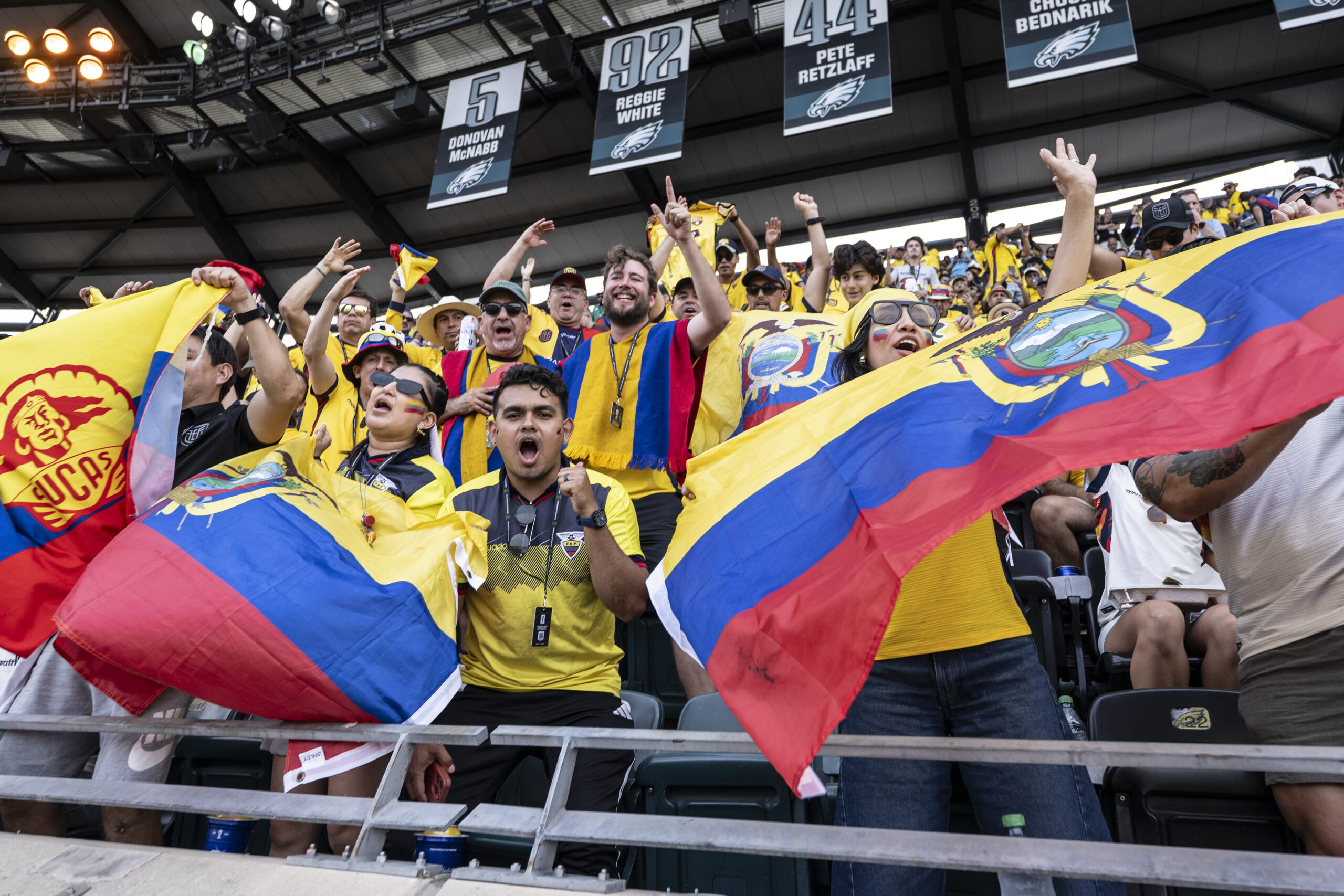
Ecuador national team fans cheer during the national anthems before the FIFA World Cup Group E match between Ecuador and Côte d’Ivoire on June 14, 2026, at Lincoln Financial Field in Philadelphia. The match marked the first FIFA World Cup game played in Philadelphia.
The six matches played in Philadelphia brought tourists from Brazil, Côte d’Ivoire, Croatia, Curaçao, Ecuador, France, Ghana, Haiti, and Iraq, but where Philly’s World Cup and America’s 250th tourists are coming from spans the globe.
Fraser McNaughton, a Scot visiting Philadelphia with family, couldn’t believe how inviting Philadelphians have been as he took photos with the Rocky statue last week.
“Everywhere we’ve went, everyone’s been so friendly, so welcoming, helping us out when we need it,” McNaughton said. “It’s just a brilliant city.”
“They go out of their way to say ‘Hello’ or ‘Welcome to Philly’ here,” said fellow Scot Michelle Thomson. “We’ve really loved it.”
Here are the main takeaways, based on flight data shared by Sojern,a hospitality marketing platform that provides travel data to hotels, airlines, and tourism boards.
(function () {window.addEventListener(‘message’, function (e) { var message = e.data; var els = document.querySelectorAll(‘iframe[src*=”‘ + message.id + ‘”]’); els.forEach(function(el) { el.style.height = message.height + ‘px’; }); }, false); })();
Ecuadorian travelers surged this World Cup
Ecuadorians don’t make up a sizable chunk of the international travelers coming to Philadelphia this summer. Canada, the United Kingdom, and Italy take that crown, in that order.
However, Ecuadorian travelers, like the Castellanoses, were so pumped to experience a World Cup in person that the number of flights booked from Ecuador to Philadelphia surged by 622% compared to the year prior. Philadelphia hosted Ecuador’s first group match in the World Cup, convincing many Ecuadorians to make the 2,760-mile trip to the City of Brotherly Love.
“It was the first game for Ecuador, so a lot of the Ecuadorians from Ecuador and the U.S. had to be here because there was a lot of expectation,” Carrión said.
To the Ecuadorian-American who lives in New York, the influx of people was facilitated by an ease of travel between the South American country and the U.S.
“It’s easier for us to travel to the States than to Europe or Qatar,” Carrión said. “And there are direct flights to LaGuardia and New York.”
Ecuadorians require visas to enter Europe, Canada, and the United States. Even traveling to Mexico can involve visa procedures if they don’t have a U.S. visa first, a formality that has become more complex since Ecuador and Mexico broke international relationships in 2024, Carrión said.
(function(){function e(){window.addEventListener(`message`,function(e){if(e.data[`datawrapper-height`]!==void 0){var t=document.querySelectorAll(`iframe`);for(var n in e.data[`datawrapper-height`])for(var r=0,i;i=t[r];r++)if(i.contentWindow===e.source){var a=e.data[`datawrapper-height`][n]+`px`;i.style.height=a}}})}e()})();
Dutch Caribbean islands show up for Curaçao
The small autonomous nations of Curaçao, Aruba, and Sint Maarten, all part of the Kingdom of the Netherlands, have seen a huge surge in flights this summer.
Curaçao had the largest increase, almost 240%, despite being the smallest nation ever, with a population of 158,006 people, to qualify for the FIFA World Cup.
“When we won tickets through the FIFA lottery for the Curaçao versus Ivory Coast in Philadelphia, we knew we had to make it happen, especially since the Curaçao match falls on my husband’s birthday,” said Vanessa Santine-Vinck, who traveled here from Curaçao with her partner and two sons.
Travel from Sint Maarten and Aruba are also up — 193% and 117% respectively.
Croatia and Hungary aren’t missing Philly’s World Cup
Croatia claimed victory over Ghana at Philadelphia Stadium on June 27, and flights from the European country have jumped almost 100%.
Neighboring Hungary has also seen a dramatic increase. There are almost 200% more flights from Hungary this summer than last summer.
Dominican Republic shows steady growth
Philadelphia’s Dominican community has grown in recent years, helping drive population growth in the city.
With the World Cup in Philly this summer, travel from the Caribbean nation has increased 34%. While DR is not in the World Cup, their neighbor, Haiti, faced Brazil on June 19, losing 3-0.
Philly’s French connection brings throngs of tourists
This summer has brought a notable uptick in French tourism to Philadelphia, with 33% more flights. The cross-cultural connection runs deep, Parisian aesthetics have long influenced the city’s architecture.
Throngs of Francophones across the city cheered on their national team to a 3-0 victory against Iraq on June 22.
(function(){function e(){window.addEventListener(`message`,function(e){if(e.data[`datawrapper-height`]!==void 0){var t=document.querySelectorAll(`iframe`);for(var n in e.data[`datawrapper-height`])for(var r=0,i;i=t[r];r++)if(i.contentWindow===e.source){var a=e.data[`datawrapper-height`][n]+`px`;i.style.height=a}}})}e()})();
France also ranks fourth in terms of total foreign travel this summer after Canada, the U.K.I, and Italy. Between the architecture, the French cuisine, and the fact that two of his family’s favorite teams, France and Côte d’Ivoire, would play in Philadelphia, traveling to the city was an easy choice for Frenchman Elias Pierson.
He had already heard of the comparisons between the city and Paris, and as he walked through Independence Hall with his family last week, much of the architecture he saw reminded him of home.
“We have a good relationship with the people of Philadelphia. We were just in the train station with a Philadelphian, and she explained to us where we needed to go and where the best French restaurants are,” Pierson said. “My favorite part of Philadelphia so far is City Hall and Old City because of the very beautiful buildings.”
Now, before Pierson heads home, he said he hopes to get a coveted seat at Philly’s world-famous French bistro, Parc.
The house: A 1,150-square-foot townhouse in Southwest Philly with two bedrooms and two bathrooms built in 1925.
The price: Listed for $180,000; purchased for $165,000.
The agent: Kristie Bergey, Coldwell Banker
The ask: Dylan Foglesong felt like he was overpaying for his apartment. He was spending $2,600 a month, plus utilities, for a two-bedroom place in Manayunk, and the money was going toward a place he would never own.
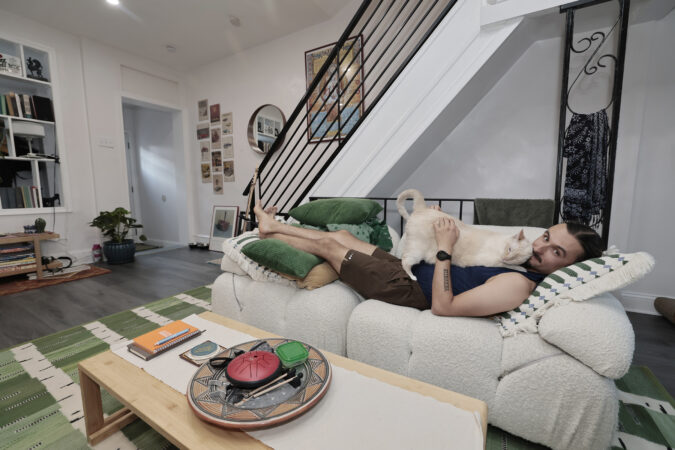
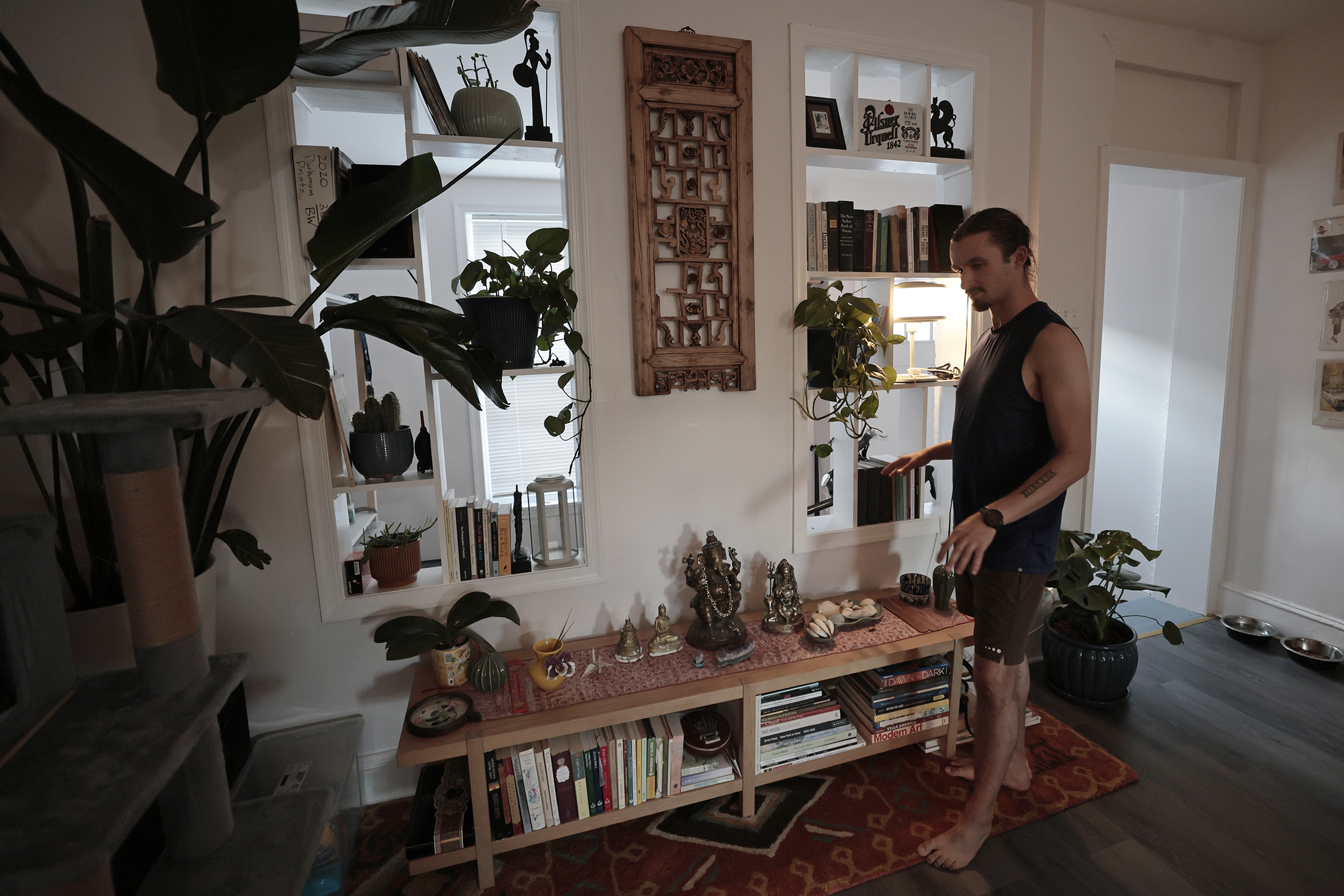
Dylan Foglesong tends to an area he calls the shrine in his home.
After six months, he paid the fee to break his lease and moved into a house with friends. His rent dropped to $600 a month, and because he was subletting month-to-month, he could leave whenever he wanted. He was saving more than $2,000 a month, and he realized he could put that money toward buying a house.
Foglesong had a simple wish list. As an avid cyclist, he wanted to be near multiple bike paths. He also wanted outdoor space, two usable bedrooms, and a low price. He did not care about central air or polished finishes. “I just wanted a cheap place that worked,” he said.
The search: Foglesong started searching in January,focusing on a small section of Southwest Philadelphia near Bartram’s Garden and the trail network along the Schuylkill. He wanted to remain close to Center City so he could bike to work.
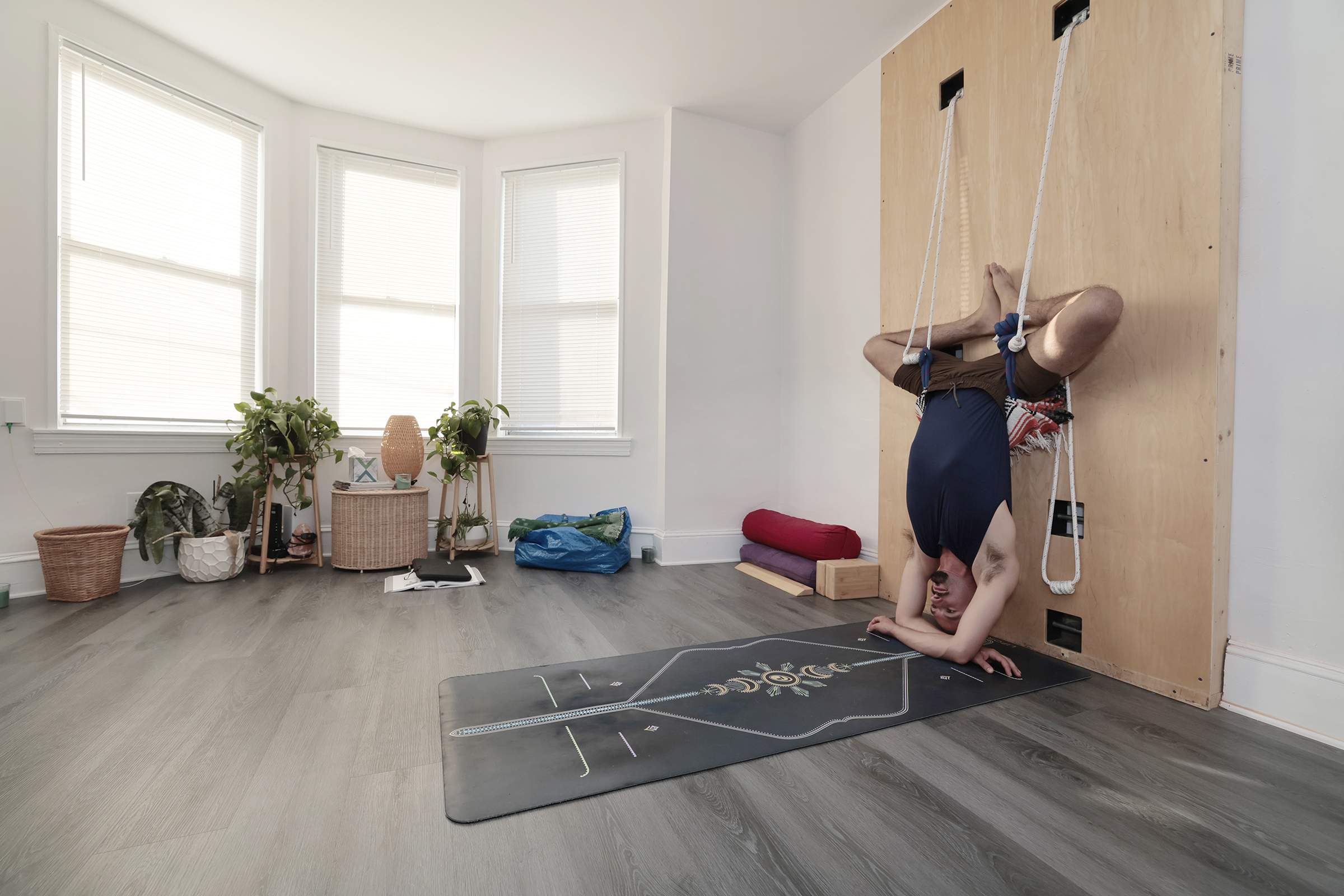
Foglesong uses the rope wall to work out in the studio of his home.
He saw five houses. The first one was in his ideal location, but the floors were scratched and coming up, the kitchen looked decades out of date, and the upstairs had the cramped three-bedroom layout he wanted to avoid. It would have taken too much work to reach a point where he was not “barfing every morning at how much of an eyesore it was,” he said.
The only other serious contender had a large backyard, a clean basement, and an updated kitchen. But a quarter of the ceiling in one upstairs room appeared to be collapsing because of a leak. The house was listed for about $212,000. Foglesong offered $190,000, figuring he could use the difference to repair the roof, but the seller rejected the offer.
The appeal: The fifth and final house had a great layout. Both rooms upstairs were large. It also recently had “a really thoughtful renovation,” Foglesong said. The updates included a new HVAC system and appliances, while the house also had a finished basement with high ceilings, outdoor space, and an enclosed front porch where he could store his bikes.
Foglesong also liked the location on a quiet side street with little through traffic. “It’s on the kind of street that you wouldn’t drive down unless you lived there or you knew someone who lived there,” Foglesong said. Most of the houses on the block were occupied, which made the neighborhood feel established.
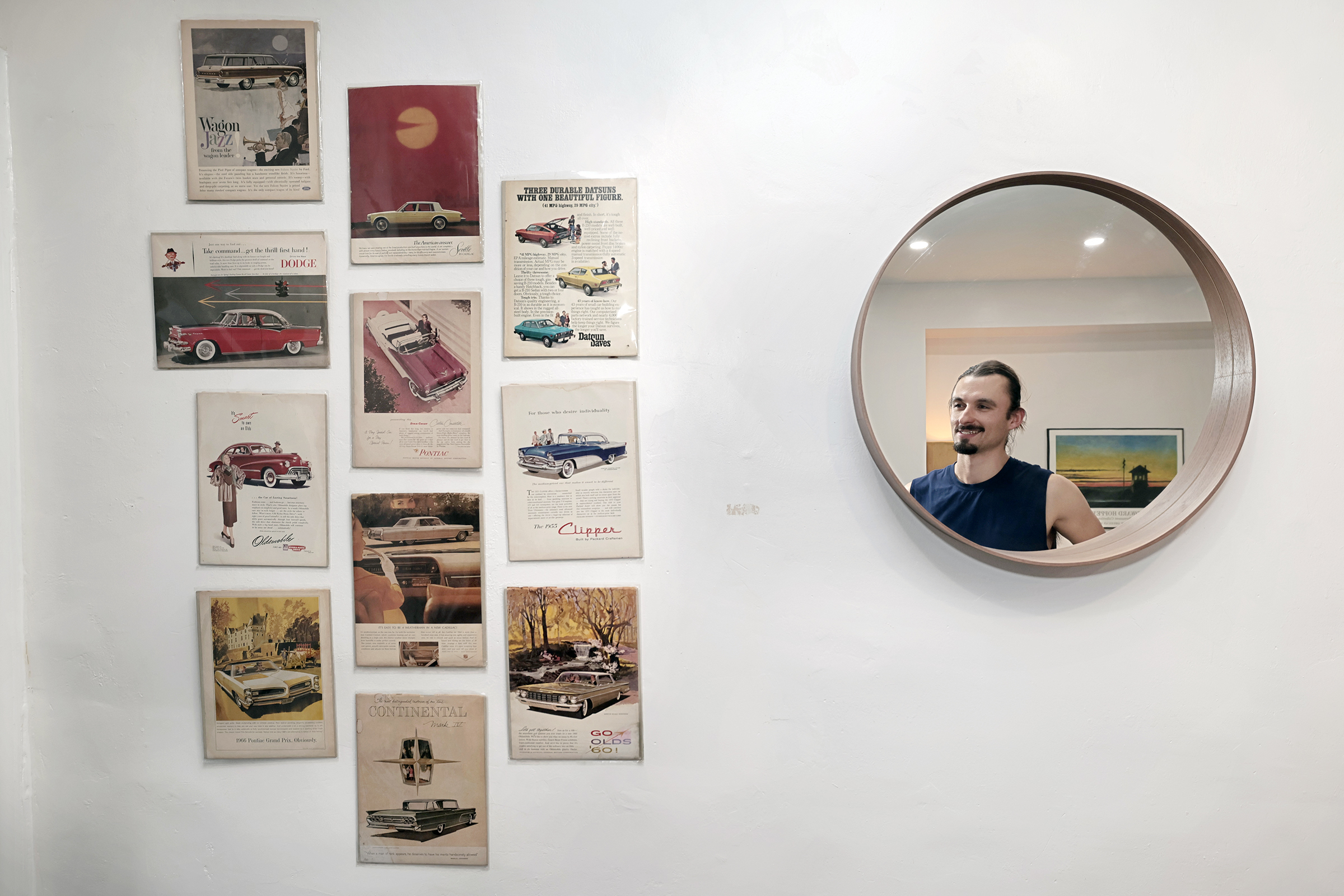
Dylan Foglesong is reflected in a mirror that hangs, next to classic car ads, in the foyer of his home.
The deal: The house had initially been listed for a little more than $181,000 before the seller lowered the price to $180,000. It had been on the market for roughly five months by the time Foglesong saw it.
He offered $170,000 and asked the seller to contribute 3% toward closing costs. They declined the closing assistance but countered at $165,000. The lower price ended up saving Foglesong the same amount of money, so he accepted.
The inspection was clean, save for one issue with the electrical. When Foglesong called Peco to arrange service, he learned that the house was not legally connected, even though the power was on. An electrical inspection found that the breaker box needed work, and the seller hired an electrician to set it up properly. But Foglesong still could not transfer the service into his name until the seller paid thousands of dollars in outstanding utility balances. The whole thing “seemed a little sus,” Foglesong said, but it worked out.
The money: Foglesong put 3% down, or $4,950. Including his closing costs, he paid about $11,600 out of pocket to buy the $165,000 house. His mortgage rate is 6.25%. Today, his monthly payment, including property taxes, is $1,300.
He already had some savings when he moved in with roommates, but the drop in rent allowed him to build the rest quickly. He estimates that he was saving nearly $3,000 a month. Within 3½ months, he had accumulated enough to cover the down payment and closing costs. “You take that little compromise for a couple of months,” Foglesong said about moving in with friends, “and all of a sudden you have $11,000 in your bank account.”
The move: Foglesong closed in April and moved his belongings from the shared house into a 10-foot U-Haul. Everything fit in one load, and he completed the move over two days without hiring movers or asking friends to help.
He managed it alone because he did not own much heavy furniture. His couch comes apart into sections, and he sleeps on a futon that he could fold and carry over his shoulders. For everything else, he improvised. “You put a blanket on the stairs, slide the furniture down,” Foglesong said. “You figure it out.”
Life after close: At first, buying the house felt less momentous than Foglesong expected. He had imagined “a really grand, movie-montage sequence,” he said, but moving in felt much like any of the other moves he had made during his 10 years in Philadelphia.
But as the weeks passed, the difference between his new home and the others became clearer. He was no longer paying rent for a place that belonged to someone else. He owned the house, and the monthly payment was within his budget. “It’s very grounding to wake up in a place that you can afford,” Fogelson said.
The experience also reinforced his belief that young buyers may need to reconsider what they expect from their first home. “You have to be realistic about what you can access right now,” Foglesong said. “Your first house doesn’t have to be your dream home.”
Editor’s note: This article has been updated to correct real estate agent Kristie Bergey’s name.
Did you recently buy a home in the Philadelphia area or South Jersey? Share the story of how you did it. Email Inquirer real estate reporters at properties@inquirer.com.
Philadelphia historian, author, and educator Michelle Craig McDonald knows her coffee. Especially the revolutionary kind.
McDonald, who serves as an academic adviser for PBS’s series Drive By History, is the author of the new book, Coffee Nation: How One Commodity Transformed the Early United States.
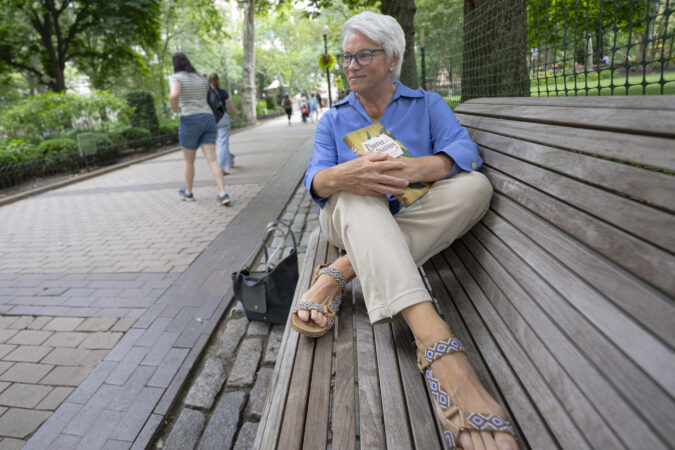
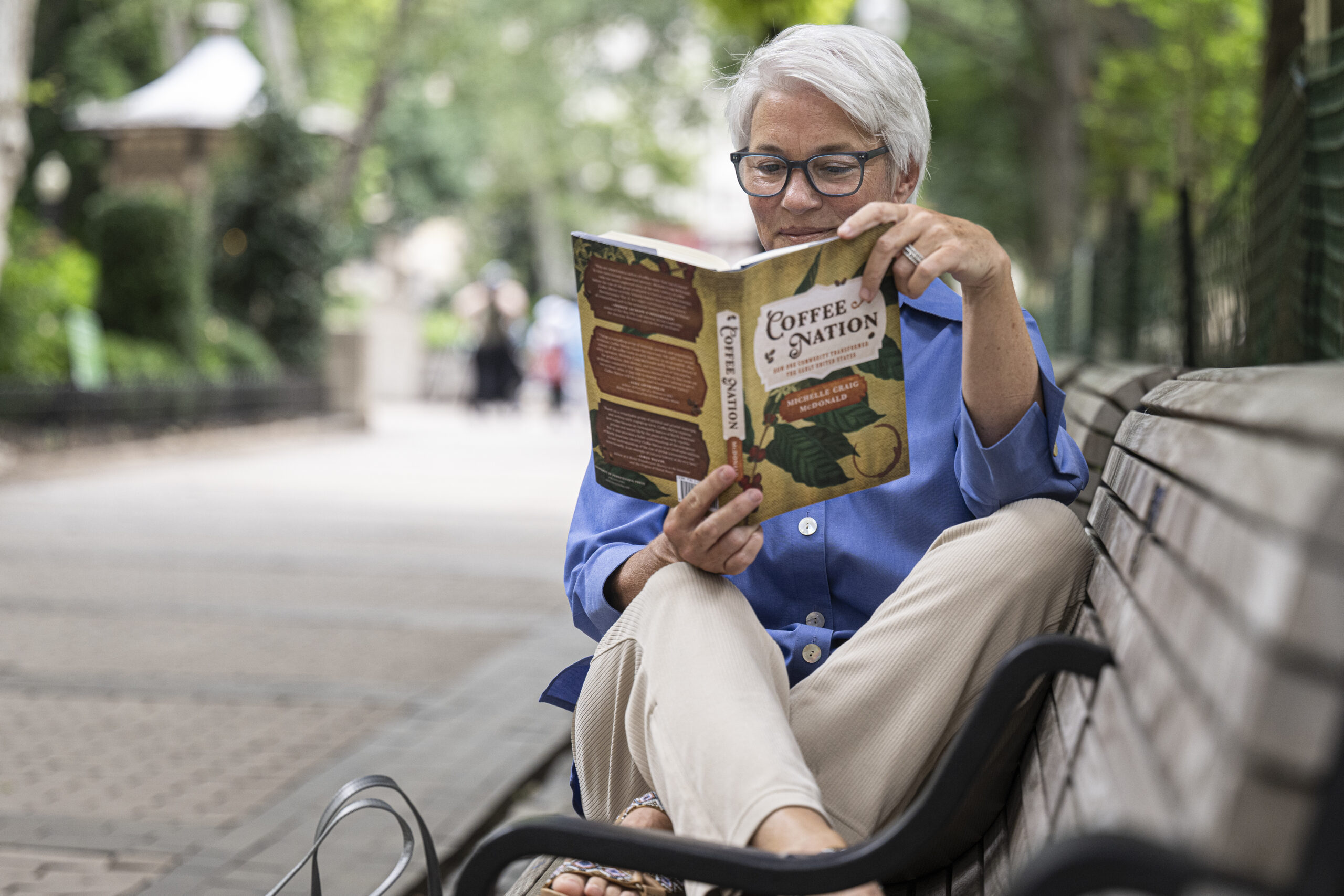
Philly historian and educator Michelle Craig McDonald enjoys reading in Rittenhouse Square Park. She is the author of “Coffee Nation: How One Commodity Transformed the Early United States.”
Telling the story of America and coffee, McDonald traces the bean’s beginnings from slavery-based plantations of the Caribbean and South America in the early 1700s through its prominence in Colonial life to the rebranding of the exotic good as an American staple. McDonald details the emergence of coffee shops, like the Old London Coffee House at Front and Market Streets, as critical Revolutionary-era hubs for politics and business.
“Within 50 years of our independence, the United States becomes one of the largest suppliers of coffee to the world — but we can never grow it,” said McDonald. So in this moment, when we think about independence, coffee really reminds us that the United States remains deeply tied and deeply embedded with the economies of the region. It was not just a self-sustaining nation that looked inward.”
Given the nature of her research, it’s no surprise that McDonald’s Perfect Philly Day revolves around food and drink. McDonald, a Southern California native who lives in Rittenhouse Square with her husband and fellow historian, Roderick A. McDonald, said her perfect day includes lots of coffee and cooking, a great Philly workout, and reading crime novels in Rittenhouse Square.
6:30 a.m.
My coffee pot is my first spot. I’m going to need fortification if I’m going to tackle the day’s news. I just go with the tried and true Colombian roast from Trader Joe’s.
When we are down the Shore, my favorite comes from Remedee Coffee, started by two sisters who source their beans from Colombia. It’s a great small business.
On a perfect day, this is when we do our New York Times games — like Connections or Wordle — which we do together. My sister says it’s cheating. I like to say it’s “collaborating.”
8:30 a.m.
I love cooking of all kinds, but baking is my first love. My go-to on a perfect day is a batch of scones. I have a recipe that I got online from a website called Love and Lemons. It’s a base recipe. You can make anything you want. Cranberry, orange walnut, apricot, ginger almond, or my brother-in-law’s favorite, which I know because he buys the ingredients every time I visit, blueberry lemon.
I used to head over to Metropolitan Bakery on 19th Street, which I am still mourning the loss of.
I loved their Millet Muffins and raisin walnut bread. My freezer is stuffed with both because I bought as many as I could before they closed. And I’m slowly rationing them so I don’t lose them quickly.
9:30 a.m.
We have a solid division of labor in the household. I do the cooking. But my husband does the shopping. While the scones are in the oven, he may well be on his way down to the Italian Market on his vintage 1962 Schwinn bicycle — expertly serviced by Curtis at Via Bicycle on Broad Street. He’s a fan favorite!
My husband is the provisioner of the house. I get to take what he brings back from the list — and sometimes not from the list. It feels like my own personal version of Chopped. He comes home with five ingredients and says, “What can you do with this?’”
10 a.m.
I’m hitting the gym. I do love eating, which means I need to pay the piper. I go to Pure Barrein Center City. It’s wonderful. It’s a class — a core-based workout that does weightlifting, planks, pushups. An hour there, any day I can get it, gives me enough brownie points for the rest of the day’s culinary adventures.
If the weather is nice, we might substitute a bike ride down the Schuylkill River Trail. Manayunk is a great destination.
Noon
That’s when Small World Seafood is in the area with deliveries. It’s an Old City business that was born out of necessity. The owner provided fresh seafood to restaurants during the COVID-19 pandemic. Then he began an online business selling directly to customers. You can get anything — halibut, skate steaks, steelhead trout, oysters, clams — for a lazy cooking night.
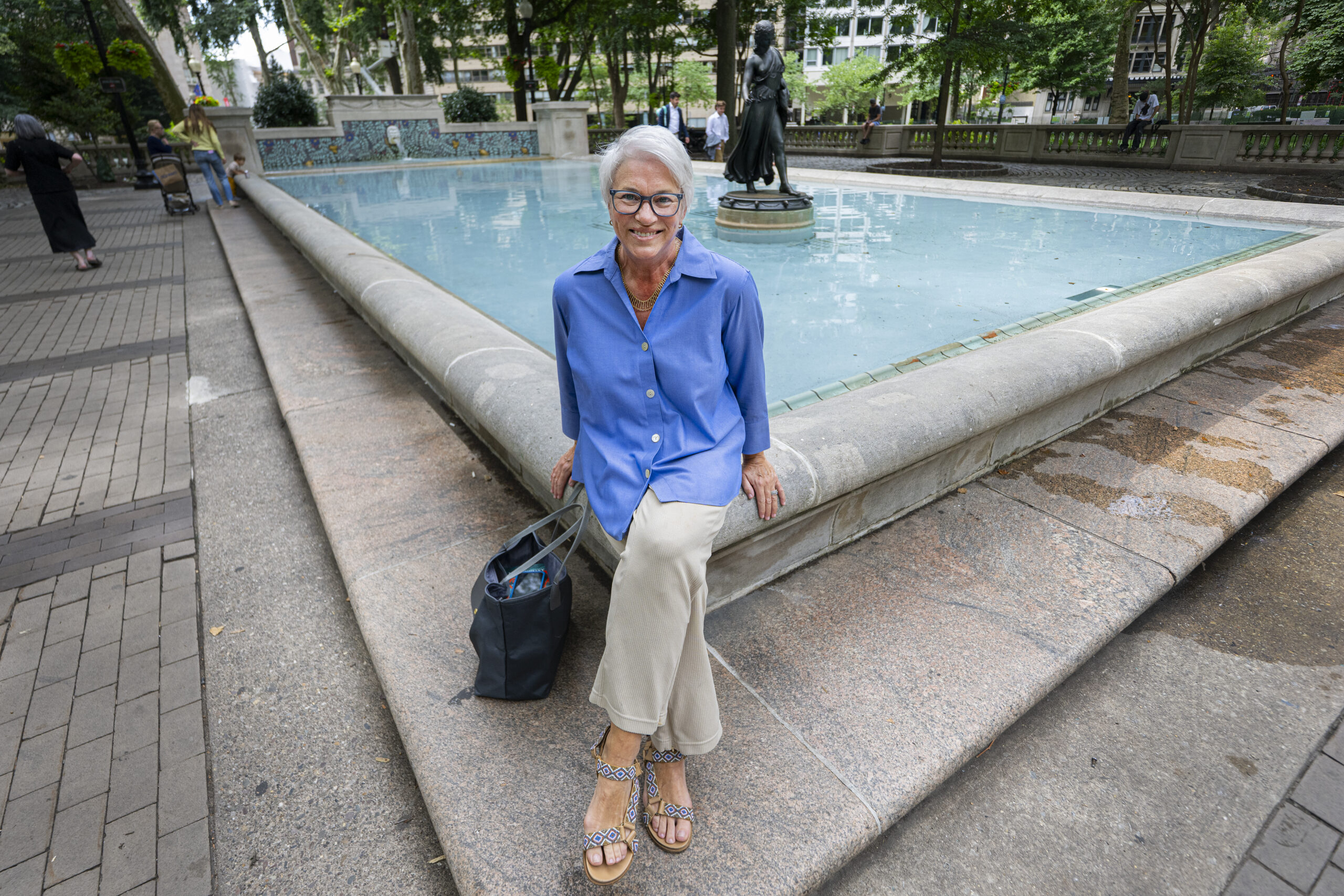
Michelle Craig McDonald’s perfect Philly day includes lots of coffee and cooking, a great Philly workout, and reading crime fiction in Rittenhouse Square.
1 p.m.
I’ve got the fish and I’m marinating it for dinner. Steelhead trout is one of my favorites, so super easy, a little bit of soy, a little bit of orange, a little bit of brown sugar, a little bit of maple, and garlic.
2 p.m.
On a perfect day, when I can while my time away, you will find me reading in Rittenhouse Square. I have an abiding passion for crime fiction. Ann Cleeves. Donna Leon.
And if it’s not great weather, you could still find me reading, but probably in one of any of a dozen coffee shops that are within walking distance of my house.
There was a great article that just ran recently in The Inquirer about the rise of Yemeni coffee shops in the city, such as Moka & Co.
3 p.m.
This is where it’s going to get busy. I would be remiss if I didn’t bring a little history and culture into this day. The American Philosophical Society has a wonderful project called “The Revolutionary City: A Portal to the Nation’s Founding.” It’s a partnership where five Philadelphia historical institutions — the APS, the Library Company of Philadelphia, the Historical Society of Pennsylvania, the Kislak Center at Penn Libraries, and the Museum of the American Revolution — came together to plan for 2026, and all their exhibits build on each other. Now I know that’s a long afternoon. Readers can pick and choose and see the others on their second favorite perfect Philly day [laughter].
6 p.m.
My husband and I cook together. If it’s Saturday, the compulsory listen is “The Many Moods of Ben Vaughn.” Cooking is my way to unwind and my husband is an excellent sous chef.
8 p.m.
We tend to have a leisurely meal with a glass of wine or two, and review the day’s exploits. An episode of television in the evening is a good escape. We are huge PBS fans. We love British crime dramas. We are huge fans of Shetland, a Scottish crime drama, and Vera, an old British crime drama with a curmudgeonly police detective.
10 p.m.
I am not a night owl. But I will confess to a wee dram of bourbon most evenings. Then, a little more light reading. And it’s time for lights out.
This interview has been edited for length and clarity.
O little town of Bethlehem, how we see thee as just a place to visit during the holidays.
It’s true that the former steel city, tucked between Allentown and Easton along the Lehigh River, leans into — and has built a whole tourism industry around — its Christmas-themed name and roots, but there’s much more to Bethlehem than carols and holly.
The forest and river beckon in summer, and the city’s position along the Delaware and Lehigh Trail, which parallels the Lehigh Canal, puts visitors within easy access of both.
There’s an old-fashioned ice cream parlor, a grand historic hotel, a blueberry festival, even a UNESCO World Heritage Site. And if you really, really need a dose of holiday spirit, Christmas in July is right around the corner.
Bethlehem’s main street (literally, Main Street) twists up from the Lehigh River and stretches like taffy into a long straightaway lined in shops and cafes. At the foot of this drag is Hotel Bethlehem, built atop the 1741 foundation of the First House of Bethlehem and later the 1823 Golden Eagle Hotel. It has operated as Hotel Bethlehem — through periods of both glamour and neglect — for more than a century. Today, its crimson neon sign glows above the brick facade, while its rooms blend industrial touches with classic historic design. Across the street, a collection of modern suites houses the hotel’s spa. The property has been named the nation’s best historic hotel by USA Today, for five years running.
Cross the river to the South Side Historic District for breakfast — think vanilla-cinnamon French toast or loaded home fries bowls — or lunch, with options like a Cuban sandwich or cheddar-jalapeño burger. Cafe the Lodge is more than a charming cafe with a courtyard garden and art gallery. Since opening in 2012, it has provided transitional employment and housing opportunities for adults living with mental health diagnoses.
📍 427 E. Fourth St., Bethlehem, Pa. 18015
See: Moravian Church Settlements
Long before the Protestant Reformation, the Moravians were establishing a religious movement in Central Europe. Fast-forward a few centuries, and the Moravian church established an American foothold in Bethlehem whose well-preserved 18th-century buildings, cemetery, and museum now form part of the only transnational UNESCO World Heritage Site in the U.S. (sister settlements in Ireland, Denmark, and Germany comprise the collective). The Moravian Church Settlements tour explores this fascinating history, whether you’re interested in religion or simply great storytelling.
You gotta love a small-town summer fruit festival, and Bethlehem goes all in on blueberries every July. The 39th annual Bethlehem Blueberry Festival returns to Burnside Plantation the weekend of July 18 with blueberry pie, ice cream, coffee cake, lemonade, doughnuts, strudel, and just about every other indigo-colored treat imaginable. There are also live musicians, blacksmithing demonstrations, baby-goat snuggling and, naturally, a pie-eating contest. Resist the urge to yell, “Violet, you’re turning violet, Violet.”
📍 1461 Schoenersville Rd., Bethlehem, Pa. 18018
Move: Historic Bethlehem River Tours
There’s no need to decide between a paddle down the Lehigh River or bike along the Delaware and Lehigh Trail with Historic Bethlehem River Tours. Their Glendon Dam Discovery package, which launches from the Nagy’s Landing trailhead just east of downtown, pairs a peaceful two-mile downstream paddle with a six-mile bike ride to the dam’s overlook. It’s beginner-friendly and unguided, meaning you can go at your own pace, with HBRT providing all the equipment (and a shuttle back if you’re feeling lazy).
Named after a wild mushroom, Bolete isn’t just one of Bethlehem’s best restaurants. It’s one of Pennsylvania’s best restaurants. Chef-owner Lee Chizmar serves an exactingly prepared, terroir-driven menu in a stone-walled former country inn dressed with maximalist wallpaper and antique lighting. Depending on the season, you might find smoked pork chop with cherries and shiitakes, or foie gras paired with funnel cake, blueberries, and Valley Milkhouse fromage blanc.
If a town has a historic ice cream stand, and it’s summer, you should proceed immediately there for dessert. Bethlehem’s is the Bethlehem Dairy Store, a low-slung diner with neon sundaes and hot dogs in the windows that’s giving Nifty Fiftys. But “The Cup,” as locals call it, far predates Nifty, opening way back in 1927. Hand-dipped ice cream, soft serve, frozen yogurt, and sherbet comprise the roster of frosty treats, coming in flavors like dulce de leche, lemon cookie crunch, chocolate raspberry truffle, and mint Oreo.
Happy 250th, America! We’ll show you a July Fourth-themed photo taken in the Philly-area, you drop a pin where you think it was taken. Closer to the location results in a better score. Good luck!
Round #40
Question 1
Where are these fireworks?
Loading…
ClickTap on map to guess the location in the photo
ClickTap again to change your guess and hit submit when you're happy
You will be scored at the end. The closer to the location the better the score
Charles Fox / Staff Photographer
Pretty good/Not bad/Way off! Your guess was from the location.Spot on! Your guess was exactly at the location. Here's also where a random selection of Inquirer readers guessed.
Fireworks over the Philadelphia Museum of Art and the statue of George Washington at Eakins Oval during the Wawa Welcome America Festival on July 4, 2023.
Quiz continues after ad
Question 2
Where is this crowd?
Loading…
David Maialetti/ Staff Photographer
Pretty good/Not bad/Way off! Your guess was from the location.Spot on! Your guess was exactly at the location. Here's also where a random selection of Inquirer readers guessed.
The crowd gathered at Independence Hall is seen through the “O” in the OY/YO sculpture across the street during the Wawa Welcome America Salute to Independence Day Parade on July 4, 2023.
Quiz continues after ad
Question 3
Where is this ceremony?
Loading…
Tyger Williams / Staff Photographer
Pretty good/Not bad/Way off! Your guess was from the location.Spot on! Your guess was exactly at the location. Here's also where a random selection of Inquirer readers guessed.
Thirteen Immigrants are sworn in as American citizens at the Betsy Ross House on July 15, 2021.
Your Score
ARank
🇺🇸 Amazing work. A star-spangled success.
BRank
📜 Good stuff. Your knowledge is self-evident.
CRank
📝 C is respectable, but you might need a few amendments.
DRank
🗽 D isn’t great. Life, Liberty, and the pursuit of improvement.
FRank
🪶 We don’t want to say you failed, but maybe back to the drafting board.
You beat % of other Inquirer readers.
We’ll be back next Saturday for another round of Citywide Quest.
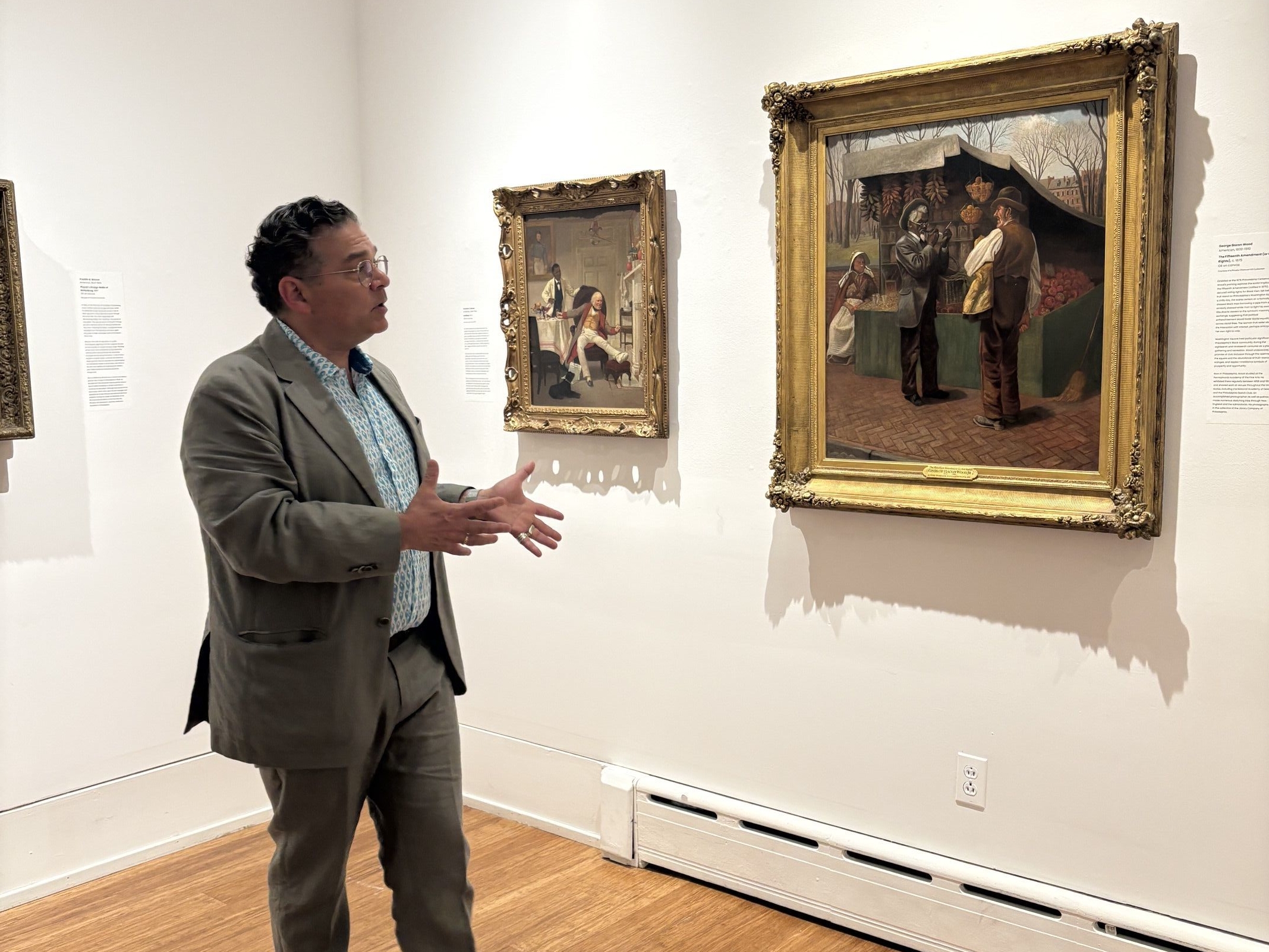
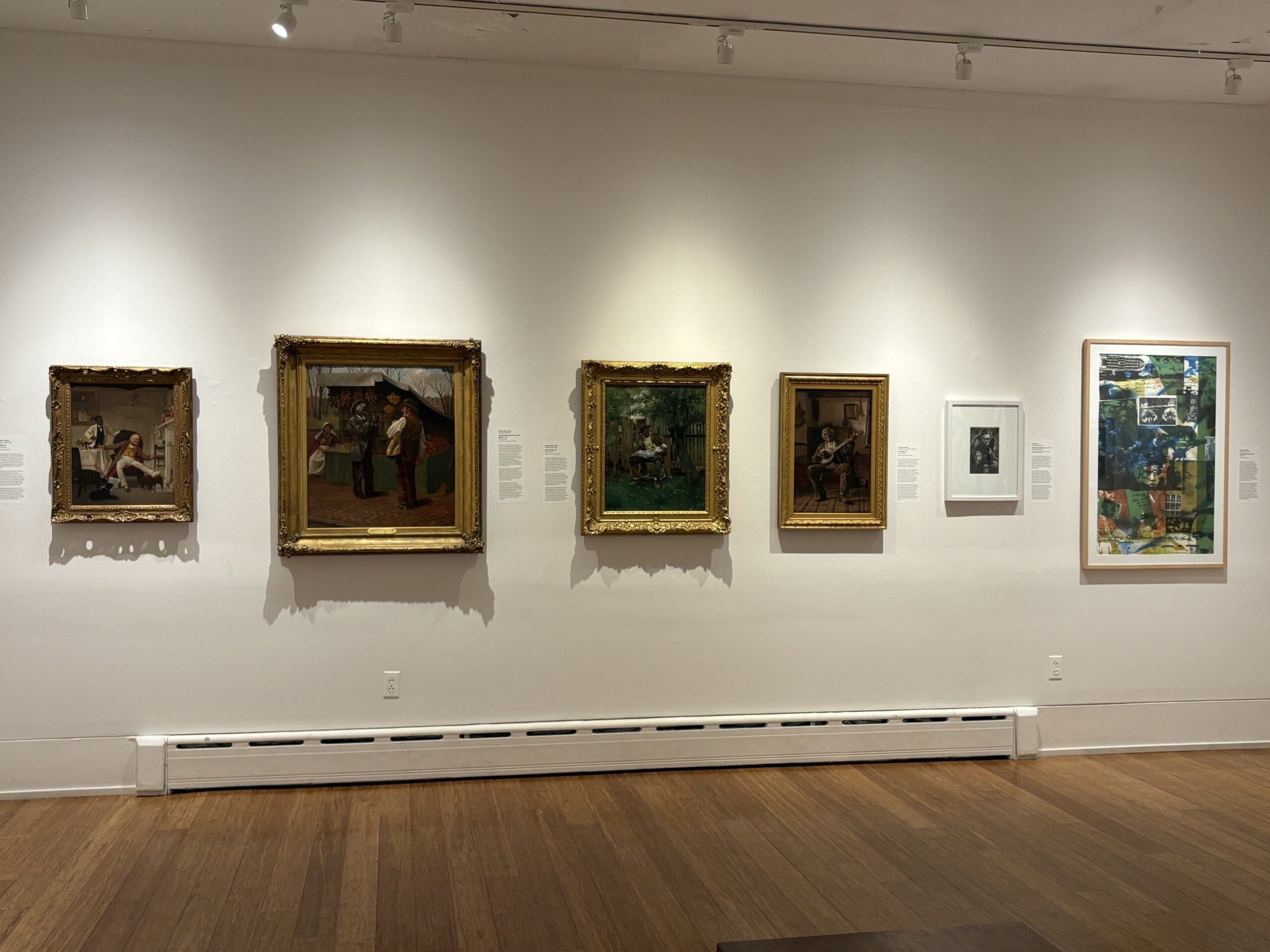
Last week, Woodmere director William R. Valerio stood in front of six vibrant works in Woodmere’s Charles Knox Smith Hall’s Antonelli Gallery.
Behind him were two works by Philadelphia painters Francis Coates Jones and Thomas Hovenden, both depicting an elderly Black person named Sam, who lived in the Germantown/Chestnut Hill area, enjoying moments in nature. Another work, a Dox Thrash etching of a man holding a banjo, suggests he’s more than an entertainer; he’s also an introspective thinker.
Woodmere director William R. Valerio discusses the “Arc of Promise” exhibition, featuring the work of Philadelphia artists who portray Black people with humanity. A number of the works are from the Civil War era.
Contemporary artist Allan L. Edmond’s lithograph, America’s Bicentennial, features luminaries Frederick Douglass, Martin Luther King, and Barack Obama alongside scenes of African American struggle and achievement.
What if America in the 19th century — when many of these works were made — embraced Black men’s humanity? Valerio asked, sparking my own questions.
What if we came to terms with how unfair treatment of women, minorities, and immigrants in the past impacted our lives today?
Would America be a different place?
These questions find answers in every nook, cranny, and inch of Woodmere’s “Arc of Promise” exhibit. Each painting, ceramic, map, or mixed media collage speaks to how Philly artists — from the 17th century through today — envisioned the idea of America.
From left to right, “Untitled,” 1874; by Charles V. Brown; Francis Coates Jones; “The Fifteenth Amendment (or Civil Rights), George Bacon Wood, 1875; “Left in Charge,” 1882; Thomas Hovenden, “I’s So Happy,” 1882; Dox Thrash, “Played Out” c. 1937; “American Bicentennial,” Allan L. Edmunds. These photos show the humanity of Black men during an era when art didn’t portray them as such.
But there are also several important works on loan including protest photography by Harvey Finkle and a mixed-media necklace by Teri Hislop, a member of the Lenape Nation of Pennsylvania. Henry Bermudez’s Miss America, completed in 2019, offers a layered vision of America through migration, mythology, and identity. It sits next to sculptor Hiram Powers’ “America,” in which 19th-century America is depicted as a Greek goddess.
There is a lot of pomp, circumstance, and sparkle in this lively retrospective. The must-see gallery, however, is the Schnader Gallery Hall because it includes a pristine collection of refurbished American landscapes by local 19th-century artists Frederic Edwin Church and James Hamilton featuring many a Schuylkill waterfall. Think of this gallery as a place to retreat after a bustling Fourth of July weekend.
“Arc of Promise” takes its name from watercolor artist Jerry Pinkney, a longtime friend of the Woodmere who used the term as a way to speak to an America of unfolding potential, despite its past unequal treatment of Black people, immigrants, and women.
“Arc of Promise” runs through Nov. 2, 2026, Woodmere’s Smith Hall is located at 9201 Germantown Ave.
— Elizabeth Wellington
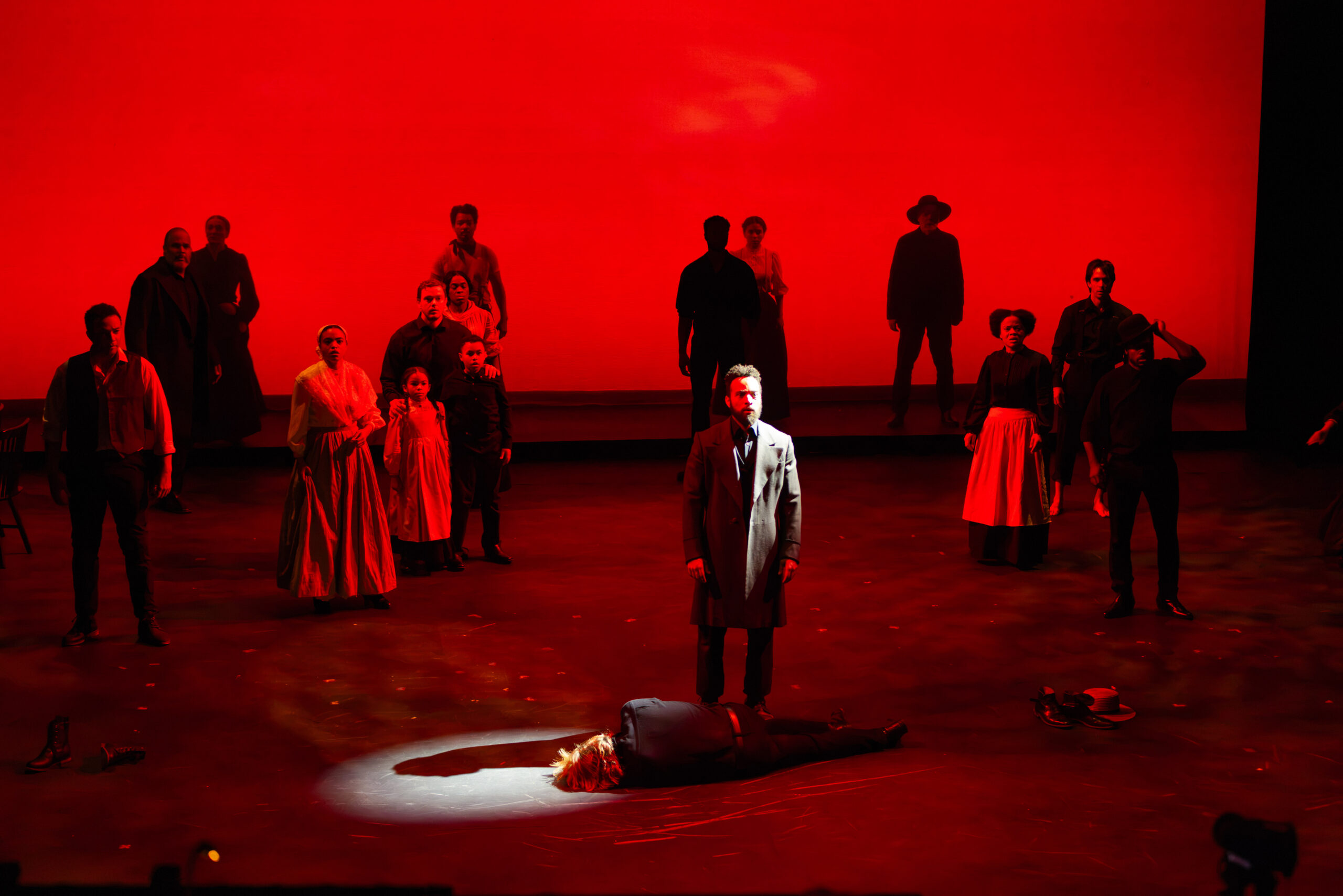
Actor John Clarence Stewart as the titular character in “Basil Biggs” at the Wilma Theater.
Excavating history with ‘Basil Biggs’
There is something so powerful about seeing someone grapple with their personal experience of American history. As Semiquincentennial fanfare reached a fever pitch in Philadelphia, this workshop of a developing play by actor/playwright Anna Deavere Smith was a deeply moving performance about her great-great-grandfather, Basil Biggs, a conductor on the Underground Railroad. Smith learned of him in an episode of Finding Your Roots; even then, she knew his story was worthy of a play, though she didn’t start writing until a decade later.
Biggs was a veterinarian and farmer in Gettysburg during the Civil War, a free Black man who helped fugitives escape slavery and who buried the tens of thousands of soldiers who died in the war’s bloodiest battle. The Biggs family house still stands today, and Smith visited the grounds, as well as the Adams County Historical Society, while she researched the time period. There was little historical documentation about her family, so this work is narrative speculation, based on her research of the time period, much like groundbreaking scholar Saidiya Hartman’s critical fabulation: In the absence of records about African Americans, visionaries use archival materials to imagine the lives of those largely erased from written memory.
Smith crafted a riveting world that showcased fierce resilience, disarming humor, and profound empathy during a painfully divided time. The story is fueled by original music from actor/violinist Edward W. Hardy. It was an honor to experience one of the earliest presentations of this play, which will likely grow into a major production. It’s the kind of honest work about this nation’s bloody, conflicted history that feels like essential viewing for anyone who calls themself a patriot.
“Basil Biggs” ran June 26-28 at the Wilma Theater as part of ArtPhilly’s What Now: 2026 festival.
— Rosa Cartagena
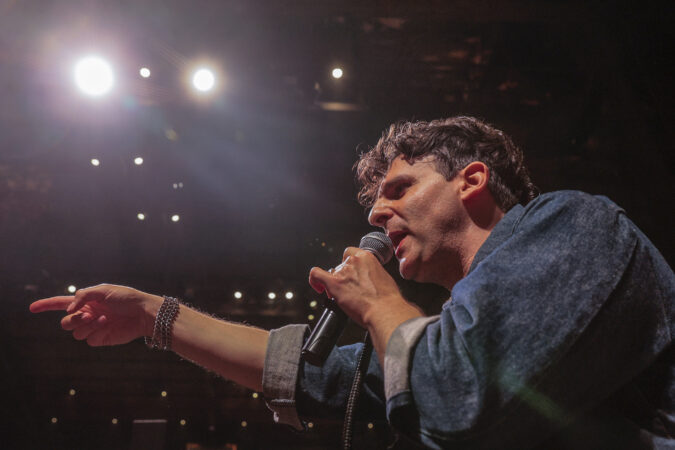
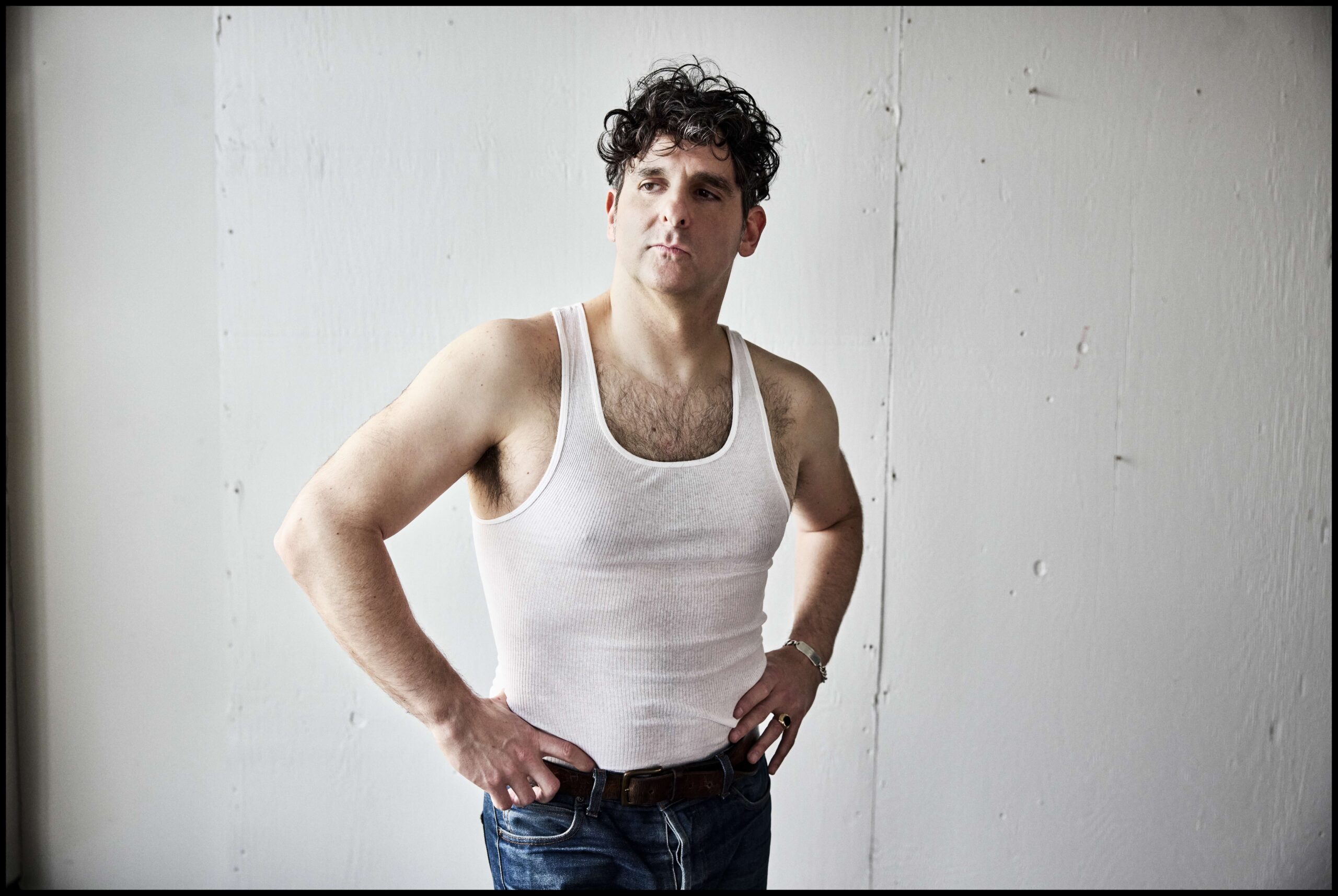
Adam Weiner of Low Cut Connie. The band’s new album is “Livin’ in the U.S.A.”
Romping, stomping, piano-pounding resistance with Low Cut Connie
Adam Weiner of Low Cut Connie has stressed that the band’s eighth studio album, whose release is timed to America’s 250th birthday, is an act of resistance.
Shortly after becoming one of the first artists to cancel at the Kennedy Center after the Trump administration’s takeover of the D.C. institution in early 2025, Weiner recorded what became the title song.
As he explains in an explanatory note that accompanies the album, it addresses “the atrocity of ICE, authoritarianism, racism” and led to a full set of songs “about the times we are living through in America 2026.”
But while Weiner’s political stance is unequivocal — “I made this album to say f— you to this regime, to the brutality, and inhumanity of our tech leaders,” he writes — his music is much more subtle.
Many of the titles like “Oh Yeah” and “Get Down” on Livin in the USA are essentially party songs: romping, stomping, piano-pounding, and saxophone-wailing celebrations of diversity and sexuality that aren’t the slightest bit preachy or pedantic.
Singing a gospel of self-liberation, Weiner is accompanied by the touring LCC band, which includes singer Amanda “Rocky” Bullwinkel,” guitarist-sax player Kelsey Cork, and drummer Jarae Lewis. Occasionally, as in the grinding “Human Condition,” the songs are overt in their condemnation of life during Trump time, which he likens to “living in a house of detention.”
But in general, he heeds lessons learned from favorite albums like Bruce Springsteen’s Born in the USA and Sly and the Family Stone’s There’s a Riot Goin’ On. When delivering a heavy message, always keep the groove going and the rock rolling.
“Just because the world is collapsing,” Weiner writes in his Livin album note, “doesn’t mean we can’t go skinny dipping this weekend.” “Can’t Be Wrong” is perhaps the most grabby earworm in a tight, 10-song set whose energy never flags. In that song, the prospect of “gettin’ naked in the afternoon, or maybe later underneath the moon” leads to an obvious conclusion: “Oh babe, you know it can’t be wrong.”
“Livin in the USA” releases July 3
— Dan DeLuca
Remembering LGBTQ+ activists
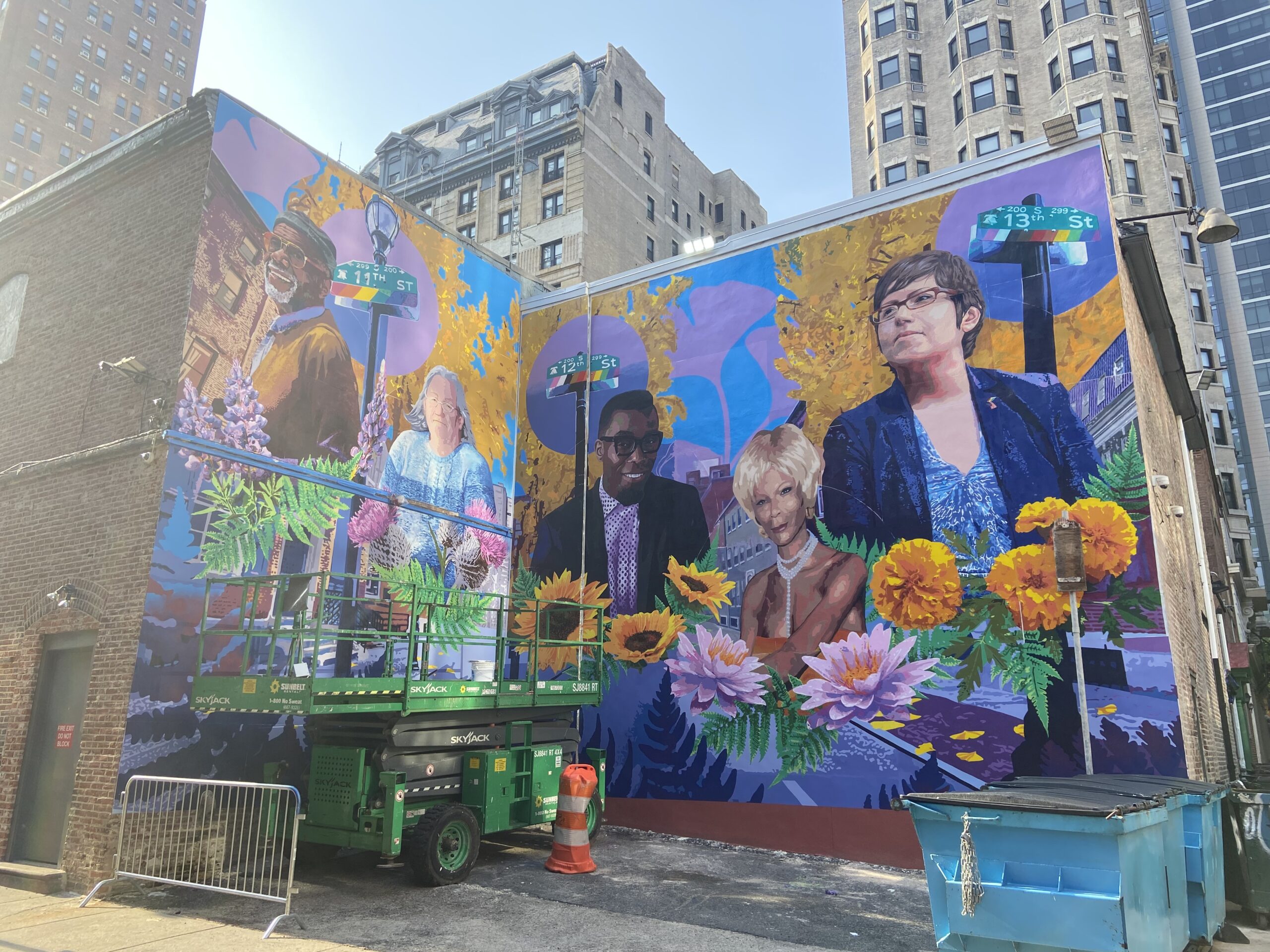
Resting in peace can also mean resting in pride and power. A new Gayborhood mural provides a tribute that does exactly that.
In Pride, In Power, In Memory is located on the side of Voyeur Nightclub at 1221 James St., a prominent spot amid Philadelphia’s queer nightlife.
The mural is located outside of Voyeur Nightclub in Philadelphia’s Gayborhood.
Painted by artist Santiago Galeas, the mural displays portraits of Gloria Casarez, Michael S. Hinson Jr., Tyrone Smith, Nizah Morris, and Dawn Munro; all LGBTQ+ activists who called Philadelphia home.
Each figure is accompanied by a flower symbolizing the person’s life and identity; Casarez’s portrait is adorned by Mexican marigolds, for example, as a nod to her heritage. The faces were all drawn referencing photos of them looking hopeful and optimistic.
The mural is strikingly bright, with vivid shades of purple and yellow illuminating the portraits.
These trailblazers pursued several kinds of activism in their lives, including AIDS awareness, trans rights, and community organization to rally for queer rights. Without them, the status of Philadelphia’s acceptance of the queer community may have looked completely different today.
“In Pride, In Power, In Memory”is located on the side of Voyeur Nightclub at 1221 James St.
ARIES (March 21-April 19). Freedom is not only the ability to go where you please. It is the ability to become who you are. Trust your own judgment. Celebrate the choices that make your life feel more fully your own.
TAURUS (April 20-May 20). Bravery means continuing even when the outcome isn’t guaranteed. On some level, there are no guarantees on this plane of existence, so it takes a certain amount of courage just to live an ordinary day. But you take it to another level, doing the extraordinary with a brave heart.
GEMINI (May 21-June 21). Fireworks begin as stored energy waiting for release. So do many dreams. Something you’ve been imagining is ready to move from possibility into action. The first actions will have to do with preparing your workspace with the intent of “safety first.”
CANCER (June 22-July 22). You embody the pursuit of happiness. Freedom is not only about escaping limitations; it’s also about moving toward what delights you. There’s a playful quality to this day you spend in the pursuit of experiences that put a smile on your face.
LEO (July 23-Aug. 22). Consider what deserves your allegiance and what does not. Decide which values to lead with. What needs to happen for these values to be represented in your daily life? In a sense, every habit is a vote for your values.
VIRGO (Aug. 23-Sept. 22). For you, freedom is not the absence of responsibility but being able to choose your commitments instead of being assigned them. Because you know who you are, it’s not hard to distinguish the path that best suits you.
LIBRA (Sept. 23-Oct. 23). You believe groups are strongest when many different voices find a way to share the same table. You have a gift for bringing people together without requiring them to be alike. Your curiosity and respect create a harmonious atmosphere wherever you go.
SCORPIO (Oct. 24-Nov. 21). Like a bald eagle riding a thermal high above the landscape, you gain perspective by rising above the immediate situation. Details fit into a larger context. From this altitude, you see where the path on the ground leads.
SAGITTARIUS (Nov. 22-Dec. 21). Independence is not isolation. You can be independent with people around you or while working as part of a team because independence is a spirit inside you. The point is not to stand apart. The point is to stand firmly in your own choices.
CAPRICORN (Dec. 22-Jan. 19). Fireworks last only moments, but the planning behind them takes time. You understand this principle well. The visible result is never the whole story. Your preparations will culminate into just the “wow factor” you were going for.
AQUARIUS (Jan. 20-Feb. 18). Here you go again, expanding the definition of what is possible. Because why preserve old systems when you can improve them? And you’re so good at attracting others willing to experiment and create. Together you’ll flesh out an unconventional idea.
PISCES (Feb. 19-March 20). There is magic in simple togetherness. Some of the happiest moments happen around a picnic table or at a backyard gathering. It’s all about just plain fun. That’s how freedom rings for you, and the sound carries on and on.
TODAY’S BIRTHDAY (July 4). It’s your Year of the Lucky Lamp. Like the legendary lamp of Aladdin, it is not the object itself but what it awakens that matters. Opportunities and helpers appear when called upon with intention. And your wish for more love comes true first. More highlights: A person with influence becomes an ally. A purchase improves life in lasting ways. Milestones for family are a huge point of pride and purpose. Sagittarius and Gemini adore you. Your lucky numbers are: 7, 18, 29, 3 and 14.
DEAR ABBY: I have been married to my husband for 10 years. Ever since I have known him, he has had issues with depression and anxiety. I have tried to support him through these diagnoses.
He has attempted to go to therapy several times, but he never sticks with it. Once the therapist gets to the point where they start to get into what he needs to work on, he quits. He claims no one understands what he is going through. This has impacted every aspect of his life — sleep, eating habits and his controlling attitude toward me. He also works out excessively (like five hours a day).
It has also affected his ability to enjoy life and his job. He takes a lot of time off work, claiming he needs the rest, but he doesn’t rest. He does other things. When I say he needs to go to work like everybody else, he gets mad. His employer is now on his case for excessive absences. He refuses to take responsibility and says his employer is “targeting him.” Nothing is ever his fault. There is always an excuse.
This has greatly affected our marriage and his relationships with our two children, who really want their dad around, but he is not. I am a counselor. I see narcissistic tendencies in his behavior. I love him very much, and he has not always been like this. I don’t want to quit on him, but I don’t know what to do. I can’t continue to live like this, and I need to help our children live their best lives. Please help.
— LIKE A SINGLE PARENT IN NEW MEXICO
DEAR SINGLE PARENT: I am sure that, as a therapist, you realize you can’t help someone who refuses to be helped. It is time to put the welfare of your children first. Give your husband an ultimatum: Get help for his issues and stick with it, or you are leaving and taking the children with you. The atmosphere you have described is unhealthy for them and for you as well. P.S. As I’m sure you are aware, some counselors have therapists. Please consider enlisting some emotional support for yourself as you make your way through this.
** ** **
DEAR ABBY: I have a friend whom I love and enjoy being with. However, when we spend extended periods of time together, such as a few days on a trip, it doesn’t work well because of our personalities and belief systems. She is not aware of the struggles I have when spending more than a few hours with her and regularly invites me to go on trips with her. I have put her off a few times without telling her the truth. Is there a polite way to tell her that I’d rather not go on a trip with her?
— BRIEFLY IN DELAWARE
DEAR BRIEFLY: Tell your friend that you love her and enjoy being with her, but that if it involves leaving home for any length of time it makes you “anxious.” You do not have to explain any further. You may, however, have to refrain from telling her about any travel you do with other, more compatible friends.
** ** **
DEAR READERS: Happy 250th birthday to the USA! Let’s all enjoy a safe and happy Fourth of July! P.S. Wishing a Happy Heavenly Birthday to you, Mom!
Though this is the first time that a World Cup’s round of 16 is the second knockout round, some of the matchups are loaded with history.
One of them will take center stage in Philadelphia’s July 4 festivities. France and Paraguay have met twice in World Cups, and both were momentous.
In the 1998 round of 16, La Albirroja held Les Bleus scoreless on home turf for 114 minutes until defender Laurent Blanc scored a sudden-death winner. (Soccer briefly settled games that way.)
In the 1958 group stage, French striker Just Fontaine scored a hat trick in a 7-3 win on the way to totaling 13 goals in the tournament — still the most goals by one player in one World Cup.
That record could fall this summer, thanks partially to another French superstar. Kylian Mbappé has six goals so far, one behind Lionel Messi’s tournament-leading seven for Argentina. Yes, the extra round helps, but both are in the all-world category. Not many people will argue if they beat Fontaine’s mark.
Messi’s next chance to score is Tuesday, when he leads the Albiceleste into Atlanta to face Mo Salah’s Egypt.
Philly fans won’t have to travel far (if they can get tickets) to see one of the round’s most star-studded clashes: Brazil’s Vinícius Júnior vs. Norway’s Erling Haaland on Sunday in New Jersey’s Meadowlands.
Strangely, the five-time World Cup champion Seleçao have never beaten the Vikings in three friendlies and one World Cup meeting. Norway pulled off a 2-1 upset in the 1998 group stage.
Monday’s Portugal-Spain showdown in suburban Dallas will have the most rivalry spice. The next-door neighbors have met 41 times dating back to 1921, but just twice in World Cups: the 2010 round of 16 and the 2018 group stage. We’ll see if this round of 16 game sends Spain on the same path it followed in 2010 to its first World Cup title.
Finally, we come to the games that will matter most in our part of the world. All three cohosts are still alive, but they all face big tests.
Canada goes first on Saturday, facing Morocco in Houston. The Atlas Lions made the 2022 semifinals and are looking sharp again this summer.
Then comes an all-time Sunday night on this continent’s most famous soccer stage. Mexico, fresh off its first knockout win since the last World Cup it hosted in 1986, hosts England at the Estadio Azteca.
🔥¡GOL DE QUIÑONES A NIVEL DE CANCHA! 🗣️⚽
Julián Quiñones firmó una joya para abrir la cuenta y poner en ventaja a México🇲🇽 sobre Ecuador🇪🇨 en estos Dieciseisavos de Final. 🏟️💥
¿Qué te pareció la definición del goleador mexicano?👇
— Telemundo Deportes (@TelemundoSports) July 1, 2026
While there’s no question that the Three Lions have the better talent, they’ve never played at anything like Mexico City’s 7,220-foot altitude. Will that plus a deafening home crowd propel El Tri to a famous win?
Finally, there’s the world’s version of Monday Night Football in Seattle. The U.S. men play the biggest game in program history when they face Belgium, trying to win two knockout games in one World Cup for the first time. It’s the game so many people have dreamed of for years, and now it’s finally here.
SEATTLE — America’s national pastime crossed paths with the world’s favorite game on Friday evening when the Seattle Mariners hosted the U.S. men’s soccer team at their game against the Toronto Blue Jays.
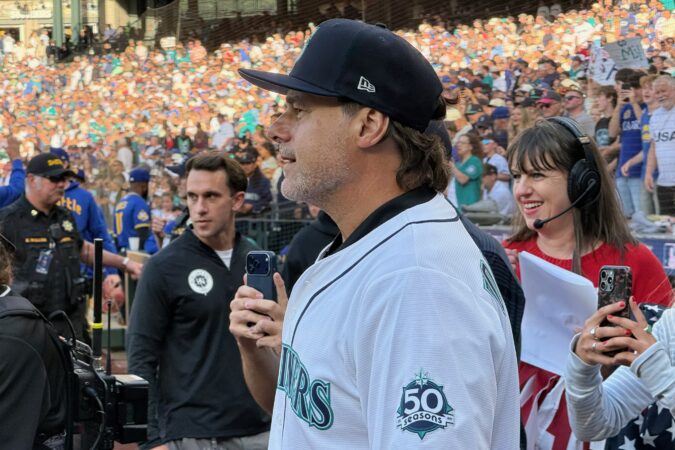
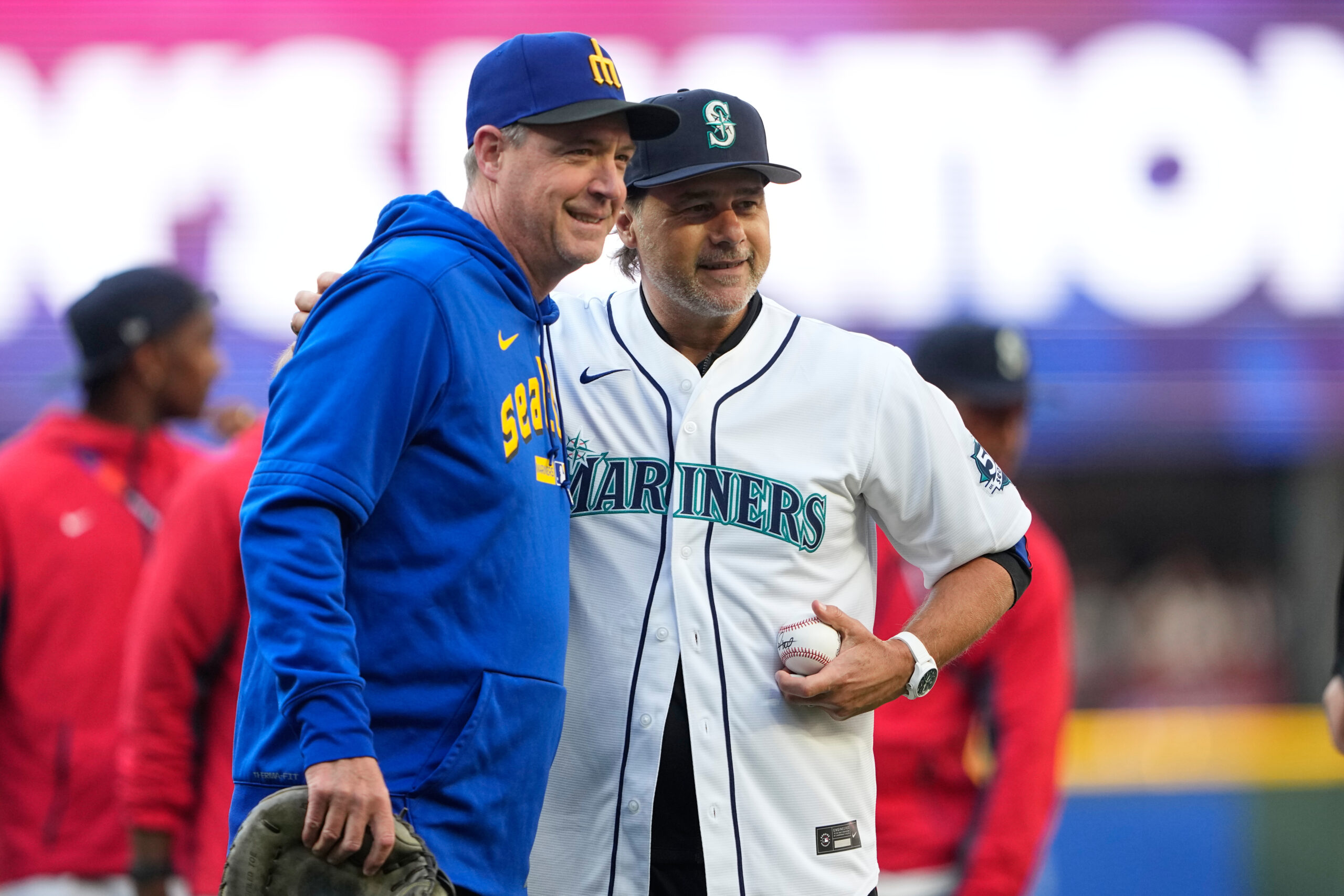
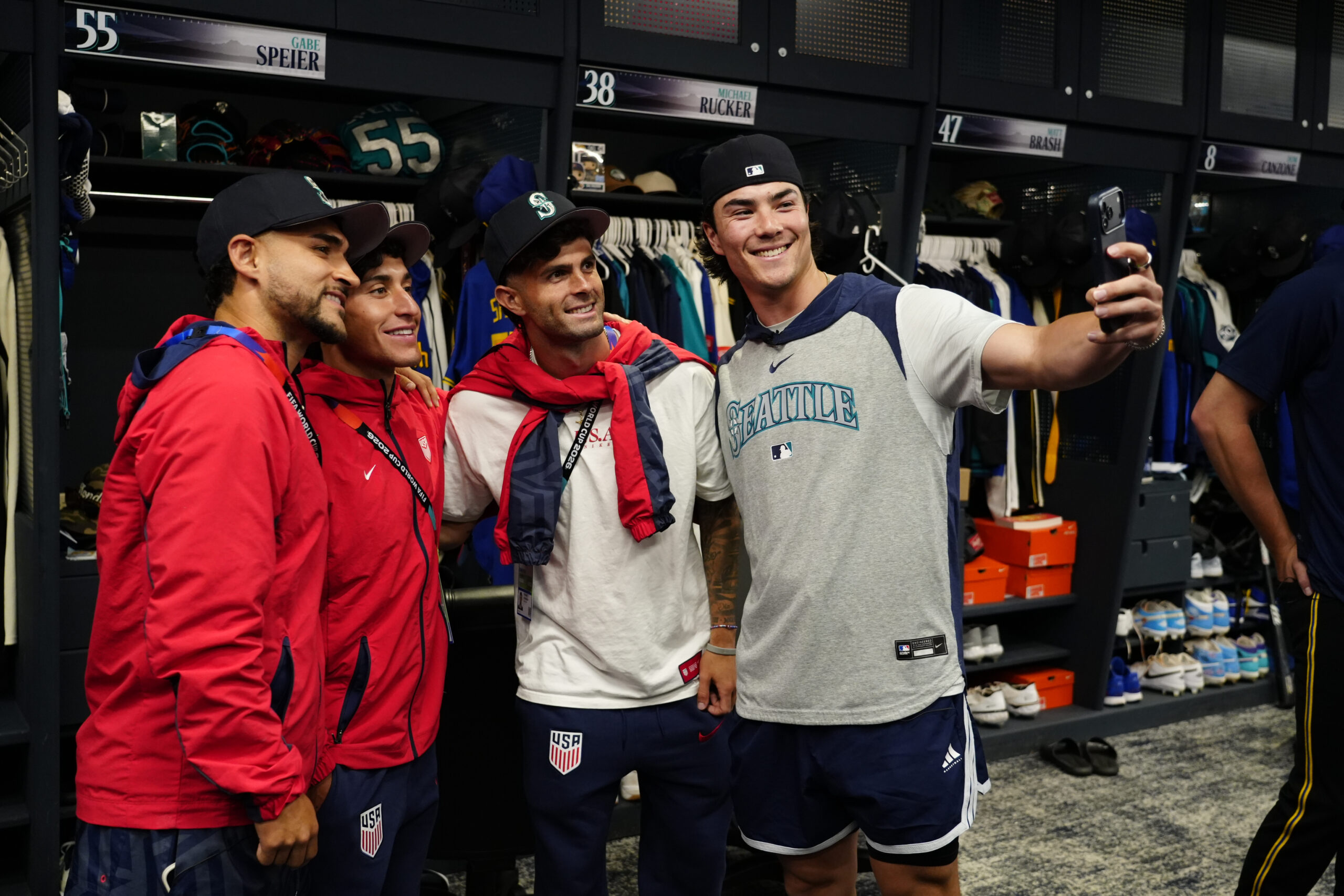
The U.S. squad met the Mariners in their clubhouse before the game, and were introduced to a cheering crowd one-by-one on a red carpet. Manager Mauricio Pochettino then stepped to the foot of the mound and threw the ceremonial first pitch.
Mauricio Pochettino throws a fine first pitch for a soccer manager who might not ever have picked up a baseball before this morning:
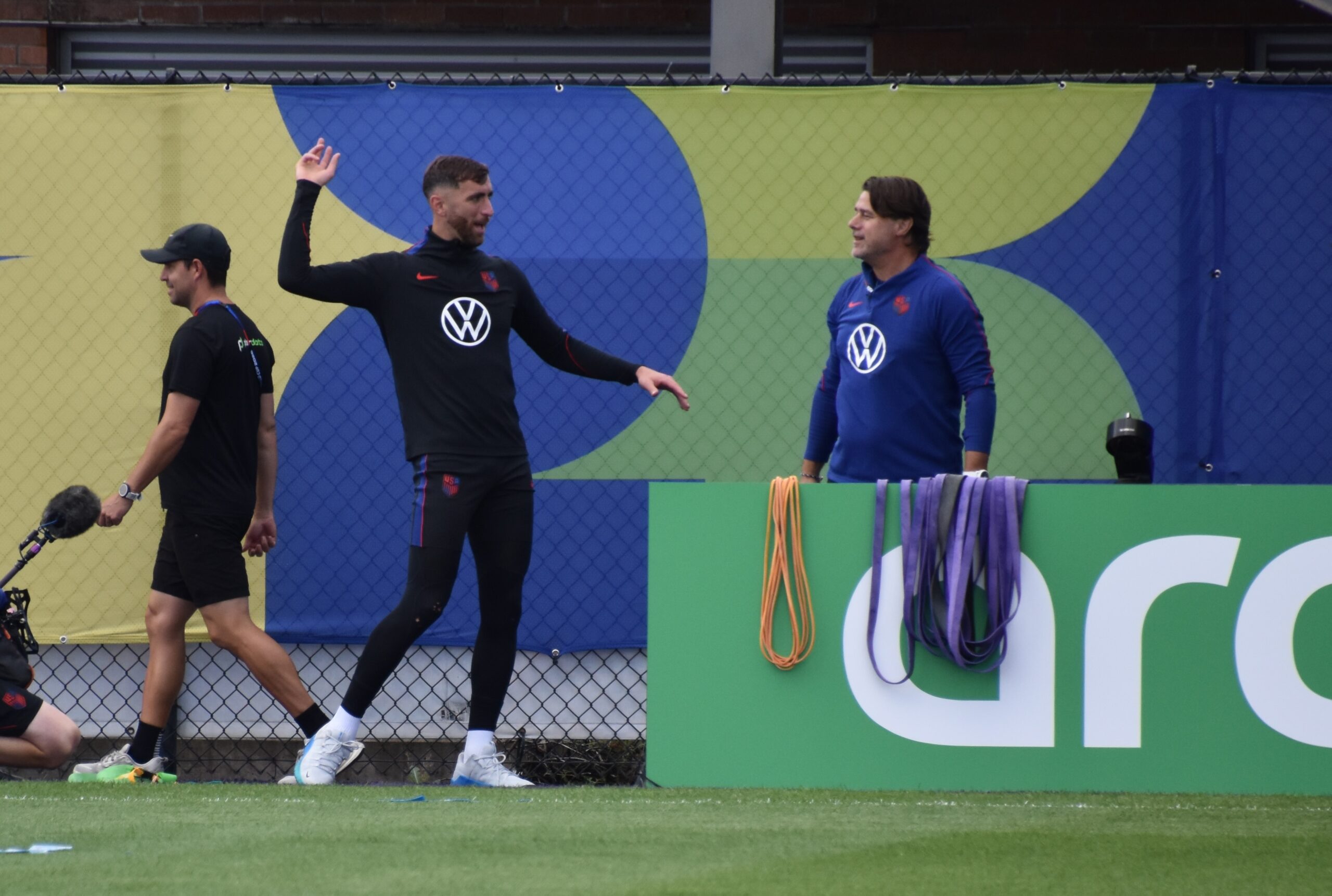
Pochettino practiced some in the morning, before his team got to work on the University of Washington’s soccer field across town. The Huskies’ baseball team lent balls and gloves, and U.S. backup goalkeeper Matt Turner — who played shortstop at St. Joseph Regional High School in north Jersey — gave his boss some tips on throwing form.
Matt Turner (left) giving Mauricio Pochettino advice on how to throw a baseball at Friday morning’s U.S. practice.
“It’s amazing to be here again and feel your support,” Pochettino told the crowd. “The city is amazing. It’s a baseball city. It’s a soccer city. Thank you so much — thank you to the 12th man.”
That bonus reference to Seahawks football fans was one of a few cultural crossovers in a city with big stadiums are a block from each other at the southern edge of downtown.
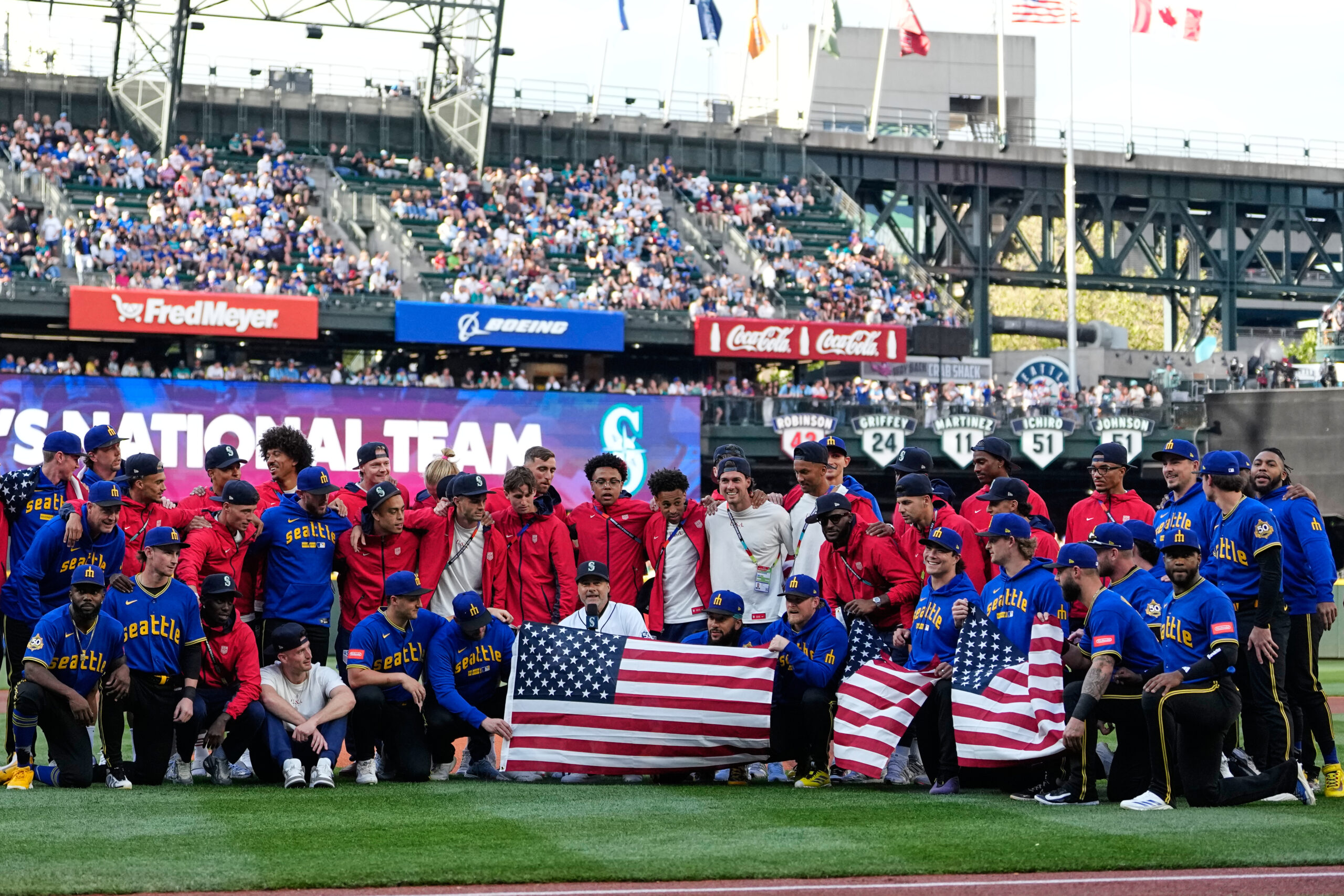
The U.S. men’s soccer team and the Mariners got together on the field for a photo after the ceremonial first pitch.
Between the Mariners and Jays’ pregame warmups, John Fogerty’s classic baseball anthem “Centerfield” played on the T-Mobile Park public address system while extra time of the Argentina-Cape Verde game was shown on the big screen, including the moment Argentina took a lead. A gaggle of fans with field access gasped as they watched the goal.
A few minutes later, the World Cup’s official song, “Dai Dai” by Shakira and Burna Boy, was the DJ’s pick for the playlist. And not long after that, the fans gasped again when Cape Verde tied the score a second time, then once more when Argentina scored a late winner.
“To have the USA team here earlier [in the tournament] and now to have them back, I think is pretty cool,” Wilson said. “And a chance to meet some of these guys, and [have] the fans give them a chance to show their appreciation for the job that they’ve done. Obviously, this is a global event that has been followed all over the world, and it’s exciting. It brings people together.”
Mariners manager Dan Wilson (left) with Mauricio Pochettino.
That appreciation certainly arrived. Though the Blue Jays always bring lots of fans for their visits here thanks to a big fan base in nearby Vancouver, there were big cheers as the U.S. players were introduced individually. Cristian Roldan drew the biggest, as the Seattle Sounders stalwart was saved for last. He brought the Mariners’ trident out with him and said a few words as the U.S. and Mariners squads gathered for a group photo.
“Thank you, Seattle — thank you for the love and support,” Roldan said. “Let’s go win a World Cup! Go USA; go Mariners!”
The Mariners’ active roster is as global as any in baseball, with players from six countries. Center field Julio Rodríguez, a Dominican Republic native, has befriended French World Cup winner and soon-to-be Orlando City playmaker Antoine Griezmann. (Rodríguez wasn’t around to talk about that on Friday because he’s sidelined with a concussion.)
“We have players from all over, and many of them played soccer as kids,” Wilson said. “I think that’s what the beauty of the event of the World Cup is: It affects so many people. Yeah, these guys are watching the games, and you always know when a team scores because you hear it down the hall. So it’s pretty fun.”
Mariners pitcher Bryan Woo (right) took a selfie in the locker room with (from left) Cristian Roldan, Alejandro Zendejas, and Christian Pulisic