WASHINGTON — Warming temperatures are forcing Antarctic penguins to breed earlier and that’s a big problem for two of the cute tuxedoed species that face extinction by the end of the century, a study said.
With temperatures in the breeding ground increasing 5.4 degrees Fahrenheit (3 degrees Celsius) from 2012 to 2022, three different penguin species are beginning their reproductive process about two weeks earlier than the decade before, according to a study in Tuesday’s Journal of Animal Ecology. And that sets up potential food problems for young chicks.
“Penguins are changing the time at which they’re breeding at a record speed, faster than any other vertebrate,” said lead author Ignacio Juarez Martinez, a biologist at Oxford University in the United Kingdom. “And this is important because the time at which you breed needs to coincide with the time with most resources in the environment and this is mostly food for your chicks so they have enough to grow.’’
For some perspective, scientists have studied changes in the life cycle of great tits, a European bird. They found a similar two-week change, but that took 75 years as opposed to just 10 years for these three penguin species, said study co-author Fiona Suttle, another Oxford biologist.
Researchers used remote control cameras to photograph penguins breeding in dozens of colonies from 2011 to 2021. They say it was the fastest shift in timing of life cycles for any backboned animals that they have seen. The three species are all brush-tailed, so named because their tails drag on the ice: the cartoon-eye Adelie, the black-striped chinstrap and the fast-swimming gentoo.
Warming creates penguin winners, losers
Suttle said climate change is creating winners and losers among these three penguin species and it happens at a time in the penguin life cycle where food and the competition for it are critical in survival.
The Adelie and chinstrap penguins are specialists, eating mainly krill. The gentoo have a more varied diet. They used to breed at different times, so there were no overlaps and no competition. But the gentoos’ breeding has moved earlier faster than the other two species and now there’s overlap. That’s a problem because gentoos, which don’t migrate as far as the other two species, are more aggressive in finding food and establishing nesting areas, Martinez and Suttle said.
Suttle said she has gone back in October and November to the same colony areas where she used to see Adelies in previous years only to find their nests replaced by gentoos. And the data backs up the changes her eyes saw, she said.
“Chinstraps are declining globally,” Martinez said. “Models show that they might get extinct before the end of the century at this rate. Adelies are doing very poorly in the Antarctic Peninsula and it’s very likely that they go extinct from the Antarctic Peninsula before the end of the century.”
Early bird dining causes problems
Martinez theorized that the warming western Antarctic — the second-fasting heating place on Earth behind only the Arctic North Atlantic — means less sea ice. Less sea ice means more spores coming out earlier in the Antarctic spring and then “you have this incredible bloom of phytoplankton,” which is the basis of the food chain that eventually leads to penguins, he said. And it’s happening earlier each year.
Not only do the chinstraps and Adelies have more competition for food from gentoos because of the warming and changes in plankton and krill, but the changes have brought more commercial fishing that comes earlier and that further shortens the supply for the penguins, Suttle said.
This shift in breeding timing “is an interesting signal of change and now it’s important to continuing observing these penguin populations to see if these changes have negative impacts on their populations,” said Michelle LaRue, a professor of Antarctic marine science at the University of Canterbury in New Zealand. She was not part of the Oxford study.
People’s penguin love helps science
With millions of photos — taken every hour by 77 cameras for 10 years — scientists enlisted everyday people to help tag breeding activity using the Penguin Watch website.
“We’ve had over 9 million of our images annotated via Penguin Watch,” Suttle said. “A lot of that does come down to the fact that people just love penguins so much. They’re very cute. They’re on all the Christmas cards. People say, ‘Oh, they look like little waiters in tuxedos.’”
“The Adelies, I think their personality goes along with it as well,” Suttle said, saying there’s “perhaps a kind of cheekiness about them — and this very cartoonlike eye that does look like it’s just been drawn on.”
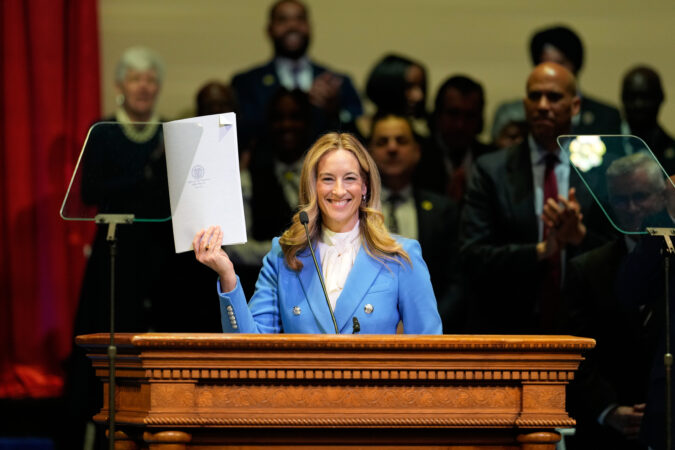
New Jersey Gov. Mikie Sherrill was so excited to fulfill her promise of declaring a state of emergency on utility bills on her first day in office, she did it before finishing her inauguration speech.
“I’ve heard you, New Jersey — we are facing an affordability crisis, and you want costs to come down,” she said during her speech that followed her swearing-in. “And you want that to begin today.”
The first freezes utility rates in New Jersey, which she is able to do by directing the state Board of Public Utilities to provide credits to bill payers for increases. The board made a similar move over the summer under former Gov. Phil Murphy after significant bill increases. Those credits were funded with money from clean energy programs.
The public utilities board, known as the BPU, is a regulatory authority that oversees private utility companies in New Jersey and works on clean energy programs in the state. It is funded in part through a charge on utility bills.
BPU President Christine Guhl-Sadovy said in a statement that the board “looks forward to supporting the governor’s agenda to lower utility costs for New Jersey ratepayers while encouraging the development of new energy resources here in the Garden State.”
Sherrill also directed the public utilities board to consider pausing or modifying the schedule for proceedings in which utility companies seek rate increases — as much as the law allows — and called for a study into modernizing the current electricity distribution business model. She also called for the board to revise the Clean Energy Program for the upcoming FY 2026 budget.
Sherrill also signed an executive order on stage to increase power generation in the state as part of her effort to lower costs.
“This is just the beginning,” she said on stage.
“Not of my speech, of my work,” she joked.
Her second order rolls out efforts to make it easier and faster for companies to generate power in the state, particularly via solar and battery sources. She directs state agencies to pursue permitting reforms that can help speed up processes to get new energy sources up and running as part of this order.
She also calls on the New Jersey Department of Environmental Protection to expedite permitting processes for existing gas plants to expand capacity, run more efficiently, and reduce emissions.
In another request of the public utilities board, she asks officials to require electric utility companies to report on how much energy data centers request to assess “ghost loads,” which are forecasts for how much energy large projects may require. These predictions impact how much energy the regional grid operator PJM anticipates needing to handle, which can increase prices.
Sherrill has blamed PJM for high utility costs, and the regional grid operator has argued that it has simply responded to supply and demand issues as energy usage has drastically increased in recent years in part to the increasing demand for artificial intelligence.
The order also creates a Nuclear Power Task Force to support nuclear power generation.
“I heard the people of New Jersey loud and clear – these rate hikes are unacceptable – and as your governor, I will not stop fighting to lower costs and make New Jersey a more affordable place to live, work, and raise a family,” Sherrill said in a statement.
Online speculation about whether Maxey and Edgecombe liked each other started after a defensive miscommunication in the first quarter of Friday’s loss to Cleveland led to an open Donovan Mitchell three. Maxey and Edgecombe were caught on the bench having what appeared to be a heated conversation after the play.
But on Monday, after Maxey was named an All-Star starter, Edgecombe was the first person to reach out to him — telling reporters he set a 2 p.m. alarm just to make sure he found out right away whether Maxey had been named a starter so he could congratulate him.
Edgecombe woke up Maxey from his pregame nap trying to call him.
“I’m like, why is he calling me?” Maxey said pregame. “And I answer, and he’s screaming and showing me the TV. And I’m like, ‘OK.’ We chopped it up a little bit.”
And postgame, the two Sixers guards were having fun after the 113-104 win over the Pacers.
KYIV, Ukraine — Russia bombarded Ukraine with more than 300 drones and ballistic and cruise missiles in its latest nighttime attack on the Ukrainian power grid, President Volodymyr Zelensky said Tuesday, as Moscow gives no public sign that it’s willing to end the invasion of its neighbor anytime soon.
The attack knocked out heating to more than 5,600 apartment buildings in the capital, Kyiv Mayor Vitali Klitschko said. Nearly 80% of the affected buildings had recently had their heating supply restored after a major Russian barrage on Jan. 9 that plunged thousands of people into a dayslong blackout, he said.
Ukraine is enduring one of its coldest winters for years, with temperatures in Kyiv falling to minus 4 Fahrenheit. At the same time, Russia has escalated its aerial attacks on the electricity supply, aiming to deny Ukrainians heat and running water and wear down their resistance almost four years after Moscow launched its full-scale invasion on Feb. 24, 2022.
Meanwhile, Ukrainian officials are trying to keep up the momentum of U.S.-led peace talks. A Ukrainian negotiating team arrived in the United States on Saturday. Their main task was to convey how the relentless Russian strikes are undermining diplomacy, according to Zelensky.
The Ukrainian leader said last week that the delegation would also try to finalize with U.S. officials documents for a proposed peace settlement that relate to postwar security guarantees and economic recovery. If American officials approve the proposals, the U.S. and Ukraine could sign the documents at the World Economic Forum in Davos, Switzerland, this week, he said.
Kremlin spokesman Dmitry Peskov said Tuesday that presidential envoy Kirill Dmitriev plans to meet with some American representatives at Davos.
He refused to name the officials Dmitriev would meet with, but media reports said they would include U.S. envoy Steve Witkoff and U.S. President Donald Trump’s son-in-law, Jared Kushner.
Attacks described as ‘cruel’
Ukrainian Foreign Minister Andrii Sybiha said his country needs urgent assistance and additional sanctions on Russia to make Moscow change course.
Russian President Vladimir Putin’s “barbaric strike this morning is a wake-up call to world leaders gathering in Davos,” Sybiha said on X.
U.N. Human Rights Chief Volker Türk said that he was outraged by the repeated large-scale attacks on Ukraine’s energy infrastructure, which especially affect children, older people, and those with disabilities.
The strikes “can only be described as cruel,” he said in Geneva. “They must stop. Targeting civilians and civilian infrastructure is a clear breach of the rules of warfare.”
Several electrical substations providing power vital for nuclear safety in Ukraine were affected, said Rafael Mariano Grossi, director-general of the International Atomic Energy Agency.
Air defense systems are expensive
Ukraine’s air force command said that 27 missiles and 315 drones were shot down or jammed, while five missiles and 24 drones hit 11 locations.
The Russian Defense Ministry claimed that its forces targeted Ukrainian military and industrial installations as well as energy and transport infrastructure used by the Ukrainian armed forces.
The constant attacks have stretched Ukraine’s air defenses and, according to Zelensky, some systems recently ran out of ammunition before a new shipment arrived.
The fight is also expensive: the air defense ammunition that Ukraine used against the Russian missiles overnight cost about 80 million euros ($93 million), Zelensky said.
Ukrainian air defenses are adopting a new approach, with the appointment of a new deputy air force commander, Pavlo Yelizarov, according to Zelensky.
“This system will be transformed,” he said late Monday, without providing details.
Ukraine relies on sophisticated air defense systems produced by Western countries, especially the U.S., to thwart Russia’s missile and drone attacks.
I’m Jewish, and like most other Jews I know, I often wonder who else is. When I meet someone at a party, or see a new face on TV, I think: yes or no? It’s a game, and it’s all in good fun.
But when the government does it, it isn’t. It’s a dagger at our hearts.
That’s why so many people at the University of Pennsylvania — where I teach — are up in arms about the Trump administration’s effort to compel the university to identify Jewish students and employees. It’s part of an investigation of antisemitism on campus by the Equal Employment Opportunity Commission, which issued a subpoena demanding the names and contact information of members of Jewish-related student groups, staffers at the school’s Jewish studies program, and anyone who had filed an antisemitism complaint.
Fortunately, Penn said no. The EEOC sued the university back in November for refusing to comply with the subpoena. And last week, several groups at Penn filed their own motion in the case. “Compiling and turning over to the government ‘lists of Jews’ conjures a terrifying history,” they wrote.
Indeed, it does. Going back to the Middle Ages, state officials have tried to establish who is Jewish. And it never ends well.
In 1215, Pope Innocent III decreed that Jews must wear markers at all times that made them distinguishable from Christians. Two years later, in England, King Henry III ordered male Jews to wear a badge on the front of their outer garments.
In England, the badge was shaped like the tablets upon which Moses — according to the Old Testament — received the Ten Commandments. In France, it was a circle of red or yellow felt. Hungarian Jews had to wear red capes. And in German-speaking parts of Europe, Jews were required wear a cone-shaped Judenhut, or “Jew’s Hat.”
The goal of these rules wasn’t simply to identify Jews; it was to segregate, humiliate, and persecute them. Jews wearing badges were mocked by children and attacked by bandits. Badge laws also led to extortion: To receive exemptions from the laws, Jews had to pay large sums to the state.
In the so-called Jewish Emancipation era of the 18th and 19th centuries, when Jews finally received citizenship in the nations where they lived, badge laws disappeared. But they returned with a vengeance in the 1930s and 1940s, when the Nazis required Jews in Germany and the territories it conquered to wear yellow stars.
That helped facilitate their deportation and murder in concentration camps, where a new set of markers developed. Jews who were also political prisoners wore a red triangle, superimposed on a yellow one; gay Jews were identified by the pink triangle, which was later adopted by LGBTQ+ activists as a symbol of pride.
And Jewish camp prisoners often received tattooed numbers on their arms. Again, that was a way to degrade Jews as well as to identify them.
“My number is A-10572. That is what I was, they did not call us by our names,” recalled Holocaust survivor Lilly Ebert, whose TikTok video about the Auschwitz death camp went viral in 2021. “We were no longer humans. We were only a number, and we were treated like numbers.”
Since then, every state effort to count or list Jews has reflected disdain for them. Convinced that Jews at the Bureau of Labor Statistics were altering employment statistics to undermine him, President Richard Nixon ordered aides to find out how many BLS workers were Jewish. “The government is full of Jews,” Nixon fulminated in a taped 1971 White House conversation. “Most Jews are disloyal … You can’t trust the bastards. They turn on you.”
An aide scrutinized the BLS employees’ names — never a perfect way to figure who is Jewish — and concluded that 13 of 35 fit the “demographic criterion that was discussed,” as he delicately reported. Less than two months later, two Jewish senior officials were removed from their posts and demoted to less visible positions in the agency. That was “the last recorded act of official antisemitism by the United States government,” as political commentator Tim Noah wrote.
Forcing Penn to cough up a list of Jews would be the next one. It doesn’t matter that it comes as part of a Trump administration investigation of antisemitism. Frankly, I doubt a president who welcomed Holocaust denier Nick Fuentes to his home for dinner — and who still refuses to criticize him — cares very much about the safety of Jews on campus.
But even if he does, that’s no reason to count them. When the government does that, it isn’t fun anymore. It’s game over.
Major changes are coming to the Rittenhouse Hotel on Rittenhouse Square, as the Italian restaurant Scarpetta will leave the bilevel space next weekend after nearly a decade to set the stage for a posh new steakhouse called the Ruxton, from Baltimore-based Atlas Restaurant Group.
Alex Smith, Atlas’ president and chief executive, told The Inquirer that the Ruxton, a sibling of the location in Baltimore’s Harbor East, would open in spring 2027. This will be the second Philadelphia restaurant for Atlas, which opened the high-end Loch Bar at Broad and Spruce Streets in fall 2023.
A rendering of the second-floor dining room of the Ruxton at Rittenhouse Hotel.
But before renovations for the Ruxton begin, the Rittenhouse space will host a residency from up-and-coming chef RJ Smith, 21, who launched Ocho Supper Club last year in his Drexel University apartment to showcase Afro-Caribbean cuisine through a fine-dining lens.
RJ Smith, no relation to Atlas’ president, said he has scheduled the first seating for his eight-course tasting menus for Feb. 1 and plans to offer them through July 26; the schedule has not been formally set but includes Valentine’s Day.
RJ Smith, culinary student and executive chef of Ocho Supper Club.
Scarpetta, owned by LDV Hospitality, has set its final service for Jan. 31. Scarpetta opened in 2016, filling the space previously occupied by Smith & Wollensky, also a steakhouse. Lacroix, the Rittenhouse Hotel’s signature restaurant, is unaffected by the changes.
Construction is expected to start in late summer for the Ruxton, whose deal has been in the works for nearly a year. Alex Smith said the Ruxton will occupy more space at the Rittenhouse — allowing for a total of 220 seats, vs. Scarpetta’s 120.
The Ruxton, offering Rittenhouse Square views from its second floor, will have three private dining rooms and a 50-seat outdoor space on the deck. The restaurant’s entrance will be moved next to the hotel lobby, and there will also be an interior entrance through the hotel lobby.
Designer Patrick Sutton is channeling inspiration from the Jazz Age, with highlights including velvet upholstery, walnut wood millwork, and custom Murano-style glass chandeliers. Corporate chef Aaron Taylor will oversee the steak and seafood menu.
The Philadelphia location will be Atlas’ third Ruxton location; the second is due to open this fall in National Harbor in Maryland, outside of Washington, D.C.
“We love Philly,” Smith told The Inquirer, adding that Loch Bar’s numbers are strong. “It’s a great town. In some ways, it reminds me of Baltimore — just much bigger. And we’re planning on doing more in Philadelphia.” He said developer Carl Dranoff, his partner at Loch Bar, would be involved in the Ruxton.
Cole Hernandez, a Rittenhouse Hotel spokesperson, said that the Scarpetta space, in the short term, would also be used by Lacroix chef Eric Leveillee to host groups, do cooking and mixology classes, and other programming.
In addition, the hotel’s Library Bar continues to rework its cocktails in collaboration with James Beard Award winner Danny Childs. A fresh drinks menu will launch in February.
“Where we’re ultimately heading is a broader shift across the property,” Hernandez said. “The Philadelphia dining scene is changing — it’s more vibrant, more interesting, and less formal and stuffy. We’re evolving our concepts to be more relevant to today’s diner.
At Lacroix, service standards have been modified to allow for more approachable, 90-minute dinners and “more dynamic and social” brunches that include à la carte options.
On Monday, America — some of it, anyway — paused to celebrate the Rev. Dr. Martin Luther King Jr., who would have turned 97 this month. In one sense, there’s never been a rougher time for the legacy of the slain civil rights icon, with the U.S. Supreme Court perhaps poised to gut the 1965 Voting Rights Act and a president who barely acknowledged the holiday. But thousands of everyday Americans now resisting U.S. Immigration and Customs Enforcement are channeling the spirit of the man who said one has “a moral responsibility to disobey unjust laws.” Happy belated birthday, Dr. King.
Dems, stop trying to make ICE better. Make them go away.
Aliya Rahman is detained Jan. 13 by federal agents near the Minneapolis street corner where Renee Good was fatally shot by an ICE officer.
Imagine this … and if you watch the daily stream of videos coming from the ICE raids that have roiled Minnesota since the start of the new year, it’s not that hard to imagine.
You’re minding your own business, or maybe picking up your kid at their school, when suddenly you find yourself in the middle of a platoon of masked, armed, camouflaged government agents. One thing leads to another, and in a flash, an agent has wrestled you to the ground, and is brandishing a weapon — maybe a Taser … if you’re lucky.
But what if I told you that lawmakers on Capitol Hill have a solution? They are proposing a brave new world, where now — flat on your back and gasping for air, and perhaps able to bravely manage to free your phone from your pocket — you could scan a federally mandated QR code on the agent’s uniform and find out the identity of the man who is currently pummeling you to within an inch of your life.
You’re probably thinking the same thing I did when I read about New York Rep. Ritchie Torres’ new bill he called the Quick Recognition (get it?) Act, which is his big idea for how Democrats can respond to public anger over the murder of Minneapolis mom Renee Nicole Good by an ICE agent, and the raidsthat have led to violent encounters and made a major U.S. metropolis look and feel like a war zone.
A four-word sentence that begins with, “What the actual …?”
“There is nothing the Trump administration fears more than transparency and accountability,” a spokesperson for Torres, who faces a primary challenge, in part, because of his outspoken views on Gaza, said recently.
Really? Is that true? Because everything I’ve seen is that Donald Trump is mainly terrified about a GOP bloodbath in the November midterms, which would surely lead to his impeachment, his eventual disgrace, and even a shot at the real accountability that takes place only behind prison bars. But that’s not going to happen unless Democrats can convince those midterm voters they are serious about dismantling the rotten system that murdered Good — so there are no bad guys left to scan.
It’s tempting to write off Torres’ idea as one stray piece of almost comically misguided legislation. But the truth is that his core idea — that what’s evolved during the Trump era into an American secret police force that folks like Joe Rogan and Bruce Springsteen are openly calling “the Gestapo” can be tweaked into something great — isendorsed by Democratic leaders in Congress and many rank-and-file members.
“Clearly, significant reform needs to take place as it relates to the manner in which ICE is conducting itself,” House Minority Leader Hakeem Jeffries (D., N.Y.) told MS Now, bloodlessly. “ICE is using taxpayer dollars to brutalize American citizens and to unnecessarily and viciously target law-abiding immigrant families and communities.”
So you’re going to halt the flow of those taxpayer dollars, right?
Right?
Actually, many key Democrats — facing a Jan. 30 deadline for new appropriation bills — say they are willing to keep the dollars flowing to the embattled and increasingly unpopular agency, but with hopes of leveraging the Minneapolis controversy in return for major reforms. Sen. Chris Murphy (D., Conn.), who has been a leading critic of the Trump regime, has suggested banning masks, mandating badges, requiring warrants to make an arrest, and returning Border Patrol agents to the border.
Most critics of ICE, Border Patrol, and any other immigration raiders under the U.S. Department of Homeland Security would agree that all of those things should have happened yesterday. But the lack of appetite for utterly dismantling the DHS regime — despite its culture of violence and disrespect for law-abiding refugees — reminds too many voters of the cowardice that branded the Dems as losers in the first place.
Progressive attorney Aaron Regunberg mocked the stance of some mainstream Democrats as: “We are the resistance. We are also negotiating furiously to figure out how to fully fund the Gestapo.” He’s right. Under Trump, with recruitment ads inspired by white nationalist memes, ICE has become a tool of a new American fascism.
You don’t “significantly reform” fascism. You need to crush it. As Andrea Pitzer, who literally wrote the book on the history of concentration camps, noted Monday night, “The correct response to Dachau was not better training for the guards.”
It’s telling that — as often is the case — everyday people are way out in front of the supposedly opposition Democrats. The latest polls show that a strong majority of Americans oppose Trump’s immigration policies — with just 38% approving of them in a new AP-NORC poll, down sharply — and that, for the first time, a plurality would like to see ICE (which has only existed since 2003) eliminated. No wonder the number of Americans who now identify as liberal — 28% — is the highest since Gallup began asking in the early 1990s.
And yes, more Democratic officials are starting to get it than ever before. More than 100 members of the House Progressive Caucus said last week that they won’t vote for any budget bill with additional funding for the immigration raid agencies without an end to their militarized policing. Arizona Democratic Sen. Ruben Gallego, who seemed to tack right on immigration issues in winning a close election in 2024, surprised political observers when he declared this weekend in a CNN interview that “I think ICE needs to be totally torn down.”
Note that he didn’t say “abolish” — a word that causes Democrats to break out in hives. That’s OK. Call it a teardown, or a demolition, but every day, more Americans can see that the United States would function better without ICE — as it did the first 227 years of its history — and with the work that’s actually needed, like arresting the sliver of immigrants who really are violent criminals, given to all new people.
The problem is that Democratic fecklessness isn’t limited to just the future of ICE. Our European allies are disappointed that the opposition party isn’t out manning the barricades and calling for much more forceful action to curb Trump’s bat-guano crazy demand for Greenland, apparently because he feels slighted by not getting the Nobel Peace Prize. And sure, Americans want lower coffee prices, but they care more about not having Captain Queeg with the nuclear football.
Dismantling the ICE regime needs to be the floor, not the ceiling, and any Democrat in Congress who doesn’t get with the program can — and should — be replaced in the primaries to avoid another debacle with alienated or apathetic voters in November. Call your member and find out where they stand. You won’t even need a QR code.
Yo, do this!
I didn’t feel a compelling need to memorialize one year of Trump’s second presidency, since that’s kind of what we do here every week. But M. Gessen, the Russian émigré whose understanding of how authoritarians rule has been a blessing for American readers, did write the piece that captures the fierce urgency of now. Their new New York Times column (gift link) calls on us to use our freedoms before they totally disappear. “The only way to keep the space from imploding is to fill it, to prop up the walls: to claim all the room there still is for speaking, writing, publishing, protesting, voting,” they wrote. “It’s what the people of Minnesota appear to be doing, and it’s something each of us needs to do — right now, while we still can.”
In a month of short, frigidly cold days, with a deteriorating political situation, the Eagles’ one-and-done, and up-and-too-often-down 76ers and Flyers, my main source of pleasure is getting under several blankets and watching football games in which I don’t much care who wins. The NFL playoffs, minus the Birds’ fiasco and one or two clunkers, have been the most compelling drama on TV in years. Don’t miss Sunday’s Final Four: Patriots-Broncos (CBS) followed by Rams-Seahawks (Fox), kicking off at 3 p.m.
Ask me anything
Question: One question that is top of my mind is “does this week feel like a tipping point?” Can’t shake the feeling that it is. — Marguerite Fahey (@margueritefahey@bsky.social) via Bluesky
Answer: Marguerite, I got several variations of your question, so this is definitely on the minds of folks. But while Trump’s bizarre actions surrounding Greenland have raised questions about the president’s fitness to hold office on a level we’ve never seen before, including Watergate, it is less clear what affirmative actions can take place. It’s impossible to imagine the lackeys in Trump’s cabinet, like Kristi Noem, ever green-lighting the 25th Amendment, let alone the 20 GOP Senate votes that would be required to remove the president in an impeachment. An increasingly likely possibility is high-ranking generals refusing a Trump order to send troops to Greenland or Minnesota. Yes, it has come to this.
What you’re saying about …
Sometimes, readers of this newsletter still surprise me. While most of you are righteously appalled at the immigration raid abuses in Minnesota and elsewhere, many still want to see major reforms at ICE and its sister agencies rather than abolishing them altogether. “ICE doesn’t need to be abolished,” Ed Truncale wrote. “ICE is like a child that has lost their way and needs to be disciplined, redirected.” Cathie Cush agreed. “I’d feel a lot more comfortable with ‘Demilitarize ICE’ and ‘Demilitarize the police,’” she wrote. “And make them accountable. And reduce their ranks.”
📮 This week’s question: Donald Trump’s increasingly aggressive demands for Greenland have not only threatened the post-World War II global order but raised legitimate mental health questions about the commander of the world’s largest military. But how can Europe, Democrats, and any remaining sane Republicans respond to this? Please email me your answer and put the exact phrase “Greenland response” in the subject line.
History lesson on America’s betrayal of the Hmong
ChongLy “Scott” Thao, a U.S. citizen, sits in his St. Paul, Minn., home Monday, the day after federal agents broke open his door and detained him without a warrant.
A long time ago, on the other side of the world, began what would become a fraught relationship between the Hmong tribal people of northern Laos and the United States, as represented by the CIA. At the dawn of the 1960s, American spies recruited the Hmong to fight communism in their homeland and neighboring Vietnam, which proved a disastrous bet. Thousands died in the next 13 years of combat in Southeast Asia, and more would perish when the communists took over Laos in 1975, while others dodged bullets, swimming the Mekong River toward overcrowded refugee camps in Thailand.
Fifty years ago, the United States was led by people who at least understood our deep debt to the Hmong, forged in blood. Thousands who’d escaped the slaughter were eventually resettled in the United States, and Minnesota — aided by Lutherans and other religious charities and good public housing, and despite its frigid weather — became an unlikely magnet. Today, a population of 94,000 people, with a slightly higher average salary than the state as a whole, and including the mayor of St. Paul, the state capital, makes Minnesota home to the largest U.S. Hmong population.
It’s an immigration success story that makes the events of recent days beyond baffling. In one Minneapolis neighborhood this weekend, a witness reported that roving ICE agents who have flooded the metropolis pulled over a car and asked the driver, “Where the Hmongs at?” St. Paul Mayor Kaohly Her said: “We’ve received reports of ICE officers going door to door asking where the Asian people live … I myself have received advice to carry my passport with me because they may target me based on what I look like.”
On Sunday, federal agents broke down the front door of a St. Paul home and took away ChongLy “Scott” Thao, also known as Saly, a Hmong American who was born in a Laotian refugee camp but is a U.S. citizen after living most of his life here. A photo of the man being led out of the house — wearing only boxer shorts and Crocs on a bitterly cold day, a plaid blanket hastily thrown over his exposed torso — went viral on social media. Family members said ICE agents drove Thao around for an hour while they questioned him, but brought him back home when they realized he was a naturalized citizen with no criminal record. Still, the episode was traumatizing, and it epitomized the big question hanging over all of this.
What is this even for? ICE’s harsh and disruptive focus on the Hmong people of Minnesota — people who were brought here because of their support for America in wartime, with the encouragement of the federal government as well as their new prairie neighbors — makes absolutely no sense. A people who suffered in their homeland for their ties to the United States are now facing new torment in their adoptive land — judged not for the content of their character, but for the color of their skin. This is a new, shameful moment in American history.
What I wrote on this date in 2021
Looking back at the dawn of what’s proved to be a painful decade for America can be difficult. Tuesday is the fifth anniversary of Joe Biden’s inauguration as the 46th president, and like most Americans, I had thoughts and prayers that the deep stain of Donald Trump’s lawbreaking first term could be erased. On Jan. 20, 2021, I predicted we’d understand “this nation will not have peace without justice. That empathy is empty without accountability. And that American carnage cannot be healed until we can handle the truth.” Yeah, how did that work out? Read the rest: “After four years of ‘American carnage,’ President Joe Biden gets it: Truth must come before healing.”
Recommended Inquirer reading
With so much happening, I did an NFL coin-toss move and elected to defer my Martin Luther King Jr. holiday day off until some warmer, happier time. In my Sunday column, I looked at how economic pressure campaigns against U.S. corporations aiding Trump’s immigration policies, like Avelo Airlines — which halted ICE deportation flights after months of protests and boycotts — are starting to make a difference. With boycotts getting results at firms like Disney and Spotify, can Americans do more to vote with their wallets? Over the weekend, I dug into CBS News and its new Trump-friendly regime headed by Bari Weiss, and how its slanted journalism — including a highly inflammatory and factually dubious story about the Minneapolis ICE shooting — is a bad sign for the future of democracy.
We now know Trump told Pennsylvania Gov. Josh Shapiro not to run for president, which normally would be tantamount to an endorsement. But that disclosure — which comes from the governor’s new autobiography, Where We Keep the Light, that is also functioning as a curtain-raiser on Shapiro’s 2028 presidential ambitions — might have been a rare case of good advice from The Donald. The Inquirer’s crack political team is already all over the book and its fallout, including Shapiro’s controversial claim that aides to Kamala Harris — vetting him as a potential 2024 running mate — asked the Jewish governor if he was “a double agent” for Israel. The book is already generating backlash and some TV punditry that Shapiro’s once-rising star has dimmed, but the broader implication remains clear. One way or the other, the road to the 48th presidency runs through Pennsylvania, and the best way to keep up is to follow our in-depth coverage in The Inquirer. Subscribe today and get on the bandwagon.
By submitting your written, visual, and/or audio contributions, you agree to The Inquirer’s Terms of Use, including the grant of rights in Section 10.
A Philadelphia police officer opened fire on a man Monday night after the man critically injured another person in Hunting Park, police said. The man, police said, was not hit.
Officers were called about 8:30 p.m. to a Sunoco gas station in the 4100 block of North Broad Street for a report of a man with a gun, according to police Tuesday.
When they arrived, police said, the officers saw multiple men arguing. The men quickly left the gas station and walked toward the intersection of Broad and Jerome Streets, where the fight turned physical, police said.
A 29-year-old man drew a handgun and shot another man in the chest and groin. One of the officers fired at the alleged shooter, police said, but did not strike him.
The alleged shooter ran away, but the officer caught and arrested him in the 1300 block of Jerome Street, police said. Nearby, beneath a parked vehicle, officers found a 9mm handgun.
Paramedics took the victim to Temple University Hospital, where police said he was in critical condition Tuesday. His name was not released.
Police did not release the name of the alleged shooter, who had not yet been formally charged, they said.
The officer, a 36-year-old man with nine years on the police force, was not injured in the incident, police said. He has been placed on administrative duty pending an internal investigation, as per department policy when an officer discharges his gun.
Nick Nurse thought back to the 76ers’ preseason trip to Abu Dhabi, and how a multitude of injuries (again) forced him to cobble the rotation together for two exhibition games against the New York Knicks.
“I’d be pretty happy that we’re here right now,” the coach said of his former self late Monday.
“Here” is a 23-18 record at the regular season’s halfway point following a 113-104 home victory over the Indiana Pacers. Nurse acknowledged he is still irked by the handful of close games he believes the Sixers gave away. The roster, meanwhile, still feels like a work in progress after finally reaching full availability earlier this month.
But the Sixers are considered one of the NBA’s pleasant surprises, entering Tuesday in fifth place in the crowded Eastern Conference standings where 1½ games separate third and seventh.
“Probably would have taken this at the start of the season, for sure,” Nurse said. “And, hopefully, a couple more [health] dominoes can fall here as we go on.”
In that spirit, here is a collection of second-half goals for the Sixers’ rotation players.
Tyrese Maxey: Make the MVP ballot
When Maxey received “M-V-P!” chants at the free throw line during an early-season home game, he told Joel Embiid, “I don’t know how you do this.”
Maxey has been worthy of such serenading from spectators while making another significant leap in his sixth season. The 25-year-old point guard was named an All-Star starter Monday afternoon, as the top American vote-getter. That naturally makes him an All-NBA contender.
One step beyond those potential accolades? Getting onto MVP ballots, a race that could become more open if Nikola Jokić, the three-time winner of the sport’s top individual award and this season’s early favorite, falls under the 65-game eligibility threshold because of a recent knee injury. Maxey was seventh in the first ESPN straw poll, which surveys 100 eligible voters, released on Dec. 19.
For good reason. Maxey entered Tuesday ranked third in the NBA in scoring (30.2 points per game) while also setting career highs in assists (6.7 per game) and rebounds (4.4 per game). He is shooting 40% from three-point range and 47.5% from the floor, on 22.3 attempts per game as a multidimensional bucket-getter. He has become more of a defensive playmaker, averaging 2.1 steals per game — including a career-high eight in Monday’s win over the Pacers — and turning several into blazing finishes at the opposite end. And he is doing this while leading the league in minutes played, at 39.4 per game.
Some of these numbers could dip slightly if Embiid and Paul George can stay healthy, taking some of that load off the relentless Maxey. And a tough two-game stint against the Cavaliers — he went a combined 14-of-39 from the floor in consecutive losses — demonstrates he still faces a learning curve as the focal point of opposing defenses.
But Embiid was correct in nicknaming Maxey “The Franchise” years ago. If Maxey is the leader of a Sixers team that shifts from resurgent to legitimate East threat, he will need to get used to those chants.
Joel Embiid and Paul George: More dunks!
Following a Jan. 3 win at the New York Knicks, Embiid’s first dunk of the season was a popular topic. Nurse quipped that it occurring with a win secured in the final seconds “was a pretty cheap way of getting it … but at least we know he can still dunk.” When VJ Edgecombe learned that Embiid had not dunked since last season, the rookie’s reaction was “Oh my God.”
The celebration is not as much about the act itself, but the ongoing physical progress it signifies.
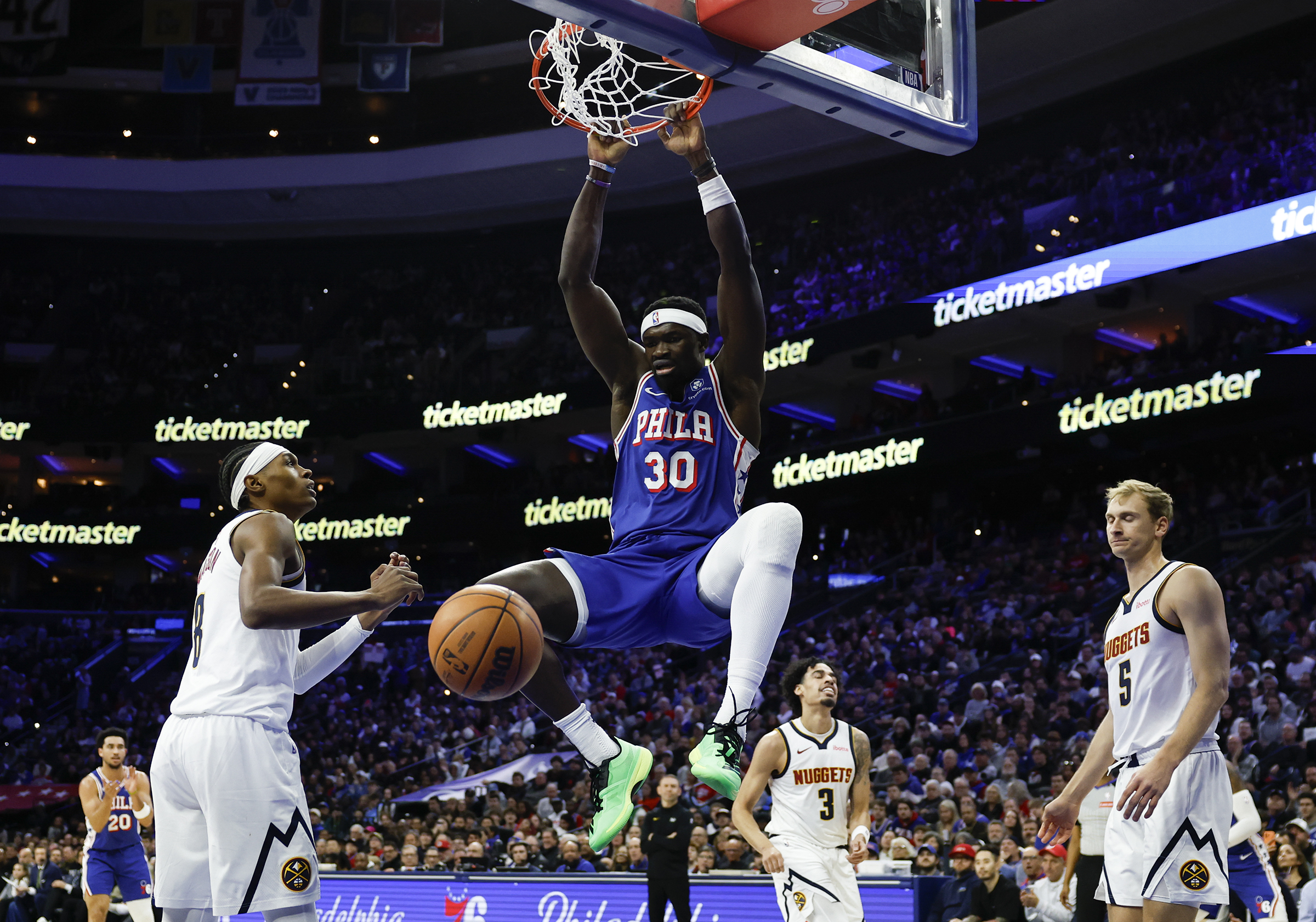
Ditto for Embiid more often stepping to center court for the opening tipoff. Or that he has played in 10 of 11 games since Dec. 30, including logging 40 minutes for the first time since the 2024 playoffs in a Jan. 5 overtime loss to Denver. During this stretch, he has averaged 27.4 points on 51.6% shooting with 7.6 rebounds, 4 assists, and noticeably improved elevation and mobility as a defender and rim protector.
And by the time the Sixers won in Toronto on Jan. 12, Embiid was throwing down one-handed dunks in traffic.
“I’ve made a lot of strides since the beginning of the season,” Embiid said Monday. “I’m back to, probably say, All-Star level and getting back to that All-NBA level and MVP level each and every day. Just got to keep it going.”
George, who battled numerous injuries during a disappointing first season in Philly, can relate. Though he has been most dangerous this season as a three-point shooter (37% on 6.3 attempts per game entering Tuesday), he said his body also feels (and looks) better as a versatile complementary player on both ends.
“Those small things,” George said. “It’s like stuff that I can check off like, ‘All right, I’m able to do this again. I’m able to dunk again. I’m able to explode again.’ So it’s just the small gains that just keep you going.”
Dominick Barlow and Jabari Walker: Secure an NBA standard contract
While sitting inside a restaurant during the Las Vegas Summer League, Sixers president of basketball operations Daryl Morey said he believed the front office had been savvy in leveraging two-way contracts to sign helpful players in Dominick Barlow and Jabari Walker.
Morey was more than correct. Barlow has been the Sixers’ breakout player, lauded for his knack for crashing the boards and cutting while averaging 8.2 points, 5.1 rebounds, and 1.3 assists as the starting power forward. Walker is a high-energy rebounder (3.4 in 12.9 minutes per game), and has played in 39 of the Sixers’ 41 games.
“Those two guys just go out and play hard,” Nurse said Monday, “and have a lot of fun just giving everything they have.”
Both have certainly outplayed their two-way status, which primarily is designed for young, developing players to split time between the NBA and G League. The Sixers will aim to maximize the NBA games Barlow and Walker still have available before converting either (or both) to a standard contract. Because of a quirk for teams that do not fill their entire 15-man roster (the Sixers had 14 players signed to standard contracts as of late Monday), Barlow and Walker have a combined six active games with the Sixers remaining.
“We kind of have that respect for each other,” Walker said recently. “… This is new to both of us, so we don’t let the two-way define us. We just know we’re both big pieces and we have similar styles sometimes with our energy. We talk about how we can be effective as a team, and how we can both bring more energy.”
The Feb. 5 trade deadline could present an opportunity to free up another full roster spot. Kelly Oubre Jr., Andre Drummond, Eric Gordon, and Kyle Lowry are on expiring contracts.
Andre Drummond and Adem Bona: Stay ready
That sports cliche is in the air throughout the Sixers’ roster, as Nurse experiments with various personnel combinations with a healthier group. It is most applicable to the two centers behind Embiid. The roles for Drummond and Bona have ranged from starter to backup to completely out of the rotation.
With Embiid now (seemingly) able to play more consistently, matchups, foul trouble, and other factors could determine when exactly Drummond or Bona see the floor.
Drummond appeared to be in the midst of a resurgent season but has looked more limited at times since a late-November knee injury. Bona’s early-season minutes were more sporadic before he recently regained the backup spot. There have been games when one player took the first-half stint and the other held that role in the second half.
Sixers center Adem Bona has shared the backup spot behind Joel Embiid with Andre Drummond.
“We’ve got to do it by feel,” Nurse said. “But I think they’re not alone in that. That’s what we’re doing [with multiple players] almost every night as coaches. … We’re always, every night, trying to figure out which guy fits that moment of the game. It’s really moment-to-moment. It’s just kind of the way it is.”
Nurse said last week that, in the games Embiid does not play, he would prefer to start Drummond and bring Bona off the bench because of the way opponents typically go smaller with their backup frontcourt players.
On last month’s holiday road trip, Nurse even tried Embiid and Bona on the floor together. Bona said that making that partnership effective is one of his primary goals moving forward.
VJ Edgecombe: Embrace the grind
At halftime of a Jan. 5 loss to the Denver Nuggets, Embiid asked Edgecombe if he was taking the day off.
Then the rookie turned another quiet start into a fabulous finish on both ends of the floor. He flashed his rare blend of athleticism and poise while scoring 17 points after the break, and finished with a career-high nine assists and a slew of impact defensive moments.
This feels like a key stretch for Edgecombe, who has already surpassed the total games he played during his one college season at Baylor — and entered Tuesday ranked eighth in the NBA in minutes (35.7). He acknowledged some early-season fatigue before a calf injury. Now, he is entering the NBA doldrums before the All-Star break and, after that, a playoff push.
After that night against Denver, Edgecombe connected on 5-of-6 three-point attempts in a Jan. 12 win at the Raptors. He has taken on more ballhandling responsibility. He has guarded All-NBA guard Donovan Mitchell. But he also took only five shots in that Friday loss to the Cavaliers.
“I was the first person that went up to him [after that game],” Maxey said of Edgecombe, “and told him, like, ‘Dude, you shooting five times in a basketball game is not going to cut it for us. You’ve got to be up to 10, 12. You’ve got to be aggressive.’ Man, that’s my dog. That’s my little brother.”
On the season, Edgecombe is averaging 15.6 points, 5.3 rebounds, 4.3 assists, and 1.5 steals. He must embrace the grind, because the Sixers are counting on his electric impact to persist into the spring.
Kelly Oubre Jr.: Recapture the early-season flow
Oubre quickly got downhill for the Sixers’ first bucket of Monday’s victory, igniting an outing when he totaled 18 points and a season-high five assists.
He looked like the player Oubre was before a mid-November knee injury, when he arguably was putting together the best basketball of his career in his 11th NBA season. He was in more control with the ball in his hands, averaging 16.8 points on 49.7% shooting in 12 games. And he relished taking on challenging perimeter defensive assignments.
Sixers guard Kelly Oubre Jr. looked more like himself as he scored 18 points against the Pacers.
Oubre has been back for six games, initially with understandable rust. He has committed to allowing his defensive energy to ignite his offense. He gained some momentum in a Jan. 11 loss at Toronto (13 points, five rebounds, four steals, three blocks), and then put up 12 points as part of the closing lineup in Friday’s loss to Cleveland.
It will be critical for Oubre to maintain that patience and understanding with himself, rather than reverting to old habits.
“He’s done a good job of just kind of easing his way back in,” Maxey said of Oubre on Monday, “and I feel like letting the game come to him.”
Quentin Grimes: Make a Sixth Man of the Year push
Grimes was never going to be the high-volume scorer and lead ballhandler he was after the Sixers’ acquired him at last season’s trade deadline, then shifted into tank mode. But Grimes’ first full season in Philly has been spotty, at times.
After a December shooting slump, Grimes rediscovered his touch at the end of the Sixers’ holiday road trip. Since then, he has hit double figures in scoring in only two of the Sixers’ last six games. He entered Tuesday ranked sixth in that category among players with double-digit games played off the bench (14.2 points), while adding 4.1 rebounds, 3.3 assists, and a willingness to defend.
Grimes will often be in the closing lineup, where the Sixers can utilize their guard depth. But being that initial, consistent spark off the bench — which could lead to Sixth Man of the Year consideration — is another worthwhile goal.
One nugget: Grimes is now eligible to be traded, and has veto power on any proposed deal after signing his one-year qualifying agreement in October.
Trendon Watford and Jared McCain: Squeeze back into the rotation
Watford was regarded as a sneaky-good offseason signing because of his versatility as a “point” forward. Hamstring and thigh injuries have limited him to 20 games, though one was a triple-double against the Raptors.
Watford is beginning to crack the rotation minutes again, totaling four points, two rebounds, and two assists while setting the pace as an additional ballhandler on Friday against Cleveland.
He played another 12 minutes Monday against Indiana, with two points on 1-of-4 shooting.
“Being able to play a lot of positions and play with different lineups, I think I can do,” Watford said Saturday of that reintegration process. “I just try to keep building off of that. Obviously, the team has something going right now, so I’m just trying to integrate my way back into it with my style of play and my game. It’s a process, but it’s slowly getting there.”
Sixers forward Trendon Watford was considered a sneaky good offseason addition in free agency.
The opposite has happened for McCain, whose road back from knee and thumb surgeries has been choppy. His minutes have diminished as the Sixers’ roster returned to health, eventually falling out of the rotation Friday against Cleveland. The next day, he was assigned to the G League’s Delaware Blue Coats for the second time since his return. He was back in Philly in time for Monday’s matchup against Indiana, but he played only the final 47 seconds.
The former Rookie of the Year front-runner is shooting 35.4% from the floor, and has recently passed up some wide-open looks. His struggles even carried to the G League, where he went 5-of-18 from the floor (and had six turnovers) in the Blue Coats’ loss at the Noblesville Boom on Sunday.
“We’re just trying to get him some extended run,” Nurse said of McCain. “ … I don’t think he’s had much of a runway to play consistently.”
The Justice Department is considering loosening a slate of gun regulations as it seeks to bolster support from ardent Second Amendment advocates, according to three people familiar with the changes who spoke on the condition of anonymity to discuss plans that have not been made public.
Some of the changes are expected to ease restrictions on the private sale of guns and loosen regulations on shipping firearms.
Other changes to Bureau of Alcohol, Tobacco, Firearms and Explosives regulations under consideration would change the types of firearms that can be imported and make licensing fees refundable. Officials are also expected to change the form required to purchase guns to have applicants list their biological sex at birth. The current form asks applicants to list their sex.
Federal officials had considered announcing the changes to coincide with the National Shooting Sports Foundation gun trade show in Las Vegas, which began on Tuesday. Deputy Attorney General Todd Blanche is scheduled to speak at the annual show. The NSSF SHOT Show is one of the nation’s largest firearm trade shows, and Justice Department officials in both Democratic and Republican administrations have regularly attended it.
But officials are still finalizing their new regulations and the timing of the announcement, the people familiar with the matter said.
The back-and-forth over the rollout of the new gun rules highlights the Justice Department’s challenges as it seeks to placate a part of the president’s base that believes the administration has not been aggressive enough in easing firearm restrictions — while also preserving the law enforcement capabilities of ATF, which some gun rights advocates have sought to abolish.
The Trump administration has installed prominent gun rights advocates in senior political positions, and the president has allied himself with conservative advocacy groups, such as Gun Owners of America. The administration has pushed to slash about 5,000 law enforcement officers from ATF, cutting the number of inspectors who ensure gun sellers are in compliance with federal laws.
But some gun rights advocates have publicly expressed disappointment with Attorney General Pam Bondi, who as attorney general of Florida supported gun restrictions after the 2018 school shooting in Parkland.
Bondi and the Trump administration have faced criticism for not going as far as some lawmakers and gun rights advocates have demanded.
“The Biden Administration waged war against the Second Amendment, but that era has come to an end under Attorney General Bondi, who has led the Justice Department’s effort to protect the Second Amendment through litigation, civil rights enforcement, regulatory reform, and by ending abusive enforcement practices,” a Justice Department spokesperson said in a statement.
“Whenever law-abiding gun owners’ constitutional rights are violated, the Trump Administration will fight back in defense of freedom and the Constitution.”
Because ATF crafts regulations based on its interpretation of laws passed by Congress, Justice Department officials are allowed to amend its rules, though any changes risk legal challenges. ATF is part of the Justice Department, responsible for regulating the sales and licensing of firearms and working with local law enforcement to solve gun crimes. Federal and local law enforcement officials tout ATF’s gun tracing capabilities with helping to combat violent crime.
In the first months of the Trump administration, the Justice Department proposed merging the Drug Enforcement Administration with ATF — a move that ATF’s backers feared would leave the agency powerless. Opponents of ATF, meanwhile, feared that the merger would give the agency too much power. The merger plans have not come to fruition and, instead, the Trump administration in November quietly nominated a respected ATF veteran to lead the agency.
The nominee, Robert Cekada, is scheduled to have his hearing next month, and administration officials are worried about how the announcement of the new regulations could boost or hurt his nomination chances, according to one person familiar with the nomination process. Announcing the loosening of regulations ahead of his nomination hearing could risk the support of moderate Republicans, said the people, who spoke on the condition of anonymity to discuss personnel issues.
Winning confirmation to serve as ATF director is notoriously difficult. Only two people have won Senate approval as director since the position began requiring Senate confirmation in 2006. During his first term, President Donald Trump had to pull a nominee, Chuck Canterbury, the former head of the national Fraternal Order of Police, because some conservative Republicans thought he would restrict gun rights.
Trump had originally tapped FBI Director Kash Patel to simultaneously serve as ATF director. The Washington Post reported at the time that Patel never showed up to ATF headquarters and had scarce interaction with staff. The administration replaced Patel in early April with Army Secretary Dan Driscoll, who holds the two roles simultaneously. Cekada has been running the day-to-day operations of ATF since the ousting of the second-in-command at ATF in April.
The nomination of Cekada was considered a win for Bondi, who had wanted a law enforcement veteran leading the agency. Some Second Amendment groups had pushed for an advocate at the head of the organization.
Bondi pushed out ATF’s longtime general counsel and replaced her with a political appointee, Robert Leider — a former law professor who believes in a strict interpretation of the Second Amendment and has publicly written about how ATF too heavily regulates firearms.
The Post reported this past summer that the U.S. DOGE Service sent staff to ATF with the goal of revising or eliminating at least 47 rules and gun restrictions — an apparent reference to Trump’s status as the 47th president — by July 4, according to multiple people with knowledge of the efforts. Those plan hit roadblocks, in part, because the political appointees failed to realize how complicated and legally cumbersome it is to amend regulations, according to one person familiar with the process.
In addition to the regulatory changes, Leider and his team have been working to shrink the legally mandated 4473 Form that most buyers are required to fill out when purchasing a firearm, making it quicker to read and fill out the paperwork required to purchase and sell firearms.
In December, Assistant Attorney General Harmeet K. Dhillon, who heads the Civil Rights Division, announced creation of a new Second Amendment group within her division focused on expanding gun rights. In its first days, the newly created group filed a lawsuit challenging an assault weapon ban in D.C.
It’s unclear how much support Dhillon’s new group has received. Top Justice Department officials have not fully backed it, in part because Congress needs to approve the creation of a new section within the Civil Rights Division, according to people familiar with the group.
Dhillon so far has not hired many attorneys with legal expertise in the Second Amendment to work in the group, the people said. Instead, she has used existing attorneys within the Civil Rights Department to staff some of the group’s projects.
Top Democratic lawmakers on the Senate Judiciary Committee have questioned the creation and legality of Dhillon’s group.
“Since President Trump took office, you have decimated the Division’s nonpartisan workforce and changed the Division’s enforcement priorities to serve the President’s agenda in lieu of our federal civil rights laws,” Sens. Peter Welch (D., Vt.) and Dick Durbin (D., Ill.) wrote in a letter to Dhillon this month. “The creation of the Second Amendment Section is another example of this profound retreat from the core mission of the Civil Rights Division.”
Last week, the Justice Department’s Office of Legal Counsel issued an opinion saying that a federal ban on mailing firearms through Postal Service is unconstitutional. An OLC opinion is not binding, but it provides legal guidance across the federal government on how federal prosecutors view laws and signals the Justice Department’s future stances in court.