Tyler Gerber loved growing up in Medford in the 1990s and early ’00s. But for all its suburban charm, “Medford didn’t really have a lot of places people could attach themselves to and be proud of,” he said.
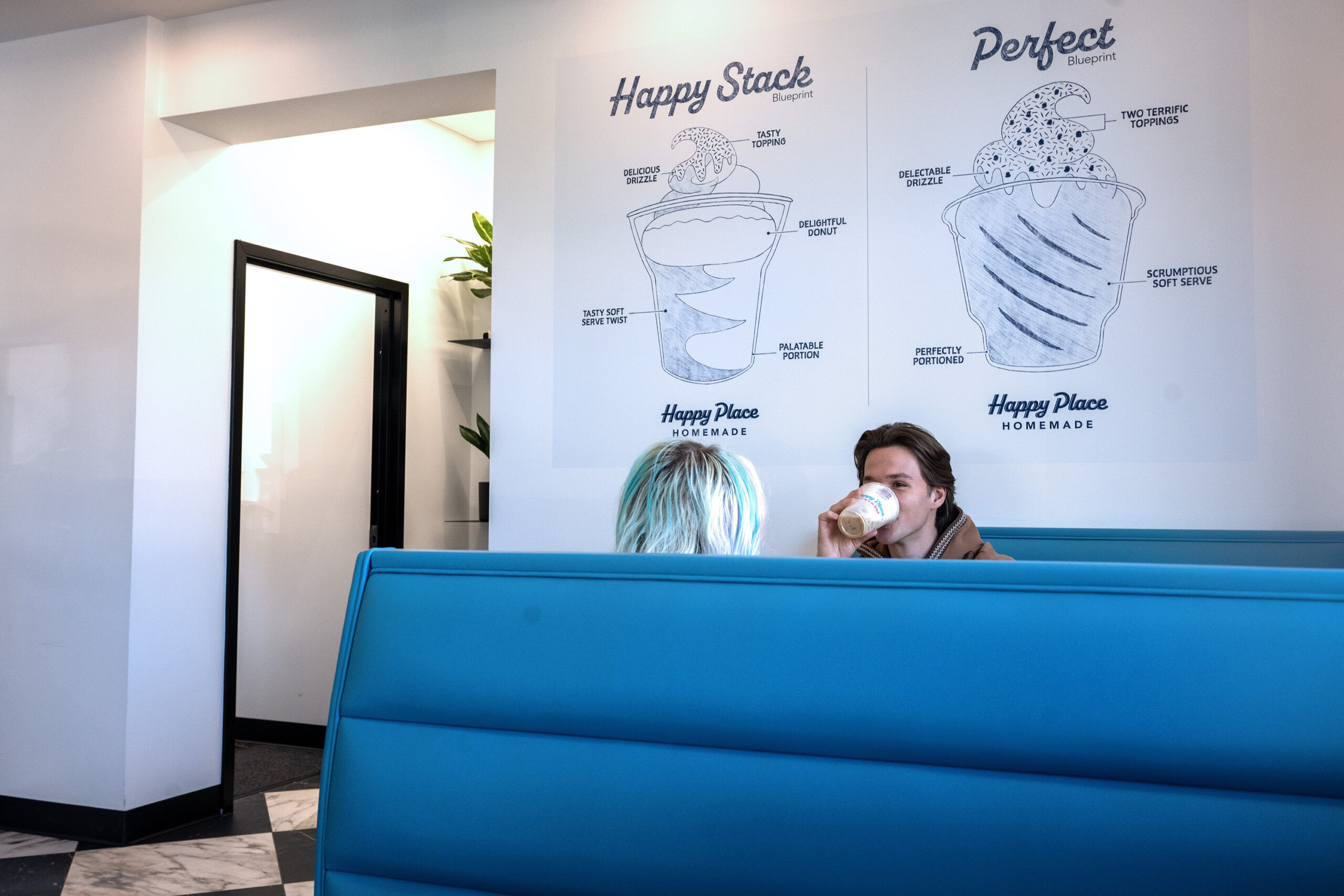
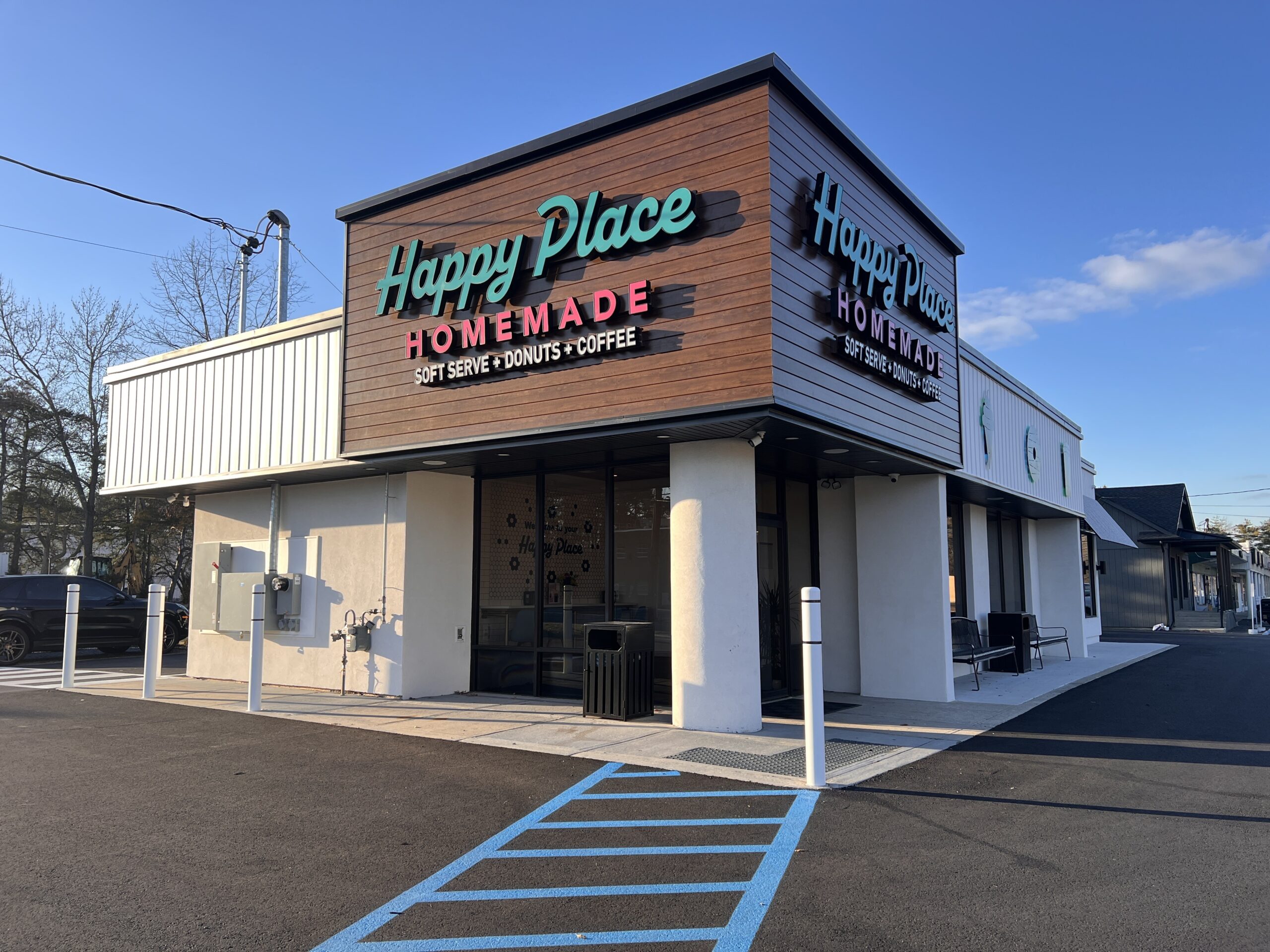
On Jan. 23, Gerber, 32, marks the grand opening of Happy Place Homemade, a bright, modern shop designed around the daily rhythms of the Burlington County town. Set up in a former Bank of America branch on Route 70 — including the drive-through — it serves coffee and scratch-made doughnuts in the morning, and adds soft serve and shakes in the afternoon and evening. There’s seating in booths along the front windows.
A torch is used to toast the marshmallow atop the s’mores doughnuts at Happy Place Homemade.
“We’re trying to create a fun, unique experience for the town,” said Gerber, who moved to Philadelphia after his Shawnee High graduation to study entrepreneurship and financial planning at St. Joseph’s University.
Combining seemingly disparate food product lines — Federal Donuts & Chicken comes to mind — is not new. “But it hasn’t been done around here,” Gerber said. “We call it ‘new nostalgia.’ We want to build a place people remember — a spot they come back to 10 or 20 years from now and say, ‘Oh, my God, Happy Place.’”
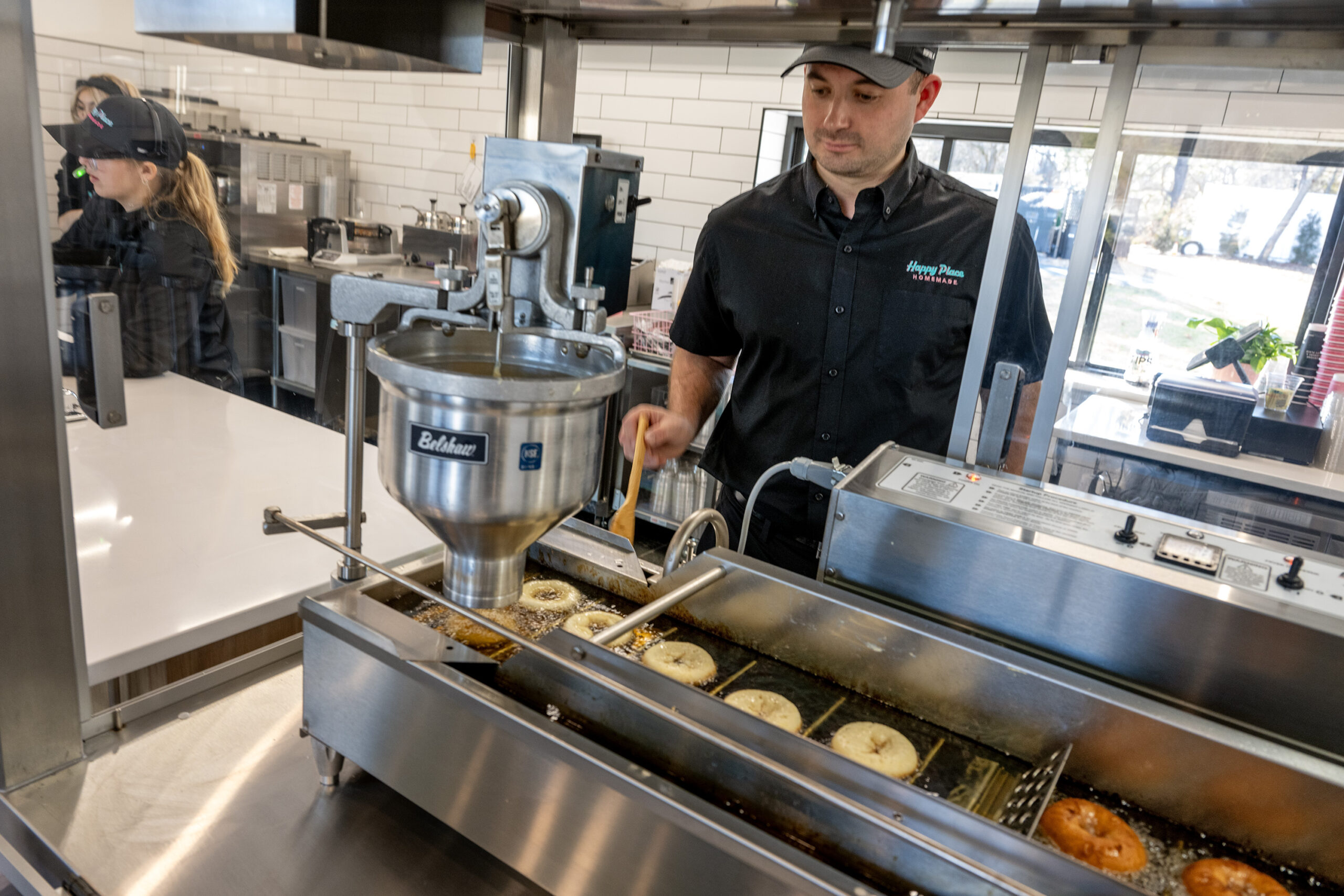
Tyler Gerber talks makes doughnuts at Happy Place Homemade in Medford.
At first, Gerber said, “we were going to be a straight soft-serve shop. But the challenge around here is that most ice cream places aren’t open year-round. We wanted to build something that could be sustainable all year, so we started thinking about what paired naturally with soft serve. Hot and cold just makes sense. That’s where doughnuts come in.”
And where there are doughnuts, there is drip coffee — in this case, from La Colombe. Gerber makes his own syrups to flavor coffee drinks and soft serve.
Gerber bought a country-fair-style Belshaw cake-doughnut machine with a glass front to let customers watch the process from the first drop of batter to the roll-out of the finished doughnut. Batter is mixed in-house and temperature-controlled before being fried, cooled, glazed while warm, and displayed in the nearby case.
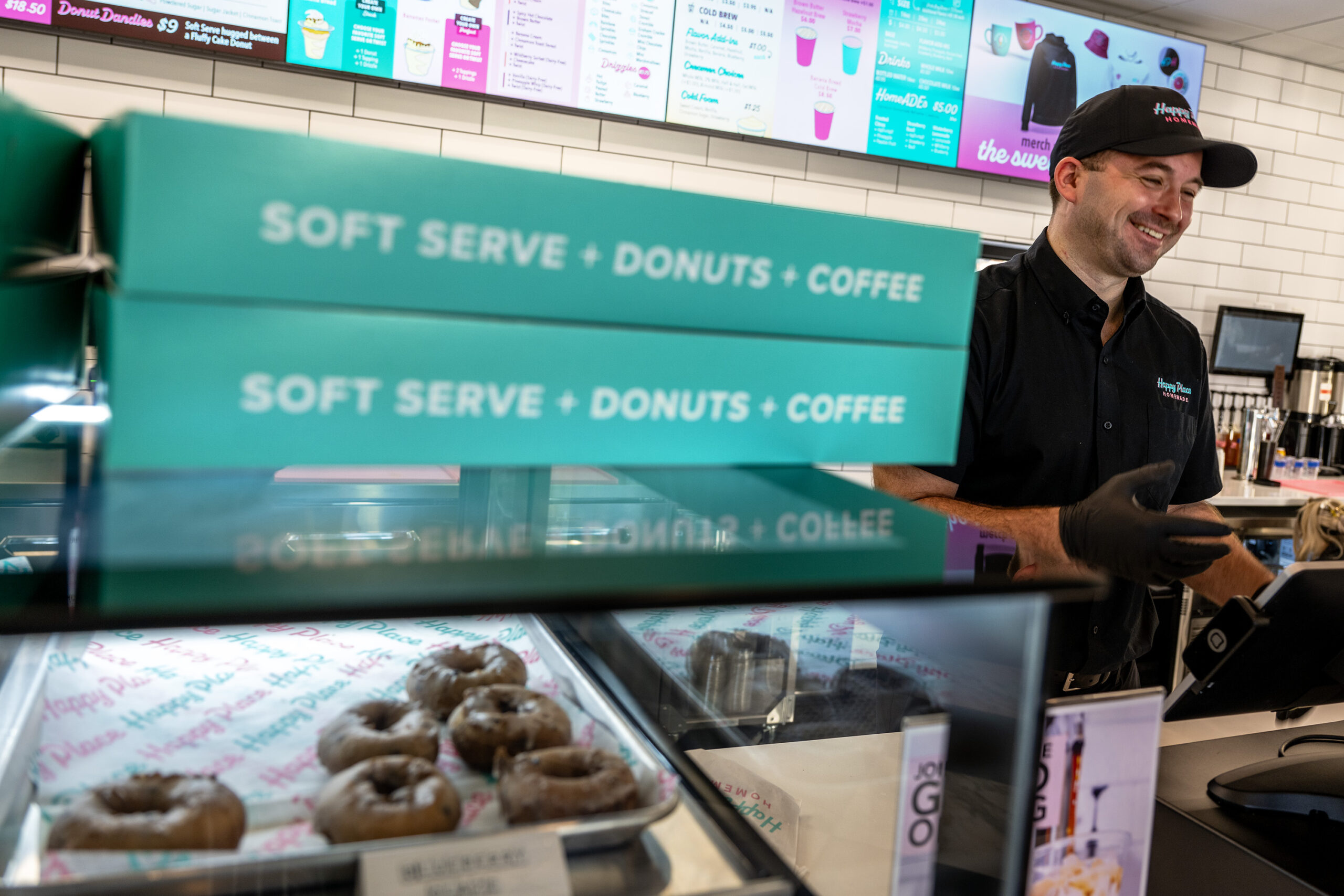
Tyler Gerber works the counter at Happy Place Homemade in Medford.
The soft serve is spun into a dense, low-air product that tastes creamier than even most ice cream, even though at 9% butterfat it is not “ice cream” by industry standards.
“We aim for about 40% overrun,” he said, referring to the percentage of air whipped into the mix during freezing. (Super-premium ice creams’ overruns are about 50% and lower, while premium brands range between 60% and 90%.)
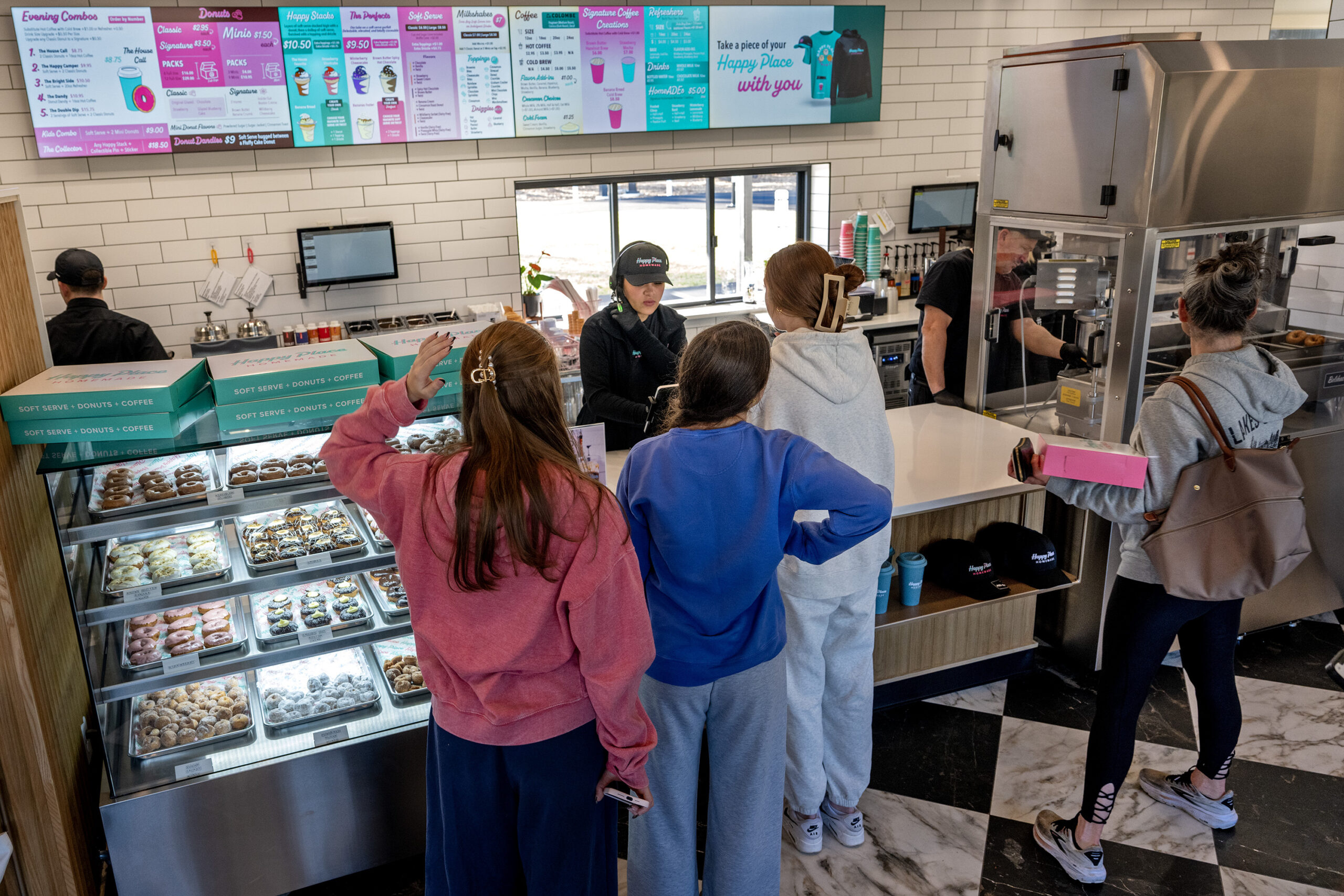
Chase Horton serves customers at Happy Place Homemade in Medford.
The doughnut-and-ice cream combination led to one of the shop’s signature creations: Happy Stacks — a doughnut sandwiched by soft serve, served in a cup, with toppings and a syrup drizzle.
There are also soft-serve parfaits (“Perfects,” he calls them), doughnut soft-serve sandwiches (“Donut Dandies”), and nondairy, fruit-based iced drinks (“HomeADE”).
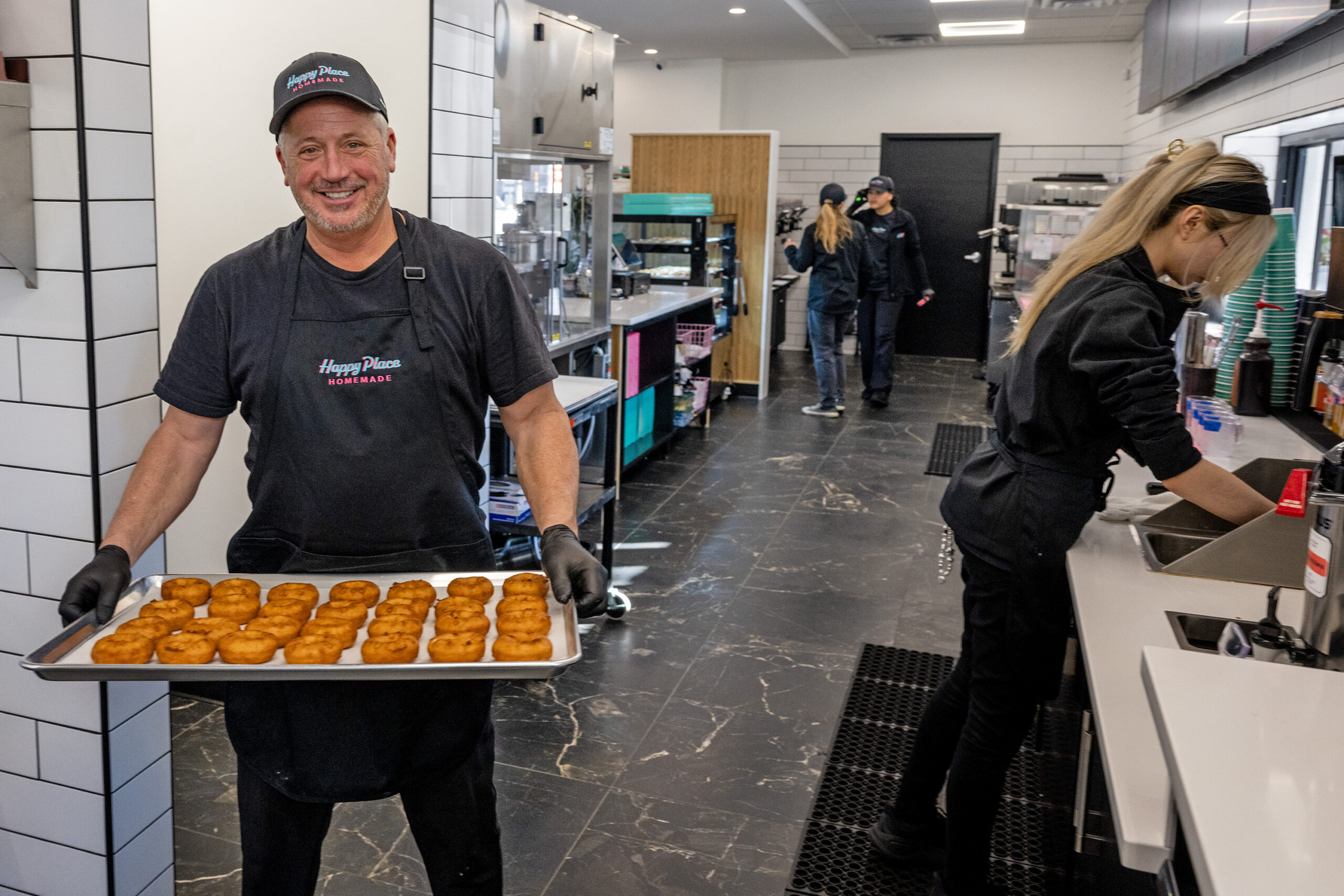
Tyler Gerber’s father, Larry Gerber, totes a tray of doughnuts at Happy Place Homemade.
Although Gerber doesn’t come from a traditional restaurant background, he says his strength is creation. “I love to cook. I’ve been experimenting my whole life,” he said.
“He goes 100% into everything,” said his father, Larry, who sold his concrete business several years ago and is helping him with the business. “Sports, school, business — he’s a perfectionist. This whole concept came out of his imagination.”
Lilli Schoener (left) and Justice Wunsch have a snack at Happy Place Homemade.
Tyler Gerber said he was making a long-term bet on his hometown.
“We’re not just popping up,” he said. “We’re building a brand. We’re building an experience. And hopefully, we’re building something that Medford can call its own.”
Happy Place Homemade, 690 Stokes Rd., Medford, N.J., 609-969-9650, happyplacehomemade.com. Hours are 7 a.m. to 9 p.m. Wednesday through Monday, closed Tuesday.
Happy Place Homemade at 690 Stokes Rd, Medford on Jan. 15, 2026.
1. Eligibility. Sweepstakes is offered only in the United States to legal residents who are 18 years of age or older as of the date of entry and who have subscribed with The Inquirer. Employees, officers, directors, agents and representatives of The Philadelphia Inquirer, LLC (“The Inquirer”), their immediate family/household members are not eligible to participate or win a prize. By entering, you agree to these Official Rules (“Official Rules”) and the decisions of The Inquirer, which are final and binding in all respects.
2. Sweepstakes Period. Sweepstakes period begins at 5:00:00 a.m. on February 3, 2026 and ends at 11:59:59 p.m. on February 10, 2026 ET (the “Sweepstakes Period”). All entries must be received by The Inquirer by the end of the Sweepstakes Period.
3. Entry. For individuals who are Inquirer Subscribers: You may enter by completing the Subscriber e-Edition Satisfaction Survey, which can be found here: Inquirer.com/survey or through the link provided in the sent email or postcard. You may need to enter your name, address (no P.O. Boxes accepted), and/or e-mail address, and will need to confirm that you are 18 years of age or older and agree to the Official Rules and The Inquirer’s Terms of Use and Privacy Policy. Upon completing the entry method and submitting your entry, subject to the conditions set forth in these Official Rules, you will automatically be entered into the Sweepstakes. Proof of entry submission does not equate to proof of receipt. Entrants agree to be bound by the Official Rules. ONE ENTRY PER PERSON DURING SWEEPSTAKES PERIOD (REGARDLESS OF WHETHER MORE THAN ONE PERSON USES THE SAME E-MAIL ADDRESS).
4. Winners. All winners will be selected by random drawing with one winner selected for each Sweepstakes prize. The drawing will be conducted by The Inquirer following the conclusion of the Sweepstakes Period and held on or about February 11, , 2026. There will be Three (3) prize winners. All winners will be selected randomly by The Inquirer from all eligible entries received during the Sweepstakes Period. One prize per entrant.
Winners of the drawing will be notified by e-mail (a “Prize Notification”) within approximately two (2) business days of the drawing. To claim a prize, the winner must: (A) respond to the Prize Notification within three (7) days of the date of the Prize Notification by replying to the email address provided in the Prize Notification; (B) provide The Inquirer with valid identification no later than seven (7) days following the Prize Notification; and (C) sign and return to The Inquirer its Affidavit of Eligibility, Liability Release and any tax forms deemed required by The Inquirer no later than seven (7) days following the Prize Notification.
If a winner fails to fulfill the above requirements, the applicable prize will be deemed forfeited and an alternate winner may be randomly selected from the eligible entries received during the Sweepstakes Period. Four (4) alternate winners will be selected in case of forfeiture. Final designation as the winner depends on verification of eligibility as determined by The Inquirer. Winners may not substitute or redeem prizes for cash.
5. Prize/Odds. In accordance with these Official Rules, each winner will be awarded one (1) American Express Gift Card with a value of $100. Odds of winning will be determined by the total number of eligible entries received during the Sweepstakes Period. No assignment, transfer or substitution of prize is permitted except by The Inquirer in the event of prize unavailability.
6. General Conditions. Winners may be required to execute and return an Affidavit of Eligibility, a Liability Release, applicable tax forms, and where lawful, a Publicity Release within five (5) days of notification of the prize. Failure to return documents timely, or if prize notification or prize is returned as non-deliverable, the winner may be disqualified with an alternate winner selected. Where permitted by law, winner agrees to grant to The Inquirer the right to print, publish, broadcast and use, worldwide in any media the winner’s name, portrait, picture, voice, likeness and biographical information as news or information and for advertising and promotional purposes without additional consideration; and further without such additional compensation, appear for, or provide biographical information for use in, any presentation or other activity which may include filming/audio/video/electronic or other recordings and/or interviews, as may be determined from time to time by The Inquirer. Each winner and entrant agrees to release and hold harmless The Inquirer and their respective affiliates and their respective directors, officers, employees, representatives and agents from any and all liability for any injuries, loss or damage of any kind to person, including death, and property, arising in whole or in part, directly or indirectly, from acceptance, possession, use or misuse of a prize, participation in any Sweepstakes related activity, or participation in this Sweepstakes. This Sweepstakes is organized, administered, and Sponsored by The Inquirer.
VOID WHERE PROHIBITED BY LAW. FEDERAL, STATE AND LOCAL LAWS AND REGULATIONS APPLY. NO PURCHASE NECESSARY TO ENTER OR WIN. A PURCHASE WILL NOT INCREASE YOUR CHANCES OF WINNING.
7. Limitations of Liability. The Inquirer is not responsible for any incorrect or inaccurate information, whether caused by Web site users, or tampering or hacking, or by any of the equipment or programming associated with or utilized in the Sweepstakes and assumes no responsibility for any error, omission, interruption, deletion, defect, delay in operation, or transmission, communications line failure, theft or destruction. or unauthorized access to the Web site. The Inquirer is not responsible for injury or damage to participants’ or to any other person’s computer related to or resulting from participating in this Sweepstakes or downloading materials from or use of the Web site. If, for any reason, the Sweepstakes is not capable of running as planned by reason of infection by computer virus, worms, bugs, tampering, unauthorized intervention, fraud, technical failures, or any other causes which, in the sole opinion The Inquirer, could corrupt or affect the administration, security, fairness, integrity or proper conduct of this Sweepstakes, The Inquirer reserve the right at their sole discretion to cancel, terminate, modify or suspend the Internet portion of this Sweepstakes for any drawing(s) and select the winner from Internet entries received for that drawing prior to the action taken. IN NO EVENT WILL THE INQUIRER OR THEIR RESPECTIVE OFFICERS, DIRECTORS, EMPLOYEES, REPRESENTATIVES, AFFILIATES AND AGENTS, BE RESPONSIBLE OR LIABLE FOR ANY DAMAGES OR LOSSES OF ANY KIND, INCLUDING DIRECT, INDIRECT, INCIDENTAL, CONSEQUENTIAL OR PUNITIVE DAMAGES ARISING OUT OF YOUR ACCESS TO AND USE OF INTERNET SITE INQUIRER.COM, OR THE DOWNLOADING FROM AND/OR PRINTING MATERIAL DOWNLOADED FROM SAID SITE.
8. Disputes. As a condition of participating in this Sweepstakes, entrant agrees that any and all disputes that cannot be resolved between the parties, and causes of action arising out of or connected with this Sweepstakes, shall be resolved individually, without resort to any form of class action or mass arbitration, exclusively, before a court located in the Commonwealth of Pennsylvania having competent jurisdiction, which Court shall apply the laws of the Commonwealth of Pennsylvania without regard for doctrines of conflict of law.
9. Privacy Policy. By entering the Sweepstakes, you consent to receive promotional emails, newsletters, and other emails from The Inquirer and to The Inquirer’s privacy policy, which is available here: https://www.inquirer.com/privacy-policy/. You acknowledge that if you elect to log in to Inquirer.com through Google or Apple, that in doing so, you also agree to the privacy policy of Google or Apple, as applicable.
10. Winners’ List. or names of the winners send a self-addressed stamped envelope by March 30, 2026 to: The Inquirer Satisfaction Survey Sweepstakes – Winners’ Names, 100 S. Independence Mall West, Philadelphia, PA 19106.
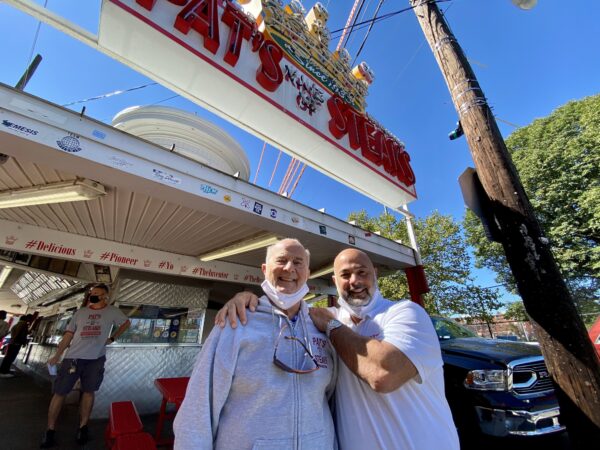
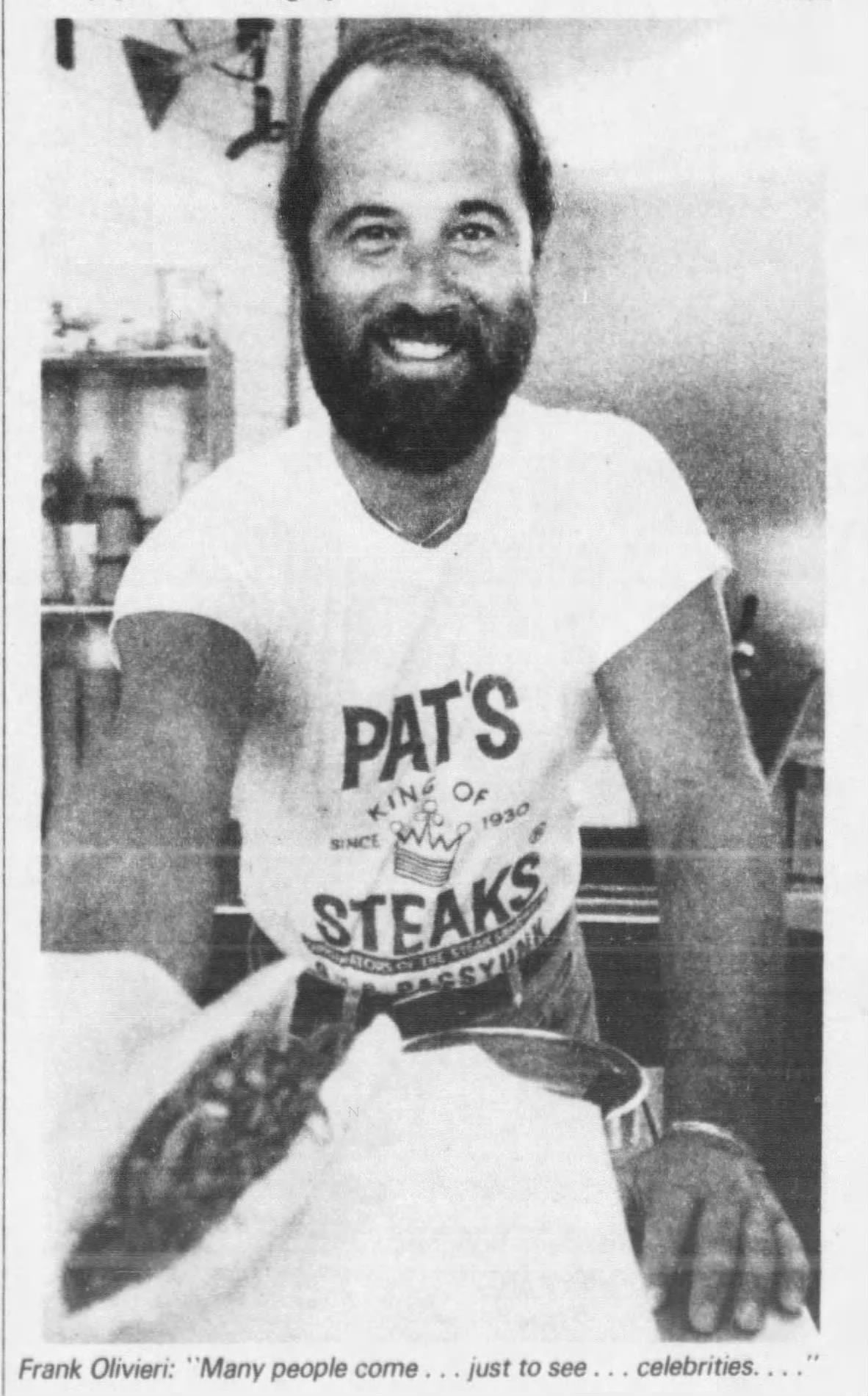
Frank P. Olivieri, 87 — whose uncle and father invented the steak sandwich and who ran the landmark Pat’s King of Steaks for nearly four decades — died Sunday, Jan. 18. He had been under care for dementia, said his son, Frank E. Olivieri, who has run the shop since his father’s 1996 retirement.
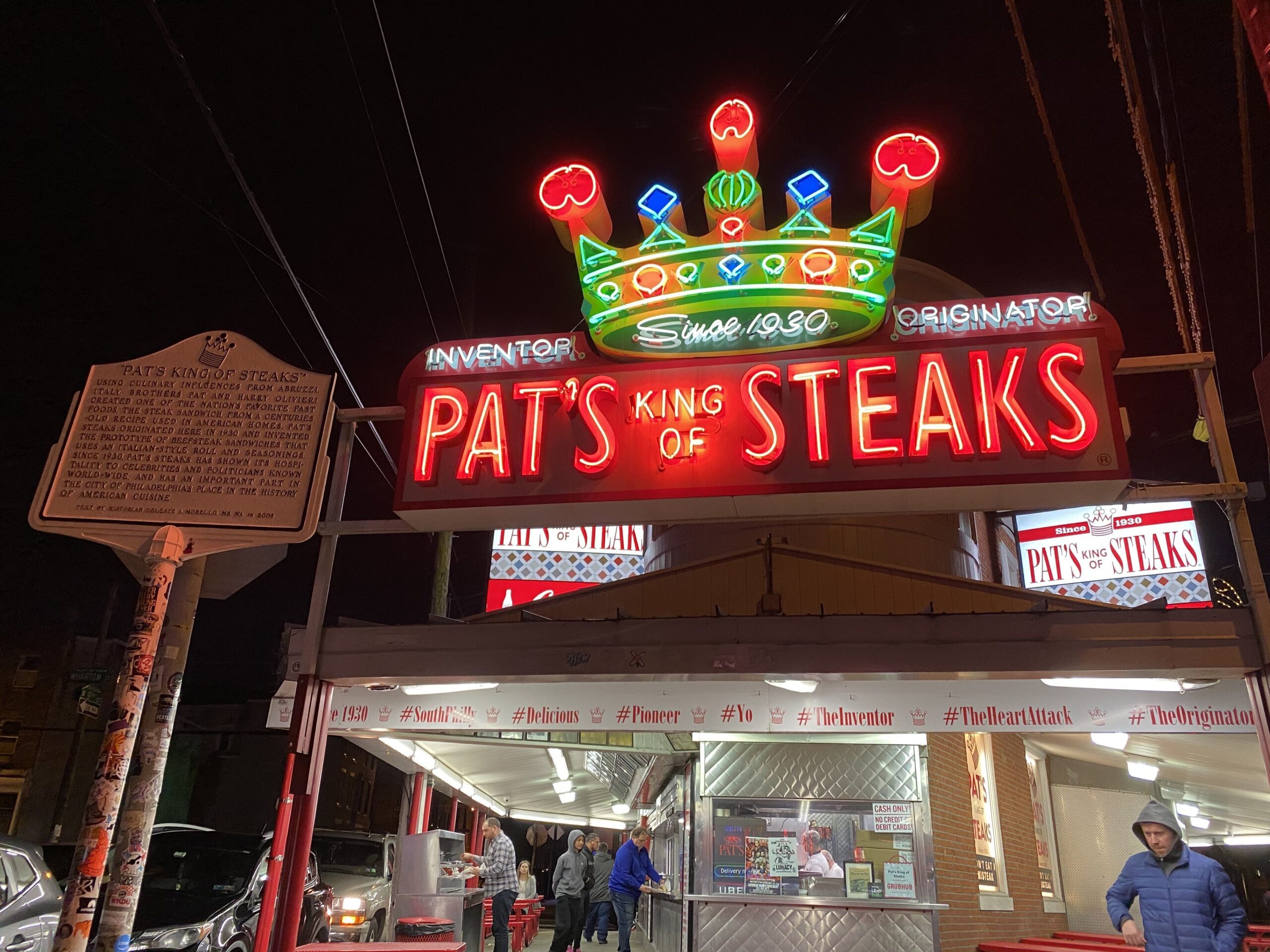
Though the Olivieri name spread through Philadelphia over the years through various shops, Mr. Olivieri spent his entire working life at the intersection of Ninth, Wharton, and Passyunk in South Philadelphia. “I’m on my own little island,” he told The Inquirer in 1982.
Pat’s King of Steaks, at Ninth Street, Wharton Street, and Passyunk Avenue, in 2020.
The legend began in 1930 (in some accounts 1932) when Mr. Olivieri’s father, Harry, and his uncle, Pasquale “Pat” Olivieri, started selling hot dogs for a nickel at that corner. (Pat, the elder, got the naming rights.) One day, as the story goes, they got tired of eating hot dogs and bought a loaf of Italian bread and some steaks, sliced them up, and put them on the grill. (Cheesesteaks came along in 1951.) Curious cabdrivers begged for the sandwiches. “Pretty soon, they forgot all about the hot dogs and did nothing but steaks,” Mr. Olivieri told The Inquirer in 1982.
Mr. Olivieri told The Inquirer that he started working at the stand at age 11, selling watermelon and corn on the cob out front. He turned down the opportunity to go to the University of Pennsylvania to become an attorney, and chose to go into the family business, his son said.
Frank Olivieri working the grill at Pat’s King of Steaks in 1980.
Pat Olivieri moved to California in the 1960s; he died in 1970. In 1967, father and son Harry and Frank Olivieri bought the original stand, while Pat’s son Herb obtained licensing and franchising rights to the name.
Herb Olivieri opened Olivieri’s Prince of Steaks in Reading Terminal Market in 1982 and later ran a Pat’s location in Northeast Philadelphia (unaffiliated with the original). Herb’s son Rick owned sandwich shops, including the reflagged Rick’s Steaks at Reading Terminal, as well as stands at the Bellevue and Liberty Place food courts.
Pat’s, meanwhile, had become a 24-hour destination. Limos and tour buses, then as now, roll up at all hours.
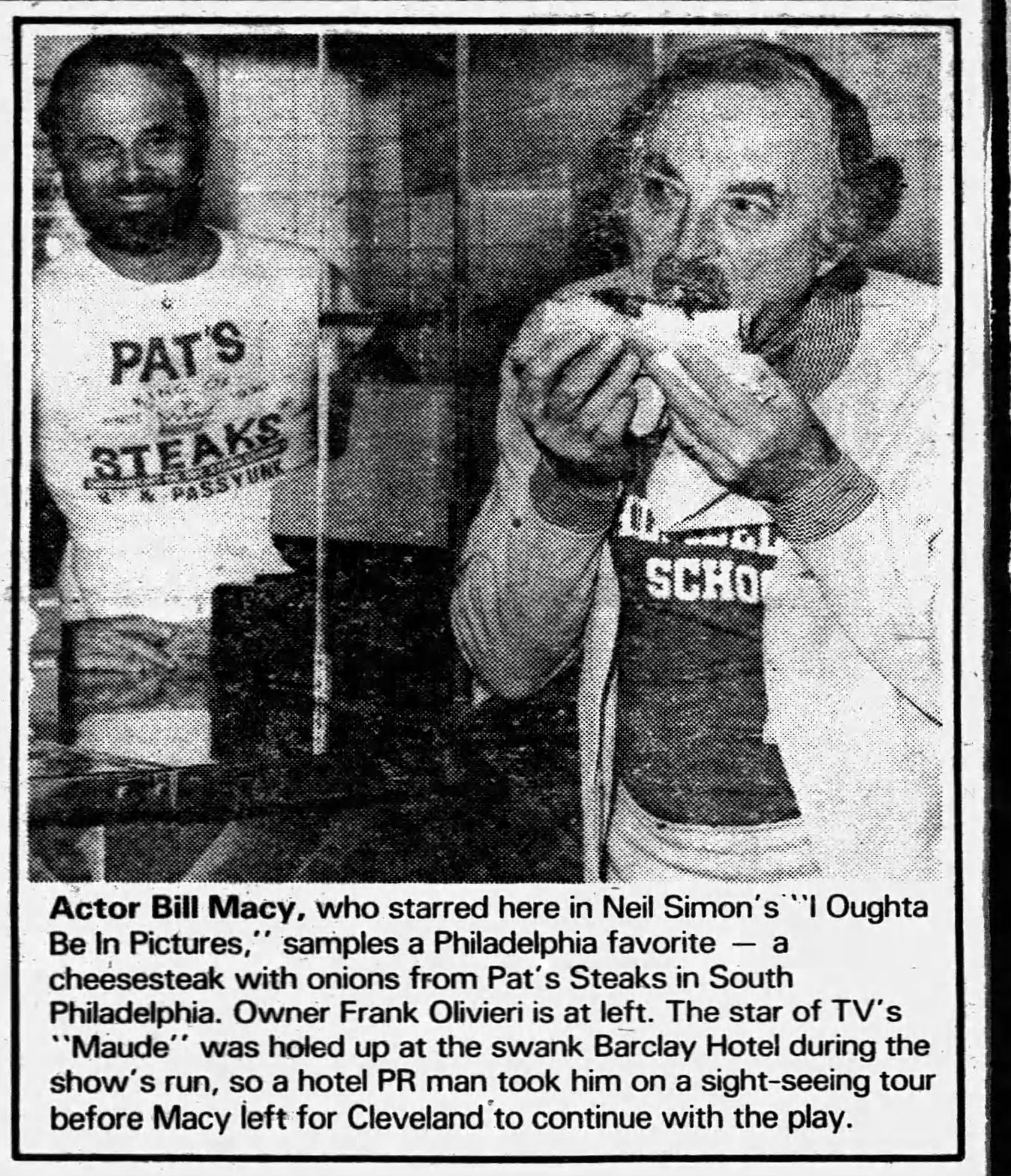
Frank Olivieri (left) watching actor Bill Macy eating a cheesesteak from Pat’s King of Steaks in 1981. Macy was touring Philadelphia sites while starring at the Forrest Theater in a pre-Broadway run of “I Oughta Be in Pictures.”
When Sylvester Stallone filmed part of Rocky outside of Pat’s in 1976, he invited Mr. Olivieri to a private party afterward.
“I had to tell him I can’t go,” Mr. Olivieri recalled. “We didn’t get to be No. 1 by letting the business run itself.” Back then, Mr. Olivieri lived in Packer Park, kept a summer home in Brigantine, and was rarely more than an hour away.
“I can be here any time,” he said. “And I am here lots and lots of the time.”
In 1966, a competitor arrived across the street: Geno’s Steaks, owned by Joey Vento, a former Pat’s employee. The Pat’s-Geno’s rivalry — buzzing neon, dueling lines, endless debates over quality — is, in fact, wildly overblown. Current owners Frank E. Olivieri, popularly known as Frankie, and Geno Vento, Joey’s son, are good friends.
Mr. Olivieri, who served for many years on the board of directors of Provident Bank, was a whiz with numbers, his son said. He also was an avid fisherman and yachtsman who had his captain’s license. “He also taught me everything I know about electrical work, plumbing, woodworking, and how to fix just about anything,” his son said. “The reason I know how to do all of that is because if he couldn’t do something himself, I had to learn how to do it. Without his guidance, I wouldn’t know how to do any of it.”
Mr. Olivieri’s son recalls his father’s burgundy 1974 Corvette. “One of the happiest moments of my week was sitting in the passenger seat with him on Saturdays and Sundays,” he said. When they turned from Broad onto Wharton Street, “by the time we hit around 10th Street, I could already smell the onions cooking. He always had the T-tops off for me in the summer. That was my first introduction to being at the store.”
Besides his son, Mr. Olivieri is survived by his wife of 65 years, Ritamarie; daughters Danielle Olivieri and Leah Tartaglia; 10 grandchildren; and three great-grandchildren.
Viewing will be from 9 to 11 a.m. Friday, Jan. 23, at Baldi Funeral Home, 1327-29 S. Broad St. A prayer service and memorial tributes will begin at 11 a.m. The family requests donations to St. Maron Church, 1010 Ellsworth St., Philadelphia, Pa. 19147.
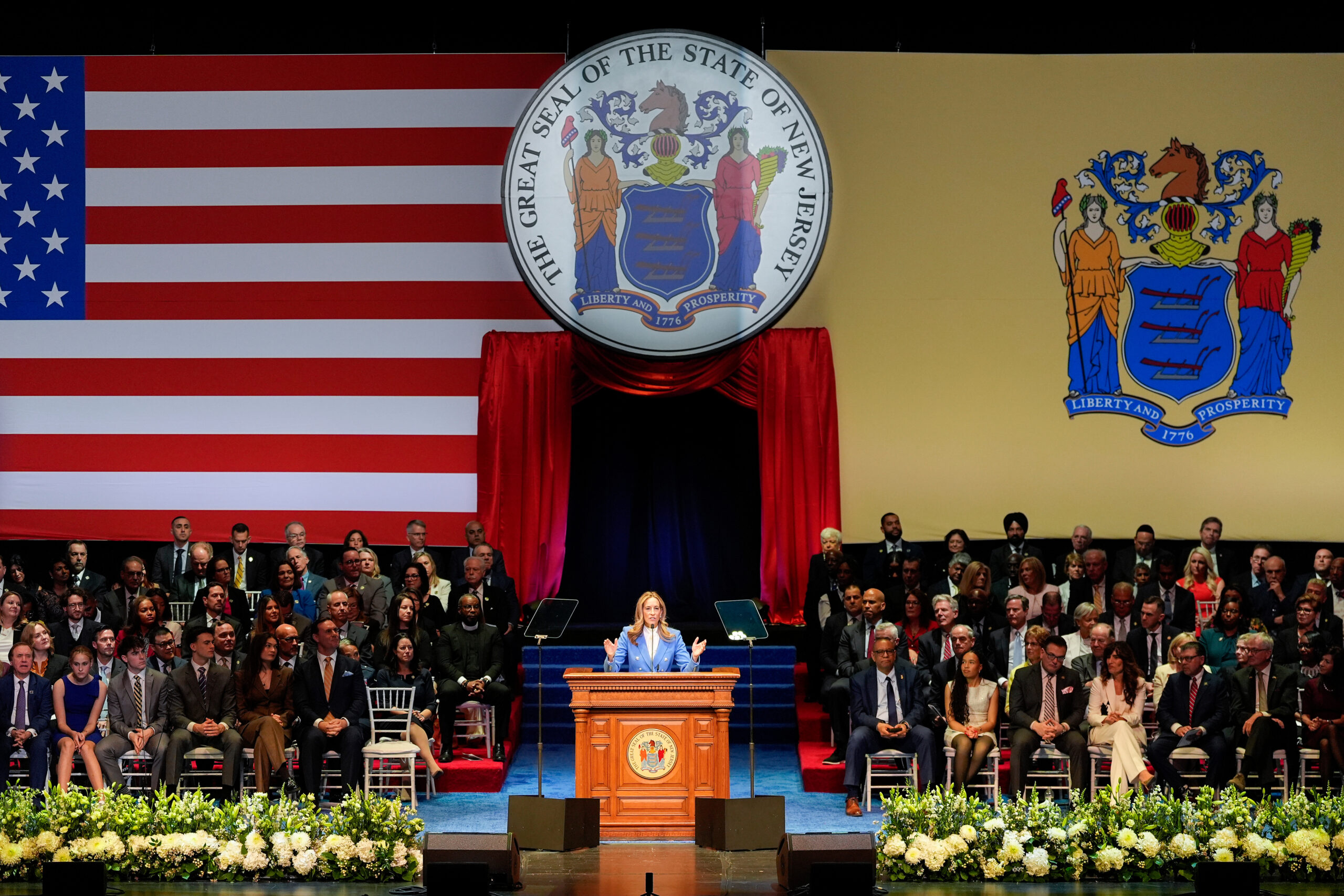
NEWARK, N.J. — Mikie Sherrill was sworn in as New Jersey governor Tuesday, becoming the second woman to govern the state and the first from the Democratic Party.
Sherrill, who is also the first female veteran from either party to be elected to the office, broke tradition by opting to be inaugurated in her home county of Essex, in northern New Jersey, instead of the state’s capital city, Trenton.
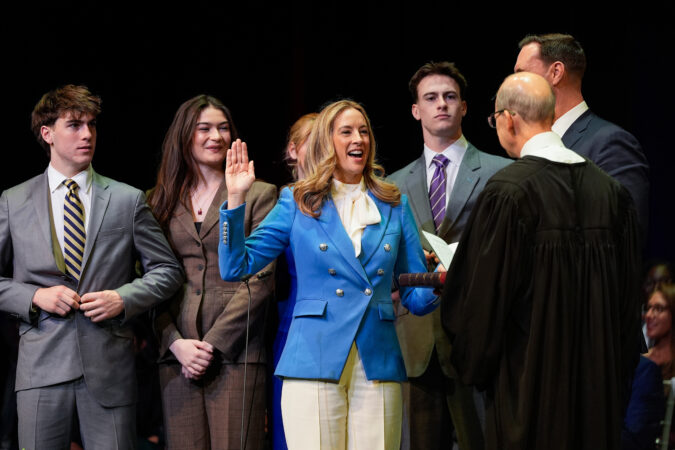
She took the oath at the New Jersey Performing Arts Center in Newark in the morning. Joined onstage by her family and high-profile Democrats, Sherrill spoke about her love for New Jersey and denounced President Donald Trump in a speech on Tuesday.
She also gave two shout-outs to South Jersey, noting that she learned on the campaign trail that South Jerseyans say “pork roll” instead of “Taylor Ham.”
“I have heard you in South Jersey, where you want jobs, transportation investments, innovative businesses, and not to be forgotten or left behind,” she also said.
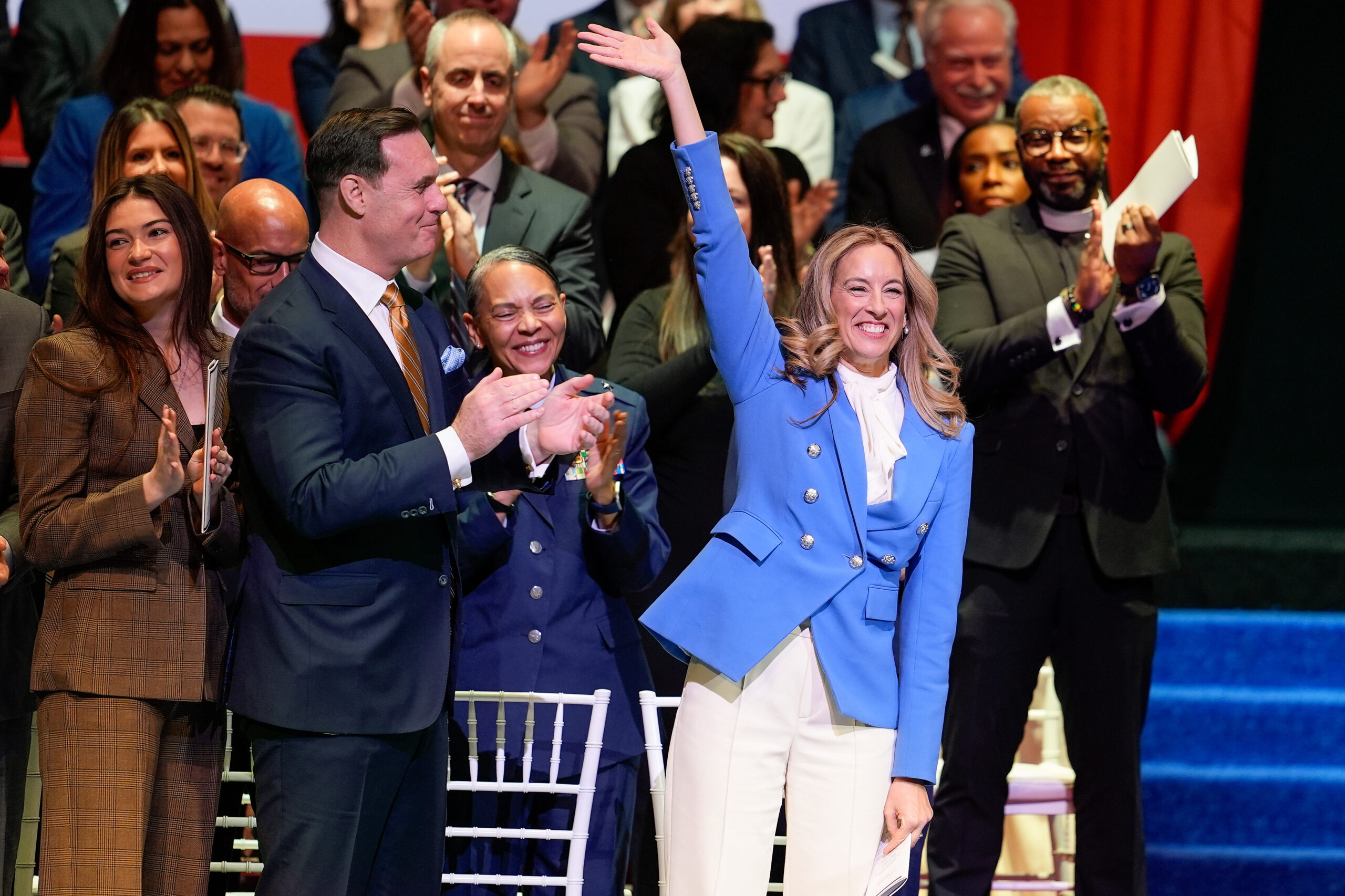
New Jersey Governor-elect Mikie Sherrill waves as she arrives for her inauguration, Tuesday, Jan. 20, 2026, in Newark, N.J. (AP Photo/Seth Wenig)
She even referenced Philadelphia while talking about the founding of the United States — in a very Jersey way.
“In fact, not too far away, in the greater Camden metropolitan region, in a place called Philadelphia, Thomas Jefferson wrote a declaration of our independence, marking the birth of this great nation,” she said.
“This entirely unique and revolutionary declaration claims human beings had universal rights to life, to liberty, to the pursuit of happiness, not because of who their parents were, but because every human being is endowed with these rights by their creator, not by a king,” she added, and was met by applause.
She drew parallels between England’s king at the founding of the United States and Trump, whom Democrats have criticized through “no kings” protests. Sherrill said Trump is “illegally usurping power, unconstitutionally enacting a tariff regime to make billions for himself and his family while everyone else sees their costs go higher.”
Sherrill, a former Navy helicopter pilot, former federal prosecutor, and mother of four, was elected to Congress in 2018 and stepped down in November after winning the election, defeating Jack Ciattarelli, who had won the endorsement of Trump.
Sherrill, whose closely watched candidacy drew significant national support, promised during her campaign that she would make New Jersey more affordable and would stand up to Trump.
White flowers lined the front of the stage, and large American and New Jersey flags served as a backdrop.
Virginia Gov. Abigail Spanberger, Sherrill’s friend and former congressional colleague, was in attendance. Spanberger became Virginia’s first female governor on Saturday in a ceremony attended by Sherrill and other high-profile Democrats.
New Jersey and Virginia were the only states to hold gubernatorial races last year, and the Democratic victories were viewed as a positive sign for the party heading into the midterms with Trump in the White House.
Sherrill, who turned 54 on Monday, succeeds Gov. Phil Murphy, a Democrat who served two terms. It’s the first time the same party has held the governor’s mansion for three consecutive terms since 1970.
After the ceremony, Sherrill was slated to head to Trenton to sign more executive orders before going back north for an inaugural ball Tuesday evening at the American Dream in East Rutherford.
Sherrill’s lieutenant governor, Dale Caldwell, 65, was also sworn in Tuesday. Caldwell, a Middlesex County-based Methodist pastor, most recently worked as the first Black president of Centenary University. He has worked for state government, started nonprofits, and led charter schools.
In his speech Tuesday, Caldwell said his father marched with the Rev. Dr. Martin Luther King Jr., whom he and Sherrill both mentioned in their speeches.
“My father taught me that faith must be active, not passive. He taught me that justice is not an idea, it is a responsibility,” Caldwell said. “And he taught me that service is not optional, especially for those who have been blessed with opportunity.”
Her decision to be inaugurated up north was celebrated by Newark officials, but Trenton City Council member Jennifer Williams, a Republican, argued in an op-ed that it was an insult to Trenton.
Christine Todd Whitman, the first woman to serve as New Jersey governor, used the same venue as Sherrill when she was sworn in for her second term in 1998 while the war memorial in Trenton, the traditional site, was undergoing renovations.
Whitman served as a Republican from 1994 to 2001 before joining the Bush administration and has since left the Republican Party for the Forward Party. She endorsed Sherrill’s candidacy.
New Jersey Gov. Mikie Sherrill speaks after taking the oath of office during an inauguration ceremony, Tuesday, Jan. 20, 2026, in Newark, N.J. (AP Photo/Seth Wenig)
Which Eagles players should stay or go next season? Swipe and decide.
// Timestamp 01/20/26 1:02pm
Which Eagles should stay or go next season? Swipe and decide.
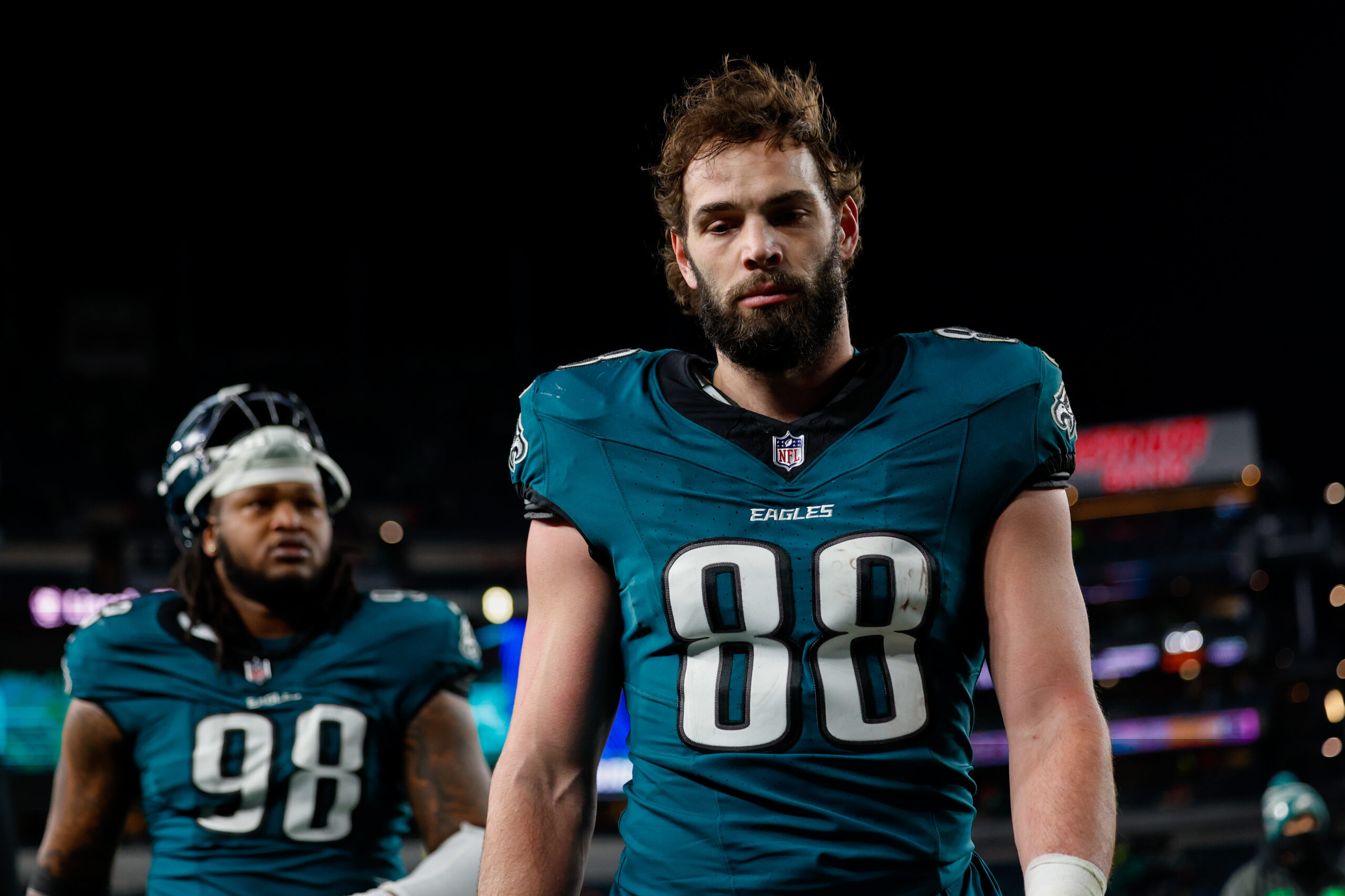
Eagles tight end Dallas Goedert will be a free agent this offseason.
The Eagles’ season ended sooner than expected with a loss to the 49ers in the wild-card round. Now the Birds will try to assemble a roster that can help them get back to their Super Bowl standard.
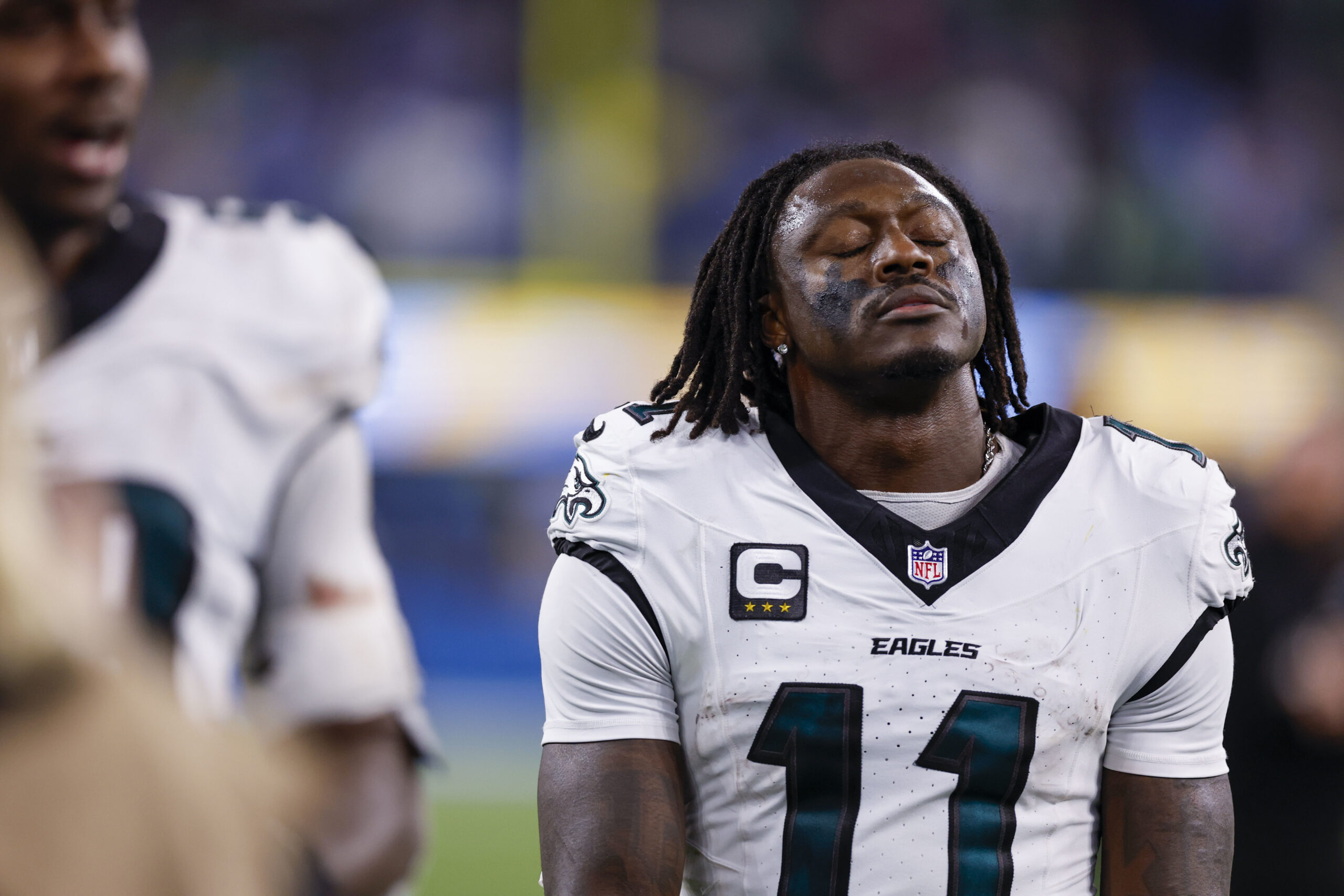
Beat writer Jeff McLane made his picks on what personnel decisions he sees the team making this offseason, including wide receiver A.J. Brown’s future and whether tight end Dallas Goedert should be back next season.
Make your pick for each player by swiping the cards below — right for Stay, or left for Go. Yes, just like Tinder.
One NFL personnel evaluator told ESPN the likely trading partner will be the Buffalo Bills, who desperately need to acquire talent to help Josh Allen.
“The Bills have to upgrade there — their best receiver is Khalil Shakir, who is a nice player but he’s not a top guy,” the executive told ESPN. “Brown is an immediate upgrade and he’s still young. And the Eagles can build the passing game around DeVonta Smith and a high draft pick.”
Other NFL scouts suggested to Fowler the Eagles could end up trading Brown to the Tennessee Titans, Cleveland Browns, San Francisco 49ers and Las Vegas Raiders.
Brown is under contract through the 2029 season, and trading him would certainly put a dent in the Eagles’ salary cap (though designating it a post-June 1 trade would free up $7 million in cap space). But as Philly Voice’s Jimmy Kempski pointed out, there would be major long-term savings for the Eagles — over $44 million per season — if they traded him away this offseason.
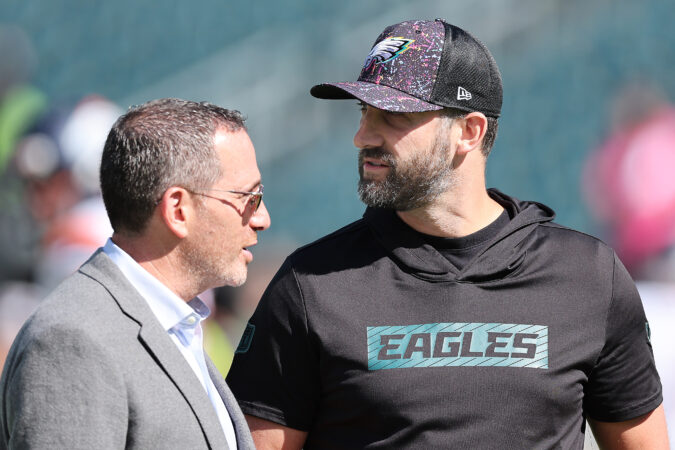
Eagles general manager Howie Roseman was noncommittal when asked if he would consider trading Brown.
“It is hard to find great players in the NFL, and A.J. is a great player,” Roseman told reporters at a news conference last week. “I think from my perspective, that’s what we’re going out and looking for, when we go out here in free agency and in the draft, is trying to find great players who love football, and he’s that guy. So that would be my answer.”
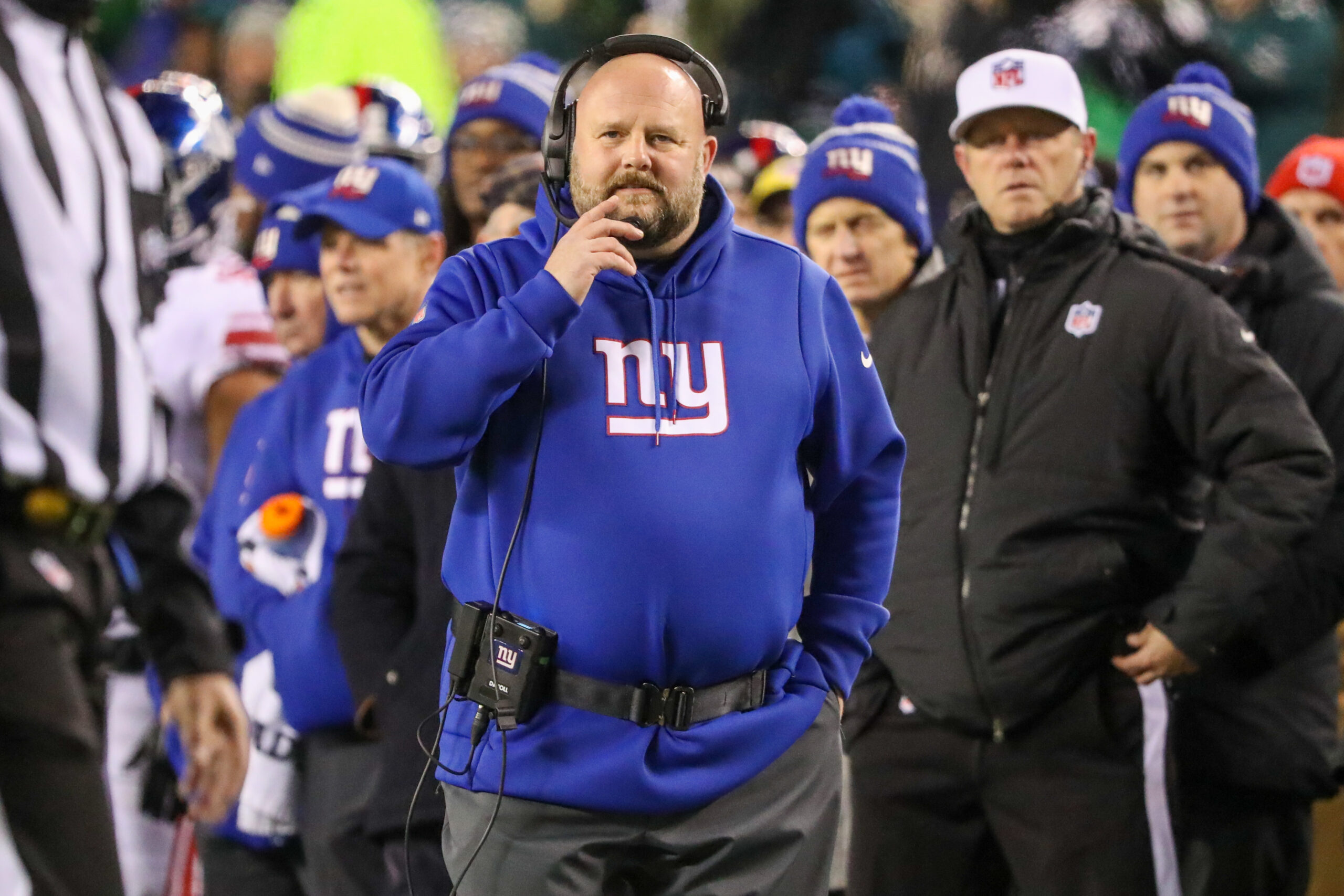
Daboll went 20–40–1 (.336) in four seasons with the Giants, and was named NFL Coach of the Year in 2022. Prior to that, he was the offensive coordinator with the Buffalo Bills, where he was credited with the development of Josh Allen.
After firing Sean McDermott, the Bills are reportedly interested in bringing back Daboll. He interviewed with the Tennessee Titans, who ended up hiring former San Francisco 49ers defensive coordinator Robert Saleh as their next head coach.
Daboll also reportedly interviewed for the vacant offensive coordinator position with the Los Angeles Chargers.
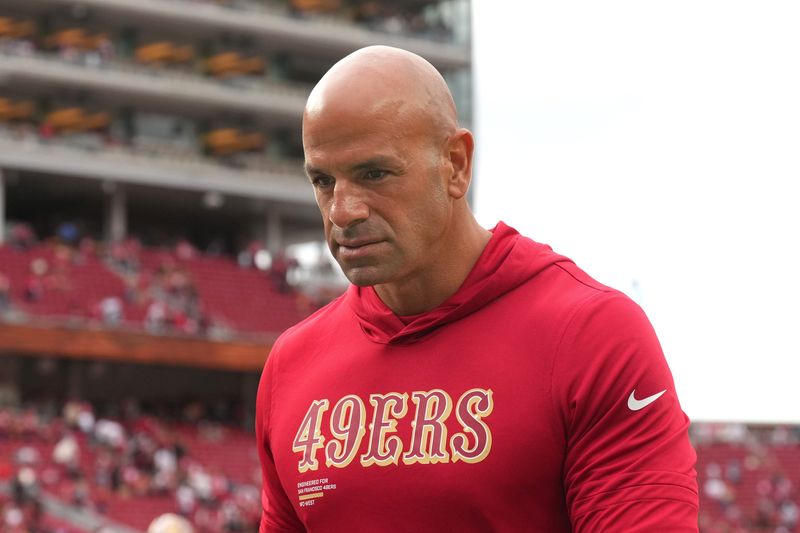
Robert Saleh is headed to the Tennessee Titans to become their next head coach.
And then there were five.
In an offseason that saw 10 head coaching vacancies (tying an NFL record last reached in 2022), four have already been filled.
The latest is former San Francisco 49ers defensive coordinator Robert Saleh, who has been hired by the Tennessee Titans as their new head coach, according to multiple reports.
Here’s a look at the newest NFL head coaches:
Atlanta Falcons: Kevin Stefanski, former Browns head coach
Tennessee Titans: Robert Saleh, former 49ers defensive coordinator
New York Giants: John Harbaugh, former Ravens head coach
Miami Dolphins: Jeff Hafley, former Packers defensive coordinator
Here are the remaining head coaching vacancies across the league:
Eagles have yet to convince Mike McDaniel to interview: sources
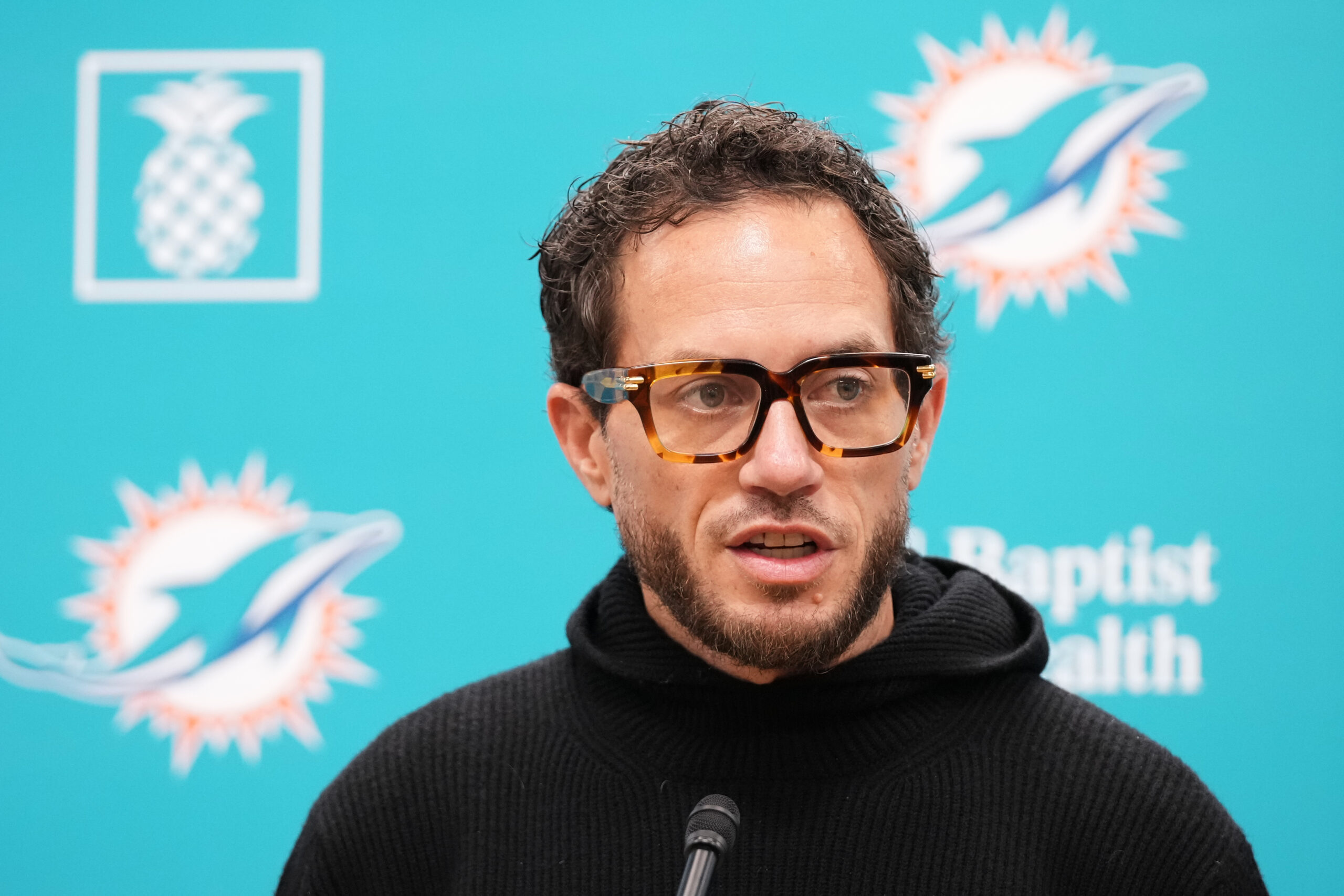
Ex-Dolphins coach Mike McDaniel is getting a lot of interest from multiple teams.
In the past week, the Eagles have made it known to sources around the league that hiring former Miami Dolphins head coach Mike McDaniel as their new offensive coordinator is their No. 1 offseason priority. That includes fired New York Giants coach Brian Daboll, who is expected to interview for the position this week.
Virtually no amount of money, literally no amount of autonomy, and no fear of conflict would deter the team from signing McDaniel, a respected offensive innovator.
McDaniel and Eagles defensive coordinator Vic Fangio endured a rocky year together in 2023, when Fangio worked for McDaniel as his defensive coordinator in Miami, and their split, while couched as a mutual parting of the ways, was not without acrimony.
At any rate, league sources indicate that even though Fangio’s work the last two seasons has been integral and possibly unmatched around the league, if the Eagles were somehow able to hire McDaniel, they would not be deterred by any possible discomfort from Fangio.
Of course, the actual hiring of McDaniel in Philadelphia would be an unexpected coup for the Birds. Right now, he’s a hotter commodity than Venezuelan oil.
League sources say the Eagles have not yet convinced McDaniel to interview, which offers a glimpse into how he considers the Philly job. That said, don’t expect money to be an obstacle. Sources say that, for McDaniel, the position could be worth as much as the $6 million annual salary the Raiders gave Chip Kelly, who then was fired just 11 games into 2025, his first of three seasons under contract. At the end of the season head coach Pete Carroll also was fired, which created the current vacancy.
Latest on Eagles’ search for a new offensive coordinator
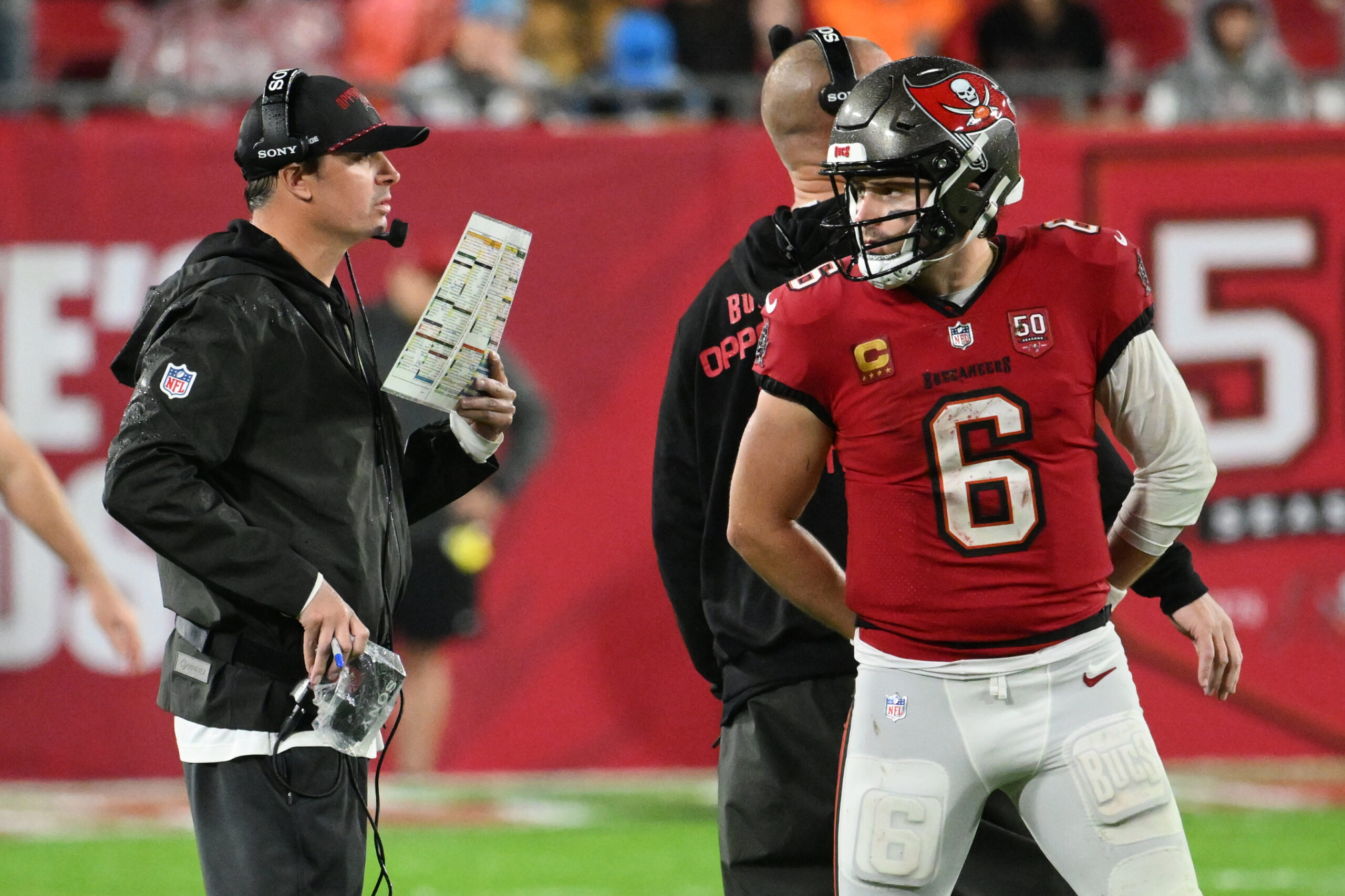
Former Buccaneers offensive coordinator Josh Grizzard reportedly interviewed with the Birds Monday.
It’s been about a week since the Eagles moved on from offensive coordinator Kevin Patullo, and the Birds have been busy interviewing potential replacements.
Here are the offensive coordinator candidates the Eagles have already reportedly interviewed or are scheduled to meet with:
Brian Daboll: The former Giants head coach, reportedly at the top of the Eagles’ wish list, will interview with the team Tuesday, according to The Athletic’s Dianna Russini.
Josh Grizzard: The former Buccaneers offensive coordinator interviewed with the Birds Monday, according to Jordan Schultz.
Mike Kafka: The former interim head coach and offensive coordinator of the Giants interviewed with the Birds Saturday, according to ESPN’s Jeremy Fowler.
Jim Bob Cooter: The Colts offensive coordinator and one-time Birds assistant also interviewed with the Eagles Saturday, according to multiple reports. Colts head coach and former Birds offensive coordinator Shane Steichen is open to letting Cooter pursue an opportunity to call plays, according to Sports Illustrated’s Albert Breer.
Zac Robinson: The former Falcons offensive coordinator was the first candidate interviewed by the Eagles, according to ESPN’s Adam Schefter.
And here are some coaches the Eagles have either reached out to interview or plan to bring in:
Mike McDaniel: The former Dolphins head coach remains one of the Eagles’ top targets, but has yet to agree to an interview, according to columnist Marcus Hayes.
Eagles defensive coach Christian Parker to interview with Dolphins
Sources: The #Packers will interview #Eagles DBs coach and pass-game coordinator Christian Parker for their vacant DC job after Jeff Hafley took the Dolphins head-coaching position.
Broncos backup Jarrett Stidham will start his first game of the season Sunday against the Patriots.
We’re down to just three games remaining this NFL season, though most Eagles fans bailed following the Birds wild-card loss to the San Francisco 49ers.
The name you’ll be hearing all week is Jarrett Stidham, the backup replacing starting quarterback Bo Nix, who broke is ankle on the second-to-last play against the Bills Saturday and is out for the rest of the season.
Stidham (who was originally drafted by the Patriots and was once Tom Brady’s backup) will make his first start of the season Sunday. The last time that happened was 53 years ago in 1972, when then-backup Roger Staubach started in place of Craig Morton and played terribly in a lopsided loss to Washington.
“His last pass in a game came two years and two weeks ago,” retired NFL writer Peter King noted in his weekly newsletter.
Here’s the schedule for Sunday’s NFC and AFC Championship games:
No. 2 Patriots at No. 1 Broncos: 3 p.m., CBS (Jim Nantz, Tony Romo, Tracy Wolfson)
No. 5 Rams at No. 1 Seahawks: 6:30 p.m., Fox (Kevin Burkhardt, Tom Brady. Erin Andrews, Tom Rinaldi)
Protestors want ICE agents banned from the Criminal Justice Center in Center City, where immigrants have been trailed and arrested.
// Timestamp 01/20/26 9:39am
Anti-ICE demonstrators end their protest
Rev. Jay Bergen, a leader of No ICE Philly, said the group had accomplished its goal – and that the brutal cold had become too much for older demonstrators, some of whom have medical conditions.
In his closing prayer, Bergen hoped the nearly 2 hour stretch was enough for ICE’s target to be somewhere else.
“All of us here have proven in our song and our prayer that we can slow down the machine of authoritarianism, of fascism, that we can delay the operations that will detain and kidnap and destroy our neighbors, our families, our community,” Bergen said.
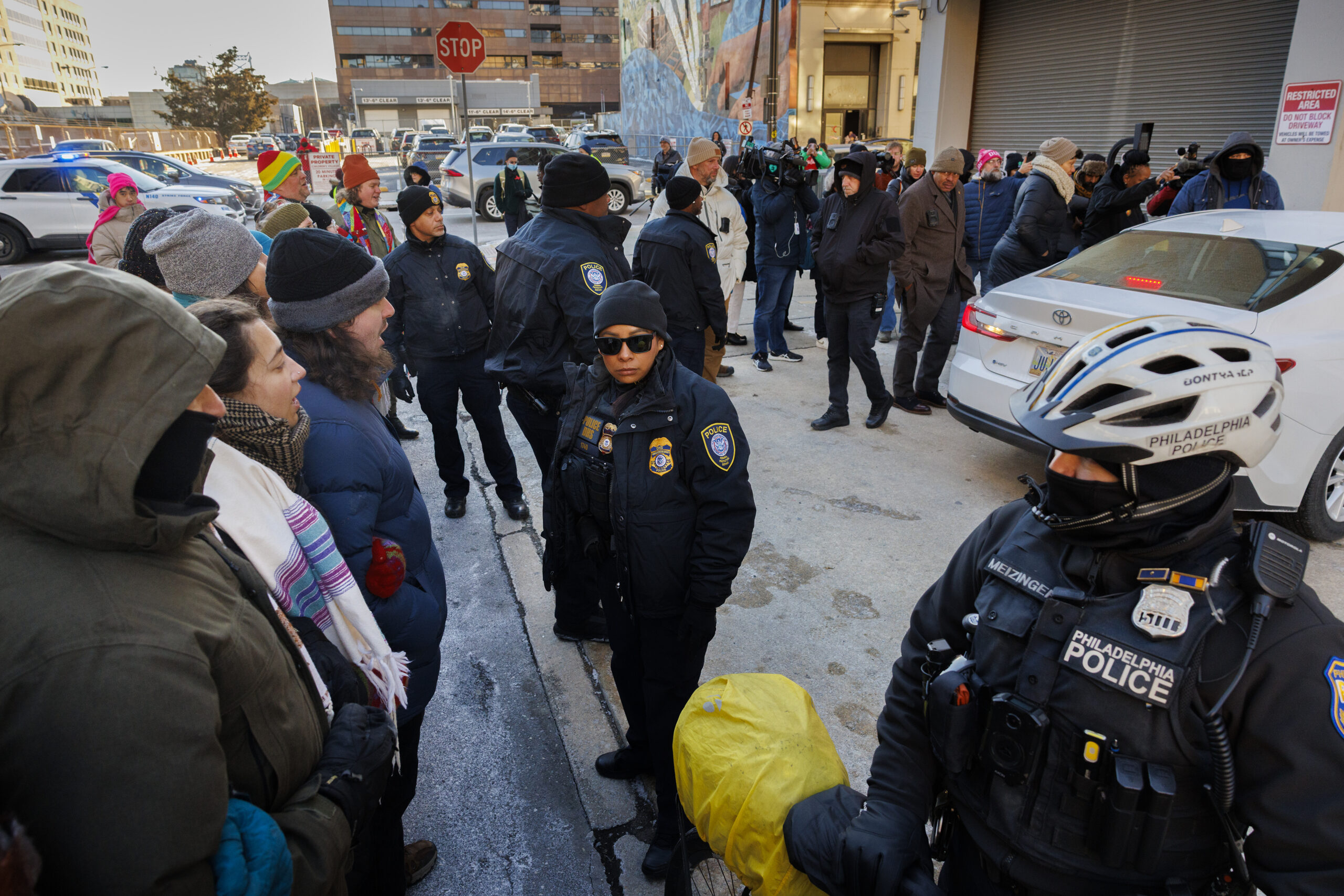
ICE vehicle able to exit garage, helped by Philly police
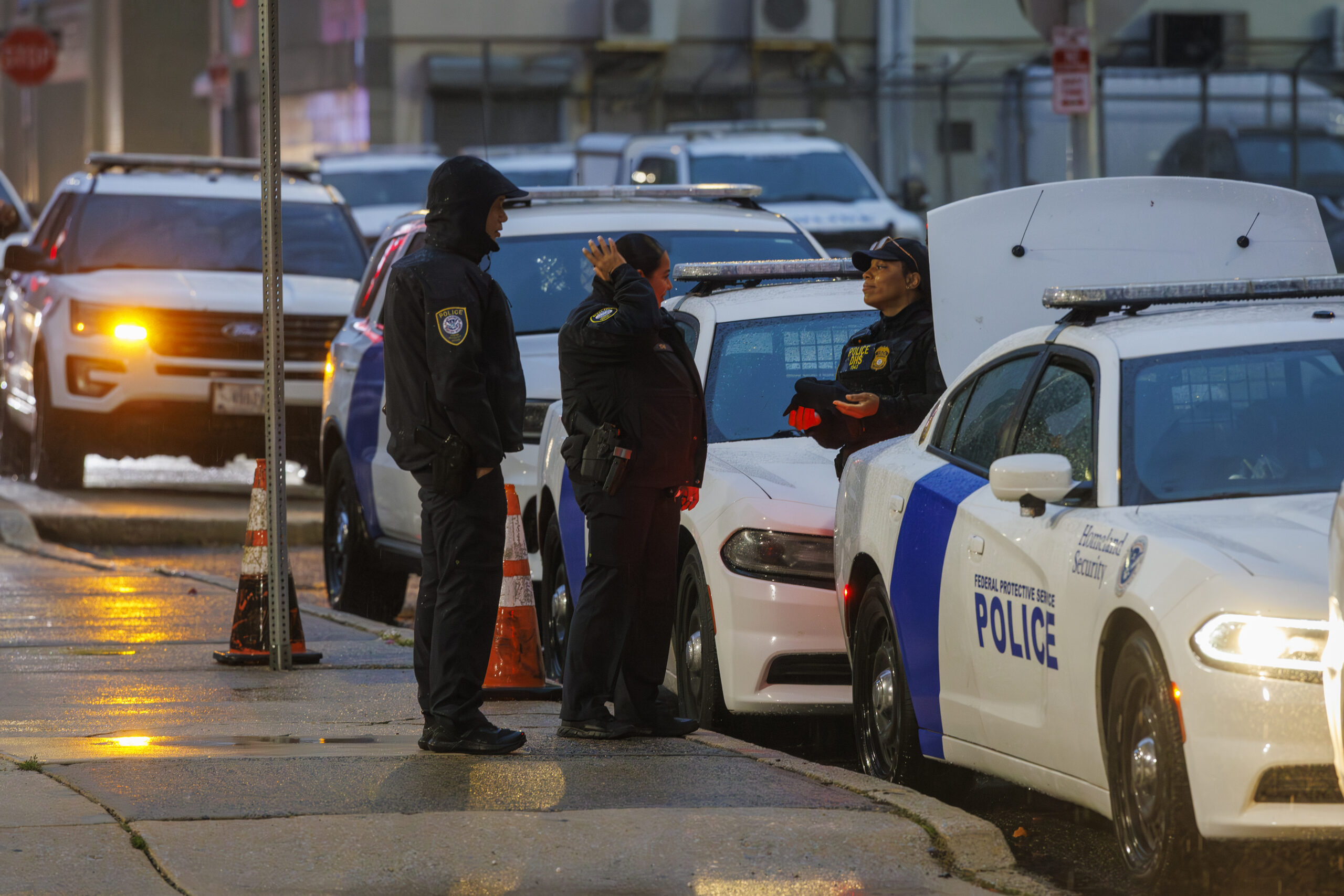
Philadelphia Police and Department of Homeland Security officials block protesters outside the garage at ICE’s Center City headquarters.
Just before 9:30 a.m., a white sedan – which had initially been blocked by protesters – was able to exit the ICE headquarters parking bay with the help of Philadelphia Police.
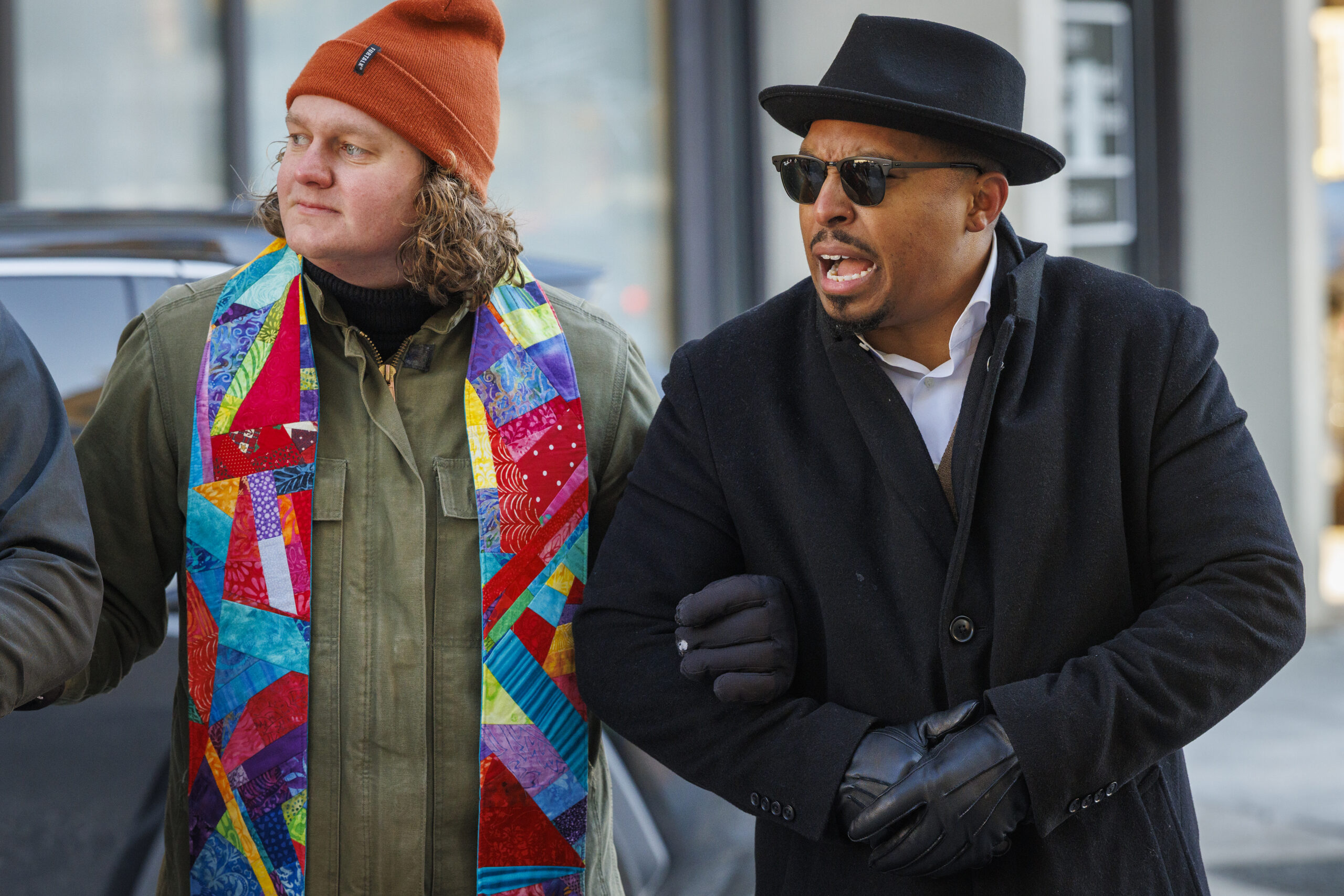
Philadelphia City Councilman Nicolas V. O’Rourke (right) joins the protest alongside Rev. Jay Bergen.
Protestors saw their ranks boosted by City Council member Nicholas O’Rourke, who is also a pastor of the Living Water United Church of Christ in Oxford Circle.
O’Rourke said it was only natural for him to join fellow clergy at Tuesday’s frigid demonstration.
A pastor of the Living Water United Church of Christ in Oxford Circle, O’Rourke said Tuesday’s action was part of a long tradition of faith leaders being at the forefront of the “struggle against oppression,” as seen with Rev. Dr. Martin Luther King Jr. and others.
“We are a day after King’s Day, and it’s important that we don’t just wax eloquent about the nice things that King said or the image that he’s been painted of now, but we continue in that tradition of resisting the oppression as he saw it, we’re doing in our own time,” said O’Rourke.
‘We need more people every day willing to do this’
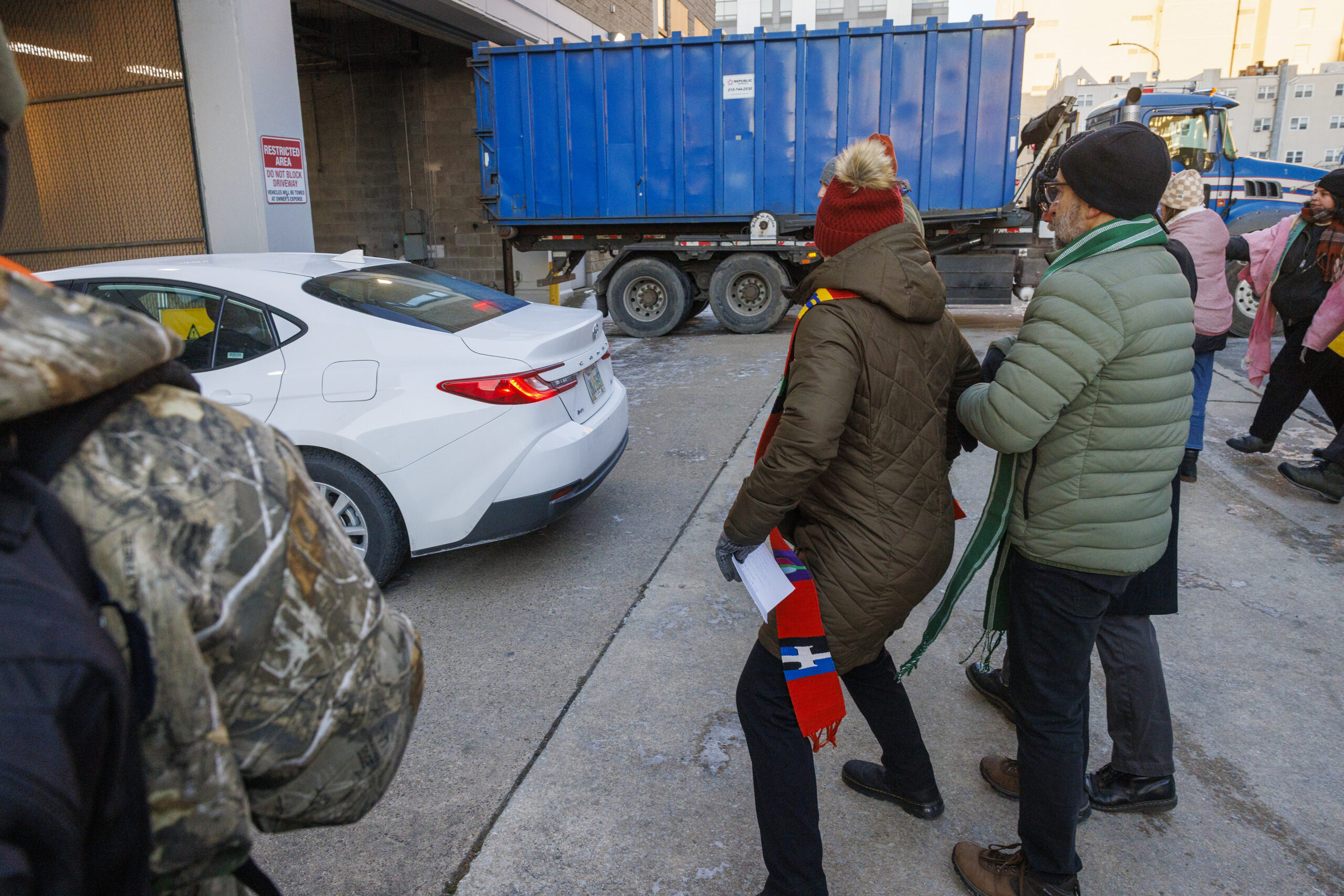
Protesters sing and lock arms outside ICE headquarters in Center City Tuesday.
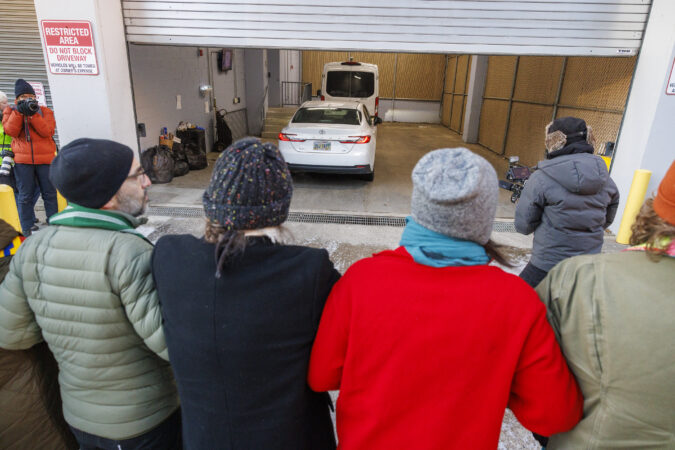
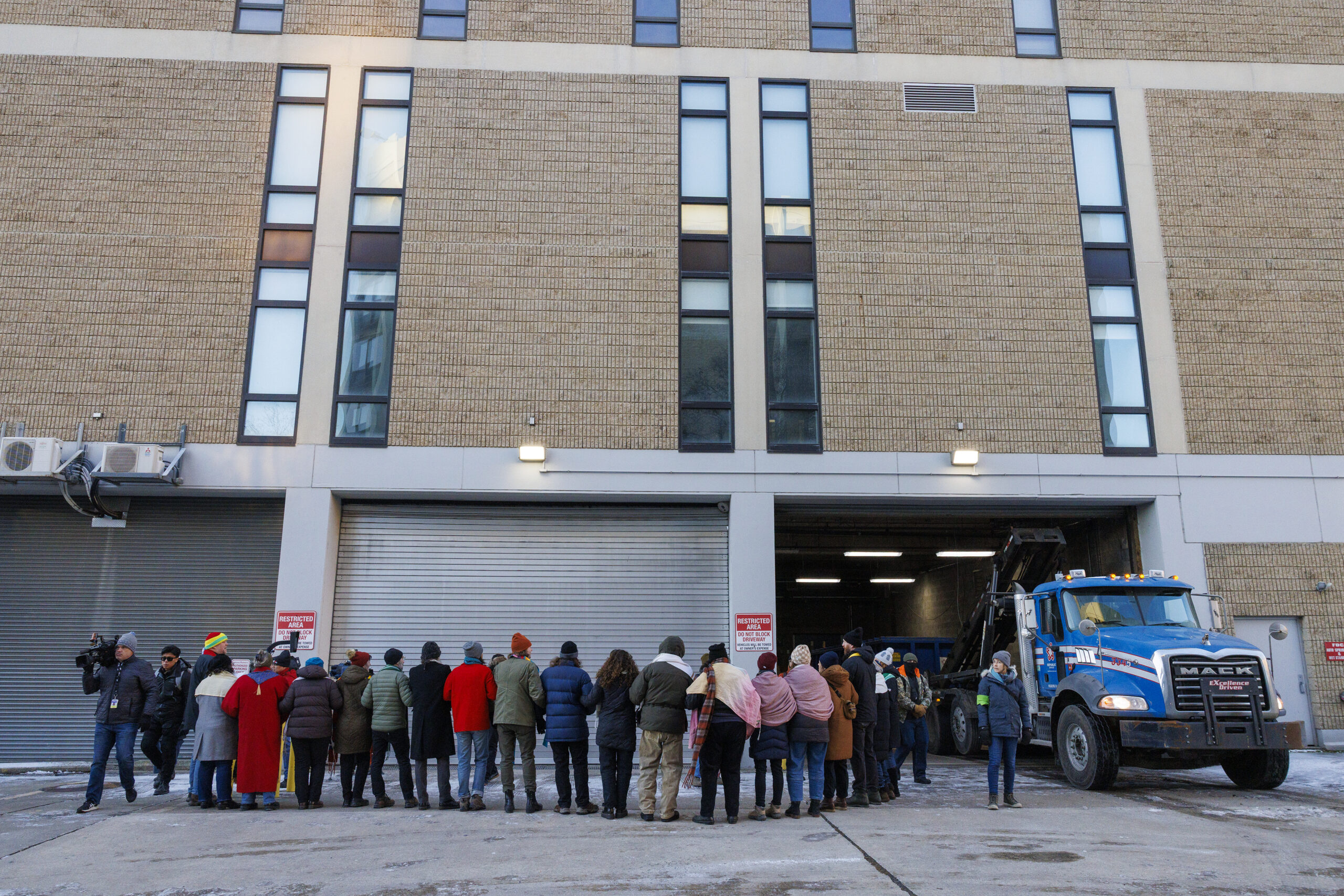
The group of clergy and immigration advocates continued to sing in locked arms in front of the parking bay in front of ICE headquarters in Center City after its initial “ICE block” in an effort to disrupt immigration enforcement.
Rev. Hannah Capaldi, minister at the Unitarian Society of Germantown, described the selection of participants as an intentional one as they face warnings from police, possible arrests, and citations.
Those present are leveraging a certain level of privilege, she said. All are citizens and many are clergy wearing collars, taluses, and stoles.
“We’re saying, listen, we have some level of moral authority in this city, and we’re trying to tell you where to look and what to pay attention to,” she said.
But in addition to drawing attention to ICE operations in Philadelphia, Capaldi hopes to plant “seeds of resistance” in the broader public, encouraging people to get involved.
“It doesn’t have to just be us, and we need more people every day willing to do this, to stand between the vehicles and the work that they’re doing to kidnap our neighbors,” she said.
“What ICE is doing in our communities is against our faith tradition,” said Rev. Jonny Rashid, a protest organizer. “We are gathered clergy, priests, rabbis, imams, and we are here to say no to ICE, and we want to demonstrate that publicly, and we’re willing to get arrested to do that. We’re blocking ICE’s garage as a symbol of saying you are not welcome in Philadelphia.”
He said he was not surprised by the lack of an overt Philadelphia police presence, though in the past groups of officers have been sent to anti-ICE protests.
“I don’t think the Philly police want to engage. They don’t want to make Philadelphia look like Minneapolis.”
Protestors are blocking the parking garage at ICE headquarters in Center City Philadelphia.
A group of about 30 immigration advocates, including local clergy, kicked off the frigid morning shortly before 8 a.m. with song in front of ICE headquarters.
They carried signs that read “Who would jesus deport?” and approximately at 7:55 a.m. the group locked arms calmly shouting “ICE block” as a white sedan tried to make its way out of a garage.
The gate to the garage closed back down almost immediately as the car pulled back in and the group continued in song.
Organizers with No ICE Philly say they’ll form a human blockade to stop ICE vehicles from departing the agency’s Center City headquarters beginning at 8 a.m. Tuesday.
They pledge to stay there, singing and chanting, until they are forcibly removed or arrested or both, in what they say is an effort to stop ICE from “leaving the facility to terrorize our neighbors.”
The ICE office is located at 8th and Cherry Streets, just southwest of the former Roundhouse police building.
Homeland Security officers with their cars along Cherry Street outside ICE’s Center City office in October.
In October, a No ICE Philly protest outside the agency headquarters erupted into physical confrontations with police, with several people knocked to the ground and four taken into custody.
A series of push-and-shove skirmishes broke out after about 35 protesters gathered for a Halloween Eve demonstration where they attempted to stop Immigration and Customs Enforcement vehicles from leaving the facility.
When an organizer shouted, “ICE Block!” about a dozen people poured onto Cherry Street to try to block the road. A series of scrums grew increasingly intense, with police shoving protesters back and in some cases to the ground.
The Department of Homeland Security, ICE, and Philadelphia police presence was substantial, with more than 30 officers outside the immigration agency’s big metal garage doors. Philadelphia police said four demonstrators were arrested and later released after being given citations for obstruction of highway, a violation that typically results in a fine.
That protest followed a September demonstration in which members of No ICE Philly acted as symbolic “building inspectors” who “condemned” the ICE facility. On the building they hung signs, bordered with yellow-and-black warning tape, that said, “ICE Raids Violate Philly Values.”
Protesters want Sheriff Rochelle Bilal to ban ICE agents from the courthouse in Center City.
No ICE Philly has been a leader in protests outside the Criminal Justice Center in Center City, where it and other groups have demanded that Sheriff Rochelle Bilal ban immigration agents from the building.
Activists charge that the sheriff has allowed ICE to turn the property into a “hunting ground,” with at least 114 immigrants trailed from the courthouse by agents and arrested on the sidewalk.
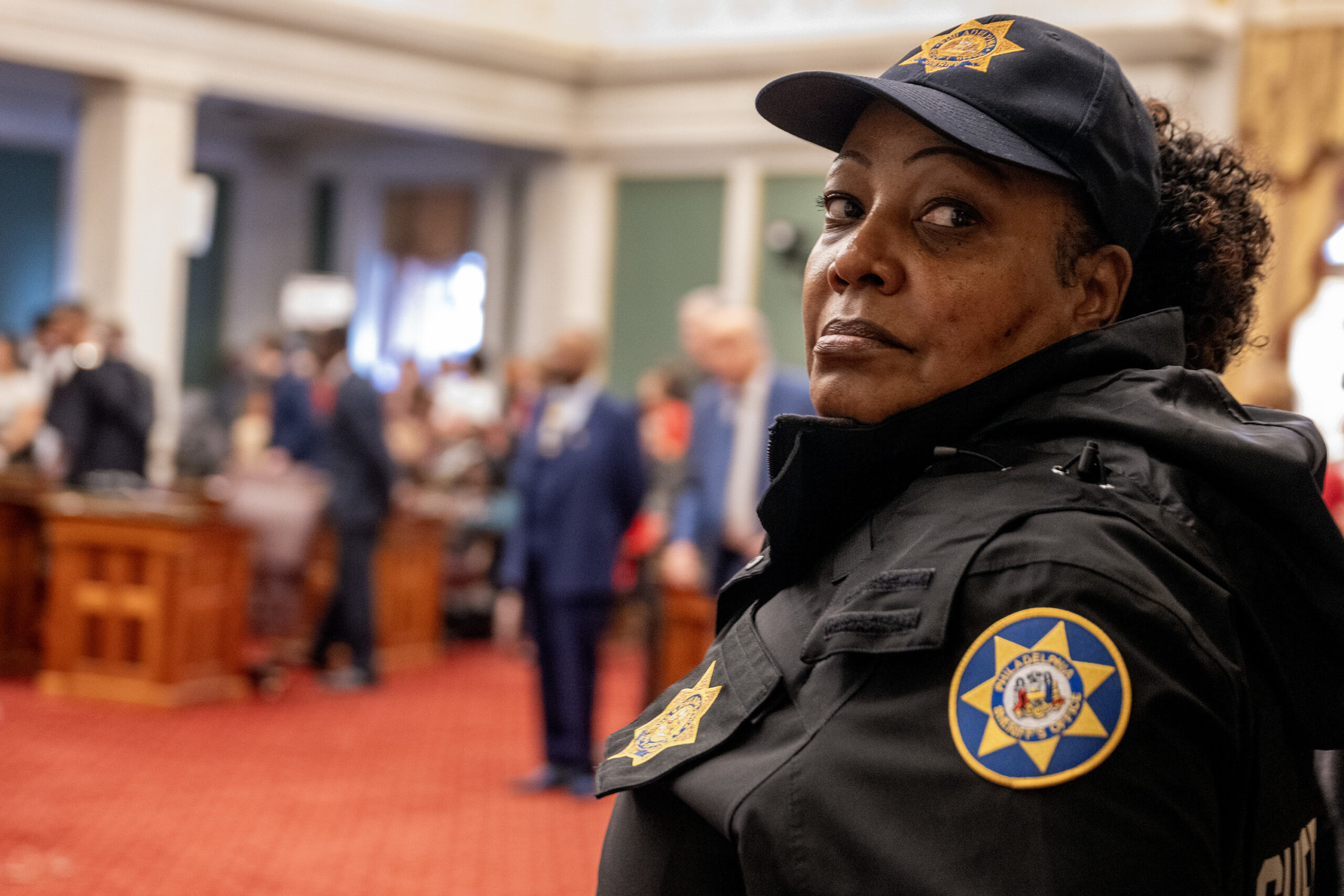
On Wednesday the judicial district that oversees the Philadelphia court system said that authority for managing ICE’s presence rested with the sheriff, and that decisions around that were her “sole responsibility.”
Many people who go to the courthouse are not criminal defendants ― they are witnesses, victims, family members, and others in diversionary programs. But they have been targeted and arrested by ICE, immigration attorneys and government officials say, causing witnesses and victims to stay away from court and damaging the administration of justice in Philadelphia.
In a small fictional town in Louisiana, the six women centered in Steel Magnolias have forged a community among — and an ever-deepening relationship with — each other. In a real town in southeastern Pennsylvania, a group of women who have worked together for decades are bringing those characters and those deep bonds to life at People’s Light in Malvern.
“You don’t have to worry about if that familiarity is there,” said Janis Dardaris, who portrays Clairee, the widow of the town mayor. “You just sit on the stage and it’s there. There’s no working at it. I sometimes wonder, what would it be like doing this play with completely different people that I didn’t know?”
As the women portray lifelong friendships, they have been able to find that depth and heart because of their own close connections. They’ve known each other for decades through their work in the arts — up to 50 years, in some cases, with some combination of them overlapping in at least a dozen shows in recent years.
Talking together in a room at the theater days before the Sunday opening, they occasionally finished each other’s sentences, extrapolating thoughts for each other.
Abigail Adams, the production’s director who has directed the women in several other performances, has a sense of how each of them works — how much time it takes for them to process, when to ask for something in their performance and when to hold back.
Claire Inie-Richards, who plays young nurse and newlywed Shelby, and Susan McKey, who plays her mother, M’Lynn, have portrayed a mother-daughter duo three times over 20 years.
Though with each role they learn each other anew, “There’s no substitute for time,” Inie-Richards said.
Marcia Saunders (left) and Brynn Gauthier are part of an all-women ensemble performing “Steel Magnolias.”
Brynn Gauthier, who makes her People’s Light debut in her portrayal of Annelle, is the new addition to a group of women whose history stretches back decades.
At first she thought it might be intimidating to work with people who have known each other and worked together for so long, but it felt like she got to be part of the journey of the cast getting to know each other in a new way through this show.
That familiarity is not without its challenges, though. Marcia Saunders sometimes feels “Marcia” surface in place of “crusty” Ouiser.
“That’s been challenging because of my relationship with these people and this institution, which is like a home to me,” she said.
Told as a series of moments in the women’s life within the safe confines of Truvy’s in-home hair salon, the play opens with Truvy and newcomer Annelle preparing Shelby for her wedding. Shelby and mother M’Lynn discuss wedding preparations, while local grouch Ouiser gripes about their property line.
Clairee arrives, windswept, from a dedication ceremony honoring her late mayor husband. Annelle, originally reluctant to give any information at all about herself, breaks down, admitting to the women that her husband has disappeared — with her money, her car, and her jewelry. She finds immediate support.
It’s just the start of how the relationships evolve and deepen in Robert Harling’s play, set in a southern town in the 1980s.
From left, Janis Dardaris, Susan McKey, and Claire Inie-Richards, members of an all-women ensemble performing “Steel Magnolias,” speak about working together for decades — some for more than 50 years — during an interview at People’s Light in Malvern.
Even though the viewer slowly learns more about the women’s external lives and pressures — confronting joys and tragedies — the play never leaves the salon.
“I love how this play – it’s about these women. It’s about this place. It’s about us. And I just think that makes for such a strong story, and I think more poignant than the movie,”McKey said.
Gauthier observed that there’s something inherent to women’s friendships in how they can discern when to tiptoe and when to confront in their care for each other.
Marcia Saunders (from left), Brynn Gauthier, Janis Dardaris, Susan McKey, Claire Inie-Richards, and Abigail Adams speak of their performing “Steel Magnolias” at People’s Light in Malvern.
“Truvy’s place is the place where they can be fully themselves, and they really can’t be fully themselves in their domestic arrangements, not in the same way,” Adams said. “They can’t be as outrageous, and they can’t be as vulnerable.”
It’s the vulnerability, that unyielding support for each other despite personal differences, that the women think today’s audiences will connect with. Though the story — popularized by a film adaptation released in 1989 starring Julia Roberts, Sally Fields, and Dolly Parton — is often thought about as a sentimental tearjerker, it’s injected with lightness, Gauthier said. .
“It’s kind of like the best episode of like Friends or a TV show you really love, where you just are spending time with these people,” she said.
“There’s always going to be intrigue and interest and drama, but there’s an element of just sitting with these people that you really enjoy and getting to experience them really fully,” Gauthier said. “It’s really nice to just have these characters that are so easy to fall in love with.”
“Steel Magnolias” continues through Feb. 15 at People’s Light, 39 Conestoga Rd. in Malvern. Information: peopleslight.org or 610-644-3500.
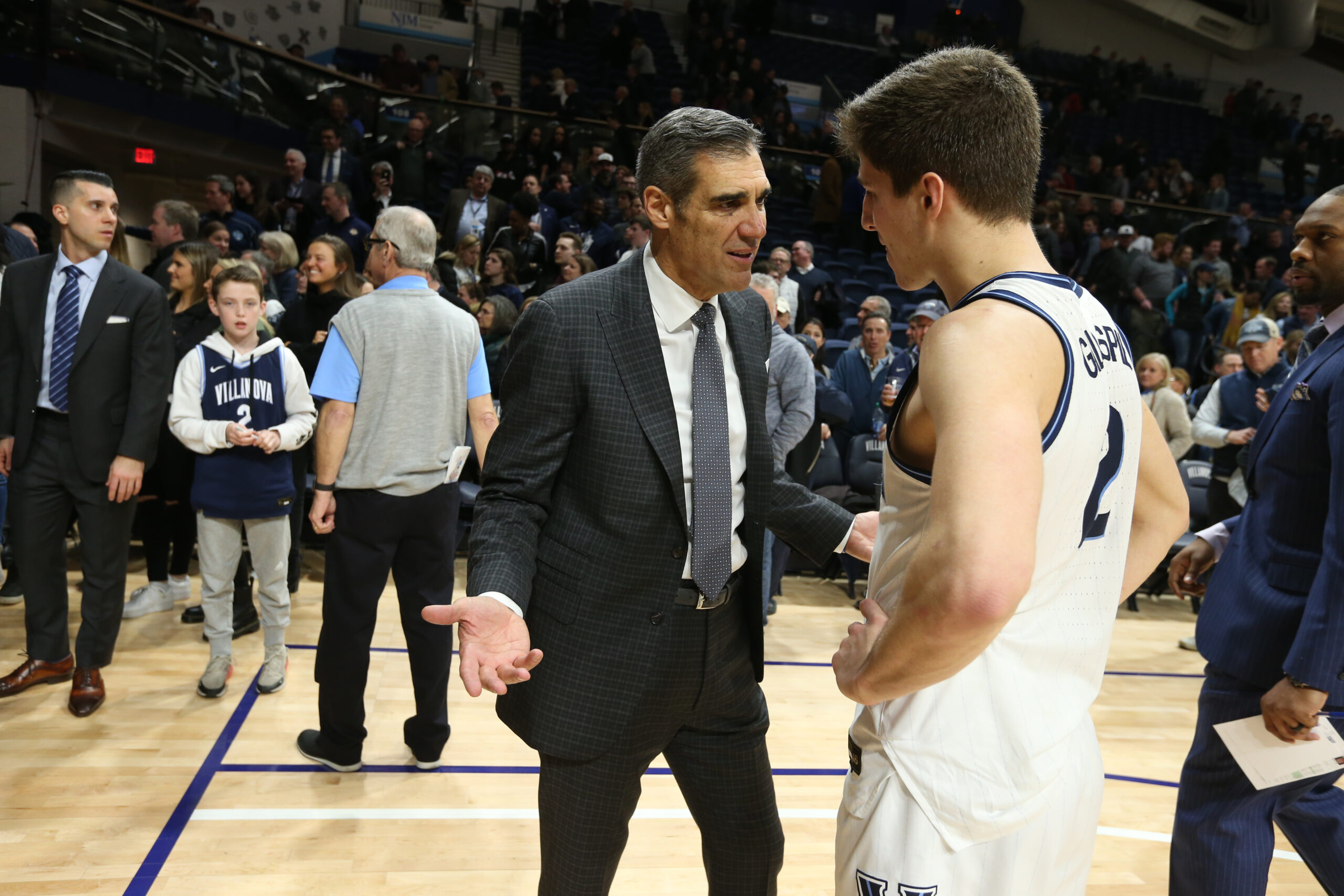
Jay Wright saw enough of Collin Gillespie a few nights before to invite him to Villanova on a Monday in January 2017 and offer him a scholarship. But this was hardly a courtship. Wright told Gillespie that he would redshirt his freshman season, maybe play as a junior, and then have a complementary role as a fifth-year senior.
“I thought he would get his master’s degree and be a great coach one day,” Wright said. “I was thinking ‘I would love to have this guy on my staff.’”
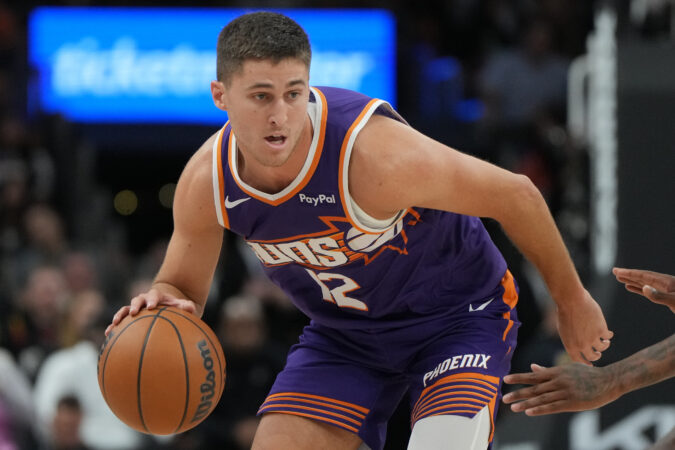
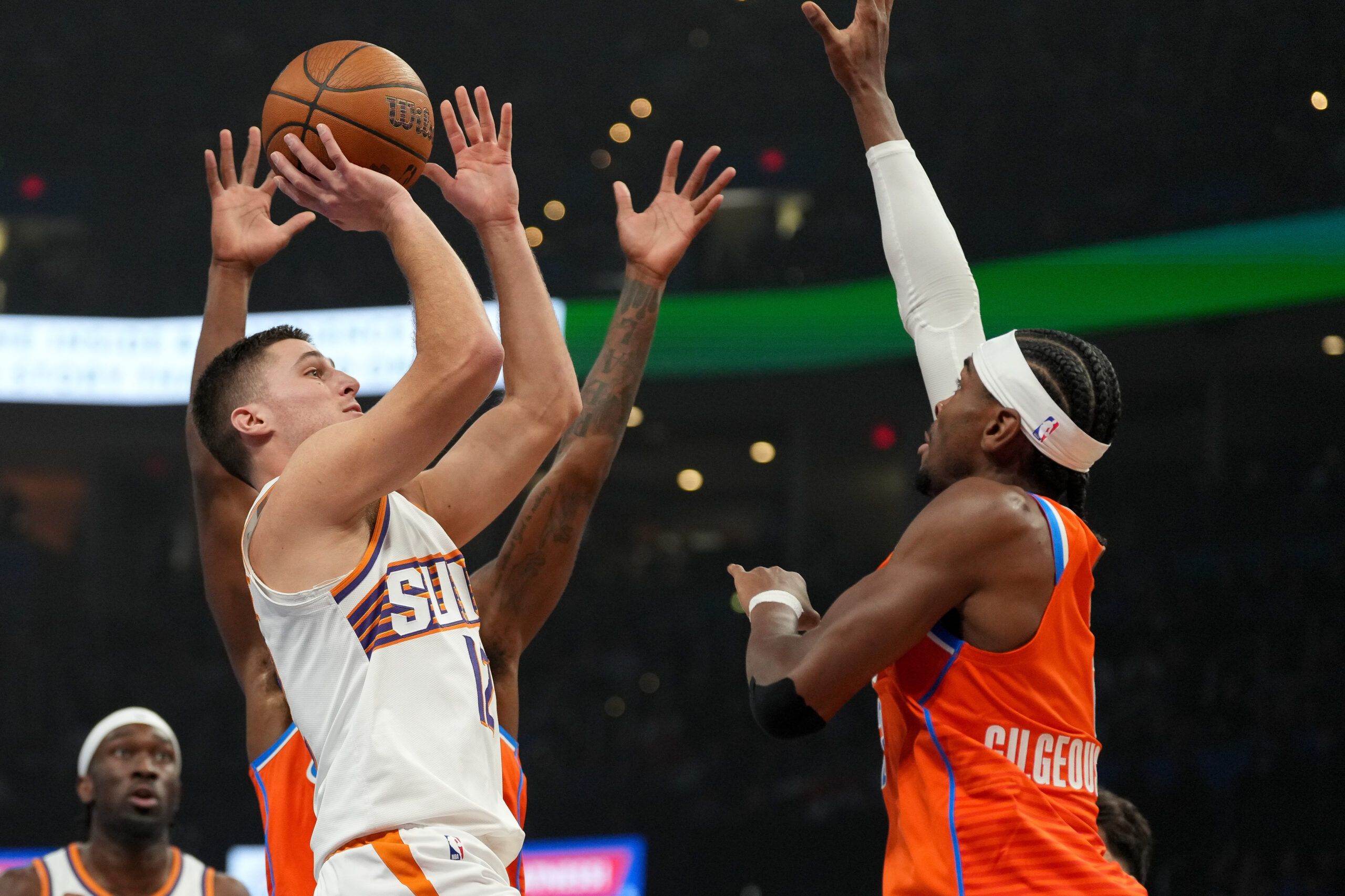
Gillespie — who has molded himself into an NBA starter with the Phoenix Suns after going undrafted in 2022 — nodded along. He didn’t have a Division I scholarship before his senior year at Archbishop Wood and declined to visit Division II schools because he believed bigger programs would eventually see what he already knew: He could play. Redshirt? OK. Bench player? Sure. Coach? Yes, sir.
“I didn’t really believe him,” said Gillespie, who will play against the 76ers on Tuesday night. “I believed in myself. I was just like, ‘Whatever he says, I’ll take it and then prove him wrong.’”
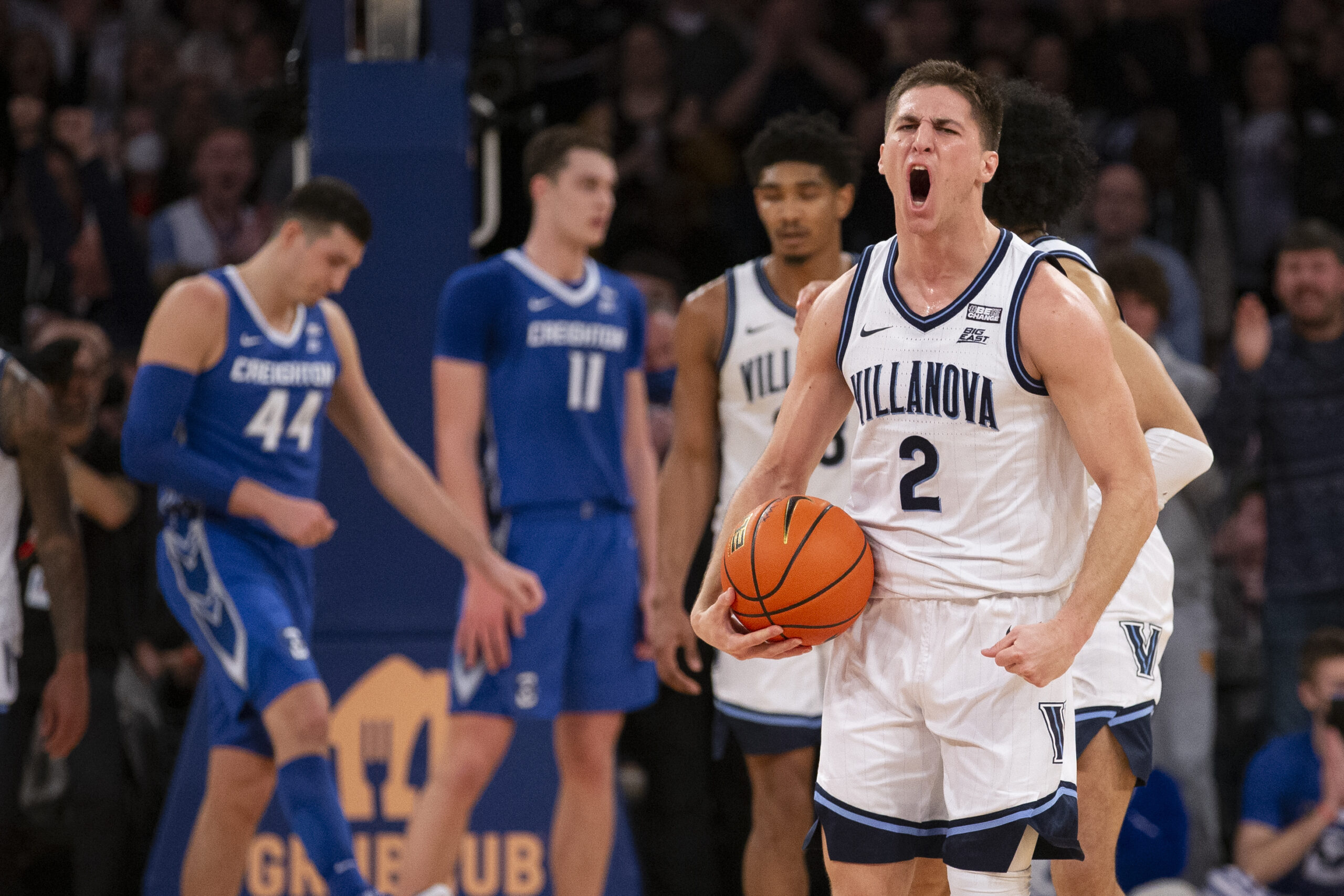
There was Gillespie 15 months later on the court for Wright in the national championship game, taking a charge against Michigan and looking the part. In his fifth year, the kid who had to wait for college scholarships was named the nation’s top point guard in 2022. He went undrafted that June but landed a non-guaranteed contract in July with the Denver Nuggets. He was on track.
Three weeks later, Gillespie suffered a broken right leg while playing in a pickup game at Villanova.
His NBA career — the one that is now flourishing — seemed unlikely then to nearly everyone except the guy who nodded along that day in Wright’s office.
“Everyone has their own journey,” Gillespie, 26, said. “Everyone runs their own race. You just have to stick to what you do, put your head down, and work hard. Don’t compare yourself to anyone else. If you work hard enough, you can probably achieve anything you want to.”
Collin Gillespie (right) became much more than a fifth-year senior role player first envisioned by Villanova coach Jay Wright.
G League to the league
Andre Miller often learned via text messages which players would be flying nearly three hours from Denver to join his G League team that night. He coached the Grand Rapids Gold, the Nuggets’ minor-league affiliate in Michigan that played 1,100 miles from Denver. Those morning flights gave Gillespie a chance to get on the court.
“It wasn’t a good recipe for these guys to be successful, but when he did show up, he didn’t want to come out of the game,” said Miller, who played three of his 17 NBA seasons with the Sixers. “We knew we had to leave him out there because he didn’t have an opportunity with the other team and he took great advantage of it.”
Gillespie feared that the Nuggets would void his contract after he suffered that injury playing at Villanova. That’s the first thing he said to his father, who was in the gym when it happened. But they didn’t. They kept him around that first season while he rehabbed and then split his time the next season between Denver and Grand Rapids.
“There was no ego,” Miller said. “One thing that’s tough to deal with is when your career is in the hands of other people. Some people felt like he wasn’t an NBA player and some people felt like he was an NBA player. The one thing that stood out about him to me is that he’s a competitor. He’s a dog. He’s a guy who enjoys playing basketball. He’s a leader. He plays with a chip on his shoulder.
“I wish I could have coached him more in the G League, but he was an NBA player. I knew that from the first time I saw him on the court with the G League players. I was like, ‘He probably won’t be here much.’”
Gillespie signed before last season with the Suns, again splitting time between the NBA and the G League. The 6-foot-1 guard earned a full-time role this season, starting for the Suns and fitting in with pesky defense and a three-point shot. Just like college, it took time before Gillespie’s game was appreciated.
“You just don’t see it initially. He doesn’t wow you,” Wright said. “But when you see him play over time and you realize this guy is getting to the rim and finishing, he’s elevating on his jumper and shooting over bigger guys, and he’s not getting backed down. You almost need to have time to believe what you’re watching.”
Collin Gillespie is shooting 41.4% from three-point range for the Suns.
Gillespie entered Monday’s game against Brooklyn averaging 13.2 points, 4.9 assists, and shooting 41.4% from three-point range. He hit a game-winner at the buzzer in November, regularly finds ways to create his own shot, and has proved that his game fits in the NBA.
Kevin Durant called him “a dog” and Anthony Edwards said after a loss to the Suns last season that “No. 12 is pretty good at basketball.” Two NBA superstars could see what Gillespie always believed: He belongs.
“He has more heart than talent,” said his father, Jim. “The kid just doesn’t want to lose. When he sets his mind to something, he just does it. And ultimately, he’s a winner. Wherever he’s gone, he’s won. At every level.”
Jay Wright says Collin Gillespie came to Villanova with a “killer mentality and stone face that we try to teach.”
Change of plans
Gillespie was in the stands for a Villanova game as a senior in high school, seated behind the La Salle bench at the Palestra. The Explorers invited him and Gillespie thought a scholarship offer was near.
“But they never offered,” Jim Gillespie said.
Gillespie eventually landed smaller Division I offers as a senior, but he was hopeful a Big 5 school would have a spot for him. None of them did until January when Villanova assistant Ashley Howard urged Wright to watch Gillespie play a game against five-star recruit Quade Green’s Neumann Goretti squad at Archbishop Ryan.
The Northeast Philly gym was packed and the coach couldn’t stay long as he was being hounded. Howard called Wright while he was driving home and told the coach that one kid scored 42 and the other kid scored 31. Wright figured the 42 points belonged to Green, who was already committed to Kentucky. It was Gillespie, the assistant said. Wright was sold.
“Nothing was spectacular, and he’s not bringing any attention to himself,” Wright said. “He just makes the right plays.”
Wright called Gillespie’s father and told him he needed his son at Villanova on Monday. The coach gave Gillespie his pitch that day without any guarantees.
“We left and we were like, ‘What are you going to do?’” his mother, Therese, said. “He said, ‘I’m going to play out my senior [year].’ I said, ‘Collin, it’s Jay Wright.’ He said, ‘Mom, I know what I’m doing.’”
Gillespie committed a week later, simply deciding after a game at Bonner-Prendergast that he had enough of the recruiting trail. He was headed to ’Nova and told a Wood coach without first running it by his parents. Gillespie knew what he was doing.
“He always said, ‘I’ll bet on myself,’” Jim Gillespie said. “He put the work in and the effort in and that’s what he’s always done.”
It took Gillespie just a few weeks to force Wright to rethink the plan that he would redshirt. Every day in practice that June he went up against Jalen Brunson and held his own.
Collin Gillespie (left) got to play in practice against future NBA players Donte DiVincenzo (center) and Jalen Brunson (right) at Villanova.
“He came in with that killer mentality and stone face that we try to teach,” Wright said. “But he came in with that. Then he spent every day with Jalen Brunson and it just became reinforced. It was so obvious. The coaching staff, behind closed doors, was going, ‘This kid is going against Brunson every day. He’s pretty good.’”
Gillespie suffered a minor injury that month and Wright checked with athletic trainer Jeff Pierce to see how the freshman was feeling. He was fine, the trainer said.
“The trainer said, ‘You’re not redshirting this kid,’” Wright said. “I said, ‘Is it that obvious?’ He said ‘Yeah, everyone knows.’ Yeah, it was.”
The guy who nodded along in Wright’s office proved that he belonged. Now, he’s doing it again in the NBA.
“It’s the way I was raised and where I come from,” said Gillespie, who grew up in Pine Valley before moving to Huntington Valley. “My brother is a year older, so I always played a year up. I had to play against older guys and was always smaller. I always had to prove myself and had a chip on my shoulder. My parents always believed in me and my family always believed in me and taught me to believe in myself.”
Pennsylvania is leading the way on breast cancer screening policy. Thanks to Senate Bill 88, a decisive move from the commonwealth, patients with state-regulated health plans will no longer face high out-of-pocket costs when an abnormal screening requires follow-up breast imaging.
Many Americans assume this is already the case, given the Affordable Care Act’s promise of no-cost preventive services. With breast cancer, however, that’s not always true.
Patients whose routine screening mammogram reveals an abnormality require additional imaging for a more detailed look. Those who are at high risk due to family history, dense breast tissue, or a genetic abnormality may need an MRI or ultrasound for their routine screening, rather than a standard mammogram.
Cultural, economic, and other social factors, including access to health care, may influence the lower rate of breast cancer screening.
Neither meets most health plans’ technical definition of “preventive care.” And, in many parts of the country, both can cost hundreds, even thousands, of dollars out of pocket.
By eliminating out-of-pocket costs for patients, Pennsylvania is establishing itself as a national leader in breast cancer treatment. But this state legislation can only go so far, and many people still face major gaps in coverage when they need breast imaging beyond a screening mammogram.
As it turns out, that lack of coverage doesn’t sit well with voters.
Support for treatment
In a national poll of 1,000 Republican primary voters commissioned by the Alliance for Breast Cancer Policy, sentiment on the topic was clear: If a patient needs breast imaging, they should get it — with the full cost covered by their health plan.
A full 95% of polled voters said insurers should cover the full cost of all recommended breast imaging, not just the standard screening mammogram. After all, preventive care means preventive care. Voters recognize that. When health plans split hairs and argue technicalities, they do so at the patients’ risk.
A bill before Congress would help, covering many in Pennsylvania who will still fall through the cracks even after the passage of SB 88. Known as the Access to Breast Cancer Diagnosis (ABCD) Act (S 1500/HR 3037), the federal legislation would eliminate out-of-pocket costs for patients’ necessary breast imaging.
And 85% of polled voters responded to the legislation’s primary goal: ensuring women get the answers they need before it’s too late. When breast cancer is caught early, treatment is more effective, less invasive, and far more likely to lead to positive outcomes — with five-year survival rates as high as 98%. Early detection saves both lives and dollars.
Respondents expressed support for the ABCD Act, especially given the impact the bill would have on those who often can’t get the help they need: rural, lower-income, Black, Hispanic, and younger women.
With costs for healthcare so high, many, especially younger women who make up 10% of all new breast cancer cases in the U.S., are looking toward high-deductible health plans to lower their monthly costs. But this often comes with less comprehensive coverage before a deductible. Two-thirds of polled voters say the full cost of necessary breast imaging should still be covered for those with high-deductible health plans.
Pennsylvania is proving that bold, patient-centered policy can save lives and reduce costs. Yet, in more than half the country — and still for some in the Keystone State — outdated insurance rules still force patients to choose between lifesaving breast imaging and paying their bills.
It’s time for Congress to follow Pennsylvania’s lead and make comprehensive breast cancer imaging a priority.
Breast cancer doesn’t wait. In 2025, an estimated 43,000 women and men in the U.S. lost their lives to the disease, including 1,800 in Pennsylvania alone. Access to early diagnosis should never hinge on the state you reside in. Congress should take note of Pennsylvania’s recent legislation and ensure lifesaving screenings are within reach for everyone.
Molly Guthrie is vice president for policy and advocacy at Susan G. Komen and leads the Alliance for Breast Cancer Policy.
A six-story apartment project at 2001 E. Lehigh Ave. is moving forward with a new owner after years of delay amid a difficult development environment.
Five-lane Lehigh Avenue divides the southern portion of Kensington, which has experienced development more akin to the boom in Fishtown, from the parts of the neighborhood to the north that are at the heart of the city’s opioid crisis.
But along the northern edge of the avenue, next to the Conrail tracks, a series of auto-oriented and light-industrial properties have been redeveloped as housing in recent years.
“That whole corridor has continued developing. It’s even pushing over the tracks further up north, too,” said Brian Corcodilos, CEO of Designblendz, the architect for the project. “We’re confident that … this area continues to rent up.”
The former owner of 2001 E. Lehigh, developer Isaac Singleton, secured zoning approvals for the project in 2023 and 2024. City records then show the property sold for $2.5 million in January 2025.
A demolition permit for the property was issued this week to an address associated with developer Roman Ovrutsky — whose home The Inquirer profiled last year — and Corcodilos said their team expects construction to begin by early spring.
Ovrutsky’s version of the project will feature 146 apartments, a slightly smaller number than Singleton proposed, and a little over 6,000 square feet of commercial space on the ground floor. The project will also have 54 underground parking spaces.
Designblendz has updated the visual palette for the project by adding darker grays and slate-colored hues.
Corcodilos said that changes in federal tax policy in President Donald Trump’s Big Beautiful Bill have enabled clients to begin building again. A lull in recent years was caused by heightened interest rates and an apartment glut that made it hard for developers to charge the rents necessary to pay back the loans on their projects.
The former design for the building included greens and browns. The new vision features slate-colored hues.
Corcodilos said developers have also found that more projects are making sense if they use either the city’s mixed-income housing zoning bonus — which allows taller or denser construction in exchange for an affordability component — or if they base their financing on catering to some tenants who use federal rent voucher subsidies.
“That’s how a lot of these projects are getting done,” Corcodilos said.
It’s illegal in Philadelphia to discriminate against renters using vouchers, but it’s common for landlords to discourage those tenants, and many buildings owners don’t proactively advertise to subsidized tenants.
But in recent years, increasing numbers of landlords have seen the advantage of tapping into a large tenant base with almost guaranteed payments.
Another property just north of Lehigh Avenue at 2200 E. Somerset St. was sold last year to the Philadelphia Housing Authority, after many of its tenants ended up being voucher holders.
“A lot of these big buildings that are going up, the only way they’re penciling is if there’s some sort of an affordability component to it,” Corcodilos said.
Beyond Kensington, Designblendz is seeing an increase in work this year due to developer-friendly changes in the federal tax code, opportunities in affordable housing provision, and an easing of the overall apartment glut, he said.
“I’m not getting a sense at the moment that clients are worried about not filling their units,” Corcodilos said. “Obviously things slowed down a little bit over the last year and a half for the industry. But what we’re seeing right now, it’s busier than ever.”