Blog

  • The Flyers have lost five straight. Here are five things they need to do to snap out of it

    The Flyers have lost five straight. Here are five things they need to do to snap out of it

    Losers of five straight, the Flyers are spiraling.

    To be clear, it’s not that they’re spiraling because they’ve lost five straight. The issue is how the Flyers have been playing during this stretch.

    And have they been facing some adversity regarding injuries? Yes. Across the past five games, defenseman Jamie Drysdale missed three with an upper-body injury; forward Bobby Brink (upper-body) has missed five and is now on injured reserve; defenseman Rasmus Ristolainen is day-to-day with an upper-body injury; and Dan Vladař was injured against the Buffalo Sabres on Wednesday.

    But all teams face adversity. The Flyers just need to play better.

    Saturday, the Flyers face a New York Rangers team that is not just spiraling but plummeting. Facing the Rangers is a prime opportunity to get back in the win column, but it won’t happen unless the Flyers correct a bunch of things.

    Aside from the power play, which is at 12.5% during the slide, and goaltending — the Flyers went from 2.80 goals-against per game in the first 41 to 5.00 in the past five — needing to, be better, here are five things they need to do to right the ship.

    1. Stop taking bad penalties

    Is every penalty a bad penalty? No. Is every penalty the correct call by the officials? Absolutely not, and there have been some horrendous calls this season against the Flyers.

    But when the penalty kill has been struggling — it went from 80.2% across the first 41 games and is at 61.1% during the five-game losing streak — you have to stay out of the box.

    The Flyers have taken 28 penalties during this stretch, which is the most by any team, have been shorthanded 18 times, tied for the second most, and have been shorthanded more than 5 minutes per game. They’ve also allowed the most power-play goals against (seven), three of which came on Thursday in the 6-3 loss to the Pittsburgh Penguins.

    The Flyers left Sidney Crosby all alone to score a power-play goal in Thursday’s 6-3 loss to Pittsburgh.

    “Yeah, I think it’s just being smarter, not letting frustration creep in. I think it’s, I don’t know, a lot of away from the puck stuff that’s kind of creeped in recently, and I think that’s due to frustration,” forward Owen Tippett said after Wednesday’s game when the Sabres scored twice on the man advantage.

    2. Maintain the diamond on the penalty kill

    What’s going wrong on the penalty kill? A lot. But the biggest issue is that it has lost its structure.

    “Yeah, just really disappointed, like, I’m pretty disappointed,” said coach Rick Tocchet after the Sabres game. “I’m a PK guy, and the reads that we gave them weren’t good. They’re just unacceptable for me, so we’re going to have to tidy that up.”

    Tocchet prefers the diamond PK setup to take away point shots, the player in front of the net, and passes to the bumper. The diamond shape is designed to take away specific passing lanes from the player who is typically set up right in the slot in the 1-3-1 structure typically employed by NHL teams.
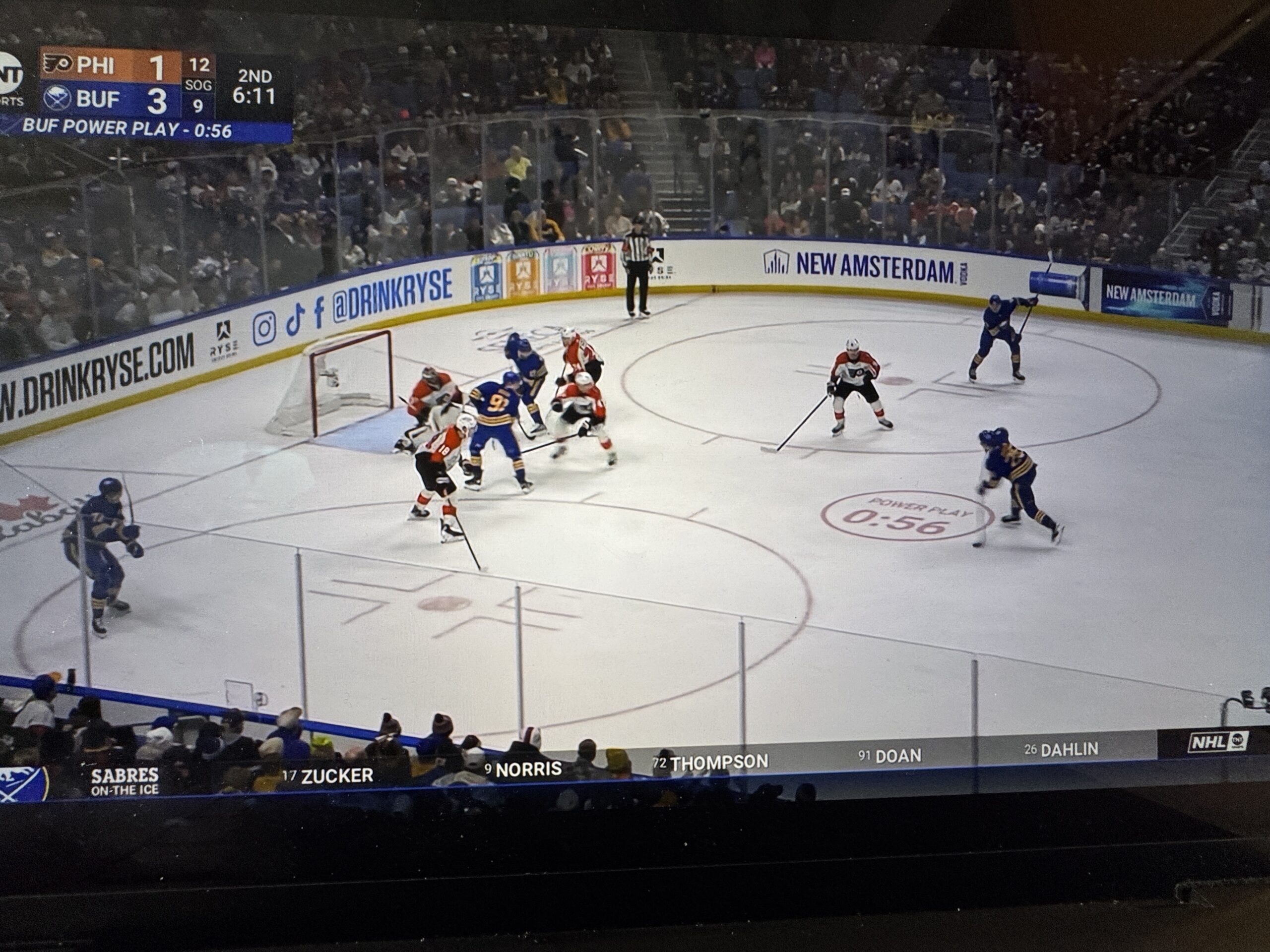
    Buffalo scored two power-play goals on Wednesday, including this one, where all four of the Flyers’ penalty killers got caught too tight together in front of the net, allowing Rasmus Dahlin to walk in and score.

    Of course, that doesn’t mean you should ignore the other guys — see Sidney Crosby’s goal Thursday from the right flank. But the Flyers’ structure has fallen apart, and if you’re going to be a team to take penalties, this needs to be airtight.

    3. Shoot the puck … on net

    Remember the good old days of fans yelling, “Shoot the puck?” It was always kind of annoying and probably didn’t come at the right time, but maybe it’s time to start doing that again because, as Wayne Gretzky and Michael Scott said: “You miss 100% of the shots you don’t take.”

    The Flyers have never poured the shots on in Tocchet’s system. They averaged 26.3 in the 41 games before the losing streak, which had them ranked 25th in the NHL. And they have only put more than 30 shots on goal in a game 11 times.

    Flyers center Denver Barkey skates with the puck against the Tampa Bay Lightning on Monday, January 12, 2026 in Philadelphia.

    Across the losing streak, that average has dipped to 23.8, which is the sixth-fewest — and only looks better than it is because of the 33 shots they put on Stuart Skinner on Thursday night, including 17 in the second period.That’s by far the most in a single period during a stretch in which the Flyers did not have more than 23 shots on goal in a game; in 12 of their previous 13 periods, the Flyers hit double digits just once.

    The problem is that at five-on-five, they are getting chances but not scoring. Natural Stat Trick has the Flyers tied for 13th in the NHL at shot attempts (205), but with only 86 shots and six goals during the losing streak. The Flyers are also No. 2 in missed shots during that span (92).

    “I think there were a few chances tonight that could have changed, maybe the momentum of the game, but at the end of the day, that’s the part of it, you’ve got to score more goals than the other team,” Drysdale said in Buffalo. “So I think we got better [as the night wore on]. We will be better.

    4. Follow Owen Tippett’s lead

    Tocchet has long talked about Tippett being a guy he can unlock and how, with his size, speed, and scoring ability, he can be a power forward in the NHL. He just hadn’t put it all together — until maybe now.

    The winger has been using his size to lay timely hits — he has 10 in the past five games — that create turnovers, and speed and footwork to drive to the net.

    During the Flyers’ loss to Tampa Bay on Monday, he used his speed and body to drive down the boards and set up Sean Couturier for a Grade A chance that went off the post.

    And in the overtime loss to Toronto, he was the one who turned on the jets and tried a wraparound that just missed before Trevor Zegras thought he scored an insurance goal on the power play.

    His speed pushes defenses back, which led to another Grade A scoring chance, this time for Denver Barkey as he streaked to the net against the Leafs.

    Owen Tippett has six goals in his last 13 games.

    Now, does Tippett miss the net too much still? Yes. But he has 31 shot attempts across the five games with 18 shots on goal. He also has two goals and one assist.

    According to Natural Stat Trick, the Flyers have 60 shot attempts to 43 when he is on the ice at five-on-five across the slide. Individually, he leads the team in five-on-five in individual scoring chances (12), shots (14), and individual shot attempts (25).

    5. Let the kids play

    The Flyers have three kids 22-and-under who bring different elements but have shown they can add to the lineup.

    Barkey, 20, was a healthy scratch on Wednesday and bounced back with a two-assist performance against the Penguins. He set up Nick Seeler for a goal and connected with Matvei Michkov on a two-on-one after Couturier made a nice play along the boards to spring them.

    Matvei Michkov had a goal and an assist on Thursday. Could he be coming out of his slump?

    Despite playing juniors last year, Barkey has shown he has an extremely high hockey IQ and a motor that gets him up and down the ice with efficiency. Did he have two not-so-great games with turnovers leading to goals by the Lightning? Absolutely. But it’s obvious what he can bring, whether teaming up with Tippett or Michkov.

    Grebenkin, 22, is a fireplug. He’ll make coverage mistakes and is still uncertain as to when to jump into piles vs. staying back, but he drives to the net, throws the body around, and stands up for his teammates. Considering Tocchet wants his team to go to the net more, he’s heeding the bench boss’s edict — and as noted, he did just that on Tippett’s goal against Buffalo.

    And then there’s the polarizing Michkov. The 21-year-old is still learning the North American game, and does appear to be “stuck in mud” at times — watch his skating in the overtime against the Toronto — but his vision and desire for the puck is unmatched.

    He scored against a goalie for the first time in 20 games in Buffalo, playing it perfectly by driving to the net on a two-on-one and shooting right off the pass. It’s what the Flyers need to do as a whole, as a lot of their shots are not quick enough, giving the opposition and goalies a chance to stop the play or make the save.

    Across the past five games, he has shown that he can provide offense, but he also needs to work on his defensive game. Across all strengths, according to Natural Stat Trick, the Flyers have a 63.99% expected goal share when he is on the ice; Barkey is No. 1 at 81.86%, and Tippett is No. 2 at 67.50%.

    And although he’s been on the ice for two goals by the Flyers and six against at even strength — plus the short-handed goal by Laughton — he has the second-highest expected goals for on the Flyers (4.27) behind Zegras 4.99. He even made a nice defensive play on Peyton Krebs in the first period on Wednesday, and has seemingly stopped taking bad penalties

    The Flyers need offense — going from 3.02 goals per game in the first 41 to 1.80 the past five — and the Russian has shown he can bring that, whether scoring himself or setting up his teammates.
  • Cuba launches mass demonstration to decry U.S. attack on Venezuela and demand Maduro’s release

    Cuba launches mass demonstration to decry U.S. attack on Venezuela and demand Maduro’s release

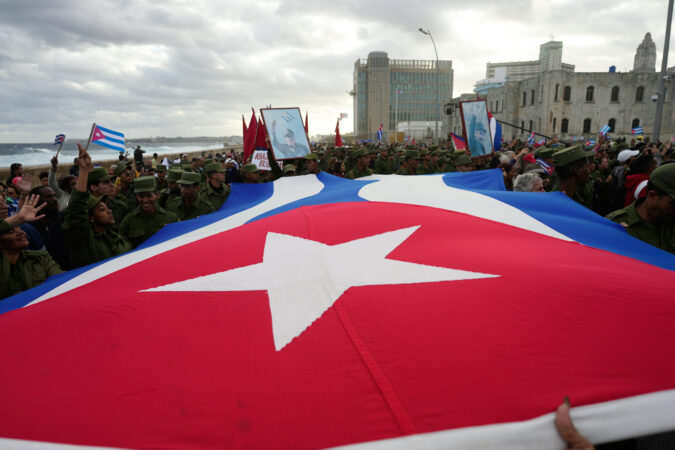
    HAVANA — Tens of thousands of Cubans demonstrated Friday outside the U.S. Embassy in Havana to decry the killing of 32 Cuban officers in Venezuela and demand that the U.S. government release former Venezuelan President Nicolás Maduro.

    They crowded into the open-air José Martí Anti-Imperialist plaza across from the embassy in a rally organized by the Cuban government as tensions between Cuba and the U.S. spike following the U.S. attack Jan. 3 on Venezuela.

    The 32 Cuban officers were part of Maduro’s security detail killed during the raid on his residence in Caracas to seize the former leader and bring him to the U.S. to face drug trafficking charges.

    “Humanity is experiencing something very complex, and (the U.S.) is governed by a president who considers himself an emperor,” said René González, 64, one of the protesters.

    “We must show him that ideas are worth more than weapons,” he said. ”This march is a message of our unity. Independence is sacred, and we will defend it tooth and nail if necessary.”

    Cuba’s national anthem rang out at Friday’s demonstration as large Cuban flags waved in the chilly wind and big waves broke nearby along Havana’s famed sea wall. Cuban President Miguel Díaz-Canel shook hands with members of the crowd clad in jackets and scarves before speaking to them.

    “The current U.S. administration has opened the door to an era of barbarism, plunder, and neo-fascism,” he said.

    The demonstration was a show of popular strength after U.S. President Donald Trump recently demanded that Cuba make a deal with him before it is “too late.” He did not explain what kind of deal.

    Trump also has said that Cuba will no longer live off Venezuela’s oil and money. Experts say the move could have catastrophic consequences since Cuba is already struggling with severe blackouts.

    “No one here surrenders,” Díaz-Canel said. “The current emperor of the White House and his infamous secretary of state haven’t stopped threatening me.”

    Washington has maintained a policy of sanctions against Cuba since the 1960s to pressure the island’s government to improve its human rights record, end its one-party communist system, and allow democracy. The sanctions have been further tightened during Trump’s presidency, suffocating the island’s economy.

    “Cuba does not have to make any political concessions, and that will never be on the table for negotiations aimed at reaching an understanding between Cuba and the United States,” Díaz-Canel said. “It is important that they understand this. We will always be open to dialogue and improving relations between our two countries, but only on equal terms and based on mutual respect.”

    After the president’s speech, the demonstration transitioned into a parade that Cubans call a “combatant march,” a custom that originated during the time of the late leader Fidel Castro. The crowd was led by a line of people holding pictures of the 32 officers killed.

    “Down with imperialism!” the crowd yelled. “Cuba will prevail!”

    The demonstration was organized a day after tens of thousands of Cubans gathered at the headquarters of the Ministry of the Revolutionary Armed Forces to pay their respects to the 32 officers slain.

    Their remains arrived home on Thursday morning, and they were scheduled to be laid to rest on Friday afternoon in various cemeteries following memorial ceremonies in all of Cuba’s provincial capitals.

  • In the face of Trump’s tariffs, Canada and China grow closer

    In the face of Trump’s tariffs, Canada and China grow closer

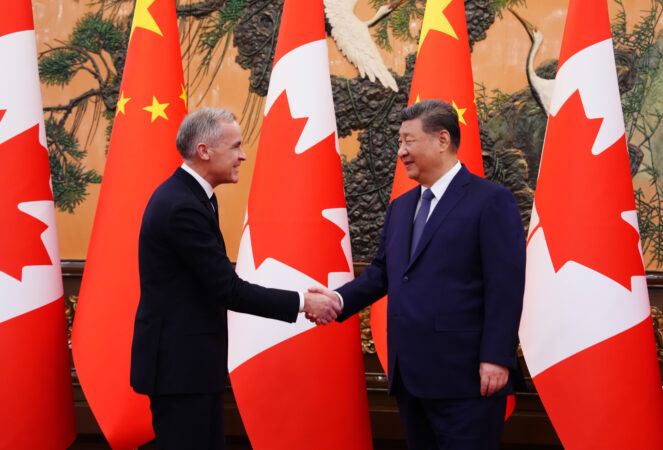
    Canadian Prime Minister Mark Carney hailed a “new strategic partnership” and tariff deals with China on Friday after a four-day visit that analysts said was an effort reset a deeply troubled relationship amid Canada’s efforts to diversify trade away from the United States.

    Carney announced the easing of some of the tariffs the two countries had imposed on each other, with Canada agreeing to allow in 49,000 Chinese electric vehicles at a much-reduced tariff of 6.1%, while China will cut canola seed tariffs to about 15%.

    The moves were a sign of how President Donald Trump’s levies on allies and adversaries alike are reordering global economic relationships, pushing two of the United States’ largest trading partners closer together after years of strained ties to offset the costs.

    Earlier in the day, Carney met with Chinese President Xi Jinping, who described the visit as part of a “turnaround” in Sino-Canadian ties.

    China, Canada’s second-largest trading partner after the United States, imposed steep tariffs on Canadian agricultural goods, including rapeseed and beef, last year. Those duties were retaliation for Canada’s levies on Chinese-made electric vehicles, steel, and aluminum. Ottawa announced those tariffs in 2024, as part of an effort to align itself with U.S. policy on China.

    Despite the easing of some tariffs and the optimistic words from both leaders, the visit was largely an opening “icebreaker,” said Zhao Minghao, deputy director of the Fudan University Center for American Studies. Sino-Canadian ties, he added, still face “many difficulties, especially in areas like ideology and national security. It’s an exploratory process, and they are focusing on the so-called low-hanging fruit first.”

    Reflecting the assessments of many other analysts, Zhao also said the most striking part of the visit was the way Canada was “using the restoration of ties with China as a way to de-risk its relationship with the U.S.”

    Carney’s visit was the first by a Canadian prime minister in nearly a decade, and Sino-Canadian ties have been in a deep freeze for nearly as long. But Canada has been seeking a thaw as part of an effort to diversify trade away amid Trump’s tariffs and threats to use “economic force” to make it the 51st state.

    For Canada, a country caught in the middle between China and the United States — its two largest trading partners — the trade diversification strategy has meant knotty choices. For Carney, a political rookie who won a federal election last year by casting himself as the best person to manage the break in U.S.-Canada ties, the China visit has required walking a tightrope.

    Carney’s predecessor and fellow Liberal, Justin Trudeau, was the last Canadian prime minister to travel to China. He, too, sought closer economic relations with Beijing, but his 2017 visit ended with the two sides deeply divided on several issues and without an expected announcement on the start of formal free trade talks.

    That chasm only widened the next year, after China detained two Canadians — former diplomat Michael Kovrig and businessperson Michael Spavor — in what was widely viewed as retaliation for Canada’s arrest of Meng Wanzhou, a Huawei executive wanted in the U.S. on bank and wire fraud charges.

    The “two Michaels,” as they were known in Canada, were held in secret prisons on vague charges of espionage and stealing state secrets, allegations for which China never provided evidence. They were tried in secret proceedings from which Canadian diplomats were barred, in violation of a consular agreement between the two countries.

    The Canadians were released in 2021, after Meng reached a deal with the U.S. Justice Department that allowed her to return to China in exchange for acknowledging some wrongdoing in the criminal case. A Pew Research Center poll that year found a record of more than 70% of Canadians had an “unfavorable” view of China — up from 45% in 2018.

    Canadian intelligence officials have accused China of “clandestinely and deceptively” seeking to interfere in Canada’s federal elections with the goal of supporting candidates favorable to its strategic interests. They have also alleged that the country conducts transnational repression in Canada, targeting dissidents and lawmakers who are vocal opponents of Beijing.

    Critics of Carney’s rapprochement of China have argued that closer ties could spell trouble, given Beijing’s history of weaponizing access to its markets. Not long after the two Michaels were detained, China imposed tariffs on Canadian canola in what was widely viewed here as further retaliation for Meng’s arrest.

    Opponents of the recalibration in the relationship have also warned that it could draw the ire of the Trump administration, which has been seeking to curtail China’s influence, ahead of a planned review this year of the U.S.-Mexico-Canada Agreement (USMCA). Chris LaCivita, a former Trump campaign manager, said on X that drawing closer to China “won’t end well for Carney.”

    Canadian officials and businesses view the continued existence of the North American free-trade pact as critical for the country’s economic prosperity. More than 70% of Canadian exports have typically gone to the United States. But Trump, who brokered the USMCA and called it “the best agreement we’ve ever made,” said this week that he doesn’t “really care about it.”

    “There’s no real advantage to us,” Trump told reporters in Dearborn, Mich., renewing fears in Canada that he could rip the deal up. “It’s irrelevant to me. … Canada wants it. They need it. We don’t.”

    Carney has been unable to reach a deal to ease the tariffs that the U.S. has imposed on Canadian goods. In October, Trump terminated all trade talks with Canada over a television advertisement critical of tariffs that was broadcast on U.S. networks and paid for by the government of Ontario. Canadian officials said they were close to a deal before Trump suspended negotiations.

    At home, the China reset has also proved tricky.

    Provincial leaders and farmers in the prairie provinces of Saskatchewan and Manitoba, which have been hardest hit by the Chinese tariffs, have long pressed Carney to ease the levies on China. But the move is poised to anger officials in the province of Ontario, the heart of Canada’s auto industry.

    Officials there have supported the tariffs on China, viewing them as necessary for protecting Canadian auto jobs and citing national security concerns. Canada’s auto sector is facing an existential crisis, analysts say, because of Trump’s tariffs on autos, steel, and aluminum. Trump administration officials have repeatedly asserted they do not want to make cars with Canada.

    Trump’s tariffs and threats against Canadian sovereignty have infuriated Canadians. A Pew Research Center poll in July found that 59% of Canadians view the United States as their country’s top threat, while just 17% see China that way.

  • Defendant in Charlie Kirk’s killing asks judge to disqualify prosecutors

    Defendant in Charlie Kirk’s killing asks judge to disqualify prosecutors

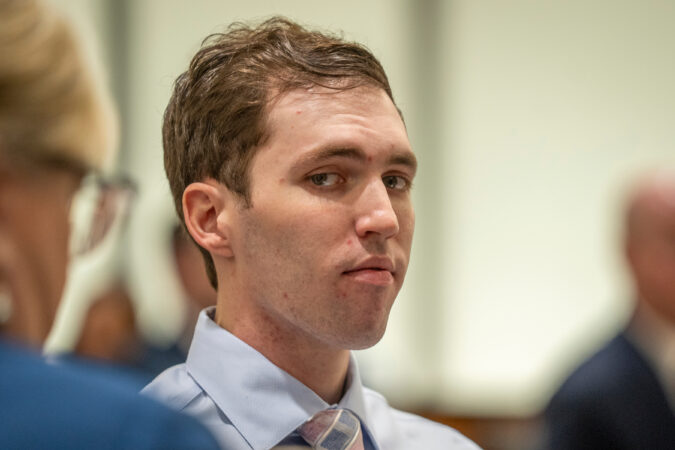
    PROVO, Utah — The Utah man charged with killing conservative activist Charlie Kirk returned to court Friday as his attorneys seek to disqualify prosecutors because an adult child of a deputy county attorney involved in the case attended the rally where Kirk was shot.

    Defense attorneys say the relationship represents a conflict of interest after prosecutors said they intend to seek the death penalty against Tyler Robinson for aggravated murder.

    Robinson, 22, has pleaded not guilty in the Sept. 10 shooting of Kirk on the Utah Valley University campus in Orem, just a few miles north of the Provo courthouse.

    The 18-year-old child who attended the event — and whose name was redacted from court filings — later texted with their father in the Utah County Attorney’s Office to describe the chaotic events around the shooting, the filings from prosecutors and defense lawyers state.

    Robinson’s attorneys say that personal relationship is a conflict of interest that “raises serious concerns about past and future prosecutorial decision-making in this case,” according to court documents. They also argue that the “rush” to seek the death penalty against Robinson is evidence of “strong emotional reactions” by the prosecution and merits the disqualification of the entire team.

    Defense attorney Richard Novak urged Judge Tony Graf on Friday to bring in the state attorney general’s office in place of Utah County prosecutors to address the conflict of interest. Novak said it was problematic for county prosecutors to litigate on behalf of the state while defending their aptness to remain on the case.

    Utah County Attorney Richard Gray replied that Novak’s last-minute request was aimed at delaying the case against Robinson.

    “This is ambush and another stalling tactic to delay these proceedings,” Gray said.

    The director of a state council that trains prosecutors said he was not aware of any other major case where attorneys had been disqualified for bias.

    “I would bet against the defense winning this motion,” Utah Prosecution Council Director Robert Church said. “They’ve got to a show a substantial amount of prejudice and bias.”

    Several thousand people attended the outdoor rally where Kirk, a co-founder of Turning Point USA who helped mobilize young people to vote for President Donald Trump, was shot as he took questions from the audience. The adult child of the deputy county attorney did not see the shooting, according to an affidavit submitted by prosecutors.

    “While the second person in line was speaking with Charlie, I was looking around the crowd when I heard a loud sound, like a pop. Someone yelled, ‘he’s been shot,’” the child stated in the affidavit.

    The child later texted a family group chat to say “CHARLIE GOT SHOT.” In the aftermath of the shooting, the child did not miss classes or other activities, and reported no lasting trauma “aside from being scared at the time,” the affidavit said.

    Prosecutors have asked Judge Graf to deny the disqualification request.

    “Under these circumstances, there is virtually no risk, let alone a significant risk, that it would arouse such emotions in any father-prosecutor as to render him unable to fairly prosecute the case,” county attorney Gray said in a filing.

    Gray also said the child was “neither a material witness nor a victim in the case” and that “nearly everything” the person knows about the actual homicide is mere hearsay.

    If the Utah county prosecutors were disqualified, the case would likely be picked up by prosecutors in a county with enough resources to handle a big case. That could be Salt Lake City, or possibly even the state attorney general’s office, said prosecution council director Church. The judge would have the final say, he said.

    Prosecutors have said text messages and DNA evidence connect Robinson to the killing. Robinson reportedly texted his romantic partner that he targeted Kirk because he “had enough of his hatred.”

    At the school where the shooting took place, university president Astrid Tuminez announced Wednesday that she will be stepping down from her role after the semester ends in May.

    The state university has been working to expand its police force and add security managers after it was criticized for a lack of key safety measures on the day of the shooting.

    Prosecutors are expected to lay out their case against Robinson at a preliminary hearing scheduled to begin May 18.

  • NCAA takes a step toward adding flag football by including it in its Emerging Sports for Women program

    NCAA takes a step toward adding flag football by including it in its Emerging Sports for Women program

    The NCAA has added flag football to its Emerging Sports for Women program, effective immediately, the organization announced Friday.

    Flag football was approved to join the Emerging Sports program by representatives from Division I, Division II, and Division III, giving it a path to becoming an NCAA championship sport in the coming years.

    Since its creation in 1994, the Emerging Sports for Women program has identified sports that “help schools provide more athletics opportunities for women and more sport-sponsorship options for institutions,” according to its website.

    Eight sports included in the Emerging Sports for Women program have been elevated to full NCAA championship status since 1996, including rowing, ice hockey, water polo, bowling, beach volleyball, and women’s wrestling. At the 2026 convention, the NCAA elevated stunt and acrobatics & tumbling from emerging sports to championship sports.

    Several NCAA schools have added seven-on-seven flag football ahead of its inclusion in the 2028 Summer Olympic games in Los Angeles, including some in the Philadelphia area.

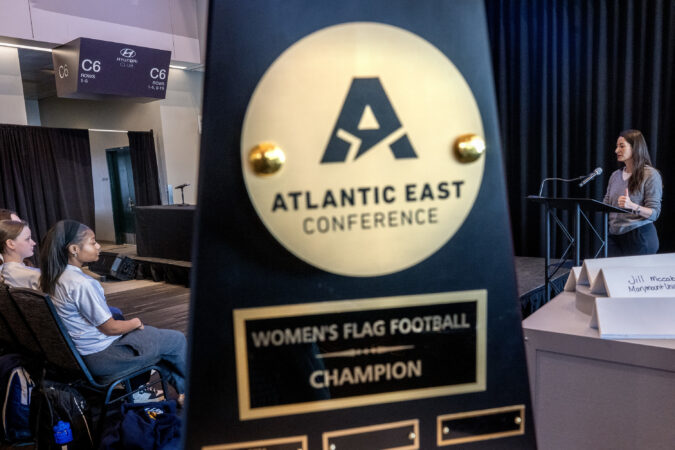
    Holy Family, Immaculata, and Neumann fielded teams for the Atlantic East Conference’s inaugural flag football season last spring, and Chestnut Hill will compete in the Atlantic East this season. After competing in the Atlantic East in 2025, Eastern’s team will compete in both the Eastern College Athletic Conference and the Atlantic East in 2026.

    Flag football joins rugby, triathlon, and equestrian on the NCAA’s list of emerging sports. For flag football to be considered for championship status, it needs a minimum of 40 schools sponsoring it at the varsity level. It also will need to meet “minimum contest and participation requirements,” per the NCAA’s release.

    The NCAA’s sports sponsorship data shows that 40 schools either currently field a flag football team or plan to this spring. Of the 40 schools included in the NCAA’s data, three are Division I, 14 are Division II, and 23 are Division III.

    While the NCAA did not set forth a timeline for flag football to be added as a championship sport, it does expect sponsorship of the sport to increase as a result of its inclusion in the Emerging Sports for Women program.

  • ICE says a Cuban immigrant died in a suicide attempt. A witness says guards pinned and choked him

    ICE says a Cuban immigrant died in a suicide attempt. A witness says guards pinned and choked him

    WASHINGTON — A Cuban immigrant died in a Texas immigration detention facility earlier this month during an altercation with guards, and the local medical examiner has indicated that his death will likely be classified as a homicide.

    The federal government has provided a differing account surrounding the Jan. 3 death of Geraldo Lunas Campos, saying the detainee was attempting suicide and staff tried to save him.

    A witness told the Associated Press that Lunas Campos died after he was handcuffed, tackled by guards, and placed in a chokehold until he lost consciousness. The immigrant’s family was told by the El Paso County Medical Examiner’s Office on Wednesday that a preliminary autopsy report said the death was a homicide resulting from asphyxia from chest and neck compression, according to a recording of the call reviewed by the AP.

    The death and conflicting accounts have intensified scrutiny into the conditions of immigration jails at a time when the government has been rounding up immigrants in large numbers around the country and detaining them at facilities like the one in El Paso where Lunas Campos died.

    U.S. Immigration and Customs Enforcement is legally required to issue public notification of detainee deaths. Last week, it said Lunas Campos, a 55-year-old father of four and registered sex offender, had died at Camp East Montana, but made no mention of him being involved in an altercation with staff immediately before his death.

    In response to questions from the AP, the Department of Homeland Security, which includes ICE, on Thursday amended its account of Lunas Campos’ death, saying he tried to kill himself.

    “Campos violently resisted the security staff and continued to attempt to take his life,” DHS spokesperson Tricia McLaughlin said. “During the ensuing struggle, Campos stopped breathing and lost consciousness.”

    In an interview before DHS updated its account, detainee Santos Jesús Flores, 47, from El Salvador, said he witnessed the incident through the window of his cell in the special housing unit, where detainees are held in isolation for disciplinary infractions.

    “He didn’t want to enter the cell where they were going to put him,” Flores told the AP on Thursday, speaking in Spanish from a phone in the facility. “The last thing he said was that he couldn’t breathe.”

    Among the first sent to Camp Montana East

    Camp Montana East is a sprawling tent facility hastily constructed in the desert on the grounds of Fort Bliss, an Army base. The AP reported in August that the $1.2 billion facility, expected to become the largest detention facility in the United States, was being built and operated by a private contractor headquartered in a single-family home in Richmond, Va. The company, Acquisition Logistics LLC, had no prior experience running a corrections facility.

    It was not immediately clear whether the guards present when Lunas Campos died were government employees or those of the private contractor. Emails seeking comment on Thursday from Acquisition Logistics executives received no response.

    Lunas Campos was among the first detainees sent to Camp Montana East, arriving in September after ICE arrested him in Rochester, N.Y., where he lived for more than two decades. He was legally admitted to the U.S. in 1996, part of a wave of Cuban immigrants seeking to reach Florida by boat.

    ICE said he was picked up in July as part of a planned immigration enforcement operation due to criminal convictions that made him eligible for removal.

    New York court records show Lunas Campos was convicted in 2003 of sexual contact with an individual under 11, a felony for which he was sentenced to one year in jail and placed on the state’s sex offender registry.

    Lunas Campos was also sentenced to five years in prison and three years of supervision in 2009 after being convicted of attempting to sell a controlled substance, according to the New York corrections records. He completed the sentence in January 2017.

    Lunas Campos’ adult daughter said the child sexual abuse accusation was false, made as part of a contentious custody battle.

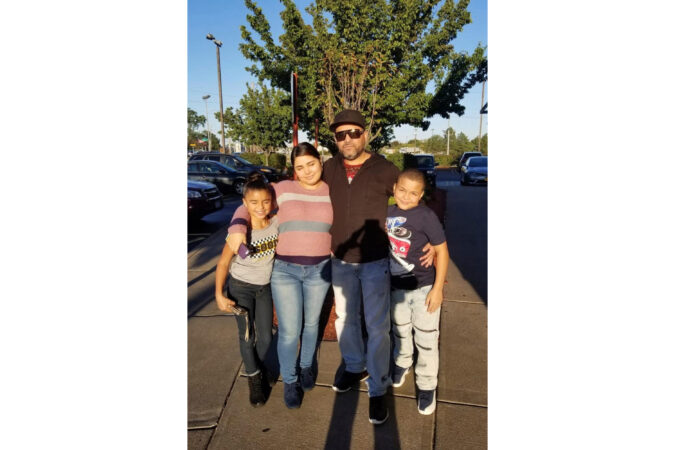
    “My father was not a child molester,” said Kary Lunas, 25. “He was a good dad. He was a human being.”

    Conflicting accounts

    On the day he died, according to ICE, Lunas Campos became disruptive while in line for medication and refused to return to his assigned dorm. He was then taken to the segregation block.

    “While in segregation, staff observed him in distress and contacted on-site medical personnel for assistance,” the agency said in its Jan. 9 release. “Medical staff responded, initiated lifesaving measures, and requested emergency medical services.”

    Lunas Campos was pronounced dead after paramedics arrived.

    Flores said that account omitted key details — Lunas Campos was already handcuffed when at least five guards pinned him to the floor, and at least one squeezed his arm around the detainee’s neck.

    Within about five minutes, Flores said, Lunas Campos was no longer moving.

    “After he stopped breathing, they removed the handcuffs,” Flores said.

    Flores is not represented by a lawyer and said he has already consented to deportation to his home country. Though he acknowledged he was taking a risk by speaking to the AP, Flores said he wanted to highlight that “in this place, guards abuse people a lot.”

    He said multiple detainees in the unit witnessed the altercation, and security cameras there should have captured the events. Flores also said investigators had not interviewed him.

    DHS did not respond to questions about whether Lunas Campos was handcuffed when they say he attempted suicide, or exactly how he had tried to kill himself.

    “ICE takes seriously the health and safety of all those detained in our custody,” McLaughlin said. “This is still an active investigation, and more details are forthcoming.”

    DHS wouldn’t say whether other agencies were investigating. The El Paso medical examiner’s office confirmed Thursday that it conducted an autopsy, but declined further comment.

    A final determination of homicide by the medical examiner would typically be critical in determining whether any guards are held criminally or civilly liable. When such deaths are ruled accidental or something other than homicide, they are less likely to trigger criminal investigations, while civil wrongful death lawsuits become harder to prove.

    The fact that Lunas Campos died on an Army base could also limit state and local officials’ legal jurisdiction to investigate. An El Paso County District Attorney’s Office spokesperson declined to comment Thursday on whether it was involved in an investigation.

    The deaths of inmates and other detainees after officers hold them face down and put pressure on their backs and necks to restrain them have been a problem in law enforcement for decades. A 2024 AP investigation documented hundreds of deaths during police encounters in which people were restrained in a prone position. Many uttered “I can’t breathe” before suffocating, according to scores of body camera and bystander videos. Authorities often attempt to shift the blame for such deaths to preexisting medical conditions or drug use.

    Victor Weedn, a forensic pathologist who has studied prone restraint deaths, said the preliminary autopsy ruling of homicide indicates guards’ actions caused Lunas Campos’ death, but does not mean they intended to kill. He said the medical examiner’s office could come under pressure to stop short of calling it a homicide, but will probably “stick to its guns.”

    “This probably passes the ‘but for’ test. ‘But for’ the actions of the officers, he would not have died. For us, that’s generally a homicide,” he said.

    ‘I just want justice, and his body here’

    Jeanette Pagan-Lopez, the mother of Lunas Campos’ two youngest children, said the day after he died the medical examiner’s office called to inform her that his body was at the county morgue. She immediately called ICE to find out what happened.

    Pagan-Lopez, who lives in Rochester, said the assistant director of the El Paso ICE field office eventually called her back. She said the official told her the cause of death was still pending and that they were awaiting toxicology report results. He also told her the only way Lunas Campos’ body could be returned to Rochester free of charge was if she consented to his being cremated, she said.

    Pagan-Lopez declined and is now seeking help from family and friends to raise the money needed to ship his body home and pay for a funeral.

    After failing to get details about the circumstances surrounding his death from ICE, Pagan-Lopez said she got a call from a detainee at Camp Montana East who then put her in touch with Flores, who first told her about the altercation with guards.

    Since then, she said she has repeatedly called ICE, but is no longer getting a response. Pagan-Lopez, who is a U.S. citizen, said she also twice called the FBI, where an agent took her information and then hung up.

    Pagan-Lopez said she and Lunas Campos were together about 15 years before breaking up eight years ago. She described him as an attentive father who, until his detention, had worked in a minimum-wage job at a furniture store, the only employment she said he could find due to his criminal record.

    She said that in the family’s last phone call the week after Christmas, Lunas Campos talked to his kids about his expected deportation back to Cuba. He said he wanted them to visit the island, so that he could stay in their lives.

    “He wasn’t a bad guy,” Pagan-Lopez said. “I just want justice, and his body here. That’s all I want.”

  • Temple dismisses CJ Hines from men’s basketball program following alleged involvement in point-shaving case

    Temple dismisses CJ Hines from men’s basketball program following alleged involvement in point-shaving case

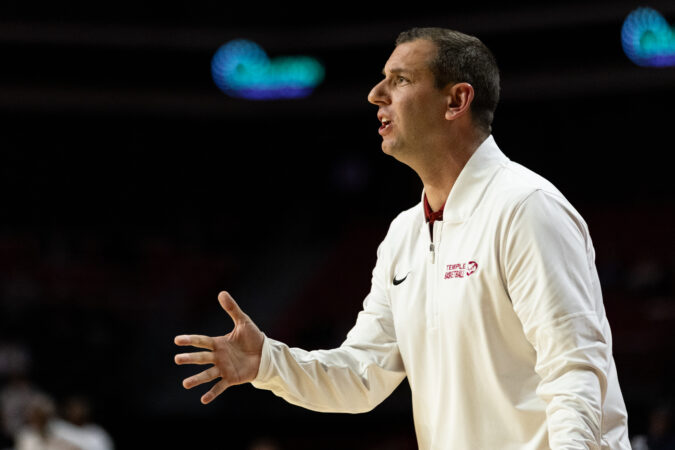
    Temple guard CJ Hines is no longer with the men’s basketball team, the program announced in a statement, after being referenced in a basketball gambling indictment by federal prosecutors in Philadelphia on Thursday.

    Hines transferred to Temple in May 2025 but didn’t play in a game this season after the university announced on Nov. 5 that he was under investigation for eligibility concerns prior to his enrollment at Temple.

    According to the indictment, Hines, who played two seasons at Alabama State, was allegedly involved in point-shaving efforts with former teammate Shawn Fulcher during the Hornets’ 2024-25 season. Hines will be charged elsewhere if he is found guilty.

    The indictment names more than two dozen players on 17 different NCAA teams in the basketball gambling scheme, which also targeted the Chinese professional league for attempting to fix games from September 2022 to October 2025.

    Temple coach Adam Fisher brought Hines in to add scoring depth after Hines averaged 14.1 points and shot 37.8% on three-pointers for Alabama State last season. Hines led the Hornets to the NCAA Tournament in the 2024-25 season.

    The 6-foot-2 guard amassed more than 1,500 points during his career at Faulkner and Alabama State.

  • unCovering the Birds: What do Jeffrey Lurie and Howie Roseman really think of Nick Sirianni?

    unCovering the Birds: What do Jeffrey Lurie and Howie Roseman really think of Nick Sirianni?

    There was a lot said during the Eagles’ end-of-season news conference, but nothing stood out more to The Philadelphia Inquirer’s Jeff McLane than a comment general manager Howie Roseman made about his head coach, Nick Sirianni. What did Roseman say, and why was it so noteworthy? McLane and Inquirer columnist Marcus Hayes read between the lines in this recap of Roseman and Sirianni’s Q&A with reporters.

    00:00 What did Howie Roseman say?

    17:43 Front office power dynamics between Roseman, Nick Sirianni, and Jeffrey Lurie

    23:24 Kevin Patullo, Jalen Hurts, and the blame game

    33:17 Will A.J. Brown be here next year?

    unCovering the Birds is a production of The Philadelphia Inquirer and KYW Newsradio Original Podcasts. Look for new episodes throughout the offseason, including breaking news updates and reactions.

  • Trump signals Hassett may stay at White House, reshaping Fed chair race

    Trump signals Hassett may stay at White House, reshaping Fed chair race

    President Donald Trump on Friday suggested that Kevin Hassett, a top contender to run the Federal Reserve, could remain in his current job as head of the National Economic Council, casting new uncertainty over the race to succeed Fed Chair Jerome H. Powell.

    Speaking at a healthcare event at the White House, Trump said Hassett performed well as a surrogate for the president on television and the potential for him to vacate his current role was a “serious concern.”

    “I actually want to keep you where you are if you want to know the truth. We don’t want to lose him, Susie,” Trump said, addressing White House Chief of Staff Susie Wiles. “We’ll see how it all works out.”

    Analysts and officials close to the White House have said the sweepstakes to succeed Powell may have been scrambled this week when Powell publicly disclosed that the Justice Department had launched a criminal investigation tied to a massive office renovation project for the central bank’s headquarters overlooking the National Mall.

    Powell and supporters characterized the move as an attempt to undercut the Fed’s independence on monetary policy. At least two Republican senators said they won’t vote for any nominee to replace Powell until the legal matter is resolved. And some Fed watchers have said the Senate might be less inclined to approve someone so close to the White House.

    Former Trump strategist Stephen K. Bannon cast that pushback against Hassett in far more combative terms. “The Globalist circle-the-wagons with all the living former Fed Chairs immediately defending Powell sealed Hassett’s fate,” he wrote in a text message. “The anti-Trump Senate cabal signaled they would never confirm someone professionally close to the President.”

    Trump first nominated Powell to the top Fed role in 2017 but quickly soured on him over interest-rate policy. At a January 2020 signing ceremony, Trump suggested that he wished he had instead tapped former Fed governor Kevin Warsh, who was a runner-up for the job.

    “I would have been very happy with you,” Trump said, singling out Warsh. “I could have used you a little bit here. Why weren’t you more forceful when you wanted that job?”

    Analysts said the remarks could place Warsh in a stronger position to become the next chair of the Fed when Powell’s tenure in the role ends in May. Trump had signaled this week that he was choosing between one of “the two Kevins.” He was expected to announce his choice as early as this month.

    In one sign of Warsh’s improved odds, investors in betting markets early Friday afternoon assessed the former Fed governor had a roughly 60% change of replacing Powell, up from around 40% earlier in the day.

    Other candidates in the mix for the role include sitting Fed governor Christopher Waller and Rick Rieder, an executive at BlackRock. Treasury Secretary Scott Bessent has helped spearhead the process for selecting Powell’s replacement but has said he isn’t interested in the role.

    Hassett has acknowledged that the race remains unsettled. Speaking at a Wall Street Journal conference in December, he cautioned against assuming a final decision had been made. “He makes his choice, and then he changes his mind, too,” Hassett said, referring to the president.

  • Why is everyone so excited about University City’s new Taco Bell?

    Why is everyone so excited about University City’s new Taco Bell?

    It was a Christmas miracle of the fast food variety: A 24-hour Taco Bell had opened in University City.

    The Mexican-ish chain opened its 16th Philly location in late December at 3901 Chestnut St., where it replaced a Boston Market outpost that once owed nearly $220,000 in rent after defaulting on a lease. To hear some Philadelphians tell it, the opening was practically heaven-sent.

    The new Taco Bell generated two separate posts from different users last month in the 95,000-member r/Philly subreddit. Other restaurants yearn for that kind of word-of-mouth marketing.

    “Anyone have any info on the Taco Bell they’re putting on 39th and Chestnut?” asked user 8hivefiend8 on Dec. 17. “I have high hopes that maybe it will open soon because it looks so close to finished.”

    Six days later, user rad_rascal posted pictures of the Taco Bell in all of its grand opening glory under the title “New Taco Bell in West Philly!” In the days leading up to the opening, the user wrote, they “would pass it every day and peer in like a buncha [sic] creeps.”

    New Taco Bell in West Philly!
    byu/rad-rascal inphilly

    Under both threads, commenters expressed the kind of jubilation normally reserved for, say, rotisserie chicken-eating stunts or Super Bowl parades. “This just made my day,” commented one Taco Bell enthusiast. Others chimed in. “This the best Christmas present yet,” wrote one user. “My new home away from home,” said another.

    In a city with no shortage of affordable (and excellent) Mexican food, why do people care so much about a Taco Bell that doesn’t even serve alcohol? And could this Taco Bell possibly live up to Reddit’s expectations?

    Is it normal to care this much about a Taco Bell?

    Taco Bell is as much a fast food chain as it is a borderline “cult,” according to chef Reuben Asaram, one of Philly’s most notable Taco Bell enthusiasts.

    The 34-year-old’s love affair with Taco Bell began after his family emigrated from India to Queens in 1993, the chain quickly becoming a staple for weekend meals out. Taco Bell partially inspired Asaram’s Mexican and pan-Asian pop-up menus, which led the chain to name him one of three chefs allowed to reimagine the iconic Crunchwrap Supreme in 2024. At one point, Asaram was so tight with the staff at the 1037 Chestnut St. Taco Bell that they would turn part of restaurant into a private space for him to take dates.

    Philly chef Reuben Asaram was one of three chefs tapped by Taco Bell to revamp the Crunchwrap Supreme. The local Taco Bell enthusiast created a butter chicken version.

    True Taco Bell devotees will go out of their way to try a new location, Asaram said, because “they’re obsessed with getting the perfect bite” and need to know if there’s a reliable option nearby in case a Dorito Locos Taco emergency hits. Asaram is one of those people.

    “If I have a craving and know I’m going to be in a random place, I have to know where the [nearest] good Taco Bell is,” said Asaram while sipping a Baja Blast on Zoom. Asaram’s preferred locations are the two closest to his house in Cherry Hill. He must visit the University City outpost before it can be added to his reserves.

    Taco Bell has spent decades converting its Mexican food into a lifestyle brand with legions of devoted fans by pushing the boundaries of fast food marketing. There’s a Taco Bell wedding chapel in Vegas and a faux-retirement community in San Diego, plus an ultramarathon that requires stopping at nine Taco Bells. The brand occasionally rewards that devotion by letting fans contribute to the menu, at one point even bringing back the Mexican pizza based on an online petition.

    In Philly, Taco Bell is best known for bait and switches. On April Fools’ Day 1996, the chain took out a full-page ad in The Inquirer claiming it had purchased the Liberty Bell, a prank that sparked both outrage and a boost in sales. Nearly 30 years later, the brand announced that it would plant the region’s first booze-serving Taco Bell Cantina at 1614 Chestnut St., only to reverse course and open a regular location after failing to obtain a liquor license.

    Perhaps the University City Taco Bell is a representation of what could’ve been, four walls for Philly fans to place their shattered hopes and dreams. Or maybe people are just happy something replaced the Boston Market.

    “That Boston Market was profoundly cursed,” one Philadelphian wrote on Reddit. Others claimed they got food poisoning there.

    “Everyone I know that ever went into the Boston Market when it was open has a horror tale about it!” wrote user rad_rascal, who broke the Taco Bell news.

    window.addEventListener(“message”,function(a){if(void 0!==a.data[“datawrapper-height”]){var e=document.querySelectorAll(“iframe”);for(var t in a.data[“datawrapper-height”])for(var r,i=0;r=e[i];i++)if(r.contentWindow===a.source){var d=a.data[“datawrapper-height”][t]+”px”;r.style.height=d}}});

    What are the vibes?

    The University City Taco Bell has all the makings of what some in the Taco Bell-loving community refer to as a “Taj-Mah-Bell,” or a higher-end location.

    This Taco Bell location is large, with a mix of booths, standard tables, and counter seating that isn’t sticky: When I visited on a Wednesday afternoon in early January, employees were cleaning tables within minutes of customers leaving. There were ample napkins (necessary for taco spillage), and the soda machine dumped out pellet ice, perfect for fountain drinks. It made my medium-size Baja Blast taste extra electric.

    The outside of University City’s new Taco Bell, which is open 24-hours, seven days a week.

    The only downside: Humans don’t take your order. Customers use one of several digital kiosks spread across the store. That’s a bummer for Asaram.

    “What makes a good Taco Bell franchise is mainly how the workers treat their guests,” he said.

    How’s the food?

    Not Taj-Mah-Bell quality, I’ll tell you that much.

    I ordered a beef Crunchwrap Supreme, beef Doritos Locos Taco, cinnamon twists, and the all-important beef chalupa. The latter, Asaram said, is key for understanding the quality of a Taco Bell.

    “You want to see all the components of your Taco Bell [at once]. You want to see if the fryer oil is fresh, if their vegetables and other garnishes are good,” he said.

    A textbook chalupa is golden brown, Asaram said, with firm tomatoes and a layer of ground beef on the bottom that’s roughly an inch thick. If the deep-fried flatbread shell has a sheen — or worse, approaches a russet shade of brown — it means the fryer is dirty.

    “That’s when you know the Taco Bell [location] doesn’t give a s— and you want to dip out,” said Asaram.

    A tray of menu items from University City’s new Taco Bell, which includes a Crunchwrap Supreme, Doritos Locos Taco, Chalupa, and cinnamon twists.

    Despite receiving my chalupa in less than five minutes, it was cold. The fried shell was inexplicably both light brown and vaguely sparkly. Who knows what that means for the fryer oil.

    They also skimped on the meat, which was not evenly distributed across the bottom. The Crunchwrap and taco had the same issues: cold and limp.

    Perhaps this was my fault. I ordered close to 2 p.m. The prime time to visit a Taco Bell is between 11 a.m. and 12:30 p.m., Asaram said, when the morning and afternoon shifts switch over.

    At that time, Taco Bell is “like an omakase,” he explained. “They just make everything in front of you and hand it to you to eat.

    Taco Bell, 1037 Chestnut St., 215-925-1037. Hours: Open 24 / 7.