Jayden Boyd texted a group of Northeast High School football players from his hospital bed in September.
“I got shot,” he wrote.
Jeremiah Tellus read it and thought the quarterback was playing a joke. A few hours later, Tellus saw his friend on a Zoom call as Boyd told the team what happened.
Some Northeast players were sleeping at an assistant coach’s house in Frankford so they wouldn’t be late to practice on Labor Day morning. They were playing video games when they heard gunfire around 1 a.m. outside on Adams Avenue.
Boyd dropped to the floor of the living room.
“Because, you know, that’s what people do,” Boyd said.
Police said several shots were fired through the living room window, and one struck the 17-year-old.
“People always say it feels like it’s burning,” Boyd said. “But I just felt like something went in me. I said, ‘I got shot.’”
Police rushed Boyd to Temple University Hospital, where a surgeon removed a bullet that fractured the quarterback’s spine. His football season, they figured, was finished. Doctors said it could have been worse.
“One more inch to the right, and I would’ve been paralyzed,” he said. “I try not to think about that.”
Boyd told his teammates in the morning that everything would be OK and reminded them to focus on their next game. He was recovering from a gunshot wound but was thinking about his team. He’s a true quarterback, his mother said.
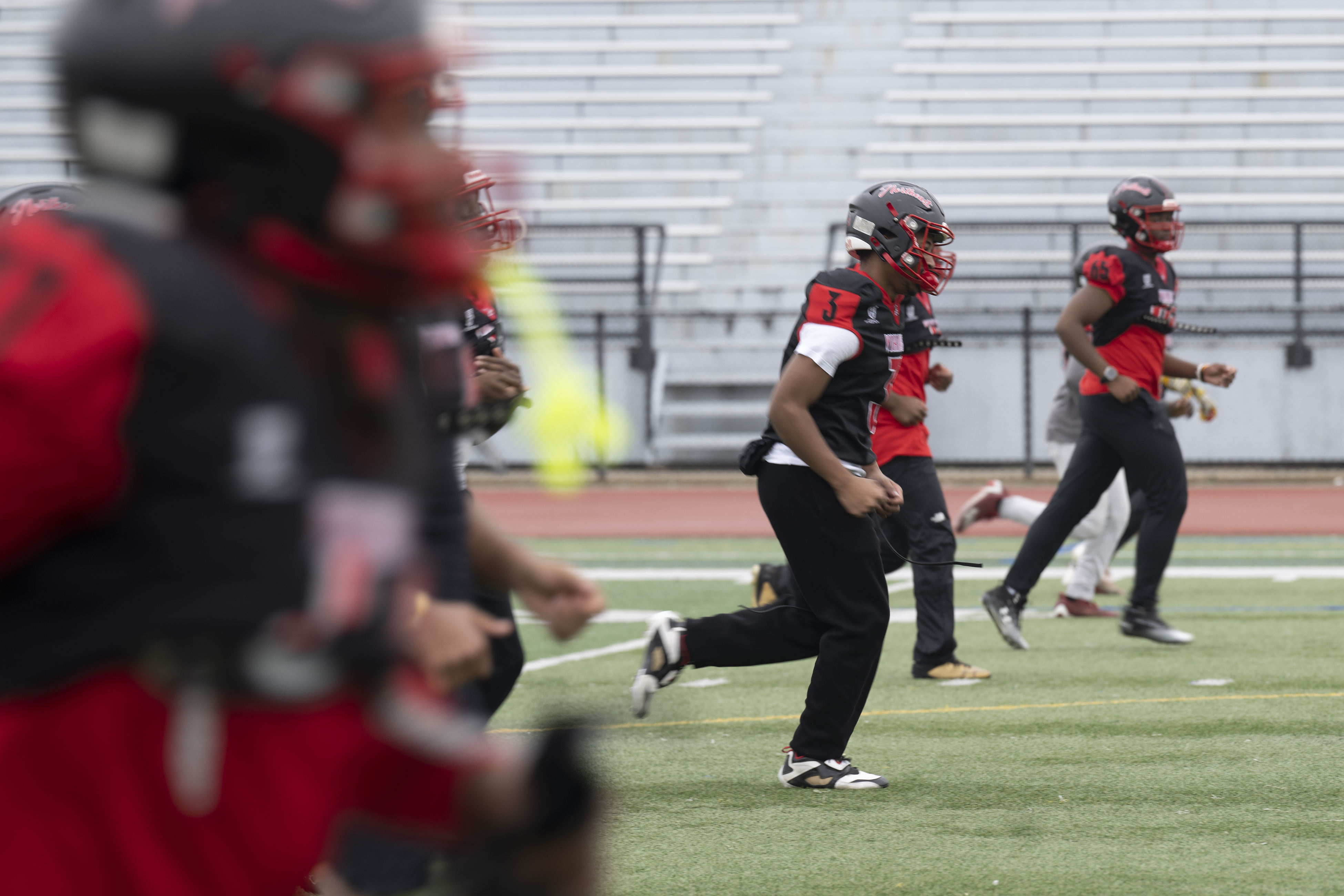
Quarterback Jayden Boyd practicing on Wednesday with his teammates at Northeast High School.
Boyd returned to school three weeks later but missed Northeast’s next nine games and could only watch as the Vikings lost to Lincoln in the Public League playoffs.
“He kept saying, ‘I let my team down,’” said his mother, Bahisha Durbin. “I said, ‘You didn’t let anybody down. This is not your fault.’”
But Boyd’s season did not end that night in Frankford. Doctors told him last week that he can play again, clearing the quarterback in time to join his team for its Thanksgiving game against rival Central. On the night he was shot, the teenager underwent surgery to remove the bullet. He never lost the ability to walk. After he recovered, he underwent physical therapy at Children’s Hospital before he was cleared to play. Boyd practiced Monday afternoon, wearing shoulder pads for the first time in more than two months. It was surreal, he said.
And his teammates — guys like Tellus, who prayed that their teammate was still alive until he showed up on that Zoom call — could not believe it.
Boyd made it back for Thanksgiving.
“Thankful,” he said. “Thursday is going to be very emotional. I know we’re going to score when I’m in the game, so I’m probably going to shed a couple tears.”
Football brought joy
Durbin signed up her son to play football when he was 7 years old, hoping the sport would help his ADHD.
“It was a godsend,” she said. “It’s helped out so much. I can’t thank the coaches enough.”
Football soon became Boyd’s life. That’s all he cares about, his mother said.
“I’m, like, a physical person, so I wanted to be a part of that,” Boyd said. “It brought joy to my life.”
Boyd wanted to be a wide receiver like Odell Beckham Jr. but soon fell in love with playing quarterback. He spent his first two high school seasons at Archbishop Carroll before transferring to Northeast.
He leaves his home in South Philly each morning at 6:15 and takes two buses and a subway to get to school.
“He’s a great part of the team,” said Tellus, a running back. “He’s a great friend. He has great loyalty. He always has my back. He’s a great friend to have.”
Boyd dreamed of playing college ball and studying sports medicine. That felt impossible, though, after he was shot. Schools had been in touch with him, but Boyd knew he needed to show more on the field. His junior year was supposed to be his chance to display his talent as a dual-threat quarterback — “I can beat you with my arm and legs,” he said — and earn a college scholarship.
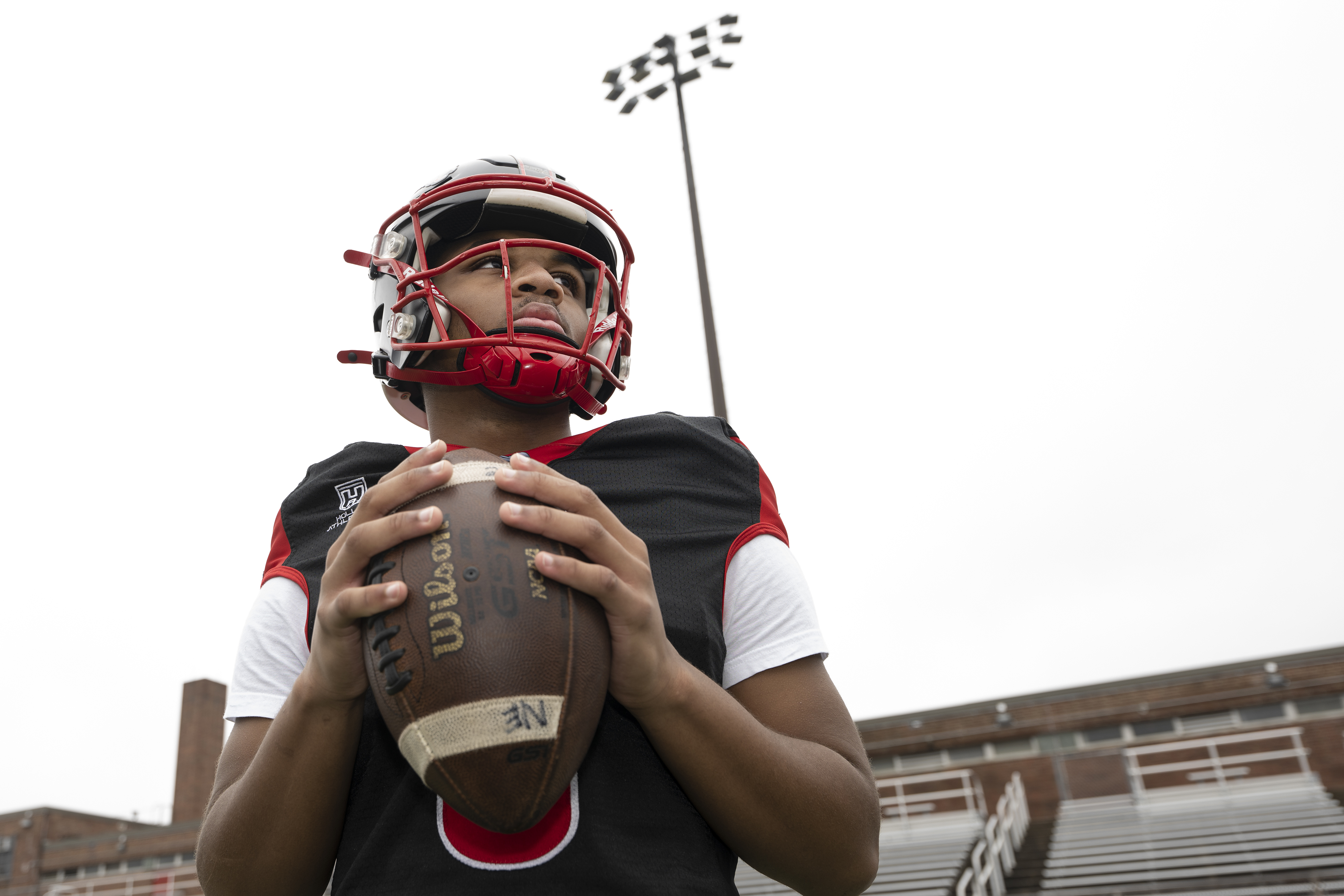
Northeast High’s Jayden Boyd says he cannot wait to play in his senior season: “We’re going to do something crazy next year.”
“Football was the last thought on my mind, but he doesn’t care about anything else,” Durbin said. “He was like, ‘Life is over because football is over and I can’t play.’ I said, ‘It’s OK, Jay. It’s not like your grades are messed up and that’s why you can’t play. You can’t play because you got shot.’ He’s just so passionate.”
Boyd was devastated to not play and soon became nervous in his own neighborhood. He spent weeks with a friend in Drexel Hill as the shooting made him afraid of being in Philly. Boyd figured if he couldn’t be safe playing video games, then where could he?
He had nightmares and flashbacks about that night on Adams Avenue and now meets with a therapist. His mother asked him if he wanted to switch schools. Boyd declined.
He wanted to stay at Northeast with coach Nick Lincoln, who was at Temple University Hospital that night and kept Boyd involved with the team while he was sidelined.
“It’s not something you necessarily prepare for when you get into coaching,” Lincoln said. “But being in Philly for about 15 years, I can’t say it’s the first time that something has occurred to my players off the field. It’s always disheartening and surprising. You just try to figure out how you can best support him and his family. We want these kids to use the sport to better themselves, become men in the community, and not become products of an environment.”
Reasons to be grateful
Durbin was sleeping when her son called that night.
“Usually, when Jayden is blowing my phone up it’s because he wants something from Wawa,” Durbin said. “I’m like, ‘I’m not giving this boy any more money.’ That’s usually what it is.”
So she didn’t answer. And then her other son ran into her bedroom to tell her what happened.
Northeast High coach Nick Lincoln celebrating a win against Central on Thanksgiving last year.
“I called Jay, and I was yelling at him,” Durbin said. “I hear him, but I don’t. It’s 1 o’clock in the morning, and we don’t play in the streets at 1 o’clock.
“I said, ‘What were you doing outside?’ He said he wasn’t outside. So I said, ‘How did you get shot?’”
Boyd told his mother the story, reminding her that he was sleeping at a coach’s house.
“He was loud but calm,” Durbin said. “That’s what helped me not get hysterical. Because he was calm. He didn’t call me screaming.”
She rushed to the hospital, fearful that her son would never walk again, and then was relieved to see he was OK. Durbin worried about the teammates who were there that night.
“I felt bad for the kids who had to watch and see it,” Durbin said. “These are good kids. They’re not in the hood doing crazy stuff. All these kids know is football. The one kid was shaking so bad because the coach was telling him to apply pressure on [Boyd’s] back. He was scared.”
Earlier this month, police arrested Nasir Johnson, 26, and charged him with aggravated assault, a firearms charge, and related offenses. Police said they had obtained surveillance footage of someone wearing blue jeans and a white T-shirt firing a gun on 4200 block of Griscom Street in the direction of the 1500 block of Adams Avenue, where Boyd was playing video games. Police said they recovered several items — including clothing that was consistent with what the suspect was wearing in the surveillance footage — when they arrested Johnson.
Lincoln called Boyd’s mother last week to say he wanted the quarterback to play a few snaps on Thanksgiving, just enough to give him a taste of being back on the field before next season. The series against Central, which dates to 1892, is said to be the nation’s oldest rivalry among public schools.
Boyd wasn’t able to show college coaches his promise this fall, but he still has another season of high school ball to prove himself. He can’t wait.
“We’re going to do something crazy next year,” he said.
His mother agreed to let him play Thursday but told the offensive line to “protect my baby.” She gave her son Psalms to recite before he takes the field, and she’ll be in the stands with an entire section of family and friends. Nearly three months after being shot, Boyd will be back on the field for one last game. His season is not finished.
“We’re just grateful,” Durbin said. “I’m grateful that he’s here. It’s Thanksgiving, for sure.”
As charming and ebullient as Nephtali Andujar is (lots of hugs, compliments, and gifts of his homemade pottery), the 61-year-old is also pretty blunt about why people should give to Project HOME, one of the city’s largest nonprofit housing agencies.
Because of Project HOME, said Andujar, who spent years living on the streets, he is no longer desperate — desperate to get money to feed a heroin addiction, desperate to scrape $5 together to pay someone to let him drag a discarded mattress into an abandoned house for a night’s sleep out of the rain.
“It’s not just giving someone an apartment,” said Andujar, who sheepishly described a past that included stealing cars and selling drugs. “It’s the snowball effect.
“You are not just helping the homeless,” he said. “You are helping the city. You are helping humanity.”
In the agency’s name, the letters HOME are capitalized, because each letter stands for part of the multipronged approach that Project HOME takes in addressing homelessness and combating poverty for the 15,000-plus people it serves each year.
There’s H, for Housing — not only housing in the literal sense, but also in the teams of outreach workers who comb through the city’s neighborhoods looking for people like Andujar. One outreach worker found Andujar in 2021 at a critical moment in his life — clean, just out of the hospital for liver treatment, and back on the streets of Kensington ready to begin anew.
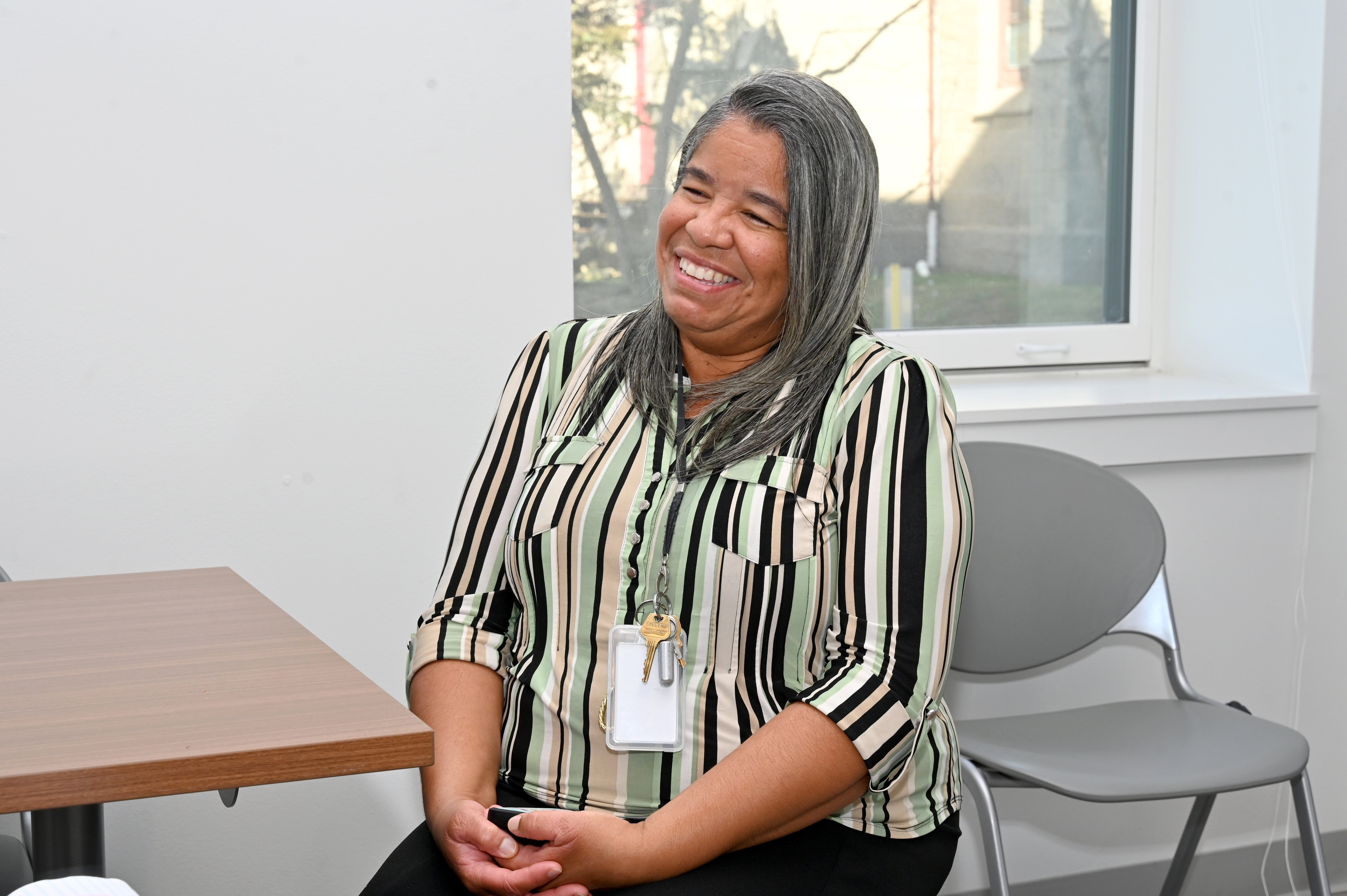
“We know we have to do the most we can to preserve these resources that we’ve come to rely on,” says Donna Bullock, president and CEO of Project Home.
For Andujar, it was a race. What would find him first?
Would it be heroin, as it had so often been in the past? It was tempting. It’s painful being on the street — cold, hungry and dirty, ashamed and alone. “When you do heroin, you don’t feel the cold. It kills the hunger,” he said. “When you use the drugs, you don’t have to suffer for hours. Heroin numbs you.”
Instead, though, it was the outreach worker — someone who had been through Project HOME’s recovery program — who plucked Andujar off the street in the nick of time and took him to a shelter.
A year later, that same outreach worker helped Andujar move to his own room at Project HOME’s Hope Haven shelter in North Philadelphia.
“You get tired of the streets. They were killing me,” Andujar said.
Next Andujar found Project HOME manager JJ Fox, who helped him get a birth certificate and other documents, and arranged for him to stay. But he needed more than a warm bed.
The problem with getting straight after a heroin addiction, Andujar explained, is finding a new purpose and direction. For so long, life was focused on a repeat cycle of getting the next fix and then becoming numb to pain while it was working.
So when he got to Project HOME, he needed a new direction, which is where both the O and E in HOME came in for Andujar.
“JJ Fox gave me direction,” he said, and so did Project HOME employment specialist Jamie Deni.
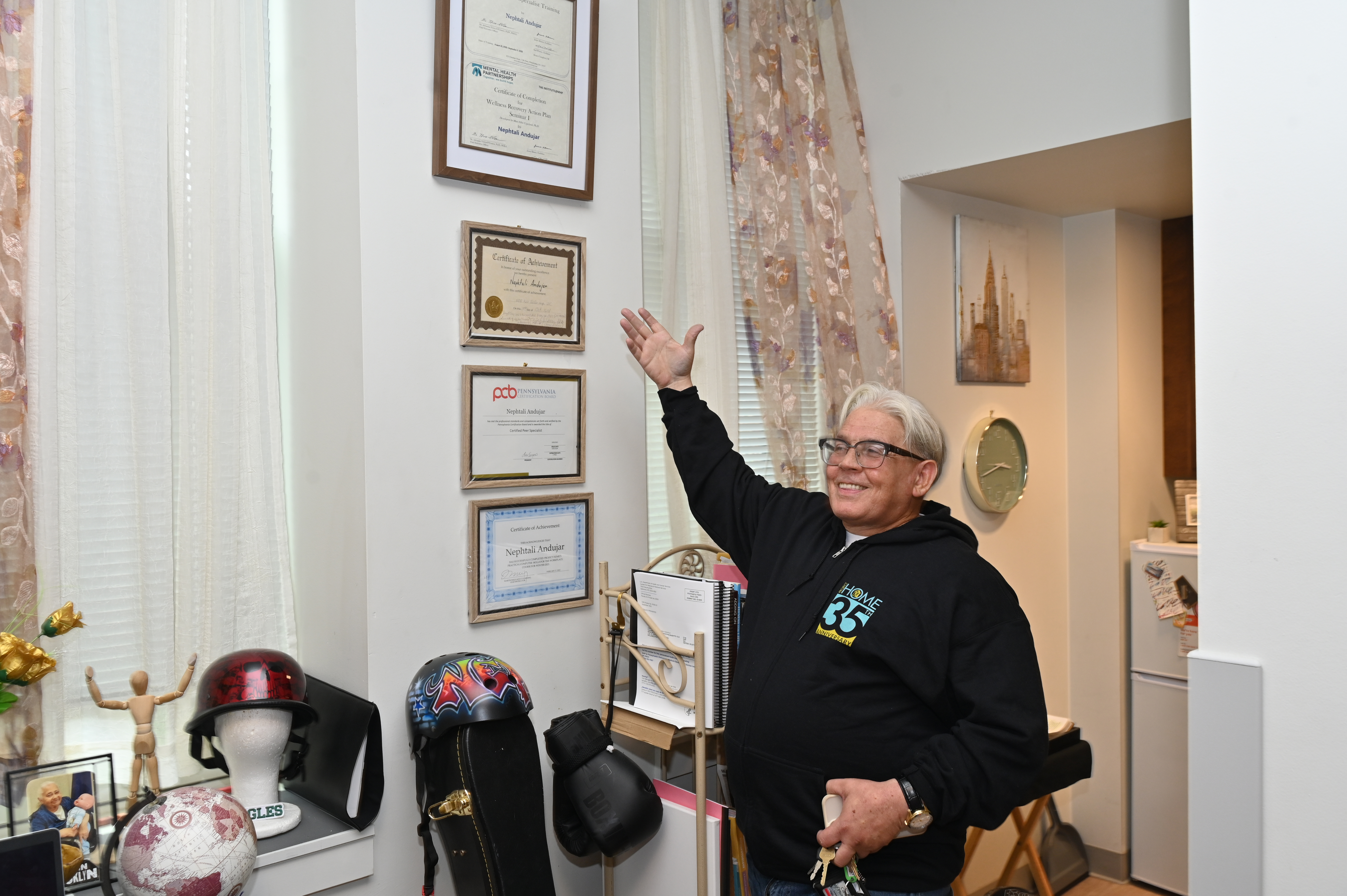
Training certificates cover a wall in Nephtali Andujar’s studio apartment in Project HOME’s Inn of Amazing Mercy in Kensington.
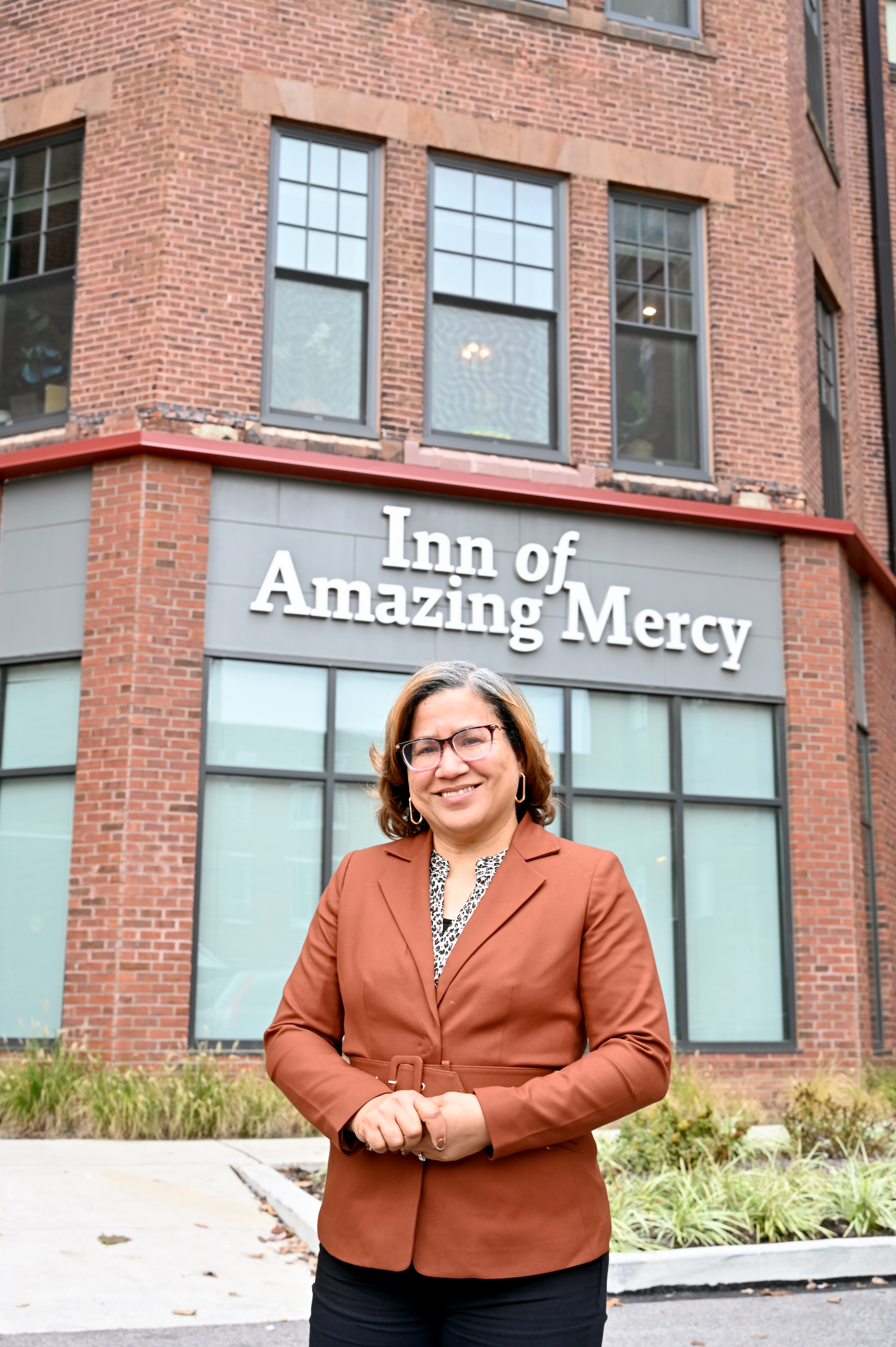
The “O” in HOME has to do with Opportunities for employment. Certificates cover one wall in Andujar’s studio apartment in Project HOME’s Inn of Amazing Mercy, a 62-unit apartment building and offices in a former nursing school dormitory in Kensington. He can point to his accomplishments in computer skills, barbering, and training as a peer specialist to help others the way the outreach worker helped him.
But Andujar is not in good health, as vigorous as he appears. His addictions will someday exact their price, even though with cirrhosis of the liver, he is already living years beyond what his doctor predicted.
Full-time work is not an option. So Andujar is part of the “E,” as in Education. Deni helped him get a grant to take art classes at Community College of Philadelphia. She helped him understand CCP’s education software so he could turn in his homework.
Project HOME offers classes in graphic design, music production training, ServSafe food handling, forklift and powered industrial trucks certification, and website building, among other courses.
The M stands for Medical. Project HOME doctors, nurses, and other health practitioners treat 5,000 people a year, both in a fully equipped health center and by sending medical teams into the streets, caring for people, literally, where they live.
“My dad always told me that you need three things — housing, food, and love. You get all that here,” Andujar said.
And for him, it goes beyond that. During a stable period in his life, Andujar had a partner and a child. His daughter is now 14 and living with her aunt in New Jersey. Her mother, who was also stable for many years, fell into addiction but is clean now. She is living in another Project HOME apartment.
Like Andujar, Omayru Villanueva, 49, another resident at the Inn of Amazing Mercy, recalls her first night of homelessness.
She remembered a cold slushy rain.
She remembered sweeping every corner of her house, determined to leave it clean, no matter what. Her husband had been convicted and jailed for a federal crime. She couldn’t make the payments on the house, so she sold or stored all of her belongings and prepared to leave.
On her last morning at home, she and her school-age twin sons walked out the door before the sheriff came. Her older daughter was able to find a place in a shelter. Her second daughter, just under 18, said she was living with a boyfriend, but it turned out that she had been trafficked.
“There’s a sense of dignity and respect when you have your own place,” says Omayra Villanueva, another resident of the Inn of Amazing Mercy.
By that evening, Villanueva was desperate. She took her boys to a hospital emergency room. At least they could sit indoors while she figured out something. “I was crying inside.” Finally, she called a friend from church who took her and her sons in.
From there, they moved from shelter to shelter, and ultimately to a Project HOME apartment with two bedrooms.
“That night we had a pizza party. We were so happy,” she said. “There’s a sense of dignity and respect when you have your own place. You can take your worries away from having a place to live, and you can focus on other things.”
She remembered lying in her new bed, “thanking God and rubbing my feet against the mattress.” The next day, she woke up, opened the window, and listened to the birds. Then she asked her sons what they wanted for breakfast. “When you are in a shelter, you eat what they give you.”
Three of her four children, scarred from the experience, have also been homeless and living on the street. Her two sons, now 23, are in Project HOME apartments. Both daughters are now fairly well-established.
Villanueva appreciates the medical help she has been given at Project HOME, particularly for mental illness stemming from the trauma she has experienced with her ex-husband’s arrest and homelessness.
“Anybody can end up being homeless,” she said. “I wasn’t a drug addict. I wasn’t an alcoholic. It can happen to anybody.”
She thinks of her daughter, who has a house, a job, and a car. But if something happens to the car, her daughter won’t be able to get to work. She won’t be able to pay her mortgage, and she could wind up homeless. It’s that simple.
“It’s important to donate because people can help break the cycle of homelessness,” Villanueva said.
“It’s about housing and education. It’s about medical help. It’s about employment,” she said. “Project HOME helped me a lot.”
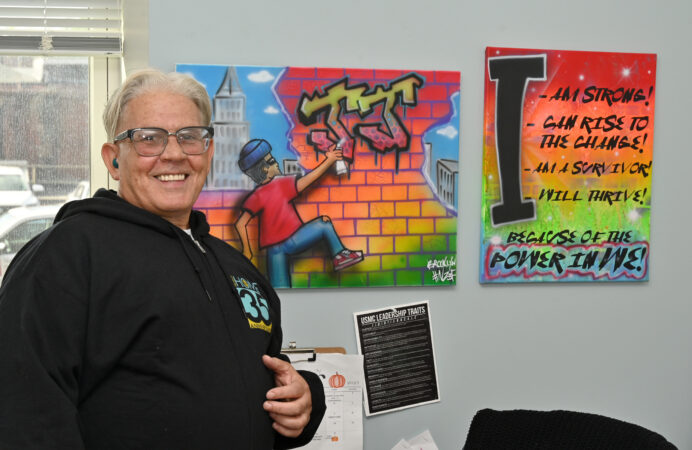
The truth is that every person in Project HOME has a story. Those stories keep Donna Bullock, president and chief executive, motivated to preserve and protect the agency founded just over 35 years ago by Sister Mary Scullion and Joan Dawson McConnon.
She worries about how the city will respond to federal executive orders amounting to the criminalization of homelessness. Will there be tightened requirements for agencies that provide shelter?
Project HOME is reimbursed for some of the medical care it provides, but Bullock worries that new rules involving Medicaid reimbursement will impact the agency’s budget, while cutbacks in services increase demand.
“It’s terrifying,” she said. “We know we have to do the most we can to preserve these resources that we’ve come to rely on.
“In this job, I’ve learned to appreciate the humanity of folks — the residents and the stories they tell and the contributions they make to our community.”
Sometimes, she said, Project HOME residents walking the path of recovery slip and fall away. Sometimes the results are tragic, the losses devastating.
“We’re experiencing all these moments — communal grief and communal celebrations as well. We talk a lot about how every journey of recovery is unique. Everyone walks their own journey. We can’t do the walk for you, but we can walk with you,” she said.
Bullock invites others to the journey, promising that when people give to Project HOME, they can be assured that their money is carefully managed. “We’re good stewards of the resources entrusted in our care. We know how to leverage the resources given to us.
“Folks expect a return on their investment, and the return is the difference in individual lives and also building a community,” she said. “Your investment is magnified 10 times over.”
This article is part of a series about Philly Gives — a community fund to support nonprofits through end-of-year giving. To learn more about Philly Gives, including how to donate, visit phillygives.org.
For more information about Philly Gives, including how to donate, visit phillygives.org.
About Project HOME
Mission: To empower adults, children, and families to break the cycle of homelessness and poverty, to alleviate the underlying causes of poverty, and to enable all of us to attain our fullest potential.
People served: More than 15,000 annually — with street outreach, housing, opportunities for employment, medical care, and education.
Annual spend: $49.06 million
Point of pride: Project HOME, which operates 1,038 housing units, broke ground in October for construction of 45 new apartments; also under construction are 20 respite beds. In the pipeline are an additional 44 apartments. Project HOME also operates the Honickman Learning Center Comcast Technology Labs, Stephen Klein Wellness Center, Helen Brown Community Center, and Hub of Hope.
You can help: Volunteers tutor students, serve meals, participate in neighborhood cleanups, and organize donation drives at their organizations for household items or other items useful to families or people still experiencing street homelessness.
Here are some ways that a gift can help the people we serve:
$25 provides warm clothing and new socks for a visitor at the Hub of Hope.
$50 supports a behavioral health counseling visit.
$100 provides a month’s worth of hygiene products and toiletries for a family.
$250 provides a welcome basket for a new resident complete with sheets, towels, and cooking supplies.
$500 supports five dental visits at the Stephen Klein Wellness Center.
$1,000 funds six weeks of summer camp at the Honickman Learning Center Comcast Technology Labs, keeping a child’s mind active during the summer and supporting moms who work.
$1,500 funds a certification program through the Adult Education and Employment program leading to employment readiness.
Over the course of three days, I met with 13 congressional legislators or their staffers, spoke to representatives of the U.S. Department of Agriculture and the White House, as well as fellow farmers, to discuss a very real threat impacting our nation: the instability of our food system.
Across the United States, food system organizations — from regenerative farms and gleaning networks, to food access nonprofits and community grocers — are all under immense pressure because of federal funding cuts, rising tariffs, and labor shortages. The entire food chain is strained, and the effects are compounding.
Recently, during the government shutdown, families across the country were not receiving SNAP benefits. American farms and families are still struggling and need relief now.
Farmers suffer even as food prices rise
While food prices continue to rise, farmers make less than 16 cents on every food dollar spent, according to the National Farmers Union. Even worse, there has been a severe labor shortage because of outdated agricultural workforce policies, while large corporate farms are making record profits.
Suicide among farmers is at an all-time high, and the sixth highest among all occupational groups. As the largest Black food grower in Pennsylvania, I am seeing these challenges each and every day.
In addition to the impact this will have on our children and our most vulnerable communities, the killing of this program is having a direct impact on small and first-generation farmers like me. My produce farm lost upwards of $150,000 between contracts with local food banks that were supported by the LFPA Program and the loss of the Agriculture Department’s Climate Smart Partnerships.
These drastic cuts have strained our operations and have impacted our ability to promptly pay our workers and ensure our communities have access to food that is not only locally and regeneratively grown, but also 100% chemical-free.
Food anchors social drivers
At the heart of this challenge is a simple truth: Food is the anchor to all social drivers of health. When food is unstable, so is health, education, safety, economic opportunity, and environmental well-being.
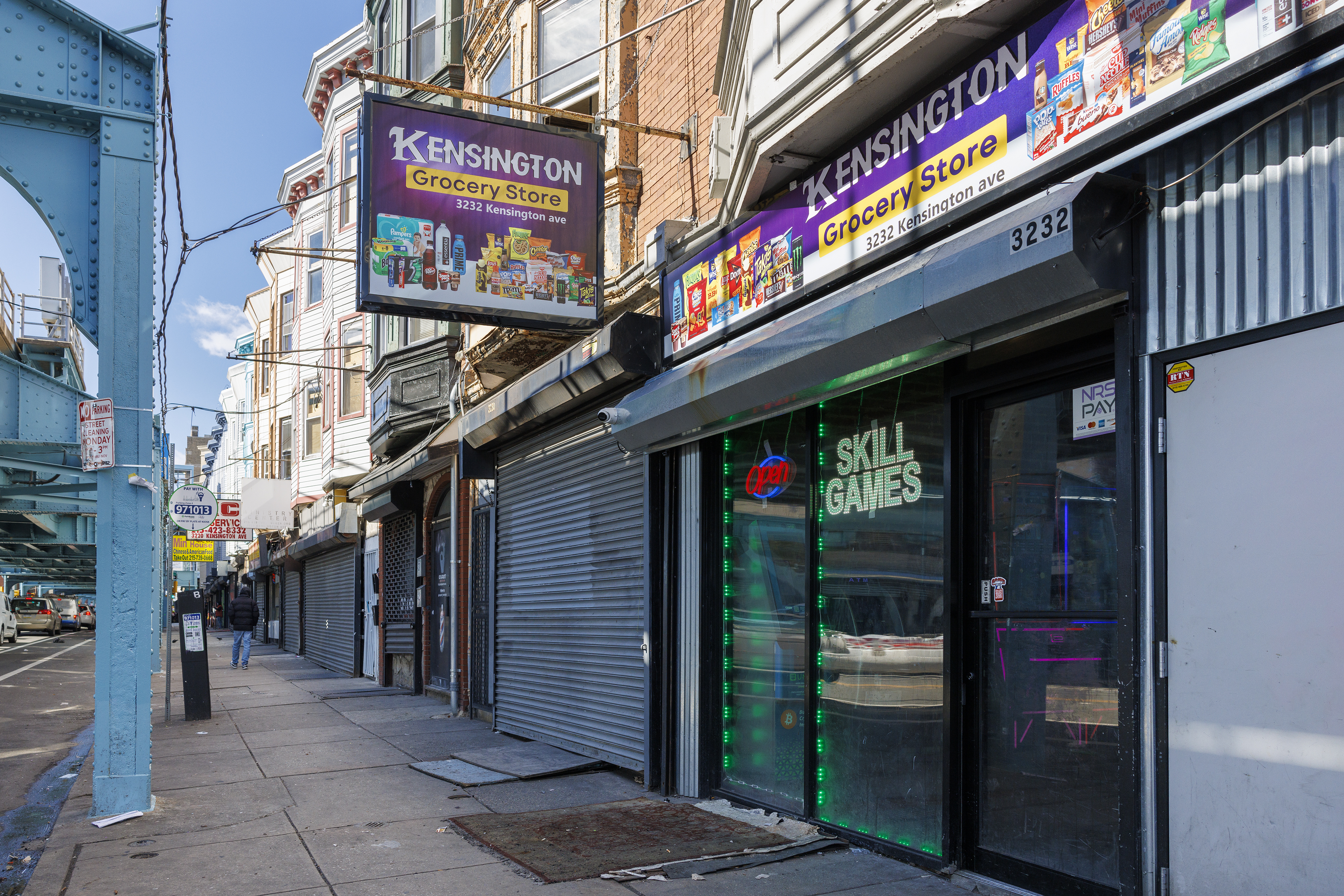
This is evident in North Philadelphia’s Kensington neighborhood, which is plagued by an opioid epidemic, crime, food apartheid, and nutrition insecurity.
A corner store in Philadelphia’s Kensington neighborhood. Such stores should be part of the local food system, writes Christa Barfield.
According to a 2019 report released by the city of Philadelphia and Drexel University’s Dornsife School of Public Health, Upper Kensington ranked last out of 46 Philadelphia neighborhoods in terms of health factors and health outcomes.
Addressing food access through a regenerative and localized lens is not just a response — it is a long-term strategy for national security.
In my September conversations with members of Congress, it became abundantly clear that an updated Farm Bill would not be passed into law by the Sept. 30 deadline. And it wasn’t.
Due to this failure to prioritize the needs of small family farmers, we must now turn inward and rely on our communities to design and implement a scalable, regionally coordinated food system.
This is possible by supporting local farmers and workers through fair, reliable markets, reducing food waste via efficient, community-based recovery, and empowering neighborhoods with increased food sovereignty and local ownership.
I founded FarmerJawn Agriculture seven years ago, and I know that for a community or nation to be healthy, it must be well-fed. Food is medicine. Good food means good health.
Despite the challenges we face, this idea is more relevant now than ever. I am eager to launch CornerJawn, a farm-to-store operation that will reimagine the corner store as a preventative healthcare hub.
CornerJawn will increase access to fresh and nutrient-dense food that is both convenient and affordable through a dignified pricing model.
It will enhance urban living for the strategically forgotten communities that are now seeing record development in hopes of creating, what? Wealth? True wealth is measured in longer lives with beautified communities and healthier families.
We must treat food like medicine, invest in those specialty farms that feed us, and watch our country thrive.
Remember: Agriculture is the Culture.
Christa Barfield, a.k.a. FarmerJawn, is a healthcare professional turned regenerative farmer, an entrepreneur, an advocate for food justice, and a James Beard Award winner. As the founder of FarmerJawn Agriculture, she manages 128 acres across three counties in Pennsylvania, making her the largest Black food grower in the state.
2026 Audi S3 Prestige vs. 2026 BMW 228i xDrive Gran Coupe: Battle of the little racers.
This week: BMW 228i
Price: Starts at $41,600 for both the 2025 and 2026 model years. Advantage, BMW.
Conventional wisdom:Car and Driver liked the “Refined balance of ride and handling, eager powertrains, purposeful near minimalist interior design and materials,” but not the “compromised cargo and rear passenger space,” and that the “front and rear fasciae appear a bit forced on otherwise sleek bodywork.“
Marketer’s pitch: “Strikingly sporty.”
Reality: “Striking.” I was afraid of striking things as I tried to make simple adjustments.
Catching up: Last week Mr. Driver’s Seat enjoyed the Audi S3 — until he landed on the highway, or tried to squeeze in some luggage.
What’s new: The 2 Series received more horsepower and a new look for 2025, and carries on pretty much unchanged for 2026.
Competition: In addition to the S3, there are the Acura Integra, Cadillac CT4, and Mercedes-Benz CLA.
Up to speed: The 2 Series’ speed would be the first question mark. The 2.0-liter TwinPower turbo provides 241 horsepower, almost 100 fewer than last week’s Audi S3; would it keep up?
Yet the version tested gets to 60 mph in 5.1 seconds, according to Car and Driver, just 0.7 seconds slower than the S3. A more souped-up model with a 3-liter six-cylinder engine gets there in just 3.6 seconds.
Shifty: The seven-speed dual-clutch transmission is super smooth, worlds above any attempt from Kia or some other inexpensive offerings.
The slider PRND operator looks cool but doesn’t offer much feel or add any usable space. Shift via the steering wheel paddles.
On the road: Handling is quite nice, perhaps in part because of the M Sport Package, which adds adaptive suspension along with other decals and stuff, plus the aforementioned dual-clutch.
In the first of several “improvements” designed to make the interior feel more high tech, Sport mode requires finding the button on the console touch pad (no solid way to feel your way to it) and then pressing the large icon on the screen. So there’s two instances you’re looking away from the road while trying to operate the vehicle.
But at least compared to last week’s Audi S3, the BMW doesn’t rattle your brain on the highways at all.
The cockpit of the 2025 BMW 2 Series looks as inviting as ever but operation does not live up to expectations.
Driver’s Seat: The sport seats that come with the M Sport package are supportive and comfortable, and I never adjusted it beyond forward and backward. No annoying lumbar or grippy seat corners.
The materials all feel upscale, an improvement over the X2 SUV I tested this year. Everything about that small SUV felt cheap and plasticky.
The materials seem especially scuff prone, though. I brushed out the carpet and seats when I was done with my loan and it seemed the bristles and the plastic handle left marks on the seat and in the plastic door frame bottom. Be sure this fabric fits your lifestyle.
Friends and stuff: Sturgis Kid 4.0 laughed at how tight the rear seat was. He sat stretched into the middle just to make it workable.
He’s not wrong. My own head was squashed up against the ceiling in the corner, although foot room and legroom were pretty good. Entry and exit are challenging because the door is narrow and the seat actually sits up kind of high (not something I expected to write in this review). The middle seat is compromised by the hump and the console and the corner people trying to find a place for their heads.
Cargo space is 13.8 cubic feet, far higher than the S3.
Play some tunes: Sound from the Harman Kardon system might be better than I heard, but I could never find the audio tuning adjustment when I had CarPlay activated. It would only show up in the touchscreen when I left CarPlay off, so it was difficult to make the most of my favorite songs. B-, because why make it so hard?
BMWs once had a superb dial and button system for operating the infotainment, and some models still have it. It takes a bit of practice but you can really run it by feel after a while. Now it’s all about the touchscreen, with a roller dial on the console for volume.
Keeping warm and cool: The temperature controls appear as small +/- adjustments at the corners of the touchscreen. There’s no way to feel for them, and your eyes are off the road while you adjust.
But wait! There’s more! To make further HVAC adjustments, click on the tiny fan icon between them to open up all the controls. These are fairly clear, but I’ve already looked at the screen and away from the road twice now, just to cool off (or warm up).
Fuel economy: I neglected to note the fuel economy. (Hangs head in shame, then blames BMW for the confusion.) The window sticker says 30 mpg combined, but that seems optimistic.
Where it’s built: Leipzig, Germany. Germany is the source of 24% of the car’s parts. None of it comes from the United States or Canada.
How it’s built:Consumer Reports gives the 2 Series Gran Coupe a predicted reliability rating of 3 out of 5.
In the end: The 228i was definitely fun to drive, but too many drawbacks made me long for the real delight of the S3. Just pack ibuprofen for the highways.
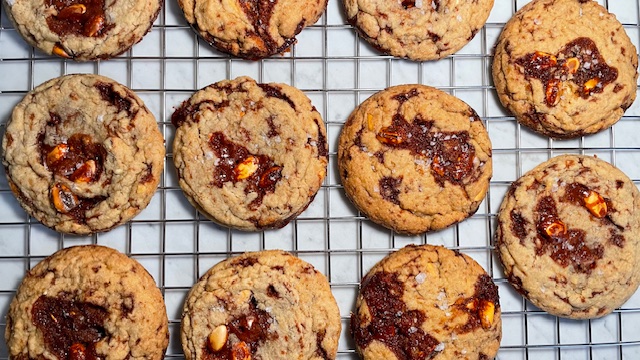
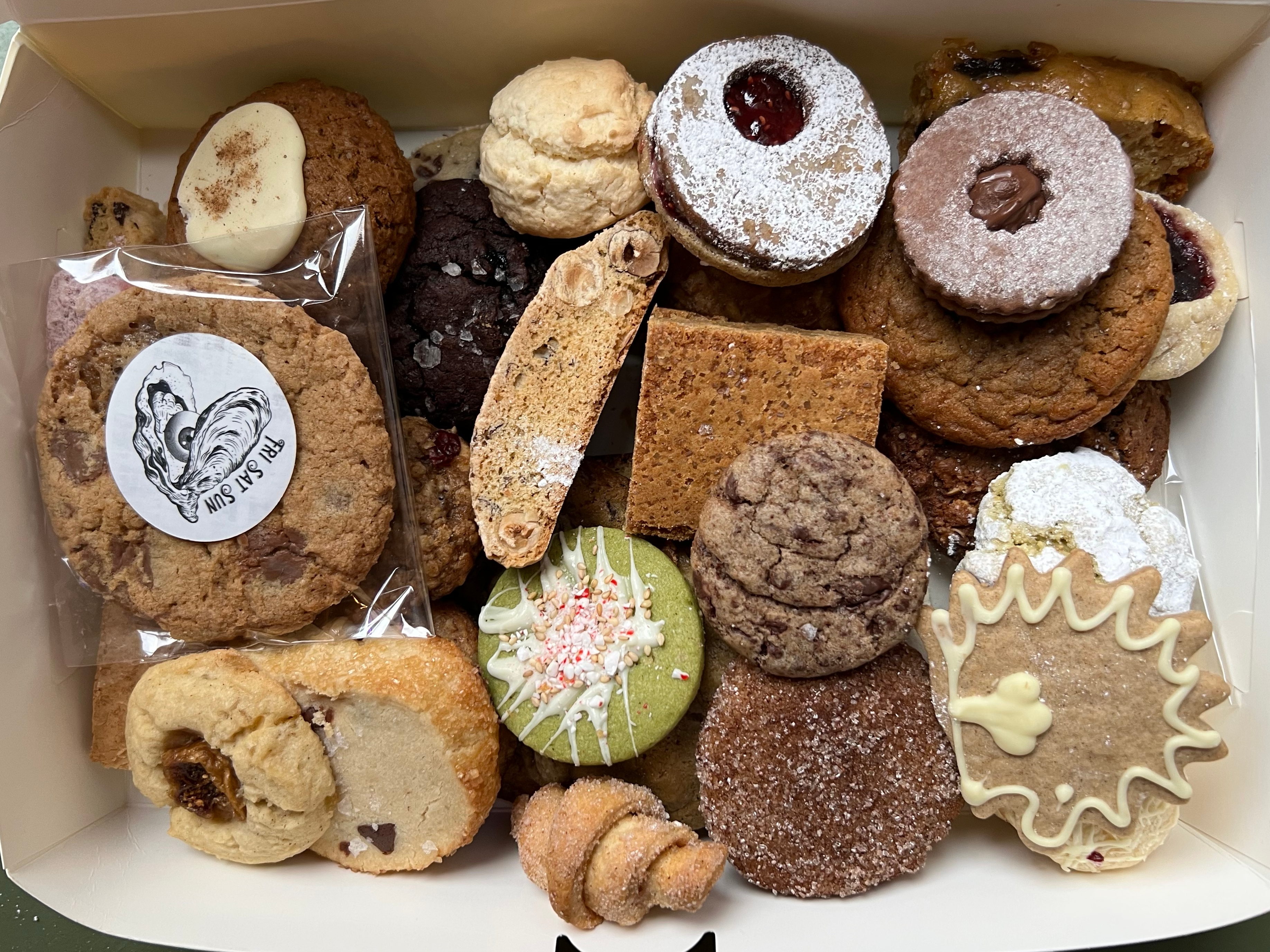
These cookies were among chef Amanda Shulman’s favorites of the 40-plus entries included in last year’s Cookies 4 Coats box, which Shulman coordinates and sells every year with the help of more than two dozen contributors, with 100% proceeds split between the Sunday Love Project and Broad Street Love. The recipes, sourced from Philly kitchen pros, have been lightly edited for clarity but not tested.
Note: While some recipes call for cups and teaspoons, several of them call for grams (one generous contributor includes both). Most baking professionals measure ingredients by weight, using a digital scale to ensure accuracy; not only does it result in more accurate measurements, it also saves time and cleanup. If you want to convert from one measurement to another, you can find a very helpful equivalencies chart online at King Arthur Flour’s website. — Jenn Ladd
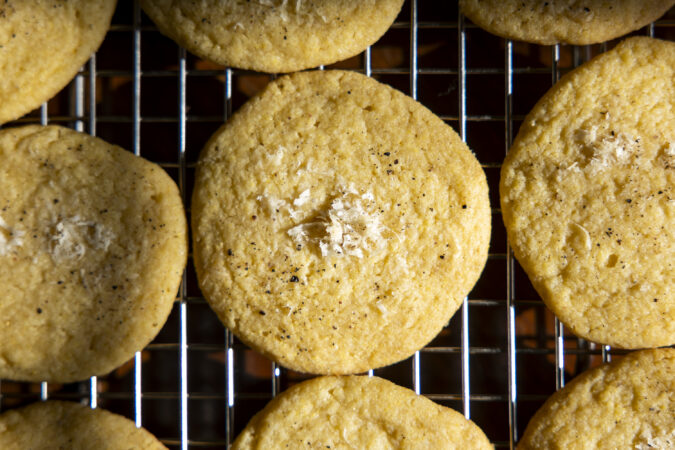
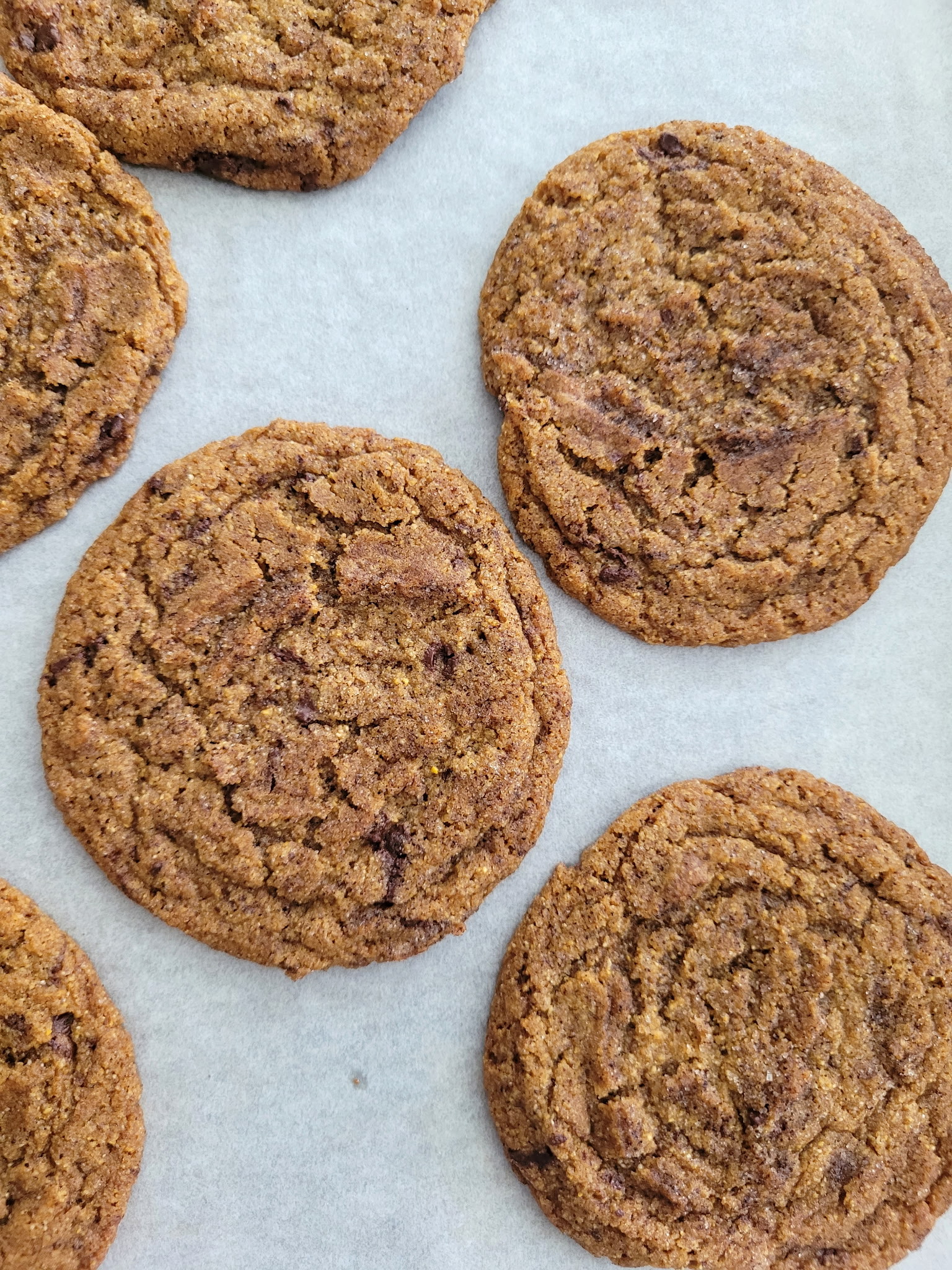
The Parmesan Cornbread Cookies made by Inquirer reporter Jenn Ladd in Philadelphia, on Friday, Nov. 14, 2025.
Parmesan cornbread cookies
Recipe by Ashley Huston, Dreamworld Bakes
Makes 45 cookies
This fun recipe from Ashley Huston, the baked-good mastermind behind Kensington’s Dreamworld Bakes, yields soft, chewy cookies, and a lot of them. You can easily halve the ingredients below for more modest batch, but they’re so good (and freeze well) that you’re better off making it as written.
Cornmeal gives cookies the faintest grainy texture — in the best way — and a big dose of honey lets you inform their flavor with your favorite type, be it clover, wildflower, or buckwheat. Top the cookie dough rounds with as much grated fresh Parmigiano Reggiano (or sprinkle the nicest pre-grated parm you have) and cracked black pepper as you like; if you sprinkle it on before you chill the cookies, it’ll hold up better upon baking for a more visually interesting cookie.
525 grams all-purpose flour
350 grams cornmeal
12 grams salt
6 grams cornstarch
6 grams baking powder
3 grams baking soda
450 grams (4 sticks) butter, softened
400 grams white sugar
200 grams honey
110 grams egg (2 eggs), room temperature
Parmesan cheese, freshly grated, to taste
Black pepper, freshly milled, to taste
Heat the oven to 350°F. Sift together the flour, cornmeal, salt, cornstarch, baking powder, and baking soda. Set aside.
In a stand mixer with the paddle attachment, cream the sugar and butter together until light and fully incorporated. Add the eggs and honey, then beat until blended.
Gradually add the dry ingredients to the mixer, beating until combined. Do not overmix.
Scoop out 1.5-ounce portions of dough onto onto a lined sheet pan, form discs, top with Parmesan and pepper. Refrigerate for 15 minutes.
Bake for 9 to 11 minutes, until set.
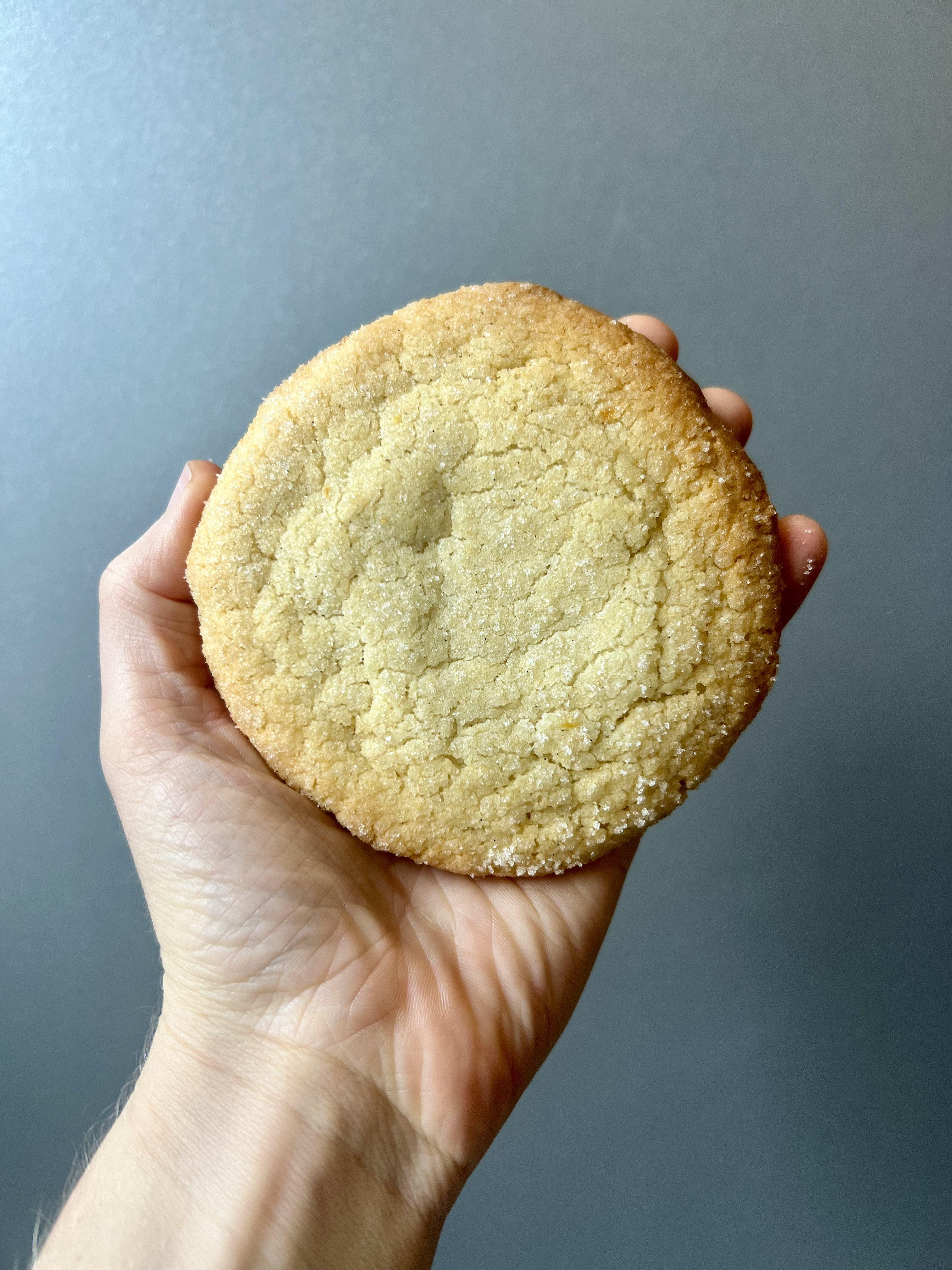
Mighty Bread’s Italian almond cookie.
Italian almond cookie
Recipe by Christopher DiPiazza and Siobhan McKenna, Mighty Bread Co.
Makes 20 large cookies
This crowd-pleasing cookie — which is giant, a characteristic of all things Mighty Bread — was inspired by the quintessential sprinkle cookies found in virtually every South Philly Italian bakery. Head pastry chef Siobhan McKenna says Mighty Bread swaps orange-vanilla sugar for sprinkles to make it “a bit more elevated.” But we won’t tell if you cover your cookie dough in rainbow sprinkles (or, you know, jimmies).
750 grams all-purpose flour
10 grams baking powder
3 grams baking soda
8 grams salt
450 grams butter
110 grams cream cheese
500 grams granulated sugar, plus 200 grams for coating
16 grams vanilla paste
100 grams eggs
4 grams almond extract
Finely grated zest from an orange
Vanilla bean, split
Combine the flour, baking powder, baking soda, and salt. Set aside.
In a stand mixer with the paddle attachment, cream the butter, cream cheese, vanilla paste, and sugar until pale and doubled in size. Scrape down bowl and paddle.
Add the eggs in two increments, beating until fully incorporated. Add the almond extract and scrape down the bowl and paddle. Add the dry ingredients in several increments until incorporated. Transfer the dough to another bowl or container, cover, and chill for 45 minutes to an hour.
While the cookies chill, scrape the vanilla bean seeds into the remaining 200 grams sugar. Add the orange zest. Rub together to combine thoroughly.
Scoop the dough into balls (100 grams each for a Mighty Bread-sized cookie). Dip each cookie in the orange-vanilla sugar before placing on a lined sheet pan, spacing appropriately, six to a half-sheet pan.
Bake at 350°F for 14 to 16 minutes, rotating after 6 and 12 minutes and checking for another 2 to 4 minutes, until edges are set and center is cooked but soft.
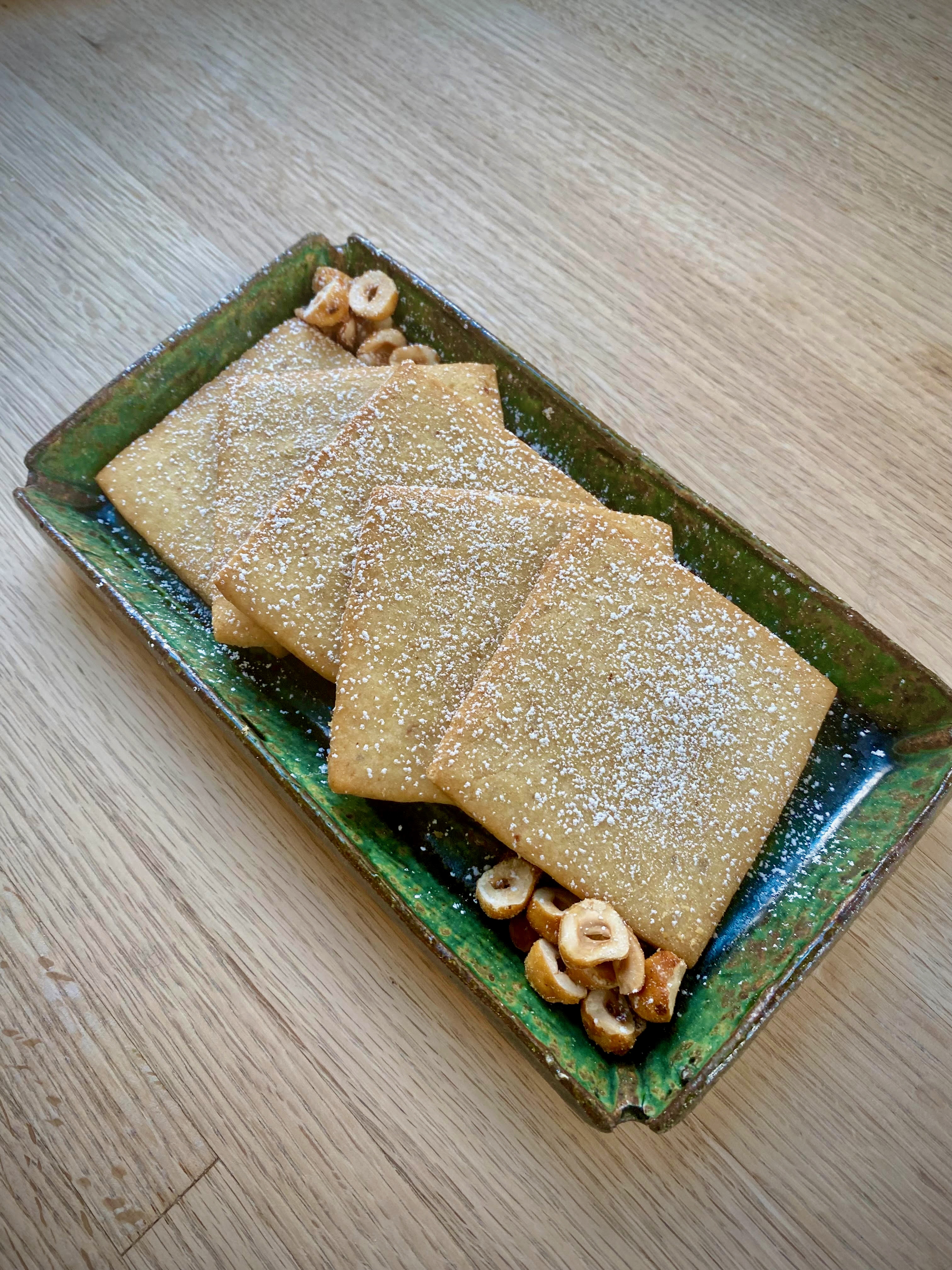
Hazelnut shortbread made by Vetri Cucina’s Michal Shelkowitz.
Hazelnut shortbread
Recipe by Michal Shelkowitz, Vetri Cucina
Makes 24 cookies
There’s not much backstory to these simple (but delicious) cookies, says pastry chef Michal Shelkowitz. “I just love shortbread! They’re the only cookies I allow to be crispy,” she says, adding “maybe a hot take, but crispy chocolate chip cookies make me want to die inside.”
100 grams hazelnuts
275 grams all-purpose flour, divided
½ teaspoon baking powder
½ teaspoon salt
250 grams butter, room temperature, cubed
70 grams powdered sugar
60 grams egg yolks
Heat the oven to 350°F. Spread the hazelnuts on a baking tray, toast in the oven for 5 to 8 minutes, until golden and fragrant. Allow to cool completely. Once cool, place hazelnuts in a food processor along with half of the flour and grind to a fine powder. Add the hazelnut mixture to the remaining flour, then mix in the baking powder and salt. Set aside.
In a stand mixer with the paddle attachment, cream the butter and powdered sugar for a few minutes until butter is light in color and fluffy. Scrape the bowl down well, then add the egg yolks. Mix until completely incorporated. Scrape down once more, then add all of the dry ingredients. Mix on low speed until all of the flour has been absorbed and a soft dough forms.
Transfer the dough to a piece of parchment paper. Press down to even it out, place another piece of parchment on top, and roll out the dough to about ½-inch thickness. At this point you can either cut the dough into 3-inch squares or use similar-sized cookie cutters. Transfer the sheet of dough onto a tray and chill in the refrigerator until firm.
Once firm, use an offset spatula to transfer the cookies to a lined baking tray, placing them about 1 inch apart. Bake for 10 to 12 minutes, until the edges turn golden brown. Let cool on the sheet tray before removing.
Roasty Toasty Kinako cookies made by Linna Li of Aidomi Cafe
Roasty toasty kinako cookies
Recipe by Linna Li, Aidomi Cafe
Makes 12 cookies
This project cookie comes from Chester Springs native Linna Li, a veteran of New York’s restaurant industry who now owns Mama Wong in Exton and is searching for a home for Aidomi Cafe, a forthcoming all-day spot with a menu that will blend Li’s Chinese background with the Honduran roots of her partner, chef Jose Nunez. That cultural combo informs these cookies: They get crunch from a brittle made with cancha, or toasted corn nuts, and warm, nutty flavor from kinako, or roasted soybean flour. Those ingredients are widely available in Latin and Asian supermarkets, respectively. (You can also sub a store-bought brittle or toffee if you like; see note below.) Optional buckwheat flour plus masa harina and cornmeal add further complexity, which is what Li’s all about.
“Anytime I create like a cookie recipe,” she says, “I’m really focused on flavor — something that’s not too saccharine, has a little bit of a more salty component to it — but also something that’s pretty interesting in texture.”
Note: If substituting the canchita brittle with store-bought brittle or toffee, reduce the brittle weight from 120 grams to 90 grams.
120 grams (1 cup) buckwheat flour or AP flour or any gluten free flour
60 grams (½ cup, plus 1 tablespoon) masa harina
48 grams (⅓ cup) finely ground cornmeal
30 grams (4 tablespoons) kinako powder
1 teaspoon baking soda
1 teaspoon kosher salt
226 grams (2 sticks) unsalted butter, softened
75 grams (⅓ cup) granulated sugar
100 grams (½ cup, packed) dark brown sugar
1 tablespoon vanilla paste or vanilla extract
1 large egg, room temperature
120 grams (1 heaping cup) canchita brittle, chopped into pea-sized pieces, plus more for garnish
Flaky sea salt
For the canchita brittle
Line a sheet pan with parchment paper and set aside. In a pan over medium heat, combine the oil, cancha corn, and 1 teaspoon of the salt, stirring occasionally to get even coloring. After a few minutes, the kernels will start to pop; you can partially cover the pan so the kernels don’t pop out. Stir until the canchitas are golden brown and have a nice crispy bite, about 10 minutes. Transfer to a bowl and set aside.
Combine the sugar, butter, and water in a saucepan, preferably with a light-colored bottom. Warm the mixture over medium heat until it melts and begins to bubble, swirling the pan occasionally. Cook the butter, swirling often, until it is golden and the milk solids are dark caramel-colored (with a temperature of 300°F), 6 to 8 minutes.
Once the mixture is golden, thick, and bubbly, fold in the canchitas, stirring until evenly coated. Add the baking soda and the remaining salt. Turn off heat and stir until baking soda is completely dissolved. Spread the mixture over the lined baking sheet and spread to a single layer. Let cool completely before chopping into shards.
For the cookie
Stir together the buckwheat flour, masa harina, cornmeal, kinako powder, baking soda, and salt in a medium bowl and set aside.
In a stand mixer with the paddle attachment, beat the butter, sugar, and dark brown sugar on medium speed for about 5 minutes, until the mixture is smooth and fluffy, scraping down the bowl and paddle as needed. Drizzle in the egg and vanilla, beating until the egg is fully incorporated, about 1 minute.
Add the flour mixture in small batches, reserving a few tablespoons, and mix on low speed for about 30 seconds until the flour is almost combined, with few visible flour streaks. Stop the mixer and scrape down the bowl and paddle.
Combine the reserved flour with the canchita brittle, evenly coating each piece with flour. Add half to the dough, folding it in by hand. Once folded, pour in the remaining half and scrape the bowl from bottom up to release any ingredients that may be stuck.
Using an ice cream scoop or your hands, portion out cookies to 70 grams and place on a lined sheet pan, making sure they are close but not touching. Cover the baking sheet with plastic wrap and refrigerate overnight or up to 24 hours to allow the dough to rest.
When ready to bake, heat the oven to 350°F. Transfer portioned dough to another lined sheet pan, leaving about 2 inches between each cookie. Top each cookie with a small piece of canchita brittle pressed down into the dough.
Bake for 15 to 17 minutes. You want the cookies to be slightly underdone. They will feel soft to the touch but will firm up as they cool.
While the cookies are still warm, tap the center of each with a spatula to create an indent. Top each with flaky salt and shape with a 4-inch cookie cutter (they will spread so shaping while warm is crucial). Cool completely before transferring to a wire rack. Cookies can stay at room temperature in an airtight container for up to one week. Unbaked dough can stay frozen for up to one month.
Brandon Parish’s black & white cookie, from the Kibitz Room.
Black & white cookie
Recipe by Brandon Parish, the Kibitz Room
Makes 12 to 14 cookies
Brandon Parish’s spin on this classic deli treat uses an ultra-moist muffin batter for the cookie, yielding a fluffy, not-too-sweet base for the black-and-white icing. If you want to recreate a Kibitz Room dessert at home, try serving a hot black-and-white cookie with powdered sugar, sprinkles, and a scoop of ice cream or gelato.
For the cookies
1⅔ cups all-purpose flour
⅔ teaspoon baking soda
⅔ teaspoon salt
½ cup buttermilk
⅔ teaspoon vanilla
½ cup unsalted butter, softened
⅔ cup sugar
1⅓ large egg
For the icing
2 cups confectioners’ sugar
1⅓ tablespoons clear corn syrup
2⅔ teaspoons lemon juice
⅓ teaspoon vanilla
1⅓ tablespoons water (roughly)
⅓ cup cocoa powder
Heat the oven to 375°F if using a conventional oven or 350°F if using convection. In a small bowl, sift together the flour, baking soda, and salt. In a separate bowl or measuring cup, mix together the buttermilk and vanilla.
In a stand mixer with the paddle attachment or with an electric mixer, beat butter and white sugar together in a large mixing bowl with an electric mixer until it’s evenly distributed, about 3 minutes. Add the egg and beat until blended.
Alternating with each addition, gradually add the dry ingredients ½ cup at a time, incorporating the buttermilk mixture between each addition. Mix until smooth, occasionally scraping down the sides of the bowl.
Spoon ¼ cup portions of batter onto a lined sheet pan. Bake for 15 to 17 minutes, or until the tops are golden brown and spring back when touched. Place on a cooling rack and allow to cool completely before icing.
In a large bowl, stir together the confectioners’ sugar, corn syrup, lemon juice, vanilla, and ½ tablespoon of water until smooth. Place half of the mixture into a separate bowl and add the cocoa powder, and remaining water bit by bit until it is the same consistency as the white icing. If the icing is too runny, whisk in more confectioners’ sugar until smooth and spreadable.
Turn cooled cookies flat side up. Using a pastry spatula or a butter knife, spread on the icing, white over one half, chocolate over the other. Let set.
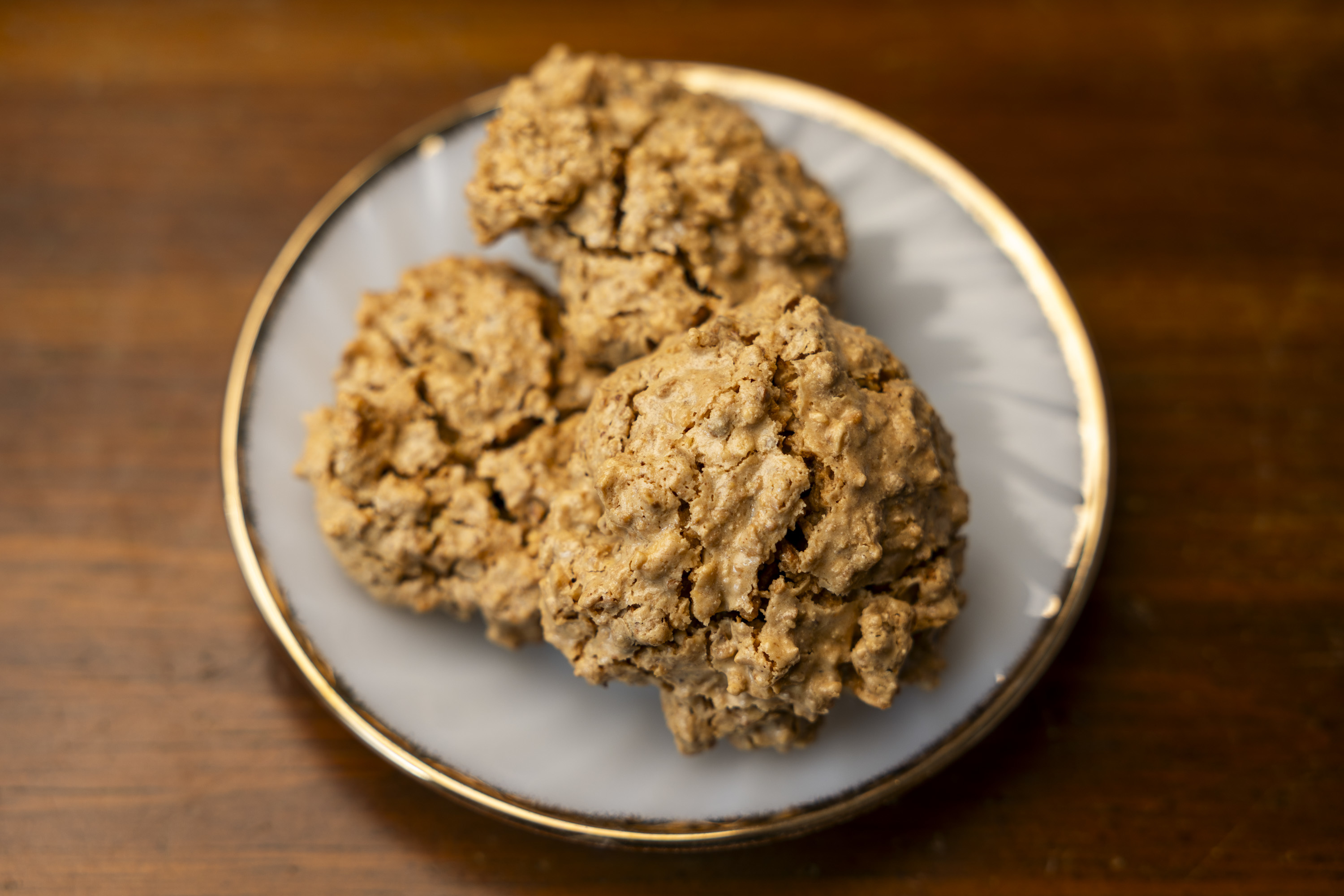
The brutti ma buoni cookies made by Inquirer reporter Jenn Ladd in Philadelphia, on Friday, Nov. 14, 2025.
Brutti ma buoni (ugly but good)
Recipe by Justine MacNeil, Fiore
Makes 18 cookies
These chewy-crunchy meringue cookies use a slightly unusual cooking process — there aren’t too many stovetop cookies — that will fill your kitchen with the sweet smell of toasted hazelnuts and caramelizing sugar. “All the classic Italian recipes are quite bizarre,” says Justine MacNeil, the reining pastry queen (and co-owner) of Fiore, who is delighted by this nutty cinnamon-spiced cookie. “They’re my fave.”
250 grams hazelnuts
250 grams granulated sugar, divided
90 grams egg whites
125 grams sugar
½ teaspoon kosher salt
¼ teaspoon vanilla extract
⅛ teaspoon ground cinnamon
Toast the hazelnuts at 350°F until golden brown, 12 to 15 minutes. Let cool. Reduce the oven to 275°F (convection) or 300°F (conventional). Line a sheet pan with parchment or Silpat.
In a food processor, grind the hazelnuts and 125 grams of the sugar into small pebble-like pieces. Be careful not to overgrind and turn the mixture into nut butter. Set aside.
In a stand mixer with the whisk attachment, whip the egg whites on high speed. Once they are opaque, slowly stream in the remaining 125 grams of sugar and whip until thick and shiny, about 5 minutes. Fold the hazelnuts into the egg white mixture. Fold in the salt, vanilla, and cinnamon.
Transfer the mixture to a 4-quart pot or saucepan. Cook over medium-low heat, stirring often, until the mixture thickens and begins to gain a caramelized color, 8 to 10 minutes.
Scoop immediately onto the lined sheet pan using either a 2-tablespoon scoop or two spoons. (They are supposed to be irregularly shaped.)
Bake for 20 to 25 minutes, until dried and lightly golden. Allow to cool and then store in an airtight container for up to one month.
The limoncello cookies made by Inquirer reporter Jenn Ladd in Philadelphia, on Friday, Nov. 14, 2025.
Limoncello cookies
Recipe by Aurora Samsel
Makes 5 dozen cookies
Try a nub of this cookie dough raw and you’ll get the bite of raw olive oil and the tang of fresh lemon juice and limoncello. But these three-bite cookies bake up into mild lemony treats that are absolutely kid-friendly. They come courtesy of pastry chef Aurora Samsel, who developed them while working at Osteria. Samsel characterizes this as a basic dough with some Italian spins (including semolina flour). She likes to bake the cookies so they come out a very light golden brown, but it’s OK if you take them a shade darker around the edges. “They taste delicious either way,” she says.
2 cups all-purpose flour
⅔ cup semolina flour
1 teaspoon baking powder
½ teaspoon baking soda
½ teaspoon kosher salt
½ cup (1 stick) unsalted butter, softened
2 tablespoons extra-virgin olive oil
1 cup granulated sugar, plus more for rolling
1 large egg
1 large egg yolk
Freshly grated zest and squeezed juice of 1 lemon
2 tablespoons limoncello
½ teaspoon pure vanilla extract
Heat the oven to 325°F. Line a sheet pan with parchment or Silpat and spray with oil.
Sift together the flour, semolina, baking powder, baking soda, and salt and put it aside.
Using an electric mixer with a paddle attachment, cream together the butter, olive oil, and 1 cup of the sugar.
Scrape the bowl, then with the mixer on, slowly add the egg and egg yolk. Scrape again, then add the lemon zest, lemon juice, limoncello, and vanilla extract.
Once combined, add the dry mixture, and continue to mix until all combined. The dough will be soft and sticky. Place the dough in the fridge and chill for 1 hour (or longer).
When ready to bake, place some sugar in a small bowl. Scoop the ball into 15-gram portions, rolling each to a 1-inch ball. Roll in the sugar, then place on the prepared pan.
Bake for 12 to 14 minutes, rotating the pan halfway through, until the cookies are a pale golden brown and set. When out of the oven, transfer the cookies onto a wire rack to let cool completely.
Mocha snickerdoodles made by Jessica La Torre of High Street Bakery.
Mocha snickerdoodles
Recipe by Jessica LaTorre, High Street Philadelphia and the Bread Room
Makes 30 cookies
Buy a bunch of butter for these snickerdoodles, which call for browning 2 pounds of it and combining some of that with regular salted butter, too. High Street bakery production manager Jessica LaTorre notes that these cookies came about as a result of tinkering with the restaurant’s cornmeal snickerdoodle, and that it’s a crispy-crunchy variation of the cinnamon-coated classic. “Don’t expect much chewiness,” she says. “If you are looking for a bit more of a classic snickerdoodle chew you can swap in up to half brown sugar for the granulated.” A stickler for detail, LaTorre also suggests using fine or medium-grind cornmeal and erring on the side of underbaking.
For the cookies:
230 grams brown butter (see below), room temperature
230 grams salted butter, softened
600 grams granulated sugar
15 grams espresso powder or finely ground coffee
400 grams all-purpose flour
300 grams cornmeal
14 grams cream of tartar
12 grams baking soda
5 grams kosher salt (Diamond Crystal)
100 grams (2) eggs, room temperature
100 grams dark chocolate, finely chopped
For the dusting sugar:
100 grams granulated sugar
10 grams cinnamon, ground
20 grams espresso powder or finely ground coffee
5 grams cocoa powder
For the glaze (optional):
130 grams confectioners sugar
16 grams milk
20 grams light corn syrup
2 grams kosher salt
For the brown butter: Cube 8 sticks (2 pounds) of unsalted butter. Cook in a medium pot over medium heat, allowing it to foam and bubble. Stir frequently until the butter and milk solids at the bottom turn a golden brown. Cool to room temperature. You’ll have extra. Save for another project (like Amanda Shulman’s brown butter sourdough chocolate chip cookies).
For the cookies: In a stand mixer fitted with the paddle attachment, cream both butters, the sugar, and the espresso powder until light and fluffy. In a separate bowl, whisk together the flour, cornmeal, cream of tartar, baking soda, and salt.
Scrape the bowl and paddle with a spatula. Mixing on low speed, add the eggs in one at a time. Scrape again. Add in the dry ingredients and mix on low until just combined. Fold the finely chopped chocolate into the dough.
Using a 2-ounce scoop or two spoons, scoop the dough onto a lined and greased cookie sheet and then chill in the fridge for at least an hour.
Heat the oven to 350°F. Mix the sugar and spices together and roll your cookies in it. Space them 6 to a cookie sheet and bake for about 8 minutes, until the cookies have completely puffed. Tap the tray on a counter to gently deflate the cookies.
For the glaze: Whisk all the ingredients together. Transfer to a piping bag and drizzle over cooled cookies. Allow to dry before stacking.
Come Dec. 6, Amanda Shulman, chef and creator of the now Michelin-starred Rittenhouse restaurant Her Place Supper Club, knows exactly what she’ll be doing: boxing up hundreds of cookies.
More than three dozen cookie varieties — snickerdoodles, chocolate chips, shortbread, thumbprints, meringues, macaroons, and many more, in 100-cookie batches — will be ferried to Center City that morning. They’ll be brought by bakers and pastry chefs from around the region, all of whom have enlisted to help Shulman pull off what has become an epic holiday fundraiser, Cookies 4 Coats, now in its fourth year.
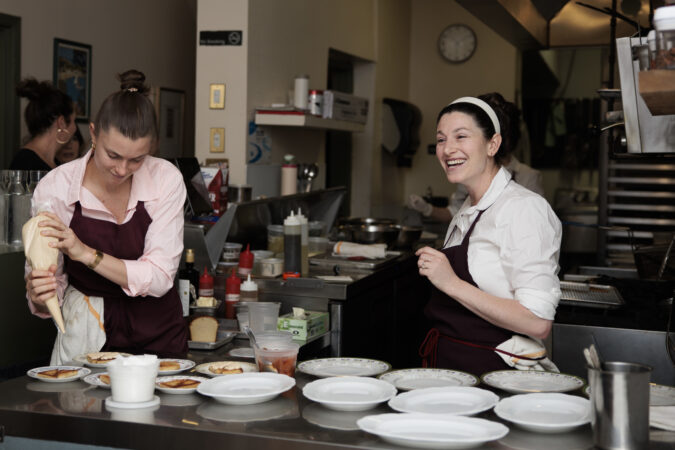
Shulman and her crack team take over once the cookies have converged. They’ll crank for two hours, putting together a cookie box so big, it will fill the front seat of your car.
“It’s so many cookies,” Shulman said in a recent interview. “It is an irresponsible amount of cookies, and it’s awesome.”
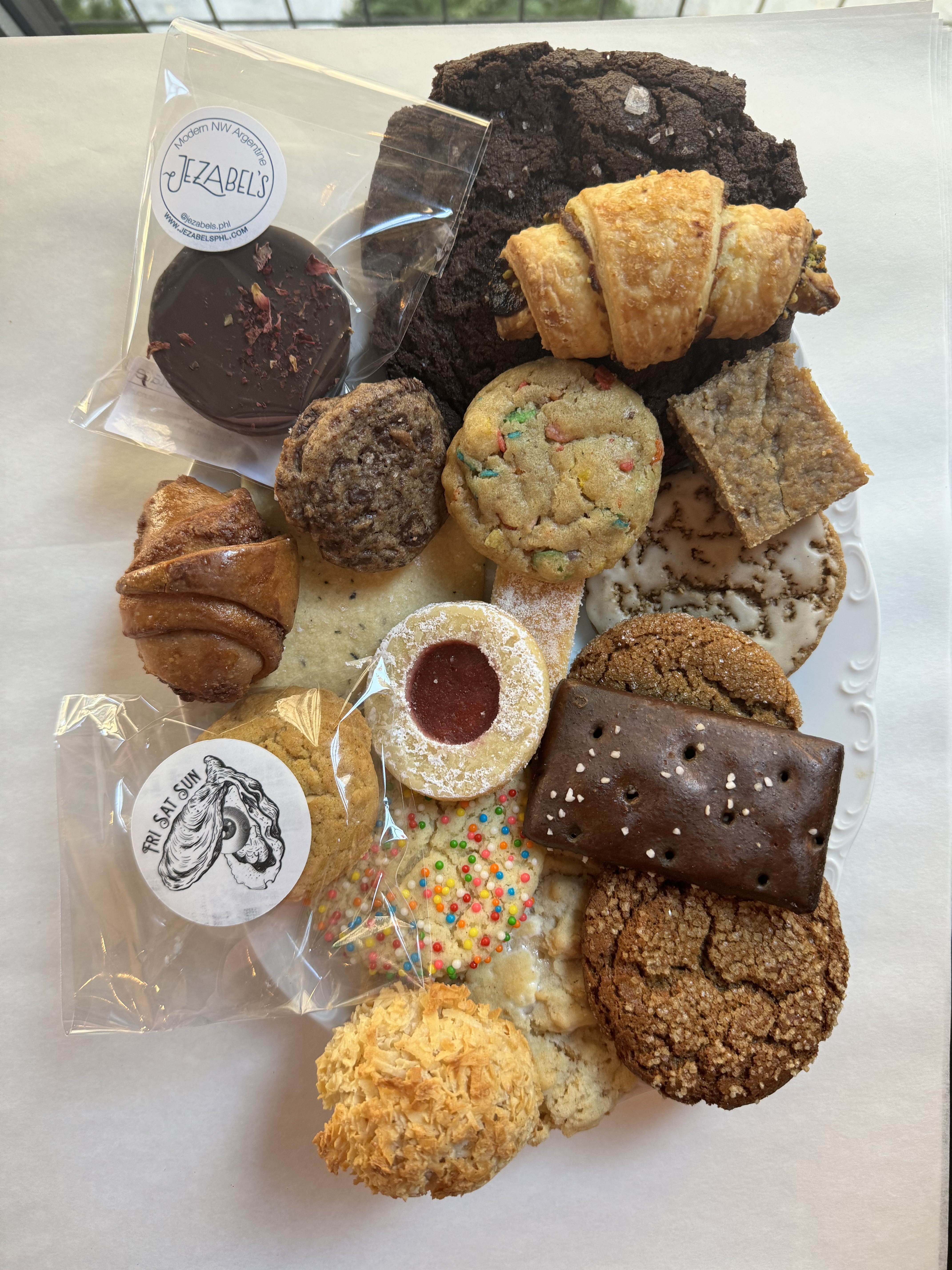
The first edition of Cookies 4 Coats’ annual cookie boxes, which assemble treats from well over two dozen bakers and chefs from around Philly. The fundraiser has only grown since it started in 2022.
If you’ve scored a box in previous years — the reservations for them were snapped up in a matter of hours last December — you know the treasure trove of sweets that lies within.
Last year’s 41-cookie box was full of recipesfrom pop-up bakers and pastry chefs, including several folks behind some of Philly’s most vaunted restaurants, bars, and bakeries: brown butter chocolate chip cookies from Provenance pastry chef Abby Dahan, white chocolate and cranberry oatmeal cookies from Friday Saturday Sunday’s Amanda Rafalski, hazelnut shortbread from Vetri’s Michal Shelkowitz, Italian anise wedding cookies from Laurel chef Nick Elmi, Krispie cornflake marshmallow cookies from New June’s Noelle Blizzard, and Irish shortbread from Meetinghouse chef Drew DiTomo, not to mention Shulman’s own sourdough chocolate chips.
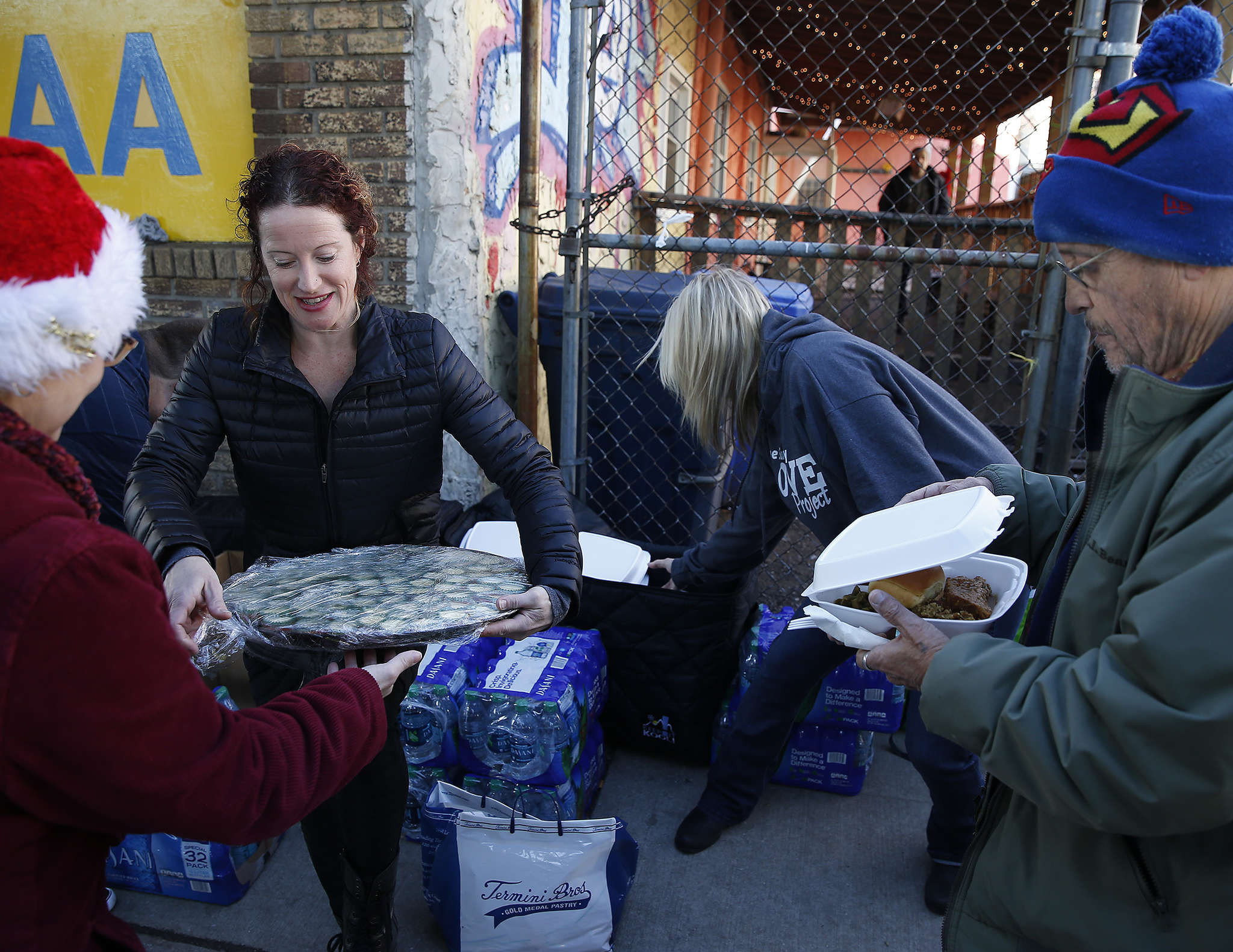
All the proceeds from these coveted cookie boxes are split between Broad Street Love, the radical hospitality-rooted Center City nonprofit, and Sunday Love Project, a Kensington nonprofit that runs a free community grocery store in the Riverwards neighborhood. Last year’s sell-out bake sale generated a $15,000 donation to Sunday Love that funded the purchase of hundreds of coats for local kids, as well as programming (music, art, cooking classes, etc.) for children and families, according to Sunday Love founder Margaux Murphy.
Margaux Murphy, founder of the Sunday Love Project, serves Carlos Gonzalez.
Shulman and Murphy first met in 2021, while Murphy was still running Sunday Love out of the Church of the Holy Trinity at 19th and Walnut, serving 2,000 meals a week to anyone in need. Shulman and the Her Place crew — then in their first year of business — got involved, cooking lunches for kids going to summer camp and dropping off meals to the church.
Her Place was the stage for various pop-up bake sales and charity events in those pandemic-era years. In 2022, the idea came to Shulman for an extra-special one: “Everybody loves a holiday cookie box.” Why not assemble a citywide assortment and donate to Philly charities?
She put out an open call to bakers to pitch in and got tremendous response. She shared an online spreadsheet for the participants to see who planned to bake what, so that there wouldn’t be too many repeats. To add to the box’s value, they included a recipe book so that buyers could recreate their favorites at home.
Her Place Supper Club chef Amanda Shulman rings the bell at the Sixers game Wednesday, Nov. 19, 2025, in Philadelphia
Shulman estimates 32 bakers contributed to the first Cookies 4 Coats box, raising thousands of dollars.Ever the one to see things through, Shulman didn’t leave much work for Murphy to do after collecting the cash.
“The first year, I [sold the boxes] a little earlier and I bought [the coats] all myself on Black Friday and had them all shipped to my house, so I had hundreds of coats in my apartment,” Shulman laughs, recalling the charity-induced splurge. “I needed to get different designs. I had to be sure there was something for everybody, so I went a little crazy. I had never racked up a credit card like that, and it was so exhilarating.”
Things are different these days, and Shulman says that’s for the best. “Now we just write checks, because they need other things besides coats — and [Murphy] gets to pick out what she needs as opposed to me just going on a shopping spree.”
One of Cookies 4 Coats’ annual cookie boxes, which assemble treats from well over a dozen bakers and chefs from around Philly.
Reservations for this year’s cookie box went live earlier this month and sold out in a matter of days. Shulman lowered the total number of boxes sold from 120 to 100, but the fundraiser is set to generate even more this year, because the price — $135 per box — increased to cover the cost of improved packaging: Each cookie will be individually wrapped this year, so buyers know which cookie is which rather than guessing based on flavor profiles and recipe cards (a fun game in itself).
Thirty-three bakers and chefs are signed up to contribute thus far, including Scampi’s Liz Grothe (cappuccino Rice Krispies treat), New June’s Blizzard (salted double chocolate chip shortbread), Amy’s Pastelillos’ Amaryllis Rivera-Nassar (besitos de coco), and Lost Bread’s Dallas King (honey butter corn cookies). (For those who don’t have a Cookies 4 Coats reservation, we offer eight of Shulman’s favorite recipes from last year’s box as a consolation.)
Murphy is perpetually floored by the size of the donation, and by Shulman’s seemingly bottomless reservoir of generosity. Murphy’s had strangers give thousands of dollars to Sunday Love, only to discover it was because Shulman recommended the nonprofit to a customer or acquaintance. Shulman recently collaborated with the Philly-area meal-delivery service Home Appetit, sending a portion of the sales to Sunday Love; it resulted in an $8,000 donation.
“I always tell her, she waves a magic wand and she’s just like, ‘Here’s $10,000, feed all the children,’” Murphy said. She remembers a very pregnant Shulman coming to last year’s annual coat giveaway (which will take place this year on Dec. 13 at 3206 Kensington Ave.). “She was in my store because she wanted to see the kids getting coats — I was like, ‘I swear to God, if you have this baby right here on my floor’ — that’s how hard she was working just to make sure that we had everything.”
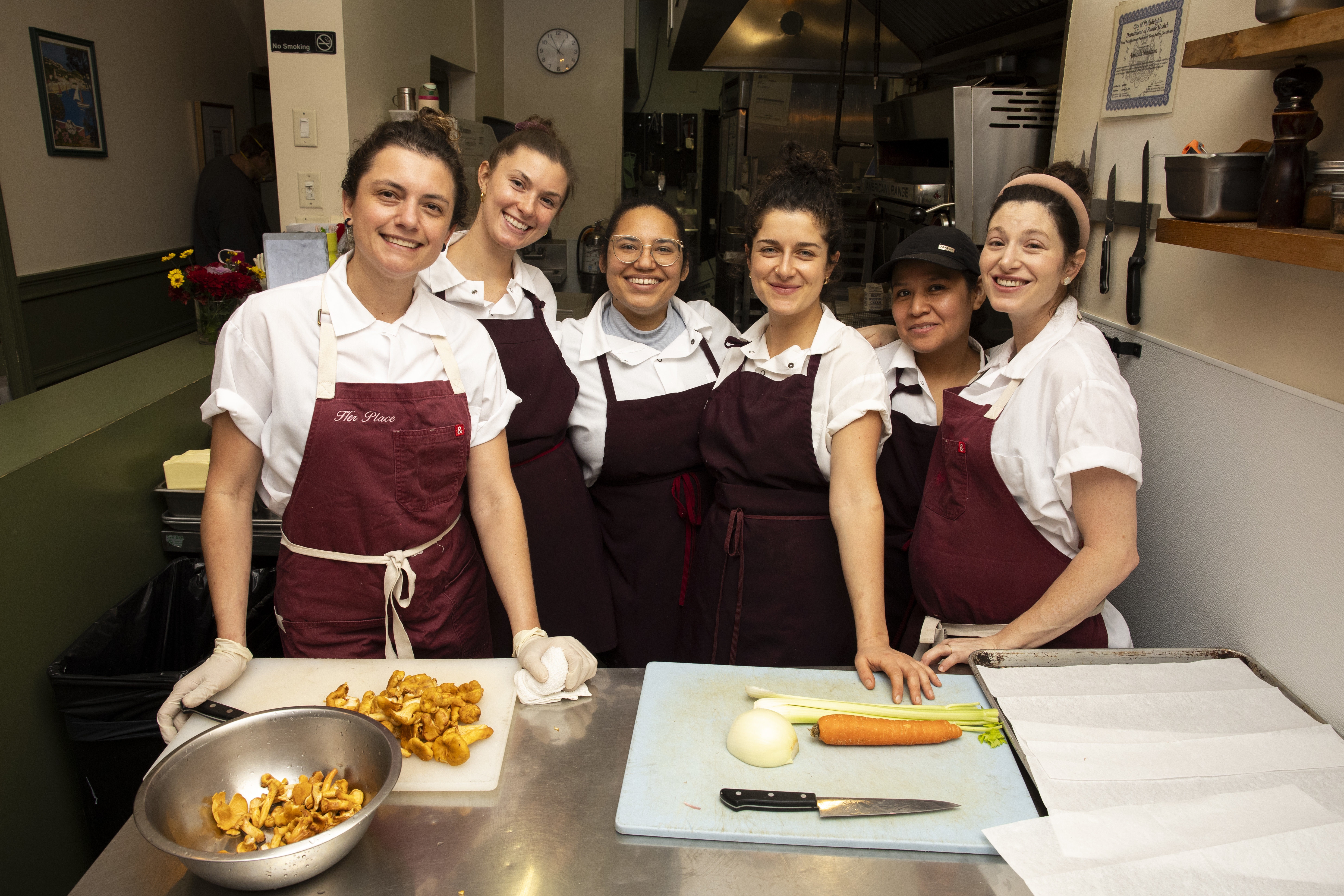
The Her Place team from left to right: Chef de Cuisine Ana Caballero, Line Cook Lauren Fiorini, Pastry Chef Jazzmen Underwood, Sous Chef Santina Renzi, Prep Cook Denia Victoriano, and Chef/Owner Amanda Shulman posed for a group photo at Her Place Supper Club on Tuesday, Nov. 26, 2024 in Philadelphia. Her Place is located at 1740 Sansom Street in Center City.
Shulman remembers that day a little differently, singling out a moment where she watched a little girl pick out a coat — “this brand-new, shiny pink coat that she got to pick out,” she said. “It’s full circle when you get to do every single part of the process, from the physical picking of the cookies to packing them to printing the things. I’m very grateful to everybody who helps out, and especially to my own team, because it’s a lot of work to make it this seamless.”
That’s what Shulman comes away with when reflecting on what goes into this crumb-flecked effort: gratitude.
“If I can say thanks to my team … and to the community, that would be awesome. Thank you to all the bakers and restaurant people who give so much in the busiest time,” she said. “These bakers take time to not only make [the cookies], but then get it to us. It sounds like an easy lift — it’s not, especially if you’re going to work that day. I don’t take it for granted at all.”
Editor’s note: An earlier version of this story stated that 100% of the Cookies 4 Coats proceeds go to Sunday Love Project. It is split 50/50 between Sunday Love and Broad Street Love.
Stephanie Dunn, who at first introduction has the warm disposition and positivity of someone who has never had a bad day, will tell you that a life-threatening, flesh-eating infection in her foot and the subsequent amputation of her left leg are not the hardest challenges she’s had in life.
That distinction she reserves for motherhood.
But the recovery from the mysterious illness that struck Dunn in September 2022 has had its share of brutal moments.
Through the near-death experience, the onslaught of medical bills, and coming to terms with the fact that some aspects of her life would never be the same, the 52-year-old Schwenksville mom has worked to become as mobile as feasibly possible.
In a matter of years, she has upgraded to a prosthetic meant for high-impact use and more mobile amputees. It’s a cumbersome process that involves proving to insurers the patient is active enough to qualify for the prosthetics that offer a broader range of motion and shock absorption. Amputee forums are filled with stories of red tape and insurance rejections, telling patients the advanced prosthetics are not “medically necessary.”
“If I didn’t have two kids, I don’t know if I would have pushed myself to do it,” she said of the daily workout routines she has adopted in the years since her amputation. “I knew I had a responsibility to them and you can’t give up.”
This Thanksgiving, Dunn, who never considered herself athletic before she lost her limb, hopes to put her current prosthetic to the test, walking in her local Gobble Wobble.
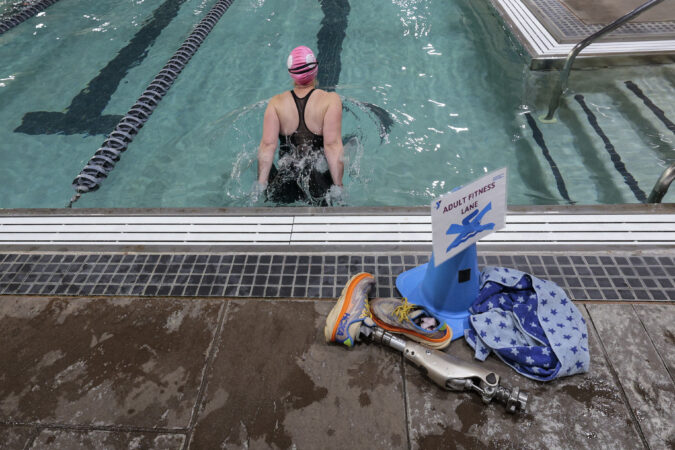
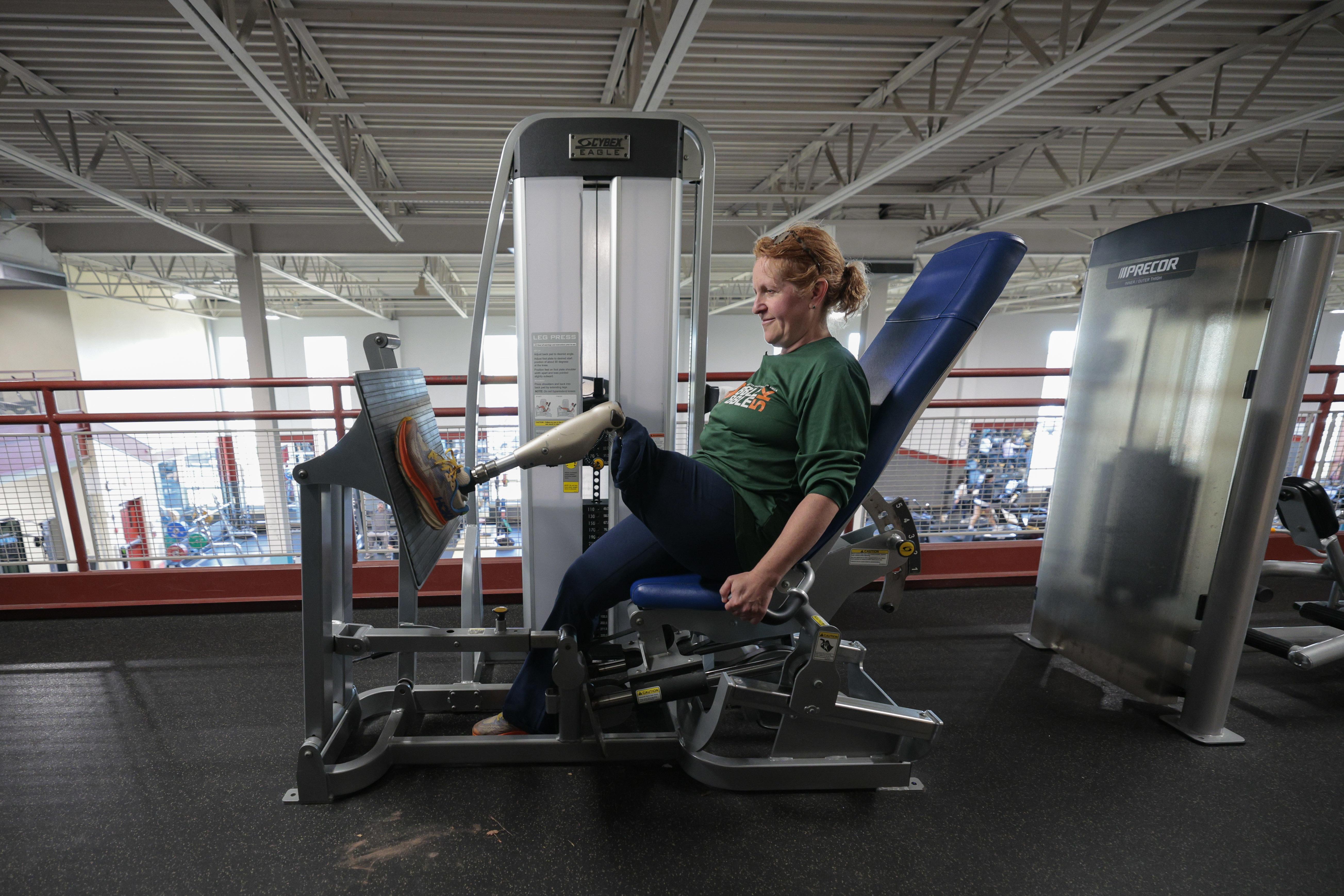
Stephanie Dunn had to have her leg amputated because of a rare bacterial infection two years ago. She credits the Spring Valley YMCA, in Royersford, where Dunn was using a weight machine with her prosthetic legs on Monday.
Hosted by the Greater Philadelphia YMCA, the Spring Valley event offers a 5k event and a mile walk. For her first Gobble Wobble with a prosthetic, in 2023, Dunn cut some sections of the walk. Last year, she finished the loop but came in last. Dunn believes she can beat that performance this year. She also hopes it will serve as a milestone on her way to an even more ambitious goal: qualifying for a running blade along with a grant to pay for it.
And while Dunn doesn’t see herself as an amputee advocate or role model — she reserves that designation, perhaps incorrectly, to the “super-fit people out there running marathons” — she hopes her story will let people in similar situations know the journey to mobility is hard but possible with the right support system.
This year’s Gobble Wobble is as much of a personal test for Dunn as it is a bit of an ode to the wheelchair-accessible Spring Valley YMCA, which has been a lifeline and refuge in the years following her amputation.
“When [the amputation] first happened, I thought, ‘Oh, my God, I’m on the periphery of society now. I’ll never be able to do anything normal,’” she said, remembering how she avoided grocery stores at first. “But I did. I could come here.”
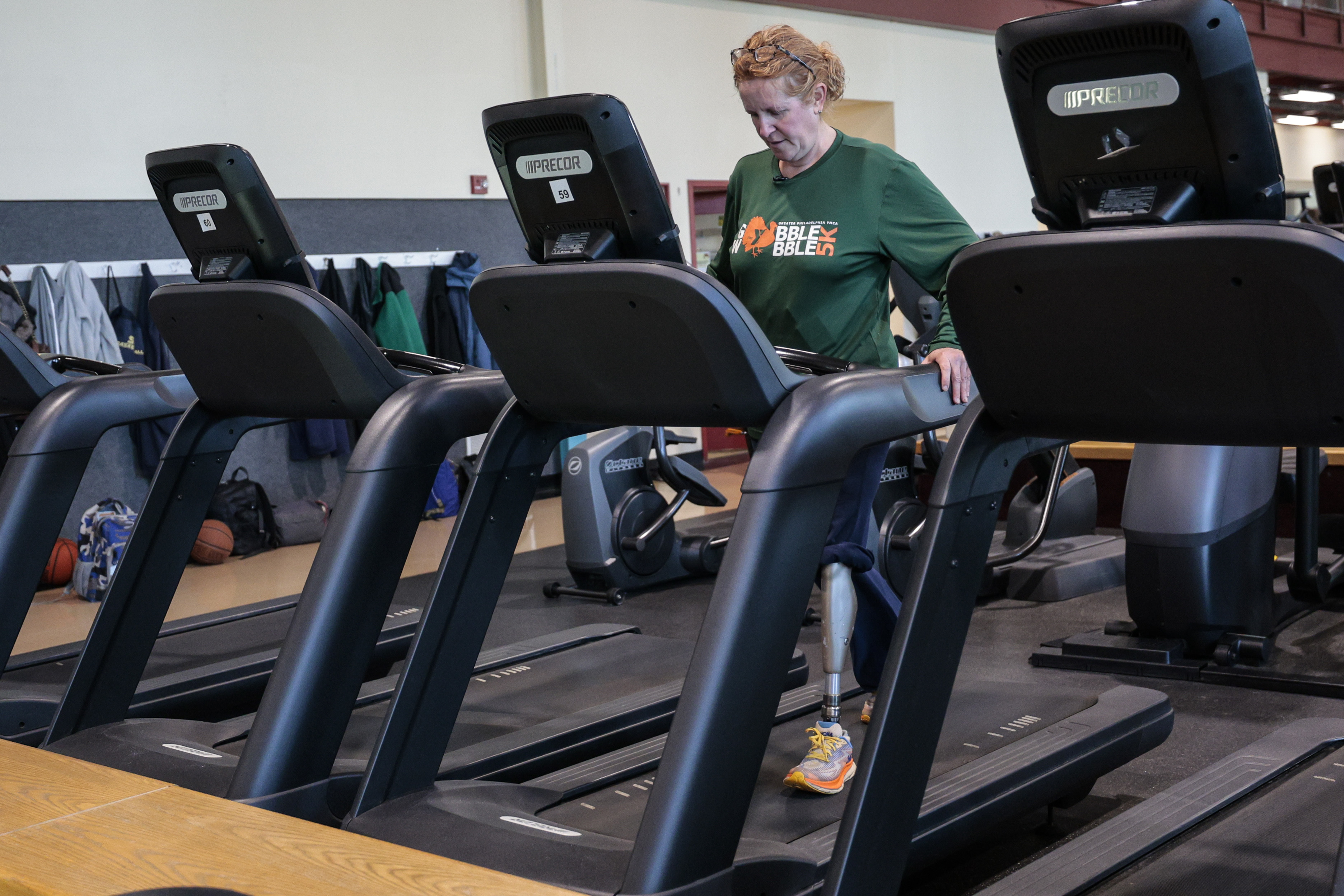
Stephanie Dunn had to have her leg amputated because of a rare bacterial infection two years ago. She credits the Spring Valley YMCA, in Royersford, where Dunn was working out on the treadmill Monday.
The challenges facing America’s growing number of amputees
For Dunn, a throbbing left foot and waves of bile vomit ended up being necrotizing fasciitis, source unknown.
The flesh-eating bacteria gnawed away at her limb in a matter of days, led to sepsis, and nearly reached her chest. Dunn said the amputation saved her life.
Yet there is much more to an amputation than the operation itself.
The Amputee Coalition says 36% of people living with limb loss experience depression. Many find themselves physically unable to return to demanding jobs that require fast movement or heavy lifting. Dunn, who had been a speech pathologist for 19 years, has come to terms that she cannot do the job full-time without risking an injury, even with her prosthetic.
And while a Government Accountability Office report expects the number of people living with limb loss to double by 2050, online forums remain full of people looking for advice on how to get their insurers to pay for prosthetics that will help with mobility.
Dunn’s experience navigating healthcare is only a snapshot of the challenges facing amputees.
After the amputation, she faced a growing mountain of medical bills and paperwork. As Dunn managed pain and the care of her two young children, she had to go from her home in Schwenksville, Montgomery County, to South Philly to “prove” she had actually had her limb amputated in order to apply for disability benefits.
Then there was the process of qualifying for a prosthetic.
The most basic below-the-knee prosthetics cost $3,000. There is no secondhand market because each is molded to the person. Even so, as limbs naturally change size and swell or contract throughout the day, users will have to adjust. It’s why amputees sometimes stuff socks in their prosthetics.
The more advanced prosthetics provide more mobility but easily run into the tens of thousands of dollars. Private insurance runs the gamut in terms of coverage, with many amputees reporting better luck through Medicare or Medicaid. But going with public insurance comes with other considerations, such as income limits.
“You can’t financially get ahead at all,” said Dunn, who was making a six-figure salary before her amputation. “You can just barely make ends meet.”
In the early post-op days, Dunn said, lying in bed and sitting in a chair were her biggest temptations — they often are for recent amputees. But skipping the at-home workouts assigned by her physical therapist risked muscle spasms and stiff muscles in the remaining part of the limb. To lose flexibility in the limb makes it harder to move with a prosthetic.
Determined to become mobile, Dunn headed to her local Y branch.
Dunn said in those early post-op days, lying in bed and sitting in a chair were her biggest temptations — they often are for recent amputees.
A gym offers refuge and resources
To walk alongside Dunn at the Spring Valley Y is to accompany a minor celebrity. Dunn jokes that it’s the prosthetic leg, though that feels like she’s selling herself short. She is at the gym every day for anywhere between 30 minutes and three hours.
“You must’ve had a good night’s sleep,” shouts a lifeguard taking his perch after Dunn completed several laps in the pool. One of the many greetings thrown over the hum of the pool machinery.
Part of the Greater Philadelphia YMCA, the Spring Valley branch was familiar to Dunn before her injury because of the programming her children took part in, which only became more important during her two-month stay at the hospital.
The children participated in the branch’s before- and after-school care, which Dunn credits with giving the boys a routine as she regained her strength.
But the facility was also primed to aid in her recovery in small ways that added up.
Before Dunn renovated her bathroom to be wheelchair-accessible, the Spring Valley Y was the only place she could shower.
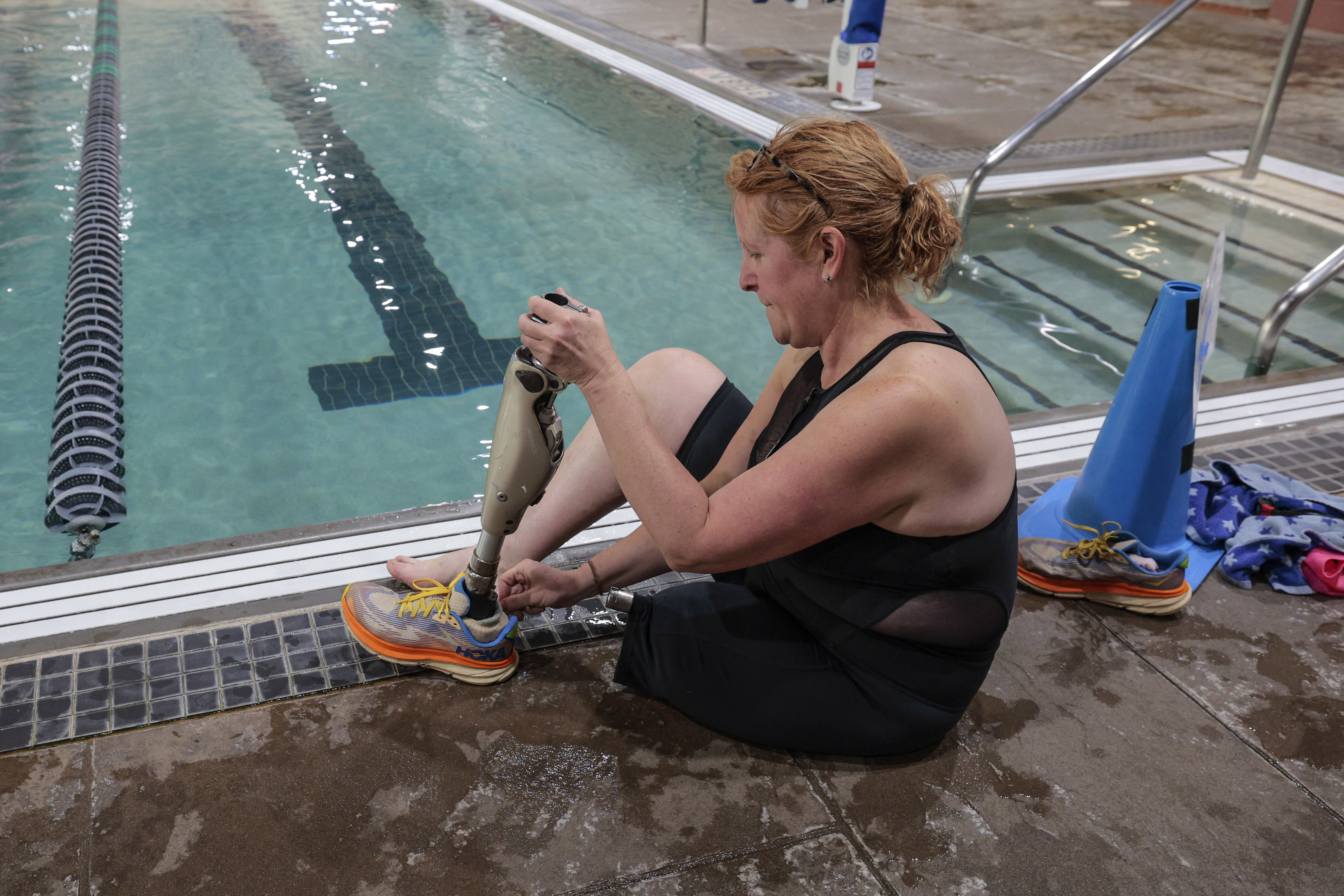
Soon, Dunn was navigating the gym equipment and pool. She could park her wheelchair along the pool’s edge and get in the water, where she enjoyed what she described as a weightlessness.
Dunn still had days when she cried in the parking lot or the bathroom, but she kept coming to get on the sit-up machines and for the aquatic dance classes. Not once did she feel out of place, she said.
The mental boosts served to buoy her physical gains and vice versa. It’s a rhythm she longs for other amputees to find.
“I maintained the range of motion in my limb, so that when I did get measured for a prosthetic to see what kind of prosthetic I could qualify for, as far as insurance and what I could use … I got a higher-level prosthetic than if I hadn’t come here,” she said.
That said, a robust support network or gym can’t fix the healthcare system, and Dunn continues to navigate the logistics of getting the prosthetics she needs to live the life she wants with her children.
Dunn said she had to travel to New York City in order to get a one-step procedure that would allow a rod to be embedded in what is left of her femur. Approvals took six months.
And even as Dunn gets more comfortable with her prosthetic, there is tweaking to be done. She has been dealing with pain that is constantly in the background.
Still, Dunn characterizes these as small bumps along the way, as she does with many of the challenges she has navigated postamputation.
She said going through fertility treatments to have her boys and the quandaries of raising them as a single mom by choice weighed much more heavily on her.
Back then, when things felt particularly dire, she would tell herself: If at any time you want to stop, just stop.
In the case of her mobility journey, as with conception, Dunn has yet found a reason to call it.
The holiday season is officially upon us and with it, a slew of festive events. From Santa sightings to a menorah lighting, here’s how and where to celebrate around Lower Merion.
Santa will come to town on a fire truck for the tree lighting at Schauffele Plaza, where there will also be hot chocolate, cookies, and photo ops with St. Nick.
Catch a screening of the 1946 holiday classic starring Jimmy Stewart and Donna Reed. A cocktail is included with the ticket purchase for those 21 and over.
⏰ Thursday, Dec. 4, 7:15 p.m. 💵 $17.75 📍Bryn Mawr Film Institute, 824 Lancaster Ave., Bryn Mawr
Catch screenings of your favorite animated holiday classics The Year Without a Santa Claus, Frosty’s Winter Wonderland, and ’Twas the Night Before Christmas during two matinee showings.
⏰ Saturdays, Dec. 6 and 20, 11 a.m. 💵 $6.75-$7.75 📍Bryn Mawr Film Institute, 824 Lancaster Ave., Bryn Mawr
Santa will be at Suburban Square on select days this season.
Santa will be visiting Suburban Square and posing for photos three days in December, when there will also be carolers and live music. Little ones can also drop off letters to Santa.
⏰ Saturdays, Dec. 6, 13, and 20, 11 a.m.-2 p.m. 💵 Free 📍Suburban Square, Anderson and Coulter Avenues, Ardmore
Shop an array of vendors selling things like coffee, jewelry, florals, skincare, pottery, and food. You can also try your hand at wreath-making and roast s’mores over a fire. Advanced registration is encouraged.
⏰ Saturday, Dec. 6, 11 a.m.-4 p.m. 💵 Pay as you go 📍Riverbend Environmental Education Center, 1950 Spring Mill Rd., Gladwyne
Wander around Narberth as it’s transformed into an 1840s Charles Dickens-themed London, complete with characters from A Christmas Carol. Period vendors, carolers, crafts, food, drinks, and a scavenger hunt round out the event.
⏰ Sunday, Dec. 7, noon-4 p.m. 💵 Pay as you go 📍Downtown Narberth
Take a look inside the main house at Stoneleigh as it’s decked out for the holidays.
⏰ Saturday, Dec. 13-Sunday, Dec. 14 and Saturday, Dec. 20-Sunday, Dec. 21, times vary 💵 $15 for Natural Lands members and $20 for nonmembers 📍 Stoneleigh, 1829 County Line Rd., Villanova
Celebrate the first night of Hanukkah with a lighting of the giant menorah at Suburban Square. There will also be food, drinks, and activities like donut decorating.
⏰ Sunday, Dec. 14, 5 p.m. 💵 Free 📍Suburban Square, Anderson and Coulter Avenues, Ardmore
Enjoy a meal and a movie during this longtime tradition. There will be a family-friendly movie option (Happy Feet) as well as a dark comedy for adults (Bad Shabbos).
This suburban content is produced with support from the Leslie Miller and Richard Worley Foundation and The Lenfest Institute for Journalism. Editorial content is created independently of the project donors. Gifts to support The Inquirer’s high-impact journalism can be made at inquirer.com/donate. A list of Lenfest Institute donors can be found at lenfestinstitute.org/supporters.
Are you experiencing the Donald Trump/JD Vance boom? Vance recently said, “It’s gonna take a little bit of time for every American to feel that economic boom which we really do believe is coming.” How long does “every American” need to wait? Do you know who doesn’t have to wait? Do you know who is feeling a boom you or I will never see? The Trump family.
Since Trump has taken office, the family has made over a billion dollars. No waiting there. No deciding how they are going to pay bills. But the everyday American — who can’t afford rent, groceries, or healthcare — needs to wait.
How many vacations have you taken since this regime took office? Vance has taken how many? Last I saw was eight. That’s almost one a month. He’s not waiting for a boom. Does this administration even know what affordability means?
Trump and Vance imposed tariffs — “the most beautiful word” — that raised prices on everyday goods and services. Now they are retracting them to make life “affordable” again. That’s the only boom you and I will see. And they will expect you to be humble and ever grateful for their willingness to put out the very fire they started.
This is your economy. This is your mess. This administration is so out of touch with the everyday Americans they swore to serve. They ran on making life affordable, and the only ones who seem to be able to afford basic life needs are they and their oligarch cronies.
Ellen McGuigan,Clarks Summit
. . .
In 1992, James Carville coined the phrase, “It’s the economy, stupid.” It’s still a priority today, but Donald Trump’s solutions to the pesky economic challenges are little more than trumped-up pigs in a poke to sell us a bill of goods. Can’t buy a first home? How about a 50-year mortgage? Lower monthly payments, but pay no attention to the fact that banks will likely charge higher interest, the total cost will increase 86%, and the first 10 years of payments cover interest and no equity. Need affordable healthcare? The Affordable Care Act is now offering catastrophic coverage (plans once limited to people under 30). Lower monthly payments (sound familiar?) but with a whopping $10,000 deductible. It’s gonna cost ya! Chris Bond, a spokesperson for AHIP, an insurance lobbying firm, cautions that “catastrophic plans … are not a replacement for affordable comprehensive coverage.” And let’s not even get started on Robert F. Kennedy Jr.’s “miasma theory,” his blast us back into the past approach to medicine that Amesh Adalja, of the Johns Hopkins Center for Health Security, said is “all just obfuscation to support his idea that vaccines are not valuable.” Pigs in a poke. A bill of goods. Don’t do us any favors. And the final insult? JD Vance, sensing Trump’s lame-duck status, is suddenly in the picture, all unctuous empathy, addressing our concerns about the high cost of living, assuring us, “We hear you,” and we just need to “have a little patience.” Yeah, right. They might hear us, but they are not listening. It’s still the economy, but it’s their lame brain “solutions” that are the epitome of stupid.
Deborah DiMicco, Newtown
Loss of HUD funding
The announcement that the U.S. Department of Housing and Urban Development will no longer fund permanent supportive housing is a disaster for homeless service providers like the Bethesda Project, Project HOME, and the women and men who live in HUD-supported rooms or apartments. The Bethesda Project operates 150 units of permanent, supportive housing for formerly homeless men and women. Most, if not all, of those units are supported by HUD subsidies that make up the difference between one-third of a resident’s income and the market rate for a permanent room or apartment. Absent the HUD subsidy, most residents cannot pay the market rate. Those residents will likely end up back on the streets of Philadelphia. This Trump administration policy is misguided, counterproductive, and stupid.
Angelo Sgro,Philadelphia
Restore viable vacancies
In another world, the demolition of the former Admiral Court apartment building at 237 S. 48th St. would never have happened. A sturdy four-story apartment building with 46 units, in a city that is in need of affordable housing, should have been a prime target for rehabilitation and reuse. Instead, the building is lost. Even after a devastating fire that investigators are treating as arson, there was still enough of the structure left that this building could have been saved. Now, the neighborhood will get an empty lot to look at, despite pleas from neighbors and from a member of City Council to see this building put back into service.
The current owners of Admiral Court also control 4710 Locust St., which is listed as having 56 apartments and has been vacant for many years. Hopefully, the city can intervene before another arson fire destroys this building, as well.
President Trump said he agrees that it would be great if Mamdani could make NYC more safe. He said it would be great if Mamdani could make things more affordable, and great if he could help the housing shortage. That means ab-so-lute-ly nothing. Trump just wished him well. President Trump did not promise to do or finance anything specific to help, for sure. Mayor-elect Mamdani’s methods may be way, way different from President Trump’s methods to help anything, and we will all wait with bated breath to see what the future brings.
Also, Mamdani is not a dictator. He can only pass laws with the majority agreement of himself and of 51 city council members from the five boroughs. That has never even been mentioned. How will the 51 members vote?
All President Trump really did was to say hello and good luck.
David F. Lipton, Toms River
Join the conversation: Send letters to letters@inquirer.com. Limit length to 150 words and include home address and day and evening phone number. Letters run in The Inquirer six days a week on the editorial pages and online.
ARIES (March 21-April 19). Thankfully, you have a spirit that begins things. You take the first step when others hesitate, light the torch, and run ahead. You remind everyone that momentum itself is a blessing — energy that turns desire into something real and alive.
TAURUS (April 20-May 20). Thankfully, you know your own appetites, as this allows you to nourish, comfort and soothe yourself. Giving yourself what you need most is a noble act because when you’re as strong as you can be, the people around you benefit, too.
GEMINI (May 21-June 21). Thankfully, you stay curious. Every question you ask and every story you share creates connection. Your way with words and wonder keeps the world interesting, reminding everyone that gratitude begins with paying attention to what’s worth talking about.
CANCER (June 22-July 22). Thankfully, you care so deeply. You sense when someone needs comfort, and you offer it without being asked. Your nurturing energy wraps the world in safety, teaching that gratitude isn’t always spoken; sometimes it’s simply felt through kindness.
LEO (July 23-Aug. 22). Thankfully, you have an instinct for entertaining yourself, as this leads to being the bright spark in everyone’s days, including your own. You see what is unusual, funny or worthy of your playful attention and you point it out.
VIRGO (Aug. 23-Sept. 22). Thankfully, you notice details that others miss. You bring grace to systems, order to chaos and meaning to small things. Gratitude flows through every improvement you make, proving that love often hides in practical acts of service.
LIBRA (Sept. 23-Oct. 23). Thankfully, you bring harmony wherever you go. Your natural sense of fairness and style elevate the tone of every room. Gratitude is your social art; you balance others with kindness and show that peace is something we create together.
SCORPIO (Oct. 24-Nov. 21). Thankfully, you feel deeply and aren’t afraid of transformation. You know that love, loss and renewal are parts of the same sacred cycle. Gratitude, to you, is found in truth — even when it’s shadowy, it still packs a powerful connection.
SAGITTARIUS (Nov. 22-Dec. 21). Thankfully, you’re guided by wonder. You roam wide, in body or in mind, believing life is worth exploring. Your gratitude is expansive, turning experience into wisdom and reminding others that freedom itself is a reason to give thanks.
CAPRICORN (Dec. 22-Jan. 19). Thankfully, you endure. Your discipline and faith in effort build lasting things like work, trust and legacy. Gratitude shows up for you in steady progress and in the quiet pride of seeing what happens when you don’t give up.
AQUARIUS (Jan. 20-Feb. 18). Thankfully, you think differently. Your original mind and humanitarian heart bring fresh air to stale rooms. You’re grateful not just for belonging but for the freedom to be yourself and for the chance to make the world kinder.
PISCES (Feb. 19-March 20). Thankfully, you empathize, which brings together people and groups. This is what is essential; shared emotion is the glue that sustains relationships, without which nothing is possible for a human. This is what makes a difference in the world.
TODAY’SBIRTHDAY (Nov. 27). Welcome to your Year of Sacred Momentum. You’ll sense divine timing in motion — one green light after another. What felt stalled will glide and then accelerate, earning money on the way. It comes with a profound sense of contribution to the greater good. More highlights: Partnerships feel destined, good fortune through intuition, and a steady rise in prosperity, health and inner peace. Libra and Cancer adore you. Your lucky numbers are: 5, 39, 2, 15 and 19.