Blog

  • Fear factors: Ranking the Eagles’ road to the Super Bowl, from the real Rams to the fraud Bears

    Fear factors: Ranking the Eagles’ road to the Super Bowl, from the real Rams to the fraud Bears

    It’s a weird year in the NFL. Each of the traditional powers is missing something. Everything we fret about with the Eagles are worries in Kansas City and Buffalo.

    The Chargers have failed to take the next step. The Lions and Ravens might miss the playoffs. Brock Purdy just threw three interceptions against the Panthers. Drake Maye is a great quarterback. Do the Patriots really have a great roster?

    Something to be thankful for: Nobody else is great, either.

    We’ll see that on Friday, when the Eagles host the Bears. Chicago is among the more fraudulent 8-3 teams we’ve seen.

    Here is a look at all of the NFC teams that matter more than the Bears.

    1. Rams (9-2)

    It sure feels like 2025 is setting up for a Rams-Eagles NFC championship game that could launch an era-defining rivalry. The only thing missing right now is a big Rams win. The Eagles have beaten them four times over the last three seasons after initially replacing them as NFC champs in the 2022 season. But the Rams have walked away from the last two outings feeling like the Eagles’ equals if not betters.

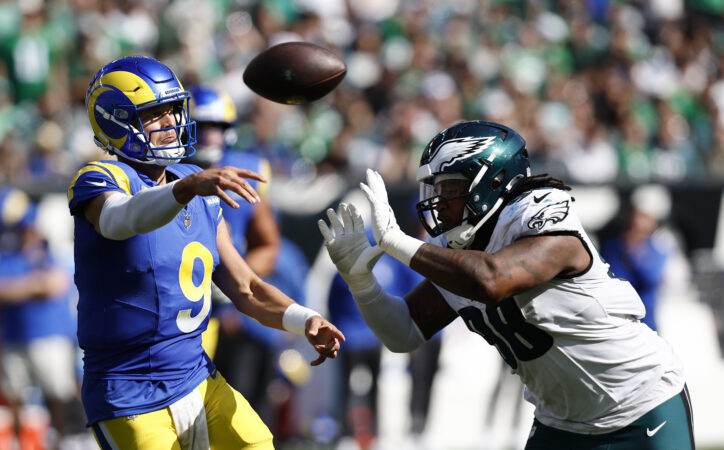
    First came that snowy 28-22 playoff loss when the Rams gave away six points on fumbles and still had a first down on the Eagles’ 21-yard line with 1 minute, 25 seconds remaining and a chance for a go-ahead touchdown. Then came Week 3, when L.A. blew a 26-7 lead and still had a shot at a game-winning 44-yard field goal with three seconds left only to have Jordan Davis block it and score a touchdown to boot.

    The Rams are due. Sean McVay is too good of a coach, Matthew Stafford too good of a quarterback, and Les Snead too good of an executive to not eventually announce it to the rest of the world. What they’ve done in the four years since they won the Super Bowl is every bit as impressive as the mini-dynasty that Nick Sirianni, Jalen Hurts, and Howie Roseman have put together.
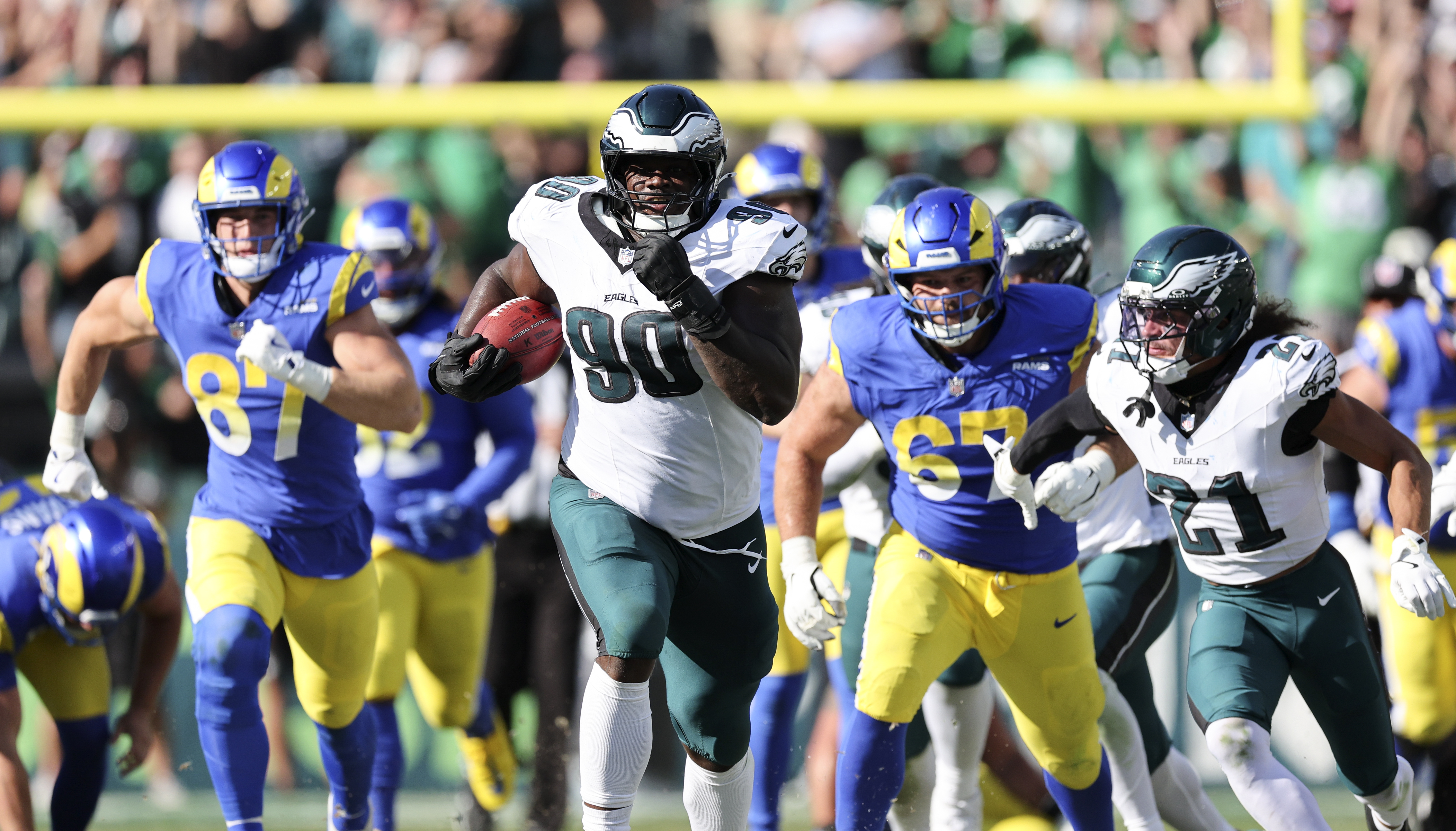
    Eagles defensive tackle Jordan Davis brought the last meeting with the Rams to a thrilling end with his touchdown.

    Snead and McVay have orchestrated an incredible turnaround on par with the Eagles post-2017. Stafford is one of only four players remaining on either side of the football who played at least 20% of the offensive snaps in 2021, when the Rams won the Super Bowl (The others: OT Rob Havenstein, TE Tyler Higbee, CB Darious Williams). They exited their Super Bowl with a bloated cap sheet and just one first-round pick between 2017 and ’25. Now, suddenly, they are the most impressive team in the NFL. The only impressive team, arguably, along with maybe the Colts. Since losing to the Eagles, their only loss was in overtime to the division rival 49ers (more on them later). They’ve beaten the Colts, the Ravens, the Jaguars, the 49ers, the Seahawks, and the Bucs. Of their six straight wins, five have been by at least two touchdowns. Of their nine overall wins, seven have come against teams whose Super Bowl odds rank in the top half of the NFL.

    2. Detroit Lions (7-4)

    The eye test says Detroit is a team nobody should want to face, particularly at home. But they wouldn’t even make the playoffs if they started today. And they would need to overcome some considerable odds if they hadn’t pulled out an overtime win over the Giants on Sunday. The Lions’ last six games are all losable: on the road against the Rams, Vikings, and Bears; at home against Green Bay, Dallas, and Pittsburgh.

    Don’t get it twisted. They are a serious threat, one of two teams in the NFC who would have a strong argument to make to be favored over the Eagles in a playoff game at home. That’s a long shot to happen, given the tiebreaker the Eagles hold. But the Lions’ 16-9 loss at Lincoln Financial Field in Week 11 didn’t exactly establish them as the definitive favorites even at home.
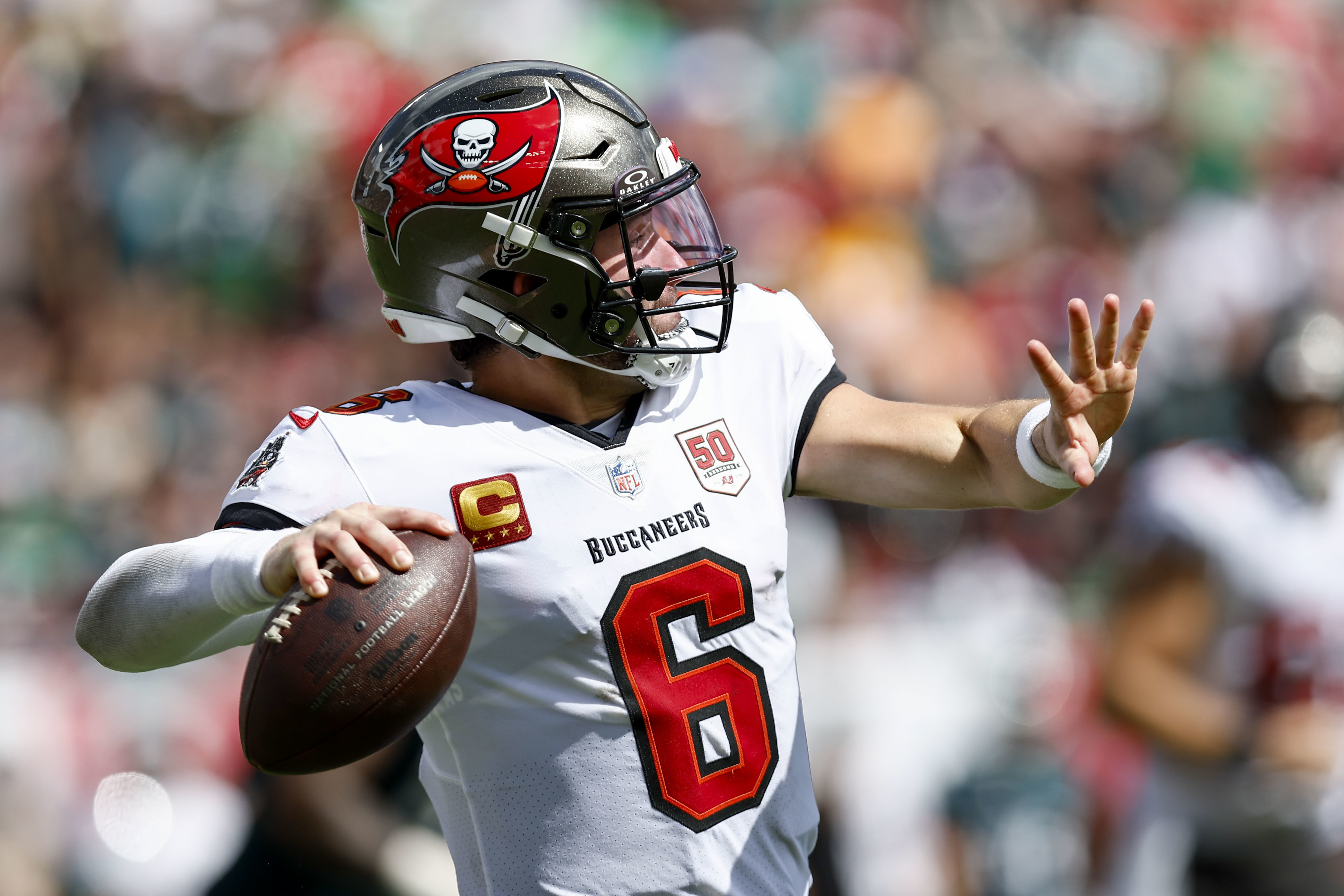
    Baker Mayfield and the Bucs have a soft schedule ahead.

    3. Buccaneers (6-5)

    Tampa Bay has one of the easiest remaining schedules in the NFL. Arizona, New Orleans, Atlanta, Miami, and Carolina twice. Find me two losses among those, assuming Baker Mayfield starts at quarterback. Even if Mayfield misses a week or two with his sprained nonthrowing shoulder, the Bucs should be able to finish atop the putrid NFC South. That means they have six weeks to get Mayfield and Chris Godwin healthy. Which means they could easily be a threat once the playoffs arrive.

    4. 49ers (8-4)

    Surprised? You shouldn’t be. Like I said, the field is weird this year. Who else would you put ahead of San Francisco? The Eagles are the only legitimate contender of the NFC’s three-loss teams. They already beat Green Bay on the road. Seattle is quarterbacked by Sam Darnold and will be playing as a wild card with the Rams winning the division. The Bears are the fakest of them all. You’ll see that on Friday.

    The 49ers? They are faker than they usually are. The Fred Warner injury — out for the season — was the final deal-breaker. They sorely miss Deebo Samuel and Brandon Aiyuk on the offensive side. San Francisco is only a threat to the Eagles if the Eagles turn out to be the team they’ve looked to be over the last several weeks. That team is capable of losing to anybody with a competent quarterback and a great head coach.

    5. Cowboys (5-5-1)

    This is not recency bias. The Cowboys would be second on this list if you could guarantee me that they would make the postseason. As it stands now, they will probably need to win two out of three against the Chiefs (home), Lions (road), and Chargers (home) just to have a reasonable chance of qualifying for the postseason. And that’s assuming they beat the Vikings, Commanders, and Giants.
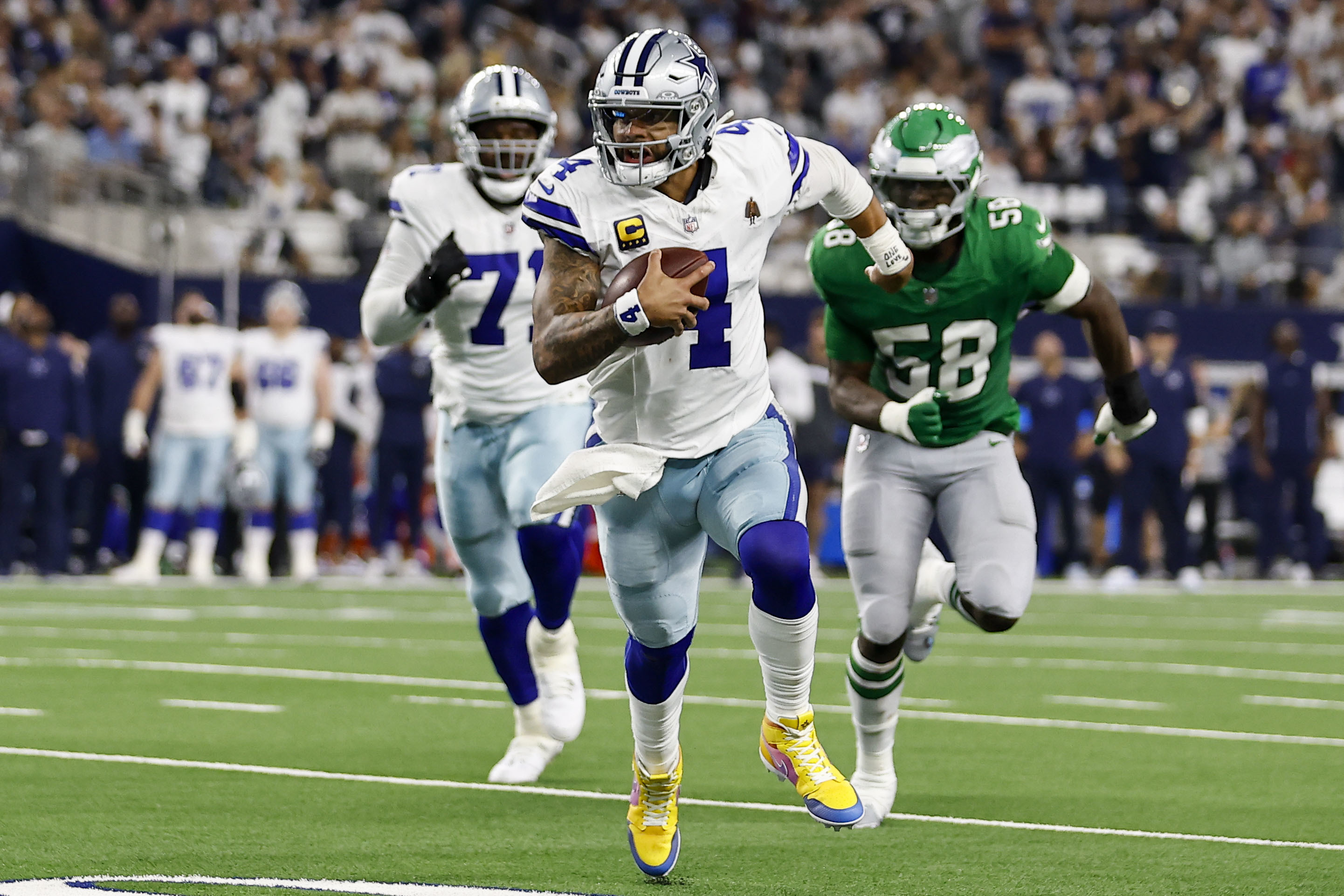
    Cowboys quarterback Dak Prescott running for a touchdown in the fourth quarter against the Eagles.

    That being said …

    If all of that happens, then we’d be foolish to consider the Eagles as anything better than a coin flip in a playoff game against the Cowboys, whether at home or on the road. Dallas has outplayed them even this season, once in a game the Eagles should have lost and, more recently, in a game the Eagles should have won. In both games this season, the Eagles have struggled to find an answer for CeeDee Lamb and George Pickens. Dak Prescott is playing at a near-MVP level and gives the Cowboys the advantage at quarterback. Mostly, this is a referendum on the rest of the NFC.

    6. Seahawks (8-3)

    Look, Darnold has been better than anybody could have envisioned after the Jets drafted him at No. 3 overall. But he is still the biggest reason to doubt that Seattle has been anything more than the beneficiary of a light schedule. The Seahawks’ best wins have come on the road in Pittsburgh in Week 2 and on the road in Jacksonville in Week 6. It’s definitely worth something that they put up 414 yards of total offense and nearly beat the Rams despite Darnold throwing four interceptions. But, then, Darnold threw four interceptions.
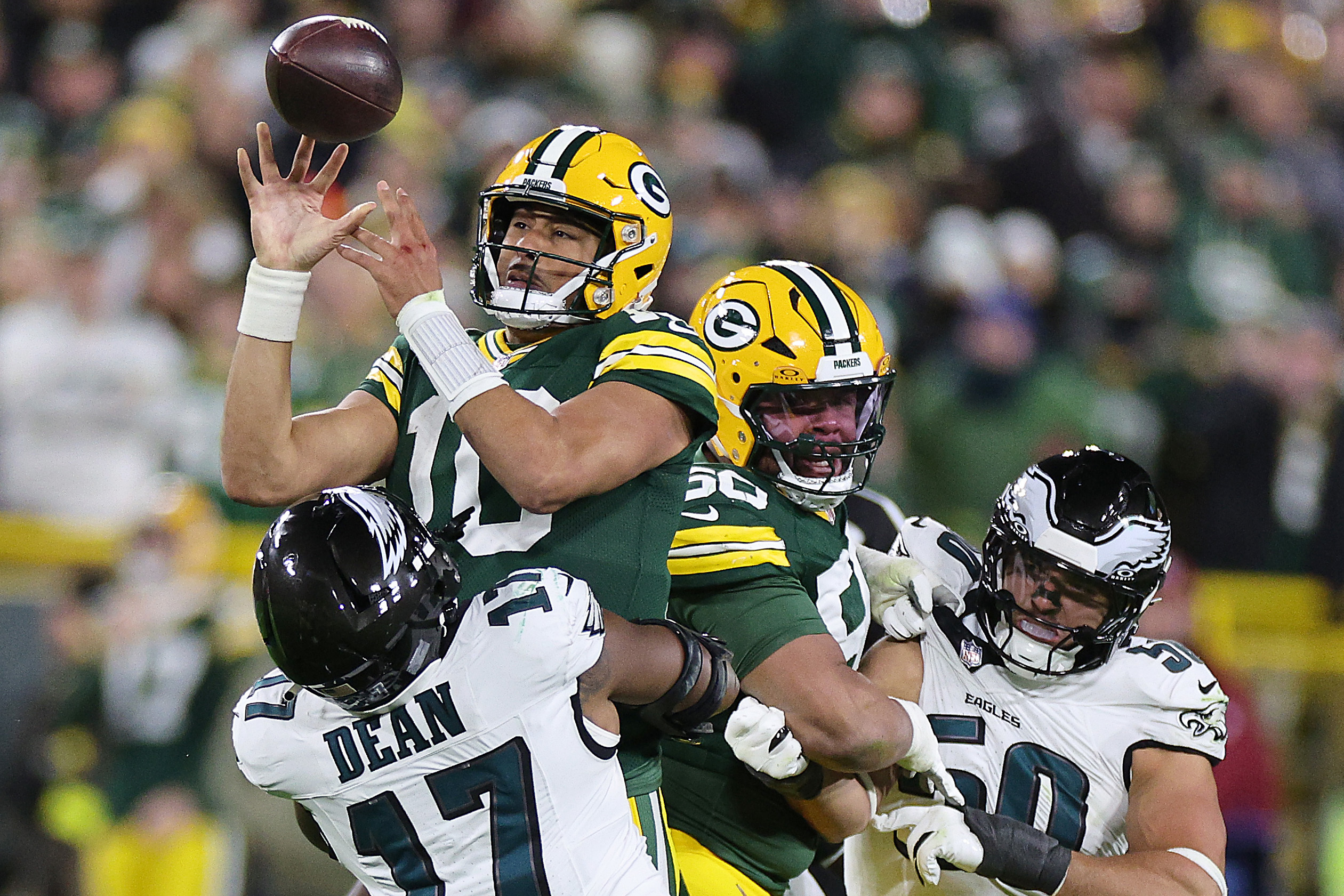
    Eagles linebacker Nakobe Dean forcing a fumble by Packers quarterback Jordan Love on Nov. 10.

    7. Packers (7-3-1)

    Jordan Love is the most overrated quarterback in the NFL, and Matt LaFleur might be the most overrated play-caller. Not a good combination. The Eagles already beat Green Bay at Lambeau Field on a night when a better team would have beaten them. No worries here.

    8. Bears (8-3)

    For whatever reason, I’ve watched more of the Bears this season than virtually any other team. At no point have they looked capable of beating even a semicompetent team. That holds true for some of the games that they’ve actually won. Caleb Williams is missing something. I think we will see that on Friday.
  • Philly wants to set its own speed limits, and other highlights of the city’s new Vision Zero report

    Philly wants to set its own speed limits, and other highlights of the city’s new Vision Zero report

    Philadelphia can’t set the speed limits on roads within its own borders. Only the state can.

    So city transportation officials want to persuade Harrisburg to give it the power to set speed limits more appropriate to the density of Philadelphia.

    That is a top action item in the city’s new Vision Zero report, released Tuesday, which will guide traffic safety efforts for the next five years.

    “We’re looking to work with the state legislature to make our roads safer,” said Christopher Puchalsky, director of policy and strategic initiatives at the Philadelphia Office of Transportation and Infrastructure Systems.

    In Pennsylvania, as in many states, speed limits are based on the 85th percentile rule. Engineers measure speeds in a study area and set the limit based on how fast 85% of the drivers there are traveling.

    “It just sort of got adopted and enshrined in law,” Puchalsky said of the principle developed from studies of rural roads in the 1950s and ’60s.

    In recent years, traffic engineers, many states, and federal agencies in charge of traffic safety have been moving away from the approach and toward speeds that help prevent injuries and deaths.

    “It’s one of those things we’ll look back on and say, ‘Why did people think that was a good method?’” Puchalsky said. “And we’ll all scratch our heads — or at least our grandchildren will scratch their heads.”

    Pennsylvania’s legislature would need to amend the state’s vehicle code to grant Philadelphia the authority.

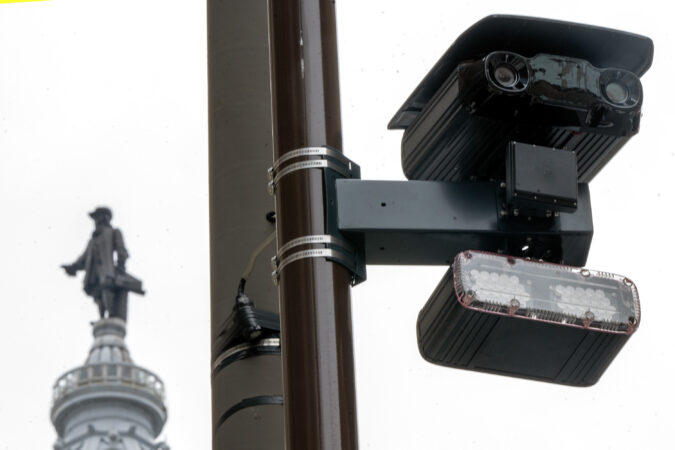
    Similarly, the city wants to expand the use of automated speed enforcement cameras and red-light enforcement cameras. That would also require legislation.

    The speed cameras on Roosevelt Boulevard are now permanent, and the city was authorized to put them on five other dangerous roads on a trial basis.

    Speed cameras also went up on most of Broad Street.

    Here are other takeaways from the Vision Zero report:

    Traffic deaths are still high in Philly

    In 2024, 120 people were killed in vehicle crashes in the city. The number of fatalities has been trending down slightly since 2020, but that figure is still 41% higher than it was in 2015, when the Vision Zero program began.

    “I think we’ve unfortunately hit a higher set-point post pandemic than we would like,” said Kelley Yemen, director of multimodal planning for the city. “We’re seeing encouraging news with this year, but we’ve got two months to go and are holding our breaths.”

    Yemen said the city has seen a 20% reduction in crashes on corridors where Vision Zero has been able to do traffic-calming projects such as installing speed cushions, implementing road diets that slow drivers, and installing separated bike lanes.

    “As we get further out from the pandemic, we’re also hoping we reset some cultural norms on our streets, whether it’s through automated speed enforcement, red-light cameras, or working with [the police department],” she said.

    The size of Philly’s problem

    Philadelphia is an old, dense city with a robust transit system, similar to New York and Boston. But its rate of traffic-related deaths per 100,000 people is many times New York’s — and most closely resembles that of Los Angeles, the Vision Zero report noted, citing federal data from 2019 through 2023.

    Philadelphia had 8.48 traffic deaths per 100,000 people, and Los Angeles had 8.11 per 100,000 residents.

    “We are still reviewing the plan, but our initial reaction is that the goals set forth are not transformational enough to address the climbing traffic death statistics,” said Jessie Amadio, an organizer with Philly Bike Action.

    “Vision Zero safety interventions work in the places they are installed,” but annual progress is too slow, she said.

    Factors that make a crash severe

    Speeding was the leading contributing factor in serious injury and fatal crashes between 2020 and 2024, present in 19%, the report said. Drivers impaired by alcohol or drugs were involved in 8% of the crashes, and 8% ran a red traffic light. Distracted driving was responsible in 4% of crashes, and running stop signs in 2%.

    People walking or using a personal mobility device were involved in 6% of crashes from 2002 through 2024 but were 40% of those who were killed, the report found.

    Thirty-eight percent of people who died were in motor vehicles.

    What were residents’ biggest concerns and asks?

    The Philadelphia Office of Transportation and Infrastructure Systems heard from about 3,000 city residents about their biggest concerns and preferred responses, said Marco Gorini, the Vision Zero program manager.

    Speeding was the topmost concern, cited by 24% of the people participating, followed by drivers running red lights and stop signs, cited by 23%.

    People were reached at roundtables involving more than 80 community groups, by online services, and through a polling firm that randomly queried 1,500 Philadelphians representative of the city’s overall population.

    Participants supported tough enforcement by automated cameras and police against those violations by wide margins.

    Infrastructure-related changes work best to protect people and change driver behavior, residents said, and they clamored for more traffic-calming measures and street redesigns, according to Gorini. They want to prioritize changes around schools, senior centers, and public parks.

    Besides enforcement and traffic-slowing infrastructure, residents expressed strong support for more safety education — instruction for high school students on safe driving (76%) and education for young students on safe walking and biking (71%).

    And another thing: People want transparency with safety efforts.

    “It’s very important that we regularly report on the state of traffic safety in Philadelphia and the results of Vision Zero interventions,” Gorini said. “This ensures accountability and helps the public understand what the issues are and how efforts to address them are going.”

    Next steps

    The city will be developing a spending plan for new safety projects for the next annual budget, due in the first quarter of 2026. And figuring how to pay for them from city funds and state and federal grants.

  • These numbers show Saquon Barkley’s drop-off from his historic 2024 season with the Eagles

    These numbers show Saquon Barkley’s drop-off from his historic 2024 season with the Eagles

    Saquon Barkley isn’t going to become the first running back in NFL history to have a second 2,000-yard season — at least not in 2025. At his current rate, he’ll barely exceed 1,000 rushing yards, a benchmark he hasn’t failed to reach while playing a full season in his NFL career.

    What was Barkley going to do for an encore? It was one of the big storylines for the Eagles before the season started. Repeating last season’s success was always going to be difficult. But this? He has just one game over 100 yards after having 11 such performances in 16 regular-season games last season.

    The Eagles are struggling on offense, and it’s fair to say their inability to consistently run the ball is the biggest concern of all. There are a variety of reasons. Barkley thinks he’s in “a little funk,” but tackle Jordan Mailata blamed the offensive line’s execution.

    There are multiple hands sharing the blame, but regardless of who shoulders it most, Barkley’s drop-off has been precipitous. Here’s a look at some numbers that show the drastic decline:

    32.4%

    It’s worth starting here because it can help explain everything in some ways. We knew opposing defenses were going to change their approach. The Eagles surely did, too.

    Last season, Barkley faced eight or more defenders in the box 20.6% of the time, according to Next Gen Stats. That was 20th in the NFL among qualified rushers.

    This season, Barkley is facing eight or more defenders in the box 32.4% of the time, the seventh-highest rate in the NFL.

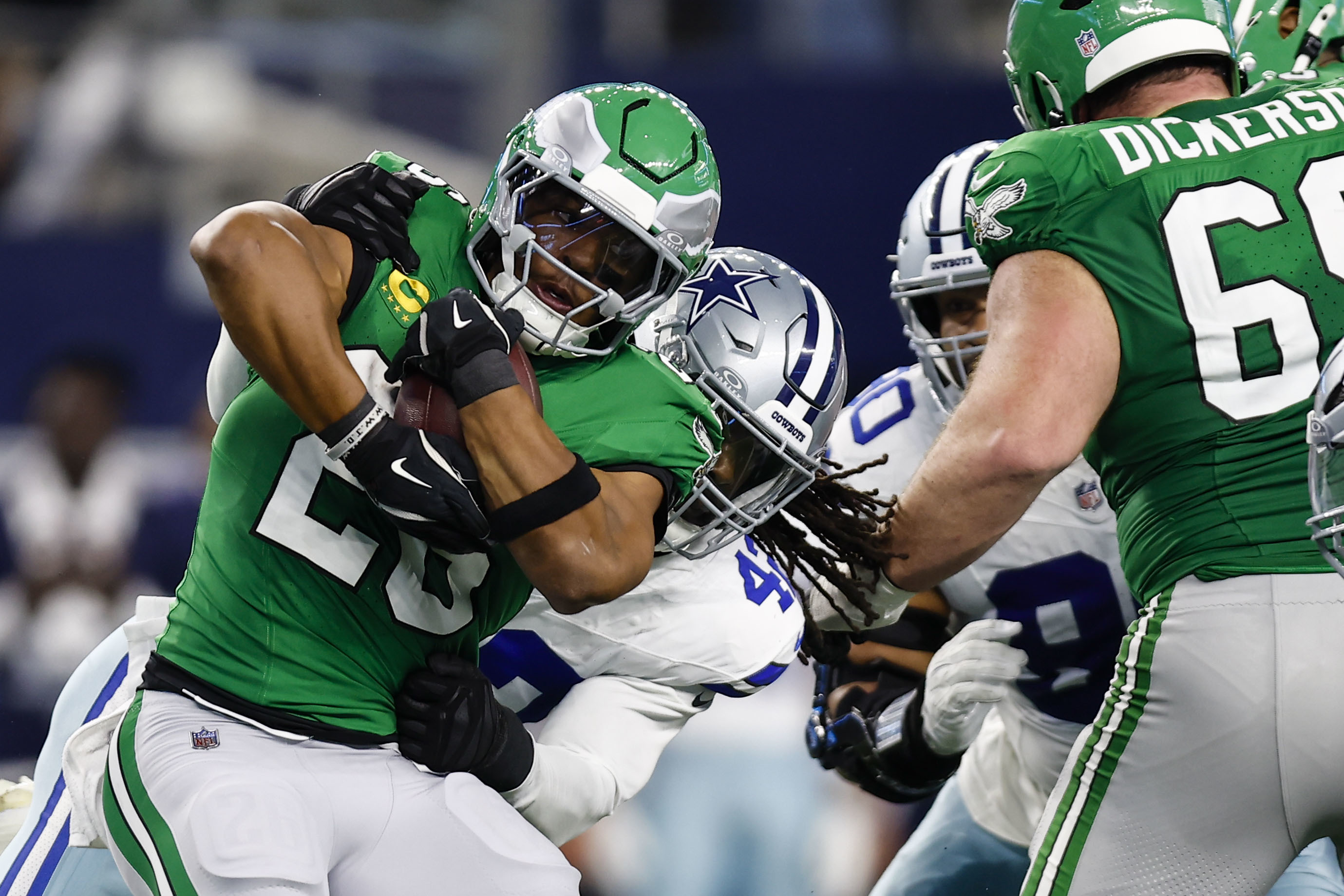
    Saquon Barkley is wrapped up by Cowboys outside linebacker Jadeveon Clowney in the second quarter in Week 12.

    Barkley did much of his damage in 2024 against opposing teams’ nickel packages. This year, the Eagles are facing fewer of those. Teams are matching the Eagles’ personnel, and the Eagles are running a lot of 12 and 13 packages (one running back plus two tight ends and one running back plus three tight ends, respectively).

    Defensive coordinators seemingly have decided that they’re going to sell out to stop the run and dare Jalen Hurts and the passing offense to beat them.

    2.3

    Mailata is right that the running game’s issues start with the offensive line. A running back needs blockers, and right now Barkley just isn’t getting enough help in front of him.

    There’s a variety of reasons for that, even though the Eagles returned four-fifths of their starting offensive line. First off, the replacement for Mekhi Becton at right guard, Tyler Steen, has not had the same kind of success run blocking. But the four returners haven’t been themselves, and injuries mostly are to blame. Lane Johnson has suffered multiple ailments, the latest a Lisfranc injury in his right foot. Cam Jurgens started the season coming off back surgery and has since suffered a knee injury and a concussion. Landon Dickerson has experienced bad injury luck going back to his collegiate career and probably hasn’t been 100% since high school.

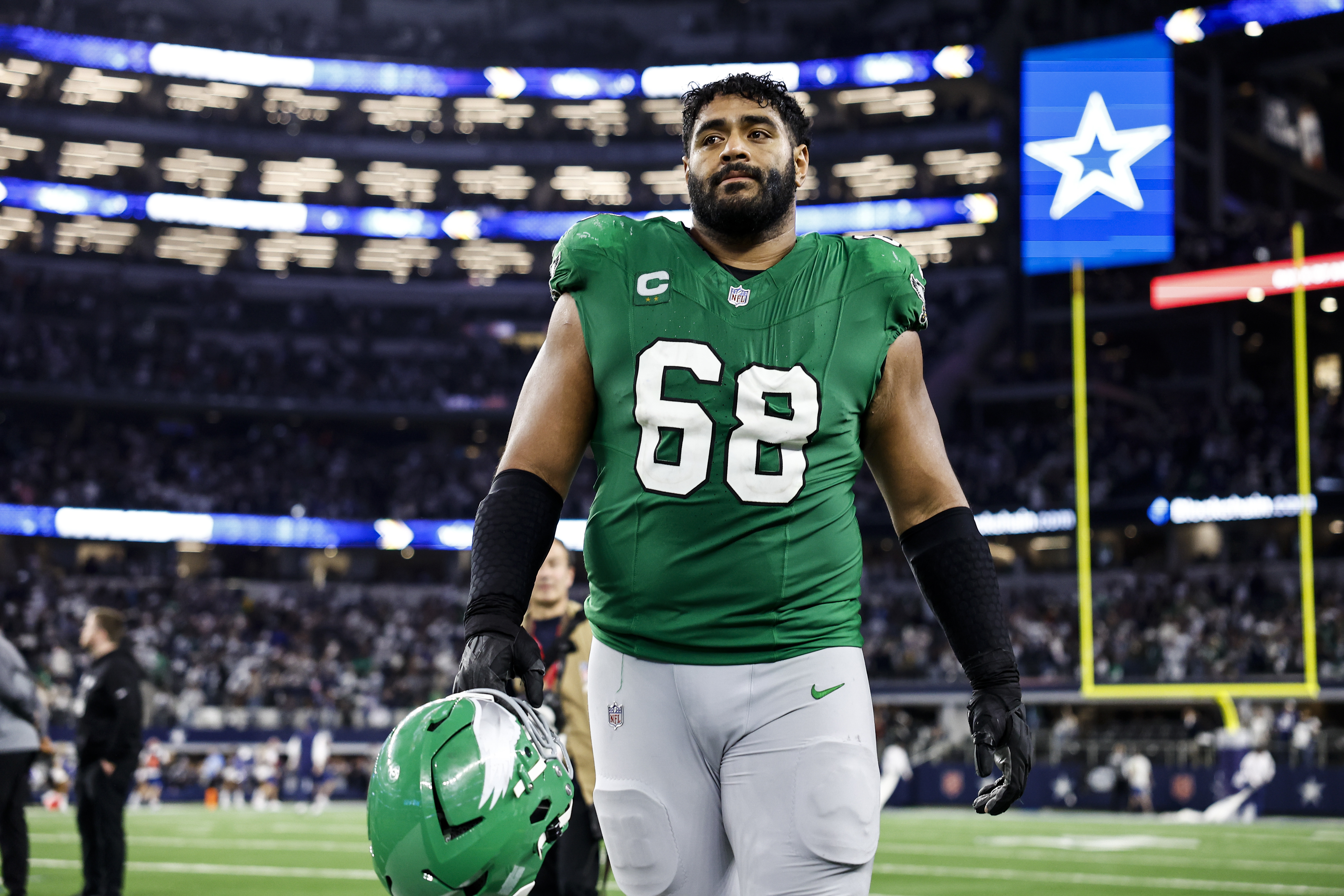
    Eagles tackle Jordan Mailata leaves the field after the game against the Cowboys in Week 12.

    Last season, Barkley had room to run. This season, he doesn’t. That’s clear in the numbers, too. In 2024, Barkley ran 3.8 yards per carry before being contacted. This season, that number has dropped to 2.3 yards per attempt, according to Pro Football Reference.

    “It’s on all of us,” Mailata said Sunday after the Eagles blew a 21-0 lead partially because they can’t run the ball. “You can just watch the film. We always say we’re one block away, and as tiring and as repetitive as that is, that is the truth. I’m tired of saying it, but it starts with us. We’ve got to do a better job of execution, and until we do that, this running game is not going anywhere.”

    15 mph

    Barkley in open space meant a lot of room to sprint. He finished second in the NFL in 15-plus-mph runs with 73 in 2024. This season, he is eighth with 28 such runs, according to Next Gen, and he’s on pace to finish with just 43 15-plus-mph runs.

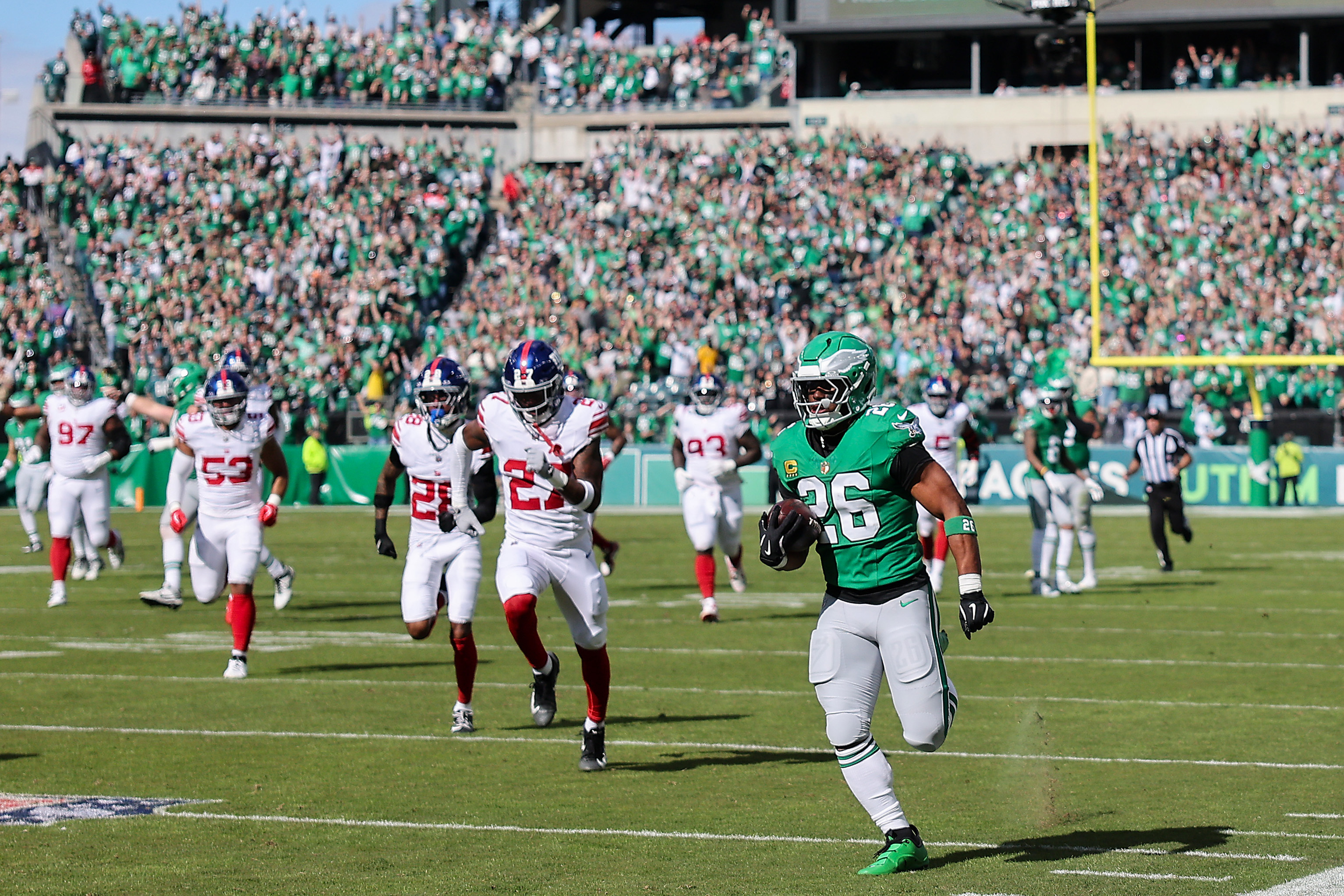
    Eagles running back Saquon Barkley scores during a run in the first quarter against the Giants.

    Blocking is a big factor there. But what about Barkley’s burst and his overall health? He touched the ball 482 times last season between rushes and receptions in the regular season and playoffs. His previous high was 377 in 2022.

    Barkley’s training regimen is pretty good. But that’s a lot of wear and tear in one season. Barkley said he was healthy on Sunday when asked after the game.

    -3

    Next Gen’s expected rushing yards model calculates “how many rushing yards a ballcarrier is expected to gain on a given carry based on the relative location, speed, and direction of blockers and defenders.”

    The model also calculates a metric called “rushing yards over expected,” which is “the difference between actual rushing yards and expected rushing yards on an individual play or series of plays.”

    Last season, Barkley was second in the NFL with 546 yards over expected — an average of 1.6 yards over expected per attempt — behind Derrick Henry’s 562 yards over expected. The third player on the list, Chuba Hubbard, had 270 yards over expected, which shows how otherworldly Henry and Barkley were in 2024.

    This season, Barkley is at minus-3 yards over expected and zero yards over expected per attempt. Those numbers rank 32nd in the NFL.

    What’s the takeaway here? The blocking hasn’t been good, but Barkley hasn’t been himself at beating defenders, either.

  • Over a dozen holiday events in Cherry Hill you won’t want to miss

    Over a dozen holiday events in Cherry Hill you won’t want to miss

    The holiday season is officially upon us and with it, a slew of festive events. From Santa sightings to a menorah motorcade, here’s how and where to celebrate around Cherry Hill.

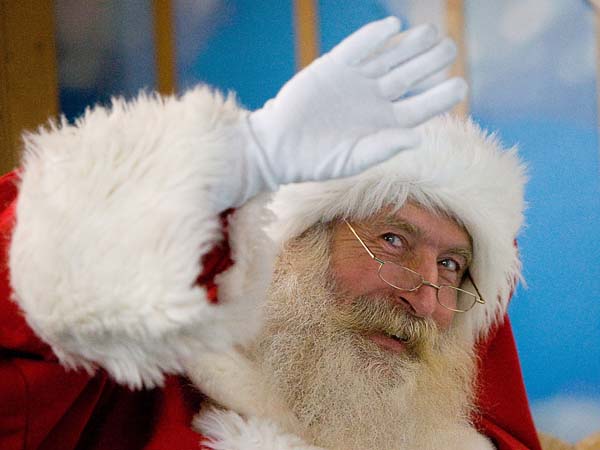
    Santa has returned to the Cherry Hill Mall, where he’s posing for photos throughout the holiday season.

    Photos with Santa at the Cherry Hill Mall

    Snap a photo with St. Nick during his ongoing residency at the mall, where he’ll be through Christmas Eve. Walkups are welcome, or you can sign up for a time slot here. Pets can also get in on the action on select days, but they must be on a leash, in a carrier, or held by their owner. Sign up for a pet time slot here.

    ⏰ Through Wednesday, Dec. 24, times vary 💵 $19.99-$59.99 📍Cherry Hill Mall, 2000 Route 38, Cherry Hill

    Photos with Santa at Spirit Christmas

    If you’re looking to get in a little holiday decor shopping while also grabbing a photo with Santa, Spirit Christmas is hosting the big guy on Fridays, Saturdays, and Sundays, plus the week leading up to Christmas.

    ⏰ Through Wednesday, Dec. 24, days and times vary 💵 $19.99-$59.99 📍Spirit Christmas, 2234 Marlton Pike West, Cherry Hill

    The rink will be open on select days through Feb. 22.

    WinterFest Ice Skating

    Lace up your skates and hit the ice at Cooper River Park on select days through Feb. 22.

    ⏰ Friday, Nov. 28-Sunday, Feb. 22, times vary 💵 $6-$9 admission, plus a $6 skate rental 📍Cooper River Park, 510 Park Blvd., Cherry Hill

    Morning Glori Farmette Pop-Up Shop

    Marlton-based alpaca farm Morning Glori Farmette is hosting a pop-up shop in Cherry Hill, where you can shop handmade gifts and meet two of their resident camelids, Rocky and Crash.

    ⏰ Friday, Nov. 28, 9:30-11:30 a.m. 💵 Pay as you go 📍1504 Pleasant Dr., Cherry Hill

    Ornament-Making Workshop

    Design and create your own holiday ornament during this walk-in workshop.

    ⏰ Friday, Nov. 28, 10 a.m.-2 p.m. 💵 $40 📍Hugs Ceramics, 1400 Haddonfield-Berlin Rd., Cherry Hill

    Holiday House

    Tour Barclay Farmstead decked out for the holidays at this ticketed event.

    ⏰ Sunday, Nov. 30, 1-4 p.m. 💵 $3.49-$5.49 📍Barclay Farmstead, 209 Barclay Lane, Cherry Hill

    Sounds of the Season

    Catch holiday performances while shopping at the mall. At 6 p.m. on Dec. 3, the Pine Barons Chorus will perform everything from classic carols to current favorites. And at 5 p.m. on Dec. 17, Cherry Hill West’s Royal Purple Majesties club will perform throwback holiday tunes from the 1920s and 1940s from the likes of Nat King Cole and Frank Sinatra.

    ⏰ Wednesday, Dec. 3, 6 p.m. and Wednesday, Dec. 17, 5 p.m. 💵 Free 📍Cherry Hill Mall, 2000 Route 38, Cherry Hill

    Breakfast with Santa

    Join the Cherry Hill African American Civic Association for a breakfast buffet, holiday crafts, games, and photos with Santa.

    ⏰ Saturday, Dec. 6, 8-10 a.m. 💵 $12.51-$23.18 📍Applebee’s Grill, 108 Haddonfield Rd., Cherry Hill

    Colorful Desires Holiday Marketplace

    Shop an array of small businesses at this two-day pop-up in the Grand Court.

    ⏰ Saturday, Dec. 6, 10 a.m.-9 p.m. and Sunday, Dec. 7, 11 a.m.-6 p.m. 💵 Pay as you go 📍Cherry Hill Mall, 2000 Route 38, Cherry Hill

    Winter Festival

    This year’s winter festival includes a craft market, a beer garden, fire pits, ice carving demonstrations, food, and live performances. It will be held rain or shine.

    ⏰ Sunday, Dec. 7, noon-4 p.m. 💵 Pay as you go 📍Croft Farm, 100 Bortons Mill Rd., Cherry Hill

    Cherry Hill Senior Holiday Party

    Celebrate the season with other senior township residents over a buffet lunch, music, and dancing. Tickets must be purchased by Nov. 30.

    ⏰ Thursday, Dec. 11, 11 a.m.-2 p.m. 💵 $40 📍DoubleTree by Hilton, 2349 Marlton Pike West, Cherry Hill

    Winter Concert with the Chamber Ensembles of Cherry Hill High School East

    Hear performances of works by Wolfgang Amadeus Mozart and Joseph Haydn in addition to other festive holiday tunes. Advanced registration is required.

    ⏰ Thursday, Dec. 11, 11:30 a.m.-12:30 p.m. 💵 Free 📍Cherry Hill Public Library, 1100 Kings Hwy. North, Cherry Hill

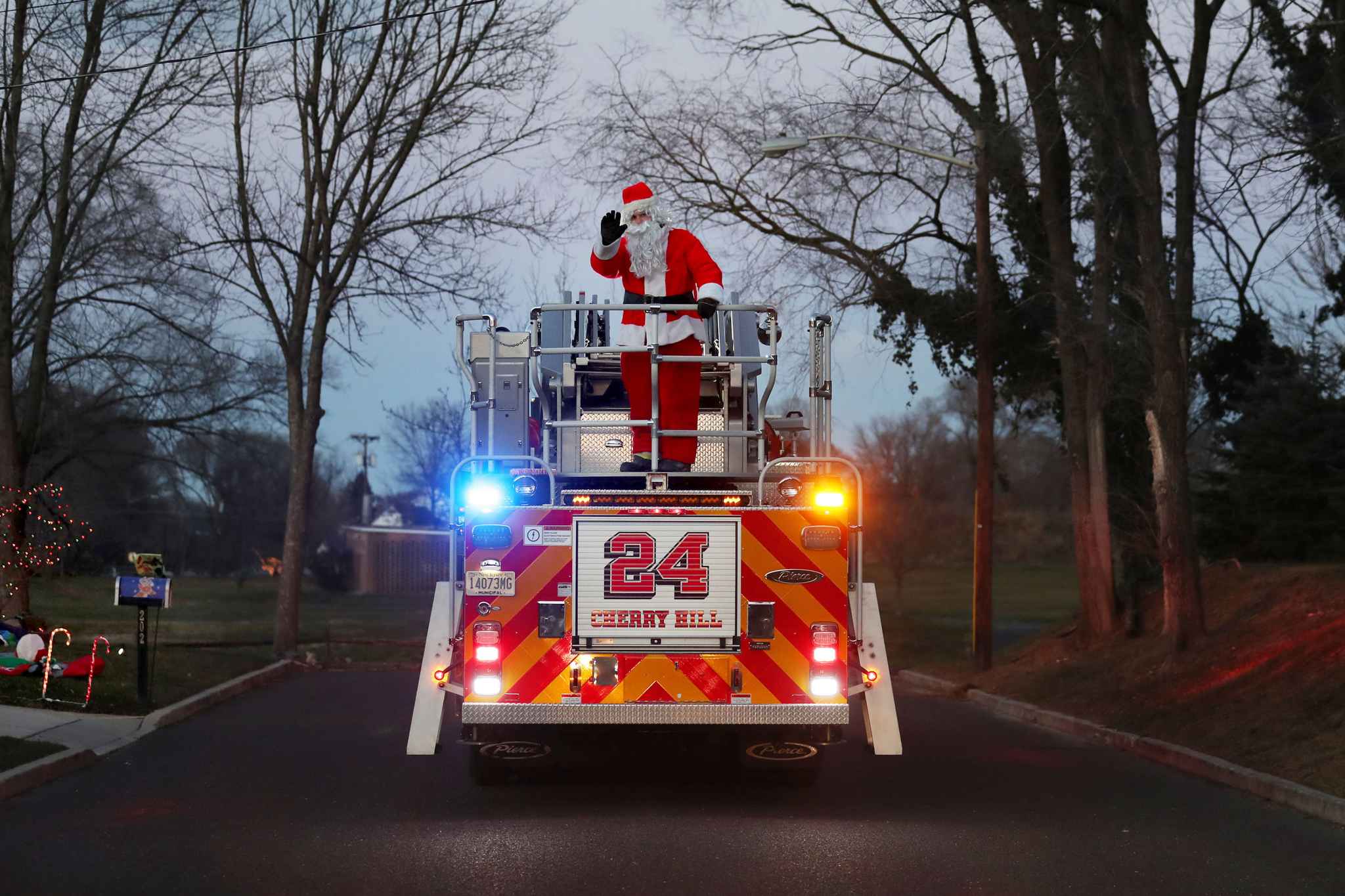
    Santa Claus plans to visit neighborhoods alongside the Cherry Hill Fire Department again this year.

    Cherry Hill Fire Department Santa Visits

    Santa will make visits to neighborhoods throughout town alongside the fire department. Visits are expected to start Dec. 13 and run through Dec. 21. An interactive map with details on the schedule will go live Dec. 1.

    ⏰ Saturday, Dec. 13-Sunday, Dec. 21, times vary 💵 Free 📍Cherry Hill Township

    Sounds of the Season

    Local musician Christopher Westfall will perform classic and original Christmas songs to benefit homeless shelter Joseph’s House of Camden.

    ⏰ Saturday, Dec. 13, 7 p.m. 💵 $15 📍St. Andrews United Methodist Church of Cherry Hill, 327 Marlton Pike West, Cherry Hill

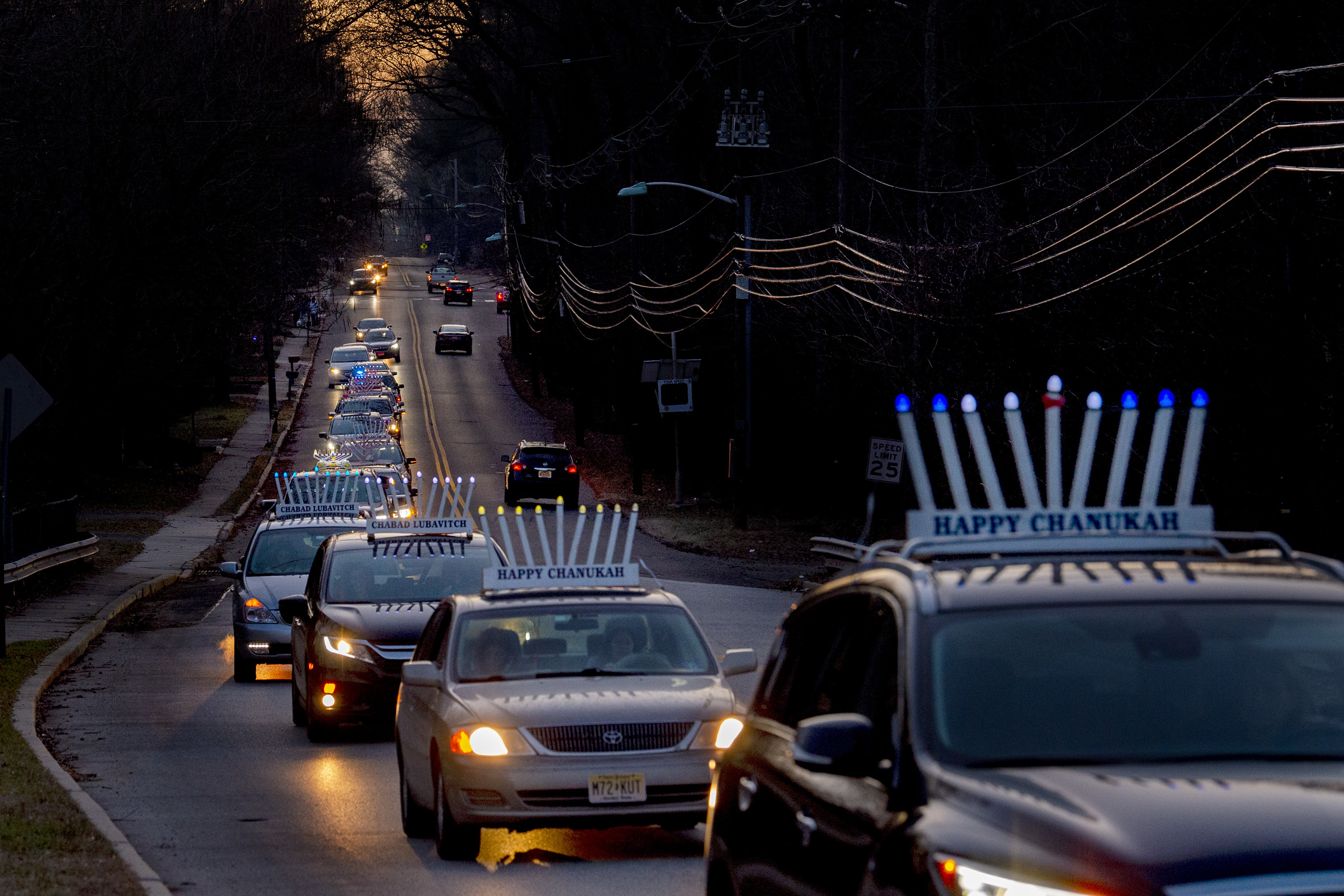
    The Menorah Motorcade will take place the first night of Hanukkah.

    Menorah Motorcade

    Now in its 16th year, cars adorned with menorahs will parade from Chabad in Cherry Hill to Barclay Farm Shopping Center, where the giant menorah will be lit. There will be latkes, donuts, music, and LED robots for the lighting.

    ⏰ Sunday, Dec. 14, parade starts at 4 p.m., giant menorah lighting is at 5 p.m. 💵 Free 📍Chabad of Camden and Burlington Counties, 1925 Kresson Rd., Cherry Hill

    Curate Noir Holiday Market Pop-Up Expo

    Snag last-minute holiday gifts at this two-day pop-up at the mall that features local small businesses.

    ⏰ Saturday, Dec. 20, 9 a.m.-10 p.m. and Sunday, Dec. 21, 10 a.m.-9 p.m. 💵 Pay as you go 📍Cherry Hill Mall, 2000 Route 38, Cherry Hill

    This suburban content is produced with support from the Leslie Miller and Richard Worley Foundation and The Lenfest Institute for Journalism. Editorial content is created independently of the project donors. Gifts to support The Inquirer’s high-impact journalism can be made at inquirer.com/donate. A list of Lenfest Institute donors can be found at lenfestinstitute.org/supporters.

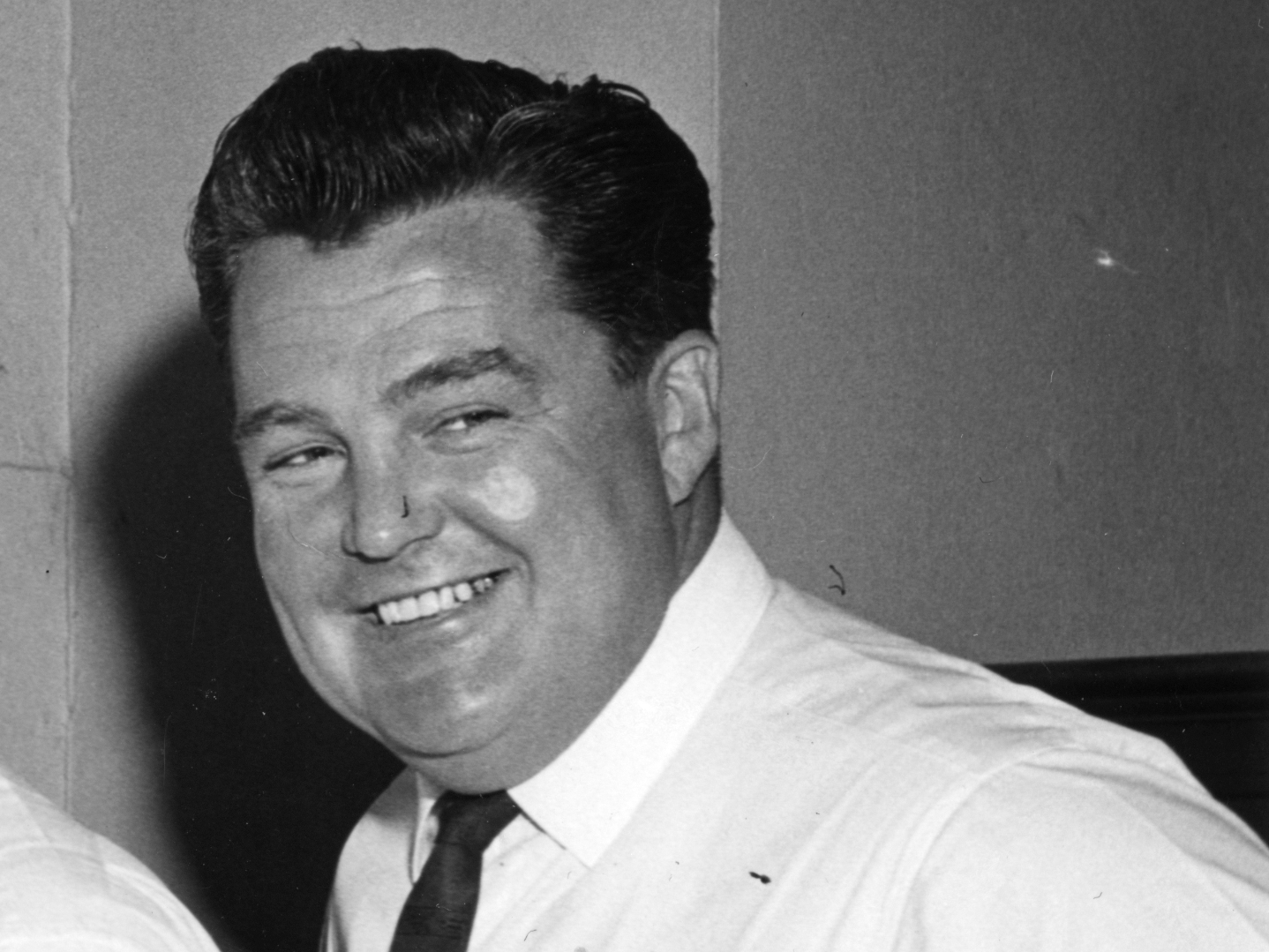
  • Bucko Kilroy was once called the NFL’s dirtiest player. He became much more than that in a six-decade career.

    Bucko Kilroy was once called the NFL’s dirtiest player. He became much more than that in a six-decade career.

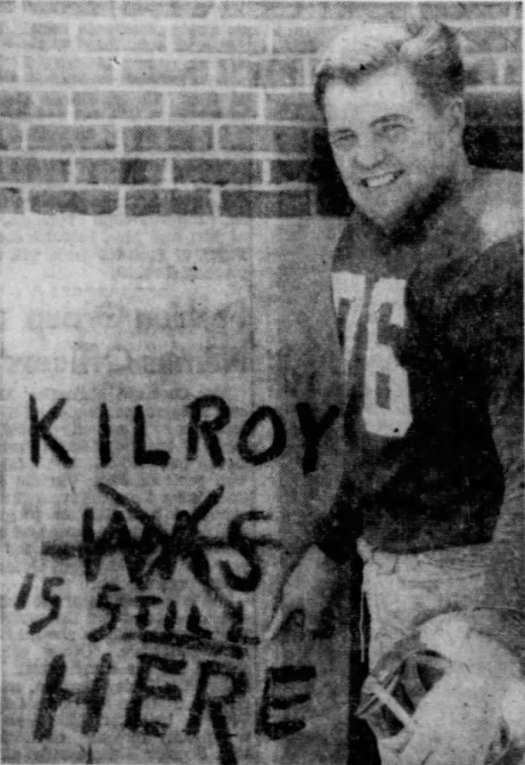
    Bucko Kilroy spent a week in a Philadelphia courtroom three years after a Life magazine story described him as football’s dirtiest player. He sued the magazine for libel, claiming the accusation that he purposely injured opponents had ruined his reputation.

    He was a two-way lineman for the Eagles who once played in 101 straight games. Dirty? Never, Kilroy said. A lawyer representing the magazine during the 1958 case asked Kilroy if he remembered kicking the Chicago Bears’ Ray Bray in the groin. “It is all according to what you mean by kicking,” Kilroy said.

    Upton Bell’s secretary interrupted him in his office to tell the newly hired New England Patriots general manager that someone was on the phone for him. It was a collect call from a pay phone.

    “I said to myself, ‘Who the heck is this?’” said Bell, whose father founded the Eagles in 1933.

    It was Kilroy, who was working for the Dallas Cowboys and had scouted with Bell years earlier. He wanted to work for the Patriots.

    “He was calling from a phone booth because he didn’t want Dallas to know that he was applying for the job,” Bell said. “He said, ‘There’s no way they can trace this to me.’ Typical Bucko.”

    Francis Joseph “Bucko” Kilroy, who will be inducted Friday into the Eagles Hall of Fame during the game against the Bears, spent 64 consecutive years in the NFL as a player, coach, scout, and front-office executive. He grew up in Port Richmond, starred at North Catholic and Temple, and won NFL championships with the Eagles in the 1940s before helping Bill Belichick win Super Bowls as a scouting consultant in the 2000s. Kilroy was there.

    Bucko Kilroy during his time as the Eagles’ player personnel director in 1960, when they won the NFL championship.

    Kilroy was one of the league’s first scouts and a front-office innovator who helped teach a lineage of future decision makers from Hall of Famer Bill Parcells to current Tampa Bay general manager Jason Licht. He was much more than the dirtiest player in football. And everything — from the players he was targeting in the draft to the phone calls he made — was a secret.

    “I would ask him, ‘Is that for public record or not?’” said Tom Hoffman, the Patriots’ director of public relations during Kilroy’s tenure as GM. “He would tell me, well, he can always disseminate confidential misinformation.”

    Battle scars

    The incident happened, Kilroy told the lawyer, about 10 years earlier during a preseason game. He fell down on a kickoff and Bray jumped on top of him. Kilroy said he put his foot up and flipped Bray over. Kilroy was ejected and fined $250.

    The lawyer asked Kilroy if that was a fair description of a “vicious kick in a very vulnerable spot.” No, Kilroy said. “I wasn’t trying to kick him, I was trying to ward him off. The man was trying to jump on me. How else could I get rid of him? Am I going to let him jump on me?”

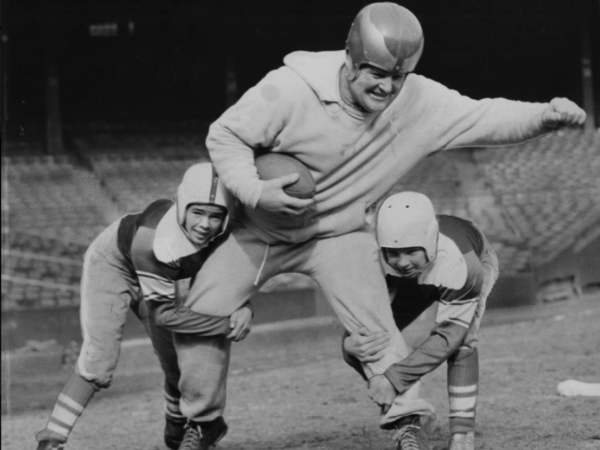
    Kilroy spent most of his adult life with the indention of a cleat on his cheek, a scar from his time in the NFL when face masks were rare and gentlemen were even rarer. A kick to the face may not have been a penalty, but it did leave a battle scar. Kilroy’s NFL was wild — penalties like roughing the passer were years away — and the guy from Port Richmond fit right in.

    “Nothing came easy for him,” said Dan Fahy, Kilroy’s great-nephew. “He had to work hard. He had that grit and that desire and that ferociousness to succeed. He saw football as a game of toughness and that meant playing the game tough.”

    An Eagles player from 1943-55, Kilroy crushed opponents’ faces with his huge hands, tripped ballcarriers, and drove quarterbacks into the turf.

    When he injured a Pittsburgh Steelers player in 1951, the Steelers said they would get revenge on Kilroy when the teams played again. Bring the brass knuckles, he replied. He was a 6-foot-2, 243-pound menace who never backed down.

    “I can remember my father getting a call from Bucko’s wife [Dorothy] complaining because my dad [who became NFL commissioner] had fined him,” Bell said. “I think he kicked someone in the head. I can hear the whole conversation and he’s telling her, ‘Mrs. Kilroy, if Bucko goes the rest of the season without getting in trouble, I’ll give you the money.’ Bucko had promised to buy her a mink coat with his bonus. So she was calling because she thought she was losing her coat. My dad said, ‘I won’t give him the money back, but I’ll give it to you.’ And that’s what he did. Bucko didn’t get in trouble the rest of the year and my father had the check issued to her, not him. She got her coat.

    “He did have a reputation for being a dirty player. But there were a lot of guys around like that. The game was totally different. He was also a pretty damn good player. Guys were fearful of him.”

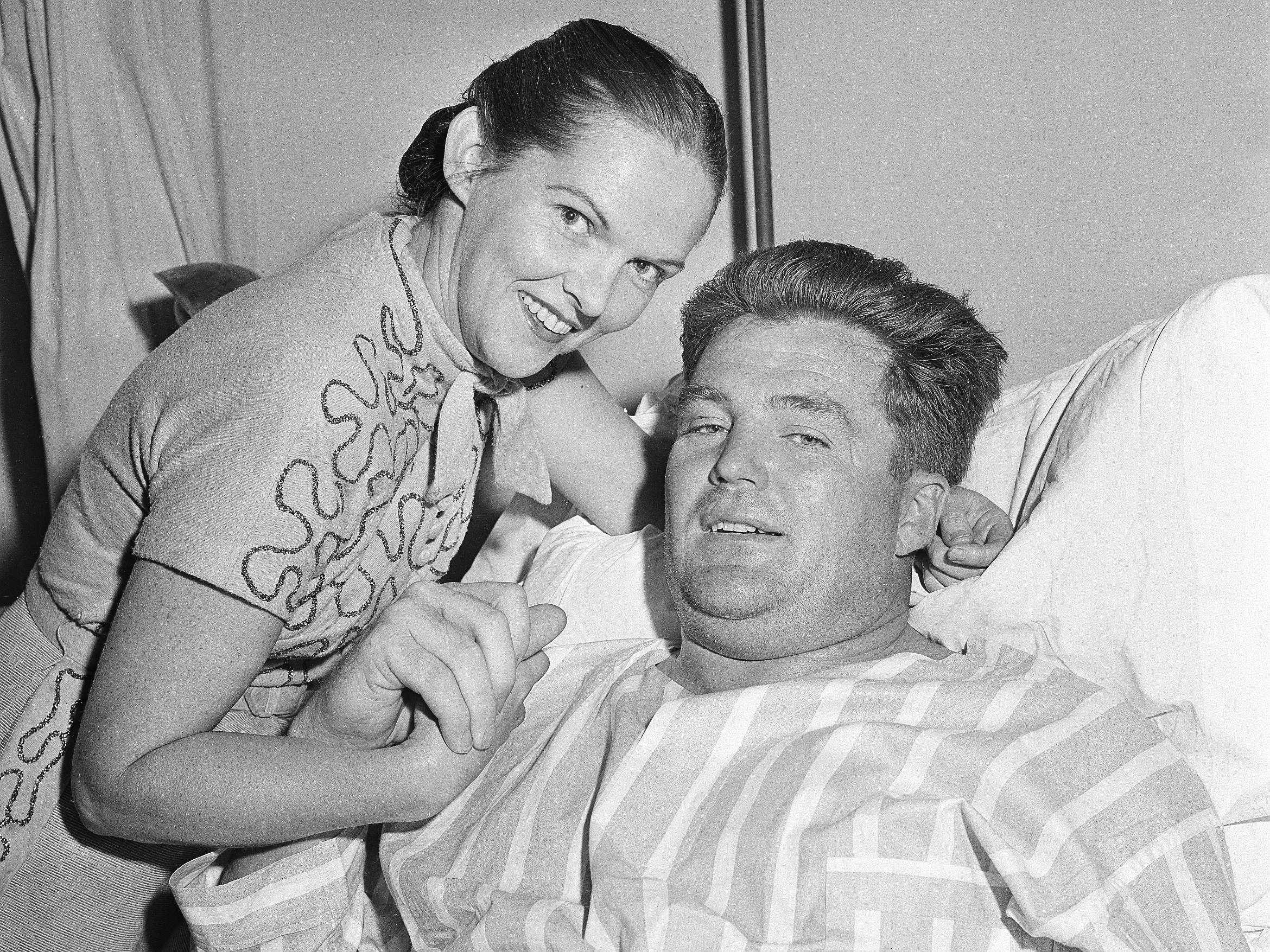
    Eagles lineman Bucko Kilroy with his wife, Dorothy, in the hospital after he suffered a career-ending knee injury against the New York Giants in 1955.

    Kilroy’s uncle, Matt “Matches” Kilroy, pitched in the majors (his 513 strikeouts in 1886 are still a record) and his father owned a bar on Richmond Street. He grew up in St. Anne’s parish during the Great Depression and played in the NFL with the same vigor he did as a kid against the boys from Nativity.

    Kilroy started his professional career in 1943 with the Steagles, the team Bert Bell formed during World War II by combining the Eagles and Steelers.

    He played on the weekends, commuting from New York while serving in the Merchant Marines. It was the start of an NFL career that spanned more than six decades without missing a season.

    “Football hasn’t just been a part of my life,” Kilroy said in 1993 after joining North Catholic’s Hall of Fame. “It is my life.”

    Kilroy was roommates on the Eagles with Walt “Piggy” Barnes, who later found work in Hollywood as an actor in Clint Eastwood movies. Kilroy worked during each offseason — he sold cars at night one year after working mornings in a stone quarry — and lived in a twin house on Wakeling Street in Frankford.

    When the Eagles won the 1948 title by beating the Chicago Cardinals, it was Kilroy’s fumble recovery that positioned the Birds for their only score during a snowstorm at Shibe Park. A year later, the Eagles repeated as champions and were gifted $500 and cigarette lighters. If they wanted championship rings, the players had to pay $65.

    Kilroy, who was later named to the NFL’s all-decade team for the 1940s, was the oldest player in the NFL at age 34 when he entered his 13th and final season. His career ended in the 1955 opener against the Giants. They were still angry at Kilroy for injuring quarterback Arnie Galiffa two years earlier. The Giants mangled Kilroy’s knee during a pile-up and he never played again.

    Bucko Kilroy was the oldest player in the NFL when he retired with the Eagles in 1955 at age 34.

    “These guys had it for him,” Fahy said. “But his own teammates would have told you that he had it coming. He had a reputation.”

    ‘Ornery critters’

    Kilroy and teammate Wayne Robinson — who also sued Life magazine — were described in the article as “ornery critters.” Cloyce Box of the Detroit Lions explained in court that an ornery critter was a “domesticated animal which at periods of times acts without the scope of that domestication.”

    Otto Graham, the Hall of Fame quarterback from Cleveland, said in court that the Eagles were the “roughest football team in the National Football League.” And Kilroy? “Well, he was the bad boy, one of the bad boys, of the league,” Graham said.

    Kilroy left that pay phone in 1971 to work with Bell in New England as the personnel director. He was the Eagles’ player personnel director when they won the 1960 NFL championship, making him one of the league’s first scouts. He later built scouting systems for the Dallas Cowboys that led to five straight division titles. He was instrumental in launching the scouting combine for the draft.

    Kilroy’s Patriots hit on three first-round picks in 1973 by selecting future Hall of Fame lineman John Hannah, running back Sam Cunningham, and wide receiver Darryl Stingley. Three years later, the Pats again had three first-rounders and Kilroy drafted another future Hall of Famer in defensive back Mike Haynes.

    “He was a brilliant mind,” Hoffman said.

    Kilroy was promoted to GM in 1979 and later became the Patriots’ vice president before becoming a scouting consultant, a position he held until he died in 2007 at age 86. Belichick honored him the next spring when the Patriots drafted for the first time without Kilroy. He was a pillar of the league, Belichick said. Kilroy spent one year longer in the NFL than George Halas. He was more than a dirty player. And that was his best-kept secret.

    “You would think, ‘This is just some big, dumb football player,’” Bell said. “But if you got to know him, you learned how smart he was. He was one of the greatest characters I’ve ever known and I’ve known most of the great characters. I once told him, ‘Bucko, you’re so secretive. Are you sure you didn’t work in the CIA?’

    “Bucko Kilroy belongs in the Pro Football Hall of Fame. That’s how good he was. And if I don’t get a phone call from Bucko Kilroy in a phone booth, I don’t hire him.”

    Kilroy won his lawsuit against the magazine and was awarded $11,600. It was more than he ever made in the NFL as his first season with the Steagles earned him just $1,300.

    But the lawsuit wasn’t really about Kilroy as much as it was about the NFL, which was trying to protect its image as it grew in popularity. The league needed to respond to an article titled “Savagery on Sundays” and Kilroy’s libel case was the response. Kilroy played football with an edge, so calling him dirty was hardly an offense. “I don’t think Bucko was ever offended by anything,” Bell said.

  • Christmas tree retailers find lots to like at a Pennsylvania wholesale auction

    Christmas tree retailers find lots to like at a Pennsylvania wholesale auction

    MIFFLINBURG, Pa. — Christmas went on the auction block last week in Pennsylvania farm country, and there was no shortage of bidders.

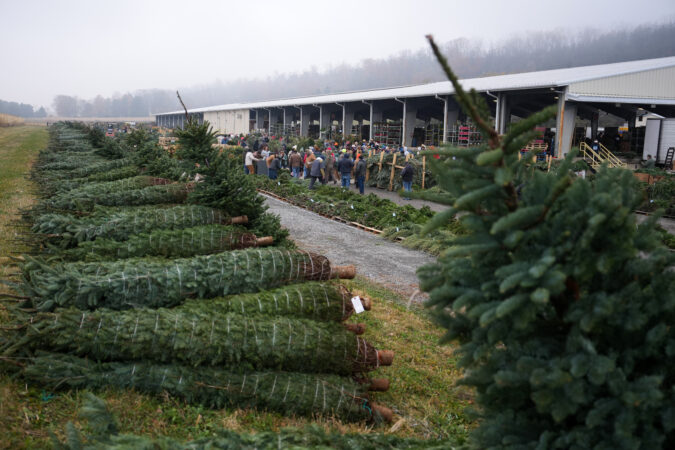
    About 50,000 Christmas trees and enough wreaths, crafts, and other seasonal items to fill an airplane hangar were bought and sold by lots and on consignment at the annual two-day event put on at Buffalo Valley Produce Auction in Mifflinburg.

    Buyers from across the Northeast and Mid-Atlantic were there to supply garden stores, corner lots, and other retail outlets for the coming rush of customers eager to bring home a tree — most commonly a Fraser fir — or to deck the halls with miles of greenery.

    Bundled-up buyers were out in chilly temperatures to hear auctioneers hawk boxes of ornaments, bunches of winterberry, cotton branches, icicle lights, grave blankets, red bows, and tree stands. It was nearly everything you would need for Christmas except the food and the presents.

    A worker transports holiday decorations at Buffalo Valley Produce Auction in Mifflinburg, Pa.

    Americans’ Christmas tree buying habits have been evolving for many years. These days homes are less likely than in years past to have a tree at all, and those that do have trees are more likely to opt for an artificial tree over the natural type, said Marsha Gray with the Howell, Michigan-based Real Christmas Tree Board, a national trade group of Christmas tree farmers.

    Cory Stephens was back for a second year at the auction after his customers raved about the holiday decor he purchased there last year for A.A. Co. Farm, Lawn & Garden, his store a three-hour drive away in Pasadena, Md. He spent nearly $5,000.

    “It’s incredible, it’s changed our whole world,” Stephens said. “If you know what you’re looking for, it’s very hard to beat the quality.”

    Ryan Marshall spent about $8,000 on various decorations for resale at Ward’s Berry Farm in Sharon, Mass. Among his purchases were three skids of wreaths at $29 per wreath — and he expected to double his money.

    “The quality’s good, and it’s a place that you can pick it out yourself,” he said.

    Gray said her group’s research shows the main reason people pick a real tree over an artificial tree “is the scent. They want the fresh scent of a real Christmas tree in their home.” Having children in the house also tends to correlate with picking a farm-grown tree, she said.

    An August survey by the Real Christmas Tree Board found that 84% of growers did not expect wholesale prices to increase this season.

    Buffalo Valley auction manager Neil Courtney said farm-grown tree prices seem to have stabilized, and he sees hope that the trend toward artificial trees can be reversed.

    “Long story short — we’ll be back on top of the game shortly,” Courtney said. “The live tree puts the real Christmas in your house.”

    A survey by a trade group, the National Christmas Tree Association, found that more than 21 million farm-grown Christmas trees were sold in 2023, with median price of $75. About a quarter of them were purchased at a “choose-and-cut” farm, one in five from a chain store, and most of the rest from nurseries, retail lots, nonprofit sales, and online.

  • Threat to prosecute lawmakers for speech is scary (and probably unconstitutional)

    Threat to prosecute lawmakers for speech is scary (and probably unconstitutional)

    “I do solemnly swear that I will support and defend the Constitution of the United States against all enemies, foreign and domestic … and that I will obey the orders of the President of the United States and the orders of the officers appointed over me,” according to law.

    Military and intelligence community members were recently reminded of this oath when, on Nov. 18, six members of Congress released a direct-to-camera video, telling service members that they “can refuse illegal orders.”

    In response, the president unleashed a spate of social media posts calling for the lawmakers to be jailed, charged, and even executed. He subsequently doubled down on his threats of arrest and prosecution.

    If there were any doubt whether the president’s words were empty rhetoric, look no further than the just-dismissed case against former FBI Director James Comey, who, after the president directed Attorney General Pam Bondi to pursue Comey via a Truth Social post, found himself under federal indictment weeks later.

    The First Amendment does not permit the government to prosecute lawmakers for telling service members to hold the line against unlawful orders.

    With a U.S. Department of Justice willing to pursue political prosecutions, another round of charges is almost certainly coming. The question is whether the Constitution’s protections will hold.

    First Amendment barriers

    Under modern First Amendment doctrine, the government cannot punish speech because it conveys a message the government dislikes. The law is especially protective of “core political speech,” i.e., speech advocating for sociopolitical change.

    Meanwhile, speech loses protection when it is “directed to inciting or producing imminent lawless action and is likely to [cause] such action.” The standard — set intentionally high by the U.S. Supreme Court — comes from a 1969 case, Brandenburg v. Ohio, reversing a Ku Klux Klan leader’s conviction over his Klan rally speeches. As the court explained it, the First Amendment does not permit punishment for “mere advocacy,” no matter how abhorrent.

    In other words, just like the government could not prosecute someone for using a vulgarity to describe the draft to protest the Vietnam War (Cohen v. California) or the KKK for saying that “there might have to be some revengeance taken” (Brandenburg), the First Amendment does not permit the government to prosecute lawmakers for telling service members to hold the line against unlawful orders.

    Vindictive prosecution

    Prosecuting these lawmakers would also present a textbook case of “vindictive prosecution.” As lawyers in the Comey case recently argued, the due process clause forbids prosecutions based on “a government official’s animus” or “personal spite” toward a person. Showing that, here too, the government acted because of “genuine animus,” as is required, would not seem difficult.

    And although most grand jury proceedings come with a “presumption of regularity,” as one federal court recently put it, that may no longer be the case: “the irregular is now the regular.” Take the Comey case, for example. While the charges were just dismissed, recall that days before Comey was indicted, the then-head prosecutor for the Office of the U.S. Attorney for the Eastern District of Virginia declined to charge him.

    In response, the president installed his own attorney, Lindsey Halligan, who had no prosecutorial experience, as interim chief of the office. Halligan then personally presented Comey’s case to the grand jury, days before the statute of limitations ran out, and recently admitted the final indictment was never reviewed by the full grand jury.

    Lindsey Halligan, outside of the White House in August, had no prosecutorial experience before being named U.S. attorney.

    Now, one federal judge has ruled that Halligan’s appointment was invalid, requiring dismissal, while another federal judge seems primed to dismiss the charges for good on vindictive and selective prosecution grounds, among others. Talk about unprecedented.

    Even assuming the president found a prosecutor to pursue charges, and a grand jury indicted — neither of which is guaranteed — it seems highly unlikely the charges would survive against the growing backdrop of this administration playing fast and loose with the grand jury process to exact political retribution on the president’s perceived enemies.

    Going on offense

    But bracing for an onerous — even if legally faulty — investigation is not the only option. The president’s next political target to catch wind of a grand jury investigation against him or her could take a page from Ealy v. Littlejohn.

    In that post-civil rights movement era case, a Black organization in Mississippi, which came under investigation for accusing local officials of failing to investigate the suspicious death of a young Black man, sued and got a court order to stop the investigation in its tracks.

    The federal court determined that the investigation was being carried out for “the purpose of harassing and intimidating the plaintiffs in violation of their First Amendment rights,” and said it would be a “sorry day” for the country “were we to allow a grand jury to delve into” protected First Amendment activity “on the pretext that” it might reveal “some information relevant to a crime.” If ever there was a case to test out this affirmative strategy, this would seem to be it.

    David Axelrod, a partner at Ballard Spahr, is a former Securities and Exchange Commission supervisory trial counsel in Philadelphia and a former assistant U.S. attorney in the Eastern District of Pennsylvania. Isabella Salomão Nascimento is a senior associate in Ballard Spahr’s Media and Entertainment Group. Before joining the firm, she was a staff attorney at the ACLU of Minnesota, where she specialized in civil rights and constitutional law.

  • Elfreth’s Alley is getting a park to honor woman who saved it from demolition

    Elfreth’s Alley is getting a park to honor woman who saved it from demolition

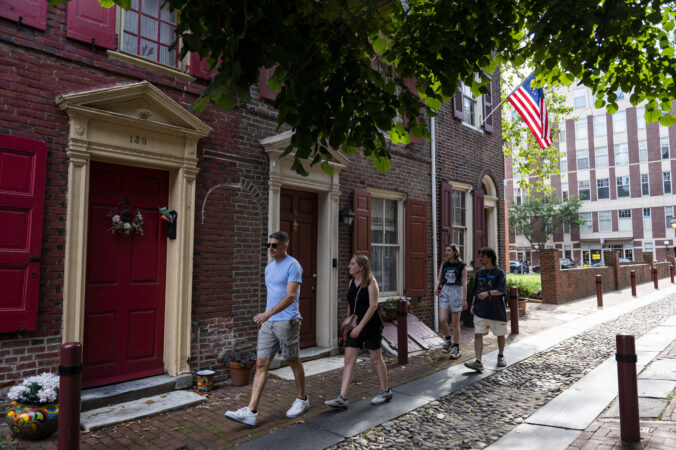
    Few Philadelphians may recognize the name Dolly Ottey, yet nearly all know Elfreth’s Alley — the nation’s oldest residential street — which she helped rescue from decline and demolition starting in the 1930s.

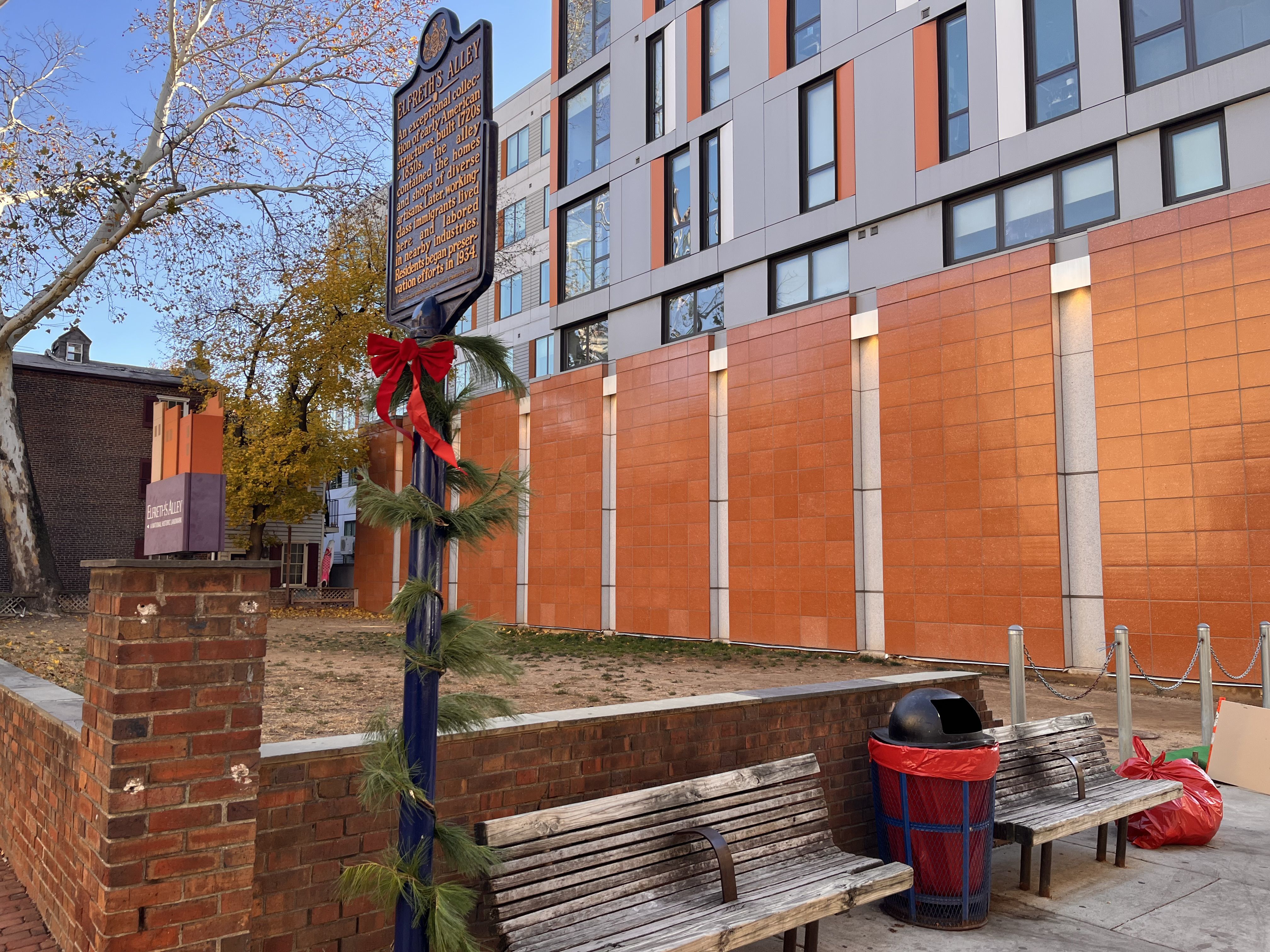
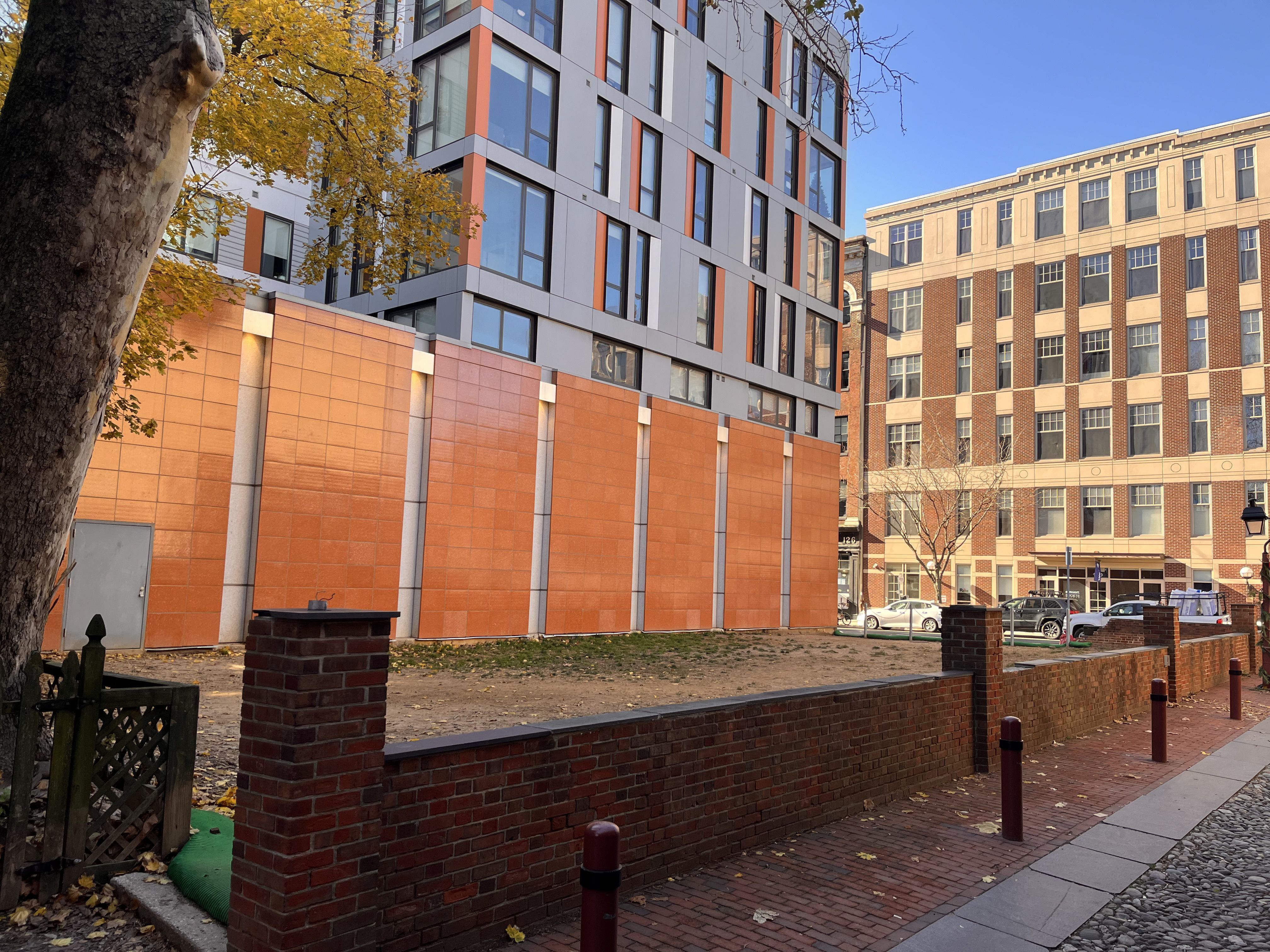
    Now, after years of wrangling, a long-neglected vacant lot that some have derided as an eyesore at the historic location is slated for a transformation in time for the 250th anniversary of the Declaration of Independence.

    Plans call for the lot at North Second Street and Elfreth’s Alley to be reborn as Dolly Ottey Park, honoring the woman who first championed preservation of the narrow cobblestone passage starting in the 1930s.

    window.addEventListener(“message”,function(a){if(void 0!==a.data[“datawrapper-height”]){var e=document.querySelectorAll(“iframe”);for(var t in a.data[“datawrapper-height”])for(var r,i=0;r=e[i];i++)if(r.contentWindow===a.source){var d=a.data[“datawrapper-height”][t]+”px”;r.style.height=d}}});

    Job Itzkowitz, executive director of Old City District, said the project took eight years of sporadic effort to get multiple parties to sign off on an agreement to create the park. Old City District is a nonprofit registered community organization.

    “We want it to be a place where residents, tourists, visitors, employers, and employees can take a bit of a respite,” he said. “It’s going to be a drastic improvement.”

    A conceptual rendering of Dolly Ottey park at Second Street and Elfreth’s Alley in Old City, Philadelphia. Organizers hope to transform the existing vacant space into a park by spring.

    On a recent day, families and couples toured Elfreth’s Alley, taking pictures and discussing the history of the area. But none ventured into the vacant lot. Later, a lone woman could be seen walking her dog there.

    Itzkowitz credited a renewed spirit of collaboration for breaking the stalemate.

    He said changes in leadership at the real estate advisory board for the National Old City Apartments, which abuts the park, and crucial support from the nonprofit Elfreth’s Alley Association paved a path for agreement.

    A view of a vacant lot at Second Street and Elfreth’s Alley in Old City Philadelphia. Plans for creation of Dolly Ottey Park at the location and named after an advocate who helped save Elfreth’s Alley in the early to mid 20th Century.

    The lot is owned by Bit Investment Seventy-Eight LLC, according to city records, and is part of that company’s holdings for National Old City Apartments along North Second Street.

    A usable space by spring

    The pocket park will rise in two phases: an interim stage featuring a crushed stone base, picnic tables, planters, wild grasses, and repairs to a crumbling brick wall, followed by a more permanent design.

    An architect has been hired to craft a cost-effective plan to deliver a usable public space by spring 2026.

    The interim plan design for Dolly Ottey Park carries a modest $60,000 budget, with fundraising to break ground in February and finish by March. Old City District has set up an online link for public contributions.

    Itzkowitz said the timing for the interim phase would ensure the park provides a welcoming experience for visitors during the Semiquincentennial as part of a significant historical landmark.

    A view of Elfreth’s Alley.

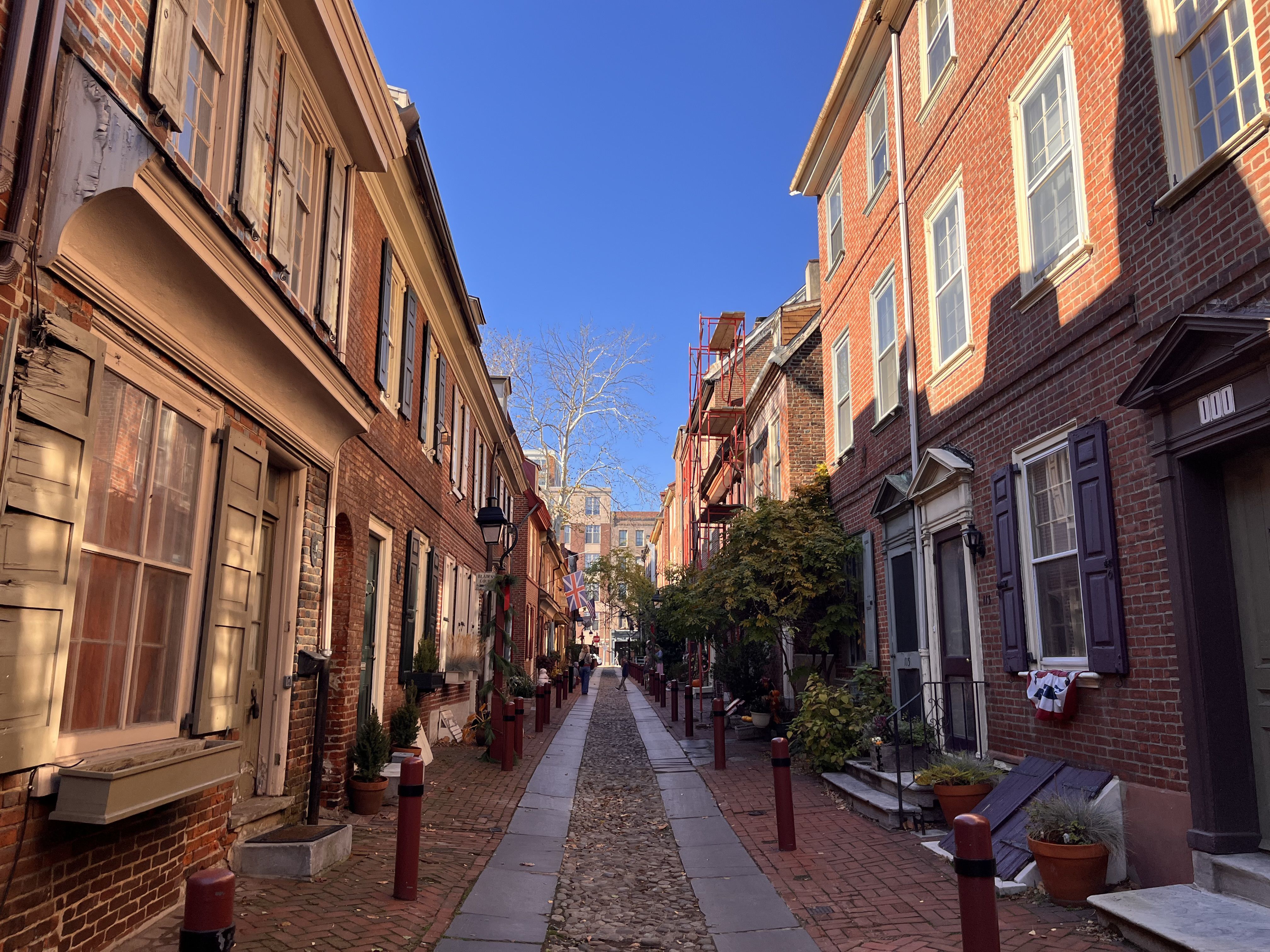
    Elfreth’s Alley is believed to be America’s oldest continuously inhabited residential street. Its origins trace to the early 1700s, when two landowners combined properties to create a cart path leading to the river. People have been living there since 1713.

    The cobblestone alley, about 400 feet long and lined by 30 brick buildings, was named for Jeremiah Elfreth, an 18th-century blacksmith. It originally housed artisans and merchants, serving as a base for business ventures. Notable figures such as Stephen Girard, who helped finance the War of 1812, are believed to have lived here.

    However, Elfreth’s Alley faced demolition due to neglect and development pressure. From the 1890s to the 1930s, part of the block was rebranded as Cherry Street, leading to the loss of at least one historic home.

    Who is Dolly Ottey?

    Ottey, a resident and owner of the Hearthstone restaurant at 115 Elfreth’s Alley, formed the Elfreth’s Alley Association in 1934 to protect the unique street and save it from destruction.

    A view from Elfreth’s Alley facing a vacant lot at Second Street that will be transformed into Dolly Ottey Park.

    Elfreth’s Alley faced an even bigger existential threat in the 1950s and 1960s when proposed construction of I-95 would have demolished at least half the block.

    The demolition was vehemently opposed by Ottey and the Elfreth’s Alley Association. The community gathered 12,000 signatures for a petition presented at City Hall, successfully pleading for the street to be spared.

    Elfreth’s Alley was protected as a National Historic Landmark in the 1960s as a result and is listed on Philadelphia’s historic register.

    Ottey died in 1996, in South Jersey, at age 85.

    Elfreth’s Alley remains not only a residential area but also a cultural and historical attraction. It holds a museum that educates visitors on its history and the lives of early inhabitants.

  • Eagles defensive tackle Byron Young’s father died suddenly in March. He’s found a way to keep Kenny Young close.

    Eagles defensive tackle Byron Young’s father died suddenly in March. He’s found a way to keep Kenny Young close.

    When Byron Young’s father died earlier this year, he asked his mother for his dad’s key chain.

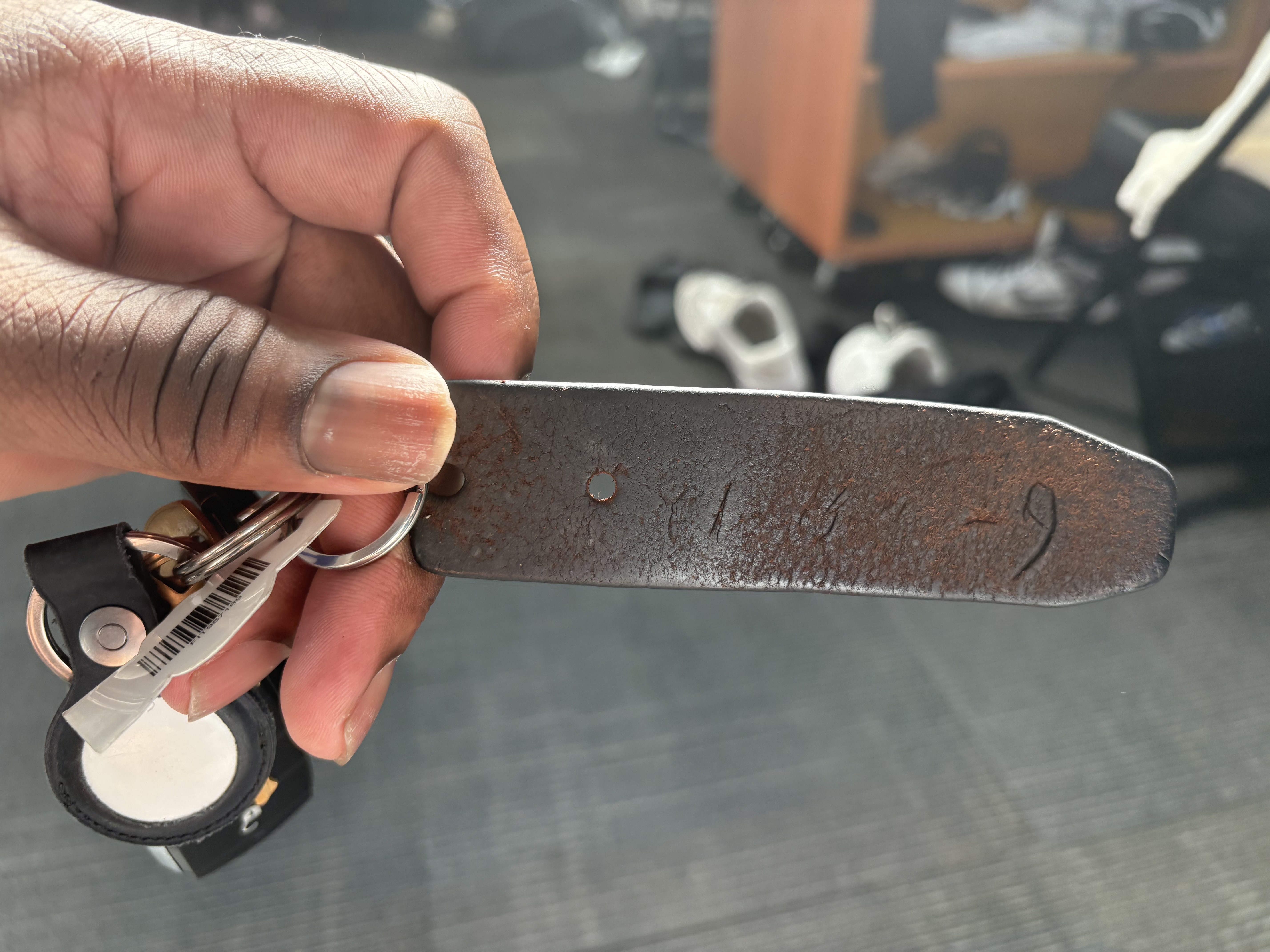
    It’s not your normal key chain. It’s made from the end of a snapped belt, the key ring looping into one of the belt’s holes. There’s a date carved into the brown leather on one side. It’s faint now, but Young said he thinks it reads “7-1-9” for July 1, 2009.

    “I think the date that was on the belt was the date that he cut the belt and put it on his key chain,” Young said. “I want to say the belt was broken or something, and he just put it on there. I don’t think there was any deeper meaning.”

    But the chain has great significance to Young, the Eagles’ 6-foot-3, 292-pound defensive tackle. When he first linked it to his keys, he marked the other side of the belt with the date “4-7-25,” nearly 16 years after his father’s original carving and just a week after Kenny Young, 62, suffered a fatal heart attack.

    Byron Young turned father Kenny’s broken belt into a key chain that serves as a reminder of his father’s love.

    “It’s just something that I knew he always carried around since that day, I believe,” Byron said, “and so it’s just something I want to keep with me.”

    Young grabbed the key chain from his locker stall when a reporter recently asked how he kept his father’s memory alive, crying as he gripped the belt. He doesn’t hide his emotion. He said he gets that from his father, who openly shed tears when he spoke about his love for his family or God.

    “I think a part of being masculine is being able to show your emotions and explain the way you feel and express the way you feel to other people,” Young said. “Not just balling everything up and thinking, ‘Oh, I’m a man. I can’t talk about this.’”

    When Young found out his father had died back home in Mississippi on March 31, he drove to teammate Gabe Hall’s house, overcome with grief. They met just before the 2024 season and spent the next six months as part of the same position group, training side by side nearly every day during the offseason. The goal was to make the Eagles’ 53-man roster after having served mostly as reserves. But his father’s death put Young’s football plans on hiatus. He flew home the next day.

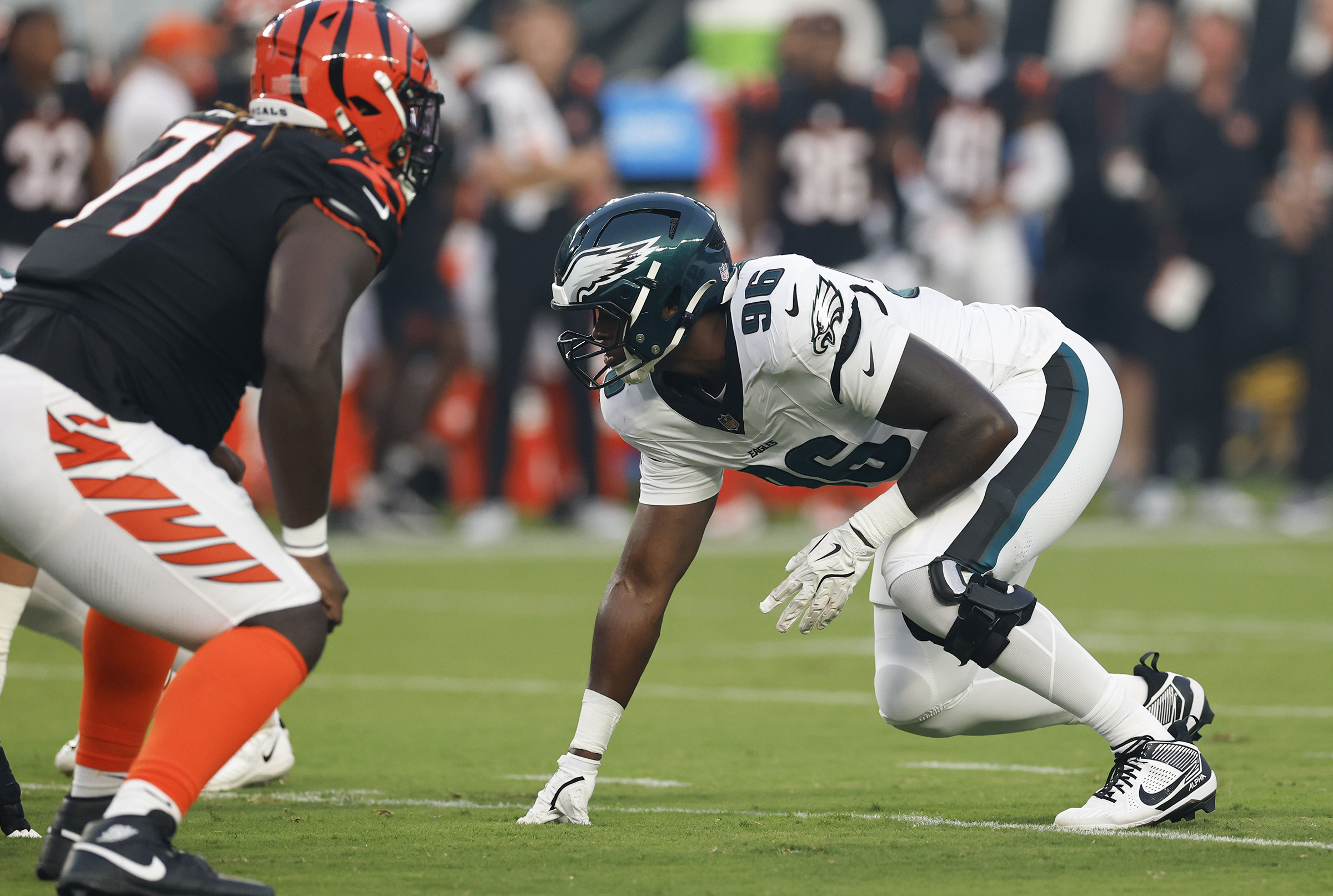
    Eagles defensive tackle Byron Young has appeared in all 11 games this season.

    “I expected him to be gone for the rest of summer,” Hall said. “I was like, ‘OK, he’s not going back. I’m going to miss him.’ But he came right back. And he was like, ‘Bro, it’s time to get to work.’ When I saw that, I was like, ‘Yeah, that’s my dog.’”

    Hall said Young trained with a “chip on his shoulder” that motivated him. They played golf — along with former Eagles tackle Laekin Vakalahi — to break the monotony. And they sometimes spoke about Young’s father.

    Hall said he did his best to keep his friend from ruminating on the loss. Young had all the inspiration he needed.

    “A lot of working out, man, a lot of working out ’cause it’s what he would have wanted,” Young said of his father.

    Young and Hall initially made the active roster. The latter was soon moved to the practice squad where he remains, while the former has played in every game this season as the Eagles’ fourth defensive tackle.

    The 25-year-old Young said he doesn’t dwell on his father’s absence or his last moment with him because it was like so many.

    “He wasn’t the type that didn’t tell you that he loved you. He wasn’t the type that didn’t tell you he was proud of you,” Young said. “He would always let you know, to the day that he passed, that ‘I’m proud of you; you’ve done a lot of great stuff.

    “‘I love you.’”

    Byron Young (center) with his siblings and father, Kenny (center) and mother Melissa (left).

    ‘A passionate person’

    Young didn’t play in Super Bowl LIX in February. His season ended in October when the Eagles placed him on injured reserve with a hamstring injury. But he was in New Orleans for the game, as was his family, which made the two-hour drive south from Taylorsville, Miss.

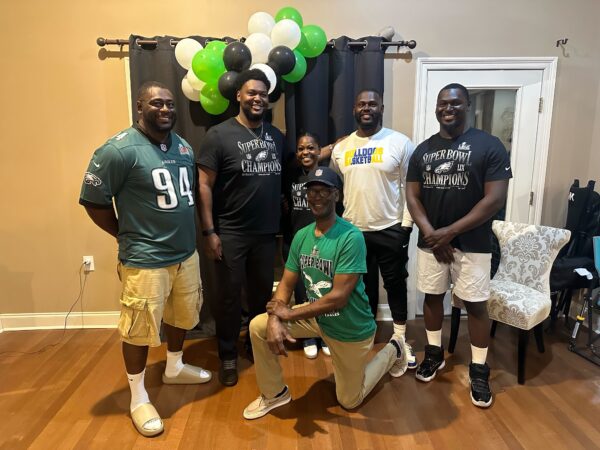
    His parents, Kenny and Melissa, were unable to get on the field at the Superdome to celebrate with Byron after the Eagles toppled the Kansas City Chiefs. But the family had a proper party back home a month later with Byron and his brothers Kendrick, Regrick, and Brandon, and sister Shavon.

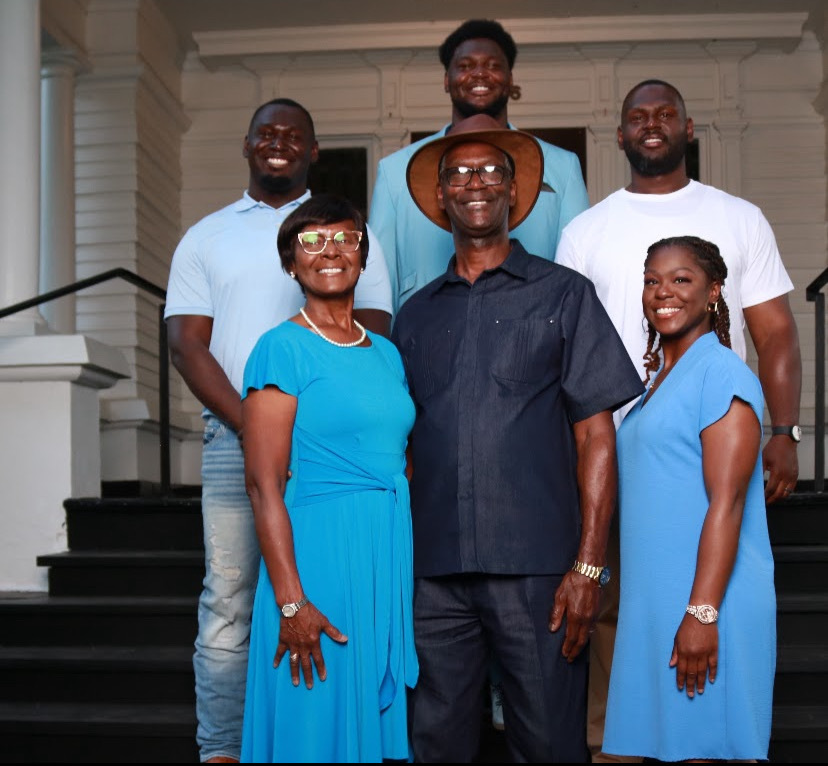
    Byron Young (center), flanked by parents Melissa (left) and Kenny (right) at a family Super Bowl celebration last March. Kenny died suddenly two days after this photo was taken.

    A day later, the Youngs gathered after Sunday church services to celebrate the birthday of Melissa’s sister. At one point, Kenny stood up and delivered a speech. He loved to talk. But he also wanted to express his love for his two sisters-in-law.

    “He shed a few tears. What’s crazy is my uncle told him, ‘You get up there talking like you about to leave us,’” Byron said. “It just so happened that he did. I don’t know if he knew, or I don’t think he knew, but I don’t think anybody had any idea.

    “But, man, he was just always a passionate person.”

    Kenny Young didn’t have anything close to an ideal upbringing, according to his wife and son. But he was a man of faith and found mentors through the Friendship Church of God in Christ in Collins, Miss. He had just ended a relationship when one day in church he prayed that his next girlfriend would become his wife, according to an oft-repeated family anecdote.

    His plea was answered when he met Melissa in the library at the University of Southern Mississippi. She was a student, and he liked to go there to read the magazines. They started dating and married two years later.

    Kenny was a “hands-on man,” as his wife described him. He worked on farms growing up and was mechanically inclined. He was a laborer at Georgia-Pacific and pulled the wood that the company manufactured into paper products.

    The work was physically grinding. Byron recalled his father’s long hours and hearing his keys jingle in the early mornings as he was leaving for the next 12-hour shift. But Kenny also was a present dad to five children, Melissa said.

    There were rules and discipline. He coached his sons in youth football and sometimes took them to chop firewood for parishioners who needed warmth during the winter months. He loved to joke and laugh.

    “The best way to describe Kenny is he loved well,” Melissa said. “He had a great love, reverence for God, and he spoke the truth out of love, and he didn’t want anybody to go to hell. … He was a deacon in our church.”

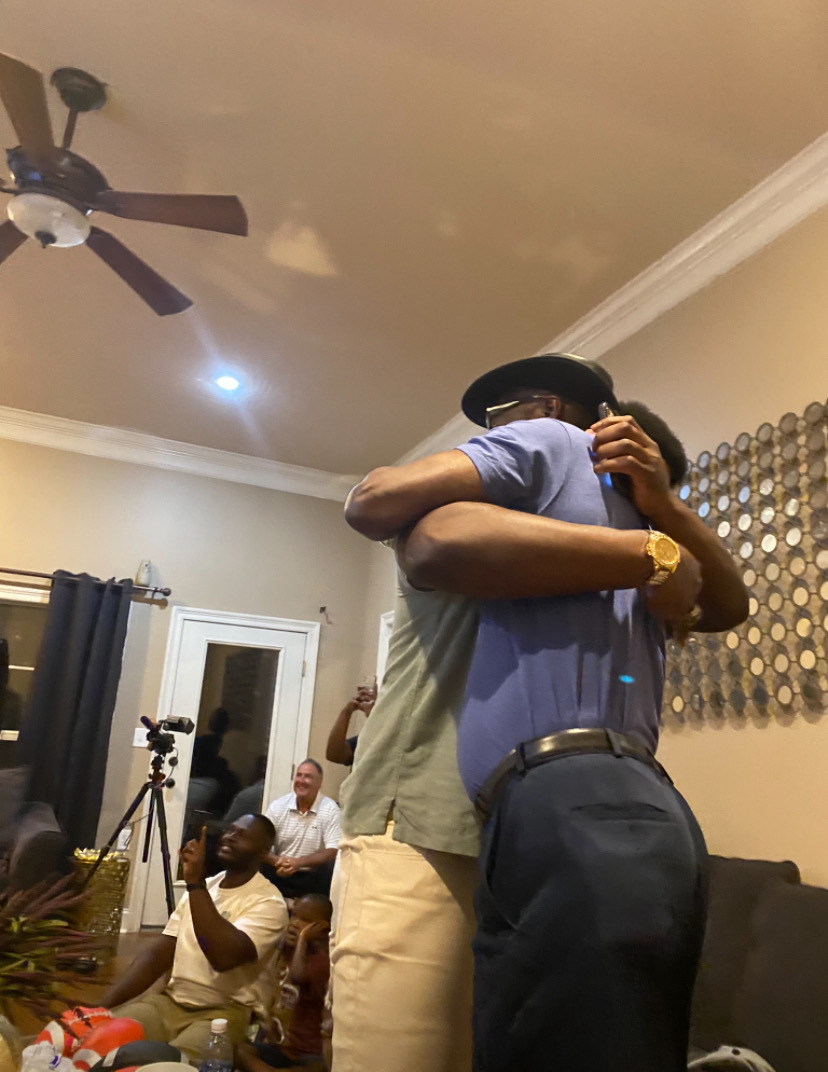
    Byron Young hugging father Kenny after he was selected by the Las Vegas Raiders in the third round of the 2023 draft.

    Kenny had been promoted to less strenuous jobs in his later years at Georgia-Pacific. He was a lathe machine operator who “pushed buttons,” Byron said, to keep wood on the straight and narrow. He could have retired, Melissa said, but he told her he was needed to spread the gospel at work.

    “We had talked about the two of us retiring at age 65, maybe coming out the same year, but God retired him at age 62, and his work was done,” said Melissa, who’s still a pre-K teacher. “And I feel like God said to my husband, ‘Well done, that good and faithful servant.’

    “He slipped away quickly and easily. He didn’t go through any suffering.”

    ‘A mini-him

    Kenny worked on Monday, the day after his sister-in-law’s birthday, after Byron flew back to Philly. Later that night, Kenny got into bed with his wife.

    “He liked to play. And I thought he was making a sound just playing with me,” Melissa said. “And I said, ‘Well, Ken is gonna quit making that sound in a little bit.’ So I guess it may have been a moment, and he kept making the sound. … I got up and I turned the light on, I called his name and I pushed him, and he was not responsive.”

    Melissa called Shavon and they dialed 911. They got Kenny off the bed, elevated his head, and tried chest compressions. One of Byron’s brothers called him immediately. There was nothing that could be done.

    “He wanted to turn around and come drive right back,” Melissa said of Byron. “But one of his brothers convinced him not to. … They told him to get a flight, because he will get here by plane quicker than he would if he got on the road and drove.

    “And he probably was not in any condition to be on the road anyway.”

    Young called Hall instead. He wanted to know if he could watch his dog while he was away. They had worked out at NovaCare Complex, the Eagles’ practice facility, earlier that day. Hall sensed something was wrong.

    “I was like, ‘You OK?’” Hall said. “This was late. You don’t just call me late.”

    Young told him about his father and asked if he could drive over.

    “He allowed me to cry on his shoulder,” Young said. “We just sat in silence because there was nothing really to be said.”

    Eagles defensive tackle Gabe Hall helped Byron Young cope with the pain of his father’s death.

    At one point, Hall said, Young cracked a joke. Hall had never met Young’s father, but he had heard stories about his sense of humor.

    “You could tell he was kind of a mini-him, in a sort of way,” Hall said. “I just knew that was a person he always talked about. He talked about his dad at least a few times a week.

    “You could just tell when a man respects somebody in their life.”

    Kenny played football growing up, but couldn’t pursue it beyond high school because he had family responsibilities, his son said.

    “According to him, he was one of the best ever,” Byron said. “And I don’t doubt it.”

    He stopped coaching his sons when they reached a certain level. But he influenced their every decision. Byron wanted to play at Ole Miss, but Kenny felt Alabama and coach Nick Saban would be best for his son.

    The first training camp was difficult.

    “I remember calling him one day and not wanting to be there anymore,” Young said of his father. “He just told me that’s what I signed up for. … I didn’t really tell anybody else but him. He told me that wasn’t something that he wanted me to do because I gave Alabama my word that I would be there for four years.

    “And that was kind of the end of me thinking that I was going to transfer.”

    Young played in 13 games as a freshman, won a national title as a sophomore, and was All-SEC by his senior season. When the Las Vegas Raiders drafted him in 2023, he and his father had a long, knowing embrace.

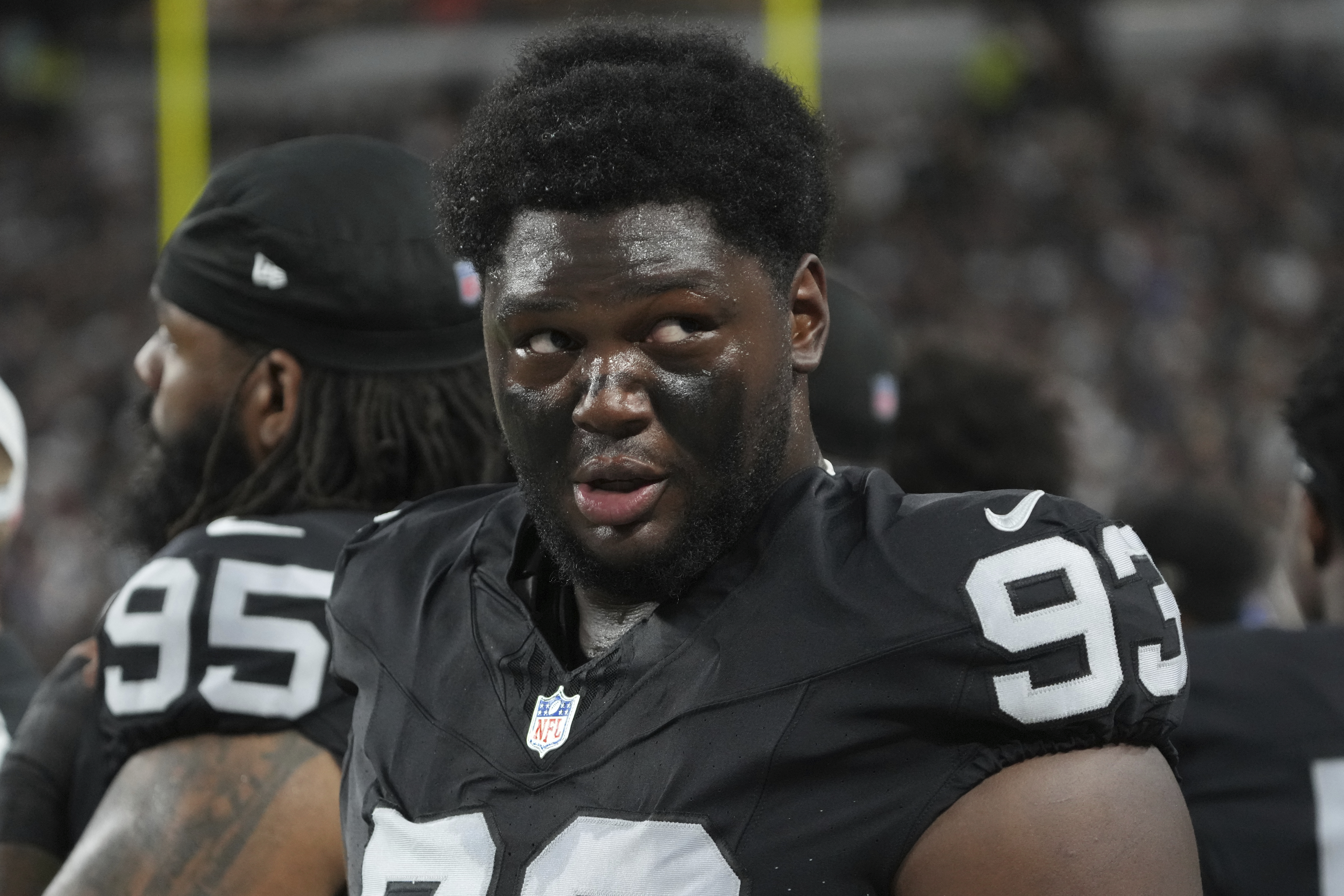
    Byron Young spent one difficult season as a member of the Las Vegas Raiders before being cut and landing in Philly.

    The NFL brought its own struggles. Young played in only six games as a rookie and was cut by the Raiders the following August. He still has the voicemail his father left him offering encouragement and advice.

    “It’s something like the last thing that I have on my phone of his voice,” Young said. “And … I just always keep that in my mind.”

    The Eagles signed him off waivers the next day. Exactly one year later, Young made the 53-man roster out of 2025 training camp. He said he wasn’t surprised “because I knew the work that I had put in.” He just wished his dad could have been there to see it.

    “I believe that he knows, and that he’s in heaven or resting right now,” Young said, “and eventually I’ll see him again.”

    For now, he has mementos. There’s Kenny’s 1967 Pontiac GTO parked in the shed his father built that Byron hopes to finish restoring. And, always with him, his father’s key chain.

    “Hopefully, one day I have a son or a daughter,” Young said, “and I can give it to them.”

  • Football feast | Sports Daily Newsletter

    Football feast | Sports Daily Newsletter

    In the spirit of the holiday, we’re starting the newsletter today with a pair of football-focused stories by Matt Breen to digest.

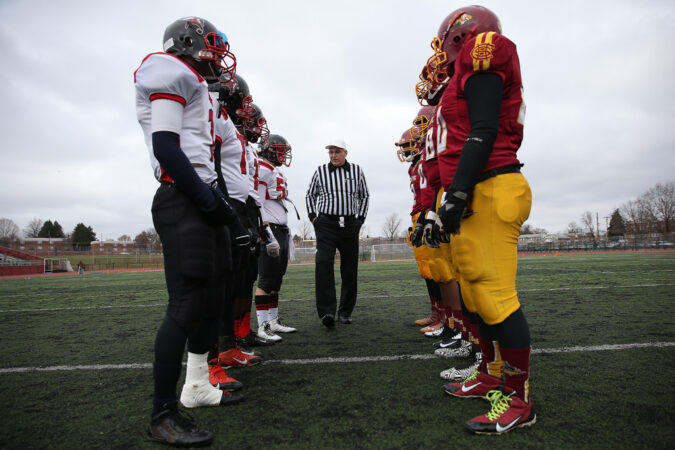
    The first is about a Thanksgiving tradition that is fading away. High school football games between fierce rivals used to be a Turkey Day staple, but only 10 games are planned Thursday in Southeastern Pennsylvania, down from 28 in 2005.

    The games are dwindling because of the PIAA playoff schedule, tepid attendance, and school closures, among other reasons, but one Thanksgiving rivalry plays on. Northeast and Central started playing annually in 1896 and the rivalry has paused only twice: in 1918 during World War I and 2020 during the pandemic. The schools say it’s the nation’s oldest rivalry among public schools.

    Although attendance has shrunk, the teams will meet again at Northeast on Thursday at 10:30 a.m. and the mahogany Wooden Horse trophy will be at stake.

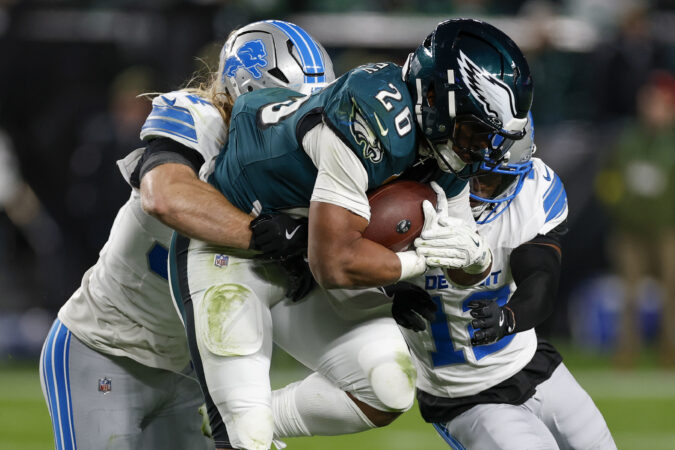
    The second story revisits the rough-and-tumble days of the NFL in the 1940s and ’50s, when Bucko Kilroy was a fearsome force on both sides of the ball for the Eagles. Kilroy was called the dirtiest player in football in a Life magazine article, but he wound up spending 64 years in the NFL as a player, coach, scout, and front-office executive.

    Kilroy will be inducted into the Eagles Hall of Fame on Friday.
    — Jim Swan, @phillysport, sports.daily@inquirer.com.

    If someone forwarded you this email, sign up for free here.

    We’re taking a break

    Happy Thanksgiving! The newsletter will be taking Thursday and Friday off as we observe the holiday. Sports Daily will return to your inbox on Monday.
    Loaded for Bears

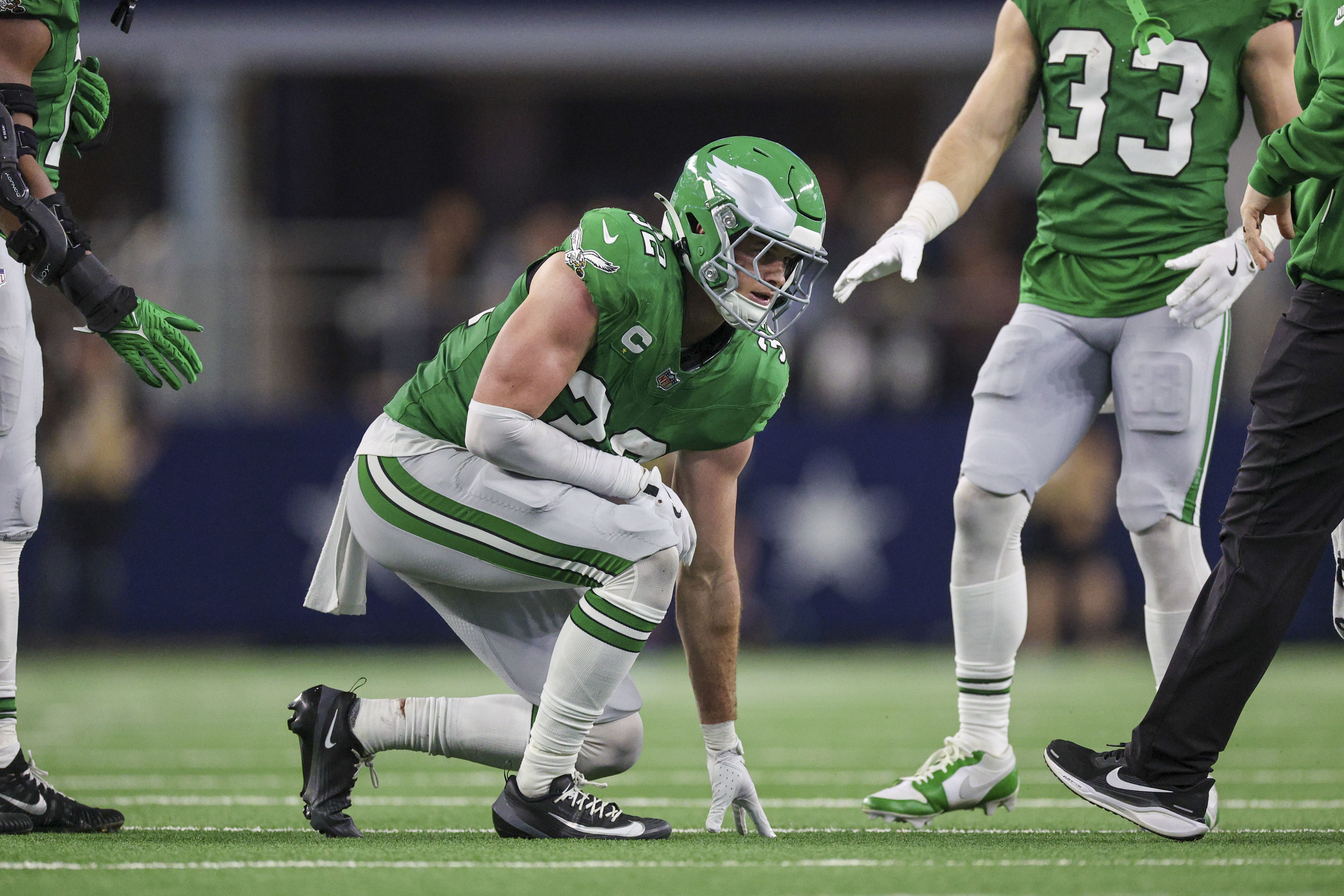
    Eagles safety Reed Blankenship limping off the field after he suffered a thigh injury against the Cowboys.

    The Eagles needed some good news after that awful ending on Sunday and this is it: Defensive coordinator Vic Fangio says he expects to have Reed Blankenship available to play in the Good Friday matchup against the Chicago Bears (3 p.m., Fox29).

    The veteran safety left the Cowboys game with an injured thigh and the other safety, Drew Mukuba, suffered a right leg fracture in that game. Cornerback Adoree’ Jackson left with a concussion, too. Olivia Reiner reports on how the Birds plan to patch up their secondary against the Bears.

    Also on the Eagles beat:

    A bright spot

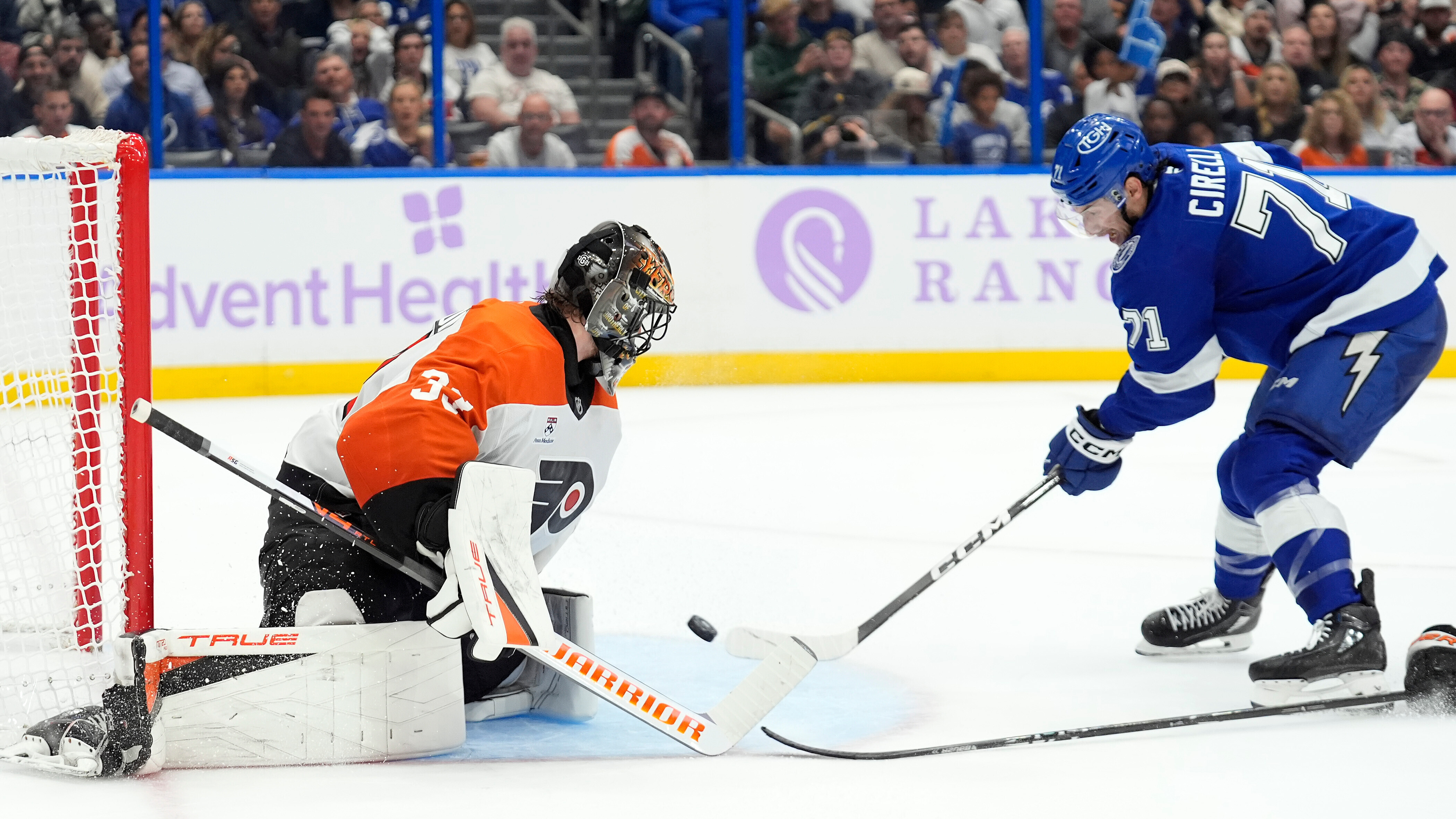
    Lightning center Anthony Cirelli scores on Flyers goaltender Samuel Ersson during the second period Monday.
    The Flyers managed only 20 shots on goal Monday, failing to score for the first time this season in a 3-0 loss to the Lightning in Tampa, Fla. Tending goal for the first time in 10 days, Sam Ersson played well for the Flyers, making 15 saves. Peer beyond the box score and you’ll see a goalie who played his game.

    Join us before kickoff

    Gameday Central: Bears at Eagles

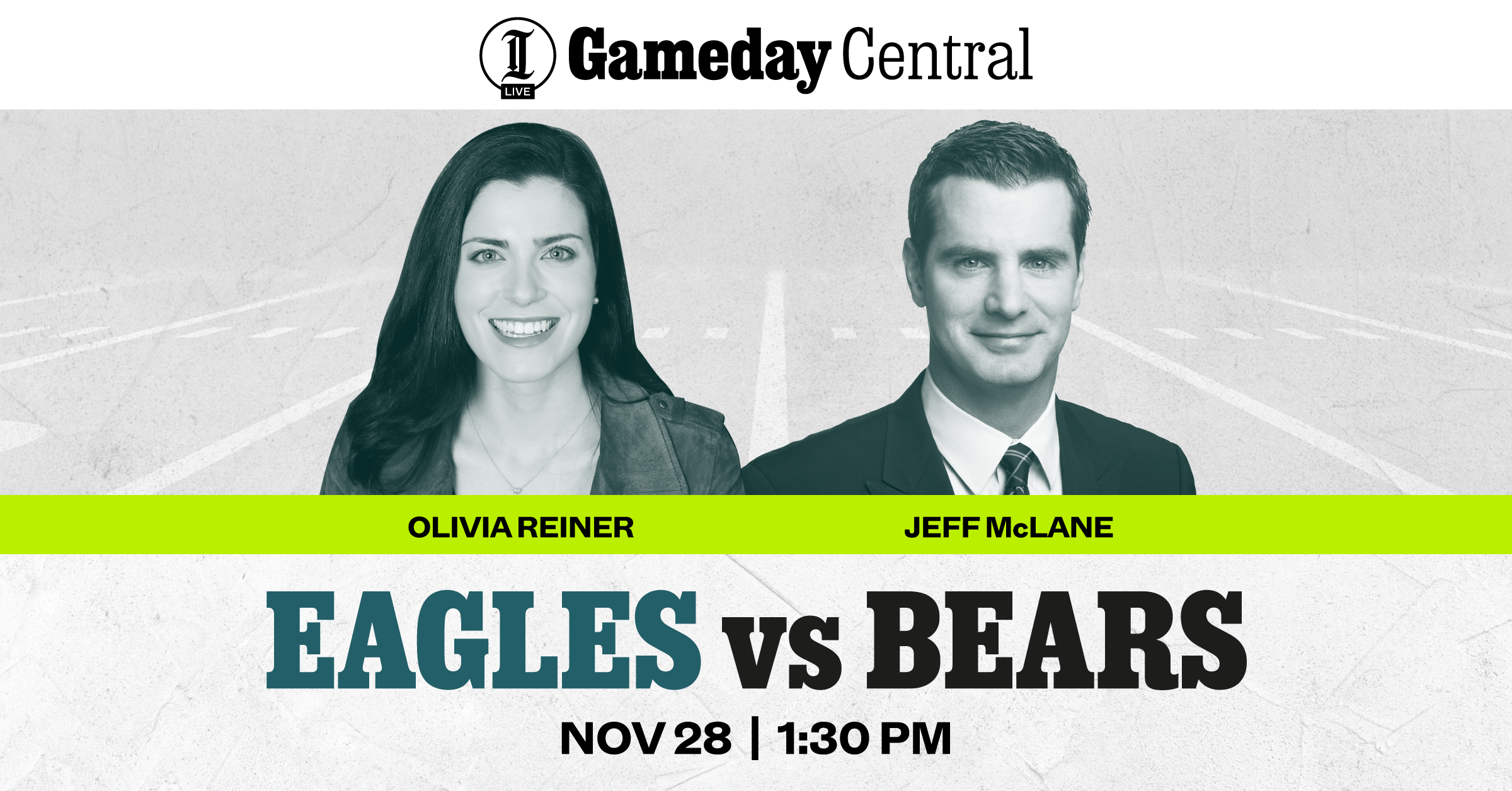
    Live from the Linc: Beat writers Jeff McLane and Olivia Reiner will preview the game against the Bears on Friday at 1:30 p.m. Tune in to Gameday Central.

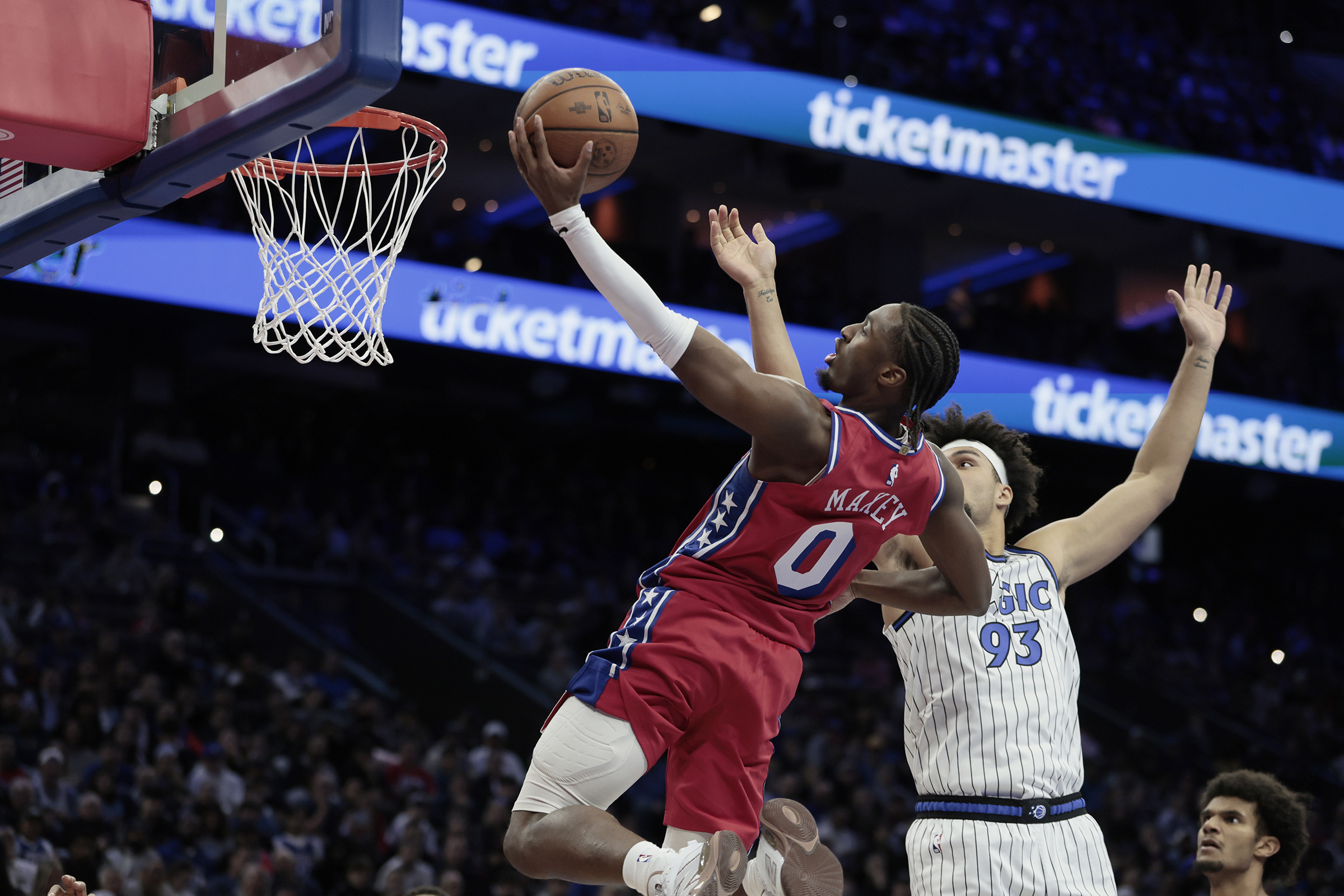
    Sixers’ Tyrese Maxey drives to the rim during the first half of their loss to the Orlando Magic on Tuesday night at Xfinity Mobile Arena.

    Sports snapshot

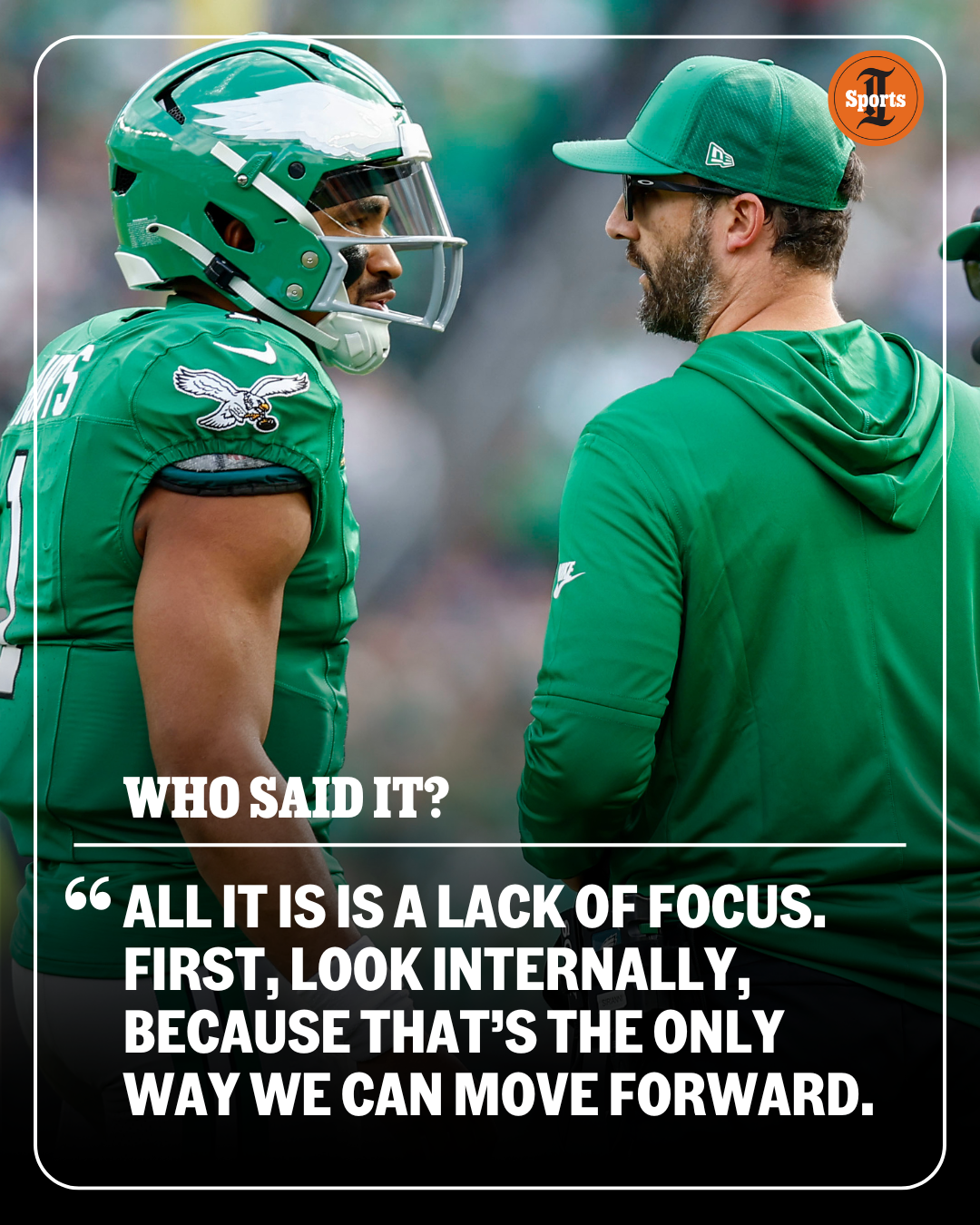
    Who said it?

    Jalen Hurts and Nick Sirianni talking during Sunday’s loss. The Eagles offense has lacked consistency all season.

    What’s wrong with the Eagles? One veteran offered his take. Click here to see if you know who said it.

    What you’re saying about the Eagles

    We asked: Should the Eagles change their play-caller? Among your responses:

    I do not ascribe that play calling is at the root of the offense’s “funk.” I see the issue as execution on the field. Saquon’s inability to gain constructive yards and bone headed penalties and decisions (fielding punt on 2-yard line) as the primary culprit. — Bill M.

    YES! — Jill L.

    Just curious why the Eagles felt that “on the job training” would be successful? Detroit made the change a few weeks ago. Worked for the first game and that’s it. How come no one is questioning Jeff Stoutland, the OL and run game coach? Big game coming up on Friday afternoon against da’ Bears. Looking for a 34-10 win and that will shut everyone up! Me included! Except for talk radio that will pick the game apart as usual. — Ronald R.

    ABSOLUTELY. Duh. … Patullo is not working. At the end of the season, you’ll be saying “shoulda, woulda, coulda.” — Karen L.

    The Eagles definitely need to change their play caller, but would guess that would not be easy at this point in the season. Maybe a serious sit down with Patullo, Sirianni, Roseman, and Mr. Lurie would help. I’ve never been a football coach, but just watching on TV from far away I find myself so frustrated at the calls that seem to be contrary to the immediate need. — Everett S.

    It is easy to want a change, but who would you turn to? Nick is hopefully on the middle of game planning. Given his 4th quarter calls, he is not the answer. We are stuck with a learning curve and will have to ride it out. Either the plays are too conservative or the execution by the players is off. The offensive line has not been intact all year and Barkley looks a step slower. — Bob C.

    There is something clearly wrong with this offense. They have enough talent that blowing a 21-point lead should never happen. I am not certain that the play caller is the problem but something has to change and that seems to be the place to start. — Bill H.

    We compiled today’s newsletter using reporting from Matt Breen, Jeff Neiburg, Olivia Reiner, Jeff McLane, Marcus Hayes, Keith Pompey, Jackie Spiegel, Ariel Simpson, Colin Schofield, and Katie Lewis.

    By submitting your written, visual, and/or audio contributions, you agree to The Inquirer’s Terms of Use, including the grant of rights in Section 10.

    Again, happy Thanksgiving! I’ll see you in Monday’s newsletter. — Jim