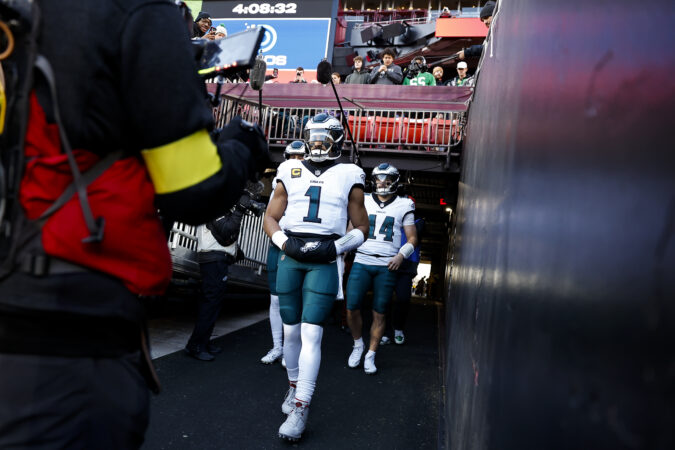
Hours before kickoff in Saturday’s Eagles-Commanders matchup, a Google app jumped the gun with an AI-generated post that the Birds had won the game.
The artificial intelligence hiccup, known as a hallucination, had the Eagles winning 27-17 and clinching the NFC East title. It even included made-up game highlights — Jalen Hurts throwing for over 200 yards and Saquon Barkley scoring a key touchdown. (Here in the real world, Hurts threw for 185 yards in a 29-18 Eagles win; Barkley did in fact run for a TD as the Birds became the champs of the NFC East.)
The false information was easily identified because the game had not started, but that is not always the case with AI hallucinations in legal cases and financial reporting, said Subodha Kumar, a professor of statistics, operations, and data science at Temple University’s Fox School of Business.
“Sometimes it is so wrong that you can detect it,” Kumar said in an interview Saturday. “Sometimes you cannot.”
The fake post was captured by Reddit Philadelphia users. Such erroneous AI-generated posts are user-specific and often deleted. A line at the bottom of the post cautioned: “Generated with AI, which can make mistakes.”
The post linked to an accurately reported 6abc game preview story noting that the Eagles could become the first NFC East team since 2004 to win back-to-back division titles.
Kumar said the hallucinations typically link to a news article or published reference to give the false information the appearance of legitimacy.
Eagles fans commented on the error on Reddit. Some immediately recognized it as an AI mistake; others worried that it could be a jinx for the Eagles.
“Crossing my fingers but jeepers Google kind of jumped the gun this morning,” one wrote.
“I saw this and thought — did I miss a game?” another commented.
Another wrote: “‘Generated with AI, which can make mistakes’ is the understatement of the year.”
Hallucinations occur when a generative AI model confidently presents false or misleading information as a fact, rather than a prediction, Kumar said.
They are most common in big sporting events, like the 2024 Super Bowl, when two AI chatbots made up statistics when questioned about the game between the Kansas City Chiefs and the San Francisco 49ers. (The Chiefs won in overtime.)
There have also been false AI-generated election results, financial reports, and legal decisions, Kumar said. The biggest impact may be false financial reports, which can affect the stock market, he said.
“Clearly, this is a big problem,” Kumar said. “We have to be careful using the results for critical decision-making.”
Kumar said guardrails currently are not properly designed to prevent such errors, but the technology has improved in recent years.
More companies have added fact-checking technology to alert the algorithm before it generates erroneous content, he said.
Asked Saturday afternoon to predict the Eagles game, Kumar quipped: “I will leave it to AI.”
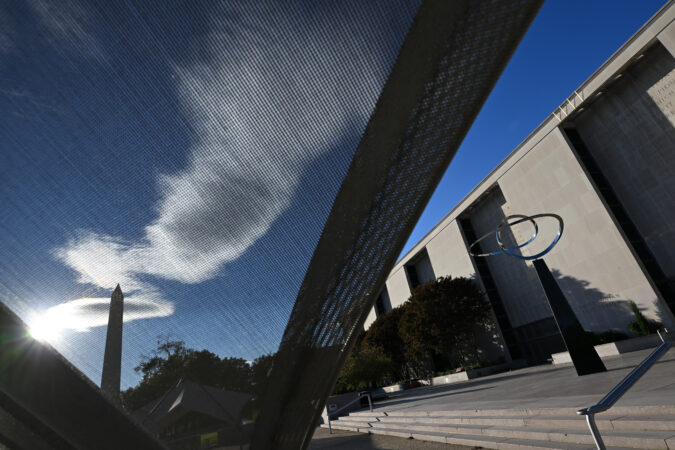
The Trump administration escalated pressure on the Smithsonian last week, threatening to withhold federal funds if it does not submit extensive documentation for a sweeping content review. President Donald Trump earlier this year set out to purge what he called “improper ideology” from the nation’s most prestigious museum system, efforts that are expected to intensify as his administration tries to shape the country’s 250th anniversary celebrations next year.
In a staff email obtained by the Washington Post, sent Friday evening after the funding threat, Smithsonian Secretary Lonnie G. Bunch III said the Smithsonian had sent information to the White House in September and intended to submit more that day. He asserted that “all content, programming, and curatorial decisions are made by the Smithsonian.”
The previous day, Domestic Policy Council director Vince Haley and White House budget directorRussell Vought wrote to Bunch that the Smithsonian’sinitial submissions “fell far short of what was requested.” Among the solicited documents are current exhibition descriptions, comprehensive America 250 programming files, draft plans for upcoming shows, and internal guidelines used in exhibition development. The White House gave the Smithsonian until Jan. 13 to meet the request.
“Funds apportioned for the Smithsonian Institution are only available for use in a manner consistent with Executive Order 14253 ‘Restoring Truth and Sanity to American History,’ and the fulfillment of the requests set forth in our Aug. 12, 2025 letter,” Haley and Vought wrote. The letter specifically referenced the Museum of American History, the Museum of Natural History, the Air and Space Museum, the Museum of African American History and Culture, the Museum of the American Indian, the Smithsonian American Art Museum, the Museum of African Art, and the National Portrait Gallery.
It was not immediately clearhow much money the White House might try to withhold, from which parts of the Smithsonian, or on what authority. The institution is about 62% federally funded by a combination of congressional appropriation, federal grants, and contracts.
An earlier letter, in August, called for an aggressive review of eight museums to ensure they align with the president’s directive to “celebrate American exceptionalism” and asked the Smithsonian tosubmit all requested materials within 75 days and “begin implementing content corrections” within 120.
Amid scrutiny from Trump, the institution had already planned its own content review, with theSmithsonian’s Board of Regents instructing Bunch in June “to ensure unbiased content” across the institution and report back on “any needed personnel changes.”
The Smithsonian declined to comment on the latest development. In Friday’s email, Bunch told staff that the institution had provided the White House with information in September about their public exhibitions and displays, policies, and procedures, and had planned to send more documents related to their mission, organization, and public exhibitions and displays.
But, Bunch added, “some aspects of the White House request are not readily available and will require a significant amount of time, labor, and coordination from various departments across the Smithsonian” and as they collect documents, they would “continue to evaluate the scope of our response.”
He stressed that the Smithsonian is “committed to transparency” and has for nearly 180 years “served our country as an independent and nonpartisan institution.”
In September, Bunch wrote in a letter to staff that the institution had assembled a small, internal team to advise on what it can provide to the White House and said it was undergoing “our own review of content to ensure our programming is factual and nonpartisan.”
The heightened demands arrive at the end of a tumultuous year for the Smithsonian — the self-described “world’s largest museum, education, and research complex” — which normallyoperates independently. Historians have broadly criticized Trump for attempting to sanitize the country’s past by demanding that cultural institutions espouse “American exceptionalism” and focus less on slavery, among other historical sins.
In June, the director of the Smithsonian’s National Portrait Gallery, Kim Sajet, resigned after Trump attempted to fire her, and months later, artist Amy Sherald pulled her solo show from the same museum, after a disagreement with the institution over how a portrait of a transgender woman as the Statue of Liberty would be displayed.
The Trump administration amplified its rhetoric over the summer, with the president posting on social media that the nation’s museums are “essentially, the last remaining segment of ‘WOKE’” and that the Smithsonian is too focused on “how bad Slavery was.” The White House later released a list of exhibits and materials at the Smithsonian of which it disapproves, specifically targeting works and content mentioning race, slavery, transgender identity, and immigration.
A unique public-private partnership that is a “trust instrumentality” created by Congress, the Smithsonian puts its public funds toward conserving national collections, basic research, public education, andadministrative and support services to maintain large museum and research complexes. Itsprivate funds are used to endow positions, build new facilities, andopen new exhibitions, among other uses, according to the Smithsonian website.
“We wish to be assured that none of the leadership of the Smithsonian museums is confused about the fact that the United States has been among the greatest forces for good in the history of the world” leading up to the nation’s 250th anniversary, Haley and Vought wrote in Thursday’s letter. “The American people will have no patience” for any museum that is “uncomfortable conveying a positive view of American history.”
The Organization of American Historians wrotein an August statement that Trump’s content review “will undoubtedly be in service of authoritarian control over the national narrative, collective memory, and national collections.”
James Millward, a history professor at Georgetown who studies Chinese history and is one of the founders and leaders of Citizen Historians for the Smithsonian — a volunteer effort to document everything on display at the institution — said that he suspects the request for digital files means “they’re looking for trigger words.” The Post reported in February that National Science Foundation staff members were combing through research projects looking for words such as “diversity” and “gender.”
“We’ve seen, of course, this across websites, across agencies, across the United States, and they want to apply that kind of sledgehammer, chauvinistic, brute force, and frankly, bigoted approach to the Smithsonian as well,” Millward told the Post.
The rhetoric from the Trump administration on how to discuss the past is “very similar to Chinese Communist Party propaganda,” he said. “Only positive stories, only positive energy, no negative energy allowed when you’re talking about history.”
Over three years, the U.S. Citizens Coinage Advisory Committee sifted through hundreds of ideas for commemorative coins to celebrate the 250th anniversary of America’s founding.
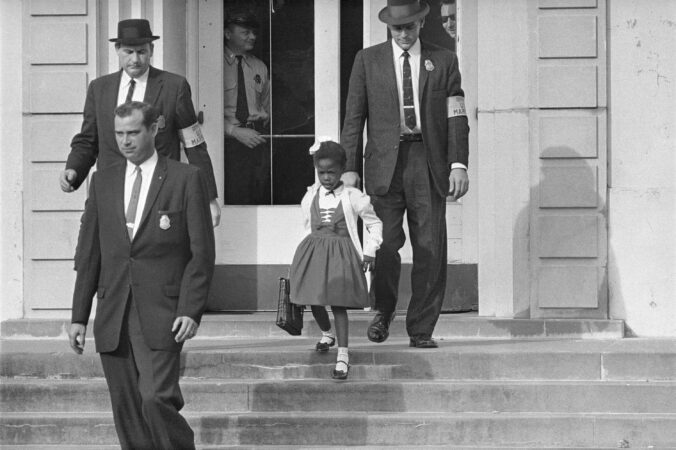
The group settled on five options, including quarters honoring abolitionist Frederick Douglass; Ruby Bridges, a 6-year-old girl who helped integrate public schools in New Orleans; and the women’s suffrage movement.
“The question was do we focus only on what happened in 1776 and the years around that or do we also talk about everything that has happened since then,” said Lawrence Brown, a retired New York City doctor who served on the committee from 2019 to 2024.
“To me, the latter is just as important if not more important because it gives us answers to the questions of how did we maintain that Constitution? How did we maintain our independence?”
In a preview of the Trump administration’s approach to celebrating the country’s 250th birthday, Treasury Department officials announced this month that the agency would ignore the committee’s recommendation and produce quarters that are far less diverse and more traditional. Instead of addressing the country’s racial history, the five coins will feature images of former presidents George Washington, Thomas Jefferson, James Madison, and Abraham Lincoln, as well as a Pilgrim couple.
The Biden administration was focused on diversity, equity and inclusion, and critical race theory, U.S. Treasurer Brandon Beach told Fox News, but the “Trump administration is dedicated to fostering prosperity and patriotism.”
“The designs on these historic coins depict the story of America’s journey toward a ‘more perfect union,’ and celebrate America’s defining ideals of liberty,” Kristie McNally, acting director of the U.S. Mint, said in a statement.
The administration is also considering a commemorative dollar with President Donald Trump’s face on one side and his raised fist with the words “FIGHT FIGHT FIGHT” on the other, a reference to the widely circulated image of the president following an assassination attempt in 2024. Democratic senators have decried the idea as “un-American” and introduced legislation to prohibit “the likeness of a living or sitting president” from appearing on American currency.
The nation’s semiquincentennial offers Trump a rare, high-profile opportunity to shape how Americans understand the country’s history. In addition to the coins, the Post Office is expected to announce commemorative stamps, and the National Endowment for the Humanities is offering up to $200,000 to fund new statues of historical figures.
The new coin designs reflect the Trump Administration’s focus on exalting the country’s pre-civil rights history and depicting idealized images of American life. It is part of an effort to rewrite the past with an exclusionary view of American history, some historians said.
The White House is working with PragerU, a nonprofit that produces educational videos and is known for taking a conservative view of American history, to organize educational initiatives and “freedom trucks,” mobile museums that will be driven across the country during semiquincentennial celebrations.
In September, the administration announced the opening of the Founders Museum in Washington, which has been criticized by historians for its use of AI-generated material and its exclusion of nonwhite voices from the nation’s past. The administration is encouraging educators to re-create the exhibit at their schools with printable versions of the portraits and labels.
“The goal is to instill a sense of patriotism in young Americans,” said Allen Estrin, co-founder of PragerU. “If we don’t have an appreciation of our past, it’s going to be very difficult to imagine a bright future.”
Andrew Rudalevige, a professor of government at Bowdoin College, said that it is not unusual for presidents to put their stamp on historical events and tie them to their agendas. But by working so closely with ideological groups and focusing on issues like DEI, Trump is risking infusing partisan politics into the semiquincentennial and turning off half the country, he said.
“I’d be very happy for more people to read the founding documents and seriously engage with the arguments that founders were making,” Rudalevige said. “But I think unfortunately it’s likely that the celebration is going to be pushed into the same culture wars and the same polarization that seems to affect so much of the country right now when it ought to be a time when we could rise above that.”
Dean Kotlowski, a historian who served on the Citizens Coinage Advisory Committee from 2018 to 2023, said the new coins are part of the administration’s efforts to derail a campaign to diversify the faces on America’s money. “The whole idea was to get away from this kind of presidential history but these coins are very, very traditional,” Kotlowski said.
The committee, which was established by Congress in 2003, began working on coins to celebrate the country’s 250th birthday after Trump signed the Circulating Collectible Coin Redesign Act during the waning days of his first term. The law called for the creation of five quarters, including at least one featuring a woman.
The 11-member committee worked with the National Archives, National Park Service, and historians to develop themes and designs for the coins. They conducted online polls and solicited public comment. The process culminated in a two-day public hearing in October 2024 before the panel submitted its final recommendations to then-Treasury Secretary Janet L. Yellen.
Among the designs recommended for the quarter featuring Bridge is an image immortalized in Norman Rockwell’s 1964 painting of her being escorted to school by U.S. marshals with the words “We Shall Overcome.” The committee chose a portrait of Frederick Douglass that, it said, “conveys his strength as a symbol of the abolition movement.” A third coin celebrating the women’s suffrage movement included a protester carrying a “Votes for Women” flag.
The remaining two quarters would feature images of the Declaration of Independence and the U.S. Constitution.
“The process, as it was supposed to happen, is very well-informed, very public, and taken very seriously,” said Dennis Tucker, who took part in the deliberations during his tenure on the committee from 2016 to 2024. “It’s not clear what went into this decision.”
Trump has been on a campaign to restore what he calls “patriotic education” to the country’s national parks, monuments, and museums. Signs and exhibits related to slavery have been removed from multiple national parks with Trump arguing that they overemphasize the negative aspects of American history. The administration cut funding to small archives and museums across the country but later restored grants to those aligned with Trump’s vision for the celebration of the 250th anniversary.
During his first term, his administration halted efforts to put Harriet Tubman on the $20 bill, with Trump criticizing the Obama-era decision as “pure political correctness.”
David Ekbladh, a professor of history at Tufts University, said Trump’s focus on advancing a traditional version of history has intensified since his first term. “During his first administration, Trump pardoned Susan B. Anthony,” Ekbladh said. In 1872, nearly 50 years before women gained the right to vote, Anthony was arrested for wrongfully and willfully voting.
“But now, even the suffragists are seen as outside the pale of what they want as part of our remembered past.”
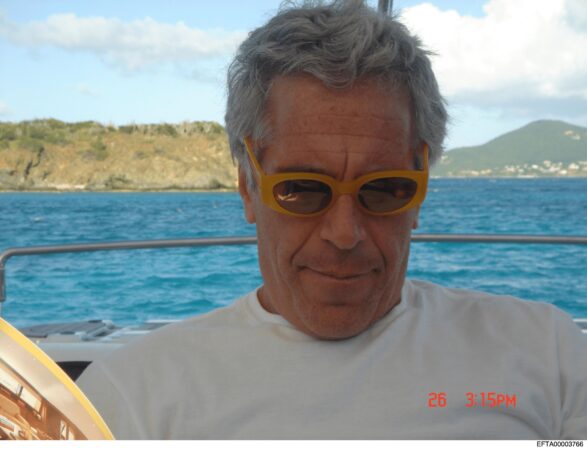
NEW YORK — At least 16 files disappeared from the Justice Department’s public webpage for documents related to Jeffrey Epstein — including a photograph showing President Donald Trump — less than a day after they were posted, with no explanation from the government and no notice to the public.
The missing files, which were available Friday and no longer accessible by Saturday, included images of paintings depicting nude women, and one showing a series of photographs along a credenza and in drawers. In that image, inside a drawer among other photos, was a photograph of Trump, alongside Epstein, Melania Trump, and Epstein’s longtime associate Ghislaine Maxwell.
The Justice Department did not say why the files were removed or whether their disappearance was intentional. A spokesperson for the department did not immediately respond to a request for comment.
Online, the unexplained missing files fueled speculation about what was taken down and why the public was not notified, compounding long-standing intrigue about Epstein and the powerful figures who surrounded him. Democrats on the House Oversight Committee pointed to the missing image featuring a Trump photo in a post on X, writing: “What else is being covered up? We need transparency for the American public.”
The episode deepened concerns that had already emerged from the Justice Department’s much-anticipated document release. The tens of thousands of pages made public offered little new insight into Epstein’s crimes or the prosecutorial decisions that allowed him to avoid serious federal charges for years, while omitting some of the most closely watched materials, including FBI interviews with victims and internal Justice Department memos on charging decisions.
Scant new insight in initial disclosures
Some of the most consequential records expected about Epstein are nowhere to be found in the Justice Department’s initial disclosures, which span tens of thousands of pages.
Missing are FBI interviews with survivors and internal Justice Department memos examining charging decisions — records that could have helped explain how investigators viewed the case and why Epstein was allowed in 2008 to plead guilty to a relatively minor state-level prostitution charge.
The gaps go further.
The records, required to be released under a recent law passed by Congress, hardly reference several powerful figures long associated with Epstein, including Britain’s former Prince Andrew, renewing questions about who was scrutinized, who was not, and how much the disclosures truly advance public accountability
Among the fresh nuggets: insight into the Justice Department’s decision to abandon an investigation into Epstein in the 2000s, which enabled him to plead guilty to that state-level charge, and a previously unseen 1996 complaint accusing Epstein of stealing photographs of children.
The releases so far have been heavy on images of Epstein’s homes in New York City and the U.S. Virgin Islands, with some photos of celebrities and politicians.
There was a series of never-before-seen photos of former President Bill Clinton but fleetingly few of Trump. Both have been associated with Epstein, but both have since disowned those friendships. Neither has been accused of any wrongdoing in connection with Epstein and there was no indication the photos played a role in the criminal cases brought against him.
Despite a Friday deadline set by Congress to make everything public, the Justice Department said it plans to release records on a rolling basis. It blamed the delay on the time-consuming process of obscuring survivors’ names and other identifying information. The department has not given any notice of when more records might arrive.
That approach angered some Epstein accusers and members of Congress who fought to pass the law that forced the department to act. Instead of marking the end of a yearslong battle for transparency, the document release Friday was merely the beginning of an indefinite wait for a complete picture of Epstein’s crimes and the steps taken to investigate them.
“I feel like again the DOJ, the justice system is failing us,” said Marina Lacerda, who alleges Epstein started sexually abusing her at his New York City mansion when she was 14.
Many records were redacted or lacked context
Federal prosecutors in New York brought sex trafficking charges against Epstein in 2019, but he killed himself in jail after his arrest.
The documents just made public were a sliver of potentially millions of pages of records in the department’s possession. In one example, Deputy Attorney General Todd Blanche said Manhattan federal prosecutors had more than 3.6 million records from sex trafficking investigations into Epstein and Maxwell, though many duplicated material already turned over by the FBI.
Many of the records released so far had been made public in court filings, congressional releases, or freedom of information requests, though, for the first time, they were all in one place and available for the public to search for free.
Records that were new were often lacking necessary context or heavily blacked out. A 119-page document marked “Grand Jury-NY,” likely from one of the federal sex trafficking investigations that led to the charges against Epstein in 2019 or Maxwell in 2021, was entirely blacked out.
Trump’s Republican allies seized on the Clinton images, including photos of the Democrat with singers Michael Jackson and Diana Ross. There were also photos of Epstein with actors Chris Tucker and Kevin Spacey, and even Epstein with TV newscaster Walter Cronkite. But none of the photos had captions and no explanation was given for why any of them were together.
The meatiest records released so far showed that federal prosecutors had what appeared to be a strong case against Epstein in 2007 yet never charged him.
Transcripts of grand jury proceedings, released publicly for the first time, included testimony from FBI agents who described interviews they had with several girls and young women who described being paid to perform sex acts for Epstein. The youngest was 14 and in ninth grade.
One had told investigators about being sexually assaulted by Epstein when she initially resisted his advances during a massage.
Another, then 21, testified before the grand jury about how Epstein had hired her when she was 16 to perform a sexual massage and how she had gone on to recruit other girls to do the same.
“For every girl that I brought to the table he would give me $200,” she said. They were mostly people she knew from high school, she said. “I also told them that if they are under age, just lie about it and tell him that you are 18.”
The documents also contain a transcript of an interview Justice Department lawyers did more than a decade later with the U.S. attorney who oversaw the case, Alexander Acosta, about his ultimate decision not to bring federal charges.
Acosta, who was labor secretary during Trump’s first term, cited concerns about whether a jury would believe Epstein’s accusers.
He also said the Justice Department might have been more reluctant to make a federal prosecution out of a case that straddled the legal border between sex trafficking and soliciting prostitution, something more commonly handled by state prosecutors.
“I’m not saying it was the right view,” Acosta added. He also said that the public today would likely view the survivors differently.
“There’s been a lot of changes in victim shaming,” Acosta said.
NEW YORK — The Flyers seemed to have the game in hand, thanks to a four-goal second period, but then the lights went out on Broadway.
Heading into the third period with a 4-2 lead, the Flyers allowed the New York Rangers to come back and steal a 5-4 shootout win. It is the first time this season the Flyers led heading into the third period and lost (10-0-1).
Mika Zibanejad tied the game with 2 minutes, 34 seconds left in regulation, beating his countryman, Sam Ersson, with a one-timer from the left circle. The Rangers had a power play after Rasmus Ristolainen was called for delay of game, when he sent the puck over the glass.
“I think we just can’t sit back as much as we do,” said forward Owen Tippett. “We put ourselves in great spots, and obviously we play a certain way to get there, and I think we just have to kind of continue playing that way and not worry about sitting back.”
Artemi Panarin, who had a pair in regulation, and Vincent Trocheck, who scored the Rangers’ third goal, each beat Ersson in the skills competition. New York netminder Igor Shesterkin stopped Trevor Zegras before Travis Konecny hit the post.
The Flyers have lost two straight and five of their past six games, with four of the losses coming after regulation.
“We’re starting to learn how to win,” coach Rick Tocchet said postgame. “This group’s going to have to learn, but they’re working hard. We [were up] 4-2 and had a couple of opportunities to score, and then we leave it for chance, right? A penalty. You can’t take your foot off.”
The dog is in the fight
Denver Barkey spent Friday afternoon tossing and turning in bed, trying to get his pregame nap in before Lehigh Valley of the American Hockey League’s game against Bridgeport.
“Couldn’t fall asleep, and I rolled over and checked the time on my phone and saw a few missed calls from [Flyers general manager Danny Brière] and a text saying, call me back ASAP, so kind of clicked in there,” Barkey said of when he found out he was being called up to the Flyers.
“Yeah, super cool moment.”
Those lights were bright on Broadway for the forward as he had an “eye-opening experience” making his NHL debut at Madison Square Garden with his parents and brother in attendance despite snow in Toronto delaying their arrival.
Welcome to the NHL, Denver Barkey. The forward has two primary assists, giving the #Flyers a 2-1 lead at MSG. pic.twitter.com/ySgUFYCQDs
They must have enjoyed it even more when the forward made his presence known from puck drop. Literally, as he got the start with linemates Sean Couturier and Tippett.
On his first shift, Barkey forced Shesterkin to freeze the puck on a shot by Tippett. On his next shift, he almost scored — twice.
The Flyers controlled the perimeter and the boards with Barkey, Couturier, and Tippett cycling the puck down low. Couturier got the puck in the left corner and sent it around to Tippett before finding Barkey crashing down. He shot the puck off the pass and then got a rebound chance.
In the third period, he came close to scoring his first NHL goal as he drove to the net. Couturier sent the pass to the 5-foot-10, 173-pound forward as he tried to finish backdoor.
“I’ve actually played with him a couple years now in camp, and obviously, super skilled player, and brings a lot of energy,” Tippett said. “Were telling him to kind of play his game and not worry about anything else. And I think he played great.”
In the second period, Barkey got on the scoresheet with a pair of primary assists.
His first came on a power play, when he got the puck off the right boards and fed Travis Sanheim in the high slot. The defenseman skated down and fired the wrister from the slot past the stick of Shesterkin. It is Sanheim’s first power-play tally since Jan. 31, 2019, against the Boston Bruins.
Just 23 seconds later, he got point No. 2. Flyers defenseman Cam York threw a backhander on net that was knocked down by Rangers defenseman Will Borgen in front. Barkey scooped up the loose puck and sent the backhand pass toTippett, who was at the left point. The forward skated in between the circles and also beat Shesterkin stick side.
“The way he played tonight, the way he competes, yeah, I’m going to fight for him,” Tocchet said when asked if Barkey has a chance to stick around. ”Listen, he’s a young kid too. You want to make sure that he has enough reps where he’s going to be, but I saw enough tonight, and that’s a short sample side, that he’s a good little player.”
What We Do
In the second period, Barkey also drew a penalty that led to yet another power-play goal for the Flyers. The penalty came in the offensive zone, after the forward cleared the puck away from the front of the Flyers’ end.
On the ensuing power play, the Flyers ran what appeared to be a set play. Noah Cates won the face-off back to Jamie Drysdale at the left point. The defenseman sent it across to his good buddy, Zegras, and the New York native sent a one-timer into the back of the net.
Zegras has a team-leading 15 goals and 35 points in 34 games. He is riding a seven-game point streak (five goals, four assists).
It is the first time the Flyers have scored two power-play goals in a game since Dec. 3 against the Sabres, which was also the last time the Flyers got a tally on the man advantage. They went 0-for-16 across the past seven games.
But what made the day extra special was the Flyers getting their first short-handed goal of the season. Rodrigo Ābols forced defenseman Scott Morrow to make a pass across the ice that was picked off by Sanheim.
The defenseman skated down and made a nifty move around Morrow on a two-on-one. His pass went off the skate of Ābols as he crashed the net. The goal is Ābols’ second of the season.
Philly had two chances to win the game in overtime.Panarin slashedYork eight seconds into the extra session. They had four shot attempts, withKonecny missing the net twice.
Then, with 51 seconds left in overtime, Zegras was pulled down by Morrow, but the Flyers couldn’t find the back of the net. Shesterkin stopped a tip-in chance by Konecny from 6 feet out with 33 seconds left, and Zegras had a shot blocked.
“Yeah, it’s tough. … I think it’s something that we’ve got to get a lot better at, because that’s, two four-on-threes in overtime, like you’ve got to come up with a goal for the team there,” Zegras said. “Just not good enough.”
Added Tocchet: “We had chances at the end, four-on-three. We have some guys here who’ve got to help us. Got to score there. Too slow with the four-on-three. … We’ve just got to learn how to handle pressure. We knew at the beginning of the year we had to start to do [that], but take the point when we thought we should have had two.”
Before the game, Brière announced that goalie Dan Vladař “has got a little, little boo-boo.” The goalie has an upper-body injury is “Nothing too serious,” and “he should be back, we hope, by Monday.”
With that, Ersson got the start in goal for the second straight game. Although he came up big at times, he still allowed fourgoals on 27 shots, including two on 10 shots in the final frame.
Panarin, who was clearly the Rangers’ best player Saturday, beat Ersson twice. His first goal of the game, with 26 seconds left in the first period, put the Flyers in a 1-0 hole. It is the 24th time in 34 games that the Flyers have trailed 1-0.
Off a face-off in the Flyers’ end,Zibanejad got the puck on the right boards and chipped the pass to Panarin alone in the middle of the ice. He sent the wrister stick-side past Ersson.
Flyers goaltender Samuel Ersson allowed four goals on 26 shots in regulation against the Rangers on Saturday.
The Russian winger scored again in the second period after Tippett turned the puck over in the neutral zone. Panarin intercepted his backhand pass in the middle of the ice, skated down the right wing, and fired the snapshot off the far post and in.
Trocheck cut it to 4-3 in the third period after Ersson made a brilliant save on the Pittsburgh native, but couldn’t control the rebound. Trocheck’s second shot appeared to nick the skate of Nikita Grebenkin before getting past Ersson.
“Comparing this one to recent third periods, I thought this one was a little bit better. I think maybe just a couple mental breakdowns, obviously, that led to the goal that was bouncing around. And then obviously they got one on the power play late to tie it up.” Zegras said.
”But, I mean, I thought we were playing better in the third than we normally have. So I guess that’s exciting, but still not good enough.”
Breakaways
Forward Garnet Hathaway was a healthy scratch for the first time with the Flyers on Saturday. The winger does not have a point in 33 games this season. “He’s had some tough moments and stuff like that. He’s trying to find his game,” said Tocchet, when asked about Hathaway postgame. “… He’s good when he plays with speed guys. So we’ve also got to help him, too.” … Forward Christian Dvorak (lower-body injury) did not play. Neither Dvorak nor Vladař’s injury is expected to be long-term, per Brière. Goalie Aleksei Kolosov was recalled under emergency conditions and served as the backup. … The Flyers are 12-7-5 when trailing 1-0; their 12 wins lead the NHL. … The two goals assisted on by Barkey, 23 seconds apart, is the sixth time this season the Flyers have scored twice within 25 seconds. It is three more than the next-closest team, the Pittsburgh Penguins.
Up next
The Flyers head home for a meeting with coach Rick Tocchet’s old team, the Vancouver Canucks, on Monday (NHLN, NBCSP, 7:30 p.m.).
They finish up the schedule before the NHL’s holiday break with a quick trip on Tuesday against the Chicago Blackhawks (9 p.m., TNT, truTV, HBO Max).
Philadelphia police are investigating two hit-and-run crashes that left a pedestrian and bicyclist dead.
At 3:44 a.m. Saturday, a bicyclist was struck by an SUV as he turned on to North 56th Street from Lancaster Avenue, police said.
Following the impact, the SUV appeared to swerve and continued on Lancaster Avenue, police said.
Philadelphia Fire Department medics responded to the scene and took the bicyclist, a 54-year-old man, to Lankenau Hospital. He was pronounced dead at 4:47 a.m., police said.
At approximately 8:56 p.m. Friday, a 63-year-old woman was struck by a car headed northbound on Whitaker Avenue as she crossed in a crosswalk at Wyoming Avenue, police said.
Police said the driver of the car, a white 2012 Infiniti M37, briefly looked at the victim and then fled the scene, continuing northbound on Whitaker Avenue.
The woman was taken by a medic unit to Temple University Hospital, where she was pronounced dead at 9:34 p.m.
The car was later found unoccupied in the area of A and Loudon streets and will be seized for further investigation, police said.
The police Crash Investigation Division is conducting ongoing investigations into both incidents.
The victims’ identities were not immediately available Saturday.
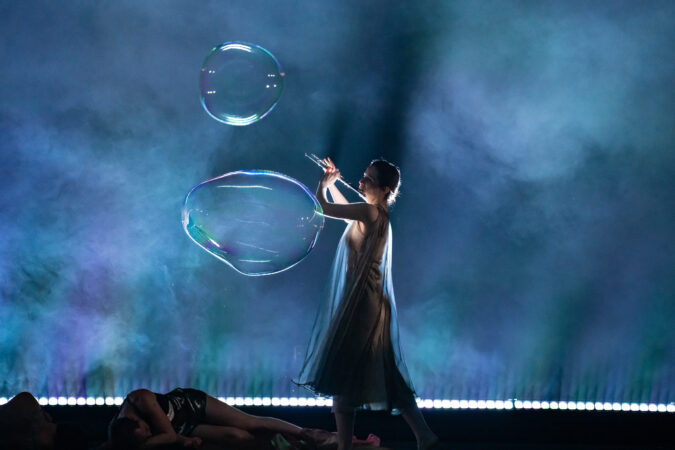
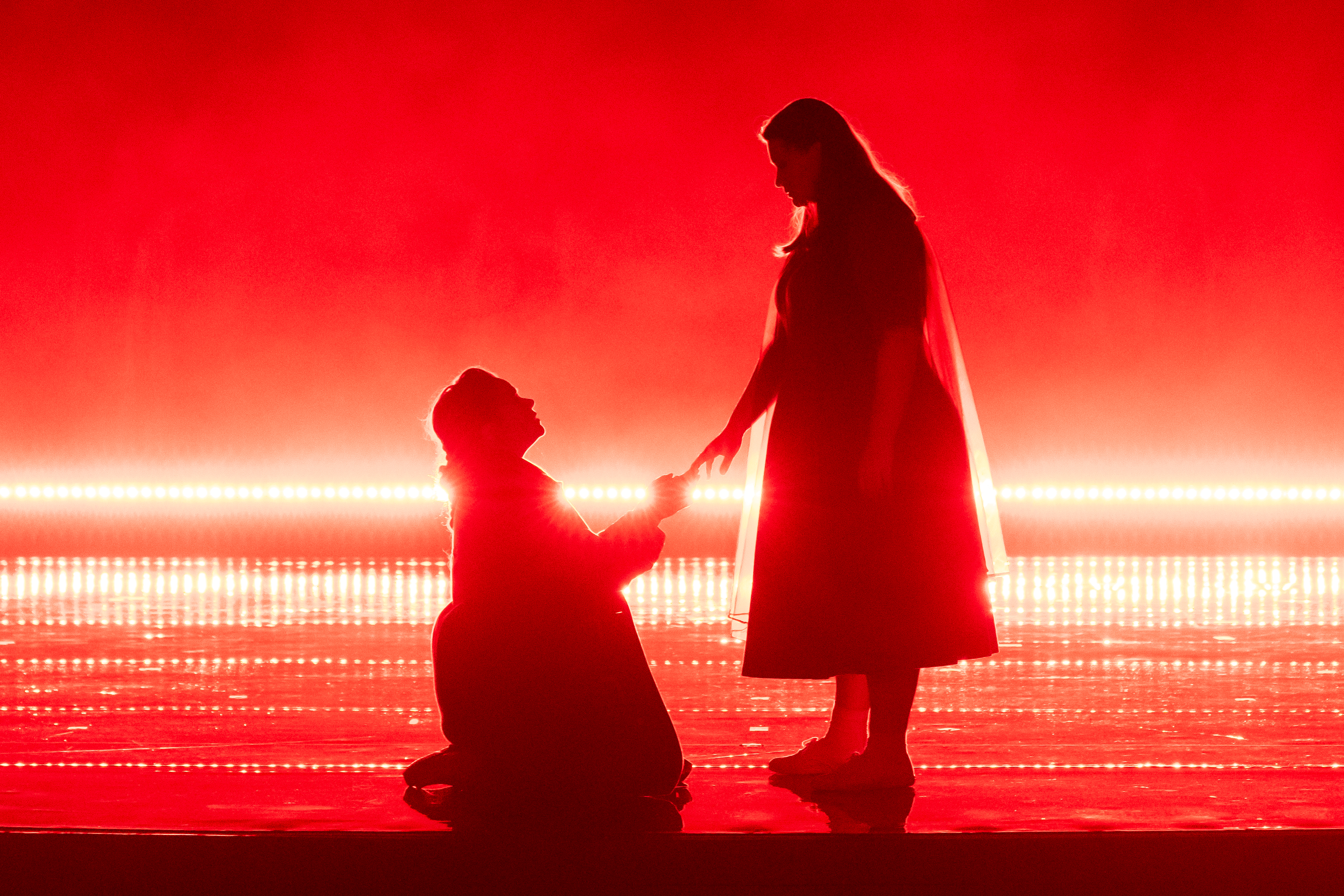
Like much on the mind of the general public, climate change is now in the voices of Opera Philadelphia in The Seasons, an ambitious opera/dance expansion of Vivaldi’s The Four Seasons warning of a time when seasons cease to exist.
Sounds like a virtuous West Coast “granola opera”? Not quite. But the Friday opening at Kimmel Center’s Perelman Theater wasn’t as effective as it wanted to be.
The piece’s secondary purpose as a showcase for Vivaldi’s music actually became primary, going beyond the composer’s popular four-violin concertos, collectively known as The Four Seasons, and exploring some great, rarely heard arias from his many operas.
And luckily so.
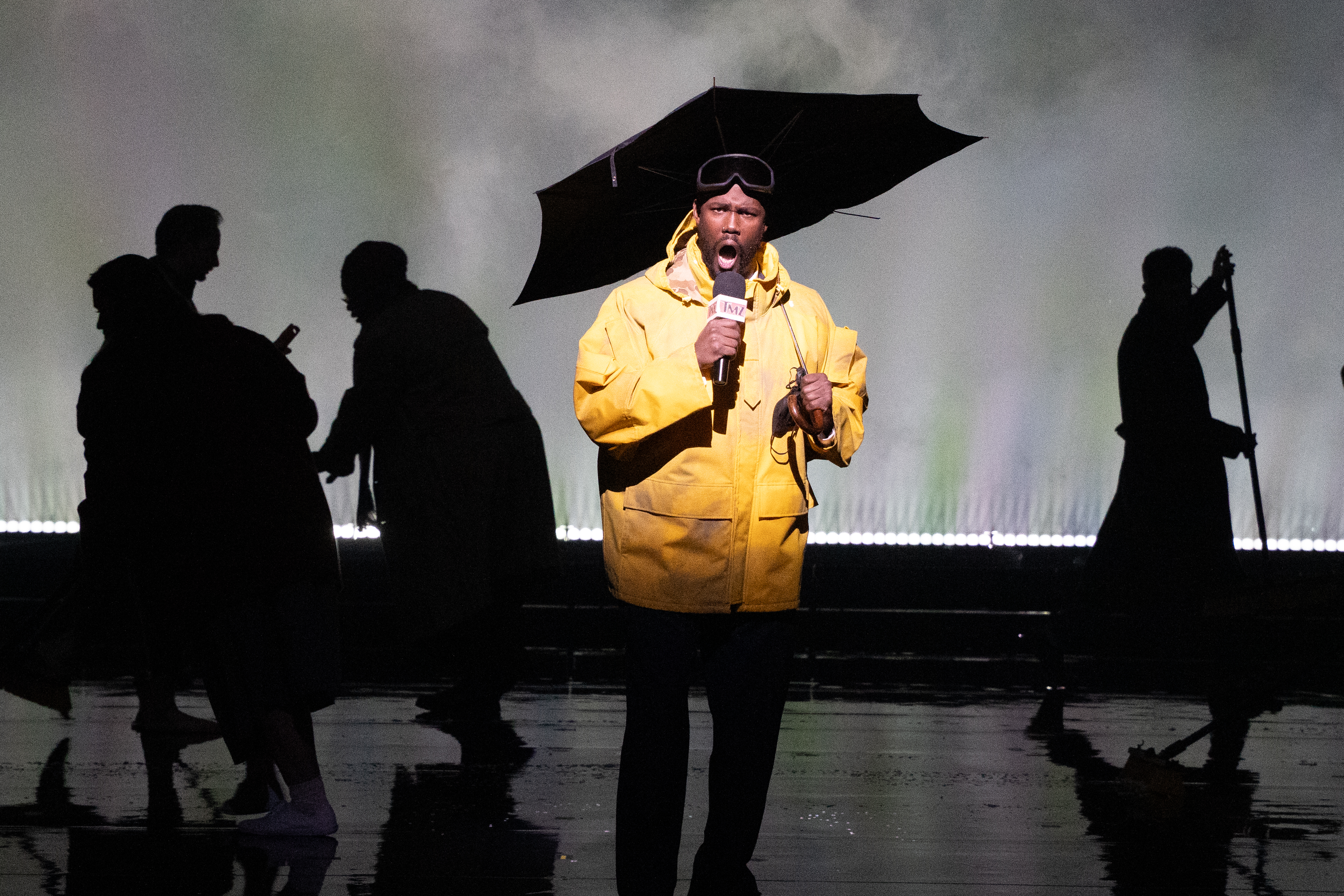
Bass John Mburu delivers the forecast as the Cosmic Weatherman in “The Seasons,” where the seasons are completely out of order.
Vivaldi’s innately agitated rhythms convey the urgency of climate change in a much more visceral manner than the often on-the-nose libretto by playwright Sarah Ruhl.
That’s a surprising reversal of artistic priorities considering that her 2003 play Eurydice is one of the best works of its decade (especially as seen several years ago, across the street at the Wilma Theater).
Vivaldi wrote 50 or so operas in the capitals of 18th-century Europe, and the pieces from them, employed by The Seasons, were often dark-night-of-the-soul arias that reveal depths not apparent in the composer’s short-breathed concertos.
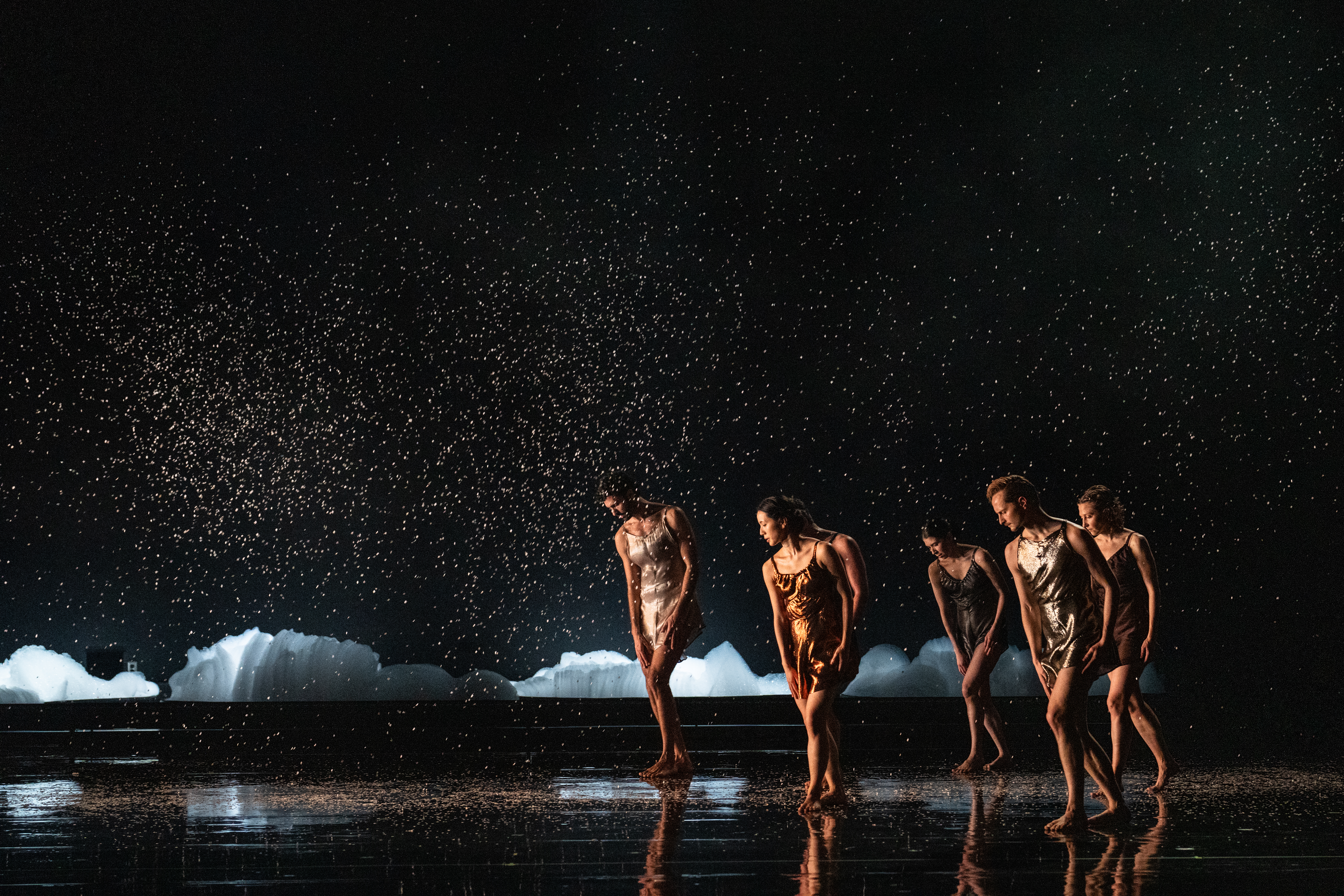
Dancers Marc Crousillat, Stephanie Terasaki, Brian Lawson, Taylor LaBruzzo, Anson Zwingleberg, and Maggie Cloud in the Philadelphia premiere of “The Seasons,” directed by Zack Winokur and choreographed by Pam Tanowitz
These operas have been major discoveries over the last few decades in Europe, and Opera Philadelphia’s presentation constitutes a significant addition to the local operatic culture.
Fitting arias into a new plot was fairly common in 18th-century opera, though The Seasons, conceptualized by Ruhl and Opera Philadelphia chief Anthony Roth Costanzo, is best taken in by those who have missed climate-change news of fish frying in warm ocean water and frozen iguanas falling out of unseasonably cold Florida trees.
The Seasons has somebody resembling a TV weatherman (bass John Mburu) appearing periodically, lecturing the audience to not ignore or forget the dire planetwide shifts in weather (as if we could!).
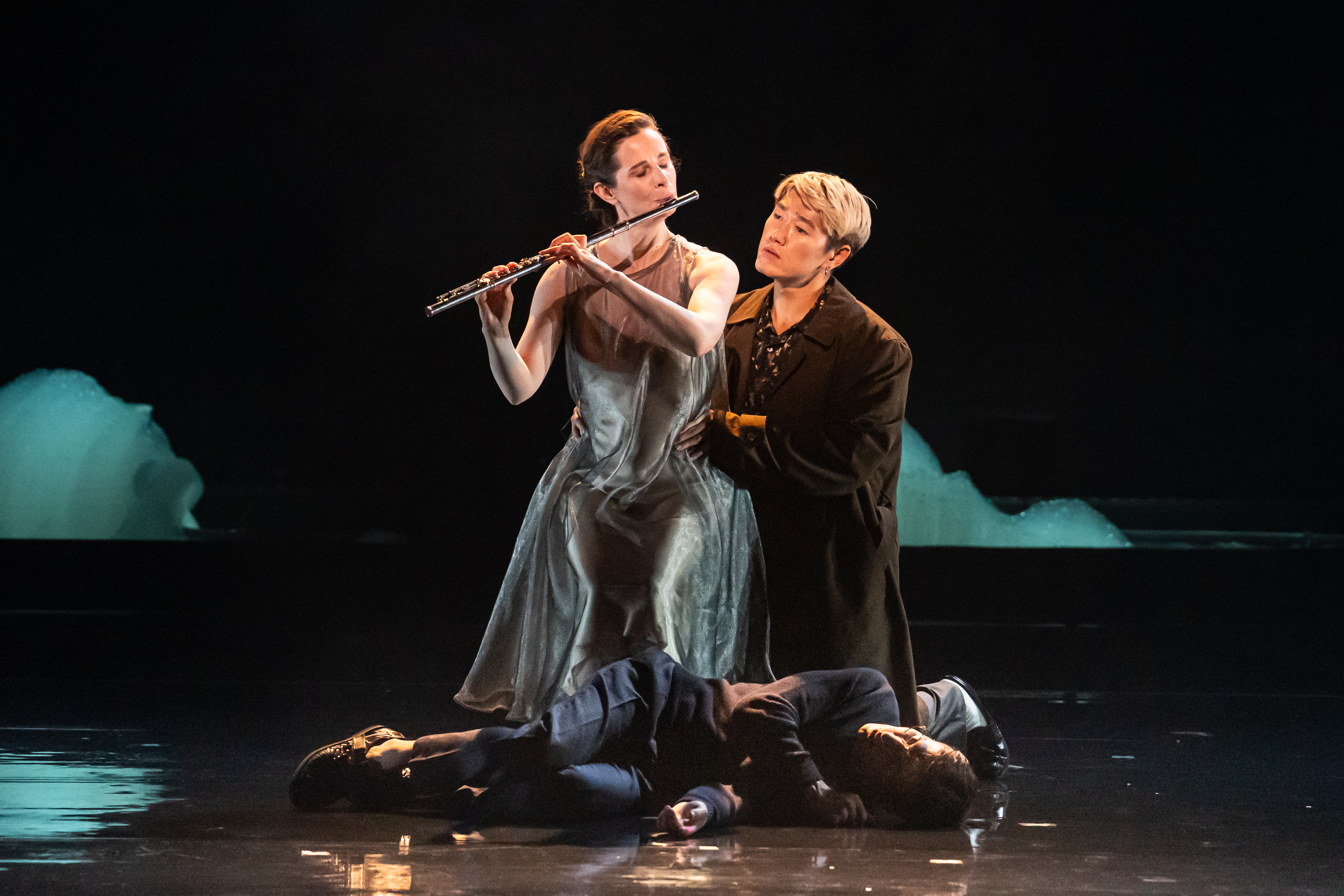
Flute Soloist Emi Ferguson with Kangmin Justin Kim and Anthony Roth Costanzo in the Philadelphia premiere of “The Seasons.”
Other characters are sociological touchstones: A poet, a painter, an actress-turned-farmer, a performance artist, and a choreographer (none with specific names) share the stage, some having troubled same-sex romances — though the purpose of their artistic affiliations had little consequence.
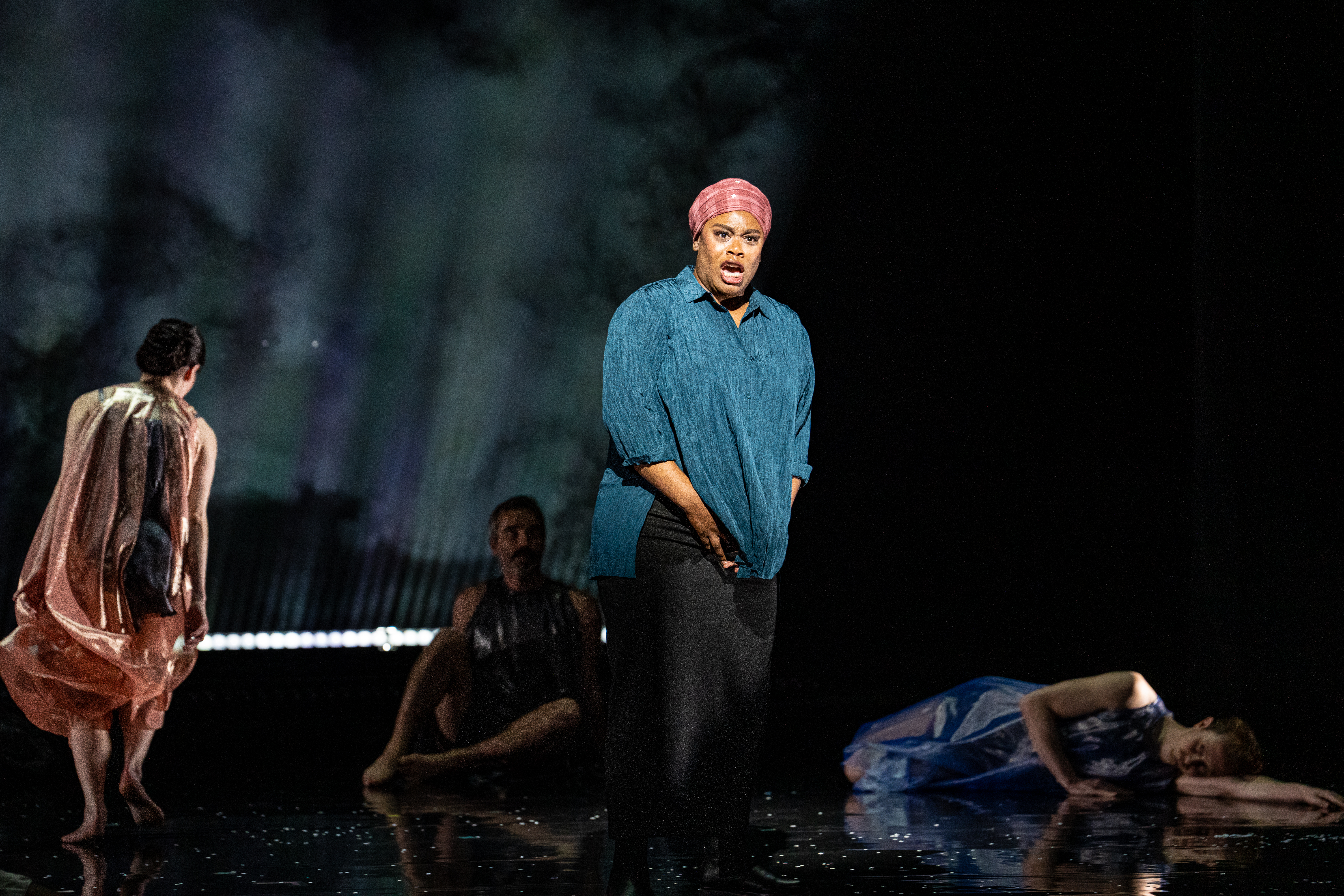
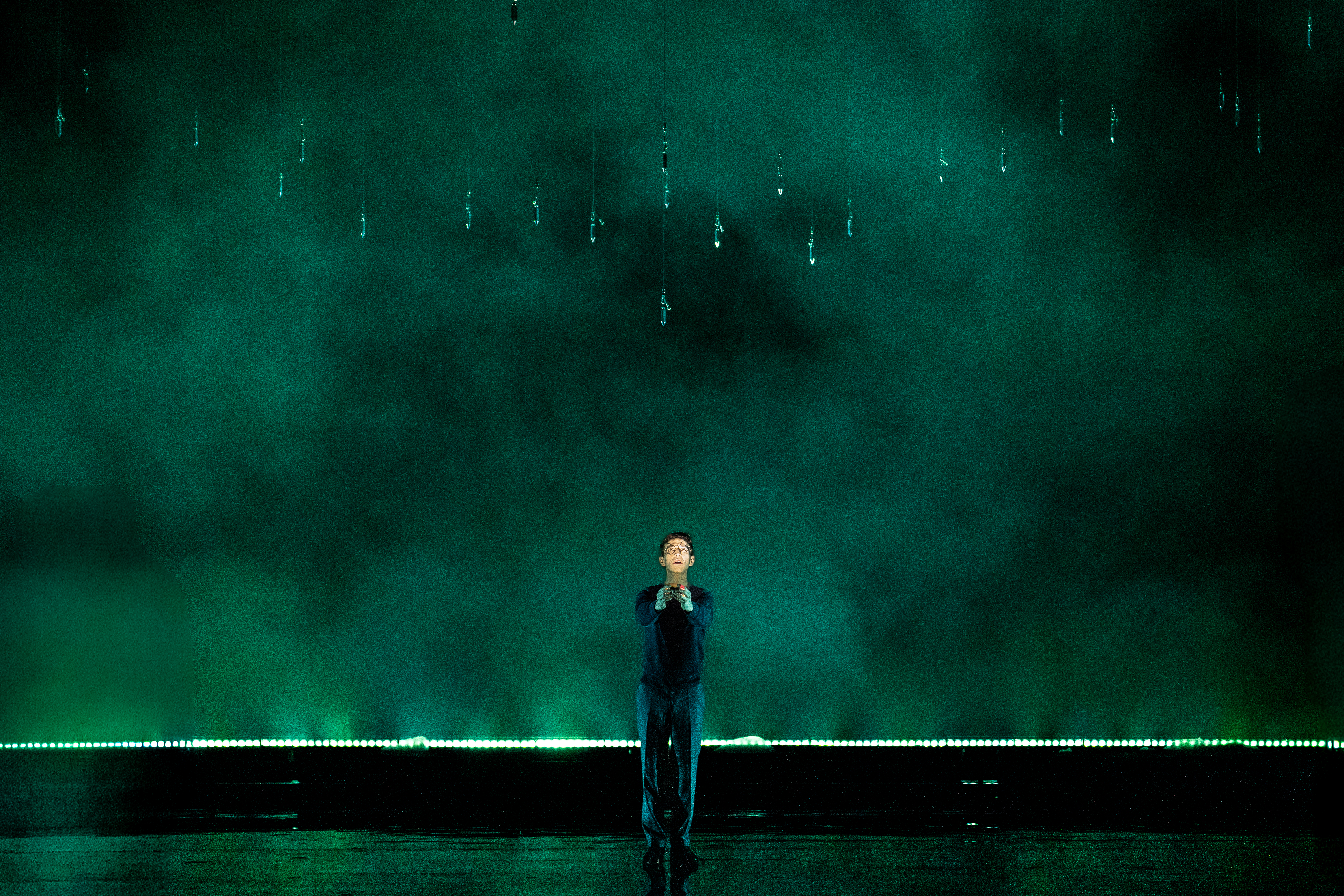
Vivaldi’s Four Seasons was often used as dance interludes in choreography by Pam Tanowitz. Under the overall direction of Zack Winokur, various screens and lighting effect conspired to convey stars, wildfire, and aurora borealis — as characters become climate refugees and, presumably, move north.
It’s not a spoiler to say that the opera ends with a hope-inspiring children’s chorus (Commonwealth Youth Choir and Philadelphia Youth Choral Ensemble) that has an unexpectedly visceral impact. It’s a reminder that their generation is tasked with cleaning up the ecological mess made by their elders.
Abigail Raiford (The Farmer) and Megan Moore (The Choreographer) during a fire.
Amid isolated strong points, The Seasons also showed signs of quick assemblage.
Besides having English lyrics that could certainty be improved with more revision time, the different elements didn’t always flow together comfortably.
The Act I choreography that had the six dancers gracefully balletic from the waist up but appropriately earthy from the waist down tended to slip into and out of obscurity in Act II.
One has to respect the effort put into the production, but the singers’ performances (in arias from Tito Manlio, Giustino, and many others) saved the day — supported by excellent orchestra playing. Conductor Corrado Rovaris instilled a proper baroque style and manner that unlocked the music’s considerable value.
All of the singers had fairly adept coloratura abilities that are necessary with baroque-period opera, including Mburu, who used the vocal passage work in a suitably reckless fashion conveying his character’s distress.
Soprano Whitney Morrison, the Performance Artist, sings about how she used to be an activist upon arriving at an artist retreat in “The Seasons.”
Kangmin Justin Kim (the Painter), Whitney Morrison (the Performance Artist), Abigail Raiford (the Farmer), and Megan Moore (the Choreographer) all had star-turn moments, some gathering momentum in Act II, others audibly tiring as the opera went on.
Costanzo couldn’t help being a dominant presence, not just because he’s a key figure in the opera’s conception (as well as Opera Philadelphia as a whole) but because he is such an accomplished actor and singer.
Countertenor Anthony Roth Costanzo is the Poet in “The Seasons,” based on Vivaldi’s music and a new libretto by playwright Sarah Ruhl.
At times, he actually made the lesser moments in the character dialogue work. He still has one of the most natural and pleasing countertenor voices currently before the public, plus a fine legato line and telling use of words. It’s great to have him at the helm of Opera Philadelphia, but it’s greater just to hear him.
Repeat performances of “The Seasons” are Dec. 20, 8 p.m., and Dec. 21, 2 p.m., at Perelman Theater, 300 S Broad St. The shows are currently sold out. operaphila.org
WASHINGTON — U.S. forces on Saturday stopped a vessel off the coast of Venezuela for the second time in less than two weeks as President Donald Trump continues to ramp up pressure on Venezuelan President Nicolás Maduro.
The move, which was confirmed by two U.S. officials familiar with matter, comes days after Trump announced a “blockade” of all sanctioned oil tankers coming in and out of the South American country and follows the Dec. 10 seizure by American forces of an oil tanker off Venezuela’s coast.
Homeland Security Secretary Kristi Noem confirmed that the U.S. Coast Guard with help from the Defense Department stopped the oil tanker that was last docked in Venezuela. She also posted on social media an unclassified video of a U.S helicopter landing personnel on a vessel called Centuries.
A crude oil tanker flying under the flag of Panama operates under the name and was recently spotted near the Venezuelan coast, according to MarineTraffic, a project that tracks the movement of vessels around the globe using publicly available data. It was not immediately clear if the vessel was under U.S. sanctions.
“The United States will continue to pursue the illicit movement of sanctioned oil that is used to fund narco terrorism in the region,” Noem wrote on X. “We will find you, and we will stop you.”
The action was described as a “consented boarding,” with the tanker stopping voluntarily and allowing U.S. forces to board it, one official said.
The Pentagon and White House officials did not immediately respond to requests for comment.
Trump earlier this month announced that the Coast Guard had seized an oil tanker in the Caribbean Sea and vowed that the U.S. would carry out a blockade of Venezuela. It all comes as Trump has ratcheted up his rhetoric toward Maduro and warned that the longtime Venezuelan leader’s days in power are numbered.
Trump this week demanded that Venezuela return assets that it seized from U.S. oil companies years ago, justifying anew his announcement of a “blockade” against oil tankers traveling to or from the South American country that face American sanctions.
Trump cited the lost U.S. investments in Venezuela when asked about his newest tactic in a pressure campaign against Maduro, suggesting the Republican administration’s moves are at least somewhat motivated by disputes over oil investments, along with accusations of drug trafficking. Some sanctioned tankers already are diverting away from Venezuela.
“We’re not going to be letting anybody going through who shouldn’t be going through,” Trump told reporters. “You remember they took all of our energy rights. They took all of our oil not that long ago. And we want it back. They took it — they illegally took it.”
U.S. oil companies dominated Venezuela’s petroleum industry until the country’s leaders moved to nationalize the sector, first in the 1970s and again in the 21st century under Maduro and his predecessor, Hugo Chávez. Compensation offered by Venezuela was deemed insufficient, and in 2014 an international arbitration panel ordered the country’s socialist government to pay $1.6 billion to ExxonMobil.
The targeting of tankers comes as Trump has ordered the Defense Department to carry out a series of attacks on vessels in the Caribbean and eastern Pacific Ocean that his administration alleges are smuggling fentanyl and other illegal drugs into the United States and beyond.
At least 104 people have been killed in 28 known strikes since early September.
The strikes have faced scrutiny from U.S. lawmakers and human rights activists, who say the administration has offered scant evidence that its targets are indeed drug smugglers and that the fatal strikes amount to extrajudicial killings.
The Coast Guard, sometimes with help from the Navy, had typically interdicted boats suspected of smuggling drugs in the Caribbean Sea, searched for illicit cargo, and arrested the people aboard for prosecution.
The administration has justified the strikes as necessary, asserting it is in “armed conflict” with drug cartels aimed at halting the flow of narcotics into the United States. Maduro faces federal charges of narcoterrorism in the U.S.
Maduro has insisted the real purpose of the U.S. military operations is to force him from power.
White House chief of staff Susie Wiles said in an interview with Vanity Fair published this week that Trump “wants to keep on blowing boats up until Maduro cries uncle.”
DAMASCUS, Syria — Jordan confirmed Saturday that its air force took part in strikes launched by the United States on Islamic State group targets in Syria in retaliation for the killing of three U.S. citizens earlier this month.
The U.S. launched military strikes Friday on multiple sites in Syria to “eliminate” Islamic State group fighters and weapons in retaliation for an attack by a Syrian gunman that killed two U.S. troops and an American civilian interpreter almost a week earlier.
The Jordanian military said in a statement that its air force “participated in precise airstrikes … targeting several ISIS positions in southern Syria,” using a different abbreviation for the Islamic State group. Jordan is one of 90 countries making up the global coalition against IS, which Syria recently joined.
The U.S. military did not say how many had been killed in Friday’s strikes. The Syrian Observatory for Human Rights, a U.K.-based war monitor, reported that at least five people were killed, including the leader and members of an IS cell.
The Jordanian statement said the operation aimed “to prevent extremist groups from exploiting these areas as launching pads to threaten the security of Syria’s neighbors and the wider region, especially after ISIS regrouped and rebuilt its capabilities in southern Syria.”
U.S. Central Command, which oversees the region, said in a statement that its forces “struck more than 70 targets at multiple locations across central Syria with fighter jets, attack helicopters, and artillery,” with the Jordanian air force supporting with fighter aircraft.
It said that since the Dec. 13 attack in Syria, “U.S. and partner forces conducted 10 operations in Syria and Iraq resulting in the deaths or detention of 23 terrorist operatives,” adding that the U.S. and partners have conducted more than 80 counterterrorism operations in Syria in the past six months.
President Donald Trump had pledged “very serious retaliation” after the shooting in the Syrian desert, for which he blamed IS. Those killed were among hundreds of U.S. troops deployed in eastern Syria as part of a coalition fighting the militant group. On Friday Trump reiterated his backing for Syrian interim President Ahmad al-Sharaa, who Trump said was “fully in support” of the U.S. strikes against IS.
IS has not taken responsibility for the attack on the U.S. service members, but the group has claimed two attacks on Syrian security forces since, one of which killed four Syrian soldiers in Idlib province. The group in its statements described al-Sharaa’s government and army as “apostates.” While al-Sharaa once led a group affiliated with al-Qaida, he has had a long-running enmity with IS.
As well as killing three U.S. citizens, the shooting near Palmyra also wounded three other U.S. troops as well as members of Syria’s security forces, and the gunman was killed.
The assailant had joined Syria’s internal security forces as a base security guard two months ago and recently was reassigned while he was under investigation on suspicions that he might be affiliated with IS, Syrian officials have said.
The man stormed a meeting between U.S. and Syrian security officials who were having lunch together and opened fire after clashing with Syrian guards.
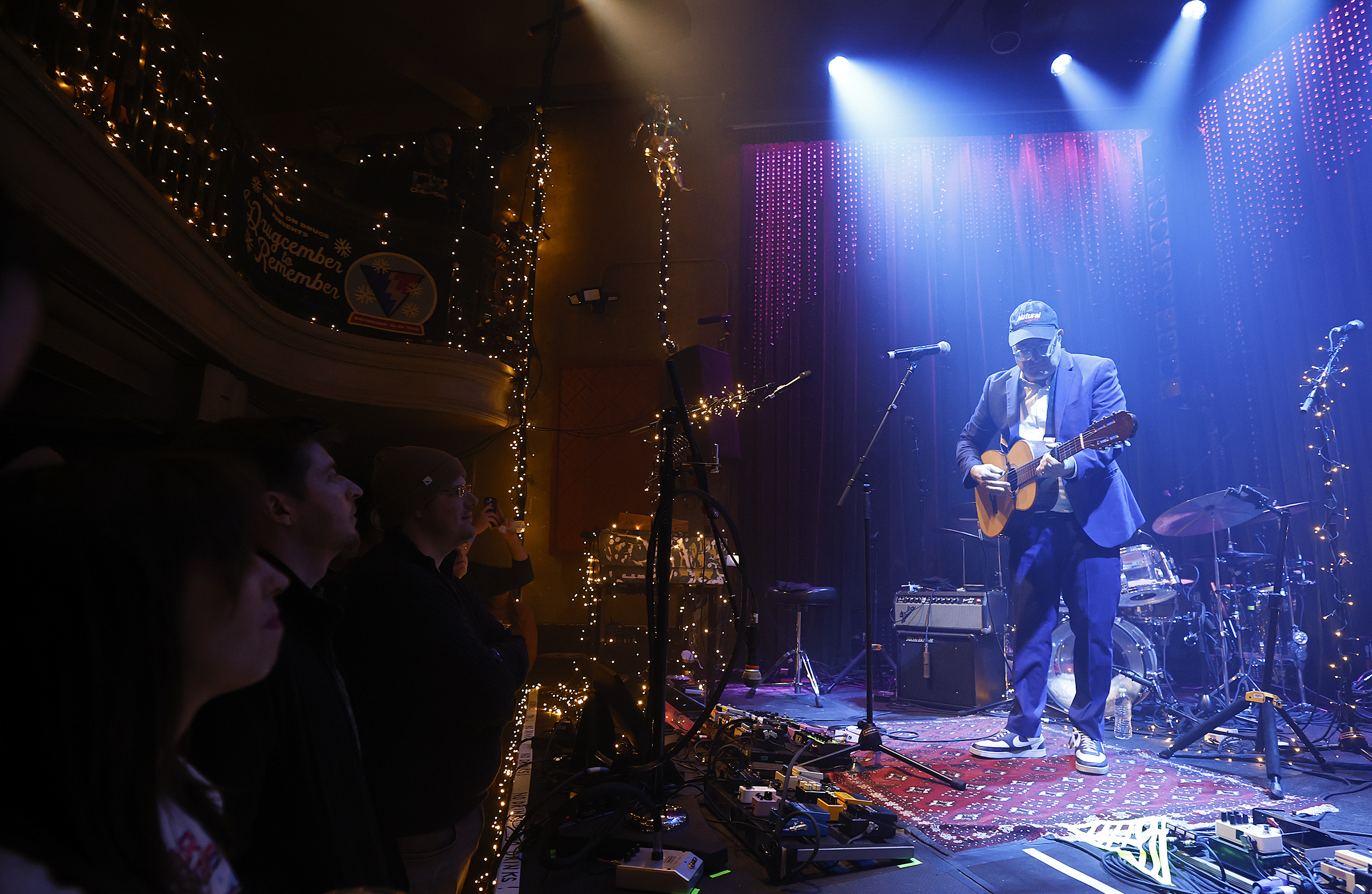
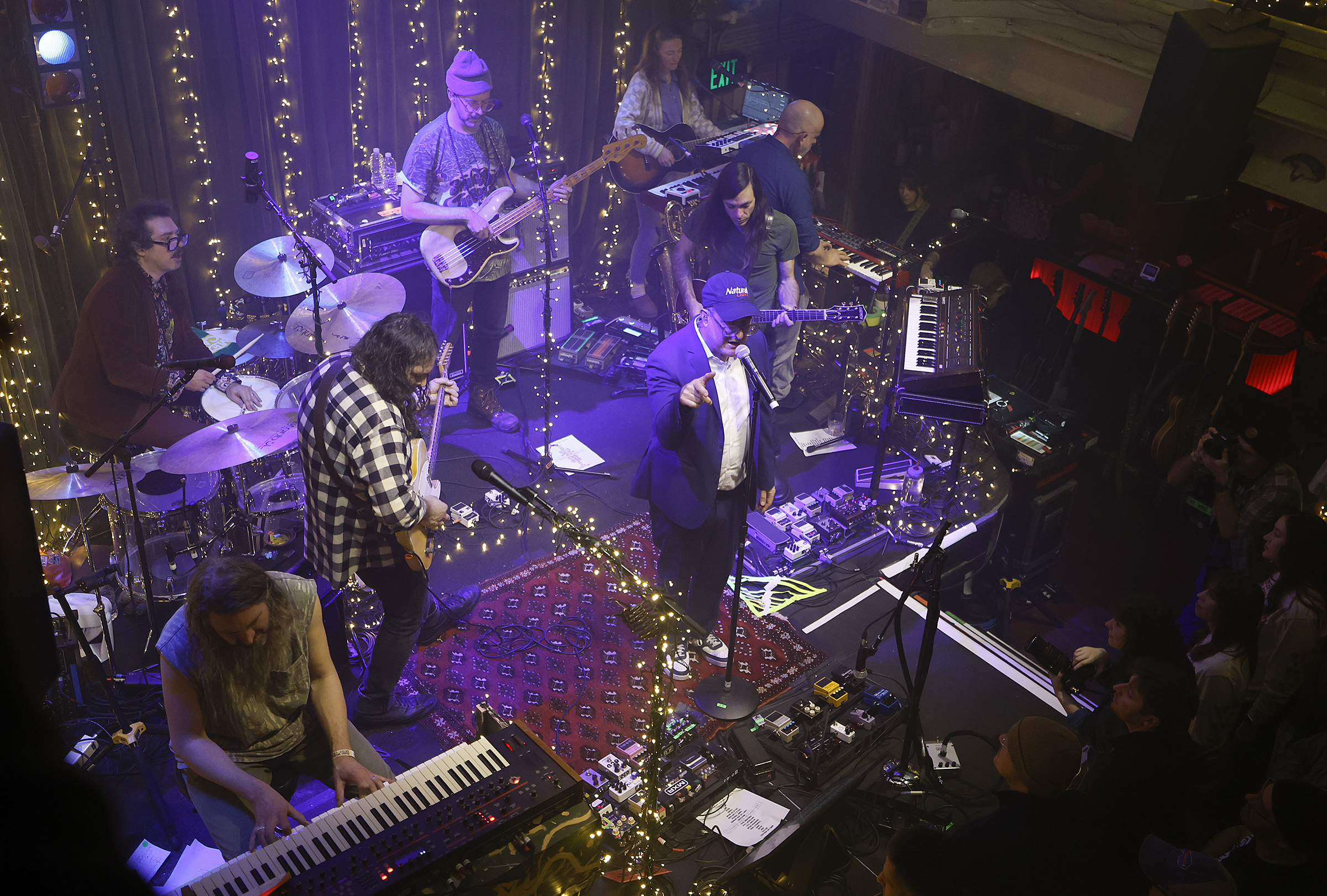
During the second night of the War on Drugs’ three-show “A Drugcember to Remember” run at Johnny Brenda’s on Friday, there were two kinds of special guests.
The first was deeply satisfying, really cool, and not entirely unexpected.
It was Craig Finn, the front man for the Hold Steady, whose superb new album, Always Been, was produced by Drugs leader Adam Granduciel.
Finn does have a track record of showing up at Drugcembers past, so the second guest was a tad more surprising.
It was a genuine “Holy [cow]! What just happened?” moment that gobsmacked a crowd that was already pinching itself — it’s not every day you are lucky enough to see Philadelphia’s most acclaimed rock band in peak form in a 250-capacity room, many times smaller than the capacious spaces they play in around the world.
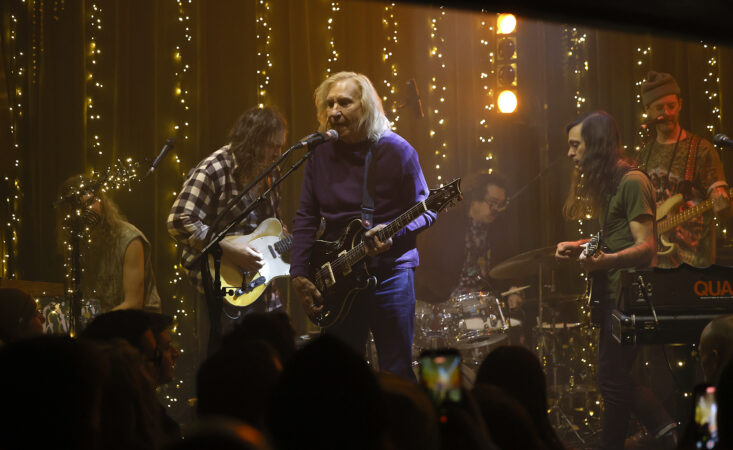
It was Joe Walsh. Yes, that Joe Walsh, the James Gang founder, solo artist, and guitarist for the Eagles — the band, not the football team.
Special guest Joe Walsh performs with War on Drugs during the “A Drugcember To Remember” show at Johnny Brenda’s in Fishtown on Friday, December 19, 2025.
But the night would have qualified as an unforgettable Drugcember to Remember even without the out-of-the-blue rock star appearance.
The show’s earlier highlights included a roaring cover of Tom Petty’s “Love is a Long Road” and a goose bump-inducing 17-minute motorik version of “Harmonia’s Dream,” from the band’s 2021 album I Don’t Live Here Anymore, that spotlighted keyboard player Robbie Bennett.
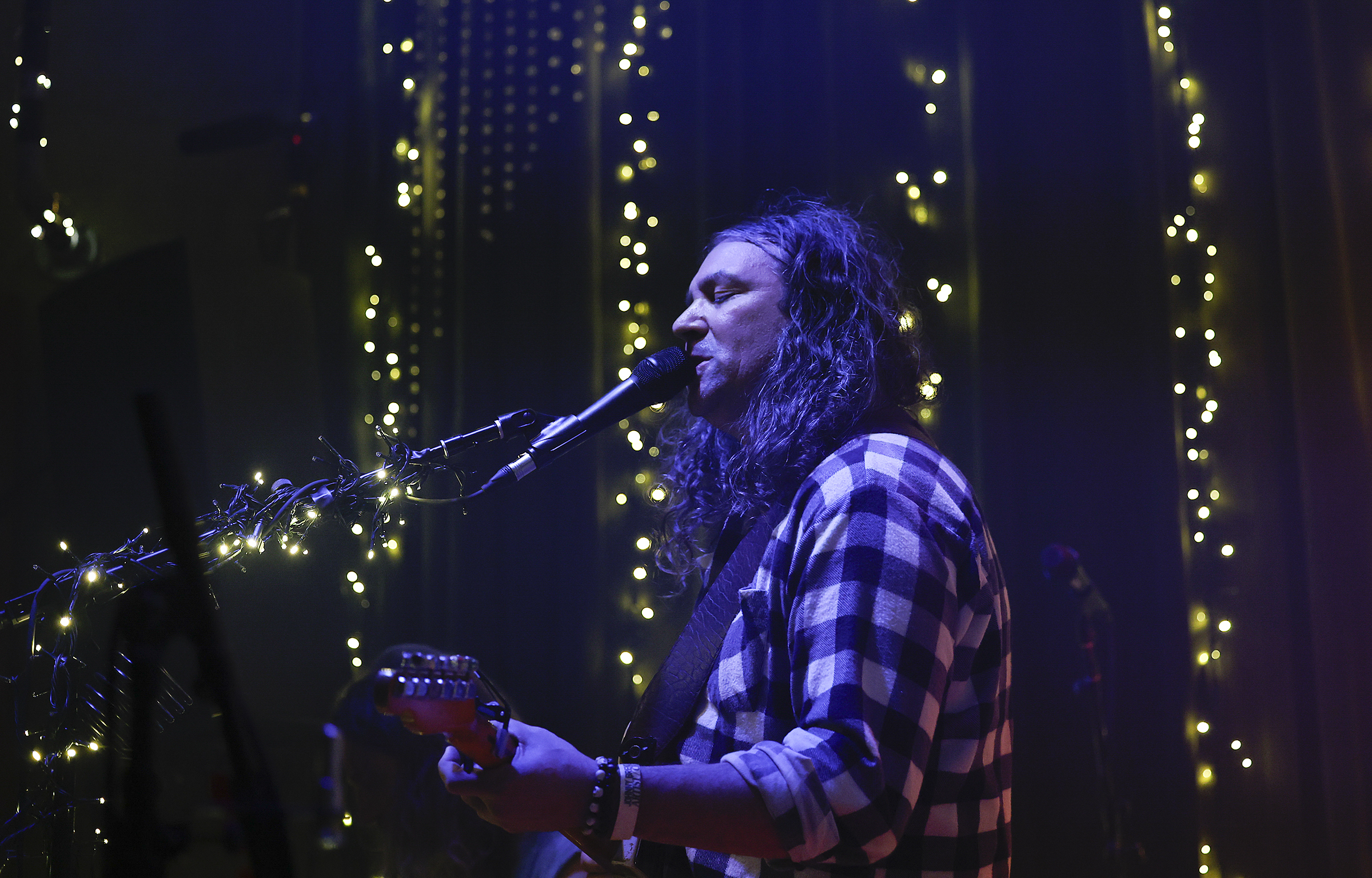
War on Drugs frontman Adam Granduciel performs during the groups “A Drugcember To Remember” show at Johnny Brenda’s in Fishtown on Friday, December 19, 2025.
It leveled up to a higher plane with the arrival of Walsh, the 78-year-old powerhouse slide guitar player who seemed thrilled to be playing with a decades younger vise-tight group of simpatico musicians.
The Walsh-Drugs mini-set kicked off with “Rocky Mountain Way,” the extra-crunchy 1973 hit that turned Walsh into a solo star. He was joined by an arsenal of guitarists onstage including Granduciel, Anthony LaMarca, and, at times, newest band member Eliza Hardy Jones, who also played percussion and sang backup throughout the evening.
On “Rocky Mountain Way,” which has gotten new life in the last year as a TikTok phenomenon, Walsh employed a talk box, using a tube in his mouth to manipulate and distort the sound of his guitar in ways that still sound futuristic 50 years later.
It also meshed perfectly with the audio geek aesthetic of Granduciel, who is an expert at layering guitar and keyboard sounds to transporting effect.
Before the band leaped into that song, though, Granduciel and Walsh explained to the nonplussed crowd how the seemingly unlikely collaboration came to be. How did Walsh wind up onstage at the Fishtown club that has been the Drugs’ spiritual home since they played there on the venue’s opening weekend in 2006?
Here’s the story: In 2023, the band played Walsh’s VetsAid concert for military veterans in Los Angeles.
“We became friends, we stayed in touch,” Granduciel said. “And he wanted to come to Drugcember, he wanted to see all you guys. He wanted to breathe the air that we’re breathing.”
During the Drugs’ set at VetsAid, Walsh said, “I was walking around backstage and I listened to ’em. And I never heard them live. They make nice records. But, boy, this thought: I couldn’t help it. ‘Damn! I’d sure like to play in a band like that.’ Be careful what you … wish for!”
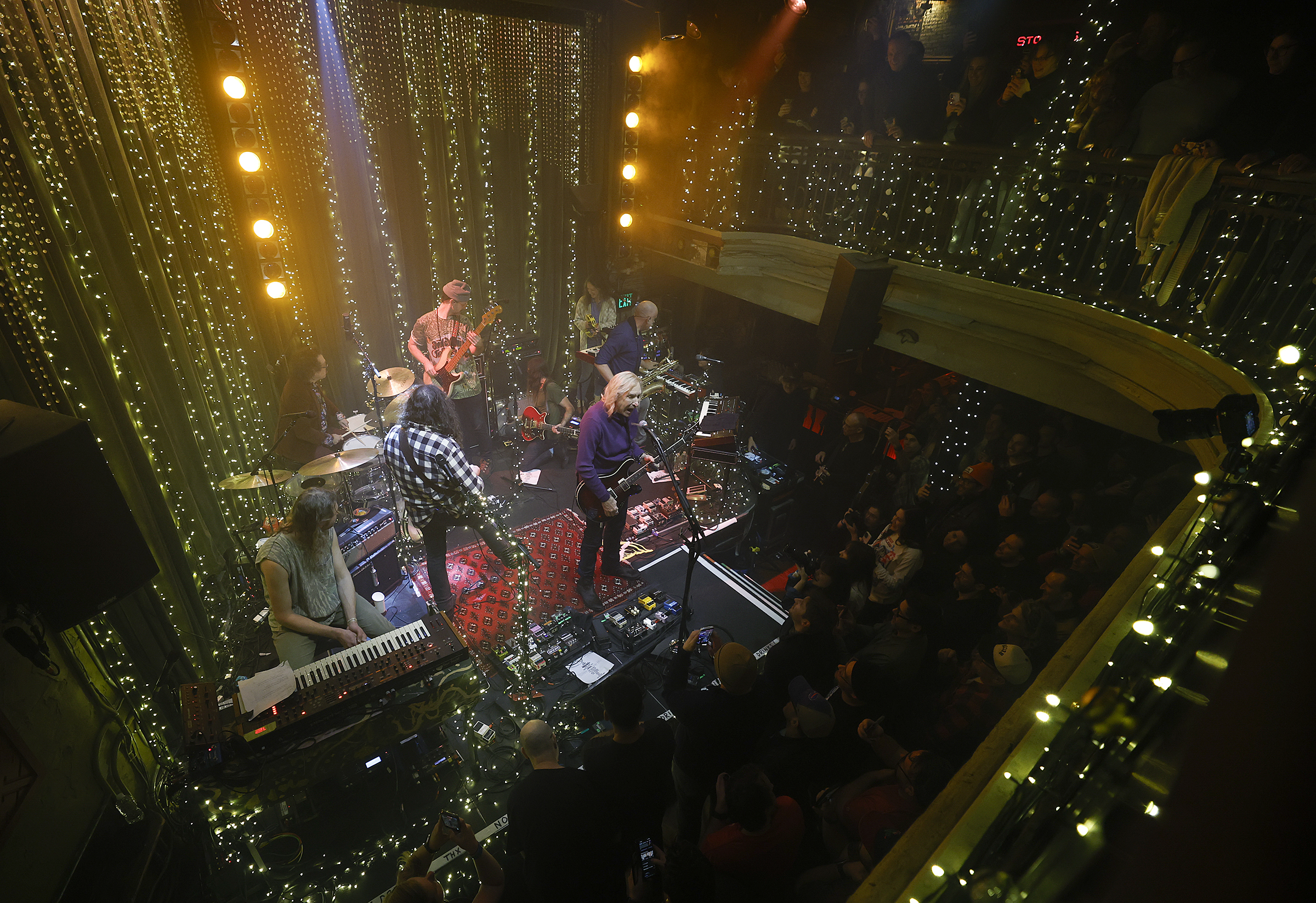
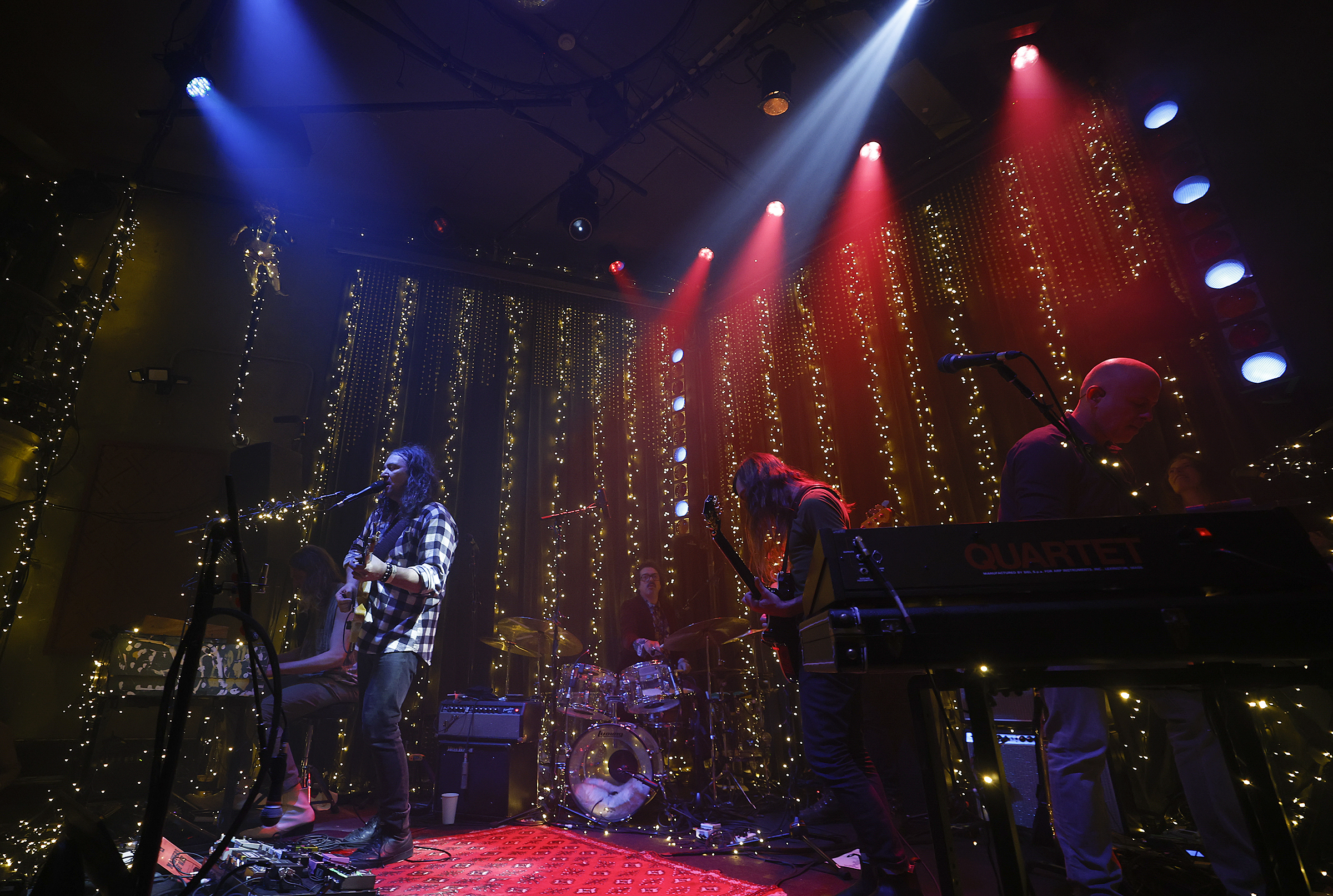
The War on Drugs perform during the group’s second of three sold-out “A Drugcember To Remember” performances at Johnny Brenda’s in Fishtown on Friday, December 19, 2025. “A Drugcember To Remember,” a series of holiday shows directly benefit The Fund for the School District of Philadelphia, a nonprofit that raises and coordinates investments into the Philadelphia public schools.
“Rocky Mountain Way” was followed by “In the City,” Walsh’s song written for the 1979 action movie The Warriors that he also recorded with the Eagles. His craggy and Jones’ dulcet vocals made for a captivating blend, while the rhythm section of bassist Dave Hartley and drummer Charlie Hall powered the song forward.
As exciting as it was to hear the Drugs back up Walsh on his own hits, it was more compelling still to watch him engage with the band on the closing number of the night, “Under the Pressure,” from 2014’s Lost in the Dream.
That song is combustible under normal conditions, but it moved from a simmer to a boil in a flash with Walsh added to the mix. He and Granduciel were hunched over their guitars on the lip of the stage, illuminated by the strings of holiday lights on the mic stands and on the balcony railings above them in the intimate club.
It was like a one-of-a-kind Fishtown version of what Keith Richards and Ronnie Wood of the Rolling Stones call their “guitar weave,” and it was a kick to watch Walsh so enthusiastically just want to be one of the boys in the band.
As mentioned, pre-Walsh, the show was terrific on its own terms. And a special shout out goes to Jon Natchez, the Drugs’ multi-instrumentalist, who played keyboards and baritone sax.
Special guest Craig Finn performs during “A Drugcember To Remember” show with War on Drugs at Johnny Brenda’s in Fishtown on Friday, December 19, 2025.
The latter instrument’s honking added extra force to typically meticulously arranged songs like the Phil Collins-evoking “I Don’t Wanna Wait,” a highlight of the band’s opening set, which was followed by a 15-minute intermission.
In introducing Natchez, Granduciel mocked his Boston sports fandom. “He wouldn’t be caught dead in an Eagles jacket,” the bandleader said. “I’m out of Boston, too” — Granduciel grew up in Dover, Mass. — “but I bleed green.”
The evening began three hours before it ended with Finn walking onstage with an acoustic guitar and wearing a Natural Light ball cap. He warmed up an attentive crowd with songs and stories, mostly from Always Been, his superb song cycle that’s partly set outside Philadelphia and mostly at the Delaware shore.
Special guest Craig Finn performs with War on Drugs during the “A Drugcember To Remember” show at Johnny Brenda’s in Fishtown on Friday, December 19, 2025.
Finn was followed on stage by seven members of the Drugs, who reached back to open with “Arms Like Boulders,” from the band’s 2008 debut Wagonwheel Blues.
“Pain,” from 2017’s Grammy-winning A Deeper Understanding, outlined the idea of the unending quest that’s an animating concept in Granduciel’s lyrics. “I want to find what can’t be found,” he sang. And later, in “Strangest Thing,” also from Deeper, he sang about still not finding resolution: “I’m just living in the space between the beauty and the pain.”
Seven songs in, the Drugs brought Finn back out for a three-song interlude that closed the first set.
Two of those were from Always Been, including the engrossing “Bethany,” which took off into the stratosphere with a Granduciel solo midway through. Then it lingered with an image in the closing line: “But the sunset looks like blood from the window of the bus, somewhere between Harrisburg and Bethany.”
The third song in the Drugs-Finn collab on Friday was “Sweetheart Like You,” featuring Finn and Granduciel trading vocals on Bob Dylan’s philosophical barroom come-on.
That was a treat, with Finn being very much himself, gesticulating his way through his verses while Granduciel slipped into his best sneering Dylan voice. It was an exquisite combo, and just one of many indelible moments in an evening that for all concerned will surely be the Drugcember they remember.
The final sold-out night of “A Drugcember to Remember” was scheduled for Saturday night at Johnny Brenda’s. No special guests have been announced.