President Donald Trump accused six Democratic members of Congress of committing sedition,a claim that his administration has stuck to amid a fierce national debate that began when the lawmakers urged military and intelligence personnel to “refuse illegal orders.”
The Democratic members, who are all veterans or members of the intelligence community, shared a video online last week in whichthey accused Trump’s administration of pitting service members against American citizens andwarned against orders that would violate the Constitution.
The lawmakers did not reference specific orders, but members have spoken against strikes in the Caribbean and Trump’s deployment of the National Guard in American cities — both of which have faced legal scrutiny — as cause for concern.
Trump first responded to the video with a string of posts on his social media platform, Truth Social, calling for the lawmakers to be arrested and put on trial for sedition, “punishable by DEATH,” and sharing posts against them, including one that called for them to be hanged.
Two of the members represent Pennsylvania: U.S. Reps. Chrissy Houlahan (D., Chester), an Air Force veteran, and Chris Deluzio (D., Allegheny), a Navy veteran.
On Monday, the Department of Defense announced that it would investigate Sen. Mark Kelly (D., Ariz.), a former naval officer and the one veteran in the video who is still obligated to follow military laws because he served long enough to become a military retiree. The announcement threatened to call Kelly back to active duty for court-martial proceedings.
On Tuesday, a Justice Department official told Reuters that the FBI has requested interviews with the Democrats who appeared in the video, which some of the lawmakers publicly corroborated. The FBI declined to comment when reached by The Inquirer.
As the debate over the video escalates in the wake of Trump’s sedition accusation and his administration’s actions, a rarely used charge and the intricacies of military law have been thrown into the spotlight.
What is sedition, and is it punishable by death?
Sedition is an incitement of a rebellion or encouragement of attacking authority, or, in other words, the intent to overthrow the government, according to legal and military experts. When acting with others, it is called seditious conspiracy.
For civilians, sedition is a violation of federal law and carries prison time. It is not punishable by death.
Active-duty military, however, must follow the Uniform Code of Military Justice (UCMJ). While the military law has overlap with civilian law, it is more expansive, controlling, and strict, said Sean Timmons, a Houston-based attorney specializing in military law who previously served as an active-duty U.S. Army captain in the U.S. Army Judge Advocate General (JAG) program.
“In the civilian world you have a lot more defenses, and you have full First Amendment protections,” said Timmons, a managing partner at Tully Rinckey PLLC. “Whereas in the military, your First Amendment rights are quite limited.”
The maximum punishment for active military is death, but it can be far lower, he said.
Service members must be on active duty to be prosecuted under the UCMJ, but the conduct does not have to have taken place during active duty. This means that retirees like Kelly can be recalled for active duty to face UCMJ prosecution over their behavior while they were not on active duty.
What is an illegal order?
Members of Trump’s administration have pointed to the UCMJ rule that says members must follow lawful orders and orders should be presumed to be lawful. Service members can be punished for not following orders.
However, military rules also prohibit service members from following orders that are undoubtedly illegal — a point the lawmakers get at in their video — and they can be punished for doing so.
But whether orders are legal is supposed to be up to officers, not rank-and-file members, Timmons said.
“If you don’t comply, you could be charged with failure to follow orders and other crimes,”hesaid.
The exceptions (those obviously illegal crimes) would be war crimes like raping prisoners, deliberating killing civilians without justification, or torture, not day-to-day acts that would break the law, he explained.
Take the example of burning down an enemy’s structure.
“If your military unit says to burn it down because it’s part of the military objective, that’s a lawful order, even though it’s an illegal act,” he said. “It’s a war crime if it’s to burn down adaycare with kids inside.”
The boat strikes in the Caribbean have been in a legalgray area, he said, but “if your command says it’s legal, you’re supposed to execute.”
“The military system is harsh, cruel, and unfair … but it’s the system we have in place, and it’s designed that way to ensure discipline, obedience, and compliance,” he added.
Did the lawmakers commit sedition?
Claire Finkelstein, founder and faculty director of the Center for Ethics and the Rule of Law at the University of Pennsylvania’s Carey Law School and an expert in military ethics, said accusing the lawmakers of sedition “makes absolutely no sense, especially in a case in which they’re just reminding servicemen of their obligation not to follow illegal orders, which is a fundamental part of the UCMJ.”
“One has to really work hard to fill in the blanks here,” she said.
Timmons said five out of the six lawmakers have their freedom of speech to relyon as a protection.
“Just having divergent political views that the commander-in-chief doesn’t like, for civilians, there’s no liability, there’s no repercussions,” he said.
That doesn’t mean Trump’s administration cannot investigate them for “seditious behavior” anyway.
Kelly, on the other hand, was “on thin ice” by participating in a video that seems to undermine Trump’s authority, he said, and it’s not “totally crazy” to argue he engaged in seditious behavior under military law.
That being said, prosecutors would have to prove that his intent was to “cause a revolt within the ranks,” which would be “very hard,” he said.
“But could they make him miserable and humiliate him and charge him? Yes,” he said.
“Is that politically wise? Absolutely not. Is it reckless? Of course. But, technically, can they do it? Yes,” he added.
What are members of Trump’s administration saying?
White House press secretary Karoline Leavitt told reporters on Monday the White House supports the investigation into Kelly and accused him of trying to “intimidate” active-duty members with the video.
“Sen. Mark Kelly well knows the rules of the military and the respect that one must have for the chain of command,” she said.
“You can’t have a functioning military if there is disorder and chaos within the ranks, and that’s what these Democrat members were encouraging,” she added.
In a social media post on Monday, Defense Secretary Pete Hegseth called the lawmakers the “seditious six.”
“Encouraging our warriors to ignore the orders of their Commanders undermines every aspect of ‘good order and discipline,’” he wrote. “Their foolish screed sows doubt and confusion — which only puts our warriors in danger.”
How has Kelly responded?
Kelly, also a former astronaut, played down the impact of the threats against him on The Rachel Maddow Show Monday night.
“Is it stressful? I’ve been stressed by, you know, things more important than Donald Trump trying to intimidate me into shutting my mouth and not doing my job,” he said. “He didn’t like what I said. I’m going to show up for work every day, support the Constitution, do my job, hold this administration accountable.”
He also denounced the president’s rhetoric, calling it “inciteful.”
“He’s got millions of supporters,” Kelly said. “People listen to what he says more so than anybody else in the country, and he should be careful with his words. But I’m not going to be silenced here.”
He said he and his wife, former U.S. Rep. Gabby Giffords (D., Ariz.), who survived a 2011 assassination attempt in which she was shot in the head, “know what political violence is, and we know what causes it, too.”
What response have Houlahan and Deluzio gotten?
Houlahan and Deluzio, the two Pennsylvania lawmakers in the video, both reported bomb threats at their district offices on Friday following the president’s posts.
But they have also gotten messages of support.
Houlahan shared voice recordings of veterans from all over the country who left messages of support for her office and thanked her for her advocacy.
“Keep pushing it,” one said. “I’m with you, I’m behind ya,” another said.
“I am so proud of all six of you for making that video,” said another.
Andrew Rick (center) in the pregame huddle with teammates before the Philadelphia Union's Major League Soccer (MLS) game against the Chicago Fire at Subaru Park in Chester, Pennsylvania on Saturday, August 23, 2025.Philadelphia Union
Which Union Players Should Stay or Go? Swipe and decide
Though the Union’s playoff run ended earlier than hoped for this year, it was still a successful season. Winning the Supporters’ Shield returned the team to MLS’s elite, and the squad saw some new names rise to prominence. But as always in soccer, there isn’t much time to reflect. The Union have to make their offseason roster moves quickly, then get to work preparing for next year. Here’s your chance to play sporting director and pick who should stay or go.
Our soccer reporter Jonathan Tannenwald also provides his analysis on how much of a roster overhaul the team needs. Make your pick for each player by swiping the cards below — right for Stay or left for Go. Yes, just like Tinder. Finding it hard to decide? We'll also show you how other Inquirer readers have voted so far and what we think the team will do.
Advertisement
Goalkeepers
As ever, Andre Blake leads the way, with Andrew Rick a strong backup behind him.
#18
Andre
Blake
Captain
Crowd says
Contract
Signed Thru: '26 Option: '27
Age
35
Inky Says Stay
The Union's No. 1 in net, and the best goalkeeper in MLS for nearly a decade. Neither of those things will change soon.
#1
Oliver
Semmle
Loaned out
Crowd says
Contract
Signed Thru: '25 Option: '26
Age
27
Inky Says Go
A loan out this year was the final proof that he wasn't good enough for the MLS level.
#31
George
Marks
Crowd says
Contract
Signed Thru: '26
Age
26
Inky Says Go
He did his job as an emergency signing when other backups were injured.
#76
Andrew
Rick
Home grown
Crowd says
Contract
Signed Thru: '28 Option: '29
Age
19
Inky Says Stay
The safest hands the team could ask for in a backup goalkeeper, as he showed again in the playoffs.
An era is ending with Mikael Uhre’s expected departure. Will the Union sign another Designated Player to replace him, and will the team let young prospects fill out the depth chart?
#7
Mikael
Uhre
DP
Crowd says
Contract
Signed Thru: '25
Age
31
Inky Says Go
It's been an open secret for weeks that his time is up. Here's hoping fans appreciate what he did.
#9
Tai
Baribo
Crowd says
Contract
Signed Thru: '25 Option: '26
Age
27
Inky Says Stay
He likes Philadelphia, and fans like him. Will contract talks produce a deal that keeps him in town long-term?
#20
Bruno
Damiani
DP
Crowd says
Contract
Signed Thru: '28 Option: '29
Age
23
Inky Says Stay
A relenteless worker not afraid to mix it up physically. But goals count the most, and there weren't enough this year.
#25
Chris
Donovan
Crowd says
Contract
Signed Thru: '25 Options: '26, '27
Age
25
Inky Says Go
He's been a good servant, but his skill set remains limited. Better to play the club's young prospects.
#32
Milan
Iloski
Crowd says
Contract
Signed Thru: '27 Option: '28
Age
26
Inky Says Stay
His arrival in the summer saved the season and launched a run to a trophy. Here's hoping for an encore next year.
#35
Markus
Anderson
Crowd says
Contract
Signed Thru: '26 Options: '27, '28
Age
21
Inky Says Stay
Regained the first team's good graces this year even though he didn't play much. He brings something different, and that's needed.
#55
Sal
Olivas
Home grown
Crowd says
Contract
Signed Thru: '28 Option: '29
Age
19
Inky Says Stay
He showed in his first-team cameos that he deserves more chances next year, and maybe did this year.
#77
Eddy
Davis III
Home grown
Crowd says
Contract
Signed Thru: '27 Options: '28, '29
Age
19
Inky Says Stay
He's still young, but deserves a shot next year to show if he can step up to the first team.
MONTOURSVILLE, Pa. — The rocky shores of Loyalsock Creek looked a bit drab to the untrained eye on a blustery, overcast November afternoon.
There were browns and grays, along with flurries of yellow and orange leaves across the turbid water when the wind whipped through the trees.
Sierra Weir, an artist from Pittsburgh, stepped gingerly across the mud and rocks. When she got to the water’s edge, Weir saw the landscape in a completely different way.
“It’s not as visually stunning as synthetic colors, but I would say the depth and variation within one tiny spectra is so much deeper,” she said. “I’ve gained such an appreciation for all the different ways brown can be brown.”
Sierra Weir of Pittsburgh was an artist-in residency of the Susquehanna River Watershed.
Weir, who has a background in biochemistry, is a pigment artist and community outreach coordinator for Three Rivers Waterkeeper, a nonprofit organization in Pittsburgh that advocates and protects the Monongahela, Allegheny, and Ohio rivers.
In June, the Pennsylvania Environmental Council, selected Weir and two others for its new artist-in-residency program, “Reflections through Art: Inclusive Access on Water Trails in the Susquehanna Basin.”
“It’s a new way to get people to engage with the environment,” Weir said.
Painter Spencer Verney of Coatesville was also chosen as a resident by the PEC. He focuses on preserved lands and protected waterways in historic settings. Meg Lemieur of Port Richmond was chosen to illustrate a map for the Swatara Creek Watershed.
“My art celebrates the diversity and amazing features of the natural world,” Lemieur told The Inquirer. “I’m definitely drawn to all the living animals, including animals of the watershed like turtles, owls, and gophers, but lately I’ve been getting more into flora and understanding plants.“
Tali MacArthur, a senior program manager for the PEC, said the residency program was created as another way to get the public involved in watershed conservation.
“There are people who don’t really see themselves as scientists or fishermen, but maybe they see themselves as artists, as musicians, or visual learners,” MacArthur said. “I’ve kind of been chasing this approach for some time now.”
The residency program was funded by the National Park Service’s Chesapeake Gateways Grant Program and the Pennsylvania Department of Conservation and Natural Resources Community Conservation Partnership Program.
When Weir was in college, in Ohio, she spent a year studying the pigments of Betta fish and contributed a sculpture based on the majesty of jeweled beetles. She’s also created various paintings made with natural pigments like goldenrod, black walnut, and pokeberry, which fade quickly.
“It’s in opposition to synthetic pigments, which are made from petrochemicals, and I do a lot of work to reduce pollutants,” she said. “This was a natural fit.”
Sierra Weir of Pittsburgh was an artist-in-residency of the Susquehanna River Watershed. She’s pictured along Loyalsock Creek in Montoursville.
Weir, 28, said her goal of combining art and waterways was to help people hone their “noticing skills” and provide new ways to engage with the environment and, perhaps, repair broken connections to the natural world.
“What I do is help people notice the relationship between water, earth, plants, and themselves and how inherently connected we are to this place,” Weir said. “We’re made of this same stuff, biologically and chemically.”
Sierra Weir of Pittsburgh was an artist-in-residency of the Susquehanna River Watershed.
Biology professor Jody Hey was lecturing on human evolution one recent day at Temple University.
His students vigorously took notes by hand in paper notebooks.
There wasn’t a laptop in sight. Nor an iPhone. No student’s face was hidden by a screen.
Hey said he stopped allowing them about a year and a half ago after seeing research that students are too often distracted when laptops are open in front of them and actually learn better when they have to distill lectures into handwritten notes.
“The clearest sign that it’s making a difference is that students are paying attention more,” said Hey, who has taught at Temple for more than 12 years. “And they want to participate much more than before.”
Hey is among a seemingly growing number of professors who have chosen to keep laptop and phone use out of class, with exceptions for students with disabilities who require accommodations. Several said they made the decision after seeing what some students were doing on their laptops during class.
Temple University biology professor Jody Hey stopped allowing laptops to be used in class about a year and a half ago. He said he’s noticed improvement in student performance.
Jessa Lingel, an associate professor of communication at the University of Pennsylvania and director of the Gender, Sexuality, and Women’s Studies Program there, stationed teaching assistants in the back of her room to observe.
Students “were out there booking flights and Airbnbs,” Lingel said. “Fun fall cocktail recipes. They were online gambling in class. I thought, ‘This is not acceptable.’”
She originally disallowed laptops in 2017, but decided to go easy in 2021 as students returned after the pandemic, she said. She reinforced the ban after her teaching assistants’ observations.
“It’s a movement,” Lingel said. “More and more people are headed in this direction.”
In Hey’s class, students have warmed up to the laptop ban.
“At first I didn’t like it,” said Jess Nguyen, 20, a junior genomic medicine major from Broomall, “because I kind of organize all my notes on my laptop. But I feel I’ve been learning better by writing my notes.”
When she took notes on her iPad, she sometimes got distracted and played computer games, she said. In Hey’s class, that’s not an option.
Students said it takes more time to write notes and sometimes their hands get tired.
“After a couple classes, you kind of get used to it,” said Sara Tedla, 22, a senior natural sciences major from Philadelphia.
She’s on the fence about which way she prefers to take notes.
“It’s good that for an hour and 20 minutes you can just sit down and, without any technological distractions, focus because that’s a part of your brain you can work on,” said Quinn Johnson, 20, a senior ecology major from Philadelphia. “The more you do it, the easier it becomes to focus on something for a long period of time.”
‘Students learn better’
Professors say laptopsare pretty ubiquitous in the classroom when they are permitted.
Hey conducted research on laptop use and presented it at a Temple department faculty meeting earlier this year.
“As early as 2003, a study was done contrasting the retention of lecture material by two groups of students, one who had laptops and unrestrained internet access and a second who worked without laptops,” he said. “In that study, students with laptops scored 20% lower on average in the subsequent exam.”
Four of every five students who used laptops in a general psychology class said they checked email during lectures, another study showed, while 68% used instant messaging, 43% surfed the net, 25% played games, and 35% said they did “other” activities.
He also cited studies showing students who took notes by hand performed better on tests. Others cited that research, too.
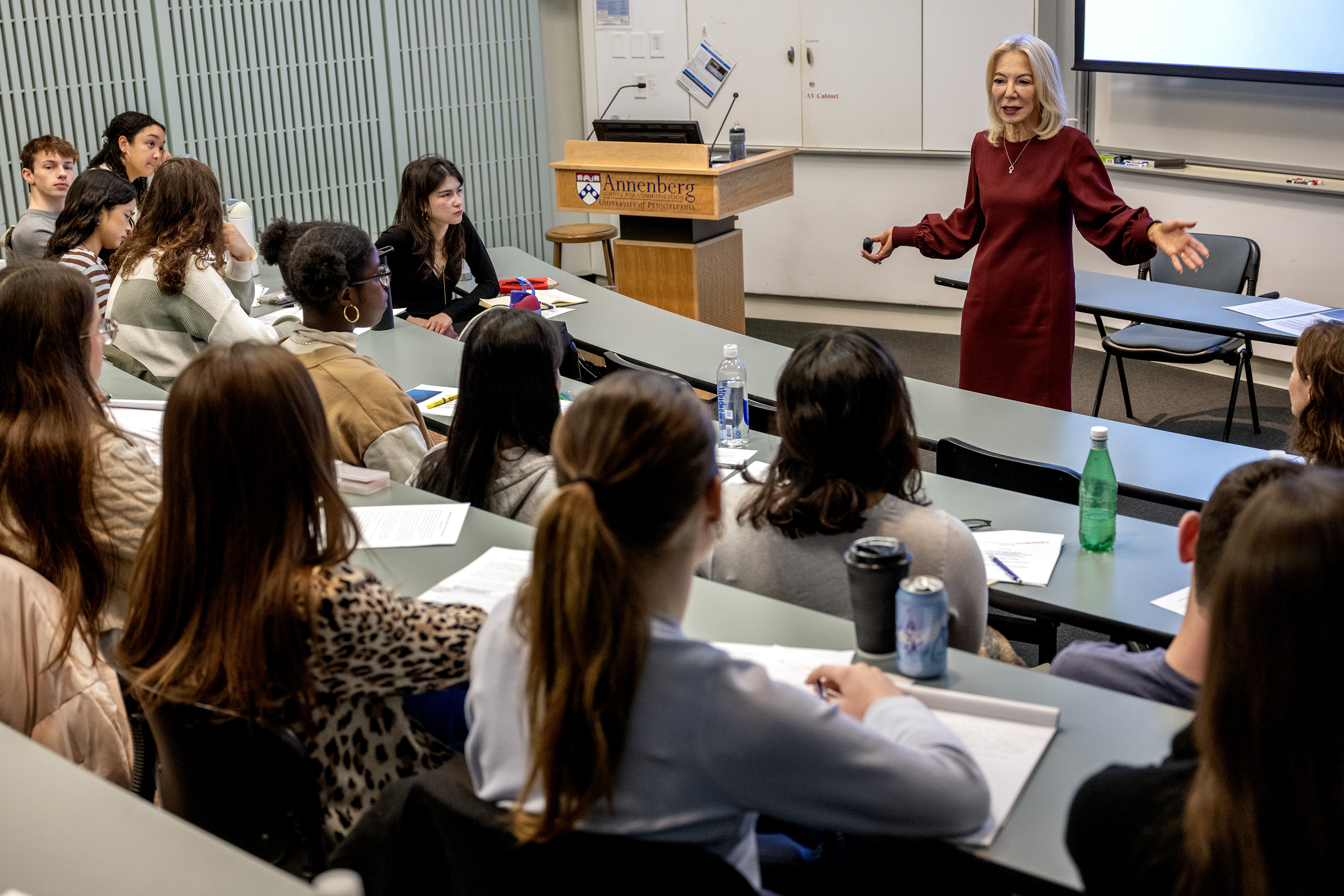
Penn President emerita Amy Gutmann co-teaches a class at Penn’s Annenberg School for Communication with the dean Sarah Banet-Weiser. They don’t allow laptops or phones to be used in the classroom.
“I read the literature on it and it really showed that students learn better when they’re taking notes rather than trying to type as fast as they can verbatim what you say,” said Amy Gutmann, Penn president emerita, who is co-teaching a class at the Annenberg School for Communication this fall.
Some professors say laptop use in class can be beneficial.
Sudhir Kumar, a Temple biology professor, said he asks his class of 150 students to respond to questions on their laptops every 10 minutes. Their answers count toward their grades.
“It’s constantly keeping them on their toes,” he said.
He would not want to see everyone give up on laptop use in class.
“We cannot fight technology,” he said. “Teachers have to embrace technology, whether it is artificial intelligence or computers. That is a standard mode of operation for most people today.”
(Left to Right) Jess Nguyen, 20, a junior from Broomall, Allan Thomas, 22, a senior from Philly, and Sara Tedla, 22, a senior from Philly, in a class taught by Temple University biology professor Jody Hey last month.
In Cathy Brant’ssocial studies methods classof 20 to 25 students at Rowan University, laptops are key. Brant, an associate professor of education, saidthere are lots of hands-on group projects, and she frequently asks students to check New Jersey standards online as they prepare their lessons. She also teaches them how to use AI appropriately in the classroom.
One of her students, she said, recently handed in a paper with very detailed notes from Brant’s lecture that she probably got only because she was able to type quickly on her computer.
“You’re responsible for paying attention in class,” she said. “Maybe it’s a little harsh, but I’m just like, ‘If you want to be on Facebook the entire time during class, that’s on you.’”
Jordan Shapiro, an associate professor at Temple, more than a decade ago used to make a point of having his students post on Twitter, now X, during class and counted it toward classroom participation.
Now, he tells students to put their laptops away during class.
“I tell them I have no problem with tech or laptops,” he said. “I just think that none of us get enough time in our lives to just focus on ideas or to listen in a sustained way to the people around us.”
He also became concerned about students doing homework during class, he said, and usingartificial intelligence to supply them with questions and comments to ask in class. They were “outsourcing class participation to the robots,” he said.
Mark Boudreau, a biology professor at Penn State Brandywine, disallowed laptops for the first time this semester.
“I thought I would get real pushback … or people might even drop the class,” he said. “But … a lot of students have had other faculty who have this policy.”
Exam scores in his three courses are better this year, he said.
Hey noted student grades have gone up, too. But he can tell some students struggle with note-taking; some just listen and don’t take notes.
“That’s better than sitting there and going on Facebook,” he said.
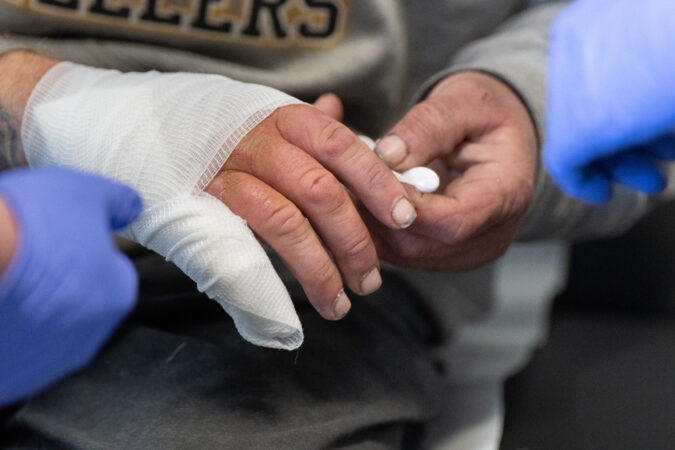
In a small clinic room at Mother of Mercy House on Allegheny Avenue in Kensington, Emma Anderson unwrapped a bandage from a man’s swollen hand.
“It hurts really bad in the cold,” the man said, wincing at the inflamed wound that covered most of a right-hand finger.
Cleaning it with saline solution proved so painful that Anderson, an EMT and St. Joseph’s University student, let the patient take the lead, wiping carefully at the yellowish-white tissue at the center of the wound.
It was his second time attending the wound care clinic at Mother of Mercy, the Catholic nonprofit that twice a week opens its doors to people with addiction dealing with the serious skin lesions, caused by the animal tranquilizer xylazine, that can develop into wounds so severe the only treatment is amputation.
Called “tranq” on the streets, xylazine was never approved for human use and has wreaked havoc across the city since dealers began adding it to fentanyl to extend the opioid’s short-lived high.
In the five years since it emerged as a threat, amputations among opioid users have more than doubled. The Philadelphia drug supply is now changing again, and though emergency rooms in the last year have treated fewer xylazine wounds, the crisis is far from over.
The man who visited Mother of Mercy’s clinic on a recent Tuesday, who gave only his first name, Steven, because of the stigma surrounding drug use, noticed the alarming wound on his hand a few weeks ago.
Steven had seen people sleeping on the streets with flies hovering around their gaping wounds. He had hoped that he could avoid a wound himself: He smokes fentanyl, instead of injecting it, and knows that injection drug users are generally at a higher risk for skin infections. But, like many people who smoke their drugs, he had developed a wound anyway.
“Believe it or not,” Steven said, between deep breaths during the painful cleaning, “I actually was an EMT myself at one point.”
‘How did we let it get this bad?’
Mother of Mercy, founded in 2015 in Kensington, partners with St. Joseph’s Institute of Clinical Bioethics to host the clinics. The institute, headed byFather Peter Clark, a Jesuit priest and a bioethicist at several area hospitals, has long held a monthly health clinic at the nonprofit’s Kensington headquarters.
In the last year, they expanded the program to offer more wound care opportunities to a community increasingly in need of them.
Father Peter Clark, the director of the Institute of Clinical Bioethics at St. Joseph’s University, and Ean Hudak, a St. Joseph’s student and staffer at the Mother of Mercy House wound care clinic, assist a person who had fallen unconscious on Allegheny Avenue in Kensington.
“To be physically down here in the heart of it, and seeing it on a weekly, monthly basis, it opens your eyes. How did we let it get this bad?” said Steven Silver, the assistant director of research and development at St. Joseph’s, who was welcoming clients at the door on a recent clinic day.
The program is staffed by medical students and undergraduates, all trained in wound care. Many say the work they do at the clinic is unlike any medical training they’ve been offered at school.
Undergraduates like Anderson and Ean Hudak, who takes shifts at the clinic in between applying to nursing schools, say they’re hoping to use their experience as they pursue careers in the medical field.
On Tuesdays and Thursdays, organizers serve hot meals and wait inthe small clinic room for patients to trickle in, usually about 20 a week.
Once a month, the team takes to the streets with wound care supplies, such as bandages, saline sprays, and antiseptic cleansers. They look for people on the streets who may not be able to reach the clinic.
Clark said the clinic stepped up its hours in an effort to help patients keep their wounds clean more consistently — and hopefully prevent more amputations. “It’s increasing [patients’] ability to know what to do and how to keep the wounds clean — hopefully to help them out,” he said.
The trust factor
This year, medetomidine, another animal tranquilizer that causes severe withdrawal, has supplanted xylazine’s dominance in the Philadelphia area drug supply. Fewer patients addicted to opioids are visiting emergency rooms with soft-tissue damage, according to city data.
But it’s unknown how medetomidine affects those wounds, and there are still enough people suffering from them in Kensington, the epicenter of the city’s opioid crisis, that the clinic felt it necessary to increase its hours.
Hosting more frequent clinics also deepens relationships with patients. “People are coming back, which is good,” Clark said. “The trust factor is a huge issue.”
Many of the clinic’s patients avoid hospitals, fearing long waits for care: “At the ERs, they wait eight hours and they sign themselves out, or they’re coming down from a high, and nobody’s taking care of the withdrawal,” Clark said. “It’s a big mess.”
At the clinic,staff are regularly on the phone with wound care physicians at Temple University Hospital, who can flag patients with xylazine wounds and get them prompt care before they enter withdrawal, he said.
They also connect patients with housing, inpatient rehabs, and hospital care, for those with wounds too serious for the clinic to handle.
Several weeks ago, they called an ambulance to get a man with a wound that exposed his bone to the hospital.
Staff collect data to share with area hospitals so physicians can get a better understanding of the situation on the street — measuring patients’ wounds, collecting demographic data, and asking patients about which drugs they use.
Each leaves the clinic with a hospital bracelet documenting the care they’ve received so staff can keep track of their care from week to week.
‘It’s always an uphill battle’
Not all patients at the clinic are suffering from xylazine wounds. On a recent weekday, one man asked for help bandaging scrapes on his knuckles. He’d tried to fight someone who was stealing his belongings.
Another man said he’d been robbed and pepper-sprayed and asked staff to help wash the last traces of Mace out of his eyes.
As staffers looked for eyedrops among their medical supplies, Clark poked his head into the room. “We need someone with Narcan,” he said, referring to the opioid overdose-reversing spray.
Across the street, a man was slumped on a stoop, unresponsive.
Clark and Hudak dodged cars on Allegheny Avenue, knelt down by the man, and managed to gently shake him awake.
Slowly, he revived enough to speak a bit and showed them a wound on his leg, which they cleaned and wrapped in gauze. “You have some cracked skin — do you want us to put some moisturizer on your hands?” Hudak asked.
With temperatures dropping, the team is worried that patients’ skin will dry out, making their wounds more painful. (The summer months present a different challenge, with wounds leaking fluids.) And many patients may be too cold to travel to the clinic, making the monthly street rounds even more crucial.
When Steven Peikin and Amy Spicer moved back to the Philadelphia area in late 2023 after spending 2½ years in Florida, there weren’t many houses on the market. So when Peikin discovered a 4,100-square-foot, two-story home in Bryn Mawr on a solo trip, he convinced Spicer that he’d found the perfect home.
“She saw the pictures online,” recalled Peikin, a gastroenterologist at Cooper University Health Care. “I saw it on a Thursday and was told there could be no contingency or inspection, there were four other bidders, and I had to have our best offer in by Sunday.”
He took the plunge and bought the house, but when Amy saw it, she wasn’t completely sold. She felt the house was dated and she couldn’t get past the yellow exterior.
“When I saw the inside of the house, it was very 1980-esque and needed considerable remodeling,” said Amy, a pharmaceutical sales rep for Madrigal and a yoga instructor. “Steve found it very charming, but I saw it as my 97-year-old grandma’s house.”
Steve Peikin and Amy Spicer’s living room was one of the spaces they updated in renovations.The kitchen and dining area, which looks out on the backyard.The renovated kitchen features Thermador appliances and a stone island with a built-in stove. Decor in the den.
The compromise was to make changes that would satisfy them both. The couple stayed in Airbnbs during a four-month renovation, and moved into the home in the spring of 2025.
With the help of Christina Henck from Manayunk-based Henck Design, they created a cozy, updated English Country style home in warm browns and neutrals.
“The house was very formal but we created a more natural, laid-back feel,” said Peikin.
They painted the exterior brownish gray, updated the bathrooms, created a dedicated laundry room, and added architectural elements to the living room and family room.
The outside of the home, which was once yellow, was painted after Spicer and Peikin moved in.
Those included custom bookshelves, a new metal mantle for the wood-burning stove, and extended ceiling beams. They also replaced all of the original lighting with a combination of recessed lighting and fixtures, swapped out the window treatments, updated the HVAC system, and added pavers to the backyard.
“Steve has a living room and I have a den,” said Spicer. “Mine is very calm and peaceful and his feels refined and sophisticated.”
Parts of the house had been renovated a couple of years earlier after a tree fell on the house, resulting in a new kitchen, primary suite, and roof.
Spicer’s son, Austin, 23, is currently living with the couple. He and his mom enjoy cooking together in their spacious kitchen featuring Thermador appliances and a stone island with a built-in stove. A second stove sits under the microwave. When weather permits, Peikin grills outside and they eat on the patio.
A reprint of the painting “Lady With an Ermine” by Leonardo da Vinci is pictured on a shelf in the den.Metal wall decor hanging on the wall of the den.Steve Peikin’s home office. When they bought the home, the couple wanted space for two home offices.The mudroom and arched entryway.
The mudroom off the garage leads to the kitchen through an arched passageway which may have been an addition to the original house built in 1950, Peikin said. The mudroom floor features black and gold tile and a huge inlaid wooden chest that they call the Narnia cabinet — akin to the one in the fantasy novel The Lion, The Witch and The Wardrobe — sits against one wall.
The primary bedroom suite includes a large window overlooking the tree-lined property.
“You can watch the deer and other animals in the backyard,” said Spicer. “While our home in Florida was lovely because we stared at water, it was loud. Here it’s quiet and just beautiful.”
Peikin and Spicer each have dedicated offices. He refers to his first-floor office as his studiolo, which during the Italian Renaissance was a place of study and contemplation. He meets with telemedicine clients there, but it’s also where he watches ballgames and hangs out.
The backyard, where the couple enjoy swimming, barbecuing, and relaxing.
Spicer’s office includes an altar featuring a Buddha, a space where she meditates and which she uses as a backdrop for the online yoga classes she teaches.
The backyard is where the family spends as much time as possible, swimming, hanging in the hot tub, lounging by the pool, warming up at the fire pit, or barbecuing. With help from All Seasons Maintenance & Design, Melady Landscaping, and Bloom Design, they created a cozy, inviting outdoor retreat.
“The best part of living here is that we are surrounded by a bamboo forest and tall trees, with beautiful crepe myrtle, dogwoods, and magnolias, and we have deer and lots of birds,” said Peikin. “We love the outdoors.”
Is your house a Haven? Nominate your home by email (and send some digital photographs) at properties@inquirer.com.
The outdoor kitchen, where Spicer and Peikin prefer to cook dinner when the weather allows.Steve Peikin and Amy Spicer pose for a portrait in their backyard.
Trump is ready to press Ukraine to bow to a plan that guarantees further Russian destruction. Let’s hope the backlash to the proposal stiffens the backbone of GOP supporters of Ukraine against the pro-Russian White House crowd.
The drama hasn’t ended yet.
The 28-point plan was cooked up by Trump’s feckless negotiator, Steve Witkoff, and first son-in-law Jared Kushner. Two real estate moguls with zero knowledge of Ukraine wrote a draft plan based heavily on input from Kremlin insider Kirill Dmitriev.
Dmitriev is Putin’s representative for economic cooperation and has wooed Witkoff and Kushner with fantasies of joint U.S.-Russian investment. The three men met for secret talks in October in Miami, at Witkoff’s home.
The resulting document reads like Kremlin talking points; some Russia experts point out that the English syntax sounds as if it were google translated directly from the Russian text.
“Even Neville Chamberlain would blush at this,” said Rep. Don Bacon (R-NE), referencing the British prime minister who infamously appeased Adolph Hitler. “It’s embarrassing to our country.”
Painfully true.
The deal demands suicidal concessions from Ukraine, the victim of Russian aggression, but none from the Russia invader. The points echoed a Putin wish list, and green-light Moscow’s complete subordination of Ukraine, by shrinking Kyiv’s army, limiting its alliances and weapons, and leaving it wide-open to future Russian attacks.
Trump was — and still is — ready to sell out Kyiv in pursuit of an imaginary Nobel Peace Prize along with lucrative business deals with Moscow and predatory deals for Ukrainian minerals (both are touted in the plan).
In clear evidence of Russian untrustworthiness, Dmitriev leaked the proposal last week to journalist Barak Ravid of Axios in order to box in the Americans before consultations with Ukraine. Yet Trump quickly endorsed this capitulation document.
Dmitriev’s betrayal alone should disqualify him from further negotiations, but there’s no sign Witkoff will abandon his new Russian pal. As for Witkoff and Kushner, Trump is rewarding their blunders by sending them to meet Putin next week.
Russian President Vladimir Putin’s envoy Kirill Dmitriev (left) and President Donald Trump’s special envoy Steve Witkoff attend talks in St. Petersburg, Russia, in April.
How do we know for sure that Dmitriev was the leaker? Because Witkoff posted on X, “He [Axios’ Ravid] must have got this from K …,” meaning Kirillov. Apparently, Witkoff thought he was sending a private message, another sign he isn’t up to the job.
Equally egregious, Secretary of State Marco Rubio, who does know something about Russia, was kept out of the loop by Witkoff. After the leak, he got a firestorm of complaints from upset European counterparts and GOP supporters of Ukraine. That led him to call Sen. Mike Rounds (R., N.D.), who was at an international security conference in Halifax, Nova Scotia, along with a bipartisan Senate delegation.
Rounds recounted to journalists that Rubio described Witkoff’s plan as a Russian “wish list” and not an actual U.S. proposal. Under White House pressure, Rubio soon reversed himself and posted online that the senators were mistaken. A State Department spokesperson falsely accused the senators of lying
I spoke to Sen. Chris Coons (D., Del.), who was with the delegation during the call (although not on the phone). “I heard what [my colleagues] said immediately after the call,” he told me. “They couldn’t have been clearer about what Marco said, and what the complications were. I hope after today we’ll see a proposal which enables Ukraine to remain free and sovereign and defend itself in the future.”
With this White House, don’t hold your breath.
The pushback from GOP backers of Ukraine, as well as from the EU and Kyiv, was so intense, however, that Rubio rushed to “update” the document in weekend negotiations with Ukrainian officials in Geneva.
Very sensitive issues remain unresolved, yet Trump is still pressuring Kyiv to sign on this month. There is an acute danger that he and Vice President JD Vance may try again to bushwhack Ukraine’s Volodymyr Zelensky, who will probably visit the White House this month.
European allies, who were not consulted on the deal, have been desperately trying to bolster Zelensky and get Trump’s ear.
In this image taken from video provided by Russian Presidential Press Service on Nov. 20, Russian President Vladimir Putin speaks as he visits one of the command posts of the West group of Russian Army in an undisclosed location.
But given the president’s eagerness for a “deal” — any deal, no matter how fatal to Ukraine — Trump is more likely to squeeze Kyiv than press Putin for concessions. Russian Foreign Minister Sergey Lavrov made clear this week that Putin is only interested in the original pro-Russian points, and not any revision that protects Ukraine from future attack.
It’s important for Americans to understand why the Putin-Trump 28-point deal wouldn’t stop Russian aggression and would only encourage Moscow to continue the war.
As former Ukrainian Defense Minister Andriy Zagorodnyuk pointed out: “Ukraine has never attempted to seize Russian territory. Russia, on the other hand, has repeatedly invaded Ukraine and continues to strike Ukrainian cities daily.”
The bottom line for achieving peace is that any plan must strengthen Ukraine’s defenses and provide concrete U.S. guarantees that Russia won’t destroy the Ukrainian state in the future. The 28-point plan does just the opposite (and the revisions aren’t strong enough.)
The Kirillov proposal shrinks the size of the Ukrainian army by a third while putting no limits on Russia’s army, which is roughly twice the size of Ukraine’s. It prevents Ukraine from ever joining NATO and forbids NATO peacekeepers on its soil.
Imagine if Franklin Delano Roosevelt had endorsed a peace plan between Winston Churchill and Hitler in 1940 that left Hitler free to expand his army while demanding Churchill halve his forces, ground his Spitfires, and promise never to ask the Yanks for help.
Which brings us to the ugliest part of Trump’s fake peace efforts. There is a lot of loose verbiage about “guarantees” against a future Russian invasion in the 28 points, and in a side letter offering Kyiv a “security assurance modeled on the principles of [NATO’s] Article 5.” Note the weasel words.
Let me assure you, I have read and reread the texts, and they offer Ukraine no firm U.S. or allied commitment to intervene if Russia attacks again.
The real hint of the worthlessness of this Kremlin-born document comes with point 16, which proclaims: “Russia will enshrine in law its policy of non-aggression toward Europe and Ukraine.”
Does Trump not know Putin has violated every accord he or his predecessors signed with Kyiv. That includes the 1994 Budapest Memorandum by which Ukraine surrendered its nuclear weapons in exchange for guarantees of sovereignty from the U.S., the U.K., and Russia? We know how much those paper assurances have been worth.
POTUS refuses to face reality: Putin respects only strength; there will be no peace until the costs of war are more than the Russian economy and military can bear.
Peace negotiations are worthless unless backed by tougher U.S. sanctions and sales of U.S. air defense systems and missiles to Ukraine.
By his continual concessions to Moscow, Trump has convinced the Russian leader that he is a weak pushover. That guarantees that Russia will continue the war.
Why is Donald Trump deserting Ukraine? Ukraine has demonstrated superior battlefield and technical skills over Russia and taken back territory that Russia has captured. Ukraine has suffered severe losses fighting for its sovereignty. International experts believe Ukraine could defeat Russia. Why aren’t we giving help to our ally? We’ve given and taken it away twice. Trump and Vladimir Putin now suggest a plan giving Russia a major gift. Russia started this war and should never be rewarded. The plan sounds like a big win for Russia and a loss for the U.S., Ukraine, and NATO. Trump continues to show admiration for Putin, who has humiliated him more than once. Trump flattered Putin in Alaska. It didn’t work. Do we really want to give Russia control over major territory in Ukraine, relief on sanctions, and limitations on NATO countries? Russia has been trying to damage NATO countries’ airports. We should never reward Russia when we’ve seen these actions. Allies in Europe don’t favor the referenced plan, nor should the U.S.
Robert Turnbull, Media
. . .
Ukrainian President Volodymyr Zelensky must not agree to the Trump administration’s Russia-friendly proposal to end hostilities between the two neighboring countries. The American people support Ukraine’s fight, but their president never has. He’s a grudge holder who likely blames Zelensky (for his refusal to investigate the Bidens) for his first impeachment. Trump wants Ukraine to capitulate in order to boost his campaign for a Nobel Peace Prize. Trump is for Trump and no one else. Vladimir Putin manipulates Trump, who has done nothing to earn Zelensky’s confidence and trust. Trump’s demand that Ukraine accept terms that are favorable only to Russia is a knife in the hearts of all peace-loving and battle-weary Ukrainians. Zelensky repeatedly held out his hand (both hands to be accurate) to Trump, requesting “U.S. support” in the form of aid and defensive military weaponry. Each ask resulted in no aid. Nada, from the onetime swaggering candidate who even before the inauguration told voters he would end hostilities in short order if elected. Volodymyr, don’t lose Ukrainian dignity. Trump is not your friend.
David Kahn,Boca Raton, Fla.
Unfair
On Nov. 13, Sen. John Fetterman was hospitalized following a minor cardiac event. How nice for him to be able to draw on government-subsidized health coverage to access the care he needs. What a shame he couldn’t be bothered to fight to protect access to affordable healthcare for his constituents.
When I received a breast cancer diagnosis a few days shy of my 34th birthday, it was my Affordable Care Act plan that ensured I could get the treatment I needed without decimating my financial reserves. Now, thanks to Fetterman’s spinelessness, what cancer treatment couldn’t wipe out, a 75% increase in insurance premiums just might. How many Pennsylvanians are going to find themselves in a comparable position? Trapped between healthcare they can’t afford to go without and coverage they can no longer afford to pay.
Katherine Roberts,Philadelphia
Join the conversation: Send letters to letters@inquirer.com. Limit length to 150 words and include home address and day and evening phone number. Letters run in The Inquirer six days a week on the editorial pages and online.
ARIES (March 21-April 19). If you could just do all the right steps in the right order, the task would get good results in a predictable amount of time. But perfect instructions are a rare thing in this world. So watch a pro and have a little fun while you give it your best shot.
TAURUS (April 20-May 20). Vivid fantasies and dreams are available to you the moment you make a relaxed space for them. Like children who go wild when adults leave the room, your thoughts will be feral fun once the uptight prefrontal cortex gets out of the way.
GEMINI (May 21-June 21). You don’t need rescuing, but some will rush in wanting to help. Let them show their care. Just don’t hand over your power. Accept the kind of assistance that lightens your load without taking over your path.
CANCER (June 22-July 22). Being struck with the best idea in a powerful, potent and fully realized form is a rarity. The first idea needs only to be good enough to keep you revisiting. Solutions will be the result of a thought process, not a thought.
LEO (July 23-Aug. 22). You’ll be once more made aware of how every object, obligation or identity we carry requires energy to maintain. To live with less is, in a sense, to be less tired. Fewer possessions, fewer commitments, fewer mental attachments — this does bring freedom.
VIRGO (Aug. 23-Sept. 22). The unconscious mind processes information faster than conscious reasoning. It picks up subtle cues and patterns, then delivers them as an “aha” or gut feeling. You feel as you do. Don’t worry too much about your reasons — trust that you have them.
LIBRA (Sept. 23-Oct. 23). What you want is in line with what is possible, good and right for you to have. Streamline your efforts. A lean and mean approach will concentrate your power so you can use it precisely, making a difference when it matters.
SCORPIO (Oct. 24-Nov. 21). You’re open and curious right now, ready to explore. Lead with appetite and you’ll have more fun because you’re so hungry for life and ideas. Intuition will guide your curiosity, and you can trust it to know what’s next for you.
SAGITTARIUS (Nov. 22-Dec. 21). Charisma is easy for you, but it’s not always about giving a performance. Sometimes it’s as simple as not staring at a screen, so the others in the room feel you’re in the same setting as them and you want to be there.
CAPRICORN (Dec. 22-Jan. 19). Your mood: feisty. It feels like the entire system is wonky. You may find yourself buzzing through every experience with a kind of low-grade, rebellious energy. The rebel in you doesn’t need a justification — just a stage.
AQUARIUS (Jan. 20-Feb. 18). You have a plan, and it’s a good one, but when the moment arises, we are only as effective as our adaptive instincts. Keep your intentions at the forefront and you will succeed in conveying them.
PISCES (Feb. 19-March 20). Those who can’t appreciate their own experiences usually have trouble appreciating anyone else’s. Keep that in mind when choosing an audience. The receptivity of others will affect your mood, so choose people who listen well and laugh easily.
TODAY’SBIRTHDAY (Nov. 26). Welcome to your Year of Living Deliciously. Pleasure is the compass that leads to prosperity. Your appetites and curiosities lead you to situations that make life interesting while making you smarter about curating the lifestyle that fits you best. More highlights: Recognition for creative courage, an unexpected financial upswing, and love that thrives on curiosity and humor. Virgo and Aquarius adore you. Your lucky numbers are: 12, 8, 33, 45 and 21.
DEAR ABBY: My child “Logan” is the product of a sexual assault. He has located his father and formed a relationship with him. Logan didn’t know the circumstances of his conception at the time he contacted his father. He has now been made fully aware by our family as to what occurred.
Abby, Logan has invited this person to his wedding. I do not want to attend if his father will be present. Logan has told me that this man WILL be attending and that the problem is MY issue. I love my son, but this is beyond traumatic for me. I want to be there for the special day, but I cannot bring myself to be in the same room with the person who assaulted me.
This situation has broken my heart. I feel as though my feelings don’t matter to Logan and that he expects me to just push through this, go to the wedding and deal with it. What are your thoughts?
— WORST-CASE SCENARIO
DEAR WORST-CASE: Your son’s insensitivity to your feelings is appalling. That he would demand you ignore the fact that you were a rape victim and spend even a minute in the perpetrator’s presence is outrageous. Whatever decision you make to move forward is the right one for YOU. I am so sorry for your pain, which is palpable.
** ** **
DEAR ABBY: I work with a lady who has drama swirling around her constantly. There’s always something wrong with work, her house, her family, herself, her pets, etc. Each problem is worse than the next. At first, I was sympathetic and let her vent. Then I realized this is a daily occurrence, and all this negativity is draining not only my patience but also my mental health.
I have tried quickly moving past her work area, but she then follows me to mine. When I tried getting to work before she did, she started coming in earlier. When I tell her I need to complete an assignment, she continues to talk! I’d like to put some distance between us. But she’s a nice person, and I hate to say, “I really can’t listen to you complain every day.” Any suggestions?
— RUNNING OUT OF PATIENCE
DEAR RUNNING: Yes, quit being such a “nice person” yourself and stop letting this co-worker use you as a trouble dump. The next time she approaches you, tell her that what she’s doing is interfering with your work and sapping your energy, and you can no longer allow it. Say plainly that you need her to stop. If she doesn’t, discuss the problem with your supervisor or HR.
** ** **
DEAR READERS: Tomorrow is Thanksgiving, and no Thanksgiving would be complete without sharing the traditional prayer penned by my dear late mother:
Oh, Heavenly Father,
We thank Thee for food and remember the hungry.
We thank Thee for health and remember the sick.
We thank Thee for friends and remember the friendless.
We thank Thee for freedom and remember the enslaved.