After years of working as a recruiter, Justin Kirkwood landed in tech, eventually becoming a technical project manager for a vendor inside Meta’s Seattle campus. He had clawed his way into the industry with an associate’s degree, getting to work with some of the brightest people in tech in a role he thought was secure.
But his perception shifted when the social media giant laid off 11,000 employees in one day in 2022, his first year working there. When he got his pink slip last month, he says grief set in, then denial and anger. He half-jokingly entertained the idea that he might become a cobbler or hot dog vendor.
The tech industry, once viewed as prestigious and safe, has become tumultuous, with some economists even warning of a looming recession in jobs. While tech companies continue to invest billions of dollars into AI, they’re slashing jobs while touting AI-forward strategies and leaner organizations. People who pursued careers in the tech industry expected big salaries, job security, and an abundance of opportunity that would take them to retirement. But now, as tech companies continue to shed jobs, workers are shifting their expectations even with an AI boom.
“My perception of [tech] as the most viable path to job stability has definitely waned,” Kirkwood, 47, said. “Is a constant soul-crushing ambient anxiety a stage of grief?”
The layoffs continued to trickle in. In January Amazon announced that it cut 16,000 roles — in addition to 14,000 cuts it announced in October — as it aims to reduce bureaucracy and get rid of some layers of management. (Amazon founder Jeff Bezos owns the Washington Post.) Pinterest also announced layoffs, stating it would cut 15% of staff in pursuit of its “AI-forward strategy.” Meta cut more than 1,000 workers earlier this year while Microsoft announced that it was slashing 15,000 jobs last year.
Meta CEO Mark Zuckerberg said on an earnings call recently that AI would “dramatically change the way that we work” this year, as Meta invests in AI tools to help workers be more productive, noting that it would be need to “flatten” teams. Amazon CEO Andy Jassy had warned employees in June that cuts were coming, attributing the reductions to efficiencies created by the company’s use of AI.
The layoffs come as the U.S. economy shows signs of growth. The Federal Reserve opted to hold interest rates steady in January noting that “economic activity has been expanding at a solid pace” and the unemployment rate shows “signs of stabilization.” The unemployment rate is near historic lows at 4.3% but the labor market has largely been frozen, leaving those who are employed “clinging to their jobs,” said Diane Swonk, chief economist at KPMG.
Unlike the dot-com boom of the 90s, the AI boom is not creating a major influx of new jobs because AI brings the promise of efficiency, she said. Meanwhile, tech companies are feeling financial pressure as they continue their costly build-out of data centers to support their AI ambitions.
“Over time, AI could be a productivity miracle … but in the near term we have to deal with the transition cost,” she said.
Amazon says AI is not the reason behind the reductions but rather to drive speed and ownership for invention and collaboration. Microsoft has said that even as it cuts, it’s continuing to hire and invest in strategic areas, though it did not provide specifics. Meta declined to comment.
Daniel Keum, an associate professor at Columbia Business School who researches labor market policy said the massive cuts in the tech industry are likely driven by a mix of restructuring around AI as well as the winding down of projects that companies pursued while rapidly expanding during the height of the pandemic.
“Everybody is realizing the need to be quicker and more agile,” he said. “You can do things a lot faster now.”
No more job security
Tech workers who’ve been in the industry for decades say the current period feels like a moment of transformation — one that’s reduced job security.
Six years ago, the thought of Amazon making massive cuts was unthinkable, said Fintan Palmer, a former Amazon senior software engineer who got his layoff notice in October. But in the past few years, tech companies have become less of a “safe harbor,” often hurting junior employees the most as they don’t have the network or skills to easily move on, he said.
“It’s both a really exciting and really scary time to be in tech,” said Palmer, who added that he’s felt like he’s spent the past six weeks working harder than in the past six months to solidify a new job through networking. “I’m excited to see where it goes, but I’m nervous there will be damage done to people’s lives and the industry.”
The tough job market is forcing workers across industries to spend long periods unemployed. People spent an average of 24.4 weeks unemployed in December, up from 19.5 in December 2022, according to data from the Bureau of Labor Statistics. As a result, workers, even in tech, are having to tweak their job search strategies.
Brian Morales was laid off last fall from an information technology managerial post at the Kroger supermarket chain. The 55-year-old lamented what felt like his inability to break through AI screening of job applications — until he started to tactically use AI to outgun the filters.
Morales went through AI certification programs to brush up his resume and is using ChatGPT to tailor outreach messages to potential employers. He says he’s getting more traction now but is feeling the pressure to land a job to support his wife and three children.
“It’s a lot of work compared to when I was last looking for a new role,” he said. “It’s very, very different.”
Steven Stark, a 32-year-old data scientist in Ann Arbor, Mich., who recently losthis job for the second time in a year, said that he’s had to hone his LinkedIn strategies to try to catch the eye of potential employers. He’s spent years relentlessly posting on the professional networking site to build a following, which he says translates into more people now seeing his job-hunting posts.
While another job search feels a little exciting, it’s also odd. “Most days blend together and feel the same now,” Stark said.
For younger people entering the industry, the challenges in landing a job appear even more pronounced.
A frustrating job search has made 24-year-old Frank Uribe-Medina wonder why he gravitated to technology work in the first place. Uribe-Medina’s employer told people after Christmas that it’s relocating jobs from the Los Angeles area to Virginia. Since then, he’s applied to nearly 150 openings without landing an interview.
Uribe-Medina taught himself software development and put himself through a degree program following advice that if he learned to code, he’d always have a job.
“Well, I’m looking for a job,” he said. “It feels like a big lie.”
For those still employed, the mood isn’t much different, with many worrying about when the ax will hit them as layoffs continue.
“It’s tense,” said a program manager at Microsoft, who spoke on the condition of anonymity for fear of professional retribution. “I’m doing everything I can to avoid the pink slip with very little confidence that I can. I feel like so much of this is out of my hands.”
Internally, leaders are overhyping the capabilities and efficiencies of AI as they cut head counts and leave remaining staff to pick up the slack, he said. Meanwhile, they’re raising the bar on expectations. People are less likely to take bold stances, “terrified” of taking big risks and cautious about voicing concerns, especially as they relate to the use of AI, he said.
“The concern is if you say anything negative about AI, it’s death for your career,” he said.
Microsoft declined to comment on the AI initiatives.
Meta workers are also turning to Blind, an app that gives users with a company email access to a private and anonymous message board, to speculate about the company’s future workforce. In one message entitled “Mark wants to flatten teams,” a worker wrote “it’s been very clear in the earnings call that there may be massacres soon,” according to copies of the messages viewed by the Washington Post. Another commented that “managers will all be asked to become [individual contributors]. Anyone who can’t perform as an IC will be let go.”
Meta declined to comment on the posts.
The Microsoft worker said he gets inundated by inquiries from jobseekers, often young people trying to make their way in or industry veterans who lost their jobs. But he’s no longer convinced the tech industry is a safe place to build a career.
Kirkwood says while the job hunt has been “brutal,” he’s landed a few interviews after applying to more than 100 jobs. But he expects to have contingency plans the next time around.
“I won’t take employment for granted anymore,” he said. “You have to keep multiple irons in the fire at this point because you never know when the carpet will get pulled out from under you.”
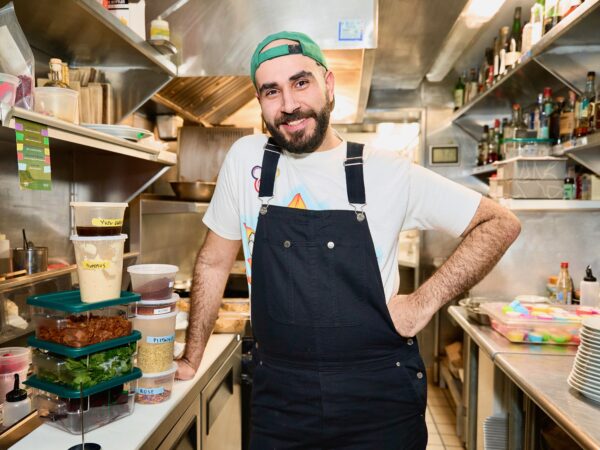
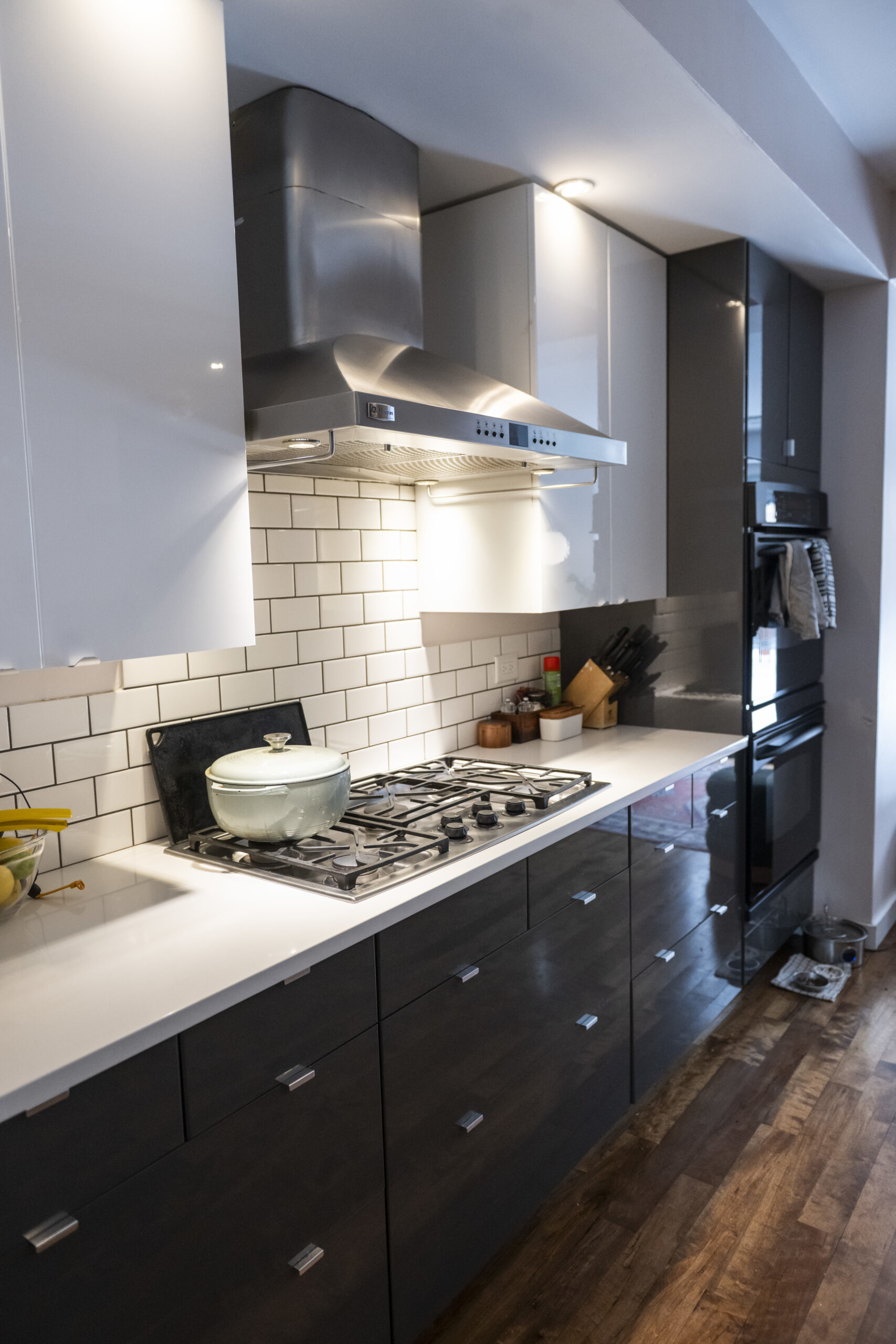
Miled Finianos grew up between Miami, Fl. and Zgharta, Lebanon, until he moved to South Philly in 2019. The 30-year-old rising chef, who runs Habibi Supper Club and lives in an East Passyunk rowhouse with a lovely modern kitchen, where his recipe ideas come to life.
Within two years of its launch, Finianos has reimagined what chef-led dinners can look like in Philly with his exciting weekly concept Habibi Supper Club, an underground supper club in Philly serves the “love language for Arabs” with a big Lebanese feast. Loyal diners and first-timers consistently book out his supper club as soon as he drops the reservation link on social media for five to six course menus showcasing the flavors of his roots — think spreads of shish barak, warak enab, and kibbeh.
“Having left Lebanon 14 years ago, and I would say it’s important to me to preserve the recipes and the experiences that are attached to these dishes because a lot of Levantine culture is passed down by word-of-mouth,” he said. “So when the mouth gets farther away, it becomes hard to preserve the culture. Habibi Supper Club has brought me closer to my culture than ever before — that’s what fuels me to keep going.”
Here’s how Finianos would spend a perfect day in Philadelphia. “Habibi has no scary Sundays if I follow this exact itinerary,” he added.
8 a.m.
I used to wake up earlier when I was still at my corporate job, but now I sleep in a little longer to make up for some of the later hours of my supper clubs and workshops. Now I can sit in bed, check emails, messages, and socials — I’m a notorious quick responder; it kills me to leave things overnight.
9 a.m.
I’m out the door, dressed for the weather, and walking up Passyunk Ave to find coffee. We are blessed in South Philly with a plethora of coffee shops, each better than the next. My rotation is usually between Herman’s, Shot Tower, or Rival Bros. Today we’re hitting up Shot Tower for an iced americano — no matter the temperature outside.
Miled Finianos’ perfect Philly day includes a stop to see friend/chef Kenan Rabah at Majdal Bakery.
10:30 a.m.
After sipping on coffee and reading the newspaper at Shot Tower, it’s time for breakfast. The only breakfast spot for me is Majdal Bakery, where my friend [and owner/chef] Kenan [Rabah] is slinging the flavors I grew up with. (This is a public plea for him to bring back the za’atar manouche with makdous.) With Fairouz playing, I feel like I’m back home [in Ehden, Lebanon] for a bit. He won’t let me leave without trying something one of his new pastry inventions and I will always happily say yes.
11:30 a.m.
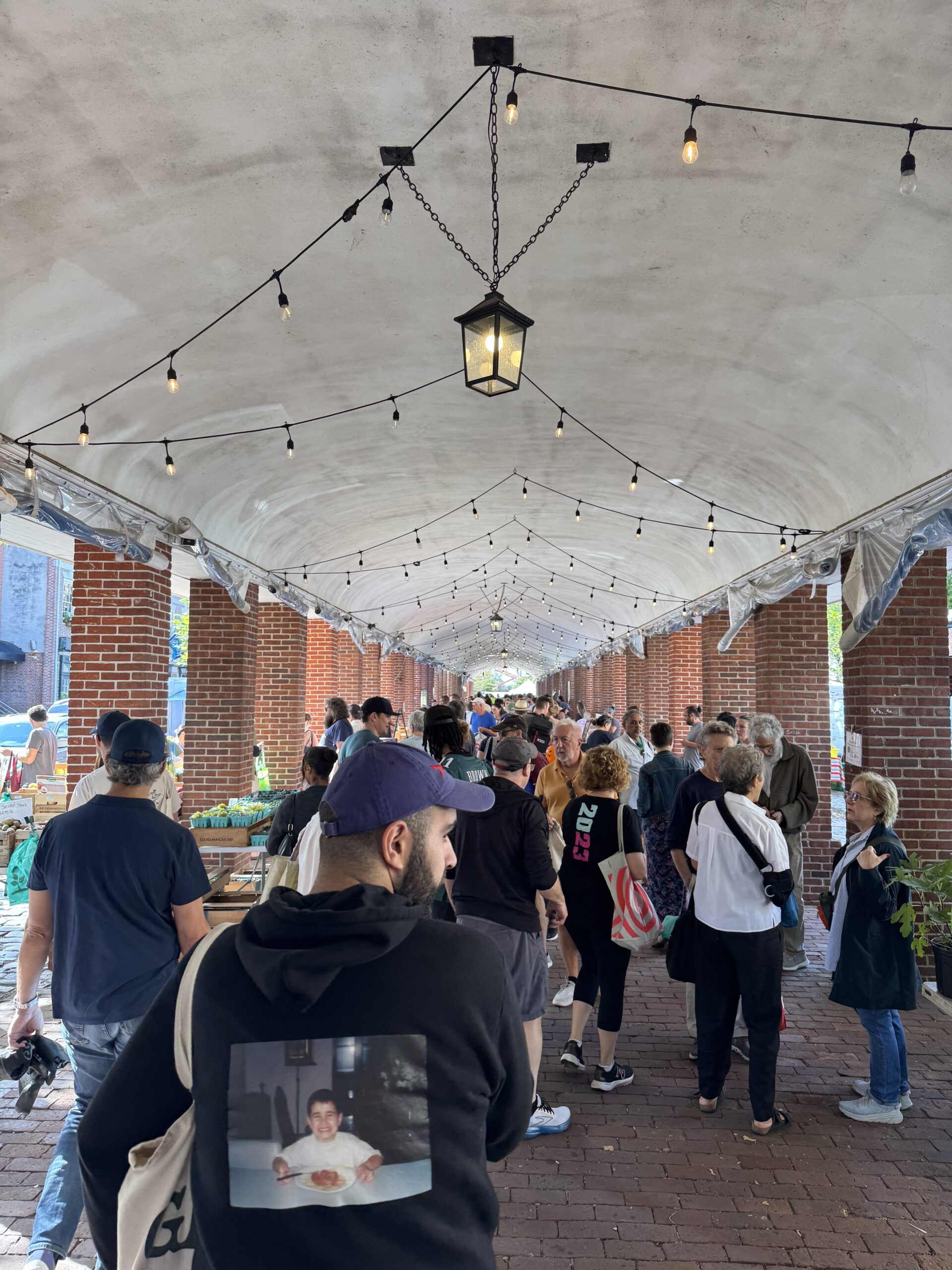
Sundays in Queen Village means the farmer’s market at Headhouse is in full swing. Armed with my tote and a debit card, I’ll peruse the market goodies, often while on FaceTime with my teta (grandmother) or mother. I show them what’s in season — but low-key, I’m farming for ideas of what they would do with what I buy. Then I head home with my goods and plot some personal menu ideas, along with some Habibi [Supper Club] R&D for whatever event is coming up.
1 p.m.
Hunger hits again, and lately I have been on a Vietnamese kick. I walk back up to either Pho Ha or Cafe Diem for a dry rice noodle bowl to satisfy that craving. We really are so lucky to have such a diverse authentic food scene in South Philly.
Miled Finianos visits the Headhouse Square farmers markets.
2:30 p.m.
Now, assuming I don’t have prep work to do, I’ll head back down Passyunk Ave, find another coffee, and sit with my laptop. If the weather is nice, I’ll park myself outside and people watch, daydreaming about a car-free Passyunk Square. This is the time I think of menu ideas, work on future events, and just soak in gratitude for being able to do this as a full-time gig.
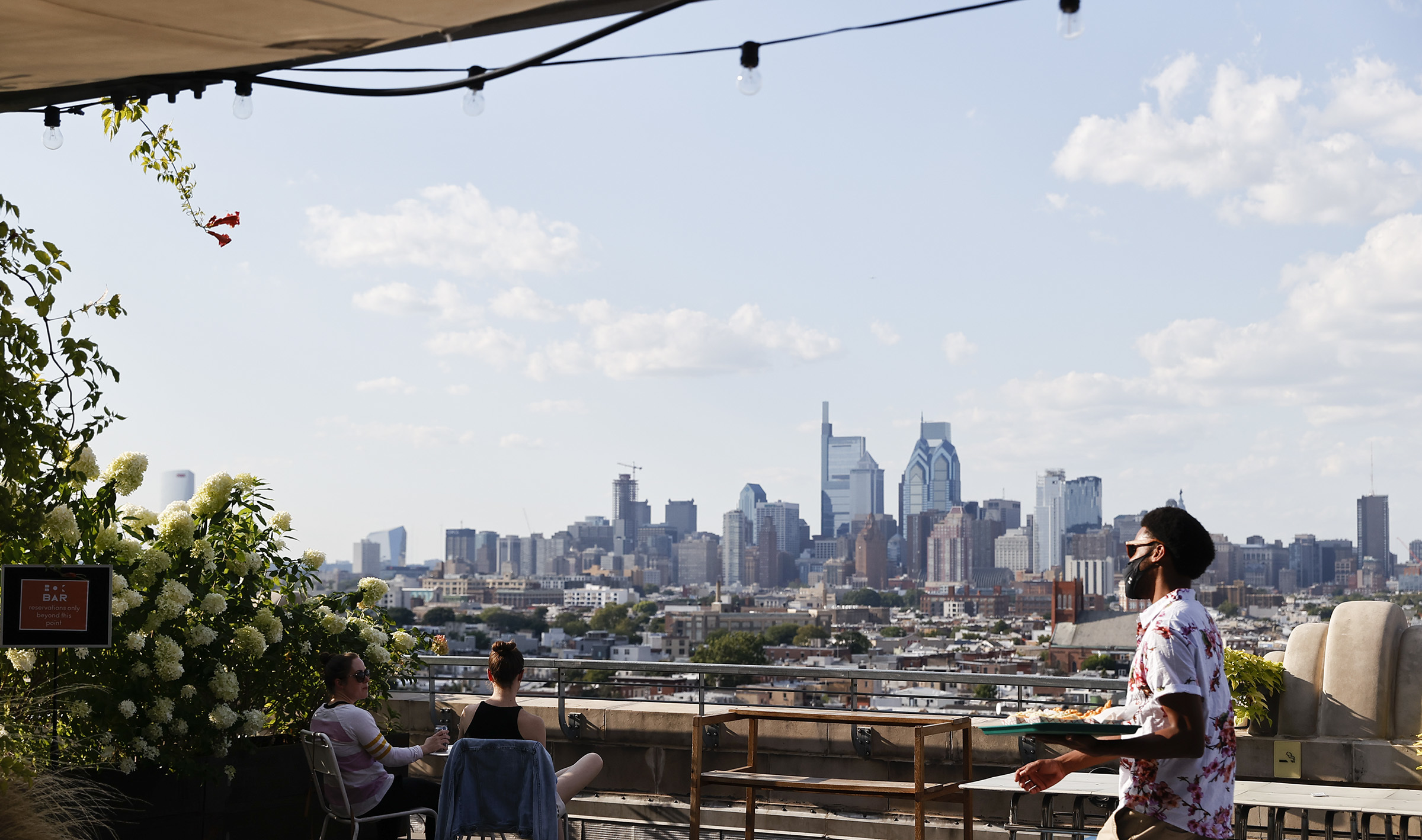
View of Center City Philadelphia from the BoK Bar atop the BOK building in South Philadelphia on Thursday, August 5, 2021.
6 p.m.
Now, my social itch is itching. If this is a day off, I usually have plans with a friend — or 12. I like to keep it local, so drinks and snacks at Grace & Proper and Royal Tavern. Or if it’s open, Bok Bar, my favorite place in Philadelphia — the view of the city paired with the delicious pop-up of the month just makes my heart full.
9 p.m.
One last drink at my fave dive bar, The Jim. I have been ending my nights with a nice shot of Fernet Branca because anything else gives me acid reflux — that’s just too much information to be sharing, but oh well.
As you can probably tell now, the perfect day for me is devoid of any chores or errands because that’s what Mondays are for.
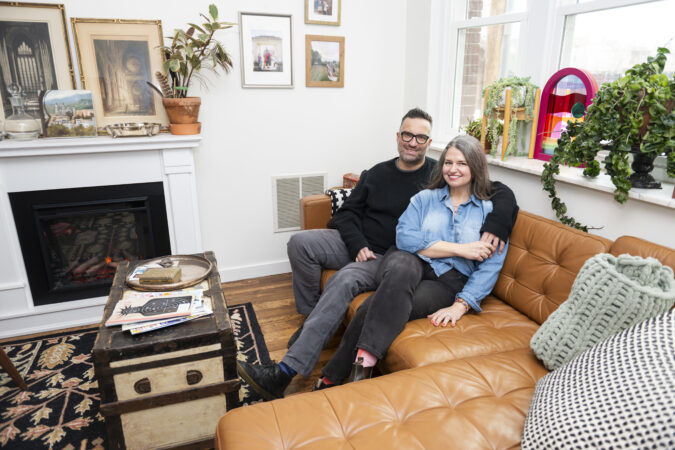
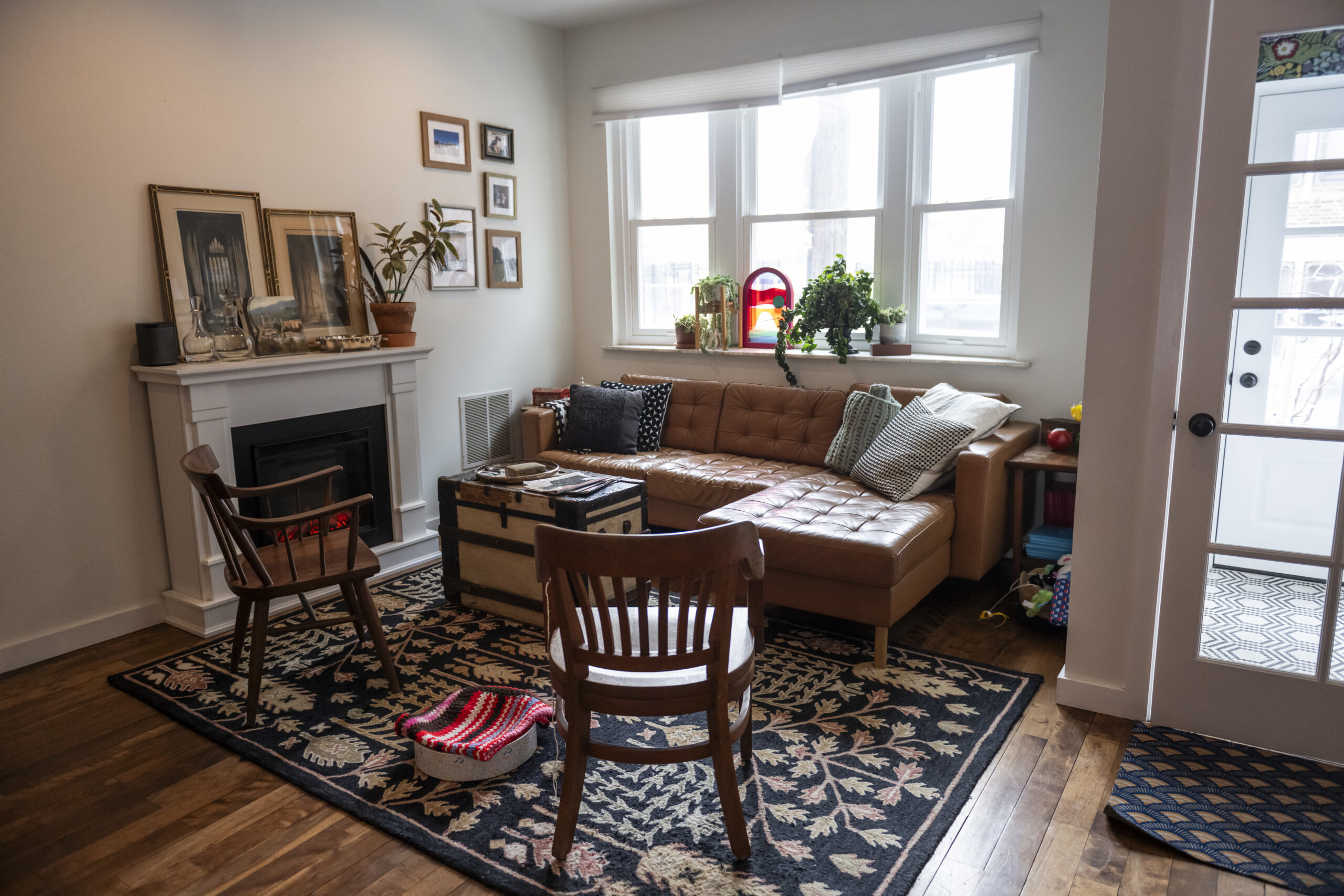
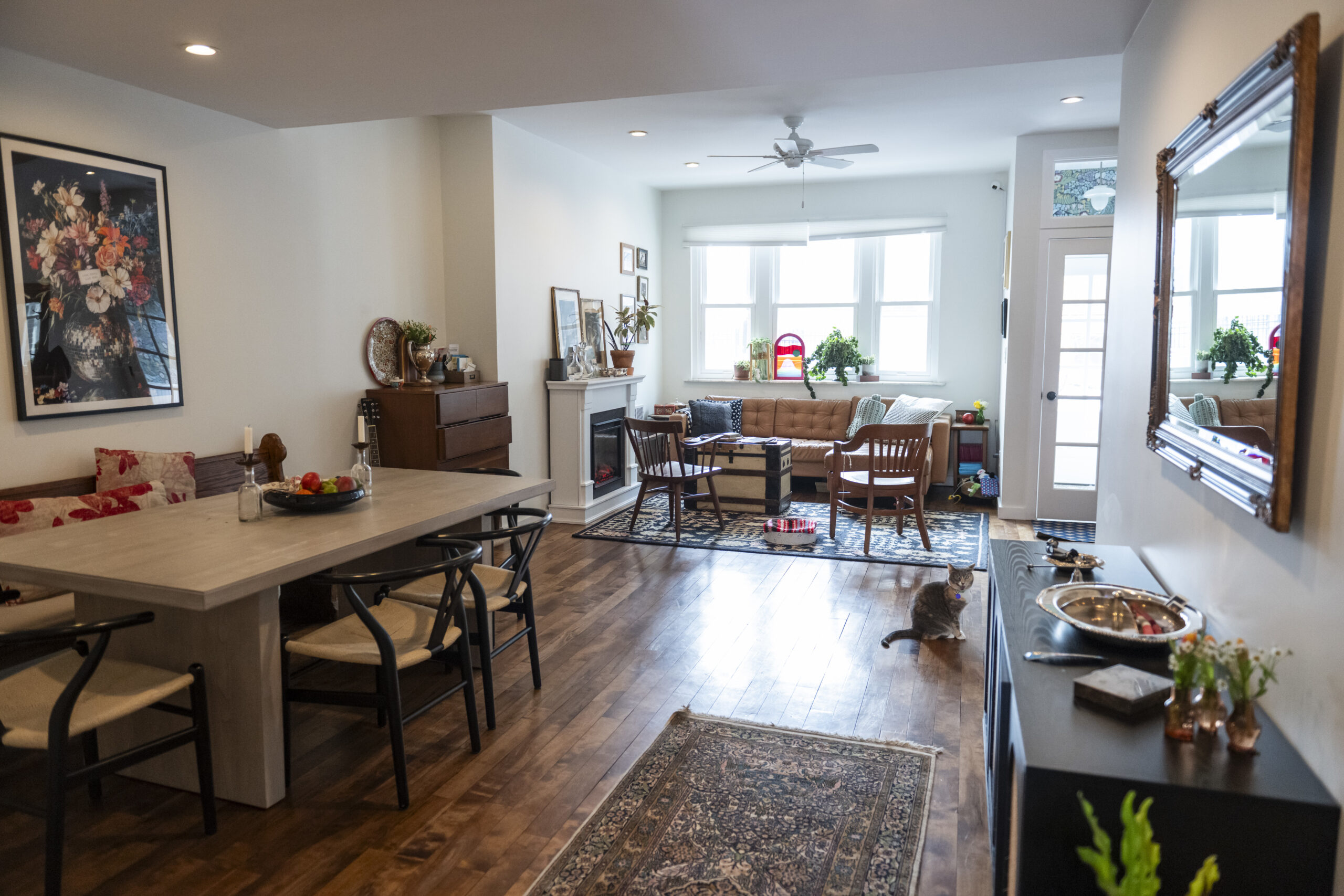
The house: A 1,700-square-foot townhouse in Passyunk Square with three bedrooms and two bathrooms built in 1915.
The price: listed for $725,000; purchased for $725,000.
The agent: Ashley Miele, Compass
The living area in the home in South Philadelphia.
The ask: Catherine Wargo Roberts and her husband, Karsten Roberts, had no desire to leave Passyunk Square. They were already deeply rooted in the neighborhood, with two kids enrolled at the local school and a daily life that revolved around a few familiar streets. But they had grown tired of their mixed commercial and residential block. “We were very happy for new businesses to come into the neighborhood and thrive,” she said. The block had become “just a little bit busier … than we wanted.”
The search: In fall 2024, the family set off in search of a new house. They wanted more square footage, lots of outdoor space, and an unfinished basement. “Everybody in Philadelphia wants a finished basement, but everybody’s basement floods,” Wargo Roberts said. “I want an unfinished basement so that if it fills with water, I’m not freaking out.” They also needed to stay in their kids’ school catchment.
The couple only looked at two homes. The second home was listed as a private sale.
Their list narrowed the search to just two houses. One was north of Washington Avenue, which Wargo Roberts said “felt like a whole different ballgame,” even though it was close to the kids’ school. It also didn’t have any outdoor space.
The other house they had to wait for. An agent friend had given them a heads-up that it would be on the market in a few months. The couple grabbed the first viewing available on the first day it was open for a private sale.
The appeal: Inside, Wargo Roberts was immediately drawn to the home’s size and layout. It was 250 square feet larger than their previous home, and most of the extra space wasin the first-floor living area, which Wargo Roberts appreciated. “I didn’t care about a big bedroom,” she said. “That’s not something I need.”
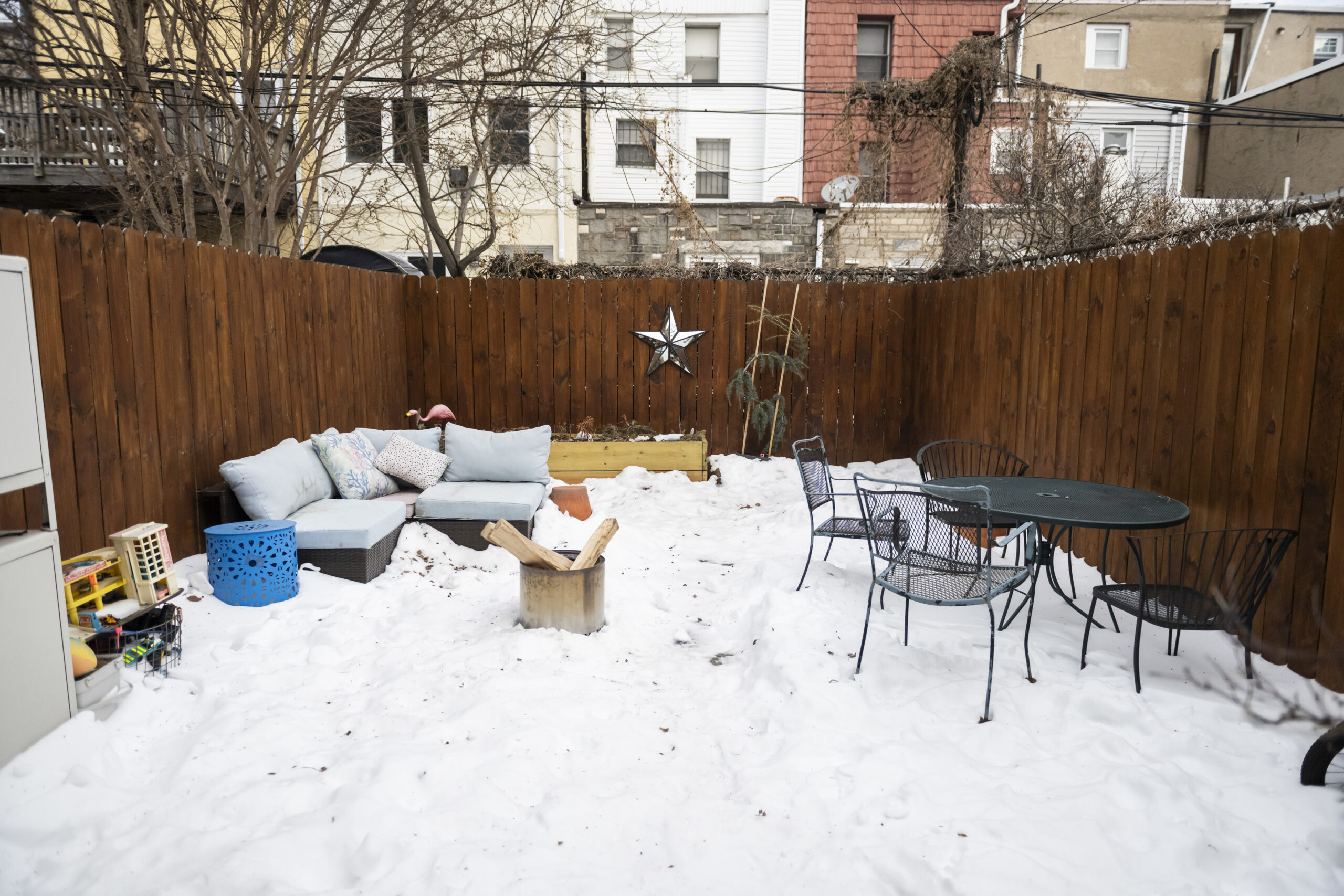
Outside, the house offered outdoor space that felt special: a large backyard, plus a deck that connects to the master suite on the top floor and a second deck above it. “Most people walk in our backyard and are like ‘holy s—,” Wargo Roberts said.
Wargo Roberts’ favorite thing about their new house? The giant backyard.
The deal: The house was listed for $725,000. The couple submitted a full-price offer the same day they saw it. It was within their budget, and “the comps supported it,” Wargo Roberts said. The next night, they learned their offer had been accepted.
The inspection revealed a failing sewer line and a bowing brick facade. The sellers agreed to a $7,000 credit for the sewer repair but declined to cover the estimated $8,000 cost of stabilizing the front wall. “They played hardball,” Wargo Roberts said. “They knew we wanted the house.
The kitchen in Catherine Wargo Roberts and Karsten Roberts home in South Philadelphia.
The money: The couple’s path to a $725,000 home began more than a decade ago in San Francisco. In 2012, they bought a condo for $562,000 with help from Wargo Roberts’ parents. “We never would have been able to do that without help,” she said. They sold the condo in 2017 and walked away with $330,000. They used $235,000 for a down payment on their first Philadelphia home, which cost $470,000.
To purchase their current house, they used an interest-free bridge loan to cover the down payment while they waited for their old house to sell. “It kept me up at night every single night for 30 days,” Wargo Roberts said. “Because if the house you’re selling doesn’t sell in a certain amount of time, the interest ramps up.” Nine days after it went on the market, their house sold for $612,000, netting them $360,000. They put $300,000 toward the down payment on the new house — roughly 41% of the purchase price. Their monthly mortgage payment is $3,600. “That’s only possible because we had a giant down payment,” Wargo Roberts said.
Marzipan the cat sits in the master bedroom in the home of Catherine Wargo Roberts and Karsten Roberts.
The move: The family closed on their new house in April, but the sellers continued to live there for free until June, when they moved to Florida. Becoming a landlord for six weeks wasn’t worth the hassle, Wargo Roberts said. The sellers, she added, “got a sweet deal.”
She did, however, request a security deposit. “What if they decided to chainsaw the fridge in half?” she said, laughing. “You have to protect yourself to some degree.”
Because of the delayed closing, the family had time to prepare. They put seasonal items, books, and decor into storage to reduce moving costs and packed everything else themselves. The kitchen was the only thing they outsourced. “It’s a huge pain,” Wargo Roberts said.
A friend with a pickup truck moved the family’s plants over, and Broad Street Movers took care of the boxes and furniture. “It’s always the skinniest dudes that you’re just like, ‘I can’t understand how you walk, much less carry my couch up three floors,’ but they did it,” Wargo Roberts said.
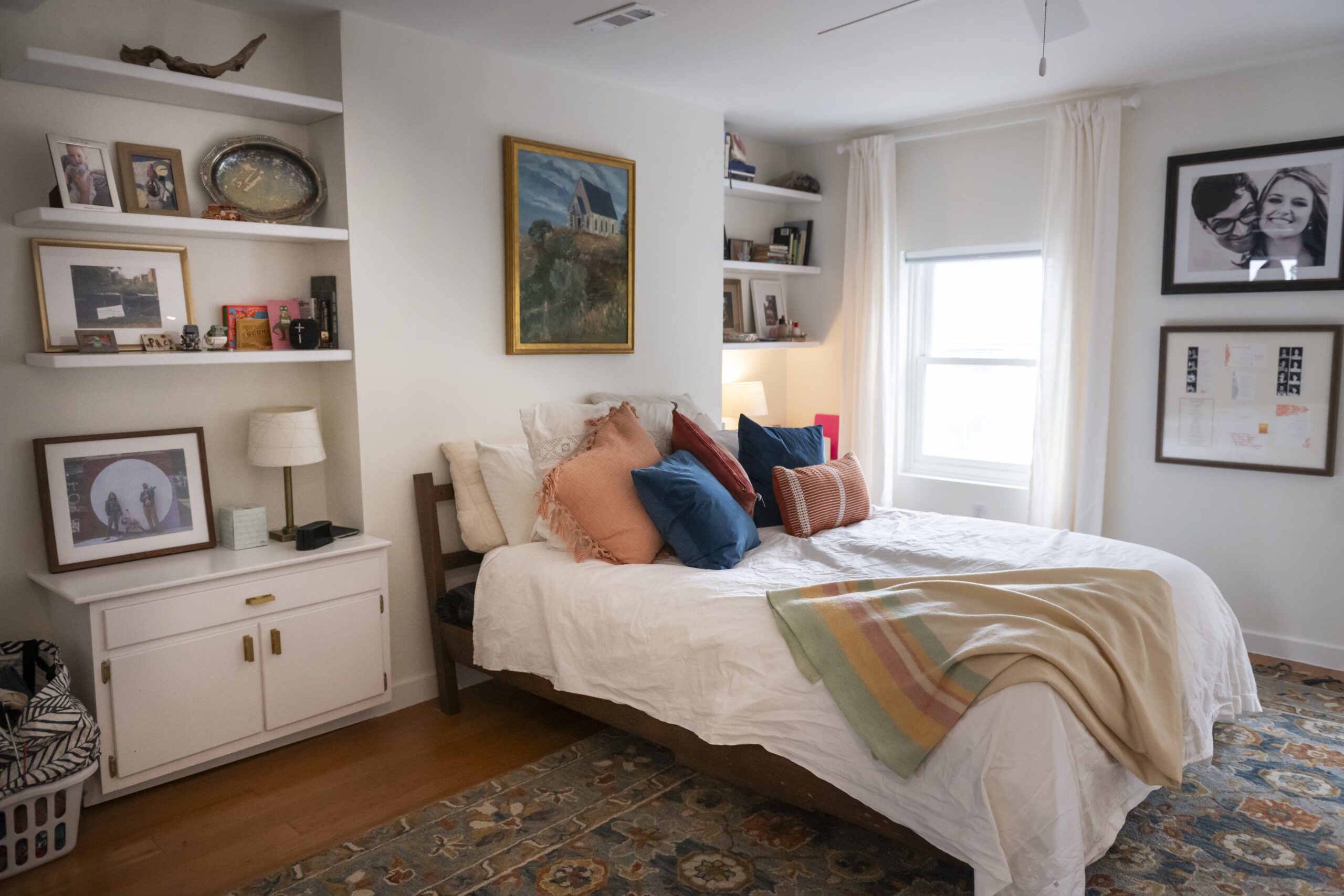
The couple installed custom built-ins to cover up a neon wall in the master bedroom.
Any reservations? “We probably overpaid a little bit,” Wargo Roberts said. “I would’ve loved to get it for $700,000 instead of $725,000.”Still, she is happy with the outcome. “We’re in a house that I feel pretty certain we’ll live in until our kids are out of high school,” she said.
Life after close: Wargo Roberts wasted no time making changes. She painted multiple rooms and tackled one feature she couldn’t live with: a neon-lit wall in the master bedroom. “I called it the portal to another dimension,” she said. “It was so weird.” They used money they had set aside from the sale of their previous home to install custom built-ins on either side of the bed, covering it completely.
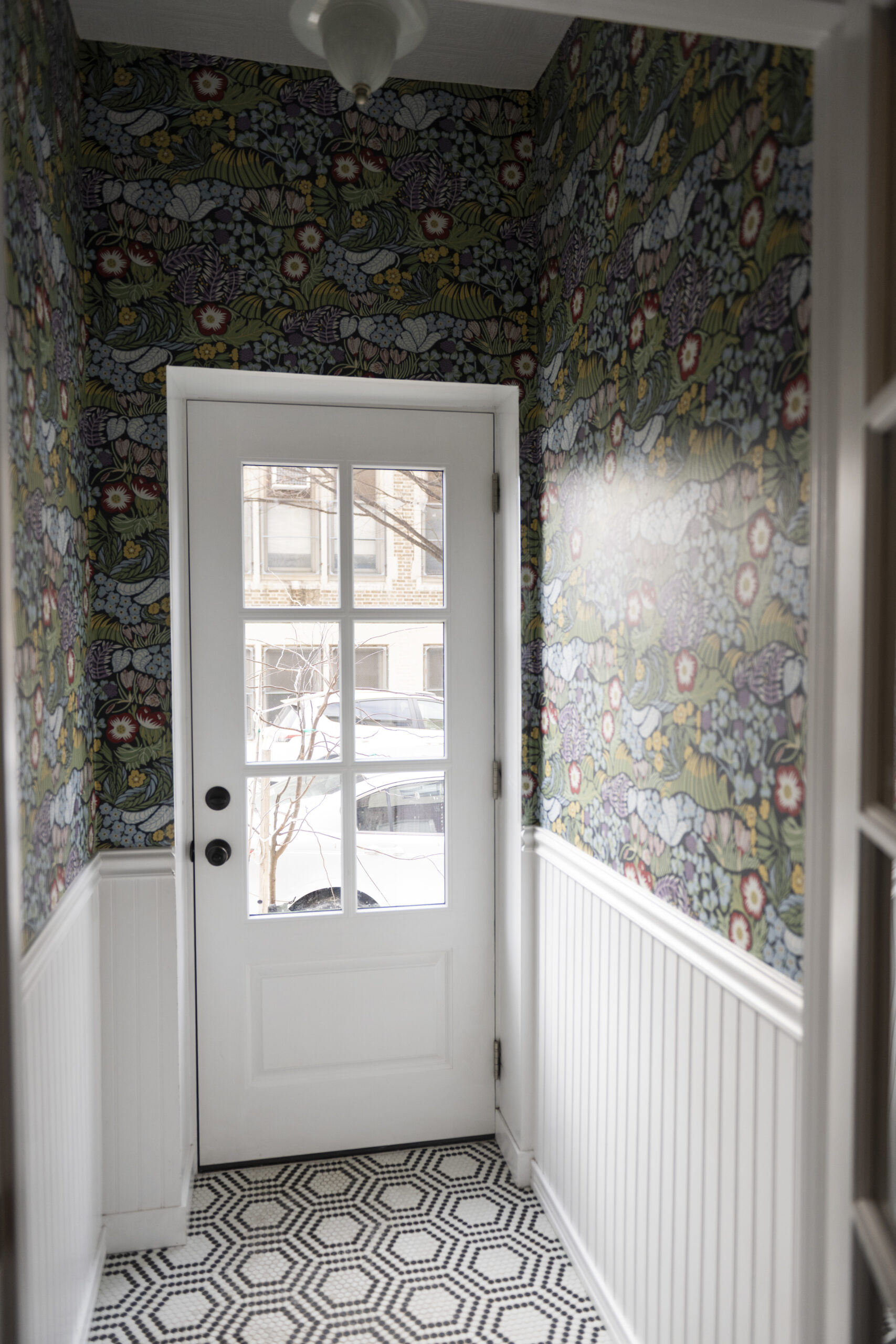
The traditional South Philly vestibule that the couple rebuilt after moving in.
They also rebuilt a traditional South Philly vestibule in the front of the home. “It was a vanity project for sure,” Wargo Roberts said, “But I just really wanted one.” She doesn’t regret it. “Best money I ever spent.”
We’ll show you a photo taken in the Philly-area, you drop a pin where you think it was taken. Closer to the location results in a better score. This week is all about Valentine’s Day! Good luck!
Round #20
Question 1
Where did this Valentine’s Day wedding take place?
Loading…
ClickTap on map to guess the location in the photo
ClickTap again to change your guess and hit submit when you're happy
You will be scored at the end. The closer to the location the better the score
Jessica Griffin / Staff Photographer
Pretty good/Not bad/Way off! Your guess was from the location.Spot on! Your guess was exactly at the location. Here's also where a random selection of Inquirer readers guessed.
Every year on Valentine’s Day, the city holds ceremonies for ten couples to get married or renew their vows in front of the LOVEsculpture. Time slots are reserved on the Parks and Recreation website.
Quiz continues after ad
Question 2
Where was this couple seen holding hands?
Loading…
Alejandro A. Alvarez / Staff Photographer
Pretty good/Not bad/Way off! Your guess was from the location.Spot on! Your guess was exactly at the location. Here's also where a random selection of Inquirer readers guessed.
This romantic stroll took place in front of a Chinatown mural.
Quiz continues after ad
Question 3
Where did this cherry blossom-filled kiss take place?
Loading…
Tyger Williams / Staff Photographer
Pretty good/Not bad/Way off! Your guess was from the location.Spot on! Your guess was exactly at the location. Here's also where a random selection of Inquirer readers guessed.
Springtime is right around the corner, which means the cherry blossoms will soon be blooming. This couple was photographed under the trees along Columbus Boulevard.
Your Score
ARank
❤️ Amazing work. You really love Philly geography!
BRank
❤️ Good stuff. You really love Philly geography!
CRank
C is a passing grade, but this quiz could use some love.
DRank
💔 D isn’t great. This quiz could use some love.
FRank
💔 We don’t want to say you failed, but you didn’t not fail.
You beat % of other Inquirer readers.
We’ll be back next Saturday for another round of Citywide Quest.
In most of the countries where the Chinese titan went head-to-head with Tesla — including Germany, Mexico, Thailand, and Australia — Tesla lost market share at an unprecedented rate.
The end of federal support for EVs has bitten into Tesla’s sales in the United States, while backlash against chief executive Elon Musk’s political posturing has damaged his company’s reputation both at home and abroad. Globally, BYD is dominating with newer models, better batteries, and lower sticker prices.
“Tesla didn’t just lose its sales crown, it squandered its position as a leader,” said Paul Blokland, cofounder of automotive data company Segment Y Automotive Intelligence.
“As the U.S. industry retreats behind a wall of tariffs and abandoned EV plans, Asia has taken the torch,” Blokland said.
In one of the most extreme examples of Tesla getting trumped, BYD vehicles swarmed roads in Europe last year. The Chinese company’s sales in the top 10 European markets quadrupled in 2025 compared with the previous year, according to calculations from Segment Y. Tesla sales slumped 30% over the same period.
As Tesla loses global market share, Musk has been trying to diversify Tesla away from its EV roots and rebrand it as more of an AI, robotics, and robotaxi company.
On Tesla’s earnings call last month, Musk announced that he would end production of the Model S and Model X and use the factory space to produce Optimus humanoid robots. He said he hopes to produce 1 million robots a year at the production plant in Fremont, Calif.
“It’s time to basically bring the Model S and X programs to an end with an honorable discharge because we’re really moving into a future that is based on autonomy,” Musk said on the call.
The BYD Changzhou car carrier is docked at Terminal Zarate in the Buenos Aires province of Argentina, Tuesday, Jan. 20, 2026, where hybrid and electric vehicles shipped from China are parked next to the ship.
BYD was founded in 1995 in Shenzhen, China, starting out as a maker of low-cost rechargeable batteries for consumer electronics, eventually supplying Motorola, Nokia, and others.
BYD has now emerged as a global electric-vehicle heavyweight by controlling much of its supply chain and rapidly rolling out new models. An early investment from Berkshire Hathaway helped legitimize the company abroad.
As BYD expanded sales across China, Europe, and other overseas markets, it has been reshaping competition in the auto industry everywhere it lands.
Because of steep tariffs and federal restrictions, you can’t buy a BYD passenger vehicle in the U.S. But experts and customers say BYD offers a higher-quality car for a much lower price in other countries. The BYD Dolphin, an all-electric hatchback, starts at less than $14,000 in China.
More than 75,000 BYDs were sold in Mexico last year, according to Segment Y’s tally. Canada recently reached a trade agreement with China that would allow more Chinese EVs into the country.
Experts said BYD has several advantages over Tesla, including a more diverse product offering, lower-cost access to rare earth metals used in batteries, and immunity from U.S. safety and labor laws.
“High-visibility elements of BYD cars seem to be superior to not just Teslas but a lot of the cars that are being produced by non-Chinese companies,” said Karl Brauer, an analyst at iSeeCars.com. “Musk has got to find another concept to build his legacy on.”
Tesla offers a few main vehicles with some variation, including a compact car, a midsize SUV and the Cybertruck. BYD sells more than eight models that include sedans, several SUVs, minivans, and trucks.
In countries where there is a choice between Tesla and BYD, customers say BYD cars look better, cost less, and come with more options.
Amy de Groot, a resident of Melbourne, Australia, bought her BYD Sealion 6 about a year ago for around 55,000 Australian dollars — about $35,000 in U.S. currency. She said BYD vehicles are all over the roads in her community.
“Everyone that gets into the car is dead shocked at how nice it is,” De Groot said. “It’s a beautiful car to look at and to be inside.”
When she was shopping for an electric vehicle, De Groot didn’t give much thought to buying a Tesla. That brand peaked in popularity in Australia about five years ago, she estimated, but Musk’s reputation has significantly deteriorated since then, she said.
“At the time that I was looking, the Tesla stocks bombed really hard, and resale is always top of mind for me,” De Groot said. “It was a real fad to have a Tesla, and I just don’t think that they’re competitive in any way.”
According to Segment Y Automotive Intelligence, BYD sold more than 52,000 electric vehicles in Australia in 2025, a 156% increase from the year prior. Tesla sales in the country fell 24%.
Even in California, where electric vehicles are extremely popular and BYD is nowhere to be found, Tesla is losing market share.
The number of new Teslas registered in California fell more than 11% from 2024 to 2025. Tesla’s market share among EVs in the state fell 5 percentage points over the same period, according to recent data from the California Auto Outlook.
American automaker Chevrolet and Japanese manufacturer Honda both gained market share at the same time.
“The scrapping of incentives no doubt impacted Tesla, but at least it does not have to worry about BYD in its own backyard yet,” Blokland said.
One of BYD’s competitive edges, analysts say, is its batteries. It started as a battery company and has developed batteries that are more affordable and powerful than the competition.
Another factor is that battery materials are cheaper to source in China, said Brauer of iSeeCars.com.
“When the most expensive part of an electric car is the battery, and you have a massive advantage on the cost of producing a battery, you have a massive advantage in the EV world,” he said.
BYD may also be getting some help from government backing as well as lower labor costs, experts say.
“Our rules and environmental regulations and our laws about how you treat workers are not globally instituted,” said Brian Moody, an automotive expert and analyst. “It seems to give BYD a financial advantage in that they can charge next to nothing for a car that maybe costs more than that to build.”
ARIES (March 21-April 19). How can you obey your heart’s commands if the noise of your mind makes it impossible to hear? Focusing on your breath pulls attention away from racing thoughts and activates the parasympathetic nervous system, which signals your body to relax.
TAURUS (April 20-May 20). If you could, you’d say yes to everyone who needs your help or wants your company. But since you can’t do it all, you’ll do the next best thing — decline invitations with such grace it warms hearts and keeps bonds intact.
GEMINI (May 21-June 21). When your aesthetic is reflected in your environment, you feel loved. And this is why you’ll gravitate toward clean, clear, organized, novel and coordinated surroundings. The work you do will move through your hands and settle back into you.
CANCER (June 22-July 22). You’ll raise your energy by playing to your strengths and avoiding the obvious drains. Conserving and boosting your energy is a form of self-kindness that creates a foundation of comfort and safety you can grow from.
LEO (July 23-Aug. 22). Good news on the financial front: You’re rich in all the ways that matter and a few bonus ways, too. And since there’s still no reason to buy what you can’t afford to impress those you don’t know, you can save a little, too!
VIRGO (Aug. 23-Sept. 22). When you have fun, others catch on to your joy. So don’t worry about being seen. It’s good for everyone if you are. As one doctor suggested, “Look at me, look at me, look at me now. It is fun to have fun, but you have to know how.” — Dr. Seuss
LIBRA (Sept. 23-Oct. 23). Most events are a good time to somebody. But if they are not your idea of a good time, there’s no need to attend. Go with what puts a smile on your own face or at least with what doesn’t make you frown.
SCORPIO (Oct. 24-Nov. 21). Today’s plot unfolds to prove once more that compassion is always best. The self-centered behavior of others will make it challenging, so go slow and be patient, and with a little restraint, love wins.
SAGITTARIUS (Nov. 22-Dec. 21). Too much analysis breeds paralysis; action is the way. The movement itself is what will make sense of things. The movement itself is what will change the odds, validate the mission and prove the purpose worthy.
CAPRICORN (Dec. 22-Jan. 19). Compassion pulls you toward people and you begin to care about their reality, their struggles and their hopes. Before you know it, concern turns into commitment. Compassion ignites passion.
AQUARIUS (Jan. 20-Feb. 18). You’ll get attention, though you may be too busy to notice. It’s OK because you don’t feed on external validation. You’re full already. You come to the party of life, after having already eaten at home.
PISCES (Feb. 19-March 20). Before you buy, ask yourself questions like “really?” and “why?” Confront deeper motivations and life gets less expensive. You’ll serve your actual need instead of getting the quick, cheap, shiny Band-Aid. Honest reflection leads to pure fulfillment.
TODAY’SBIRTHDAY (Feb. 14). Welcome to your Year of the Wild Horses, when you’ll have the unbridled power, untamed heart and exuberant kinship to roam with fellow feral spirits. More highlights: Fun, infatuation, thrills, illusion and the more substantial fortifications of sincere and devoted love. You’ll delight in the company of those whose style and processes are a mystery to you including animals who teach you about being human. Scorpio and Taurus adore you. Your lucky numbers are: 1, 50, 33, 13 and 6.
DEAR ABBY: A good friend of mine, “Louis,” has big problems. He is in his 60s, and although he’s 50% disabled, he can still work custodial jobs. His sister, “Gayle,” who lives 500 miles away, asked him to move in with her and her husband, saying they would help take care of him.
Louis moved, not realizing his sister was a severe alcoholic. She’d come home from work, have six or eight drinks and become really belligerent with both her husband and Louis. She even gave Louis 30 days to get out of her house. He has nowhere to go because he severed ties with everyone in his prior location.
I loaned Louis enough money to keep him from starving as he tried to find a means of support. He has applied for several custodial jobs. His brother-in-law is a great person but is not strong enough to do anything. Gayle has hit her husband on several occasions. They are at their wits’ end and need advice. Gayle refuses to seek any kind of help.
— THERE FOR MY FRIEND IN FLORIDA
DEAR ‘THERE’: Louis and his brother-in-law might find some support if they start attending Al-Anon or Smart Recovery meetings. Because they are dealing with a raging alcoholic, it may make them feel less isolated.
As to what you should advise Louis about his living situation: Since he burned his bridges in the town from which he relocated and doesn’t have the funds to move out of his sister’s home, all you can do is continue to listen to him and be as supportive as you can until he finds work. Because Louis is partially disabled, he may qualify for some services and assistance in his new community. Encourage him to look into these potential options further.
** ** **
DEAR ABBY: My sister-in-law and mother-in-law are going to court against each other. My mother-in-law acknowledges that she wasn’t a good mother when her children were younger. My sister-in-law claims her mother was harassing her by dropping off gifts, notes and money on birthdays.
Unfortunately, my fiancé and I were dragged into the middle of the situation because we were speaking with both of them prior to the court proceeding. Now, they have both cut us off! I’m pretty sure it was because we wouldn’t pick sides, but why should we have to? We love them both.
My fiancé had a close relationship with his sister and mother. I know this is hurting him. How can I help bring their relationships back together? My sister-in-law has blocked me from all of her accounts, and if I mail a letter, I’m afraid she will accuse me of harassing her, too.
— TOUGH POSITION IN PENNSYLVANIA
DEAR TOUGH POSITION: There is no way you can force a reconciliation between two parties who don’t want to mend fences. You do not know whether your mother-in-law’s motive for dropping off unwanted gifts was to harass her daughter. (It may have been.) My advice is to stay firmly out of the line of fire until after that court case has been resolved.
** ** **
DEAR READERS: On this day that celebrates love, I want you to know how much I value my long relationship with all of you. Wishing you all a Happy Valentine’s Day.
On Friday, Drexel defeated Elon, 68-59. After starting out 0-2 in Coastal Athletic Association play, the Dragons have rattled off eight wins in their last 10 conference outings.
The Dragons (15-8, 8-4 CAA) pushed their lead to 19 points late in the third quarter behind fifth-year guard Amaris Baker’s 27 points. The Phoenix cut Drexel’s lead to single-digits in the fourth, but ultimately dropped their ninth consecutive game to the Dragons.
Drexel currently sits in fifth place in the CAA standings with six games remaining. If Drexel can clinch a top four seed in the conference, the team will receive a first-round bye in the CAA Tournament.
“Every game at this point is going to be a position game for us,” said Drexel coach Amy Mallon. “I think that really has to be the mentality of this team. … We always take it game by game and possession by possession, but they have to understand right now where we are and where we fall.”
Local leaders
Baker, the CAA’s leading scorer and a Cardinal O’Hara graduate, notched her 14th game this season scoring at least 20 points. She also logged five rebounds and two assists.
“[Baker’s] composure this year with what she’s seen as one of the best players in the league, as far as scoring — they’re keying in on her every week,” said Mallon. “So the fact that she’s still capable of putting up the numbers she has been able to put up just goes to show the discipline she has.”
Drexel’s Amaris Baker (right) is the leading scorer in the CAA.
Behind her in the stat sheet was another local product, Archbishop Wood’s Deja Evans. The junior forward logged 14 points and a team-high seven rebounds. Evans’ efforts on the board were a major factor in Drexel winning the rebounding battle, 31-20.
After trailing big in the third quarter, Elon made the game competitive in the fourth behind freshman center Tamia Watkins. The three-time CAA rookie of the week scored 10 of her team-high 16 points in the final period.
Elon cold from deep
The Dragons were perfect from deep through the first quarter, shooting 4-for-4 from three-point range. Baker made two of those threes.
Meanwhile, Elon’s (11-13, 6-6) shooting woes started early and carried throughout the game. The Phoenix shot 23.8% from deep compared to Drexel’s 63.6% from three
“We mostly just locked in on defending them outside the three, and when we’re in our 2-3 [zone defense], we just were moving well together, and we’re just communicating well together,” said Evans.
The Dragons turned the ball over 10 times in the first half, taking a nine-point lead to the half. In the second half, Drexel cleaned up their ball security, turning it over nine times.
‘Staying composed’
A 12-0 run powered by Watkins helped Elon cut Drexel’s lead to six points with just over four minutes to go.
Drexel’s Laine McGurk (center) falls backward trying to control a loose ball against Elon.
Eight of Drexel’s 15 points in the fourth quarter came from the line to help the Dragons outlast the Phoenix.
“In a fourth quarter, they go on a run, and you can sustain and make sure you stay disciplined. Teams are going to have runs,” said Mallon. “I thought we did a nice job staying composed, understanding what needs to be done.”
Up next
Drexel goes on the road next Friday to face Hampton for a second time this season (7 p.m., FloCollege).
It certainly did not feel like baseball weather. Fans were bundled up in coats and blankets and hand warmers were the most coveted item of the day as mounds of snow sat behind the dugouts.
Despite the 35 degree weather, there was an undeniable excitement in the air at Hank DeVincent Field — and for good reason.
La Salle baseball was back for the first time in 1,728 days.
The Explorer program shut down following the 2020-21 season but returned Friday for the first time since May 9, 2021, to face Maryland Eastern Shore. In front of a dedicated crowd braving the cold, La Salle beat the Hawks 27-10 to welcome the program back to the diamond.
“This is almost six years in the making for me and two years in the making in this most recent run,” said head coach David Miller. “It’s just a lot of hard work with these kids.”
La Salle’s on-field performance certainly left a strong first impression for fans, many of whom were getting their first look at Explorer baseball. They recorded 19 hits, led by second baseman Daniel Perez, who went 4-4 with a home run and three RBIs. Right handed pitcher Shawn Karpaitis threw five innings and gave up one run in relief after UMES tied the game at eight in the second inning.
While the outcome is a bright spot for the program, the atmosphere brought even more excitement.
A major tenet of La Salle’s three-step plan to bring back baseball was getting the field up to Division I standards. The program made sure there was new padding in the outfield and got the scoreboard up to date. The season-opener was not initially supposed to be in North Philadelphia, but issues with UMES’ field moved the first series of the year to La Salle.
And the Explorer faithful were ready to support their program.
La Salle outfielder Kosei Suzuki reacts after scoring during the first inning against the Maryland Eastern Shore Hawks at Hank DeVincent Field.
Fans filled bleachers behind the home dugout and parents occupied the grass along the first base line.
“There’s a lot of excitement around the program,” said Ed Litsky, father of freshman pitcher Josh Litsky. “I know from a parent perspective there’s a lot of excitement. The coaches and players seem really into it. It’s just amazing.”
The baseball team also got immense support from fellow student athletes. They helped fill the bleachers and the standing area to provide a boost to the players and even offered some heckling of the Hawks.
“Other student athletes on campus were all very supportive today, coming to my office in the morning and wishing us luck,” Miller said. “I know I saw rugby out here, girls lacrosse, soccer and a couple of fraternities heckling a bit.”
The players enjoyed a chance to usher in a new era of La Salle baseball. Some, like center fielder Chase Swain, had been waiting since 2019 to play for the Explorers, while others, like Perez, followed Miller after he raved about his time at La Salle.
“Coach Miller always talked about [La Salle] at Manhattan,” Perez said. “I knew the program had shut down and he has a lot of good words to say about this program. I knew he wanted to come back here and it sucked that when I hit the portal last year, I probably would have come here if there was a team. It’s just super special to be able to play for him.”
La Salle’s Jayden Novak (left) celebrates with teammate Chase Swain during the fifth inning against Maryland Eastern Shore on Friday.
Friday wasn’t about the past. La Salle is excited about its future and a chance to kick-starting a new era.
“It’s a great day for La Salle Athletics and it’s a great day for La Salle baseball,” Miller said. “[The fan support] is Philly in a nutshell.”
A Trenton man was sentenced to up to 60 years in Pennsylvania state prison for fatally shooting a bystander at a Morrisville strip club.
On Friday, Pedro E. Rodriguez, 29, pleaded guilty to third-degree murder, discharging a firearm into an occupied structure, possession of an instrument of crime, and four counts of recklessly endangering another person in the killing of 28-year-old Mekhi Norman in August 2024.
According to the Bucks County District Attorney’s Office, Norman was shot at a Morrisville nightclub while acting as a Good Samaritan. He did not know Rodriguez but was helping the club’s staff following an altercation at the doorway.
Surveillance video shown during the sentencing hearing shows Rodriguez walking to his car, getting a handgun, loading it, and returning to the club, according to a district attorney’s office statement. Then, he fired into the building as security staff were attempting to remove his nephew, according to the statement.
Norman, who was helping the staff when he was shot, was struck in the back of the head, the left thigh, and under both armpits, as 17 patrons and employees remained at the club.
Rodriguez fled but later turned himself in and was held on $5 million bail at the Bucks County Correctional Facility. He now faces between 30 and 60 years in state prison.
Rodriguez’s nephew, 22-year-old Kevin Perez, entered a guilty plea in 2025 to several counts of simple assault, disorderly conduct, and harassment for assaulting staff. The Trenton resident was sentenced to 10 to 23 months in the Bucks County Correctional Facility, followed by a year of probation.
During the sentencing hearing, Deputy District Attorney Ed Louka described Norman as a good father, a good son, and a good friend who died being a Good Samaritan, according to the statement.
Offering an account of how life has changed, the mother of Norman’s daughter told the court that the child still cries waiting for her father to call in the mornings and nights, as he used to, according to prosecutors.
“While this sentence ensures that the defendant is held accountable for his senseless and violent actions, we know it cannot fill the void left in the lives of those who loved Mr. Norman,” District Attorney Joe Khan said.