Blog

  • The Phillies have made progress, but still haven’t signed a player out of Japan. Will that change soon?

    The Phillies have made progress, but still haven’t signed a player out of Japan. Will that change soon?

    Twenty-four hours after throwing 96 pitches to shove the World Series to a seventh game, the Dodgers’ Yoshinobu Yamamoto ran in from the bullpen to this: ninth inning, one out, winning run at second base.

    It was a legend-making moment.

    Halfway around the world, Tora Otsuka chuckled.

    In 2023, his first season as a Japan-based scout for the Phillies, Otsuka hosted three team officials, including assistant general manager Jorge Velandia, on a scouting visit. Among their stops: Chiba, a short drive from Tokyo, to watch Yamamoto pitch for the Orix Buffaloes.

    “He threw a no-hitter in that game,” Otsuka said this week, laughing into the phone from Japan. “We had all our people watching this one game, and he threw a no-hitter. Only special players do that, you know? I feel like some players have ‘it.’ He’s one of those guys that has ‘it.’”

    Otsuka laughed some more.

    “When I saw that,” he continued, “I was like, ‘Yeah, I know he will do good in the States.’”

    Just not for the Phillies.

    Oh, they tried. The Phillies took a Bryce Harper-size swing at signing Yamamoto two years ago. They flew a seven-person delegation to Southern California to meet him and make a $300 million guarantee, plus add-ons that boosted the offer to more than $325 million, multiple sources said at the time.

    The Phillies tried hard to sign Yoshinobu Yamamoto as a free agent out of Japan two years ago.

    But the Phillies have never signed a player out of Japan to a major league contract.

    And Yamamoto wasn’t interested in being the first.

    It’s a common sentiment. When Shohei Ohtani was courted by teams in 2017, he famously told MLB.com that he wanted to snap a selfie with the Rocky statue but didn’t want to play here. Last year, right-handed phenom Roki Sasaki wouldn’t even meet with the Phillies, a snub that owner John Middleton described as “hugely disappointing.”

    And with a trio of Japanese stars available this offseason — right-hander Tatsuya Imai entered the posting system this week, joining slugging infielders Munetaka Murakami and Kazuma Okamoto — the Phillies are at a disadvantage relative to teams that have been active in Japan over the years, notably the Dodgers but also the Mets, Yankees, Cubs, Mariners, and Red Sox.

    “Well, you still compete,” Phillies president of baseball operations Dave Dombrowski said. “Sometimes there’s a little bit more of an obstacle we’re facing. Maybe [Philly] is not the No. 1 place, first and foremost. But you don’t give in to that. You try to create an atmosphere that people want to join, and you’re hopeful that at some time it works out for you.“

    Dombrowski maintains that the Phillies have made inroads, even though it’s difficult to see. They employ two full-time scouts in Japan now after years with one or none. Otsuka, the son of former major league pitcher Akinori Otsuka, is based near Tokyo; Koji Takahashi, hired away from the Twins, lives 300 miles to the southwest in Osaka.

    With Otsuka and Takahashi building connections on the ground, at the amateur level and especially within Nippon Professional Baseball, the Phillies believe they’re better positioned to attract players.

    But when?

    “I feel like it’s going to happen sooner or later for the Phillies,” Otsuka said. “Timing-wise, it just hasn’t happened yet. We’re very close, I would say.”
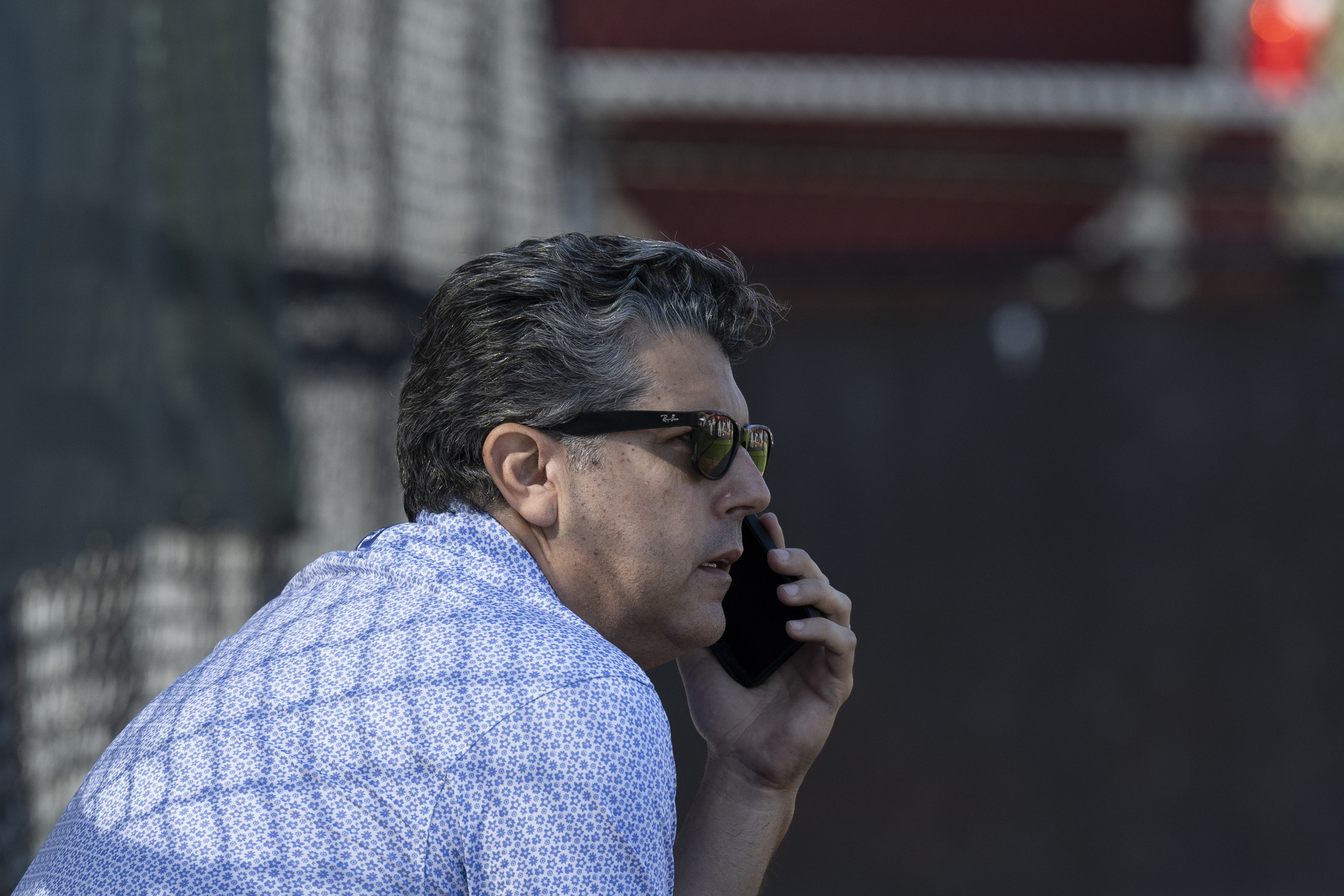
    Assistant general manager Jorge Velandia heads up the Phillies’ international scouting efforts, including in Japan.

    Playing catch up

    It all started with “Nomomania.”

    Hideo Nomo signed with the Dodgers in 1995, bringing a distinctive pitching style that translated into major league success. Since then, 72 players have gone from NPB to MLB, with seven teams (Mets, Dodgers, Mariners, Red Sox, Cubs, Yankees, and Rangers) accounting for more than half those deals.

    Conversely, the Phillies, Rockies, Astros, and Marlins have been shut out. (Second baseman Tadahito Iguchi and outfielder So Taguchi played for the Phillies. But Iguchi was traded over from the White Sox in 2007, and Taguchi signed as a free agent a few months later after six seasons with the Cardinals.)

    The Phillies fell behind other teams in scouting Japan. After getting hired in December 2020, Dombrowski felt that he lacked adequate information about available Japanese players. He appointed Velandia to lead international scouting, with a directive to “build a better infrastructure in how we approach the Far East.”

    Velandia tasked scouting director Derrick Chung with interviewing talent evaluators. Chung, who joined the Phillies in 2017 as an interpreter for South Korean outfielder Hyun Soo Kim before moving into scouting, recommended Takahashi.

    Otsuka was clinging to hopes of playing professionally in Japan when Chung met him at a tryout for an independent league team. A former outfielder for the University of San Diego, Otsuka impressed Chung with his knowledge of the game and fluency in both Japanese and English.

    After a formal interview process, the Phillies hired Otsuka, now 27, as a full-time scout.

    Tadahito Iguchi became the Phillies’ first player from Japan after being acquired from the White Sox in a 2007 trade.

    Velandia and Chung each make two or three trips per year to Japan. The Phillies send their special assignment scouts, too. Otsuka said this was a “very busy year, with scouts coming in and out” to watch Imai, Murakami, and others in “a very, very solid class of guys.”

    “The stuff we were doing three years ago and now, I’d say we have gotten better just understanding more about the market,” Otsuka said. “We’re more dialed in now compared to maybe before. We send scouts all the time to come to Japan. Just the process of everything has gotten smoother and smoother as the years have gone by.”

    Otsuka claims that the Phillies’ brand recognition has improved in Japan, too. Amid four consecutive playoff appearances, and with popular stars such as Harper and Kyle Schwarber, the Phillies are often featured on television in Japan.

    They aren’t the Dodgers, of course. For 30 years, from Nomo through pitchers Kazuhisa Ishii, Takashi Saito, Hiroki Kuroda, Yu Darvish, and Kenta Maeda, Japanese baseball culture has extended to Los Angeles. And after signing Ohtani, Yamamoto, and Sasaki in the last two years, the Dodgers might as well be Japan’s national team.

    The connection extends to the players. Yamamoto cited a desire to play with Ohtani as a reason for choosing the Dodgers’ $325 million over similar offers from the Mets, Yankees, and Phillies. Sasaki made no secret that he wanted to be alongside Ohtani and Yamamoto.

    And social media was buzzing this week over a photo of Murakami, who holds Japan’s single-season record with 56 home runs, dining with Yamamoto.

    “There is the difficulty of we have not had a player straight from Japan,” Otsuka said. “Players do talk with each other, saying what is a good organization, what is not a good organization. It would be nice to have one player be signed from Japan who plays in the big leagues to have more viewership from the Japan side for the Phillies.”

    For a brief time last winter, Otsuka thought he might have found that player.

    The Phillies signed Japanese reliever Koyo Aoyagi to a minor league contract last winter but released him in July after he struggled in triple A.

    Chicken-or-egg situation

    Koyo Aoyagi was a three-time all-star in nine NPB seasons. He won a gold medal in the 2020 Olympics. Three years later, he started Game 7 of the Japan Series and spun 4⅔ scoreless innings for the champion Hanshin Tigers.

    But his dream was to play in the majors.

    At 31, coming off a 2024 season that he said didn’t meet his standards, Aoyagi signed a minor-league contract with the Phillies. The side-arming reliever attended major league camp but agreed to go to triple A.

    Upon arriving in spring training — his first visit to the United States — Aoyagi said through an interpreter that he “wasn’t too aware” of the Phillies’ inability to break through in Japan. But he also acknowledged that “me pitching on the big-league mound will definitely bring some attention to the Phillies that would be able to recruit Japanese players more.”

    It was a low-risk, high-reward union of player and team.

    And it didn’t work out.

    Aoyagi struggled to throw strikes all spring, and it carried into the season. He had a 7.45 ERA with 23 walks in 19⅓ innings in triple A. After getting demoted to double A, he posted a 6.91 ERA and 15 walks in 14⅓ innings. The Phillies released him in July.

    But Otsuka, who recommended that the Phillies take a flier on Aoyagi, stands by the team’s process. He also believes in what Aoyagi represented.

    “Even though he didn’t make it to the big leagues, just him being on the team [in spring training], that still brought some attention in Japan,” Otsuka said. “I see a lot more Phillies hats walking around town. That’s all I can say. And I hear a lot of people talking about the Phillies just being a really good, strong team.”

    Japanese reliever Koyo Aoyagi pitched in the minors for the Phillies last season before getting released.

    Maybe. But the Aoyagi experience re-raised a chicken-or-egg conundrum: Do the Phillies have to gain more traction in Japan in order to attract an impact player? Or must they sign a Japanese player to a major league contract in order to really penetrate the Far East market?

    “I really can’t honestly answer that,“ Dombrowski said. ”Because I don’t know.”

    The answer might not be found in this year’s class.

    Murakami, 26, has prodigious left-handed power but also strikes out a lot and is a poor defender at third base. Okamoto, 30, is a right-handed hitter with less upside than Murakami who also profiles best at first base.

    Imai, 28, draws intriguing comparisons to Yamamoto. The Phillies aren’t prioritizing the rotation. But that was the case in each of the last two offseasons, and they made a mega offer to Yamamoto and discussed trading for Garrett Crochet before acquiring Jesús Luzardo.

    “When most teams talk to me about Imai, they say, ‘Oh my,’” agent Scott Boras said at the recent GM meetings. “He’s that kind of guy. … He loves big markets. We go through a list of places he may want to play, and, believe me, he is someone who wants to be on a winning team and compete at the highest level.”

    But whether it’s now or in the future, the Phillies’ biggest challenge in mining talent from Japan is selling players on Philadelphia.

    Velandia said the pitch highlights the city’s restaurants, doctors, and other resources that would make a Japanese player feel comfortable. Otsuka likes to emphasize the area’s golf courses, such as Pine Valley and Merion East.

    The fact is, though, Philadelphia has a smaller Japanese population than many other major league cities. As one team official said, it makes sense that a Japanese player coming to the U.S. would be drawn to L.A. or New York, just as an American soccer player going to Spain would focus on Barcelona or Madrid.

    “We just spit out all the good things about Philly,” Otsuka said. “We give the most information about Philadelphia, where it is as a city, what it’s like to play for the Phillies. It’s not like the worst sell ever. It has its difficulties, but it’s good. We can make it work.”

    It might take a trail blazer, a player who wants to forge his own path. Otsuka intends to find him.

    “That’s actually one of those selling points, that you could be ‘The Guy,’” Otsuka said. “You can be the first. When they think about Phillie Japanese players, you could be that player. Definitely the right player’s out there, the player that we want to go after.

    “When the time’s right, it’s going to happen. It’s just a matter of time. We have the right processes. We’re doing everything possible now. I think we have all the necessary resources now to actually make it happen. I’m not frustrated about it. I’m just patiently waiting.”
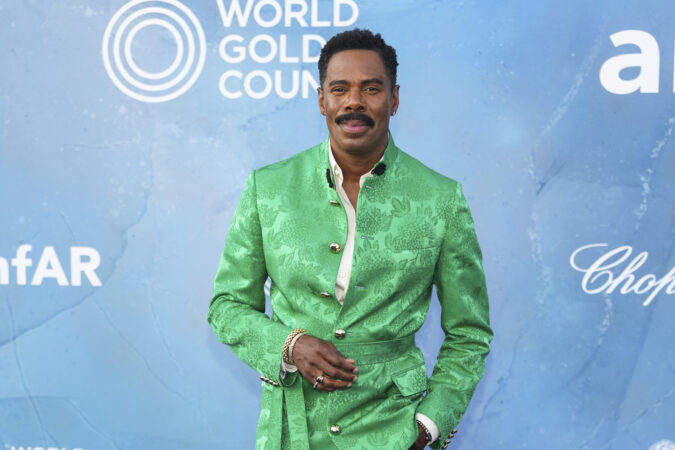

  • Colman Domingo will deliver Temple University’s commencement speech next May

    Colman Domingo will deliver Temple University’s commencement speech next May

    Emmy Award-winning actor and self-confessed dandy Colman Domingo will deliver the commencement address at Temple University this spring, the university announced Thursday.

    Domingo, a native of West Philadelphia, will also receive an honorary degree during the ceremony that will be held at the school’s Liacouras Center on May 6, 2026. Domingo went to Overbrook High School before coming to Temple University in the late 1980s to study journalism.

    It was at Temple that Domingo developed a love for theater after a teacher told him he had a special gift. In 1991, with only 50 credits to go, he dropped out and moved to California to pursue a career in acting.

    Domingo said returning to Temple for the university’s commencement ceremony will be a full circle moment for him.

    “I am beyond grateful and humbled to receive an honorary doctorate from Temple University,” he said in a statement. “As a journalism student who struggled with the balance of working two jobs … this degree is very meaningful to me.”

    Domingo stars in the action movie The Running Man, in theaters now. He received consecutive nominations for the Academy Award for best actor in 2023 and 2024 and this year he was one of the co-chairs for the Met Gala, celebrating the opening of The Metropolitan Museum of Art’s groundbreaking fashion exhibit, “Superfine: Tailoring Black Style.”

    Domingo was named one of Time magazine’s 100 most influential people in 2024.

    Past commencement address speakers and honorary award recipients at Temple include fellow West Philadelphian Quinta Brunson, Bishop Desmond Tutu, and North Philly native basketball coach Dawn Staley, among others.

  • Yes, flying cars are great, but ‘Back to the Future’ could do with a little heart too

    Yes, flying cars are great, but ‘Back to the Future’ could do with a little heart too

    Audiences apparently are shelling out money for tickets to Back to the Future: the Musical, now at the Academy of Music, just for a glimpse of the time-traveling DeLorean. But the rush from those high-action sequences is not unlike the thrills of a Universal Studios theme park ride — short-lived and emotionally hollow.

    That is perhaps less a fault of the movie-to-musical pipeline, but more of the plot of Back to the Future. Marty McFly, high school boy of the 1980s, wants nothing more than to rise above his “loser” family and become a rock star. But when he accidentally transports himself back through time to the 1950s, he must help his parents fall in love to ensure his own survival.

    Oh yeah, and his mom has the hots for him now and his father is a peeping Tom.

    The First National Touring Company of “Back to the Future: The Musical.”

    While these morally gray and otherwise two-dimensional characters are a product of the original source material, now in the medium of musical theater, their story falls flat with audiences. Characters sing because they have to — it’s a musical — and audiences grin and bear it until the next action sequence.

    It is unfortunate, too, that even the dancers’ incredible execution of choreographer Chris Bailey’s lively interpretation of both ’80s and ’50s dance styles is not enough to save these long numbers. There is hardly a hummable tune in the bunch, and the plot rarely moves forward through a song.

    There are bright spots, though.

    Lucas Hallauer (Marty McFly) and Sophia Yacap (Jennifer Parker) in the First National Touring Company of “Back to the Future: The Musical.”

    Cartreze Tucker (Goldie Wilson/Marvin Berry) is a joy to watch sing and dance. Goldie is perhaps one of the only characters that gives audiences the musical theater warm and fuzzies as he dreams of becoming the mayor. Zan Berube (Lorraine) shines with her adept comedic timing and truly lovely voice. Overall, the cast, led by Lucas Hallauer (Marty McFly) and David Josefsberg (Doc Brown), does a wonderful job playing into the fan service element of the show. Audiences, clad in red puffer vests, are looking to hear their favorite lines and see their favorite moments and that, the show delivers.

    David Josefsberg (Doc Brown) in the First National Touring Company of “Back to the Future: The Musical.”

    Tim Hatley’s design is sleek and economical. The downstage scrim allows for inventive solutions to some of the more difficult action sequences. The DeLorean sequences in particular are aided by truly amazing work from video designer Finn Ross and illusion designer Chris Fisher. While at times those tricks could feel a bit smoke-and-mirrors with some conveniently timed blackouts, the work gives audiences a glimpse into the future of high-tech, commercial theater.

    That is perhaps why the lack of heart in the book and lyrics feels so disappointing. The show does its best work when it leans into the campy, almost-parodic nature of the adaptation, using savvy theatrical solves to some of the harder scenes to reinterpret, like Doc climbing the bell tower with the clever use of projections.

    Lucas Hallauer (Marty McFly) and the First National Touring Company of “Back to the Future: The Musical”

    It is when the production turns its attention back to the musical theater genre that it feels like a drag.

    It seemed even Hallauer could feel the dead air when he called out “Philly, how you feeling?” during his rendition of “The Power of Love,” and there was no reply. It takes a lot for a Philly audience not to respond to the simple mention of Philadelphia.

    But then, when the car flies, it’s pretty incredible.

    ‘Back to the Future: The Musical’

    (Community/Arts)

    In the latest big IP movie-to-musical pathway pipeline production, some truly amazing video and illusion work wow the audience. The cast does a wonderful job playing to the red puffer-vested fans.

    ⌚️ Through Nov. 30, 📍 240 S Broad St, Philadelphia 🌐ensembleartsphilly.org

    Theater reviews are produced independently by The Inquirer without editorial input by their sponsor, Visit Philadelphia.

  • Philadelphia Art Museum names a new director and CEO

    Philadelphia Art Museum names a new director and CEO

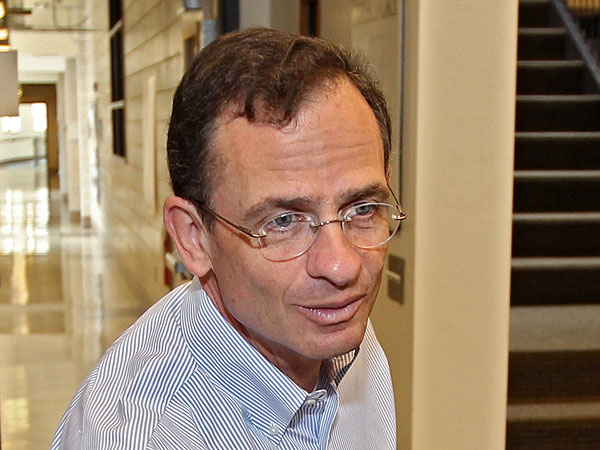
    The Philadelphia Art Museum, seeking to calm the waters after a turbulent six-week stretch, has named an experienced hand, Daniel H. Weiss, as director and CEO.

    Weiss, 68, was president of Haverford College starting in 2013 and left the post in 2015 to lead the Metropolitan Museum of Art in New York, staying eight years. Prior to Haverford, he was president of Lafayette College.

    The decision was approved Friday morning by the Art Museum’s trustees with a unanimous vote, a spokesperson said.

    Weiss’ appointment comes as something of a surprise. The museum had been expected to name an interim director while it searched for a permanent one. Right now, Weiss is set to remain in the post only through the end of 2028, though his tenure could be extended.

    He takes over an institution left shaken by the Nov. 4 firing of its director and CEO, Sasha Suda, after an investigation by an outside law firm flagged the handling of her own compensation. She filed a wrongful termination lawsuit against the museum less than a week later.

    Weiss said Friday that despite the recent turmoil, the museum had all of the important required ingredients it needed for its future — a great collection, staff, buildings, and mission.

    “What we have to do is clean things up and reaffirm our commitment to that mission,” he said. “I don’t think the challenges are so steep. They have to be addressed, they are real, but they are not overwhelming.”

    The first thing he will do, he said, is to sit down with the staff, board, donors, and other constituents, and through these conversations the museum’s priorities would emerge.

    “I know less about these issues than anybody else does at this point, so I need to listen and to learn,” he said.

    Art Museum board chair Ellen T. Caplan was not available for comment, a spokesperson said, but she said in a statement that the museum was “extraordinarily fortunate to have someone of Dan Weiss’s caliber and experience step into this critical role.”

    His proven track record of museum leadership, along with his “deep understanding of the field, and his ability to navigate complex institutional challenges,” she said, “make him ideally suited to provide stability and strategic direction during this critical period for the art museum.”

    Weiss comes to his new post with both substantial art and business credentials. An art historian, he holds a master’s degree in medieval and modern art and a Ph.D. in western medieval and Byzantine art, both from Johns Hopkins University. He previously earned an MBA from Yale School of Management and worked for consulting giant Booz Allen Hamilton.

    Daniel Weiss at Haverford College after being named the college’s president in 2013.

    He was at Haverford College for a little less than two years before being hired away to lead the Met along with director Thomas P. Campbell. With Campbell’s departure in 2017, he took on the title of chief executive. He worked alongside Max Hollein after Hollein became director in 2018. Weiss left the Met in 2023.

    He was the head of Haverford College in 2014 when it received its largest single gift to date at the time — $25 million from Howard Lutnick, then-chairman of the college’s board of managers and a Haverford graduate. (Lutnick is currently U.S. secretary of commerce.)

    Weiss brings to the Art Museum another storehouse of knowledge. He recently worked as a consultant to the museum’s board, a museum spokesperson said.

    He is no stranger to controversy. At the Met, he helped the museum grapple with decisions such as the end of its longtime pay-as-you-wish admission policy, as well as the question of whether to cut ties with the Sackler family, whose company, Purdue Pharma, manufactured and marketed the opioid painkiller OxyContin.

    The museum in 2019 announced it would stop accepting gifts from the Sacklers, and in 2021 it removed the family’s name from a number of exhibition spaces, including the wing that houses the popular Temple of Dendur.

    Weiss was also at the Met when the museum faced a set of circumstances not unlike some of those the Philadelphia Art Museum is facing now. In 2017, struggling with a deficit, the Met decided to pause plans for a $600 million expansion. Instead, it focused on more mundane, if important, projects, like work on the roof and skylights.

    Howard Lutnick (left) with Haverford College then-president Daniel Weiss for the 2014 announcement of Lutnick’s $25 million gift to the school.

    Most recently, for the past two years, Weiss has been a humanities professor and senior advisor to the provost for the arts at Johns Hopkins University.

    Suda filed a lawsuit on Nov. 10 against her former employer. Her lawyer said that she was the victim of a “small cabal” from the board that commissioned a “sham investigation” as a “pretext” for her “unlawful dismissal.”

    The Art Museum on Thursday responded to the lawsuit in Philadelphia Court of Common Pleas with a petition saying Suda was dismissed after an investigation determined that she “misappropriated funds from the museum and lied to cover up her theft.” Her lawyer called the museum’s accusations false. “These are the same recycled allegations from the sham investigation that the museum manufactured as a pretext for Suda’s wrongful termination,” he said.

    The Art Museum has a list of short- and long-term challenges with which it must grapple. Among them is the question of whether to roll back the recent name change and rebrand, which have been widely mocked and disliked.

    It also has several big pieces of the operational, facilities, and financial puzzle to prioritize. The Perelman annex was closed to the public during the pandemic and has not reopened; a planned expansion of gallery space beneath the museum’s east steps is in limbo; deferred maintenance on the main building awaits attention; the endowment is considered inadequate for an institution of its size.

    In addition, the museum is challenged by an operating deficit and visitorship numbers that have not recovered post-pandemic.

    Weiss — who is expected to take over the museum Dec. 1 — is the author of several books, including a recent one that explores the place of the art museum in society throughout history and examines its challenges today in the larger culture. Its title suggests the case he will need to make as the museum’s 15th director: Why the Museum Matters.

    “This is a great museum with a bright, important future,” said Weiss, “and our ability to fulfill our mission requires everyone’s involvement.”

  • Reports: Temple coach Adam Fisher receives two-year extension through 2030

    Reports: Temple coach Adam Fisher receives two-year extension through 2030

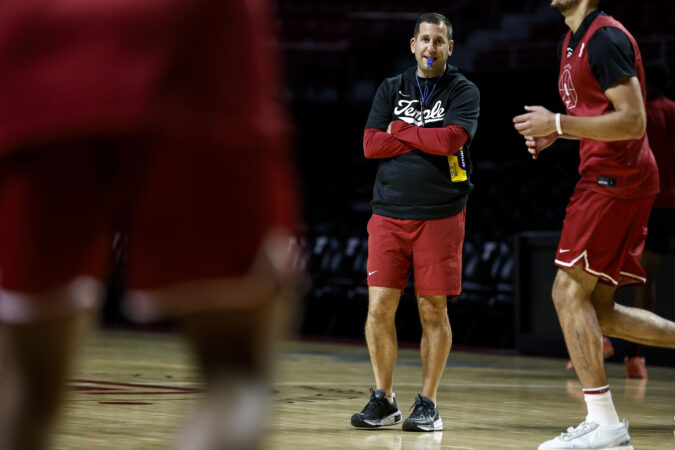
    Temple men’s basketball coach Adam Fisher received a two-year contract extension that will run through the 2030 season, CBS Sports and ESPN reported Friday.

    Fisher was hired on March 29, 2023, after spending three seasons as the associate head coach at Penn State. In his third season as coach, Fisher has led Temple to a 36-36 record and a 14-22 record in the American Conference.

    He led the Owls to a 16-20 record in his first season and an appearance in the American Conference Tournament championship game. Temple won four games in four days before losing to UAB in the championship.

    Fisher’s team saw improvement in his second season, going 17-15, but lost in the first conference tournament game against Tulsa. The Owls are 3-1 to start this season.

  • French water giant Veolia buys King of Prussia waste recycler

    French water giant Veolia buys King of Prussia waste recycler

    Veolia, the French water and sewage giant with R&D labs in Trevose, has agreed to pay $3 billion for Philadelphia-based Enviri’s Clean Earth division, which treats contaminated materials for big manufacturers.

    Clean Earth, based in King of Prussia, serves manufacturers such as Boeing, Merck, computer-chip makers, and hospitals. Veolia operates local water utilities in towns across the U.S., including a slice of Delaware County and northern Delaware.

    Clean Earth employs around 1,800, and already uses Veolia incinerators to burn hazardous medical waste and other refuse. Enviri bought that business for $625 million in 2019. Veolia says it plans to cut $120 million in spending as it integrates Clean Earth, to make the deal more profitable.

    Combined with Veolia’s existing hazardous-waste business, Veolia says it will be among the largest businesses of its kind. Veolia also bought medical-waste companies in New England and California earlier this year, and it has incinerators in Texas, Illinois, and Arkansas.

    Clean Earth includes tar-contaminated soil collection treatment centers on the Schuylkill in Southwest Philadelphia; in Morrisville, Bucks County; and New Castle, Del.; and a hazardous-waste and chemical disposal site in Hatfield, Montgomery County, among 82 waste-management and 19 federally-permitted treatment sites, along with hundreds of trucks. Veolia has industrial facilities in Bridesburg and Pennsauken, among other area locations.

    Veolia will pay cash worth around $15.50 a share, or $1.3 billion, to Enviri shareholders for Clean Earth; plus $1.35 billion to pay down some of Enviri’s debt load; and around $400 million to help finance Enviri as it restructures as a smaller company and issues new shares. Both boards have approved the deal, pending a vote by Enviri shareholders next spring.

    The price to shareholders is a premium to Enviri’s recent share value, and triple what it was worth at its recent low in March. But it’s also less than the stock was worth as recently as 2022, before the company changed its name from Harsco and moved from central Pennsylvania to Philadelphia, where its leaders said it’s easier to recruit engineers and managers.

    The sale leaves Enviri with two remaining business lines: steel-mill slag management and railroad track equipment and maintenance. The latter business faces large environmental expenses, and Enviri had earlier tried to sell it.

    After selling Clean Earth to Veolia and reducing management costs, Enviri will spin off the remaining businesses into a new company, under the same name.

    Announcing the deal, Enviri chief executive F. Nicholas Grasberger also said he’ll be stepping down from the company’s top job, to be succeeded by Russell Hochman, a ten-year Enviri veteran who already serves as the company’s senior vice president, top lawyer, and compliance officer.

    F. Nicholas Grasberger, chairman & CEO of Enviri, at the company’s Philadelphia headquarters in 2023. He will be stepping down as the company sells its hazardous-waste division to France’s Veolia.

    The restructured Enviri will have more cash to invest in its businesses and lower finance costs, Grasberger said in a statement. He praised successor Hochman’s “deep business acumen and proven ability to navigate mergers and acquisitions, regulatory matters, and transformation efforts.”

    The boost in Enviri’s capital “will create enhanced opportunities” for both slag and rail, Hochman said in a statement.

  • Is Michelin’s Bib award for Royal Sushi a snub? Chef Jesse Ito takes the izakaya’s honors in stride.

    Is Michelin’s Bib award for Royal Sushi a snub? Chef Jesse Ito takes the izakaya’s honors in stride.

    There were chef tears of joy, stunned looks from some unexpecting winners, and the silent sting of award-show snubs as the Michelin Guide announced its first-ever round of accolades for the Philadelphia restaurant scene Tuesday night.

    But there was also some lingering confusion that followed the much-anticipated Kimmel Center ceremony. One of the biggest gasps of baffled surprise rippled through the crowd when Royal Sushi & Izakaya, a favorite predicted by many to earn a star, was instead awarded a Bib Gourmand.

    The Bibs are widely coveted as Michelin’s nod to restaurants with “exceptionally good food at moderate prices.” Ten Philly restaurants were awarded Bib Gourmands, including Angelo’s, Dizengoff, and Pizzeria Beddia.

    But how does Royal Sushi & Izakaya — where a seat at chef Jesse Ito’s omakase counter now clocks in at a city-high $355 — qualify? Is it now the world’s most expensive Bib Gourmand?

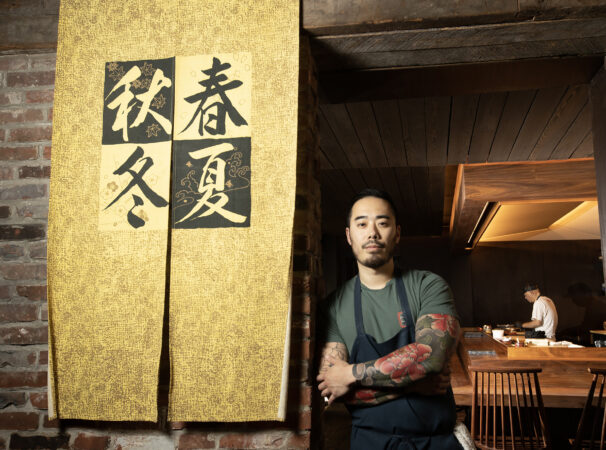
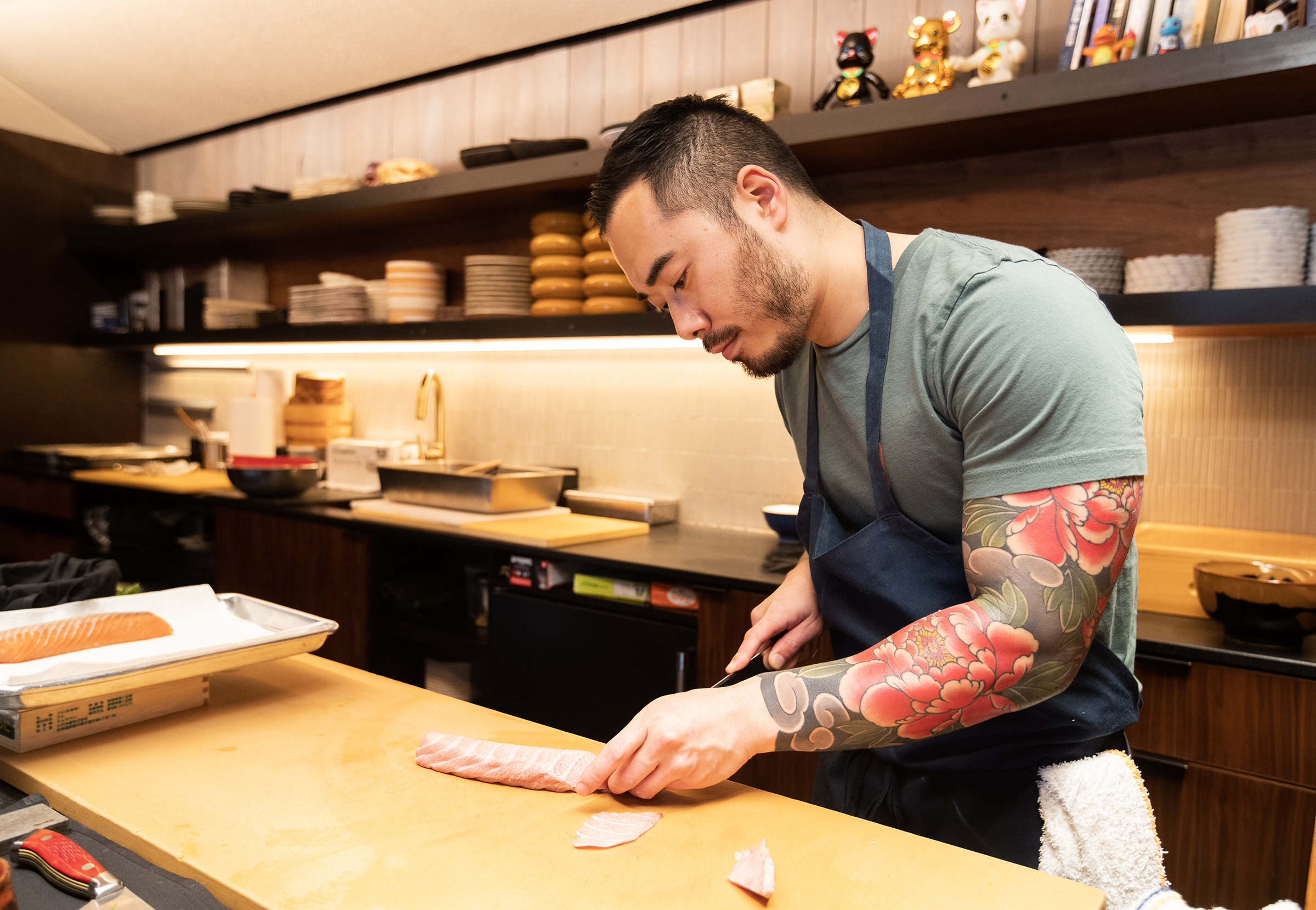
    Chef-owner Jesse Ito at Royal Sushi & Izakaya on Aug. 11, 2023.

    Michelin, which is renowned for secrecy, would not clarify its reasoning: “The Michelin Guide doesn’t reveal specifics,” said spokesperson Carly Grieff.

    The answer, most logically, is that Royal has always been two distinct restaurants under a single name and roof, and the Bib most logically applies to the more casual one: the lively izakaya-style tavern that anchors the front of the Queen Village building, where a relatively affordable a la carte menu of cooked Japanese classics and sushi is served to a walk-ins-only crowd, with cooked items ranging from $6 to $38.

    Ito’s luxury sushi tasting counter, meanwhile, hums along in a separate room in back, where Ito handcrafts every bite with artistry using some of the world’s most expensive ingredients. Such omakase counters are prime candidates for Michelin stars, including at least two (Boston’s one-star 311 Omakase and New York’s three-star Sushi Sho) that picked up accolades at the recent ceremony in Philadelphia.

    The sesame-crusted eggplant at Royal Izakaya on Aug. 18, 2022. Royal Izakaya is located at 780 South 2nd St.

    But the 16 nightly seats of Ito’s omakase counter are so locked down with devoted regulars — who can rebook their seats for another meal before leaving their dinner — that even Michelin’s anonymous inspectors, it appears, could not score a reservation.

    “They only ate at the izakaya,” surmises Ito from Michelin’s review, a glowing assessment of the izakaya’s menu range and high-quality ingredients, with only a passing mention acknowledging its “exclusive” omakase counter.

    Ito was hardly a loser at the Michelin ceremonies, even if he didn’t win a star, because he was thrilled with the Bib acknowledgment: “I’m super-proud of the izakaya and this is very fitting for what it does … The stars are really great and obviously every chef wants that, but the Bibs will also prove useful once tourists come, especially next year for the FIFA World Cup and Philadelphia’s 250th anniversary.”

    Diners inside Royal Izakaya on Aug. 18, 2021.

    Nonetheless, the uncertainty of how Michelin might handle his dual-concept space has weighed on the chef, who knows the roller-coaster emotions and anxiety of awards program recognition more than most.

    He’s experienced tremendous highs, such as this fall when his restaurant was named the 32nd best restaurant in North America by World’s 50 Best. He’s also repeatedly dealt with the disappointment of coming up just short with the James Beard Foundation, being named a finalist eight times — only to miss out every year, including once again this spring.

    Ito said he’s considered various ways to more clearly separate the two concepts, or at least make the reservation process for the omakase more accessible.

    “But I wouldn’t even know how to do that,” said Ito, who’s worked through some alternatives and fears that bots would ultimately snap up seats for scalping. “I’m able to have regulars this way, and we have the best guests with whom we’ve created real relationships over time. But I love having new people, too, and that definitely still happens.”

    The exclusive nature of the omakase, and the unintended fallout from such limited reservations — especially with hopeful guests, including possibly judges for potential awards — was never intended. It just happened.

    Chef Jesse Ito and Mia Colona at the Michelin Guide announcements at the Kimmel Center on Nov. 18.

    “I didn’t think about any of this award stuff when I was opening this restaurant nine years ago at age 27 on limited resources,” said Ito, whose initial goals were to support his parents and create something for himself.

    As the restaurant continued to evolve and garner national attention, however, he’s had to learn to cope with the anxiety of increasing acclaim. And no matter how veteran the chef, the nerves always tighten the gut at an awards ceremony, when the announcement draws near. He’s learned the hard way to find a silver lining in whatever the results.

    “Just because you’re not [ultimately] a winner doesn’t mean you’re not deserving,” says Ito. “That’s part of losing the Beard award eight times! You come away with the ability to enjoy the moment of just being recognized.”

    The Royal Toast from the Royal Sushi Omakase at Royal Izakaya on Aug. 18, 2022.

    Ito says he owes much of his current attitude to getting sober five years ago.

    “Beforehand, I used to always crave that external hit, that numbing sensation of having fun. But now in my life, I find happiness in my routine and relationships, my business and personal journey. The awards? I’m happy to be a part of them — but they are not what defines us.”

    What drives Ito is his passion for turning raw fish into edible art for the devoted customer base he values, and “to improve myself and the omakase a little bit each day,” he says, citing the Japanese philosophy of kaizen.

    Chef-owner Jesse Ito at work at Royal Sushi & Izakaya on May 31, 2024.

    So, once the Michelin ceremony concluded — “a weight was lifted from my shoulders,” he says — and it was back to what he loves most. He went straight to dancerobot, his new restaurant in Rittenhouse Square where a Resy-sponsored after-party was in full bloom. He put on his apron and immediately busted out the premium uni and caviar to top hundreds of aka-taka toro rolls brought in from the izakaya, and strolled through the crowd with a tray, handing out $75 bites for free.

    “Everyone was so relieved [it was over], we were just celebrating and having fun,” he said.

    And then out came his secret weapon: the karaoke mic, an important Ito ritual for every post-awards party, no matter the result.

    “I sang ‘Creep‘ by Radiohead,” he said, his usual song. “Then I left when the party was still bumping, because I didn’t want to go to bed too late.”

    He had another busy day to prep for service at Royal Sushi & Izakaya ahead.

    Chef Jesse Ito of Royal Sushi & Izakaya hands out aka-taka tuna belly and pickled radish rolls topped with salmon roe, uni, and caviar to guests at an afterparty for the Michelin awards held at his new restaurant, dancerobot.
  • Thousands of Penn graduate student workers could soon strike

    Thousands of Penn graduate student workers could soon strike

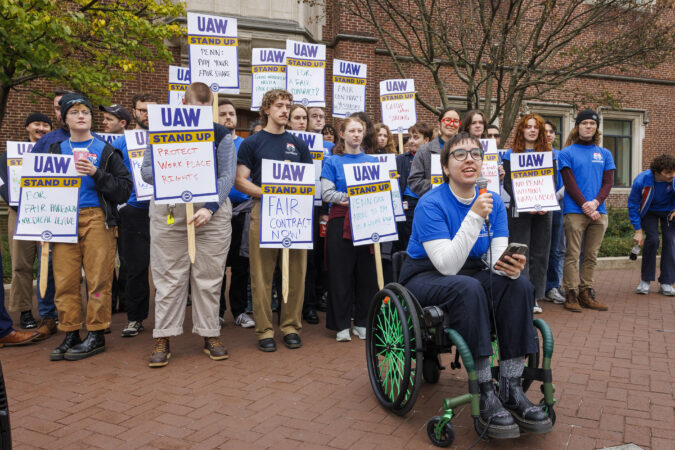
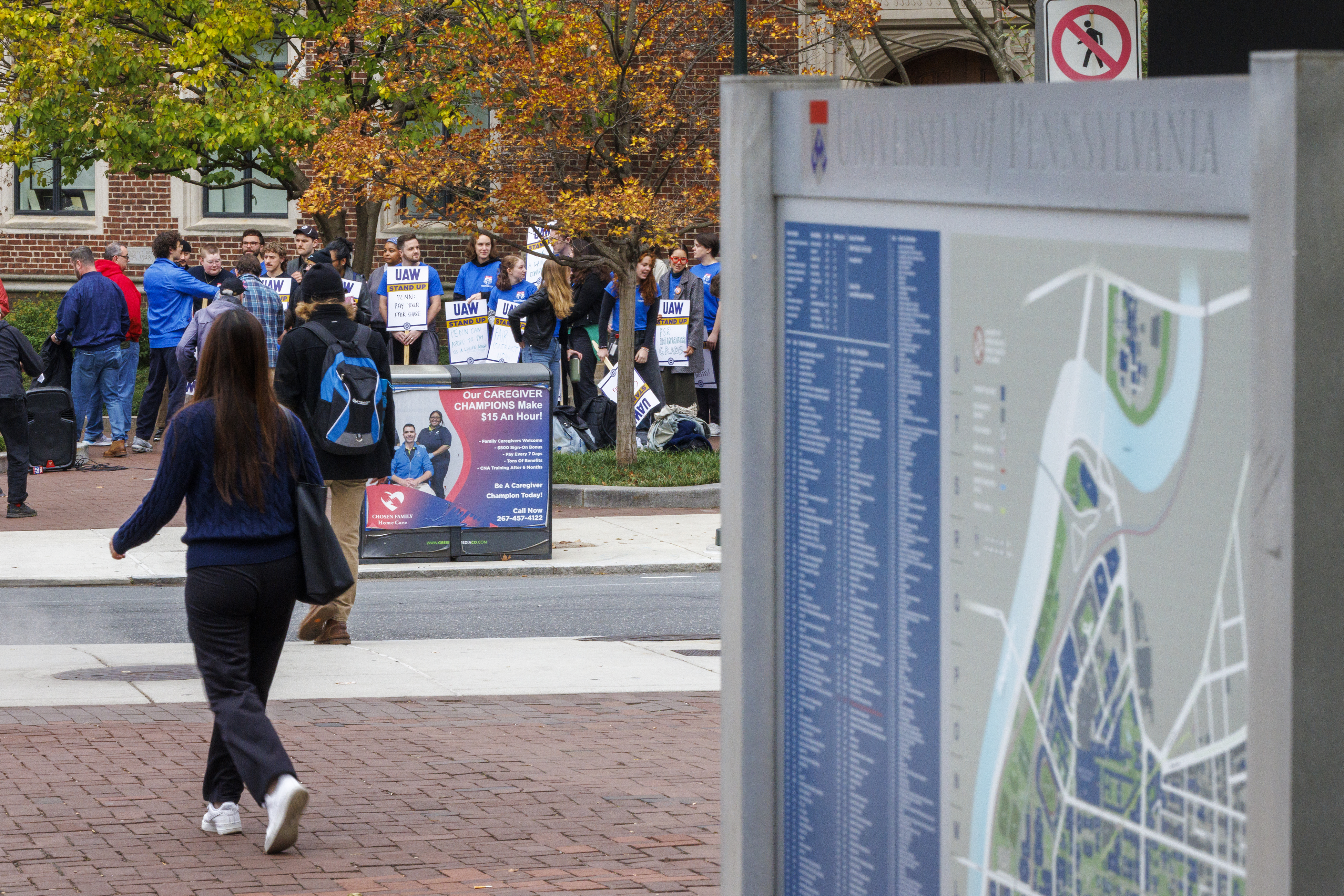
    Graduate student workers at the University of Pennsylvania have voted to strike if their union calls for it, as they work toward a first contract with better pay and benefits.

    The graduate students, who research and teach at the university, voted to unionize last year, after two decades of organizing attempts.

    The union’s total membership is about 3,400, and 2,416 participated in the strike vote. Of them, 92% voted in favor of calling a strike if needed to reach an agreement.

    “As the city of Philadelphia’s largest employer and a world-class research institution, Penn must do better by the workers that ensure its continued success,” Katelyn Friedline, a bargaining committee member and Ph.D. student, said at a news conference earlier this month.

    The union, Graduate Employees Together-University of Pennsylvania (GET-UP) is part of the United Auto Workers (UAW), which represents groups of university workers across the country, including Penn postdoctoral researchers and research associates who voted to unionize in July.

    The strike vote comes amid a wave of labor actions across Penn and other campuses. During contract negotiations in 2023, Temple University graduate workers went on strike for 42 days. The same year, Rutgers University educators, researchers, and clinicians walked off the job for a week.

    Since 2023, resident assistants at Penn, Temple, Drexel University, and Swarthmore College have also unionized. This month, graduate student workers also voted to form a union at Pennsylvania State University.

    GET-UP has been bargaining with Penn since October 2024, but sticking points include wages, healthcare coverage, and more support for international student workers.

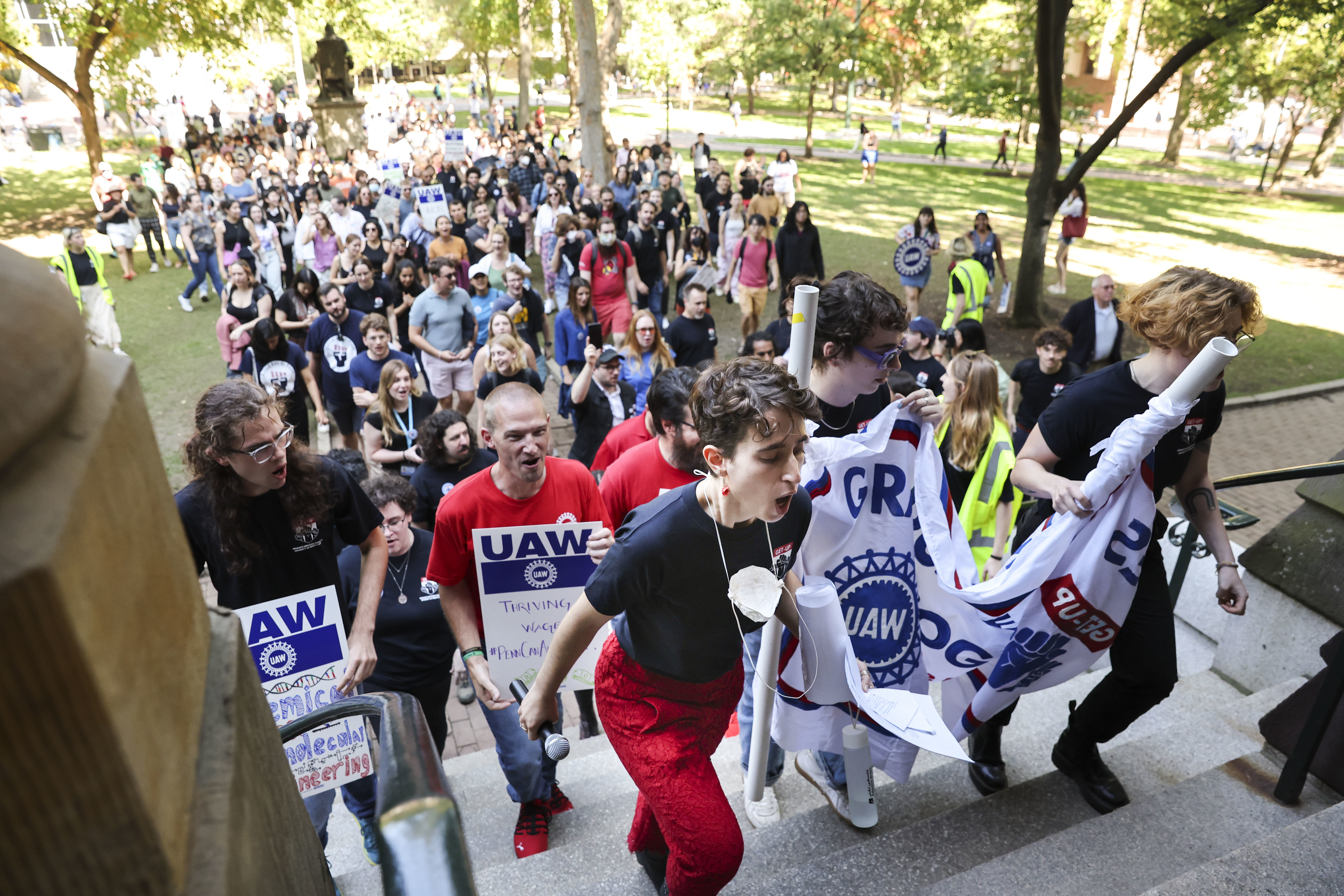
    Hilah Kohen, a Ph.D. student in comparative literature, and hundreds of supporters march into College Hall during a GET-UP rally in October 2023.

    A strike would be disruptive, said Sam Schirvar, a Ph.D. candidate in history and sociology of science, and would be a “last resort” for the union.

    “A work stoppage would really inhibit the basic teaching and research functions of Penn, and would make it very difficult for it to operate as it does as an academic institution,” said Schirvar, who has been organizing with the union for over five years.

    A university spokesperson, Ron Ozio, said via email on Thursday that Penn has been bargaining in good faith with the union.

    “We believe that a fair contract for the union and Penn can be achieved without a work stoppage, but we are prepared in the event that the union membership votes to authorize a strike,” said Ozio.

    What are graduate workers asking for?

    “There’s still a lot of room between the kinds of things that we’re calling for and the kinds of things that management is proposing,” said Schirvar.

    Wages

    The majority of the bargaining unit is made up of Ph.D. students who are paid an annual stipend, while workers pursuing master’s degrees receive hourly pay.

    Stipend workers make a minimum of about $39,000 annually, and hourly workers have no university minimum, Schirvar said.

    In its most recent proposal, the university offered $19 an hour for hourly employees and a minimum of $44,000 for the annual stipend starting in July 2026. The union is asking for a minimum wage of $37 an hour for those paid hourly and $55,500 for those on an annual stipend upon ratification of the contract.

    “While we’re asking for these things because it would make meaningful and life changing differences in our own individual lives, it also helps keep Penn a competitive, world-class institution,” said Friedline.

    Healthcare improvements

    The union is asking for the university to cover the full cost of health insurance for graduate student workers including dental, vision, and dependent coverage. The university already pays full healthcare benefits for graduate student workers, and some dental reimbursements depending on their department, said Friedline.

    Support for international students

    The union is also asking for more protections for international student workers on visas, who represent roughly a third of the bargaining unit, said Friedline. That support is important at this time, Friedline said, “amidst a national anti-immigrant political climate.”

    The union wants Penn to reimburse up to $3,000 of immigration expenses, bar immigration enforcement agents from entering nonpublic areas of campus unless legally required to, and alert the union if access is granted for a search or arrest warrant.

    Guruprerana Shadadi, a second-year Ph.D. student in the computer science department and an international graduate worker from India, said he had to cover the costs of moving to the U.S. before getting his first paycheck from the university, which included visa expenses.

    “I was lucky enough to be able to afford this, but I know several international graduate workers who found it extremely hard to go through this process,” he said. “Receiving a livable wage and higher stipends would go a long way for international students who literally have to start from zero to set up their lives here when they move to the United States.”

    University of Pennsylvania graduate students held a news conference and rally calling for a strike vote Nov. 3.

    Vacation days

    The union is asking for 20 paid vacation days and 20 sick days in a year. University leadership has said that this proposal exceeds what full-time staff get in their first few years. The university has proposed five paid days off per fiscal year and noted in a proposal that workers can “request flexibility in scheduling” when sick.

    Penn doesn’t currently have a centralized paid time-off policy for graduate student workers, and employees may be grading student work, preparing teaching materials, or working in a lab during the university’s academic breaks, said Schirvar.

    Why are graduate students organizing now?

    The academic job market has changed in recent decades, said Adrienne Eaton, a distinguished professor in the Rutgers School of Management and Labor Relations. In the past, graduate student workers might have been more willing to get paid less, knowing that time would ensure they could get good jobs later on.

    “You could kind of sacrifice those wages, that salary for a while, because you were pretty sure that when you finished, you were going to be able to get a tenure track job — and that just hasn’t been true, probably more like 20 years, depending on what field you’re in,” she said.

    Meanwhile, the cost of living has risen, said Eaton. “Those stipends that used to be kind of OK, I think, have gotten to be viewed as much more inadequate.”

    Whether or not Penn graduate workers actually strike, Eaton noted that passing a strike authorization vote typically sends a message.

    “It’s a leverage tool in bargaining to kind of let the employer know we’re serious about this, and you need to be serious about what you’re doing at the bargaining table,” she said.

  • Rape crisis centers are finally getting funding from Pennsylvania’s budget, but advocates say it’s not enough to support survivors

    Rape crisis centers are finally getting funding from Pennsylvania’s budget, but advocates say it’s not enough to support survivors

    Rape crisis centers in the Philadelphia region are sounding the alarm that the slight increase in funding in the recently passed state budget won’t be enough to sustain or improve crucial services for survivors of sexual assault.

    The Pennsylvania Coalition to Advance Respect (PCAR), which funds rape crisis centers via the state allocation, estimates centers will only see an average increase of $5,300 from the state to support their work assisting victims of sexual violence.

    The Philadelphia Center Against Sexual Violence had to lay off most of its staff and reduce services due to the nearly five-month state budget impasse. And while leaders in the region appreciate the funding — the first increase for rape crisis centers in years — it’s only a fraction of what Philly’s only rape crisis center says it needs to survive.

    “Even with the budget now passed, the funding increase is minimal compared to the overwhelming need,” said LaQuisha Anthony, senior manager of advocacy at the center, in a news release last week. The center is known as WOAR, the initials of its former name, Women Organized Against Rape.

    Now advocates in Philadelphia and the suburbs are turning their focus to next year’s budget, pushing for an $8 million increase in state funding to rape crisis centers, which, among other services, offer victim advocacy, legal services, and crisis hotlines. A surge in funding will help provide stability for survivors and adequately compensate staff who dedicate their lives to this work.

    “An $8 million increase would help ensure that every survivor across the Commonwealth, urban, suburban, and rural, has access to care, advocacy, and prevention,” said Joyce Lukima, coalition director and chief operating officer at PCAR, in a statement.

    More than $12 million of a $50.1 billion state budget was allocated to rape crisis this year, a $250,000 increase from last year. Lukima said this $250,000 will be split among 47 rape crisis centers in the state.

    In a statement, a spokesperson for the Pennsylvania Department of Human Services, which oversees rape crisis center funding, highlighted Gov. Josh Shapiro’s history of support for survivors of sexual violence.

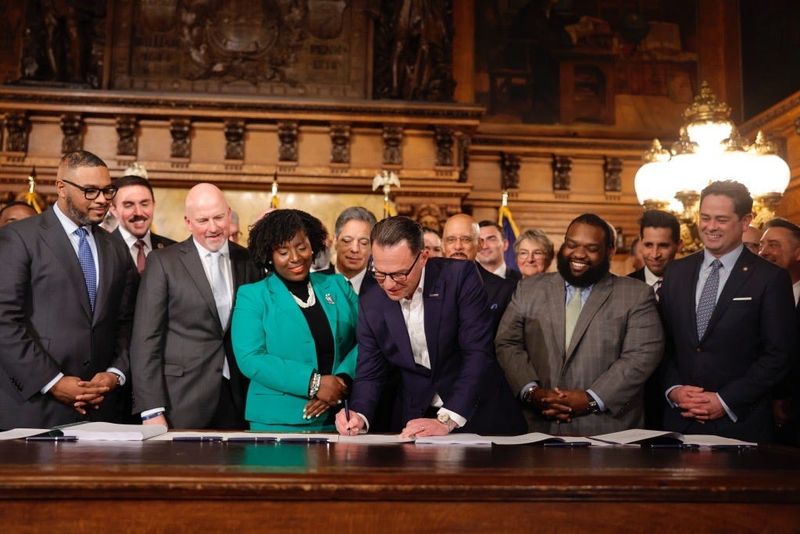
    Gov. Josh Shapiro signs the fiscal year 2025-26 budget surrounded by General Assembly members on Nov. 12 at the Capitol in Harrisburg. The state budget had been due June 30, and Pennsylvania is the final state in the country to approve a funding deal.

    “The final budget reflects the realities of working with one of the only divided legislatures in the entire country – but Gov. Shapiro will continue to fight for survivors and the Commonwealth’s rape crisis centers,” said Ali Fogarty, the DHS spokesperson.

    Victim services centers in the suburbs, which also offer rape crisis services, are echoing WOAR and PCAR’s message, highlighting the urgent need for greater funding. These suburban centers receive funding from additional sources because they support victims of other crimes.

    “For now, we’re doing OK, but another year of no increase in funding while the cost of living is going up has a significant impact on our staff as well as our organization,” said Penelope Ettinger, executive director of Network of Victim Assistance – Bucks County.

    Trying to stay afloat

    While Pennsylvania lawmakers were failing to come to an agreement on a far overdue state budget last month, rape crisis centers in Philadelphia and the suburbs were trying to make ends meet and provide services to survivors of sexual violence.

    For instance, the Victim Services Center of Montgomery County had to use a line of credit, delay bill payments, institute a hiring freeze, increase the number of interns, and commit to “triaging services,” said Mary Onama, executive director.

    “If they hadn’t passed the budget the time that they did, by December or January, we would have had to close, because we couldn’t go much longer,” Onama added.

    At the Crime Victims’ Center of Chester County, it “added a layer of stress to an already very stressful job,” though the center did not have to reduce services, said Christine Zaccarelli, the organization’s CEO.

    And at WOAR, the changes were drastic.

    The nonprofit cut their 30-person staff and paused counseling and therapy services and prevention-education programs. Other programming was kept afloat by the handful of staff members that remained.

    WOAR’s release last week said the closure of therapy and counseling services left “106 individuals wait-listed, 33 group clients waiting for services to resume, and eight child clients referred elsewhere for care.”

    The center has been serving Philadelphia since 1971 and was one of the first rape crisis centers in the United States, according to the organization. Between January and October, the center said it responded to 3,820 calls on its crisis hotline.

    But there have been recent shake-ups at the nonprofit, including the hiring of Gabriella Fontan, WOAR’S executive director, which was announced roughly a week before layoffs began in October. Prior to Fontan, the center had two interim executive directors since 2022.

    The dysfunctional approval of the state budget, though, will have lingering effects on WOAR, warning in the news release that without a “long-term, sustainable investment,” the center won’t be able to meet a rising demand for resources.

    The Bridge Loan, from the Pa. Treasury Department, provided WOAR funding owed for July through September, but it still wasn’t enough to return WOAR to full capacity, said Demetrius Archer, PCAR’s communications director. The center also brought back two employees this month, but it’s still in need of community support and is hoping to bring back more staff when possible.

    “When services are underfunded, survivors and entire communities feel the impact,” said Fontan in the news release. “In a city as large and diverse as Philadelphia, every minute counts when someone is in crisis. Survivors deserve to know that when they reach out for help, someone will be there to answer.”

    All eyes on Harrisburg

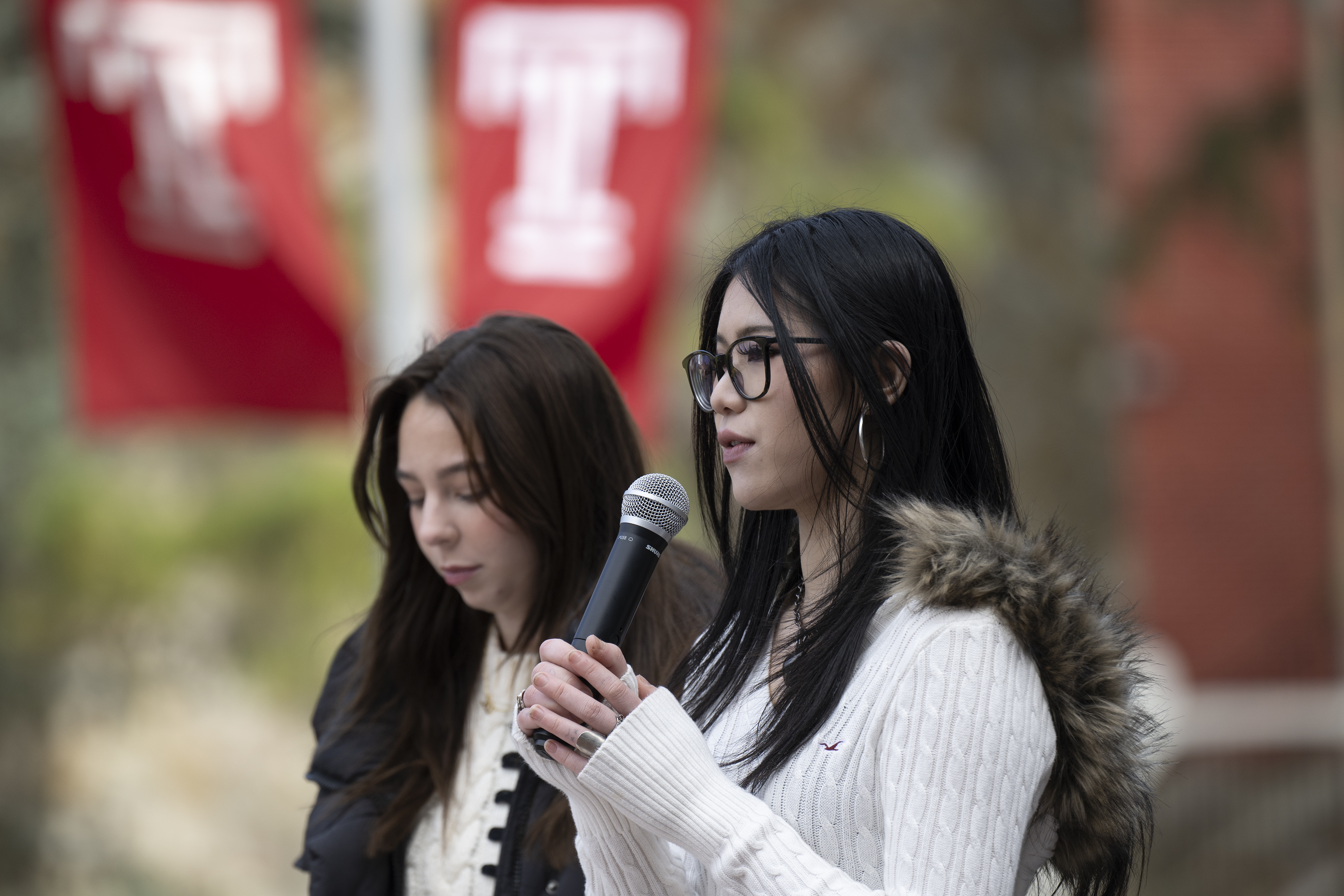
    At Temple University’s campus Tuesday, student advocates bundled up in their coats, hats, and scarves and gathered at the Bell Tower to discuss an anti-sexual violence state bill they helped develop.

    The Every Voice Bill, which primarily focuses on sexual violence prevention resources on college campuses, is even more important now that survivor services from WOAR are “unstable,” said Bella Kwok, a senior criminal justice major and president of Temple’s Student Activists Against Sexual Assault, in an interview prior to Tuesday’s event

    “This bill would ensure that stability at least on an institutional level,” Kwok said.

    Temple University students Emma Wentzel, left, and Bella Kwok speak at a podium on Polett Walk on Tuesday, Nov. 18, 2025, about campus sexual assault and a state bill they helped craft to strengthen protections against sexual violence at colleges.

    Kwok is not the only one who is turning their attention to Harrisburg. PCAR and other rape crisis centers are continuing their push for next year’s budget to include an $8 million increase in the Pa. DHS line item for rape crisis.

    As the first increase for rape crisis centers in a few years, the new budget’s funding gives advocates “hope,” even if the amount is “disappointing,” said Zaccarelli, of the Crime Victims’ Center of Chester County.

    “Maybe our advocacy is making a little bit of a difference and shining a light on survivors and their needs and how important our centers are in the community,” Zaccarelli said.

    Ettinger said that Bucks County’s state lawmakers have been supportive of NOVA Bucks, which had to place a hiring freeze on some positions and issue “significant” restrictions on spending due to the impasse, but that a lack of increased funding from the state is “very telling.”

    “I believe that the fact that the state did not allocate a significant increase is very telling to what they believe, where they put it on the priority list,” Ettinger said.

    For his part, Shapiro signed Act 122 in October 2024, which aimed to increase transparency by requiring a statewide electronic system to track evidence kits for sexual assaults, Fogarty, the DHS spokesperson said. And in December 2023, he signed Act 59, which aims to improve access to treatment for survivors of sexual assault.

    It’s a “societal” problem, not a government problem, said Vincent Davalos, interim executive director of the Delaware County Victim Assistance Center.

    “When we talk about sexual violence, the first thought is, of most people, is to say ‘Maybe this didn’t happen,” Davalos said. “And even if they do believe it happens… it’s just a really difficult topic for people to engage and talk about it plainly.”

    This week, victim services leaders across Pennsylvania will gather in Harrisburg for an annual conference to address funding challenges among other concerns, Davalos said, noting that with more funding, his center could improve staff retention.

    But this year, the newly passed state budget is likely to be top of mind.

    “I think money is going to be a big topic,” Davalos said.

  • Meet Temple guard Gavin Griffiths, who got the nickname ‘LeBron Frames.’ Here’s why.

    Meet Temple guard Gavin Griffiths, who got the nickname ‘LeBron Frames.’ Here’s why.

    During Temple’s season opener against Delaware State on Nov. 5, a new face got the action going instantly — Gavin Griffiths.

    The 6-foot-7 former Nebraska guard soared to the hoop from a lob by forward Babatunde Durodola, slamming it home for Temple’s first points. He ended his Owls debut with 16 points and had another dunk, earning him the nickname “LeBron Frames” on social media.

    “We ran through that play a lot of times in practice,” Griffiths said. “So yeah, it was something we worked on at shootaround today. I knew it was coming.”

    Griffiths, a junior, is having a career resurgence after injuries spoiled his single season with the Huskers. This is his third program — he spent the 2023-24 season at Rutgers — and he has become one of Temple’s best players, averaging 13.2 points per contest.

    “He’s rebounded at a high rate right now and we can throw some lobs, which is fun,” said coach Adam Fisher. “His personality is great. I just told him, ‘Don’t get caught up in all the memes.’ He’s been a great addition. He’s so coachable. He’s come from amazing coaches.”

    Griffiths joined Temple after spending one season at Nebraska, but his college career began at fellow Big 10 school Rutgers. He played one season under coach Steve Pikiell and scored a career-high 25 points in his second collegiate game against Boston University.

    The additions of future NBA lottery picks Dylan Harper and Ace Bailey prompted the four-star recruit — and top 50 high school prospect out of Kingswood Oxford School in Connecticut — to enter his name into the transfer portal. He played in 16 games for the Cornhuskers before entering the transfer portal again.

    Fisher, who was an assistant coach at Penn State when Griffiths was coming out of high school, tried recruiting him to the Nittany Lions. Penn State assistant coach Mike Farrelly was Griffiths’ lead recruiter, but Fisher remembers meeting the guard’s family, and the two formed a relationship from there.

    Gavin Griffiths works out during practice at the Liacouras Center on Oct. 27.

    “Gavin’s a young man that I’ve known for a long time,” Fisher said. “Mike Farrelly was the point person on the recruitment there and then coach Shrewsbury and I went and saw him and visited with his family. So we had a relationship and had seen him for three years prior. Great athlete, can make shots, comes from an amazing family. His mom and dad are just great people.”

    Griffiths had a better sense of what he was looking for since it was his second time in the transfer portal. He already had a relationship with Fisher, so most of his time was spent watching the Owls’ film. He then visited Temple’s campus, which led to his commitment on April 25.

    While he has given Temple a boost from three-point range, he worked to improve his game during the offseason. He developed to become a complete player and earned a spot in the Owls’ rotation. He’s started all four Temple games.

    “I’ve just been trying to work on my game in the offseason to make sure my shot feels good,” Griffiths said. “Play my role in terms of, if that’s knocking down a three, being able to do that and step in and shoot it confidently.”

    He’s reached double digits in each of the Owls’ four games, and when his shots are falling, it has put Temple in an offensive groove. He also knocked down three consecutive three-pointers in the last three minutes against Boston College on Nov. 15, which gave Temple a fighting chance — despite falling 76-71.

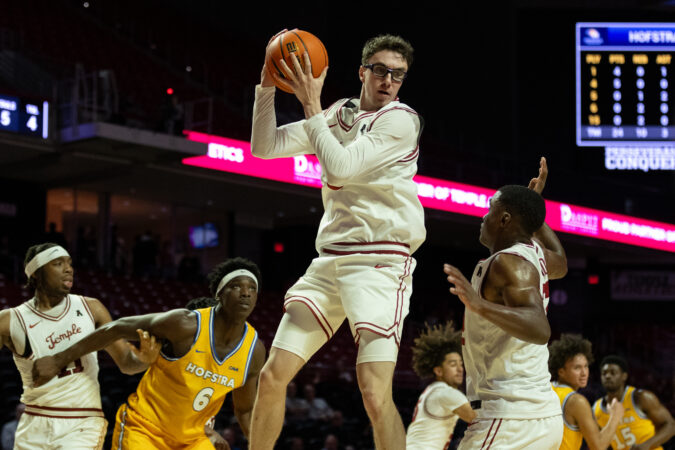
    He did the same thing against Hofstra on Wednesday. Griffiths finished with 11 points, including nine second-half points, all of which came in three-pointers to help the Owls escape the Pride.

    “I like that we scored,” Griffiths said. “And I like that [I] helped us get a little bit of energy, and I think that let us get some stops. So yeah, I think it was a good play.”

    For Fisher, Griffiths’ impact has reminded the coach of the player he recruited in high school.

    “I think it’s something that you just got to build with your players,” Fisher said. “We’re going to give you the freedom and you’re going to make mistakes. We all do. … Every team in the country is going to have practice. What are you doing besides that to separate yourself? And he does all that extra work.”