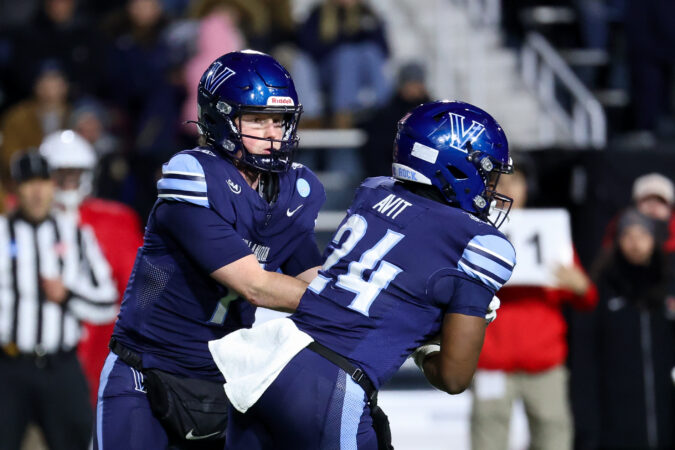
Villanova’s season came to an end Saturday night in a 30-14 loss to unseeded Illinois State in the semifinals of the Football Championship Subdivision playoffs at Villanova Stadium.
Emotions were high for the Wildcats who played their last collegiate snaps, but the 12-3 team could take solace in a bounceback season that saw it reach the FCS semifinals for the first time since 2010.
Villanova opened the season with a 1-2 record, including a blowout loss to Penn State and a 51-33 defeat to Monmouth in the Coastal Athletic Association opener. Then the Wildcats played every game like it was the last one, running off 11 wins in a row.
“Week 3, if anyone told us we’d be here now, I think they’re a little crazy,” graduate linebacker Shane Hartzell said. “But I’m super proud of how we responded week after week. Every game after Week 3 was pretty much a playoff game for us. We took that as it was, and I was really proud of the group that we had.”
Hartzell, who led the team with 101 total tackles and 9½ sacks, played his final collegiate game. The Perkasie native led the Wildcats in tackles in three of his five seasons with the program. In the postgame news conference, Hartzell said the end of his collegiate career had not fully set in, but earlier this season he said he could be interested if a professional football opportunity came his way.
“Super proud of this team and the season they were able to put together this year,” Villanova coach Mark Ferrante said. “When you get to a playoff situation, unless you go all the way, it’s bittersweet, because you’re going to end it in an ‘L.’ As I said all year, [this team] gave maximum effort all the time, showed a lot of resilience, and we just came up short.”
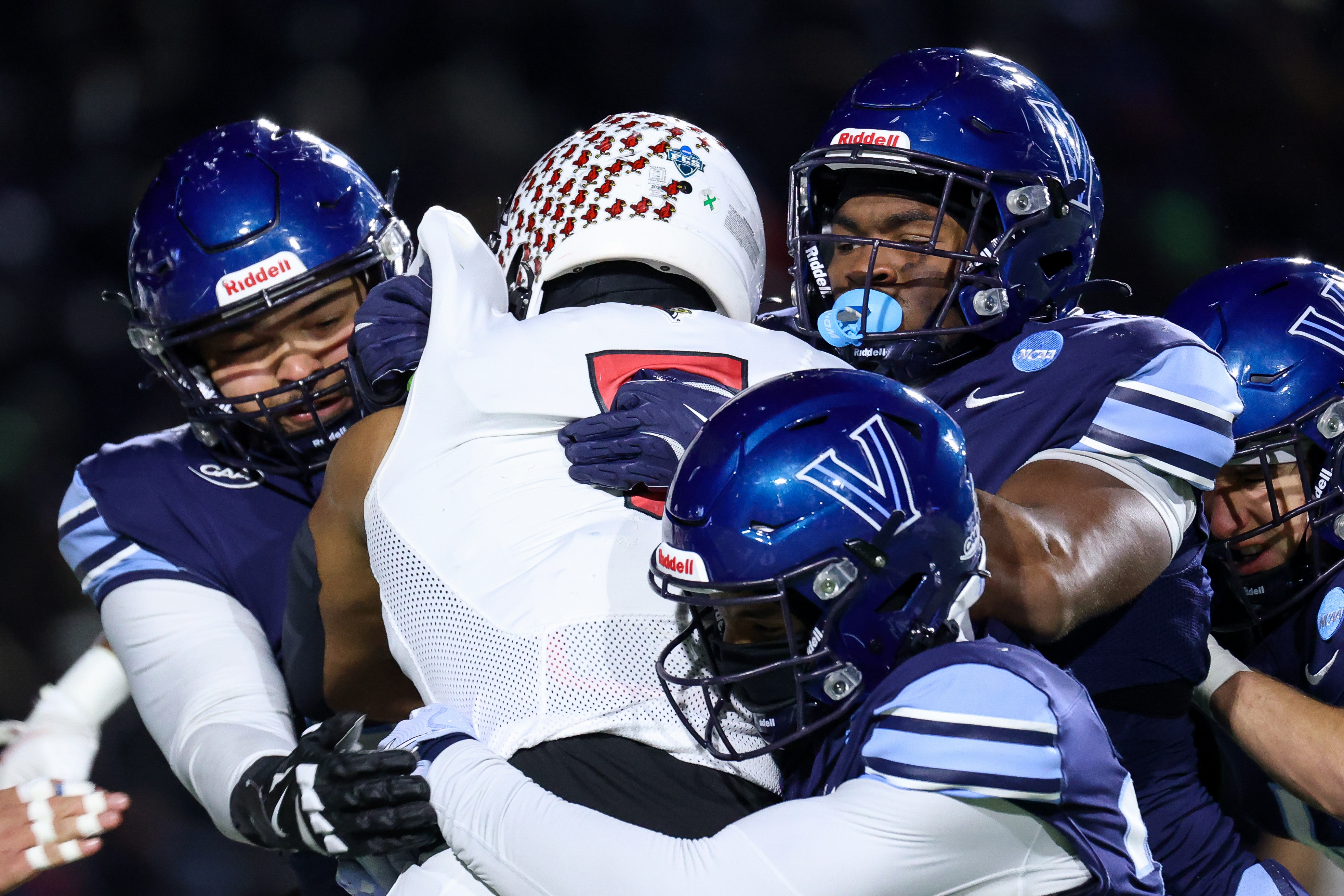
Villanova linebackers Omari Bursey (left) and Ayden Howard stuff Illinois State running back Victor Dawson during the first quarter Saturday.
Even though the college football landscape has changed with name, image, and likeness opportunities and the transfer portal, Villanova prides itself on a culture that retains players for four seasons, plus graduate years in a lot of instances.
“It was a great season, the ups and downs, but I’m super proud of these guys,” said running back Isaiah Ragland, a redshirt sophomore. “This year was very player-run, so it was very easy to mesh with the guys. And Pat McQuaide was a great leader. He came in last January and he was super hype. [We were] like, ‘Who’s this guy?’ But as time went on, we adapted to him, and we took him in. … We spent a lot of time outside of football, hanging out with each other. And I think that really helped with our successes.”
McQuaide transferred in as a graduate student from Nicholls State last winter. He threw 25 of his 51 career touchdown passes at Villanova. In his final game, he passed for 199 yards with a touchdown and an interception.
“Pat, honestly, just as an offense as a whole, we had complete trust in him,” Ragland said. “If he made a mistake, we knew he was going to go out there and make a play.”
Ferrante is looking forward to speaking with all seniors and players with eligibility remaining in the coming days and weeks.
“I told them I want to talk to each one of the guys who are exhausting their eligibility here within our program,” Ferrante said. “[We will] let them check it into the training room and then have a team meeting [Sunday], and then I’ll pull those guys aside, we’ll have a great conversation.”
Ferrante was able to retain running back David Avit last offseason after he entered the transfer portal. Avit received offers from Stanford, South Florida, and others before deciding to return to the Main Line.
Wildcats wide receiver Braden Reed runs with the ball against Illinois State.
With the season now concluded, Ferrante and the Wildcats are planning on enjoying the holiday season. Then it will be back to business, with the coaching staff hitting the road for recruiting visits.
“Right now, it’s bitter,” Ferrante said. “As we get further and further away from where we are right now, into the next semester, and we go on a road recruiting, there’ll be a lot of people giving us a lot of compliments on the season we had. So it’ll get a little sweeter later.
“There’s a lot of tears, as you would imagine, especially the older guys whose careers are ending, but they have a lot to be proud of. But right now, I told them, enjoy the holidays with your families, and we’ll move forward, the sun will come up tomorrow, and we’ll be in great shape.”
A star player was available for trade. The Flyers reportedly showed some interest. The team elected not to pony up the required assets to make the deal. The star player landed elsewhere and sent the Flyers back to the drawing board.
I’m obviously referring to Norris Trophy-winning defenseman Quinn Hughes being traded on Dec. 12 from Vancouver to Minnesota for a package that included blue-chip prospect Zeev Buium, middle-six center Marco Rossi, prospect Liam Öhgren, and a first-round pick. Hughes, the second-best defenseman in the world, and notably a well-documented fan of Flyers coach Rick Tocchet from their time together with the Canucks, is exactly the type of needle-moving superstar the Flyers are missing on their blue line. So why no deal?
That answer is more nuanced than “the Flyers were being cheap again,” and we will address that in a minute. Nevertheless, missing out on star talent has been an all-too-familiar and frustrating pattern for Flyers fans over the past few years as the team has carried out its rebuild and focused largely on subtraction rather than addition.
But that was all supposed to change next summer, when Danny Brière, Keith Jones, and the Flyers suggested they would pull out the checkbook and aggressively try and sign a marquee free agent. One problem: That 2026 free agent class, which was once headlined by Connor McDavid, Jack Eichel, and Kirill Kaprizov, has all but evaporated outside of soon-to-be-overpaid consolation prizes like Alex Tuch, 34-year-old Artemi Panarin, and Rasmus Andersson, none of whom play center, the gaping hole the Flyers need to address most.
With that in my mind, could/should the Flyers have pulled the trigger on a Hughes deal? And where might the team turn from here to solve its 1C problem?
The Flyers were right to pass on Hughes
To start, Hughes would have fit perfectly in Philly, as he is one of only three or four genuine game-breaking defensemen who exist in the league. One of the world’s top 10 players, his dynamic skating ability, particularly his lateral movement and ability to walk the line, and playmaking prowess would have provided a seismic jolt to an anemic offense and struggling power play, and subsequently bumped the rest of the team’s defensemen back into their appropriate slots. More simply, Hughes, while a wildly different player, would have been the team’s best defenseman since Chris Pronger’s injury-shortened spell from 2009-12.
The Flyers were interested in Quinn Hughes but reluctant to move their top two assets in Matvei Michkov and Porter Martone.
So could the Flyers have traded for him? In short, yes.
The Flyers boast a consensus top-10 prospect system, own several future first-round draft picks, and have players who would have intrigued Vancouver, namely Matvei Michkov and Michigan State phenom Porter Martone. Both of those players are viewed as untouchables for the Flyers, and not including them would have all but removed them from the Hughes sweepstakes. Some combination of Jett Luchanko, Jack Nesbitt, Tyson Foerster, Owen Tippett, Cam York, Oliver Bonk, and first-round picks, while nothing to sniff at, was not besting the return Vancouver ultimately landed, headlined by Buium.
What will infuriate Flyers fans is that the team had a chance to draft Buium just 18 months ago. Ranked No. 4 among North American prospects in 2024 according to NHL Central Scouting, the former University of Denver star slid directly into their laps in that draft, only for the Flyers to trade the pick to Minnesota and move down one spot and select Luchanko. While the Flyers still believe in the speedy Luchanko, the simple fact is the centerman is not as highly regarded a prospect as Buium leaguewide. Obviously, there is some revisionist history here, but if the Flyers had taken the consensus top player on the board in 2024, maybe they would have been in a better position to make this type of deal.
While the Flyers could have potentially pulled this deal off by including Michkov or Martone, they were right not to. But wouldn’t landing a superstar be worth the price of a promising young player or a highly regarded but unproven at the NHL level prospect? Not when you consider the Flyers’ current standing and Hughes’ current contract situation.
Hughes, 26, is only signed through the end of next season, and his agent Pat Brisson said “that under no circumstances could we guarantee a contract extension with anyone.” In other words, the Flyers, who are not ready to compete for a Stanley Cup in the next year and a half, would be rolling the dice on Hughes’ connection to Tocchet and willingness to extend beyond that point. That is far too risky for a team in their position, especially one that was already forced to punt away one high-end prospect in Cutter Gauthier, and couldn’t afford to part with another like Michkov or Martone for a one-and-a-half-year lottery ticket.
The Flyers passed on drafting Zeev Buium with the 11th pick in 2024.
So where do the Flyers go from here?
While the Flyers refuse to put a hard timeline on their rebuild and have continued to preach patience, the clock is ticking for a couple of reasons.
First, the team is 17-10-7 and more likely to earn a playoff spot than land a top-10 draft pick to select a prospective No. 1 center or No. 1 defenseman. For context, I’d count 27 players leaguewide as worthy of that true No. 1 center designation, and 15 of them were top-three picks, 19 were top-10 picks, and 24 of them were first-rounders. In other words, the Flyers either need to trade for a No. 1 center and/or hope they can uncover a gem like Robert Thomas (20th overall), Wyatt Johnston (No. 23), Tage Thompson (No. 26), Sebastian Aho (No. 35), Roope Hintz (No. 49), or Brayden Point (No. 79). Rightly or wrongly, the team is no longer constructed in a position to bottom out for that type of draft capital, and that isn’t likely to change going forward.
Second, as we mentioned earlier, there don’t seem to be any ready-made solutions left in free agency next summer. The top unrestricted free-agent center options available are Evgeni Malkin, who will turn 40 before next season if he doesn’t retire; former Flyers captain Claude Giroux, who will be 38 and has shifted mostly to wing over the latter half of his career; Nick Schmaltz, who turns 30 in February, has never reached 65 points, and is best on the wing; and Christian Dvorak, who is already a Flyer.
So who could be available if the Flyers are ready to deal? That conversation will always start with Thompson, who is on pace for his third 40-goal season in four years and is wasting away in Buffalo. The 28-year-old All-Star wouldn’t come cheap, but he is a unique player at 6-foot-6 and 220 pounds, and attractively, is signed for the next four years at a relative bargain price of $7.14 million.
Tage Thompson is one of the league’s premier goal scorers and would immediately fill the Flyers’ hole at 1C. He would command a Quinn Hughes-like haul though.
Buffalo, which changed general managers last week, still seems to think it can make the playoffs, but when that pipe dream is extinguished, which could be sooner rather than later, don’t be surprised to see Thompson push for a change of scenery. Buffalo and Philly make a lot of sense as trade partners, too, as Philly has some attractive young NHL pieces, prospects, and picks it could send back to Buffalo if the Sabres decide to tear it down … again. Thompson would be plug-and-play on the Flyers’ top line and bring a mixture of size, skill, and one of the league’s top shots to Broad Street.
Outside of Thompson, the path to landing a 1C or even a 2C is a lot murkier, as the Flyers would seemingly be out on guys in their mid-30s like Nazem Kadri, Brayden Schenn, and Ryan O’Reilly, with most others unavailable. Elias Pettersson, another high-end center who has been shopped in recent years, is also likely off the block now and would be an odd fit given his up-and-down time under Tocchet in Vancouver, anyway.
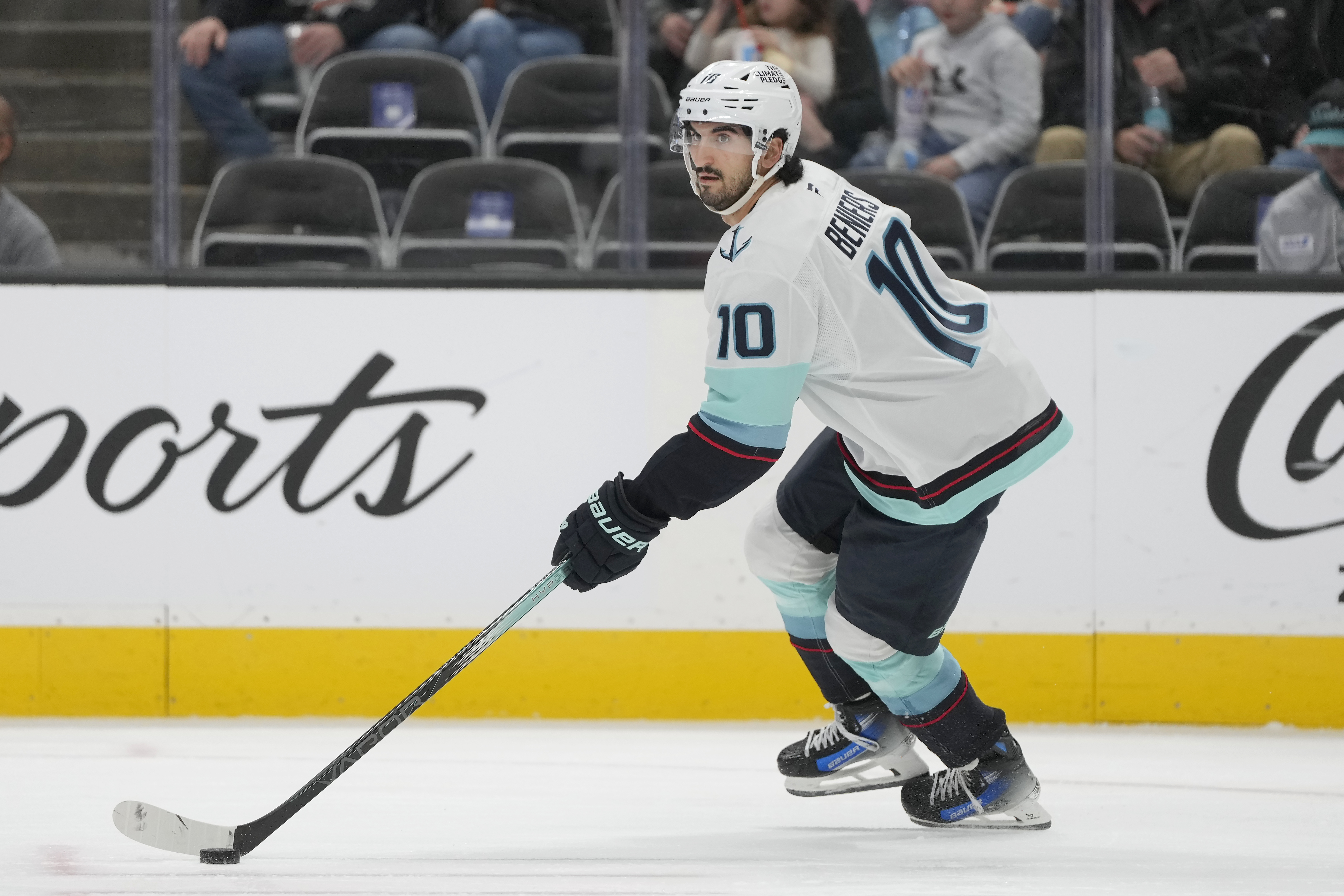
I’ve always wondered about Seattle’s Matty Beniers, who has been solid but hasn’t truly taken off offensively since being the No. 2 overall pick in 2021. With Seattle likely stuck with 31-year-old Chandler Stephenson for five more years (yikes), and centers Berkly Catton, Shane Wright, Carson Rehkopf,and Jake O’Brien rising in the system, could the Flyers pry Beniers, 23, away from the Kraken with the right offer?
St. Louis’ Robert Thomas and Toronto’s William Nylander are two others I could see becoming available for massive hauls if things break right. Detroit, which is under pressure to take a step and make the playoffs, and was also a leading contender for Hughes, might be tempted to move a young center like Marco Kasper or Nate Danielson for a package headlined by a proven top-six NHL winger.
Seattle Kraken center Matty Beniers is a young player with untapped potential.
How about a team like Minnesota, which just pushed its chips to the middle and went all-in? Would moving young Danila Yurov for immediate upgrades at wing or center, say Owen Tippett and Minnesota-born Noah Cates, make sense? Would Anaheim, which has its long-term top two centers figured out in Leo Carlsson and Mason McTavish, quickly flip 2025 No. 10 overall pick and oft-injured Roger McQueen for help at wing as it pushes for the playoffs? We know Brière and Ducks GM Pat Verbeek have each other on speed dial by now. Would Eastan Cowan, especially given his London ties, be a prospect the Flyers target if the Maple Leafs look to bolster their postseason chances?
One way or another, the Flyers’ search for a No. 1 center goes on, and there are fewer obvious solutions than ever. It’s time to act and time to get creative. Your move, Danny Brière.
Maybe the Eagles are getting a little of that Super Bowl feeling back from a season ago. You know the vibe: Saquon Barkley carries the offense, the defense goes into shutdown mode, and the Birds win.
That’s exactly the formula the Eagles used Saturday night as they clinched the NFC East with a 29-18 victory against the Washington Commanders. Granted, it came against a moribund team that was down to its third-string cornerback, but Vic Fangio’s defense held the Commanders to 220 yards, some of which came during a garbage-time touchdown drive.
Barkley’s performance might be the best sign for the Eagles, though. He rushed for 132 yards and a touchdown, breaking off a 48-yard run at one point that was reminiscent of his incredible 2024 season. The rushing numbers in the last four games suggest that Barkley and Co. are doing something better, Jeff McLane writes. The Eagles have averaged 4.96 yards per carry over that span. In their first 11 games, they averaged only 3.91 yards.
Jalen Hurts’ legs, Barkley’s strong December, better blocking schemes, and Tank Bigsby as the second punch could be the recipe for the Eagles in the postseason.
One of the recipes from last season might be ripped from the cookbook, though. The Eagles tried the Tush Push three times against the Commanders and failed all three times. It’s time for last rites for the Eagles’ signature sneak, Mike Sielski writes.
That wasn’t the only slipup for the Birds, either. Jake Elliott missed three field-goal attempts, although one was negated by a penalty. Elliott is 17-for-24 on field goals this season. His success rate of 70.8% is the worst of his career.
Nick Sirianni is standing by his kicker. “I have a ton of confidence in him that he’ll respond and rebound from this,” the coach says, ”because he’s mentally tough and a great kicker.”
At 10-5, the Eagles are the third seed in the NFC, which is where they’ll likely land when the playoffs begin. After two wins against the dregs of the NFL, they’ll take a step up in class Sunday when they visit the 11-4 Buffalo Bills, who have won four straight.
VJ Edgecombe has been an early Christmas gift for the Sixers.
VJ Edgecombe outperformed another flashy first-year player, No. 1 pick Cooper Flagg, on Saturday. The rookie finished with 26 points in a 121-114 victory against the Dallas Mavericks and afterward Sixers star Tyrese Maxey was asked whether Edgecombe has surprised him this season.
“Sadly, no,” Maxey said. “I want to say yes, but, sadly, no. Like, this is who he is, you know what I mean? We realized that Game 1. Yeah, you can do what you want to do in the preseason, and all that and practice in training camp, but when the lights come on, you just never know, and the lights came on, and he came on with it.”
The Phillies signed Adolis García, left, to replace Nick Castellanos in right field.
The Phillies plan to plug Adolis García into right field, taking over for Nick Castellanos whenever they trade or release him. It will be quite an upgrade, says former Phillie Brad Miller, who played with García when the Texas Rangers won the World Series in 2023.
“What I would tell people is, Adolis is worth the price of admission,“ says Miller, who is now a television analyst for the Rangers. ” … It’s exciting stuff, like he’ll make diving plays, he’ll throw a guy out from the wall in right field. I can just picture that at the Bank. … He plays with a flair. And he can do everything. I’m excited for him. I think it’s going be a breath of fresh air.”
Reliever Matt Strahm will get to breathe the fresh air in Kansas City after the Phillies traded him to the Royals for right-handed reliever Jonathan Bowlan.
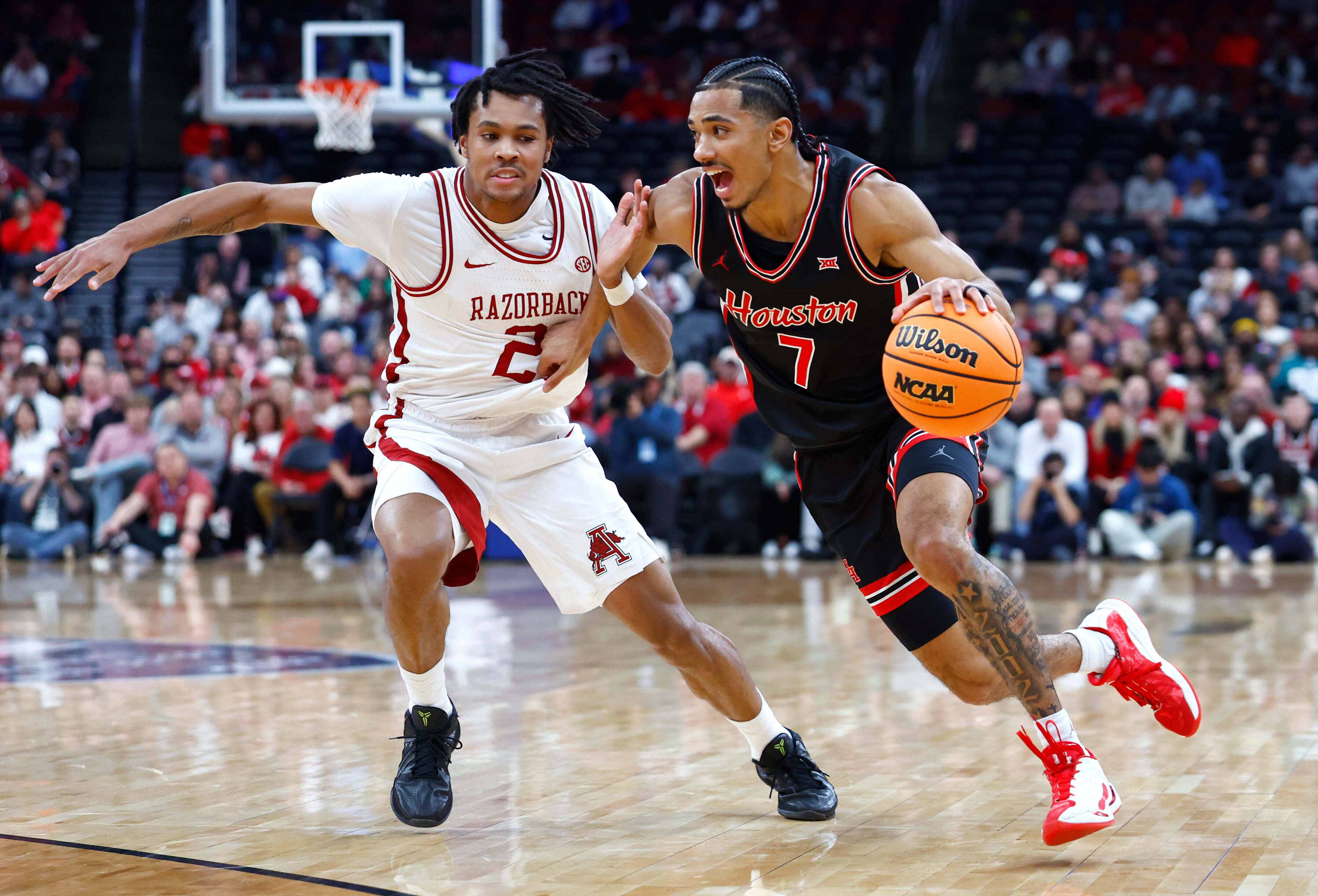
D.J. Wagner of Arkansas guards Houston’s Milos Uzan during the first half Saturday in Newark, N.J.
Not long ago, Camden High’s D.J. Wagner was the top-ranked high school basketball recruit in the nation. Now he’s in his third college season, not really thought of as an NBA lottery pick as he starts at guard for John Calipari at Arkansas.
After a loss to No. 8 Houston in Newark, N.J., on Saturday, Wagner is averaging a career-low 8.4 points for the Razorbacks. His NBA star may have dimmed, but Wagner is doing just fine thanks to his NIL deals and is comfortable in his role.
“I’m just happy to be here,” Wagner says. “Whatever I can do to help my teammates out, I’m happy to do it.”
Flyers general manager Danny Brière knows it is hard to find No. 1 and No. 2 centers. But that is his task as the Flyers look to take the next step in their rebuild.
The Flyers missed an opportunity to obtain a budding star when Vancouver traded Norris Trophy-winning defenseman Quinn Hughes to the Minnesota Wild on Dec. 12. Now it’s back to the drawing board for the Flyers, who are hesitant to deal away top prospects.
Should the Flyers have gone harder after Hughes? What’s the next step for a team that still lacks a No. 1 center and defenseman? Gustav Elvin considers the possibilities.
Sports snapshot
The Bears’ DJ Moore celebrates after his 46-yard TD catch in overtime beat the Green Bay Packers.
Coach moving on: Camden native Elijah Robinson reportedly is leaving the Syracuse staff and returning to Texas A&M as defensive line coach.
Special report: Drexel’s Terrence Butler died two years ago. The reasons for his passing still elude everyone who loved him. Mike Sielski reports.
On this date
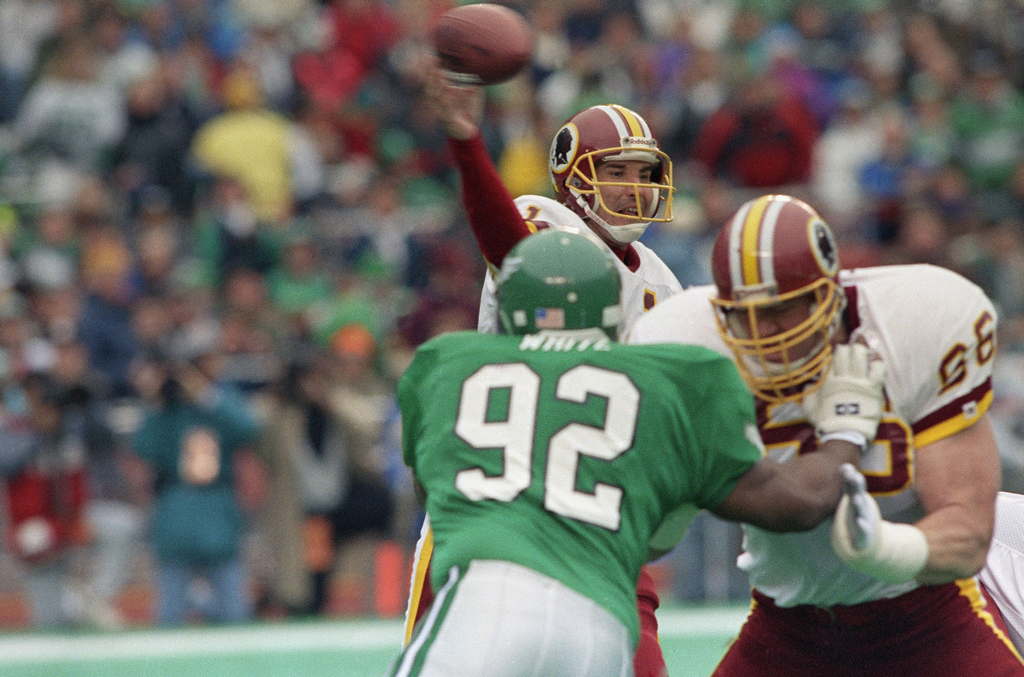
Washington quarterback Mark Rypien passes under pressure from the Eagles defensive end Reggie White during a playoff game in the 1990 season.
Dec. 22, 1991: The Eagles scored 17 points in the fourth quarter of a 24-22 victory against Washington. Reggie White sacked Washington quarterback Mark Rypien twice. Roger Ruzek’s 38-yard field goal won it for the Birds.
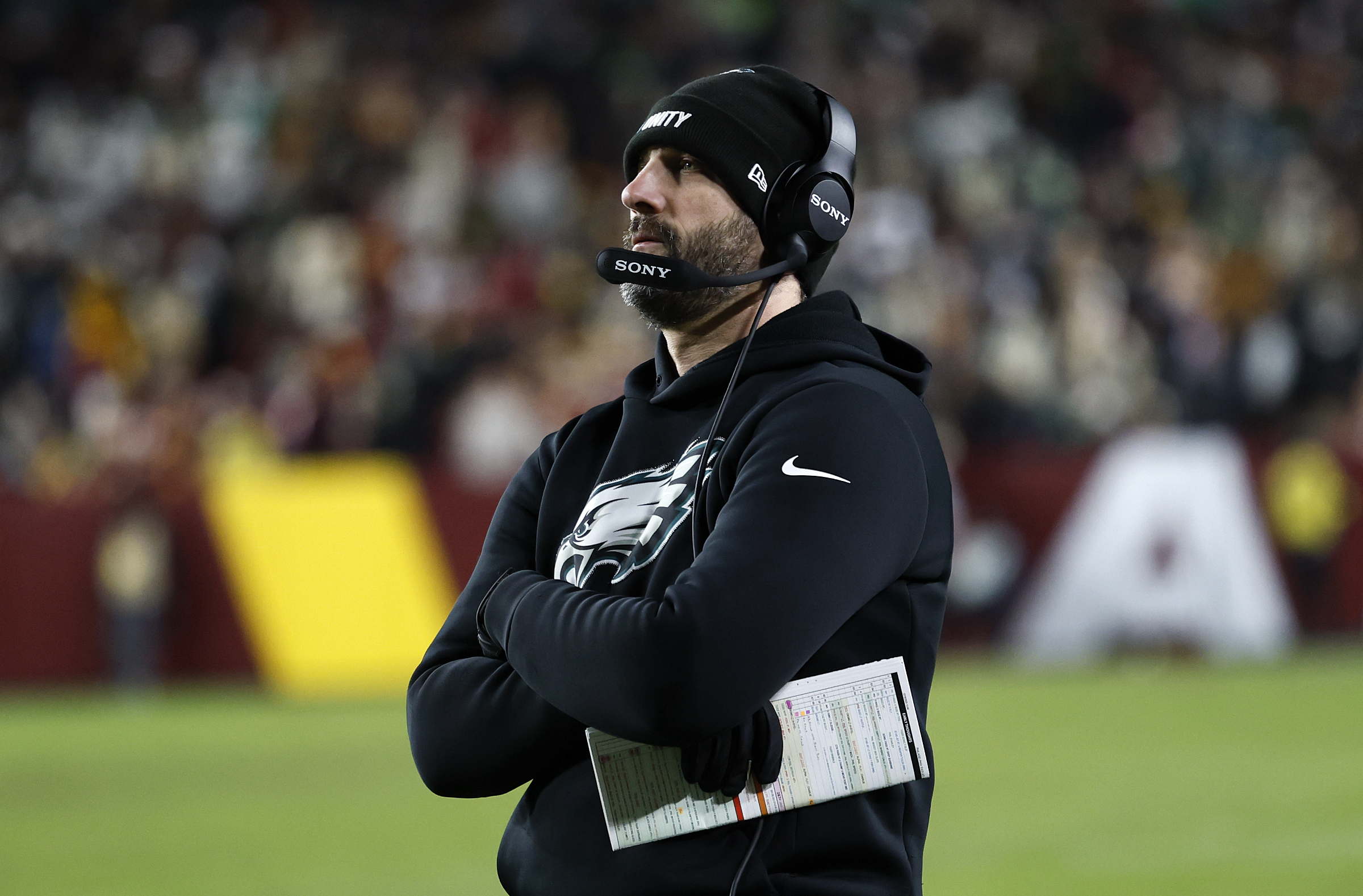
Was Eagles coach Nick Sirianni trying to run up the score by going for two points with a big lead late? The Commanders seemed to think so.
It seems ungrateful to complain about any win, particularly a win that ensures a fifth consecutive trip to the playoffs, and the team in question won the latest Super Bowl.
It seems doubly thankless to whine about the coach and staff that largely have been responsible for this windfall of January football, delivered with an NFC East title earned Saturday with a 29-18 win over the Commanders.
We compiled today’s newsletter using reporting from Jeff McLane, Mike Sielski, Jeff Neiburg, Olivia Reiner, Marcus Hayes, Scott Lauber, Keith Pompey, Gina Mizell, Gustav Elvin, Devin Jackson, Dylan Johnson, and Katie Lewis.
By submitting your written, visual, and/or audio contributions, you agree to The Inquirer’s Terms of Use, including the grant of rights in Section 10.
Thanks for reading Sports Daily. I’ll see you in Tuesday’s newsletter. — Jim
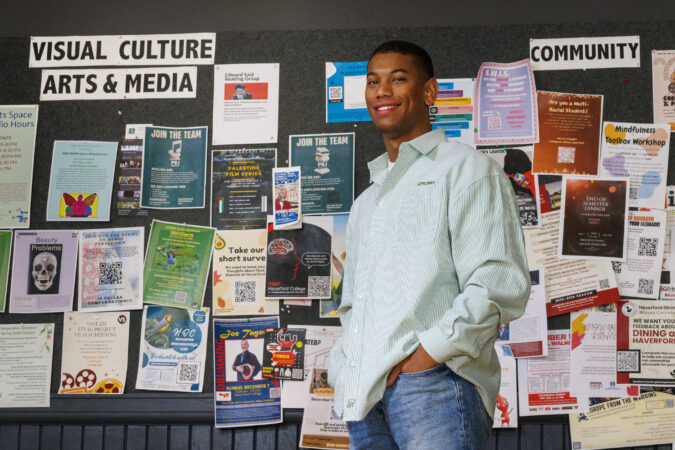
Haverford College senior Jackson Juzang earlier this year had been talking to a school administrator about the need for more resources to support student journalism.
The administrator, Chris Mills, Haverford’s associate vice president for college communications, asked if there was a network of student newspaper journalists in the region that Haverford could join and seek support from.
There wasn’t.
“So I decided to create one,” said Juzang, 22, an English major from Pittsburgh who serves as associate editor of the Clerk, Haverford’s student newspaper.
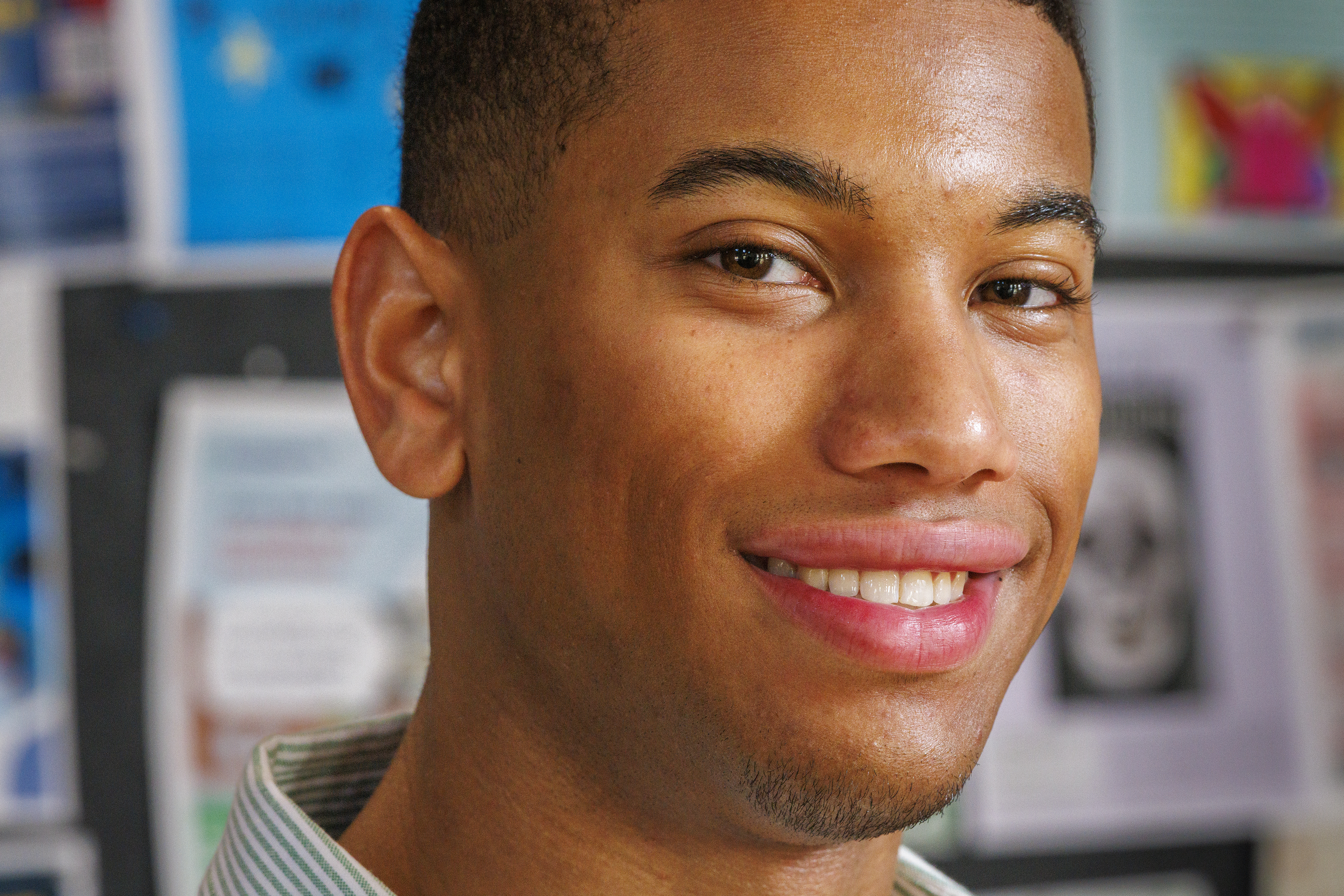
Jackson Juzang explains why he started the Philadelphia Student Press Association.
He established the Philadelphia Student Press Association as a nonprofit and created a board with student editors from 11 college news organizations around the region, including Temple, Drexel, Villanova, St. Joseph’s, La Salle, Rowan, Rutgers-Camden, Bryn Mawr, Swarthmore, Haverford, and Eastern.
With the slogan “Rooted in Philly, Reporting for All,” the group — which collectively represents about 400 student journalists — is seeking funding from organizations to support student journalism at a time when college budgets are tight and the news industry faces challenges, including rising print costs and lower readership. The association already has held workshops with more planned next year, and its 21-member board meets monthly and discusses common issues and problems and brainstorms solutions.
“We have so many people coming from different regions, but we are united in the sense that we are all here for the same reason,” said Claire Herquet, an editor at the La Salle Collegian.
At a recent meeting, members talked about artificial intelligence and what to do if an editor suspects a student writer used it, Herquet said. There were two instances over the past semester when she read an article submission and thought the terminology and phrasing didn’t sound like the writer, she said.
“If I didn’t have PSPA, I wouldn’t have people to lean on,” said Herquet, 21, a junior communications major from Camden. “It would just be me versus the problem.”
Herquet manages communications for the association. She has been reaching out to foundations about obtaining grant funding for the association. Some college newsrooms are better funded than others and can give writers and editors stipends.
She’s hopeful that uniting the newsrooms will result in better experiences for students and more funding.
La Salle’s publication is only digital; there is no print version. Costs are minimal, but funding would cover professional workshops for students and costs, such as travel, associated with their reporting.
The Whit, Rowan University’s student news site, prints a newspaper once a week and receives financial support via student government, but print costs are rising, said junior Katie Thorn, who serves as managing editor.
“We’re trying to figure out with the budget we have if it is possible and what we are going to have to sacrifice to keep our paper printing,” Thorn said.
Thorn, who is serving as treasurer for the association, said it’s been helpful to learn that other student organizations are facing the same challenges.
“Journalism as a whole is such a scary world right now,” said Thorn, 20, a journalism major from Mantua, Gloucester County, “and you’re kind of throwing yourself into the fire. Am I going to find a job? Where does my future lie? Having people who support you and uplift you is a great thing.”
Haverford’s student newspaper has received funding via the president’s office and is able to pay its writers, Juzang said. In January, the Clerk will publish its first print edition.
But the Clerk would like resources for deeper reporting and investigative work and mentorship, he said.
Juzang, who hopes to pursue a graduate degree in communication management next year at the University of Southern California, said he’s invested thousands of dollars of his own money to get the association started. He currently works as a research/editorial intern for NBC Sports.
He said the association also has received support from the Philadelphia-based Foundation for Individual Rights and Expression.
Juzang said he would like to help schools, including Widener and Lincoln, that used to have student news sites revive them. He also has begun talking to student journalists in other metro areas, including Washington, Boston, New York, and Baltimore, about starting an association for their university newsrooms, he said.
Mills, the Haverford communications administrator, was pleased to see Juzang take that conversation the two had last March and create a mechanism for student journalists to share their experiences and learn from each other.
“It’s really important for the students to share resources and knowledge and wisdom,” he said. “For those of us who value student journalism, it’s great to see them prioritizing this and making the time to do it.”
And this year, Parker let go of three top city officials amid ordeals fraught with internal drama for the administration.
Despite those tribulations, the big-picture news for the city has been positive, and the mayor can credibly say she has made progress on her oft-repeated campaign slogan of making Philadelphia “the safest, cleanest, greenest big city in the nation with access to economic opportunity for all.”
"We are doing the best we can with what we have," Parker said in an interview Friday. “Nobody’s resting. We’re not having a party and celebrating because we know we have a lot more work to do.”
story continues after advertisement
The year encapsulated Philadelphia’s reality under Parker’s administration: big wins on major goals despite signs of tension in City Hall.
“She’s getting some pushback, but statistically, in terms of the crime rate, the city is doing better,” said David Dunphy, a Pennsylvania Democratic political consultant and lobbyist. “In terms of the biggest issues that voters had in the last election, it’s inarguable there’s been vast improvement.”
“There’s a general sense Philadelphia is coming back and making a rebound [following the pandemic], and she gets a lot of good will from the sense she enjoys being mayor,” Dunphy said.
Here are six takeaways from Parker’s second year in office.
story continues after advertisement
Big wins, with caveats
Parker made public safety the central themeof her 2023 mayoral campaign. And two years in, the news could hardly be better.
The Police Department as of last week had recorded 212 homicides in 2025, and is on pace to close the year with the lowest level since 1966.
But it’s not just the reduction in violence.
Philadelphia’s poverty rate has dipped below 20%, and it no longer has the highest rate among the 10 largest U.S. cities. The city’s finances are in the best shape they have been in since the early 1990s fiscal crisis. Perhaps most shockingly, there even appears to be progress in Kensington, where Parker has pledged to end the neighborhood’s notorious open-air drug market.
Onedrug dealer told The Inquirer the city’s crackdown has cut his weekly revenue from about $1,500 to $400. And the city isexpanding its Riverview Wellness Village, a first-of-its-kind initiative from Parker’s administration to house and provide treatment for people in recovery.
There are plenty of caveats to all of those headline accomplishments. The decline in homicides began shortly before Parker took office. Philadelphia still has the lowest median income of the 10 biggest cities in the country. The city’s finances, buoyed by a growing economy, have been growing more stable for decades. And the Kensington drug market isn’t disappearing anytime soon.
Workers from Philadelphia’s Community Life Improvement Program clean the intersection of Kensington Avenue and Somerset Street on Jan. 22, 2025.Jessica Griffin / Staff Photographer
But mayors are judged by how the city changes during their tenures. And so far, Parker is likely pleased with her progress on the most important measuring sticks.
“She communicated during the campaign and throughout the beginning of her term a set of priorities that everybody can repeat: the safe, clean, green, inclusive growth or opportunity for all,” said Pedro A. Ramos, a former city managing director who now leads the Philadelphia Foundation, a major philanthropy. “Two years in, I think any fair scorecard has got to give her pretty good grades.”
Tom Gralish / Staff Photographer
Strike highlighted Parker’s strengths and weaknesses
During the first major city worker strike in 40 years, the mayor stoodatop the Philadelphia Art Museum steps in sweltering heat as what were unofficially dubbed “Parker piles” of uncollected trash mounted around the city.
“I will not put the fiscal stability of the city of Philadelphia in jeopardy for no one,” Parker said, explaining her refusal to meet demands for bigger wage increases for the union representing trash collectors, 911 dispatchers, water treatment plant employees, and other blue-collar workers. “If that means I’m a one-term mayor, then so be it.”
Philadelphia Mayor Cherelle L. Parker discusses the AFSCME DC 33 municipal workers strike at a news conference at the Philadelphia Art Museum on Thursday, July 3, 2025.Kaiden J. Yu / Staff Photographer
But the strike was also the most divisive moment in Parker’s tenure, fuelingtensions within organized labor and leading to accusations that Parker didn’t care about the workers’ plight.
Teamsters Local 107 president Bill Hamilton said the mayor encouraged workers to cross picket lines and “should be ashamed of her actions and her words during this strike.”
“She doesn’t have any friends on my side of labor, I can tell you that,” he said.
Parker said that being at odds with labor was “abnormal” for her and that she was disappointed the strike led some people to believe she was not a strong supporter of organized labor.
”Was I disappointed? Yes, because it wasn’t reflective of my career and everything I had done," Parker said in the interview. “But I also respect the union.”
Alejandro A. Alvarez / Staff Photographer
Parker’s don’t-poke-the-bear strategy with Trump
In August, the U.S. Department of Justice sent so-called sanctuary cities a letter threatening to cut off federal funding if they did not get in line with the Trump administration’s immigration policies.
Like many other Democratic leaders, Boston Mayor Michelle Wu excoriated the Trump administration andpublished a scathing response to the DOJ.
But Parker said nothing. Her administration refused to release Philadelphia’s response to the DOJ letter and is still fighting an Inquirer request for the document under Pennsylvania’s Right to Know Law.
Since President Donald Trump took office in January, Parker has rarely if ever uttered the president’s name in public. Supporters sayher don’t-poke-the-bear approach has saved Philadelphia from Trump’s wrath and kept National Guard troops out of the city while theywere deployed to other major U.S. cities. Critics say it shows an unwillingness to stand tall during a dangerous moment in American history.
Read More
Mayor Parker’s restraint with Trump is both calculation and gamble as the president escalates against blue cities
Mayor Cherelle L. Parker has avoided overtly criticizing Trump, even as the president has sought to deploy troops to other American cities against the will of their Democratic mayors.
“We are living in actual fascism,” said City Councilmember Nicolas O’Rourke, of the progressiveWorking Families Party. “It’s clear the mayor is being calculating. That is not the tactic I would take. I think we need to be more pronounced.”
Parker said her goal was to focus on delivering on her campaign promises without letting politics get in the way.
“If there were ever a time that the citizens of Philadelphia needed a mayor to stay laser-focused on doing everything we can with the scarce resources that we have … that time is now,” Parker said. “Some people won’t like it. That’s very unfortunate, but I have to lead in a way that’s authentic to me.”
Kaiden J. Yu / Staff Photographer
A remarkable level of control over Philly’s political arena
In one meeting in June, Council approved the initial legislation for the H.O.M.E. initiative, a $6.8 billion city budget, and a 13-year plan to gradually cut the business tax — all while makingminimal changes to Parker’s proposals.
For a moment, it appeared Council President Kenyatta Johnson had gotten rolled by Parker. But Johnson, standing next to Parker at a celebratory news conference, revealed they had been working together all along, even before Parker unveiled her budget and tax plans three months earlier.
“Folks want to see us fight,” Johnson said. “A while ago … we had the John Street-Ed Rendell partnership when the city thrived. We haven’t seen it since then, quite frankly.”
City Council President Kenyatta Johnson and Mayor Cherelle L. Parker at City Hall on Thursday, Dec. 19, 2024.Tom Gralish / Staff Photographer
It’s difficult to overstate the significance of the comparison. In the 1990s, Mayor Ed Rendell and Council President John F. Street formed an unlikely partnership that was credited with saving the city from the brink of bankruptcy. No mayor and Council presidenthave worked together as closely since.
The moment highlighted how Parker has amassed a remarkable level of control over institutions in Philadelphia government and politics that have tripped up past mayors’ agendas.
In City Hall, Parker’s alliance with Johnson has seen her agenda largely sail through the legislature. City Controller Christy Brady, whose office has historically been a thorn in the sides of mayors, ran for reelection this year on a platform of working with, and not against, the Parker administration.
And the unions for city workers,which have inflicted lasting wounds on past mayors including Rendell and Michael A. Nutter, are all locked in multi-year contracts after Parker’s successful stand against DC 33’s strike.
Politically, the centrist Democratic mayor has a seemingly unbreakable bond with some of the most influential labor organizations in the city — the Philadelphia Building and Construction Trades Council, the Carpenters union, and the Service Employees International Union Local 32BJ — and she is usually in lockstep with Democratic City Committee Chair Bob Brady.
Additionally, potential threats from both the right and the left have not materialized, with the Philly GOP in the political wilderness and the local progressive movement appearing to have lost some momentum.
Parker said the support she has built in Philadelphia politics is not a strategy but the product of her career in public service, which began when she was a teenager interning for former Councilmember Marian Tasco.
“These are organic relationships. These are not like forced marriages,” Parker said. “I’ve been working with all of these people my whole life.”
Council took its most notable stand against Parker during a fight this fall over legislation related to the H.O.M.E. initiative.Johnson sided with lawmakers who wanted to prioritize funding for housing programs for the city’s lowest-income Philadelphians, defying Parker’s plan to spread the benefits more evenly across low- and middle-income households.
But Council still supports the major tenets of H.O.M.E., and Johnson made clear earlier this month the episodedid not damage his alliance with Parker. He even made an unsolicited early endorsement for her 2027 reelection campaign.
“I’m pretty confident that our mayor will be reelected — that’s my personal opinion — and will have my support to get reelected,“ said Johnson, the only senior Democratic member of Council who did not endorse Parker in the 2023 mayor’s race.
Despite facing little political opposition, Parker clearly still sees enemies in many corners.
The mayor bristles at dissent even when she wins, and has recently has been handing out to journalists, administration officials, and others copies of a 98-page book titled Performative Outrage: How Manufactured Fury Undermines Local Government and Public Service.
“It is truly our blueprint,” chief of staff Tiffany W. Thurman said. “It reminds us that noise isn’t the same as progress. … We don’t chase the outrage of the moment. We chase the outcomes of a lifetime.”
The city in August spent $423.80 to order copies for every cabinet member, according to records for the mayor’s office credit card.
Parker signed a copy of the book, which was given to a reporter, writing: “Great read!”
Tom Gralish / Staff Photographer
Signs of discord within the administration
Parker freely admits she is a tough boss. And the strains of working under her demanding leadership style started to show in her second year.
But Anderson, the former DEI director, pushed back on that account, and asserted that DeSantis’ investigation was a pretext for Parker to fire her because she had pushed for the administration to take a more aggressive stance against Trump’s DEI crackdown. Her comments took on new salience whenThe Inquirer revealed this fall that Parker had quietly ended the city’s longstanding policy of prioritizing city contracts for businesses owned by women, people of color, or disabled people due to legal threats from conservative groups.
Parker said personnel issues come with the territory of running a city.
“Things happen. You can’t have a government with 29,000 employees where stuff doesn’t just happen,” she said. “For me, it’s how does my administration navigate those challenges? … Do we get paralyzed into inaction? And the answer is no.”
Ramos added that Parker will be judged by outcomes, not internal disputes.
“At the end of the day, people only care about palace intrigue if they don’t see results,” Ramons said.
Tom Gralish / Staff Photographer
A ‘big mahoff’ emerges
When she became mayor, Parker said she didn’t want one top aide to be the “big mahoff” in her administration. Instead she appointed a “big three” — a trio of senior advisers.
Two years later, it looks like Parker ended up with a “big mahoff” after all.
Thurman, the chief of staff, appears to have become the central figure in the administration, and her portfolio of responsibilities has continually grown over the last two years.
The shift started in 2024, when Thurman took over the 76ers arena negotiations from then-Chief Deputy Mayor Aren Platt. And when Platt resigned in October of that year, Thurman took over the oversight of all the city’s planning and development projects. This year, her portfolio has grown to include the Neighborhood Community Action Centers, a Parker initiative to establish 10 “mini-City Halls” throughout the city, where residents can request services like graffiti removal and traffic-calming measures.
Chief of staff Tiffany W. Thurman takes questions from City Council on Nov. 12, 2024.Alejandro A. Alvarez / Staff Photographer
Parker objected to the notion that her “big three” structure had gone by the wayside and emphasized that the two chief deputy mayors who make up the rest of the triumvirate continue to have “a hell of a lot” in their portfolios. Sinceré Harris, who was Parker’s 2023 campaign manager, oversees labor, legislative affairs, and intergovernmental relations. Vanessa Garrett-Harley leads on child welfare, early education, DEI, and other issues.
Thurman could instead be seen as a first among equals, given that Harris and Garrett-Harley still report directly to the mayor.
But at Friday’s event, Thurman introduced Parker with a flattering speech, and the mayor in turn made clear that Thurman has a central role in her administration.
“Tiffany Thurman is not just my chief of staff. She is the chief air traffic controller” of the administration, Parker said Friday. “Nothing moves in this city without her. I don’t make a decision without her.”
Tom Gralish / Staff Photographer
Staff Contributors
Reporting: Sean Collins Walsh, Anna Orso, Jake Blumgart, Ellie Rushing, and Ryan Briggs
Editing: Oona Goodin-Smith, Ariella Cohen, and Addam Schwartz
Digital Editing: Patricia Madej
Subscribe to The Philadelphia Inquirer
Our reporting is directly supported by reader subscriptions. If you want more journalism like this story, please subscribe today
Crowds of last-minute shoppers, customers looking for seasonal ingredients, sappy hands from tying Christmas trees to cars, and of course, hours and hours of cheery holiday music playing on a loop.
Such is the life of a grocery worker during the holidays.
“Everyone wants to get, like, the biggest tree on, like, the smallest car,” said Edward Dupree, who has worked at the Center City Whole Foods for over nine years.
Working at a grocery store during the holiday season can be hectic and intense, requiring a lot of patience, he said.
“It’s, I think, definitely under-appreciated,” said Dupree.
Grocery employees from across the region say this time of year brings a surge of stressed shoppers making larger purchases, even in the age of DoorDash, grocery delivery, and curbside pickup.
Customers rush into the store for their last-minute shopping, said Erika Keith, who works at the Fox Street ShopRite in Nicetown. And they’re often hurried as they fill their carts, said Charletta Brown, of the Acme in Trooper, juggling year-end demands at work and pressures at home as they prepare for the holidays.
“Those three days moving into Thanksgiving are just insane,” said Dupree. He said the store starts getting busier in September as students return to the area, and it stays hectic through the end of the year.
Customers aren’t just getting their regular groceries and Christmas trees. They’re looking for specialty seasonal items including cranberries, decorative gourds, chestnuts, eggnog, and black-eyed peas for the New Year.
“Even in spite of the current economy — we do hear a lot that things are a little rougher than they have been in past years — people still want that tradition,” said Brown.
Specific holiday wishes
As the holidays approach, the Philadelphia Whole Foods bakery makes hundreds of pies and a slew of custom orders, said baker Jasmine Jones. During the holidays, they said, “the cakes get bigger.”
Many are seeking out pie crusts and fillings, as well as phyllo dough to make hors d’oeuvres, said Brown, of Acme. These freezer items are hidden “way in the back” for most of the year, but they get the star treatment, “front and center” for the holidays.
Keith, of ShopRite, said the holidays bring in more business for the store’s Western Union service, as people send money to loved ones as gifts.
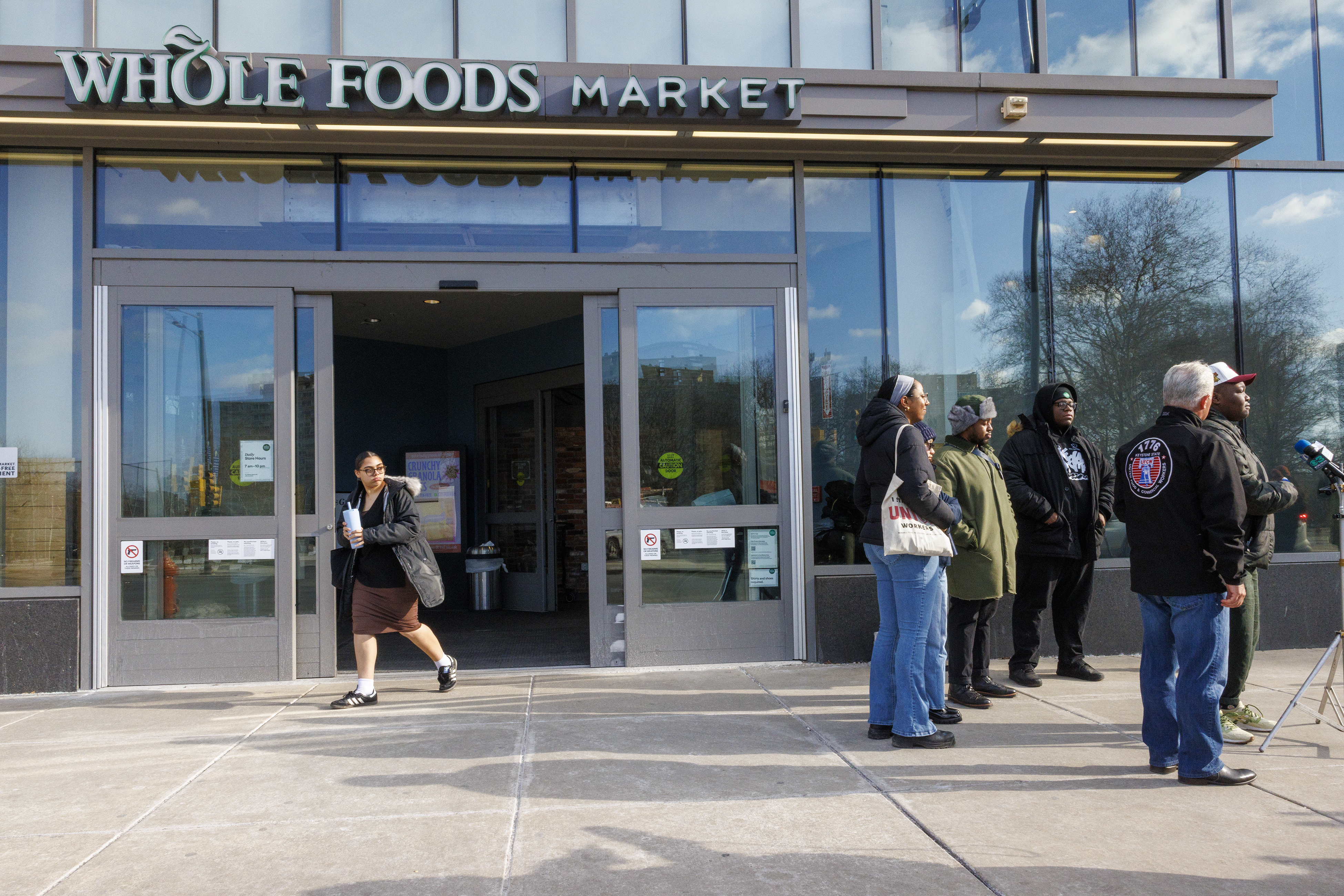
Union workers gather outside the Center City Whole Foods Market in January.
At the Trooper Acme, Brown said, shoppers start looking for Ivins Famous Spiced Wafers starting around Halloween, and as the holiday season progresses, they’re looking for specific nostalgic sweets to fill their candy dishes — minty After Eight chocolates or the multicolored, straw-shaped Plantation hard candies, for example.
“Some people say, ‘We don’t eat them, but we just want them to sit out in the candy dish, because I had that as a kid, and my mother and father always had it out,’” she said.
Holiday gripes
For Jones, Whole Foods is a second job on weekends. They said they’re “stretched kind of thin” during the holidays as they juggle another full-time job. Jones sometimes volunteers to work extra hours for the money during the holidays, but they don’t like losing the time with loved ones.
And, Jones added, the holiday music is not a perk.
“It kind of makes me angry,” said Jones, adding that they’re “still an overworked worker.”
“It kind of just reminds me that I could be home if you paid me more.”
Shoppers peruse the Save-a-Lot grocery store in Atlantic City in this Jan. 2024 file photo.
Dupree, also of Whole Foods, isn’t a fan of the constant seasonal music either.
“If I want to go listen [to the song] ‘This Christmas,’ I’ll listen to it on my own — don’t play it 82 times a day,” he said. “It’s a bit intrusive.”
The customers
Some customers, for their part, avoid the busiest times at the grocery store.
In Wayne, Lisa Goldschmidt has become dependent on Instacart grocery deliveries most of the year. But when it’s time to shop for her holiday dinners, she makes a couple in-person trips to her local Acme. For her sanity, she keeps to a personal code, she said: “Avoid the weekends and the after-work times when it typically gets crazy.”
Goldschmidt, a 58-year-old attorney who works from home, said she’s fortunate that she can run out midday on weekdays to buy her holiday essentials, which include an expansive antipasto assortment that her family eats on Christmas Eve and the prime rib they make on Christmas Day.
April Beatty, 51, of Broomall, also tries to avoid peak shopping times at her go-to stores — Wegmans, Trader Joe’s, and Gentile’s produce market. She aims to pick up all her groceries at least a couple days before Christmas, and she also buys more this time of year with her two children home from college.
But her job, too, keeps her busy during this season — she works in supply-chain logistics — so shopping the way she prefers, at “off times, just because it’s more efficient,” isn’t always an option.
This year, her Wegmans trip for Thanksgiving happened during a shopping rush: “aisles packed, parking lot packed,” she said. During the holidays, she added, “at least people are polite.”
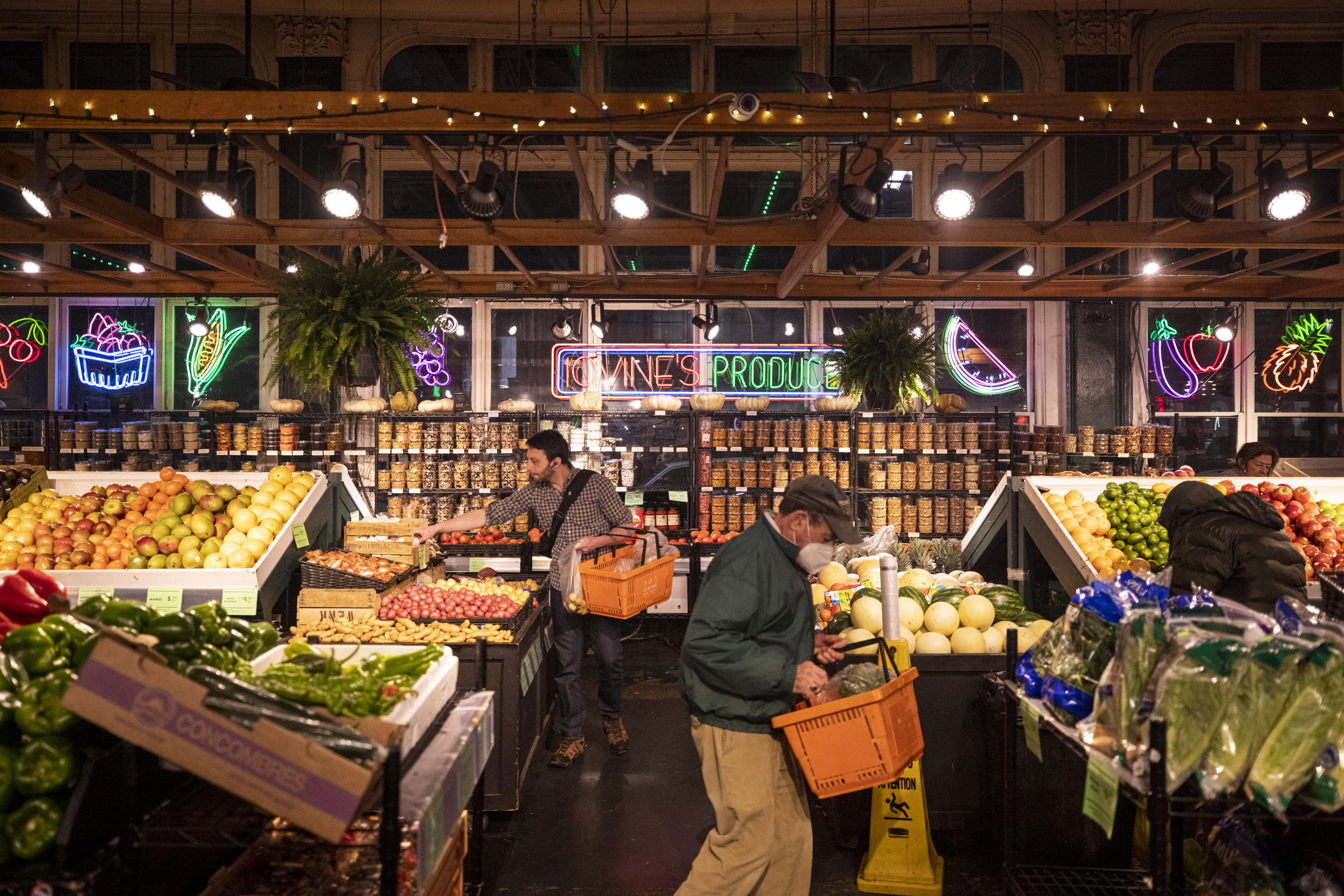
Customers browse Iovine Brothers Produce at Reading Terminal Market in this 2022 file photo.
Customers at Whole Foods are more outgoing during the holidays, said Dupree, part of a kind of jolly Christmas mentality around this time of year.
The days leading up to Thanksgiving are usually the busiest — more so than Christmas — but he didn’t notice quite as much Thanksgiving hustle this year.
“I wonder if this is because, you know, people’s pockets are hurting,” Dupree pondered aloud.
At ShopRite, Keith said, some of the busiest shopping days she recalls are the day before Thanksgiving and Christmas Eve.
“We have our last-minute shoppers — and, you know, I get it. I get the busy life,” she said.
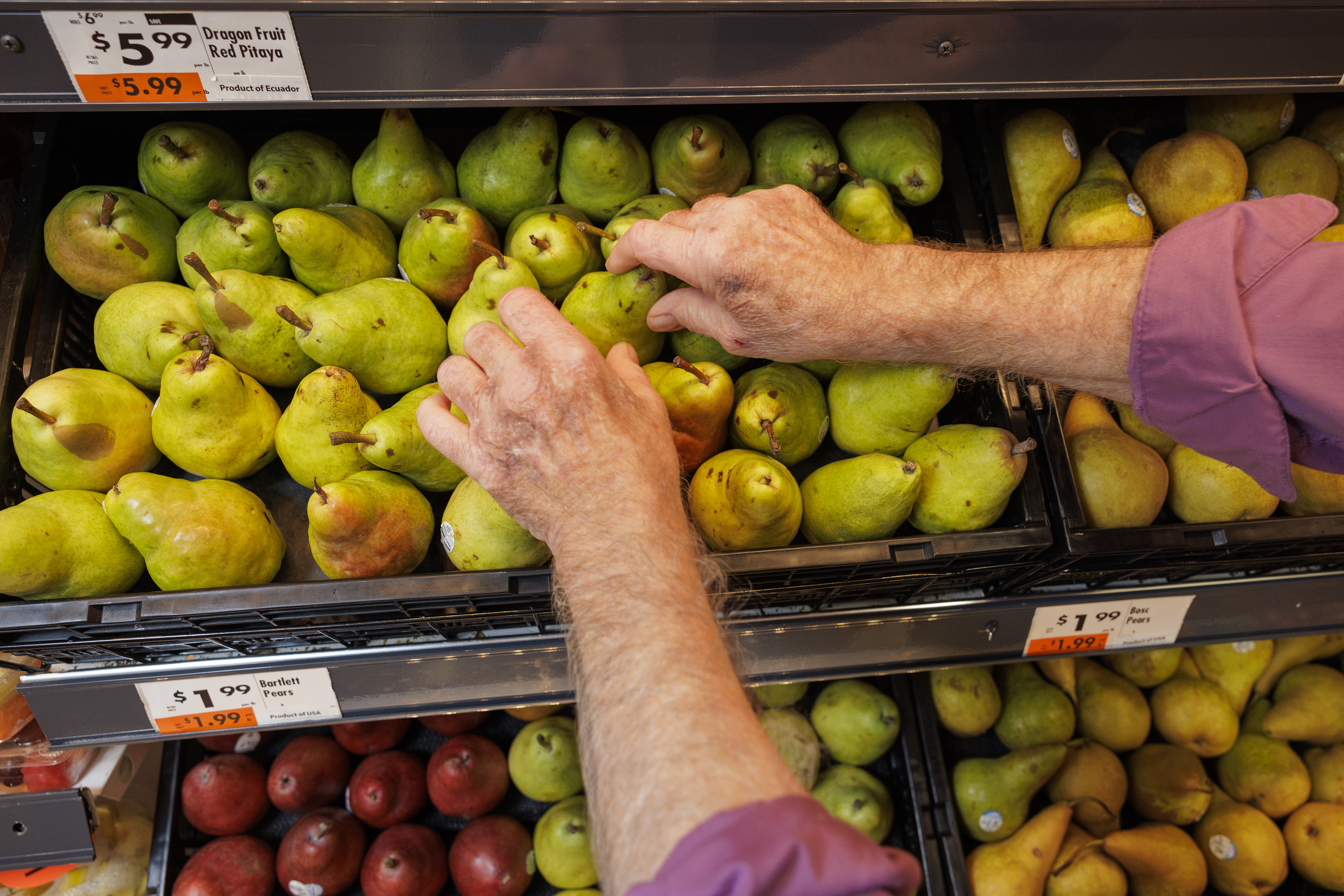
A Save-a-Lot supermarket employee arranges pears at the chain’s Camden store in this January 2024 file photo.
At Acme, Brown sees pressure and stress on some customers.
“Being sympathetic to that, listening to them, is probably half the battle of dealing with any stresses or strain that I might be under — and also what they might be under,” she said.
Brown said she tries to get a head start on her own holiday decorating and planning each year because there isn’t a lot of downtime once the store gets busy.
“I have to manage that time effectively in order to be able to really decompress and enjoy the holidays myself,” she said.
This year, for the first time in a while, she won’t be working on Christmas Eve because it‘s on a Wednesday, her usual day off.
But Brown said she actually loves working Christmas Eve, “because it just seems to me like everybody’s just so happy.”
Tanner Rouse will be Delaware County’s new top law enforcement officer, but he’snot new to the work.
Rouse will be sworn in on Jan. 5 as district attorney after his predecessor, Jack Stollsteimer, steps down to assume the county judgeship he won in November. Rouse, 42, will finish out the final two years of Stollsteimer’s term after working as his first assistant since 2020.
In a recent interview, Rouse discussed the strides in reducing violent crime he and his colleagues have made under Stollsteimer — the first-ever Democrat to serve as district attorney in Delaware County — as well as how he plans to continue those advances.
The short answer: Keeping the same playbook, but “putting a personal stamp on it,” as an offensive coordinator does when he takes over as head coach, said Rouse, an avid Eagles fan and ambitious Little League coach.
A former Philadelphia prosecutor under Seth Williams, Rouse credited the lessons he learned from investigating gun violence in the city, along with the recruitment of several former colleagues he brought over the county line, withimproving the way crime is prosecuted in Delaware County.
“We have demonstrated you can reform the criminal justice system and that it doesn’t have to come at the expense of stopping violent crime,” Rouse said. “They’re not mutually exclusive.”
Who is Tanner Rouse?
Rouse, a Phoenixville-area native, is the son of the late Willard Rouse III, the prominent Philadelphia developer behind One and Two Liberty Place. After graduating from the University of Wisconsin and Fordham Law School, Rouse spent seven years in the Philadelphia District Attorney’s Office, prosecuting crimes in Center City and North Philadelphia.
Rouse left the office in 2017, months before Larry Krasner took over. He practiced civil law for a time and ran an ultimately failed campaign to unseat then-State Sen. Tom McGarrigle before Stollsteimer called and offered him the first assistant job.
At the time, Rouse said, the offer was unexpected. But, looking back, he now considers it one of the greatest opportunities of his career.
What is Rouse most proud of from his tenure as first assistant?
The most notable achievement of his tenure to date in the district attorney’s office, Rouse said, is the steep reduction of gun violence in Chester.Shootings are down 75% since 2020. Rouse credits community outreach efforts for that, especially through the Chester Partnership for Safe Neighborhoods program, overseen by veteran homicide prosecutor Matt Krouse, whom Rouse worked with in Philadelphia and recruited to join him in Delaware County.
The partnership’s fundamental philosophy is a combination of focused deterrence programs Rouse helped oversee in Philadelphia that target repeat offenders, as well as community outreach efforts run by trusted neighborhood figures.
Rouse said he never wanted to be a faceless presence in the county and made it his priority to get out and form relationships in all of the municipalities he served, visiting community meetings, block parties, and even a few pickup basketball games.
“I don’t do this job from behind a desk,” he said, speaking in his county courthouse office. “And I think demonstrating that commitment and that care by being more present in those communities, and not just being kind of the big, scary law enforcement agency on a hill is incredibly important.”
Rouse said he is proud of other reforms including creating a diversionary unit in the office, revamping its drug court and instituting a special “child’s court,” created by Kristen Kemp — Rouse’s chosen first assistant and an expert in special-victims’ cases — that allows young victims to testify against adult offenders in a more comfortable environment.
The county’s jail population is down 50% as well, something Rouse says is a result of approaching prosecuting crimes in a humane, logical way.
What are his priorities as district attorney?
Rouse said he plans to create a similar community outreach program in Upper Darby, a community he said is “on the verge of some big things.”
“It’s not as if we’re saying, ‘We’re coming in here to take on Upper Darby and what goes on there,’ but more of, ‘Guys, look, we’re not just the people you pick up and call when there’s a crime.’”
He also expressed interest in creating reciprocity agreements with his counterparts in the other collar counties around Philadelphia, specifically when it comes to handling drug cases and providing treatment to the people caught up in them.
How has his time in Philadelphia influenced his work in Delco?
Rouse said he cut his teeth in the city working alongside veteran prosecutors, and he’s worked to bring that environment of mentorship to Delaware County.
He said he and his more senior deputies often sit in on trials, giving feedback to younger staff members just as his mentors did for him nearly two decades ago.
“That’s how I got better, and that’s one of the roles I most cherish here,” he said.
With First Day hikes surging in popularity, Pennsylvania and New Jersey are rolling out a full slate of outings to welcome 2026 — from daybreak rambles to sunset treks, and nearly every hour in between for those easing into the new year.
Many of the guided hikes require advance registration and fill quickly.
The Jan. 1 hikes are offered through the Pennsylvania Department of Conservation and Natural Resources (DCNR) and the New Jersey Department of Environmental Protection (DEP). Some are guided by rangers, others by volunteers.
Another option: Join the Friends of Ridley Creek State Park in Media, Delaware County, for a 3.5-mile loop featuring creek views and a stop at historic hilltop Russell Cemetery.
Or, for a spectacular bird’s-eye view of the Pinelands at daybreak, you can tackle a 2.5-mile round trip, starting at 6 a.m., to Apple Pie Hill in Wharton State Forest, where hikers climb the 79 steps of the fire tower at sunrise. The only drawback: The hike has become so popular that the DEP holds a lottery at 1 p.m. on Dec. 31 to select participants.
Apple Pie Hill Tower offers a dramatic view of the Pinelands.
First Day Hikes began in Massachusetts in 1992, and went nationwide in 2012 under an effort by the National Association of State Park Directors.
Ian Kindle, environmental education regional program coordinator for DCNR’s Bureau of State Parks, said the hikes in Pennsylvania started not long after that. But, he said, they have become increasingly popular since the pandemic, when many people took to the outdoors.
“I think people have really taken to the idea of making getting outdoors on the first day of the year a tradition.” Kindle said. “I know that some of the first ones I led at Delaware Canal State Park, we could have 100, 150, and upward of 200 people, which is a challenge to lead.”
Last New Year’s Day, 2,488 people — and 224 dogs — participatedin Pennsylvania. They gathered for 74 hikes at 47 state parks and one state forest, accumulating 6,478 miles.
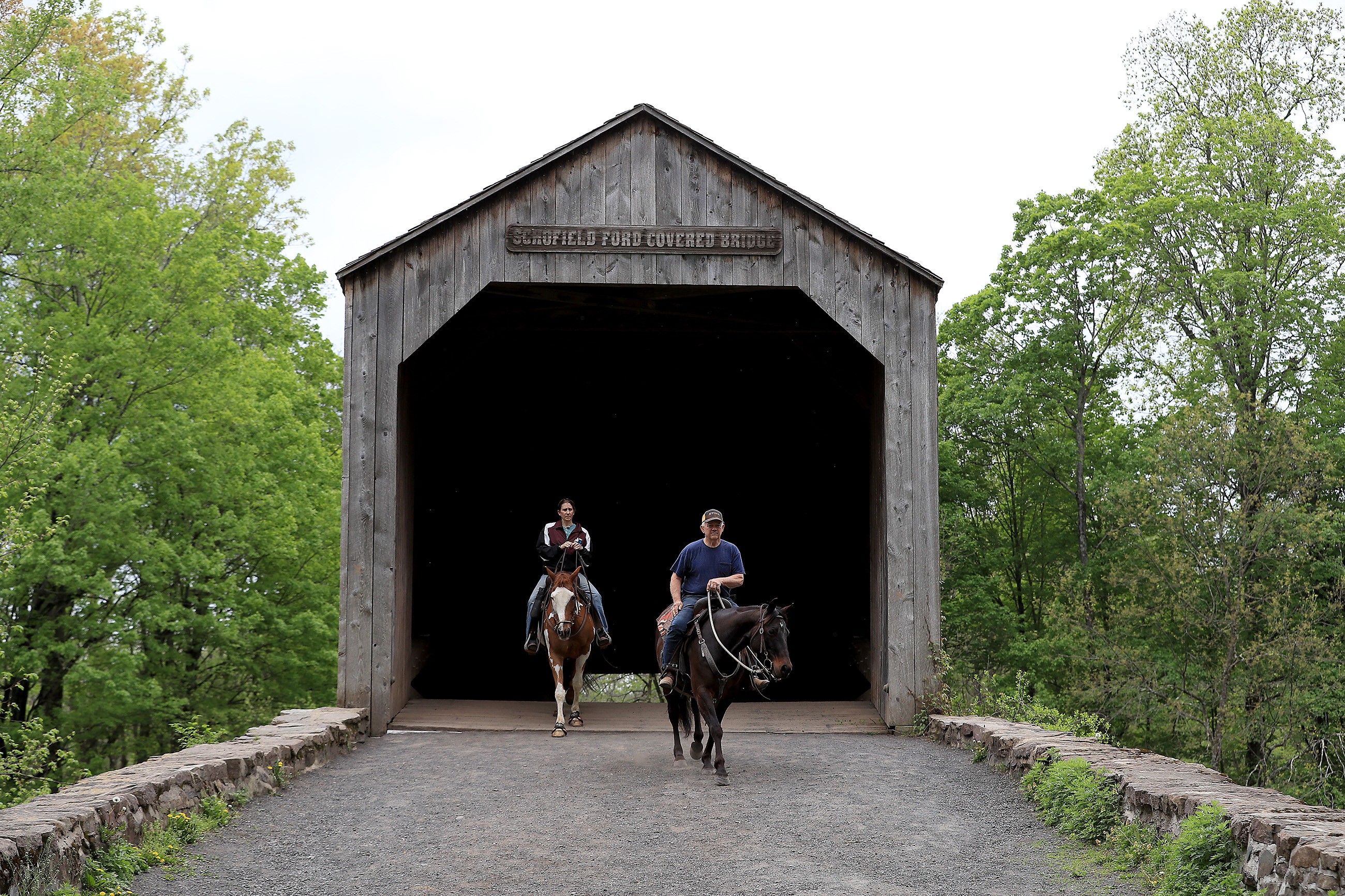
Cheryl and Gary Moore, of Bucks County, ride their horses over the Schofield Ford covered bridge in Tyler State Park in Newtown, Bucks County in this 2021 file photo.
The two most attended hikes were at Beltzville State Park in Carbon County in the Poconos (175 people) and Tyler State Park in Bucks County (170 people).
This year, DCNR has organized 60 free guided hikes in 49 state parks and three forest districts, choosing to make the walks more focused.
Kindle said an “almost full moon” hike is set for Delaware Canal State Park in Yardley, Bucks County, at 4 p.m. He noted a two-mile hike around Militia Hill at Fort Washington State Park in Montgomery County.
The hikes include: walks at 10 a.m., noon, and 2 p.m. through historic Revolutionary-era Batsto Village in Wharton State Forest; a more rigorous six-mile hike at Brendan T. Byrne State Forest on the Cranberry Trail that includes Pinelands cedar swamps and Pakim Pond; and a two-mile hike at Washington Crossing State Park in Mercer County where you can learn about the famed feat by the Continental Army that routed the Hessians at Trenton.
Out of the 50 largest metropolitan areas, the Philadelphia region is where minimum-wage earners must work the most hours to afford rent.
Two workers who make Pennsylvania’s $7.25 minimum hourly wage would each have to work 96 hours per week to afford the Philadelphia metropolitan area’s median asking rent of $1,739 in November, according to an analysis by Realtor.com.
Only five of the top 50 metros have rents that are affordable without overtime for a household in which two workers make the minimum wage. In all five metros, the minimum wage is above the federal floor of $7.25, and the median rent is lower than the median across the 50 metros.
The most affordable metro is Buffalo, N.Y., where two workers making the state’s minimum wage of $15.50 would need to work only 30 hours per week each to afford the region’s median asking rent of $1,176 in November.
Joel Berner, senior economist at Realtor.com, noted that demand for workers often pushes the lowest actual starting wages above mandated minimums. But in areas with high costs of living, even wages driven higher by market forces or increases to the state minimum don’t close “the affordability gap.”
“It’s a clear signal that housing costs continue to pose a massive hurdle for those at the bottom of the pay scale,” Berner said in a statement.
Rents were considered affordable if they were no more than 30% of renters’ income.
window.addEventListener(“message”,function(a){if(void 0!==a.data[“datawrapper-height”]){var e=document.querySelectorAll(“iframe”);for(var t in a.data[“datawrapper-height”])for(var r,i=0;r=e[i];i++)if(r.contentWindow===a.source){var d=a.data[“datawrapper-height”][t]+”px”;r.style.height=d}}});
Nationwide, rents have moderated in recent years. But in November, the median rent across the top 50 metros was still 17% higher than just before the pandemic in November 2019.
Danielle Hale, chief economist at Realtor.com, pointed out that some states’ minimum wages are scheduled to increase in the new year, which “will help to improve affordability for the most burdened households.”
“While the challenge remains immense, particularly in high-cost areas, the number of metros where two minimum-wage earners can afford a typical rental without working overtime will grow in 2026, a positive sign,” she said in a statement.
Two metros are set to join these ranks next year: Detroit, where the minimum wage is scheduled to increase from $10.56 to $13.73; and Jacksonville, Fla., where the minimum wage will increase from $13 to $15.
The number of hours people need to work will drop most in Florida metros. Two minimum-wage workers living together in Tampa would each need to work 45 hours per week in 2026 to afford the median asking rent. That’s down seven hours from this year.
Cencora Inc., a drug-distribution giant based in Conshohocken, is expanding its presence in oncology and retina care, two medical specialties that rely heavily on pharmaceuticals.
The company announced on Dec. 15 that it had agreed to buy out its private-equity partner in a national cancer practice management company, OneOncology, for $5 billion in cash and debt.
Cencora already owned 35% of OneOncology, which has a small presence in the Philadelphia area.
In January, Cencora spent $5 billion, including contingency payments, for Retina Consultants of America, a network of specialized practices withlocations in 23 states, including two in Pennsylvania outside the Philadelphia area.
The deals are part of Cencora’s effort to extend its reach into medical specialties that rely heavily on pharmaceuticals to treat patients. By positioning itself closer to patients, Cencora can capture more of the profit margin that goes along with selling drugs.
“We like those two spaces because they’re pharmaceutical centric,” Cencora’s CEO Robert Mauch said at the 2025 J.P. Morgan Healthcare Conference. He said the company doesn’t see other specialties with the same makeup as oncology and retina.
“That’s where we will continue to focus,” he said. “Now as we look forward, there could be other specialties. There could be other innovations in the pharma industry that create something in another area.”
Cencora had $321 billion in revenue in its fiscal year that ended Sept. 30. It had $1.5 billion in net income. That’s a great deal of money, but amounted to less than half a percent of its revenue.
McKesson and Cardinal Health, Cencora’s two biggest U.S. competitors in the drug-distribution business, face similarly narrow margins from drug distribution. Both also own companies that manage cancer practices. Among the benefits of owning the management companies is securing the customer base.
Cencora’s follow-up to 2023 deal
Cencora, then known as AmerisourceBergen, paid $718.4 million for a 35% stake in OneOncology in June 2023. That deal, in partnership with TPG, valued OneOncology at $2.1 billion. The seller was General Atlantic, a private equity firm that had invested $200 million in the Nashville management services company in 2018, according to the Wall Street Journal.
The deal announced last week valued OneOncology at $7.4 billion, including debt. The big increase in value came thanks to a doubling in the company’s size. OneOncology now has 31 practices with 1,800 providers who treat 1 million patients across 565 sites, according to the company.
Rittenhouse Hematology Oncology, which has offices in Bala Cynwyd, Brinton Lake, King of Prussia, and Philadelphia, became part of OneOncology last year.