Blog

  • Belmont Charter looks to make history as the only Public League team left in the PIAA playoffs

    Belmont Charter looks to make history as the only Public League team left in the PIAA playoffs

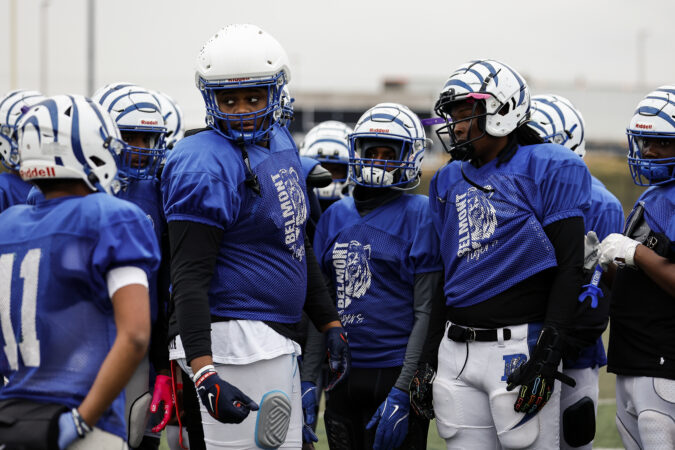
    All 20 players on the Belmont Charter football team were back on a school bus Tuesday, this time for practice at the South Philadelphia Super Site. It was a sweet upgrade from its usual practice field, best described as an open space in Fairmount Park.

    With a male enrollment of 127, Belmont Charter is the smallest Public League school with a football team. Belmont Charter, now located in the former John W. Hallahan Catholic Girls High School near Logan Square, has no home stadium and has had varsity football only since 2021.

    “With limited resources, we do make the best out of it,” said Cintella Spotwood, the school’s athletic director.

    Belmont Charter still can do something that no other Public League can match this season: win a PIAA state football championship. The Tigers (9-1) play Lackawanna Trail (12-1), from near Scranton, in the Class 1A quarterfinal Friday night at Northern Lehigh High School, about a half-hour’s drive north of Allentown.

    Since the PIAA playoffs began in 1988, no team from Philadelphia or the suburbs has won a state title in Class 1A, the smallest of six enrollment classifications. Imhotep Charter, with a Class 3A title in 2015 and a Class 5A title in 2023, is the only Public League school with a state title.
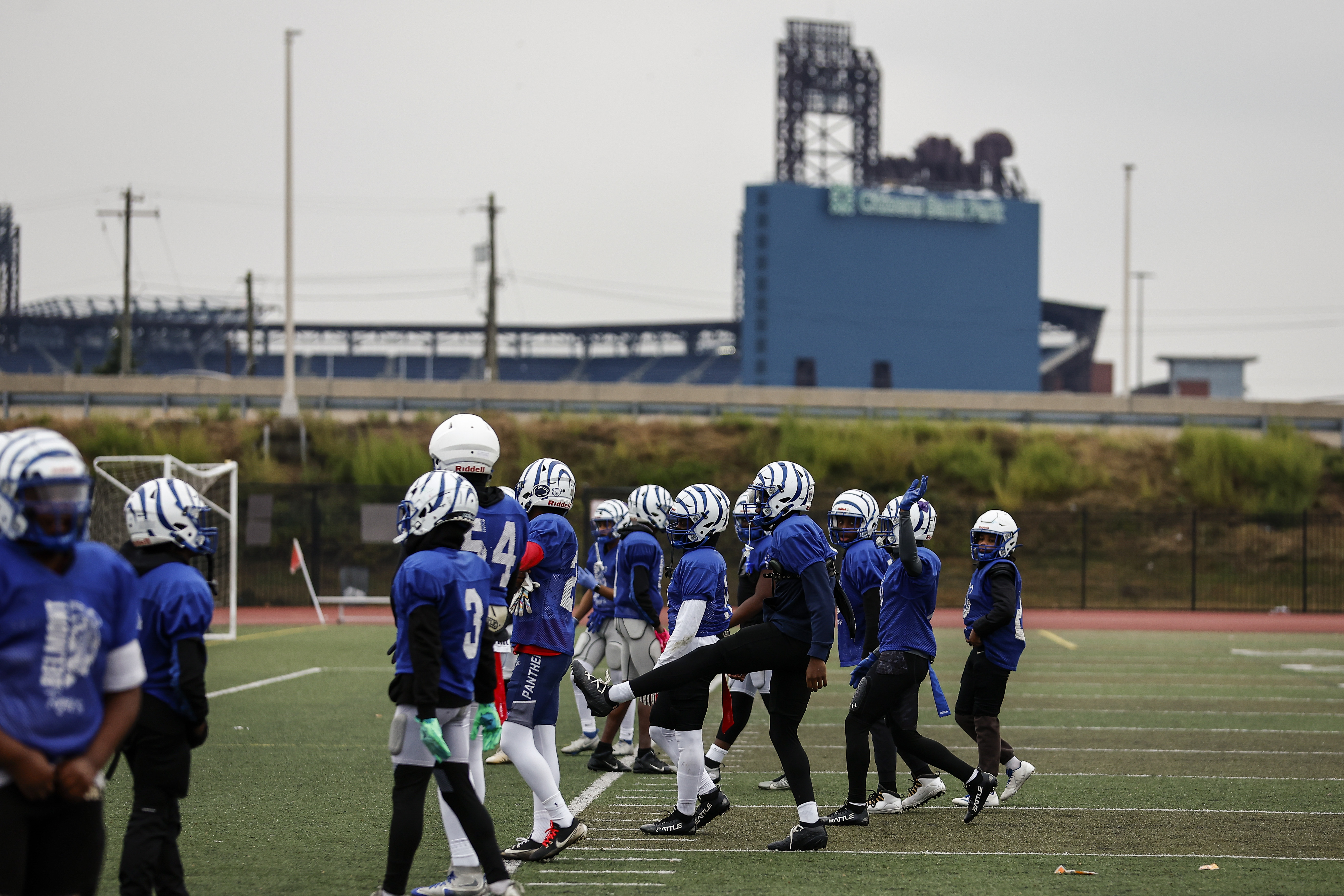
    Belmont Charter practicing at the South Philadelphia Super Site on Wednesday.

    Plus, Belmont Charter is one of only 10 teams from the city or suburbs among 48 teams still alive for six state championships. The others: La Salle College (10-1), Pennridge (12-1), and North Penn (11-2) in 6A; Roman Catholic (9-3), Springfield (Delco) (13-0), and Chester (13-0) in 5A; Cardinal O’Hara (9-4) in 4A; Neumann Goretti (8-4) in 3A, and Lansdale Catholic (11-2) in 2A. Pennridge and North Penn play each other Friday, as do Springfield and Chester.

    This will be only the third state playoff game in Belmont Charter history, compared with the 24th for Lackawanna Trail, which lost in the state championship game in 2019. And yet a lack of players, facilities, and postseason experience does not appear to bother the Tigers.

    “They’re just like us,” Kabir Knight, a junior wide receiver and defensive back, said of Lackawanna Trail. “They’re just in our way.”

    Belmont Charter, a four-year college-preparatory and career-readiness high school and part of the Belmont Charter Network, was founded in 2017 with a class of 75 freshmen. Before moving into the Hallahan facilities this year, the school was located on Belmont Avenue in West Philadelphia.

    Belmont Charter is coming off its first victory in the state playoffs — a 36-20 triumph last Saturday over host York Catholic, where the Tigers rolled to a 24-7 lead in the first nine minutes. Freshman quarterback Nafis Watkins passed for 253 yards and three touchdowns.

    “That’s how we should have been playing all season,” said Mason Billingsley-Walker, a 6-foot-4 and 310-pound senior tackle on both offense and defense.

    The victory softened a tough 28-22 loss last year to Delone Catholic that had motivated the 14 returning players to launch training in January for the 2025 season. The team’s only loss this season was by six points last month to Central, which has a student body six times larger.

    “Gotta go through the downs, but there have been more ups than downs lately,” said Terrell Brent, the Tigers’ effervescent third-year head coach.
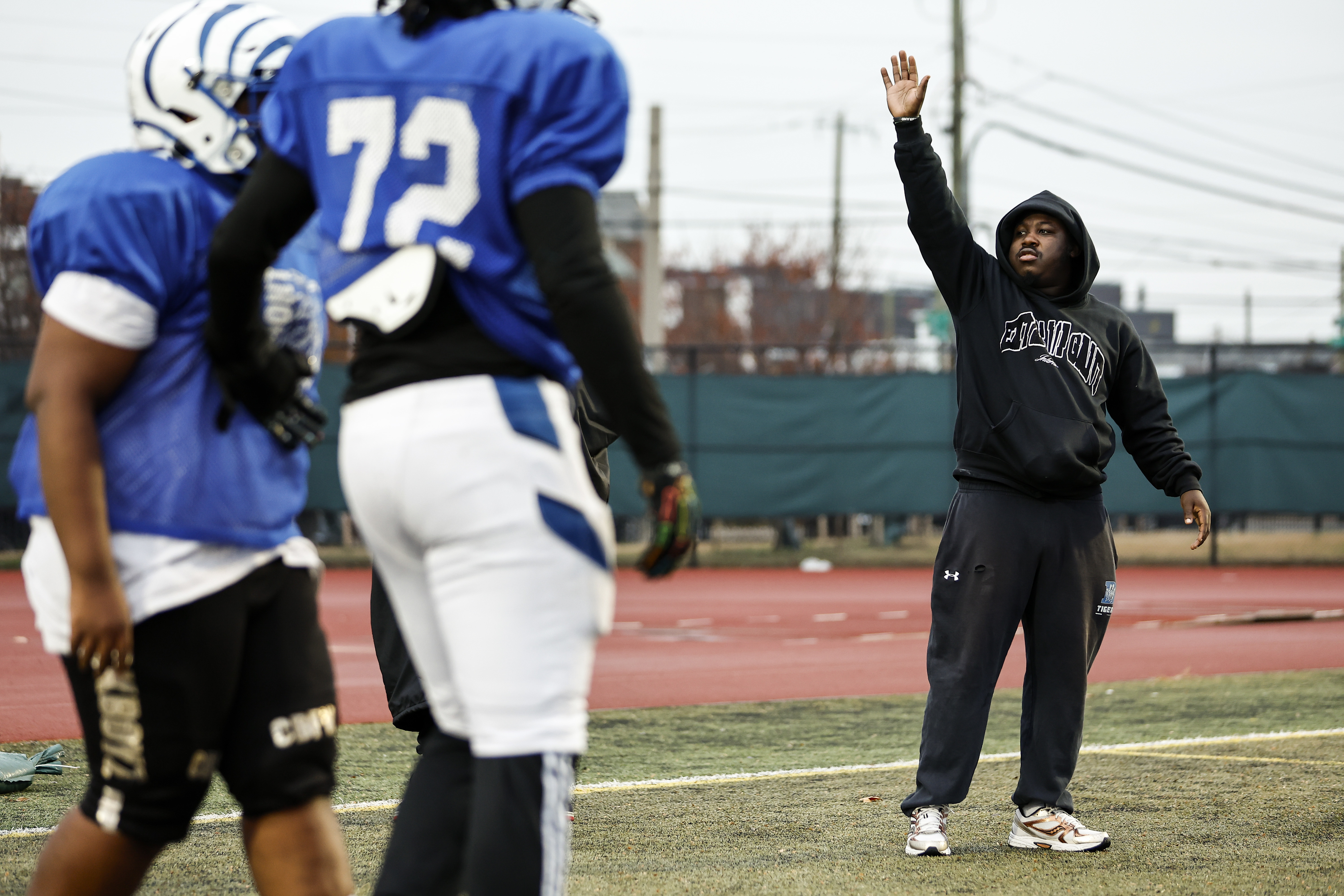
    Belmont head coach Terrell Brent leads practice on Wednesday.

    He said of the long bus ride home from York: “Instead of going home crying, there were happy tears — and smiling.”

    Brent, 26, is a health and physical-education teacher at the school. He joined head coach Ed McCabe’s staff at Belmont when Brent was still a student at East Stroudsburg University, during COVID-19, which delayed and shortened the Tigers’ junior varsity schedule.

    The Tigers have made progress each season. They lost a 2023 play-in playoff game to Steelton-Highspire, the eventual state champion, but they finished 5-6 last year, beating District 1 champ Morrisville in a play-in game before losing to Delone Catholic. The Tigers beat Morrisville again this year to earn the playoff game against York Catholic.

    “Our coaches motivate us, but we keep each other accountable,” said Shyneem Newsuan, a sophomore linebacker and running back. “We don’t overlook anyone. We just play hard-working football.”

    Billingsley-Walker said the lack of a practice field near the school — they take a bus to the athletic fields across the Avenue of the Republic from the Please Touch Museum, not far from Belmont’s former location — can take away valuable practice time.

    But still: “I like us in the long run,” Billingsley-Walker said.

    Because Belmont Charter faces schools its size in the playoffs, the Tigers won’t be overwhelmed by teams with substantially larger rosters. York Catholic had 28 players on its roster, according to MaxPreps, and Lackawanna Trail has only 30.
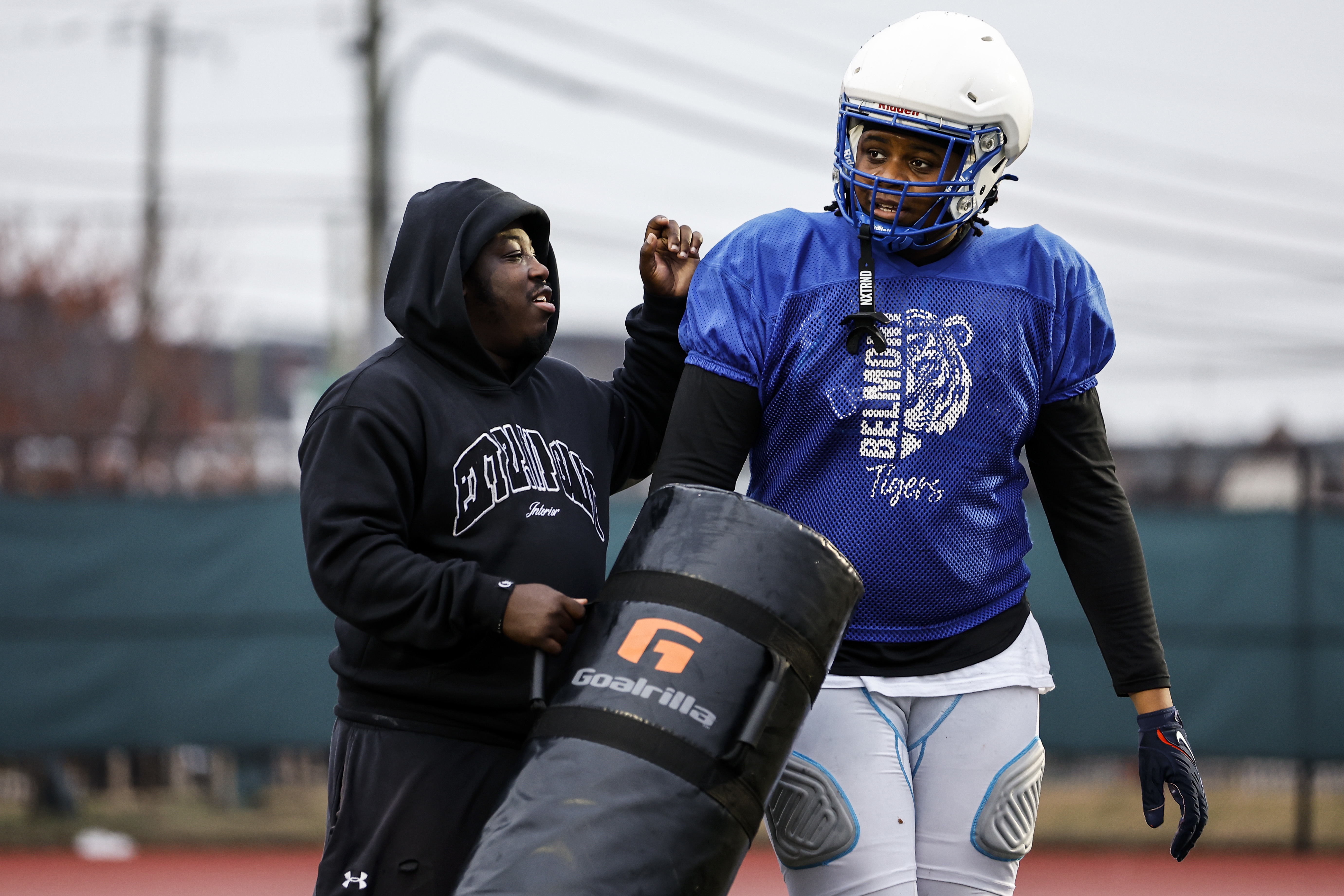
    Belmont head coach Terrell Brent stands with senior tackle Mason Billingsley-Walker during practice on Wednesday.

    (Roxborough High, another Public League team, played a regular-season game last month against Olney with only 17 players in uniform.)

    Still, the four-weekend grind through the state football playoffs is much more punishing and treacherous for Class 1A teams than larger schools.

    At a school like Belmont Charter, ranked 202nd in the state (Lackawanna Trail is 97th), there is no such thing as a depth chart, because everyone is needed to play both ways. Injuries can’t be avoided, but Brent has kept his team healthy by paying attention to training details.

    “We always try to take care of the kids,” he said. “For the most part, they’re trying to get their bodies right. I believe in the staff and the abilities of the coaches to put kids in the best position possible.”

    The Tigers find a way to manage. Their game against Morrisville was supposed to be held in Philly, but Spotwood said she could not find an available field in the city, so the game was played at Morrisville. The Tigers won, 19-0.

    They will practice at the South Philadelphia Super Site for as long as they are playing in the playoffs. It has lights, and the open space they normally use for practice is ringed by trees. Their bus to South Philly was late, and when they got to the field, a soccer goal was on it.
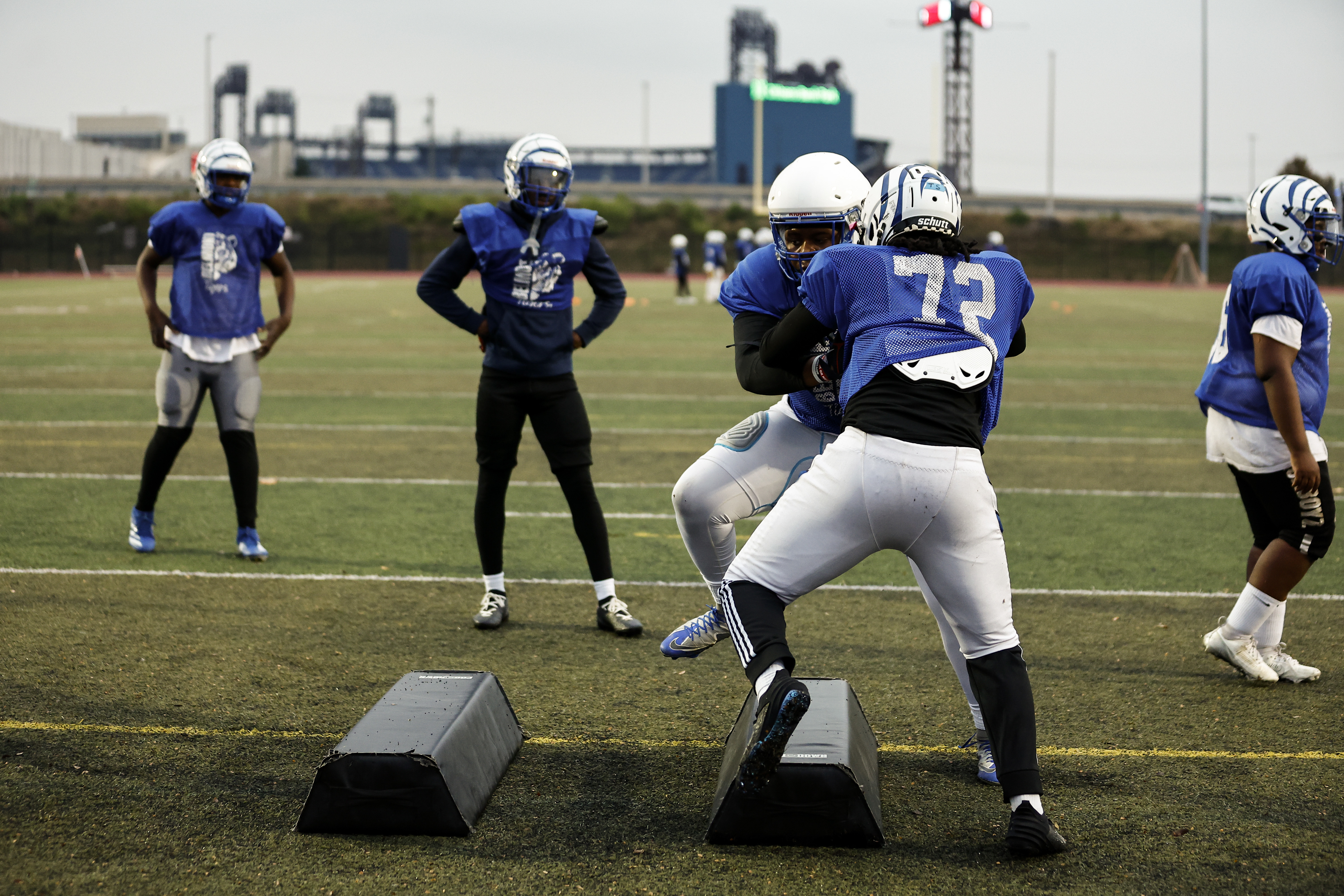
    Belmont Charter is the smallest school in the Public League with a football program.

    The goal, fortunately for Belmont Charter, was on wheels, so two players were able to easily push it aside. But Brent already had a Plan B: If they could not move the goal, they would just use half the field — it is not as if the team is overflowing with players.

    “To the outside world, we would be underdogs,” Brent said. “But we’re confident in the coaching staff and the kids to go 1-0 every week.”
  • What’s next now that Trump has signed bill releasing the Epstein files

    What’s next now that Trump has signed bill releasing the Epstein files

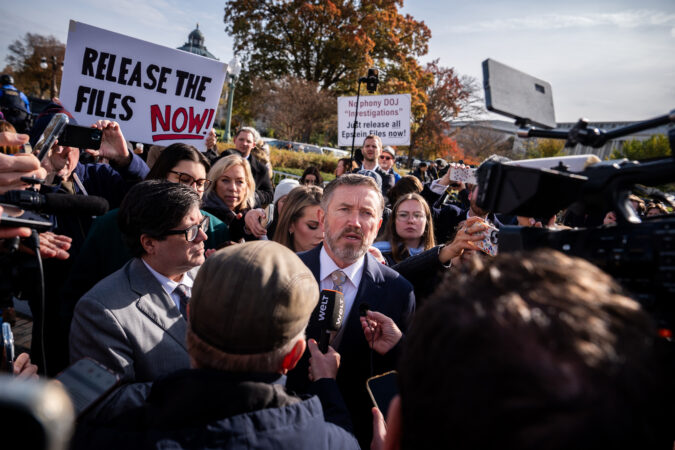
    WASHINGTON — President Donald Trump has signed a bill to compel the Justice Department to make public its case files on the convicted sex offender Jeffrey Epstein, a potentially far-reaching development in a yearslong push by survivors of Epstein’s abuse for a public reckoning.

    Both the House and Senate passed the bill this week with overwhelming margins after Trump reversed course on his monthslong opposition to the bill and indicated he would sign it. Now that the bill has been signed by the president, there’s a 30-day countdown for the Justice Department to produce what’s commonly known as the Epstein files.

    “This bill is a command for the president to be fully transparent, to come fully clean, and to provide full honesty to the American people,” Senate Democratic Leader Chuck Schumer of New York said Wednesday.

    Schumer added that Democrats were ready to push back if they perceive that the president is doing anything but adhering to “full transparency.”

    In a social media post Wednesday as he announced he had signed the bill, Trump wrote, “Democrats have used the ‘Epstein’ issue, which affects them far more than the Republican Party, in order to try and distract from our AMAZING Victories.”

    The swift, bipartisan work in Congress this week was a response to the growing public demand that the Epstein files be released, especially as attention focuses on his connections to global leaders including Trump, former President Bill Clinton, Andrew Mountbatten Windsor, who has already been stripped of his royal title as Prince Andrew over the matter, and many others.

    There is plenty of public anticipation about what more the files could reveal. Yet the bill will most likely trigger a rarely seen baring of a sprawling federal investigation, also creating the potential for unintended consequences.

    What does the bill do?

    The bill compels Attorney General Pam Bondi to release essentially everything the Justice Department has collected over multiple federal investigations into Epstein, as well as his longtime confidante and girlfriend Ghislaine Maxwell, who is serving a 20-year prison sentence for luring teenage girls for the disgraced financier. Those records total around 100,000 pages, according to a federal judge who has reviewed the case.

    It will also compel the Justice Department to produce all its internal communications on Epstein and his associates and his 2019 death in a Manhattan jail cell as he awaited charges for sexually abusing and trafficking dozens of teenage girls.

    The legislation, however, exempts some parts of the case files. The bill’s authors made sure to include that the Justice Department could withhold personally identifiable information of victims, child sexual abuse materials and information deemed by the administration to be classified for national defense or foreign policy.

    “We will continue to follow the law with maximum transparency while protecting victims,” Bondi told a news conference Wednesday when asked about releasing the files.

    The bill also allows the Justice Department to withhold information that would jeopardize active investigations or prosecutions. That’s created some worry among the bill’s proponents that the department would open active investigations into people named in the Epstein files in order to shield that material from public view.

    Rep. Marjorie Taylor Greene, a longtime Trump loyalist who has had a prominent split with Trump over the bill, said Tuesday that she saw the administration’s compliance with the bill as its “real test.”

    “Will the Department of Justice release the files, or will it all remain tied up in investigations?” she asked.

    In July, the FBI said in a memo regarding the Epstein investigation that, “we did not uncover evidence that could predicate an investigation against uncharged third parties.” But Bondi last week complied with Trump’s demands and ordered a federal prosecutor to investigate Epstein’s ties to the president’s political foes, including Clinton.

    Still, Rep. Thomas Massie, a Kentucky Republican who sponsored the bill, said “there’s no way they can have enough investigations to cover” all of the people he believes are implicated in Epstein’s abuse.

    “And if they do, then good,” he added.

    The bill also requires the Justice Department to produce reports on what materials it withheld, as well as redactions made, within 15 days of the release of the files. It stipulates that officials can’t withhold or redact anything “on the basis of embarrassment, reputational harm, or political sensitivity, including to any government official, public figure, or foreign dignitary.”

    Who could be named?

    There’s a widely held expectation that many people could be named in case files for investigations that spanned over a decade — and some concern that just because someone is named, that person would be assumed guilty or complicit.

    Epstein was a luminary who kept company with heads of state, influential political figures, academics and billionaires. The release of his emails and messages by a House Oversight Committee investigation last week has already shown his connections with — and private conversations about — Trump and many other high-powered figures.

    Yet federal prosecutors follow carefully constructed guidelines about what information they produce publicly and at trial, both to protect victims and to uphold the fairness of the legal system. House Speaker Mike Johnson raised objections to the bill on those grounds this week, arguing that it could reveal unwanted information on victims as well as others who were in contact with investigators.

    Still, Johnson did not actually try to make changes to the bill and voted for it on the House floor.

    For the bill’s proponents, a public reckoning over the investigation is precisely the point. Some of the survivors of trafficking from Epstein and Maxwell have sought ways to name people they accuse of being complicit or involved, but fear they will face lawsuits from the men they accuse.

    Massie said that he wants the FBI to release the reports from its interviews with the victims.

    Those reports typically contain unvetted information, but Massie said he is determined to name those who are accused. He and Greene have offered to read the names of those accused on the House floor, which would shield their speech from legal consequences.

    “We need names,” Massie said.

  • Kajiya Hollawayne has ‘come a long way’ in his journey to Temple, where he’s the leading receiver

    Kajiya Hollawayne has ‘come a long way’ in his journey to Temple, where he’s the leading receiver

    When K.C. Keeler was hired by Temple last Dec. 1, there was one question swirling in wide receiver Kajiya Hollawayne’s mind: Should he leave?

    In fact, he’d pondered that thought since former coach Stan Drayton was fired. He wouldn’t have been the first, as nearly 20 players entered the transfer portal after Drayton’s dismissal.

    However, this wasn’t Hollawayne’s first experience with a coaching change.

    His primary recruiter at UCLA, quarterbacks coach Dana Bible, retired before his first practice as a freshman in 2021. Hollawayne bounced between programs, including Grambling State and Riverside Community College, but left for greener pastures. This time, he decided he wanted to stick out the challenge at Temple.

    “I just thought it’s time to stop running from the struggles that I have got going,” Hollawayne said. “Every school I’ve been at has had coaching changes. So I was like, ‘Let me stop running and see the other side, see how the grass is on this side.’ So when I stayed, I just knew to put my head down and grind, because a lot of times, coaching staff that come in, it’s not better for us. It’s like whoever comes in has a better hand on things like that, so I was just thinking about trying to get on their radar.”

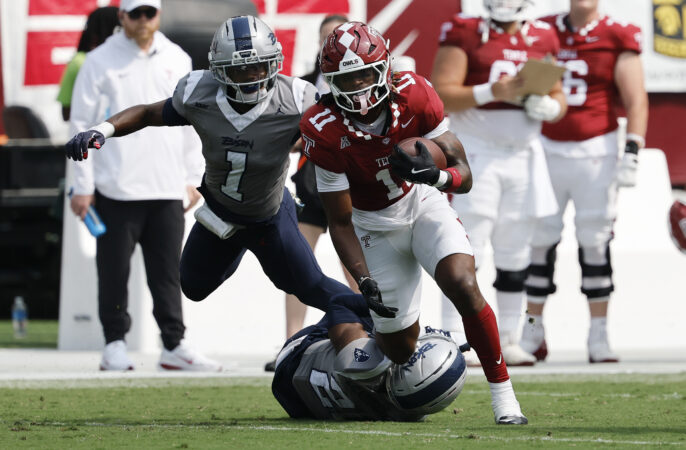
    The redshirt senior climbed Temple’s depth chart amid the offseason departures. Hollawayne talked to Keeler and new offensive coordinator Tyler Walker, who knew they could mold the receiver into the Owls’ system. The result: Hollawayne is the team’s best receiver this season. He leads the Owls (5-5, 3-3 American Conference) with 445 receiving yards and six touchdowns entering Saturday’s matchup against Tulane (8-2, 5-1) at Lincoln Financial Field (3:45 p.m., ESPNU).

    “It’s been a steady process since January,” Walker said. “He’s come a long way. And he’s definitely earned a reputation as a guy that we can throw the football to in critical moments, and we feel confident that he’s going to go get the football.”

    Before arriving at Temple, Hollawayne was a three-star quarterback out of San Jacinto (Calif.) High School, where he was ranked 34th in the state. He committed to UCLA under then-coach Chip Kelly, who also coached the Eagles from 2013 to 2015 and now is the Las Vegas Raiders offensive coordinator, but only lasted a season at UCLA.

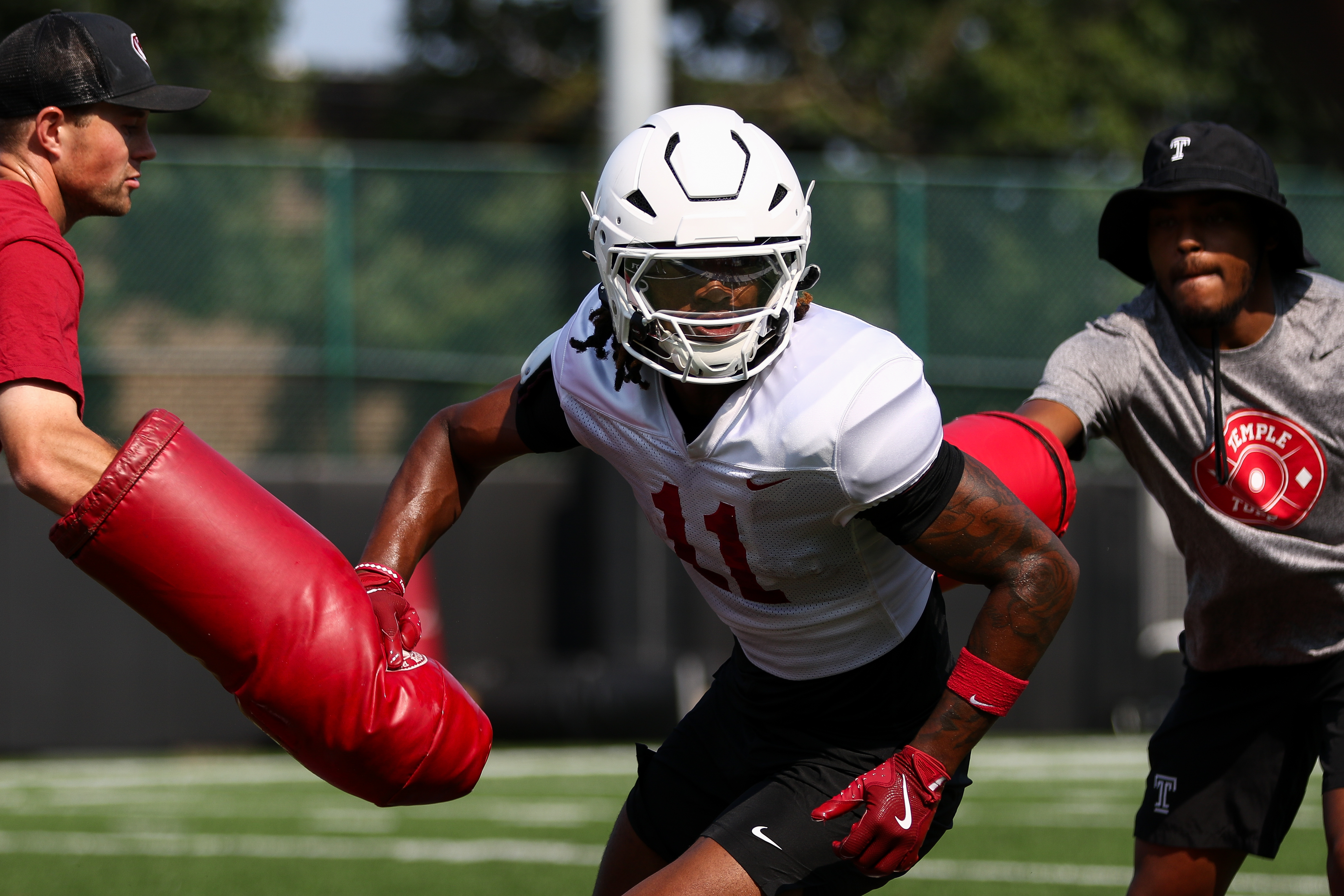
    Temple wide receiver Kajiya Hollawayne takes part in drills during practice on Aug. 4.

    He spent the 2021 season backing up Bruins starter Dorian Thompson-Robinson. Hollawayne, then 18, didn’t want to wait on the sidelines for another year. So he left.

    He landed at Grambling State, which then was coached by Hue Jackson, but another setback occurred. Hollawayne suffered a severe strain on his rotator cuff that dated back to pitching while he was in high school. If he were to continue playing quarterback, he would need to have surgery.

    Not wanting to lose another year of eligibility, Hollawayne asked his coach how he could get on the field, which led to a position switch from quarterback to wide receiver.

    “It was kind of easy, because growing up, everybody played wideout,” Hollawayne said. “The hard part was learning how to block and stuff like that. There’s little things to block that you can get beat on.”

    At Grambling State, he bonded with Tyron Carrier, the wide receivers coach. Even after Hollawayne left for Riverside Community College, they remained in touch. Eventually Carrier was hired at Temple and recruited Hollawayne.

    While Hollawayne followed suit, he didn’t hit the ground running. He was behind wide receivers Dante Wright, Ashton Allen, John Adams, and Antonio Jones on the depth chart. While he finished with 120 receiving yards in 2024, Hollawayne used the opportunity to learn behind those older receivers.

    “I was behind Dante in the slot, and he was a great player, just paying attention to him, seeing how he works the game, how he plays the game,” Hollawayne said. “Also just working because I haven’t been playing wide receiver for a long time. I’m looking at different wide receivers in our group, seeing what I can take from their game, put into my game. Also looking online and seeing what you can do better, like hand work.”

    He also formed a connection with quarterback Evan Simon, who transferred to Temple from Rutgers that offseason.

    When Hollawayne transferred to Temple from Riverside, he didn’t have a dorm room for the first month. Jones, who was roommates with Simon, asked if Hollawayne could crash on their couch. Simon obliged, and, before long, they were tossing passes together.

    “[Antonio] is like, ‘Is it cool if Kajiya Hollawayne lives with us for a little bit?’ Absolutely,” Simon said. “Then next thing, we’re throwing on our own, him and I. We’d be out here throwing after whatever. He’d wait out there for me to get the gate because he couldn’t get in.”

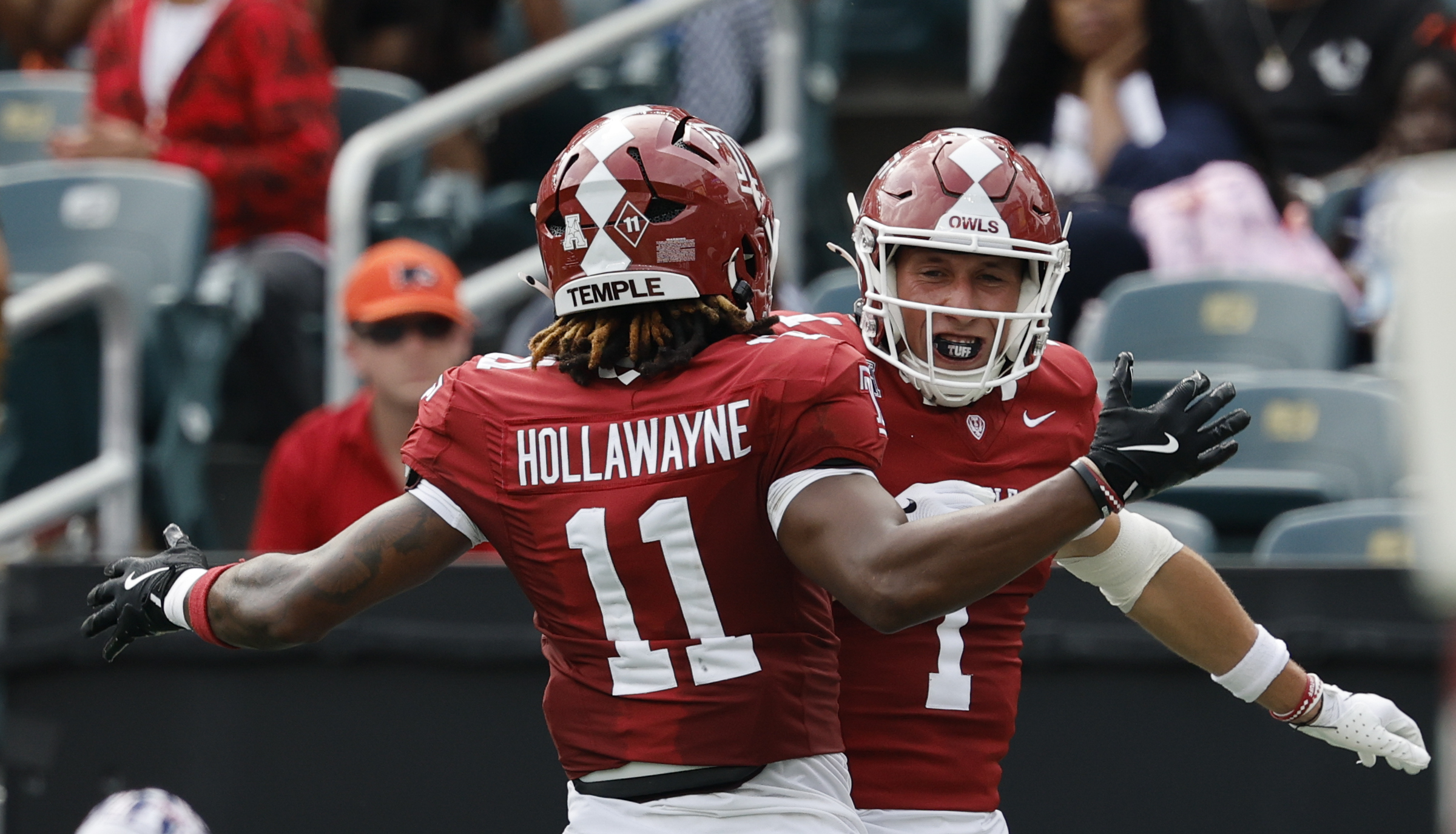
    Temple wide receiver Colin Chase (right) celebrates a first quarter touchdown reception with teammate wide receiver Kajiya Hollawayne on Sept. 6.

    Simon and Hollawayne’s extra work has paid off this season.

    “I think some of it definitely was him trusting in his ability, and him seeing the results, and then him understanding that we have confidence in him to throw the ball in key moments,” Walker said. “Then when he makes those plays, it just builds confidence. I think a lot of it was that he always had the athletic ability, that was never an issue. It was just getting him to fine tune his ability and get him to do some things that naturally take some time, and he’s done a great job.”

    For Hollawayne, his development on the field comes from his journey, which has had many twists and turns.

    “I think that freshman year helped me a lot,” Hollawayne said. “I think if I would have played my freshman year, I wouldn’t be the man I am right now, because that actually humbled me a lot.”

  • Thanksgiving wine pairings are notoriously tricky. Here’s why you should skip the ‘serious reds.’

    Thanksgiving wine pairings are notoriously tricky. Here’s why you should skip the ‘serious reds.’

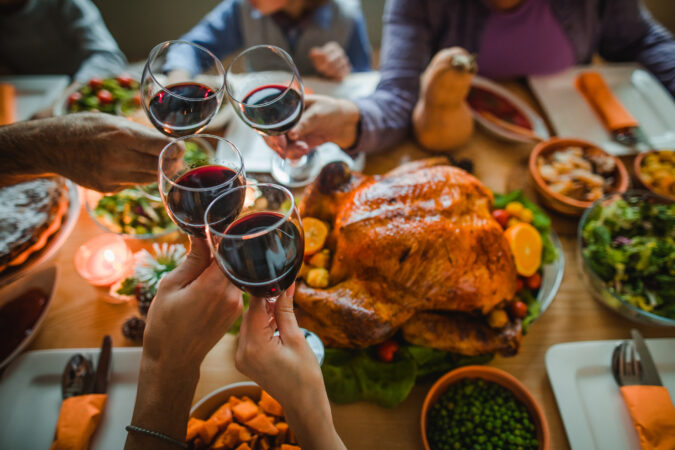
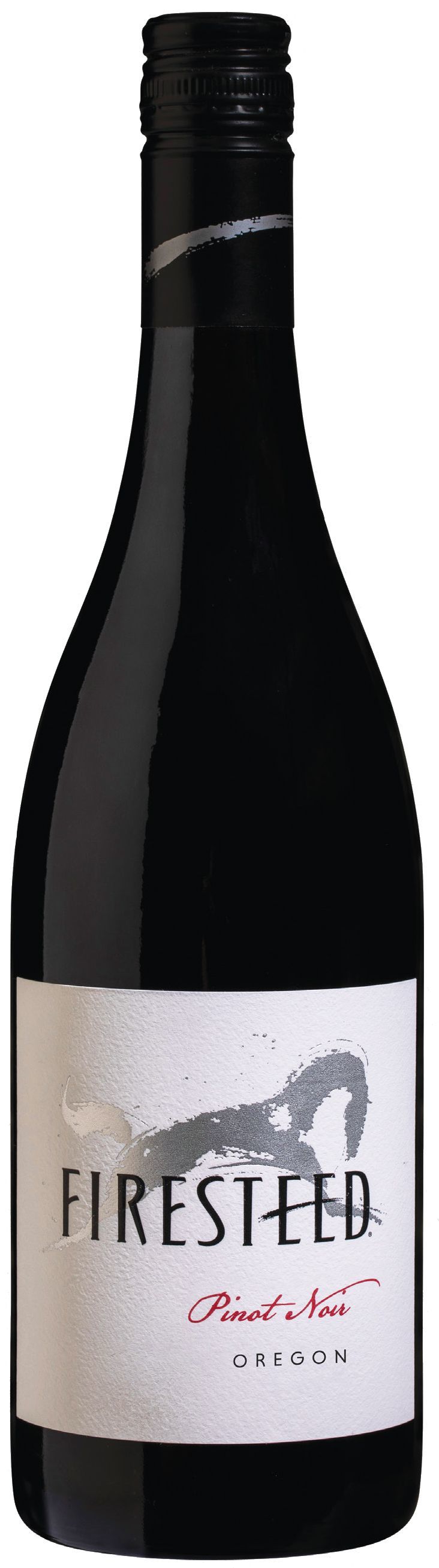
    With turkey day around the corner, now is the time to stock up on suitable wines for your family’s Thanksgiving feast. To find a complete list of my go-to holiday wine suggestions, all of which are stocked in Pennsylvania’s Fine Wine and Good Spirits stores, let’s focus on the most challenging item on the holiday wine shopping list: a Thanksgiving-friendly red, like this fruity young pinot noir from Oregon.

    Many people think the reason red wines are hard to pair for this holiday dinner is that turkey is a white meat that favors white wines, and there is some truth to this. Generally speaking, lighter, paler, and younger reds make the best picks for any poultry-centric meal. However, there is another complicating factor in that most red wines are dry — meaning not sweet — and the lightest reds in the fine wine space tend to also be quite tart, especially the classic styles like Italian Chianti or French Burgundy. These traits, which are usually food-pairing assets, become distinct liabilities at American Thanksgiving dinners because of the sky-high sugar content of this holiday’s traditional sauces and sides. The drier and more acidic a red wine tastes on its own, the more problematic it will taste with cranberry sauce or marshmallow-topped sweet potato casserole.

    That’s why the best bet is to skip the “serious reds” at this meal and instead opt for something that is fresh, fruity, and lightweight, like this crowd-pleasing Oregon pinot noir. The sappy freshness of its raspberry and strawberry flavors will partner nicely with both the turkey and its cranberry sauce. Even better, it has cross-generational appeal at a great price and is light enough to crack at noon and continue sipping on all day.

    Firesteed Pinot Noir

    Firesteed Pinot Noir

    Oregon; 13.5% ABV

    PLCB Item #4999, on sale for $15.69 through Nov. 30 (regularly $17.69)

    Also available at: WineWorks in Marlton ($15.99; wineworksonline.com), Canal’s of Glassboro in Glassboro ($16.99; canalsofglassboro.com), and Total Wine & More in Wilmington and Claymont, Del. ($17.69; totalwine.com).

  • Woman killed in early-morning hit-and-run in University City

    A woman was killed in a hit-and-run crash early Thursday morning in University City.

    Meaza Brown, 48, of South Philadelphia, was walking with coworkers when a driver in a silver Chrysler 300 with tinted windows struck and killed her at 4:17 a.m. at 33rd and Market Streets, Chief Inspector Scott Small told reporters at the scene. The woman was pronounced dead at 4:59 a.m. at Penn Presbyterian Medical Center with multiple injuries and internal bleeding.

    Police later recovered the vehicle they believe struck Brown at 34th and Race Streets. No arrest was reported, and the investigation is ongoing.

    Small said that the woman was hit at such a high rate of speed, “she was launched out of her sneakers.” Police say the collision propelled the woman several hundred feet down Market Street.

    “The driver of the striking vehicle did not remain on scene, did not render any aid, and just fled the scene,” Small said.

    The driver drove away on Market Street, heading toward 30th Street Station. No other people were hit by the car or injured, police said.

    Police were able to get the Chrysler’s license plate number, and officers were sent to the home registered with the vehicle Thursday morning.

    The deadly crash occurred in the heart of Drexel University’s campus, in the intersection in front of the school library and student center, and only a few blocks from 30th Street Station.

    Philadelphia has experienced fewer traffic deaths in the first half of this year than in any equivalent period since 2019, according to the Bicycle Coalition of Greater Philadelphia. Fatalities have been on a downtrend for years; however, the back half of each year tends to get more deadly.

    The city has recorded more than 70 fatal crashes this year, with more than a third of those killed being pedestrians.

  • Why is A.J. Brown struggling against zone coverage? Here’s what the film says about his inconsistency.

    Why is A.J. Brown struggling against zone coverage? Here’s what the film says about his inconsistency.

    When the Eagles face the Dallas Cowboys for the second time this season on Sunday, they’ll face a team that plays the seventh-highest rate of zone coverage, according to Sharp Football Analysis.

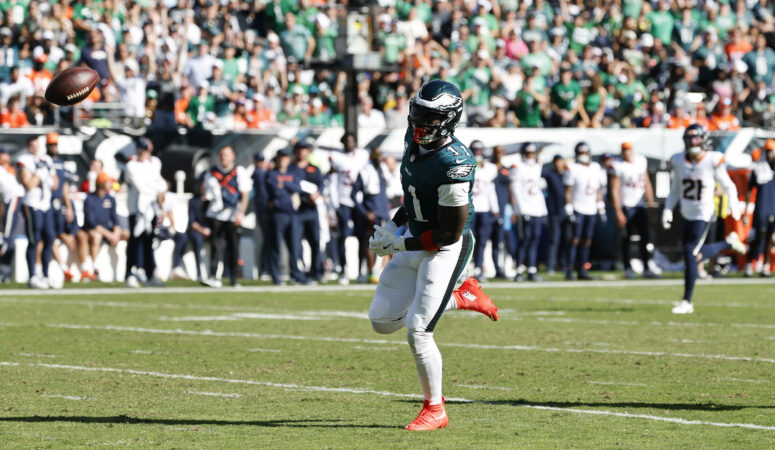
    The Eagles passing offense — which has seen a lot of zone coverage — has been a roller coaster this season. Eagles quarterback Jalen Hurts and wide receiver A.J. Brown haven’t put up the production to match the gaudy numbers they’ve produced together in years past.

    Brown still thrives against man coverage, catching 16 of his 25 targets for 244 yards and three touchdowns this season against man schemes, according to Next Gen Stats. But Brown not only has his lowest target per route percentage (20.9%) against zone coverage since joining the Eagles in 2022 per Next Gen, but has a career-low 38 yards after catch vs. zone coverages and is averaging 1.14 yards per route against zone coverage, the lowest rate of his career.

    We took a film- and stats-based dive into why Brown is having a down year, and particularly what’s contributing to his issues against zone coverage this season as the passing game searches for consistency:

    Route variety

    For this exercise, we watched all of Brown’s targets in an Eagles uniform, beginning with his dynamo 2022 season, in which he finished with a franchise-record 1,496 receiving yards on 88 receptions with 11 receiving touchdowns.

    The playcaller that year was current Indianapolis Colts head coach Shane Steichen, and the first noticeable difference from 2022 to now is the variety of routes that Brown ran in that offense.

    According to Pro Football Focus, Brown had a near 70/30 split in terms of his alignment, with 808 of his 1,187 snaps that year coming out wide, and 342 coming from the slot. This will be important later, but that unpredictability allowed Brown to be moved around to several spots and be utilized in different ways.

    One of the best ways to get receivers the ball against zone coverage is moving the pocket and utilizing shallow crossing routes. Brown had a career-best 17.5 yards per reception vs. zone coverages, and the utilization of him getting underneath or between linebackers across the middle of the field made for easy throws for Hurts.

    Even though that route wasn’t as prevalent in 2023, the Eagles brought it back more often in 2024, especially after the bye week with the Birds sitting at 2-2. Against the Cowboys, Commanders, and Rams, there was a noticeable effort to get Brown touches and space for yards after catch opportunities on those routes, and even Brown’s touchdown in Super Bowl LIX came on a shallow cross route.

    In 2025, there have been attempts to incorporate crossing and shallow routes into the offense, but the attempts have been either infrequent or unsuccessful. A shallow route passing attempt from Hurts to Brown vs. zone coverage against Denver was rushed because of pressure and fell incomplete, and a crossing route to Brown vs. zone went for a 16-yard gain against the Giants.

    The routes that Brown was known for in Tennessee and even now as an Eagle, are in-breaking routes, including slants and dig routes. Those have been a major aspect of Brown’s game, because of his ability to create after the catch, and his physicality to withstand hits that come over the middle of the field.

    A large portion of his catches in 2022 were on those routes, and he dominated after the catch that year. According to Next Gen, 40.5% of his YAC came against zone coverage, and he caught 51 of his 78 targets against zone coverages for 892 yards. He also averaged 2.62 yards per route against zone, which is still the second-highest split of his career.

    In 2023, those numbers took a dip, to 2.19 yards per route, with just 26.7% of his YAC coming against zone coverages, per Next Gen. But the in-breaking routes were more successful post-bye last year, as his numbers crept to the highest yards per route mark (2.83) of his career and his second-highest YAC percentage (29.4%) against zone.

    This season, he’s at career-low in both categories: 1.14 yards per route and just 17.8% of his YAC are coming against zone coverages. He’s averaging just 9.7 yards per reception vs. zone and has 22 catches on 187 routes run against zone this year.

    Part of that is linked to the running game’s ineffectiveness in past years, but also the increase in heavy personnel. The Eagles are running 13 personnel (one back, three tight ends) at a 6.47% rate, according to Sumer Sports, almost double the rate from last year, and 12 personnel (one back, two tight ends) at a slightly higher rate this year (30.32%) compared to last year (30.16%).

    The Eagles are running more condensed formations while running 11 personnel (one back, one tight end) at the lowest rate since Brown as been an Eagle, with just 54.8% of their snaps. They’re also not throwing the ball as much either from empty formations, where Brown has thrived in previous years against both man and zone coverages.

    Add in that fact that Brown has been targeted on just 21.3% of his routes against zone coverage this season, his lowest rate since his rookie year in 2019 (20.7%), according to Next Gen, and it’s been a struggle for him to get the ball. Per Pro Football Focus, 13 of his 14 catches between the numbers this year came on passes of 10 yards or less, with just one coming in beyond 20 yards. In 2022, he had 14 catches beyond 10 yards between the numbers, 12 in 2023, and 10 last season.

    Formational changes

    As outlined above, formational changes have played a part in Brown’s struggles this season, with a shift to heavier personnel and dialing back 11 personnel. But so has Brown’s alignment, which has trended away from utilizing him in the slot.

    After playing 342 snaps in the slot in 2022, he played 259 in 2023, and 171 in 2024, which matched more of his alignment with the Titans in 2019-21 (when he averaged 131 slot snaps). This year, Brown is on pace for his fewest such snaps as an Eagle, with 52 of his 504 snaps coming in the slot, per PFF.

    He’s aligning outside the numbers over 88% of the time, which not only allows defenses to send multiple defenders his way, but also limits his route tree. Almost all of his routes against the Lions last week were outside the numbers and he played just four snaps in the slot.

    Having Brown in the slot not only creates opportunities for mismatches, but it gives him a chance to create big plays against linebackers and safeties. The 2023 season probably shows his slot usage best, when Brown had career-highs in routes (366), targets (89) and catches (62) against zone coverage with 801 receiving yards, his second-highest total behind the 2022 season.

    The route spacing this season just isn’t as sharp as years past and it seems to bring some hesitancy from Hurts in challenging those windows at times. Hurts had no problem ripping the ball Brown in 2022 and 2023 on curl or in-breaking routes, but appears not as confident in doing so this year.

    Brown had targets where he sat in the soft spot of zone coverage against Denver and Green Bay, and against the former, Hurts eventually hit him after scrambling and immediately put the ball on him against the Packers.

    What could help?

    One way to combat some of the bracket coverages and extra attention that Brown is getting from opposing defenses is to have him align on the same side as DeVonta Smith. Especially against zone coverages, the alignment puts defenses in a bind, forcing them to choose one star receiver or the other.

    A lot of Brown’s big plays against zone coverage in those situations came in either 12 personnel or empty formations, and since the heavier personnel isn’t working this year, adding more empty passes could be beneficial for Brown and the Eagles’ passing game.

    Most of the time the Eagles are attacking downfield this year, its in man coverage situations, but Hurts and the passing attack has shown the ability to hit “hole shots” which are passes in between the corner and safety in zone coverage. They did so in 2022 and 2023 to Brown, making two-high zone coverages pay for not sending help to the corner on such throws.

    The Eagles have Smith and Brown run hitch routes above league-average this year (16.5%), at 24.5% and 23.7%, respectively, according to Next Gen, and that will always be an identity of the offense. But adding in more variations, where Brown isn’t always working along the sidelines, could help open some throwing windows for Hurts.

    Whether it’s adding him more to the slot or utilizing more empty formations and 11 personnel, there has to be a more concerted effort for the Eagles to find more easy targets for Brown and find answers to their issues against zone coverage. Unlocking this dimension could be the step forward the offense needs.

  • The Sixers continue to have a third-quarter problem, even after their lineup switch against Toronto Raptors

    The Sixers continue to have a third-quarter problem, even after their lineup switch against Toronto Raptors

    About 10 days ago, Nick Nurse jokingly proclaimed that maybe the 76ers would play better in the third quarter if they spent halftime regrouping on the bench, instead of inside the locker room. Veteran Kyle Lowry suggested to star guard Tyrese Maxey that perhaps the players should try another round of layup lines before the second half begins.

    There was no making light of the ongoing problem late Wednesday, when another dreadful third quarter doomed the Sixers in a 121-112 loss to the Toronto Raptors on the front end of a back-to-back. For a season that so far has been a pleasant 8-6 surprise, the Sixers’ perplexing struggles during that specific quarter remain a worthy criticism.

    “A lot of bad, right?” Nurse said when asked again Wednesday about the blunders.

    The Sixers were outscored 44-26 in Wednesday’s third quarter, flipping a three-point halftime advantage into a 15-point deficit entering the final frame. And though they rallied in the fourth — another quality consistently flashed throughout the early season — that hole ultimately was too deep to fully overcome against the streaking Raptors (10-5).

    When the third-quarter topic was broached again Wednesday, a far more terse Maxey pointed to the Sixers’ turnovers (eight, which Toronto parlayed into 15 points) and defensive breakdowns (the Raptors shot 68.4% from the floor, including a blistering 5-of-6 on three-pointers) as the primary areas to blame. Nurse added that the Sixers committed five fouls in less than four minutes, leading to a whopping 16 free-throw attempts (and 13 shots made) for the Raptors during that period.

    “Just set the tone for a really bad quarter,” Nurse said.

    It was the latest on a growing list of “really bad” third quarters populating the regular season’s opening month. The Sixers have “lost” 11 of their 14 third quarters, with one tie. They have been outscored by 111 total points (454-343) in that frame, with an average of 24.5 points per third quarter.

    On Oct. 30, Nurse said the reasons for the Sixers’ woes during those 12 minutes were “under investigation.” Subsequent questions to the coach as the dilemma persisted did not yield revelations about correctable through-lines or themes.

    Separately and unprompted, Maxey and reserve big man Jabari Walker have suggested that it may now be a collective mental block.

    “Man, I think it’s a mindset thing, honestly,” Walker said Wednesday, after a long exhale. “We’ll figure it out. But it’s honestly mindset. It’s nothing besides that.”

    After a Nov. 5 loss at the Cleveland Cavaliers, Nurse floated the idea of starting a different group at the beginning of each half, a tactic he has previously used to spark his team coming out of the locker room.

    That has transpired in the Sixers’ past three games. One change was out of necessity, when wing Kelly Oubre Jr. went down with an LCL sprain in his left knee in the second quarter of last Friday’s loss at the Detroit Pistons. But Wednesday night, Quentin Grimes and Trendon Watford replaced starters Justin Edwards and Dominick Barlow in the first group to play after the break.

    That approach placed Grimes on a better rotation pattern for the closing lineup, with which he scored 15 of his 21 points in Wednesday’s fourth quarter. It also allowed the coaching staff to make judgments in real time, to cater to specific matchups or ride a role player who excelled in the first half.

    “It just changes the rhythm of the start of the second half,” Nurse said in Cleveland. “It doesn’t mean you’re penalizing anyone in particular. Just trying to look for solutions.”

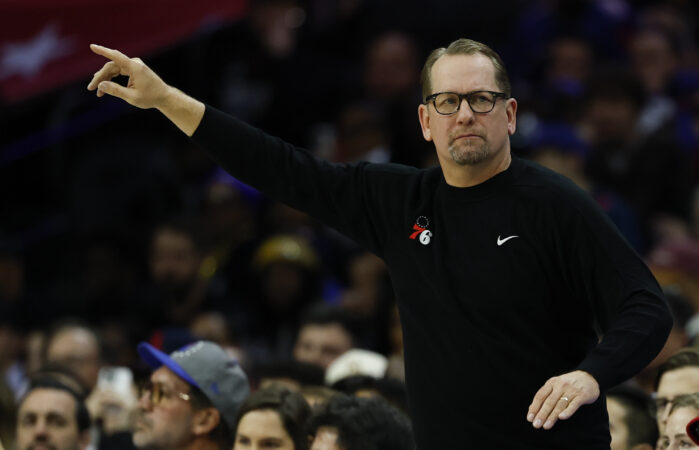
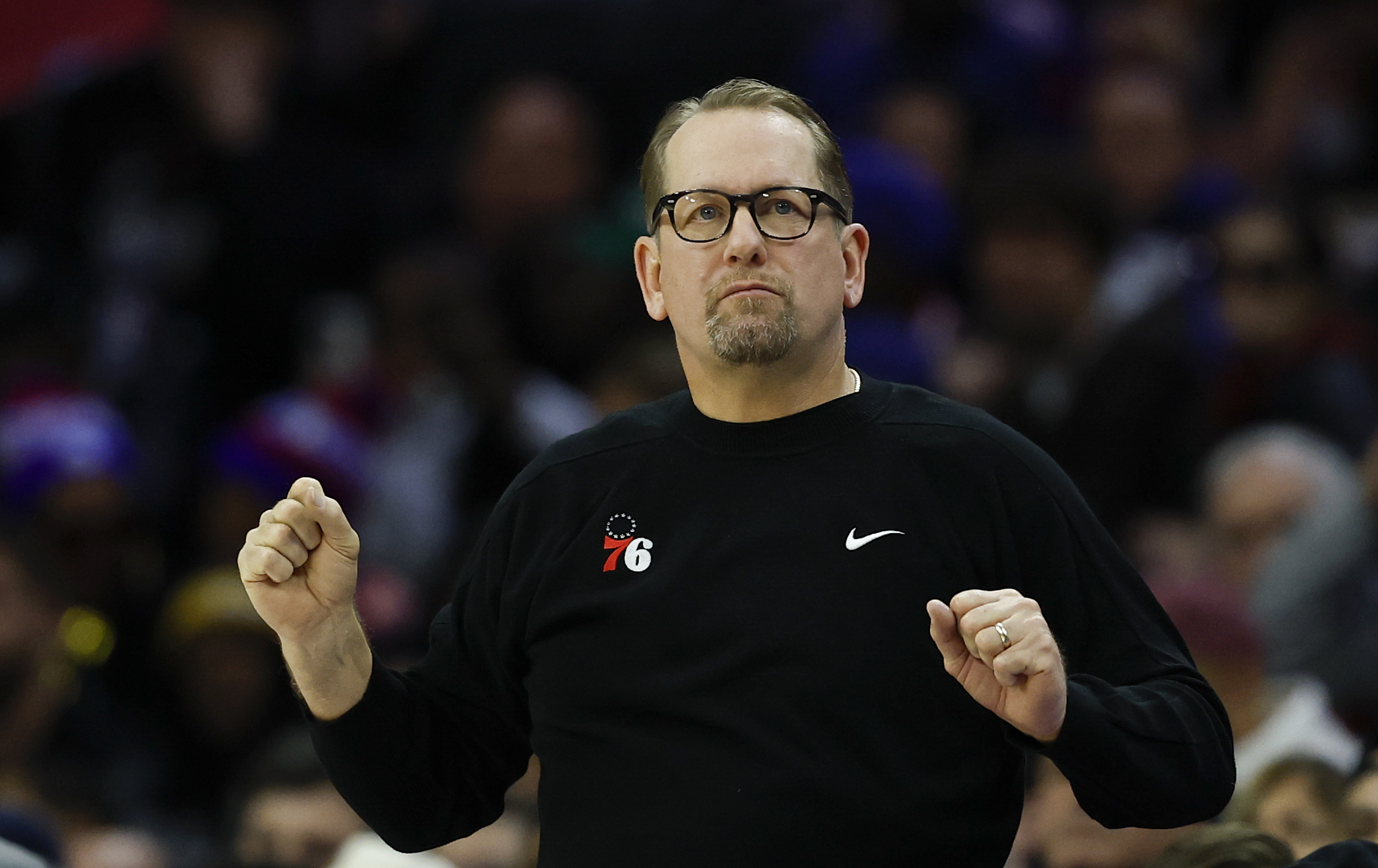
    Sixers head coach Nick Nurse and his teams are still trying to figure out their fourth-quarter issues.

    That lineup tweak, however, did not solve the issue Wednesday. The Raptors began the third on a 10-2 run, and never surrendered the lead after that.

    And perhaps the third-quarter gaffes are even more glaring because of the Sixers’ knack for clawing back in the fourth quarter.

    They have already played an NBA-leading 12 “clutch” games, going 7-5 in such situations. They also have already tied an NBA record for most victories by a team that entered the fourth quarter trailing by double digits, with four.

    It looked like the Sixers might be on their way to such a result again, when a Grimes three-pointer capped a 24-12 run to slash the Raptors’ lead to 109-106 with 5:25 to play. But the work required to rally meant the Sixers could not afford defensive miscues down the stretch, which helped Toronto re-extend its lead.

    Before making the quip about staying on the floor during halftime, Nurse bristled a bit at a question about the Boston Celtics outscoring the Sixers, 36-20, in the third before his team rallied to a Nov. 11 win. The coach said, “I’d rather be a better fourth-quarter team” because, “in the fourth quarters, we’re pretty damn good.”

    But inside the Sixers’ postgame locker room that night, the phrase “30th in 3Q” had been written on a white board — with the word “STILL” in red. Ten days later, this is still plaguing a positive start to the season.

    So why does the Sixers’ third-quarter problem persist?

    “To be honest, we don’t know,” rookie VJ Edgecombe said. “If we had it all figured out, there would be no slow starts to third quarters.”

  • Selling the family Shore house | Real Estate Newsletter

    Selling the family Shore house | Real Estate Newsletter

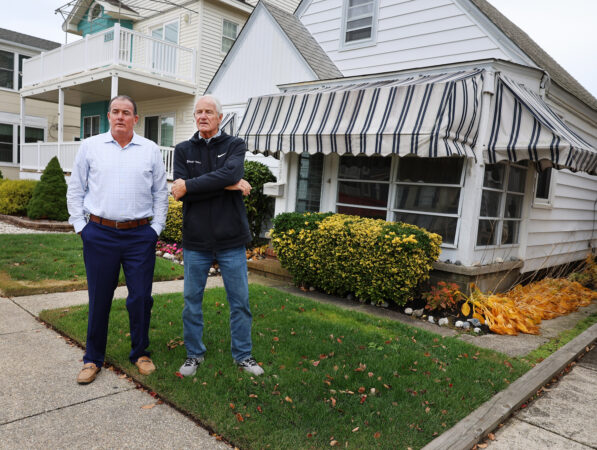
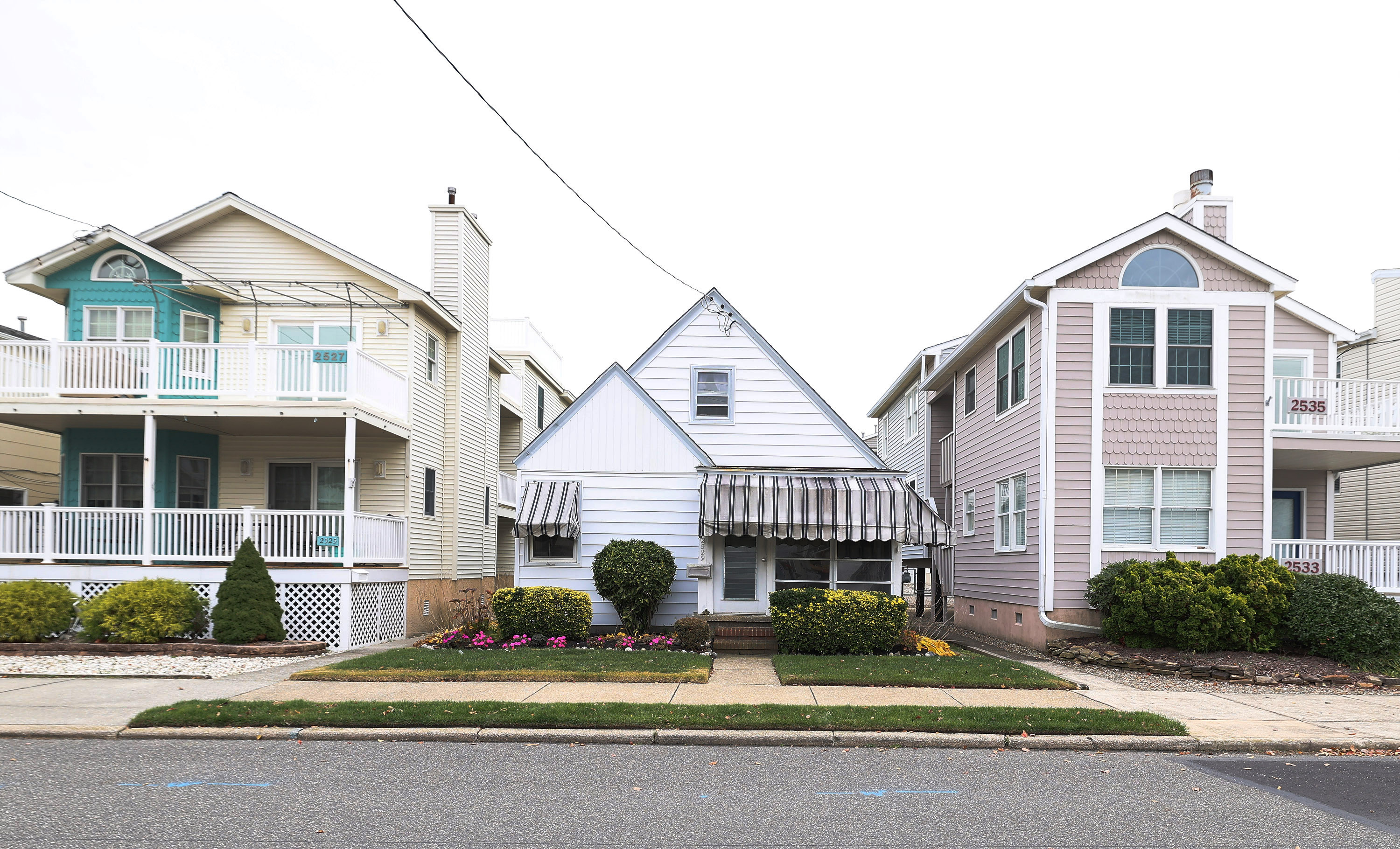
    The cottage on Asbury Avenue in Ocean City has been in the Smith family for seven decades. Now, it’s most likely at the end of its life.

    The 957-square-foot home two blocks from the beach is under contract with a developer for $1.4 million. And the family knows that the buyer will probably tear it down.

    That’s what happens down the Shore. The cottage sits on a large lot ripe for development and surrounded by larger neighbors.

    Keep scrolling for that story and more in this week’s edition:

    📮What type of nonresidential building would you want to live in if it were converted into a home? Maybe you even have a specific building in mind. Let me know.

    — Michaelle Bond

    P.S. The newsletter will be taking a break for Thanksgiving. So I’ll see you bright and early in your inbox the following Thursday, Dec. 4.

    If someone forwarded you this email, sign up for free here.

    Selling a piece of family history

    Norman and Elizabeth Smith bought the two-bedroom, one-bathroom cottage in 1956 for $13,500. Generations of Smiths spent summers crammed into every corner of the home.

    And they watched over the years as small cottages like theirs were demolished and replaced with larger homes.

    After Norman and Elizabeth died, one of their sons moved in. But when he died in September, the family decided to sell the property that’s unique in the neighborhood for its small house and grass-covered yard.

    The home was listed for sale at the end of October. The family immediately received a bunch of offers, mostly from developers. Now the property is under contract with a developer for $1.4 million.

    My colleagues wrote last year about the owners of tiny Shore homes who refuse to sell their million-dollar properties.

    But that’s not the usual choice. Take a look inside the Smith’s Shore cottage before it’s gone.

    Fuel leak upends a Bucks neighborhood

    “We will never drink the water in this house again,” a Bucks County homeowner said.

    Kristine Wojnovich and her husband don’t bathe in their home either. That’s because they get their water from a well, and that well was one of six that a pipeline leak contaminated with jet fuel.

    The leak has disrupted life in a quiet, suburban neighborhood, which happens to have a 14-inch-wide pipeline running underneath it that carries jet fuel, diesel, or gasoline from Delaware County to Newark, N.J.

    State inspectors discovered the leak in January. But Wojnovich told my colleague that she first knew something was wrong with the water coming from her well in 2023.

    Many residents of the neighborhood won’t drink or cook with their water. They watch as neighbors put their houses up for sale.

    Keep reading to learn more details about the leak and what life is like now for the people who live in the neighborhood.

    The latest news to pay attention to

    Home tour: Church turned apartments

    The four women in their 20s all separately found Christ Reformed Church on Facebook. But they didn’t come to worship. They wanted to live there.

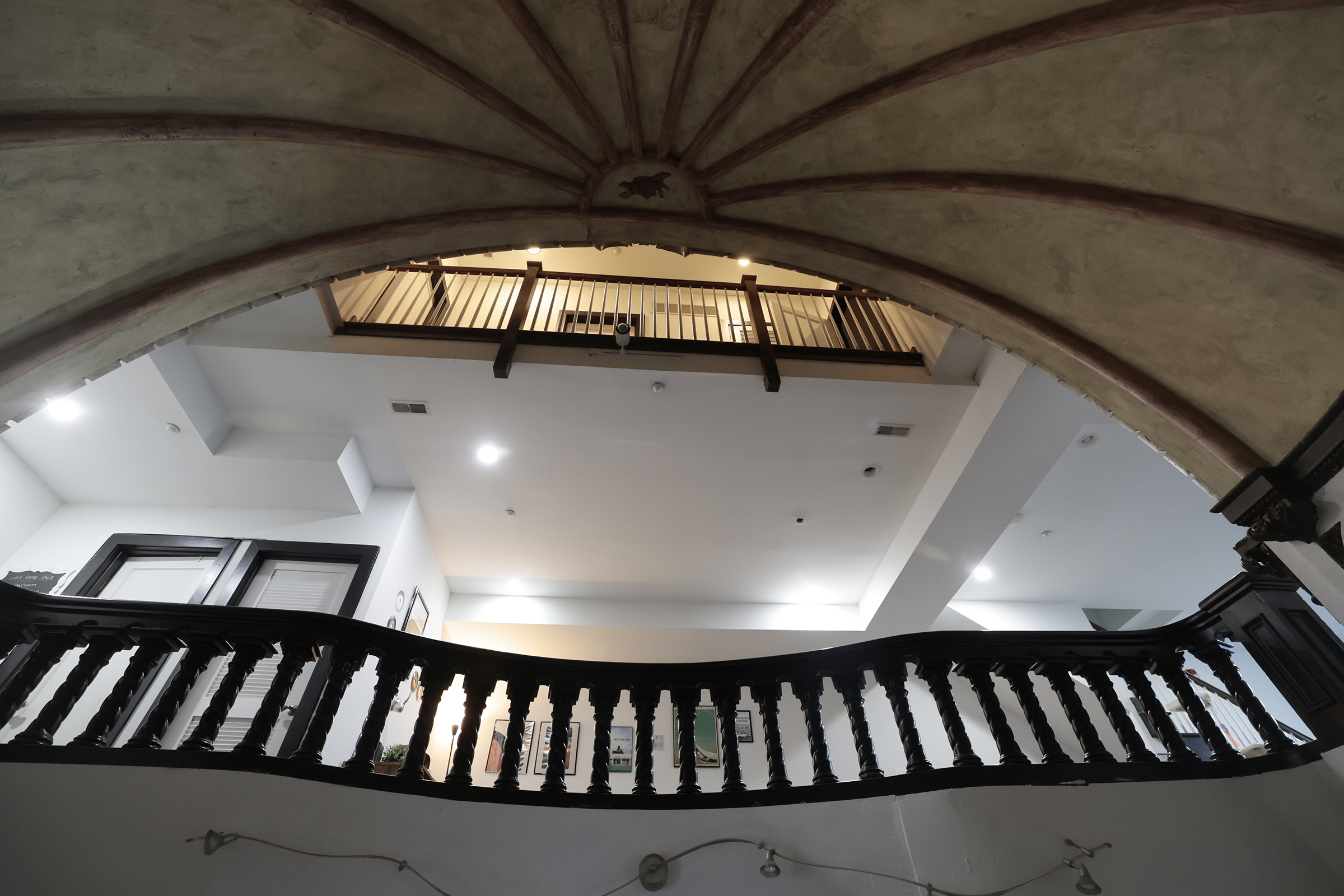
    The Romanesque-style brownstone structure was built in 1860 as a church, but now it’s an apartment building with 17 multilevel units.

    Corwynne Peterson, Riley Sperger, Ashlee Propst, and Magdalena Becker live in one of those units. They moved in at different times over the last 2½ years.

    Their four-level apartment includes soaring ceilings, stained glass, columns, and ornate carvings.

    The women throw parties in the home and screen movies on the dome of what used to be the church’s sanctuary. They call the sanctuary’s raised platform “the stage” and have furnished it with a dining table, chairs, and a rug.

    Peek inside their unique Spring Garden apartment.

    📷 Photo quiz

    Do you know the location this photo shows?

    📮 If you think you do, email me back. You and your memories of visiting this spot might be featured in the newsletter.

    Shout-out to Janet P. and Gary G., the first readers to answer last week’s quiz correctly. That photo featured the statue of activist Octavius V. Catto on the south side of City Hall.

    Enjoy the rest of your week and your Thanksgiving. We’ll meet back here on Dec. 4.

    By submitting your written, visual, and/or audio contributions, you agree to The Inquirer’s Terms of Use, including the grant of rights in Section 10.

  • ‘They don’t return home’: Cities across U.S. fail to curb traffic deaths

    ‘They don’t return home’: Cities across U.S. fail to curb traffic deaths

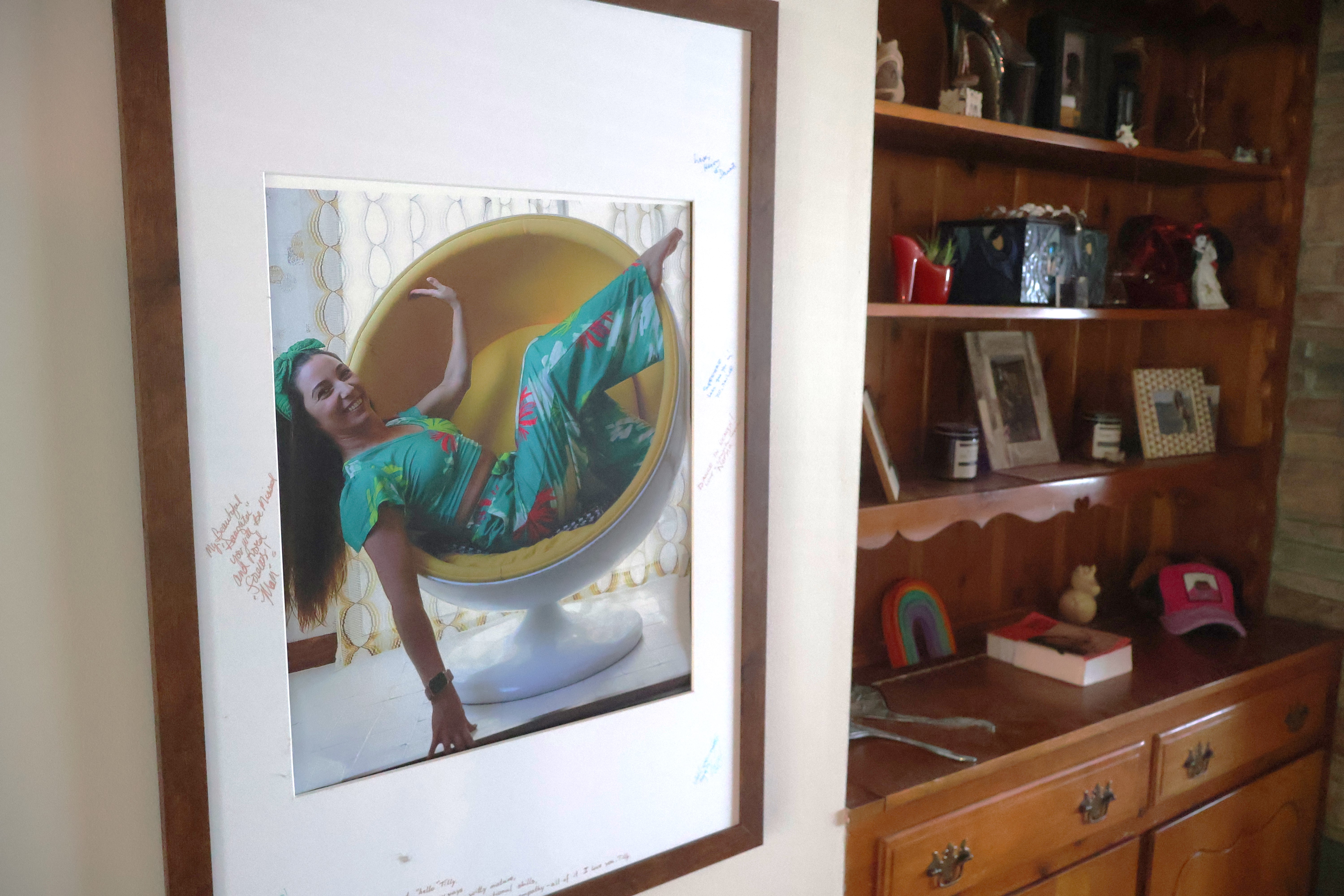
    Kris Edwards waited at home with friends for his wife, Erika “Tilly” Edwards, to go out to dinner, but she never made it back to the house they had purchased only four days earlier. Around 9 p.m. on June 29, a hit-and-run driver killed Tilly as she walked to her car after a fundraiser performance in Hollywood.

    “I’ve just got to figure out how to keep living. And the hard part with that is not knowing why,” Edwards said of his wife’s death.

    Despite local, state, and federal safety campaigns, such as the global Vision Zero initiative to eliminate traffic fatalities, such deaths are up 20% in the U.S. from a decade ago, from 32,744 in 2014 to an estimated 39,345 in 2024, according to data from the Department of Transportation’s National Highway Traffic Safety Administration. Although traffic deaths have declined since peaking at 43,230 in 2021, the number of deaths remains higher than a decade ago.

    Since the COVID-19 pandemic, the Pew Research Center found, Americans’ driving habits have worsened across multiple measures, from reckless driving to drunken driving, which road safety advocates call a public health failure. They say technology could dramatically reduce traffic deaths, but proposals often run up against industry resistance, and the Trump administration is focusing on driverless cars to both innovate and improve public safety.

    “Every day, 20 people go out for a walk, and they don’t return home,” said Adam Snider, a spokesperson for the Governors Highway Safety Association, which represents state road safety offices.

    American roads have become more dangerous than violent crimes in some cities: Los Angeles, San Francisco, and Houston are among the major cities that now report more traffic fatalities than homicides. In 2024, the Los Angeles Police Department reported an estimated 268 homicides and 302 traffic deaths, the second consecutive year that the number of people killed in collisions exceeded the number of homicide victims, according to Crosstown LA, a nonprofit community news outlet.

    San Francisco reported more than 40 traffic deaths and 35 homicides in 2024. In Houston, approximately 345 people died in crashes and 322 from homicide.

    Philadelphia had 134 traffic deaths last year, 59 of which involved pedestrians hit by vehicles.

    “Simply put, the United States is in the middle of a road safety emergency,” David Harkey, president of the Insurance Institute for Highway Safety, testified during a House Energy and Commerce subcommittee hearing this summer. Out of 29 high-income countries, America ranks at the bottom in road safety, Harkey said. “This spike is not — I repeat, is not — a global trend. The U.S. is an outlier.”

    In January 2017, then-Mayor Eric Garcetti joined 13 other L.A. city leaders in pledging to implement the Vision Zero action plan and eliminate traffic deaths in the city by 2025.

    Instead, deaths have increased.

    An audit released in April that was commissioned by the city’s administrative officer found that the level of enthusiasm for the program at City Hall has diminished and that it suffered because of “the pandemic, conflicts of personality, lack of total buy-in for implementation, disagreements over how the program should be administered, and scaling issues.” The report also cited competing interests among city departments and inconsistent investment in the city’s most dangerous traffic corridors.

    Mayor Karen Bass’ office did not immediately respond to requests for comment.

    A hit-and-run driver killed Erika “Tilly” Edwards as she walked to her car after a fundraiser performance in Los Angeles’ Hollywood neighborhood in June 2025. Despite safety campaigns, U.S. traffic deaths are up 20% from a decade ago, according to the Department of Transportation. (Chaseedaw Giles/KFF Health News)

    Last year, California state Sen. Scott Wiener proposed a bill that would have required new cars sold in the state to include “intelligent speed assistance,” software that could prevent vehicles from exceeding the speed limit by more than 10 mph. But the bill was watered down following pushback from the auto industry and opposition from some legislators who called it government overreach. It was ultimately vetoed by Democratic Gov. Gavin Newsom, who said a state mandate would disrupt ongoing federal safety assessments.

    Meanwhile, the Alliance for Automotive Innovation, an influential automotive lobby, this year sued the federal government over an automatic emergency braking rule adopted during the Biden administration. The lawsuit is pending in federal court while the Department of Transportation completes a review. Even before Donald Trump was sworn in for his second term, the alliance appealed to the president-elect in a letter to support consumer choice.

    Under Trump, Transportation Secretary Sean Duffy is prioritizing the development of autonomous vehicles by proposing sweeping regulatory changes to test and deploy driverless cars. “Federal Motor Vehicle Safety Standards were written for vehicles with human drivers and need to be updated for autonomous vehicles,” NHTSA Chief Counsel Peter Simshauser said in September in announcing the modernization effort, which includes repealing some safety rules. “Removing these requirements will reduce costs and enhance safety.”

    Some Democratic lawmakers, however, have criticized the administration’s repeal of safety rules as misguided since new rules can be implemented without undoing existing safeguards. NHTSA officials did not respond to requests for comment about Democrats’ concerns.

    Advocates worry that without continued adoption of road safety regulations for conventional vehicles, factors such as excessive speed and human error will continue to drive fatalities despite the push for driverless cars.

    “We need to continue to have strong collaboration from the federal, state, local sectors, public sector, private sector, the everyday public,” Snider, of the Governors Highway Safety Association, said. “We need everyday drivers to get involved.”

    It took nearly a month for police to track down the driver of a Mercedes-Benz G-Wagen allegedly involved in Tilly’s death. Authorities have charged Davontay Robins with vehicular manslaughter with gross negligence, felony hit-and-run driving, and driving with a suspended license due to a previous DUI. He has pleaded not guilty to all charges and is out on bail.

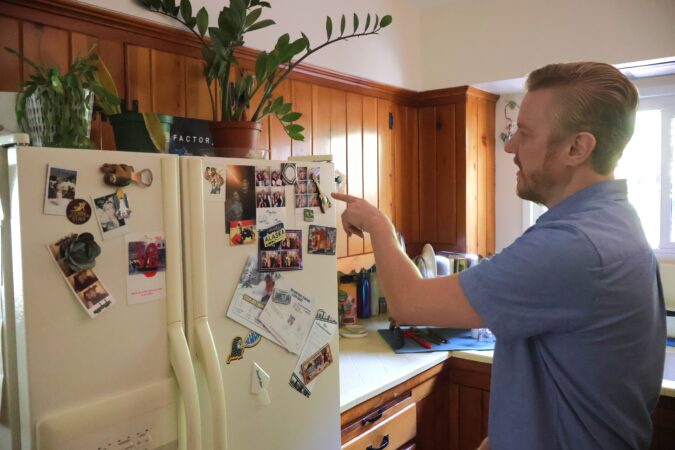
    Kris Edwards now tends to the couple’s backyard garden by himself. Since his wife’s death, he has experienced sleep deprivation, fatigue, and trouble eating, and he relies on a cane to walk. His doctors attribute his ailments to the brain’s response to grief.

    “I’m not alone,” he said. “But I am lonely, in this big, empty house without my partner.”

    Edwards hopes for justice for his wife, though he said he’s unsure if prosecutors will get a conviction. He wants her death to mean something: safer streets, slower driving, and for pedestrians to be cautious when getting in and out of cars parked on busy streets.

    “I want my wife’s death to be a warning to others who get too comfortable and let their guard down even for a moment,” he said. “That moment is all it takes.”

  • The artist behind the ‘Boob Garden’ and ‘Rave Coffin’ strikes again with ‘Crab Couch’ in South Philly

    The artist behind the ‘Boob Garden’ and ‘Rave Coffin’ strikes again with ‘Crab Couch’ in South Philly

    For the last two years, Rose Luardo has been exceedingly generous with her art, installing it for all to see in a vacant triangular lot in South Philly that was once home to Capt. Jesse G’s Crab Shack.

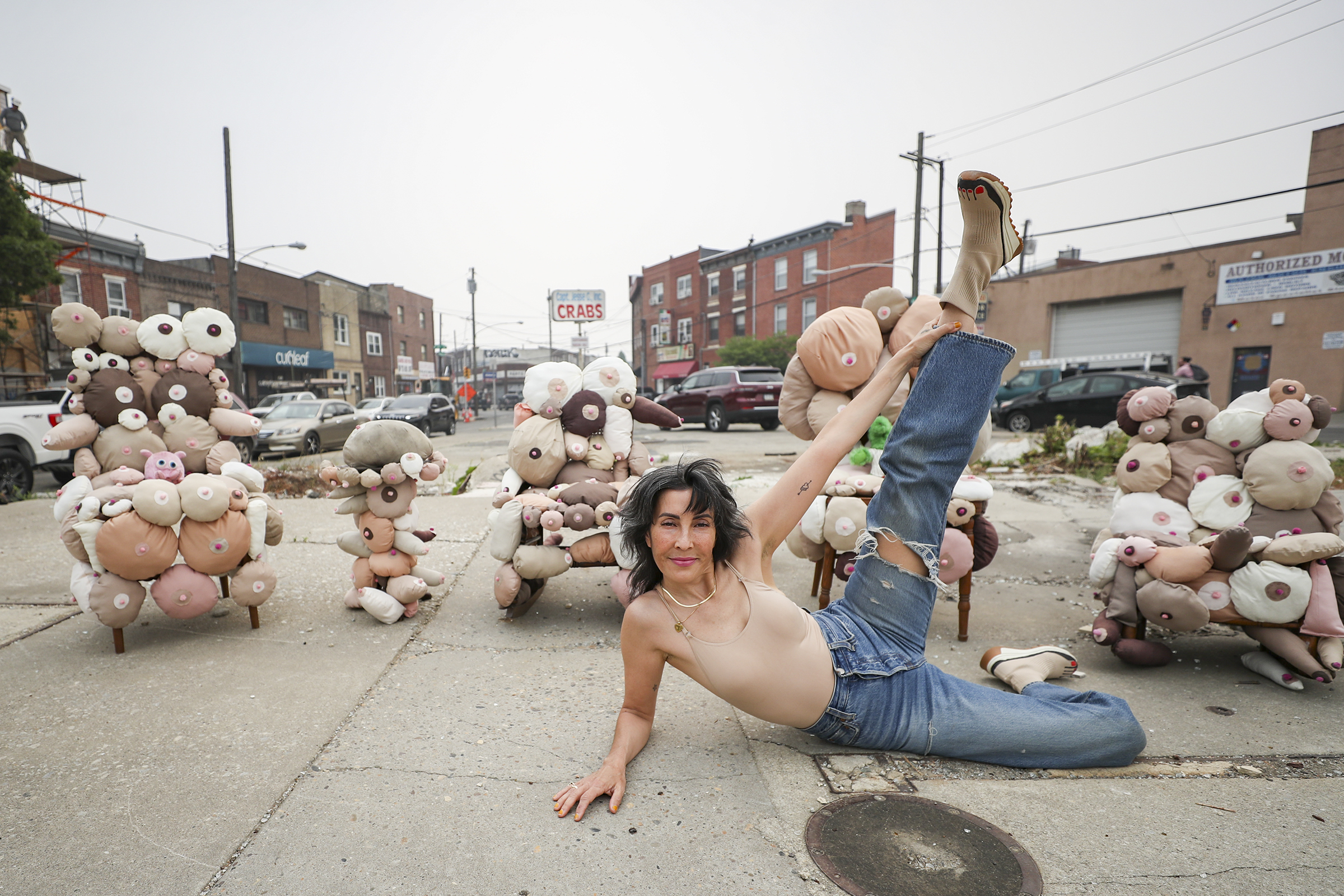
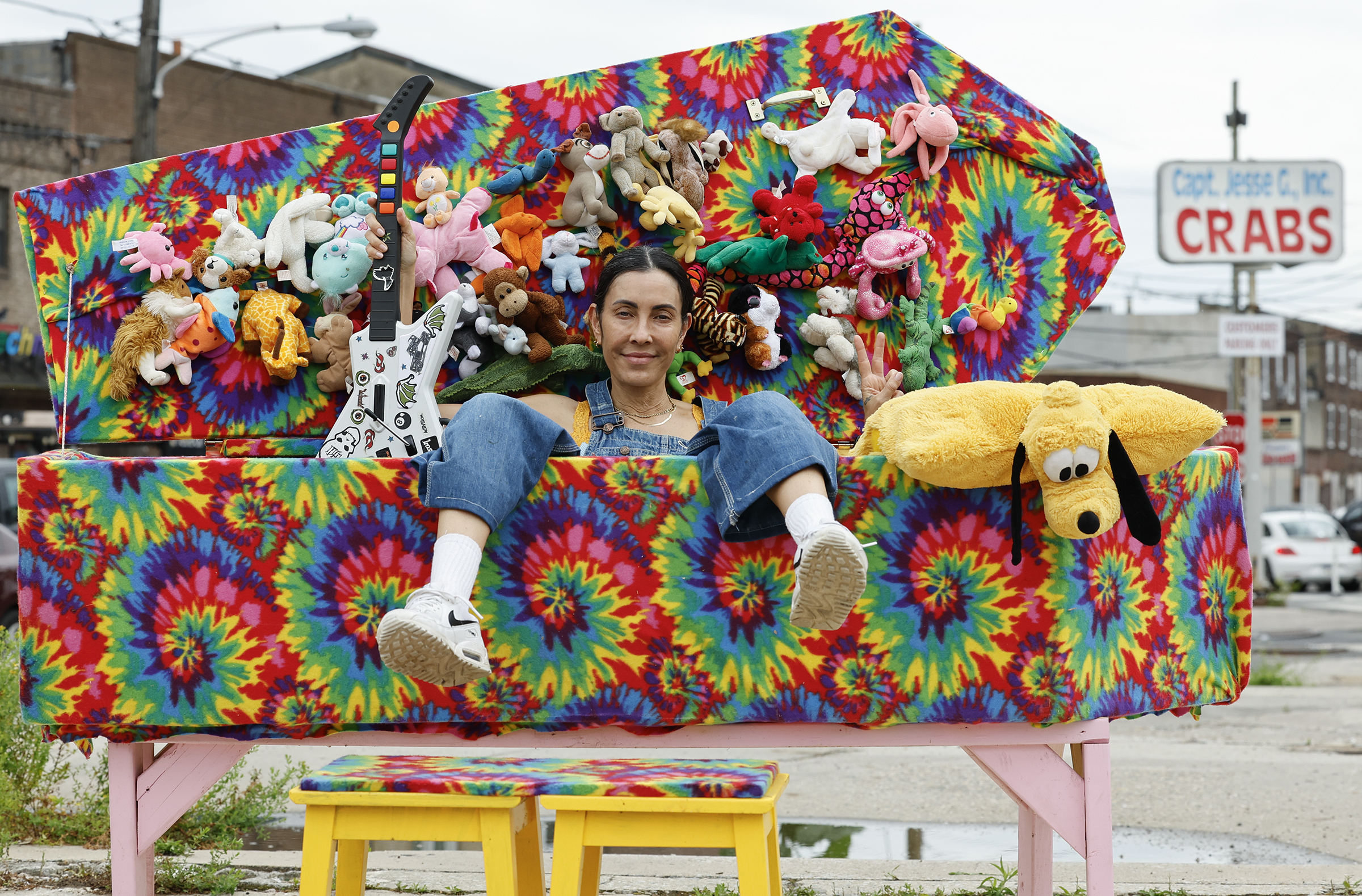
    In 2023, she gifted the people of Philadelphia with the Boob Garden, a furniture set covered in handmade breast plushies, and the following year she gave us the Rave Coffin, a casket covered in tie-dyed felt that passersby could lie down inside of.

    Rose Luardo strikes a pose at her “Boob Garden” art installation in 2023.

    Luardo struck again Sunday night at the cement triangle at the intersection of Washington Avenue, Passyunk Avenue, and Eighth Street, but this time around, her guerrilla art installation was totally shellfish.

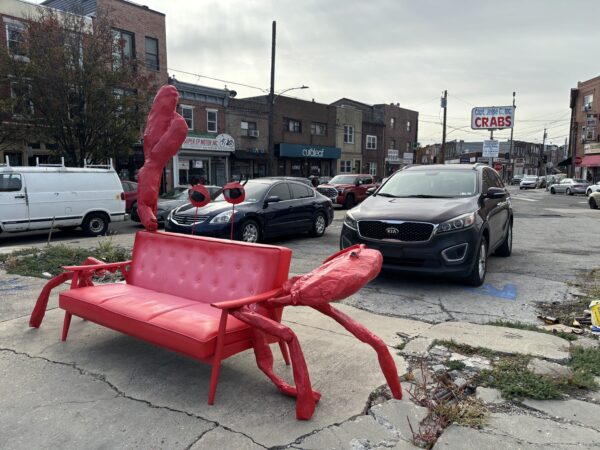
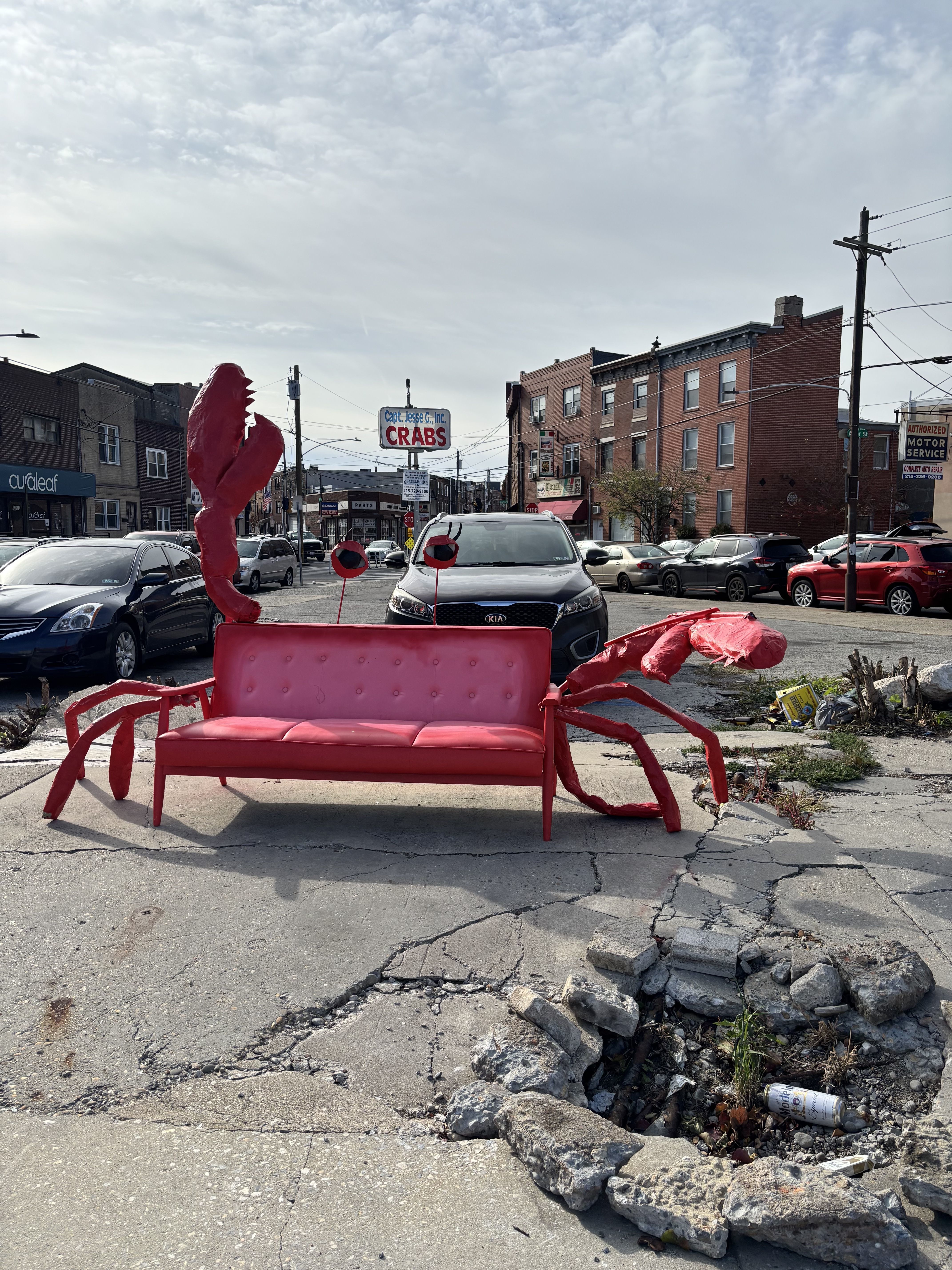
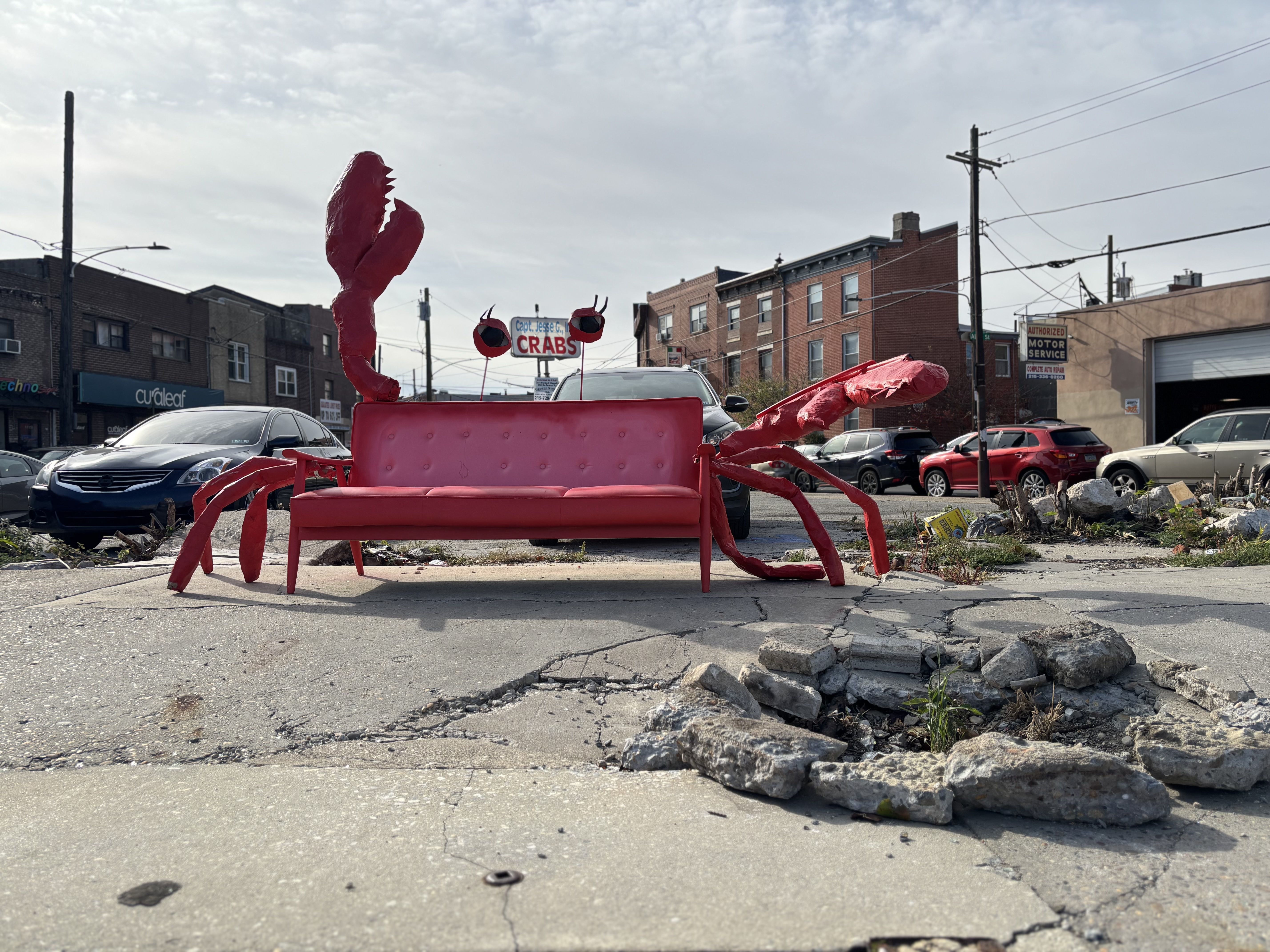
    Crab Couch — which is exactly what it sounds like unless you’re thinking of the other kind of crabs, which it is not — is the latest work Luardo set up at what she calls Capt. Jesse G’s Crab Shack Gallery. That’s because the shuttered business’ sign inexplicably remains lording over the lot on a freestanding pole, even though the building was long-ago demolished.

    Once just a regular white sofa that was looking for a new home on Facebook Marketplace, Luardo — a provocateur of the peculiar — rescued the couch and Frankenstein-ed that piece of furniture into a comfy crustacean.

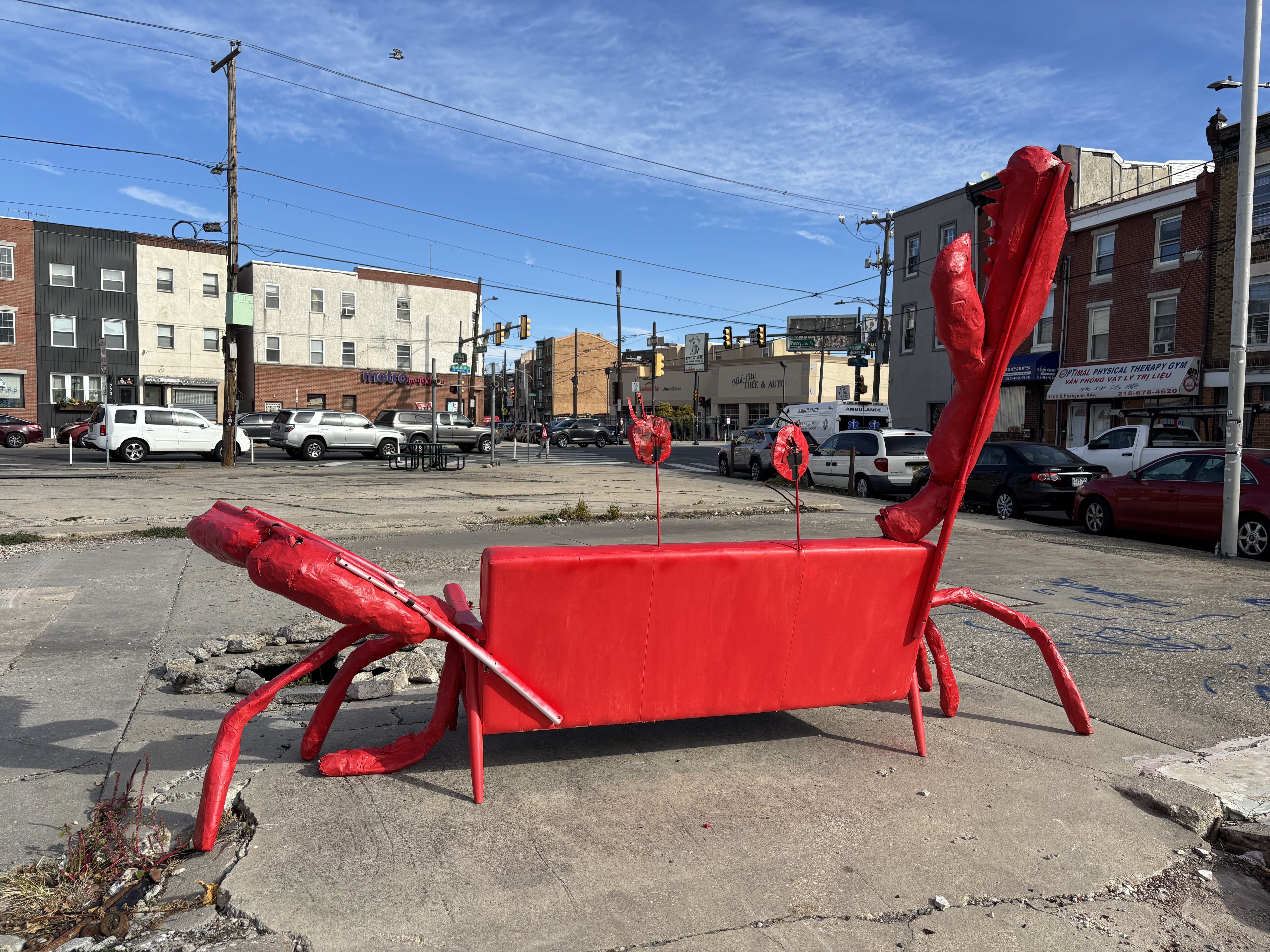
    With some papier-mâché, red house paint, and the help of her niece, Ingrid Rose Koppisch, and their friend, Simply Val, Luardo gave the couch six legs, a pair of judgey eyes, and two hulking claws, with one clamping down on a giant cigarette.

    She first put the crabby patio furniture in a gallery show she had in September.

    “I just had a feeling that this was not going to sell, but it would be a fun thing to make and eventually put out in my own personal art gallery at Capt. Jesse G’s,” Luardo said.

    On Sunday night, she and her husband put Crab Couch on one of his skateboards and wheeled it up the street to the vacant lot.

    Luardo noticed, as did I, that since the time of her installation last year, a taco truck has stationed itself at the edge of the lot and someone has bashed a small hole into the cement and created a modest fire pit, which Luardo placed the Crab Couch in front of. When I stopped by on Tuesday, the pit held an empty can of Modelo and an empty pack of Marlboro Lights.

    Artist Rose Lurado placed her latest work, “Crab Couch,” in front of a fire pit someone smashed into the cement at the vacant South Philly triangle she calls “Capt. Jesse G’s Crab Shack Gallery.”

    “I was so psyched that was there!” Luardo said of the pit. “This is the dream coming true, which is that the space is becoming activated, people are hopefully hanging out, eating a taco, drinking a Modelo, and sitting on the couch.”

    In the days since it was installed, the wind has done some damage to Crab Couch’s claws, which Luardo said neighbors came out to valiantly fix with drills. But its giant cigarette is nowhere to be found. It has become the ultimate Philly loosie.

    Otherwise, all is good with Crab Couch.

    “Crab Couch” is an old bae but a good one.

    I asked Luardo why she continues to put her art in such a hardscrabble lot, where it’s subject not only to weather but to something even more unpredictable — the whims of Philadelphians.

    “It was built for this kind of experience and nobody has claimed it,” she said. “It’s just this … s— lot and I know there’s people walking by and it’s so much fun to see something crazy and delightfully weird. It puts a hitch in your giddy-up.”

    According to city records, the lot is owned by 1100 Passyunk Partners LLC, which purchased the property for $2.85 million in 2020. A number for the group was not able to be located.

    South Philly artist Rose Luardo sits in her “Rave Coffin” at the triangular cement lot between Washington Avenue, Passyunk Avenue, and Eighth Street in 2024.

    To whomever owns this eyesore — which has been a vacant lot since at least 2016 — I beseech you to gift it to Luardo, who’s shown more interest in it and has done more to improve it than you ever have.

    The world is coming to Philadelphia next year and instead of having an empty, crumbling lot on one of the city’s busiest corridors, why not let Luardo show the world just how weird Philly can be?

    I hear she’s been eyeing an inflatable nightclub on Temu.

    “Crab Couch” looks out over the vacant triangle lot where it’s currently clawing out its existence next to busy Washington Avenue.