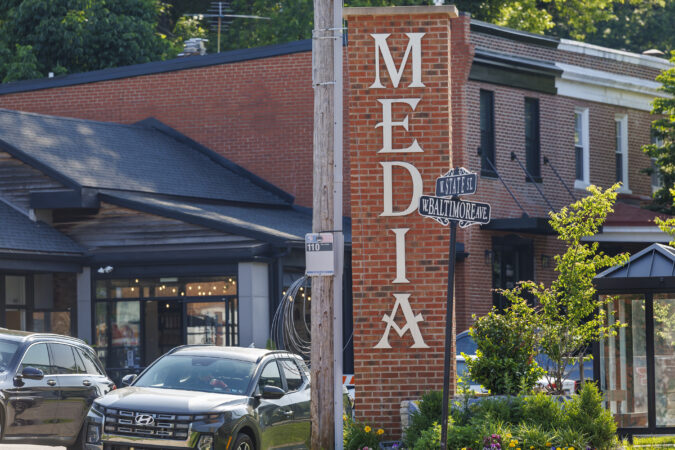
Staff members arrived at the Delaware County Republican Party headquarters in Media on Wednesday morning to find the building’s glass door shattered.
The apparent vandalism appeared to have occurred overnight, said Frank Agovino, the party chair. The Media Police Department, he said, is investigating.
The incident comes a year after the local party had to call police to the same office when protesters cornered two volunteers ahead of the presidential election.
“It’s just a sign of the times, unfortunately,” Agovino said. “There’s some people who just refuse to be civil about political disagreements.”
It was unclear who damaged the office or their motive. However, according to photos shared to Facebook by the Delaware County GOP, a sign identifying the office as a Republican office was posted on the door above the broken glass.
The Media Police Department did not immediately comment on the incident.
Agovino called for state and federal officials to consider stricter penalties for the perpetrators of such violence.
“People that are working in the political arena need to be protected,” he said.
This suburban content is produced with support from the Leslie Miller and Richard Worley Foundation and The Lenfest Institute for Journalism. Editorial content is created independently of the project donors. Gifts to support The Inquirer’s high-impact journalism can be made at inquirer.com/donate. A list of Lenfest Institute donors can be found at lenfestinstitute.org/supporters.
When Ethan Ruiz was diagnosed with leukemia in 2024, he decided to tackle it rationally, just like he tackled the monsters under his bed.
“Why would a monster want to jump me specifically, right?” Ruiz joked. “That never really went away. Even as things got scarier and bigger, I was able to rationalize that I’m going to be able to get through things.”
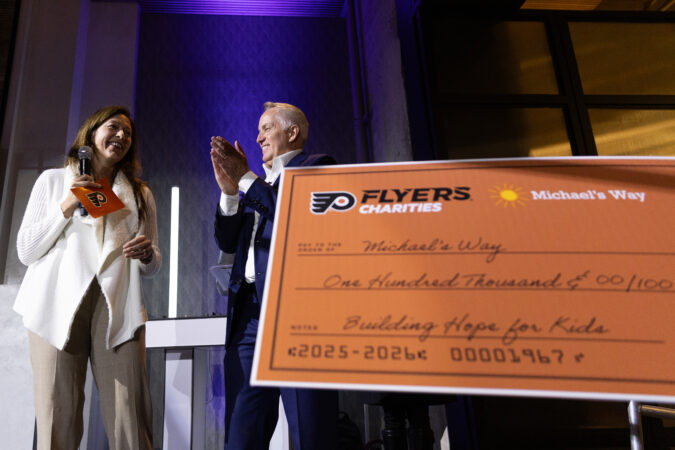
Ruiz is this year’s recipient of the Flyers’ Building Hope for Kids grant, which will renovate his family’s home in Northeast Philadelphia in an attempt to “create a more comfortable, accessible, and uplifting space as he continues treatment.” But the 19-year-old isn’t the type to ask for help, his mother said, which is part of why Blair Listino and Flyers Charities were drawn to the family for this year’s grant.
“Building Hope for Kids is one of the most meaningful programs we’re part of each season,” saidListino, the chair of Flyers Charities and an alternate governor of the Flyers, in a news release. “It’s about more than transforming a home. It’s about surrounding families with care, comfort, and love during some of life’s hardest moments. The Ruiz family’s strength and positivity are inspiring, and we can’t wait to see their faces when they walk into their new home this March.”
“Partnering with Flyers Charities is amazing. Everyone jumps in with such enthusiasm and dedication,” added Chris McElwee, founder of Michael’s Way and president of Fastrack Construction. “It’s a huge team effort from start to finish. We all share the same goal: to create a peaceful, supportive space for Ethan throughout his fight and during his recovery. This project is, without question, a labor of love.”
This year's Building Hope for Kids recipient is 19-year-old Ethan Ruiz of Philadelphia. 🧡
Ruiz is still living in his childhood bedroom, so one major piece of the renovation will be taking the family’s basement and turning it into a new, much larger bedroom for him to stay in while he attends the Community College of Philadelphia.
“I’ve lived in the exact same room that I’ve always lived in since I was a little baby, the smallest room in the house, and I’m going from there to the biggest room in the house,” Ruiz said. “As my interests and I have grown up, I feel like I’ve gotten too big for it. The main thing is just taking all my interests and being able to have a space for me to actually output that into something that I feel like is representative of me now, instead of me as a kid.”
Having their home renovated will help Ruiz and his mother, Yomayra Carrer, focus fully on his treatment and care, instead of saving up for what repairs might be needed on their house at any given time.
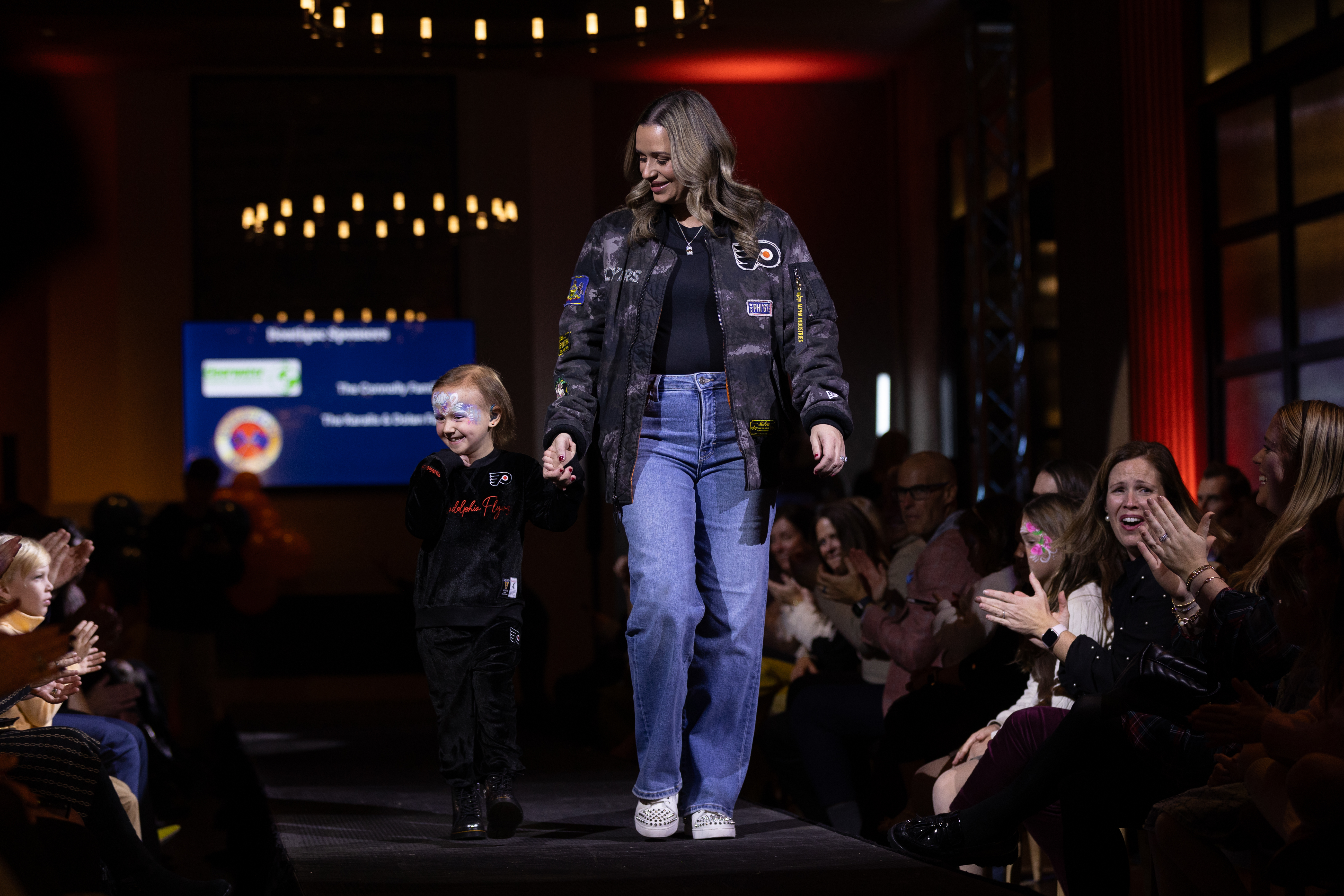
The Flyers announced this year’s recipient of the Building Hope for Kids initiative on Tuesday as part of a fashion show. The show featured children receiving treatment for cancer who are beneficiaries of Michael’s Way, modeling outfits they chose themselves from the Flyers’ store, and some of their own favorites.
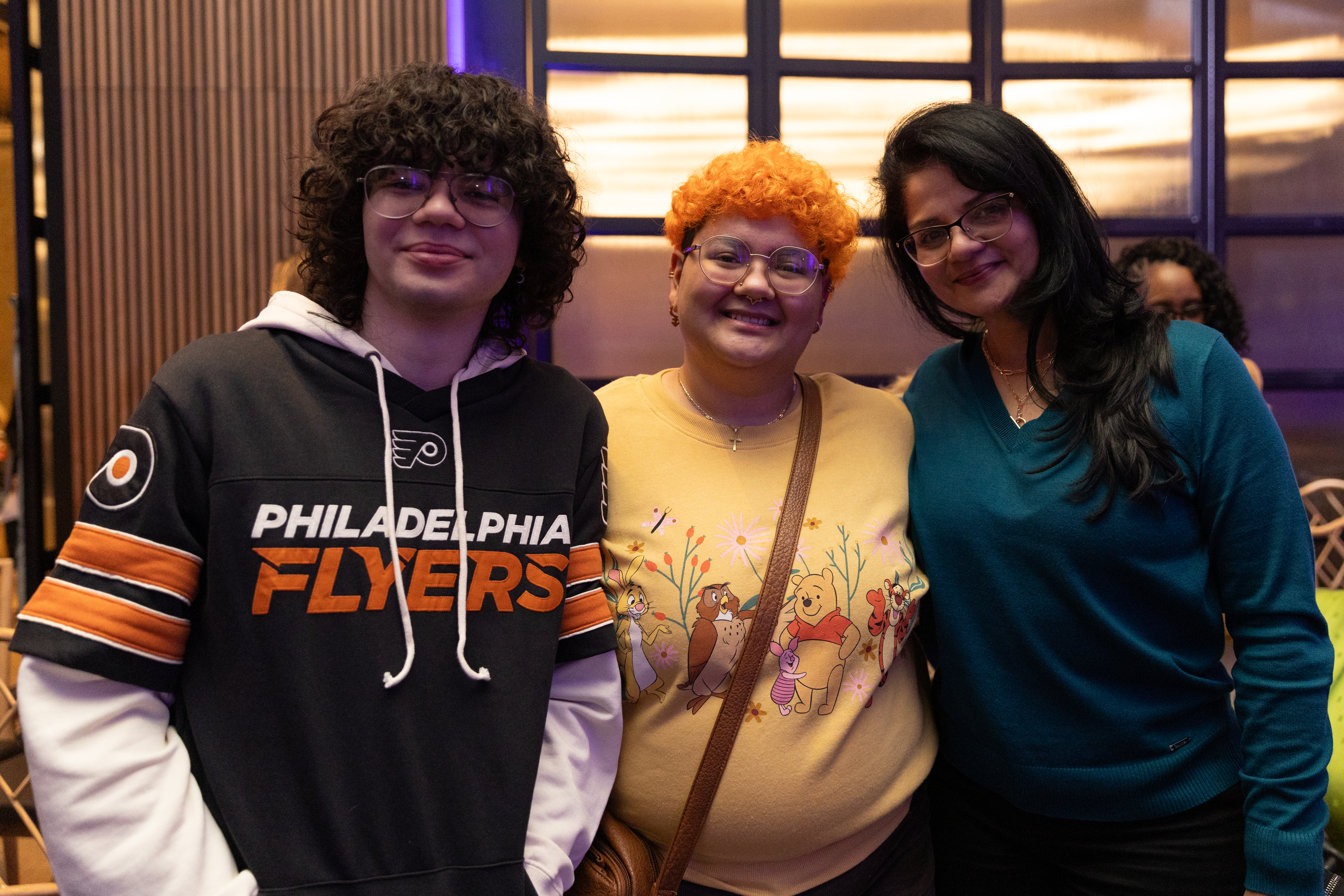
From left, Ethan Ruiz, Adonis Carlos Ruiz, and Yomayar Carrer pose for a photo after becoming the recipients of the Building Hope for Kids initiative during the Michael’s Way Fashion Show on Nov. 18.
The group included three former Building Hope for Kids recipients, and the wives and girlfriends of Flyers players, coaches, and staff, many of whom take the lead in decorating the home for the initiative each year.
“We have a great turnout,” Alex Sanheim said. “Everyone’s always willing to help. All the new ones, I feel like the first thing when you come in, we all discuss this project, and no one really understands the hype of it until you’re a part of it. Once you are, it’s truly magical, and everyone looks forward to it every year.”
Flyers Charities increased its financial contribution to the initiative to $100,000 in 2025 because of the increased cost of building materials and the success of the previous home renovations.
The Ruiz family is the 10th beneficiary of the Building Hope for Kids initiative, which returned last year for the first time since the COVID-19 pandemic. The finished renovation will be unveiled in March.
“This means the world to my family and me. I don’t think I fully believed this blessing was real until people showed up at my door,” Ruiz in the news release. “It’s incredibly reassuring to know I’ll have a home tailored to our needs. Everything I’ve needed has been provided, and having no loose ends or added worries has been such a relief.”
Sloane, 5, and Laurence Couturier walk the runway during the Michael’s Way Fashion Show.
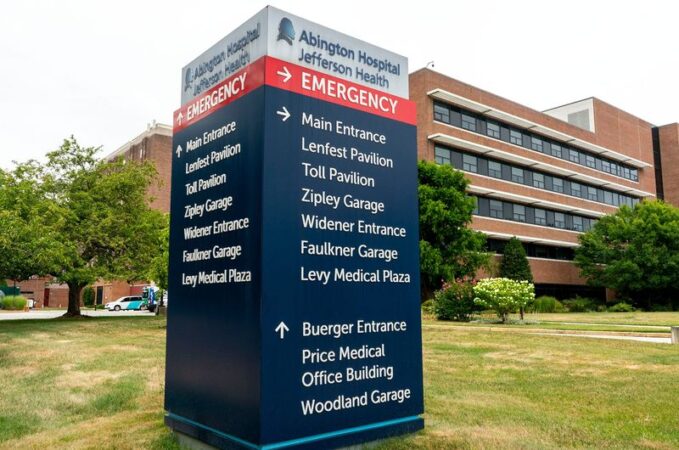
Jefferson Abington Hospital has closed its inpatient behavioral health unit and will use the 23 beds to accommodate extra patients in its emergency department, the health system said this week.
Abington will continue to provide crisis services to stabilize patients who are experiencing a mental health emergency when they arrive at the hospital, and will provide psychiatric evaluations needed to transfer them to specialized facilities. The hospital will also continue to provide outpatient behavioral health services.
The shift “will better serve our emergency department patients both with and without behavioral health needs,” Jefferson Health said in a statement.
A spokesperson confirmed the change on Tuesday but declined to say when the hospital had transitioned the 23 behavioral health beds into an emergency department “surge unit” or whether any staff members were laid off.
Jefferson Health announced in October that it had laid off between 600 and 700 of its 65,000 employees. The system reported an operating loss of $104 million in the first quarter of fiscal 2026, which ended in September, driven largely by its struggling insurance business.
The spokesperson also declined to say whether the hospital had plans to reopen the psychiatric unit in the future, or whether the change was part of ongoing restructuring across the sprawling 32-hospital system. Jefferson leaders have said they plan to streamline services across the Jefferson network, which has grown significantly through acquisitions since 2015.
The hospital’s inpatient psychiatric unit treated 350 patients in 2024, according to the most recent data from the Pennsylvania Department of Health.
Patients experiencing severe mental and behavioral health emergencies often need to be admitted to a specialized psychiatric hospital. General hospitals like Abington are critical entry points, helping to stabilize these patients and providing psychiatric evaluations, said Carla Sofronski, executive director of the PA Harm Reduction Network, a nonprofit organization that advocates for people with mental and behavioral health needs.
Patients must be evaluated by a psychiatrist or psychologist before being transferred to a specialized facility.
Sofronski said she worries that being in the emergency department could become even more stressful and scary for patients in a mental health crisis if they do not have dedicated rooms to decompress.
“It’s a very busy emergency department — what does that experience look like for people who are suffering?” she said.
Last year, an Abington security guard was accused by the Pennsylvania Department of Health of using excessive force against a patient being treated in the hospital’s psychiatric unit. Video footage of the hallway encounter obtained by The Inquirer showed the guard bringing the patient — who was naked beneath a hospital-bed blanket wrapped around her body — to the floor after she ignored his orders to stop walking. Jefferson has said the guard followed protocol.
Jefferson declined to say where it planned to transfer patients.
Other options nearby for patients in need of these services include Holy Redeemer Hospital’s 24 inpatient psychiatric beds, according to health department data from 2024, the most recent year available.
Elsewhere in the Jefferson network, Jefferson Einstein Philadelphia has 37 inpatient psychiatric beds and the system’s flagship hospital has 16.
Temple University’s vice president for enrollment and student success resigned abruptlythis week after only 2½ years in the post.
Jose Aviles’ resignation is effective Dec. 2, the university said in a message to the campus Wednesday.
“It is very difficult to leave, but I have a life-changing opportunity that awaits me,” Aviles said, adding that he would share details when able. “Serving the Temple University community has been an extreme honor, as I am deeply grateful to have had the chance to fulfill the mission of Russell Conwell and expand access and opportunity to this world-class institution.”
Temple did not respond to questions on why Aviles is leaving midyear, with the university in the midst of another application cycle.
“Jose has reimagined enrollment management at the university over the last couple of years, helping move us to a modern, technology- and data-driven approach that has delivered results,” Temple president John Fry and interim provost David Boardman said to the campus community.
They noted the university achieved growth in first-year enrollment the last two years, with this year’s group reaching a record high of 5,379.
The university also under his tenure started the Temple Promise program, which makes tuition and fees free for first-time, full-time college students from low-income families who live in Philadelphia, and the Temple Future Scholars program, a mentoring and college-readiness program.
Aviles, who came to Temple from Louisiana State University, where he had served as vice president for enrollment management and student success since 2017, was recently promoted from a vice provost to a vice president.
He said in his statement that he “received great support from this university and its leaders” and would “continue to cheer on Temple from the sidelines.”
While Temple’s first-year class was strong, the school fell short of its initial overall enrollment projection by about 700 students, which translates to about $10 million in lost revenue.
The university had been estimating it would enroll a total of 30,100 to 30,300 students, which would have been its first enrollment increase since 2017.
Instead, enrollment came in at 29,503, down about 500 from last year and further declining from its high of more than 40,000 eight years ago. (That does not include enrollment on its Japan and Rome campuses, which increased. Including those campuses, Temple’s overall enrollment was over 33,000, a slight increase from last year.)
There have also been concerns about sophomore retention and a higher percentage of third- and fourth-year students not returning.
And in September, the Temple News, the student newspaper, reported that more than 25 admissions counselors, directors, and staff left the department or were laid off over the two years that Aviles led enrollment. Students experienced delays in receiving their admissions decisions, problems with credit transfers, and difficulty with advising and financial aid packages, the Temple News reported.
“I’m proud of the work that we’ve done,” Aviles told the Temple News at the time. “We definitely walked into a challenging time for admissions but when you look at what’s really happened in the last two years, I think I’m most proud of the foundation that we’ve set.”
Representatives behind Philly’s three Michelin starred restaurants are lauded for their culinary skills, hospitality, and showmanship. But the men involved with each of them also have this shared trait: They’re all certified Wife Guys.
For those uninitiated, a wife guy is a colloquial way to refer to someone who is all about their marriage and finds ways to talk about their devotion whenever possible. (There are some instances where this phrase is used snarkily, but in this case, we mean it genuinely as a compliment and in earnest.)
When chefs Amanda Shulman and Alex Kemp stepped on stage to receive Her Place Supper Club’s one-star honor, Kemp stepped to the side, opting not to be photographed alongside the Michelin Man.
“Amanda is the hardest working woman in show business,” Kemp told The Inquirer on Wednesday. “She deserves this. I felt super proud of her, but I didn’t want to take her thunder.”
While Kemp is part-owner of Her Place, Shulman founded the restaurant and is the face (and chef) of the project.
Emcee for the night, Java Ingram, remarked on stage how Kemp’s gesture to step aside was “classy.”
He wasn’t the only one paying tribute to his wife that night.
Power couple Chad and Hanna Williams, who are behind star-winning restaurant Friday Saturday Sunday, also displayed their love for each other. Chad Williams could be seen on stage holding his wife and kissing her cheek after they received their award and Michelin jackets.
“Love and partnership is the foundation of this restaurant,” Williams later told The Inquirer of his display. “We got married in the kitchen for God’s sake. To have earned a Michelin star is my greatest accomplishment but to have done it with my wife is a dream come true.”
Finally, there was Provenance, the surprise of the night, pulling off a star within the atelier’s first year of opening.
Michelin international director Gwendal Poullennec asked Nicholas Bazik on stage what his inspiration was. While holding the mic, he pointed to his wife, Eunbin Whang. “She’s right over there,” Bazik said as the crowd erupted in “aws.” Whang demurely approached Bazik on stage, covering her face, tearful and proud as Bazik draped his arm around her.
“There would be no Provenance without my wife,” Bazik told The Inquirer, citing her influence on his “culinary identity,” blending French and Korean culture and cuisine.
So is love a prerequisite to getting a star?
Bazik seems to think so.
“Everybody needs a constant, something that can help center them. This is a hard job that oscillates between insanity and reality checks. Love is that thread.”
Kemp concurs.
“Or maybe it’s being a ‘family guy,’” he quipped when asked by The Inquirer for his take. “Amanda is a very easy person to love. She’s my best friend. We do everything together. We spend every moment of the day talking or working together.”
He added, “I love being a wife guy. It’s cool being a wife guy.”
It’s not just Dallas week for the Eagles. It also happens to be the start of the NFL’s 10th annual My Cause My Cleats initiative, which allows players to wear their hearts on their feet — by highlighting a charity of their choice with custom cleats through creative artwork and designs.
“My Cause My Cleats is a player-driven platform that does a tremendous job of amplifying the voices, charitable causes, and social issues that matter most,” Eagles owner Jeffrey Lurie said in a statement. “I am especially proud of our players for always taking this opportunity to drive change and draw attention to the organizations that work year-round to help others. The dedication of those in our building is inspiring and a testament to their ongoing commitment to making a positive difference in the community.”
This year’s My Cause My Cleats campaign will take place during Weeks 12 and 13. While the players will lace up their cleats Sunday against Dallas, the Eagles’ coaching staff will highlight the Eagles Autism Foundation during the team’s Black Friday game against the Chicago Bears by wearing custom Nike sneakers on the sideline.
Game-worn cleats will be auctioned off at NFL Auction, with all proceeds donated to the charities chosen by players. Ahead of Sunday’s game, we’ve picked out some of the Eagles’ custom cleats, but you can check them all out — and find out more on the charities they support — here …
Jalen Hurts’ custom Jordan 1 cleats will highlight the Jalen Hurts Foundation.
Jalen Hurts
Jalen Hurts will be highlighting the Jalen Hurts Foundation, which aims to “strengthen communities by servicing and advancing the youth.” Similar to last year’s cleats, the quarterback’s baby blue Jordan 1s will have the foundation’s logo painted across the toe of the shoe.
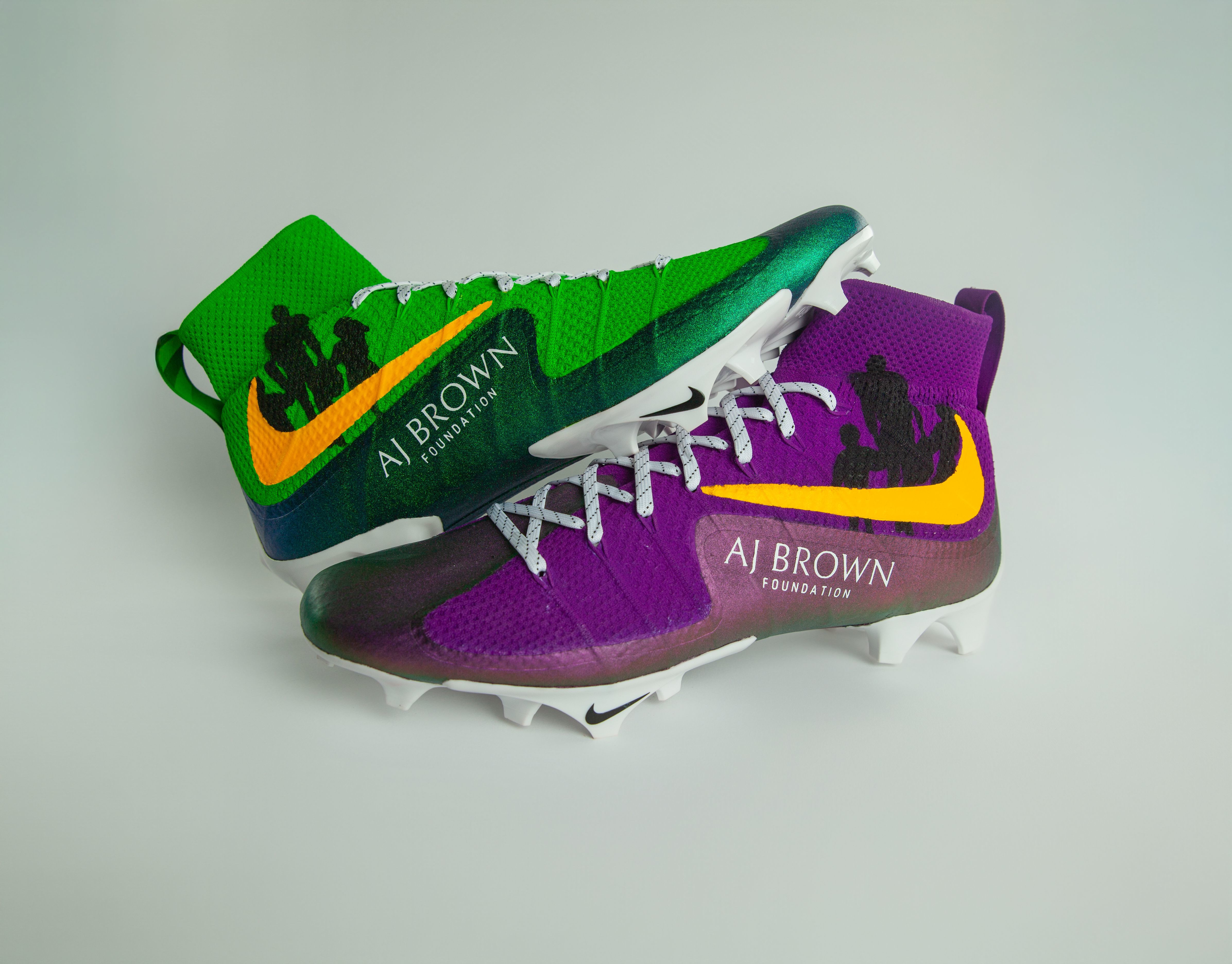
A.J. Brown will support the A.J. Brown Foundation with his custom green and purple Vapor Edge 360 “Untouchable” cleats.
A.J. Brown
Similar to last year’s look, wide receiver A.J. Brown will stick with a bold colorway — sporting green and purple Vapor Edge 360 Untouchable cleats to support youth development with the A.J. Brown Foundation. The Joker-like cleats feature a silhouette of Brown walking hand-in-hand with children above the foundation’s name.
Cooper DeJean will highlight cancer awareness and prevention with his custom cleats.
Cooper DeJean
Cornerback Cooper DeJean is highlighting cancer awareness and prevention with custom cleats designed to honor the University of Iowa Health Care Stead Family Children’s Hospital.
Representing the school’s colors, the cleats feature a yellow colorway with a painting of the hospital on the inside of the shoe. Different colored handprints decorate the cleats, and “Iowa” is painted along the outside.
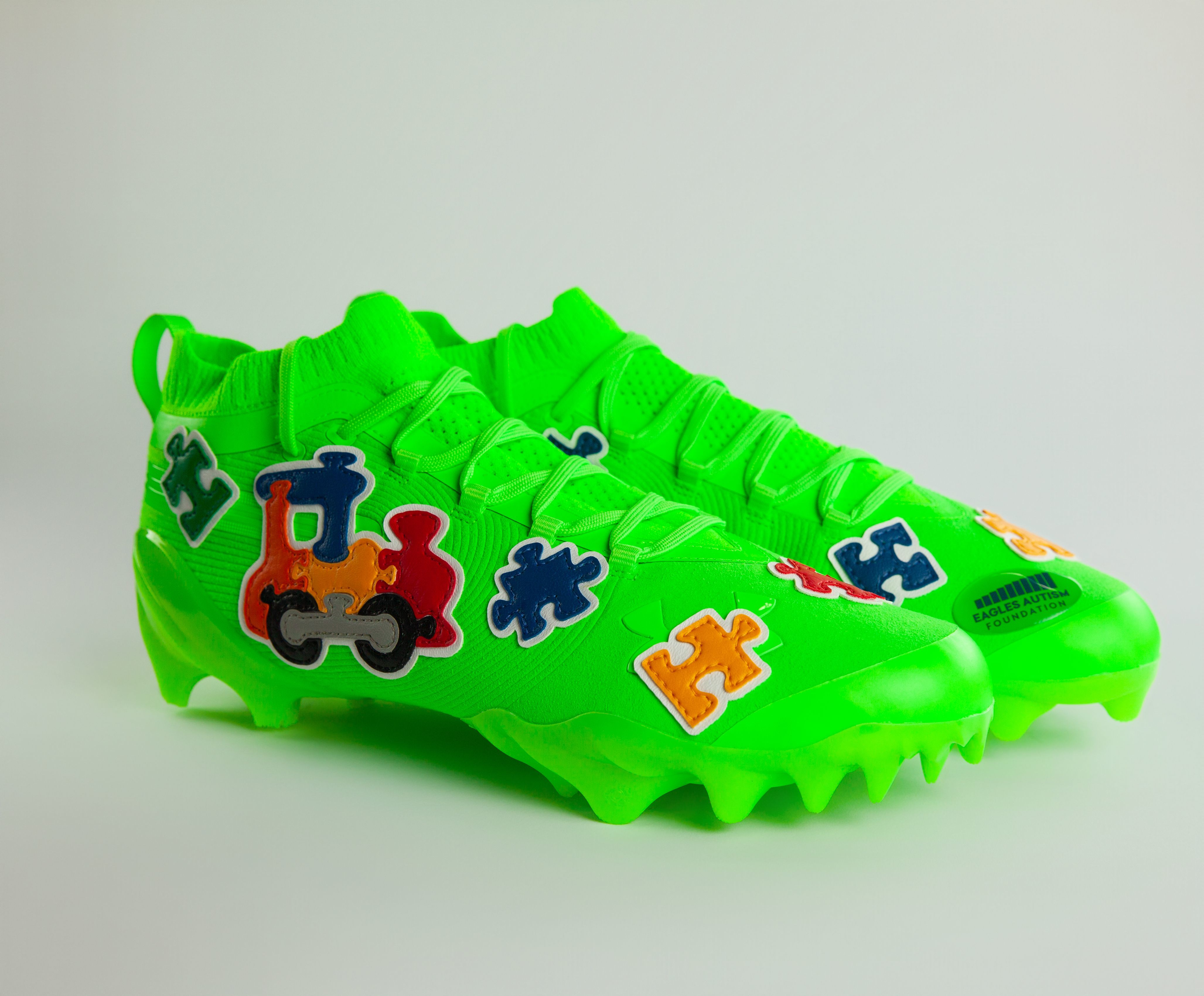
DeVonta Smith will support the Eagles Autism Foundation with custom Under Armour Spotlight Pro Suede cleats.
DeVonta Smith
Wide receiver DeVonta Smith will honor the Eagles Autism Foundation, wearing custom Under Armour Spotlight Pro Suede cleats that feature the autism puzzle pieces decorating an all-lime green body.
Nakobe Dean is supporting youth development with custom cleats designed to honor Kind Hearts 4 Lyfe.
Nakobe Dean
Nakobe Dean is supporting youth development with custom cleats designed to honor Kind Hearts 4 Lyfe. The Eagles linebacker started the foundation to “provide community outreach programs and services that support, assist, and positively impact the lives of people of all ages.”
Dean’s all-red cleats have the organization’s logo on the heel with its slogan, “Reaching for the hand, but touching the heart,” running along both shoes. Hearts decorate the inside of the Nike logo.
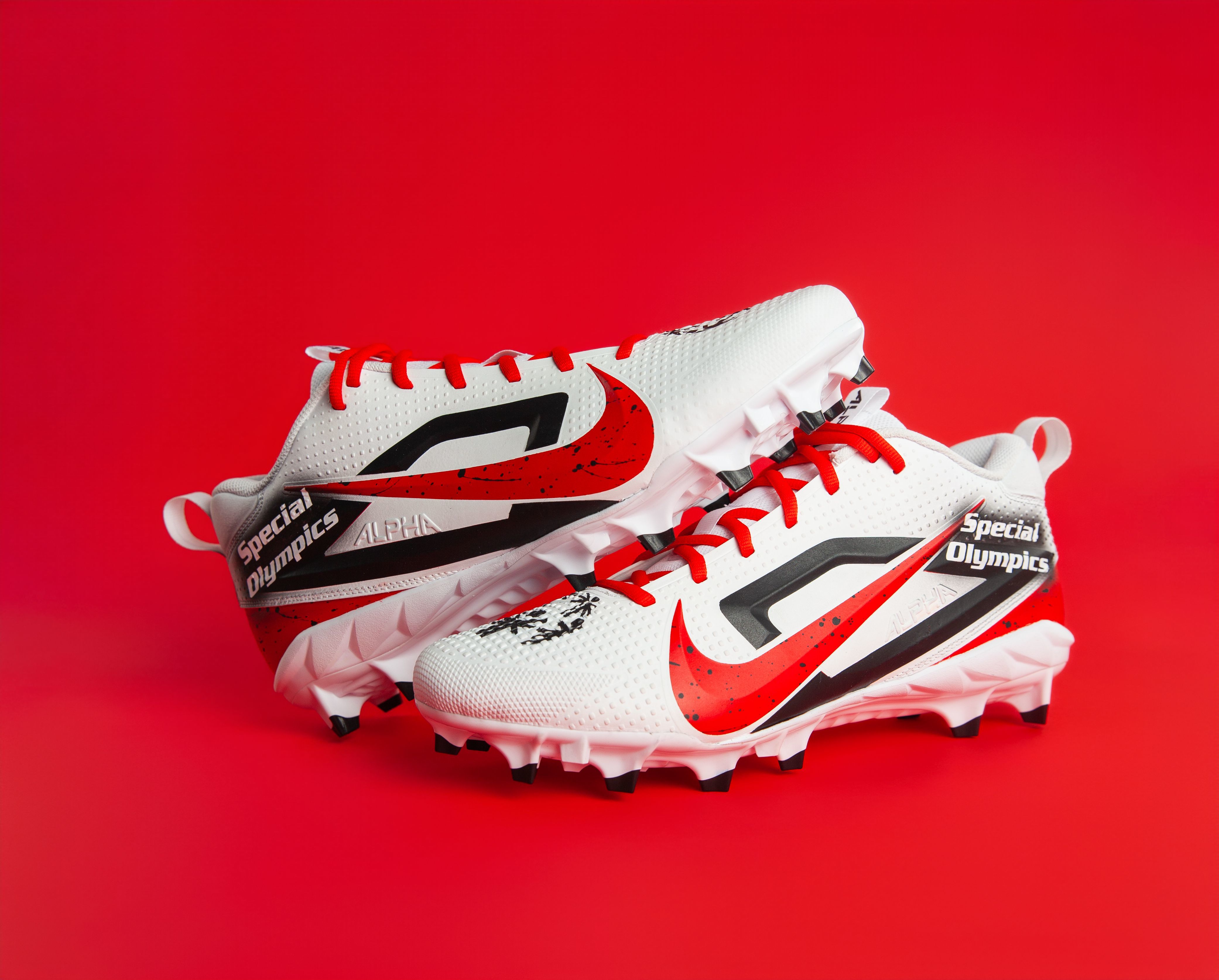
Zack Baun’s custom Nike Alpha Menace 4 Varsity cleats highlight the Special Olympics.
Zack Baun
Linebacker Zack Baun is highlighting the Special Olympics. His custom Nike Alpha Menace 4 Varsity cleats feature a sleek red, white, and black design with the Special Olympics logo on the toe of the shoe.
Britain Covey’s all-pink cleats are decorated with horseshoes to honor Bridle up Hope and the Rachel Covey Foundation.
Britain Covey
Britain Covey is supporting women’s mental health by highlighting Bridle Up Hope and the Rachel Covey Foundation. Its mission is to “inspire hope, confidence, and resilience in girls and women through horses and habits.” The foundation was founded after the death of Rachel Covey, Britain’s cousin, who battled depression for many years. Covey’s all-pink cleats are decorated with horseshoes and the foundation’s name.
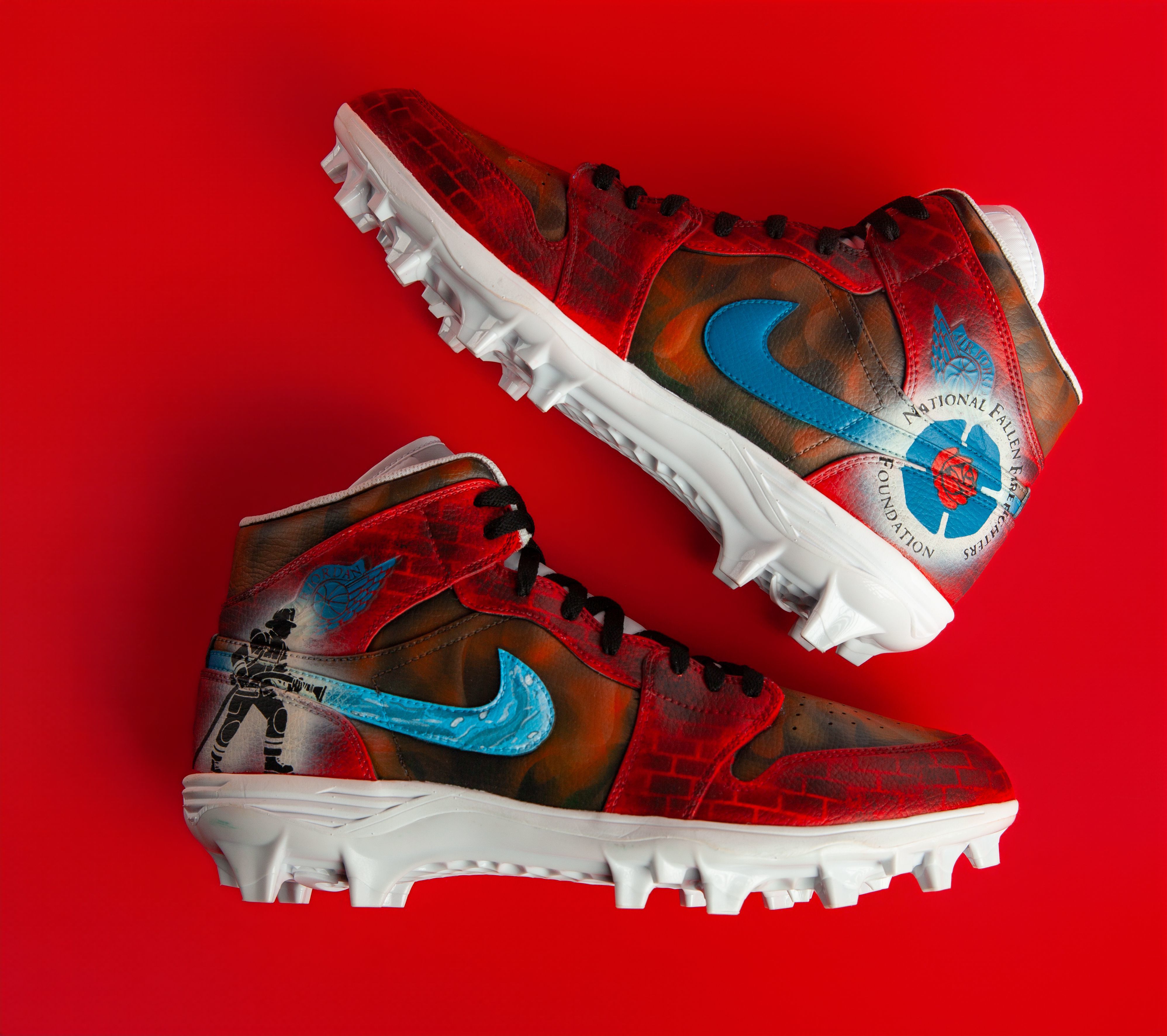
Grant Calcaterra is supporting first responders by highlighting the National Fallen Firefighters Foundation.
Grant Calcaterra
Grant Calcaterra is supporting first responders by highlighting the National Fallen Firefighters Foundation, whose mission is to “honor America’s fallen fire heroes and support their families, colleagues, and organizations,” as well as reduce the number of preventable fires.
The tight end’s custom Jordan 1 cleats are painted to replicate a firefighter extinguishing a fire in a burning building, with the artist utilizing the Nike swoosh as the water from the hose. The organization’s logo decorates the heel of the cleats. Calcaterra previously pursued becoming a firefighter before continuing his football career.
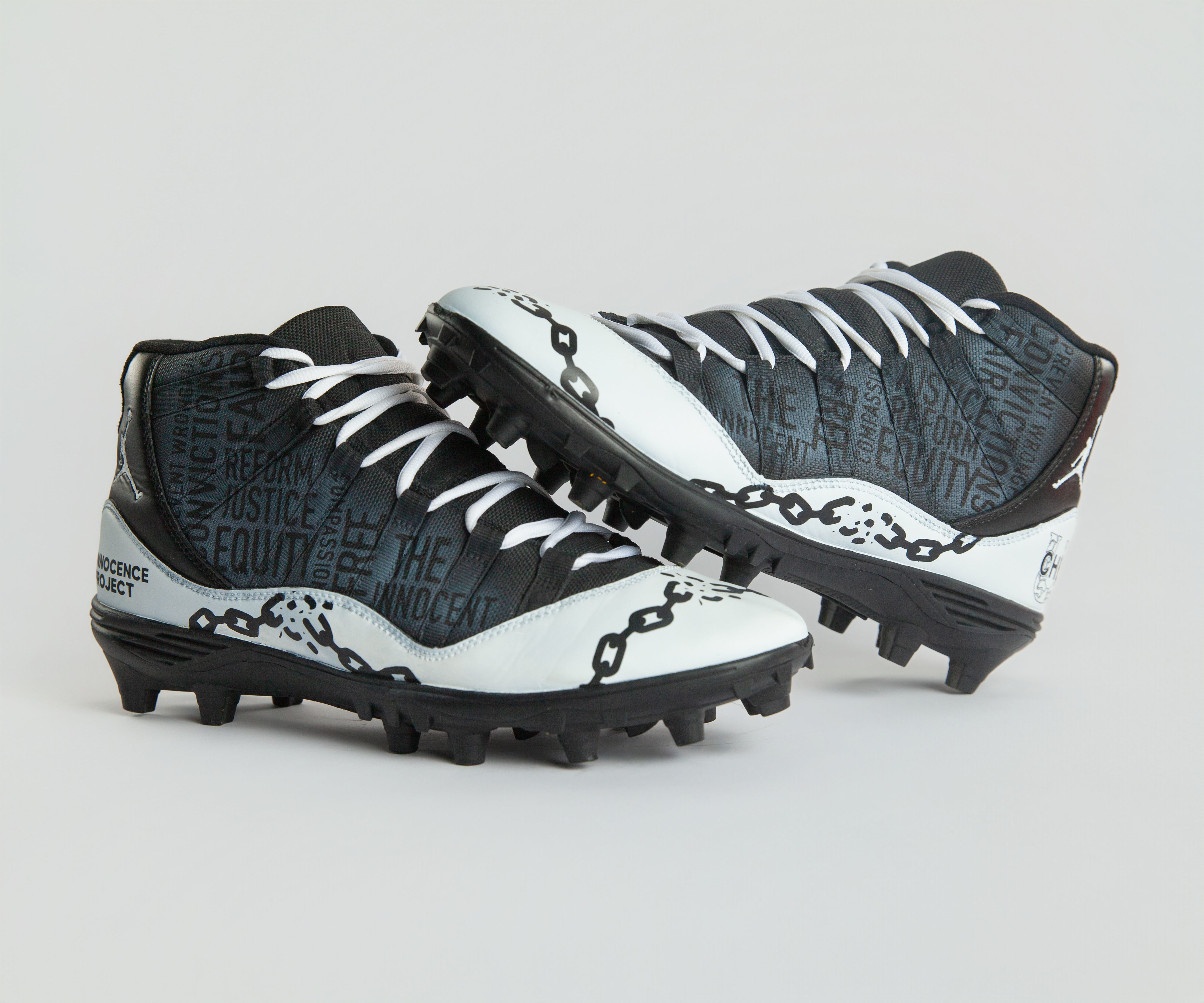
Joshua Uche’s custom Jordan 11 cleats support the Innocence Project.
Joshua Uche
Edge rusher Joshua Uche is using his platform to support social justice by highlighting the Innocence Project, which works to exonerate those who have been wrongly convicted of crimes. His custom Jordan 11 cleats are decorated in broken chains with the words “reform,” “justice,” and “equity” written across the cleats’ upper.
Lane Johnson’s camouflage cleats honor the Travis Manion Foundation.
Lane Johnson
Lane Johnson won’t be playing, but the Eagles right tackle is again highlighting the Travis Manion Foundation, supporting veterans and the families of fallen military members. His cleats feature a black and gray camouflage design with a gold star alongside the outside of both cleats.
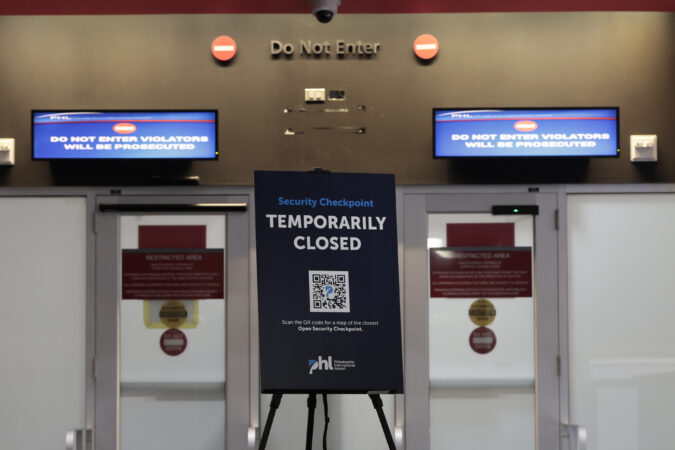
Philadelphia International Airport will reopen two U.S. Transportation Security Administration-run security checkpoints that were closed two weeks ago amid the government shutdown.
PHL’s Terminal A-West and Terminal F security checkpoints are slated to reopen Thursday, the airport announced via social media. Once opened, the checkpoints will operate on their regular schedules, with Terminal A-West running from 5 a.m. to 10:15 p.m., and Terminal F running from 4:30 a.m. to 9:30 p.m.
“We appreciate your patience as we collaborated with the TSA to maintain efficient security operations,” the airport said. “And thank you to our staff for supporting travelers throughout the closure.”
The airport closed those terminals on Nov. 5 at the request of the TSA, which was affected by the then-ongoing shutdown of the federal government. Amid the shutdown, which began Oct. 1, roughly 800 TSA officers continued screening luggage and staffing airport checkpoints without pay, and employees with the agency missed their first full paychecks on Oct. 24, The Inquirer reported.
The checkpoints’ closures, airport officials said, were temporary, though no date for their return was provided at the time they were shuttered. Checkpoints at Terminals A-East, B, C, and D/E remained operational.
The shutdown also brought a flight-reduction order from the Federal Aviation Administration, which required airlines to, in phases, eliminate 10% of their scheduled trips at 40 of the nation’s busiest airports — PHL included. Designed to ease pressure on air traffic controllers, who were experiencing staffing shortages, that order caused a number of flight delays and cancellations at PHL and other airports around the country.
The flight-reduction order was lifted Sunday, when the FAA retracted its mandate following the end of the shutdown last week. Federal legislators on Nov. 12 reached a deal to fund the government through at least Jan. 30, stopping the shutdown after 43 days — the longest stoppage in history.
Flight schedules at PHL were expected to return to normal quickly. That return to normal, as well as the reopening of the two formerly closed TSA checkpoints, comes just ahead of the holiday travel season, which the airport expects to bring about 1 million passengers through its gates between Friday and Dec. 2.
An array of dishes were set out for the critics — whole-wheat lasagna rollups, veggie samosas, cheeseburger bites with dill pickle ketchup.
The jurists did not hold back.
“That’s bussin’,” one student said of the lasagna, indicating his approval of the dish.
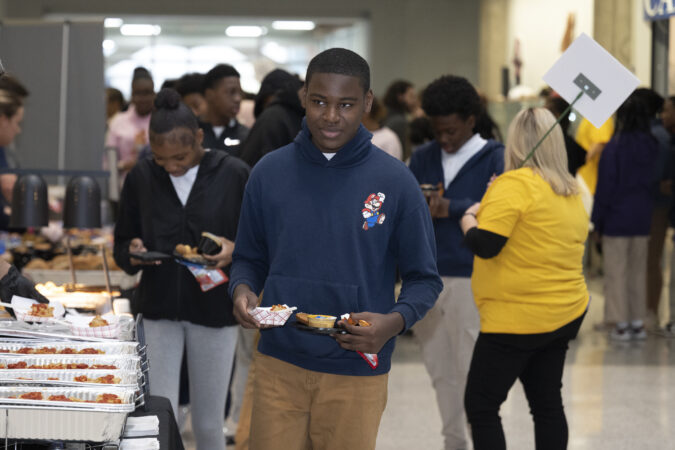
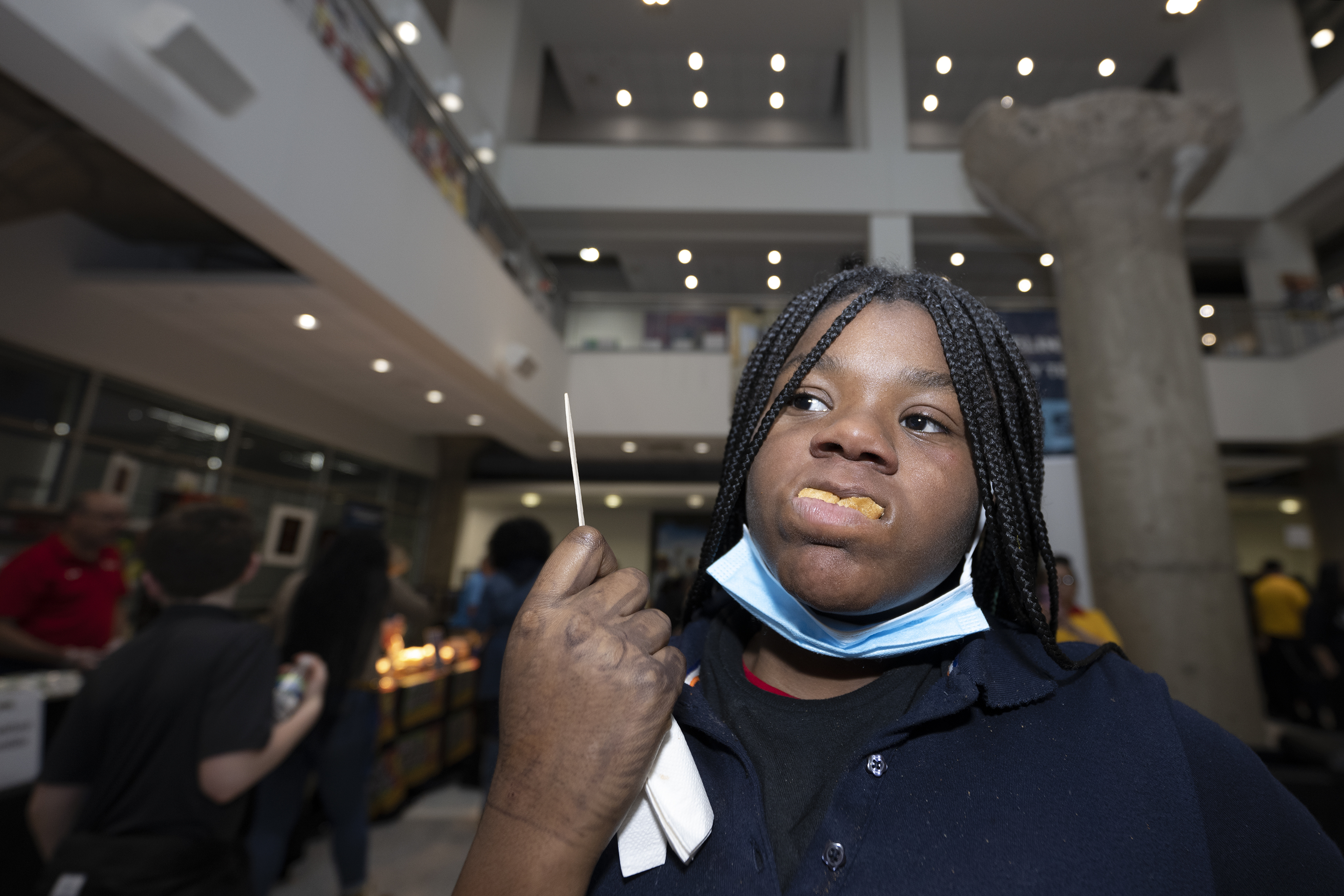
Semia Carter, a student at Crossroads Academy, tastes a burger bite while taste testing potential school lunch food on Wednesday at at Philadelphia School District headquarters.
“Mid,” another commented on the cheeseburger dish, shrugging his shoulders to emphasize how very mediocre it was.
Hundreds of city students descended on Philadelphia School District headquarters Wednesday for a food show — their chance to weigh in on dishes that might show up on their school breakfast and lunch plates next year. Thirty-three manufacturers showed off 55 products not yet in district cafeterias, from whole-grain onion rings to turkey sausage bites.
It’s one of the biggest days of the year for Lisa Norton, the district’s executive director of food services.
“We give the students voice to select the menu that they will eat every day,” Norton said. “It’s the dietary fuel that students need to learn.”
Norton knows her critics won’t hold back. She was prepared for that.
“They will tell the vendors, ‘We don’t like this,’” she said. “But that’s what we need. We want to buy food they’ll eat.”
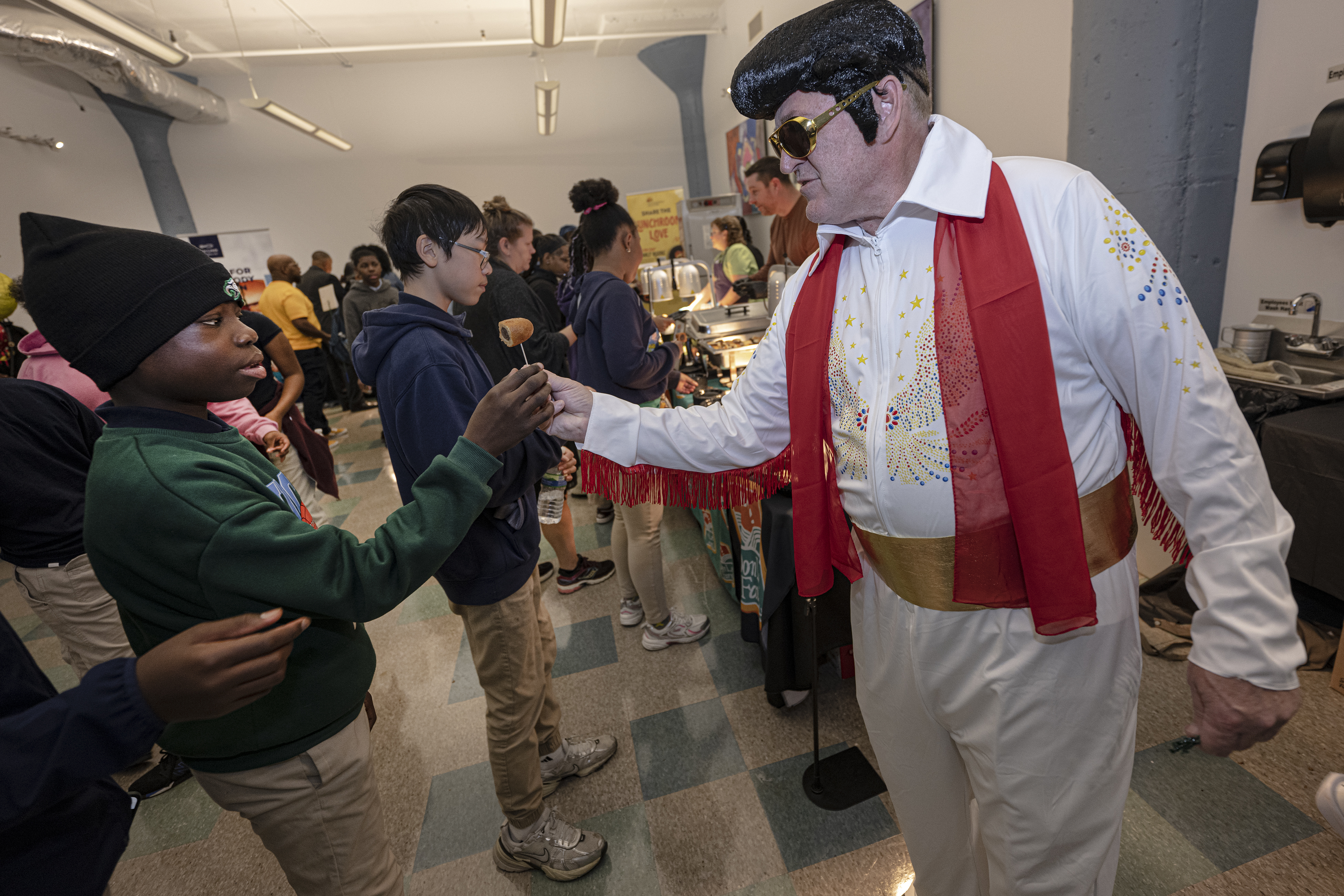
All around Norton, students scoped out offerings, tasted things that looked good, then recorded their thoughts after scanning QR codes on their phones. At one station, a man dressed as Elvis danced and encouraged students to try more.
Three friends from Hancock Elementary in the Northeast said everything they tried was “really good” — an improvement from the food offered in their cafeteria now. (Though Philadelphia is a “universal feeding” district, so every student receives free breakfast and lunch regardless of income, the Hancock students were like most who spoke to The Inquirer — they said they eat school food only sometimes, preferring to bring lunch from home most days.)
“Sometimes it’s mystery mush,” sixth grader Alina Leone said of current school food offerings.
“Sometimes it’s not bad,” said her classmate Calie Sharpe.
“There’s pizza almost every day,” said Aislee Blaney, another Hancock friend.
Havyn Nelson, a seventh-grade student at Lingelbach Elementary in Germantown, found the brownie bars and the taco meat tasty.
Peyton Sanders, Havyn’s classmate, scrunched her nose when asked to describe the dishes her school offers now.
“It’s prison food,” Peytonsaid.
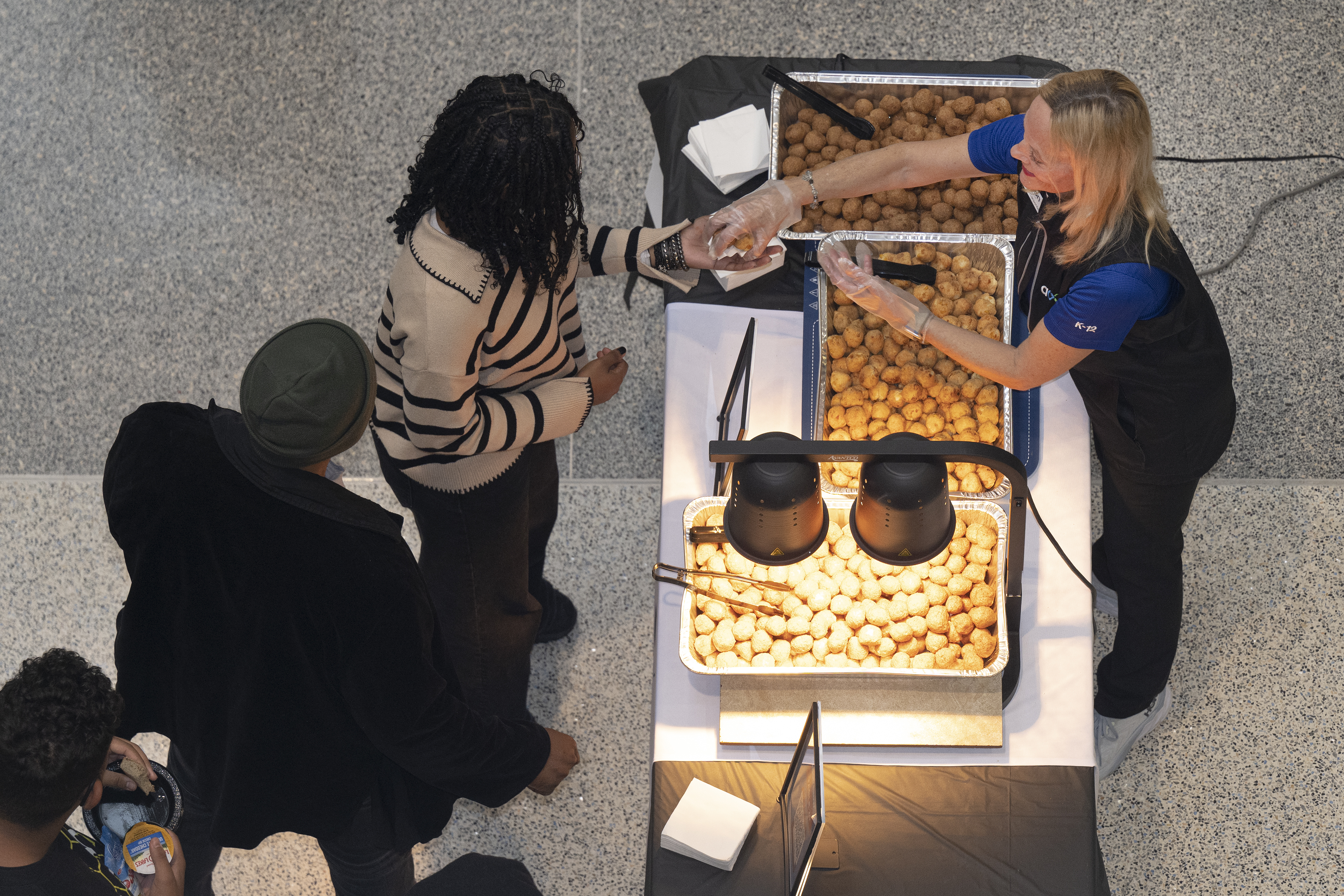
Jannette Carpentier of Acxion Foodservice serves Southern hush puppies to students during a taste test at the Philadelphia School District headquarters on Wednesday.
Angelo Valvanis, who works for the company Grecian Delight, offered students beef gyro with what he marketed as “white sauce” — tzatziki sauce. His firm has dishes that students in Chicago, Detroit, and New York eat, and it was hoping to break into Philly.
“You guys ever get gyro from food trucks? It’s really good. You know, the meat that turns, and you cut it with a knife? It’s from Greece,” Valvanis said.
The idea of school lunch still conjures the image of tasteless, lukewarm, floppy food — hot dogs, pizza, chicken nuggets — but school meals have changed, Valvanis said.
“These kids are much more open,” he said. “They all see these things on YouTube.”
In front of him, a group of students nodded.
Gabby Swaminathan, a sixth grader from Meredith Elementary in Queen Village, nibbled the gyro. It was good, she said.
“Our food at school right now is not that good,” Gabby said. Her strategy was to rate the food she liked — the gyro, the lasagna roll-ups — really highly, with hopes those will eventually replace the food she doesn’t like.
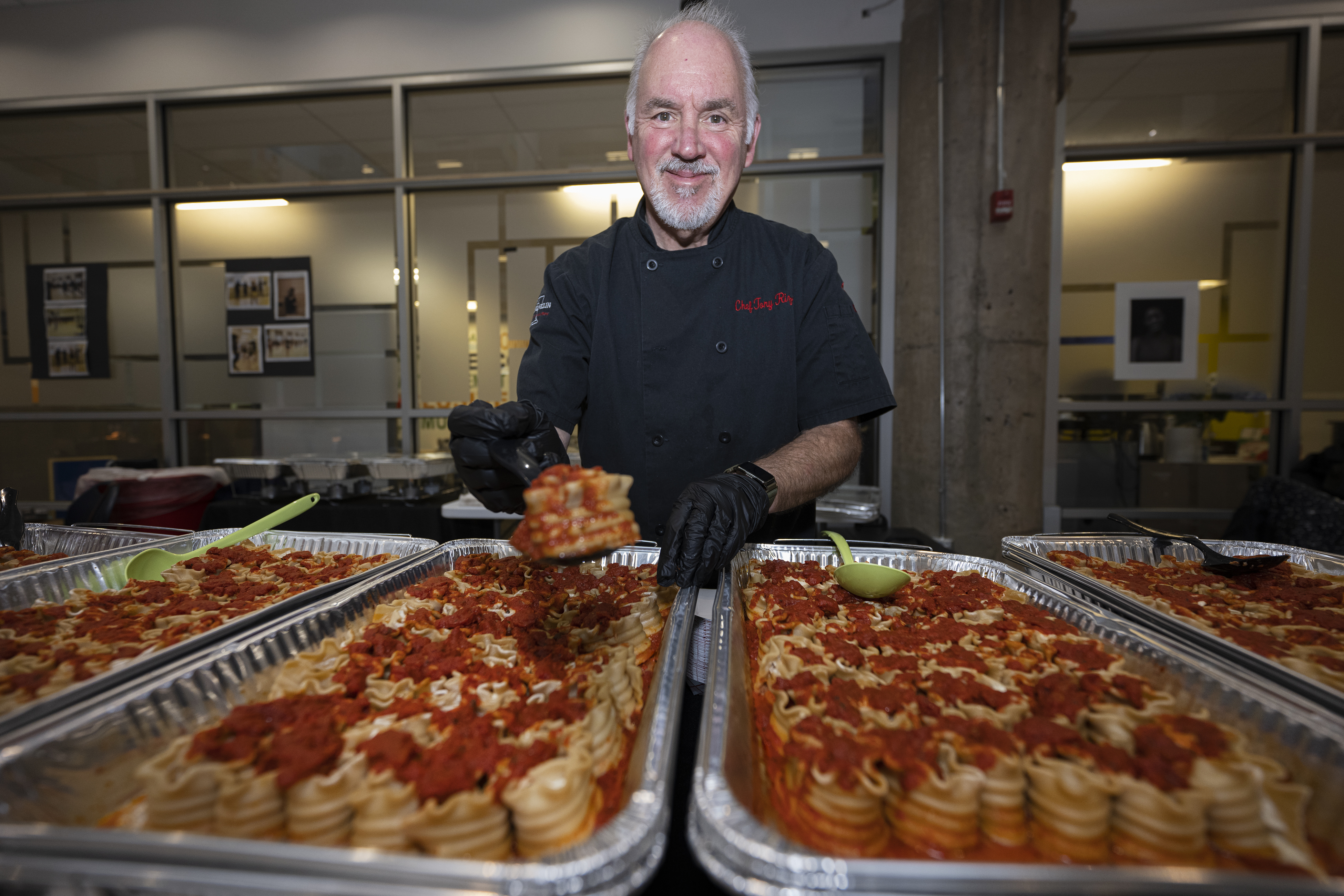
Chef Tony Rizzo of Chase Franklin Food Company shows Marieta pasta ahead of a student tasting session at the Philadelphia School District headquarters on Wednesday.
Wednesday’s event was timely. Several members of Philadelphia City Council grilled district officials about the food at a Tuesday hearing on school matters, saying constituents had concerns about the quality of the meals served to students. The elected officials said they want to come to a Center City school to eat the same lunches students eat.
Superintendent Tony B. Watlington Sr. explained the district’s conundrum — its food service program must be funded completely by reimbursements fromthe U.S. Department of Agriculture.
“The dollars are not robust enough to have filet mignon everyday, but it is sustenance, and I say that very respectfully,” Watlington told Council.
Kameron Garrick and Amaud Burton-Bullock, students at Martin Luther King High, can say definitively they have never been served filet mignon at school.
They mostly skip school lunch, they said, and buy food at a corner store or eatathome.
But sure, they were game to try the offerings.
The cheeseburger bites? OK.
“I would say it’s mid,” Kameron said. “It needs more seasoning.”
But they found a bright spot — the cornbread bowls with chicken.
“I would take that cornbread,” Amaud said. “It was nice and moist.”
Kervens Orelus, a student at Lingelbach, gets a corn dog from Elvis during a testing session at the Philadelphia School District headquarters on Wednesday.
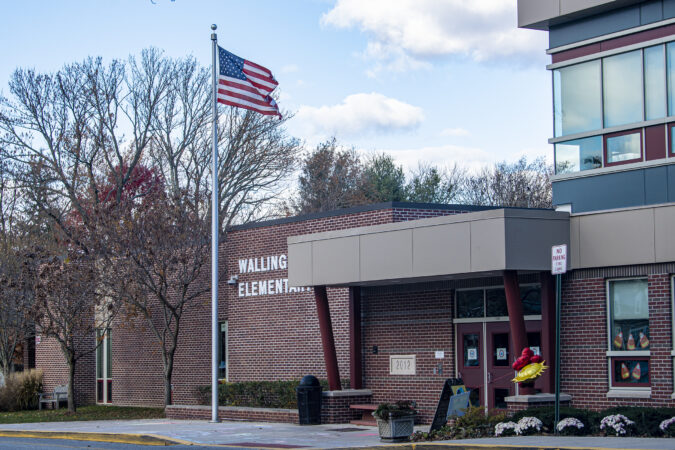
The Wallingford-Swarthmore School District is headed for a $2.6 million budget deficit, district officials said during a presentation on Tuesday night.
At a meeting of the district’s finance committee on Nov. 18, Superintendent Russell Johnston and business administrator DeJuana Mosley presented a dire picture of the school district’s finances. Increased staffing costs, subpar inventory management, and costly building repairs have coincided with a shrinking revenue base in the district, officials said. Without implementing a “cultural shift” around spending, Mosley said, the district is staring down major fiscal problems for the 2027-28 school year.
“Bottom line, the district has a spending problem,” Mosley said.
Why is Wallingford-Swarthmore facing a budget deficit?
District administrators say Wallingford-Swarthmore‘s fiscal issues are largely related to runaway spending and insufficient recordkeeping.
The school district’s budget has increased by 18%, or around $16 million, over the last five years. Administrators said the district has had to pour resources into its security, nursing staff, and costly building repairs that had been put off for years. On top of that, Mosey outlined a lack of inventory management, describing a culture across the district of “just ordering stuff.”
Johnston was hired earlier this year to replace former Superintendent Wagner Marseille. The school district parted ways with Marseilles in 2024 amid mounting criticism of his management style and spending decisions.
The district’s unsustainable spending has been set to the backdrop of a decreasing tax base, officials said. The 2025 taxable assessed value in the school district is $2.6 billion, a $5.8 million decrease from 2024. The decrease resulted in a $174,000 loss in revenue.
School districts in Pennsylvania are limited by the Act 1 Index, a formula used to determine the maximum tax increase a district can levy (without voter approval). The index is calculated using the statewide change in wages, the nationwide change in school employee compensation costs, and an individual district’s relative wealth. Wallingford-Swarthmore’s 2026-27 Act 1 Index is 3.5%.
Unlike neighboring school districts like Rose Tree Media, which has seen continued population increases and new construction, Wallingford-Swarthmore is small and almost entirely residential. Limited construction and growth leaves few opportunities to increase the district’s tax base.
Around 20% of the district’s revenue comes from state and federal subsidies. Mosey said poor recordkeeping had impacted state subsidy and grant revenue (the issue has since been cleaned up, she added).
How is the district planning to balance the budget?
If no changes are made, the school district is set to be short about $2.6 million for the 2027-28 school year. Mosley recommended the district cut the budget by double that amount ($5.2 million).
“I know it’s alarming and it’s aggressive and it’s a lot,” she said. “We’re trying to change the trajectory of what we’re doing.”
Johnstonsaid the district should look at cost savings that are “furthest away from the classroom,” citing examples like professional development and travel for staff, a reduction of the size of the district’s capital plan, and a review of “potential redundancies in services and staffing.” He also suggested evaluating which services the district is required to provide and which are optional.
“I almost have to take a deep breath when I say this out loud, but kindergarten transportation is not required,” he said, offering cutting buses for kindergartners as an example.
Johnston emphasized that he was not making a suggestion to cut kindergarten transportation from the get-go, but was offering it as an example of an optional service the district provides.
What happens next?
The district has to present a 2027-28 budget draft by June of next year. Johnston and Mosley said they were deliberately bringing the budget process to the public months in advance to allow for ample conversations with teachers, staff, parents, and the school board.
In early December, Johnston will host optional community forums with school faculty and the community. The school board’s finance committee will present a potential budget reallocation strategy at its Dec. 16 meeting. On Dec. 22, the board is set to vote on its reallocation expectations.
This suburban content is produced with support from the Leslie Miller and Richard Worley Foundation and The Lenfest Institute for Journalism. Editorial content is created independently of the project donors. Gifts to support The Inquirer’s high-impact journalism can be made at inquirer.com/donate. A list of Lenfest Institute donors can be found at lenfestinstitute.org/supporters.
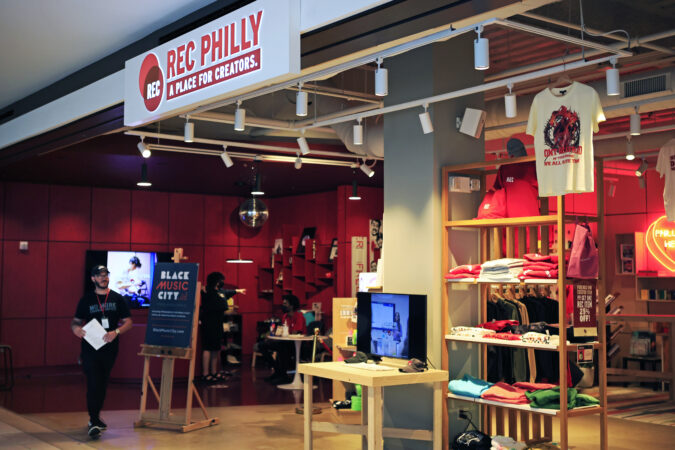
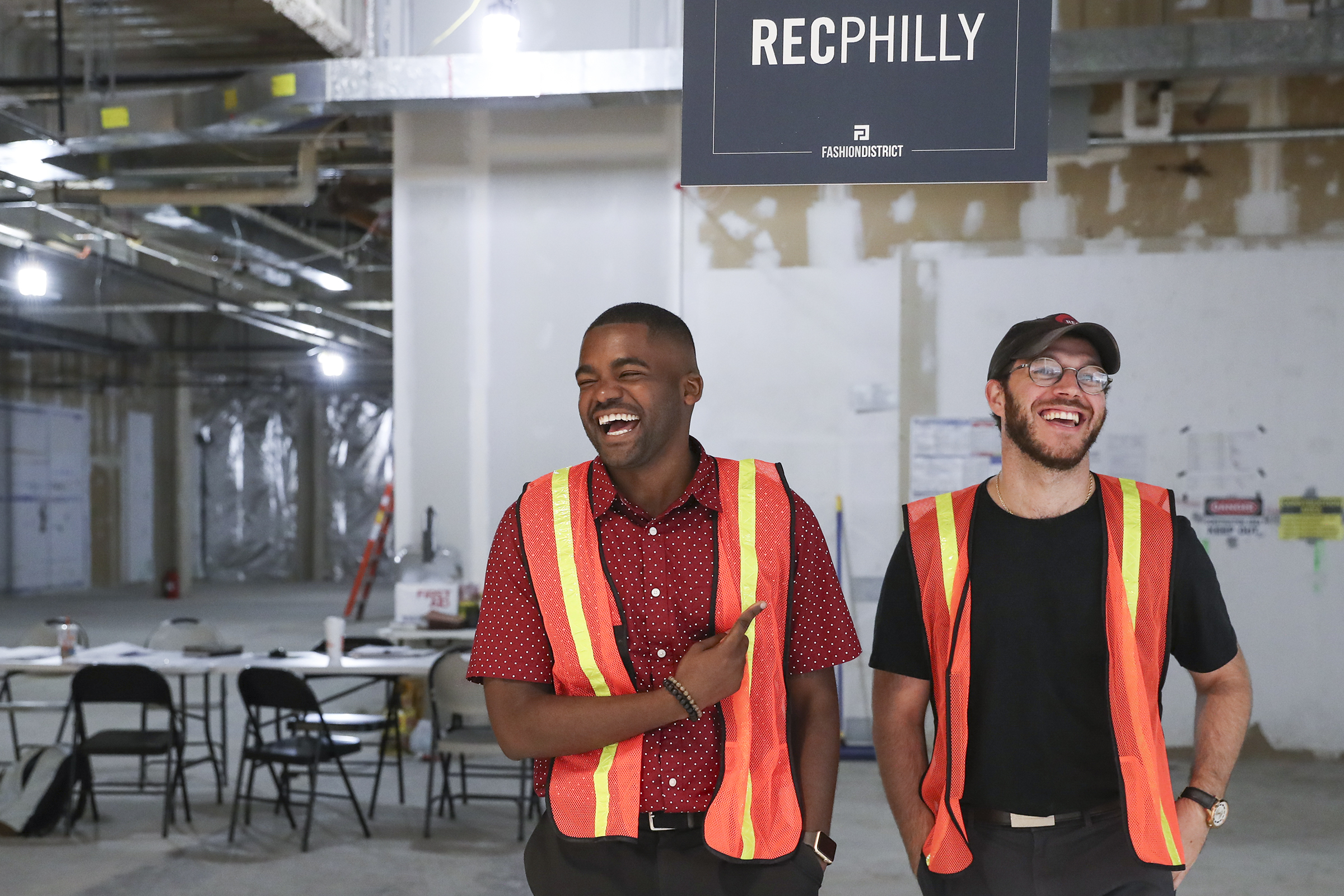
REC Philly, a long-standing space for independent creatives and entrepreneurs to cowork and create in, is closing its Center City headquarters on Dec. 20.
In an email sent to REC Philly members on Monday, the organization announced the shuttering of its Fashion District 10,000-square-foot space, located at Ninth and Market Streets, due to “unforeseen circumstances.”
“We know this news may come as a surprise, and we do apologize for any inconvenience it may have caused. We’ll stay in touch with any updates, but until then, stay creative,” the email stated.
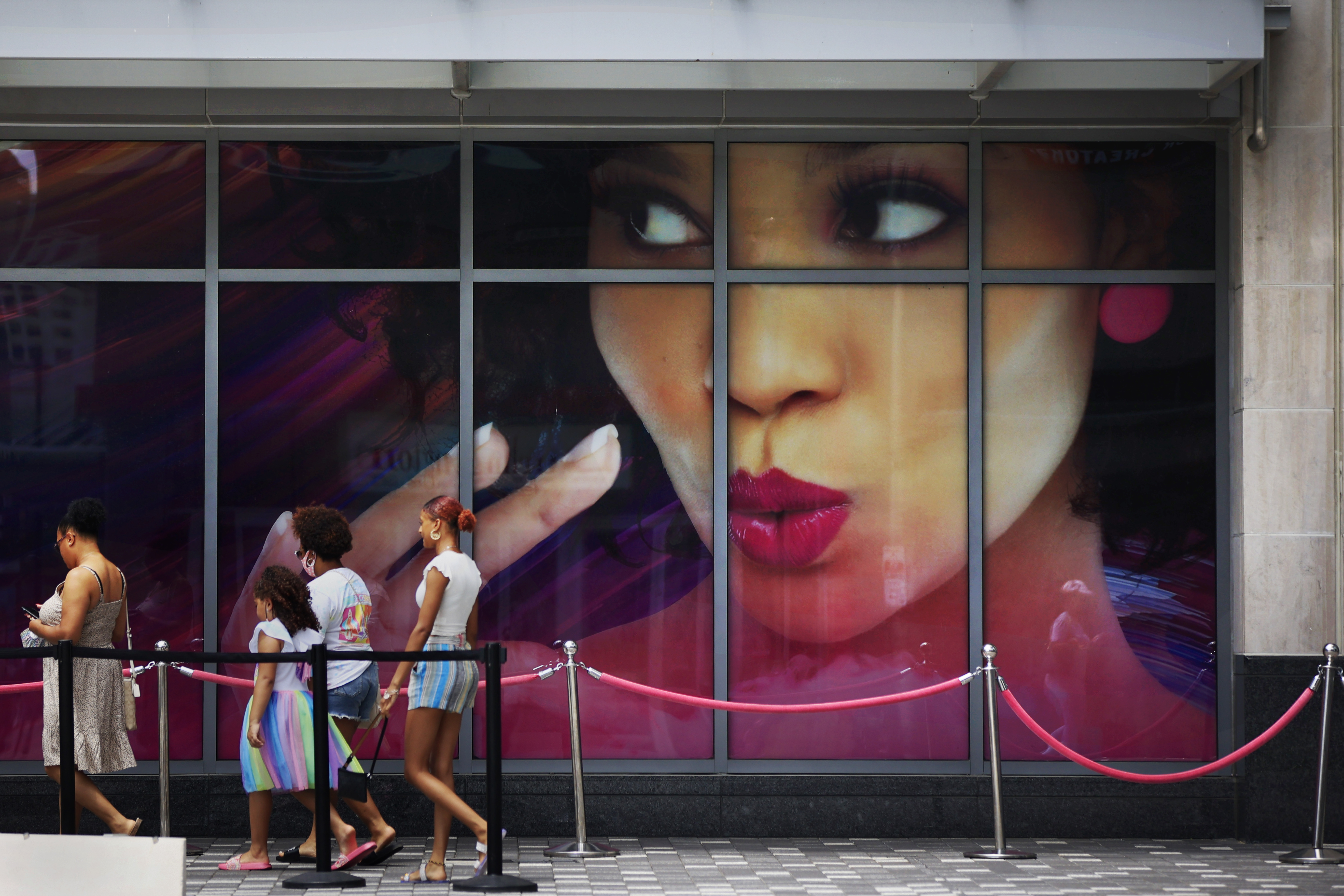
Patrons walk past an advertisement on June 19, 2021 outside the Fashion District.
All active REC Philly members will have access to the space through the closing date, the email stated. After that, all memberships and app access will end and some refund options will be available.
“This decision was made due to circumstances beyond our control related to the long-term sustainability of the space,” the email states. “It was not made lightly, and our team explored every possible option before reaching this point.”
William Toms, left, and David Silver pose for a portrait inside the REC Philly space at Ninth and Market Streets, on July 25, 2019.
The announcement comes six years after cofounders Will Toms and Dave Silver opened the facility. The venture, originally named the Broad Street Music Lounge, started in Silver’s North Philly basement. That’s where the duo — who met as high schoolers at Warminster’s William Tennent High School — held concerts and community events for friends before launching REC in 2014.
They opened a 600-square-foot warehouse, located at Ninth and Dauphin Streets, a year later. And in 2019, they cut the ribbon on the Fashion District location, which housed a recording studio, performance stage, and coworking areas.
REC, an acronym for “resources for every creator,” also offered workshops, educational programs, grants, and networking events.
Guests gather as WNBA player and North Philadelphia native Kahleah Copper participates in a Q-and-A at REC Philly on Tuesday, Oct. 29, 2024 in Philadelphia.
While the Center City hub will close its doors at the end of the year, REC Philly will not be completely shutting down operations, just the space.
“REC is not shutting down completely at this time. The space needs to close in order for the business to properly transition,“ the email to members states. Those transitional plans are yet to be announced.
Neither Toms nor Silver responded to media inquiries in time for publication.