Blog

  • Quinyon Mitchell looked like an All-Pro vs. the Lions. His Florida family and friends were there to see it.

    Quinyon Mitchell looked like an All-Pro vs. the Lions. His Florida family and friends were there to see it.

    From his rookie season in 2007 through 2015, Darrelle Revis was the NFL’s best cornerback: seven Pro Bowls, four first-team All-Pro selections, 28 interceptions, three pick-sixes. He was so good that the Jets, for whom he played most of his career, seldom gave him help from safeties, which left him on an island. His nickname soon became Revis Island, a place where receivers went to disappear.

    Soon, Quinyonamo Bay will be as famous as Revis Island.

    That’s the early nickname for the twilight zone that surrounds Quinyon Mitchell, the Eagles’ current best candidate for Defensive Player of the Year. It refers to Guantánamo Bay, the U.S. naval base and notorious military prison on the Cuban coast.

    Maybe it’s not the most tasteful play on words, but it’s a bit of phrasing that aptly connotes both the sinister intent and dire prospects associated with challenging the best cover corner in the NFL.

    On Sunday night, in perhaps Mitchell’s finest hour of many fine hours to date, a dozen of his friends and family from Williston, Fla., attended a 16-9 win over the Lions in what could be an NFC championship game preview. Most were second cousins, and all were laid-back Florida mellow.

    From 47-year-old cousin Kendall Edwards, the senior member of the clan, to 13-year-old T.J. Snead, the aspiring quarterback / safety / outfielder / pitcher, they were bursting with pride that “Q” had played so well in prime time in a game dominated by the Eagles defense.

    Eagles cornerback Quinyon Mitchell is in the midst of a shutdown season.

    “It was awesome,” said Snead. “But cold.”

    Factoring in 25-mph winds, the real-feel temperature Sunday night in Philly was 30 degrees. It was 79 back in Williston. Mitchell was even hotter.

    He allowed zero catches and zero yards on six targets, according to Next Gen Stats. The league said that tied for the best performance against at least six targets since the beginning of the 2024 season.

    In fact, through 10 games, Mitchell has allowed a 41.9% completion rate, which, according to Next Gen, is the lowest since 2018. He has not allowed a touchdown pass.

    He is in just his second season.

    As well as new edge rusher Jaelan Phillips has played; as well as linebacker Nakobe Dean has played since returning from injury; and as well as hard-hitting corner Cooper DeJean, linebacker Zack Baun, and defensive tackle Jalen Carter, the linchpin of the defense, have played all season, none has been as suffocatingly good as Mitchell.

    Mitchell has not gotten the recognition he deserves because he does not take as many chances as most corners, which means he doesn’t get beaten, but he also doesn’t rack up interceptions. He has zero picks in his 26 regular-season games, but that doesn’t mean he can’t catch. He picked off Packers quarterback Jordan Love in the Eagles’ wild-card playoff win in January and snagged one from Jayden Daniels in the NFC championship game win over the Commanders.

    Mitchell faces the best of the best — Hall of Fame-caliber quarterbacks and Pro Bowl receivers who play on proven teams.

    The Eagles opened the season against the Cowboys, who feature CeeDee Lamb and George Pickens. They then visited Patrick Mahomes in Kansas City. They then beat Matthew Stafford, Puka Nacua, and Davante Adams when the Rams visited and did the same to two-time Pro Bowl quarterback Baker Mayfield in Tampa, when Mitchell was named NFC Defensive Player of the Week.

    He was just getting started.

    Mitchell blanketed Justin Jefferson, the league’s best receiver, when the Birds won in Minneapolis: one catch, 10 yards, three targets. He gave up two catches for 24 yards on seven targets in Green Bay; then, on Sunday Night Football, he pitched a shutout against Amon-Ra St. Brown and, occasionally, Jameson Williams.

    NBC analyst Cris Collinsworth, who owns Pro Football Focus, an analytics service that rates every NFL player, believes in the numbers. He said Sunday that Mitchell already is among the best corners in the league, if not the best.

    Emmanuel Acho, a retired Eagles linebacker and current NFL analyst, posted a film session Tuesday with evidence from Sunday to support Acho’s claim that Mitchell is No. 1.

    Like Acho, Mitchell’s three cousins, who played with him at Williston High, presented evidence.

    “He traveled well,” said Malik Latson, who was a senior receiver when Mitchell started as a freshman cornerback.

    He referred to Mitchell often covering St. Brown whether the Lions receiver lined up on the left side, the right side, or the slot. Last season, Mitchell lined up almost exclusively on the right side. This season, Mitchell travels all the time.

    “He recognized a lot of routes before they ran them. He understood leverage,” Latson continued. “That off-man, I think, is his best coverage.”

    Indeed, Mitchell seemed most effective when he gave the Lions receivers a few yards of cushion at the line of scrimmage.

    But still, no picks. Revis knows: Picks get you to the Pro Bowl.

    “That’s fine. No picks, that’s fine,” said Zachary Riley, who was a senior receiver and defensive back at Williston when Mitchell was a freshman. “He completes the assignment. There were no big catches on him. I mean, no catches at all, that I remember.”

    He remembered correctly.

    “I mean, he just looked normal. Smooth,” said C.J. Strange.

    He would know best.

    Quinyon Mitchell breaking up a pass intended for Giants receiver Darius Slayton on Oct. 26.

    Strange and Mitchell graduated together. Strange played quarterback (and punter) with Mitchell, who played not only corner but also running back in high school and ran for 983 yards and 11 touchdowns as a senior.

    Mitchell and Strange played high school basketball together as well. That’s why Strange got the White Glove treatment last weekend, while the rest of the clan fended for themselves.

    Mitchell picked up Strange at the airport around midday Saturday. They had an early dinner, then went back to Mitchell’s home to watch college football.

    Latson and Riley are working as truck drivers out of Virginia, so they rented a car and drove up, but as they crossed the Pennsylvania state line and called Mitchell in the early evening, he replied, “Sorry. I’m about to head to the team hotel.”

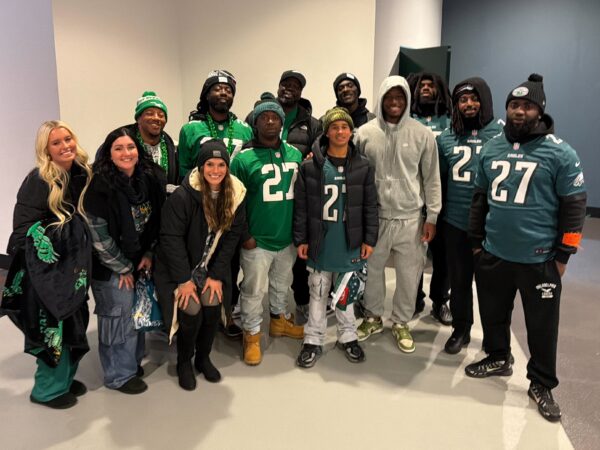
    They spent the night in his home with Strange, and the trio of teammates carpooled to the game in Mitchell’s truck, piling out two hours before game time in matching midnight green No. 27 jerseys.

    They didn’t see Mitchell until after the game, when he emerged from the locker room tunnel and found himself awash in the affection unique to big families from the South.

    “It means a lot, having this support system, and some of them coming all the way from Florida,” Mitchell said. “A whole lot of love here.”

    And with that, the whole group left Lincoln Financial Field, eager to bask in the aura of Quinyonamo Bay.


  • Musicians will honor beloved WMMR host Pierre Robert in memorial concert

    Musicians will honor beloved WMMR host Pierre Robert in memorial concert

    What better way to remember Pierre Robert than to hold a concert in his honor?

    93.3 WMMR announced on Wednesday the Pierre Robert: A Show of Life, a celebration of the memory of the beloved Philly radio host, whose unexpected death last month shocked the music world.

    “We will sing, dance, and celebrate in the way Pierre would have wanted us to,” said Chuck Damico, WMMR’s program director.

    The concert will take place at the Fillmore on Dec. 17. Tickets will cost $50 and go on sale Friday at 10 a.m. through Ticketmaster on the Fillmore’s website. A portion of the proceeds will go to MANNA, the Metropolitan Area Neighborhood Nutrition Alliance.

    The show will feature bands and musicians near and dear to the former WMMR host’s heart, including The Hooters, Brent Smith and Zach Meyers of Shinedown, Lizzy Hale and Joe Hottinger of Halestorm, and Ed Roland of Collective Soul.

    “He was a beautiful man who meant so much to so many people,” an emotional Roland said on social media.

    A poster for a concert honoring former WMMR host Pierre Robert, who died unexpectedly last month.

    Robert, 70, was found dead in his Gladwyne home on Oct. 29 after failing to show up for his midday show. The cause of Robert’s death was not disclosed and officials don’t plan to release additional information. Caroline Beasley, the CEO of WMMR’s parent company, Beasley Media Group, said foul play was not suspected.

    “Everything seemed to be natural,” Preston Elliot said on air following Robert’s death. “It just appears he passed overnight.”

    Robert was a musical institution in Philadelphia, where he spent 44 years on the air sharing his deep love of classic rock and expressing a humanity that touched musicians and listeners across the county.

    Earlier this month, hundreds of fans and friends flooded Rittenhouse Square, where Robert enjoyed a book and a cup of La Colombe coffee just days before his death.

    “He was truly irreplaceable and his passing will leave a big hole especially in the local music community,” Hooters singer and cofounder Rob Hyman said. “Pierre was that ‘good citizen’ who will be missed by all.”

    Pierre Robert’s annual Thanksgiving Day show will continue this year, hosted by his former producers.

    With Thanksgiving approaching, WMMR plans to keep Robert’s annual Turkey Day show alive with a midday show anchored by Ryan Shuttleworth and featuring a collection of the rock host’s former producers — Kevin Gunn, Michael Anthony Thompson, Nick McIlwain, Jason Fehon, and Chris “Pancake” Ashcraft.

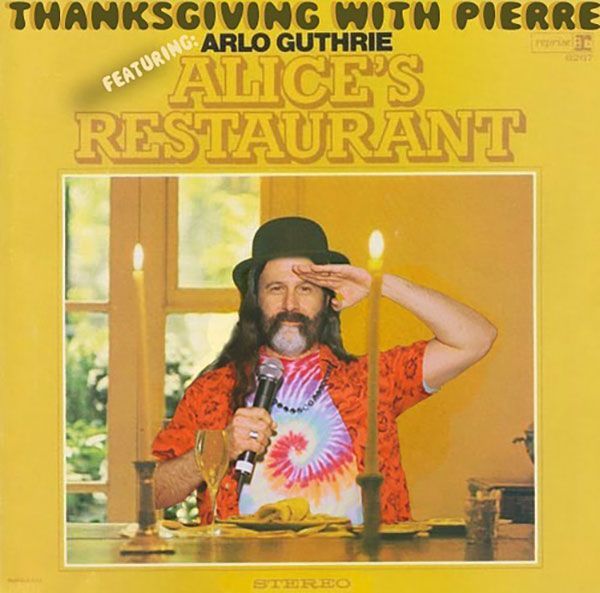
    And yes, that means a heaping spoonful of Arlo Guthrie’s “Alice’s Restaurant Massacree,” the folk singer’s 18-minute opus. Expect to hear three versions of the song, including the even-longer 25th anniversary edition, which will be played at noon.

  • Treating chronic pain faces obstacles in light of the opioid epidemic

    Treating chronic pain faces obstacles in light of the opioid epidemic

    A woman in her mid-50s was my fifth patient on a long day treating people with severe chronic pain, all with similar stories. An automobile accident 25 years before left her with severe lower back and neck pain.

    At the time of her accident, she was a mother with three small children. Her primary care physician had been treating her for all this time with a relatively high and stable dose of opioid pain medications.

    Prescription painkillers were viewed differently when she first began taking these potent medications. It was a common and legitimate medical practice to offer higher doses of opioid medications — so long as the patients required them for pain relief, didn’t abuse them, and didn’t have any concerning side effects.

    These medications had given this patient significant relief and had allowed her to raise her children and live a relatively normal life.

    With her primary care physician now retiring, she was looking for a doctor willing to allow her to continue her medications, and even slowly taper them under supervision. But she couldn’t find a provider, not even one specializing in pain management, willing to take her on as a new patient.

    Eventually, she found her way to me through a referral. I specialize in carefully treating patients with severe pain with the medications that they require to relieve their suffering.

    I had heard nearly identical stories from the four patients that I had already treated that morning, all suffering from severe chronic pain. They had previously sought relief through surgery or nerve blocks and procedures like spinal cord stimulators, but they still were suffering from unrelenting pain.

    My medical opinion was that the only option available to them at this stage was opioid medication. They had ended up in my clinic, however, because the pain specialists they had been seeing were not willing to increase their doses, even under close supervision.

    Twenty-five million Americans suffer from high impact chronic pain — defined as daily pain that negatively affects their quality of life and ability to work. In the 1990s and early 2000s, improper prescribing of opioids by inadequately trained healthcare providers — along with immoral actions and misleading information from some pharmaceutical and medication-supply companies — led to the “opioid crisis.”

    Many unwitting patients became addicted to these substances and suffered great harm.

    Today, however, I am seeing a new crisis among patients who truly suffer from debilitating, life-limiting, and sometimes life-destroying pain. They cannot get the care they need.

    Chronic pain patients are maligned, misjudged, disrespected, and often treated in a punitive way. The overwhelming majority of patients with chronic pain, who are treated appropriately by highly skilled and empathetic physicians, use these medications to help ameliorate severe pain, not because they are looking to get high or satisfy an addiction.

    When treated with expertise, they obtain great benefit, and many can resume something of a normal life.

    The woman and the four patients whom I had already treated that morning each benefited from higher levels of medication. Each tolerated them without adverse effects, and none abused, diverted, or misused the medications. What had led to our medical system being unwilling to give them the treatment they needed?

    Concern about regulatory oversight and potential civil and criminal legal issues have prompted many physicians, including pain specialists, to stop prescribing opioid pain medications. (I cannot explain this contradiction — how can a pain physician not prescribe effective pain medications?)

    Many pharmacists also tell me that they are reluctant to dispense these medications, even if the patient has an appropriate prescription from a qualified physician. The pharmacists say that they are under scrutiny by the Drug Enforcement Administration and that their suppliers can be threatened with disciplinary actions if they fill even completely proper prescriptions above their quota.

    It’s not unusual for my patients to tell me that they had to call 25 to 50 pharmacies before they found one to fill their prescriptions.

    In Pennsylvania, the recent closure of Rite Aid pharmacies has exacerbated the problem. Patients who had been getting their pain medications from Rite Aid are now searching for alternatives. But most of the remaining pharmacies have reached their quotas of controlled medications such as opioids with established patients and are not able to serve new patients.

    In some particularly egregious situations, pharmacies have had their entire supply of controlled substances suspended for seemingly minor issues.

    I am a pain specialist, caring for many patients with severe pain. Most of my patients have exhausted or failed other potential therapeutic options. Over 90% of my patients who use opioid medications as their last available option get significant pain relief and have improved quality of life.

    Yet due to the current situation, I now have many patients who are struggling to obtain these valuable medications, with many also having to deal with symptoms of withdrawal.

    Many of my patients often wonder to me why they are punished because of others’ misdeeds and say that they have done nothing wrong and have simply been unfortunate to have suffered injuries and illness, that it’s not fair and is cruel.

    It’s time that we begin to correct this travesty. We can treat these patients with expertise. The “opioid crisis” will not worsen by proper and dignified treatment of patients with chronic pain. They certainly deserve our care and their prescribed, helpful medications.

    Ira Cantor, M.D., is an internal medicine physician specializing in pain management at Steiner Medical & Therapeutic Center in Phoenixville.

  • Philly’s big Michelin night! | Let’s Eat

    Philly’s big Michelin night! | Let’s Eat

    What a night! Nearly three dozen Michelin restaurants in the 215!

    Also in this edition:

    Mike Klein

    If someone forwarded you this email, sign up for free here.

    A very Philly Michelin night

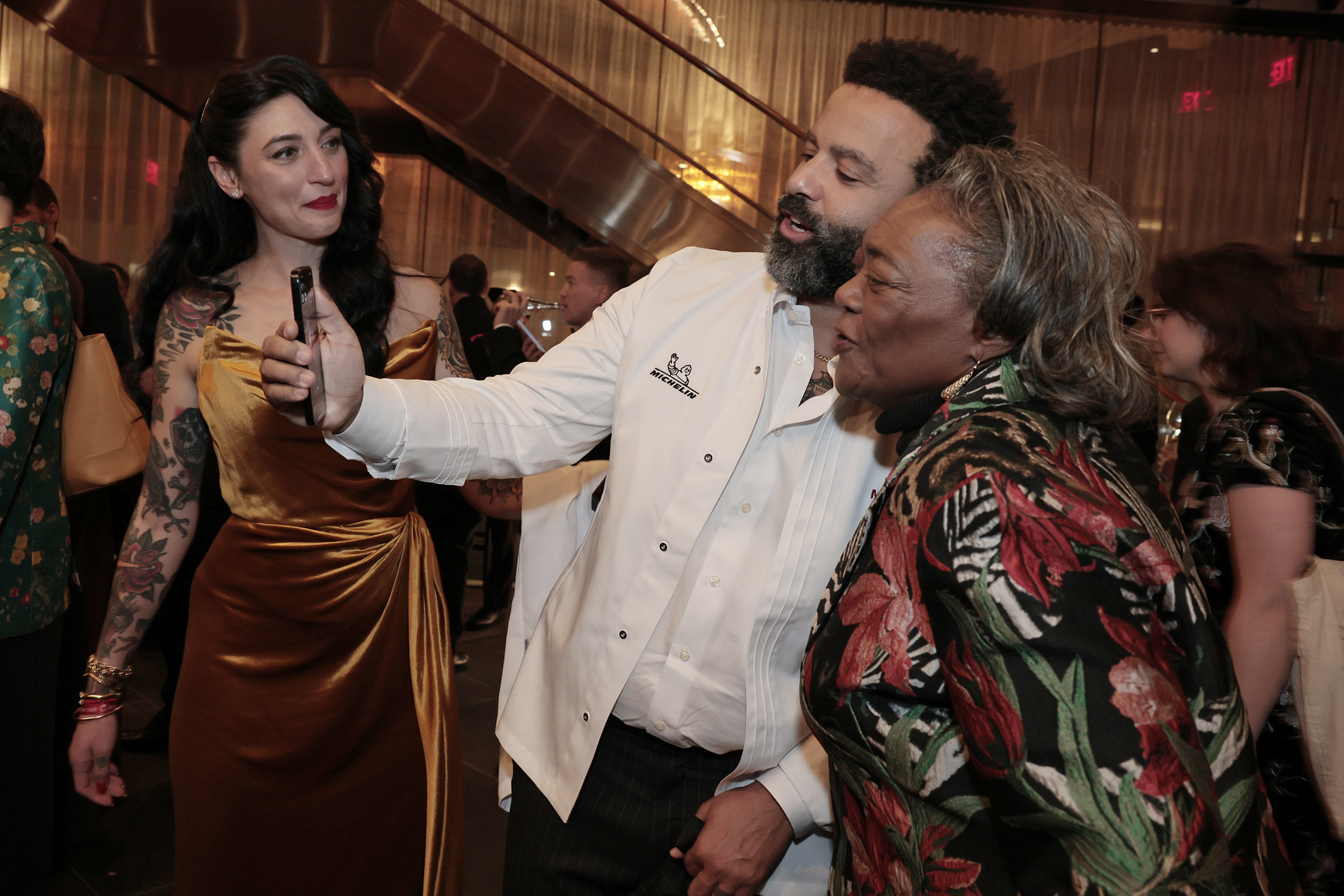
    For the first time ever, Philadelphia has a Michelin star. Three, in fact. Plus 31 other restaurants with Michelin acclaim, including three cheesesteak spots!

    We lay out last night’s winners and what it all means. (Beyond the fact that you might never be able to be a walk-in anymore.)

    Our favorite pies

    You say you’re not baking this year? No worries. We scouted outlets for pie, and we’ve found bakeries that are a cut above. Check out our map.

    Where to eat along Marathon route

    Sunday’s Philadelphia Marathon wends from Old City out to Manayunk. If you’re watching with kids, here are 10 restaurants that can accommodate everyone relatively painlessly.

    Chef puts his stock in milk buns

    Chef Yehuda Sichel of the sandwich shop Huda has gone into the burger biz with Huda Burger, set right in the middle of everything in Fishtown. The secret sauce, as it were, is his fluffy, house-made milk buns.

    A look back at the Inquirer Food Fest

    🤤 A recap of some of the tastier bites from last weekend’s Inquirer Food Fest.

    🧁 Watch Eagles star Jordan Mailata and his wife, Niki, judge the Great Inquirer Bake-Off.

    Scoops

    Luna Cafe in Kensington is making a short but substantial move, ceding its home at Third Street and Cecil B. Moore Avenue for a new space two blocks away at the Luxe (1705 N. American St.), allowing owner Sarah Varisano to grow the brand without leaving the neighborhood she’s called home for 13 years. Varisano, who started Luna in Old City 10 years ago as a new Drexel University MBA grad, will close the current cafe after brunch service on Dec. 14 and expects an April reopening. Luna’s familiar identity — full-service brunch, breakfast, coffee-to-go — will remain, while its bar and beverage program will expand. Evening hours will be added Thursday through Saturday. A key Luxe draw is the large outdoor courtyard, which Varisano expects to activate with about 50 seats for brunch, evening service, collaborations, and pop-ups.

    Palm Vintage Cafe — cafe by day, high-end cocktails and sushi by night — is on the way this winter to 1414 S. Penn Square (next to La Colombe and across from City Hall at the Residences at the Ritz Carlton). Houston Yang, who also owns the new Fushimi sushi counter at Two Liberty Place, and friend Mike Beja, an engineer, plan to offer pastries, breakfast sandwiches, salads, lunch sandwiches, and coffee from 7 a.m. to 4 p.m. Then it goes to cocktails, sushi, caviar, oysters, and light food till 10 p.m. The tropical motif is meant to evoke a relaxed island escape in the middle of Center City.

    Mei Mei in Old City is undergoing renovations. Meanwhile, owner Jay Ho is taking over the former Izakaya Fishtown space next spring with Kato, an homage to his Taiwanese father and the food he grew up eating, amped by his love of Korean, Thai, and Vietnamese cooking. Ho plans to keep the front bar intact but will transform the back sushi counter area into additional dining space with the option for private dining.

    Capperini, a luxe spot serving an Italian-Mediterranean menu with a liquor license, is on its way to 137 S. Easton Rd. (at Wesley Avenue) in Glenside. Co-owner Ilya Vorobey, whose partners include the crew from Capri in Queen Village, says it should open next spring.

    Restaurant report

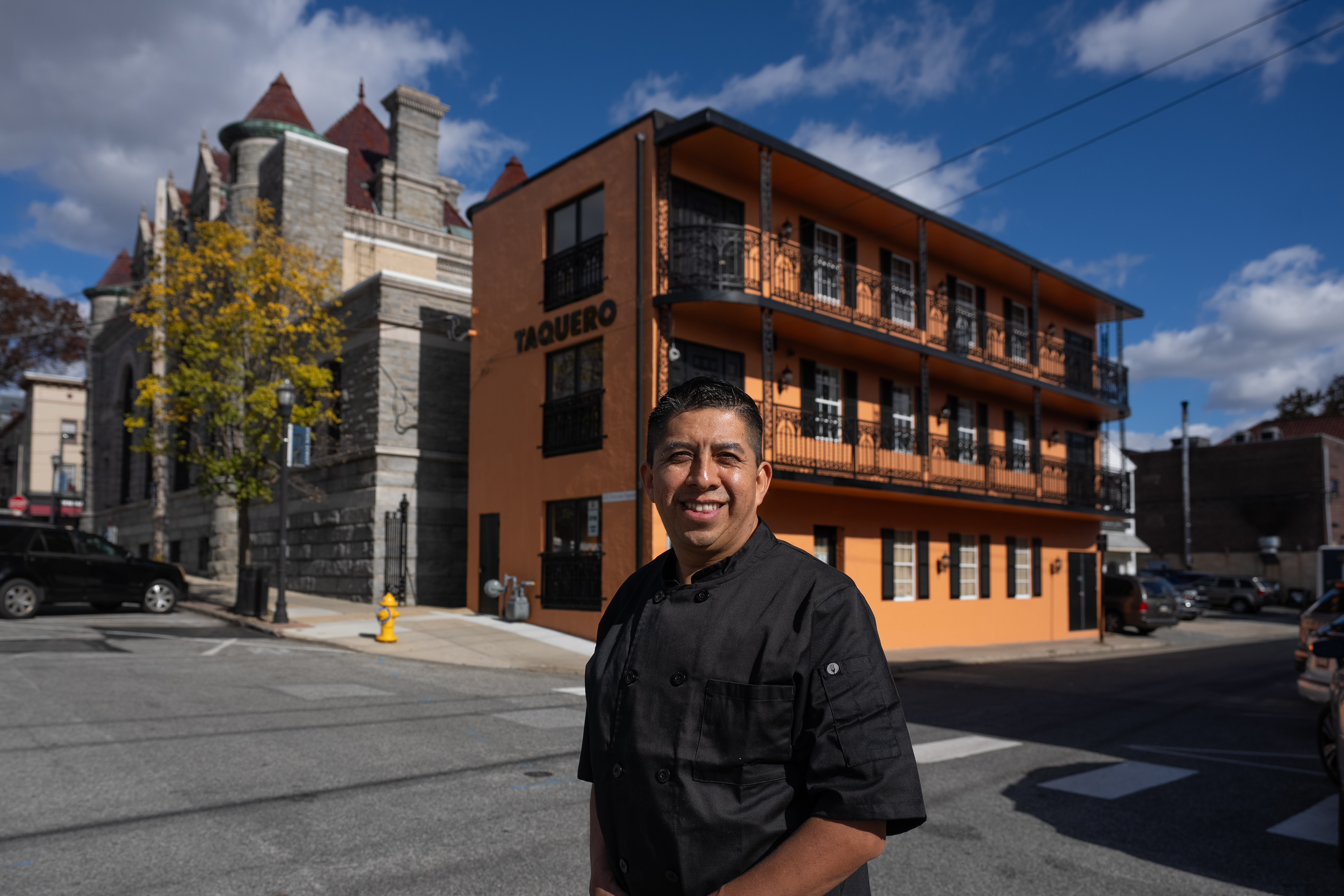
    Antonio Garcia, longtime chef of Italian restaurant Ariano in downtown Media, will open his own BYOB, Taquero, on the same block. The menu will pay homage to his Mexican roots. Above is fideo seco — noodles in a chipotle broth, served with queso fresco, crema, lump crab, and avocado. Read on as Lisa Dukart runs down the other specialties in advance of Taquero’s opening Monday on Veterans Square.

    Briefly noted

    Rocket Cat Cafe is not coming back to Fishtown. The long-delayed LeoFigs decided to have some fun with its neighbors with a bit of a ruse.

    Percy in Fishtown has rebranded to all-day diner after mixed reviews. Pancakes for dinner under the El!

    Nan Xiang Soup Dumplings, the acclaimed Shanghainese restaurant that scored a “Michelin-recommended” tag at its flagship in Queens, has set Thursday for the opening of its first Delaware location in the Christiana Shopping District, 101 Geoffrey Drive, Newark.

    St. Oners, Tired Hands Brewing Co.’s eatery at 2218 Frankford Ave., will mark the release of its cannabis-inspired beer Stoner Hands on Thursday (3-10 p.m.) with an a la carte Mexican pairing menu from chef Antonio Hidalgo. Attendees get a sample pint of Stoner Hands, a 5.5% ABV terpene-infused pale ale.

    Chef Nana Araba Wilmot, whose cooking is shaped by her Ghanaian heritage and informed by French, Spanish, Southern, and Asian traditions, will host a Love That I Knead Supperclub installment themed to the cultural and culinary ties between Ghana and Jamaica. The BYO dinner, hosted by 5to9 Hospitality Group, will be from 5 to 7:30 p.m. Sunday in Fishtown. It’s three courses plus welcome bites ($120 for chef’s table, $95 for general seating). A portion of proceeds benefits the Walkgood Jamaica Hurricane Relief Fund. Details are here.

    Paris Baguette’s first South Jersey location will ribbon-cut at 3:30 p.m. Monday at Moorestown’s East Gate Shopping Center (105 Mall Link Rd.). Franchisees are IT professionals Ami and David Shah.

    Tickets for the James Beard Foundation’s Taste America: Philadelphia 2026 — it’s March 18 at the Grand Belle at the Bellevueare now online.

    ❓Pop quiz

    What is the manufacturer PepsiCo doing with Doritos and Cheetos to make them more healthful?

    A) frying them in avocado oil

    B) baking them first in olive oil

    C) eliminating artificial colors

    D) making the chips thinner

    Find out if you know the answer.

    Ask Mike anything

    What is happening on Washington Avenue near Front Street? It looks like a huge space, and yet from what I can tell online, it is a coffee shop? — Amanda J.

    It will be the first Philadelphia location of Trung Nguyên Legend, the powerhouse Vietnamese coffee brand behind the G7 instant line and animal-free “weasel” coffee. Grand opening is noted in its social media as Nov. 29. It started in 1996 in Vietnam’s Central Highlands and has grown into a global chain of philosophically themed cafés and franchises, now pushing into the United States. “Weasel coffee?” you ask. That’s Vietnam’s famed civet-style brew; traditionally made from beans eaten and excreted by civets, it’s now recreated by Trung Nguyên through an enzyme-fermentation process that mimics the flavor without using animals.

    📮 Have a question about food in Philly? Email your questions to me at mklein@inquirer.com for a chance to be featured in my newsletter.

    By submitting your written, visual, and/or audio contributions, you agree to The Inquirer’s Terms of Use, including the grant of rights in Section 10.

  • Eli Lilly & Co. is opening a Lilly Gateway Labs biotech incubator in Philadelphia

    Eli Lilly & Co. is opening a Lilly Gateway Labs biotech incubator in Philadelphia

    Philadelphia is the newest destination for Lilly Gateway Labs, an incubator for early-stage biotech companies backed by pharmaceutical giant Eli Lilly & Co., the company announced Wednesday.

    The Center City incubator will be Lilly’s fifth in the United States. Biotech hotbeds Boston, South San Francisco, and San Diego already have them. (South San Francisco has two.) Companies at those locations have raised more than $3 billion from investors since the program started in 2019, Lilly said.

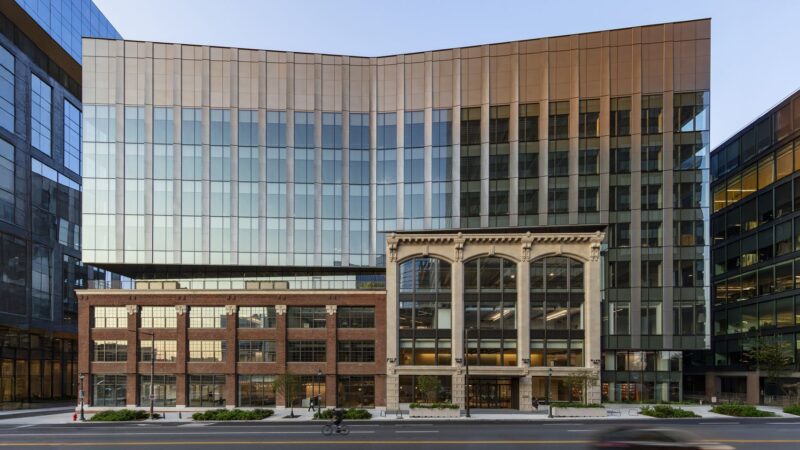
    Lilly’s Philadelphia operation will occupy 44,000 square feet on the first two levels of 2300 Market St. in Center City.

    Lilly expects to house six to eight companies there, aiming to welcome the first startups to the site in the first quarter of next year, said Julie Gilmore, global head of Lilly Gateway Labs. She did not identify prospects.

    Typically, Gateway Labs residents are at the stage of raising their first significant round of capital from investors, called Series A, and are two or three years from clinical testing, she said.

    The arrival of high-profile Lilly, which has seen resounding success with its GLP-1 drugs for diabetes and weight loss, could turn out to be a shot in the arm for a local biotech scene. Philadelphia has a growing biotech sector but has lagged places like Boston, despite the presence of world-class scientists at local research universities. Their work has fueled groundbreaking discoveries in cell and gene therapy, as well as vaccines.

    But Lilly is interested in supporting ideas that go beyond the city’s cell and gene therapy strengths, said Gilmore. Gateway labs is part of Lilly’s Catalyze360 Portfolio Management unit, which provides broad support to fledgling biotech firms, including venture capital.

    “What we like is to go after innovative science. Who are the companies trying to solve really hard problems?” Gilmore said. “And we do know that Philadelphia has had a ton of success in gene therapy and CAR-T and I hope we can find some great companies in that space, but we’re going to be open to other types of innovative science as well.”

    Expanding Philly’s life sciences footprint

    Indianapolis-based Lilly already has a small presence in Philadelphia with Avid Radiopharmaceuticals Inc., a company it acquired in 2010. Avid still operates in University City. Lilly’s chief scientific officer, Daniel Skovronsky, founded Avid in 2004 after receiving a doctorate in neuroscience and a medical degree from the University of Pennsylvania.

    Lilly is interviewing people to lead Philadelphia’s Gateway Labs location. They like to hire people who are familiar with the local universities and venture funds for those jobs, but that’s not all that matters. “We’re also looking for somebody who’s got deep drug development expertise,” Gilmore said.

    Lilly’s incubator adds to the life sciences activity at 23rd and Market Streets.

    Breakthrough Properties, a Los-Angeles-based joint venture of Tishman Speyer and Bellco Capital, announced plans for the eight-story, 225,000 square-foot building in 2022. Last week, Legend Biotech, which is headquartered in Somerset, N.J., celebrated the opening of a new cell therapy research center on the building’s third floor.

    Lilly Gateway Labs companies agree to stay for at least two years, and they can apply for up to another two years, Gilmore said.

    “The goal is, a company moves in and they can just worry about their science, worry about their team, and moving their mission forward, and we try to take care of everything else,” she said.

  • It’s essential that Mayor Parker’s H.O.M.E. plan prioritize resources for ‘people-first’ housing

    It’s essential that Mayor Parker’s H.O.M.E. plan prioritize resources for ‘people-first’ housing

    After months of state and federal budget stalemates that have threatened essential services for Philadelphia’s most vulnerable, we now know those budget outcomes don’t address critical housing needs, and as such, we have an opportunity right now as a city to meet the moment through the first year of spending in Mayor Cherelle L. Parker’s housing affordability plan.

    As a city, we are currently scrambling to decide what to do with $200 million per year for four years to address housing, when just last year we were discussing spending $1.3 billion on a Sixers arena in Chinatown. Clearly, the issue is not a lack of resources, but where we choose to direct them.

    Housing in Philadelphia has rarely been people-first in its approach; rather, it’s been about extraction from communities in one form or another. One could argue that the first great Philadelphia housing plan started with the city’s founding in 1682 and was built on the displacement of the Lenape people, who had inhabited the region for generations.

    In a neighborhood like Kensington — where I live and work — housing was developed at the turn of the 20th century to advance industry, and the profits to be made from it, by putting factories in formerly rural spaces and then surrounding those workplaces with as many homes as possible. This was a housing plan meant to extract as much as possible — rental payments, increased worker productivity, patronage of local businesses — from those who lived and worked here.

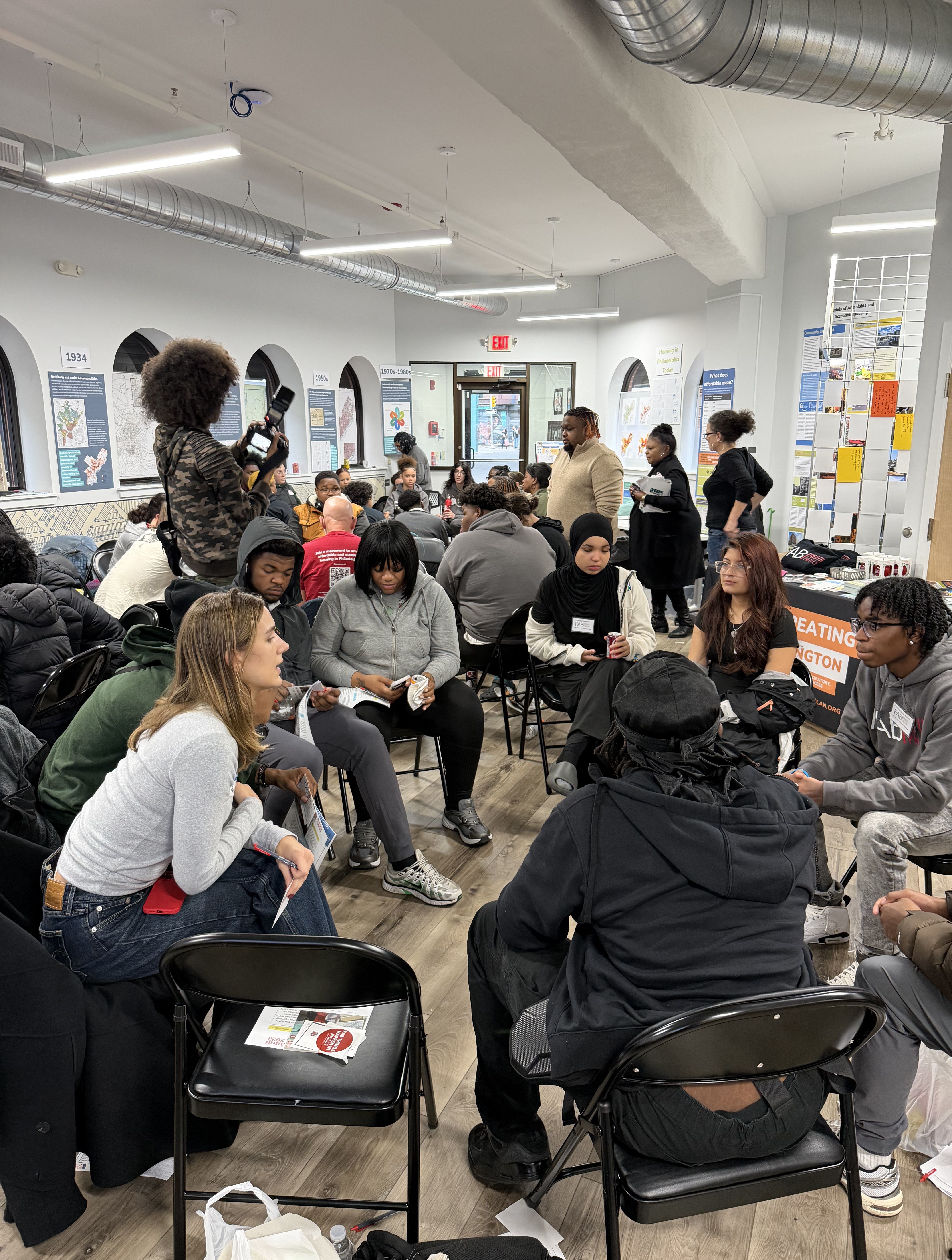
    Fab Youth Philly brings together young people for a teen town hall to discuss housing issues on Nov. 15 at the Kensington Engagement Center.

    Profit-first models aren’t only relegated to the past. Just a few weeks ago, the Reinvestment Fund reported that corporate investors are most active in Black and brown — often intentionally disinvested — neighborhoods, where they are responsible for one in four residential purchases, creating more extraction through landlords rather than creating and maintaining wealth among homeowners.

    Any transformative housing plan must be built on values: to address historical and current misaligned missions that continue to drive exploitative forces in our neighborhoods. The start of the mayor’s H.O.M.E. program is a moment to ensure the plans that we will be paying for over the next 30 years are people-first in their mission, purpose, and function.

    Real change happens when we are collectively grounded in hope, community, facts, and information about where we have been, all of which can serve as a guide to where we’d like to go.

    Over the last few years, New Kensington Community Development Corp. has been facilitating the Co-Creating Kensington planning and implementation process, in which we have received feedback from 700 residents about their priorities. In January, we completed the rehabilitation of a three-story building at 3000 Kensington Ave., converting it into the Kensington Engagement Center, a meeting place and exhibition space that was designed to facilitate conversations with the community on their priorities.

    Conversations with our neighbors and partners revealed that housing is an increasingly pressing issue for Kensington residents (as well as for the rest of Philadelphia). We collectively recognized a moment of alignment with the release of the Philadelphia H.O.M.E. Initiative and the soon-to-be-released Pennsylvania Housing Action Plan.

    We convened several organizations already prioritizing housing affordability across the city, including Philly Boricuas, Green Building United, the Philadelphia Coalition for Affordable Communities, the Women’s Community Revitalization Project, Fab Youth Philly, and the Philadelphia Community Land Trust. Together, we codesigned a 14-part people-first housing workshop series and exhibit.

    This deep-dive approach is based on an understanding that community engagement needs to go beyond pizza parties and setting up tables at events. For a community to truly participate in its future, it needs to be informed, there needs to be shared power, and there needs to be collaboration and collective visioning.

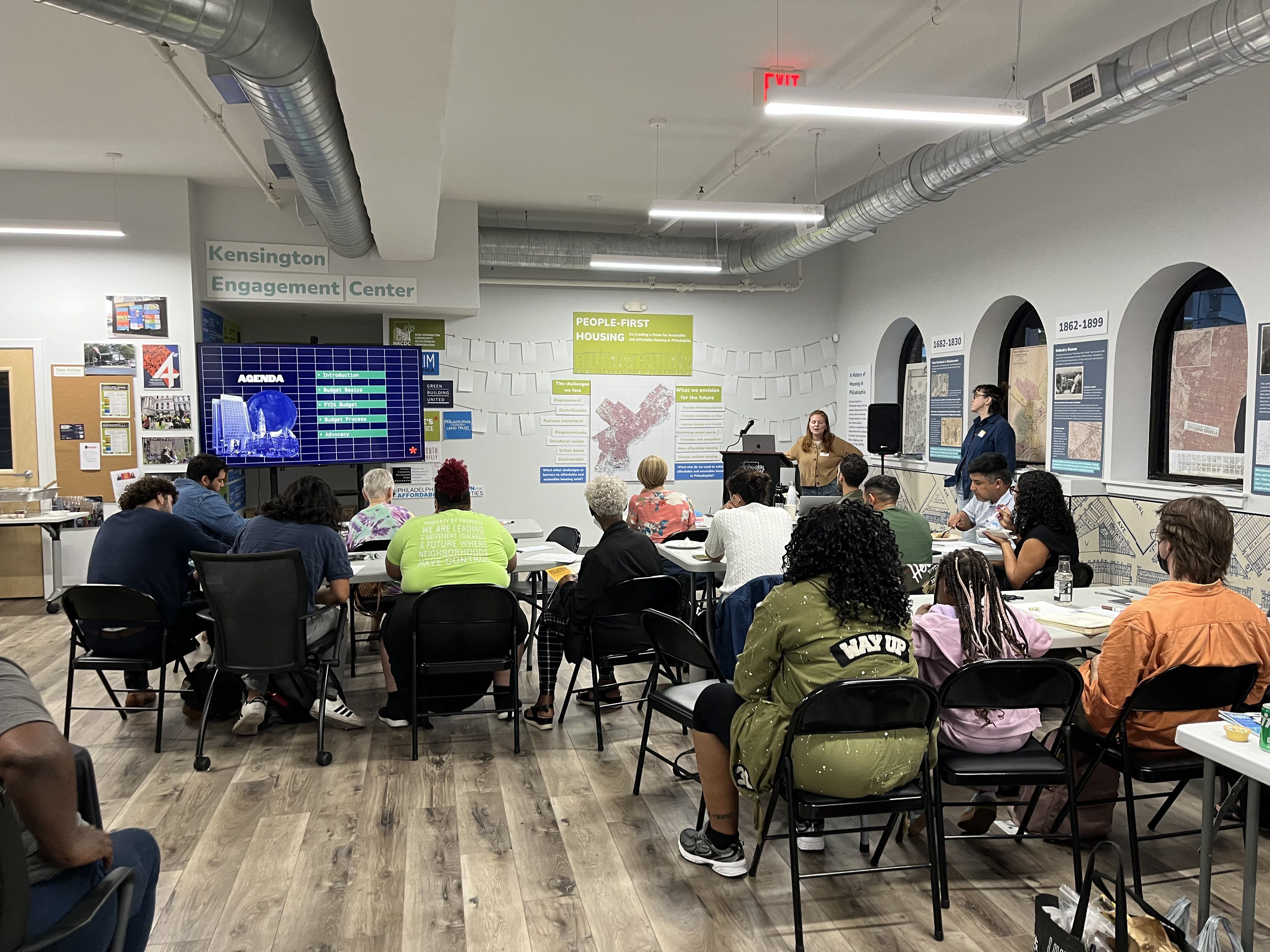
    The People’s Budget Office facilitates a Budget 101 Workshop at the Kensington Engagement Center on Oct. 7.

    The workshop series has engaged more than 175 residents from 15 neighborhoods and has covered topics from housing wins, gentrification and displacement, how municipal resources are directed toward housing, environmental concerns, tenants’ rights, illegal evictions, and more.

    Angela Brooks, Philadelphia’s chief housing and development officer and new chair of the board of the Land Bank, came out for a workshop on the H.O.M.E. plan to help residents understand how the initiative will work and to hear resident feedback.

    Most recently, we hosted a teen town hall facilitated by Fab Youth Philly, in which more than 70 young people came together to share their hopes, dreams, and concerns and gave guidance on how the city can support young people — for example, looking at how the McKinney-Vento Homeless Assistance Act implements programs that serve youth.

    What we’ve learned so far is that the best way to build momentum for change is through informed, collective action and leveraging strategic pressure points by investing in relationships early. Creativity and diversity in leadership and lived experience are critical to ensuring movements are resilient, and we need to question the status quo.

    Communities must be built for the people who live in them, so that they aren’t just about four walls built by colonizers and conquerors, but about communities of choice and relevance so people can thrive.

    Trickle-down approaches do not work. The city’s H.O.M.E. plan needs to concretely prioritize resources for residents whose households earn no more than 30% of the area’s median income. We need to serve those on housing program wait lists before adding more and higher earners. We need to preserve the affordable housing we already have, and we need to invest more deeply in home repair programs like Built to Last.

    As someone serving on the H.O.M.E. advisory board and as a nonprofit leader of a community development corporation, I learned there are several housing issues we aren’t addressing at all in the city’s H.O.M.E. plan, such as those affecting young people and individuals impacted by the criminal justice system who have urgent needs but do not meet many of the traditional service categories.

    How do we move forward?

    For those of us who are currently centering housing, learning and being in community is essential. But we also need actionable moments.

    I recommend all these organizations because they put people first in housing plans — countering the notion that housing is just a commodity. Instead, they affirm the fundamental idea that housing is about people — and that people deserve a home.

    Bill McKinney is a Kensington resident and the executive director of the New Kensington Community Development Corp.

  • 👟 26.2 miles of fans | Morning Newsletter

    👟 26.2 miles of fans | Morning Newsletter

    Hi, Philly. Expect clouds and possibly rain this morning.

    It’s almost time for the most ambitious among us to lace up their sneakers and run for hours through the city’s scenic and historic neighborhoods. For the rest, there’s the spectator’s guide to the 2025 Philadelphia Marathon.

    And a pipeline leak disrupted a quiet Bucks County community. Some residents say they’ll never drink the water in their homes again.

    Plus, the Michelin Guide has announced which Philly restaurants are worthy of its coveted stars. See the latest analysis at Inquirer.com and on Instagram.

    — Julie Zeglen (morningnewsletter@inquirer.com)

    If someone forwarded you this email, sign up for free here.

    A spectator’s guide to the marathon

    Philadelphia Marathon Weekend is upon us. This year, organizers expect roughly 30,000 athletes across Saturday’s half marathon and 8K, and Sunday’s full marathon and children’s run.

    Not running, but want to be one of the thousands of spectators supporting those who are? We have some advice.

    🪧 Pick your position: If you want the energy of a crowd, consider posting up at Chestnut Street in Center City or Main Street in Manayunk. If you’re looking for a calmer vibe, head to Kelly Drive.

    👟 Get around: With road closures, parking restrictions, and heavy traffic expected, driving anywhere near the race is a risk. Metro lines and Regional Rail are your friends. Or, you can always travel by foot, like the runners.

    🎉 Bring the party: But also layers, snacks, and the Philadelphia Marathon app downloaded on your phone to track participants in real time.

    Here’s the full spectator’s guide to the 2025 marathon, including a map of the race route and closures.

    More on navigating the marathon:

    ‘Something off with the water’

    Life has gotten more stressful for residents of a suburban Bucks County community after a pipeline leaked jet fuel under their homes, contaminating their water supply.

    The 67-year-old Twin Oaks Pipeline is owned by Sunoco and its parent company, Energy Transfer. As part of the more than 2.5 million miles of pipelines that transport fuels in the United States, it tunnels under the Delaware River and runs below a school’s grounds and state and local parks.

    State inspectors uncovered the leak in January. Regulators say it likely began much earlier.

    Energy Transfer has apologized and taken steps to remediate the issue. But now, most people in the neighborhood won’t drink the water. Many won’t cook with it. Some even bathe elsewhere.

    Reporter Frank Kummer has the story.

    In other environmental news: A Conshohocken-area data center proposal was abruptly withdrawn over legal issues. Neighbors have cited concerns about light, noise, and air pollution, as well as water usage and electricity costs.

    What you should know today

    Quote of the day

    West Philly’s Jubilee School on Monday commemorated the 1967 student walkout, when thousands of Philadelphia School District students demanded better treatment of Black students.

    🧠 Trivia time

    As shown during Sunday’s Eagles broadcast, Boathouse Row recently glowed pink and green as a nod to what?

    A) The Eagles’ belated celebration of Breast Cancer Awareness Month

    B) The eventual return of spring

    C) The theatrical release of Wicked: For Good

    D) Preppy vibes

    Think you know? Check your answer.

    What we’re …

    🥧 Mapping: The best pies in the Philly area, from apple crumb and salted honey.

    👖 Asking: Is Boscov’s selling the most offensively Pennsylvania outfit ever?

    🏈 Following: The pushes for and against merging these Main Line schools’ football teams.

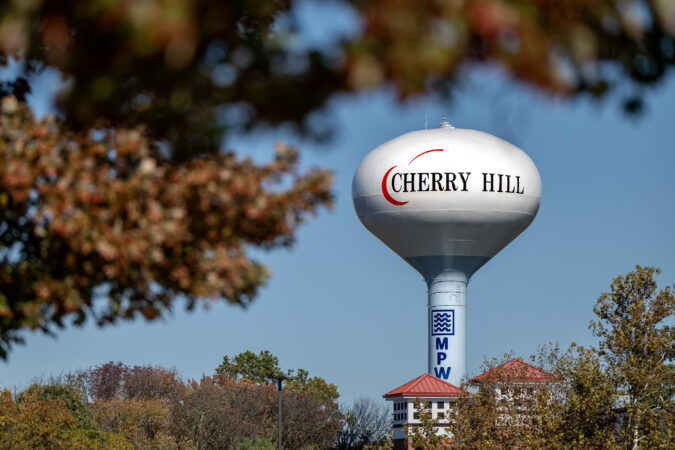
    🌳 Studying: What makes older residents stay in Cherry Hill.

    Considering: What comes after the “No Kings” rallies.

    🧩 Unscramble the anagram

    Hint: Wilmington chemical company

    NUT POD

    Email us if you know the answer. We’ll select a reader at random to shout out here.

    Cheers to Diane Marcakis, who solved Tuesday’s anagram: The College of Physicians of Philadelphia. The Mütter Museum’s parent org announced plans Monday for a $27 million expansion and renovation at 22nd and Chestnut Streets.

    Photo of the day

    Crossing guard Terri Ashwood shields her head and face from cold winds while working on the 4700 block of Germantown Avenue.

    Stay warm today. I’ll be back with you tomorrow.

    By submitting your written, visual, and/or audio contributions, you agree to The Inquirer’s Terms of Use, including the grant of rights in Section 10.

  • What draws the 55+ population to Cherry Hill? | Inquirer Cherry Hill

    What draws the 55+ population to Cherry Hill? | Inquirer Cherry Hill

    Hello, Cherry Hill! 👋

    First up this week, a $70,000 grant from the state will help the township explore a key question: What makes Cherry Hill such a desirable place to live for people 55 and older? Also this week, a Say Yes to the Dress star is coming to town, and we explain why the library is experiencing disruptions.

    If someone forwarded you this email, sign up for free here.

    A new assessment will explore what draws older residents to Cherry Hill

    Cherry Hill will be doing a needs assessment to determine what makes older residents want to stay.

    One-third of Cherry Hill’s residents are 55 or older. As the township’s population continues to grow, local leaders want to understand what makes its older residents stick around.

    “For those that have the means, it’s a conscious decision to stay,” said Mayor Dave Fleisher. “They want to stay close to their kids, close to their grandkids.”

    Cherry Hill will be using a $70,000 grant from the New Jersey Department of Human Services to do a needs assessment, including focus groups, listening sessions, and a survey. The goal of the grant, given to 17 communities in total, is to “make communities more welcoming and livable for people of all ages.”

    Read more about what Cherry Hill leaders hope to learn.

    💡 Community News

    🏫 Schools Briefing

    • In case you missed it, last week, Cherry Hill Public Schools Superintendent Kwame Morton assured parents that the district will not ban or censor library books. The clarification came after an internal memo suggested that students would need parental permission to check out “sensitive” books.
    • Morton also last week released a report on the first quarter of the school year. It outlined key actions, currents challenges, and next steps across five areas, including academic achievement, the school’s climate, and staffing.
    • The district will hold its final meeting about elementary school enrollment “balancing” tomorrow at 7 p.m. over Zoom.
    • Reminder to families: There will be an early dismissal next Wednesday to kick off Thanksgiving break. See the district’s full calendar here.
    • Inspire A Learner, a new Islamic youth education and daycare center, has received zoning approval to operate in a converted office building on Marlkress Road. (70 and 73)

    🍽️ On our Plate

    • The owners of Cherry Hill’s Old World-style Italian restaurant Il Villaggio have an agreement to buy popular Haddon Township pub Keg & Kitchen. It will remain a pub, but undergo a few changes, including to its name, menu, and decor.
    • Bombay Express, an Indian restaurant that recently closed its Marlton location, is heading to Cherry Hill. The eatery, which offers chicken, lamb, and vegetable dishes, in addition to biryanis and tandoori, will open in the Centrum Shoppes on Haddonfield-Berlin Road, though an exact timeline has not yet been shared.
    • Umai Ramen is one of the 20 best ramen shops in the Garden State, according to BestofNJ.com. The food outlet noted the Brace Road restaurant “brings a taste of authentic Japanese street food to Cherry Hill,” suggesting diners try the classic miso, tonkotsu, or the black garlic ramen.

    🎳 Things to Do

    🎅🏻 Coca‑Cola Holiday Caravan: The bright red touring truck is making a stop in Cherry Hill tonight, where you can take photos with Santa, enjoy seasonal activities, and purchase Coca-Cola-themed gifts. ⏰ Wednesday, Nov. 19, 5:30-7:30 p.m. 💵 Pay as you go 📍 Roy Rogers

    🛍️ Eyez on U Pop-Up Market: Beat the Black Friday rush and shop local businesses at the mall’s Grand Court. ⏰ Friday, Nov. 21-Sunday, Nov. 23, times vary 💵 Pay as you go 📍 Cherry Hill Mall

    🎄 Holiday House: See Barclay Farmstead decked out for the holidays. ⏰ Friday, Nov. 21-Sunday, Nov. 23, times vary 💵 $5.49 for adults, $3.49 for children 10 and under📍 Barclay Farmstead

    🤖 Philcon 2025: Science fiction, fantasy, and horror buffs will gather to celebrate the genres in books, film, television, and more. This year’s principal speaker is writer Charles Gannon, who is known for his Caine Riordan series. ⏰ Friday, Nov. 21-Sunday, Nov. 23, times vary 💵 $35-$75 📍 DoubleTree by Hilton

    🎧 R&B Night: Drinksgiving: Three DJs will play tunes during this R&B-themed event. ⏰ Friday, Nov. 21, 9 p.m.-2 a.m. 💵 $13.34 📍 Vera

    💎 Holiday Gift Bazaar: Over 40 vendors will be selling everything from accessories and beauty products to home goods at this event. ⏰ Sunday, Nov. 23, 9 a.m.-2 p.m. 💵 Pay as you go 📍 Congregation Kol Ami

    🎁 Holiday Craft Fair: Browse an array of vendors selling items like jewelry, scrapbooking supplies, and pottery. ⏰ Sunday, Nov. 23, 1-4 p.m. 💵 Pay as you go 📍 Cherry Hill Public Library

    🏡 On the Market

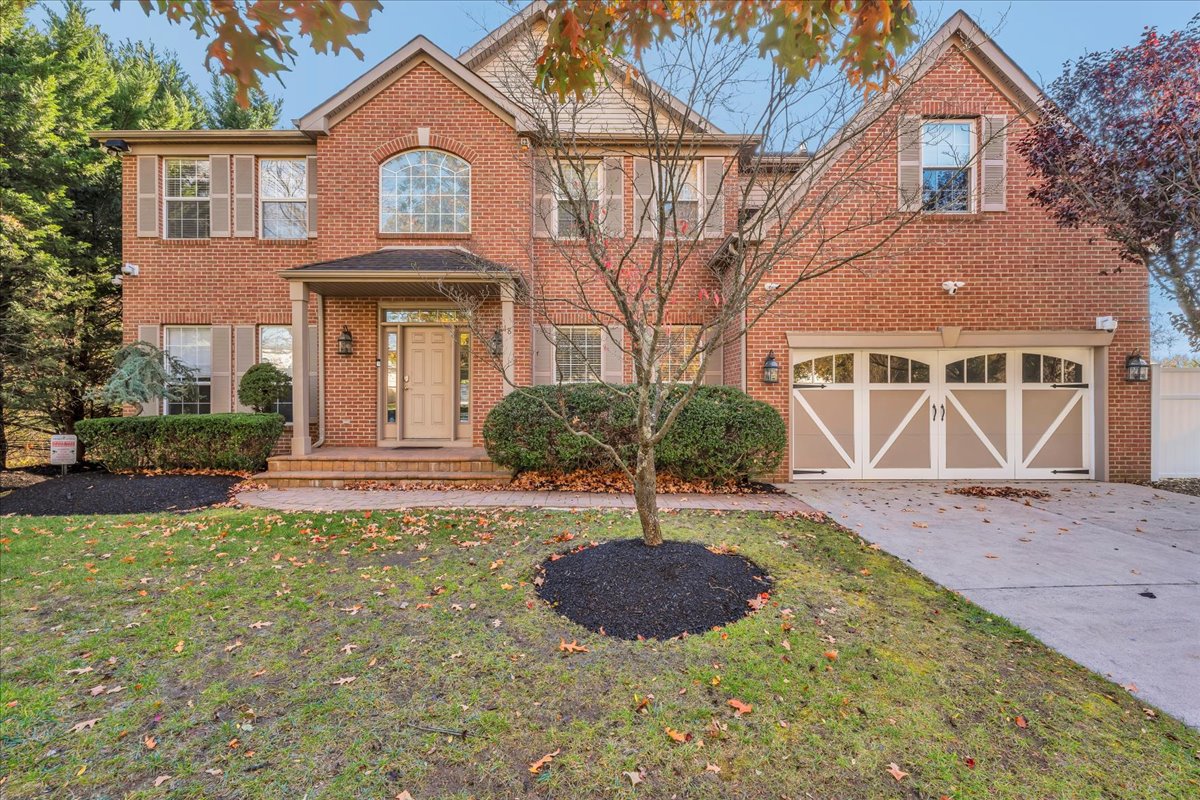
    This four-bedroom Short Hills home has a heated covered patio

    The four-bedroom home spans more than 5,100 square feet.

    Built in 1999, this spacious brick-fronted Short Hills home has a variety of unique features. Its first floor features a two-story foyer; a living room; an office; a family room with a fireplace set into a stone accent wall and vaulted ceilings; a dining room with a quartz waterfall island in lieu of a table; and a kitchen with granite countertops and high-end appliances. It has four bedrooms, including a primary suite, with a massive walk-in closet, a fireplace, a spa-like bathroom, and a balcony. The finished basement has a full bathroom and a home gym. Outside, there’s a heated covered patio and a saltwater fiberglass pool with a rock waterfall.

    See more photos of the property here.

    Price: $1.165M | Size: 5,100 SF | Acreage: 0.38

    🗞️ What other Cherry Hill residents are reading this week:

    By submitting your written, visual, and/or audio contributions, you agree to The Inquirer’s Terms of Use, including the grant of rights in Section 10.

    This suburban content is produced with support from the Leslie Miller and Richard Worley Foundation and The Lenfest Institute for Journalism. Editorial content is created independently of the project donors. Gifts to support The Inquirer’s high-impact journalism can be made at inquirer.com/donate. A list of Lenfest Institute donors can be found at lenfestinstitute.org/supporters.

  • What makes older residents stay in Cherry Hill? A grant-funded study aims to find out.

    What makes older residents stay in Cherry Hill? A grant-funded study aims to find out.

    While East Coast retirees have a reputation for decamping to places like Florida for warm weather and lower taxes, many of Cherry Hill’s older residents have stuck around.

    One-third of Cherry Hill’s residents are 55 or older.

    “Cherry Hill is a wonderful place to raise a family and to live, so people don’t want to leave,” Mayor Dave Fleisher said.

    Cherry Hill prides itself on its work with older residents — from tax-preparation assistance to social events, Fleisher said. Yet as the township continues to grow, local officials want to zero in on what its older community needs and how they can best deliver it.

    Using a $70,000 grant from the New Jersey Department of Human Services, the township is embarking on a multipronged needs assessment to better understand and serve its older residents.

    Why does Cherry Hill have such a large population of older residents?

    Cherry Hill officials say varied housing options, tax-rebate programs like Stay NJ, and multigenerational ties have helped the township’s older population flourish.

    “For those that have the means, it’s a conscious decision to stay,” Fleisher said. “They want to stay close to their kids, close to their grandkids.”

    “It’s a very multigenerational community,” said Beth Segal, interim executive director of Cherry Hill’s Katz JCC, a watering hole for local older residents.

    The JCC runs regular lunches, fitness classes (think pickleball and water aerobics), and programs on politics, literature, and art. Segal said she works with families who have been involved in the JCC for as many as four generations. Though Cherry Hill kids often leave the nest in search of big cities and new experiences, Segal said, many come back to raise their own kids alongside their parents and grandparents.

    Fleisher said Cherry Hill’s relatively diverse housing stock has allowed residents to stay in the township without being forced to remain in the large — and, at times, expensive — single-family homes they raised their families in.

    Around 20% of homes in Cherry Hill are multiunit. That’s higher than neighboring communities like Haddonfield (13%) and Moorestown (13%). Around 40% of homes in Voorhees are multifamily.

    Two affordable housing complexes with designated units for older residents are set to open in Cherry Hill next year, joining existing communities like Weinberg Commons and the Plaza Grande.

    Fleisher also credits tax-relief programs. Stay NJ, a statewide property tax benefit for New Jerseyans 65 and older, allows eligible homeowners to be reimbursed for up to 50% of their property tax bill, up to $13,000.

    In 2023, Cherry Hill’s property taxes were around $1,600 higher than the county average. That year, Cherry Hill residents paid an average of $8,851, compared with the countywide average of $7,222.

    What will the assessment entail?

    There will be two phases. The qualitative phase, which is ongoing, includes focus groups and listening sessions with facilitators (the township has contracted with market research firm 18 Stones). The first phase will wrap up in December.

    The quantitative phase will involve a survey that residents will be able to complete via email or paper mail, online, or over the phone. The survey, which is currently being formulated, will be translated into Spanish and Simplified Chinese.

    The assessment is funded by a $70,000 grant from the New Jersey Department of Human Services. The department awarded grants to 17 municipal governments in March to “make communities more welcoming and livable for people of all ages” and to implement recommendations from the state’s 2024 Age‐Friendly Blueprint. Cherry Hill was the only municipality in Camden County to receive a grant. The assessment is to be finished by July 1, 2026.

  • Three Nick Castellanos trades that show how little the Phillies should expect in return

    Three Nick Castellanos trades that show how little the Phillies should expect in return

    The most important variable in any negotiation is what the other side thinks you are willing to pay. Right now, the other 29 teams in Major League Baseball have every reason to think the Phillies aren’t willing to pay Nick Castellanos anything. That’s a tough starting point for Dave Dombrowski as he tries to find someone interested in trading for the veteran right fielder.

    Fact is, Castellanos is due to make $20 million this season, which is at least $18 million more than he could reasonably expect to make if he were a free agent. Even if the Phillies eat most of that money, why would a team trade anything of value for Castellanos rather than signing this year’s version of Mark Canha for a couple of million bucks?

    The only realistic option for the Phillies is to find a team that is looking to shed a similarly overpriced contract. Even then, Dombrowski may have to further incentivize an interested party. That quickly leads to a point where the Phillies are better off simply releasing Castellanos. Or walking a lot of things back before he reports for spring training.

    Here are three examples of deals that maybe, kinda, sorta, if you squint could potentially make a fraction of a smidgen of sense for both parties.

    Get excited!

    Andrew Benintendi is slashing just .245/.309/.391 in his first three years with the White Sox.

    1. Andrew Benintendi plus cash to the Phillies, Castellanos to the White Sox

    This is the baseball equivalent of one of those NBA trades in which a couple of overpriced veterans and 16 second-round draft picks change hands but nobody ends up with more than they started with. You only live once, baby.

    Benintendi has been a sunk cost the moment he signed a five-year, $75 million contract in Chicago in 2023. Was it only three years ago that the White Sox were trying? Apparently, it was.

    Benintendi hit free agency as the rare hitter still in his prime, having broken into the big leagues at 21 years old on the watch of none other than Dombrowski. He hasn’t come close to the .782 OPS he posted in his first seven seasons in the majors, hitting just .245/.309/.391 in his first three years with the White Sox. He showed a little life in the second half of last season and finished with a .738 OPS that was slightly above league average. But he didn’t show nearly enough life to warrant salaries of $17.1 million this season and $15.1 million in 2027.

    Swapping Castellanos for Benintendi would make some sense from an accounting perspective. The Phillies would be taking on an additional $12.2 million in “dead” money over two years. More importantly from a competitive standpoint, they’d be tacking on $15 million in average annual value to next year’s payroll rather than paying Castellanos $20 million up front and then being free and clear.

    But what if the White Sox included $10 million in cash to pay Benintendi’s 2027 salary? That would essentially enable the Phillies to split up Castellanos’ money over two years, saving them $10 million this year while adding $10 million next year. And, hey, maybe Benintendi gives them a little something in the outfield rotation as a Max Kepler replacement. At 31 years old, the chances of that aren’t zero.

    What’s in it for the White Sox? Well, they’d save $5 million in cash in 2027 at the expense of an extra $3 million this year. I’m not sure whether this trade makes sense for both sides or makes sense for neither side. But that’s where we’re at.

    The Orioles’ Tyler O’Neill had just 209 plate appearances and nine home runs in 2025.

    2. Tyler O’Neill to the Phillies, Castellanos to the Orioles

    Truthfully, I’m not sure how much sense this makes for either side. O’Neill signed a three-year, $49.5 million contract last offseason after a big year with the Red Sox (.847 OPS, 31 home runs). He was a major disappointment, posting a .684 OPS and nine home runs in 209 plate appearances in a season marred by injuries.

    The argument from the Phillies’ perspective goes like this. They’d essentially be signing O’Neill to a two-year, $13 million deal, given the $20 million they are saving on Castellanos. That’s pretty close to fair market value for O’Neill, who has mostly been a league-average hitter outside of his two spike years (2021 with the Cardinals and 2024 in Boston).

    The Phillies get a right-handed hitter who still might have another big season in him. Even if he doesn’t, maybe he is an adequate enough rotational corner outfielder for two years (O’Neill is heading into his 31-year-old season). They also save $3.5 million on this year’s official payroll.

    Is all of that worth $16.5 million less in spending power next offseason? Probably not.

    Likewise, what are the Orioles really gaining? Saving $13 million over two years isn’t nothing. But it’s probably not worth sacrificing the chance that O’Neill bounces back.

    Kyle Freeland, 32, has spent his entire career with the Rockies and has been better away from Coors Field.

    3. Kyle Freeland to the Phillies, Castellanos plus cash to the Rockies.

    Freeland, who has spent his entire career with the Rockies, has one year and $16 million left on his deal. That’s a lot to pay a guy who has a 5.07 ERA over the last three seasons. Castellanos has hit well at Coors Field with a .914 career OPS in 88 plate appearances. The Phillies get another piece of rotation depth in the form of a guy who has had some decent years on the road in his career. The Rockies get a guy who at least has chance of regaining some value between now and next year’s trade deadline.