Immigrants who have ongoing legal cases have been unexpectedly taken by federal agents amid the Trump administration’s push to boost arrests and deportations. In Philadelphia, the arrest of an Indonesian man at a routine visa appointment has sparked outrage among advocates.
Rian Andrianzah showed up for what he thought was a routine biometrics appointment in Philadelphia last month.
Instead, while his wife waited for him in another room, U.S. Immigration and Customs Enforcement agents arrested the Indonesian man and sent him to a Central Pennsylvania detention center. He now faces deportation.
It’s part of a strategy shift by President Donald Trump’s administration to arrest green-card applicants, asylum seekers, and others who are going through legal processes to stay in the country, lawyers and advocates say.
Meanwhile, members of the city’s Indonesian American community have responded quickly to Andrianzah’s arrest, raising thousands of dollars to support his family.
The parents of a 16-year-old shot and killed last month near Northeast Philadelphia High want the city to know not just how he died, but who he was.
A 21-year-old South Jersey man was charged by federal prosecutors with cyberstalking a 13-year-old girl and coercing her into self-harm.
The Philadelphia District Attorney’s Office this month charged a record number of Philly cops in a grant theft scandal. DA Larry Krasner has been unusually quiet about it.
SEPTA’s largest employee union voted Sunday to authorize a strike. Transport Workers Union Local 234 represents, among other workers, bus, subway, and trolley operators.
A 14-foot-long great white shark named Contender, the largest tagged and tracked by research group OCEARCH, pinged near the New Jersey coast last week.
Quote of the day
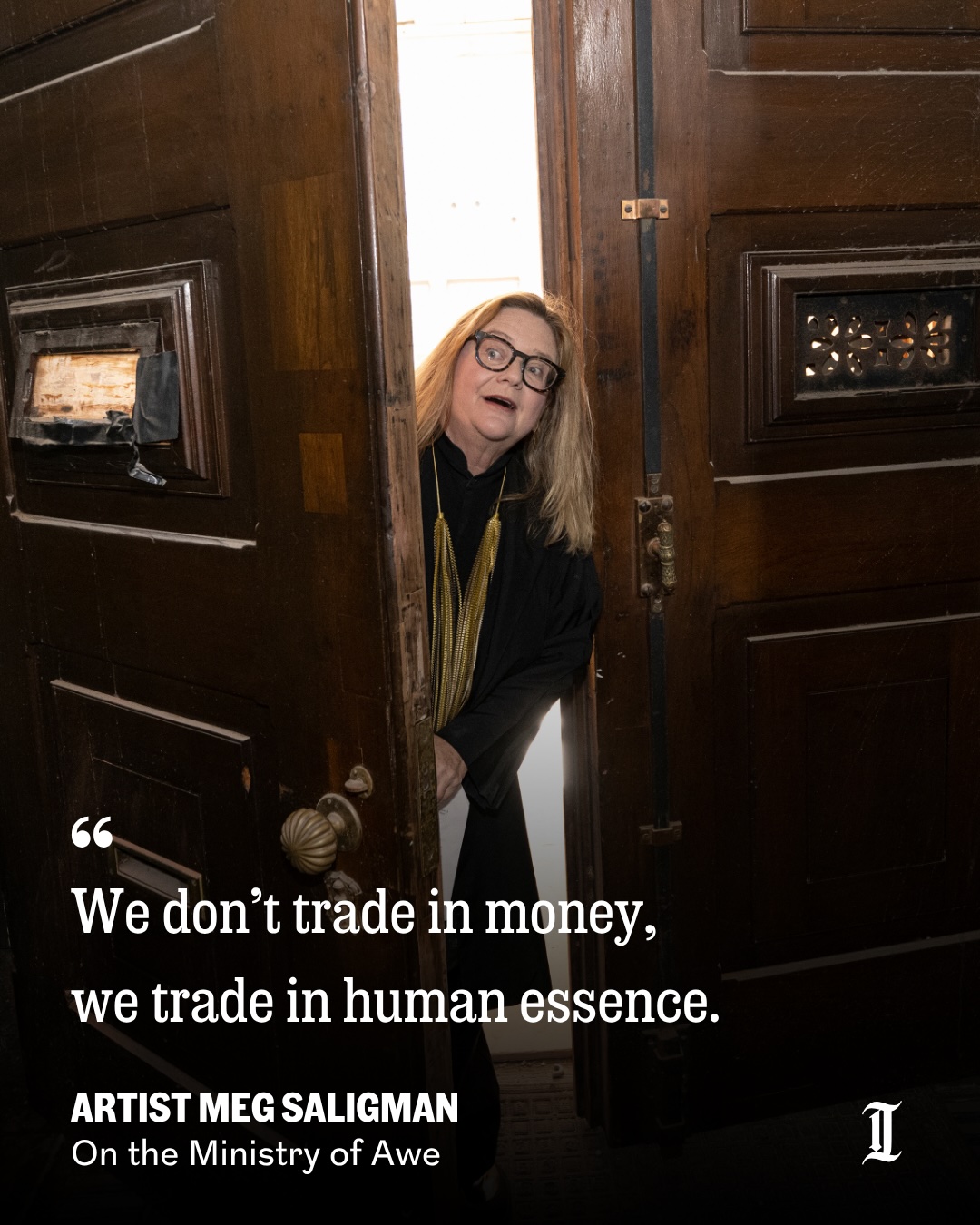
The Ministry of Awe, a new permanent cultural attraction, is set to open in the historic Manufacturers National Bank in Old City this March. Meg Saligman founded the project in 2022 as a nonprofit dedicated to reviving the vacant bank and creating an arts venue with work that riffs on the bank theme.
🧠Trivia time
Amy Gutmann is coteaching an undergraduate class this semester in the University of Pennsylvania’s Annenberg School for Communication. Which is not one of her past roles?
Cheers to Peter Stevens, who solved Sunday’s anagram: Barnes Foundation. A South Philly teen broke into the institution 73 years ago. It led to a lifelong artistic career.
Photo of the day
The Seeing Eye volunteers from five different clubs across Pennsylvania, New Jersey, and Delaware took 46 puppies on an exposure outing to the Philadelphia International Airport. The last stop for the puppies was the baggage claim area after successfully deplaning and walking through the terminal, where Quest (right), a 5-month-old yellow lab, stops to rest.
Think back to the night that changed your life that could only happen in Philly, a true example of the Philly spirit, the time you finally felt like you belonged in Philly if you’re not a lifer, something that made you fall in love with Philly all over again — or proud to be from here if you are. Then email it to us for a chance to be featured in the Monday edition of this newsletter.
This “only in Philly” story comes from reader Miles Davis, who describes witnessing the emergence of a cultural movement firsthand:
The night that changed my life and let me know I was from the best city in the United States of America was when I was with my best friend, Eric, heading downtown. It was 1980 at Wagner’s Ballroom. We were going to see for the first time a battle of hip-hop, which was turning up the streets with rap and turntables spinning the newest jams.
The show was so lit and not a person was seen sitting. Heck, in the time hip-hop came out, no one was ever sitting at a hip-hop event. We called people who sit at rap concerts a Wall Flower who holds up the wall.
Hip-hop came on the scene with its own sound and meaning. I was so glad to have been a part of that culture knowing what it meant and where it was going.
Follow your own groove today. Have a good one.
By submitting your written, visual, and/or audio contributions, you agree to The Inquirer’s Terms of Use, including the grant of rights in Section 10.
Though DuPont is a larger company, Qnity, which started trading Nov. 1, is worth more on the stock market, a sign that investors expect its Big Tech customers — chipmakers like AMD and electronics giants like Samsung — will buy Qnity’s Kalrez sealants, Pyralux adhesives, and other products.
And they expect it will do sofaster than DuPont can boost sales to its remaining brands such as Tyvek and Corian.
With expected sales of $7 billion next year, DuPont has a stock market value of about $16 billion. Qnity, with sales expected to approach $5 billion, is worth $20 billion.Both companies are profitable, but Qnity’s margins are bigger.
Based a five-minute walk from DuPont headquarters in suburban Wilmington, Del., Qnity was given away to DuPont shareholders — one share for each two DuPont shares. The company employs around 10,000 at 39 factories and 17 labs worldwide, including 1,300 in the Wilmington area.
It was the latest in a string of sales and spin-offs that have cut DuPont sales from $62 billion in 2017 — after Edward Breen of New Hope, now DuPont’s executive chairman, took over with a mandate to cut costs and boost shareholder payouts — down to an expected $7 billion next year.
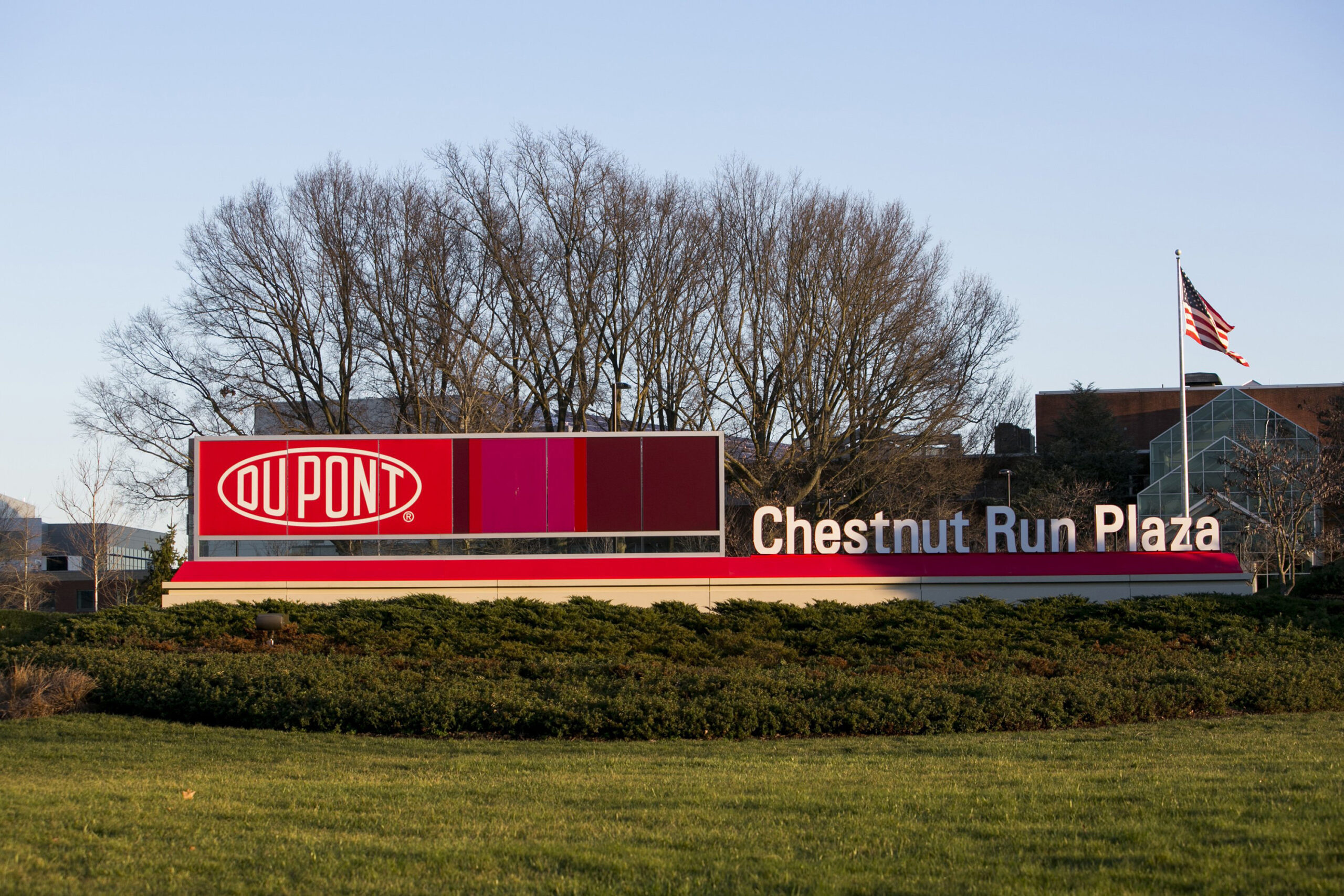
DuPont’s Chestnut Run Plaza headquarters in Wilmington, Del. The company’s November 2025 spin-off, Qnity, is based at the south end of the campus.
Qnity’s price quickly spiked from an initial $70 a share to around $100 in early November trading, and stock analysts predict it will go higher on relentless demand for AI and high-speed computer chips.
The company’s name (pronounced CUE-nitty) was “inspired” by the letter Q’s role in electrical notation. It trades as Q on the New York Stock Exchange.
Q is “the symbol for electrical charge and unity,” Qnity CEO Jon Kemp said in a meeting with DuPont investors.
What does Qnity make?
Qnity’s profit margin before financial expenses is a robust 30%, but analysts warn the chip business might not stay so profitable.
“Wafer starts,” a count of how many new silicon pieces are being used to build new chips, rose roughly 5% this year. Qnity is growing faster than the industry because some of its products are in special demand, “fueled by the adoption of leading-edge technologies for AI applications,” Kemp told the investors earlier this year.
Qnity’s “AI-driven technology ramps” include densely layered circuit boards that allow more computing power in a smaller space and barriers to keep data centers from overheating. The company also sells to aerospace, and military equipment and vehicle makers.
At an August investor meeting, JPMorgan analyst Steve Tusa noted the soon-to-be-spun-off company’s reliance on AI growth. He asked whether the global slump in consumer electronics demand was likely to end, broadening the company’s growth prospects.
Kemp, in response, acknowledged that consumer demand had been “weak,” noting that “all of the growth for the last several quarters is really coming from AI-driven applications.”
Worth more in pieces?
DuPont has sold or spun off many of its once-familiar products in recent years.
DuPont still makes Tyvek house and medical wraps, Corian counters, Molykote lubricants, FilmTec membranes, and medical-device packaging systems, automotive battery and aerospace parts, as well aswater, gas, and mining products.
In all, it’s a radical reduction from the 1950s, when DuPont was the most valuable company in the world, and owned major stakes in General Motors and other customers, or in the 1990s, when DuPont owned oil giant Conoco and attempted a drug-making joint venture with Merck.
DuPont was dropped from the Dow Jones 30 industrial stock index in 2017. It remains one of the S&P 500 stocks, a list Qnity has also joined.
The Qnity spin-off is just the latest in the dismemberment that began before Breen joined DuPont and became chief executive and chairman in 2015. Breen, who similarly broke apart the former Tyco International in the 2000s, came to DuPont at a time when some investors were discontented with low profit growth.
The result is a string of DuPont successor companies, most still based in the Wilmington area.
They include Corteva Agrisciences, a 2019 combination of DuPont and Dow pesticide lines and genetically engineered seeds with offices at the old DuPont headquarters. The company expects more than $17 billion in sales this year.
Corteva, whose U.S. operations are mostly in the Midwest, announced this month that it was moving corporate offices from the suburban Wilmington office park that also houses DuPont and Qnity to the former DuPont headquarters complex in central Wilmington.
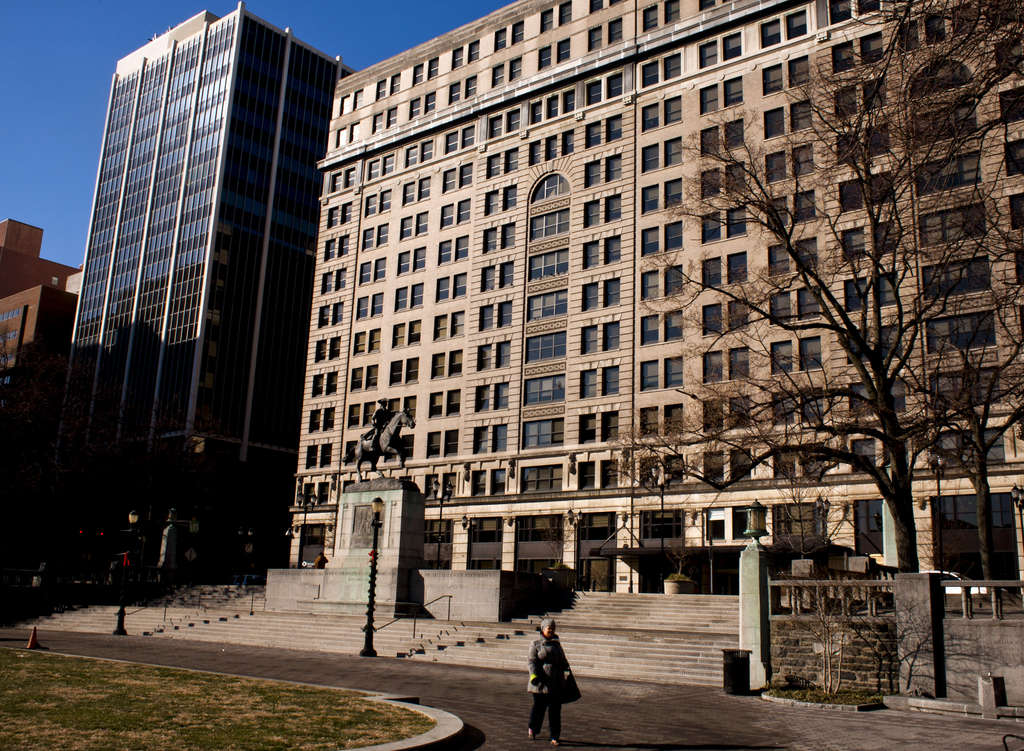
The Rodney Square side of the former DuPont Co. headquarters in Wilmington is now home to its chemical spin-off, Chemours. The western end of the same campus will soon be home to offices of Corteva, which includes DuPont’s former pesticides business. This 2019 photo also shows a statue of independence leader Caesar Rodney, which was removed from its pedestal after protests in 2021.
Another global leader in pesticides, Philadelphia-based FMC, owns some former DuPont products and the company’s Newark, Del., research farm.
In 2020, DuPont sold its food and biosciences business to a smaller company, IFF, for $7.3 billion. Both companies had plants in the Philadelphia area.
In 2013, DuPont sold its automotive paints group, Axalta, to private-equity giant Carlyle Group. Carlyle took Axalta public the next year, making three times what it paid DuPont for the South Philly-based company.
Axalta and Corteva shares have roughly doubled in value since DuPont spun them off, though the S&P 500 index is up more. DuPont itself trades at about the same price it was worth just before the Dow merger in 2017. Chemours shares are also roughly flat since it went public. (Update: Axalta announced its sale to rival AkzoNobel NV in November, 2025.)
With its stock trading at a premium over DuPont’s, thanks to investor faith that digital demand will keep going up, Qnity has given shareholders more to celebrate — so far.
Sherri Horsey Darden has no family history of brain cancer, nor has she been having persistent headaches, seizures, or any other symptoms that could suggest a tumor.
But when she heard the Brain Tumor Foundation, a New York-based charity, was offering free magnetic resonance imaging (MRI) brain scans in Philadelphia, she made sure to get an appointment.
“A lot of times people have things and don’t know,” she said.
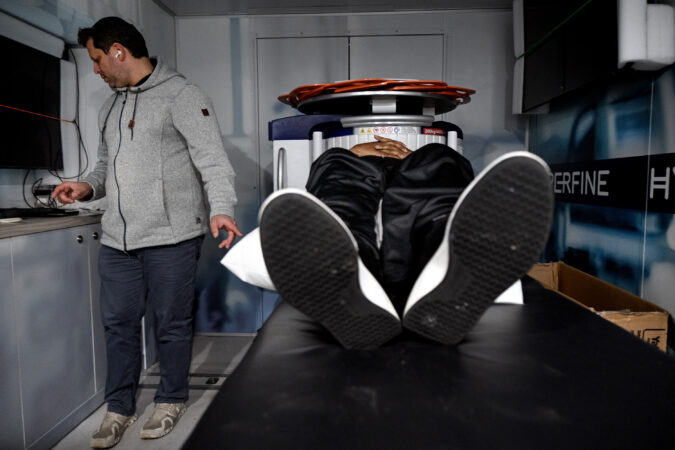
She received her scan at Triumph Baptist Church of Philadelphia in North Philadelphia, where the foundation was offering scans last week to the general public. She’ll receive her results within a couple weeks.
The foundation has hosted these screening events for more than a decade, with the goal of promoting early detection of brain tumors.
Using MRI scans for preventive health screening hasgrown increasingly popular in recent years, with celebrities like Kim Kardashian touting expensive whole-bodyscans on social media.
But many doctors worry that the risks outweigh the benefits. They say that screening MRIs of the brain could lead to unnecessary surgeries and anxiety, and that catching a brain tumor early wouldn’t always change a person’s outcomes. These scans are not typically covered by insurance if not ordered by a doctor, and can cost anywhere from $1,000 to $10,000.
“There, to date, is no data available at all that would suggest that this is a useful approach,” said Stephen Bagley, a neuro-oncologist at Penn Medicine’s Abramson Cancer Center.
In the best scenarios, preventive medical screening can help catch diseases early when they are most treatable, and give people peace of mind. But they can also lead to overdiagnosis, false positives, unnecessary stress, and costlyfollow-up procedures.
This is why expert panels carefully evaluate which screening tools should berecommended to the general public. Decisions by the U.S. Preventive Services Task Force, considered the gold standard for evidence-based preventive care, weigh the potential harms involved against the likelihood of improving outcomes.
Even the most common screenings for cancer, like mammograms for breast cancer and PSA tests for prostate cancer, have faced controversy and shifting guidelines regarding who should get them and how frequently they should be administered.
There is no medical evidence showingthat mass MRI screening is helpful. Still, all spots for the foundation’s multiday screening event at Triumph Baptist Church were claimed. Zeesy Schnur, executive director of the foundation, said they aim to scan 100 to 150 people in each city.
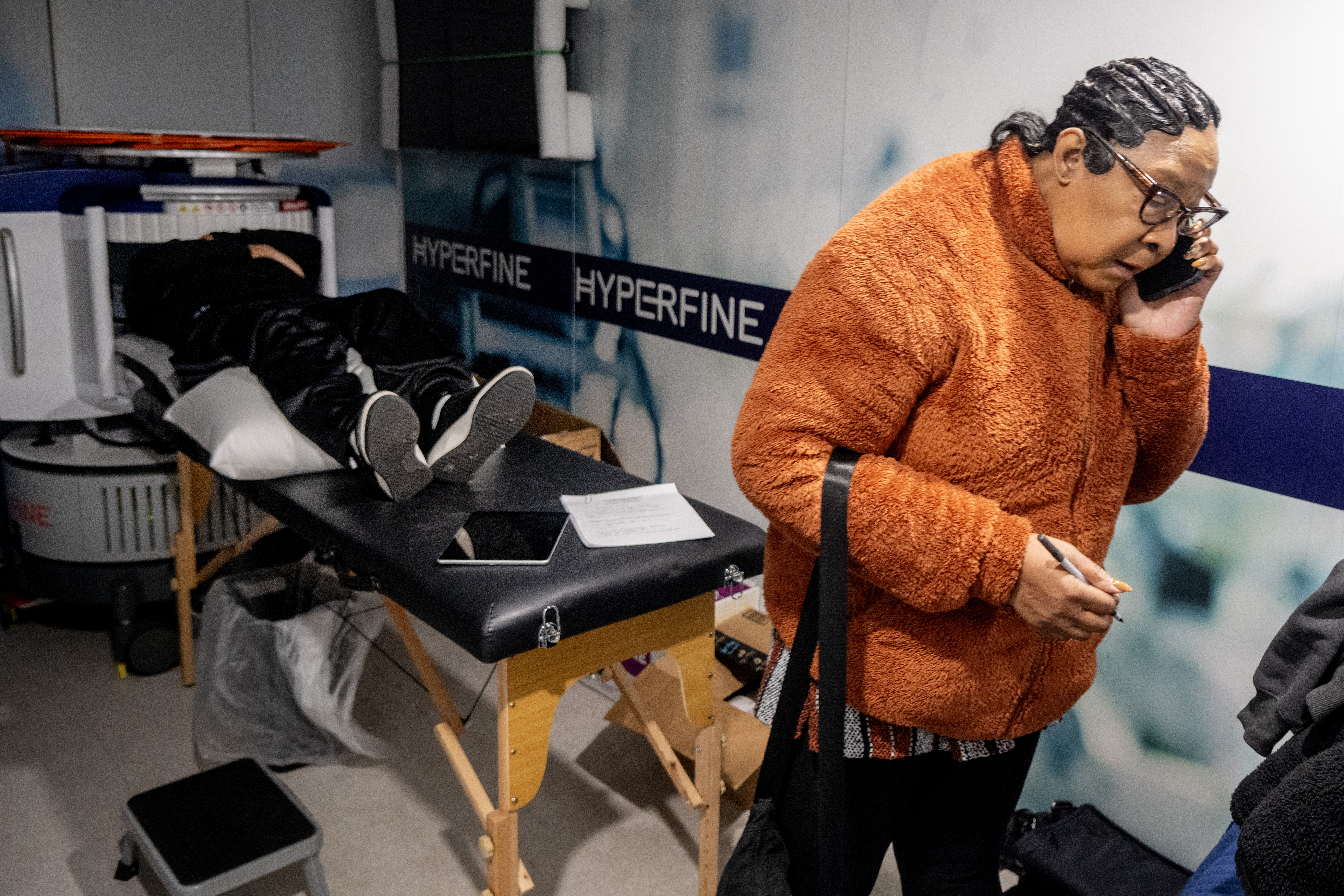
Juanita Young, her husband, and her friend all booked consecutive appointments last week. Though she hasn’t had any symptoms that would make her think she had brain cancer, she signed up “just wanting to know,” she said.
Juanita Young, her husband, and her friend all booked consecutive appointments to get screened.
Philadelphia visit
The idea for the early detection campaign came from Patrick Kelly, a now retired neurosurgeon who started the foundation in 1998.
He was frustrated to see the majority of his brain cancer patients die from the disease, and felt that treatment would be more effective if the tumors were found earlier, explainedSchnur, who has been at the foundation since 2000.
Kelly envisioned a future where, similar to going through the scanners at an airport security checkpoint, people could get a full scan of their body, “and then this piece of paper would pop out and say, ‘Hey, you have a problem here,’” Schnur recalled.
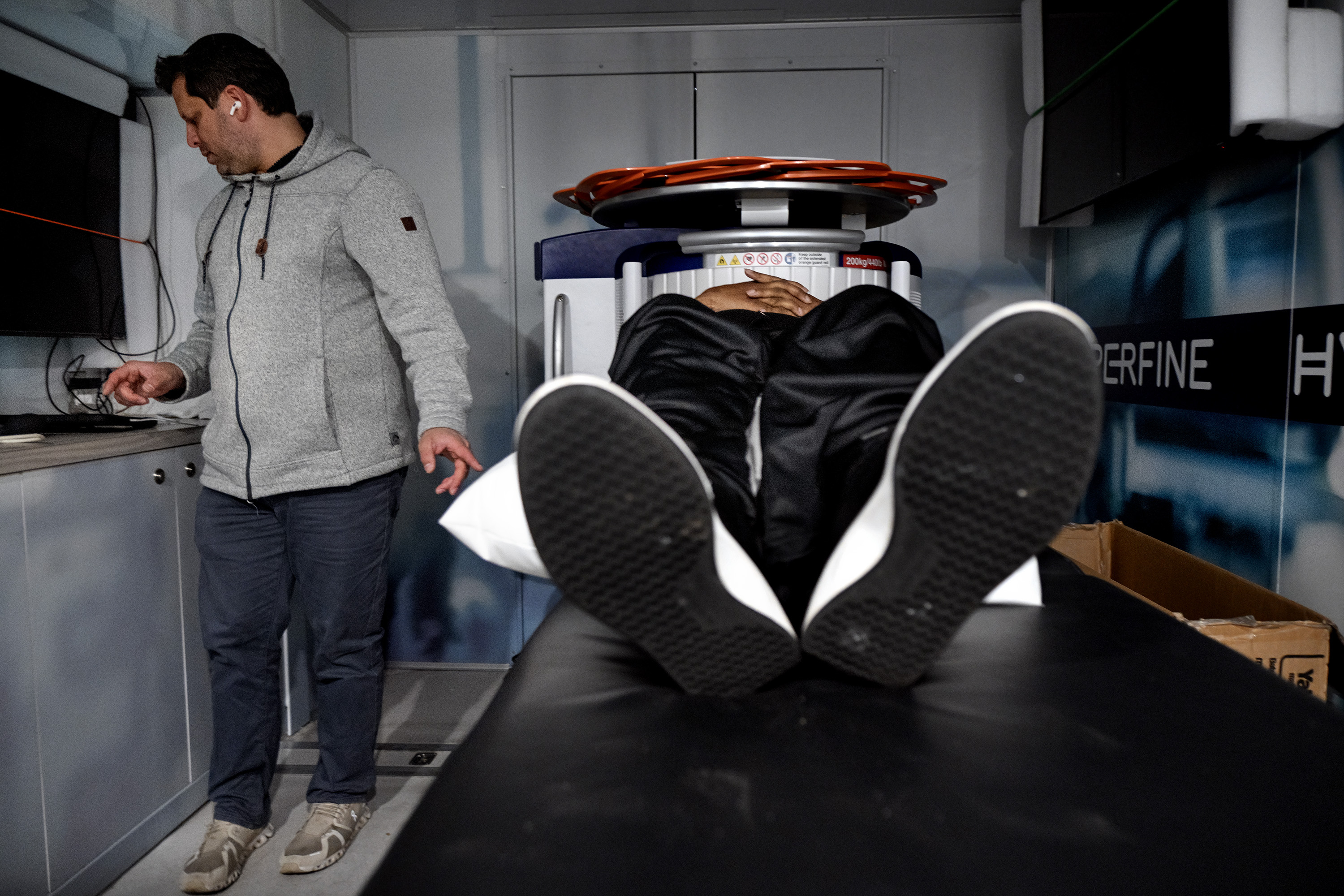
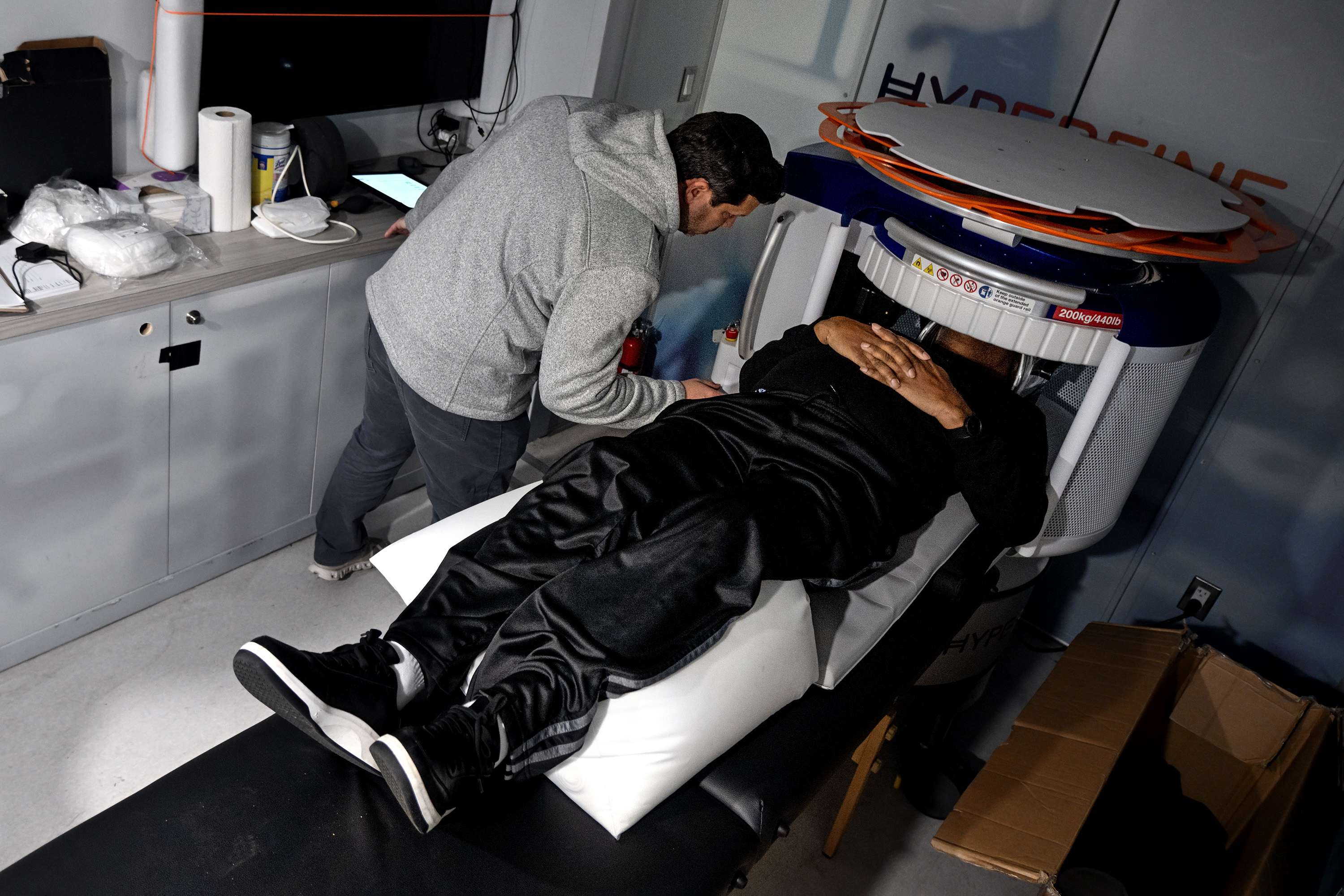
The foundation offers brain MRIs for free at their events, covering the cost of administering the scan and having a radiologist read it. They use a portable MRI machine that only scans the brain and takes approximately 15 minutes.
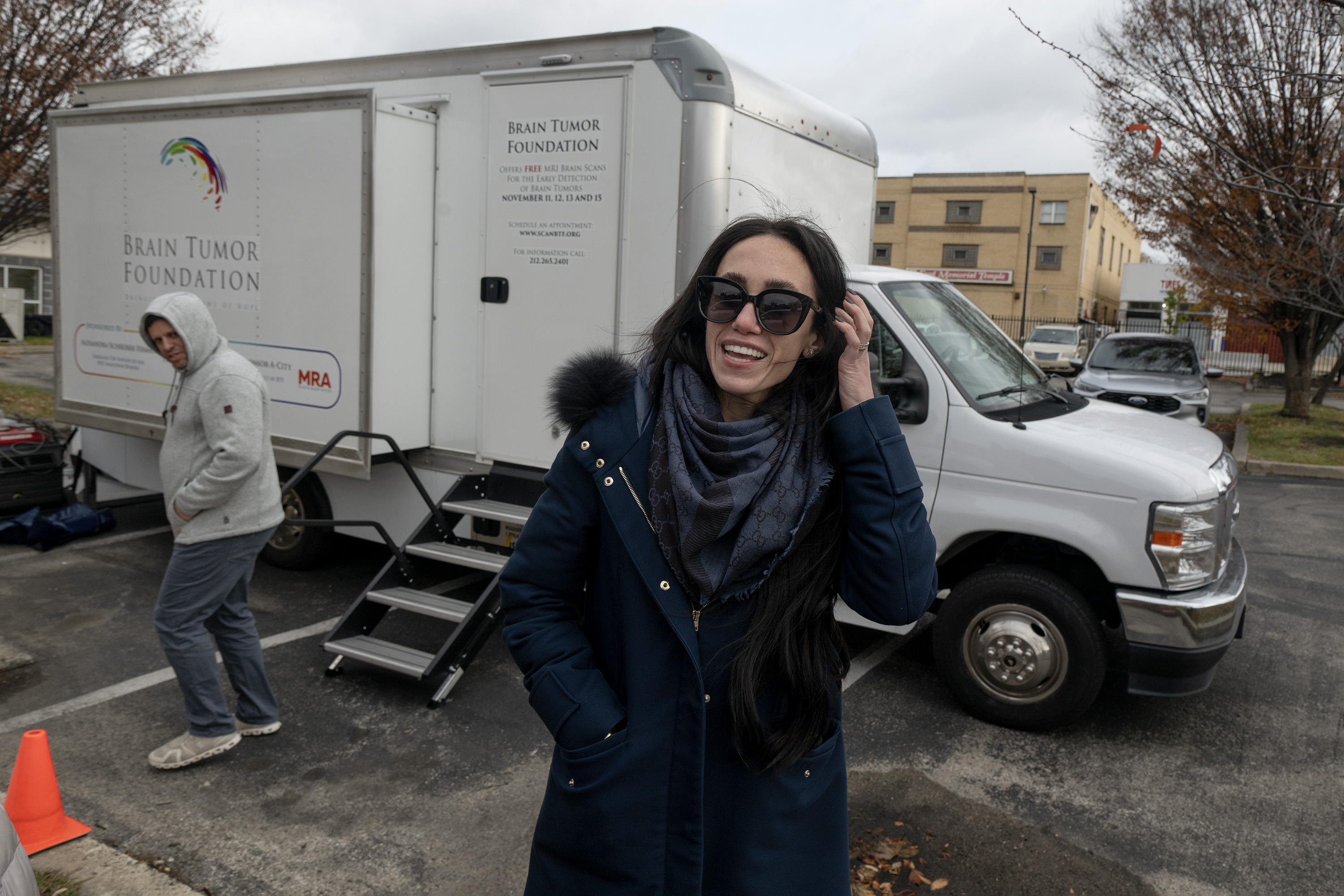
The foundation has chauffeured its machine all over the country through its “Sponsor-A-City” program, which allows people to donate the funds needed to bring the unit to a city of their choice. They usually pick cities that are demographically diverse.
The event in Philadelphia was sponsored by Alexandra Schreiber Ferman, who lives in the area, through the more than $50,000 she raised from running the New York City Marathon.
Schreiber Ferman’s paternal grandfather died from glioblastoma and was a patient of Kelly’s. Her family has been involved with the foundation since its inception.
Schreiber Ferman got her first scan five or six years ago, after she had been having headaches. She pressured her parents to get her in for an MRI when the foundation’s unit was in Brooklyn.
“Thankfully, everything was OK. I just was stressed out,” she said.
Having a family history of the cancer makes her and her family more alert when it comes to headaches and other symptoms. Schreiber Ferman received her second scan Tuesday morning at the screening event.
Alexandra Schreiber Ferman sponsored the Brain Tumor Foundation’s event in Philadelphia.
She said her family and people at the foundation feel that these scans should be “something that’s routine,” like mammograms and skin checks.
“My goal would be that getting a brain scan becomes just a routine part of aging,” she said.
Her father, who serves as chairman of the foundation, wants other people to have the chance to get screened and has helped sponsor past city visits.
However, he himself has only gotten one screening since the program first started, and no longer wants any more.
“My dad is adamant that he does not want to get a scan. I think for him, ‘ignorance is bliss,’” she said.
What doctors say
Screening tests have to meet certain criteria in order to become standard practice, explained Richard Wender, chair of family medicine and community health at Penn and former chief cancer control officer for the American Cancer Society.
A national leader in cancer screening, he would not recommend that people undergo MRIs to screen for brain cancer.
The first criteria for a screening tool to be recommended for the general population is that the disease is common, he said. The disease must also come with a high risk of harm or death and must have stages, so that it can be found before it causes symptoms.
Lastly, available treatments for the disease have to be able to reduce the risk of serious outcomes.
Brain cancer is unlikely to ever meet that criteria, Wender said, mainly because it isn’t common enough. There also isn’t sufficient evidence that finding a brain cancer earlier reduces the risk of a person dying from it.
For example, the most common malignant brain tumor, glioblastoma, is so aggressive and invasive from the start, it is always considered a grade four tumor, noted Bagley, who serves as section chief of neuro-oncology at Penn.
These cancers grow so quickly that the time between the tumor developing and someone showing up to the emergency room with symptoms is typically on the order of months, he said.
“You cannot cure it, no matter when you find it,” Bagley said.
A subset of brain tumors called grade two gliomas are slow-growing enough that catching them earlier could give a patient a better outcome. However, “it’s so rare, you’d have to do so many of these MRIs to find those tumors,” he said.
Another issue with screening the general population is that there will inevitably be false positives.
Some abnormalities in the brain might look like possible tumors on MRIs but turn out to be harmless.
Yet, the person would have to undergo a medical procedure, such as a brain biopsy, to prove that it isn’t cancer.
“You end up putting the patient through invasive brain procedures, lots of anxiety, and existential distress for what ends up to be nothing,” Bagley said.
The same goes for benign brain tumors like meningioma, the most common type of brain tumor in adults. Roughly 39,000 cases are reported each year in the United States. A “very tiny percentage” of these ever become malignant, and it’s unknown if catching them early would help the patient in the long run, Bagley said.
It might just mean the patient has to get MRIs every year for the rest of their life, or get surgery to remove a tumor that probably never would have been become a problem.
Some of these patients have ended up seeking follow-up care fromRicardo Komotar, a neurosurgeon who directs the University of Miami Brain Tumor Initiative in Florida, after finding out they had benign tumors from screening MRIs. He tells these “super nervous” patients that it’s nothing to worry about, but now that they’ve found it, he has to follow it.
As of right now, there is no good screening mechanism when it comes to the brain, Komotar said. He recommends only imaging a person’s brain if there’s a reason, such as a seizure, weakness, or migraines, or an injury, such as in a car accident.
“Brain MRIs as screening have not been proven to help and, in my experience, they only hurt,” Komotar said.
More research needed
Ethan Schnur checks on James Brown as he has his early detection brain tumor screening at the Brain Tumor Foundation event in Philadelphia.
When the foundation first started offering scans, they were finding potential abnormalities in one out of every 100 people they screened. Those included anything from a brain tumor, to silent stroke, to an aneurysm.
One example was a man from Staten Island who had no symptoms, but through the scan, found out he had a nonmalignant brain tumor. He got surgery to remove it.
“He called us afterward to thank us,” Schnur said.
Their stance is that these MRIs should be part of standard of care, so that anyone who wants one has the option.
The foundation has partnered with Weill Cornell Medicine and NewYork-Presbyterian in New York City for a formal research study using data from their screening events.
John Park, the lead researcher and chief of neurosurgery at NewYork-Presbyterian Queens Hospital, said the study will help assess whether screening MRIs for a general populationcould be useful. They aim to screen up to thousands of patients.
“We don’t know if it will be effective or not,” Park said.
If the study were to suggest the scans are effective, there would still need to be a large randomized trial to validate those conclusions, Wender said.
Park’s team will also look at demographic information in an effort to identify risk factors for brain tumors and other abnormalities.
Research into risk factors could help justify whether certain populations should get routine screeningMRIs, Bagley said. He noted that patients with Li-Fraumeni syndrome, a rare genetic disease that predisposes people to developing cancer, are already recommended to get whole-body MRI scans yearly because they’re known to be at such high risk.
Other than those patients, “we don’t really have any way to say this large group of patients is at high risk for this type of brain tumor,” Bagley said.
A handful of patients have ended up seeking care at Penn from Bagleyafter paying for a whole-body MRI from a private company. These are people who were “completely fine” before happening to find a brain tumor on their scans, he said.
One of them was diagnosed with glioblastoma.
He isn’t sure yet whether being diagnosed earlier will actually extend the patient’s survival time. It might just mean the patient gets a few months’ head start on treating the tumor.
“It’s totally unclear if he did himself any justice by finding this terrible brain cancer any earlier. It’s incurable either way,” Bagley said.
Late in the afternoon on Nov. 7, a Friday, the Philadelphia Police Department announced that nine current and former police officers had been charged with conspiring to defraud the city by using a grant-funded youth boxing program to pad their salaries.
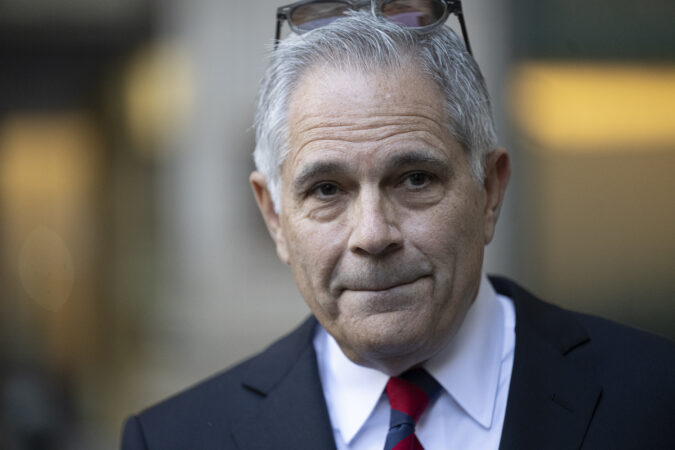
It was the largest number of Philly officers charged together with misconduct in nearly 40 years — a seemingly splashy case for District Attorney Larry Krasner, a progressive prosecutor who has made charging cops a cornerstone of his two terms in office.
Yet Krasner has been unusually quiet about it.
The district attorney was traveling in Switzerland for a conference when the charges became public. His office declined to comment, held no news conference, and issued no public statements — in stark contrast to his trumpeting of police misconduct cases in the past.
Krasner has charged dozens of police officers since taking office in 2018. But he did not publicly acknowledge his largest booking to date until The Inquirer approached him at an unrelated news conference, nearly a week after these most-recent charges were filed.
And even then, he was reluctant to talk about it.
“We had probable cause that they committed the crimes,” Krasner said Thursday. “Having said that, I wanna be very clear: There are a lot of great cops in the city. … I don’t think that this group of nine should in any way taint the rest of them.”
Prosecutors accuse Nashid Akil, former captain of the 22nd District in North Philadelphia, and eight of his officers of stealing $44,576 in taxpayer-funded anti-violence grant money between January and September 2022, according to charging documents.
Those funds came from a $392,000 city grant awarded to Epiphany Fellowship Church to support Guns Down, Gloves Up, a boxing and youth mentorship program that Akil founded at his nearby district building. No one from the church was charged, and Krasner said Thursday the church should not be “tainted” by the allegations against police.
Former Captain Nashid Akil, shown here while at the boxing program Guns Down Gloves Up, at the 22nd District, in Philadelphia, Friday, October 7, 2022.
City employees are prohibited from receiving grant dollars. Yet after vowing in the grant application that police time would be volunteered, Akil, using the church as a pass-through, allegedly paid himself and eight district officers for their work as boxing instructors, an arrangement that came to light through an Inquirer investigation in 2023.
Police now say some officers were paid during their scheduled shift hours.
A law enforcement source familiar with the case said the district attorney’s office concluded its probe into the grant scheme months ago. Krasner did not approve the charges until Oct. 31, according to a police department spokesperson. That was days before the Nov. 4 election, when Krasner was handily reelected to a third term. The defendants began surrendering to authorities three days later.
Police Commissioner Kevin Bethel issueda statement after the arrests saying he was “deeply troubled” by the officers’ alleged actions and “particularly disappointed by the involvement of a former commanding officer.”
But neither Krasner nor his spokesperson responded at the time to repeated requests for comment.
On Thursday, Krasner attributed the timing of the charges to logistical issues with bringing in the nine codefendants.
Akil was forced to resign in February 2023 after The Inquirer’s reporting on the boxing program, and three other officers who allegedly took the money had since resigned. Bethel has moved to fire the five active officers.
Only one of the nine officers listed an attorney in court records, and that lawyer could not be reached for comment.
Officials at Epiphany Fellowship Church did not respond to a request for comment.
An unusual silence
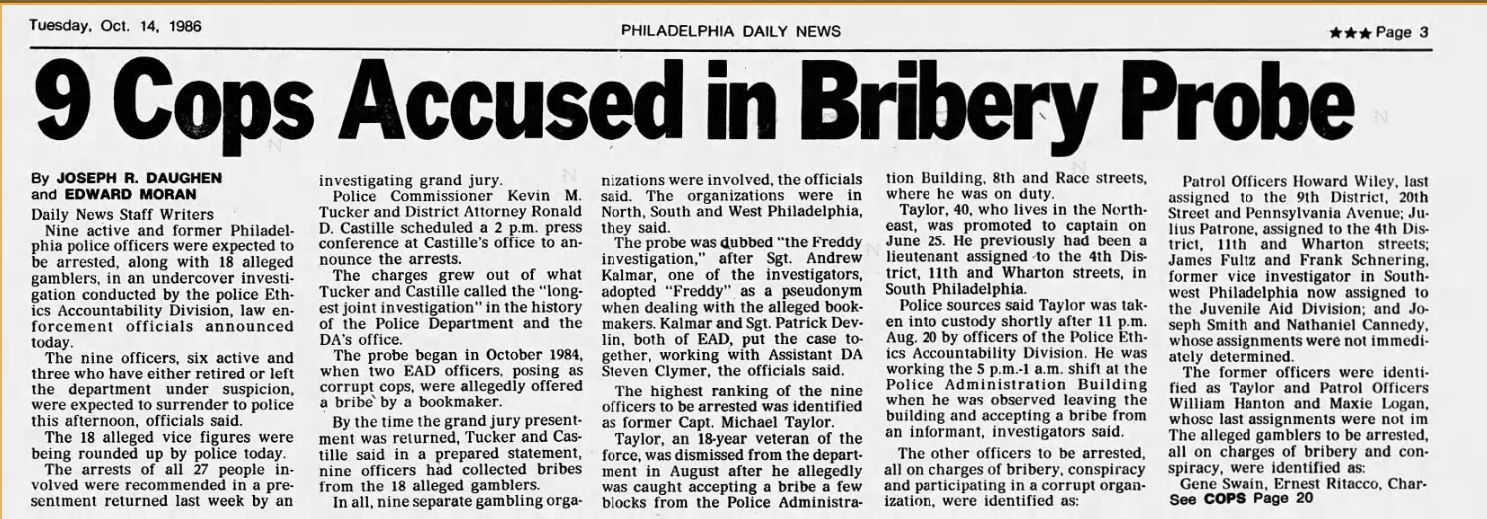
The last time nine officers were charged together in Philadelphia was in 1986, for taking bribes to conceal an underground gambling ring.
An Oct. 14, 1986 article in the Philadelphia Daily News shows the last time nine current and former Philadelphia police officers were charged following a single investigation.
Since the charges were filed in the boxing program scandal, Krasner’s office has put out ninenews releases — but nothing on the nine officers charged.
It’s a departure from how the typically loquacious district attorney has handled previous allegations of police misconduct.
In 2021, for example, when The Inquirer was reporting on widespread abuse of the department’s injured-on-duty program, Krasner said he believed some officers were “gaming the system, and in my opinion, committing crimes by engaging in fraudulent practices to stay home.” The disability system was reformed and hundreds of officers returned to work, but no criminal charges were filed.
The next year, Krasner issued a lengthy news release after the arrest of Officer Daniel Levitt on perjury and related charges, stemming from an allegedly illegal search that led to the recovery of a handgun. The charges against Levitt were initially dismissed but have since been refiled.
In 2023, Krasner was again out front in announcing the arrest of former Officer Patrick Henon for sexually assaulting young girls. Henon pleaded guilty.
In May, Krasner called a news conference after a jury convicted two former detectives convicted of making false statements about DNA evidence.
A month later, when Donald Suchinsky, a former homicide detective, was sentenced to prison for sexually assaulting relatives of murder victims, Krasner appeared outside the Criminal Justice Center to condemn Suchinsky’s conduct and urge any other victims to come forward.
And in July, Krasner again held a news conference to criticize what he called a lenient sentence of former Officer Mark Dial, who was paroled following his voluntary manslaughter conviction in the shooting of Eddie Irizarry.
“I am deeply disappointed with a verdict that I think makes people lose faith in the criminal justice system,” Krasner said.
A sensitive issue
In contrast, when approached by reporters Thursday, Krasner requested an advance list of questions about the alleged grant misappropriation, then huddled privately with two of his top prosecutors for several minutes before offering littlecomment.
Asked about his reticence toward this case compared with past cases, Krasner alluded to outside concerns.
“We have to do certain things in court in a certain kind of way, and we have to operate with our partners, and that’s what we’re going to do,” he said.
He declined further questions.
Krasner’s uncharacteristic silence has not gone unnoticed by nearly a dozen communications consultants, lawyers, and law enforcement officials, who spoke with The Inquirer on the condition that they not be named.
They speculated that Krasner might be downplaying the arrests due to political sensitivities or because — unlike in cases of wrongful arrests and shootings — there is not a clear victim in this case, outside of city taxpayers. Some acknowledged that there could also be legal reasons why Krasner would decline to draw additional attention to the arrests.
Carl Day, a pastor who runs Culture Changing Christians, noted that Krasner is allied with Black clergy members who have supported his political campaigns. Day suggested that the district attorney might be trying to avoid further scrutiny into the church that was in charge of the grant.
“My hope and belief is that it’s a level of respect,” Day said. “In this work, you become scrutinized a ton and placed under microscopes, especially when you are a Black-led organization and getting government money.”
The boxing program scandal is one of several incidents that have raised concern about the city’s oversight of millions of anti-violence grants, scores of which have been awarded to small nonprofits in the Black community.
Day said nonprofit leaders need to be held accountable for misspent funds, but he argued that Black-led nonprofits, many of which do not have the financial resources of large organizations that typically get city grants, face heightened scrutiny.
If that is the case, Day said, he is puzzled why Krasner wouldn’t come out and say so.
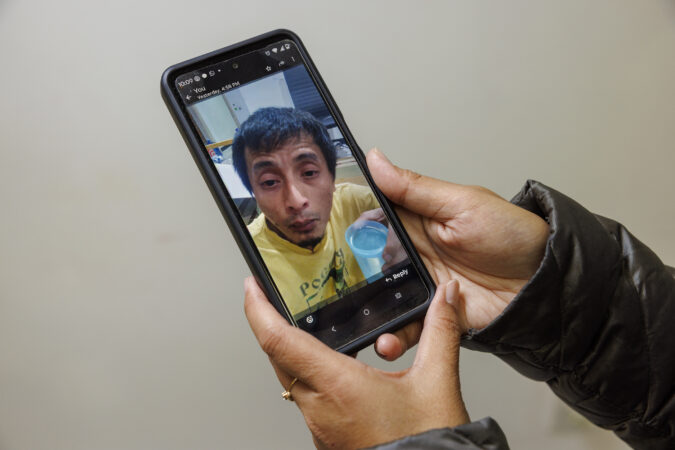
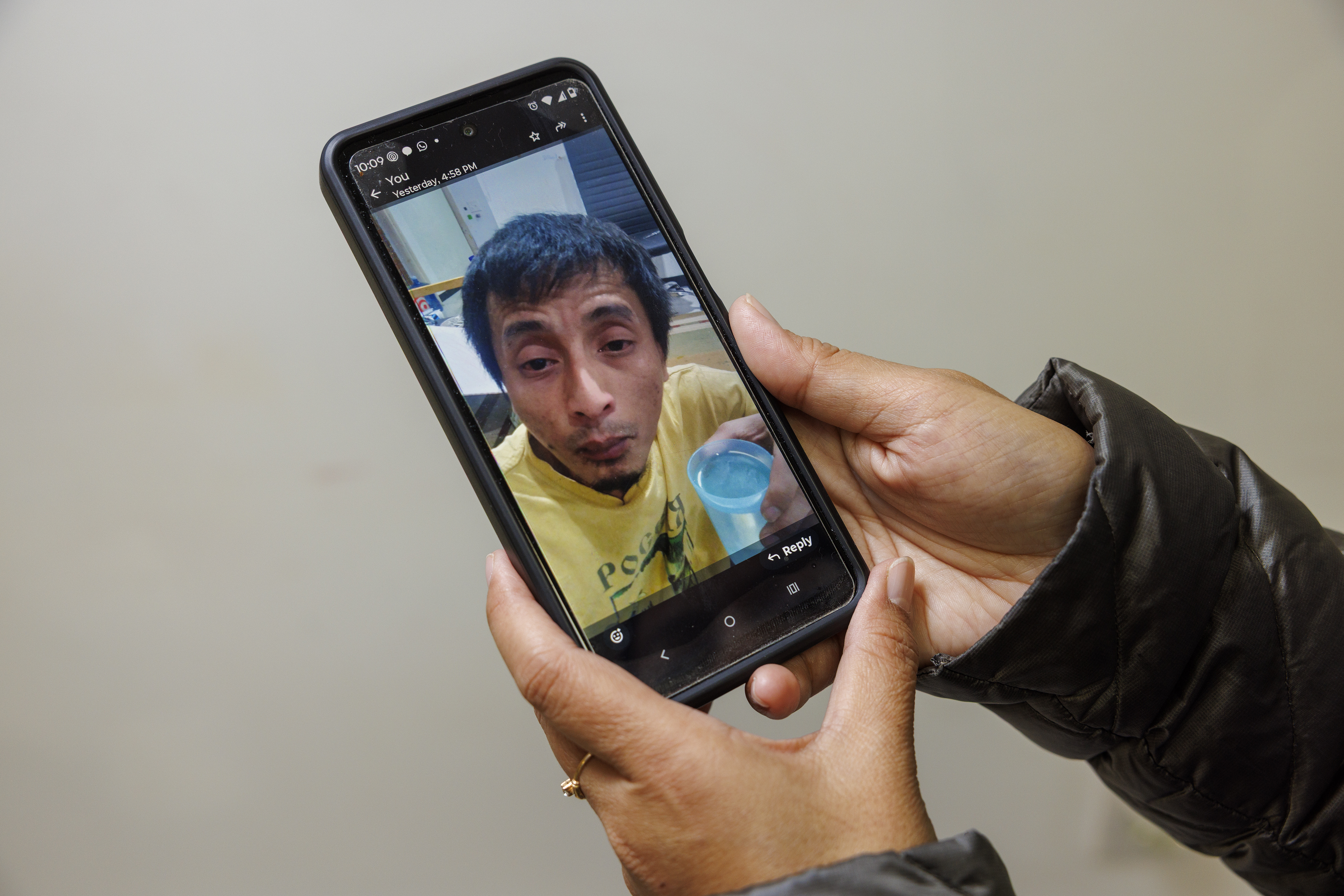
On Oct. 16, Rian Andrianzah walked into a Philadelphia office of U.S. Citizenship and Immigration Services for what he thought was a routine biometrics appointment. He expected to be fingerprinted and photographed and sent on his way.
Instead, while his wife waited in an outer room, he was arrested by ICE ― and now faces deportation in a case that has angered the city’s Indonesian community.
Andrianzah, 46, is among a growing number of immigrants whose families say they showed up for in-person appointments or check-ins, only to be suddenly handcuffed and spirited into detention.
Green-card applicants, asylum-seekers, and others who have ongoing legal or visa cases have been unexpectedly taken, part of a Trump administration strategy, lawyers and advocates say, to boost the number of immigration arrests and to deport anyone who can possibly be deported.
“ICE was waiting for him,” said Philadelphia immigration attorney Christopher Casazza, who represents Andrianzah and his family. “In 15 years, I have never once seen somebody arrested at their biometrics appointment ― except in the past few months.”
Andrianzah legally entered the United States on a visitor’s visa in February 2000, but did not return to Indonesia. He was placed in removal proceedings in 2003, and a judge issued a final order of deportation in November 2006. His appeal was denied two years later.
The removal order was never enforced, as had been common for what the government thensaw as low-priority immigration violators. Some people with final orders have lived in the U.S. for decades.
In the ensuing years, Andrianzah worked factory and warehouse jobs ― and married Siti Rahayu, 44, also of Indonesia. They made a home in South Philadelphia, parents to two U.S.-citizen children, a son, age 8, and a daughter, 15.
Andrianzah and his wife went to USCIS that day as part of her application for a T visa, available to people who have been victims of human trafficking. In an interview with The Inquirer,Rahayu said she was sent to the U.S. in 2001 by relatives who saw her as a means to pay off a debt, delivering her to an underground organization that puts people in low-paying jobs, then keeps them working indefinitely.
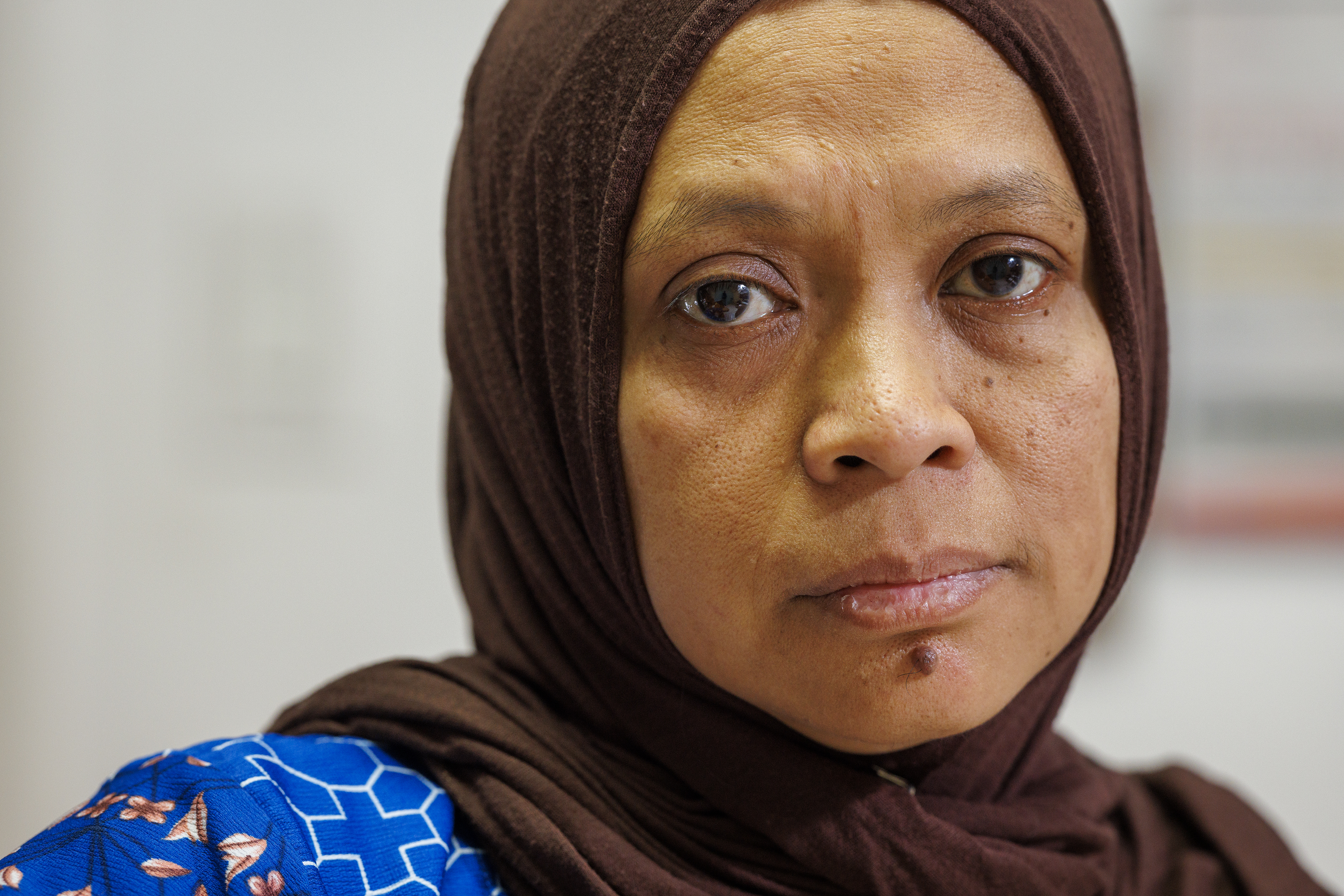
Siti Rahayu of Philadelphia, here on Thursday, November 6, 2025. Her husband Rian Andrianzah walked into United States Citizenship and Immigration Services office for a routine visit but he was sent to Moshannon detention center to await deportation.
Casazza, of the Philadelphia firm Palladino, Isbell & Casazza LLC, said Rahayu has a strong case for a T visa, which offers permission to live in the U.S. and a path to permanent residency and citizenship.
As her husband, Andrianzah would receive those same benefits under her visa.
That’s why, Casazza said, it makes no sense for ICE to confine and deport him. Once his wife’s visa was approved, Andrianzah would be able to legally live in the United States, the attorney said.
Asked about Andrianzah’s arrest and the couple’s situation, a U.S. Immigration and Customs Enforcement spokesperson in Philadelphia said in a statement: “Due to privacy issues, we are not authorized to discuss this case.”
Andrianzah is being held at the Moshannon Valley Processing Center, an ICE detention facility in Clearfield County, Pa.
As President Donald Trump presses his deportation agenda, what were routine meetings with federal authorities have now become risky for immigrants. Advocates say many of those arrested were following the rules and doing what the government asked:
On May 27, the wife of a Marine Corps veteran was detained in Louisiana after meeting with USCIS about her green-card application, CBS News reported. Paola Clouatre, 25, said she came to the U.S. as a child with her mother, but was abandoned as a teenager and unaware that the government had ordered them deported. She spent about eight weeks in custody before being fitted with an ankle monitor and released.
On June 3, federal agents in New York City arrested at least 16 immigrants who showed up for check-ins, after a private contractor working with ICE summoned them to urgent appointments, The City, a news organization, reported.
On Oct. 22, a 21-year-old California college student was arrested by ICE at an appointment at a USCIS office in San Francisco, Newsweek reported. Government officials said Esteban Danilo Quiroga-Chaparro, a Colombian national and green-card applicant, had missed mandatory meetings, though his husband said that was untrue.
On Oct. 23, a Venezuelan couple pursuing asylum were arrested during a check-in at the ICE office in downtown Milwaukee, Urban Milwaukee reported. Diego Ugarte-Arenas and Dailin Pacheco-Acosta sought protection after fleeing their homeland in 2021. An ICE spokesperson told the news agency that “all aliens who remain in the U.S. without a lawful immigration status may be subject to arrest and removal.”
“There’s a lot of risks right now,” said Ana Ferreira, who serves on the executive board of the Philadelphia chapter of the American Immigration Lawyers Association.
Some clients went intoimmigrationappointments knowing there was a possibility they could be detained, she said. Others were shocked to be taken.
“None of this would have happened years ago,” Ferreira said. “It’s a completely different landscape.”
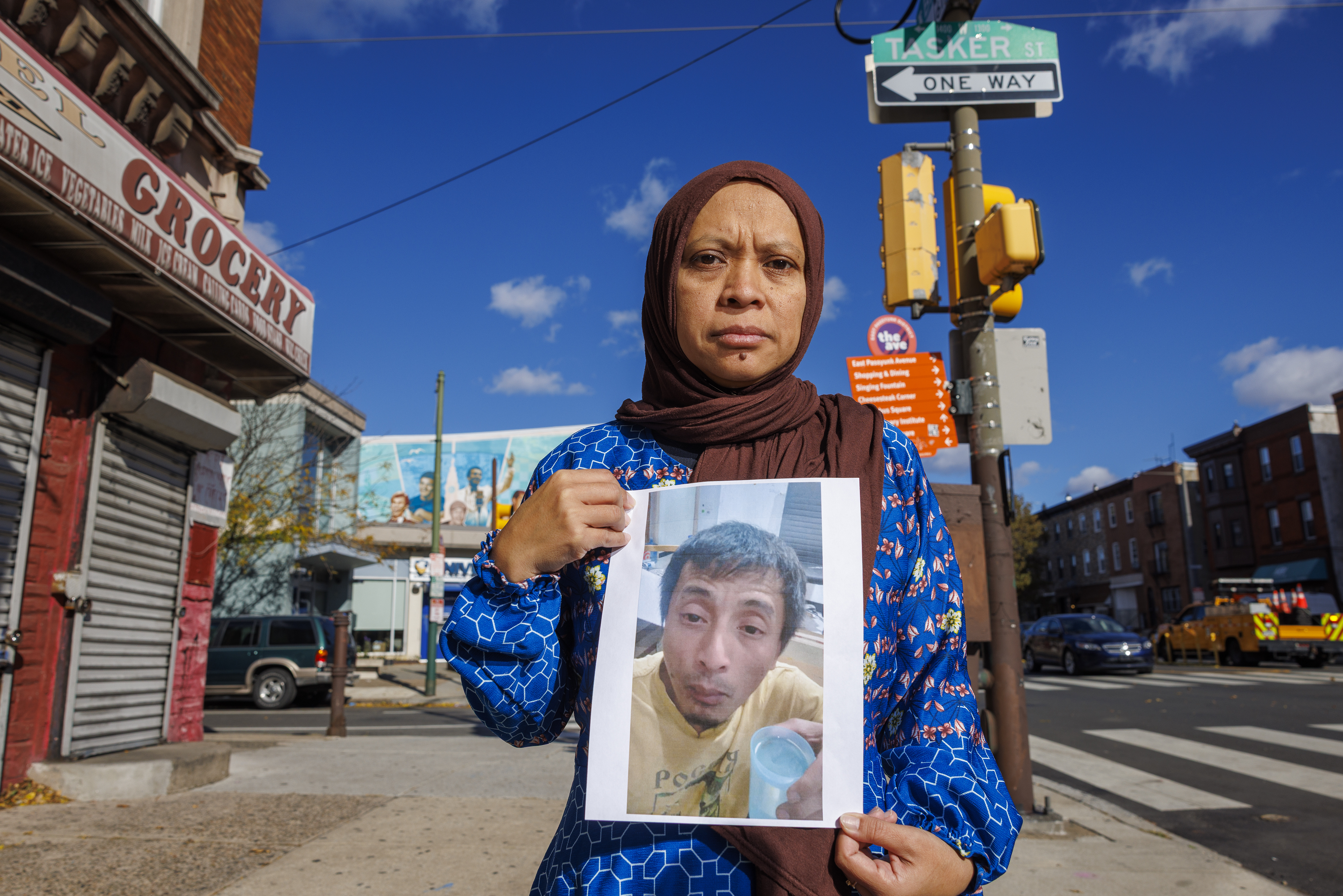
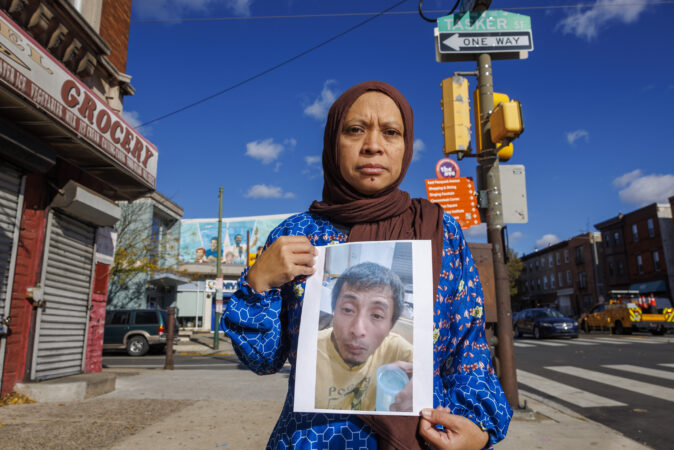
Siti Rahayu of Philadelphia holds a photograph of her husband, Rian Andrianzah. He walked into a United States Citizenship and Immigration Services office for what he thought would be a routine visit but was sent to the Moshannon detention center to await deportation. Photograph taken on Thursday, November 6, 2025.
Rahayu said that on Oct. 16, she completed her own biometrics appointment, then grew concerned when her husband did not appear. She asked the staff what was happening.
“They [said they] don’t know anything, and they say this is new for them,” Rahayu said.
Finally someone told her: He’s gone. Rahayu fears for her husband’s health in custody because he suffers from diabetes, which impairs his vision.
The local Indonesian American community reacted immediately, supported by Asian Americans United, the advocacy group. An estimated 2,000 Indonesians live in Philadelphia, the 10th-largest community in the nation.
Andrianzah said through his wife that he wished to thank everyone who has tried to help him and his family, that he is grateful for their care and concern. Supporters have raised about $13,000.
Each year thousands of people physically report to ICE or related immigration agencies for mandatory check-ins.
Some immigrants are required to appear every couple of weeks, some once a month, others once a year. The appointments help immigration officials keep track of people who in the past have been low priorities for deportation, allowed to live freely as they pursue legal efforts to stay in the United States.
Biometrics appointments are usually brief sessions, perhaps half an hour, at which the government captures fingerprints, a passport-style photo, and a signature. The immigrant may also be asked to provide information like height and weight.
Despite the fresh risk of being arrested on the spot, immigrants have little option except to show up. Many types of immigration applications require in-person appearances. And failure to appear for a required ICE appointment can by itself result in an order for removal.
“They’re trying to grab everybody, wherever they can,” and that included Andrianzah, Casazza said. “ICE is going to do their best to deport him.”
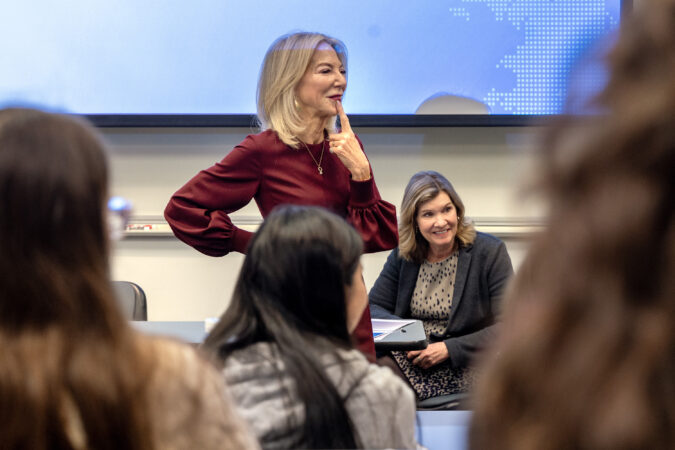
The undergraduateclass at the University of Pennsylvania vigorously discussed the use of affirmative action in college admissions, half the room charged with arguing one side and half the other.
Their task, informed by the 2023 U.S. Supreme Court decision that ended the use of race-conscious college admissions, was to brief and advise a popular governor of a swing state who had not yet taken a position on the issue.
“Guess who is the governor?” said their professor, Amy Gutmann. “I am the governor.”
And for 90 minutes, the entirety of the class period, Gutmann guided a lively discussion in which students talked as much as she did.
While never a governor, Gutmann has quite the leadership portfolio. She was president of Penn for a record 18 years, leaving in 2022 to become U.S. ambassador to Germany under former President Joe Biden, a post she held until 2024. She is also a Harvard-educated political scientist who cowrote the book The Spirit of Compromise and in 2018 was called one of the world’s 50 greatest leaders by Fortune magazine.
Now, for the first time in about 25 years — since she was a politics professor at Princeton — Gutmann is back in the classroom teaching a full course this semester in the Annenberg School for Communication. Sarah Banet-Weiser, dean of Annenberg, who initially came up with the idea for the course, is her co-teacher.
For students, the professorial star power was hard to pass up. There was a waiting list for the class.
“It’s kind of a power duo,” said Evan Humphrey, 21, a senior communications major from Seattle. “Got to take that class.”
Senior Evan Humphrey said she was drawn to enroll in the class because of the two professors and their distinguished careers.
Focusing on teaching — the heart of a university — has been especially meaningful to Gutmann, and to Banet-Weiser, too, at a time when higher education has had its federal funding threatened and its approaches attacked.
“It literally gives me life every week,” Banet-Weiser said.
Gutmann, 75,who said she aspired to be a teacher since she was 5, said it has made her feel productive “in a way that goes to the heart of what a university is about.”
“We should never lose sight of that heart of the university and how valuable it is,” she said.
The goal of the class, called “The Art and Ethics of Communication in Times of Crisis,” is “to learn how and why to communicate with greater insight and understanding across differences,” while creating space “for free and open dialogue about controversial issues.”
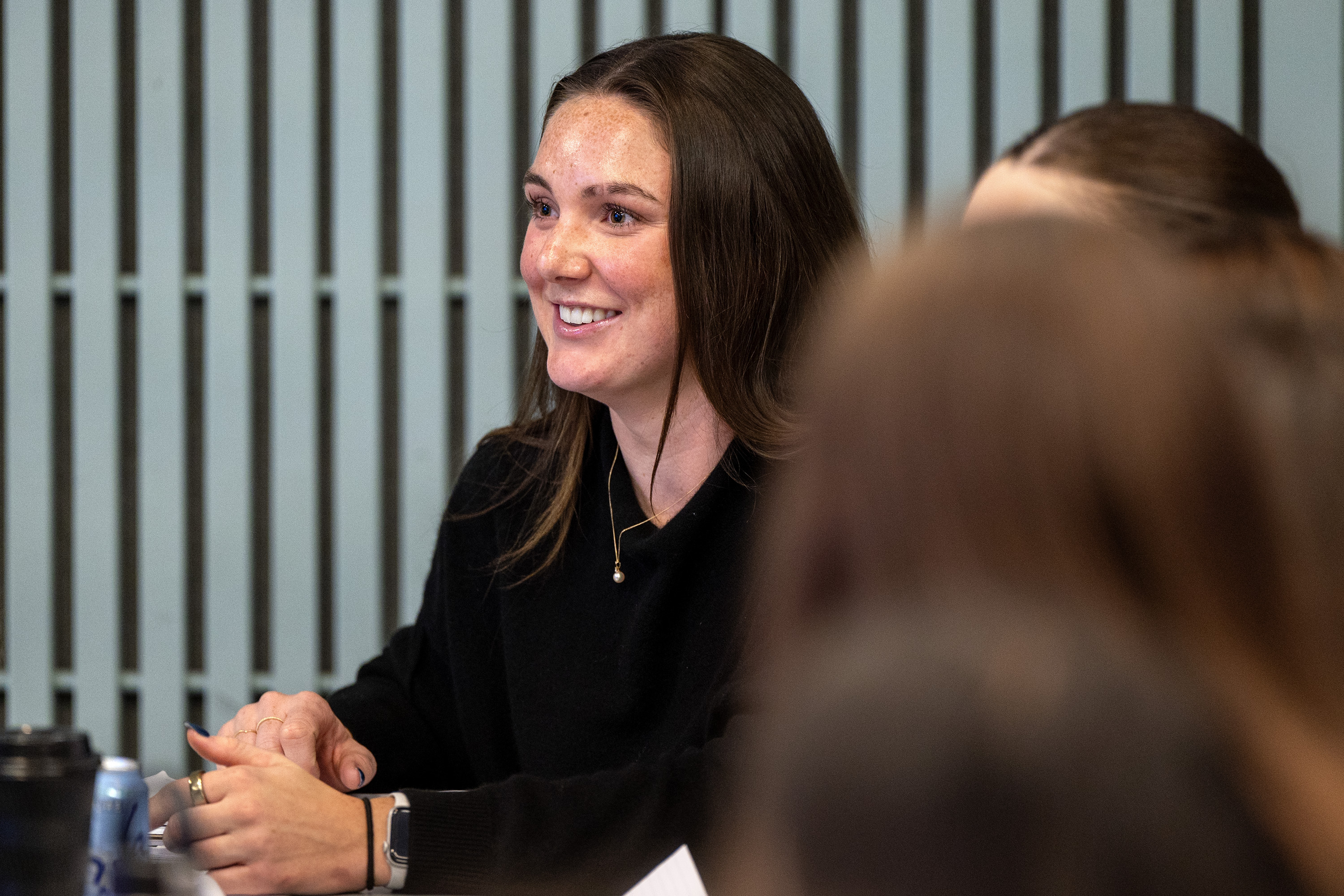
Seniors Luiza Louback (left) and Sarah Usandivaras (right) participate in the class discussion.
It could be a primer for the politically divided nation.
“My pitch is that you can’t really know what you believe if you don’t know what people who disagree with you believe and what their reasons are,” Gutmann said in an interview. “I always say I don’t care what your position is. I care that you can give reasons for it and understand the strongest arguments on the other side.
“That’s the method to search for truth, and it’s the way we serve a democracy.”
Bringing experience to the classroom
During class, Gutmann frequently drew on her experiences as a first-generation college student, a young professor at Princeton, a college president, and an ambassador.
When she got her first teaching job, a male colleague congratulated her, but later she learned he told someone she got the job because she was a woman.
“Did I take that as a compliment? Mm-mm,” Gutmann told the class.
Humphrey said she especially likes hearing about Gutmann’s vast experiences.
“She’s like, ‘Well, when I was the president here, this is something I dealt with,’” Humphrey said. “It’s really interesting knowing the experience she has and her background and the perspective she brings.”
Amy Gutmann (center), president emerita of the University of Pennsylvania and former U.S. ambassador to Germany, is presented with the Weitzman National Museum of American Jewish History’s Only in America® Award during a gala at the museum this month. The award recognizes “Jewish Americans who have made enormous contributions to our world … often despite facing antisemitism and prejudice.” Among those posing with her are Ramanan Raghavendran (far right), chair of Penn’s board of trustees, veteran journalist Andrea Mitchell (next to Raghavendran), Penn President J. Larry Jameson, (to the immediate left of Gutmann), and David Cohen, former Penn board chair, (next to Jameson.)
Gutmann’s life outside class continues to be full, too. After class Wednesday, Gutmann, whose father fled Nazi Germany, flew to Berlin to receive the Prize for Understanding and Tolerance from the Jewish Museum Berlin.
Having returned to Philadelphia to live after leaving Germany, Gutmann said it wasn’t hard to find her stride again in the classroom. She had given one-off lectures as Penn’s president.
“I have a lot of muscle memory on teaching,” she said.
Her style has changed from her early days at Princeton, where she worked from 1976 to 2004. She said readinga student’s notebook left behind and open after one of her ethics and public policy lectures was a major turning point.
“‘That’s not what I said,’” Gutmann thought. “And I realized it’s not what you teach them, it’s what they learn. At that point, I realized I needed feedback.
“So I changed from doing the 45-minute [lecture] thing to doing five or 10 minutes, max, and then asking them questions. Then I got them to argue with one another, and once I found that, I found what I really discovered worked for learning.”
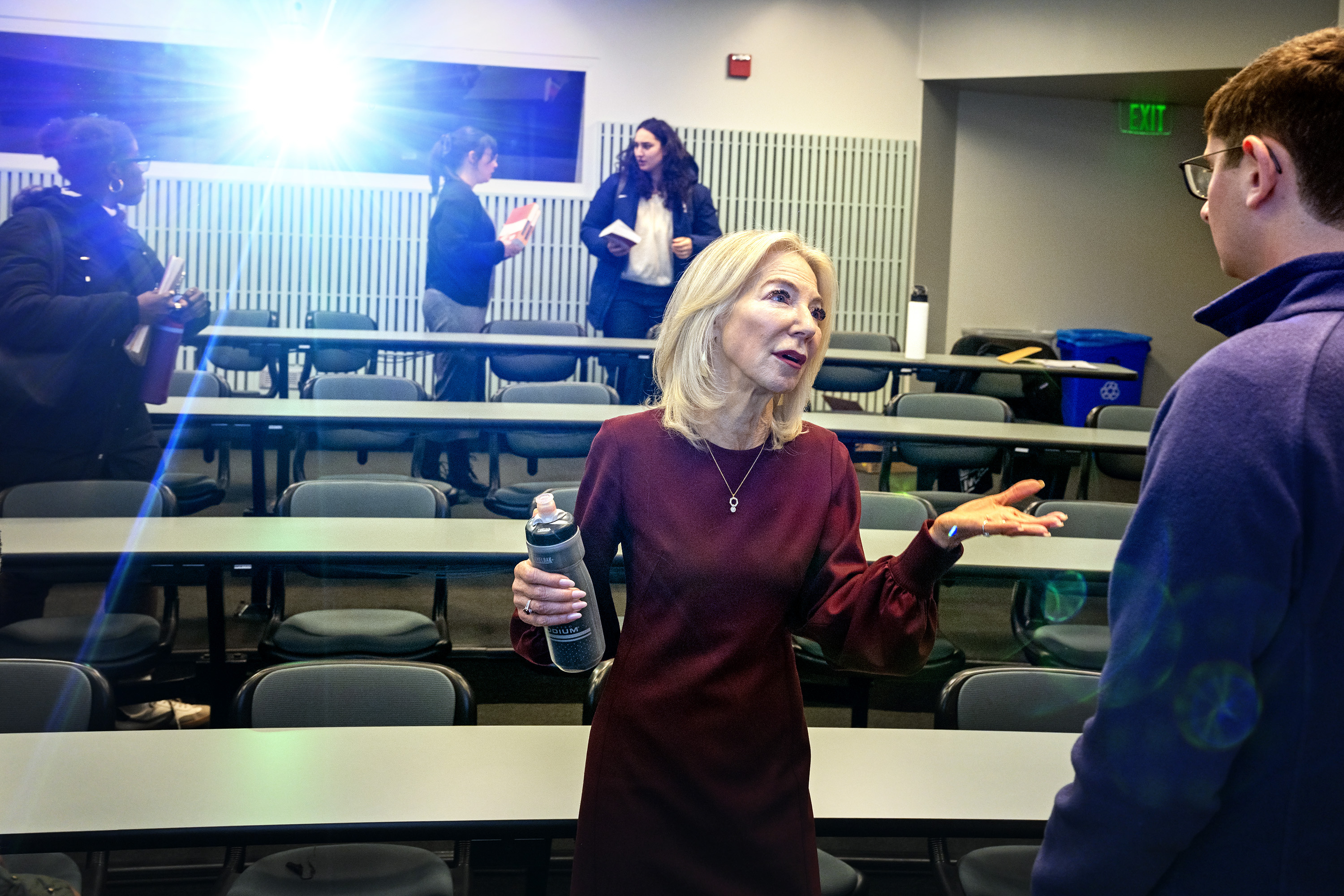
Amy Gutmann talks with sophomore Brian Barth (right) at the end of class she co-teaches at Penn’s Annenberg School for Communication.
Gutmann said she spends Fridays and weekends preparing for the class, which meets twice a week.
“It’s a ton of work,” she said. “I’m really delighted to be doing it.”
The class comes against the backdrop of fraught times for colleges. Penn earlier this year scrubbed its website of diversity initiatives after President Donald Trump’s administration threatened funding to schools employing diversity, equity, and inclusion efforts. In the summer, the school struck an agreement with the administration over the past participation of former transgender swimmer Lia Thomas, and Penn was one of nine schools originally asked to sign a compact that would have given the school preferential consideration for federal funding in exchange for complying with certain mandates affecting admissions, hiring, and other university operations. Penn declined.
‘One-of-a-kind’ discussions
Gutmann and Banet-Weiser do not allow laptops, phones, or any electronic devices in class so that students completely focus on the conversation. To prepare for the affirmative action discussion, students were assigned related readings and review of the court cases.
The two professors interacted with each other and prompted discussion among students with deep questions: Is treating people equal the same as treating them equally? Is it right to use affirmative action for only one racial group? What about other forms of affirmative action or preference, including for athletes, low-income students, and legacies whose parents attended the university?
The approach resonated with students.
“I wanted to take a class where I would really be encouraged to step out of my comfort zone and be able to learn not only how to understand my own beliefs and values but understand the beliefs and values of others,” said Sarah Usandivaras, 21, a senior communications and political science major who was born in New York and grew up in Paraguay.
She found it in Gutmann and Banet-Weiser’s classroom.
“It’s a one-of-a-kind,” she said.
Ariana Zetlin, a doctoral student in Penn’s Graduate School of Education, is auditing the class to observe its approach.
“The discussion and the debates are so much deeper and stronger than what I’m seeing in classrooms that don’t necessarily have these structures,” said Zetlin, 30, who is from New York.
During class, those on both sides found common ground.
Senior Angele Diamacoune said she was learning from the day’s lesson.
“So I’m hearing agreement that diversity is a good thing but disagreement on how you get it,” Gutmann said.
She asked students how many believed that having low-income and racially diverse students in class contributed to their learning. Every hand went up.
“That to me is really striking,” Gutmann said. “There aren’t that many things that we can get unanimity on.”
She asked students how they would advise colleges to teach the issue.
“It would be good to teach with activities like this,” said Angele Diamacoune, 21, a senior communications major from Allentown.
If that sounds harsh, well, harsh is a pretty good word to describe the experience of watching the Eagles offense right now. The play-calling lacks imagination. The run-blocking lacks the dominance that was once its hallmark. The quarterback has always lacked aggression. Now, he lacks accuracy, too.
That’s not an ideal formula. There are all kinds of ways you can shrug off the staggering ineptitude the Eagles displayed while muddling their way to a 16-9 win over the Detroit Lions on Sunday night. It’s an easy thing to do when your defense consistently forces opponents to play bleepier than you. The Eagles are 8-2, with the best Super Bowl odds in the NFC, and victories over four of the five teams whose odds are just behind theirs. That stuff matters. But you can’t shrug off the one question that every team with Super Bowl aspirations must constantly ask itself.
Are we a championship team in our current form?
That the Eagles can even think about answering yes is a testament to how good they are everywhere outside of offensive execution.
Brown said it best on Sunday night.
“This team is resilient,” said the Eagles’ wide receiver, who broke free of his recent on-field anonymity with 11 targets and seven catches, albeit for only 49 yards. “Show up, work hard, find a way, no matter what it looks like.”
Brown is right. And he has been right all along. The Eagles are a very good team. Winning football games is important. But so is progress. Right now, the Eagles are a long way off from being the best team they can be.
Nothing that we saw from them on Sunday night suggests their fundamental problem has been solved. It isn’t just that the Eagles aren’t scoring enough points. It’s that they don’t appear to be getting any better.
They have scored 17 or fewer in four of their last six games, including a combined 26 in their last two. Are they capable of winning a Super Bowl in their current form? Absolutely. But you can’t ignore how different their current form is from the one that saw them win the Super Bowl last season.
For the second straight game, and for the fifth time this season, the Eagles failed to crack 300 yards of total offense. That only happened three times all last season. Heck, it only happened five times in 2023.
There are plenty of mitigating circumstances. Last week’s game in Green Bay was played in real feel temperatures that dropped into the teens. Sunday’s win over the Lions featured a steady wind with wild gusts above 30 miles per hour. In both games, the Eagles lost All-Pro right tackle Lane Johnson to an injury (most recently, his foot, which sidelined him for all of the second half Sunday night).
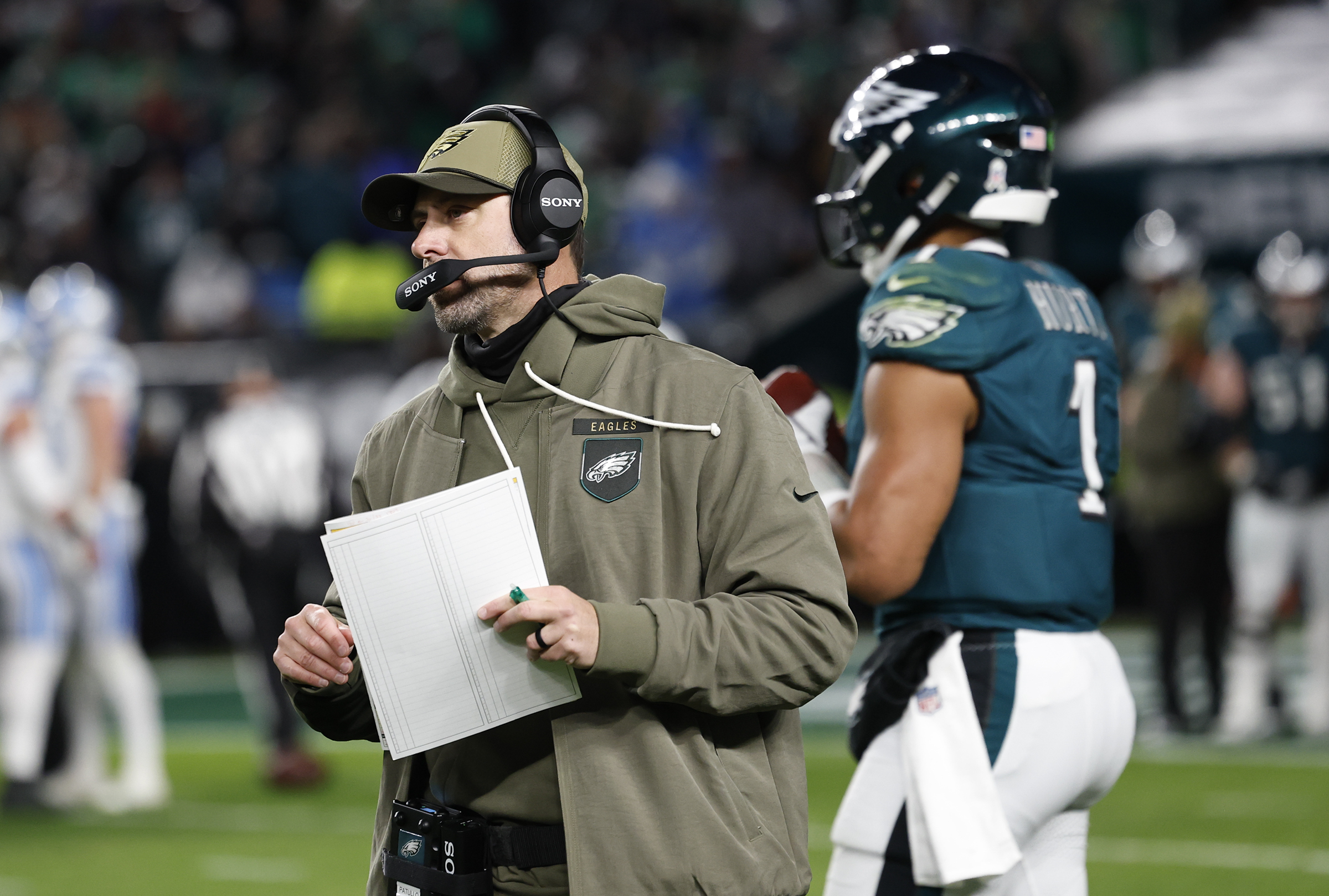
Coordinator Kevin Patullo is among those seeking answers to the team’s offensive issues.
The schedule has been brutal. The Lions defense entered Sunday ranked seventh in the NFL in yards per play allowed. The Eagles had already faced three of the six teams who ranked above Detroit (Denver Broncos, Green Bay Packers, Los Angeles Rams).
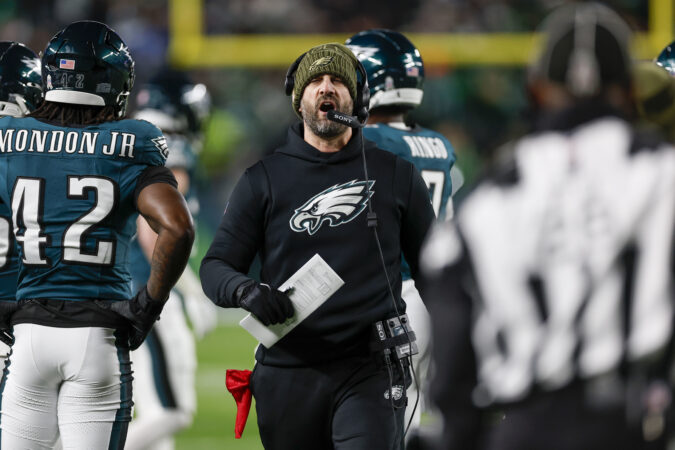
“We want to be better than what we were tonight, but every game’s played a little bit differently,” coach Nick Sirianni said. “Every game is played to win, but do we have to clean up things on offense? Of course we do. As good as the defense played, we’re going to have to clean up things on defense. As good as the special teams played, we’re going to have to clean up things on special teams. But on offense, there’s some shooting ourselves in the foot that’s happening and some of those things are things that, we always talk about [things that] take no talent, and we have such good talent that we have to be able to master the things that take no talent so our talent can shine.”
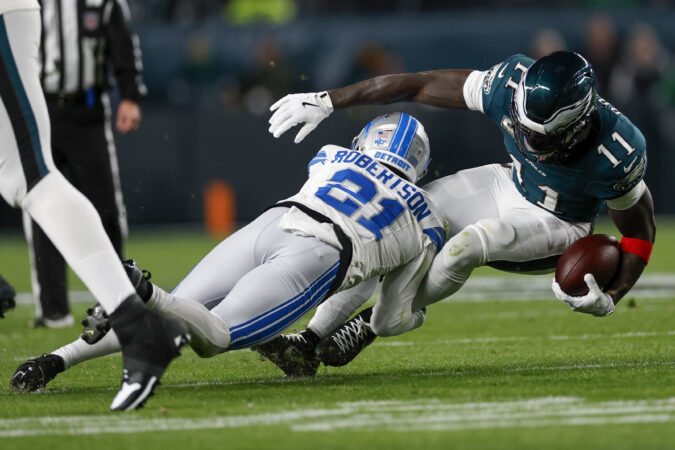
Give them credit for trying something new. They tried to force the ball to Brown, which is something that he and plenty of Eagles fans have been lobbying for in recent weeks. His 11 targets were more than he had in the last two games combined, including last week’s three-target, two-catch nothingburger in Green Bay.
The concerning thing is that nothing else changed. Brown’s seven catches went for just 49 yards. The Eagles scored just one touchdown. Even on a night when Jared Goff was out of sync and the Lions went 0-for-5 on fourth down, Detroit’s offense looked like the more highly evolved unit. The pinnacle came in the second quarter, when Goff hit Amon-Ra St. Brown for 34 yards and then Jameson Williams for a 40-yard touchdown. The 74 yards the Lions gained on two plays were more than the Eagles had gained all game to that point.
There were plenty of stretches last season when the Eagles looked like that sort of offense. Brown was always at the center of it, it seemed.
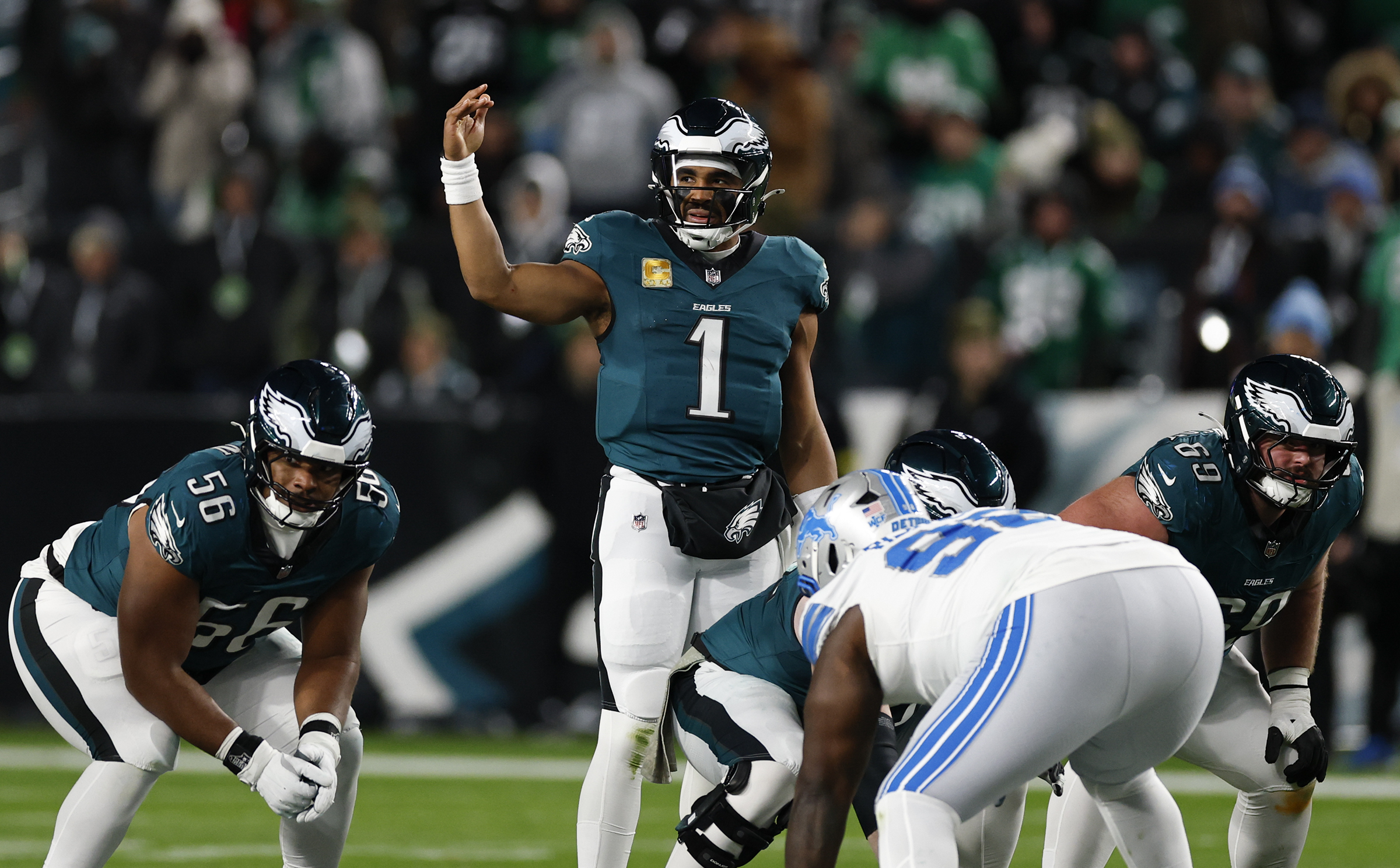
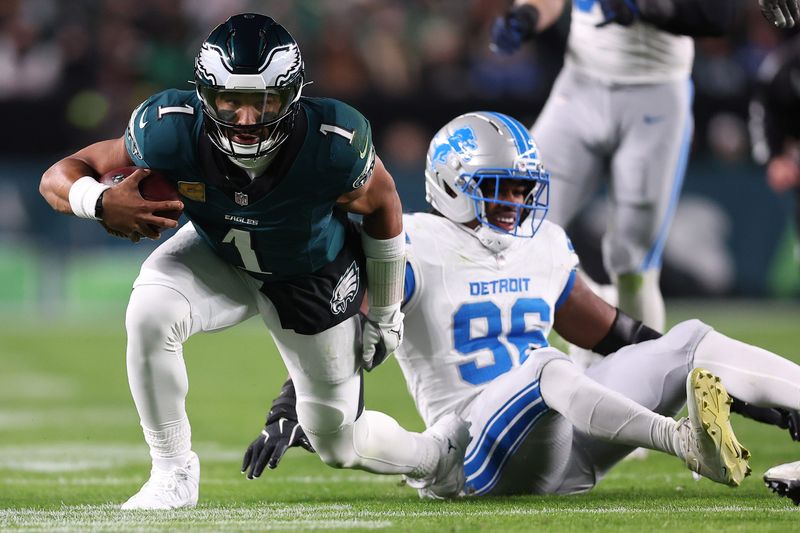
Jalen Hurts and the Eagles offense must find a rhythm if they wish to make a run at another Super Bowl.
The Eagles need to find a way to make Sunday night a building block. Good things happen when you target even a diminished Brown. The final example came with 1:47 left, with the Eagles one play away from turning the ball back over to the Lions for a chance at a wholly unearned game-tying touchdown drive. On third-and-8 from the Eagles 37, Jalen Hurts forced a pass to a tightly covered Brown, and Lions cornerback Rock Ya-Sin panicked. Instead of watching Hurts’ pass sail wide of its mark and short of the sticks, he reached out toward Brown and drew a flag. It was a questionable call, but the end result gave the Eagles a first down, and kept the Lions offense on the sidelines for the rest of the game.
“We’re always trying to get A.J. involved,” Sirianni said. “Always, always, always, always. The game play is played differently each and every week of what happens. I don’t think I’ve been shy about saying this. The game plan’s always going to start in the passing game with him and [WR] DeVonta [Smith] and [TE] Dallas [Goedert], and so we’re always trying to do that and get him the football. That’s the way the game played out a little bit today.”
At some point, it will need to play out better. Let’s hope that point comes soon.
Friday Saturday Sunday, Mawn, Kalaya – let us know who you think deserves a prestigious Michelin star
Tomorrow night during a ceremony at the Kimmel Center, Michelin will award its first ever stars to restaurants in Philadelphia. The wait is nearly over but until we finally find out we want to know which ones you think deserve a star.
Now that you know more about Michelin stars, let us know which of these restaurants you think deserves one — swipe right for Yes or left for No. Yes, just like Tinder. Finding it hard to decide? We'll also show you how other Inquirer readers have voted so far.
Mawn
Cuisine
Cambodian
Neighborhood
South Philadelphia
Crowd says
Friday Saturday Sunday
Cuisine
Modern American
Neighborhood
Center City
Crowd says
Her Place
Cuisine
Modern American
Neighborhood
Center City
Crowd says
Provenance
Cuisine
French, Korean
Neighborhood
Center City
Crowd says
Honeysuckle
Cuisine
American, Brunch
Neighborhood
Spring Garden
Crowd says
Zahav
Cuisine
Israeli
Neighborhood
Center City
Crowd says
Kalaya
Cuisine
Thai
Neighborhood
Fishtown/Kensington
Crowd says
Pietramala
Cuisine
Vegan
Neighborhood
Northern Liberties
Crowd says
Royal Sushi & Izakaya
Cuisine
Japanese
Neighborhood
South Philadelphia
Crowd says
My Loup
Cuisine
French, Seafood, Modern American
Neighborhood
Rittenhouse
Crowd says
Parc
Cuisine
French
Neighborhood
Rittenhouse
Crowd says
Vernick
Cuisine
Seafood, Modern American
Neighborhood
Rittenhouse
Crowd says
Vetri Cucina
Cuisine
Italian
Neighborhood
Center City
Crowd says
Andiario
Cuisine
Italian, American
Neighborhood
West Chester
Crowd says
All rated!
story continues after advertisement
Staff Contributors
Design, Development, Reporting, and Data: Aileen Clarke
Editing: Sam Morris
Photography: Jose F. Moreno, Monica Herndon, Yong Kim, Tom Gralish, Charles Fox, Tyger Williams, and Tim Tai
Illustration: Steve Madden and Sam Morris
Subscribe to The Philadelphia Inquirer
Our reporting is directly supported by reader subscriptions. If you want more journalism like this story, please subscribe today
Seven hundred and twenty-four days ago, Nick Sirianni stared into a bank of TV cameras and dared the NFL — hell, dared the whole world — to stop the play that the Eagles had mastered and no one else in pro football had. It was late October 2023, and while holding a seven-point lead against the Miami Dolphins, the Eagles ran a quarterback sneak, a Tush Push, on fourth-and-1 with 10 minutes, 1 second left in regulation. That wasn’t the striking part. Neither, really, was the fact that Jalen Hurts powered forward for a first down. The striking part was that the Eagles were on their own 26-yard line, a set of circumstances that made a bold postgame assertion from Sirianni all the more memorable.
“If everybody could do it,” he said that night, “everybody would do it.”
Well, there the Eagles were Sunday night, and for once, the Tush Push was an issue for them. For once, it wasn’t automatic. For once, its magic was gone, and of all the ramifications of the Eagles’ 16-9 victory over the Detroit Lions, that relative demystifying of their signature, unstoppable play was among the most concerning. For these last few years, the Tush Push had given them an innovative and significant advantage over their opponents, had meant the Eagles really needed just 9 yards to get a first down, because the 10th yard was a fait accompli.
Nothing was that easy Sunday. The Eagles succeeded just once — Hurts’ second-quarter touchdown, the team’s only one of the game — in their six sneak attempts. They false-started. They were stuffed. With 2:54 left in regulation, with the Eagles up 10 and facing fourth-and-1 from their own 29-yard line — a situation similar to the one they confronted against the Dolphins in ’23 — Hurts went nowhere, and that failure invited the Lions back into the game by handing them at least a chance to cut the lead to a single score.
“I’d do it again over and over,” tackle Jordan Mailata said. “I’d take us any day. Now, we’ve got to go back and watch that play and see what went wrong. But I’d still take us any day of the week. When you have a defense like ours, it does make it easier to go for it on fourth down. There’s the trust and faith in the guys up front, but also, if we don’t get it, there’s the trust and faith in the guys on defense.”
That was the knee-jerk justification for a call that, in the context of this particular game and the condition of this particular Eagles offensive line, Sirianni never should have made. When he had the Eagles go for it from their own 26 nearly two years ago, his decision was surprising because it was so unconventional at the time. He was correct then: The Eagles were the only team that could run the Tush Push with so high a rate of success, and they could because of the players they had blocking on the play: Jason Kelce, Lane Johnson, Mailata, all healthy.
Jalen Hurts has been frequently working behind a different version of the O-line than the dominant one that patented the Tush Push.
Sunday was so far from that same scenario. Johnson was ruled out at halftime with a foot injury, and center Cam Jurgens, having missed the previous two games with a knee injury and already playing through the painful effect of offseason back surgery, had exited, too, with 5:06 to go. So two backups, Fred Johnson and Brett Toth, were subbing for them. And the NFL and its officials and a chorus of complainers are now watching every twitch and subtle hint of movement every time the Eagles run the Tush Push. And now a play that was once a slam dunk is something closer to a midrange jump shot.
“They’re homing in on it,” Hurts said. “They’re very strict on the guard and the center and how they operate. They’ve got their eyes on it, and we’ve got to go out there and be as clean as possible.”
This sliver of doubt when it comes to the Tush Push might seem a small matter. It isn’t. The play’s reliability was a tangible symbol of the strength of the Eagles offense: the manner with which they controlled the line of scrimmage. Lane Johnson’s warning last month, after a loss to the New York Giants, about the offense becoming “predictable” was in that sense silly. No offense in the NFL last season was more predictable than the Eagles’. Everyone knew Saquon Barkley was getting the ball, and still no one could stop it.
This season, the worry for a team that is 8-2 and atop the NFC is simple: That inevitable dominance hasn’t been there, and that reality has to change the calculus when it comes to the Eagles’ trademark aggressiveness in their play-calling. They could afford to go for it anytime, anywhere in short-yardage situations when they had the best collection of blockers in the league. The line’s regression should compel Sirianni to coach the team he has right now, not the one he used to have or the one he wished he had, and over the rest of the season, he has to weigh how much he asks of a defense that is carrying the Eagles, that allowed them to get away with two subpar offensive performances against two playoff-caliber teams.
“Always. Always. You always think about those things,” he said. “You think about how it plays in-game, but you also think about your past experiences. Everything is taken into account. But you definitely think about how it’s playing in-game. … Any time we don’t get a fourth-down conversion, I’m going to put that on myself. I’m always going to be hypercritical of myself. Obviously, if I had known we weren’t going to get it, I would have punted it.”
He couldn’t have known it, but he could have suspected it, and he has to start asking himself a question that he once didn’t have to contemplate. Of course, if everybody could do the Tush Push, everybody would. But what if the Eagles can’t?
Angelica Javier was sitting at home on a Saturday evening last month when her son’s uncle called in a panic.
Xzavier, her 16-year-old, had been shot, he said — one of the teen’s friends had called and told him, but he knew nothing else.
Javier, 32, frantically checked a news website and saw a brief story mentioning that a man was shot and killed in Northeast Philadelphia.
That could not be her son, she told herself. Xzavier was only a boy, she said — tall but lanky, with the splotchy beginnings of a mustache just appearing on his upper lip.
She called around to hospitals without success. Xzavier’s father, Cesar Gregory, drove to Jefferson Torresdale Hospital, desperate for information.
Then, just before 10 p.m., she said, a homicide detective called to say their eldest child, their only son, had been shot and killed that afternoon near Teesdale and Frontenac Streets.
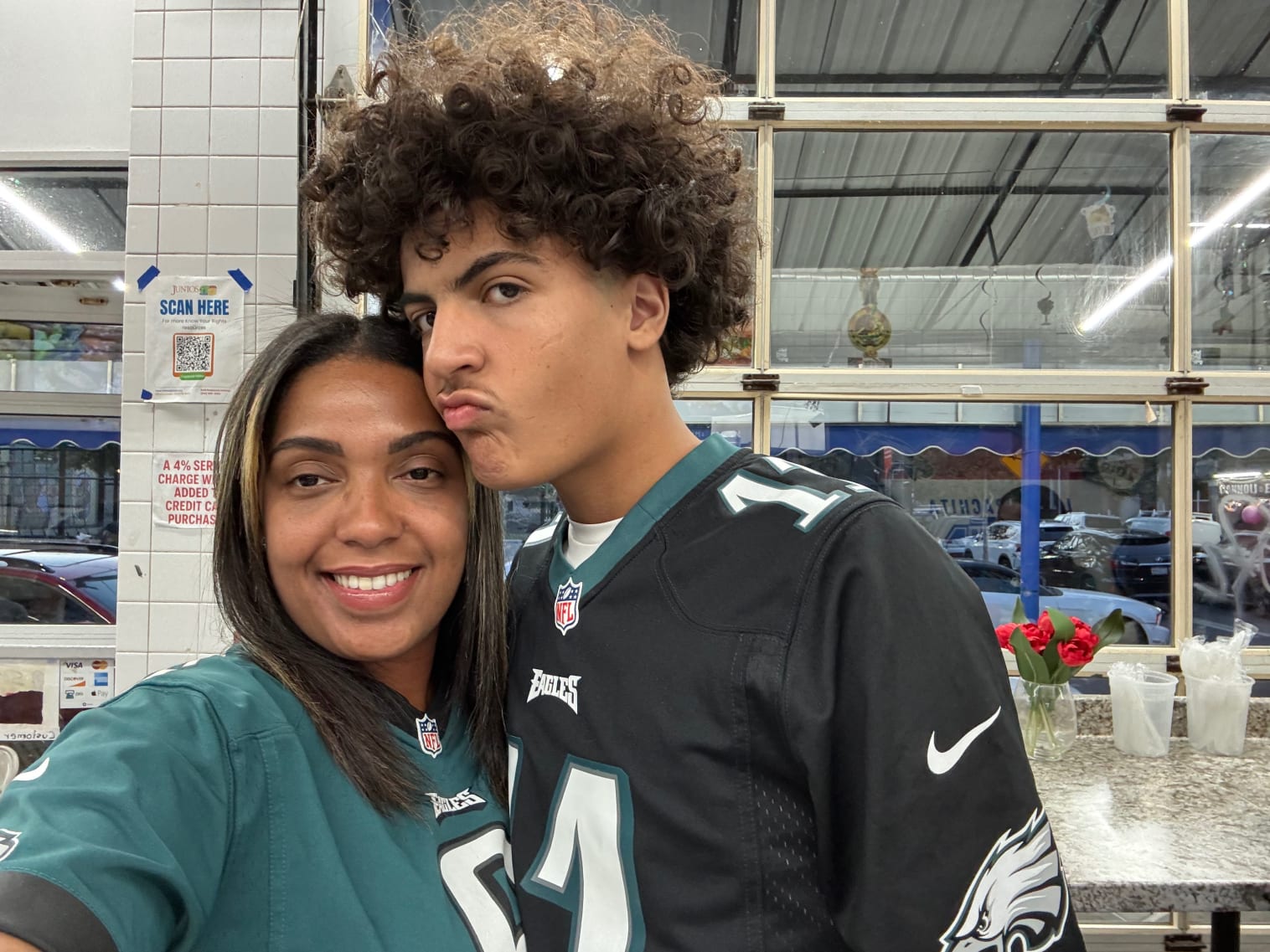
Angelica Javier (left) and her 16-year-old son, Xzavier Gregory, getting tacos after watching the Eagles beat the Los Angeles Rams earlier this year.
The shooting, police said, stemmed from a dispute among teens at the Jardel Recreation Center, just blocks away, earlier in the week. Xzavier’s parents said the detective told them that one of their son’s friends may have slapped a young woman that day.
On Oct. 11, they said, police told them that Xzavier and his friends stopped by the young woman’s house shortly before 4 p.m. to talk with her, apologize, and resolve the conflict. They shook hands, the parents said, and started to walk away.
Then, police said, the girl’s 17-year-old boyfriend, Sahhir Mouzon, suddenly came out of the house with a gun and started shooting down the block at them. Someone shot back, police said, but it was not Xzavier. In total, 45 bullets were fired.
An 18-year-old woman walking by the teens was wounded in the leg.
Xzavier was struck in the chest and died within minutes.
Mouzon has been charged with murder and related crimes.
Javier and Gregory have been left to navigate life without their “Zay” and to reckon with a loss that comes even as gun violence in the city reaches new lows — but which still persists among young people and brings pain to each family it touches.
They don’t understand how a 17-year-old had a gun, they said, or why a seemingly minor — and potentially resolved — conflict had to escalate.
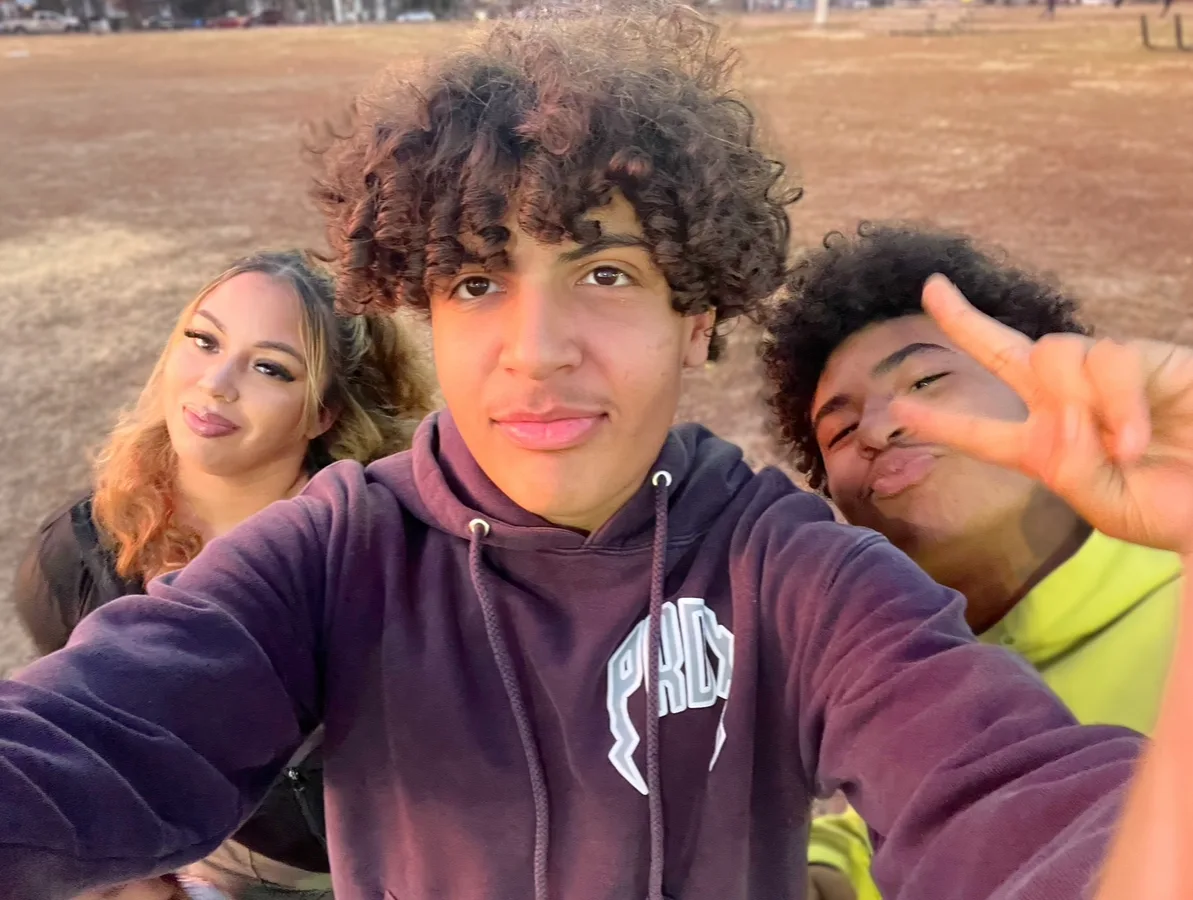
But mostly, they said, they want Philadelphia to know and remember their child: a goofy junior at Northeast High. An avid Eagles fan. A lover of Marvel movies and spicy foods.
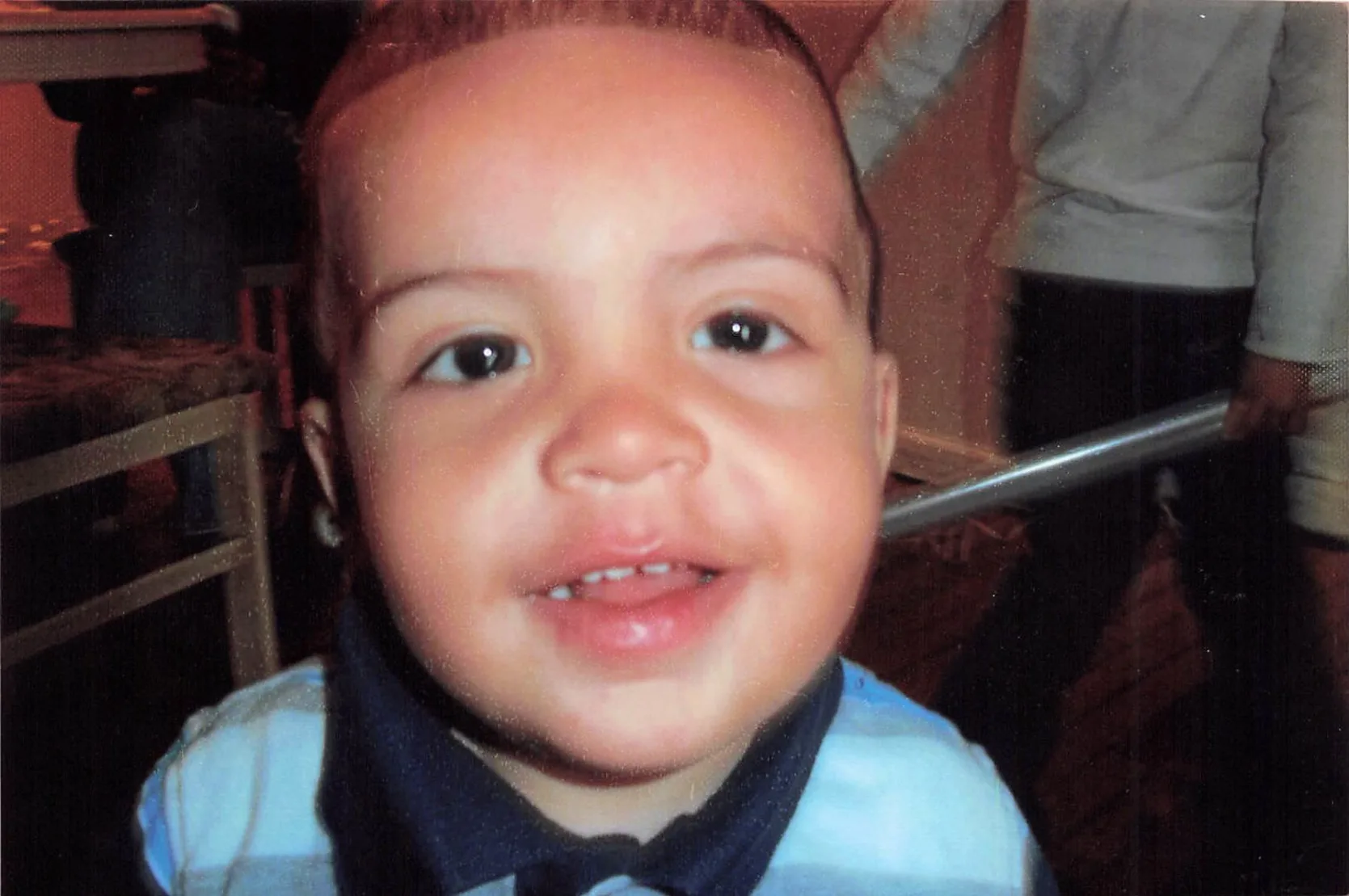
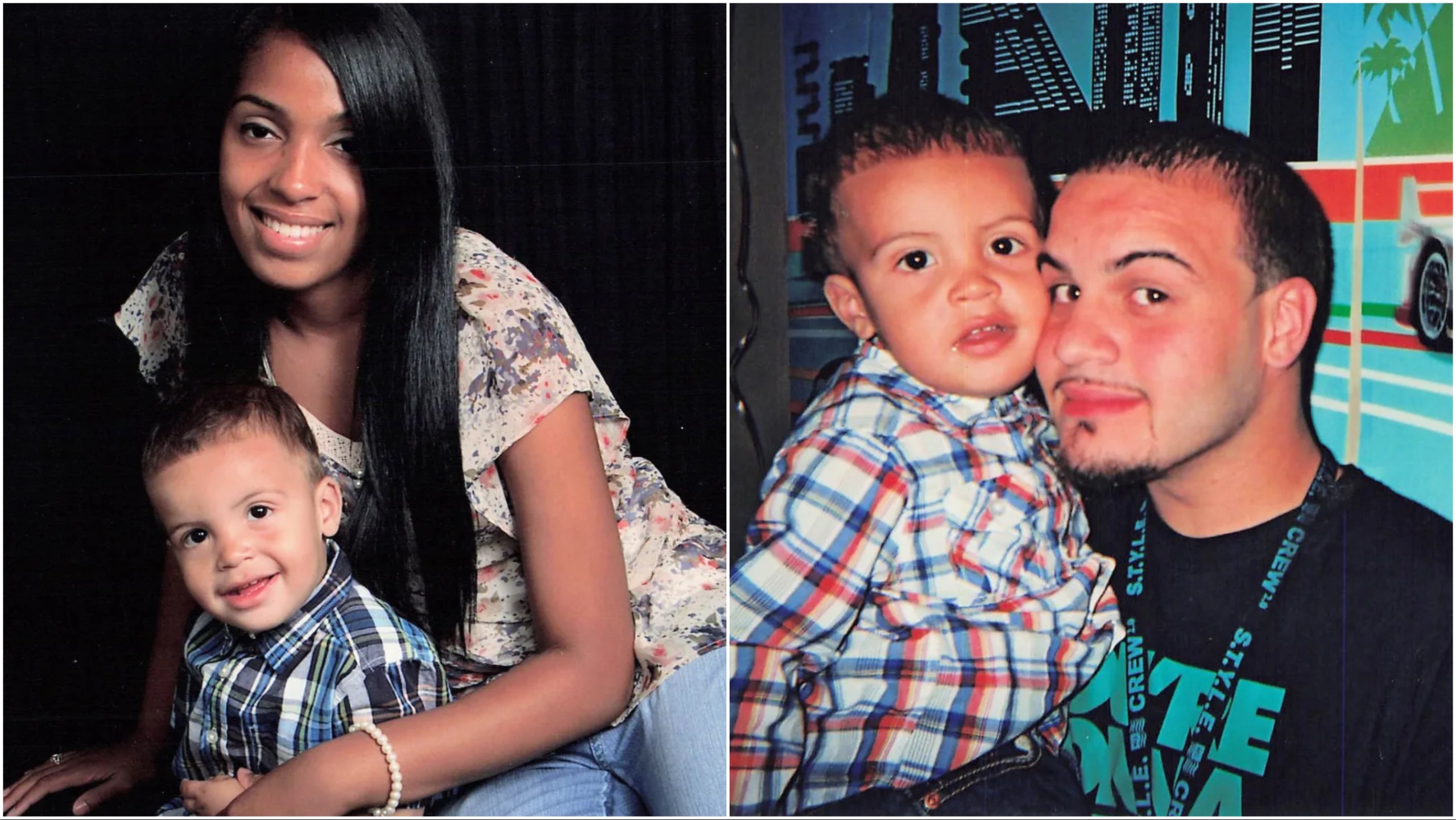
Xzavier Gregory was born in Philadelphia. His parents loved his chubby cheeks.Xzavier Gregory was born Sept. 20, 2009, to Angelica Javier and Cesar Gregory.
Xzavier Giovanni Gregory was born Sept. 20, 2009, at Temple University Hospital in North Philadelphia. His parents, just teens at the time, were immediately taken by his chubby cheeks, which he kept until his teenaged years.
He lived in Kensington until he was about 10 years old, his mother said, when they moved to the Northeast. He attended Louis H. Farrell School, then spent his freshman year at Father Judge High before moving to Northeast High.
He loved traveling, and often visited family in Florida and the Dominican Republic, attended football camps in Georgia and Maryland, and tagged along on weekends to New York with his mother as part of her job managing federal after-school programs.
He played football for the Rhawnhurst Raiders, typically as an offensive or defensive lineman, and had a natural skill for boxing, his parents said.
Philadelphia sports were in his blood — particularly the Eagles. DeVonta Smith and A.J. Brown, his father said, were his favorite players. (Before his death, he agreed that Brown should be included in more plays this year, Gregory said.)
Some of Gregory’s favorite memories with his son revolve around the Eagles. Sitting front row at the Linc on his 13th birthday. Erupting in cheers as the team won its first Super Bowl in 2018. Embracing in tears when they won a second this year.
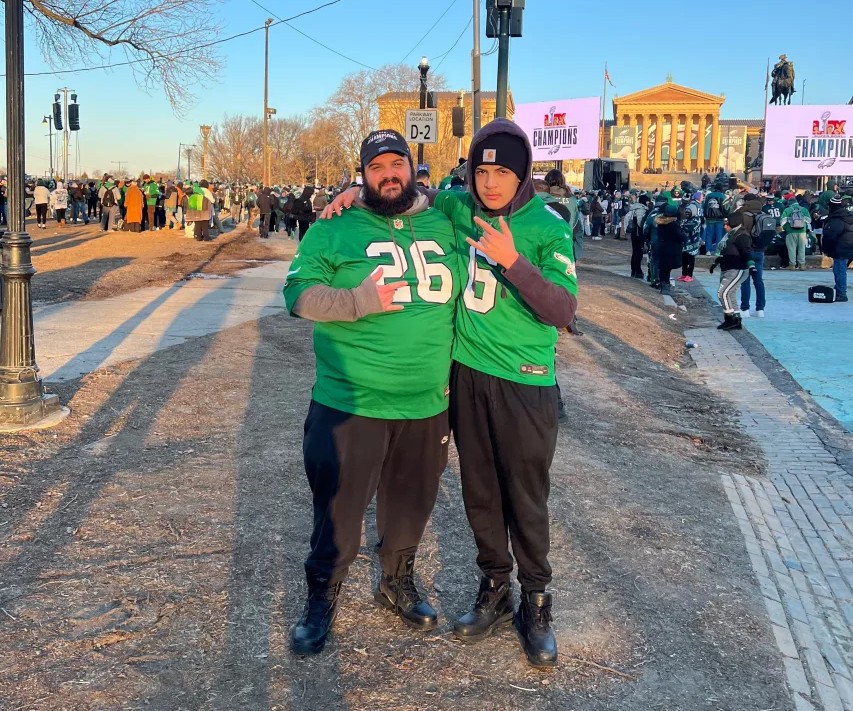
Cesar Gregory (left) and son Xzavier at the Eagles Super Bowl parade near the Art Museum in February. It is a day with his son that the father said he will never forget.
Xzavier was the oldest of three children. His sisters are still too young too fully understand what happened, the parents said.
“He went to heaven,” Javier told 7-year-old Kennedy.
The number of kids shot peaked in 2021 and 2022, when violence citywide reached record highs and guns became the leading cause of death among American children. So far this year, 105 kids under 18 have been shot — a sharp drop from three years ago, but still higher than pre-pandemic levels, according to city data.
Xzavier is one of at least 11 children killed by gunfire this year.
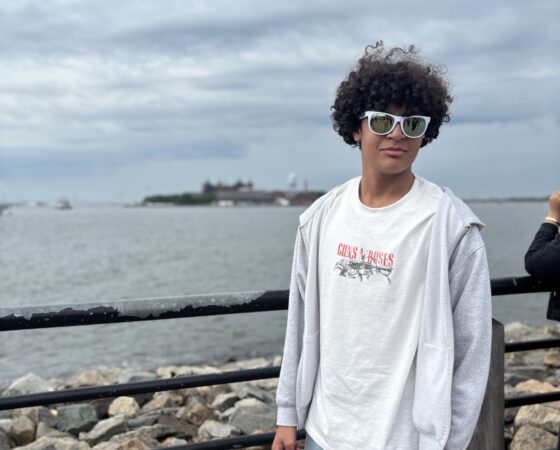
Xzavier Gregory (center) was a goofy teen who attended Northeast High School, his parents said.
Javier and Gregory said some relatives are considering leaving Philadelphia, shaken by Xzavier’s killing and a feeling that teens don’t fear consequences.
But the parents said they will stay. They want to be near Magnolia Cemetery, where Xzavier is buried, and to feel closer to the memories that briefly unite them with him.
On harder days, they said, they go into his bedroom, which is just as he left it, a relic of a teenage boy.
His PlayStation controller sits in the middle of his bed, and a photo of him and his mother hangs on the wall above it. His Nike sneakers are scattered. His black backpack rests on the floor, and a Spider-Man mask sits on the corner of his bedframe.
On Thursday, his parents stood in the room they used to complain was too messy, that smelled like dirty laundry.
“Now, I come in just to smell it,” Javier said.
She took a deep breath.
Staff writer Dylan Purcell contributed to this article.





 You decide