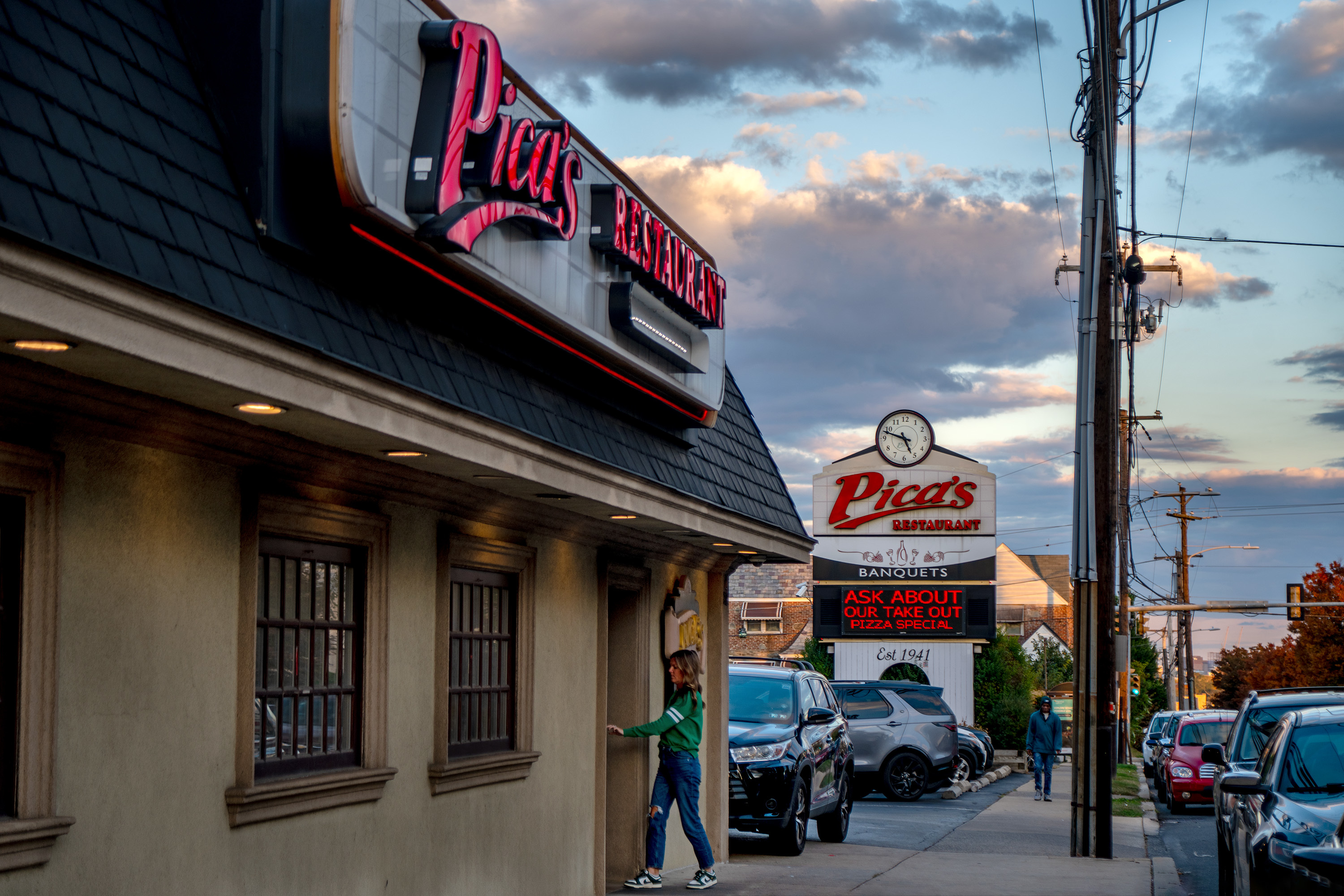
On our first date 10 years ago, my husband and I went to Pica’s Restaurant in Upper Darby and then to a John Oliver stand-up show at the nearby Tower Theater.
The latter was his choice, but the restaurant was my pick. I was well aware of how large Pica’s legend loomed in Delaware County, and Upper Darby native Tina Fey had recently extolled her love for its unique sauce-on-the-top square pizza on The Tonight Show Starring Jimmy Fallon, so I wanted to try it.
I arrived at the restaurant a bit frazzled, given that I’d spent the hours before reporting on ferrets eating a baby’s face off. “Intense” is the word my husband uses to describe me that night. I’m pretty sure my nail marks are still embedded in the table where we sat.
The final night of dinner at Pica’s Restaurant in Upper Darby.
I don’t remember what we talked about that night or what we ate, but I remember feeling comforted by that man and by that place. Pica’s wasn’t fancy or pretentious — the outmoded decor looked like it hadn’t been updated since the ’90s — but it was packed. Not with people who came to be seen, but with people who came to be with each other.
You know how there are comfort foods? I could tell this was a comfort restaurant.
My husband and I haven’t been back to Pica’s a lot in the years since, maybe because it felt like a place we’d always be able to go back to. So when I heard Pica’s was closing its Upper Darby location on Sunday after 69 years, I knew we had to get in on the last night. We invited friends — a couple who are Delco lifers, like my husband — along for the ride.
How Delco rolls
On a TV in the lobby, a still frame of Tina Fey eating Pica’s pizza on the Tonight Show played on rotation, along with photos of Pica’s food and awards it’s received over the years, like Philadelphia Magazine’s 2017 Best of Philly award for “Best Red Gravy Italian.” The carpeting and wood paneling were unchanged since my first visit a decade ago.
Upper Darby native Tina Fey and “Tonight Show” host Jimmy Fallon share a Pica’s pizza on air in 2014.
There was a good crowd, but the restaurant wasn’t packed. Within 15 minutes of arriving, our friend ran into two of his friends who’d also stopped in for a last supper, because that’s how Delco rolls. Near us was what appeared to be three generations of women who shared two pizzas between them, and at another table, a dad and daughter who said little to each other, but were very happy to see their huge pasta dishes.
We ordered pizza and mozzarella sticks as appetizers and pasta for dinner, which felt gluttonous because it was, but we’ll be happily eating the leftovers this week. From the wonderfully sweet sauce to the perfectly melted cheese and pepperonis the size of manhole covers, everything was on point.
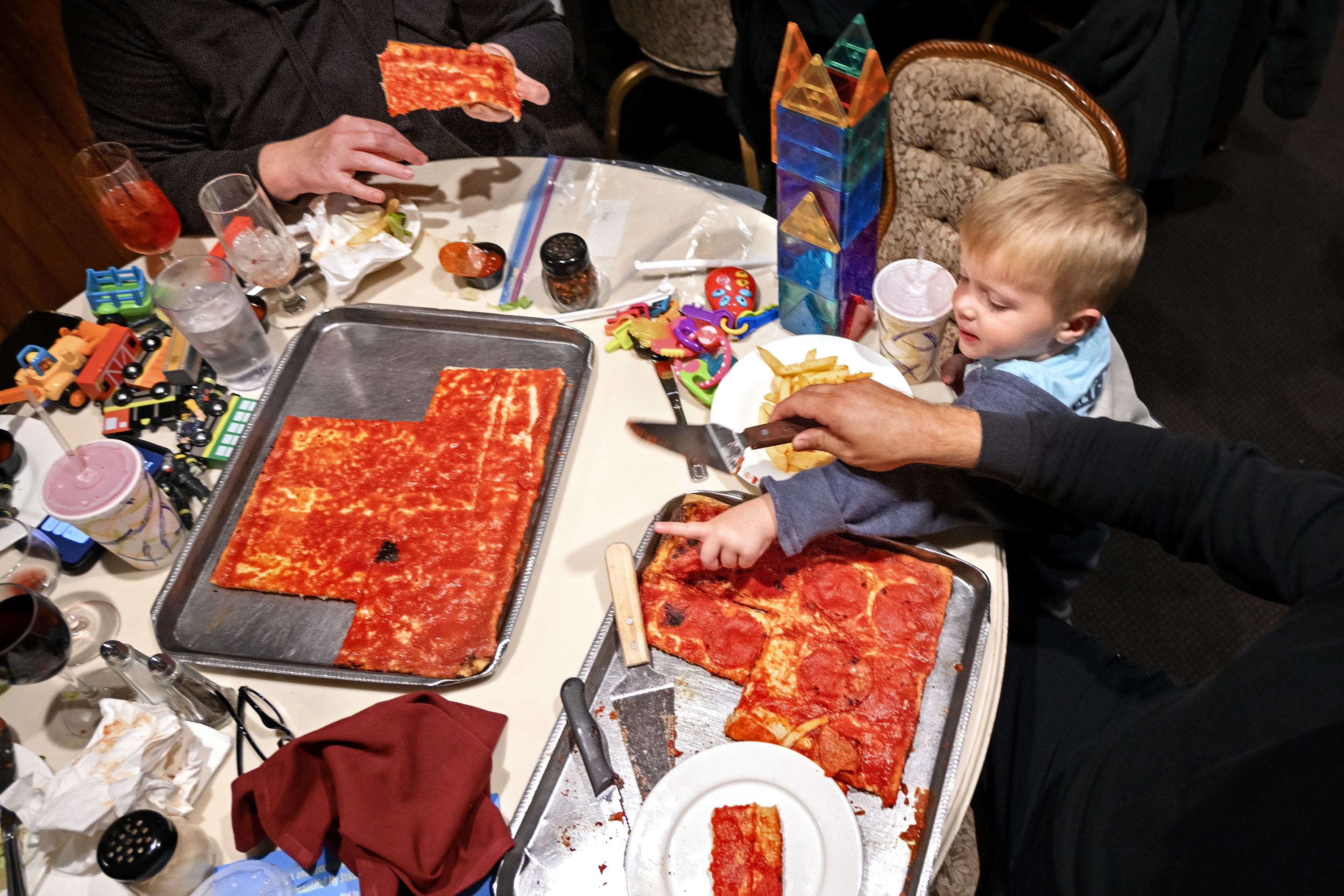
Two year-old AJ Jr. sits between his parents AJ Grenier, Sr. (right) and Carolyn Grenier (left) as he grabs a slice of pizza on the final night of dinner at Pica’s Restaurant in Upper Darby Sunday.
The bar even had Montepulciano wine and I got the last full glass. Our amazing server, Shannon Murphy, who’s worked at Pica’s for 27 years, also brought me a sidecar glass containing the last few sips of the bottle so that it didn’t go to waste. The way I’d felt like I’d won the lottery in that moment is hard to explain.
Murphy, who had her wedding reception at Pica’s, said the closing of the Upper Darby restaurant was “bittersweet” and “nostalgic.”
“The family is just amazing to work for,” she said.
Three generations
Founded by Frank Pica Sr., Pica’s first opened in 1941 as a brick-oven pizza shop in West Philly before the proprietor and his son, Frank Pica Jr., moved it to West Chester Pike in Upper Darby in 1956, where it became a full-service restaurant.
The company is now owned by the third generation of Picas, Angela Pica-Oandasan and Frank Pica III. Their sisters, Lori Pica-Rosario and Karen Pica, also played important roles in the family business over the years.
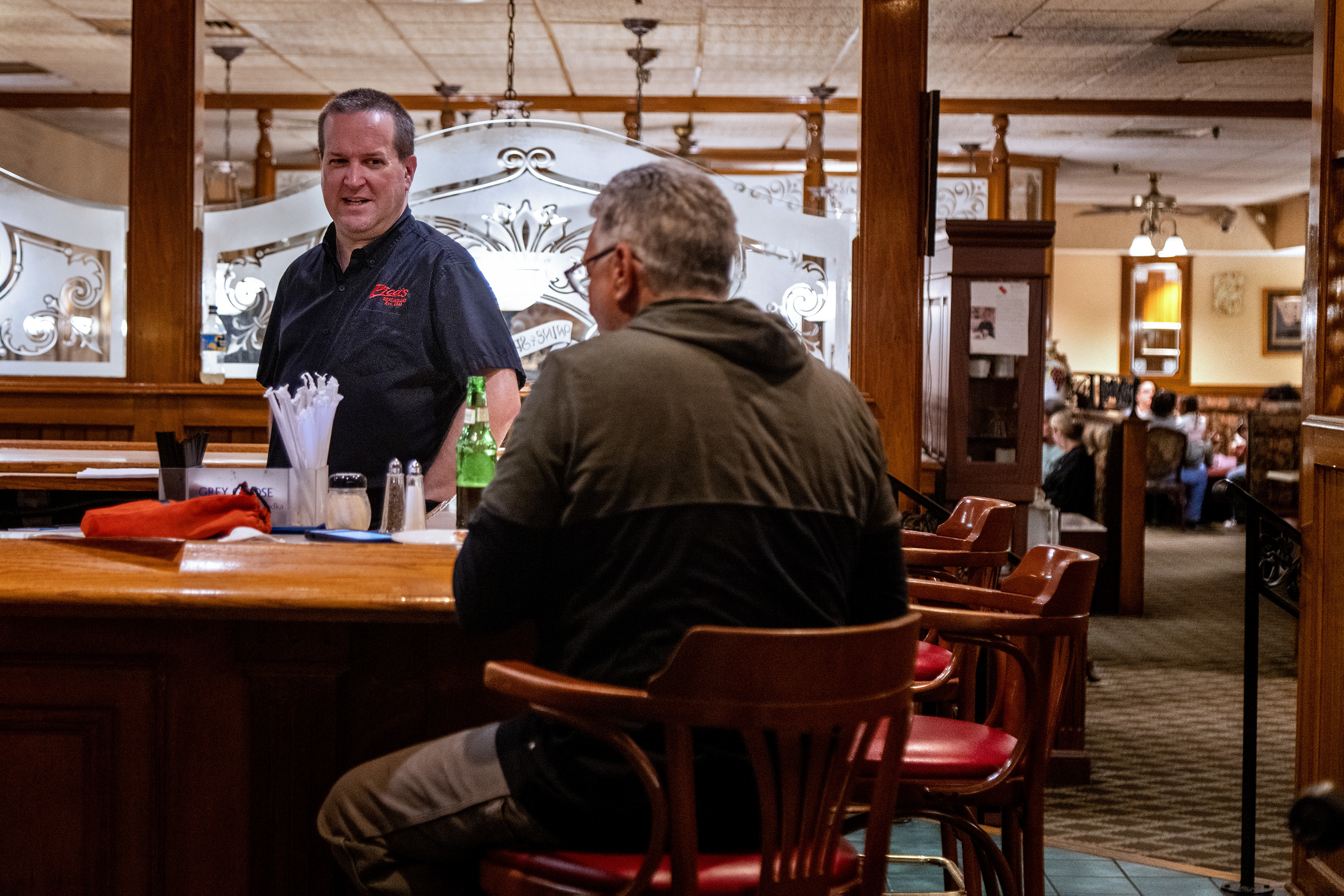
Brian Henley (left), part-time Pica’s bartender for 10 years, talks with Anthony Voci, Jr. eating dinner at the bar on the final night at Pica’s Restaurant in Upper Darby.
The siblings grew up in the restaurant, and the staff was always happy to see them because that meant extra hands to help, Pica-Oandasan said.
“We would all sit in a circle sometimes making pizza boxes together on a Friday afternoon,” she said. “We all joke around about our memories.”
In 2017, Pica’s opened a second location in West Chester, which remains in operation. The family plans to open a takeout spot in Delco, most likely in Broomall, but they’re still in negotiations (they hope to make an official announcement in the coming weeks). Until then, takeout at the Upper Darby Pica’s remains open.
‘Tough decisions’
When Pica’s posted on Facebook in March that it would close its Upper Darby location this year, its page was flooded with comments calling the restaurant a “landmark,” a “core memory,” and a “historical spot.”
Carolyn Grenier sits with her twin two year-old sons James (left) and AJ Jr. (right) eating their ice cream dessert after pizza on the final night of dinner at Pica’s Restaurant in Upper Darby Sunday.
Generations of Delco residents have had their birth, death, and wedding celebrations at the Upper Darby restaurant. One of the options on Pica’s phone directory was: “If you are calling regarding a luncheon after a funeral, please press six.”
Making the decision to close the restaurant wasn’t an easy one, the owners said. But the building is older and needs a lot of work. The Upper Darby location is just massive — it seats 250 in the dining room, 200 more in the banquet room downstairs. On top of that, staffing has been hard after the pandemic, and the owners often have to fill in.
“It’s hard leaving here because we just spent so much of our time and our lives here … and we know how much this building and this business meant to our father, our grandfather. But sometimes in business you have to make tough decisions and you have to transition and adapt to the times,” Pica III said. “We do really understand how much this business has meant to this community for so long — all the schools, all the graduations, we worked them all.”
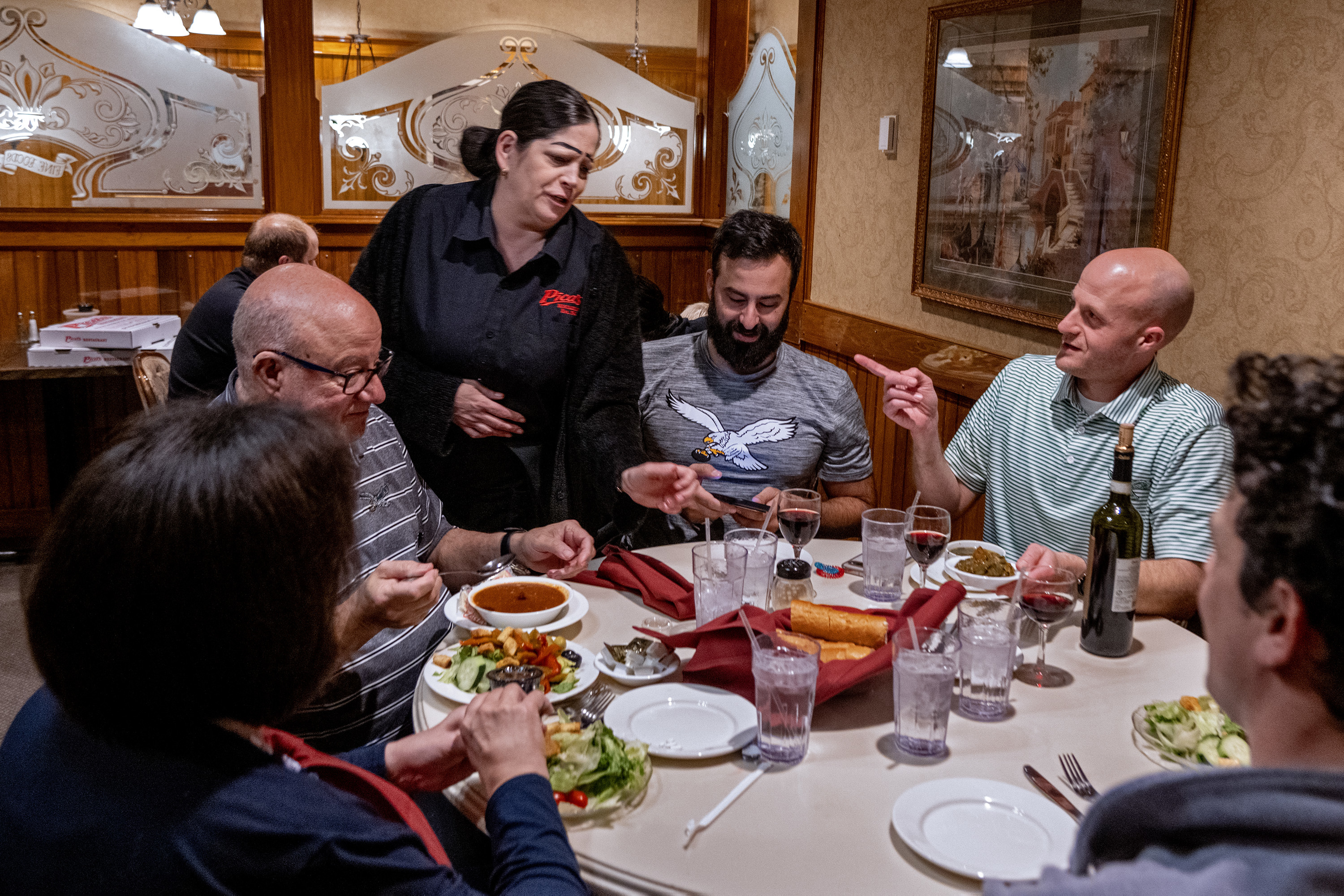
Dominic D’Angelo (right) banters with nine-year server Stephanie Cornman (standing) as he has dinner with family members on the final night of dinner at Pica’s Restaurant in Upper Darby Sunday.
Pica-Oandasan said the family received cards from customers dining at the restaurant for the last time, some of whom they’ve been serving for three generations.
“It’s very heartwarming to see the impact, that it means so much to them,” she said. “It makes it harder. It’s bittersweet, all the memories that will be lost in that building.”
It’s not only the customers they’ll miss, it’s the employees. One staffer worked there for more than 50 years and two others, for more than 40.
“It was always a big family environment” Pica III said. “Everyone really put their heart into here.”
One last hug
At the end of our meal, Murphy didn’t judge me for using a $20 off coupon I got in a mailer, like the classy Delco resident I am. And when I asked, she said I was more than welcome to take a copy of the paper menu for my scrapbook.
Murphy told us a lot of people had asked to keep the menu, and one customer even requested all of the restaurant staff autograph it for them.
As we got ready to leave, I met two women in the lobby wearing Pica’s T-shirts and getting their photos taken with staffers. Bernadette Wasch, 72, of Havertown, and her friend, Kathleen Baker, 73, of Upper Darby, are uber Pica’s fans and said it always felt like home.
Kathleen Baker, 73, of Upper Darby, at left, and Bernadette Wasch, 72, of Havertown, at right, are uber Pica’s fans. They came to the Upper Darby restaurant in their Pica’s shirts for dinner on Sunday, the final night for in-house dining.
Wasch first came to Pica’s in grade school. In the last week before its closure, she visited three times to wring all the nostalgia she could out of the place. I watched as she hugged staffers one last time with what seemed like every ounce of her being.
“The food is just incredible and so is the waitstaff. People say it’s like family and it really is,” she said. “We’re very sorry to see it go.”
Baker agreed. “This is goodbye but it’s not good,” she said.
Dozens of Philadelphia-area restaurants have signed on to participate in CHOMP for CHOP, a weeklong fundraiser to benefit Children’s Hospital of Philadelphia’s Food Pharmacy program, which provides food access and nutrition resources for families in need.
The initiative, created by CHOP’s food pharmacy manager, Abbe Stern, aims to raise $50,000 for CHOP’s programs addressing food insecurity between Nov. 10 and 16. Participating restaurants will raise funds in various ways, such as selling specific dishes, offering special menus, donating a percentage of sales, and allowing customers to contribute on their tabs.
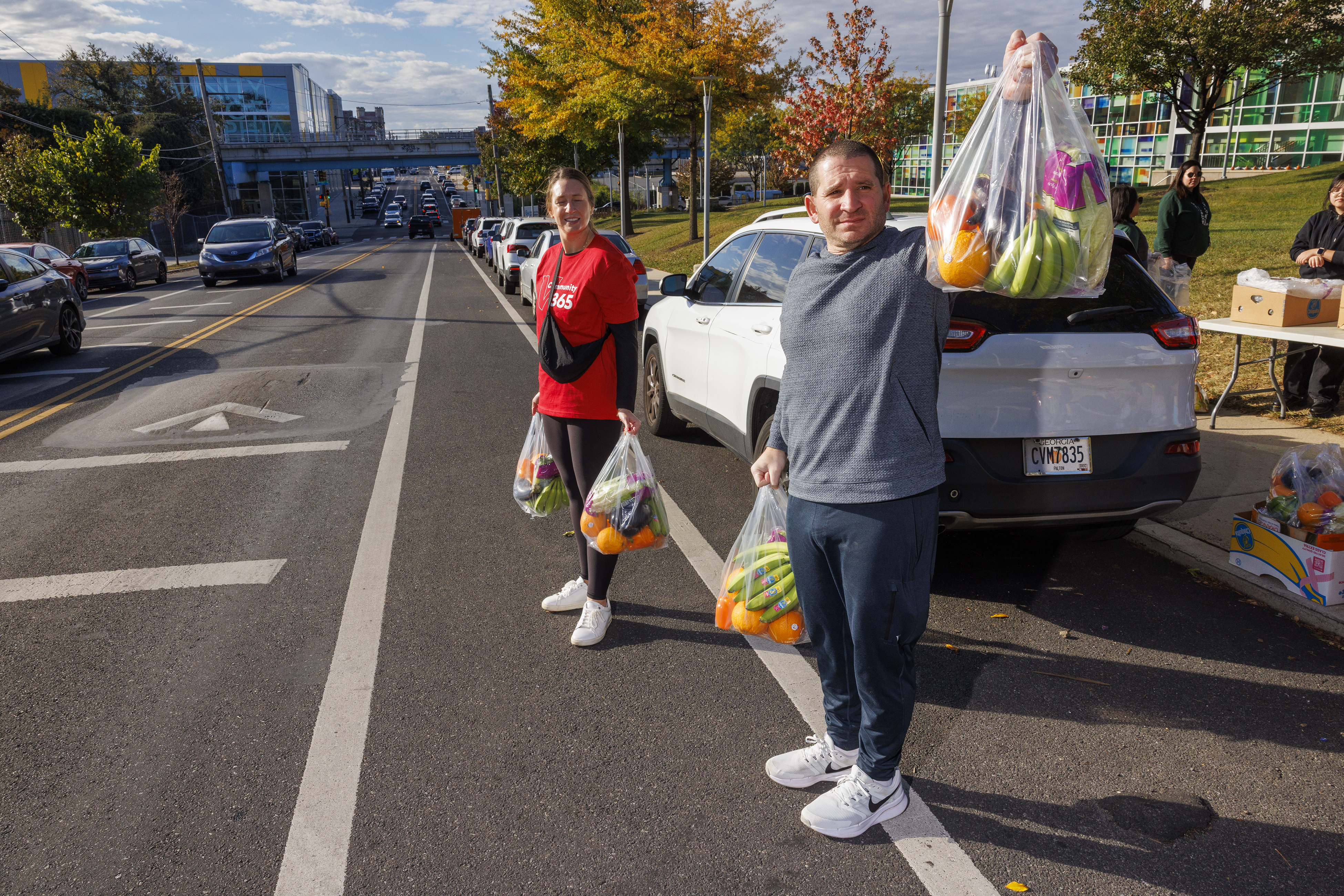
Abbe Stern, food-pharmacy manager with Children’s Hospital of Philadelphia, takes a selfie with volunteers from Vanguard after they distributed 90 bags of food on Oct. 23.
The restaurants include some of the city’s most recognizable names, such as Zahav, Scampi, Amá, Little Water, Yanaga Kappo Izakaya, a.kitchen, Federal Donuts, Riverwards Produce, Santucci’s Original Square Pizza, El Chingón, Forsythia, Barbuzzo, Bar Hygge, El Merkury, Huda, Irwin’s, Kismet Bagels, the Boozy Mutt, Lark, Khyber Pass Pub, Wilder, Bridget Foy’s, Cry Baby Pasta, Sabrina’s, Middle Child Clubhouse, 48th Street Grille, Vientiane Bistro, Fishtown Pasta, and Cavanaugh’s Rittenhouse. More restaurants are signing up daily, Stern said.
Stern said she got the idea after hearing about a restaurant week fundraiser in the suburbs. “I had this idea: ‘Can’t we just do something like that in Philly?’” said Stern, who previously worked for the Rittenhouse Hotel and also for the app Too Good to Go, which addresses food waste. “I knew there was so much motivation within the Philly restaurant scene to help the community and feed people.”
Alyssa Drummy and David Forgione with Vanguard distribute food outside Karabots Pediatric Primary Care Center in West Philadelphia as part of CHOP’s food-access initiative.
Stern reached out to public relations executive Peter Breslow, who with his colleague Mike Prince agreed to help recruit restaurants. “We had a really quick call and brainstormed how to engage the restaurant scene to raise funds,” Stern said. “From my experience, I wanted restaurants to create something that would work for their businesses and encourage patrons to buy, while helping us build food access for the community.”
Stern said the effort is timely, as families face mounting hardship amid impending cuts to SNAP benefits, with more patients and providers reaching out for help. “Families are scared, struggling, and can’t find support anywhere else,” she said.
Through CHOMP for CHOP, she hopes to connect the city’s hospitality community with families in crisis. “These businesses are excited to say they’re part of the solution — part of a big initiative to feed our neighbors,” Stern said.
FIFA began the process of selling another 1 million tickets for next year’s World Cup on Monday, with the opening of a new ticket draw marking the start of the tournament’s second phase of sales.
The World Cup will take place this summer in 16 cities across the U.S., Canada, and Mexico, including in Philadelphia, where six matches will be played at Lincoln Financial Field.
This draw, which runs through 11 a.m. Friday, includes a domestic exclusivity time slot for residents of the three host countries. Fans from those countries, whose entries are selected out of this draw, will have the opportunity to buy single-match tickets for games taking place inside their home nation.
The phase is open to all fans, regardless of which country they live.
“We already have seen massive interest from around the world for this tournament, and especially from within the host countries as Canada, Mexico and the United States prepare to host the biggest FIFA World Cup yet,” said Heimo Schirgi, the tournament’s chief operating officer. “This second phase, with its host country domestic exclusivity time slot, will allow us to say ‘thank you’ to these local fans, while ensuring global opportunity as well.”
Those fans from the U.S, Canada and Mexico who enter the draw before it closes Friday have a chance to receive, through what FIFA says is a randomized process, a time slot during which they can buy tickets starting on Nov. 12. Those slots will be issued through Nov. 15. Fans who win those chances will receive word at least 48 hours before their time slot opens.
Residents of the three host countries — the U.S., Canada and Mexico, in that order — purchased more tickets than those from any other nation in the initial phase of ticketing. England, Germany, Brazil, Spain, Colombia, Argentina and France, in that order, rounded out the top 10.
Once the domestic exclusivity time slot ends, more fans will be eligible to obtain a purchasing slot starting on Nov. 17. Additional tickets will be made available in subsequent phases, FIFA said.
FIFA announced earlier this month that more than 1 million tickets have already been sold for next year’s World Cup, with people from 212 countries and territories having already purchased. So far, 28 of the 48 spots for teams in the field have been filled.
The start of ticket sales doesn’t take away from how there are unique questions for consumers heading into the tournament, particularly about how they’ll get visas, if necessary, to visit the U.S. as the country cracks down on immigration. An international friendly match between defending World Cup champion Argentina — featuring Lionel Messi — and Puerto Rico was moved from Chicago to Fort Lauderdale, Fla., because of lagging ticket sales that some believe were in response to the immigration crackdown.
Based on the listed stadium attendance figures, there are roughly 7.1 million seats to fill for the 104 matches for the tournament around 16 North American venues. It is unknown how many of those seats will be available for sale to the public.
Ticket data has shown that the lowest-priced seats — set at $60 — were available for at least 40 matches. Almost all seats for the vast majority of matches were set at a much higher price. The opening match for the U.S., to be played at Inglewood, Calif., had prices ranging from $560 to $2,735 when sales opened. On the resale site, at least one ticket for that opening U.S. match on June 12 was listed for more than $60,000 earlier this month.
Fans with the option to purchase could choose seats in one of four categories; Category 1 is what FIFA officials call the best seats, Category 4 is somewhere around the tops of stadiums. Ticket costs are expected to fluctuate as soccer’s biggest event utilizes dynamic pricing for the first time.
Roughly one in four small residential buildings bought in Philadelphia from2017 and 2022were purchased by corporations, according to a new report about investor activity in the city.
Investors compete with low-income homebuyers. They are more likely to pay with cash and less likely to be denied mortgages. They sometimes pursueproperties before they hit the market.
“There are a lot of neighborhoods that are seeing investor activity, that are raising concerns,” said Emily Dowdall, president of policy solutions at Reinvestment Fund. “Our hope is that this report, that other reports, are going to help inform a strategy going forward.”
Smaller operators are buying most Philadelphia homes purchased by investors. But researchers have seen an increase in larger corporate landlords.
Researchers looked at sales of residential buildings with one to four housing units. Most were single-unit homes, but the city records that researchers classified properties with one to four units as single-family housing.
Researchers found that 13 investors bought 100 or more properties and eight bought more than 200 from 2017 through 2022.
Here are some other takeaways from the new study.
No sign of big national players
From 2020 through 2022, 91% of homes purchased by corporations were bought by smallerinvestors.
Researchers said they found no evidence that the biggest national investors in single-family homes — such as the private equity firm Blackstone and Invitation Homes, one of the country’s largest landlords of single-family homes — are active in Philadelphia.
Private equity-backed national investment organizations have bought single-family homes in bulk in places such as the southeastern United States, which has been targeted because it has newer housing stock and fewer tenant protections, Dowdall said.
These types of investors have been tied to rent increases and fewer opportunities for first-time homebuyers and buyers with low and moderate incomes.
Philadelphia is less likely to see these organizations operating here because of the city’s many renter protections and an older housing stock that needs a lot of investment, Dowdall said. The city’s foreclosure prevention program and the relatively long foreclosure process in Pennsylvania also deter these organizations, which like to quickly buy and lease homes on a large scale.
“It’s still possible that we could see more national players, as they have already saturated the easier markets to get into,” she said.
During the pandemic, some larger regional and national companies started to come to Philadelphia, researchers found.
Investor activity is concentrated in certain areas
Corporate investors mostly buy single-family homes in areas of the city where prices are lowest. Those neighborhoods also are predominately Black and Hispanic, including Brewerytown, Germantown, Juniata Park, and Kingsessing.
From 2020 to 2022, the median purchase price for an investor was $129,000, compared to the citywide median purchase price of $225,000 and individual buyers’ median purchase price of $247,000.
During this time, investors were most active in North, West, and Southwest Philadelphia and sections of Lower Northeast and Northwest Philadelphia. Investors bought more than half of all homes sold in these areas.
Before sheriff sales paused because of the pandemic, investors often bought a chunk of their properties that way.
The share of foreclosed homes purchased by investors grew from 31% of properties sold in sheriff sales in 2012 to 60% in 2019.
From 2017 to 2019, high-volume investors got about a third of their single-family properties through sheriff sales.
From 2020 through 2022, fewer than 40 properties were auctioned off each year. So investors relied more on other ways of acquiring properties, including buying directly from homeowners, “potentially creating more direct competition with individual homebuyers,” the report said.
More eviction filings and code violations
Large corporate landlords were more likely to file in court to evict tenants than smaller investors.
About one in seven homes bought by high-volume investors were associated with eviction filings within five years, compared to less than one in 20 homes bought by smaller investors.
Investors of all sizes were more likely than individual homebuyers to have code violations. About 20% of properties bought by investors had violations within five years of the purchase. The share of violations in owner-occupied properties was 9%.
Researchers plan to learn more about the types of code violations these properties generate, since violations can range from trash issues to unsafe conditions.
More work on properties
Researchers also uncovered “potentially positive findings” about large investors, Dowdall said.
Philadelphia’s aging housing stock needs investment for renovations and maintenance, and the report found that larger investors were more likely to get permits to alter their properties than smaller investors. “Bringing much needed dollars in to refurbish our housing stock,” she said.
Large corporate investors received alteration permits for 42% of the properties they bought, compared to 29% for smaller investors and 13% for individual homebuyers.
Like code violations, projects that need permits can range from the minor to the major, from adding electrical outlets to total renovation.
In future analyses, researchers plan to drill down on the specific work being done on investors’ properties.
Researchers’ recommendations
Many investors purchase properties using a variety of corporate names, so identifying who is in control of corporations can be challenging, researchers said. That makes it difficult to hold operators accountable for problems at their properties.
Researchers recommend state lawmakers require limited liability companies to disclose who is in control.
They also recommended that the city:
Enforce rental license requirementsto create a more complete inventory of rental properties
Use public data to understand how investors operate and their effects on the market and renters
Prioritizeindividuals and nonprofits at sheriff sales
Help individual homebuyerscompete in the housing market, including by giving more money to homebuyer assistance programs
The transit agency has until Oct. 31 to complete the inspections, which were recommended after the National Transportation Safety Board released a report investigating five fires that occurred on the Silverliner IVs this year.
As of Oct. 9, SEPTA said that crews can handle about six Silverliner IV cars a day, with a goal of ramping up inspections to handle 12 cars a day with five-person crews per car.
Although SEPTA is rotating cars in and out of service for the inspections — instead of yanking all 225 from service at once — riders have experienced significant delays and some trains have been outright canceled. Without a full fleet, SEPTA says it is unable to respond as easily to typical delay-causing events, such as power outages and bad weather.
Riders should check the SEPTA app for real-time updates on how trains are running.
As the deadline approaches and delays persist, The Inquirer is tracking SEPTA’s inspection progress.
Mon., Oct. 27, 2025
95 inspections complete
Days until deadline: 4
Fri., Oct. 24, 2025
88 inspections complete
Days until deadline: 7
Wed., Oct. 22, 2025
78 inspections complete
Days until deadline: 9
Mon., Oct. 20, 2025
66 inspections complete
Days until deadline: 11
Fri., Oct. 17, 2025
58 inspections complete
Days until deadline: 14
story continues after advertisement
Wed., Oct. 15, 2025
46 inspections complete
Days until deadline: 16
Thurs., Oct. 9, 2025
12 inspections completed
Days until deadline: 22
Mon., Oct. 6, 2025
Inspections begin
Cars began undergoing inspections in SEPTA’s four regional maintenance facilities.
Greg Buzby, manager of Regional Rail vehicle engineering, shows some of the work being done for the safety inspections at the SEPTA Overbrook Maintenance Facility.Tyger Williams / Staff Photographer
“We’re looking for any signs of overheating or damage to any of the circuits, physical damage, making sure the bolted connections are tight,” said Greg Buzby, manager of Regional Rail engineering. “There’s also electrical testing that we have to do to make sure the insulation has its integrity.”
Inspections remaining: 225
Days until deadline: 25
Wed., Oct. 1, 2025
NTSB releases report
Noting that the Silverliner IV cars’ “outdated design … represents an immediate and unacceptable safety risk,” the National Transportation Safety Board urged SEPTA to sideline all the Silverliner cars immediately and to retrofit or replace them as soon as possible. The Silverliner IVs went into service between 1974 and 1976, with technology that was designed even before that time.
The NTSB’s findings are advisory.
More than 300 passengers were safely evacuated after a SEPTA Regional Rail train caught fire in February in Delaware County.Charles Fox / Staff Photographer
The Federal Railroad Administration, which regulates freight and passenger railroads, ordered SEPTA to undertake the inspections, concluding “that SEPTA’s maintenance and operation of its passenger rail equipment requires additional oversight and corrective action.”
Inspections remaining: 225
Days until deadline: 30
story continues after advertisement
Talk to our transportation team.
Do you have questions about what’s happening on Regional Rail? Ask here or share how your rides on Regional Rail have been impacted in October.
Staff Contributors
Reporting: Thomas Fitzgerald and Erica Palan
Graphics: John Duchneskie
Editing: Lizzy McLellan Ravitch
Digital Editing: Erica Palan
Subscribe to The Philadelphia Inquirer
Our reporting is directly supported by reader subscriptions. If you want more journalism like this story, please subscribe today
The deal joins two companies that trace their roots to the late 1800s, Essential chairman and chief executive Christopher Franklin told investors Monday in a conference call.
Joined under the American Water brand at its Camden headquarters, the enlarged company will be worth around $40 billion on the stock market, ranking with water and electric companies among the 10 most valuable U.S. utility stocks, American Water CEO John Griffith, saidin an interview.
With around 10,000 total employees, the companies together serve around 5 million water and wastewater customers across 17 states, plus military bases in more than a dozen states, with Pennsylvania accounting for around one-third of the total.
The two companies are “by far the two largest players in the regulated water utility industry,” said Ryan M. Connors, a veteran utility analyst now with Northcoast Research in Cleveland. Together they would be “a truly dominant” water utility, he said.
Locally, American Water serves users in the Coatesville, Downingtown, Exton, Norristown, Phoenixville, and Plymouth Meeting areas, and in Burlington, Glassboro, Haddonfield, and other areas in South Jersey.
Aqua has customers in communities throughout Philadelphia’s Pennsylvania and New Jersey suburbs.
Franklin acknowledged that Essential’s share price has been trading “at a discount,” adding that sales and profits should grow more quickly under American Water.
The partners will need approvals from shareholders and state utility regulators in at least five states, including Pennsylvania and New Jersey, to close the deal on schedule by early 2027. Connors said the combined company from its New Jersey headquarters needs to show it can continue Aqua’s success getting Pennsylvania regulators to approve water charges and plans.
Franklin said that on Sunday, he told his predecessor, longtime Aqua CEO Nicholas DeBenedictis, about the merger. “He said, ‘It could have happened 20 years ago. These companies belong together.’”
As a combined company, the leaders said it would be easier to finance the $28 billion in improvements needed over the next five years to upgrade systems.
About two-thirds of that total will go toward routine upgrades and new technology. The rest includes environmental improvements, including the cost of complying with lead and copper limits, and cleaning water from potentially cancer-causing PFAS chemicals formerly leached into U.S. waters by chemical manufacturers and government firefighting gear.
Franklin said the merger would make it easier to “keep customer rates affordable” as the business expands.
As a larger company, the two CEOs said they also would be able to more easily service AI and high-speed data centers and other large new customers.
Essential has committed to investing $26 million to supply 18 million gallons a day to International Electric Power’s 1,400-acre data center and nearly 1,000-megawatt natural gas and battery storage plant, which sit on former coal-mining lands in western Pennsylvania’s Greene County. Griffith said other large projects are under consideration.
Though neither company ruled out back-office job cuts, offices in Bryn Mawr and Pittsburgh as well as the Camden headquarters will remain open. Griffith said he plans to honor union contracts with dozens of labor organizations, including locals of the Operating Engineers and Steelworkers.
“This is really not a cost savings-driven transaction. Both American Water and Essential are growing in a robust way,” Griffith said.
After decades of paranoia and conspiracy theories that cast the Birds as victims of perceived favoritism shown to such rivals as the Cowboys, Patriots, and Chiefs, consider what happened for the Eagles on Sunday against the Giants. Honestly, no fan base feels persecuted more than the Eagles’, whose owner, Jeffrey Lurie, is still bitter about the obvious defensive holding call by James Bradberry that cost them a Super Bowl win three years ago.
James Bradberry gets called for a holding penalty late in Eagles-Chiefs.
The NFL continues to allow the Eagles to run the Tush Push, but that play earned another strike against it when the owners meet next spring.
Assuming a team introduces another proposal to ban the controversial short-yardage play — which has been assailed as an injury risk, which is ridiculous, and has been assailed as a penalty magnet, which is legitimate — Sunday’s debacle will add fuel to whatever fire remains from last spring’s 22-10 vote, which was two ballots shy of a ban.
Facing fourth-and-1 at the Giants’ 11 early in the second quarter, Jalen Hurts and his line surged forward and Hurts peeled off slightly to the left. Floating on a sea of humanity, Hurts clearly never stopped moving toward the line to gain, and as he reached the ball forward, Giants linebacker Kayvon Thibodeaux stripped him of the ball and recovered it.
The play was not reviewable because forward progress is not a reviewable issue.
The larger issue here is that officials don’t seem to be able to consistently rule correctly on a number of areas, among them: whether the defense moves too early; whether the defense lines up in the neutral zone; whether the offensive line moves early; or whether the offense lines up in the neutral zone.
Sunday, they didn’t properly gauge forward progress, even with the runner in plain view.
The final was 38-20, but the call was enormous in the context of the game. Instead of losing the ball to a Giants team that had just completed a 52-yard touchdown drive, the Eagles retained possession and scored a touchdown two plays later to make it 14-7.
It was just the first seven-point swing the officials delivered to the home team.
Early in the fourth quarter, with New York facing fourth-and-11 and trailing by 18, Giants receiver Darius Slayton and Eagles cornerback Quinyon Mitchell engaged in routine hand-fighting during Slayton’s route. Slayton disengaged in a normal fashion, caught the pass, and romped for a 68-yard touchdown.
But no.
Slayton was called for offensive pass interference. Brutal call. In fact, a penalty probably should have been called on Mitchell.
Instead of cutting the lead to 11, the Giants had to punt.
The Eagles are tied for 11th in total penalties called, and they’re seventh in total penalty yards, but most of the calls are inarguable, and, objectively, they seem to be getting away with lots of shenanigans. This was true Sunday.
Yes, the Eagles won by 18, and they dominated all day, but they were gifted that 14-point swing. These two were the kinds of crucial calls that the Eagles and other Chiefs opponents lately have claimed gave unfair advantage to Kansas City; the kinds of calls the Patriots under Bill Belichick seemed to get all the time; and the kinds of calls America’s Team has gotten for 50 years in Dallas.
The Eagles are getting those calls now … right?
The Giants agreed, at least for Sunday. Said Thibodeaux:
“They said they called the forward progress before he reached the ball out. Sounds like some [B.S.] to me.”
Me too.
Eagles tight end Dallas Goedert scoring a fourth-quarter touchdown against the Giants.
Seeing red with Goedert
Under Nick Sirianni, the Eagles have never finished outside the top 10 in red-zone efficiency. But with the combination of Sirianni and offensive coordinator Kevin Patullo, who had served as Sirianni’s passing-game coordinator the last four years, the Birds have never been better.
The Eagles are 6-2 in large part because they’ve converted 17 of their 20 trips inside the opponents’ 20-yard line into touchdowns. That’s 85%, which is about 11 percentage points better than the Ravens’ rate last season, which is the best conversion rate by any team over an entire season since Sirianni arrived.
Why are they so efficient?
Because the Eagles have a spectacular offensive line; a strong, fast quarterback; a lethal play in the Tush Push; a superstar running back; two star receivers; and, for my money, the most important red-zone weapon: an elite tight end.
Also: superb play-calling. Example:
On second-and-8 from the Giants’ 17-yard line, Patullo called a run-pass option. Hurts kept it. At the same time, tight end Dallas Goedert swung from the left side of the line to the right, broke upfield, and was wide-open for a touchdown.
So many moving parts worked in perfect synchronization. It was the Eagles’ prettiest play of the season.
“Ultimately, Kevin has to call the plays that he feels give us the best chance to win there,” Sirianni said after the Eagles went 3-for-3 in the red zone on Sunday. “I think we’ve done a good job of being efficient down there, though. … We’ve kept the ball moving forward. Jalen’s played really good football down there, and Dallas has obviously been really good down there.”
Goedert had two touchdown catches in Sunday’s win over the Giants. His seven TD catches are first among tight ends and already are a career high.
“They’ve been letting me get the ball and use my big body,” Goedert said. “We can score in a lot of different ways.”
He certainly can. His 35 touchdowncatches (including playoffs) in about 7½ seasons as an Eagle rank second among franchise tight ends behind Zach Ertz, who caught 40 (including playoffs) in about 8½ seasons.
“He’s a hell of a player,“ Hurts said. ”He’s a big-time target and in a sense, he’s due. He’s due. He does a lot of dirty work in this offense.”
It might be tough to call Goedert’s number with Hurts, running back Saquon Barkley, and receivers A.J. Brown and DeVonta Smith, but the Eagles are winning because Goedert is finding the end zone more than anyone else under Patullo.
“KP has a really good feel in the red zone,” said Hurts.
So does DG.
Mixed emotionals
After being embarrassed by owner Woody Johnson, who said, “If we can just complete a pass, it would look good” after seven weeks of bad quarterback play, Jets quarterback Justin Fields played well Sunday in a comeback win over the Bengals.
Fields had been benched at halftime the week before in favor of Tyrod Taylor, but Taylor’s bruised knee sidelined him Sunday and gave Fields another chance. Fields played well enough to win: 21-for-32, 244 yards, one touchdown. Afterward, during an emotional press availability, he admitted that the pressures of his turbulent career, culminating in Johnson’s criticisms, broke him down.
“This week, I found myself in my closet, crying on the ground, laying down,” Fields said.
As you might assume, Johnson, formerly Donald Trump’s ambassador to the United Kingdom, is not a pleasant bloke. In an annual survey conducted by the players’ association, his 2024 team gave his club the league’s only overall “F,” and his franchise has been a punch line for years.
However, if Johnson’s cruel, candid, but ultimately accurate assessment of the quarterback play worked, well …
Coach Shane Steichen’s Colts are 7-1.
Extra points
Shane Steichen, in his third year in Indianapolis, continued his romp to Coach of the Year honors when his Colts beat the Titans and moved to 7-1. Since becoming the Eagles’ OC in 2021, Steichen’s teams have been in the top 10 in rushing, with the Eagles finishing No. 1 in 2021. This year, behind league-leading running back Jonathan Taylor, the Colts rank sixth. … Right behind Steichen in the running for COY: Mike Vrabel, whose Patriots reached 6-2 with a win over the Browns. Second-year quarterback Drake Maye leads the NFL with a 118.7 passer rating. … In that game, Browns defensive lineman Myles Garrett recorded five sacks, bringing him to 10 for the season, tied for the league lead. … Aaron Rodgers failed to join Peyton Manning, Tom Brady, Brett Favre, and Drew Brees as quarterbacks who have beaten all 32 teams when his Steelers lost to the Packers, the team that drafted him. … The Cowboys, with their No. 2-ranked offense and second-to-last defense, lost in Denver and fell to 3-4-1. That means the Eagles are the only team in the NFC East with a winning record — remarkable, since the division was considered one of the best before the season began.
In 2005, Christine Cox just wanted to hire exciting choreographers to make new work on dancers who, at the time, were mostly her friends and colleagues picking up extra work in their off time from Pennsylvania Ballet.
She had little idea that she was creating a Philadelphia institution.
“I was a really short-term planner,” said Cox, 56, whose contemporary ballet company, BalletX, is celebrating 20 years. “I just wanted to do the next right thing.”
She tried selling the company to everybody, she said: “people sitting in a picnic at Rittenhouse Square, someone at a library, someone I met in an elevator. I literally had postcards in my back pocket.”
Once at a fair on Walnut Street, she had her team blow up hundreds of BalletX balloons and hand them out. “And I’d see all these balloons, and it was so much work” said Cox. “But you know, we were as a team, doing anything we could to spread the word, and we still continue.”
BalletX dancers, João Pedro Silva and Itzkan Barbosa rehearse.
There was no way of knowing that the troupe she started with Matthew Neenan (who later left to devote his full attention to his choreography but continues to work frequently with BalletX) would one day employe 16 dancers for an almost unheard of 52-week contract with six weeks of paid vacation time and a matching 401(k). Or that they would tour, perform frequently at the Vail Dance Festival, and have regular home seasons in Philly.
Cox would go on to commission 150 world premieres by 80 choreographers, launching some careers and bringing well-known dance makers to Philly.
BalletX will be celebrating its two decades with a pair of retrospective performances over the next two weeks at the Suzanne Roberts Theater. The first week will include excerpts of works Cox commissioned in the company’s first decade. The second will include excerpts from more recent works and then finish with a short world premiere by rehearsal director Keelan Whitmore.
BalletX dancer Eileen Kim rehearses.
In all, the performances will mark 18 new works BalletX commissioned, each in snippets of six minutes or less.
Until relatively recently, Cox didn’t realize the success she had built.
It took BalletX opening its own studio on Washington Street in 2018 for her to see it.
“When I saw the looks on people’s faces around the country, like, ‘Oh, we just opened up our own studio.’ Especially when we were in New York City. Suddenly everyone took us a little bit more seriously.
A home of one’s own is a rare success in the dance world.
Choreographer, Marguerite Donlon, center, rehearses dancers for the company’s 20th anniversary retrospective.
She is finallystarting to have a longer vision and dream.
“I am able to now say, ‘OK, I think this, this is possible.’ I always say it with hesitation, because that’s my nature, the balance between humility and confidence. It’s a fine balance. I’m also a little superstitious. I don’t want to be like, ‘We’ve got it all figured out,’ and then the next thing you know, you’re navigating out of a pandemic.”
And yet, the COVID-19 pandemic also helped shape BalletX, which was one of the first and more successful companies to do work on camera. The company continues to feature short films in every performance and will do so for the retrospective, too.
The first week’s performances will open the way BalletX launched: with the angel trio from Neenan’s Frequencies. The initial three dancers were Cox, Neenan, and Tara Keating, who is now the company’s associate artistic director.
Ballet dancers rehearse for the company’s 20th anniversary retrospective.
“It was a couple years after 9/11. The lyrics in the music, the whole piece was just unexpected to me. We ended with this beautiful trio of this really lightning, fast, energetic piece. Matt just was so bold and daring … he would take really into make really incredible choices that were not traditional. And I think that was really important in helping us define who we were.”
The program will also include Still at Life, which introduced the now widely known choreographer Annabelle Lopez Ochoa to American audiences. It will also include a piece by Edward Liang, the artistic director of Washington Ballet, along with work by Jodie Gates, Nicolo Fonte, and Jorma Elo.
The second week will feature excerpts from Trey McIntyre’s Big Ones, which got BalletX featured on the cover of Dance Magazine. It also includes work by Jo Stromgren, Darrell Grand Moultrie, Dwight Rhoden, and Jennifer Archibald. It will also feature the work of former BalletX dancer Caili Quan who, after launching her career in Philly, went on to choreograph for some of the top American companies.
At the end of the retrospective, Cox wants to launch BalletX into the future, with the world premiere of Whitmore’s work.
“I thought it’s really important to really end the night on the second program with what we do, which is the future. You know, we’re creating work.”
BalletX 20th anniversary retrospective. “Program A: The first decade,” Oct. 29-Nov. 2. “Program B: The second decade,” Nov. 5-9. Suzanne Roberts Theater. $65-$90, 215-225-5389 x250 or boxoffice@balletx.org
Guess who’s going back, back again. Jett Luchanko is returning to juniors.
The Flyers announced Monday that the center has been returned to Guelph of the Ontario Hockey League after he skated in four of the Flyers’ first eight games. According to a team source, there has been no decision yet on who will be recalled from the Lehigh Valley Phantoms to take Luchanko’s spot on the roster.
The team could have played Luchanko in as many as nine games before triggering his NHL contract.
“Very simple, we want him to play high minutes,” Flyers general manager Danny Brière said. “We liked what we’ve seen. He could have stayed here; he showed that he can play. But we want more than that for him in the long run.
“And we felt at this point it was time for him to start playing high minutes and more of an offensive role, get back to playing power play, killing penalties, facing the top opposition on the other team, on a nightly basis.”
Transaction: We have returned forward Jett Luchanko to his junior team, @Storm_City (OHL).
Luchanko averaged 8 minutes, 58 seconds of ice time with the Flyers, registering one shot on goal and a plus-minus of minus-3. Last season, also in four games, he tallied three shots on goal across an average of 14:03 with the same plus-minus.
The only difference is that last season, under former coach John Tortorella, Luchanko was playing higher up the lineup. Under new coach Rick Tocchet, Luchanko had been slotted in on the fourth line, often between Garnet Hathaway and Nikita Grebenkin.
“He’s going to play in the NHL, there’s no doubt about that. Now, how high does he get? That’s really up to him, but it’s in there,” Brière said. “The speed alone is going to scare a lot of teams eventually — when he gets more comfortable, when he gets more assertive out there. The speed alone is probably his biggest asset. … It took me a while to feel comfortable enough to make those plays, so I know exactly what he’s going through. It takes time.
“From our end, we need patience; we need to give him time to find that comfort, and on his end, his job is just to find a way to break through.”
Luchanko struggled to find his footing this season despite his high hockey IQ and passing ability. He missed development camp because of a groin injury and was held out of rookie camp for precautionary reasons.
He also continued to grapple with the Flyers’ push to see the 19-year-old shoot more; he also had only threeshots on goal in five preseason games. As an NHL scout told The Inquirer in early October, Luchanko, who is listed at 5-foot-11, 190 pounds, doesn’t look NHL strong yet and needs to play a harder, more confident game.
“I wouldn’t say shooting’s his thing,” Riley Armstrong, the Flyers’ director of player development, told The Inquirer in April. “I think that’s one thing that we’re working on with him. He’s always been kind of that pass-first guy. … And a lot of it is confidence, having confidence that you can beat a goalie.”
Added Brière: “It’s a comfort thing. He just needs to feel comfortable. I know how you feel as an 18- or 19-year-old. You’re coming in, you’re trying to please everybody around you. You’re on the ice with guys you’ve been watching on TV. You have a Travis Konecny beside you, obviously, you’re going to force a pass there. It’s human nature. That’s just how it is.
“It takes time, and hopefully he’s going to get out of that pretty soon. And we’ve seen him play in juniors. He can shoot the puck. He’s got a good shot. It’s just the confidence that he needs to do it here now.”
Drafted 13th overall in 2024, Luchanko tallied 21 goals and 56 points in 46 OHL games last season with Guelph. After his season ended with the Storm, he had a 16-game stint with the Phantoms in the American Hockey League, which included seven playoff games. He racked up nine assists in the AHL, including two in the first-round series clincher against Wilkes-Barre/Scranton.
While there was a thought to send him to the AHL on a conditioning stint, it meant he would have had to sit for some time to be eligible. But the Flyers were happy with his progression with the Phantoms and at training camp as well.
“We saw a big progression last season when he came in to play in Lehigh — he was pretty impressive. He played really well,” Brière said. “He was arguably our best player down the stretch and into the playoffs. So that was really encouraging to see.
“He was able to put up points as well, but that was the product of playing heavy minutes in junior to feeling comfortable on the ice … and that takes time.”
Because of the NHL-CHL agreement, which prevents CHL players under 20 years old from going to the AHL, he could only be returned to the Storm. That rule will change next season when each team will be granted one exemption.
“Well, it [stinks] because he’s in that mushy [middle]. … There’s certain things that, [to be fixed], he just has to go play a lot,” Tocchet said. “You can’t do it up here, whether you play 10, 11, minutes: more decisive with the puck, more shooting mentality, use his speed offensively, not just defensively. … Because of the rules of it is what it is, he has to go somewhere where we can just get settled and play.”
The expectation is that Luchanko will play for Canada at the World Junior Championship, which begins after Christmas. Luchanko suited up last year in a limited role, despite being one of the better players, for the squad that lost to Czechia in the quarterfinals. A native of London, Ontario, he had one goal in five games.
“We also want to prepare him for the World Junior Championship because it’s tough if he’s playing 7, 8 minutes a night for the first three months of the season, and you send him to the World Juniors, and they expect to play him 15 to 18, maybe 20 minutes,” Brière said.
“It’s a tough adjustment to change like that. So you’ve got to get used to those minutes, and it should give him plenty of time to get conditioned to play in high minutes.”
Entering Monday, Guelph is 6-5-2-0 in 13 games and has won three straight.
Ed Baumstein is betting that Philadelphia’s next great restaurant won’t come from a professional chef — rather, from the kitchens of everyday Philadelphians.
Baumstein, a longtime business executive, is behind the ambitious Recipe Philly, a 175-seat restaurant, opening next spring at Broad and Arch Streets. In a novel hook, the menu will exclusively feature recipes created by the winners of a competition, and the creative process will be filmed as a docuseries of the same name.
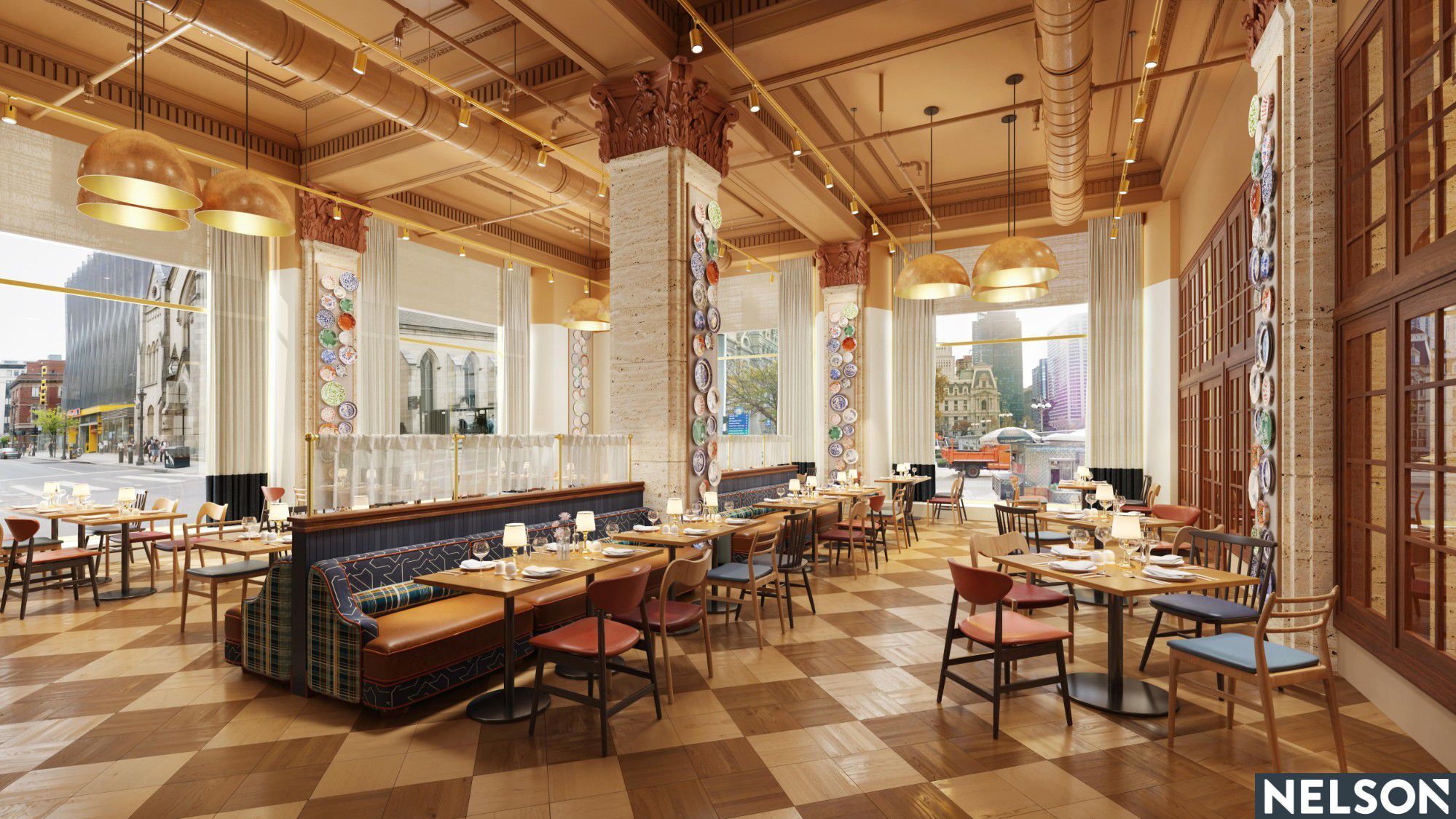
A rendering of the bar and entrance at Recipe Philly, planned for Broad and Arch Streets.
Baumstein said those personal stories will differentiate Recipe Philly from other food-competition shows. “We’re capturing the story behind the dish and the people,” he said in a phone chat last week. “There have been several applicants already that give me goosebumps — the love that goes into the dishes and the people they cook for. It’s almost romantic.”
How Recipe Philly will work
The competition will begin Nov. 8 with a casting call and registration at the Convention Center’s Broad Street atrium; pre-registration is open at recipephilly.castingcrane.com. With cameras rolling, contestants will fill out recipe cards and share the stories behind their dishes, not the dishes themselves.
Josh Randall, the warmup host for American Idol, will emcee that day’s filming. Production will continue as producers whittle the entries down to about 100 contestants, and then to about 35 finalists.
Contestants will compete across eight categories: appetizers, soups and salads, poultry, pasta, seafood, meat entrees, desserts, and an “other” category for creative outliers. Film crews will tape at contestants’ houses and on the site of the new restaurant as the competition continues. The recipes will be judged — by “chefs, food influencers, and community voices,” according to the show’s press release — based on taste, creativity, and story.
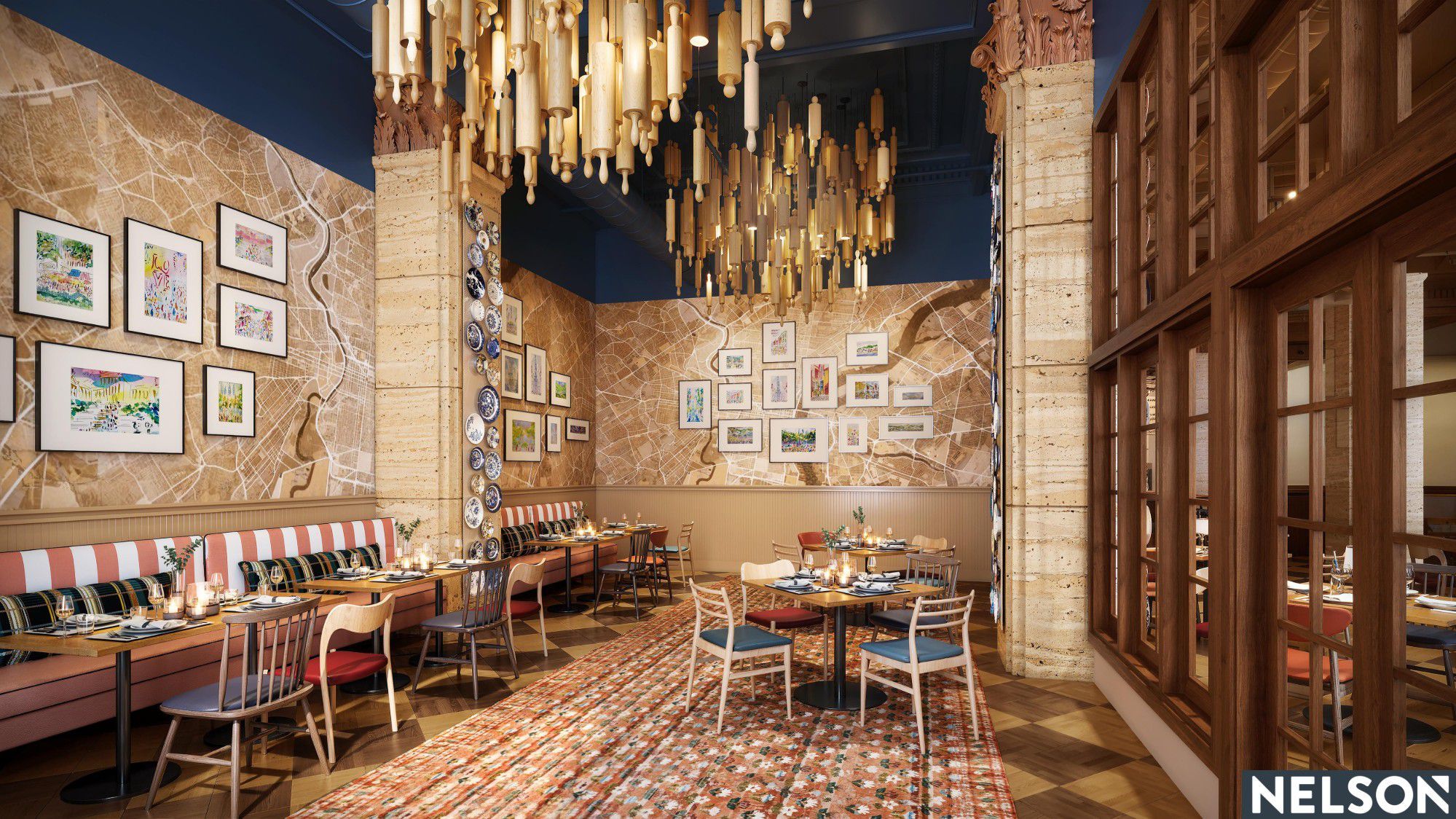
A rendering of the dining room at Recipe Philly, planned for Broad and Arch Streets.
Each winner will receive $1,000, with additional category prizes of $2,000, and their names and photos will appear on the restaurant’s menu next to their dishes. They’ll also eat for free at the restaurant as long as their recipe remains featured.
“Here’s the beauty of this,” Baumstein said. “We have no idea what we’re going to serve yet. It’s part of the intrigue of the show.”
The docuseries will consist of eight to 10 episodes, beginning with the November casting call and the early stages of restaurant construction. Later episodes will focus on the competition, the judging, and the restaurant’s transformation from an empty space to a fully realized dining room designed by Nelson, an international design and architecture firm. (Joe Scarpone, himself a former chef-restaurateur, and Alex Snyder, both of MPN Realty, represented Baumstein in the lease at the One City building. Stefanie Gabel and Jacob Cooper of MSC represented the landlord, an affiliate of Alterra Property Group.)
Baumstein said he expects to secure a network or streaming partner in early 2026. He also wants to expand the idea to other cities. “Every restaurant will have a completely different menu — indigenous to its home city,” he said.
From potluck to prime time
Baumstein, 70, a graduate of Olney High School and Temple University, is an unabashed Philadelphia booster. “This city’s vibrant, especially when it comes to food,” he said in an interview last week. “It’s the best-kept secret in the country — 25% cheaper than New York, 25% cheaper than D.C., and just full of family and community.”
Baumstein’s inspiration for Recipe Philly traces back to his days running SolomonEdwards, the Philadelphia-based consulting firm he founded in 1999, expanded internationally, and sold three years ago.
Signage for Recipe Philly on the windows of the One City building on Oct. 24.
During the 2008 recession, Baumstein’s chief financial officer proposed canceling the company’s annual holiday parties. Baumstein refused. Instead, he invited employees to his suburban Philadelphia home for a potluck dinner. “I was just blown away by the enthusiasm that our colleagues brought to the Christmas party,” Baumstein said. “They were super-excited about making their dishes. They watched the buffet table to see who was eating their dishes. We gave out little prizes, and just getting that three minutes of fame was unbelievable.”
SolomonEdwards compiled the recipes into a cookbook, which Baumstein kept as a reminder of how food brings people together. “What I love more than food is the inspiration that people give you,” he said. “In a world full of negativity, I wanted to create something that highlights the positive.”
The team behind the kitchen
Baumstein’s Homebred Hospitality owns the Recipe Philly brand. His restaurant partner is chef Andy Revella, who has handled menu development and operations for restaurants including Bennigan’s, Steak & Ale, and Rainforest Cafe and is a former director of food and beverage for Harrah’s Casino. Jarrett O’Hara, formerly culinary director of Federal Donuts, is vice president of culinary operations.
Baumstein said the total budget was $4 million — comparable to similar restaurants.
A rendering of the private dining room at Recipe Philly, planned for Broad and Arch Streets.
Asked if he had ever thought of opening a restaurant before, Baumstein replied: “No, and thank God, and I’m not going to be the one responsible for the daily operations. That’s Andy’s job. I’ve grown some big companies, and I think probably what my skill set is hiring really smart people that are talented and are able to get the team all rowing together in the same direction.”
Filming for Recipe Philly begins Nov. 8 at the Pennsylvania Convention Center. Registration and details are available at recipephilly.castingcrane.com.