Blog

  • Trump’s attack on Venezuela further flouts the Constitution he swore to uphold | Editorial

    Trump’s attack on Venezuela further flouts the Constitution he swore to uphold | Editorial

    So much for Donald the Dove.

    President Trump mounted an illegal invasion of Venezuela, kidnapping president Nicolás Maduro and his wife and spiriting them out of the country.

    The breathtaking use of military force against a sovereign state has no legal justification. It opens the door for anarchy in Venezuela and threatens to make the United States a pariah with no moral authority for other dictatorships around the globe.

    Trump acted without the authorization of Congress, in clear violation of the Constitution. But then again Trump has long mocked the Constitution he swore to uphold.

    Former President George W. Bush at least sold a phony story about weapons of mass destruction to get Congress to go along with his reckless invasion of Iraq. That catastrophic folly lasted nearly nine years, resulting in tens of thousands of needless deaths and costing taxpayers roughly $3 trillion.

    Trump once promised to avoid forever wars and claimed to be the president of peace. But without any provocation or convincing explanation, he launched a military buildup in the Caribbean and began illegally bombing small boats, killing alleged drug smugglers in Central and South America.

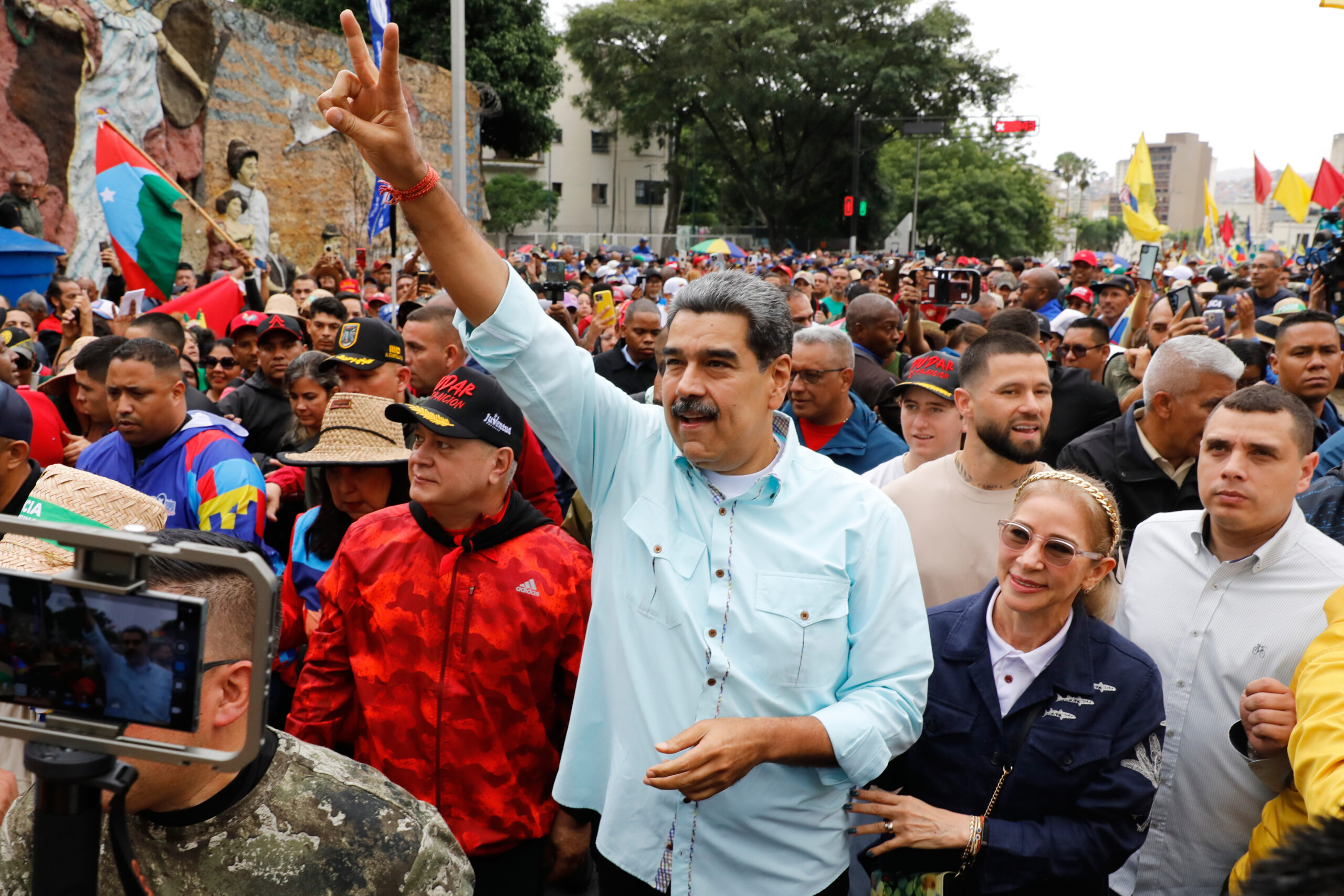
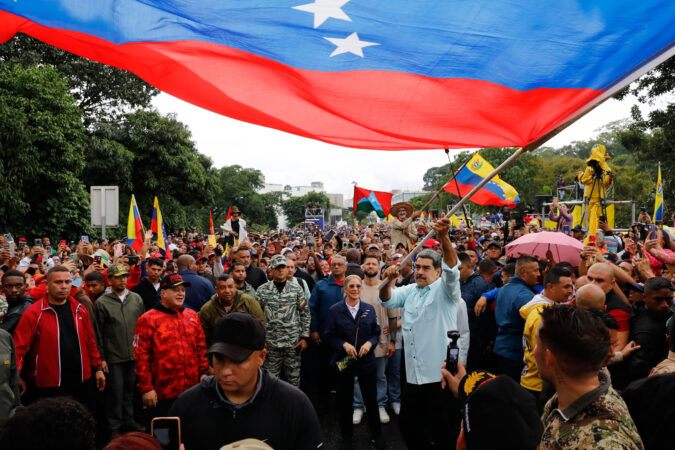
    President Nicolás Maduro joins a rally in Caracas, Venezuela, on Dec. 10, 2025. The Trump administration designated Cartel de los Soles, which it says is headed by Maduro, a foreign terrorist organization.

    Trump has offered shifting explanations — and even less evidence — for the military action ranging from wanting to stop drug trafficking to accusing Maduro of “stealing” U.S. oil and land.

    After the attack, Trump came clean on just how out of control the operation is, claiming the U.S. is ”going to run the country” and take over oil production.

    There is scant public support for Trump’s attacks in Venezuela.

    Congress, which under the Constitution, has the sole power to declare war, rejected efforts to rein in Trump’s warmongering. House Speaker Mike Johnson, a Trump puppet, praised the attack as a “justified operation that will protect American lives.”

    Sen. Andy Kim (D., N.J.) called the move “disastrous” and said Secretary of State Marco Rubio and Defense Secretary Pete Hegseth “blatantly” lied to Congress when they said the goal of the military buildup was not to topple Maduro.

    To be sure, Maduro is a corrupt and undemocratic leader who has brought economic ruin and death to Venezuela. Under his repressive regime, roughly 8 million people have fled the country.

    But if the Trump doctrine is the removal of corrupt and undemocratic leaders, where do the military actions end? How does Trump square the removal and prosecution of Maduro with his outrageous pardon last month of former Honduras President Juan Orlando Hernández, who was convicted of drug trafficking by federal prosecutors?

    Trump’s strongman act will do little to spread peace and democracy around the globe. In fact, the military actions in Venezuela may embolden China to invade Taiwan. It also signals to Russian dictator Vladimir Putin that Trump is not serious about defending Ukraine or Europe.

    It is painfully clear there is a corrupt and unrestrained madman in the White House. Yet, the conservatives on the U.S. Supreme Court and the Republicans in Congress have abandoned their role to act as checks on the executive branch, starting with the insurrection Trump fomented nearly five years ago.

    Under Trump, the American democracy that is getting ready to celebrate 250 years, is backsliding. A Harvard professor who studies democracies said flatly: “We are no longer living in a democratic regime.”

    The unauthorized attack in Venezuela is just the latest example of Trump’s growing authoritarian rule.

  • Steve Sweeney to be paid up to $287K in new Gloucester County job after being appointed during Friday commissioners’ meeting

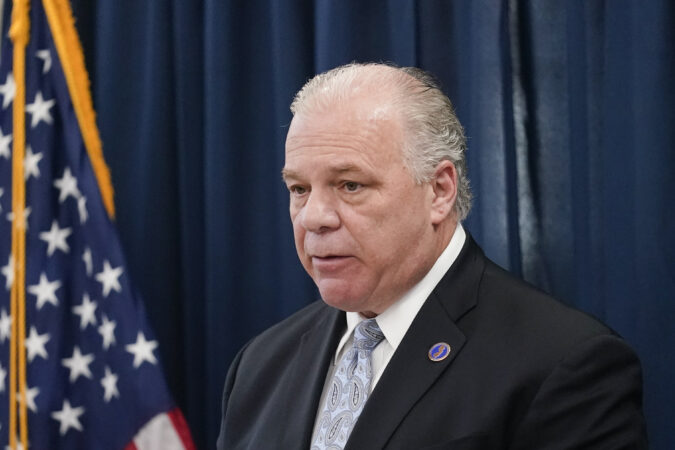
    Steve Sweeney to be paid up to $287K in new Gloucester County job after being appointed during Friday commissioners’ meeting

    Former New Jersey Senate President Steve Sweeney, who finished last in the six-way Democratic primary for New Jersey governor in June, will receive a six-figure salary in Gloucester County for a new role.

    The Gloucester County Board of Commissioners appointed Sweeney as county administrator at its public reorganizational meeting Friday night. The role has a salary rage of $191,308 to $287,168.

    The resolution appointing Sweeney, 66, to the position is tucked away in an unsearchable 236-page packet posted online Friday afternoon, just hours before the meeting. It does not say what Sweeney will be paid, but the document specifies that the county will provide him with a vehicle that can be utilized for personal use — “as in the past,” the resolution notes.

    Sweeney replaces Chad Bruner, the county’s longtime administrator who recently stepped down. Bruner chairs Rowan University’s Board of Trustees, which Sweeney joined in September.

    The resolution easily won approval by the board, which is composed of five Democrats and two Republicans. All five Democrats voted yes. Republican Nicholas DeSilvio voted no, while Republican Chris Konawel Jr. abstained from voting in protest.

    “They violated procedure, and I do believe that was an illegal meeting,” Konawel said Saturday morning.

    Democratic commissioners wouldn’t allow him to object to a “consent agenda,” which would have let commissioners look more closely at each resolution on the agenda, Konawel said. He said he received a copy of the resolution just four hours before the meeting, and noted that the vote was scheduled during a meeting with no public comment period.

    “The biggest thing for me is, we just handed somebody a $290,000 a year job, with no idea what his qualifications were,” Konawel said.

    Sweeney’s contract will last 5 years, the maximum for the role.

    Sweeney, a longtime friend of power broker George Norcross and an ironworker union leader, served the longest tenure as state Senate president, the most powerful position in New Jersey government aside from governor.

    But the West Deptford Democrat lost his reelection in 2021 to Trump-aligned Republican Ed Durr, a truck driver with little funding who planned to also run for governor before dropping out last year.

    The Republican commissioners first found out that Sweeney was picked for the role through the rumor mill weeks ago when department heads were given a heads-up behind closed doors, Konawel said.

    Konawel and DeSilvio each questioned Sweeney’s credentials in part because he didn’t attend college.

    “I kind of thought that they would actually go through a process to pick somebody qualified. I didn’t think they would just give it to Steve Sweeney, but that’s what they did,” DeSilvio said.

    Sweeney and Democratic leaders on the county board could not be reached on Friday for comment.

    Since leaving the state Senate, Sweeney served as the founding chair of a think tank at Rowan University called the Steve Sweeney Center for Public Policy.

    He attempted a political comeback last year, but his campaign for governor failed to gain traction outside of South Jersey and he did worse than expected even within the region.

    Sweeney ran to the right of his opponents on certain issues, like by saying he would get rid of the state’s sanctuary policy for undocumented immigrants, a stance touted by Republicans.

    He avoided the press in the final days of his campaign and left his party quietly just minutes after his loss, which signaled another failure of the South Jersey party machine. He won Gloucester and Salem Counties by wide margins but lost to Gov.-elect Mikie Sherrill in the other three southern counties that endorsed him.

    As county administrator, Sweeney will oversee all county department heads and can sign off on all personnel actions. The powerful role also comes with the authority to help prepare the county budget, authorize payments, take part in board discussions (without voting power), inquire into county operations, and sign off on behalf of the clerk of the board if the clerk is absent.

    County administrators are paid six-figure salaries throughout the state, but Gloucester County has developed a reputation for paying its administrator particularly well.

    Bruner was the second highest paid county administrator in the state at $253,324 in 2023, according to data compiled by the Bergen Record. The highest county administrator salary that year was in Middlesex County, which has more than double the population of Gloucester, according to the Census Bureau. Sweeney’s starting salary was not stated at the meeting, according to Konawel.

    Sweeney cannot be removed from the role without cause for the duration of his contract, and if he is, he will still receive his remaining salary, according to the resolution. He will be eligible for raises.

    Attorney General Matt Platkin expressed disapproval over the position’s high salary last month, noting that Gloucester’s County administrator was making more than the governor, whose salary is $175,000 and will raise to $210,000 this year when Sherrill takes office.

    “A county administrator making $100k more than the current governor’s salary is a pretty good argument to keep the comptroller as an independent agency to combat waste, fraud, and abuse in local government,” Platkin said in a social media post in early December when the state legislature was considering an ultimately unsuccessful bill to limit the watchdog’s power.

  • Trump says U.S. has captured Venezuelan President Nicolás Maduro, will run the country

    Trump says U.S. has captured Venezuelan President Nicolás Maduro, will run the country

    CARACAS, Venezuela — The United States captured Venezuelan President Nicolás Maduro and flew him out of the country in an extraordinary military operation early Saturday that plucked a sitting leader from office. President Donald Trump insisted the U.S. government would run the country at least temporarily and would tap Venezuelan’s vast oil reserves to sell “large amounts” to other countries.

    The action marked the culmination of an escalating Trump administration pressure campaign on the South American country that consisted of months of strikes on boats officials said were smuggling drugs to the U.S. Behind the scenes, U.S. officials tracked Maduro’s behavioral habits, including what he ate and where he slept, in preparing to execute an operation that resulted in one of the more stunning regime changes in modern history.

    Maduro and his wife, seized overnight from their home on a military base, were aboard a U.S. warship on their way to New York, where they were to face criminal charges in connection with a Justice Department indictment accusing them of a role in narco-terrorism conspiracy.

    Trump said the U.S. planned to run Venezuela until a transition of power can take place. He claimed the American presence was already in place, though there were no immediate signs the U.S. was running the country. Venezuelan state TV continued to air pro-Maduro propaganda, broadcasting live images of supporters taking to the streets in Caracas in protest.

    Trump claimed that Venezuelan vice president Delcy Rodríguez had been sworn in as president shortly before he spoke to reporters and added she had spoken with Secretary of State Marco Rubio.

    “She is essentially willing to do what we think is necessary to make Venezuela great again. Very simple,” Trump said.

    Earlier, opposition leader María Corina Machado said that the opposition candidate Edmundo González should assume power, saying that he rightfully won the 2024 presidential election.

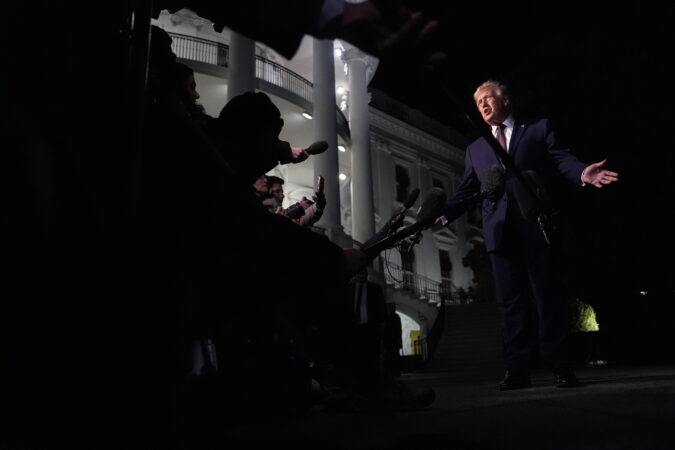
    “We’re going to run the country until such time as we can do a safe, proper and judicious transition,” Trump said at a Mar-a-Lago news conference where he boasted that this “extremely successful operation should serve as warning to anyone who would threaten American sovereignty or endanger American lives.”

    The legal authority for the attack, which echoed the 1990 U.S. invasion of Panama that led to the surrender and seizure of leader Manuel Antonio Noriega, was not immediately clear. The U.S. government does not recognize Maduro, who last appeared on state television Friday while meeting with a delegation of Chinese officials in Caracas.

    Maduro and other Venezuelan officials were indicted in 2020 on “narco-terrorism” conspiracy charges, but the Justice Department released a new indictment Saturday of Maduro and his wife, Cilia Flores, that described the regime as a “corrupt, illegitimate government” fueled by a drug trafficking operation that flooded the U.S with cocaine.

    Trump posted on his Truth Social account a photo that he said showed Maduro in custody, blindfolded and wearing a sweatsuit.

    Early morning attack

    Early Saturday, multiple explosions rang out and low-flying aircraft swept through the Venezuelan capital. Maduro’s government accused the United States of attacking civilian and military installations, calling it an “imperialist attack” and urging citizens to take to the streets.

    The attack lasted less than 30 minutes and the explosions — at least seven blasts — sent people rushing into the streets, while others took to social media to report what they’d seen and heard. Some Venezuelan civilians and members of the military were killed, said Vice President Delcy Rodríguez, without giving a number. Trump said some U.S. forces were injured in Venezuela but none were killed.

    “We think, we develop, we train, we rehearse, we debrief, we rehearse again, and again. not to get it right, but to ensure we cannot get it wrong,” said Dan Caine, the chairman of the Joint Chiefs of Staff.

    Video obtained from Caracas and an unidentified coastal city showed tracers and smoke clouding the landscape as repeated muted explosions illuminated the night sky. Other footage showed cars passing on a highway as blasts illuminated the hills behind them. The videos were verified by the Associated Press.

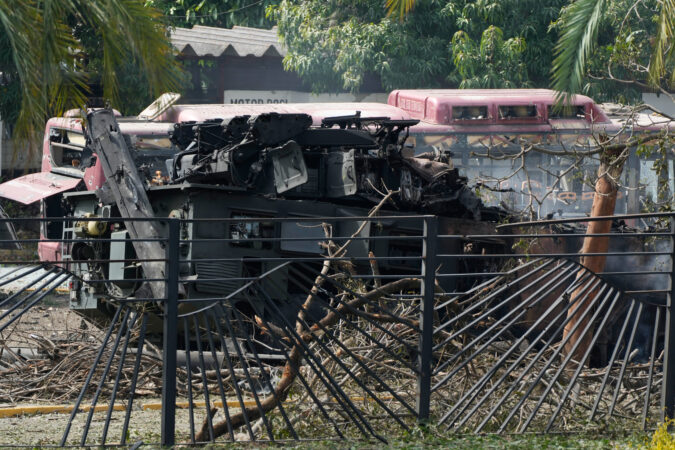
    Smoke was seen rising from the hangar of a military base in Caracas, while another military installation in the capital was without power.

    Venezuelan ruling party leader Nahum Fernández told the Associated Press that Maduro and Flores were at their home within the Fort Tiuna military installation when they were captured.

    “That’s where they bombed,” he said. “And, there, they carried out what we could call a kidnapping of the president and the first lady of the country.”

    The strike followed a monthslong Trump administration pressure campaign on the Venezuelan leader, including a major buildup of American forces in the waters off South America and attacks on boats in the eastern Pacific and Caribbean accused of carrying drugs. Last week, the CIA was behind a drone strike at a docking area believed to have been used by Venezuelan drug cartels — the first known direct operation on Venezuelan soil since the U.S. began strikes in September.

    As of Friday, the number of known boat strikes was 35 and the number of people killed at least 115, according to the Trump administration. Trump said that the U.S. is engaged in an “armed conflict” with drug cartels and has justified the boat strikes as a necessary to stem the flow of drugs into the U.S.

    Maduro has decried the U.S. military operations as a thinly veiled effort to oust him from power.

    Some streets in Caracas fill up

    Venezuela’s ruling party has held power since 1999, when Maduro’s predecessor Hugo Chávez took office, promising to uplift poor people and later to implement a self-described socialist revolution.

    Maduro took over when Chávez died in 2013. His 2018 reelection was widely considered a sham because the main opposition parties were banned from participating. During the 2024 election, ruling party-loyal electoral authorities declared him the winner hours after polls closed, but the opposition gathered overwhelming evidence that he lost by a more than 2-to-1 margin.

    In a demonstration of how polarizing a figure Maduro is, people variously took to the streets to deplore his capture and celebrate it.

    At a protest in the Venezuelan capital, Caracas Mayor Carmen Meléndez joined a crowd demanding Maduro’s return.

    “Maduro, hold on, the people are rising up!” the crowd chanted. “We are here, Nicolás Maduro. If you can hear us, we are here!”

    Earlier, armed people and uniformed members of a civilian militia took to the streets of a Caracas neighborhood long considered a stronghold of the ruling party.

    In other parts of the city, the streets remained empty hours after the attack, as residents absorbed events. Some areas remained without power, but vehicles moved freely.

    “How do I feel? Scared, like everyone,” said Caracas resident Noris Prada, who sat on an empty avenue looking down at his phone. “Venezuelans woke up scared, many families couldn’t sleep.”

    In the Chilean capital of Santiago, people waved Venezuelan flags and banged pots and pans as vehicles passed by honking at them.

    Questions of legality

    The Armed Services committees in both houses of Congress, which have jurisdiction over military matters, had not been notified by the administration of any actions, according to a person familiar with the matter and granted anonymity to discuss it.

    Lawmakers from both political parties in Congress have raised deep reservations and flat-out objections to the U.S. attacks on boats suspected of drug smuggling near the Venezuelan coast, and Congress has not specifically approved an authorization for the use of military force for such operations in the region.

    Connecticut Rep. Jim Himes, the top Democrat on the House Intelligence Committee, said he had seen no evidence that would justify Trump striking Venezuela without approval from Congress and demanded an immediate briefing by the administration on “its plan to ensure stability in the region and its legal justification for this decision.”

    Deputy Secretary of State Christopher Landau said the military action and seizure of Maduro marks “a new dawn for Venezuela,” saying that “the tyrant is gone.” He posted on X hours after the strike. His boss, Rubio, reposted a post from July that said Maduro “is NOT the President of Venezuela and his regime is NOT the legitimate government.”

    Cuba, a supporter of the Maduro government and a longtime adversary of the United States, called for the international community to respond to what President Miguel Díaz-Canel Bermúdez called “the criminal attack.”

    “Our zone of peace is being brutally assaulted,” he said on X. Iran’s Foreign Ministry also condemned the strikes.

  • With capture of Maduro, Trump claims successful operation as he treads into uncharted territory

    With capture of Maduro, Trump claims successful operation as he treads into uncharted territory

    WASHINGTON — With the capture of Venezuela’s Nicolás Maduro, President Donald Trump and his allies are calling the audacious military operation a major success as the U.S. leader once again demonstrated a willingness to use U.S. forces for risky missions that come with a potential big payoff.

    The operation has ousted a South American strongman blasted by Trump’s administration as an “illegitimate” dictator and a “narco-terrorist,” a scourge responsible for a steady of stream of illegal drugs poisoning U.S. and Europe.

    “It was a brilliant operation, actually,” Trump told the New York Times shortly after U.S. forces were cleared from Venezuelan airspace. He later added in an appearance on Fox & Friends that some U.S. troops were injured in the strike but none were killed.

    But the path ahead could certainly be treacherous as the White House faces a series of difficult questions.

    Who will fill the power vacuum now that Maduro is gone? How do you maintain stability in a country that’s already endured years of hyperinflation, food and medicine shortages and brain drain despite its vast oil wealth?

    What lessons will U.S. adversaries take from Trump’s decision to demonstrate American might in its sphere of influence as China’s Xi Jinping vows to annex the self-ruled island of Taiwan and Russia’s Vladimir Putin has designs on neighbor Ukraine and diminishing NATO’s eastern flank?

    Trump takes a big risk

    The operation to remove Maduro certainly marks another big moment for Trump’s foreign policy in his second term, as he hasn’t shied away from flexing U.S. military might even as he has vowed to keep America out of war.

    Trump has now twice used U.S. forces to carry out risky operations against American adversaries. In June, he directed U.S. strikes on key Iranian nuclear sites.

    Saturday’s action stirred fresh anxiety in capitals around the world that have sought to adjust to a new normal in Trump 2.0, where the idea of the U.S. trying to find global consensus on issues of war and peace is now passe. On Friday, Trump issued a new threat to Iran that if it “violently kills peaceful protesters” — in protests sparked by the collapse of Iran’s currency — the United States “will come to their rescue.”

    With the Venezuela operation, Trump followed through on a promise, spelled out in his National Security Strategy published last month, to assert U.S. dominance in the Western Hemisphere.

    More questions than answers

    Retired Navy Rear Adm. Mark Montgomery said the immediate path ahead for Trump in Venezuela could be more difficult to navigate than what he faced after the Iran strikes.

    “Unlike the [Iran] strikes where Trump did the action and then said ‘fights over,’ he will not have that luxury here in Venezuela,” said Montgomery, an analyst at the Foundation for Defense of Democracies, a hawkish think tank in Washington. “He needs to stay engaged in Venezuela to make sure that Maduro’s cronies — equally guilty of any crime he is — are also pushed out of power, and they may want to stay and fight as they don’t have too many places to run.”

    What’s next for Venezuela?

    European allies had expressed concern as Trump built up a massive presence of troops in the Caribbean in recent months and carried out dozens of lethal strikes on suspected drug smugglers — many that the administration claimed were effectively an arm of the Maduro government.

    Maduro was hardly viewed as a choir boy by the international community. His 2018 and 2024 elections were seen as riddled with irregularities and viewed as illegitimate.

    But many U.S. allies greeted news of Maduro’s capture with a measure of trepidation.

    European Commission President António Costa said he had “great concern” about the situation in Venezuela following the U.S. operation.

    “The EU has repeatedly stated that Mr Maduro lacks legitimacy and has defended a peaceful transition,” European Union foreign policy chief Kaja Kallas added on X. “Under all circumstances, the principles of international law and the UN Charter must be respected. We call for restraint.”

    France’s Foreign Minister Jean-Noël Barrot said “the military operation that led to the capture of Maduro infringes the principle of the non-use of force that underpins international law.”

    “France recalls that no lasting political solution can be imposed from outside and that sovereign peoples alone decide their future,” he said in a statement posted on X.

    The criticism from some Democrats over Trump’s military action to oust Maduro was immediate.

    “This war is illegal, it’s embarrassing that we went from the world cop to the world bully in less than one year.” Sen. Ruben Gallego of Arizona wrote on X. “There is no reason for us to be at war with Venezuela.”

    Russia’s Foreign Ministry condemned what it called a U.S. “act of armed aggression” against Venezuela in a statement posted on its Telegram channel Saturday. The ouster of Maduro, who was backed by the Russians, comes as Trump is urging Putin to end his nearly four-year brutal war on Ukraine.

    “Venezuela must be guaranteed the right to determine its own destiny without any destructive, let alone military, outside intervention,” the statement said.

    Similarly, China’s foreign ministry in a statement condemned the U.S. operation, saying it violates international law and Venezuela’s sovereignty.

    Capture follows months of pressure

    The operation was the culmination of a push inside the administration led by Secretary of State Marco Rubio and other like-minded foes of Maduro who have been urging Trump to take action against the Venezuelan leader for years dating back to Trump’s first administration.

    In South Florida — the epicenter of the Venezuelan diaspora opposition to Maduro that has influenced Rubio’s thinking — Saturday’s operation was cheered as an era-changing moment for democracy.

    Rep. Carlos Gimenez, a Florida Republican, said he had spoken to Rubio and thanked Trump for having “changed the course of history in our hemisphere. Our country & the world are safer for it,” he wrote on X, comparing Maduro’s ouster to the fall of the Berlin Wall.

    Maduro had sought a pathway to exit from power, while saving face.

    Venezuelan government officials had floated a plan in which Maduro would eventually leave office, the Associated Press reported in October.

    The proposal, which was rejected by the White House, called for Maduro to step down in three years and hand over to his vice president, Delcy Rodriguez, who would complete Maduro’s six-year term that ends in January 2031. Rodriguez would not run for reelection under the plan.

    But the White House had rejected the proposal because the administration questioned the legitimacy of Maduro’s rule and accused him of overseeing a narco-terrorist state.

    Maduro earlier this week said Venezuela was open to negotiating an agreement with the United States to combat drug trafficking and work with Washington on promoting U.S. further investment in the Venezuelan oil industry.

    But Trump for months has insisted that Maduro’s days in power were numbered.

    Shorty after Trump announced Maduro’s capture, the White House posted video on one of its social media accounts of Trump in October explicitly telling reporters that Maduro was feeling pressure from the U.S. campaign and trying to cut a deal.

    “He doesn’t want to f— around with the United States,” Trump said.

    Elliot Abrams, who served as U.S. special representative for Iran and Venezuela in the first Trump administration, said the president now must decide how invested his administration will be in shaping the next government in Caracas. Venezuela’s opposition says the rightful president is the exiled politician Edmundo González.

    “I think the real question is whether Trump will claim victory and be satisfied with Delcy Rodriguez making some promises or engaging in negotiations,” Abrams said. “Or will he insist on Gonzalez.”

    Trump in an appearance on Fox & Friends on Saturday morning said he wasn’t ready to commit to a certain leader but pledged his administration would be “very involved” in Venezuela.

    “We can’t take a chance of letting somebody else run it — just take over where [Maduro] left,” Trump said.

  • From bus driver to president: Venezuela’s Maduro never escaped his predecessor’s shadow

    From bus driver to president: Venezuela’s Maduro never escaped his predecessor’s shadow

    CARACAS, Venezuela — Nicolás Maduro, who rose from unionized bus driver to Venezuelan president and oversaw his country’s democratic undoing and economic collapse, was captured Saturday during an attack by U.S. forces on his capital.

    U.S. President Donald Trump, in an early morning social media post, announced Maduro’s capture. Venezuela’s vice president, Delcy Rodríguez, later announced that the whereabouts of Maduro and his wife, Cilia Flores, remained unknown. Trump’s attorney general, Pam Bondi, said Maduro and Flores, would face charges after an indictment in New York.

    Maduro’s fall was the culmination of months of stepped-up U.S. pressure on various fronts.

    He had spent the last months of his presidency fueling speculation over the intentions of the U.S. government to attack and invade Venezuela with the goal of ending the self-proclaimed socialist revolution that his late mentor and predecessor, Hugo Chávez, ushered in 1999. Maduro, like Chávez, cast the United States as Venezuela’s biggest threat, railing against Democratic and Republic administrations for any efforts to restore democratic norms.

    Maduro’s political career began 40 years ago. In 1986, he traveled to Cuba to receive a year of ideological instruction, his only formal education after high school. Upon his return, he worked as a bus driver for the Caracas subway system, where he quickly became a union leader. Venezuela’s intelligence agencies in the 1990s identified him as a leftist radical with close ties to the Cuban government.

    Maduro eventually left his driver job and joined the political movement that Chávez organized after receiving a presidential pardon in 1994 for leading a failed and bloody military coup years earlier. After Chávez took office, the former youth baseball player rose through the ranks of the ruling party, spending his first six years as a lawmaker before becoming president of the National Assembly. He then served six years as foreign minister and a couple months as vice president.

    Appointed the political heir to Chávez

    Chávez used his last address to the nation before his death in 2013 to anoint Maduro as his successor, asking his supporters to vote for the then-foreign affairs minister should he die. The choice stunned supporters and detractors alike. But Chávez’s enormous electoral capital delivered Maduro a razor-thin victory that year, giving him his first six-year term, though he would never enjoy the devotion that voters professed for Chávez.

    Maduro married Flores, his partner of nearly two decades, in July 2013, shortly after he became president. He called her the “first combatant,” instead of first lady, and considered her a crucial adviser.

    Maduro’s entire presidency was marked by a complex social, political and economic crisis that pushed millions into poverty, drove more than 7.7 million Venezuelans to migrate and put thousands of real or perceived government opponents in prison, where many were tortured, some at his direction. Maduro complemented the repressive apparatus by purging institutions of anyone who dared dissent.

    Venezuela’s crisis took hold during Maduro’s first year in office. The political opposition, including the now-Nobel Peace Prize winner María Corina Machado, called for street protests in Caracas and other cities. The demonstrations evidenced Maduro’s iron fist as security forces pushed back protests, which ended with 43 deaths and dozens of arrests.

    Maduro’s United Socialist Party of Venezuela would go on to lose control of the National Assembly for the first time in 16 years in the 2015 election. Maduro moved to neutralize the opposition-controlled legislature by establishing a pro-government Constituent Assembly in 2017, leading to months of protests violently suppressed by security forces and the military.

    More than 100 people were killed and thousands were injured in the demonstrations. Hundreds were arrested, causing the International Criminal Court to open an investigation against Maduro and members of his government for crimes against humanity. The investigation was still ongoing in 2025.

    In 2018, Maduro survived an assassination attempt when drones rigged with explosives detonated near him as he delivered a speech during a nationally televised military parade.

    President Nicolas Maduro acknowledges supporters alongside first lady Cilia Flores during his closing election campaign rally in Caracas, Venezuela, on July 25, 2024.

    Bedeviled by economic problems

    Maduro was unable to stop the economic free fall. Inflation and severe shortages of food and medicines affected Venezuelans nationwide. Entire families starved and began migrating on foot to neighboring countries. Those who remained lined up for hours to buy rice, beans and other basics. Some fought on the streets over flour.

    Ruling party loyalists moved the December 2018 presidential election to May and blocked opposition parties from the ballot. Some opposition politicians were imprisoned; others fled into exile. Maduro ran virtually unopposed and was declared winner, but dozens of countries did not recognize him.

    Months after the election, he drew the fury after social media videos showed him feasting on a steak prepared by a celebrity chef at a restaurant in Turkey while millions in his country were going hungry.

    Under Maduro’s watch, Venezuela’s economy shrank 71% between 2012 and 2020, while inflation topped 130,000%. Its oil production, the beating heart of the country, dropped to less than 400,000 barrels a day, a figure once unthinkable.

    The first Trump administration imposed economic sanctions against Maduro, his allies, and state-owned companies to try to force a government change. The measures included freezing all Venezuelan government assets in the U.S. and prohibiting American citizens and international partners from doing business with Venezuelan government entities, including the state-owned oil company.

    Out of options, Maduro began implementing a series of economic measures in 2021 that eventually ended Venezuela’s hyperinflation cycle. He paired the economic changes with concessions to the U.S.-backed political opposition with which it restarted negotiations for what many had hoped would be a free and democratic presidential election in 2024.

    Maduro used the negotiations to gain concessions from the U.S. government, including the pardon and prison release of one of his closest allies and the sanctions license that allowed oil giant Chevron to restart pumping and exporting Venezuelan oil. The license became his government’s financial lifeline.

    Losing support in many places

    Negotiations led by Norwegian diplomats did not solve key political differences between the ruling party and the opposition.

    In 2023, the government banned Machado, Maduro’s strongest opponent, from running for office. In early 2024, it intensified its repressive efforts, detaining opposition leaders and human rights defenders. The government also forced key members of Machado’s campaign to seek asylum at a diplomatic compound in Caracas, where they remained for more than a year to avoid arrest.

    Hours after polls closed in the 2024 election, the National Electoral Council declared Maduro the winner. But unlike previous elections, it did not provide detailed vote counts. The opposition, however, collected and published tally sheets from more than 80% of electronic voting machines used in the election. The records showed Edmundo González defeated Maduro by a more than 2-to-1 margin.

    Protests erupted. Some demonstrators toppled statues of Chávez. The government again responded with full force and detained more than 2,000 people World leaders rejected the official results, but the National Assembly sworn in Maduro for a third term in January 2025.

    Trump’s return to the White House that same month proved to be a sobering moment for Maduro. Trump quickly pushed Maduro to accept regular deportation flights for the first time in years. By the summer, Trump had built up a military force in the Caribbean that put Venezuela’s government on high alert and started taking steps to address what it called narco-terrorism.

    For Maduro, that was the beginning of the end.

  • A timeline of the US military’s buildup and strikes against Venezuela leading to Maduro’s capture

    A timeline of the US military’s buildup and strikes against Venezuela leading to Maduro’s capture

    WASHINGTON — President Donald Trump had long threatened that he could order military strikes on targets on Venezuelan territory after months of attacks on boats accused of carrying drugs from the South American country. President Nicolás Maduro of Venezuela said the U.S. military operations were a thinly veiled effort to oust him from power.

    On Saturday, the U.S. conducted a “large-scale strike” against Venezuela and said that Maduro and his wife, Cilia Flores, had been captured and flown out of the country. Trump announced the operation on social media hours after the attack. The Venezuelan government called it an “imperialist attack” and urged citizens to take to the streets.

    Attorney General Pam Bondi said Maduro and Flores, would face charges after an indictment in New York.

    Before the escalation, there had been 35 known strikes against alleged drug smuggling boats in South American waters since early September that killed at least 115 people, according to announcements from the Republican administration.

    The U.S. had sent a fleet of warships to the region, the largest buildup of forces in generations.

    The White House said Washington was in “armed conflict” with drug cartels to halt the flow of narcotics into the United States, while U.S. officials alleged that Maduro supported the international drug trade.

    Here is a timeline of the U.S. military actions and related developments:

    Jan. 20, 2025

    Trump signs an executive order that paved the way for criminal organizations and drug cartels to be named “foreign terrorist organizations.” They included Tren de Aragua, a Venezuelan street gang.

    U.S. intelligence agencies have disputed Trump’s central claim that Maduro’s administration was working with Tren de Aragua and orchestrating drug trafficking and illegal immigration into the U.S.

    Feb. 20

    The Trump administration formally designated eight Latin American crime organizations as foreign terrorist organizations.

    The label is normally reserved for groups such as a-Qaida or the Islamic State that use violence for political ends, and not for profit-focused crime rings.

    Aug. 19

    The U.S. military deployed three guided-missile destroyers to the waters off Venezuela.

    The naval force in the Caribbean grew within weeks to include three amphibious assault ships and other vessels, carrying about 6,000 sailors and Marines and a variety of aircraft.

    The U.S. sent F-35 fighter jets to Puerto Rico in September, while a Navy submarine carrying cruise missiles operated off South America.

    Sept. 2

    The U.S. carried out its first strike against what Trump said was a drug-carrying vessel that departed from Venezuela and was operated by Tren de Aragua.

    Trump said all 11 people on the boat were killed. He posted a short video clip of a small vessel appearing to explode in flames.

    Sept. 10

    In a letter to the White House, Democratic senators said the administration had provided “no legitimate legal justification” for the strike.

    Sen. Jack Reed of Rhode Island, the top Democrat on the Senate Armed Services Committee, said the U.S. military was not “empowered to hunt down suspected criminals and kill them without trial.”

    Sept. 15

    The U.S. military carried out its second strike against an alleged drug boat, killing three people.

    Asked what proof the U.S. had that the vessel was carrying drugs, Trump told reporters that big bags of cocaine and fentanyl were spattered all over the ocean. Images of what Trump described were not released by the military or the White House.

    Sept. 19

    Trump said the U.S. military carried out its third fatal strike against an alleged drug-smuggling vessel. Several senators and human rights groups continued to question the legality of the strikes, describing them as a potential overreach of executive authority.

    Oct. 2

    Trump declared drug cartels to be unlawful combatants and said the U.S. was now in an “armed conflict” with them, according to an administration memo obtained by The Associated Press.

    The memo appeared to represent an extraordinary assertion of presidential war powers and drew criticism from some lawmakers, including Republican Sen. Rand Paul of Kentucky.

    Oct. 3

    Defense Secretary Pete Hegseth said he ordered a fourth strike on a small boat he accused of carrying drugs.

    Oct. 8

    Senate Republicans voted down legislation that would have required the president to seek authorization from Congress before further military strikes.

    Oct. 14

    Trump announced the fifth strike against a small boat accused of carrying drugs, saying it killed six people.

    Oct. 15

    Trump confirmed he has authorized the CIA to conduct covert operations inside Venezuela and said he was weighing carrying out land operations in the country.

    He declined to say whether the CIA has authority to take action against Maduro.

    Oct. 16

    The Navy admiral who oversaw military operations in the region said he will retire in December.

    Adm. Alvin Holsey became leader of U.S. Southern Command only the previous November, overseeing an area that encompasses the Caribbean and waters off South America. Such postings typically last three years to four years.

    Oct. 16

    Trump said the U.S. struck a sixth suspected drug-carrying vessel in the Caribbean, killing two people and leaving two survivors who were on the semisubmersible craft.

    The president later said the survivors would be sent to Ecuador and Colombia, their home countries, “for detention and prosecution.” Repatriation avoided questions about what their legal status would have been in the U.S. justice system.

    Oct. 17

    The U.S. military attacked a seventh vessel that Hegseth said was carrying “substantial amounts of narcotics” and associated with a Colombian rebel group, the National Liberation Army, or ELN. Three people are killed.

    Oct. 20

    Washington Rep. Adam Smith, top Democrat on the House Armed Services Committee, called for a hearing on the boat strikes.

    “Never before in my over 20 years on the committee can I recall seeing a combatant commander leave their post this early and amid such turmoil,” Smith said in a statement of Holsey’s impending departure. “I have also never seen such a staggering lack of transparency on behalf of an Administration and the Department to meaningfully inform Congress on the use of lethal military force.”

    Oct. 21

    Hegseth said the U.S. military launched its eighth strike against an alleged drug-carrying vessel, killing two people in the eastern Pacific.

    The attack was an expansion of the military’s targeting area to the waters off South America where much of the cocaine from the world’s largest producers is smuggled.

    Oct. 22

    Hegseth announced the ninth strike, another in the eastern Pacific, saying three men are killed.

    Oct. 24

    Hegseth ordered the U.S. military’s most advanced aircraft carrier, the USS Gerald R. Ford, to the region in a significant escalation of military firepower.

    Oct. 24

    Hegseth said the military conducted the 10th strike on a suspected drug-running boat, leaving six people dead.

    Oct. 27

    Hegseth said three more strikes were carried out in the eastern Pacific, killing 14 people and leaving one survivor.

    Hegseth said Mexican authorities “assumed responsibility for coordinating the rescue” of the sole survivor, who was presumed dead after Mexico suspended its search.

    Oct. 29

    Hegseth said the U.S. military carried out another strike on a boat he said was carrying drugs in the eastern Pacific, killing all four people aboard in the 14th attack.

    Oct. 29

    Virginia Sen. Mark Warner, the ranking Democrat on the Senate Intelligence Committee, said the administration briefed Republicans, but not Democrats, on the boat strikes.

    The Senate at the time was facing a potential vote on a war powers resolution that would have prohibited strikes in or near Venezuela without congressional approval.

    Oct. 31

    U.N. human rights chief Volker Türk called for an investigation into the strikes, in what appeared to be the first such condemnation of its kind from a U.N. organization.

    Ravina Shamdasani, a spokeswoman for Türk’s office, relayed his message at a briefing: “The U.S. must halt such attacks and take all measures necessary to prevent the extrajudicial killing of people aboard these boats.”

    Nov. 1

    Hegseth announced the 15th known strike, saying three people were killed.

    Nov. 4

    In the 16th known strike, Hegseth posted on social media that two people were killed aboard a vessel in the eastern Pacific.

    Nov. 6

    Hegseth announced the 17th known strike, which killed three people.

    Senate Republicans voted to reject legislation that would have limited Trump’s ability to order an attack on Venezuelan soil without congressional authorization. Lawmakers from both parties had demanded more information on the strikes, but Republicans appeared more willing to give Trump leeway to continue his buildup of naval forces.

    Nov. 9

    The U.S. military struck two vessels in the eastern Pacific, killing six people, according to an announcement from Hegseth the following day.

    Nov. 10

    The 20th known strike on a boat accused of transporting drugs killed four people in the Caribbean, according to a social media post from the U.S. military’s Southern Command.

    Nov. 11

    Venezuela’s government launched what it said was a “massive” mobilization of troops and volunteers for two days of exercises prompted by the U.S. military buildup.

    Defense Minister Vladimir Padrino López asserted that Venezuela’s military was “stronger than ever in its unity, morale and equipment.”

    Nov. 15

    Three people were killed after the U.S. military conducted its 21st strike on an alleged drug-smuggling boat in the eastern Pacific, according to a post from Southern Command a day later.

    Nov. 16

    The Ford arrived in the Caribbean, a major moment in the Trump administration’s show of force.

    The aircraft carrier’s arrival brought the total number of troops in the region to around 12,000 on nearly a dozen Navy ships in what Hegseth said was “Operation Southern Spear.”

    Nov. 16

    Trump said the U.S. ” may be having some discussions ” with Maduro and “Venezuela would like to talk,” without offering details.

    “I’ll talk to anybody,” Trump said. “We’ll see what happens.”

    Dec. 4

    Adm. Frank “Mitch” Bradley appeared for closed-door classified briefings at the Capitol as lawmakers began investigating the strikes. The investigation started after reports that Bradley ordered a follow-on attack that killed the survivors of the first strike on Sept. 2 to comply with Hegseth’s demands.

    Sen. Tom Cotton, R-Ark., later told reporters that “Bradley was very clear that he was given no such order, to give no quarter or to kill them all.”

    Democrats said they found the video of the entire attack disturbing.

    Smith said the survivors were “basically two shirtless people clinging to the bow of a capsized and inoperable boat, drifting in the water — until the missiles come and kill them.”

    Dec. 4

    Four people were killed in the 22nd strike on an alleged drug-smuggling boat in the eastern Pacific, according to a post from Southern Command.

    Dec. 10

    The U.S. seized an oil tanker off the coast of Venezuela after the ship left that country with about 2 million barrels of heavy crude.

    Attorney General Pam Bondi said the tanker was involved in “an illicit oil shipping network supporting foreign terrorist organizations.” Venezuela’s government said the seizure was “a blatant theft and an act of international piracy.”

    Dec. 15

    The U.S. military struck three alleged drug-smuggling boats, killing eight people, in the eastern Pacific Ocean, Southern Command announced.

    Dec. 16

    Hegseth said the Pentagon will not publicly release unedited video of the Sept. 2 strike that killed two survivors, even as questions mounted in Congress about the attack and the overall campaign near Venezuela.

    Dec. 16

    Trump said he was ordering a blockade of all “sanctioned oil tankers” going into and out of Venezuela, a move that seemed designed to put a tighter chokehold on the South American country’s oil-dependent economy.

    Trump alleged that Venezuela was using oil to fund drug trafficking, terrorism and other crimes. He pledged to continue the military buildup until Venezuela returned to the U.S. oil, land and assets, though it was unclear why Trump felt the U.S. had a claim.

    Dec. 17

    The U.S. military said it attacked a boat accused of smuggling drugs in the eastern Pacific Ocean, killing four people.

    House Republicans rejected a pair of Democratic-backed resolutions that would have put a check on Trump’s power to use military force against drug cartels and Venezuela. They were the first votes in the House after Senate Republicans previously voted down similar war powers resolutions.

    Dec. 18

    The U.S. military said it conducted two more strikes against boats that were allegedly smuggling drugs in the eastern Pacific, killing five people.

    Dec. 20

    Homeland Security Secretary Kristi Noem said the U.S. Coast Guard, with help from the Defense Department, stopped a second oil tanker off the coast of Venezuela.

    Dec. 22

    Trump confirmed that the U.S. Coast Guard was chasing another oil tanker that the administration described as part of the “dark fleet.”

    The U.S. military said it attacked a boat accused of smuggling drugs in the eastern Pacific Ocean, killing four people.

    Dec. 29

    Trump told reporters that the U.S. struck a facility where boats accused of carrying drugs “load up.” He declined to say whether the U.S. military or the CIA carried out the strike on the dock or where it occurred. He did not confirm it happened in Venezuela.

    The U.S. military said it attacked a boat accused of smuggling drugs in the eastern Pacific Ocean, killing two people.

    Dec. 30

    The CIA was behind the drone strike at a docking area believed to have been used by Venezuelan drug cartels, according to two people familiar with details of the classified operation who requested anonymity to discuss it.

    It was the first known direct operation on Venezuelan soil since the U.S. began strikes in September. Venezuelan officials have not acknowledged the strike.

    Dec. 30

    The U.S. military struck three more boats that were allegedly smuggling drugs, killing three people in the first boat while people from the other two boats jumped overboard and may have survived, Southern Command announced the following day.

    Dec. 31

    The U.S. imposed sanctions on four companies operating in Venezuela’s oil sector and designated four additional oil tankers as blocked property and part of the larger shadow fleet that was evading U.S. sanctions on Venezuela.

    Dec. 31

    The U.S. military said it attacked two more boats, killing five people who were allegedly smuggling drugs along known trafficking routes.

    Jan. 1, 2026

    Maduro, in an interview on state television that aired on New Year’s Day, said Venezuela was open to negotiating an agreement with the United States to combat drug trafficking. He declined to comment on the CIA-led strike and reiterated that the U.S. wanted to force a government change in Venezuela and gain access to its vast oil reserves.

    Jan. 3

    The U.S. conducted a “large-scale strike” across Caracas, the capital of Venezuela, captured Maduro and Flores and flew them out of the country. Maduro and Flores would face charges after an indictment in New York, according to Attorney General Pam Bondi.

    Maduro was indicted in 2020 on “narco-terrorism” conspiracy charges, but it was not previously known that Flores had been.

    ___

    Garcia Cano reported from Caracas, Venezuela.
  • ❤️ Mummers devotion | Morning Newsletter

    ❤️ Mummers devotion | Morning Newsletter

    Good morning. It’s set to be a mostly cloudy Saturday with a high near 33.

    Today, we’re talking about the pure love that poured out from the Mummers Parade.

    But first, we have updates on disruptions coming to SEPTA’S Fox Chase Line, another Philadelphia bar that has gone to the dogs, and the Philly area’s first babies of 2026.

    Let’s get into it.

    — Paola Pérez (morningnewsletter@inquirer.com)

    If someone forwarded you this email, sign up for free here.

    What you should know today

    A romantic Mummers

    When considering the good, bad, and weird in the region’s latest happenings, editor Sam Ruland looked to two special stories out of the Mummers Parade that captured hearts across the city of Philadelphia.

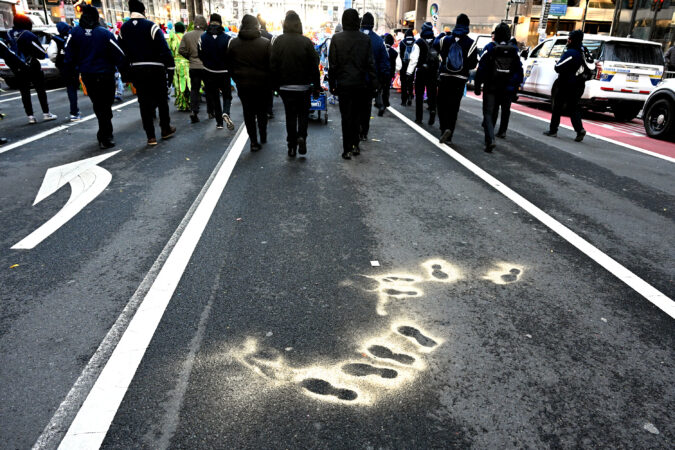
    The nation’s oldest folk parade drew thousands who braved the bitter cold and high winds to participate in the annual tradition. Unfortunately, those winds prevented the string bands from competing, marking the first time in Mummers history that was suspended.

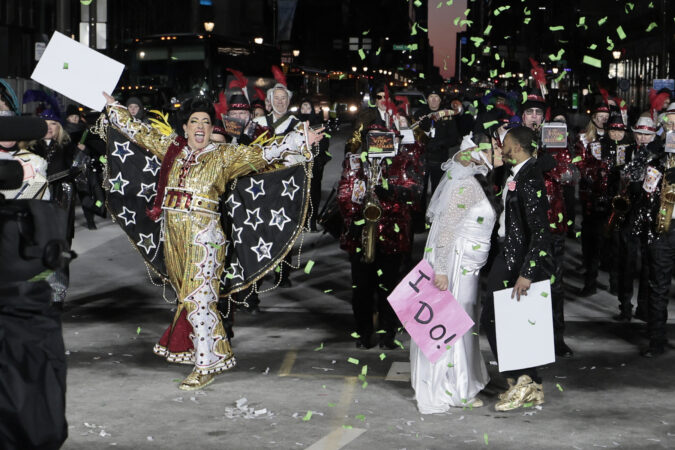
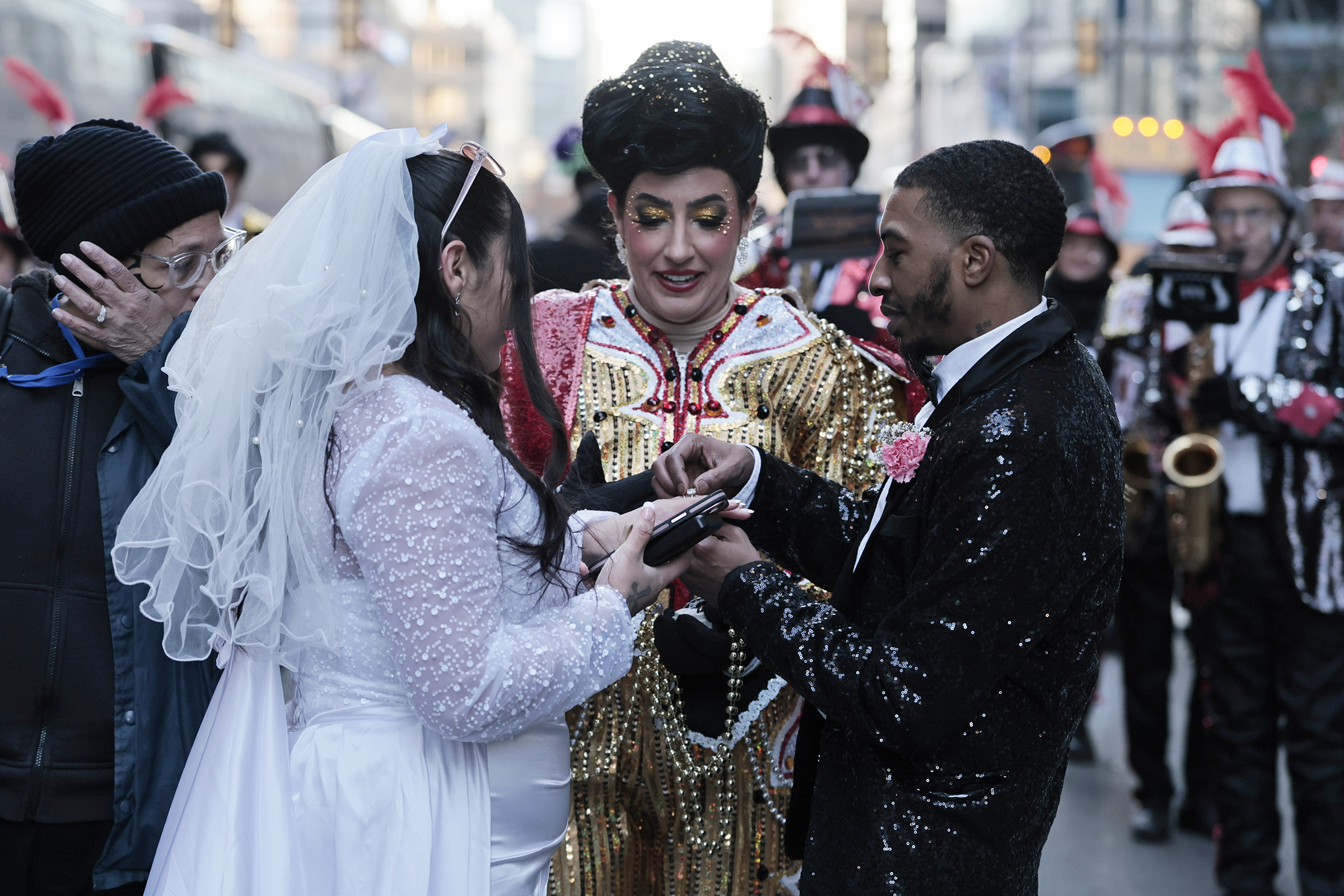
    But because this is Philadelphia, the show still went on, and we got to see uplifting things happen amid the dancing, sequins, and feathers: There was a couple who got married in the middle of the parade, and an adorable Mummers-obsessed 93-year-old Welsh grandma who flew here to finally see them in person. A uniquely Philly love was palpable at the event, now in its 125th anniversary.

    “This New Year’s Day delivered a reminder of what this thing actually is: unshakable, irrational, deeply sincere devotion,” Ruland writes. Both stories earned an A+.

    Catch up on these stories and more from this week in Philly news.

    One viewpoint

    In this week’s Shackamaxon, Inquirer columnist Daniel Pearson proposes some New Year’s resolutions for key players in City Hall, Harrisburg, and everywhere in between.

    For instance, Pearson argued City Council should work toward eliminating micromanagement, and called on SEPTA “to stand and deliver.” Read his suggestions to state and local leaders, including a bonus resolution for everyday Philadelphians.

    📍 Find the location

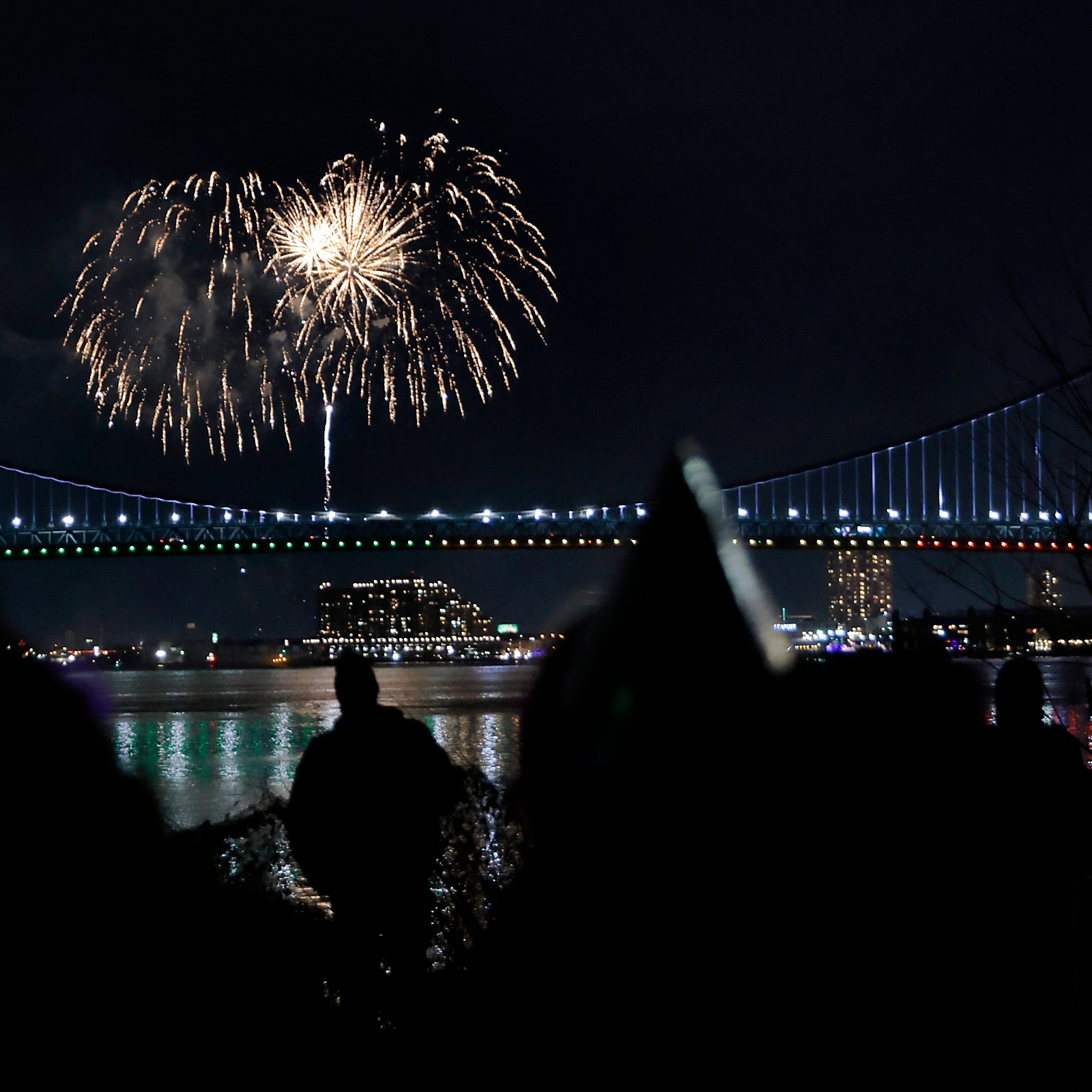
    Somewhere in Philly, people watched the New Year’s Eve fireworks shows.

    Think you know where this was taken? Our weekly game puts your knowledge of Philly locations to the test. Check your answer.

    🧩 Unscramble the anagram

    Hint: Hollywood production designer from West Philly

    MONTHS YAWN

    Email us if you know the answer. We’ll select a reader at random to shout out here.

    Cheers to Melissa Pergine, who correctly guessed Wednesday’s answer: Manayunk. Acclaimed gluten-free bakery Flakely will move from an industrial kitchen in the Northwest Philadelphia neighborhood to a bigger storefront in Bryn Mawr by February 2026.

    🎤 We were there

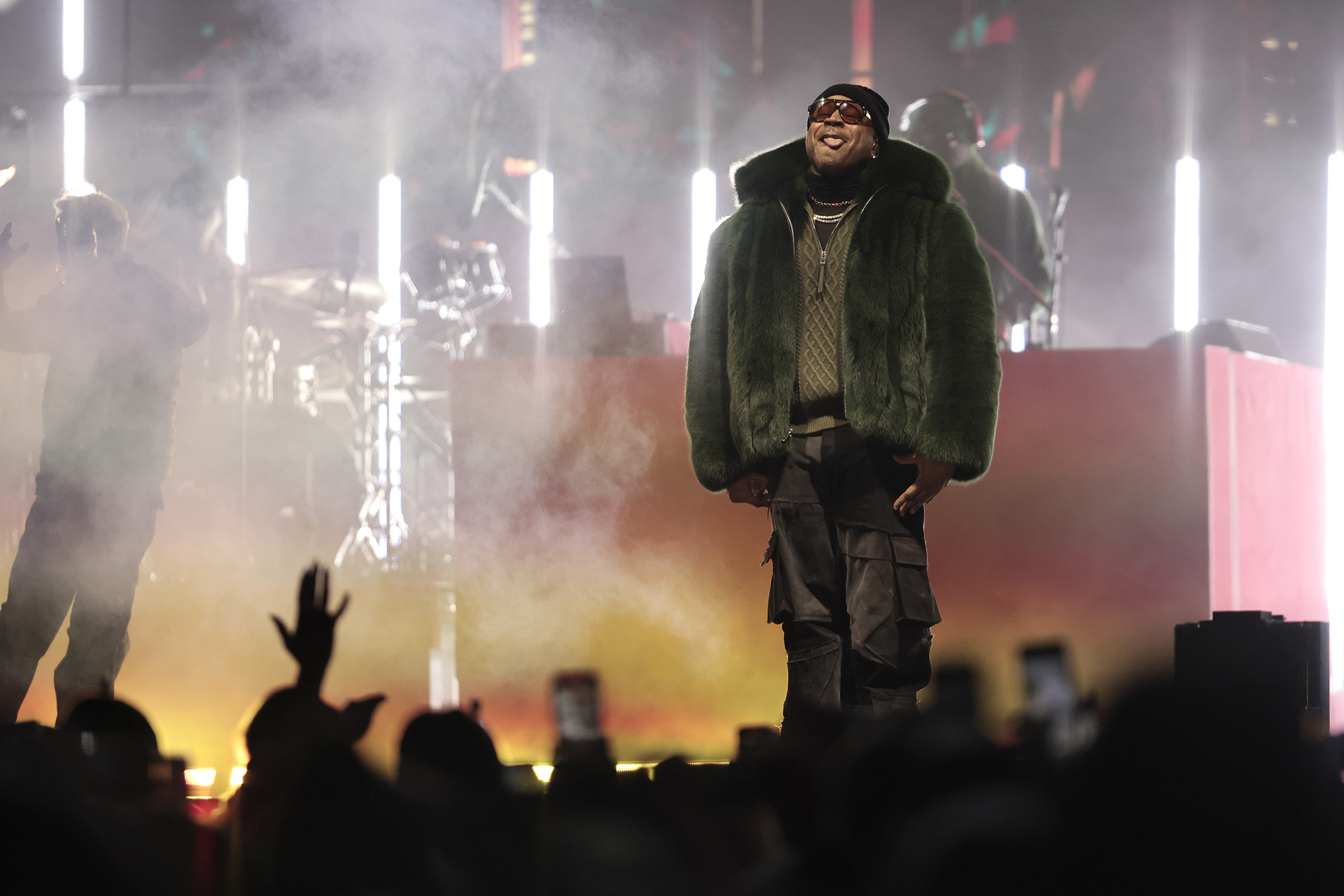
    LL CooL J performs during Philadelphia’s free New Year’s Eve concert and fireworks display, at the Oval on the Benjamin Franklin Parkway, on Wednesday.

    The free New Year’s Eve concert in front of the Philadelphia Art Museum was a frigid, fireworks-filled affair, kicking off the city’s celebration of America’s 250th birthday.

    LL Cool J and DJ Jazzy Jeff headlined the show, with Philadelphia-based rapper Freeway making a surprise appearance just before midnight.

    Somewhere on the internet in Philly

    Why is Wawa called Wawa? There are degrees of knowledge to unpack here, so WHYY’s Avi Wofman-Arent walked us through the lore (with some Sheetz shade to boot).

    Streets Dept posted a crabby art installation at Washington and Passyunk Avenues. The video title is timeless: “Philly is not a real place.”

    Meanwhile, Philadelphians on Reddit are talking about Stranger Things apparently confirming “Philly is the center of the universe.” Spoilers ahead: This is why fans are buzzing about the finale.

    One more thing: Before I let you go, allow me to congratulate my colleague Diane Mastrull on her retirement. She is a longtime editor of this newsletter and a titan of journalism and public service. This edition is the last to be expertly edited by her eagle eye. Thank you, Diane.

    👋🏽 Thanks for stopping. See you again tomorrow morning.

    By submitting your written, visual, and/or audio contributions, you agree to The Inquirer’s Terms of Use, including the grant of rights in Section 10.

  • Tesla loses title of world’s biggest electric vehicle maker as sales fall for second year in a row

    Tesla loses title of world’s biggest electric vehicle maker as sales fall for second year in a row

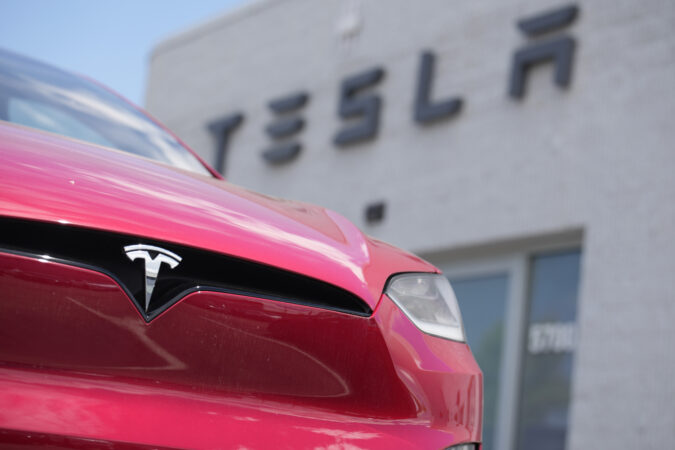
    NEW YORK — Tesla lost its crown as the world’s best-selling electric vehicle maker on Friday as a customer revolt over Elon Musk’s right-wing politics, expiring U.S. tax breaks for buyers, and stiff overseas competition pushed sales down for a second year in a row.

    Tesla said that it delivered 1.64 million vehicles in 2025, down 9% from a year earlier.

    Chinese rival BYD, which sold 2.26 million vehicles last year, is now the biggest EV maker.

    It’s a stunning reversal for a car company whose rise once seemed unstoppable as it overtook traditional automakers with far more resources and helped make Musk the world’s richest man.

    For the fourth quarter, sales totaled 418,227, falling short of even the much reduced 440,000 target that analysts recently polled by FactSet had expected. Sales were hit hard by the expiration of a $7,500 tax credit for electric vehicle purchases that was phased out by the Trump administration at the end of September.

    Tesla stock closed down nearly 3% on Friday.

    Even with multiple issues buffeting the company, investors are betting that Tesla CEO Musk can deliver on his ambitions to make Tesla a leader in robotaxi services and get consumers to embrace humanoid robots that can perform basic tasks in homes and offices. Reflecting that optimism, the stock finished 2025 with a gain of approximately 11%.

    The latest quarter was the first with sales of stripped-down versions of the Model Y and Model 3 that Musk unveiled in early October as part of an effort to revive sales. The new Model Y costs just under $40,000 while customers can buy the cheaper Model 3 for under $37,000. Those versions are expected to help Tesla compete with Chinese models in Europe and Asia.

    For fourth-quarter earnings coming out in late January, analysts are expecting the company to post a 3% drop in sales and a nearly 40% drop in earnings per share, according to FactSet. Analysts expect the downward trend in sales and profits to eventually reverse itself as 2026 rolls along.

    Investors have largely shrugged off the falling numbers, choosing to focus on Musk’s pivot to different parts of business. He has been saying the future of the company lies with its driverless robotaxis service, its energy storage business, and building robots for the home and factory — and much less with car sales.

    Tesla started rolling out its robotaxi service in Austin earlier this year, first with safety monitors in the cars to take over in case of trouble, then testing without them. The company hopes to roll out the service in several cities this year.

    To do that successfully, it needs to take on rival Waymo, which has been operating autonomous taxis for years and has far more customers. It also will also have to contend with regulatory challenges. The company is under several federal safety investigations and other probes. In California, Tesla is at risk of temporarily losing its license to sell cars in the state after a judge there ruled it had misled customers about their safety.

    “Regulatory is going to be a big issue,” said Wedbush Securities analyst Dan Ives, a well-known bull on the stock. “We’re dealing with people’s lives.”

    Still, Ives said he expects Tesla’s autonomous offerings will soon overcome any setbacks.

    Musk has said he hopes software updates to his cars will enable hundreds of thousands of Tesla vehicles to operate autonomously with zero human intervention by the end of this year. The company is also planning to begin production of its AI-powered Cybercab with no steering wheel or pedals in 2026.

    To keep Musk focused on the company, Tesla’s directors awarded Musk a potentially enormous new pay package that shareholders backed at the annual meeting in November.

    Musk scored another huge windfall two weeks ago when the Delaware Supreme Court reversed a decision that deprived him of a $55 billion pay package that Tesla doled out in 2018.

    Musk could become the world’s first trillionaire later this year when he sells shares of his rocket company SpaceX to the public for the first time in what analysts expect would be a blockbuster initial public offering.

  • Capturing the ghosts of 2025 and the future memories of 2026

    Capturing the ghosts of 2025 and the future memories of 2026

    Just a week ago, in my last column of 2025 I said I was looking forward. So where do I go in the very first column of 2026?

    When you drive for decades all over the city on assignment certain streets, buildings or neighborhoods tilt you toward the past.

    Memories don’t just live in one place but are scattered across the map, waiting around a corner, or sitting on a stoop like an old friend. Every recurring event or anniversary replays images in my head.

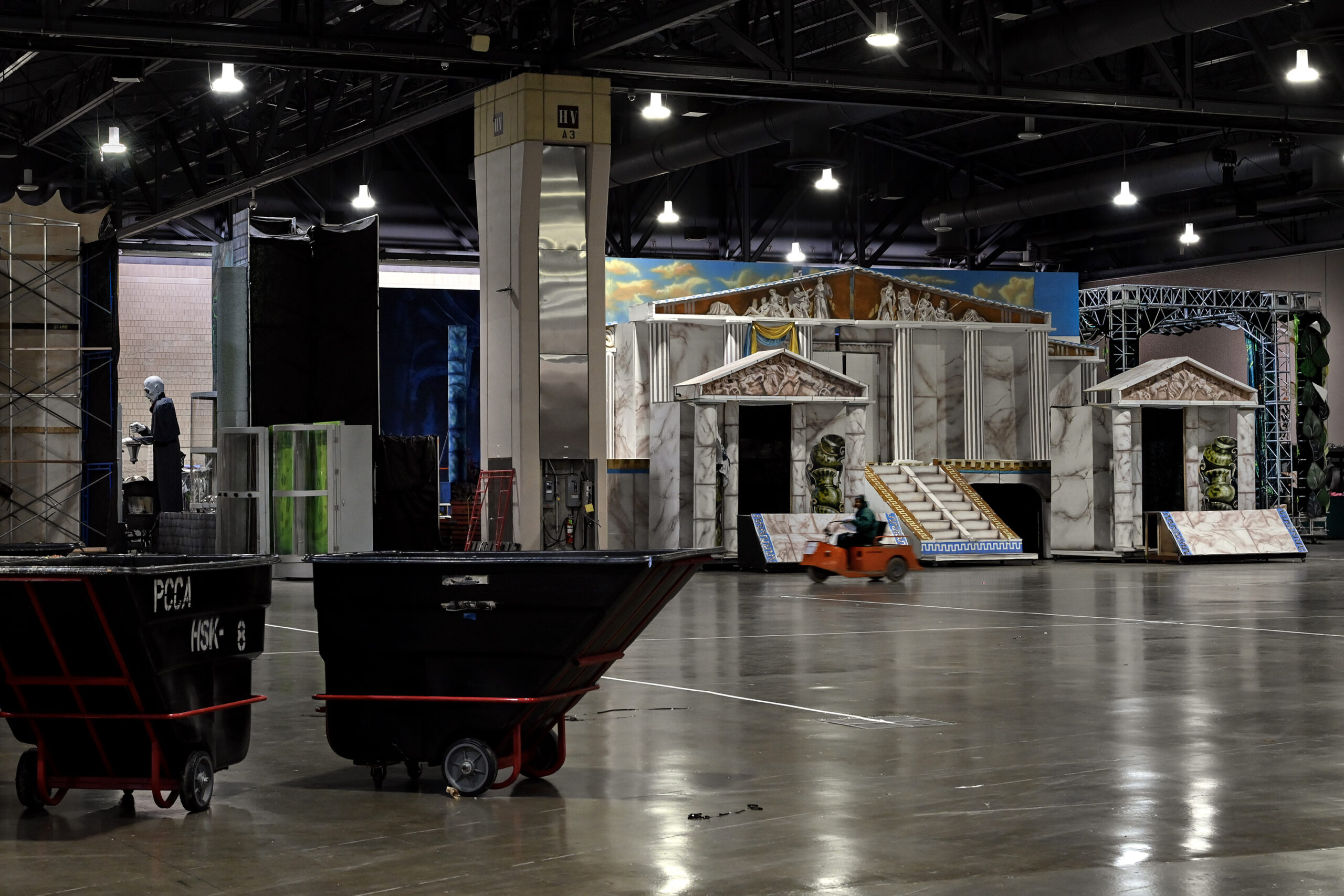
    An empty Convention Center hours before Fancy Brigade members arrive for a night of finishing the construction of their stage sets.

    I went to the Convention Center two days before the Mummers Parade, looking as I have many times, to make a photo ahead of the event.

    But this year, there were no Fancy Brigade members in the cavernous room. Nobody working on their elaborate stage sets or rehearsing their Broadway-quality choreographed performances.

    As a cost-cutting measure this year, the clubs only booked the hall (and union workers) for an eight-hour shift in the evening. No early overtime.

    So there I was, “seeing” feathered and sequined Mummer ghosts of my memory dancing through the hall. Then, like in the 2006 movie Night at the Museum. I almost wondered if a Greek god, 15 foot high Tiki figure or jester would suddenly come alive.

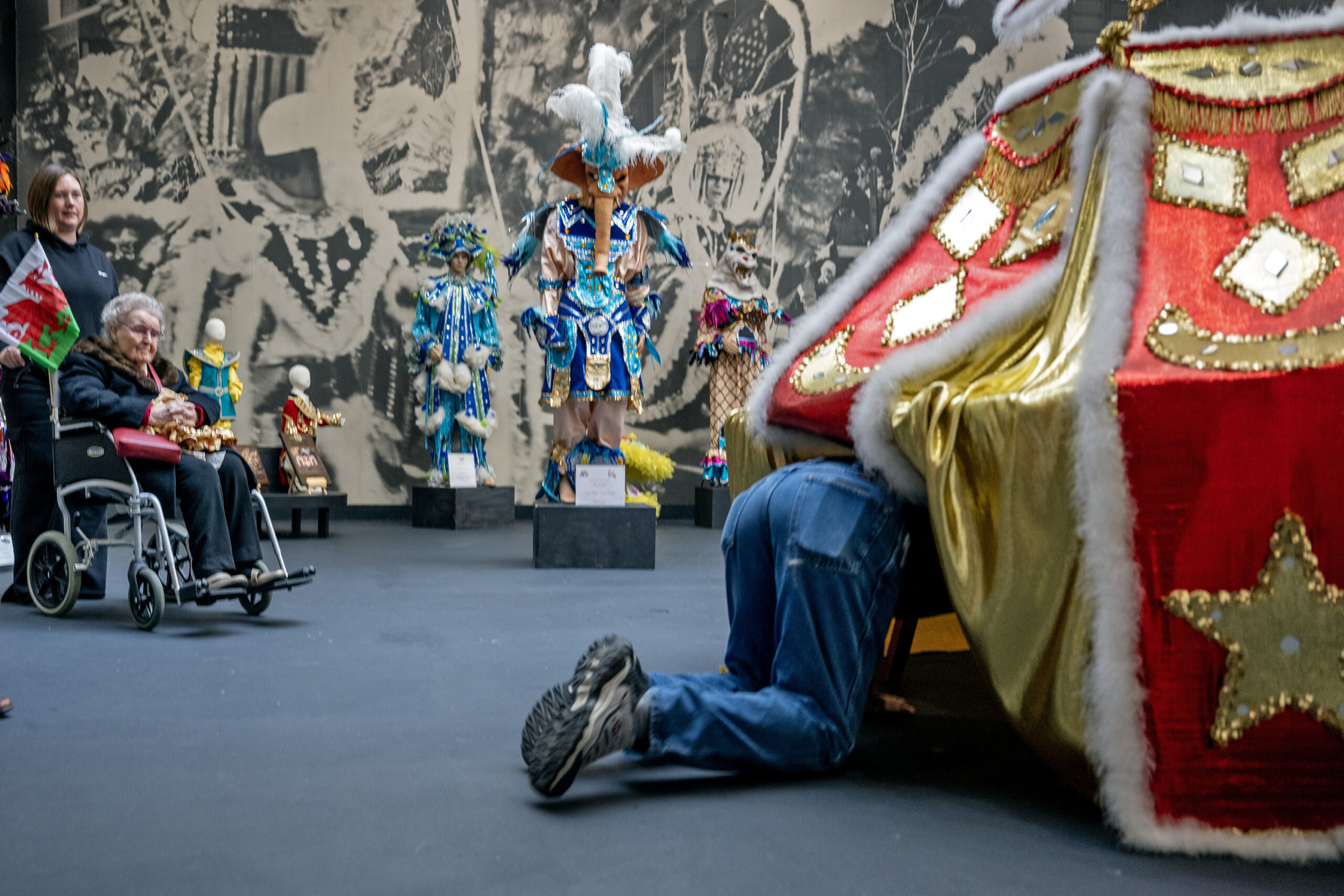
    On New Year’s Eve, I photographed a 93 year-old Welsh grandmother visiting the Mummers Museum.

    Mummers Museum president Brian Donnelly crawls inside to demonstrat marching in a large Fancy Division frame suit while giving Avril Davidge a tour.

    The next day she was to live her dream of going to the parade. I wondered what she was thinking the next day, even as I photographed it for my umpteenth time, collecting more memories and learning, as always, how to see things in new ways.

    Since 1998 a black-and-white photo has appeared every Monday in staff photographer Tom Gralish’s “Scene Through the Lens” photo column in the print editions of The Inquirer’s local news section. Here are the most recent, in color:

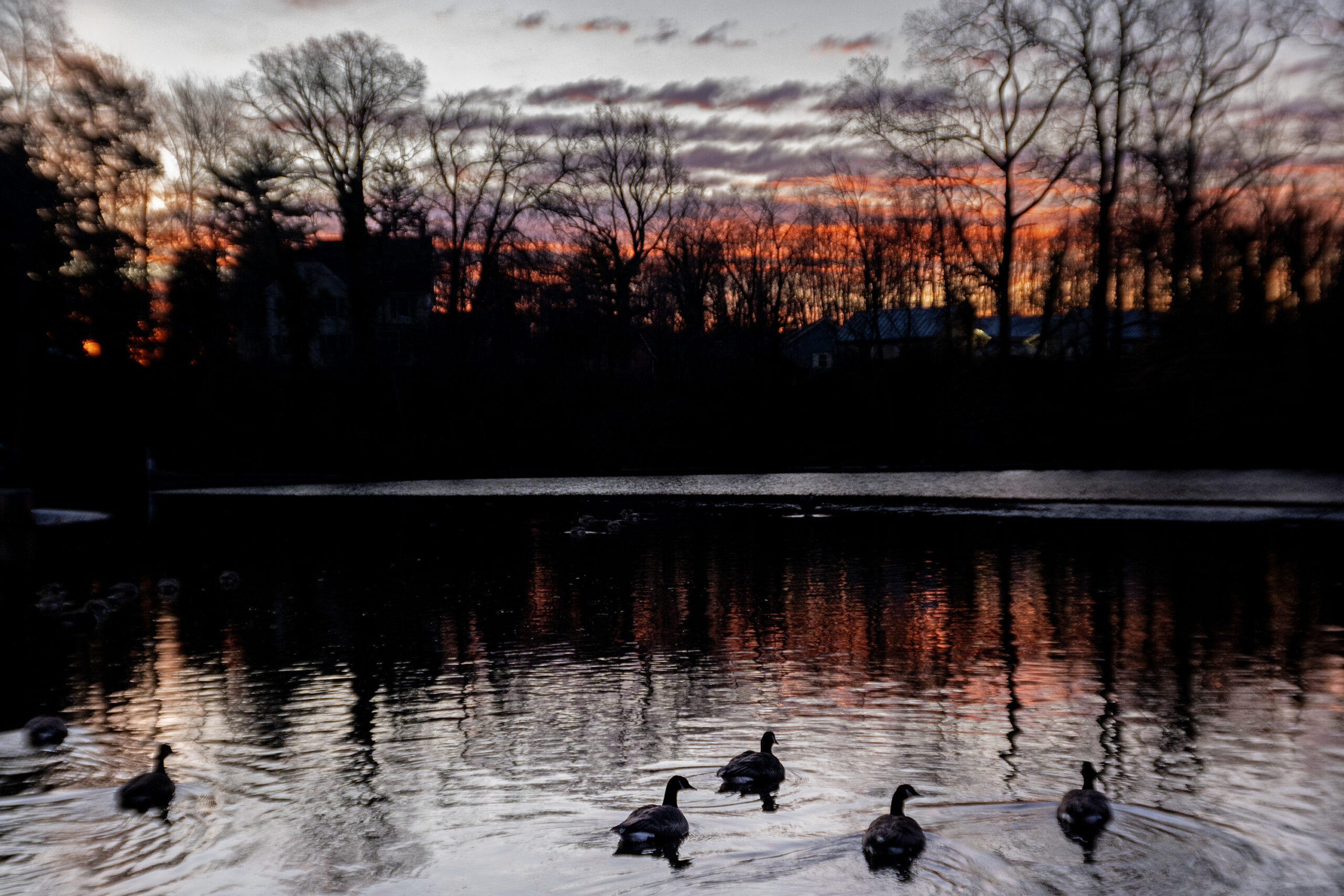
    Dec. 29, 2025: Canada geese at sunrise in Evans Pond in Haddonfield, during the week of the Winter Solstice for the Northern Hemisphere.
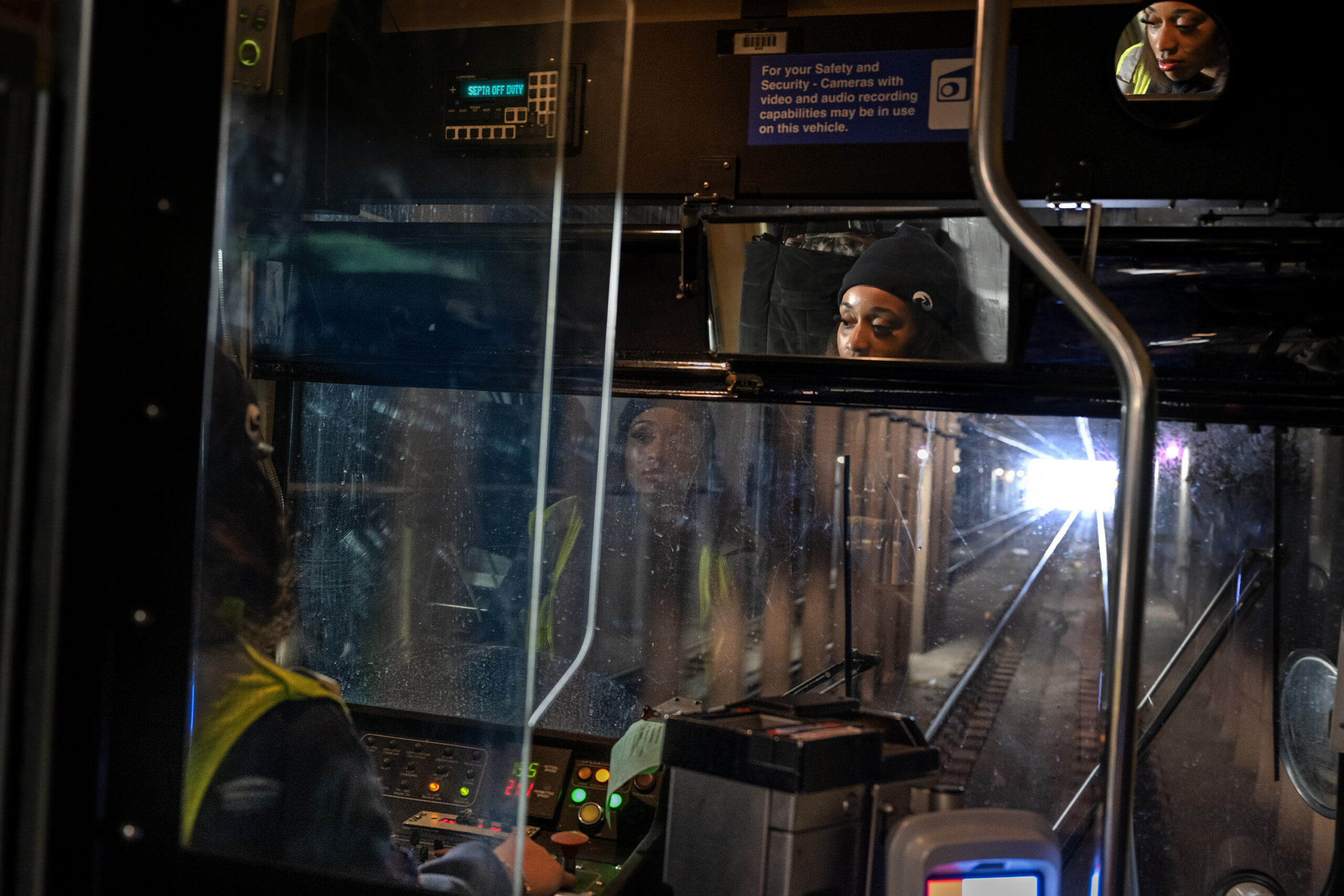
    December 22, 2025: SEPTA trolley operator Victoria Daniels approaches the end of the Center City Tunnel, heading toward the 40th Street trolley portal after a tour to update the news media on overhead wire repairs in the closed tunnel due to unexpected issues from new slider parts.
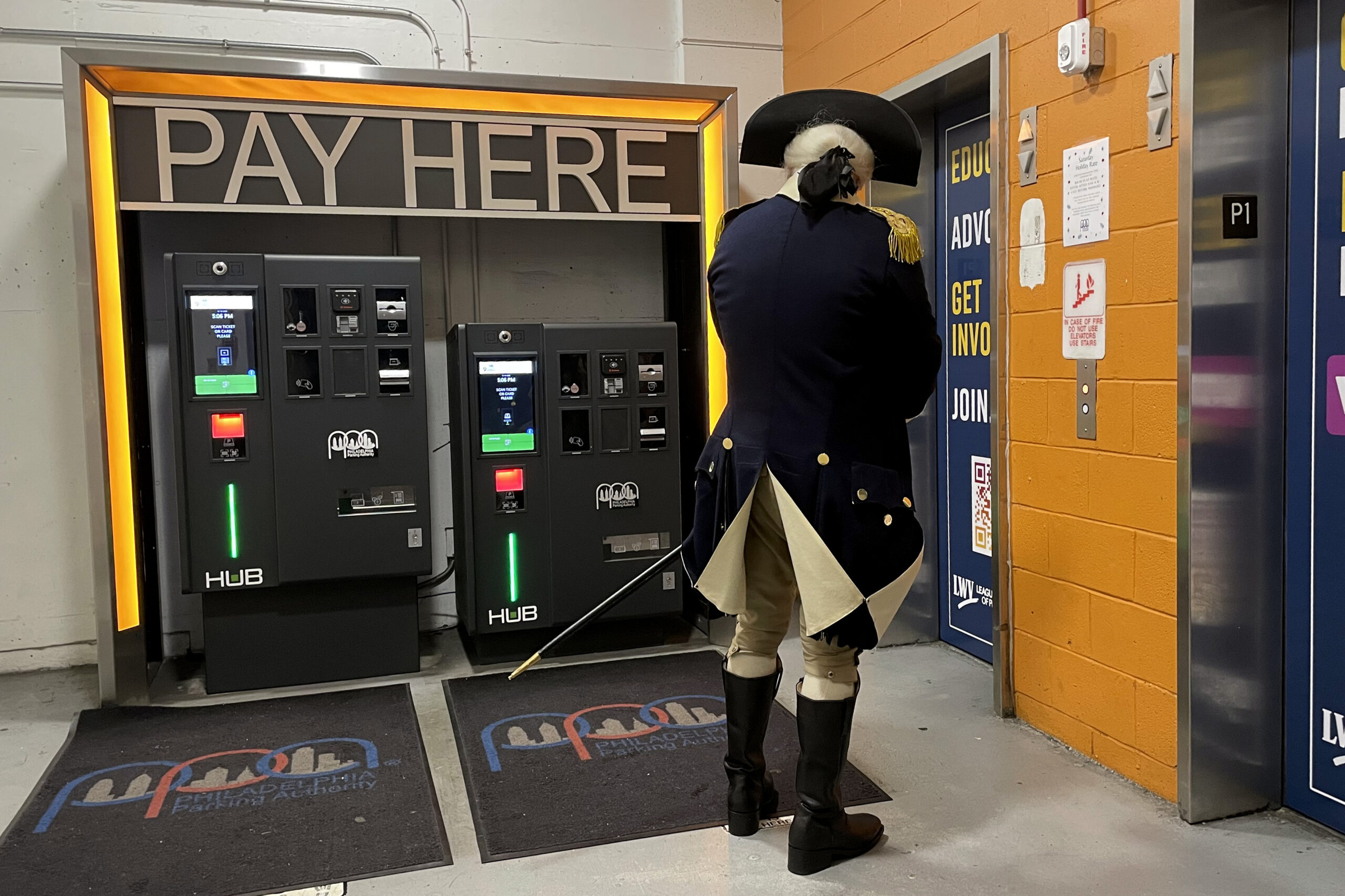
    December 15, 2025: A historical interpreter waits at the parking garage elevators headed not to a December crossing of the Delaware River, but an event at the National Constitution Center. General George Washington was on his way to an unveiling of the U.S. Mint’s new 2026 coins for the Semiquincentennial,
    December 8, 2025: The Benjamin Franklin Bridge and pedestrians on the Delaware River Trail are reflected in mirrored spheres of the “Weaver’s Knot: Sheet Bend” public artwork on Columbus Boulevard. The site-specific stainless steel piece located between the Cherry Street and Race Street Piers was commissioned by the City’s Public Art Office and the Delaware River Waterfront Corporation and created and installed in 2022 by the design and fabrication group Ball-Nogues Studio. The name recalls a history that dominated the region for hundreds of years. “Weaver’s knot” derives from use in textile mills and the “Sheet bend” or “sheet knot” was used on sailing vessels for bending ropes to sails.
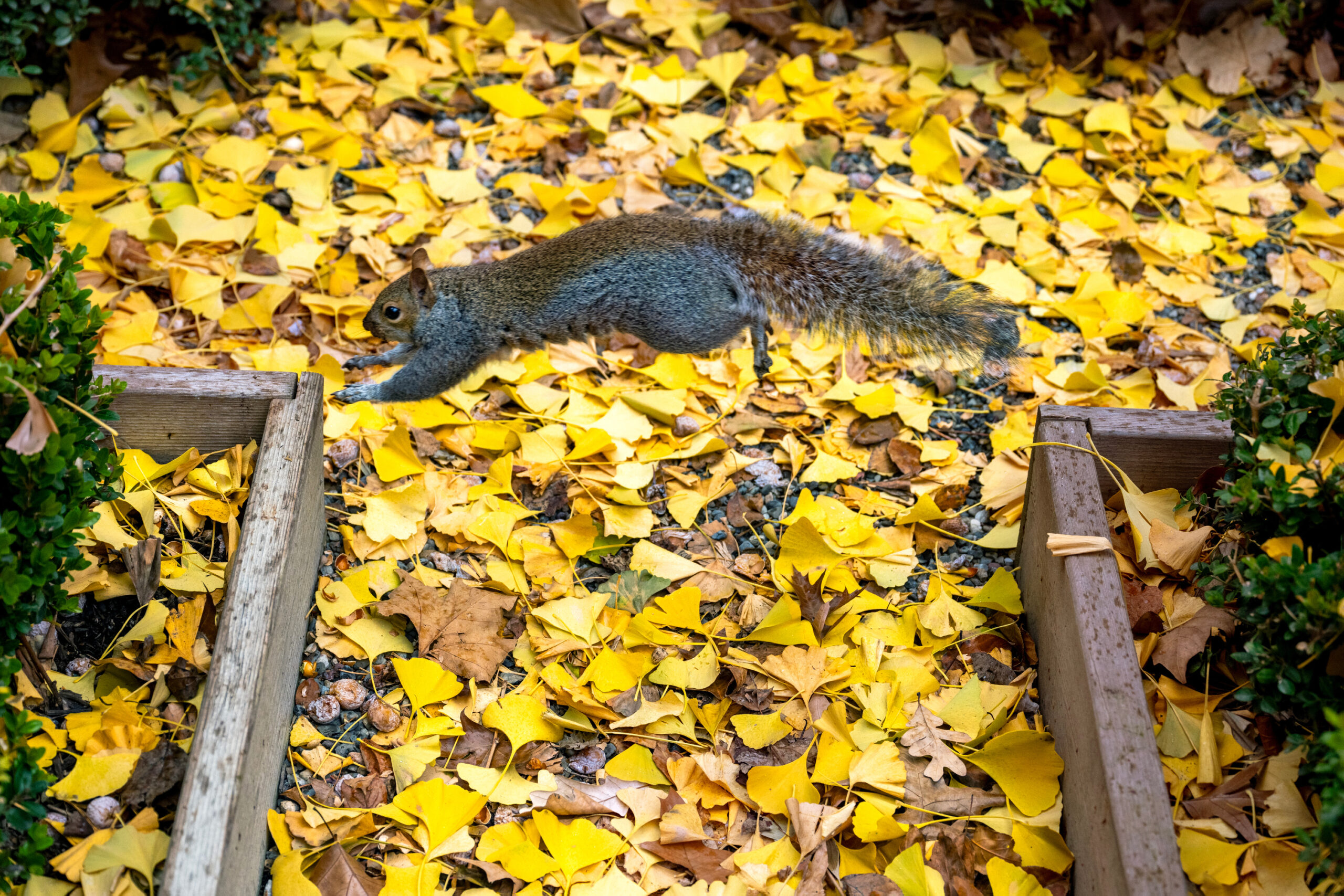
    November 29, 2025: t’s ginkgo time in our region again when the distinctive fan-shaped leaves turn yellow and then, on one day, lose all their leaves at the same time laying a carpet on city streets and sidewalks. A squirrel leaps over leaves in the 18th Century Garden in Independence National Historical Park Nov. 25, 2025. The ginkgo (Ginkgo biloba) is considered a living fossil as it’s the only surviving species of a group of trees that existed before dinosaurs. Genetically, it has remained unchanged over the past 200 million years. William Hamilton, owner the Woodlands in SW Phila (no relation to Alexander Hamilton) brought the first ginkgo trees to North America in 1785.
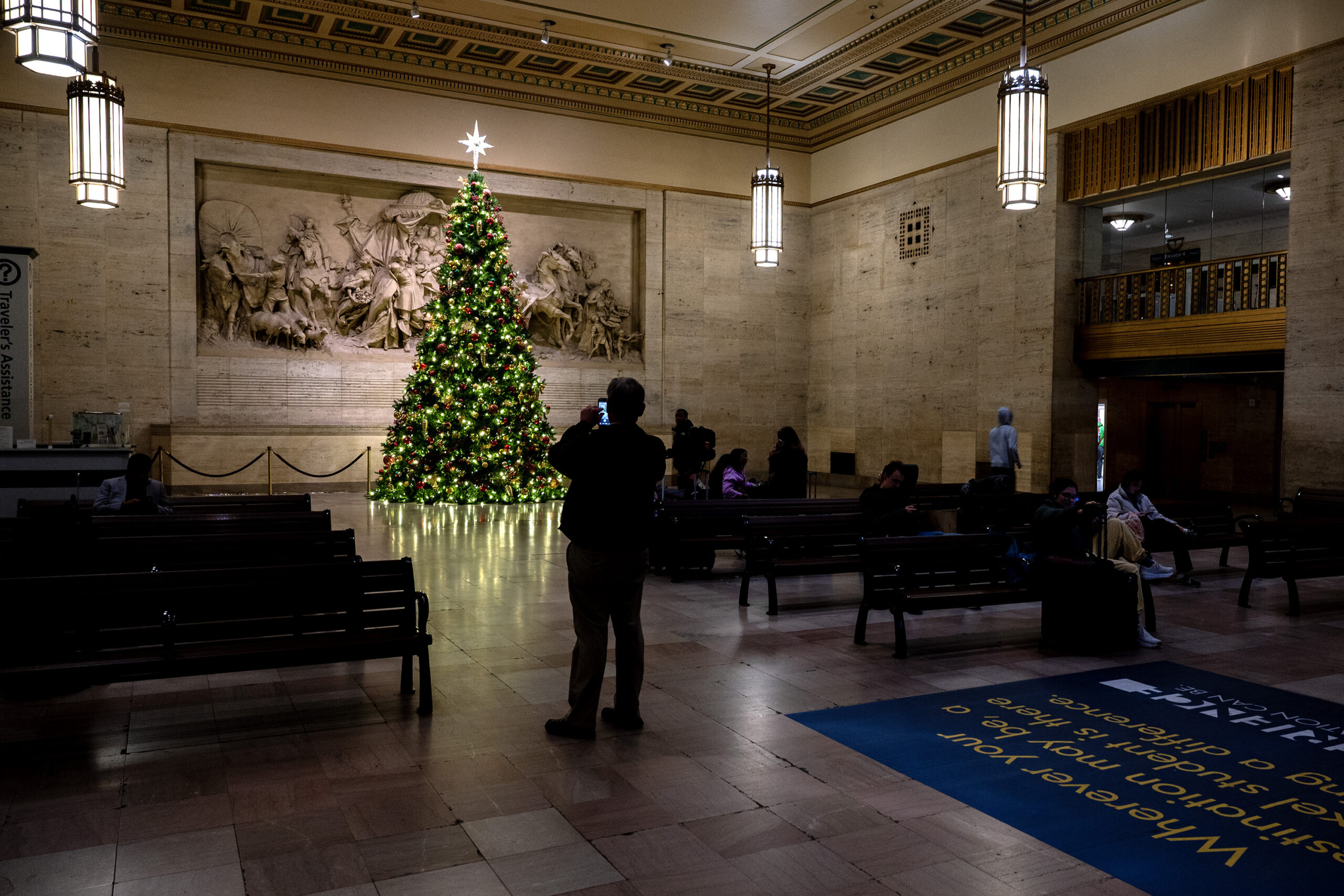
    November 24, 2025: The old waiting room at 30th Street Station that most people only pass through on their way to the restrooms has been spiffed up with benches – and a Christmas tree. It was placed there this year in front of the 30-foot frieze, “The Spirit of Transportation” while the lobby of Amtrak’s $550 million station restoration is underway. The 1895 relief sculpture by Karl Bitter was originally hung in the Broad Street Station by City Hall, but was moved in 1933. It depicts travel from ancient to modern and even futuristic times.
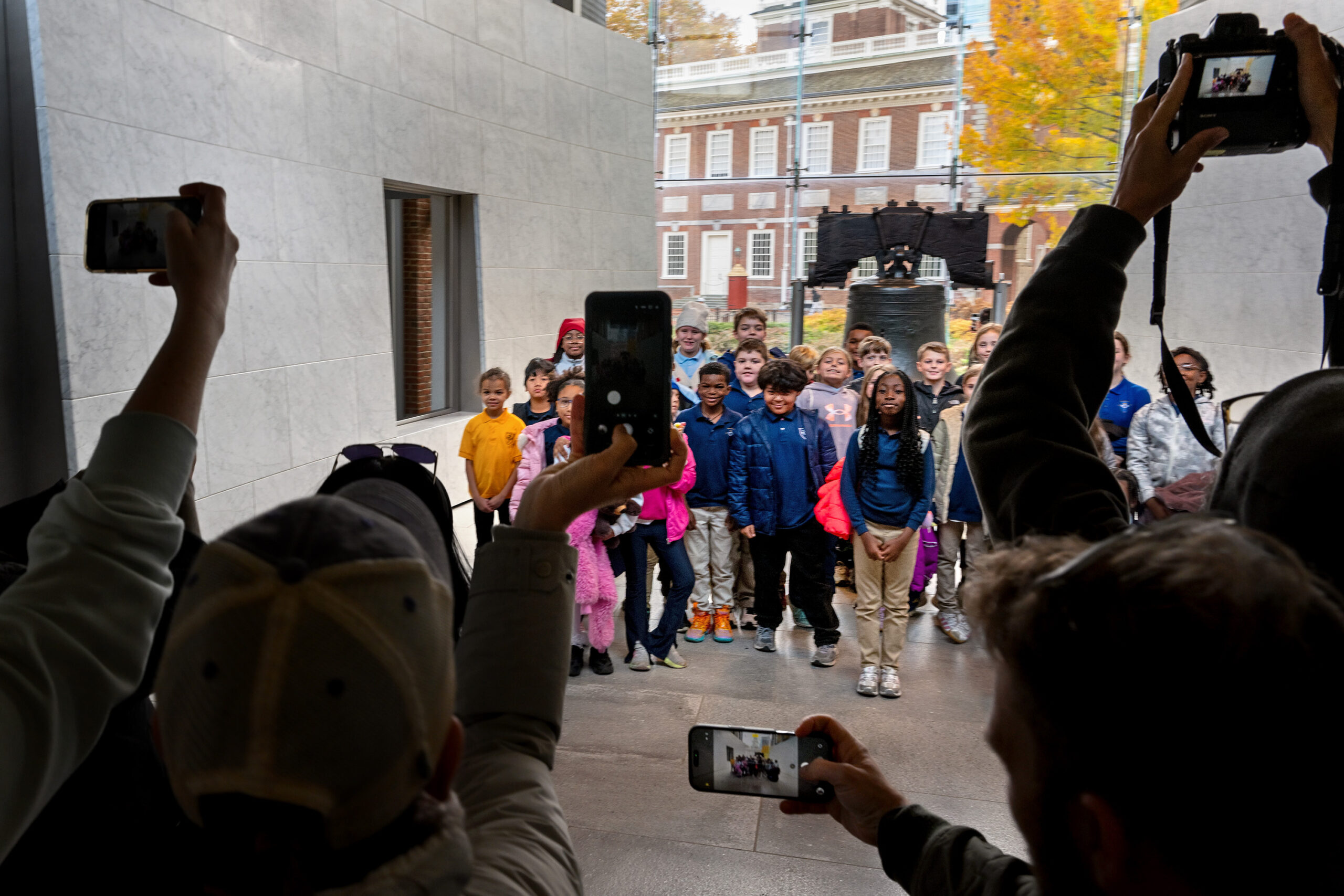
    November 17, 2025: Students on a field trip from the Christian Academy in Brookhaven, Delaware County, pose for a group photo in front of the Liberty Bell in Independence National Historical Park on Thursday. The trip was planned weeks earlier, before they knew it would be on the day park buildings were reopening after the government shutdown ended. “We got so lucky,” a teacher said. Then corrected herself. “It’s because we prayed for it.”
    November 8, 2025: Multitasking during the Festival de Día de Muertos – Day of the Dead – in South Philadelphia.
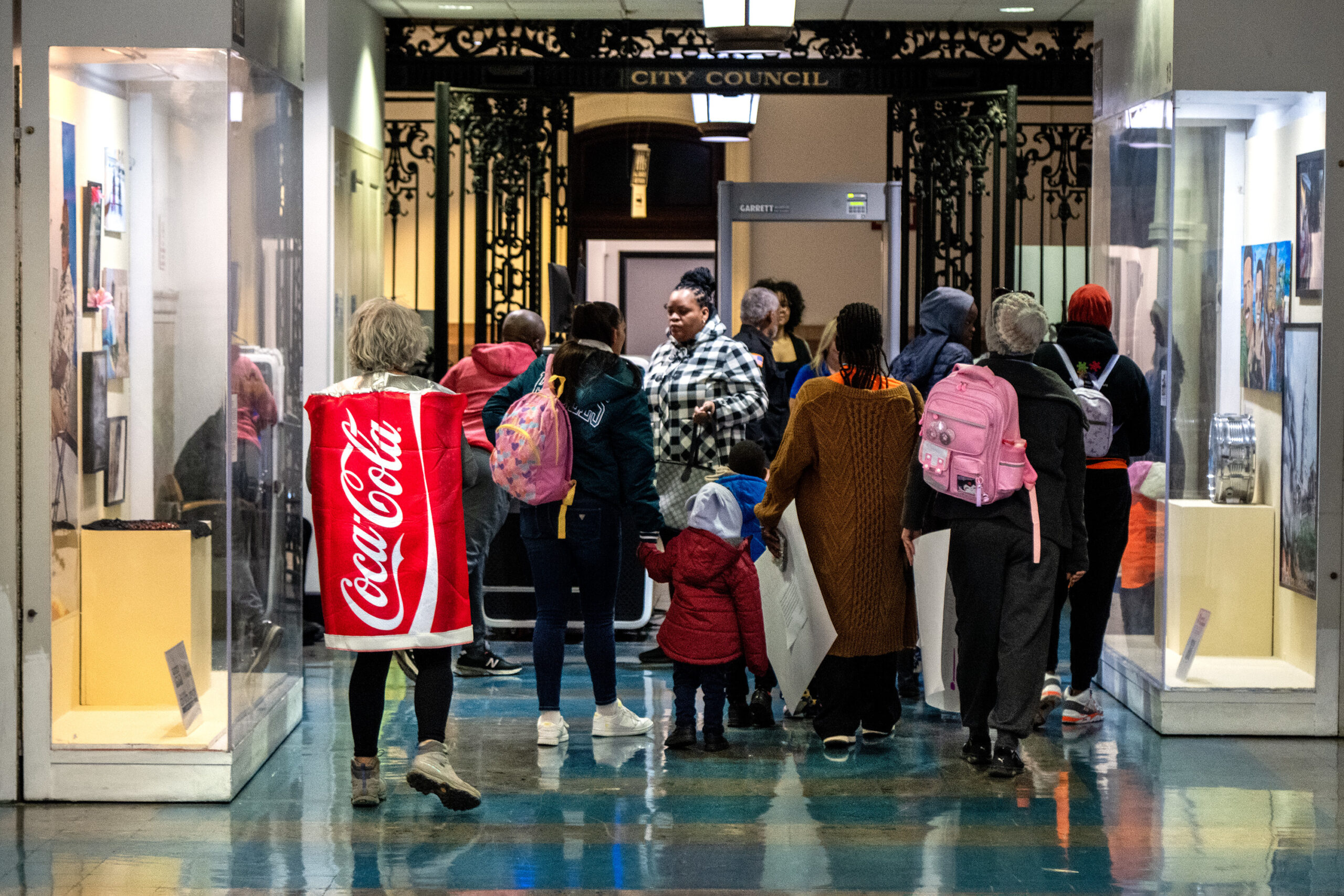
    November 1, 2025: Marcy Boroff is at City Hall dressed as a Coke can, along with preschoolers and their caregivers, in support of former Mayor Jim Kenney’s 2017 tax on sweetened beverages. City Council is considering repealing the tax, which funds the city’s pre-K programs.
    October 25, 2025: Austin Gabauer, paint and production assistant at the Johnson Atelier, in Hamilton Twp, N.J. as the finished “O” letter awaits the return to Philadelphia. The “Y” part of the OY/YO sculpture is inside the painting booth. The well-known sculpture outside the Weitzman National Museum of American Jewish History was removed in May while construction continues on Market Street and has been undergoing refurbishment at the Atelier at the Grounds for Sculpture outside of Trenton.
    October 20, 2025:The yellow shipping container next to City Hall attracted a line of over 300 people that stretched around a corner of Dilworth Park. Bystanders wondered as they watched devotees reaching the front take their selfies inside a retro Philly diner-esque booth tableau. Followers on social media had been invited to “Climb on to immerse yourself in the worlds of Pleasing Fragrance, Big Lip, and exclusive treasures,” including a spin of the “Freebie Wheel,” for products of the unisex lifestyle brand Pleasing, created by former One Direction singer Harry Styles.
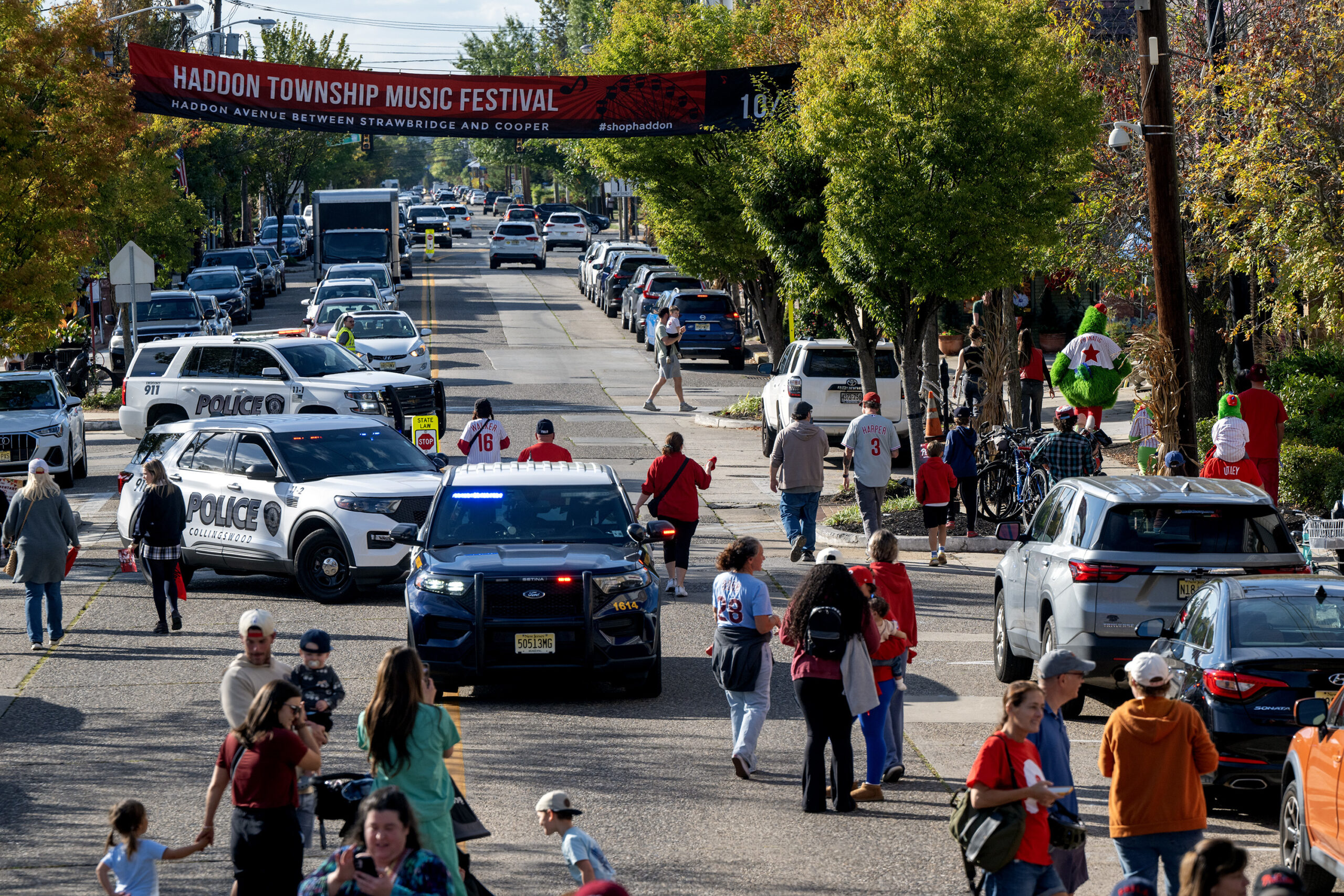
    October 11, 2025: Can you find the Phillie Phanatic, as he leaves a “Rally for Red October Bus Tour” stop in downtown Westmont, N.J. just before the start of the NLDS? There’s always next year and he’ll be back. The 2026 Spring Training schedule has yet to be announced by Major League Baseball, but Phillies pitchers and catchers generally first report to Clearwater, Florida in mid-February.
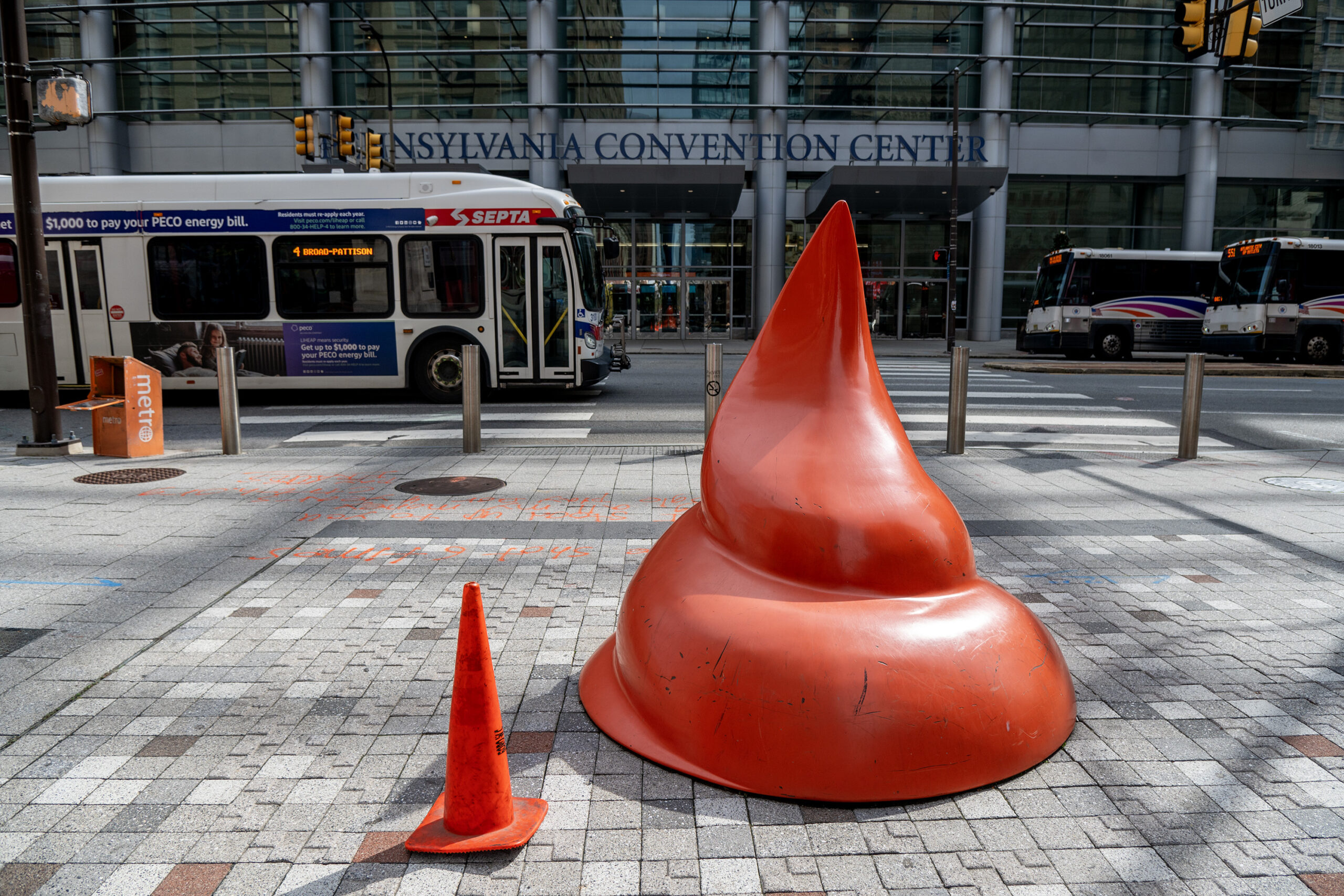
    October 6. 2025: Fluorescent orange safety cone, 28 in, Poly Ethylene. Right: Paint Torch (detail) Claes Oldenburg, 2011, Steel, Fiberglass Reinforced Plastic, Gelcoat and Polyurethane. (Gob of paint, 6 ft. Main sculpture, 51 ft.). Lenfest Plaza at the Pennsylvania Academy of the Fine Arts on North Broad Street, across from the Convention Center.
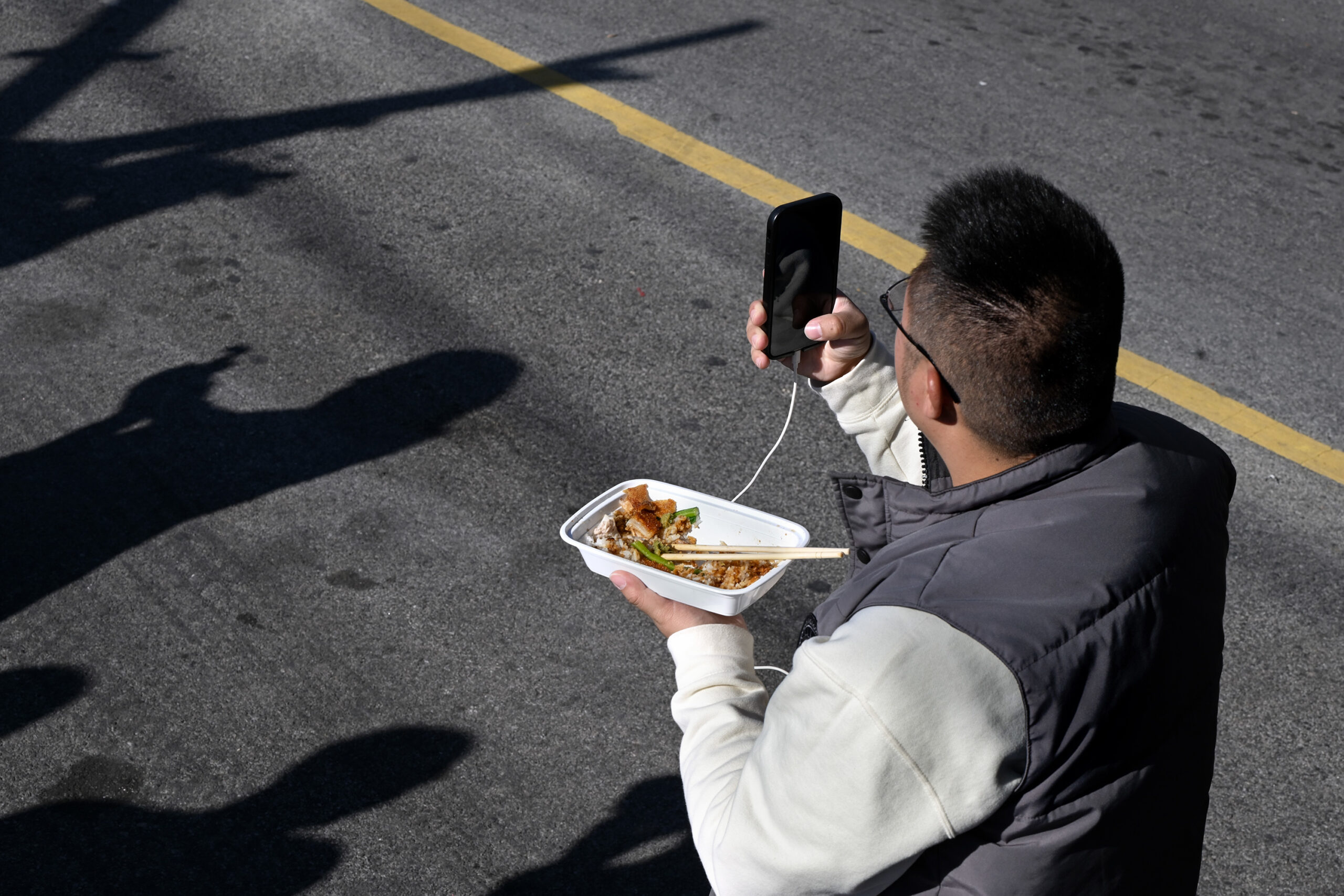
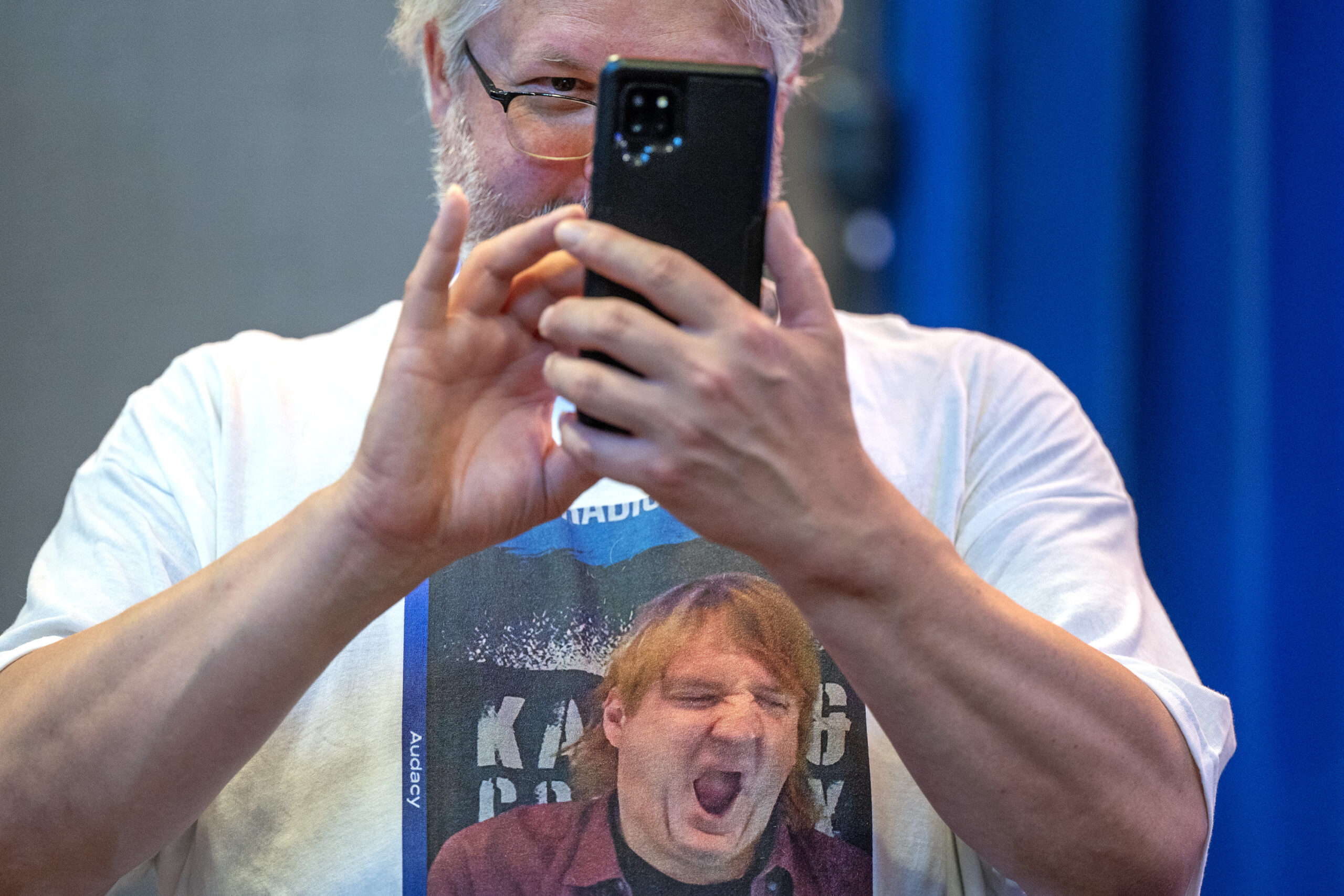
    September 29, 2025: A concerned resident who follows Bucks County politics, Kevin Puls records the scene before a campaign rally for State Treasurer Stacy Garrity, the GOP candidate for governor. His T-shirt is “personal clickbait” with a url to direct people to the website for The Travis Manion Foundation created to empower veterans and families of fallen heroes. The image on the shirts is of Greg Stocker, one of the hosts of Kayal and Company, “A fun and entertaining conservative spin on Politics, News, and Sports,” mornings on Talk Radio 1210 WPHT.

    » SEE MORE: Archived columns and Twenty years of a photo column.

  • Jeff McLane’s keys to Eagles vs. Commanders in Week 18: What you need to know and a prediction

    Jeff McLane’s keys to Eagles vs. Commanders in Week 18: What you need to know and a prediction

    The Eagles host the Washington Commanders in a Week 18 matchup at Lincoln Financial Field on Sunday at 4:25 p.m. Here’s what you need to know about the game:

    When the Eagles have the ball: It’s Tanner McKee time. Well, the Eagles will have more backups on offense than just the No. 2 quarterback, with the Eagles expected to rest their starters in the season finale. But having McKee under center will give a glimpse of how much he’s progressed in the last year and whether he can increase his value if the front office wants to entertain trade offers this offseason.

    He played well a year ago, completing 27 of 41 passes for 269 yards and two touchdowns against New York Giants starters in Week 18. McKee will be facing another comparatively poor defense, but will he have enough around him to get the job done?

    The Eagles’ offensive line, from left to right, is expected to be: Fred Johnson, Brett Toth, Drew Kendall, Matt Pryor, and Cameron Williams. McKee will have two rookies blocking for him, with Kendall and Williams at center and right tackle, respectively. Williams was activated on Thursday after spending almost the entire season on injured reserve with a shoulder injury.

    Washington isn’t strong at edge rusher. The Eagles allowed just one outside pressure when the teams played in Week 16. But Williams may need help on occasion. While McKee had returning-from-injury Dallas Goedert for about a quarter last January, and targeted the tight end on six of the 13 plays he was on the field, he will have no such luxury this season. Receiver Jahan Dotson will likely be the lone starter to play. Dotson is often the fifth option when on the field with the first offense, but the former Commander caught 7 of 11 targets for 94 yards in last season’s finale.

    I could see Nick Sirianni and Kevin Patullo leaning into their under-center offense on Sunday. The Eagles have done it more with McKee than with Jalen Hurts, although the sample may not be large enough to make any definitive claims. In the final drive of the Las Vegas Raiders blowout three weeks ago and against New York last year, McKee completed 7 of 9 passes for 80 yards and a touchdown when throwing off play-action from under center.

    The second unit offensive line will need to block better on the ground if under-center runs are to be productive. But the Commanders have one of the worst run defenses in the NFL. They rank 29th in expected points added (EPA) per rush. (Of note: Three of the league’s bottom four run defenses are the Eagles’ NFC East rivals.)

    Tank Bigsby fans should see the running back get a high volume of carries. He enters averaging 6.4 yards a carry with the Eagles and has 98 rushing yards over expected, per NextGen Stats, which is 22 more than starter Saquon Barkley, who has 238 more tries. Will Shipley will be featured in the backfield as well, more likely on passing downs. He could be a check-down favorite for McKee.

    Tight end Grant Calcaterra should also get more chances to do what he does best, which is run routes and catch the ball, vs. the run blocking that has contributed to some of the Eagles’ struggles in that regard. But mostly, it’ll be interesting to see McKee operate with Patullo at the controls.

    Washington lacks talent and is on the older side, but veteran linebacker Bobby Wagner is still a run-defending machine. And edge rusher Von Miller should have enough gas in the tank to trouble Williams.

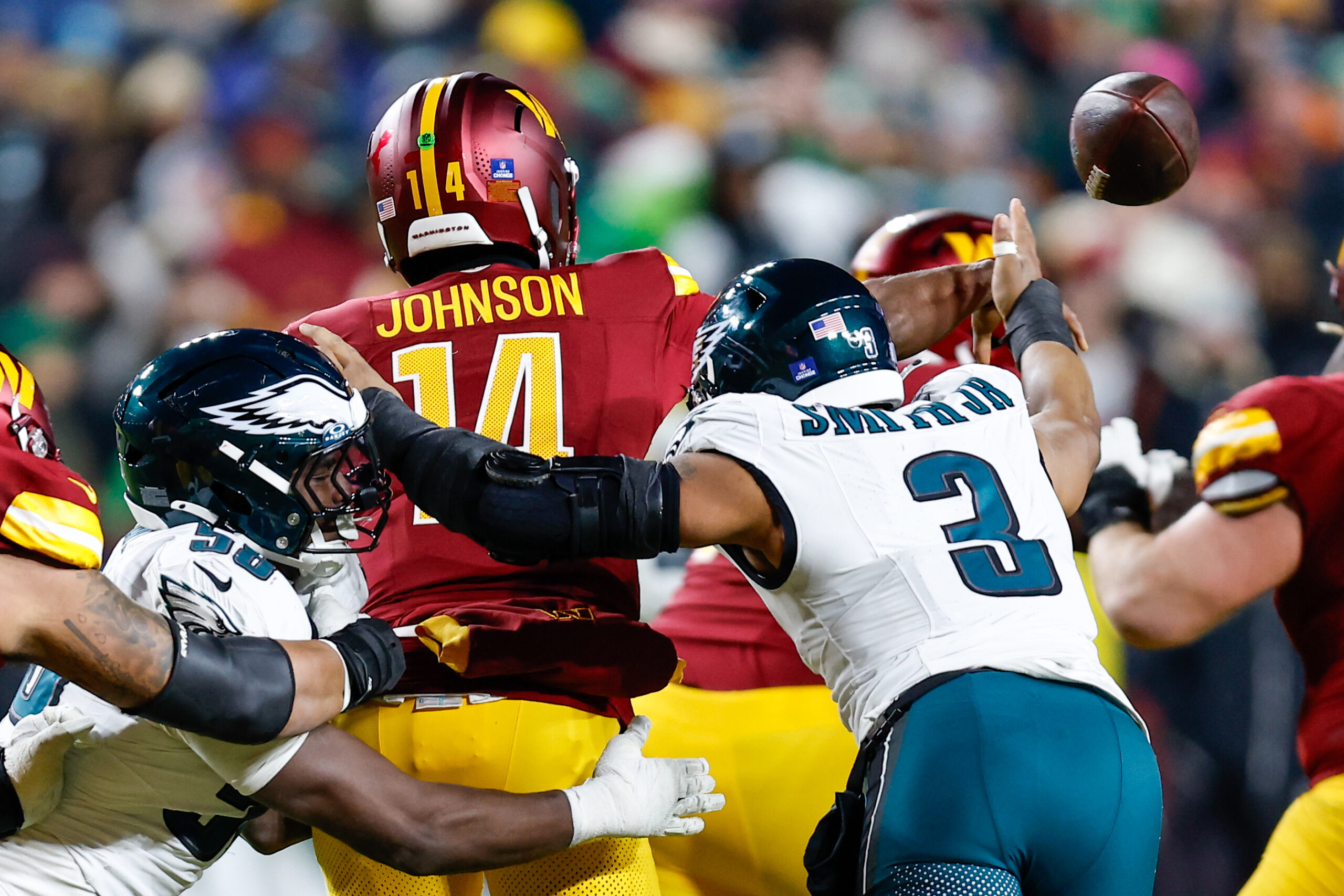
    The Eagles got after Josh Johnson when he relieved an injured Marcus Mariota in Week 16.

    When the Commanders have the ball: Speaking of old guys, 39-year-old Josh Johnson will be making only his 11th career start at quarterback since being drafted by the Bucs in 2008. It’ll be his second straight start after backup Marcus Mariota was knocked out against the Eagles two weeks ago.

    Johnson looked overwhelmed as a mid-game replacement and threw a bad interception to cornerback Cooper DeJean. He fared better with a week of preparation and completed 15 of 23 passes for 198 yards against the Dallas Cowboys. The Commanders struggled to get much going on offense and lost, 30-23, but offensive coordinator Kliff Kingsbury schemed up explosive plays on the ground and through the air to help Johnson.

    Deebo Samuel was the benefactor of a 41-yard screen pass and a 29-yard end-around. The Eagles have to always be cognizant of where Samuel lines up and how motion misdirects defenders away from him.

    Running back Jacory Croskey-Merritt ran for touchdowns of 72 and 10 yards on more traditional runs against the Cowboys. The Commanders won’t have a mobile quarterback like they normally do with Jayden Daniels or Mariota to help the rushing offense. And they’ll be without three-fifths of their starting offensive line. Left tackle Laremy Tunsil, right guard Sam Cosmi, and center dress are out.

    The Eagles will have a decidedly different look up front. A year ago, defensive tackle Jordan Davis played a bunch of snaps in the finale. He’ll likely be one of a dozen or so starters who dress on Sunday, but the Eagles will do their best to keep him off the field. He’s come a long way in 12 months.

    Byron Young and Ty Robinson will take most of the snaps in the interior. Joshua Uche, who’s been inactive the last five games, will finally get an opportunity to get some repetitions at outside linebacker. Jihaad Campbell was pressed into duty two weeks ago when Nakobe Dean suffered a hamstring injury, but the rookie linebacker is expected to start and play some. Jeremiah Trotter Jr. and Smael Mondon will likely log most of the time at off-ball linebacker.

    The Eagles could be most susceptible in the secondary. Terry McLaurin vs. most any cornerback would favor the Washington receiver. Cornerback Kelee Ringo and whoever lines up opposite him — Jakorian Bennett or rookie Mac McWilliams — may often get help from safeties Sydney Brown and Andre’ Sam against McLaurin.

    Extra point: The line hasn’t moved much, even after it was reported that Sirianni would rest his starters. The Eagles are around 4-point favorites. The news that Johnson was officially starting likely offset any advantage the Commanders might have been expected to gain. Washington coach Dan Quinn doesn’t seem like the tanking type, but it didn’t appear as if he was in any rush to get Mariota back.

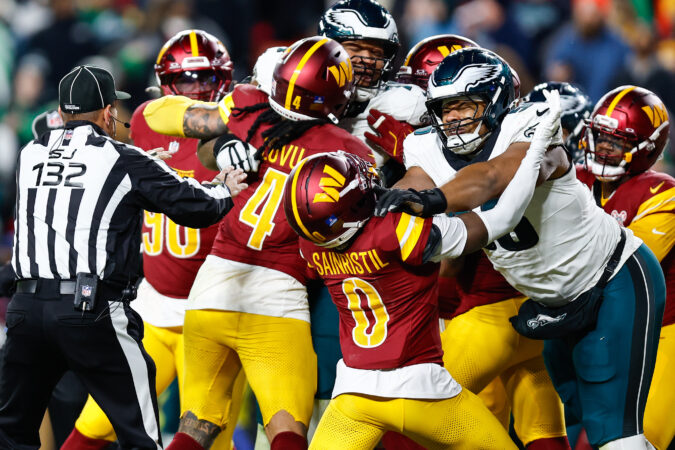
    The Commanders can improve their draft standing several slots with a loss, and I have to wonder how much the players are motivated at this stage of the season. But I thought they played hard in their last several games, and they may be looking for payback after a first meeting full of chippiness and altercations.

    The Eagles can still improve their playoff seeding with a victory coupled with a Chicago Bears loss to the Detroit Lions. I understand Sirianni’s rationale for giving his starters the game off. He can’t control getting the No. 2 seed, but he can decide who plays and who doesn’t. The Eagles aren’t exactly beat up, but it’s been a long season. A week of rest may help. Tackle Jordan Mailata spoke more about the mental benefits than the physical.

    As for the game, I think we may see Patullo use McKee at quarterback as an opportunity to dip into the playbook. That’s no knock against Hurts, but the Eagles have become predictable in certain respects, and I can see more diversity helping their cause. Sirianni has more depth than most teams, but I don’t think his squad is as deep as it was a year ago. I think what’s left of Washington’s first unit has enough to hold on.

    Prediction: Commanders 23, Eagles 20.