Blog

  • The long-term vision for Union captain Alejandro Bedoya? Return to the MLS Cup final. Full stop.

    The long-term vision for Union captain Alejandro Bedoya? Return to the MLS Cup final. Full stop.

    Alejandro Bedoya has no idea.

    Don’t talk to him about the next five years; he doesn’t want to discuss them. Will his contract get extended with the Union next season? He says he has no clue.

    In fact, as he arrived for an interview to discuss his career and where it’s going from here, he joked that he didn’t even know where he was supposed to go after this meeting for a scheduled team-bonding activity — one that apparently involved barbecue.

    Bedoya is an enigma. Right now, he might be one of the few people whose off-the-field portfolio, at first glance, shows many avenues. But on this day, as captain of the No. 1 team in MLS’s Eastern Conference … no plans.

    Well, except for one: Get back to the MLS Cup final. That’s it.

    “Five years from now? I don’t know. I couldn’t tell you,” Bedoya said as he leaned back in his cushioned chair inside the Union’s film room. “What I can tell you? This team is special, and we’ve been special since preseason. We knew this team was special that long ago. I want to be a part of the team that brings an MLS Cup to this club and home to Philly.

    Alejandro Bedoya (right) celebrates scoring a goal in the first half of the Union’s win against the Houston Dynamo on July 29.

    “So, to be honest, I’m not thinking about [anything past that]. I made it a point this season, especially now that we’ve been so successful, to be focused on the team. I don’t want to think too far down the line and cause any disruptions to talk about this or that or what may happen or might not.”

    It’s been an interesting 10-year run in Philly for Bedoya. He’s been the team’s leader since arriving from FC Nantes of the French first division in 2016. He’s been a vocal ambassador for ending gun violence. He’s been a staunch advocate for growing the youth game from a grassroots level.

    However, this season, he’s mainly been the utilityman that first-year manager Bradley Carnell needs.

    Things get real now for the Union. Coming off a high two weeks earlier after the club captured its second Supporters’ Shield, given to the team that finishes with the best regular-season record, Bedoya now leads the Union into the playoffs with every opponent looking to beat the best.

    Alejandro Bedoya raises the Supporters’ Shield after beating New York City FC at Subaru Park on Saturday, Oct. 4.

    First up is Chicago in Game 1 of a best-of-three series on Sunday (5:55 p.m., FS1, Apple TV+).

    “He’s our leader. He’s one of the guys who holds us together,” Carnell said earlier this season of Bedoya. “That’s why he’s here. He’s committed to doing what he has to for the club. And from a leadership standpoint, there’s no one better. He’s great with the young guys, he’s great with the guys [who] have been here, and he knows what it takes to get to where we’re trying to go.”

    Taste for more

    It was 2022, and the rays of a sunny Los Angeles afternoon beamed onto Banc of California Stadium (now known as BMO Stadium), the site of the MLS Cup final. Led by then-manager Jim Curtin, Bedoya, clad in the Union’s unmistakable lightning bolt kit, took the field for warmups. He didn’t start that day, but his impact to that point was immeasurable.

    That season, at age 36, he’d played in 30 regular-season games for the club and started 27 of them. He played nearly 2,500 minutes and scored six goals along with six assists, highlighted by two goals against D.C. United on July 8, which made him just the third player in club history to join the 20-20 club.

    The fruits of his labor culminated in an Eastern Conference title and a trip to MLS’s final. But as team captain, his leadership guided the Union to its first MLS Cup appearance — and arguably one of the greatest MLS Cup finals ever.

    So what’s changed in his roles and responsibilities from that moment with that coach to this moment with this coach?

    “To be honest? Not much,” Bedoya said. “I’m still one of the captains, whether it’s me, [goalkeeper Andre] Blake or [defender] Jakob [Glesnes]. I, more so maybe than others, act as like that intermediary between the coaching staff, the technical staff, and the locker room. … I’ve been more of a glue guy, if you will. And this year, more than ever.”

    The glue-guy approach has been the case on the field too. Each year, Bedoya’s minutes have dwindled from everyday starter to strategic, none more than this season, when he was used in situations to which he’s unaccustomed, like in the Union’s 7-0 loss to Vancouver on Sept. 13, when he started at right back following the suspension of defender Olwethu Makhanya.

    In that match, the decision — and result — spoke for itself. Bedoya even acknowledged as much. But in the same breath, he noted that ebbs and flows happen in a club-first mindset.

    “We had to rotate a little bit, obviously,” Bedoya said. “Maybe I’m not the best right back. So I took that on the chin there, but we’re all about the collective here … and you have to be an unselfish guy. I think in Bradley [Carnell’s] system this year, I’ve been playing more even on the left side of midfield, which typically I haven’t played in years past. But as I said before, man, whatever it takes, I’m ready to step up and help the team out in any way.”

    A plan for now

    Despite a refusal to look into crystal balls right now, Bedoya’s future does have a number of paths. He has a certification from Harvard Business School and has become an entrepreneur and investor across several ventures.

    He has diversified, but not necessarily in a way where all roads leads back to soccer. Instead, it’s in a way that when he’s not on the field, he can spend more time doing things with his family, namely his children, Santino, age 10, and Milena, 8.

    Bedoya says the two, along with his wife, Bea Hilland, are his biggest supporters. He said he loves doing dad things, like taking them to soccer, dance, and doing school pickups when he’s not on the road.

    But in true dad fashion, sometimes he wants to just sit on the couch and watch football. He says they’re cool with that, too.

    Alejandro Bedoya (left) and his wife Beatrice Hilland (right) were on hand at the White House in 2022 for a celebration of then-President Joe Biden signing new federal gun control legislation.

    “My wife will be the first one to tell you that she plays a major role in the house, with the kids, especially as much as we travel to games,” he said. “And as an old guy myself, you feel more pain, you get more sore the day after games. And you know those Sundays when maybe we have the days off, the younger guys can come in and do even more work, but I just want to sit on a Sunday and watch [NFL] RedZone all day, you know?

    “I make it a routine to make sure every time I’m home, I do a drop off at school and pick up at school. I make sure that even when I do want to be lazy or try to recover on the sofa, that I got both of them next to me on my side … I get emotional sometimes thinking about after we won a Supporters’ Shield, like how happy they were. They’re FaceTiming friends saying, ‘We won the Shield,’ not just ‘Dad won the Shield.’ What I do matters to them, and to me, that’s everything.”

    So how does he juggle a portfolio that doesn’t seem to stop?

    “It’s finding the right balance with them,” Bedoya said. “My kids are at the age where they’re playing sports now. They’re in soccer. They’re in dance; they’re in baseball. I like being part of those special moments. I think part of the beauty of being a father and still being a player is being able to share these moments with them.”

    “Let’s go finish this thing”

    Over the course of his 15-minute interview, the only times Bedoya wasn’t stoic was when he discussed his family and what’s next for the Union. The latter only has a handful of more games before it could be bringing home MLS’s biggest prize.

    And after 10 seasons in the same league with the same team on the same mission, Bedoya knows he’s not getting any younger. There are no more long-term contracts. His playing career has become a year-over-year proposition with a goal that has been the same since Day 1.

    Bring an MLS Cup back to the Chester waterfront.

    Union captain Alejandro Bedoya is ready to be the leader the team needs as it enters into the 2025 postseason as the No. 1 team in the Eastern Conference.

    This is the year he truly feels offers the best chance to do that. Whatever happens after that, Bedoya has already affirmed is wait-and-see.

    “I can tell you from that first week [of preseason training] in Marbella [Spain], I could sense that there was something brewing,” Bedoya said. “We already had a basic kind of philosophy, philosophical model of how we want to play, but Bradley and the staff came in and amped that up to another level, to another notch.

    “As far as my place? Like I said, I’m maybe not a starter anymore, but I’ve shown even this year that even when I do start, I can still impact the game in a positive way.”

    He paused and added:

    “This team is special, I think our record and our run to this point reflects that. The standard in training and in games is high, every day. We’re the team to beat and now it’s about going out there and being dominant. Let’s go finish this thing.”


  • As Joel Embiid adapts to his new reality, can he help the Sixers be competitive?

    As Joel Embiid adapts to his new reality, can he help the Sixers be competitive?

    The most significant uncertainty surrounding the 76ers is how Joel Embiid continues to adapt.

    He could be a major X factor in the Sixers’ hopes for a successful season. Embiid was far from his usual dominant self in Wednesday’s season opener against the Boston Celtics at TD Garden. But he bounced back in a big way in Saturday’s 125-121 home-opening victory over the Charlotte Hornets at Xfinity Mobile Arena.

    Two distinctly different regular-season results aren’t a large enough sample size to determine how good Embiid will be this season.

    In the 117-116 victory over the Celtics, he had the look of someone who had lost his quickness and explosion. But on Saturday, he frustrated Ryan Kalkbrenner and just about everyone else who guarded him.

    He finished with 20 points on 7-for-11 shooting, including making 3 of 6 three-pointers, to go with two rebounds, four assists, and two steals in 20 minutes, 7 seconds. He scored five of the Sixers’ first seven points and nine of their first 18.

    Embiid played only five minutes after intermission because he had reached his minutes limit.

    Sixers center Joel Embiid returned to the team bench late in the fourth quarter against Charlotte after an evaluation following his minutes restriction.

    He said he was trying to work his way back in his first regular-season game since February on Wednesday and figure out how to maneuver the minute restriction.

    “The first game, it was more like getting in the game slowly,” he said.

    But he was more aggressive while being on the court for longer stretches against the Hornets (1-1).

    “Longer stints, you’ll actually be able to let the game come to you,” he said. “But then again, longer stints also mean you might be done by halftime.

    “But I can’t sit for too long… being in shape is one thing, but being in basketball shape is another thing. You need to play, and you need to play a lot.”

    The question is, can Embiid repeat Sunday’s performance against elite competition? If not, can the 2023 MVP and seven-time All-Star adapt his game like many great players have late in their careers?

    Adapt to survive

    Hall of Famers like Magic Johnson, Jason Kidd, and David Robinson adapted the way they played their game after losing athleticism and/or a skill set.

    On the other hand, Sixers Hall of Famer Allen Iverson never really adapted after losing his quickness, which contributed to his decline.

    Embiid was a shell of his former self in Wednesday’s 117-116 victory over the Celtics. He finished with four points and six rebounds in a little over 20 minutes. Embiid missed his first four shots en route to shooting just 1-for-9.

    The 31-year-old also didn’t show a lot of lateral movement on defense and rarely jumped to contest shots or go after rebounds.

    Despite that, Embiid’s teammates praised him for just being on the court with them. He had arthroscopic surgery in his left knee on April 11, marking his second left knee surgery in 14 months and third in nine seasons. He played in only 58 games over the last two seasons.

    Sixers center Joel Embiid struggled through 1-for-9 shooting against the Boston Celtics.

    “Having Joel on the court is extremely important for us,” said guard Tyrese Maxey. “We appreciate him. He has done a lot for this organization … his family, and everything. So shoutout for him, man. He played good tonight, and he’ll always play better. We know that.”

    But not everyone gave Embiid credit for just being out there.

    The Sixers center spent most of his time on the perimeter instead of down low, where his size advantage would have been a matchup problem.

    Hall of Famer Kevin Garnett wasn’t impressed with that tactic and felt Embiid should have been able to do more.

    “We just had a summer,“ Garnett said on the Ticket and the Truth podcast with Paul Pierce. “What’d you do in the summer, bro? What’d you do in the summer? Bro had enough time to recover and just develop. Come on, bro.

    “Real talk. If you get [from] April to September, that should be enough time. … He’s supposed to be ready for [the] season.”

    We’ll find out in time whether Embiid’s lackluster season-opening performance is the result of a perceived lack of offseason preparation, of being cautious with banging down, or of him not being able to do it with the same impact as past seasons.

    But his playing mostly from the elbow isn’t surprising. Embiid did that in the team’s intrasquad scrimmage and in the exhibition game against the Minnesota Timberwolves.

    And to his credit, Embiid, a two-time league scoring champion, has embraced his new reality and a potentially new role for the Sixers. He sounds content to serve as a supporting actor who uplifts his teammates.

    But he was the first one off the bench to celebrate his teammate’s accomplishment. And with him on the bench, Embiid watched the Sixers battle back from a double-digit, fourth-quarter deficit to win both of this season’s games.

    Winning a game without Embiid on the floor was a major problem last season.

    “It’s been 12 years,” Embiid said, correcting a reporter. “I’d take it. Keep it going. Obviously, the most important games are the best teams and the playoffs. That’s the effort we are going to have when I’m not on the floor, Amen. It’s been a long time.”

    In addition to being a great teammate, Embiid is focused on being a versatile player until he returns to form.

    “There’s still so much more I can contribute to other than scoring,” Embiid said. “So just using myself as a decoy to allow all these guys to do whatever they have to do to win.”

    But what if Embiid doesn’t return to his old form? How could he make an impact while Maxey and VJ Edgecombe provide the scoring?

    Embiid can do that by being a defensive anchor, playing a more power-oriented game, and becoming a great three-point shooter. That shouldn’t be a problem for Embiid, who has always had a good touch with the elbow jumper and shot a career-best 38.8% on three-pointers two seasons ago.

    Sixers center Joel Embiid had four points and was a minus-16 in Wednesday’s season-opener against the Boston Celtics.

    He may not be able to beat guys off the dribble with his quickness like he used to. But with his knowledge of the game, he may be able to help the team.

    It’s a two-way street. It’s not only how he adapts his game, but also how his teammates and coaches adapt to him. It’s still too soon to gauge his level of play. Even though he made more shots on Saturday, he still settled for a lot of jumpers.

    We’ll have to wait a couple of games to see how he does. And if nothing gets better, pay close attention to his ability to alter his game.

  • This is what is happening to immigrants and citizens in Chicago right now

    This is what is happening to immigrants and citizens in Chicago right now

    Just before 9 p.m. on Oct. 15, Tracy pulled up outside the townhouse on the west side of Chicago. She ushered Juliana and her 6-year-old, Yori, into the back seat and headed for Union Station — the overnight train to New York City, their best shot at safety.

    For a month, mother and daughter had barely opened the door of their one-room apartment. Yori stopped attending first grade. Juliana stopped cleaning houses. Neighbors left groceries at the threshold.

    In mid-September, during a construction site raid, U.S. Immigration and Customs Enforcement (ICE) agents detained José, Juliana’s husband and Yori’s father, and deported him to Venezuela. He was “lucky”: at least he wasn’t lost in detention purgatory or sent to a prison in El Salvador.

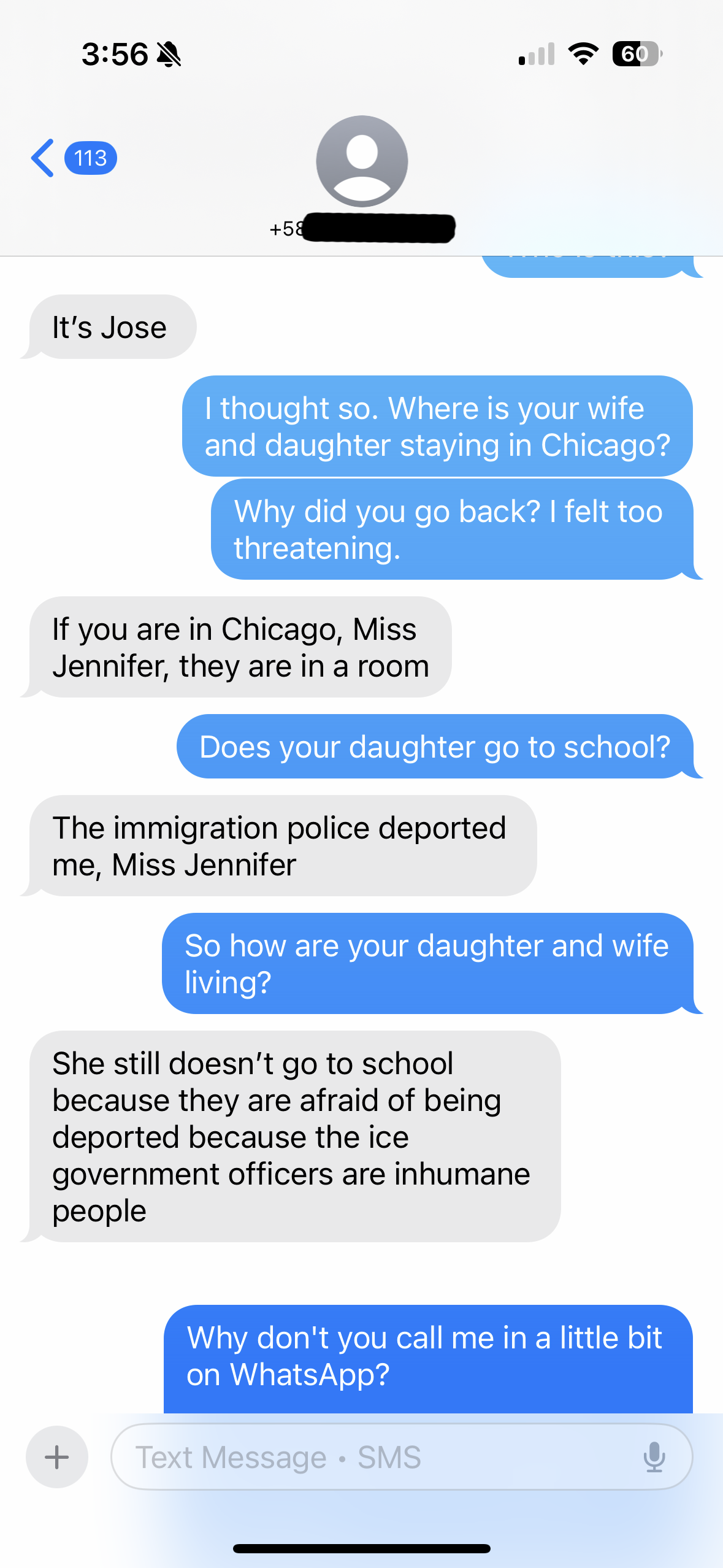
    From Venezuela, José texted me about conditions at the Broadview Detention Center, where he had been held before deportation, calling them inhumane.

    He asked for only one thing: “Please help my family leave Chicago. It’s too dangerous for them there.”

    One of the text messages between José and the author, after José had been deported to Venezuela. His phone number has been obscured by The Inquirer, leaving Venezuela’s international country code as verification of the provenance of the call.

    I first met José outside my local grocery store, Jewel-Osco, in Wilmette, one of Chicago’s North Shore communities. He held up a sign, seeking odd jobs. Many Venezuelan immigrants who congregated around the Jewel ended up there when Texas Gov. Greg Abbott bused them to Wilmette shortly after they crossed the border in late 2023.

    I spoke with José and hired him to do some repairs and painting. He traveled by subway two hours each way for work, Juliana and Yori in tow. While José worked, I drew with Yori.

    Yori explored the West Loop of Chicago in July with Tracy, one of the residents of Wilmette. Yori was drawn to the impressive mural of a woman who looked like her and her family. She loved posing in front of it, and the mural made her feel more at home in her new city.

    One warm summer day after José finished working, we all walked to the edge of Lake Michigan, where Yori made sand castles.

    These were good people who faced difficult circumstances. It felt right to help them.

    José was a proud craftsman, and I recommended him to other friends, including Tracy — one of the three of us who would later make sure Juliana and Yori had some money and helped arrange their transportation to New York after José’s deportation.

    What happened last month is not the 1930s. But as a Jewish woman, I can’t ignore the echo of that dark period.

    In Adolf Hitler’s Berlin, families packed by day and moved quietly toward the border by night, clutching papers that might open a path to New York, a city that, for many, meant survival.

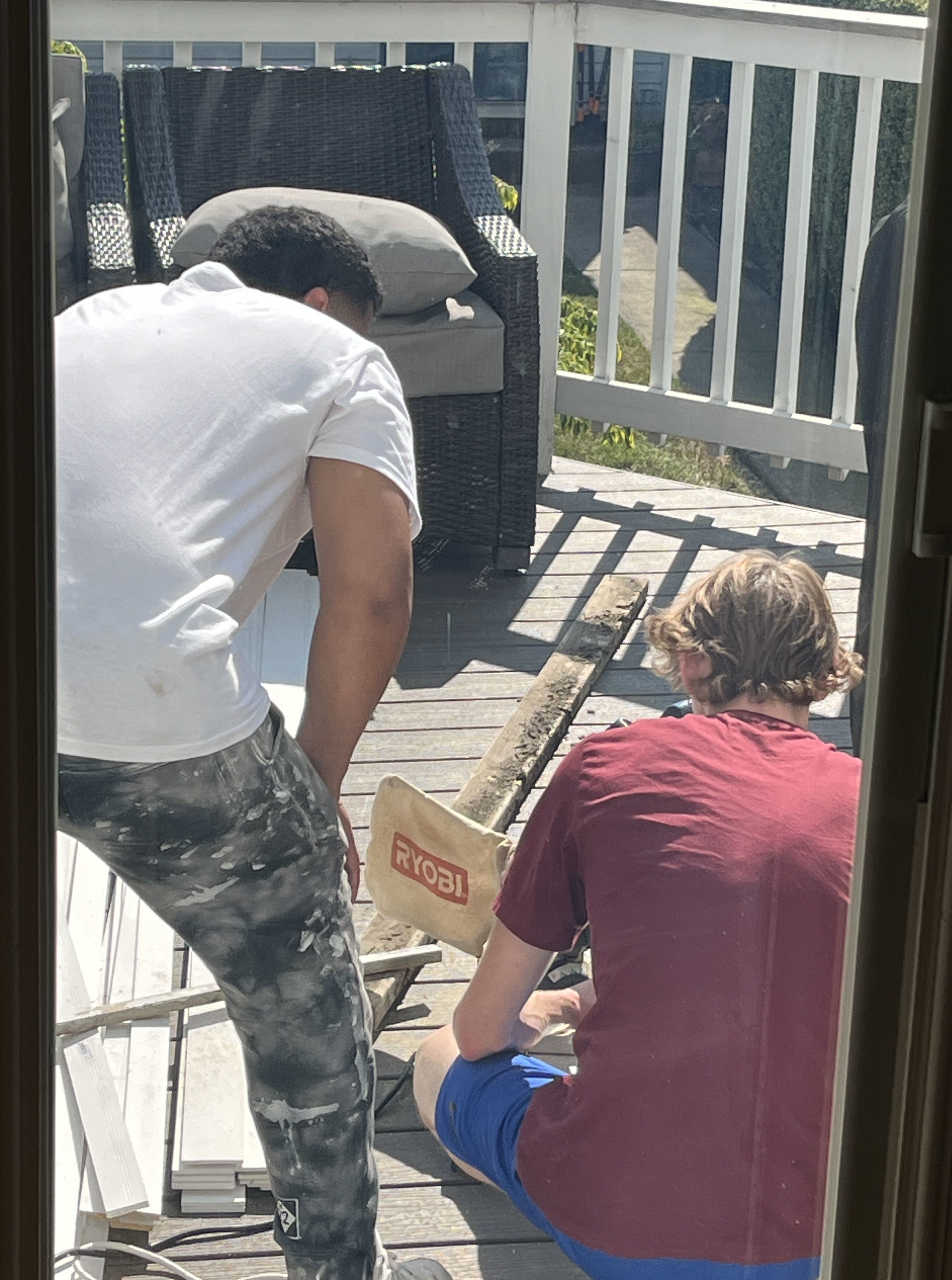
    José helps with a neighborhood construction project.

    They wrote to cousins, begged for affidavits, queued at consulates, and measured hope in stamps and signatures. The promise was simple: make it to New York, and you can gain freedom from terror.

    Our family, led by my great-uncle Max Berg, had settled in New York City after immigrating from Poland. On the eve of World War II, letters began arriving from people in Europe desperate to escape Hitler. They wrote because they shared his last name — Berg — hoping for a connection that might save them.

    The author’s great-uncle, Max Berg, standing, third from right, was a Jewish immigrant from Poland, the third of seven children. He became a successful lawyer in New York and, on the eve of World War II, sponsored 49 families to enter the U.S. These individuals wrote to him because they shared a common last name, though it remains unclear whether they were actual relatives. Many of those he sponsored became judges, writers, and leaders in their respective fields.

    Max never knew whether any of the 49 families were actually relatives, but he sponsored them all, buying their passage and covering their first month’s rent so they could begin new lives.

    The differences matter, of course. Hitler engineered annihilation; today’s migrants are not facing that. But the moral test feels painfully familiar.

    When government policy makes ordinary life like work, school, or a doctor’s visit unsafe for families who pose no threat, do we widen the circle of protection or narrow it? In the 1930s, too many Germans hid behind drawn curtains rather than opening their doors.

    As residents of Philadelphia and other American cities steel themselves for the possible deployment of immigration agents, Chicago offers a bleak preview of this chilling and shameful moment in our nation’s history.

    My hometown has faced an onslaught of immigration enforcement as part of Operation Midway Blitz. Chicago has responded to the crisis by widening its circle of protection. Our neighbors are already organizing.

    Yori, who loves to draw, illustrates her spelling lessons.

    Rapid-response networks canvass homes and storefronts, sharing “know your rights” cards and training witnesses to safely document encounters with ICE — even here in the affluent North Shore, where there are few immigrant residents but many immigrant workers.

    We also hold peaceful protests, which include clergy and citizens from across Illinois, to exercise our right of free speech.

    An ICE agent watches protesters as a Lenco BearCat vehicle drives to the scene in the Brighton Park neighborhood of Chicago, on Saturday, Oct. 4, 2025, after protesters learned that U.S. Border Patrol shot a woman Saturday morning on Chicago’s Southwest Side.
    Protesters stand and chant in the Brighton Park neighborhood of Chicago earlier this month, after protesters learned that U.S. Border Patrol agents shot a woman hours earlier on the city’s Southwest Side.

    And we record encounters whenever possible. In some instances, Chicagoans have faced down multiple ICE agents wielding weapons during an attempted arrest. In one such incident, a man, once pinned to the ground, was released because bystanders gathered to document and demand accountability.

    However, ICE agents are using aggressive tactics, often crossing the line into violence directed at protesters and people who document their activities.

    On Sept. 19, federal agents, who appeared like snipers perched on a rooftop at the Broadview Detention Center, shot a local pastor in the head with a pepper ball and then teargassed him.

    A federal agent throws a tear gas canister toward protesters in Chicago earlier this month.

    In recent footage, rows of agents in tactical gear surround protesters and push their faces into the pavement. On Oct. 10, a producer with a local television news program was thrown to the ground, handcuffed, and detained without cause.

    These are not “isolated incidents,” but rather tactics intended to intimidate and provoke. Chicago feels combustible — one itchy trigger finger from our own Kent State massacre.

    The real suffering isn’t confined to the protesters, of course, but to the detainees inside Broadview’s walls. In Lake County, Ill., immigration attorney Kimberly Weiss described the case of her client, Juan — who, like all the immigrants included in this commentary, was willing to be included in this essay only if his surname was withheld. (Likewise, some of the native-born U.S. citizens I interviewed agreed to participate only if their surnames were withheld, for fear of retribution.)

    Juan is a widowed father of four U.S.-born children, ages 12 to 20, detained by ICE outside his home. “His children contacted me terrified,” Weiss said.

    That same night, she filed emergency motions to stop his deportation and request bond, with a hearing set for the next morning. “It would have been a strong case,” she said. “He entered legally, held valid documents, like a work permit, Social Security number, and driver’s license. He’s a union roofer, a widower caring for his U.S. citizen children. He qualified for lawful status under a widower petition.”

    But before the hearing could take place, Juan was gone. Weiss said her client described Broadview Detention Center as so inhumane that he couldn’t endure another night. Detainees had no access to water. The air was so thick and suffocating that Juan witnessed others gasping for breath.

    Officers threatened Juan into signing his deportation papers, using an ICE agent as a “translator” to deceive him. Without his glasses and terrified, he finally signed. By the next afternoon, Juan was across the border.

    “There’s no accountability for what happens inside Broadview,” Weiss said. “It’s overcrowded, filthy, and cruel. There is no oversight, even when the conditions amount to torture.”

    Stories like these ripple far beyond detention centers. Dread doesn’t stop at the gates of Broadview. Anxiety seeps into neighborhoods, workplaces, and schools, touching even those who are U.S. citizens.

    During a recent nighttime raid in a South Shore neighborhood, Blackhawk helicopters dropped armed federal agents on top of an apartment building, as dozens of masked ICE agents arrived in trucks.

    Hundreds of agents moved through the building, kicking in doors, setting off flash-bang grenades, and rounding up residents as they slept. Children were separated from parents, zip-tied, and held in vans for hours.

    Imagine being a child, awakened in the middle of a peaceful slumber, snatched from your parents, and restrained. The U.S. Department of Homeland Security proudly boasts about the raid, but dozens of those arrested were U.S. citizens.

    We’ve now reached the point where friends of mine, Indian American physicians named Shila and Ravi, make sure they and their 14-year-old daughter always leave the house with their driver’s licenses and U.S. passports, in case they are stopped by ICE.

    “Show me your papers” is a demand one might expect from the Gestapo, Hitler’s secret police, but as Americans, we do not expect this, and should never accept it.

    “Being a brown-skinned woman in America means constantly proving my right to belong,” Shila told me recently. “My citizenship and contributions never seem enough to erase the question — ‘Where are you from?’ — that marks me as foreign. I’ve learned to live with this othering, but seeing my child inherit it breaks my heart.”

    “What was once an occasional ‘Go back home’ has become a deeper threat: ‘I’ll make sure you get home,’” she added. “But where is home when this is the only one we’ve ever known? Nothing can shield us from the fear that belonging can be questioned or revoked at any moment.”

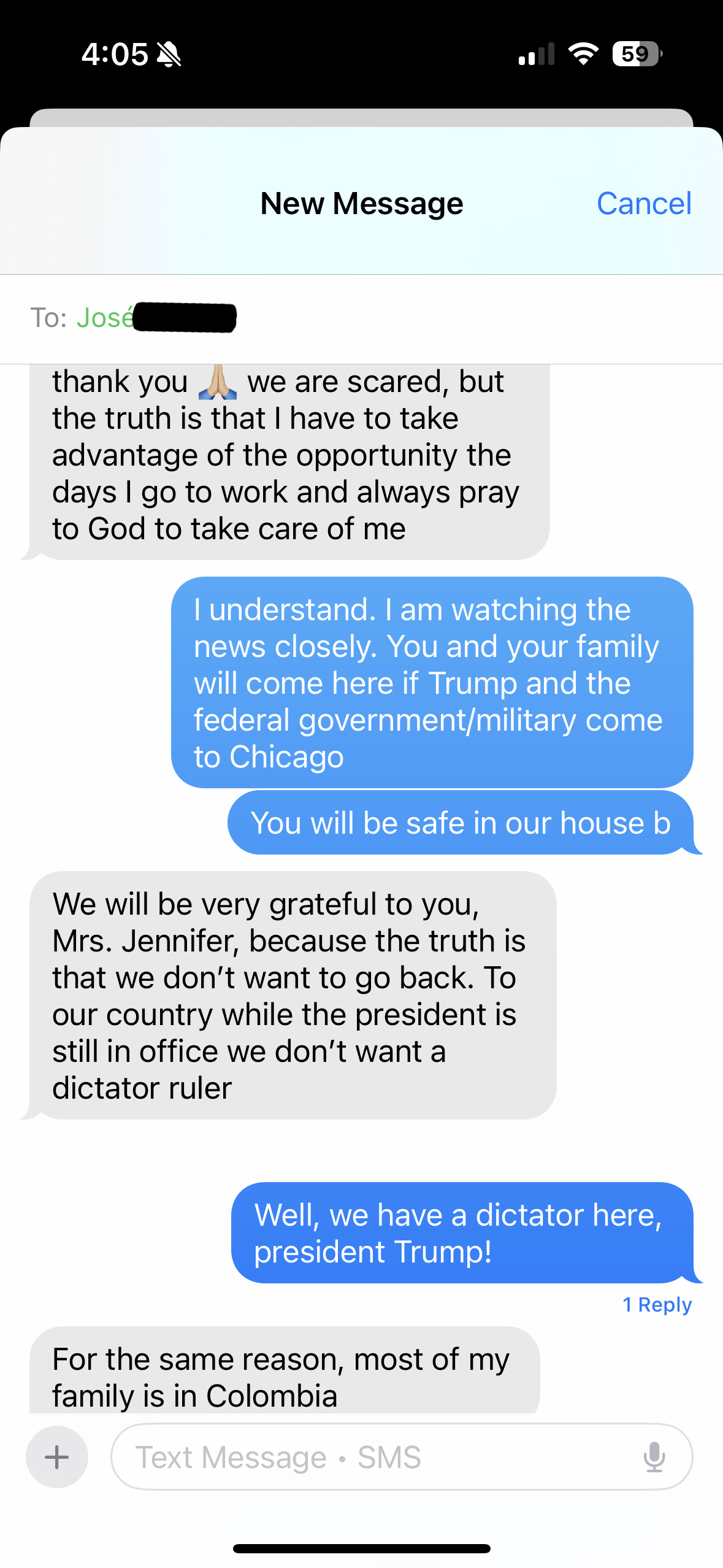
    When ICE occupied Los Angeles and the National Guard was deployed, José and I exchanged texts so that I could better understand his asylum case.

    José then called me at the end of August. I could feel his embarrassment reaching through my phone, but he asked: Could he and his family move in with us? He’d heard about the planned ICE buildup and wondered whether his family would be safe in the predominantly Latino neighborhood where they were living.

    I declined. I thought of families in Europe who hid neighbors in attics and back rooms, and felt the weight of closing my door to him. My daughters were still home from college, and there wasn’t space for anyone else. I also wanted time with my girls before they left.

    And truthfully, I wasn’t sure José and his family would be any safer in my predominantly white suburb. I suspected my next-door neighbors were Trump supporters, and worried they would report him.

    One of the text messages between José and the author, before José’s deportation. His last name has been obscured by The Inquirer.

    Still, I told myself that by mid-September, when the girls returned to school, I would offer them refuge.

    But when I finally texted him, it was too late. He had already disappeared.

    When Juliana and Yori finally arrived at Penn Station, they carried two small suitcases with everything they could fit. They left behind their clothes, furniture, toys, traces of a life they built from nothing.

    With the help of an acquaintance, they found a family shelter in New York City, a place that feels more like exile than arrival. The noisy streets outside, thick with strangers and sirens, overwhelm them. Yori cries every day; she misses her father. Juliana leaves the room only to buy food. She had hoped to find work, but even mastering the city’s subway system seems like an impossible task.

    She once dreamed her daughter would breathe freely, run in the open air, play on a jungle gym. Instead, they live in a small room where safety feels borrowed.

    Yori playing in the park in Chicago before her father was deported.

    Watching Juliana and Yori struggle to rebuild their lives, I realize that what failed them wasn’t only my courage, but our collective conscience. The duty to offer refuge doesn’t belong to governments alone; it begins in the smallest places — on our streets, in our homes, within ourselves. Compassion is not a policy, but a choice, a door we decide to open or keep closed. The question is no longer who will offer them refuge, but who we become when we hide behind our curtains.

    I still replay that call, wondering whether borders are drawn only on maps, or instead, inside of us.

    Jennifer Obel is a founding member of the New Trier Rapid Response Team and coleader of Sukkat Shalom’s immigration task force.

  • Trump’s crackdown on EVs hits home in the Battery Belt

    Trump’s crackdown on EVs hits home in the Battery Belt

    STANTON, Tenn. — Stanton, Tenn., population 450, welcomed a massive new neighbor a few years ago: a Ford electric-truck factory and a joint-venture battery plant slated to employ 6,000 workers.

    Ford’s 2022 groundbreaking triggered an influx of construction activity into the former cotton-and-soybean farmlands outside of Memphis. Hard-hatted workers filled local diners. Developers scrambled to build homes and fire stations

    Stanton is quieter these days. Ford over the past 18 months repeatedly delayed phases of the project. The EV truck plant is slated to begin initial production in 2027 and start sending deliveries the next year, a timeline delayed several times from the original plan of coming online in 2025.

    Ford said it “will be nimble in adjusting our product launch timing to meet market needs and customer demand while targeting improved profitability.”

    The Ford complex is part of the so-called Battery Belt, a swath of factories stretching across the U.S. heartland that spans from Georgia to Indiana. Roughly two dozen battery projects worth tens of billions in investment have been announced this decade, promising to inject tens of thousands of jobs in Republican-dominated states like Georgia and Kentucky.

    By last year, though, Americans’ waning enthusiasm for electric cars led automakers to delay or scrap some factory projects. Now, the additional fallout from U.S. President Donald Trump’s recent policy changes is descending on the Battery Belt.

    Ford CEO Jim Farley last week offered the prediction that electric-car sales could fall by around 50% following the Sept. 30 expiration of a $7,500 tax credit for buyers, echoing other gloomy forecasts for the EV market.

    The uncertain fate of these massive, high-tech factories and their employment has rattled the small rural communities that spent years hitching their economic futures to these projects.

    “That’s on everybody’s mind, quite frankly,” said Allan Sterbinsky, who retired as mayor of Stanton in December and advocated for the site for years before Ford came to town. Some residents worry that Ford will never follow through on the plant, the former mayor said. Others hope the company will repurpose the 3,600-acre site if demand doesn’t increase for EVs.

    A Ford spokesperson pointed to the automaker’s community work in Stanton, including grants to public safety organizations as part of a broader $9 million commitment to the area.

    A Reuters review of U.S. battery-investment plans shows those worries are justified. The industry appears headed toward a huge glut of factory capacity, if all those projects were to move ahead as planned.

    By 2030, the planned battery plants would provide the capacity to produce 13 million to 15 million EVs annually, according to figures provided to Reuters by research firm Benchmark Mineral Intelligence. But the industry now might only need about one-quarter of that factory space. S&P Global Mobility predicts only around 3 million EVs will be produced that year, and some would likely use batteries imported from other countries.

    Some of that excess roughly 10 million-EV worth of battery capacity would likely be used for hybrids and extended-range EVs as well as the booming energy storage industry, but there is still a sizable gulf, said Stephanie Brinley, S&P Global Mobility automotive analyst.

    The demise of the $7,500 tax credit — which had been in place for more than 15 years to persuade Americans to try green cars — is only the highest profile of several anti-EV measures put forth by the Trump administration. Combined, they further jeopardize battery projects and other electric-car-related investments, experts say. In the last few months, several automakers have canceled, delayed or downsized EV projects.

    Meanwhile, a pot of tens of billions of dollars available to companies that make EV batteries domestically has tighter restrictions that will likely reduce the amount of federal money that flows to the battery sites.

    “All of a sudden, much of what was originally going to benefit from these credits now no longer can to a large degree,” said Jennifer Stafeil, tax auto sector lead for KPMG.

    Trump has said he is not anti-EV, but prefers that consumers decide what cars to buy, without government influence. He also has criticized EV-friendly regulations implemented under former President Joe Biden, which Trump has said were costly and threatened American auto jobs.

    One of the nation’s largest EV projects, Hyundai Motor’s $12.6 billion assembly plant and joint-venture battery factory near Savannah, Ga., is moving ahead. Last month the project suffered a setback when federal law enforcement raided it. Hyundai has said the fallout would delay the battery plant by at least two to three months.

    In the three years since Hyundai announced the megasite, 21 suppliers have opened operations near the site.

    “Hyundai is committed to offering a diverse product lineup, including internal combustion, hybrid, plug-in hybrid, and EV models. We understand that every customer is unique, and we strive to meet a wide range of needs,” a company spokesperson said.

    The complex is gearing up to hire 8,500 employees by 2031, and is paying wages 25% above the county average, said Trip Tollison, president of the Savannah Economic Development Authority.

    Tollison acknowledged that some in the community worry about the uncertain future of the nascent EV industry that underpins all that development. He is hopeful Hyundai can flexibly shift to hybrid production if the EV market doesn’t take off.

    “That’s how you provide opportunities like this to lift people out of poverty,” he said.

  • How China weaponized soybeans to squeeze U.S. farmers — and spite Trump

    How China weaponized soybeans to squeeze U.S. farmers — and spite Trump

    The start of the harvest in September is usually when China, the world’s biggest importer of soybeans, puts in a flurry of orders to the farms of Illinois, Iowa, Minnesota, and Indiana.

    This year, however, Chinese importers aren’t buying. In retaliation for President Donald Trump’s tariffs, Beijing has cut off Midwestern farmers from their largest and most lucrative overseas customer: China accounted for half — or $12.6 billion — of U.S. soybean exports last year.

    For the first time since November 2018, China imported no soybeans from the U.S. in September, data from China’s General Administration of Customs showed Monday.

    “We’re in uncharted territory in terms of a complete absence of Chinese buyers for the harvest that is currently coming in,” said Even Pay, director of agriculture research at Trivium China, a research firm based in Beijing.

    For Beijing, halting U.S. soybean imports has been an easy and relatively cost-free way to pile pressure on Trump ahead of a planned meeting with Chinese leader Xi Jinping in South Korea later this month.

    Trump, speaking to reporters on Air Force One last weekend, said he wanted China to return to its previous level of purchases and that he thought Beijing was ready to make a deal on soybeans.

    But while American farmers lobby Trump to get them back into China, there isn’t similar pressure within China for the government to allow purchases from U.S. suppliers. That “gives Beijing a great deal of negotiating leverage,” Pay said.

    On Tuesday, Trump took to social media to call China’s decision to not buy U.S. soybeans “an Economically Hostile Act” and said the U.S. was considering “terminating” buying cooking oil from China as retribution.

    But Beijing has shrugged off Trump’s threats. Analysts say it is ready to extend the purchasing freeze for the rest of the year.

    Here’s how China has turned its massive market for soy into a trade war weapon.

    Why does China buy so many soybeans?

    China consumes far more soybeans than any other country in the world, but it grows less than a fifth of what it needs — just enough to cover all the tofu and soy sauce used in Chinese cooking.

    It buys everything else from abroad — importing more than the rest of the world combined — and the U.S. has traditionally been one of its top suppliers.

    Those imported beans mostly feed huge numbers of pigs, chickens, and other livestock, as meat consumption by wealthier Chinese families has grown rapidly. Despite efforts to develop alternatives, soybeans accounted for 13% of animal feed in 2023.

    The remaining imported soybeans mostly become cooking oil: soybean oil’s mild taste and ability to withstand high heats make it perfect for stir-fries. Chinese producers favor U.S. or Brazilian imports over more expensive homegrown soybeans.

    For U.S. farmers, it’s hard to find a replacement for Chinese demand. “It’s just an enormous market,” said Phil Luck, director of the economics program at the Center for Strategic and International Studies (CSIS), a Washington-based think tank.

    How has China curbed reliance on American farmers?

    China has worked hard to curb its reliance on U.S. soy imports, especially after the trade conflict of Trump’s first term ended in 2020 when Beijing agreed to buy $200 billion in American products, including soybeans (although it bought far less than it promised.)

    Beijing has since pushed Chinese farms to consolidate and expand domestic output. It has launched trial programs for previously banned genetically modified crops. And it is aiming to lower the ratio of soybeans in animal feed to 10% by 2030, down from 18% in 2017.

    A Ministry of Agriculture report released in May said that these efforts meant import demand would steadily fall over the coming years.

    But thanks to limited farming land and ballooning demand, China is still a long way from its goals to meet half of its soybean needs with domestic crops and will rely on imports for years to come, analysts said.

    So who is supplying China instead?

    Chinese analysts are blunt about their country’s growing preference to buy from anywhere but the U.S.

    “From China’s perspective, the U.S. is an unpredictable supplier,” said Niu Haibin, director of the Center for Latin America Studies at Shanghai Institutes for International Studies.

    Tariffs mean U.S. soybeans no longer have a price advantage and China has already identified alternative suppliers to fill the gap. “The longer we rely on alternative sources, the dimmer the outlook for U.S. soybean exports to China becomes,” Niu said.

    Those suppliers include Argentina, Uruguay, and even Russia. But it is Brazil, the world’s largest soybean exporter, that has been the big winner from China’s U.S. embargo.

    China would typically alternate between hemispheres, buying from Brazil during its March to June harvest season and then from the U.S. for the remainder of each year.

    But this year, instead of switching to American farms, China kept placing orders from Brazil. It imported $4.7 billion in soybeans from the country in August and only $100 million worth from the U.S.

    That continued in September, when China bought 7.2 million tons of soybeans from the South American country — 93% its total exports, according to Anec, Brazil’s national association of grain exporters.

    China’s effort to secure Brazilian soybeans goes far beyond merely placing big orders.

    Chinese state-owned companies have taken stakes in the major Brazilian ports of Paranaguá, Açu, and Santos. COFCO, China’s largest agricultural importer, has the exclusive rights to run a major new terminal at Santos that opened in March and will expand the port’s throughput by 15 million tons per year when it reaches full capacity in 2026.

    And Beijing is still trying to lower barriers for Brazilian exporters to access its vast market. The two countries are working on plans to build a railway connecting Brazil to Peru’s Chancay port that could cut shipping times to Asia dramatically.

    What does this mean for U.S.-China trade talks?

    With plentiful supply from South America, China has been projecting confidence that it can cold-shoulder American farmers for as long as is necessary to reach a trade deal.

    Beijing once worried that U.S. wouldn’t sell China its soybeans, but it is now the U.S. that is anxious for China to buy, declared one widely shared article published on social media app WeChat last week.

    In response to Trump’s recent threat to retaliate by halting cooking oil trade — which Chinese analysts took to mean the U.S. stopping purchases of used oil that can be turned into biodiesel — the state-owned Global Times newspaper declared that “there is no shortage of buyers for China’s used cooking oil.”

    That defiant tone is helped by China’s sizable stockpiles. Its soybean imports hit a record in May and were up 5.3% year-on-year for January to September to reach 95 million tons, according to China’s customs agency.

    Beijing is in a position where it could hold out for months — possibly until new South American crops arrive in early 2026 — without needing to procure U.S. soybeans, said Pay, the Trivium analyst.

    Trump’s focus on soybean purchases has only strengthened Beijing’s belief that this is an easy way to squeeze the U.S. with minimal costs at home.

    In Beijing, “there’s definitely a sense that the U.S. is in chaos and there’s room for putting political pressure on targeted groups,” said Jack Zhang, director of the Trade War Lab at the University of Kansas.

    It also gives Xi something to offer Trump in exchange for what China really wants.

    “Part of the calculation,” Zhang said, “is that the U.S. will negotiate over these small but pressing concerns and relent on some of the larger structural stuff that China’s more worried about.” These include U.S. export controls on advanced computer chips.

    But even if a deal is struck this month, it may be too late for U.S. farmers to make up for orders already lost.

    “China’s in a pretty good position. We really want to resolve this. They don’t need to,” said Luck, the CSIS analyst. Even if China started placing orders the day after Xi and Trump meet, U.S. soybean farmers “still probably lost half of the season, so we’re on the clock here,” he said.

  • Has pickleball’s popularity peaked? These Philly businesses hope not

    Has pickleball’s popularity peaked? These Philly businesses hope not

    What do vacant retail spaces, garages, malls, and industrial buildings all have in common? Many have been repurposed into dedicated pickleball venues.

    Pickleball courts have been popping up all over the Philadelphia region — indoor and outdoor, many privately owned or operated by chains, and some sponsored by or partnered with local government.

    While they’ve been prolific, these facilities aren’t instant moneymakers. Local businesses offering the sport have been strategic and made adjustments in efforts to make a profit.

    “Folks who invest in pickleball need to make sure they do a sound economic impact study and run the numbers to understand what a complex will support,” said Justin Maloof, chief competition officer of USA Pickleball, based in Scottsdale, Ariz.

    Pickleball’s skyrocketing popularity

    Pickleball, a combination of tennis and ping-pong, is the fastest-growing sport in the U.S., with about 20 million players in 2024, according to the Sports and Fitness Industry Association (SFIA)’s 2025 Topline Participation Report. The sport grew by 223% in three years, with every age group seeing increased participation.

    Venues offer memberships and pay-as-you-go options, with costs varying widely. Some municipalities offer play free of charge with no membership or court time fees. Other clubs have multitiered packages ranging in price up to $350 per month. Without a membership, hourly fees can run upward of $15 per hour.

    With close to 16,000 pickleball locations, including 4,000 new sites in 2024, according to SFIA, competition is stiff and business models for new venues continue to evolve.

    “We are seeing a definite shift toward permanent pickleball courts,” Maloof said. “In the early years, most of the pickleball courts were temporary or converted courts, including underutilized basketball or tennis courts or hardwood gymnasium floors.”

    Those makeshift courts employed temporary nets and line markings that were often created from tape or chalk. As demand grew, players gravitated to dedicated courts with permanent nets and clear lines. Investors refit existing buildings or converted outdoor spaces, which has been quicker and more cost-effective than building new facilities from scratch.

    Pickleball is played on the courts to the right while padel is played on the courts to the left at Viva Padel & Pickleball in Philadelphia.

    Keeping start-up and operating costs low

    When Viva Padel & Pickleball opened in June in East Poplar, the founders invested just under $1 million on an outdoor venue featuring four pickleball and four padel courts. One of the Viva investors already owned the lot that had previously been used for parking.

    To entice clients, the group created a business model built on multiple tiers, ranging from a pay-as-you-go plan for casual players to a monthly fee premium plan for folks who play every day.

    “The flexible business model allows people to buy in and test it out,” said cofounder and CEO Mehdi Rhazali. “We can target many different audiences.”

    In the first three months, the club acquired 150 members in addition to drop-in players. That was a successful enough start to open a second indoor facility, set to open this fall.

    For their second location, the investors partnered with the Magarity family, who have repurposed their tennis club in Flourtown into a pickleball and padel venue. They felt that converting to pickleball and padel would bring in more participants and more community usage, Rhazali said.

    The clubs will run independently so joining one will not give players membership to both.

    “With an indoor model, you have to cap your membership” to avoid overcrowding, Rhazali said. “We are planning on offering a lot of programming and options for members and nonmembers in the Flourtown location.”

    The cost to refit an outdoor surface, most often a former basketball or tennis court, is $35,000 to $40,000, according to Carl Schmits, chief technology officer for USA Pickleball, based in Lake Oswego, Ore. That covers just the cost of the surface, not buying or leasing the space, or outfitting the venue.

    The indoor court facility build-out is accelerating, driven by franchise operations including Life Time and Dill Dinkers, Schmits said. Closed retail spaces, such as former Bed Bath & Beyond stores, are being repurposed for pickleball, with 10 courts per facility on average.

    For a smaller venue, perhaps a former garage or manufacturing facility, it costs about $10,000 to refinish the floor, create separations between the courts, and add lighting, Schmits said.

    “A smaller operation would ideally need to see revenue of over $100,000 per year per court,” Schmits said.

    Overcoming challenges

    Delco Turf & Pickle will celebrate its first anniversary on Nov. 27. The locally owned venue offers nine indoor courts and an outdoor surface, open 24 hours a day, 7 days a week. Half of the building is a turf field for other sports.

    On the pickleball side, the Boothwyn business started as a pay-as-you-go club, and then began offering memberships three months later. Last month they added additional tier levels.

    “We are trying to get the word out that we are here, we do a great job, and we have a great product,” said Adam Devlin, general manager and director of pickleball operations. The first year was a learning experience, he said.

    By the time their infrastructure was in place, many local players had already committed to other clubs. This year, investors are counting on cold weather to bring in business, as many of the other courts nearby are outdoor.

    To keep staffing and overhead low, the club is fully automated. Clients use an app to sign up, pay, and enter the facility. Staff are on-site during busy times.

    Filling off-peak time remains a challenge for most clubs.

    At the Delco club, the turf side of the venue picks up the slack, getting business from school and community groups. At Viva, Rhazali’s group is pursuing partnerships with schools and businesses to provide team-building events at the facility.

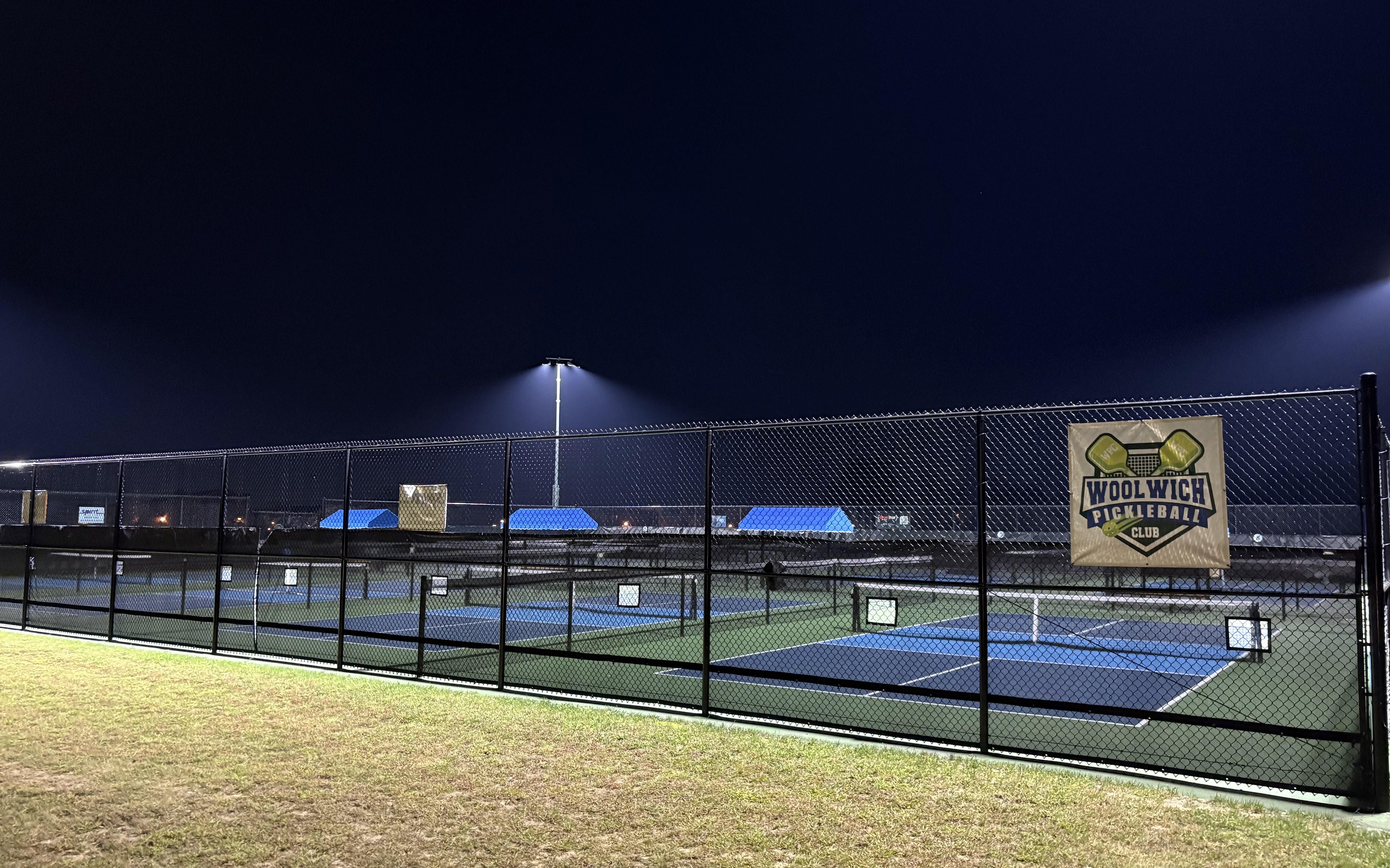
    The community pickleball courts in Woolwich Township are shown lit up at night.

    Local government hops on the pickleball bandwagon

    Many municipalities, from the Philly suburbs to the Shore, offer pickleball, sometimes in repurposed tennis or basketball courts. Generally, their fees cover the costs of upkeep and staff and may be supplemented by the local government.

    “Anything that gets people off the couch and active is a healthy thing,” said Doug Horton, competition and tournament director for 08085 Pickleball, which covers Woolwich and Logan Townships. “It brings people together and builds relationships.”

    The two Gloucester County towns, just a few miles apart, share 14 pickleball courts, eight in Woolwich Township and six in Logan Township. The Woolwich courts were built and paid for by the developer who erected the surrounding homes in June 2024, as a perk to the community. The Logan courts, once a skate park, were recently repurposed to meet the demand for pickleball.

    The club, which has more than 1,000 members, offers free memberships with no charge for court time. Anyone is welcome to join, but memberships are required as a way to assess the level of each player and ensure games are competitive.

    The Logan program is recognized and supported as an official sport by the township, similar to their youth programs. In Woolwich Township, sponsorships, fees for lessons, leagues and tournaments support the program without the use of tax dollars.

    Pickleball has also been available in Philadelphia’s Dilworth Park this fall, through a partnership between City Pickle and Center City District, a business improvement district. City Pickle offered season passes and open play time, as well as select open play sessions for no cost.

    As more courts and venues pop up, pickleball will eventually reach a point of saturation in the region.

    “In the early ’80s there was a heavy build-out of racquetball and tennis facilities, with the perspective ‘If we build it, they will come,’” Schmits said. “In hindsight, we look at how many closed.”

    To area businesspeople, he cautioned: “Be sure to do the due diligence to understand the economic impact in your area.”

  • These parents wish Mikie Sherrill would defend their transgender kids. They understand why she doesn’t.

    These parents wish Mikie Sherrill would defend their transgender kids. They understand why she doesn’t.

    C.B. can’t even comprehend her transgender daughter being required to use the boys’ bathroom at her South Jersey school.

    “If you went into her classroom and someone said, ‘Pick out the trans kid out of these 25 kids,’ you would not be able to,” C.B. said. “You might very well get it wrong.”

    C.B., who asked to be identified by her initials to protect the privacy of her child, said she loves the Garden State. She has a “very Jersey family.”

    But, like other parents of trans children, she’s considering packing her family’s bags depending on the results of the Nov. 4 election, and whether the next governor maintains the state’s LGBTQ+ friendly policies.

    “I can’t think of anyone who’s not at least thinking of a contingency plan. I think we all have our limits of when we’ve got to go,” C.B. said. “We just have to protect our kids.”

    The stakes of the election are stark for C.B. and other parents. Jack Ciattarelli, the Republican nominee for New Jersey governor, opposes state policies implemented under Democratic Gov. Phil Murphy meant to protect transgender children. Ciattarelli says he would require schools to tell parents about their children’s gender identity and stop transgender girls from participating in girls’ sports. He also opposes gender-affirming care for minors and believes parents should be able to opt their kids out of LGBTQ+ related topics in school.

    U.S. Rep. Mikie Sherrill, the Democratic nominee, has largely voted in support of transgender rights throughout her nearly seven-year legislative career. She was endorsed by LGBTQ+ advocacy groups as well as her friend U.S. Rep. Sarah McBride (D., Del.), the first openly transgender member of Congress. But Sherrill has not publicly defended trans rights when criticized by Ciattarelli and has declined to answer reporters’ questions on the matter.

    L.B., another South Jersey parent facing the same dilemma in the lead-up to Election Day, said her 10-year-old transgender daughter isn’t stealing any thunder from other girls on her coed sports team — she is the smallest in her class. And it’s hard for her to imagine anyone seeing her child as a threat to anyone in the bathroom.

    “People move from all over the country to New Jersey because it’s known as a safe haven for LGBTQ rights,” said L.B., who is using her initials to protect her child’s privacy. “And now, if Jack Ciattarelli wins, it could become a state that people have to flee from.”

    Republican nominee for New Jersey governor Jack Ciattarelli speaks at a rally at the Corner House Tavern in Columbus.

    During the 2024 election, President Donald Trump frequently attacked Vice President Kamala Harris for supporting transgender people. Ciattarelli has followed that playbook, framing Sherrill on the campaign trail, in ads, and on the debate stage as being too supportive of transgender identities.

    Sherrill has not just ignored the attacks. She has avoided talking about the issue altogether.

    “I don’t necessarily blame her for that, although more vocal support, outspoken support, would be amazing. It would make a lot of us feel much safer,” C.B. said.

    Other transgender rights advocates interviewed by The Inquirer also said they wish Sherrill would speak up more. But they understand why she doesn’t.

    “Mikie Sherrill is not saying much of anything about the transgender population — which, you know, frankly, is what unfortunately might be her best strategy to be elected,” said Melissa Firstenberg, a transgender woman who founded Marlton Pride. “Unfortunately, for somebody like me, she is the only option.”

    Melissa Firstenberg marching in a July 4 parade with Marlton Pride.

    A page out of Trump’s playbook

    Trump campaigned for president on the promise of stopping transgender athletes from competing in women’s and girls’ sports.

    Ciattarelli has also made the popular GOP talking point a centerpiece of his campaign. In his stump speeches, he attacks Sherrill for voting “to allow biological boys to play in girls’ sports” despite being “a mother of two daughters,” in reference to her vote against the “Protection of Women and Girls in Sports Act‚” which would prohibit transgender girls from participating in girls’ sports and had support from only two House Democrats.

    Ciattarelli has championed a so-called parental rights movement and frequently touts his opposition to New Jersey School Policy 5756, an advisory policy calling for schools to support students’ gender identity and allow transgender students to compete on sports teams and use the restrooms where they feel comfortable. The guidance states that parental consent is not needed to accept a student’s asserted gender identity.

    In the first general election debate last month, Ciattarelli tried to veer the conversation to transgender youth in schools multiple times, and said he was concerned about “the welfare of our children.”

    “I don’t think school districts should be keeping secrets from parents. I don’t think that biological boys should be playing in girls’ sports,” he said.

    “She opposes me on both of those issues,” Ciattarelli added, referring to Sherrill’s 2023 vote against the “Parents Bill of Rights Act” that would require parental notification of children’s gender identity, among other measures. No House Democrats voted for the bill.

    Sherrill did not address her past votes, correct Ciattarelli, or respond to the specifics of his argument, beyond mentioning that “parents know their kids best, and they need to be able to determine if there’s something they want to opt out of.” That stance echoes Ciattarelli’s arguments, though it was unclear what exactly Sherrill was referring to.

    When asked after the debate about participation of transgender athletes, Sherrill deferred to “New Jersey sports groups” and the National Collegiate Athletic Association. She also cited her support for the Kids Online Safety Act, mentioning an uptick in bullying of LGBTQ+ youth.

    Sherrill has garnered endorsements and donations from LGBTQ+ advocacy groups like the Human Rights Campaign and GLAAD for her voting record — though she did take heat for a December 2024 vote for the National Defense Authorization Act, which included a provision that removed transgender healthcare for military dependents. Despite her vote, Sherrill criticized that measure as singling “out a small handful of innocent children to be used as political pawns.”

    But Sherrill declined through a campaign spokesperson to share her stance on the state’s school guidance or protections for gender-affirming care for this story, or to be interviewed about trans rights.

    U.S. Rep. Mikie Sherrill (D., N.J.) speaks during a gubernatorial debate with Republican Jack Ciattarelli Sept. 21, 2025 at Rider University.

    Instead, in a statement, Sherrill said she “will govern in a way that keeps New Jersey kids, my own and others, safe and with parents in the driver’s seat regarding their kids’ education.” The 200-word statement did not mention “trans,” “gender,” or “LGBTQ.”

    She also said that “schools are a place to learn, not to advance political agendas,” and that she would ensure they teach “the full history of our nation” and continue to give parents the choice to opt out of “certain sex-education conversations.”

    Meanwhile, Chris Russell, a Ciattarelli campaign spokesperson, said in a text message that Ciattarelli “opposes so-called gender-affirming care for minors” when asked about Murphy’s executive order that makes the state a “safe haven” for gender-affirming healthcare.

    “As Governor Jack will review all of Governor Murphy’s EO’s and related policies to ensure that they are consistent with his positions regarding parental notification for minors, protecting women’s & girl’s sports & offering an age appropriate curriculum,” he added.

    Sherrill is not the only Democrat across the country who has trod lightly on trans rights since Republicans upped the attacks last year, but Diane Rugala, a Collingswood-based parent whose transgender son is a Rutgers University graduate student, thinks Sherrill should “just own it” when it comes to defending transgender kids.

    “You have to play the game, I get it,” said Rugala, who is also an activist with PFLAG, an LGBTQ+ advocacy group.

    “But I also think that a really authentic statement would be good,” she added. “I don’t think people are asking for her to become this big advocate for the trans community … just a simple statement.”

    Attack ads mirroring the presidential election

    Ciattarelli’s campaign recently started running an ad that highlights Sherrill saying that she “would push an LGBTQ education into our schools,” and that “parents have a right to opt out of a lot of things” but “this is not an area where they should be opting out.”

    The clip was from a Democratic primary debate earlier this year when she was responding to the question of whether parents should be able to opt their students out of “LGBTQ-related content” in the same way they can be taken out of sex-ed and health classes.

    The ad calls it her “education plan” and tells viewers that it’s “your choice, not hers.”

    She explained in that debate that students should understand “the background of people throughout our nation” and condemned the “erasure of history.” As of 2020, New Jersey schools are required to teach about societal contributions from LGBTQ+ people, along with other groups, in middle and high school social studies.

    Jo Miller speaks at a rally for trans youth organized by Garden State Equality in Asbury Park in June.

    Another ad echoes the attack that was lodged against Vice President Kamala Harris’ presidential campaign.

    The American Principles Project (APP), a Virginia-based conservative group that identifies itself as “pro-family,” paid for an ad that vilifies trans people and accuses Sherrill of wanting to “protect they/them instead of your children,” referencing nonbinary pronouns. The group’s New Jersey PAC reported $126,000 in expenditures in the race as of Oct. 3, with $429,000 more cash on hand.

    Trump’s campaign aired ads last year arguing that Harris is for “they/them,” while Trump is for “you.”

    Jo Miller, 29, a transgender woman who serves on the Woodbury City Council, said she “would like to see a more forceful response” from Sherrill because not addressing the attacks can leave more people thinking that Republicans’ “demonization” of trans people — a small segment of the population — is true.

    “I would love to see Mikie Sherrill take some stronger stances, and I think we will see that eventually as governor, but I think the truth is, it’s not her main focus,” Miller said. “And it’s kind of strange that it’s Jack Ciattarelli’s main focus, and it’s Donald Trump’s main focus.”

  • Letters to the Editor | Oct. 26, 2025

    Letters to the Editor | Oct. 26, 2025

    A moment of understanding

    We refuse to be enemies. We refuse to hate each other. We are two mothers, one Jewish American and one Palestinian American, who have found in each other a friend with whom to cry, to dream, to learn, to laugh, to heal, and to grow.

    Going against the grain of deep-seated conditioning requires vulnerability, an essential and universal human quality. Allowing ourselves to be vulnerable shatters the conception that another person is “enemy,” and opens us to seeing the other’s fears, insecurities, wounds, hopes, and needs.

    We first met in May 2024 while planning a women’s peace vigil at City Hall sponsored by Sisters Waging Peace, a Philadelphia chapter of the Sisterhood of Salaam Shalom that brings together Jewish and Muslim women. The seed of friendship we have planted and watered with tears has taken root. We are actively creating a new “us” — one conversation, one peace vigil, one moment of understanding at a time.

    Now that there is a ceasefire in Gaza, we can breathe for a moment, but we cannot rest. A ceasefire halts the bombs, but does not end the underlying structure of injustice. The work to end the occupation must continue with even greater intensity. We must remember that the status quo was not peace, and going back to it would bring us back to the cycle of destruction and loss.

    Sisters Waging Peace, the Philadelphia chapter of American Friends of Combatants for Peace, and others will next bear public witness on Oct. 27, at City Hall from 4 to 5 p.m. Please come join us, wearing white, to pray for a just peace in Palestine and Israel, to bring a spirit of peace to our city, and to honor our humanity.

    Samah Elhajibrahim and Rabbi Malkah Binah Klein, founding members, Sisters Waging Peace

    Finding common ground

    Pennsylvania’s diversity has always been one of our commonwealth’s greatest strengths, but it has also frequently played a prominent role during political disputes. Whether the divide is rural vs. urban, wealthy vs. struggling communities, or along racial and ethnic differences, these fault lines become flashpoints when difficult decisions must be made.

    The recent battle over SEPTA funding provided a clear example.

    During budget negotiations, as Philadelphia’s transit system faced devastating service cuts, Republican Senate Majority Leader Joe Pittman of Indiana County spoke on the Senate floor about his rural Western Pennsylvania upbringing, quoting John Mellencamp’s “Small Town” before stating: “Human nature suggests, why should I do anything to help? I don’t ever get any help for my region. Why should I do anything to help the southeast part of the state?”

    This framing of regional interests in opposition to one another is nothing new to our statehouse. The tension runs deep and cuts both ways: a Democratic legislator responded by proposing to split state tax revenue by region, noting Philadelphia generates more revenue than it receives and subsidizes public services in counties that can’t afford them.

    The best antidote to division in our politics is common understanding, and that’s precisely why the statewide reporting of Spotlight PA is so important.

    As an independent, nonprofit newsroom, Spotlight PA seeks to better connect communities with what’s happening (or not) in Harrisburg, and to better connect communities to one another. The newsroom shares all its stories at no cost with more than 125 partner news outlets across the state dedicated to informing their local communities, including The Inquirer.

    The less we understand about life across Pennsylvania — people’s challenges, economic conditions, and their daily realities — the more susceptible we all become to politics that emphasize our differences rather than our shared interests.

    Finding common ground requires first understanding the ground others stand on — and that’s impossible without quality local news coverage from throughout the state.

    Christopher Baxter, CEO and president, Spotlight PA

    Join the conversation: Send letters to letters@inquirer.com. Limit length to 150 words and include home address and day and evening phone number. Letters run in The Inquirer six days a week on the editorial pages and online.

  • Horoscopes: Sunday, Oct. 26, 2025

    ARIES (March 21-April 19). Is it true that when you open yourself up, the universe sends the right people in? Maybe people cross your path all the time, but you only welcome new friends when something in you is ready. Either way, you’re so ready.

    TAURUS (April 20-May 20). Your room, your rules. The more you live that, the easier it is to respect boundaries elsewhere. Clarity today comes from remembering who’s in charge of the space you’re in.

    GEMINI (May 21-June 21). A secret comes your way, and suddenly, you’re holding something fragile. What you do with it changes the dynamic. Keep it safe and people will treat you differently, with the kind of trust you cannot ask for directly.

    CANCER (June 22-July 22). The future you once wanted no longer applies, and good riddance. Your current incarnation is wiser. There’s relief in the admission that you don’t know what the future brings. Uncertainty is your power — margins wide enough to let the impossible in.

    LEO (July 23-Aug. 22). A win feels bigger because someone is watching. It’s not that you live to amuse, entertain and wow them, but it does bring you great pleasure to know this is possible, as it should. Yours is a rare gift!

    VIRGO (Aug. 23-Sept. 22). Today’s problem will be solved with a scientific approach. Decide which metrics are meaningful to you and start recording the data. With small, logical steps, you’ll move the action in your preferred direction and create the habits that will nurture your best self.

    LIBRA (Sept. 23-Oct. 23). Someone tries your patience, but you don’t lose your cool over it. You can bend the moment toward a lighter feeling. Irritation is less powerful when you find it curious, even funny. You’ll surprise yourself by laughing at what once drove you mad.

    SCORPIO (Oct. 24-Nov. 21). You’re in one of those states where ideas come easily and the creative momentum is exciting, not to mention attractive to everyone around you. They’ll be fascinated as they watch and wonder what you’ll make next.

    SAGITTARIUS (Nov. 22-Dec. 21). Feelings sneak up, quick and full. Pause to trace where they started and what they are pointing to. There’s a clue in the emotion, and following it leads to the breakthrough you’ve been wanting.

    CAPRICORN (Dec. 22-Jan. 19). Instead of trying to predict and plan for every contingency, decide what matters. Remember, there is no objective right answer. If it matters to you, it matters. There’s too much good stuff happening to waste energy on things of little impact.

    AQUARIUS (Jan. 20-Feb. 18). Your interest in others draws out their stories, and in the sharing, connections start to form. You don’t even have to ask particularly insightful questions. Your attention alone invites people to reveal what they most want you to know.

    PISCES (Feb. 19-March 20). It sounds improbable, but it really happens like this: The wrong turn sets you free. What you thought was a mistake reveals a better path. Truly, the delay is nothing compared to the discovery.

    TODAY’S BIRTHDAY (Oct. 26). Welcome to your Year of the Bold Leap. You’ll take daring steps in work which lead to promotion or even heading your own business. Relationships thrive because you go for what you want and say what you need to say. More highlights: You’ll risk rejection and come out ahead. Finances improve with structure. A presentation shows who you are — people start following and paying you for your ideas. Gemini and Libra adore you. Your lucky numbers are: 9, 18, 4, 44 and 28.

  • Dear Abby | Relationship with younger man reaches crucial point

    DEAR ABBY: I was with the same person (my first “everything” guy) for 23 years. A few years after the shock of a divorce, I met someone 10 years my junior. He makes me feel I’m the most beautiful woman in the world, complimenting on what my ex considered my faults, showing I am still a sexy, desirable woman and making me feel like I matter in this world.

    The problem is, despite him saying he could live without having kids (I’m almost 50), I fear it may be something he’ll regret or resent me for down the road if we stay together. His friends keep trying to fix him up with younger women “because he’d be a good dad,” and it breaks my heart to think this might be what tears us apart when we haven’t yet put a label on what we are together.

    I don’t want to hold him back from a life he may have pictured, yet it terrifies me that I’d have to see him with someone else. He stays friends with his exes, so I can imagine him expecting me to still be part of his life even if not romantically. I’m not sure my heart could handle that. Advice?

    — WISTFUL IN WASHINGTON

    DEAR WISTFUL: You are overdue for a conversation with this man in which you tell him you need to know how important having children is to him. Explain that his friends trying to fix him up with younger women “because he’d make a great dad” is unnerving, and you do not want to stand in his way if he wants to be one.

    While you are at it, tell him that standing aside and watching him build a life with someone else would be heartbreaking for you, and he shouldn’t expect that it will happen. It is the truth. He needs to hear it, and you need his answer.

    ** ** **

    DEAR ABBY: My mother-in-law is a very generous lady. She pays for nearly everything as far as food and necessities for our family when she visits twice a year. She’s a foodie, which means when she’s here, we eat at any restaurant she hasn’t tried. She’ll order nearly every appetizer on the menu and encourage each of us to order something different so we can all sample a variety of entrees. The dessert menu is no exception.

    I have dietary issues and have only recently figured out which foods don’t make me uncomfortable. I can no longer tolerate dairy, fatty foods, etc. The menu items at most restaurants contain those things. When I politely refuse certain appetizers or sides with my entrees, she becomes upset. I understand, as she does pay for everything. How can I get around not compromising my health with her generosity?

    — PERPLEXED IN COLORADO

    DEAR PERPLEXED: The conversation you must have with your mother-in-law should take place privately, and not while you are at a restaurant ordering food. You may need to have it more than once, and in advance of her visit. If necessary, explain, IN DETAIL, how severe your digestive issues are. Then, when you and the family dine out, tell the server who is taking your order exactly what you need.