Former Temple guard Jamal Mashburn Jr. was selected eighth overall by the Westchester Knicks, the G League affiliate of the New York Knicks, in the 2025 NBA G League Draft held in White Plains, N.Y., on Saturday.
Mashburn Jr., the son of former NBA All-Star forward Jamal Mashburn Sr., spent one season at Temple after playing three years at New Mexico under Richard Pitino. He also played his freshman year at Minnesota, also under Pitino.
His season at Temple started strong before being derailed by a toe injury in February.
Mashburn Jr. led the Owls with 22 points per game and started all 23 games before missing nine of Temple’s final 10, including its American Conference Tournament loss to Tulsa on March 13.
He provided a scoring punch for Temple after the departure of former guard Hysier Miller, scoring 20 or more points 16 times, including a career-high 34 in a double-overtime win over Charlotte.
Mashburn Jr. is Temple’s second player to sign an NBA contract this offseason. Former forward Steve Settle III signed an Exhibit 10 deal with the Miami Heat and is expected to play for its G League affiliate in Sioux Falls, S.D.
Spotlight PA is an independent, nonpartisan, and nonprofit newsroom producing investigative and public-service journalism that holds power to account and drives positive change in Pennsylvania. Sign up for our free newsletters.
HARRISBURG — Taxpayers are paying for roughly $1 million in security upgrades to Gov. Josh Shapiro’s private home in Montgomery County, according to information the administration disclosed to top lawmakers about its expenditures in the aftermath of the brazen arson attack on the first family earlier this year.
In a Friday letter to legislative leaders, administration officials said improvements include “erecting physical and visual barriers on the property, installing enhanced security technology, and other steps.” They then noted that due to safety concerns, they could not provide more details about the work being conducted at Shapiro’s private home.
The letter, authored by Pennsylvania State Police Commissioner Christopher Paris and Department of General Services Secretary Reggie McNeill, also disclosed safety upgrades totaling $32.3 million at the governor’s official residence in Harrisburg, including $8 million to retrofit the mansion with new windows that are bullet- and shatterproof.
The attack occurred at the 29,000-square-foot mansion this past April while the governor and his family were asleep inside.
“The horrifying attack on the Governor, his family, and Commonwealth property, coupled with the unfortunate rise in political violence across our country, has made these updates necessary to protect the Governor and his family and ensure the continued operation of the executive branch of the Commonwealth,” Paris and McNeill wrote. “No family should have to live behind bulletproof glass or behind large walls — but the nature of the threats against elected officials today require us to take these important steps.”
They added: “Unfortunately, the threat to a high-profile elected official like Gov. Shapiro does not end when he leaves the Governor’s Residence.”
In a statement, Shapiro spokesperson Rosie Lapowsky said the State Police conducted a security review of the governor’s personal residence and recommended a number of improvements. Before carrying out any of those improvements, she said the administration “consulted the Ethics Commission … to ensure there is no improper private, pecuniary gain from these security improvements.”
Last week, Harrisburg resident Cody Balmer pleaded guilty to attempted murder, aggravated arson, and other charges related to the attack in the dead of the night on April 13. That is when Balmer scaled the perimeter fence at the governor’s official residence along the banks of the Susquehanna River, broke two windows, and used crude, homemade Molotov cocktails to set fire to several rooms on the residence’s first floor.
Shapiro, his family, and friends had celebrated Passover just hours before, and were asleep on the second floor of the residence when Balmer broke in. Balmer told authorities that he would have beaten Shapiro with a hammer he had with him if he had encountered the governor.
The Democratic governor has said that he and his family are still struggling with the emotional toll of the attack, but stressed that he will not be deterred from continuing in public service.
It is not clear what prompted Paris and McNeill’s letter. Earlier this week, Spotlight PA submitted a public records request for all taxpayer-funded expenditures at the governor’s private home.
Also midweek, Republican state Sen. Jarett Coleman, who chairs the chamber’s Intergovernmental Operations Committee, fired off a letter to Paris seeking similar information about physical improvements to Shapiro’s Montgomery County home, among other items.
Coleman told Spotlight PA on Friday that his committee will “continue to investigate” spending at the governor’s private residence “to protect taxpayers as this unprecedented project is being completed.”
Spotlight PA last month reported that the state has spent more than $6 million to repair extensive damage from the fire at the governor’s official residence — but that the administration is shielding information about nearly a quarter of those expenses, including who was paid and exactly what the money was spent on.
The news organization has also reported that private donors have separately contributed to a fund managed by a Harrisburg-based nonprofit to help restore the mansion. So far, neither the organization nor the administration has disclosed the donors’ identities, the amount they contributed to the fund, or provided a general description of what that money has or will be used for.
In the letter sent to legislative leaders, the administration shed light on at least some of those questions. The officials said that to date, the state has submitted $4.5 million in expenses to one of its insurers, which in turn has so far approved $2 million in reimbursements.
Security upgrades and improvements to the official residence, however, are not covered by the state’s insurance plans. The security improvements — recommended by a third-party review commissioned by the State Police in the wake of the attack — there include:
An estimated $14 million to replace the 6-foot fence that Balmer scaled with a “single material, 10-foot barrier resistant to vehicle damage or climbing.”
An estimated $6.3 million to install updated cameras, improve lighting, and add motion detection sensors in the residence’s yard.
An estimated $8 million to retrofit the residence’s existing windows with bulletproof and shatterproof glass.
An estimated $4 million to install a comprehensive fire suppression system in the residence, one of the largest state-owned buildings without one.
“In addition to the visible and extensive building security enhancements outlined above, additional recommendations on things like staffing, internal systems, and other technology improvements have been implemented,” by the state, Paris and McNeill wrote. “To avoid risk of a successful security threat against the property or the Governor in the future, we cannot disclose all of those recommendations publicly.”
The two men noted that the fire damaged multiple decorative items inside the residence, including chandeliers, china, pianos, and artwork. Most of those items, they said, do not qualify for insurance reimbursement, and their repair or replacement will be funded by private dollars.
BEFORE YOU GO… If you learned something from this article, pay it forward and contribute to Spotlight PA at spotlightpa.org/donate. Spotlight PA is funded by foundations and readers like you who are committed to accountability journalism that gets results.
LOS ANGELES — The Department of Justice is preparing to send federal election observers to California and New Jersey next month, targeting two Democratic states holding off-year elections following requests from state Republican parties.
The DOJ announced Friday that it is planning to monitor polling sites in Passaic County, New Jersey, and five counties in southern and central California: Los Angeles, Orange, Kern, Riverside, and Fresno. The goal, according to the DOJ, is “to ensure transparency, ballot security, and compliance with federal law.”
“Transparency at the polls translates into faith in the electoral process, and this Department of Justice is committed to upholding the highest standards of election integrity,” Attorney General Pam Bondi said in a statement to the Associated Press.
Election monitoring is a routine function of the Justice Department, but the focus on California and New Jersey comes as both states are set to hold closely watched elections with national consequences on Nov. 4. New Jersey has an open seat for governor that has attracted major spending by both parties and California is holding a special election aimed at redrawing the state’s congressional map to counter Republican gerrymandering efforts elsewhere ahead of the 2026 midterms.
The DOJ’s efforts are also the latest salvo in the GOP’s preoccupation with election integrity after President Donald Trump spent years refusing to accept the results of the 2020 election and falsely railing against mail-in voting as rife with fraud. Democrats fear the new administration will attempt to gain an upper hand in next year’s midterms with similarly unfounded allegations of fraud.
The announcement comes days after the Republican parties in both states wrote letters to the DOJ requesting their assistance. Some leading Democrats in the states blasted the decision.
New Jersey Attorney General Matt Platkin called the move “highly inappropriate” and said the DOJ “has not even attempted to identify a legitimate basis for its actions.”
Rusty Hicks, chair of the California Democratic Party, said in a statement that “No amount of election interference by the California Republican Party is going to silence the voices of California voters.”
California’s House districts at stake
The letter from the California GOP, sent Monday and obtained by the AP, asked Harmeet Dhillon, who leads the DOJ’s Civil Rights Division, to provide monitors to observe the election in the five counties.
“In recent elections, we have received reports of irregularities in these counties that we fear will undermine either the willingness of voters to participate in the election or their confidence in the announced results of the election,” wrote GOP chairwoman Corrin Rankin.
Each of the counties named, they alleged, has experienced recent voting issues, such as sending incorrect or duplicate ballots to voters. They also take issue with how Los Angeles and Orange counties maintain their voter rolls.
California is one of at least eight states the Justice Department has sued as part of a wide-ranging request for detailed voter roll information involving at least half the states. The department has not said why it wants the data.
Brandon Richards, a spokesman for Gov. Gavin Newsom, said the DOJ has no standing to “interfere” with California’s election because the ballot contains only a state-specific initiative and has no federal races.
“Deploying these federal forces appears to be an intimidation tactic meant for one thing: suppress the vote,” he said in an email.
Orange County Registrar of Voters Bob Page said he welcomes anyone who wants to watch the county’s election operations and said it’s common to have local, state, federal and even international observers. He described Orange County’s elections as “accessible, accurate, fair, secure, and transparent.”
Los Angeles County Clerk Dean Logan said election observers are standard practice across the country and that the county, with 5.8 million registered voters, is continuously updating and verifying its voter records.
“Voters can have confidence their ballot is handled securely and counted accurately,” he said.
Most Californians vote using mail ballots returned through the Postal Service, drop boxes or at local voting centers, which typically leaves polling places relatively quiet on Election Day. But in pursuit of accuracy and counting every vote, the nation’s most populous state has gained a reputation for tallies that can drag on for weeks — and sometimes longer.
In 2024, it took until early December to declare Democrat Adam Gray the winner in his Central Valley district, the final congressional race to be decided in the nation last year.
Passaic County the target in New Jersey
California’s request echoed a similar letter sent by New Jersey Republicans asking the DOJ to dispatch election monitors to “oversee the receipt and processing of vote-by-mail ballots” and “monitor access to the Board of Elections around the clock” in suburban Passaic County ahead of the state’s governor’s race.
The New Jersey Republican State Committee told Dhillon that federal intervention was necessary to ensure an accurate vote count in the heavily Latino county that was once a Democratic stronghold, but shifted to President Donald Trump’s column in last year’s presidential race.
The county could be critical to GOP gubernatorial nominee Jack Ciattarelli’s hopes against Democrat Mikie Sherrill. But the letter cited previous voter fraud cases in the county and alleged a “long and sordid history” of vote-by-mail shenanigans.
In 2020, a judge ordered a new election for a city council seat in Paterson — the largest city in Passaic County — after the apparent winner and others were charged with voter fraud.
Platkin said the state is committed to ensuring its elections are fair and secure. With the DOJ’s announcement, he said the attorney general’s office is “considering all of our options to prevent any effort to intimidate voters or interfere with our elections.”
Election observers are nothing new
Local election offices and polling places around the country already have observers from both political parties to ensure rules are followed. The DOJ also has a long history of sending observers to jurisdictions that have histories of voting rights violations to ensure compliance with federal civil rights laws.
Last year, when the Biden administration was still in power, some Republican-led states said they would not allow federal monitors to access voting locations on Election Day.
Trump has for years railed against mail voting as part of his repeated false claims that former President Joe Biden’s victory in 2020 was rigged. He alleges it is riddled with fraud, even though numerous studies have found no evidence of widespread fraud in U.S. elections.
Earlier this year, Trump pledged to ban vote-by-mail across the country, something he has no power to do under the U.S. Constitution.
The DOJ’s effort will be overseen by Dhillon’s Civil Rights Division, which will deploy personnel in coordination with U.S. attorney’s offices and work closely with state and local officials, the department said
The department also is soliciting further requests for monitoring in other jurisdictions.
David Becker, a former DOJ attorney who has served as an election monitor and trained them, said the work is typically done by department lawyers who are prohibited from interfering at polling places.
But Becker, now executive director of the Center for Election Integrity & Research, said local jurisdictions normally agree to the monitors’ presence.
If the administration tried to send monitors without a clear legal rationale to a place where local officials didn’t want them, “That could result in chaos,” he said.
There were Irish step-dancing vampires and opera-singing vampires. Vampires who claim to hunt billionaires and vampires who moonlight as emergency medical technicians. And, in at least one instance, a vampire who doubled as a heavyweight champ.
Such was the lineup of the first-ever Miss American Vampire Philadelphia pageant, where 13 wannabe bloodsuckers donned their best vampiric drag to compete inside heavy metal bar Doom Friday night. Contestants were thirsty to show that vampires contain multitudes (and, perhaps, for a little bit of blood).
Back then, MGM hosted the regional beauty competition to promote the movie House of Dark Shadows, with finalists going on to compete in Los Angeles for title of Miss American Vampire and a guest-starring role on the long-running vampire soap opera Dark Shadows. Native American activist Sacheen Littlefeather won the crown, though she never redeemed her prize.
The stakes of Doom’s pageant were far lower than a TV appearance and eternal life, though just as competitive. Contestants were judged by a panel of full-time goths and burlesque performers on their creativity and vampiric presence as they competed in the standard pageant categories: A costume parade, an interview, and a dark art — or talent with a touch of the occult.
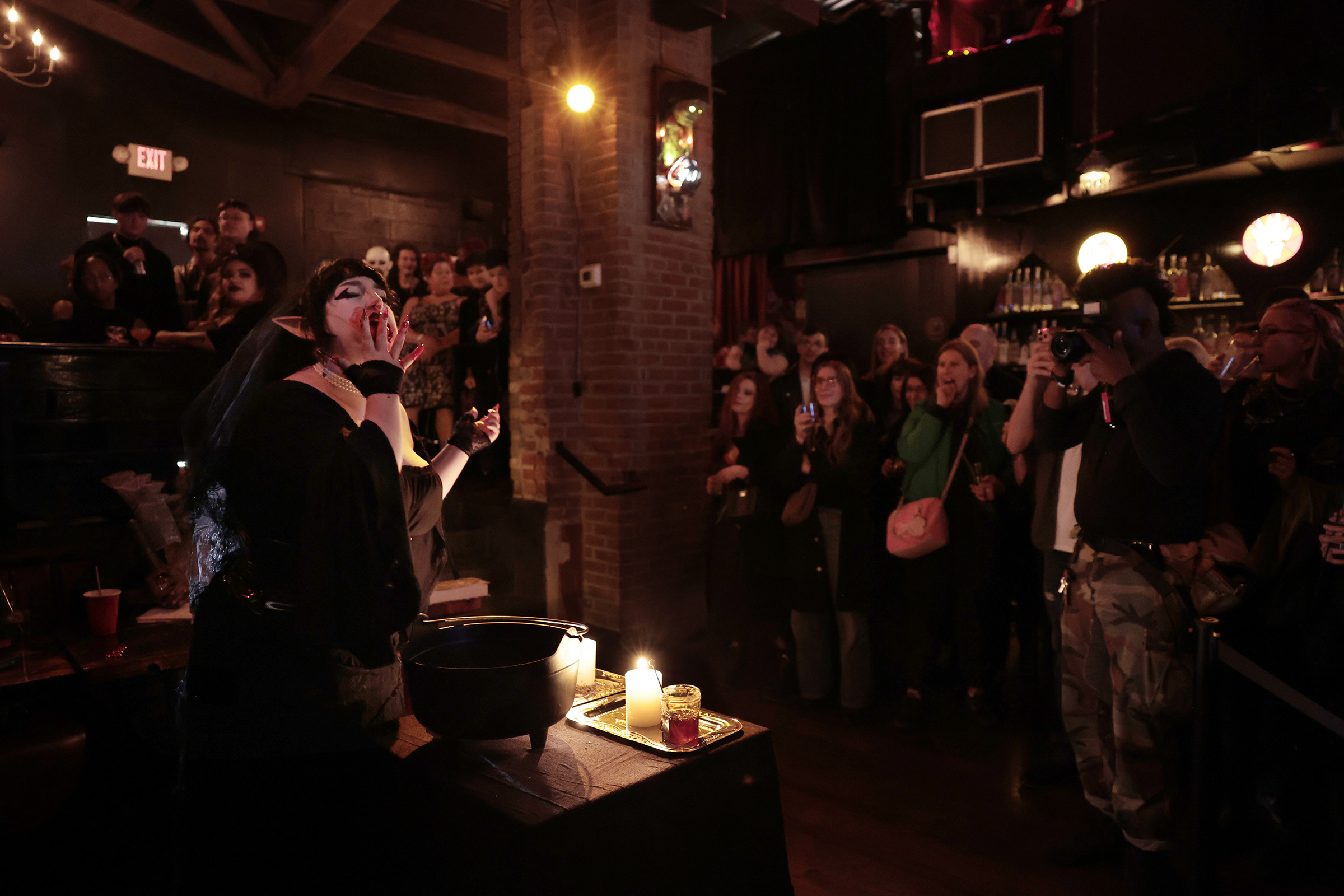
The crowd reacts as Ezra Markel’s vampire persona “Isolde the Saturnine” eats the human heart she concocted during the talent portion of the Miss American Vampire Pageant at heavy metal bar Doom in Philadelphia on Friday, Oct. 24, 2025.
Prizes included $100 cash, a new set of fangs, and comic books donated from Atomic City Comics. Skull and mixed metal artist Sue Moerder prepared a Bob Mackie-inspired gothic crown, with feathers and pearls sprouting from an arrangement of ornate obsidian gems.
“Vampires represent the alternative, the occult, the bat-brained, the gothic … [people] on the outskirts of civilization,” Delgado told The Inquirer. “We just wanted to show that this bar is a safe cave for vampires to commune.”
Both floors at 421 N. 7th St. were packed as contestants flitted across the makeshift stage in costumes that highlighted the full expanse of vampire-dom. There were homages to both the German and Transylvanian versions of Dracula in peasant blouses and bejeweled collars, as well as more contemporary interpretations, with floor-length evening gowns, corseted waistlines, and lots of red lips.
Lilith Lobotomy — a blue-haired vamp whose bio alleged she bakes cakes and stalks billionaires — was an immediate favorite, earning thunderous applause when she turned away from the audience to drop her floor length duster. Emblazoned in sparkling blood red font on the back of her black dress was the phrase “Eat the rich.”
Logan Laudenslager performs as “Lilith Lobotomy” during the talent portion of the Miss American Vampire pageant held at Doom. She performed a rendition of “Phantom of the Opera.”
Madame Lobotomy would go on to win the coveted title of Miss Off Putting — Delgado’s spin on Miss Congeniality — after belting out the song “The Phantom of the Opera” while twirling a lit candelabra.
She was still no match for Norah Morse, who took home the Miss American Vampire Philadelphia crown after shocking the judges with her interview. When asked how she prepared for the competition, Morse scoffed.
“I don’t know what you mean,” she said in a thick Transylvanian accent. “I’m a vampire and I showed up.”
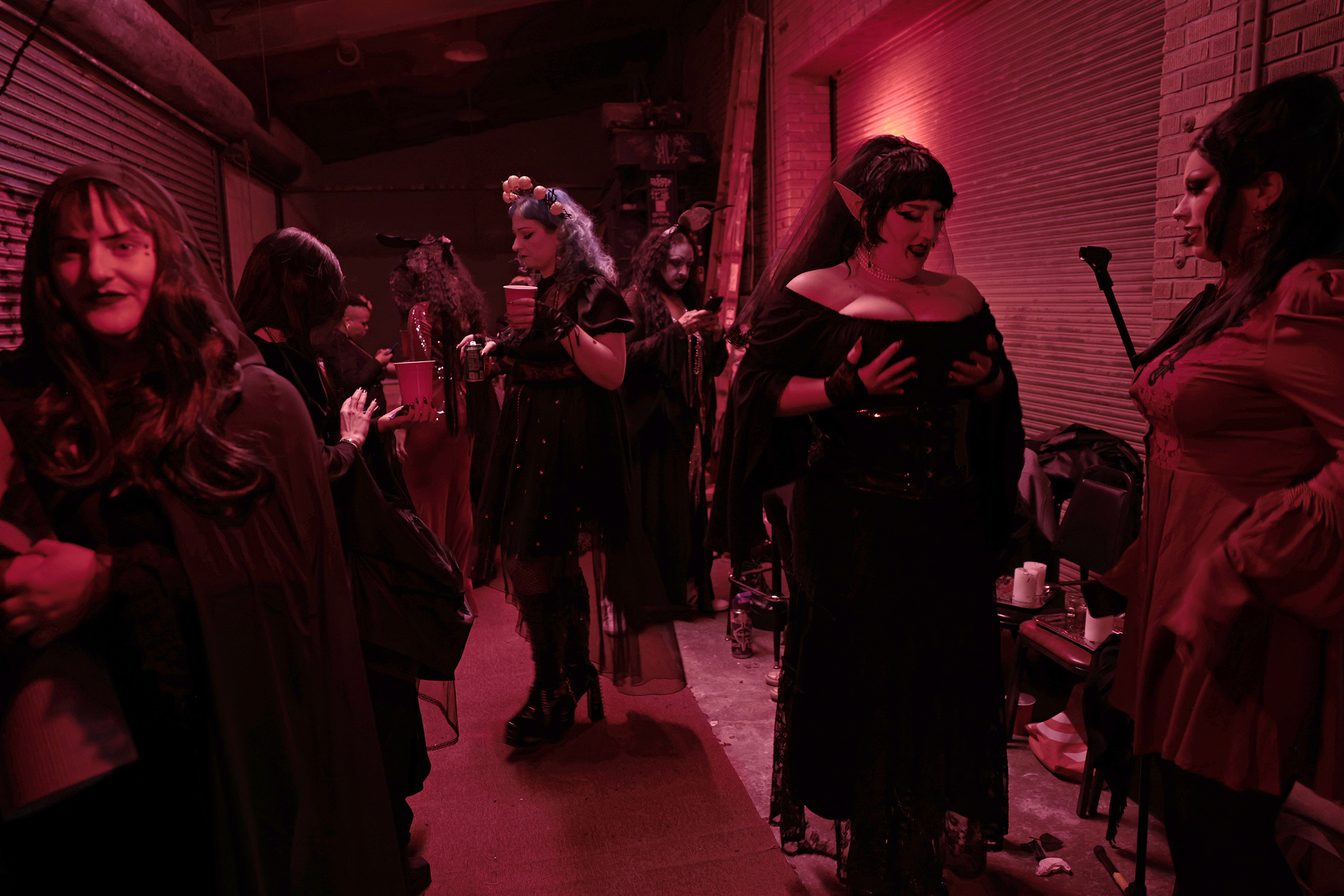
Contestants get ready backstage to performing during the Miss American Vampire Pageant at heavy metal bar Doom.
Judge and burlesque performer Caress Deville said Morse represented the commitment she was looking for. “I was gagged,” Deville said. “That’s exactly how you would answer if you were a real vampire.”
During her crowning, Morse’s human mother rushed to the front of the crowd to take photos. Even vampires, it seems, yearn for mom’s approval.
In the world of us mortals, Morse goes by Alex Decker, a 29-year-old from Bellmawr who has been drawn to vampires since she was a child. Decker lives with contamination OCD, she said, and envies the freedom of the undead.
“Life would be a lot easier if I was a vampire who could just drink blood all the time,” Decker said. “I have been weird and creepy and insane my entire life.”
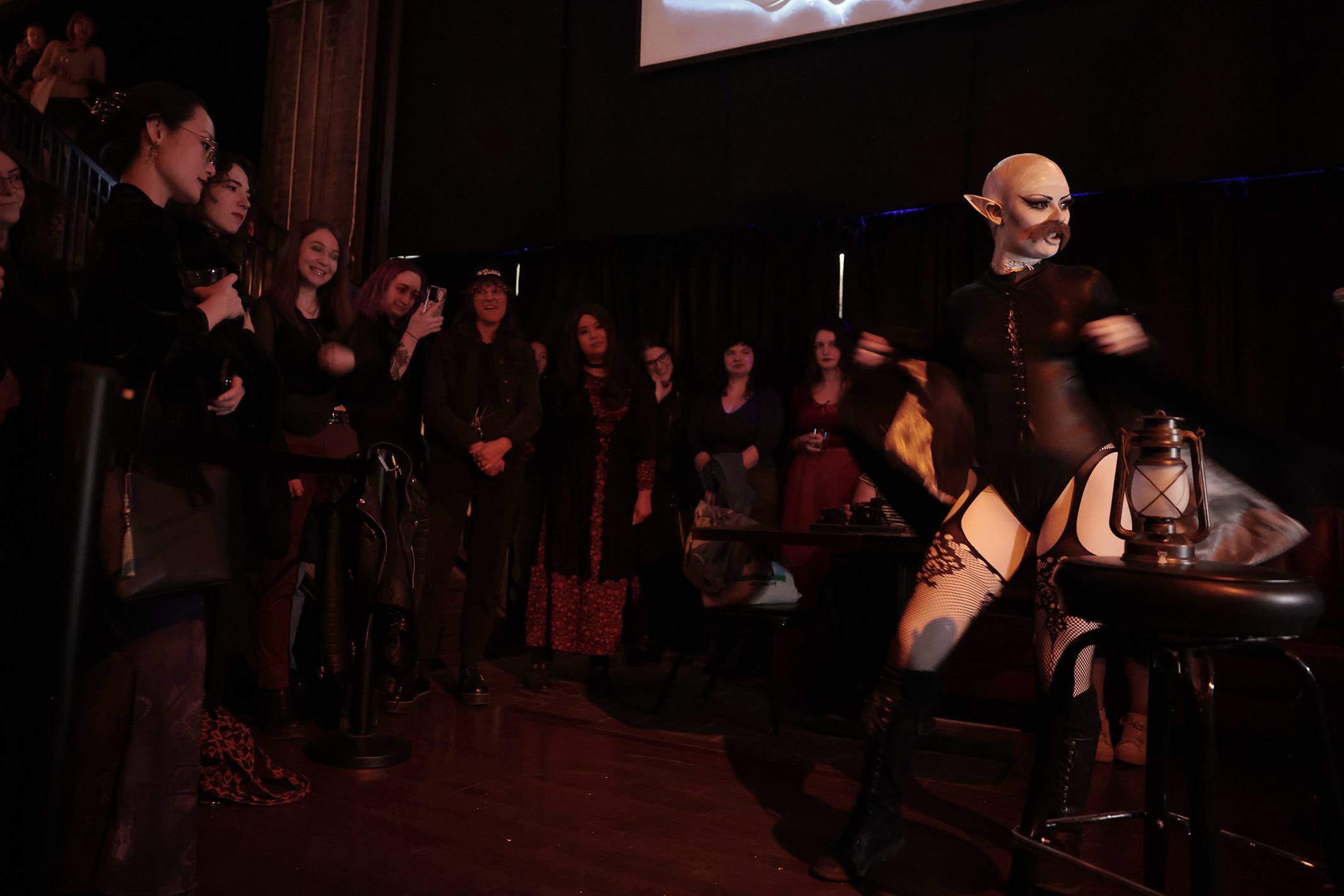
Jenna Painter, of Willow Grove, performed as a naughty ‘Count Orlok” during the Miss American Vampire Pageant at heavy metal bar Doom, throwing off a trench coat to reveal a leotard and garters.
Competing to be America’s next top vampire
For some contestants, Miss American Vampire Philadelphia was an opportunity to transform their mortal selves into bolder and braver versions that were battle-tested from centuries of living.
When Doom announced the pageant on Instagram in early October, the post received more than 4,500 likes, Delgado said, and hundreds of shares. More than 50 hopefuls sent in applications via a Google form that asked for their vampiric backstory and talent, forcing Holden and Delgado to spend hours deliberating.
Delgado was unsurprised that the pageant took off. They were, however, shocked by the lack of trolling.
“I didn’t know how serious everyone who applied was at first,” Delgado said. “It’s supposed to be campy.”
On Friday, the beauty competition toed the line between a drag show and an actual Miss America preliminary. The judges pressed contestants on tough questions, such as how they choose their victims, and if it’s ethical to let them live post blood-sucking.
For Mira Castigin, of Camden, the most important quality to look for in a vampire is fun.
“What’s the point in being immortal if you let life pass you by?” she told the crowd.
Castigin’s vampiric persona is Elmira, a bewitching goth girl who shares Castigin’s day job as an EMT in hopes of atoning for her sins. The competition was an excuse for Castigin to air out some special pieces from her vintage clothing collection, including a petticoat and a pair of London Underground shoes.
Mira Castigin’s vamprie persona “Elmira” is applauded after performing during the Miss American Vampire Pageant at heavy metal bar Doom. For her talent, Castigin sang opera.
“I think it’s always fun to do your makeup and get dressed up no matter what day it is,“ Castigin, 25, of Camden, said. ”And this is like a more thought-out version of that.”
Castigin opened the talent portion by singing an operatic aria, setting up the audience for a night of bewitching tricks. One vampire played the violin, while another danced an Irish jig to a Type O Negative song. Cassius King — a silent movie star turned vampire — wowed the audience by performing feats of strength, at one point picking up his assistant and turning him upside down.
Rachel Rushmore — aka “Vampire Rachel” of Philadelphia — waits backstage during the Miss American Vampire Pageant at heavy metal bar Doom.
Rachel Rushmore, 34, of Fishtown, had a simpler talent, using sleight of hand to summon a tiny bat. Rushmore said she felt called to compete after 15 friends — including several who don’t even live in Philly — sent her Doom’s Instagram post.
Onstage, Rushmore transformed from mortal Rachel to Vampire Rachel, a temptress and philanthropist who had been around since “the age of powdered wigs and Ben Franklin.” Vampire Rachel wears maroon floor-length gowns and bedazzles her face with gems borrowed from Marie Antoinette. The real-life version works in children’s book publishing and had never performed in front of a crowd before.
“I called myself Vampire Rachel because it’s hard for me to be somebody who I’m not,” Rushmore said. “Tonight I’m Rachel, but more.”
When the Eagles and Giants squared off in Week 6, Saquon Barkley rushed for his third-highest total of the season.
He finished with a meager 58 yards, which tells you a lot about how Barkley’s second year in Philadelphia has gone.
Barkley has been held below 100 yards on the ground in each of the Eagles’ seven games. Through his first seven games in 2024, he rushed for an average of 109.4 yards, more than double his average of 52.7 in 2025.
Despite the dip in production, there is a sense of optimism in the NovaCare Complex that Barkley could be close to breaking out, as a rematch with his former squad looms Sunday at Lincoln Financial Field.
Much of the hope comes from the Eagles’ offensive performance last weekend in Minnesota, where the passing attack erupted behind an under-center, play-action flavored game plan.
The wrinkle wasn’t revolutionary, but it did give the Eagles a new look.
“It’s going to be fun or interesting to see how teams play us now,” said left tackle Jordan Mailata. “We can go under center and pass the ball, we can go under center and run the ball, so it’s going to be fun. I hope [opponents] respect one or the other. They have to now.”
Why have Barkley and the run game struggled so much?
First, defenses are playing them differently this year.
It’s been obvious live and on film that the Eagles are getting fewer lighter boxes to run into. Last year, the Eagles faced a light box 44.9% of the time, which ranked 15th in the NFL.
This year, there’s been a 20% decrease to 36.8%, which ranks 29th.
It’s a numbers game the Eagles are losing, particularly when it comes to their preferred zone blocking scheme — especially when defenses have five- and six-man fronts.
“When you go against a six-man front, now it’s one-on-one everywhere, and then there’s a guy sitting back there for the running back that’s unblocked,” said left guard Landon Dickerson.
Expecting all five offensive lineman to win their one-on-ones is a tough ask, and, in some cases, tight ends or a sixth offensive lineman are acting as a tight end.
One way to counter a heavy front is with gap scheme runs.
On a very rudimentary level, gap scheme runs, unlike zone runs, have pullers: an offensive lineman pulling as the lead blocker. These types of plays were responsible for some of Barkley’s most explosive rushes last year.
In gap schemes, the blocks are designed for a specific gap. In zone runs, the linemen block zones and work to the second level to create multiple lanes that the running back can choose to run through.
“I think zone, it’s pretty simple,” said Mailata. “If the play is an inside zone left, you’re stepping to an inside zone to your left.”
The inside zone run can come in many forms and has been a staple of offensive line coach Jeff Stoutland’s run scheme since he first arrived in Philadelphia in 2013. Every team runs it, but he may teach it better than anyone.
The Eagles, however, are having a hard time executing it this year because of the heavier boxes they’re facing and more five- and six-man fronts, and also because defensive coordinators are coming up with exotic strategies to slow the inside zone run down.
By running into bad looks on early downs, the Eagles haven’t done themselves any favors. It has burdened the line, forced Barkley to cut away from the flow of the blocking, and instead made him try to beat defenders on his own.
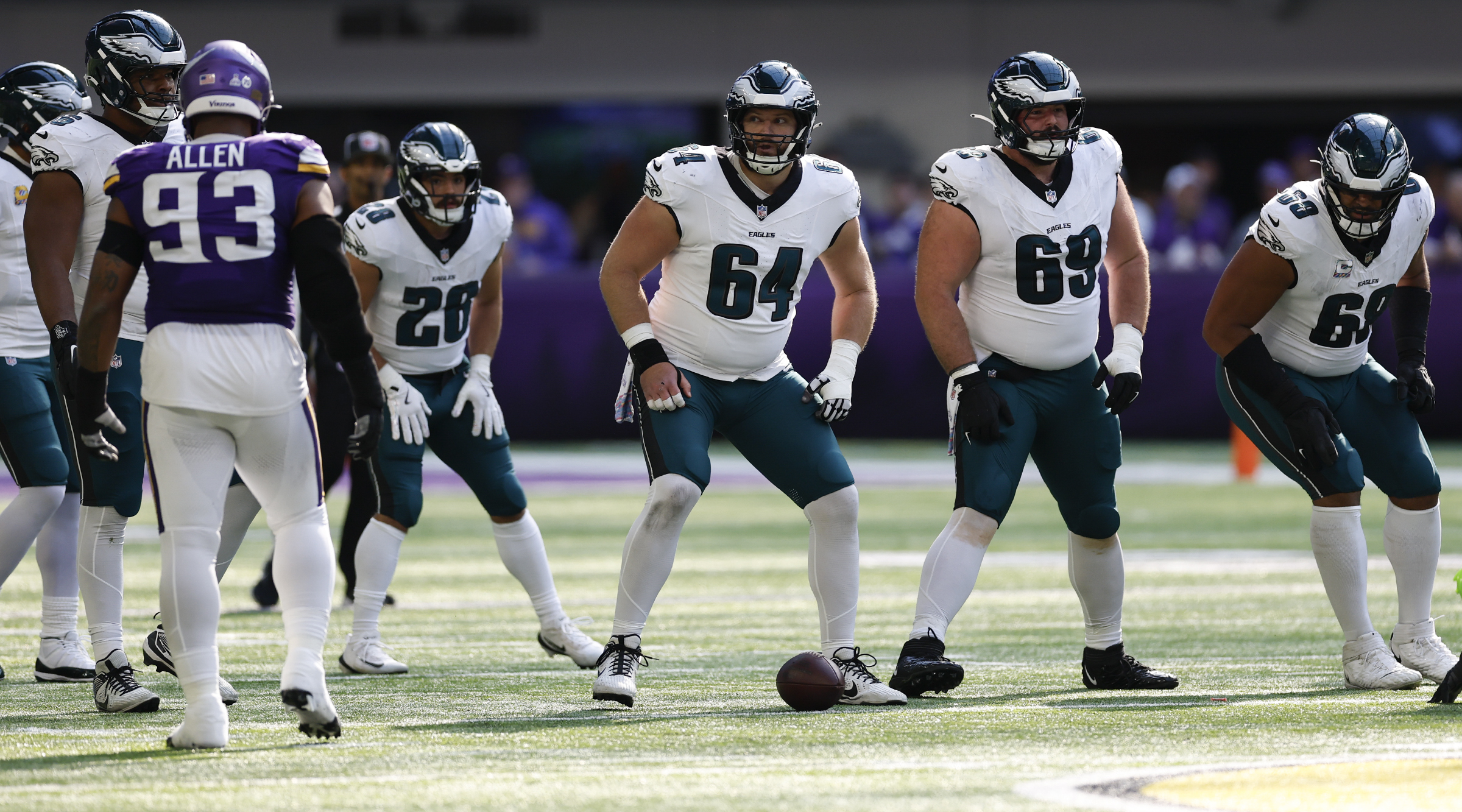
Brett Toth with teammates Landon Dickerson and Jordan Mailata at the line against the Vikings on Oct. 19.
This chain reaction is essentially what happened last Sunday when the Vikings defense, after the Eagles enjoyed modest success in the run early, adjusted on the Eagles’ third drive and started stacking the line.
The Eagles, however, had a counter of their own. Even though their initial production on the ground diminished, it still served a means to an end.
They came into their matchup with the Vikings wanting to establish under-center runs so that they could eventually use play-action passes downfield. It’s an obvious way to beat stacked boxes — to keep linebackers and safeties from cheating to stop the run.
The Eagles didn’t do much of it through the first six weeks of the season, but right tackle Lane Johnson, along with fellow linemen Dickerson and Mailata, advocated for more under-center plays during the mini-bye that followed the Eagles’ loss to the Giants on Oct. 9.
“It’s really beneficial for us,” Mailata said. “It’s just protecting our C.Y.A. — cover your [butt]. That’s the way I see it. There’s so much potential. You don’t know if it’s a pass, if it’s a run, if it’s a play-action.”
Jalen Hurts said after the Vikings game that he also recommended more under-center plays.
Through the Eagles’ first six games, he was under center only 14% of the time, throwing out of it only once.
In Minnesota, the Eagles were under center 41% and threw out of it four times. Hurts completed those passes for 121 yards, including the 79-yard touchdown pass to receiver DeVonta Smith that opened the second half.
“I think, conceptually, there’s a way to do quarterback run game from under center,” said Hurts, who usually ranks in the top five in the NFL in shotgun or pistol plays. “It’s just a matter where we are creatively, in what positions we put ourselves in.
“Not to get too much into schemes, it’s just more so how we choose to attack a team that week, and the level of execution that week.”
With receiver A.J. Brown (hamstring) already ruled out this Sunday, the Eagles will be down a key playmaker.
Barkley, who’s averaging just 3.3 yards per carry and ranks 36th out of 40 qualifying running backs with the expected points added number of -22.3, doesn’t want to hear about defenses focusing their efforts on him.
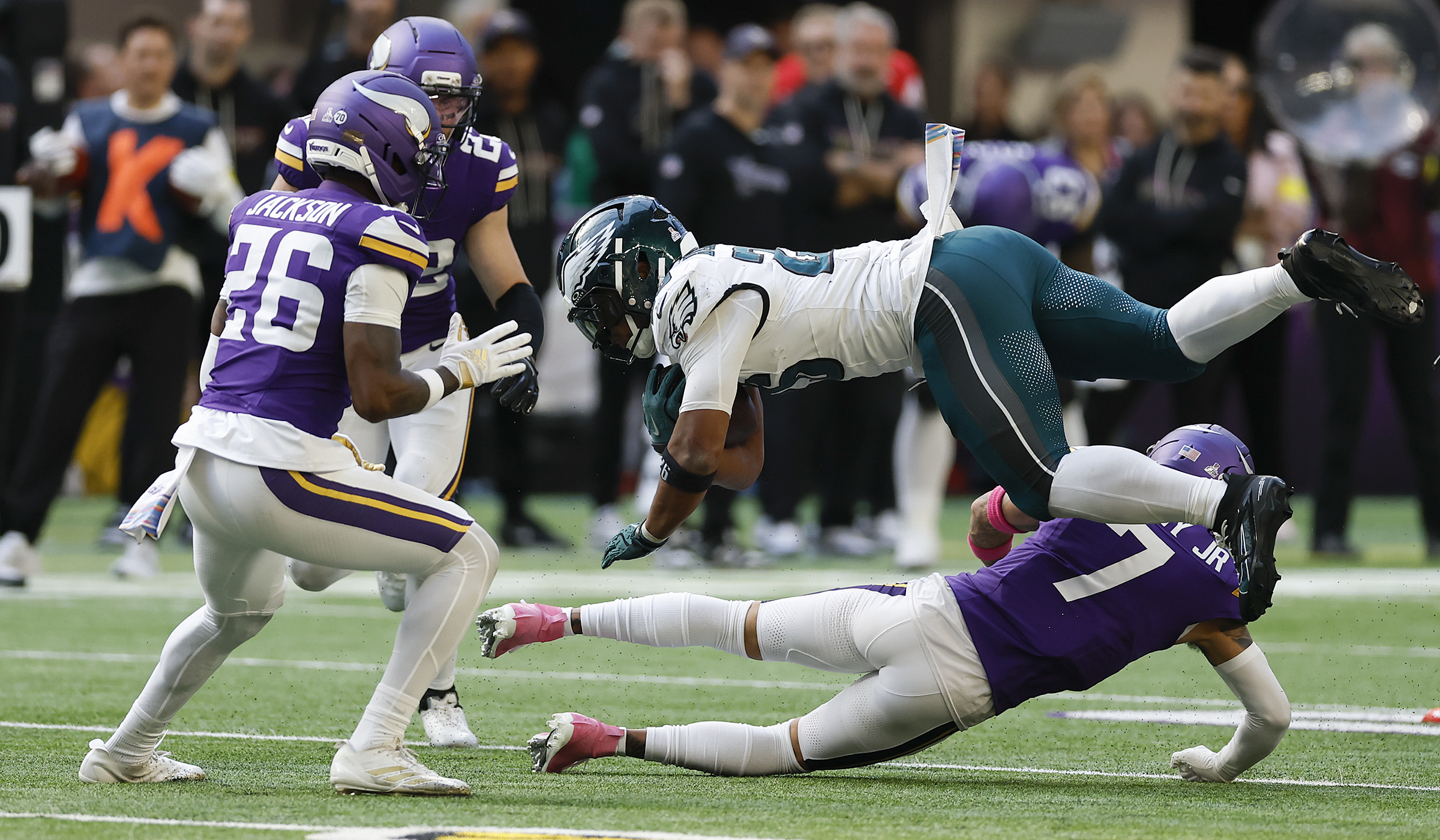
Barkley leaps past Minnesota Vikings cornerback Byron Murphy in the fourth quarter on Oct. 19.
“No, I don’t, I don’t agree with that,” said Barkley, cutting off a reporter who asked about the premise.
He said he was brought here to make plays, and right now, he’s not giving the Eagles enough of them.
“I’m taking too many negative runs, and I own that. It’s not because I rushed for 2,000 yards last year. I hate that narrative. We just had a different attitude, had a different mindset.”
Barkley already has 21 negative-yard runs this year, accounting for 18.6% of his 113 carries — nearly double his percentage from last season.
Barkley said after the Eagles’ 28-22 victory in Minnesota, the bottom line matters more to him than rushing numbers.
“Am I satisfied? No. We’ve got a lot of room to improve, but it’s good to get a win in a tough environment.”
There were a lot of questions about Barkley’s workload this season following the near-500 total touches he had in 2024.
There’s also the matter of his age. Barkley turned 28 in February. While that number is young for most, it’s around the time that running backs often start to decline.
According to the NFL’s NextGen Stats, Barkley’s rushing yards-over-expected, an advanced metric that measures how many more yards a player gains than expected, is -0.1. Last year, the mark was a superlative +1.6.
He’s also seen his average yards after contact drop from 3.4 to 2.8, and he’s averaging about three fewer touches per game in the regular season (a decline that could be related more to the run game’s ineffectiveness than the Eagles’ taking a decided approach to reducing Barkley’s carries).
Despite the decrease in his raw numbers and advanced analytics, Barkley still looks explosive and elusive enough on film.
“You guys see somebody different?,” Dickerson said. “He looks the same to me. I don’t think somebody killed him and started dressing up as him.”
Eagles coach Nick Sirianni refused to buy into Barkley’s own claim that the run game starts and ends with him.
“It’s on all of us,” Sirianni said. “We’re working like crazy to figure it out, and I think we’ve had some good thoughts. Now, we got to go put it to work.”
NEW YORK — Here’s something that Union principal owner Jay Sugarman has in common with his team’s fans.
He, too, has spent much of this year seeing Lionel Messi, Son Heung-Min, and Thomas Müller dominate the headlines, even though his team topped them all in the standings.
And he, like those fans — well, let’s keep things polite in the C-suite — would like to see the spotlight spread out a little more.
“Any press for MLS, I’m good with,” he said. “Messi’s been fantastic for this league. Son’s been fantastic, Müller’s fantastic. We don’t want to take away their press. We just want more coverage for a different kind of story.”
So Sugarman decided to put himself out there this week. The Union invited a group of media outlets, including The Inquirer, to MLS headquarters, and Sugarman held court, as he spent an hour talking about the success of his team.
Jakob Glesnes (left) and the Union could see Lionel Messi and Inter Miami again in the playoffs.
“We’ve got to show it on the field,” he said. “But so far the results, you know, I think are worthy of people paying attention. And saying, whether it’s a player or a fan: ‘Hey, I kind of like that team. They work really hard, they don’t ever give up, they’re a tough team in a tough city, and they bring it every game.’”
Sugarman praised manager Bradley Carnell’s work this year, and Ernst Tanner’s work over many years. He praised the players for their feats and the culture they’ve all built together.
He laid out a series of impressive statistics: the fewest goals conceded this year, and the most total shots taken, corner kicks won, tackles, interceptions, and counter-press regains — those moments when high-pressing forces turnovers.
“It was a bit eye-opening to see how many categories we could track to say, when does a defense become offense?” Sugarman said of conversations he had with Tanner about this very subject.
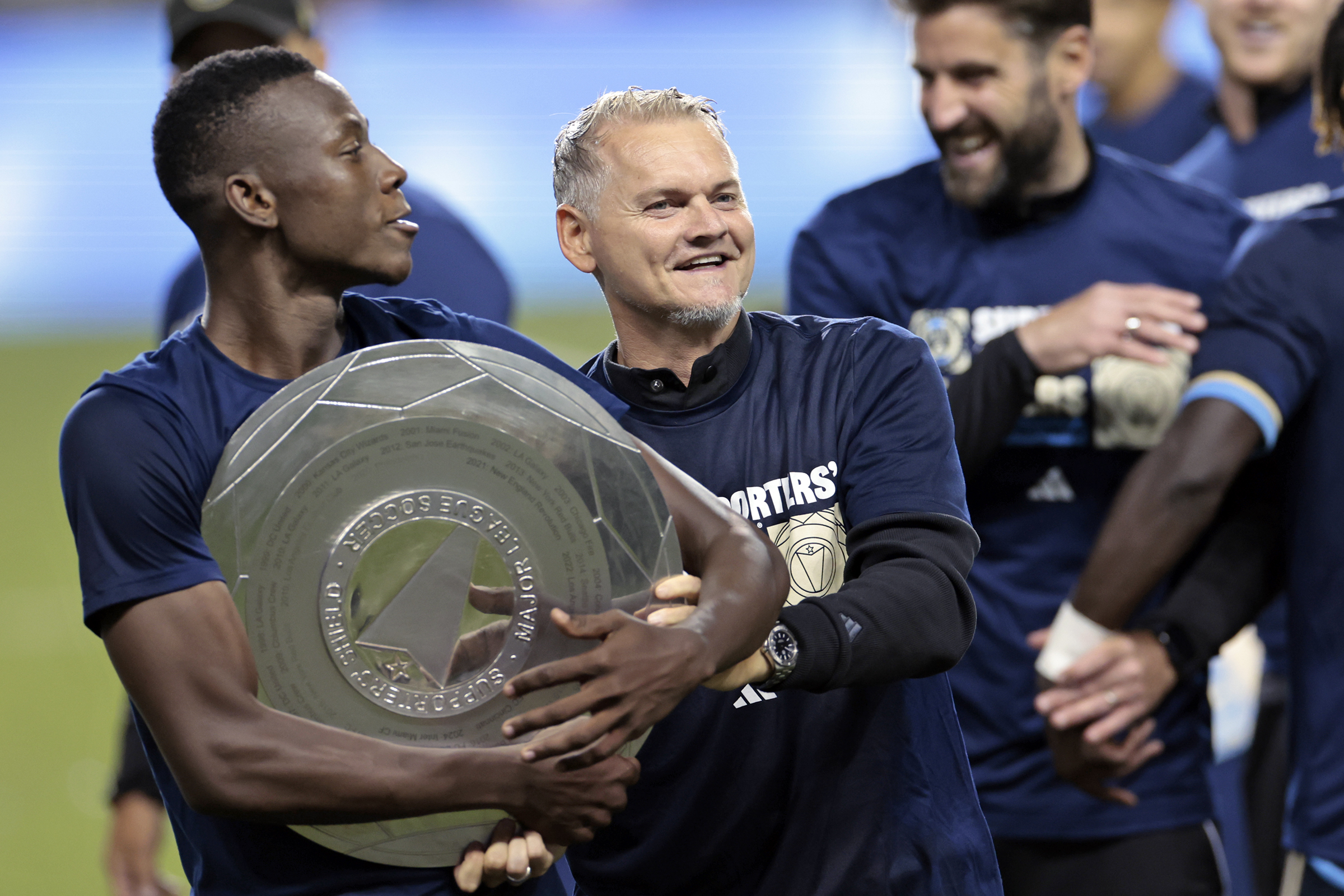
Bradley Carnell (right) helped the Union win the Supporters’ Shield in his first year as the team’s manager.
This all came as the Union recorded the league’s worst pass completion percentage, the lowest number of touches in their own half, and the second-lowest number of one-on-one take-ons. But they also had the most goals scored from crosses.
A surprising admission
Sugarman then ran all this through the eye test.
“It means we’re putting the ball in places where the defense has to put it out of play — that’s their best choice,” he said. “But where we do pass to, where we do touch the ball, is usually pretty dangerous, and it leads to dangerous things, crosses, shots, corner kicks, throw-ins deep. Anything in that deep attacking zone, I think Ernst would tell you, is a good place to be.”
Then he offered something that many outsiders have felt instinctively, but might have never expected the team to admit.
“We don’t rely so much on guys creating their own shot,” Sugarman said. “We don’t expect people to dribble through defenders. … We’re not about individual moments of brilliance breaking down a defense. But we will get into dangerous places, and our team working together will create opportunities.”
Kai Wagner (left) and Tai Baribo are some of the players who most symbolize the Union’s direct style.
The payoff for all of this has come in the statistics that matter most.
The Union have totaled the most standings points of any team in the league since 2020, and the second-highest total since Tanner’s first full year in 2019. They’ve won two Supporters’ Shields for the league’s best regular-season record, made the playoffs every year but one along the way, reached two conference finals, and came a breath from winning it all in 2022.
Sugarman believes in an organizational philosophy of continuous improvement, and there has been a lot in recent times. He also knows as well as anyone that the hardest part of improvement in sports is the last part.
Jay Sugarman was in a celebratory mood when the Union won their second Supporters’ Shield earlier this month.
A reporter from a sports business publication asked Sugarman how the team’s success on the field has translated to the team’s bank accounts.
“It’s a lot more fun to be part of a successful club,” he said to start his answer. “So we know that’s a helpful part of the conversation with sponsors and fans.”
“Our goal right now is to win a [MLS] Cup,” he said. “You can feel it in the players, you can feel it in the coaching staff, you can feel it at the ownership level. It feels like the one thing we haven’t quite gotten our hands on.”
Jakob Glesnes (center) is one of the players still left from the 2022 Union team that came so close to winning the MLS Cup final.
Now the heart of the matter was truly on the table. For as much as this year has been better than expected, there’s been real pressure on the Union to turn these many years of success into trophies.
It’s why there have been stern demands to win a U.S. Open Cup. It’s why, once that quest failed this year, the pressure skyrocketed to win the Supporters’ Shield.
It’s why the air was so thick as kickoff approached on the night they clinched it, earlier this month against New York City FC. And it’s why there was such an explosion of joy around Subaru Park when that final whistle blew.
“Everybody knows this is the best sports town, maybe the toughest sports town,” Sugarman said. “We said, maybe our MLS tagline should be ‘the toughest team in the toughest city with the toughest fans.’ They want, they demand, success — we knew that going in. So we can’t deliver anything less than that for them.”
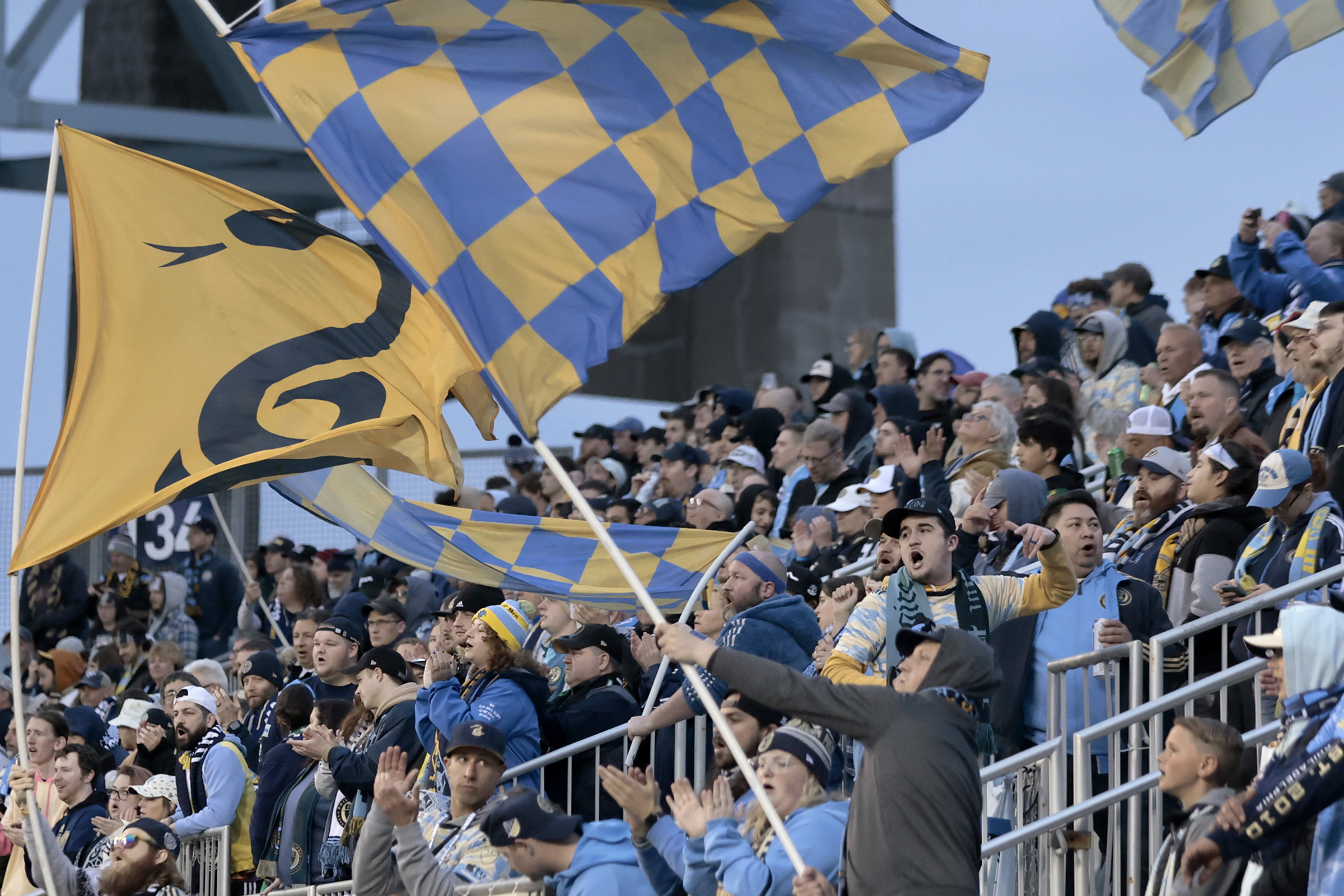
The Union will play all but one of their playoff games this year at Subaru Park.
He was still willing to defend his long-term vision for reaching success, even as he knew those same fans want it faster. But that’s for another moment.
This moment — this month, this week, this Sunday evening playoff opener against the Chicago Fire at Subaru Park (5:55 p.m., FS1, Fox Deportes, and Apple TV) — is about right now.
“It’s great that we’re going to be at home. Our fans are going to give us that extra 10%,” Sugarman said. “I think this is the year that everybody feels like we need to do everything we can.”
He caught himself for a breath, but not much more.
“It’s hard to put the kind of pressure on to say we must do it,” he said, “but this feels like the moment where — I’ve watched the joy on this team when they win. It is infectious. When they get rolling, I think it’s going to be hard to stop this.”
A few years ago, he was driving with his then-11-year-old daughter when she asked where roads came from.
“The government,” Gibbons responded.
“What’s the government?” his daughter asked.
That led to a longer explanation and eventual father-daughter trip to a Gloucester Township meeting so she could see the government in, ah, action. Having covered many local government meetings and school boards long ago, I can attest that Gibbons went beyond any parental or civic duty.
Gibbons continued to attend the meetings when a proposal to dissolve the Municipal Utilities Authority (MUA) caught his attention. He feared the township was planning to sell the water and sewer system.
But during sworn oral testimony in a May 2023 teleconference, an attorney representing the township said there was no expectation the utilities would be sold within the next five years. Mayor David Mayer agreed.
Yet, a year later, the township council voted to sell the sewer system to the highest bidder.
“They lied to us,” Gibbons said.
The township received two bids from large for-profit water companies: Aqua offered $52 million, and New Jersey American Water bid a whopping $143 million, plus a promise to make an additional $90 million in capital improvements to a system that only needed an estimated $25 million in repairs.
Something didn’t smell right. Even for a sewer system.
Keith Gibbons (middle) joined Ira Eckstein and Denise Coyne at a rally opposing a plan to sell a South Jersey sewer and water utility in October 2024.
Coincidentally, Mayor Mayer worked for American Water. In addition to his job as director of government affairs at the water company, his mayoral salary is $52,000.
To guard against any conflict of interest, Mayer recused himself from any discussion regarding the sewer sale.
Even still, American Water’s lucrative offer raised eyebrows. But generous bids are part of the for-profit playbook. Aqua offered Bucks County $1.1 billion for its sewer system, but the commissioners backed away after fierce public opposition.
For-profit water companies have been throwing big money at small towns in New Jersey, Pennsylvania, and beyond in an effort to scale up. The utility systems may not seem sexy, but they are mini monopolies that generate steady cash flow.
In Pennsylvania, a 2016 change in the law essentially opened the door for local utilities to be sold at higher prices. Local politicians are often happy to get the utility systems off the books and use the windfall to fund other projects or avoid tax increases.
But often left out of the negotiations are the ratepayers.
After the sales go through, the for-profit companies often jack up the rates. In some towns, after a brief rate freeze, the water bills have increased by 100%.
Rates have also increased at government-owned utility companies, but not by nearly as much. For example, Philadelphia recently increased water rates by 9%.
As utility bills grow, residents have nowhere to turn. Aging infrastructure, climate change, and increased demand, including to cool computer data centers, are expected to further drive up water prices in the years to come.
From left: Denise Coyne, Nancy Kelly Gentile, Gloucester Township independent mayoral candidate Keith Gibbons, and Ira Eckstein canvass supporters in Clementon, N.J., in September.
For-profit companies say they offer professional management and resources to make long-deferred upgrades, as well as the ability to purchase materials in bulk and spread the risk across systems as they grow.
Mayer said in an interview that the sewer sale would have enabled Gloucester to reduce property taxes, eliminate its debt, and make other improvements.
But critics argue that handing control to for-profit companies seeking quick returns on investments is shortsighted and results in higher costs to consumers. After all, water and sewer utilities are supposed to be a long-term public good, not a profit center.
To its credit, Gloucester Township scheduled a referendum last November to let residents vote on whether to sell the sewer system or not. A public vote should be a requirement, but most towns avoid referendums because the last thing they want is for taxpayers to have a say in the utility system they own.
The referendum gave Gibbons time to mount a grassroots campaign against the sale. He knocked on doors, handed out yard signs, and used a podcast to raise awareness.
But Gibbons seemed overmatched. His group spent roughly $3,000 opposing the sale, while New Jersey American Water spent about $1 million.
Yet, David beat Goliath in a landslide. More than 80% voted against the sale.
Gibbons, 48, a Cinnaminson High grad, who ran a Christmas tree farm and worked for Live Nation but is now self-employed and serves on the school board, became somewhat of a local hero in a town of 66,000 residents.
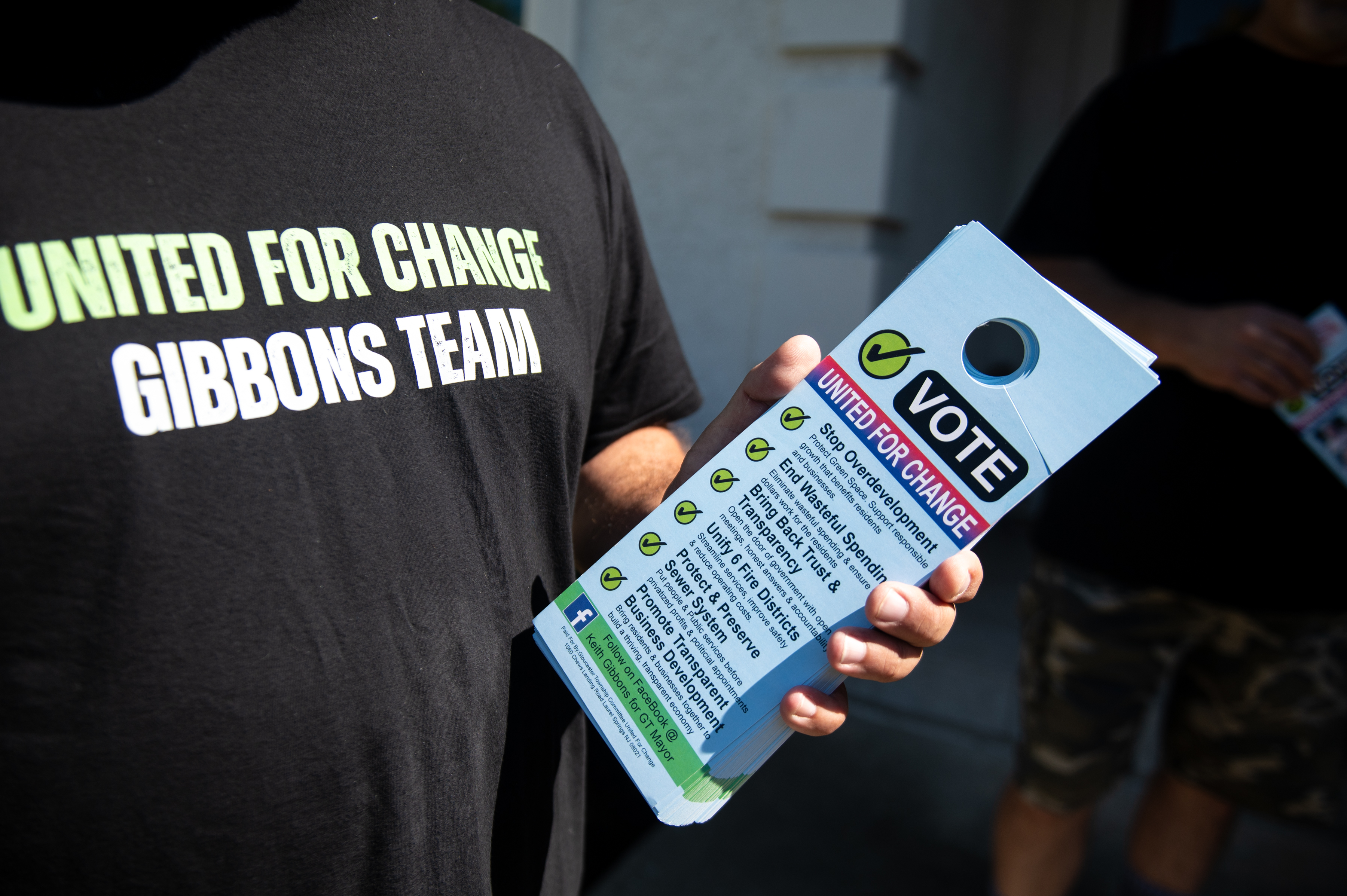
Gloucester Township independent mayoral candidate Keith Gibbons holds promotional materials encouraging constituents to vote for him.
Residents soon urged him to run for mayor.
Gibbons, a former Republican, is running as an independent against Mayer, who has spent his life in South Jersey politics, working for former U.S. Rep. Rob Andrews in the 1990s before becoming chief of staff in the Camden County Clerk’s Office.
He also served as a New Jersey assemblyman before getting elected mayor in 2010. Mayer’s wife is a Camden County freeholder.
Mayer is part of the Democratic machine that has controlled South Jersey for decades, but has recently shown signs of losing its grip on power. In Gloucester Township, there are still twice as many registered Democrats as Republicans.
The election has turned nasty. There are allegations that the Democrats tried to recruit a “phantom candidate” to run as a Republican to siphon votes away from Gibbons.
Mayer said Gibbons has been on the school board for three years, and “I don’t know what he’s touting as his accomplishments.”
Other attempts to muddy Gibbons indicate that the Democratic establishment may be nervous.
Is it because Gibbons has a sophisticated field operation?
“I don’t even have a campaign manager,” he said.
Does Gibbons have deep-pocketed donors?
“I’ve spent about $5,000 on the election,” he said.
What’s his campaign message?
“I’m not a political person,” Gibbons said. “I just want to fix local problems.”
Can an outsider with no political experience win?
Gibbons believes voters are fed up with South Jersey’s entrenched political machine, in which jobs and contracts often go to cronies. He argues no one is looking out for taxpayers who are often too busy to get involved, or believe they can’t do anything to change the system.
But his efforts to block the sewer sale show that one person — and a motivated electorate — can make a difference.
Mayer counters that he is proud to be a Democrat, and that the party’s strength has benefited South Jersey. He pointed to a list of accomplishments as mayor, from creating community policing to adding open space, attracting new businesses, and opening an office for veterans, adding that no party boss tells him what to do.
For his part, Gibbons said he supports term limits and smart development. He plans to focus on fiscal responsibility and government transparency. If elected, he promised the water and sewer system would not get sold to a for-profit company whose main mission is to maximize shareholder value.
“I don’t claim to know everything, but I do know enough,” Gibbons said.
Now there’s a campaign slogan for an accidental candidate.
Two Plymouth Township police officers were hospitalized Friday after a driver allegedly injured them intentionally with a vehicle in a hotel parking lot. The suspect is in custody.
Toys R Us will open more than two dozen flagship stores and holiday pop-up stores across the country by the end of the year, including two in the Philadelphia area.
A Delaware County man trolled a Philly Mag writer on Facebook. Now, a judge has ordered him to pay $160,000.
An estate and former convent in Chestnut Hill has been converted to host galleries centering on local artists by the Woodmere Museum. It opens to the public on Nov. 1.
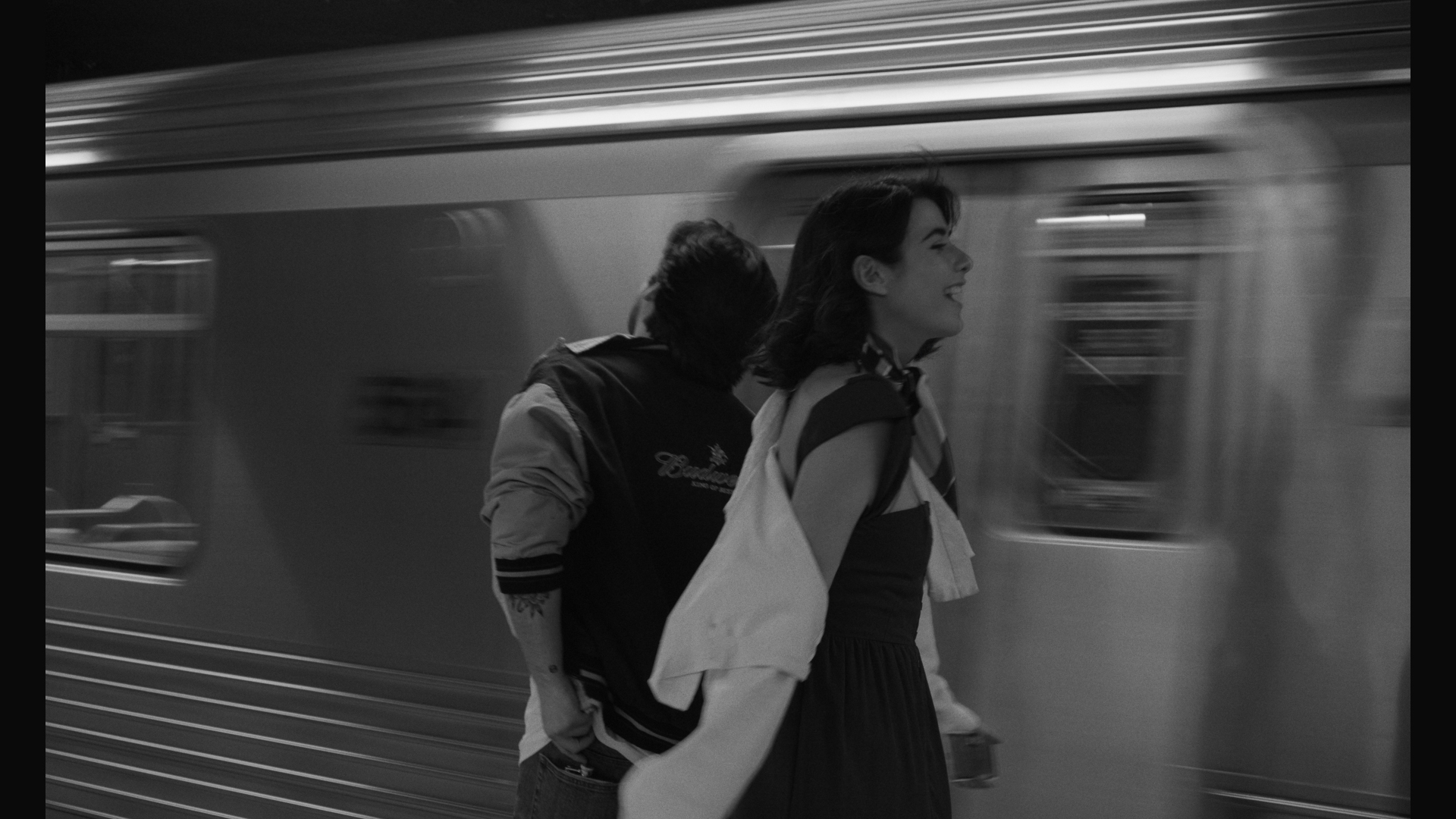
Every Saturday, we’ll talk about something happening around Philly that’s stuck in our minds. This time, it’s “Alice-Heart,” a movie directed by Mike Macera and starring Lissa Carandang-Sweeney, Tony McCall, and Adam McAlonie.
The city, seen through monochromatic lens all throughout, may as well have had acting credits. With the Schuylkill River Trail, the Broad Street Line, and food favorites like Crown Fried Chicken as the backdrop, the titular 20-something tries to find meaning and figure herself out in this quaint city full of possibilities.
Watching Alice-Heart was like watching a train wreck of the chaotic college student life, from the messy to the vulnerable and earnest. It was a sincere portrait of young, passionate people who find themselves trapped in a mess of their own making. The film also felt authentic to itself. I could tell that the people making it love Philly, and that they had fun telling this story. As for myself and the audience, if our collective reactions throughout were any indication, we certainly had fun watching it.
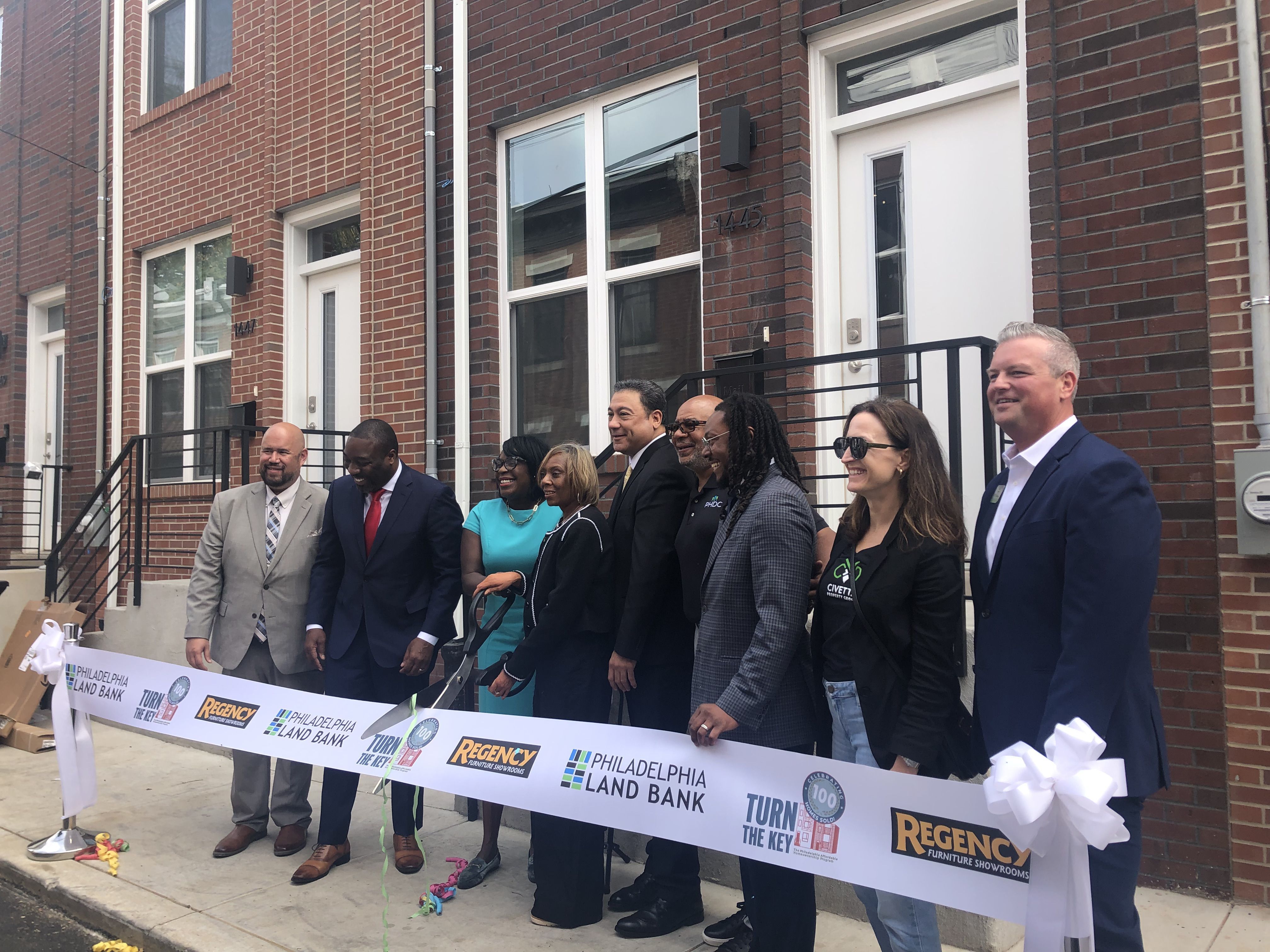
In 2013, Philadelphia City Council created the Land Bank to help the city acquire and sell vacant, blighted, and tax-delinquent properties. Despite its goal, the agency has been bogged down by dysfunction.
Somewhere in Philly, you can find the grave of Benjamin Franklin, marking the Founding Father’s final resting place (unless you believe rumors of his ghost still lurking around).
Where is it?
A) Penn’s Landing
B) Franklin Institute
C) City Hall
D) Old City
Think you know? Our new (weekly!) Citywide Quest game puts your knowledge of Philly’s streets to the test. Check your answer.
Cheers to Kathleen Wersinger who correctly guessed Friday’s answer: Carousel House. The West Philly rec center will be Philly’s “flagship.” But people with disabilities will have to wait until 2028 to reunite.
Seniors — both senior citizens and high school seniors — let their youthful spirits flow on the dance floor at the 12th annual Golden Age Prom in Cherry Hill on Thursday. Denali Sagner and staff photographer Yong Kim bring us this dispatch from the party.
Somewhere on the internet in Philly
A post on X declared: “the prettiest girl you know is probably an Eagles fan.” Naturally, a Philadelphian obliged, immediately proving the point.
When special education teacher Mike Surrency decided to use football to connect with sophomore Dave Siegel, there was only one problem.
Surrency is a big-time Philadelphia Eagles fan. Siegel is a die-hard New York Giants fan.
Despite cheering for rival teams, the two forged a friendship that began in 2009 in history class at Cherry Hill High School East and has expanded beyond school and football.
“I can’t get him to start liking the Eagles. I tried,” Surrency said. “He loves the Giants.”
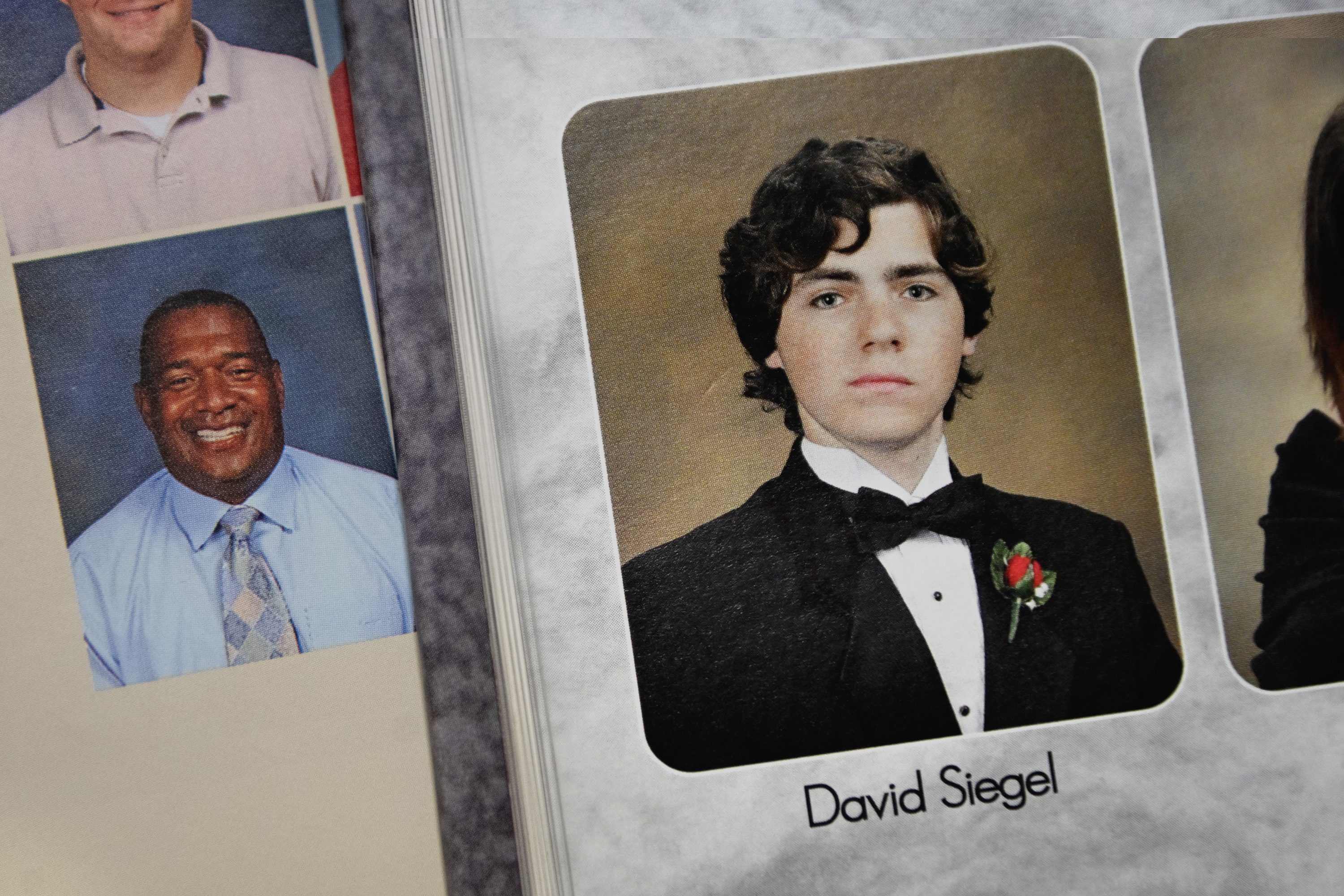
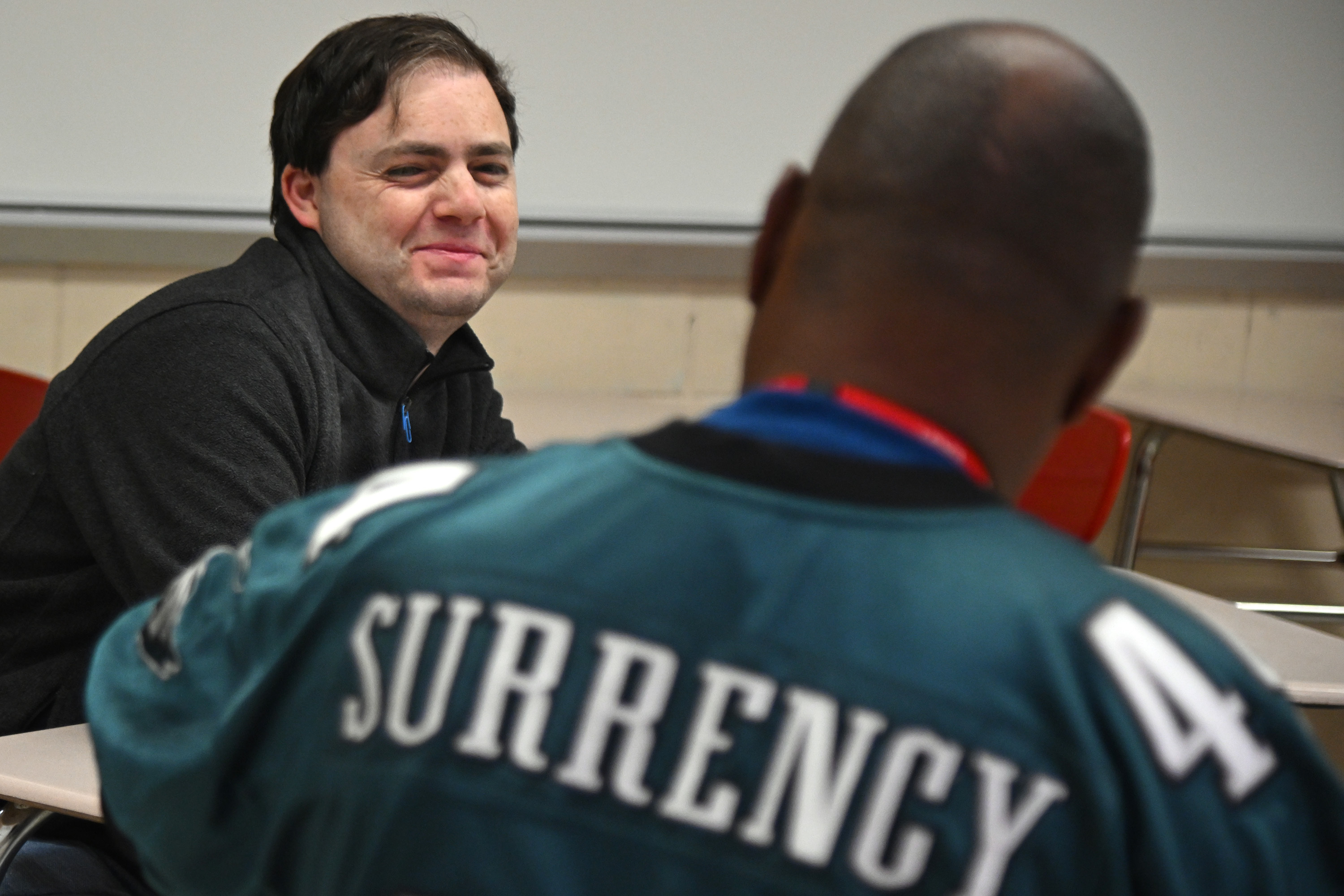
Senior class yearbook photo of Cherry Hill High School East Class of 2010 student and New York Giants fan David Siegel (right) next to page with teacher and Eagles fan Mike Surrency. The two developed a special bond while supporting rival football teams and began attending games together when the NFC teams played in Philadelphia. They will be at the Linc Sunday for the second game between the Eagles and Giants.
A former high school football player and coach, Surrency has been an Eagles season ticket holder since 1990. Siegel took notice when Surrency wore an Eagles jersey to school on Fridays during football season.
Surrency thought football would help him bond with hisstudents. As the inclusion teacher, Surrency helped ensure all students were integrated into the classroom.
“By far, the best teacher I ever had,” Siegel said.
One day, Siegel, then 15, asked his teacher to take him to an Eagles-Giants game at Lincoln Financial Field. (The Eagles won, 40-17.) That began a tradition that continued long after Siegel graduated in 2011.
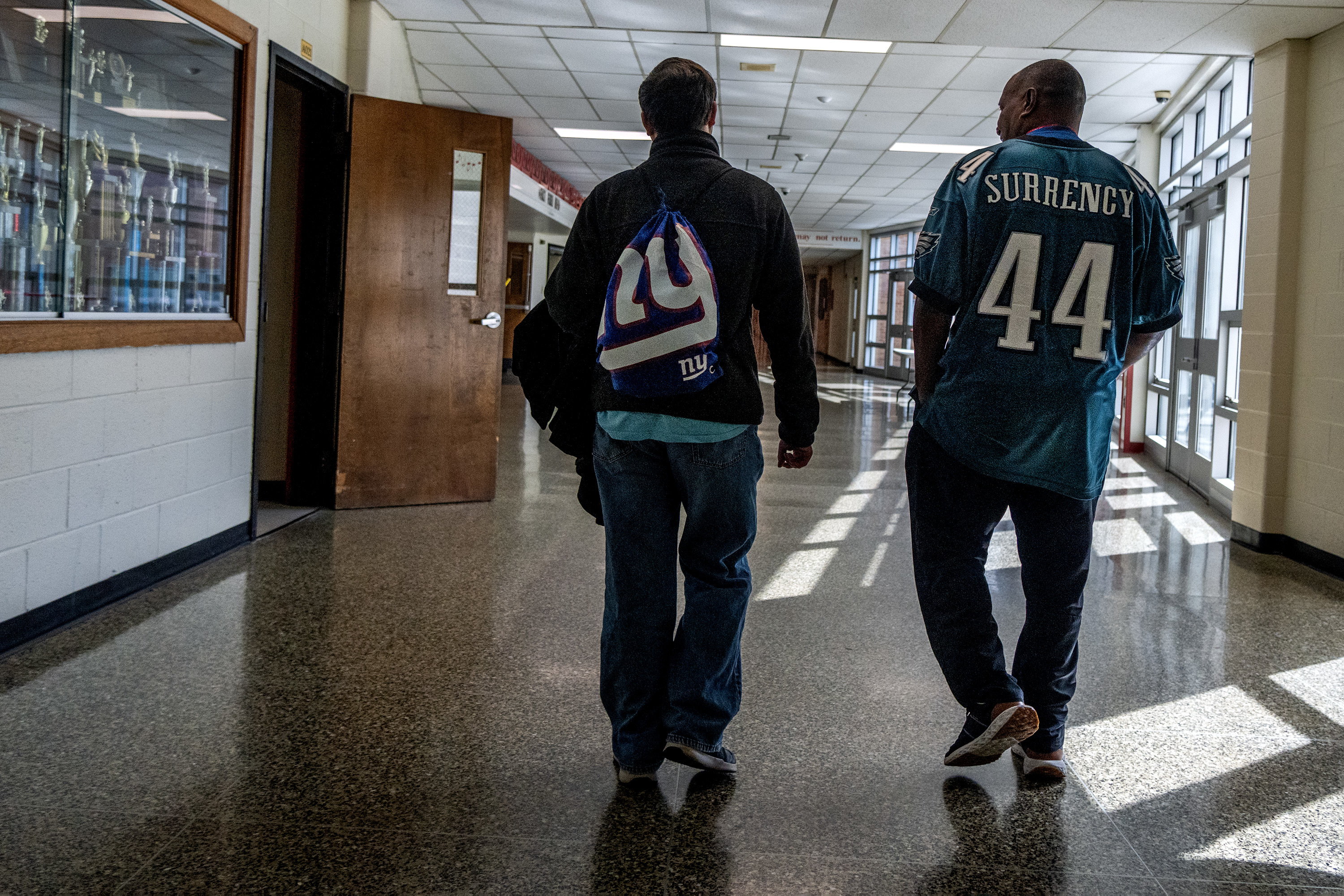
Cherry Hill High School East class of 2010 graduate and New York Giants fan David Siegel visits teacher and Eagles fan Mike Surrency at the school this week. The two developed a special bond while supporting rival football teams and began attending games together when the NFC teams played in Philadelphia.
‘He’ll protect me’
There will be plenty of traditions and trash-talking before Sunday’s game. The two plan to stop for hoagies on the way to the stadium.
Surrency plans to wear his favorite Eagles jersey. Siegel, 33, usually doesn’t wear Giants fan gear to a game, and especially not this time.
“As a Giants fan, I’m predicting an Eagles blowout,” Siegel said matter-of-factly. “The Eagles are at home and they want revenge.” (The Giants last won in Philadelphia in October 2013, 15-7).
Surrency said his fellowEagles fans in Section 228 have welcomed Siegel. At games leading up to the Giants showdown, they often ask if Siegel will be attending the big contest against their rival team.
“Of course he’s coming. This is his seat,” Surrency responds.
Siegel said he has no worries about possible backlash from zealous Eagles fans. He plans to wear a 76ers jersey — a favorite team for both him and Surrency.
“I’m not afraid of the fans,” Siegel said. “I know I have Surrency. He’ll protect me.”
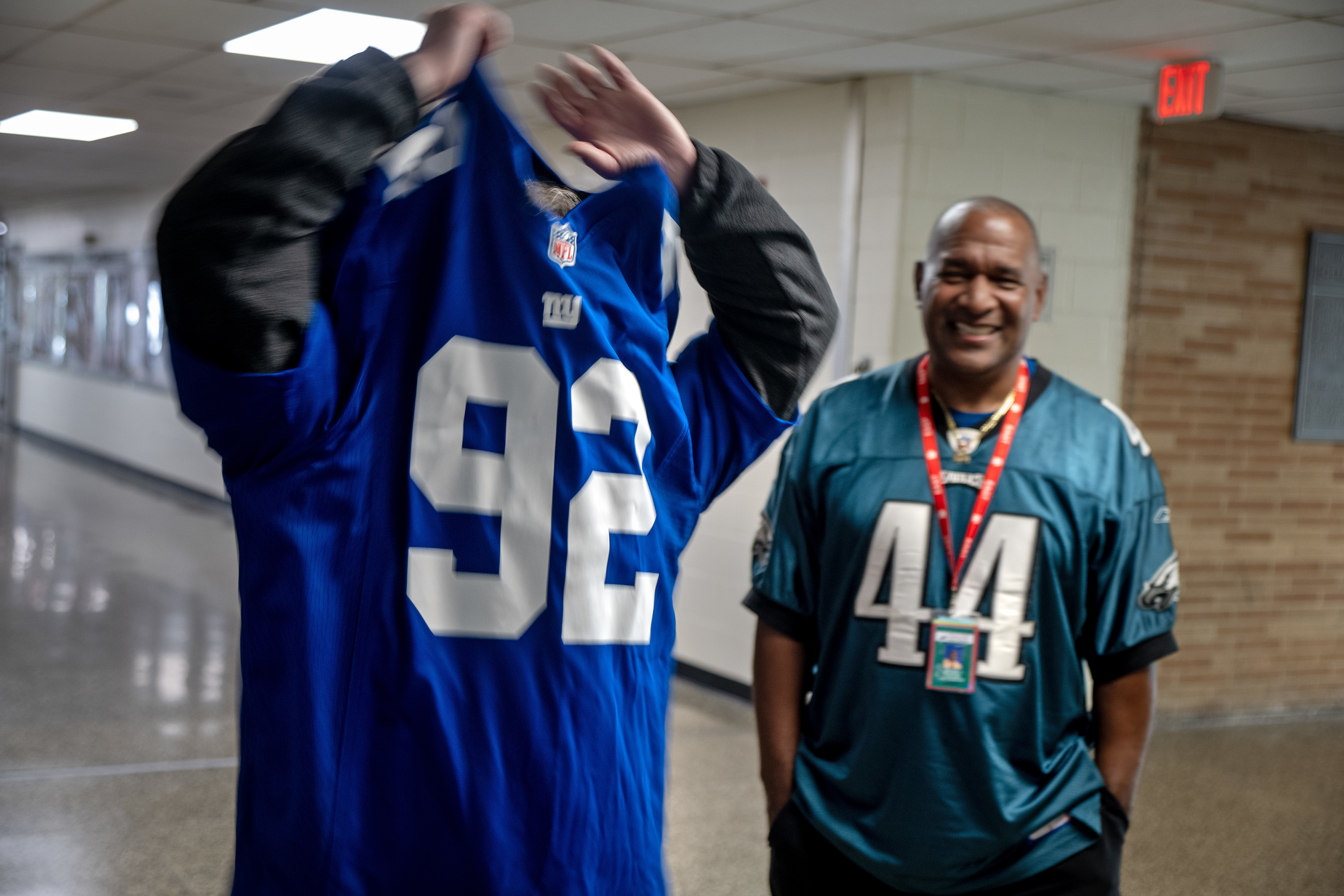
Cherry Hill High School East Class of 2010 student and New York Giants fan David Siegel quickly removes his jersey after posing for a photo with teacher and Eagles fan Mike Surrency during a visit at the school Monday. Seigel says he “never wears the apparel after they lose,” which they did the day before to the Denver Broncos.
Siegel can easily rattle off statistics about the Eagles-Giants rivalry. He has attended 14 games with Surrency; the Eagles won 12 of those.
The two occasionally travel up the New Jersey Turnpike to attend Eagles-Giants games at MetLife stadium in East Rutherford. They also attend baseball and basketball games.
Cathleen Lynch, a counselor at East, began sharing their story when she learned recently about the special bond between Surrency and his former student.
“It gave me goose bumps,” Lynch said. “It’s amazing that they’re still doing this every year.”
During a recent visit at East, Siegel and Surrency traded jabs about their teams. Surrency wore a custom-made Eagles jersey with his last name and No. 44 — from his high school football-playing days. Siegel wore former Giants defensive end Michael Strahan’s No. 92.
“I always tell people that Surrency is my mentor. I don’t see him as a teacher.”
“This thing we have is definitely bigger than football,” said David Siegel of his former Cherry Hill High School East teacher Mike Surrency. “It’s a blessing to have someone like him in my life.”
‘Bigger than football’
No matter the outcome of an Eagles-Giants game, Siegel and Surrency have a rule that they follow religiously on the ride home afterward: no trash-talking about who won.
“This thing we have is definitely bigger than football,” Siegel said. “It’s a blessing to have someone like him in my life.”
Siegel met Surrency in 2007 while taking summer classes. The two became close, talking about sports. They have opposing baseball teams, too. Siegel is a Mets fan, Surrency a Phillies fan.
Two years later, Siegel was pleasantly surprised to land in Surrency’s U.S. history I class. Surrency took notes provided to all students that helped him pass all four marking periods with two A’s and two B’s and a final grade of a B, Siegel said.
A former Sony sales rep, Surrency, 62, became a teacher when the company downsized. He has been at East for his entire 22-year teaching career.
“It was the best thing to happen,” Surrency said.
Surrency, the father of an adult daughter and a grandfather, said he has invited other students to Eagles games. Siegel, by far, has attended the most games with him.
Over the years, their relationship has changed from teacher-student, he said. Siegel, a recreation therapist at a nursing home, often calls Surrency for advice.
“I just want to make sure he’s fine in the outside world. I’m there if he needs me, no matter what,” Surrency said.
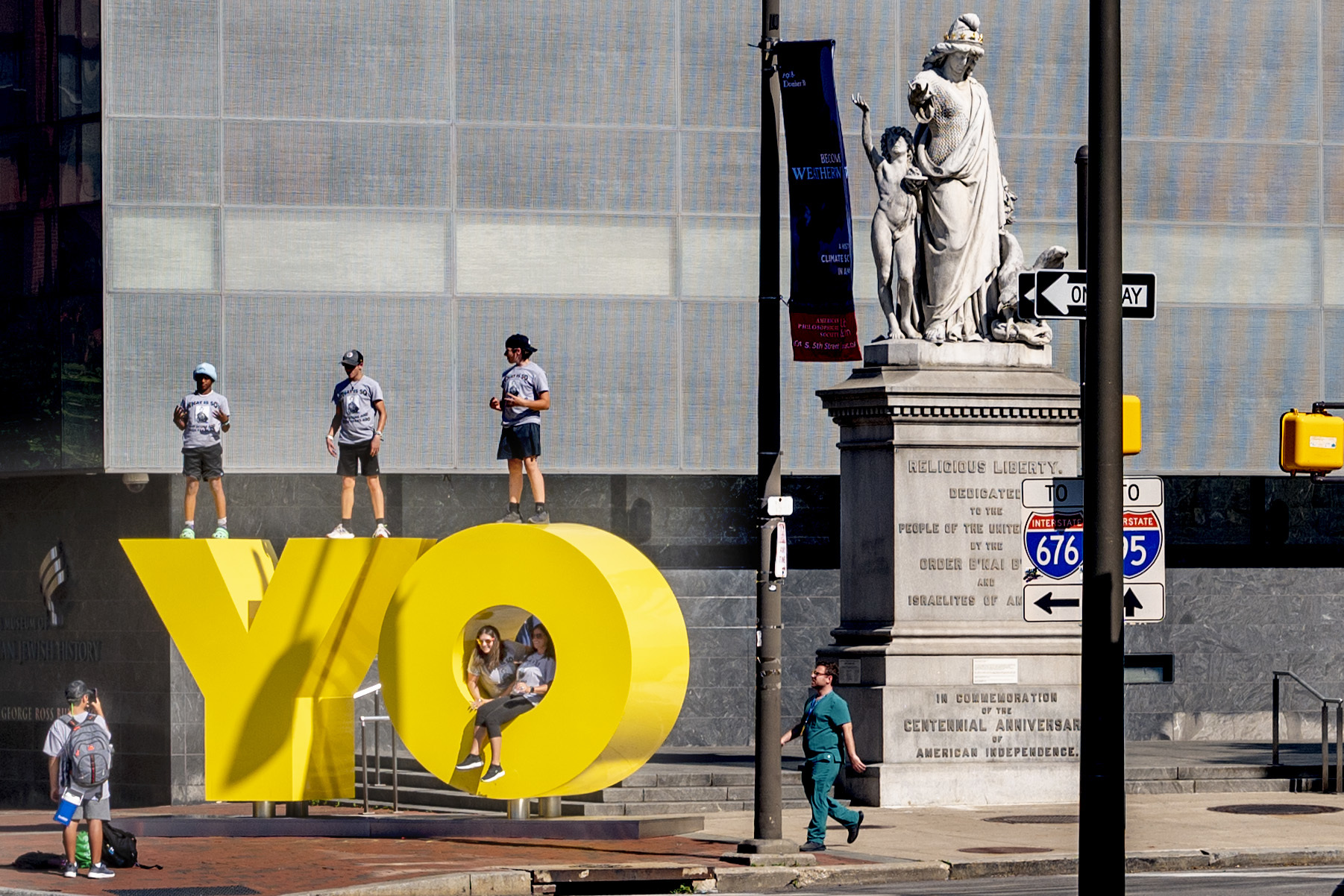
No longer at its home outside the Weitzman National Museum of American Jewish History on the corner of Fifth and Market Streets, the bright “Lamborghini yellow” sculpture that then-curator Josh Perelman called “an ongoing love letter to the city,” had gone away for some R & R — removal and refurbishment.
The “Y” waits to be refurbished at the Johnson Atelier in September.
Installed in 2022, the work by Brooklyn, N.Y.-based artist Deborah Kass quickly became one of our city’s most selfied spots — right up there with that bell just across Independence Mall.
It was only supposed to be here a year, but it stayed around (although the museum is hopeful, it’s still not officially permanent).
Students from Hillwood Middle School in Ft. Worth, Texas visit in 2022.
After years on the busy corner (and all those field-tripping middle-schoolers climbing on it) the museum scheduled a removal in May of the eight foot tall Y and O letters for freshening up, planned to coincide with the continuing construction along Market Street through Old City.
Knowing my feelings for their sculpture, the folks at the museum invited me to photograph the refurbishment.
The letters did not require extensive work, and the aluminum was treated not unlike body work on a car: removing dents, priming, painting and leaving a durable finish.
At the Johnson Atelier, a facility established by Seward Johnson in 1974 to give artists greater involvement in the production of their work, I was not allowed to photograph from any angle that showed any other art works in the background. And there were plenty (sigh), like an eight-foot tall metal hand sitting on the floor, right across from the “Y” (I had to sign an NDA).
Looking over the fence from a public area at Grounds for Sculpture in 2019. A collection of trompe-l’œil painted sculptures by Seward Johnson in the yard at the adjacent Johnson Atelier.
Adding to the lack of visual variety, the letters went into the painting booth one at a time, so I couldn’t make a picture of them in the same frame. And I could only see the workers in the booth from outside – through a couple of windows. But that is exactly the kind of photographic challenge I most enjoy.
Now, after a few months the two giant letters are both as good as new and are scheduled to be reinstalled this Saturday.
Weitzman president and CEO Dan Tadmor, looking forward to its return to their corner heading into the nation’s 250th says, “Deborah Kass’s OY/YO celebrates the spirit of a city that’s always spoken in its own voice: bold, funny, and full of heart.”
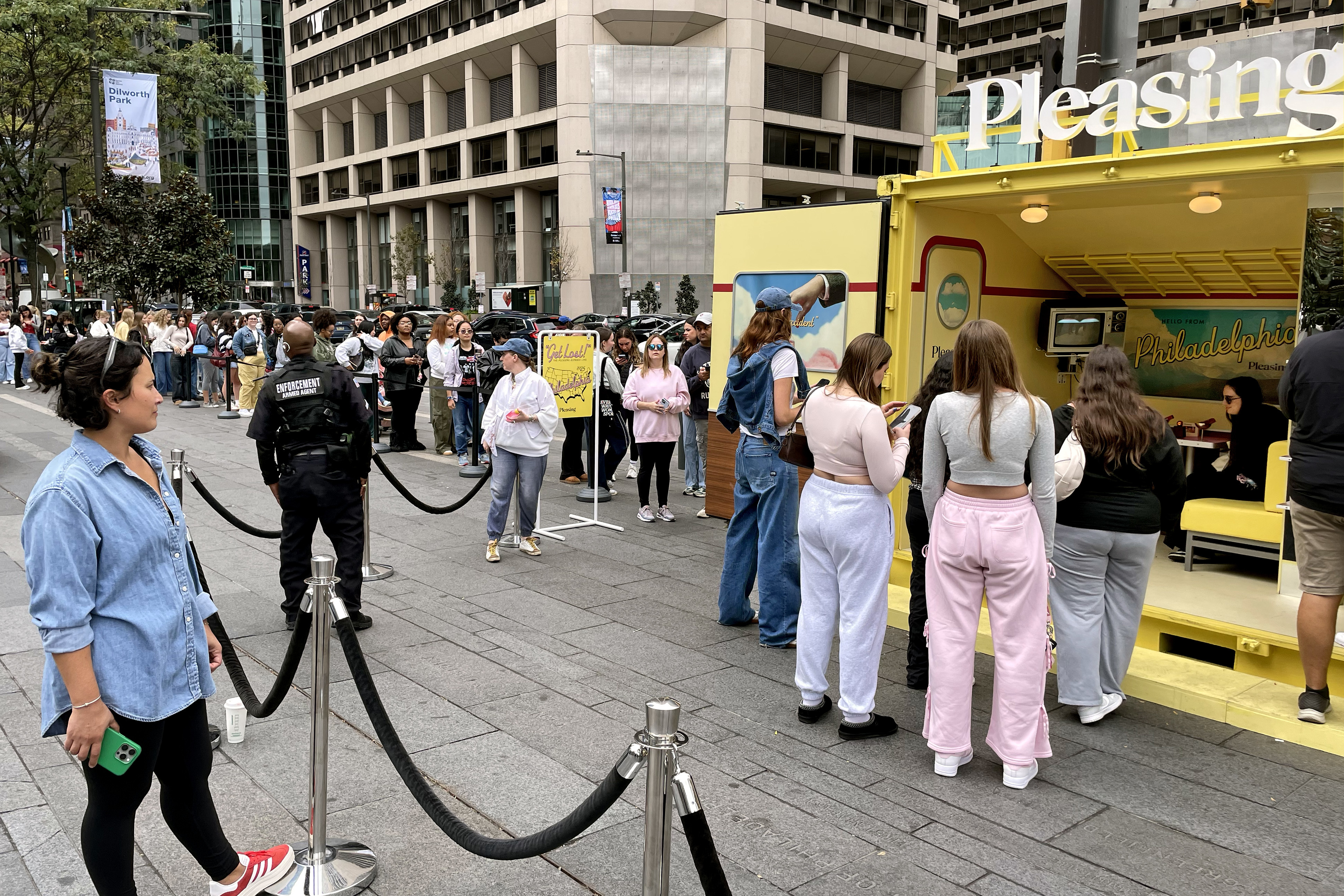
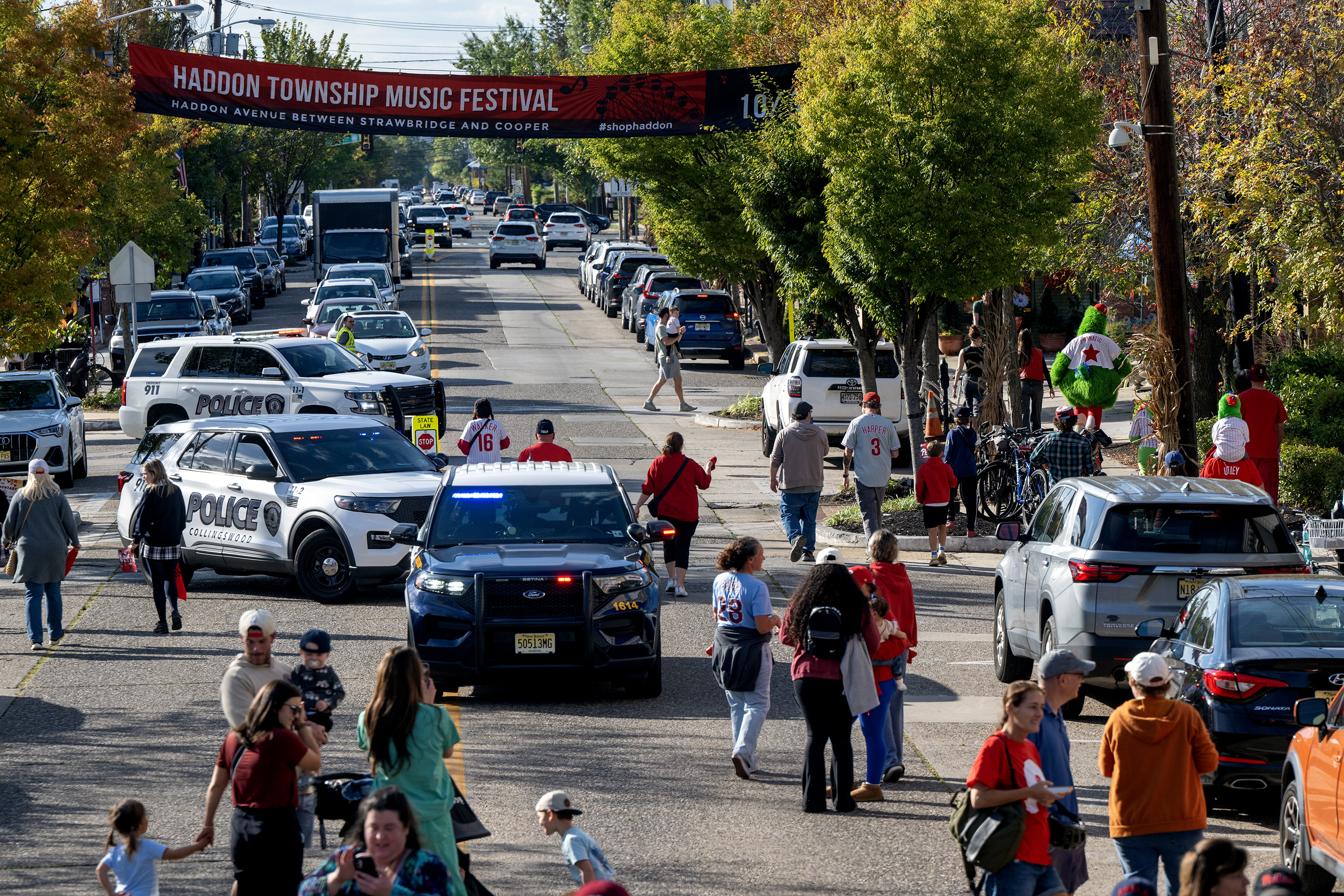
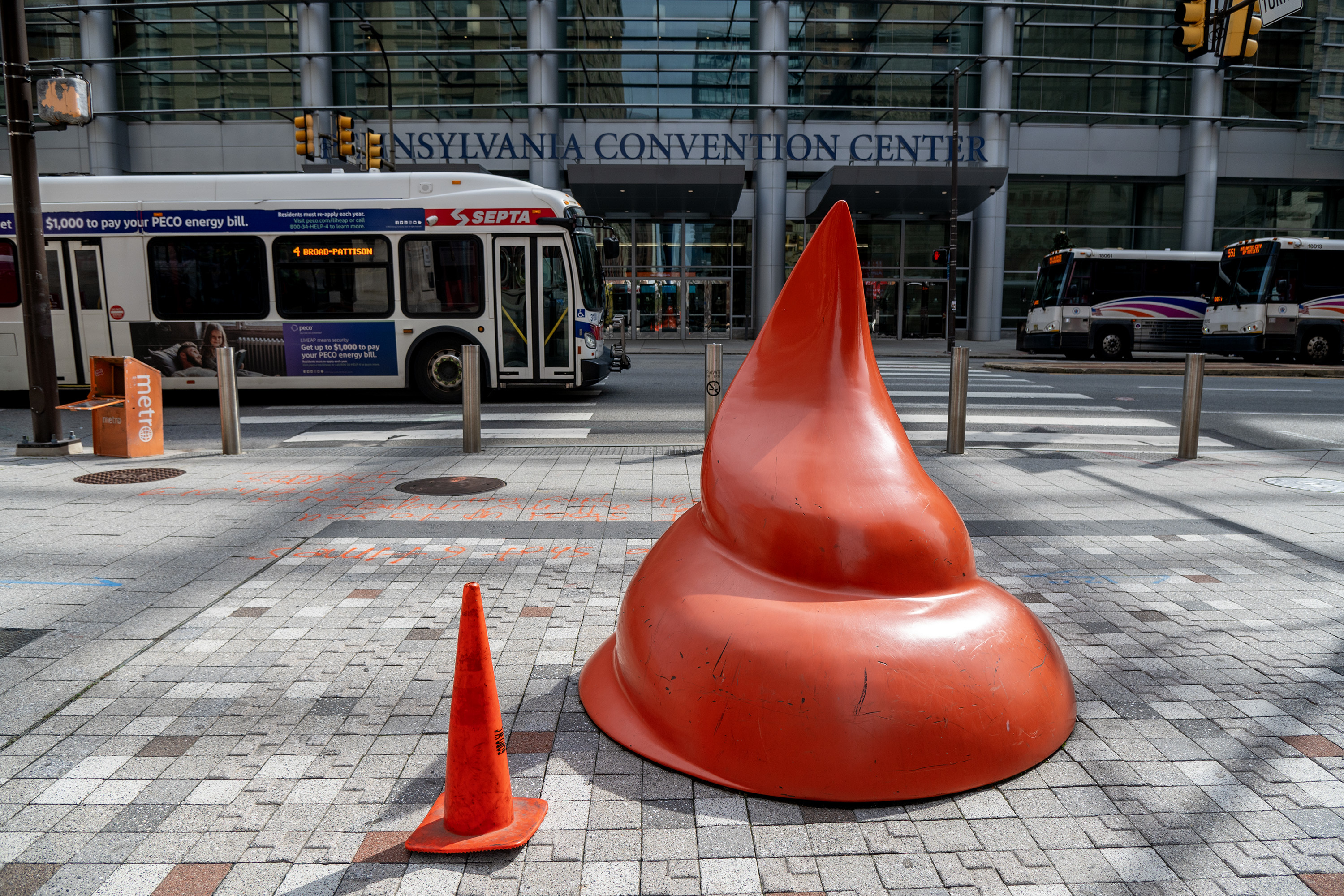
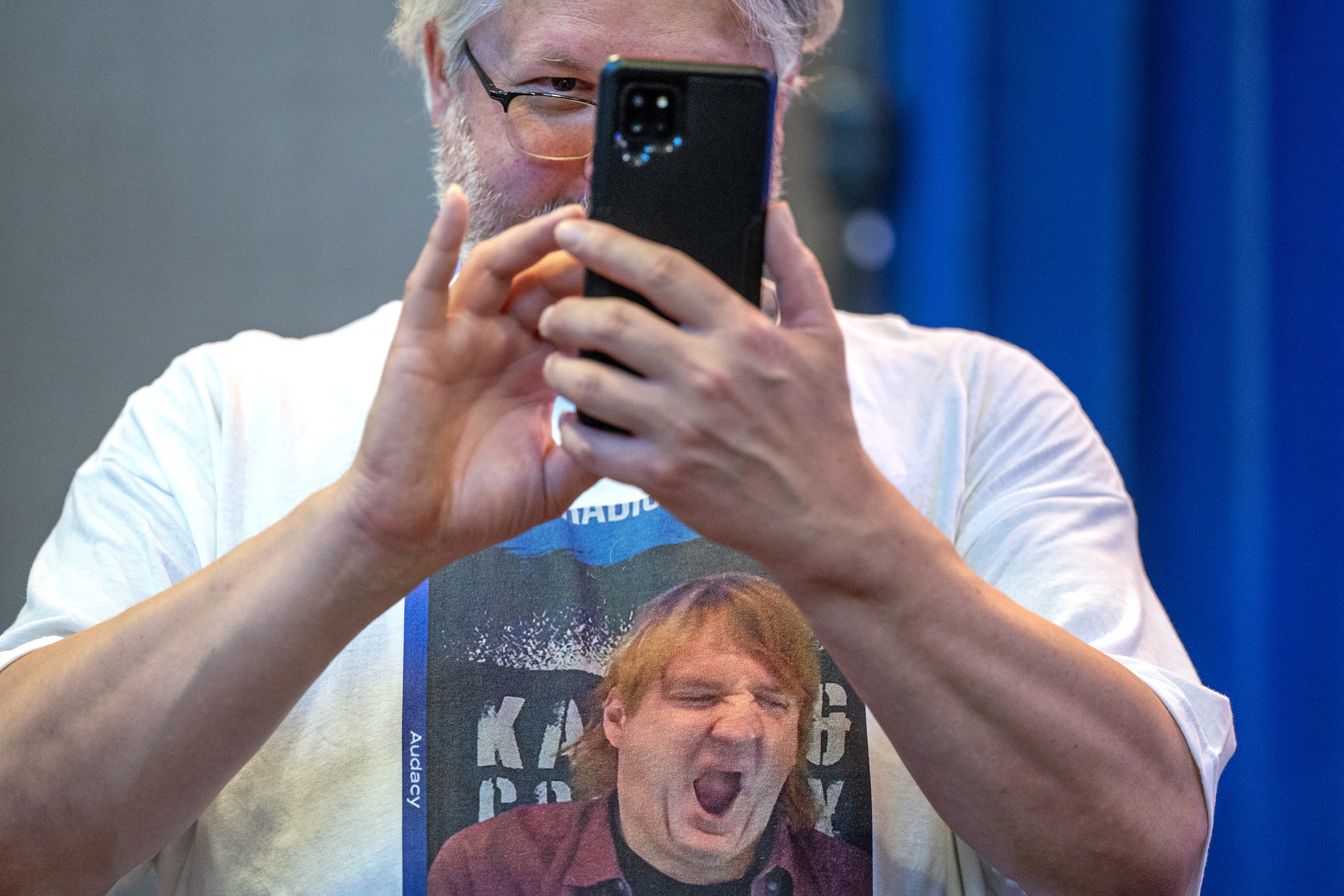
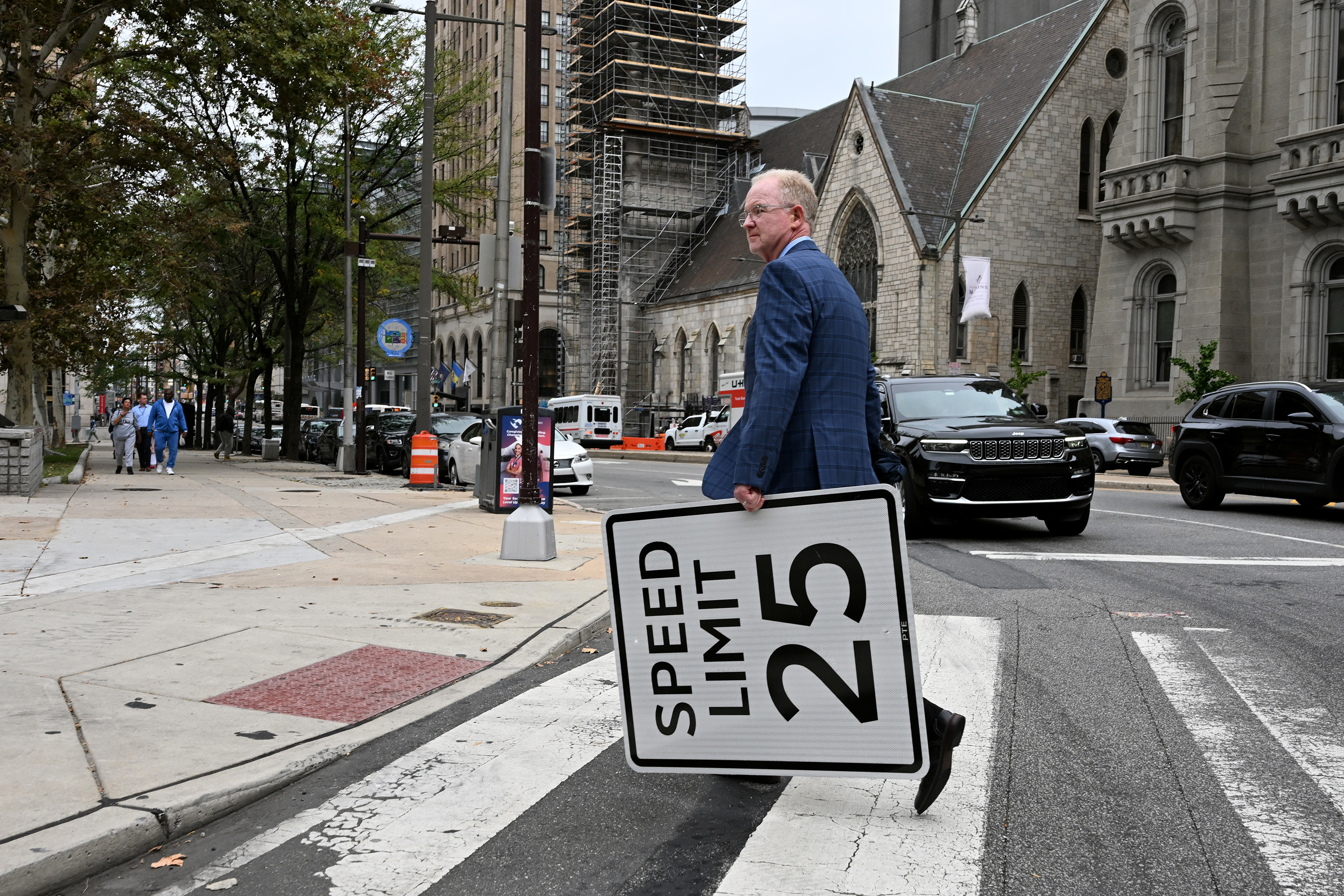
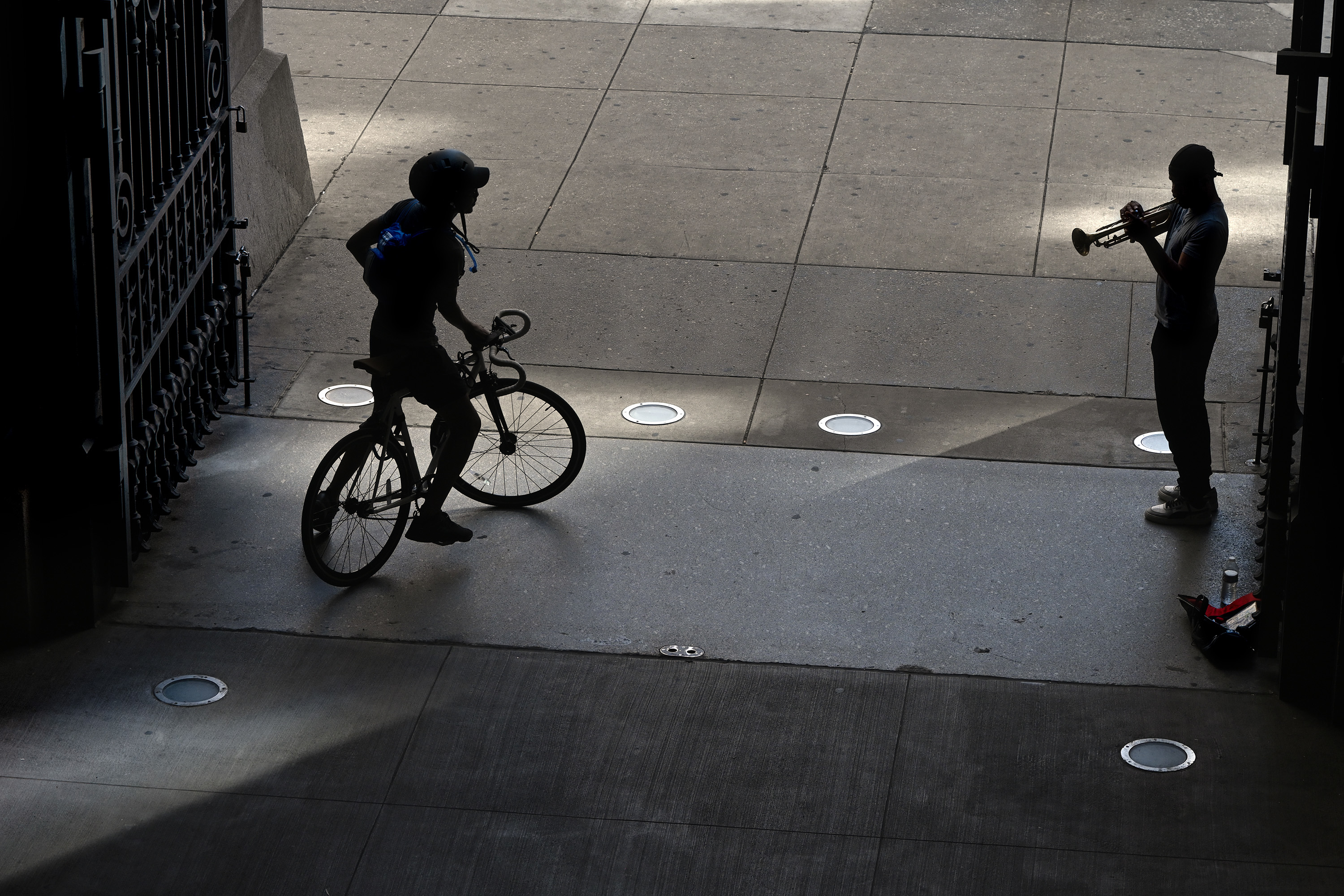
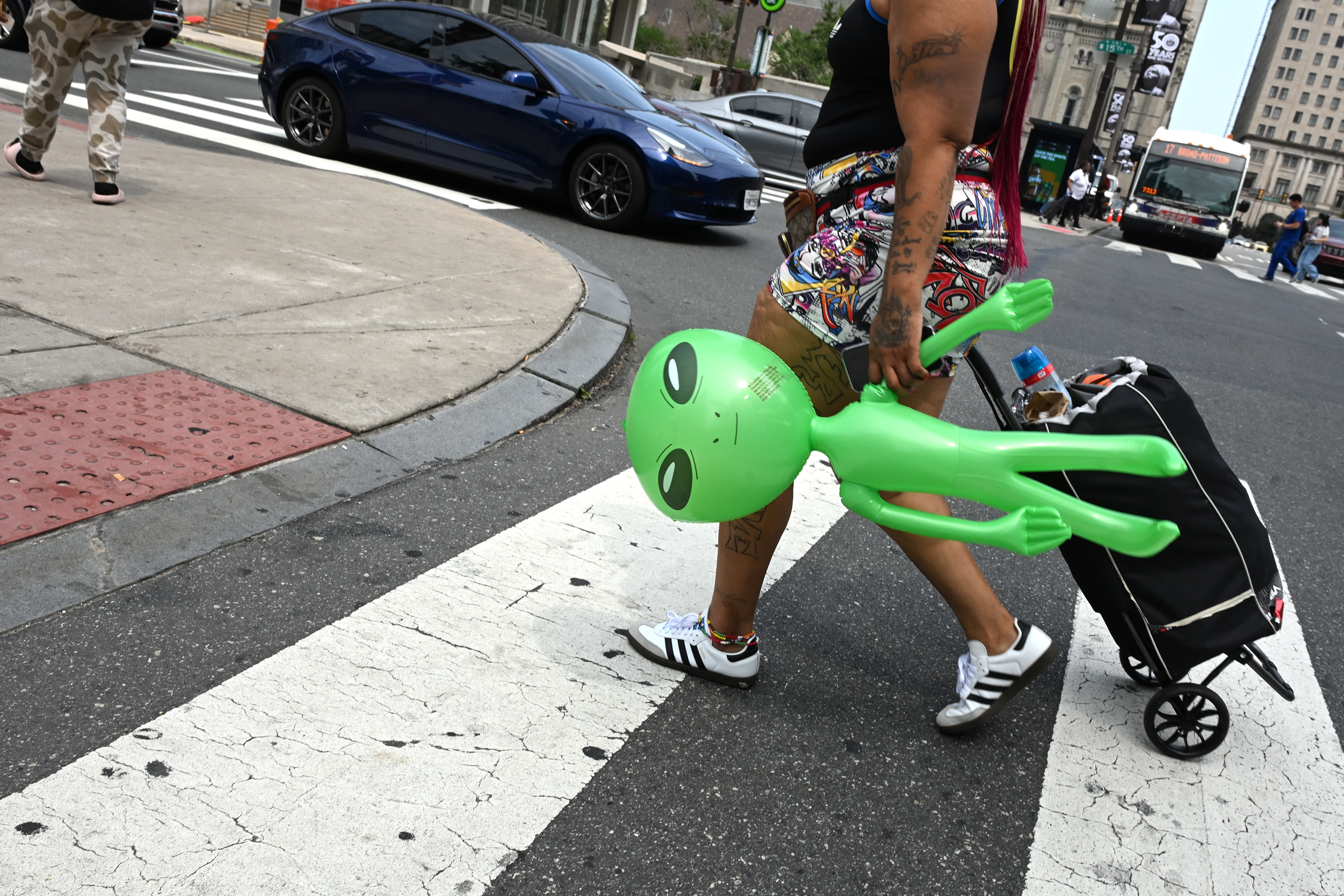
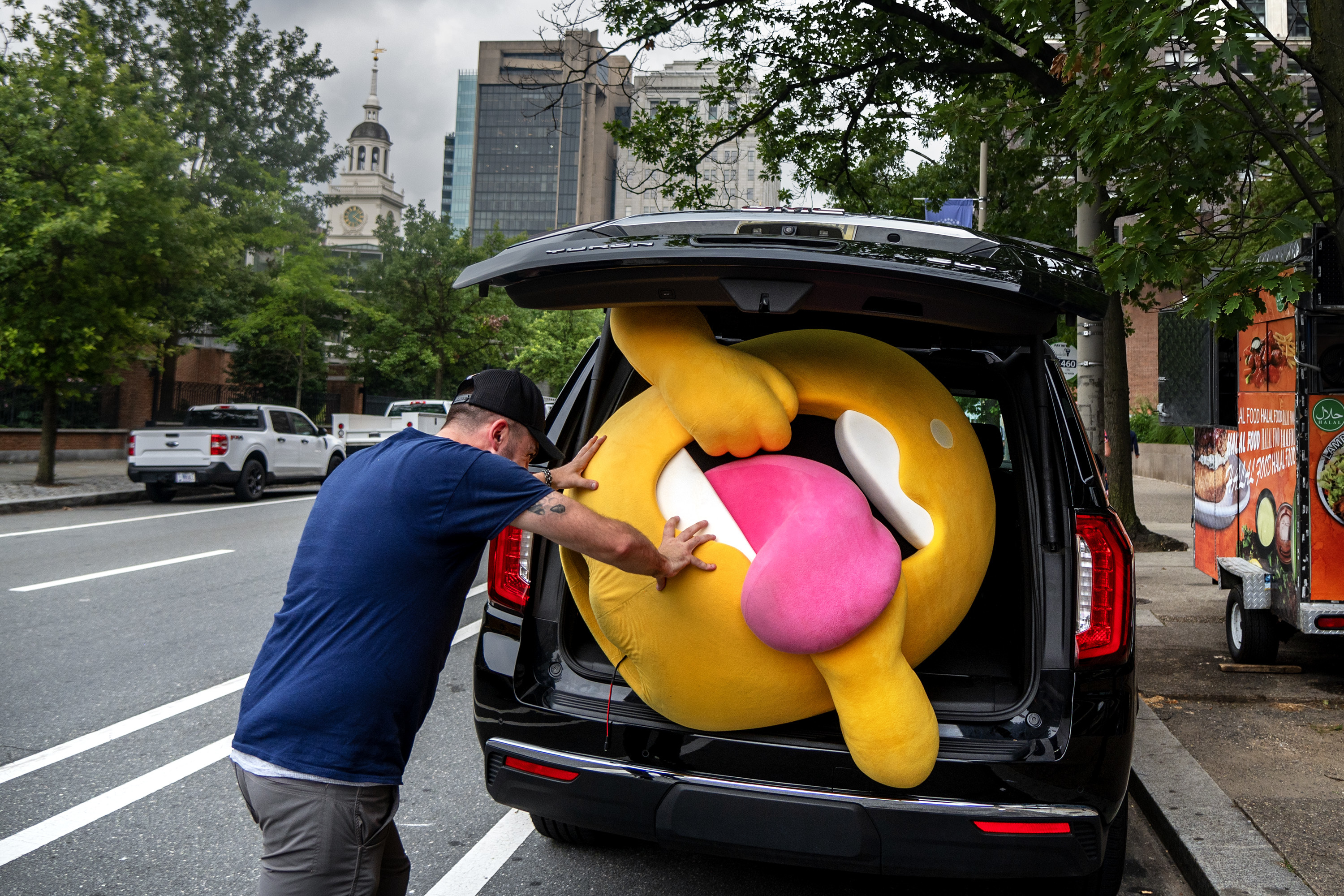
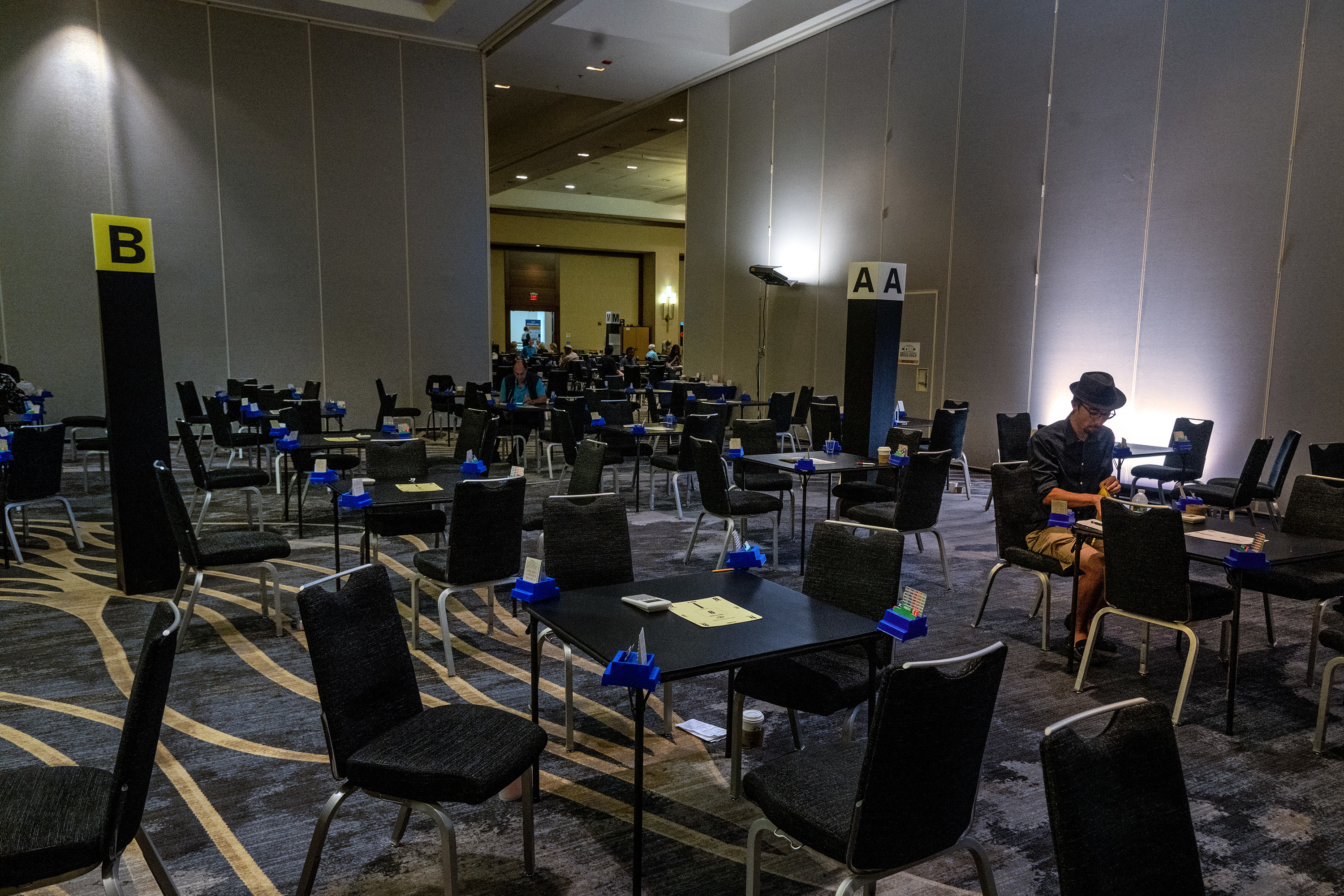
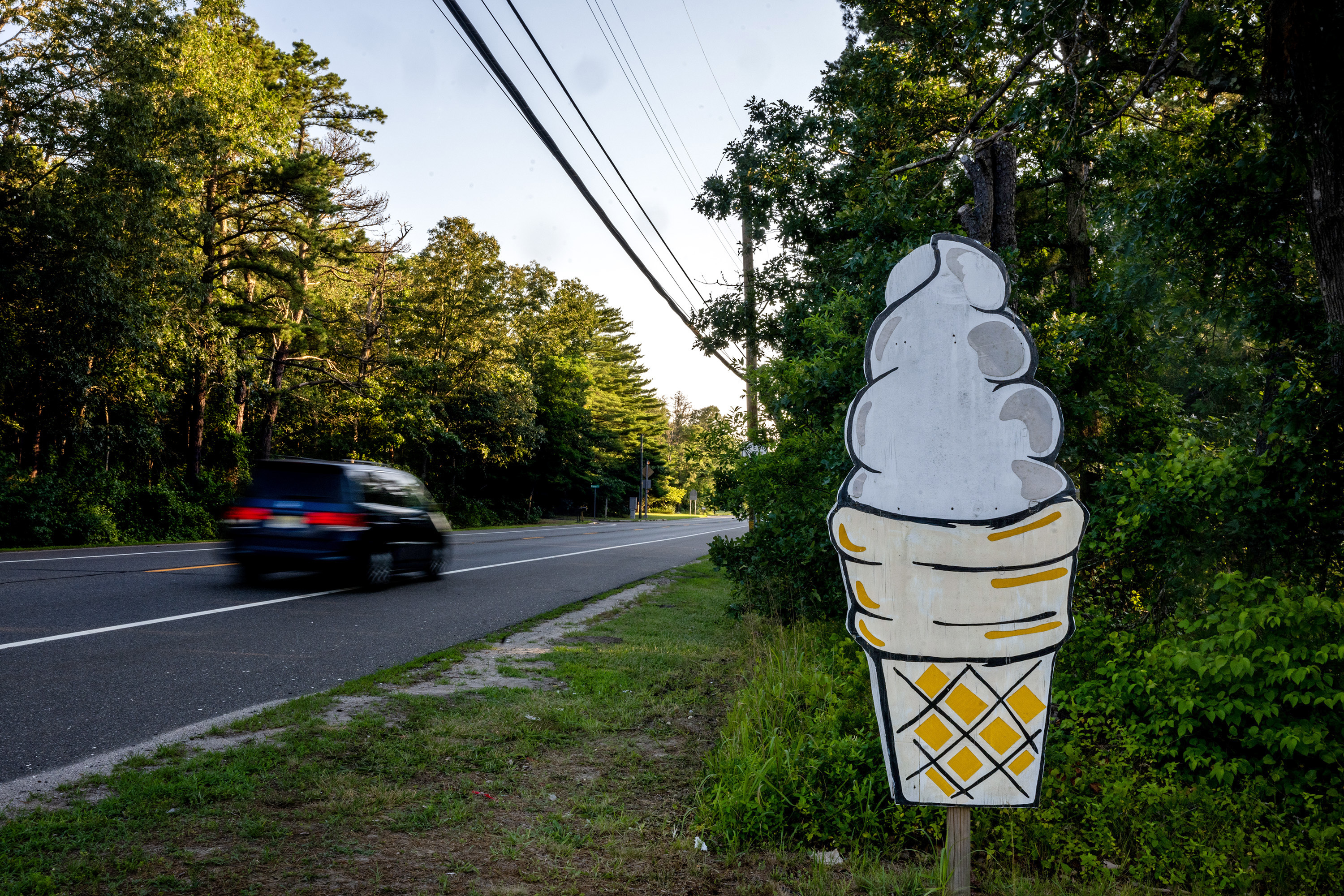
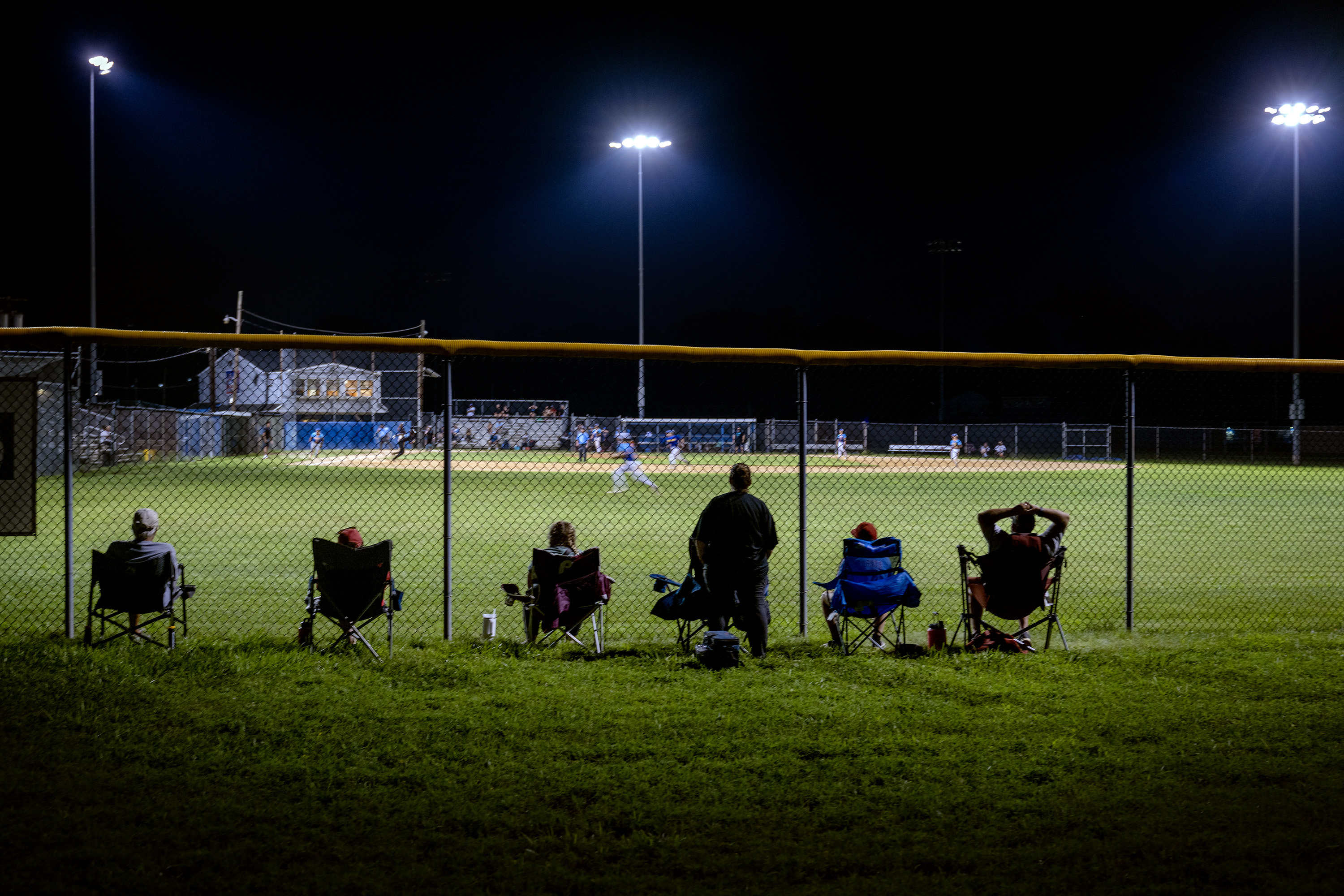
Since 1998 a black-and-white photo has appeared every Monday in staff photographer Tom Gralish’s “Scene Through the Lens” photo column in the print editions of The Inquirer’s local news section. Here are the most recent, in color:
October 20, 2025:The yellow shipping container next to City Hall attracted a line of over 300 people that stretched around a corner of Dilworth Park. Bystanders wondered as they watched devotees reaching the front take their selfies inside a retro Philly diner-esque booth tableau. Followers on social media had been invited to “Climb on to immerse yourself in the worlds of Pleasing Fragrance, Big Lip, and exclusive treasures,” including a spin of the “Freebie Wheel,” for products of the unisex lifestyle brand Pleasing, created by former One Direction singer Harry Styles.October 11, 2025: Can you find the Phillie Phanatic, as he leaves a “Rally for Red October Bus Tour” stop in downtown Westmont, N.J. just before the start of the NLDS? There’s always next year and he’ll be back. The 2026 Spring Training schedule has yet to be announced by Major League Baseball, but Phillies pitchers and catchers generally first report to Clearwater, Florida in mid-February.October 6. 2025: Fluorescent orange safety cone, 28 in, Poly Ethylene. Right: Paint Torch (detail) Claes Oldenburg, 2011, Steel, Fiberglass Reinforced Plastic, Gelcoat and Polyurethane. (Gob of paint, 6 ft. Main sculpture, 51 ft.). Lenfest Plaza at the Pennsylvania Academy of the Fine Arts on North Broad Street, across from the Convention Center.September 29, 2025: A concerned resident who follows Bucks County politics, Kevin Puls records the scene before a campaign rally for State Treasurer Stacy Garrity, the GOP candidate for governor. His T-shirt is “personal clickbait” with a url to direct people to the website for The Travis Manion Foundation created to empower veterans and families of fallen heroes. The image on the shirts is of Greg Stocker, one of the hosts of Kayal and Company, “A fun and entertaining conservative spin on Politics, News, and Sports,” mornings on Talk Radio 1210 WPHT.September 22, 2025: A shadow is cast by “The Cock’s Comb,” created by Alexander “Sandy” Calder in 1960, is the first work seen by visitors arriving at Calder Gardens, the new sanctuary on the Ben Franklin Parkway. The indoor and outdoor spaces feature the mobiles, stabiles, and paintings of Calder, who was born in Philadelphia in 1898, the third generation of the family’s artistic legacy in the city.September 15, 2025: Department of Streets Director of Operations Thomas Buck leaves City Hall following a news conference marking the activation of Automated Speed Enforcement (ASE) cameras on the Broad Street corridor – one the city’s busiest and most dangerous roads. The speed limit on the street, also named PA Route 611, is 25 mph.September 8, 2025: Middle schoolers carry a boat to the water during their first outing in a learn-to-row program with the Cooper Junior Rowing Club, at the Camden County Boathouse on the Cooper River in Pennsauken. September 1, 2025: Trumpet player Rome Leone busks at City Hall’s Easr Portal. The Philadelphia native plays many instruments, including violin and piano, which he started playing when he was 3 years old. He tells those who stop to talk that his grandfather played with Billie Holiday, Duke Ellington, Nina Simone, and Dizzy Gillespie. August 25, 2025: Bicycling along on East Market Street.August 18, 2025: Just passing through Center City; another extraterrestrial among us. August 11, 2025: Chris Brown stows away Tongue, the mascot for a new hard iced tea brand, after wearing the lemon costume on a marketing stroll through the Historic District. Trenton-based Crooked Tea is a zero-sugar alcoholic tea brand founded by the creator of Bai, the antioxidant-infused coconut-flavored water, and launched in April with former Eagles defensive end Brandon Graham as a partner.August 4,2025: Shanna Chandler and her daughters figure out their plans for a morning spent in Independence National Historical Park on the map in the Independence Visitor Center. The women (from left) Lora, 20; Shanna; Lenna, 17; and Indigo, 29, were stopping on their way home to Richmond, Virginia after vacationing in Maine. The last time they were all in Philadelphia Shanna was pregnant with Lenna. July 28, 2025: Louis-Amaury Beauchet, a professional bridge player from Brittany, France, takes a break between game sessions in an empty ballroom during the North American Bridge Championships at the Center City Marriott with some 4000 people in town over week of the tournament. The American Contract Bridge League is hosting the week of meetings and tournaments with bridge players from all over the world. The ACBL is the largest bridge organization in North America, with over 120,000 members (down from around 165,000 before COVID). Bridge draws players of all ages and walks of life – fictional characters James Bond and Snoopy both played as do billionaires Bill Gates and Warren Buffett (who sometimes play as partners).July 21, 2015: Signage for the Kustard Korner in Egg Harbor City, on the way to the Jersey Shore. President Ronald Reagan designated July as National Ice Cream Month and the third Sunday of the month.July 14, 2025: Fans watch a game at the Maple Shade Babe Ruth Field, part of the 20th Annual Franny Friel Summer Classic, on a cool(er) night with a refreshing breeze, the weekend before the MLB All-Star Game (with Kyle Schwarber the lone Phillies representative).