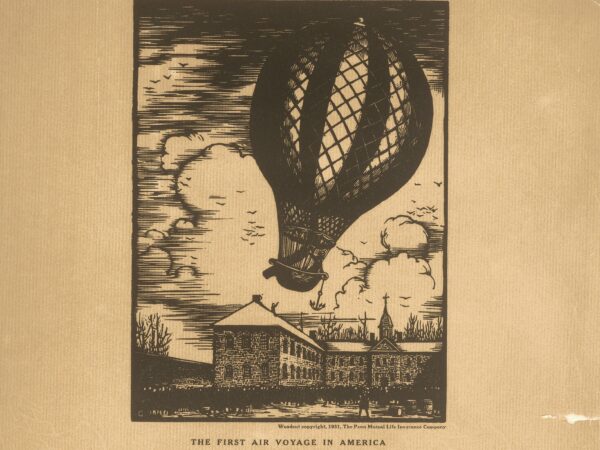
It was a cold January morning in colonial Philadelphia. The year was 1793 and Thomas Jefferson, James Monroe, John Adams, and George Washington were among dozens of spectators gathered in the Walnut Street Prison workyard. The Founding Fathers watched in awe as French aeronaut Jean-Pierre Blanchard prepared to take flight.
Blanchard’s hydrogen-powered balloon rose up into the sky. It was the first time someone had ever seen a balloon take off in America.
Two and a half hours later, Blanchard landed the blue-and-yellow striped silk balloon 15 miles north in a Deptford, N.J., field that today is a Walmart Supercenter parking lot.
That historic moment — America’s first balloon ride — will be remembered on Saturday at the Athenæum, where the Walnut Street Prison workyard once stood.
The festivities will kick off the Philadelphia Historic District’s 52 Weeks of Firsts, a weekly day party marking events that happened in Philadelphia before anywhere else in America, and often the world. Each Saturday, the Historic District will partner with a local institution to host a free festival — or “Firstival.” This will be part of a yearlong celebration of America’s 250th birthday.
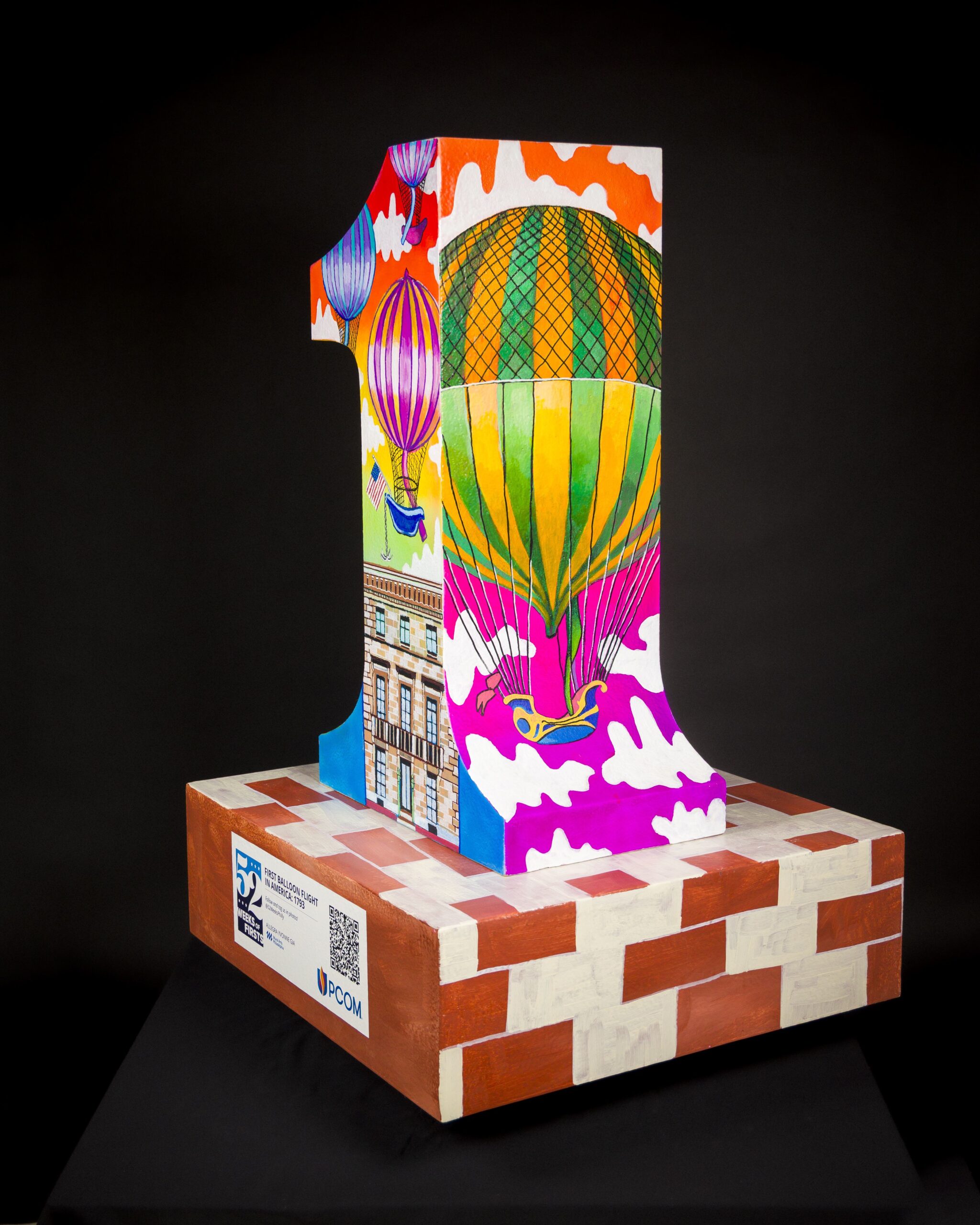
Each of those locations will feature a foam sculpture illustrated by a Mural Arts of Philadelphia artist commemorating the historic event.
Mural Arts artist Allegra Yvonne Gia infused images of the Walnut Street prison yard, The Athenæum of Philadelphia, and hydrogen balloons in this illustration.
While in Paris negotiating an end to the Revolutionary War in 1783, America’s A-list forefathers, Ben Franklin, John Adams, and John Jay witnessed some of the world’s first balloon rides. Impressed, they came back to Philadelphia raving about the innovation.
Two years later, Blanchard, and co-aeronaut John Jefferies, became the first people to sail over the English Channel in a hydrogen balloon. (He chose hydrogen because hot air balloons were powered by fire and prone to explosion, thereby making any flight more than three miles risky.)
The English Channel trip made Blanchard a big deal in aeronautical circles, and he started traveling around the world, flying balloons, and charging spectators, explained Beth Shalom Hessel, executive director of the Athenæum of Philadelphia
On Jan. 9, 1793, Blanchard made his landmark 45th flight in Philadelphia, turning the Walnut Street Prison workyard into the birthplace of aeronautics in America.
Onlookers paid $5 — more than $150 in today’s money — to witness Blanchard take off. He carried with him a dog and a letter from Washington. This letter, which demanded that Blanchard be offered safe passage wherever he landed, is considered by many to be the first ever American passport.
“As a way of making money and drumming up interest in his balloon, Blanchard intentionally chose Philadelphia for his first American flight,” Hessel said. “And that’s fascinating.”
This week’s Firstival is Saturday, Jan. 3, 11 a.m.- 1 p.m., at the Athenæum of Philadelphia, 219 S. Sixth St. The Inquirer will highlight a Philly “first” from the 52 Weeks of Firsts program every week.
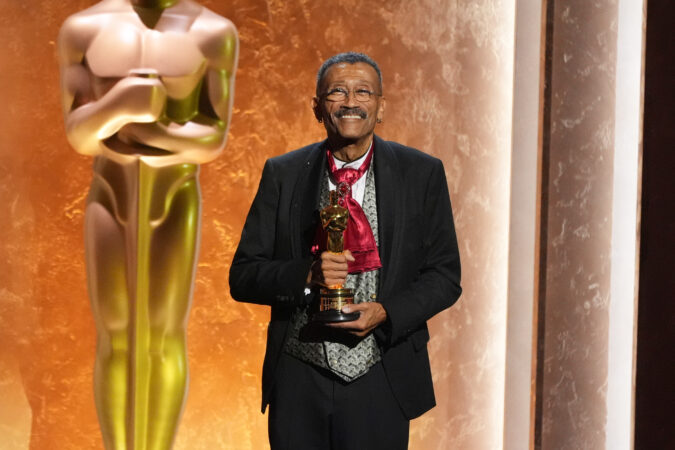
When famed production designer Wynn Thomas prepared an acceptance speech for his long-awaited Oscar at the age of 72, he wanted to highlight his own Philadelphia story.
“My journey to storytelling began as a poor Black kid in one of the worst slums in Philadelphia. There were street gangs and poverty everywhere. And to escape that world, I immersed myself in books,” Thomas told the Hollywood audience at the Governor’s Awards ceremony in November. “I would sit on my front stoop and I would travel around the world. Now, the local gangs looked down on me and called me ‘sissy.’ But that sissy grew up to work with some great filmmakers and great storytellers.”
It was a significant moment for an artist who has spent nearly 50 years behind the camera to finally step into the spotlight himself. The honorary Oscar — which also went to Tom Cruise and Debbie Allen — recognizes “legendary individuals whose extraordinary careers and commitment to our filmmaking community continue to leave a lasting impact.”
During his extensive film career, Thomas has designed epic, comedic, and dramatic worlds for filmmakers like Spike Lee (Do The Right Thing, Malcolm X), Ron Howard (A Beautiful Mind, Cinderella Man), Robert DeNiro (A Bronx Tale), Tim Burton (Mars Attacks), and Peter Segal (Get Smart).
And while at it, he broke several barriers along the way: Thomas is considered the first Black production designer in Hollywood history.
No matter how far his work took him, though, he was always proud to discuss his Philadelphia roots.
The theater kid from West Philly
Long before he worked on major feature films, Thomas grew up as one of six kids in West Philadelphia, living primarily near 35th and Spring Garden Streets. Avid reading kept him out of trouble. His mother, Ethel Thomas, wrote a permission letter to the local library so he could access the adult section, and he immersed himself in the worlds of Harper Lee, James Baldwin, William Shakespeare, and Lillian Hellman.
The young Thomas always looked forward to Saturdays, when he could spend nearly all day at a movie theater on Haverford Avenue. Occasionally, he took classes at Fleisher Art Memorial, too.
The 1961 movie Summer and Smoke, written by Tennessee Williams, he said, inspired him to pursue theater.
“I absolutely said, ‘My God, what is this?’ I think it was just the nature of the story that really affected me,” Thomas, who now lives in New York, said in a recent interview. “I couldn’t believe what I had just seen, what I had just experienced. So I went to my library and got as many Tennessee Williams plays as I could.”
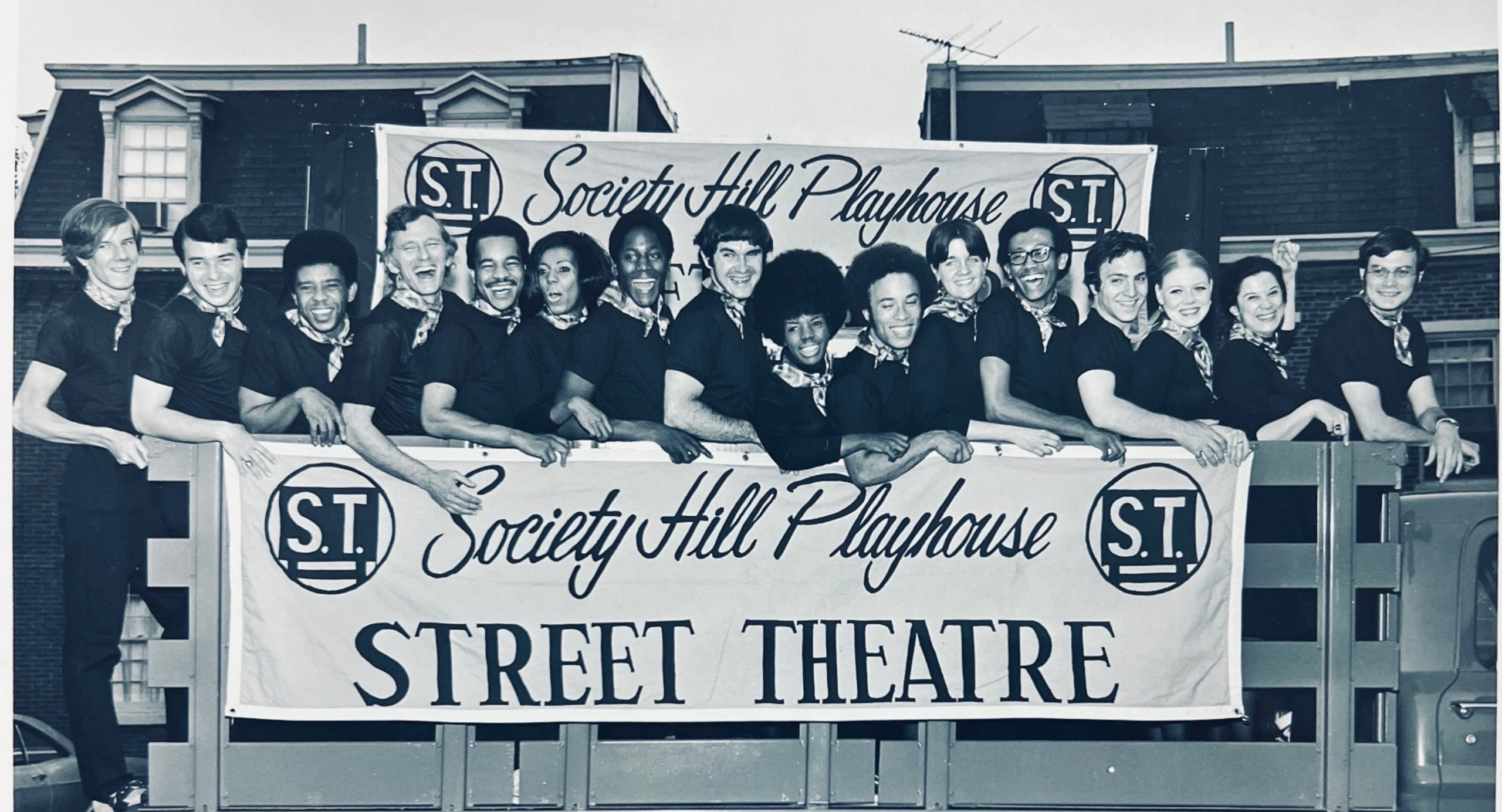
Wynn Thomas (fifth from right) at the Society Hill Playhouse as a teen in the late 1960s.
A couple of years later, Thomas heard that Society Hill Playhouse was holding open auditions. He was too young to audition himself, so he persuaded his older sister Monica to try out.
“I remember saying to her, ‘You need to do a scene from Who’s Afraid of Virginia Woolf,’” he recalled, chuckling. “Now, can you imagine being a 14-year-old kid who knows Who’s Afraid of Virginia Woolf? That’s a geek!”
She earned a spot in the company for a season and Thomas frequently tagged along, volunteering as an usher and eventually forming a close relationship with the owners, legendary Philadelphia theater couple Jay and Deen Kogan.
Throughout high school, the Overbrook High art student spent most of his after-school time across town at the playhouse. He acted, painted scenery, and served as a stage manager.
One of the final productions he stage-managed was The Great White Hope, loosely based on boxing champion Jack Johnson, who was played by Richard Roundtree — the soon-to-be Hollywood star who went on to lead the 1971 classic Shaft. While he was performing at Society Hill Playhouse, Roundtree was auditioning for the life-changing role.
“Shaft was a very important and very pivotal film for that time period,” said Thomas. “It was about a strong Black male who lived in the world under his own terms. That was not a character that was portrayed often in films.”
It was a glimpse into the worlds Thomas would help create in the future — with Black characters who had agency at the center.
Some four decades later, he worked with Roundtree once more for the 2019 remake of Shaft and they had an “incredible reunion.”
From Philly to Boston to New York
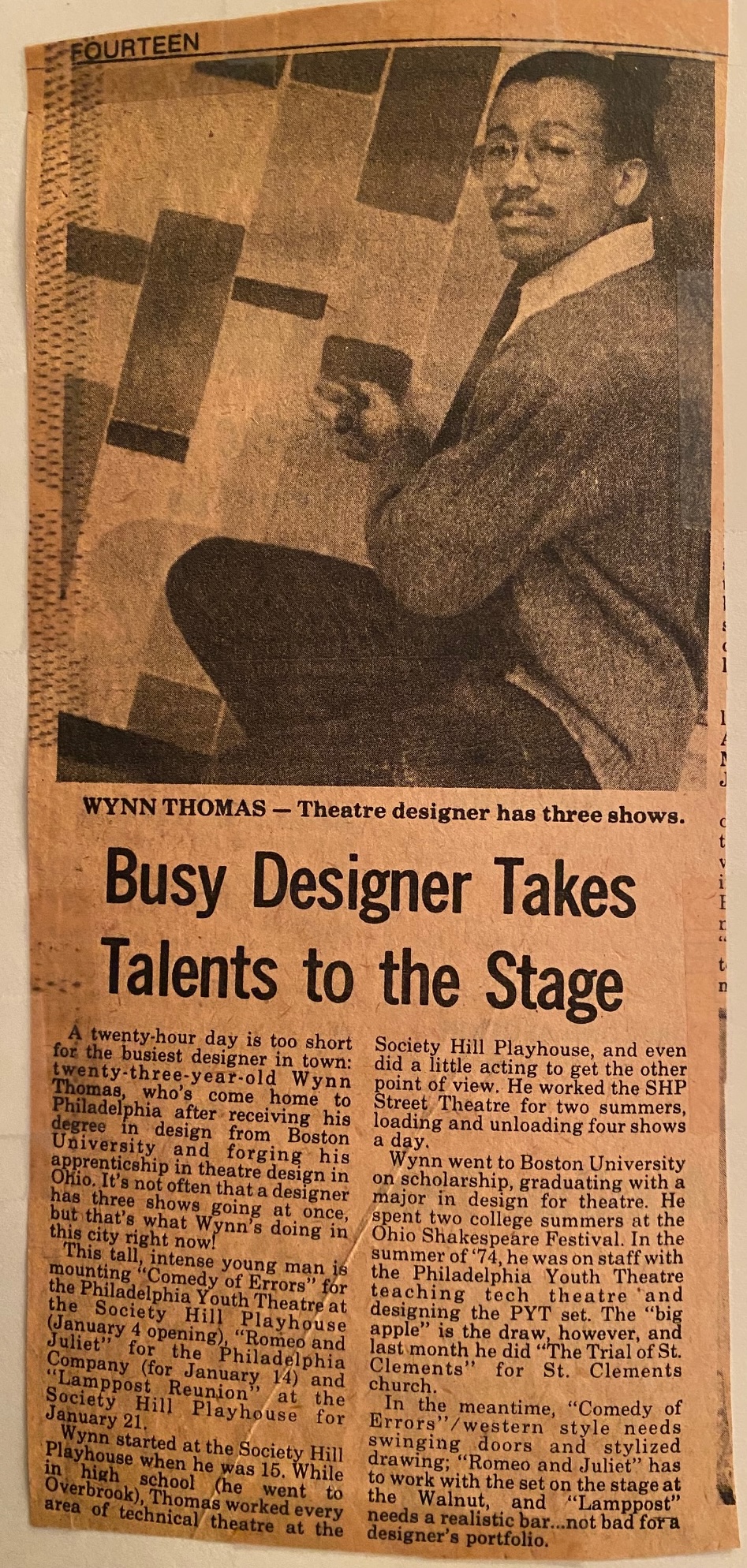
Thomas received his bachelor of fine arts in theater design from Boston University. After graduating in 1975, he returned to Philadelphia and worked as a window dresser at the Strawbridge & Clothier department store on Market Street for a few months before landing his next theater job.
For about four years, Thomas was a painter for the Philadelphia Drama Guild, operating out of the Walnut Street Theatre. He also returned to Society Hill Playhouse as a production designer.
An article about Wynn Thomas when he was 23 years old and working as a theater designer in Philadelphia in the mid 1970s.
“It was a huge learning phase for my career, because I was painting all these different kinds of shows,” Thomas said.
By his mid-20s, Thomas had moved to New York and soon became the resident set designer for the legendary Negro Ensemble Company, where he worked with not-yet-famous actors from Denzel Washington to Phylicia Rashad.
“There was an actor who had auditioned for the company but did not get in. He was looking for a job and it turns out that he had carpentry skills, so I ended up hiring this actor who built my sets for my very first season at NEC,” Thomas recalled.
“That actor was Samuel L. Jackson.”
Breaking into film
Thomas loved theater but sought higher-paying work in film. After multiple job rejections, he joined the United Scenic Artists Local 829.
In an event the union organized with renowned production designer Richard Sylbert, who was working on Francis Ford Coppola’s The Cotton Club, Thomas was the sole Black person in attendance.
The next day, he called Sylbert and introduced himself: “I’m the Black guy that was in the room last night. Do you remember seeing me?”
He convinced Sylbert to hire him to build model sets, and Sylbert became a crucial reference that helped Thomas secure art director jobs, like on 1984’s Beat Street (directed by fellow Philly native Stan Lathan). That’s where he met Spike Lee, who interviewed “for the coffee-fetching position of assistant to the director,” Thomas recalled. When Lee stopped by the art department to greet a friend, the aspiring filmmaker was surprised to see Thomas.
“He said he didn’t know there were any Black people doing this [work],” Thomas said.
Filmmaker Spike Lee, center right, appears with his brother David Lee, center left, with castmembers, including Halle Berry, left, and Wesley Snipes, right, on the set of the 1991 film, “Jungle Fever.” Wynn Thomas served as production designer.
A storied career of firsts
That Beat Street encounter led to one of the most fruitful collaborative relationships of Thomas’ career: He went on to make 11 films with Lee, from She’s Gotta Have It to School Daze to Jungle Fever. Lee regularly worked with the same collaborators (“the family”) including Thomas, costume designer Ruth Carter, and cinematographer Ernest Dickerson.
“We wanted to present images of Black and brown folks that had not been seen before on the screen. We did not want to present any negative images. If you look at those films, there’s no drugs, there’s no alcohol, there’s no domestic abuse — none of that trauma that people used to associate with our communities,” said Thomas. “That was the artistic link, the journey for all of us …[and] that has been a criteria for me.”
Meanwhile, he continued to find mainstream success on commercial films, fueled by a relentless work ethic and a commitment to hiring a diverse crew of artists on his team. Later in his career, he was elected to the Academy’s Board of Governors where he pushed for expanding educational programs nationwide.
Thomas’ films showcase a breadth of world-building talent across genres like comedy (To Wong Foo, Thanks for Everything! Julie Newmar, Get Smart), romance (The Sun Is Also a Star), and dramas about other Black barrier-breakers, like King Richard (starring fellow Overbrook alum Will Smith), Hidden Figures, and the miniseries Lawmen: Bass Reeves.
It’s rare that he returns to his hometown for a job, but in 2014, he was thrilled to work on the pilot of the Philadelphia-set show How to Get Away with Murder.
Thomas believes the city holds countless rich, untold stories that he hopes will one day receive a bigger spotlight.
For now, he’s enjoying seeing the Oscar statue grace his living room.
“It really means a great deal to me, after 40-plus years of working in the business, to have my work recognized by this organization,” said Thomas. “I’ve worked on a lot of films that should have been recognized by the Academy, [for which] I should have been nominated, and it never happened. So I think this was a way for the Academy to correct that oversight.”
President Ulysses S. Grant established Yellowstone as the first national park on March 1, 1872. Ever since, 27 American presidents have supported, nurtured, and developed national parks — that is, until now, with this president, Donald Trump.
National park budget cuts, which were first proposed by the Heritage Foundation’s Project 2025, have totaled roughly 35%.
Implemented by Elon Musk and his so-called Department of Government Efficiency, the cuts have led to thousands of public servants being fired and day-to-day operations being vastly curtailed.
Taking it to the next step, Trump’s secretary of the interior, Doug Burgum, who oversees national parks, is considering a plan for the elimination of up to 350 park sites across the country. Burgum is apt to diminish or shutter sites that fall vulnerable to Trump’s executive order, cynically titled, “Restoring Truth and Sanity to American History.”
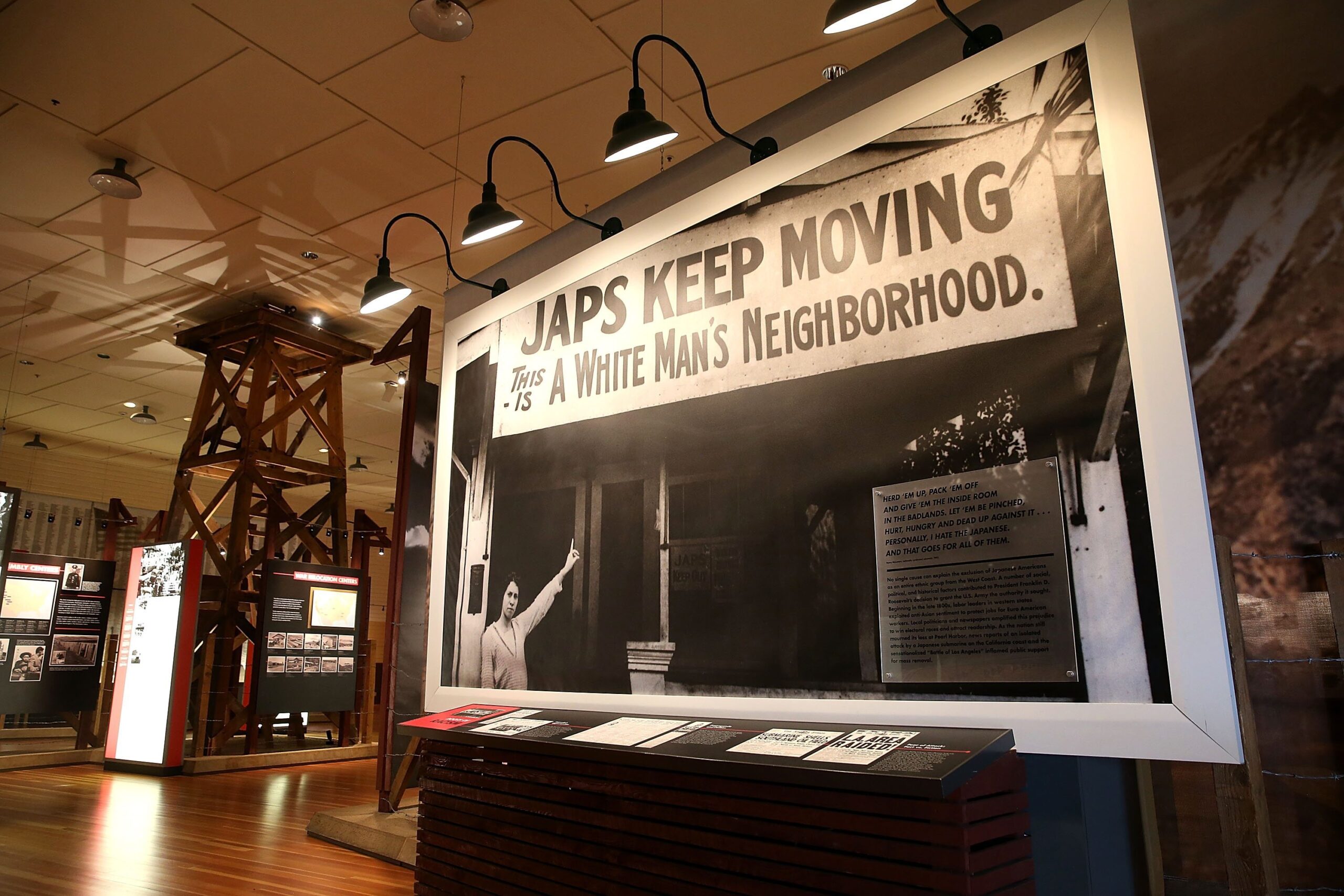
A vintage photograph is displayed at Manzanar War Relocation Center at Manzanar National Historic Site, near Independence, Calif.
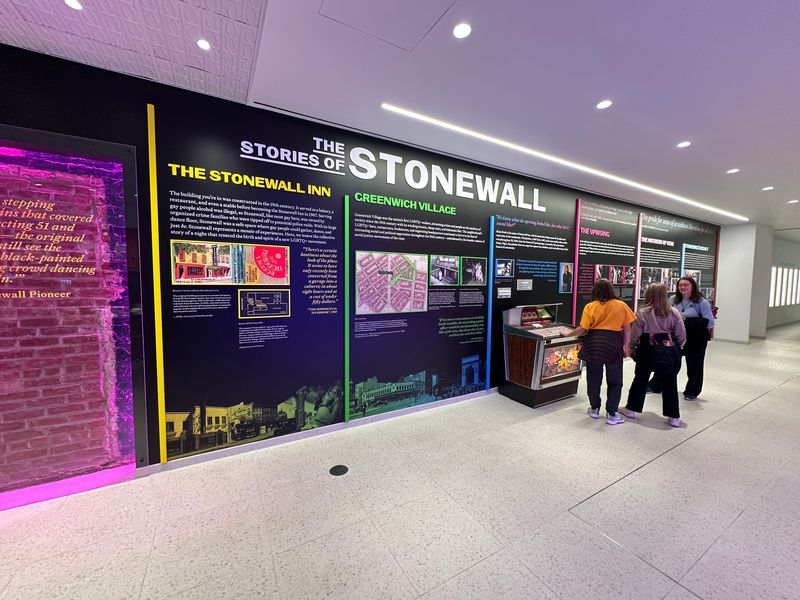
Park sites seen as not conforming to the order might include the Manzanar National Historic Site in California, which describes the government’s forced race-based relocation to detention camps of Japanese Americans at the start of World War II, or the Stonewall National Monument in New York City, where the advancement of civil rights for LGBTQ+ Americans is celebrated.
An exhibit at the Stonewall National Monument Visitor Center.
National parks across the country are also burdened with huge backlogs of deferred maintenance to infrastructure.
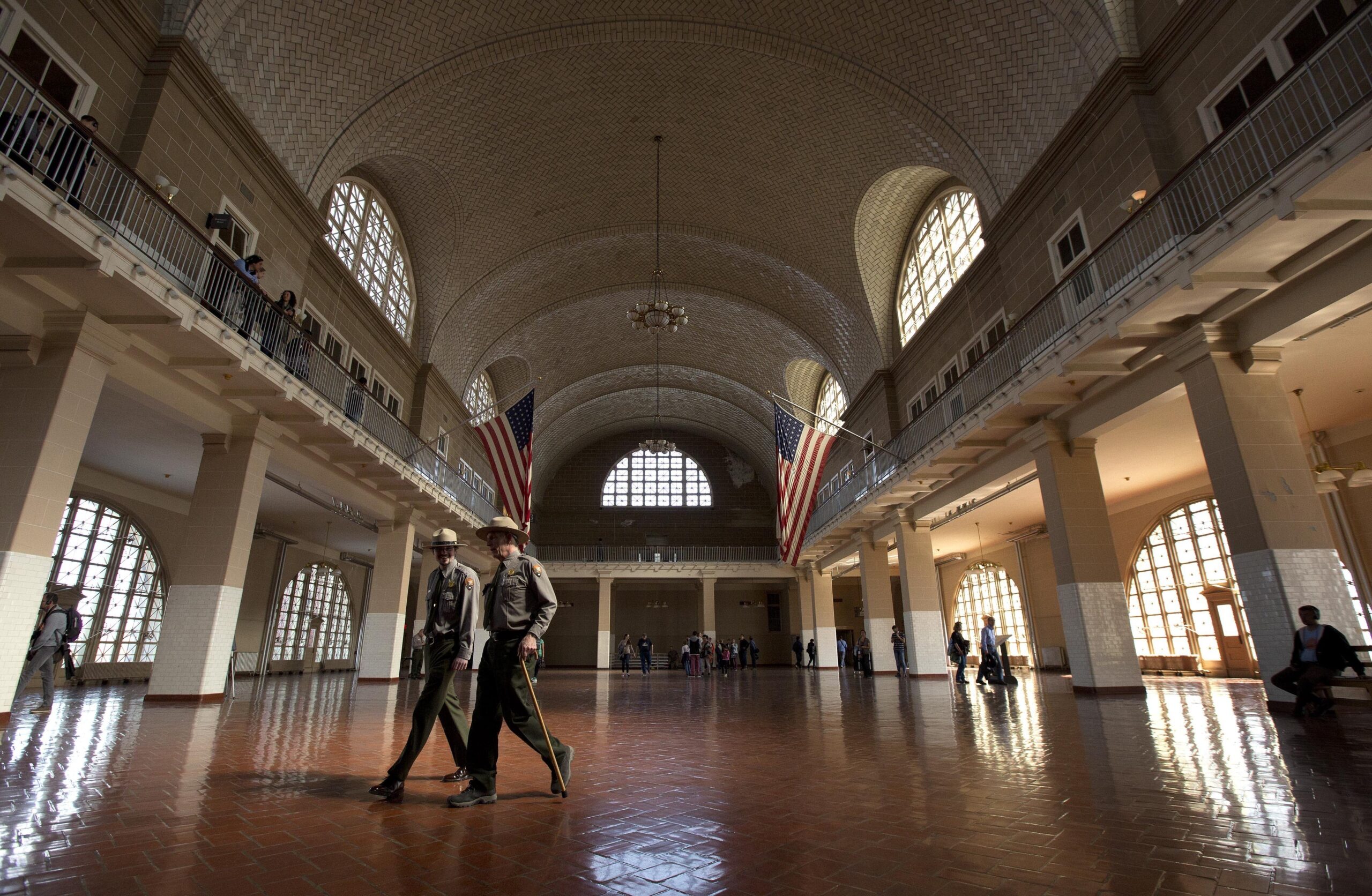
Statue of Liberty National Monument and Ellis Island in New York Harbor stand proudly as memorials to those who migrated to the United States to escape poverty, repression, and tyranny. Many of the nearly four million who visit every year pay honor to ancestors who made new homes, raised families, and helped build the American dream.
National Park Service rangers walk through the Great Hall at Ellis Island.
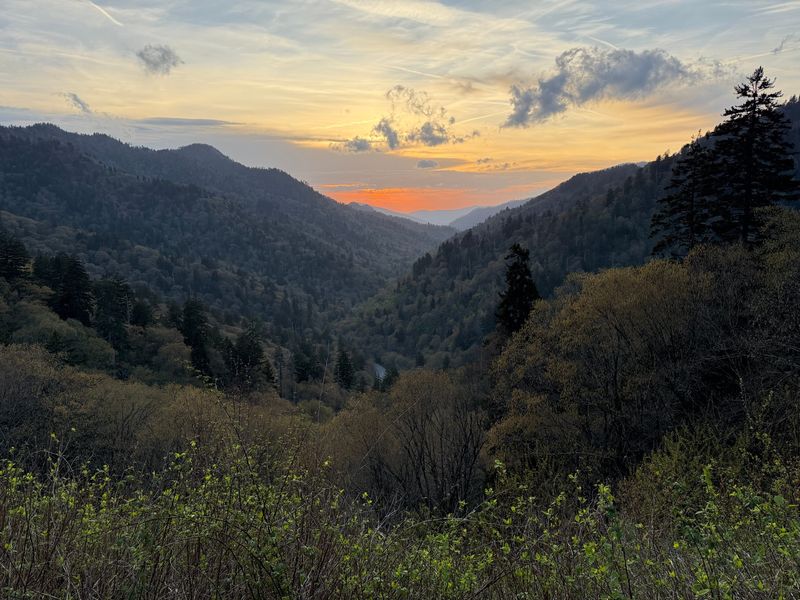
The Great Smoky Mountains National Park in Tennessee and North Carolina is a natural gem that attracts over 12 million visitors a year. People come to camp, hike, fish, or enjoy the awesome scenery.
The sun sets on America’s most visited national park, Great Smoky Mountains.
Guests also spend an estimated $2.1 billion annually boosting area lodgings, restaurants, and convenience stores. This economic dynamic supports over 20,000 jobs in the region.
President Trump apparently does not grasp that if parks nationwide are degraded through deep budget cuts, thousands of small businesses located in or near national park gateway communities will suffer, and tens of thousands of employees, mostly in the private sector, will be out of work.
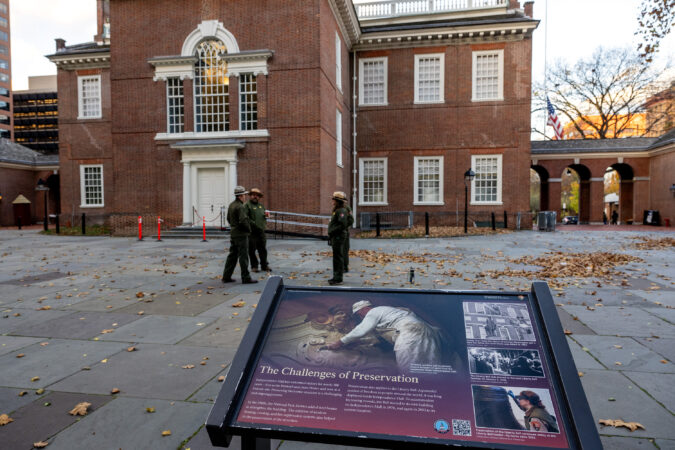
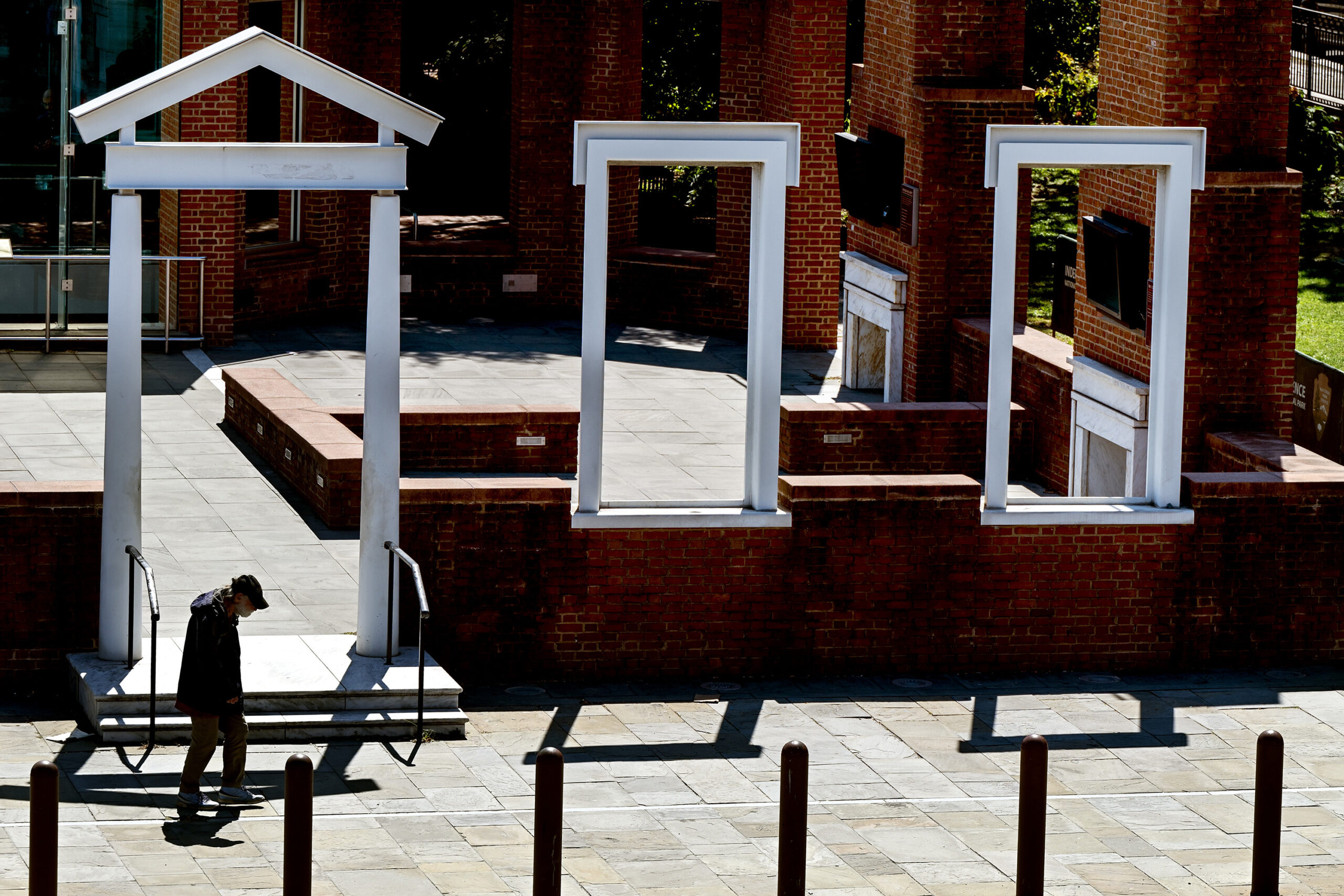
The President’s House in Independence National Historical Park, in September.
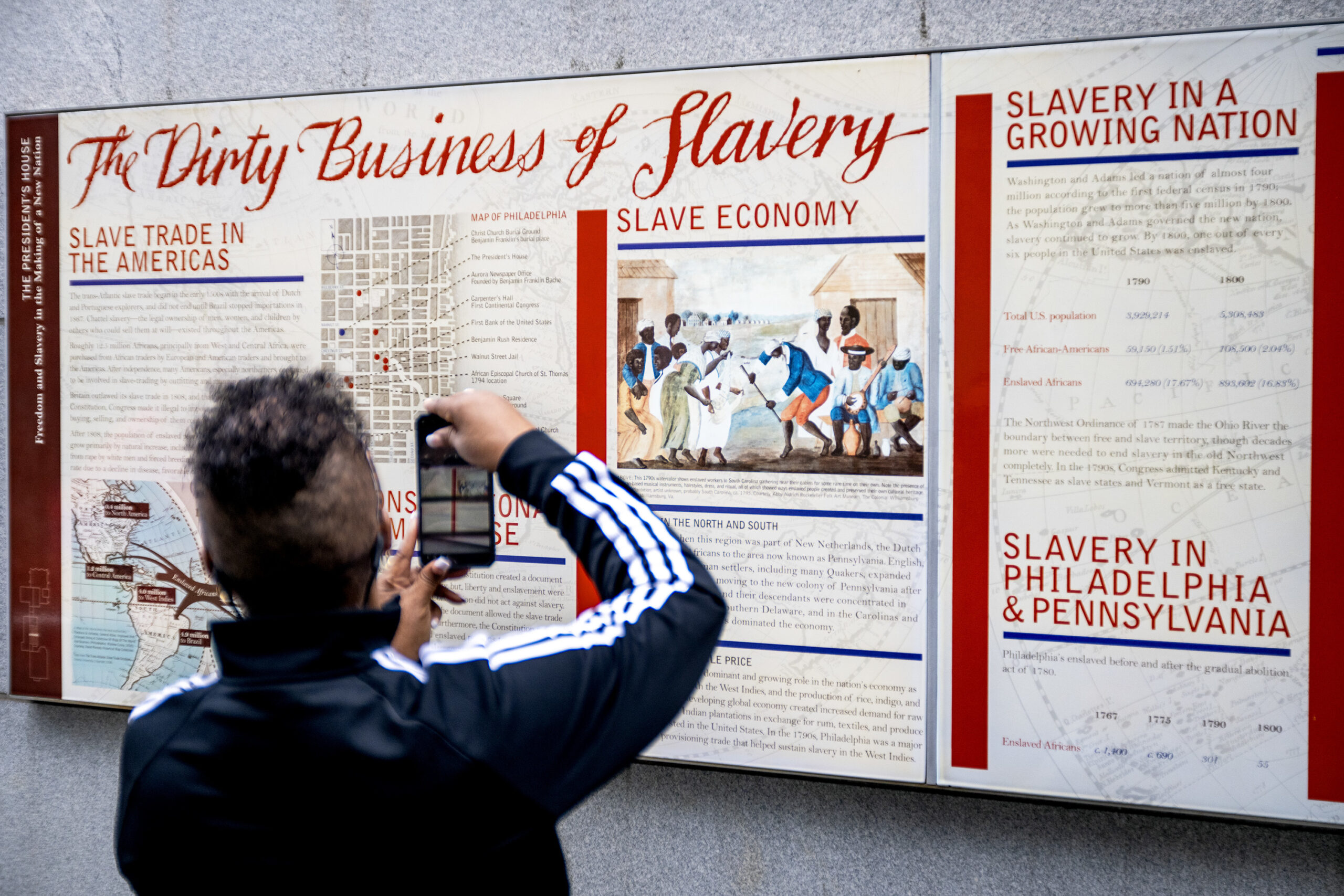
The President’s House Site at Independence National Historical Park in Philadelphia memorializes nine people who were enslaved there while George Washington was president in the earliest years of the republic. Their names are Austin, Christopher Sheels, Giles, Hercules, Joe, Moll, Oney Judge, Paris, and Richmond. The house site reflects this important detail and describes it truthfully. Yet, this president has ordered that the story be altered to be compatible with a sanitized — and dishonest — description of history.
Gina Blakemore from Sacramento, Calif., photographs signage describing enslavement at the President’s House in Independence National Historical Park, in September.
By erasing this factual presentation at Independence Park, a venerated place that represents the founding ideals of the nation, President Trump is revealing a vivid disrespect not only for African Americans but for all of us.
Slashed funding, fired employees, endangered properties, lost revenue, environmental rollbacks, whitewashed history: this will be the public lands legacy of President Donald Trump.
The damage to national parks that Trump and his loyalists have already inflicted is so profound that it will take years for these sites to recover.
We citizens, though, can do something now to help save them. We can write, call, or text members of Congress to demand they step up and repel this president’s egregious assault on parks.
Meanwhile, we should also make sure to visit a nearby national park site, seek out a ranger or guide, and assure them that we will do our part to defend and protect America’s magnificent national parks.
John Plonski was a finalist for the 2023 Theodore Roosevelt Genius Prize for the Promotion of Conservation and served as executive secretary of the Pennsylvania State Park and Forest Systems from 1995-2004.
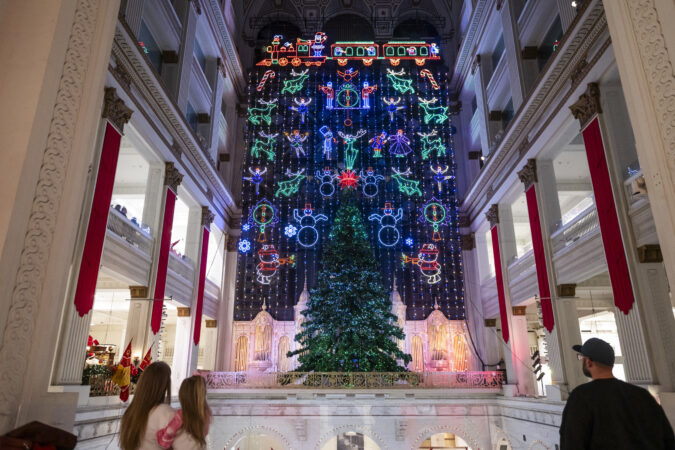
The Wanamaker Light Show and Dickens Village are over for 2025 — and with renovation needing to be done on 13th and Market, it is uncertain when they will return. The void that it leaves in Philadelphia’s holiday season will not just be one less Christmas attraction — it just won’t feel like Christmas.
As a kid, it just wasn’t Christmas without a trip to Wanamaker’s to see that light show and Dickens Village, and, of course, the sweet sound of that organ. The smell of that incredible grand marble lobby is forever captured in my mind. And getting lost? That was a metaphysical impossibility — all I had to do was to make my way back to that giant Eagle provided by John Wanamaker himself, and one that seemed a mere 1,000 feet tall to my 8-year-old brain.
One hundred and fourteen years ago this week, President William Howard Taft dedicated Wanamaker’s grand flagship store. Wanamaker’s was a true first in American shopping. The first with tags for prices, the first offering a money-back guarantee, the first to be equipped with a pneumatic tube system in the building in order to transport money.
Wanamaker’s didn’t just make an indelible mark on Philadelphia’s holiday celebrations. It redefined American shopping. When Wanamaker couldn’t serve in the American Civil War, he opened a store instead. His original venture (Oak Hall) sat on the location of the old President’s House in Center City. When it was time for a new location, Wanamaker selected the old Pennsylvania Railroad Depot at 13th and Market.
So with such a significant part of our city’s history taking a hiatus for the near term, what will we Philadelphians do? Wait for it to return, of course.
Michael Thomas Leibrandt, Abington Township
The Mighty Caroline
Tatiana Schlossberg, the accomplished wife, mother, and middle child of Caroline Kennedy Schlossberg, died at 35 years of age. It was the latest in a series of devastating heartbreaks for her mighty mother.
I am sure there are countless women of a certain age all over this country whose own hearts are aching for Caroline — the way we did as little girls when her daddy died. I recall the moms on our block on Long Island bursting out of their front doors, wailing in collective anguish at the news coming out of Dallas.
The other level of sadness is that thinking of young Caroline brings us back to a point in time in national politics and society when compassion crossed back and forth between party lines in the interest of the common good.
What is going on now in Washington also makes a person want to tear up — mostly because there is no known unifier to count on to lead us back to a functioning nation due to all the regrettable and preventable upheaval of the past year.
Mary Kay Owen,Downingtown
Join the conversation: Send letters to letters@inquirer.com. Limit length to 150 words and include home address and day and evening phone number. Letters run in The Inquirer six days a week on the editorial pages and online.
DEAR READERS: Welcome to 2026! A New Year has arrived; the last one is safely behind us. As always, this New Year brings with it our hopes for a new beginning.
Today presents an opportunity to discard destructive old habits for healthy new ones, and with that in mind, I will share Dear Abby’s often-requested list of New Year’s Resolutions — which were adapted by my late mother, Pauline Phillips, from the original credo of Al-Anon:
JUST FOR TODAY: I will live through THIS DAY ONLY. I will not brood about yesterday or obsess about tomorrow. I will not set far-reaching goals or try to overcome all of my problems at once. I know that I can do something for 24 hours that would overwhelm me if I had to keep it up for a lifetime.
JUST FOR TODAY: I will decide to be happy. I will not dwell on thoughts that depress me. If my mind fills with clouds, I will chase them away and fill it with sunshine.
JUST FOR TODAY: I will accept what is. I will face reality. I will correct those things that I can correct and accept those I cannot.
JUST FOR TODAY: I will improve my mind. I will read something that requires effort, thought and concentration. I will not be a mental loafer.
JUST FOR TODAY: I will make a conscious effort to be agreeable. I will be kind and courteous to those who cross my path, and I’ll not speak ill of others. I will improve my appearance, speak softly and not interrupt when someone else is talking. Just for today, I will refrain from improving anybody but myself.
JUST FOR TODAY: I will do something positive to improve my health. If I’m a smoker, I’ll quit. And I will get off the couch and take a brisk walk, even if it’s only around the block.
JUST FOR TODAY: I will gather the courage to do what is right and take responsibility for my own actions.
And now, Dear Readers, allow me to share an item that was sent to me by L.J. Bhatia, a reader from New Delhi, India:
DEAR ABBY: This year, no resolutions, only some guidelines. The Holy Vedas say, “Man has subjected himself to thousands of self-inflicted bondages. Wisdom comes to a man who lives according to the true eternal laws of nature.”
The prayer of St. Francis (of which there are several versions) contains a powerful message:
Lord, make me an instrument of your peace;
Where there is hatred, let me sow love;
Where there is injury, pardon;
Where there is doubt, faith;
Where there is despair, hope;
Where there is darkness, light;
And where there is sadness, joy.
O Divine Master,
Grant that I may not so much seek to be consoled as to console;
To be understood, as to understand;
To be loved, as to love;
For it is in giving that we receive,
It is in pardoning that we are pardoned,
And it is in dying that we are born to eternal life.
And so, Dear Readers, may 2026 bring with it good health, peace and joy to all of us.
ARIES (March 21-April 19). For your fresh start you will need courage, not because you’re facing something scary, but because living more fully requires risk. You put more of your emotions and energy on the line, and it will pay off. Lucky charm: a ring.
TAURUS (April 20-May 20). Your fresh start will benefit from intentional rest. Exhaustion cannot be your default anymore. Schedule restoration like it’s sacred, because it is. When you rest deliberately, your creativity comes back glowing. Lucky charm: a pen.
GEMINI (May 21-June 21). This fresh start activates your wonder. Not childish naivety, but the ability to expect good things without bracing for disaster. Curiosity will open doors that fear kept locked. You’ll be surprised how well things work out. Lucky charm: a feather.
CANCER (June 22-July 22). For your fresh start you’ll need clarity. Not perfect vision, just honest recognition of what you truly want. Desire is direction. Let your decisions be simple, your heart be decisive, and your steps be bold. Lucky charm: a key.
LEO (July 23-Aug. 22). Your fresh start requires boundaries. Not walls, gates. You decide what enters. Your time is precious, your peace sacred. Protect them like the future depends on it, because it does. Lucky charm: a lock.
VIRGO (Aug. 23-Sept. 22). Your fresh start is a seed of faith. What you plant will grow — believe it and be patient. Seeds don’t sprout on demand; they sprout because the conditions are right. Create those conditions and let your inevitable future unfold. Lucky charm: jade.
LIBRA (Sept. 23-Oct. 23). Your fresh start thrives on simplicity. Strip away the noise, the obligations you outgrew, the rituals that lost meaning. Leave only what feels alive. This is how you make room for the opportunities orbiting you now. Lucky charm: a coin.
SCORPIO (Oct. 24-Nov. 21). Your fresh start thrives on play. You’ve been serious for too long. Let joy make decisions. Follow whims, create without purpose, laugh freely. This lightness will unlock progress that pressure never could. Lucky charm: anything heart-shaped.
SAGITTARIUS (Nov. 22-Dec. 21). For your fresh start, prioritize pleasure. More than an emotion, it’s a strategy. What delights your senses isn’t frivolous at all because it fuels you and keeps you going. With more sensory satisfaction, you have more energy, too. Lucky charm: perfume.
CAPRICORN (Dec. 22-Jan. 19). For your fresh start, you turn up your gratitude practice with rituals that anchor you in optimism. Acknowledge regularly how far you’ve come, and just how much you have that can be leveraged to bring your dreams to life. Lucky charm: a note.
AQUARIUS (Jan. 20-Feb. 18). Your fresh start is galvanized in the spirit of commitment. You choose devotion over discipline. You show up because it feels meaningful, not mandatory. Your momentum blossoms from genuine excitement. Lucky charm: a stone.
PISCES (Feb. 19-March 20). Your fresh start highlights self-trust. You’ve earned it. Second-guessing instinct is a thing of the past. You know more than you think you do. Your intuition is a partner, and the sharpest one you’ve ever had. Lucky charm: a seashell.
TODAY’S BIRTHDAY (Jan. 1). Welcome to your Year of Sweet Upgrades. Not all-at-once dramatic change, just steady, luxurious improvement on all fronts until the glow-up is undeniable. Your environment becomes prettier, your systems smoother and your connection to others warmer. More highlights: a high-status opportunity you earn through charm, an adventure you didn’t realize you needed and an investment that matures beautifully. Scorpio and Leo adore you. Your lucky numbers are: 1, 10, 6, 11 and 42.
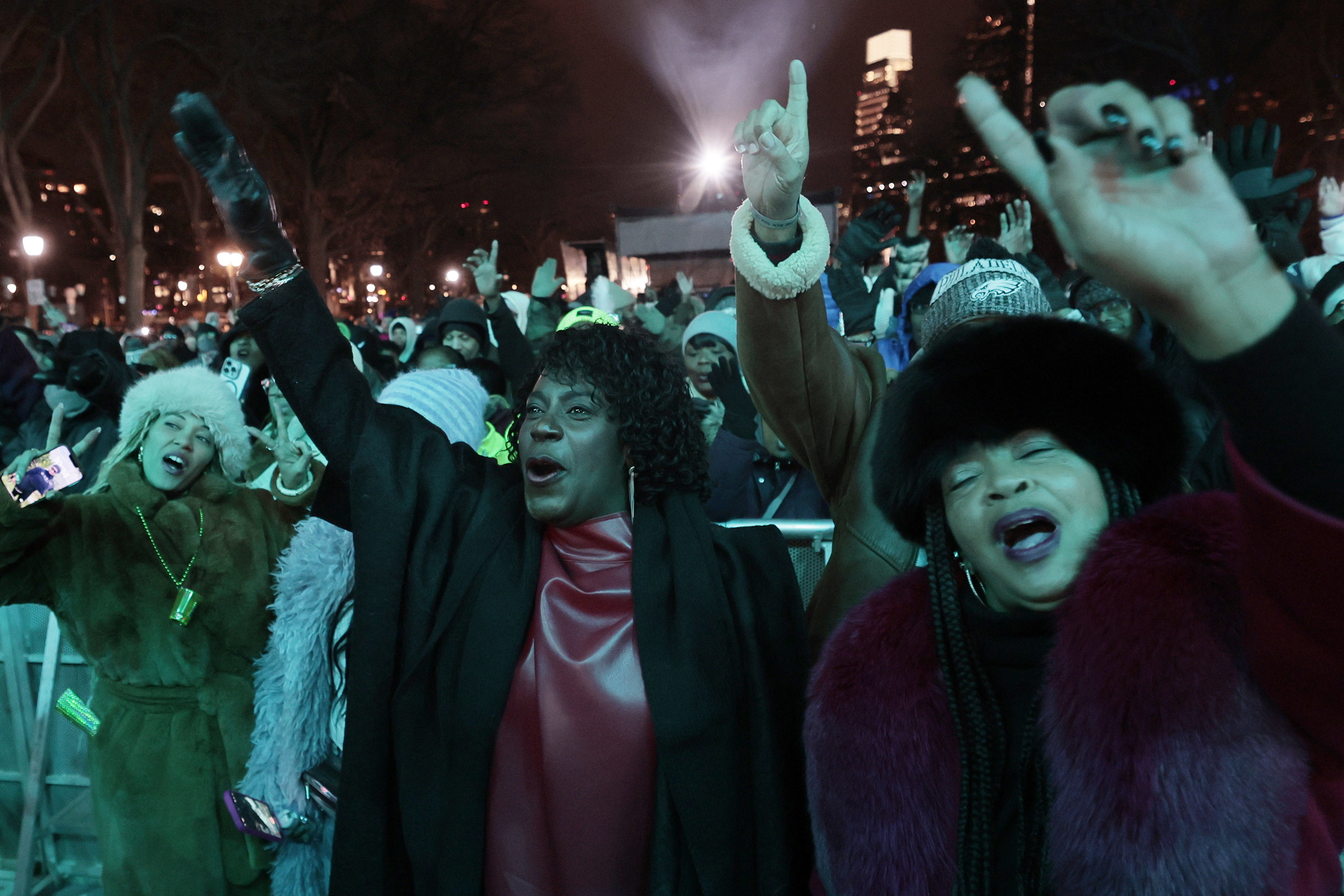
Fans braved the bitter cold to attend the free New Year’s Eve concert in front of the Philadelphia Art Museum and watch a midnight fireworks display kicking off the city’s celebration of the nation’s 250th anniversary.
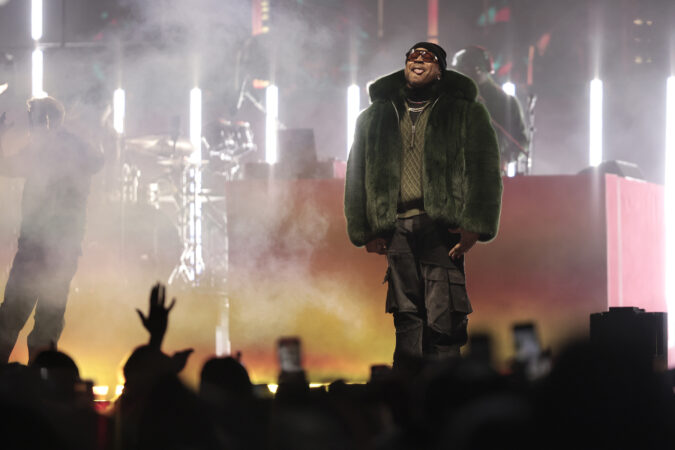
The concert was headlined by LL Cool J, the two-time Grammy-winning rapper who also has had a long career in movies and TV, including as a regular cast member on the series NCIS: Los Angeles.
About 10 minutes to midnight, LL Cool J brought out Philadelphia-based rapper Freeway as a surprise guest.
Mayor Cherelle L. Parker joined the stage just before 10 p.m. to welcome another headliner, DJ Jazzy Jeff, alongside radio personality Lady B.
“My mayor is a hip-hop head,” Lady B said. Parker told the crowd: “Tonight, we remind the nation, that we are one America, a united nation.”
After taking the stage, Parker told a gaggle of reporters “what you are seeing is ‘one Philly, a united city’ in action” — referencing her mayoral slogan.
“Philadelphia is the birthplace of democracy, sixth-largest city in the nation — Why wouldn’t we kick off 2026, the Semiquincentennial, the 250th birthday of our nation?” she said. “Because Philadelphia, it’s where it happened.”
When asked if the free concert will become an annual tradition, Parker quipped, “Well, the budget process.” (A final price tag on the event was not yet available.)
Mayor Cherelle L. Parker and Lady B (right) dance to DJ Jazzy Jeff during Philadelphia’s free New Year’s Eve concert and fireworks display, at the Oval on the Benjamin Franklin Parkway, on Wednesday, Dec. 31, 2025.
As for Parker’s resolutions for Philly in 2026: “To work harder, to dream bigger, and to do the impossible.
“We have a lot of challenges to address here in our city, but with our amazing team, there is nothing that we cannot accomplish together,” she said.
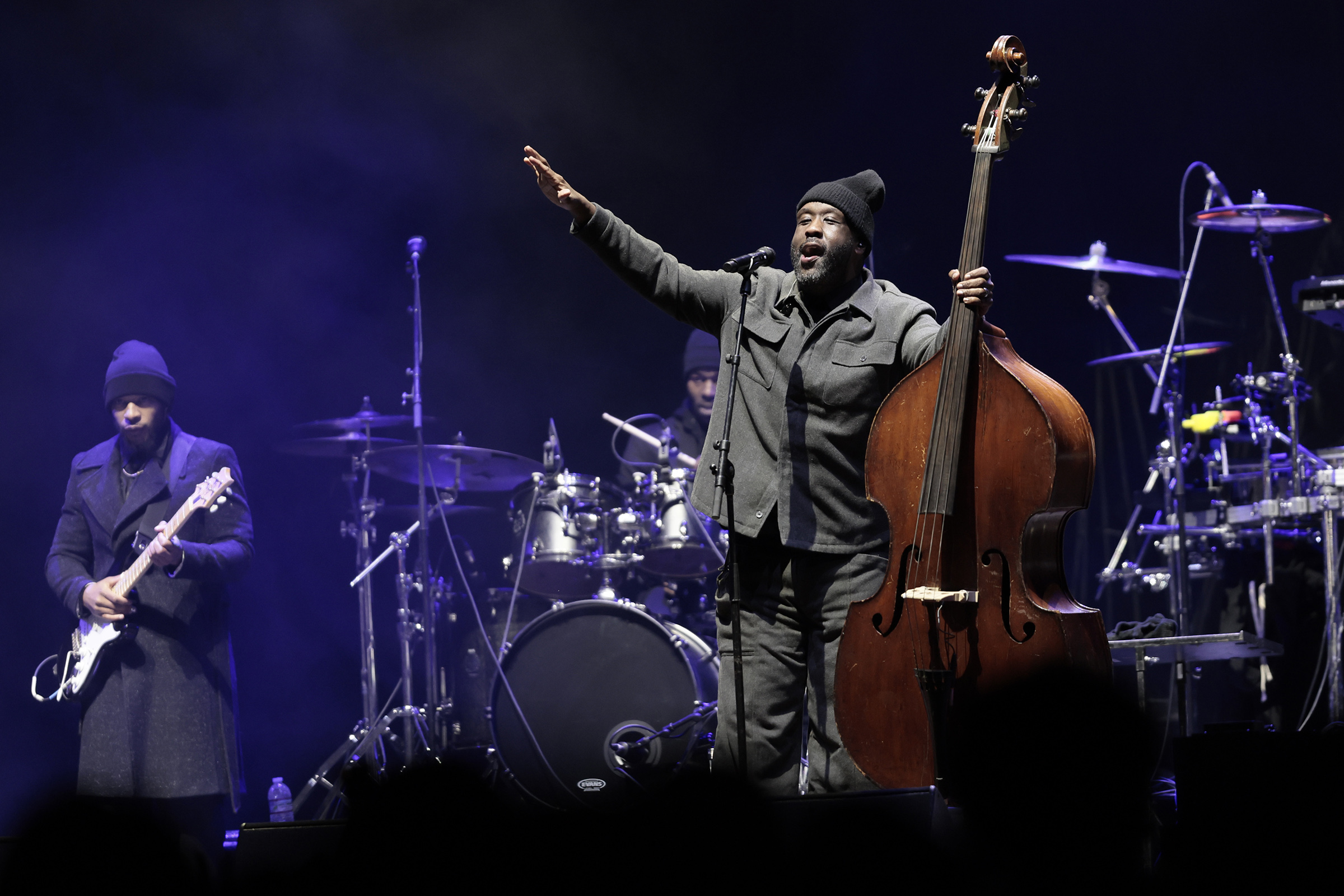
Taking the stage shortly after 8 p.m., multi-instrumentalist Adam Blackstone, the Philadelphia High School for Creative and Performing Arts graduate and University of the Arts alum who has since performed with some of the world’s most popular musical artists, declared: “I’m home right now. They told me Philly’s the spot to be.”
Just before 11:30 p.m., attendance had grown to around 7,500 and was still growing, according to the show’s producer, Scott Mirkin, of ESM Productions. The final crowd estimate was 10,000 attendees, according to ESM.
The crowd had been modest up to around 10 p.m., but a late surge may have included people only interested in seeing LL Cool J or the fireworks display after the concert.
All were bundled in winter gear as the wind chill dipped into the 20s and even flurries made a late-night appearance.
Performers repeatedly commented on the frigid temperatures Wednesday night.
“I know it’s cold but we’re going to warm you up,” Dorothy frontwoman Dorothy Martin told concertgoers.
Martin later said: “I know you’re cold, but your heart is warm.”
The temperature made Fairmount residents Corey Fletcher, 32, and Alyza Ngbokoli, 30, hesitate, despite the draw of Cool J and Jazzy Jeff. Both were surprised by the prospect of an outdoor concert in the winter.
“It’s hard to breathe — it hurts my lungs,” Fletcher said of the cold. (Fletcher said fall is the ideal season for outdoor events; Ngbokoli said summer.)
For next year, Ngbokoli recommended organizers invest in heat lamps or warming tents. This year, concertgoers had the option of purchasing a hot meal — fried desserts, fried chicken, or lobster bisque from various food trucks — hot apple cider, hot chocolate, or $8 White Claws and other spirits.
Adam Blackstone performs during Philadelphia’s free New Year’s Eve concert and fireworks display, at the Oval on the Benjamin Franklin Parkway, on Wednesday, Dec. 31, 2025.
Die-hard fans were undeterred by the cold.
Sarah and Mike Murray, of Wilkes-Barre, estimate they’ve seen Cool J in concert “almost double-digits.”
“He’s easy on the eyes,” Sarah, 46, said.
“You can’t argue with that,” chimed Mike, 54. “He’s LL — ladies love him.”
The Cool J enthusiasts were supposed to see him perform on the Parkway on July 4, but the “Mama Said Knock You Out” and “I Can’t Live Without My Radio” singer canceled in solidarity with striking municipal workers.
What are the Murrays looking forward to in 2026?
“See LL Cool J more,” Mike said.
Cousins Tahira and Sean Tyler came to the Ben Franklin Parkway expecting a party. It was 55-year-old Sean Tyler’s first New Year’s Eve out on the town, and both were drawn in by LL Cool J.
Sean Tyler, of Overbrook Park, said she remembered in the ‘80s listening to the then-new artist’s first single on Power 99, but had never seen him live. Both Tylers discovered newfound appreciation for LL Cool J canceling his summer concert in solidarity with striking city workers.
“It showed how many people that it affected, and how much in wages, benefits — it shows how much it affects a broad range of people,” Sean Tyler said.
Upon walking into the barricaded Parkway, Sean and Tahira said the visible Philadelphia police presence and security measures made them feel safe.
Police Commissioner Kevin Bethel has said police will be out in full force, and asked concertgoers to leave weapons at home.
Tahira said the show, featuring local talents — like Blackstone and Jazzy Jeff — is the perfect way to ring in 2026, and the nation’s 250th birthday.
Tahira said: “Let’s continue to love Philly in the right kind of way — “
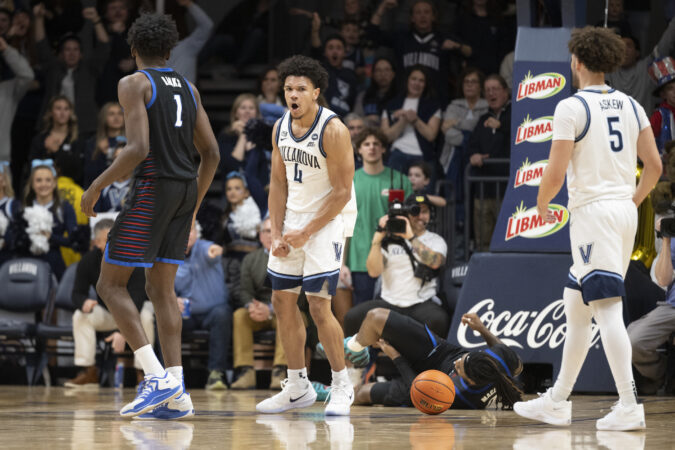
Tyler Perkins and Bryce Lindsay scored 19 points apiece in Villanova’s 71-66 win against DePaul on Wednesday.
Perkins had seven rebounds for the Wildcats (11-2, 2-0 Big East Conference) and Lindsay shot 7 for 17 overall, including 5 for 10 from beyond the arc. Duke Brennan shot 3 of 5 from the field and 3 of 7 from the free-throw line to finish with nine points.
The Blue Demons (8-6, 0-3) were led by CJ Gunn, who posted 15 points and seven rebounds. DePaul also got 13 points from Layden Blocker. RJ Smith had 11 points.
Lindsay scored 10 points in the first half as Villanova went into the break trailing 32-28. Villanova used a 13-2 second-half run to erase a two-point deficit, and gave the Wildcats a 69-60 lead with 1:45 remaining in the game. Perkins scored 11 second-half points.
The Wildcats next will visit Butler in another Big East game, Saturday at noon (TNT).
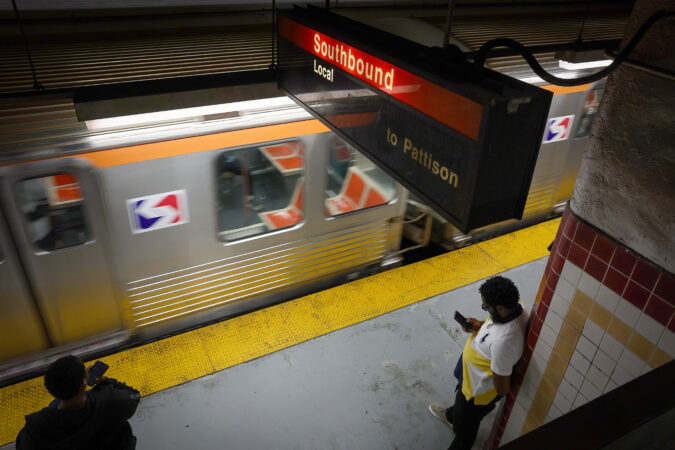
Two men were in stable condition after sustaining stab wounds on SEPTA’s Broad Street Line late Wednesday afternoon, a transit agency spokesperson said.
The stabbings happened around 4 p.m. on a northbound Broad Street Line train, said SEPTA spokesperson John Golden.
Because of police activity at the Broad-Girard Station, northbound B1, B2, and B3 trains were bypassing the station for several hours.
Shortly after 10:30 p.m., Golden said a suspect had been taken into custody by SEPTA Transit Police.
B1,B2,B3: Northbound B1, B2, and B3 trains are bypassing Girard Station due to police activity.
A 31-year-old man was fatally shot — allegedly by his 38-year-old brother — in the parking lot of a shopping center Wednesday evening in the Eastwick section of Southwest Philadelphia, police said.
Just before 6:10 p.m., nearby police officers responded to the sound of gunfire at the Penrose Plaza Shopping Center at 2900 Island Ave. and found the victim with two gunshot wounds to the chest, police said.
The man was transported by police to Penn Presbyterian Medical Center, where he was pronounced dead at 6:35 p.m.
Inspector D.F. Pace said the brothers, whose identities were not released, were believed to be arguing about money when the shooting happened.
The older brother was quickly taken into custody, Pace said.