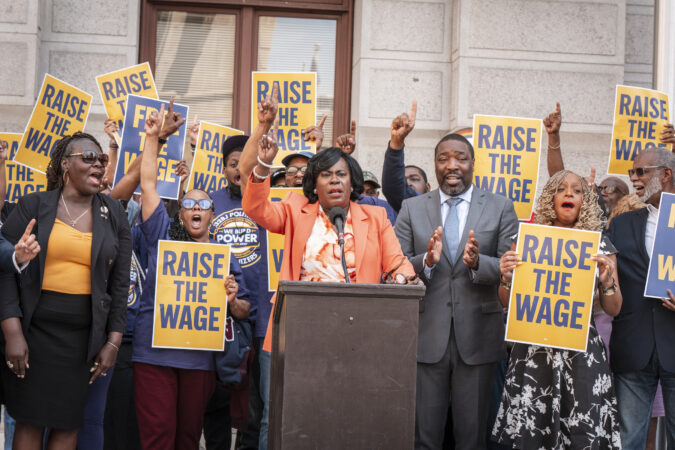
New Jersey’s minimum wage will increase on Thursday.
The new rate of $15.92 an hour is a $0.43 increase from the previous standard, which was set in 2025.
“Eight years ago, Governor Murphy pledged a stronger, fairer economy, and we’re delivering on this commitment by raising New Jersey’s minimum wage again,” Robert Asaro-Angelo, commissioner of the state’s Department of Labor and Workforce Development, said in October. “This increase will provide vital support to all Garden State workers by making the dream of a livable wage reality.”
window.addEventListener(“message”,function(a){if(void 0!==a.data[“datawrapper-height”]){var e=document.querySelectorAll(“iframe”);for(var t in a.data[“datawrapper-height”])for(var r,i=0;r=e[i];i++)if(r.contentWindow===a.source){var d=a.data[“datawrapper-height”][t]+”px”;r.style.height=d}}});
In 2019, New Jersey lawmakers passed legislation to increase the standard to $15 by 2024, joining California, Massachusetts, New York, and the District of Columbia which were also progressively introducing the new standard. At the time, the minimum wage in New Jersey was $8.85 per hour.
A single adult without a child needs to make $26.20 per hour in New Jersey to afford their basic needs as of February 2025, according to a living wage calculator developed at the Massachusetts Institute of Technology.
Agricultural workers in New Jersey have a separate wage standard and will see an increase from $13.40 to $14.20 in January.
For tipped workers, the minimum hourly wage will increase from $5.62 to $6.05. But when combined with their tips, these workers should have a total hourly wage of at least $15.92.
Employees at seasonal and small businesses will see wages rise from $14.53 to $15.23. The state has a different scale for these employers to lessen the impact of the raises.
What’s the minimum wage in Pennsylvania?
Pennsylvania’s minimum wage has gone unchanged since 2009, despite efforts to increase it. The federal minimum wage was last increased in 2009 to $7.25.
In Pennsylvania, a single adult without a child needs to make $22.91 per hour to afford their basic needs, according to the MIT calculator.
As of July, other states following the federal minimum wage were: Idaho, Utah, Kansas, Oklahoma, Texas, North Dakota, Iowa, Wisconsin, Indiana, Kentucky, North Carolina, and New Hampshire.
Advocates have also sought legislation to allow Philadelphia to set its own minimum wage separate from the state’s. That’s currently prohibited by law.
Your once-glorious live Christmas tree is likely starting to lose its magic. While still covered in sparkling lights and ornaments, the beginnings of brown and bald spots may be appearing. Your floor is filled with needles. And you know it’s time to say goodbye.
Tossing your tree — the last symbol of holiday cheer — is never an easy or fun task. But you can make it a tradition that benefits others, and in return, perhaps brings you a little post-holiday joy. How? Repurpose or recycle your tree.
While most municipalities, including Philadelphia, will pick up your tree with your curbside trash, there are ways to put it to better use, such as feeding it to goats and helping preserve Jersey Shore parks. Here’s where to recycle your tree in the area.
Philly Goat Project Tree-Cycling
Furry friends at the Philly Goat Project are ready to munch on your holiday leftovers. The community-based program is hosting tree-cycling on Jan. 10, from noon to 3 p.m. (Rain date: Jan. 11) at the Farm at Awbury Arboretum, 6336 Ardleigh St., Philadelphia 19138. On Jan. 17, trees will be accepted from noon to 3 p.m. (no rain date) at Laurel Hill West Cemetery, 215 Belmont Ave., Bala Cynwyd, 19004. The final event will be at the Awbury Arboretum on Jan. 24, from noon to 3 p.m. (Rain date: Jan. 25)
At the Awbury Arboretum, it’s not just a tree drop-off, either. Get cozy by the fire pit with free hot cocoa or enjoy goat cuddles — awesome for the whole family. A suggested donation of $20 per tree is requested. All proceeds support the Philly Goat Project’s free year-round programming, like goat walks and children’s literacy events. PGP can provide a tax receipt.
Recycle your Christmas tree at one of several locations in Ocean County through Jan. 31. Locations can be found here. Your tree will get turned into woodchips and used for landscaping projects at park facilities. Recycled trees have also been used to line sand dunes to help prevent erosion, which has become more common as development increases. Drop-off times are Monday-Saturday from 7:30 a.m. to 3 p.m.
For the 37th year, the Streets Department will be accepting Christmas trees for recycling for two weeks, from Jan. 5 through Jan. 17. While the program is running, you may bring your Christmas tree to one of several designated locations or to a sanitation convenience center at no cost. All trees should be untied and free of decorations, lights, and ornaments.
A car with a Christmas tree that ended up at the Philly Goat Project’s 2025 Tree-Cycle Festival at the Farm at Awbury in Philadelphia in 2025.
Philadelphia neighborhood Christmas tree recycling
Neighborhood associations and community groups host tree-cycling events throughout Philadelphia, including:
Lower Moyamensing Civic Association is accepting trees on Jan. 3-4 from 9 a.m. to 3 p.m. at South Philadelphia High School, 2101 S. Broad St. A $5 donation is required per tree.
Passyunk Square Civic Association is accepting trees on Jan. 10 from 9 a.m. to 2 p.m. at Columbus Square Park (corner of 13th and Wharton Sts.) for a $5 donation.
Christmas tree recycling curbside pickup
Too busy to deliver your tree yourself?
Circle Compost offers $20 curbside pickup on the weekends for the following dates: Jan. 3-4, Jan. 10-11, and Jan. 17-18. Sign up online, and put your tree outside your house the night before pickup. Pickup days will be assigned two days in advance. Maximum tree height allowed is 14 feet. Trees are turned into woodchips to be used as mulch or compost for Philly’s nonprofit urban farms. Questions? Call 267-388-1493 or visit circlecompost.com. To sign up for pickup, visit accounts.circlecompost.com/shop/christmas-tree
Bennett Compost will pick up your tree on the weekends of Dec. 28-29, Jan. 3-4, Jan. 10-11, or Jan. 17-18 for a fee of $20. Sign up online. Trees will either be taken to the Fishtown Neighbors Association site where Bennet Compost will donate $5 to them on your behalf. Trees that can’t go to the tree-cyclers will be chipped at Bennet Compost and used in its composting process. Questions? Call 215-520-2406 or visit bennettcompost.com. To sign up for pickup, visit bennettcompost.com/seasonal.
This article has been updated since it first published. Grace Dickinson and Steven White contributed to this article.
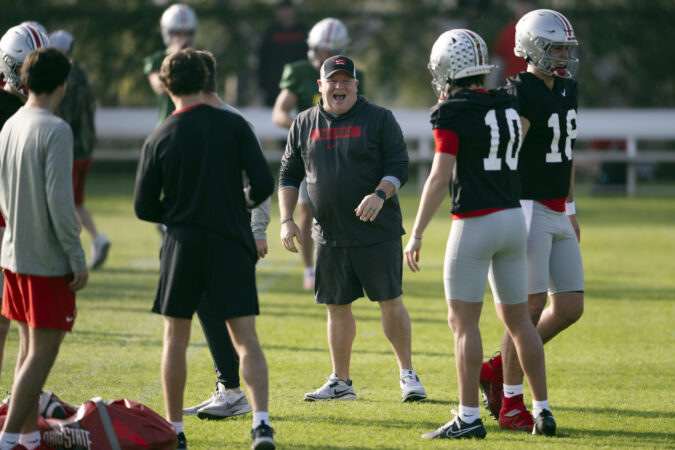
It’s back to the college ranks for Chip Kelly. Northwestern announced the hiring of the 62-year-old former Eagles coach as its offensive coordinator on Tuesday.
Kelly served in the same role for the Las Vegas Raiders this season, but he was fired on Nov. 23 after a 2-9 start. He has been a head coach with the Eagles (2013-15) and the San Francisco 49ers (2016). In the college game, he was head coach at Oregon (2009-12) and UCLA (2018-23).
He also was offensive coordinator at Ohio State last season as the Buckeyes captured the national championship.
“We are absolutely thrilled to welcome Chip and his wife, Jill, to our university,” Wildcats head coach David Braun said. “His innovative approach to offense using systems that focus on varying tempo, efficiency and smart decision-making, his track record of developing quarterbacks, and his ability to maximize talent are exactly what our program needs at this moment. …
“Make no mistake: this is a program-defining change and is reflective of our long-term commitment to the pursuit of championships.”
Kelly replaces Zach Lujan, the Wildcats’ offensive coordinator for two seasons. Northwestern went 7-6 this season, 4-5 in the Big Ten.
“I am honored to join the Northwestern Football program,” Kelly said. “This program and university are clearly on the rise, and the values of the people and this place align with my own. I am grateful for the opportunity. There is tremendous potential under Coach Braun’s leadership, and I’m ready to contribute to this team.”
Realtor.com labeled homes as luxury if their listing price was in the most expensive 10% of listings for their market. The company analyzed markets that had an average of at least 500 million-dollar listings over the 12 months through November.
The country’s fastest-moving luxury markets span regions and price points. The fastest was the San Jose, Calif., metro area, where luxury homes sold in November in a median of 56 days. And of the 10 fastest-selling markets, the Philadelphia metro area had the second-lowest threshold for luxury homes: $898,989.
Nationally, the luxury threshold in November was about $1.2 million. And homes listed at this price and above stayed on the market for a median of 78 days.
window.addEventListener(“message”,function(a){if(void 0!==a.data[“datawrapper-height”]){var e=document.querySelectorAll(“iframe”);for(var t in a.data[“datawrapper-height”])for(var r,i=0;r=e[i];i++)if(r.contentWindow===a.source){var d=a.data[“datawrapper-height”][t]+”px”;r.style.height=d}}});
The slowest-moving metropolitan area in November was Bend, Ore., where luxury homes sold in a median of 146 days. Its luxury market started at $1.85 million.
The Heber, Utah, metropolitan area had the second-slowest market last month. Luxury homes there sold in a median of 136 days.
But this area outside Salt Lake City also had the most expensive luxury market in November. Its luxury threshold was about $6.6 million, which was roughly 10% higher than at the same time last year.
Falling luxury prices
Nationally, the threshold for what constitutes a luxury listing — roughly $1.2 million — was down 2.3% in November from the same time last year.
Luxury prices in November dropped from last year in eight of the 10 most-expensive metro areas.
In the region of Kahului and Wailuku on Hawaii’s Maui island, the luxury price threshold of roughly $3.66 million was down 21% from last year — the steepest price drop of the markets Realtor.com analyzed.
DHAKA, Bangladesh — Former Bangladeshi Prime Minister Khaleda Zia, 80, whose archrivalry with another former premier defined the country’s politics for a generation, has died, her Bangladesh Nationalist Party said in a statement Tuesday.
Ms. Zia was the first woman elected prime minister of Bangladesh.
Bangladesh’s interim government announced a three-day mourning period. A general holiday also was announced for Wednesday, when Ms. Zia’s funeral prayers are scheduled be held in front of the country’s national Parliament building in Dhaka.
“Her role in the struggle to establish democracy, a multi-party political culture, and the rights of the people in Bangladesh will be remembered forever,” Yunus said.
Indian Prime Minister Narendra Modi offered condolences in a statement Tuesday, noting that “as the first woman Prime Minister of Bangladesh, her important contributions toward the development of Bangladesh, as well as India-Bangladesh relations, will always be remembered.”
Sajeeb Wazed, son of former Bangladesh Prime Minister Sheikh Hasina, said in a statement Tuesday that Ms. Zia’s demise “will leave a deep impact on the country’s [democratic] transition.”
“She will be remembered for her contributions in nation building but her death is a blow to stabilize Bangladesh,” said Wazed, whose mother was Ms. Zia’s greatest political rival.
Hasina issued a statement from exile in India saying Ms. Zia’s death was “an irreparable loss” for politics in Bangladesh and recalling her contributions in establishing the nation’s democracy.
The BNP said that after she was released from prison due to illness in 2020, her family sought permission for treatment abroad at least 18 times from Hasina’s administration, but the requests were rejected.
Bangladesh’s early years of independence, gained in a bloody 1971 war against Pakistan, were marked by assassinations, coups, and countercoups as military figures and secular and Islamic leaders jockeyed for power.
Ms. Zia’s husband, President Ziaur Rahman, had grabbed power as a military chief in 1977 and a year later formed the Bangladesh Nationalist Party. He was credited with opening democracy in the country but was killed in a 1981 military coup. Ms. Zia’s uncompromising stance against the military dictatorship helped build a mass movement against it, culminating with the ousting of dictator and former army chief H.M. Ershad in 1990.
Ms. Zia’s opponent when she won her first term in 1991 and in several elections after that was Hasina, the daughter of independence leader Sheikh Mujibur Rahman, who was assassinated in a 1975 coup.
Ms. Zia was criticized over an early 1996 election in which her party won 278 of the 300 parliamentary seats during a wide boycott by other leading parties, including Hasina’s Awami League, which demanded an election-time caretaker government. Ms. Zia’s government lasted only 12 days before a nonpartisan caretaker government was installed, and the new election was held that June.
Ms. Zia returned to power in 2001 in a government shared with the country’s main Islamist party, Jamaat-e-Islami, which had a dark past involving Bangladesh’s independence war.
Ms. Zia’s Bangladesh Nationalist Party was previously closely allied with the party and her government maintained the confidence of the business community by following pro-investment, open-market policies. Ms. Zia was known to have a soft spot for Pakistan and used to deliver anti-Indian political speeches. India alleged insurgents were allowed to use Bangladesh’s soil to destabilize India’s northeastern states under Ms. Zia, especially during her term from 2001 to 2006.
During that term, Ms. Zia also was tainted by allegations that her elder son, Tarique Rahman, was running a parallel government and was involved in widespread corruption.
A rivalry with Hasina
In 2004, Hasina blamed Ms. Zia’s government and Rahman for grenade attacks in Dhaka that killed 24 members of her Awami League party and wounded hundreds of people. Hasina narrowly escaped the attack, which she characterized as an assassination attempt, and subsequently won the 2008 general election.
Ms. Zia’s party and its partners boycotted the 2014 election in a dispute over a caretaker government, giving a one-sided victory to the increasingly authoritarian regime of Hasina. Her party joined the national elections in 2018 but boycotted again in 2024, allowing Hasina to return to power for a fourth consecutive time through controversial elections.
Ms. Zia was sentenced to 17 years in jail in two separate corruption cases for misuse of power in embezzling funds meant for a charity named after her late husband. Her party said the charges were politically motivated to weaken the opposition, but the Hasina government said it did not interfere and the case was a matter for the courts.
Hasina was bitterly criticized by both her opponents and independent critics for sending Ms. Zia to jail.
Health concerns placed over politics
Ms. Zia was released from jail by Hasina’s government in 2020 and was moved to a rented home, from which she regularly visited a private hospital. Her family repeatedly requested that Hasina’s administration allow Ms. Zia to travel abroad for medical treatment, but was refused.
After 15 years in power, Hasina was ousted in a mass uprising in August 2024 and fled the country. Ms. Zia was given permission to travel abroad by an interim government led by Yunus, a Nobel Peace Prize laureate.
Ms. Zia was silent about politics for years and did not attend political rallies, but she remained the BNP chairperson until her death. Rahman has been the party’s acting chair since 2018.
She was last seen at an annual function of the Bangladesh military in Dhaka Cantonment on Nov. 21, when Yunus and other political leaders met her. She was in a wheelchair and appeared pale and tired.
She is survived by Rahman, her elder son and heir apparent in the political dynasty. Her younger son, Arafat, died in 2015.
The question: Is red wine healthier than white wine?
The science: Many people think red wine is better for youthan white wineor other types of alcohol.
The notion was partly born from studies — some of which have been disputed —that suggested that certain compounds found in red wine could improve cardiovascular health.
Now the evidence suggests that any type of alcohol — including red wine — is unlikely to make you any healthier than drinking no alcohol at all.
“There’s no isolated health benefit of red wine over white wine over any other beverage containing alcohol,” said George Koob, the director of the National Institute on Alcohol Abuse and Alcoholism. And, he added, “There’s no physical health benefits of which we can attribute to alcohol.”
While it’s long been known that heavy alcohol consumption can cause serious health problems, the potential benefits and risks of moderate drinking — defined as up to two drinks per day for men and one for women — have been murkier. In the past, some research suggested that people who drank small amounts of alcohol in general might have a health advantage compared with those who didn’t drink at all.
But as research has evolved over the years, we nowknow that even modest drinking is linked to a higher risk of developing certain cancers such as breast, colorectal and esophageal cancers, as well as brain changes and dementia, heart problems and sleep problems.
Dietary guidance has also changed. Current guidelines from the U.S. Department of Agriculture state that “emerging evidence suggests that even drinking within the recommended limits may increase the overall risk of death from various causes.” The American Heart Association recommends limiting or abstaining from alcohol, even though the association published a scientific review in 2025 that concluded that light drinking poses no risk for coronary artery disease, stroke, sudden death and possibly heart failure, and may even reduce the risk of developing such conditions — though not all experts agreed with that conclusion.
The argument in favor of red wine used to focus on certain compounds.
Red wine contains more polyphenols — plant compounds with antioxidant and anti-inflammatory properties — because the grape juice is fermented with the grape skins, where these compounds are concentrated. (White wine grapes are pressed, and the skins removed, before the fermentation process.)
These polyphenols include procyanidins, flavonoids and resveratrol, which is often mentioned in cancer research.Another type, anthocyanins, helps give red wine its rich color and has been studied for potential cardiovascular benefits.
Most of the health benefits associated with these polyphenols have been observed in studies at much higher doses than what you would get from a couple glasses of wine, so there’s no real advantage,experts said.
“The concentrations are sufficiently low that you would have to drink more than moderate amounts to truly get that much more benefit from the polyphenols in red wine,” which could lead to health issues, said Eric Rimm, a professor of epidemiology and nutrition at the Harvard T.H. Chan School of Public Health, who has studied the health effects of alcohol.
Instead, you could add stronger sources of anthocyanins into your diet, including darker berries such as blueberries, apples, onions, black or green tea, and dark chocolate, Rimm said.
As for other risks and benefits, some people may avoid red wine because it can stain teeth and cause headaches and even allergy-like symptoms. Whilered wine headaches are not fully understood, some people may be especially sensitive to the tannins in the grapes, histamines or sulfites produced through fermentation, or the additional sulfites added to preserve wine. Some research suggests quercetin, an antioxidant found in grapes, may be responsible.
In one study, people who had a wine intolerance were more likely to report allergy-like symptoms such as nasal congestion, itching, flushed skin and stomach upset more often after drinking red wine than white wine.
What else you should know
While drinking alcohol probably won’t lead to any positive health effects, you may be able to reduce potential negative effects by how you drink it.
First, speak with your health care provider about whether drinking alcohol is safe for you.People who are pregnant, have certain medical conditions, take medications that interact with alcohol, or have or are recovering from an alcohol-use disorder should not drink, according to USDA. Also, teetotalers, people who don’t already drink, should not start drinking for any health reasons, health officials said.
Assuming you’re of legal drinking age — 21 years or older in the United States — here are some tips from experts:
Eat first: Food, particularly foods with some protein, fats and carbohydrates, slows the absorption of alcohol into the bloodstream, reducing potential ill effects.
Understand drink sizes: A standard alcoholic drink has 0.6 ounces of pure alcohol. That’s equal to 5 ounces of wine with 12 percent alcohol, 12 ounces of beer with 5 percent alcohol, or a shot — 1.5 ounces — of an 80-proof liquor. When buying alcohol at a store, check the alcohol content. “Beer used to be 4 or 5 percent alcohol. There are a lot of beers now that are 8 to 10 percent. So you may want to drink a little bit less if you have a higher alcohol-containing beer or a higher alcohol-containing spirit,” Rimm said.
Keep in mind that men and women may process alcohol differently: Women generally don’t produce as much of an alcohol-metabolizing enzyme called alcohol dehydrogenase, which means they break down alcohol more slowly and are at a higher risk of alcohol-related health problems.
Drink in moderation: Moderation is defined as up to two drinks per day for men and one for women.Also, space out drinks throughout the week — meaning don’t drink all 7 or 14 drinks in one weekend.
The bottom line: While red wine has more polyphenols, which are associated with cardiovascular benefits, than white wine, they aren’t in a high enough concentration to provide a health advantage. In addition, red wine may be more likely than white wine to cause headaches and allergy-like symptoms in people who are susceptible.
The past year in sports was full of choices that worked out swimmingly, such as Anthony Joshua taking a fight on relatively short notice. The fight, of course, was against Jake Paul, it earned Joshua a massive payday, and he finished it with a knockout of someone a lot of people wanted to see get knocked out.
Other choices didn’t work out quite so well, and a few were unfortunate enough to make this roundup of 2025’s thoroughly regrettable sports decisions. It’s a non-comprehensive list (and by all means, make some additions in the comments), but it should be enough to have us all looking to ring in a less misguided new year.
The Mavericks trade Luka Doncic for … not much
Never mind that, in the wake of the Luka Doncic trade, the Dallas Mavericks wound up with Cooper Flagg. They don’t get credit for seeing a piece of outrageous good fortune fall into their collective lap.
On the other hand, the Mavericks deserved all the criticism they received — a Texas—size mass that didn’t subside for months — and not just because they dealt a massively popular, 25-year-old superstar who already had led them to the NBA Finals. The return for Doncic and a couple of ancillary pieces to make the trade work included an aging and injury-prone Anthony Davis, Max Christie, a first-round draft pick and … actually, that was it.
The worst part? Well, that’s a tough question, given that the trade came as an out-of-nowhere jolt of shocking news, left the franchise bereft of a long-term centerpiece (again, the subsequent, utterly fluky landing of Flagg doesn’t count) and allowed the Los Angeles Lakers to retain some assets that the Mavericks should have demanded as part of the package. Maybe the most galling aspect was that Nico Harrison, the Mavericks’ general manager, didn’t shop Doncic around the league, a process that almost certainly would have yielded more substantial offers. Instead, Lakers GM Rob Pelinka appeared to use his long-standing friendship with Harrison to pull off a clandestine swindle. Plus, did it have to be the Lakers? You know, the franchise that has lorded over the Western Conference for huge chunks of the past 45 years and whose fans have come to expect the regular arrival of elite players as their birthright?
None of that sat at all well with Mavericks fans, and ultimately their fury and the team’s lack of success after the trade cost Harrison his job. He’s no longer around, but the frustration of the Doncic trade figures to linger in Dallas for years to come.
Orion Kerkering throws home
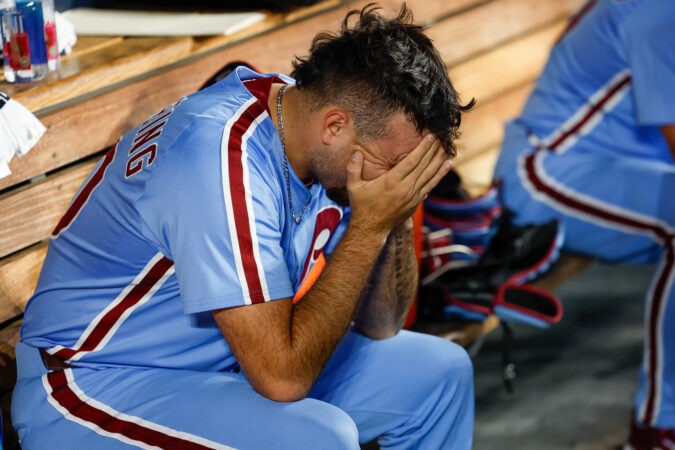
It might be unfair to say he panicked, but Orion Kerkering was hardly the picture of composure when a ball was hit back to the Philadelphia Phillies’ 24-year-old pitcher in the bottom of the 11th inning of Game 4 of the National League Division Series. Kerkering had trouble fielding the ball, but after he did eventually pick it up, he appeared to have time to turn and throw to first base. Given that there were two outs, a successful throw to the first baseman would have ended the inning, kept the score tied and kept the Phillies alive in their series against the Los Angeles Dodgers.
Certainly, that was what Phillies catcher J.T. Realmuto wanted. As Kerkering picked up the ball, Realmuto was pointing toward first base. Alas, the pitcher opted to throw home — the bases were loaded, so an inning-ending out also could have been made at the plate — but he had only a split second to beat the runner, and Kerkering’s rushed effort sailed wide of Realmuto. The runner was safe at home, the Dodgers spilled out of their dugout with joy, and the Phillies were forced to contemplate a brutal end to their season. Kerkering defended his decision, saying he thought he could get the ball to home plate faster than if he turned and threw to first, but he acknowledged, “It was just a horses— throw.”
The Clippers bring back Chris Paul
When the Los Angeles Clippers signed Chris Paul in July to a one-year contract, it seemed like a solid move, potentially even a heartwarming one — after all, Paul is a franchise icon, and he was poised to help his team return to the playoffs in what could be his final NBA season. Instead, the relationship between Paul — never one to refrain from offering strong opinions on team-related matters — and the Clippers’ coaching staff reportedly curdled almost immediately. Then, barely a quarter of the way through this season, the 40-year-old point guard was banished altogether.
Paul remains under contract, though, meaning that after getting the heave-ho, he is still essentially getting paid handsomely by the Clippers not to work. Wait, why does that sound familiar? Oh, right — their season began under a cloud of suspicion that they may have circumvented NBA salary cap rules by arranging for Kawhi Leonard to receive a lucrative, no-show job from a team sponsor. At least Leonard is performing his job for the Clippers by putting up good numbers, but he already has missed a chunk of the season with his latest injury and, more ominously, has proved unable to help the Clippers avoid an early-season free fall that has them near the bottom of the Western Conference.
A guy gets caught stealing a hat from a kid
Here’s the thing: If you’re going to swipe a cap clearly meant for a kid, don’t do it where loads of cameras are present. Wait, sorry, here’s the thing: Don’t do it at all. Alas, Polish businessman Piotr Szczerek found it as easy in the moment as stealing candy from a baby, only to discover that his misdeed went viral.
Caught red-handed at the U.S. Open (tennis version), Szczerek subsequently issued an apology, but not before online sleuths found his business and subjected it to damagingly poor reviews. Even in his apology, Szczerek claimed it was “never my intent to steal away a prized memento from the young fan,” leading to another round of criticism.
Picking upsets in your NCAA bracket
Everyone knows that if you actually want to win your NCAA tournament pool, you can’t go chalk. While you may not be able to predict which upsets will occur, you know they’re coming, so your best bet is to pick a few and hope you get some hits.
Unless, that is, you were filling out a bracket for the 2025 NCAA men’s basketball tournament, which turned out to be a chalk show. The top 16 seeds won their first-round games, the only No. 12 seeds to get to the second round promptly lost, the only double-digit seed in the Sweet 16 was a John Calipari-coached SEC squad (No. 10 Arkansas, which promptly lost), and the Final Four was composed solely of No. 1 seeds. At least, at that point, Duke haters got to see the Blue Devils get upset by Houston, but even that unexpected result deprived hoops fans of seeing Flagg in the national title game.
Tom Brady clones his dog
In thanking a biosciences company for giving him and his family “a second chance with a clone of our beloved dog,” Tom Brady raised a question of what kind of “second chance” he thought he was getting. Obviously, the first go-round went so well that he decided to have the dog duplicated, so it wasn’t a question of making amends. At the same time, the personality that so endeared the original pooch to the Bradys wouldn’t necessarily be replicated in the clone.
What Brady could count on, if he cared to get some feedback, was disapproval from animal rights activists and others who happen to be well aware that tons of terrific pups are just waiting at shelters for a loving human to come along. That act of compassion could be accomplished for a fraction of the price of cloning — and without the possibility that several attempts might be discarded before an acceptable look-alike was produced.
Chauncey Billups plays in shady poker games
Chauncey Billups, the Portland Trail Blazers coach who was placed on unpaid leave one game into the season after being arrested on money laundering conspiracy and wire fraud conspiracy charges, pleaded not guilty. Perhaps he did nothing wrong and is guilty only of poor judgment — but, hoo boy, did he display some poor judgment in getting involved in an allegedly Mafia-backed scheme to use his celebrity to attract other poker players to illegal games so they could be defrauded with techniques such as rigged card-shuffling machines. In addition, Billups was accused by federal authorities of passing along information about the Trail Blazers’ plans to tank a March game by benching players, which allegedly resulted in big-money bets being placed on the contest.
If Billups plays his cards right (ahem) with the not-guilty plea and avoids what could be decades in prison, he still might be banned for life by the NBA, particularly if there is compelling evidence that he did indeed share Portland’s tanking plans. At a minimum, he probably can kiss his coaching career goodbye, and his recent Hall of Fame induction could be in jeopardy.
A marathoner tries to help her maid
After Ruth Chepngetich eventually provided an explanation for how she came to have a banned substance in her system, the Athletics Integrity Unit described her tale as “hardly credible.” Even if you take her explanation at face value, though, it doesn’t exactly do her any favors.
Chepngetich, who smashed the women’s marathon world record in October 2024 only to test positive for hydrochlorothiazide (HCTZ) several months later, was said to have told investigators that she fell ill with similar symptoms to those experienced shortly before by her housemaid. According to the AIU, an agency established by track and field’s international governing body to ensure athletes adhere to anti-doping protocols, the 31-year-old Kenyan asked what medication her maid had taken and then promptly ingested it herself. Chepngetich even provided a photo of the medication, which clearly stated “Hydrochlorothiazide” on its packaging, and she was said to have claimed she didn’t know it was on the prohibited list.
The AIU noted that Chepngetich had multiple opportunities to give her account of events before she provided the explanation and that it still didn’t account for the trace amounts of HCTZ found in a test she took before the episode in question. She accepted a three-year suspension, although her record has been allowed to stand, at least for the time being.
Bill Belichick agrees to go on camera
Infamously taciturn during his two-decade run as the New England Patriots’ coach, Bill Belichick invariably gave the impression that he would much rather be left alone to work on game plans in a darkened film room. After taking the North Carolina job, though, he was much more willing to go on camera. By doing so, the 73-year-old Belichick also happened to shine more of a spotlight on his girlfriend, 24-year-old Jordon Hudson. That may have been the plan all along (for at least one of them), but it didn’t always go the way they would have liked.
Most notably, Hudson’s commandeering of a “CBS Sunday Morning” interview of Belichick in April raised widespread questions about how much of a managerial role she seemed to have taken. When the season started, she became a very visible presence on the Tar Heels’ sidelines, and cameras also caught Belichick conferring with her there shortly before games kicked off. In October, video emerged from an aborted docuseries on Belichick by NFL Films that showed Hudson displaying a high degree of involvement and, at times, casting aspersions on the work of production team members.
As for the on-field product Belichick produced, he probably wishes that wasn’t filmed, either. In his first season at UNC, he oversaw a 4-8 season that began with an embarrassing blowout loss and included four other defeats by at least 16 points.
Mississippi fans hope for Lane Kiffin to stay
Sure, Lane Kiffin’s bolting for LSU just after guiding the Rebels to their best regular season since 1962 made for a messy ending in Oxford, but what did Mississippi fans expect? Kiffin departed almost all of his coaching gigs with a trail of ill will in his wake, and the LSU job has been a generally more coveted position for decades.
Nonetheless, a lot of Mississippi fans apparently expected Kiffin to stay, and many of them didn’t appreciate getting jilted. Maybe now that he’s with the Tigers, some of those fans will learn that a leopard can’t change his spots.
FIFA creates a peace prize for Trump
Maybe, just maybe, if President Donald Trump hadn’t been openly pining for a Nobel Peace Prize, and if FIFA head Gianni Infantino hadn’t been acting so openly obsequious toward Trump, the fact that FIFA’s newly created peace prize just happened to go to Trump wouldn’t seem like such a blatant case of currying favor. Of course, soccer’s international governing body could reasonably have some major concerns about the smooth staging of its 2026 World Cup — much of which will be in the United States, which hasn’t exactly rolled out the welcome mat for foreign visitors this year — that FIFA wants very much to allay.
We’ll see how it goes next year with the world’s most-watched tournament, just as we’ll see who gets picked by FIFA as the next recipient of what it promises will be an annual honor. Presumably, the pool of candidates will be composed solely of world figures Infantino reckons will actually want to accept an award of such dubious origin.
FIFA asks Wayne Gretzky to pronounce names of countries
At the same World Cup draw this month where Infantino handed Trump his hardware, Wayne Gretzky was asked to help read names of countries as they were slotted into pods for group play. While it wasn’t ideal that he pronounced Curaçao as “Cuh-rocco” and North Macedonia as “Mack-a-donia,” in fairness, those probably aren’t places he hears dropped into conversation very often.
But Jordan? Or as Gretzky put it, “Jor-DAN”? Again, that’s a country not likely to be bandied about frequently in Gretzky’s presence, but you would think he has heard more than enough comparisons to Michael Jordan to just go with that as the default pronunciation.
NASCAR thinking it could win a court battle against Michael Jordan
Speaking of Jordan, his latest showdown was in a federal courtroom, not on an NBA court, but the outcome would have been familiar to any number of Jordan’s opponents in hoops: NASCAR was put on the proverbial poster. Jordan and his 23XI racing team, along with co-plaintiff Front Row Motorsports, came away with a settlement of their antitrust lawsuit that pretty much gave them what they wanted. In turn, that amounted to a huge win for all the other Cup Series teams, who also will benefit from the reported settlement terms of permanent charters, greater revenue sharing and more say in how the overall business operates.
The Charlotte-based judge who presided over the nine-day trial, which began approximately 14 months after Jordan and his partners filed suit, said he wished the settlement could have been reached “a few months ago.” Some NASCAR officials probably felt the same way, given some of the damaging details that emerged during discovery. They reportedly included text messages from NASCAR Commissioner Steve Phelps to a colleague that called team owner Richard Childress a “stupid redneck” who should be “taken out back and flogged.”
It remains to be seen whether Phelps is able to keep his job, but there is little doubt that the organization he works for got dunked on by His Airness.
The choice of Keegan Bradley for Ryder Cup captain
Normally, active PGA Tour players are not chosen for the Ryder Cup captaincy. Keegan Bradley was not only very much still on the tour but, in fact, played so well this year that he might have been a captain’s pick — had he not been the captain himself. Technically, Bradley could have selected himself, but he chose to focus solely on his duties as captain.
The result of the Ryder Cup — a 15-13 win for Europe on American soil — made it fair to wonder whether it would have been better to pick a captain who could have used the whole PGA Tour season to focus on the event instead of finding time between tournaments to give it thought. Bradley was criticized for his pairings — particularly the duo of Harris English and Collin Morikawa, whose possible partnership ranked dead last out of 132 optimal pairings in a widely cited statistical model — as well as his course setup and other tactics.
It seems safe to assume that, come 2027, the Ryder Cup captaincy will revert to an accomplished player who has aged out of the PGA Tour. Hmmm … Tiger Woods, anyone?
Mark Sanchez picks a fight over parking
Allegedly, anyway. At Mark Sanchez’s trial, which was moved to March, he might be able to present a convincing case that he was the victim in an October incident that left him in a hospital with stab wounds. The bizarre episode resulted in a felony charge being brought against the former quarterback, who can now also be called a former Fox Sports analyst after the network parted ways with him.
In Indianapolis for an upcoming Colts game, Sanchez was said by prosecutors to have been in a state of public intoxication when he approached a 69-year-old man and allegedly took issue with where the latter had parked his truck. The man was described as an employee of a cooking oil recycling company who had brought his truck to a hotel loading dock to perform his job duties before ending up in a physical confrontation, during which the man allegedly produced a knife to defend himself from further attack.
Authorities cited surveillance video from a hotel in bringing charges, which indicates Sanchez’s legal team will have some work to do. If he can’t adequately explain his side of things, Sanchez could get prison time.
The Eagles escaped Highmark Stadium with a 13-12 win over the Buffalo Bills, extending their winning streak as they head into the last game of the regular season.
After the win, the Birds have moved up in some of the national power rankings and have fallen three spots in another. As they prepare to host the Washington Commanders, here’s where they stand in the latest batch …
The Ringer: Sixth
The Eagles remain in the sixth spot in The Ringer’s power rankings. The outlet praised the Birds’ physicality but raised one big concern coming out of Sunday: “Can this team stop turtling in big games?”
“The Eagles were clearly the more physical and better-prepared team in Sunday’s game against Buffalo, and were crushing the Bills late in the first half,” Diante Lee wrote. “If this team really was returning to its dominant 2024 form, the second half of that game would’ve been a perfect time to show it.
“Instead, the Eagles sat on their 13-point lead, made predictable calls and hoped its offensive line would bully its way to a win — something that hasn’t happened all season — and Philadelphia only managed to escape with a one-point win because Josh Allen missed an open receiver on a two-point conversion attempt. Head coach Nick Sirianni says he needs to be ‘more involved’ in important moments, and I’m wondering why he would ever take his eye off the offense in the first place.”
The Eagles rank behind the No. 5 New England Patriots and No. 4 Jacksonville Jaguars. The Seattle Seahawks and Denver Broncos remain at Nos. 1 and 2, respectively.
ESPN: Seventh
The Eagles have moved up in ESPN’s power rankings — jumping up three spots from last week’s No. 10 ranking. As the regular season comes to an end, ESPN has learned “the Eagles have a Super Bowl-caliber defense, again.”
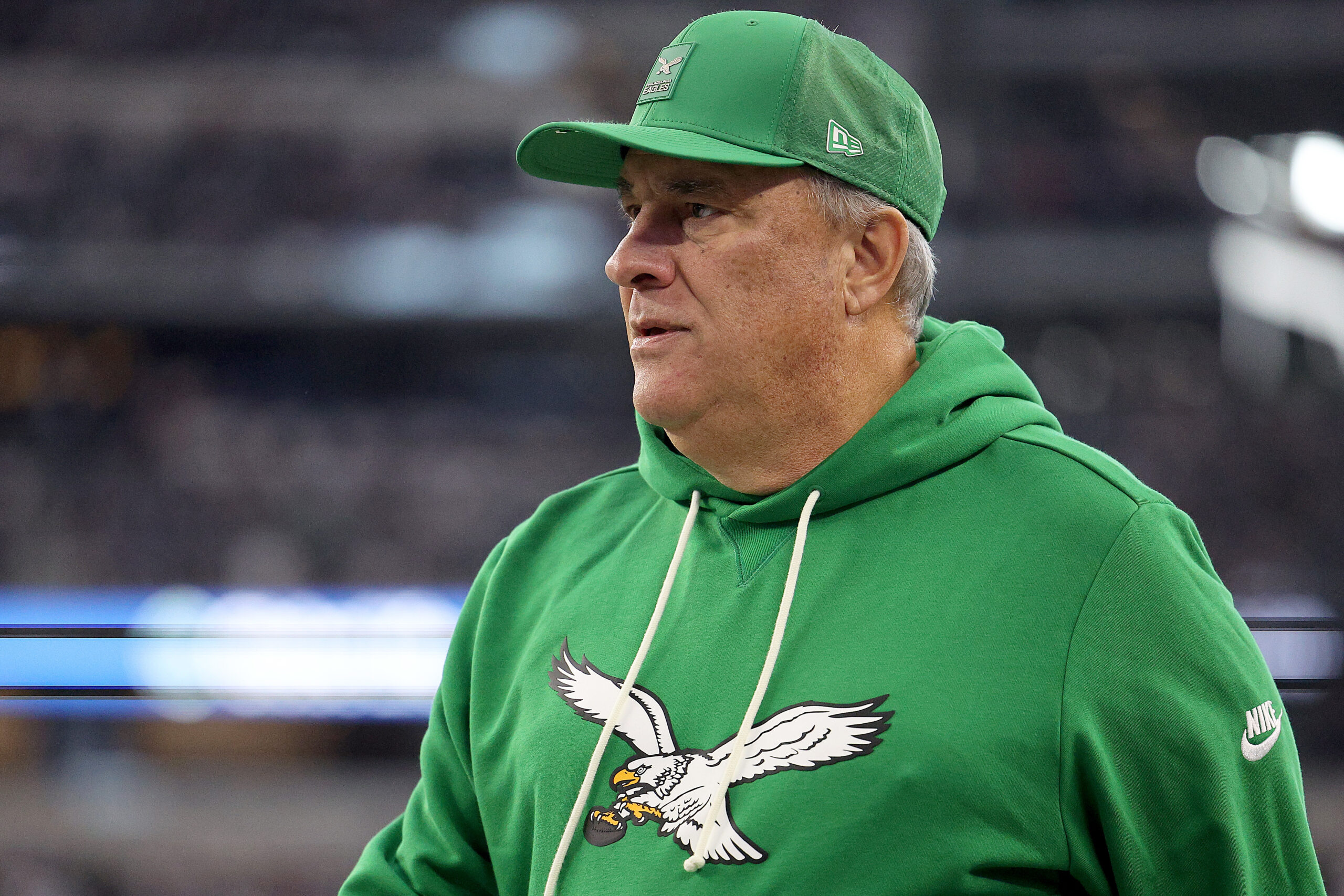
Eagles defensive coordinator Vic Fangio continues to earn national praise.
“Defensive coordinator Vic Fangio has been downright dominant since being hired by the Eagles in 2024,” Tim McManus wrote. “He orchestrated the No. 1 defense in football last season en route to Philadelphia’s second Lombardi Trophy and will deserve much of the credit should it snag a third this season. The unit ranks third in points allowed (18.8 per game) and ninth against the pass (193.4 yards per game). The Eagles showed against the Bills that they’re capable of quieting the best quarterbacks in the business.”
The Eagles sit behind the No. 6 Jaguars, the No. 5 Los Angeles Rams, and the No. 4 San Francisco 49ers. The Seahawks remain in the top spot. Meanwhile, the New England Patriots have moved up two spots to the No. 2 ranking.
Yahoo! Sports: Ninth
Despite the win over the Bills, the Eagles have fallen in Yahoo! Sports’ power rankings. A poor offensive showing from the Birds in the second half was enough for the NFC East champs to fall three spots from last week’s No. 6 ranking.
“In the second half at Buffalo, the Eagles did not complete a pass and had just 16 yards,” Frank Schwab wrote. “Maybe Philly shouldn’t move down three spots after a win at Buffalo, but the problems with its offense aren’t going away. The Eagles might be getting worse. Their defense was fantastic, keeping Buffalo off the scoreboard for the Bills’ first eight drives (not counting kneel downs) but it’s hard to go on a playoff run when you can’t crack 20 yards of offense in a half of football.”
The Eagles trail the No. 8 Houston Texans and the No. 7 Chicago Bears. Meanwhile, the Seahawks remain at the No. 1 spot and the Broncos moved up to No. 2.
CBS Sports: 10th
The Eagles haven’t moved in CBS Sports’ power rankings, remaining at the No. 10 spot. The team sits below the No. 9 Bills, a team it just defeated, and the No. 8 Texans.
“The defense is great. The offense isn’t,” Pete Prisco wrote. “Can they turn that offense around come playoff time?”
Similar to last week, the Seahawks (No. 1) and the Patriots (No. 2) top the list.
The Athletic: Ninth
The Eagles moved up two spots from last week’s No. 11 ranking, trailing the No. 8 Bears and the No. 7 Texans. Despite their offensive inconsistencies, The Athletic praised Sirianni.
“Philadelphia had 17 yards of offense in the second half Sunday and still won,” Josh Kendall and Chad Graff wrote. “It feels like something only Nick Sirianni could pull off. The Eagles’ sometimes embattled head coach has a .702 winning percentage in nearly five seasons at the helm, the highest in the league among active head coaches. He may have to retool his entire offensive staff in the offseason, but Sirianni probably will be coaching this team (and aggravating Eagles fans) for another decade.”
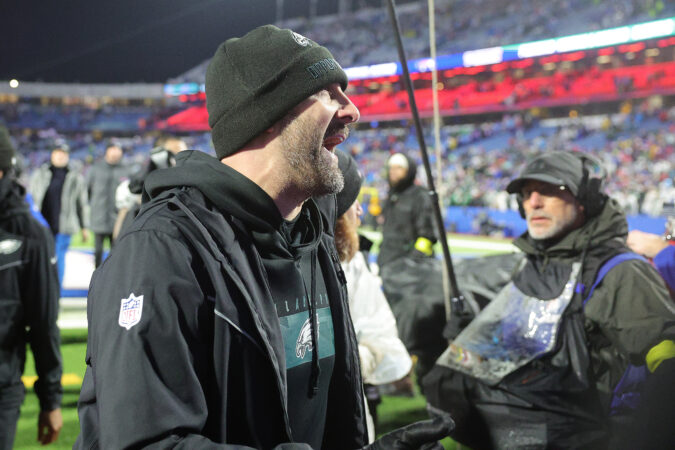
“Hey! I don’t hear any [expletive] anymore Chiefs fans!” Sirianni yelled as he left the field. “See ya!”
Things went downhill from there. The Eagles went on to lose five of their next six games in an epic collapse that cost them an NFC East title, followed by an early playoff exit.
That trash-talking Sirianni was back following Sunday’s win against Buffalo, where the Birds coach offered a similar-sounding taunt aimed at Bills fans.
“There was a lot of talking by those Buffalo fans coming in. Not so much anymore!” Sirianni shouted as he exited the field. “Not so much anymore.”
Wide receiver A.J. Brown, who was walking in next to Sirianni, didn’t appear too impressed by his coach’s outburst. Neither was 94.1 WIP morning show host Joe DeCamara.
“Can he just not help himself?” DeCamara said during Monday’s broadcast. “I think he’s a great coach. This is an aspect of his thing I could do without.”
So what got Sirianni so worked up? During an interview Tuesday morning on WIP, Sirianni said it didn’t have anything to do with growing up in nearby Jamestown, N.Y., or having friends and family in the stands. Instead, he offered a simpler explanation.
“Football is fun,” Sirianni said. “It’s OK to show emotion. It’s fun to show emotion. Like, it’s OK to be excited.”
The outbursts might cause some fans to cringe, but you can’t question the results. Since Sirianni took over as head coach in 2021, the Eagles have advanced to the playoffs five straight seasons, played in two Super Bowls, and took home a Lombardi Trophy last season. Sirianni already ranks second in wins in franchise history (including the playoffs), and is just one of five head coaches in NFL history with a career winning percentage above .700.
Even during Sunday’s game, Sirianni was seen on the sideline jawing with Bills players and celebrating following a first-quarter touchdown pass to Dallas Goedert.
“We had fun winning that game,” Sirianni said. “And, yeah, you’re going to be emotional after the game and you’re going to be emotional in the game.”
“I love seeing our guys show emotion after they make a big play, and I show emotion after they make a big play,” Sirianni added. “That’s one of the reasons why you get into coaching. You can’t make plays anymore, and you want to help other people make plays.”
“We still have time,” Sirianni said. “There’s benefits to rest, there’s benefits to play, and we’ve just got to do what we think is best for the football team.”
The Eagles will likely enter the playoffs as the No. 3 seed and face either the San Francisco 49ers or Los Angeles Rams in the wild-card round. But the Birds could move up to the No. 2 seed and face the Green Bay Packers with a win Sunday and a loss by the Chicago Bears against the Detroit Lions.
Columnist David Murphy thinks Sirianni’s lack of a straight answer is a signal he’s giving serious thought to resting his starters.
“If the Eagles punt on Week 18, it will allow the coaching staff and front office to spend an extra week preparing for the playoffs. It will give Jalen Hurts and the rest of the starters the ability to participate in that scouting and game-planning process,” Murphy wrote. “That’s a big, big deal.”
The Trump administration made sweeping changes in 2025, leading to layoffs, resignations, and early retirements.
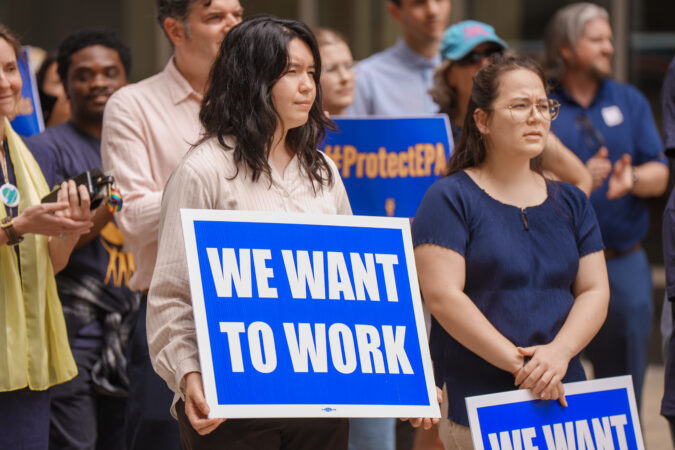
Employees and supporters at a Philadelphia rally for EPA workers being put on leave after signing a letter critical of the Trump administration on July 9, 2025.Jessica Griffin / Staff Photographer
For many federal workers, 2025 has been a year of massive change in the workplace. And for thousands of them, it was the year they quit working for the U.S. government.
That’s the result of the Trump Administration’s efforts to shrink and reshape the federal workforce through a deferred resignation program called “Fork in the Road.” First offered in January, it allowed employees to resign and stay on government payrolls through Sept. 30.
If they didn’t resign, they were told, there was no assurance their job would still be around.
After the “Fork in the Road” offer, President Donald Trump’s administration continued to shake up the federal workforce, with moves including layoffs, dismantling federal worker unions, and overhauling workplace policies.
Here’s a look back on how these changes have impacted Philadelphia-area federal employees this year.
President Donald Trump signs executive orders in the Oval Office at the White House on Jan. 20 after his inauguration. Credit: Jabin Botsford/The Washington PostJabin Botsford
Elon Musk during a trip with President Donald Trump to the NCAA Division I Men’s Wrestling Championship at the Wells Fargo Center in Philadelphia.Elizabeth Robertson / Staff Photographer
DOGE was tasked with reducing government spending and streamlining bureaucracy by July 4, 2026, encouraging mass layoffs and upheaval within the federal government.
Jan. 28
Trump administration offers a new resignation program
Federal workers received an email directly from the U.S. Office of Personnel Management (OPM), the government’s human resources agency, offering the opportunity to resign while continuing getting paid for several months. The agency encouraged federal workers to go from “lower productivity jobs in the public sector to higher productivity jobs in the private sector.”
Protestors hold signs at the Save Our Services day of action event at Independence Mall in Philadelphia on Feb. 19. They gathered to protest Elon Musk's push to gut federal services and impose mass layoffs.Elizabeth Robertson / Staff Photographer
Local workers and supporters gathered in subfreezing temperatures near Independence National Historical Park to protest the layoffs and other workforce shakeups.
On Feb. 26, a memo from OPM and the Office of Management and Budget gave agencies a March 13 deadline for submitting additional layoff and reorganization plans.
Musk said in a post on X that not responding to the email would be seen as a resignation, but some members of the Trump’s administration later said responding was voluntary.
March 5
Pa. government looks to hire federal workers
Gov. Josh Shapiro signed an executive order to streamline the hiring process for former federal employees. Nearly two weeks later, hundreds had applied.
Gov. Josh Shapiro delivers his budget address in February 2025.Tom Gralish / Staff Photographer
story continues after advertisement
March 7
Trump administration starts stripping union rights
The Department of Homeland Security canceled union rights for Transportation Security Administration employees. TSA union leaders and workers at the Philadelphia International Airport said the change caused morale to plummet.
TSA worker Devone Calloway at the Philadelphia International Airport soon after DHS revoked TSA employees' collective bargaining rights.Jose F. Moreno / Staff Photographer
A few weeks later, Trump issued an executive order to end union rights for federal workers across agencies, and union dues stopped being deducted from worker paychecks.
April 2
State officials express concerns over federal layoffs in Pa.
“What we’re seeing right now, in the last 72 days, is an unprecedented assault on organized labor, on working people, on working families and on Pennsylvanians of all different political stripes, from every single corner of our commonwealth,” said state Rep. Malcolm Kenyatta (D., Philadelphia) at a hearing. “It is an attack on their ability to have access to the necessary government services that they depend on every single day.”
Andrew Kreider, an environmental protection specialist at the EPA's Region 3 office, holds a sign reading “Thank You EPA” at a solidarity march around City Hall on March 25.Tyger Williams / Staff Photographer
In a late Friday email, the IRS asked employees to share their resumes so leaders could “determine [their] qualifications.” That included over 3,600 employees from the agency’s office at 30th and Market Streets.
IRS Union Rep. Alex Jay Berman, in front of the Philadelphia IRS building at 30th and Market Streets in April 2025.Jessica Griffin / Staff Photographer
April and May
Philly’s understaffed National Park Service faces “workforce optimization”
NPS workers were asked in late April to upload their resumes amid plans for “workforce optimization.” But administrative staff had already left the regional office in Philadelphia, leaving others to take on their work. At Independence National Historical Park, staffing was an issue even before the start of the second Trump administration, workers said.
At Independence National Park, a ranger casts shadow as they walk along S. 6th Street at Market Street in June.Alejandro A. Alvarez / Staff Photographer
“To work well, to perform, you have to be happy, you have to enjoy what you’re doing,” said Ed Welch, president of AFGE Local 2058, which represents employees at the NPS in Philadelphia. “There’s a horrible oppressiveness in government now, and it‘s unnecessary.”
story continues after advertisement
May 5
Philly-based VA workers return to offices full-time
Following orders from the VA, employees started coming in to work in-person full time but found challenges including insufficient parking and concerns about the confidentiality of work in a shared space.
Theresa Heard attends a rally of VA employees at the VA Medical Center in West Philadelphia in June 2025.Jessica Griffin / Staff Photographer
During a February protest in Philadelphia, retired federal worker Roseanne Sarkissian of Philadelphia holds a sign showing Elon Musk and the phrase “This man is not our boss.”Elizabeth Robertson / Staff Photographer
DOGE, Musk said, is “like a way of life.” The agency remains part of Trump’s government.
Late May
Laid-off employees return to work
Workers who’d been laid off across agencies were reinstated and placed on administrative leave following court rulings. As of late May, the “vast majority” of several hundred Philly-area IRS workers, who lost their jobs in the probationary worker layoff were back at work, union leader Alex Jay Berman estimated.
Yolanda Cowan, Mayra Gonzalez, and Michael Rosado were among the Philadelphia IRS workers who lost their jobs when probationary employees were laid off in February. Here, in February, they posed for a selfie outside the IRS offices.Tom Gralish / Staff Photographer
June 1
Over 100 federal workers find work for the Pa. government
By the first week of June, the state had hired 119 former federal employees across 22 agencies, according to Daniel Egan, a spokesperson for the Pennsylvania Office of Administration.
July 7
VA cancels mass layoffs after many employees leave voluntarily
The VA said it would forgo plans to cut the workforce by 15% after about 17,000 people left through the deferred resignation program, retirement and other attrition. The agency was on pace to have 30,000 fewer employees by the end of the 2025 fiscal year.
A rally of VA employees at the VA Medical Center in West Philadelphia on June 5, 2025.Jessica Griffin / Staff Photographer
August
Federal agencies cancel union contracts
Employees at the VA, the EPA, the U.S. Citizenship and Immigration Services, the Department of Agriculture (USDA), and the Federal Emergency Management Agency (FEMA) are stripped of their union contracts.
Brad Starnes, president of American Federation of Government Employees Local 3631, which represents EPA employees in Pennsylvania, Delaware and several other mid-Atlantic states.Jessica Griffin / Staff Photographer
story continues after advertisement
September
Thousands have left federal government employment
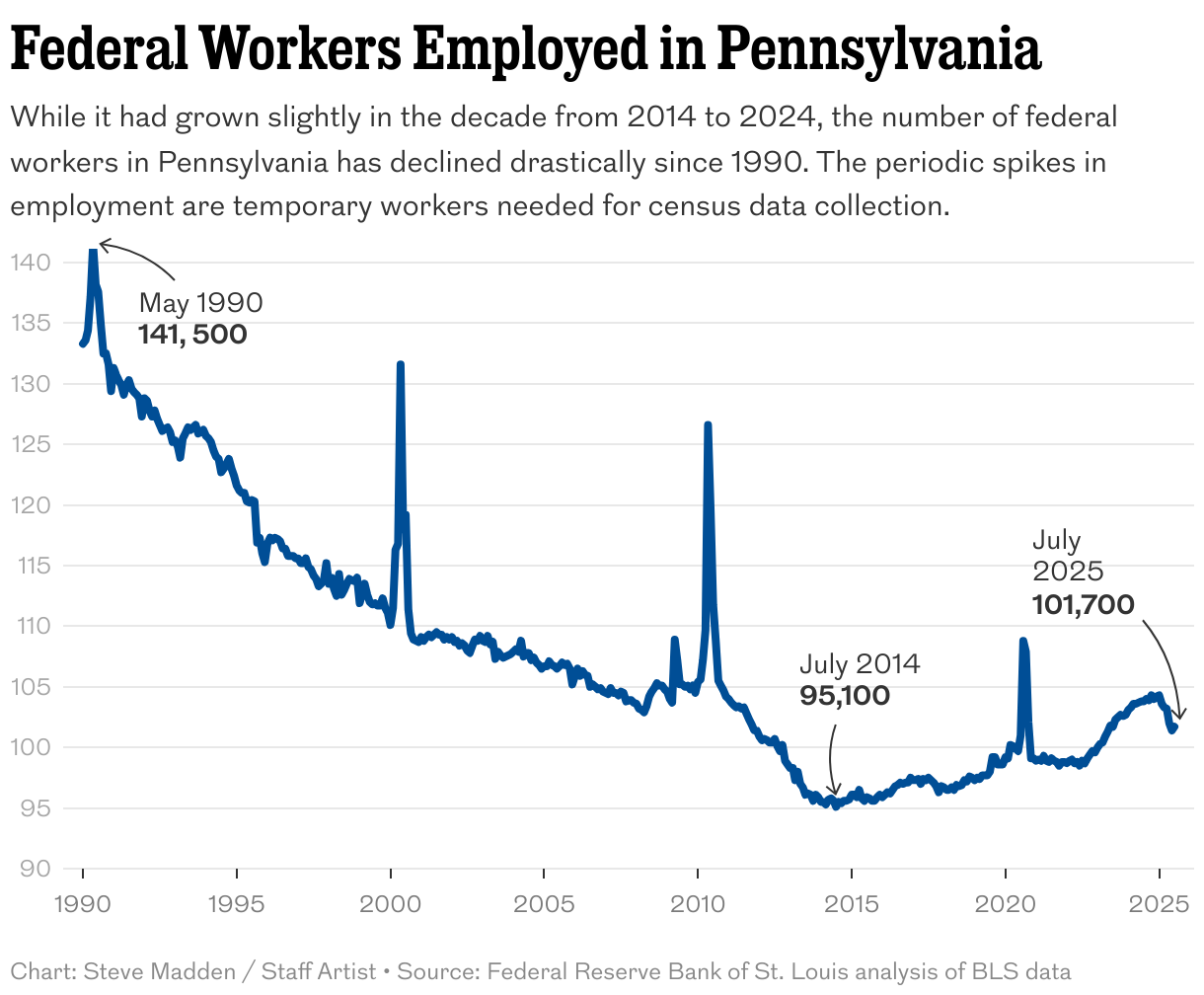
A few weeks before deferred resignations were expected to drop off payroll, new data showed the scope of the workforce shrinkage through mid-2025. In Pennsylvania, there were 2,600 fewer federal workers by the end of July than at the start of 2025.
Meanwhile, media reports said the government planned to call back some employees who took the deferred resignation program at the IRS and the U.S. Department of Labor.
Sept. 24
White House threatens mass firings if shutdown occurs
Federal agencies were asked to prepare plans to fire workers if legislation is not passed to keep the government open past Oct. 1. Philadelphia-area union leaders said they would push back on this effort, even as the Trump administration has moved to curtail their collective bargaining rights.
Oct. 1
A federal government shutdown begins
Lawmakers were unable to reach a deal to keep the government open, causing a shutdown. Agencies shared plans for how many employees were expected to continue working without pay and how many would be sent home on furlough. Air traffic controllers and TSA agents at Philadelphia International Airport, continued to work and so did employees at Philadelphia’s Social Security Administration building at Third and Spring Garden.
The Liberty Bell Center is closed Oct. 1, 2025 in Independence National Historical Park due to the federal government shutdown.Tom Gralish / Staff Photographer
Mid to late October
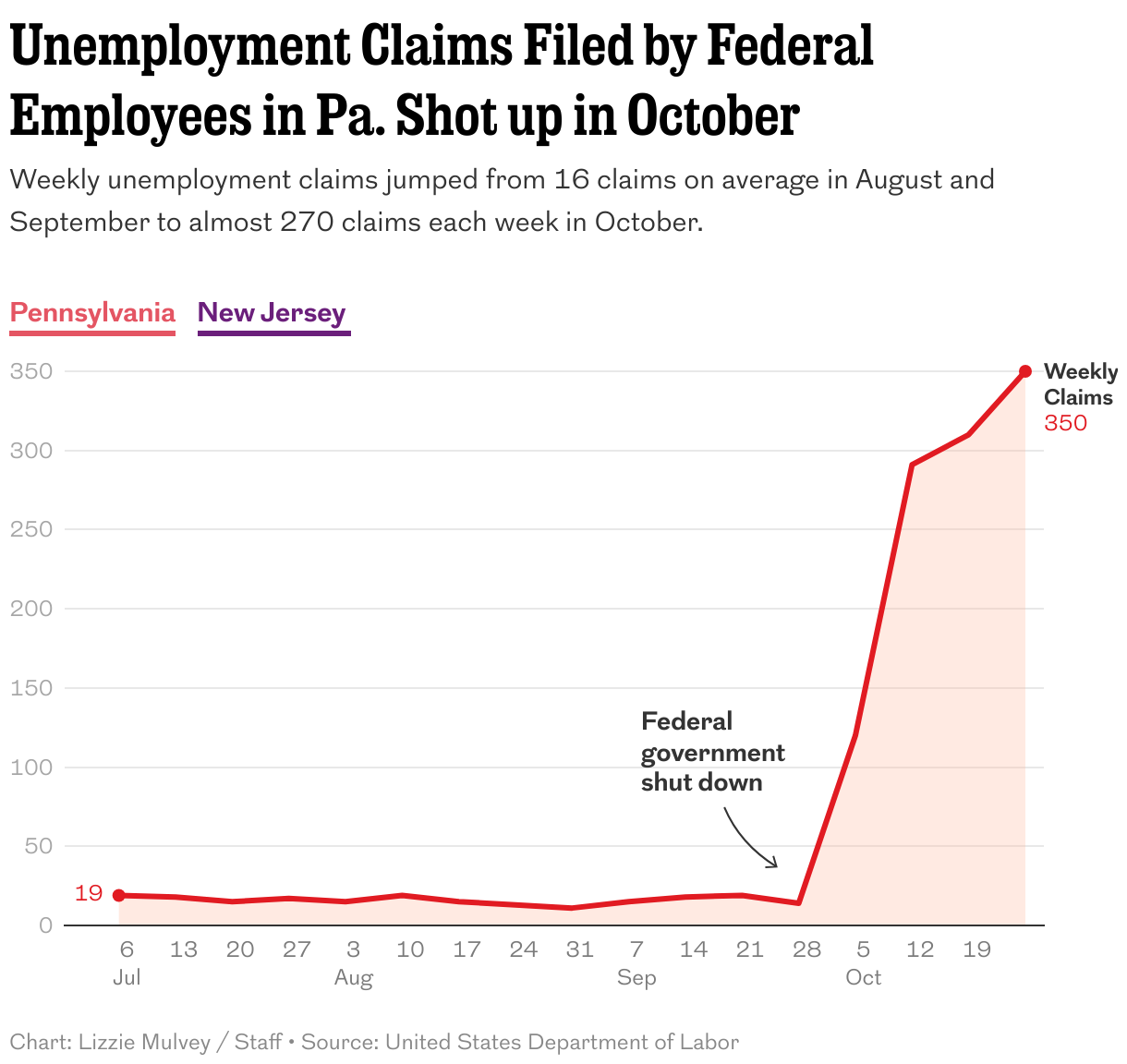
Unemployment claims increase in Pa. and N.J.
Uncertain when their next paycheck would arrive, federal workers applied to SNAP, put their mortgage payments on hold, negotiated with utility companies, and cut back on costs. At PHL, a food pantry was set up for airport government employees impacted by the shutdown. It served some 250 employees in its first two days.
Many federal workers in Pennsylvania and New Jersey filed for unemployment benefits.
Nov. 12
The end of the longest shutdown in history
Lawmakers reached a deal to reopen the government and keep it funded through Jan. 30, and President Donald Trump signed the legislation. The shutdown lasted 43 days, making it the longest in the country’s history.
The deal included protections from mass layoffs through Sept. 2026, and reversal of firings made during the shutdown — the administration sent 4,000 layoff notices during that time. Still, some worried about another potential government shutdown after Jan. 30.
December
Data on impact of resignations is still to come
Workers who took the government’s deferred resignation offer were expected to drop off federal payroll after Sept. 30, and be reflected in employment data from the Bureau of Labor Statistics.
Amid the shutdown, federal data releases were canceled or delayed. Insight on how many people have left the federal government since September is now expected in January.
story continues after advertisement
Staff Contributors
Reporting: Ariana Perez-Castells and Fallon Roth
Editing: Lizzy McLellan Ravitch and Erica Palan
Digital editing: Lizzy McLellan Ravitch
(()=>{var K=(e,t)=>()=>(t||e((t={exports:{}}).exports,t),t.exports);var A=K(r=>{var Q={0:”Jan.”,1:”Feb.”,2:”March”,3:”April”,4:”May”,5:”June”,6:”July”,7:”Aug.”,8:”Sept.”,9:”Oct.”,10:”Nov.”,11:”Dec.”};function L(e){return e===void 0&&(e=new Date),Q[e.getMonth()]}var X={0:”Jan”,1:”Feb”,2:”Mar”,3:”Apr”,4:”May”,5:”Jun”,6:”Jul”,7:”Aug”,8:”Sep”,9:”Oct”,10:”Nov”,11:”Dec”};function b(e){return e===void 0&&(e=new Date),X[e.getMonth()]}function s(e){return e==null}function T(e){return typeof e==”number”&&isFinite(e)}function f(e){return T(e)&&Math.floor(e)===e}var ee=[“one”,”two”,”three”,”four”,”five”,”six”,”seven”,”eight”,”nine”],te=[“million”,”billion”,”trillion”,”quadrillion”,”quintillion”,”sextillion”,”septillion”,”octillion”,”nonillion”,”decillion”],S=[“th”,”st”,”nd”,”rd”,”th”,”th”,”th”,”th”,”th”,”th”],ne=[11,12,13];function M(e){if(s(e))return””;var t=+e;return f(t)?ne.indexOf(t%100)>-1?S[0]:S[t%10]:””}var oe=[“first”,”second”,”third”,”fourth”,”fifth”,”sixth”,”seventh”,”eighth”,”ninth”],ie=new RegExp(/s+([^s]*)s*$/);r.apdate=function(e){return e===void 0&&(e=new Date),L(e)+” “+e.getDate()+”, “+e.getFullYear()},r.apdatetab=function(e){return e===void 0&&(e=new Date),b(e)+” “+e.getDate()+”, “+e.getFullYear()},r.apmonth=L,r.apmonthtab=b,r.apnumber=function(e){if(s(e))return””;var t=+e;return f(t)?t=10?e.toString():ee[t-1]:e.toString()},r.aptime=function(e){e===void 0&&(e=new Date);var t,n,o=e.getHours(),i=e.getMinutes(),u=i===0;if(u){if(o===0)return”midnight”;if(o===12)return”noon”}return o0?o:12):(t=”p.m.”,n=o===12?o:o-12),u?n+” “+t:n+”:”+(i<10?"0"+i:i)+" "+t},r.capfirst=function(e){if(s(e))return"";var t=String(e);return""+t.charAt(0).toUpperCase()+t.slice(1)},r.intcomma=function(e){if(s(e))return"";var t,n=+e;return T(n)?((t=n.toString().split("."))[0]=t[0].replace(/B(?=(d{3})+(?!d))/g,","),t.join(".")):e.toString()},r.intword=function(e){if(s(e))return"";var t=+e;if(!f(t))return e.toString();var n=Math.abs(t);if(n<1e6)return e.toString();var o=Math.ceil(Math.log(n+1)/Math.LN10)-1,i=o-o%3,u=t/Math.pow(10,i);return(u=Math.round(10*u)/10)+" "+te[Math.floor(i/3)-2]},r.ordinal=function(e,t){if(t===void 0&&(t=!1),s(e))return"";var n=+e;return f(n)?t&&n/Android|webOS|iPhone|iPad|iPod|BlackBerry|IEMobile|Opera Mini/i.test(navigator.userAgent);var g=(e,t=null,n=null)=>{n||(n=document.querySelector(“head”));let o=document.createElement(“script”);o.type=”text/javascript”,o.src=e,t&&(o.onload=t),n.appendChild(o)},q=()=>(window.PMNdataLayer?.[0]!==void 0&&window.PMNdataLayer[0])?.analytics?.user?.state===”Subscribed”,k=()=>{let t=(window.PMNdataLayer?.[0]!==void 0&&window.PMNdataLayer[0])?.analytics?.user?.state;return window.location.host.includes(“zzz-systest”)||window.location.host.includes(“pmn.arcpublishing.com”)||window.location.host.includes(“stage.fusion.inquirer.com”)||typeof t>”u”},j=()=>{let t=(window.PMNdataLayer?.[0]!==void 0&&window.PMNdataLayer[0])?.analytics?.user?.hasAdsFreeReading;return!!(t&&t==1)},v=()=>window.location.host.includes(“localhost”);var re=()=>{j()&&document.querySelectorAll(“.js-adbox”).forEach(t=>{t.classList.add(“is-hidden”)})},H={init:()=>{re()}};var a,y=!1,se=()=>{a=document.querySelector(“.js-appendix”)},C=()=>{let e=document.querySelector(“.js-appendix-static-content”),t=e.querySelector(“.js-appendix-static-items”).getBoundingClientRect().height;e.classList.remove(“is-collapsed”),e.style.maxHeight=t+”px”},B=()=>{a.classList.contains(“js-appendix-sticky”)&&(a.getBoundingClientRect().top{y=document.querySelector(“.js-appendix-static-content”).getBoundingClientRect().bottom{y&&document.querySelector(“body”).classList.toggle(“is-open-appendix”)},ae=()=>{window.addEventListener(“scroll”,()=>{B(),D()}),window.addEventListener(“resize”,()=>{B(),D()}),document.querySelector(“.js-appendix”).addEventListener(“click”,()=>{P()}),document.querySelectorAll(“.js-appendix-expand-static”).forEach(e=>{e.addEventListener(“click”,()=>{C(),window.addEventListener(“resize”,()=>{C()})})}),document.querySelectorAll(“.js-appendix-link”).forEach(e=>{e.addEventListener(“click”,()=>{P()})})},N={init:()=>{se(),ae()}};var m,ce=(e,t)=>{m=m||window.PMNdataLayer,m?m.push({event:”misc_event”,eventAction:e,eventLabel:t}):window.location.hostname.includes(“localhost”)?console.log(“Analytics event:”,e,t,”(not actually being sent due to localhost)”):console.log(“Failed to push analytics event”,e,t)},I={event:(e,t)=>{ce(e,t)}};var le=()=>{document.querySelectorAll(“.js-card-show-more”).forEach(e=>{e.addEventListener(“click”,()=>{de(e)})})},de=e=>{let t=e.closest(“.js-card”),n=t.querySelector(“.js-card-body”),i=n.querySelector(“.js-card-body-content”).getBoundingClientRect().height;t.classList.remove(“is-collapsed”),n.style.maxHeight=i+”px”,setTimeout(()=>{n.style.maxHeight=”none”},1e3),I.event(“expand_card”,`${t.dataset.id}`)},F={init:()=>{le()}};var c,$,ue=()=>{c=document.getElementById(“js-inno-toast”)},pe=e=>{if(!c)return;c.innerHTML=e,c.classList.add(“is-active”);let t=()=>{c.addEventListener(“transitionend”,fe,{once:!0}),c.classList.remove(“is-active”)};clearTimeout($),$=setTimeout(t,5e3)},fe=()=>{c.innerHTML=””},l={init:()=>{ue()},showToast:pe};var h,z=!1,me=async()=>new Promise(e=>{setTimeout(()=>{console.log(“simulating createShareLink for localhost”),e(“https://inquirer.com/interactives”),he()},100)}),he=()=>{let e=document.querySelector(“.js-gift-toast-receiver”);!e||!(e instanceof HTMLElement)||setTimeout(()=>{let t=e?.querySelector(“span”);t&&(t.innerHTML=”Gift link copied to clipboard“)},20)},ge=()=>{let e=window.services?.createShareLink;e&&(h=e),v()&&(h=me),h&&ye()},ve=async e=>{let t=”text/plain”,n=async()=>{try{return await h(window.location.pathname)}catch{e.dataset.state=”error”,l.showToast(“Hmm, we couldn’t generate a gift link…”)}},o=new ClipboardItem({[t]:n()});await navigator.clipboard.write([o]).catch(i=>{console.log(i),l.showToast(“Couldn’t copy to clipboard, try again?”),e.dataset.state=”error”}),l.showToast(“Gift link copied to clipboard!”),e.dataset.state=”complete”},ye=()=>{document.querySelectorAll(“.js-gift”).forEach(t=>{(q()||v()||k())&&t.classList.add(“is-available”)}),document.querySelectorAll(“.js-gift-button”).forEach(t=>{t instanceof HTMLButtonElement&&t.addEventListener(“click”,()=>{t.classList.contains(“disabled”)||(t.dataset.state=”loading”,z=!0,ve(t),setTimeout(()=>{t.dataset.state=”ready”},2e3))})});let e=document.querySelector(“.js-gift-toast-receiver”);!e||!(e instanceof HTMLElement)||we(e)},we=e=>{new MutationObserver(n=>{for(let o of n){let i=[…o.addedNodes].at(0);if(!(i instanceof HTMLElement))return;z&&l.showToast(i.outerHTML)}}).observe(e,{subtree:!0,childList:!0})},O={init:()=>{ge()}};var xe=()=>{window.addEventListener(“message”,e=>{if(e.data[“datawrapper-height”]){let t=e.data[“datawrapper-height”];for(let n in t)document.querySelector(`#datawrapper-chart-${n}`).setAttribute(“height”,t[n])}})},Le=()=>{document.querySelectorAll(“.js-datawrapper-graphic”).forEach(e=>{g(`https://datawrapper.dwcdn.net/${e.dataset.id}/embed.js`,null,e)})},be=()=>{window.addEventListener(“message”,e=>{let t=e.data;document.querySelectorAll(`iframe[src*=”${t.id}”]`).forEach(o=>{o.style.height=`${t.height}px`})},!1)},Se=()=>{document.querySelectorAll(“.js-pym-graphic”).forEach(e=>{if(typeof window{new window.pym.Parent(e.id,e.dataset.iframe)};typeof window.pym>”u”?g(“https://pym.nprapps.org/pym.v1.min.js”,t):t()}})},R={init:()=>{xe(),Le(),Se(),be()}};var p,Me=()=>{document.querySelectorAll(“.js-hover”).forEach(e=>{e.addEventListener(“click”,()=>{J(e)}),e.addEventListener(“mouseenter”,()=>{J(e)}),e.addEventListener(“mouseout”,()=>{V(e)})}),window.addEventListener(“scroll”,()=>{p!==null&&Te()})},Te=()=>{(p>window.scrollY+100||p{V(e)})},J=e=>{e.classList.add(“is-visible”),p=window.scrollY},V=e=>{e.classList.remove(“is-visible”),p=null},G={init:()=>{Me()}};var d,w,x=!0,Ae=()=>{d=document.querySelectorAll(“.js-video-autoplay”)},Ee=()=>{window.addEventListener(“resize”,()=>{W()}),window.addEventListener(“scroll”,()=>{W()}),d.forEach(e=>{e.addEventListener(“volumechange”,t=>{e.muted!==x&&!E()&&(x=e.muted,qe())})})},W=()=>{let e;d.forEach((t,n)=>{let o=t.getBoundingClientRect(),i=o.height/2;o.y-i&&(e=t)}),e!==w&&(w=e,d.forEach(t=>{t.pause()}),e?e.play():w=null)},qe=()=>{d.forEach(e=>{e.muted=x})},Y={init:()=>{Ae(),d&&Ee()}};var _={init:()=>{H.init?.(),N.init?.(),F.init?.(),O.init?.(),R.init?.(),G.init?.(),Y.init?.(),l.init?.()}};var ke=()=>{},U={init:()=>{ke()}};var je=document.querySelector(“.js-inno”),Z=()=>{_.init(),U.init()};je?Z():new MutationObserver((t,n)=>{if(document.querySelector(“.js-inno”)){n.disconnect(),Z();return}}).observe(document,{attributes:!0,childList:!0,subtree:!0});})();