Blog

  • A baker’s ode to Chile opens in downtown Ambler

    A baker’s ode to Chile opens in downtown Ambler

    Compared with other Latin American communities in the region, the Chilean crowd is quite small — by many estimates, in the low thousands.

    But Cote Tapia-Marmugi knows that this is a passionate audience eager to get a taste of the homeland 5,000 miles away.

    Alfajores at Copihue Bakehouse.

    When she was about 10, Tapia-Marmugi’s family emigrated from Santiago to Westchester County, N.Y., where they frequented Los Andes Bakery, in nearby Sleepy Hollow. “Even if it’s a couple of hours away, you drive to it and it’s a thing that you do,” she said. “You spend your Sunday afternoon eating and buying all the goodies that you miss from home. You go, you have empanadas, you buy stupid amounts of junk food, and then you go home happy, and you do it again in a couple of months.”

    She has created a similar destination a hundred miles south in downtown Ambler. Last month, she opened Copihue Bakehouse, named after Chile’s national flower and pronounced “ko-pee-way.” Along with local customers strolling Butler Avenue, she’s meeting Chileans who drive into town to order empanadas or the pastry known as tortas mil hojas, and sit at one of the few tables.

    Those visits can run for an hour. “We chit-chat for a while, they tell me about where they’re coming from and what part of Chile they’re from, and they find out my background. Then they sit and order one thing, then they get up and browse a little bit, order some more and sit,” said Tapia-Marmugi, 40, whose husband, David Marmugi, a Venezuelan-born engineer, joins the conversation when he’s there.

    Sometimes the food hasn’t even hit the case before it’s sold. Last weekend, she had made a batch of the flan-like semolina pudding called sémola con leche. “I didn’t even put it out, and people were like, ‘Oh, my God. You have this?’ and they scooped it right up,” she said.

    A ladder shelf is stocked with groceries at Copihue Bakehouse in Ambler, Pa.

    The selections in the cases are ever-changing and subject to sell out. The most popular items on the savory side are baked cheese empanadas as well as the cheese-and-onion empanadas known as pequén, served with pebre, a hot sauce made of coriander, tomatoes, parsley, chopped onion, oil, and vinegar. Tomato toast comes out on her house-baked Irish soda bread slathered with tomato and a sprinkle of salt and oregano, as well as traditional avocado toast — a popular South American snack long before Americans bougie-fied it.

    You’ll find manjar, a sort of dulce de leche, in many desserts, such as the intensely rich lucuma cups (crispy meringue pieces in a creamy cup full of the fruit known as lucuma and whipped cream); the tortas mil hojas (flaky layers of pastry alternating with manjar and walnuts); brazo de reina (a sponge cake rolled with manjar and covered in coconut); and alfajores (thin, crunchy cookies with manjar in the center). She also sells various scones; cakes such as kuchen de nuez; pies (notably a buttery-crusted lemon meringue); and brown-butter chocolate chip cookies.

    The counter of Copihue Bakehouse.

    Along with teas and coffee from Càphê Roasters are mate, cafe helado, and mote con huesillo — traditionally a summertime drink made with peaches cooked in sugar, water, and cinnamon, and, once cooled, mixed with cooked husked wheat berries.

    Tapia-Marmugi, whose family moved to Lansdale, Montgomery County, when she was a teen, came up as a cake baker. She won an episode of Netflix’s Sugar Rush, as she ran Mole Street Baker out of her home when she lived in South Philadelphia. In 2021, she joined Ange Branca’s pandemic incubator, Kampar Kitchen, to develop her savory cooking and also worked at the restaurant Kampar.

    Table seating in the window of Copihue Bakehouse.

    Since Tapia-Marmugi is vegetarian, so is everything she makes. “There won’t be any meat on the menu, which I know will [annoy] a bunch of Chileans,” she added, laughing. “But that’s just how I grew up.”

    The walls of the sunny shop are filled with her framed photos. A rack is stocked with Chilean snacks, like the gummy candies called guaguitas; ramitas, a crunchy wheat stick; and Super 8 chocolate bars.

    “This is kind of my ode to Chile — the food memories. I want people to go inside and feel like they’ve just stepped into a little piece of South America.”

    Copihue Bakehouse, 58 E. Butler Ave., Ambler, copihuebakehouse.com. Hours: 8:30 a.m. to 3 p.m. Thursday to Sunday.

  • Meet the three Pa. Supreme Court justices up for retention on the November ballot

    Voters will decide whether the Pennsylvania Supreme Court should be transformed for years to come when they are asked next month whether they should retain three justices for another 10-year term or oust them.

    The justices — Justices Christine Donohue, Kevin Dougherty, and David Wecht — were each elected as Democrats in 2015 during a transitional period for the court when Democrats took a majority, the first time so many seats were open at one time, in part due to resignations of disgraced former justices. Since then, the three justices have played decisive roles on the 5-2 liberal majority of Pennsylvania’s highest court.

    Their decisions have had great impacts on the lives of the state’s residents, including rulings on whose mail ballots should be counted under the law, whether cities can set their own gun laws, and shoring up the state’s constitutional rights for gender equality.

    Now the justices will appear individually on Pennsylvania ballots, where voters will be asked “yes” or “no” on whether each should be retained for another 10-year term.

    Retention elections in Pennsylvania traditionally attract little attention and little money. But Republicans view this as an opportunity to overhaul the court, which has become an even more critical battleground in the Donald Trump era as state-level courts hold sway over everything from abortion rights to congressional redistricting.

    The GOP has spent millions to try to oust the three justices, while Democrats have spent even more to try to keep them on the bench. As of Friday, Republicans had spent or reserved nearly $2.5 million in ad buys, while Democrats had spent more than $7 million.

    The Inquirer spoke with the justices about their last 10 years on the bench, what it has been like to campaign in a hyper-partisan environment for what is intended to be a nonpartisan election, and more.

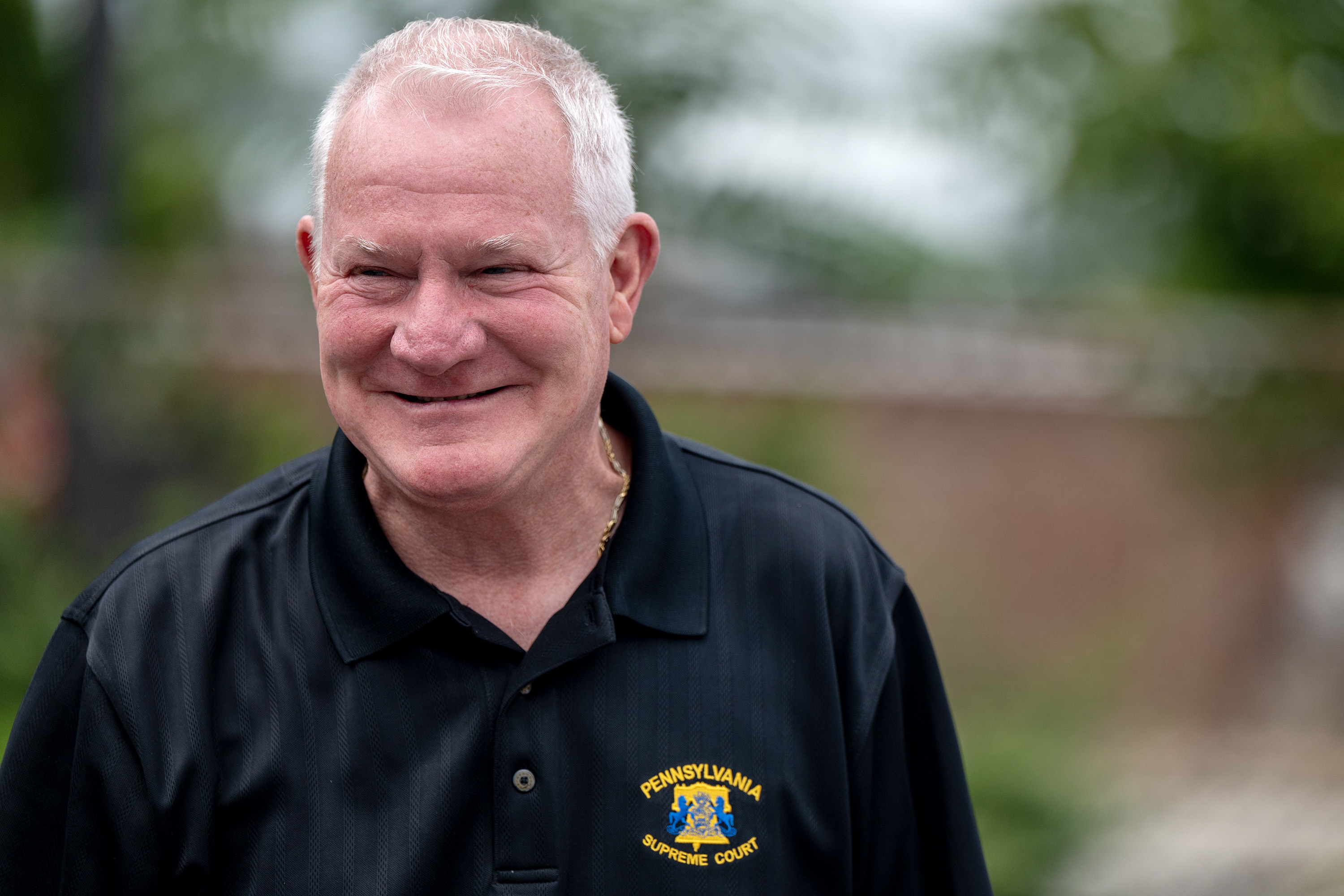
    Kevin Dougherty

    A small group of volunteers gathered in a Northeast Philadelphia parking lot on a gloomy Saturday afternoon in early September to knock on doors and urge residents to retain the current members of the Pennsylvania Supreme Court.

    Milling among the volunteers was Dougherty. Despite having been on the ballot for local or state office three times, Dougherty, of Philadelphia, never knocked on voters’ doors until this year.

    And he was disgusted by the fact that it was necessary.

    “Judges shouldn’t have to canvass,” Dougherty said several times over the course of the afternoon.

    Justice Kevin Dougherty talks with volunteers before they head out the canvass in Fox Chase Sunday Sept. 7, 2025. Dougherty is one of three Pennsylvania Supreme Court justices up for retention.

    He then proceeded to walk a Northeast Philly neighborhood alongside his son, State Rep. Sean Dougherty, a first-term Democrat who represents the area, and a family friend.

    Kevin Dougherty, 63, is from South Philadelphia and hails from one of the most well-known families in Philadelphia politics. His brother, John “Johnny Doc” Dougherty, is the once-powerful former leader of IBEW Local 98. John Dougherty was convicted in 2023 of embezzling funds from the union.

    Before running for the Pennsylvania Supreme Court, Dougherty spent nearly 15 years on the Common Pleas Court bench in Philadelphia, with much of that time spent serving in the family division.

    Justice Kevin Dougherty (right) canvasses with his son, State Rep. Sean Dougherty (left), in Fox Chase Sunday Sept. 7, 2025.

    As a Supreme Court justice, Dougherty has highlighted his work on the autism in courts initiative as a key accomplishment. This program works to educate judges about the particular challenges people with autism spectrum disorder may face when dealing with the justice system, and has grown further into sensory-friendly courtrooms in more than a dozen counties.

    The program, Dougherty said, was inspired by his own experience on the bench when a child stood in his courtroom for a delinquency case showing “all the signs of an incorrigible person.” Then, Dougherty said, the child’s mother pulled him aside and told him her son was on the autism spectrum.

    “It was like a punch in my mouth because I had never been exposed,” Dougherty said. “You’re only ignorant once.”

    Dougherty said he self-educated and began working in Philadelphia to reform the way the court interacts with individuals with autism and brought those efforts to a statewide focus as a justice.

    Justice Kevin Dougherty (left) canvasses with his son, State Rep. Sean Dougherty (center), in Fox Chase Sunday Sept. 7, 2025, stopping at the home of voter Skip Nelson (right).

    “You need to make the system fair,” Dougherty said.

    On the court, Dougherty has often sided with the liberal majority. He recently wrote the majority opinion in a case that allowed local governments to use zoning law to limit where gun ranges could be located. In oral arguments, when attorneys get a chance to argue their cases before the Supreme Court’s seven justices, Dougherty often presses lawyers to refine their arguments.

    Christine Donohue

    Donohue is often the first justice to ask questions during oral arguments.

    Her quick interjections are because of her 27 years as a trial attorney prior to her career on the bench, she said. She cannot help but be inordinately prepared when she puts on her judicial robes and sits on the state’s highest court.

    “Thoroughness is one of my ‘things,’” she said, with a laugh.

    Justice Christine Donohue speaks during a fireside chat at Central High School.

    Donohue, 72, would be able to serve for only two years of another 10-year term. But it wasn’t even a question to her whether she should step aside sooner. She believes she has fulfilled her duty as a justice, and she is prepared to do so until she hits the voter-set maximum age for a justice, 75.

    Donohue authored the court’s ruling last year that signaled some members of the court are prepared to find that the Pennsylvania Constitution secures the right to an abortion. But less discussed from that same opinion, Donohue said, she is proud to have shored up the state’s Equal Rights Amendment.

    Pennsylvania was the first state in the nation to amend its constitution to enshrine that every person has equal rights that cannot be “denied or abridged” because of an individual’s sex in 1971, and the first state to show support for amending the U.S. Constitution to guarantee the same.

    But a 1984 ruling by the state Supreme Court “diluted” the ERA in Pennsylvania, Donohue said. It wasn’t until the justices decided the Allegheny Reproductive Health case 40 years later that the court revisited the state’s Equal Rights Amendment to make it “perfectly clear that a biological difference cannot serve as the basis for a denial or an abridgment of a right,” she said.

    “To me, I’m very proud of many of the decisions I’ve been able to be involved with, but that one really sort of sets the record straight,” Donohue said.

    Outside her legal work on the state Supreme Court, she has been an advocate to offer more young lawyers the opportunity to try a case before a jury, which has become less and less frequent in recent years. Ensuring that the next generation of lawyers knows how to try a case before a jury is critical to guaranteeing the right to a fair trial, and would prevent a potential competency gap for future lawyers.

    David Wecht

    Like many of the justices on the Pennsylvania Supreme Court, Wecht spends much of his free time thinking about legal questions or ethical dilemmas. Or going on walks and listening to podcasts that deal with the same issues. (He recommends Amarica’s Constitution by Yale Law professor Akhil Amar or any of the podcasts by Jeffrey Rosen at the National Constitution Center, among others.)

    He works from his chambers in Pittsburgh each day, unless the court is at one of the state’s many satellite courtrooms for oral arguments. There are times when he is in his chambers reading and writing all day long, which he described as “very, very fun, and very, very interesting and exciting.”

    Justice David Wecht speaks with moderator Cherri Gregg during a fireside chat on retention at Central High School.

    “The work is interesting. It is varied, It is never stagnant. We deal with all areas of the law,” Wecht said. “I’m very grateful that the voters gave me this job 10 years ago, and I hope they’ll see fit to provide me an additional term.”

    Wecht is a true student of the law and said he enjoys probing attorneys’ arguments and the back-and-forth between justices on the bench.

    He sees his role on the court as to decide cases. “Nothing grander, and nothing more,” he said.

    He and the whole court, he said, operate under a “philosophy of judicial restraint.”

    The court’s liberal majority has faced criticism from Republicans during the last 10 years — especially during the COVID-19 pandemic — for decisions they claimed were made by an “activist court.”

    But those rulings, Wecht said, were the justices’ best attempts at deciding what a law passed by the General Assembly means when the lawmakers left it ambiguous, or their best attempt to understand what the framers of the state constitution intended, even if he doesn’t agree with it.

    “It’s not our business whether we like them,” he said.

    Early Vote Action, a Republican group, urges voters to vote against retaining the justices at a Republican rally in Bucks County on Sept. 25, 2025 at the Newtown Sports & Events Center. The event was headlined by Treasurer Stacy Garrity, a Republican running for governor.

    Republican groups have attempted to mislead voters in mailers, Wecht has said, about the justices’ role in a 2018 decision that found Pennsylvania’s congressional maps were unconstitutionally gerrymandered. The GOP groups have had similarly misleading ads about the court’s actions on abortion and voting rights, even recently invoking the anti-Trump “No Kings” language to try to sway voters to vote “no.”

    Wecht is a professor at Duquesne School of Law and the University of Pittsburgh, where he has been teaching for years. He is also a visiting professor at Reichman University in Israel each year, and regularly teaches continuing legal education courses for attorneys, which are courses that all lawyers must complete on an annual basis to maintain their active attorney’s license in Pennsylvania.

  • Philadelphia’s immigration court now rejects three in four asylum cases under Trump

    Philadelphia’s immigration court now rejects three in four asylum cases under Trump

    Asylum denials in Philadelphia’s immigration court have spiked through the first seven months of President Donald Trump’s administration, according to an Inquirer analysis of the latest available government data.

    The court has denied 74% of asylum claims in the first seven months of Trump’s second term, compared with a 61% denial rate during the last seven months of the Biden administration, mirroring national trends.

    The data were published by the Transactional Records Access Clearinghouse (TRAC), a data gathering and research organization that regularly acquires and analyzes such data from the Executive Office for Immigration Review (EOIR), the agency responsible for overseeing the nation’s immigration courts system.

    window.addEventListener(“message”,function(a){if(void 0!==a.data[“datawrapper-height”]){var e=document.querySelectorAll(“iframe”);for(var t in a.data[“datawrapper-height”])for(var r,i=0;r=e[i];i++)if(r.contentWindow===a.source){var d=a.data[“datawrapper-height”][t]+”px”;r.style.height=d}}});

    And it’s not just that denials are up: The volume of cases has risen substantially as well. The Philadelphia court heard twice as many cases over Trump’s first seven months, compared with Biden’s final seven: 1,059 vs. 513.

    Local immigration attorneys say that’s no coincidence.

    “Absolutely. They’re pushing cases to go forward,” said Brennan Gian-Grasso, founding partner of Philadelphia’s Gian-Grasso & Tomczak Immigration Law Group, when asked whether the two trends may be connected. “Additionally — and I think this is probably the big difference — prosecutorial discretion.”

    Under the Biden administration, Gian-Grasso said, immigration officials often gave asylum seekers who may not have necessarily qualified for asylum the opportunity to remain in the United States by putting a case on hold or otherwise allowing individuals to continue to stay in the United States so long as they did not have a criminal record or other derogatory characteristics.

    “That’s gone,” said Gian-Grasso. “Every case is going forward now.”

    The administration has been open about its efforts to push cases through the system. Last month, EOIR issued a news release trumpeting a shrinking backlog of immigration court cases — claiming a decrease of 450,000 pending cases since Trump’s inauguration. TRAC data indicate a slight decrease for Philadelphia’s backlog since the start of the current fiscal year last October.

    Emma Tuohy, a partner at Philadelphia’s Landau, Hess, Simon, Choi & Doebley and a recent past president of the American Immigration Lawyers Association’s Philadelphia chapter, suggested the rising number of decisions and denial rates were connected to another recent trend: surging arrests and detentions by Immigration and Customs Enforcement (ICE).

    “Denials in detained settings have always been higher,” Tuohy said, explaining that attorneys face particular obstacles when representing detained clients.

    The Inquirer reported in August that the number of people detained in ICE custody in New Jersey and Pennsylvania was up about 68% in July compared with figures at the start of Trump’s administration.

    Historically, asylum denial rates are vastly higher for those individuals who were in custody at the time a decision was rendered in their cases. Since the start of the 2000 fiscal year, about 99% of detained individuals in Philadelphia’s immigration court were denied asylum, compared with 63% of individuals who were detained at some point but later released and 58% of those who were never detained since the start of fiscal 2000. Similar, though smaller, gaps exist nationally.

    window.addEventListener(“message”,function(a){if(void 0!==a.data[“datawrapper-height”]){var e=document.querySelectorAll(“iframe”);for(var t in a.data[“datawrapper-height”])for(var r,i=0;r=e[i];i++)if(r.contentWindow===a.source){var d=a.data[“datawrapper-height”][t]+”px”;r.style.height=d}}});

    “[Cases] move much, much quicker — within just a couple months — as opposed to non-detained cases which can take a few years. It’s a much shorter timeline to put together extensive documentation and it’s obviously quite a bit harder to work with clients, given they are not as accessible as normal,” said Tuohy. “It’s much harder for individuals in detention to collect documents, to call people they need to speak with, to prepare their statements, to request letters from witnesses. We’re relying mostly on families that are outside and they may not have all the information nor access.”

    Officials at EOIR did not respond to requests for comment.

    A flurry of policy changes have made winning cases tougher

    The substantial increase in denial rates since Trump’s inauguration has been accompanied by a succession of policy changes at EOIR.

    The first came in a February memo issued by Sirce Owen, the Trump-appointed acting director of EOIR. Unlike typical federal judges, immigration court judges are not independent judicial branch officials but executive branch employees within EOIR. The directive rescinded a 2023 memo meant to better ensure that individuals in asylum proceedings are provided with adequate interpretation and translation services.

    Gian-Grasso explained that access to interpretive services can be critical to an asylum seeker’s ability to properly plead their case.

    “Just in my own experience, I’ve had clients who could not speak a word of English — and were illiterate even in their own language — but in translation during testimony could very, very effectively and intelligently articulate their fear of return to their country and their asylum case,” he said.

    Gian-Grasso worried the policy shift would put some asylum seekers at a severe disadvantage.

    “Limiting that kind of access dooms asylum cases because if you can’t tell your story, what does the judge have to go on?” he said.

    Historically, asylum denial rates are significantly higher for those individuals who don’t speak English. In Philadelphia’s immigration court, about 62% of non-English speakers were denied asylum, compared with 51% of English speakers, since the start of fiscal 2000.

    window.addEventListener(“message”,function(a){if(void 0!==a.data[“datawrapper-height”]){var e=document.querySelectorAll(“iframe”);for(var t in a.data[“datawrapper-height”])for(var r,i=0;r=e[i];i++)if(r.contentWindow===a.source){var d=a.data[“datawrapper-height”][t]+”px”;r.style.height=d}}});

    Attorneys have cited a second memo, issued in April, as likely to have an even greater effect on asylees.

    That memo essentially encouraged immigration judges to order an asylum seeker removed before providing them with an opportunity for a full hearing of their case — an action known as pretermission — if a judge believes that an applicant has failed to present sufficient corroborating evidence at the outset of their proceedings.

    Tuohy described the practical effect of the policy as telling judges to throw out cases over paperwork errors.

    “These [cases] are not being pretermitted because there’s not corroborating evidence or there’s not an affidavit or there’s a credibility issue where they don’t believe a person’s story on the merits,” Tuohy said. “This is just because someone has not fully filled out a form.”

    Gian-Grasso said the new memo will likely be particularly difficult on individuals navigating the immigration system without an attorney.

    “Asylum is highly technical. It’s very difficult to put together an asylum case,” Gian-Grasso said. “You can have a valid asylum case, but if you don’t know how to put it together legally — now judges are being told to look to pretermit in these situations.”

    Historically, asylum denial rates are markedly higher for those individuals who don’t have access to an attorney. In Philadelphia’s immigration court, about 82% of asylum applicants without representation were denied asylum, compared with 57% of those who did. An even larger gap exists nationally.

    window.addEventListener(“message”,function(a){if(void 0!==a.data[“datawrapper-height”]){var e=document.querySelectorAll(“iframe”);for(var t in a.data[“datawrapper-height”])for(var r,i=0;r=e[i];i++)if(r.contentWindow===a.source){var d=a.data[“datawrapper-height”][t]+”px”;r.style.height=d}}});

    Denial rates vary by president, and, locally, by judge

    While recent denial rates are the highest on record, increases and decreases in the rate of asylum denials are nothing new.

    While Philadelphia’s recent denial rate marks the highest since data became available a quarter century ago, rates have fluctuated over time, with notable shifts depending on who’s in the White House.

    window.addEventListener(“message”,function(a){if(void 0!==a.data[“datawrapper-height”]){var e=document.querySelectorAll(“iframe”);for(var t in a.data[“datawrapper-height”])for(var r,i=0;r=e[i];i++)if(r.contentWindow===a.source){var d=a.data[“datawrapper-height”][t]+”px”;r.style.height=d}}});

    In addition to notable partisan gaps, the data reveal another factor in success for an asylum speaker: the judge assigned to the case.

    From the 2019 through 2024 fiscal years, the Philadelphia judge with the lowest denial rate denied asylum in 33% of cases, compared with the judge with the highest denial rate, 85%.

    Tuohy expressed frustration over that chasm in case outcomes.

    “There’s just absolutely no way that those judges are being assigned such fundamentally different cases that their grant rates should be so different so unfortunately yes, it makes a huge difference what judge you get assigned to,” Tuohy said.

    Gian-Grasso agreed, arguing it’s one more reason that asylees without an attorney are penalized.

    “You know as an attorney what you’re getting when you go in with these judges and how to structure your case,” said Gian-Grasso. “But, again, that goes back to our [unrepresented asylum seekers]. They have no idea and they’re similarly disadvantaged for having this lack of knowledge at the end of the day.”


  • Ambler’s small businesses want to make the borough a destination

    Ambler’s small businesses want to make the borough a destination

    Maura Manzo, founder and director of yoga studio Camaraderie in Ambler, previously owned the Yoga Home studio in Conshohocken but stepped away during the pandemic.

    When she was looking to get back into the business, she chose Ambler.

    “I was looking for a vibrant, walkable downtown, rooted in community,” Manzo said.

    She was encouraged by the presence of a food co-op, Weavers Way, which “signaled to me that this is a community invested in sustainable, healthy living — values that align beautifully with a yoga community,” as well as the other businesses around.

    “There’s a balance of restaurants, arts and culture, and shopping that creates a wonderful, rich community and attracts people,” Manzo said.

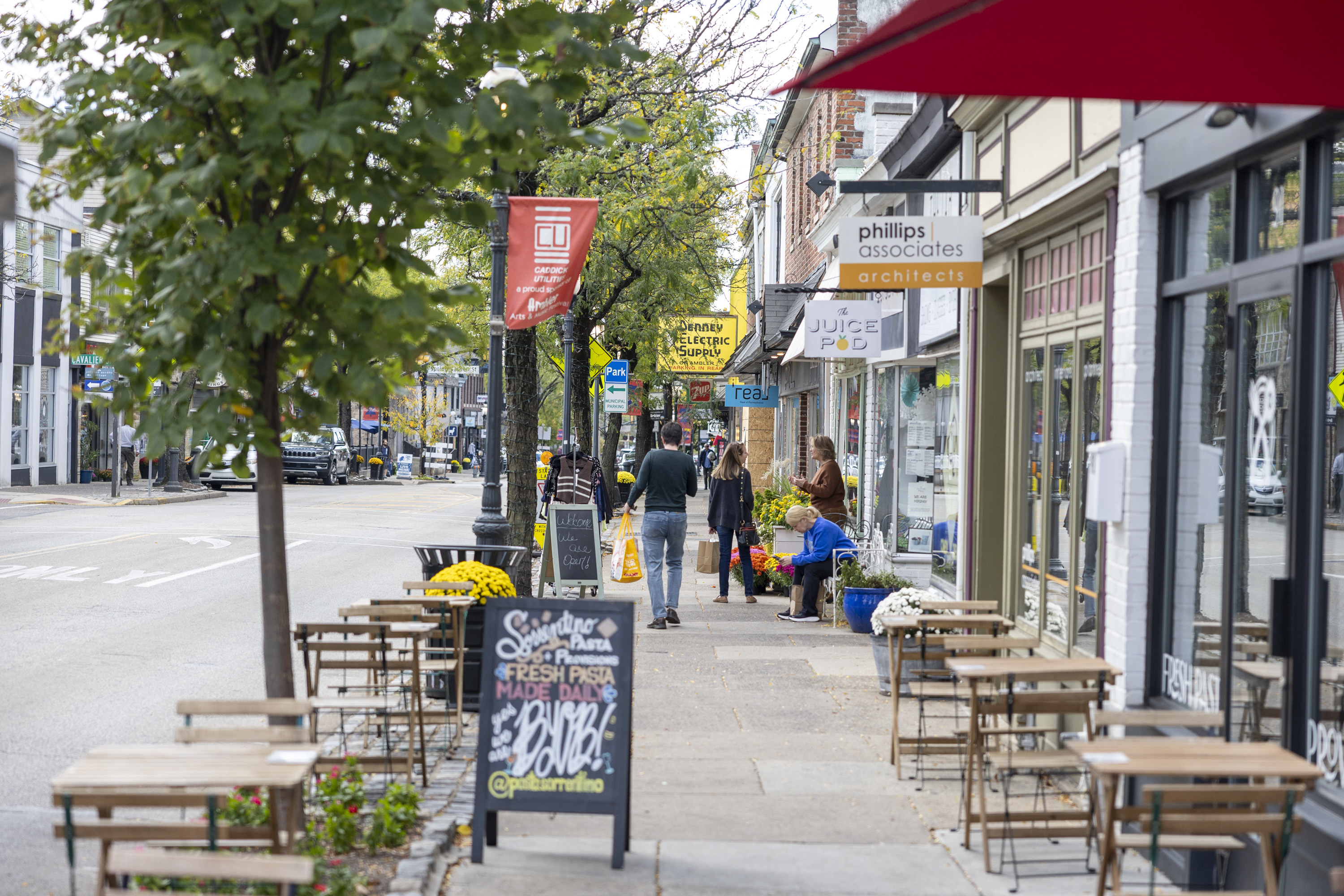
    Centrally located in Montgomery County, the borough of Ambler has become home to an eclectic blend of retailers, restaurants, and services. Its downtown business district includes a spa, tuxedo rentals, a bakery, a tattoo parlor, hair salons, and restaurants from all different culinary genres.

    People walk along Butler Avenue among various shops and restaurants in Ambler.

    The borough started as a mill town in the 1700s and evolved into a factory town run by the Keasbey & Mattison Co. in the 1800s. Many of the original buildings from that period still exist in the downtown district.

    The borough has been consistent in its preservation efforts. Recently an ordinance passed to be sure that any new construction reflects the existing architectural charm, said Ambler Main Street manager Elizabeth Wahl Kunzier.

    Still, the area has continued to evolve, recently adding a food hall with 10 vendors, seeing the merger of two established Ambler boutiques into one new storefront, and promoting downtown events on social media. With the holiday season approaching, business owners are looking ahead to their busiest time of year and gearing up for a number of seasonal events.

    “We have a pretty good organic social media reach,” Wahl Kunzier said. “It took a long time to get that where it is today, but given the nature of how the public gets information, it is very important to have a good following.”

    Building momentum behind the scenes

    Elizabeth Wahl Kunzier, Ambler Main Street manager.

    Wahl Kunzier serves as the marketing lead for Ambler Main Street — the name of the nonprofit that promotes downtown Ambler, even though many of its businesses are on Butler Avenue rather than Main Street. She monitors the businesses’ social media accounts daily to see what they’re advertising and share the information more broadly.

    Her office also organizes special events such as a semiannual restaurant week and a holiday shopping weekend. And the borough hosts a Farmer’s Market every Saturday from May through the weekend before Thanksgiving at the old Ambler train station.

    “I work with business owners brainstorming on everything from vacant storefronts to customized events to keep the foot traffic coming,” Wahl Kunzier said.

    The small business district and the community’s “people” are what drew Daniel J. DeCastro to Ambler, where he opened Ridge Hall last month.

    “They were a large family of small businesses that looked out for each other and supported one another while also having patrons who were cheerleaders of their businesses,” he said.

    An event board with various posters and advertisements for Ambler businesses and events.

    Located in a historic warehouse, Ridge Hall has 10 dining spots and a second-floor venue called The Mercantile.

    DeCastro is optimistic this food hall and retail concept will do well in Ambler, which he described as “on the cusp of breaking through as a destination town.”

    “Chestnut Hill, Doylestown, New Hope, and Phoenixville have become towns that you simply go to without a commitment. Unless you live in Ambler, it takes a commitment to drive into town,” DeCastro said. With Ridge Hall, “I wanted to create a destination that would entice people to stay for the day and return sooner rather than later.”

    Customers dine at Ridge Hall in front of Mary’s Chicken Strip Club.

    Some of the district’s established restaurateurs perhaps would argue that Ambler was already a destination.

    At Sorrentino Pasta + Provisions, customers find fresh pasta, house-made focaccia, and imported Italian goods for sale. The restaurant is open for lunch Wednesday through Sunday and dinner Thursday through Saturday, and it’s a BYOB.

    “Lunch is steady and a great opportunity to grab a table since it’s a little more difficult at dinner time,” proprietor Rich Sorrentino said. “We are extremely lucky to have the customers we do. Most are from the borough, but a surprising amount travel a bit to come join us.”

    Geronimo’s Peruvian Cuisine, also a BYOB, offers signature dishes such as ceviche, lomo saltado, anticucho de corazón, arroz con mariscos, pollo a la brasa, and many other authentic Peruvian dishes, said co-owner Daniel Salazar. It’s open Wednesday through Sunday.

    “Weekends are busy nights for us, we highly recommend calling the restaurant for a reservation,” she said. “Our goal here is to bring a cultural experience, to share a great cuisine that has history, flavor, and a little bit of mystery.”

    A tale of two stores

    Jeanne Cooke (left) and Barb Asman in their combined store, which opened earlier this year, bringing together XTRA Boutique and Main Street Vintage.

    Jeanne Cooke, owner of Main Street Vintage, sold painted furniture, vintage wood furniture, new and vintage home accessories, and artwork at her Butler Avenue shop for years. Just down the street, Barb Asman’s XTRA Boutique was selling women’s clothing.

    In August, they combined their businesses, merging into one larger storefront on Butler.

    “Barb and I have been looking in windows in Ambler for years. We felt we needed more square footage to take our businesses to the next level,” Cooke said. “The merge was seamless. I guess because we talked about it for quite some time.”

    The new experience is like shopping in a beautifully decorated home where you can buy all the furnishings. The two owners design the merchandising collaboratively, and the two businesses are intertwined.

    The back of the store, where Main Street Vintage’s furniture and home decor are on display.

    Asman said they are excited for what the future holds.

    “I sometimes stand in the middle of the store and say: ‘Wow, this feels so good.’ It’s hard to put it into words,” Asman said. “It’s a really good feeling.”

  • The Union lost their regular-season finale, but for once it didn’t matter

    The Union lost their regular-season finale, but for once it didn’t matter

    It’s a rare day when a soccer team, or any sports team, can play a game and have a good reason to not worry about its result.

    That was the Union’s privilege Saturday, having wrapped up the Supporters’ Shield for the league’s best regular-season record with a game to spare.

    So it didn’t matter much that they lost, 2-0, at Charlotte FC. Sure, it’s annoying that they’ve still never won in Charlotte in four tries. And it might be a little more annoying in the locker room that they fell just short of setting a record for points in a season, ending with 66 when it could have been 67 (the standing record from 2022) or 69.

    Only two things truly mattered: not suffering any injuries, and not taking any red cards. As neither of those things happened, the rest of the night can be mostly forgotten.

    “We had to distribute the minutes amongst everybody here today, pretty much,” manager Bradley Carnell said. “Happy everybody got a run, happy everybody got minutes just to stay sharp. Just got to make sure we’re looking after our bodies.”

    And as he said when asked where those factors ranked compared to winning, he said: “You saw us make changes. So that’s how high-priority it was.”

    Forgetting the game doesn’t mean taking it for granted. Charlotte’s artificial turf raised the injury risk, and a fractious first half saw Danley Jean Jacques and Mikael Uhre draw yellow cards.

    Carnell withdrew Uhre at halftime and took out Alejandro Bedoya for Indiana Vassilev. The latter move looked planned, given Vassilev’s recovery from a recent knee injury, and Carnell didn’t exactly deny it after the game.

    Indiana Vassilev (left) entered the game at halftime.

    “We were thinking of 50-55 [minutes], to set the tone for the second half,” Carnell said. “But we were trailing 2-0. So at that point, just to give guys a fresh look from the very beginning, I think it was the right decision.”

    In the second half, Carnell won a gamble by leaving Jean Jacques in until the 78th minute. Nathan Harriel and Bruno Damiani had also been booked by then, in the 71st and 73rd, and Carnell pulled Harriel at the same time he pulled Jean Jacques.

    “I said to Nate, the way the referee, the way the things are going, that’s an automatic easy one for them,” Carnell said. “So I’m going to get you out of here, I’m going to protect you, going to protect Danley. I think Bruno did just enough to make sure he didn’t fall into that sort of level.”

    The Union didn’t play badly, despite the score. They outshot Charlotte, 23-8, with shots on target even at 5, and the Union’s expected-goals sum was 2.06 to Charlotte’s 1.07.

    Danley Jean Jacques (center) drew a yellow card for his role in a scuffle during the first half.

    The difference was in all those shots that didn’t go on target, from Bedoya’s in the first half to various players’ speculative long-range attempts in the second.

    Tai Baribo had three of the best looks of the game, starting with a spin and shot in the 72nd minute that Charlotte goalkeeper Kristijan Kahlina saved well. Baribo then put a header off the bar in the 87th after beating Kahlina to a loose ball, and had another good shot denied by a diving stop in the 92nd.

    Cavan Sullivan also deserves a nod for how well he played and how long he played. His entry in the 55th minute started his longest shift in a first-team game since July 5, and his first appearance for the first team since Aug. 23.

    In his last game before leaving for the under-17 World Cup, Sullivan created two chances, including the setup for the first of those Baribo attempts, and had a nice shot of his own saved by Kahlina in the 85th.

    Cavan Sullivan (right) escapes a defender during his second-half run.

    That all added up to Sullivan’s best outing in a league game so far this year. (He played more in the Union’s U.S. Open Cup early round games, but against lower-division opponents.)

    “We have to make sure we send him off in the right way [as] possible, and he’s been training well,” Carnell said. “So we thought we’d reward him away from home here, and I thought he did well. He could have got on the score sheet once or twice, and he was a busybody — he counter-presses really well, he came in and he made an impact.”

    It will be for another day to discuss whether the Union have hurt their playoff chances by letting Sullivan go. The short answer for now is they need Jeremy Rafanello to get past his hamstring injury, because he’s the only other attacking midfielder left who’s had regular minutes. Other than that, the choices are little-used reserves Ben Bender, Markus Anderson, or C.J. Olney.

    At least for now, the Union have time to get everyone rest before starting the playoffs sometime next weekend. The schedule should land in the next day or two.

    Union manager Bradley Carnell on the sideline during Saturday’s game.

    MLS playoff bracket

    Here’s how the matchups landed for the first round of the MLS playoffs, listed in order of the bracket. The wild-card games between the No. 8 and 9 seeds are scheduled for Wednesday.

    Eastern Conference

    1. Union vs. 8. Chicago Fire or 9. Orlando City

    4. Charlotte FC vs. 5. New York City FC

    3. Inter Miami vs. 6. Nashville SC

    2. FC Cincinnati vs. 7. Columbus Crew

    Western Conference

    1. San Diego FC vs. 8. Portland Timbers or 9. Real Salt Lake

    4. Minnesota United vs. 5. Seattle Sounders

    3. Los Angeles FC vs. 6. Austin FC

    2. Vancouver Whitecaps vs. 7. FC Dallas

  • This La Salle triathlete competed in an Ironman world championship earlier this month. She hopes it’s the first of many.

    This La Salle triathlete competed in an Ironman world championship earlier this month. She hopes it’s the first of many.

    Between adapting to college coursework, independent living, and the freshman flu, a college freshman faces plenty of challenges in their first semester.

    La Salle’s Sofia Nordbeck faced those challenges while also adapting to life in the U.S. and racing in the 2025 Ironman World Championship on Oct. 11 in Kailua-Kona, Hawaii.

    Nordbeck, who moved to the U.S. from her native Sweden to join the Explorers’ triathlon team this fall, completed the 140.6-mile IWC race in 13 hours, 9 minutes, and 45 seconds. She finished 51st among women aged 18-24 in the ultraendurance triathlon.

    “There were so many times during the race where I thought it wouldn’t happen,” Nordbeck said. “I was very shocked, and I’ve been shocked for a few days now. I still can’t really wrap my head around what I’ve done.”

    Triathlon training

    Nordbeck, a 20-year-old freshman, is an experienced triathlete. When coach Sage Maaranen recruited Nordbeck to join La Salle’s triathlon program, which is in its first season, Maaranen knew Nordbeck had qualified for the Ironman World Championship and intended to run it.

    “It was definitely, ‘I want to come, but I’m going to do this Ironman. Can I come and do Ironman?’” Maaranen said. “She knows it’s a huge accomplishment to qualify for Kona, and there’s no guarantee that she’ll qualify again. So I was definitely very supportive of it.”

    An Ironman race is very different from the sprint triathlons in which La Salle’s team competes. The Ironman consists of a 2.4-mile swim, followed by a 112-mile bicycle ride and a 26.2-mile run. Sprint triathlons, half of the Olympic triathlon distance, typically are a 0.47-mile swim followed by a 12-mile bike ride and a 3.1-mile run. Running an Ironman is a solo task, while La Salle’s sprints are a team event. Triathlon is among the NCAA’s emerging sports for women program, which aims to create more athletic opportunities.

    The differences between the formats leads to disparate training needs. For an Ironman race, one needs endurance training and mental fortitude, while sprint triathlon calls for more strength training and higher-intensity bursts of effort.

    “They’re both triathlons, but they are two completely different sports,” Nordbeck said. “Ironman, yeah, it’s longer, but that’s not the big difference. The difference is you’re all alone. You’re not allowed to race with a team. … So you’re kind of stuck in your head with yourself, with your demons, the whole race.”

    Maaranen, who was named the first head coach of La Salle’s triathlon team in July 2024, worked to accommodate the training needs Nordbeck had while preparing for the Ironman race.

    “It’s incredibly difficult to train for an ultraendurance event like that while also doing the extreme opposite,” Maaranen said. “And so trying to balance those few needs, train her for short-course racing while she was still maintaining the endurance she needed for Kona, was quite the challenge. I think Sofia handled it incredibly well.”

    Iron family

    Nordbeck was born into an Ironman family. Her parents, Carl and Lotta, met at triathlon events in Sweden. Nordbeck grew up following them as they competed at triathlon and Ironman events “all over the world.”

    As Nordbeck got older, she started to take interest in triathlons. She competed in shortened versions of the Ironman designed for children, then progressed to sprint triathlons once she turned 14. When she turned 18 and met the Ironman age requirement, she set out to take on the full race.

    She started Ironman Sweden in 2023, but did not finish. She returned to the race in 2024, finishing the course in 12 hours, 23 minutes, and 20 seconds. The race qualified Nordbeck for the 2025 Ironman World Championship.

    Nordbeck had been to Hawaii before, as her father competed at the 2017 Ironman World Championship in Kona, finishing in 12 hours, 16 minutes.

    “He said he would never do the race again because it was so hard,” Nordbeck said. “He would probably never be back [to Kona].”

    But with Nordbeck and her mother qualifying for the 2025 race, the Nordbecks made the trip out to Hawaii. Since the Kona race was an all-women’s event in 2025, Carl served as the family’s bike mechanic while Sofia and Lotta raced. Lotta finished in 15 hours, 52 minutes, and 12 seconds, 202nd in the 50-54 age division.

    In addition to his role as bike mechanic, Carl also served as a documentarian for Sofia, posting videos from her race to her Instagram account, @sofianordbeck. Nordbeck said she gained around 3,000 followers during the race, more than doubling her follower count.

    “I don’t do the social media part for my followers, I mostly do it for me,” Nordbeck said. “It’s kind of my notebook. It’s just so fun that I’ve gained so many followers and people are actually interested. I’m a bit shocked, still.”

    Sofia’s setbacks

    Nordbeck faced challenges in the weeks leading up to her race in Hawaii. She contracted strep throat, and on the day she flew from Philadelphia to Hawaii, Nordbeck had an allergic reaction to the antibiotic she had been prescribed.

    Her ailments combined with hot, humid, and windy race day conditions on the Big Island made Nordbeck nervous at the starting line.

    “You don’t really know how your body will react in that heat, and when you’ve been sick before, too,” Nordbeck said. “So, I was extremely nervous.”

    Nordbeck was able to push through the challenges posed by the Hawaiian elements and her own immune system to finish the race.

    “It was the hardest race of my life, and probably the worst race of my life, too,” Nordbeck said. “But, I would definitely do it again, 100%. I want to [go] back and I want to be competitive.”

    It may be the first of many Ironman World Championship races for Nordbeck. Her ultimate goal is to pursue a professional career in Ironman after her sprint triathlon career at La Salle.

    “If I keep combining them both and focus on sprints at the same time, I will be more than ready to, hopefully, be good enough to become [a] professional when I graduate college,” Nordbeck said.

    Nordbeck returned to La Salle on Wednesday after some postrace sightseeing in Hawaii. Her body is still recovering from the grueling race, but she intends to compete in La Salle’s next event. The Explorers enter the postseason at the East Regional Championship on Oct. 25.

  • In a blowout of Charlotte, Temple picks up its first AAC road victory since 2019

    In a blowout of Charlotte, Temple picks up its first AAC road victory since 2019

    Temple turned a first-quarter tie into a 49-14 rout over host Charlotte on Saturday.

    In doing so, the Owls (4-3, 2-1 American)posted their first conference road win since 2019, while head coach K.C. Keeler earned his 275th career victory. The Owls’ fourth win of the season also marked their most since 2019.

    Temple got the rout underway on its second possession of the second quarter when quarterback Evan Simon capped a four-play, 44-yard drive with a 5-yard touchdown run. On Charlotte’s ensuing possession, Owls cornerback Adrian Laing jumped in front of a pass from Grayson Loftis and ran it back 64 yards for a pick-six, which gave the Owls a 14-point cushion and marked the beginning of the end for the 49ers.

    Too close for comfort

    After its loss to Navy last week, Keeler was adamant the Owls had to wipe the slate clean to avoid a downward spiral. Charlotte (now 1-6, 0-4) made the perfect opponent for the Owls to bounce back against. The 49ers ranked 122nd in the country in scoring defense, and its lone win was against an FCS foe, Monmouth.

    At first, the 49ers hung with every punch the Owls threw. They forced a Temple punt on the first drive, and when Temple found the end zone on the next drive, Charlotte found gold with a touchdown of its own.

    Loftis threw the ball with ease in the opening frame. He completed six of eight first-down pass attempts and found tight end Gus McGee on a 2-yard touchown pass to knot the game at seven. The 49ers’ defense did its part as well, containing Temple’s offense to just 100 first-quarter yards to Charlotte’s 110.

    Air it out

    Temple’s run game couldn’t get going, so the offense leaned on its passing game. Simon, who just had a career game seven days prior against Navy, threw for 194 yards and three touchdowns, in addition to his rushing TD.

    Simon’s 176 first-half passing yards opened the floodgates for an offense that averages 30 points per game. He found wide receiver JoJo Bermudez three times for 45 yards, including a 29-yard gain to get to the 49ers’ 5-yard line. The very next play was when Simon scored on a keeper to give the Owls a 14-7 lead.

    Wide receiver Kajiya Hollawayne followed up on his 146-yard game against Navy with 85 on Saturday. He was on the receiving end of a 46-yard strike from Simon to pour onto the lead.

    The second half was more of the same for Temple. The running game got its legs under it, with a 44-yard rush by running back Jay Ducker, who punched the ball into the end zone to extend the Owls later in the quarter. He finished the game with 114 yards, while Simon continued to deal.

    Simon had one more touchdown pass before being taken out for backup Gevani McCoy in the fourth quarter.

    Bend don’t break

    The 49ers’ offense finished with 359 yards and coughed the ball up three times.

    Laing’s pick came when Charlotte was driving to tie the game in the second quarter. Two drives later, Temple allowed Charlotte to its 40-yard line before defensive tackle Allan Haye forced a fumble that bounced into the hands of safety Avery Powell.

    The Owls allowed the 49ers to amass just nine plays after the takeaway. When Charlotte started moving the ball again, the game was out of reach.

    The cherry on top came when Charlotte running back Cameren Smith fumbled and Temple safety Louis Frye, who was back following a two-game absence, scooped up the ball and ran back for a 73-yard touchdown.

    Up next

    Temple will stay on the road next week to take on Tulsa (2-5, 0-4) on Oct. 25 ( 3:30 p.m. ESPN+).

  • Thousands turn out in Philly for the ‘No Kings’ protest

    Thousands turn out in Philly for the ‘No Kings’ protest

    Joining demonstrators around the country, thousands gathered Saturday in Philadelphia to protest President Donald Trump’s actions that they contend are threatening to undermine 250 years of the nation’s democratic traditions.

    “I think everybody needs to know that we’re not going to just sit back,” said Sherri King, who arrived at the “No Kings” rally in Center City wearing an inflatable chicken costume.

    On a mild October afternoon when the weather was drawing no protests, the event began in a festive atmosphere with the sounds of clanking bells as participants gathered at City Hall — some, like King, wearing pre-Halloween regalia — and marched to Independence Mall.

    Demonstrators gather for a’ No Kings’ rally in Philadelphia on Saturday, Oct. 18, 2025.

    “It’s a very large, orderly crowd,” said Police Capt. Frank Palumbo. The three-hour march and rally, which began at noon, actually ended on time.

    Said Thomas Bacon, a 72-year-old Vietnam veteran from North Philadelphia: “It’s peaceful. No division. Just opposition.”

    Under Trump, he said, “the whole world is turned upside down.”

    In what was the third mass anti-Trump protest this year, several organizers were taking credit, including Indivisible, MoveOn, and the 50501 Movement.

    The demonstrators’ menu of grievances included aggressive raids by Immigration and Customs Enforcement, Trump’s budget and efforts to limit free speech, and the government shutdown that began Oct 1.

    Organizers of the more than 2,500 demonstrations nationwide say the shutdown in particular is a dangerous move toward authoritarianism.

    Trump and congressional Republicans are blaming Democrats for refusing to vote on a reopening.

    For his part, Trump spent the day of what fellow Republicans were calling “Hate America” rallies at his Florida mansion.

    Demonstrators gather for a’ No Kings’ rally in Philadelphia on Saturday, Oct. 18, 2025.

    At the Philadelphia protest, Laura Murphy, a 74-year-old retiree, said she was struggling with the “Hate America” concept. “It’s ridiculous,” she said. “What could be more American than being against kings?”

    Along with demonstrators, Democratic politicians were evident at events in Philly and elsewhere.

    With Democrats hoping to make significant gains in the 2026 election, the presence of party elected officials was evident at rallies in Philly and elsewhere. Among those who showed up in Philadelphia were area U.S. Reps. Mary Gay Scanlon, Madeleine Dean, and Brendan Boyle, along with U.S. Rep. Jamie Raskin of Maryland.

    Rallies were being held all over New Jersey, Pennsylvania, the region, the nation — even Spain, where a few hundred gathered in Madrid. About 5,000 people jammed the streets of West Chester.

    In Philly, Jerry Lopresti, who said he never had attended a protest in his 64 years, said: “There has to be a show of numbers. It’s important to show up.”

    Demonstrators gather for a ’No Kings’ rally in Philadelphia on Saturday, Oct. 18, 2025.

    Among those who showed up conspicuously was Michael Noonan, 48, of Northern Liberties. He was wearing a Tinky-Winky Teletubby costume as he walked off a Market-Frankford Line subway car.

    He said his outfit was a counterpoint to suggestions that the demonstrations might turn violent. “Nobody’s here to fight anyone,” he said, “nobody’s here to kill anyone.”

    Not everyone who showed up had issues with Trump.

    Patrick Ladrie, 20, who lives in Camden County, stood out in his Trump hat and “ultra MAGA” T-shirt that proclaimed “I love our king.”

    He said he crossed the Delaware River to “get a good viewpoint of what the American left is.”

    After engaging in debate with three protesters on matters that included Christianity and conservatism, Ladrie reported that the environment was not so bad.

    In fact, he said, it was one of the “most peaceful” debates he could recall. As one of his adversaries jogged away to meet up with his friends, Ladrie said, “Keep out of trouble.”

    The protest was a decidedly intergenerational affair, with some parents describing the event as a teachable moment, while others said it was their progeny who came up with the idea to attend. Danielle Pisechko, 38, carried her youngest, who wore orange butterfly wings, on her shoulders.

    Their sign read: “The only monarchs we want are butterflies.”

    Demonstrators gather for a’ No Kings’ rally in Philadelphia on Saturday, Oct. 18, 2025.

    The participants included Center City resident Reed Oxman, 66. Although his disability limited his movement, he and his husband sat on a ledge near City Hall as evidence of the diversity of the crowd. “It’s [about] representation and clearing all the lies about who is coming to this,” Oxman said.

    Lana Reckeweg, who lives at a North Philly women’s shelter, said her resources were seriously limited, but that didn’t stop her from finding cardboard and getting markers to make signs to give to other demonstrators.

    She said that over the last several months a handful of undocumented women have found sanctuary in the place she calls home, and seeing their struggles made her want to attend the protest on their behalf.

    “I have done a lot of crying. I see how it’s affecting them every day,” said Reckeweg, trying to keep her handwriting steady on a moving bus.

    “I am here because they can’t be. People need to wake up and realize it’s getting a lot more serious more quickly than expected.”

    As for what effect the rallies might have, “I would tend to doubt that the protests will have any immediate direct impact on the administration’s policies,” said David Redlawsk, chair of the political science and international relations department at the University of Delaware, but “they may work to embolden those who are opposed to Trump’s actions to continue to organize and respond.”

    Sam Daveiga, 15, attended her first protest, the Women’s March, when she was 7 years old. This time, she brought along her father, Ed. “Every voice counts,” the Philly teen said.

    “You can have a small voice, but the second you put it with everyone else who’s come out, it amplifies.”

    Staff writers Emily Bloch, Scott Sturgis, and Rob Tornoe contributed to this article, which contains information from the Associated Press.

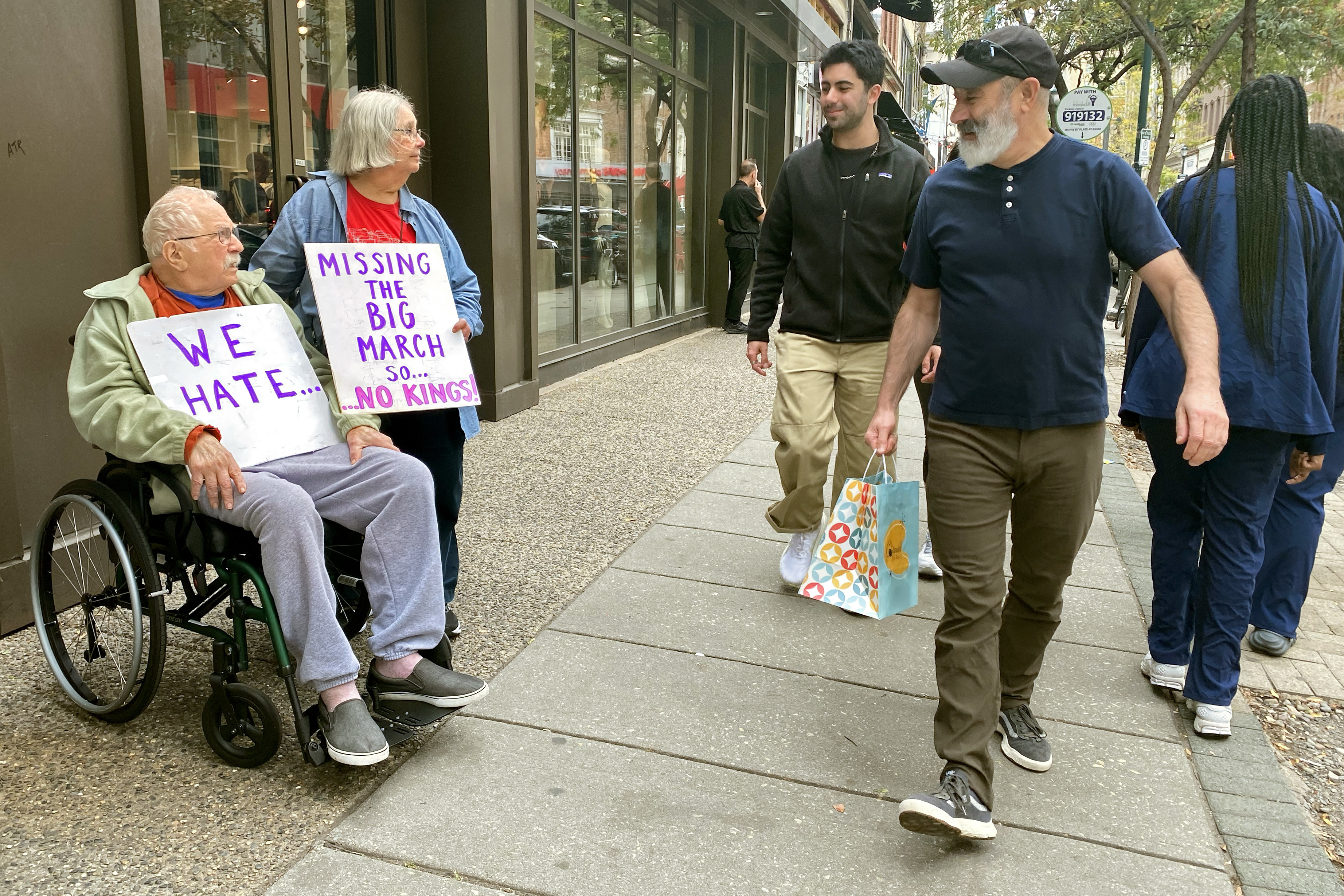
    Fourteen blocks away from the “No Kings” rally on Independence Mall, Bert and Lynne Strieb stand (and sit) in silent protest Saturday, Oct. 18, 2025 outside their apartment building in the 1900 block of Chestnut Street, vicariously joining thousands of others in Philadelphia and in cities across the country in response to Trump’s masked ICE agents and the deployment of troops in American cities. The Striebs, both in their 80s, could not attend the June “No Kings” march as Bert was in the hospital, and Lynne said they “did not want to miss this one.”

  • James Franklin says he was ‘in shock’ after being fired from Penn State

    James Franklin says he was ‘in shock’ after being fired from Penn State

    STATE COLLEGE, Pa. — Former Penn State football coach James Franklin appeared Saturday on ESPN’s College GameDay for an exclusive interview, which marked his first public statement since the university fired him last Sunday.

    Franklin, who spent 12 seasons in charge in Happy Valley, said he was shocked when Penn State athletic director Pat Kraft informed him of the school’s decision to fire him on Sunday afternoon.

    “At about 1:30, the athletic director walked in and said, ‘We’re going to make a change. I’m sorry,’” Franklin recalled. “I was in shock … And then I walked down and had a super emotional meeting with the team to tell them I was leaving.”

    Franklin’s 104 wins rank second in program history, trailing only Joe Paterno’s 409. He led Penn State to the 2016 Big Ten Championship and to its first College Football Playoff appearance last season.

    Franklin said he wants to focus on the “unbelievable moments” and relationships he built in State College.

    “I had a great run there. Twelve years. Penn State was good to me and my family,” Franklin said. “I’m a players’ coach, so walking away from all those young men in that locker room, the recruits that were committed to us, that’s the challenging part. It’s [about] the people at the end of the day.”
    The Nittany Lions entered this season with national championship expectations after returning Heisman Trophy candidate Drew Allar, hiring defensive coach Jim Knowles to the richest coordinator contract in the nation, and earning the No. 2 ranking in the Associated Press preseason poll. But after losses to winless UCLA and unranked Northwestern dropped Penn State to 3-3, the school’s patience ran out.

    Franklin said he didn’t have an answer as to why the team fell apart so quickly before his firing.

    “I’m still working through it myself. It feels surreal,” Franklin said. “To think, essentially, six games ago, we were fighting for a chance to be in the national championship, a two-minute drive away … I thought we were going to win a national championship there. I guess we’re just going to go to win a national championship somewhere else now.”

    James Franklin couldn’t explain why the team fell apart so quickly before his firing.

    Penn State went 4-21 against AP top 10 opponents during Franklin’s tenure. The constant blip on his resume was his inability to win the big game, which happened again on Sept. 27 when the Nittany Lions lost 30-24 in overtime against Oregon.

    While Franklin said it is not his place to say whether Kraft’s decision was fair, Nick Saban, who won seven national championships during his coaching career, didn’t hold back his disdain for Penn State’s decision.

    “It’s unfair as hell for you to go to the Rose Bowl, Fiesta Bowl, get into the final four, come out being ranked No. 1 this year — an expectation that you created by what you accomplished at Penn State,” Saban said. “And for those people not to show enough appreciation for that and gratitude for all the hard work that you did, I’m saying it’s unfair.”

    Franklin is owed more than $49 million in his contract buyout, which will be spread across multiple payments, according to On3.

    But if he accepts another coaching gig, which he has to make a “good faith effort to obtain,” according to documents related to Franklin’s 2021 contract extension that were obtained by Front Office Sports, Penn State only has to pay the difference between the annual salary it owes him and his new yearly compensation.

    The longtime coach sounded ready to get back in the saddle.

    “I don’t know anything else [other than coaching]. I’ve been doing this for 30 years. I don’t have hobbies,” Franklin said. “This has been such a big part of my identity, such a big part of my family. We love it. So I think it was take a deep breath, and then we got to get back to doing what we do, which is helping young people achieve their dreams … I can’t wait for that next challenge.”

  • Shohei Ohtani’s performance was epic. But let’s not forget what Rick Wise did.

    Shohei Ohtani’s performance was epic. But let’s not forget what Rick Wise did.

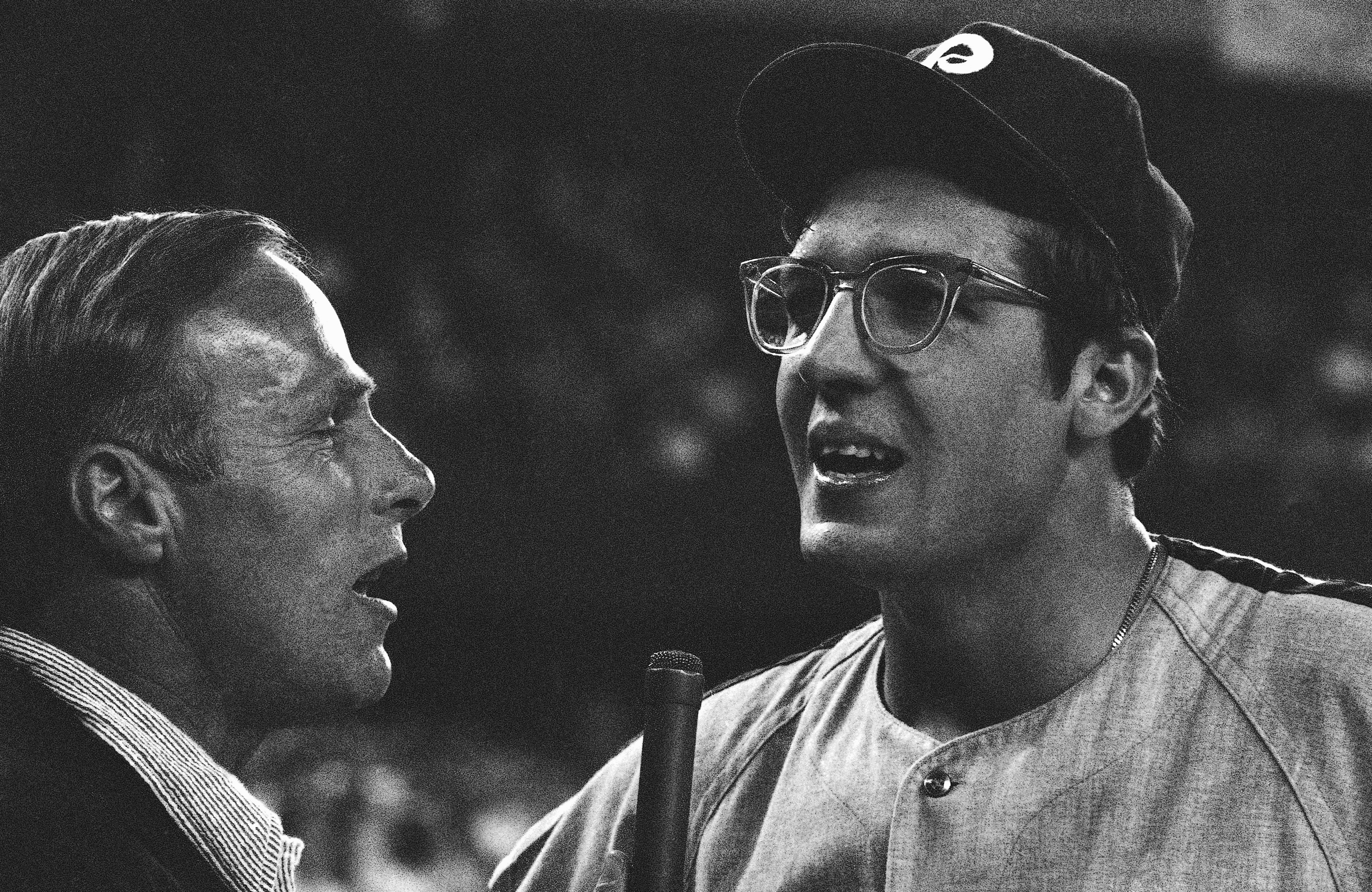
    The decision was looming in June 2021 for the National League to adopt the designated hitter when Rick Wise thought that meant his night — pairing a no-hitter in 1971 with the Phillies with two homers — would never be matched.

    “If they do the DH, no one is ever going to break the record,” Wise said. “Maybe it might work out with Ohtani.”

    And maybe Wise is right. But Shohei Ohtani didn’t break it yet. Ohtani hit three homers on Friday night and struck out 10 in six shutout innings as the Dodgers swept the Brewers with a 5-1 win in Game 4 of the NL Championship Series to reach the World Series.

    Ohtani may be the greatest player ever, and his latest epic feat already is being called the “greatest game in baseball history.” Perhaps it is.
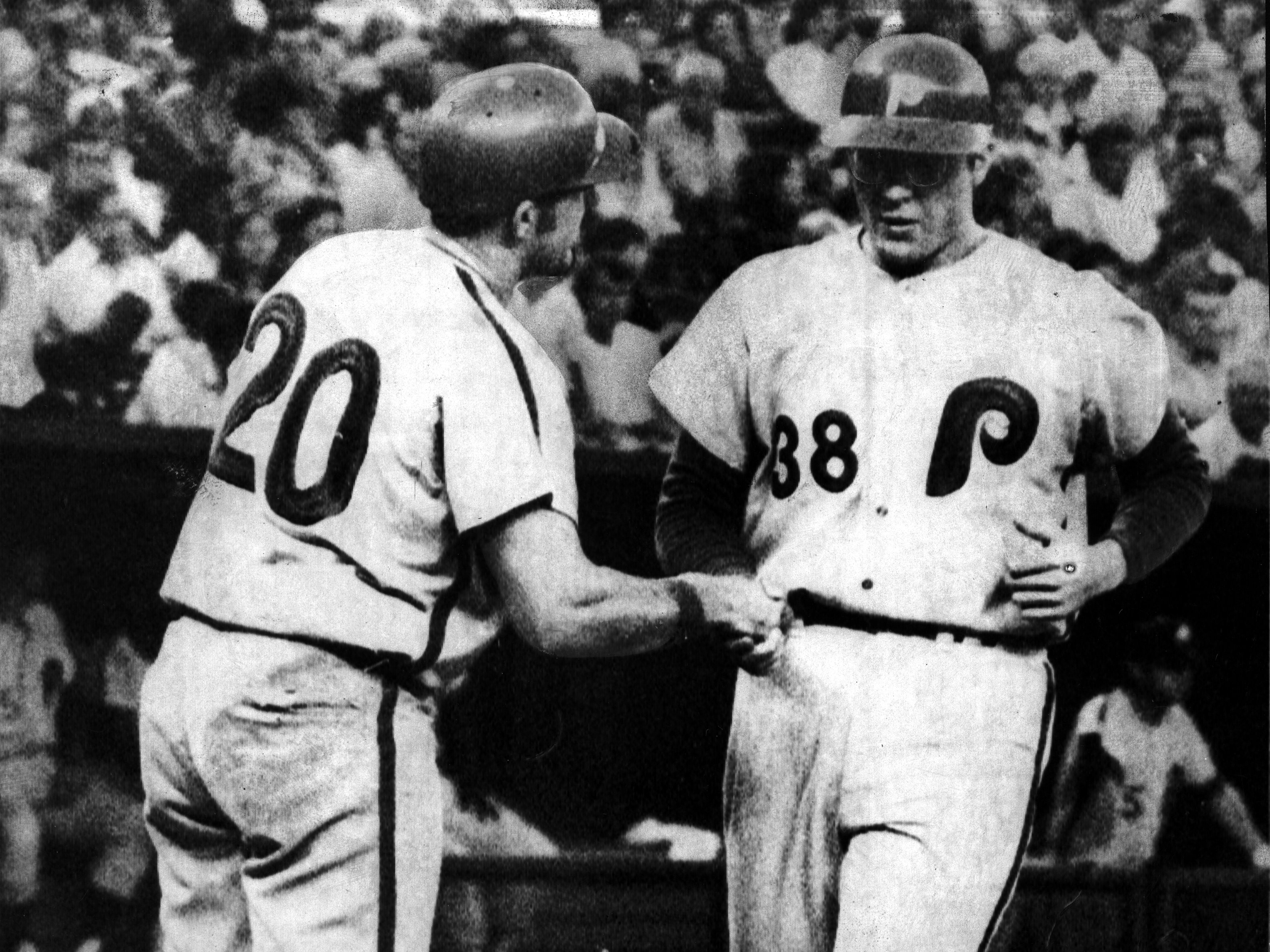
    But let’s not forget what Wise did in June of 1971 at Riverfront Stadium against a lineup of Hall of Famers days after having the flu.

    “I didn’t really know if I could pitch that day, but it was my turn to take the ball, so I knew I was going to pitch,” Wise recalled four years ago. “It was just a matter of how long I was going to last.

    “I felt very, very weak. It was in Cincinnati, and those cookie-cutter stadiums with AstroTurf, man, I’m telling you it was 130 degrees there, even though it was a night game. Warming up, it seemed like the ball was stopping halfway to the plate. I didn’t have any pop.”
    Rick Wise hit two homers and threw a no-hitter in June 1971 at Riverfront Stadium in Cincinnati.

    Wise reached the majors as an 18-year-old “bonus baby” in 1964, pitching in 25 games for those star-crossed Phillies. He pitched in a rotation with Jim Bunning and Chris Short and took batting practice every afternoon when the team was home.

    “We only got 20 minutes when the team was home,” Wise said. “On the road, the starting pitcher hit with the lineup. That was the extent of it.”

    Maybe that’s all Wise needed. He hit 11 homers from 1968 to 1971 with an OPS that was near league average. Wise was Ohtani-like every fifth day.

    “I was a good hitter when I was 8 or 9 years old starting in Little League,” said the 80-year-old Wise, who lives in Washington. “That’s what we did. We played sports. We weren’t in front of a TV. We were outside playing whatever that season was. Baseball, football, basketball. That’s what we were doing as kids growing up. In Little League, Babe Ruth, Legion ball, and high school, I always hit third, fourth, or fifth. Pick a number.”

    The Phillies pitchers played a game every afternoon — “50 cents a man,” Wise said — where each hit had to clear the infield dirt. The batting practice pitcher would be the umpire and decided if the ball was a hit or out. The money was pooled together every day.

    “At the end of the year, the pitchers went out for a party,” Wise said.

    And that’s how he prepared for his memorable night. Wise — who later was the winning pitcher when Carlton Fisk waved his home run fair at Fenway Park in 1975 — homered off Reds left-hander Ross Grimsley in the fifth and worked a 2-0 count in the eighth against Clay Carroll.

    “I stepped out of the box and looked down at George Myatt and he turned his back on me,” Wise said of the team’s third-base coach. “So that meant the green light was on for me. I got a cripple fastball. I mean it was right down the middle to a pitcher. And I was ready for it. I took my hacks when I was up there. If I saw something I liked, I was swinging.”

    Roger Free greets Rick Wise after his first homer in the fifth inning at Cincinnati in June 1971.

    Wise had his two homers and was six outs away from no-hitting a lineup that featured Pete Rose, Johnny Bench, Tony Pérez, George Foster, Lee May, and Dave Concepcion. He ended the 4-0 no-hitter by retiring Rose, who Wise called “the last guy you want to see to get the 27th out.” Third baseman John Vukovich grabbed Rose’s liner, and the Phils mobbed Wise at the mound before they celebrated in the clubhouse.

    “It’s not that easy against any team because all it takes is a chopper or a bunt or a blooper or whatever, and there goes the no-hitter,” Wise said. “But against that team under the conditions that I felt, it was tremendous. That lineup was tremendous.”

    Wise was traded after that season to St. Louis for Steve Carlton, one of the most significant trades in Philadelphia sports history. Wise wanted a bigger contract from the Phillies, and Carlton wanted more money from the Cardinals.

    “Back then, I didn’t have any agent or anything. I was making, at that time, after seven years in the big leagues, $25,000,” Wise said. “I’d be a multimillionaire these days, but then, a lot of pitchers from those days would be, too. You can’t miss what you never had.

    “John Quinn was giving it to the veteran players, but he was lowballing the younger players. He wouldn’t give in. He wouldn’t budge. The same thing happened with Carlton. He went to Philly and got what he wanted, and I went to St. Louis and got what I wanted. They doubled my salary, and that’s what I was looking for.

    “[The Phillies] had a record attendance that year, and we didn’t have a real good team, per se [67-95 in Veterans Stadium’s first season]. Just the type of year I had, to really become the ace of the staff, I thought I deserved more than he offered. I never got anything for throwing the no-hitter. They didn’t give me a bonus, or anything like that. But then, to be traded after all that.

    “I was down in spring training when I was traded, and the traveling secretary was the one who came to my door, knocked on my door, and told me I’d been traded. It wasn’t from John Quinn. It wasn’t from the president of the Phillies. It was the traveling secretary.”

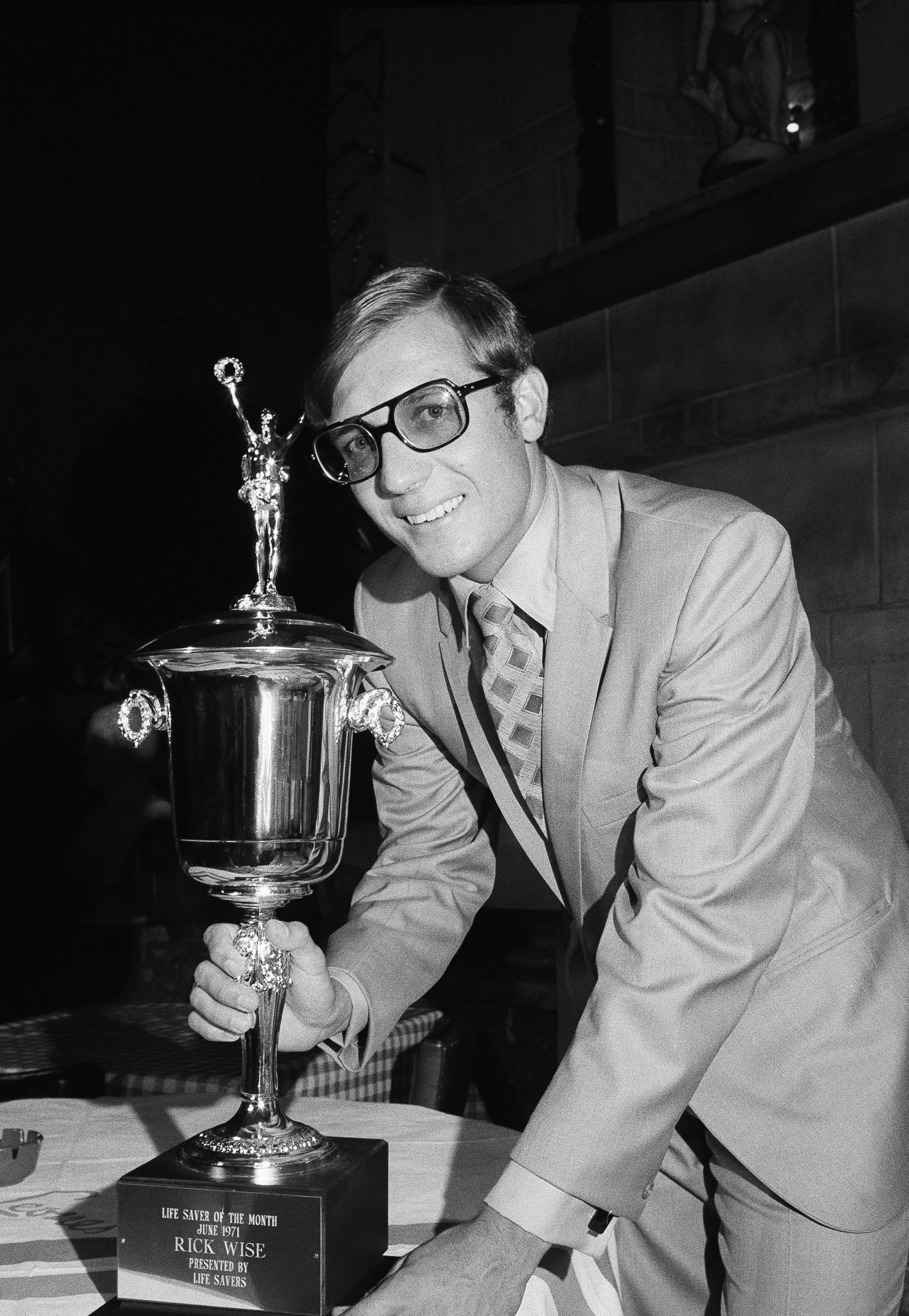
    Rick Wise holds the Life Saver of the Month Trophy awarded in July 26, 1971. He was honored for his performance against the Cincinnati Reds.

    Ohtani was named the MVP of the NLCS and likely will be named the National League’s MVP next month for a second straight year. He will pitch next week for the Dodgers in the World Series, something Wise did twice with Boston. And Ohtani will have a chance to write another October chapter.

    “That was probably the greatest postseason performance of all time,” Dodgers manager Dave Roberts said of Ohtani after Friday’s win. “There’s been a lot of postseason games. And there’s a reason why he’s the greatest player on the planet.”

    It often seems that there’s nothing Ohtani can’t do on a baseball field, from throwing triple-digit fastballs to hitting 500-foot homers. But there’s still something Wise did that Ohtani has yet to match.

    “What he’s doing right now is captivating the baseball world, and I imagine Japan follows every single game he plays,” Wise said in 2021. “He has such a unique capability.”