Restaurants are not around forever, so it is special when a signature dish takes on new life well after last call.
Take the Milan salad, essentially a deconstructed BLT with shrimp dressed in a distinctive Italian-Russian dressing, popularized by Jimmy’s Milan. Three decades after the Rittenhouse supper club’s closing, it lives on two blocks away at D’Angelo’s. (Cofounder Tony D’Angelo was Milan’s chef.) Order the D’Angelo’s salad, take a bite, and enjoy the time warp.
Restaurateur Jeffrey Chodorow, who will open the swank Mr. Edison at the Bellevue next year, told me that he plans to revive other Philly classics, including Georges Perrier’s galette de crabe, the Le Bec-Fin chef’s take on a Maryland crab cake.
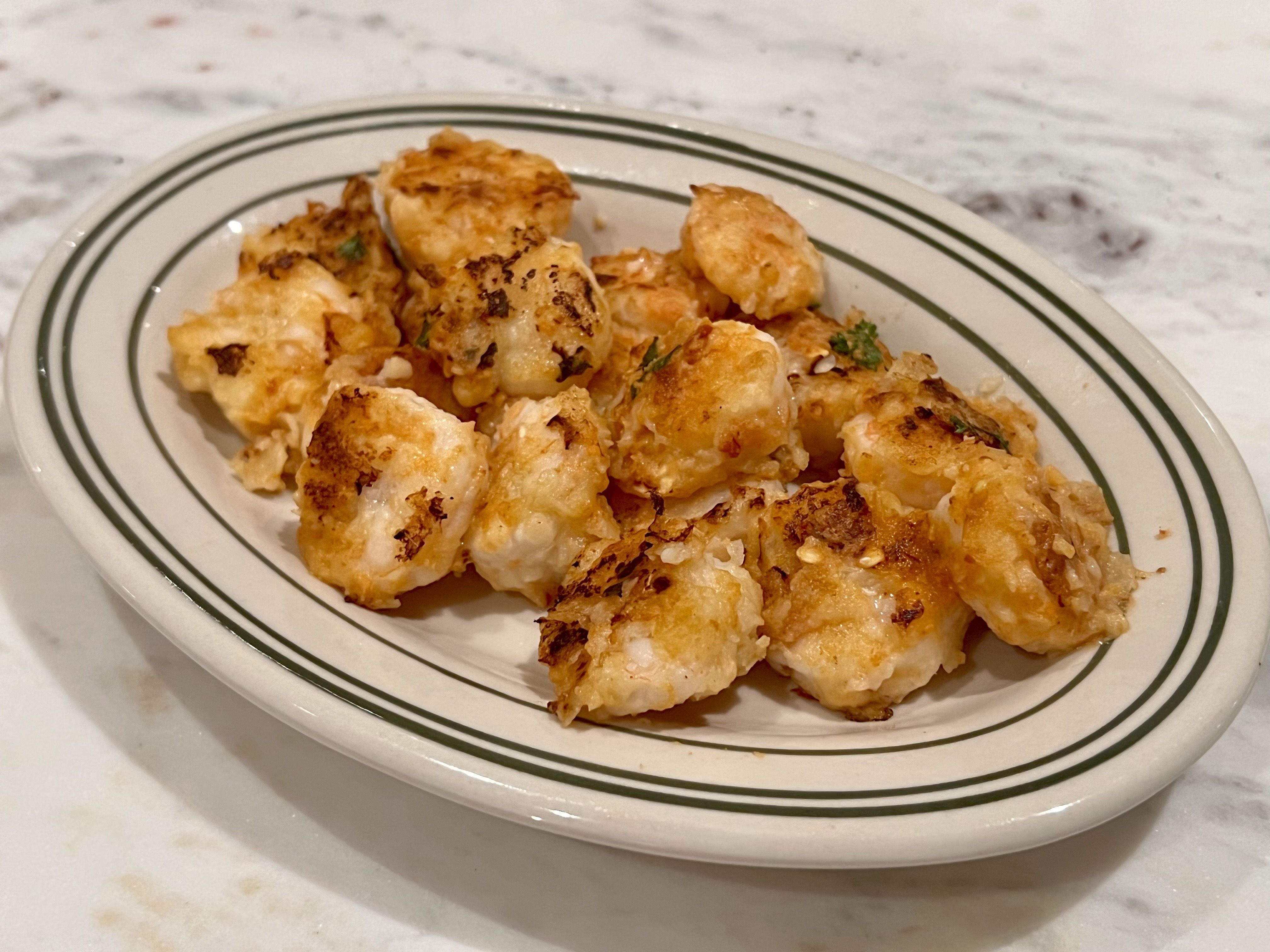
Now let’s consider shrimp pil pil, which restaurateur Dmitri Chimes introduced in the mid-1990s at Pamplona, his Washington Square West tapas bar, and later served at all of the locations of Dmitri’s, his no-frills Greek taverna. The appetizer delivered a one-two punch of chili and garlic with a burst of lemon to prep you for your entrée — perhaps the smoky chargrilled octopus or a rich bowl of cioppino.
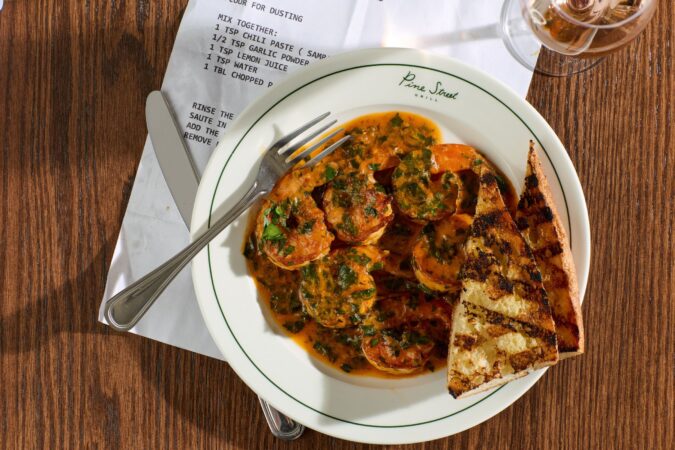
When chefs Amanda Shulman and Alex Kemp were planning their new Pine Street Grill at 23rd and Pine Streets — which housed a Dmitri’s from 1999 to 2014 — they asked their Fitler Square neighbors what they wanted in a restaurant. “They all kept referring back to Dmitri’s,” Shulman said.
Kemp said he called Chimes, who still lives in the neighborhood. “He hand delivered us the recipe,” he said. “We’re just super-excited to keep a part of his legacy going. I will say that ours is more of an homage since we know it could never be exactly the same. We started with Dmitri’s recipe as a base and then iterated it a bit, but inherently, it has [the] same ethos and qualities.”
Kemp and Shulman have done justice to this classic.
Pamplona/Dmitri’s recipe called for large shrimp. At Pine Street, they’re going big with six jumbo shrimp, topping them with an abundant sauce that is far creamier and more herbaceous than I remember. They’re also thoughtfully adding grilled bread to ensure plate-cleaning.
Now perhaps they’ll consider adding spanakopita or baklava to the menu …
Another former religious building is being redeveloped into apartments, with an assist from a law City Council passed in 2019 to preserve large, neighborhood-scale historic buildings like churches.
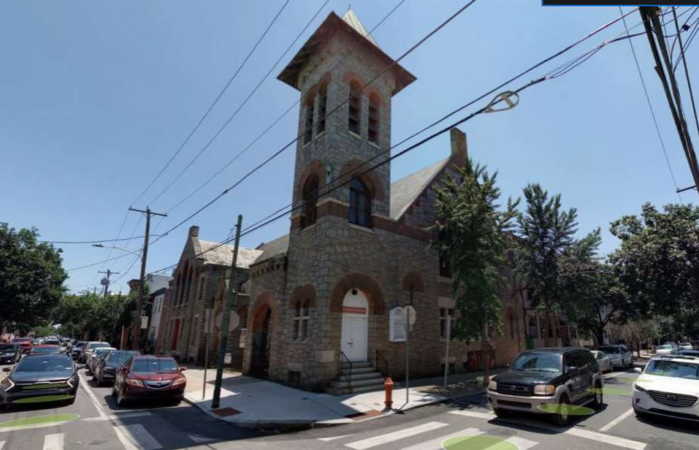
The former St. John’s Baptist Church at 13th and Tasker Streets is slated to house 26 rental units. The church dates to 1892 and is currently vacant.
The developer is Annex Investments II, owned by Drew Palmer, and the design of the remodel is by Philadelphia-based Toner Architects.
The church, which sits at the northeastern corner of the Miracle on 13th Street block, is zoned for single-family residential.
But the 2019 law passed by district Councilmember Mark Squilla makes it easier to convert “special use properties” — such as churches or theaters — to new uses no matter their underlying zoning, if the building is historically protected.
St. John’s Baptist Church was added to the local Register of Historic Places in 2020 after the advocacy group Preservation Alliance of Greater Philadelphia nominated it.
The bill was passed following the St. Laurentius debacle in Fishtown, where a handful of neighbors managed to delay a redevelopment project with lawsuits until the building was in poor enough shape that it had to be razed.
The 2019 law makes such legal warfare more difficult to wage.
These new zoning laws are “facilitating an increasing number of adaptive reuse projects of historically designated properties, preserving them while returning them to productive, taxpaying use and strengthening their surrounding neighborhoods,” said Paul Steinke, who leads the Preservation Alliance.
On Tuesday the project was given a preliminary review by the Architectural Committee, which advises the Historical Commission.
As part of the conversion, the developer wants to insert additional floors to the church building, which is beyond the Historical Commission’s jurisdiction. The plan also includes adding large dormers to the roof to allow more light into the future residences and replacing the dilapidated slate roof with asphalt.
The proposed new dormers can be seen in this rendering, lining the church’s roof.
The Architectural Committee objected to both of those exterior changes.
“The dormers are pretty significant on this, and we’re looking to find a way to make those more subtle,” said Nan Gutterman, who sits on the committee.
Sara Shonk Pochedly of Toner Architects noted the dormers are the same size as those added to other redeveloped churches reviewed by the Architectural Committee, but this building is smaller in size so the new additions look larger.
Because this was a preliminary review meeting, the committee did not indicate how it would vote to advise the larger commission.
“We always appreciate when a church is given another life,” said Justin Detwiler, who sits on the Architectural Committee. “Thank you and your applicant for doing that and being sensitive. These are not easy projects.”
Palmer did not attend the committee meeting and did not immediately respond to a request for comment. Ian Toner of Toner Architects declined an interview request at this early stage in the development process.
Capstan Therapeutics’ sale this year for $2.1 billion, the highest price paid for a private early-stage biotech company since 2022, was a triumph for its founders at the University of Pennsylvania.
Unfortunately for Philadelphia, the company is based in San Diego. Investors wanted an executive who lives there to be CEO.
Capstan was a miss for Philadelphia, said Jeffrey Marrazzo, who cofounded a high-profile regional biotech company, Spark Therapeutics, and is now an industry investor and consultant.
If Philadelphia had a bigger talent pool of biotech CEOs, “it would have and should have been here,” he said.
The Philadelphia region has lagged behind other biotech centers in landing companies and jobs, but industry experts are working to close the gap and better compete with Boston, the San Francisco Bay Area, and San Diego.
According to Marrazzo and others, the Philadelphia region’s relatively shallow pool of top biotech management is a key challenge.
Big investors go to managers who have proven ability to deliver big investment returns, said Fred Vogt, interim CEO of Iovance Biotherapeutics, a California company with a manufacturing facility in the Navy Yard.
“They want the company to perform. They’ll put it in Antarctica, if that was where the performance would come from,” he said.
The Lilly announcement last month also reflects Philadelphia’s national biotech stature. It’s the fourth U.S. city to get a Lilly Gateway Lab, behind Boston, the San Francisco Bay Area, and San Diego.
Those places have far outpaced Philadelphia in the creation of biotech research and development jobs, even as the sector’s growth has slowed.
From 2014 through last year, the Boston area added four biotech research and development jobs for every one job added here, according to an Inquirer analysis of federal employment data.
window.addEventListener(“message”,function(a){if(void 0!==a.data[“datawrapper-height”]){var e=document.querySelectorAll(“iframe”);for(var t in a.data[“datawrapper-height”])for(var r,i=0;r=e[i];i++)if(r.contentWindow===a.source){var d=a.data[“datawrapper-height”][t]+”px”;r.style.height=d}}});
Penn’s role in Philadelphia biotech
Philadelphia’s reputation as an innovation center — boosters like to call the region “Cellicon Valley” — starts with the University of Pennsylvania, which has long been a top recipient of National Institutes of Health grants to advance scientific discovery.
Research at Penn has contributed to the creation of 45 FDA-approved treatments since 2013, according to the university.
“Penn discoveries help spark new biotech companies, but we can’t build the whole ecosystem in this area alone,” said John Swartley, Penn’s chief innovation officer. “Great science is just one ingredient. We also need capital, experienced leadership, real estate and manufacturing infrastructure, and strong city and state support.”
Penn was one of two Philadelphia institutions receiving more than $100 million in NIH funding in the year that ended Sept. 30. The otherwas the Children’s Hospital of Philadelphia.
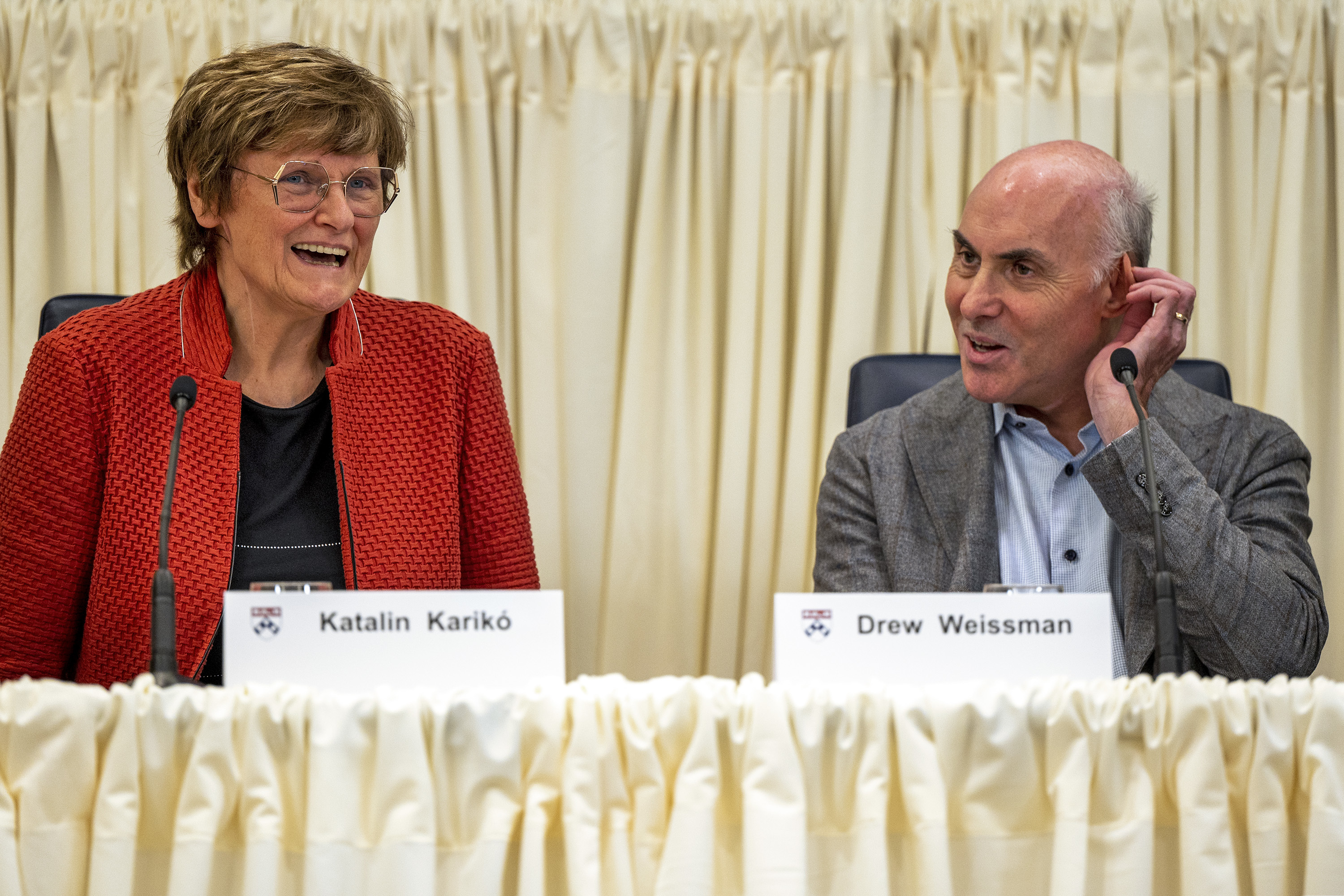
Katalin Karikó and Drew Weissman spoke at a University of Pennsylvania news conference after they were named winners of a 2023 Nobel Prize in medicine. Their work was instrumental to modifying mRNA for therapeutic uses, such as the rapid development of lifesaving vaccines during the COVID-19 pandemic.
By contrast, the Boston area was home to 10 institutions with at least $100 million in NIH grants, generating more spinoffs and jobs.
The Philadelphia region has a healthy number of biotech spinouts, but the biggest markets have more from a larger number of research institutions, said Robert Adelson, founder Osage University Partners, a venture capital firm in Bala Cynwyd.
That concentration of jobs and companies in the Boston area — where nearly 60,000 people worked in biotech R&D last year — makes it easier to attract people. By comparison, there were 13,800 such jobs in Philadelphia and Montgomery County, home to the bulk of the regional sector.
If a startup fails, which happens commonly in biotech, “there’ll be another startup or another company for me to go to” in a place like Boston, said Matt Cohen, a managing partner for life science at Osage.
Another challenge for Philadelphia: It specializes in cell and gene therapy, a relatively small segment of the biotech industry, whose allure to investors has faded in the last few years.
Such market forces shaped the trajectory of Spark, a 2013 Children’s Hospital of Philadelphia spinout that developed Luxterna, the first FDA-approved gene therapy, used to treat an inherited form of blindness. The promise of Spark’s gene therapy work for a form of hemophilia spurred its 2019 acquisition by Swiss pharmaceutical titan Roche for $4.8 billion.
The company still employs about 300 in the city, a spokesperson said, and work continues on its $575 million Gene Therapy Innovation Center at 30th and Chestnut Streets in University City.
The long arc of biotech
A handful of companies dominated the early days of U.S. biotech. Boston had Biogen and Genzyme, San Francisco had Genentech, San Diego had Hybritech, and Philadelphia had Centocor. All of them started between 1976 and 1981.
Centocor started in the University City Science Center because one of its founders, virologist Hilary Koprowski, was the longtime director of the Wistar Institute. Centocor’s first CEO, Hubert Schoemaker, moved here from the Boston area, where he had gotten his doctorate at the Massachusetts Institute of Technology.
Another drug still under development at the time of the sale, Stelara, went on to become J&J’s top-selling drug as recently as 2023 with $10.9 billion in revenue. Stelara, approved to treat several autoimmune disorders, remains a testament to Centocor’s legacy.
Despite its product success, Centocor didn’t have the same flywheel effect of creating new companies and a pipeline of CEOs as peer companies did in regions outside of Philadelphia.
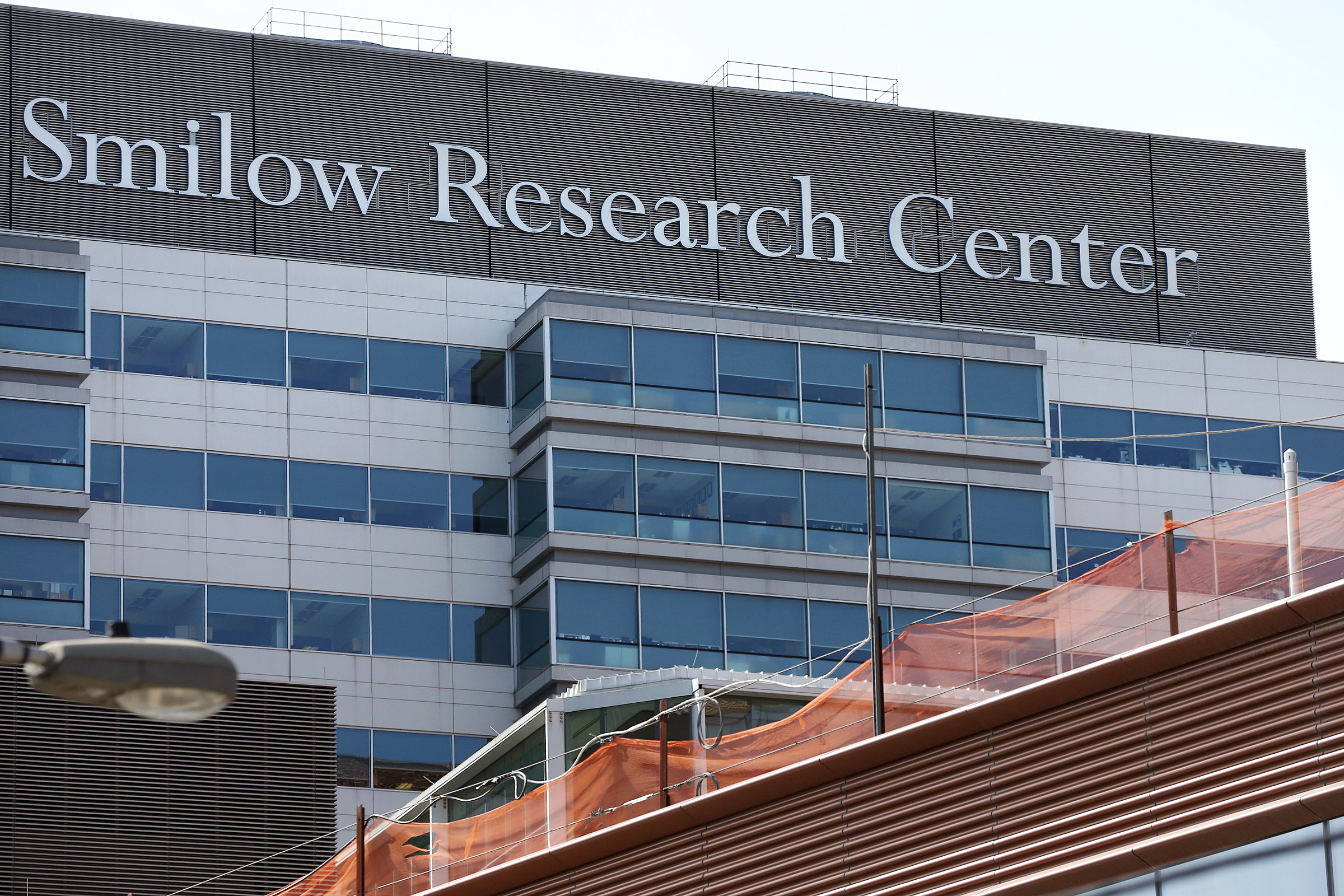
The University of Pennsylvania’s Smilow Center for Translational Research, shown in 2020, is one of the school’s major laboratory buildings.
“There are a lot of alums of Centocor that are really impressive, but they seem to have wound up elsewhere,” said Bill Holodnak, CEO and founder of Occam Global, a New York life science executive recruitment firm.
Among the Centocor executives who left the region was Harvey Berger, Centocor’s head of research and development from 1986 to 1991. He started a new company in Cambridge, Mass.
At the time, the Philadelphia area didn’t have the infrastructure, range of scientists, or management talent needed for biotech startups, he said.
Since then, he thinks the regional market has matured.
“Now, there’s nothing holding the Philadelphia ecosystem back. The universities, obviously Penn, and others have figured this out,” Berger said.
Conditions have changed
Penn’s strategy for helping faculty members commercialize their inventions has evolved significantly over the last 15 years.
It previously licensed the rights to develop its research to companies outside of the area, such as Jim Wilson’s gene therapy discoveries and biochemist Katalin Karikó and immunologist Drew Weissman’s mRNA patents. Now it takes a more active role in creating companies.
Among Penn’s latest spinouts is Dispatch Bio, which came out of stealth mode earlier this year after raising $216 million from investors led by Chicago-based Arch Venture Partners and San Francisco-based Parker Institute for Cancer Immunotherapy.
Dispatch, chaired by Marrazzo, is developing a cell therapy approach that uses a virus to attach what it calls a “flare” onto the cells it wants the immune system to attack.
Marrazzo said in July that he wasn’t going to be involved in Dispatch if it wasn’t based largely in Philadelphia. As of July, 75% of its 60 employees were working in Philadelphia. Still, Dispatch’s CEO is in the San Francisco Bay Area.
The Philadelphia region is increasingly well-positioned for the current biotech era, said Audrey Greenberg, who played a key role in launching King of Prussia’s Center for Breakthrough Medicines about five years ago. The center is a contract developer and manufacturer for cell and gene therapies.
“You no longer need to move to Kendall Square to get a company funded,” she said, referring to Cambridge’s biotech epicenter. “You need good data, a credible translational plan, experienced advisers, and access to patient capital, all of which can increasingly be built here.”
Greenberg now works as a venture partner for the Mayo Clinic, with the goal of commercializing research discoveries within the health system’s network of hospitals in Minnesota, Arizona, and Florida.
She plans to bring that biotech business to the Philadelphia region.
“I’m going to be starting my companies all here in Philadelphia, because that’s where I am. And I know everybody here, and everybody I’m going to hire in these startups that are going to be based here,” she said.
The Eagles are going to win their division. They need just one victory to clinch first place, and they’re likely to get that victory Saturday night against the Washington Commanders. And even if, by some minor miracle, they manage to lose to a 4-10 team that will be quarterbacked by Marcus Mariota, they can still just wait until the Dallas Cowboys lose again, which would bring its own kind of satisfaction.
One way or another, the Eagles will end up atop the NFC East, becoming the first team to repeat as the division’s champion since they won it four straight times from 2001 through 2004. That statistic makes the last quarter-century of NFC East history sound more competitive and equitable among the Eagles, Cowboys, New York Giants, and Washington than it has actually been. In 2001, the Eagles won their first division title and reached their first NFC championship game with Andy Reid as their head coach and Donovan McNabb as their starting quarterback. That season was, really, the start of the general dominance that has followed. Here’s the breakdown of these 25 years, assuming the Eagles finish first again this season:
Eagles
Overall record: 240-160-2
Winning seasons: 18
Playoff berths: 16
Division titles: 12
Conference championship games: 8
Super Bowl appearances: 4
Super Bowl victories: 2
Nick Sirianni (right) has carried on the Eagles’ winning tradition that started with Andy Reid.
Whatever crises the Eagles might be undergoing are framed through a different lens from any other team in the division. They judge themselves and are judged by the answer to one question: Are we good enough to win the Super Bowl? Their divisional foes’ standard has not been quite as high: Are we good enough to keep from embarrassing ourselves again?
Quarterback Jayden Daniels and the Commanders took a big step backward in an injury-plagued season.
Less than a year ago, for instance, the Commanders’ appearance in the NFC championship game was supposed to augur a new rivalry between them and the Eagles at least and a new era for the division at best. That’s why the teams’ two games this season were scheduled in the season’s final three weeks. Huge head-to-head matchups to decide the division, right? Instead, the Eagles trounced the Commanders by 32 points to reach Super Bowl LIX. Jayden Daniels, Washington’s wonderful young quarterback, has played just seven games this season because of injuries, and even if Daniels had remained healthy, the Commanders might be floundering anyway; their front office built the oldest roster in the NFL around him.
So what happened? How did the Eagles manage to create so much distance between themselves and the NFC East field? As with all big questions, there’s not just one big answer, but here are a few explanations:
Jeffrey Lurie, Joe Banner, and Howie Roseman have been forward-thinkers.
From strategic massaging of the salary cap to aggressive play-calling on fourth down, Lurie has empowered his executives (and, in that middle-management position, his head coaches) to be creative, to posit how the NFL would evolve and how the Eagles might get ahead of those changes.
Jerry Jones can’t put his ego aside for the sake of a Super Bowl.
Jones has been a true visionary when it comes to the NFL’s growth into the pop-cultural monster it is today. He recognized America’s insatiable appetite for pro football and has built one trough after another to feed us, and he does want to win championships. But he’s not willing to sacrifice the publicity and the credit, to stand aside and let someone smarter handle the Cowboys’ football-related decision-making. It is not enough that the Cowboys win. Jones must be perceived as the reason they have won, and it’s that very thinking that keeps them from matching the Eagles’ success.
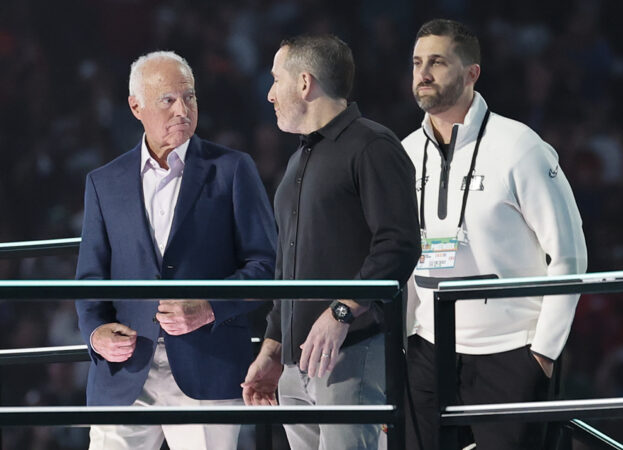
Jerry Jones (right) and the Cowboys have not been able to keep up with Jeffrey Lurie’s Eagles.
Daniel Snyder.
That’s it. The man pretty much single-handedly destroyed one of the best and most popular franchises in the league. As just one example, Washington’s coaching staff in 2013, under head coach Mike Shanahan, included Sean McVay, Kyle Shanahan, Matt LaFleur, Mike McDaniel, and Raheem Morris — and Snyder let all of them get away. (Or run away, as the case may be.)
Eli Manning retired.
Sounds crazy, right? It’s not. When Manning was in his prime, the Giants went through an eight-year stretch in which they qualified for the postseason five times, won two Super Bowls, and never finished under .500. The Giants haven’t been able to replace him, and that has been a bigger failure even than allowing Saquon Barkley to sign with the Eagles.
Jeff Stoutland has given the Eagles an edge in the trenches.
Yes, the Eagles have long maintained that games are won and lost along the offensive and defensive lines. Any franchise’s coaching staff can chant that mantra, though. Few, if any, can develop linemen like the Eagles, and Stoutland’s presence and expertise are invaluable in that regard. Ask yourself if Jordan Mailata would have become an elite left tackle anywhere else.
The Eagles value depth at quarterback.
They won one Super Bowl with their backup quarterback (Nick Foles), won another with a player who had been drafted to be their backup quarterback (Jalen Hurts), made a season-saving run to the NFC divisional round in 2006-07 with their backup quarterback (Jeff Garcia), and have generally hired head coaches who know how to implement and oversee quarterback-friendly systems.
DETROIT — Sixteen states and the District of Columbia are suing President Donald Trump’s administration for what they say is the unlawful withholding of more than $2 billion dollars in funding for two electric vehicle charging programs, according to a federal lawsuit announced Tuesday.
The lawsuit filed Tuesday in the U.S. District Court for the Western District of Washington is the latest legal battle that several states are pursuing over funding for EV charging infrastructure that they say was obligated to them by Congress under former President Joe Biden, but that the Department of Transportation and Federal Highway Administration are “impounding.”
“The Trump Administration’s illegal attempt to stop funding for electric vehicle infrastructure must come to an end,” California Attorney General Rob Bonta said in a release. “This is just another reckless attempt that will stall the fight against air pollution and climate change, slow innovation, thwart green job creation, and leave communities without access to clean, affordable transportation.”
The Department of Transportation did not immediately respond to request for comment.
The Trump administration in February ordered states to halt spending money for EV charging that was allocated in the bipartisan infrastructure law passed under the previous administration.
Several states filed a lawsuit in May against the administration for withholding the funding from the $5 billion National Electric Vehicle Infrastructure program for a nationwide charging buildout. A federal judge later ordered the administration to release much of the funding for chargers in more than a dozen states.
Tuesday’s separate lawsuit addresses the withholding of funding obligations for two other programs: $1.8 billion for the Charging and Fueling Infrastructure Grant program, as well as about $350 million in Electric Vehicle Charger Reliability and Accessibility Accelerator money.
Tuesday’s lawsuit is led by attorneys general from California and Colorado, joined by the attorneys general of Arizona, Delaware, Illinois, Maryland, Massachusetts, Michigan, New Jersey, New York, Oregon, Rhode Island, Vermont, Washington, Wisconsin, the District of Columbia, and the governor of Pennsylvania, Josh Shapiro.
The Trump administration has been hostile to EVs and has dismantled several policies friendly to cleaner cars and trucks that were put in place under Biden, in favor of policies that instead align with Trump’s oil and gas industry agenda.
Once in office a second time, President Trump immediately ordered an end to what he has called Biden’s “EV mandate.” While Biden targeted for half of new vehicle sales in the U.S. to be electric by 2030, policies did not force American consumers to buy or automakers to sell electric vehicles.
Biden did set stringent tailpipe emissions and fuel economy rules in an effort to encourage more widespread EV uptake, as the auto industry would have had to meet both sets of requirements with a greater number of EVs in their sales mix.
Under the Biden administration, consumers could also receive up to $7,500 in tax incentives off the price of an EV purchase.
The Trump administration has proposed rolling back both tailpipe rules and the gas mileage standards, cut the fines to automakers for not meeting those standards, and eliminated the EV credits.
The lawsuit comes amid those regulatory changes and as the pace of EV sales have slowed in the U.S. as mainstream buyers remain concerned about both charging availability and the price of the vehicles.
New EVs transacted for an average of $58,638 last month, compared with $49,814 for a new vehicle overall, according to auto buying resource Kelley Blue Book.
Automakers, meanwhile, have responded to consumers accordingly.
Earlier this week, Ford Motor Co. announced it was pivoting away from its once-ambitious, multibillion-dollar electrification strategy in lieu of more hybrid-electric and more fuel-efficient gasoline-powered vehicles.
Taking a direct route, Santa has to travel 3,400 miles from the North Pole to Philadelphia. In comparison, your Christmas tree will have barely moved. That’s because there’s a high likelihood that your tree is one of the approximately 720,000 grown in the state of Pennsylvania.
Christmas tree lore runs deep around these parts. Don’t take our word for it, Taylor Swift grew up on an 11-acre Christmas tree farm in Reading – she even wrote a song about it.
That’s because Pennsylvania and New Jersey played a significant role in shaping the Christmas tree industry. Pennsylvania is still home to 1,301 Christmas tree farms, the second most in the nation, according to the U.S. Department of Agriculture.
Christmas trees harvested by county annually in Pennsylvania and New Jersey
0
0 – 5k
5k – 20k
20k – 50k
50k – 110k
Indiana, Pa. was once known as the "Christmas Tree Capital of the World."
Columbia, Pa. was where the technique of shearing Christmas trees was invented.
Mercer, N.J. was where the first commercial Christmas trees were grown.
Philly
Pittsburgh
Data: U.S. Department of Agriculture
America’s very first Christmas tree farm was established just outside of Trenton, according to Henry H. Albers and Ann Kirk Davis, authors of the Wonderful World of Christmas Trees. In 1901, a farmer named William McGalliard planted 25,000 Norway spruce trees on his farm in Mercer County, and would later sell his trees seven years later for $1 each.
Before McGalliard’s innovation, most yule trees were wild evergreen conifers (think green cones) cut from forests or abandoned farm land.
A 2000 Inquirer article on Philly and Pennsylvania’s role in establishing the Christmas tree tradition. The Christmas tree in the early illustration is indicative of how wild Christmas trees were far less dense and conical before tree shaping was invented.newspaper.com
Although the origins of decorating Christmas trees indoors are uncertain — often attributed by historians to early German immigrants — archival Inquirer articles have claimed that Philadelphians were among the first Americans to promote the tradition.
Although the growing industry began in Jersey, Pennsylvania farmers were instrumental in improving Christmas tree cultivation through the invention of techniques that are still practiced to this day.
story continues after advertisement
Fred Musser of Indiana County, Pa., started growing seedlings that he sold to other Christmas tree farmers in order to improve the quality of the trees, becoming the nation’s first ever Christmas tree nursery in the late 1920s. Andrew Abraczinskas, who first planted trees in Columbia County in 1915, invented the widely adopted process of shearing the sides of trees such that the resulting trees would keep a dense, conical “Christmas tree” shape.
McGalliard, Musser, and Abraczinskas’s work effectively ended the practice of harvesting wild trees and heavily influenced how trees are grown today:
Many growers buy young plants from tree nurseries where they were raised from seeds that have been genetically curated for the best chance of survival, either in seedbeds or as individual plugs.
Planting happens as soon as the ground thaws in the spring, typically in March. Trees establish themselves better if planted by mid-April, when temperatures rise and new growth begins to emerge.
After about the third growing year, growers wait until August for the new growth to harden before trimming the tree. Every year, the tree must be trimmed again, the base around the trunk pruned, and sprayed with pesticides.
Growers trim the sides to form the classic conical Christmas tree shape. This directs the tree’s energy upward and encourages denser needle foliage.
Trees reach their ideal marketable height of six or seven feet after about seven years, depending on the species. In the holiday harvest season, retail customers can select and cut their own tree, which is then netted by a mechanical baler for easy transport home to be adorned and adored.
While most of the growing process is the same, there are in fact a few different species of trees used for Christmas trees: notably: Firs, Pines, and Spruces. Each region will be better at growing specific subspecies within those three.
“Christmas tree species that you'll find growing in any production region reflect the climate and what grows well there. For instance, in the Pacific Northwest, they grow a lot of Noble Fir and Douglas fir,” said Rick Bates, Associate Professor or Horticulture at Penn State, who also advises growers on Christmas tree management.
“Here in Pennsylvania, we grow a lot of Fraser fir and Douglas fir and a handful of other species.”
Fir trees make up 60–70% of Christmas trees from Pennsylvania. They have flat, soft, long-lasting needles and some, like Douglas firs, have a citrus scent. Fraser firs are currently the most popular yule tree in the country, with European varieties like Turkish, Nordmann, and Korean firs introduced in the past 20 years.
Pine trees with slender, bundled needles and a sharp, earthy scent. They have a long history in Pennsylvania Christmas tree cultivation. Scotch pines, promoted by early innovator Musser, along with Eastern white and red pines, were once the state’s most popular Christmas tree.
Spruce trees, including the bluish-green Colorado spruce, have square, stiff needles that hold ornaments well but can be prickly and shed quickly. Norway spruces were the first commercially grown Christmas trees near Trenton.
Managing a Christmas tree farm can be fun, says Gerrit Strathmeyer II, a tree farmer in York County and president of the Pennsylvania Christmas Tree Growers Association, but the work is also a years-long endeavor that is logistically and physically demanding.
“Think of farming Christmas trees like farming corn or soybeans. They’re on what’s called a one year rotation — we’re on a 10 year rotation.”
The work is tough and labor-intensive. Planting begins in the still-chilly early spring, while growers wait until the hottest late summer months to start manually shearing, as Strathmeyer recounts: “I remember my high school days growing up, my summer jobs were just working in the field for eight, nine, ten hours a day.”
Subscribe to The Philadelphia Inquirer
Our reporting is directly supported by reader subscriptions. If you want more journalism like this story, please subscribe today
Come the winter months, while everyone else enjoys the festive season, this is the busiest time for growers, who take inventory and harvest trees.
Russell Wagner, a former board member of the Pennsylvania Christmas Tree Growers Association, whose farm is located 45 miles north of Harrisburg, has been monitoring the snow forecast in preparation for a busy work week.
“If we get a lot of snow, it can really hamper things, though light snow just makes it more Christmassy.”
story continues after advertisement
Strathmeyer said that his dad and uncles were at their Christmas tree peak in the late ‘90s and early 2000s. “They had 2,500 acres of Chrstmas trees and were selling around 120,000 cut Christmas trees.
Today, Strathmeyer sells around 22,000 trees a year, and the industry is no longer at its pinnacle. In the most recent USDA Census of Agriculture (2022), Pennsylvania had only 60% as many Christmas tree farms as it did 20 years ago.
Wagner attributes this to the fact that “the initial cost to get into the business is prohibitive. Unless you’re already a Christmas tree grower and another generation is going to continue it, it’s very difficult to get started.”
The industry was also disrupted by the advent of the artificial tree in the last 30 to 40 years, which are becoming increasingly more realistic — some even simulate the smell of a yule tree.
A 1972 Inquirer article about the artificial Christmas trees and Indiana County, once known as the "Christmas Tree capital of the world" at the time.newspaper.com
Strathmeyer, who is 38, said that “the popularity of the real Christmas tree has kind of plateaued off. It's a generalization, but our generation I think, people don't want to deal with the mess of a tree, and so that deters them from getting a real tree.”
However, Strathmeyer is optimistic. He is currently transitioning one of his wholesale farms to a choose-and-cut farm – where customers visit the farm, select a tree to cut, and take it home. He credits the recent popularity of these on-site experiences to social media. “People want that experience,” said Strathmeyer, “they want to take pictures out on the farm.
“Maybe they'll put up with the mess of a real tree because their kids want to go out to the farm and ride the wagon and run through the field.”
Support That Keeps Our Journalism Evergreen
Rooted in the field and committed to the facts, our newsroom brings you in-depth reporting. Support quality journalism by making a donation today.
Bates said Pennsylvania has a thriving choose-and-cut scene and that “a lot of those retail choose-and-cut farms also have other activities, like they may have a corn maze or some kind of agritainment.”
Combined with Pennsylvania’s proximity to major cities along the eastern seaboard, this growing popularity of experience-forward farms suggests the industry will remain viable for the foreseeable future.
It might be too late for you to grow up on a Christmas tree farm like Taylor Swift, but it’s not too late to ride a wagon and run through local Christmas tree fields. Whether you’re going to cut your own, or pick one up from a parking lot, we’ve got you covered with guides on where to go and how to get one delivered.
Methodology
Christmas tree data comes from the U.S. Department of Agriculture (USDA) Census of Agriculture data, which was most recently conducted in 2022, and accessed via the USDA’s National Agricultural Statistical Service. The data accessed cover farms that produce Christmas trees, including the number of farms, trees harvested, and acres planted.
Staff Contributors
Design, Development, and Data: Jasen Lo, Sam Morris
Driving up Wovern Place in Ocean City feels like entering a Hallmark movie set.
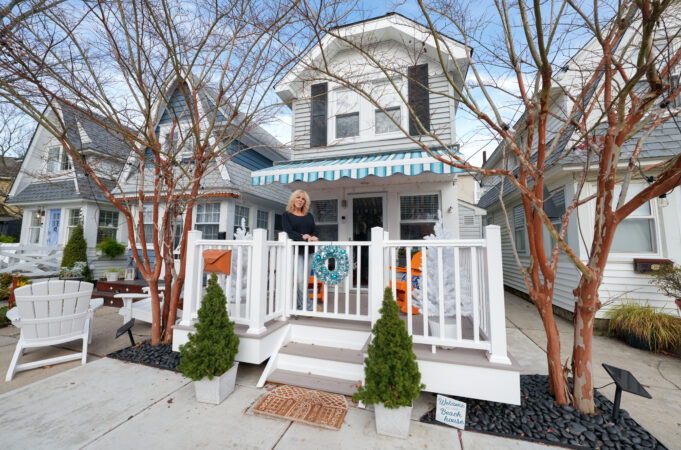
It’s where nine homes — 800 square feet or smaller — stand shoulder to shoulder on a winding road known as Dollhouse Row, all decked out in holiday cheer. Ginny Chappell’s house, decorated in blue and white, combines holiday tradition with a classy beach vibe.
“Christmas has always been my favorite time of year,” said Chappell.
Since randomly discovering Dollhouse Row as a twentysomething visiting the Shore, Chappell dreamed of owning a home on this historic street, where the houses were built in 1927.
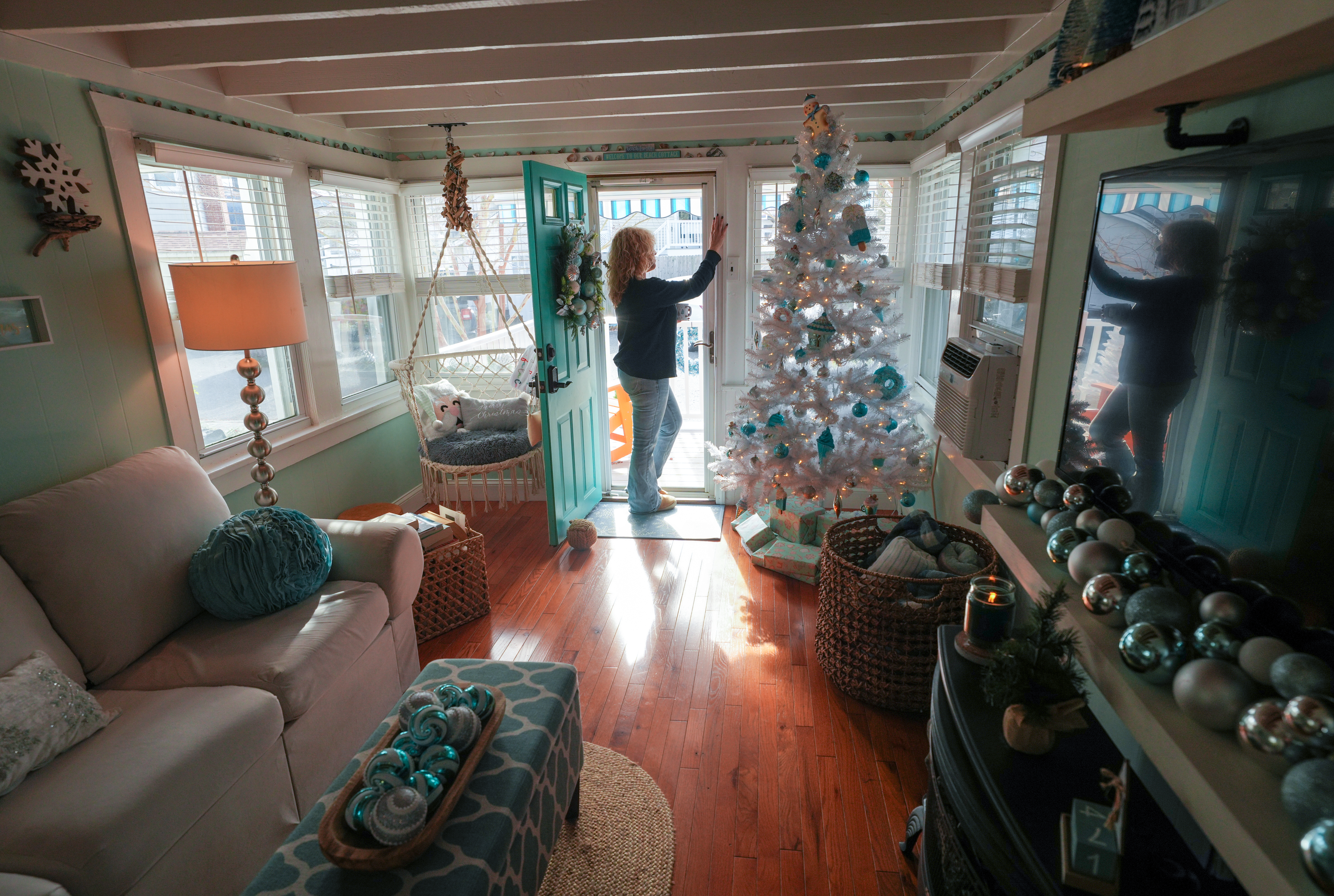
Ginny Chappell looks out the front door from the living room of her Ocean City house.
“I was obsessed with the street and followed it ever since,” recalled Chappell, a retired nurse with two part-time jobs in Ocean City. She’s a salesperson at Artisan Body Products and a part-time assistant innkeeper at the historic Coastal Chateau.
In 2015, when she was living in Franklinville and looking to buy a vacation home, there weren’t any houses for sale on Dollhouse Row.
“My Realtor told me to dream on, that they stay in families and almost never sell,” said Chappell, who instead bought an even tinier home — 400 square feet — in the south end of Ocean City.
Five years later, looking for more space, she set out to buy a larger house, but just days before closing, the deal fell through. Chappell was devastated.
A white and blue Christmas tree, festive ornaments and a toasty fireplace bring holiday cheer to the home.Chappell sits on the steps just off the galley kitchen.
But her luck changed two months later when she got the call she had long dreamed of: an 800-square-foot Dollhouse Row house was about to go on the market.
“I’m someone who very much believes in manifestation,” Chappell said.
She now shares the house, named Grayce by previous owners, with her two long haired mini-Dachshunds, Liliana, 17, and Romeo, 6 months. She has a comfortable primary bedroom and a spare bedroom for visitors, which often include her daughter Kayla, 22.
The first floor is open space with a cozy family room, kitchen, and dining area. Upstairs, a full bathroom sits between the two bedrooms, with a stacked washer and dryer hidden behind a curtain. The primary bedroom includes a small electric fireplace that doubles as a heater.
Chappell’s holiday decor, with blue details throughout, doesn’t compete with the beachy theme of her primary bedroom.In a comfortable chair in the primary bedroom, Chappell is surrounded by blue, teal, and silver Christmas and winter accessories.
Despite the small space, Chappell’s home is not cluttered. She has thoughtfully arranged each piece of furniture, artwork, and knickknack, with storage invisibly tucked away. She also rents a storage unit for offseason clothing and other items.
Each year, she envisions her holiday theme, then sets out to perfect it.
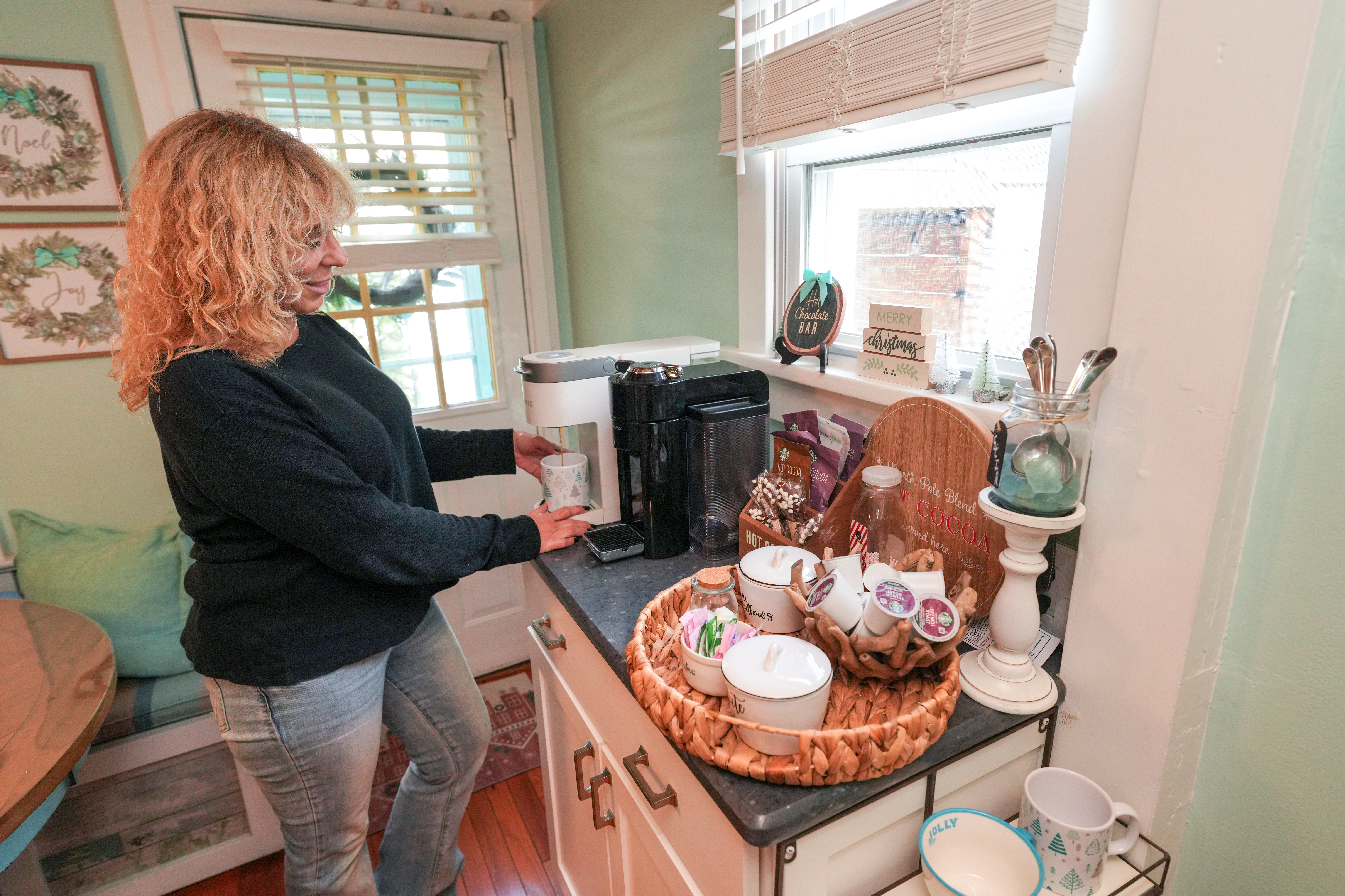
For her coffee and hot chocolate station, complete with marshmallows and candy cane sprinkles, she wanted Christmas-themed mugs in blue and white and searched until she found them.
“I spent four days finding these mugs,” she recalled, hitting three Home Goods stores, Hobby Lobby, and Dollar General on her search.
Ginny Chappell makes a warm beverage at her coffee and hot chocolate bar, complete with festive mugs.
It isn’t about what something costs but how it makes her feel, she said. Her pre-lit frosted white tree, adorned with blue and silver ornaments and a Gingerbread Man tree topper, came from Walmart. She also supports local crafters and businesses whenever possible.
For home design details she keeps year-round, she loves to scour the beach for beautiful broken seashells, where the iridescent pinks and beiges can be seen through the cracks in the shells. Shells line each window frame throughout the house.
“If they weren’t broken you would never be able to see just how beautiful they are inside,” she said. “The message is broken is beautiful.”
She also has dozens of small one-of-a-kind driftwood shelves hanging on her walls, and at this time of year each holds a small snowflake, tree, or other decoration. Her mantle is filled with artistic Christmas trees in shades of blue, white, silver, and gray. Vintage Christmas decor, including tin post cards, can be found throughout the cottage.
Given its small size, Chappell’s home can’t host large parties, but it can be shared with friends, neighbors, and even strangers. Her home has been featured in Ocean City’s Holiday House Tour for the last three years, drawing as many as 500 visitors each year.
Ginny Chappell sits on the porch of her 800-square-foot home that is decorated for Christmas.
A house close to 100 years old does come with challenges.
“I’m always fixing things,” Chappell said. “But, people are drawn to its charm and history.”
A small group of friends share the holidays with charcuterie boards, wine, and lots of laughs. Her front porch is the perfect perch for watching visitors stroll down the street, enamored with the tiny houses.
“I believe this street is very special because of its history,” Chappell said. “The people on this street call ourselves the cottage keepers. We want people to restore rather than tear down.”
Is your house a Haven? Nominate your home by email (and send some digital photographs) at properties@inquirer.com.
’Twas a few days before Christmas, and all through Cherry Hill, children were running outside with no jackets to chase Santa, and sometimes with no shoes.
Strapped to the top of a Cherry Hill fire truck, Santa Claus made his rounds through the South Jersey community on Sunday, waving as he passed through condominiums decorated for Christmas and snow-dusted cul-de-sacs. Santa’s firefighter escorts handed out candy canes and holiday greetings as Christmas cheer warmed the frigid township.
“There’s nothing better than when you pull around the block with Santa on the roof,” said Jim Aleski, a Cherry Hill Fire Department lieutenant.
Each December, Santa makes a special trip to Cherry Hill, meticulously visiting every street in the township over the course of the department’s multiday Santa Tour. A fresh coat of rare December snow made for a particularly picturesque scene over the weekend, when kids, parents, and dogs chased down the fire truck to get a coveted glimpse of St. Nick.
Mark Yakovich, 3, and his dad, Ed Yakovich, 44, flagged down the fire truck from their driveway as if they were hailing a cab. Mark, the toddler, is very into trains at the moment. Luckily, fire trucks remain pretty high on his list (specifically when they’re associated with Marshall, the Dalmatian puppy fire marshal in PAW Patrol). Holding two candy canes and a toy train, Mark eyed the fire truck with glee, and a healthy skepticism, from the comfort of his dad’s arms.
Though Ed Yakovich said they are still “figuring out the family traditions with the new little guy,” seeing Santa was at the top of their December to-do list.
At the Burrough’s Mill subdivision, Andrew Lee said he and his family wait for Santa every year. A bit of Christmas light amid so much darkness in the world was a welcome respite this time around, he said.
“Santa brings the spirit,” Lee said.
What is Lee’s son, Makai, 10, asking for this Christmas? An Xbox, Roblox, and more Roblox.
Ed Yakovich takes a photo of his wife Kendra McGarvey with their son Mark Yakovich, 3, as Santa, leaves after stopping at their home.
As the firefighting crew and its guest of honor wound through the township, delighted residents waved and cheered, stopped for selfies, and honked in appreciation. One resident ran out to gift a box of brownies to the firefighters.
Aleski said no one can quite pinpoint when the Santa Tour began, but residents say they remember the tradition happening as far back as the 1960s.
Archives show Santa visiting South Jersey via fire truck as early as 1931, when he distributed gifts to the children of Barrington on Christmas Day.
Sandy Chase, 54, said she remembers a Santa Tour from her childhood in northern New Jersey.
“This is a big Jersey thing,” she said.
Nicole Gaunt, 31, has lived in Cherry Hill her whole life. She and her daughter Khaos, 8, were out playing in the snow when Santa rounded the corner.
Gaunt said the duo were prepared to see the big guy.
“We’ve chased him down before,” she added.
Three-year-old Michele Peruffo pauses as firefighter Sam Harrison (left) walks behind a fire truck with Santa through the neighborhood.
Aleski said nothing drives community engagement like the Santa Tour. Each year, his department gets dozens of calls, emails, and social media inquiries about when Santa will pass by each house.
Though the department is meticulous in hitting every block, it’s a fire department first, and emergency operations supersede Santa. Santa has shown up at more than a few unexpected emergencies during tours past.
The Santa Tour in Cherry Hill will continue over the next few days. To see when Santa is visiting each neighborhood, explore this interactive map.
Firefighter Lt. Jim Aleski gives candy canes to a driver “stuck” behind the Santa fire truck.
This suburban content is produced with support from the Leslie Miller and Richard Worley Foundation and The Lenfest Institute for Journalism. Editorial content is created independently of the project donors. Gifts to support The Inquirer’s high-impact journalism can be made at inquirer.com/donate. A list of Lenfest Institute donors can be found at lenfestinstitute.org/supporters.
Maya Nazareth was 17, living in Malaysia, when she started training in Brazilian jiujitsu and discovered the discomfort and limitations of women’s fightwear.
She kept adjusting her sports bra, fixing her rash guard and pants while trying to focus on the martial art that demands immense discipline and control. Nazareth, who struggled with body image issues, said the feeling of discomfort and frustration affected how she moved in the gym and in the world.
Back in the U.S, as a “naive” college student with $2,000 to her name, she dreamed of building Alchemize Fightwear, an apparel brand to empower women fighters across the world.
She founded the brand in 2020. Five years later, she won $300,000 on ABC’s Shark Tank, backed by Reddit founder Alexis Ohanian, Lori Greiner, and Kendra Scott in exchange for a 15% stake.
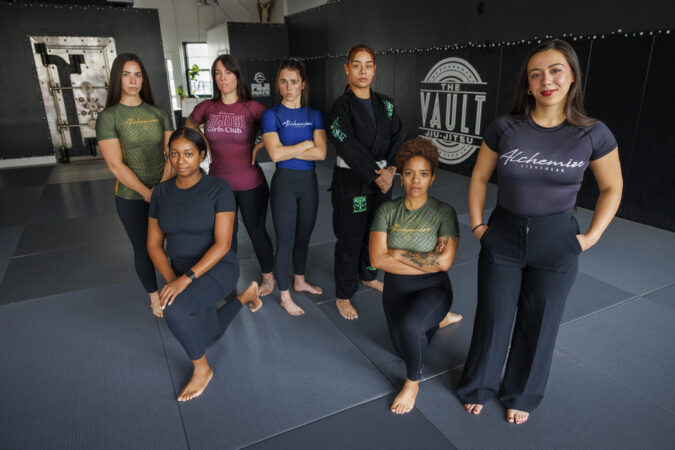
Maya Nazareth at the Vault Jiu Jitsu, Morton, PA., is the founder and CEO of Alchemize Fightwear, Friday, December 5, 2025.
“I was having my chest exposed, my stomach exposed, and my pants fell during training,” she said. “That’s a huge barrier for women to train in these sports, especially in front of 50-plus men in a training room. I just thought I could create something better.”
Nazareth, who grew up in Malaysia and all over New Jersey, realized that she shared her reality with many women in male-dominated gyms and martial arts academies, who are often led to quit before they experience the confidence and power martial arts brought to Nazareth.
“Jiujitsu transformed me into someone who felt strong, powerful, and confident, but the gear I was training in didn’t make me feel that way,” she said.
While studying international business at the University of Delaware, Nazareth placed her first purchase order of rash guards from a manufacturer, trying them out herself and putting them to test.
Her college apartment was Alchemize’s first headquarters, and her car was amobile sales office.
She started by surveying 1,500 fighters, from amateur athletes to professional competitors, asking them what elements would make their apparel more comfortable and functional for their specific disciplines.
At left is Ashley Razzano with Genisis Medina-Arce in embroidered Gi’s by Alchemize Fightwear. They are shown at the Vault Jiu Jitsu, Morton, PA, Friday, December 5, 2025.
Nazareth reshaped necklines in the tops, removed center seams from the bottoms, inserted silicone waistbands, and built in sports bras for added support and comfort.
What she offered was both stylish and functional for women fighters in jiujitsu, wrestling, and later boxing, Muay Thai, and other disciplines. They were all “customer-centric designs,” she said, that made for a more fluid and functional fit for martial arts practitioners. She even tapped MMA fighter Michelle Waterson to design a collection of her own.
“It’s nothing revolutionary,” Nazareth, 27, said, “but it’s really just thinking about the customer first and what they need from their fight wear.”
When she formed the brand in 2020, she built a company for every woman, in and outside the gym.
“Moms are fighters. People going through medical diagnosis are fighters. People trying to push through in their careers are fighters. And I think fighting is just a natural human movement that we all innately know how to do, want to do, and need training around,” Nazareth said.
“I really love that we have created an avenue for more women to step into that. I think it’s really powerful to say, ‘Hey, it’s safe to show up and express yourself in this way.’”
Ashley Razzano with embroidered gi from Alchemize Fightwear, Friday, Dec. 5, 2025.
Under the Alchemize brand, Nazareth hosts free self-defense classes for survivors of domestic and sexual assault. She also organizes grappling camps in gyms and martial arts academies throughout the region to increase accessibility for women athletes.
“I’m personally passionate about what fight sports can offer survivors of assault and of domestic violence,” Nazareth said. “Just being able to make fight sports accessible to the everyday woman who may think, ‘I’m not a fighter,’ or who doesn’t see themselves rolling on the mat with a bunch of sweaty men. I think that’s something I’m really proud of and something I would like to continue doing.”
Maya Nazareth at the Vault Jiu Jitsu, Morton, PA. She is the founder and CEO of Alchemize Fightwear, Friday, December 5, 2025.
Her work and advocacy haven’t gone unnoticed. In December 2024, the Fairmount resident was named to the Forbes 30 Under 30 list for groundbreaking work in women’s sportswear and retail.
Less than a year later, she was pitching on Shark Tank.
She received an email from the Shark Tank production team in March 2025 and immediately questioned its legitimacy.
“I try not to overcommit to an opportunity before it happens,” Nazareth said.
Despite her initial suspicion, she filled out the application and took the phone screening. Two months later, she flew out to California to compete on the show.
”You never know if you’re going to actually air on the show or what’s going to happen,“ she said. ”But I started my business for the love of the sport and because I wanted to do something cool for women’s jiujitsu. So, every single opportunity that comes up, I try to do my best. It was really exciting.”
As she practiced her script, Nazareth took a moment to reflect on her journey. “I kept saying to myself, this is not the time to play small,” she said. “This is the time to be courageous.”
When she walked out to present, Nazareth said she “blacked out.” But her proposal sparked immediate interest from Ohanian.
She started out seeking a $250,000 investment in exchange for a 5% stake in Alchemize, and ended with $300,000 and a shared deal with Ohanian, Greiner, and Scott.
“It was really emotional and really, really cool,” she said.
In the months since the episode’s airing Oct. 22, Nazareth said the company has seen increased sales and a growing list of new customers. Having weathered the chaos of Black Friday, she looks forward to the slower Christmas season before things pick back up at the top of the year.
Genesis Medina-Arce wears an embroidered gi from Alchemize Fightwear, Friday, December 5, 2025.
She’s excited about the new developments at Alchemize. In 2026, Nazareth and her business partner, Suzette “Suliy” Melendez, will launch the flagship Alchemize Fightwear Athlete Program.
The online program will support athletes as they scale their current and future businesses in and outside of combat sports. Melendez said the move aligns with Nazareth’s mission to empower women in sports and business.
“We want to give other women opportunities outside of jiujitsu and give them a platform to scale,” Melendez said. “Being able to have shoulders to lean on, on the mats or off the mats, helps create community with our events.”
Nazareth also plans to expand Alchemize’s sports camps, making it the “South by Southwest” of women’s combat.
Through all these ventures, the goal remains the same, she says: creating pathways for women to enter martial arts and encouraging them to “own their inner ferocity.”
When the U.S. Department of Health and Human Services quietly altered the nameplate on Rachel Levine’s official portrait during the recent government shutdown — replacing her legal first name with the one assigned to her at birth — it might have seemed to some like an insignificant gesture.
But symbols matter. Names matter. And, as we are constantly reminded by the pioneering example of Levine — the first openly transgender person confirmed for a government role by the U.S. Senate — identity matters.
And the deliberate act of using a transgender or nonbinary person’s birth name (or a previous name) after they’ve chosen a new one — a demeaning practice known as “deadnaming” — is more than just an insult to one nationally recognized medical leader. It’s a signal about what our health system is becoming.
It tells every transgender clinician, trainee, staff member, and patient: Your identity is provisional here. Your legitimacy is negotiable. Your name can be taken from you. For a profession that depends on psychological safety, this is no small thing.
Imagine training as a transgender medical resident and watching the federal government manipulate the image of one of the country’s most illustrious physicians — someone who helped lead Pennsylvania through the opioid epidemic, someone who oversaw critical COVID-19 responses, and someone so accomplished that they hold the rank of admiral in the U.S. Public Health Service.
Then-Pennsylvania Secretary of Health Rachel Levine meets with the media at The Pennsylvania Emergency Management Agency headquarters in Harrisburg in May 2020.
Imagine treating transgender youth in a climate where federal agencies publicly invalidate the very concept of gender identity.
Imagine being a transgender patient, already vulnerable, and seeing your government insist that who you are is, at best, a clerical preference and, at worst, a threat to national security.
We sometimes tell ourselves that culture wars don’t reach the clinic. They do.
They show up when patients avoid care because they fear being misgendered or judged.
They show up when medical students stay closeted to avoid being targeted, derailing careers before they begin.
They show up when clinicians feel pressured to hide their families or their own identities in order to survive training environments already marked by burnout, moral injury, and hierarchy.
They show up in public health, where trust is essential — whether in vaccines, harm-reduction programs, or pandemic response. When government institutions themselves engage in targeted stigmatization, entire communities disengage.
And they show up in professional integrity. A health system that claims to uphold evidence yet endorses policies contradicted by every major medical association — including the treatment of gender dysphoria — erodes its credibility. When science is invoked only when politically convenient, clinicians feel the ground shift under their feet.
Levine showed grace by calling the deadnaming “petty.” In a sense, she’s right: The act is juvenile. But if the rest of us don’t call it out, we risk missing the larger threat.
Professional erasure begins with symbolic gestures — the removal of names, the reclassification of identities, the retelling of who someone “really” is. History is rife with examples of how stripping titles, credentials, or names precedes efforts to diminish authority and restrict participation.
A physician’s portrait is not just a piece of decor. It is a public acknowledgment of service, expertise, and contribution. Altering it is an attempt to rewrite not only identity but legacy.
If medicine is to retain its moral center, clinicians must resist the temptation to disengage. This is not “politics” in the partisan sense. It is professional ethics.
We can start by naming the harm clearly. Deadnaming is not a clerical correction; it is a form of psychological violence aimed at delegitimizing identity.
We must also educate our colleagues, many of whom underestimate the downstream effects of identity-based policies on patient trust, engagement, and health outcomes.
At the same time, we have an obligation to actively support trainees and colleagues — especially those who are transgender or gender-expansive — who may feel newly unsafe or exposed within training environments and workplaces.
Defending evidence-based care is essential: Transgender medicine is medicine. Period. And we must insist that federal agencies speak truthfully about science.
A selective invocation of “scientific reality” is not reality at all; it is ideology masquerading as evidence. Medicine is facing a pivotal question: Are we willing to let political ideology dictate whose identities are valid within our clinics, hospitals, and public health institutions?
Rachel Levine’s portrait matters because deleting her name is an invitation to delete others. It is an attempt to redefine professional legitimacy by biology rather than biography — by chromosomes rather than contributions.
Yet her life is proof that gender identity neither diminishes competence nor negates service.
When a government tries to rewrite that narrative, the medical profession must ask itself: If we do not stand up for the integrity of our colleagues, who will stand up for the integrity of our patients?
Arthur Lazarus is an adjunct professor of psychiatry at the Lewis Katz School of Medicine at Temple University.









 on Philly and Pennsylvania’s role in establishing the Christmas tree tradition. The Christmas tree in the early illustration is indicative of how wild Christmas trees were far less dense and conical before tree shaping was invented.](https://interactives.inquirer.com/secondbank/arc/23HWJ4UDIZGPPALTU5ZPZVNUD4/325.webp)


 about the artificial Christmas trees and Indiana County, once known as the "Christmas Tree capital of the world" at the time.](https://interactives.inquirer.com/secondbank/arc/3L6UHPXXHNHYFITN64ON5QSIMI/325.webp)