Blog

  • Police have person of interest in custody over Brown University shooting that killed 2, wounded 9

    Police have person of interest in custody over Brown University shooting that killed 2, wounded 9

    PROVIDENCE, R.I. — A person of interest was in custody Sunday after a shooting during final exams at Brown University that killed two students and wounded nine others, though key questions remained unanswered more than 24 hours after the attack.

    The attack Saturday afternoon set off hours of chaos across the Ivy League campus and surrounding Providence neighborhoods as hundreds of officers searched for the shooter and urged students and staff to shelter in place. The lockdown, which stretched into the night, was lifted early Sunday, but authorities had not yet released information about a potential motive.

    The person of interest is a 24-year-old man from Wisconsin, according to two people familiar with the matter. The people were not authorized to publicly discuss details of the investigation and spoke to the Associated Press on condition of anonymity.

    Col. Oscar Perez, the Providence police chief, said Sunday afternoon that no one has been charged yet. Perez, who also said no one else was being sought, declined to say whether the detained person had any connection to Brown.

    The person was taken into custody at a Hampton Inn hotel in Coventry, R.I., about 20 miles from Providence, where police officers and FBI agents remained Sunday, blocking off a hallway with crime scene tape as they searched the area.

    The shooting occurred during one of the busiest moments of the academic calendar, as final exams were underway. Brown canceled all remaining classes, exams, papers, and projects for the semester and told students they were free to leave campus, underscoring the scale of the disruption and the gravity of the attack.

    College President Christina Paxson teared up while describing her conversations with students both on campus and in the hospital.

    “They are amazing and they’re supporting each other,” she said at an afternoon news conference. “There’s just a lot of gratitude.”

    The gunman opened fire inside a classroom in the engineering building, firing more than 40 rounds from a 9 mm handgun, a law enforcement official told the Associated Press. Two handguns were recovered when the person of interest was taken into custody and authorities also found two loaded 30-round magazines, the official said. The official was not authorized to discuss the investigation publicly and spoke to AP on the condition of anonymity.

    One student of the nine wounded students had been released from the hospital, said Paxson. Seven others were in critical but stable condition, and one was in critical condition.

    Some businesses remain closed in shocked city

    Providence leaders said residents would notice a heavier police presence, and many area businesses announced Sunday that they would remain closed. A scheduled 5K run was postponed until next weekend.

    Mayor Brett Smiley invited residents to gather Sunday evening in a city park where an event had been scheduled to light a Christmas tree and Hanukkah menorah.

    “For those who know at least a bit of the Hanukkah story, it is quite clear that if we can come together as a community to shine a little bit of light tonight, there’s nothing better that we can be doing,” he told reporters.

    Smiley said he visited some of the wounded students and was inspired by their courage, hope, and gratitude. One told him that active shooting drills done in high school proved helpful.

    “The resilience that these survivors showed and shared with me, is frankly pretty overwhelming,” he said. “We’re all saddened, scared, tired, but what they’ve been through is something different entirely.”

    Exams were underway during shooting

    Investigators were not immediately sure how the shooter got inside the first-floor classroom at the Barus & Holley building, a seven-story complex that houses the School of Engineering and physics department. The building includes more than 100 laboratories and dozens of classrooms and offices, according to the university’s website.

    Engineering design exams were underway. Outer doors of the building were unlocked but rooms being used for final exams required badge access, Smiley said.

    Emma Ferraro, a chemical engineering student, was in the lobby working on a final project when she heard loud pops coming from the east side. Once she realized they were gunshots, she darted for the door and ran to a nearby building where she waited for hours.

    Surveillance video released by police showed a suspect, dressed in black, walking from the scene.

    Former “Survivor” contestant just left the building

    Eva Erickson, a doctoral candidate who was the runner-up earlier this year on the CBS reality competition show Survivor, said she left her lab in the engineering building 15 minutes before shots rang out.

    The engineering and thermal science student shared candid moments on Survivor as the show’s first openly autistic contestant. She was locked down in the campus gym following the shooting and shared on social media that the only other member of her lab who was present was safely evacuated.

    Brown senior biochemistry student Alex Bruce was working on a final research project in his dorm across the street from the building when he heard sirens outside.

    “I’m just in here shaking,” he said, watching through the window as armed officers surrounded his dorm.

    Students hid under desks

    Students in a nearby lab turned off the lights and hid under desks after receiving an alert, said Chiangheng Chien, a doctoral student in engineering who was about a block from where the shooting occurred.

    Mari Camara, 20, a junior from New York City, was coming out of the library and rushed inside a taqueria to seek shelter. She spent more than three hours there, texting friends while police searched the campus.

    “Everyone is the same as me, shocked and terrified that something like this happened,” she said.

    Brown, the seventh-oldest higher education institution in the U.S., is one of the nation’s most prestigious colleges, with roughly 7,300 undergraduates and more than 3,000 graduate students.

    Crystal McCollaum, of Chicopee, Mass., was staying at the hotel where the person of interest was taken into custody. She was with her daughter to attend a cheerleading competition in Providence, but after hearing about the shooting, she thought they would be safer staying outside the city.

    “It was just weird and scary,” she said.

  • Won’t get fooled again | Editorial Cartoon

    John Cole spent 18 years as editorial cartoonist for The (Scranton) Times-Tribune, and now draws for various statesnewsroom.com sites.

  • A bumpy road for Atlantic City | Morning Newsletter

    A bumpy road for Atlantic City | Morning Newsletter

    Welcome to Sunday.

    By the time you’re reading this, it has likely snowed overnight. The National Weather Service issued a warning overnight for 3 to 5 inches, with 6 or more possible across the region. Check Inquirer.com for the latest.

    Our top story highlights Atlantic City’s struggles as it tries to close the door on 2025.

    Further on, go inside the FBI’s hunt for a ring of bandits who allegedly tried to rob five armored trucks over the summer.

    — Paola Pérez (morningnewsletter@inquirer.com)

    If someone forwarded you this email, sign up for free here.

    Shore town in trouble

    Between the looming threat of New York casinos moving in and a fire at Peanut World, it’s been a rough year for Atlantic City.

    And just as business owners and residents alike are ready to turn over a new leaf, a new plot twist has emerged: Marty Small Sr., the newly reelected mayor, is on trial for what he described a “private family problem.” Small is accused of allegedly physically abusing his teenage daughter.

    The site of historic mayoral misdeeds, multimillionaire overreach, and chronic unwanted attention is ending 2025 in crisis, and more worries are brewing.

    Can A.C. come out of this unscathed? Amy Rosenberg has the story on the myriad problems the resort faces entering 2026.

    In other Shore news:

    🌊 Eroded beaches could soon get federal money for replenishment. Will it be enough?

    🎡 Ocean City Mayor Jay A. Gillian was hit with a civil suit saying he owes nearly $600,000 for an unpaid debt related to Gillian’s Wonderland Pier.

    💰 Atlantic City wind turbines were once opposed by residents. Two decades later, officials estimate they have saved $8.8 million.

    How the hunt happened

    Old-school detective work. High-tech surveillance. An anonymous tip. And seemingly unrelated probe into car thefts.

    These elements and more helped investigators piece together a case against a crew that allegedly executed two robberies of armored trucks over the course of six days this summer in Philadelphia.

    Caught in the mix of records is a text message that came from a West Philly man now playing in the NFL, referencing a news story about the heists.

    Investigative reporter David Gambacorta details how officials worked to identify, track, and ultimately arrest members of the robbery ring.

    What you should know today

    • At least two people were killed and several more injured in a shooting in the area of Brown University in Rhode Island on Saturday, a law enforcement official said, as the Ivy League school issued an active shooter alert and urged students and staff to take shelter.
    • A Philly charter awarded a big contract to a board member’s friend, then punished the official who reported it, according to a lawsuit.
    • Candidates running to replace retiring U.S. Rep. Dwight Evans spent a busy weekend in New York trying to woo donors and supporters, as Pennsylvania’s political elite gathered in Manhattan for the annual Pennsylvania Society dinner — and a parade of related events.
    • A South Jersey man was charged with impersonating law enforcement after he showed up at a police investigation claiming to work for the U.S. Department of Homeland Security.
    • Approximately 3.4 million state agency letters intended for Pennsylvania residents — including some detailing whether they are eligible for health benefits or food assistance, or need to renew them — were not delivered to residents from Nov. 3 through Dec. 3, officials said Friday.
    • Julianne Murray, President Donald Trump’s U.S. attorney in Delaware, abruptly resigned Friday. She is the latest Trump-appointed federal prosecutor whose appointment has drawn scrutiny.
    • Off-duty Jefferson nurses performed CPR on a man who fell ill during a music performance at a Philly venue this week. It’s not the first time in recent memory that hospital staff helped save a customer’s life at the club.
    • Two local bookstores are among eight in Pennsylvania to win a $500 grant from award-winning author James Patterson’s annual Holiday Bookstore Bonus Program.
    • A Texas-style country outlaw-themed bar meets secondhand store — deep in the heart of Fishtown.
    • A couple in York claim to have the best-lit Christmas tree in all of Pennsylvania. They shared tips to make yours second best.

    ❓Pop quiz

    This week brought some conversation regarding the fate of the Rocky statue located at the top of the Philadelphia Art Museum’s steps (for now, it’s not moving). In total, how many official Rocky statues are in Philly?

    A) one

    B) four

    C) three

    D) two

    Think you got it? Test your local news know-how and check your answer in our weekly quiz.

    🧩 Unscramble the anagram

    Hint: City in Chester County

    LOCATE ELVIS

    Email us if you know the answer. We’ll select a reader at random to shout out here.

    Cheers to Peter DiMaio, who correctly guessed Saturday’s answer: Elkins Estate. The Gilded Age estate and wedding venue in Montco is adding a boutique event space and distillery.

    Photo of the day

    Russell Edling, a musician who goes by the moniker Golden Apples, in his art supply store, Freehand, in Fishtown.

    🎶 Today’s song sounds like: “Free, I want to be / Tell them all get out from under me.” I’m enjoying Golden Apples’ Shooting Star record. Here’s how Russell Edling, the man behind the music, enjoys his perfect day in Philadelphia.

    One more musical thing: The most acclaimed Philly act of 2025 is a band called They Are Gutting a Body of Water. Pop critic Dan DeLuca spoke with its frontman on why he loves Philadelphia, and Philadelphia music.

    👋🏽 Thanks, as always, for spending part of your morning with us. Stay warm, and take care.

  • At the border, fear and uncertainty as Trump seeks to remake the immigration court system

    At the border, fear and uncertainty as Trump seeks to remake the immigration court system

    EL PASO, Texas — A small group of immigrants gathered in the lobby of the Richard C. White federal building downtown here on a cool early morning in November. They waited to be allowed up to the seventh floor, where they would appear before a judge as their case made its way through the immigration system.

    Among them were Noemi and her 6-year-old daughter, Abigail. They had driven more than four hours to get to their court date and were hoping to head back the same day. While Noemi was soft-spoken, Abigail was sharp and spirited, more than willing to answer all the questions she was being peppered with by strangers.

    She spoke about where she was from (El Salvador), her favorite show (Bluey), about school (It’s all right), and about her older best friend (She’s 8).

    Abigail has been in the U.S. since 2021, arriving with her mother in search of a better life. They were welcomed by a Biden administration that, despite its many faults, initially asserted an immigration policy that was deeply humanitarian.

    But that was then.

    While the immigrants sat and waited, Sigrid González introduced herself. She was a volunteer doing court accompaniment. They could not offer legal advice but were there to observe and help immigrants plan — did they bring a car? Do they have kids in school? Do they know whom to call? — in case they were detained.

    “ICE is here. They have a list. We don’t know who they will take,” González said. “This is not to frighten you, but to let you know.”

    Later, as the elevator doors opened on the seventh floor, a group of about half a dozen Immigration and Customs Enforcement agents were indeed there. Dressed as civilians but still in uniform: blue jeans, sneakers, and dark jackets.

    El Paso has not seen the kind of excessive use of force seen in places like New York, but as in immigration courtrooms across the country, ICE agents stand in wait to arrest people who are following the rules.

    Immigration and Customs Enforcement agents escort a detained immigrant into an elevator after he exited a New York immigration courtroom in June.

    The government’s strategy is to ask the court to dismiss an immigrant’s case, making them eligible for expedited removal, a relatively quick process under which a noncitizen can be deported back to their country, potentially without any additional immigration court hearings, Emmett Soper, a former immigration judge in Virginia, told me.

    In practice, however, ICE agents regularly detain immigrants regardless of a judge’s decision on dismissal.

    “I denied every single motion to dismiss. I set the case for a further hearing. I gave all the required advisal, things like that,” Soper said. “Every single person was arrested, to my knowledge, after I denied the motion to dismiss.”

    The Trump administration is not stopping at ignoring due process, it is also working to reshape the immigration court system. Soper is one of about 100 immigration judges fired this year. There is no explanation for the dismissal of the judges, other than many of them having a record seen as out of step with the administration’s hard-line approach.

    Instead of an experienced jurist like Soper, who took the bench in 2017 and understands that every case should be given a fair hearing according to the law, Department of Homeland Security Secretary Kristi Noem is looking for people who want to be a “deportation judge” and want “to restore integrity and honor to our Nation’s Immigration Court system.”

    In case there was any doubt what the Trump administration wants to restore, DHS clarifies in a recruitment ad: “Defend your communities, your culture, your very way of life.”

    As Abigail sat next to her mother inside Judge Judith F. Bonilla’s courtroom, coloring an image of two cats sitting side by side handed to her by the court clerk, it was hard to see what the White House is so afraid of.

    Noemi was so concerned about her legal case that she would only speak with me on the condition that her last name not be used. She did not have a lawyer. The judge asked her a series of questions and she responded in turn: She had no family in the U.S., she had not been a victim of a crime, it was her first time in the country, she had never been arrested. She was not afraid to go back to El Salvador.

    It was clear from her answers that Noemi did not want to fight her case.

    The only relief available for her, the judge said, was voluntary departure. If she took that option, Noemi waved her right to appeal but it left the door open for them to return legally in the future.

    “I want voluntary departure,” she said.

    Noemi and her daughter had 90 days to leave the U.S.

    Outside the courtroom, Noemi met with González, who asked her if she wanted to share any contact information in case they were detained by ICE. Noemi looked confused.

    “I have voluntary departure; can they still take me?” she asked. Based on experience, González did not hesitate to answer: “Yes.”

    I have been thinking for weeks about Noemi’s face at that moment. How to describe what it looks like when someone who has gone through the legal process and made peace with the fact she cannot stay in the U.S. must still face the random cruelty of an administration that sees her and her 6-year-old as a threat.

    Crestfallen, Noemi shared her information with González.

    Across the hall, the ICE agents began to move toward the elevator. Apparently, they were leaving. Everyone around Noemi and Abigail sighed in relief. The mother and daughter were not among those taken, which that day included a man and a mother and her older son.

    As Noemi and Abigail left the federal building to drive back home through the west Texas desert — back to the life they had built for themselves over four years and now had 90 days to leave — the only thing I could think was, how does this benefit America?

    More from the border: Trump may have shut down the border to asylum-seekers, but he can’t end immigrants’ hope

  • Paul George shows signs of being the versatile difference-maker the Sixers expected last season

    Paul George shows signs of being the versatile difference-maker the Sixers expected last season

    ATLANTA — Paul George has been a bigger asset for the 76ers than folks envisioned at the beginning of the season.

    His defense and ability to assert himself when needed have made up for subpar shooting. He’s also been a great leader. At the same time, the 6-foot-8 forward is fully aware that the Sixers are Tyrese Maxey’s team, and he’s OK with it.

    The 35-year-old, who’s in his 16th NBA season, is determined to do whatever he can to support Maxey, who’s 10 years his junior, along with all of his teammates.

    George’s No. 1 priority is helping his fourth-place squad ascend the Eastern Conference standings.

    He’s sure to play a significant role in Sunday’s 6 p.m. game against the Atlanta Hawks at State Farm Arena. A victory would give the Sixers (14-10) five wins in six games since suffering a 142-134 double-overtime loss to the Hawks (14-12) on Nov. 30 at Xfinity Mobile Arena.

    Yet, George comes with a lofty price tag, making $51.6 million this season. He’s scheduled to make $54.1 million next season. And at the age of 37, he’ll have a player option for $56.5 million for the 2027-28 campaign.

    This type of contract is often reserved for foundational franchise players who are expected to dominate the league. It’s typically viewed as a bad investment for an aging and often-injured player who’s no longer the focal point.

    That’s why the Sixers may have a decision to make ahead of the Feb. 5 trade deadline.

    Do they try to part ways with the nine-time All-Star as a way to free up cap space?

    Or do they keep the older star, hoping that his leadership and ability to adapt will help them contend for a title?

    Sixers forward Paul George dribbles the basketball against the Indiana Pacers on Dec. 12.

    Here’s the dilemma: Even though George’s contract is a cap-space killer, the Sixers need his adaptability, selflessness, and leadership more than people want to admit.

    “He’s showing he’s a guy who can score and create his own shot — both from two and three,” coach Nick Nurse said. “Again, if he’s going to sneak in a few drives, which he had late [vs. the Indiana Pacers on Friday], it’s just going to make it all the tougher, if he can score on all three levels.”

    With Maxey sidelined by illness, George assumed the role of point forward in the 115-105 home victory. He finished with season highs of 23 points and five assists, while logging a season-long 33 minutes, 7 seconds. This was just his ninth game after missing 14 with left knee injury management and another with a sprained right ankle.

    “I thought he did a good job of just, again, settling things down,” Nurse said. “You know, he’s an experienced player. He’s got the ball in his hands, and, again, it comes down to making the right read. If there’s nothing there, you’ve got to go to work and score a big bucket.

    “He looked pretty good.”

    George has looked pretty good more often than not when available this season.

    But critics will point out that his field-goal percentage (41.8%) and three-point percentage (34.9%) were the second lowest of his career before Friday’s game. They’ll also mention that George’s updated scoring average of 15.1 is the fourth-lowest of his career.

    But his performance against the Pacers (6-19) marked the third time he’s scored at least 20 points this season. He shot 8 of 17, including 4 of 7 three-pointers, which could be something to build on.

    And if we’re sincere, George doesn’t need to carry that scoring load with Maxey being third in the league in scoring at 31.5 points per game.

    George’s job is to make things easier for the explosive point guard, who’s an early-season MVP candidate. He knows that assignment changes game to game depending on what the team needs.

    But he’s been most impactful running the Sixers’ offense in the half-court and providing solid defense.

    Sixers forward Paul George drives to the basket against Indiana Pacers guard Ethan Thompson on Dec. 12.

    Yet, George has proved that, when needed, he’s capable of providing a scoring spark.

    He finished with 21 points, five rebounds, and two steals while playing 24:42 in the Sixers’ 123-114 overtime victory over the Milwaukee Bucks on Nov. 20 at Fiserv Forum. His performance came one day after sitting out his team’s 121-112 home loss to the Toronto Raptors due to not playing on back-to-back nights.

    Against the Bucks, he scored the Sixers’ first 11 points while making his first four shots. George scored the game’s first basket by driving through the lane and muscling his way to score. Then he added three-pointers on the Sixers’ next three possessions.

    “That was kind of the mindset,” George said following that game. “I know these guys played last night. So I’m fresh. I tried to come in, get the boost, just morale on both ends. I tried to impose my will on the defense, and then come out with a burst offensively.”

    Maxey took over from there, finishing with a career-high 54 points and nine assists.

    But the point guard had a quiet game in the Sixers’ second meeting against Milwaukee.

    Maxey had a season-low 12 points on 5-for-14 shooting in his team’s 116-101 road victory over the Bucks on Dec. 5.

    Stepping up, George hit several clutch shots en route to finishing with 20 points, five rebounds, and five assists.

    With Milwaukee mounting a comeback, he hit two straight jumpers to give the Sixers a 101-87 cushion with 5:51 remaining. Then he grabbed a huge defensive rebound to ward off another comeback attempt with 2:52 left.

    The California native took a lot of the pressure off Maxey by bringing the ball up the court and initiating the offense.

    Sixers forward Paul George passes the basketball against the Indiana Pacers on Friday, December 12, 2025 in Philadelphia.

    On Friday, George did one better while making sure things ran smoothly amid Maxey’s absence. That involved much more than his season-best individual performance. He was in constant communication with rookie guard VJ Edgecombe throughout the game.

    “P helps me a lot,” Edgecombe said on Thursday. “That’s someone I have a good relationship with. So, he helps me a lot. Just telling me the little things. Just telling me the things he experienced as a rookie, but overall, we have a personal relationship outside of basketball. So, yeah, it’s good.”

    When it comes to basketball, George wants Edgecombe to be himself regardless of the situation.

    “That’s the main thing he’s been telling me,” Edgecombe said. “It doesn’t matter if he’s on the floor or [Joel Embiid’s] on the floor, Tyrese is on the floor, whoever’s on the floor, just be myself. He helps me with defensive tips. Just little things like that, anyway, I can get better.”

    Critics have viewed George’s acquisition negatively because he has missed 56 games since the start of last season due to injuries. But he’s starting to make positive contributions.

    And it is becoming evident that what he provides has been an asset to his mentees and to the team as a whole.

    Will the Sixers be eager to replace that at the trade deadline if they’re still competitive?

  • Candidates for Dwight Evans’ congressional seat hunt for cash and support at the Pa. Society in New York

    Candidates for Dwight Evans’ congressional seat hunt for cash and support at the Pa. Society in New York

    NEW YORK — In dimly lit Italian restaurants, boisterous Irish pubs, and the vintage sprawling ballroom atop Rockefeller Center, candidates running for Congress in Philadelphia spent a busy weekend in New York trying to woo donors and supporters.

    State Sen. Sharif Street, Ala Stanford, and State Rep. Morgan Cephas, all seeking to replace retiring U.S. Rep. Dwight Evans in one of the nation’s most Democratic districts, made the rounds, as Pennsylvania’s political elite gathered in Manhattan for the annual Pennsylvania Society dinner — and a parade of related events.

    Stanford held a somewhat star-studded fundraiser Thursday evening, hosted, according to a posted listing for the private event, by Hamilton actor Leslie Odom Jr., (who did not attend but lent his name). Other hosts included Holly Hatcher-Frazier, an educator and original cast member on the TV show Dance Moms, and Lauren Bush, the niece of former President George W. Bush and co-founder of FEED Projects, a fashion brand which donates a portion of its proceeds to alleviating childhood hunger.

    “What I’m hearing is people want a different type of solution,” Stanford said in an interview at a breakfast held by the University of Pennsylvania on Saturday. “Innovative, reaching across the aisle, collaborative, not afraid to stand up to authority,” she added.

    A lot of eyes are on the pediatric surgeon and founder of a community health center, to see how she translates a career that involved fundraising for nonprofits into funding her first campaign.

    She was endorsed by Evans upon launching her bid to succeed him in the 3rd Congressional District.

    She’s built her campaign around her experience in the medical community and the biggest buzz of the weekend may have been her response to a minor medical incident. An older woman fell down some steps exiting a reception hosted by House Speaker Joanna McClinton (D., Philadelphia).

    Stanford “triaged” the situation, according to Democrats in attendance, instructing Pennsylvania Supreme Court Justice Kevin Dougherty and his son State Rep. Sean Dougherty to lift the woman onto some chairs so she could evaluate her. The woman ended up being fine and was able to walk home from the restaurant.

    Street, the former state party chair and a longtime attendee at Pennsylvania Society, held two fundraisers in Manhattan, fresh off his endorsement last week by former Gov. Ed Rendell.

    “We got a lot of people that can vote in the district here, we want their votes,” he said in an interview at a rooftop reception hosted by Independence Blue Cross. “We got a lot of people who can write checks here, we want their checks.”

    State Rep. Ben Waxman, a longtime friend and colleague of Cephas, is in talks with donors to organize a super PAC to support the fellow Philadelphia Democrat’s campaign, according to a source familiar with the plans. The PAC would likely be run by longtime Philadelphia strategist Brandon Evans, who worked for both former Mayor Jim Kenney and District Attorney Larry Krasner.

    The PAC has a goal of raising $250,000 to spend on digital, mail, and field, according to the source.

    Cephas was the only sitting member of the Pennsylvania House to endorse Waxman when he ran in 2022 and has been a big supporter ever since. He is the treasurer of a state PAC created to support the Philadelphia delegation in Harrisburg, which she chairs.

    Not spotted at Pennsylvania Society weekend was State Rep. Chris Rabb, who is running as an anti-establishment progressive.

    “That’s not really my thing,” he said in a text message, of the glitzy Manhattan affair.

    Declared candidates in the Democratic primary for Philadelphia’s 3rd Congressional District, clockwise from upper left: State Sen. Sharif Street, State Rep. Chris Rabb, Ala Stanford, and State Rep. Morgan Cephas. The seat, currently held by retiring U.S. Rep. Dwight Evans, represents a large portion of Philadelphia and is the most Democratic district in the state.

    The state of the race

    Street released an internal poll last week that showed him narrowly beating Rabb with Stanford and Cephas following behind.

    Several candidates running in the crowded race, which is up to about a dozen candidates, were not included in the poll and did not attend Pennsylvania Society.

    “I believe our standing is strong,” Stanford said when asked about the poll. “I believe that there are many endorsements and people donate lots of money. But ultimately every individual has one vote. And that is the equalizer.”

    One question will be whether Street, the son of former Mayor John Street, ties up most or all of the Democratic establishment support.

    Several state representatives and ward leaders, like State Rep. Danilo Burgos, have already endorsed him — little surprise given his background running the party. But other elected officials, including City Councilmember and ward leader Katherine Gilmore Richardson, said they are waiting for their ward’s official vetting process to get underway.

    Street said when it comes to his colleagues, “I think by the time we get to Election Day, most of my colleagues will be for me.”

    John Brady, political director of the Pennsylvania Democratic Party, said 60% of Philadelphia wards have endorsed Street. He said the City Committee is waiting for more of the remaining wards, including the progressive and independent wards, to complete their processes so the full committee can move forward with their endorsement process in February.

    “Look, two months from now is the first week of February, that’s plenty of time for them to complete their processes.” The concern, Brady said, is if the party waits too long, an endorsement may not carry weight.

    While the City Committee wants to firm up an endorsement, some elected Democrats at Pennsylvania Society said they were struggling with whom to back — several said they really liked Cephas but felt wary of political backlash if they didn’t back Street and he won the nomination.

    While Rabb has carved out a clear lane as the progressive, some of the city’s most progressive elected lawmakers have not lined up behind him yet. City Councilmember Jamie Gauthier, who represents West Philadelphia, said this weekend she is not yet ready to endorse and Working Families Party member Kendra Brooks, also on City Council, said the Working Families Party would go through a formal process in January (the progressive group often gets involved in Democratic races).

    While Evans is backing Stanford, Philly’s other Democratic members of Congress have yet to weigh in. U.S. Rep. Brendan Boyle said he might not endorse in the primary. U.S. Rep. Mary Gay Scanlon, at an event on Friday night, said she’s worked with both Cephas and Stanford and has “great respect for both of them.”

    Mayor Cherelle L. Parker has said she will endorse in the primary and her vetting process starts in January.

    “For me, I’m really looking at Philadelphia’s agenda, you know, safe, clean, green, economic opportunity for all and how will you leverage your seat at the table to deliver for the 3rd Congressional District?” she said.

    “What do you advocate for and champion as a legislator? What’s your personal passion and then you have to leverage tangible results.”

  • Duke Brennan’s career night displays Villanova’s inside-out game as conference play looms

    Duke Brennan’s career night displays Villanova’s inside-out game as conference play looms

    Villanova took its lumps earlier this week when it traveled to Ann Arbor to face what is probably the best team in the country in second-ranked Michigan.

    Duke Brennan’s night had to have been discouraging. The Wildcats’ senior center, who leads the nation in rebounding, scored five points on four shots and grabbed a season-low six rebounds. He had four fouls and two turnovers in 22 minutes. Michigan is big and athletic. Its center, Aday Mara, is 7-foot-3, five inches taller than Brennan. Villanova lost by 28, and was really never in the game.

    But the Wildcats flew home from Michigan, landed around midnight on Tuesday night, took Wednesday off, and returned to the practice floor Thursday.

    “You’ve got to bounce back, especially after bad losses,” Brennan said Saturday. “We had two great days of practice. That prepared us for the game.”

    Villanova coach Kevin Willard concurred. He said the practices were strong, and he felt his team showed Saturday that it had let a tough loss go in the way it performed.

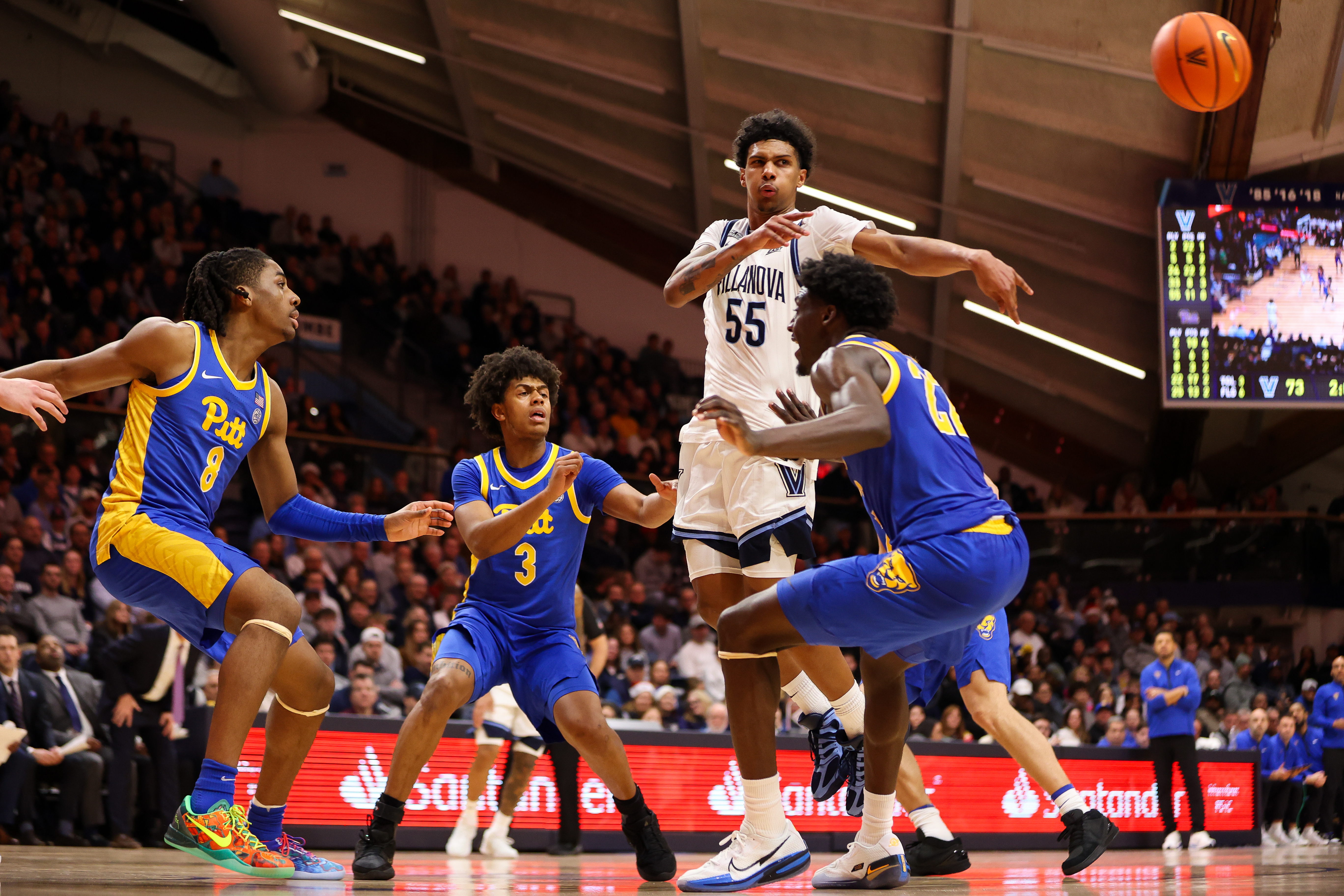
    Brennan set a new career high with 24 points, and Bryce Lindsay also scored 24 as Villanova controlled the game and pulled away from Pittsburgh in the second half in a 79-61 victory.

    From left, Villanova guard Acaden Lewis, forward Matt Hodge, and forward Duke Brennan celebrate as guard Bryce Lindsay is interviewed after the team’s 79-61 win against Pittsburgh on Saturday.

    The Wildcats, who are in the top 50 in college basketball in three-pointers attempted, showed a balanced inside-outside attack in the process. Brennan wasn’t up against Mara, but Cameron Corhen was no slouch at 6-10, 235 pounds, averaging 14 points and nine rebounds heading into Saturday. Brennan had his way inside. He made all eight of his attempts from the floor and was 8-for-10 from the free-throw line, a positive development for the transfer from Grand Canyon, who entered Saturday having made just 52% of his free throws.

    Brennan, who played a season-high 34 minutes, was active. The Wildcats used him as a screener and fed him when he rolled. Their guards executed dribble handoffs with Brennan and, because Brennan had it going, it freed up shooters like Lindsay, who was 4-for-11 from deep, and Matt Hodge, who made two of his four attempts from three-point range.

    “I think Duke’s biggest strength is his energy, how hard he plays, his rebounding,” Willard said. “But when we can get him some points down low, I think it rewards him for how hard he plays throughout the game. It also keeps him involved and keeps him happy a little bit, to be honest with you

    “I think the more we can get Duke involved in pick-and-rolls and get him on rolls, it just puts pressure on the weakside defense. When you have young guards and you have a team that hasn’t been together overly long, sometimes it just takes a little time to kind of know what works and what doesn’t work.”

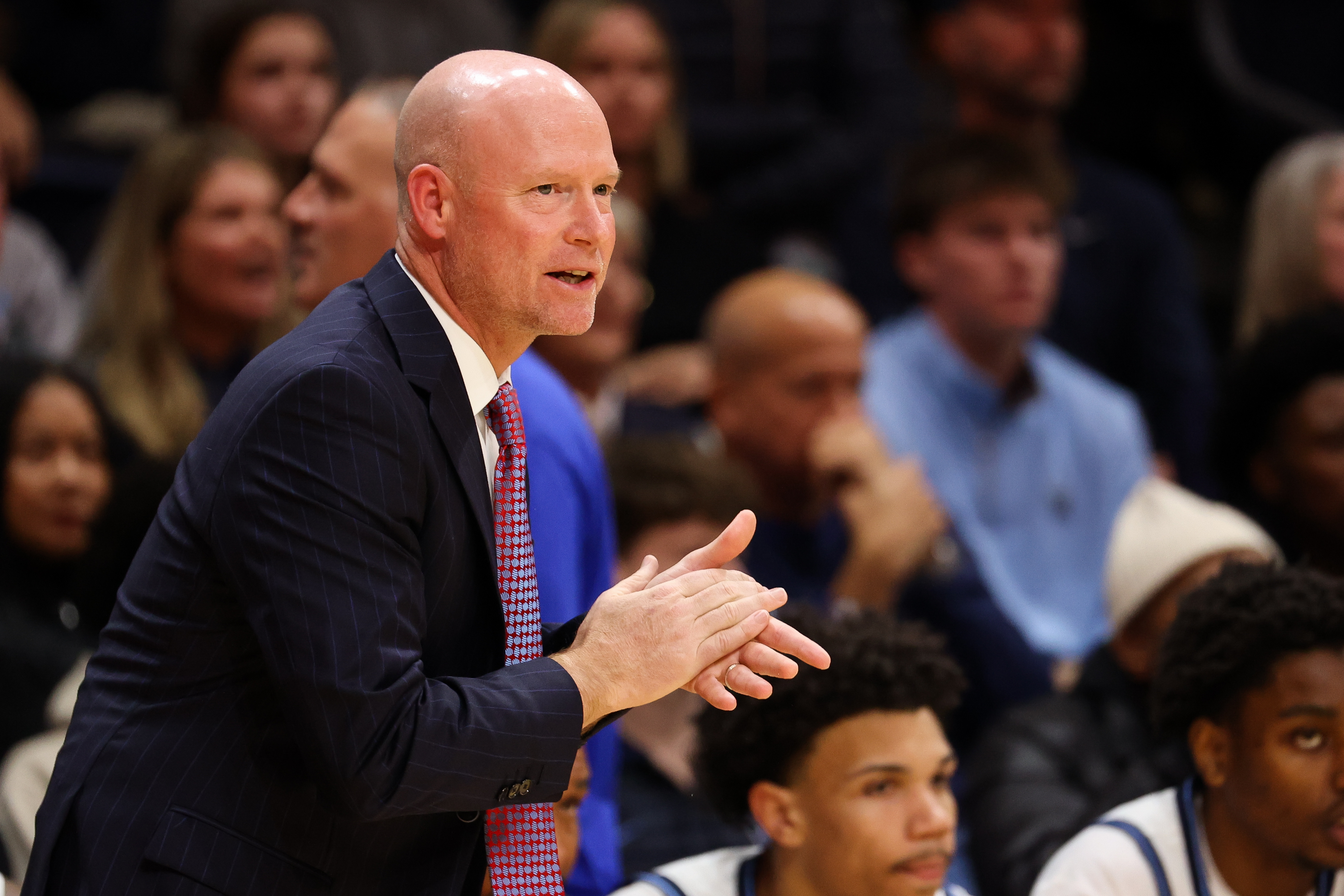
    Kevin Willard coaching Villanova during the second half against Pittsburgh on Saturday.

    It is all clicking right now for Villanova, save for the 40-minute hell that is playing Michigan right now.

    Freshman point guard Acaden Lewis kept his positive play going with 11 points and seven assists. He had just one turnover, and the Wildcats had just three on the day. They had 20 assists on 26 makes.

    The performance needs to be put in the proper context, though. While Pitt may be a power-conference opponent, the Panthers have struggled so far in 2025. They dropped to 5-6 with Saturday’s loss, and they entered Saturday ranked 163rd in the NCAA’s NET rankings. That made Saturday’s victory of the Quad 4 variety for Villanova, which at least for now makes it as valuable come March as Villanova’s Nov. 11 victory over Sacred Heart.

    Villanova is 8-2, and its best win, at least according to KenPom metrics, is Saturday’s victory over Pitt, which was ranked 118th after the game.

    There’s something to be said for winning the games you’re supposed to. Villanova’s three-year NCAA Tournament drought is dotted with slip-ups. But it’s never too early to start looking ahead to March, especially with the Wildcats through 10 of their 11 nonconference games.

    ESPN bracket master Joe Lunardi had Villanova as his first team out of the NCAA Tournament field as of Saturday morning before the Wildcats played a game that couldn’t help them by winning and could only hurt them by losing.

    Villanova guard Acaden Lewis passes the ball against Pittsburgh on Saturday.

    Up next is Wisconsin, though. A victory over the Badgers in Milwaukee on Friday night would be Villanova’s only win outside of Quad 4 before Big East play starts. It would be a good feather in the cap of the Wildcats, who entered Saturday 37th in NET and were at No. 34 in KenPom after the win.

    Big East play will be here soon enough — Dec. 23 to be exact, a road game at Willard’s old school, Seton Hall, which improved to 10-1 with a win over Rutgers on Saturday.

    The Wildcats have essentially two bubble games next before the holiday break. They at least avoided a major blunder Saturday by handling Pitt, and their balanced attack, with Brennan’s scoring inside, should prove valuable moving forward.

  • Atlantic City is ending the year in crisis. Its mayor is on trial, New York casinos are coming, Peanut World caught fire. There are more worries.

    Atlantic City is ending the year in crisis. Its mayor is on trial, New York casinos are coming, Peanut World caught fire. There are more worries.

    ATLANTIC CITY — The journey through Atlantic City is bumpy these days, and not only because Atlantic Avenue is desperately in need of paving.

    Ducktown Tavern owner John “Johnny X” Exadaktilos has one wish for Atlantic City that has nothing to do with the gut-jarring avenue that runs in front of his bar.

    “Just normal,” says Exadaktilos. “I just want things to be normal.”

    Atlantic City, a place of historic mayoral misdeeds, multimillionaire overreach, and chronic unwanted attention, has managed in this waning year, even as its workers string up holiday decorations, to come up with a new plot twist: Its newly reelected Democratic Mayor Marty Small Sr. is on trial for alleged physical abuse of his teenage daughter.

    The trial has left Small untethered from his cell phone as new casinos have been green lit in New York City, and the state moves to tighten its authority over the town. Another trial, of Small’s wife, La’Quetta Small, who is the superintendent of schools, is set for Jan. 12.

    With Small reporting to an Atlantic County courthouse each day to face his daughter, who spent seven hours testifying against him on Tuesday, a bit of a hush has fallen on the city as it awaits the outcome, which could come this week.

    The sentiment in City Hall, where many employees owe their jobs to Small, leaned toward the assumption that Small would beat this charge like he’s beaten two previous indictments on voter fraud charges.

    But will the city emerge unscathed?

    “Every day, people who live in Atlantic City want to know what those of us are elected are doing to make their lives better and respond to their issues and concerns,” said council member Kaleem Shabazz, who was going from a planning board meeting to a mayor-less City Hall last week. “Whatever will happen will happen. The city still has to function. People have to be responsible.”

    On Dec. 1, as Small readied for jury selection in Mays Landing, New York City approved three casinos, two for Queens and one for the Bronx, a development long feared in Atlantic City.

    On Dec. 5, with the jury picked, the iconic Peanut World on the Boardwalk erupted in flames. On Dec. 9, with the mayor listening to his daughter, legislators in Trenton were proposing more state oversight of A.C. including a surprise provision that would give the state the power to pick developers for major projects.

    The biggest threat may come from the New York casinos, which some in the industry estimate could threaten as much as 30% of A.C.’s business and lead to the shuttering of one casino, if not more.

    Small, meanwhile, took the stand took the stand in his own defense on Friday, testifying that his daughter was his “best friend,” until becoming involved with a boy the family disapproved of, and denied he had abused her. The same day, community group El Pueblo Unido Of Atlantic City posted photos of ICE agents making car stops in city neighborhoods.

    Small could face jail time and be forced to step down as mayor under New Jersey law, if convicted. He and his wife, who has been attending her husband’s trial, taking notes in the back, have resisted calls to relinquish their powerful roles as mayor and superintendent.

    “It’s not ideal obviously,” said Shabazz. “If you had to pick a multiple choice question what would you want to be happening in your public schools, that wouldn’t be something you would pick, if you’re a parent or a taxpayer.”

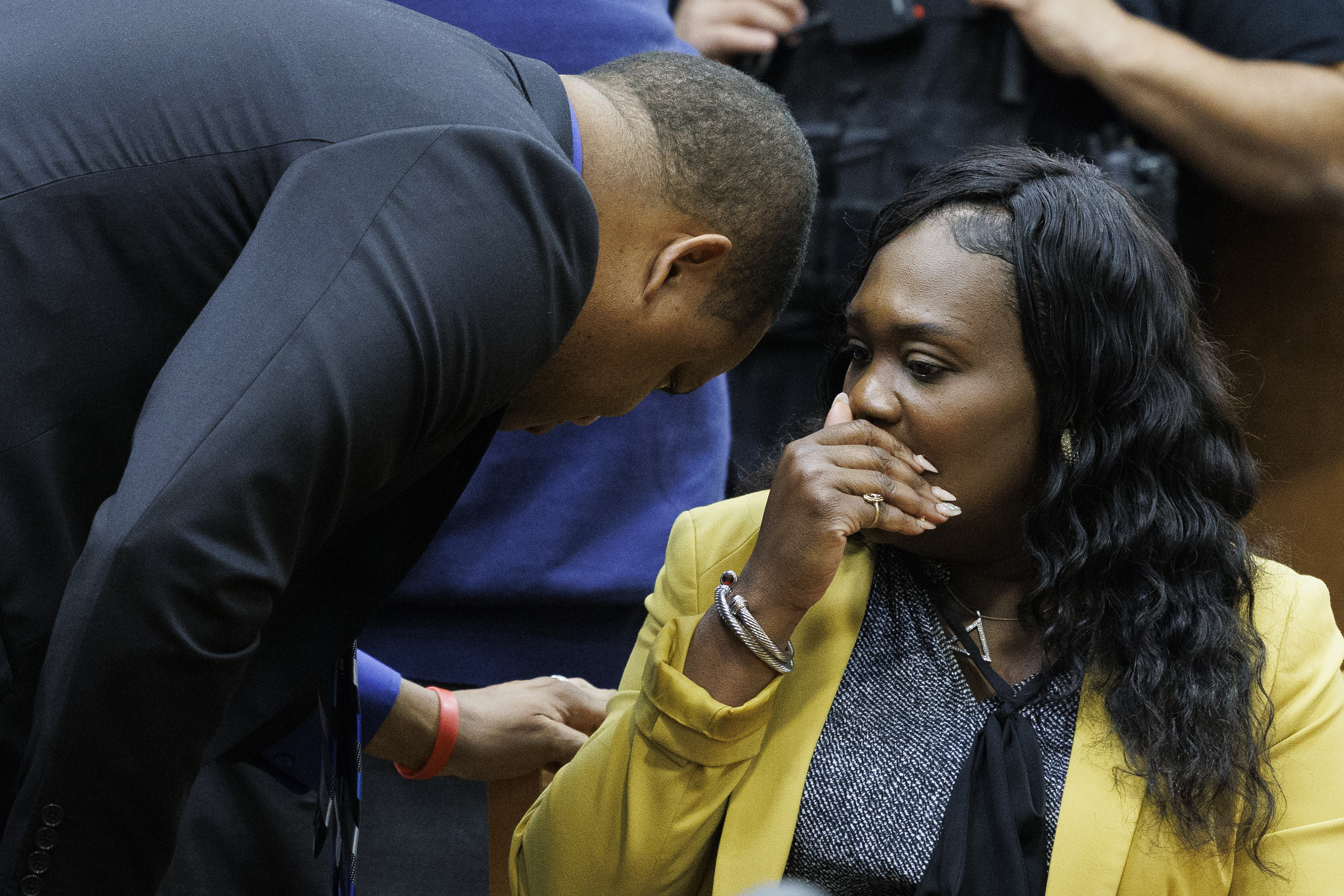
    Atlantic City Mayor Marty Small and his wife, Superintendent of Schools La’Quetta Small, chat before the start of arraignment on Oct. 10, 2024. Mayor Small stood trial last week in Mays Landing. Cameras were barred from the courtroom during the trial.

    ‘A wake-up call’

    Early one morning last week, having just come from a planning board meeting, Shabazz said the city was going about its business. “I’m not at the trial, I’m on my way to City Hall,” he said. “The work of government has to go on.”

    Shabazz, who’s been focused for years, even decades, on some of the same intractable problems of the resort, remains optimistic. It’s a city where it can be hard to read the scorecard: progress seems to be there, but not there, at the same time.

    The city’s only full-size supermarket, the beleaguered Save A Lot is under new management, and the adjacent nuisance liquor store is expected to close. High-profile developers like Jared Kushner and K. Hovnanian appear to be going forward with residential projects in the city’s Inlet section. There are new restaurants, like the Byrdcage in Chelsea and Simpson’s, relocating next month to Atlantic Avenue.

    Shabazz is hoping the state will return zoning authority back to the city after years of the Casino Reinvestment Control Authority overseeing planning and zoning in the city’s tourism district.

    Kaleem Shabazz, president of the local chapter of the NAACP in Atlantic City, and Maryam Sarhan, a community organizer, stand in front of mural honoring civil rights leaders. “The city still has to function,” he said, while its mayor is on trial for alleged child abuse. “People have to be responsible.”

    But last week, as the mayor listened to his daughter testifying that he struck her in the head with a broom, after she threw detergent at him and refused to go to a community march, the state went in the opposite direction: a bill to renew the state’s takeover of Atlantic City for another six years that would allow the state to pick a “master developer” to oversee big projects, the Press of Atlantic City reported.

    “We have to be competitive,” Shabazz said. “We have to let people know that we’re open for business and we’re safe and secure. Crime is down significantly.”

    Like others interviewed, he believes Atlantic City can sell itself as a safe and affordable seaside destination. “We still have a free beach,” he said. “We have to let people know what we have.”

    Atlantic City Mayor Marty Small arriving for his arraignment before Judge Bernard DeLury at the Atlantic County Criminal Courthouse in Mays Landing on Oct. 10, 2024. Small testified in his own defense Friday during his trial. Cameras were barred from the courtroom.

    What the city has, chronically, is mayors under indictment. Small is the fifth mayor since 1981 to face indictment, following in the dubious footsteps of Michael Matthews (taking bribes), James Usry (accepting bribes, a charge later dropped), Bob Levy (defrauding the Veterans Administration), and Frank Gilliam (wire fraud).

    Small has defended himself by describing this latest situation as a private family problem, not related to his job performance. He has called the prosecution politically motivated and an overreaction. A jury will now weigh in.

    John Boyd Jr., a principal in the Boyd Co., which advises companies on where to locate, said many developers (and homeowners) continue to balk at Atlantic City, despite the upward pressure on Jersey Shore real estate that has left the city as arguably the last affordable seashore town in the entire Northeast.

    He called the three New York City casino licenses “a wake-up call” for New Jersey, and advocates a plan where the state allows casinos at the Meadowlands and/or Monmouth Park but shares the revenue with Atlantic City.

    “If you ask national developers their opinion of Atlantic City, it wouldn’t be a very positive one for a myriad of reasons,” he said.

    “Good governance is fundamental to economic development success. Companies want to minimize risk. It’s more than the mayor being on trial. It’s the uncertainty.”

    Meanwhile at the slots

    Inside Hard Rock casino during a blustery stretch last week, people were three deep at the holiday-branded Mistletoe Bar in the lobby, and nine guitars had become a menorah in the atrium.

    Gamblers were locked in as names were called for a random spin-the-wheel drawing every half hour. A convention of real estate agents brought lines to the check-in desk. The trial was off in the distance, invisible to most.

    “I do love coming to Atlantic City,” said Adam Druck, 33, a Realtor from York, Pa. “I hope the trial doesn’t make too much difference to what’s going on here.”

    Asked about New York casinos, Joe Pendle, 71, a retired police officer from North Jersey, said he was comfortable with his routines at Hard Rock, where free rooms and meals anchored his pleasant stays. (Hard Rock itself has one of the three licenses in New York City, an $8.1 billion project near Citi Field in Queens, which it projects will result in $1 billion a year in tax revenue.)

    “I have a three-room suite upstairs,” noted Pendle. “I like the beach.”

    Arthur Austin, 70, of Old Bridge, said he had worked for decades on Wall Street and had no desire to travel to New York for a casino weekend.

    “I worked in the city for 20 years,” he said. “I only go into the city if I have to.”

    Adam Druck, 33, of York, Pa., and Eric Moeller, 36, of Reading, inside Hard Rock casino on Dec. 9, where they were staying as part of Triple Play Realtor Convention and Trade Expo in Atlantic City.

    Out-of-towners like Austin hadn’t heard about Small’s trial, but the local gamblers at Hard Rock sure had.

    “Atlantic City is a crooked place, and it’s always gonna be crooked because of what everybody’s into,” said a 57-year-old woman who lives locally and was playing the slots. She did not want her name used so that she could speak her mind in a small town.

    “People want their guy to stay in there,” said the woman. “He gives everybody a job. You could flourish, but only if you are with the right people.”

    “I don’t think that it hurts Atlantic City,” said Seng Bethia, 40, of Atlantic City, who was at the slots. “His daughter is such a sweet girl. It was bad, just the whole thing.”

    ‘Are you kidding me right now?’

    Exadaktilos, the Ducktown Tavern owner who is Small’s loudest detractor, said he had taken things down a notch of late, putting aside his popular weekly Facebook live rants that he said had started consuming him.

    Still, last week, as the prosecution wound up its case, the city sent out a contractor to do some temporary filling in of cracks on Atlantic Avenue in advance of the city’s holiday parade, and Exadaktilos found himself back on Facebook live.

    “Are you kidding me right now?” he said over footage of the roadway. “What happened to Atlantic Avenue is going to be paved? Horrible.”

    Boyd, the location consultant, points to bright spots. The national developers are a vote of confidence, as is the September opening of the SeaHaus boutique hotel on the Boardwalk, a Marriott property. Showboat and the Sheraton near the Convention Center are converting rooms to residences.

    Boyd sees potential for Atlantic City to follow the likes of Coney Island, which has seen a renaissance, to attract film business, to market itself as a live-work-play destination.

    Outgoing council member George Tibbitt looks at the Kushner plan, a 180-unit apartment complex, as another missed opportunity. “No vision there,” he said. “That’s desperate development.”

    The property is on the inlet near Gardner’s Basin and at one point was viewed as a potential spot for an ambitious mixed-use development similar to the Inner Harbor in Baltimore.

    “New York City definitely makes me afraid,” said Tibbitt. “There’s only so many gambling dollars to go around. Adding more casinos is going to be devastating. We have to clean the city up. We have to get the neighborhoods filled back up.”

    One industry the city bet heavily on was cannabis: Its midtown quickly filled with 16 dispensaries. But after complaints from the cannabis entrepreneurs themselves, city council capped the number at 16, leaving many that have been approved but have yet to open (including one that necessitated the demolishing of a historic church) in limbo.

    Atlantic City is a place where things can seem to be finally coming together, while simultaneously unraveling. Big plans vaporize, like the highly touted gym and nightclub outside Showboat, where last summer, the owner set up couches, DJ booths, and exercise machines, got stalled by permitting issues, and quietly dismantled them.

    Miguel Lugo, general manager at AC Leef, which held out for a strategic spot on Albany Avenue, said his cannabis business has been good. He looks forward to the dispensary running financial literacy classes for the community, and getting its cultivation license.

    “On this side of the town, everything’s been phenomenal,” Lugo said. “I’m super focused on AC Leef. I don’t know what’s going on with the mayor.”

  • How baby boomers got so rich, and why their kids are unlikely to catch up

    How baby boomers got so rich, and why their kids are unlikely to catch up

    Baby boomers hold more than $85 trillion in assets, making them the richest generation by far. New research explores the extraordinary rise in their good fortunes — one that experts say successive generations will be hard-pressed to replicate.

    The reasons come down to timing and time: Americans 75 and older bought homes and invested in stocks well before such assets exploded in value, according to Edward Wolff, an economics professor at New York University. In a working paper for the National Bureau of Economic Research, he examined the four decades between 1983 and 2022 when those older boomers’ saw their wealth climb and their younger peers recorded relative declines.

    “It’s astonishing how their relative wealth has taken off in the last 30 plus years,” Wolff said. “They started out as among the poorest groups in terms of wealth back in 1983.”

    The wealth of baby boomers — especially those in retirement — is a reflection of the uniquely favorable economic conditions that occurred during their working lives, Wolff and other economists said. So much so that it would be difficult for younger generations to emulate, especially as they are more likely to be weighed down by debt or childcare costs.

    Housing costs also factor into the widening divide between baby boomers (born from 1946 to 1964), and everyone else, experts say. Generation X (1965 to 1980), millennials (1981 to 1996), and their successors increasingly dedicate a bigger portion of their budgets to mortgage or rent.

    Without considering the historical backdrop that let many boomers buy homes and invest in stock before decades of asset appreciation, people might overstate the extent to which the generation’s wealth reflects their superior financial decision-making, said Olivia Mitchell, professor of business economics and public policy at the University of Pennsylvania’s Wharton School.

    What happened?

    Good economic conditions

    Baby boomers “entered the labor force during decades of strong economic growth, rising productivity, and relatively high real wages,” Mitchell said. They were in their prime earning and saving years during long bull markets, namely in the 1980s and ’90s, she said, as well as the economic recovery that followed the Great Recession. They faced lower tuition and healthcare costs, and benefited from favorable tax policies, including lower capital gains tax rates, she said.

    By contrast, younger generations endured the Great Recession — which ran from late 2007 to mid-2009 — early in their careers and more volatile capital markets afterward, she said.

    And “particularly for middle-income workers, real wage gains since the 2000s have been modest, compared to the robust wage growth that boomers benefited from mid-career,” Mitchell said.

    By age 30, the average millennial had about twice as much debt as their baby boomer counterpart, said Jeremy Ney, a professor at Columbia University’s business school.

    Post-World War II, “you had this tremendous boom that many got to ride for a very long period of time,” Ney said. “And when you compare that to the bursting of the dot-com bubble, when you compare that to the 2008 housing crisis, when you compare that to the declines of COVID, it made it much more difficult for people to invest, accumulate wealth.”

    The rise of 401(k)s and stock holdings

    Some older boomers benefited from having access to defined-benefit pension plans, many of which were phased out in the private sector in the 1980s as tax-advantaged 401(k)s became commonplace. The rise of such employer-sponsored retirement plans also drove up baby boomers’ stock holdings.

    Today, about half of baby boomers’ wealth is tied up in cash, bonds, stocks, or mutual funds held directly or through retirement accounts, or other financial holdings, Mitchell said, citing 2023 survey data from the Federal Reserve. Though the generation makes up about one-fifth of the population, they hold more than half of corporate equities and mutual fund shares.

    Baby boomers have accumulated $85.4 trillion in wealth through the second quarter, according to Federal Reserve data. That’s nearly twice as much as Gen X and four times more than millennials.

    Younger generations are more likely to have debt, leaving less to save or invest, Ney said, citing student loans and childcare costs that nearly doubled between the mid-1980s and 2011, according to the U.S. Census Bureau.

    “In 1940 there was a 90% chance that you were going to earn more than your parents. To somebody born today, it is just a coin flip,” Ney said.

    Millennials and Generation Z (those born between 1997 and 2012) also tend to be more risk-averse when it comes to investing in the stock market, compared with members of the Silent Generation (1928 to 1945), boomers, and Gen X that lived through better economies, Ney said.

    “Gen Z does not buy the dip,” he said. “They are too nervous to engage in the stock market” when prices are low.

    The big story: Housing

    Perhaps the biggest share of baby boomers’ wealth comes from their home.

    Many were better positioned to buy or refinance their homes during stretches with particularly low interest rates, including after the Great Recession and during the COVID-19 pandemic, said Annamaria Lusardi, academic director of Stanford University’s Initiative for Financial Decision-Making.

    The nation’s median home price was $410,800 in the second quarter, compared with the $327,100 recorded just before the pandemic started in 2020, Federal Reserve data show. Medians are significantly higher in the Northeast ($796,700) and the West ($531,100).

    By comparison, the median home price in the first quarter of 1976 — when the oldest boomers were 30 — was $42,800, Fed data show. That would be $242,400 adjusted for inflation.

    While higher home valuations have bolstered the net worth of existing owners, Lusardi said, they’re outpacing the earnings of younger adults. Nor are they helped by current mortgage rates, which have hovered above 6% on a 30-year loan since September 2022.

    About one-third of baby boomers’ wealth today is equity in their primary residence, Mitchell said, citing the 2023 survey. Boomers overall bought homes at younger ages than later cohorts and when prices were significantly lower, allowing them to benefit from decades of home appreciation.

    The typical age of first-time home buyers recently hit an all-time high of 40 years, up from late 20s in the 1980s, according to a 2025 National Association of Realtors survey.

    “Even when you look at that same age, you tend to see much lower rates of homeownership, and therefore much lower rates of wealth accumulation,” Ney said.

    Michael Walden, a professor emeritus of economics at North Carolina State University, said some of the divergence might be due to preference — such as younger adults preferring to rent rather than assume responsibility for home repairs, or to wait for a perfect home rather than settling for a starter home they might hold onto for a few years until they had enough equity to move up.

    “Their attitude about buying housing is very different than what my parents ingrained in me which was” to ‘just get your foot in the door’ with a starter house, Walden said. “It’s probably not going to be adequate, but a few years later, you’ll be able to sell it for more and just work your way up.”

  • The holiday shopping season comes with tons of extra emissions. Here’s how to do it sustainably

    The holiday shopping season comes with tons of extra emissions. Here’s how to do it sustainably

    We’re in the thick of the holiday shopping season, and U.S. residents are expected to shatter the spending record again this year. The National Retail Federation forecasts that 2025 will be the first time we collectively spend more than $1 trillion on year-end gifts.

    A lot of materials, energy, packaging, and gasoline have gone into making and moving those gifts. All of those processes release planet-warming gases into the atmosphere.

    But a lot of that environmental impact is avoidable. Making, baking, thrifting, and avoiding traditional wrapping paper are all more planet-friendly ways to give. We’ve got tips on how to do them all.

    Homemade doesn’t have to be difficult

    Sure, if you’ve got the skill to turn a wooden bowl or needlepoint a Christmas stocking, those gifts are guaranteed to be unique and meaningful. But not all of us have the knowledge or time.

    Sandra Goldmark, associate dean of Columbia Climate School’s Office of Engagement and Impact, said one of her favorite options is an act of service for a loved one. One year, for example, her husband organized all her passwords for her.

    “It was not something easy to wrap and put under the tree, but believe me, it was meaningful and really helped me more than any additional object cluttering up my home could have,” she said.

    Another winner: food. If, say, you have a long list of recipients, buy ingredients in bulk and pack them in Mason jars. Cookie mix, soup mix, sourdough starter, and spice mixes are all easily sealed and transported that way. Add some ribbon and a sprig of cedar, and it’s festive. Homemade baked goods and snacks are other options.

    “It’s inexpensive, but it takes care and time and attention,” said sustainable-living educator Sarah Robertson-Barnes.

    Give experiences instead of buying more stuff

    The advice here starts out simple: Buy less stuff. The best way to give gifts more sustainably is to buy fewer new things, said Goldmark.

    Stockings can be a common spot for toys that break quickly before going straight to the landfill. Instead, you can fill stockings with things that your friends or family need anyway, like toothbrushes or body wash, or traditional treats like fruit and chocolates.

    Giving someone an experience is another popular option. That might mean a pair of concert tickets, a spa day, a gift card to a favorite local restaurant, a local news subscription, or a membership to a local garden or zoo that the recipient can use over and over. Research has indicated that experiences strengthen relationships better than material gifts do.

    “There is so much that you could do by just saying, ‘I would prefer if you just made me a nice meal or took me out for some sort of adventure,’” said Atar Herziger, environmental psychologist and assistant professor at Technion — Israel Institute of Technology.

    Experiences also come with less packaging. Herziger cautions, though, that travel can have a high impact especially if it involves planes. So she recommends local options such as a nearby hike or a staycation.

    And if you’re unsure what experience your loved one would prefer? Herziger said don’t overcomplicate it — just ask.

    Go vintage

    Secondhand gifts are easier on the planet because they involve less manufacturing, packaging, and shipping. Robertson-Barnes looks to Facebook Marketplace or her local Buy Nothing group to find items that she would have otherwise bought new.

    “I bet somebody has the thing that you’re looking for and they would love to get rid of it,” she said.

    Still, for some recipients, secondhand gifts are taboo.

    “We do have a weird cultural thing where new is better and used is gross,” said Robertson-Barnes, who suggested reframing used gifts as “vintage.”

    Similarly, Herziger said secondhand options might be received better when they’re items that can’t be bought new, such as a family heirloom or a collectible that isn’t produced anymore.

    Goldmark looks to thrift stores for smaller toys or mugs. Record stores, used book stores, furniture stores, and antique shops are other options. And of course big names like eBay and Goodwill can have rare and unique finds, too.

    If buying secondhand simply won’t work for a recipient, Goldmark said to focus on items that are high-quality, long-lasting, repairable, and really needed. That ensures that it’s worth investing in and reduces the chance that it gets returned. Look to buy locally, rather than ordering online, to reduce how far it travels.

    The wrapping matters, too

    Millions of pounds of wrapping paper end up in the landfill every year. Much of it is blended with plastic to make it shiny or sparkly, so it can’t be recycled.

    Not sure whether your wrapping paper is recyclable? Check your local recycler’s website for guidelines, or try a simple test by crumpling it into a ball. If it holds its shape, it’s more likely recyclable. Also, if it rips as easily as printer paper or gets soggy like a saturated brown grocery bag, those are good signs it’s recyclable, too.

    Robertson-Barnes said if you already have wrapping paper on hand, you should use it rather than waste it. But once it’s gone, she recommends reusable wrapping cloths such as furoshiki, a traditional Japanese fabric for presenting gifts.

    Some experts also recommend gift bags as long as they’re reused — and not tossed.

    Another cheaper and more planet-friendly alternative to wrapping paper is newspaper or brown paper bags. Tie them off with reusable ribbon, a couple pinecones or a candy cane, and suddenly it’s festive.

    Plus, brown paper is a blank canvas with endless opportunities for customization. “If you’ve got kids, then their drawings are wonderful packaging materials. They make the best wrapping paper,” Herziger said.