The Eagles suffered another defeat last week with their 24-15 loss to the Chicago Bears. Philadelphia was the top seed in the NFC just a month ago, but after two straight losses, the team is tasked with an uphill battle for the NFC’s number one seed in January.
Jalen Hurts and the Birds, who are 2.5-point favorites, have a chance to get back on track against a Chargers (8-4) team dealing with a hand injury to quarterback Justin Herbert, although he is expected to play. Here’s who the experts are picking in Monday’s game …
Inquirer predictions
First, let’s begin with what our writers are thinking about the game. Here’s a look at Jeff Neiburg’s prediction …
To read more of Neiburg’s prediction and see what our other writers think the outcome will be, click here.
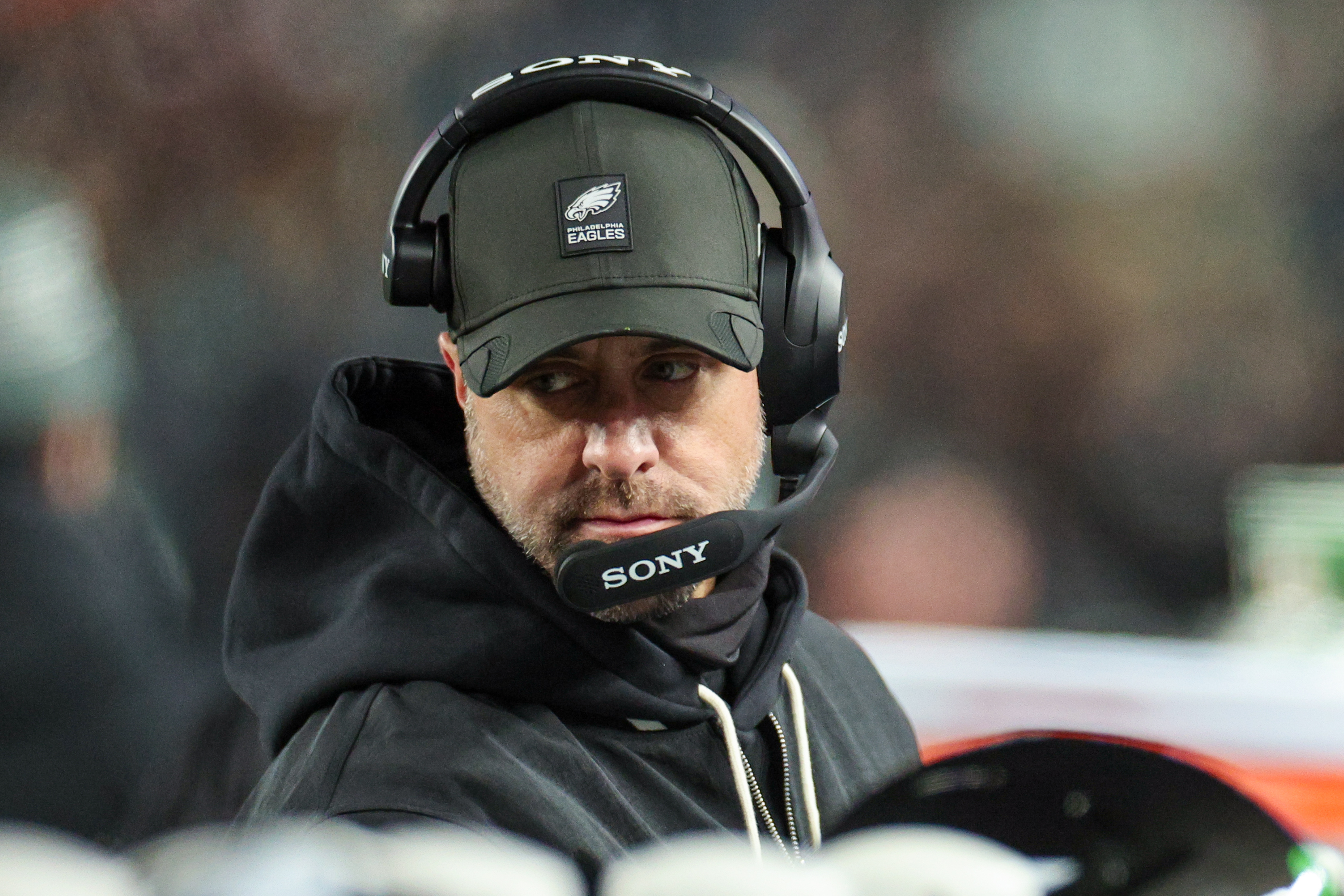
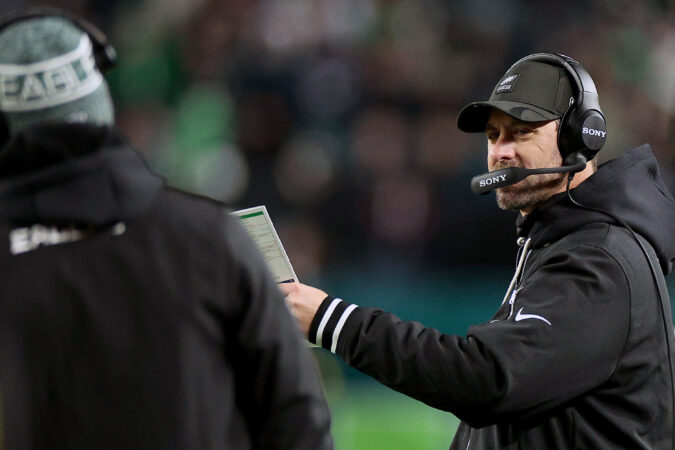
Eagles offensive coordinator Kevin Patullo has come under fire this season as his unit has struggled to find an identity.
National media predictions
Here’s a glimpse at how the national media is swaying before Monday’s matchup …
ESPN: Just like last week, ESPN is heavily toward the Eagles. Nine of the 11 panelists have the Birds winning.
CBS Sports: CBS follows suit, as six out of eight CBS analysts pick Philly to win.
Pro Football Talk: NBC is split on this matchup. Mike Florio picks the Eagles while Chris Simms predicts a Chargers’ win.
USA Today: USA Today is nearly split, four of the six panelists have the Eagles winning Monday night.
The Athletic: The Athletic is the same, with four of six staff members picking the Eagles.
Bleacher Report: After picking against Philly last week, six of the seven Bleacher Report analysts have the Birds winning and covering the 2.5-point spread.
Sporting News: Vinnie Iyer predicts a 21-17 win for the Eagles.
Listen — Philly has a reputation. We know this. We wear it like a badge. We boo Santa, we heckle refs, we meltdown on WIP like it’s an Olympic sport. But there’s passion, there’s unhinged, and then there’s driving to Moorestown at 3 a.m. to egg the offensive coordinator’s house because the Eagles lost to the Bears.
That’s not passion. That’s just loser behavior.
Patullo said all the right things this week. That criticism is part of the job, that he’s been here five years, that he loves the city and the fans. But he also made it clear: When it involves your family, the line isn’t just crossed… it’s obliterated. And he’s right. Yell at the TV, tweet about it, call WIP at 6 a.m. pretending to be “Bryce from Bridesburg.” But families are off-limits.
The good news? Neighbors rallied, the community reached out, and Patullo isn’t going anywhere — not from his home, and not from the sidelines (despite Nick Foles’ dream of him coaching from the booth like it’s Madden franchise mode).
Philly can take a joke, a hit, and a heartbreak season. What we can’t take is letting a few clowns make us look like we egg coaches every time the offense ranks 24th in yards.
Save the eggs for tailgates. Or better yet, breakfast.
A cheesesteak from Dalessandro’s in Philadelphia, on Friday, Nov. 21, 2025. Michelin recently recognized the restaurant with a Bib Gourmand. Cheesesteak restaurants Angelo’s and Del Rossi’s were also recognized by Michelin.
Philly is America’s No. 1 foodcation destination: A (obviously)
All because of one thing: the cheesesteak, which topped the national list with 27% of Americans saying it’s their dream domestic “foodcation.” Translation: People are now booking vacations around a sandwich we buy at 1 a.m. like it’s no big deal.
Food & Wine says Americans spend about $910 on their typical food-focused trip and would nearly double that budget if the bite was bucket-list–worthy. So somewhere out there is a family justifying a $2,000 vacation to stand outside Angelo’s at 10 a.m. behind 70 locals who think they have “a system.”
Meanwhile, New York tied us at 27% for pizza — but let’s be serious. A cheesesteak beating out an entire city’s worth of pizza is so Philly-coded it should count as a parade.
A Waymo car drives down Market Street Tuesday, July 8, 2025, in Philadelphia.
The company says its cars are now driving autonomously (with a human babysitter for now), mapping our neighborhoods and “laying the groundwork” to eventually chauffeur actual Philadelphians around.
Bold. Truly bold. Because sure, a driverless car can operate in Phoenix. But can it:
Identify a pothole before it becomes a crater?
Handle a double-parked Amazon van, a food truck, and a guy pushing a sofa on a hand truck… all in the same block?
Not get stolen? (It’s Philly. We have statistics.)
City officials say they’re “monitoring the situation,” which is Philly-speak for: If this thing blocks a SEPTA bus, there will be consequences. Meanwhile, Waymo has been chatting with local groups — the Bicycle Coalition, Best Buddies — which is smart, because they’ll need all the friends they can get once these cars try to merge on I-95.
Delco Donny turning Wawa parking lots into concert venues: A
Only in the Greater Philadelphia region could a man with a guitar, a thick Delco accent, and a dream turn random Wawa parking lots into 100-person pop-up concerts — and somehow it feels… correct.
“Delco Donny,” the alter ego of musician Jake Dillon, started as a joke for his girlfriend’s Delco mom, reported Philly Voice. Now he’s pulling six-figure TikTok views by belting out Oasis, the Killers, and “Creep” between parked Hyundais and people sprinting inside for Sizzlis. At his Boothwyn Wawa show, fans were literally acting like he was Noah Kahan, except with more vowels flattened and more hoodies with paint stains.
The shtick is simple: He shows up, leans into the Delco accent America learned during Mare of Easttown, and sings like he’s headlining the Spectrum in 1996. And people eat it up. Wawa corporate even started sending him merch, which is basically the Delco version of getting knighted.
There’s something kind of pure about it: a Northeast Philly native channeling a fictional Boothwyn legend who meditates in a cluttered van, reviews local pizza joints, and humbly accepts Marlboro Reds as offerings from the people. The man is doing character work in a gas-station parking lot, and somehow it feels like local folklore in the making.
Opera Philadelphia hosted “Home for the Holidays” at the Wanamaker Building’s Grand Court on Tuesday, Dec. 2, 2025.
The Wanamaker Christmas comeback: A
In the most Philadelphia plot twist imaginable, the Wanamaker Grand Court took what could’ve been a gut punch — Macy’s closing, holiday traditions dangling by a thread — and turned it into a full-blown victory lap complete with a wreath-wearing Wanamaker Eagle, opera singers, dinosaur dancers, and an organ flex so powerful it could rattle the Market-Frankford Line.
“Home for the Holidays,” Opera Philadelphia’s one-night takeover, wasn’t just a concert, it was a statement. Philly looked at a soon-to-be shuttered space and said, Fine, then we’re going out in style. The whole night doubled as a nostalgia bomb: marching-toy projections for anyone who remembers buying Christmas presents in the old store, an audience gasping at the tree like it was 1978 again, and the ground-shaking Wanamaker Organ.
But the real Philly heart came from the subtext: This was also a campaign to keep the space public, alive, and musical long after renovations. You don’t raise $1 million for a Pipe Up! series unless you’re gearing up for a fight.
Philly is getting a cruise terminal again (!!): A-
PhilaPort struck a deal with Norwegian Cruise Line, building a new terminal in Tinicum Township with 41 voyages already on the books over the next two years, reported 6ABC. Norwegian’s locked in through 2033, sending thousands to Bermuda, the Bahamas, Canada, and New England, all sailing straight out of the airport’s backyard.
It’s a major comeback for a region that hasn’t had a real cruise hub in more than a decade, and the timing couldn’t be better with the 250th, the World Cup, and the All-Star Game all landing next year. Economic impact? Around $300 million annually. Jobs? More than 2,100.
And yes, it’s a six-hour ride down the Delaware before you hit the Atlantic. Philly’s response: New York isn’t much faster, Baltimore is way slower. So grab a drink and enjoy the shoreline.
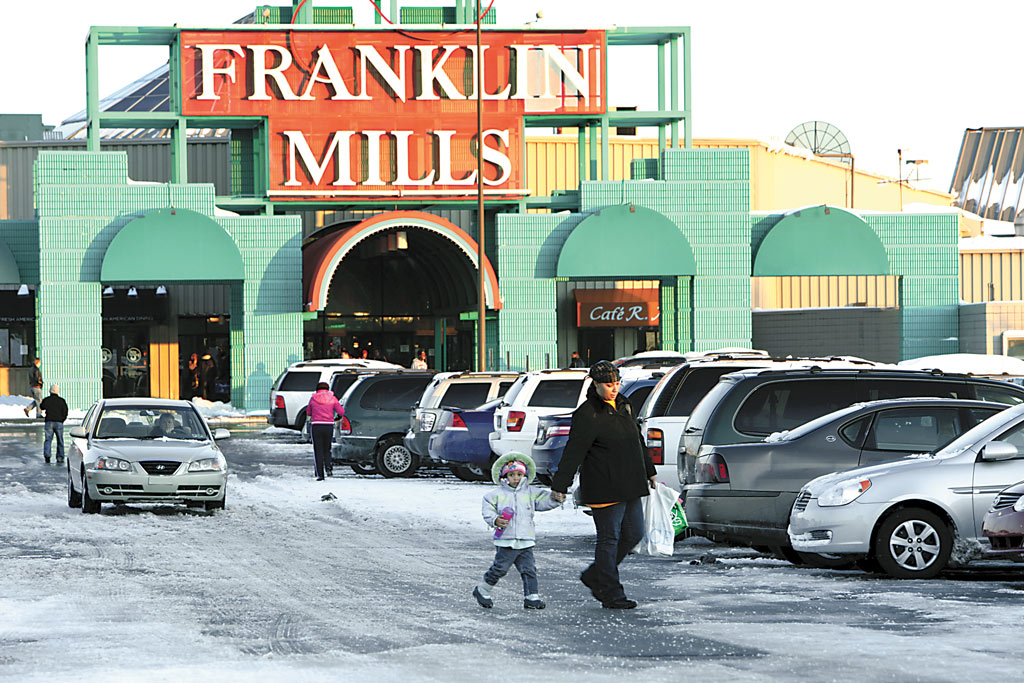
Franklin Mall, previously known as Franklin Mills, is for sale again.
Franklin Mills (sorry, “Franklin Mall”) is officially for sale: C
Franklin Mills, the place where Northeast Philly teens found Hot Topic, freedom, and an alarming amount of Orange Julius, is officially on the market. Again. After years of falling occupancy, collapsing value, and visitor counts dropping from 20 million a year in the ’90s to 5.6 million today, it’s basically being lilsted as: “137 acres… willing to become literally anything.”
Industrial redevelopment? Sure. Warehousing? Probably. Housing? Maybe, if City Council blesses it. A mall again? As one architect put it: “Unlikely.” (Philly translation: absolutely not.)
This place is 1.8 million square feet (second only to King of Prussia), but while KOP is still the superstar of malls, Franklin Mills slowly slid into its “legacy act” phase. The valuation dropped from $370 million in 2007 to $76 million last year. Even the name had to be changed back because Simon Property Group kept the Mills trademark, which feels like getting your hoodie taken in a breakup.
Real talk: The building is basically a demolition project waiting for a permit. But to its credit, 65% occupancy means it isn’t a ghost town yet — just a mall trying to remember who it used to be.
It might become warehouses, apartments, or over a million square feet of “don’t worry, it’ll create jobs.” But one thing’s for sure: If Northeast Philly wakes up to find a sea of Amazon vans where Franklin Mills once stood, people will still call it Franklin Mills.
This week I have asked two reporters to help answer a holiday question — is the asker reasonable or a Grinch?
Have your own thoughts or other questions? Fill in the box at the end!
.inno-chat__body {
border-radius: 12px;
}
Evan Weiss
Deputy Features Editor
The question is… My neighbor's rowhome Christmas lights shine directly into my bedroom. What should I do?
Jason Nark
Life & Culture Reporter
My first instinct, perhaps because it's Christmas, is to let it pass, to take one for the season.
Zoe Greenberg
Life & Culture Reporter
I say close the curtains? Put on your eye mask. It's the holidays.
Jason Nark
But, I do have strong feelings about light.
Jason Nark
Light pollution, for one. The new, pervasive, blinding white lights make the world look like a dental office. The amount of lights on in urban office/tall buildings at night, which contributes to bird deaths. I'm a light weirdo.
Zoe Greenberg
I'm also anti-bird death!!!
Zoe Greenberg
I will say that my partner is always trying to have the indoor lights match the outside night sky, which means that in the winter he wants it very dark inside our home. And I long for light.
Evan Weiss
So your lights are off around 4:30??
Zoe Greenberg
If he could choose, that's what would happen.
Jason Nark
My hometown recently installed new streetlamps that are too tall and far too bright. If I lived closer to one, and they didn't do anything about it, there might be sabotage.
Zoe Greenberg
The neighbor's lights are not going to last too long.
Zoe Greenberg
Should we be worried about your sabotaging your neighbor's beautiful Christmas lights?
Jason Nark
No, I give Christmas lights a pass because they're usually less intrusive and dimmer, and temporary.
Jason Nark
I will say that it's smart to invest in timers.
Evan Weiss
I think unless you really can't sleep, you have to deal with it.
Evan Weiss
Part of living in a city is accommodating your community. If you want no light, no noise, there are plenty of parts of Pennsylvania where the bears will welcome you.
Zoe Greenberg
Very true. Or rocks in the ocean.
Evan Weiss
You're exiling the neighbor to the sea?
Zoe Greenberg
I just mean if they don't want any lights! In the darkest season when light brings happiness and joy!!
Jason Nark
I wouldn't want my neighbor to have one of those Christmas "shows." I think that would be too much. Someone in Milford, Pa. was charged for cutting Christmas lights a few years back. She thought they were too much.
Evan Weiss
Any last advice for the question asker?
Zoe Greenberg
Maybe bake the neighbor some cookies and wish them a happy holidays.
Jason Nark
Or get blackout curtains.
This conversation has been edited for length.
What other Very Philly Questions should we address?
For Patricia Clark, who survived living on the streets of Camden for 25 years, the county’s move to build a supportive housing center with 60 efficiencyapartments for people experiencing homelessness is a welcome development in a distressing moment.
“The homeless rate is crazy, and this new place is needed, absolutely,” said Clark, 65, who struggled with substance abuse disorder starting at age 32 before going through recovery and becoming a homeowner and administrator at Joseph’s House of Camden, which offers shelter and support for unhoused people.
“I thought I’d die as Jane Doe with a needle in my arm and a crack pipe in my mouth,” she said. “I’m so grateful for the help I got. I know the new center will help, too.”
Named after a former Camden city attorney, the $22 million Martin McKernan Supportive Housing Center in Blackwood is expected to be completed in the spring, according to Camden County spokesperson Dan Keashen. Ten ofthecenter’s 60 units will be set aside for emergency shelter, while the balance will be transitional housing, available to individuals for up to two years, according to Rob Jakubowski, director of Camden County Homelessness and Community Development. Residents will be offered case-management services that typically include counseling, employment help, and assistance finding permanent housing, he said.
Camden County has seen homelessness grow by 20% between 2020 and today — from 633 to 759 people, 148 of them unsheltered, according to figures provided by Keashen.
The county is confronting that increase in need as it faces a threat to federal housing aid under a Trump administration plan to cut two-thirds of the aid designated for permanent housing for people experiencing homelessness.
Federal housing administrators argue its proposal would “restore accountability” and promote “self-sufficiency” in people by addressing the “root causes of homelessness, including illicit drugs and mental illness. But housing experts say it could displace 170,000 people nationwide.
“We are already seeing some of the effects of the HUD plan, with housing programs being cut,” Colandra Coleman, executive director of Joseph’s House, said. “I expect more to be cut back significantly.”
The McKernan center now seems that much more important, said Louis Cappelli, director of the Camden County Board of Commissioners. He stressed that homelessness is growing not just in the city of Camden, but in other parts of the county.
“It’s in Haddonfield and Collingswood and so many other places,” he said. “We want to provide the best possible opportunity for people everywhere who need it.”
While substance abuse and behavioral health are at the root of homelessness for many people, anti-homelessness agencies say the main reason Americans are homeless is the dearth of affordable housing.
“The affordability crisis is at the heart of the larger numbers of people who experience homelessness,” said Kathleen Noonan, president and CEO of Camden Coalition, a nonprofit helping those with complex health and social needs. The average rent in New Jersey as of this month is $2,087, a 2% increase over last year, according to Apartments.com.
For Clark, having a roof over her head and the sobriety to keep it still feels like a miracle.
“I never had a happy moment on the street in 25 years,” she said. “Getting beaten, going hungry, being arrested for shoplifting, being judged by people. I remember wishing I was dead.
“But now it’s different. I work to give hope to people living like I used to. In the end, God had a better plan for me.”
Despite years of bipartisan insistence that action is just around the corner, state leaders have yet to agree on a plan to regulate and tax so-called games of skill. While Harrisburg dithers, the machines have proliferated across the commonwealth, with dire consequences for many communities.
Make no mistake, ideally, these machines should be banned. However, courts have so far ruled that these devices — the use of which, proponents argue, involves a modicum of skill — do not run afoul of gambling laws. In reality, though, there seems to be little separating them from slot machines, which are regulated.
While no one knows the exact number of skill games in Pennsylvania, their impact is clearer.
Philadelphia City Council members have described them as a nuisance, attracting crime, and creating what are essentially unlicensed slot machine parlors. The all-cash machines also lend themselves to low-effort money laundering. Meanwhile, supporters claim the money from skill games helps small businesses, VFW halls, and other community anchors to pay their bills.
For Harrisburg, gambling in general has become a crutch to avoid tough decisions about spending and revenue. Taxing skills games is expected to bring in hundreds of millions of dollars to state coffers. That’s on top of the $2.7 billion the commonwealth already earns from existing forms of gambling, like slot machines, interactive virtual casinos, and online sports betting.
Gambling is a predatory, extractive, and addictive industry. Ignoring its negative effects while depending on gambling revenue to avoid broader tax increases is a counterproductive strategy for the Keystone State. Research shows that an incredibly high share of gambling revenue comes from a very small percentage of overall gamblers. People trapped in gambling addiction experience bankruptcy, divorce, and suicide at higher rates.
Yet, a small army of lobbyists, a surge in advertising, sympathetic social media influencers, and a hefty presence by gambling interests on campaign finance reports have made legislators fearful of taking action, even on skill games.
A recent pressure campaign sponsored by the industry led state Senate President Pro Tempore Kim Ward to declare that her caucus doesn’t “do well being bullied,” and that gaming interests “have done nothing but try to bully us. And I don’t think we stand for that.” But for years, that’s exactly what’s happened.
Beyond the million-plus dollars a year advocates have spent on political donations, some legislators report that the gaming industry is also using its cash to build influence in more subtle ways. Sports betting companies FanDuel and DraftKings have taken over from Bud Light as the sponsor of free service on SEPTA’s sports express. Skill games operators and others in the gambling industry are using the prospect of charitable donations to build political influence.
There is still some hope regarding skill games, at least. The Pennsylvania Supreme Court is currently hearing a case that could reinstate the previous ban on the devices. This would be a win for communities across the commonwealth.
If the machines are deemed legal, the state must at the very least ensure they are sufficiently regulated and taxed. Some of the legislation surrounding the games proposes that the Department of Revenue handle regulation. This would be a mistake. Given their similarity to existing gambling, the devices should be regulated by the Pennsylvania Gaming Control Board.
For her part, Mayor Cherelle L. Parker has softened her strong opposition to skill games, in part because Republican leaders in the General Assembly have promised the money could help support public transit, including SEPTA. The transit agency needs an additional, sustainable funding source. Still, politicians should remember there are other ways to raise revenue besides new forms of gambling.
Until the court or Harrisburg acts, skill games will remain in an unregulated, untaxed status quo. That may work for machine operators, but it doesn’t work for Pennsylvania.
Theater communities across the globe have been mourning Tony Award-winning playwright Tom Stoppard, the beloved Czech writer who died last week at his home in Dorset, England, at 88.
Stoppard’s acclaimed dramas graced countless stages over six decades, but he had a special place in his heart for Philadelphia’s Wilma Theater, where he formed deep, longstanding friendships with founders Blanka Zizka and her late husband, Jiri.
The prolific playwright, known for irreverent, cerebral dramas with dense and rather dizzying rhetoric, was often compared to William Shakespeare and George Bernard Shaw. Some of his most popular works include Rosencrantz and Guildenstern Are Dead (a clever take on Hamlet), The Real Thing, The Coast of Utopia, and the screenplay for the 1998 Oscar-winning rom-com Shakespeare in Love.
He made Tony Award history and broke his own records, winning best play five times between 1968 (Rosencrantz and Guildenstern Are Dead) and 2023 (Leopoldstadt).
The latter beat out Pulitzer Prize-winning Fat Ham — also a clever take on Hamlet, in wildly different ways — from former Wilma co-artistic director James Ijames. (The Wilma coproduced the Broadway production that earned five Tony nominations.) A year later, the Wilma received the 2024 Regional Theatre Tony Award, becoming the first theater in Pennsylvania to earn the recognition.
But beyond his international fame, Stoppard is an integral part of the Wilma’s history and, in turn, Philadelphia theater history.
The Wilma Theater’s 1997 production of Tom Stoppard’s “Arcadia.”
Blanka Zizka first met Stoppard in 1996, when they both participated in a panel discussion at the University of Pennsylvania. The dramatist was visiting the city for a three-day residency on Penn’s campus following a symposium dedicated to his play Arcadia.
At the time, the Zizkas, political refugees also from the Czech Republic, were in the process of moving the Wilma from a small Sansom Street theater to its current larger venue on Broad Street. The first play of the season at the new location happened to be Arcadia, which they had chosen before meeting Stoppard. (The Wilma had produced his 1974 play Travesties as well.)
“He was very impressed by the fact that Jiri and I were from Prague, and we came all the way to the United States, to Philadelphia, and that we were creating a new theater,” said Zizka, who now lives in New York’s Catskills region. “He’s from Czech Republic, originally. He left when he was 2 years old, and he doesn’t speak too much Czech, but he still had a very strong connection to the country. … So for him, [ours] was just a very impressive story.”
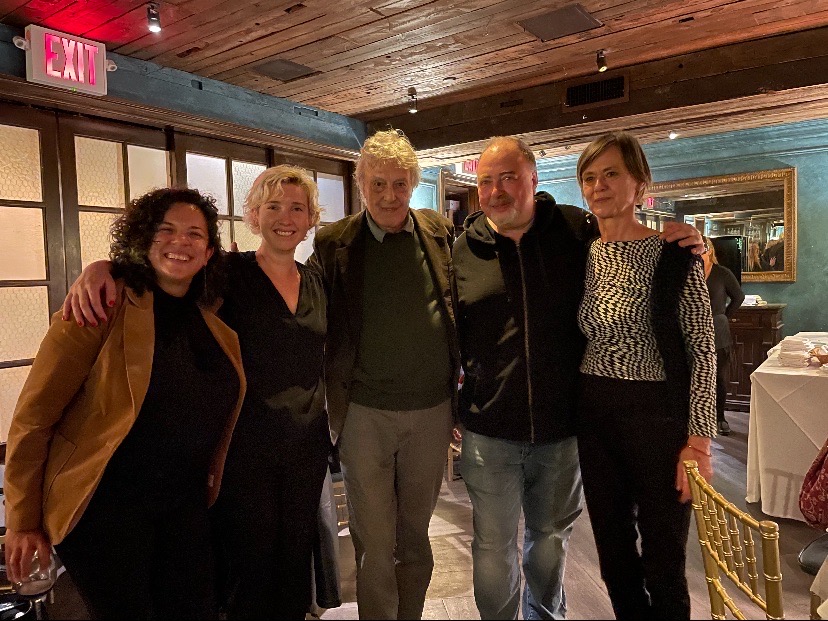
From left: Wilma managing director Leigh Goldenberg, coartistic director Morgan Green, playwright Tom Stoppard, coaristic director Yury Urnov, and founder Blanka Zizka in 2022.
Stoppard came to the Arcadia opening and became a frequent Wilma visitor over the years as the theater went on to produce 12 of his plays; he made his way to town for nearly every show and often attended rehearsals, too. He even helped with fundraising for the Wilma by visiting the homes of board members.
Zizka has happy memories of Stoppard’s visits, as well as the times he invited her to join him in New York for tea parties. Whenever she and her son traveled to England, Stoppard let them stay at his apartment and set them up with tickets to whatever shows they wanted to see. He would send her books to read and ask about not only her theater work but her other passions, like painting.
Stoppard was generous with his time, Zizka said, especially with younger theater artists and organizations like the Belarus Free Theater, which was forced to flee to England after facing political persecution for their work.
His plays provided a thrilling challenge for Zizka as a director and for the Wilma actors. She spent months preparing for brainy Stoppard shows, which the playwright meticulously researched as his characters included historical figures like Oscar Wilde, Vladimir Lenin, James Joyce, and Mikhail Bakunin.
“A lot of people consider him this intellectual playwright, but I think Tom is also full of emotions that are covered by those intellectual ideas. And for me, as a director, I didn’t have to look for the intellect … because it was there, but I had to always look for the world that is underneath the words,” she said.
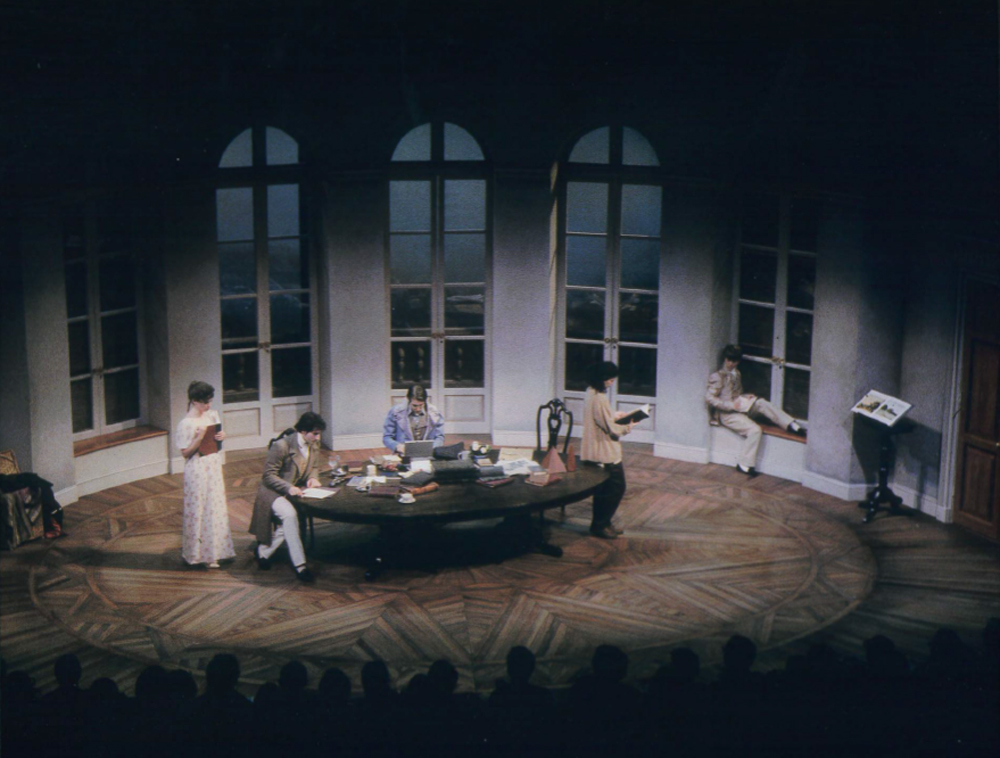
The Wilma Theater’s 2000 production of Tom Stoppard’s “The Invention of Love.”
That effort proved particularly difficult in the 2000 production of The Invention of Love, which centered on poet A.E. Housman. There’s a scene in which Housman meets a younger version of himself and the two engage in a lengthy debate over the placement of a comma — not typically the most entertaining of topics.
“It was two or three pages of dialogue, and it was so intense. … I just could not sleep over it. I felt we were in our heads, and it was boring,” said Zizka.
She had the actors try speaking in their own words to get the idea across but ultimately had a breakthrough when she asked them to perform in gibberish. The result was “an amazing, intense and exciting scene” in one of the most successful productions in Wilma history.
Gibberish helped them crack Stoppard’s code again in 2016, when the Wilma staged the U.S. premiere of The Hard Problem, which Zizka also directed. It followed a psychology student at a neuroscience research center attempting to understand the root of human consciousness.
Lindsay Smiling, now a co-artistic director at the theater, performed in the play and remembers meeting the famous dramatist in rehearsal, when they replaced Stoppard’s dialogue with nonsense words.
“It was nerve-wracking to do that in front of this playwright who is a legend,” said Smiling. “His work is so much about the language and his plays are very talky. … He was like, ‘I don’t know what you all did, but that is the scene with none of my words.’ And he was thrilled.”
As exciting as it was to discuss the work, Smiling marveled even more at Stoppard’s friendliness. After rehearsal, a group, including Zizka, went to Caribou Cafe for burgers and beer.
Wilma cofounder Blanka Zizka, playwright Tom Stoppard, and former Wilma staffer Julia Bumke in 2015.
“We sat outside on the sidewalk on Walnut Street and we talked about beer, we talked about history, we talked about Philadelphia,” said Smiling. “He was interested not just in theater makers and our lives … I remember him just coming back with all these conversations he’s had with random people on the street around Philadelphia.”
Though Stoppard did not spend too much time in the city, his contributions were profoundly meaningful to Philadelphia artists — and of course his work will continue to be produced across the region. Earlier this year, the Pennsylvania Shakespeare Festival stagedRosencrantz and Guildenstern Are Dead alongside Hamlet.
Of course, he’ll always be part of Wilma history.
“He was very much a strong part of what the Wilma was,” said Zizka. “We have not done any other playwright in such a big measure as we did his work.”
This article was updated with the correct release year for ‘Travesties.’
WASHINGTON — Don Garber said it when MLS announced its switch to a winter-centric schedule a few weeks ago, and he said it again Thursday at his State of the League address.
The commissioner knows as well as anyone that the league needs to not just change when it plays, but how it plays to truly improve its standing on the world stage. That means loosening the roster rules, letting teams not just spend more money but have more freedom about how they spend it.
This time, he said to not just the usual audience of domestic media who cover the league all year, but a big crowd of international journalists who came to the nation’s capital for Friday’s World Cup draw. Some of them might have headed to Fort Lauderdale afterward for Saturday’s MLS Cup final between Lionel Messi’s Inter Miami and Thomas Müller. (We can only wonder how many would have made the even shorter trip to Chester were the Union hosting.)
“One of our core principles is that we will do whatever it takes, and make whatever decisions necessary, that will define our future,” Garber said as he started to address the coming changes, including “increased investment in player development, and an evolution of our roster strategy that will elevate the overall quality of the play on the field.”
Don Garber (left) is no doubt pleased that Lionel Messi (right) and Inter Miami made this year’s MLS Cup final.
Those were some strong words, and they prompted a natural question. Just how far is the league willing to go to deliver that pledge? And in particular, how much work is the commissioner himself willing to do behind closed doors to push team owners who want to spend less than others do?
“MLS has had this view, and it’s defined the position that we’re in today, that our owners are partners off the field, and they’re fierce competitors on the field,” Garber said. “And in order to do that, you’ve got to consider the thoughts of teams that are in smaller markets that might have a different view as to what the competitive balance should be, and then those that are in larger markets and newer stadiums. You would say maybe the legacy teams versus the middle teams versus the new teams.”
Indeed, many watchers would say that, and some were facing Garber’s podium.
“Our job is to pull them all together,” Garber said of his circuit’s 30 clubs, “and come out with a competitive format and roster rules that move our league forward.”
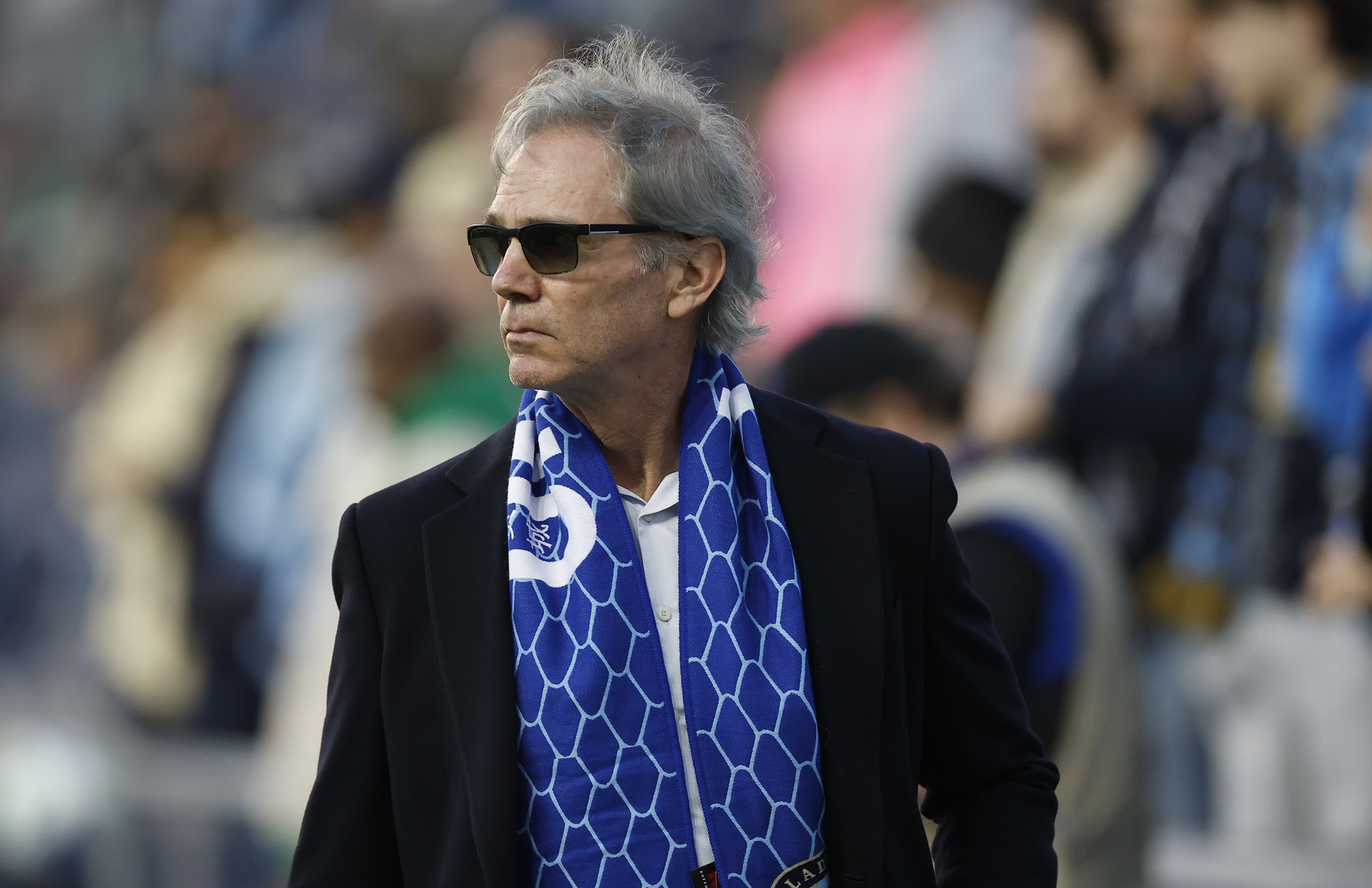
Philadelphia Union Chairman and Majority Owner Jay Sugarman before Union played the Chicago Fire FC in a first round MLS playoff game at Subaru Park in Chester, Pa., on Sunday, October 26, 2025.
‘Nudge it a little more’
He asked the next question himself, before others could.
“And how do you do that?” he said. “You know, you can listen to noise — and noise is important, because noise is really research — and get an understanding of where fans are and where is MLS in the conversation. But it’s also about metrics. What’s driving our revenue? What’s driving our ratings? What’s driving the overall sale of our commercial [product], which speaks to fan interest and what we call fan avidity?”
Garber did not need to use that jargon to back up his point that “that’s all moving in the right direction with the rules that we have.” No one, even the league’s critics, doubts that is happening. It’s just about how quickly or slowly that movement is going. And with the unparalleled opportunity that comes from the World Cup being on home turf, Garber knows it’s time to push the gas pedal.
“How do you nudge it a little more as the market gets more sophisticated?” he said. ”And that’s our job. And you’ve got to figure out ways that you go into a board room, and you wrangle a bunch of them together, and you do the work in committees, and base it on research. We try to not to be distracted by the loud voice of few, but use data to drive our decisions, and research that drives decisions, and that’s what made MLS successful.”
The Vancouver Whitecaps’ signing of German legend Thomas Müller helped push the team to its first MLS Cup final.
Garber engages more with the rest of the world’s soccer leagues than he ever has. He sits on the management board of the World Leagues Forum, along with English Premier League CEO Richard Masters and Italian Serie A CEO Luigi De Siervo.
That is good company to keep, but it’s also a constant reminder of how far MLS has to go.
“[MLS is] very different from the rest of the world, which has open rules and basically can do what they want, but they have different competitive formats,” Garber said. “They have their version of the Champions League, which has its own economic value. We’ve got to think about our business and ensuring that our league is stable and moving in the right direction.”
Garber concluded his reflection by saying that the league will “continue to do what we’re doing, and push the envelope as much as we can without being reckless.”
Where the balance of that lands will define the rest of his tenure.
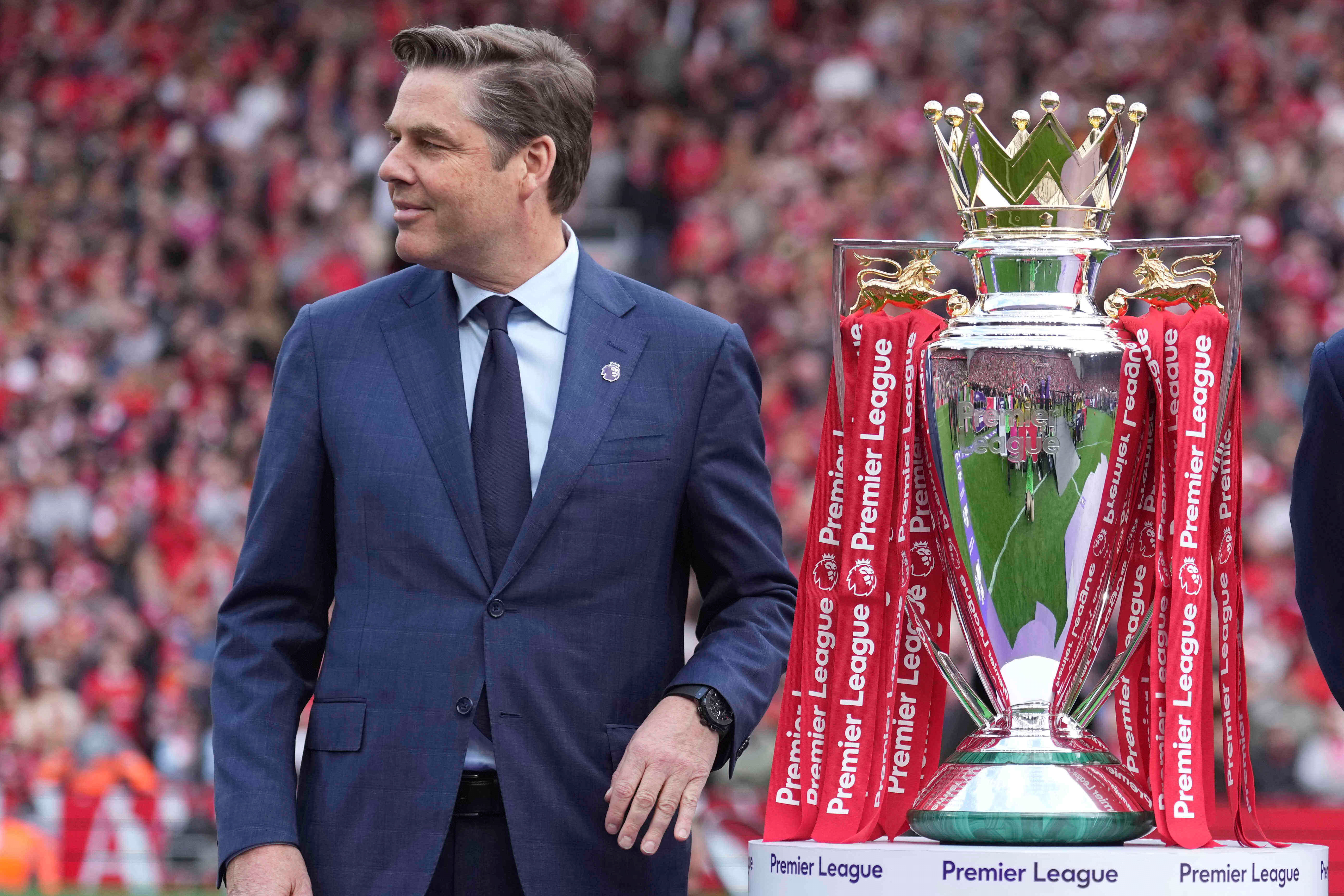
English Premier League CEO Richard Masters knows MLS commissioner Don Garber well.
Promotion and relegation?
Speaking of MLS’s differences from the rest of the world, Garber was given a proverbial open goal to shoot at when a reporter from abroad asked if MLS will ever have promotion and relegation, a cornerstone of the global sport.
In most of those years, as Garber went on to indicate, he thumped his shot in with a resounding no. But there is growing speculation that he might retire when his contract ends in 2027. He has not stopped that speculation in recent times, by talking about how the league will look after he steps down. He went in that direction again Thursday.
“This will be fun,” he said to start his answer. “In every single press conference we’ve ever had, somebody’s saying, ‘When are you going to have promotion and relegation?’”
That is indeed close to true.
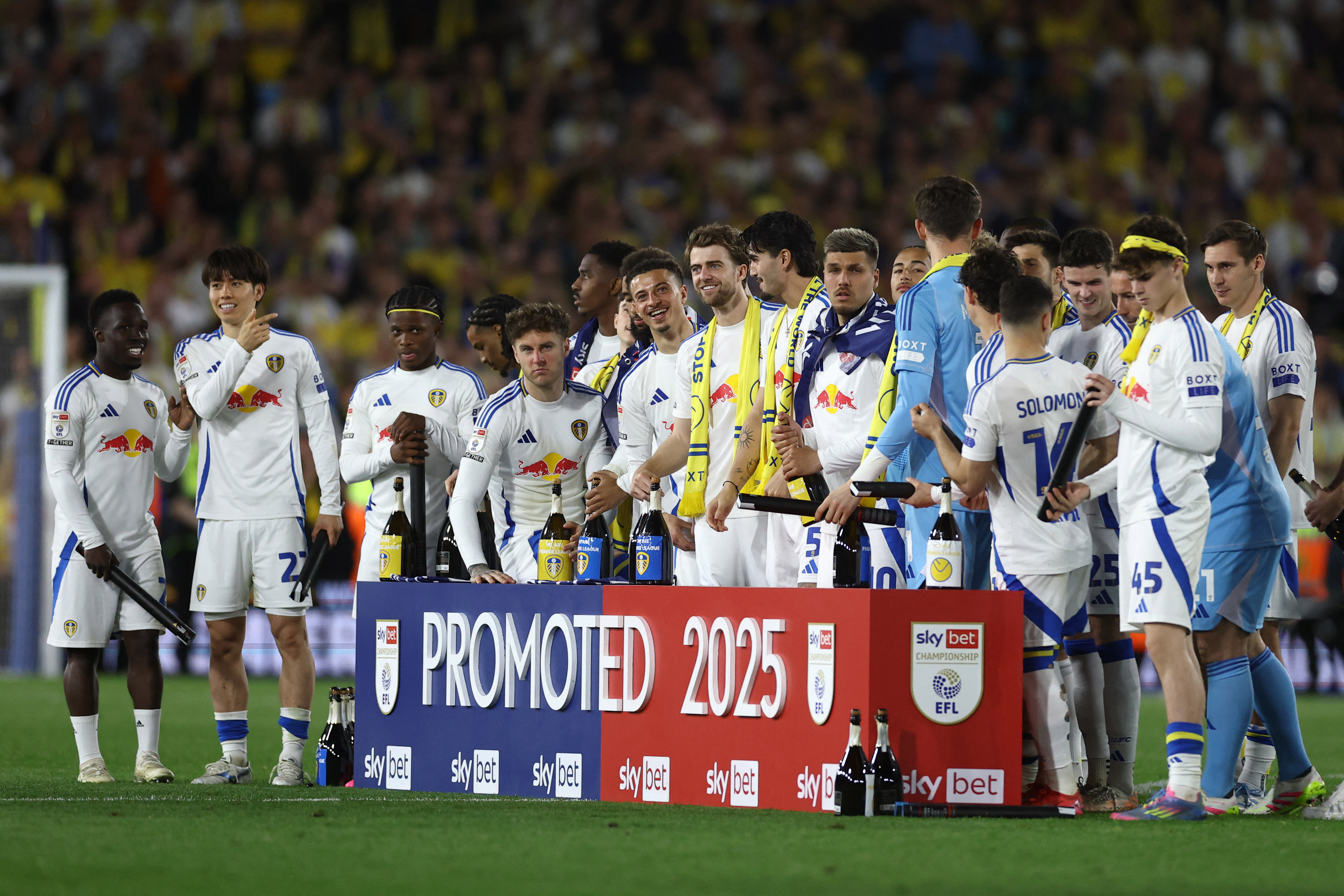
With a squad including Medford’s Brenden Aaronson, England’s Leeds United has shown in recent years how dramatic promotion and relegation can be.
“Back in the day, I would say, ‘Never,’” Garber said. “Today I would say, ‘There’s no real point in saying never, because I don’t know what the future will look like.”
Garber admitted the league’s calendar flip influenced his thinking on that, as something he also “never thought we would adapt to.” But with that now happening, and with the lower leagues of the USL getting stronger over time — albeit in a totally separate business entity — the question continues to arise.
He stood on his longtime point that relegation is bad for team owners who invest a lot of money and don’t make it back. But when Americans buy European clubs, as happens often, they know what they’re getting into, and Garber knows a fair few of them from his travels.
“If I were to ask most European leaders of pro leagues, and many owners, whether or not promotion and relegation was good for their investment and good for the broad, macro view of the sport,” he said, “most of them will say, ‘Well, I’m not quite sure. But as a fan, I think it’s kind of fun and it’s kind of cool.’”
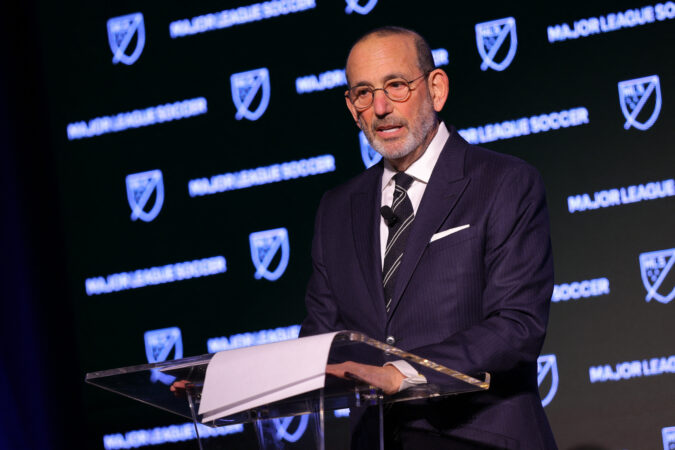
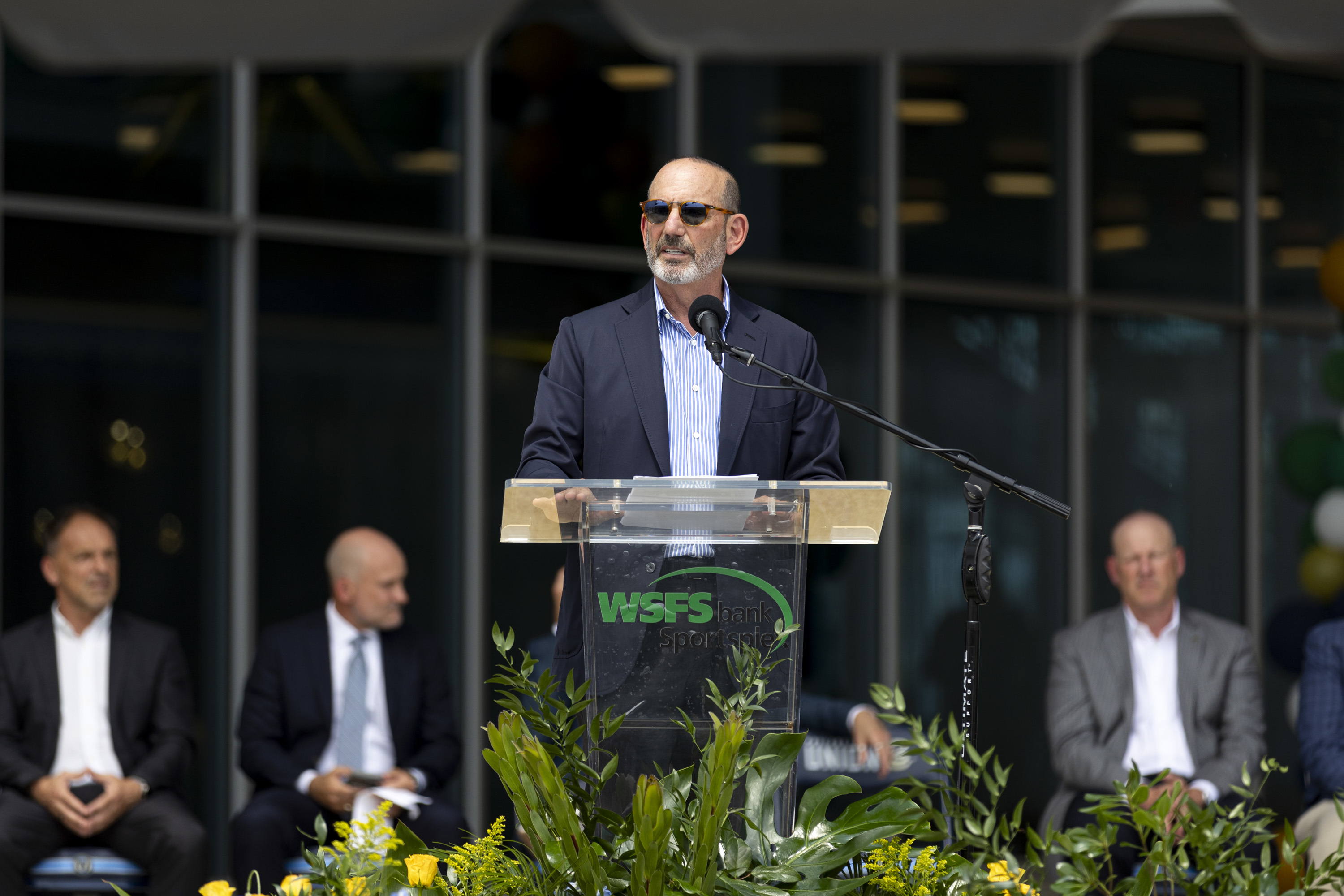
Don Garber, Major League Soccer Commissioner, speaks at the WSFS Bank Sportsplex Ceremony in Chester, Pa., on Thursday, July 17, 2025.
From there, he cracked open the door for a moment.
“So let’s see how it plays out,” Garber said. “Maybe as the development of the lower divisions continues to grow, as they’ve been doing so well over the years, there would be a proper ecosystem. I’m not sure — frankly, I don’t believe that ecosystem consists can exist today. But who knows? I’ve learned, never say never.”
Then, after taking a breath, he slammed the door right back shut.
“That doesn’t mean we’re having promotion or relegation anytime soon,” he said, and went on to the next question.
It has been a few weeks since A.J. Brown has been a major topic of consternation and conversation around the Eagles. The easy explanation for the relative quiet is that Brown hasn’t posted anything on social media lately that would get people to raise their eyebrows. The even easier explanation — and maybe so easy that it’s a cheap shot against Brown — is that he caught 18 passes for 242 yards and three touchdowns against the Bears and the Cowboys, and even though the Eagles lost both of those games, Brown must be content that he’s finally getting his numbers again.
That narrative — that Brown is only about Brown, and his selfishness damages the Eagles — has never held up under much scrutiny. Should he stay off social media more? Of course he should. But they have a 53-18 record (in regular-season and postseason games), have won a Super Bowl, and reached another since acquiring him. At least 29 other teams in the NFL would sign up for that level of damage.
What’s more, there’s nothing inherently wrong with Brown wanting the ball more in the name of benefiting himself and benefiting the Eagles. The two goals aren’t mutually exclusive, and it’s understandable that Brown would raise a stink with Jalen Hurts, Kevin Patullo, or both if he didn’t believe he was being used properly or frequently enough.
Think of it like this: Brown is to the Eagles’ offense as an outstanding reporter or writer is to a news organization, and Patullo and Hurts are his editors. If the editors relegated that reporter to the least important and relevant assignments — when he has produced and is capable of producing well-read, Pulitzer-caliber journalism — he would be within his rights to tell them, Hey, you aren’t maximizing my skills, and it’s hurting the whole news operation, too.
Would that make him selfish? Maybe. Would it make him self-interested? Yeah. Would it make him right? Absolutely.
Maybe tap the brakes on the Trevor Zegras anointment?
Have you forgotten Andrew MacDonald?
Trevor Zegras has been terrific so far, but before anyone starts thinking about making him a Flyer for life, can he get through half a season here first?
Kyle and the cash register
The very simple reason to be optimistic that the Phillies will re-sign Kyle Schwarber comes down to three words.
Butts in seats.
Yes, Schwarber has improved as a hitter over the last two years, putting the ball in play more often and raising his batting average without sacrificing any of his power. Yes, he’s an outstanding clubhouse leader. And yes, his presence is necessary if the Phillies are to get over their October bugaboos, get back to the World Series, and win it. Those factors make him vital to the franchise.
But a baseball season, despite the attention and excitement that the playoffs generate, is not the playoffs alone. The 162-game march to the postseason matters too. It matters a lot. And Schwarber has overtaken Bryce Harper as the player on the Phillies roster whose at-bats are true can’t-miss theater. If you’re at Citizens Bank Park on a chilly night in early May, waiting to get your hot dog and beer, the chance to see Schwarber blast one 450 feet is probably one of the reasons you’re at the ballpark in the first place. And if he comes up and you’re still waiting, you might just hop out of that long line to make sure you don’t miss one of his lighting bolts. He’s the guy who makes you stop and watch.
Sports is still first and foremost an entertainment product, and Schwarber provides more entertainment night to night than any other Phillies player. John Middleton isn’t likely to let someone steal such an asset away, for any price. He’d be a fool if he did.
Allen Iverson was a 40-plus-minute man before the term “load management” entered the NBA vernacular.
Maxey and A.I. as iron men
Ahead of the 76ers’ matchup in Milwaukee against the Bucks on Friday night, Tyrese Maxey was leading the NBA in minutes played per game. His average: 40.0.
All kudos to Maxey for bringing it every night for as long as he does. But just for some perspective, it’s worth noting that for a 10-year period, from the 1998-99 season through the 2007-08 season, Allen Iverson never averaged fewer than 40.8 minutes. And over his six seasons from 2001 through 2007, he averaged 42.5 minutes and led the league in minutes five times. When the man said he played every game like it was his last, he meant it.
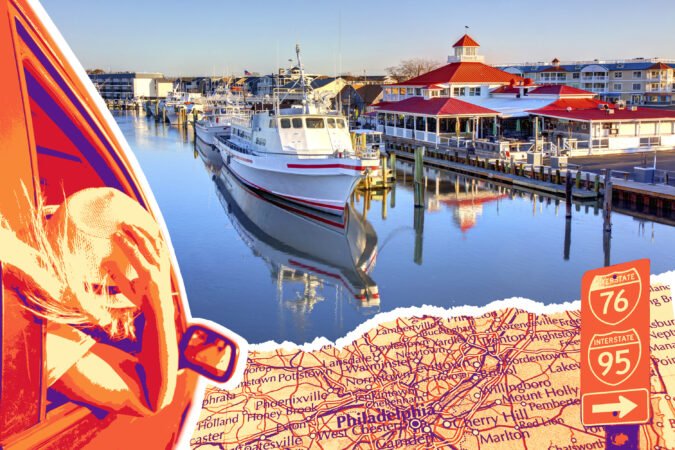
They don’t go “down the Shore” on the other side of the Delaware Bay. First Staters go to the beach — or, more geographically correct, to the Delaware Beaches: the neighboring Atlantic towns of Rehoboth, Dewey, Bethany, and Fenwick Island, familiar to most Philadelphians even if they’ve never been.
The Delaware Beaches and Lewes, their historic bayside gateway, are charming and festive during the holidays. Come for the tax-free shopping and craft-beer icons, stay for the smart indie restaurants and pristine nature. It’s a quick trip across the bay on the ferry. Margate, Ocean City, and Wildwood will still be there when you get back.
Getting to Coastal Delaware is half the fun when you take the Cape May-Lewes Ferry. It takes about the same amount of time to drive directly from Philly to Lewes as it does to drive to Cape May and board the boat for the 85-minute crossing, but only one option gives you cinematic views of the Delaware Bay — historically the most important waterway in the region. (No bay for Billy Penn to sail up, no founding of Philadelphia.) It’s also a key environment for marine life, from oysters and mussels to dolphins and seals. You might even catch a migrating humpback whale on the 17-mile crossing.
📍 1200 Lincoln Blvd., North Cape May, N.J. 08204
Stay: Dogfish Inn
One of the original craft-beer brands, Dogfish Head is maybe the most famous Delaware resident who wasn’t also POTUS. Sam Calagione founded the Milton brewery — more on that in a minute — in 1995, and it became such a tourist magnet that a hotel was a natural expansion.
The friendly, 16-room Dogfish Inn opened in 2014 and sits along the Lewes–Rehoboth Canal, walking distance to both the ferry and downtown. Rooms are simply furnished and stylish, with branded swag and pops of olive and teal. Outside, beer pilgrims, holiday shoppers, and their dogs (the inn is pet-friendly) gather around the Cowboy Cauldron, the nickname for the communal firepit.
Fig-tahini danish, pumpkin-cheesecake conchas, and sugared doughnuts plumped with chai-spiced cream gleam in the pastry case at the Station on Kings, a charming café with arboreal décor and a greenhouse dining room that feels sunny even when winter clouds cover the coast. Grab a table and settle in for a leisurely brunch of those excellent baked goods, a creamy French omelet, maybe the calendar-correct Mistletoe Matcha, Station’s matcha latte sweetened with white chocolate-peppermint syrup. After, browse the selection of candles, soaps, ornaments, and other local and artisan gifts.
📍 720 Kings Hwy., Lewes, Del. 19958
Shop: Tanger Outlets
Continue making your list and checking it twice at the Tanger Outlets in Rehoboth. Bargain hunters come year-round, but the holiday sales are especially enticing. The complex is divided into three clusters (Surfside, Seaside, Bayside) along Route 1, with more than 100 brands, including Nike, North Face, and Le Creuset.
📍 Route 1 Coastal Hwy., Rehoboth Beach, Del. 19971
There’s a windswept solitude to the beach in December that, for anyone raised on towel-to-towel summer crowds, is narcotically surreal. Encompassing more than 5,000 acres of sandy shores, reedy wetlands, and maritime forest, Cape Henlopen State Park is the place to get centered in nature at the Delaware Beaches. Walking trails lace the preserve, winding through historical sites like Fort Miles, which played a critical coastal defense role in WWII, and around Gordon’s Pond. Head to the Point, near the hooked tip of Cape Henlopen, for views of the 140-year-old Delaware Breakwater Lighthouse.
📍 15099 Cape Henlopen Dr., Lewes, Del. 19958
Sip: Dogfish Head Brewery
Despite being bought by the Boston Beer Company in 2019, Dogfish remains a Delaware darling. The brand offers multiple touchpoints throughout the beaches, but it’s worth the 15-minute drive west of Lewes to the Milton brewery. Tours run three times daily, seven days a week, and include a pour of 60 Minute IPA. For an extra $8, enjoy a tasting flight in the on-site taproom.
📍 6 Cannery Village Center, Milton, Del. 19968
Eat: the Blue Hen
Located a block and a half from the beach, on the ground floor of the Avenue Inn & Spa, the Blue Hen gives cozy coastal tavern vibes with pewter-blue paint, carved woodwork, and a gallery wall of framed photographs. The cooking, from chef Julia Robinson, elevates the genre: gingered lobster toast with dashi aioli, mezze rigatoni with pistachio pesto and confit chicken, Iberico pork Milanese.
Robinson bought the Blue Hen with her wife, sommelier and GM Heather Sharp, in 2022 after moving from Philly in 2017. Walking the Rehoboth boardwalk after dinner, it’s easy to see the appeal.
The house: a 1,254-square-foot rowhouse in Port Richmond with 3 bedrooms and 2½ bathrooms, built in 1925.
The price: listed for $315,000; purchased for $325,000
The agent: Rachel Shaw, Philly Home Girls
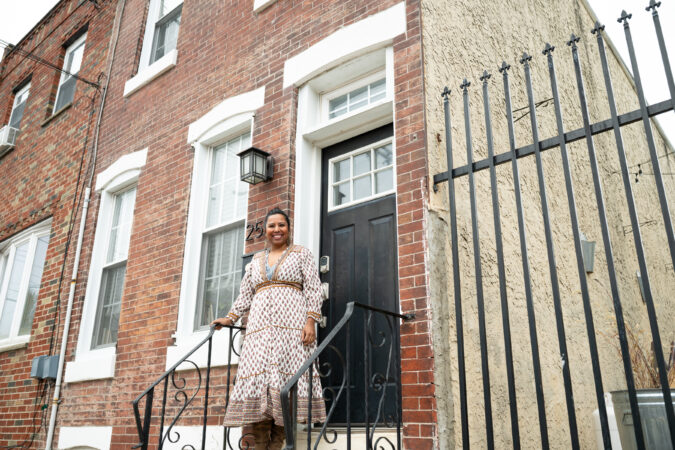
The ask: The first time Sindhu Nair tried to buy a house, the deal collapsed the day of closing. A lender told her last minute that he couldn’t approve the loan after all. The experience left such a sour taste that she stepped away from the market for years. But by 2025, she felt ready to try again, especially after seeing how much money she had sent her landlord on Cash App in the past two years. She was done giving her money to someone else, she said.
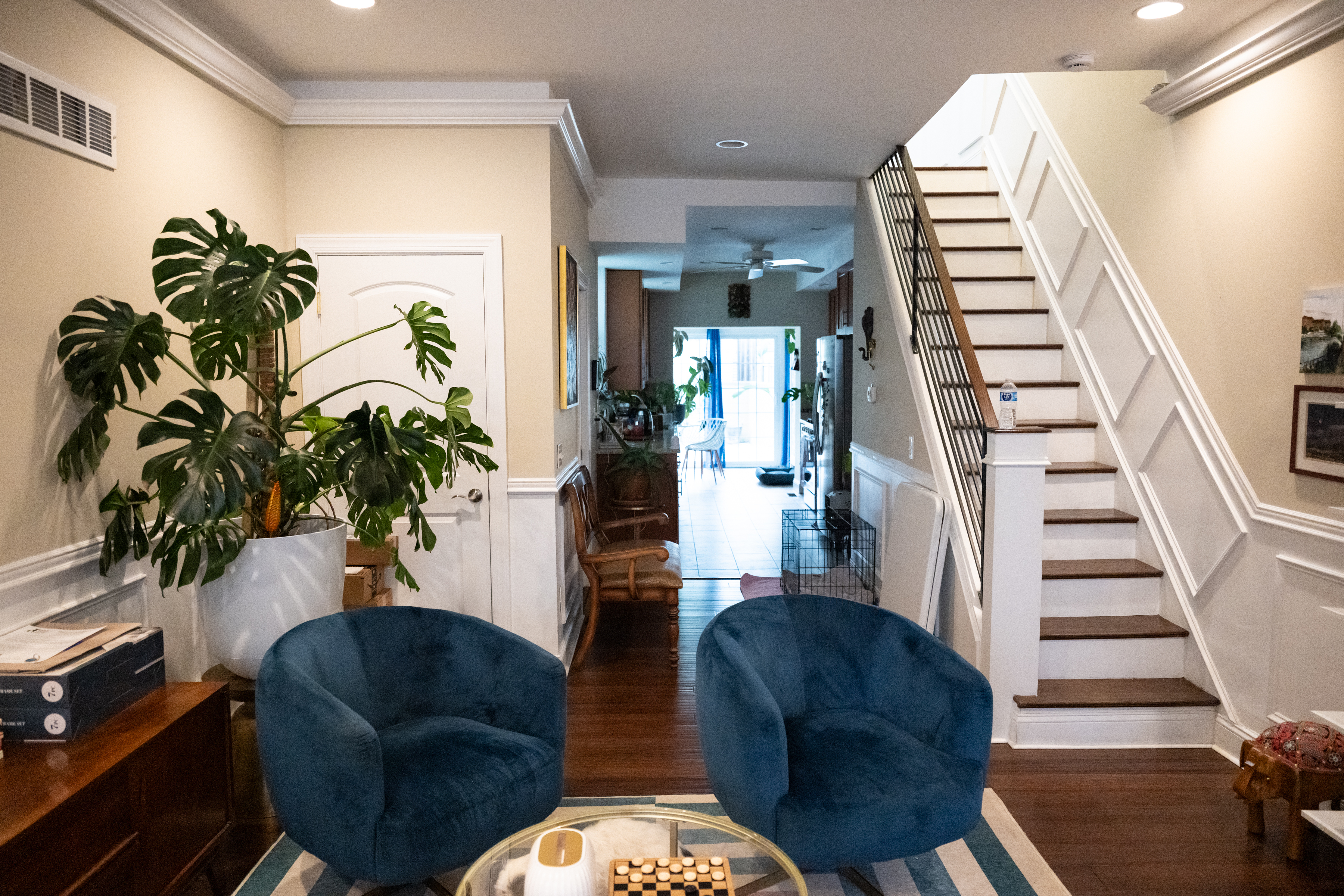
Sindhu Nair loved the light and the “good vibes” in the house’s living room.
Nair had been looking for a house for years and knew what she wanted. “I trusted my gut instincts,” she said. She needed at least two bedrooms and a bathroom on the ground floor. She also wanted a small backyard for her dog and access to easy street parking. She limited her search to the Port Richmond area. “My dog walker lives in this area,” Nair said, “so I’ve been in the neighborhood a lot, and it’s just so cute.” Her budget was $350,000.
The search: Nair began her search in July. The first place she toured had two private parking spaces but needed a gut renovation. “I didn’t want to take on that financial burden,” she said. She visited two other open houses that afternoon. Both appealed to her, and she hoped to make an offer on the less expensive one, but it already had two bids. She would have had to offer well over the $250,000 asking price to be competitive.
Meanwhile, the pricier home — the one she actually preferred — had no competing offers. After running the numbers and realizing the difference in cost was smaller than she expected because of the competing offers, she shifted course. “I decided just to go for the house that I wanted,” Nair said.
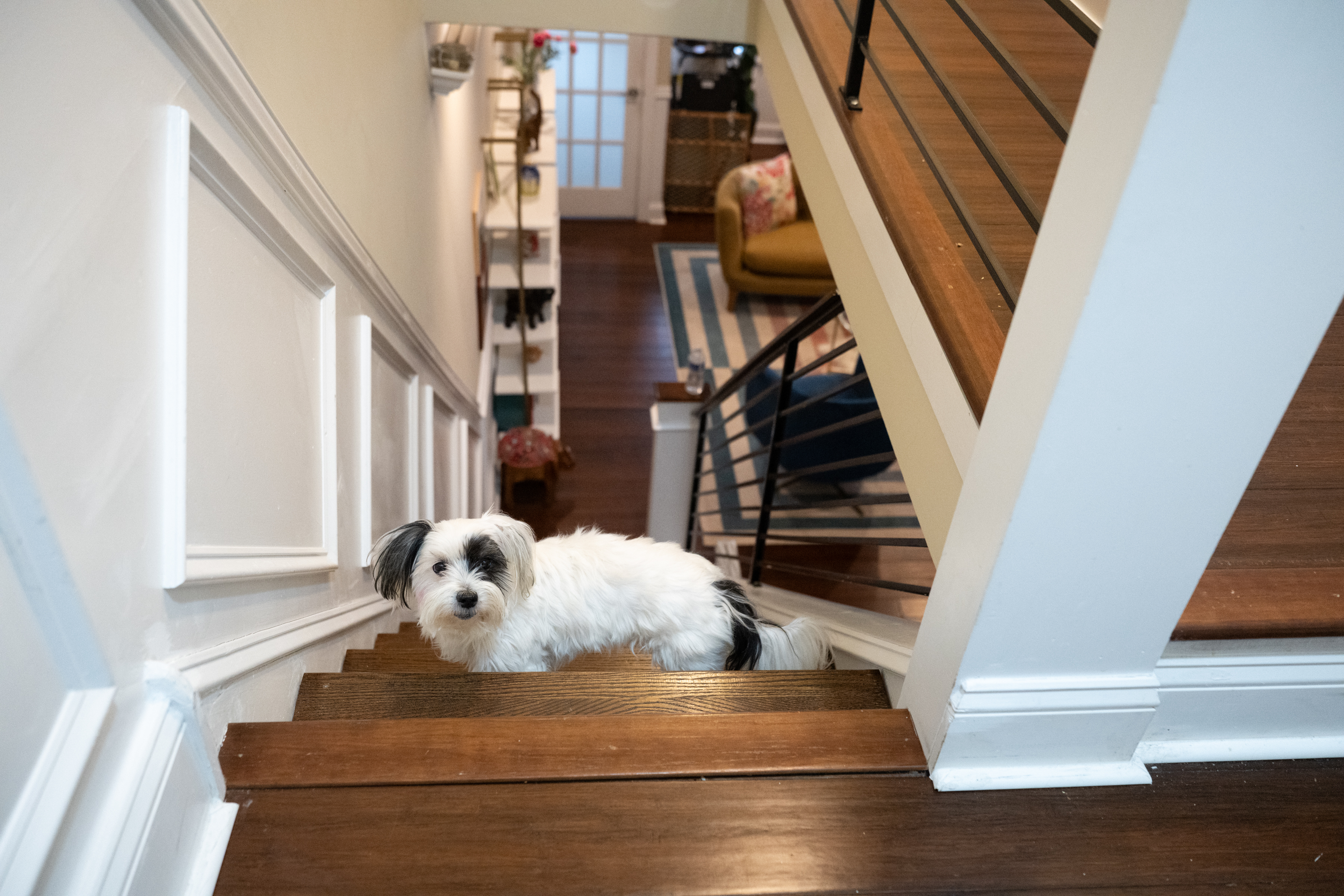
Sindhu Nair’s dog, Scotty, approves of her purchase.
The appeal: Nair says she knew she had found the one as soon as she stepped inside. “I think the universe was ready to provide me with this house,” Nair said. The light looked amazing, the space had a “good vibe,” and the backyard was the perfect size for her dog, Scotty. She loved that it was move-in ready. “Whoever rehabbed it did a beautiful job,” Nair said.
The deal: The seller’s agent told Nair at the open house that the seller was motivated and willing to offer a seller’s assist, which is when the seller agrees to cover a portion of the buyer’s closing costs. Nair and her agent asked for enough to covernearly all of Nair’s closing costs.
In return, Nair offered $325,000 — $10,000 over the asking price — even though there weren’t any other offers. “We wanted to make sure that with the seller’s assist, she was still going to make a profit,” Nair said. She views the seller’s assist as a tool she used to keep more money in her bank account after she purchased the home. “It has nothing to do with financial stability,” Nair said. “It’s a financial tool that people should take advantage of.”
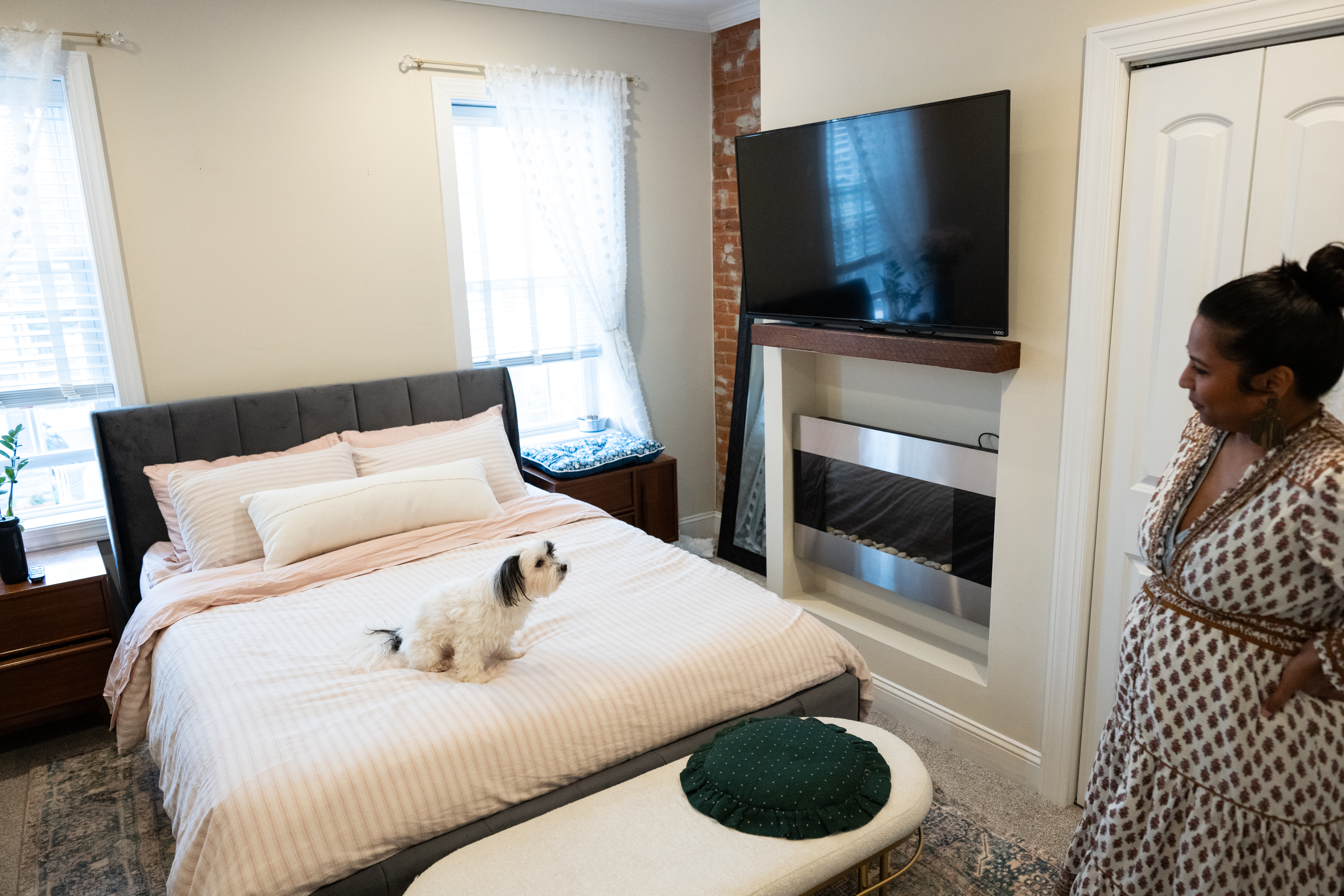
There are three bedrooms in Nair’s home. Scotty sleeps in the bedroom with Nair. Nair’s foster cat has her own room.
The seller accepted Nair’s offer and agreed to the amount for the seller’s assist.
The money: Nair began the year with about $60,000 in savings, but she used roughly half to pay off her private student loans. “They’d been the bane of my existence,” she said. “I imagined being 70 or 80 years old with debt collectors still calling me.” Paying off that balance left her with about $30,000, money she had saved gradually over the years. She didn’t want to use all of it for a down payment, though. “I wanted to have a cushion for anything that came up after I bought the house,” she said.
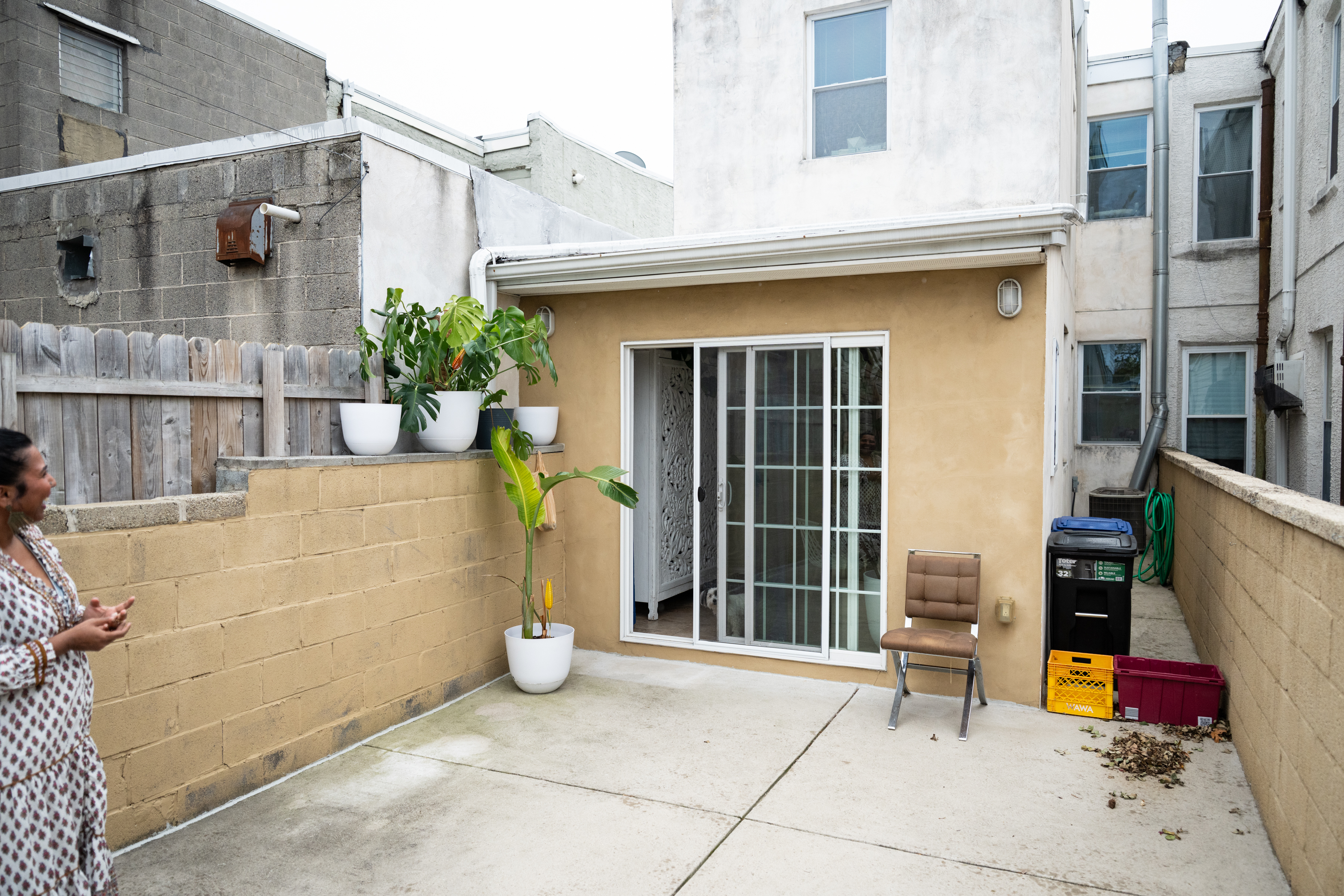
The back patio is the perfect size for Scotty, Nair says.
To keep more cash on hand, she worked with her lender to take out an FHA mortgage, which requires as little as 3.5% down and allows sellers to contribute to closing costs. With a seller’s assist, her out-of-pocket contribution dropped to around $10,000. Without it, she would have paid closer to $20,000. “It’s my first home,” Nair said, “and I’m proud of the strategies I used to get it.”
The move: Nair closed on the house on Aug. 25, a few days earlier than planned. The original closing date was Aug. 28, but she asked to move it up so she could leave her apartment before Sept. 1 and avoid paying another month of rent. She admits she was nervous while she waited for her mortgage to be approved. “I was sweating because of my first experience,” she said. “But my lender kept telling me, ‘Nope, you’re good. I would have told you if there was an issue.’”
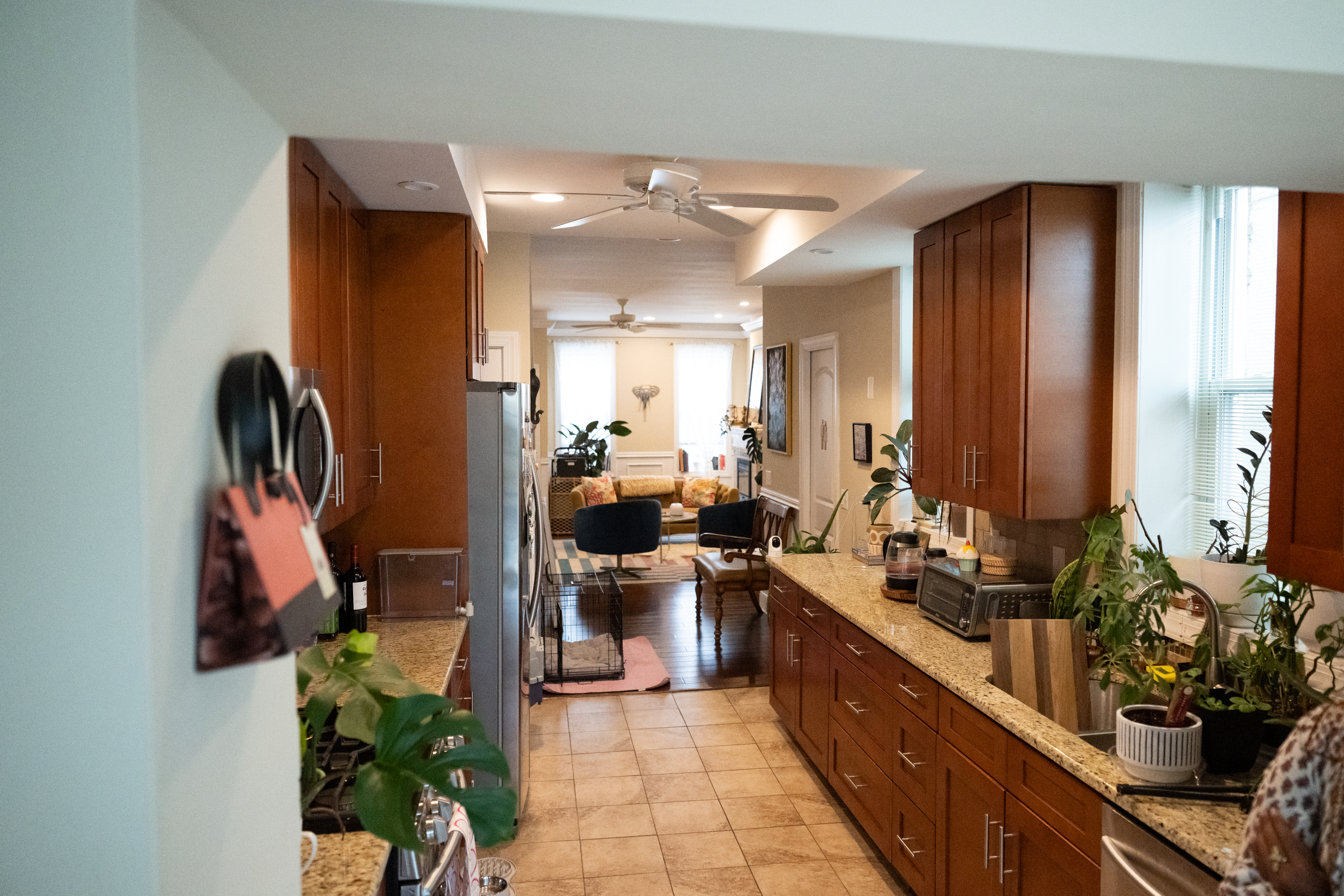
The kitchen and living room in Sindhu Nair’s home.
Once her approval came through, she began lining up help. She hired someone to assist with packing and brought in movers for the actual move, but the two-step arrangement proved more frustrating than she expected. “I realized I didn’t save any money, and I just gave myself a headache,” she said. Next time, she plans to hire a company that handles everything — packing, loading, unloading, and unpacking — in one coordinated sweep.
Any reservations? Nair says she doesn’t have any regrets about the purchase. “I think I got lucky, and I feel very proud of myself for having this accomplishment,” she said. She’s thrilled to have paid off her student loans and bought a home in the same year, and she hopes her experience sends a message to others. “I want people to know, especially single women, that you can do this,” she said. “It’s not easy; it’s very hard, but it’s doable.”
Life after close: A Halloween housewarming party forced Nair to get the main parts of her house unpacked and organized, but there is still work to be done. She just started unpacking her basement and is getting ready to set up her office in the smallest bedroom. She’s not sure what she’ll do with the other bedroom. It currently houses an animal. “I have a cat that I’m fostering,” Nair said, “and that’s her bedroom.”