Blog

  • Traveling to Southern Europe? Here’s what to know about a deadly parasite active there.

    Traveling to Southern Europe? Here’s what to know about a deadly parasite active there.

    Are you planning a vacation to Spain, Italy, France, Greece, or another country along the Mediterranean?

    If so, you should know about a parasite that puts travelers at risk of a rare disease, called “visceral leishmaniasis,” that can be deadly when untreated. The parasite — leishmania — is transmitted by a bite from an infected sandfly. It can lie dormant in the body for years, then later cause severe illness, including persistent high fever.

    A 34-year-old South Jersey resident, Louis-Hunter Kean, died from it in late 2023 after doctors at two South Jersey medical systems and later at Penn Medicine missed the diagnosis. His symptoms developed about a year after he vacationed in Tuscany, where parasitic disease experts now believe he was infected.

    “Leishmania in the U.S. is underappreciated,” said Joshua A. Lieberman, assistant director of the molecular microbiology clinical laboratory at University of Washington in Seattle. “We want to get the word out that there’s a lot more of it than we think.”

    Parasitic disease experts say most American doctors don’t know enough about leishmania. Here’s what you should know about leishmania:

    Where is the parasite active and who’s at risk?

    Worldwide, there are more than a dozen species of leishmania that cause three different diseases in humans.

    Visceral leishmaniasis is caused by the most deadly species. At risk are travelers to Southern Europe, Brazil, East Africa, India, and military personnel who were deployed to Afghanistan and Iraq. Its primary symptom is fever, along with an enlarged liver and spleen, weight loss, and a low blood cell count. Each year, an estimated 50,000 to 90,000 new cases are reported globally, according to the World Health Organization (WHO).

    The majority of healthy people who get infected never experience symptoms or sickness. However, the parasite can cause severe illness in small children, senior citizens, and people who are malnourished or immunocompromised. It can activate decades after exposure.

    Cutaneous leishmaniasis is the most common and less dangerous form of the disease. This species is present in the countries that also have visceral leishmaniasis, as well as in Israel, Mexico, Central and South America — and in a few U.S. states, including Texas, Oklahoma, and Arizona. More than 80 cases have been reported in the U.S. since 2017, though experts believe that’s an undercount, according to a recent study published in the digital journal JMIR Dermatology.

    People with active cases first see small, red bumps on the skin that can develop into skin ulcers, which may ooze or scab. These symptoms typically appear within weeks or months after exposure, but ulcers can surface years later. Worldwide, an estimated 600,000 to 1 million cases occur each year, according to the WHO.

    “If you’re traipsing through the rain forest in Central America, you’re at huge risk,” said leishmania expert David L. Sacks, an immunologist and senior investigator with the National Institutes of Health (NIH). “We see patients all the time at the NIH hospital who have the cutaneous form from traveling.”

    Mucosal leishmaniasis is most commonly found in parts of the Amazon basin, specifically Bolivia, Peru, and Brazil. Symptoms usually start as a skin sore, which can advance to the nose, mouth, or throat and cause severe facial disfigurement. It can be life-threatening.

    Can leishmaniasis be treated?

    All three types are treatable with antiparasitic and antifungal medications.

    Some forms of cutaneous leishmaniasis will heal on their own.

    More than 90% of patients with visceral leishmaniasis will die without treatment. An estimated 20,000 to 50,000 people die from it each year, according to research published in the academic journal Tropical Diseases, Travel Medicine and Vaccines.

    How prevalent is leishmaniasis in the U.S.?

    An exact number of cases is unknown. The federal government does not require doctors to report the disease to the Centers for Disease Control and Prevention. Texas is the only state that requires medical providers to report cases to the state health department.

    The CDC identified 1,222 cutaneous leishmania cases in the U.S. from 2005 to 2019.

    How can you protect yourself against leishmaniasis?

    There are no vaccines or drugs for prevention, but people can take steps to protect themselves when visiting areas where the parasite is circulating.

    Sandflies are most active from dusk until dawn, so consider staying indoors during that time. Wear long-sleeved shirts and long pants, and socks that cover ankles. Apply insect repellent, preferably with DEET, to clothing and exposed skin. Sandflies can slip through window and door screens, so it’s best to stay in accommodations with air-conditioning or sleep under insecticide-treated bed nets.

    People who are immunocompromised may want to avoid travel to regions with leishmania.

    Also, if you experience symptoms, especially a high fever that won’t go away, provide your doctor with a thorough travel history, going back decades.

  • Tyrese Maxey: The hero Philadelphia needs

    Tyrese Maxey: The hero Philadelphia needs

    There is no Philadelphia sports figure without blemish.

    The Phillies’ hitters failed again, and Zack Wheeler is hurt. The Eagles collapsed en masse after winning their second Super Bowl; even Saquon Barkley took hits before and during the season. The Flyers remain mired in a rebuild. And no team has engendered as much disappointment, if not disgust, as the Sixers over the past 14 years.

    With one exception.

    Tyrese Maxey.

    With his incandescent smile, his irrepressible joy, his boundless energy, and what has turned into a sterling set of skills and talents, Maxey is a beacon among the blurred and foggy landscape of Philadelphia sports.

    Everybody loves Maxey. He’s the breath of fresh air Philly sports needed. He’s never worried about the score of the game. You never see him dog it. He’s Pete Rose with a jump shot.

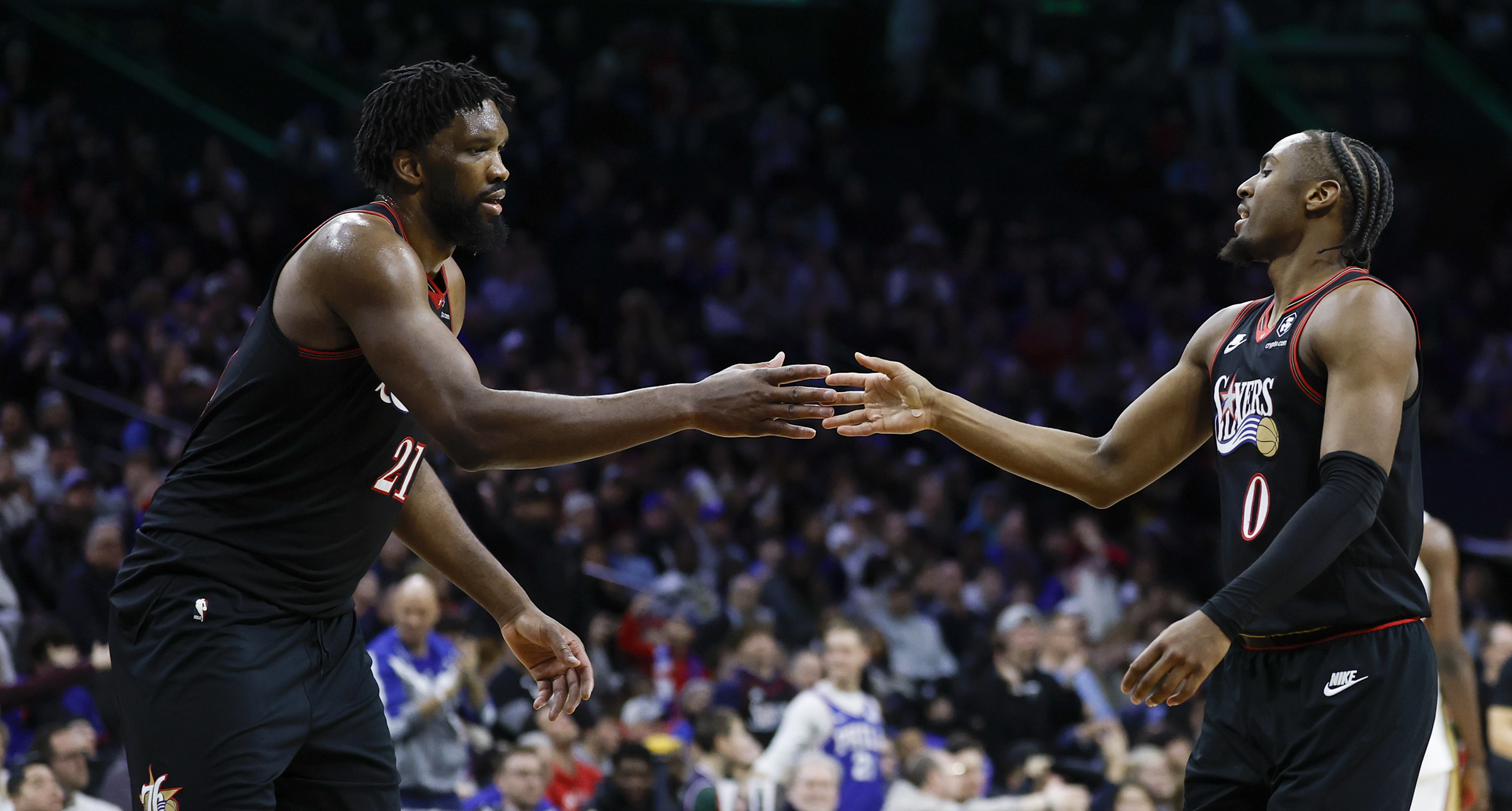
    Sixers guard Tyrese Maxey (right) no longer has to play second fiddle to Joel Embiid.

    Maxey will represent the Sixers as an NBA All-Star Game starter in Los Angeles on Sunday. This is fitting, since he’s the embodiment of what the Sixers hope to be and emblematic of how Philadelphia sees itself.

    Joel Embiid represents “The Process,” has been diminished as a part-time role player, and is a reminder of the disastrous slash-and-burn rebuild that began in 2013.

    Paul George represents the failed philosophy of Sixers president Daryl Morey, who bet everything on James Harden both in Houston and Philadelphia and made a similarly bad bet on George, addled by injury and seven games into a 25-game drug suspension.

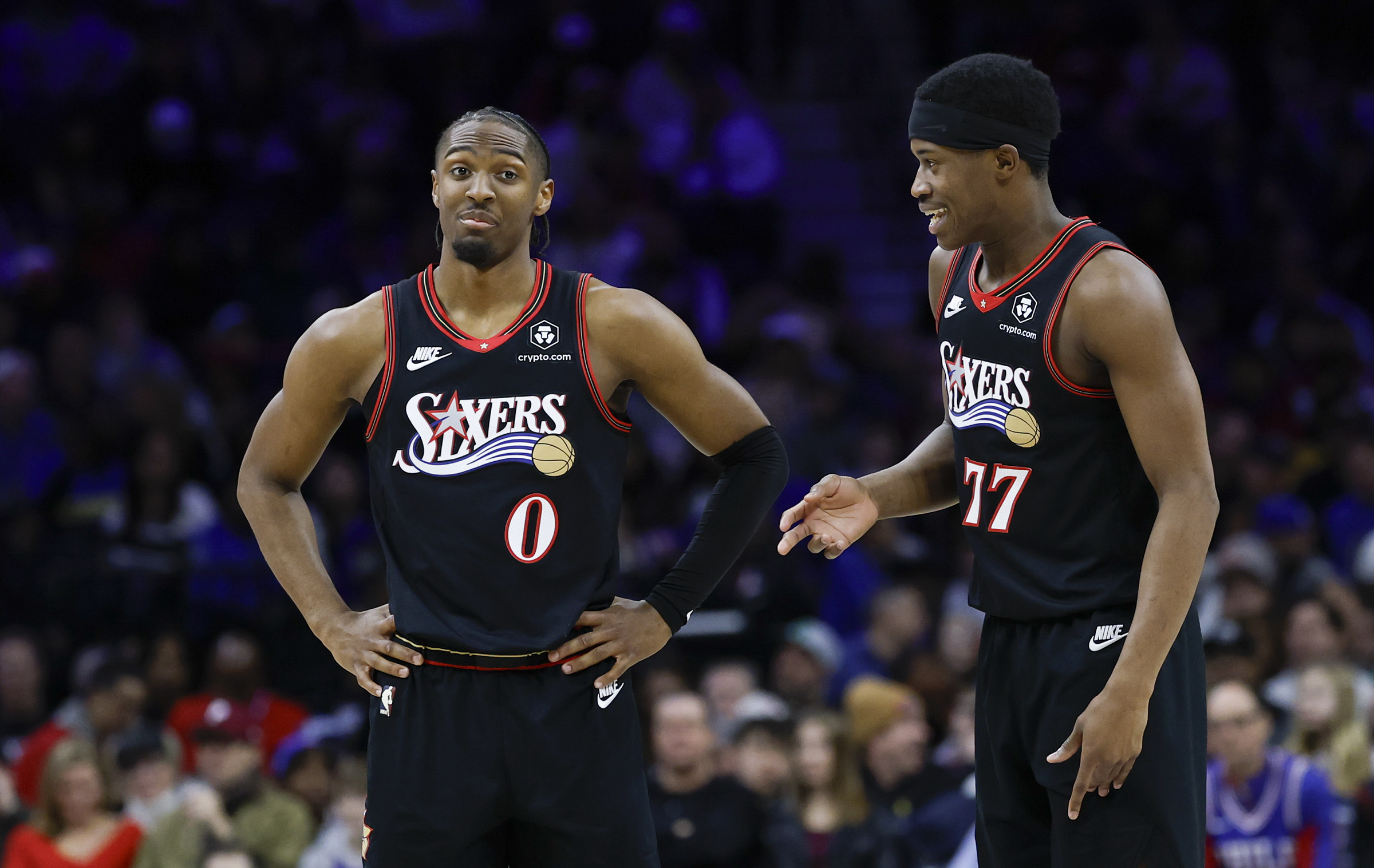
    Rookie guard VJ Edgecombe was the MVP of the Rising Stars All-Star competition Friday night and represents the future, but it is a future that depends on working in harness with Maxey.

    Maxey represents the Philly of today: a city that sees itself as a collection of hardworking, well-meaning, decent, and spirited underdogs.

    Philly guy

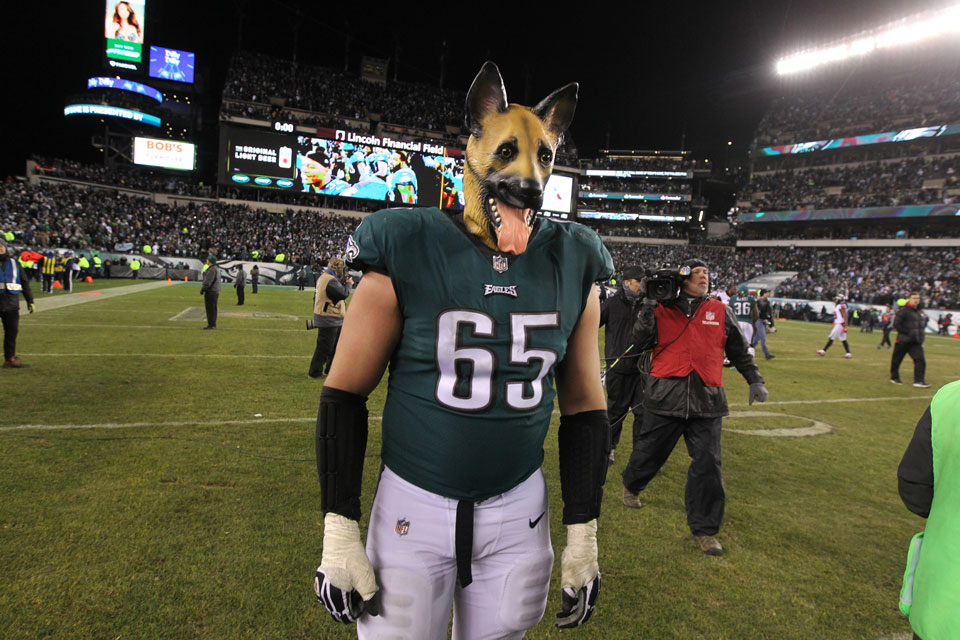
    From Vince Papale to Rocky Balboa to the 2017 Eagles, Philly loves an underdog.

    Eagles tackle Lane Johnson dons a dog mask after a playoff victory against the Atlanta Falcons on Jan. 13, 2018.

    Maxey has always been an underdog.

    He was never touted as an AAU player. He played for Kentucky for one uninspired season. He then was the 21st overall pick of the COVID-19 draft in 2020, behind the likes of Killian Hayes (seventh) and Kira Lewis (13th). A poor shooter, he started just eight games as a Sixers rookie. The Sixers hoped he’d be Dario Šarić or Landry Shamet, players drafted outside of the top 10 who have become dependable, if limited, NBA performers.

    As it turns out, Maxey has no limit.

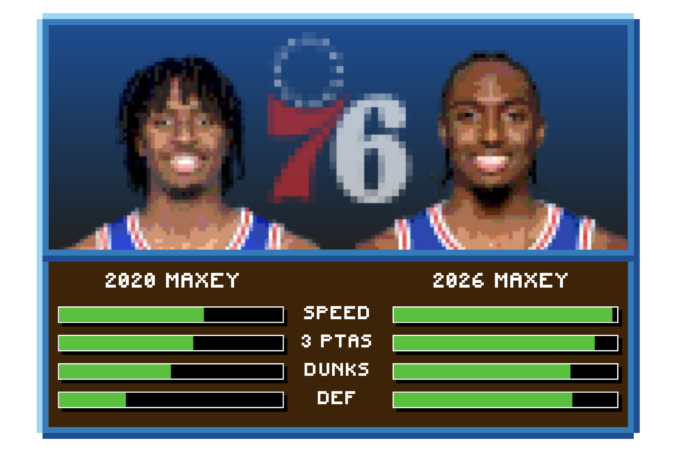
    His maniacal offseason workout regimen focused on shooting and turned him from a 30.1% three-point shooter as a rookie into a 42.7% bomber in his second season. His scoring average over the years went from 8 points to 17.5 to 20.3 to 25.9, which made him the 2023-24 Most Improved Player and an All-Star reserve. He missed much of last season with injuries and still averaged 26.3 points, and now he’s at nearly 29 points per game, an All-Star starter, and an MVP candidate.

    Like former Eagles offensive line coach Jeff Stoutland said: Hungry dogs run faster.

    Maxey stays hungry. Hungry for wins.

    “I just want everybody to know I try extremely hard, I work extremely hard, and I leave it all out there on the court every single night. I play through whatever,” he said recently. “That’s the legacy I want to leave behind. But the main thing is to win.

    “This is a town that believes in winning. And I believe in winning.”

    Tyrese Maxey (left) and VJ Edgecombe form a potent combination at guard for the Sixers.

    Ravenous

    Maxey used to practice so much they had to take away his keys to the gym.

    He never was expected to play point guard. The Sixers drafted Maxey while Ben Simmons was on the team, then traded Simmons for Harden, then, when Harden forced a trade in 2023, Maxey took over the point. It was not pretty. He went to work.

    He’s a complete point guard today. His ballhandling and passing have advanced so much that his Player Efficiency Rating this season is 22.72, about three points higher than his last All-Star season and fifth among point guards. He trails reigning MVP Shai Gilgeous-Alexander, five-time top-10 MVP candidate Luka Dončić, two-time MVP Steph Curry, and 2026 All-Star and NBA champ Jamal Murray. Which is why Maxey is an MVP candidate himself.

    His game has blossomed.

    “I play three different roles on this team,” he said. “Sometimes I’ve got to shoot 30 times. Sometimes I’ve got to get Joel the ball. Sometimes I have to play full-time point guard and guard [elite] people. That’s OK. Whatever it takes to win.”

    He didn’t just develop a three-point shot, he developed Harden‘s three-point shot after pestering Harden to teach him during the Beard’s 1½ seasons with the Sixers. The result: a lethal, sidestep-stepback, coil-and-release mortar shell whose range knows no limit.

    This season, he mastered the most important skill of any backcourt scorer: the pull-up jumper, the most lethal weapon in basketball, from Jerry West to Michael Jordan to Kobe Bryant to Kevin Durant.

    How far has he come? He’d dropped in the draft because he couldn’t shoot. Now, on Saturday, he’ll be the first Sixer to compete in the three-point shooting contest since Kyle Korver in 2005.

    He remains driven by that disrespect, but he isn’t disrespectful, and that endears him to Philly even more. Sure, Philly’s a rough place. Some people got a kick out of Embiid and his Twitter-beefing with players like Karl-Anthony Towns. Some people loved it when Bryce Harper stared down mouthy Atlanta Braves shortstop Orlando Arcia in the 2023 playoffs.

    But those incidents also rubbed some people the wrong way. Maxey seems to always rub folks the right way.

    What’s not to like? After all, Maxey is the No. 1 dog dad in a canine-crazed city.

    Maxey owns three dogs. His first is named Apollo, after the Apollo Creed character in Rocky. Then he got Aries and Arrow. They are his family. Maxey told Sixers videographers that when he bought a house in South Jersey, he insisted it have lots of land: “Try to create a happy home for my dogs. Let them run around in this big backyard.”

    He made a cameo appearance at the National Dog Show when it visited the Philadelphia area in November.

    So, he loves dogs. He loves kids, too.

    Maxey won the Bob Lanier Community Assist Award in 2024 for his offseason work with youths in Philadelphia and his native Dallas.

    With Tyrese Maxey, it’s never about Tyrese Maxey.

    I ran an informal Twitter/X poll Tuesday into Wednesday that asked, “Who’s your favorite Philly athlete?” I listed Harper, Kyle Schwarber, Saquon Barkley, and Maxey. (X only allows four entries.) Maxey won with 38% of the votes. Schwarber got 23%, Harper got 15%, and Barkley got 24%.

    No, it’s not a scientific poll, and yes, it drew only about 400 respondents, but it makes sense nevertheless.

    When the local TV broadcast spotted Maxey’s parents, Tyrone and Denyse (his name is a combination of theirs) at the Sixers’ game Saturday in Phoenix, play-by-play announcer Kate Scott called them “the Royal Family of Philadelphia.”

    That’s because, at this moment, their son is king.

    Always ‘us,’ never ‘me’

    In an era of shameless self-promotion, Maxey never lobbies for personal accolades. He has never deemed himself an All-Star or an MVP until somebody else deemed him thus.

    He’s always accountable, but he spreads the love. When Embiid dropped 40 on Jan. 31, Maxey detailed how the big guy’s game had developed to the point that Embiid found Maxey late in the game instead of forcing his own shot: “He played the right way.”

    When George got suspended in the middle of a playoff push, Maxey never wavered: “We stand with Paul.”

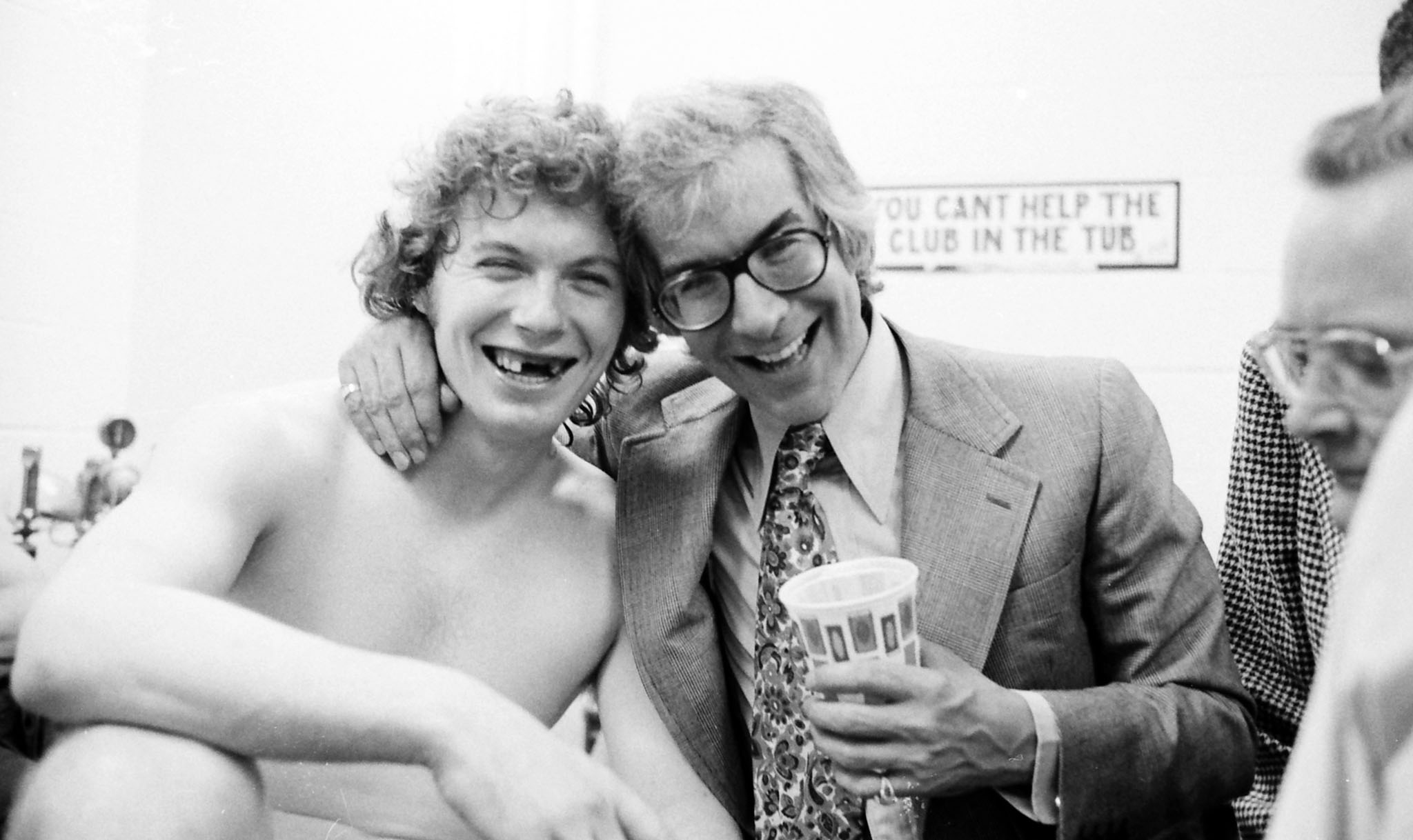
    He plays a child’s game with a child’s glee. It isn’t perfect, but Maxey has the most recognizable Philly smile since Flyers legend Bobby Clarke, and he flashes it all the time.

    Bobby Clarke and Ed Snider in the Flyers’ locker room in 1974. (Spectrum Archives)

    From diet to conditioning to practice to rest, he adores the process and the progress as much as he relishes the result.

    It was Maxey who, in a team meeting last season, finally confronted Embiid about his selfishly tardy habits: how he kept teammates waiting at meetings, on buses, and on planes.

    Maxey just shows up on time, pays attention, and plays his hardest every second. He’s the type of player Philadelphians swear they would be if they had the chance. He understands that he has a gift, and that he should rejoice in his gift, even if it doesn’t take him to the top of the mountain.

    This weekend, that gift took him to L.A.

  • This Harvard-trained, ex-Uber lawyer is the boss at one of Philly’s biggest builders

    This Harvard-trained, ex-Uber lawyer is the boss at one of Philly’s biggest builders

    Construction is often a family business. Mike Lloyd, as a Harvard Law graduate, former Wall Street trader, past counsel for Uber and Chevron, and a native of south Louisiana, had a first-class outsider’s resume when he arrived at Malvern-based IMC Construction, one of the mid-Atlantic’s largest general contractors.

    But Lloyd is family, too: In 2017, engaged to the boss’ daughter, he took over as IMC’s general counsel, and moved onto a new career path that added his professional and personal skills to IMC’s career construction managers.

    Since 2023 he’s been president and the firm’s controlling owner. On his watch, IMC revenue has risen more than 70%, to $600 million, and it has added offices and clients in New Jersey and Delaware, with more planned. The firm, founded in 1976, now employs 300, plus dozens of subcontracted crews at any given time.

    Senior managers of IMC Construction, 2025. CEO Mike Lloyd is third from right; his predecessor, IMC chairman and Lloyd’s father-in-law Robert Cottone, is third from left.

    Jobs that IMC built or rebuilt in recent years include Penn and Jefferson medical projects, Prologis warehouses in Marcus Hook, the Morgan Lewis tower at 2222 Market St., new plants for Merck, Solenis and other biotech companies, apartments at the Granite Run Mall, the Promenade at Upper Dublin, the King of Prussia Town Center, and more than 100 other area sites.

    Lloyd recently spoke with The Inquirer at IMC’s Chester County headquarters and on a tour of its nearby Great Valley Apartments complex, for developer Greystar. The conversation has been edited for clarity and length.

    How did you get this mid-career opening into the construction business?

    Rob Cottone [his predecessor as IMC CEO] recognized he needed support to help the organization grow across the Mid-Atlantic.

    This business is hand-to-hand combat every day. Every day is different.

    What I bring to the table is my broad skill set. I’ve worked in finance. I’ve worked in law. I’ve worked in mergers and acquisitions, with big and small companies. I’m comfortable with financial companies, whether for IMC’s own work, or to help the building owners get comfortable with the construction lenders.

    I don’t pretend to know things I don’t. We build a team of specialists who complement each other.

    What’s an example?

    Phil Ritter, a senior project manager, had the idea of creating a Special Projects division for jobs worth $5 million and under. You use a different pool of contractors, and a faster operating model, but you get the benefit of working for a large, efficient organization.

    I worked on the business plan, and in 2020 he started it, with maybe a million dollars in revenue that year. In three years, we were doing $30 million. We had a tremendous success doing small projects for Penn Medicine and Jefferson and others.

    Many companies would not have put a top project executive in charge of a new business. It costs overhead while working on a business plan. But that’s how we invest in people.

    We opened in 2022 in Edison, N.J., with four employees. We are now 37 there, of our 300 total, with $210 million in projected revenue for 2026. Our biggest job is the Crossings at Brick Church in East Orange, a transit-oriented multifamily development for Triangle Equities.

    Are those smaller projects non-union?

    The labor is driven by the clients’ demands. As a general contractor, we are a merit shop [using both union and non-union contractors]. Our jobs are often 100% union, not always.

    Sometimes we do jobs for a lump-sum price, sometimes open-book, guaranteed-maximum, the approach pioneered by Buck Williams [who founded IMC in 1976]. It takes a lot of working with the owners.

    Mike Lloyd, CEO of IMC Construction, in the company’s Malvern headquarters, in January. Behind him are renderings and photos of some of IMC’s recent projects.
    You’re building a lot of apartments lately?

    We see a tremendous amount of suburban apartment demand.

    A lot of these are places where people can avoid going to the city, when you can have a nice dinner and do some retail shopping close to work, close to home. You have that in King of Prussia, you are getting it in the Great Valley, you will see more of it at the Navy Yard, and in Ardmore.

    We recently broke ground at 100 Lancaster in Ardmore for Radnor Property Group, and the Great Valley Apartments we’re building for Greystar. You have a demographic of millennials who are finally getting married and moving out of the city as they have kids.

    We survived COVID by completing over six million square feet of warehouses. We have turned over nearly 5,000 apartment units since the year before I joined, which should make IMC one of the largest apartment builders in the Philadelphia region. We have turned over 1,700 senior-living units over the past five years, which makes IMC the largest builder of senior living units [around Philadelphia.]

    Has office construction peaked?

    I don’t know that offices have peaked. I’m actually bullish on office construction. We’re completing our rebuild of 680 Swedesford Rd. [in Wayne], for example. Employers want to get their people back together. There’s benefits for collaboration and connection.

    But they want higher-quality space. More light and amenities. They want a kind of ecosystem, like you see at the Navy Yard, where Ensemble is investing in life sciences. They have labs, offices, apartments, and amenities.

    At the King of Prussia Town Center, the retail draws people in, and they’re building offices around it. You see a similar trend in the Great Valley. Historically there was this corporate office campus, now there are restaurants, hotels, apartments all around.

    Is biotech construction stalled?

    We are part of a $100 million lab project in Delaware. We did Penn’s Center of Healthcare and Technology in Center City. We built the Radnor outpatient center — it’s a model. We built their facility in Chesterbrook. And the hospitals are still building.

    After years of industry support for underrepresented contractors, are you feeling whiplash due to President Donald Trump’s reaction to DEI?

    We are now one of the largest minority-owned contractors [in the country]. We don’t distinguish ourselves by being a minority contractor; we aspire to be the leading general contractor in the Mid-Atlantic region by leveraging technology in unique ways and creating solutions to serve our clients’ needs.

    We happen to be a minority-owned company. I personally care about expanding opportunities. We have broadened the subcontractor pool and awarded $1 billion of subcontracts to minority- and women-owned businesses.

    We have not felt much backlash or reversal. Many owners still feel committed to expanding the contractor pool. In the current administration it may need to be structured differently.

    Will your kids make this a family business?

    Our children are young. My daughter has already told me she wants to build her own house, and I can live in it if one day we were working together.

  • 🏀 Do you know ball? | Sports Daily Newsletter

    🏀 Do you know ball? | Sports Daily Newsletter

    Today, we’re offering you a chance to test your basketball acumen through the eyes of Sixers All-Star Tyrese Maxey. As Maxey steps into more of a leadership role on the team, every decision he makes on the court dictates the Sixers’ chances of contention for the postseason.

    Those aren’t my words but those of Inquirer interactive designer Jasen Lo, who created a game in which you can predict Maxey’s next move, and see if you’re right.

    The game not only predicts what he might do but showcases career stats, which offer insight into the propensity of his movements and why over the last few seasons, they’ve been so effective.

    Played it yesterday. Anticipated all of Maxey’s moves correctly.

    I know ball. To see if you do, play our game.

    Speaking of the Sixers, the New York Knicks were able to figure out Maxey and Co., who suffered their second straight loss following a 138-89 final at Xfinity Mobile Arena last night. Here’s what we saw.

    Not going to get much snow melt today, as highs are expected to barely sneak past freezing. Let’s all continue to think warm thoughts.

    — Kerith Gabriel, @phillysport, sports.daily@inquirer.com.

    If someone forwarded you this email, sign up for free here.

    The kids’ new home

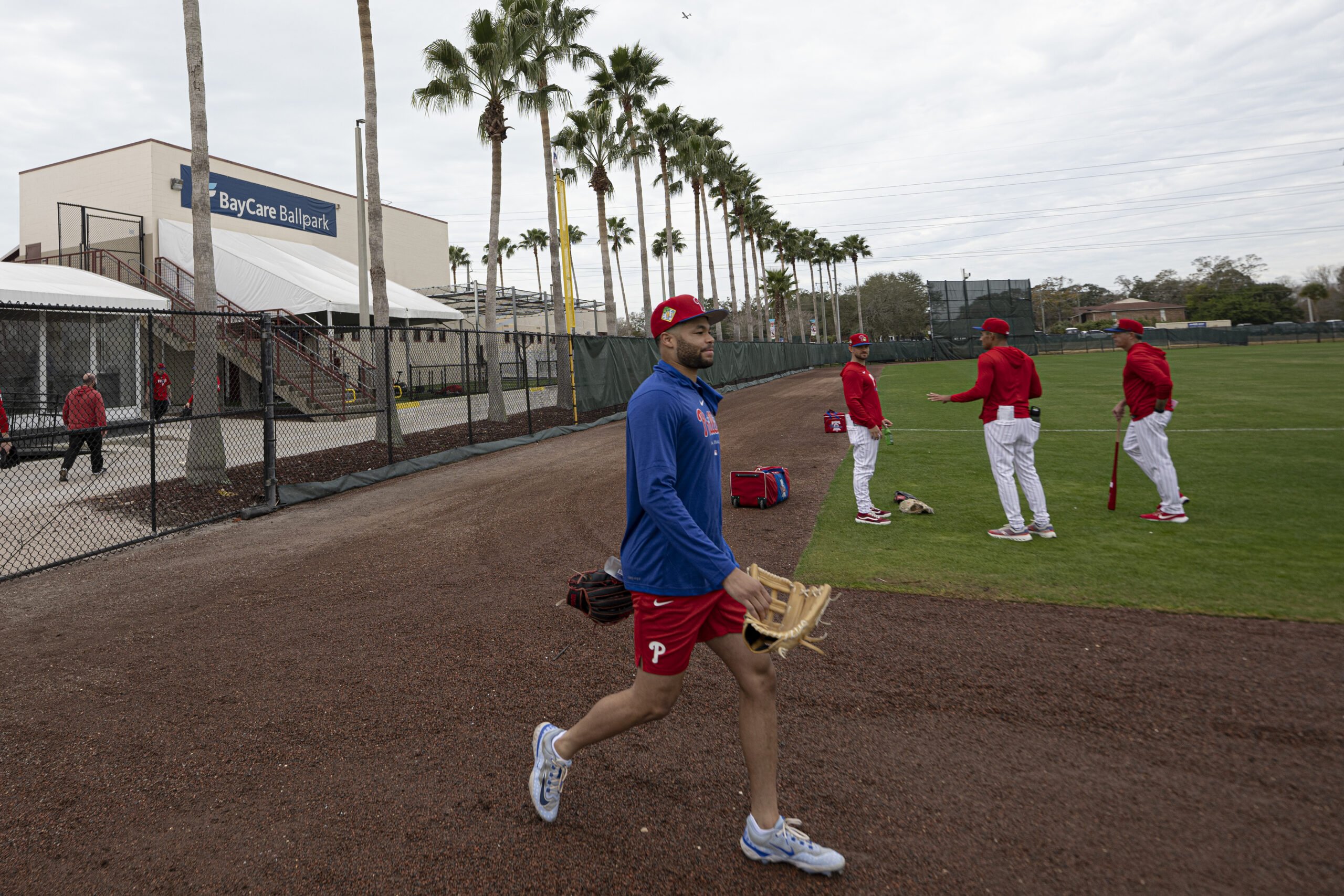
    Justin Crawford walks on to the field during the first day of spring training for pitchers and catchers on Wednesday in Clearwater, Fla.

    Kyle Schwarber did a double take almost as soon as he walked through the door Wednesday in Clearwater, Fla., even before J.T. Realmuto pointed it out. Left fielder Brandon Marsh stopped infield prospect Aidan Miller in the hallway and said, “Man, you got a good little locker spot there.”

    “They’ve all kind of made little comments here and there about it,” said Miller, who now occupies the space once reserved for Nick Castellanos, the disgruntled $20 million right fielder who no longer has a locker because he will be traded or released by the weekend.

    “I was surprised seeing it myself.”

    He shouldn’t be. Nobody should.

    Miller is in the Phillies’ plans — and sooner than later. So, it isn’t a coincidence, according to manager Rob Thomson, that he and fellow top prospect Justin Crawford (No. 80 in your spring-training program) are taking up residence on Millionaires’ Row.

    Zack Wheeler has a rib as a memento from his surgery for a blood clot. He vows that he won’t skip a step in his return to the mound.

    Reliever Orion Kerkering’s spring training will start slowly due to an injury suffered right before camp opened.

    What we’re …

    🏒 Wondering: What’s going through the mind of Penn State star hockey player and Flyers prospect Gavin McKenna, who now has to wait until mid-March for his preliminary hearing on an assault charge.

    🦉 Introducing: The Temple women’s hooper who went from reliable bench player to leading the American Conference in points.

    🦅 Sharing: Jason Kelce’s thoughts on a world without Jeff Stoutland leading the Eagles’ offensive line.

    🏈 Noticing: Former Eagles offensive coordinator Kevin Patullo may have just landed in Miami as the Dolphins’ passing game coordinator.

    🙏🏽 Remembering: The life of James van der Beek, the actor who many know for his role on Dawson’s Creek, but who we’ll remember as Jon Moxon, in the film Varsity Blues, who defied an egotistical coach, conquered temptation, and led the Coyotes to a winning season. Mr. Van Der Beek died on Wednesday at age 48.

    Greatest show on ice

    Team USA takes to the ice today in men’s ice hockey against Latvia.

    For hockey fans, the last 24 hours have been pretty awesome. The puck dropped on a men’s hockey doubleheader at the Winter Games in Italy yesterday, but today is the real treat with eight nations facing off, including the United States and Latvia (3:10 p.m., USA Network). Here’s our roundup of reasons to get excited about the men’s edition of the tournament.

    Running afoul

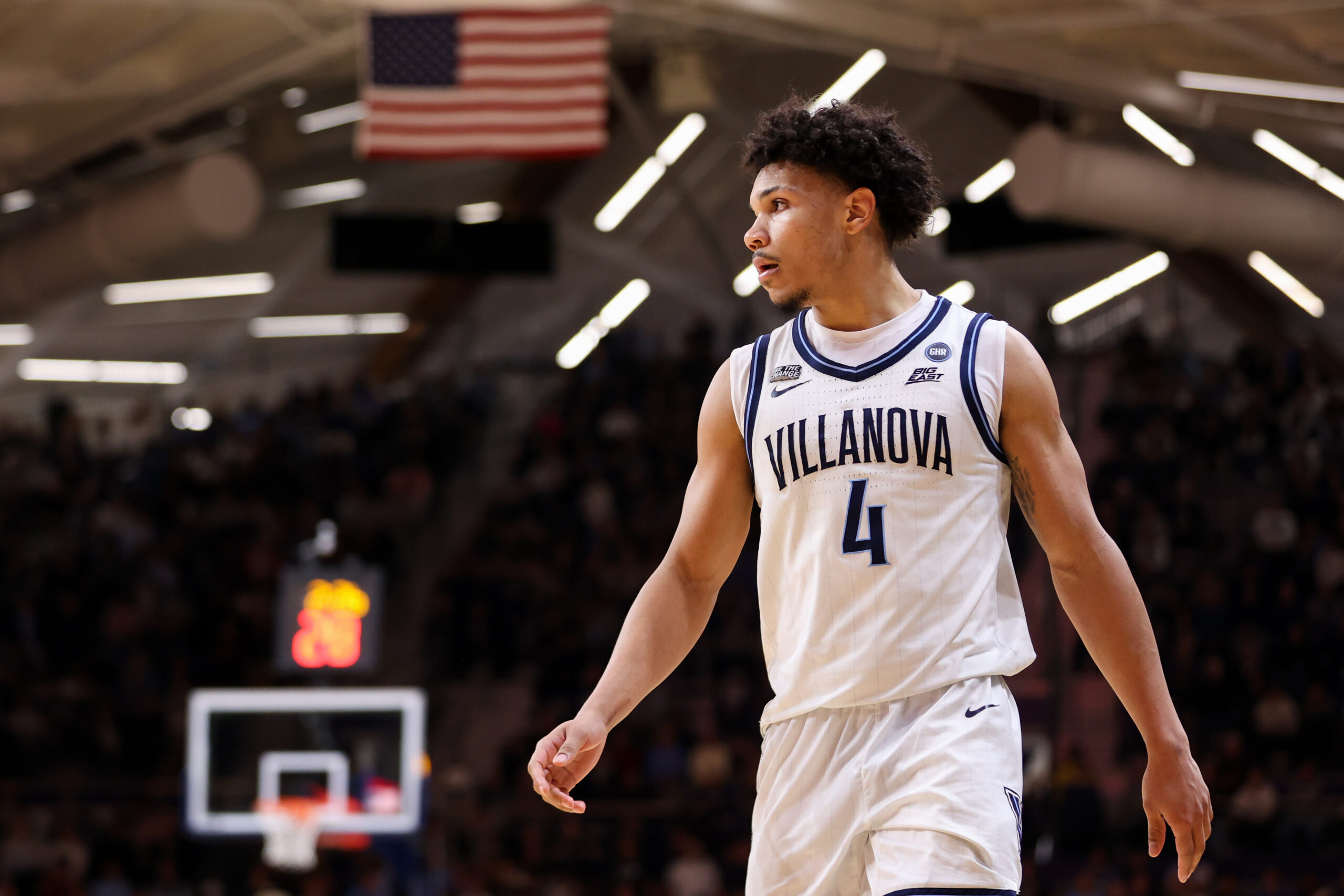
    A Villanova free throw misses the mark during the win against Marquette on Tuesday.

    In back-to-back games, Villanova has made a pair of wins look really hard to come by. The latest came Tuesday in a three-point victory over Marquette at home. What ails the most? A complete lack of consistent free-throw shooting.

    It is worth mentioning that the struggles are abnormal for a program that has consistently resided at the top of the Big East in that statistic for much of the last decade. It should also be noted that the team is 19-5 this season and on pace to make its first NCAA Tournament appearance in four years.

    Still, what gives?

    It’s what Inquirer writer Jeff Neiburg dives into, along with what’s next as March Madness looms.

    Coming together

    Agustín Anello (left) celebrates with Jovan Lukić after his assist powered a goal in the Union’s preseason game against CF Montréal on Wednesday.

    The Union wrapped up their preseason competition with a loss on Tuesday against Eastern Conference foe CF Montréal, which saw a pair of red cards dished out, including one to Montréal’s manager.

    But that’s not the story. The story is that for the first time, the Union’s latest arrivals got game action and displayed a promising performance. With the signings of multiple million-dollar transfer fee players, the next step is getting them all to jell before the Union’s first official game in Concacaf Champions Cup action against Defence Force in Port of Spain, Trinidad, next Wednesday.

    Inquirer writer Jonathan Tannenwald is in Clearwater, the site of Union training camp, for more on the game, but perhaps, more importantly at this juncture — how the new kids played in it.

    On this date

    Eagles quarterback Jalen Hurts watches the Kansas City Chiefs celebrate a win in Super Bowl LVII on Feb. 12, 2023.

    Feb. 12, 2023: Eagles fans were forced to watch red and yellow confetti fall after the Kansas City Chiefs won Super Bowl LVII, 38-35, in Glendale, Ariz. Since halftime shows seem to be the topic of the moment, do you remember who the performer was in that game? Take a guess and then scroll down for the answer.

    Mike Sielski’s take …

    Villanova guard Tyler Perkins is leading by example as the longest-tenured Wildcat on the roster this season.

    “The whole idea of a player recognizing and appreciating a particular program’s history and culture seems quaint in this era of college basketball. It certainly doesn’t have the pull and power that it once did.“ — Sielski offers insight into the state of college basketball and how Villanova guard Tyler Perkins seems to be an exception to the norm.

    What you’re saying about the Eagles

    We asked: Who is your favorite Eagles player of all time?

    Wes Hopkins. Wes left everything on the field. Sadly, his career was cut short by injuries, but he and Andre Waters lowered the boom on any and all that came across the middle or the sidelines. — Craig K.

    My favorite Eagle was Brian Westbrook. When he came into the league, the thought was that he was too small to be an everyday running back, but that he would be a good return man. He turned out to be so much more than that, a very successful multipurpose back who could run or catch a pass equally well. He was able to have a successful career because of quickness and speed, but, just as important, guts and determination. The fact that he played college ball locally at Villanova was an added bonus. — Tom E.

    When I was young, I wanted to be just like Jesse Richardson #72. He was a defensive tackle who clogged up the middle of the field so that the linebackers could do their thing. Not very glamorous work, but I was always amazed watching him work. No face masks in those days, so the expressions were fairly easy to read. Every pickup game, I wanted to be our team’s Jesse. — Bill B.

    We compiled today’s newsletter using reporting from Jasen Lo, Scott Lauber, Lochlahn March, Gustav Elvin, Olivia Reiner, Matt Mullin, Colin Schofield, Keith Pompey, Mike Sielski, Jonathan Tannenwald, and Jeff Neiburg.

    By submitting your written, visual, and/or audio contributions, you agree to The Inquirer’s Terms of Use, including the grant of rights in Section 10.

    That’s all for today. Thanks for allowing me to get your day started. Jim is back tomorrow to get you ready for the weekend. Oh, and if you guessed Rihanna in our On This Date question, you know your halftime shows. — Kerith

  • Nordic-style sauna with cold plunge debuts at Schuylkill Center

    Nordic-style sauna with cold plunge debuts at Schuylkill Center

    Erin Mooney, executive director of the Schuylkill Center for Environmental Education, slipped out of a sweltering sauna last weekend wearing only a bathing suit and strode barefoot straight into the coldest day of the winter.

    “I never thought that I would find myself in a bathing suit laying down in the snow on a 15-degree day, and I found myself doing that at the Schuylkill Center,” Mooney said.

    It marked the opening weekend of a new experience that the Schuylkill Center, on Hagy’s Mill Road in Philadelphia, is offering along with a local sauna company, Fiorst — one that already has had solid booking off social media views, despite having just opened Saturday.

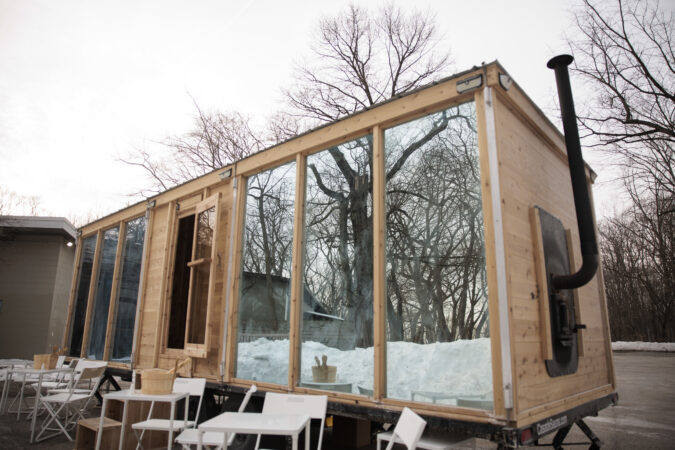
    Visitors will have the chance to relax in a glass-walled, wood-fired sauna overlooking a snowy field and woods in Northwest Philly, paired with a cold plunge.

    Mooney said the idea to host a mobile sauna on the preserve’s grounds grew from a desire to keep the center lively through winter and draw in new visitors. She was inspired by a sauna exhibit by the American Swedish Historical Museum in FDR Park and began looking for a way to bring that Nordic tradition of “hot and cold” to her own facility.

    She spotted Fiorst, a mobile sauna venture run by Jose Ugas, on social media, reached out, and the two forged a near-instant partnership. They spoke on Jan. 30, a Friday; by the next Friday, a custom sauna unit from Toronto rolled onto the grounds.

    By last Saturday, the fire was lit, and guests arrived.

    “It was, you know, kind of kismet, in a way, we were able to have this shared vision,” Mooney said. “And with him doing this servicing of the saunas on site, it makes it so much easier for us.”

    The interior of the Nordic-style sauna at the Schuylkill Center for Environmental Education.

    How does the sauna work?

    Nordic-style wood saunas are notable for their minimalist design and high heat, which participants couple with either a plunge into a cold shower, tub, or lake or a step outdoors.

    Fiorst’s installation overlooks the center’s main wooded area, framing the winter landscape through a glass wall as guests sweat it out inside the sauna’s 170- to 190-degree temperatures. Each 90-minute session allows participants to cycle at their own pace through intense heat and biting cold, a contrast Mooney found invigorating.

    The sauna is modeled on a concept popular across Nordic countries, including Norway, Finland, Denmark, and Sweden.

    Mooney said the project has already pulled in new visitors from neighborhoods like Fishtown or outside Philadelphia who might not typically visit for hiking or birdwatching.

    She believes the sauna fills a niche for “clean, wholesome, healthy fun” that is alcohol-free.

    However, unlike the typical Nordic experience of being nude during the sauna, the Schuylkill Center experience is strictly “bathing-suit friendly,” a choice tailored to American comfort levels.

    The collaboration operates on a revenue split, with a charitable twist. During February, the center’s share of the proceeds goes to its Winterfest for Wildlife campaign to support the on-site wildlife clinic.

    For now, the sauna remains a seasonal experiment, but it will stay in place as long as demand — and winter weather — holds up.

    “I think it will stay seasonal,” Mooney said. “We live in a sauna already in the summer in Philadelphia.”

    The sauna is open on weekends at the Schuylkill Center from 9 a.m. to 5 p.m. and is booked through the Fiorst website. The cost for a 90-minute session is $75. You can add a friend for $25. Private sessions of up to 16 cost $600. For now, bookings can be made only one week in advance.

    The Schuylkill Center is expecting Valentine’s Day weekend to book quickly.

    Jose Ugas (left), founder of Fiorst, and Erin Mooney, executive director of the Schuylkill Center for Environmental Education, at the sauna.

    ‘A moment of clarity’

    Ugas, a bioengineer at Johnson & Johnson who lives in Whitemarsh Township, felt compelled to bring a Nordic-style sauna experience to the region after a trip he took to Sweden following the loss of his mother to brain cancer in 2023. There, friends introduced him to a traditional Scandinavian ritual: enduring searing dry heat inside a wooden sauna, followed by a plunge into icy water or a cold shower.

    What began as a distraction soon crystallized into a moment of clarity, Ugas said.

    “Just that time together and kind of going between the hot and the cold just was like a mental reset for me,” Ugas said.

    Ugas, who will graduate with an MBA from Villanova University this spring, wanted to replicate the nature-immersive element that had grounded him overseas.

    He found a Toronto company that builds portable glass-fronted wooden saunas and ordered a custom unit equipped with a wood-fired stove, hot stones, steam, aromatherapy, and a cold-plunge tub. Ugas launched Fiorst in 2024, describing it as “nomadic” at first.

    The venture first hosted sessions overlooking Valley Forge and at Fitzwater Station in Phoenixville. Ugas then established a more permanent site, which he calls Riverside, on River Road in Conshohocken where he still books sessions.

    Ugas calls the partnership with the Schuylkill Center a natural fit given its location amid nature, merging his wellness goals with the venue’s environmental focus.

    “At the core of our mission and their mission is to get people out in nature,” Ugas said.

    So far, he has relied on social media to market the sauna, which has drawn hundreds of visitors to its locations.

    The Nordic-style sauna at the Schuylkill Center for Environmental Education in Philadelphia.

    ‘Social sauna’

    Serena Franchini, a nurse and founder of Healing Fawn Inner Child Work & Somatic Therapy, has taken sauna sessions at Ugas’ other locations. She sees it as a tool to help with nervous system regulation while offering an immersion in nature.

    “I loved the idea that it was outside,” Franchini said.

    She likes the relaxed atmosphere compared with some traditional saunas that often enforce strict time limits on heating and cooling cycles. Instead, she cycles between the sauna and cold-plunge tub at her own pace.

    Franchini highlighted the mental wellness aspect of Ugas’ “social sauna” sessions, noting Friday night events as “skip the bar” alternatives that allow strangers to gather for a healthy, communal experience.

    “It’s a great way for community to connect with people that are interested in the same things that you are,” Franchini said.

  • Westtown’s Jordyn Palmer — a basketball phenom and highly sought-after recruit — has untapped potential

    Westtown’s Jordyn Palmer — a basketball phenom and highly sought-after recruit — has untapped potential

    Amid the cacophony of whirling toddlers at a local YMCA in Oxford, Chester County, about 14 years ago, Jermaine Palmer caught a glimpse in the corner of his eye of what was to come. He had gotten his daughter, Jordyn, into basketball, taking her to his practices, letting her crawl around the court in diapers, and involving her in youth coed rec leagues with a tiny ball and hoop.

    One afternoon, as a game was going on, he noticed, Jordyn and a little boy collided going after a rebound. They both fell. The boy went crying to his mother. Jordyn stood up, grabbed the ball, and scored a layup as if nothing happened, smiling back down the court. Jermaine just shook his head, he recalled.

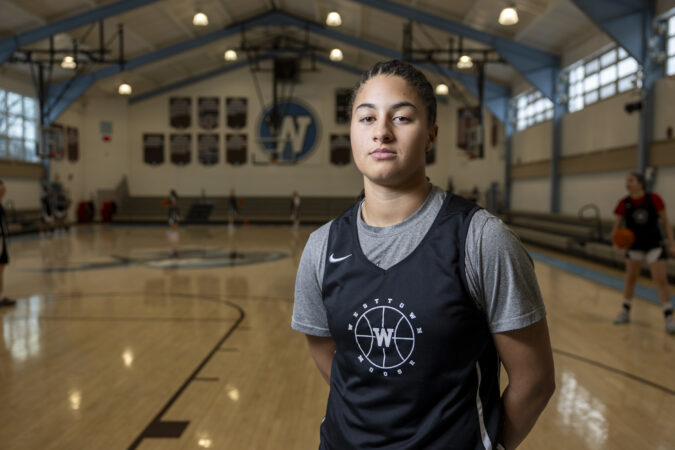
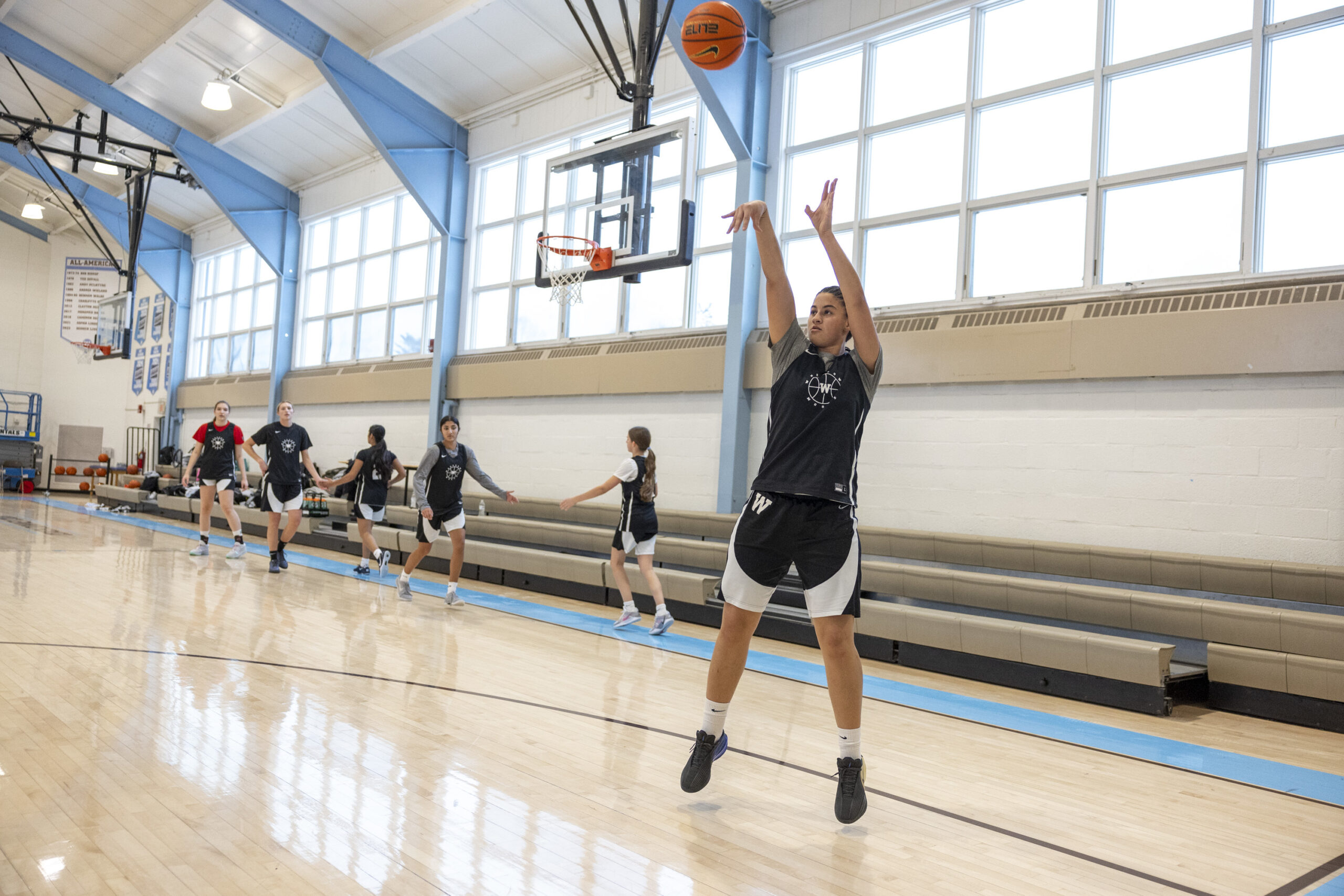
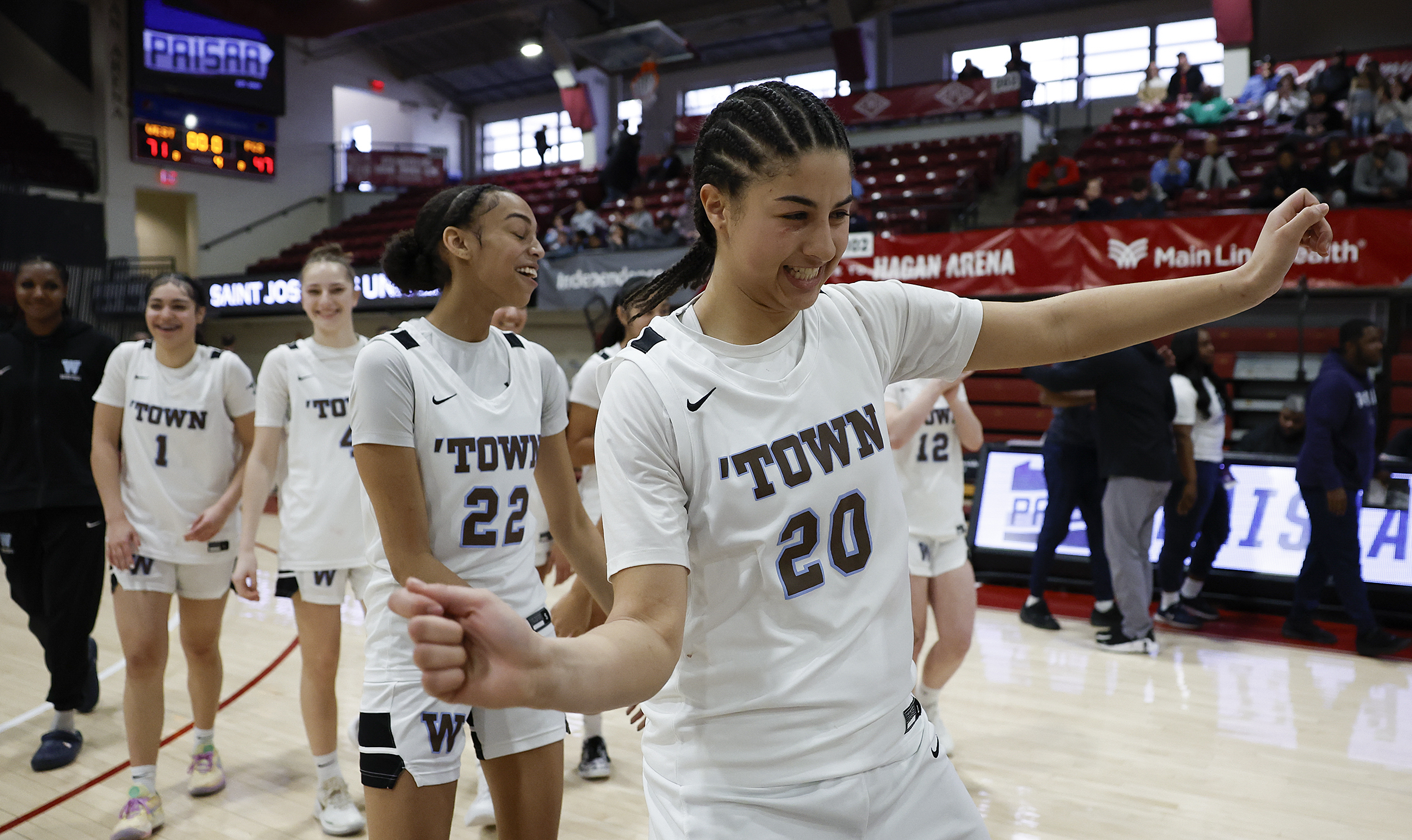
    Jordyn Palmer, the gifted 6-foot-2 junior guard at Westtown School, tends to make a lot of people shake their heads in disbelief each time they see her play, especially the nation’s top college coaches. She is ranked as the No. 6 player in the country in the class of 2027 by ESPN’s SportsCenter NEXT — Super 60. She is averaging a humble 23 points and 12 rebounds for the Moose, who will be playing for their sixth straight Friends Schools League championship this Friday at 6:30 p.m. against archrival Friends’ Central at La Salle University.

    As a junior, Palmer is on the threshold of 2,000 career points and is the leader of a star-studded team that has a/ 23-1 overall record this season and is ranked No. 7 in the country by ESPN.

    What is so interesting about Palmer is that her best is yet to come. She’s always been tall for her age, and her parents, Jermaine and Kim, had to carry her birth certificate as proof of her age because of that. She has been playing varsity basketball since she was in eighth grade.

    A dominant rebounder, ballhandler, and shooter, she can finish left- or right-handed and has added a more consistent perimeter game. She’s also a team player, making a point to get her teammates involved. She plays with poise, despite the constant attention she has had on her since she was 14.

    She was 5-9 at age 12 playing for the Chester County Storm under-16 AAU team when Westtown coach Fran Burbidge first saw her in a summer tournament at the Spooky Nook complex in Manheim, Lancaster County. Burbidge, who coached women’s stars Elena Delle Donne and Breanna Stewart, quickly saw how much more advanced Palmer was than the teenage girls she was playing against.

    “A friend of mine asked me if I ever saw her play. I remember going to one of the back courts and thinking, ‘There is no way that kid is in seventh grade,’” Burbidge said. “So, yeah, I had to convince myself she was that much better than everyone around her. If I didn’t know, I would have thought she was a high school junior.”

    Palmer has evolved since then. The second-oldest of four, she’s 17 and may grow another inch.

    She’s also a victim of her own success. Burbidge pulls her early in blowouts — and the Moose have many. She easily could score 40 points a game, but she plays with a pass-first, team-first mentality.

    Last summer, she was playing in a league against a talented Imhotep Charter team when she dominated both ends of the court for 10 minutes. Then she turned back to being a facilitator again. She is by no means lazy, according to her coaches and her father, but she is so smooth that she can play at different levels.

    Jordyn Palmer is averaging 23 points and 12 rebounds this season.

    “I was raised around the game. I grew up with a basketball in my hands, my dad being a coach taking me to practice,” said Jordyn, who carries a 3.5 grade-point average. “I was pretty much crawling around a basketball court before I was walking. I was always the tallest kid, that was me. I grew up playing soccer, too, but basketball was definitively my first love. I would say I was around seventh, eighth grade, when I started to think I was pretty good at this. It really changed when I went to Westtown.”

    And it really changed in 2023 when she was cut from the U.S. under-16 national team in Colorado Springs, Colo., when she was 14. It was the first and only time she was cut from something. She reached the second cuts. She sat in a conference room and was told that she did very well, but she would not make the team.

    When Jordyn called her parents, tears were shed — fueling aheightened determination.

    “A year later, I got invited back, and I made the team,” she said. “That was the first time I faced rejection, and I thought I dealt with it well. It made me work harder. Being cut didn’t make me angry because I was not too sure I would make it anyway, but it shocked me. I began working out in the morning, and I’m not a morning person. I hate waking up early. I began taking basketball more seriously than I ever did.”

    A month after she was cut that summer, she led Philly Rise to an AAU national title.

    Jermaine and Burbidge want her to play more intensely for sustained periods of time. Jordyn knows she will need to maintain those levels once she gets to college.

    “Jordyn has not even scratched her full potential,” said Jermaine, the girls’ basketball coach at Oxford High School. “I’m proud of her. Jordyn is a great kid. Her upbringing keeps her humble. But she does not play with the urgency that I know she has. You see it in spurts, but when you see her playing national-level players, that comes out. I get on her all the time about dominating.

    “The stuff people don’t see in the gym is someone who can outplay anyone. You can’t really guard her. When she tightens her shot off the dribble and her ballhandling, she is going to be terrifying. I’m her father and a coach — you see the way games are called. She’s so strong and so solid, refs look at her a different way than they do other players. She has gotten used to it. Refs don’t understand the body difference between Jordyn and everyone else.

    “No one likes Goliath. It’s part of the game.”

    Jordyn Palmer plans to make her college commitment next spring. She’s interested in South Carolina, LSU, Kentucky, Rutgers, Maryland, Notre Dame, and UCLA.

    South Carolina, LSU, Kentucky, Rutgers, Maryland, Notre Dame, and UCLA are the schools in which she’s interested. She says she is looking to make her official visits over the summer and make a decision next spring. Jordyn and Jermaine said they want to take their time with the recruiting process.

    She would get around 30 calls a day this time last year. That has been reduced to around five a day.

    “It’s been a little bit of a pain,” she said. “There have been those times when I have cried by myself because it can sometimes be overwhelming. I spoke to my parents about it, and they have done a great job taking the pressure off me, telling these coaches I’m taking a break. I’m still a kid, and I’m grateful to my parents for allowing me to be a kid. They let me fish.”

    Then, Jordyn went into her own “fish tale.” She got into fishing as a way to relax through her maternal grandfather. During summer vacations, she fishes with her family in northeast Maryland and the Outer Banks in North Carolina. She once hooked a baby shark when she was 7.

    “Yep, it was about 100 pounds,” she said. “We took it home and ate it. My uncles helped me pull it in.”

    Her father laughs at the recollection.

    “Jordyn was there,” Jermaine said. “I don’t know if she caught it. But we’ll go with that story.”

    One thing is certain, Jordyn Palmer is no fish tale.

    Westtown School’s Jordyn Palmer will play for a Friends Schools League championship on Friday at La Salle.
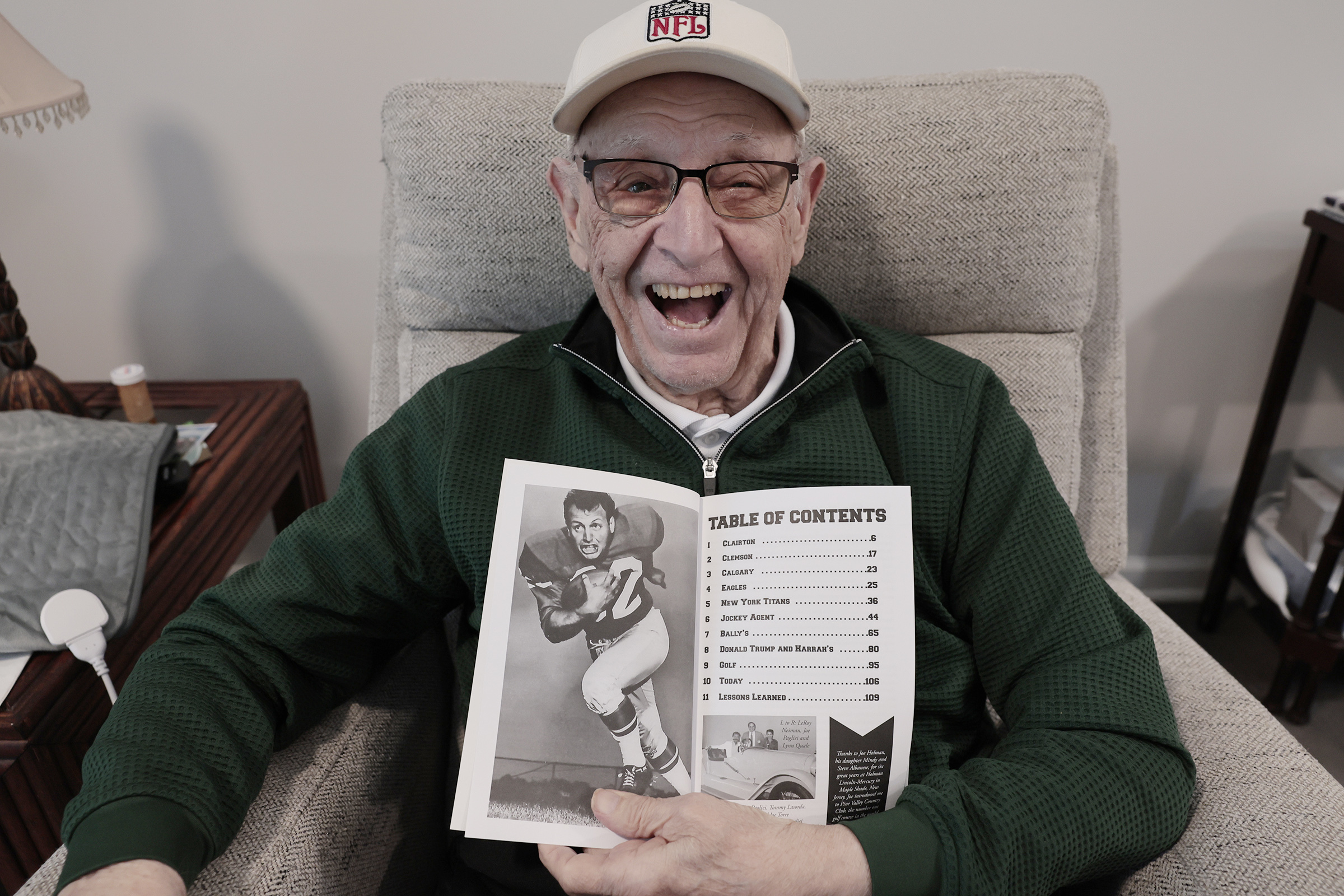
  • At 91, Joe Pagliei is believed to be the oldest living Eagle. It’s made him popular at his South Jersey retirement home.

    At 91, Joe Pagliei is believed to be the oldest living Eagle. It’s made him popular at his South Jersey retirement home.

    When Joe Pagliei moved to the Azalea senior living facility in September of 2023, word spread quickly. This was not just because he spent a season playing for the Eagles.

    It was also because of his unabashed personality.

    Pagliei would walk the halls of the Cinnaminson retirement home practicing his golf swing. If he lost a game of bingo, he’d throw the cards into the air and accuse his neighbors of “cheating.”

    Every day, at 3 p.m., he’d sit at the bar, nursing a ginger ale, with copies of a book about his life stacked beside him. Before long, residents began to ask for some.

    This wasn’t your average nonagenarian, after all. Pagliei spent parts of the 1950s and 1960s as a pro football player, first in Canada in the CFL, then in the NFL, and eventually, the AFL.

    He played the 1959 season as a fullback and punter with the Eagles. Pagliei was the last cut in training camp before the 1960 season. The Eagles called him back, asking if he’d want to rejoin the team, but it was too late.

    The fullback had already signed with the New York Titans, later to become the New York Jets. Pagliei ended up missing out on a championship.

    “Big mistake,” joked his daughter Vicki.

    It didn’t hamper Joe’s confidence. The former football player worked in auto sales and real estate for a few years, and became a jockey agent in 1970 out of Garden State Park Racetrack.

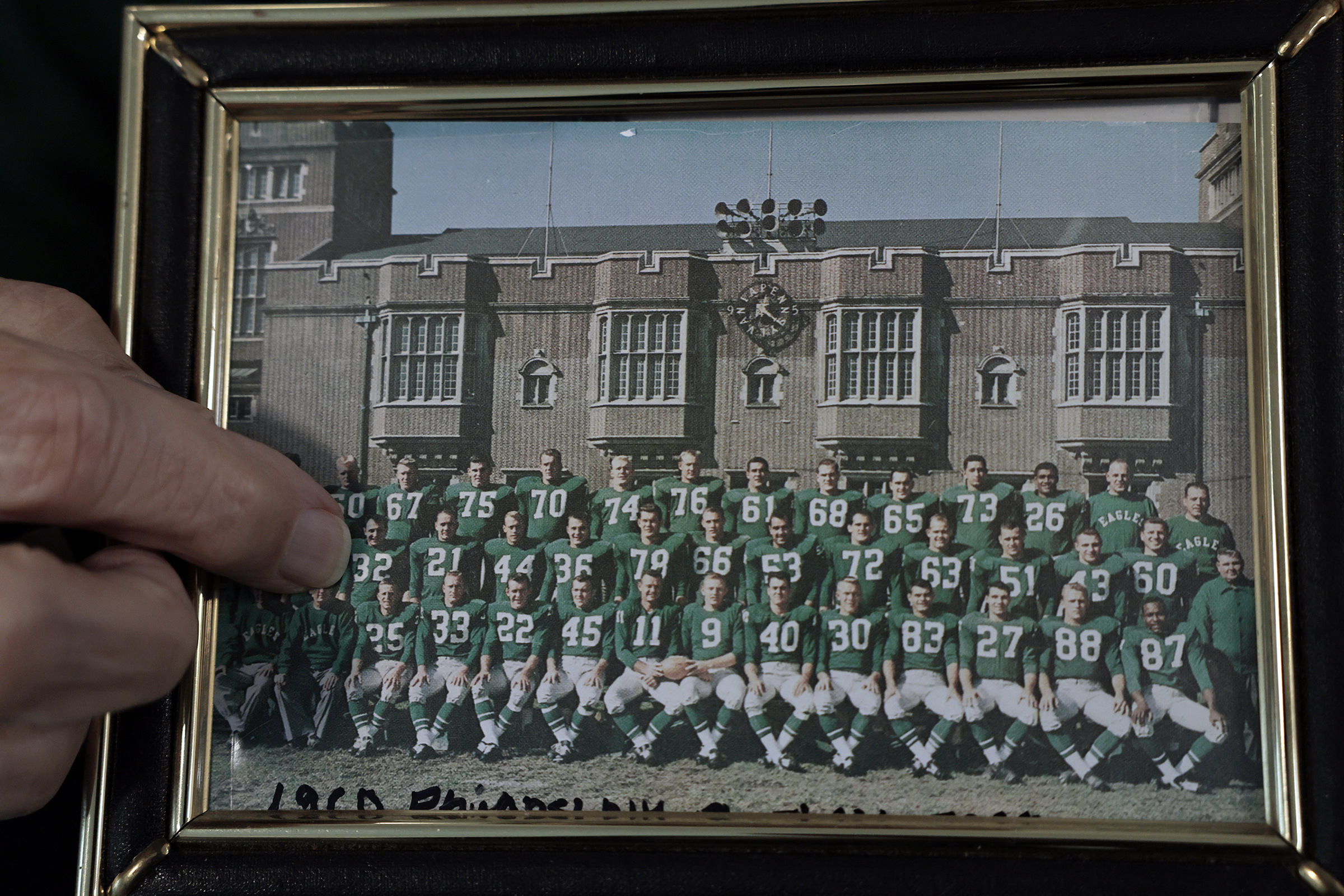
    Joe Pagliei points to himself, wearing No. 32, in the 1960 Eagles team photo taken at Franklin Field.

    When the track burned down in 1977, Pagliei headed to Atlantic City, where he became a casino host, crossing paths with everyone from Mickey Mantle to Joe Frazier to Sammy Davis Jr.

    He moved to Mount Laurel with his wife of 62 years, Rita, and four children in 1991. He sold cars for a few years, retired in 2000, and moved to Azalea after Rita died in 2023.

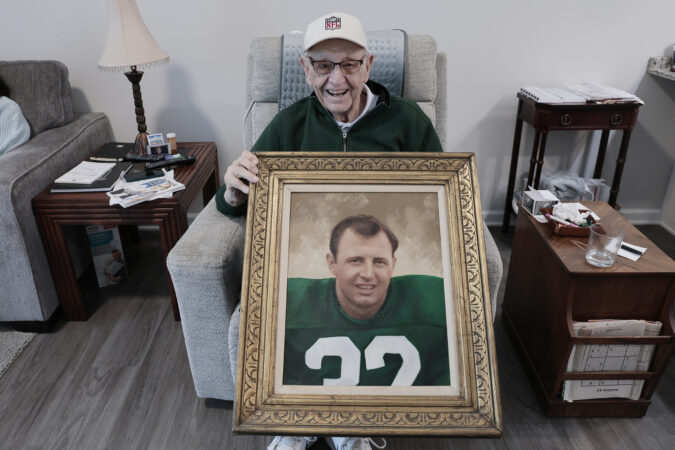
    At 91, Pagliei is believed to be the oldest living former Eagle. It is not a title he takes lightly. Last year, before the Super Bowl, his senior facility arranged for a visit from an Eagles-themed bus.

    Dressed in his kelly green jersey, Pagliei signed one of the bus panels: “Joe Pagliei, #32.”

    When he’s not lifting weights, or playing poker, he is watching Eagles games in his apartment, often with critiques of his own. Philadelphia will always be his favorite team, but he does have some misgivings about how he was used back in the day.

    “I was awfully good to be sitting down,” the 91-year-old said. “Not enough [playing time].”

    ‘I’m going to make you famous, buddy’

    Pagliei grew up in Clairton, Pa., a small town southeast of Pittsburgh, full of hard-nosed steel mill workers. His father, Alberto, emigrated from Italy and spent 48 years working as a janitor at the local plant.

    The elder Pagliei, a pragmatic man who saved every dollar, didn’t see the benefit in his son joining the football team. He refused to let him play until the 11th grade.

    Despite missing a few seasons, the younger Pagliei was not short on confidence. On the first day of practice, he walked straight up to his new coach.

    “I said, ‘I’m going to make you famous, buddy,’” Pagliei recalled. “He said, ‘You’re full of [expletive].’ And I said, ‘Oh really?’

    “I didn’t know the plays. I went out on a Wednesday. I ran two touchdowns. He said, ‘Wow.’ I said, ‘You just put my [butt] in there. Don’t worry about it.’”

    Famous might have been an exaggeration, but Pagliei did catch the attention of some big-name schools. According to his 2017 self-published book, The Roast Master, he received more than 100 recruitment letters.

    The fullback chose Clemson University in South Carolina. His arrival on campus in 1952 marked the first time he’d ever traveled outside of Western Pennsylvania. He played both football and baseball, and separated himself on the gridiron.

    Joe Pagliei came to football later than most, but he made up for lost time as a dual-position standout.

    In 1954, he led the Atlantic Coast Conference in punting, averaging 37.8 yards on 26 kicks. In 1955, his senior year, he topped the conference again, averaging 39.1 yards on his punts. He also made a dual-threat impact for the Tigers on offense, rushing for 476 yards and catching 10 passes for 233 yards.

    Clemson’s 1955 team program referred to the fullback as a “flashy performer,” a characterization that seemed apt, though perhaps insufficient in retrospect.

    “I did a number on ’em when I went to Clemson,” Pagliei said. “I just ran everybody the hell out. They had me as number five. I said, ‘I’m number uno.’ They said, ‘You’re five.’ I became the best one.”

    After going undrafted in 1956, Pagliei received free-agent invitations from the Green Bay Packers and Washington, but said neither came “with any form of guarantee.”

    He ended up getting a better contract outside the NFL, with the Calgary Stampeders of the CFL, where he played the 1956 season. Pagliei was drafted into the U.S. Army in 1957.

    He joined the football team on the base while serving at Fort Knox in Kentucky, and the Eagles offered him a contract for the 1958 season. Because of his military commitment, he was unable to suit up until May 1959, when he was discharged from the Army.

    The Eagles had a deep backfield, and as Pagliei noted, he didn’t get much playing time (only two carries for minus-5 yards and two catches for 9 yards). He didn’t get much time as a punter, either, because he was the backup for Hall of Fame quarterback Norm Van Brocklin.

    But Pagliei did emerge with one stat to be proud of. According to The Roast Master, on Dec. 6, 1959, in the middle of a rainy game against Washington, Van Brocklin suggested that Pagliei take the kick.

    Joe Pagliei was not officially a part of Buck Shaw’s 1960 title team, but he was considered an honorary part of it by his former Eagles teammates.

    He did, for 45 yards. It was the NFL rookie’s only punt of the 1959 season, giving him a yearly average of 45 yards (for his one attempt) while Van Brocklin had only 40.8 (for his 53).

    “I always rubbed that in with Van Brocklin,” Pagliei wrote. “And he’d say to me, ‘You son of a [expletive]. One punt and you lead the team.’”

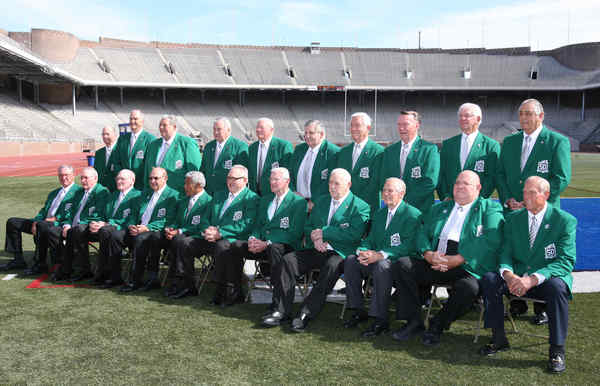
    Pagliei again faced stiff competition in training camp the following year. He was cut on the day the Eagles took their team photo, Sept. 19, 1960, thereby capturing his final moment on the future championship-winning squad.

    After he signed with the Titans of the AFL, the Eagles contacted Pagliei again. Fullback Theron Sapp had broken his leg in a preseason game and would be out longer than the team had expected.

    They asked Pagliei if he’d like to return to Philadelphia, but he’d already signed his Titans contract. While missing out on history was bittersweet, the 91-year-old always felt like he was a part of the 1960 Eagles group.

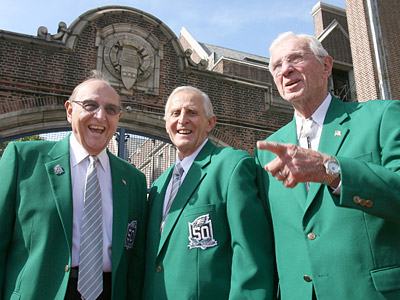
    Joe Pagliei (left) with Tommy McDonald (center) and Chuck Bednarik at an event honoring the 1960 team.

    It included some of his closest friends. Defensive tackle Jesse Richardson was the best man at Pagliei’s wedding. Wide receiver Tommy McDonald was like a family member. McDonald’s wife, Patty, was the godmother to Pagliei’s daughter Lizanne and the confirmation sponsor for Vicki.

    Pagliei left professional football in 1961 but continued to stay a part of that fraternity. His kids would play with McDonald’s kids, and linebacker Bob Pellegrini’s kids. The team always invited Pagliei to reunions and celebrations of the 1960 championship.

    In 2018, after the Eagles won their first Super Bowl, former players and their families were invited to the NovaCare Complex to see the Lombardi Trophy up close.

    McDonald had been diagnosed with dementia. He attended the event in a wheelchair, donning his gold Hall of Fame jacket. The former receiver’s recall was shaky, but when he saw Pagliei, his face lit up.

    “He knew who my dad was,” Vicki said. “He didn’t know too many people, but he knew who my dad was. He used to call him his brother.”

    The mayor of Azalea, senior living

    The staffers at Azalea of Cinnaminson say that Pagliei is something akin to a mayor. He knows everyone in the building. He also knows everything going on in the building, for better or for worse.

    The 91-year-old goes to the gym once a day, where he rides a bike, and does “40 reps of each weight.” On Tuesday and Thursday nights, he plays poker, a game that he might take more seriously than any other.

    Members of the 1960 Eagles NFL championship team pose for a team photo at Franklin Field, the site of their 17-13 win over Green Bay in the title game.

    “I make a lot of money,” Pagliei said, pointing to a stack of bills totaling $21 on a nearby counter. “Big time. Big time.”

    The former Eagle is 66 years removed from his last NFL season, but he has not lost his competitive spark. The Azalea staff learned this the hard way.

    Gracie Pouliot, a guest services manager, has had to intervene in a few contentious games of bingo.

    “He’s not a very good loser,” she said. “Everyone is cheating if he loses. He’s like, ‘This is [expletive]! They cheated!’

    “And we’re like, ‘No!’ He’ll throw the cards. He just cracks us up. He’s so funny.”

    Linda Bryant, a life enrichment assistant, said that Pagliei used to make fun of how she’d play pool.

    “He was joking around,” she said. “‘You guys don’t know how to do it.’”

    Bryant and Pouliot wouldn’t have it any other way. Pagliei might not be able to punt the ball, or run the length of a field, but he still has the spirit of a teenager.

    “He’s our little, fun-loving guy,” Bryant said.

  • A bald eagle laid three eggs in Lancaster County. You can watch them hatch live online.

    A bald eagle laid three eggs in Lancaster County. You can watch them hatch live online.

    Lincoln, the 26-year-old bald eagle that performs at Eagles home games and recently starred in a heartwarming Super Bowl commercial for Budweiser, isn’t the only local bird getting prominent airtime this week.

    A pair of Lancaster County bald eagles are currently the subject of a popular livestream presented by the Pennsylvania Game Commission and HDOnTap — one of two active eagles nests being livestreamed by the state at the moment.

    E-L-G-S-E-S!

    The two eagles — nicknamed “Lisa” and “Oliver” — have captured the imagination of onlookers as they preside over three eggs expected to hatch next month.

    At mid-morning Wednesday, the livestream had more than 100 live viewers. On Facebook, commenters leave by-the-hour updates on the birds’ comings and goings (“Oliver brought a nice size fish for Lisa’s dinner,“ wrote one Facebook commenter.. Last year, the Lancaster County nest alone saw nearly 700,000 viewers over the course of the year.

    It’s a popularity that Jason Beale, the game commission’s conservation education and social science chief, attributes to the bald eagle’s mythic status, its position as a national emblem, and the animals’ history of near-extinction.

    The bald eagle, in fact, has made a stunning comeback in recent years, “one of the great wildlife conservation stories in the history of both the state and the nation,” according to the Pa. Game Commission.

    In 1990, the number of known active nests in the state had dwindled to just eight. Today, that number stands at more than 300.

    The Lancaster County eagle cam is one of two livestreams of active eagles nests in the state, the locations of which are undisclosed to protect the animals and their nests. The state also operates an elk cam (1,151,559 views in 2025) and a snow goose cam (which has been a bit of a bust this year, Beale admits).

    But the eagle cam is where the interesting stuff seems to happen, says Beale.

    Once, he said, a livestream caught an eagle carrying a cat up to the nest. Another time, a turtle.

    All of it can make for good TV.

    “Generally, if you watch it for a few minutes, you’re going to see something,” Beale said.

    As for the enduring popularity of the eagle cam?

    Said Beale, “It’s happening when people are cooped up inside, they’re ready to get out in the spring, and it’s a way to connect with nature at a time when not a lot of us are connected with nature.”

    Find the Lancaster County eagles nest livestream at bit.ly/4rdfTU1.

  • Opening a burger place in Fishtown shouldn’t be that hard | Editorial

    Opening a burger place in Fishtown shouldn’t be that hard | Editorial

    Delaware Avenue used to be Philadelphia’s party district. During the 1990s, when nightclub culture was in full swing, people flocked to riverfront venues like Egypt and Maui. While patrons enjoyed the riverfront’s dance era, many of the people living nearby did not.

    With the assistance of their district councilperson, Frank DiCicco, neighbors in Northern Liberties and Fishtown instituted restrictions in 2002 on what kind of businesses could operate in the area. This meant new bars and restaurants adjacent to the nightclub zone would have to go to the city’s zoning board for approval.

    These days, club culture has faded. Young people are staying home, drinking less, and dancing is done on TikTok. Yet, the restrictive zoning rules remain — out of step with the neighborhood’s current needs and realities.

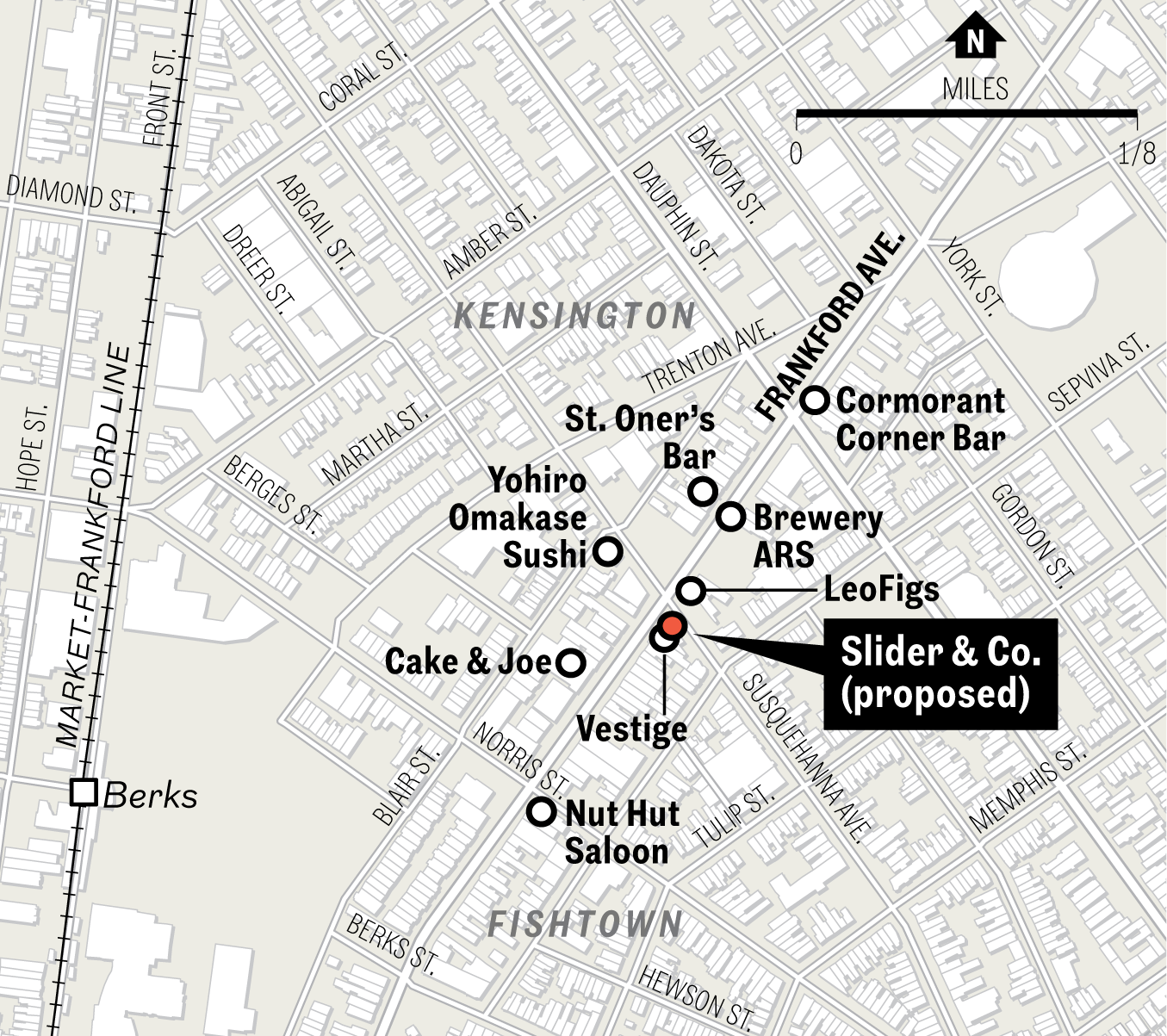
    Take the new bar and restaurant proposed by the Slider Co. for a building at 2043 Frankford Ave. in Fishtown. Since the restriction affects any establishment that serves food or drinks, the business has been mired in red tape that has so far cost owners more than $40,000 in fees and six months in delays, according to reporting by The Inquirer’s Jake Blumgart.

    Even after prevailing recently at the Zoning Board of Adjustment, the eatery could still face further delays — and more legal fees — if an appeal is filed.

    These obstacles are a self-imposed limit on prosperity for Philadelphia.

    The city’s onerous wage and business taxes are often cited as a reason for the lack of economic growth, paucity of businesses, and stagnant job market. Having these zoning restrictions on the books contributes to these problems — without even the benefit of helping to fund city services. Instead, the tens of thousands in legal fees and rent payments go directly to local law firms and landlords.

    It is also inherently unfair. With no objective standards, entrepreneurs are forced to defend themselves against vague arguments. A potential neighbor of the Slider Co. argued to the zoning board that a bar and restaurant would be out of character for the corridor. Never mind that the area is already home to LeoFigs, a winery and restaurant, St. Oner’s restaurant, and Brewery ARS. This incongruity led some neighbors to allege that opposition may be based on race. The Slider Co.’s owners are Black, and most of Fishtown is not.

    Locator map of bars and restaurants along Frankford Avenue in Fishtown and Kensington.

    Over time, maintaining these kinds of zoning restrictions incentivizes the growth of the kind of national franchises that can afford to go through the process, as opposed to the scrappy local options that lack the resources needed to wait out the delays. This board has long opposed the proliferation of these types of limits, as well as the tradition of councilmanic prerogative that makes them possible.

    Given City Council is unlikely to give up prerogative — the tradition of allowing district Council members to control land use in their districts — or to stop adopting zoning restrictions anytime soon, one way they can mitigate some of the resulting bureaucratic entanglement for future Philadelphians is to enact a sunset provision.

    Attaching an expiration date to zoning restrictions would change the conversation.

    Instead of asking why a zoning overlay should be repealed, policymakers would ask why it should be extended. In some cases, antiquated restrictions may simply disappear. After all, the nightclub restriction along Delaware Avenue is not the only one that could use a refresh.

    In much of South Philadelphia, residents are prohibited from adding a third story to their homes without including an 8-foot setback. Beyond making for some truly ugly streetscapes, the requirement also makes the high cost of adding a floor futile by eliminating a sizable chunk of the new square footage. This restriction was passed with the aim of preventing gentrification, but instead, it just makes it harder for families to rightsize their homes for the remote work era.

    Creating a sunset clause doesn’t stop Council members from protecting their communities from unwanted changes; it just allows Philadelphia the chance to evolve with the times.

  • Will we stand up for immigrants and democracy?

    Will we stand up for immigrants and democracy?

    As a Pennsylvanian who works with immigrants on the U.S.-Mexico border, I urge people of goodwill in the Keystone State and beyond to stand up for immigrants in our country. Our democracy depends on it.

    I am a Sister of Mercy of the Americas, a Catholic order that has accompanied immigrants in Pennsylvania, across the United States, and internationally since 1843. We take seriously the Gospel command to “welcome the stranger.”

    On the border, I am a community worker. Part of my ministry is to help immigrants in the United States apply for citizenship or renew their legal permanent residence and DACA (Deferred Action for Childhood Arrivals) status.

    Migrants are arrested at the Texas-Mexico border in 2024. Migrants’ lives have become a nightmare, writes Sister Patricia Mulderick.

    Most are doing everything they can to follow the rules, to attain or hold on to legal status. But their lives have become a living nightmare, and their plight fills me with anguish.

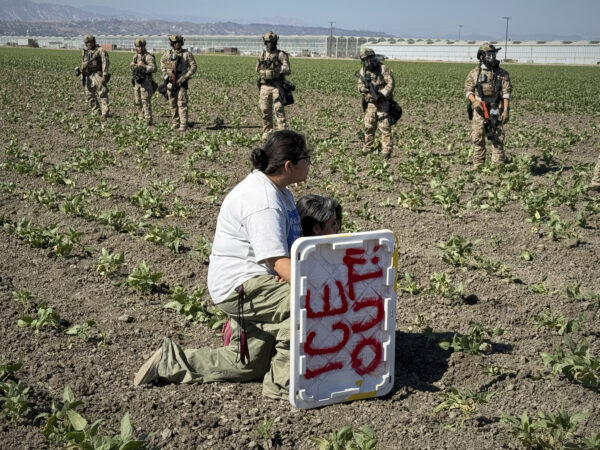
    Migrant workers in Texas are terrified of being picked up in the fields, where they toil 12 hours a day under the hot sun to pick melons, onions, carrots, and other fresh produce destined for grocery stores and our kitchen tables around the country, anonymous but vital to our economy and way of life.

    The migrants left in Mexico are in limbo, denied hearings by U.S. immigration officials and often unable to return to their home countries.

    “You could send me a limousine with a marching band, and I could not return,” one man said to me. “I would be dead within 24 hours.” And a woman I know sold everything she owned to make the journey north — she has nothing to go back to.

    On the U.S. side of the border, people are being terrorized by masked U.S. Immigration and Customs Enforcement agents stalking our neighborhoods. One elderly woman who has worked in the fields for four decades hid in her bedroom as they pounded on her front door. Neighbors alerted a women’s group I am part of, and members asked to see the agents’ warrant. It turned out ICE was looking for someone else. I shudder to think what would have happened if those brave advocates had not stepped up.

    I first learned about the bonds between democracy and our nation of immigrants at my public school in the coal regions. The brutality and terror inflicted by security forces all around our country are un-American.

    When Pennsylvanians helped unite 13 colonies into one country by inviting new Americans to Philadelphia’s Independence Hall to debate and sign the Declaration of Independence and the U.S. Constitution, they knew their “experiment” in self-governance wasn’t guaranteed. Ben Franklin famously said that Americans had “a republic, if you can keep it.” We must again help lead the way.

    Pennsylvanians take pride in being standard-bearers for liberty. We also value the vital contributions newcomers make in our state, in industries ranging from construction and hospitality to high-tech.

    More than ever, we must stand up for immigrants and democracy together. We must hold our nation to the ideals inscribed on the Statue of Liberty: “Give me your tired, your poor, your huddled masses yearning to breathe free.”

    We must not lose hope. But we cannot sit idle.

    The Sisters of Mercy have spoken out on the cruel treatment of our immigrant brothers and sisters under this administration, as have the U.S. bishops in a powerful statement, and Pope Leo XIV, who emphasized that immigrants arriving in strange lands “must not find the coldness of indifference or the stigma of discrimination!”

    Pope Leo and I met in the 1980s, when he was the young priest Father Robert Prevost, and we both were serving in Peru. His humility and concern for people living in poverty moved me deeply.

    In Mexico recently, I held hands with a woman who wept after her immigration hearing — scheduled for the day after President Donald Trump’s inauguration — was canceled by the president on his first day in office. This woman had lived in a tent for eight months, waiting to cross legally.

    “Your president says we are criminals, but I have never broken a law in my life,” she told me. “They seem to hate us, but I will not hate back. I will not let hate win.”

    Will we?

    Sister Patricia Mulderick is a member of the Sisters of Mercy of the Americas, the largest order of Catholic religious women in the United States. She serves in both Pennsylvania and Texas.