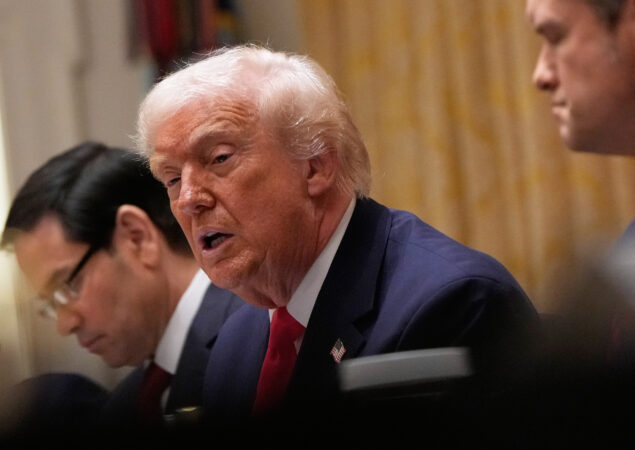
The expansion would build on a travel ban already announced in June by the Republican administration, which barred travel to the U.S. for citizens from 12 countries and restricted access to the U.S. for people from seven others. In a social media post earlier this week, Noem had suggested more countries would be included.
Noem, who spoke late Thursday in an interview with Fox News Channel host Laura Ingraham, would not provide further details, saying President Donald Trump was considering which countries would be included.
In the wake of the National Guard shooting, the administration already ratcheted up restrictions on the 19 countries included in the initial travel ban, which include Afghanistan, Somalia, Iran and Haiti, among others.
Ingraham asked Noem whether the travel ban was expanding to 32 countries and asked which countries would be added to the 19 announced earlier this year.
“I won’t be specific on the number, but it’s over 30. And the president is continuing to evaluate countries,” Noem said.
“If they don’t have a stable government there, if they don’t have a country that can sustain itself and tell us who those individuals are and help us vet them, why should we allow people from that country to come here to the United States?” Noem said.
The Department of Homeland Security did not respond to requests for comment about when an updated travel ban might go into effect and which countries would be included in it.
Additions to the June travel ban are the latest in what has been a rapidly unfolding series of immigration actions since the shooting Thanksgiving week of two National Guard troops in Washington.
Rahmanullah Lakanwal, who emigrated to the U.S. from Afghanistan after the U.S. withdrawal, has been charged with first-degree murder after one of the two victims, West Virginia National Guard Specialist Sarah Beckstrom, died of wounds sustained in the Nov. 26 shooting. The second victim, Staff Sgt. Andrew Wolfe, was critically wounded. Lakanwal has pleaded not guilty.
The Trump administration has argued that more vetting is needed to make sure people entering or already in the U.S. aren’t a threat. Critics say the administration is traumatizing people who’ve already gone through extensive vetting to get to the U.S. and say the new measures amount to collective punishment.
Over the course of a little more than a week, the administration has halted asylum decisions, paused processing of immigration-related benefits for people in the U.S. from the 19 travel ban countries and halted visas for Afghans who assisted the U.S. war effort.
On Thursday, U.S. Citizenship and Immigration Services announced it was reducing the time period that work permits are valid for certain applicants such as refugees and people with asylum so they have to reapply more often and go through vetting more frequently.
What’s it like to be an executive at baseball’s winter meetings? Jim Duquette, a former general manager with the Mets and Orioles and now the host of a show on MLB Network Radio, puts us in the rooms where everything happens. He also discusses the Phillies’ offseason, including the chances that Kyle Schwarber and J.T. Realmuto return in free agency. It’s all on “Phillies Extra,” the baseball podcast from The Philadelphia Inquirer. Watch here.
The Festival of Lights, now in its 50th year, kicked off its seasonal run at Rose Tree County Park in Media on Thursday night. Santa was on hand as more than 125 trees decked out in some 300,000 lights were lit for the first time this season.
Despite the chilly temperatures, spirits were high, with families coming out to see the lights, visit with Saint Nick, and shop from vendors at Delco’s first Fare & Flair night for the season.
Rose Tree County Park’s Festival of Lights was lit for the first time on Dec. 4. It will be lit nightly through Jan. 3. The Springton Lake Middle School Select Choir counts down the illumination of the 50th annual Festival of Lights at Rose Tree County Park. An attendee captured the lighting, which includes some 300,000 lights. Santa met with festivalgoers throughout the night, including 7-year-old Iris Yang. While the temperatures were cold enough for snow, only the faux kind fell during the opening night of the Festival of Lights. Three-year-old Liliana Napoletano and Marco Napoletano, both of Media, reveled in the faux snow that fell during the festival’s lighting. The display includes a walk-through lighted tunnel. A display of reindeer also returned this year. Savannah, 3, and Ace, 8, of Drexel Hill, looked at the lights.Thursday was the first night of the Delco’s Fare & Flair nights, when food trucks and vendors line the back of the park. Work to wrap some 125 trees throughout the park began in October. Even dogs came out to enjoy the festival’s kickoff on Thursday.
This suburban content is produced with support from the Leslie Miller and Richard Worley Foundation and The Lenfest Institute for Journalism. Editorial content is created independently of the project donors. Gifts to support The Inquirer’s high-impact journalism can be made at inquirer.com/donate. A list of Lenfest Institute donors can be found at lenfestinstitute.org/supporters.
BRUSSELS, Belgium — When NATO foreign ministers gathered this week to deliberate on a U.S. plan to end the war in Ukraine, they had neither the plan in hand nor Secretary of State Marco Rubio in the room to represent the alliance’s biggest, most powerful member. Rubio skipped the meeting as the White House held talks with Russia and Ukraine that have kept European allies sidelined.
The State Department did not give a reason for Rubio’s absence, but his decision not to attend the high-profile meeting only added to the quiet frustration among his European counterparts as President Donald Trump’s envoy Steve Witkoff and son-in-law Jared Kushner visited Moscow to discuss a plan with huge ramifications for European security.
It was here at NATO’s glassy headquarters that Trump rattled America’s partners during his first presidency by telling them that if they didn’t pull their weight, he could “do his own thing.” Now Washington appears to be doing just that, and not only in the Russia talks. In the Middle East, the Caribbean, the South Caucasus and pretty much everywhere else, Trump acts first, consults after — if at all.
In their plan for Ukraine, the president and his advisers have even seemed to position the United States as speaking not for the alliance — synonymous with American military might since its founding in 1949 — but as an independent arbiter, whose interests do not necessarily coincide with those of the 31 other allies, from Canada to Estonia.
“The spirit of the plan was: We are no longer an ally, we are a broker. We are not in this camp or that one, we are above that. It was perceived as a catastrophe by the Europeans,” said Claudia Major, a senior vice president of the German Marshall Fund, a Washington-based think tank.
“They don’t have to leave NATO to weaken NATO,” she said. “I mean, I’m a member of a gym but I don’t go.”
NATO Secretary General Mark Rutte, whose core job responsibility often seems to be to smooth over relations between Trump and other allies, told reporters there was nothing to worry about. The White House is “absolutely consulting enough” with European allies and he is “in constant contact” with U.S. officials, Rutte said as he convened the foreign ministers meeting Wednesday.
But Trump’s approach repeatedly has left European leaders in the dark, relying on leaks and news reports for the latest developments, then scrambling from afar to shape policy discussions in which their constituents and their continent have a far more direct stake.
Ahead of Witkoff’s trip, several diplomats at NATO said they weren’t sure which version of the plan he was taking to the Kremlin — an updated proposal reflecting changes from talks with Ukrainian negotiators, or something else.
European leaders are anxious and distrustful of the Trump administration. According to the leaked transcript of a phone call among leaders, published on Thursday by Der Spiegel, German Chancellor Friedrich Merz said that the Americans are “playing games” while French President Emmanuel Macron warned that Washington might “betray” Ukraine.
American exceptionalism — including unilateral decision-making and military action — is nothing new. Butfor Europeans, it now hits closer to home. After supporting the U.S. in many conflicts, including by sending troops to Afghanistan and Iraq, some allies feel bitterly slighted by Trump’s limited regard for their priorities.
European leaders were already alarmed by Trump’s interest in renewing economic ties with Russia, along with the president’s uncertain commitment to Europe’s security.
In an earlier bid to end the war, Trump invited Russian President Vladimir Putin to Alaska and seemed open toRussia’s demands for Ukrainian territory, prompting several European leaders to race to the White House for a meeting.
Special envoy Steve Witkoff (from left), Secretary of State Marco Rubio, and Jared Kushner meet with Ukrainian officials Nov. 30 in Hallandale Beach, Fla.
Last month, Witkoff floated a plan for Ukraine that many European officials found out about in the press. The proposal triggered alarm not only for the concessions it demanded of Kyiv but also because it mentioned using Russian frozen assets held in Europe, as well as restricting NATO expansion and the European Union’s ability to accept Ukraine as a member.
The initial, 28-point plan appeared to get revised after meetings between U.S. and Ukrainian negotiators. European diplomats expressed relief that it was revamped and said they had received U.S. assurances that NATO and EU questions would be addressed separately.
But Trump’s constant freelancing has cut to the heart of European apprehension that Washington does not share their dark assessment of Putin’s ultimate intentions, which they see as undermining European democracies and weakening NATO.
The negotiations also feed a fear that Trump shares with Putin a vision of the world in which Washington and Moscow get to decide the fate of others.
“You have this idea behind it that the great powers decide, and the smaller ones have limited sovereignty, and they are informed afterward,” Major said. “There is a certain intellectual dissonance,” she added, in the U.S. wanting to potentially do business with Russia while most NATO leaders describe Russia as their biggest threat.
Still, some European diplomats say the only option in the immediate term is to keep getting in Trump’s ear — because even if he were willing to consult more, Putin is not.
“The fact of life is the only ones capable of negotiating an end to the Ukraine war are the U.S., for the simple reason that Putin will not sit at the table with anyone else,” said a NATO diplomat, who, like others, spoke on the condition of anonymity to discuss sensitive security issues. “This causes a lot of discomfort for many Europeans, but it is a fact of life, so as long as the Americans listen to us.”
“I think it’s fair to say these are the most consequential negotiations for European security of this century,” the diplomat added.
At this week’s NATO meeting, the United States was represented by Deputy Secretary of State Christopher Landau — who earlier this year questioned the need for NATO, calling it “a solution in search of a problem” in a post on X that he later deleted.
A State Department official, speaking on the condition of anonymity to discuss Rubio’s travel, said NATO was “completely revitalized” since Trump secured a European pledge to increase national defense spending by allies. Rubio has “already attended dozens of meetings with NATO allies, and it would be completely impractical to expect him at every meeting,” the official said.
NATO foreign ministers typically meet twotimes per year, with ambassadors stationed in Brussels meeting far more frequently.
“I totally accept him not being able to be here,” Rutte said of Rubio, who is juggling multiple jobs in the administration. Rutte also told reporters that he hears from “all allies that they’re completely committed” to NATO’s political doctrine that Russia poses the biggest threat to the Western alliance.
Several European diplomats acknowledge privately, however, that they encounter conflicting messages among those in Trump’s circle — seeing Rubio, for example, as more aligned with their ideas and Witkoff as too close to Moscow.
The Kremlin regularly criticizes input from European officials on the negotiations, casting them as warmongers seeking to perpetuate the conflict with their backing of Ukraine.
Putin declared this week that Russia is ready for war with Europe “right now if Europe starts it,” drawing consternation from European ministers, who said this was proof that they should funnel more money to Ukraine and their own militaries.
The increasingly tense rhetoric is fueling European calls to take charge at NATO in case the U.S. shrinks its dominantrole, including in the command structure and quick-response plans.
European leaders must “adjust to a new reality” in which U.S. interests don’t necessarily match theirs, said Giuseppe Spatafora, an analyst at the EU’s Institute for Security Studies and a former NATO policy adviser.
“This opinion is becoming more popular among European leaders,” as the leaked phone call suggested, Spatafora said. “They thought that relentless engagement would avoid the worst outcomes, which it did, or could have slowly shifted Trump’s needle. I don’t think the latter happened.”
Ukrainian President Volodymyr Zelensky, meanwhile, is dealing with a major corruption scandal that prompted the resignation of his chief of staff, and his negotiating leverage remains precarious. That’sespecially because of a disagreement among EU nations on how to find fresh cash for Kyiv, now that the U.S. has halted direct cash assistance.
An EU plan to tap into some $200 billion in frozen Russian assets has run into stiff opposition from Belgium, where most of the funds are located.
Estonian Foreign Minister Margus Tsahknasaidthere was “very important momentum” in the U.S.-led talks, but he acknowledged early Wednesday, the morning after the American delegation went to the Kremlin: “We don’t know exactly what was discussed, and what will be the results.”
For every person who signed up for Obamacare health insurance in Pennsylvania last month, two others dropped their plans in anticipation of skyrocketing costs.
The average cost of a health plan through Pennsylvania’s Affordable Care Act marketplace, Pennie, is expected to double, on average, with some people paying several times more in 2026, if Congress allows a key financial incentive program to expire at the end of this year.
Pennie leaders say sticker shock for 2026 is undermining a program they credit for driving historically low uninsured rates.
Nearly 31,000 people canceled their Pennie health plan in November, the first month of open enrollment, which runs through the end of January. About 16,000 people signed up.
Pennie administrators previously estimated that roughly 150,000 of the nearly 500,000 people who bought plans in 2025 will drop out because they find their options for 2026 unaffordable.
Some level of turnover is normal, as people move out of state, find new jobs, or become eligible for other government programs, such as Medicare or Medicaid. But the sharp rise in plan cancellations — more than the marketplace saw in all of 2025 — shows that cost remains a driving factor in health decisions.
“People want health coverage, and when it can fit in their budget, they buy it,” said Devon Trolley, Pennie’s executive director.
A partisan divide over the so-called enhanced premium tax credits was at the center of this fall’s longest-ever federal government shutdown. The subsidies have helped offset the cost of Obamacare premiums, ensuring no one spends more than 8.5% of income on health insurance through Democrats’ signature health coverage reforms implemented under President Barack Obama.
The federal budget ultimately approved by the current Republican-controlled Congress did not include an extension of the tax credits, and it is unclear whether Democrats or Republicans will be able to secure enough votes for the fixes they have proposed.
U.S. Rep. Brian Fitzpatrick, a Bucks County Republican, is proposing legislation that would extend the tax credits for two years, with some restrictions.
The subsidies have been particularly beneficial to working individuals and families who earn too much to qualify for other, income-based Obamacare tax credits, but who cannot afford to pay full price and do not have access to insurance through an employer. Income-based tax credits for people who earn below 400% of the federal poverty rate are part of the original ACA law and will not expire.
The add-on tax credits have been approved annually by Congress since 2021, and the vast majority of people who buy coverage through Pennie qualify for at least some amount of financial assistance.
Pennie will work to update rates as quickly as possible if Congress renews the tax credits before the end of the year.
In the meantime, marketplace leaders are urging people to consider all the plan options — which range from high-deductible plans with low premiums to plans with steep monthly costs but fewer out-of-pocket expenses — before canceling their coverage entirely.
Plan costs and expected increases vary, depending on age, income, and geography, which is why it is important for people to review their options, Trolley said.
Philadelphia’s Pennsylvania suburbs are expected to see costs increase an average of 40% to 70%, while costs are rising an average of 400% or more in rural communities in the middle of the state.
Increased outreach amid tax credit confusion
State-based marketplaces and their partners have ramped up marketing and outreach in an effort to make sure people are aware of the cost increases.
Pennsylvania Health Access Network has doubled the amount of text messages, phone calls, and emails it is sending past clients. Messages remind people of the deadline to enroll and urge them to review their plan online — even if they intend to keep it.
The nonprofit has seen an increase in people reaching out early for information, compared with past enrollment seasons, as well as more people waiting to make a final decision about coverage, said Antoinette Kraus, the organization’s executive director.
“We’re seeing fewer people say, ‘All right, sign me up today,’” Kraus said. “They’re taking time to figure out how this fits in the budget.”
New Jersey announced it was expanding outreach efforts for its marketplace, Get Covered New Jersey, with more than three dozen enrollment events at shopping malls and grocery stores across the state.
New Jersey has not released enrollment data for 2026.
Justin Zimmerman, commissioner of New Jersey’s Department of Banking and Insurance, urged people not to put off buying a plan, despite uncertainty about tax credits. In New Jersey, people must sign up by Dec. 31 for coverage to take effect Jan. 1.
“It is especially important for consumers to shop and compare plans to find the best options for them,” Zimmerman said in a statement announcing outreach plans.
Fitting health insurance into the budget
People who are used to their plan automatically renewing at the end of the year may be particularly surprised by the new prices when insurers begin sending January premium bills by mid-December.
Pennsylvania’s deadline for insurance that begins in January is Dec. 15, but people have until the end of January to make any changes to their coverage.
That means people who are automatically reenrolled in their existing plan still have time to change it, if they realize after getting their first bill that they cannot afford it and want to look for a less expensive option.
And people who canceled their coverage earlier in the enrollment period can still sign up if they change their mind.
As of Feb. 1, when the enrollment period ends, people can still cancel their plan, but they will not be able to pick a new one until the coming fall.
The marketplace’s enrollment specialists work with people to price out all their options. But Pennie’s executive director fears that without an extension of the add-on tax credits, many will not find an option they can afford.
“We are doing the best we can to provide people with the best information,” Trolley said. “But ultimately, we cannot fill the hole of federal funding.”
WASHINGTON — President Donald Trump’s administration has set forth a new national security strategy that paints European allies as weak and aims to reassert America’s dominance in the Western Hemisphere.
The document released Friday by the White House is sure to roil long-standing U.S. allies in Europe for its scathing critiques of their migration and free speech policies, suggesting they face the “prospect of civilizational erasure” and raising doubts about their long-term reliability as American partners.
At the same time the administration is sharply critical of its democratic allies in Europe and carrying out a pressure campaign of boat strikes in South America, it chides past U.S. efforts to shape or criticize Middle Eastern nations and seeks to discourage attempts for changes in those countries’ governments and policies.
The strategy reinforces, in sometimes chilly and bellicose terms, Trump’s “America First” philosophy, which favors nonintervention overseas, questions decades of strategic relationships, and prioritizes U.S. interests.
The U.S. strategy “is motivated above all by what works for America — or, in two words, ‘America First,’” the document said.
This is the first national security strategy, a document the administration is required by law to release, since the Republican president’s return to office in January. It is a stark break from the course set by President Joe Biden’s Democratic administration, which sought to reinvigorate alliances after many were rattled in Trump’s first term and to check a more assertive Russia.
Democratic Rep. Jason Crow of Colorado, who sits on House committees overseeing intelligence and the armed forces, called the strategy “catastrophic to America’s standing in the world and a retreat from our alliances and partnerships.”
“The world will be a more dangerous place and Americans will be less safe if this plan moves forward,” Crow said.
Criticism of Europe
The United States is seeking to broker an end to Russia’s nearly four-year-old war in Ukraine, a goal that the national security strategy says is in America’s vital interests. But the document makes clear that the U.S. wants to improve its relationship with Russia after years of Moscow being treated as a global pariah and that ending the war is a core U.S. interest to “reestablish strategic stability with Russia.”
The document also accuses America’s longstanding European allies, which have found themselves sometimes at odds with Trump’s shifting approaches to the Russia-Ukraine war, of facing not just domestic economic challenges but, according to the U.S., an existential crisis.
Economic stagnation in Europe “is eclipsed by the real and more stark prospect of civilizational erasure,” the strategy document said.
The U.S. suggests that Europe is being enfeebled by its immigration policies, declining birthrates, “censorship of free speech and suppression of political opposition” and a “loss of national identities and self-confidence.”
“Should present trends continue, the continent will be unrecognizable in 20 years or less. As such, it is far from obvious whether certain European countries will have economies and militaries strong enough to remain reliable allies,” the document said.
The document also gives a nod to the rise of far-right political parties in Europe, which have been outspoken in their opposition to illegal immigration and climate policies.
“America encourages its political allies in Europe to promote this revival of spirit, and the growing influence of patriotic European parties indeed gives cause for great optimism,” the strategy said.
German Foreign Minister Johann Wadephul acknowledged the U.S. is “our most important ally” in NATO but said questions about freedom of expression or “the organization of our free societies” are not part of alliance discussions.
“We also don’t think that anyone needs to give us any advice on this,” Wadephul told reporters.
Markus Frohnmaier, a lawmaker with the far-right, anti-immigration Alternative for Germany party, described the U.S. strategy as “a foreign policy reality check for Europe and particularly for Germany.”
Setting sights on power in the Americas
Despite Trump’s “America First” maxim, his administration has carried out a series of military strikes on alleged drug trafficking boats in the Caribbean Sea and the eastern Pacific Ocean while weighing possible military action in Venezuela to pressure President Nicolás Maduro.
The moves are part of what the national security strategy lays out as “a ‘Trump Corollary’ to the Monroe Doctrine” to “restore American preeminence in the Western Hemisphere.” The 1823 Monroe Doctrine, formulated by President James Monroe, was originally aimed at opposing any European meddling in the Western Hemisphere and was used to justify U.S. military interventions in Latin America.
Trump’s strategy document says it aims to combat drug trafficking and control migration. The U.S. also is reimagining its military footprint in the region even after building up the largest military presence there in generations.
That means, for instance, “targeted deployments to secure the border and defeat cartels, including where necessary the use of lethal force to replace the failed law enforcement-only strategy of the last several decades,” it says.
Shifting focus away from the Middle East
With a shift to the Americas, the U.S. will seek a different approach in the Middle East.
The U.S., according to the strategy, should abandon “America’s misguided experiment with hectoring” nations in the Middle East, especially monarchies in the Gulf, about their traditions and forms of government.
Trump has bolstered ties with nations there and sees Middle Eastern countries as ripe for economic opportunities, and the Arab nations are “emerging as a place of partnership, friendship, and investment,” the document says.
“We should encourage and applaud reform when and where it emerges organically, without trying to impose it,” it says.
This year, Trump made his first major foreign trip to the Middle East, and his efforts to settle the Israel-Hamas war in Gaza has been a major focus. But the U.S. plans to shift its focus from the region, the administration says, as America is less dependent on its oil supply.
‘Rebalance’ of U.S. relationship with China
Meanwhile, as the U.S. under Trump has overturned decades of free trade policies with his sweeping global tariffs, its ties with China have been a prime focus. America under Trump is seeking to “rebalance” the U.S.-China relationship while also countering Beijing’s aggressive stance toward Taiwan, according to the document.
The Trump administration wants to prevent a war over Taiwan, the self-governing island that Beijing claims as its own and to which the U.S. is obligated by its own laws to give military support, by maintaining a military advantage over China.
But the U.S. wants allies in the region to do more to push back against Chinese pressure and contribute more to their defense.
“The American military cannot, and should not have to, do this alone,” the strategy says. “Our allies must step up and spend — and more importantly do — much more for collective defense.”
Ocean City Mayor Jay A. Gillian has filed for personal bankruptcy.
The “extraordinarily difficult decision” was made after a combination of business decisions he made, personal financial obligations, and outside circumstances led to “serious financial strain” on his family, Gillian said in a statement shared on Ocean City’s government website.
“Like many individuals and families across our nation who encounter unexpected hardship, I found myself in a position where traditional methods were no longer viable,” Gillian said. “It is my hope that by being transparent and direct, others facing similar hardships will feel empowered to seek help, take responsible action, and work toward rebuilding.”
Despite this personal challenge, Gillian said his leadership of Ocean City remained “unwavering,” and he would stay in his role as mayor. In the statement, the mayor assured residents that his personal financial issues had no impact on city finances and operations were uninterrupted.
“Safeguards, oversight, and the structure of municipal government ensure that personal finances and public finances remain entirely separate,” Gillian said.
Gillian referred to his public statement when asked for additional comment.
A sign welcomes visitors to Gillian’s Wonderland Pier in Ocean City on Tuesday, August 20, 2024.
While the mayor, who has been in office since 2010, did not specify what led to the bankruptcy beyond his statement, the Gillian family, which owned Gillian’s Wonderland Pier since 1965, sold the property to developer Eustace Mita, of Icona Resorts, in 2021. At the time, the Gillian family had defaulted on $8 million in loans, with the pier as collateral.
Mita has since embarked on plans to transform the site, first into a $150 million luxury hotel, and later, into townhomes. After a City Council vote Thursday, the property is now under review by the Ocean City Planning Board to determine whether the property should be rehabilitated or rezoned for new development.
Rebecca Kelly Slaughter was a powerful — but low-profile — bureaucrat when a New York Times news alert popped up on her phone blasting to the world her firing by President Donald Trump. The Democratic member of the Federal Trade Commission had found out only minutes earlier.
Her phone began blowing up as she stood outside her daughter’s school during a rehearsal of Beauty and the Beast Jr. Slaughter, who mostly avoided the media, was soon participating in an impromptu news conference on her phone as the musical carried on inside.
When her daughter stepped offstage, Slaughter pushed through a crowd so she could be the first to spill the news to the girl. The fifth grader burst into tears before asking, “Are you going to fight back?”
“Probably,” Slaughter replied.
Thrust into the spotlight in March, a regulator more comfortable with the minutiae of antitrust issues than the dynamics of a political fight, has emerged as one of the primary opponents of Trump’s war on the federal workforce he disparages as the “deep state.”
Slaughter has not onlyfought her owndismissal in court, she has defended the work of civil servants beforeCongress, on podcasts and on TV, speaking outwhen many others are demoralizedfrom losing jobs and absorbingthe president’s repeated attacks.
Rebecca Slaughter chats with her children as she makes dinner.
On Monday,the Supreme Courtwill hear arguments in her case — which probably will be the first in which the justicesrender a final decision on the legality of Trump’s moves to fire agency heads and gut agencies.
Many legal experts expect the court to rule against Slaughter — a majority of the justices have signaled support for much of Trump’s argument.The stakes are high: The case could upend how the federal government has been run for nearly a century. A ruling against her could give the president greater control over sometwo-dozen independent agencies, a major goal in his quest to enlarge his power.
The administration says presidential control will make agenciessuch as the Federal Trade Commission,Federal Election Commission and Federal Communications Commission more accountable to voters who elect presidents. Slaughter fears political influence will replace the expertise that has guided decisions on issues such as product safety, banking, and media mergers.
In other words, the very work she and some of the roughly 300,000 other civil servants who have been laid off in recent months have unobtrusively carried out for decades. Trump’s purge of the federal workforce is the largest in a single year since World War II.
“The alternative to allowing these agencies to operate as Congress designed is … accruing power to the president,” Slaughter said. “That is something that would be concerning at any time, but really concerning when you have a president who is interested in wielding power for the benefit of himself, his friends and allies — and at the expense of everyday Americans.”
Dismissed
Independent agencies were some of the first targets of Trump’ssecond-term buzz saw as he slashed government jobs and put the executive branch under a tighter grip.
“My administration will reclaim power from this unaccountable bureaucracy, and we will restore true democracy to America again,” Trump said in his first speech to Congress of his current term.
Slaughter watched with trepidation as Trump fired a Democratic member of the National Labor Relations Board in January and the Democratic chair of the Merit Systems Protection Board in February.
She guessed she might be a target but was still shocked when the email landed in her inbox March 18. Slaughter had spent nearly seven years on the commission and loved the work. Trump had originally appointed her in his first term, and she was reappointed by President Joe Biden.
“Your continued service on the FTC is inconsistent with my Administration’s priorities,” stated the message sent on behalf of the president.
It was the first time in 91 years a president had tried to fire a member of the FTC, which focuses on consumer protection and increasing business competition. Trump also dismissed the other Democrat on the five-member commission, Alvaro Bedoya, leaving only Republicans.
What struck Slaughter was thatTrump had given no reason for her dismissal. Congress insulated the FTC from the president through a law allowing the executive to remove commissioners only for “inefficiency, neglect of duty, or malfeasance in office.” Slaughter said firing her without citing any such reason was a blatant and illegal power grab. Almost immediately, she resolved to sue.
The stakes of her public stand quickly became apparent.
After juggling press calls and her daughter’s performance the night of her firing, Slaughter returned home. She received a knock on her door around 11:30 p.m. as her four children slept. It was a pizza delivery she had not ordered. Bedoya got one, too, the same night.
They concluded the pizzas were probably part of a wave sent to the homes of judges and other officials, most of whom had ruled against or opposed Trump’s policies — a reminder that potential assailants knew where they lived. They alerted police and scrubbed personal information from the internet.
Rebecca Slaughter chats with fellow FTC member Alvaro Bedoya on Capitol Hill in 2023.
But she and Bedoya resolved to stay in the public eye despite the risks. Days later, Slaughter appeared before a House committee to testify about her firing.
“I will not be the first to go down without a fight, and neither will Commissioner Bedoya,” Slaughter told the legislators. “We swore an oath to serve the American people and our Constitution, and I believe that the law will vindicate our right to finish the job.”
The legal fight
That was not so easily accomplished.
The path to the Supreme Court has been winding and full of setbacks. Bedoya had to drop out along the way.His family was struggling financially with one paycheck. The problems were compounded when someone tried to take out a $500,000 line of credit in his name, an act he suspects wastied to hisspeaking out about his firing.
“It is not fun to take on the president of the United States, particularly in this environment,” Bedoya said. “It’s not fun to notknow where your next paycheck will come from or if you will get a paycheck, period.”
Slaughter carried on, with her husband, who works for an investment firm, shouldering the financial load for the family and withhelp from pro bono attorneys. She has continued to publicly weigh in on matters before the FTC as if she werestill on the job, while speaking and making media appearances to draw attention to her case.
Rebecca Slaughter kisses one of her daughters as she prepares a meal in November.
“Mommy, I thought that being fired would make you less busy,” Slaughter recalled her 6-year-old daughter telling her.
In July, a federal judge ruled she could return to her job while her case played out in the courts. When Slaughter arrived back to work on a Friday, about two-dozen FTC staffers stood outside and clapped as she entered the building.
The returnwas exhilarating — but short-lived. By the following Monday, an appeals court hadpaused her reinstatement. In September, the appeals court ruled she could return to work again, but the Supreme Court soon stayed that order until it makes a final ruling on her dismissal.
Slaughter joked she is the first person in history fired from the FTC three times but said “the whiplash was really disheartening.” Even more disturbing were the glimpses she got inside the FTC during her second stint back.
It was an agency transformed.
“There were a lot of questions about political interference,” Slaughter said of two staff meetings she held. “People seem demoralized. People felt beaten down.”
A case with major ramifications
Slaughter’s case is in many ways a redo of another that changed the course of the federal government nine decades ago.
Through the late 1800s, presidents regularly rewarded political supporters with federal jobs. But the spoils system, as it was called then, was phased out after a backer of President James Garfieldwho had been denied a position assassinated him. Congress passed new laws for a nonpartisan civil service and prevented some officialsfrom being removed for political reasons.
A major test of thosestandards came in 1933, when President Franklin D. Roosevelt fired an FTC commissioner over policy disagreements related to economic regulation and the New Deal. William E. Humphrey sued, saying he could be removed only for cause under the law that created the FTC.
The Supreme Court sided with Humphrey, upholding Congress’s ability to limit the president’s firing ofthe heads of independent agencies. The case, knownas Humphrey’s Executor, is little known to the general public, but it has outsize legal importance.
University of Michigan law professor Daniel A. Crane credited it with “paving the way for the modern administrative state” — the alphabet soup of agencies that rely on technical expertise to regulate interest rates, bank deposits, labor disputes, and more.
The agencies are often run by bipartisan commissions, whose membersare appointed to staggered terms and can be removed only for cause. The idea was to mitigate political pressure on the agencies, so they could make decisions based on expertiseand technical knowledge, rather than political considerations.
Backers of the idea of independent agencies worry the demise of Humphrey’s Executor will mean presidents could politicize regulation of baby food, credit card fees, and a host of other things to please cronies, big donors, and ideological allies.
“The last thing we want is for industry to be able to come in and insert their favorite folks on commissions,” said Erin Witte, director of consumer protection at the Consumer Federation of America. “Congress designed these agencies to be independent for a reason. There’s a lot at stake.”
The Trump administration counters by arguing the contemporary FTC is far different fromthe one that existed when Humphrey’s Executor was decided. The agency now wields significant executive power, so the president — as head of the executive branch — has the constitutional authority to remove its commissioners.
“In this case, the lower courts have once again ordered the reinstatement of a high-level officer wielding substantial executive authority whom the President has determined should not exercise any executive power,” Solicitor General D. John Sauer wrote in a court filing.
The position is in keeping with a muscular vision of the presidency embraced by Trump and some conservatives, known as the unitary executive theory, that holds the president should have unfettered control over hiring and firing in the executive branch.
So far, the court has appeared to endorse that idea in temporary ordersallowing Trump to remove Democrats from the National Labor Relations Board, Consumer Product Safety Commission and Merit Systems Protection Board. Those orders aren’t final decisions on the merits of the cases but give a strong suggestion of where the court’s majority is headed, legal experts say.
“The Supreme Court has given every indication it will overrule Humphrey’s Executor,” Crane said.
Despite the seemingly long odds, Slaughter remains hopeful she will prevail. On a recent morning, she was once again making her case in public before a conference of women who work on antitrust issues.
“Why are you staying in the fight?” the host asked.
Slaughter said that independent agencies are crucial for protecting Americans and that she was taking a stand against Trump’s lawlessness. Trump should have sought a change in the law if he wanted to dismiss her, she said.
“As a person who took an oath to the Constitution, I feel very strongly that when that process for changing the law isn’t followed, then I need to stand up and push back,” Slaughter said. “I really recognize deeply how many people in this country are not in a position to do that. I am, so I have the obligation to do it.”
NEW YORK — A federal vaccine advisory committee voted on Friday to end the longstanding recommendation that all U.S. babies get the hepatitis B vaccine on the day they’re born.
A loud chorus of medical and public health leaders decried the actions of the panel, whose current members were all appointed by U.S. Health Secretary Robert F. Kennedy Jr. — a leading anti-vaccine activist before this year becoming the nation’s top health official.
“This is the group that can’t shoot straight,” said William Schaffner, a Vanderbilt University vaccine expert who for decades has been involved with ACIP and its work groups.
Several medical societies and state health departments said they would continue to recommend them. While people may have to check their policies, the trade group AHIP, formerly known as America’s Health Insurance Plans, said its members still will cover the birth dose of the hepatitis B vaccine.
For decades, the government has advised that all babies be vaccinated against the liver infection right after birth. The shots are widely considered to be a public health success for preventing thousands of illnesses.
But Kennedy’s Advisory Committee on Immunization Practices decided to recommend the birth dose only for babies whose mothers test positive, and in cases where the mom wasn’t tested.
For other babies, it will be up to the parents and their doctors to decide if a birth dose is appropriate. The committee voted 8-3 to suggest that when a family elects to wait, then the vaccination series should begin when the child is 2 months old.
The acting director of the Centers for Disease Control and Prevention, Jim O’Neill, is expected to decide later whether to accept the committee’s recommendation.
The decision marks a return to a health strategy abandoned more than three decades ago
Asked why the newly appointed committee moved quickly to reexamine the recommendation, committee member Vicky Pebsworth on Thursday cited “pressure from stakeholder groups,” without naming them.
Committee members said the risk of infection for most babies is very low and that earlier research that found the shots were safe for infants was inadequate.
They also worried that in many cases, doctors and nurses don’t have full conversations with parents about the pros and cons of the birth-dose vaccination.
The committee members voiced interest in hearing the input from public health and medical professionals, but chose to ignore the experts’ repeated pleas to leave the recommendations alone.
The committee gives advice to the director of the Centers for Disease Control and Prevention on how approved vaccines should be used. CDC directors almost always adopted the committee’s recommendations, which were widely heeded by doctors and guide vaccination programs. But the agency currently has no director, leaving acting director O’Neill to decide.
Hepatitis B is a serious liver infection that, for most people, lasts less than six months. But for some, especially infants and children, it can become a long-lasting problem that can lead to liver failure, liver cancer and scarring called cirrhosis.
In adults, the virus is spread through sex or through sharing needles during injection drug use. But it can also be passed from an infected mother to a baby.
In 1991, the committee recommended an initial dose of hepatitis B vaccine at birth. Experts say quick immunization is crucial to prevent infection from taking root. And, indeed, cases in children have plummeted.
Still, several members of Kennedy’s committee voiced discomfort with vaccinating all newborns. They argued that past safety studies of the vaccine in newborns were limited and it’s possible that larger, long-term studies could uncover a problem with the birth dose.
But two members said they saw no documented evidence of harm from the birth doses and suggested concern was based on speculation.
Three panel members asked about the scientific basis for saying that the first dose could be delayed for two months for many babies.
“This is unconscionable,” said committee member Joseph Hibbeln, who repeatedly voiced opposition to the proposal during the sometimes-heated two-day meeting.
The committee’s chair, Kirk Milhoan, said two months was chosen as a point where infants had matured beyond the neonatal stage. Hibbeln countered that there was no data presented that two months is an appropriate cut-off.
Cody Meissner, a professor of pediatrics at the Geisel School of Medicine at Dartmouth, also questioned a second proposal — which passed 6-4 — that said parents consider talking to pediatricians about blood tests meant to measure whether hep B shots have created protective antibodies.
Such testing is not standard pediatric practice after vaccination. Proponents said it could be a new way to see if fewer shots are adequate.
A CDC hepatitis expert, Adam Langer, said results could vary from child to child and would be an erratic way to assess if fewer doses work. He also noted there’s no good evidence that three shots pose harm to kids.
Meissner attacked the proposal, saying the language “is kind of making things up.”
Health experts say this could ‘make America sicker’
Health experts have noted Kennedy’s hand-picked committee is focused on the pros and cons of shots for the individual getting vaccinated, and has turned away from seeing vaccinations as a way to stop the spread of preventable diseases among the public.
The second proposal “is right at the center of this paradox,” said committee member Robert Malone.
Some observers criticized the meeting, noting recent changes in how they are conducted. CDC scientists no longer present vaccine safety and effectiveness data to the committee. Instead, people who have been prominent voices in anti-vaccine circles were given those slots.
The committee “is no longer a legitimate scientific body,” said Elizabeth Jacobs, a member of Defend Public Health, an advocacy group of researchers and others that has opposed Trump administration health policies. She described the meeting this week as “an epidemiological crime scene.”
Republican Sen. Bill Cassidy, a liver doctor who chairs the Senate health committee, called the committee’s vote on the hepatitis B vaccine “a mistake.”
“This makes America sicker,” he said, in a post on social media.
The committee heard a 90-minute presentation from Aaron Siri, a lawyer who has worked with Kennedy on vaccine litigation. He ended by saying that he believes there should no ACIP vaccine recommendations at all.
In a lengthy response, Meissner said, “What you have said is a terrible, terrible distortion of all the facts.” He ended by saying Siri should not have been invited.
The meeting’s organizers said they invited Siri as well a few vaccine researchers — who have been vocal defenders of immunizations — to discuss the vaccine schedule. They named two: Peter Hotez, who said he declined, and Paul Offit, who said he didn’t remember being asked but would have declined anyway. Offit is a nationally renowned vaccine expert and physician who leads Children’s Hospital of Philadelphia’s Vaccine Education Center.
Hotez, of the Texas Children’s Hospital in Houston, declined to present before the group “because ACIP appears to have shifted its mission away from science and evidence-based medicine,” he said in an email to the Associated Press.
“It’s really more their process than it is ours at this time in the sense that they set the time frame,” Dave Dombrowski said. “They know we have interest, and then it’s up to them to kind of say, ‘OK, we’re ready to move forward,’ or not, whenever that ends up happening.”
That was three weeks ago. Schwarber and Realmuto have had five weeks to browse the market. By now, they have a decent idea of what’s there for them beyond the Delaware Valley. The Phillies probably do, too.
And with the baseball world set to gather again Sunday night in Orlando for the three-day winter meetings, it might finally be time for all parties to circle back to one another. In the shadow of the Magic Kingdom, of all places, the fantasyland of rumors about which teams are curious about which players will give way to a better sense of reality about whether Schwarber and Realmuto will return or move on.
The Phillies haven’t hidden their strong desire to keep both. Even though Schwarber will be 33 and Realmuto 35, and they’re central to a team that made the playoffs four years in a row but stubbed its toe in October, Dombrowski described them as “very important” and said they “mean a lot to the organization.”
With the exception of Japanese ace Yoshinobu Yamamoto, owner John Middleton hasn’t lost out on a free agent that he’s wanted since the “stupid money” winter of 2018-19. And free agents have wanted to play in Philly over the last half-decade because of the culture set by Schwarber, Realmuto, et al.
No wonder most of the industry expects Schwarber and Realmuto to find their way back to the corner of Pattison and Darien.
Phillies owner John Middleton hasn’t been outbid for many free agents over the last half-decade.
But even if it feels like almost a fait accompli, the mission for their agents is to get offers that will at least drive up the price. Maybe they’ve done that. Maybe not.
Schwarber’s market is especially fascinating because it lacks most of the high-payroll teams. The Dodgers’ designated hitter is Shohei Ohtani, only the best player on the planet. The Yankees (Giancarlo Stanton) and Astros (Yordan Alvarez) are set at DH, too. George Springer had a career renaissance as a DH for the Blue Jays, who are in on seemingly every marquee free agent except Schwarber. The Cubs appear to be focused on pitching.
The Red Sox want to add a middle-of-the-order bat, chief baseball officer Craig Breslow said last month, and Alex Cora loved managing Schwarber in 2021. But given their lineup’s lefty lean and Fenway Park’s dimensions, righty-hitting Pete Alonso or Alex Bregman might be better fits. And Boston doesn’t spend money like it once did, either.
The Reds’ interest in bringing Schwarber home to southwest Ohio is real, multiple sources confirmed this week. It makes sense for a young team that is rich in starting pitching but lacking power and veteran leadership. Asked in July about the prospect of being courted by his childhood team, Schwarber said this: “I think it’d be awesome.”
But the Reds intend to keep their payroll in the $120 million range, president of baseball operations Nick Krall told reporters last month, leaving them with about $20 million to spend for 2026. Schwarber figures to cost at least $30 million per year.
And even if they had the cash, spending big for free agents isn’t in the Reds’ organizational DNA. They’ve done only two nine-figure contracts in their history, and Joey Votto and Homer Bailey were extensions. Their largest free-agent contracts: Mike Moustakas and Nick Castellanos, both four years, $64 million.
That leaves, well, who? Various reports have linked Schwarber to the Giants and Pirates (seriously).
The Mets are “in the mix” for Schwarber, at least according to an ESPN.com report. It’s plausible as a backup plan if New York doesn’t re-sign Alonso, although president of baseball operations David Stearns emphasized run prevention as the team’s chief offseason focus. Schwarber doesn’t help there.
But the best way for Schwarber’s agents to hike the price on the Phillies might be to claim interest from the rival Mets, owned by Steve Cohen, the wealthiest man in baseball. And the Mets could attempt to gain leverage over Alonso by suggesting they’d pivot to Schwarber.
In any case, the Phillies remain the favorite in the Schwarber derby.
“You have the owner who wants him, you have Dave Dombrowski who wants him, you have the coaching staff, you have [manager] Rob Thomson, you have a fan base — everybody involved here wants [him] to be back, including Kyle — so what does it come down to?” hitting coach Kevin Long, who is close with Schwarber, said on The Inquirer’s Phillies Extra podcast. “What’s his market value, and are we willing to give him his market value? And I think the answer is yes to that.
“I think it would be devastating to this organization and this fan base and everybody involved if he wasn’t a Phillie.”
The last five weeks have been about establishing market value for Schwarber and Realmuto. Next week might finally mark the Phillies’ chance to meet it.
A few other thoughts leading into the winter meetings:
Phillies third baseman Alec Bohm is once again a candidate to be traded in the offseason.
Trading places
Two of the most intriguing offseason moves so far were one-for-one trades of major leaguers.
The Orioles swapped four years of control over gifted but often-injured pitcher Grayson Rodriguez to the Angels for walk-year outfielder Taylor Ward. Then, the Mets dealt popular outfielder Brandon Nimmo to the Rangers for second baseman Marcus Semien in a change-the-mix move.
Across the sport, the trade market is hyperactive, multiple team officials said this week, perhaps because some clubs are wary of signing free agents to multiyear contracts amid labor uncertainty beyond 2026.
Once again, Alec Bohm‘s name will come up in the Phillies’ conversations. But they couldn’t agree on his value in trade talks last winter, and it figures to be even lower now that the third baseman is one season from free agency.
Lefty reliever Matt Strahm could be another potential chip, especially after Dombrowski volunteered in an end-of-year news conference that the veteran declined to do pitcher fielding drills before the postseason.
Rivals believe the Phillies prefer trading from their major league roster rather than the farm system after moving teenage shortstop Starlyn Caba (for Jesús Luzardo) and catcher Eduardo Tait and right-hander Mick Abel (for Jhoan Duran) within the last calendar year. Andrew Painter, Aidan Miller, and Justin Crawford are thought to be largely off limits, with Painter and Crawford ticketed for the opening-day roster and Miller close behind.
As long as the Phillies cling to that trio, it’s difficult to see them matching up with the Diamondbacks for second baseman Ketel Marte, the Red Sox for outfielder Jarren Duran, or especially the Twins for center fielder Byron Buxton, if Buxton decides to waive his no-trade clause.
But maybe there’s a trade to be made for someone like Astros center fielder Jake Meyers, a solid defender who batted .292 with a 103 OPS-plus this season and is reportedly available.
Jesús Luzardo had a big season for the Phillies after being acquired in a trade last December.
Making a pitch
A year ago, the Phillies weren’t focused on starting pitching at the winter meetings. But they traded for Luzardo a few weeks later, and it wound up as their best offseason move.
Just something to keep in mind.
Because although the rotation remains the strength of the roster even amid the expected departure of free agent Ranger Suárez, there are questions. Aaron Nola is coming off an injury-interrupted season in which he posted a 6.01 ERA. Painter’s prospect shine isn’t quite as luminescent after he struggled in triple A.
Oh, and although Zack Wheeler is close to throwing a ball again, a source said this week, the recovery from thoracic outlet decompression surgery isn’t always a linear process.
And Dombrowski, who values starting pitching as much as any executive in the sport, recently noted the drop-off after Cristopher Sánchez, Luzardo, Wheeler, Nola, Taijuan Walker, and Painter.
“We don’t have a lot of starting pitching depth, so that’s something that we have to be cognizant of,” he said. “It’s not our highest priority, but I can’t say that we wouldn’t [add another starter]. That doesn’t necessarily mean top of the market, but where does that fit in? Because you never have enough starting pitching.”
After making a bid for Yamamoto two years ago, it wouldn’t be surprising if the Phillies show interest in Japanese right-hander Tatsuya Imai. Or maybe they will be opportunistic in the trade market again.
One other bit of winter-meetings business: The Phillies are still looking for a bench coach. Don Mattingly remains a leading candidate, if he’s interested in returning to the dugout after leaving the Blue Jays’ staff after the World Series.