Tyrese Maxey scored 20 of his 35 points in the third quarter, Andre Drummond had 12 points and 10 rebounds, and the 76ers beat the Washington Wizards 121-102 on Tuesday night.
Maxey, who was coming off a 44-point performance, was 13 of 26 from the field to score 20-plus for the 20th straight game this season. He also had six assists and four steals in 29 minutes.
The Sixers (11-9) had their 66-54 halftime lead trimmed to five after Washington scored the first seven points of the third quarter. But the Sixers scored 11 of the next 13 points to rebuild a double-digit lead at 77-63 with 6 minutes, 30 seconds left in the frame.
Jabari Walker had 10 points and 12 rebounds off the bench for the Sixers in their 121-102 win over Washington.
Maxey scored 20 points in the third quarter, while the Wizards had just 23 after going 7 of 22 from the floor. Maxey did not play in the fourth quarter.
Philadelphia hit 100 points with 32.1 seconds left in the third on a free throw by Maxey. The 76ers extended the lead to 115-79 after starting the fourth on a 14-2 run.
Washington (3-17) dropped to 1-11 on the road this season.
Jared McCain added 14 points for the Sixers and fellow reserve Jabari Walker had 10 points and 12 rebounds. Paul George scored 11.
Washington had seven players score in double figures, led by Tristan Vukcevic with 16 points. Marvin Bagley III, Justin Champagnie, and Will Riley each had 13 points.
Maxey scored 15 points in the first half, McCain added 11 and the Sixers went 9 of 21 behind the arc, while the Wizards shot 38% overall by halftime.
Philadelphia was without Quentin Grimes, who is third on the team with 17 points per game, for the first time this season.
The Sixers will host the Golden State Warriors on Thursday (7 p.m., NBCSP).
WASHINGTON — Hopes for an extension of healthcare subsidies were diminishing in Congress this week as Republicans and Democrats largely abandoned the idea of bipartisan talks on the issue, increasing the odds that millions of Americans could see sharp premium spikes starting Jan. 1.
Democrats who agreed earlier this month to reopen the government in exchange for a December healthcare vote were hoping they could work with Republicans to extend the COVID-era Affordable Care Act tax credits that help many Americans pay for their health coverage. But lawmakers in both parties have spent most of the time since talking among themselves instead, while rehashing longstanding partisan arguments over the law in public.
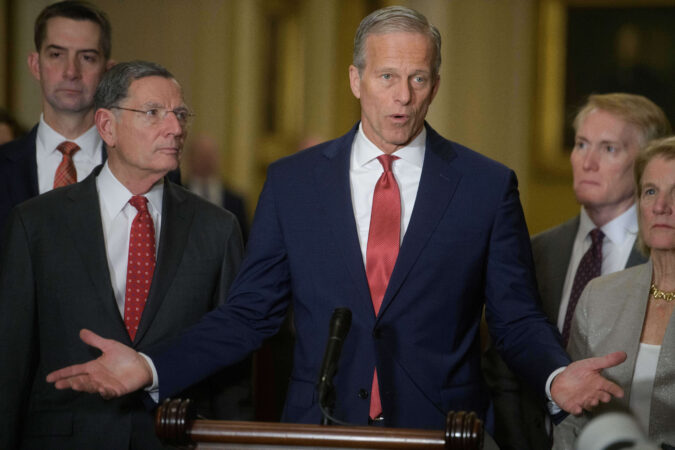
“I don’t think at this point we have a clear path forward, I don’t think the Democrats have a clear path forward,” Senate Majority Leader John Thune said Tuesday after Republicans met and discussed different proposals to overhaul the law.
The impasse means the Senate vote, expected next week, could be a party-line messaging exercise with no real chance of passage. Under the deal struck to end the shutdown, Democrats can determine the legislation that comes up for a vote. But Senate Democratic Leader Chuck Schumer has indicated they are leaning toward a vote on a straight extension of the subsidies with no new limits or tweaks to the law, which Republicans have already rejected.
“So far the Republicans are in total disarray and have no plan,” Schumer said Tuesday. “We have a plan.”
Democrats say they are willing to negotiate on the issue, and some have said they would be open to new limits on the subsidies. But they argue that two main issues are holding up talks: the lack of input from President Donald Trump, and Republicans’ insistence that abortion funding be part of the discussion.
“Our Republican colleagues aren’t going to engage with us” unless Trump weighs in, Sen. Peter Welch (D., Vt.) said. “That’s the paralysis here.”
Abortion issue holds up compromise
Maine Sen. Angus King, an independent who caucuses with the Democrats, was part of the group that struck a deal to end the shutdown. He says there have been some informal bipartisan discussions since then, but says they stalled as Republicans insisted on stricter abortion restrictions on Affordable Care Act plans.
“They have set up a red line that is also a red line for the Democrats,” King said of Republicans. “So they’re going to own these increases.”
Missouri Sen. Josh Hawley, who has said he wants to see the tax credits extended, said the issue “should not be a deal-killer” since a ban on federal funding for abortions is already in the law.
Democrats say current law should be sufficient. While many states ban abortion coverage from all plans in the ACA marketplaces, others allow or require abortion coverage that isn’t paid for with federal funding.
Republican senators have discussed several competing proposals in recent weeks. Louisiana Sen. Bill Cassidy and Florida Sen. Rick Scott have suggested creating different types of health savings accounts that would change the way people buy insurance — an idea that Trump has endorsed in social media posts without much detail. Other senators have suggested extending the subsidies with new limits on income.
Thune said Tuesday that “we will see where the Republicans come down, but that conversation continues.”
Republicans want to work on a constructive solution, he said, “but that hasn’t landed yet.”
In the House lawmakers were also discussing different ideas. But there was no indication that any of them could be ready by the end of the year or generate enough bipartisan support.
“Healthcare is a very complicated issue,” House Speaker Mike Johnson (R., La.) said Tuesday, while insisting that Republicans were still “pulling ideas together.”
Trump gives little guidance
Lawmakers in both parties have said it will be hard to move forward without Trump’s support for a plan. But the president has yet to formally endorse any legislation.
Last week, the White House circulated a proposal to extend the subsidies with some limits, like new income caps and a requirement that all recipients pay some sort of premium. The proposal would also have allowed those in lower-tier plans, such as the bronze-level or catastrophic plans, to put money into health savings accounts.
But the proposal was never released.
Asked last week whether he wants to extend the subsidies, Trump appeared to refer to the leaked plan, saying that “somebody said I wanted to extend it for two years. … I’d rather not extend them at all.”
Still, he acknowledged that some sort of extension may be “necessary.”
The William Way LGBT Community Center will return to the building it has called home after much-needed renovations are completed, instead of permanently leaving as had been previously announced, the leaders of the nonprofit’s board said Tuesday.
Earlier this year, William Way announced it was planning to sell its 175-year-old building at 1315 Spruce St. because fundraising efforts for a “comprehensive redevelopment plan to renovate and expand” the Center City property had fallen short.
The nonprofit said early last week that it was permanently closing its doors later this month and relocating services, and even had a “One Last Dance” goodbye party in the building scheduled for this Friday.
The building will still close on Dec. 18, but the services that William Way provides will eventually return, the nonprofit said Tuesday.
“Thanks to the support of multiple sources, including generous individual donors, and the efforts of our board, staff, and partners, we are pleased to share that the center will return to the building once redevelopment is complete,” Dave Huting and Laura Ryan, cochairs of the William Way LGBT Community Center Board, said in a statement.
“While there are still many details to finalize, including a timeline for when we can once again welcome the community back into the building, we are thrilled to share that the center will not be leaving its longtime home,” Huting and Ryan said.
“We look forward to sharing our vision for a reimagined facility, one that continues to be an essential resource for Philadelphia’s LGBTQ community, and which will become a reality as details are finalized,” they said.
“We are partnering with a nonprofit developer to redevelop our building at 1315 Spruce Street, transforming it into a modern and welcoming space that better serves our vibrant and engaged community,” Huting and Ryan said.
The center briefly closed for inspection and emergency repairs last fall, then partially reopened in January 2025.
In June, William Way said it needed to sell the building — which it had purchased in 1997 — because the nonprofit could not move forward with the more than $3.5 million in immediate repairs that were needed “before any broader redevelopment could proceed.”
The statement on Tuesday did not explicitly say the building would not still be sold.
A spokesperson for William Way could not be reached for comment.
In the meantime, William’s Way’s programs will move.
On Jan. 5, the center’s empowerment programs, including the elder initiative, peer counseling, and trans programs, will operate out of the nearby Church of St. Luke and the Epiphany at 330 S. 13th St.
A plan is being developed to temporarily relocate the John J. Wilcox Jr. Archives and is expected to be announced next year, the nonprofit said.
“We have always said that the center thrives not because of its building, but because of its people. However, the rebuilding of the center will allow it to become an even more effective space to advance our mission and enhance the services and support we provide to our community,” the board cochairs said.
As of Tuesday evening, the “One Last Dance” party was still being promoted on William Way’s website.
President Donald Trump closed his eyes for extended periods as cabinet officials went around the room Tuesday providing updates on their work, at times seeming to nod off.
It was the second time in less than a month that Trump has appeared to struggle to stay awake as his advisers speak about the administration’s initiatives. A Washington Post analysis of multiple video feeds of the meeting Tuesday showed that during nine separate instances, Trump’s eyes were closed for extended periods or he appeared to struggleto keep them open, amounting cumulatively to nearly six minutes. The episode was similar to an Oval Office event on Nov. 6 when the president spent nearly 20 minutes battling to keep his eyes open.
Trump’s apparent drowsiness during the 2-hour, 17-minute gathering with his cabinet followed pronouncements in recent days by the79-year-old president, his advisers and his doctor that he is in excellent health and full of stamina — an assertion the president repeated early in Tuesday’s meeting.
“Right now, I think I’m sharper than I was 25 years ago,” Trump said, criticizing a recent New York Times article that said the president was facing the realities of aging. He later resurrected a frequent insult, “Sleepy Joe,” to mock former President Joe Biden, the first octogenarian to serve as president, who faced regular scrutiny for his perceived lack of stamina.
In response to a request for comment about Trump’s eyes being closed during the meeting, a White House official initially told the Post that he was not sleeping,though a subsequent statement from press secretary Karoline Leavitt did not specifically address whether the president had dozed off.
Leavitt instead said he was “listening attentively and running the entire” meeting,and cited Trump’s “amazing final answer in the news conference,” in which he bashed Somali migrants, calling it an “epic moment.”
The White House has worked to refute suggestions that Trump has slowed down since his first term eight years ago. His advisers on Monday provided private logs to the New York Post that they said revealed Trump “working up to 12-hour days” on several instances during the past few weeks, the outlet reported.
But on Tuesday, the president appeared sleepy. Throughout Secretary of State Marco Rubio’s discussion of “the most transformational year in American foreign policy since the end of the Second World War — at least,” Trump leaned his head forward and shut his eyes. They remained closed even as Rubio discussed one of the president’s favorite topics, his efforts to broker peace between warring foreign nations.
Trump appeared far more alert later Tuesday when announcing “Trump accounts,” new tax-advantaged investment accounts for children. Unlike the meeting that had ended an hour earlier, where Trump was seated as he appeared to battle sleep, the president, Sen. Ted Cruz (R., Texas) and other officials were standing during the 40-minute announcement.
“I don’t think [Trump] sleeps at all,” Cruz said at one point.
While Trump’s Oval Office drowsiness last month came a week after he returned from a trip to Asia — a journey known for causing jet lag — the episode Tuesday followed a late night and early morning of the president scrolling and posting on social media.
Between 10 p.m. Monday and midnight, Trump made nearly 150 posts and reposts on his Truth Social account, ranging from criticisms of Democrats and screenshots of posts from right-wing conspiracy theorists to positive video clips about himself and first lady Melania Trump. Despite being a prolific and longtime user of social media, Trump’s blitz of posts that night was far more than is typical for him, though Trump’s advisers have told the Post he frequently only gets about four hours of sleep a night.
By 5:30 a.m. Tuesday, the president was back to posting again online.
LAS VEGAS — Goalie Carter Hart, one of five 2018 Canada World Junior hockey players acquitted of sexual assault in July, will make his first NHL appearance in nearly two years when he starts in goal Tuesday night for the Vegas Golden Knights, who host Chicago.
The former Flyers goaltender was the first of those five players to agree to an NHL contract. The league ruled those players were eligible to sign deals beginning Oct. 15 and to play beginning Dec. 1. Hart signed a two-year, $4 million contract and has been working with the club’s American Hockey League affiliate in Henderson, Nev.
After he agreed to sign, Hart read a statement to reporters that, in part, said he wanted “to show the community my true character and who I am and what I’m about.”
Hart was asked Monday what steps he has taken to fulfill that pledge.
“There’s been a few things we’ve talked about,” Hart said. “We did a thing there in Henderson helping out the homeless. There’s some things we’ve talked about throughout the season. Whatever I can do to help, I’m happy to help.”
Giving Hart his first start at home could help ease him into what could be a rocky reception around the league. How welcoming Golden Knights fans will be remains to be seen, but after facing the Blackhawks, Vegas goes on a five-game road trip against Eastern Conference teams, including a Dec. 11 visit to the Flyers.
He worked in Henderson on getting back into NHL game shape. Hart appeared in three games and went 1-2.
“I’ve worked by [butt] off to get back to this point,” Hart said. “For me, the key is preparation and I’ve done everything I can to be prepared.”
The 27-year-old last played in an NHL game on Jan. 20, 2024, for the Flyers. Hart played six seasons for the team, going 96-93-29 with a .906 save percentage and 2.94 goals-against average.
“The purpose of Henderson was to get him back into live reps,” Golden Knights coach Bruce Cassidy said. “He can practice with us with NHL shooters, but traffic around the net, screens, all that stuff is sometimes hard to replicate, especially when you haven’t played that often. We’re less worried about the results, more getting reps, getting used to that stuff.”
The Golden Knights could use the help in net, especially with starting goalie Adin Hill on injured reserve with a lower-body injury and his return possibly weeks away. Akira Schmid has received the majority of the work with Hill out and is 9-2-4 with a .896 save percentage and 2.51 GAA.
Cassidy said the upcoming schedule works in the Golden Knights’ favor in terms of not overloading the goalies.
“Akira’s played well, too, so we have to keep mindful he has to stay sharp,” Cassidy said. “So I’m sure you’ll see a lot of both goalies, but Carter’s waited a long time to play, so he’s definitely going to get his share of starts.”
NEW YORK — The U.S. men’s soccer team has played some strong opponents in its preparation for the World Cup so far. But for its last four games before the tournament, the team will face some of the biggest teams of all.
After weeks of speculation, official word came Tuesday that the U.S. will play Belgium and Portugal in March in Atlanta, then Germany in Chicago in June for its World Cup send-off game.
There also will be a game at the end of May in Charlotte, N.C., against a team to be announced. It might be revealed after the World Cup draw on Friday, since the U.S. won’t want to play against a team it will face again a few weeks later. The U.S. can’t be drawn against Belgium, Portugal, or Germany, as they’re in the same pot in the draw.
“I think before starting the World Cup, it starts to [feel] like a World Cup, and I think it’s important for the team,” U.S. manager Mauricio Pochettino said at a gathering of the governing body’s sponsors and donors. “What we need is to challenge teams that are in the top list, and I think that is going to be an important experience for us. Great experience, and then after [that] to attack the World Cup in a very good condition.”
Atlanta’s Mercedes-Benz Stadium will host eight games in next year’s World Cup, including a semifinal.
All four games will be at the respective cities’ NFL stadiums, with Atlanta getting two since the area is the new home of U.S. Soccer’s headquarters. The governing body will open a $200-plus-million, 200-acre training center in the southern suburb of Fayetteville, Ga., this spring, in time for the men’s team to hold its pre-World Cup camp there.
“That is a massive thing that is going to inspire, is going to give an unbelievable power to soccer here in the USA,” Pochettino said, knowing that some of the funders of the facility were in attendance Tuesday. “Maybe today, people don’t realize it because we are focused on the World Cup, [so] it’s about [how] to win the games. But that is the real impact that is going to be a massive change for soccer here in the USA.”
Portugal’s visit won’t just bring all-time superstar Cristiano Ronaldo, who hasn’t played a game on American soil since 2014. The No. 6 team in FIFA’s global rankings has a fleet of the sport’s best players: Bruno Fernandes of England’s Manchester United, Rafael Leão of Italy’s AC Milan, and João Neves and Vitinha of reigning European champion Paris Saint-Germain.
Belgium is led by midfield playmaker Kevin De Bruyne, a longtime player for England’s Manchester City and now with Italy’s Napoli, and winger Leandro Trossard of England’s Arsenal. The Red Devils are ranked No. 8, and, like Portugal won their group in European World Cup qualifying. Had they finished second, they’d have gone into the playoffs for the last World Cup spots that also are set for March.
Kevin De Bruyne (right) is one of Belgium’s stars.
Some famous histories
Both nations stir memories for U.S. fans. The American men earned one of their most famous World Cup wins against Portugal in 2002, then nearly pulled off another upset win in 2014 before Ronaldo assisted a last-minute equalizer.
When the teams last met in a friendly in 2017, the Americans earned a 1-1 tie in Portugal in the first senior national team appearance for Weston McKennie, Tyler Adams, and Cameron Carter-Vickers. (McKennie scored the goal, assisted by then-Union striker C.J. Sapong, and Ronaldo was absent.)
Nine days later, the U.S. took Belgium to extra time with goalkeeper Tim Howard’s 16 saves, then fell, 2-1. Howard’s heroics set a World Cup record for saves in a game that still stands. The teams have not met since.
Germany is a frequent and longtime U.S. opponent. This will be their 13th meeting, with the most recent a 3-1 Mannschaft win in Connecticut in October 2023. The first, in 1993, was a 4-3 U.S. loss that nonetheless announced the program on its way to hosting the 1994 World Cup. (Coincidentally, that game also was at Soldier Field.)
Gio Reyna (left) on the ball in front of Florian Wirtz during the last U.S.-Germany game in 2023.
The current German squad, ranked No. 9, is led by playmakers Florian Wirtz of England’s Liverpool and Jamal Musiala of Germany’s Bayern Munich. There also are some big-time rising stars aiming to make the World Cup squad, including striker Nick Woltemade of England’s Newcastle United and 17-year-old Lennart Karl of Bayern.
“It’s true that when we arrived here one year ago, it was a rushed time,” Pochettino said. “We need to go there, we need to perform, we need to get results, we need to push quickly the process, we need to go at a really fast speed. And I said, ‘No, calma [Spanish for calm down] … You cannot sometimes go faster [than] what the process demands.’ I think we are in a very good moment now, right on time.”
Pochettino’s insight on why he took the U.S. job
The manager’s remarks came in a wide-ranging conversation on stage with his top assistant Jesús Pérez and Fox Sports reporter Jenny Taft. Some of the topics were ones Pochettino has covered often, but one he hasn’t so much is why he took the U.S. job in the first place.
Mauricio Pochettino (center) with Jenny Taft (left) and Jesús Pérez (right) on stage at Tuesday’s event.
“I think one of the motivations was to go out of our comfort zone after more than 15 years coaching clubs,” he said. “We felt very special when the first call [came] from Matt [Crocker, U.S. Soccer’s sporting director]. I called Jesús and said, ‘Why not?’”
That didn’t mean he thought it would be easy.
“Was it going to be a massive challenge? Of course,” Pochettino said. “We didn’t know what we were going to find there. It was a country that we only traveled to, to come here for preseason with Tottenham or Chelsea or Paris Saint-Germain.”
Those were the three big European clubs he managed before taking the U.S. job.
“I said, ‘Oh, that is going to be a big test for us as a coaching staff,’” he said. “It was also a moment to reveal and to challenge ourselves … I think it was the right moment for us in our lifetimes, in a personal way but also in a professional way. Both sides were perfect timing.”
Mauricio Pochettino (right) and Jesús Pérez (left) watching a U.S. practice in Octover.
Pérez, who has been at Pochettino’s side throughout the manager’s career, went into more detail on that.
“To manage the last two clubs we were working with, and the personalities there, it took a lot of energy from him [Pochettino], especially — and you pay for that,” Pérez said. “It was a challenge for us to come where people know the name, but we had to prove that we can coach here and we can perform.”
He also spoke about the differences between club management, where coaches can spend every day with players, and national teams, where time together is limited.
“What we miss is training sessions,” Pérez said. “It’s where you can feel the player, you can improve the player, you can challenge the player. … It took us to a point that we have to change our way of work in order to have less training sessions, more precise, more clear, sometimes more simple. But with just basics, you can make people perform.”
Defense Secretary Pete Hegseth previously emphasized the samemilitary law that the Trump administration has been calling Pennsylvania lawmakers seditious for citing.
Hegseth notedthe military rule not to obey unlawful orders during a forum in 2016,when he was a Fox News contributor, in recorded remarks CNN unearthed on Tuesday.
Hegseth spoke at length about his views on the military — and criticism of former President Barack Obama — in a talk titled “The US Military: Winning Wars, Not Social Engineering.” The talk was shared online by the Liberty Forum of Silicon Valley and was marked as taking place on April 12, 2016. Hegseth, an Army veteran, had a book coming out that he promoted at the event.
The moderator asked him a question from an attendee: “Can you comment on soldiers who are being held at Leavenworth Prison for being soldiers?”
Hegseth argued that some prisoners at the facility did not deserve to be there but that others were facing the consequences for their unlawful actions.
“There are some guys at Leavenworth who made really bad choices on the battlefield, and I do think there have to be consequences for abject war crimes,” he said. “If you’re doing something that is just completely unlawful and ruthless, then there is a consequence for that.”
“That’s why the military said it won’t follow unlawful orders from their commander in chief,” he added. “There’s a standard, there’s an ethos, there’s a belief that we are above what so many things that our enemies or others would do.”
It is the same policy that a group of six Democratic members of Congress cited in a video that enraged President Donald Trump.
On his social media website, Truth Social, Trump said they were committing sedition “punishable by DEATH” and shared other posts attacking the lawmakers, including one calling for them to be hanged. Hegseth called them the “seditious six.”
“Encouraging our warriors to ignore the orders of their Commanders undermines every aspect of ‘good order and discipline,’” Hegseth said in a social media post. “Their foolish screed sows doubt and confusion — which only puts our warriors in danger.”
When asked for comment by CNN, spokespersons for the Pentagon and the White House further criticized the Democratic lawmakers who made the video.
Pentagon spokesperson Kingsley Wilson also told CNN that the military “has clear procedures for handling unlawful orders” and defended Trump’s orders as legal.
White House spokesperson Anna Kelly told CNN that Hegseth’s position has remained consistent and that his remarks were “uncontroversial.”
Sean Timmons, a Houston-based attorney specializing in military law who served as an active-duty U.S. Army captain in the U.S. Army Judge Advocate General (JAG) program, told The Inquirer that service members can get in trouble for refusing orders and that it is largely up to commanders to determinewhether orders are lawful or not. While the military rules specify not to follow obviously illegal orders, such as war crimes, they also say to presume orders are lawful.
Houlahan expressed disappointment in her Republican colleagues for largely not defending the Democratic lawmakers, though U.S. Rep. Brian Fitzpatrick, a Bucks County Republican, said he stood by his Democratic colleagues when asked by The Inquirer.
The fallout from the video has gone beyond rhetoric on X and Truth Social.
Hegseth also said in his 2016 talk that he believed U.S. Sen. Ted Cruz (R., Texas), Trump’s top rival for the GOP nomination that year, would be the best president at fighting wars, but that he believed Cruz and Trump would both “unleash war fighters and get the lawyers out of the way, which is really a big impediment to how we fight wars.”
The Democratic lawmakers did not cite specific orders in their video announcement, but Trump’s involvement of the National Guard in U.S. cities and the Pentagon’s strikes in the Caribbean have drawn legal debate.
PITTSBURGH — Adam Thielen didn’t stay out of work long.
The Pittsburgh Steelers signed the veteran wide receiver to their practice squad on Tuesday, a day after the 35-year-old was released by the Minnesota Vikings so he could pursue more playing time elsewhere.
Thielen had just eight catches for 69 yards in his return to Minnesota, where he starred from 2014-22 before a two-year stint with Carolina.
It might not take Thielen long to find his way onto the field in Pittsburgh. The Steelers (6-6) have struggled to do much in the pass game of late with neither Roman Wilson nor Calvin Austin III becoming consistent contributors alongside DK Metcalf.
Thielen is the second experienced wideout to join Pittsburgh’s practice squad in recent weeks. The Steelers signed Marquez Valdes-Scantling last month, though he has yet to find his way onto the 53-man roster on gamedays.
Pittsburgh also promoted Asante Samuel Jr. from the practice squad and released six-time Pro Bowler Darius Slay, who had been a healthy scratch in recent weeks.
Samuel made his first appearance with the Steelers in Sunday’s loss to Buffalo, finishing with three tackles in his return to action after undergoing neck surgery last spring. Tomlin saw enough of Slay to sign him to the active roster rather than risk someone poaching Slay from the practice squad late in the season.
“We certainly wanted to have an opportunity to see him in stadium before we maybe had to make a decision on him, before someone else forced our hand regarding decisions,” Tomlin said, later adding, “we liked some of the things we saw.”
Slay, signed to a one-year deal in March, had essentially been benched by Tomlin in favor of less experienced players, including James Pierre.
Juan Manuel Fleischer’s ancestors ranched on the borderlands before the United States existed, and the Arizona resident’s business importing Mexican cattle across the modern-day frontier has survived decades of immigration politics and the construction of a towering steel wall.
But that work has collapsed over the past year as an insidious threat shakes U.S.-Mexico relations and the American beef industry: the New World screwworm, a flesh-eating parasite that has resurged south of the border 60 years after it was mostly eradicated in U.S. livestock.
Around 1.2 million young Mexican cattle cross each year through a half-dozen entry ports to bulk up in American pastures or feedyards. But the gates have been shut to livestock for most of the past year, since a cow in southern Mexico tested positive in November 2024 for New World screwworm — maggots that burrow into warm-blooded animals, creating foul-smelling wounds and sometimes fatal weight loss. Mexican cattle imports have plunged to about 230,000 in 2025 as additional cases have emerged farther north, including one in September only 70 miles south of the border.
The unprecedented closure, when a shrinking American cattle herd is contributing to near-record-high beef prices, represents both a rare agreement on science and trade between the Biden and Trump administrations and the intense alarm shared by federal officials and the broader U.S. livestock industry. Agriculture Secretary Brooke Rollins has called keeping the parasite out of the country “a national security priority.”
The blockade, however, has upended cross-border relationships forged over generations and has financially strained Texas cattle feeders, New Mexico importers, and Arizona ranchers.
“We’re trying to almost beg the USDA to keep our Nogales border open,” said Jorge Maldonado, the mayor of Nogales, Arizona, where the livestock pens are empty at a port of entry that remains busy with produce imports.
Maldonado has a small cattle operation across the border in the Mexican state of Sonora, and recently he sold about a dozen animals for $10,000 less than he would have fetched in the United States.
But Maldonado said his larger worry is for his city of 20,000. He estimates that it has collected as much as 15% less in bed taxes this year because of the absence of Americans and Mexicans who typically stay overnight and “wine and dine” while negotiating over cattle that must be quarantined for three days on the Mexican side. And it has been “a catastrophe,” he said, for local businesses that revolve around the industry.
One belongs to Fleischer, who in a good year brought in 80,000 cattle from small ranches in Mexico. He walked steers and heifers through the dust and through the metal border barrier, where he was known as an expert at sorting the animals by size with just a glance. When he heard about the closure, Fleischer recalled, “I said, ‘Oh, my god, it’s going to kill us. This will break us.’ ”
Now he is surviving on savings, and his wife and son have taken on substitute teaching jobs.
New World screwworm was a scourge in the first decades of the 20th century, costing U.S. ranchers tens of millions of dollars a year and killing thousands of deer. The federal government spent millions of dollars more to eradicate it in the 1960s through the breeding and unleashing of sterile flies, which eventually doomed the species domestically. Occasional outbreaks have since occurred among livestock in the Southwest, and, in 2016, among endangered Key deer in the Florida Keys. And in August, a rare human case was reported in a Maryland resident who had traveled to El Salvador.
The concern today is not that New World screwworm would wipe out American cattle, but that the cost of monitoring and controlling it would be enormous, experts and industry officials said. The Agriculture Department estimates that an outbreak could cost the Texas economy alone $1.8 billion.
“This would be a very hands-on issue if it were to emerge,” said Hunter Ihrman, a spokesman for the National Cattlemen’s Beef Association. “It makes people very nervous.”
He said the association is supportive of the border closure and other federal efforts to hold back the pest, though it wants speedier action on plans for an $8.5 million sterile fly production facility projected to open in Texas early next year. The only such facility in North America is in Panama.
At a meeting with Rollins last month in Mexico City, Mexican President Claudia Sheinbaum again pushed for the reopening of the border, calling it a “top priority.” But the USDA, which did not respond to questions for this article, has made clear that it does not trust Mexico to control the threat.
Maldonado, the Nogales mayor, said USDA officials who met with him and other Arizona officials and producers last week indicated that it would stay shut at least until the end of the year.
He and others involved in the trade say they feel confident that the New World screwworm could not slip past import protocols, which involve quarantining in Mexico, anti-parasite treatments, and inspection by U.S. and Mexican government veterinarians. They also argue that the closure is contributing to high American beef prices, which the Trump administration has pledged to address by investigating meatpacking companies and importing Argentine beef.
Industry watchers are skeptical the blockade has driven up prices. The loss of Mexican cattle, which in typical times represent about 3 to 4% of the American calf herd, has probably had only a “marginal impact” on prices, said Derrell Peel, an Oklahoma State University agricultural economist.
What is clear, he said, is the hardship on those who depend on the trade. “Regionally, the impacts are very severe,” Peel said.
Among those affected is Mark Rogers. He started his Dimmitt, Texas feedyards 30 years ago with a few Mexican cattle. When the border first shut a year ago, 90% of his 50,000 animals were Mexican. Rogers found Mexican cattle hardier than domestic, a quality he attributed to the travel and the import process they underwent. After years of almost daily phone calls, he calls the Mexican producers he works with “some of my best friends.”
These days, Rogers is down to about 27,000 head of cattle, he has cut a third of his workforce, and he says he is breaking even. His neighbors also have vacant pens, he said. “I’ve laid in bed at night thinking, ‘What the heck?’” he said. “But I’ve just got to know that one of these days that border’s got to open back up.”
Fifteen percent of the feeder cattle in Texas come from Mexico, the state’s agriculture commissioner, Sid Miller, said in an interview. He said he has sent proposals to White House officials, urging them to allow a “test opening” of imported Corriente cattle for rodeos and to deploy a specific fly bait. They have not responded to the first idea, he said; the USDA sternly rejected the latter.
Discontent is hardly uniform in the industry. Those who breed calves are getting top dollar for their animals. And some who import Mexican cattle say they understand the caution.
The shift “has been painful on one side of the ledger,” said Kevin Buse, chief executive of Champion Feeders in Hereford, Texas, who runs feedyards and ranches in Texas, Oklahoma, and Nebraska. He has faith in the health surveillance of cattle on both sides of the border but said he also trusts the USDA’s approach. “We need to open slowly, we need to make sure that what we’re doing is good, and make sure we’re not stepping into a bear trap.”
But the change to Buse’s business is felt by Alvaro Bustillos, president of Vaquero Trading, an El Paso company that before the screwworm blockade generated $400 million in annual revenue importing 250,000 Mexican cattle a year, including for Champion Feeders. Now it is shut down.
Like many in the trade, Bustillos, who is also chairman of the board of the cattle producers union in Chihuahua, Mexico, said he worries all the American politics around beef prices have made reopening even thornier. In a September letter, Bustillos urged Rollins to reconsider. “This relationship goes beyond numbers: We share traditions, genetics, culture and families that have worked together for generations on both sides of the border.”
Just over the New Mexico state line, the pens at the Santa Teresa port of entry, the nation’s busiest for livestock, are eerily silent. In a typical year, 500,000 cattle and horses valued at $1 billion cross at the port, according to Daniel Manzanares, who directs the livestock crossing.
Manzanares has laid off half of the 40 employees. Truckers who transported the cattle are also out of work, he said. “There are people selling homes, people selling semis,” he said. “It’s created such a disaster for so many people.”
But for now, he sees little reason to hope. “We are a really tiny chip in the poker game between the U.S. and Mexico,” he said.
There are days when Brett Gordon is driving down Route 309 toward La Salle College High School and he’ll think about his late father Drew, the Hall of Fame coach who died on Sept. 4, 2023, at the age of 73. Memories of his dad, Brett admits, have become more vivid, especially these last couple of weeks.
The Explorers are on a special journey this season. So is their second-year coach Brett Gordon, who learned everything about football — and life — from his dad.
The only time La Salle won a PIAA state football championship was 2009, when the Explorers won the Class 4A title with Drew as their head coach and Brett as their offensive coordinator.
Drew and Brett are on the brink of doing something no father-son duo has ever done in the 36-year history of the PIAA football state playoffs — win state championships as head coaches. But first, one game stands in the way of accomplishing that. La Salle (12-1) will face Central Catholic High School (13-1) of Pittsburgh in the PIAA Class 6A final on Saturday at 7 p.m. at Cumberland Valley High School.
“I know how much my father would have loved to be a part of this,” Brett said. “I think about him all the time. If my father was with us and he was in good health, he would have been around here coaching in some capacity. I wouldn’t have a choice. The thing I admired the most about my father was that it never was about him. He grew up in a generation of serving. He never cared about any recognition. He was direct. He was there to coach. He cared about the kids. That was all that mattered. That was how he operated.”
Brett Gordon was an assistant coach on the staff of his late father, Drew Gordon, at La Salle in 2006.
After La Salle beat St. Joseph’s Prep for the first time in 10 years for the Catholic League 6A crown on Nov. 1, Brett, 46, a 1998 La Salle and 2002 Villanova graduate, received a long, congratulatory text from former St. Joe’s Prep coach Gabe Infante, currently Duke’s assistant head coach, special teams coordinator, and defensive tackles coach. When Infante was first hired by The Prep in 2010, he was not exactly embraced by the area football community after taking over for the popular Gil Brooks.
One of the first welcomes Infante received came from Drew in a letter sent to Paramus Catholic in North Jersey, where Infante was leaving to take the Prep job.
“I know people will not want to hear this, but Drew and I were very close, even after he stopped coaching [in 2014],” Infante said. “Drew welcomed me, and that showed me who Drew was. He was a true competitor. He showed tremendous class. I was definitely an outsider who was not welcomed when I originally went down to Philadelphia. I would not be where I am today without Drew Gordon and what he built at La Salle. He raised my level, and I would like to think Prep’s success raised La Salle’s level again.
“I was in Brett’s shoes. I could appreciate what Brett is doing there. I am a fan of people who are committed to sacrifice like Brett is. True competition brings out the best in people. When Drew got sick, I reached out to him. We had a really good relationship, and it all started with a very kind, simple letter welcoming me to the Philadelphia Catholic League and Philadelphia area.”
The notes fill a shoebox in a bedroom drawer. They came in the form of either a Hallmark card, yellow legal paper, or a simple scrap of printer paper or from a looseleaf notebook. They sometimes would be sitting in an envelope on the kitchen table, tucked under a door or stuffed in a mailbox. Brett still has most of them — letters from Drew.
Father and son share a lot in common. They always took a cerebral approach to football. They always were focused and intense about the steps in the process of preparing. Brett, a two-time Catholic League champ and league MVP at La Salle, says he tends to wear his emotions on his sleeve, probably more than his father, who was far calmer on the sideline and emotionally indifferent.
It’s why he communicated with his son and two daughters through letters.
Drew was a baby boomer born in 1950, the oldest of six. He was 12 when his parents separated, moving with his mother, Dorothy, and five younger siblings from Ohio to Glenside, Montgomery County. He was “the man of the house” who worked a paper route in Abington to help his mother pay the bills.
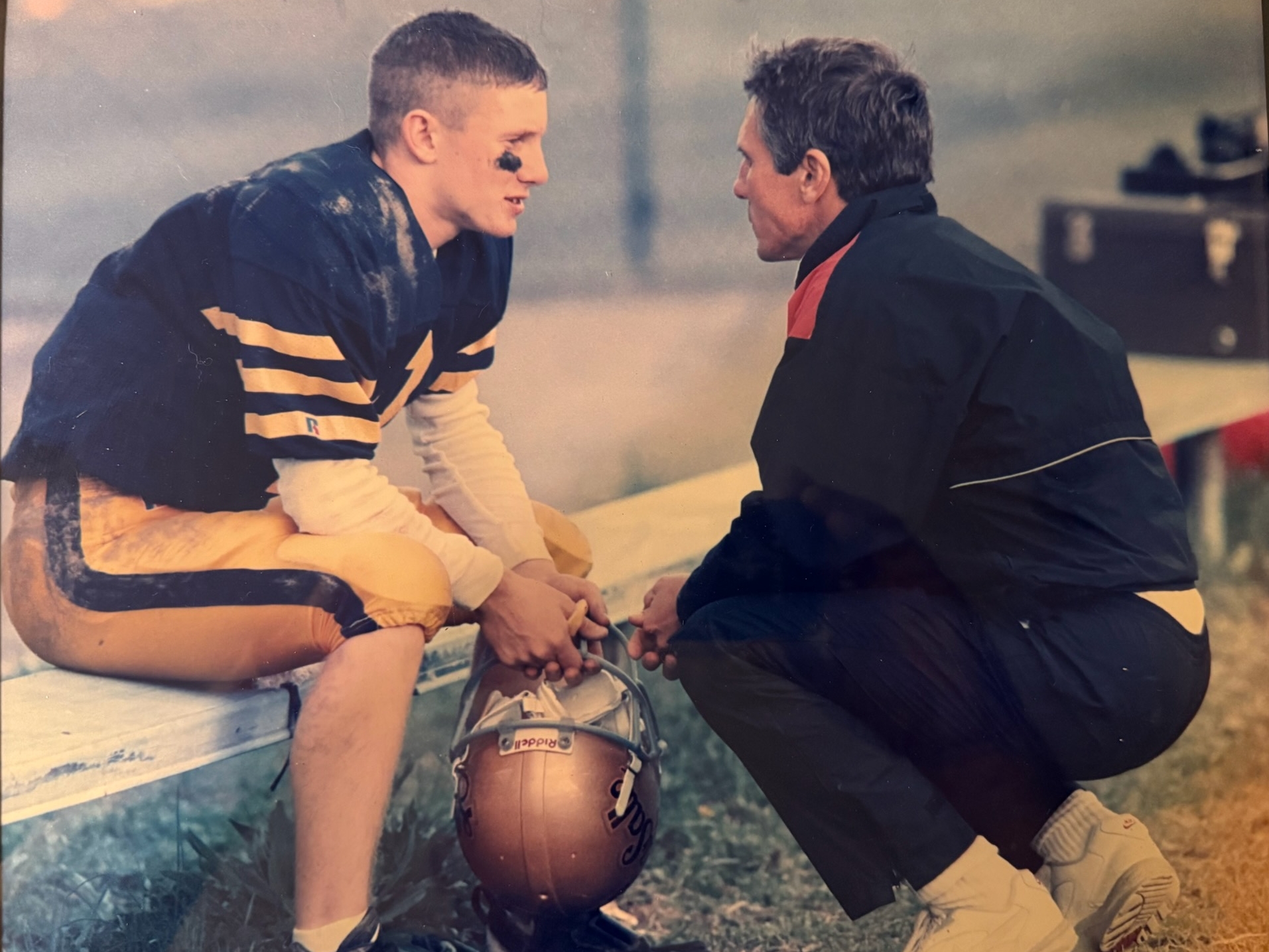
Brett Gordon and his late father, Drew, talking on the sideline.
He was steeped in Midwestern stoicism and self-reliance.
“That was my dad,” Brett said. “He came from that generation when men did not show emotion. Verbal communication was not my dad’s strong suit. He had a very regimented way he did things. He built Gordon Truck Leasing from the ground up. We are similar in certain ways, and we are also very different. My dad was always about the process. I still use a lot of his old-school principles. But he came up in a different, authoritative generation. I’ll ask the players for their feedback, like what uniforms they want to wear. He would never have done that.
“The compliments he gave me came in letters. I still have a lot of them. He came from a different generation. He would put things down on paper.”
When Brett was inducted into the Hall of Fame at Villanova and La Salle, Drew left his son a letter stating how proud he was of him.
Sometimes letters were better.
After Brett threw for a Villanova single-game passing record of 460 yards (which still stands) and three touchdowns in guiding the Wildcats to a last-second 38-34 victory over rival Delaware in November 2002, he was greeted by Drew and his mother, Bernadette, outside the Villanova locker room. The first thing Drew said to Brett was, “Your footwork was horrendous today.”
“In a weird way, that was his way of complimenting me,” Brett said, laughing. “It was very hard for him to hand out compliments. I’m sure he told his buddies about the game I had. I always knew he was proud of me. I wouldn’t be where I am without him. Yeah, you could say it was the good, tough love. It is that constant reminder that there is always room to be better. That is my coaching philosophy today.”
This season is as much a homage to his dad as it is giving a group of dedicated seniors a year to remember.
An ‘emotional’ run
When John Steinmetz resigned after the 2023 season following nine years as Explorers’ head coach succeeding Drew, there was a groundswell of support from the La Salle community for Brett to take over. Brett, who was his father’s offensive coordinator from 2006 to 2014, dabbled in coaching after his father left La Salle in 2014. He joined Albie Crosby’s Imhotep Class 3A state championship staff in 2015 and helped occasionally at his alma mater.
Numerous current players were looking to transfer out of La Salle after their sophomore year. The Explorers had been competitive, though not exactly in the class of Catholic League foe St. Joe’s Prep. The Hawks had turned what once was a rivalry into a lopsided series. There is a standard at La Salle, a touchstone of success the football program had not felt since Drew left.
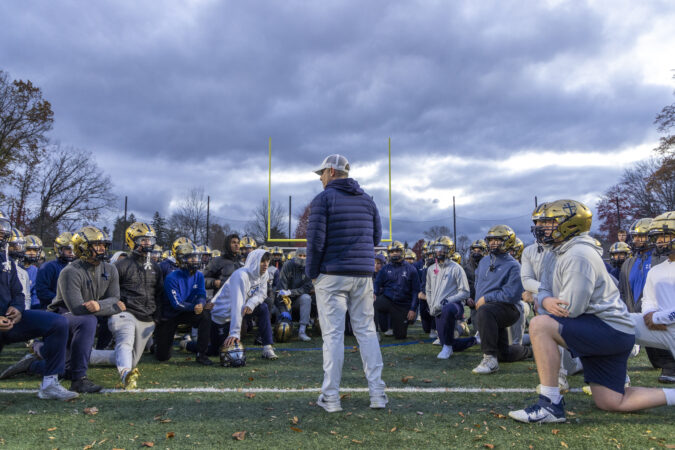

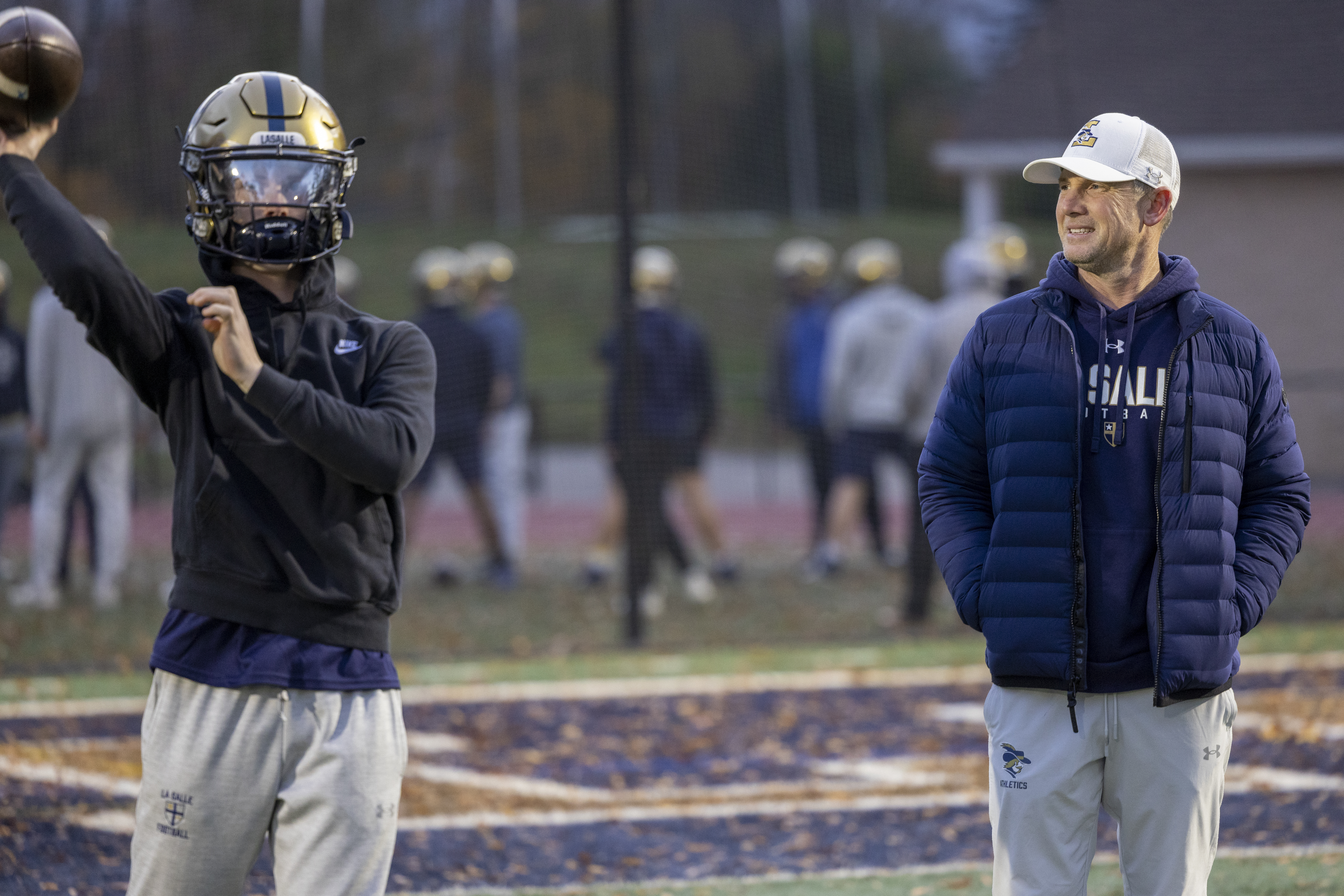
La Salle coach Brett Gordon talks to his team at practice on Nov. 10.
“It was not 100% that we were all leaving, but a lot of guys were talking,” said Gavin Sidwar, the Missouri-bound quarterback who has broken all his coach’s passing records at La Salle. “When we found out Coach Brett would be the head coach, it’s something a lot of us were happy to hear. Personally, I can’t say enough about what Coach Brett has done for me. He’s brought out a growth in me, and I am willing to put in 100% for him.
“He gave up his job for this. We know that. This run is going to be emotional for a lot of us. I know for me, being here for four years with some adversity, winning a state championship means everything. Knowing now the tradition his father has here and being the first father-son combination to ever win a state championship, it means more for all of us. We play our butts off for Coach Brett and the whole coaching staff. To get Coach Brett a state title, we are even more motivated.”
Brett received his business degree from Villanova and worked in the corporate world for 15 years, building a national reputation in the software industry. It gave him financial flexibility, he said, to do what he is doing now. He had to first check with Tanya, his wife, son, Luke, who is a sophomore quarterback for La Salle, and teenaged daughter, Grace, who follows her father everywhere.
“Tanya puts up with a lot, especially at certain times of the year like now,” he said. “In order to take on the role as coach at La Salle, I needed full support from not only Tanya, but Luke and Grace. This job impacts our entire family, so it was very important for me to have both Tanya and Grace involved so they feel a part of what we are building here.
“Tanya has gotten to know most of our players and has our son in the program, so it can be difficult being the head coach’s wife and being a parent in the program. She has done an amazing job balancing it all. Tanya and Grace often remind Luke and I at home when it is time to talk about something other than La Salle football.”
La Salle coach Brett Gordon with quarterback Gavin Sidwar at practice.
In 2009, father and son were robbed of their time in the sun, or in the Gordons’ case, that late-December Saturday, the snow. When the Explorers played State College in the 2009 Class 4A championship, the game was postponed for a day because of a raging blizzard. Luke had been born a few weeks earlier with a collapsed lung. His medical situation put the family on edge. Brett woke up at 7 a.m. on a snowy Saturday, Dec. 19 morning and had the roads to Hershey to himself. La Salle handily beat State College, 24-7, to become the first Catholic League team to win a state football championship.
The problem was Brett had no time to celebrate. He had to trek back home to be with Tanya and Luke.
Around 9 p.m. that night, Brett got a knock on the door. It was his dad, who drove through a snowstorm to get there, tossing aside the state championship celebration himself to see his grandson. He stayed in the guest room that night.
Drew never missed anything Luke or Grace did. To this day, Luke wears a silver chain his grandfather gave him.
There were more than 1,000 people who attended Drew’s funeral services, Brett recalled. It stretched over two days in September 2023.
“I saw my dad cry once, after my last high school game on Thanksgiving against St. Joe’s Prep in 1997,” Brett said. “We lost, and I remember when I saw him after the game, I told him I was sorry. He just burst open and hugged me. I remember his younger brother, my godfather, telling me years later he never saw anything like that with my dad. … It won’t be easy on or off the field. I wish I could bounce ideas off him, but I also know how much he would love being a part of this. If we are able to pull this off, he’ll be the first one I think of.”