Blog

  • Analyzing where the Flyers’ penalty kill went wrong in Monday’s 5-1 loss to the Penguins

    Analyzing where the Flyers’ penalty kill went wrong in Monday’s 5-1 loss to the Penguins

    The Flyers entered Monday’s matchup with the Pittsburgh Penguins with the league’s fourth-best penalty kill. When the night was done, the Flyers were handed a 5-1 loss to snap a three-game winning streak, and their penalty kill slipped to ninth.

    In some ways, it made sense. The Penguins started the day with the NHL’s No. 2 power play and an impressive 30.2% effectiveness. Even with that, no one expected them to score three times in four opportunities.

    The Penguins now have the NHL’s No. 1 power play at 33.3% — which is ridiculous when you think about it. But maybe not.

    “Well, they’ve got a championship pedigree, right?” Flyers coach Rick Tocchet said. “They’re well-coached. They stuck to their game plan. They went north on us. First period, actually, we had some chances, [but] not much velocity on the shots. I don’t know, we weren’t assertive enough. And then obviously the PK, which has been good all year, struggled tonight.”

    Tocchet knows the Penguins. He was an assistant coach on former Pittsburgh coach Mike Sullivan’s staff and won two Stanley Cups. And he ran the power play.

    Yes, the Penguins’ power play boasts Sidney Crosby, who is 23rd in NHL history with 191 power-play goals and scored one on Monday night. And, yes, there’s Evgeni Malkin, who is four spots below Crosby and has 185.

    Sidney Crosby scored one of the Penguins’ three power-play goals on Monday night.

    But the Flyers coach also hasn’t liked his group’s penalty kill the last five games, noting the structure. It was exposed to the utmost degree at Xfinity Mobile Arena.

    “We’ve been running around lately,” he said. “We’re an aggressive diamond … and if you look at the goals, after the shot, two guys ran out of position, opens up the middle. Twice. Those are killers.”

    The diamond pattern is just that, a diamond shape. It allows there to be a defender, usually a defenseman, in front of the goalie with the other defenseman as one of the points on the side of the diamond picking up someone in the circle, aka on the flank. There is one forward opposite that defenseman and another at the top of the diamond shape.

    The aggressiveness comes with the unit moving together as one of the penalty killers puts pressure on the opposition’s power play. Does it leave open the middle of the ice and the person in the bumper? Sometimes, but an active stick and closing lanes are critical to this type of penalty kill.

    “If you give them the flanker shots, you can live with it,” Tocchet said. “I think the [Bryan] Rust flanker, [Travis Sanheim’s] got to get out there. That’s his flex. He was backed in too much.

    “He flexes out; his job is to take the weak side away so [Dan Vladař] can see it. Things like that. But that’s just, maybe that’s guys being tired, mentally tired. I don’t know.”


    When the pass is made, Travis Sanheim (No. 6 in front of the net) is a little too low to take away the weakside shooter, Bryan Rust (bottom of the screen).
    Because Sanheim (front of the net, closest to the bottom) is too low and stagnant, it allows Rust (bottom) ample time and space to carry the puck into the left face-off circle and score.

    The Flyers’ penalty kill has been a strong suit for a while. Over the first 24 games, the Flyers had killed off 100% of the penalties they faced in 14 games, had allowed just one power-play goal in nine other games, and, before Monday night, had allowed two goals on the man advantage just once all season, against the Montreal Canadiens in a wild 5-4 shootout win in early November.

    “All year, PK has been great for us,” captain Sean Couturier said. “Tonight we didn’t have it. They picked us apart. It happens. We’ve got to fix it and get back on track next game.”

    The structure has fallen by the wayside a bit. The New York Islanders had the second-worst power play entering Friday’s game, and Anders Lee could stand in front of the net and deflect a point shot in. Against the New Jersey Devils, Timo Meier was allowed to crash the net down the middle and clean up a loose puck.

    On Monday night, Crosby buried the puck from just above the slot “because we cheated on one of them,” Tocchet said. Penguins defenseman Erik Karlsson carried the puck from the left to the right and down the boards, causing the Flyers to overcommit. It opened the ice for Rust, who sent a backhand pass to Crosby coming down the middle — and Crosby isn’t going to miss from there.


    Bryan Rust (No. 17 and bottom of the screen) has plenty of room to either shoot or pass the puck, choosing the latter as the Flyers overcommitted.
    Sidney Crosby (No. 87 and middle of the screen) received the pass from Bryan Rust in the high slot and was able to score as the Flyers collapsed around the net.

    The Penguins added a third power-play tally after Malkin put a shot on goal, Kris Letang retrieved the rebound along the boards, and set up Tommy Novak for the shot past Vladař. The Flyers were out of their structure.

    Initially, when Malkin shot the puck from the point, they collapsed into an I formation, meaning everyone straight down the middle. When the puck went to the boards, Owen Tippett went to him, which is fine, but Noah Juulsen and Nick Seeler were too low to step into Novak or play a possible pass to Ville Koivunen, who was sitting wide-open across the crease.

    “They snap it around, and they get a lot of shots from the middle, and that’s what we’re trying to get our guys to do,” Tocchet said. “It’s actually a good learning lesson … get that shot in the middle.”

  • International fans with World Cup tickets arriving in the U.S. next summer can apply for a priority visa. Here’s how.

    International fans with World Cup tickets arriving in the U.S. next summer can apply for a priority visa. Here’s how.

    Editor’s note: The headline in this story was updated to reflect that international ticketholders will have priority access to apply for a visa, not receive one.

    Ticket holders for the 2026 FIFA World Cup who plan to travel internationally into the U.S. next summer will have priority access to interview appointments for travel visas.

    On Monday, FIFA and the U.S. Department of State announced that international fans who bought tickets to any of the 78 matches hosted in 11 U.S. cities, including Philadelphia, will be eligible for the FIFA Priority Appointment Scheduling System, or FIFA PASS, which allows each ticket holder to obtain a prioritized visa interview for a B-2 visa.

    Here’s what it is, how it works, and why the State Department is looking to make World Cup travel to America a priority.

    President Donald Trump holds the FIFA World Cup trophy alongside FIFA president Gianni Infantino on Monday.

    What is FIFA PASS?

    The U.S. is co-hosting the world’s largest soccer tournament alongside Canada and Mexico, with the final scheduled to take place at MetLife Stadium on July 19.

    The FIFA PASS is expected to expedite visa processing for international travelers seeking to enter the U.S. for the international tournament next summer.

    Typically, wait times for an interview at U.S. embassies in countries where a B-2 tourist visa is required range from less than a month to 16½ months.

    How many matches will be in Philadelphia?

    Philadelphia will host six matches at Lincoln Financial Field in June and July, including a Round of 16 match on July 4.

    The FIFA World Cup 2026 Volunteer Center at the Fashion District is said to have over 3,000 Philadelphia-based volunteers.

    How do people apply?

    Many of the nations already qualified for next summer’s World Cup are listed under the U.S. Visa Waiver Program, including Japan, Australia, France, South Korea, England, and Germany, among others.

    However, many qualified nations are not included on the list of waiver countries. All six CONMEBOL qualifiers from the South American federation are excluded from the list, as are the nine qualifying countries from the Confederation of African Football. Fans from these nations will need to obtain a visa to cheer on their teams in the U.S.

    Travelers from countries included in the Visa Waiver Program can travel to the U.S. as tourists or on business for 90 days or less without obtaining a visa. Travelers from nations included in the waiver program must have a valid Electronic System for Travel Authorization approval before departing their home countries.

    Canadian Prime Minister Mark Carney (right) is presented with a novelty World Cup ticket by FIFA President Gianni Infantino on Oct. 10.

    What officials are saying

    Gianni Infantino, president of FIFA, regaled the news in a press release, saying that “we have always said that this will be the greatest and most inclusive FIFA World Cup in history — and the FIFA PASS service is a very concrete example of that.”

    Secretary of State Marco Rubio added that “the kickoff is coming up” for the World Cup in the next eight months and that “the United States is offering prioritized appointments so FIFA World Cup fans can complete their visa interviews and show they qualify.”

    The State Department encourages those who are in countries where interview appointments are available to apply for one immediately. FIFA’s release said that further information about the FIFA PASS process will be distributed directly to ticket holders “in early 2026.”

    How many nations have qualified?

    As of Tuesday, 34 countries have qualified for the tournament, leaving 14 spots to be filled in the 48-team field. The 2026 World Cup will be the first to feature 48 teams, expanding from the traditional 32-team format. The World Cup draw, which will determine groups for the tournament, will take place in Washington at noon on Dec. 5.

    Over 1 million tickets have already been sold worldwide for matches in the United States, Mexico and Canada next year.

    How many people are expected?

    FIFA said it had sold 1 million tickets for the event in October, less than a month after making match tickets available to the public. More than 6 million tickets are available for 104 tournament matches in 16 host cities in Canada, Mexico, and the United States.

    Are there any concerns?

    The announcement comes in the midst of logistical uncertainty for next summer’s World Cup. President Donald Trump threatened to relocate World Cup matches from a few cities, including Boston, in October over his safety concerns because of civil unrest. On Monday, he mentioned those relocation threats again while speaking alongside Infantino in the Oval Office.

  • Flyers activate Oliver Bonk from injured reserve, assign him to Lehigh Valley

    Flyers activate Oliver Bonk from injured reserve, assign him to Lehigh Valley

    Barkey. Bjarnason. Bump. … Bonk.

    The Lehigh Valley Phantoms will add another highly touted B-named prospect to their ranks this week, as Oliver Bonk will join the team after missing the first 20 games of the season because of an upper-body injury. The Flyers activated the defenseman from injured reserve on Tuesday before assigning him directly to their American Hockey League club.

    The news is a long time coming for the 20-year-old Bonk, who suffered the injury early in rookie camp and later missed all of training camp. The 2023 first-round pick is considered the Flyers’ top defensive prospect and has a chance to make his professional hockey debut this weekend for the Phantoms.

    Bonk has been rehabbing with the Flyers and has been skating with the team for the last couple of weeks. On Oct. 27, general manager Danny Brière provided an update on Bonk and said that things were “going well now” in terms of his rehab.

    “We’re just hoping that there’s no setbacks,” Brière said. “We’re trying to give him the time and proper space between skates for him to feel good enough to come back and play. It’s a little tougher on a timeline with him. We’re kind of waiting on the progression and making sure there’s no setback on him.”

    The Flyers have high hopes for Bonk, whom they selected with the 22nd pick in the same year they drafted Matvei Michkov at No. 7, and believe he can be a top-four NHL defenseman. A two-way blueliner with a game predicated on smarts and his ability to kill plays defensively through angles and good positioning, Bonk came in at No. 5 in The Inquirer’s annual Flyers prospect rankings.

    Defenseman Oliver Bonk had designs on making the Flyers before suffering an upper-body injury in September.

    Bonk was a key cog, alongside close friend Denver Barkey, with London over the last few years, leading the Knights to back-to-back Ontario Hockey League titles and the Memorial Cup crown last season. He was a first-team OHL All-Star in 2023-24 after scoring 24 goals and tallying 67 points in 60 games. Last season he was a second-team selection after posting 11 goals and 40 points in 52 games.

    Carson Bjarnason and Alex Bonk are two more prospects on the Phantoms roster.

    The next steps for Bonk, a steady Eddie who isn’t flashy but defends at a high level and largely keeps things simple, will be to continue to get stronger and learn to play with more pace and urgency.

    “I think Bonk is going to adjust to the pace of the game in the American League,” Riley Armstrong, the Flyers’ director of player development, said in August. “I think he [and Barkey] played on a very good team in London, where you’re able to go back and break a puck out with ease, and play 30 minutes a night, and, you know, maybe not even break a sweat.

    “I think that’s going to be a change for him, heading into this year where the pace is going to pick up. … Guys are going to forecheck a lot quicker and harder, finish checks on him. But I do think his brain is high-end … and I think he’s going to be able to adjust pretty quickly once you get him in that environment.”

    That first pro test likely will come this weekend with Lehigh Valley.

  • Eastern University to purchase nearly half of Valley Forge Military Academy’s property

    Eastern University to purchase nearly half of Valley Forge Military Academy’s property

    Eastern University has entered an agreement to buy nearly half the Valley Forge Military Academy property, which is less than a mile from the Christian university’s St. Davids campus in Delaware County.

    The planned purchase, announced by Eastern on Tuesday, includes 33.3 acres encompassing the football stadium, track, and athletic field house, as well as multiple apartment buildings that will be used to house students. Eastern had been leasing the athletic properties from the academy since 2021. The purchase also includes additional fields, buildings, and a pickleball court, the school said.

    The academy announced in September that it planned to close at the end of the 2025-26 academic year amid declining enrollment, financial challenges, and lawsuits over alleged cadet abuse, but that its college would continue to operate on the main campus. The boarding school announced last month it would go virtual after Thanksgiving and resume in-person classes on the 70-acre campus in January.

    Eastern’s current campus is 114 acres, so the addition of the Valley Forge property will substantially increase its footprint.

    “For Eastern, expanding our campus through this new property is a pivotal step in EU’s growth and vision for a flourishing future,” said Eastern president Ronald A. Matthews. “… We will be able to provide the space for our expanding student body to call Eastern’s campus ‘home.’”

    The sale is subject to approvals and regulatory requirements and is expected to be completed over the next five months, the school said.

    “Valley Forge Military Academy & College has enjoyed a mutually beneficial relationship with our neighbors at Eastern University for many years,” academy president Col. Stuart B. Helgeson said in a statement.

    Eastern’s enrollment has continued to grow over the last six years, reaching nearly 10,000 students this fall, up 14% from last year. The growth is largely fueled by its low-cost, online “LifeFlex” programs, including a $9,900 master of business administration. But on-campus enrollment also has been rising in part due to the addition of new athletic and arts programs, the school said. Its football team is competing in the NCAA Division III championships on Saturday.

  • Pope Leo XIV shares his thoughts on the conclave, reflects on spirituality and future travels

    Pope Leo XIV shares his thoughts on the conclave, reflects on spirituality and future travels

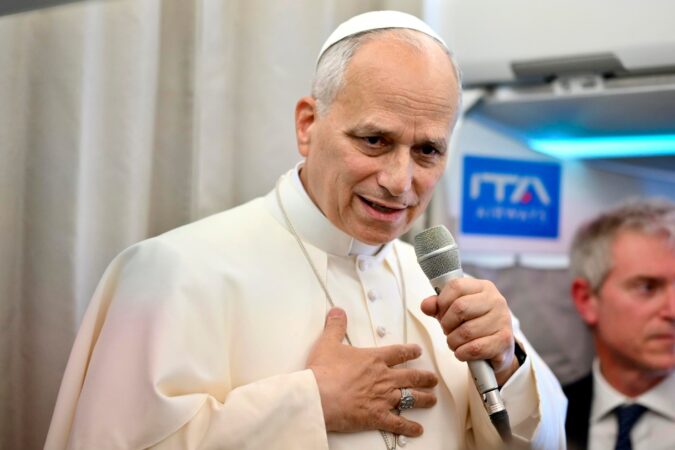
    ABOARD THE PAPAL PLANE — Pope Leo XIV on Tuesday shared for the first time what he was thinking when the votes started going his way during the conclave that elected him, saying he resigned himself to the inevitable and put the rest in God’s hands.

    “I took a deep breath. I said ‘Here we go Lord. You’re in charge and you lead the way,’” Leo told reporters during a wide-ranging airborne news conference coming home from his inaugural trip to Turkey and Lebanon.

    Leo fielded questions for a half-hour, responding easily in English, Spanish, and Italian about a variety of church and international news. He hinted at behind-the-scenes discussions about Hezbollah and Israel in Lebanon, urged dialogue rather than U.S. military threats on Venezuela and discussed his hoped-for future travels in Africa and South America, among other topics.

    But it was his remarks about the conclave and his papal learning curve that shed new light on Leo the man and what makes him tick. His responses, after seeming timid with the media early in his pontificate, showed he is much more comfortable now, is paying close attention to what is being reported about him, and that he has a good sense of humor about it.

    Leo was asked what he was thinking when he saw a huge crowd of people at one of his events in Lebanon, where it seemed as if the size had taken him by surprise. Leo suggested that wasn’t necessarily the case.

    “My face is very expressive but I’m oftentimes amused by how the journalists interpret my face,” he said. “It’s interesting. Sometimes I get really great ideas from all of you because you think you can read my mind or my face.”

    “You’re not always correct,” he added, to laughs.

    A spirituality that leaves everything up to God

    More instructive to understanding what he’s thinking, Leo said, would be to read up about his spirituality. Beyond St. Augustine, the fifth-century theologian who inspired his religious order and is Leo’s most-frequently cited church father, Leo recommended a book The Practice of the Presence of God, by a 17th-century Carmelite friar, Brother Lawrence.

    “It describes, if you will, a type of prayer and spirituality where one simply gives his life to the Lord and allows the Lord to lead. If you want to know something about me, that’s been my spirituality for many years,” he said.

    “In midst of great challenges — living in Peru during years of terrorism, being called to service in places where I never thought I’d be called to serve — I trust in God,” he said.

    That held true in the May conclave, he said, when the former Cardinal Robert Prevost was elected in a remarkably fast four ballots on the second day of voting. According to cardinals who participated, it was clear already by the third ballot that morning that the votes were going his way and that Prevost would be elected history’s first American pope.

    “I resigned myself to the fact when I saw how things were going and I said ‘This could be a reality,’” Leo said.

    Speaking to a reporter who is about to retire, Leo said he had had different plans for his future.

    “Just a year or two ago, I too thought about retiring some day,” he said. “You’ve received that gift apparently. Some of us will continue to work.”

    In Lebanon, Leo had a taste of what it’s like to be a pope on the road, and he said the enthusiasm of young Catholics was “awe-inspiring.”

    “I think to myself, ‘These people are here because they want to see the pope.’ But I say to myself, ‘They’re here because they want to see Jesus Christ and they want to see a messenger of peace,’” he said. “Just to listen to their enthusiasm and to hear their response to that message is something that I think is — that enthusiasm — is awe-inspiring.”

    “I just hope I never get tired of appreciating everything that all these young people are showing,” he said.

    On pressing international issues

    • Leo urged the United States to pursue dialogue and even exert economic pressure on Venezuela’s leaders to achieve its goals, rather than threats of military action. “The voices coming from the United States change, with a certain frequency at times,” he said. “I believe it’s better to look for ways of dialogue, perhaps pressure — including economic pressure — but looking for other ways to change, if that’s what the United States wants to do.”
    • Leo said he hopes to make his second trip as pope to Africa next year, visiting several countries but especially Algeria because of its important role in Christian-Muslim relations and its significance to St. Augustine, who inspired his religious order.
    • Leo also said he hoped to visit three countries in Latin America in either 2026 or 2027: Argentina, Uruguay and Peru, where he lived for two decades as a missionary. Argentina especially has been waiting for a papal visit after Pope Francis never went home after his 2013 election.
  • RFK Jr.’s vaccine advisers plan biggest change yet to childhood schedule

    RFK Jr.’s vaccine advisers plan biggest change yet to childhood schedule

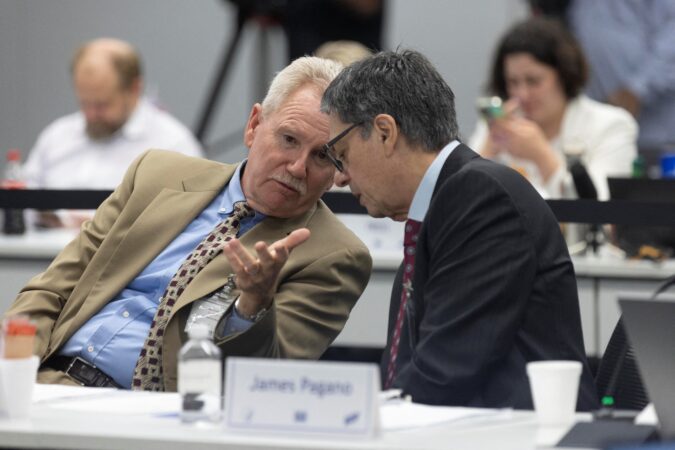
    Federal vaccine advisers selected by Health Secretary Robert F. Kennedy Jr. are planning to vote on ending the practice of vaccinating all newborns for hepatitis B and to examine whether shots on the childhood immunization schedule are behind the rise of allergies and autoimmune disorders, the newly appointed chair of the group told the Washington Post.

    Kirk Milhoan, a pediatric cardiologist and critic of coronavirus vaccination who recently took over as chair of the influential vaccine panel, said members meeting Thursday and Friday are broadly scrutinizing vaccines recommended for children. The wide-ranging discussions on the timing of vaccines and ingredients could signal major changes to how children in the United States are vaccinated, marking the latest flash point in an accelerating reshaping of immunization policy under Kennedy.

    For decades, the childhood and adolescent immunization schedule has called for administering vaccines at set milestones. But Kennedy, the founder of an anti-vaccine group, has long linked the rise of chronic disease, autism, and food allergies in the U.S. to what he calls the “exploding vaccine schedule” — claims that have been rebutted by medical associations and extensive research into the safety of shots.

    The members of the Advisory Committee on Immunization Practices are preparing to make their most significant change to the childhood vaccine schedule yet since Kennedy purged the panel and replaced members with experts who have largely been critical of public health vaccination practices.

    The new members plan to vote Thursday on scrapping the recommendation to give babies a dose of hepatitis B vaccine within 24 hours of birth if their mothers test negative for the virus. Instead, the panel is weighing a delay in that first dose byan interval that is “still being finalized,” Milhoan said. Vaccine advisers pushed back a vote on hepatitis B vaccine recommendations at their September meeting following disagreement.

    The birth dose has been credited for a 99% drop in infections in children and teens since the 1991 recommendation from the Centers for Disease Control and Prevention and the American Academy of Pediatrics, according to a 2023 study in the official journal of the U.S. Surgeon General.

    Critics of the birth dose, including Kennedy, say that it is unnecessary to vaccinate all children for the virus when the vast majority are not at risk for infection.

    Clinicians say the birth dose acts as a safety net to give infants immediate protection if they acquire the infection from mothers whose infection status is unknown, incorrectly documented or whose test results are delayed.

    ACIP makes recommendations to the CDC director on how approved vaccines should be used. CDC directors have almost always adopted the committee’s recommendations, which compel insurers to pay for vaccines and have traditionally guided pediatricians and medical organizations.

    The committee also plans to begin public discussions on its effort to review the childhood immunization schedule and the cumulative health effects of the dozens of shots children receive.

    “We’re looking at what may be causing some of the long-term changes we’re seeing in population data in children, specifically things such as asthma and eczema and other autoimmune diseases,” Milhoan said in an interview Monday.

    “What we’re trying to do is figure out if there are factors within vaccines,” he said, such as their ingredients or unintended substances contaminating them during manufacturing.

    Milhoan said the panel is focusing on the use of aluminum as an adjuvant, an ingredient added to vaccines to help the body produce an immune response strong enough to protect the person from the disease.

    Aluminum salts are in more than a dozen routinely recommended vaccines such as hepatitis A, hepatitis B, diphtheria-tetanus-containing vaccines, Haemophilus influenzae type B, HPV, and meningococcal B and pneumococcal vaccines. Adjuvants are essential because without them, the vaccine might not be able to trigger adequate immune responses.

    Aluminum salts have been used safely in vaccines for more than 70 years, according to the CDC. Aluminum-adjuvant-containing vaccines have only uncommonly been associated with severe local reactions, according to the Food and Drug Administration, which tests vaccines containing adjuvants extensively in clinical trials before they are licensed. The agency notes that the most common source of exposure to aluminum is food and drinking water.

    Public health and medical experts have raised alarms that the panel is moving toward recommending that only vaccines without aluminum adjuvants be used, a move that health and industry experts have said would be expensive and difficult on a practical level and could lead to shots being pulled from the market. Milhoan said the panel is not calling for the removal of aluminum from vaccines.

    “We’re not saying that at all,” he said. “We’re just starting to have the discussion.”

    The FDA generally has the responsibility to direct manufacturers to remove ingredients from vaccines. Some high-level FDA officials think that it would be infeasible to take aluminum adjuvants out of vaccines and that it cannot be done on any practical timeline, according to a senior federal health official who spoke on the condition of anonymity to be candid.

    Vaccine industry officials said that removing aluminum adjuvants from vaccines would cost billions of dollars and that finding a replacement would take years, according to people involved in the drug industry who spoke on the condition of anonymity to avoid publicly antagonizing the administration. The costs and technical complexities of doing so are enormous, one of the people said.

    The two-day ACIP meeting this week follows intense upheaval in the federal vaccination system.

    The committee has come under intense criticism from public health groups who accused the new members of botching and misstating science to further an agenda to undermine vaccines.

    Sean O’Leary, who chairs the infectious-diseases committee of the American Academy of Pediatrics, said revisions to the childhood immunization schedule by the newly reformulated ACIP “should not be trusted.”

    “Any changes they do make could be devastating to children’s health and public health as a whole,” O’Leary said in a briefing with reporters.

    Andrew Nixon, a spokesman for the Department of Health and Human Services, said in a statement that the vaccine panel “remains committed to evidence based decision making, and will carefully consider all data before any recommendation is made.”

    HHS announced Monday that Milhoan would be chair because his predecessor Martin Kulldorff, a Swedish biostatistician and prominent critic of the public health response to COVID, is joining the health agency in a staff role.

    Milhoan is affiliated with an organization that promoted ivermectin as a coronavirus treatment despite trials finding it is not effective, and in March, he called for mRNA vaccines to be halted.

    Former CDC director Susan Monarez said she was fired in August after refusing to rubber-stamp recommendations from the reformulated committee, and several top CDC officials resigned in protest.

    Last week, the CDC revised its website to contradict its longtime guidance that vaccines don’t cause autism. Kennedy told the New York Times he personally directed the change.

    On Friday, the nation’s top vaccine regulator, Vinay Prasad, announced plans to impose a more stringent approach to approving vaccines, including the annual flu shot, citing his team’s conclusion — without detailing the underlying evidence — that coronavirus vaccines had contributed to the deaths of at least 10 children.

    With the exception of the vote on hepatitis B vaccine, the federal vaccine advisers have not scheduled any other votes on the childhood vaccine schedule this week. According to the draft agenda, there are no presentations about vaccine effectiveness, access, equity or practical consequences of disrupting well-established schedules, which were always included before panel membership changed.

    Milhoan said vaccine benefits are well known and have been extensively discussed.

    “Not enough attention is being paid to risk,” he said.

  • Emmett named one of Esquire’s Best New Restaurants

    Emmett named one of Esquire’s Best New Restaurants

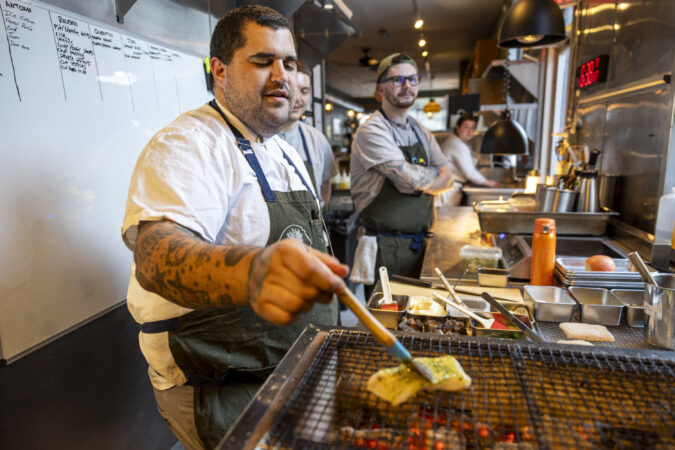
    Emmett, the Kensington restaurant serving modern Levantine cuisine, has found itself on a coveted list: Esquire’s Best New Restaurants. It is the only Philadelphia establishment recognized on the list. The 30-seat restaurant is already perpetually busy, but since the list was announced Dec. 1, chef-owner Evan Snyder, 33, has seen an uptick in reservations on OpenTable.

    He had been sitting on the news — or at least, some suspicion of it — for the last two weeks, since he received an invitation from Esquire for the list’s unveiling party in New York. The list was compiled by editor Jeff Gordinier and writers Joshua David Stein and Amethyst Ganaway; Stein was responsible for Emmett’s inclusion. He visited twice this past year and in Emmett’s segment of the article praised its rye tartlet filled with American wagyu tartare, sesame madeleine with baharat butter, corn agnolotti with tahina, and duck breast.

    The rye-wagyu tartlet at Emmett, 161 W. Girard Ave., in Philadelphia, Pa., on Thursday, March 27, 2025.

    Snyder was particularly delighted by Stein’s focus on these menu stalwarts. “The tartlet and madeleine are staples that will probably never come off the menu, as well as the dry-aged duck, which we age for 21 days, quite a bit longer than most people age ducks. The agnolotti with tahina is a set that changes micro-seasonally. These are all the things he enjoyed,” said Snyder.

    Sesame Madeleines with Ras al Hanout butter at Emmett, 161 W. Girard Ave., in Philadelphia, Pa., on Thursday, March 27, 2025.

    Emmett, named after Snyder’s 2-year-old son, opened Jan. 28, after he had run the concept as a pop-up for two years prior.

    The outside of Emmett, 161 W. Girard Ave., in Philadelphia, Pa., on Thursday, March 27, 2025.

    Snyder is most thrilled that the recognition gives his team “a shine.”

    “It’s the most important thing to me that [my team] is proud of what they’re doing and where they work.”

    Emmett, 161 W. Girard Ave., 215-207-0161, emmettphilly.com

  • Philly gets its first winter storm of the season, but hold the shovels

    Philly gets its first winter storm of the season, but hold the shovels

    The region is experiencing a classic Philadelphia early winter storm — a touch of ice and snow, rinsed away by plenty of ice water.

    Some light freezing rain, sleet, and random snowflakes were reported across the region around daybreak Tuesday, and several school districts in Chester and Montgomery Counties opted for two-hour delays.

    Small accumulations of freezing rain, under a tenth of an inch, were measured in the Doylestown and Pottstown areas.

    For the record, the National Weather Service in Mount Holly reported that the city recorded its second official “trace” of snow, defined as a trained spotter’s sighting at least one flake at Philadelphia International Airport.

    That duly noted, Philly’s chances for its first measurable snowfall of the season remained minimal or less.

    “It’s cut and dried,” said Tyler Roys, senior meteorologist with AccuWeather Inc.

    Quite wet, actually. As temperatures rise quickly above freezing, plain, old liquid rain, possibly heavy at times, is expected to persist into the afternoon throughout the region.

    PennDot anti-icing crews have been mobilized, said spokesperson Krys Johnson, but they are also clearing leaf-clogged drains to mitigate road flooding.

    The precipitation should shut off well before the peak afternoon commuting period. However, it appears that the meteorological winter, which began officially Monday, is going to get off to a livelier start than last year’s.

    “We’re changing the script already,” said Roys, noting another storm threat later in the week. “It’s definitely an active start.”

    NOAA’s Climate Prediction Center has the odds favoring below-normal temperatures and above-normal precipitation in the Northeast in the Dec. 7 through 15 period.

    What time will any snow and ice change to rain?

    The changeover to rain should proceed quickly, forecasters say, and it should be raining everywhere by midmorning.

    Winds are from the east, and that is importing warm air off the ocean, where sea-surfaces temperatures off Atlantic City were in the upper 40s on Tuesday morning.

    How much for Philly?

    For Philly, Johnson’s reading of the forecast — “A chance of one snowflake” — was essentially correct. In fact, from King of Prussia eastward, said Roys, “You’re looking at nothing.”

    What is the outlook for the rest of the week?

    The weather community divides the seasons into tidy three-month increments, with Dec. 1 as opening day for winter.

    It will feel that way, with temperatures several degrees below normal into the weekend, with daytime highs Tuesday and Wednesday mostly in the 30s and lows in the 20s.

    A wild card would be the arrival of an Arctic front Thursday morning, said Roys, which might set off snow squalls in parts of the region.

    Another winter storm is possible on the weekend, however computer guidance has been showing just about everything and not much, said Zach Cooper, a weather service meteorologist in the Mount Holly office.

    Welcome to winter in Philly.

  • Pottstown man who shot officer during domestic violence call sentenced to state prison

    Pottstown man who shot officer during domestic violence call sentenced to state prison

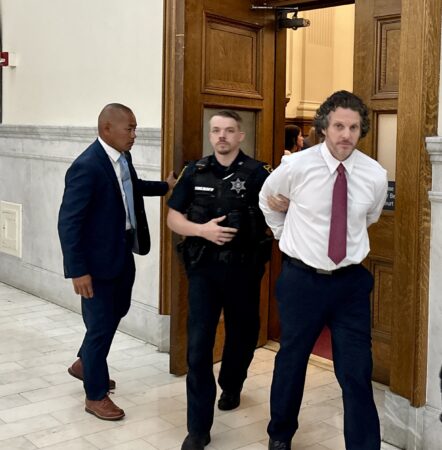
    A Pottstown man who shot an officer in the leg with his own firearm during a scuffle last year was sentenced Tuesday to 22½ to 45 years in state prison.

    William Ciccoli Jr., 43, showed little emotion as he learned his fate, shaking his head as Montgomery County Court Judge Thomas DelRicci handed down his sentence.

    The judge told Ciccoli he was shocked by his “lack of remorse and accountability.”

    “We all saw the video, yet you claim the ‘gun went off,’” DelRicci said. “It went off because of the defendant’s actions. No other reason.”

    After the hearing, Ciccoli denied pulling the trigger on Cpl. Anthony Fischer’s sidearm as they grappled inside Ciccoli’s apartment in November 2024.

    “If I disarmed him, my prints would’ve been on that gun,” he said. “I just feel sorry for my family for what has happened, that is all.”

    When pressed, Ciccoli said he feels sorry for Fischer, but insisted that he did not shoot him.

    Ciccoli’s attorney, Frank Genovese, said he wasn’t surprised by the sentence, which he said he would appeal.

    In June, a jury convicted Ciccoli of assault on a law enforcement officer and related crimes, but acquitted him of attempted murder, ruling that he did not intend to kill Fischer when he fired the gun.

    Fischer went to Ciccoli’s home on Chestnut Street to respond to a report of a domestic-violence dispute between him and his girlfriend, prosecutors said. While speaking with the officers, Ciccoli became combative and fought with Fischer.

    During the scuffle, Ciccoli wedged his hand into the holster on Fischer’s hip and pulled the trigger on his department-issued .40-caliber handgun, according to bodycam footage played during Ciccoli’s trial in June. During the video, Fischer yells “he’s going for my gun,” shortly before a single gunshot rings out.

    The shot struck Fischer in his leg, nicking his femoral artery and causing severe injuries that the officer said still prevent him from moving without pain.

    District Attorney Kevin Steele, who prosecuted the case, said Tuesday he appreciated that the judge “recognized the seriousness of the case.”

    “I think it’s very important for everyone to understand that if you try to disarm a police officer, if you shoot at a police officer you’re going to jail for 20 years,” Steele said, adding that Ciccoli’s repeated profession of innocence is “nonsense.”

    “This is a guy that’s not taking accountability for his actions,” Steele said. “We’re here because of his actions.”

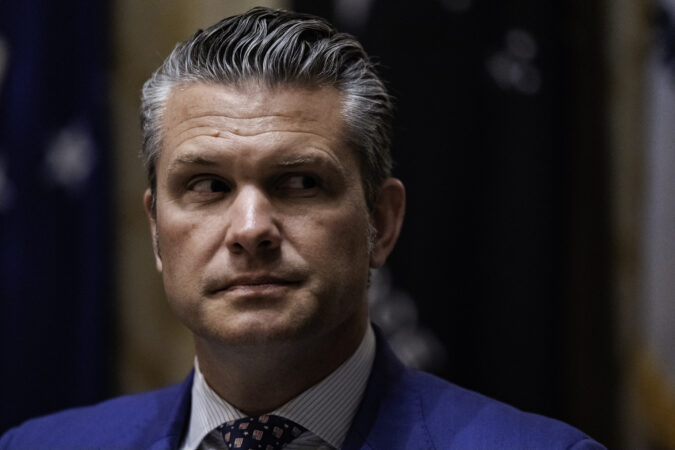
  • ‘Franklin the Turtle’ publisher slams Hegseth post joking about boat strike

    ‘Franklin the Turtle’ publisher slams Hegseth post joking about boat strike

    The publisher of Franklin the Turtle, a Canadian book franchise aimed at preschoolers, has expressed criticism after Defense Secretary Pete Hegseth appeared to make light of deadly boat strikes in Latin America by posting a doctored image that showed the well-known turtle character attacking the crew of a narcotics vessel.

    The Washington Post reported exclusively Friday that Hegseth gave a spoken order to kill the entire crew of a vessel thought to be ferrying narcotics in the Caribbean Sea, the first of more than 20 such strikes carried out by the administration since early September. When two survivors were detected, a military commander directed another strike to comply with Hegseth’s order that no one be left alive, the Post reported.

    In a post on X over the weekend, Hegseth shared an image of a doctored book cover, titled “Franklin Targets Narco Terrorists,” that depicted the elementary-school-aged turtle firing a rocket-propelled grenade at apparent drug traffickers. “For your Christmas wish list …” Hegseth wrote.

    In a statement late Monday, the cartoon’s publisher, Kids Can Press, issued a statement that did not name Hegseth, but said: “Franklin the Turtle is a beloved Canadian icon who has inspired generations of children and stands for kindness, empathy, and inclusivity. We strongly condemn any denigrating, violent or unauthorized use of Franklin’s name or image, which directly contradicts these values.”

    In an emailed response to a request for comment Tuesday, chief Pentagon spokesman Sean Parnell said, “We doubt Franklin the Turtle wants to be inclusive of drug cartels … or laud the kindness and empathy of narcoterrorists.”

    The Franklin the Turtle franchise began in 1986 and spans over 30 books, as the young turtle embarks on familiar coming-of-age milestones including falling in love, celebrating Thanksgiving and having a sleepover. The series has sold more than 65 million copies in over 30 languages, according to its publisher, and has been made into two educational television series and multiple movies.

    On Monday, Senate Minority Leader Charles E. Schumer described Hegseth’s post as a “sick parody of a well-known children’s book,” and accused Hegseth of being childish and unserious. “This man is a national embarrassment. Tweeting memes in the middle of a potential armed conflict is something no serious military leader would ever even think of doing.”

    Pressure has been mounting on the Pentagon to provide a full accounting of its orders to target alleged narcotics traffickers in the Caribbean Sea with lethal force, in strikes that have killed more than 80 people to date. Following the Post’s report, lawmakers in the House and Senate pledged to open inquiries to see if a war crime was committed during the first strike, where the two survivors were targeted. Legal experts have said the survivors did not pose an imminent threat to U.S. personnel and thus were illegitimate targets.

    On Monday, White House press secretary Karoline Leavitt acknowledged Hegseth had authorized the commander, Adm. Frank M. Bradley, to conduct the Sept. 2 strikes, while saying Bradley had “worked well within his authority and the law, directing the engagement to ensure the boat was destroyed.” Writing on social media Monday night, Hegseth said he stood by the admiral and “the combat decisions he has made.”

    The statements were seen as an attempt to distance Hegseth from the growing fallout from the strikes, with military officials expressing concern that he was attempting to insulate himself from any legal recourse and leave Bradley to face the fallout alone, the Post reported.