Blog

  • Eagles grades: Jalen Hurts has two turnovers; run defense porous vs. Bears

    Eagles grades: Jalen Hurts has two turnovers; run defense porous vs. Bears

    Instant grades on the Eagles’ performance in their 24-15 loss to the Chicago Bears:

    Quarterback: D

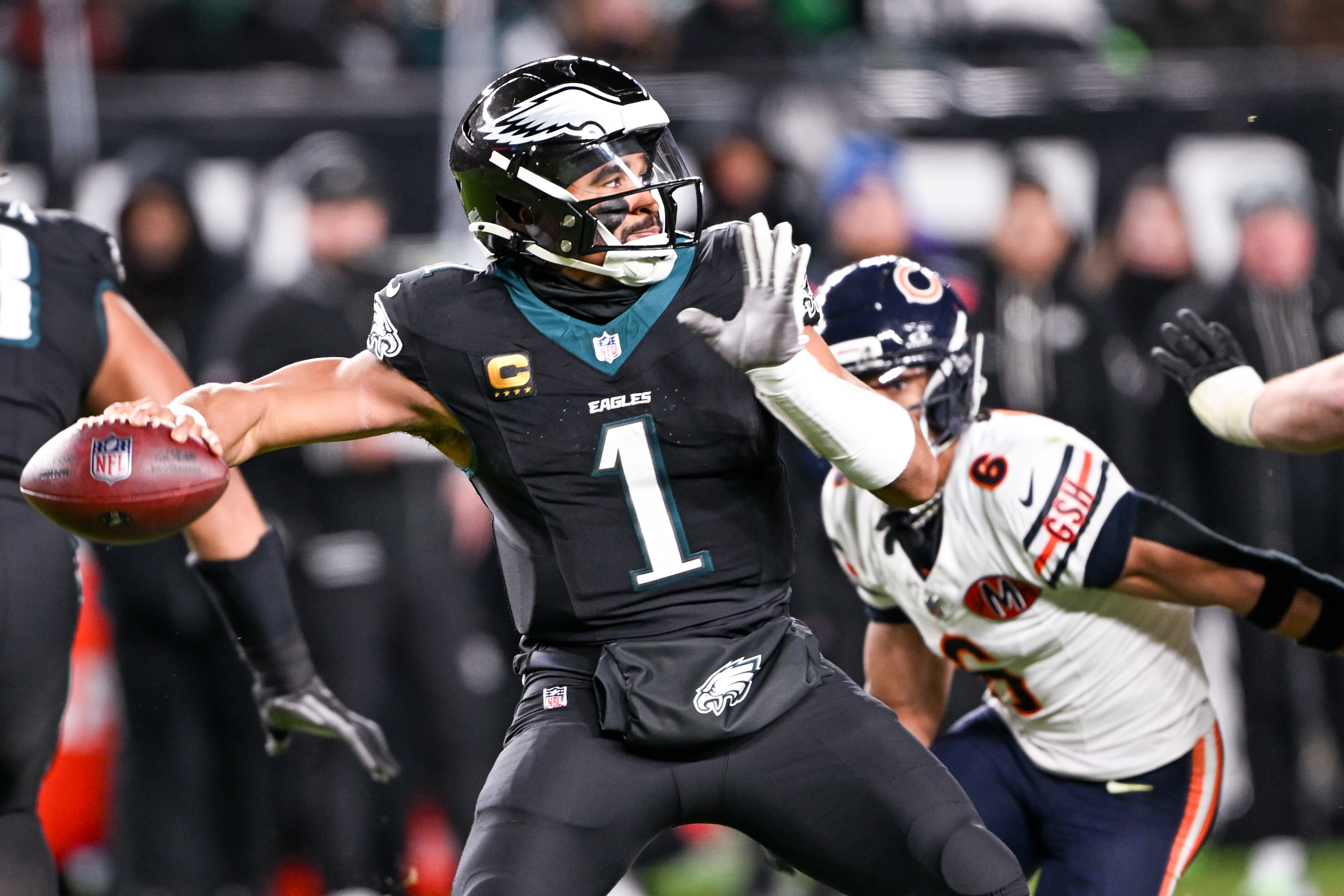
    Jalen Hurts had two costly turnovers. He tossed his second interception of the season in the third quarter when he failed to account for safety Kevin Byard in the post. And he fumbled on a third-quarter Tush Push when Bears cornerback Nahshon Wright stripped the ball after Hurts ran into a wall.

    The windy conditions at Lincoln Financial Field made it difficult on the quarterbacks. But Hurts missed too many layups and made bad decisions. He threw behind an open DeVonta Smith on a key early third down.

    There were some positives. Hurts bounced back after the pick and hooked up with A.J. Brown for a 33-yard touchdown. As a runner, he had some success with the return of the run-pass option game. He also picked up 23 yards off a draw in the third quarter.

    But Hurts was at the center of the Eagles offense’s terrible showing, and has been for most of the season.

    Running back: C-

    Saquon Barkley had a little more success on the ground, rushing 13 times for 56 yards (4.3 average). But there was an opportunity to do more against one of the NFL’s worst run defenses and a unit that was down three off-ball linebackers. Barkley’s longest gain was for 15 yards off the left side in the third quarter.

    The Eagles tried a two-back play with Tank Bigsby, but Barkley didn’t look back for the pass off an option. Even if he caught it, a defender was ready to pounce. Barkley also had a late drop.

    Receiver / Tight end: C-

    Wide receiver A.J. Brown led the Eagles, catching 10 of 12 targets for 132 yards and two touchdowns. But a lot of his production felt empty. He came back for a jump ball on a 33-yard touchdown.

    Brown had two more penalties for a team-high eight. The first — a false start — was legit. The second — a pass interference — was questionable. Brown pushed off, but it was relatively soft. The flag negated a third-down conversion.

    DeVonta Smith caught a 30-yard pass on a nicely drawn-up RPO early in the second quarter, but he went long stretches without getting involved. Dallas Goedert caught just one pass for 5 yards until the last drive — despite the Bears’ issues covering tight ends coming in.

    Offensive line: D+

    No unit gets a pass on the offensive side of the ball. The O-line just hasn’t been itself and whenever the Eagles have struggled historically, it’s been because they can’t block consistently.

    Left guard Landon Dickerson just doesn’t look close to healthy. On Hurts’ interception, he allowed pressure that forced the quarterback out of the pocket. Dickerson had a false start early on. Right guard Tyler Steen was up and down, as usual. Left tackle Jordan Mailata kept Hurts’ blind side mostly clean, but he hasn’t been the same run blocker this season.
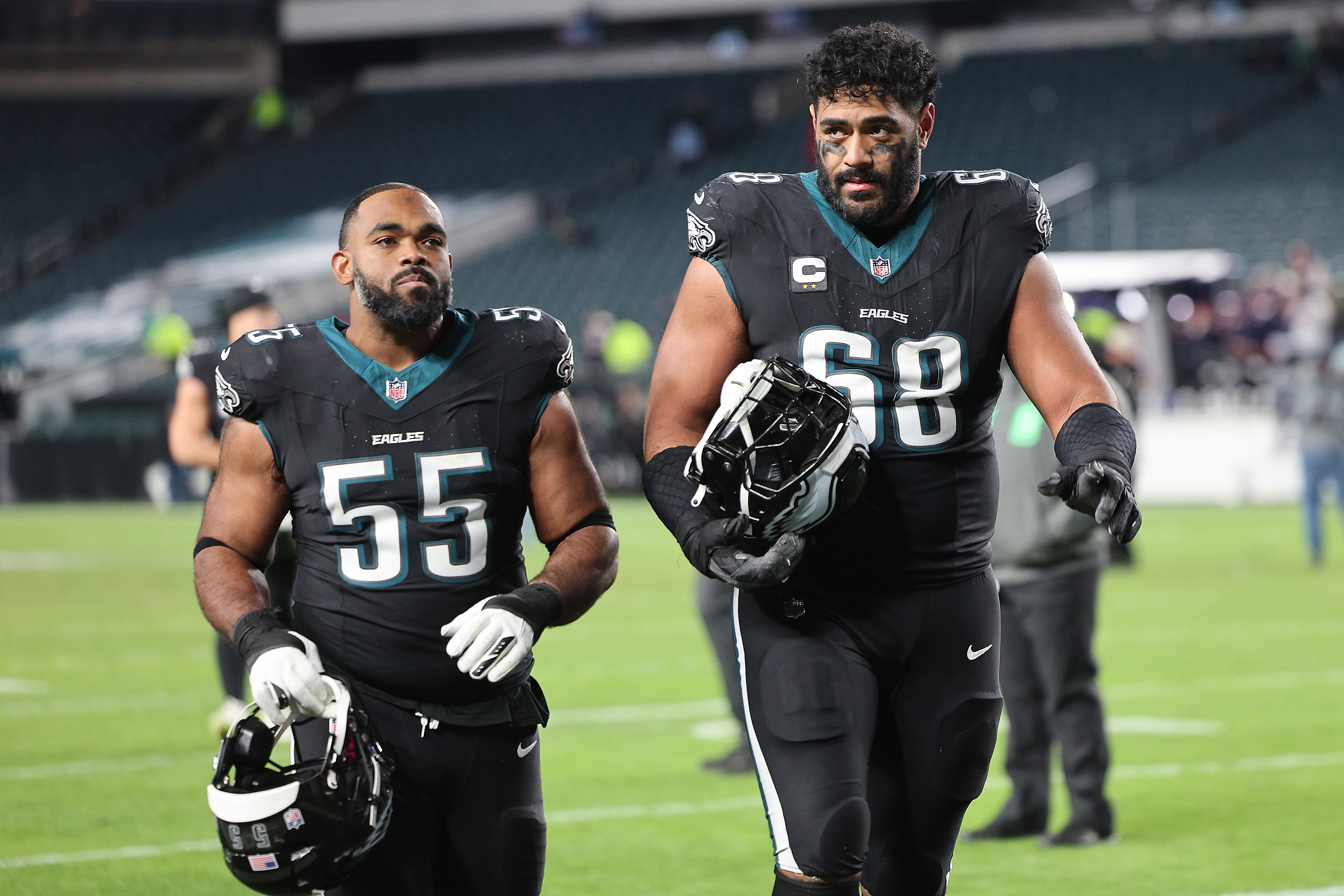
    Like several of his fellow offensive linemen, Jordan Mailata (right) hasn’t had the same type of season as he did a year ago.

    Fred Johnson started a second straight game for the injured Lane Johnson (foot). Barkley was dropped at the line after Johnson was beaten by a slanting lineman in the third quarter. He led the way on Barkley’s 15-yard tote a drive later, though. Center Cam Jurgens keeps playing through injury, but it’s hurting the offense. Jurgens and Steen combined for a lead block on a Barkley 9-yard run in the first quarter.

    Defensive line: D+

    Stopping the run is an 11-man deal, but the front was continuously beaten at the point of attack. The Bears offense often went heavy to keep the Eagles in base personnel and they ran it down their throats. Running backs D’Andre Swift and Kyle Monangai each went over 100 yards as Chicago gained 281 yards on the ground.

    Defensive tackle Jalen Carter made some undisciplined guesses as a run defender. He was blocked way out of his gap on Monangai’s 17-yard run off the right in the first quarter. And Carter took a bad angle on Swift’s 3-yard touchdown run at the end of that drive.

    Carter did pick up a sack in the second quarter after Nolan Smith hit Bears quarterback Caleb Williams. Moro Ojomo blew up a third-down screen try in the third quarter, but was bullied at times vs. the run. Jordan Davis had a run stop for no yards after fellow defensive tackle Byron Young held up his block in the second quarter. Young was first to the ball on the fourth-down run stop on the Bears’ opening drive. He failed to bring down Swift on a later long run.

    The D-line had some moments in the pass rush. Jalyx Hunt snatched his second interception of the season when he diagnosed a screen in the third quarter. The outside linebacker leaped and deflected the ball to himself. Outside linebacker Jaelan Phillips batted a third-down pass to the ground in the second quarter. Phillips also drew a holding penalty just before the half. Brandon Graham hurried Williams into forfeiting himself after dropping to pass in the third quarter.

    Linebacker: D+

    Nakobe Dean and Zack Baun just weren’t good enough in helping to stop the run at the second level. They got bullied and erased on runs up the middle.

    Dean was blocked to the ground on Swift’s 23-yard bolt up the middle on a split zone run in the first quarter. He also gave up the edge on Monangai’s 4-yard touchdown run in the fourth quarter. Baun got tossed on a Swift 17-yard rush in the second quarter.

    Dean, who finished with 12 tackles, was also called for holding on a short third-quarter pass off play-action.

    Rookie Jihaad Campbell hardly played, if at all.

    Cornerback: C

    Like Hurts, Williams had issues through the air. Some of it was self-inflicted, some of it was due to the Eagles’ pass defense. The quarterback completed just 17 of 36 passes for 154 yards. He had some key throws on third and fourth down, though.

    Adoree’ Jackson and Quinyon Mitchell weren’t challenged much on the outside, but they didn’t surrender many catches. They had more to do in the run game and didn’t do well in the open field. Jackson couldn’t bring Swift down on a second-quarter run.

    Cooper DeJean did a little more in run support. He also broke up an early pass to Rome Odunze.

    Safety: D

    Sydney Brown got his first full-time start of the season with Drew Mukuba (fractured ankle) on injured reserve. He struggled at times. Brown took a bad angle from the post on Swift’s 23-yard run. He didn’t bite on a play-action boot and held a short pass to minimal gain in the second quarter. It could have been worse had Williams been more accurate on two early throws after Brown was beaten in the end zone.
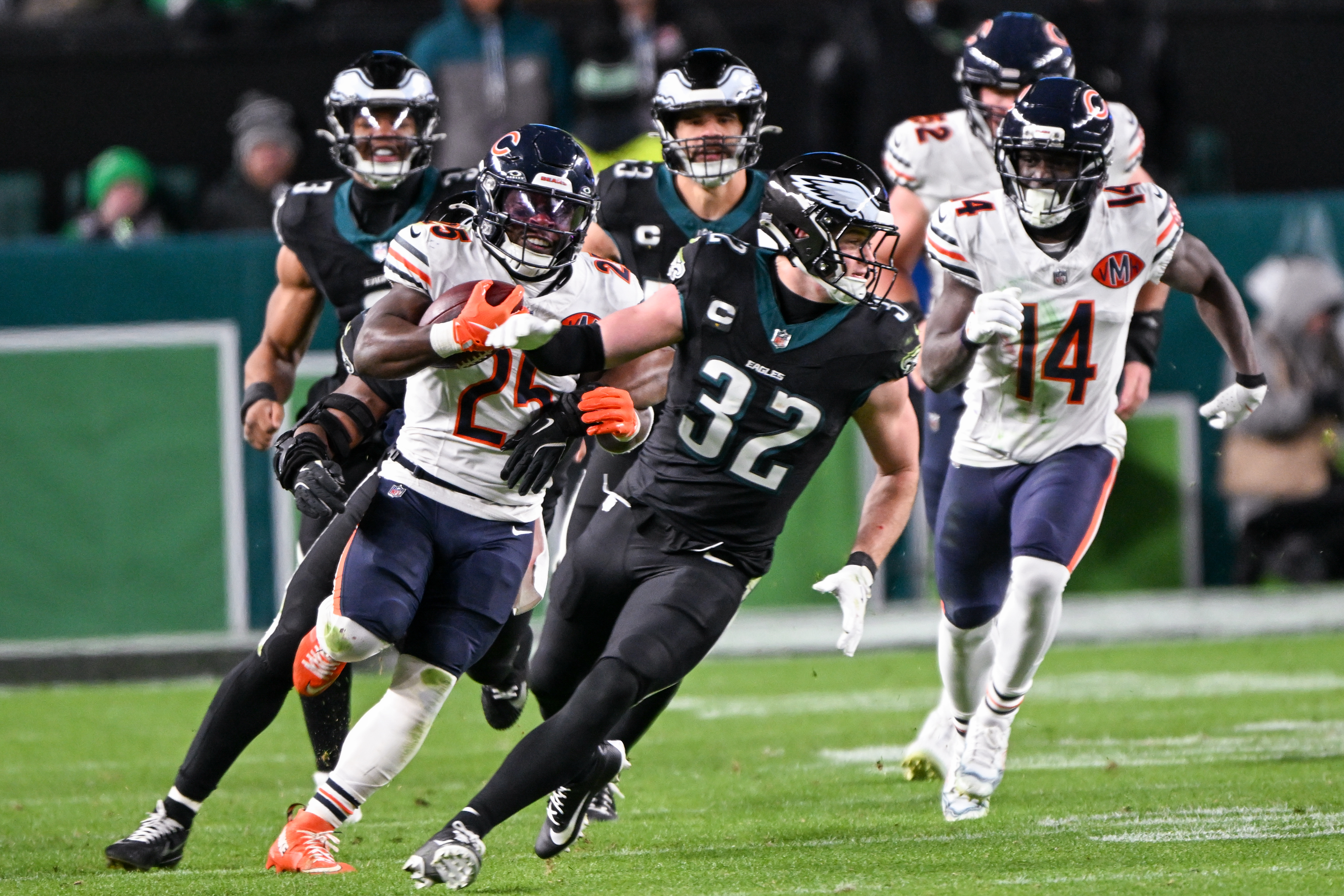
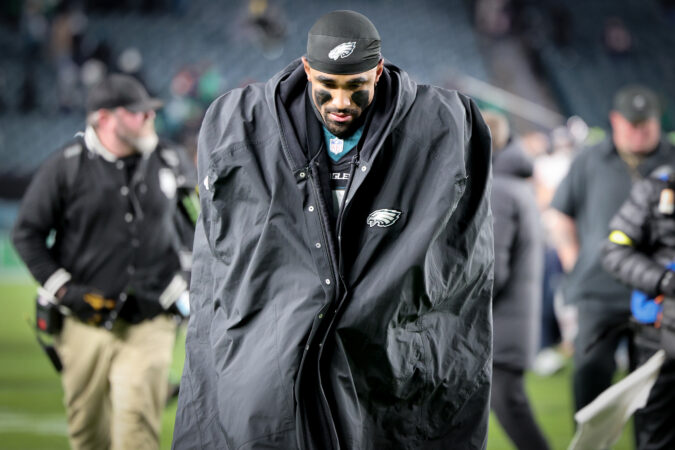
    Eagles safety Reed Blankenship had a game to forget against the Bears.

    Reed Blankenship might have been worse. He got toasted by Bears tight end Cole Kmet on the game-clinching 28-yard touchdown. Earlier, Blankenship was late to Bears receiver Olamide Zaccheaus on a third-and-7 conversion. And he slipped and lost tight end Colston Loveland when the Bears converted fourth-and-5 late in the third quarter.

    Blankenship led the Eagles with 14 tackles, many of them after runs into the secondary.

    Special teams: C-

    A steady wind wreaked havoc on the kicking game. Jake Elliott split the uprights on a 44-yard try. But he hooked an extra point wide left in the third quarter kicking again into the south end of the stadium. Elliott also missed a 52-yarder with a few seconds to play.

    Punter Braden Mann did well considering the conditions. He averaged 42.6 net yards on five punts.

    Britain Covey played in his first game in nearly a year and returned punts in place of the injured Xavier Gipson. Covey scooped up a roller and went 9 yards the other way in the second quarter. Covey was also back on kicks, and had one return for 22 yards. Will Shipley averaged 23.5 yards on two returns.

    Coaching: D-

    Nick Sirianni’s Eagles lost two games in a row for the second time this season as they fell to 8-4 — a game behind the 9-3 Bears in conference playoff seeding. Potentially more damaging is allowing the 6-5-1 Dallas Cowboys back in the division race.

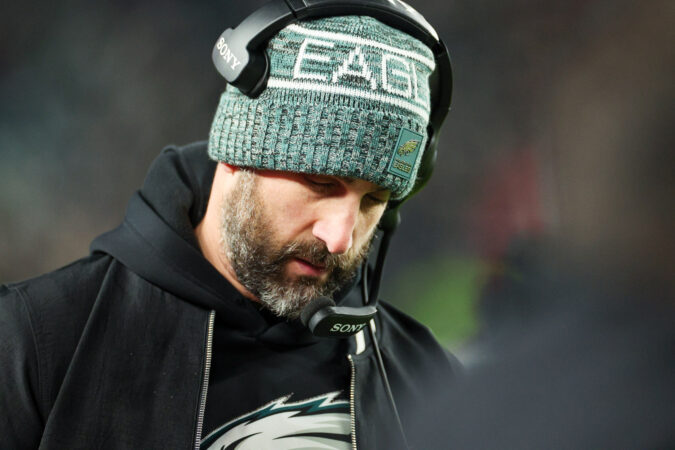
    Sirianni’s undisciplined team had seven more penalties — three of them of the pre-snap variety. He again showed little faith in his offense when he let the clock tick down to the two-minute warning before the half. His high-priced offense just shouldn’t be this bad and that’s on the coaching.

    The execution has been bad, but offensive coordinator Kevin Patullo just hasn’t had the answers. He went with more RPOs and zone reads because of the cold and windy weather, but just wasn’t sharp enough. Sirianni may have to switch up play-calling, although there isn’t an obvious replacement on staff.
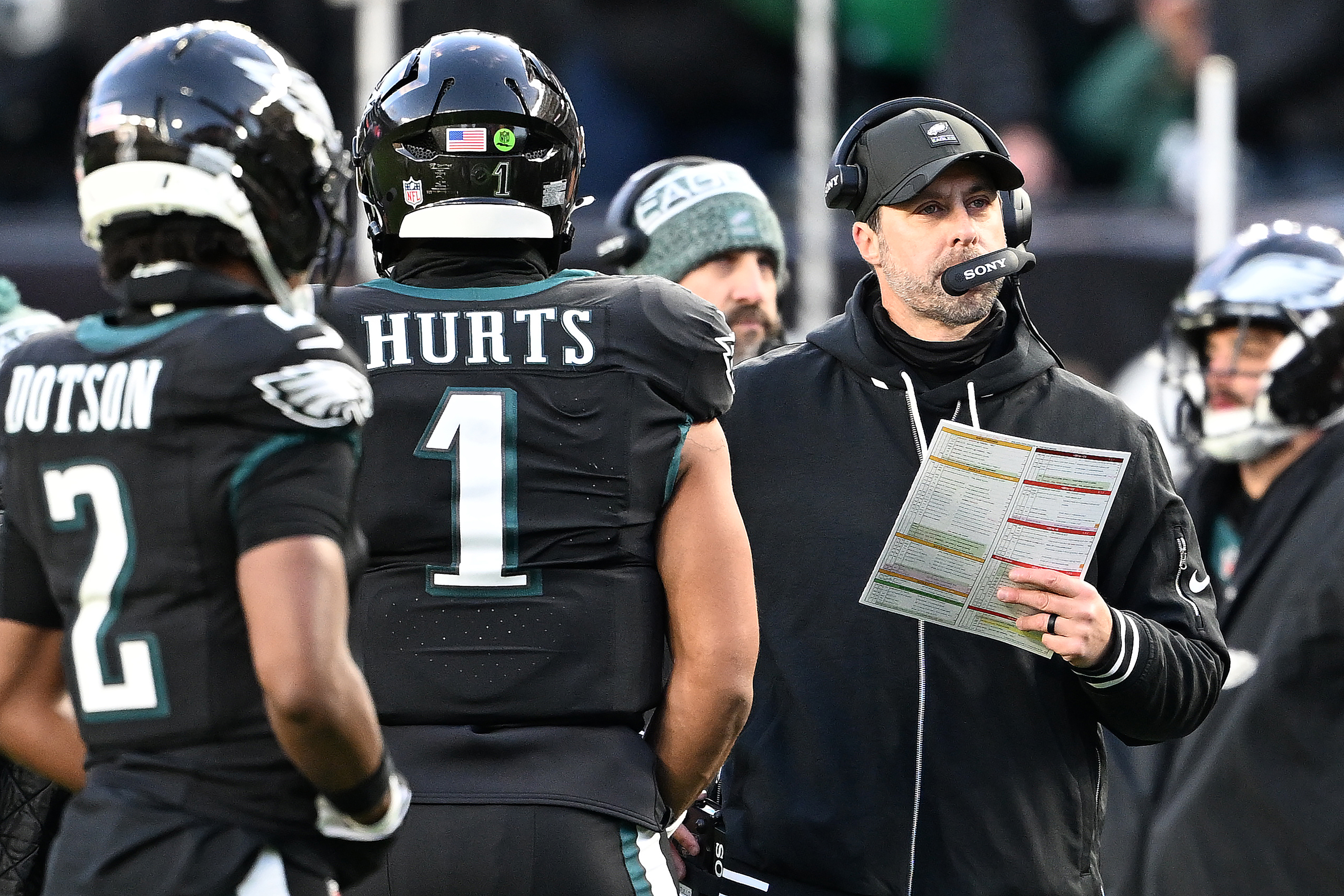
    Eagles play-caller Kevin Patullo failed to find the answers once again against Chicago.

    The Eagles entered last in the NFL in three-and-out percentage (33.3), and will likely remain there after Week 13 having gone three-and-out on 4 of 11 possessions. The Eagles were booed as they headed to the tunnel for the half and it seemed justified after they scored just three points.

    Defensive coordinator Vic Fangio’s unit got manhandled on the ground and allowed its most rushing yards in his two years in Philly. The defense tightened the hatches after allowing 204 yards and 10 points to the Bears on their first three possessions. But it again surrendered under the weight of the offense’s ineffectiveness.
  • Jalen Hurts weighs in on the Tush Push, and more from the Eagles-Bears Black Friday broadcast

    Jalen Hurts weighs in on the Tush Push, and more from the Eagles-Bears Black Friday broadcast

    It was a holiday letdown for the Birds, who dropped their second consecutive game on Friday, losing, 24-15, to the Chicago Bears.

    If you toughed it out in the cold at the Linc, or for some reason want to relive that game, here’s everything you missed from the broadcast:

    Pregame

    All of Philadelphia’s mascots were on-site for Prime Video’s extended pregame show.

    The Phanatic even cheered on a local Eagles fan in a push-up challenge against former NFL tight end Tony Gonzalez, who dropped down to attempt a few of his own.

    Even Jason Kelce was on-site with New Heights and made a brief appearance on the telecast, sharing why he believes Eagles fans are the “best in the world.” More on that in Monday’s edition of The Inquirer.

    Malcolm Jenkins, who was inducted into the Eagles Hall of Fame on Friday, Chase Utley, and Kyle Lowry shared their own messages

    Angelo’s cameo

    In order to explain the drop-off in the Eagles offense, Prime Video took a trip to newly minted Michelin Bib Gourmand cheesesteak establishment Angelo’s to take a look at the stats.

    “‘Wit’ or ‘wit’out’ a consistent offense, they’re still 8-3,” sideline reporter Kaylee Hartung said.

    Someone gave them the right intel for where to go. Shout-out to the Philadelphian on Prime Video’s staff, although brutal to use such a great cheesesteak to explain the Eagles’ struggles.

    Ben Johnson’s inspo

    Ben Johnson took his high school postgame celebration — a riff on Billy Williams’ “Good, better, best” Hall of Fame speech — and brought it to his first head coaching gig in Chicago.

    Johnson played high school football at A.C. Reynolds in Asheville, N.C., and graduated in 2004. Prime Video resurfaced a clip from Johnson’s high school days.

    What’s a wedge buster?

    What exactly is the wedge buster sandwich? I had many questions, and, to be honest, I still can’t quite tell what’s in it. But the wedge buster is Prime Video’s response to the Thanksgiving meal served by Fox at the end of Thursday’s game, an extremely large sandwich made with pizza crust that the winning team gets to eat postgame.

    Maybe just go to Middle Child next time?

    Kevin Patullo critiques

    Offensive coordinator Kevin Patullo did nothing to calm the heat around the Birds offense in the first half, with the team scoring just three points and compiling 83 yards of offense and two first downs.

    There wasn’t much more to say about the state of the Eagles at halftime.

    “Kevin Patullo does not have the answers,” former All-Pro cornerback Richard Sherman said. “He’s shown incompetency over the last couple games. … We need a little wingardium leviosa.”

    Sherman waved a little Harry Potter wand to emphasize his point, but it’s not the first time he’s criticized Patullo.

    Eagles fans

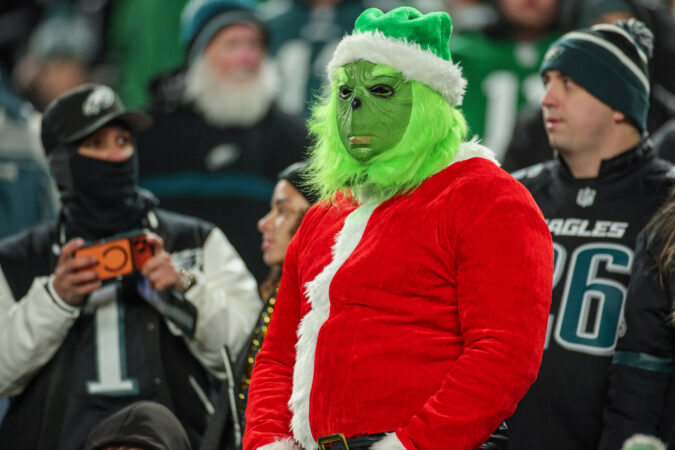
    The broadcast got lots of mileage out of disappointed Eagles fans at the Linc, including my close personal friend, Philly Sports Santa, and the Grinch.

    The boos were ringing down loudly on the broadcast after most offensive plays.

    The Bears wanted to weaponize that atmosphere entering Friday’s game.

    “If their offense goes three-and-out starting the game, they’re going to start booing them,” Bears safety and Philly native Kevin Byard said. “It’s one of those environments where it’s going to be very hostile. So hopefully we can start fast and kind of get the crowd against their own team.”

    Prime Video even did a b-roll segment of Eagles fans — and even Santa — headed for the exits after the Bears took a two-score lead in the fourth.

    Brutal.

    Tush Push hate?

    Al Michaels finally asked a Tush Push question we haven’t heard before: Who on the team is the best at pushing Jalen Hurts on the famous quarterback sneak?

    It took him a bit to get into his story because just after starting it, Hurts fumbled the ball and then the broadcast cut to commercial, leaving the captive audience (me) waiting for the end of the story.

    “You know what, I was always good without being pushed on the quarterback sneaks,” Hurts told Michaels. “I don’t need to be pushed.”

    “You know who might vote against the Tush Push? Hurts!” Michaels said.

    “He might be the first one!” color analyst Kirk Herbstreit said jokingly.

    Two-point conversion

    Herbstreit and Michaels were surprised to see Nick Sirianni and the Birds go for two down nine points in the fourth with just over three minutes to go.

    Had the Birds kicked the extra point, they could have made it a one-score game, although they would have needed to go for two if they managed to score another touchdown.

    “To me, it was a no-brainer,” Herbstreit said. “You’re down eight, you’ve got all three timeouts and the two-minute warning, you stop them on three runs, with A.J. Brown and that offense.”

    Instead, the Birds remained down nine points, which made a comeback nearly impossible. That said, the Eagles needed to go for two at some point anyway if they were going to tie the game. By going for two first, you have all the information about what the rest of the game needs to look like instead of running the clock down to near zero and then failing on the two-point try.

  • Nick Sirianni, Kevin Patullo struggle as Eagles lose again due to poor focus, fundamentals

    Nick Sirianni, Kevin Patullo struggle as Eagles lose again due to poor focus, fundamentals

    Jalen Hurts gave up two third-quarter turnovers Friday against the Chicago Bears — first, a bad, deep throw, then a fumble during a Tush Push. Both inexcusable. Both plays that reek of poor fundamentals.

    Poor fundamentals mean poor coaching.

    Bears running backs D’Andre Swift and Kyle Monangai ran for 125 and 130 yards, respectively. It’s the first time since 1960 that two opposing runners gained more than 100 yards on Eagles home turf — astonishing, considering how awful some of the Eagles’ defenses have been. They surrendered a total of 281 rushing yards, the most they’ve allowed in a decade.

    How did this happen?

    Mainly, poor tackling. Poor tackling means poor fundamentals.

    Poor fundamentals mean poor coaching.

    As has so often happened this season, the offensive play calls took far too long to be communicated to Hurts, then from him to the team. First-time offensive coordinator Kevin Patullo is 12 games into his career as a play-caller. It’s not as if the offense is particularly complex. Crowd noise was no factor: It was a home game.

    Maybe they couldn’t hear above the boos.

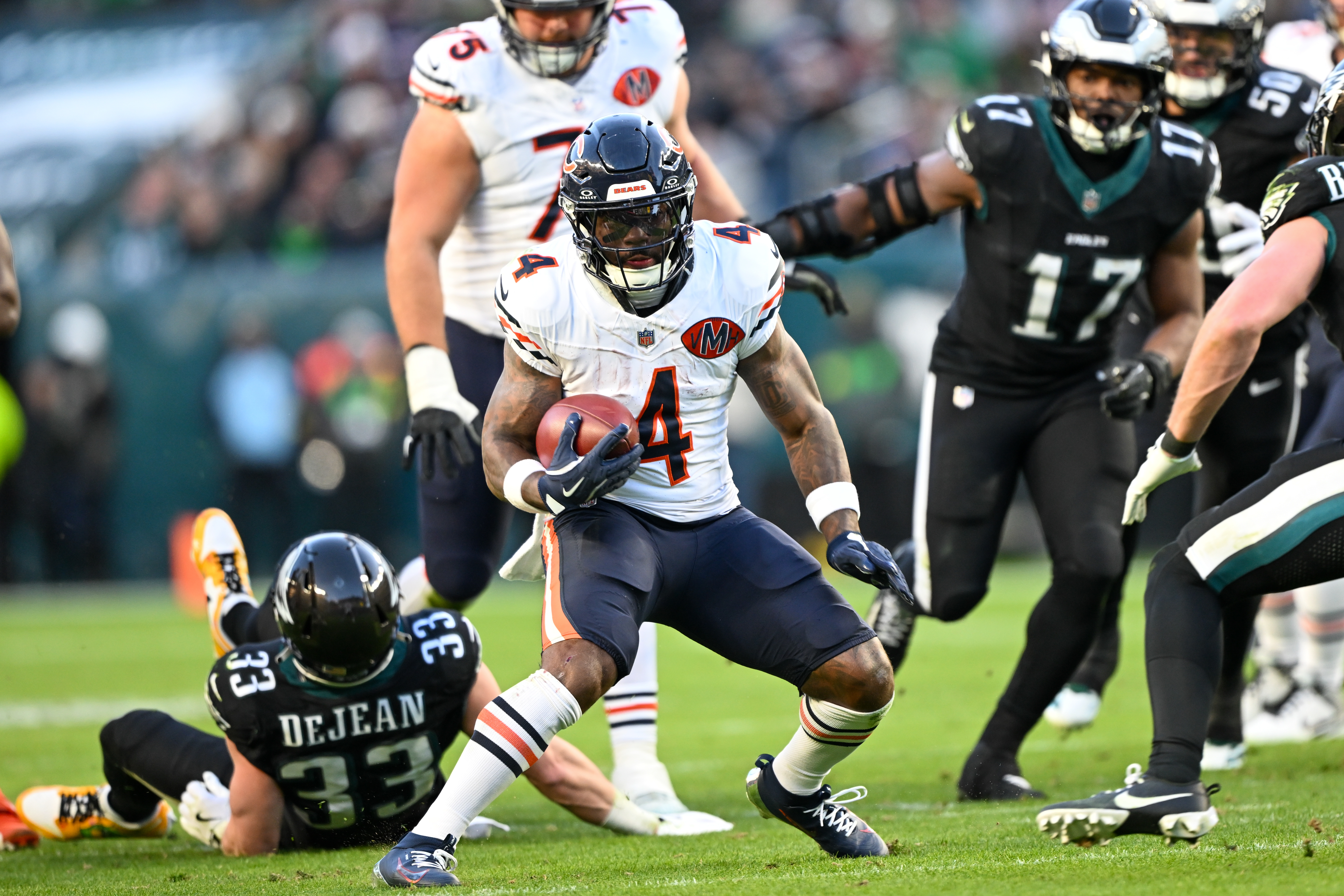
    Bears running back D’Andre Swift runs for 17 yards past a fallen Cooper DeJean during the second quarter.

    The Eagles’ Super Bowl hangover is getting worse as time grows short in the 2025 season. As was the case after Nick Sirianni and the Birds won the NFC title after the 2022 season, the coach and the team, who won Super Bowl LIX, have been unimaginative, ineffective, and have appeared unmotivated for most of the season.

    It took 11 games in 2023 for the malaise to collapse the season. It has taken only 10 games in 2025.

    After the Eagles blew a 21-point lead and committed 14 penalties at Dallas on Sunday, Sirianni fell on the sword. He did so again Friday:

    “We all have to do a better job. And that’s going to be starting with us as coaches — starting with me, as a coach.”

    For the second straight week, he swore he wouldn’t replace Patullo, who is reaching Sean Desai-levels of unpopularity. (Desai was the scapegoat defensive coordinator for part of the lost 2023 season.)

    Blame Nick. Blame Kevin. Blame whoever you like but the Eagles are now 8-4 after a 24-15 loss to the visiting Bears. Petulant receiver A.J. Brown caught 10 passes for 132 yards and two touchdowns, and had eight catches for 110 yards at Dallas in the previous game, so he’s been productive and presumably happy, but he’s an outlier.

    The Eagles’ well-paid, pedigreed offense has managed just three solid drives in the last six quarters, and one came against a prevent defense in the fourth quarter Friday night.

    The Eagles were unprepared for Dallas’ five-man front in their last game. They were unprepared to stop the Bears’ running attack Friday. They don’t seem to know what’s coming. On the other hand, the Eagles offense and defense both seem entirely predictable, and when they aren’t disciplined, they’re a disaster.

    “Turnovers and sloppy sloppiness,” said center Cam Jurgens.

    How to fix it?

    “Watching film being brutally honest.”

    It sounds as if there’s been less accountability lately.

    “You know, in a walk-through somebody false starts — like we need to make a point of every single part,” Jurgens said. “You know, and it’s happening in the game. We need to make sure we’re covering all of our bases and stay on top of it, because we’re just the sloppier team today.”

    There might have been a play or two Friday that the officials didn’t call in the Eagles’ favor, but if you’re underthrowing passes and failing to cover backs out of the backfield, and then you’re begging the refs to bail you out, well, that’s just kind of sad.

    Speaking of sad, the Eagles’ final possession of the first half went like this:

    • Weird, soft, 1-yard pass to Brown;
    • The Eagles wasted about 30 seconds when they could not get a play call in before the two-minute warning. In a bizarre moment postgame, Sirianni, clearly rattled and desperate to protect Patullo, delivered a nonsensical answer that asserted that they wasted that time on purpose;
    • Aborted route over the middle by Brown, who would have been hit hard by Jaylon Jones as he caught it;
    • Offensive pass interference on Brown, who pushed off (softly) to negate a 12-yard completion;
    • On third-and-19, an 11-yard pass to Will Shipley, who, with 1 minute, 43 seconds to play, foolishly ran out of bounds, saving the Bears about 30 seconds.
    • Braden Mann then shanked a downwind punt 44 yards. He shanked another at the start of the fourth quarter that went 40 yards.

    Needless to say, the Eagles left Lincoln Financial Field to a chorus of boos. They’d gained just 83 yards in the first half, their worst first-half production of the season.

    It got worse.

    On the first play of the second half, Hurts hit Saquon Barkley in the right shoulder pad with a pass. Barkley wasn’t ready. Hurts stared him down. In the fourth quarter, Barkley dropped another pass.

    Even when things went right, they went wrong.

    Midway through the third quarter, from the Bears’ 33, Hurts went deep. He underthrew Brown, who adjusted, ripped the ball away from Nahshon Wright, and walked into the end zone to cut it to 10-9.

    A few seconds later, kicker Jake Elliott pulled the point-after attempt left.

    Seriously.

    The Eagles now have nine days to prepare for a West Coast road game against the Los Angeles Chargers, a 7-4 team that is likely to be 8-4 after Sunday’s home game against the Las Vegas Raiders.

    That’s a lot of time for extra coaching.

    That is, if Sirianni and his staff are up to it.

  • Eagles’ issues extend to defense in wire-to-wire Black Friday loss to Bears

    Eagles’ issues extend to defense in wire-to-wire Black Friday loss to Bears

    The Chicago Bears brought a piece of the Windy City to Philly and blew the Eagles away.

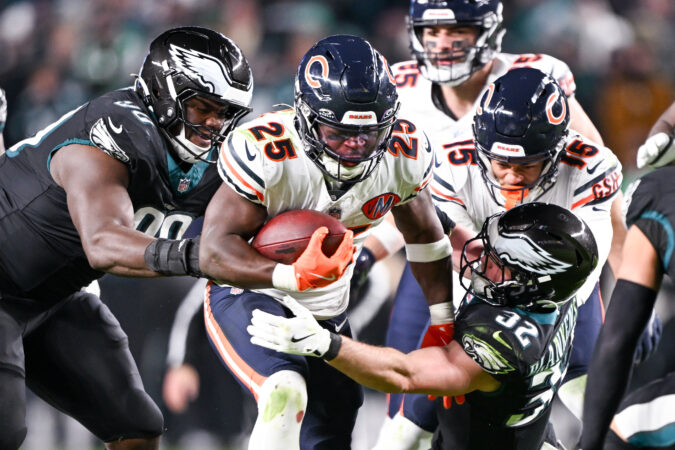
    On a gusty Black Friday afternoon at Lincoln Financial Field, the visiting Bears got to work on the ground, pounding their way to a 24-15 victory. Vic Fangio’s defense turned porous as running backs D’Andre Swift and Kyle Monangai combined for 255 rushing yards (130 for Monangai, 125 for Swift).

    The Eagles offense, meanwhile, sputtered too frequently, going three-and-out on four possessions and committing two turnovers (one interception, one fumble). Kevin Patullo’s unit finished with just 51 plays (317 yards) to the Bears’ 85 (425 yards).

    Jake Elliott also struggled, missing an extra point attempt in the third quarter and a 52-yard field goal attempt in the waning seconds of the fourth.

    Here’s our instant analysis from the Eagles’ fourth loss of the season, and second straight:

    Bears on the run

    The Bears won the time of possession game, especially in the first half, with their offense on the field for 21 minutes compared to just nine for the Eagles.

    Chicago’s offense dominated early, thanks to its running game, headlined by a running back duo of former Eagle Swift and Monangai. They combined for 7.2 yards per carry in the first half (129 yards and a touchdown on 18 carries).

    It was a happy homecoming for former Eagle and St. Joseph’s Prep product D’Andre Swift on Friday.

    Swift was particularly efficient on the ground, averaging 8.8 yards per carry through the first 30 minutes of the game. The St. Joseph’s Prep alumnus put the Bears up, 7-0, with just over a minute and a half remaining in the first quarter on a 3-yard touchdown run.

    He also was adept at forcing missed tackles, especially on the first play of the Bears’ third possession of the afternoon. Swift took a handoff from an under-center Caleb Williams, then scurried to the right for a 17-yard gain, leaving Adoree’ Jackson in his wake.

    “We’ve just got to be more violent,” Nakobe Dean said of the Eagles’ shortcomings against the run. “We’ve got to get off blocks. We’ve got to fit the run and like I said, that happens. And that’s with all 11, not just the D-line, not just the linebackers, not just the DBs. Everybody’s got to fit the run better.”

    Williams contributed on the ground, too, scrambling on third-and-5 to pick up a first down on the Bears’ third possession. However, the Bears got away from the running game briefly in the red zone, as Williams threw three straight incomplete passes. Chicago settled for a 30-yard Cairo Santos field goal and pulled ahead, 10-3.

    The Bears got back to the running game in the fourth quarter, as Monangai added another rushing touchdown to put Chicago up, 17-9. The running game became a focal point because both quarterbacks had their share of misses in the passing game.

    Jalen Hurts and the Eagles passing game had their moments against the Bears, but not enough of them.

    Williams went 17 of 36 (47.2%) for 154 yards with one touchdown and one interception, while Jalen Hurts went 19 of 34 (55.9%) for 230 yards with two touchdowns and one interception.

    Williams sealed the Eagles’ fate with his 28-yard touchdown pass to tight end Cole Kmet late in the fourth quarter that made it 24-9.

    Up-and-down offense

    While neither team thrived in the passing game, the Bears could at least run the ball. Saquon Barkley had some solid early runs, averaging 6.3 yards per carry in the first quarter, but the Bears defense tightened up and limited him to 4.3 per carry by the end of the game. Barkley finished with 56 yards on 13 carries.

    The Eagles’ passing attack couldn’t compensate for the lack of explosiveness on the ground. Hurts wasn’t always on the same page with his receivers, including a third-down incompletion to DeVonta Smith on a slant that forced the Eagles to settle for a 44-yard field goal.

    Hurts’ pass for Smith was slightly behind the 27-year-old receiver as he ran across the middle of the field. After the game, Hurts called the missed connection “two guys on two different pages.”

    “That’s a bit of the issues that we’ve kind of been having,” Hurts said. “We weren’t detailed enough in that. I wasn’t detailed enough in instructing him what to do, have him prepared, and making myself clear on that. So I’m trying to find as many particulars as I can when it comes to the level of execution we have and that’s a group effort that has to be there.”

    The field goal made it 7-3 in favor of the Bears. In the first half, the Eagles mustered just two first downs and 83 total yards, while the Bears amassed 16 first downs and 222 yards.

    Ex-Eagles safety Kevin Byard celebrated an interception of his former teammate Jalen Hurts in the third quarter.

    Ex-Eagle Kevin Byard’s third-quarter interception of Hurts continued the negative trend, but the Eagles offense showed a spark on the next possession — with a foolish Bears penalty helping the cause.

    Bears defensive lineman Gervon Dexter was flagged for a late hit on Hurts, moving the Eagles up 15 yards to their own 40. On the following play, Hurts had a rare designed run for 23 yards, bringing the Eagles to the Bears’ 33-yard line. On the ensuing play, Hurts hit A.J. Brown for a 33-yard touchdown pass, but Elliott missed the extra point to make it 10-9 Bears.

    That spark wasn’t enough. The next two Eagles possessions ended in a Hurts fumble and a three-and-out. They eventually turned it back on, reeling off a 12-play, 80-yard touchdown drive late in the fourth quarter, capped by a 4-yard Brown touchdown catch and an unsuccessful two-point conversion attempt.

    Turnover time

    Entering the game, the Eagles led the league with just six turnovers lost this season. The Bears, meanwhile, had forced a league-best 24 turnovers.

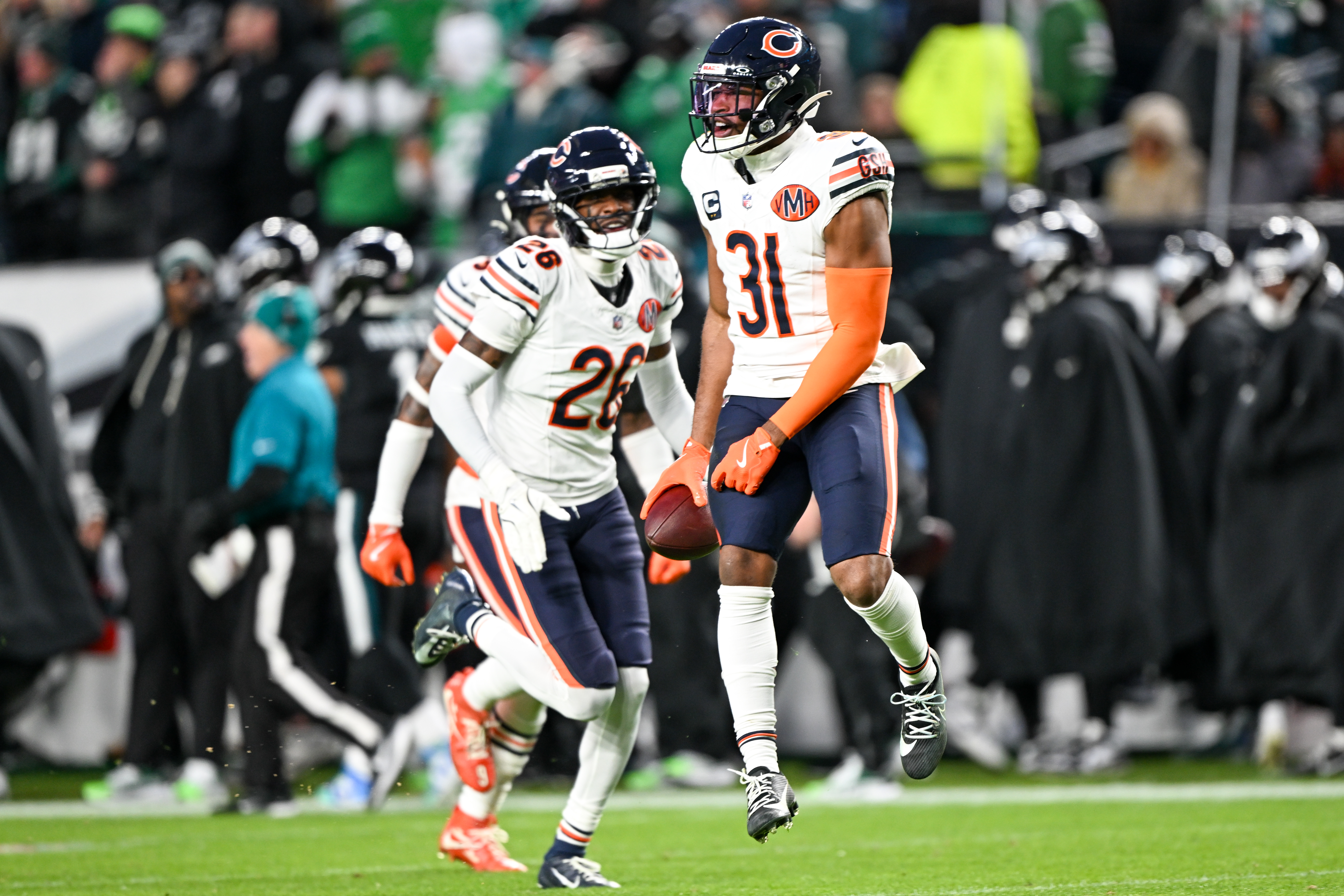
    The Bears won Friday’s turnover battle. Byard picked off Hurts early in the third quarter after the quarterback rolled out to his right while being pressured and launched a pass deep down the right sideline for Brown. Byard undercut the pass and snared his NFL-best sixth interception of the season.

    “I saw Kevin coming over and I knew there was a chance he was going to be able to make a play on the ball,” Hurts said. “Just was trying to give him a chance and throw it to the sideline where A.J. could try and make a play on it, and I wasn’t able to connect with him.”

    Luckily for the Eagles offense, the Bears failed to capitalize on Byard’s efforts. Williams was under duress up front on second and third downs, scrambling for no gain and throwing an incomplete pass intended for Bears wide receiver Rome Odunze to go three-and-out.

    Pass rusher Jalyx Hunt looked like the collegiate safety he once was on an interception of Caleb Williams in the second half.

    Later in the third quarter, Jalyx Hunt picked off Williams and returned the ball to the Bears’ 36-yard line. His play gave the Eagles offense excellent field position to try to pull ahead while they were down, 10-9.

    However, on third-and-1 at Chicago’s 12, Hurts fumbled on the Tush Push, a play that Bears head coach Ben Johnson previously denounced. Bears cornerback Nahshon Wright recovered the fumble, ending the Eagles’ attempt to go ahead. Hurts said he had hoped that his progress was stopped before the fumble, but the officials “didn’t blow the whistle as soon.”

    “That’s not to point the finger at anyone else,” Hurts said. “I’ve got to hold on to the ball.”

    This time, the Bears made the turnover count, as Monangai punched in a 4-yard rushing touchdown to cap a 12-play, 87-yard drive and put Chicago up, 17-9, early in the fourth quarter.

  • Philadelphia is on a long list of potential cities for the 2031 women’s World Cup

    Philadelphia is on a long list of potential cities for the 2031 women’s World Cup

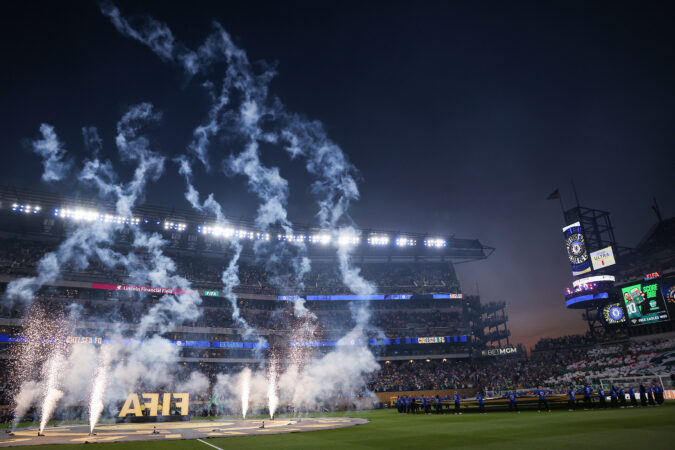
    NEW YORK — The United States Soccer Federation proposed 14 American sites among 20 possible venues to host games for the 2031 Women’s World Cup, including seven U.S. stadiums to be used for next year’s men’s tournament.

    FIFA released the bid books Friday for the 2031 and 2035 women’s tournaments. There is only one bidder for each, a U.S.-Mexico-Costa Rica-Jamaica proposal for 2031 and a United Kingdom plan for 2035. FIFA is to formally confirm the bids at its congress on April 30.

    Twenty-six additional U.S. stadiums were mentioned as suitable venues for a 48-nation tournament the bidders project would draw 4.5 million fans and generate about $4 billion in revenue, up from $570 million for 2023 in Australia and New Zealand and a projection of $1 billion for the 2027 tournament in Brazil.

    Proposed ticket prices of $35 for the cheapest seats in the opening round to $120 to $600 for the final were listed in a ticket grid. FIFA has refused to release a grid for next year’s men’s tournament, saying only prices initially ranged from $60-$6,730 but could fluctuate with dynamic pricing. The bid book said premium seating would average 10%-20% of capacity at the majority of 2031 stadiums.

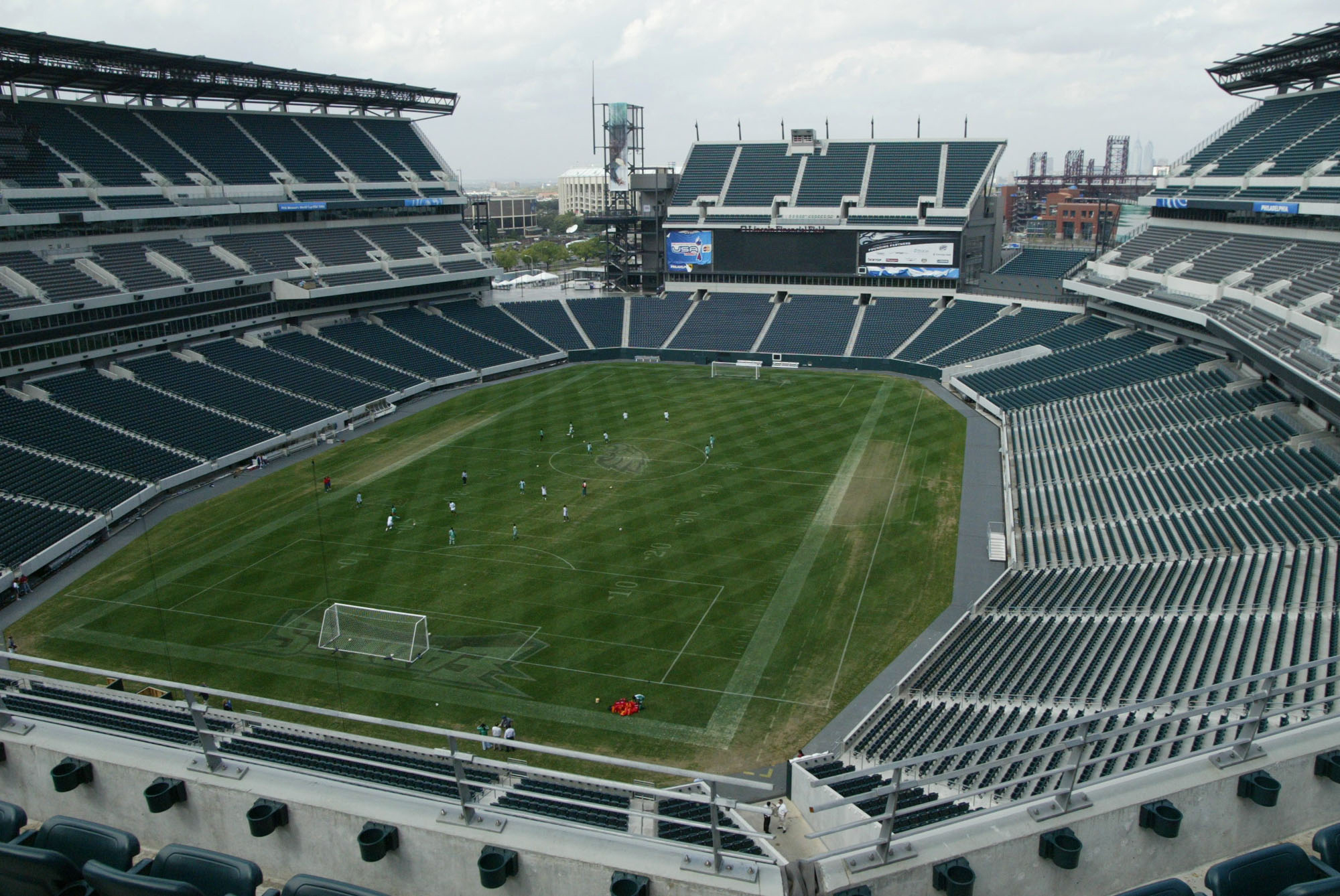
    Lincoln Financial Field last hosted a women’s World Cup in 2003.

    Fifty sites in all were mentioned in the joint 2031 bid. Final decisions likely will not be made for several years.

    The bid book also said “other suitable cities are included” beyond the specified 14 “as part of the broader bid framework with the understanding that they will continue to be equally considered for the purposes of stadium selection.”

    “By proposing more than the required 20 sites, the joint bidders demonstrate a commitment to securing the best possible hosting conditions and ensuring the tournament represents the full diversity of our region on a global scale,” the bid book stated.

    The 2026 U.S. sites included in the 2031 proposal are Arlington, Texas (AT&T), Atlanta (Mercedes-Benz), East Rutherford, N.J. (MetLife), Houston (NRG), Inglewood, Calif. (SoFi), Kansas City, Mo. (Arrowhead), and Seattle (Lumen Field).

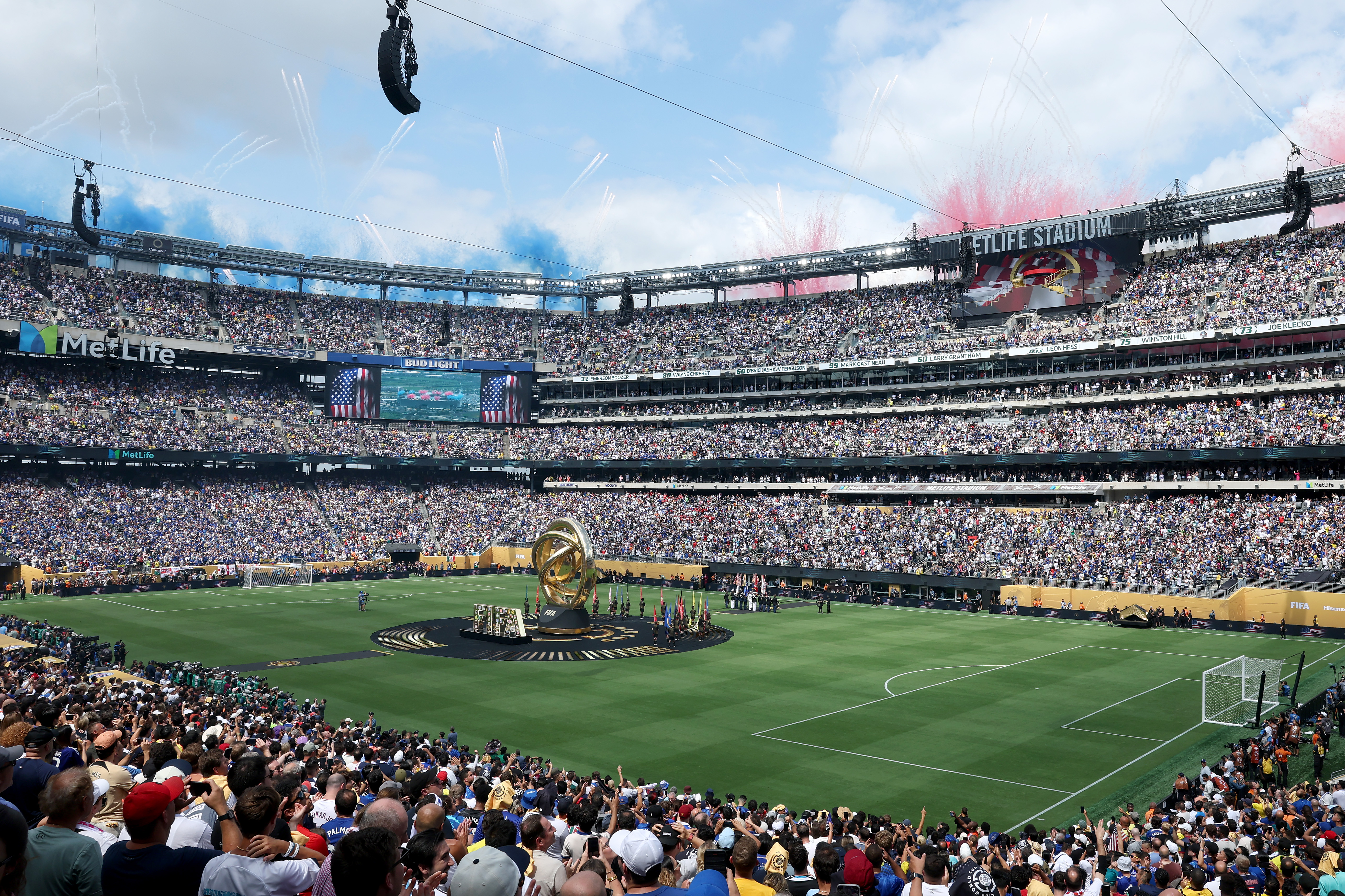
    MetLife Stadium in East Rutherford, N.J., hosted this year’s Club World Cup final and will host next year’s men’s World Cup final.

    The seven others are Charlotte, N.C. (Bank of America), Denver (Empower Field), Minneapolis (U.S. Bank), Nashville (Geodis Park), Orlando (Camping World), San Diego (Snapdragon), and Washington (proposed NFL venue on the RFK Stadium site).

    Orlando and Washington were sites of the 1994 men’s World Cup.

    Mexico’s three sites for next year’s World Cup also are proposed for the women’s tournament, Mexico City (Azteca), Guadalajara (Akron), and Monterrey (BBVA), along with a fourth in Torreón (Corona).

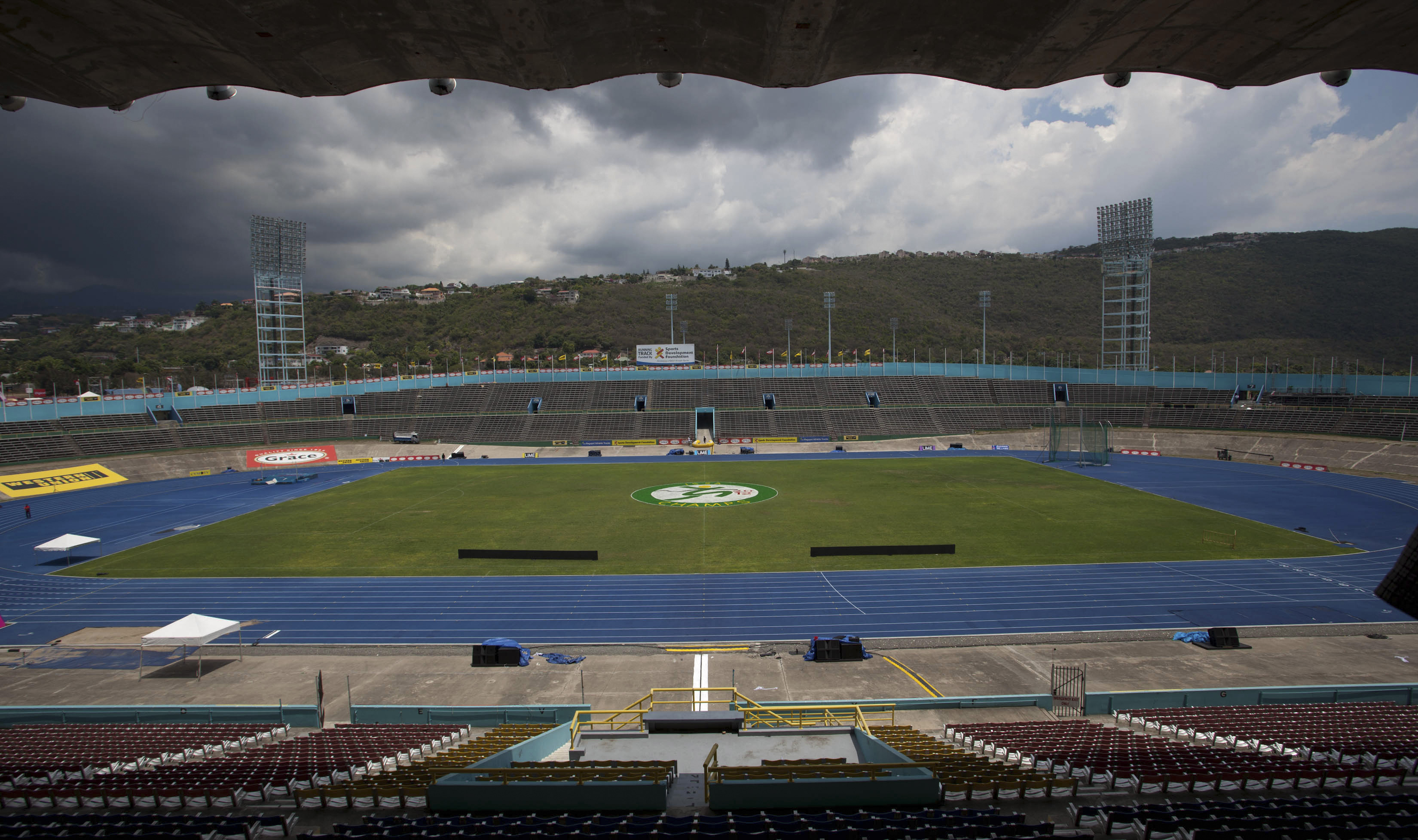
    National stadiums are proposed in Kingston, Jamaica, and San Jose, Costa Rica.

    The national stadium in Kingston, Jamaica will host its first women’s World Cup games.

    Other U.S. venues listed as possibilities are Foxborough, Mass. (Gillette), Philadelphia (Lincoln Financial Field), and Santa Clara, Calif. (Levi’s), all venues for next year’s men’s World Cup.

    Additional sites included were Baltimore (M&T Bank), Birmingham, Ala. (Protective), Carson, Calif. (Dignity Health Sports Park), Cincinnati (TQL), Cleveland (Huntington Bank Field), Columbus, Ohio (Lower.com Field), Frisco, Texas (Toyota), Glendale, Arizona (State Farm), Harrison, N.J. (Sports Illustrated), Los Angeles (Memorial Coliseum), Miami (Chase), Nashville (Nissan), New York (Etihad Park), Orlando (Inter & Co), Pasadena, Calif. (Rose Bowl), St. Louis (Energizer Park), San Francisco (Oracle Park), Sandy, Utah (America First Field), and Tampa, Fla. (Raymond James).

    Second possible sites in cities, all with lower capacities, were included for Houston (Shell Energy), Kansas City, Mo. (CPKC), and Washington (Audi Field).

    Indianapolis was listed for a proposed stadium.

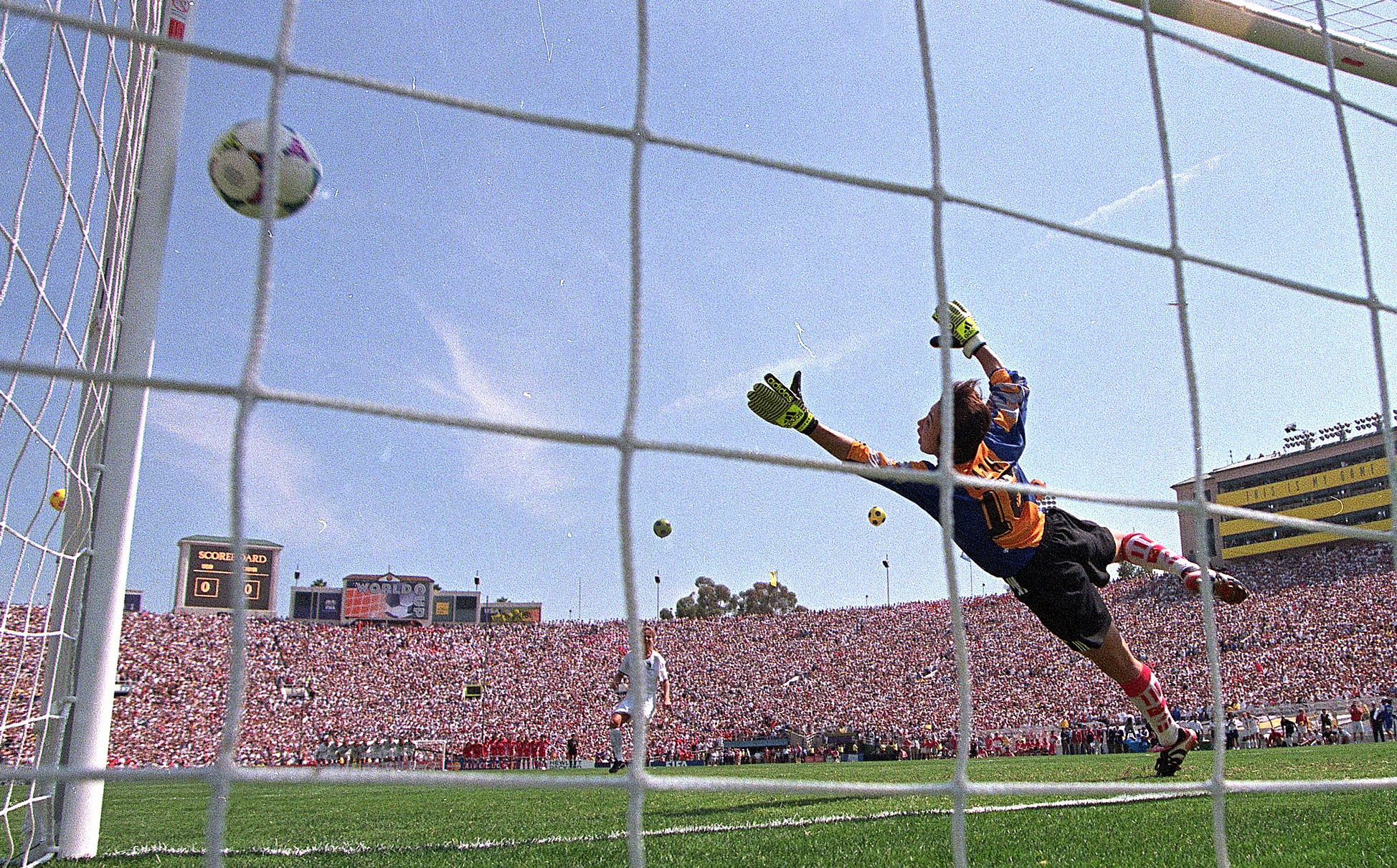
    The Rose Bowl in Pasadena, Calif., hosted the 1999 women’s World Cup final – still one of the most famous games in women’s soccer history.

    Miami’s Hard Rock Stadium was the only 2026 World Cup venue not included.

    Chicago was not listed after dropping out of bidding to host in 2026 because of what it said were FIFA’s burdensome financial demands.

    Additional possibilities in Mexico are Pachuca (Miguel Hidalgo) and Querétaro (Corregidora) along with Universitario as an alternate choice in Monterrey. Saprissa was listed as an alternate site in San Jose, Costa Rica.

    Organizers envision fan festivals and watch parties in conjunction with games. Revenue from marketing and sponsorships is projected at $1.4 billion.

  • Police arrest driver in fatal University City hit-and-run crash

    Police arrest driver in fatal University City hit-and-run crash

    Late Thursday afternoon, while Thanksgiving rituals unfurled in rowhouses and neighborhoods across Philadelphia, Rosa Mar Espinosa Rodas took her final steps.

    Espinosa Rodas, 41, was struck by a black 2012 Honda Accord at 36th and Market Streets in University City about 3:50 p.m., according to preliminary information released Friday by Philadelphia police.

    After hitting Espinosa Rodas, the Honda’s driver didn’t stop. Instead, police said, the car continued eastbound along Market Street, where it then crashed into a Buick LaCrosse near 34th Street.

    The driver of the Honda attempted to flee on foot, but was apprehended by police a few blocks from the second crash scene.

    Police identified the motorist as Shamir Miller, 30.

    Miller was charged with murder, homicide by vehicle, involuntary manslaughter, and nine other offenses, court records show.

    His bail was set at $3 million, and he is scheduled to face a preliminary hearing on Dec. 15.

    Medics pronounced Espinosa Rodas dead on Market Street, police said. CBS3 reported that Espinosa Rodas had worked nearby and was on her lunch break when she was fatally struck.

    The driver of the Buick, a 41-year-old woman, was admitted to Penn Presbyterian Medical Center with neck and back injuries and was listed Friday in stable condition.

    Miller was also treated at Penn Presbyterian for head injuries.

    On Nov. 20 — a week before Espinosa Rodas was killed — a nearby stretch of Market Street was the scene of another fatal hit-and-run crash.

    Early that morning, the driver of a silver Chrysler 300 with tinted windows struck Meaza Brown at 33rd and Market.

    Police said that Brown, 48, was hit at such a high rate of speed that she was “launched out of her sneakers” and propelled through the air for several hundred feet. She was pronounced dead at Penn Presbyterian.

    Investigators later found the Chrysler at 34th and Race Streets, but no arrests have been reported.

    The city, as part of its Vision Zero plan to reduce traffic deaths, is seeking from state legislators the authority to set speed limits for local roadways, and to expand its use of automated speed enforcement cameras, The Inquirer reported this week.

    Last year, the city recorded 120 vehicle crash deaths, a 41% increase from 2015, when the Vision Zero program began.

  • Philly is testing a new traffic pattern to help Eagles fans escape post-game gridlock

    Philly is testing a new traffic pattern to help Eagles fans escape post-game gridlock

    Teeth-chattering winds and plunging temperatures awaited Eagles fans who made a pilgrimage Friday to Lincoln Financial Field for a late afternoon matchup against the Chicago Bears.

    For those who drove to South Philadelphia, the city had a post-game surprise: a new traffic management plan that might minimize stadium complex gridlock.

    In an email to The Inquirer, the city wrote that the test pattern is designed to provide drivers with an expedited route from Pattison Avenue to the Walt Whitman Bridge and I-76 East, along Darien Street.

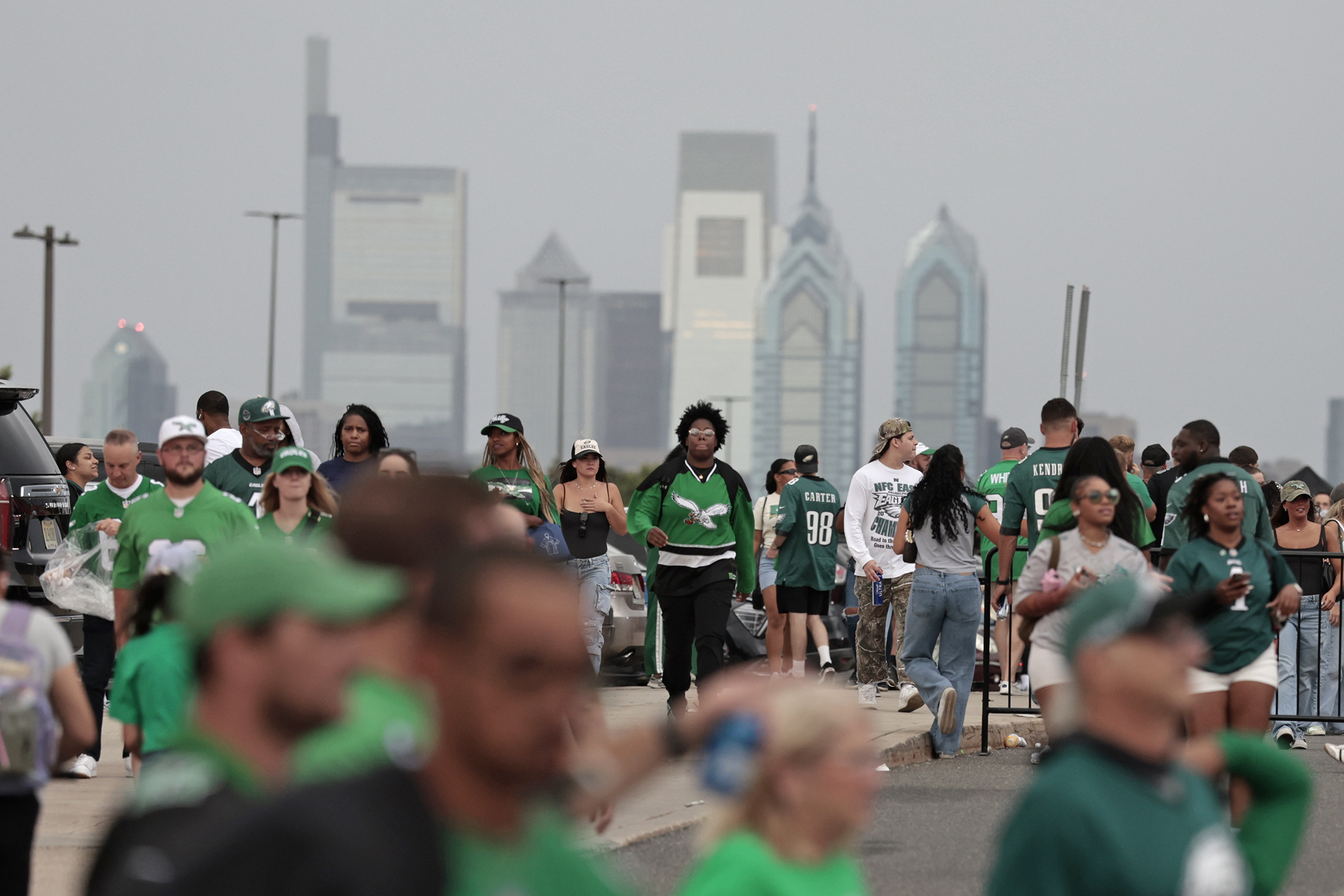
    Eagles fans make their way to Lincoln Financial Field in Philadelphia for the Eagles home opener on Thursday, September 4, 2025.

    The new pattern meant that fans who parked in the Q, R, V, W or X lots wouldn’t be able to access nearby Packer Avenue eastbound at 10th Street.

    Instead, motorists would be directed to alternative access points at Broad Street, Darien Street, or Front Street, the city said.

    The new approach Friday is an experiment, the city said, and feedback is welcome.

  • Holiday traditions, more than deals, draw Philly-area Black Friday shoppers to Cherry Hill Mall

    Holiday traditions, more than deals, draw Philly-area Black Friday shoppers to Cherry Hill Mall

    Stephanie Greenleaf has Black Friday down to a science.

    Every year, the Moorestown resident hosts Thanksgiving. The next morning, she, her sister-in-law, and her mother hit the Cherry Hill Mall early. They start at Nordstrom, then head to Soma for pajamas, Urban Outfitters for her teenagers, and anime stores for the younger kids.

    “We have it down,” she said, standing next to a Christmas ornament display around 8:30 a.m.

    “As my mom always says, ‘I just want to be out in it,’” she added. “It’s not the same when you’re sitting on your couch.”

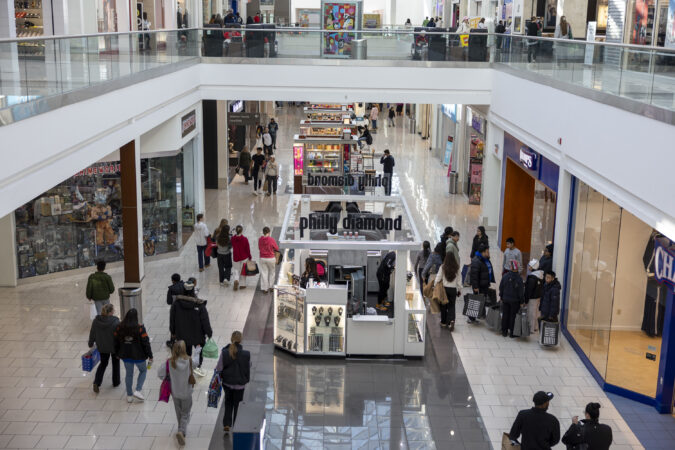
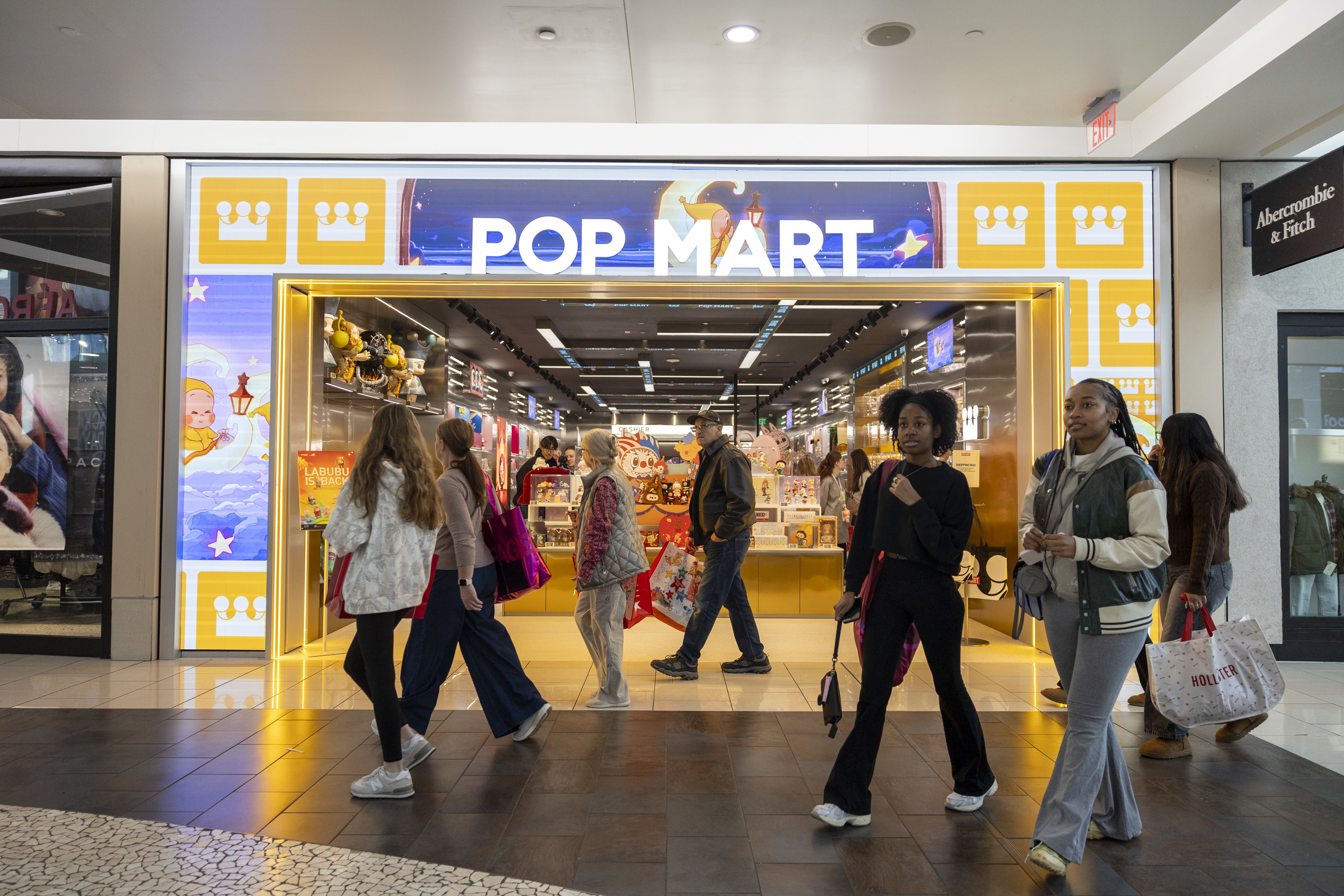
    Despite inflation, rising prices, and the omnipresent e-commerce ecosystem, a familiar Black Friday hustle was in the air at the Cherry Hill Mall on Friday morning. Shoppers filed into the parking lot early, toting shopping bags and holiday-flavored lattes. Labubus and puffer jackets were displayed in store windows. Teenagers flocked to Abercrombie and Zara.

    While some retailers reported business as usual, others described the South Jersey shopping destination as more subdued than in years past as consumers contend with an uncertain economic landscape and e-commerce giants continue to cut into a market long dominated by malls.

    People walk pass Pop Mart during their shopping on Black Friday at the Cherry Hill Mall in Cherry Hill, N.J., on Friday, Nov. 28.

    Black Friday, then and now

    The term “Black Friday” has Philly origins. Beginning in the 1960s, tourists would descend on Philly the day between Thanksgiving and the annual Saturday Army-Navy football game. Philadelphia police reportedly began calling the day Black Friday after they were forced to work long hours and manage heavy traffic and unruly crowds. Years later, Americans would latch onto the tale that Black Friday got its name because it was the day retailers would move from being “in the red” to being “in the black” (finally making a profit after running a loss).

    The retail-oriented holiday has morphed over the years from a one-day shopping bonanza to a month of deals. Now, the pervasiveness of e-commerce has muddied the Black Friday tradition, forcing retailers to attract shoppers both online and in stores.

    Barbara Kahn, professor of marketing at the University of Pennsylvania’s Wharton School, calls this an “omni-channel experience.”

    “It’s really more of an integration between both modalities now‚” Kahn said.

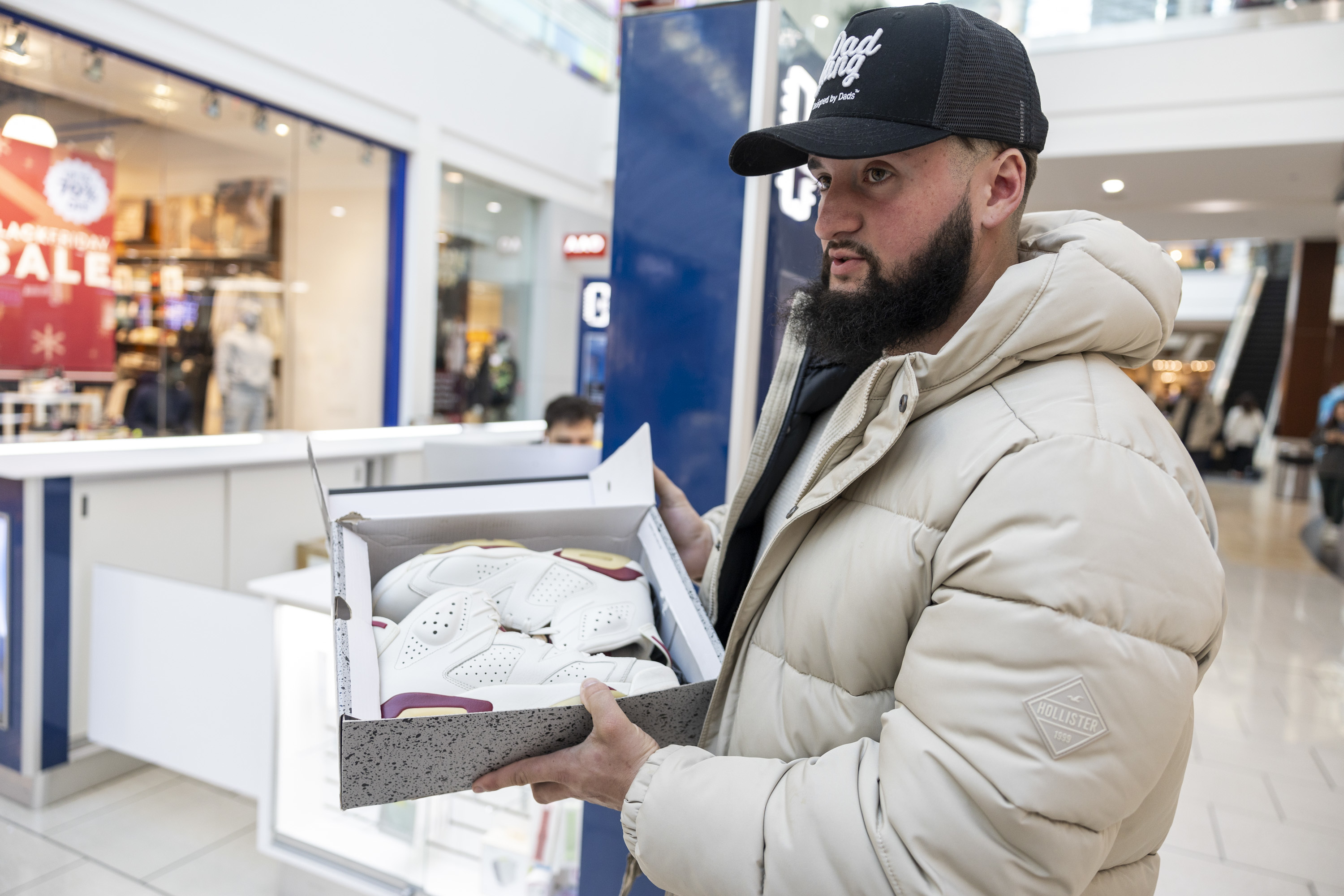
    Daniel Leslie, 23, of Franklinville, N.J., showing off a pair of Maroon Jordan 6’s he bought on Black Friday at the Cherry Hill Mall.

    Two major changes stick out to Kahn. First, the ability to compare prices online (and now with AI) has made shoppers more “price sensitive,” forcing retailers to stay competitive. Second, stores are turning to “experiences” to draw people in through giveaways, events, or exclusive items.

    “Part of what people are shopping for is not necessarily the utility of buying a particular item,” Kahn said. Rather, it’s the experience “wrapped around the actual purchase.”

    Despite these changes, a record number of shoppers were expected to hit stores, and the holiday is still largely understood to be the biggest shopping day of the year.

    Keeping the ‘Black Friday experience’ alive

    Shoppers at the Cherry Hill Mall said they had come out on Black Friday for the nostalgia more than for once-a-year deals.

    Karrim Gordon, 48, said he is “not at all” a regular Black Friday shopper. But, with his young son in tow, the South Philly dad said he wanted to give his kids the true “Black Friday experience.” They got to the mall when it opened at 7 a.m. and hoped to hit Psycho Bunny for his son, then Aéropostale and Pop Mart for his daughter.

    Daniel Leslie, 23, of Franklinville, said an Instagram ad for a sneaker deal had caught his eye. He was the first in line at a shoe store Friday morning, walking away with a pair of Timberland boots and a pair of Nike Air Force 1 sneakers for $20 each.

    Was economic anxiety curbing his holiday shopping? Not really, Leslie said.

    “The deals are just too good to pass up.”

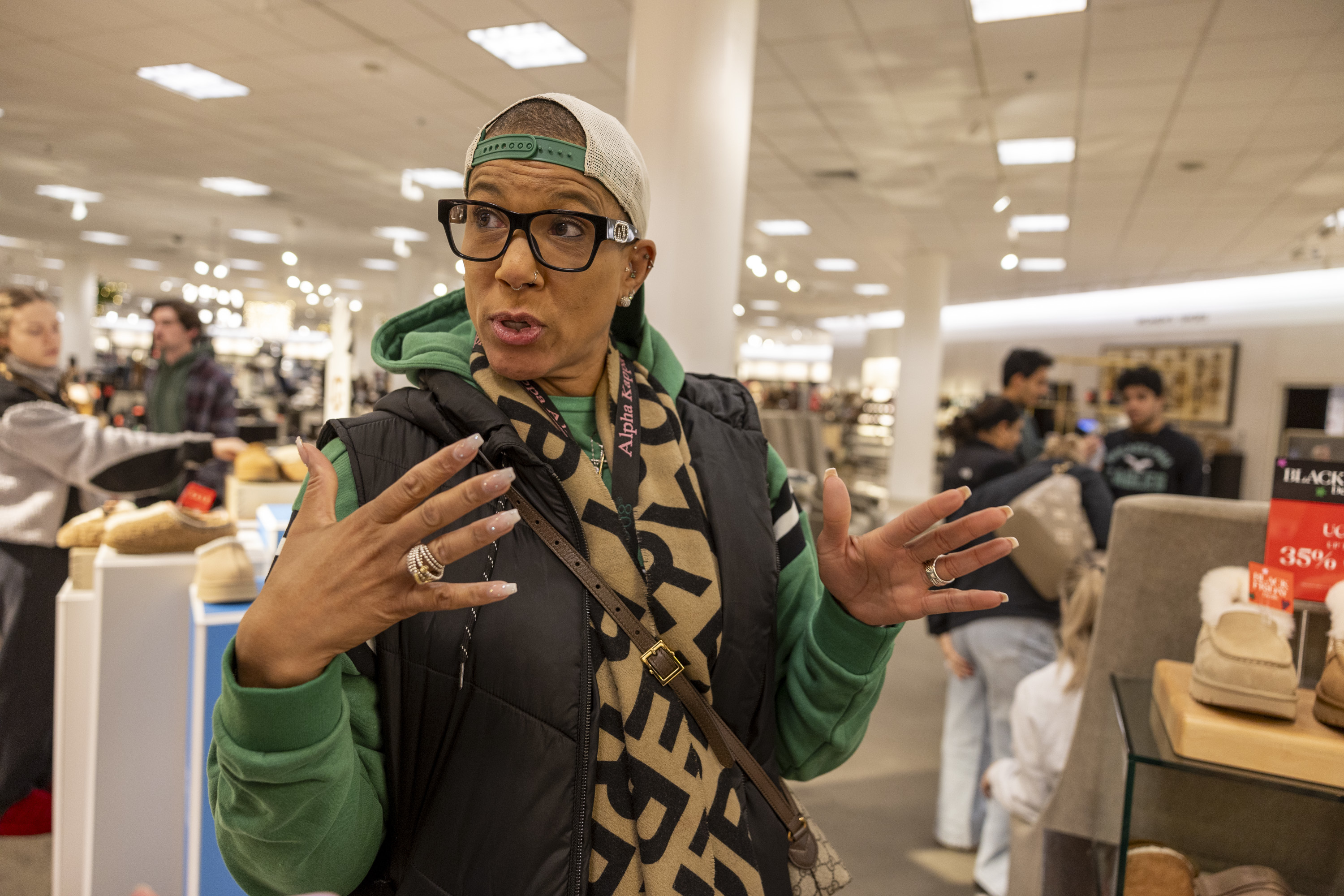
    Alicia Hall, of Philadelphia, shops at Nordstrom at the Cherry Hill Mall on Friday, Nov. 28. Hall is a regular at the mall, but said the Black Friday shopping experience isn’t what it used to be.

    Economic doom and gloom didn’t deter Alicia Hall, 54, from hitting the mall, either.

    Hall is a Cherry Hill Mall regular, driving over from Philly a few times a month to browse. For years, she would wake up early and wait in line for the big sales. Now, she said, “nothing is open like it used to be.”

    Though she sometimes thinks about looming economic concerns, “retail therapy” remains an important part of her life.

    “I go to work every day, and I work hard,” she said. “I might as well spend it.”

    This suburban content is produced with support from the Leslie Miller and Richard Worley Foundation and The Lenfest Institute for Journalism. Editorial content is created independently of the project donors. Gifts to support The Inquirer’s high-impact journalism can be made at inquirer.com/donate. A list of Lenfest Institute donors can be found at lenfestinstitute.org/supporters.

  • Skill games avoid regulation again in Pa. as gambling lobby war intensifies

    Skill games avoid regulation again in Pa. as gambling lobby war intensifies

    Spotlight PA is an independent, nonpartisan, and nonprofit newsroom producing investigative and public-service journalism that holds power to account and drives positive change in Pennsylvania. Sign up for our free newsletters.

    HARRISBURG — This year’s state budget didn’t pull slot-like skill games out of their legal limbo in Pennsylvania, despite bipartisan consensus on the need to do so.

    But it could still happen. Democratic Gov. Josh Shapiro called the matter “unfinished business,” and legislative leaders have also indicated interest in taking up the issue again next year.

    “This building has a long history of going through gaming debates, and they are very complex and very tedious and very difficult,” state Senate Majority Leader Joe Pittman (R., Indiana) said after the budget passed on Nov. 12. “I certainly believe gaming reform is — and must be — an important policy initiative going forward.”

    Pennsylvania faces a structural deficit, which will require spending cuts or more cash in the state’s coffers. A gambling levy, alongside other sin taxes, offers a way to raise revenue without making politically unpopular increases to sales or income taxes.

    While such taxes are potentially more palatable to the broader electorate, gambling debates are complex and difficult within the Capitol due to the array of monied interests that defend their existing market share or attempt to expand it further.

    The money at stake is real. Existing taxes on revenue from slot machines and table games, whether in brick-and-mortar casinos or online, as well as levies on activities like sports betting and truck stop-based video gaming terminals, brought in $2.7 billion last fiscal year, a record high.

    What was on the table this budget cycle?

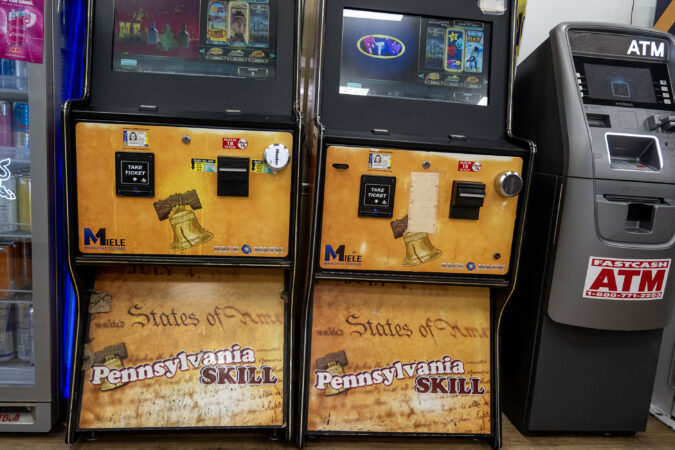
    Skill games, which have proliferated in bars and gas stations across the state, exist in a legal gray area and have been subject to years of litigation. They are untaxed and unregulated, and officially setting up laws around them would bring in more gaming cash.

    Shapiro proposed in his budget address a 52% tax on the gross revenue of skill games, estimating that it would bring in roughly $400 million. State Senate Republican leaders later backed a plan to tax skill games at a lower rate, 35% of gross revenue.

    (Politically powerful casinos pay a 55% tax on electronic games and are pushing for skill games to be taxed at a similar rate.)

    As budget talks progressed, neither of the plans went far. Lobbyists for Pace-O-Matic, a major skill games developer and distributor, wanted lawmakers to support legislation introduced by State Sen. Gene Yaw (R., Lycoming) with a 16% tax.

    In the weeks leading up to a final budget deal, Yaw and another state senator, Anthony Williams (D., Philadelphia), proposed levying a $500 monthly fee per machine, rather than a tax. They estimated such a fee would bring in about $300 million.

    Yaw, whose district is home to a skill games manufacturer, told Spotlight PA the bill was an attempt to sidestep the impasse between leaders, adding that he thinks the tax rates proposed so far would destroy the existing industry.

    Williams noted that the bill also seeks to regulate “stop-and-go” convenience stores with liquor licenses. These stores can serve as illegal gaming hubs, which is a concern among Philadelphia lawmakers.

    Both lawmakers said they hope that the legislature will finally address skill games regulations in 2026. If not his bill, Williams added, he hopes the legislature will pass another proposal.

    “I think it will be included,” Williams said of skill games. “We got a budget that’s passed, but revenue challenges are coming next year, and we’re not going to raise taxes. So this, along with other items, will be considered.”

    Adding complexity to the matter is a case before the state Supreme Court. Justices heard oral arguments about the legality of skill games in late November.

    Attorneys for the state argued that the machines’ mechanisms and functionality effectively constitute gambling, violating the state’s gaming law. “A game that looks like a slot machine, and plays like a slot machine, is a slot machine,” the state attorney general’s office wrote in its brief.

    Matthew Haverstick, Pace-O-Matic’s attorney, argued that the devices comply with decades of legal precedent and that many of the concerns raised by justices, such as the devices’ profitability, amount to policy questions.

    “Why [do skill machines] make money? Because somebody really brilliant came up with an idea that they tested. … It was held to be legal, and nobody appealed,” Haverstick said.

    It is not known when the high court will issue a ruling.

    ‘We get threatened all the time’

    Part of what makes gaming such a complex topic is simple: Money.

    Gambling is a multibillion-dollar industry in Pennsylvania with several key players. And public officials hold the keys to either helping or hurting their bottom lines.

    Pace-O-Matic alone has paid millions of dollars to employ dozens of lobbyists to influence the legislature in recent years. Casinos, legalized in the 2000s, likewise are heavily involved in the legislative process — they employ dozens of lobbyists of their own and also spend millions.

    Other, smaller players, including those involved in horse racing, sports betting, and truck-stop-only video gaming terminals, add to the complexity of the policy debate.

    Then there’s campaign fundraising. A Spotlight PA analysis of campaign finance records found that gaming interests of all stripes gave $1.7 million to top legislative leaders and the governor between Jan. 1, 2023, and Dec. 31, 2024.

    Current campaign finance reports show Pace-O-Matic has given money to a PAC that, in turn, donated to a second PAC that has attacked incumbent state Senate Republicans — something that could complicate talks going forward, particularly in the upper chamber.

    The company historically has made significant donations to legislative Republicans. But that once-friendly relationship soured earlier this year, after GOP leaders in the state Senate backed legislation that would have taxed the industry at a higher rate than it preferred.

    Around the same time, door knockers delivered fliers attacking key GOP lawmakers. State Sens. Frank Farry (R., Bucks) and Chris Gebhard (R., Lebanon) were “siding with Harrisburg insiders and lobbyists to stop small town groups like our volunteer firefighters and VFWs from being able to raise additional revenues,” the fliers, viewed by Spotlight PA, said.

    In June, Pace-O-Matic accused the state Senate’s top two GOP leaders of intimidating its lobbyists unless they dropped the company as a client. Three firms did. (A GOP spokesperson called the allegation “bizarre.”)

    A lobbyist for Pace-O-Matic told Spotlight PA at the time that it did not coordinate with the group that advanced the ad campaign attacking GOP senators.

    However, federal campaign finance records show Pace-O-Matic began giving money to Citizens Alliance, a national conservative political group, as budget talks intensified in May — $630,000 total as of Nov. 21.

    Soon after Pace-O-Matic’s first donation, Citizens Alliance contributed to an Ohio-based super PAC called Defeating Communism — the group behind the fliers. Citizens Alliance has donated $428,000 to the super PAC this year.

    Cliff Maloney, CEO of Citizens Alliance, said the organization’s aims are to make Pennsylvania into a “red wall” by running a program to “compete with Democrats’ door-knocking efforts,” and to “run a pledge program to hold both Democrats and Republicans accountable to the principles of the [Pennsylvania] and [U.S.] Constitution.”

    “Yes, partners are working to hold Senate Republicans accountable that proposed a new tax on certain small businesses,” Maloney said in a statement.

    Pennsylvania Department of State disclosures show that in October, Defeating Communism reported $225,000 for door-knocking targeting Gebhard as well as State Sen. Camera Bartolotta (R., Washington). The campaign focused on their votes on past budgets and carbon capture and sequestration, as well as skill games.

    Bartolotta told Spotlight PA that she expected taxation of skill games to still be a leading topic in state Senate Republicans’ internal discussions despite the wave of attacks.

    The skill games lobby, she said, is “just passing out garbage. And they’re acting like criminals. And I don’t know what in the world they think this is going to do to engender our support.”

    Defeating Communism did not respond to a request for comment. Mike Barley, Pace-O-Matic’s chief public affairs officer, said in a statement that the company “donates substantial amounts of funding to politicians and PACs, and we will continue to do so.”

    A growing field

    The number of moneyed gambling interests that wish to play in the Keystone State is growing.

    As Spotlight PA recently reported, the national trade group for sports betting firms launched a more than $500,000 pressure campaign to kill a closed-door budget pitch. The proposal would have raised taxes on sports betting and online casino gaming.

    That pressure helped kill the proposal for now, a source told Spotlight PA.

    Legal Sports Report, a trade news outlet, reported in November that sports bettors were creating a $10 million super PAC, citing an anonymous source who claimed that Pennsylvania has “rocketed to the top of the list of states where operators are looking to play big during next year’s midterm election.”

    While gaming was off the table in 2025, it’s unclear what the future holds.

    “We get threatened all the time by some of these interests, you know, ‘We’re going to come beat you up. We’re going to come take you out,’” state Senate President Pro Tempore Kim Ward (R., Westmoreland) said at a news conference after the budget’s passage.

    “That’s just ridiculous, and it just makes my blood pressure go up. We don’t do well being bullied. And I think a lot of these gaming interests have done nothing but try to bully us. And I don’t think we stand for that.”

    EXCLUSIVE INSIGHTS … If you liked this reporting from Stephen Caruso, subscribe to Access Harrisburg, a premium newsletter with his unique insider view on how state government works.

  • Some of Earth’s most extreme cold may be headed for the U.S. in December

    Some of Earth’s most extreme cold may be headed for the U.S. in December

    Meteorologists don’t have the specific forecast ready yet, but there is a growing consensus that December will be a frigid one for parts of the United States.

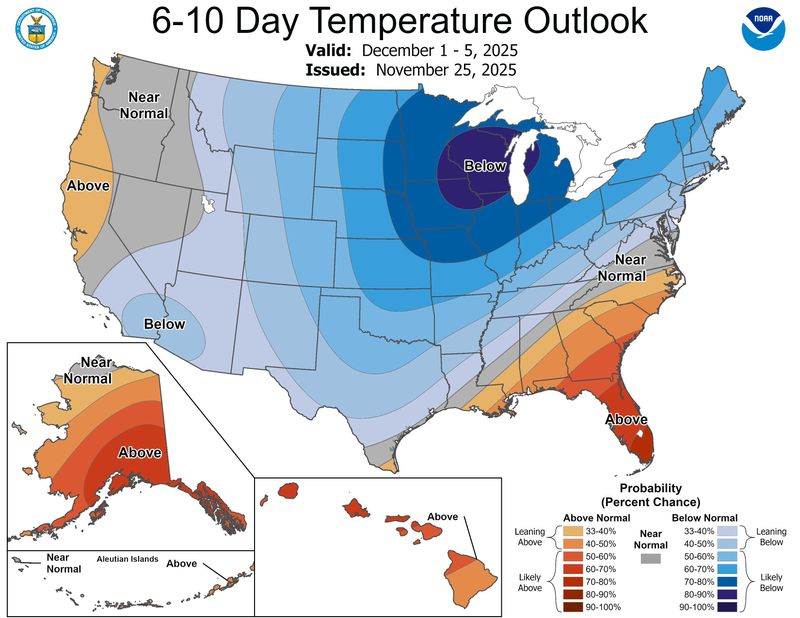
    The National Weather Service’s Climate Prediction Center says colder-than-normal weather is most likely in the northern and northeastern United States, but some forecasters say a complex dance involving the polar vortex could send some of Earth’s most extreme cold toward the United States.

    “My thinking is that the cold the first week of December is the appetizer and the main course will be in mid-December,” said climatologist Judah Cohen, a research scientist at MIT, in an email to USA TODAY.

    Unusually cold temperatures are expected for most of the north-central U.S. by the first week of December.

    Indeed, according to Cohen’s computer model, “which I can credibly claim as the world’s best — is predicting that the most expansive region of most likely extreme cold on Earth stretches from the Canadian Plains to the U.S. East Coast in the 3rd week of December.”

    As for snow, that remains a wild card, as the weather systems that produce snow typically can’t be predicted more than a few days in advance. Suffice it to say that having cold air present is half of the battle.

    Polar vortex on hold?

    The main “polar vortex” load of very cold air will remain mostly locked up in Canada through the next 7-10 days, said Weather Trader meteorologist Ryan Maue in a Substack post. Maue continues to monitor the polar vortex intrusion risk into the Lower 48 into December.

    Indeed, the complex dances of large-scale climate patterns far above our heads — which include the infamous polar vortex and a phenomenon known as “sudden stratospheric warming” — will determine the intensity and duration of the cold weather in the United States in December, Cohen said. But “I am conflicted about exactly what is happening with the polar vortex,” he admitted.

    How cold will it get?

    Although the most extreme cold won’t arrive until later in December, widespread and persistent below-average temperatures for this time of year can be expected for a wide expanse of the country from the western High Plains to the East Coast next week, with some near average conditions for the Southeast states and warmer over Florida, according to the National Weather Service.

    The coldest anomalies for both highs and lows are forecast over the Midwest Monday Dec. 1 and Tuesday Dec. 2, with highs only in the 10s to middle 20s for many of these areas, and lows in the 0s getting down to northern Missouri and Illinois by Monday morning as the arctic airmass becomes established over the region.

    Some subzero overnight lows are well within the realm of possibility from eastern Montana to North Dakota, the weather service said.