Blog

  • A nonprofit’s near implosion | Morning Newsletter

    A nonprofit’s near implosion | Morning Newsletter

    Good morning, Philly. Sun and high temps near 40? What is this, summer?

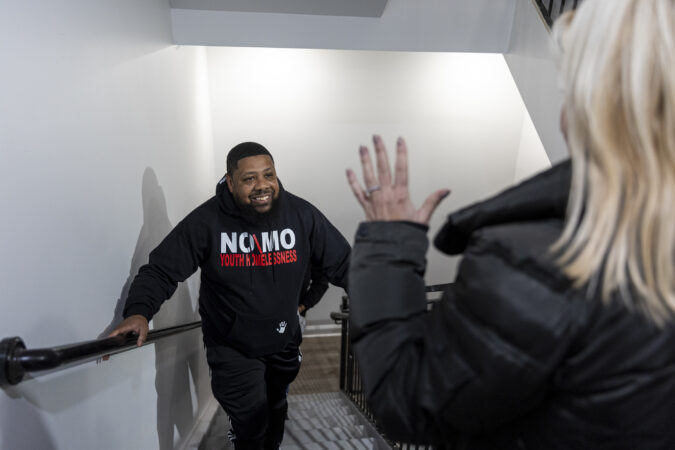
    The city spent millions to expand a single anti-violence nonprofit. Instead, it nearly imploded — facing evictions and a federal tax lien. Our investigation examines why the NOMO Foundation shut down its affordable housing program only a few years after launching it.

    And Tyrese Maxey has leveled up to become a starter in this weekend’s NBA All-Star Game. Step into his New Balances and see if you can read the game like the star 76ers guard.

    — Julie Zeglen (morningnewsletter@inquirer.com)

    If someone forwarded you this email, sign up for free here.

    Politically connected, financially unstable

    In 2021, the NOMO Foundation won a $1 million grant from the city to provide after-school programming for young people affected by violence.

    With that backing, the nonprofit — formally known as New Options, More Opportunities — expanded quickly, launching a low-income housing initiative and opening youth centers across the city.

    NOMO ultimately received more than $6 million in public funding. Yet in 2025, less than three years after the housing program began, it was forced to end the effort while facing evictions, an IRS lien, and lawsuits alleging hundreds of thousands of dollars in unpaid rent.

    Why did the nonprofit receive so much public funding despite repeated warnings from city grant managers about improper spending and mismanagement?

    Reporters Ryan W. Briggs and Samantha Melamed investigate.

    What you should know today

    Pull up, drive, or wait?

    Sixers guard Tyrese Maxey will have a big presence at the NBA All-Star Weekend: He’s both a starter in Sunday’s All-Star Game and a competitor in Saturday’s three-point contest.

    🏀 Maxey joined Philly’s team as a rookie in 2020 and is now in the midst of a breakout season as the Sixers’ top scorer, averaging 29.2 points per game and making 38.2% of his shots from deep.

    🏀 As he steps into this leadership role — especially as other top players sit out — every decision Maxey makes on the court dictates the Sixers’ chances of contention. So far, plenty of those decisions have led the team to victory.

    🏀 Can you make the right reads that he has all year? When he’s mismatched against Milwaukee Bucks forward Bobby Portis, for instance, how should he make use of his quickness advantage? When coming down the court in early offense, should he pull up, drive, or wait?

    Play along to predict what the Sixers guard does next in this lo-fi game.

    More on the Sixers:

    Quote of the day

    The Council president has largely taken a measured approach on national politics, opting to address President Donald Trump’s actions by convening task forces and holding public hearings. After watching federal agents’ deadly campaign in Minneapolis, Johnson now says he’s leading an “activist body” to push back on the administration.

    🧠 Trivia time

    The historic former visitor center in LOVE Park could soon get a revival, as the city seeks project ideas. What is the building shaped like?

    A) An octopus

    B) A flying saucer

    C) A kite and key

    D) The Liberty Bell

    Think you know? Check your answer.

    What we’re …

    🐎 Celebrating: Chinese New Year with these chef collaboration dinners and special menus.

    🥊 Recounting: The history of Philly’s Joe Frazier statue, from inception to a potential Art Museum move.

    🎥 Anticipating: This Old City studio’s doc about Mount Airy-born comedian Bob Saget.

    Asking: Nine questions about the Phillies as spring training opens.

    🍼 Considering: The impact of the Bryn Mawr birth center’s closure.

    🧩 Unscramble the anagram

    Hint: High-end grocery brand

    INDOOR BURBS

    Email us if you know the answer. We’ll select a reader at random to shout out here.

    Cheers to new reader Mattingly Cohen, who solved Tuesday’s anagram: Vanguard. Hundreds of Infosys workers are returning to the Malvern-based investment group, which sent them to the contractor in 2020.

    Photo of the day

    Construction continues on the boardwalk in Ventnor, N.J.

    🔨 One last rebuilt thing: With federal money targeted for boardwalks, Ventnor is one of several Jersey Shore towns replacing their signature walkways. Take a look at how they’re doing it.

    Be sure to catch the sun before more clouds are expected tomorrow. ’Til then, have a good one.

    By submitting your written, visual, and/or audio contributions, you agree to The Inquirer’s Terms of Use, including the grant of rights in Section 10.


  • Roadside bakeries are gaining popularity | Inquirer Chester County

    Roadside bakeries are gaining popularity | Inquirer Chester County

    Hi, Chester County! 👋

    Microbakeries are popping up around the county. Here’s where you can find some. Also this week, a teahouse and community space is planning to relocate to Exton, a former Malvern business owner has been sentenced to prison for deceptive practices, plus a new jazz cafe is opening in Coatesville.

    If someone forwarded you this email, sign up for free here.

    Roadside bakeries are filling a void across the county

    The Devon Road Made bakery cart is stocked with bread, cookies, and other baked goods.

    A small but growing number of home bakers in Chester County are looking to fill a void in the community — and in people’s stomachs.

    Microbakeries are slowly growing countywide, with 28 licensed as of last year. They’re selling goods like breads, cookies, cinnamon buns, and pancake mixes from stands outside their homes or through online ordering.

    While some of these bakers prioritize premium ingredients, many are also putting in something you won’t find on the label. “I like to put a lot of heart and soul into it,” said one baker. “I feel if you’re going to put good energy into that, people are going to feel that.”

    The Inquirer’s Brooke Schultz recently visited some of these microbakeries.

    A teahouse and community space is relocating to Exton

    Koselig Nook is planning to relocate to Exton this month.

    A Coatesville business, whose name is inspired by the Norwegian term for contentment and coziness, is relocating to Exton this month.

    The goal of moving Koselig Nook is to ensure more Chester County residents have access to the teahouse, which also functions as a third space. Visitors can reserve a time in the relaxing atmosphere — which has a no-shoes policy — for select weekday or weekend slots.

    The idea is to give people a calming place to go between work or school that’s not a bar.

    Read more about what inspired Koselig Nook.

    📍 Countywide News

    • Residents expressed anger after Enforcement and Removal Operations agents allegedly made what some described to 6abc as “violent” arrests in Phoenixville last week. Video from the confrontation shows agents dragging a person from a vehicle before being taken into custody. Shortly after the incidents, the Chester County District Attorney and the Chester County Police Chiefs Association released a joint statement saying that no police departments in the county have been deputized to carry out ICE actions, nor do they enforce immigration orders. They also noted that they will investigate any major incident to ensure no local laws were violated, adding that “Chester County law enforcement is dedicated to protecting the public, regardless of their immigration status.”
    • In case you missed it, last week the county publicly presented findings from an investigation into the error that left independent and unaffiliated voters off November’s poll books. After the report, some residents called for greater accountability and noted it fell short of addressing problems that could happen again.
    • A Democratic campaign manager was charged last week in Chester County for allegedly filing fraudulent nomination petitions in the 2024 primary race for auditor general, including the forged signatures of a Chester County judge, Coatesville city council members, and the West Goshen Township supervisor.

    💡 Community News

    • The Winter Olympics are underway, bringing curling back to the global spotlight and a familiar face along with it. Taylor Anderson-Heide, who’s competing for Team USA tomorrow night, trained at the Philadelphia Curling Club in Paoli and graduated from Marple Newtown High School. Planning to catch the action? Here’s a primer to the sport.
    • A Downingtown dog involved in four attacks since 2023, including one that seriously injured a neighbor’s 4-year-old son, was euthanized last week after the case escalated to district court. The owner has several other dogs who’ve been accused of being aggressive, leaving the boy’s parents frustrated that additional action hasn’t been taken.
    • A Coatesville couple has been found guilty of third-degree murder in the death of their 8-year-old son, who died from ingesting fentanyl, morphine, and cocaine. Mousa Hawa, 43, and Holly Back, 42, were arrested in June 2024 after an investigation found drugs and drug paraphernalia near their son’s body.
    • A Massachusetts man was arrested and charged last week after an alleged armed robbery at the Santander Bank in London Grove Township. Nicholas Casaburri, 44, is accused of taking $11,350 before fleeing in a vehicle and eventually crashing on Clay Creek Road, where he was apprehended by state police. Casaburri’s charges include robbery, fleeing and alluding, and aggravated assault.
    • The former owner of Malvern furniture store M. Kaplan Interiors was recently sentenced to six to 23 months in prison and required to pay back over $530,000 in restitution for defrauding dozens of customers. Matthew Kaplan, 37, of Rydal, previously pleaded guilty to deceptive business practices and other charges for allegedly never fulfilling paid furniture orders.
    • Heads up for drivers: PennDot has approved a new four-way stop at the South Valley Road and East and West Circular Avenues intersection in Tredyffrin Township. Work to install the stop signs and road markings is expected to take place this spring.
    • Last week, Kennett Square borough council passed a resolution declaring a phorid fly infestation and hydrogen sulfide emissions emergency, noting they are dangerous to public health and the local economy. The council addressed the phorid fly issue in 2024, resulting in a quarantine order. The borough is now urging state and federal agencies to fund mitigation research and implement additional emergency steps to address the issues that impact mushroom farming.

    🏫 Schools Briefing

    • Reminder for families: Most schools are closed Monday for Presidents’ Day and a few districts — Great Valley, Tredyffrin/Easttown, and Unionville-Chadds Ford — won’t have classes Tuesday in observance of Lunar New Year.
    • Students at Phoenixville Area High School staged a walkout Friday to protest ICE actions. A district spokesperson told NBC10 that with the help of staff and law enforcement, the district “monitored and supervised the walkout” and that students returned to class afterward.
    • Phoenixville Area School District is hosting a kindergarten information night on Tuesday from 6:30 to 7:30 p.m. at the Phoenixville Area Early Learning Center.
    • Tredyffrin/Easttown School District will form a redistricting steering committee this spring as it gears up to make changes to its elementary school boundaries ahead of Bear Hill Elementary opening next summer. Applications for the committee are expected to open in April.
    • Coatesville Area School District middle school students are set to benefit from a new initiative at West Chester University that will work with seventh and eighth graders through their first year of college. The seven-year program is being supported by a $10.26 million federal grant and is aimed at boosting graduation rates, preparing students for college, and developing “essential” skills. The grant is expected to help more than 1,800 students, including in the Chester and William Penn School Districts.
    • Last week, Kennett Consolidated School District released a draft of its Comprehensive School Counseling Plan for 2026 through 2029, which would replace the guidance counseling model with a new one requiring more data-focused planning and outcome measurement. Changes include renaming guidance counselors as school counselors and hiring one elementary counselor next school year, followed by a second counselor the following year. Families can provide feedback through March 3.

    🍽️ On our Plate

    • A new bagel shop is opening in Phoenixville on Saturday. Street Cart Bagels, which took over the former Boston Market at 240 Nutt Rd., specializes in malt-boiled, slow fermented bagels, which are available as singles or by the half-dozen or dozen. It also offers bagel sandwiches, melts, fish salads, and coffee. Street Cart is cashless and accepts credit and debit cards as well as mobile wallet payments.
    • A new jazz spot is officially opening next week. Andrea’s Jazz Cafe, located at 236 E. Lincoln Highway in Coatesville, is hosting its grand opening on Tuesday from 4 to 6 p.m.
    • Victory Brewing Company has teamed up with Visit Philadelphia to launch a new beer celebrating America’s 250th birthday. Philly First is a crisp, 4.8% ABV ale with notes of citrus, floral, tropical fruit, and pine. The Downingtown-based brewery will offer it in its taprooms starting Sunday, including in Kennett Square and Parkesburg. It will then be available at other bars and liquor stores starting around mid-March.

    🎳 Things to Do

    🌿 Garden Glow: Explore Longwood Gardens’ conservatories and Main Fountain Garden after hours when they’ll be lit in ways that show off sometimes overlooked features. ⏰ Fridays, Saturdays, and Sundays, Feb. 13-March 8, 5-10 p.m. 💵 $15-$25 for members, $25-$45 for non-members 📍 Longwood Gardens

    🎙️ America’s Sweethearts: The Andrews Sisters-inspired swing band will transport listeners back in time. ⏰ Sunday, Feb. 15, 4 p.m. 💵 $46-$60 📍 Uptown Knauer Performing Arts Center, West Chester

    🎶 Ruben Studdard: The American Idol winner and Grammy-nominated singer is bringing “The Masterpiece Tour” to town. ⏰ Wednesday, Feb. 18, 7:30 p.m. 💵 $42-$96 📍 Uptown Knauer Performing Arts Center, West Chester

    🏡 On the Market

    A three-bedroom waterfront townhome in Berwyn

    The living room has vaulted ceilings and a fireplace.

    Located in the Daylesford Lake community in Berwyn, this three-bedroom, two-and-a-half-bathroom, end-unit townhouse provides waterfront views and outdoor living space thanks to a wraparound deck. The home’s first floor features an open-concept two-story foyer, living room, and dining room; an office; and an eat-in kitchen, complete with an island, quartz countertops, and a butler’s pantry. There’s also a first-floor primary suite with deck access, a sitting or office area, a bathroom with a double vanity, and two walk-in closets. There are two additional bedrooms upstairs, and a partially finished walk-out basement downstairs. There’s an open house Friday from noon to 2 p.m.

    See more photos of the townhouse here.

    Price: $895,000 | Size: 3,658 SF | Acreage: 0.06

    🗞️ What other Chester County residents are reading this week:

    By submitting your written, visual, and/or audio contributions, you agree to The Inquirer’s Terms of Use, including the grant of rights in Section 10.

    This suburban content is produced with support from the Leslie Miller and Richard Worley Foundation and The Lenfest Institute for Journalism. Editorial content is created independently of the project donors. Gifts to support The Inquirer’s high-impact journalism can be made at inquirer.com/donate. A list of Lenfest Institute donors can be found at lenfestinstitute.org/supporters.

  • A West grad’s ode to Eagles tailgates | Inquirer Cherry Hill

    A West grad’s ode to Eagles tailgates | Inquirer Cherry Hill

    Hello, Cherry Hill! 👋

    A West grad’s latest project explores the religious-like experience of Eagles fandom. We take a peek. Also this week, we’re following the latest on the Kibitz Room closure, plus the former Lone Star Steakhouse is one step closer to being demolished.

    If someone forwarded you this email, sign up for free here.

    A West grad explores the religious-like experience of Eagles fandom

    A photo of Eagles fans tailgating from Mike Cordisco’s “Sermon on the Lot.”

    The Eagles aren’t the reigning Super Bowl champs anymore, but a new photo project by a Cherry Hill native explores a question about our fandom: Is it akin to religious fervor?

    Photographer Mike Cordisco set out to document Eagles fans and their tailgates, going beyond the stereotypical rowdy image and leaning into the religious-like experience of “sacred Sundays.” He’s compiled them into a 98-page book called Sermon on the Lot, which showcases photos of fans outside the Linc between 2018 and 2025.

    “On Sundays, you go to Mass,” Cordisco said. “But in Philly, you go to the parking lot and tailgate an Eagles game.”

    Some of Cordisco’s work is on display at Unique Photo in Center City through mid-March.

    Read more about the West grad and what inspired his latest project.

    💡 Community News

    • Reminder for residents: The extended deadline to pay the first half of this year’s township tax bills is next Wednesday.
    • A Cherry Hill man is mourning the death of his father, who died in a fire at their Main Street home on Jan. 31. In the aftermath, Hazem Abdalla, 27, wants people to remember his father, Eid, for his life, not his death. Eid was born in Egypt, where he started a construction company before moving to New Jersey for his sons to get a better education. Eid, who was 69, had previously worked as a taxi driver and a chef at the former Cherry Hill Diner. A crowdfunding campaign has raised more than $40,000 for funeral and rebuilding costs. The cause of the fire, which also damaged a neighbor’s house, is still under investigation. (NJ Pen and Fox 29)
    • After being empty for nearly 20 years, the former Lone Star Steakhouse building on Route 38 is closer to being demolished. A court recently ruled that the derelict building qualified as abandoned and that an uncontested foreclosure could move forward. The roughly 5,700-square-foot building has been vacant since 2007. (Courier Post)
    • Skechers is gearing up for a mid-spring opening at Garden State Pavilions, a company spokesperson confirmed. The shoe and apparel retailer will open between Five Below and Staples, taking over 8,500 square feet.
    • The Cherry Hill Fire Department is hosting a child safety seat event on Friday from 9 a.m. to noon at the Deer Park Station.

    🏫 Schools Briefing

    • About 500 East students walked out of school Friday morning as part of a student-organized ICE protest that lasted about one hour. “We need to make sure that ICE understands that we’re watching, we’re listening, and we’re not going to stop fighting back until they leave the innocent people in our communities alone,” one of the organizers said. (Eastside)
    • A settlement agreement has been reached between Cherry Hill Public Schools and the Zionist Organization of America, which filed a complaint in June 2024 on behalf of an East student. In the complaint, the Zionist Organization alleged that the school district retaliated against the Jewish student, who reported alleged antisemitic harassment. Under the settlement, the student’s disciplinary record is being expunged. (Philadelphia Jewish Exponent)
    • Reminder for families: Monday is a makeup day for one of last month’s snow closures. There’s no school for students on Tuesday for the Lunar New Year, but teachers will report for an in-service day. See the district’s full calendar here.

    🍽️ On our Plate

    • Two weeks after The Kibitz Room abruptly closed, former owner Brandon Parish said he is working to reopen the beloved deli “under a new entity.” An attorney for the deli, now owned by Brandon’s mom Sandy Parish, filed for Chapter 7 bankruptcy protection on Friday.
    • Fast-casual takeout eatery Rice & Spud Station opened last week at 404 Marlton Pike East in Saw Mill Village. The Halal eatery serves loaded baked potatoes, rice bowls, and desserts.
    • In case you missed it, Bahama Breeze’s parent company last week announced the upcoming closure of all the remaining tropical restaurant’s outposts by early April, including at the Cherry Hill Mall.
    • Cherry Hill real estate developer Shamikh Kazmi is looking to expand his Yum Grills brand to 200 locations, largely in the Philadelphia area, with around 15 slated to open in the next few months. The expansion of the new fast-food eatery that serves smash burgers, cheesesteaks, and loaded french fries is expected to cost $60 million. It’s unclear if any locations will be in town. (Philadelphia Business Journal)
    • The owners of Old World Italian eatery Il Villaggio are gearing up to open Duo Restaurant & Bar in Westmont this month.

    🎳 Things to Do

    🏺 Galentine’s Pottery Class: Try your hand at ceramics at this intro class, which also includes sparkling cider, for anyone 13 and older. ⏰ Friday, Feb. 13, 6 p.m. 💵 $125 📍Hugs Ceramics

    💃 Valentine’s Social Dance: If dancing is more your style, this event kicks off with a group class before segueing into a social dance with a DJ and light snacks. ⏰ Friday, Feb. 13, 7-10 p.m. 💵 $20 📍Storm BDC

    ❤️ Valen-Wine Celebration: Yogi Berra Lodge No. 3015 is hosting a Valentine’s-themed event complete with dinner, dessert, and wine. ⏰ Friday, Feb. 13, 7-11 p.m. 💵 $45 📍American Legion Post #372

    🫖 Tea Party Fundraiser: Monday is the deadline to register for this library fundraiser, which includes afternoon tea, a Jane Austen movie, and a fascinator make-and-take. ⏰ Sunday, March 1, 1-4 p.m. 💵 $35 📍Cherry Hill Public Library

    🏡 On the Market

    A four-bedroom home with an indoor hot tub

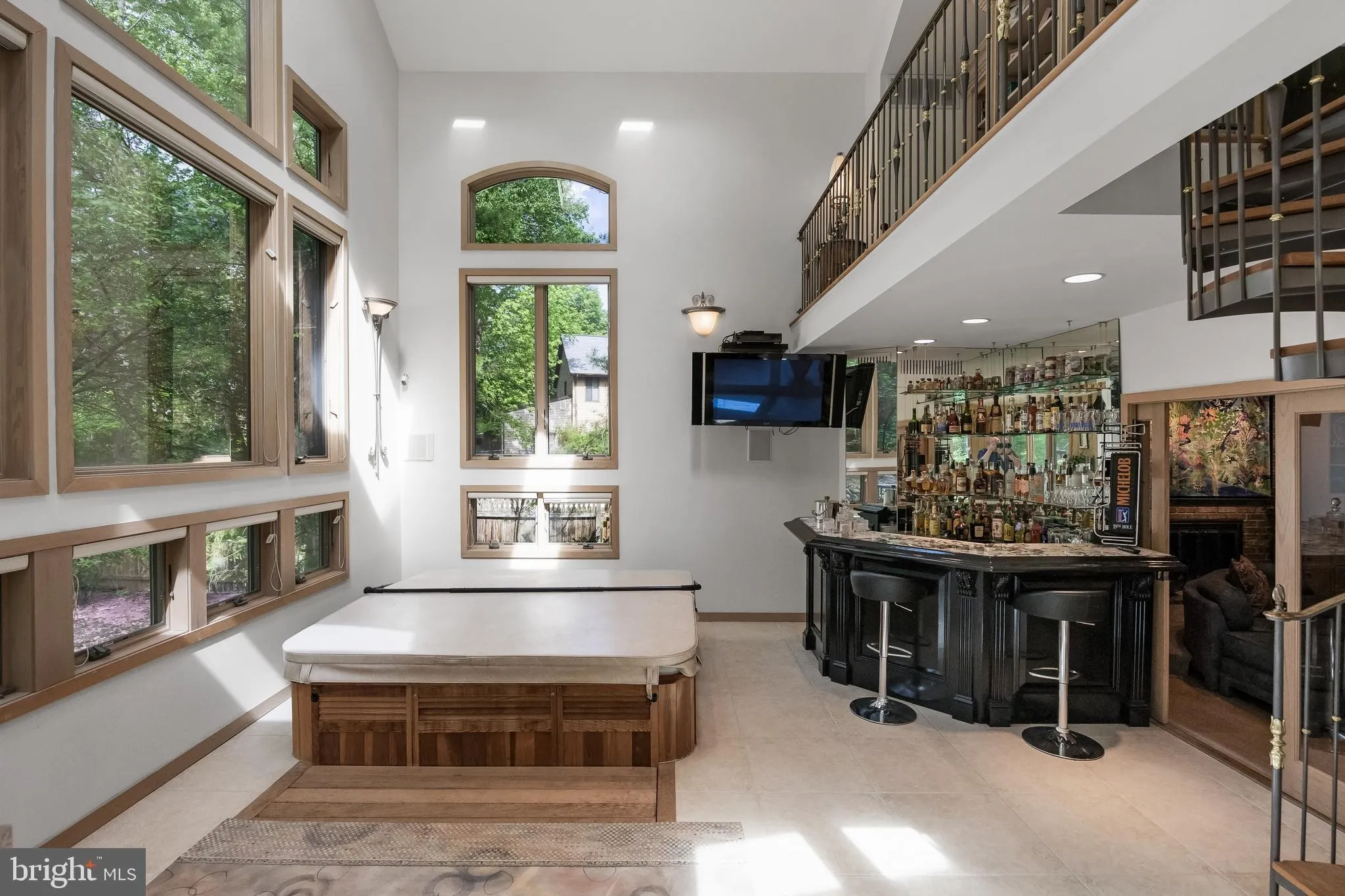
    The home’s two-story family room has a hot tub, wet bar, and ample windows.

    Located in the Ridings of Fox Run, this four-bedroom home has had just one owner since it was built in 1978. Among its most unique features is a two-story family room with an eight-seat hot tub and a wet bar. A second-floor library looks onto the airy space. There’s also a dining room, a family room with a fireplace, and an eat-in kitchen with granite countertops on the first floor. Upstairs, the primary suite has skylights, a gas fireplace, and a jacuzzi. Outside, the wooded property has a deck and a koi pond.

    See more photos of the property here.

    Price: $879,000 | Size: 3,467 SF

    🗞️ What other Cherry Hill residents are reading this week:

    By submitting your written, visual, and/or audio contributions, you agree to The Inquirer’s Terms of Use, including the grant of rights in Section 10.

    This suburban content is produced with support from the Leslie Miller and Richard Worley Foundation and The Lenfest Institute for Journalism. Editorial content is created independently of the project donors. Gifts to support The Inquirer’s high-impact journalism can be made at inquirer.com/donate. A list of Lenfest Institute donors can be found at lenfestinstitute.org/supporters.

  • Library warming centers strained workers and left people without help for complex issues, staff say

    Library warming centers strained workers and left people without help for complex issues, staff say

    The bitter and persistent cold of recent weeks was so dangerous that various Philadelphia agencies coalesced around one mission: Get the city’s most vulnerable off the streets.

    Philadelphia libraries became a key piece in these efforts, with some branches doubling as so-called warming centers for more than 20 days straight in an effort to provide a respite to people who would otherwise be living outside.

    The mobilization of what can exceed 10 branches during life-threatening cold snaps is largely, though not universally, welcomed by library staff, the community groups that support the workers, and the people who use the spaces.

    As outdoor deaths mount in places like New York City, where at least 18 people have died on the streets since Jan. 19, Philadelphia library workers see the initiative as a way to prevent similar outcomes here, where there have been three cold-related deaths since Jan. 20.

    But employees say the warming center initiative, in only its second year as a formalized network, leaves branch staff, from librarians to security, unequipped to help some of the people walking through their doors with complex mental and physical health needs.

    “People are feeling tired, feeling very burnt out, the physical, the emotional, and the mental load of not just doing our regular work, but having like this critical service, like lifesaving service, being offered on top of that for 12-plus hours a day has been really, really hard to sustain,” said Liz Gardner, a library worker, speaking as a union steward in the American Federation of State, County and Municipal Employees District Council 47’s Local 2186, which represents first-level supervisors, including those at libraries.

    There’s the “little stuff,” like how an online map sometimes listed the wrong information in December. Last-minute location changes among the South Philly branches made it confusing for even the self-described information professionals to direct people where to go. At one point, a branch that was not Americans with Disabilities Act-accessible was cast as a warming center, to the chagrin of many.

    Library workers and community groups described having to lobby the Free Library to crowdsource snacks and water. The transportation that transfers people to nighttime warming centers after the libraries close has often been late, meaning staff have to decide between staying after their shift or leaving people outside, which they don’t want to do.

    What’s more, library workers and volunteers say, some people require more than a warm space. People in mental health crises, struggling with substance abuse issues, and requiring wound care need medical support, workers say.

    “What [the city is] continuing to do is take advantage of a group of people that care so deeply about the city of Philadelphia and the communities that they serve, and they’ll continue to do it, regardless of if they have the support or not,” said Brett Bessler, business agent for DC 47 Local 2186.

    Altogether, the concerns surrounding the warming center system yield existential and moral quandaries: Is this system the best and most humane way to treat some of the city’s most vulnerable people?

    Crystal Yates-Gale, the city’s deputy managing director for health and human services, acknowledged some of the challenges described by library staff and volunteers. Many logistical issues, such as location changes, food, and transportation woes, were improving or had been resolved, she said. Some of the concerns regarding staffing might be a matter of miscommunication, she said.

    “I think everybody’s exhausted. It’s like Groundhog Day,” Yates-Gale said. “It’s the same thing: Every day you wake up, they’re all just quite exhausted, but everybody’s working toward the same goal.”

    Kelly Richards, president and director of the Free Library of Philadelphia, echoed the sentiment that staff have been saving lives. In a statement, he said he appreciated staff efforts and feedback as the Free Library continues “making improvements to better serve our communities.”

    ‘They need more than a warm building’

    Details of who uses the warming centers are limited. Visitors are not asked if they are at a library to escape the cold or for regular library programming.

    Three library workers from various corners of the city described some of the daily challenges they have faced at warming centers to The Inquirer under the condition that they remain anonymous, fearing professional repercussions.

    One worker who has lived through various iterations of heating and cooling operations involving libraries described a catatonic man being brought into their branch by first responders, left for staff to figure out his care.

    “They need more than a warm building,” the worker said. “These are human beings, and we’re the wrong department to help.”

    A worker at a different branch described trying to persuade a man with a festering wound to seek medical intervention. In another instance, when staff told a man he could not set up his sleeping bag on the library floor, he began shouting, telling workers they had to accommodate him.

    Library staff say one of the biggest challenges is the lack of consistent support for people with complex medical issues.

    Yates-Gale said the Philadelphia Department of Behavioral Health and Intellectual disAbility Services staff focuses support on what are considered “high-volume” warming centers, including the Central Library and the Northeast Regional and Nicetown branches. Mobile teams are available by request.

    In other cases, through a partnership with Project HOME, the city’s homeless services office assigns what is called a restroom attendant.

    Library workers and volunteers say the current setup is unfair to all involved.

    At the South Philadelphia Library on a recent Friday afternoon, a woman yelped in pain as she rubbed a blackened, possibly frostbitten toe. Children played with blocks in a corner as others checked out books.

    Library staffers maintain similar scenes have played out at the various warming centers, with workers left to balance the comfort and safety of people there to check out books and use their computers with those of people who might die if kicked out and sent to the streets.

    The worker who told of trying to persuade a man to seek medical attention noted that staffers are behind on work and programming has taken a hit.

    Kelsey Leon, a harm reductionist who regularly works with homeless Philadelphians with addiction, has been visiting libraries during the cold snap after hearing concerns from librarians, and working to deliver wound care kits to the centers so people there can treat themselves.

    Librarians “are so clearly beyond their capacity to handle this,” she said.

    The city says it’s listening to feedback

    A battle for snacks, workers and volunteers say, has become emblematic of the disconnect between what the Free Library and the city want warming centers to be and what they actually are.

    Most people using the service do not bring their own food.

    The city initially provided snacks at the overnight warming centers in recreation centers but made no such offerings at the daytime ones at libraries.

    When staff and volunteers noted this would mean people going 12 hours without sustenance and offered to fill that gap with crowdsourced snacks and drinks, they faced resistance.

    “We were told repeatedly that warming centers at libraries are distinct from shelters, and that is the reason they couldn’t provide food,” said a third library worker, adding the Free Library and the city eventually allowed the outside snacks to come in.

    Part of the initial hesitation, according to Yates-Gale, was based on logistical considerations, including protecting library materials and adding cleanup to the plate of security officers who handle maintenance.

    The city provided library leadership with lists of food sites, the idea being that people could leave the libraries, get a meal close by, and come back.

    Still, Yates-Gale said, the city is listening and adjusting in real time.

    Last week, after two weeks of operations, the city brought water and cereal to warming centers. The city says people also have access to water fountains.

    The city said it is not giving up on improving warming center conditions. Yates-Gale said that starting Tuesday, the Philadelphia Office of Homeless Services would send reinforcement teams to daytime warming centers to get people to connect to additional services.

    The backup cannot come fast enough.

    Ibrahim Banch, 26, has been homeless before, but the cold he has experienced recently is something different.

    “The air feels solid. It stands your hair up,” he said. He knew he couldn’t stay outside, so he sought out the warming centers as temperatures dropped. Recently released from prison, he said, he is waiting to be placed in an emergency shelter bed. But the warming centers are a last resort.

    He said the city should staff all centers with workers equipped to deal with the mental health needs that many clients have.

    “People at the library shouldn’t have to take this responsibility,” Banch said. “It’s not a shelter or a caregiving place.”

    Volunteers still eager to help

    Erme Maula, with the Friends of Whitman Library in South Philadelphia, echoed the challenging conditions described by workers. She believes it doesn’t have to be this way.

    The city’s 54 branches are full of supporters who can coalesce around the warming centers with donations, she said. Volunteers continue to collect toiletries and other essential items for people using the branches for warmth.

    As an advanced practice community health nurse, she could see healthcare workers organizing to help people and ease the load of librarians. But it is the sort of effort that would need support from the city.

    “People are kind and want to be generous, but they didn’t know you have to take care of what they expected the city to be able to take care of,” Maula said.

    Maula and others who spoke to The Inquirer emphasized they want the warming centers to be improved — not to go away.

    As with the snack issue, Yates-Gale said the city is responding to feedback in real time.

    “Now that we know that there needs to be an adjustment for support staff, we’re ready and able to immediately begin staffing the libraries,” she said.

    But that might not be felt by library staff until the next warming center activation. With daytime temperatures finally warming up, the city is slated to begin winding down warming center operations at libraries; nighttime centers will remain open until those temperatures similarly rise.

    “I’m really hopeful that we see substantial improvements to make this a more sustainable practice that helps more people in a more meaningful way,” Local 2186’s Gardner said.

  • You can be Cooper DeJean’s neighbor for $13,000 a month

    You can be Cooper DeJean’s neighbor for $13,000 a month

    For about $13,000 a month, you can rent a three-bedroom Center City penthouse in the same building as Eagles star defensive back Cooper DeJean.

    The high-end, 31-story apartment tower at 210 S. 12th St. has nine penthouses on the top two floors. They have a variety of layouts, including three-bedroom, three-bathroom apartments that range from roughly 1,650 to 1,835 square feet and cost from $12,600 per month to $13,250 per month.

    Penthouses for rent have at least one balcony and floor-to-ceiling windows that offer lots of natural light and panoramic views.

    “You are literally looking at the Philadelphia skyline from the best view possible,” said listing agent Justyna Goldman with SERHANT.

    Tenants can see the City Hall tower from this penthouse at the Center City apartment building.

    The Philadelphia metropolitan area has had a growing number of very wealthy renters in recent years. For people who like the renting lifestyle or “if someone wants to live their best life but is only staying for a short time” in Philadelphia, the penthouses at 210 S. 12th could be for them, Goldman said.

    “We offer an incredible space and incredible square footage for the price,” she said. “We are looking to make someone a very happy renter.”

    Goldman said the building could be attractive to athletes, entrepreneurs, and people working in the medical field, since hospitals are nearby. The building’s Center City location means “you’re surrounded by everything you could possibly need,” she said.

    The nine penthouses at 210 S. 12th are on the 30th and 31st floors and all have at least one balcony.

    The penthouses include walk-in closets and spacious living areas and kitchens.

    Parking spaces are available in an automated underground parking garage with electric vehicle chargers.

    The 376-unit apartment building began leasing in the summer of 2024 and is at the former site of the 12th Street Gym, which was a landmark in the Gayborhood.

    The building’s exterior was designed by the architecture firm RSHP for New York-based developer Midwood Investment & Development.

    An amenity lounge on the 30th floor of 210 South 12th includes a fireplace and floor-to-ceiling windows with Philadelphia skyline views.

    Tenants have access to amenities such as an outdoor pool, a fitness center, yoga and wellness studios, a game room, lounges and co-working spaces, outdoor terraces, a pet spa, and a dog park.

    The tower includes studios and one- and two-bedroom apartments. Studios start at $1,968, one-bedroom dens start at $2,300, one-bedroom units start at $2,411, and two-bedroom units start at $3,809.

    The building’s website is currently advertising rent deals. The property is offering 2½ to 3 months free for leases longer than a year.

    Salon Republic, which offers salon suites for rent, is operating in one of the tower’s retail spaces and more retailers are expected to be announced soon.

    The views make the penthouses at 210 S. 12th special, said listing agent Justyna Goldman with SERHANT.
  • Travis Sanheim learned hard work growing up on a grain farm in small-town Canada. It helped make him an Olympian.

    Travis Sanheim learned hard work growing up on a grain farm in small-town Canada. It helped make him an Olympian.

    There were no Christmas or birthday presents from Shelly and Kent Sanheim this year for their kids and grandkids. They combined everything into one big present for each family member.

    But those tickets to Italy weren’t for a typical family vacation. Instead, the tickets for three of their kids and their families were bought early in the hope that their brother, Travis Sanheim, had done enough to book his own trip to the 2026 Milan Cortina Olympics and represent Canada.

    The cancellation option, added just in case, was not needed.

    Around 8 a.m. Mountain Time on the morning of New Year’s Eve, the Flyers defenseman called his parents to give them the news that they needed to work on their Italian. The phone rang as they were making their way through airport security, going from Vancouver, British Columbia, to Calgary, Alberta, as they followed the Flyers on their Western Canada trip.

    “I guess maybe three, four years ago, he never thought he would have a shot at this, and now he’s going to, hopefully, bring back a gold, right?” Kent said. “So I don’t know what else to say. I guess, it’s just, I don’t know, it’s hard. It brings tears to my eyes.”

    There was a lot of emotion as Kent and Shelly spoke to The Inquirer a few hours later on the concourse at the Scotiabank Saddledome, the rink where Travis starred for the Hitmen of the Western Hockey League during his junior career. The emotions filled the rink, as it was a family affair with everyone, including his twin brother, Taylor, his teammate in the WHL, there to watch Travis play for the Flyers and celebrate his big moment.

    This is what the Sanheims are all about: family.

    ‘Where the Great Plains begin’

    Driving through the prairies of Canada, the chartreuse of the canola fields can be mesmerizing as the sun hits the bright yellow that stretches across seemingly endless miles. Across that open land, not far from the 100th meridian and tucked into the town of Elkhorn, Manitoba, is one of those fields with some wheat intermixed. In this town of about 500 people, with no street light and one K-12 school, is where Travis Sanheim learned all about responsibility, work ethic, and dedication.

    “Being out on a farm, you get firsthand … how much work my family puts in and being able to help out, at a young age, I remember skipping school for harvest, jumping in the combine, and helping mom and dad out with harvest … and just how excited I was to be able to help and be a part of it,” the 29-year-old defenseman said recently.

    Born and raised a 3½-hour drive west of Winnipeg, Travis grew up wanting to be like Kent and would help him out on the farm as much as he could. He would help plant crops in the spring and harvest them in the fall and complete daily chores throughout the year. If he didn’t help, there would be no time for hockey. And for Travis, it was all about the hockey.

    “Just a die-hard, loved the game — always has,” Shelly said of a young Travis. “Always excited to go to the rink and wanted to go to the rink.

    “It’s funny, I see on Twitter or whatever about Trav being the last one off the ice and working on things, and I’m like, ‘This is this kid his entire life.’”

    Elkhorn is where Travis fell in love with hockey. He always wanted to play, and he and Taylor even would try to scrape off the dugout, a storage reservoir on the farm, to go one-on-one. And while Kent would stay on the farm to work, they’d pile into the car and Shelly would drive them to the local community rink.

    They never wanted to leave.

    “As long as they didn’t look in the waiting room, they didn’t think they ever had to go home because I’d be knocking on the glass and pointing to my watch, and they just would never look up,” she said with a laugh.

    “And then they got to stay longer at the rink. He would always be the last one on the ice, if possible. We dragged him off.”

    Kent Sanheim with his twin sons, Travis and Taylor, when they played youth hockey in Manitoba.

    Wheat Kings and hockey things

    At some point growing up, Travis got a key to the rink, which often was open, anyway, in the town that sits near Manitoba’s border with Saskatchewan. While the temperatures could dip well into the teens in the winter months, he’d call his buddies to get games of shinny going with him and his brother.

    “We did everything together,” Travis said of Taylor. “A lot of battles in the basement, playing hockey against each other. That’s kind of where my competitiveness, I would say, came from. … Was really lucky to have the opportunities that I did growing up, that I was able to skate as much as I was, and had the guys that pushed me, and obviously, my brother was a huge reason as to why.”

    The duo also would hit a frozen pond on Boxing Day before watching Canada compete at World Juniors — a fitting tradition for a family that has a sign in the living room asking people not to disturb them because they’re watching hockey. And Travis remembers sitting in front of the television as Sidney Crosby crushed the hearts of Americans everywhere with his golden goal against the U.S. at the 2010 Vancouver Olympics.

    As a 13-year-old, he just wanted to make the NHL; he never expected to now be lining up alongside the all-time great seeking a gold medal.

    “Super excited,” he said. “Obviously, a dream come true. Getting to represent your country and playing in the Olympics and being an Olympian means a lot, and something that I never really thought was possible, but now that it’s here, and then I get the chance to do it, just really excited.”

    Sanheim has donned the maple leaf several times before, including at the 2013 World Under-17 Hockey Challenge and the 2014 U18 World Championship, snagging a bronze medal at the latter; the 2016 World Juniors; and the 2022 and 2025 World Championships, winning silver four years ago.

    Travis Sanheim celebrates after Canada’s victory in the 4 Nations Face-Off last February.

    And he surprised many across Canada last year when he was named to the team for the 4 Nations Face-Off tournament, which the Canadians won. Now he’s going for Olympic gold.

    “You never know, there’s so many good players in Canada. They could take a second team and probably still medal with the second team,” Shelly said. “So, you know, just the fact that he was in the mix was a thrill for us, and then to have the dream come true here just — I think I’m still shell-shocked over it. It’s hard to believe.”

    ‘Across the icy world’

    Tampa Bay Lightning and Team Canada coach Jon Cooper isn’t one to show his hand. However, the way he spoke of Sanheim in November in the bowels of the Lightning’s Benchmark International Arena — with a Cheshire Cat-like grin on his face — there was no denying that the defenseman was on his short list.

    “You see these players, you compete against these players, but you don’t really know till you have them,” Cooper said. “And I’ve always, I’ve really liked his game. I’m a big fan of big [defensemen] that take up a lot of space and can skate, and he can do all those things. But his ability to jump into plays, he’s got an offensive mind to him.”

    After nearly being traded in 2023, Travis Sanheim has developed into a bona fide top-pair defenseman.

    Sanheim has come a long way from being a little nervous and wide-eyed at Hockey Canada’s first practice in Brossard, Quebec, ahead of the 4 Nations Face-Off last February. And while he didn’t start the tournament in the lineup, by the end — half because of injury and half because of his performance with the versatility to play right and left defense — he was not just skating in the championship game, but Cooper had him out there for the first shift of overtime.

    “He was good. … Travis got thrown in when one of the guys, when [Shea Theodore] got hurt, probably,” said Vegas Golden Knights coach Bruce Cassidy, an assistant on Cooper’s staff.

    “Real good player, steady player, liked his pace, transported pucks, got involved. … I think both [he and Thomas Harley] ended up playing a little bit on the right side, and there was no hesitancy to get up the ice and join the rush. And I think that’s the type of team Coop wanted to build, so he fit right in.”

    There will be comfort now for Sanheim, having skated on the same team as some of the game’s biggest names like Crosby, Connor McDavid, Cale Makar, and Nathan MacKinnon. And he’ll surely be comfortable because he’ll be able to look up whenever he wants to see his family in the stands in Milan, Italy.

    And he’ll surely be thinking about how far he’s come from his days on a farm in Elkhorn, Manitoba, a place Shelly says “gives him some time for clearing his head and stuff.” He hasn’t been able to spend too much time there with all his hockey adventures, but it circles back to the biggest question heading into the Games, which for Sanheim will begin Thursday against Flyers teammate Dan Vladař and Czechia (10:40 a.m., USA and Peacock).

    When we spoke to Kent on the Flyers fathers’ trip in 2023, he revealed that “if he can’t make the playoffs, you better get home to help me work.”

    So how about now that his son is heading to the Olympics to represent his town, his province, and Canada?

    “I cut him a little slack now,” Kent said with a chuckle, “but we’ll take his help if he’s coming.”

  • After building a powerhouse at St. Joe’s, Hannah Prince wants to bring Penn State field hockey back to winning ways

    After building a powerhouse at St. Joe’s, Hannah Prince wants to bring Penn State field hockey back to winning ways

    Hannah Prince hasn’t always been a standout Division I coach, nor has she always led with the conviction she does now as the Penn State field hockey coach. But she’s long been around the sport — starting nearly 30 years ago in Gorham, Maine.

    When Prince was 6 years old, she made a declaration: She would make her high school’s varsity field hockey team. She did just that, which sparked a successful four-year career at Massachusetts.

    The Minutewomen went 56-33 and won three Atlantic 10 titles during Prince’s four-year career as a starting defenseman. Following the team’s NCAA Tournament quarterfinal run in 2013, Prince, a senior at the time, earned National Field Hockey Coaches Association first-team all-region and A-10 first-team all-conference honors.

    Prince continued playing after college and was captain of the U.S. women’s indoor team for six years, leading the team to gold at the 2017 Pan American Cup.

    Prince’s captaincy meant holding others accountable. It meant leading by example and never asking teammates to do something she wouldn’t do herself.

    “I like motivating people. I like building relationships with them that are strong, so they know I care,” Prince said. “I chose to work for some really great people who believed in me and allowed me to have a hand in certain technical and tactical areas.”

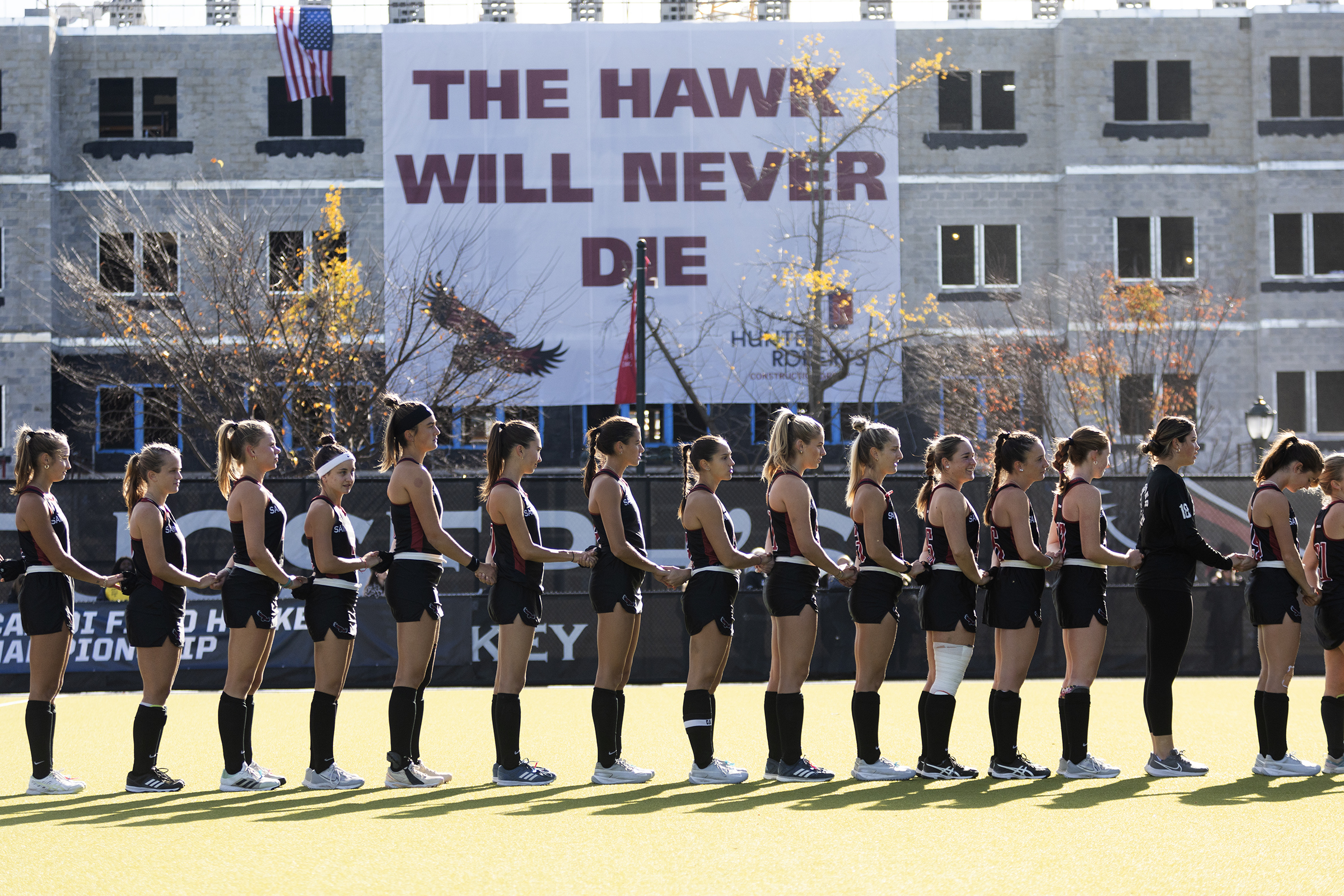
    Hannah Prince comes to Penn State after a historic run at St. Joe’s.

    Success has followed Prince at every stop of her coaching journey, which started in 2015 when New Hampshire made the America East title game in her first of two seasons as an assistant coach.

    Prince later joined St. Joseph’s as an assistant during the program’s first run to the NCAA Tournament in 2017. She then helped Louisville to the Final Four in the spring of 2021 before returning to Hawk Hill in 2022, this time as head coach.

    One of the “great people” she worked for was Justine Sowry, her coach at UMass, who has spent the last 14 seasons as Louisville’s coach. Prince credited Sowry for introducing her to coaching and for teaching her the patience required to build a championship-level program.

    Sowry lauded her former player for different reasons, ones that extend beyond the field.

    “[Prince] is an extrovert. She’s got that energy. She bounces around, and so many people are drawn to her,” Sowry said. “She just shows so much initiative. She took a lot of the weight off my plate just by being who she is … I don’t think I would have been able to get through [the 2020 COVID-19 season] if Hannah weren’t on my staff. She was an absolute godsend for so many more reasons other than just coaching hockey.”

    After a final ride under Sowry’s tutelage, Prince accepted the head coaching gig at St. Joe’s, where she went 64-14 in four seasons. The Hawks made four NCAA Tournament appearances and won two Atlantic 10 regular-season titles and four A-10 tournament titles.

    In 2023, Prince navigated the Hawks to their first-ever NCAA Tournament win. The next season, Prince guided them to the most wins in program history (20) and the NCAA title game, which marked the first time in school history that any St. Joe’s team had competed for a national championship.

    Hannah Prince led the 2024 St. Joseph’s field hockey team to the NCAA title game, a first for any program in Hawks history.

    She praised the Philadelphia area’s support during the Hawks’ title pursuit. She also lauded the resolve of her team, which embraced a “why not us” mentality as the tournament’s underdogs.

    Prince built the Hawks into a field hockey contender and galvanized area support for her team on its surge toward a championship — a showcase of her program-building prowess.

    “[Prince] is passionate, she’s driven, she’s a competitor, and she’s a proven winner,” Sowry said. “She can run a program. She’s got the X’s and O’s covered. And even areas that she might feel deficient in, she has the confidence to bring in coaches that can complement her or make her better.”

    Now, she’s ready for her next opportunity: Bringing a once-great Penn State program back into contention.

    Under former coach Charlene Morett-Curtiss, the Nittany Lions went 524-219-9 and made eight NCAA Tournament appearances. But in the three seasons since her 2023 retirement, Penn State won just 24 of its 51 games and missed the NCAA Tournament each season.

    Prince wants to win national championships in Happy Valley. And that starts with creating a culture of accountability and pride.

    “I want [Penn State] to be described as a bunch of empowered, strong, and fearless women who are playing together for a collective reason, because they want to play for each other,” Prince said. “They want to play for those who came before them. They want to play for that legacy.”

  • Everyone loves Olympic curling — and some even think it looks easy. So how hard can it be?

    Everyone loves Olympic curling — and some even think it looks easy. So how hard can it be?

    When your social media algorithm starts feeding you videos of Snoop Dogg, and Jason and Kylie Kelce learning how to curl, it must be time for the Winter Olympics.

    Curling, which officially became an Olympic sport in 1998, has already kicked off with mixed doubles, in which Team USA claimed a silver medal, its first ever medal in the event.

    Men’s curling started on Wednesday and women’s curling on Thursday — featuring a local athlete: Marple Newtown High School graduate Taylor Anderson-Heide.

    Ahead of the Milan Olympic Games, similar to the Kelces and Snoop Dogg, I had the opportunity to get some hands-on training. Here’s a look about the training that goes into the sport, my own experience on the ice, and some local places to play.

    Do you really train for curling?

    Curling can look effortless on television, but looks can be deceiving.

    Daniel Laufer, 19, a freshman at Thomas Jefferson University from Richboro, Bucks County, who has been curling for 12 years, had the opportunity to compete on this year’s Olympics ice at the Cortina Olympic Stadium in Italy during last year’s World Junior Curling Championships as a member of Team USA.

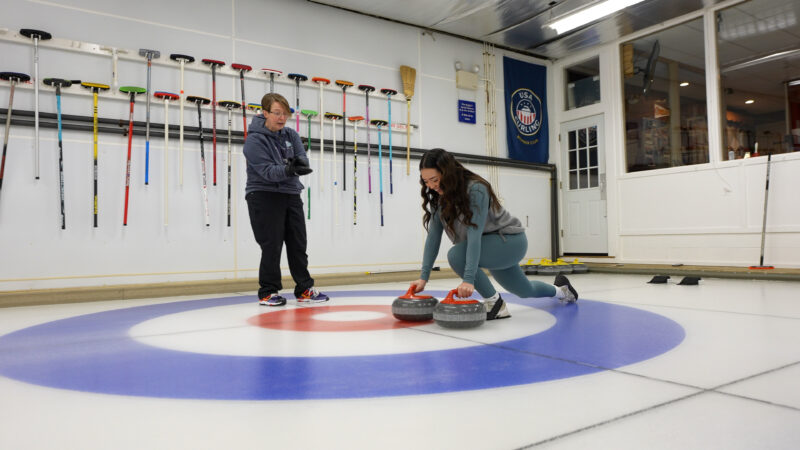
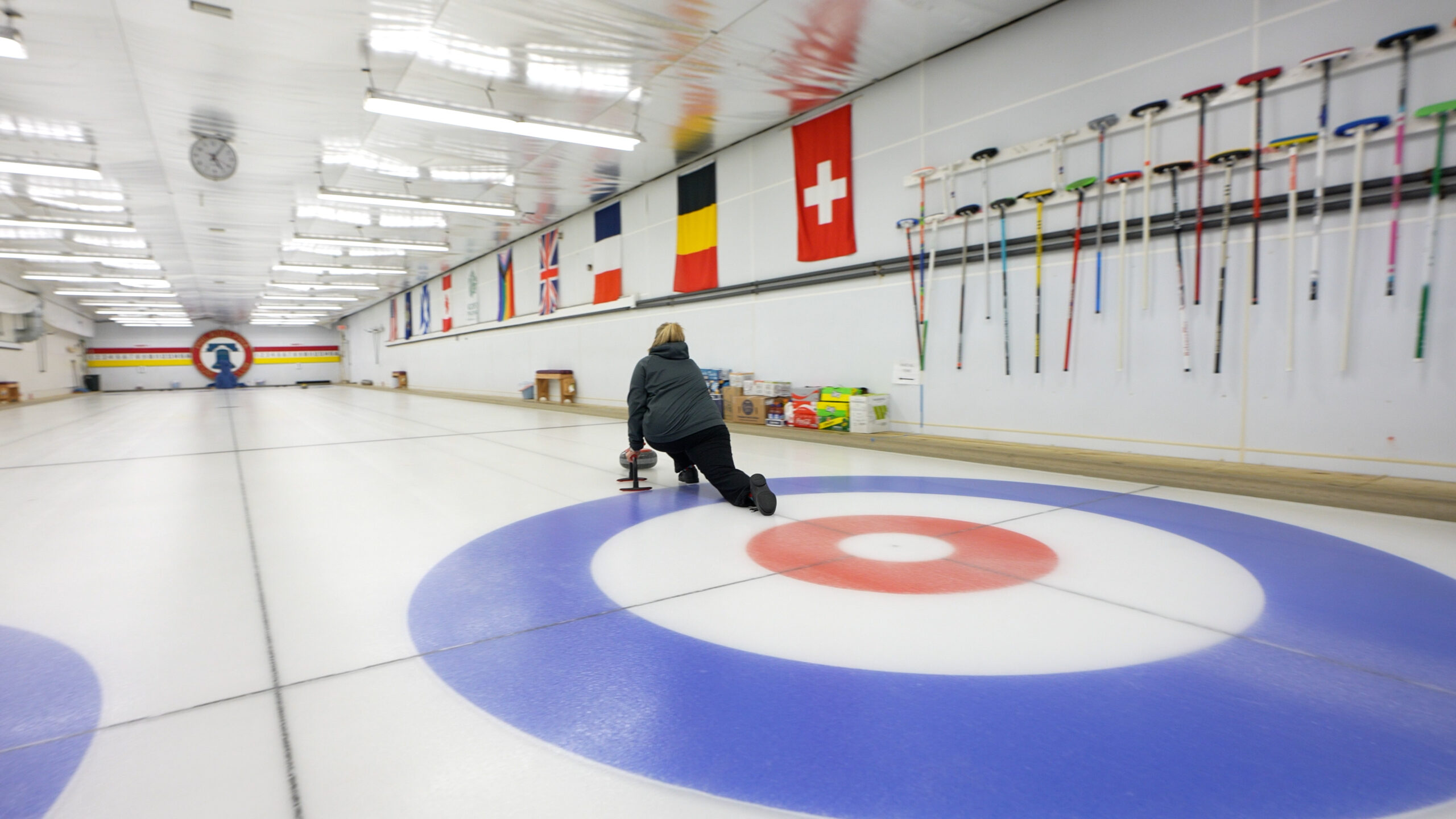
    The ice at the Olympic curling center in Milan, like the ice seen here at the Philadelphia Curling Club in Paoli, is pebbled, which is different than the smooth ice you’d find at a Flyers game.

    “That was a really great experience,” Laufer said. “[The ice] was really good. Obviously, not as good as it is for the Olympics. They were still figuring out the facilities and figuring out the rocks. We had a really good experience with that venue.”

    This year, Laufer again will be competing in the World Junior Curling Championships, just outside Copenhagen, Denmark, from Feb. 24 through March 3. Ahead of the event, he’s been training, working on his strength and cardio.

    “I usually try to lift four to five times a week and do a significant amount of cardio,” Laufer said. “When I was training specifically for Worlds last season, I had like three months where I was practicing five days a week. Practices are like two hours long. I probably throw 50 to 60 rocks every practice.

    “That’s what a higher level training regiment looks like. But, it looks different for everybody.”

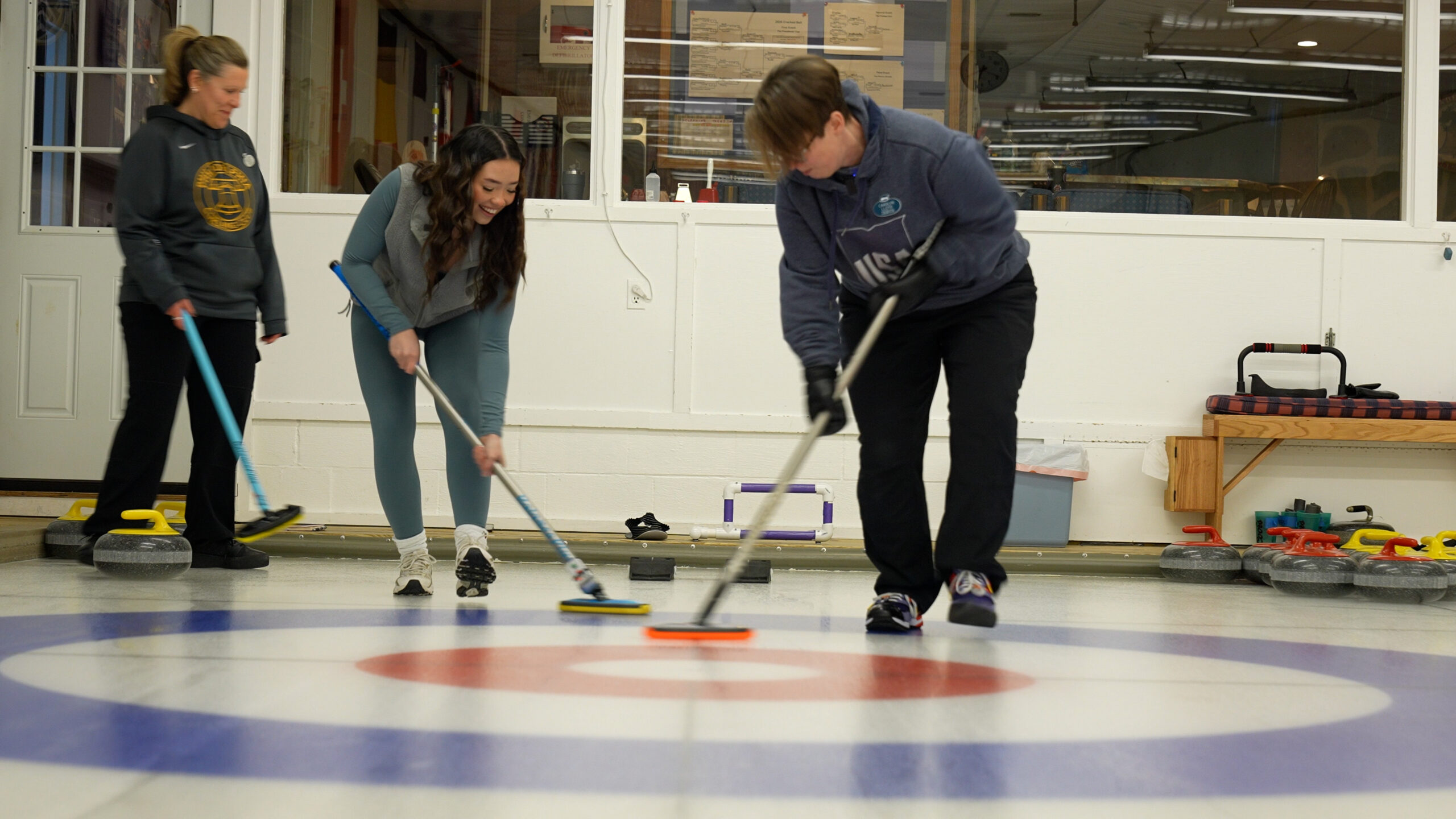
    Inquirer reporter Ariel Simpson (center) gets instructions on how to sweep from Carolyn Lloyd (right) at the Philadelphia Curling Club in Paoli.

    How hard is curling?

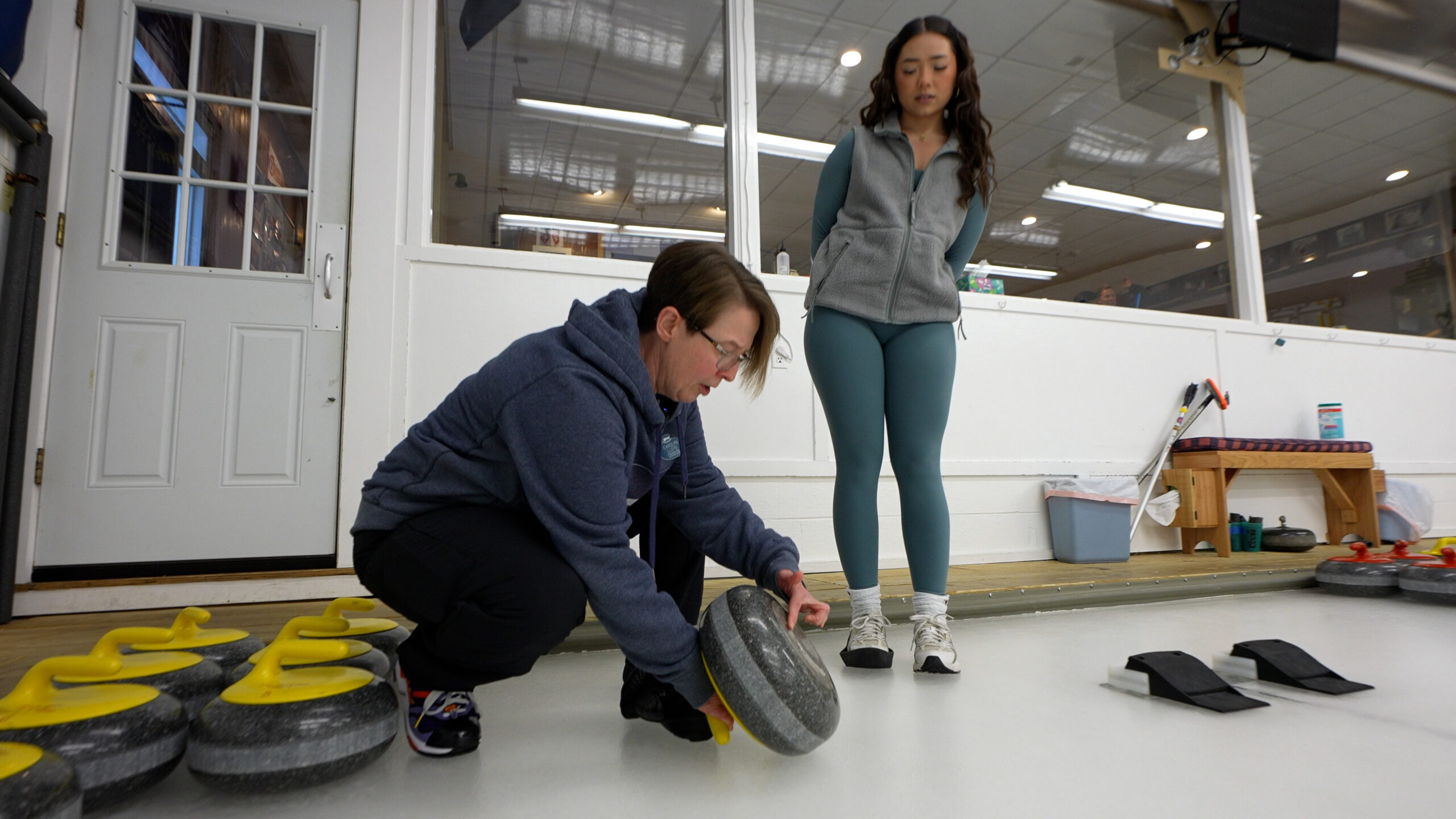
    Not everyone trains like Laufer, especially amateurs. So how difficult is curling for the average person? I recently had the opportunity to get a hands-on experience at the Philadelphia Curling Club in Paoli with Carolyn Lloyd, a member for 20 years.

    “I love exposing people to something that’s so special,” said Lloyd, who lives in Collegeville. “People don’t realize just how special it is. It’s different from a lot of sports, certainly in its culture. This sport captures my whole heart.”

    Before this I had never stepped foot on ice — other than the sheet that covered my driveway for two recent weeks. So, I knew this was going to be a bit of a challenge, but Lloyd was more than up to the task of teaching me.

    When it came to delivering the stone, I watched a number of YouTube videos ahead of time. So, of course, I felt like a pro walking in — I didn’t even need special shoes, just some attachments. But once I actually stepped onto the ice, with a gripper covering one shoe and a slider covering the other, I felt like a baby deer trying to walk for the first time.

    Walking on the ice was hard enough. Now, imagine having to get into a squat position and push off the hack — a rubber block embedded into the ice — with one leg and balance on the other while holding a deep lunge and bracing your core.

    Then you have to aim, release, and spin a 42-pound granite stone. Easy? Trust me, it’s not like they make it look on TV.

    Carolyn Lloyd (left) explains Inquirer reporter Ariel Simpson the parts of a curling stone at the Philadelphia Curling Club in Paoli.

    It took me a few tries before I was even mentally prepared to push off with enough strength to move myself a few feet. But, once you get over the fear of falling onto the ice, you start to actually enjoy yourself and can focus on the next step — getting the stone to the house — which I did, eventually.

    And all of this was only learning how to deliver the stone. Sweeping was a whole other issue. By the time I was ready to try sweeping, I had much more confidence walking on the ice, so that’s a plus. But now I had to run on it.

    Afterward, I felt like I had done a full body workout. The amount of core, lower-body, and arm strength needed for curling is substantial and was certainly a surprise.

    The one part of the sport I didn’t get a chance to take part in was the social aspect. It’s a game that’s big on camaraderie, including the post-round tradition of “broomstacking,” when the winning team buys the losing team a drink. But, hey, I was on the clock.

    Where can I try curling in the Philly area?

    If you want to give curling — and its rules and traditions — a try, there are a couple of local clubs where you can learn.

    The Philadelphia Curling Club was started in 1957 but didn’t move to its current location until 1965. Since then they have grown, gaining over 200 members.

    “This building was built for curling,” Lloyd said. “We bought the land. We built the club. And to this day, what you see here is a lot of the club members’ efforts. Most of the work that we do is not things that other people come in and do for us.”

    The club offers a junior program on the weekends where kids can start as early as 5 years old.

    “It’s something that anyone can pick up,” Lloyd said. “The game has adaptations for people who have different types of ability needs. You can learn very quickly, and then you can refine that skill for the rest of your life.”

    A member of the Philadelphia Curling Club in Paoli delivers a stone during warmups last week.

    There’s also the Bucks County Curling Club, located on York Road in Warminster, that was formed in 2010. The four-sheet club also has over 200 members and plays year-round.

    Although it’s usually once every four years when the world tunes in to watch curling on TV, there is plenty of curling content that Laufer wants fans to know about.

    “We have a ton of events,” he said. “There’s the Grand Slam of Curling events, which are our biggest tour events. There’s the World Championships, the European Championships. There’s a lot of events to watch, a lot of events that U.S. teams play in.”

    But first, the Olympics.

  • Council President Kenyatta Johnson says Philadelphia can’t sit out Trump’s immigration fight anymore

    Council President Kenyatta Johnson says Philadelphia can’t sit out Trump’s immigration fight anymore

    Despite Philadelphia being a deep-blue city dominated by Democrats, local officials have been somewhat cautious in how they talk about President Donald Trump’s administration.

    That has included the top legislator, City Council President Kenyatta Johnson, who has largely taken a measured approach on national politics, opting to convene task forces and hold public hearings rather than go scorched-earth on Trump.

    That was until last month, when Johnson, like the rest of the country, watched video footage on the news showing federal immigration enforcement agents bearing down on Minneapolis and fatally shooting two United States citizens.

    Johnson said he was horrified by the tactics, and he quickly backed a package of legislation that would limit how immigration enforcement is conducted in Philadelphia.

    He said in an interview Friday that he now sees City Council differently: as an “activist body” that is obligated to take legislative action in opposition to the Trump administration.

    And Johnson said he questions the purpose of his position if not to stand up for the city’s most vulnerable — and right now, he said, that’s immigrants.

    “It’s my responsibility to step up in this space and be more vocal,” he said over lunch in South Philadelphia’s Point Breeze neighborhood, the section of the city where he grew up and still lives. “It’s just the evolution of me really not addressing it from a political standpoint, but from a moral standpoint of advocating and fighting for individuals who really need a voice.”

    That reflects a shift for Johnson, the centrist Democrat who is entering his third year as Council president. He considers himself pro-law enforcement, and he typically takes an understated approach to leadership, preferring to dissent with others privately rather than duke it out in public.

    In employing a more assertive approach, Johnson has also over the last several months started to diverge from Mayor Cherelle L. Parker, a close ally.

    Parker has carefully avoided attacking Trump and his administration publicly since he took office for his second term more than a year ago. She says often that she is focused on executing on her own agenda, and people close to her say her strategy is aimed at protecting the millions of dollars Philadelphia receives each year in federal aid.

    Johnson — who is seen as a potential future mayoral candidate himself — does not criticize Parker’s style.

    “The mayor can respond how she chooses to respond,” he said. “For me, it’s a moral issue.”

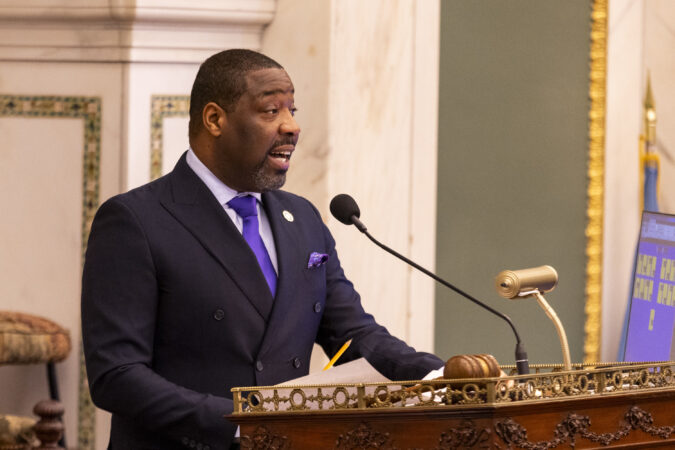
    Philadelphia Mayor Cherelle L. Parker stands beside Council President Kenyatta Johnson (left) after she finished her budget address to City Council, City Hall, Thursday, March 13, 2025.

    Larry Ceisler, a public affairs executive and longtime City Hall observer, said he has watched Johnson rise from community activist to lawmaker.

    He said the Council president, in his latest evolution, might have calculated that a majority of the 16 other members want the city’s legislative body to take a more active role.

    “He is an activist at heart, and he has a tremendous amount of empathy for people,” Ceisler said. “At the same time, he’s a pretty good politician and he can count votes. It’s very difficult for him at this point to push back on the will of his members.”

    But Ceisler said that Parker might have more to lose, and that she will “be on the hook for all this if there is retribution from Washington.”

    A ‘shameful’ episode at the President’s House

    Through the first eight months of the second Trump administration, Johnson largely kept focused on local policymaking.

    When a reporter asked Johnson in January 2025 how he saw his role responding to the Trump administration, he noted that he had convened two working groups to study how Trump-backed policies would affect Philadelphia residents.

    Other Council members introduced more than a dozen resolutions to condemn the Trump administration’s efforts that they said would harm Philadelphians, like cutting food assistance and prohibiting some diversity-hiring initiatives. One resolution opposed the federal government’s deployment of the National Guard as a crime-fighting measure in major American cities; another said Trump’s cabinet members were wholly unqualified.

    Those measures, almost entirely symbolic, were largely spearheaded by progressive members. They passed the overwhelmingly Democratic Council with little debate and not much acknowledgment from the Council president.

    But by September, Johnson began to speak up.

    He was incensed when word spread that the Trump administration was seeking to alter some content related to slavery on federal properties, including at Independence National Historical Park. The National Park Service was reportedly looking to edit panels at the President’s House Site in Center City that memorialize the nine people whom George Washington enslaved.

    Johnson at the time accused Trump of trying to “rewrite American history,” and he quickly allied himself with the Avenging the Ancestors Coalition, the group that helped shape the site.

    Last month, federal workers removed the exhibit and relocated the panels to the National Constitution Center, where they are in storage. Parker’s administration filed a lawsuit immediately, and the issue remains the only Trump initiative that Parker has vocally opposed over the last year.

    “This history is a critical part of our nation’s origins, and it deserves to be seen and heard,” she said in a video posted on social media.

    A judge is currently weighing the case.

    Veronica Chapman-Smith, concerned citizen was present at the history lesson and protest, Presidents house, Independence National Historical Park, Philadelphia, Friday, Feb. 6, 2026. The community is coming together to protest the removal of slavery exhibit at the President’s House site.

    The Council president said he wants the panels returned in time for an expected influx of tourists this year for several major events, including World Cup games and the 250th anniversary of the founding of the nation.

    “It’s shameful that during this celebration of our country, the birthplace of America, here in the city of Philadelphia, we have to deal with a Trump administration trying to whitewash our history,” Johnson said last week.

    A Minneapolis-like ICE surge on ‘any given day’

    Over the next five months, Johnson will juggle advocating for the return of the panels as he manages other high-profile local matters. Council must approve a city budget by the end of June, and its members are expected to play a crucial role in the Philadelphia School District’s closure and consolidation plan that will affect dozens of schools.

    The “ICE Out” legislation that Johnson has already backed is also expected to be a major undertaking over the coming weeks. The seven bills that make up the package already have support from 15 of Council’s 17 members, which constitutes a veto-proof majority.

    City Councilmember Rue Landau, a Democrat who is one of the prime sponsors of the immigration legislation, said Johnson “fully realizes the importance of this moment.”

    “His support,” she said, “is a recognition that local government has a pivotal role to play in moments like these.”

    Prior to this year, Johnson rarely talked about immigration. He has spent most of his career focused on public safety, gun violence prevention, and quality-of-life issues.

    Today, he said, his top priorities include the safety of the nearly quarter of a million immigrants who make up an estimated 15% of the city’s population.

    Johnson said he is especially concerned that the Trump administration quietly spent $87 million on warehouse space in Berks County, which records show will be used by U.S. Immigration and Customs Enforcement.

    Bloomberg reported that the building, about 85 miles outside Philadelphia, is one of two dozen across the nation that ICE has identified for conversion into detention centers. ICE purchased another warehouse in Schuylkill County, about 110 miles from Philadelphia.

    Together, the two facilities could hold 9,000 beds.

    To Johnson, it was like the federal government was saying: “We want to set up shop right in your backyard.”

    ICE is already operating in the city. But Johnson said the warehouse purchases are a sign that Philadelphia should prepare for a greater surge of immigration enforcement like the operation in Minneapolis, where more than 3,000 federal agents were deployed and large-scale protests ensued.

    Countless Minnesotans have said they were harassed, racially profiled, and unlawfully arrested by ICE agents during the operation this year.

    “Who’s to say that won’t happen to any of my constituents that I represent from Liberia? From Sierra Leone? From Cambodia?” Johnson said. “It can happen on any given day here in the city of Philadelphia.”

  • Sonny Jurgensen’s colorful off-field reputation was formed in Philadelphia. It was a window into the more human side of our stars.

    Sonny Jurgensen’s colorful off-field reputation was formed in Philadelphia. It was a window into the more human side of our stars.

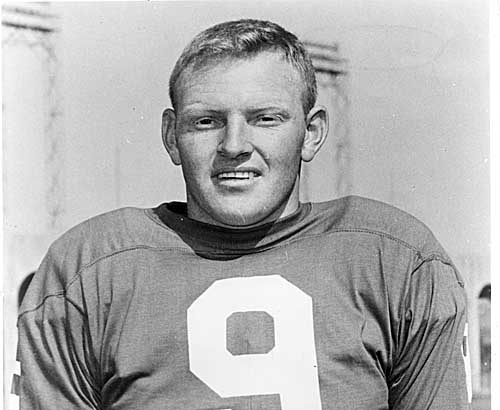
    Sonny Jurgensen was an Eagle and a Redskin but never a saint.

    It’s been about a week since the hedonistic Hall of Famer died at 91 and nearly 62 years since he departed Philadelphia for Washington in a trade that left the city’s bartenders as downcast as its football fans.

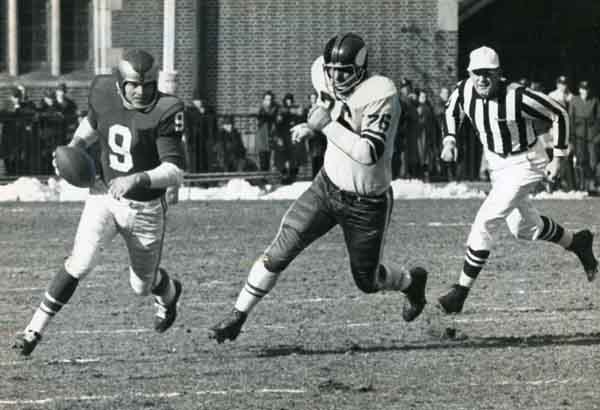
    Thinking of Jurgensen now, I still conjure images of that flimsy helmet he wore with its single-bar face mask. I see him squirming in the pocket, quickly surveying the downfield action, then flicking those effortless passes to Tommy McDonald or Pete Retzlaff.

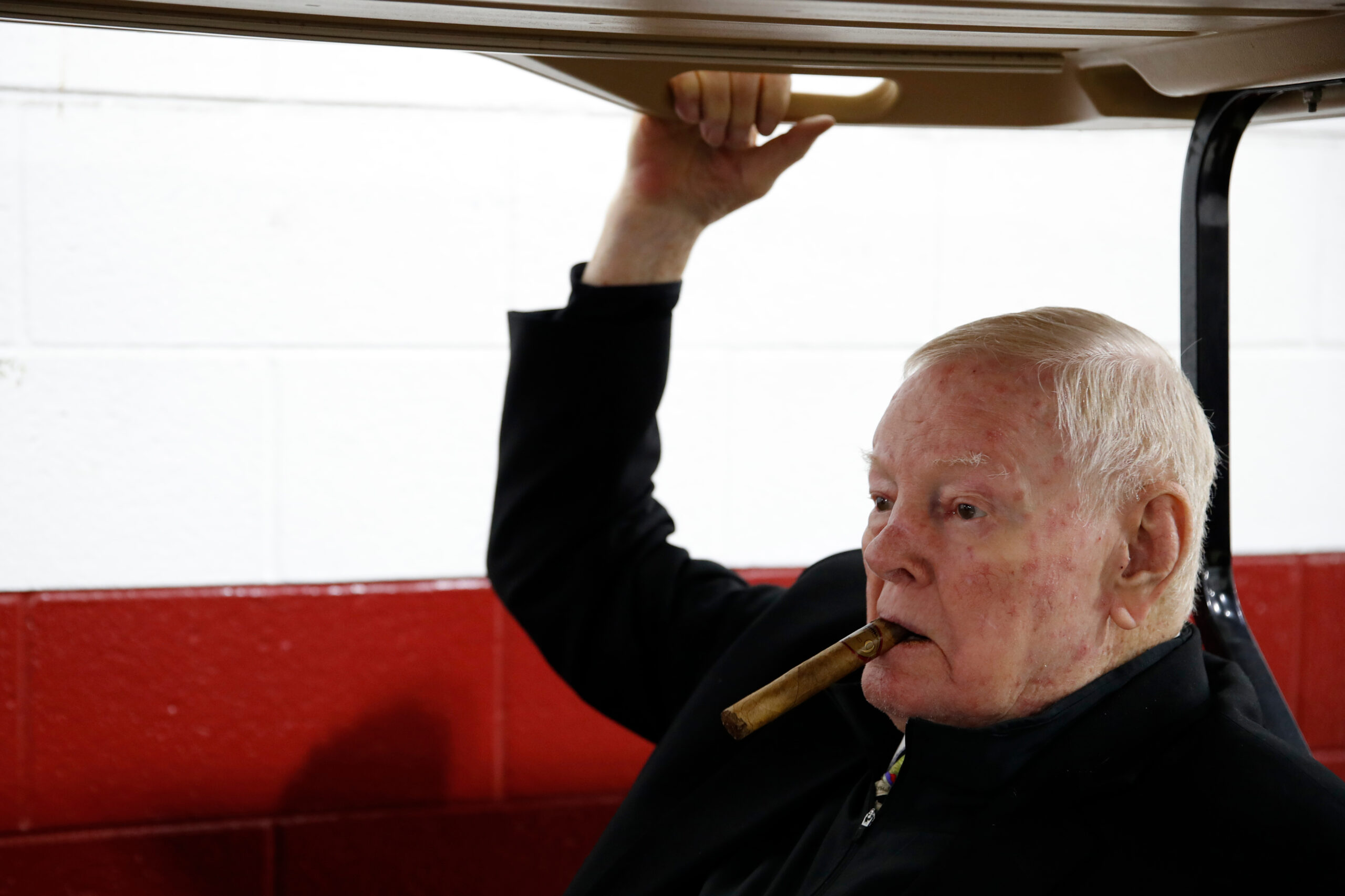
    But I also still see, maybe more than in any other athlete from that era, his personal foibles. There was the booze, the pot belly, the mischievous smile, the postgame cigars that jutted from his mouth like middle fingers to those who disapproved.

    Sonny Jurgensen was one of the NFL’s great characters of his era and went go on to achieve exalted status in Washington.

    Jurgensen was one of the first Philly athletes whose lifestyle was as well-known as his talents. Throughout his seven seasons as an Eagle, the last three as a starter, Philadelphia was rife with whispered stories about the redhead’s off-field encounters. It hardly was a secret that he loved liquor, ladies, and last calls.

    Like many of his early-1960s Eagles teammates, the native North Carolinian lived during the season at the Walnut Park Plaza hotel at 63rd and Walnut, just a short stagger from one of the team’s favorite bars, Donoghue’s. Jurgensen regularly showed up there as well as Center City spots like the Latimer Club and Jimmy’s Milan.

    Another of his favorite haunts was Martini’s, an Italian restaurant and bar in Berwyn where he befriended the owner, Louie DiMartini. DiMartini’s son, Bill, remembered all the nights that his dad and “Uncle Sonny” showed up at their house.

    “One night, my siblings and I were in bed when we were awakened by loud singing,” DiMartini said. “Sonny and my dad had just made up a song called ‘Pine Tree.’ The song had no other lyrics but ‘pine tree,’ and they went on singing it for hours.

    “Another time, the Eagles couldn’t find Sonny; he hadn’t shown up for practice. We woke up to get ready for school, and as my older brothers went downstairs they found Sonny sleeping on the couch. My father told us, ‘You didn’t see anything.’”

    I was a 12-year-old sports nut when I learned of Jurgensen’s off-field proclivities. For me, pardon the expression, it was a sobering experience, perhaps the first time I realized sports heroes weren’t gods.

    Sonny Jurgensen led the Eagles to a 10-4 mark and was an All-Pro in 1961. After two more seasons he was traded to Washington.

    If my memory is accurate, it happened on a morning in January 1962. The night before, my father, the sports editor of two Philadelphia neighborhood weeklies, had attended his first Philadelphia Sports Writers Association banquet.

    I couldn’t wait to hear about it. So at 7:30 the next morning, when he got home from his full-time job as a Bulletin proofreader, I was waiting at the door. As I peppered him with questions, he handed me the event’s program. On its front page were the autographs he’d gathered from sports celebrities he’d encountered there — Gene Mauch, Sonny Liston, Mickey Mantle.

    Clearly a little starstruck himself, he eagerly described Mantle’s Oklahoma drawl, Liston’s enormous hands, Mauch’s steely eyes.

    Then I saw another signature, this one from Jurgensen, the spirited quarterback who’d just emerged as an NFL star after throwing a league-best 32 touchdown passes during the Eagles’ 10-4 season in 1961.

    I awaited my father’s impressions. A virtual teetotaler, his tone shifted when he said, clearly disapproving, “I’ve never seen anyone drink so much.”

    That was a jolt. Could a star quarterback be a drunk? That didn’t compute. It was, after all, the pre-Ball Four world of the early 1960s when most of us knew nothing about things like Mantle’s carousing or Liston’s mob connections. Sports writers of the era, many of whom partied just as hard as Jurgensen, shielded the athletes they covered.

    My young mind’s palette worked in black and white only. There were no shades of nuance. Heroes had no flaws. Or so I believed. Was Jurgensen a drunk or a hero? He couldn’t be both. Was he the pure-passing machine who’d just thrown for an NFL-high 3,723 yards? Or was he no different from those lost souls my grandmother pointed out in warning whenever we rode the 47 trolley past Vine Street’s Skid Row.

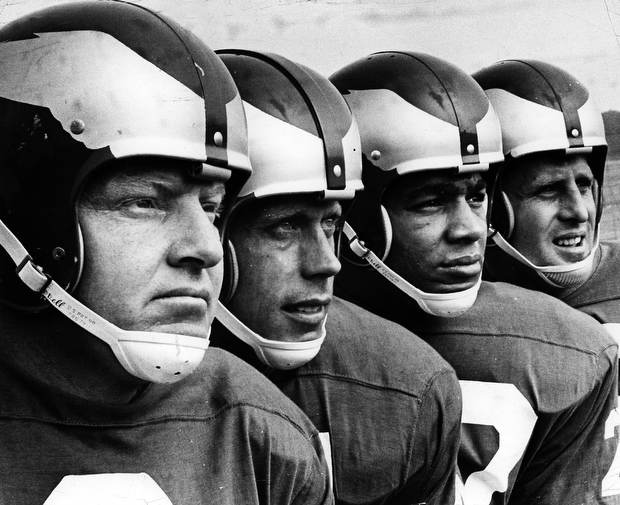
    Eagles players (from left) Sonny Jurgensen, Pete Retzlaff, Timmy Brown, and Tommy McDonald during the 1963 season.

    I still wasn’t sure when in April 1964, 12 days after he dealt McDonald, Jurgensen’s partner on and off the field, coach/general manager Joe Kuharich shocked Eagles fans by trading the colorful QB to Washington. I wondered if it had something to do with the then 29-year-old’s lifestyle. And I wasn’t alone. Daily News columnist Jack McKinney gave voice to what many thought was behind the incongruous trade.

    “Another theory is that Jurgensen’s off-field antics, something less than that of a Boy Scout leader, may have been a factor.”

    That trade, which brought pedestrian QB Norm Snead here, was a bad omen. It launched one of the longest and darkest stretches in Eagles history. They wouldn’t reach the postseason again until 1978. In those 14 intervening seasons, the team amassed a combined record of 68-122-6.

    With Jurgensen, meanwhile, Washington made five playoff appearances in that span, and in his first six seasons there, he was named first- or second-team All-Pro four times.

    No matter the Washington coach, Jurgensen flourished. For three seasons, he clashed with prudish Otto Graham — “He likes candy bars and milkshakes,” Jurgensen said, “and I like women and scotch” — but twice led the league in passing yards. He got along famously with Graham’s successor, Vince Lombardi. Never prone to hyperbole, Lombardi once admitted that Jurgensen “may be the best the league has ever seen.”

    And he was still pretty formidable after hours, too. He became a regular at such late-night D.C.-area establishments as the Dancing Club and Maxie’s. At least twice, he was charged with driving while intoxicated.

    Sonny Jurgensen spent 11 seasons as a player in Washington and was named to the Pro Football Hall of Fame in 1983.

    Jurgensen ended his 18-year career in 1974 with the highest QB rating (82.62) of anyone in the pre-1978 era. Sometime in the 1980s he reportedly stopped drinking and for four decades was Washington’s drawling, plain-spoken radio analyst.

    By then the NFL had changed. Its stars now endure round-the-clock scrutiny.

    I’m not sure how Jurgensen would have dealt with social media, paparazzi, tabloid headlines. Would it have impacted his play? Would the DWIs have sent him to rehab? Would the whispers have become shouts?

    In the end, I really don’t care.

    I lost that sportswriters banquet program years ago. I lost a lot of that youthful righteousness, too. So from now on, in those corners of my mind where it’s always a sunlit Sunday at Franklin Field, I’ll remember Jurgensen simply as a gifted man with a child’s name who lofted all those beautiful spirals.