Blog

  • Democrats in half of states sue Trump administration over Medicaid work rules

    Democrats in half of states sue Trump administration over Medicaid work rules

    NEW YORK — Democrats in 25 states and the District of Columbia on Monday sued the Trump administration over its recent guidance on new Medicaid work requirements, arguing the strict rules will prevent eligible Americans from accessing the care they need.

    The attorneys general and governors who filed the lawsuit allege that an interim final rule released earlier this month by the Centers for Medicare and Medicaid Services oversteps the text of the law last summer that set in motion the changes to Medicaid.

    They claim the Republican administration’s narrow interpretation of parts of the statute, including new limits to a medical frailty exemption, will create harmful coverage barriers and chaos in states that have been rushing to implement new systems by the January deadline.

    “Added administrative burdens will cause individuals who are eligible for Medicaid to lose or be denied coverage,” the plaintiffs write. “People with disabilities, patients in the middle of cancer treatment, or those struggling with another serious or complex health condition, shouldn’t be at risk of losing the care that helps maintain their health.”

    Spokespeople for the U.S. Department of Health and Human Services and CMS, the agencies named in the lawsuit, didn’t immediately respond to a request for comment. The Trump administration has promoted the new rules as commonsense measures to eliminate government freeloading and preserve benefits for those who need them most.

    The new Medicaid restrictions, which Democrats have criticized, were part of Trump’s big tax and policy law in 2025. The change affects those covered through an expansion in most states that gave more lower-income people access to the government’s safety net healthcare program.

    Starting Jan. 1, expansion enrollees age 19 to 64 will have to show that they work or do community service at least 80 hours a month or are in school at least half the time. There are exceptions for those considered medically frail or in addiction treatment programs, among others.

    This month’s announcement from CMS caught states off guard with a new definition of medical frailty. The law had said medically frail people include those who have substance use disorders, disabilities, or serious medical conditions. But the CMS rule went further, saying someone’s condition must “significantly impair” their ability to work, volunteer, or attend school at the rates required in the law for them to be granted an exemption.

    In 2027 and once in 2028, the patient can attest that they meet this definition. But when they try to renew coverage in 2028, they’ll need to prove it. Health analysts and state Medicaid directors have said they aren’t clear on what existing documentation could prove that point.

    In the lawsuit, states allege that this change came “contrary to months of regular communications with CMS and preliminary guidance materials upon which Plaintiff States based their implementation plans.” They say CMS has still not provided states with enough clarity on how they can update their systems appropriately.

    Democratic Gov. Josh Shapiro joined the suit, continuing a trend since last year of committing Pennsylvania to these cases that the state’s Republican attorney general has sat out.

    “Donald Trump, Dr. Oz, and RFK Jr. are hellbent on trying to push aside people who rely on Medicaid to get the care they need,” Shapiro said on X. “But here in Pennsylvania, we’re going to keep standing up to protect our most vulnerable Pennsylvanians.”

    New York Attorney General Letitia James, one of the Democrats suing the administration, said the new rule puts thousands of her state’s residents at risk.

    “New Yorkers who are battling cancer, living with a disability, managing a serious mental health condition, or recovering from addiction should be able to get the healthcare they need without being buried in paperwork,” she said in a statement.

  • Flyers qualify Trevor Zegras and Jamie Drysdale, let six other RFAs walk

    Flyers qualify Trevor Zegras and Jamie Drysdale, let six other RFAs walk

    The Flyers were required to submit qualifying offers to their restricted free agents by 5 p.m. on Monday.

    After the deadline, they announced that they did not provide qualifying offers to forwards Philip Tomasino, Brett Harrison, Tucker Robertson, and Karsen Dorwart, and defensemen Artem Guryev and Christian Kyrou. They will now be unrestricted free agents on July 1.

    They gave qualifying offers to forwards Trevor Zegras and Nikita Grebenkin, as well as defensemen Jamie Drysdale and Hunter McDonald. Drysdale, Zegras, and McDonald are eligible for arbitration.

    According to Puckpedia, Zegras’ qualifying offer is $5.75 million. It is the same amount as his expiring three-year contract signed in 2023 with the Anaheim Ducks. Drysdale is due $2.3 million, the same as the three-year deal he inked with Anaheim in 2023. Grebenkin’s is $850,000, and McDonald’s is $897,750.

    In his first season in Philly, Zegras had 26 goals and 67 points — both were career highs — in 81 regular-season games before adding another six points in 10 playoff games. It was his first playoff experience, as it was for Drysdale, who stepped up his game this past season and had a career high in goals (eight) and tied his career high in points (32). He added two goals and four points in 10 playoff games, scoring the first Flyers playoff goal since 2020.

    Grebenkin has not played since late March due to an upper-body injury. “Initially, we thought it was going to be something short, and it just never got better,” Flyers general manager Danny Brière said at his end-of-season press conference. “Now we’re looking at different options for him. So he’s the only one that I would say maybe [he’s not ready for training camp], if it doesn’t improve.” Brière did not have an update when speaking to The Inquirer at the start of June at the NHL scouting combine.

    McDonald made his NHL debut this season, skating in the season finale, and registered the secondary assist on Oliver Bonk’s first NHL goal. A rugged blueliner, he had six assists in 65 games for the Phantoms.

    “Hunter took a big step last year in his development, and that’s why he played that game late in the season,” Brière told The Inquirer in early June. “I think our coaching staff was really impressed [with] how he took a step forward this year. He put in the work and really elevated his game, earned that NHL game at the end, and he was around the team when we played in the playoffs as well.

    “Really exciting to see him have growth to his development. It’s a big summer for him, but we’re excited about him. A big, physical defenseman like that is not easy to find, and we hope he’s going to be one of those guys, eventually. But he’s going to have to beat someone at some point to earn those minutes.”

    Tomasino was acquired this past season in a swap that sent Egor Zamula to the Pittsburgh Penguins. He potted 12 goals and 41 points in 52 regular-season games between the two teams’ AHL affiliates. A first-round selection of Nashville in 2019, he has 218 NHL games under his belt.

    Traded to the Flyers with Jackson Edward for Alexis Gendron and Massimo Rizzo in March, Harrison had two goals and four points in 12 games with Lehigh Valley. Guryev was part of the deal that sent Ryan Ellis’ contract to the San Jose Sharks, and Christian Kyrou was acquired in a one-for-one, with Samu Tuomaala going to the Dallas Stars.

    Dorwart was signed out of Michigan State as a college free agent in March 2025. He skated in five games after inking his entry-level contract, making his NHL debut in Montreal. Last season, he had 10 goals and 24 points in 70 games for the Phantoms.

  • The legacy of this generation of USMNT players rests on this World Cup’s knockout rounds

    The legacy of this generation of USMNT players rests on this World Cup’s knockout rounds

    IRVINE, Calif. — The assertion on these pages of the importance of this World Cup’s first knockout round for the U.S. men’s soccer team drew a noteworthy response from a history-minded reader.

    “Just because they changed how to make it from 32 to 16 doesn’t automatically make doing it more meaningful,” it said. “Not to be too ‘Bluesky reply guy’ but portraying it otherwise empowers FIFA’s money grab imo. On Wednesday the USMNT will try to do something they’ve done 5 of the last 8 men’s World Cups.”

    Those are fair points, especially the one about FIFA grabbing money. The U.S. men have indeed been among the last 16 teams standing at five of the eight World Cups they played in from 1990-2022: ‘94, 2002, 2010, ‘14, and ‘22.

    So the point that was made here is worth clarifying. It’s not just about being able to claim a title of being one of the best 32, 16, or any fewer national teams based on World Cup finish. It’s about the mentality of knockout soccer on the sport’s biggest stage, and how different it is from anything else.

    Tyler Adams (left) and Walker Zimmerman on the field at the end of the U.S.’ loss to the Netherlands that knocked them out of the 2022 World Cup in the round of 16. This year’s tournament is the first with a round of 32.

    It’s also about whether U.S. players of this era can prove themselves in the way they’ve long told us they can. Lose the round of 32 contest to Bosnia & Herzegovina on Wednesday (8 p.m., Fox29, Telemundo 62), and all the promises go up in smoke.

    That pressure might not be the same as the kind the superstars of Brazil, Argentina, England, and so on face every day. But it’s still a significant burden, and a particular kind for a team with DNA built on fighting for respect.

    “I think everyone knows in the back of our minds what this could do for this country,” attacking midfielder Gio Reyna said before Monday’s practice, the last before the U.S. team headed north to the Bay Area for Wednesday’s game in Santa Clara.

    “Not that we’ve really spoke about it or thought about it much — we’re pretty much just focused on each game in front of us at this moment, as it is win or go home,” he continued. But they don’t have to.

    Gio Reyna (right) in action during the U.S.-Turkey group stage finale.

    “We feel the country rallying around us,” he said. “We see the momentum it’s bringing to the sport in this country just through the group stage. But we also understand that if we make a nice run in the tournament, what it could really do for the sport.”

    Reyna and centerback Tim Ream were the two players who spoke Monday. Both were part of the 2022 team that took the U.S. back to the men’s World Cup after failing to qualify for 2018. Now Ream is this team’s captain, and its oldest player.

    “Would it be weird if I told you I don’t really feel too much pressure at this minute?” he said. “I just think there’s so much pressure that we put on ourselves.”

    He acknowledged in his next breath that “it feels very different this time around than 2022, I will say that,” though “not because of the round of 32 or because that was a round of 16.”

    Tim Ream (center) on the field after the Netherlands scored its third goal against the U.S. in 2002.

    Instead it’s because of what is already in the players’ minds.

    “I think we put so much expectation on ourselves as players — and I said this at the beginning of the tournament — but I think we felt more pressure for that first game against Paraguay than anything,” Ream said. “And that’s coming from ourselves, not from anything on the outside.”

    The burden might weigh a little extra on Reyna, too, and not just because of the scandal that engulfed him and his family four years ago. Even if everything back then had been clean-cut, he’d still be the son of U.S. legend Claudio Reyna, who played for the U.S. at the 1998, 2002, and 2006 World Cups — but not in 1994 because of a hamstring injury.

    “I always like to say it’s just another game of football, but at the end of the day, I think everybody knows what this game is,” Gio said. “World Cups only come around every four years, and especially on home soil, this opportunity will really never come back.”

  • No plans to reschedule Kirk Franklin’s canceled concert, Wawa officials say

    No plans to reschedule Kirk Franklin’s canceled concert, Wawa officials say

    Before gospel singer Kirk Franklin could take the stage at Sunday’s “Gospel on Independence” concert, the show was canceled due to severe weather.

    The concert, scheduled for 7 p.m. at Independence Mall, was initially postponed because of lightning and thunder detected in the area.

    Wawa Welcome America officials, who organized the concert, said there were plans to restart the show, but it was ultimately canceled due to inclement weather.

    There are currently no plans to reschedule Franklin’s show.

    Franklin, however, found a way to greet fans as he briefly stood on top of an SUV as the crowd exited Independence Mall.

    A downpour started shortly after his departure.

    In a video posted on his Instagram page, Franklin explained his intention to put on an “incredible concert.” “I was really excited about it,” he said in a video with the caption, “I need the weather to repent! LOL! 😂❤️🙏🏽.”

    “People were really disappointed,” he wrote. “But I need you to know that I’m more disappointed because I was really, really, really ready to go. I love Philadelphia. I’ll get back, man. I can’t let Philly down like that.”

    Fans stood for hours awaiting Franklin’s arrival.

    “My feet still hurting from standing out there waiting,” one fan commented under Franklin’s Instagram post.

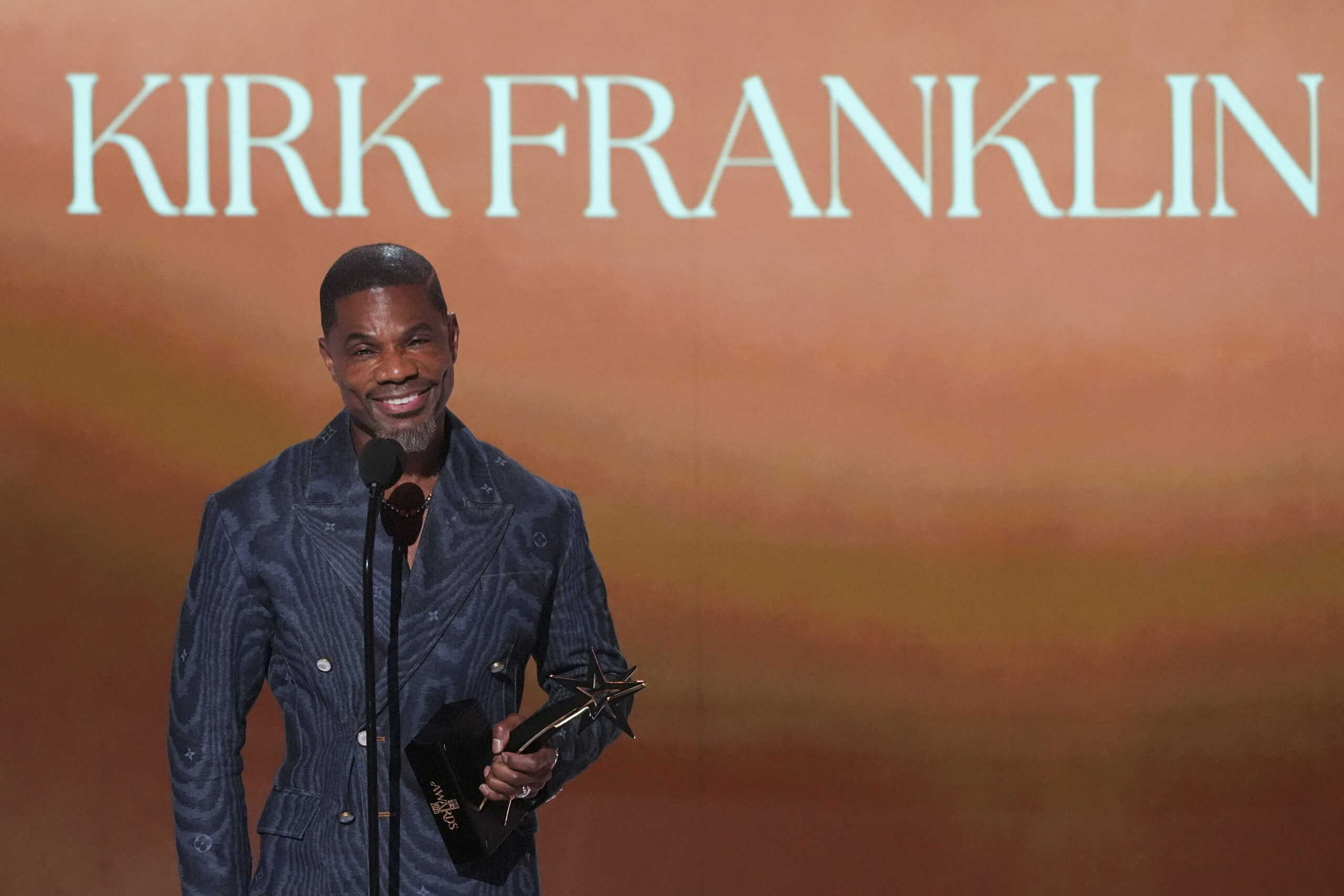
    Kirk Franklin accepts the ultimate icon award during the BET Awards in 2025, at the Peacock Theater in Los Angeles. (AP Photo/Chris Pizzello)

    Not all of Franklin’s interactions with fans on Sunday were as jovial.

    In a now-viral social media video, Franklin is seen arguing with an attendee, who urged the singer to “repent” for his sins. Otherwise, he and his wife, Tammy Franklin, are “going to go to hell,” the attendee threatened.

    Franklin attempted to confront the unidentified man but was held back by several security guards.

    The man was eventually escorted out of the venue by law enforcement officers.

    Before the show’s cancelation, fans enjoyed the opening performances and food vendors at Sunday’s event at the Independence Mall, which was part of this week’s lineup of Wawa Welcome America Festival events and concerts.

    The celebration of the nation’s 250th birthday will continue with Tuesday’s Philadelphia Orchestra’s Pride concert, Thursday’s “Salute to Service” concert, and Friday’s Pops on Independence concert.

    On July 4, the free “One Philly: Unity Concert for America” will take place on the Benjamin Franklin Parkway. Featuring Christina Aguilera, Jill Scott, The Roots, and others, that show is not part of Wawa Welcome America but counts Wawa among its sponsors.

    For more information, visit july4thphilly.com.

  • Supreme Court expands Trump’s power over the federal bureaucracy, with an exception

    Supreme Court expands Trump’s power over the federal bureaucracy, with an exception

    The Supreme Court greatly expanded President Donald Trump’s control over the federal bureaucracy Monday, but stopped short of allowing him to undermine the independence of the Federal Reserve in a pair of rulings that amount to one of the largest verdicts on the scope of presidential power in decades.

    In a 6-3 ideologically divided decision, the justices struck down a nearly century-old precedent that has allowed Congress to insulate the leaders of the Federal Trade Commission (FTC) and roughly two dozen other independent regulatory agencies from political influence by requiring the president have good reason to dismiss them.

    The ruling is likely to usher in major changes to the structure of the federal government, and it fulfills a major goal of the Trump administration and many conservatives who have long argued that the president should exercise nearly unfettered authority over the executive branch.

    In the other related case, a group of justices blocked Trump from removing Federal Reserve Governor Lisa Cook, at least for now, in a 5-4 ruling that found the powerful central bank has a distinct history and structure that allows Congress to carve out protections for its governors, unlike other independent agencies.

    Taken together, the cases amount to a split political decision for Trump, who has pushed aggressively in his second term to assert his authority over federal government by dismissing agency heads, restructuring departments, and firing thousands of federal workers.

    Trump hailed the ruling in the FTC case as a “BIG WIN” in a post on Truth Social, while saying he would continue the fight to try to remove Cook.

    “90 years of precedent has been COMPLETELY AND UNEQUIVOCALLY OVERRULED, greatly increasing Presidential Power at a time when it is most needed!” Trump wrote.

    Republicans said the FTC ruling would make the government more accountable to voters who elect the president, but Democrats and some former agency officials worried it would lead to the politicization of regulations on product safety, elections, nuclear energy, and much more. The ruling in the Cook case is provisional and it will return to the lower courts for additional legal wrangling.

    The majority said the Constitution’s plain language gives the president control of the executive branch, but Justice Sonia Sotomayor, joined by the court’s other two liberals, said in dissent that the nation’s founders clearly envisioned the existence of agencies whose independence would be protected by Congress. Sotomayor read her dissent from the bench to signal her strong disagreement with the majority.

    “Today, the majority replaces 90 years of proven, workable practice with a half-baked theory of executive power that is simultaneously all encompassing yet also subject to necessary but undefined exceptions,” she wrote. “The one thing that does appear to be clear going forward is that chaos will follow.”

    Sotomayor said the ruling would upset the structure of numerous agencies — such as the Federal Communications Commission and the Securities and Exchange Commission — that Congress created to make decisions based on nonpartisan expertise and technical knowledge. Most are run by bipartisan, multimember commissions.

    Gillian Metzger, a Columbia University law professor and expert on administrative law, said she was struck by the breadth of the FTC ruling, which could give Trump direct control over virtually all federal employees.

    “There’s language in the Slaughter majority opinion that is exceptionally broad,” Metzger said, referring to the case’s name. “The president has the power to remove at will his subordinates. That is extraordinarily broad.”

    Metzger said it was notable that the court cited no exceptions for the civil service protections that protect many federal workers from arbitrary dismissal or political retaliation. That could mean the court is possibly granting the president greater authority to remove federal workers, she said, although other court precedents protect them.

    Chief Justice John G. Roberts Jr. wrote the majority opinion, joined by the court’s five other conservatives. He said the congressionally-mandated protections that kept the president from firing Rebecca Slaughter, a Democratic member of the Federal Trade Commission, were unconstitutional.

    “We hold that such protection from removal is contrary to the separation of powers enshrined in the Constitution,” Roberts wrote.

    In the Federal Reserve case, the narrow majority from across the court’s ideological spectrum ruled that Cook could keep her job while a lawsuit challenging her dismissal plays out in the courts. The case could take months or years to resolve and appear again before the justices, who said Monday that Cook is likely to prevail.

    Roberts wrote the majority opinion in the Cook case as well, joined by the court’s three liberals as well as conservative Justice Brett M. Kavanaugh. Roberts wrote that Congress had created the Federal Reserve to operate with independence from the president.

    “Any change in that scheme must come from Congress, not the courts,” he wrote. “That is why we cannot accept the Government’s contentions in this case. To do so would allow the President to remove a member of the Federal Reserve at any time, for any reason, without any notice before, and without any judicial check after.”

    Four of the court’s conservatives objected. Justice Samuel A. Alito Jr., joined by Justice Neil M. Gorsuch, wrote in a dissent that the Supreme Court was premature in taking up Cook’s case. Justices Clarence Thomas and Amy Coney Barrett argued that the majority was wrong on the substance.

    “Today’s decision is an unprecedented incursion on the Executive Branch,” Thomas wrote in his dissent. “Neither the parties nor the Court can point to a single time in American history that this Court has upheld an injunction against the President’s removal of an executive officer.”

    Legal experts had long expected the court to rule against the decades-old precedent affirming Congress’ right to create independent agencies, known as Humphrey’s Executor, because the justices have been chipping away at it for years. Roberts called it a “dried husk” during oral arguments in December.

    The Supreme Court has repeatedly backed Trump’s efforts to remove the heads of independent agencies on its emergency docket, allowing him to dismiss members of the National Labor Relations Board, Merit Systems Protection Board, and the Consumer Product Safety Commission in rulings over the last year or so.

    Likewise, the ruling in the Cook case came as little surprise because some justices had signaled they were interested in carving out an exception to the president’s removal authority for the Fed.

    Trump fired Slaughter and the other Democrat on the five-member FTC, Alvaro Bedoya, without giving a cause in March 2025. The dismissals were part of a broader campaign by the president to remove perceived liberal leaders from independent agencies and replace them with loyalists.

    Slaughter challenged her dismissal in federal court, saying Trump had exceeded his authority under the law creating the FTC. The law says the president can fire members only for “inefficiency, neglect of duty, or malfeasance in office.” The agency works on antitrust and consumer protection issues.

    A federal judge cited the Humphrey’s Executor precedent in reinstating Slaughter to her position. That decision was upheld by an appeals court before the Trump administration asked the Supreme Court to intervene. Roberts paused Slaughter’s reinstatement in September so the high court could weigh the administration’s appeal.

    During arguments in December, Solicitor General D. John Sauer said regulatory agencies like the FTC had become “a headless fourth branch insulated from political accountability and democratic control,” and that curbing the president’s power to remove agency heads infringed on his constitutional powers.

    Trump has often disparaged the federal bureaucracy as a “deep state” determined to undermine his agenda. He has moved to fire thousands of federal workers, shutter agencies, and remove civil service protections to bring the government more firmly under his control.

    Many in the administration support the so-called unitary executive theory, which holds that the Constitution vests direct control of the executive branch solely in the president, and he is free to fire any of its officials at will. Since the Reagan administration, conservatives have pushed to give the president greater control over hiring and firing in the government.

    Trump initially nominated Slaughter to the FTC in 2018. She was unanimously approved by the Senate before President Joe Biden renominated her in 2023. Slaughter has become an outspoken critic of Trump’s efforts to cut the federal workforce.

    Slaughter said she was disappointed with the ruling.

    “What we have seen is a massive expansion of executive power at the expense of Congress, which has designed these agencies to work on behalf of the people and not the powerful,” Slaughter said.

    The majority wrote in its Cook ruling Monday that the Fed is different from other independent agencies because its structure echoes U.S. national banks whose genesis goes back to before the Constitution.

    Congress created the Fed to be independent of the president so it could make difficult decisions — such as raising interest rates — that are good for the health of the economy but may not be politically popular.

    Trump is the first president in the Fed’s 112-year history to try to fire one of its board members. In August, Trump alleged that Cook claimed two homes as primary residences to get a better mortgage rate. In filings with the Supreme Court, Cook “unequivocally” denied the allegations.

    The high court case revolved around whether Trump’s attempt to fire Cook complied with the Federal Reserve Act, which says Fed board members can only be ousted “for cause.”

    Days after Trump announced on social media in August that he was firing Cook, she sued in federal court, arguing that Trump’s accusations did not meet the standard for “for cause” removal because the allegations occurred before she was on the Fed board and had not been proved. Her attorneys also said she had not been given due process.

    A federal judge in D.C. sided with Cook, allowing her to remain on the job temporarily. A divided appeals court affirmed that decision, before the Trump administration appealed to the Supreme Court. The justices ruled in October that Cook could continue at the Fed while they considered her case.

    During arguments in January, Solicitor General D. John Sauer told the justices that the mortgage allegations gave Trump reason enough to fire Cook and that the courts did not have the authority to second-guess his determination.

    “The American people should not have their interest rates determined by someone who was, at best, grossly negligent in obtaining favorable interest rates for herself,” Sauer said.

    Paul D. Clement, an attorney for Cook, said the justices would be rash to rule on the Trump administration’s emergency request to oust Cook from her job without the benefit of additional fact-finding and legal proceedings.

    “There is no reason to abandon more than 100 years of central bank independence on an emergency application,” Clement said.

    After Monday’s ruling, Trump wrote on Truth Social that “we will take appropriate action immediately to make sure that someone who has committed wrongdoing will not be making vital decisions concerning the Welfare of the United States of America!”

    Cook said in a statement she was pleased.

    “Today’s ruling affirms a principle that has underpinned sound economic stewardship for generations: that the Federal Reserve must make all its policy decisions guided by evidence and independent judgment, free from political interference,” Cook said. “This bedrock principle has guided the Federal Reserve since its founding.”

    • The Supreme Court’s major cases during the 2025-26 term
    • Supreme Court justices turn children’s books into big paydays
    • There are no Supreme Court vacancies, but some judges are acting like there might be
  • Layoffs are ‘inevitable’ at Temple as school looks to cut $60 million, president says

    Layoffs are ‘inevitable’ at Temple as school looks to cut $60 million, president says

    Temple University has asked its schools, colleges, and administrative units to cut a total of $60 million to help offset a projected deficit for 2026-27.

    President John Fry shared the plan in a message to the campus community Friday and said a reduction in employees is “inevitable.”

    The message did not reveal how many layoffs the university is considering as it attempts to close the $85 million projected gap. The board of trustees’ executive committee is scheduled to meet next week to consider the proposed budget. The university’s current budget is $1.3 billion, excluding the health system.

    “Unfortunately, some reduction in force is inevitable, given that nearly 70% of Temple’s operating budget is spent on compensation and benefits,” Fry said in the message. “It is my promise that any employee’s separation from the university will be handled equitably and compassionately.”

    He noted that a faculty retirement incentive program this year drew 77 takers — 3% of full-time faculty — and will lessen the need for layoffs. Those faculty are scheduled to leave by the end of this month and their departures ultimately will save $15 million annually. The elimination of vacant faculty and staff positions also has helped, he said.

    Fry did not detail the cuts that are planned but said that colleges, schools, and administrative units each received a budget reduction target.

    Units were asked to make a 5% cut last year, but this year there is a range of percentages among schools, colleges, and administrative units, a university spokesperson said. The spokesperson declined to say how many layoffs will occur.

    Some potential cuts that have stirred discussion include a reduction in adjunct professors and a pause in doctoral student admissions by some programs.

    Jeffrey Doshna, president of the Temple Association of University Professionals, said Fry’s message seemed to address some of the issues the union has been raising, but said more information is needed, including how many people will lose their jobs and from what areas.

    “Hopefully, they will continue to respond to what we are calling for,” he said, including greater transparency, participation in decision-making, and no job cuts.

    Temple has been trying to cope with lost revenue from a precipitous slide in enrollment and uncertainty around federal funding. Fry has been warning since early April that the university “must act decisively and with a sense of urgency” to address the projected deficit. An internal Temple report obtained by The Inquirer in April said layoffs were coming.

    Last July, Temple laid off 50 employees, less than 1% of its workforce.

    Fry reported to the board of trustees last week that this year’s fall enrollment looks promising, with deposits by first-year undergraduate and transfer students up over last year at the same time.

    He said in his campus message that making the $60 million in cuts is “an important first step toward returning the university to a balanced budget over the next three years.”

    Fry acknowledged that the budget reductions “can create uncertainty and anxiety.” But he said the administration has attempted to be transparent and has held meetings with faculty senate, deans, and schools, colleges, and administrative units.

    “Navigating through this stark financial reality is not easy,” Fry said. “I recognize the difficulty of this present moment. We will emerge from this process stronger and on a more sustainable path moving forward.”

  • Whatever you do in Russia, don’t talk about the war

    Whatever you do in Russia, don’t talk about the war

    The war in Ukraine is a “Special Military Operation,” even though it’s the biggest conflict in Europe since World War II.

    Across Russia, officials blame fuel shortages on “unscheduled maintenance at refineries” without noting a cause, as Ukrainian drones attack fuel refining facilities in the country.

    And Russia’s central bank governor has talked of the “structural transformation of the economy,” as code for military spending that has spiraled and reoriented the economy around the military-industrial complex.

    For years, President Vladimir Putin has insulated Russian society from the consequences of his war in Ukraine, using euphemisms as a psychological shield. But as the war increasingly comes home, the mismatch between rhetoric and reality is becoming a source of frustration for ordinary Russians.

    For days, Putin didn’t mention the June 18 long-range strikes on Moscow, when Ukraine attacked with nearly 200 drones. He didn’t comment as Ukrainians promised to turn Crimea, the peninsula Russia illegally annexed in 2014, into an island by pounding it with drones and missiles.

    When he appeared June 23 for the first time since the June 18 strikes, which were the largest in the war, he used the moment to blame the West.

    “These drones, strikes on civilian infrastructure — what are they for? To destabilize society, to create uncertainty about the actions of the Russian armed forces,” Putin said. At that time, he did not address the fuel shortages in at least 56 regions, according to Mediazona, an independent Russian news outlet.

    On Sunday, Putin did acknowledge fuel shortages. At a meeting of top executives and officials, he said that “systemic measures that match the scale of current challenges” must be put in place, adding that a task force was working around the clock to ensure supplies, especially for agriculture.

    But Putin has not publicly delegated officials to prepare shelters or early warning systems in case of future strikes.

    In the Moscow suburbs of Kotelniki and Lyubertsy, both of which came under drone attack in mid-June, authorities said they would not disclose the locations of bomb shelters or use sirens because the country was not technically on a war footing. They would make this information public only in case of a “period of mobilization and in wartime.”

    Lyubertsy’s administrator suggested that people consult a PDF that appeared on a government website with practical instructions on what to do in case of a drone attack.

    The head of the Republic of Bashkortostan, a region with 4 million people between the Volga River and the Ural Mountains where Ukraine has attacked refineries, said his administration had decided to not always activate sirens to not stress people out, mentioning a rise in antidepressant use in Russia.

    Downplaying danger and resorting to euphemisms to discuss drone attacks and economic pain is a “performance of obedience” to Putin and his regime, said Aleksandra Arkhipova, a teaching and research fellow in social sciences at the École Normale Supérieure in Paris.

    She has compiled a list of new war-related terms and euphemisms such as “clap” instead of “explosion,” “deprived of life” instead of “killed,” and “air target” instead of “drone.”

    “Russian political authorities right now are all about pictures in the news,” Arkhipova said. They do not want “to create a huge panic which can be shown by local TV and then on the federal news with a lot of crowds crying and running through the streets.”

    On the news, the recent attacks on Moscow barely figured, in keeping with the state’s stance. Channel One, the Kremlin’s primary cultural and political megaphone, ran a short segment the morning of the June 18 attacks and then stayed quiet until Putin commented several days later. During the evening news broadcasts on June 18 on Channel One as well as on Rossiya 1, or NTV, “not a single word” about the attacks was uttered, according to Telegram channel Agentstvo News.

    Officials and state outlets use confusing and sometimes misleading linguistic formulations to describe certain war-related events, Arkhipova said. In the early days of the war, stores that closed as a result of Western sanctions bore signs for months and in some cases years saying they were “closed for technical reasons.”

    Russia’s Federal Air Transport Agency recently announced a “schedule adjustment” at the Krasnodar airport, which is about 150 miles from the front line and in the path of Ukrainian drones. At Sochi airport, authorities don’t write that flights are delayed by incoming drones but instead that the airport is operating according to the “actual schedule” — a confusing term that is meant to distinguish between the two columns on the planned departures and arrivals, “scheduled time” and “actual time.”

    When Moscow’s airports are temporarily closed because of Ukrainian drone attacks, the term used refers to accepting flights “by agreement.” Travelers are told that their flight is delayed because of delays to the incoming flight, rather than because the city is under drone attack.

    Arkhipova calls this linguistic technique “neutralization.” It is about intentional ambiguity, she said, explaining, “People can understand that something is happening, but what exactly is happening is not that clear.”

  • Comcast plans no big change for its 15,000 Philly workers as company splits in two

    Comcast plans no big change for its 15,000 Philly workers as company splits in two

    Comcast, the $125 billion-a-year media and communications giant based in Philadelphia, is planning to split into two publicly traded companies, one based on the NBCUniversal media group, the other focused on broadband and wireless services.

    Comcast’s consumer and business services and NBCUniversal media now face “distinct” opportunities that are best pursued separately, Brian L. Roberts, chief executive since 2002, told investors in a conference call.

    Shares of Comcast, which had recently been trading near a 10-year low, jumped as much as 17% on the news, before closing at $24.22, a 4.5% gain for the day but well below the stock’s highs earlier this year.

    The split reverses major Comcast media acquisitions.

    “We previously believed that scale and diversification benefits warranted operating these businesses as one company; we’ve now simply changed our mind about that,” said Michael Cavanagh, the former chief financial officer of both Comcast and JPMorgan Chase & Co., who became Comcast’s co-CEO last fall.

    “We’ve now concluded that future success for each of our businesses will depend on focus, speed, and strategic flexibility that this separation will unlock,” said Cavanagh, who will head NBCUniversal, based at 30 Rockefeller Center in New York, after the split.

    Comcast will retain the consumer and business services that employ the majority of the company’s 180,000 workers, including most of its 15,000 Philadelphia-area staff and managers.

    Michael Angelakis when he was CFO of Comcast in 2009. He is returning, this time as CEO, as the company divests NBCUniversal and Sky.

    Comcast’s CEO after the split will be Michael Angelakis, a Gladwyne resident, who was Comcast’s chief financial officer from 2007 to 2015 and has since headed tech investment firm Atairos while also advising Comcast.

    Comcast’s acquistion of NBCUniversal, announced in 2011 and financially structured by Angelakis, was “a brilliant success financially” since Comcast got a bargain price as it was the first multibillion-dollar acquisition after the Great Recession, telecommunications analyst Craig Moffett told clients in a report Monday.

    But it didn’t make much sense strategically, Moffett added. While original media and theme parks did little to boost cable sales, the combination turned investors off, depressing the share price.

    Angelakis’ return to Comcast is “the best part” of the “wonderful, overdue” breakup decision, Moffett said. He noted that the two successor companies were themselves unlikely to become takeover targets in the near future as it would endanger the tax-free structure of the spin-off and likely require long, expensive work to persuade national and state regulators.

    Angelakis told investors on the call: “This place was my home for many years. It’s great to be here. It feels familiar and exciting at the same time.”

    The planned move comes after Comcast announced in November 2024 that it was spinning off cable networks such as USA, Oxygen, E!, SYFY and Golf Channel, as well as CNBC and MSNBC into a new company, Versant. Movie ticketing platform Fandango and the Rotten Tomatoes movie rating site were also included. Versant went public in January at around $45 a share; it has lately traded around $36.

    Like other cable companies, Comcast in recent years has shifted its business emphasis away from traditional cable toward streaming and other sources of revenue, such as its movie studio, theme parks and home wireless and internet services.

    Media and entertainment company NBCUniversal includes a theme parks division, Universal film and television studios, NBC and Telemundo networks, Peacock, and Bravo. Its portfolio will now include European media business Sky.

    Comcast will continue providing internet and phone services to residential and business customers.

    Once the transaction is complete, Comcast shareholders will own shares in both Comcast and NBCUniversal. The separation is expected to be completed in about a year. It still needs final approval from Comcast’s board and is subject to regulatory approvals.

    Comcast expects to keep a stake of up to 19.9% ownership position in NBCUniversal for up to one year after the spinoff is complete.

    The Associated Press contributed to this report.

  • D.C. reaches court settlement with man detained while protesting troops’ patrol with Darth Vader song

    D.C. reaches court settlement with man detained while protesting troops’ patrol with Darth Vader song

    WASHINGTON — The District of Columbia has reached a settlement agreement for an undisclosed amount of money with a resident who claims police illegally detained him for following an Ohio National Guard patrol while playing Darth Vader’s theme song from “Star Wars” on his phone — an act of protest against the Trump administration’s federal law-enforcement surge in the nation’s capital.

    A court filing late Thursday says the plaintiff, Sam O’Hara, will drop his lawsuit’s claims against the district and four Metropolitan Police Department officers within three business days of receiving the settlement payment. The filing doesn’t specify a dollar amount for the deal between the district and O’Hara, who is represented by the American Civil Liberties Union of the District of Columbia.

    In an email on Friday, an ACLU spokesperson referred to the settlement’s financial terms as “a significant amount” that O’Hara ”is pleased with” but said they aren’t disclosing the dollar figure to protect his privacy. A spokesperson for D.C. Attorney General Brian Schwalb’s office declined to comment on the settlement.

    O’Hara’s agreement with the district doesn’t resolve his related claims against an Ohio National Guard member. Attorneys for the Guard member, Sgt. Devon Beck, has asked a judge to dismiss O’Hara’s claims against him.

    “He was there because that was his assigned duty,” Beck’s lawyers wrote. “This was not an accidental encounter or a one-time disagreement on a public sidewalk.”

    An earlier court filing, in February, said O’Hara had reached a settlement agreement “in principle” with the district. In response, a judge agreed to suspend the case while they negotiated terms.

    “The government’s efforts to silence me ultimately backfired and brought more attention to the unjust deployment of the National Guard in Washington, D.C.,” O’Hara said in a statement. “This settlement serves as a reminder that constitutional freedoms are worth defending, especially when those in power would prefer we stay quiet.”

    O’Hara sued the district last October, claiming police officers violated his First Amendment rights to free speech and his Fourth Amendment rights against unreasonable seizures and excessive force.

    The ominous orchestral music of “The Imperial March” from the Star Wars movies was the soundtrack for O’Hara’s peaceful protests against President Donald Trump’s ongoing deployment of Guard members in Washington. Millions of TikTok users have viewed O’Hara’s videos of his interactions with troops, according to his lawsuit.

    O’Hara, an artist who works in the hospitality industry, says he didn’t interfere with the Guard troops during their Sept. 11, 2025, encounter on a public street. One of the troops summoned Metropolitan Police Department officers, who stopped O’Hara and kept him handcuffed for 15 to 20 minutes before releasing him without charges, according to the lawsuit.

    “The law might have tolerated government conduct of this sort a long time ago in a galaxy far, far away. But in the here and now, the First Amendment bars government officials from shutting down peaceful protests,” the suit says.

    Trump, a Republican, issued an executive order declaring a crime emergency in Washington last August. Within weeks, hundreds of Guard troops and federal agents were helping police patrol the city. The surge inflamed tensions with residents of the heavily Democratic district. Hundreds of Guard members remain deployed in the district nearly a year later, with no clear end in sight.

  • Left-wing Democratic primary wins pose a test for a Jeffries speakership

    Left-wing Democratic primary wins pose a test for a Jeffries speakership

    As New York Mayor Zohran Mamdani and fellow democratic socialists celebrated a trio of insurgent leftist victories that rocked last week’s House primaries in New York, so did congressional Republicans.

    In the days since, the GOP has gleefully speculated that a potential Democratic majority next year could be just as unruly and restive as its own has been, with an ideological battle between liberals and moderates undermining a possible speakership of Minority Leader Hakeem Jeffries (D., N.Y.).

    “You can call it the Bolshevik Revolution of 2026,” House Speaker Mike Johnson (R., La.) said following the election results, while the National Republican Congressional Committee facetiously sent Jeffries a sympathy card and flowers.

    Jeffries and his Democratic allies have downplayed the tensions, noting that their party held together a broad spectrum of members the last time they were in charge of the House, from 2019 to 2023.

    But there are warning signs for Jeffries, who already faces frustration from the Democratic base that he is not fighting back hard enough against President Donald Trump. If Democrats win only a narrow majority in the heavily gerrymandered chamber in November, it will give each vote outsize importance and Jeffries critics more opportunities to stir up trouble.

    Two of the challengers backed by Mamdani, Darializa Avila Chevalier and Claire Valdez, defeated Democratic incumbents endorsed by Jeffries; only one of the three, Brad Lander, has committed to vote for him as speaker. Those candidates, all of whom are likely to win their heavily Democratic districts in November, and a handful of others who have prevailed against more moderate Democrats in primaries this year are expected to push for more liberal policies, particularly regarding Israel and Gaza, immigration enforcement, and universal healthcare.

    “What I hope will happen is that Democratic leadership will incorporate the lessons that voters are sending into the agenda that we’re going to be fighting for,” Lander said.

    Jeffries, for his part, has projected his typical calm and refused to engage with conjecture about how his leadership could be challenged. His office did not respond to a list of questions from the Washington Post but pointed to a CNN interview on the subject.

    “What’s in front of us right now is we’ve got to do everything to take back control of the House of Representatives,” Jeffries said in that interview Friday, where he steered every question about the New York primary back to a message of Democratic unity. “That’s actually the moment that we’re in.”

    On Saturday, Jeffries congratulated Valdez, Lander, and Avila Chevalier on social media.

    Not everyone in the party is ready yet to rally around Jeffries in return. A viral video from Valdez’s watch party on Tuesday night showed a crowd erupting with chants of “you’re next” when Jeffries appeared in news coverage they were watching.

    “If he continues to ignore what voters, not only in New York City but across the country, are telling him is important to them, he will do so at his own peril,” said Grace Mausser, co-chairperson of the New York City chapter of the Democratic Socialists of America. “It will weaken his power and ability, not only to control his own caucus, but to fight the right wing.”

    It’s not the first time that Democrats have navigated this dynamic.

    The wave that carried the party to the House majority in 2018 elected “the Squad,” a group of left-wing newcomers — Reps. Alexandria Ocasio-Cortez (D., N.Y.), Ayanna Pressley (D., Mass.), Rashida Tlaib (D., Mich.), and Ilhan Omar (D., Minn.) — who were more willing to openly challenge party leadership to achieve their aims. Ocasio-Cortez, who also defeated a high-ranking Democratic incumbent in her first primary, notoriously joined a sit-in in then-Speaker Nancy Pelosi’s office during her freshman orientation.

    But Pelosi (D., Calif.) wrangled the Squad by simultaneously embracing them and diminishing their power. By 2021, she was delivering historic legislative victories for then-President Joe Biden.

    In an interview, Pelosi dismissed the significance of the liberal victories from 2018, which she said “didn’t make that much difference,” and from Tuesday in New York, which she insisted would not be a problem for Jeffries because the Democratic caucus has long maintained ideological diversity.

    “I wouldn’t make so much of it,” she said. “You always have to balance. We have Blue Dogs to Squad, and they represent their districts as they ought to be respected. So he’ll be fine.”

    Since retaking control in 2023, Republican leaders, who lack Pelosi’s decades of experience, have struggled more to contain their antiestablishment wing: the ultraconservative House Freedom Caucus, whose members have a history of withholding votes unless their demands are addressed. Those rebellions cost former speaker Kevin McCarthy (R., Calif.) the gavel after only nine months and have nearly derailed some of Trump’s legislative priorities.

    With a new generation of Democratic leadership confronting a rising populist wing of the party, the Jeffries era could face the same kind of turmoil — a prospect that has Republicans gloating.

    “Democrats had a very bad week,” said Rep. James Comer (R., Ky.). “When you’re Hakeem Jeffries and you’re trying to be the next speaker of the House, and you lose three elections in your hometown, that’s a pretty big slap in the face.”

    This year’s cohort of left-wing challengers, many of whom come from organizing backgrounds, is already connected to strategize about their campaigns and beyond.

    Mai Vang — who finished ahead of Rep. Doris Matsui (D., Calif.) in a primary this month for a Sacramento-area seat — said she regularly speaks with other candidates including Valdez, Avila Chevalier, and Chris Rabb, who won the Democratic primary for a Philadelphia House seat in May.

    Under California’s top-two system, Vang will face Matsui again in a November runoff. If she wins, Vang said, she would decide whether to support Jeffries as leader only after a conversation with the other liberal freshman members.

    “These election wins in the primaries are mandates from the people,” she said. “Right now, the Democratic Party has to reckon with whether they are bold enough to represent the people.”

    Democratic strategist Trip Yang said the disagreement is healthy because it keeps the party more responsive to the public.

    “There will be some discord in the House Democratic caucus. Discord is good,” Yang said. Jeffries “is no stranger to hard, necessary conversations.”

    Some of the more moderate House Democrats are already bracing themselves. Rep. Gregory W. Meeks (D., N.Y.) warned the insurgent candidates who won Tuesday that “they’re going to have to compromise and work together” once they arrive in Congress.

    On social media last week, Rep. Josh Gottheimer (D., N.J.) sounded pessimistic about that prospect.

    “The Democratic-Socialists are bomb throwers, not problem solvers,” he said. “They’ve declared war on common sense Democrats, which will only lead to more deadlock, dysfunction, and hard-working families paying the price.”

    But publicly, most establishment members of the caucus are generally brushing off the idea that the arrival of more liberal colleagues will complicate their agenda should they win control in November. Rep. Jamie Raskin (D., Md.), the top Democrat on the House Judiciary Committee, plans to launch investigations into the Trump administration’s alleged abuse of the justice system.

    “I served opposite James Comer, and I serve opposite Jim Jordan, so I can work with anybody,” Raskin said, citing two of the most conservative members of the House. “There are exciting new generations within the Democratic Party.”

    Ocasio-Cortez called the expectation that the incoming class of left-wing members would pose trouble for Jeffries a “double standard.”

    “Conversation, negotiation, all of that is the business of governance, and it’s the business of Washington,” she said. “There’s this tendency that when a progressive negotiates, that means that they’re bad, but when a moderate negotiates, that means they’re savvy. And that is a myth. We’re all here doing the same job.”