More than 80% of mined tungsten comes from China — or did, until limits on China tungsten imports imposed during the Biden administration began last year. China has also imposed tungsten export limits.
The struggle has fed a global tungsten rush, with investors and their allies in the U.S. and foreign governments paying to reopen old mines and secure new suppliers around the globe. The restrictions have also revived production of other strategic metals in many countries.
The biggest tungsten processor in the Western world is the century-old, 400-worker Global Tungsten & Powders (GTP) complex in Towanda, Pa., three hours north of Philadelphia.It produced more than 12,000 of the 117,000 metric tons of tungsten powder made in the world last year, crushing the metal into workable powders because it takes too much energy to melt.
Far from fighting to preserve cheap Chinese tungsten supplies, GTPchampioned laws supporting China import restrictions.
Before Stacy Garrity became Pennsylvania’s elected treasurer in 2021, she worked at GTP for more than 30 years. As vice president for government affairs and head of a metals industry group, she lobbied Congress and the first Trump administration to limit tungsten imports from China and its allies under what she called the “don’t buy from the bad guys” law.
Trump endorsed Garrity last month for the Republican nomination to run against Pennsylvania Gov. Josh Shapiro this fall.
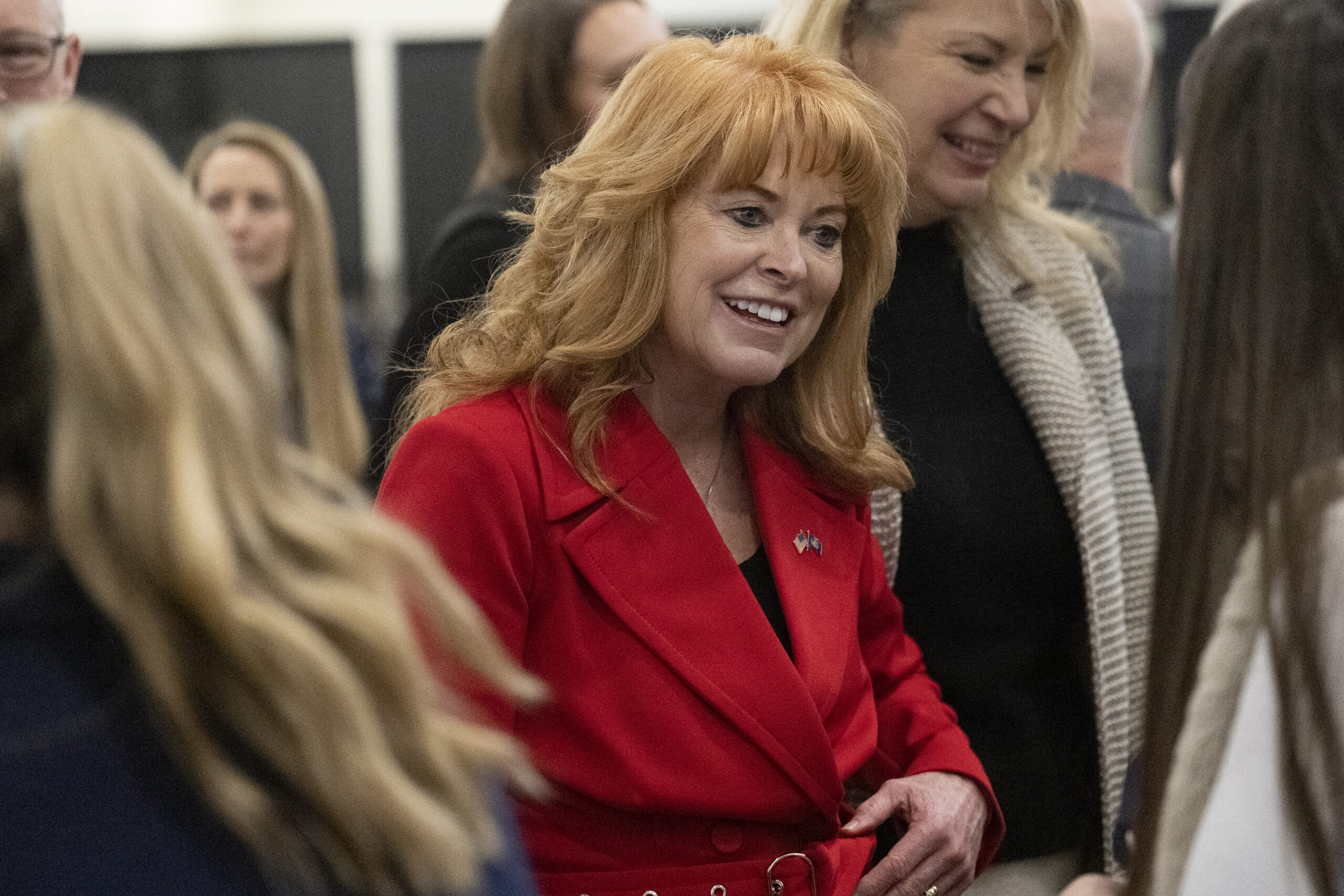
Stacy Garrity, Pennsylvania treasurer, at the Pennsylvania Farm Show in Harrisburg in January.
GTP’s owner, Austria-based Plansee, has relied mostly on recycled Western tungsten, along with the few non-Chinese mines. But with tungsten demand and pricessurging, the company has contracted mined metal from new sources, including Korea and Rwanda, after many years of effort, says Karlheinz Wex, Plansee’s executive board chairman.
Korea’s Sandong mine, once among the world’s biggest suppliers, shut in 1994 as cheaper Chinese tungsten flooded world markets. The mine has reopened with financial support from the Korean government, technical assistance from U.S. agencies, and an exclusive supply deal to GTP. It’s owned by Almonty, a multinational mining company partly owned by Plansee. Almonty is moving its headquarters to the U.S. from Canada.
Wex agreed to take questions about the tungsten trade and GTP, purchased from lighting maker Sylvania in 2007. This conversation has been edited for clarity and length.
How did a tungsten processing plant end up in Pennsylvania?
That is where it started more than 100 years ago. The company focused on medical applications. Later, it went into the lighting business[pre-LED light bulbs used tungsten filament]. We have focused it 100% on tooling and special applications, such as artillery shells, and mostly in alloys with nickel and iron for tools, and with carbide and cobalt in machines for cutting, drilling, mining.
The journey starts by creating tungsten scrap from customers and competitors. Our tungsten supply is 70% scrap recycling, from tools and drill bits.
Austria-based Plansee owns the tungsten powdering plant in Towanda, Pa., which processes about one-tenth of the world’s supply of the heavy metal, used in tools and weapons.
Why did your company, which relied on Chinese tungsten, also lobby to reduce imports from China?
We always had this topic of sources independent from China, from the politics and their pricing. The mining of tungsten in the West was not that much [because of] the unfair competition flooding Chinese materials into the market. We wanted to get independent of that.
Why are you buying tungsten from Africa now?
Tungsten is a so-called conflict material. When we can certify it’s conflict-free, the material from that mine is really sound. The people at Trinity Metals [in Rwanda], we’ve known for years. Our specialists visit their mine.
The U.S. government’s involvement made it easier to prove we can support national security in the West. We buy their entire production.
Rwanda President Paul Kagame at Trinity Metals’ newly expanded, reopened Nyakabingo tungsten mine in May 2025. The mine’s entire production is sold to Plansee, an Austrian company that processes one-tenth of world tungsten output at its General Tungsten & Powders plant in Towanda, Pa.
How does tungsten get from Rwanda to Pennsylvania?
At the mine they separate the tungsten, crushing and separating the material by weight, or separating it by flood behind a dam. That makes a concentrate, about 60% tungsten. They put it in big bags and drums, very heavy. It’s easy to transport in standard containers [usually through the port of Mombasa [in Kenya], arriving through Newark or other East Coast ports and trucked to Towanda].
Does the sale price of tungsten today cover all those costs?
We have record prices in the tungsten market. Last year the price tripled. We don’t have enough [supply].
The big problem is the Chinese have restricted exports. And the U.S. has forbidden the use of Chinese material for defense applications, as of this year. About 10% of tungsten goes into defense applications.
Will Rwanda make a big difference in the supply chain?
Rwanda is a small part.
We rely on recycling. The biggest growth in supply that we see is the Sandong mine in South Korea. We have supported that financially. They will ship the concentrate to San Francisco [ports] and then by land to Towanda.
Karlheinz Wex, chairman of the executive committee of Austria-based global miner Plansee, on a 2025 visit to the company’s Global Tungsten & Powder (GTP) mill in Towanda, Pa.
We are working at capacity. We could produce 50-60% more and sell it on the market. We are sold out for the next six to nine months. Some of our customers are desperate.
We are thinking of expanding in Towanda.
Have you kept in touch with Stacy Garrity since she became a public official?
Yes! It’s good to see her as state treasurer and potentially governor of Pennsylvania. She worked a long time for GTP after she was in the Army.
Acaden Lewis toed the free-throw line with 3 minutes, 35 seconds left in the second half Tuesday night and Villanova trailing Marquette by three. The freshman point guard released the first of two attempts and watched as it failed to reach the rim. The second attempt was only mildly better and clanked off the front of it.
Just over a minute later, he was back at the line after being fouled on a drive. The deficit still was three.
In this moment, it would be Tyler Perkins who inspired the winning plays in Villanova’s 77-74 victory. They were visible all night in Perkins’ clutch three-pointers, his game-winning block, and a key steal as he finished with a team-high 22 points.
But his night also included a moment of leadership, a junior making sure a freshman could forget what had just happened.
“Tyler came up to me and was just like, ‘You’re built for these moments,’” Lewis said.
“I just relaxed and shot them.”
Both free throws went in. Lewis cut Marquette’s lead to one. The tide was starting to turn, and Villanova (19-5, 10-3 Big East) rode the wave and avoided a bad loss to a struggling Marquette team.
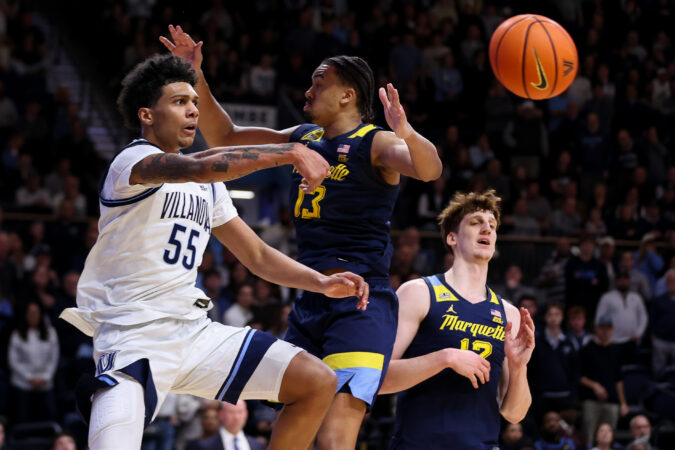
A Villanova free throw misses the hoop during the second half against Marquette on Tuesday.
That is the thing about free throws. They giveth and taketh. Lewis described his two misses as “uncharacteristic,” but he is shooting 60.5% for the season, and the Wildcats entered Wednesday ranked 285th in the country and 10th among 11 Big East teams in free-throw percentage (69%).
They made their last six free throws and won the game at the line over the final 2 minutes, 10 seconds. But they were in a tight game against an inferior opponent largely because they were 12-for-25 before the closing minutes.
Villanova’s win against Georgetown on Saturday didn’t have to be as hard as it was. Fourteen missed free throws made it nervy. The fans who were at Finneran Pavilion on Tuesday night know the issues well. They gave a Bronx cheer to freshman Chris Jeffrey when he made a pair of free throws midway through the second half.
It is worth mentioning that the struggles are abnormal for a program that consistently has resided at the top of the conference and near the top of the country in free-throw percentage for much of the last decade. But it is not particularly relevant context, given that Kevin Willard is in his first season coaching an entirely new team.
Still, what gives?
“Everyone is in there every day,” Willard said. “It’s not like we’re not doing it. I think it’s a little mental right now. I think we miss one, and it’s like we got a little bit too much negative emotion right now on the free-throw line. I’ve got to change that somehow.”
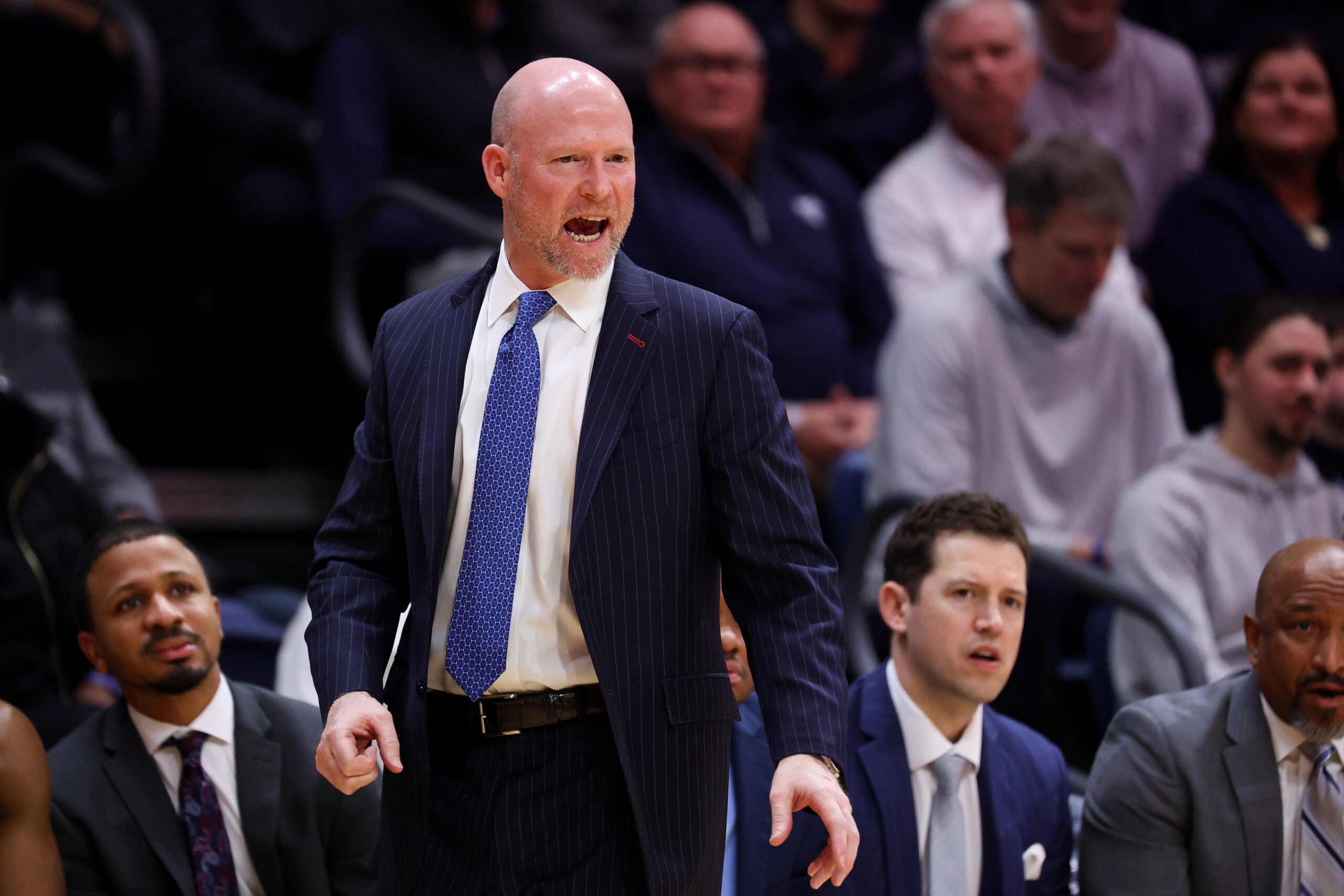
Villanova coach Kevin Willard calls out instructions during the first half against Marquette on Tuesday.
How does one change a mentality this late in the season?
“We’ll get there,” Willard said. “If we can improve our free-throw shooting and make a couple layups in the first half, it’s a completely different game. We held them to 32 points [in that first half], we should’ve had 44 points, and it’s a different type of game.”
Willard was flanked in his postgame news conference by Lewis and Perkins. He turned to Lewis and mentioned that the freshman shoots around 200 extra free throws after practices and noted that Perkins, who is shooting 75% for the season, never misses in practice.
“I have a lot of confidence in these guys that as we go through February and get into March that we’ll make them,” Willard said.
Bryce Lindsay made his first shot Tuesday night, a three-pointer less than three minutes into the game.
It had to, at least briefly, feel like the weight of the world was off his shoulders. Lindsay entered the night having made just 15 of his previous 64 attempts from three-point range (23.4%) over Villanova’s last 10 games since the calendar turned to 2026. The sharpshooting redshirt sophomore guard was a big reason behind Villanova’s strong start to the season, but he has reached double figures just four times in the last 11 games. That initial attempt Tuesday night was his only make on six three-point tries. He went scoreless Saturday afternoon at Georgetown.
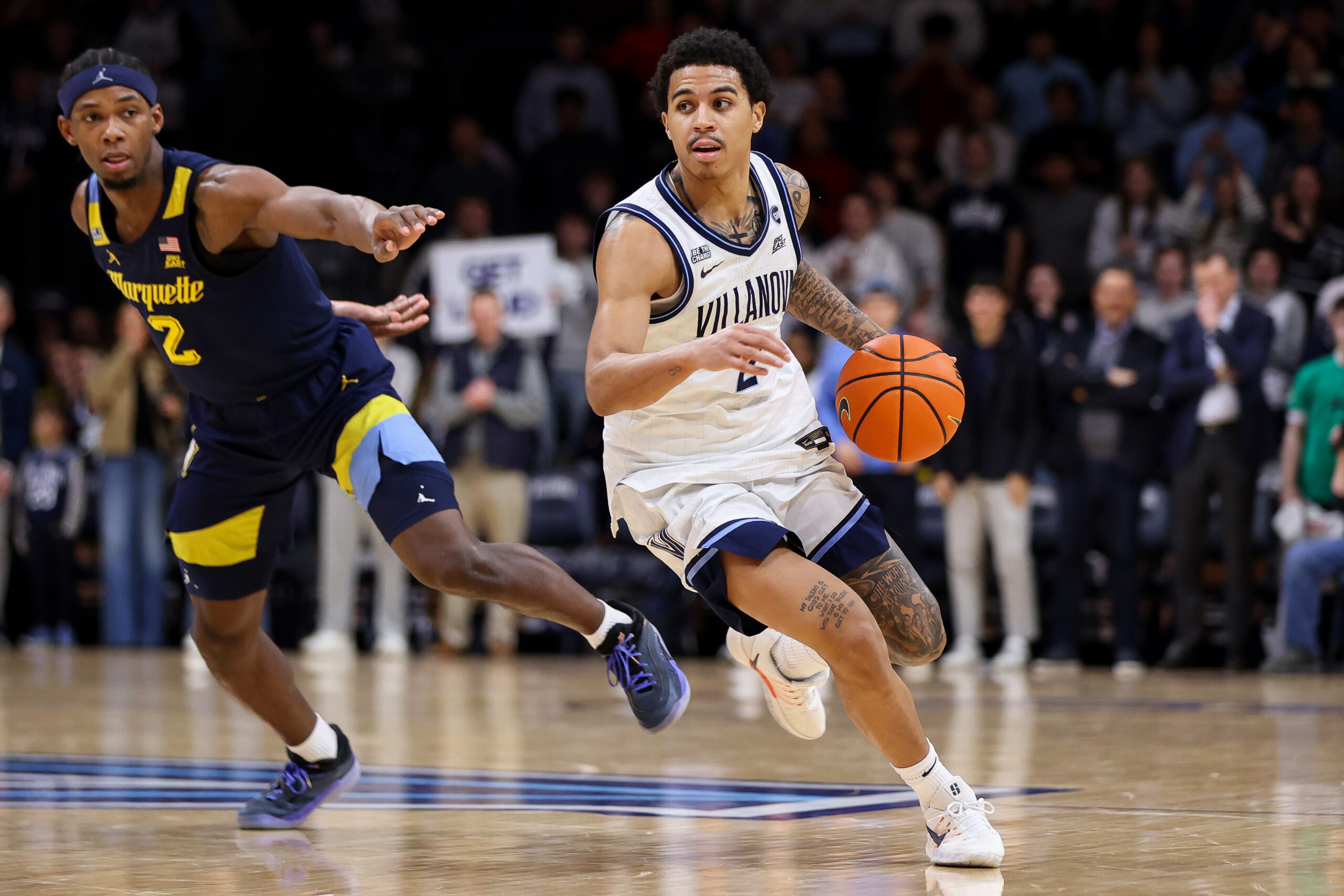
Villanova guard Bryce Lindsay dribbles past Marquette’s Chase Ross during the second half Tuesday.
“He’s going to get going,” Willard said. “It’s a little mental. I talked to the team earlier, before the game, about staying in the moment. Talking to each other and not worrying about the past, not worrying about the future, just trying to stay in the present. Sometimes it’s hard when you’re not playing well to kind of stay in the moment.
“I have a lot of confidence in Bryce. He’s in the gym with me every day working. He’s going to get it. I thought he had some good opportunities tonight. When you’re struggling the way he’s struggling, sometimes you just need one, get a good bounce, bank one in. I told him to sleep on the other side of the bed tonight. Sometimes you’ve just got to try something different.”
Something different, like starting sixth man Devin Askew and giving Lindsay a different look off the bench?
“No,” Willard said. “He’s still doing a lot of other things, and people have to guard him.”
Lindsay did affect the game in positive ways despite only scoring four points. He was plus-8 and had three rebounds and four assists, including a key pass to the corner for a Matt Hodge three-pointer with 4:20 left in the game.
Willard said he likes Askew coming off the bench as a “security blanket.”
Speaking of which … it was Askew who made two free throws with 11 seconds left that gave Villanova a three-point lead and forced Marquette into a desperation three-point attempt.
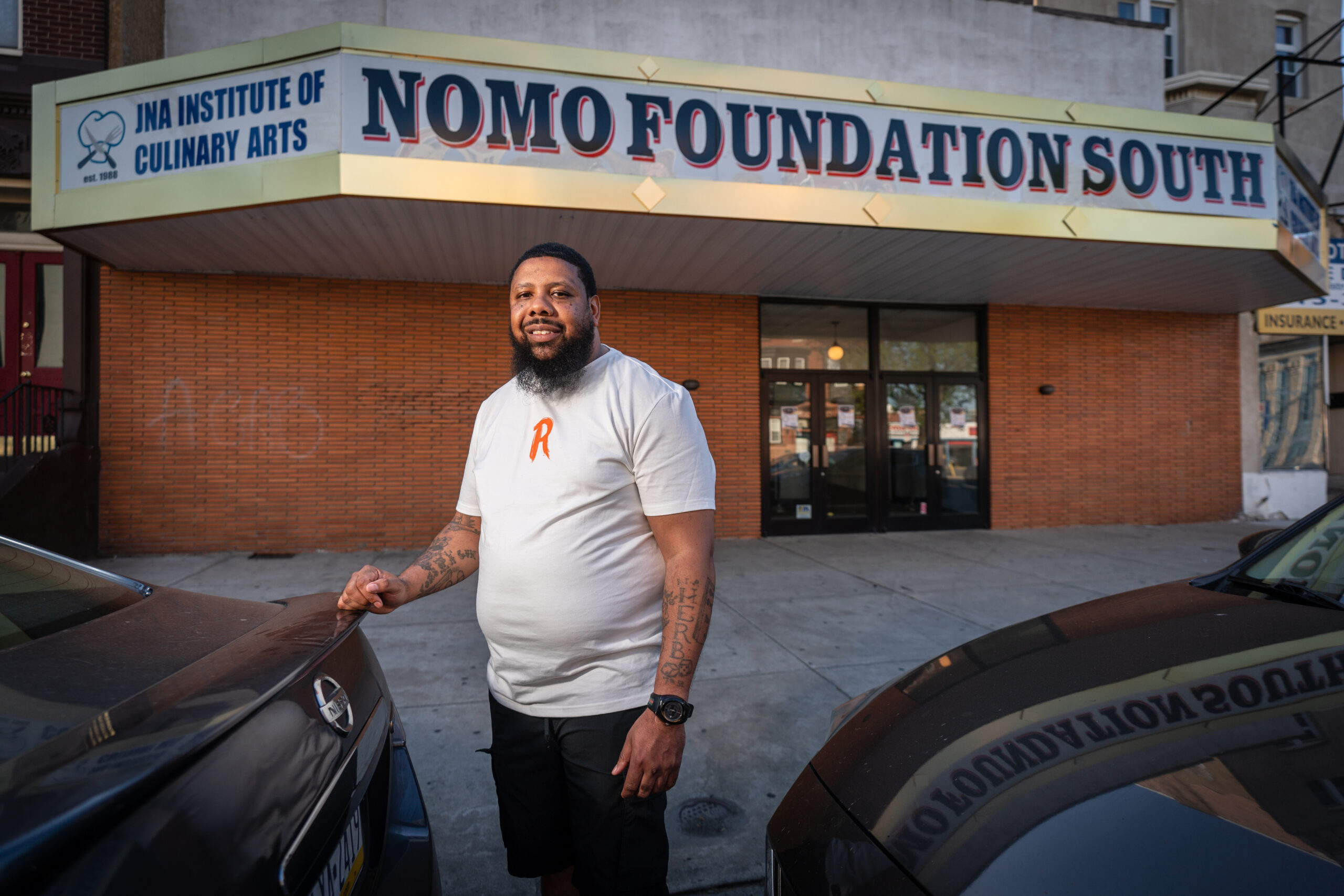
Philadelphia and state officials awarded more than $6 million in taxpayer funds over the last five years to a politically connected but financially unstable anti-violence nonprofit, despite repeated warnings from city grant managers about improper spending and mismanagement, an Inquirer investigation has found.
The group — New Options More Opportunities, or NOMO Foundation — received city and state anti-violence grants and locally administered federal dollars to expand its youth programs and launch a new affordable housing program. The money fueled NOMO’s rapid rise from a small, grassroots outfit into a sprawling nonprofit that took on expenses it ultimately could not afford.
Mayor Cherelle L. Parker has publicly touted NOMO’s work in the community, and she further boosted its profile by naming its director to her transition team upon taking office. But behind the scenes, Parker administration staffers watched NOMO face mounting financial pressures over the last two years.
In that time, the organization has been hit with multiple eviction filings and an IRS tax lien, and had to lay off staff and suspend programming. Most significantly, NOMO had to terminate its housing initiative last year — displacing all 23 low-income households that had been its tenants.
The warning signs were evident years earlier. Records obtained under Pennsylvania’s Right to Know Law show that city grant managers expressed concerns as far back as 2021 about NOMO’s lack of financial controls, incomplete balance sheets, and chronic inability to provide basic documents. As recently as last year, the city was unaware who sat on the group’s board.
Yet records show city officials kept propping up the group with more funds, without successfully putting in place the kind of structural support that might have kept it from foundering. Last year, the city sought to award a $700,000 federal homelessness prevention contract to NOMO, but the nonprofit was unable to meet the conditions of the contract and the funds were never disbursed. Officials also proposed writing more funding to NOMO into last year’s city budget as a last-minute line item. That effort failed.
In a September interview, NOMO executive director Rickey Duncan blamed city officials for funding delays.
“I was breaking my back to make sure those young people were getting housed,” Duncan said. “We built a tab that was so big we couldn’t pay no more, because the city didn’t pay.”
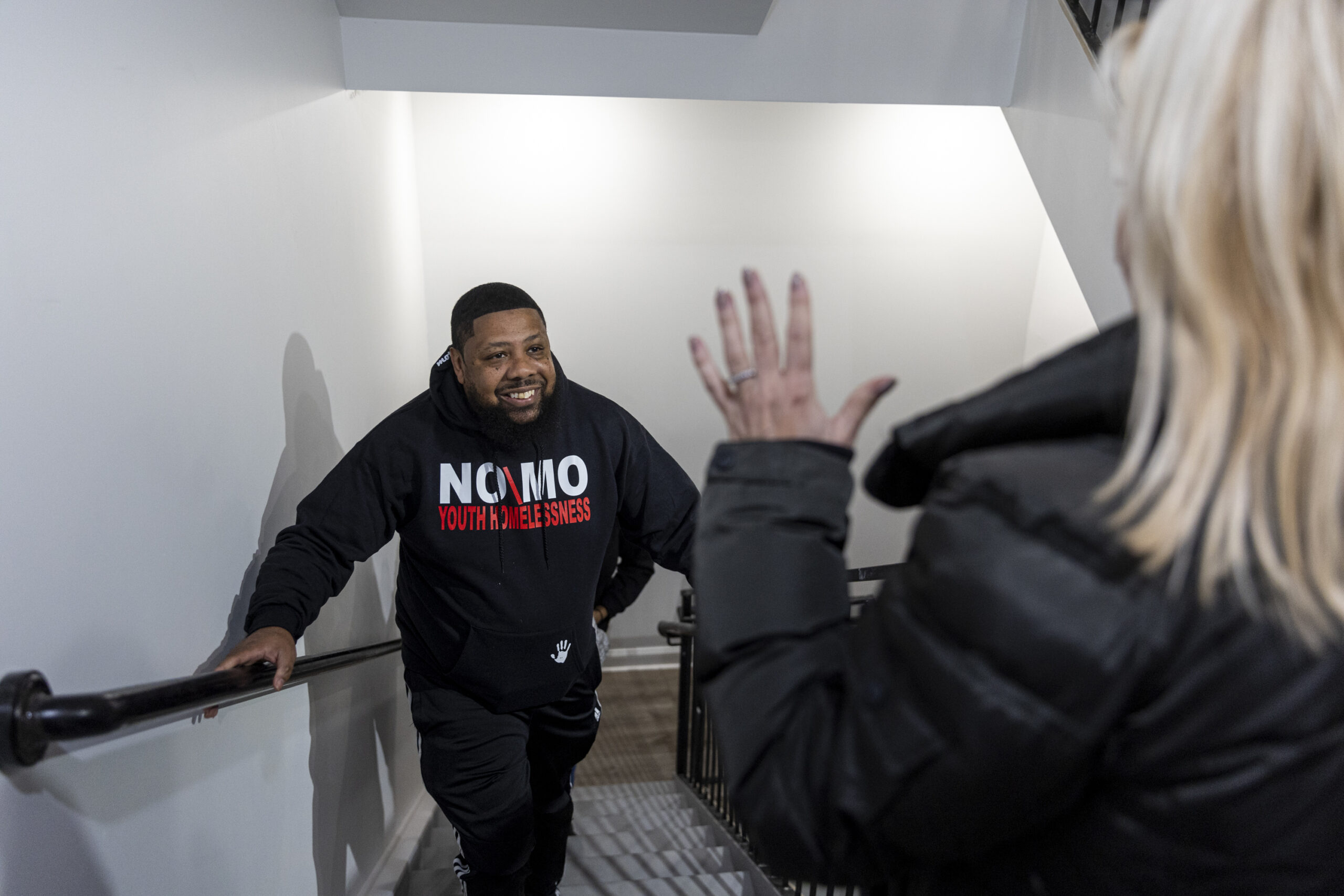
Rickey Duncan surprised a group of young women with apartments in a December 2022 file photograph. Last year, NOMO gave up the leases for the apartments citing a lack of funding.
Much of the money awarded to NOMO came via Philadelphia’s Community Expansion Grant (CEG) program, launched in 2021 to respond to record gun violence and support alternatives to policing. NOMO was one of only two initial grantees to receive the maximum $1 million award, which was meant to help the group scale up its operations and serve more at-risk youth.
NOMO’s financial records detail spending that quickly led to trouble after it received the first city grant, starting with the decision to devote most of the funds to launching a costly housing initiative while opening sprawling new youth centers to expand its after-school programs to new neighborhoods.
Duncan signed annual building leases totaling $750,000, and increased his own salary from $48,000 in 2021 to $144,000 the next year. (Duncan said that his pay — now $165,000, according to the most recent tax filing — is below average for an organization of NOMO’s size and was previously lower because he was volunteering half his time.)
The records contain no evidence that city grant managers questioned the lease expenses or conducted an evaluation of whether the upstart housing program was an appropriate addition to the organization’s core mission of offering after-school programming.
By the start of last year, a tax lien and lawsuits over unpaid rent threatened NOMO’s existence. Still, Duncan asked the city in January 2025 to reimburse the roughly $9,000 cost of two Sixers season tickets he purchased a year earlier. He explained in a memo that the tickets were “an innovative tool for workforce development.”
“Season tickets to the Sixers are not an acceptable programmatic expense,” the grant program manager responded in an email.
Records show that city officials discovered in April that a $35,000 IRS lien, filed four months earlier, had rendered NOMO ineligible for grant funding. Grant administrators sent an email to NOMO staffers with a warning written in all-caps: “CEASE ALL SPENDING.”
Duncan said that the lien was the result of a missing signature on a tax form, and that it was eventually resolved at no cost. But in a June email to Public Safety Director Adam Geer and other city officials, he accused the city of pushing his organization to the brink of collapse.
“I am respectfully requesting a written response detailing how a tax [lien] escalated into a comprehensive investigation into the NOMO Foundation’s financial health,” Duncan wrote. “NOMO has been disrespected, attacked, and harassed, by members of this office on this and previous occasions.”
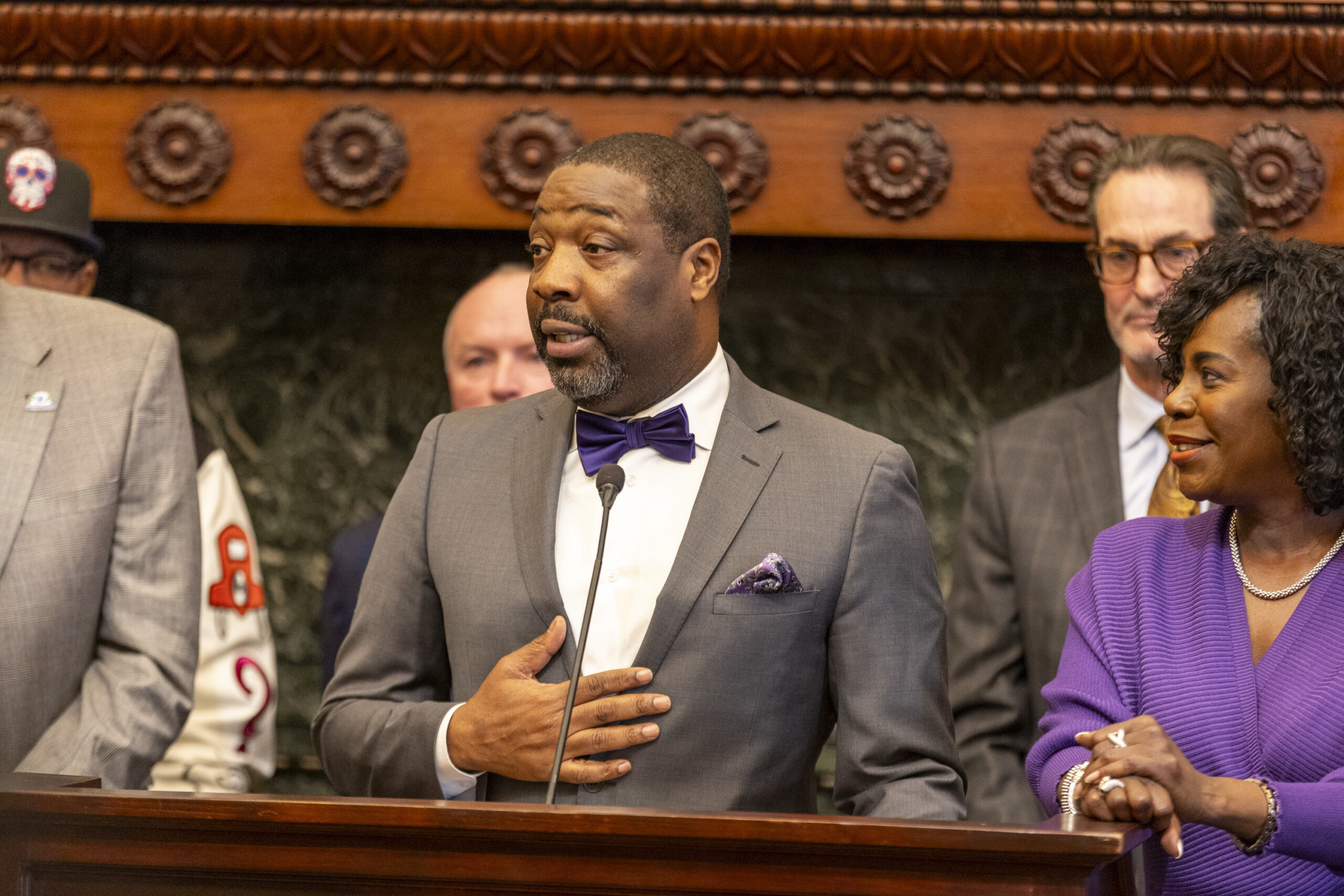
City Council President Kenyatta Johnson, speaking on Jan. 20. Regarding NOMO, he says, “It is crucial that any concerns are taken seriously.”
In a statement responding to The Inquirer’s findings, Johnson praised NOMO and credited the organization with “working with children throughout Philadelphia, intervening in cycles of violence, and literally saving lives in our community.”
Johnson, who was listed as a reference on the group’s most recent grant application, added: “Regarding any allegations raised against Mr. Duncan and NOMO, I am confident that the City of Philadelphia’s Office of Public Safety will review these matters thoroughly, fairly, and professionally. It is crucial that any concerns are taken seriously and examined through the proper channels, with facts guiding the outcome.”
A spokesperson for Parker referred questions to the Philadelphia Office of Public Safety, which manages CEG grants.
In a written response, a spokesperson for the department, Jennifer Crandall, praised NOMO’s efforts.
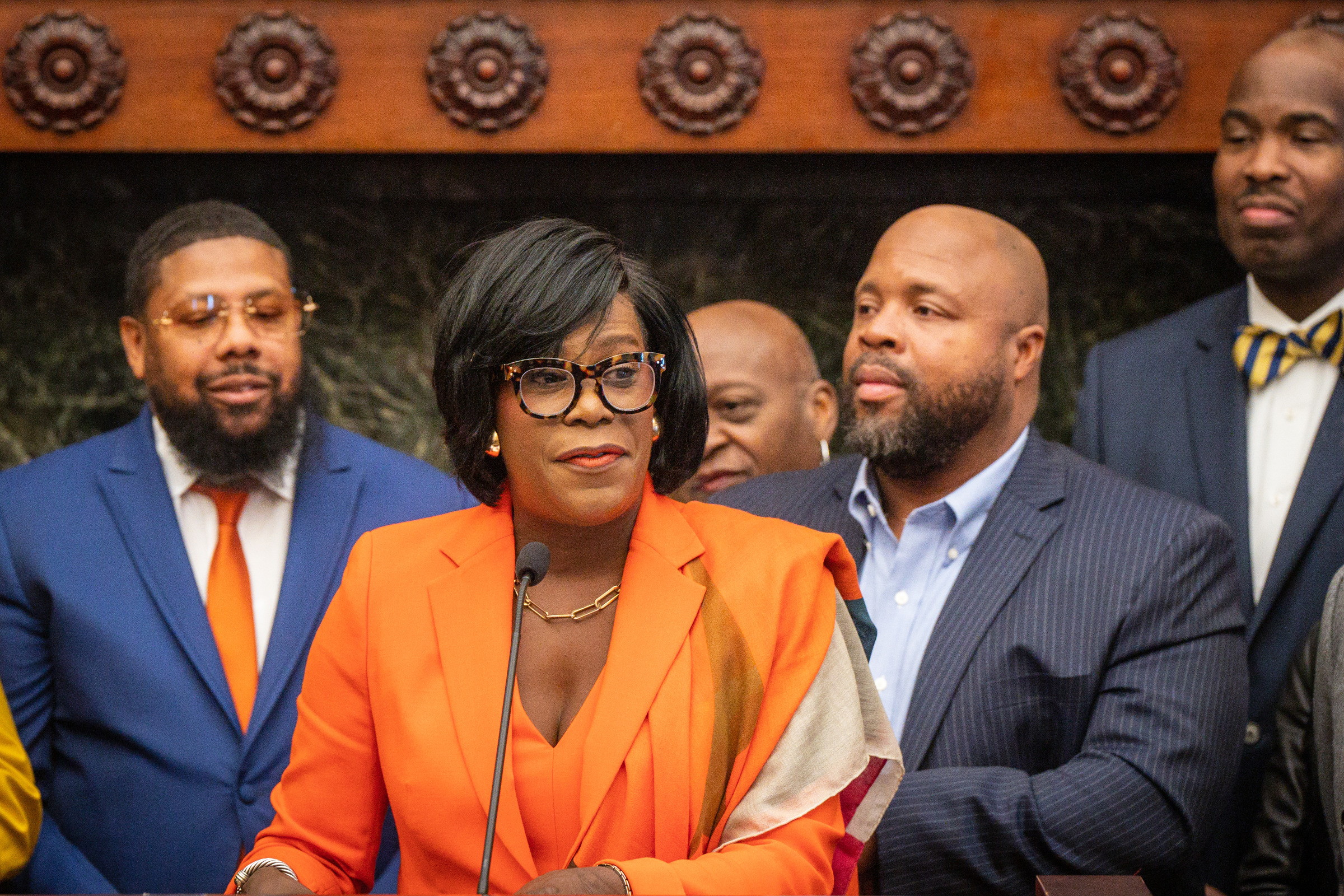
Rickey Duncan (left) and then Mayor-elect Cherelle Parker at a news conference that outlined Parker’s transition team and the plans that she had for her administration on Nov. 9, 2023.
“Not only has NOMO delivered on grant-funded programs, it has become an important partner on city initiatives like interventions with at-risk youth,” Crandall wrote. She cited evaluations by an unnamed third party that credited NOMO for providing “holistic support to participants … beyond the immediate program activities” and “addressing the broader social determinants of violence.”
Crandall did not respond to a follow-up request for the evaluation.
Duncan gave The Inquirer a 2023 report prepared by four nonprofit partners that evaluated CEG recipients in their first year, with the intention of documenting program goals and activities. The report states that the evaluation was based on a single site visit, interviews with staff, and a youth focus group, and that it was then too soon to evaluate impact. It noted that NOMO had retained more than half its participants over the grant cycle and had created “an environment that is welcoming and comfortable, so that participants willingly show up.”
The assessment did not address the viability of the housing program, nor did it cite any metrics that might be used to gauge whether NOMO’s programs had reduced community violence.
Duncan also sent The Inquirer written statements from two landlords indicating that their court cases against him had been resolved, and that they support NOMO’s mission.
He says NOMO is now financially stable, despite three years of tax returns showing the nonprofit in the red. He said NOMO’s programs now serve about 140 children a year across its three locations — about the same as when it was operating in just one location in 2019 and before the city awarded the expansion grants.
Laura Otten, a nonprofit consultant and former director of La Salle University’s Nonprofit Center, said it was clear the city’s grant awards to NOMO had not fulfilled their stated goals.
“It obviously didn’t work if they ended up having to evict people,” she said. “Where is the evidence that this grant has improved the capacity of the organization?”
Dawan Williams (left), vice president of restorative justice for the Nomo Foundation, and Rickey Duncan, Nomo CEO and executive director, in one of the student spaces at the foundation on South Broad Street on April 13, 2023.
‘Significant weaknesses noted’
When Parker laid out her priorities in her first budget address before City Council in spring 2024, she mentioned Duncan and NOMO by name as she praised the grassroots anti-violence organizations “working each day to lessen the pain and the trauma caused by gun violence.” She also promised to reward the various groups with an additional $24 million in grant funding.
It was another highlight of Duncan’s well-documented redemption story. By his own account, he dropped out of South Philadelphia High School in 1994 to sell drugs and promote concerts, earning the nickname “Rickey Rolex” for his flashy style. He was arrested the next year for robbery and spent more than a decade in prison. After he was released in 2015, Duncan began volunteering with NOMO, then a fledgling nonprofit, and eventually took the reins.
“My vision started off, to be honest, just wanting to help kids and give back to a city that I took from,” Duncan said in a 2023 interview with The Inquirer.
NOMO began as a largely volunteer-run effort operating in borrowed space on less than $50,000 a year, tax returns show.
In 2019, the tiny nonprofit submitted a grant application to Philadelphia Works, the city’s workforce development board, which was tasked with distributing about $6 million in federal Temporary Assistance for Needy Families (TANF) grants. NOMO proposed after-school programs that would teach up to 125 kids everything from neuroscience to software development to road construction.
Philadelphia Works awarded NOMO $209,000, skipping the standard financial review in order to disburse funds that would have otherwise expired.
“It breathed life into us,” Duncan said.
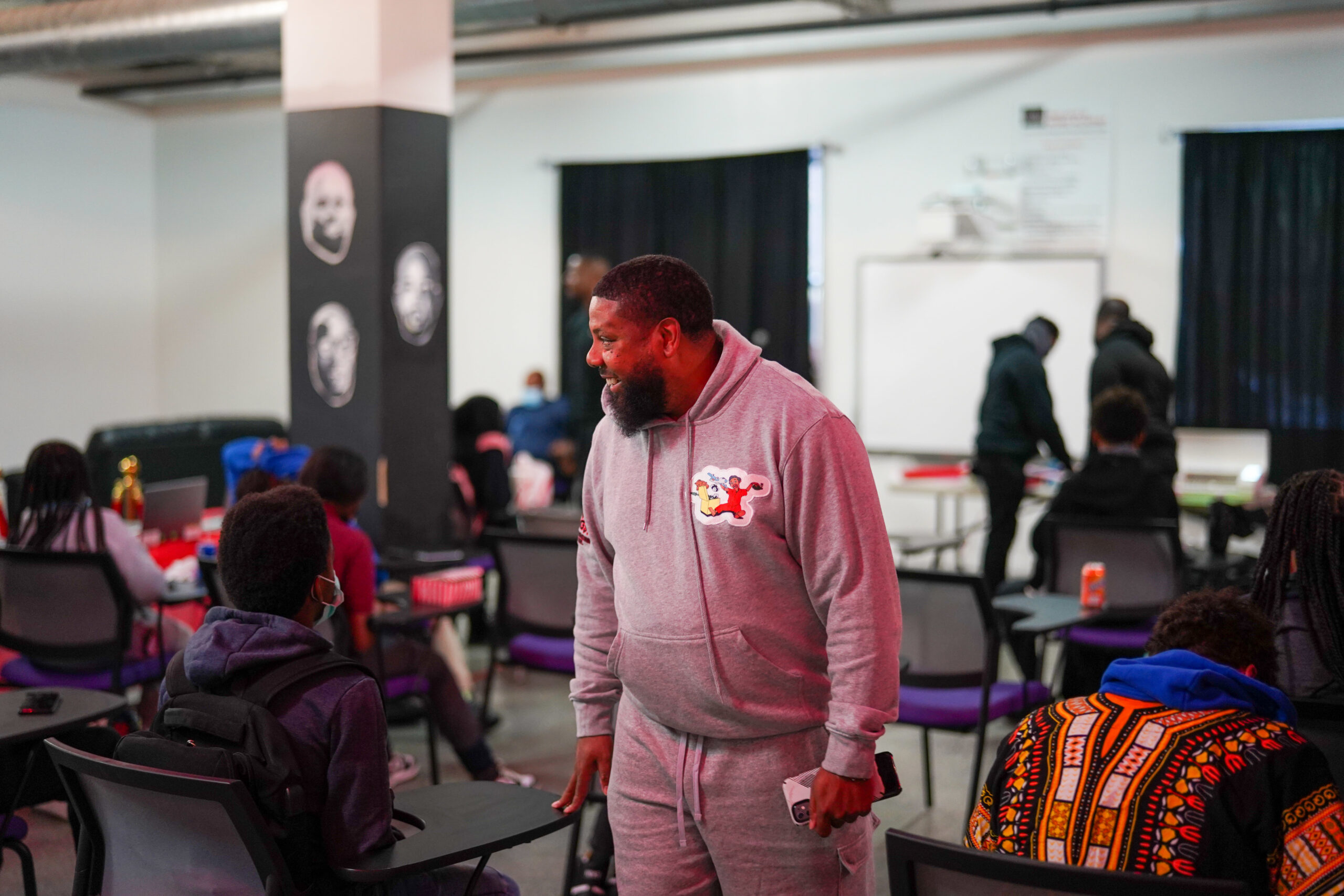
Rickey Duncan speaks with kids at a NOMO after-school program in a 2021 file photograph.
By 2021, NOMO was receiving half a million dollars annually in TANF money — enough to lease a 7,000-square-foot office space on North Broad Street and support programs for more than 100 young people. And Duncan’s star was rising as a charismatic and credible voice who came up from the same streets that he and others were working to rid of violence. Elected officials and news media alike turned to him for quotes and photo ops amid a surge in shootings.
In December 2021, then-Mayor Jim Kenney announced a $155 million investment in gun violence prevention funding. The plan included a $22 million grant program, with more than half that focused on “supporting midsized organizations with a proven track record” to “expand their reach, deepen their impact, and achieve scale.”
Duncan’s scrappy, homespun nonprofit was exactly the type of group city officials had in mind when they created the CEG program, and his grant application cited support from State Reps. Danilo Burgos and Elizabeth Fiedler. Although 30 other nonprofits received funding, NOMO was one of only two organizations awarded the maximum grant of $1 million — a transformative sum that would roughly triple NOMO’s operating budget.
In his first application for the CEG funds, Duncan pledged to expand his “trauma informed” after-school program to South Philadelphia by offering paid work experience, academic support, and intensive case management. The $1.4 million proposed budget projected the organization would spend about $1 million annually on staff salaries and participation incentives for teens, while spending $94,000 a year to cover added lease costs.
NOMO devoted just one sentence of its 15-page grant application to describing a new affordable housing initiative “to combat youth homelessness.” The proposal did not include what metrics would be used to judge that program’s success.
Despite the brief mention, the housing initiative would become the organization’s largest single budget item, by far.
After securing the city grant money, NOMO took on a $552,000 annual lease for a newly built 27,000-square-foot West Philadelphia apartment complex near 40th Street and Lancaster Avenue. It also signed a $192,000-per-year lease for a 17,000-square-foot former culinary school on South Broad Street.
The deals left NOMO with youth centers in North, South, and West Philly, each with large event spaces that could host its programming. Duncan also planned to market the venues for private events — such as weddings and Eagles watch parties — to generate additional revenue.
NOMO students bounced a basketball in the ballroom at the nonprofit’s South Broad Street youth center. The space is offered for event rentals, which Duncan said can generate crucial unrestricted income.
If city officials had concerns about NOMO’s costly expansion strategy or the viability of his plan to lease out the youth centers for parties, they are not reflected in the available records.
However, staffers at the Urban Affairs Coalition — a nonprofit the city had contracted to manage the first round of the grant program — flagged NOMO’s general lack of financial controls in a December 2021 fiscal assessment of prospective grantees.
“Significant weaknesses noted,” an Urban Affairs staffer wrote of NOMO in an email to then-anti-violence director Erica Atwood and other city officials. “No audited financials. No balance sheets presented even in the [IRS Form] 990s. Separation of Authority: Basically non-existent.”
That month, the city instructed Urban Affairs to proceed with the scheduled grant advance of $200,000 and to work with NOMO to establish a remediation plan. Instead, grant administrators wrote that they were reassured after NOMO installed a new chief operating officer — who left the organization the following year.
By the end of the grant cycle, Duncan was able to deliver a public relations win for NOMO. He appeared on Good Day Philadelphia in December 2022 to launch the housing plan with a surprise giveaway of the first of 23 brand-new apartments for young women, many of them single mothers.
Duncan said NOMO’s housing program would cover 70% of rent costs for 18 to 24 months while enrollees seek employment and eventually move out on their own.
“They’ll be getting their credit together so they can prepare to become a homeowner,” he told Fox 29. “We need money to finish doing this.”
Rickey Duncan, CEO and executive director, at Nomo on South Broad Street on April 13, 2023.
Billion-dollar dream
The city renewed NOMO’s grant in January 2024, this time for $850,000. But a tax return the same year showed the organization was already $710,000 in the red.
Months later, the nonprofit faced its first eviction suit, targeting its North Broad headquarters, and had to cut a check for $275,000 in back rent — the equivalent of one-third of its city grant money for that year.
By the fall of 2024, records show NOMO had spent only about 5% of the $150,000 initially budgeted for youth incentives, outside activities, equipment, or program supplies. The city withheld most of NOMO’s fourth-quarter grant funding, reducing the nonprofit’s award by $170,000 to a total of $680,000 for that year.
Still, the city re-upped the group for a third grant in 2025, this time for $600,000.
By January 2025, financial records show NOMO had virtually stopped spending on youth programming. It laid off most of its staff as landlords for all three youth centers took legal action against the nonprofit over hundreds of thousands of dollars of back rent.
NOMO sought to justify the expense of Sixers season tickets with a narrative submitted to the city, which denied the expense. Duncan said the majority of the tickets went to youth participants and members of the community.
Around then, NOMO received an infusion of support in the form of a $950,000 grant from the Pennsylvania Commission on Crime and Delinquency. But the TANF funds had run out, and the organization’s problems continued. City officials had NOMO submit a formal “performance enhancement plan” last July.
Duncan said in September that NOMO had cut costs, hired a new accounting firm, and was working toward “full financial stability.” It resolved two eviction cases by reducing its real estate footprint — downsizing its North Philly headquarters into basement offices and terminating its affordable housing program. Duncan said the former tenants moved in with family members or were transferred to the nonprofit Valley Youth House, which provides transitional housing.
After The Inquirer asked Duncan about the most recent lawsuit over back rent, this one for $312,000, his landlord filed notice in court that the matter was resolved. Duncan said keeping three youth centers and marketing the NOMO spaces for special events are key parts of his business plan as the organization continues to settle its debts.
The spate of lawsuits has not dampened the city’s enthusiasm for Duncan’s nonprofit. Crandall, the spokesperson for the Philadelphia Office of Public Safety, said NOMO remains eligible to receive funds when a new round of grants are awarded this year.
And with the housing initiative scrapped, NOMO is left pursuing its original mission — anti-violence programming for city youth. The organization’s renegotiated leases for its three youth centers now total $360,000 a year, roughly half what NOMO had been paying.
In a 2023 interview, Duncan acknowledged that he underestimated the financial demands of running an organization on a citywide scale.
“As a kid you think, … ‘If I can get a million dollars, I’ll be rich.’ And then you’re broke again,” he said then. “I had a billion-dollar dream. I didn’t realize it was a billion-dollar dream.”
ACKNOWLEDGMENT
The Inquirer’s journalism is supported in part by The Lenfest Institute for Journalism and readers like you. News and Editorial content is created independently of The Inquirer’s donors. Gifts to support The Inquirer’s high-impact journalism can be made at inquirer.com/donate. A list of Lenfest Institute donors can be found at lenfestinstitute.org/supporters.
Tyrese Maxey vowed in an emotional post-draft interview that the Sixers wouldn’t regret picking him 21st overall in 2020. It’s a promise that resonated with fans still scarred by Process-era selections that failed to pan out.
It’s safe to say that Maxey delivered immediately and has improved every season since, peaking with the guard earning an All-Star starting spot this season.
While he has always been an efficient scorer in an offense built around Joel Embiid, Maxey has emerged as the Sixers’ offensive engine — especially this season, as Sixers starters Embiid, Kelly Oubre Jr., and Paul George missed time because of injuries and a suspension.
Whether the 2023-24 Most Improved Player could maintain his efficiency under an expanded offensive burden was an open question. Maxey has again answered by posting career highs across the board while playing the best defense of his career.
As he steps into this leadership role on the team, every decision Maxey makes on the court dictates the Sixers’ chances of contention. It’s a lot of pressure. Think you can step into his New Balances and play the game like Maxey?
Maxey is coming down the court in early offense, what’s his next move?
You got it, Maxey’s a blur in transition. He uses his speed to drive straight into multiple defenders, scoring the bucket and drawing the foul.Not quite, Maxey’s a blur in transition. He uses his speed to drive straight into multiple defenders, scoring the bucket and drawing the foul.XX% of other readers knew what Maxey was thinking here.
Pace is the name of the game for Maxey, who is among the league leaders in transition points scored per game, an aspect of the game usually dominated by burly forwards like Giannis Antetokounmpo and LeBron James.
Transition Scoring leaders
Player
Team
FG%
PTS
Giannis Antetokounmpo
MIL
73.1%
7.9
Tyrese Maxey
PHI
55.7%
7.1
Donovan Mitchell
CLE
52.9%
7
LeBron James
LAL
64.5%
6.9
Jaylen Brown
BOS
58.7%
6.8
Sorted by number of transition points per game. Source: NBA.
Maxey’s quickness makes him an end-to-end threat in early offense, evidenced by the fact that he has covered the most distance of any player in the league this season.
story continues after advertisement
Maxey is mismatched against Bucks forward Bobby Portis. How should he make use of his quickness advantage?
You’re cooking! Maxey unleashes a crossover combination that tilts Portis off-balance before stepping back for a 31-foot pull-up jump shot.Cooked … Maxey unleashes a crossover combination that tilts Portis off-balance before stepping back for a 31-foot pull-up jump shot.XX% of other readers knew what Maxey was thinking here.
Maxey’s three-point shooting has always been solid, but he has now reached truly elite territory. He’s taking — and sinking — more threes from well beyond the arc, making him a threat from almost anywhere on the floor. Among high-volume three-point shooters, Maxey is among the leaders in accuracy on deep three-pointers, shooting on par with Stephen Curry from that range.
Long Distance 3PT Shooting Leaders
Player
Team
3PTM
3PT%
Tyrese Maxey
PHI
145
38.1%
Donovan Mitchell
CLE
143
38.2%
Stephen Curry
GSW
139
38.3%
James Harden
CLE
121
37.8%
LaMelo Ball
CHA
109
36.9%
At least 280 attempts between 25-29 feet at above 36%. Source: NBA.
A larger share of Maxey’s threes are now self-generated compared to earlier in his career. Isolation shots, like the above example against the Bucks, eviscerate slower defenders who struggle to keep up with Maxey. Although Maxey is taking more difficult shots with the defense more focused on him, his accuracy remains steady compared to his previously elite seasons.
Maxey is coming down the court in transition again. What’s his next move?
Found the alley and the oop! Maxey finds Embiid rumbling down the center of the court, lobs the perfect pass where only Embiid can reach it, and he throws it down.How’d you miss the big man? Maxey finds Embiid rumbling down the center of the court, lobs the perfect pass where only Embiid can reach it, and he throws it down.XX% of other readers knew what Maxey was thinking here.
Maxey is averaging a career high in assists this season. That’s mostly due to an increased playmaking burden, as the Sixers have routed more offense through Maxey than Embiid.
That said, Maxey is by far Embiid's most prolific setup man. After all, their two-man game provides some of the Sixers’ most effective plays, as evidenced by how their pairing leads all Sixers two-man lineups in plus/minus.
VJ Edgecombe sets a pick for Maxey in the final seconds of an OT thriller against the Memphis Grizzlies.
You found the hot hand. Maxey makes a pass out of a temporary double team and defensive breakdown from the Grizzlies, finding Edgecombe for a game-winning three-pointer.Not the right read! Maxey makes a pass out of a temporary double team and defensive breakdown from the Grizzlies, finding Edgecombe for a game-winning three-pointer.XX% of other readers knew what Maxey was thinking here.
Maxey is having such a dominant scoring season that defenders are staying on him at the expense of guarding other Sixers. In this instance, Memphis’ guards left Edgecombe wide open, even after Edgecombe had already scored 13 points in the fourth quarter.
Some teams have even begun double-teaming Maxey as soon as he crosses half court, a treatment typically reserved for elite guards when they are on shooting streaks.
story continues after advertisement
A screen from a teammate gives Maxey an open lane. What should he do?
On the money, Maxey speeds past his defender to the basket, but he makes sure to get a clean delivery by quickly releasing a wrong-footed left-hand layup.A good guess! But Maxey speeds past his defender to the basket, but he makes sure to get a clean delivery by quickly releasing a wrong-footed left-hand layup.XX% of other readers knew what Maxey was thinking here.
Players are taught to finish layups by using the two allowed steps to take off from the leg opposite their shooting hand. Maxey ignores the orthodoxy, often taking layups with just one step and using his off-hand to throw off his defenders’ timing.
According to basketball analyst Ben Taylor, tracking data shows that Maxey shoots more “wrong-footed, wrong-handed” layups than any other player in the league, shooting an impressive 61% on these high-difficulty shot attempts near the rim.
Maxey’s guarding a corner shooter as Cavaliers big man Jarett Allen is about to roll to the basket. What’s he to do?
You read the action right! Knowing that Embiid is there to protect the basket, Maxey motions toward Allen, pretending to help on his drive, and steals the pass to the corner shooter.A botched assignment for you but not Maxey! Knowing that Embiid is there to protect the basket, Maxey stunts toward Allen, pretending to help on his drive, and steals the pass to the corner shooter.XX% of other readers knew what Maxey was thinking here.
Smaller players like Maxey often don’t provide as much defensive value as larger, stronger players who can protect the basket against bigger opponents. This season, however, he is playing defense with renewed focus by positioning himself better and providing help more promptly.
According to CleaningTheGlass.com, Sixers opponents are scoring fewer points per possession in Maxey’s minutes for the first time in his career, a rarity among guards his size who are also offensive creators. Maxey is also averaging career highs in blocks …
… and steals, highlighted by a recent career-best eight steals against the Indiana Pacers.
2021
0.4
2022
0.7
2023
0.8
2024
1
2025
1.8
2026
2
0Steals Per Game2.5
These are just a few examples of how Maxey has leveled up his game. If Maxey continues to improve his game like he has these past several seasons, it might be possible for the Sixers to have another perennial MVP contender on their roster.
Maxey makes his first All-Star Game start and second appearance on Feb. 15 in Los Angeles.
Staff Contributors
Design and Photo Editing: Jasen Lo and Sam Morris
Development, Data, Reporting and Videography: Jasen Lo
Editing: Sam Morris, DeAntae Prince
Photo and Video: NBA
Copy Editing: John Roberts
Subscribe to The Philadelphia Inquirer
Our reporting is directly supported by reader subscriptions. If you want more journalism like this story, please subscribe today
At 73, I’ve lived through winters in nearly every corner of Pennsylvania — growing up in Erie, studying in State College, spending years in Western Pennsylvania, and now living in Philadelphia. Those regions routinely delivered winters far harsher than what we’re experiencing today: weeks of subzero wind chills, heavy lake‑effect snow, and ice storms that shut down entire towns. Yet, those events came and went with far less fanfare than the coverage we see now.
What concerns me is not the weather, but the framing. Routine cold snaps are now described as “extreme” or “historic,” often without any historical context. When every dip in temperature becomes a headline, the public loses perspective. Discomfort is being redefined, and it’s hard to see who benefits from that beyond media outlets competing for attention.
Weather deserves accurate reporting, but it also deserves proportion. A little historical grounding would help readers understand what is truly unusual — and what is simply winter behaving the way winter always has across Pennsylvania.
Today, a complacent majority of Americans is ignoring a different kind of storm on the horizon — the germinating threat by the Trump administration to interfere in the 2026 midterms. The warning signals for this brewing electoral disaster are as clear as any satellite image and must not be dismissed.
Families across the country are shouldering the strain of unaffordable energy bills. The growing hunger for power from data centers being built in or planned for Pennsylvania is only going to drive costs higher. But data centers are coming. We are going to need more power.
What is the president doing about this problem? What is the president doing to help lower our electric bills?
In December, his Interior Department issued stop-work orders for five offshore wind farms along the Atlantic coast, putting thousands of workers out of a job just days before Christmas. Those five projects, which were already under construction or about to begin, were creating thousands of local jobs, and, when completed, would have provided enough power for 2.5 million homes and businesses — or data centers.
Offshore wind is a reliable and inexpensive energy source that helps communities save money and keep the lights on. In fact, offshore wind is strongest in the winter and at night — right when we need it most. Thankfully, after less than two months, federal judges have ordered all the projects to move forward, putting workers back on the job.
I am calling on the president to stop his senseless attacks on offshore wind. Do something positive to lower our energy costs. Let the workers finish the job.
Peter Furcht,Philadelphia
Join the conversation: Send letters to letters@inquirer.com. Limit length to 150 words and include home address and day and evening phone number. Letters run in The Inquirer six days a week on the editorial pages and online.
DEAR ABBY: My husband is 76 but doesn’t look a day over 60. He has a full head of hair with little graying, no facial wrinkles, and he’s fairly fit. I’m 71 and look every day my age, probably older. I have graying hair — lots of it — but I like the color and will never dye it. I am fit, but the deep facial wrinkles and turkey neck emphasize my age. I “thank” my husband, a man I’ve lived with for 40 years, for this. He has given me years of stress and disappointment.
My issue: When we are out together, strangers inevitably tell him how shocked or surprised they are at how he “doesn’t look how old he is.” I’m left sitting right there feeling as if they think I’m his mother. Every time this happens, for days and sometimes weeks, he will spend time staring at himself in the mirror and reminding me how lucky I am to have such a handsome husband. He has always had an ego problem, but it is getting worse. Is there a response to get him to get over himself?
— MR. HANDSOME’S WIFE
DEAR WIFE: It is my observation that people who compulsively stare into mirrors do it not out of ego but because of insecurity. When your husband does this, does he actually TELL you how lucky you are to have such a handsome husband, or is that something you think he is thinking? He is the way his genetics have made him, and the same is true of you.
If you feel bad about yourself because you think people are making unflattering comparisons between the two of you, consider discussing it with your dermatologist to see if there are some simple procedures that might make you feel better about yourself.
** ** **
DEAR ABBY: My husband is in his 60s. His brother, “Al,” (two years younger) has been living in their mother’s house for the last 35 years. Before she died seven years ago, she put her house in my husband’s name. For all those seven years, Al has been lying to him, promising he’s going to move out “any day now.” If I try to tell my husband Al may have squatter’s rights and is never going to move, my husband becomes verbally abusive and threatens me.
Now that my husband is starting to face the fact that his brother will never move, he has become even more abusive toward me and is trying to drive me out of my own home. He knows I will get half of everything in a divorce because we have been married 31 years. When I suggested mediation, he kicked our dog. We also have loaded weapons in the house. He says he wants a divorce but can’t afford one.
— UNEASY IN THE EAST
DEAR UNEASY: You need more help than anyone can give you in a letter. Because your husband’s behavior is escalating, you need to get out of there. The next time he becomes violent, instead of kicking the dog, he may hurt you.
Contact the National Domestic Violence Hotline (1-800-799-7233) and talk with an advocate who can help you escape safely. You should also consult an attorney about how to protect yourself and file a police report about your husband’s threatening behavior. He may not be able to afford a divorce, but you can’t afford not to get one.
ARIES (March 21-April 19). Short-term pleasures such as sugar, doomscrolling, novelty, shopping and validation hits and the like are designed to spike your delight and then leave you restless. Seek the slower burn you get from learning something new, using your creativity or physicality.
TAURUS (April 20-May 20). Each small success builds confidence and reduces fear of failure. See each attempt as feedback, not a final verdict. That mindset makes action less intimidating. Remind yourself why you care about solving the problem. The “why” often outweighs fear.
GEMINI (May 21-June 21). What are you dreading? Handle that first. Today, diving right into the dreaded order of business will turn out to be laughably easy, and it’s all good moods and vibes from there.
CANCER (June 22-July 22). Adventure isn’t only spectacle; it’s a shift in perspective. Something routine can still open up a world to you because recent intellectual leaps have stirred your curiosity to new levels. Now there is something remarkable here to discover.
LEO (July 23-Aug. 22). There’s a decision to be made. Before you make the call, do some brainstorming. Throw out the weird, the wild, the half-baked — the more you come up with, the sharper your ideas get, and suddenly, problems start looking like playgrounds.
VIRGO (Aug. 23-Sept. 22). Everything good around you was, at an earlier juncture, a complete problem for someone. Fate is the culmination of one solution after another. So don’t worry about the difficulties of the day. Every last one is an opportunity.
LIBRA (Sept. 23-Oct. 23). Don’t forget that senses come alive in your mind. It’s a helpful idea when your environment gets too monotonous or downright oppressive. How you meet the environment is just as important as what’s there to meet. Use humor and take poetic license.
SCORPIO (Oct. 24-Nov. 21). You feel certain that what you’re seeing on the surface of life contradicts what lies beneath. You’re right about it. Depth is your natural terrain, and it calls you. A subtle question, silent observation or pause in judgment will uncover truth.
SAGITTARIUS (Nov. 22-Dec. 21). Teaching someone younger or older helps you understand how your generation fits — a vital link, bringing together the whole. You’re not behind or ahead; you’re in the middle, translating. What you give comes back to you in a sense of belonging.
CAPRICORN (Dec. 22-Jan. 19). Being organized puts you in control and ready for anything. Life moves quickly these days and surprises abound. It’s good when your keys, glasses and wallet are easy to find. You move with life instead of chasing it.
AQUARIUS (Jan. 20-Feb. 18). Every relationship has unique needs for closeness and space. You read the room so well and find just the distance the moment calls for. Your inspired approach will win you friends and fans.
PISCES (Feb. 19-March 20). Wishing someone would behave differently? Futile. Accepting the other person’s behavior and building on it? Productive. Boss moves like this will be your norm on this productive day. Your star is on the rise.
TODAY’SBIRTHDAY (Feb. 11). Welcome to your Year of Expertise, featuring deep learning, exciting sharing and better positioning to shine your light in the way that matters most to you. The accolades matter less than your ability to help others, but you’ll be rewarded nonetheless. More highlights: a profitable decision, emotional intimacy that grows through trust, and home becoming a gathering place that reflects your style. Virgo and Capricorn adore you. Your lucky numbers are: 19, 6, 4, 38 and 47.
VANCOUVER, British Columbia — A shooting at a school in remote northern British Columbia left seven people dead, while two more were found dead at a nearby home, Canadian authorities said Tuesday. A woman believed by police to be the shooter was also found dead, apparently from a self-inflicted wound.
The Royal Canadian Mounted Police said more than 25 people were wounded, including two who were airlifted to hospital with life-threatening injuries, after the shooting at Tumbler Ridge Secondary School.
School shootings are rare in Canada, which has strict gun control laws.
The town of Tumbler Ridge in the Canadian Rockies is more than 1,000 kilometers (600 miles) northeast of Vancouver, near the provincial border with Alberta. The provincial government website lists Tumbler Ridge Secondary School as having 175 students from Grades 7 to 12.
British Columbia Premier David Eby told reporters that police officers reached the school within two minutes.
A video showed students walking out of the school with their hands raised as police vehicles surrounded the building and a helicopter circled overhead.
Police found six people dead, a statement said. A seventh person died while being transported to a hospital, and two more were found dead at a residence the authorities believe was connected to the attack. A suspect appeared to have died of a “self-inflicted injury.”
RCMP Superintendent Ken Floyd told reporters that investigators had identified a female suspect but would not release a name, and that the shooter’s motive remained unclear. He added that police are still investigating the connection between the shooter and the victims.
Tumbler Ridge Mayor Darryl Krakowka said the whole community is grieving.
“I broke down,” he said, saying it was “devastating” to learn how many had died in the community of 2,700, which he called a “big family.”
“I have lived here for 18 years,” Krakowka said. “I probably know every one of the victims.”
The Rev. George Rowe of the Tumbler Ridge Fellowship Baptist Church went to the recreation center where the victims’ families were awaiting more information.
“It was not a pretty sight. Families are still waiting to hear if it’s their child that’s deceased and because of protocol and procedure, the investigating team is very careful in releasing names,” Rowe said. “The big thing tonight was my having to walk away and the families still waiting to find out. It is so difficult. Other pastors and counselors are there, so they are not alone.”
Rowe once taught at the high school and his three children graduated from there.
“To walk through the corridors of that school will never be the same again,” he said.
Canadian Prime Minister Mark Carney said in a social media post that he was devastated by the shooting.
“I join Canadians in grieving with those whose lives have been changed irreversibly today, and in gratitude for the courage and selflessness of the first responders who risked their lives to protect their fellow citizens,” he wrote.
Carney’s office said he is suspending a planned trip to Halifax, Nova Scotia and Munich, Germany. He was set to announce a long-awaited defense industrial strategy in Halifax on Wednesday before heading to Europe for the Munich Security Conference.
Eby, the province’s premier, told reporters he had spoken to Carney after what he called the “unimaginable tragedy.”
“I know it’s causing us all to hug our kids a little bit tighter tonight,” he said. “I’m asking the people of British Columbia to look after the people of Tumbler Ridge tonight.”
Canada’s government has responded to previous mass shootings with gun control measures, including a recently broadened ban on all guns it considers assault weapons.
Tuesday’s shootings were Canada’s deadliest rampage since 2020, when a gunman in Nova Scotia killed 13 people and set fires that left another nine dead.
TUCSON, Ariz. — A person has been detained for questioning in the disappearance of Nancy Guthrie, according to two people familiar with the matter.
The people said the person was detained in an area south of Tucson on Tuesday. They did not immediately provide additional details, and it wasn’t clear if the person being questioned is the person captured on surveillance video from outside Guthrie’s house released earlier Tuesday.
The people were not authorized to discuss details of an ongoing investigation and spoke to The Associated Press on condition of anonymity.
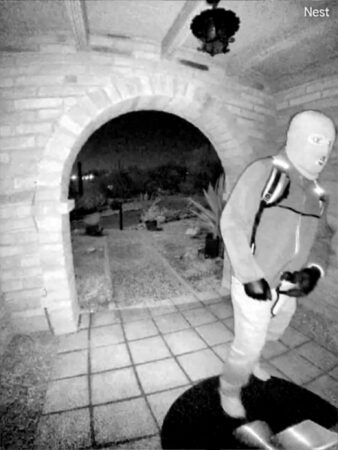
The FBI released surveillance images of a masked person with a handgun holster outside Guthrie’s front door the night she vanished, offering the first major break in a case that has gripped the nation for more than a week.
The person wearing a backpack and a ski mask can be seen in one of the videos tilting their head down and away from a doorbell camera while nearing an archway at the home of the mother of “Today” show host Savannah Guthrie.
The footage shows the person holding a flashlight in their mouth and trying to cover the camera with a gloved hand and part of a plant ripped from Nancy Guthrie’s yard.
The videos — less than a combined minute in length — gave investigators and the public their first glimpse of who was outside Nancy Guthrie’s home just outside Tucson, but the images did not show what happened to her or help determine whether the 84-year-old is still alive.
FBI Director Kash Patel said the “armed individual” appeared to “have tampered with the camera.” It was not entirely clear whether there was a gun in the holster.
The videos were pulled from data on “back-end systems” after investigators spent days trying to find lost, corrupted or inaccessible images, Patel said.
“This will get the phone ringing for lots of potential leads,” said former FBI agent Katherine Schweit. “Even when you have a person who appears to be completely covered, they’re really not. You can see their girth, the shape of their face, potentially their eyes or mouth.”
By Tuesday afternoon, authorities were back near Nancy Guthrie’s neighborhood, using vehicles to block her driveway. A few miles away, law enforcement was going door-to-door in the area where daughter Annie Guthrie lives, talking with neighbors as well as walking through a drainage area and examining the inside of a culvert with a flashlight.
Investigators have said for more than a week that they believe Nancy Guthrie was taken against her will. She was last seen at home Jan. 31 and reported missing the next day. DNA tests showed blood on her porch was hers, authorities said.
She has high blood pressure and issues with mobility and her heart, and she needs daily medication, officials have said.
This image provided by the FBI shows surveillance images at the home of Nancy Guthrie the night she went missing in Tucson, Ariz. (FBI via AP)
Authorities initially could not pull images from camera
Until now, authorities have released few details, leaving it unclear if ransom notes demanding money with deadlines already passed were authentic, and whether the Guthrie family has had any contact with whoever took Nancy Guthrie.
Savannah Guthrie posted the new surveillance images on social media Tuesday, saying the family believes Nancy Guthrie is still alive and offering phone numbers for the FBI and county sheriff. Within minutes, the post had thousands of comments.
Investigators had hoped cameras would turn up evidence right away about how Nancy Guthrie disappeared from her home in an secluded neighborhood.
But the doorbell camera was disconnected early on Feb. 1. While software recorded movement at the home minutes later, Nancy Guthrie did not have an active subscription, so Pima County Sheriff Chris Nanos had initially said none of the footage could be recovered. Officials continued working to get the footage.
Savannah Guthrie expressed desperation a day ago
Heartbreaking messages by Savannah Guthrie and her family shifted from hopeful to bleak as they made pleas for whoever took Nancy Guthrie. In a video just ahead of a purported ransom deadline Monday, Savannah Guthrie appeared alone and spoke directly to the public.
“We are at an hour of desperation,” she said. “We need your help.”
Much of the nation is closely following the case involving the longtime anchor of NBC’s morning show.
White House press secretary Karoline Leavitt said President Donald Trump watched the new surveillance footage and was in “pure disgust,” encouraging anyone with information to call the FBI.
The FBI this week began posting digital billboards about the case in major cities from Texas to California.
Connor Hagan, a spokesperson for the FBI, said Monday that the agency was not aware of ongoing communication between Guthrie’s family and any suspected kidnappers. Authorities also had not identified any suspects, he said.
Videos from Guthrie siblings appealed directly to whoever took their mom
Three days after the search began, Savannah Guthrie and her two siblings sent their first public appeal to whoever took their mother, saying, “We want to hear from you, and we are ready to listen.”
In the recorded video, Guthrie said her family was aware of media reports about a ransom letter, but they first wanted proof their mother was alive. “Please reach out to us,” they said.
The next day, Savannah Guthrie’s brother again made a plea, saying, “Whoever is out there holding our mother, we want to hear from you. We haven’t heard anything directly.”
“We received your message, and we understand. We beg you now to return our mother to us so that we can celebrate with her,” said Savannah Guthrie, flanked by her siblings. “This is the only way we will have peace. This is very valuable to us, and we will pay.”
The Black activists and community members who brought the President’s House Site into being are not letting its history be removed quietly.
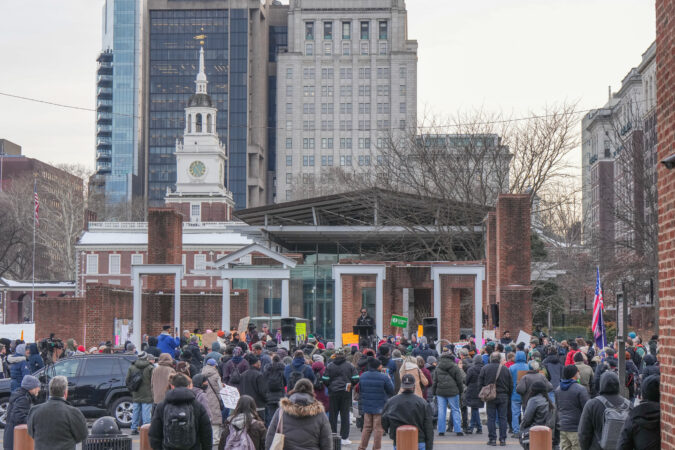
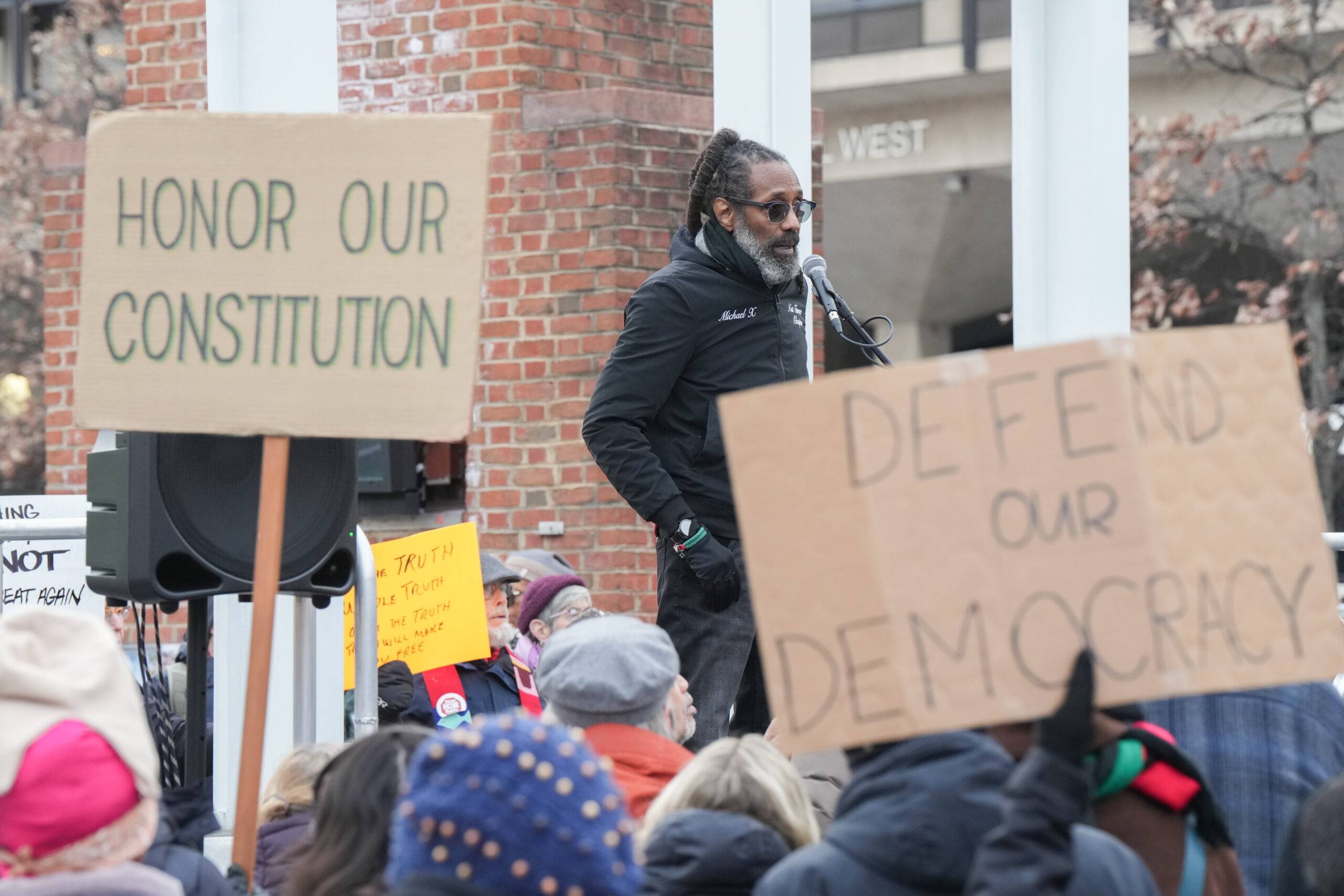
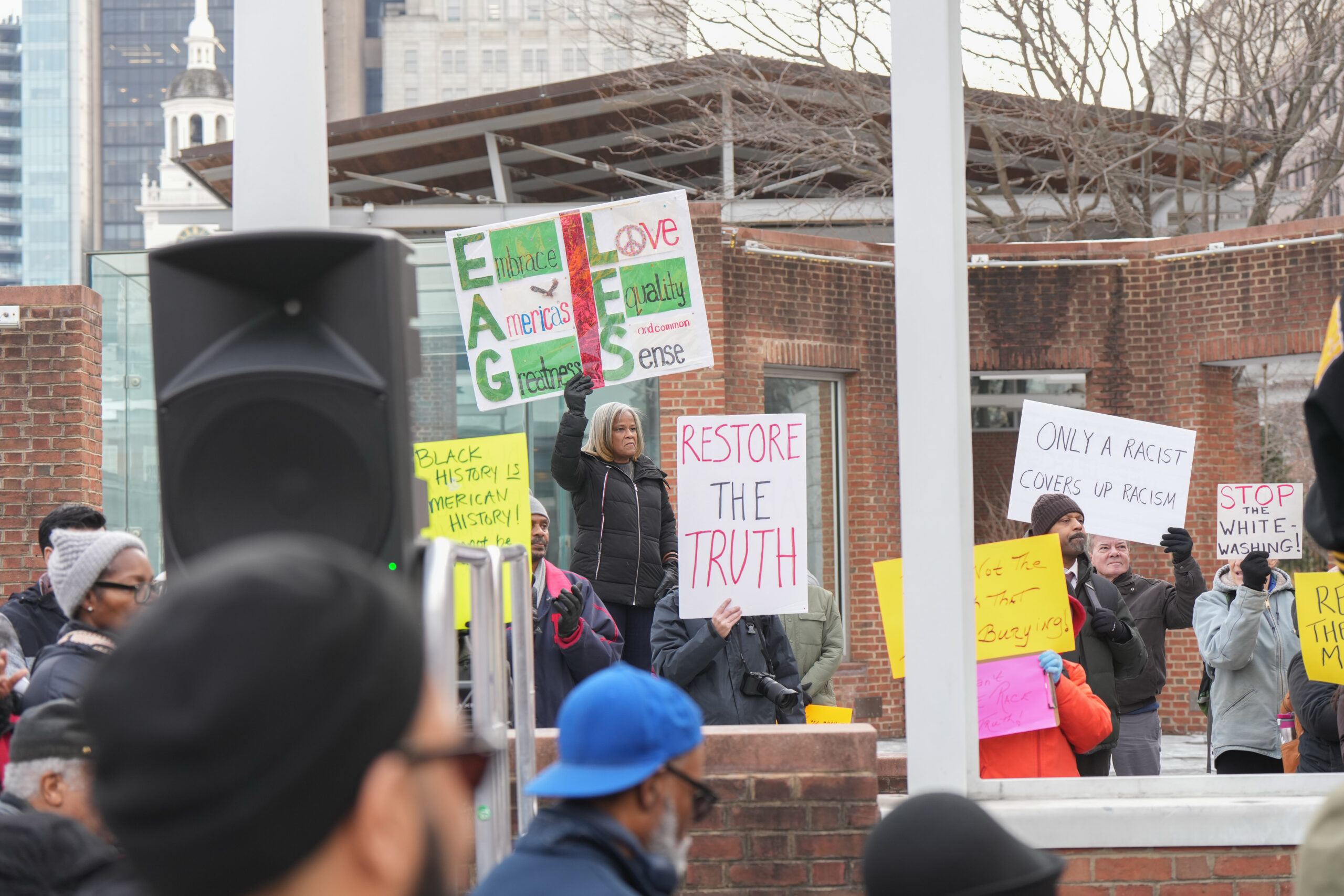
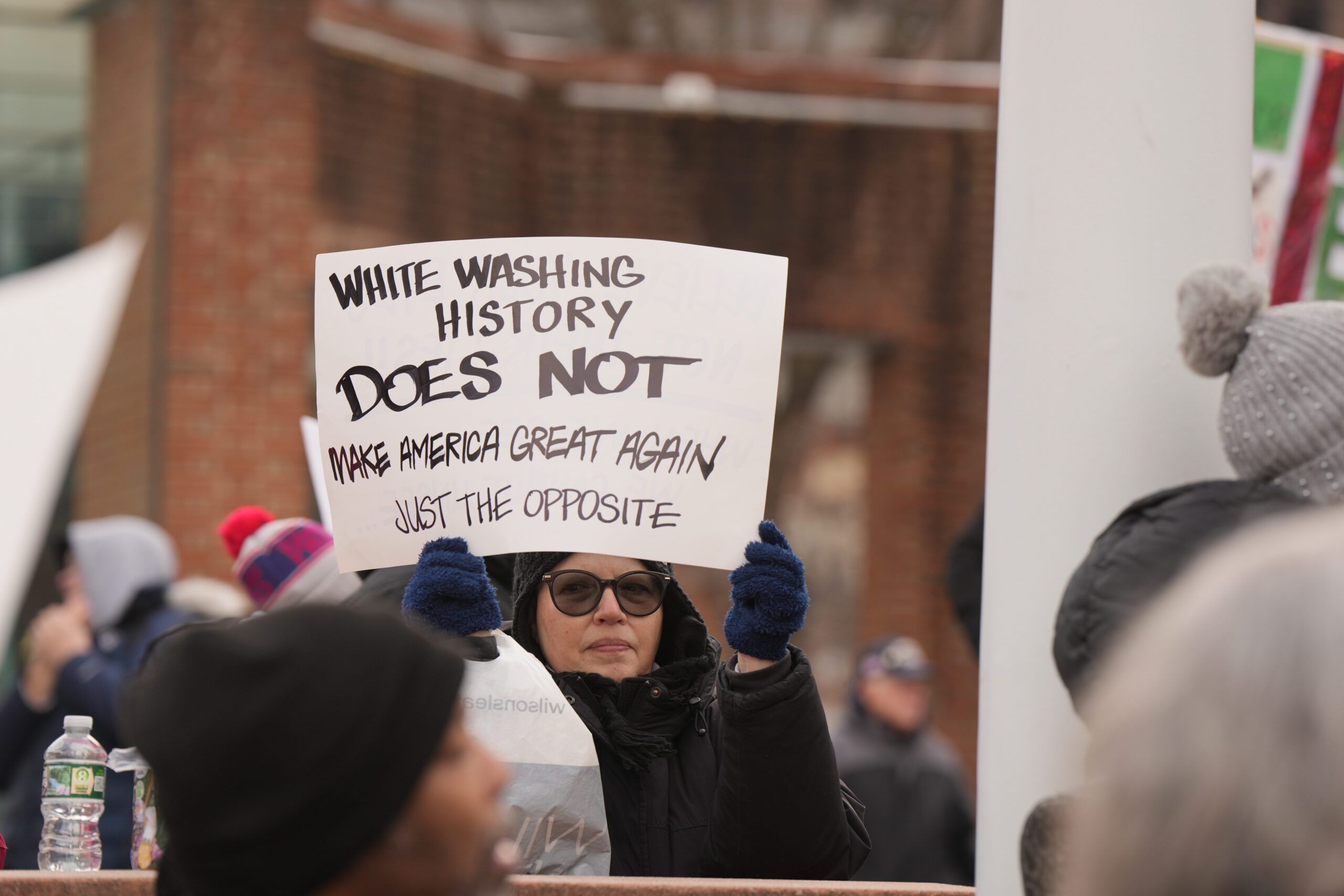
A couple of hundred supporters and local leaders organized by the Avenging the Ancestors Coalition rallied at the President’s House Site on Tuesday afternoon to demand the restoration of its slavery memorial after the National Park Service removed all of its informational and educational materials last month.
“History is not merely a collection of celebrated moments,” said Catherine Hicks, president of the NAACP Philadelphia Branch. “This action is a disservice to our city, our nation and denies future generations in the chance to learn from our history, fostering an environment of ignorance rather than understanding.”
“This site is historic, holy ground,” said Michael Coard, an attorney and founding member of ATAC. “So now what? Now, we fight the good fight.”
Lawyer Michael Coard speaks at a rally at the President’s House Site in response to the removal of the President’s House exhibit.
ATAC was instrumental to the creation of President’s House on Independence Mall in 2010, a site that honors the nine people enslaved by George Washington while he lived at the precursor to the White House. The structure at Sixth and Market Streets featured video displays, illustrations and text-filled panels about the Atlantic slave trade and life under slavery, and detailed Washington’s dogged support for the institution.
Those exhibits were dismantled on Jan. 22, following directives from President Donald Trump’s administration to review and remove displays in National Parks that “inappropriately disparage Americans past or living.”
Thirteen exhibits from the President’s House were flagged for review this summer.
Mayor Cherelle L. Parker’s administration filed a federal lawsuit against Interior Secretary Doug Burgum and acting National Park Service Director Jessica Bowron, and their respective agencies, on the day the panels were removed. The complaint argues that dismantling the exhibits was an “arbitrary and capricious” act that violated a 2006 cooperative agreement between the city and the federal government.
“Attempts to unilaterally rewrite history will deprive residents and visitors” of the collar counties “of the full and accurate picture of the nation’s founding to which they are entitled,” the brief says.
The panels are currently being held in a storage facility owned by the National Park Service that is adjacent to the National Constitution Center, according to a legal filing by the Trump administration.
People gather for a rally at the President’s House Site in response to the removal of the President’s House exhibit in Old City.
Can’t hide the truth
Ever since the panels were taken down with crowbars and wrenches, there has been an outpouring of support for the memorial to be restored, and outrage toward the Trump administration.
“If you want to hide the truth of slavery in Philadelphia, you might as well tear down the whole city because it was built on the blood of my people. You cannot hide the truth,” said Solomon Jones, a radio host and columnist for The Inquirer.
“To erase slavery is to erase American history. That would be to erase Mount Vernon, to erase Wall Street … because those structures were built by enslaved labor,” said Yvonne Studevan, a seventh-generation descendant of Mother Bethel AME’s Bishop Richard Allen.
Judy Butler, a South Philadelphia resident, said she was both heartbroken and angry once she learned that the President’s House exhibits were going to be removed.
“I felt violated, disrespected,” she said.
Butler, 66, said she’s been inspired watching from afar as people in Minnesota have braved the frigid temperatures to protest, observe and resist ICE’s occupation of the Minneapolis area. Coming to ATAC’s rally was something she felt she had to do.
“They’re taking down our history. … How deplorable is that?” she said.
People gather for a rally at the President’s House Site in response to the removal of the President’s House exhibit in Old City.