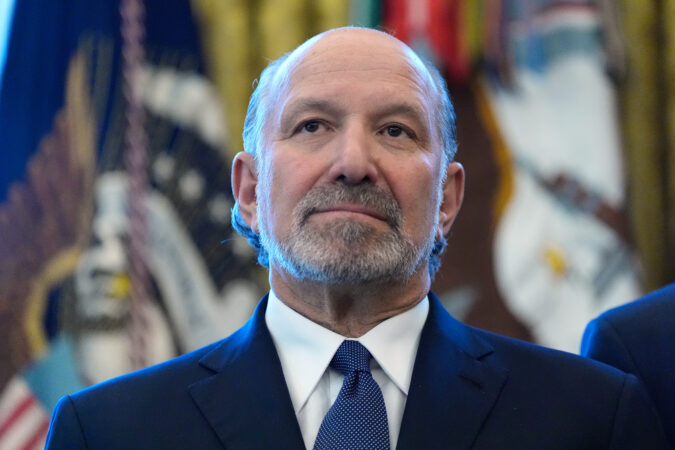
WASHINGTON — Under questioning from Democrats Tuesday, Commerce Secretary Howard Lutnick acknowledged that he had met with Jeffrey Epstein twice after his 2008 conviction for soliciting prostitution from a child, reversing Lutnick’s previous claim that he had cut ties with the late financier after 2005.
Lutnick once again downplayed his relationship with the disgraced financier who was once his neighbor in New York City as he was questioned by Democrats during a subcommittee hearing of the Senate Appropriations Committee. He described their contact as a handful of emails and a pair of meetings that were years apart.
“I did not have any relationship with him. I barely had anything to do with him,” Lutnick told lawmakers.
But Lutnick is facing calls from several lawmakers for his resignation after the release of case files on Epstein contradicted Lutnick’s claims on a podcast last year that he had decided to “never be in the room” with Epstein again after a 2005 tour of Epstein’s home that disturbed Lutnick and his wife.
The commerce secretary said Tuesday that he and his family actually had lunch with Epstein on his private island in 2012 and he had another hour-long engagement at Epstein’s home in 2011. Lutnick, a member of President Donald Trump’s Cabinet, is the highest-profile U.S. official to face bipartisan calls for his resignation amid revelations of his ties to Epstein. His acknowledgement comes as lawmakers are grasping for what accountability looks like amid the revelations contained in what’s known as the Epstein files.
In countries like the United Kingdom, the Epstein files have triggered resignations and the stripping of royal privileges, but so far, U.S. officials have not met the same level of retribution.
Senators want to dig into Lutnick’s ties to Epstein
Sen. Chris Van Hollen, the Democrat who questioned Lutnick, told him, “There’s not an indication that you yourself engaged in any wrongdoing with Jeffrey Epstein. It’s the fact that you believe that you misled the country and the Congress based on your earlier statements.”
Van Hollen, (D., Md.) stopped short of calling for Lutnick’s resignation on Monday, but requested documentation from Lutnick on any of his ties to Epstein.
“It’s absolutely essential that he provide Congress with those documents, given the misrepresentations he’s made, and then we’ll go from there,” he said.
Lutnick during the Senate hearing said he would give that request some thought, adding, “I have nothing to hide.”
However, several Senate Republicans were also questioning Lutnick’s relationship with Epstein. Sen. Roger Wicker, (R., Miss.) said the visit to Epstein’s private island “would raise questions.” And Sen. Thom Tillis, (R., N.C.) told reporters, “It’s something I’m concerned with.”
Tillis stayed away from calling for Lutnick to leave his post, but added that “he would do himself a service by just laying exactly what and what did not happen over the course of what seems to be an interesting relationship that included business entanglements.”
House members call for resignation
Meanwhile, House members who initiated the legislative effort to force the release of the files are calling for Lutnick to resign. Republican Rep. Thomas Massie of Kentucky called for that over the weekend after emails were released that alluded to the meetings between Lutnick and Epstein.
Rep. Ro Khanna, a California Democrat, joined Massie in pressuring Lutnick out of office on Monday.
“Based on the evidence, he should be out of the Cabinet,” Khanna said.
He added, “It’s not about any particular person. In this country, we have to make a decision. Are we going to allow the rich and powerful people who are friends and (had) no problem doing business and showing up with a pedophile who is raping underage girls, are we just going to allow them to skate?”
CHARLOTTE, N.C. — Detroit Pistons center Jalen Duren, a former Roman Catholic star, was among four players ejected Monday night after a fight broke out in the team’s game with the Charlotte Hornets.
Charlotte’s Moussa Diabate and Miles Bridges were tossed along with Detroit’s Isaiah Stewart and Duren. Hornets coach Charles Lee was ejected in the fourth quarter after he had to be restrained from going after an official while arguing a call.
The Pistons won, 110-104. The loss ended the Hornets’ bid to match a franchise record with 10 straight wins.
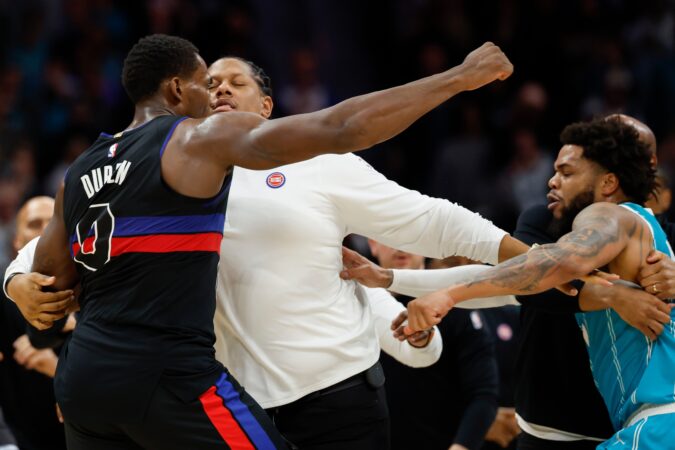
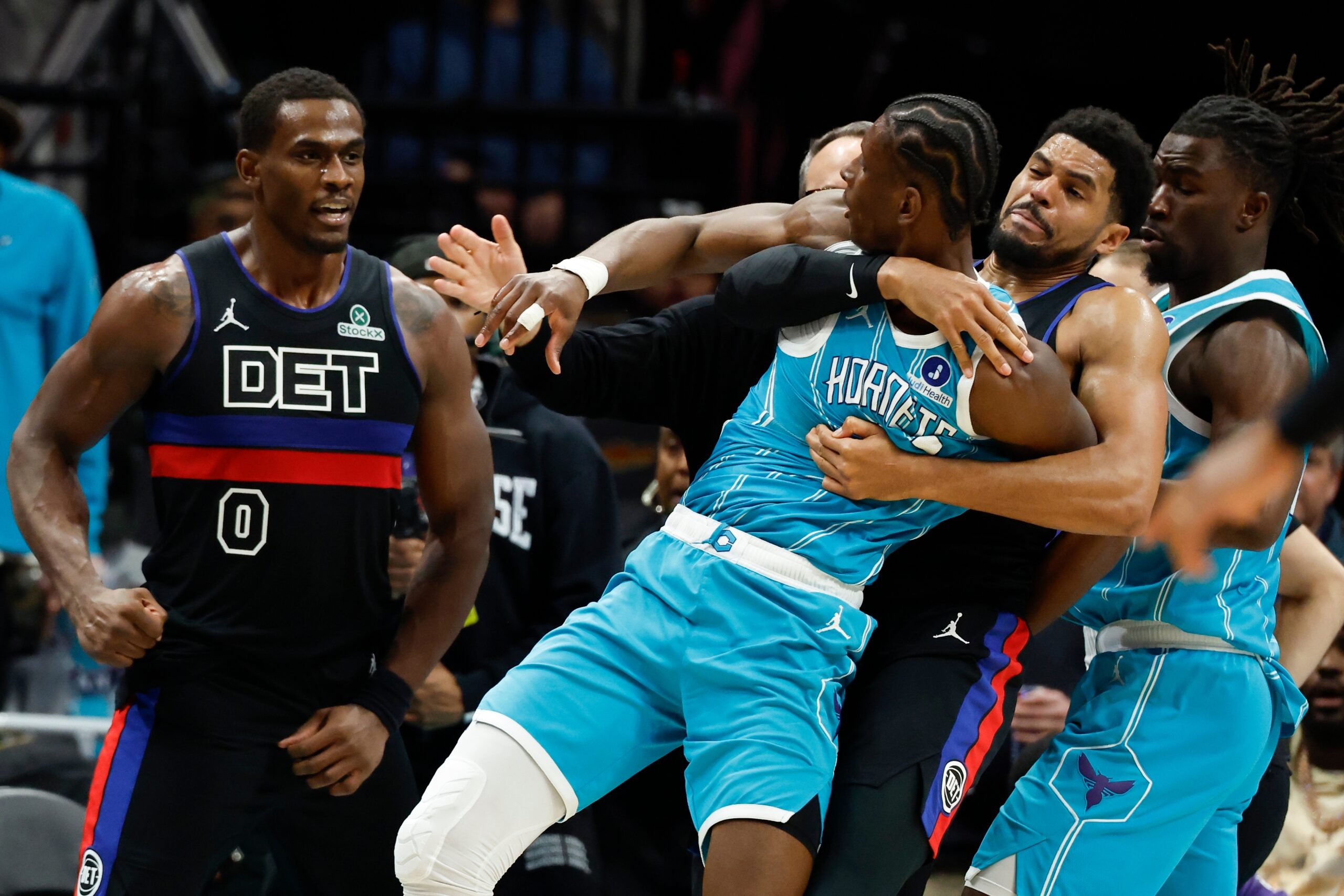
Duren had the ball and was driving toward the basket with just over seven minutes left in the third period when he was fouled by Diabate. Duren turned around to get face-to-face with Diabate and the two appeared to butt heads. Duren then hit Diabate in the face with his open right hand, starting a confrontation that lasted more than 30 seconds and ultimately ended with a brief police presence on the floor.
While Pistons forward Tobias Harris was holding Diabate back, Diabate threw a punch at Duren. Duren walked away and Bridges charged at him, throwing a left-handed punch. Duren retaliated with a punch. Diabate attempted to charge again at Duren and had to be held back.
Charlotte Hornets forward Moussa Diabate is held back by Detroit’s Tobias Harris as he fights with Pistons center Jalen Duren (0).
Stewart left the bench to confront Bridges, who responded with a punch, and the players tussled. At one point, Stewart got Bridges in a headlock and delivered multiple left-handed blows to his head.
Duren called it an “overly competitive game.”
“Emotions were flaring,” Duren said. “At the end of the day, we would love to keep it basketball, but things happen. Everybody was just playing hard.”
Duren said that opposing NBA teams have been trying to “get in our head” all season.
“This isn’t the first time that people have tried to be like extra aggressive with us and talk to us, whatever the case may be,” Duren said. “But as a group we have done an OK job of handling that energy and intensity. At the end of the day, emotions got high with everybody being competitive. Things happen.”
Duren did not say how the fight started, referring reporters instead to the video replays.
The Hornets did not make Bridges and Diabate available for interviews after the game.
However, Bridges took to Instagram late Monday night to say: “Sorry Hornets nation! Sorry Hornets Organization.! Always gonna protect my teammates forever.”
“It looked like two guys got into a heated conversation and it just kind of spiraled from there,” Lee said.
Crew chief John Goble said in a pool report after the game that the players were ejected because they “engaged in fighting activity during the dead ball. After review, we assessed fighting fouls and by rule they were ejected from the game.”
Pistons coach J.B. Bickerstaff defended his players after the game.
“Our guys deal with a lot, but they’re not the ones that initiated, they’re not the ones who crossed the line tonight,” Bickerstaff said. “It was clear, through frustration, because of what J.D. [Duren] was doing, that they crossed the line. I hate that it got as ugly as it got.
“That’s not something that you ever want to see,” Bickerstaff added, “but if a guy throws a punch at you, you have a responsibility to protect yourself. That’s what happened tonight. If you go back and watch the film, they’re the ones who initiated crossing the line and our guy had to defend himself.”
Tensions continued to mount at the Spectrum Center after the fight.
Midway through the fourth quarter, Lee was ejected and had to be restrained by Hornets guard Brandon Miller while yelling at officials for a no-call after Charlotte’s Grant Williams collided with Detroit’s Paul Reed.
“Grant was walking down the paint and barely touched somebody and the guy fell over and that is what we are going to call a foul,” Lee said. “They have a hard job to make these calls, but I don’t think that was the consistency with which that had been called the rest of the game.”
WASHINGTON — The Trump administration is expected this week to revoke a scientific finding that long has been the central basis for U.S. action to regulate greenhouse gas emissions and fight climate change, according to a White House official.
The Environmental Protection Agency will issue a final rule rescinding a 2009 government declaration known as the endangerment finding. That Obama-era policy determined that carbon dioxide and other greenhouse gases endanger public health and welfare.
A White House official, speaking on condition of anonymity because they were not authorized to speak publicly ahead of an official announcement, confirmed the plans, which were first reported by The Wall Street Journal.
“This week at the White House, President Trump will be taking the most significant deregulatory actions in history to further unleash American energy dominance and drive down costs,” White House press secretary Karoline Leavitt said in a statement Tuesday.
The endangerment finding is the legal underpinning of nearly all climate regulations under the Clean Air Act for motor vehicles, power plants, and other pollution sources that are heating the planet. It is used to justify regulations, such as auto emissions standards, intended to protect against threats made increasingly severe by climate change — deadly floods, extreme heat waves, catastrophic wildfires, and other natural disasters in the United States and around the world.
Legal challenges would be certain for any action that effectively would repeal those regulations, with environmental groups describing the shift as the single biggest attack in U.S. history on federal efforts to address climate change.
An EPA spokesperson did not address when the finding would be revoked but reiterated that the agency is finalizing a new rule on it.
Brigit Hirsch said via email that the Obama-era rule was “one of the most damaging decisions in modern history” and said EPA “is actively working to deliver a historic action for the American people.”
President Donald Trump, who has called climate change a “hoax,” previously issued an executive order that directed EPA to submit a report on “the legality and continuing applicability” of the endangerment finding. Conservatives and some congressional Republicans have long sought to undo what they consider overly restrictive and economically damaging rules to limit greenhouse gases that cause global warming.
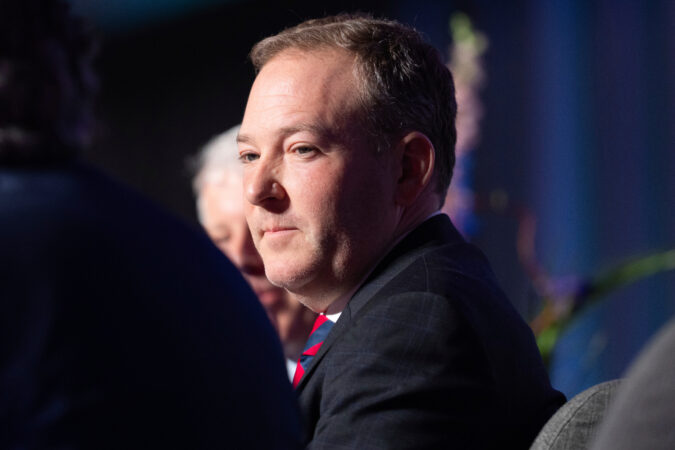
Lee Zeldin, a former Republican congressman who was tapped by Trump to lead EPA last year, has criticized his predecessors in Democratic administrations, saying they were “willing to bankrupt the country” in an effort to combat climate change.
Democrats “created this endangerment finding and then they are able to put all these regulations on vehicles, on airplanes, on stationary sources, to basically regulate out of existence … segments of our economy,″ Zeldin said in announcing the proposed rule last year. ”And it cost Americans a lot of money.”
Peter Zalzal, a lawyer and associate vice president of the Environmental Defense Fund, countered that the EPA will be encouraging more climate pollution, higher health insurance and fuel costs, and thousands of avoidable premature deaths.
Zeldin’s push “is cynical and deeply damaging, given the mountain of scientific evidence supporting the finding, the devastating climate harms Americans are experiencing right now and EPA’s clear obligation to protect Americans’ health and welfare,” he said.
Zalzal and other critics noted that the Supreme Court ruled in a 2007 case that planet-warming greenhouse gases, caused by burning of oil and other fossil fuels, are air pollutants under the Clean Air Act.
Since the high court’s decision, in a case known asMassachusetts v. EPA, courts have uniformly rejected legal challenges to the endangerment finding, including a 2023 decision by the U.S. Court of Appeals for the District of Columbia Circuit.
Following Zeldin’s proposal to repeal the rule, the National Academies of Sciences, Engineering, and Medicine reassessed the science underpinning the 2009 finding and concluded it was “accurate, has stood the test of time, and is now reinforced by even stronger evidence.”
Much of the understanding of climate change that was uncertain or tentative in 2009 is now resolved, the NAS panel of scientists said in a September report. “The evidence for current and future harm to human health and welfare created by human-caused greenhouse gases is beyond scientific dispute,” the panel said.
After Sharif Street Jr. got into a highly public fight at Mayor Cherelle L. Parker’s 2024 inauguration ceremony, his boss, City Councilmember Jim Harrity, extended him some grace.
Harrity, who credits Street Jr.’s father, State Sen. Sharif Street (D., Philadelphia), with giving him a second chance earlier in his own career, kept the junior Street on staff as a special assistant, saying the incident was a lapse in judgment.
But according to another staff member in Harrity’s office, it was not the only transgression.
Shanelle Davis, a former constituent services representative, filed a federal lawsuit last week against the city claiming that she told supervisors months before the inauguration fight that Street Jr. had sexually harassed her while she was at work, including twice grabbing her and making sexualized comments about her body.
She said in the suit, filed in the U.S. District Court for the Eastern District of Pennsylvania, that no action was taken and Street Jr. remained on staff.
Davis is seeking unspecified damages from the city, which she claims violated state and federal laws related to gender-based discrimination. Street Jr. is not named as a defendant in the suit, but he is mentioned throughout the 13-page filing.
Davis’ complaint portrays a dysfunctional workplace environment in the City Hall office, including an alleged physical altercation between Street Jr. and another staffer for which no one was reprimanded. Davis, who is Black, claimed another colleague in Harrity’s office made racist comments, including hurling the N-word toward her.
Davis, who was hired in late 2022, said in the lawsuit that she was fired for underperforming at her job about a year later, after Harrity won reelection.
Her attorney did not respond to a request for comment Monday. Street Jr. did not respond to calls seeking comment.
Harrity, a Democrat who represents the city at-large and was a longtime aide to the elder Street, said in a statement that he “categorically denounce[s] workplace harassment, or any conduct that undermines a respectful and professional work environment.”
He declined to comment further, citing the ongoing legal proceedings. A spokesperson for the city law department also declined to comment.
The lawsuit is the latest legal trouble involving Sharif Street Jr., 26, who over the last three years has pleaded guilty to criminal offenses in Philadelphia, Montgomery, and Delaware Counties. In August, his employment with the city was terminated the week he pleaded guilty to charges in connection with the inauguration assault and another incident.
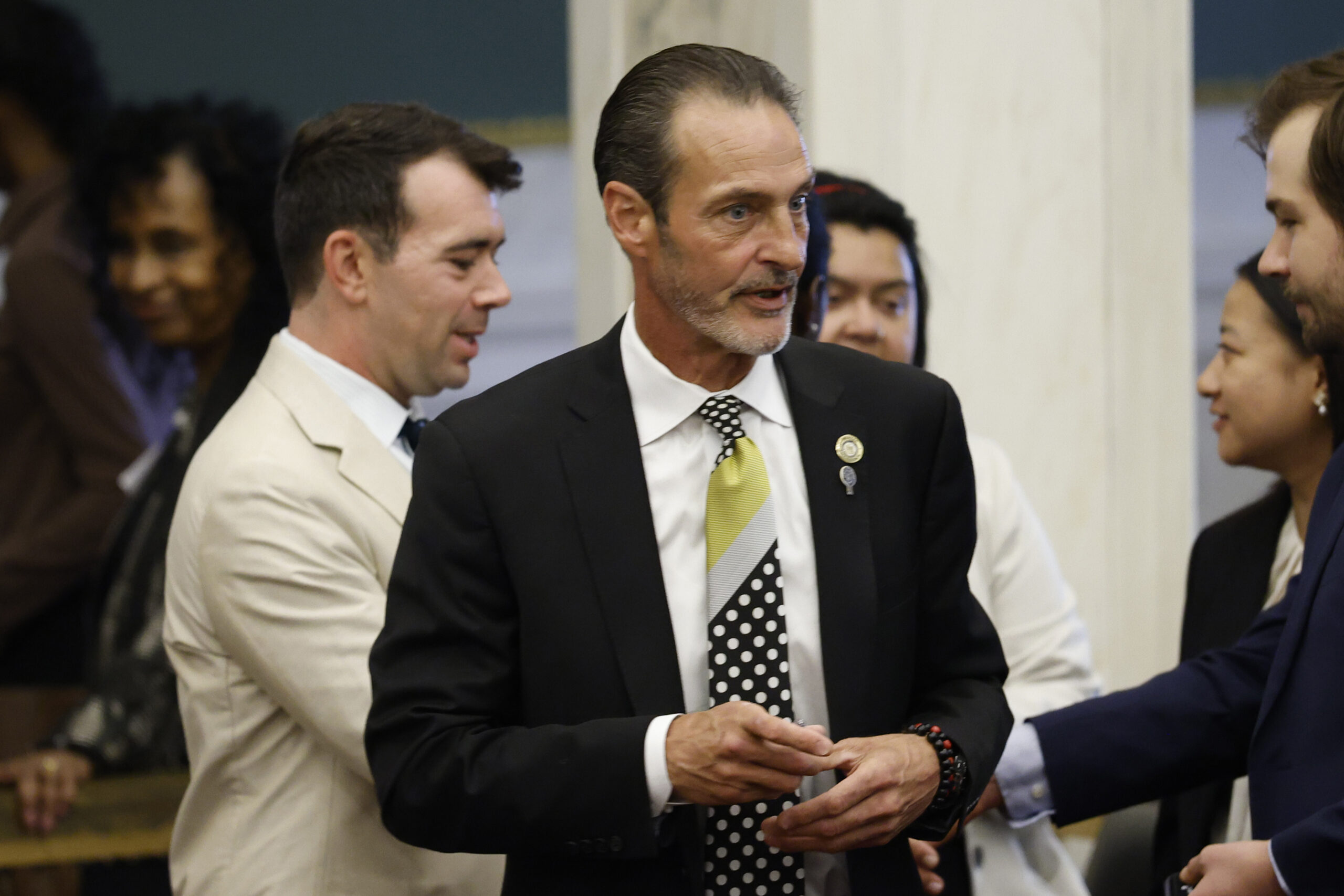
City Councilmember Jim Harrity speaks to colleagues on during a Council session in September.
Street Jr. comes from one of Philadelphia’s most well-known political families. His grandfather is former Mayor John F. Street, his mother is Common Pleas Court Judge Sierra Thomas Street, and his father is a state senator and the former head of the state Democratic Party who is now running for a seat in Congress.
Anthony Campisi, a spokesperson for the elder Sharif Street’s congressional campaign, said the state senator had “no knowledge” of the sexual harassment allegations.
“Sharif loves his son unconditionally and has supported his son through personal troubles, like so many parents across Philadelphia,” Campisi said. “That being said, Sharif unequivocally condemns sexual harassment in all its forms and is looking for the legal process to play out.”
City Council President Kenyatta Johnson, who took over as leader of the chamber in 2024, declined to comment. Under City Council rules, individual members are responsible for hiring and terminating their own employees.
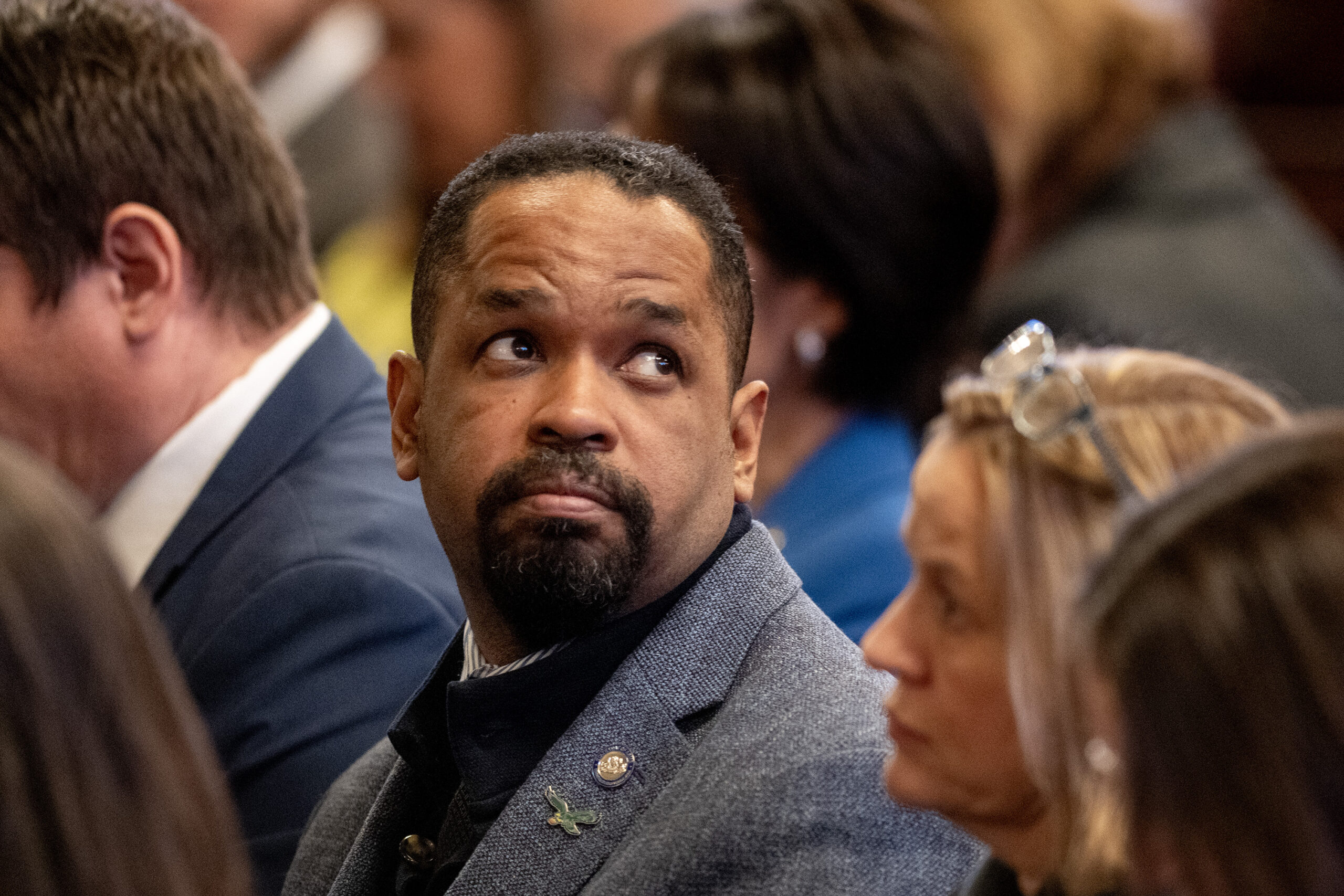
State Senator Sharif Street (D., Phila.)is in the state House chamber as Gov. Josh Shapiro makes his annual budget proposal Feb. 3, 2026.
Street Jr. was arrestedseveral times over three years while working in City Hall as an assistant in Harrity’s office, court records show. Davis’ lawsuit comes about six months after Street Jr.’s employment in Harrity’s office ended, according to payroll records.
In January 2024, Street Jr. punched a security guard at the entrance to Parker’s inauguration ceremony at the Met Philadelphia on North Broad Street. He told The Inquirer at the time that he was defending his grandfather, the former mayor, whom he said the guard had grabbed because they were trying to enter at a back entrance without waiting in line.
“I saw my grandfather get grabbed and I just sort of blacked out,” Street Jr. said. His father defended him at the time, saying the security guard had initiated the altercation.
Later that month, Street Jr. was charged in connection with a hit-and-run from the previous August that left a 14-year-old injured.
The two cases were consolidated in Common Pleas Court, and Street Jr. pleaded guilty in August to charges of assault and causing an accident that resulted in an injury. According to prosecutors, he was sentenced to 60 days in jail.
Four months later, when he was no longer working in city government, Street Jr. was briefly jailed in Delaware County following what police in Upper Darby described as a “prolonged struggle” during a traffic stop. He pleaded guilty to disorderly conduct, a summary offense.
Maybe it’s because I’ve watched every blessed one of them, starting as a curious, nearly 8-year-old boy in 1967, but the Super Bowl has always felt like the ultimate barometer of where the American Experiment is at. Super Bowl LX (that’s 60, for those of you smart enough not to take four years of Latin in high school) was no exception. The actual game was something of a snoozefest, but the tsunami of commercials revealed us as a nation obsessed with artificial intelligence, sports betting, weight loss, and anything that can lift us from middle-class peonage without having to do any actual work. As Bad Bunny said, God bless America.
Bad Bunny’s real message: From P.R. to Minnesota, we are neighbors
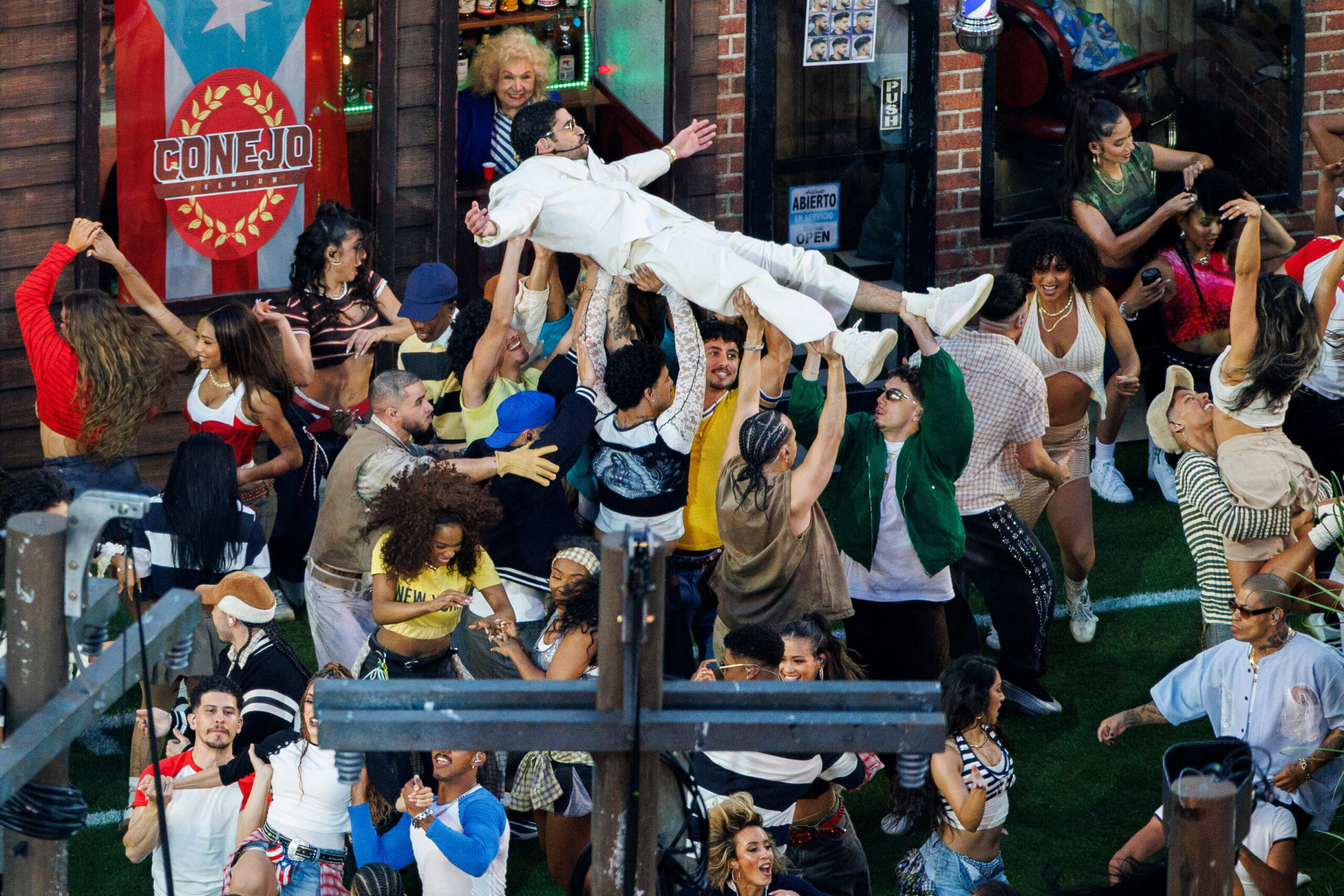
Bad Bunny (center top) performs Sunday during the halftime show of the NFL Super Bowl XL football game between the Seattle Seahawks and the New England Patriots in Santa Clara, Calif.
Right-wing media prattled on for months about how Bad Bunny, the Puerto Rican reggaeton superstar who is the world’s most streamed artist, would politicize and thus ruin the NFL’s halftime extravaganza at Super Bowl LX in Santa Clara, Calif.
The babble became a scream seven days before the Big Game kicked off, when Bad Bunny won the record of the year Grammy Award and began his acceptance speech with the exhortation “ICE out!” adding, “We’re not savages, we’re not animals, we’re not aliens — we are humans, and we are Americans.”
But on the world’s biggest stage Sunday night — seen by 135 million in the United States, a Super Bowl record — Bad Bunny sang not one word about Donald Trump, not that MAGA fans even bothered to hold up a translation app. The white-suited Benito Antonio Martínez Ocasio danced his way through the history of Puerto Rico and the Americas writ large, from the plantations of yore to the exploding power lines of the hurricane-wracked 21st century. He whirled past an actual wedding, stopped for a shaved ice, and for 13 spellbinding minutes turned a cast of 400 into what his transfixed TV audience craved at home.
BadBunny built his own community — a place not torn asunder by politics, but bonded by love and music.
Without uttering one word — in Spanish or English — about the dire situation in a nation drifting from flawed democracy into wrenching authoritarianism, the planet’s reigning king of pop delivered the most powerful message of America’s six decades of Super Bowl fever. Shrouded in sugar cane and shaded by a plantain tree, Bad Bunny sang nothing about the frigid chaos 2,000 miles east in Minnesota, and yet the show was somehow very much about Minneapolis.
Bad Bunny finally gave voice to what thousands of everyday folks in the Twin Cities have been trying to say with their incessant whistles.
We are all neighbors. The undocumented Venezuelan next door who toils in the back of a restaurant and sends his kids to your kids’ school is a neighbor. But Haiti is also a neighbor, as is Cuba. We are all in this together.
The word I kept thinking about as I watched Bad Bunny’s joyous performance is a term that didn’t really exist on New Year’s Day 2026, yet has instantly provided a name to the current zeitgeist.
The great writer Adam Serwer — already up for the wordsmithing Hall of Fame after he nailed the MAGA movement in 2018 in five words: “The cruelty is the point” — leaned hard into the concept of “neighborism” after he traveled to Minneapolis last month. His goal was to understand an almost revolutionary resistance to Trump’s mass deportation raids that had residents — many of whom had not been especially political — in the streets, blowing those warning whistles, confronting armed federal agents, and tracking their movements across the city.
Serwer visited churches where volunteers packed thousands of boxes of food for immigrant families afraid to leave their homes during the U.S. Immigration and Customs Enforcement raids, and talked to stay-at-home moms, retirees, and blue-collar workers who give rides or money to those at risk, or who engaged in the riskier business of tracking the deportation raiders.
“If the Minnesota resistance has an overarching ideology,” Serwer wrote, “you could call it ‘neighborism’ — a commitment to protecting the people around you, no matter who they are or where they came from.” He contrasted the reality on the ground in Minneapolis to the twisted depictions by Trump and his vice president, JD Vance, who’ve insisted refugees are a threat to community and cohesion.
Of course, it’s not just Minneapolis, and it’s not just the many, liberal-leaning cities — from Los Angeles to Chicago to New Orleans and more — that were the incubators of the notion that concerned citizens — immigrant and nonimmigrant alike — could prevent their neighbors from getting kidnapped. Even small towns like rural Sackets Harbor, N.Y., the hometown of Trump’s border czar Tom Homan, rose up in protest to successfully block the dairy farm deportation of a mom and her three kids. It’s been like this everywhere regular folks — even the ones who narrowly elected Trump to a second term in 2024 — realize mass deportation doesn’t mean only “the worst of the worst,” but often the nice mom or dad in the house, or church pew, next to theirs.
Only now that it’s arrived is it possible to see “neighborism” as the thing Americans were looking for all along, even if we didn’t know it. It is, in every way, the opposite vibe from the things that have always fueled fascism — atomization and alienation that’s easy for a demagogue to mold into rank suspicion of The Other.
I’m pretty sure Bad Bunny wasn’t using the word neighborism when the NFL awarded him the coveted halftime gig last fall. But the concept was deeply embedded in his show. He mapped his native Puerto Rico as a place where oppression has long loomed — from the cruelty of the sugar plantations to the capitalist exploitation of the failed power grid — but where community is stronger.
Then Benito broadened the whole concept. Reclaiming the word America for its original meaning as all of the Western Hemisphere, Bad Bunny name-checked “Chile, Argentina, Uruguay, Paraguay, Bolivia, Peru, Ecuador, Brazil,” and Canada, as well as the United States. These, too, are our neighbors. “God bless America,” he shouted — his only message of the night delivered in English.
So, no, Bad Bunny never mentioned Minneapolis, but a tender moment when he seemingly handed the Grammy he’d won just aweek ago to a small Latino boy had to remind viewers of the communal fight to save children like the 5-year-old, blue bunny hat-wearing (yes, ironic) Liam Conejo Ramos, who was just arrested, detained, and released by ICE. (A false rumor that the Super Bowl boy was Ramos went viral.)
But arguably, this super performance had peaked a few moments earlier, when the singer exited the wedding scene stage with a backward trust dive, caught and held aloft by his makeshift community in the crowd below. Bad Bunny had no fear that his neighbors would not be there for him. Viva Puerto Rico. Viva Minneapolis. Viva our neighbors.
Yo, do this!
Some 63 years after he was gunned down by a white racist in his own driveway, the Mississippi civil rights icon Medgar Evers has been having a moment. A fearless World War II vet whose bold stands for civil rights as local leader of the NAACP in America’s most segregated state triggered his 1963 assassination, Evers’ fight has become the subject of a best-selling book, a controversy over how his story is told at the Jackson, Miss., home where he was killed, and now a two-hour documentary streaming on PBS.com. I’m looking forward to watching the widely praised Everlasting: Life & Legacy of Medgar Evers.
After the Super Bowl, February is the worst month for sports — three out of every four years. In 2026, we have the Winter Olympics to bridge the frigid gap while we wait for baseball’s spring training (and its own World Baseball Classic) to warm us up. Personally, I try and sometimes fail to get too jacked up around sleds careening down an icy track, but hockey is a different story. At 2:10 p.m. on Tuesday (that’s today if you read this early enough), the puck drops on USA Network for the highly anticipated match between the world’s two top women’s teams: the United States and its heated rival Canada. Look for these two border frenemies to meet again for the gold medal.
Ask me anything
Question: How is it that some towns have been able to prevent ICE from buying warehouses and turning them into concentration camps, while others say they are helpless against the federal government? What does it mean that several are planned for within a couple of hours of Philly? — @idaroo.bsky.social via Bluesky
Answer: Great question. It seems ICE and its $45 billion wad of cash are racing in near-secrecy to make this national gulag archipelago of 23 or so concentration camps a done deal. The places where they’ve been stopped, like one planned for Virginia, happened because locals were able to pressure the developer before a sale to ICE was concluded. That’s no longer an option at the two already purchased Pennsylvania sites in Schuylkill and Berks Counties. The last hope is pressure from high-ranking Republicans, which may (we’ll see) have stopped a Mississippi site. Pennsylvanians might want to focus, then, on GOP Sen. Dave McCormick. Good luck with that.
What you’re saying about …
It’s conventional wisdom that the best argument for a Gov. Josh Shapiro 2028 presidential campaign is his popularity in his home state of Pennsylvania, the battleground with the most electoral votes. So it’s fascinating that none of the dozen or so of you who responded to this Philadelphia-based newsletter wants Shapiro to seek the White House, although folks seem divided into two camps. Some of you just don’t like Josh or his mostly centrist politics. “I think he’s all ambition, all consumed with reaching that top pedestal, not as a public servant, but because he thinks he deserves it,” wrote Linda Mitala, who once campaigned for Shapiro, but soured on his views over Gaza protesters, New York Mayor Zohran Mamdani, and other issues. Yet, others think he’s an excellent governor who should remain in the job through 2030. “Stay governor of Pa. when good governance and ability to stand up to federal (authoritarian) overreach is dire,” wrote Kim Root, who’d prefer Kentucky Gov. Andy Beshear for the White House.
📮 This week’s question: A shocking, likely (though still not declared) Democratic primary win for Analilia Mejia, the Bernie Sanders-aligned left-wing candidate, in suburban North Jersey’s 11th Congressional District raises new questions for the Dems about the 2026 midterms. Should the party run more progressive candidates like Mejia, who promise a more aggressive response to Trump, or will they lose by veering too far left? Please email me your answer and put the exact phrase “Dems 2026” in the subject line.
Backstory on how the F-bomb became the word of the year
Billie Joe Armstrong of Green Day performs Sunday before the start of Super Bowl XL in Santa Clara, Calif.
I’m old enough to remember when the world’s most famous comedy riff was the late George Carlin’s “Seven Words You Can Never Say on Television” — its point driven home by Carlin’s 1972 arrest on obscenity charges that went all the way to the U.S. Supreme Court. A half century later, you still can’t say dirty words on broadcast TV — cable and streaming is a different story — but that fortress is under assault. In 2026, America is under seemingly constant attack from the F-bomb.
It is freakin’ everywhere. When the top elected Democrat in Washington, House Minority Leader Hakeem Jeffries, cut a short video to respond to the president’s shocking post of a racist video that depicted Barack and Michelle Obama as apes, he said, “[F-word] Donald Trump!” If uttered in, say, 1972, Jeffries’ attack would have been a top story for days, but this barely broke through. Maybe because that word is in the lexicon of so many of his fellow Democrats, like Mayor Jacob Frey, who famously told ICE agents to “get the [F-word] out of Minneapolis,” or Minnesota Sen. Tina Smith, who begged federal agents to “leave us the (bleep) alone.” (Smith is retiring at year’s end and seems to no longer give a you-know-what.)
The poor guys with their finger on the silence button at the TV networks, where you still can’t say Carlin’s seven words, can barely keep up. The F-bomb was dropped at this year’s Grammys, where award-winner Billie Eilish declared “(Bleep) ICE!” as she brandished her prize. The F-bomb was dropped, of course, at the Super Bowl, when the only true moment of silence during 10-plus hours of nonstop bombast came during Green Day’s pregame performance of “American Idiot,” when NBC shielded America’s tender ears from hearing Billie Joe Armstrong sing about “the subliminal mind(bleep) America.”
We’re only about six weeks into the new year, but it’s hard not to think that Merriam-Webster or the other dictionary pooh-bahs won’t declare the F-bomb as word of the year for 2026, even if I’m still not allowed to use it in The Inquirer, family newspaper that we are. So what the … heck is going on here? One study found the F-word was 28 times more likely to appear in literature nowthan in the 1950s, so in one sense it’s not surprising this would eventually break through on Capitol Hill or on the world’s biggest stages.
But the bigger problem is that America’s descent into authoritarianism and daily political outrage has devolved to such a point where, every day, permissible words no longer seem close to adequate for capturing our shock and awe at how bad things are. Only the F-bomb, it turns out, contains enough dynamite to blow out our rage over masked goons kidnapping people on America’s streets, or a racist, megalomaniac president who still has 35 months left in his term. Yet, even this (sort of) banned expletive is losing its power to express how we really feel. I have no idea what the $%&# comes next.
What I wrote on this date in 2019
What a long, strange trip for Amazon founder Jeff Bezos, one of the four richest people on the planet. Today, Bezos is in the headlines for his horrific stewardship of the Washington Post, which has bowed down on its editorial pages to the Trump regime, lost hundreds of thousands of subscribers, and laid off 300 journalists. It’s hard to recall that seven years ago, Bezos and Trump were at war, and there was evidence Team MAGA had enlisted its allies from Saudi Arabia to the National Enquirer to take down the billionaire. I wrote that “a nation founded in the ideals of democracy has increasingly fallen prey to a new dystopian regime that melds the new 21st century dark arts of illegal hacking and media manipulation with the oldest tricks in the book: blackmail and extortion.”
My first and hopefully not last journalistic road trip of 2026 took me to Pennsylvania coal country, where ICE has spent $119.5 million to buy an abandoned Big Lots warehouse on the outskirts of tiny Tremont in Schuylkill County. I spoke with both locals and a historical expert on concentration camps about their fears and the deeper meaning of a gulag archipelago for detained immigrants that is suddenly looming on U.S. soil. It can happen here. Over the weekend, I looked at the stark contrast between Europe’s reaction to the Jeffrey Epstein scandal — where ties to the late multimillionaire sex trafficker are ending careers and even threatening to topple the British government — and the United States, where truth has not led to consequences so far. The Epstein fallout shows how the utter lack of elite accountability is driving the crisis of American democracy.
One last Super Bowl reference: Now that football is over, are you ready for some FOOTBALL? Now just four months out, it’s hard to know what to make of the 2026 World Cup returning to America and coming to Philadelphia for the very first time, and whether the increasing vibe that Donald Trump’s United States is a global pariah will mar the world’s greatest sporting event (sorry, NFL). Whatever happens, The Inquirer is ready, and this past week we published our guide to soccer’s biggest-ever moment in Philly. Anchored by our world-class soccer writer Jonathan Tannenwald and Kerith Gabriel, who worked for the Philadelphia Union between his stints at the paper, the package provides not only an overview of the World Cup in Philly, but previews the dozen teams who will (or might) take the pitch at Lincoln Financial Field, with in-depth looks at the powerhouses (France) as well as the massive underdogs (Curaçao). June is just around the corner, so don’t let the paywall become your goalkeeper. Subscribe to The Inquirer before the first ball drops.
By submitting your written, visual, and/or audio contributions, you agree to The Inquirer’s Terms of Use, including the grant of rights in Section 10.
WASHINGTON — The heads of the agencies carrying out President Donald Trump’s mass deportation agenda are testifying in Congress Tuesday and faced questions over how they are prosecuting immigration enforcement inside American cities.
Trump’s immigration campaign has been heavily scrutinized in recent weeks, after the shooting deaths in Minneapolis of two protesters at the hands of Homeland Security officers. The agencies have also faced criticism for a wave of policies that critics say trample on the rights of both immigrants facing arrest and Americans protesting the enforcement actions.
Todd Lyons, the acting director of U.S. Immigration and Customs Enforcement, Rodney Scott, who heads U.S. Customs and Border Protection, and Joseph Edlow, who is the director of U.S. Citizenship and Immigration Services, will speak in front of the House Committee on Homeland Security.
This is the first time all three have appeared in Congress since the department received a huge infusion of money from Congress last summer and since immigration enforcement operations intensified across the country. The officials are speaking at a time of falling public support for how their agencies are carrying out Trump’s immigration vision.
Under Lyons’ leadership, ICE has undergone a massive hiring boom and immigration officers have deployed in beefed-up enforcement operations in cities across the country designed to increase arrests and deportations. The appearance in Congress comes as lawmakers are locked in a battle over whether DHS should be funded without restraints placed over its officers’ conduct.
The administration says that activists and protesters opposed to its operations are the ones ratcheting up attacks on their officers, not the other way around, and that their immigration enforcement operations are making the country safer by finding and removing people who’ve committed crimes or pose a threat to the country.
Lyons is likely to face questioning over a memo he signed last year telling ICE officers that they didn’t need a judge’s warrant to forcibly enter a house to arrest a deportee, a memo that went against years of ICE practice and Fourth Amendment protections against illegal searches.
During Scott’s tenure, his agency has taken on a significant role in arresting and removing illegal immigrants from inside the country. That increased activity has become a flashpoint for controversy and marks a break from the agency’s traditional job of protecting borders and controlling who and what enters the country.
Under commander Gregory Bovino, a group of Border Patrol agents hopscotched around the country to operations in Los Angeles, Chicago, Charlotte, and New Orleans where they were often accused of indiscriminately questioning and arresting people they suspected were in the country illegally. Bovino says his targets are legitimate and identified through intelligence and says that if his officers use force to make an arrest, it’s because it’s warranted.
A Border Patrol agent and Customs and Border Protection officer both opened fire during the shooting death of Alex Pretti, one of two protesters killed in Minneapolis in January. The other protester, Renee Good, was shot and killed by an ICE officer.
After the Pretti shooting, Bovino was reassigned and Trump sent his border czar Tom Homan to Minneapolis to assume control.
USCIS has also faced criticism for steps it has taken including subjecting refugees already admitted to the U.S. to another round of vetting and pausing decisions on all asylum cases.
Three leading social media companies have agreed to undergo independent assessments of how effectively they protect the mental health of teenage users, submitting to a battery of tests announced Tuesday by a coalition of advocacy organizations.
The platforms will be graded on whether they mandate breaks and provide options to turn off endless scrolling, among a host of other measures of their safety policies and transparency commitments. Companies that reviewers rate highly will receive a blue shield badge, while those that fair poorly will be branded as not able to block harmful content. Meta — which operates Facebook and Instagram — TikTok and Snap are first three companies to sign up for the process.
“I hope that by having this new set of standards and ratings it does improve teens’ mental health,” said Dan Reidenberg, managing director of the National Council for Suicide Prevention, who oversaw the development of the standards. “At the same time, I also really hope that it changes the technology companies: that it really helps shape how they design and they build and they implement their tools.”
Teenagers represent a coveted demographic for social media sites and the new standards come as the tech industry faces increasing pressure to better protect young users.
A wave of lawsuits alleges that leading firms have engineered their platforms to be addictive. Congress is weighing a suite of bills designed to protect children’s safety online. And state lawmakers have sought to impose age limits on social apps.
But those efforts have borne little fruit. Some legal experts argue teens and their families may face difficulty in court cases proving the connection between social media use and their struggles. Officials in Washington, meanwhile, have been unable to agree on how to regulate the industry and laws passed by the states have run into First Amendment challenges.
The voluntary standards represent an alternative approach. Reidenberg said in an interview that the ratings are not a substitute for legislation but will be a helpful way for teenagers and parents to decide how to engage with particular apps. The project is backed by the Mental Health Coalition, an advocacy group founded by fashion designer Kenneth Cole.
Cole said in a statement that the standards “recognize that technology and social media now play a central role in mental health — especially for young people — and they offer a clear path toward digital spaces that better support well-being.”
There is still no scientific consensus on whether social media is on the whole harmful for children and teenagers. While some research has found that the heaviest users have worse mental health, studies have also found that young people who are not online can also struggle. But teenagers themselves have reported becoming more uneasy about the time they spend online, with girls in particular telling pollsters at the Pew Research Center in 2024 that apps were affecting their self-confidence, sleep patterns, and overall mental health.
Reidenberg said it’s clear that in some cases young people’s time online becomes problematic. He said the system was developed without funding from the tech industry, but companies will have to volunteer to participate.
Antigone Davis, Meta’s global head of safety, said the standards will “provide the public with a meaningful way to evaluate platform protections and hold companies accountable.” TikTok’s American arm said it looked forward to the ratings process. Snap called the Mental Health Coalition’s work “truly impactful.”
Organizers compared the process to how Hollywood assigns age ratings to movies or the government assesses the safety of new cars. Companies will submit internal polices and designs for review by outside experts who will develop their ratings. In all, the companies’ performance will be measured in about two dozen areas covering their policies, app design, internal oversight, user education, and content.
Many of the standards specifically target users’ exposure to content about suicide and self harm. But one also targets the sheer length of time that some people spend scrolling, crediting platforms for offering either voluntary or mandatory “take-a-break” features.
The standards are being launched at an event in Washington on Tuesday. Sen. Mark R. Warner (D., Va.) said in a statement that he welcomed the standards but they weren’t a substitute for regulatory action.
“Congress has a responsibility to put lasting, enforceable guardrails in place so that every platform is held accountable to the young people and families who use them,” he added.
President Donald Trump has threatened to block the opening of a bridge between Michigan and Ontario, claiming Canada is trying to “take advantage of America” and calling for compensation in the latest flash point in the simmering tensions between the United States and its northern neighbor.
The Gordie Howe International Bridge — a six-lane bridge between Detroit and Windsor, Ontario, that has cost about $4.7 billion to build — has been under construction since 2018 and is due to open early this year, according to the organization behind it.
On Monday, Trump said he “will not allow” it to open in a post on Truth Social, saying Canada had treated the U.S. “very unfairly for decades” and that the U.S. would not benefit from the project.
“I will not allow this bridge to open until the United States is fully compensated for everything we have given them, and also, importantly, Canada treats the United States with the Fairness and Respect that we deserve,” he said. It was unclear how Trump would be able to delay or block the project from opening.
“We will start negotiations, IMMEDIATELY. With all that we have given them, we should own, perhaps, at least one half of this asset,” he said, adding that the revenue generated from the project “will be astronomical.”
The bridge, named after Canadian ice hockey legend Gordie Howe, who played for the Detroit Red Wings, has been labeled a “once-in-a-generation undertaking” by the Windsor-Detroit Bridge Authority, the Canadian government entity responsible for delivering it. It is set to have U.S. and Canadian entry ports and an interchange connecting to Michigan’s road network.
The bridge is financed by the Canadian government but is publicly owned by the governments of Canada and Michigan, with terms outlined in a 2012 Crossing Agreement. The agreement stated all iron and steel used in the project must be produced in the U.S. or Canada.
Canada will recoup the costs of funding the bridge from toll revenue, the Canadian government said in 2022.
Candace Laing, president and CEO of the Canadian Chamber of Commerce, said regardless of whether Trump’s threat is real or an attempt at creating uncertainty, “blocking or barricading bridges is a self-defeating move.”
“The path forward isn’t deconstructing established trade corridors, it’s actually building bridges,” she said in an emailed statement.
The complaint is the latest in a string of blows he has leveled at Canada and Prime Minister Mark Carney, rupturing the traditionally close relationship between the two allies.
Last month, Trump threatened to decertify and impose tariffs on Canadian-built aircraft in a move that sparked fears of wide ramifications for U.S. air travel. He also traded barbs with the Carney on the world stage at the World Economic Forum in Davos, and later revoked his invitation for Canada to join the Board of Peace, an entity that Trump has claimed will resolve global conflicts.
The latest comments mark a sharp contrast to Trump’s previous support for the project. In a February 2017 statement with then-Canadian Prime Minister Justin Trudeau, Trump highlighted the closeness of the two countries and praised the bridge as a “vital economic link.”
The Gordie Howe International Bridge is set to absorb traffic from the nearby Ambassador Bridge between Detroit and Windsor, which is owned by Detroit’s Moroun family and responsible for about a quarter of all trade between the U.S. and Canada. The owners have appealed to Trump to stop construction of the new bridge and sued the Canadian government for approving it, claiming it will infringe on their right to collect revenue.
Windsor Mayor Drew Dilkens told the Canadian Broadcasting Corporation that Trump’s post was “insane,” noting that U.S. steel was used in construction on the Michigan side of the bridge.
“I really can’t believe what I’m reading,” Dilkens said. “The faster we can get to the midterms and hopefully see a change, the better for all of us.”
He also mocked Trump’s suggestion — made in the social media post without any supporting evidence — that if Canada makes a trade deal with China, China would “terminate” Canadian ice hockey and eliminate the Stanley Cup.
“Thankfully the bridge was named after Gordie Howe before China terminates hockey and eliminates the Stanley Cup!” Dilkens quipped on X.
U.S. Sen. Elissa Slotkin (D., Mich.) said Trump’s threats to tank the bridge project meant he was “punishing Michiganders for a trade war he started.”
“The only reason Canada is on the verge of a trade deal with China is because President Trump has kicked them in the teeth for a year,” she wrote in a post on X.
“The President’s agenda for personal retribution should not come before what’s best for us. Canada is our friend — not our enemy. And I will do everything in my power to get this critical project back on track.”
The Canadian government, the Windsor-Detroit Bridge Authority and the White House did not immediately respond to requests for comment early Tuesday.
Philadelphia will play a starring role in this summer’s celebration of the 250th anniversary of the Declaration of Independence. The Union will have a jersey fit for the party.
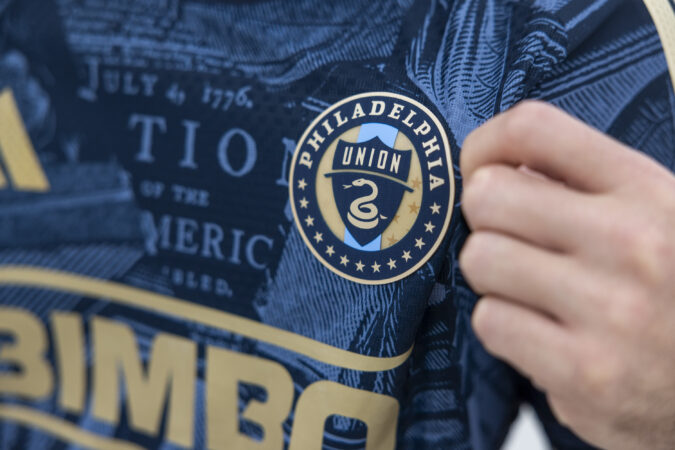
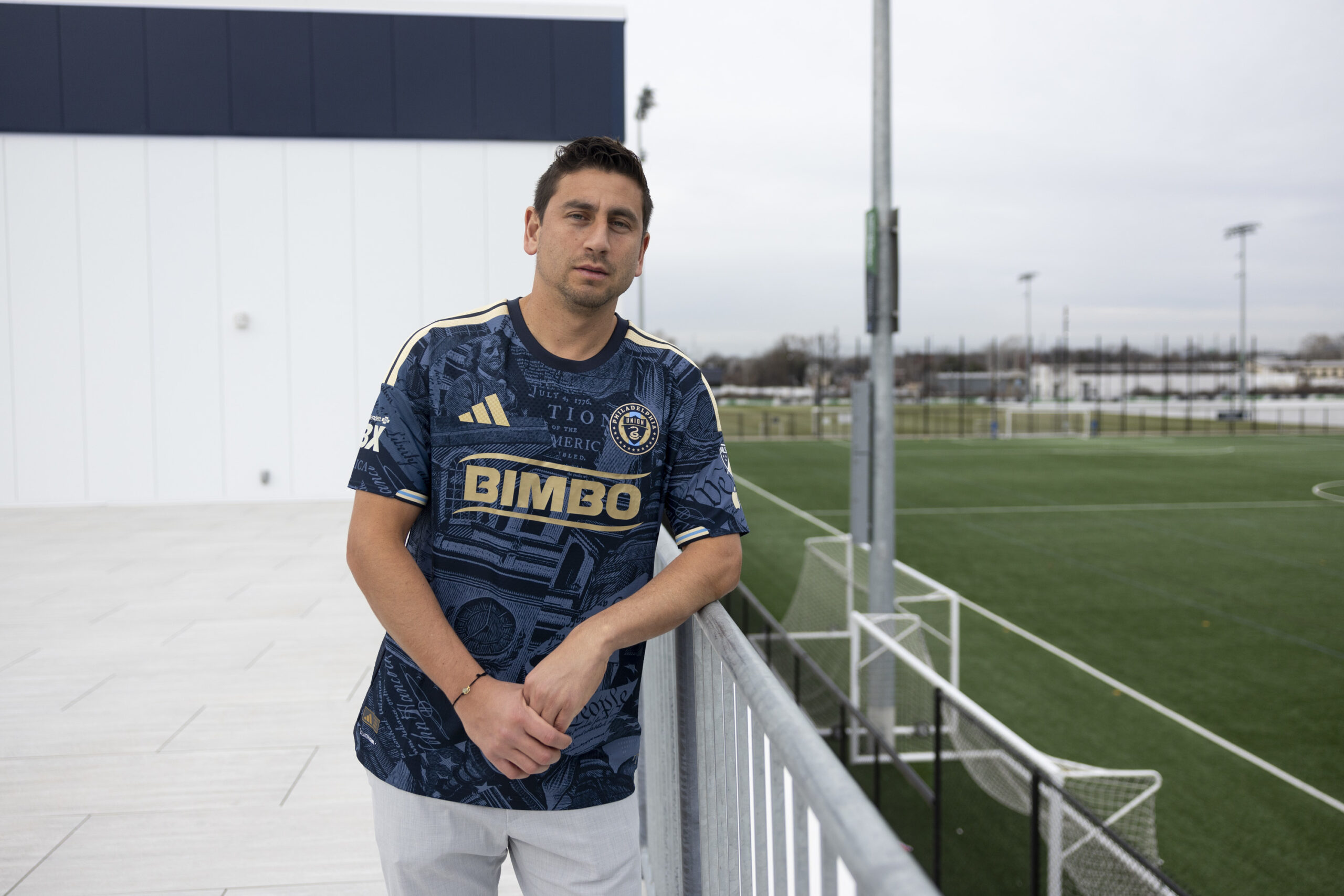
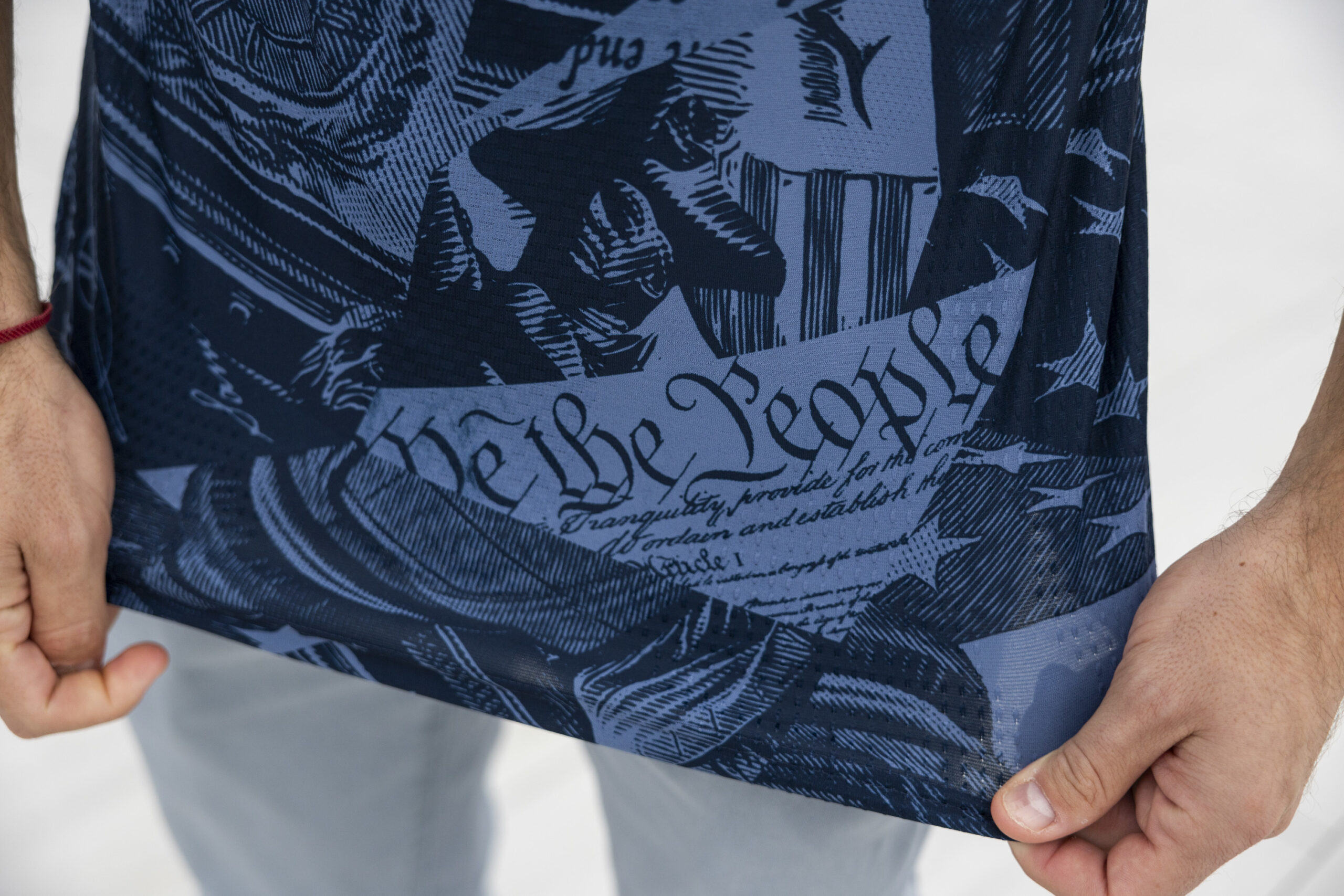
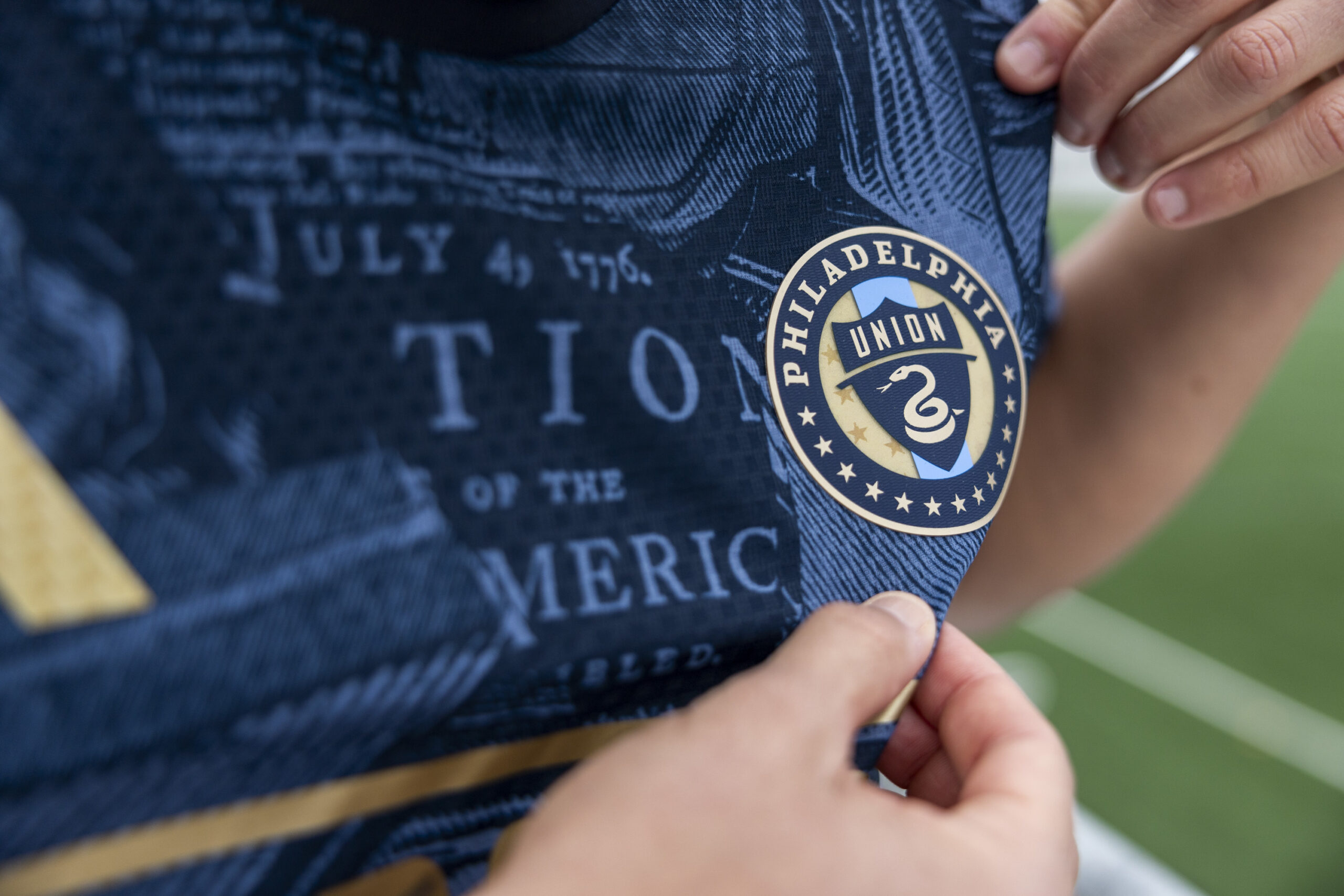
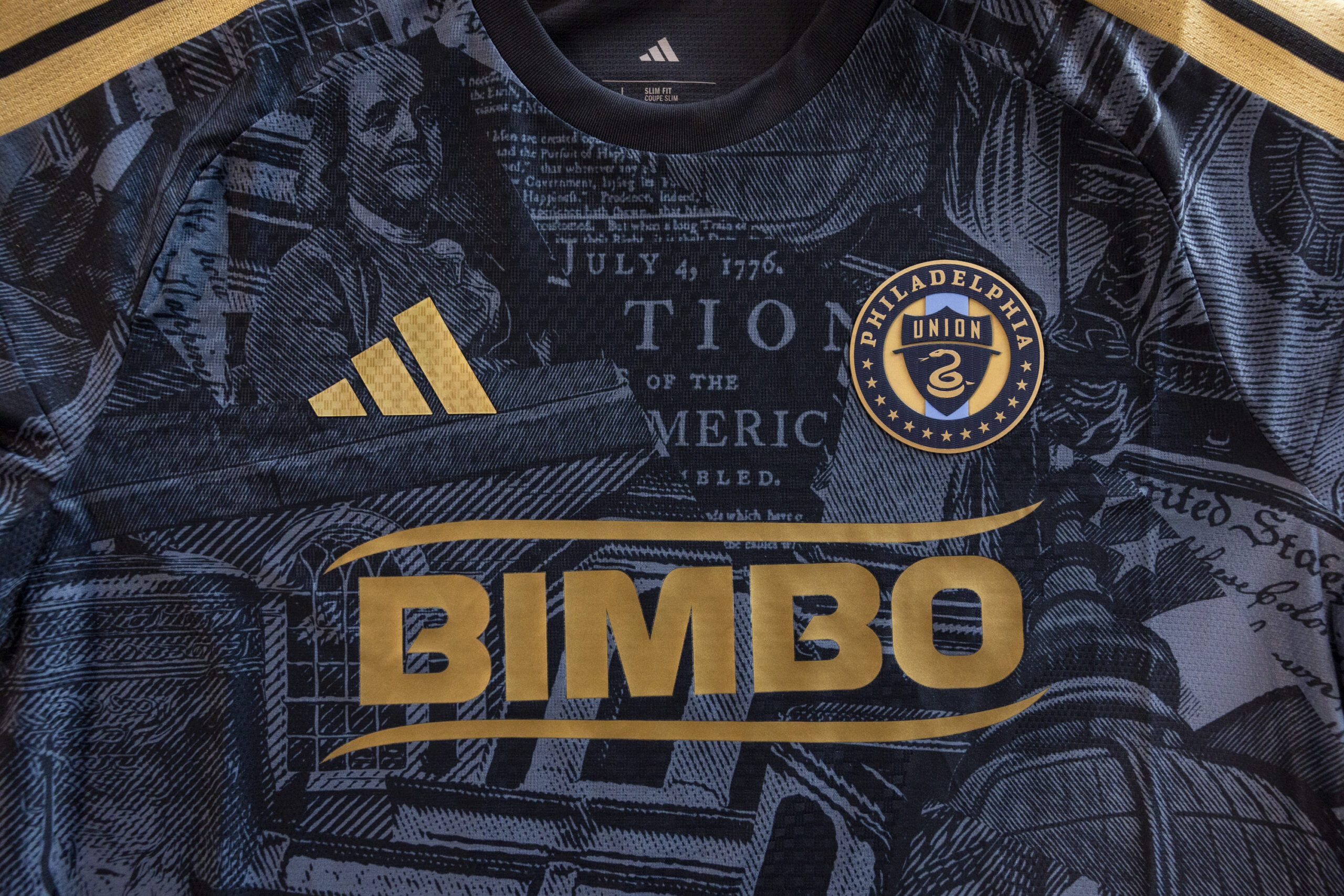
The club’s new home kit, unveiled Tuesday, is a navy blue jersey with an all-over pattern that features illustrations of some of Philly’s most recognizable landmarks and script from the Declaration of Independence.
Included in the pattern are illustrations of the Liberty Bell, Independence Hall, and even a portrait of Benjamin Franklin near the shoulder. A fragment of the Declaration of Independence, including the date of July 4, 1776, is printed just below the jersey’s collar, between the Adidas logo and the club’s crest.
“Being here in Philadelphia, the birthplace of the country, we just thought there was a really incredible opportunity to create something that represents the Philadelphia Union, that represents our city, and represents the country,” said Amanda Young Curtis, the Union’s senior vice president of marketing and communications. “This is, hopefully, a jersey that people think they can wear to a Union game, to a semiquincentennial celebration, or to a U.S. men’s national team game or watch party.”
The Union should have their first opportunity to play in their new uniform when the club hosts Trinidad’s Defence Force FC in the second leg of their first-round Concacaf Champions Cup matchup on Feb. 26. The Union’s MLS home opener is scheduled for March 1 against New York City FC.
Union midfielder Alejandro Bedoya showcases the new jersey for the season at the WSFS SportsPlex in Chester on Jan. 14.
The 1776 script also appears in the bottom corner of the jersey in gold. The jersey will be paired with dark blue shorts and socks to complete the Union’s home uniform.
The Union hope their bold new home kit can be a staple for this summer’s Independence Day festivities and fans at the FIFA World Cup, which will return to American soil for the first time since 1994.
This year, kits across MLS will feature a special nod to this summer’s World Cup, co-hosted by the U.S., Canada, and Mexico. On jerseys for American teams, the team logo will feature a holographic star pattern. For the three Canadian clubs, the holographic pattern will be maple leaves.
Union forward Milan Iloski shows off the new kit ahead of the Union’s 2026 season, which features various historical Philadelphia landmarks.
The kit, designed in partnership between the Union and Adidas, MLS’s jersey provider, will replace the navy kit that the club debuted in 2024. The team’s away jersey, a light blue shirt that features a yellow lightning pattern, will continue to be used.
Milan Iloski had high praise for the creative team behind the jersey’s design, calling it “a beautiful kit.” The Union midfielder also pointed out the kit’s versatility for this summer’s slate of festivities.
“I think it’ll be a kit that can be worn anywhere,” Iloski said. “I mean, you could wear it to a game, you can wear it to a party, you could wear it anywhere. With the World Cup coming here in America and the 250th anniversary, it felt like the perfect opportunity to do a big kit, to do something different, and I think they nailed it.”
Alejandro Bedoya has played in a lot of Union jerseys over the span of his career. But he says this year’s kit is among the best he’s seen, calling it a “work of art.”
Union midfielder Alejandro Bedoya, who shows off the raised crest on the Union’s new home kit, described it as a “work of art.”
“As a player, you’re often told [to] play for the badge, play for the shirt,” he said. “There’s no better representation of what that actually means than putting it on this jersey. You’re literally rocking Philadelphia here, and the history, and everybody who’s come through here. … Now we have even more of a reason to go out there on the field and really rep our city proudly.”
The Union wanted the kit to tell a story while representing the history and culture of Philadelphia. Fortunately for the club, the timing of its release made it easy to determine what story should be told.
“In soccer culture, not just with the Union, the jersey represents way more than just the team,” Curtis said. “It tells a story. In a way, the story was pretty clear for 2026.”
A first look at the new kit for Union’s 2026 season features various historical Philadelphia landmarks and documents depicted in the jersey to represent club, city, and country.
The Union are scheduled to host a number of pop-up retail locations in Philadelphia this weekend for fans interested in buying the new kit. They will set up at the Independence Blue Cross RiverRink Winterfest from 6:30 p.m. to 8:30 p.m. on Friday. Saturday’s pop-up is scheduled from noon to 2 p.m. at the Independence Visitor Center, and the club will be at Dilworth Park from noon to 2 p.m. on Sunday.
The team’s retail location at Subaru Park also will be open from 9 a.m. to 5 p.m. on Saturday and Sunday.
However, it appeared that fans could purchase the jerseys over the weekend, as a fan noted that the kit was on the shelves at the Mount Laurel location of Dick’s Sporting Goods on Sunday. Repeated attempts for comment from both the store’s location and from Dick’s corporate office went unreturned.
The post and others like it caused a social media storm of reactions, mostly positive from fans and style aficionados trying to determine if the leak was the team’s new primary uniform or a special third kit.
Now they have their answer.
Inquirer staff writer Kerith Gabriel contributed to this article.
After indirect fallout from the Jeffrey Epstein files sparked a dramatic day of crisis that threatened to topple him, the U.K. prime minister was saved by a pugnacious fightback and hesitation among his rivals inside the governing Labour Party about the consequences of a leadership coup.
Energy Secretary Ed Miliband said Tuesday that Labour lawmakers had “looked over the precipice … and they didn’t like what they saw.”
“And they thought the right thing was to unite behind Keir,” Miliband told the BBC.
Starmer’s authority over his center-left party has been battered by aftershocks from the publication of files related to Epstein — a man he never met and whose sexual misconduct hasn’t implicated him.
But it was Starmer’s decision to appoint veteran Labour politician Peter Mandelson, a friend of Epstein, as U.K. ambassador to Washington in 2024 that has led many to question the leader’s judgment and call for his resignation.
Starmer has apologized, saying Mandelson had lied about the extent of his ties to the convicted sex offender. And he vowed to fight for his job.
“I will never walk away from the mandate I was given to change this country,” Starmer said Tuesday as he visited a community center in southern England. “I will never walk away from the people that I’m charged with fighting for and I will never walk away from the country that I love.”
Starmer’s risky decision to appoint Mandelson – who brought extensive contacts and trade expertise but a history of questionable ethical judgment – backfired when emails were published in September showing that Mandelson had maintained a friendship with Epstein after the financier’s 2008 conviction for sex offenses involving a minor.
Starmer fired Mandelson, but a new trove of Epstein files released last month by the U.S. government contained more revelations. Mandelson is now facing a police investigation for potential misconduct in public office over documents suggesting that he passed sensitive government information to Epstein. He’s not accused of any sexual offenses.
Simmering discontent
The Mandelson scandal may be the final straw that finishes Starmer’s premiership. But it follows discontent that has built since he led Labour to a landslide election victory 19 months ago.
Some of Starmer’s problems stem from a turbulent world and a gloomy economic backdrop. He has won praise for rallying international support for Ukraine and persuading U.S. President Donald Trump to sign a trade deal easing tariffs on U.K. goods. But at home, he has struggled to bring down inflation, boost economic growth and ease the cost of living.
Despite a huge parliamentary majority that should allow the government easily to implement its plans, Starmer has been forced to make multiple U-turns on contentious policies including welfare cuts and mandatory digital ID cards.
Starmer has been through two chiefs of staff, four directors of communications and multiple lower-level staff changes in Downing Street. The prime minister’s powerful chief of staff, Morgan McSweeney, resigned Sunday over the decision to appoint Mandelson. Communications director Tim Allan left the next day.
Scottish Labour leader Anas Sarwar then held a news conference on Monday and called for Starmer to resign. If other senior party figures had followed, the pressure would have been impossible for Starmer to resist.
But none did. Instead, Starmer’s Cabinet and parliamentary colleagues posted apparently choreographed messages of support. They included former Deputy Prime Minister Angela Rayner and Health Secretary Wes Streeting, considered the two most likely challengers for the top job.
Then, came a highly charged meeting with Labour members of Parliament, where Starmer impressed many with his sense of resolve. Lawmakers in the room said that the mood, initially skeptical, became supportive.
“It was clear he was up for the fight,” said Chris Curtis, one of more than 200 Labour lawmakers elected in the 2024 Starmer landslide.
Temporary reprieve
Starmer appears to have more political lives than Larry the cat, who has outlasted five prime ministers during 15 years as “chief mouser” in Downing Street.
But his respite is likely to be temporary. Many Labour lawmakers remain worried about their reelection chances if the party’s dire opinion poll ratings don’t improve.
Some female party members feel particularly disappointed by Mandelson’s appointment. The Labour leader of Wales, First Minister Eluned Morgan, called revelations about Mandelson “deeply troubling, not least because, once again, the voices of women and girls were ignored.
“That failure must be acknowledged and confronted honestly,” she said, while offering support for Starmer.
Labour faces potential electoral setbacks at a Feb. 26 special election in what was once a party stronghold in northwest England, and in May’s elections for legislatures in Scotland and Wales and local councils in England.
And rivals are still plotting. The Guardian reported that an “Angela for leader” website backing Rayner briefly went live last month by accident. Streeting, whose genial relationship with Mandelson is now a weakness, released messages he’d exchanged with Mandelson before and after the ambassadorial appointment, seemingly in an attempt to show the men weren’t close friends.
The exchanges include implicit criticism of Starmer, with Streeting writing that the government had “No growth strategy at all.”
Tim Bale, professor of politics at Queen Mary University of London, said that Starmer had “bought himself some time” and challengers were “keeping their powder dry” for the moment.
“It’s very difficult to image after the shellacking that the party will presumably face in May, him continuing to lead the party much beyond this summer,” Bale said.
Though in British politics, nothing is impossible.
“There are problems with the other candidates,” Bale said. ”It’s never an ideal situation for any party to be choosing a prime minister in midterm, and it may be that the Labour Party decides, better the devil you know. I suspect that Keir Starmer will go, but who knows?”