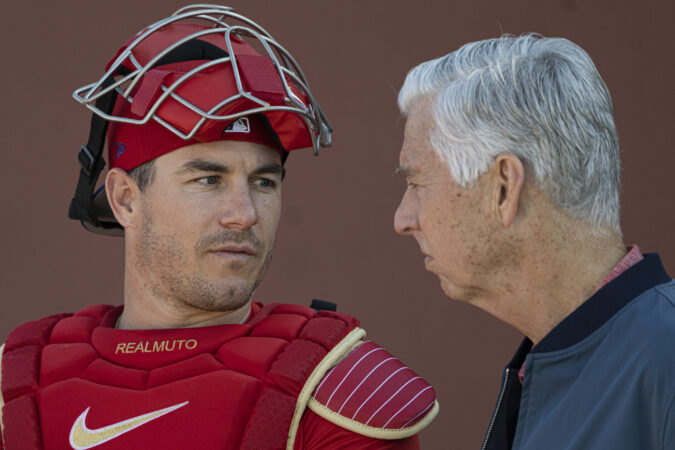
CLEARWATER, Fla. — One of the best catchers in baseball history intercepted Dave Dombrowski during a break in the general managers’ meetings in November.
Buster Posey had an itch to scratch.
Posey made roughly $170 million over a 12-year playing career in which he was a seven-time All-Star and three-time World Series champion. But he also observed that catchers, on the whole, weren’t as well-compensated as similar players at other positions, even though they are tasked with calling a game and handling a pitching staff.
So, Posey, now the San Francisco Giants’ president of baseball operations, approached his Phillies counterpart, who has led the front offices of five organizations over nearly four decades.
“He said, ‘Yeah, let me ask you a question: Why does the industry not put more dollar value on some of those things?’” Dombrowski recalled. “It’s hard, I think, the way it is. And we had a long conversation about it.”
Timely, too, as it turned out. Because the Phillies were in contract negotiations with free agent J.T. Realmuto, their catcher since 2019 and a foundational player in one of the winningest runs in the franchise’s 143-year history.
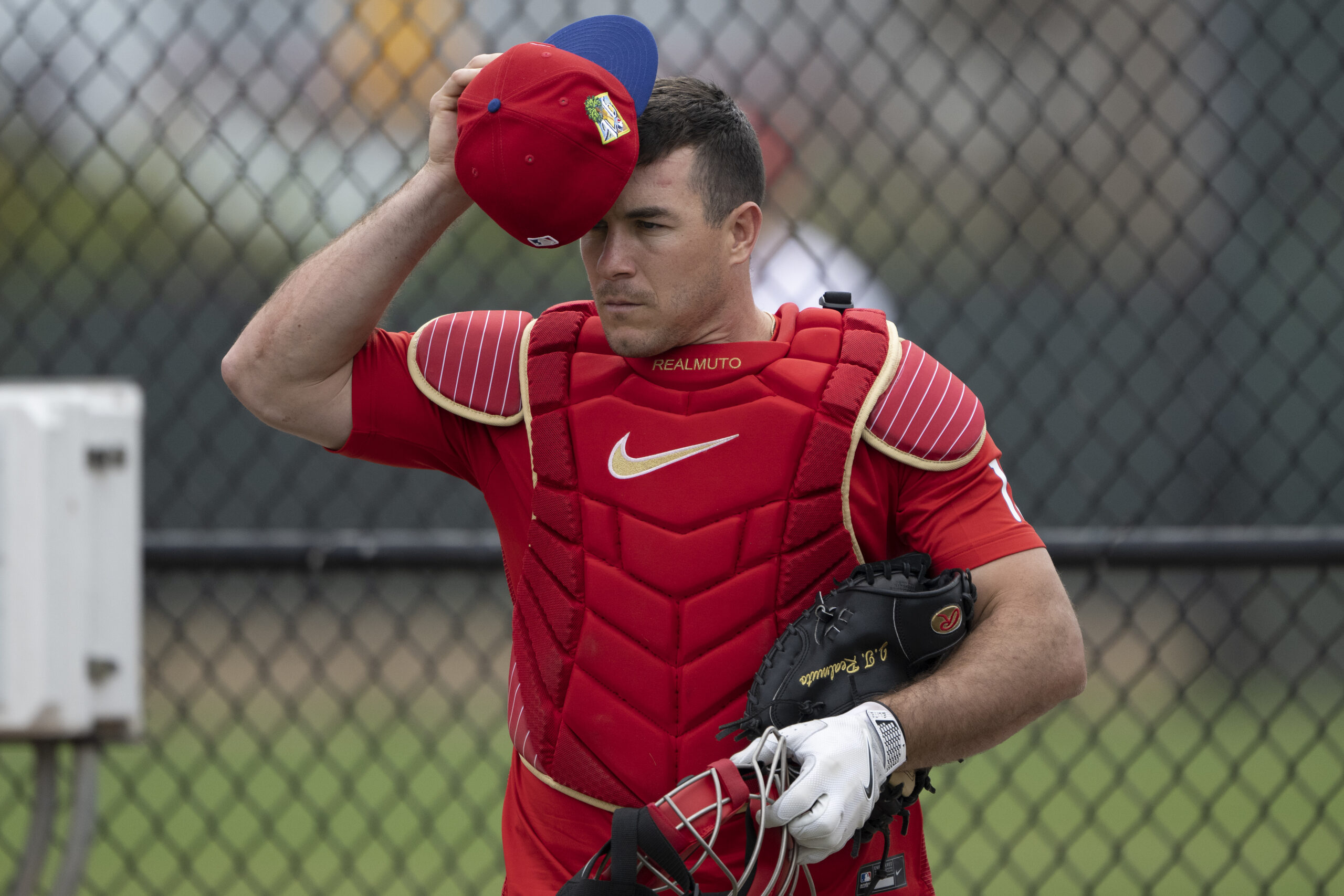
And it would soon be clear that there was at least a $4 million-per-year gulf between what the team and the veteran catcher’s camp believed he was worth.
The Phillies prioritized re-signing Realmuto this winter. They made an offer in December — but at a reduced annual salary (in the $10 million to $11 million range, major-league sources said) after three consecutive seasons of declining offense. Behind the plate, Realmuto, who turns 35 in March, remains unassailable as a game-caller and leader.
Realmuto felt those skills were worth a certain salary. The Phillies valued them differently.
“We had a number in our mind, and we knew what we were worth,” Realmuto said this week on Phillies Extra, The Inquirer’s baseball podcast. “And I wasn’t going to take anything less than that.”
It was a familiar stance. Realmuto and his agents, who also represented Posey as a player, have long sought to boost the pay scale for catchers.
In 2021, Realmuto re-signed with the Phillies for a $23.1 million annual salary, a record for catchers — by $100,000. Five years later, the mark still stands. And it’s less than the record for any position other than relief pitcher (Edwin Díaz: $23 million). It’s also less than the seven highest salaries for third basemen and the top nine for outfielders, according to Spotrac.
Realmuto went to an arbitration hearing against the Phillies in 2020 over a $2.4 million difference in salary proposals because he was trying to move the goal posts for catchers. He lost.
“I don’t believe teams — from a) their models and b) their valuations — take into account the nonanalytical special sauce of a catcher,” said Matt Ricatto, Realmuto’s agent at CAA, the same agency that represented Posey as a player. “I think it’s a blind spot for baseball.”
So, Realmuto fought that fight again this winter. It nearly ended with him and the Phillies going their separate ways.

Catch 22
Most people know the story by now.
In January, as talks with Realmuto reached an impasse, the Phillies pivoted to free-agent infielder Bo Bichette, even agreeing to make his desired seven-year, $200 million offer, major league sources said. If the Mets hadn’t swooped in with a higher-salary ($42 million per year) three-year deal, Bichette would be with the Phillies and Realmuto … well, with whom exactly?
“It got a little stressful there for a couple of days,” Realmuto said. “We started kind of thinking about our other options and putting the logistics together of what it might be like to go somewhere else. And thankfully it didn’t come to that because, as we’ve stated all along, this is where we wanted to be. We’re happy we didn’t have to up and move and go somewhere else.”
Indeed, Realmuto lives on Clearwater Beach. His wife and four children are with him throughout spring training. They’re comfortable in Philadelphia. Nobody wanted to leave.
But Realmuto felt it was important to continue his crusade for catcher equity. He held firm on not accepting the Phillies’ initial offers. On the night of Jan. 15, Dombrowski called Ricatto to inform him the Phillies were going in a different direction.
Roughly 12 hours later, once the pursuit of Bichette was foiled, the Phillies raised their offer to Realmuto: three years and $45 million, with as much as $7 million per year in bonuses based on merit (top-10 MVP votes, All-Star elections/selections, Gold Glove, Silver Slugger).
“If you ask any pitcher, any pitching coach, any manager, the most important thing a catcher can do is call a game and know his pitching staff and give them confidence when they’re on the mound,” Realmuto said. “If you can make your pitchers 5% better, 10% better, over the course of a year, that’s extremely, extremely valuable.”
Sure. But game-calling and handling a pitching staff are among the last largely unquantifiable skills in baseball’s analytics age.
“And because it’s not really quantifiable, then you don’t really get rewarded for it,” Realmuto said. “That’s the aspect that I just don’t agree with. It doesn’t sit well with me, so that’s kind of just why I enjoy fighting for it.”
Measuring up
In modern baseball, there’s a metric for everything.
Almost everything.
Who’s the fastest runner? Statcast tracks feet-per-second sprint speeds. The best outfield jump? There’s data for that, too. A hitter’s average exit velocity, launch angle, and bat speed. A pitcher’s spin rate and vertical/horizontal movement.
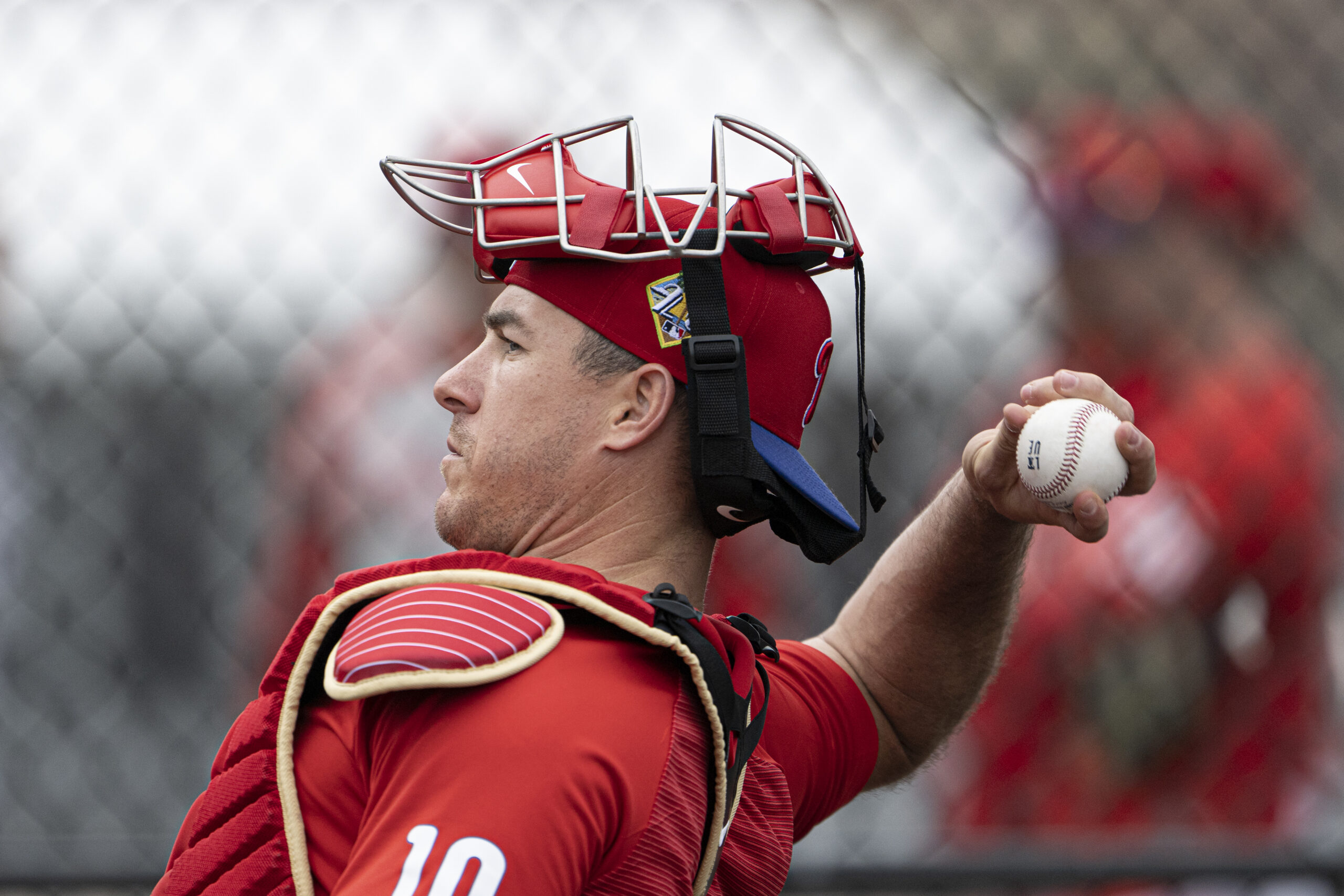
The metrics for catchers include blocking, throwing, and framing, the technique of receiving a pitch in a way that influences the umpire to call a strike. “Pop time” measures how fast a catcher releases the ball on steal attempts. Realmuto annually has among the best pop times of all catchers. His framing isn’t typically as strong, in part because the Phillies don’t emphasize it as much as other teams.
But there isn’t a reliable gauge for calling a game. Phillies manager Rob Thomson, a former minor-league catcher, suggested catcher’s ERA and OPS as decent barometers.
In that case, opponents have a .682 OPS and Phillies pitchers have a 3.75 ERA with Realmuto behind the plate since 2023. The major-league averages during that time: .722 and 4.18.
A catcher’s ability to handle a pitching staff is almost entirely anecdotal.
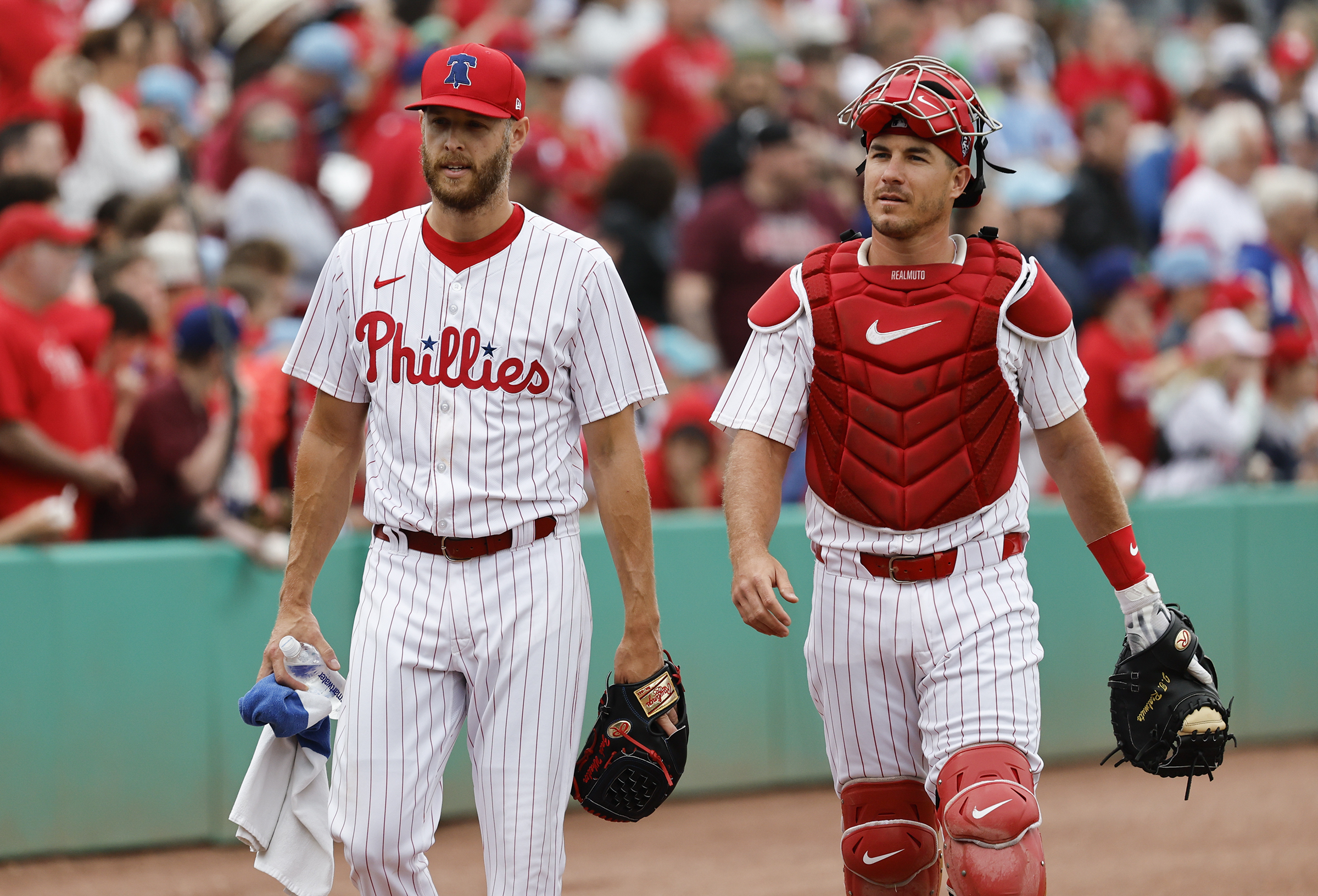
Zack Wheeler swears by Realmuto. He barely ever pitches to anyone else (134 of Wheeler’s 157 starts for the Phillies have come with Realmuto behind the plate) and hardly ever shakes off a pitch that he calls.
Cristopher Sánchez, who emerged as the Cy Young runner-up in the National League last year, cited Realmuto’s diligence in putting together a game plan, a process that begins even before the starter arrives at the ballpark. And Jesús Luzardo describes Realmuto as “a no-B.S. guy” behind the plate.
“You show up to the field, he’s already there, doing homework, going over scouting reports, watching video,” Luzardo said. “So, when he goes up back there and he tells us, ‘This is the plan that we’re going to do throughout the game,’ you have confidence that he knows what he’s talking about and that it’s not [him] just winging it.”
In conversations with the Phillies and other teams this winter, Ricatto described Realmuto’s “cascading effect” on a team. Because although he’s not the best player on the roster, “he makes [teammates] better than anyone else at that [catcher] position,” Ricatto said.
Surely, that’s worth something.
But how much?
It’s a question that gets to the heart of Dombrowski’s chat with Posey.
“J.T. is outstanding, right?” Dombrowski said. “He handles the staff well. He does all those other things. But let’s say you had a catcher that, let’s say they hit .150. And they did all that [other stuff]. What would you pay that person? I don’t have that exact answer.
“But it’s one of those where it’s a combination of the value, the defensive performance, and all that — and the hitting aspect of our game. The game has rewarded offense [more than anything] throughout the years.”
‘I never felt like Plan B’
Realmuto is coming off his worst offensive season since his rookie year in Miami. But he wasn’t a .150 hitter, either. He batted .257 with 12 homers and a .700 OPS. Based on OPS-plus, he was 9% less productive than league average.
But even at Realmuto’s offensive peak, his agents believed he was paid less simply because he’s a catcher.
After the 2019 season, Realmuto filed for $12.4 million in arbitration because his numbers were comparable at the same point in his career to then-Nationals third baseman Anthony Rendon, who made $12.3 million in 2018. But a three-person panel ruled in favor of the Phillies’ $10 million offer, still an arbitration record for catchers.
And although the judges didn’t provide an explanation, Jeff Berry, one of Realmuto’s agents at the time, believed it was because they compared Realmuto only to fellow catchers, notably Baltimore’s Matt Wieters, who made $8.3 million in his third year of arbitration in 2015.
As Berry told The Inquirer at the time, “You shouldn’t get paid less to squat for a living.”
Which doesn’t mean Realmuto gets paid squat. He has made approximately $135 million since 2016. When his new contract expires, he will have made at least $180 million.
It’s little wonder, then, that Realmuto said he doesn’t have any hard feelings toward the Phillies after they nearly broke up with him last month. He insisted he doesn’t feel like a consolation prize for not landing Bichette.
“To be honest, I never felt like Plan B because I could have signed with the Phillies a month and a half earlier,” he said. “They just valued me differently than I valued myself.”
So, Realmuto stood on principle, just like he always has.
Leave a Reply