This week in Philly music features a tribute to the late songwriter Jill Sobule, a 20th-celebration anniversary of Clap Your Hands Say Yeah’s debut, a two-night stand by funkateers Lettuce, a golden age of hip-hop rapper, and a host of rising stars. That includes power pop band the Sharp Pins, jazz musicians Kenyon Harrold and Isaiah Collier, and genre-blending maverick Sudan Archives.
Thursday, Jan. 22
Rakim
No list of the most influential rappers of all time is complete without Rakim. He is the golden age of hip-hop MC who set new standards for lyricism and internal rhyme schemes with deejay Eric B. on late 1980s albums like Paid in Full and Follow the Leader. His latest is last year’s The Re-Up. 8 p.m., City Winery, 900 Filbert St., citywinery.com/philadelphia
Gregory Alan Isakov
South Africa-born, Philadelphia-raised, and Boulder, Colo.-based indie folk singer Gregory Alan Isakov’s most recent album is 2023’s Appaloosa Bones. It is a moody evocative set of allusive songs on the Iron & Wine and Fleet Foxes continuum. His North Broad Street show is “an intimate acoustic evening.” 8 p.m., Met Philly, 858 N. Broad St., themetphilly.com
Lamp
In the Grateful Dead- and Phish-adjacent universe, Lamp has legitimate bona fides. Russ Lawton and Ray Paczkowski are the rhythm section in the Trey Anastasio Band and Scott Metzger plays in Joe Russo’s Almost Dead. 8 p.m., Ardmore Music Hall, 23 E. Lancaster Ave., Ardmore, ardmoremusichall.com
Friday, Jan. 23
Sharp Pins
Twenty-one-year-old power-pop wunderkind Kai Slater’s Sharp Pins is all the indie rage, with the kinetic Balloon Balloon Balloon drawing from Guided By Voices and the Byrds and sounding downright Beatles-like at times. The band plays two shows at Jerry’s on Front with Atlantic City’s Te Vista opening. 6:30 p.m. and 8:30 p.m., Jerry’s on Front, 2341 N. Front St., r5productions.com
Clap Your Hands Say Yeah
In 2006, Clap Your Hands Say Yeah’s self-titled debut’s music blog-fueled buzz helped reshape the indie music business. Singer Alec Ounsworth is marking the milestone with a “Piano & Voice” solo tour that kicks off with hometown Philly shows on Friday and Saturday. Noon, Free at Noon, World Cafe Live, 3025 Walnut St., xpn.org and 7 p.m., Philadelphia Ethical Society, 1906 Rittenhouse Square, r5productions.com
Lettuce, as pictured on their new album “Cook.” The Boston funk band plays two nights at Ardmore Music Hall, on Friday and Saturday.
Lettuce
The Boston funk sextet Lettuce has named its new album Cook, and the members all sport chef’s toques on the album cover. The band, whose musical stew pulls from horn-heavy influences like Tower of Power and James Brown, plays two shows this weekend. 8 p.m. Friday and Saturday, Ardmore Music Hall, 23 E. Lancaster Ave. Ardmore, ardmoremusichall.com
Saturday, Jan. 24
Isaiah Collier and Keyon Harrold
This Penn Live Arts show pairs two rising stars in the jazz world. They’re both Midwesterners. Ferguson, Mo., trumpeter Keyon Harrold has played with Jay-Z and Common, who guests on the opening track of his album. He has also played the trumpet parts in the Don Cheadle-starring Miles Davis biopic Miles Ahead. Isaiah Collier is a Chicago saxophonist whose The Story of 400 Years traces four centuries of Black American history. 7:30 p.m., Zellerbach Theatre, 3680 Walnut St., pennlivearts.org
Keyon Harrold plays the Zellerbach Theatre at the Annenberg Center on Saturday with Isaiah Collier.
Jillith Fair: Loving Jill Sobule
In May, singer-songwriter Jill Sobule tragically died in a house fire in Minnesota. A tribute show at the Fallser Club in East Falls will be co-hosted by Sobule’s friends Jim Boggia and Martykate O’Neill. The evening will feature Tracy Bonham, Jonathan Coulton, James Mastro, and author Tara Murtha. Expect an emotional evening. 8 p.m., the Fallser Club, 3721 Midvale Ave., thefallserclub.com
Daffo
Daffo, the indie pop singer born Gabi Greenberg, went viral with the 2024 single “P:or Madeline.” Their debut, Where the Earth Bends, was recorded with Elliott Smith producer Rob Schnapf. 8 p.m., PhilaMoca, 531 N. 12th St., philamoca.org
Winter Carnival
This package tour brings together several veteran alt-hip-hop luminaries, headlined by Twin Cities rap duo Atmosphere. It also includes Sage Francis and R.A. the Rugged Man and former Ultramagnetic MCs leader Kool Keith. 8 p.m., Brooklyn Bowl, 1009 Canal St. brooklynbowl.com/philadelphia.
Sunday, Jan. 25
On a Winter’s Night
In 1994, Christine Lavin produced a folk compilation called On a Winter’s Night, featuring John Gorka, Patty Larkin, Lucy Kaplansky, Bill Morrissey, and others. That album prompted many concert tours with folkies of various stripes, and this reunion features Gorka, Larkin, Kaplansky, and Cliff Eberhardt. 8 p.m., Sellersville Theater, 24 W. Temple Ave., Sellersville, st94.com
Josh Ritter
Josh Ritter is never short on new songs or stories to tell. Having completed a full band tour for his new album, I Believe in You, My Honeydew, he’s now out on a solo tour. On Sunday, it will take him to West Art, the new venue in an old church in Lancaster. 8 p.m., West Art, 816 Buchanon Ave., Lancaster, westartlanc.com.
Brittney Denise Parks, also known as Sudan Archives, plays Union Transfer on Tuesday.
Tuesday, Jan. 27
Sudan Archives
Brittney Denise Parks, who performs as Sudan Archives, is a singer, violinist, and electronic musician. She is at her most dance-floor directed on the excellent and creatively restless The BPM, the follow-up to 2022’s acclaimed Natural Brown Prom Queen. 8 p.m., Union Transfer, 1026 Spring Garden St., utphilly.com.
Greg Freeman
Put Greg Freeman in the category of RIYL MJ Lenderman, Ryan Davis, and Bob Dylan. The latter’s 1978 album Street Legal is the inspiration behind “Curtain” from Freeman’s 2025 album Burnover, which confirmed the buzz generated by the Vermont songwriter’s 2022 debut Looked Out. 8 p.m. Ukie Club, 847 N. Franklin St., 4333collective.net.
Concert announcements
It’s a busy week for tour announcements.
A$AP Rocky was musical guest on Saturday Night Live last weekend. The rapper, who also happens to be Rihanna’s boyfriend, used that appearance to announce a “Don’t Be Dumb” tour that comes to Xfinity Mobile Arena on June 4.
The Human League plays the Met Philly on June 28, joined by fellow 1980s British acts Soft Cell and Alison Moyet. And Tori Amos’ new album, In Time of Dragons, due May 1, will bring her to the Met on Aug. 1.
Snail Mail, the Baltimore indie rocker born Lindsey Jordan, has announced her new album, Ricochet, due in March, and a date at the Fillmore on April 16 with Swirlies and Hall Gallo. Ticket details at r5productions.com.
Next month, the Old City establishment will also roll out a “lighter portions, lighter prices” section of its regular menu.
This is all to keep up with the evolving preferences of Philly-area diners, said Barry Gutin, cofounder of Cuba Libre.
“We said, ‘We should put something on the menu for all sorts of people watching their diet and their money,’” said Gutin, whose staff has noticed GLP-1 users and nonusers alike requesting these options more over the past year. This trend has also been seen at Cuba Libre restaurants in Atlantic City, Washington, and Orlando, as well as at its Paladar Latin Kitchen and Bomba Tacos locations in the Philadelphia suburbs.
For customers, an added perk is that they pay less for these smaller-portioned menu items, Gutin added. He said diners have become more focused on value amid broader financial uncertainty.
“The economy dictates that we have a diversity in pricing that meets more people’s needs,” Gutin said. “You think about the way people look at menus online. They’re scanning through prices as well.”
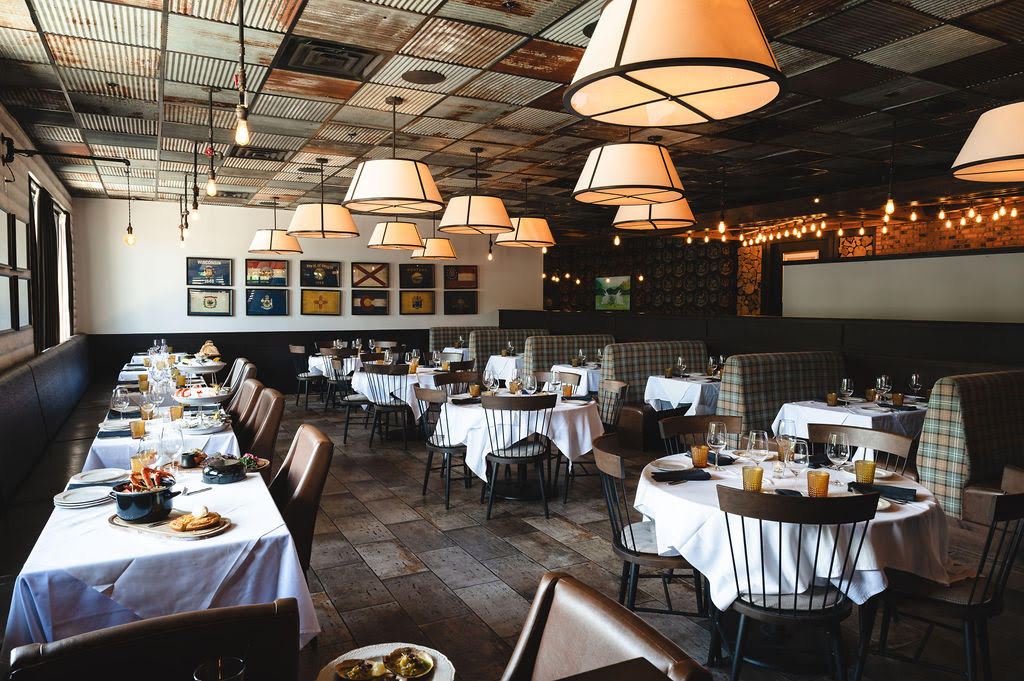
The dining room at Cuba Libre in Philadelphia. A cofounder says staff has noticed GLP-1 users and nonusers alike requesting smaller-portioned, less expensive options more over the past year.
In August, more than a third of U.S. diners said they were dining out less frequently than they did a year ago, according to a survey from YouGov. Of the less-frequent diners, 69% said they were eating out less in part because of the perceived cost of restaurant meals, the survey found.
Lower-income consumers were most likely to have cut back on dining out, according to the survey, while middle- and higher-income folks hadn’t changed their habits substantially.
This jibes with what executives at the Federal Reserve Bank of Philadelphia are hearing, too.
“Even individuals with discretionary income to spend are being careful,” Anna Paulson, president of the Federal Reserve Bank of Philadelphia, said Wednesday. “For example, although people are still eating out in Philadelphia, contacts tell us that less expensive options on the menu are becoming more popular.”
“The only exception to this trend is at more upscale restaurants,” Paulson added. “High-income households, bolstered by a strong stock market, appear to be driving elevated consumption growth.”
The Ropa Vieja meal from the GLP-Wonderful menu at Cuba Libre as shown on Jan. 14.
Alcohol use among adults has plummeted, with just 54% of respondents saying they drink in a July Gallup survey. That’s the lowest percentage in at least 90 years. It likely drops even lower this month as some people abstain from alcohol as part of the Dry January trend.
All of these trends are on display at Philly-area bars and restaurants. And owners are trying to keep up.
“We’re definitely at a time of dramatic shift in people’s preferences and tastes,” said Avram Hornik, owner of FCM Hospitality, which runs about a dozen venues in the region. They include Morgan’s Pier, Harper’s Garden, Craft Hall, and Concourse Dance Bar, as well as seasonal cocktail and beer gardens such as the traveling Parks on Tap.
“I don’t think people are spending less or going out less,” Hornik said, “but I just think they are doing it differently.”
Customers dine at Liberty Point, one of Avram Hornik’s restaurants, in 2023.
At Hornik’s restaurants, overall sales have been consistent year over year, he said. Some customers are looking for smaller portions, he said, and late-night business has dropped precipitously. But group dining and special events have made up for losses in other areas, he said.
When customers decide an outing is worthwhile, Hornik said, they generally aren’t sparing expenses.
People are “looking for more of an experience when they go out to eat,” Hornik said. “It’s really about value: Am I getting a good value for the money that I’m spending?”
To retain customers, Hornik said his restaurants are leaning into weekly specials, such as $1 tacos at Rosy’s, and happy-hour deals.
At Cuba Libre, Gutin said he sees the GLP-1 menu, as well as the forthcoming lighter-portions menu, as a way to make his restaurants as appealing as possible for all diners.
At each location, only about a dozen people request the GLP-1 menu each week, he said. But if a group is considering dining at Cuba Libre and one person is on a GLP-1, the special menu could make or break their decision. He said it could keep the GLP-1 user from exercising their “veto vote,” sending the entire group to dine elsewhere.
Dining trends differ by location
In the Philadelphia suburbs, restaurateurs said dining trends vary depending on location and type of restaurant.
The dining room at Joey Chops, the Malvern steakhouse that Stove & Co. restaurants co-owner Joe Monnich said has been least impacted financially by changing consumer habits.
Joe Monnich, co-owner of Stove & Co. restaurant group, said food sales are up at his higher-end restaurants, including Joey Chops steakhouse in Malvern. But farther from the Main Line, in more “blue-collar” Lansdale, he said, Stove & Tap’s business is less steady of late.
There, “I feel more economic up and downs,” Monnich said. He felt similarly about his Al Pastor restaurant in Havertown, which is now closed after a local buyer came in last month and offered Monnich cash on the spot for the building.
At his more casual concepts all over the region, people are spending less on average, he said, and about the same at the higher-end spots. Recently, he added, staff have noticed diners being more mindful of how much they’re consuming.
“People aren’t getting that second drink,” Monnich said. “People aren’t getting dessert. People aren’t getting that appetizer.”
Changing drinking habits have hurt alcohol sales, too, Monnich said. In recent years, many customers have turned away from local microbrews and gravitated toward canned cocktails and “macro beers” like Michelob Ultra and Miller Lite.
“Three years ago I barely sold Michelob Ultra and right now it’s one of my top sellers,” Monnich said. As are canned cocktails. “Surfsides are expensive, and I don’t make a lot of money off them.”
Stove & Co. executives have talked about creating special menus catering to these evolving consumer preferences, Monnich said, but he gets anxious about making portions smaller. So for now, he too is leaning into happy-hour deals and other value-focused items.
“I try not to be too focused on trends because trends come and go,” Monnich said. “I do see the current trend, these weight-loss drugs, I don’t see that going anywhere … [and] people are going to be drinking less-octane alcohol.”
Staff writer Ariana Perez-Castells contributed to this article.
For Shane Hennen, the house of cards keeps folding.
A federal indictment unsealed Thursday accuses the Philadelphia-based professional gambler of acting as a ringleader in a sweeping sports-betting conspiracy now involving the NCAA and the Chinese Basketball Association. Hennen was first arrested last January in connection with a gambling case involving a former Toronto Raptor, and was also charged separately in an October indictment in New York focused on the NBA.
The latest charges against Hennen, known as “Sugar Shane,” brought an international angle to the existing portrait of a high-stakes gambler who prosecutors allege was willing to bribe athletes to throw games, provide devices to fix backroom card games tied to the New York mafia, and use insider betting information to place fraudulent wagers.
In all, federal prosecutors have accused Hennen of conspiring to place fraudulent bets on ex-Raptors forward Jontay Porter and NBA guard Terry Rozier, bribing the top-scoring player in the CBA to throw games, and recruiting college basketball trainers to help rig dozens of NCAA games — much of it orchestrated from Hennen’s favorite Philly casino, Rivers. On top of it all, he is also alleged to have participated in the rigging of mob-linked poker games in New York City.
And while the list of implicated players and conspirators continues to grow by the dozens, Hennen has remained a central figure to the bet-fixing scandals that have rocked the sports world over the past year.
But Hennen’s earlier record for criminality came into clearer view as result of the federal investigations. While growing up in the Pittsburgh area, he did time for drug and gambling related charges that now serve as a kind of prelude to his role in the bet-fixing scandals.
In 2006, the Washington, Pa., native received probation in Allegheny County for charges linked to a gambling scheme. According to court records, Hennen and an accomplice rented adjacent rooms in a Pittsburgh area hotel to hold underground dice games. While gambling in one room, a partner in the next room employed a magnetic device to flip loaded dice to preferred numbers.
Then, early one morning in 2009, a former Duquesne University basketball player was found bleeding from a stab wound in Pittsburgh’s South Side neighborhood, a popular nightlife area. The man survived and later told police that Hennen had stabbed him in the neck after the athlete confronted him about cheating in a card game. Hennen was also picked up on a DUI less than two weeks later, but was released.
Not long afterward, Hennen was charged with two more felonies after he was caught in a parking lot with 500 grams of cocaine down the street from the Meadows Casino, near Pittsburgh.
In subsequent court filings, Hennen revealed that he had been working with a local drug dealer for more than a year. Facing well over a decade of jail time between the drug and assault charges linked to the stabbing, Hennen agreed to testify against his dealer and participated in a federal drug sting involving a different narcotics supplier based in Detroit, court records show.
He served just less than two-and-a-half years in prison, plus four years of supervised release.
According to court transcripts published by Sports Illustrated in October, Hennen admitted five times under oath that he cheated other people out of money.
During a cross-examination, Lee Rothman, an attorney for his associate drug dealer he was testifying against, stated bluntly that Hennen made “a living out of cheating people out of things.”
“That’s correct,” Hennen said.
After his release in 2013, Hennen traveled to Pensacola, Fla., purportedly to work as a sales rep for a seafood wholesaler. Court records show he almost immediately went back to gambling, even violating his probation to travel out of state to participate in the 2014 World Series of Poker in Las Vegas.
When Hennen landed in Philadelphia in 2015, it was seemingly to start over. He leased an apartment near the Rivers Casino in Fishtown.
The small casino would become Hennen’s unlikely staging ground for a new, more lucrative gambling scheme that would come to span the globe.
From Philly to China
Local gamblers said Hennen worked the poker and baccarat tables at Rivers, using the action to build a reputation with the house and pave the way for six-figure sports bets, the kind only gamblers with money and a track record at the casino are allowed to make.
By 2022, Hennen had launched an online betting consultancy via an Instagram page called “Sugar Shane Wins.” On social media, Hennen posted his sportsbook picks along with glamorous photos jetting around to Vegas or Dubai, or sitting courtside at Sixers games.
Although he marketed bets on teams familiar to U.S. gamblers, his focus — and income — was overseas, according to federal prosecutors.
He posted courtside photos of himself at Sixers games with a Mississippi-based sports handicapper named Marves Fairley, who prosecutors say connected the gambler with Antonio Blakeney, a former Louisiana State University shooting guard who had done a brief stint on the Chicago Bulls.
Blakeney had subsequently bounced around different international teams, including Hapoel Tel Aviv, in Israel, and the Nanjing Monkey Kings and Jiangsu Dragons, both in China. According to a federal indictment, while playing for the Dragons, Hennen and Fairley bribed Blakeney to underperform in Chinese basketball games in order to fix high-stakes bets against the team and recruit others to do the same.
Suddenly, the slots parlor on the Delaware was seeing six-figure bets placed on multiple Chinese basketball games through its sportsbook, BetRivers, sometimes for upward of $200,000. Representatives for the casino declined to comment Thursday on the latest federal indictment.
The gambit proved reliably lucrative. In a 2023 text message obtained by federal authorities, Hennen reassured an accomplice who had placed big bets against Blakeney’s team.
“Nothing gu[a]rantee[d] in this world,” Hennen wrote, ”but death taxes and Chinese basketball.”
The model would also serve as a template for a similar racket the duo would orchestrate within the NCAA.
By 2024, the duo had recruited basketball trainers Jalen Smith and Roderick Winkler to help convince dozens of college basketball players to rig matches on their behalf.
Ultimately, 39 players on more than 17 Division 1 NCAA teams would participate, with bettors wagering millions on at least 29 rigged games.
Hennen took a behind-the-scenes role, authorities alleged, texting a network of straw bettors who placed big wagers on games featuring star players bribed by the trainers, and sometimes moving bribe money or splitting up winnings back in Philly.
His rising profile started to draw unwanted attention.
Shortly after Hennen relocated to Las Vegas in 2023, he was accused of rigging poker matches by Wesley “Wes Side” Fei, another professional gambler who claimed in social media posts that Hennen had scammed him out of millions.
The next year, gambling industry watchdog Integrity Compliance 360 began flagging bets placed on six Temple University basketball games. One, against Alabama-Birmingham in March 2024, saw the Borgata, in Atlantic City, cancel bets for the game due to suspicious betting activity. Before the end of 2024, the National Collegiate Athletic Association had launched an investigation into the games, as rumors swirled that federal authorities were questioning Temple player Hysier Miller as part of an alleged point-shaving scheme.
Then Porter, the Raptors center, was banned for life from the NBA, after it emerged that the league was investigating yet another bet-rigging scheme. A few months later, Porter pleaded guilty to gambling charges — the first hint at the true scope of a sprawling federal investigation that went on to consume the NCAA and NBA.
Beginning of the end
In January 2025, Hennen’s luck ran out.
Authorities stopped him in Las Vegas as he was boarding a one-way flight to Panama, en route to Colombia. He had $10,000 in his pocket and claimed he was headed to South America for dental treatment.
But investigators had already zeroed in on Hennen as the main orchestrator of the prop betting scheme involving Rozier, the former Miami Heat guard. In October, federal prosecutors in the U.S. District Court for the Eastern District of New York unsealed an indictment, accusing Hennen of working with Fairley to have Rozier throw games for a profit, sometimes using Philadelphia as a meeting point to dole out the proceeds to other bettors.
Court records show that since then, Hennen has entered plea negotiations with federal prosecutors and relocated to a residence in South Philadelphia. (His attorney did not respond to a request for comment.)
During the Thursday news conference unveiling the latest indictment, Wayne Jacobs, a special agent in charge of the FBI Philadelphia field office, said that Hennen and his conspirators’ actions had undermined faith in professional sports writ large.
“We expect athletes to embody the very best of hard work, skill, and discipline, not to sell out to those seeking to corrupt the games for their own personal benefit,” he said. “The money that’s used as a tool to influence outcomes does not just taint a single game, it tears up the trust and the results that we cherish.”
We’ve asked where South Philly starts, and about the Eagles-Steelers divide, but now it's time to answer an even more controversial question: Where does South Jersey end and North Jersey begin?
It’s a toughie, even entire movies have tried to answer this question. Is it just Eagles country vs. Giants country? Or maybe area code based? Turnpike exits? Or just simple geography of towns and counties? We want to hear from you.
story continues after advertisement
Use the sliders below to draw the dividing line. Submit your pick and see how other Inquirer readers voted.
The Rest of New Jersey
Central Jersey
South Jersey
You think South Jersey includes south_city_marker.
If we averaged out the votes from Inquirer readers, South Jersey would include south_city_average.
We’re not done yet, though. Now you’ve told us where South Jersey starts, we have another question for you: If it exists, where does Central Jersey start?
selection_answer
Of those that voted, central_votes believe there is a Central Jersey. The average Inquirer reader placed north_city_average in North Jersey and central_city_avg in Central Jersey.
Thank you for taking our quiz. If you want to weigh in more (like Pork Roll or Taylor Ham) let us know!
Staff Contributors
Design, Development, and Reporting: Garland Fordice
Editing: Sam Morris
Copy Editing: Brian Leighton
Illustration: Julia Duarte
(()=>{var Ft=(t,e)=>()=>(e||t((e={exports:{}}).exports,e),e.exports);var at=Ft(p=>{var Ot={0:”Jan.”,1:”Feb.”,2:”March”,3:”April”,4:”May”,5:”June”,6:”July”,7:”Aug.”,8:”Sept.”,9:”Oct.”,10:”Nov.”,11:”Dec.”};function rt(t){return t===void 0&&(t=new Date),Ot[t.getMonth()]}var Ct={0:”Jan”,1:”Feb”,2:”Mar”,3:”Apr”,4:”May”,5:”Jun”,6:”Jul”,7:”Aug”,8:”Sep”,9:”Oct”,10:”Nov”,11:”Dec”};function ot(t){return t===void 0&&(t=new Date),Ct[t.getMonth()]}function S(t){return t==null}function lt(t){return typeof t==”number”&&isFinite(t)}function O(t){return lt(t)&&Math.floor(t)===t}var Nt=[“one”,”two”,”three”,”four”,”five”,”six”,”seven”,”eight”,”nine”],It=[“million”,”billion”,”trillion”,”quadrillion”,”quintillion”,”sextillion”,”septillion”,”octillion”,”nonillion”,”decillion”],it=[“th”,”st”,”nd”,”rd”,”th”,”th”,”th”,”th”,”th”,”th”],Dt=[11,12,13];function ct(t){if(S(t))return””;var e=+t;return O(e)?Dt.indexOf(e%100)>-1?it[0]:it[e%10]:””}var Bt=[“first”,”second”,”third”,”fourth”,”fifth”,”sixth”,”seventh”,”eighth”,”ninth”],Ht=new RegExp(/s+([^s]*)s*$/);p.apdate=function(t){return t===void 0&&(t=new Date),rt(t)+” “+t.getDate()+”, “+t.getFullYear()},p.apdatetab=function(t){return t===void 0&&(t=new Date),ot(t)+” “+t.getDate()+”, “+t.getFullYear()},p.apmonth=rt,p.apmonthtab=ot,p.apnumber=function(t){if(S(t))return””;var e=+t;return O(e)?e=10?t.toString():Nt[e-1]:t.toString()},p.aptime=function(t){t===void 0&&(t=new Date);var e,s,n=t.getHours(),r=t.getMinutes(),i=r===0;if(i){if(n===0)return”midnight”;if(n===12)return”noon”}return n0?n:12):(e=”p.m.”,s=n===12?n:n-12),i?s+” “+e:s+”:”+(r<10?"0"+r:r)+" "+e},p.capfirst=function(t){if(S(t))return"";var e=String(t);return""+e.charAt(0).toUpperCase()+e.slice(1)},p.intcomma=function(t){if(S(t))return"";var e,s=+t;return lt(s)?((e=s.toString().split("."))[0]=e[0].replace(/B(?=(d{3})+(?!d))/g,","),e.join(".")):t.toString()},p.intword=function(t){if(S(t))return"";var e=+t;if(!O(e))return t.toString();var s=Math.abs(e);if(s<1e6)return t.toString();var n=Math.ceil(Math.log(s+1)/Math.LN10)-1,r=n-n%3,i=e/Math.pow(10,r);return(i=Math.round(10*i)/10)+" "+It[Math.floor(r/3)-2]},p.ordinal=function(t,e){if(e===void 0&&(e=!1),S(t))return"";var s=+t;return O(s)?e&&s{F=F||window.PMNdataLayer,F?F.push({event:”misc_event”,eventAction:t,eventLabel:e}):window.location.hostname.includes(“localhost”)?console.log(“Analytics event:”,t,e,”(not actually being sent due to localhost)”):console.log(“Failed to push analytics event”,t,e)},E={event:(t,e)=>{$t(t,e)}};var et=async(t,e)=>(await fetch(`https://inq-junto.herokuapp.com/${t}`,{method:”POST”,headers:{“Content-Type”:”application/json”},mode:”cors”,body:JSON.stringify(e)})).json(),H=()=>{let e=document.querySelector(“.js-inno”).dataset.junto;if(e)return e;throw new Error(“no junto id found”)},v={getDefaultId:()=>H(),vote:(t,e=H())=>{et(“vote”,{poll:e,ballot:t})},results:async(t=H())=>await et(“results”,{poll:t})};var nt=1,st=[],R=class{constructor(e){this.el=e,this.contentPosition=”default”,this.possibleSteps=new Array,this.currentStep=null,this.offset=window.innerHeight*.9,this.instanceOfSteps=nt,nt++,this.setPossibleSteps()}start(){this.el.classList.add(“is-visible”),this.updateContent(),this.bindings()}setPossibleSteps(){this.el.querySelectorAll(“.js-steps-step”).forEach(e=>{e.dataset.step&&this.possibleSteps.push(e.dataset.step)})}bindings(){window.addEventListener(“scroll”,()=>{this.updateContent()}),window.addEventListener(“resize”,()=>{this.updateContent()})}updateContent(){this.updateCurrentStep()}updateCurrentStep(){let e;if(this.el.querySelectorAll(“.js-steps-step”).forEach((n,r)=>{n.getBoundingClientRect().top{let o=”is-“+r,c=”is-“+i;this.possibleSteps.indexOf(r){document.querySelectorAll(“.js-steps”).forEach(t=>{st.push(new R(t))})},start:()=>{st.forEach(t=>t.start())}};var je=at();var ut=()=>/Android|webOS|iPhone|iPad|iPod|BlackBerry|IEMobile|Opera Mini/i.test(navigator.userAgent);var Y=(t,e=null,s=null)=>{s||(s=document.querySelector(“head”));let n=document.createElement(“script”);n.type=”text/javascript”,n.src=t,e&&(n.onload=e),s.appendChild(n)},dt=()=>(window.PMNdataLayer?.[0]!==void 0&&window.PMNdataLayer[0])?.analytics?.user?.state===”Subscribed”,pt=()=>{let e=(window.PMNdataLayer?.[0]!==void 0&&window.PMNdataLayer[0])?.analytics?.user?.state;return window.location.host.includes(“zzz-systest”)||window.location.host.includes(“pmn.arcpublishing.com”)||window.location.host.includes(“stage.fusion.inquirer.com”)||typeof e>”u”},ht=()=>{let e=(window.PMNdataLayer?.[0]!==void 0&&window.PMNdataLayer[0])?.analytics?.user?.hasAdsFreeReading;return!!(e&&e==1)},V=()=>window.location.host.includes(“localhost”);var C=(t,e)=>{let s=[…t.querySelectorAll(“[data-populate]”)];t.dataset.populate&&s.unshift(t);let n=s.filter(r=>{let i=r.closest(“[data-populate-context]”);return!i||i==t});for(let r of n){let o=r.dataset.populate.trim().split(/s*,s*/).map(c=>c.split(/s*:s*/));for(let[c,d]of o){let l=c.split(“.”).reduce((u,b)=>u?.[b],e),f=l==null||l==null,m=d?.split(/s+/)||[“innerHTML”];for(let u of m)u.startsWith(“.”)&&r.classList.toggle(u.substring(1),f?!1:l),!f&&(u==”innerHTML”?r.innerHTML=l:u.startsWith(“@”)?r.setAttribute(u.substring(1),l):u.startsWith(“–“)&&r.style.setProperty(u,l))}}};var Rt=(t,e)=>{let s=[];return e.forEach(n=>{let r=new DOMPoint(n.getAttribute(“cx”),n.getAttribute(“cy”));if(t.isPointInFill(r))s.push(n);else return}),s},Yt=(t,e)=>{let s=[];return e.forEach(n=>{let r=new DOMPoint(n.getAttribute(“cx”),n.getAttribute(“cy”));if(!t.isPointInFill(r))s.push(n);else return}),s},g=(t,e,s)=>Rt(t,e).sort((o,c)=>s===”north”?o.getAttribute(“cy”)-c.getAttribute(“cy”):c.getAttribute(“cy”)-o.getAttribute(“cy”)).slice(0,2).map(o=>o.getAttribute(“data-name”)).join(” and “),k=(t,e,s)=>Yt(t,e).sort((o,c)=>s===”north”?o.getAttribute(“cy”)-c.getAttribute(“cy”):c.getAttribute(“cy”)-o.getAttribute(“cy”)).slice(0,2).map(o=>o.getAttribute(“data-name”)).join(” and “),G=(t,e,s)=>{let n=document.createElementNS(“http://www.w3.org/2000/svg”,”line”);return n.setAttribute(“class”,s),n.setAttribute(“x1”,0),n.setAttribute(“y1”,t),n.setAttribute(“x2”,531.5),n.setAttribute(“y2″,e),n},J={behavior:”auto”,block:”center”,inline:”center”},z=(t,e,s,n)=>{let r=(h,l)=>{let f=”http://www.w3.org/2000/svg”,m=document.createElementNS(f,h);for(let u in l)u===”href”||u===”xlink:href”?m.setAttributeNS(“http://www.w3.org/1999/xlink”,”xlink:href”,l[u]):m.setAttribute(u,l[u]);return m},i=t.querySelector(“defs”),o=r(“path”,{id:`${n}Path`,d:`M -20,${e} L 551.5,${s}`,stroke:”transparent”,fill:”none”});i.appendChild(o);let c=r(“text”,{class:`average-line-label average-line-label-${n}`});t.appendChild(c);let d=r(“textPath”,{href:`#${n}Path`,startOffset:”50%”,”text-anchor”:”middle”});d.textContent=`${n===”south”?”South”:”Central”} Average`,c.appendChild(d)};var x=document.querySelector(“.js-slider-section-wrapper”),T=document.querySelector(“.js-slider”),N=document.querySelector(“.inno-slider__map”),A=document.querySelector(“.js-slider-jersey-test-line”),D=document.querySelectorAll(“.js-slider-grabber”),y=document.querySelector(“.js-slider-jersey”),Vt=””,mt=””,X=”south”,I=!1,a=new Object,Gt=()=>{let t=!1,e=!1,s,n,r=515.91,i=700;D.forEach(o=>{let c=o.dataset.type;o.addEventListener(“mousedown”,d=>{I=!0,document.querySelector(“.js-slider-instructions”).classList.add(“is-hidden”);let h=()=>{t=!1,e=!1,o.style.cursor=”grab”,document.removeEventListener(“mousemove”,l),document.removeEventListener(“mouseup”,h)},l=f=>{if(!t)return;let m=f.clientY-n,u=12,b=950,j=w=>w>=u&&w<=b?w:w{document.querySelector(“.js-slider-instructions”).classList.add(“is-hidden”);let h=d.touches[0],l=()=>{t=!1,e=!1,o.style.cursor=”grab”,document.removeEventListener(“mousemove”,f),document.removeEventListener(“mouseup”,l)},f=m=>{if(!t)return;let b=m.touches[0].clientY-n,j=12,w=950,tt=M=>M>=j&&M<=w?M:M{document.querySelector(“.js-slider-instructions”).classList.add(“is-hidden”),Vt=y,X=”north”;let o={south_city_marker:g(y,document.querySelectorAll(“.inno-slider__city-points”),”north”),south_city_average:g(document.querySelector(“.js-slider-south-avg”),document.querySelectorAll(“.inno-slider__city-points”),”north”)};C(document.querySelector(“.step-group-0 .js-steps-steps”),o),W({area:”south”}),x.classList.remove(“is-picking”)}),T?.querySelector(“.js-slider-north-submit”)?.addEventListener(“click”,()=>{mt=y,X=”north”;let o=document.querySelector(“[data-step=’central_choice’]”).getAttribute(“data-central-pick”),c={north_city_marker:g(y,document.querySelectorAll(“.inno-slider__city-points”),”south”),north_city_average:g(document.querySelector(“.js-slider-north-avg”),document.querySelectorAll(“.inno-slider__city-points”),”south”),selection_answer:o.replace(“%%north_city_marker%%”,`${g(y,document.querySelectorAll(“.inno-slider__city-points”),”south”)}`).replace(“%%central_city_average%%”,`${k(document.querySelector(“.js-slider-north-avg”),document.querySelectorAll(“.inno-slider__city-points”),”north”)}`),central_votes:`${a.centralPercentage?a.centralPercentage?.toFixed():0}%`,central_city_avg:k(document.querySelector(“.js-slider-north-avg”),document.querySelectorAll(“.inno-slider__city-points”),”north”)};C(document.querySelector(“.step-group-1 .js-steps-steps”),c),W({area:”north”,central:!0}),document.querySelector(“body”).style.overflow=””,x.classList.remove(“is-picking”)}),document.querySelector(“.js-slider-north-start”)?.addEventListener(“click”,()=>{x.classList.add(“is-picking”),document.querySelector(“body”).style.overflow=”hidden”,Z(),document.querySelector(“.js-central-label”).classList.remove(“is-hidden”),T.scrollIntoView({behavior:”instant”})}),document.querySelector(“.js-slider-north-skip”)?.addEventListener(“click”,()=>{Z(“skip”);let o=document.querySelector(“[data-step=’central_choice’]”).getAttribute(“data-no-central-pick”),c={north_city_marker:g(y,document.querySelectorAll(“.inno-slider__city-points”),”south”),north_city_average:g(document.querySelector(“.js-slider-north-avg”),document.querySelectorAll(“.inno-slider__city-points”),”south”),selection_answer:o.replace(“%%north_city_marker%%”,g(y,document.querySelectorAll(“.inno-slider__city-points”),”south”)).replace(“%%central_city_average”,k(document.querySelector(“.js-slider-north-avg”),document.querySelectorAll(“.inno-slider__city-points”),”north”)),central_votes:`${a.centralPercentage?a.centralPercentage?.toFixed():0}%`,central_city_avg:k(document.querySelector(“.js-slider-north-avg”),document.querySelectorAll(“.inno-slider__city-points”),”north”)};C(document.querySelector(“.step-group-1 .js-steps-steps”),c),W({area:”north”,skipped:”skipped”,central:!1}),x.classList.add(“is-central-skipped”)})},U=()=>{A.setAttribute(“y1”,document.querySelector(“.inno-slider__circle-grabbers-left”).getAttribute(“cy”)),A.setAttribute(“y2”,document.querySelector(“.inno-slider__circle-grabbers-right”).getAttribute(“cy”)),ft()},ft=()=>{let e=y.getAttribute(“points”).split(” “).map(r=>{let i=r.split(“,”);return{x:parseFloat(i[0]),y:parseFloat(i[1])}}),s=[];X===”south”?s=[0,1]:s=[3,2],e[s[0]].x=A.getAttribute(“x1”),e[s[1]].x=A.getAttribute(“x2”),e[s[0]].y=A.getAttribute(“y1”),e[s[1]].y=A.getAttribute(“y2″);let n=e.map(r=>`${r.x},${r.y}`).join(” “);y.setAttribute(“points”,n)},W=({area:t,skipped:e,central:s})=>{T?.classList.add(“is-answered”),x.classList.add(`is-picked-${t}`),yt(),document.querySelector(“.js-south-slider-submit”).classList.add(“is-hidden”),document.querySelector(“.js-north-slider-submit”).classList.add(“is-hidden”),document.querySelector(“.js-slider-jersey”).classList.add(“is-set”);let n=[],r={};if(e||D.forEach(i=>{let o=i.dataset.type;n.push(i.getAttribute(“cy”)),I&&(r={…r,[`${t}-${o}`]:parseFloat(i.getAttribute(“cy”))})}),t===”south”)$.start(),document.querySelector(“.step-group-0”).querySelector(“[data-step=’south_choice’]”)?.scrollIntoView(J),I&&(v.vote({…r}),v.vote({[`${t}-line`]:n.toString()},”2025-south-jersey-line-tbd–STARTER-COMBINED”));else{let i=document.querySelector(“.step-group-1″);i.style.display=”block”,document.querySelector(“.step-group-0”).classList.remove(“is-hidden”),i.querySelector(“[data-step=’central_choice’]”)?.scrollIntoView(J),I&&(v.vote({…r,central:s}),v.vote({[`${t}-line`]:n.toString()},”2025-south-jersey-line-tbd–STARTER-COMBINED”))}},Z=t=>{mt||(x.classList.add(“is-picking-north”),document.querySelector(“.js-jersey-label”).innerHTML=”North Jersey”,T?.classList.remove(“is-answered”),yt(“restart”),document.querySelector(“.js-slider-north-jersey”)?.classList.remove(“is-hidden”),y=document.querySelector(“.js-slider-north-jersey”),t||D.forEach(e=>{currentY=e.getAttribute(“cy”),e.setAttribute(“cy”,Number(currentY)-50)}),U(),document.querySelector(“.js-north-slider-submit”).classList.remove(“is-hidden”))},yt=()=>{A.classList.toggle(“is-hidden”),D.forEach(t=>t.classList.toggle(“is-hidden”))},Jt=async()=>{let t=await v.results();a.results=t;let e={northLeft:Object.entries(t.ballot[“north-left”]),northRight:Object.entries(t.ballot[“north-right”]),southLeft:Object.entries(t.ballot[“south-left”]),southRight:Object.entries(t.ballot[“south-right”])},s=Object.entries(t.ballot.central).reduce((c,d)=>{let h=d[0],l=d[1];return{…c,total:c.total+l,central:h==”true”?c.central+l:c.central}},{total:0,central:0}),n=s.central/s.total*100;a.centralPercentage=n,Object.keys(e).map(c=>{let h=e[c].reduce((l,[f,m])=>({countNum:l.countNum+m,sum:l.sum+Number(f)*m}),{countNum:0,sum:0});return h.sum/h.countNum}).map((c,d)=>{a[Object.keys(e)[d]]||(a[Object.keys(e)[d]]={}),a[Object.keys(e)[d]].avg=c});let i=G(a.southLeft.avg,a.southRight.avg,”inno-slider__south-avg”);N.append(i),z(N,a.southLeft.avg,a.southRight.avg,”south”),document.querySelector(“.js-slider-south-avg”).setAttribute(“points”,`0,${a.southLeft.avg} 531.5,${a.southRight.avg} 531.5,1031.82 0,1031.82`);let o=G(a.northLeft.avg,a.northRight.avg,”inno-slider__north-avg”);N.append(o),z(N,a.northLeft.avg,a.northRight.avg,”north”),document.querySelector(“.js-slider-north-avg”).setAttribute(“points”,`0,0 531.5,0 531.5,${a.northRight.avg} 0,${a.northLeft.avg}`)},gt={init:()=>{Gt(),ft(),Jt()},restartCentral:()=>{Z()}};var zt=()=>{},vt={init:()=>{zt()}};var Wt=()=>{ht()&&document.querySelectorAll(“.js-adbox”).forEach(e=>{e.classList.add(“is-hidden”)})},St={init:()=>{Wt()}};var Xt=()=>{document.querySelectorAll(“.js-form”).forEach(t=>{t.addEventListener(“submit”,e=>{e.preventDefault(),Ut(t)})})},Ut=t=>{let e=t.dataset.id,s=new FormData(t),n=new Object;for(let r of s)n[`form-${e}-${r[0]}`]=r[1];v.vote({…n,[`form-${e}`]:Object.values(n).join(“///”)}),t.classList.add(“has-submitted”),t.querySelector(“.js-button-label”).textContent=”Form submitted!”,setTimeout(()=>{t.querySelector(“.js-form-button”).disabled=!0},500)},bt={init:()=>{Xt()}};var L,wt,Zt=()=>{L=document.getElementById(“js-inno-toast”)},Kt=t=>{if(!L)return;L.innerHTML=t,L.classList.add(“is-active”);let e=()=>{L.addEventListener(“transitionend”,Qt,{once:!0}),L.classList.remove(“is-active”)};clearTimeout(wt),wt=setTimeout(e,5e3)},Qt=()=>{L.innerHTML=””},q={init:()=>{Zt()},showToast:Kt};var B,At=!1,te=async()=>new Promise(t=>{setTimeout(()=>{console.log(“simulating createShareLink for localhost”),t(“https://inquirer.com/interactives”),ee()},100)}),ee=()=>{let t=document.querySelector(“.js-gift-toast-receiver”);!t||!(t instanceof HTMLElement)||setTimeout(()=>{let e=t?.querySelector(“span”);e&&(e.innerHTML=”Gift link copied to clipboard“)},20)},ne=()=>{let t=window.services?.createShareLink;t&&(B=t),V()&&(B=te),B&&re()},se=async t=>{let e=”text/plain”,s=async()=>{try{return await B(window.location.pathname)}catch{t.dataset.state=”error”,q.showToast(“Hmm, we couldn’t generate a gift link…”)}},n=new ClipboardItem({[e]:s()});await navigator.clipboard.write([n]).catch(r=>{console.log(r),q.showToast(“Couldn’t copy to clipboard, try again?”),t.dataset.state=”error”}),q.showToast(“Gift link copied to clipboard!”),t.dataset.state=”complete”},re=()=>{document.querySelectorAll(“.js-gift”).forEach(e=>{(dt()||V()||pt())&&e.classList.add(“is-available”)}),document.querySelectorAll(“.js-gift-button”).forEach(e=>{e instanceof HTMLButtonElement&&e.addEventListener(“click”,()=>{e.classList.contains(“disabled”)||(e.dataset.state=”loading”,At=!0,se(e),setTimeout(()=>{e.dataset.state=”ready”},2e3))})});let t=document.querySelector(“.js-gift-toast-receiver”);!t||!(t instanceof HTMLElement)||oe(t)},oe=t=>{new MutationObserver(s=>{for(let n of s){let r=[…n.addedNodes].at(0);if(!(r instanceof HTMLElement))return;At&&q.showToast(r.outerHTML)}}).observe(t,{subtree:!0,childList:!0})},Lt={init:()=>{ne()}};var ie=()=>{window.addEventListener(“message”,t=>{if(t.data[“datawrapper-height”]){let e=t.data[“datawrapper-height”];for(let s in e)document.querySelector(`#datawrapper-chart-${s}`).setAttribute(“height”,e[s])}})},ce=()=>{document.querySelectorAll(“.js-datawrapper-graphic”).forEach(t=>{Y(`https://datawrapper.dwcdn.net/${t.dataset.id}/embed.js`,null,t)})},le=()=>{window.addEventListener(“message”,t=>{let e=t.data;document.querySelectorAll(`iframe[src*=”${e.id}”]`).forEach(n=>{n.style.height=`${e.height}px`})},!1)},ae=()=>{document.querySelectorAll(“.js-pym-graphic”).forEach(t=>{if(typeof window{new window.pym.Parent(t.id,t.dataset.iframe)};typeof window.pym>”u”?Y(“https://pym.nprapps.org/pym.v1.min.js”,e):e()}})},qt={init:()=>{ie(),ce(),ae(),le()}};var P,ue=()=>{document.querySelectorAll(“.js-hover”).forEach(t=>{t.addEventListener(“click”,()=>{jt(t)}),t.addEventListener(“mouseenter”,()=>{jt(t)}),t.addEventListener(“mouseout”,()=>{xt(t)})}),window.addEventListener(“scroll”,()=>{P!==null&&de()})},de=()=>{(P>window.scrollY+100||P{xt(t)})},jt=t=>{t.classList.add(“is-visible”),P=window.scrollY},xt=t=>{t.classList.remove(“is-visible”),P=null},_t={init:()=>{ue()}};var _,K,Q=!0,pe=()=>{_=document.querySelectorAll(“.js-video-autoplay”)},he=()=>{window.addEventListener(“resize”,()=>{Et()}),window.addEventListener(“scroll”,()=>{Et()}),_.forEach(t=>{t.addEventListener(“volumechange”,e=>{t.muted!==Q&&!ut()&&(Q=t.muted,me())})})},Et=()=>{let t;_.forEach((e,s)=>{let n=e.getBoundingClientRect(),r=n.height/2;n.y-r&&(t=e)}),t!==K&&(K=t,_.forEach(e=>{e.pause()}),t?t.play():K=null)},me=()=>{_.forEach(t=>{t.muted=Q})},kt={init:()=>{pe(),_&&he()}};var Tt={init:()=>{gt.init?.(),vt.init?.(),St.init?.(),bt.init?.(),Lt.init?.(),qt.init?.(),_t.init?.(),$.init?.(),kt.init?.(),q.init?.()}};var fe=()=>{},Pt={init:()=>{fe()}};var ye=document.querySelector(“.js-inno”),Mt=()=>{Tt.init(),Pt.init()};ye?Mt():new MutationObserver((e,s)=>{if(document.querySelector(“.js-inno”)){s.disconnect(),Mt();return}}).observe(document,{attributes:!0,childList:!0,subtree:!0});})();
To hear Anthony Hudgins tell it, overtime fraud at the Philadelphia Fire Department is so brazen that some employees continued abusing the system even after officials started investigating them.
A paramedic was billing the city for overtime hours last May, Hudgins, the former first deputy fire commissioner, contends. But according to a federal lawsuit Hudgins filed Wednesday, there was one problem: That employee was luxuriating on a Norwegian Cruise at the time, not on the clock as a paramedic.
The alleged deception took place after The Inquirer reported that the city was investigating overtime abuse within the 2,800-member fire department and, at the same time, investigating Hudgins over a series of sexual harassment complaints made against him — claims Hudgins says were false and made by employees he’d reported for overtime abuse.
In his complaint filed in the U.S. District Court for the Eastern District of Pennsylvania, Hudgins accuses paramedics, the firefighters union president, and top city officials of defamation, subjecting him to a “bad faith” investigation, and ultimately forcing the department veteran of 31 years to lose his rank and take a $75,000 pay cut.
The dueling misconduct investigations have roiled the fire department since late 2024, and Mayor Cherelle L. Parker’s administration has declined to release the findings from either probe. Hudgins was demoted last fall.
Hudgins’ lawsuit claims that findings from the sexual harassment investigation conducted by the law firm Campbell Durrant cleared him of “verbal misconduct” and found that he had “hugged co-workers.” The complaint states that Fire Commissioner Jeffrey Thompson told Hudgins that the investigators found: “You were just being you.”
The lawsuit did acknowledge that Parker’s administration found that Hudgins had violated the city’s sexual harassment policy and demoted him as a result. Women who lodged complaints against Hudgins said that his conduct included unwanted touching, inappropriate comments, and intimidation tactics, The Inquirer reported last year.
However, Hudgins contended in his lawsuit that the overtime review conducted by Inspector General Alexander DeSantis concluded that two of the women who’d accused him of misconduct were “proven fraudsters” who also recruited other women to file complaints.
Hudgins claimed that the overtime probe was completed in September. DeSantis told The Inquirer last month that the investigation is “still ongoing and may be for some time.” DeSantis declined further comment Thursday.
Because Parker’s administration and DeSantis have continued to decline to release the results of their investigations, it is difficult to confirm Hudgins’ account.
Parker’s administration declined to comment on the lawsuit.
According to the complaint, Hudgins called for an overtime review in fall 2024 after hearing that paramedic Jacqulyn Murphy had lodged a disproportionately high number of overtime shifts that year. While her peers averaged about 24 overtime payments, Murphy had accrued 238, more than 80% of them without the necessary approval forms, Hudgins claimed.
The department’s payroll supervisor, Marian Farris, rubber-stamped the overtime approvals, according to Hudgins’ complaint. Hudgins alerted Fire Commissioner Thompson.
But before he could finish his review, he asserts, Murphy and Farris retaliated by filing sexual harassment complaints against him and encouraging other female employees to do the same — including Tabitha Boyle, Christina Quinones, and Dana Jackson, who are also named as defendants in the lawsuit. Requests for their comments were not returned Thursday.
Murphy, now a defendant in the lawsuit, did not respond to requests for comment Thursday. Payroll records show she was the ninth highest overtime earner in the department in 2024, more than doubling her $94,549 base salary.
The city paid Campbell Durrant $30,000 to conduct interviews and investigate the claims against Hudgins, who was reassigned to remote work and, later, forced to take a leave of absence.
The city has taken The Inquirer to court to block the release of overtime records related to the overtime investigation, claiming their public disclosure would jeopardize the integrity of the probe led by The Office of the Inspector General, the city’s fraud prevention watchdog.
Hudgins, in his lawsuit, claims to have seen the results of that investigation. According to his complaint, the OIG produced its findings to the city and found that Murphy and Farris had both conspired to defraud the city.
According to the complaint, the OIG report stated Murphy had received an undisclosed sum of overtime pay and then “consistently” paid Farris via CashApp. The payments occurred biweekly for at least six months in 2024.
Farris left the department in March 2025. In a phone interview Thursday, she denied any scheme involving payments with Murphy. Investigators found CashApp receipts on Murphy’s email account, but Farris said those were innocent transactions.
“It ain’t a good thing to say, but Jackie was somebody I could borrow money from when I was in Atlantic City, or I could babysit her son for her or something like that,” Farris said. “I get CashApps from my mother. I’m not doing anything fraudulent with my mother.”
Hudgins’ complaint also accused Murphy of continuing to bilk the overtime system even after Farris left the department last year.
The fire department did not respond to a request for comment on the complaint. Michael Bresnan, president of Local 22 of the International Fire Fighters and Paramedics Union, was also named as a defendant in the suit. He declined to comment Thursday.
Per the complaint, Hudgins received a phone call from Thompson in July, who told him the law firm found no wrongdoing and that he could return to work, saying, essentially:
“Good news! You’re coming back to work. You were just being you.”
Staff writer Samantha Melamed contributed to this article.
ATLANTIC CITY — Elected officials, religious leaders, and community activists gathered Tuesday in City Hall to condemn recent “aggressive” and “appalling” U.S. Immigration and Customs Enforcement activity in the resort town.
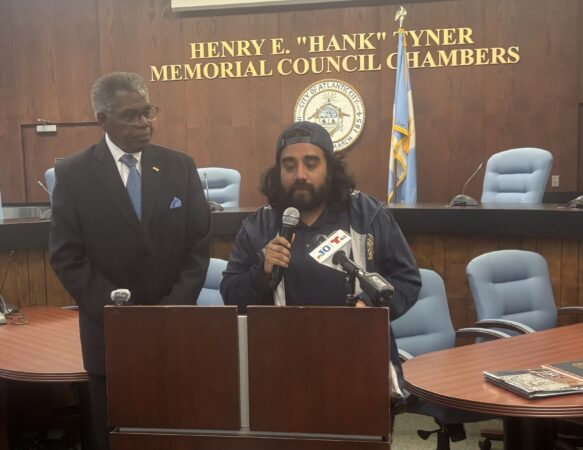
“The reason I’m here is because just last week, our community was attacked,” said Alexander Mendoza, a community organizer with advocacy group El Pueblo Unido of Atlantic City. “Fathers, friends, family members, hardworking people were taken away from us by an inhumane system called ICE.”
El Pueblo has been highlighting recent ICE activity in Atlantic City on its social media, including a car stop on Dec. 12 that led to the detainment of two men, one of whom subsequently missed the birth of his daughter earlier this week after being taken to Delaney Hall. The group called the car stop illegal and said the Mexican Consulate is working to provide the man with legal help.
“He and his partner had just moved into a new apartment and were ready to begin a new chapter in their lives,” Mendoza said. “That morning changed everything. He was taken by ICE and is now being held at Delaney Hall.”
Mendoza said this and other recent activity, including ICE agents establishing a base of operations at the city’s Bader Field, the former municipal airport, have left community members fearful and officials alarmed and outraged.
“There’s a lot of hysteria, a lot of fear in our community, rightly so,” said Cristian Moreno-Rodriguez, executive director of El Pueblo. There were rumors this week that businesses, particularly laundromats, would be targeted this week in Atlantic City and Pleasantville, he said.
“We strategically placed ourselves throughout different traffic hubs where our community is, our immigrant working-class community,” he said.
Moreno-Rodriguez said his organization has tracked some of the same ICE vehicles conducting activity in Bridgeton, Cumberland County.
ICE did not immediately respond to a request for comment regarding activity in the area.
El Pueblo has been educating community members of their rights and training volunteers to document and respond to reported ICE activity. He said the response time in Pleasantville is about two minutes; in Atlantic City, it’s 4 to 5 minutes.
Atlantic County is home to about 12,000 undocumented immigrants. Moreno-Rodriguez said the volunteers include non-Hispanic allies and young Latinos, “children who are standing up for their parents and neighbors.”
City Council Vice President Kaleem Shabazz said the council adopted a resolution last week condemning the ICE activity, which he said had made his constituents wary of leaving their homes without carrying documentation of their citizenship. He said police had not been informed about the raids or the use of Bader Field.
Moreno-Rodriguez said the city is about 33% Latino or Hispanic, and about 29% immigrant, with most Spanish-speaking immigrants coming from Mexico and the Dominican Republic, and smaller numbers from Honduras, El Salvador, and Guatemala. Nearby Pleasantville is about 50% Hispanic and has a sizable Haitian population, he said.
Both Moreno-Rodriguez and Shabazz called on businesses, which employ many immigrants, to support their workers. Moreno-Rodriguez said one man who self-deported after being picked up by ICE had worked for one of Atlantic City’s iconic bread bakeries.
“If you go into any of the small businesses of Atlantic City, they are powered by immigrant labor,” Moreno-Rodriguez said. “And we want to put out a call to action to all the business owners of Atlantic City that if you employ immigrants, please be there for them when they are detained. Please be there for them after they’ve given you hours of labor, years of blood, sweat, and tears to your business.”
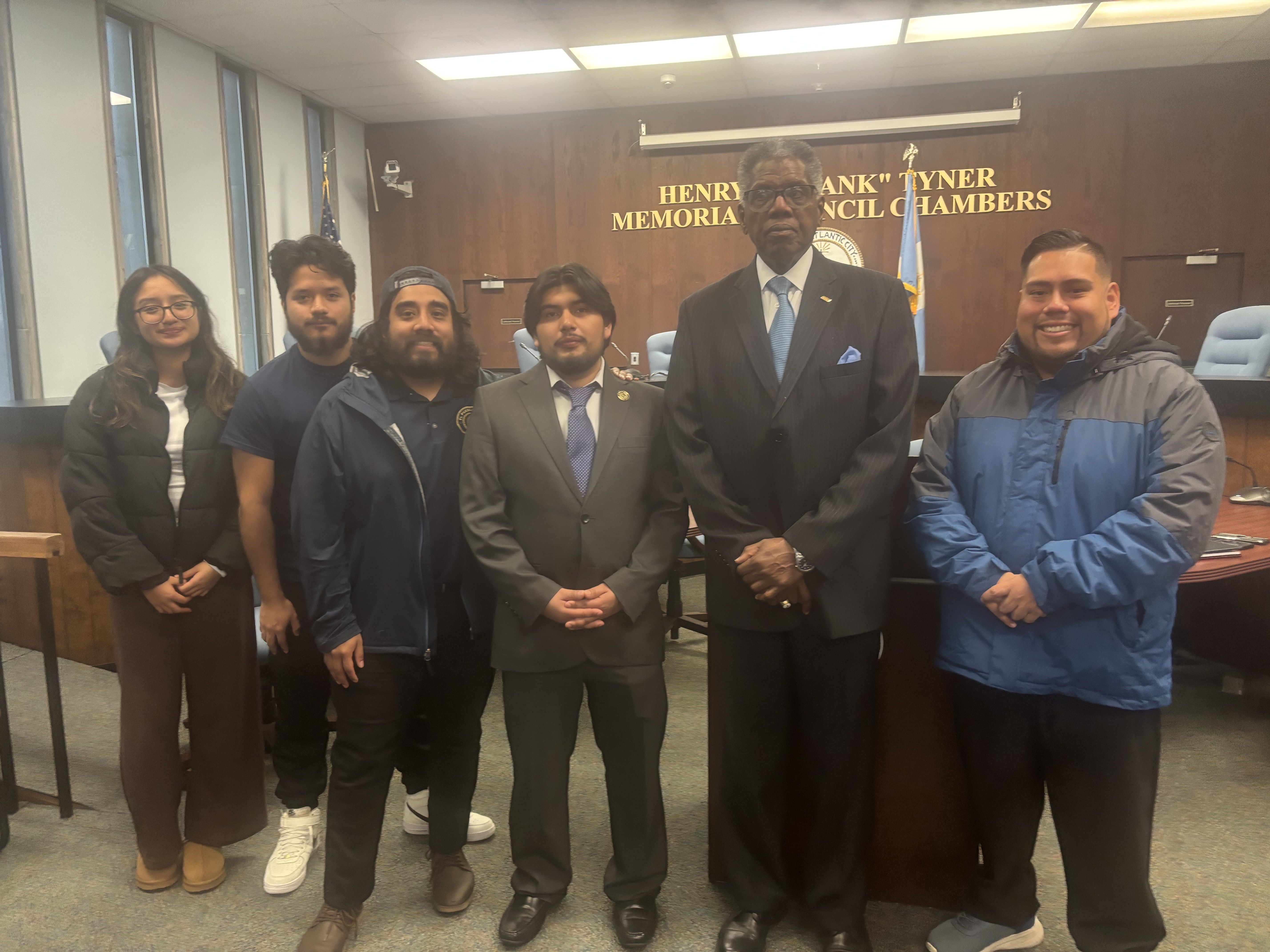
From left, advocacy group El Pueblo Unido of Atlantic City rapid responders Karen Pelaez-Moreno and Christopher Arellano, executive director Cristian Moreno-Rodriguez, Atlantic City Councilman Kaleem Shabazz, and El Pueblo board president Irvin Moreno-Rodriguez, who was recently appointed a Pleasantville School Board member. The group and elected officials held a press conference Dec. 23, 2025 to condemn recent ICE activity.
Also attending the news conference were the Rev. Collins Days, an Atlantic County commissioner, and religious leaders Imam Amin Muhammad of Atlantic City’s Masjid Muhammad mosque, Cantor Jackie Menaker of Ventnor’s Shirat Hayam synagogue, and the synagogue’s president, Joe Rodgers, a criminal defense attorney.
“I am appalled at what’s been happening in our community by ICE,” Days said. “We stand together because an attack on one group is an attack on all groups.”
“When we see the harms of our government, we are obligated to speak out,” Muhammad said. “We need engagement in the political process to make a change.”
Mendoza said activists believed the targeted raids of last week were “the beginning of a large raid on our community … a major escalation.”
“When we drove down Iowa Avenue, we saw an ICE agent and a Border Patrol agent questioning a woman, attempting to extract information in order to detain her,” he said. “When the agents noticed us, they allowed the woman to walk away.”
One of the agents claimed to be looking for a fugitive, he said.
Activists followed the man to Bader Field, where they saw a transport van and eight other vehicles. “That’s when we knew this wasn’t a small operation,” he said. “As soon as the agents realized they were being watched, they left quickly and quietly. It just took two Latino organizers standing by, holding cameras, for ICE to retreat from Atlantic City. ICE operates in the shadows. When people know their rights and when there is accountability, they scatter.”
Atlantic City Mayor Marty Small Sr. was acquitted of child endangerment and related crimes Thursday after being accused of repeatedly assaulting his teenage daughter.
Small, 51, faced charges stemming from a handful of incidents in late 2023 and early 2024 in which prosecutors said he and his wife abused and assaulted the teen. The couple said the incidents stemmed from their disapproval of their daughter’s relationship with a young man, leading to escalating tension and arguments in the family home.
The jury delivered its verdict at 12 p.m. after deliberating for two days. They found Small not guilty of endangering the welfare of a child, aggravated assault, making terroristic threats, and witness tampering.
“Thank you, Jesus! Thank you, jury!” Small said as the verdict was announced and broke into tears.
Speaking to reporters outside the courthouse, Small said he and his family were prepared to “put this chapter behind us, in peace.”
“It’s a lot of political forces out here that are against the leadership of my wife and I,” Small said. “But guess what? The people of Atlantic City want us, the people of Atlantic City need us, and the people of Atlantic City deserve us.”
Had Small been convicted of any of the crimes, he would have been required by state law to cede his office.
Those stakes were evident as the mayor’s friends and supporters packed into the courtroom for nearly two weeks of the trial. Supporters surrounded Small and broke into cheers outside the courthouse, celebrating a political career whose future had depended on the opinion of jurors.
Small said he had been heavily scrutinized for more than a year after news of the allegations broke in spring 2024. He said he and his wife had since been “drug through the mud” and cast as child abusers by the media.
Small’s defense attorney, Louis Barbone, said the verdict was “absolute proof that our justice system works” and that “honest men like Marty Small are vindicated.”
Atlantic County Prosecutor William Reynolds said he and his office “respectfully disagree with the verdict.”
“We acted based upon the complaints of the victim,” Reynolds told reporters. “The trial in this case was truly to give the victim a voice — the jury chose not to believe that voice.“
Prosecutors said Small, a Democrat who was reelected this year amid his legal struggles, punched his daughter and beat her with a belt. In an incident central to their case against the mayor, prosecutors said, Small struck her in the head with a broom multiple times, knocking her unconscious.
Jurors heard a conversation the teen recorded on her phone, in which Small told the girl he would “earth slam” her down the staircase. And prosecutors said that after the girl reported the abuse and investigators stepped in, Small encouraged his daughter to “twist up” her account of the events to minimize his involvement.
Over the course of the trial, Small and his wife, La’Quetta — who also faces charges of abusing the teen — looked on as prosecutors described the mayor’s actions as criminal. Prosecutors presented photos of the teen’s bruises and listened to testimony from a pediatrician who said the injuries did not appear accidental.
Small’s defense team, by contrast, told jurors that the teen had lied to investigators and exaggerated the extent of her injuries, and that she and her boyfriend had conspired against her father.
Barbone had called the trial “extortion by child.” He said the mayor was a caring father who was only attempting to discipline an out-of-control child, and presented jurors with more than 40 character witnesses on his behalf.
Small also testified and said he loved his daughter. He denied abusing her in the manner she described, telling jurors: “I did not hit my daughter with a broom.”
Thegirl, now 17, took the stand last week and described being punched in the legs by her father in his “man cave” after her parents found out she had sneaked her boyfriend into the family home to have sex.
“He said some words and put his hands on me,” the teen testified. Her father, she said, “was punching me in my legs and he hit me with a belt.”
Prosecutors said the girl’s decision to testify was one of the most challenging things a teenager could do, and they rebuffed Barbone’s suggestion that the girl was a liar who sought retribution againsther politically powerful father.
As for the broom incident, Barbone said, the mayor had not hit the girl but was wrestling the broom out of her hands when she fell and hit her head.
Prosecutors showed jurors photos of marks on the girl’s face. But a nurse who treated the teen at a hospital several days after the girl complained of headaches said she had not been able to find signs of injury.
Jurors asked to review multiple pieces of evidence during their deliberation, including video of Small’s testimony about the broom incident.
Again they watched the mayor recall the morning he urged his daughter to get ready to attend a peace walk in January 2024 following a spate of killings in Atlantic City.
The teen refused, cursing at Small before ripping his shirt and throwing laundry detergent on him, the mayor testified. A scuffle broke out when she picked up a butter knife and the broom, he said.
Mentioning the hospital examination, the mayor asked: “Where is the bruise, where is the bump, where is the bleeding?”
In less than half an hour, jurors returned their verdict.
Small, in his post-verdict remarks, described his daughter as “lost” and vowed to right the course of his family life.
“I’m gonna get my daughter back,” Small said. “In the Bible, it says, ‘Father, forgive her, for she know not what she do.’ And that’s what we’re gonna do.”
Prosecutors declined to comment on what would happen to the girl, who is still a minor and does not currently live with her family.
Small’s wife, La’Quetta, is scheduled to stand trial in January on charges of endangering the welfare of a child and simple assault. La’Quetta Small, the superintendent of Atlantic City public schools, is accused of repeatedly beating her daughter.
Also facing a forthcoming trial is Constance Days-Chapman, the principal of the Smalls’ daughter’s high school. Prosecutors say when the teen reported her parents’ abuse, Days-Chapman failed to notify child welfare authorities and instead told the couple of the report.
Days-Chapman, who is Marty Small’s former campaign manager, was later charged with official misconduct and related crimes.
Reynolds, the county prosecutor, said his office would hold an internal meeting to discuss the charges against La’Quetta Small and Days-Chapman. They will also meet with the Smalls’ daughter, he said.
“We need to get the victim in here and have a discussion with her before any decisions are made — and that’s out of respect for her,” Reynolds said.
The Shore this time of year is truly a lovely, if sometimes desolate, place. But the desolation is the point: Emptied of its chaotic summer bustle, the simple natural beauties take center stage.
But yet. There are still plenty of humans here, and they are doing things, some good, some dubious, and so we will take note. Here is our first-ever winter solstice Shore Town Report Card.
As to the grading system, let’s just say, it was tough to give any town less than a B- when that winter light turns the sunset sky over the ocean a thousand shades of pink, and snow turns a magical place even more magical. Even Atlantic City, in spite of its burgeoning mayoral and other problems, is worth an off-season visit.
Atlantic City
The paradoxical Shore town has had a doozy of a year, with its newly reelected Mayor Marty Small Sr. on trial for allegedly physically abusing his daughter, charges he denied during the trial, and for which a jury on Thursday acquitted him. Meanwhile, three casinos were green-lit in New York City, New Jersey is contemplating how to tighten its control over Atlantic City, Peanut World caught fire, and ICE was making car stops in city neighborhoods.
The city’s holiday parade featured the red-clad Mayor Marty Small on a special Mayor’s Office float, with his wife, schools Superintendent La’Quetta Small, festively clad in a fluffy red coat, beside him. She is also charged with child abuse.
When will Atlantic City, arguably the last affordable Shore destination along the entire Northeast coast, finally break out of its slump? I explain in this story.A+ for holiday traditions like the elaborately decorated and festive iconic spots, from the Irish Pub to the Knife & Fork Inn; for its new skate and dog parks; and its casino giveaways. But, behind the salt air tinsel, A.C. isjuggling some C+ drama.
Ventnor
You’re never more aware that your town tilts toward summer than when it rebuilds its boardwalk during the winter. A big chunk of the boardwalk (from Surrey to Cambridge) has been closed since November for a complete reconstruction and will remain closed until at least May. A similar chunk up to the A.C. border will be rebuilt after next summer. Hence the odd sight of lots of people on Atlantic Avenue detoured from the beloved wooden pathway. In better news, some of Ventnor’s favorite places have stayed open into the dead of winter. On a recent weekend, I trudged in the snow over to my friends at Remedee Coffee for a specialty hot cocoa (delish) and was surprised to find the place … full of people. Everyone in town had had the same idea, apparently, and with no boardwalk, it’s not even out of the way. B
Margate’s business administrator launched a personal investigation of the city’s CFO and was making public accusations against one of its commissioners. A former mayor wants him fired. What even is going on over there? C+
Ocean City
The identity crisis continues. The town did a complete turnaround earlier this month with respect to the former Wonderland Pier site, voting to ask the planning board whether the site is in need of rehabilitation as requested by developer Eustace Mita, who wants to build a luxury hotel. Meanwhile, its mayor declared bankruptcy and got sued by his stepmother. The iconic McDonald’s in town abruptly closed. Still, Playland’s Castaway Cove is offering its half-price ticket sale now through New Year’s Day. B-
Sea Isle City
The city canceled its holiday parade, which made people a wee bit annoyed. But dollars are being spent, most recently on a new community center and with the adoption of a five-year, $50-million capital budget targeting flood control, road work, beach projects, emergency vehicles, and sewer upgrades. . B+
A winter Sea Isle City with just a dusting of snow. Dec. 16, 2025.
Avalon
The sleepy offseason town, which came in for some summer criticism for its off-the-charts exclusivity,gets an A+ from me for its sensible and family-friendly 5:30 p.m. New Year’s Eve fireworks plan.
Stone Harbor
The city adopted a 3% occupancy tax on hotels, motels, and short-term rentals. Mayor Tim Carney said in an e-mailed statement: “This local tourism tax will generate revenue for the Borough while helping us avoid any increase to homeowner property taxes in 2026.”
However, on behalf of short-term visitors from Philly, though, and amid criticism over the quality of the Garden Club’s urn-based Christmas decorations, I’ll have to score the town a B-.
The Wildwoods
Wildwood and Wildwood Crest cut loose North Wildwood on their beach replenishment sharing agreement. Meanwhile, North Wildwood signed a 10-year agreement to police West Wildwood. Wildwood proper recently approved 24 new homes for its gateway area.
It’s one island divided into the have-sands and the have-not sands. This winter could exacerbate both ends of the spectrum. B-
Long Beach Island
The city was battling mail delivery issues, but otherwise, the peace and quiet and lack of crowds seemed to be settling well over locals, who boasted of martini towers at the Hotel LBI and $10 lunch specials at Joy & Salt Cafe (also available, $45 short ribs). Whoever it is that lives there this time of year must know something. A-
MAYS LANDING, N.J. — After a week in court, attorneys delivered closing arguments Tuesday in the child abuse trial of Atlantic City Mayor Marty Small Sr.
Defense lawyers for Small, a 51-year-old Democrat who was reelected this year, said the allegations that he and his wife had abused their teenage daughter multiple times in late 2023 and early 2024 were false.
“We are not guilty,” his attorney, Louis Barbone, told jurors in New Jersey Superior Court.
Small faces charges of endangering the welfare of child, aggravated assault, making terroristic threats, and witness tampering. He has denied the charges, and testifying in his own defense last week, he told jurors he “would do anything to protect” the girl and said he did not strike her with a broom as she has alleged.
Prosecutors say Small not only struck his daughter but also attempted to cover up the abuse as he and his wife, La’Quetta, grew increasingly in conflict with the teen over a relationship with a boy they did not approve of.
They said he punched her and beat her with a belt in addition to hitting her with a broom, and later told her to “twist up” her account of the incidents to investigators to minimize his involvement.
“Violence is not a solution,” Assistant Prosecutor Elizabeth Fischer told the panel. “Abuse is not parenting.”
But Small’s lawyer, Barbone, told jurors prosecutors lacked sufficient evidence to make their case and said they had inappropriately interceded in a private, family matter in the Small household.
“Why have we taken this man’s life and made a spectacle of it?” Barbone asked. “Because they can.”
He scoffed at prosecutors’ idea that the teen had been intimidated by her father’s political power, calling the trial “extortion by the child.”
The girl, Barone said, had lied about her injuries to both doctors and investigators, conspiring with her boyfriend to secretly record her father and compromise him.
Much of the attorney’s attention fell on the January 2024 incident in which Smalls’ daughter said he struck her multiple times in the head with a broom during an argument over her attending the Atlantic City Peace Walk.
Barbone said the girl had also been holding a butter knife and that as the mayor struggled with her over the broom, the teen fell and hit her head.
The attorney said the teen then exaggerated her injuries, and he said the bristle side of a broom couldn’t do damage. He told jurors to look no further than the testimony of the girl’s nurse, who could not rule that the teen suffered a concussion as she contended.
And Barbone returned to the topic of Small’s daughter’s sexually explicit messaging with her boyfriend, which prosecutors called a “shining ball in the corner” meant to distract jurors from both the teen’s testimony of the alleged abuse and the photos of her bruises.
Barbone said the conflicts began after the Smalls discovered their daughter had sneaked the boy into the family home and had sex without their knowledge. He later displayed an emotionally charged text chain between the girl and her mother in which the teen threatens to go off birth control.
Meanwhile, Fischer, the prosecutor, asked jurors to remember the “truth” of what Small’s daughter had endured. .
Fischer said the teen had been brave to testify against her father — arguably the most powerful figure in Atlantic City government — as well as her mother, who is the superintendent of Atlantic City Public Schools. La’Quetta Small also faces a child endangerment charge in a case scheduled for trial in January.
It was “the most difficult thing a person can do,” Fischer said of the girl’s decision to testify against her parents, giving her little incentive to lie.
The prosecutor said a nurse who tended to the girl’s injuries had diagnosed the teen with a head injury, and that it was impossible to tell if she was concussed through a CT scan alone.
And a pediatrician who specializes in child abuse testified that the girl’s injuries were “nonaccidental,” Fischer added.
Prosecutors said the girl first reported the abuse to her principal, Candace Days-Chapman. They say Days-Chapman, who previously served as Marty Small’s campaign manager, did not file a report with child welfare authorities. She instead told Smalls herself, and staff at the school only learned of the abuse after the teen reported it a second time after watching a mental health presentation. Chapman was later charged with official misconduct and related crimes.
Fischer, her voice swelling with emotion, expressed disbelief that Small had allowed his attorney to characterize his daughter as both an “animal” and “Tasmanian devil” in describing their conflicts at home.
“This is offensive at its highest level,” she said.
And she told jurors that some of those who testified on behalf of the mayor had strong ties to Atlantic City government and stood to gain from the mayor’s success. And in the end, she said, they had not witnessed the conflicts between Small and his daughter.
“Character,” the prosecutor said, ”is how you act when no one is watching you.“
Philadelphia-based Janney Montgomery Scott LLC has confirmed plans to exit the investment banking business and will focus exclusively on beefing up its wealth advisory business under its private-equity owner KKR, which bought Janney last year.
The firm has made what CEO Tony Miller called “a strategic decision” to sell the last of its banking units.
Investment bankers raise money for companies and governments by selling stock shares, bonds, and other financial instruments to investors, for a cut of the proceeds, a sometimes lucrative but hard-to-predict business. Research analysts help attract those clients by writing about their financial prospects.
Wealth advisors, typically registered with the SEC or licensed through the industry group FINRA, are paid to guide clients’ investments, and may sell exchange-traded funds (ETFs), and other approved products. Business has soared with the U.S. stock markets in recent years. Miller, the Janney CEO, called investing in that business a better road to “long-term success.”
Janney plans to sell its last bond and investment banking units, including staff in Philadelphia, at its TM Capital in Atlanta, and in other offices, to Ohio-based Huntington Bancshares and its financial institutions banking, research, and sales units to New York-based Brean Capital. Janney officials hope to close the deals in early 2026. The prices haven’t been disclosed.
Janney, which recently added advisors in Texas among other states, will remain based in Philadelphia. The company employs around 900 in the region.
Regional commercial banks and other small to midsize financial institutions were among the last industry groups Janney investment bankers and analysts covered. Just last month, Janney bankers announced that they had advised Georgia-based First Southern Bank on its unusual $51 million sale to member-owned Community First Credit Union of Jacksonville, Fla.
Former Janney employees said Janney’s owners had the option of taking the time and money to build up the investment banking unit, such as regional brokerages Piper Sandler, Raymond James, and Baird & Co. have done in recent years, instead of cutting back and relying entirely on trading and investment volume that rises and falls with market prices.
Until the late 1900s, Philadelphia was a financial center, and generations of investment professionals — at firms started by Stephen Girard, Jay Cooke, J.P. Morgan’s mentor A.J. Drexel, the predecessors of what’s now Morgan Stanley Wealth Management, the Butcher clan, as well as Janney and smaller firms — raised money for enterprises ranging from the Pennsylvania Railroad to Donald Trump’s ill-fated Atlantic City casinos. Janney notoriously fired critical analyst Marvin Roffman in 1990 at Trump’s insistence.
Successful investment bankers were paid a percentage of the deals they closed, built Main Line and Shore estates, and established branches in other cities.
But even locally based companies now bank with giant Wall Street firms. Janney’s wealth advisory office network, juiced by the relentless rise in the U.S. stock markets, has lately accounted for more than 90% of Janney’s revenue, with investment banking only a thin sliver, according to a statement the company gave The Inquirer.
“The big investment banks are feasting on deals,” said Robert Costello, a veteran Philadelphia-area money manager. “But the small deals have been drying up, and if they are getting rid of the municipal-bond desk, there’s nothing left.”
“It’s ‘another one bites the dust,’” said Ryan Connors, a Bucks County-based former Janney analyst who covers utility stocks for Northcoast Research.
“Philadelphia is thriving as a city, but our business has left it,” Connors said.
Yet investment research has survived the decline in regional investment banking, he added.
When Connors left Boenning & Scattergood, a Philadelphia investment bank where he had been director of research before it sold and shut down in 2022, “they told us [stock] research was dying.”
But Connors said research-based firms like his employer are doing well because hedge funds and other large investors have proven willing to pay for financial research.