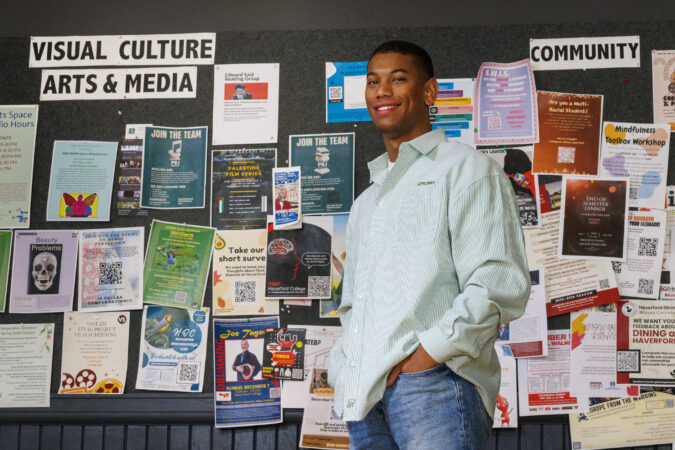
Haverford College senior Jackson Juzang earlier this year had been talking to a school administrator about the need for more resources to support student journalism.
The administrator, Chris Mills, Haverford’s associate vice president for college communications, asked if there was a network of student newspaper journalists in the region that Haverford could join and seek support from.
There wasn’t.
“So I decided to create one,” said Juzang, 22, an English major from Pittsburgh who serves as associate editor of the Clerk, Haverford’s student newspaper.
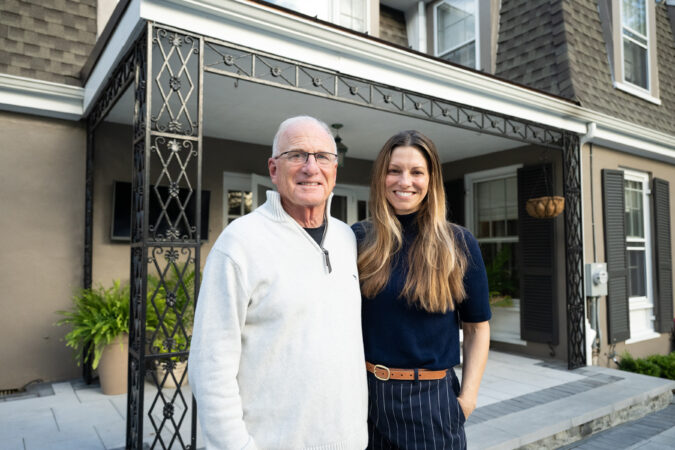
Jackson Juzang explains why he started the Philadelphia Student Press Association.
He established the Philadelphia Student Press Association as a nonprofit and created a board with student editors from 11 college news organizations around the region, including Temple, Drexel, Villanova, St. Joseph’s, La Salle, Rowan, Rutgers-Camden, Bryn Mawr, Swarthmore, Haverford, and Eastern.
With the slogan “Rooted in Philly, Reporting for All,” the group — which collectively represents about 400 student journalists — is seeking funding from organizations to support student journalism at a time when college budgets are tight and the news industry faces challenges, including rising print costs and lower readership. The association already has held workshops with more planned next year, and its 21-member board meets monthly and discusses common issues and problems and brainstorms solutions.
“We have so many people coming from different regions, but we are united in the sense that we are all here for the same reason,” said Claire Herquet, an editor at the La Salle Collegian.
At a recent meeting, members talked about artificial intelligence and what to do if an editor suspects a student writer used it, Herquet said. There were two instances over the past semester when she read an article submission and thought the terminology and phrasing didn’t sound like the writer, she said.
“If I didn’t have PSPA, I wouldn’t have people to lean on,” said Herquet, 21, a junior communications major from Camden. “It would just be me versus the problem.”
Herquet manages communications for the association. She has been reaching out to foundations about obtaining grant funding for the association. Some college newsrooms are better funded than others and can give writers and editors stipends.
She’s hopeful that uniting the newsrooms will result in better experiences for students and more funding.
La Salle’s publication is only digital; there is no print version. Costs are minimal, but funding would cover professional workshops for students and costs, such as travel, associated with their reporting.
The Whit, Rowan University’s student news site, prints a newspaper once a week and receives financial support via student government, but print costs are rising, said junior Katie Thorn, who serves as managing editor.
“We’re trying to figure out with the budget we have if it is possible and what we are going to have to sacrifice to keep our paper printing,” Thorn said.
Thorn, who is serving as treasurer for the association, said it’s been helpful to learn that other student organizations are facing the same challenges.
“Journalism as a whole is such a scary world right now,” said Thorn, 20, a journalism major from Mantua, Gloucester County, “and you’re kind of throwing yourself into the fire. Am I going to find a job? Where does my future lie? Having people who support you and uplift you is a great thing.”
Haverford’s student newspaper has received funding via the president’s office and is able to pay its writers, Juzang said. In January, the Clerk will publish its first print edition.
But the Clerk would like resources for deeper reporting and investigative work and mentorship, he said.
Juzang, who hopes to pursue a graduate degree in communication management next year at the University of Southern California, said he’s invested thousands of dollars of his own money to get the association started. He currently works as a research/editorial intern for NBC Sports.
He said the association also has received support from the Philadelphia-based Foundation for Individual Rights and Expression.
Juzang said he would like to help schools, including Widener and Lincoln, that used to have student news sites revive them. He also has begun talking to student journalists in other metro areas, including Washington, Boston, New York, and Baltimore, about starting an association for their university newsrooms, he said.
Mills, the Haverford communications administrator, was pleased to see Juzang take that conversation the two had last March and create a mechanism for student journalists to share their experiences and learn from each other.
“It’s really important for the students to share resources and knowledge and wisdom,” he said. “For those of us who value student journalism, it’s great to see them prioritizing this and making the time to do it.”
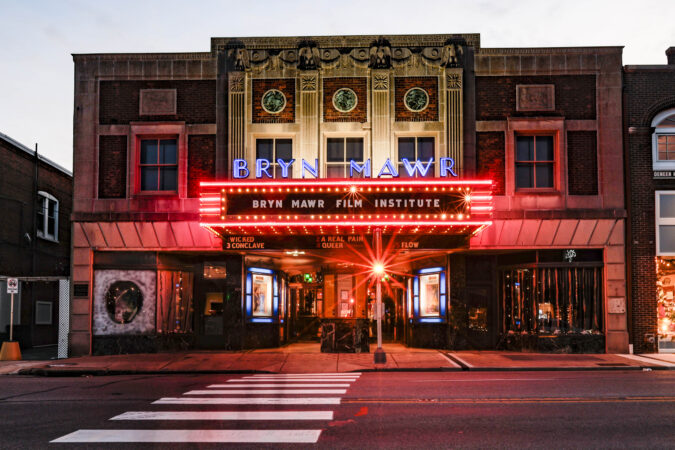
There are few facades more iconic in Bryn Mawr than the marquee of the Bryn Mawr Film Institute (BMFI), an enduring Main Line institution and watering hole for cinephiles from across the region.
BMFI has turned 20, marking two decades of the nonprofit community theater founded by Juliet Goodfriend in 2005. In the early 2000s, Goodfriend found herself dismayed when a historic movie theater in neighboring Ardmore was converted into a short-lived gym. To protect Bryn Mawr’s historic Seville Theatre from the same fate, Goodfriend rallied a team of local stakeholders around the theater. In December 2004, BMFI purchased the Seville, and in March 2005, the film institute opened its doors. Today, BMFI screens new and historic films, hosts lectures, teaches courses for children and adults, and celebrates the art of the film.
“It means a lot … to see what this place has become through the generous support and engagement of the community,” said Andrew J. Douglas, deputy director of the film institute who has worked at BMFI since it first opened.
To celebrate BMFI’s 20th anniversary, its staff compiled a list of 20 of the most iconic films the theater has screened, from Philly-based flicks to beloved musicals:
‘Blue Velvet’
If there’s an iconic filmmaker with a Philadelphia connection, it’s the late David Lynch, said Jacob Mazer, BMFI’s director of programs and education.
Blue Velvet is Lynch’s 1986 mystery thriller. It follows college student Jeffrey Beaumont after he discovers a severed ear in a vacant lot in his suburban hometown and is drawn into a dark world of crime.
“When we look at this arc of [Lynch’s] career, it’s really the film where he finds his way,” Mazer said.
Lynch began his filmmaking career in Philadelphia at the Pennsylvania Academy of the Fine Arts and regularly discussed basing his landmark debut Eraserhead on the city in the 1970s. When Lynch returned to Philly for a retrospective of his work at PAFA in 2014, he visited BMFI for a screening of his films and a Q&A session with the audience. Blue Velvet was the first film BMFI played to commemorate Lynch after his death in January.
‘The Philadelphia Story’
There’s a lot of local love for The Philadelphia Story, George Cukor’s 1940 romantic comedy set on the Main Line and based on the life of socialite Helen Hope Montgomery Scott, said Gina Izzo, BMFI’s communications director.
Plus, Izzo added, “It’s funny. It holds up.”
‘Lawrence of Arabia’
The annual summer screening of David Lean’s 1962 film Lawrence of Arabia is the oldest-running BMFI tradition. It’s a movie that is just “not done justice on a small screen,” said Mazer.
‘The Sound of Music’
Each December, lovers of The Sound of Music descend on BMFI for what Izzo describes as an “interactive screening” of the 1965 musical directed by Robert Wise. Over the course of three hours and many songs, The Sound of Music tells the World War II-era story of Maria (Julie Andrews), a young woman who becomes a governess for the von Trapps, an aristocratic Austrian family.
At the annual Christmastime screening at BMFI, moviegoers sing along from their seats and, each year, wear increasingly elaborate costumes. Last year, there were nuns, goats, and “brown paper packages tied up with strings” (a la the song “My Favorite Things”). The showings sell out months in advance.
As Izzo put it, “It’s sort of our Rocky Horror Picture Show equivalent.”
‘Harold and Maude’
Hal Ashby’s Harold and Maude has been a mainstay at the Seville Theatre since it was released in 1971. It was the last movie shown on the Seville’s single screen before the theater was twinned (split into two screening rooms) in the 1980s.
“Harold and Maude just comes back again and again and again” in the theater’s history, said Mazer. “It’s one of the quintessential cult movies.”
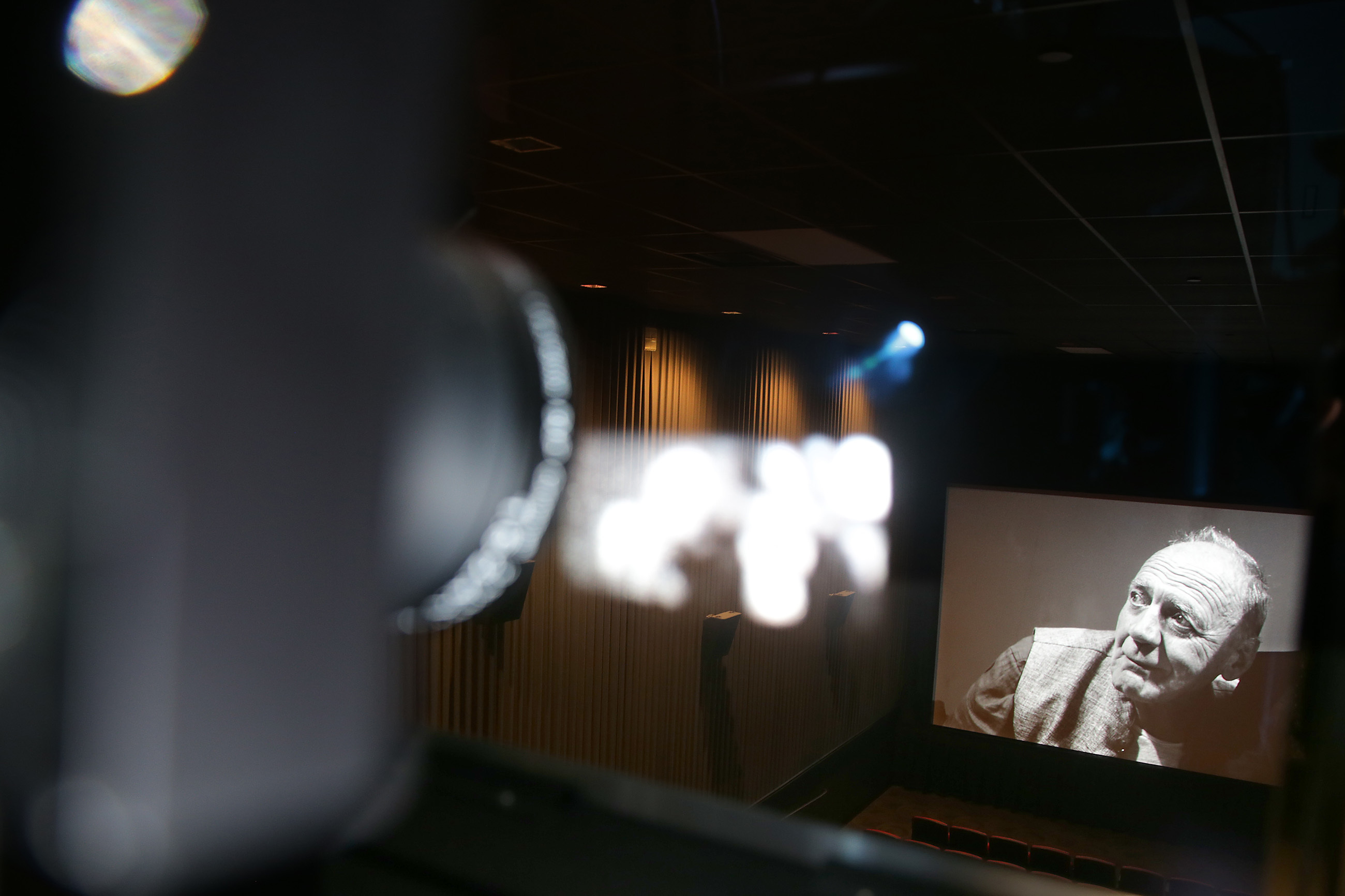
A view from one of the projection booths inside the Bryn Mawr Film Institute in Bryn Mawr on March 8, 2018.
‘Casablanca’
Michael Curtiz’s 1942 romantic-drama Casablanca is “one of the great examples of the difference [between] seeing a movie in a theater with other people versus by yourself at home,” said Douglas.
BMFI screens Casablanca every summer, and Douglas teaches an annual lecture on the film. When he watches Casablanca at BMFI, Douglas says he regularly hears people sniffling at sad moments or guffawing at funny ones, a stark comparison to the muted reactions one often has from the comfort of their own couch.
“You’re reminded how funny it is, you’re reminded how moving it is, and you’re reminded, in a sense, how human it is,” he said.
‘The Grand Budapest Hotel’
Why include Wes Anderson’s 2014 film The Grand Budapest Hotel? Put simply, people just love Wes Anderson, Izzo said.
‘2001: A Space Odyssey’
Stanley Kubrick’s 2001: A Space Odyssey was the first film shown at the theater after it developed the capacity to screen 70 mm film. Mazer called the 1968 movie an “iconic film” in cinematic history.
‘Silver Linings Playbook’
In a way, Silver Linings Playbook is a “modern-day Philadelphia Story,” said Douglas. The 2012 film, directed by David O. Russell, follows Pat Solitano Jr. (Bradley Cooper), recently released from a psychiatric hospital who works to win back his estranged wife, and Tiffany Maxwell (Jennifer Lawrence), a young widow also struggling with mental illness, as she prepares for an upcoming dance competition.
Philadelphia’s favorite rom-com is an homage to Delco, Eagles fans, and the Montgomery County-born-and-raised Cooper. It’s a “local guy makes good” story, Douglas said, referring to Cooper. It’s also the highest grossing main attraction in BMFI history.
“For our community, it was an enormously meaningful movie‚” Douglas said.
‘La La Land’
Benj Pasek and Justin Paul, known as Pasek and Paul, are a composing and songwriting duo responsible for the lyrics in La La Land, the acclaimed 2016 musical directed by Damien Chazelle.
Pasek is “Bryn Mawr’s son,” Izzo said. The composer graduated from Friends Central, the Wynnewood Quaker school, and is a longtime supporter of BMFI. When Pasek and Paul won an Oscar for the movie, everybody at home “had a little piece,” said Izzo.
‘Barbie’
Greta Gerwig’s 2023 Barbie felt like the “big wave back after the pandemic,” Izzo said. People dressed in pink and flocked to the movies after months of isolation and uncertainty.
Parasite, Bong Joon Ho’s 2019 South Korean Oscar winner, was the third-longest running main attraction in BMFI history with a 16-week run.
“We were proud to show that one,” Izzo said. “It was very popular here.”
‘Rocky’
Rocky, the 1976 film directed by John G. Avildsen about boxer Rocky Balboa (Sylvester Stallone), may seem like an obvious addition to any Philly-area iconic movies list. But the local history behind the movie is deeper than meets the eye, Mazer said.
Rocky was one of the first to be filmed with the Steadicam, a revolutionary invention of Garrett Brown, a Haverford High School graduate and prolific Philadelphia inventor. The Steadicam, created by Brown in 1975, is a camera stabilizing device that revolutionized the movie industry, allowing filmmakers to shoot scenes without having to mount cameras onto cranes or dollies.
In testing out his new invention, Brown shot various scenes around Philadelphia, including one of his future wife running up the steps of the Philadelphia Art Museum. That scene would later become an iconic motif of Rocky, shot by Brown.
“It’s this place where film history and Philadelphia history really connect,” Mazer said.
Brown is a friend of BMFI and has given numerous lectures at the theater, including for the 40th anniversary of Rocky.
‘Superman’
James Gunn’s 2025 Superman is another story of a local hero. David Cornswet, who played Superman, was raised in Lower Merion and graduated from the Shipley School, a Bryn Mawr private school. Cornswet hosted a friends and family debut of Superman at BMFI.
‘Brooklyn’
Brooklyn, John Crowley’s 2015 period drama, stars Saoirse Ronan as Ellis Lace, a young Irish immigrant to New York City. The movie was immensely popular at BMFI, said Izzo.
‘On the Waterfront’
Elia Kazan’s 1954 crime drama On the Waterfront helped revolutionize BMFI’s educational programming. The film was the first of the theater’s one-night seminars, during which moviegoers listen to a short lecture, sit for a screening, and then stay for a discussion. Now, they’re a popular part of the theater’s educational menu.
‘RBG’
RBG, Julie Cohen and Betsy West’s 2018 documentary about late Supreme Court Justice Ruth Bader Ginsburg, was the highest-grossing documentary screening in BMFI history. It’s also in the top 20 of the highest-grossing screenings in the theater’s history (including movies and documentaries).
National Theatre Live: ‘The Audience’
Though movies are at the core of BMFI’s work, the theater has expanded its repertoire to include cinematic presentations of ballet, theater, opera, and behind-the-scenes tours of art museums, all filmed and fit for the movie screen. BMFI’s most popular alternative program to date was a screening of The Audience, a 2013 play starring Helen Mirren as Queen Elizabeth II. BMFI sold out 13 showings of the show.
Izzo and Douglas said the screenings help transport locals to places that can be difficult to get to — New York City’s Broadway, London’s West End, or European museums.
“Even at current prices, it’s still a tremendous bargain for access to the arts,” said Douglas.
‘Metropolitan’
To commemorate the 30th anniversary of Whit Stillman’s 1990 movie Metropolitan, the director visited BMFI in 2022 for a screening of the film and Q&A with the audience. Metropolitan follows the Sally Fowler Rat Pack, a group of young Manhattan socialites in the throes of debutante season.
Stillman’s visit to BMFI “was the beginning of a really nice friendship,” Mazer said.
This suburban content is produced with support from the Leslie Miller and Richard Worley Foundation and The Lenfest Institute for Journalism. Editorial content is created independently of the project donors. Gifts to support The Inquirer’s high-impact journalism can be made at inquirer.com/donate. A list of Lenfest Institute donors can be found at lenfestinstitute.org/supporters.
The jingle bells are ringing, the Hanukkah party guest list is filling up, and you still don’t have a present for the coolest, artsiest person on your shopping list.
Looking for a kooky snow globe? Bespoke Eagles memorabilia? An art print unlike any other? Don’t worry! If you’re living on (or traveling to) the Main Line, here’s where you should be shopping for crafty presents.
Sweet Mabel Gallery
Narberth’s Sweet Mabel Gallery is an iconic local business, run by husband-and-wife duo David Stehman and Tracy Tumolo. Sweet Mabel got its start in 2005 when Tumolo took over her grandfather’s former barbershop in Narberth. She and Stehman, who were graphic designers, decided to turn the barbershop into a local gallery and store stocked with colorful American and Canadian folk art.
To celebrate the shop’s 20th anniversary, Sweet Mabel is displaying and selling works from local artists, all under $100. An anniversary ceremony will be held on Dec. 5 from 6-9 p.m. at the storefront on Haverford Avenue. Plus, if you find the perfect gift, Sweet Mabel will wrap it for free.
ArtStar, a Philadelphia gallery and boutique, is bringing a collection of bespoke craft vendors to Ardmore for two weekends this month. The Ardmore Holiday Market, organized in partnership with the Ardmore Initiative, will take place Dec. 6 and 13 from 11 a.m. to 3 p.m. at Schauffele Plaza.
Looking for a funky snow globe? A one-of-a-kind charm necklace? Day of the Dead inspired earrings? Ardmore’s Past Present Future is a portal into the world of eclectic antiques and crafts, from embroidered cat-themed pillows to hand-painted ceramic dishes. Sherry Tillman started Past Present Future in Philadelphia in 1976, drawing on her “long-held ties to the local arts and crafts community” to procure unique goods.
Past Present Future is open Mondays through Saturdays from 11 a.m. to 6 p.m. and Sundays from noon to 4 p.m. (or later — “If we are still standing, we are still open,” the shop’s Facebook page reads).
Something Different by Eric
Eric Wells‘ store, Something Different by Eric, isn’t just a gift shop, it’s a hub for people with disabilities on the Main Line.
Wells and his mom, Bernadette Wheeler, started the Bryn Mawr store in 2015. The nonprofit shop is staffed entirely by volunteers, including Haverford College students and special education advocates. Wheeler has said Something Different by Eric is part of a larger effort to “educate the community” and help people “see disabled individuals in action.”
In addition to selling unique housewares, Philly- and Main Line-themed trinkets, sports memorabilia, baby gifts, and greeting cards, Something Different by Eric is stocked with books about mental and physical disabilities.
The shop is open from noon to 8 p.m. on Fridays and Saturdays and from 1 to 5 p.m. on Sundays.
This suburban content is produced with support from the Leslie Miller and Richard Worley Foundation and The Lenfest Institute for Journalism. Editorial content is created independently of the project donors. Gifts to support The Inquirer’s high-impact journalism can be made at inquirer.com/donate. A list of Lenfest Institute donors can be found at lenfestinstitute.org/supporters.
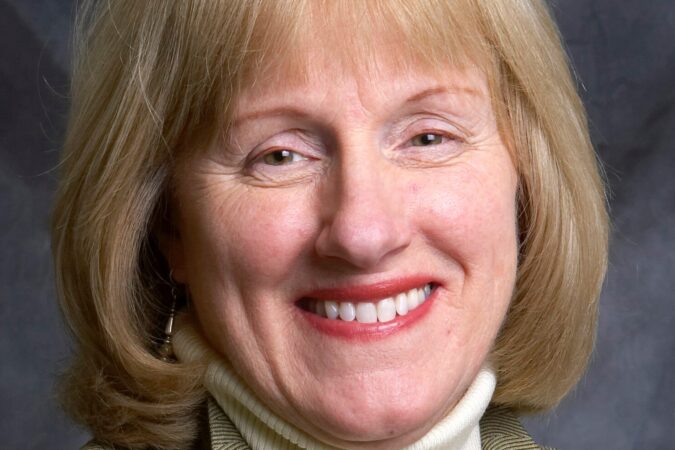
Kathleen A. Case, 80, of Bryn Mawr, longtime writer, pioneering medical journal editor, award-winning historian, researcher, and volunteer, died Friday, Nov. 14, of heart failure at Bryn Mawr Hospital.
A natural wordsmith who was interested in the origins and nuances of language as well as its use, Ms. Case spent 24 years as a top editor for the Annals of Internal Medicine and vice president for publishing at the Philadelphia-based American College of Physicians. Later, for 15 years, she was publisher, archivist, historian, and director of strategic planning for the publishing division of the Philadelphia-based American Association for Cancer Research.
She was adept at understanding and organizing complex research and other medical information, and helped Annals of Internal Medicine digitize its production process and content, expand its reach, and become one of the world’s most influential and cited medical journals. “She loved precise, concise, and unambiguous writing,” her family said in a tribute.
She was one of the few female editors in the medical publishing industry when she joined Annals as an assistant editor in 1977, and she rose to managing editor, executive editor, and senior vice president for publishing by 1998. She attended many international medical publishing conferences around the world, and other journals tried unsuccessfully to lure her away from Philadelphia.
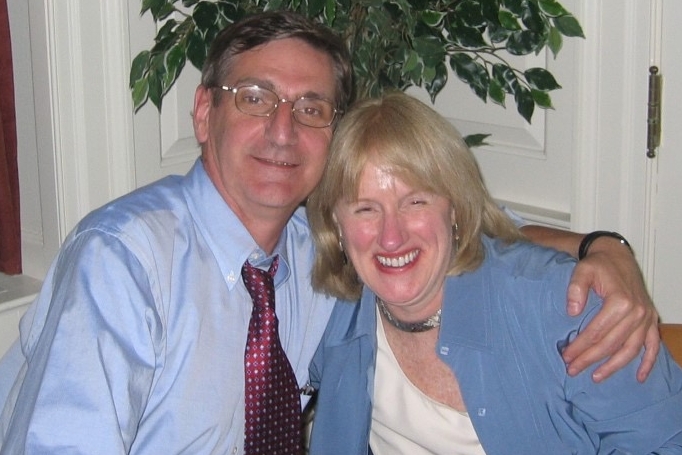
Ms. Case and her husband, Jacques Catudal, married in 1995.
“She set the highest editorial standards in medical publishing and expected the best from everyone around her,” a former colleague said in an online tribute. “But she also took the time to teach. … The lessons I learned from her have shaped my work ever since.”
Ms. Case joined the American Association for Cancer Research in 2001, served two stints as head of the publishing division, and supervised its marketing campaigns, advertising sales, and product development. She retired in 2008 but continued part time as the AACR archivist, historian, and director of strategic planning until retiring for good in 2016.
Away from her day jobs, Ms. Case was past president of the Society for Scholarly Publishing and what is now the Council of Science Editors. She also served on boards and committees for the American Medical Association, the American Chemical Society, the American Heart Association, and the International Committee of Medical Journal Editors.
Even in retirement, she continued to work as a board member, writer, researcher, and historian for the Haverford Township Historical Society. She served on the Haverford Township Historical Commission, was a member of the Historical Society of Pennsylvania, chaired the Friends of the Polo Field, and helped establish the Brynford Civic Association.
Ms. Case graduated from Radnor High School and Pennsylvania State University.
“She was always busy, always involved with some project,” said her husband, Jacques Catudal. She edited his published academic papers, he said, and routinely marked up her two sons’ school reports in red ink for years.
In 2019, she won a historic preservation award from the Heritage Commission of Delaware County. “She was an endlessly inspiring woman whose intelligence was matched only by her sharp wit and her extraordinary cultural sensitivity,” a friend said in a tribute.
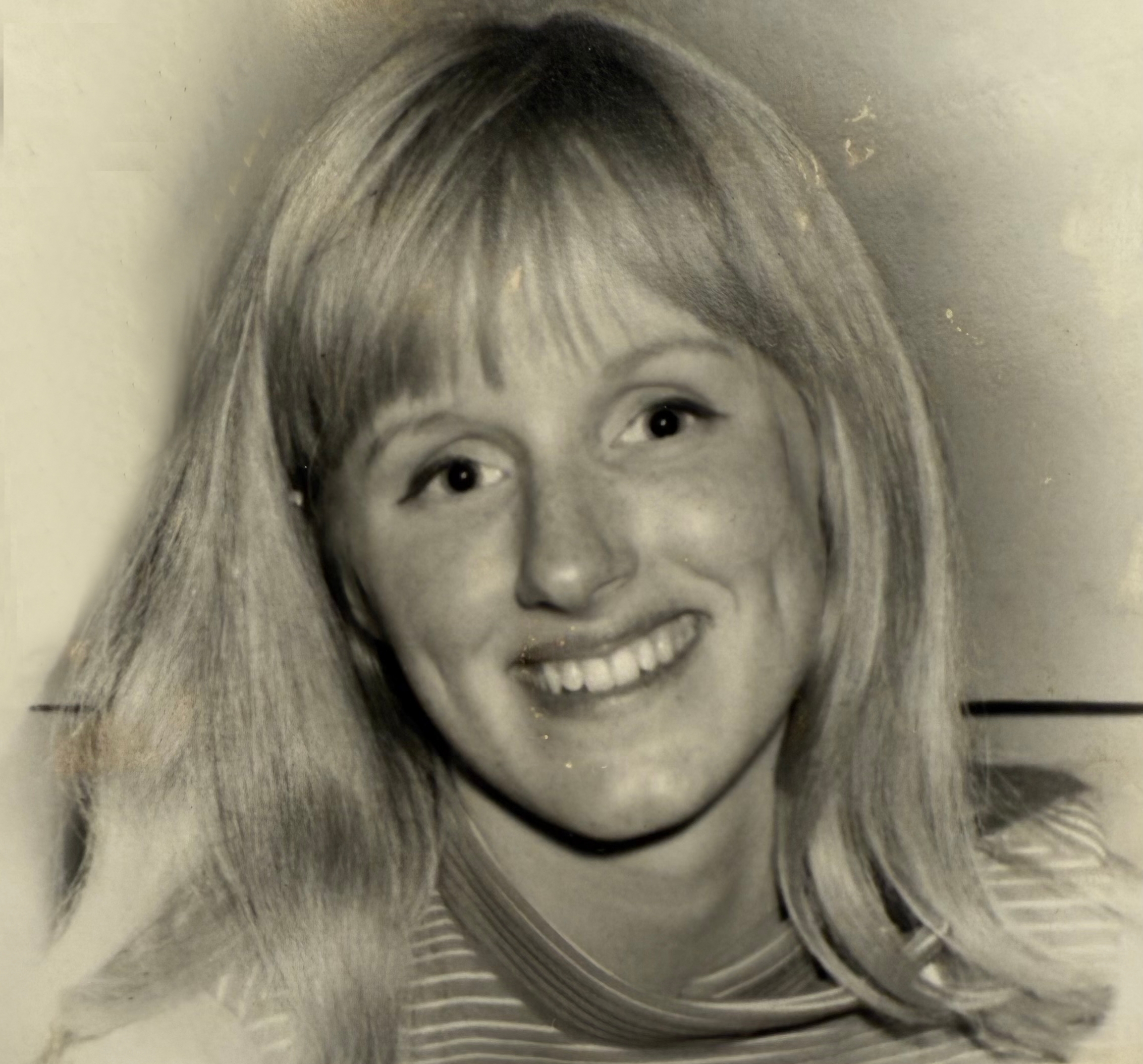
Kathleen Ann Case was born Sept. 13, 1945, in Westfield, N.J. The youngest of three children, her family moved to Omaha, Neb., and then Radnor when she was young.
She graduated from Radnor High School, studied journalism at Pennsylvania State University, and earned a bachelor’s degree in English in 1967. She was a reporter and editor for the Penn State student newspaper and so active that school officials waived their prohibition of female students living alone off campus so she could reside near the paper’s office. In 1987, she earned a master’s degree in technical and science communication at Drexel University.
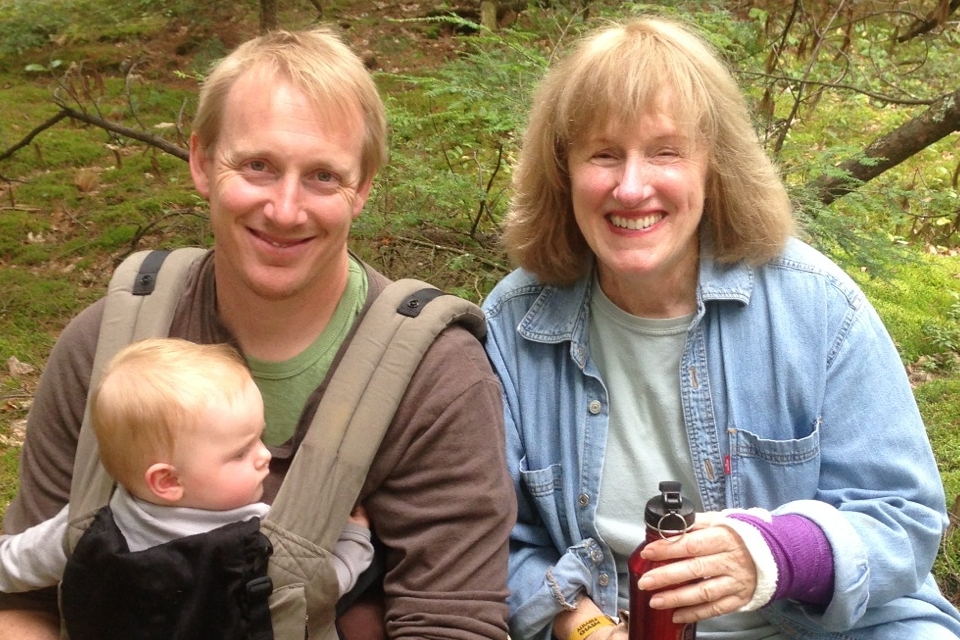
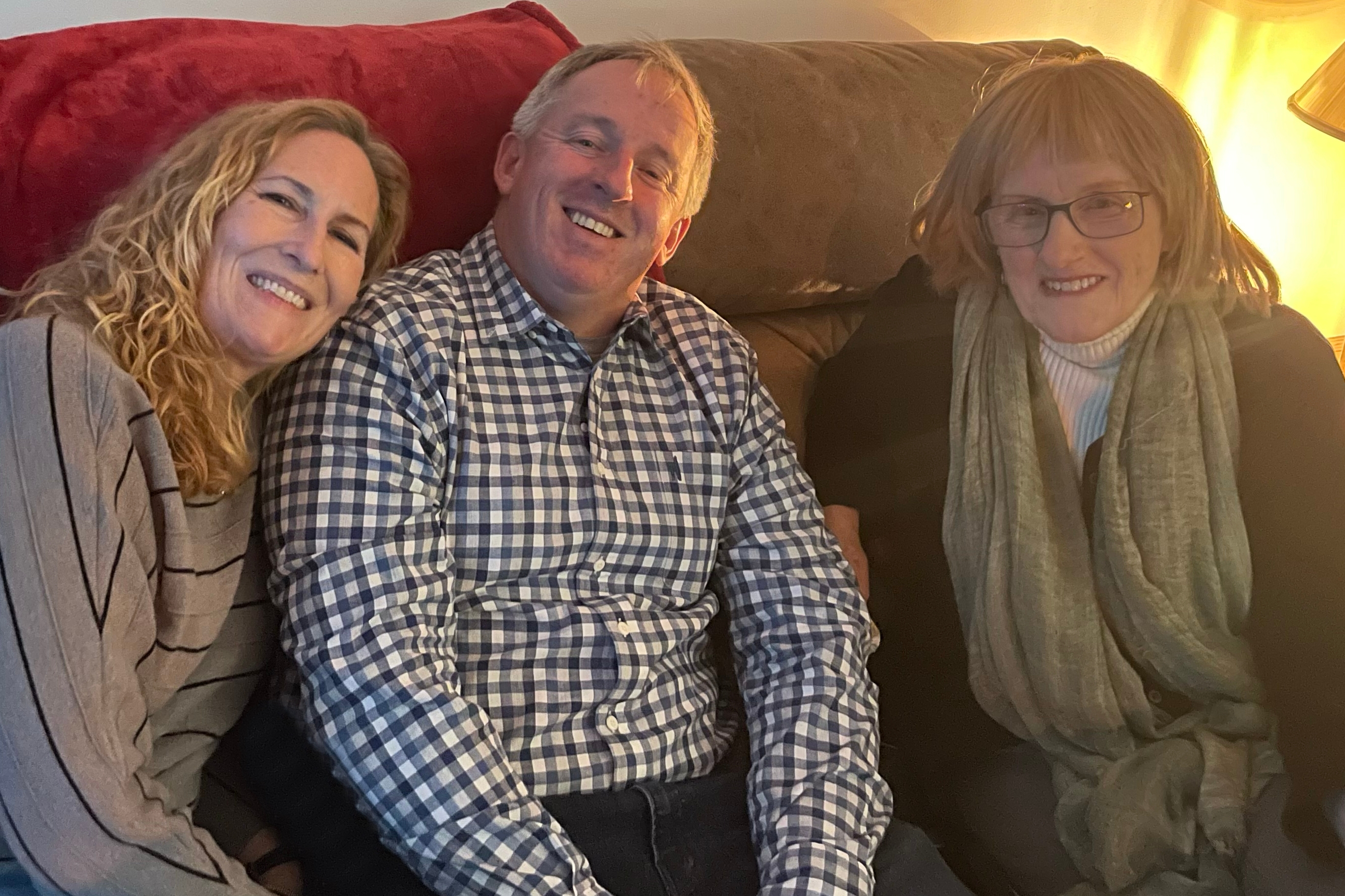
Ms. Case (second from left) enjoyed time with her family
She married D. Benjamin van Steenburgh III, and they had sons Ben and Jason. After a divorce, she married Peter Moor. They divorced, and she married Catudal in 1995.
Ms. Case raised her sons as a single mother in Avondale, Chester County, for years and moved to Bryn Mawr in 1979. She read voraciously about history, collected antiques, and enjoyed travel, classic rock, and Irish folk music.
She rode horses, was an expert archer, and followed the local sports teams. She tended her garden and investigated her genealogy.
She liked to refinish and paint furniture and discuss current events. She and her husband camped, hiked, and canoed all over the world.
Ms. Case enjoyed hiking and the outdoors.
She also dealt with metastatic breast cancer and three heart attacks. “She always gave as much honesty, opinion, perspective, experience, literary acumen, word knowledge, help, advice, comfort, and love as could be needed,” said her son Jason.
Her husband said: “She was brilliant and extremely funny. She was an organizer and always giving of herself.”
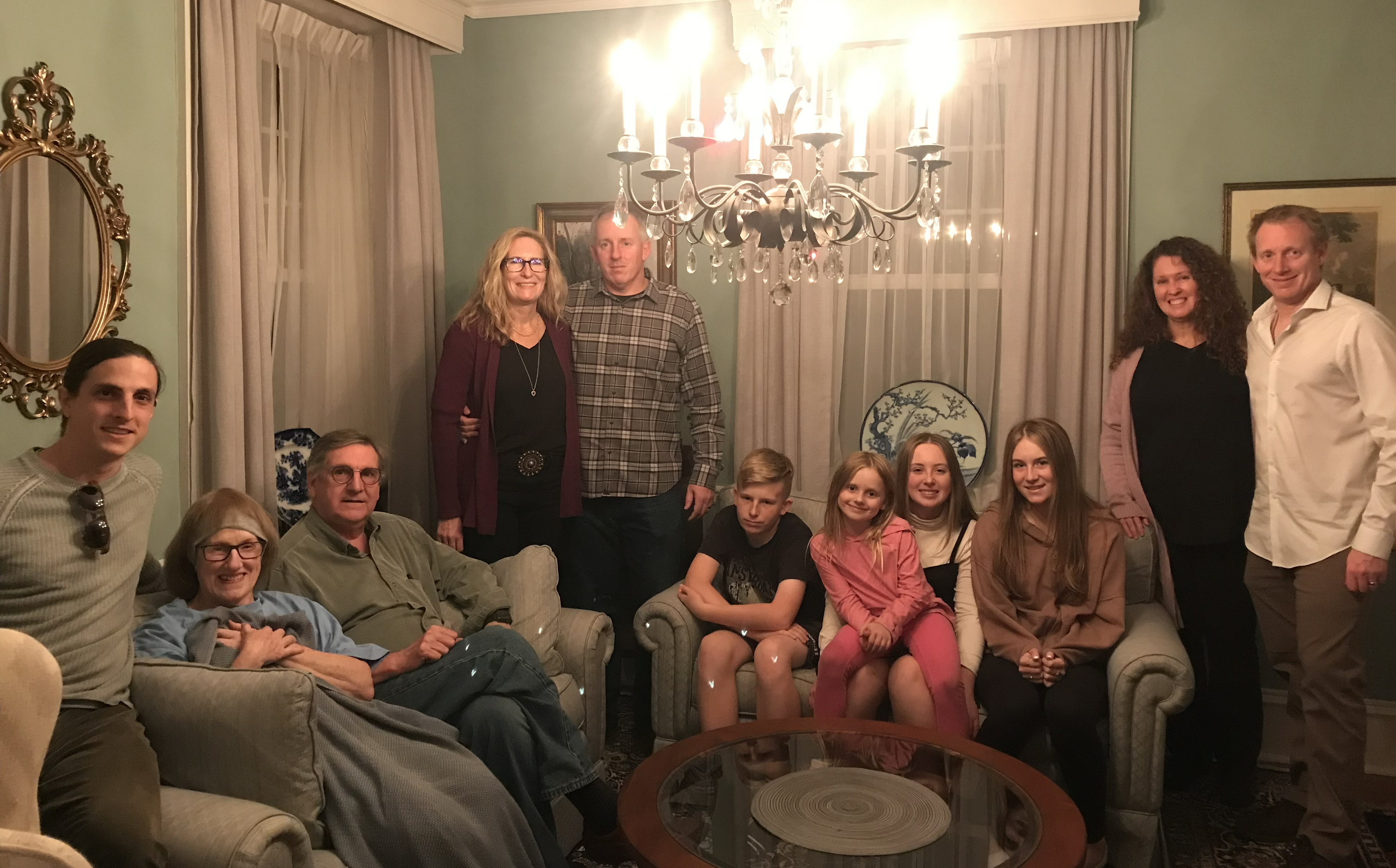
In addition to her husband, sons, and former husbands, Ms. Case is survived by four grandchildren, a sister, a brother, and other relatives.
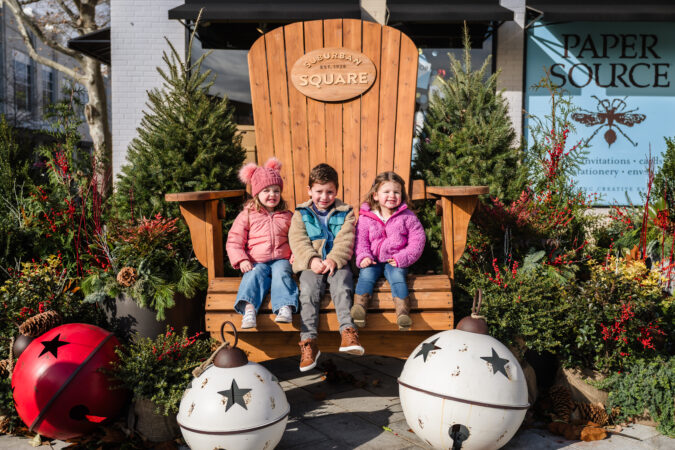
Santa will make stops throughout Lower Merion this year, including at Suburban Square.
The holiday season is officially upon us and with it, a slew of festive events. Whether you’re looking to snag a picture with Santa Claus, catch an ice skating show, see a menorah lighting, or tour a decked-out historic house, there’s no shortage of things to do in Lower Merion.
We’ve rounded up 20 holiday festivities this season, including shopping pop-ups, holiday movie screenings, festivals, and more.
A judge denied a former Narberth doctor’s parole request this week and ordered her to serve five more months in jail. Amy Lauren Cohen was sentenced in March to 11 1/2 to 23 months of jail time after pleading guilty to charges of arson, stalking, and terroristic threats for setting a 99-year-old Lower Merion woman’s home on fire in November 2023. (Main Line Times)
WMMR has announced that longtime Philadelphia radio host Matt Cord will return to the station to take over late Gladwyne resident Pierre Robert’s midday show, starting Monday, with Cord adding, “Nobody replaces Pierre.”
Gov. Josh Shapiro is sending $220 million to SEPTA, funds that will help the transit agency repair its Regional Rail cars. Problems that arose while SEPTA inspected its Silverliner IV fleet caused a painstaking return to service and commuter delays. With the fresh capital, SEPTA aims to return service to normal capacity in the next few weeks.
Make-A-Wish Philadelphia, Delaware & Susquehanna Valley opened its new headquarters in Bala Cynwyd last week. Located at 251 St. Asaphs Rd., The Vince and Lynne Laino Wishing Place features a tree house, a LEGO room, and a wishing fountain in addition to serving as the nonprofit’s offices.
Schools are closed today and tomorrow for Thanksgiving. LMHS is hosting its “Maroon Madness” on Tuesday ahead of the winter Keystone testing window, which starts Wednesday and continues until Dec. 17. See the district’s full calendar here.
The Education Foundation of Lower Merion is seeking new members to join its board of directors for three-year terms. Learn more here.
🍽️ On our Plate
Mama’s Pizzeria in Bala Cynwyd is closing its doors this week after 65 years in business. The shop, known for its signature cheesesteak, plans to shutter Friday or Saturday.
Earlier this month, Fox29’s Morgan Parrish visited The Brew Room in Ardmore to chat with the husband-and-wife team behind the specialty Greek café and what inspired them to bring the flavors of the Mediterranean to the Main Line. See the segment here.
🎳 Things to Do
🍬 Day After Thanksgiving Edible Art Camp: Kids ages 5 to 12 will make four winter-themed edible treats. ⏰ Friday, Nov. 28, 10-11 a.m. 💵 $21.20 📍 The Candy Lab
🍿Zootopia: Catch a screening of the 2016 animated film about Zootopia’s first bunny on the police force, who partners with a fox to solve a case. ⏰ Friday, Nov. 28, 1-3 p.m. 💵 Free 📍 Penn Wynne Library
👸 Cinderella: Catch a screening of the ultimate Disney classic. There will be a second screening on Dec. 13. ⏰ Saturday, Nov. 29, 11 a.m. 💵 $6.75-$7.75 📍 Bryn Mawr Film Institute
🩰 Israeli Dancing: This drop-in class will teach you some moves set to traditional Israeli music. ⏰ Wednesday, Dec. 3, 11:30 a.m.-12:30 p.m. 💵 $15 📍 Kaiserman JCC
✡️ Hanukkah Crafternoon: Kids can create a holiday-themed craft during this drop-in event. ⏰ Wednesday, Dec. 3, 3-5 p.m. 💵 Free 📍 Gladwyne Library
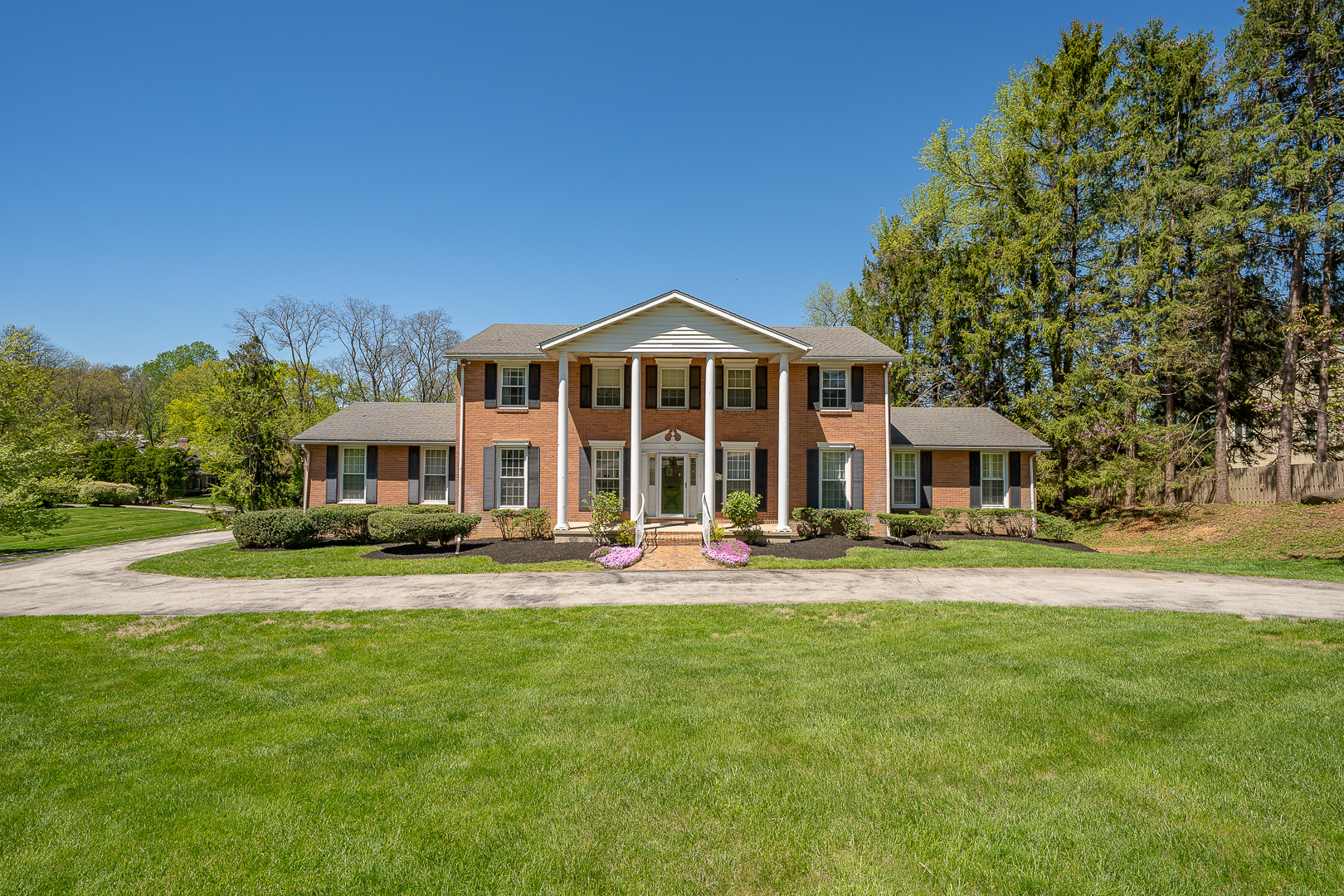
This six-bedroom brick Gladwyne home exudes old world vibes thanks to its center hall layout and two-story pillar columns. Inside, the home feels contemporary. Some features include a formal living room with a double-sided gas fireplace, a formal dining room, an eat-in kitchen, and a first floor primary suite. The finished basement also has a fireplace and an ensuite bedroom. There’s an open house on Sunday from 2 to 4 p.m.
By submitting your written, visual, and/or audio contributions, you agree to The Inquirer’s Terms of Use, including the grant of rights in Section 10.
This suburban content is produced with support from the Leslie Miller and Richard Worley Foundation and The Lenfest Institute for Journalism. Editorial content is created independently of the project donors. Gifts to support The Inquirer’s high-impact journalism can be made at inquirer.com/donate. A list of Lenfest Institute donors can be found at lenfestinstitute.org/supporters.
The holiday season is officially upon us and with it, a slew of festive events. From Santa sightings to a menorah lighting, here’s how and where to celebrate around Lower Merion.
Santa will come to town on a fire truck for the tree lighting at Schauffele Plaza, where there will also be hot chocolate, cookies, and photo ops with St. Nick.
Catch a screening of the 1946 holiday classic starring Jimmy Stewart and Donna Reed. A cocktail is included with the ticket purchase for those 21 and over.
⏰ Thursday, Dec. 4, 7:15 p.m. 💵 $17.75 📍Bryn Mawr Film Institute, 824 Lancaster Ave., Bryn Mawr
Catch screenings of your favorite animated holiday classics The Year Without a Santa Claus, Frosty’s Winter Wonderland, and ’Twas the Night Before Christmas during two matinee showings.
⏰ Saturdays, Dec. 6 and 20, 11 a.m. 💵 $6.75-$7.75 📍Bryn Mawr Film Institute, 824 Lancaster Ave., Bryn Mawr
Santa will be at Suburban Square on select days this season.
Santa will be visiting Suburban Square and posing for photos three days in December, when there will also be carolers and live music. Little ones can also drop off letters to Santa.
⏰ Saturdays, Dec. 6, 13, and 20, 11 a.m.-2 p.m. 💵 Free 📍Suburban Square, Anderson and Coulter Avenues, Ardmore
Shop an array of vendors selling things like coffee, jewelry, florals, skincare, pottery, and food. You can also try your hand at wreath-making and roast s’mores over a fire. Advanced registration is encouraged.
⏰ Saturday, Dec. 6, 11 a.m.-4 p.m. 💵 Pay as you go 📍Riverbend Environmental Education Center, 1950 Spring Mill Rd., Gladwyne
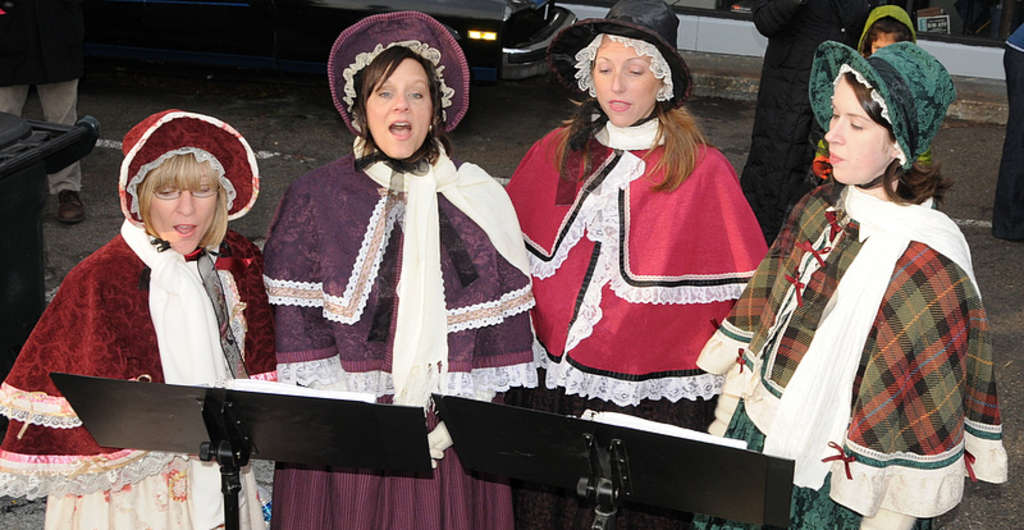
Wander around Narberth as it’s transformed into an 1840s Charles Dickens-themed London, complete with characters from A Christmas Carol. Period vendors, carolers, crafts, food, drinks, and a scavenger hunt round out the event.
⏰ Sunday, Dec. 7, noon-4 p.m. 💵 Pay as you go 📍Downtown Narberth
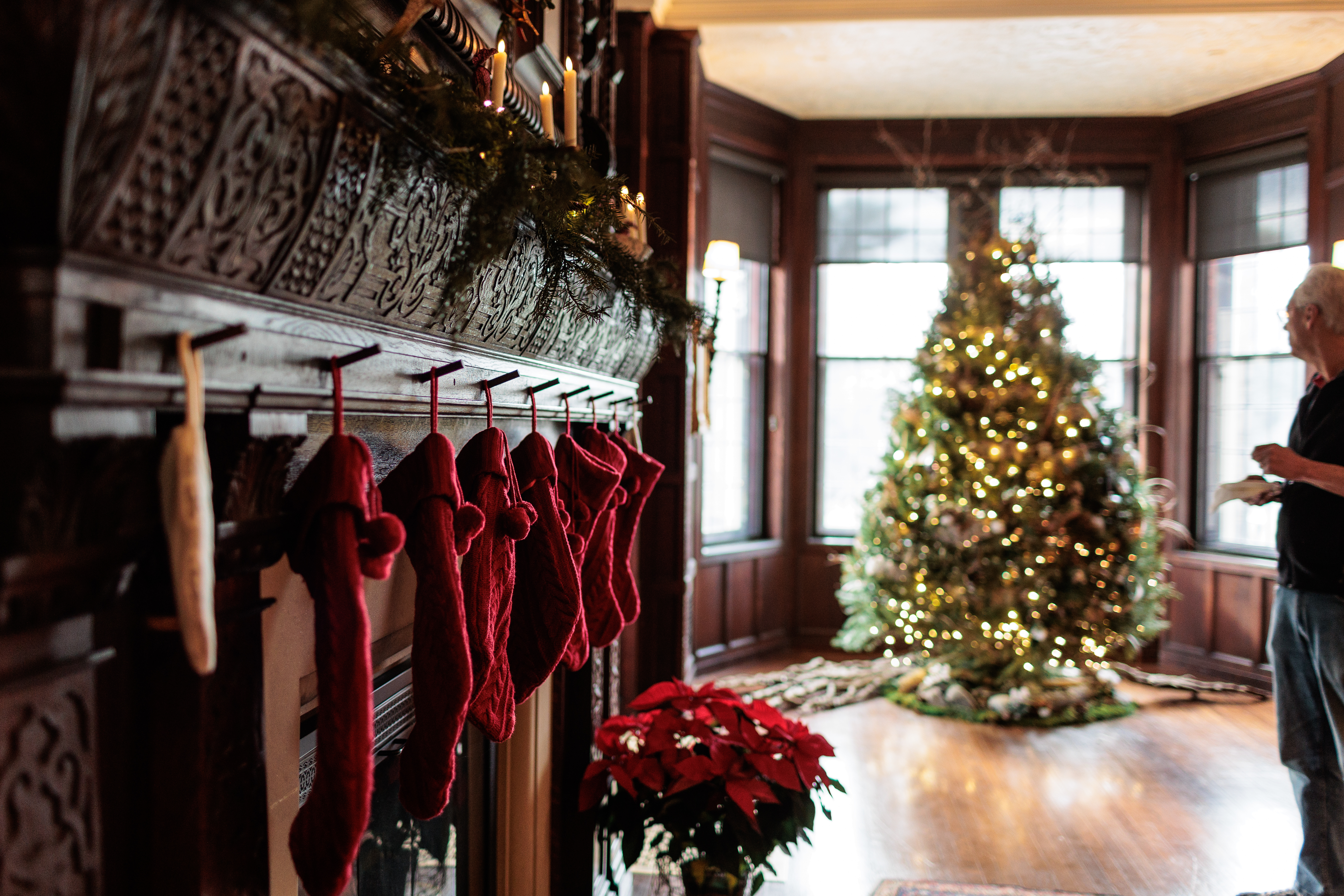
Take a look inside the main house at Stoneleigh as it’s decked out for the holidays.
⏰ Saturday, Dec. 13-Sunday, Dec. 14 and Saturday, Dec. 20-Sunday, Dec. 21, times vary 💵 $15 for Natural Lands members and $20 for nonmembers 📍 Stoneleigh, 1829 County Line Rd., Villanova
Celebrate the first night of Hanukkah with a lighting of the giant menorah at Suburban Square. There will also be food, drinks, and activities like donut decorating.
⏰ Sunday, Dec. 14, 5 p.m. 💵 Free 📍Suburban Square, Anderson and Coulter Avenues, Ardmore
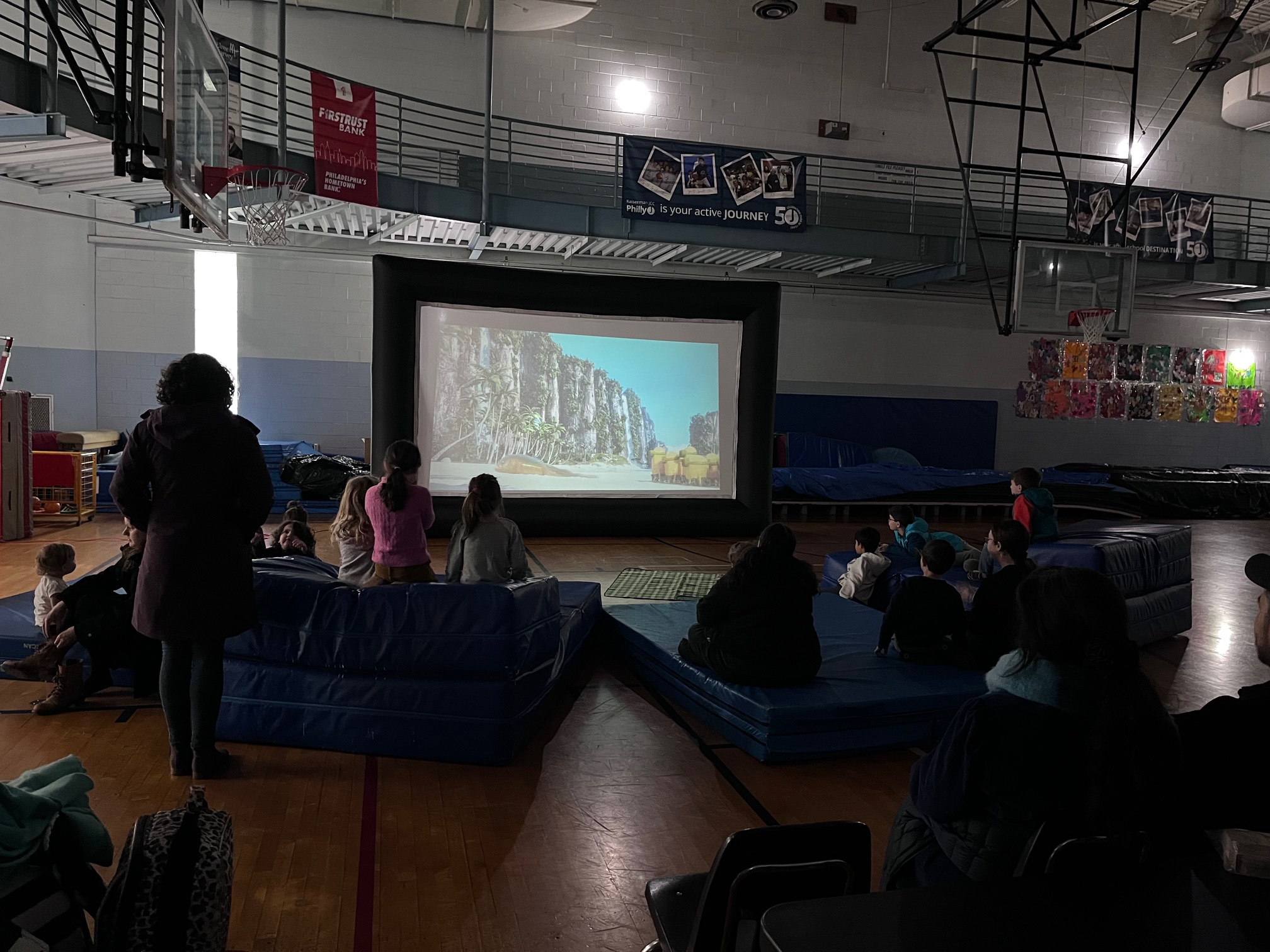
Enjoy a meal and a movie during this longtime tradition. There will be a family-friendly movie option (Happy Feet) as well as a dark comedy for adults (Bad Shabbos).
This suburban content is produced with support from the Leslie Miller and Richard Worley Foundation and The Lenfest Institute for Journalism. Editorial content is created independently of the project donors. Gifts to support The Inquirer’s high-impact journalism can be made at inquirer.com/donate. A list of Lenfest Institute donors can be found at lenfestinstitute.org/supporters.
When Steven Peikin and Amy Spicer moved back to the Philadelphia area in late 2023 after spending 2½ years in Florida, there weren’t many houses on the market. So when Peikin discovered a 4,100-square-foot, two-story home in Bryn Mawr on a solo trip, he convinced Spicer that he’d found the perfect home.
“She saw the pictures online,” recalled Peikin, a gastroenterologist at Cooper University Health Care. “I saw it on a Thursday and was told there could be no contingency or inspection, there were four other bidders, and I had to have our best offer in by Sunday.”
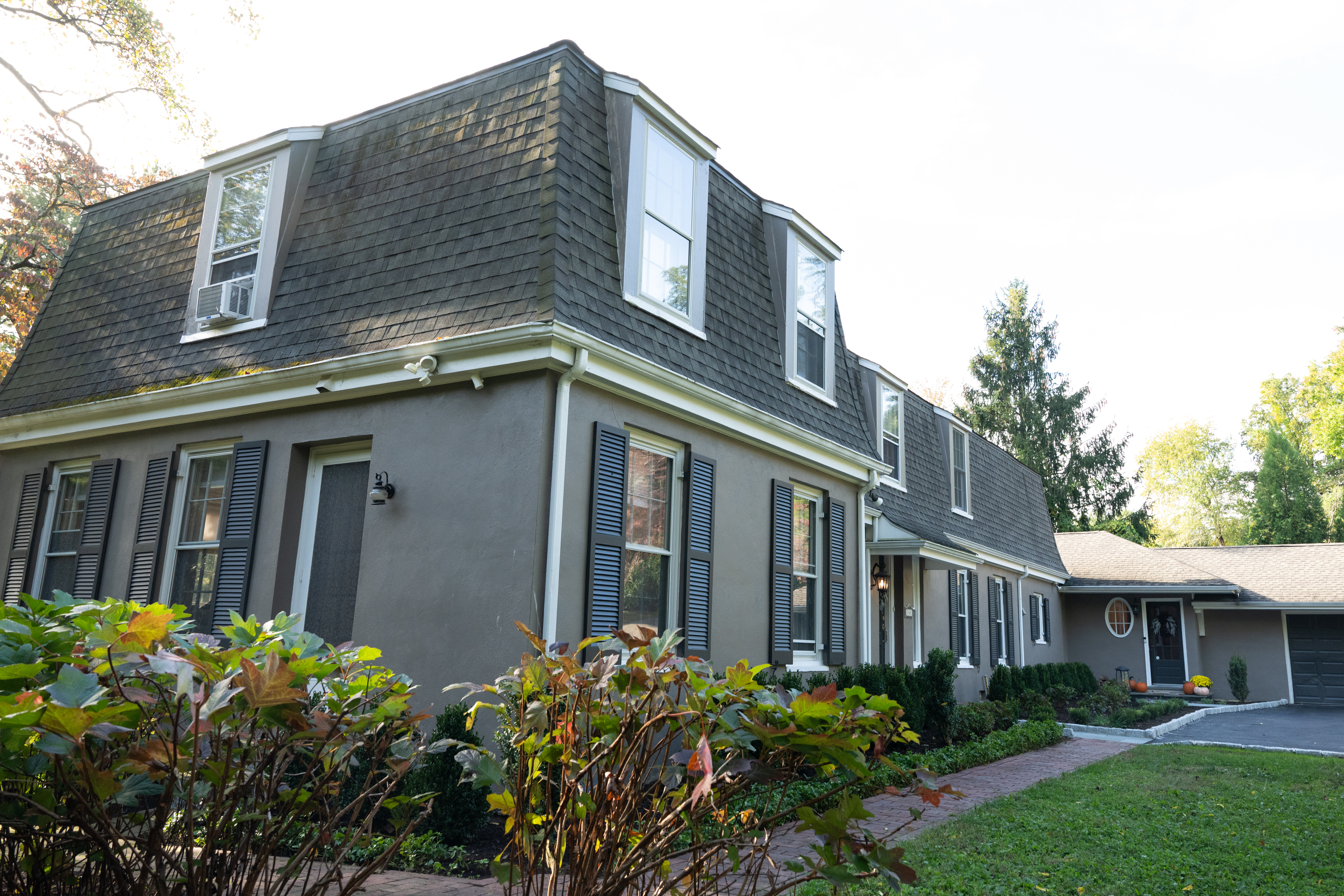
He took the plunge and bought the house, but when Amy saw it, she wasn’t completely sold. She felt the house was dated and she couldn’t get past the yellow exterior.
“When I saw the inside of the house, it was very 1980-esque and needed considerable remodeling,” said Amy, a pharmaceutical sales rep for Madrigal and a yoga instructor. “Steve found it very charming, but I saw it as my 97-year-old grandma’s house.”
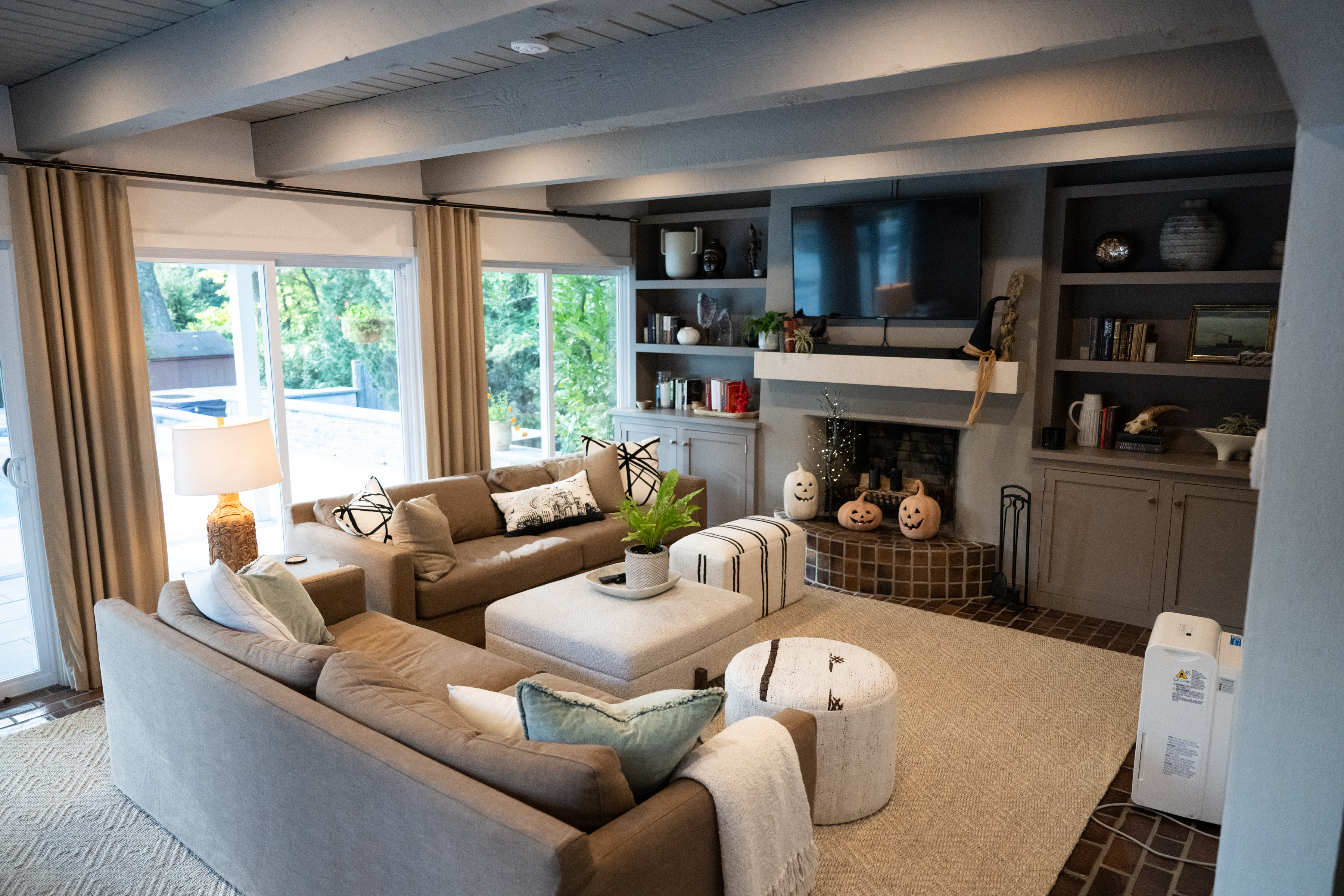
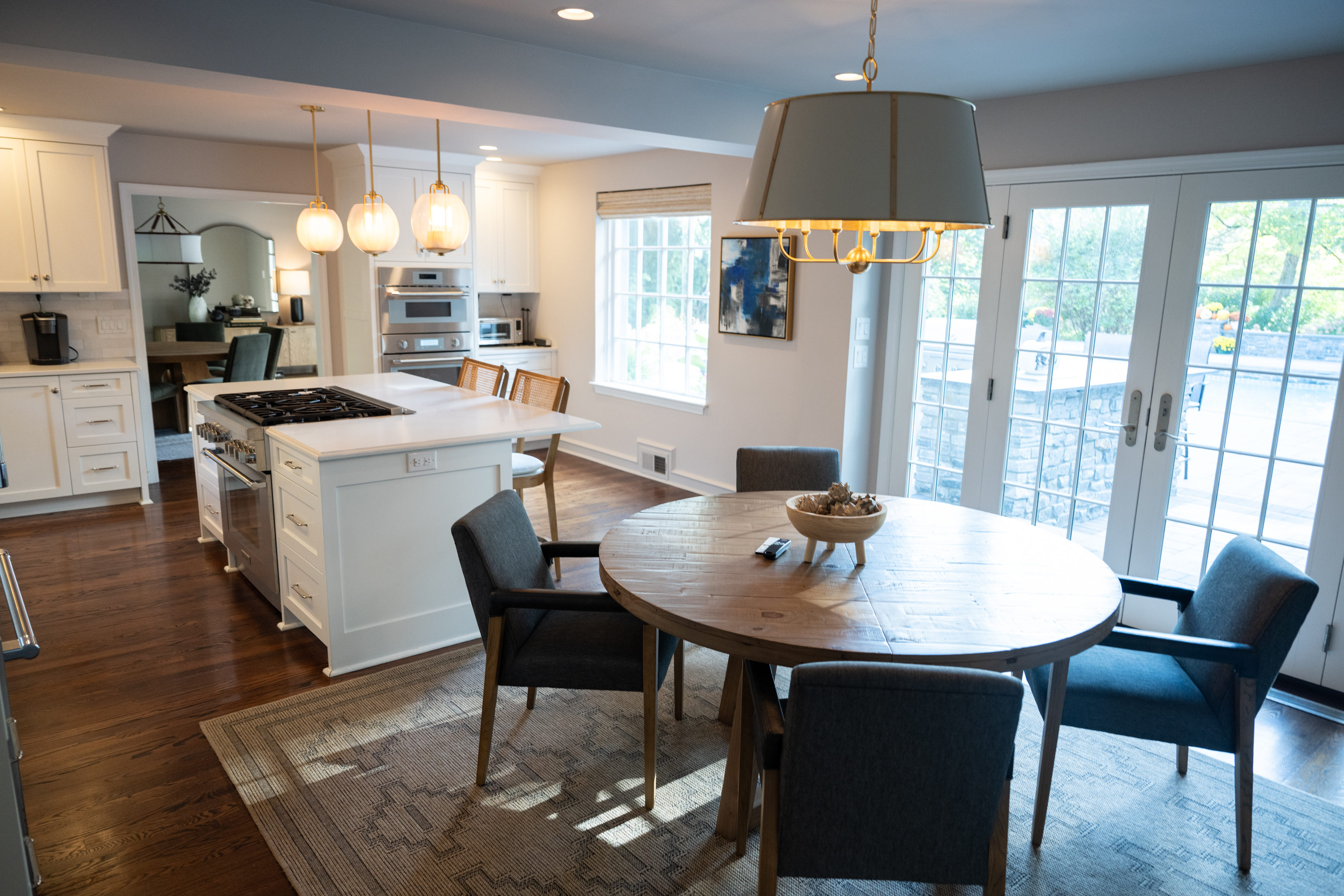
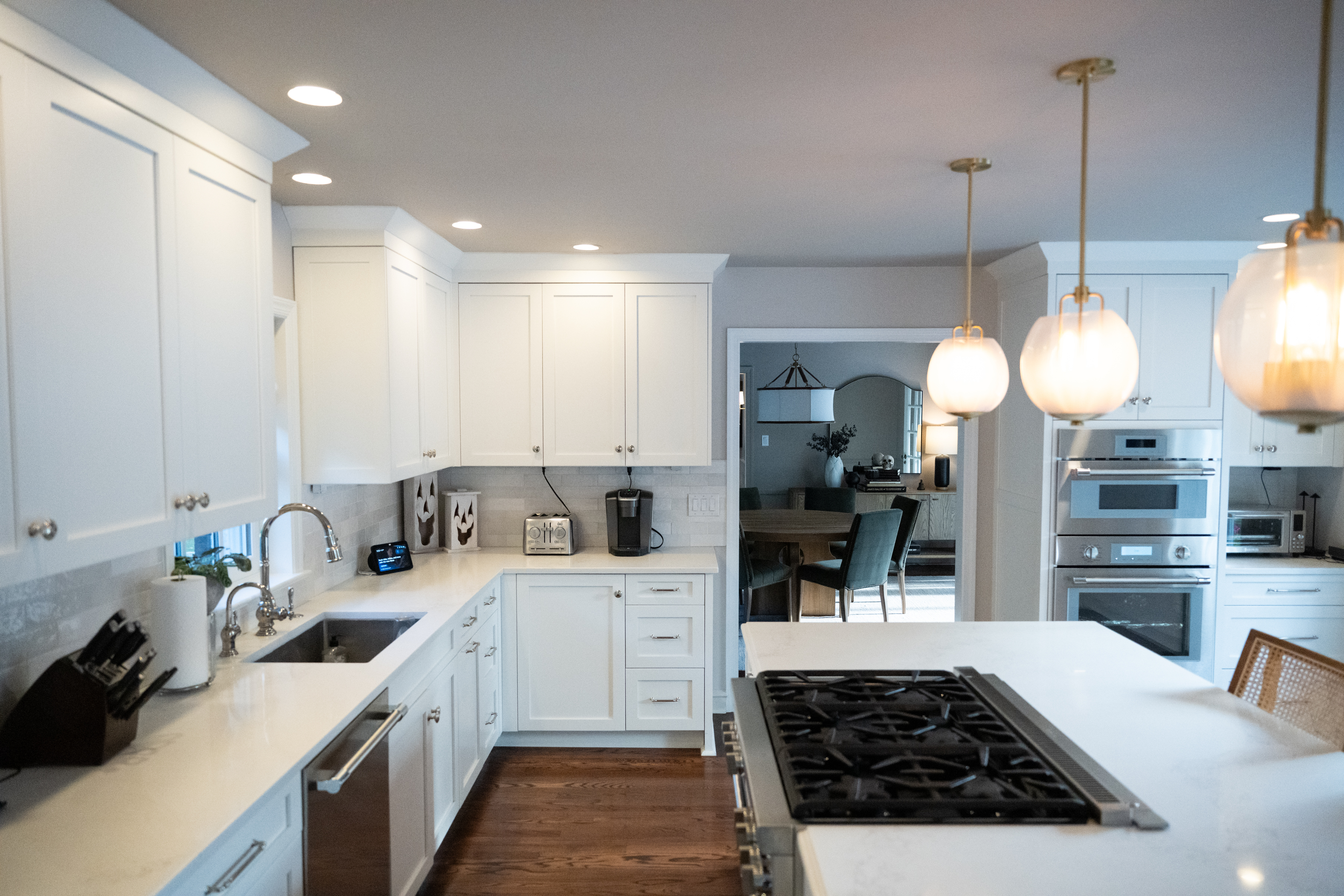
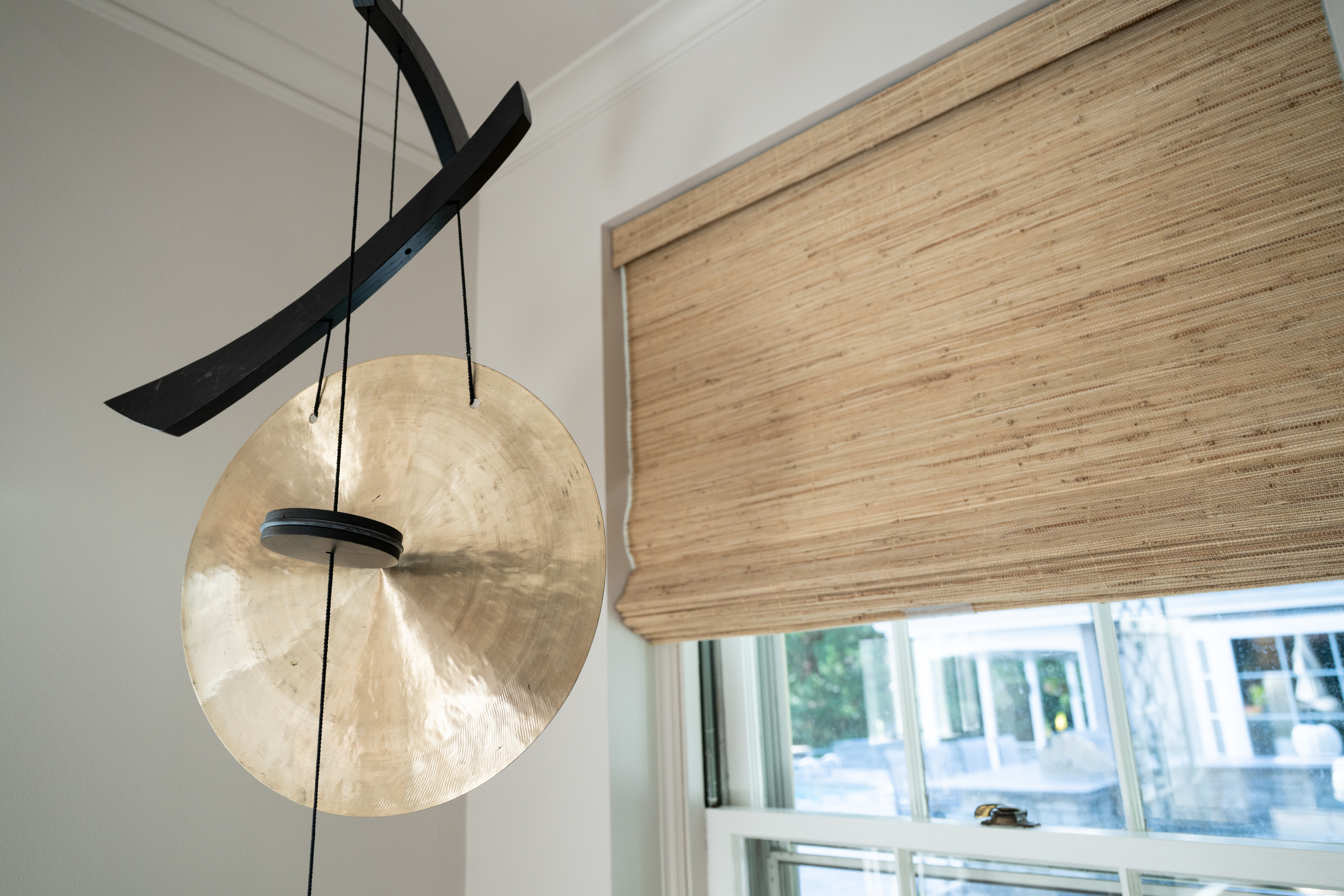
Steve Peikin and Amy Spicer’s living room was one of the spaces they updated in renovations.The kitchen and dining area, which looks out on the backyard.The renovated kitchen features Thermador appliances and a stone island with a built-in stove. Decor in the den.
The compromise was to make changes that would satisfy them both. The couple stayed in Airbnbs during a four-month renovation, and moved into the home in the spring of 2025.
With the help of Christina Henck from Manayunk-based Henck Design, they created a cozy, updated English Country style home in warm browns and neutrals.
“The house was very formal but we created a more natural, laid-back feel,” said Peikin.
They painted the exterior brownish gray, updated the bathrooms, created a dedicated laundry room, and added architectural elements to the living room and family room.
The outside of the home, which was once yellow, was painted after Spicer and Peikin moved in.
Those included custom bookshelves, a new metal mantle for the wood-burning stove, and extended ceiling beams. They also replaced all of the original lighting with a combination of recessed lighting and fixtures, swapped out the window treatments, updated the HVAC system, and added pavers to the backyard.
“Steve has a living room and I have a den,” said Spicer. “Mine is very calm and peaceful and his feels refined and sophisticated.”
Parts of the house had been renovated a couple of years earlier after a tree fell on the house, resulting in a new kitchen, primary suite, and roof.
Spicer’s son, Austin, 23, is currently living with the couple. He and his mom enjoy cooking together in their spacious kitchen featuring Thermador appliances and a stone island with a built-in stove. A second stove sits under the microwave. When weather permits, Peikin grills outside and they eat on the patio.
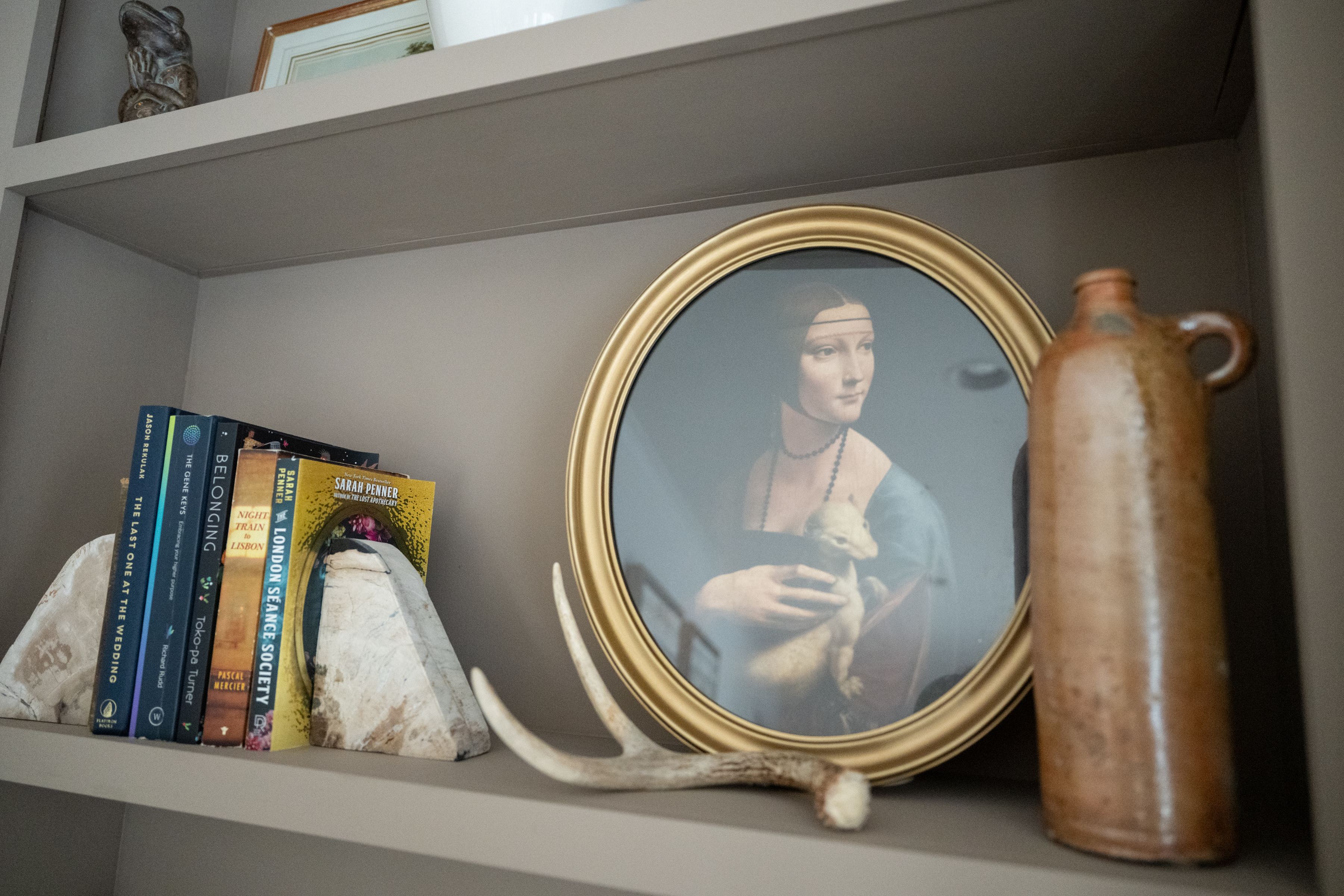
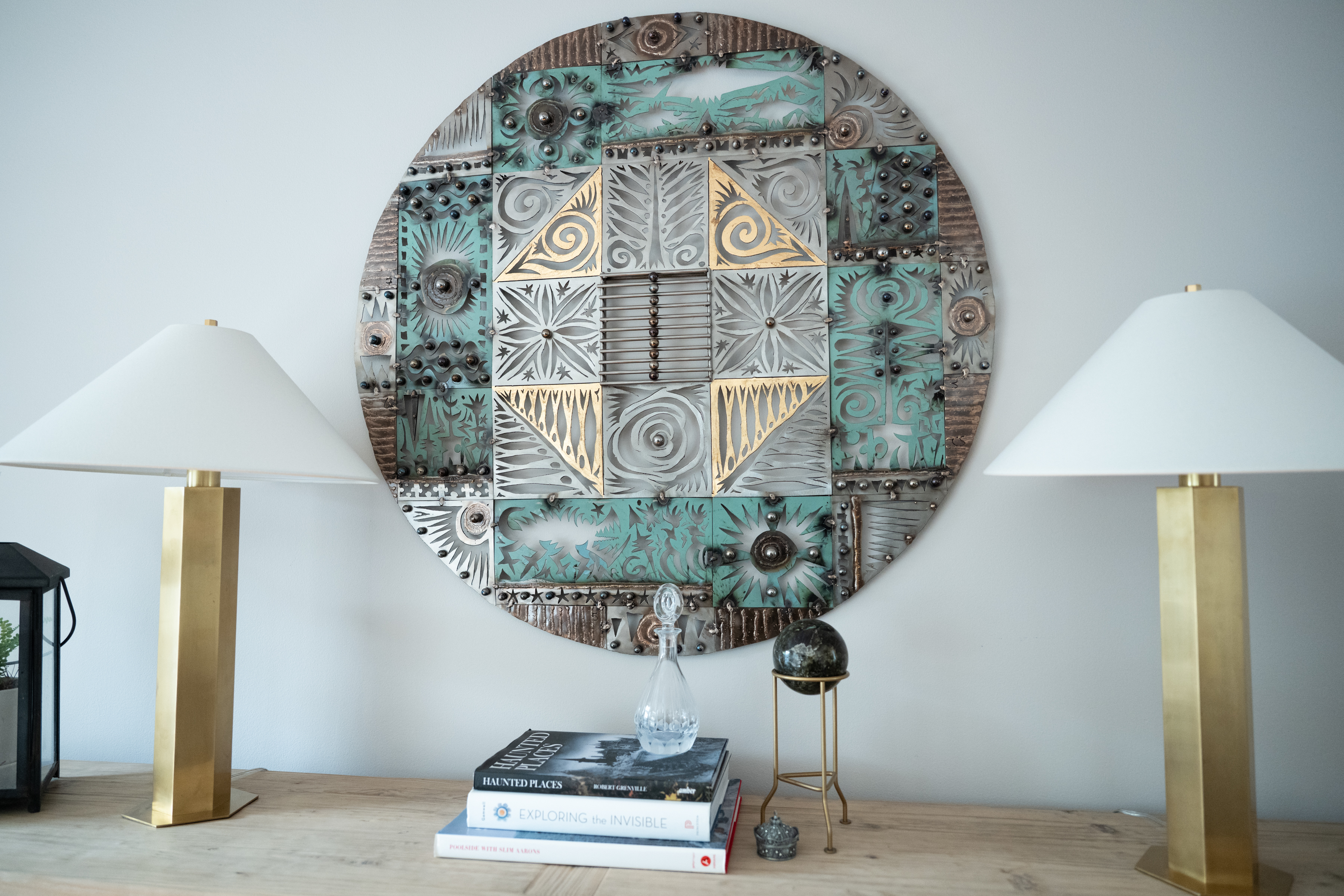
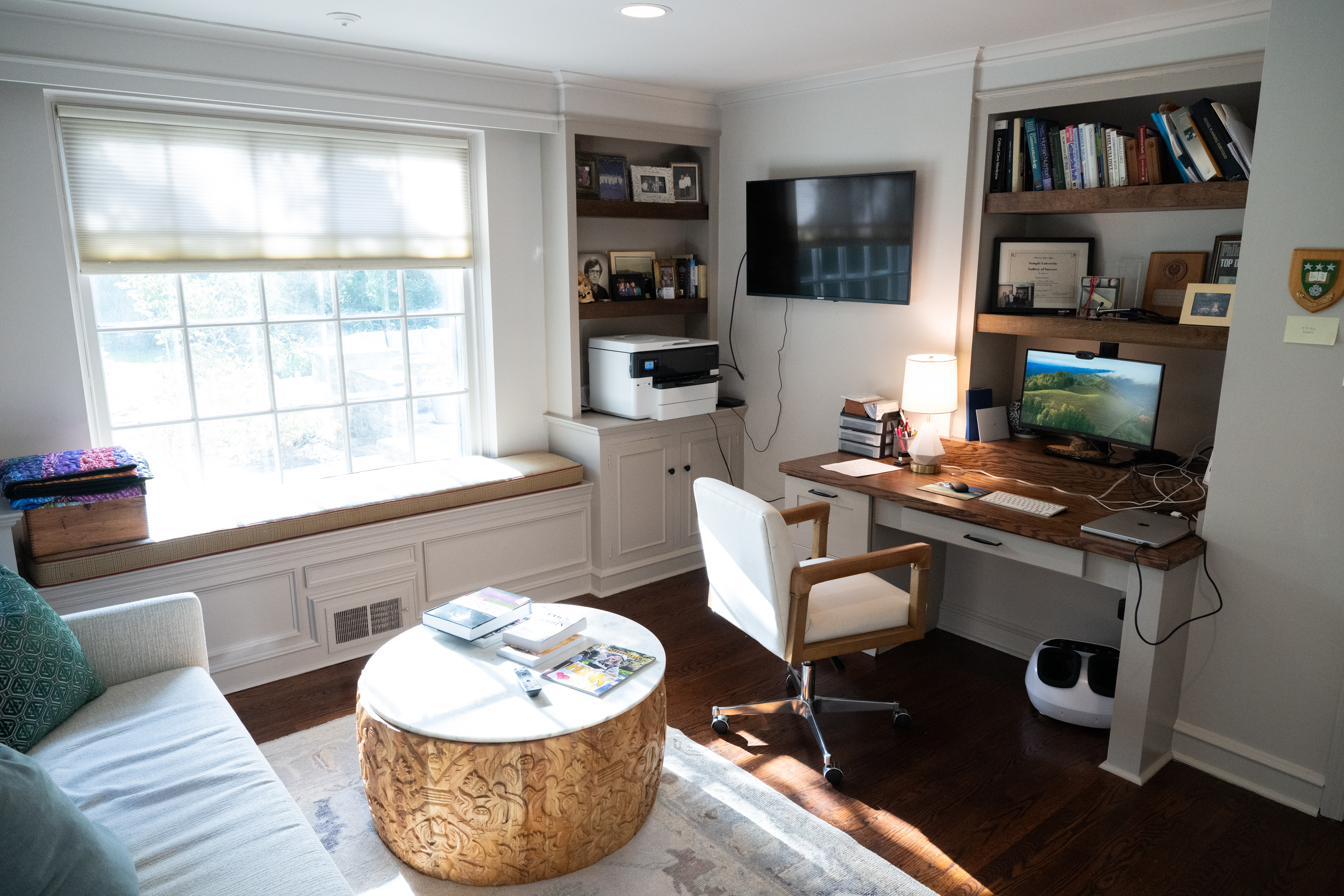
A reprint of the painting “Lady With an Ermine” by Leonardo da Vinci is pictured on a shelf in the den.Metal wall decor hanging on the wall of the den.Steve Peikin’s home office. When they bought the home, the couple wanted space for two home offices.The mudroom and arched entryway.
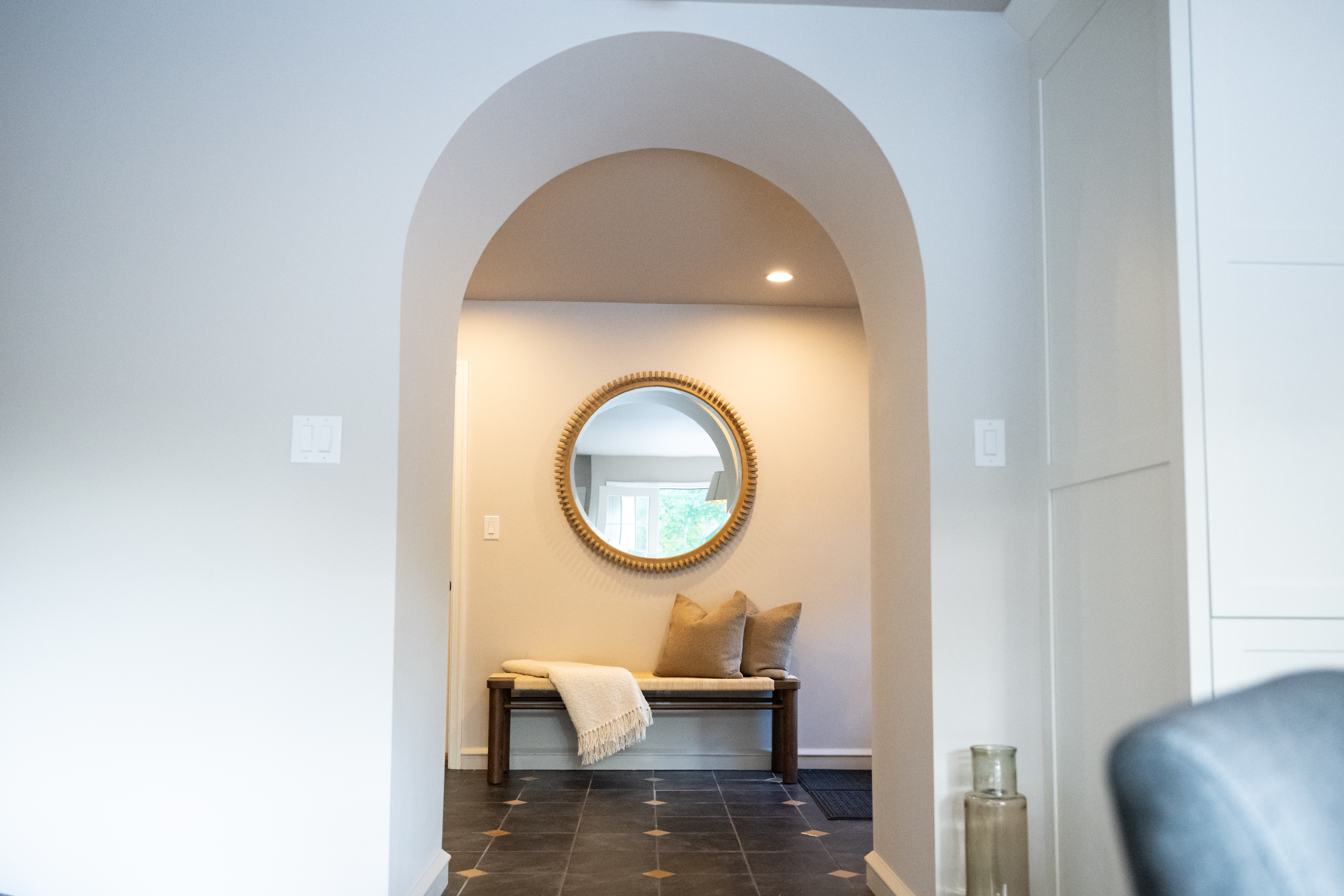
The mudroom off the garage leads to the kitchen through an arched passageway which may have been an addition to the original house built in 1950, Peikin said. The mudroom floor features black and gold tile and a huge inlaid wooden chest that they call the Narnia cabinet — akin to the one in the fantasy novel The Lion, The Witch and The Wardrobe — sits against one wall.
The primary bedroom suite includes a large window overlooking the tree-lined property.
“You can watch the deer and other animals in the backyard,” said Spicer. “While our home in Florida was lovely because we stared at water, it was loud. Here it’s quiet and just beautiful.”
Peikin and Spicer each have dedicated offices. He refers to his first-floor office as his studiolo, which during the Italian Renaissance was a place of study and contemplation. He meets with telemedicine clients there, but it’s also where he watches ballgames and hangs out.
The backyard, where the couple enjoy swimming, barbecuing, and relaxing.
Spicer’s office includes an altar featuring a Buddha, a space where she meditates and which she uses as a backdrop for the online yoga classes she teaches.
The backyard is where the family spends as much time as possible, swimming, hanging in the hot tub, lounging by the pool, warming up at the fire pit, or barbecuing. With help from All Seasons Maintenance & Design, Melady Landscaping, and Bloom Design, they created a cozy, inviting outdoor retreat.
“The best part of living here is that we are surrounded by a bamboo forest and tall trees, with beautiful crepe myrtle, dogwoods, and magnolias, and we have deer and lots of birds,” said Peikin. “We love the outdoors.”
Is your house a Haven? Nominate your home by email (and send some digital photographs) at properties@inquirer.com.
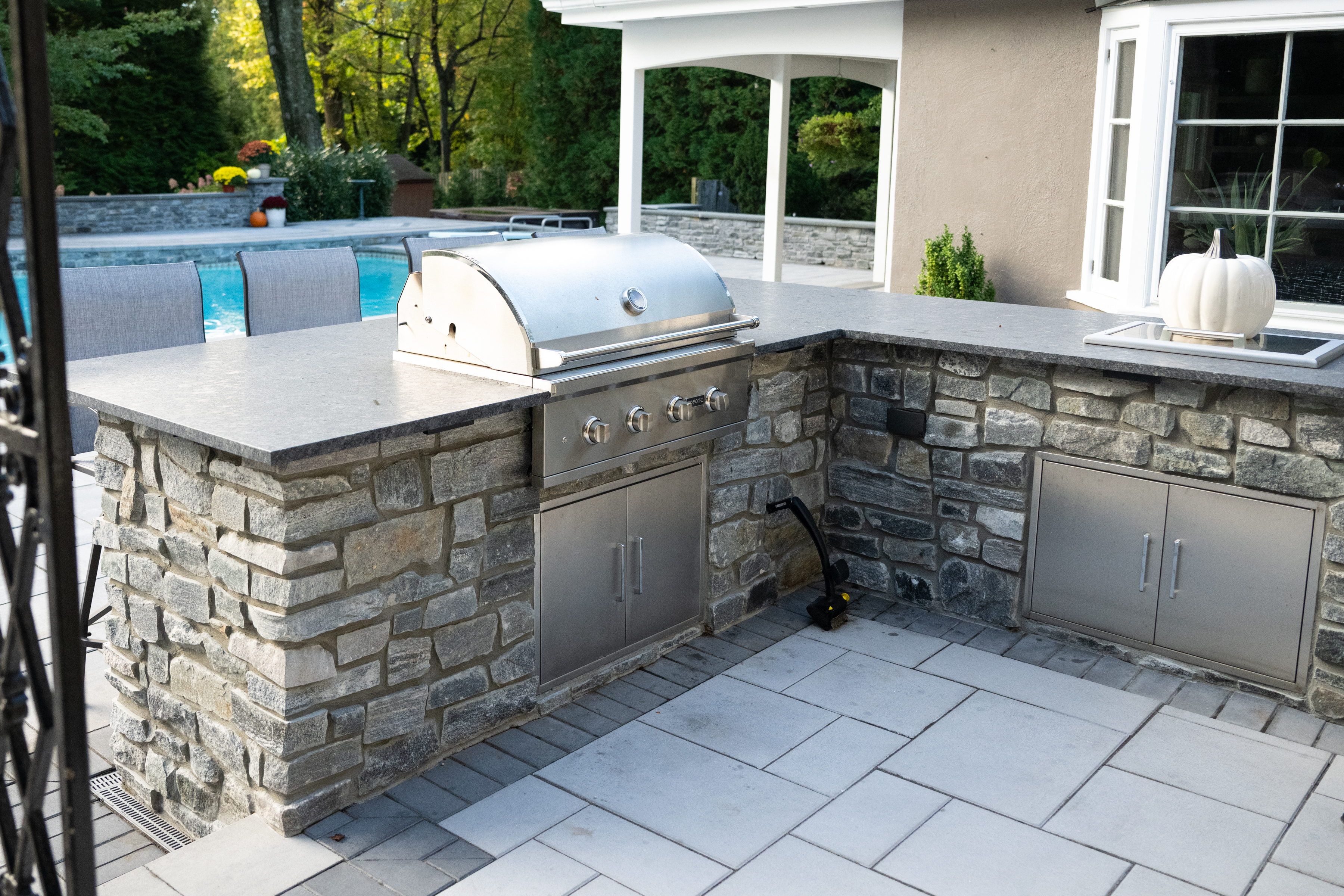
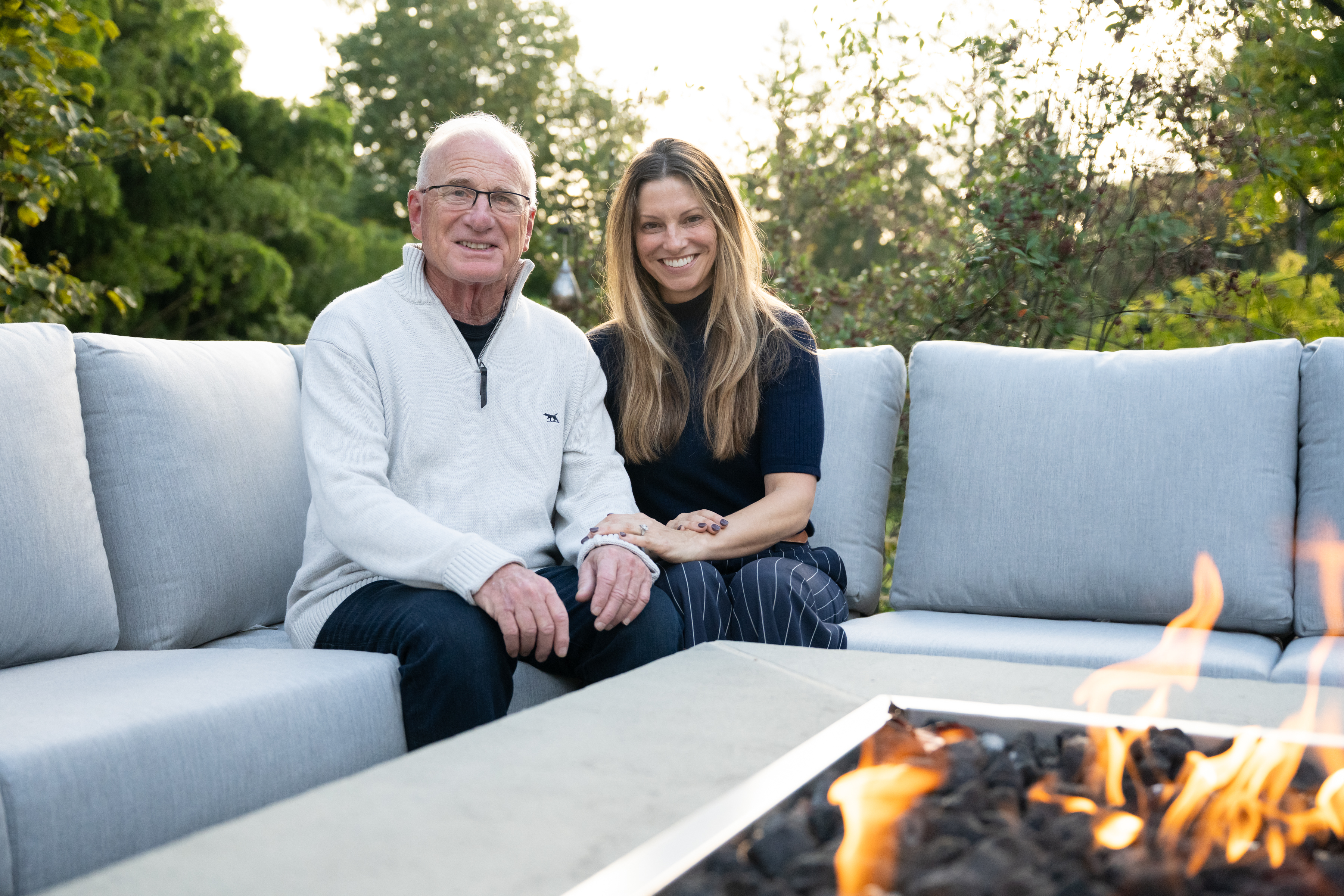
The outdoor kitchen, where Spicer and Peikin prefer to cook dinner when the weather allows.Steve Peikin and Amy Spicer pose for a portrait in their backyard.
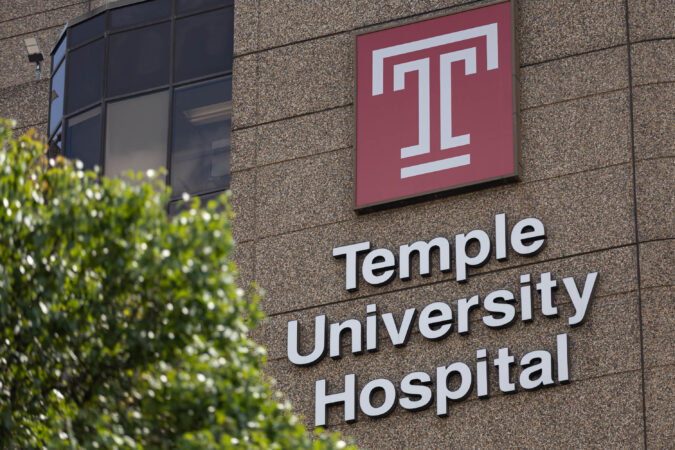
Temple University Health System‘s medical malpractice expenses have surged in the two years that ended June 30 as part of a campaign to reduce financial risk by settling old cases.
The hope is that “aggressively” settling cases will pay off over the next few years by reducing medical malpractice expenses, Michael DiFranco, the health system’s chief accounting officer, told investors during a conference call last week on the health system’s fiscal 2025 financial results.
Temple’s annual medical malpractice expenses increased nearly fourfold, to $117.8 million in fiscal 2025 from $31.6 million two years ago. Over the same period, it cut its reserves for future expenses by $88 million, or 22%. Temple’s reserves peaked at $402.9 million in 2023.
Rising medical malpractice costs are reverberating throughout healthcare. Tower Health recently boosted its reserves after its auditor decided they should be higher to deal with anticipated claims. Lifecycle Wellness, a birth center in Bryn Mawr, blamed its decision to stop delivering babies in February in part on rising medical malpractice costs.
The average number of medical malpractice lawsuits filed in Philadelphia every month has risen from 34 and 35 in the two years before the pandemic to 51 last year and 52 so far this year, according to the Philadelphia Court of Common Pleas.In additional to lawsuits against hospitals, the tally includes litigation against physicians, nursing homes, and other healthcare providers.
Contributing to the increase was a rule change at the beginning of 2023 that allowed more cases to be filed in Philadelphia rather than the county where an injury occurred. Malpractice lawyers say they like to file in Philadelphia because the system for trying cases is efficient. Health systems often note that Philadelphia juries sometimes award large verdicts.
A ‘wake-up call’ at Temple
Temple Health started rethinking its medical malpractice strategy after John Ryan started as general counsel in January 2022. A month before he started, The Inquirer published an article about three suicides at Temple Episcopal Hospital in 2020. At least two of the families sued Temple.
“That was a wake-up call,” Ryan said in a recent interview on his approach to handling malpractice cases.
Then in May 2023, a Philadelphia jury hit Temple with a $25.9 million verdict in a case involving a delayed diagnosis of a leg injury leading to an amputation.
After that loss, Temple changed the kinds ofoutside lawyers it hiresto defend it in malpractice cases, Ryan said, swapping medical malpractice specialists for commercial litigators from firms like Blank Rome, Cozen O’Connor, and Duane Morris. Such lawyers cost more, but it’s paying off, he said.
“The settlements we’re getting from the plaintiff lawyers, because they can see that we’re serious, are much better,” Ryan said. The two Episcopal cases were settled this year for undisclosed amounts, according to court records. A birth-injury lawsuit against Temple University Hospital in federal court settled for $8 million this month.
In 2024, a jury awarded $45 million to a teen who was shot in the neck and suffered brain damage from aspirating food soon after his release from Temple. Temple appealed and the judge who oversaw the original trial ordered a new one. That case then settled at the end of October for an undisclosed amount.
The new approach has helped Temple reduce the number of outstanding cases at any one time to 65 or so now compared to 110 three years ago, according to Ryan.
Temple is using the money it is saving on malpractice costs to invest in better and safer care, Ryan said. “That’s not a byproduct of all we’re trying to do as the lawyers. It’s the goal,” he said.
Inquirer staff reporter Abraham Gutman contributed to this article.
Lifecycle Wellness, a birth center in Bryn Mawr that offered an alternative to hospital delivery for Philadelphia-area parents, is shutting down operations amid growing financial pressure, the nonprofit announced Thursday.
The nonprofit, which provides “homelike” births for low-risk pregnancies at its birth center and at Bryn Mawr Hospital, will stop delivering babies on Feb. 15. Patients who are due on Feb. 1 or later will need to transition to a different provider.
In an open letter posted on its website Thursday, Lifecycle leaders said the organization was strained by rising operations and medical malpractice costs that outpaced insurance reimbursement rates — industrywide challenges that have plagued small and large health organizations alike.
“From the beginning, Lifecycle Wellness has been dedicated to providing evidence-based, family-centered care that empowers clients to make informed choices and experience birth in a supportive, homelike environment,” Jessi Schwarz, executive and clinical director, and Lauren Harrington, board president, wrote. But, they added, “growing challenges have made it increasingly difficult for small, independent, and non-profit maternal health providers to exist.”
Lifecycle reported a profit of $135,303 last year, down from $221,578 in 2023, according to its most recent tax filings.
The organization provided prenatal and birthing services to about 600 patients a year, according to its 2024 tax filings. It employed 73 people that year.
But in their letter announcing the closure, Schwarz and Harrington said that “shifts in public health and rising rates of medical complications have reduced the number of families eligible for this model of care.”
Medical malpractice strain
The number of malpractice cases rose in Philadelphia after a 2023 rule change allowed patients to sue outside the county in which they received medical treatment.
Medical malpractice lawsuits are common in obstetrics, and Philadelphia’s court is known for verdicts with high awards.
In 2023, a Philadelphia jury awarded a record-setting $180 million to the family of a child who was born with severe brain injuries at the Hospital of the University of Pennsylvania.
The Birth Center is currently facing seven lawsuits in Philadelphia.
The industry’s financial headwinds can be harder for independent, specialized healthcare organizations to face.
Last year, Rothman Orthopaedic Institute ended a decades-long run as the official team physicians for the Philadelphia Eagles, citing the risk of medical malpractice liability. A year earlier, a Philadelphia jury awarded $43.5 million to former Eagles safety Chris Maragos, who sued Rothman over the treatment he received for a career-ending knee injury.
Birth resources outside Philadelphia
Lifecycle said it would continue to work with families who are expected to give birth by the end of January.
The organization will work with families due after Feb. 1 to identify a new provider and transition their care.
Lifecycle plans to continue offering limited prenatal, postnatal, and gynecological care through the end of March. The organization will also phase out its mental health and lactation services in February and March.
“Access to respectful, equitable, community-based care is shrinking for many, particularly for marginalized communities who need it most,” Schwarz said in a statement to The Inquirer. “Our situation reflects a broader reality that the health, safety, and well-being of pregnant people and families is not prioritized within our current payment structures.”
They did not offer specifics about where existing patients may be able to transfer their care.
Birth centers are designed as alternatives to hospitals, offering a more natural, “homelike” setting. They have limited pain medications, and patients are typically not connected to fetal monitoring devices, allowing them to move more freely.
This type of care is only an option for low-risk pregnancies, as birth centers are not licensed to perform c-section operations, and will need to transfer patients to a hospital if there is a serious complication during birth.
“I felt very much in the arms of a beloved community of people who were really on your side,” said Monica Moran, who delivered her children with the support of Lifecycle midwives in 2007 and 2009.
Moran, who lives in Havertown, has continued to go to Lifecycle for routine gynecological services and isn’t sure where she will go instead.
She said she worries for families who were counting on Lifecycle’s providers for a nonhospital delivery.
Nearby hospitals with labor and delivery services include Bryn Mawr Hospital and Lankenau Medical Center, both of which are owned by Main Line Health.
The system is “well-positioned and prepared to manage increased patient volume while maintaining our high standards of care,” a spokesperson said in a statement.
It has already seen an influx of patients since Crozer Health closed earlier this year. Crozer delivered 960 babies in 2024, according to health department records.
Lower Merion’s board of commissioners is set to put multiple new ordinances on the books next month, including policies raising parking meter rates for the first time since 1999, lowering the speed limit on parts of Lancaster Avenue, and regulating where smoke and vape shops can open in the township.
The smoke and vape shop regulation movedaheadlast month, and the commissioners advanced the parking meter and speed limit changesWednesday evening. Lower Merion’s assistant township manager, Brandon Ford, said the commissioners are poised to formally vote on all three proposals in December. Here’s everything you need to know.
Parking meter rate may go up
Commissioners on Wednesday moved forward an ordinance that would raise parking meter rates across Lower Merion for the first time in more than 25 years.
Under the proposed ordinance, parking would increase from 50 cents per hour to $1 per hour across the township, with the exception of six locations in Ardmore. Parking would go up to $1.50 per hour at Rittenhouse Place, Cricket Avenue, Cricket Terrace, and township-owned parking lots five (Cricket Terrace) and six (Schauffele Plaza). The Cricket Avenue Parking Garage would stay at 50 cents per hour.
Township staff say the proposed meter rate increase would generate around $900,000 annually and would likely drive quicker turnover in Lower Merion’s commercial corridor, generating more economic activity for local businesses.
“The rates that we are charging have not kept up with the overall cost for maintaining those parking meters, as well as our overall parking services program,” Ford said during a Nov. 5 meeting.
The ordinance, if passed, would not change how parking meter fees are collected. The township collects parking fees through meters, kiosks, and a mobile app.
Commissioner Scott Zelov, who represents Bryn Mawr, Haverford, and Gladwyne, said: “It certainly is time to do this.”
Anderson Avenue near Suburban Square on June 8. A proposed Lower Merion ordinance would increase parking meter rates across the township in hopes of raising revenue and spurring economic activity in places like downtown Ardmore.
Lancaster Avenue speed limit reduction
Lower Merion is set to reduce the speed limit on parts of Lancaster Avenue from 40 mph to 35 mph, bringing township code in compliance with an earlier speed limit change by the Pennsylvania Department of Transportation.
PennDot has already placed 35-mph speed limit signs on the selected strip of Lancaster Avenue. The board’s approval will bring the township in line with the state and allow township police to start enforcing the reduced speed limit. The speed limit change is the latest development in a major redesign of Lancaster Avenue by the state and the township.
A study conducted by PennDot earlier this year found that, out of nearly 20,000 vehicles traveling on Lancaster Avenue between Wynnewood Road and City Avenue during a 24-hour period, only 57% were driving at or below the 40-mph speed limit. PennDot considers the intersection of Lancaster Avenue and Remington Road to be a “high crash location.”
The ordinance, approved for advertisement on Wednesday, also bans right turns on red at three intersections: Lancaster Avenue and Remington Road for eastbound traffic, Lancaster Avenue and Haverford Station Road for westbound traffic, and Montgomery Avenue and Airdale Road for east-west traffic.
The township aims to place automated red-light cameras at all three intersections. The first red-light camera, at Remington Road and Lancaster Avenue, is in the process of being installed. Andy Block, Lower Merion’s superintendent of police, said the camera should be up and running by the end of the year.
Following a lengthy discussion that stretched across two meetings, the board of commissioners on Oct. 22 moved forward an ordinance that would decide where tobacco and vape shops can operate in Lower Merion.
Under the proposed ordinance, if a tobacco or vape shop wanted to open in Lower Merion, it would have to be situated at least 1,000 feet from any other tobacco or vape shop and 1,000 feet from any public or private school. The rule would also apply to hookah lounges.
Township staff said the 1,000-foot buffer would dramatically decrease the opportunity for smoke shops to operate in Lower Merion. Ford said there are currently around 1,000 properties in Lower Merion where smoke shops could operate. If the buffer ordinance were to be implemented, that number would drop to 300.
While some commissioners inquired about creating a larger buffer, officials said doing so would likely zone smoke shops out of Lower Merion entirely, which would give smoke shop owners the legal claim to build anywhere in the community.
During an Oct. 17 discussion of the ordinance, Commissioner Anthony Stevenson, who represents Ardmore and Haverford, said: “We need to avoid the continuation of making our township, and particularly in the Ardmore area, a vape central.”
This suburban content is produced with support from the Leslie Miller and Richard Worley Foundation and The Lenfest Institute for Journalism. Editorial content is created independently of the project donors. Gifts to support The Inquirer’s high-impact journalism can be made at inquirer.com/donate. A list of Lenfest Institute donors can be found at lenfestinstitute.org/supporters.