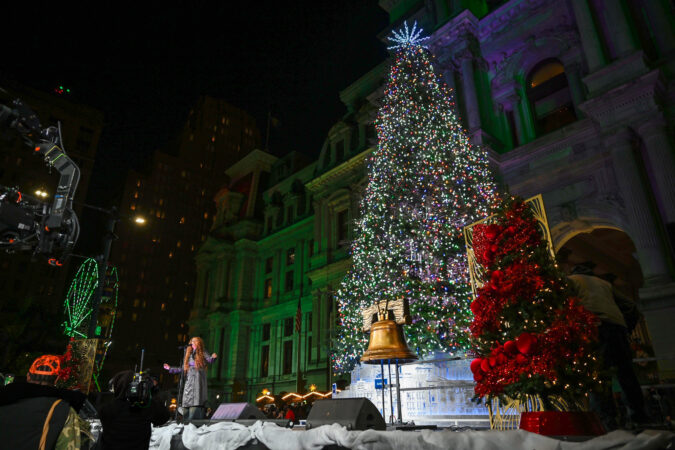
The holiday season at City Hall was kicked off Thursday night with a lighting ceremony for what is officially called the “Philly Holiday Tree,” followed by live musical performances by Grammy-winning artists Ashanti and Lalah Hathaway.
The 50-foot-tall, 75-year-old Concolor Fir, sourced from Stutzman Farms in New York, will be displayed on the north side of City Hall through Jan. 1. The tree is bigger and brighter this year, with a reimagined base that serves as a centerpiece and more than 6,000 lights.
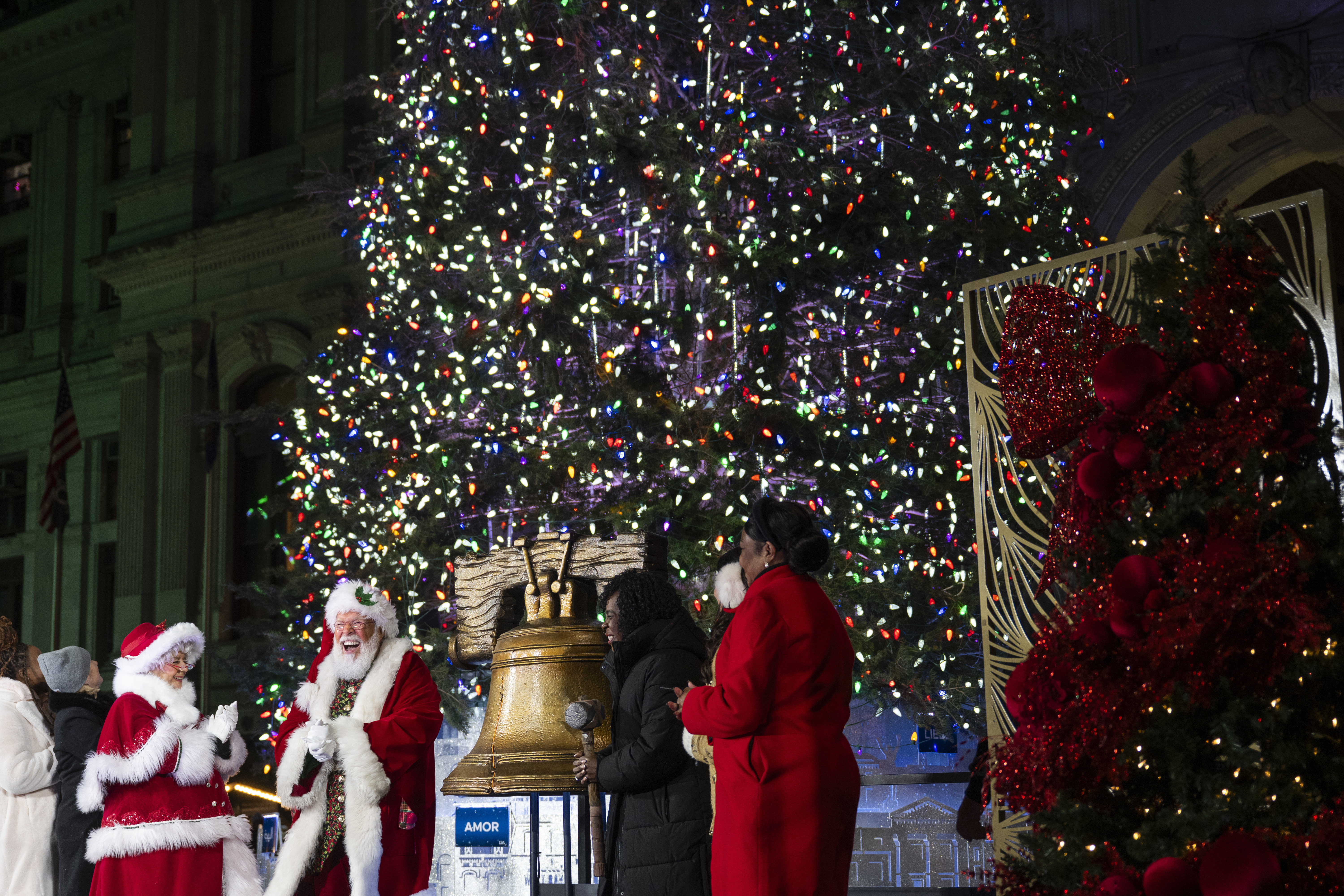
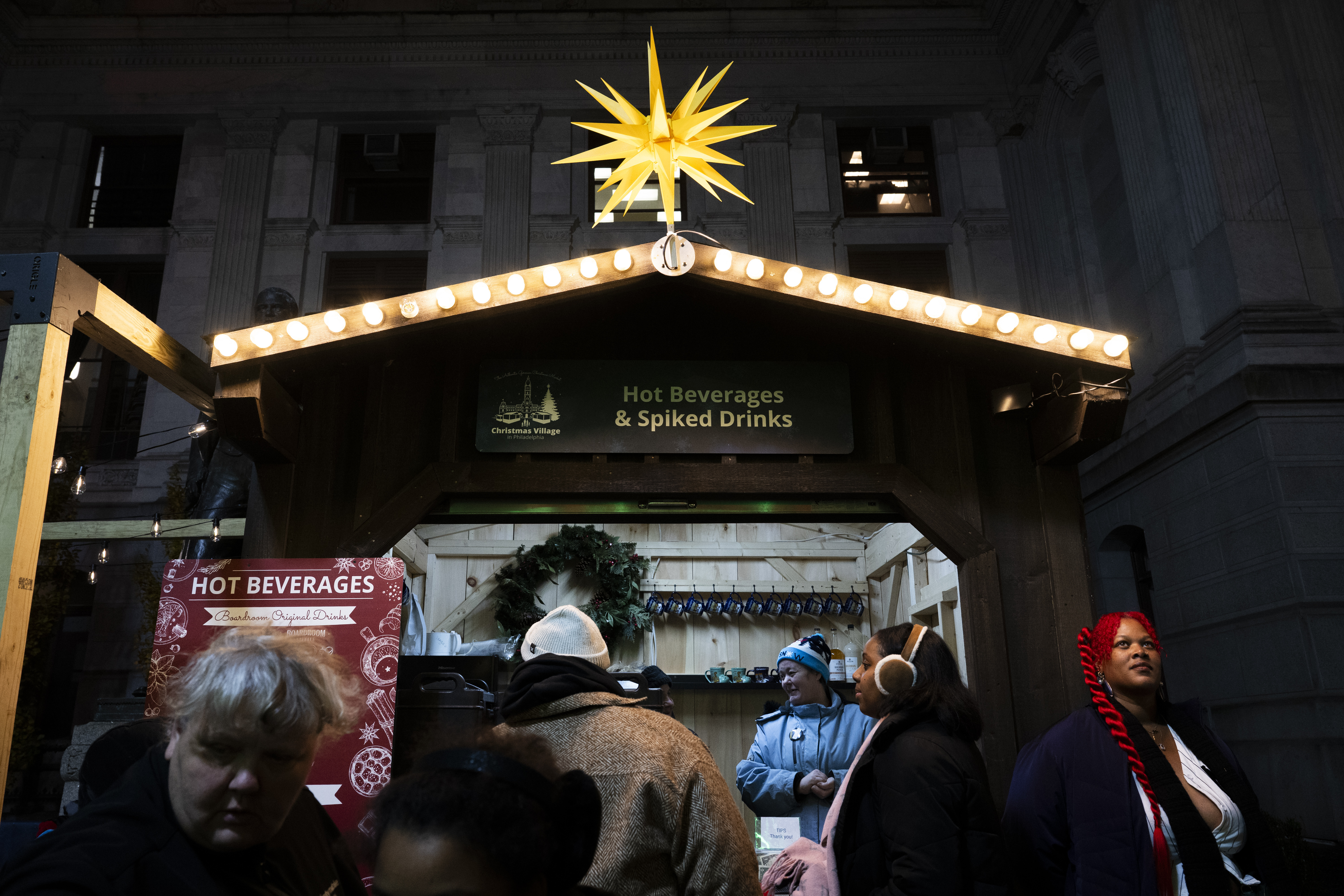
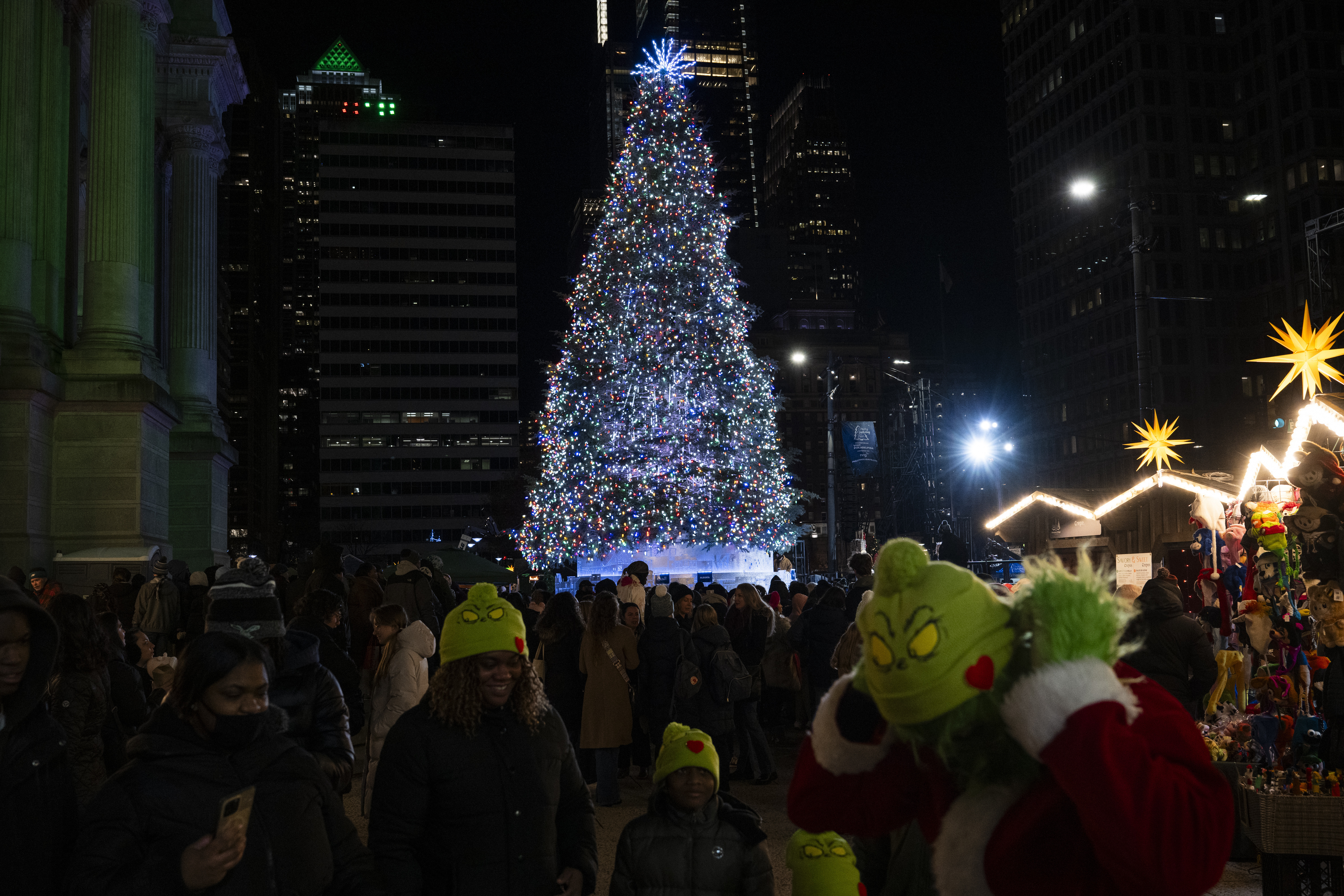
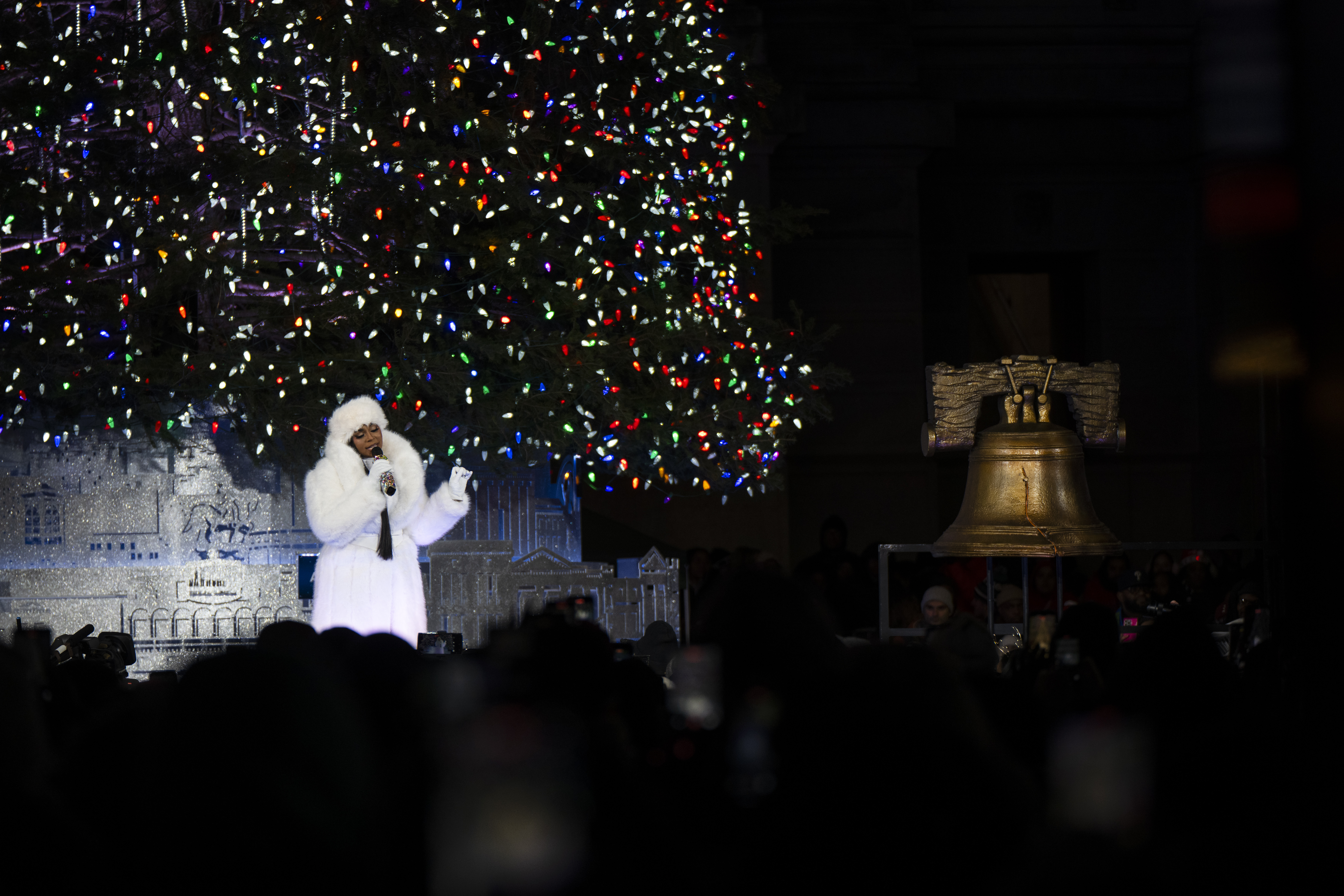
Mayor Cherelle Parker smiles alongside Santa during the annual City of Philadelphia Holiday Tree Lighting ceremony at City Hall on Thursday, Dec. 4, 2025.Attendees wait in line for drinks during the annual City of Philadelphia Holiday Tree Lighting ceremony at City Hall on Thursday, Dec. 4, 2025.Attendees with Grinch hats gather for the annual City of Philadelphia Holiday Tree Lighting ceremony at City Hall on Thursday, Dec. 4, 2025.Ashanti performs at the annual City of Philadelphia Holiday Tree Lighting ceremony at City Hall on Thursday, Dec. 4, 2025.Ashanti performs a medley during the BET Awards on Monday, June 9, 2025, at the Peacock Theater in Los Angeles.
Mayor Cherelle L. Parker struck a replica Liberty Bell with a large hammer at 7:05 p.m. to signal the lighting of the tree.
Cassie Donegan, the current Miss America, sang “White Christmas” and “Rockin’ Around the Christmas Tree.” The show was broadcast live on 6abc.
The annual city-run event is part of a wider event schedule to ring in the holiday season in Philadelphia, organized by Welcome America LLC, which also organizes the Wawa Welcome America festival on July 4.
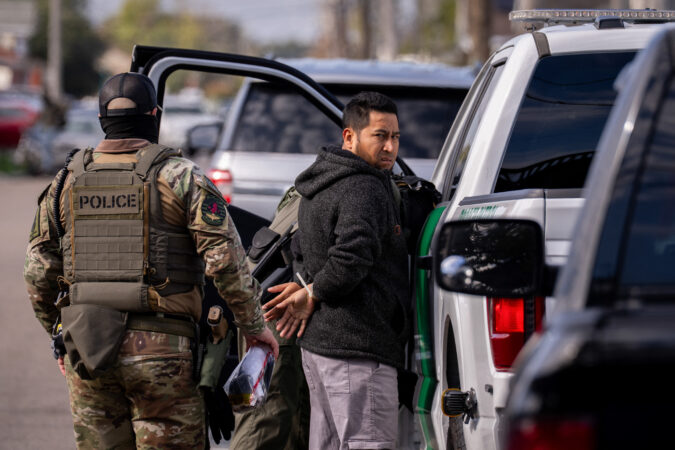
The number of immigrants confined in federal detention facilities has surged past 65,000, perhaps the highest figure ever and a two-thirds increase since President Donald Trump took office in January.
The 65,135 in custody across the nation represents a shattering of the 60,000 threshold, which was last passed briefly in August before dropping back down. The new figure is up from 39,238 when Trump was inaugurated, as his administration quickly undertook an unprecedented campaign to arrest, detain, and deport immigrants.
“It’s quite stunning,” said Jonah Eaton, a Philadelphia immigration attorney who teaches about detention at Temple University’s Beasley School of Law. “They are dead serious about moving as many people out of the country as possible, and keeping them detained while they do it.”
The data, current as of Nov. 16, come from the Transactional Records Access Clearinghouse, an information-and-research organization that obtains information from ICE and other federal agencies.
An ICE spokesperson said the agency could not comment on statistics compiled by third parties.
window.addEventListener(“message”,function(a){if(void 0!==a.data[“datawrapper-height”]){var e=document.querySelectorAll(“iframe”);for(var t in a.data[“datawrapper-height”])for(var r,i=0;r=e[i];i++)if(r.contentWindow===a.source){var d=a.data[“datawrapper-height”][t]+”px”;r.style.height=d}}});
The Trump administration says it is arresting the “worst of the worst,” criminal immigrants who have committed serious and sometimes violent offenses. But the new data show ― as they consistently have ― that 74% of those in detention have no criminal convictions.
“The question is ‘What’s going to be the ceiling for this?’ as the administration has designs to expand the capacity to detain individuals as arrests increase,” said Cris Ramon, an independent immigration consultant in Washington. “If the goal is to remove as many people as possible, they’re going to be leaning on the detention centers to be, first and foremost, a staging ground.”
Ramon said he was not surprised by the high detention numbers, given the Trump administration’s determination to carry out large-scale operations in cities like Charlotte, N.C., and Chicago.
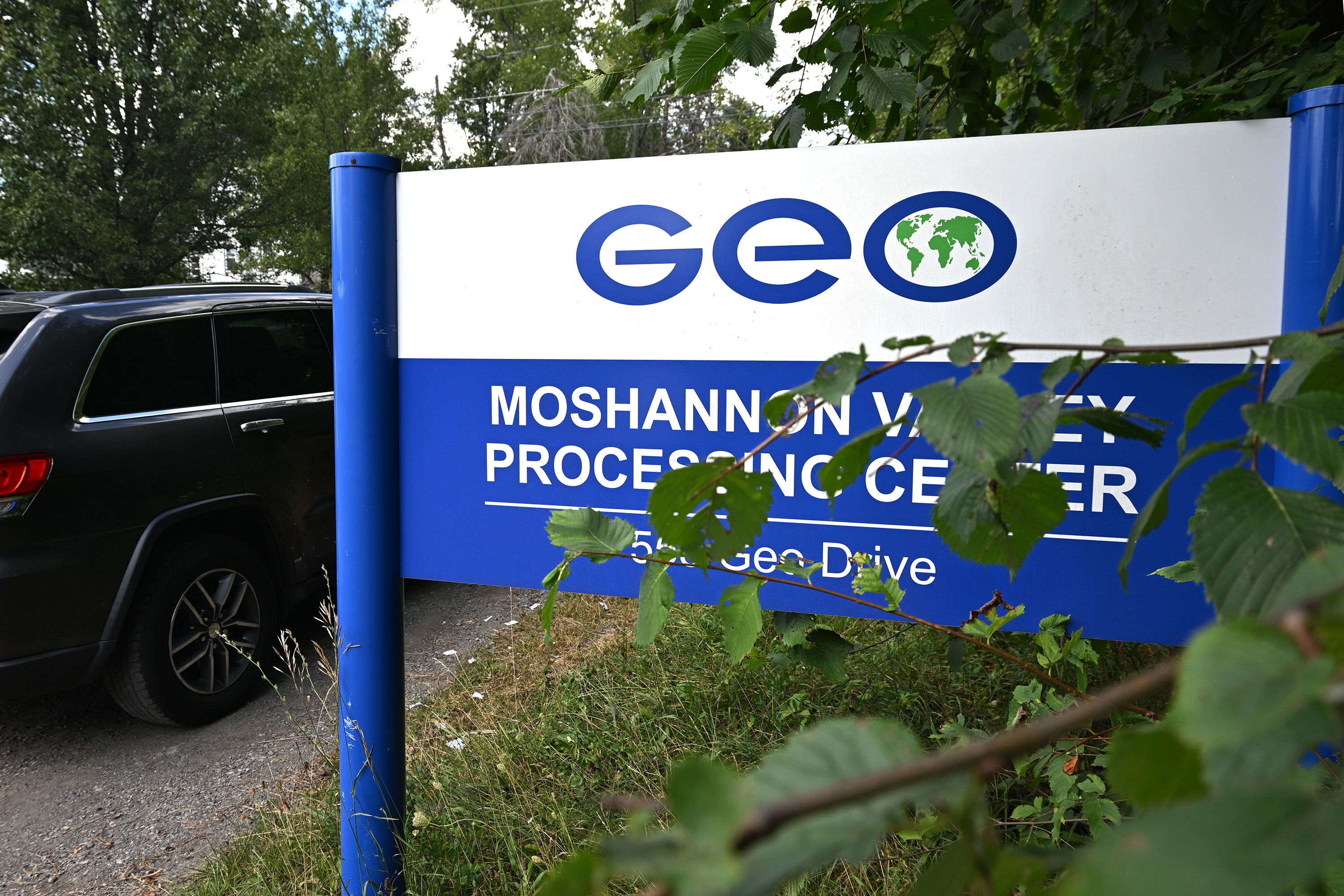
The Moshannon Valley Processing Center outside Philipsburg, a U.S. Immigration and Customs Enforcement facility in Clearfield County, Pennsylvania that is privately operated by the GEO Group under contract with ICE. It is the largest ICE detention center in the Northeast United States.
Today 81% of people in detention were arrested by ICE, up from 38% when Trump took office. The president has demanded that Immigration and Customs Enforcement make more arrests more quickly, and won new funding to encourage that.
The agency generally operates in the interior United States.
New Jersey has two detention facilities, in Newark and Elizabeth, and might be getting a third, in South Jersey. The administration plans to hold detainees at Joint Base McGuire-Dix-Lakehurst, one of two military sites that have been designated for that purpose. The other is Camp Atterbury in Indiana.
Many of those in custody are subject to “mandatory detention,” meaning they are not allowed to seek release on bond. In the summer, the administration announced a policy change that prevented immigration judges from granting bond to anyone in detention who had entered the United States without documentation.
The result, according to the National Immigration Law Center, is that the Trump administration has ensured that migrants have almost no way out of detention “other than death or deportation.”
ICE is arresting, detaining, and refusing to release far more people than before, the law center said, including many who rarely would have been held in the past.
Immigration detention is civil in nature, to hold people as they progress through their court cases or await deportation. It is not supposed to be a punishment.
When Joe Biden assumed the presidency in 2021, there were 14,195 people in immigration detention. That figure more than doubled during his term and eventually topped 39,000.
“Trump’s cruel mass detention and deportation agenda has reached a previously unimaginable scope and scale,” Carly Pérez Fernández, communications director at Detention Watch Network in Washington, said in a statement.
She called the new detention figure “a grim reminder” of a larger plan that is “targeting people based on where they work and what they look like, destabilizing communities, separating families, and putting people’s lives at risk.”
ICE holds detainees across the country, in ICE facilities, in federal prisons, in privately owned lockups, and in state and local jails. As detentions have surged, so has the need for places to house people.
As of this summer, ICE detained people in all 50 states as well as in Guantánamo Bay, Cuba, Puerto Rico, Guam, the Northern Mariana Islands, and the U.S. Virgin Islands, according to the Vera Institute of Justice in New York.
Texas had the most facilities with 69, and Florida was second with 40, the institute said.
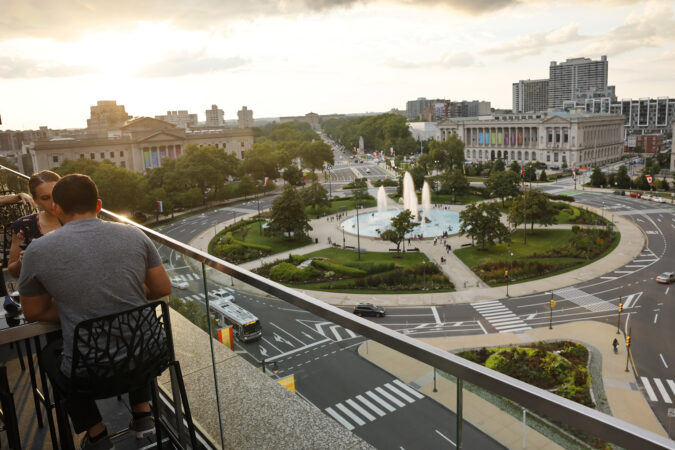
Drivers in Philadelphia’s Logan Square neighborhood should expect new delays as the city continues to prepare for America’s 250th birthday next summer.
Construction is set to cause lane closures in both directions on weekdays from Dec. 1 until May 19, Pennsylvania Department of Transportation officials said in a statement.
“This project will improve the safety and accessibility for Logan Square residents and the increased number of visitors during 2026 events,” city officials said Saturday.
Drivers won’t be able to use the interior lane around Logan Circle, the left inbound lane on the Benjamin Franklin Parkway, and the left lane on 19th Street north of the circle, according to the city.
The work is set to occur between 7 a.m. and 3:30 p.m. on weekdays, according to PennDot, and will be weather dependent.
“Motorists are advised to allow extra time when traveling through the work area because backups and delays will occur,” PennDot officials said.
During construction, pedestrians will also be unable to use the sidewalk around the circle or access Swann Memorial Fountain at its center, according to the city.
The beloved 101-year-old fountain hasn’t been fully operational since 2023 due to vandalism. Philadelphia Parks and Recreation Commissioner Susan Slawson said in September that the city is making repairs, with plans to have the fountain completely restored by May 2026.
Patti Smith has been associated with New York for her entire public life.
In 1971, her first poetry and music performance was at St. Mark’s Church in-the-Bowery with Lenny Kaye on the guitar. Along with the Ramones, Talking Heads, Television, and Blondie, she was a vital force in the mid-1970s CBGB music scene.
And in 1975, she recorded Horses at Electric Lady Studios. That galvanic debut album made her an instant punk rock and feminist hero. On Saturday, she’ll celebrate its 50th anniversary at the Met Philly, with a band that includes Kaye, drummer Jay Dee Daugherty, bassist Tony Shanahan, and her son Jackson Smith on guitar.
“People think of me as a New Yorker,” Smith said, in an interview with The Inquirer from her home in New York.
“Well, I’ve lived in New York. But I was pretty much formed by the time I got to New York. The places that helped form me were Philadelphia and rural South Jersey.”
At the Met, Smith and her band will perform Horses in its entirety, starting with the take on Van Morrison’s “Gloria” that introduced her as a brash, provocative artist with one of the most memorable opening lines in rock and roll history: “Jesus died for somebody’s sins … but not mine.”
“It’s going to be a special night, because I hardly ever get to play with my son and daughter,” said Smith, who turns 79 on Dec. 30. “So I’m really, really happy about that, bringing my kids to Philadelphia.”
Bread of Angels, unlike her 2010 National Book Award-winning Just Kids, doesn’t zero in on a particular episode in the storied career of the enduring punk icon.
“Bread of Angels: A Memoir” by Patti Smith. MUST CREDIT: Random House
Instead, Bread takes the full measure of her life. It begins in Chicago where she was born before her parents moved back to Philadelphia while she was a toddler, and turns on a late-in-life DNA revelation that shakes up her conception of her own identity.
“I didn’t plan to do this book,“ Smith said. “Truthfully, it came to me in a dream.”
In her dream, she had written a book telling the story of her life in four sections. She wore a white dress, just as she does on the cover of Bread of Angels, in a 1979 photo taken by Robert Mapplethorpe.
“It was so specific, this dream, that it sort of haunted me. And I felt like it was a sign that perhaps it was a book I should write. …. It took quite a while.”
Bread of Angels is “a love letter to certain places.”
“Philadelphia when I was young,” she said. “I love Philly. And then down in rural South Jersey, and the places in Michigan I lived with my husband.”
Summaries of Smith’s life typically cite that she lived in Germantown before moving first to Pitman and then Deptford Heights in South Jersey, before moving to New York in 1967.
But Smith’s childhood was actually much more peripatetic.
“I think we moved nine times while we were in Philly,” she recalled, including stops in Upper Darby and South Philadelphia.
“My mother had three of us in rapid succession,” said Smith. It was after the war, and a lot of the rooming houses we stayed in absolutely didn’t allow infants, so my mother was always hiding the pregnancy or hiding the baby. And then we’d get found out and have to move again.”
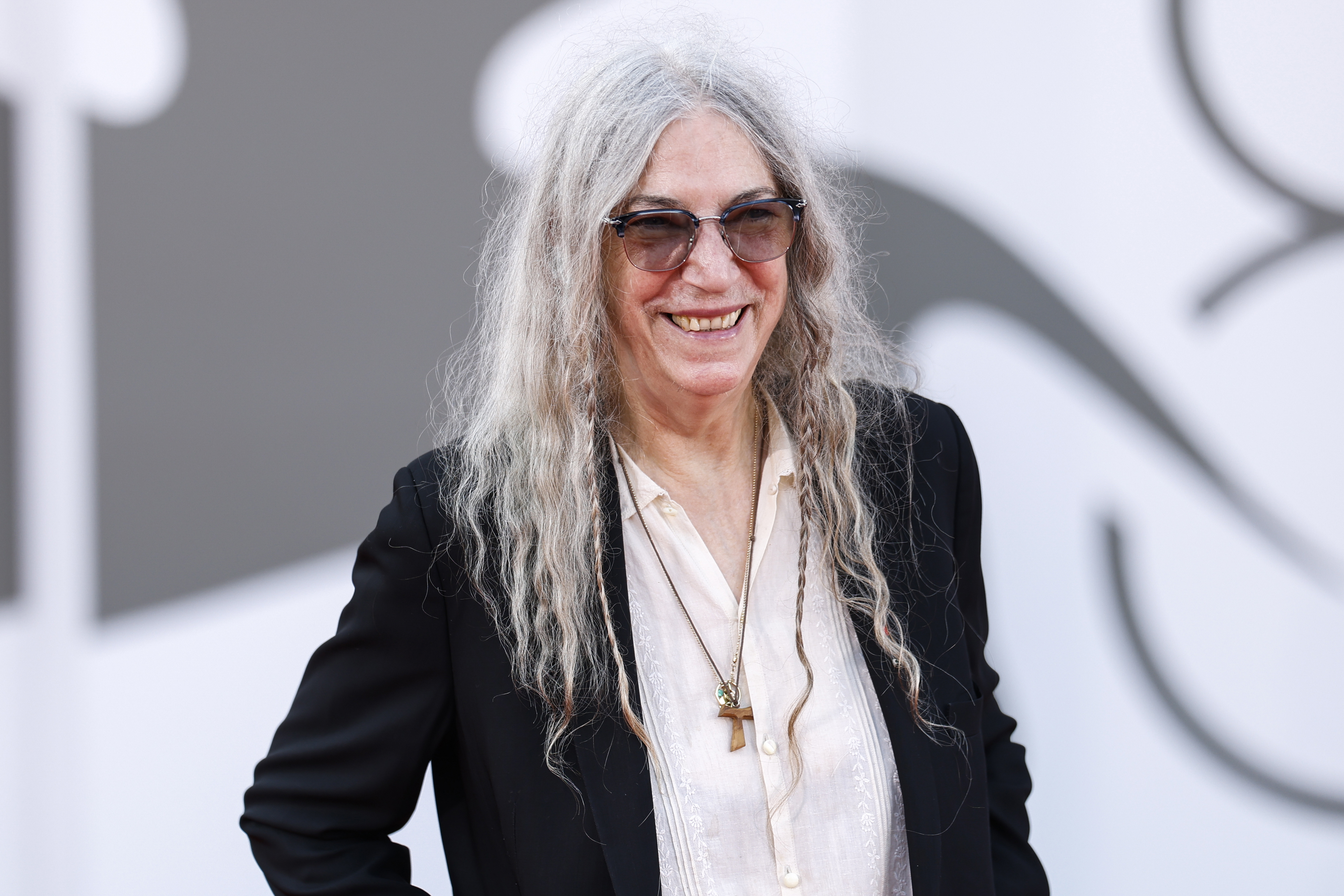
Patti Smith at the Venice Film Festival in Venice, Italy in 2024.
Her coming of age Philadelphia stories in the book evoke a happy, lower middle class childhood.
Living in a converted soldier’s barracks in Germantown she calls “the Patch,” she once beat all the boys and girls in a running race, but tripped and landed on a piece of glass, leaving blood rushing down her face. She was treated at Children’s Hospital, and rode a bicycle for the first time the following week.
“I left the perimeter of the Patch, pedaled up toward Wayne Avenue,” she writes. “I was six and half years old with seven stitches, and for that one hour, on that two-wheeler, I was a champion.”
On her seventh birthday, her mother, who then worked at the Strawbridge & Clothier department store at Eighth and Market, took her to Leary’s, the Center City bookshop that closed in 1968.
“Oh my gosh it was a wonderful bookshop,” she said. “On your birthday, you had to show your birth certificate and pay $1, and you could fill your shopping bag.”
Her bag, she said, was filled “with some very good books that I still own.”
A copy each of Pinocchio, The Little Lame Prince, an Uncle Wiggily book.
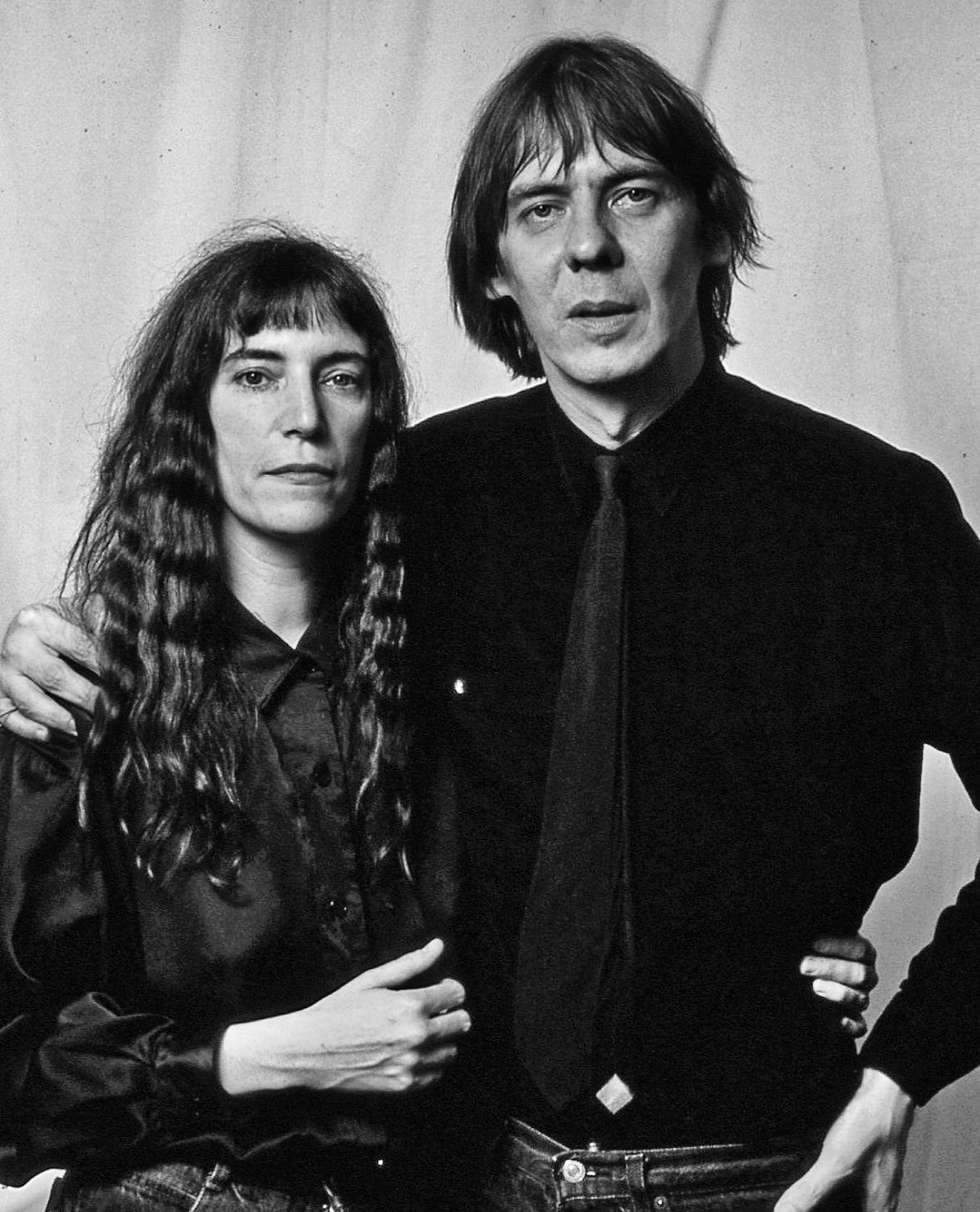
Patti Smith and her late husband Fred “Sonic” Smith, as pictured in “Bread of Angels,” her new memoir. Smith and her band will play the Met Philly on Nov. 29 on the final date of their tour celebrating the 50th anniversary of her 1975 debut album “Horses.” She will also appear on Dec. 1 at Marian Anderson Hall at the Kimmel Center in a Songs & Stories event on her Bread of Angels book tour.
As a Jersey teenager in the early 1960s, she had a crush on a South Philly boy named Butchy Magic. She once got stung by a hornet outside a dance, she writes in the book, and he looked deep into her eyes and pulled the stinger out from her neck.
“This is what the writer craves,” she writes. “A sudden shaft of brightness containing the vibration of a particular moment … Butchy Magic’s fingers extracting the stinger. The unsullied memory of unpremeditated gestures of kindness. These are the bread of angels.”
As in the book, Philadelphia loomed large over Smith’s childhood, well after the family moved to Gloucester County.
“It was our big city. It was where I discovered rock and roll,” she said.
She discovered art when her father Grant and mother Beverly took her and her younger siblings Linda, Kimberly, and Todd to the Philadelphia Museum of Art (now Philadelphia Art Museum). There, she fell for Pablo Picasso, John Singer Sargent, and Amedeo Modigliani.
“Culturally, it was the city that helped form me,” she said.
“It amazes me that half a century has gone by and people are still greatly interested in the material,” she said. “It’s a culmination of a period in my life.”
In 2012, when Smith and her sister Linda took DNA tests, Smith had already begun writing Bread of Angels. The result of the test was a shock: Grant Smith was not her biological father.
Her birth was actually the result of a relationship between Beverly Smith and a handsome Jewish pilot named Sidney who had returned to Philadelphia from World War II.
Bob Dylan and Patti Smith at the Electric Factory in Philadelphia in 1995.
“It was completely unexpected,” Smith said. “My mother was a great oral storyteller, but none of her stories gave any indication that I was fathered by a different man. … She certainly kept that a secret from everyone.”
Of the emotions Smith felt, one was “some sorrow,” she said. “Because I loved and admired my father. I felt sad because I didn’t have his blood. But I modeled myself after him so much. All of those things remain.”
She stopped work on Bread of Angels for two years.
“I didn’t know how to deal with it. Is this book false? Do I have to rewrite everything? And then I realized I didn’t have to rewrite anything. My father is still my father. But you can also show gratitude to the man who conceived with my mother. Who gave me life. So I figured it out. I have two fathers.”
Her mother, father, and biological father had all died by the time she learned the news of her parentage.
Some of Smith’s self-confidence — evident in the way she spells out “G-L-O-R-I-A!” — “might have come from the biological father I never knew,” she said. “He was a pilot. When he was young, he had this tough job. I’ve met a few people who knew him. They said he was very kind and good-hearted. He loved art, he loved to travel. He had not a conceited, but a self-confident air.
“I’ve always had that, and wondered where it came from,” she said. “I’ve always possessed that kind of self-confidence. I’ve never had trouble going on stage. So I think I have to salute my blood father, right?”
In Bread of Angels, Smith recalls her early life in Philly, and writes: “I did not want to grow up. I wanted to be free to roam, to construct room by room the architecture of my own world.”
Seven decades later, she’s still doing that, as she continues to create and perform for adoring audiences around the world.
“I have stayed in contact with my 10-year-old self, always,” she said. “I still carry around the girl that had her dog, and slept in the forest, and read [her] books, and got in trouble, and didn’t want to grow up.”
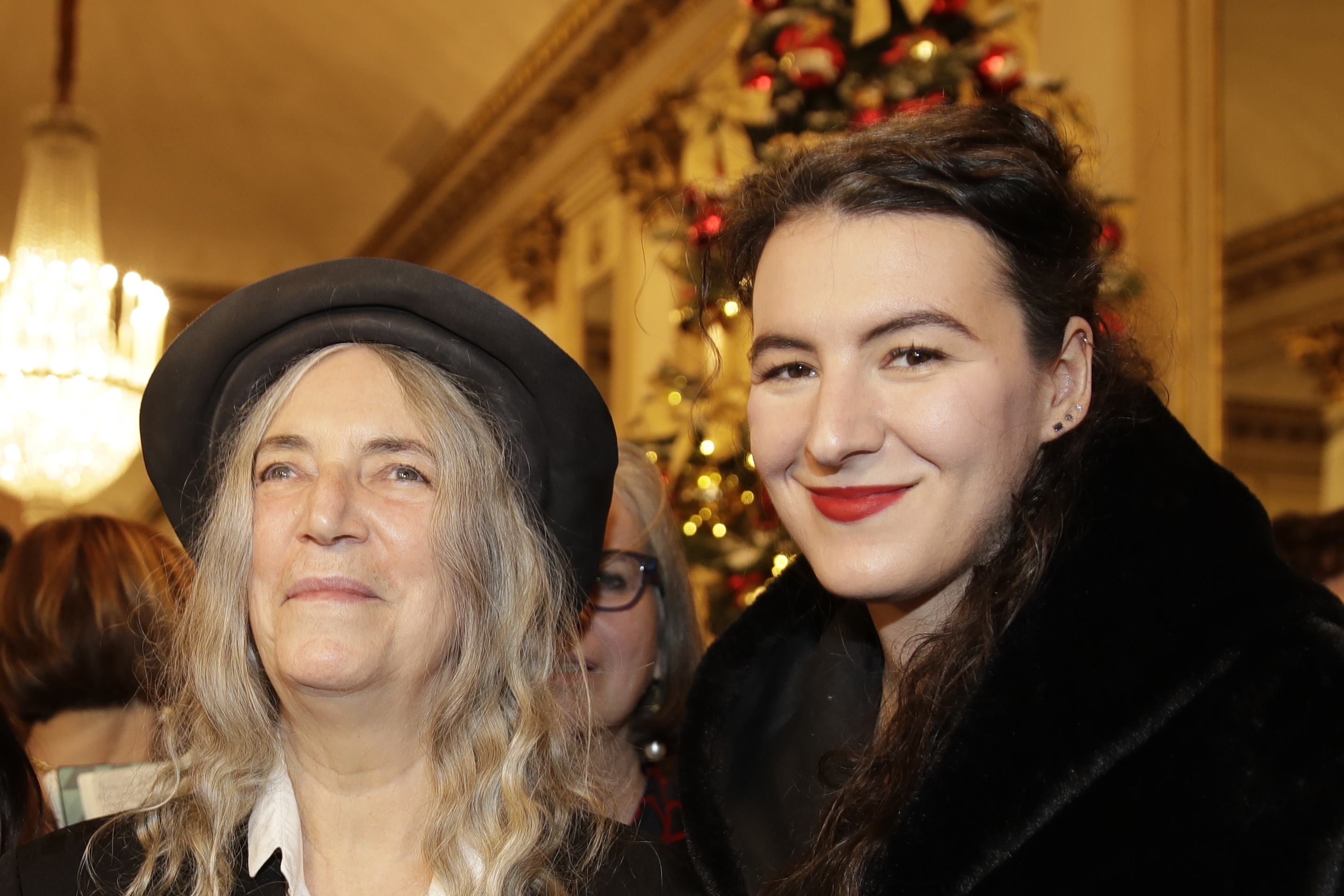
Patti Smith and daughter Jesse Paris Smith in Milan, Italy, in 2019.
She turns 80 next year.
“My hair is gray to platinum. I understand my age. I’ve had my children, and have gone through a lot of different things. But I still know where my 10-year-old self is. I still know how to find her.”
Patti Smith and Her Band perform “Horses” on its 50th anniversary at the Met Philly, 858 N. Broad St. at 8 p.m. Saturday, themetphilly.com.
“Patti Smith: Songs & Stories” at Marian Anderson Hall, 300 S. Broad St., at 7 p.m. Monday, ensembleartsphilly.org
Come Dec. 6, Amanda Shulman, chef and creator of the now Michelin-starred Rittenhouse restaurant Her Place Supper Club, knows exactly what she’ll be doing: boxing up hundreds of cookies.
More than three dozen cookie varieties — snickerdoodles, chocolate chips, shortbread, thumbprints, meringues, macaroons, and many more, in 100-cookie batches — will be ferried to Center City that morning. They’ll be brought by bakers and pastry chefs from around the region, all of whom have enlisted to help Shulman pull off what has become an epic holiday fundraiser, Cookies 4 Coats, now in its fourth year.
Shulman and her crack team take over once the cookies have converged. They’ll crank for two hours, putting together a cookie box so big, it will fill the front seat of your car.
“It’s so many cookies,” Shulman said in a recent interview. “It is an irresponsible amount of cookies, and it’s awesome.”
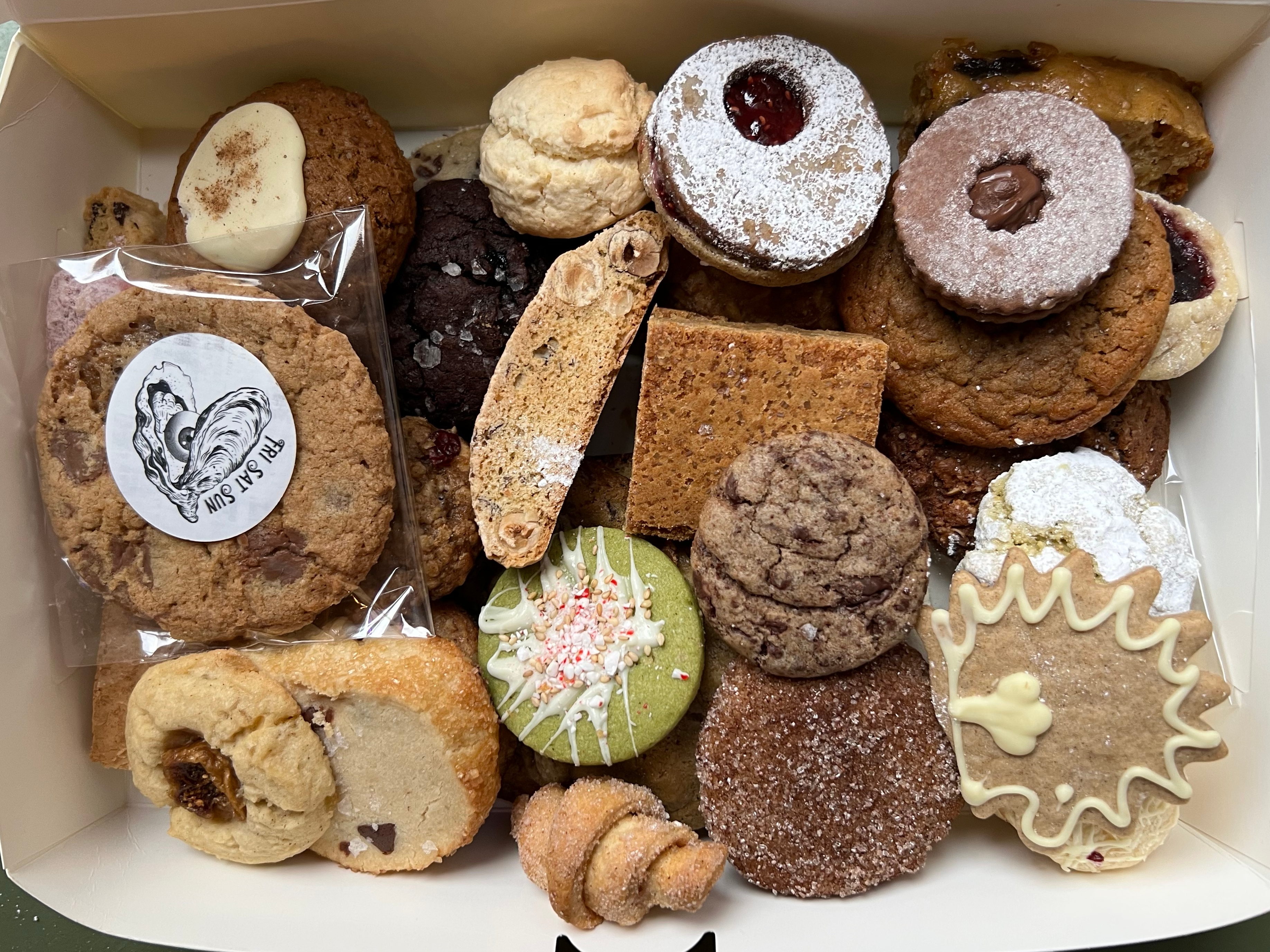
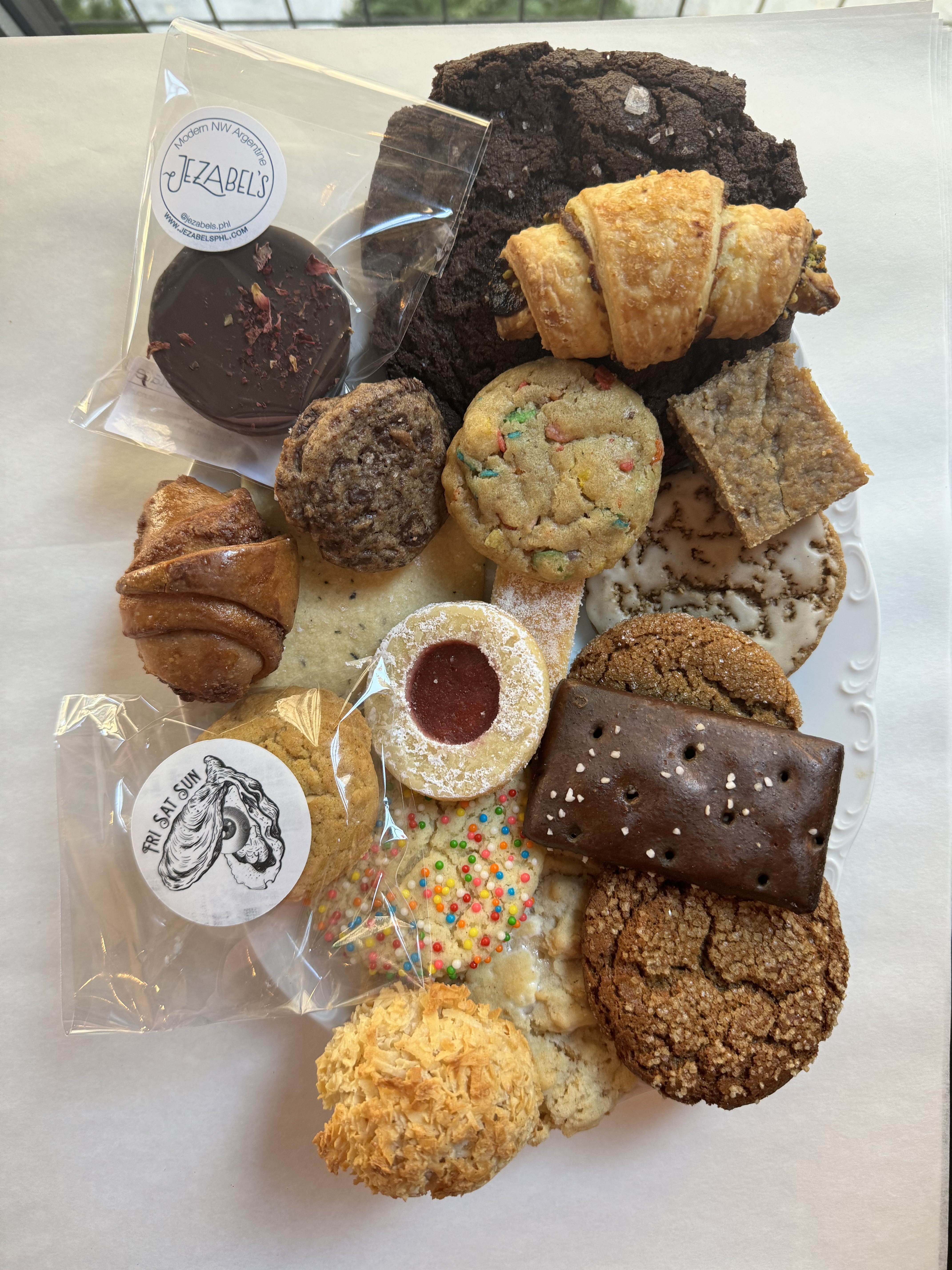
The first edition of Cookies 4 Coats’ annual cookie boxes, which assemble treats from well over two dozen bakers and chefs from around Philly. The fundraiser has only grown since it started in 2022.
If you’ve scored a box in previous years — the reservations for them were snapped up in a matter of hours last December — you know the treasure trove of sweets that lies within.
Last year’s 41-cookie box was full of recipesfrom pop-up bakers and pastry chefs, including several folks behind some of Philly’s most vaunted restaurants, bars, and bakeries: brown butter chocolate chip cookies from Provenance pastry chef Abby Dahan, white chocolate and cranberry oatmeal cookies from Friday Saturday Sunday’s Amanda Rafalski, hazelnut shortbread from Vetri’s Michal Shelkowitz, Italian anise wedding cookies from Laurel chef Nick Elmi, Krispie cornflake marshmallow cookies from New June’s Noelle Blizzard, and Irish shortbread from Meetinghouse chef Drew DiTomo, not to mention Shulman’s own sourdough chocolate chips.
All the proceeds from these coveted cookie boxes are split between Broad Street Love, the radical hospitality-rooted Center City nonprofit, and Sunday Love Project, a Kensington nonprofit that runs a free community grocery store in the Riverwards neighborhood. Last year’s sell-out bake sale generated a $15,000 donation to Sunday Love that funded the purchase of hundreds of coats for local kids, as well as programming (music, art, cooking classes, etc.) for children and families, according to Sunday Love founder Margaux Murphy.
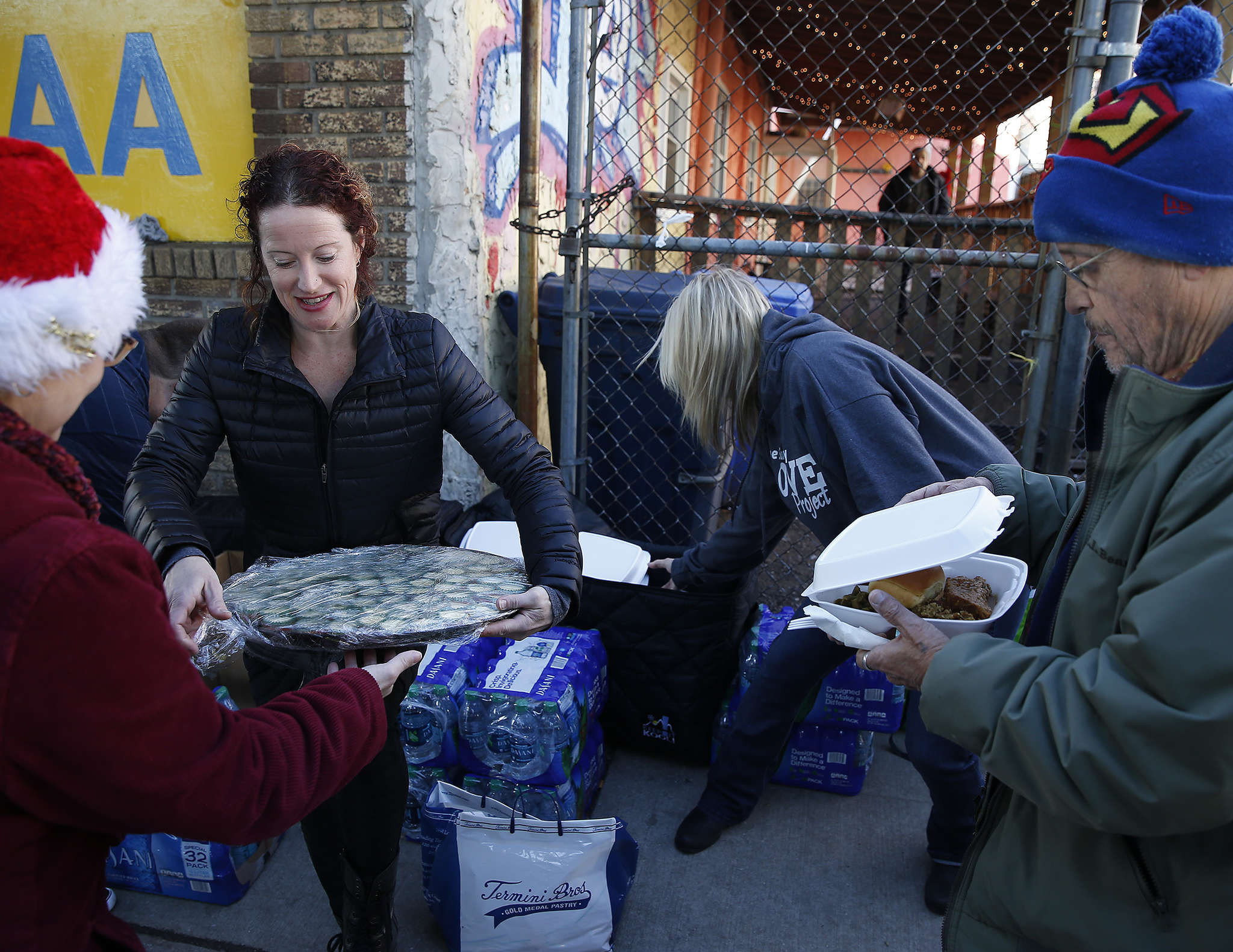
Margaux Murphy, founder of the Sunday Love Project, serves Carlos Gonzalez.
Shulman and Murphy first met in 2021, while Murphy was still running Sunday Love out of the Church of the Holy Trinity at 19th and Walnut, serving 2,000 meals a week to anyone in need. Shulman and the Her Place crew — then in their first year of business — got involved, cooking lunches for kids going to summer camp and dropping off meals to the church.
Her Place was the stage for various pop-up bake sales and charity events in those pandemic-era years. In 2022, the idea came to Shulman for an extra-special one: “Everybody loves a holiday cookie box.” Why not assemble a citywide assortment and donate to Philly charities?
She put out an open call to bakers to pitch in and got tremendous response. She shared an online spreadsheet for the participants to see who planned to bake what, so that there wouldn’t be too many repeats. To add to the box’s value, they included a recipe book so that buyers could recreate their favorites at home.
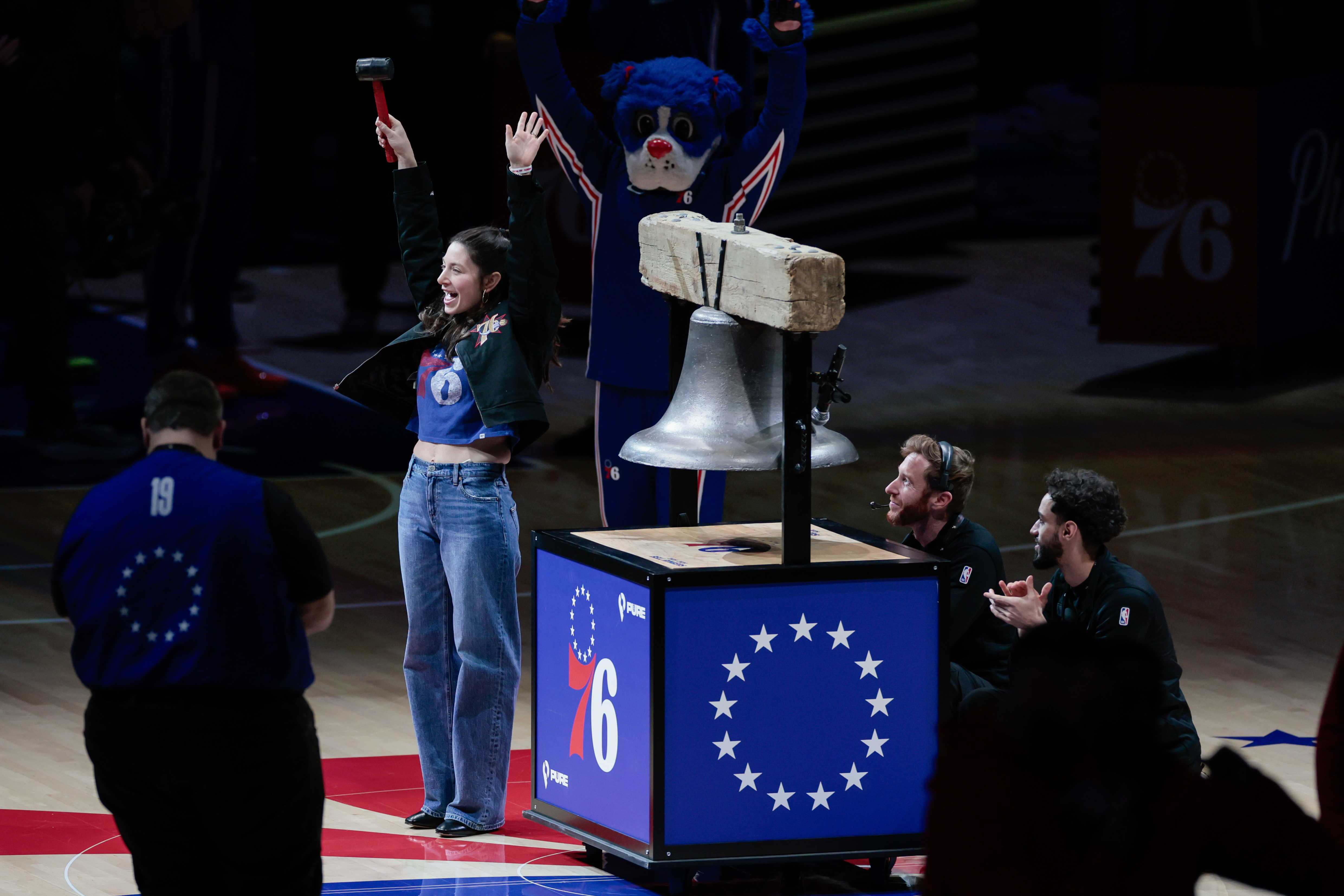
Her Place Supper Club chef Amanda Shulman rings the bell at the Sixers game Wednesday, Nov. 19, 2025, in Philadelphia
Shulman estimates 32 bakers contributed to the first Cookies 4 Coats box, raising thousands of dollars.Ever the one to see things through, Shulman didn’t leave much work for Murphy to do after collecting the cash.
“The first year, I [sold the boxes] a little earlier and I bought [the coats] all myself on Black Friday and had them all shipped to my house, so I had hundreds of coats in my apartment,” Shulman laughs, recalling the charity-induced splurge. “I needed to get different designs. I had to be sure there was something for everybody, so I went a little crazy. I had never racked up a credit card like that, and it was so exhilarating.”
Things are different these days, and Shulman says that’s for the best. “Now we just write checks, because they need other things besides coats — and [Murphy] gets to pick out what she needs as opposed to me just going on a shopping spree.”
One of Cookies 4 Coats’ annual cookie boxes, which assemble treats from well over a dozen bakers and chefs from around Philly.
Reservations for this year’s cookie box went live earlier this month and sold out in a matter of days. Shulman lowered the total number of boxes sold from 120 to 100, but the fundraiser is set to generate even more this year, because the price — $135 per box — increased to cover the cost of improved packaging: Each cookie will be individually wrapped this year, so buyers know which cookie is which rather than guessing based on flavor profiles and recipe cards (a fun game in itself).
Thirty-three bakers and chefs are signed up to contribute thus far, including Scampi’s Liz Grothe (cappuccino Rice Krispies treat), New June’s Blizzard (salted double chocolate chip shortbread), Amy’s Pastelillos’ Amaryllis Rivera-Nassar (besitos de coco), and Lost Bread’s Dallas King (honey butter corn cookies). (For those who don’t have a Cookies 4 Coats reservation, we offer eight of Shulman’s favorite recipes from last year’s box as a consolation.)
Murphy is perpetually floored by the size of the donation, and by Shulman’s seemingly bottomless reservoir of generosity. Murphy’s had strangers give thousands of dollars to Sunday Love, only to discover it was because Shulman recommended the nonprofit to a customer or acquaintance. Shulman recently collaborated with the Philly-area meal-delivery service Home Appetit, sending a portion of the sales to Sunday Love; it resulted in an $8,000 donation.
“I always tell her, she waves a magic wand and she’s just like, ‘Here’s $10,000, feed all the children,’” Murphy said. She remembers a very pregnant Shulman coming to last year’s annual coat giveaway (which will take place this year on Dec. 13 at 3206 Kensington Ave.). “She was in my store because she wanted to see the kids getting coats — I was like, ‘I swear to God, if you have this baby right here on my floor’ — that’s how hard she was working just to make sure that we had everything.”
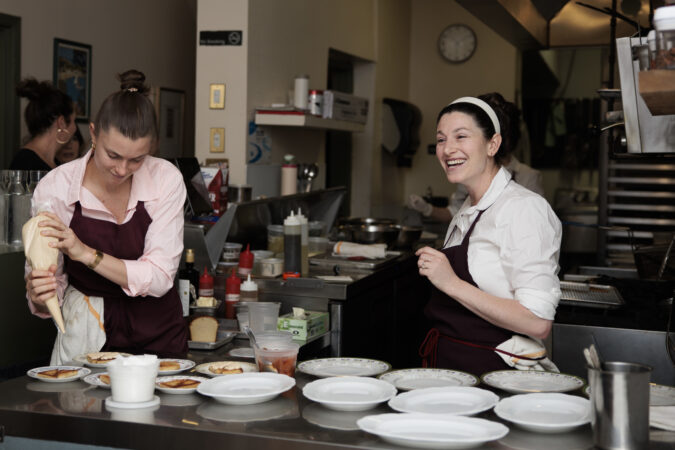
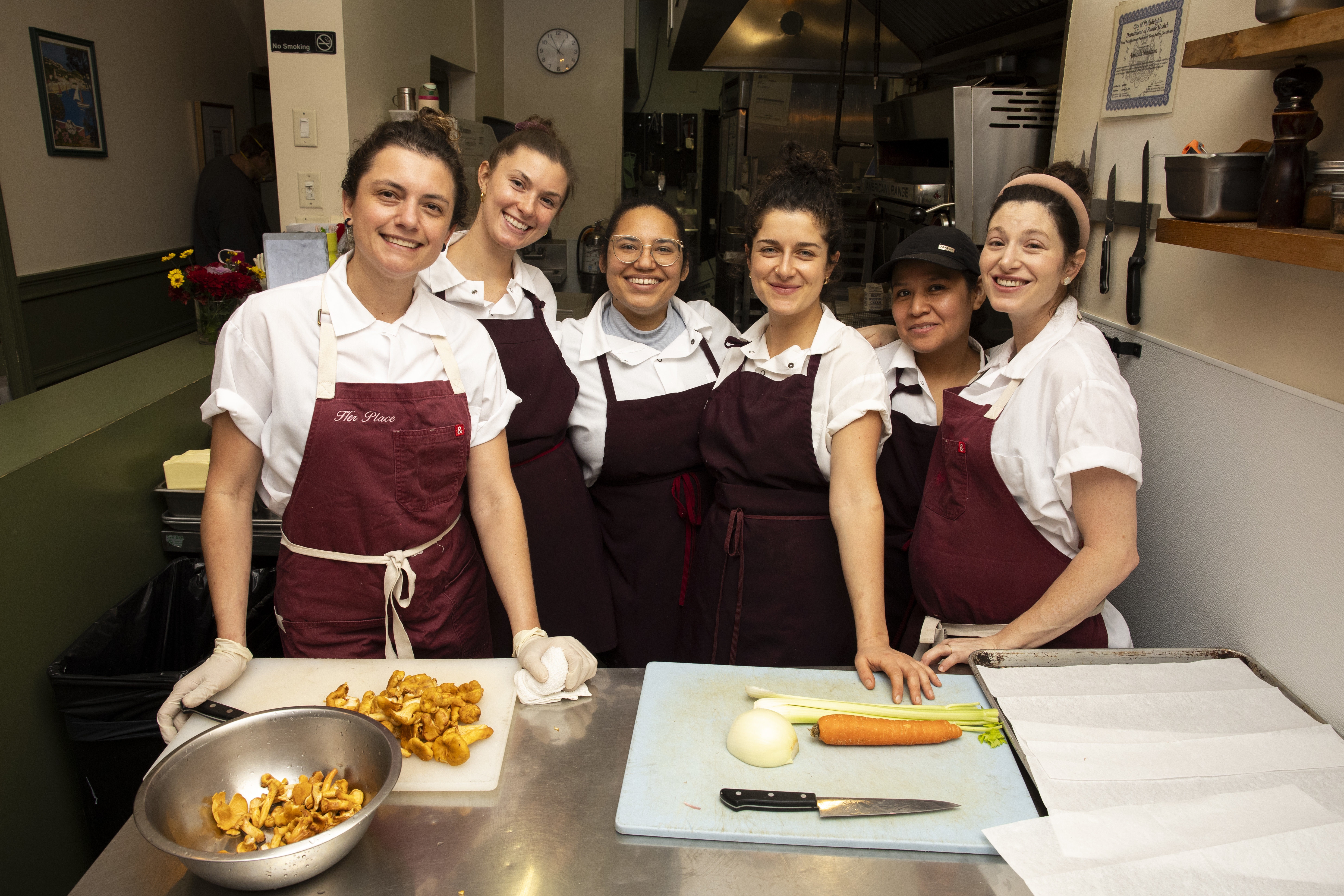
The Her Place team from left to right: Chef de Cuisine Ana Caballero, Line Cook Lauren Fiorini, Pastry Chef Jazzmen Underwood, Sous Chef Santina Renzi, Prep Cook Denia Victoriano, and Chef/Owner Amanda Shulman posed for a group photo at Her Place Supper Club on Tuesday, Nov. 26, 2024 in Philadelphia. Her Place is located at 1740 Sansom Street in Center City.
Shulman remembers that day a little differently, singling out a moment where she watched a little girl pick out a coat — “this brand-new, shiny pink coat that she got to pick out,” she said. “It’s full circle when you get to do every single part of the process, from the physical picking of the cookies to packing them to printing the things. I’m very grateful to everybody who helps out, and especially to my own team, because it’s a lot of work to make it this seamless.”
That’s what Shulman comes away with when reflecting on what goes into this crumb-flecked effort: gratitude.
“If I can say thanks to my team … and to the community, that would be awesome. Thank you to all the bakers and restaurant people who give so much in the busiest time,” she said. “These bakers take time to not only make [the cookies], but then get it to us. It sounds like an easy lift — it’s not, especially if you’re going to work that day. I don’t take it for granted at all.”
Editor’s note: An earlier version of this story stated that 100% of the Cookies 4 Coats proceeds go to Sunday Love Project. It is split 50/50 between Sunday Love and Broad Street Love.
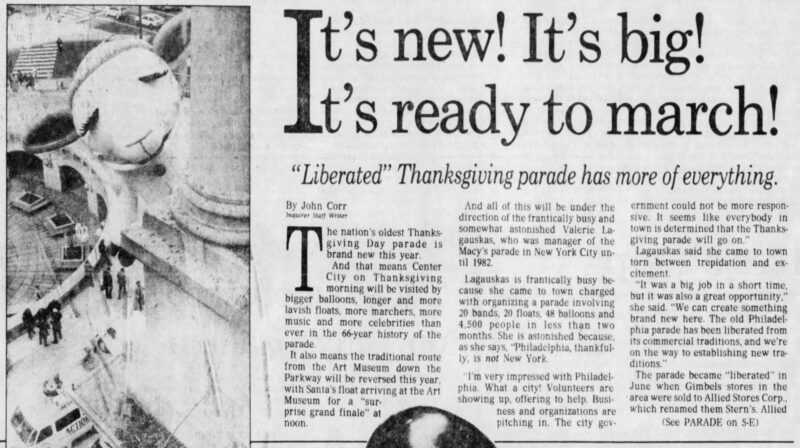
Since 1920, Philadelphia has gone without a Thanksgiving Day parade only twice — once because of poor weather, and once because of a global pandemic. But nearly four decades ago, another formidable foe — corporate sponsorship — threatened the city’s beloved holiday tradition.
That’s not a bad record for the country’s oldest Thanksgiving Day parade, which Gimbel Brothers Department Store launched with a humble procession through Center City. For more than 60 years, the festivities ended with Santa Claus climbing a ladder into the window of the Gimbels store at Ninth and Market Streets, signaling the start of the holiday season.
Until 1986, that is. Gimbels by then had fallen on hard times and, following its sale to the highest bidder, was liquidated. Its Philadelphia-area locations were to be converted into Stern’s department stores, and Gimbels hoped to pass the baton to that chain to keep the Thanksgiving Day tradition alive.
The problem was that Stern’s and its parent company, Allied Stores Corp., were not interested.
“I think the best we could do this fast is to buy the Mummers some T-shirts,” Allied Stores chairman Thomas Macioce told the Daily News in 1986.
The parade that year, however, became bigger and better than it had ever been. Here is how The Inquirer and Daily News covered it:
Article from Jun 18, 1986 Philadelphia Daily News (Philadelphia, Pennsylvania) <!— –>
‘We can’t be ready in time’
A deal in the Gimbels sale emerged in June 1986 and, right away, the Thanksgiving Day parade was on the chopping block, at least for that year. Allied officials claimed no planning had yet been done and there was no way to put it together in time.
That, it turns out, wasn’t true. Ann Stuart, a Gimbels executive, told the Daily News that parade organizers had been proceeding as though the parade would be held as scheduled. And Barbara Fenhagen, the city’s special events coordinator, said planning was going ahead as usual.
Either way, Stern’s and Allied’s lack of interest left the city in a tight spot. Aug. 15 was the last day orders could go in for the floats to be ready on time, marking a hard deadline to find a sponsor. Whoever took up the role would be expected to spend hundreds of thousands of dollars.
“We will do everything we can to make sure that [the parade’s] appearance is not interrupted, even for one year,” Fenhagen said at the time.
Article from Jul 16, 1986 Philadelphia Daily News (Philadelphia, Pennsylvania) <!— –>
‘Don’t rain on our parade’
As the controversy wore on, Philadelphians and the local press grieved and snarled at the potential loss of a holiday tradition. The Daily News seemed to plead for Stern’s to reconsider.
“Please don’t rain on our parade,” the People Paper wrote in an editorial. “To Philadelphians of all ages, it launches the holiday season in a special and heartwarming way.”
Business columnist Jack Roberts struck a more combative tone, likening Stern’s to a houseguest who begins a conversation “by spitting in your face.” He later suggested that readers send back Stern’s junk mail to the company’s “Scrooge” executives with the phrase “I want the parade” scrawled across it.
Special events professionals, meanwhile, warned that forgoing the sponsorship might create a bad name for Stern’s that would be difficult to overcome.
“Philadelphians have a way of remembering,” special events consultant Shelly Picker said.
Article from Nov 21, 1986 Philadelphia Daily News (Philadelphia, Pennsylvania) <!— –>
‘We’re delighted’
The search for a new lead sponsor was arduous, with city officials approaching “most every local company that breathes,” according to a Daily News report. A number of bigger local outfits — ranging from Meridian Bancorp to Kiddie City — bowed out over cost and branding concerns.
Then, after 56 days of limbo, the Thanksgiving Day parade was back on. And it was thanks to WPVI (Channel 6), better known today as 6abc.
“When it became clear that because of the time frame and other commitments most were unable to assume that mantle, we decided to do it — and we’re delighted,” said the station’s general manager, Rick Spinner.
The station had been airing the parade locally for 19 years and seemed to be a natural fit to take over. And, as the Daily News reported, the city had been pressuring Channel 6 to come up with a plan, seeing as the station benefited significantly from broadcasting the day’s festivities.
The parade would go on to be known as the “Channel 6 Thanksgiving Day Parade.” But that was not the only — or even the biggest — change afoot.
Article from Sep 24, 1986 Philadelphia Daily News (Philadelphia, Pennsylvania) <!— –>
‘Establishing new traditions’
Channel 6 brought in the big guns straight away. Namely, by hiring a parade coordinator named Valerie Lagauskas, who previously managed the Macy’s parade in New York and wrote a book on parade planning.
A number of changes came under Lagauskas’ leadership, including a new route. Instead of starting at the Philadelphia Art Museum and marching toward City Hall, as had been tradition, the parade would reverse direction and end at the Art Museum. The route would allow for the use of larger balloons, bigger floats, and better camera angles for the parade’s telecast.
The full parade that year would also be broadcast nationally for the first time, appearing on the Lifetime network, in which ABC was part owner.
In total, there would be 20 bands, 20 floats, 8 gigantic balloons, and 40 other balloons that were merely very large, The Inquirer reported. A massive balloon of the cartoon cat Heathcliff would make its debut. The theme, fittingly, would be “We Love a Parade.” And leading it all as parade marshal would be Sixers legend Julius “Dr. J” Erving,
“The old Philadelphia parade has been liberated from its commercial traditions and we’re on the way to establishing new traditions,” Lagauskas said.
Article from Nov 28, 1986 The Philadelphia Inquirer (Philadelphia, Pennsylvania) <!— –>
‘The best ever’
On parade day, more than 500,000 spectators were expected to attend. And, according to reports from the time, they were not disappointed.
Not only were there better floats and a more picturesque route, but paradegoers also were met with unseasonably warm temperatures.
“It’s the first time we’ve been to a Thanksgiving Day parade where you could get a sunburn,” one attendee joked.
The parade itself seemingly went off without a hitch, concluding on the steps of the Art Museum as Santa Claus pulled up to a rendition of “Happy Holidays.” Musicians and dancers let go of green and white balloons that drifted out over the Benjamin Franklin Parkway to cheers.
And at least one Philadelphian didn’t forget who saved the day. Donna Harris, 30, of Audubon, who had attended the parade yearly since she was 5, was spotted holding a sign that read “Thank You WPVI.”
Center City was resilient this year, reporting slight increases in foot traffic and overall retail occupancy despite high-profile closures along Market Street.
About 84% of Center City storefronts were occupied as of October, up one percentage point from the same time last year, according to the Center City District’s annual survey of business owners. Occupancy has hovered around that point since at least 2023 and has yet to recover to its pre-pandemic level of 89% in 2019.
So far in 2025, an average of 343,540 people walked through Center City each day, an increase of more than 3% from last year, the survey found. Each section of Center City, from the beleaguered Market East to the thriving Rittenhouse Square area, saw at least a 1% bump in average daily foot traffic, according to the survey.
Some retail corridors, however, are looking more vibrant than others.
window.addEventListener(“message”,function(a){if(void 0!==a.data[“datawrapper-height”]){var e=document.querySelectorAll(“iframe”);for(var t in a.data[“datawrapper-height”])for(var r,i=0;r=e[i];i++)if(r.contentWindow===a.source){var d=a.data[“datawrapper-height”][t]+”px”;r.style.height=d}}});
Market Street continues to struggle on both sides of Broad Street.
As of October, the office-centric western side of Market had the lowest occupancy in Center City at 62%.
Market East, the future of which continues to be debated by city stakeholders, had a 72% occupancy rate. It has been impacted by a slew of recent closures, including Macy’s, Rite Aid, Iron Hill Brewery, and Giant Heirloom supermarket. The Center City District calculates occupancy rates by number of storefronts, not total square footage.
On Chestnut Street, the eastern and western sections have vastly different occupancies. The eastern side recorded a 71% occupancy rate in October, according to the survey, while 81% of stores on the western side were occupied.
Walnut Street continues to be the district’s shining star, with 86% occupancy in both the eastern and western sections, according to the survey. In the report, the Center City District highlighted several new additions, including the luxury women’s fashion company Aritzia and North America’s first Nike Jordan World of Flight store.
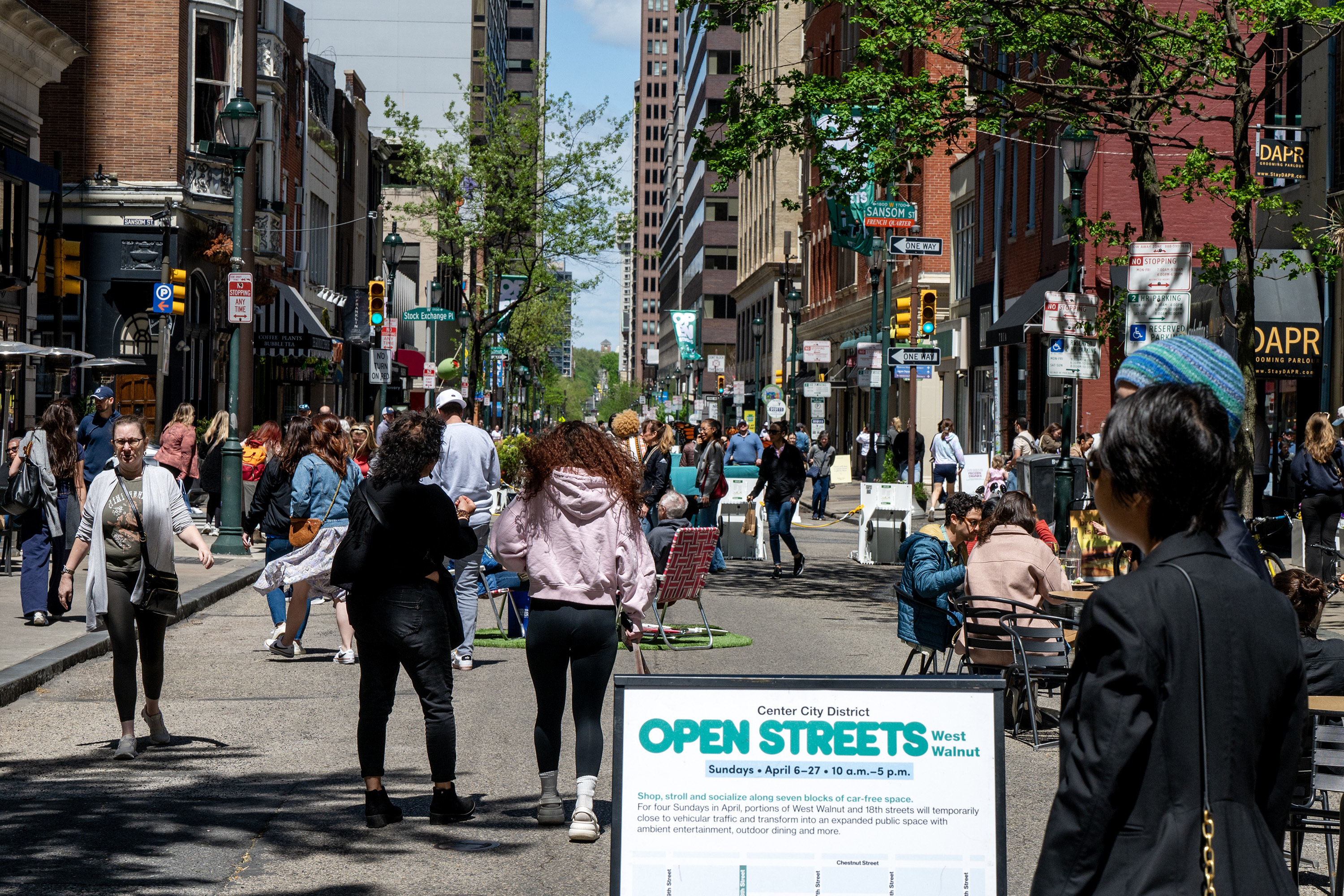
The report once again highlighted the success of the Open Streets program, during which roads are closed to car traffic and become pedestrian walkways for shopping and dining. There have been 21 Open Streets events since its inception in September 2024, with more planned for December and next year.
The events bring out more than 10,000 people on average, according to the report, and typically result in a 65% boost in businesses’ foot traffic and a 39% bump in sales volume.
An Open Streets in April. There have been 21 Open Streets events since its inception in September 2024, with more planned for December and next year.
Looking to the future, the district surveyed 700 Philadelphia renters to ask what types of retailers they’d like to see more of in Center City.
“Downtown residents seek convenient access to everyday goods, full-service grocery stores and home furnishing options — all within walking distance,” district executives wrote in the report, noting that these types of businesses could fill vacancies in office buildings or in the concourse around Suburban Station.
“CCD looks forward to convening office district stakeholders in 2026 to discuss a coordinated retail attraction strategy that could reposition the office district as a place to accommodate many of the retailers Center City is currently missing.”
Editor’s note: A previous version of this story included an incorrect comparison between 2025 and 2024 for occupancy on Market Street.
Earlier this month, the Federal Transit Administration ordered SEPTA to inspect its trolley power system after four incidents, including two times trolleys stalled in the Center City tunnel, requiring 415 passengers to be evacuated.
The budget impasse
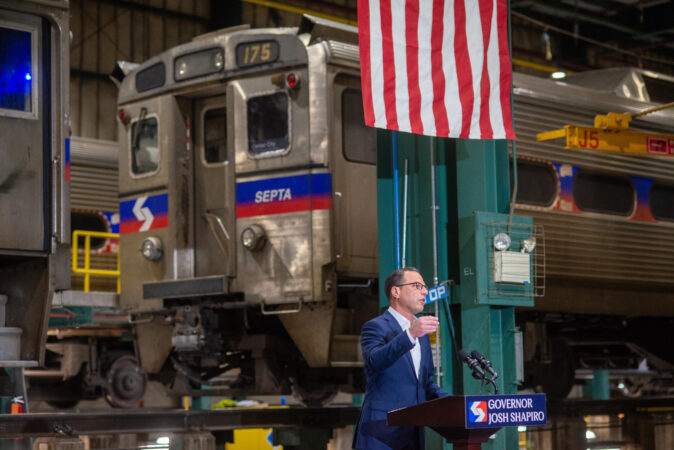
Shapiro said he was forced to act for the second straight year because Senate Republicans wouldn’t support additional recurring funding for mass transit operations in the state budget.
“They’ve come up with a ton of excuses, but they haven’t come up with the funding,” Shapiro said.
After the governor decided in September that no budget agreement on transit funding was possible, PennDotallowed SEPTA to tap $394 million in state money allocated for future capital projects to pay for two yearsof operating expenses.
The transit agency was facing a $213 million recurring deficit in its operating budget.
Yet the problems with the rail cars and trolleys served to underscore the risks of using capital funds for day-to-day operations.
“A history of chronic underinvestment has led us to this point,” said Chester County Commissioner Marian D. Moskowitz, who is vice chair of SEPTA’s board.
She noted that SEPTA has a much smaller capital budget than other large transit agencies.
$95 million for electrical system upgrades, overhauled propulsion motors and more on the Silverliner IV train cars and the newer Silverliner V models.
$48.4 million to update the overhead catenary wires in the trolley tunnel, along with three new catenary-maintenance cars for the tunnel and along trolley lines, and on long Regional Rail lines.
$51.5 million to upgrade 13 escalators at SEPTA stations, install AI-powered inspection cameras to catch potential problems earlier, and technology improvements at SEPTA’s Control Center
$8 million to install replacement parts for Broad Street Line and Norristown High Speed Line cars.
“These funds are going to make a significant difference in our efforts to overcome the current crises,” SEPTA general manager Scott Sauer said, and to help avoid future ones.
He thanked the governor and pledged “a comprehensive effort to identify potential problems sooner before they grow and lead to delays, cancellations, or shutdowns.”
Shapiro had proposed an increase in the share of general sales-tax revenue devoted to transit subsidies over five years.
Leaders of the GOP-controlled Senate said the $1.5 billion price tag was too high and proposed shifting capital money to operating subsidies for the state’s transit systems and roads — an idea partially reflected in the Shapiro administration’s temporary solution.
“I am glad the Governor continues to take our advice and use existing resources to support public transit,” Senate Majority Leader Joe Pittman (R., Indiana) said in a statement.
“It’s unfortunate that just one year ago, he took $153 million of funding from critical [road] infrastructure projects to fund transit, neglecting the needs of those who use our roadways every single day,” Pittman said.
Republicans also argued that SEPTA had been mismanaged and needs change.
As the next state budget cycle nears, the debate is likely to continue.
“I want you to know I’m going to be a continue to be a governor who supports mass transit, who gives a damn about SEPTA, who cares about those 800,000 people that rely on SEPTA every single day,” Shapiro said.
John Borodiak, 89, of Philadelphia, Hall of Fame Argentine American professional soccer player, popular coach and sports center volunteer, and longtime Center City dental lab owner, died Saturday, Sept. 13, of complications from Alzheimer’s and Parkinson’s diseases at Graduate Post Acute nursing facility.
Born and reared in Buenos Aires, Argentina, of Ukrainian descent, a young Mr. Borodiak was such a star that, in 1960, at 24, he was invited to leave South America and play soccer in the United States for the Ukrainian Nationals in Philadelphia. So, for seven seasons, through 1966, he played fullback for the Ukrainian Nationals and won four American Soccer League championships and four U.S. Open Cup titles.
As a 5-foot-8, 160-pound defensive whiz, Mr. Borodiak didn’t score many goals or race down the field on breakaways. But, said his son, Ivan, also a former pro soccer player: “He was smooth, quick, and good up in the air.”
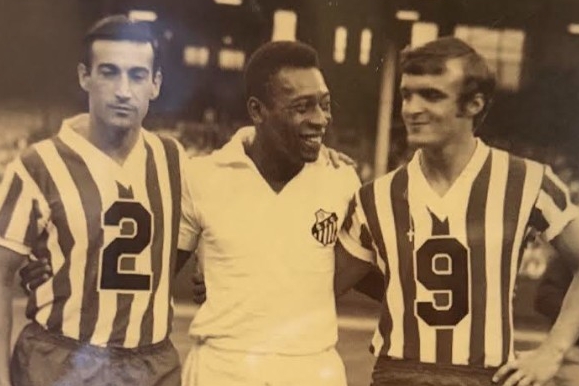
He played on the 1964 U.S. national team and was inducted into the Horsham-based Ukrainian Sports Museum and Hall of Fame in 2017. Over the years, he played against Brazilian superstar Pele and other international stars, and former colleagues called him “a living legend.”
Mr. Borodiak (left) played against Pele (center) and other international stars.
He also played with the Philadelphia Spartans in the National Professional Soccer League and the ASL’s Newark Ukrainian Sitch in 1966 and ’67. He spent the 1968 season with the Cleveland Stokers and 1969 with the Baltimore Bays in the North American Soccer League. He retired after playing a final season with the Spartans in 1970.
He made headlines after a game in 1967 when he blocked the game-tying goal after his goalie was caught out of position. “After I saw [the goaltender) go out, I expected something to happen in that corner,” he told the Daily News. “I moved up there, and the shot bounced off my chest.”
Affable and engaging off the field, Mr Borodiak became a favorite of teammates, fans, and sportswriters. He hosted instructional clinics for young players and, after learning English himself, served as a translator for other players and the media. He spoke Ukrainian, English, Spanish, and Italian.
In 1967, Daily News sports writer Dick Metzgar published his Christmas wish list and asked for “more hustling performers like little fullback John Borodiak.”
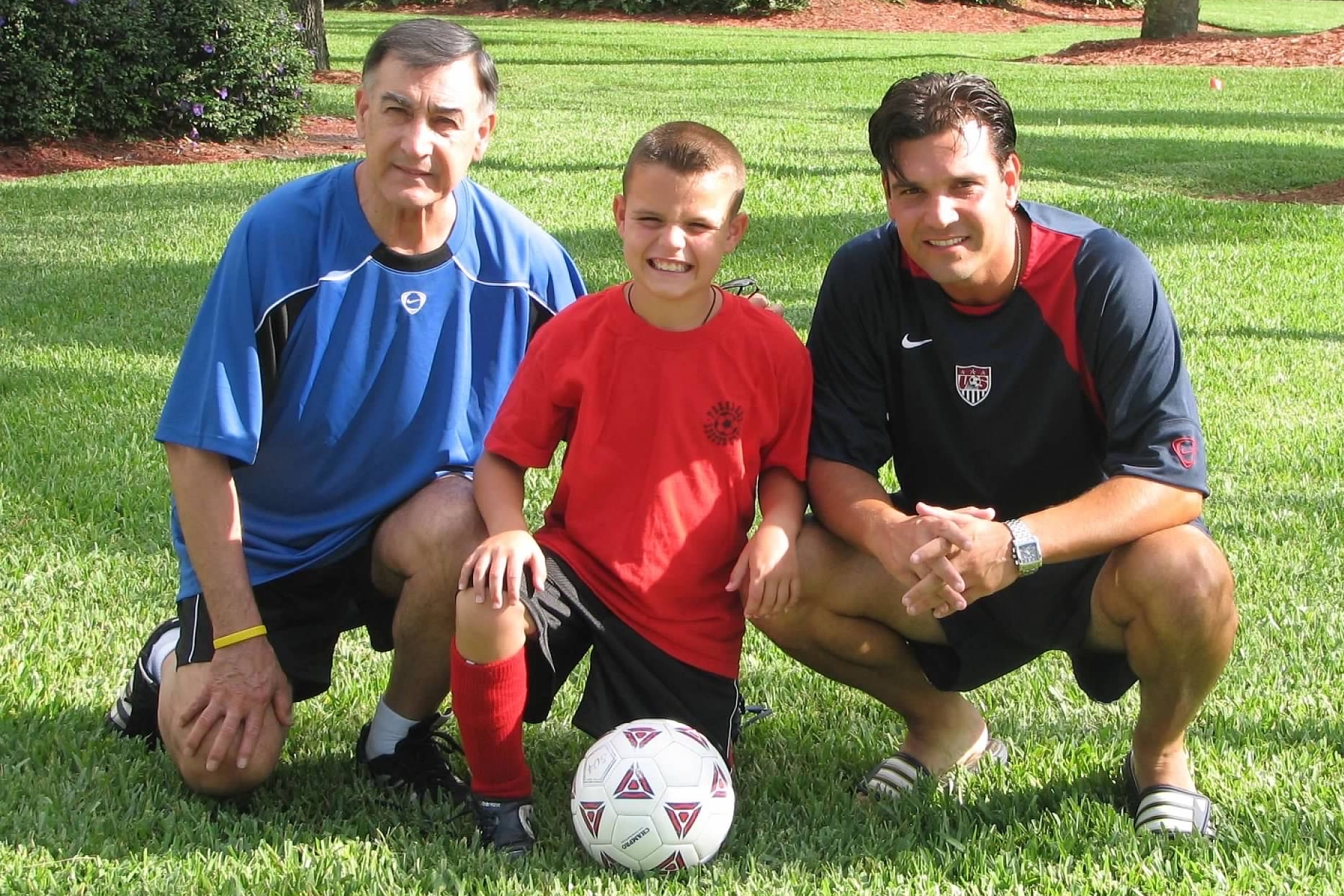
Mr. Borodiak (left) passed his athleticism on to his son and grandson.
He helped anchor a Spartans defense in 1967 that Metzgar called “impenetrable” and was known for his aggressiveness. He was ejected for fighting in a game against Baltimore that season, and he told the Delaware County Daily Times that his opponent hit him in the back. “Naturally,” he said, “I hit back.”
He was a team cocaptain in Cleveland and named a NASL all-star in 1968, and his Stokers lost a heartbreaking playoff game to Atlanta in overtime that season. After the game, a disappointed Mr. Borodiak told the Cleveland Plain Dealer: “I’m sorry.”
He rejoined the Spartans in 1970 when they entered the American Soccer League, and The Inquirer covered their big win over the Syracuse Scorpions. “A strong defensive cog, John Borodiak, was added to the Spartans lineup,” The Inquirer said, “and he played fullback in impressive style.”
In a 1969 story after the Bays tied the Dallas Tornado, the Baltimore Sun said: “Borodiak made one of the best saves of the day when he blocked a shot after [the goalie] had been pulled out of the net.” In 1966, he played briefly for Roma in the Eastern Canada Pro Soccer League, and a teammate told the Toronto Star: “Borodiak is a fine fullback and fits in well with our style of play.”
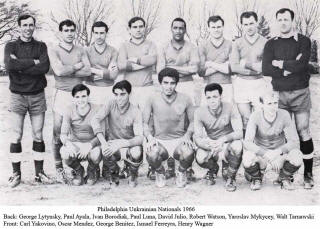
Mr. Borodiak (rear, third from left) and teammates on the Philadelphia Ukrainian Nationals pose during the 1966 season.
He coached soccer teams after he retired, played with amateur teams into his 40s, and was active for years at the Ukrainian American Sports Center in North Wales.
He earned certification at Temple University in dental cosmetics in the 1960s and owned a lab in the Medical Arts Building in Center City until he retired in 2018. At 50 years, Mr. Borodiak was the longest-tenured tenant ever in that building, his son, Ivan, said.
“He was a wonderful person,” his family said in a tribute, “He was a best friend, a champion, and a legend of his sport and in life.”
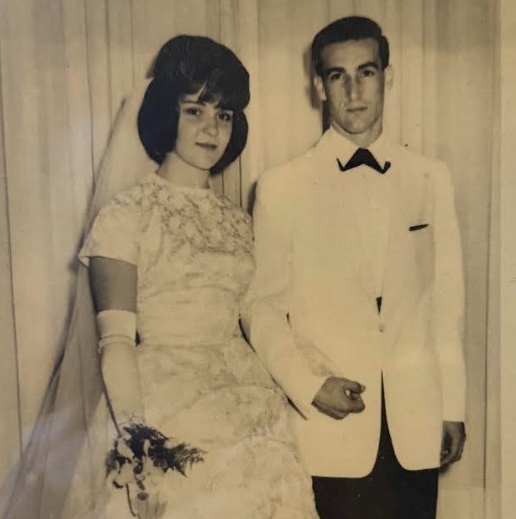
Born July, 13, 1936, Ivan Gregorio Borodiak changed his name to John when he came to the United States. He met Betty Pilari in Argentina, and they married in 1962, and lived in Bensalem and Queen Village.
Mr. Borodiak and his wife, Betty, married in 1962.
Mr. Borodiak was generous and gentle, his son said. He enjoyed fishing and car shows, and he built his own Mercedes-Benz from the tires up.
Friends noted his “kindness, gratitude, and warmth” in online tributes. One said: ”He was always a people person, and his smile could light up the darkest room.”
His son said: “He was a great man. He never had an enemy, and he overcame every adversity.”
In addition to his wife and son, Mr. Borodiak is survived by four grandchildren, a great-granddaughter, and other relatives. A sister died earlier.
Mr. Borodiak (left) doted on his grandchildren.
Private services were held earlier.
Donations in his name may be made to the Alzheimer’s Association, 225 N. Michigan Ave. Floor 17, Chicago, Ill. 60601.
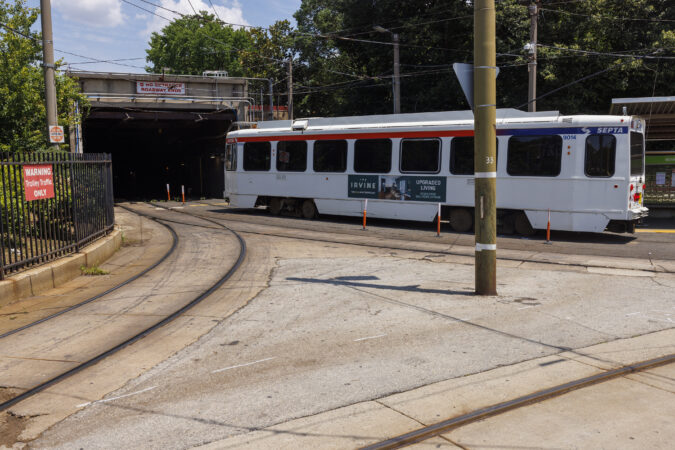
SEPTA is extending its trolley tunnel closure through at least Nov. 30, hoping to use the extra time over the Thanksgiving holiday to complete repairs to the overhead catenary power system.
The tunnel has been shut down for most of the last two weeks as crews work on the problem.
Riders should use the Market-Frankford El to travel through Center City, catching the trolleys at 40th and Market Streets.
“My wife, daughter and I are totally dependent on the trolley to get us to work and school, and with a prolonged trolley-tunnel diversion, the system has become unreliable and, frankly, unusable,” Will Tung, a Southwest Philly resident, told the SEPTA board during public comments at its Thursday meeting.
Trolley ridership is typically lower during the week of the Thanksgiving holiday so the closure should be less of a disruption, spokesperson Andrew Busch said.
SEPTA is contending with glitches in the connection between the overhead catenary wires in the tunnel and the pole that conducts electricity to the vehicle.
The issue led to two trolleys becoming stranded in October, with a total of 415 passengers needing to be evacuated.



 –>
–>  –>
–>  –>
–>  –>
–>  –>
–>