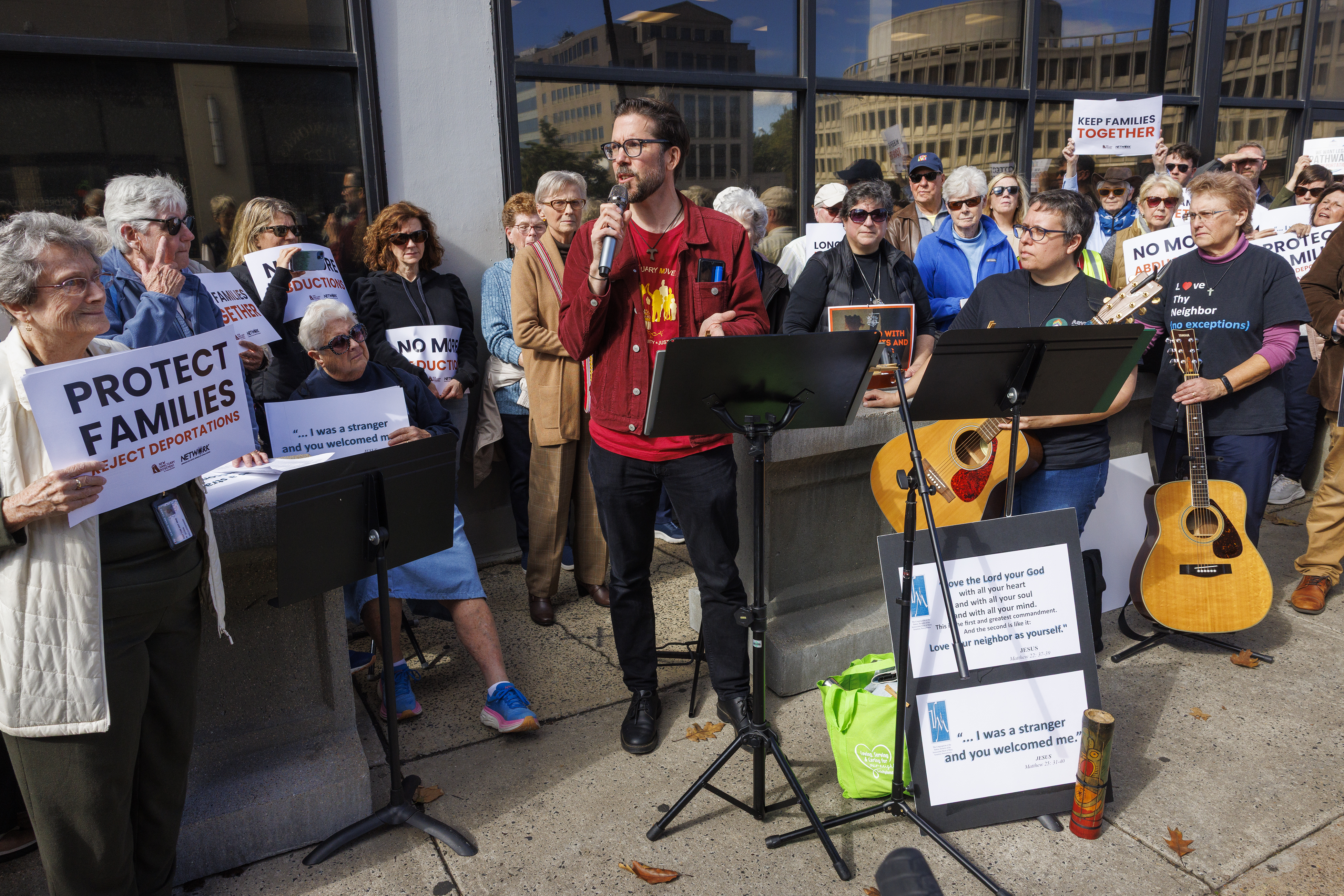
Lifted by song, prayer, and Scripture, dozens of Philadelphia-area Catholics rallied outside the Center City ICE office on Wednesday, joining a pro-immigrant push undertaken by fellow church groups around the country.
Catholic priests, nuns, and other supporters prayed and sang outside the field office near Eighth and Cherry Streets, joining a nationwide show of solidarity with migrant families, refugees, and asylum-seekers.
“We reject the culture of fear that dehumanizes,” Michelle Cimaroli of Handmaids of the Sacred Heart of Jesus, an international community of Catholic women, told the crowd of about 50 people. “As Catholics, we stand with immigrants.”
Speakers called on people to see the face of God in every human face. And to be as confident as Jesus in sharing the truth.
Catholic organizations across the country are taking part in a campaign called One Church, One Family: Catholic Public Witness for Immigrants.The movement invites parishes, schools, and faith-based groups to host prayerful public events that proclaim the dignity of every person.
U.S. Immigration and Customs Enforcement officials said in a statement: “ICE respects the rights of individuals to peacefully protest.”
Peter Pedemonti of the New Sanctuary Movement addressing Catholics gathered outside ICE office at Eighth and Cherry Streets on Wednesday. They are protesting against the detaining and incarceration of immigrants.
“I want us to take a moment to just let our hearts break,” Peter Pedemonti, codirector of New Sanctuary Movement of Philadelphia, told the crowd in Center City. “That we don’t let the daily barrage of bad news harden us.”
He and other advocates said they believed ICE arrested four people in Philadelphia on Wednesday, including a man at the Italian Market.
“We’re trying to get Catholics across the country to listen to Pope Leo’s message: Migrants lead us, they lead us to a true set of values,” said Jerry Zurek, who serves as local co-organizer of NETWORK, the Catholic social-justice group, and who took part in the Philadelphia rally.
This month the pope described migrants and refugees as “privileged witnesses of hope through their resilience and trust in God,” maintaining their strength while seeking a better future “in spite of the obstacles that they encounter,” Catholic News Service reported.
Big and small protests continue to take place in the Philadelphia area and around the county in opposition to President Donald Trump’s effort to deport millions of people. The number of people arrested by ICE in Delaware, New Jersey, and Pennsylvania has surged since the agency reportedly implemented a 3,000-arrests-a-day quota in late May.
Arrests doubled from an average of 26 a day since Trump took office through May 21, to an average of 51 a day between May 22 and June 26 for the three states. At the same time, the proportion of people arrested without a criminal record or pending criminal charges soared, up two-thirds since the directive to ICE was issued.
“As Catholics and people of deep faith, we reject the culture of fear and silence that dehumanizes, and we choose instead to stand with migrants,” local organizers said in a statement, pledging “to defend the dignity of our neighbors, family members, fellow parishioners, classmates, coworkers, and friends.”
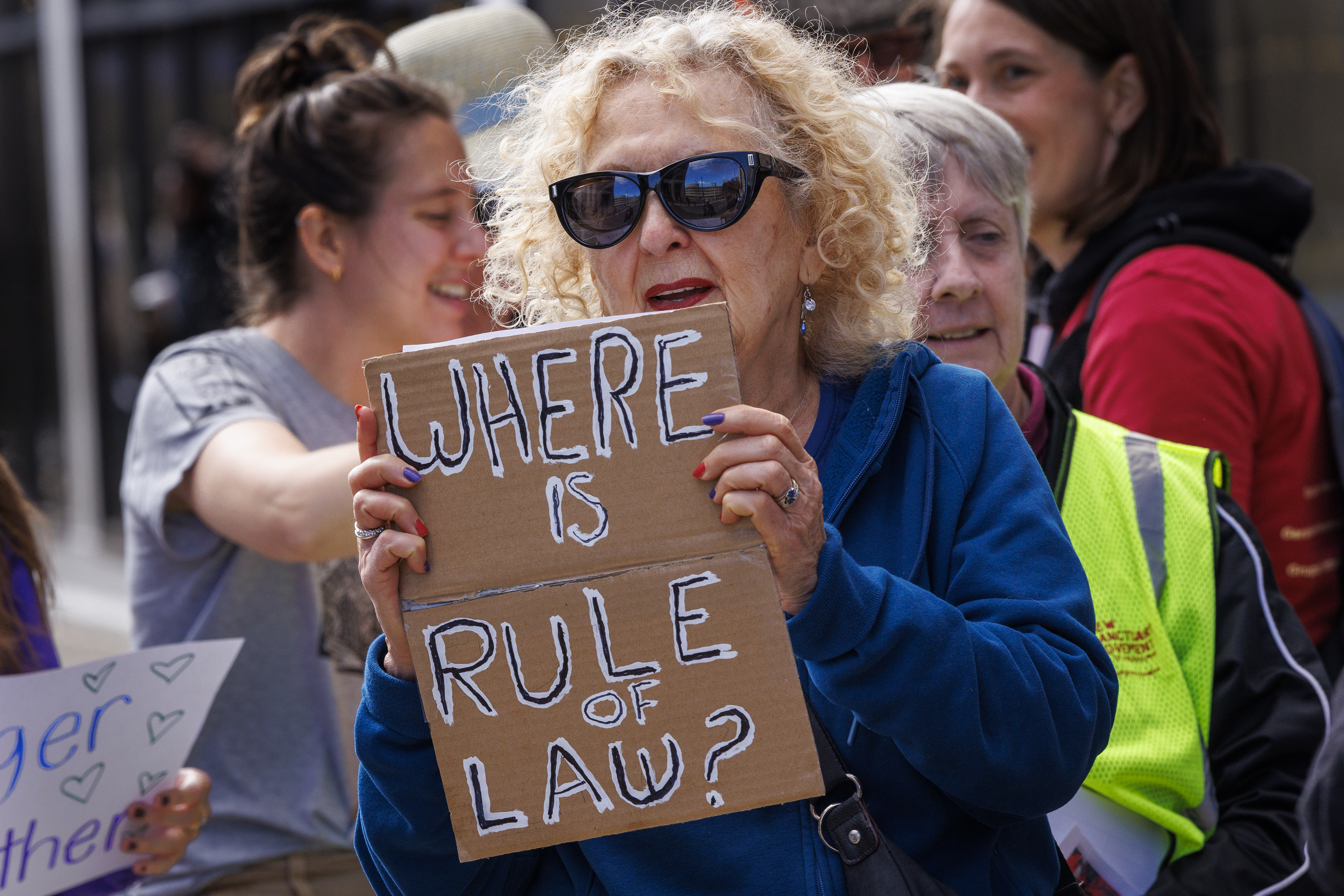
Vicki Guinta-Abbott, a concerned citizen and a Catholic, gathers with others outside the ICE office at Eighth and Cherry Streets on Wednesday.
The body of U.S. bishops, individual bishops, and Catholic organizations have been speaking out against what they call inhumane policies that go against church teachings on immigration.
Local leaders said the campaign is sponsored by the United States Conference of Catholic Bishops Migration and Refugee Services, the Leadership Conference of Women Religious, Jesuit Refugee Service/USA, and many others.
Barry Leonard, 87, formerly of Philadelphia, celebrated crimper, longtime innovative owner of the Barry Leonard Crimper & Spa in Center City, unisex beauty salon groundbreaker, fashion and marketing trendsetter, haircutting mentor, and Army veteran, died Sunday, Oct. 12, at his home in Hallandale Beach, Fla. The cause of his death has not been disclosed.
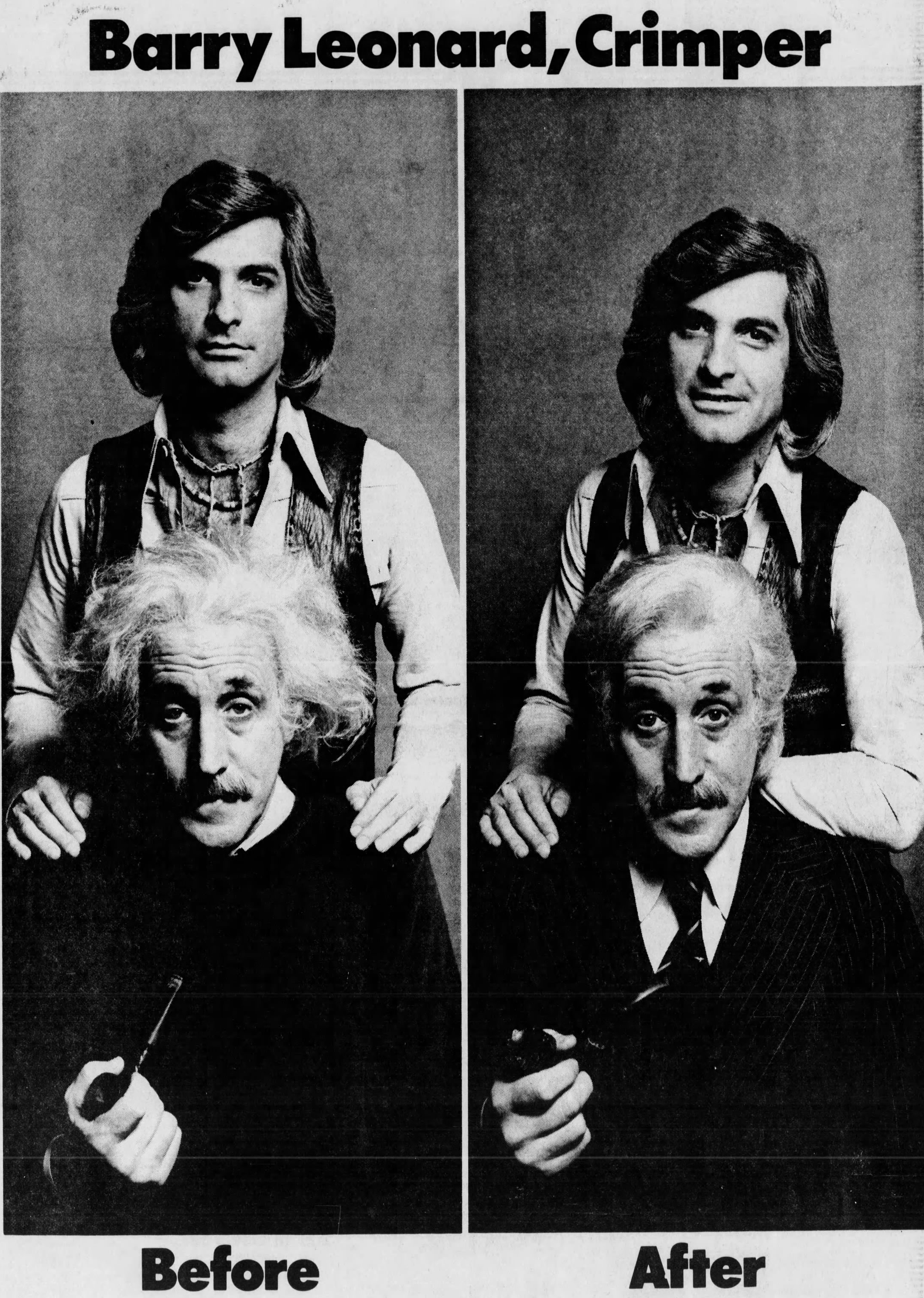
Born in Philadelphia to a family of hairstylists, Mr. Leonard swept the floor at his father’s beauty salon in West Philadelphia as a boy and, in 1955, became the first male to graduate from the beauty culture curriculum at Murrell Dobbins Career and Technical Education High School. He went on to help rewrite state statutes to allow unisex beauty salons in the 1970s, wow the marketing world with innovative ads that featured Fidel Castro, Albert Einstein, Santa Claus, and the Wolfman, and own high-end shops in the old Marriott Hotel on City Avenue and then on Chestnut Street for 43 years.
A proponent of what he called “natural haircutting,” Barry Leonard, Crimper, counted politicians, musicians, actors, and other celebrities as well as local residents as his regulars, and most of them were fine with waiting months for an appointment. He moved his bustling salon from the Marriott to 1527 Chestnut St. in 1972, relocated to 1822 Chestnut in 1995, and retired to Florida in 2005.
In the early 1970s, he saw that men appreciated hair care, too, and he successfully challenged an old state law that required separate locations for male and female haircuts. So unisex salons became common in the 1980s and ’90s.
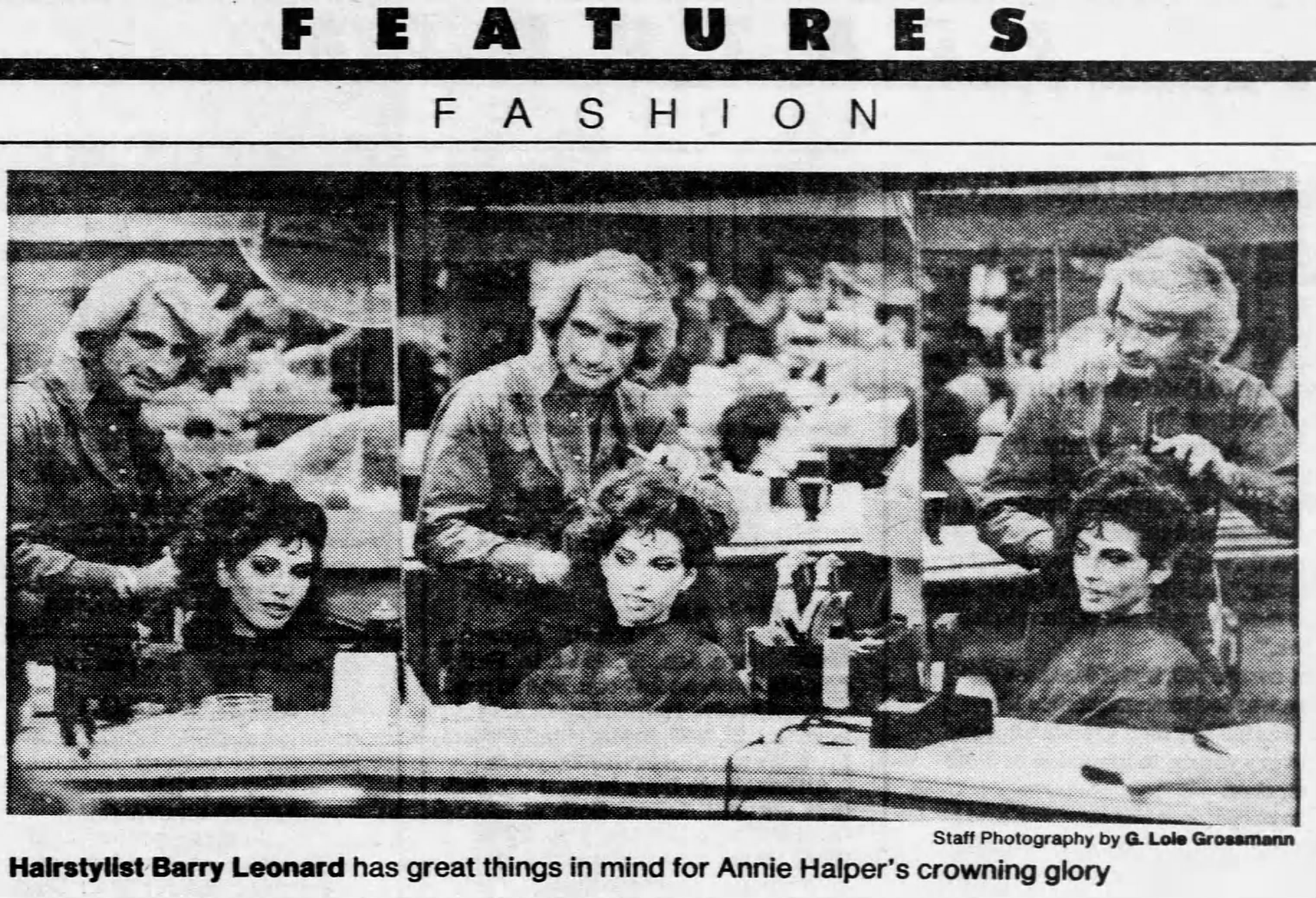
Mr. Leonard is shown styling the hair of Annie Halpern, his future wife, in this 1985 photo in the Daily News.
“Hair,” he told The Inquirer in 1973, “is the only part of the body that can be changed readily and allows the individual to play his role as he feels it at that particular moment — protest, freakiness, sensuality, anything.”
His New Age salon featured wicker furniture, hanging plants, big pillows, Japanese koi, and free coffee, fruit, and wine. He charged $12.50 per cut in 1973 and $25 in 1991. Sometimes, he booked 75 heads a day, his wife, Annie, said.
Most often, he consulted with customers before the cut, assigned the job to an assistant stylist, and checked back when the work was done. Over his career, he told his wife, he likely attended to more than 1 million customers. In 1991, he told The Inquirer: “My general philosophy is to make people happy.”
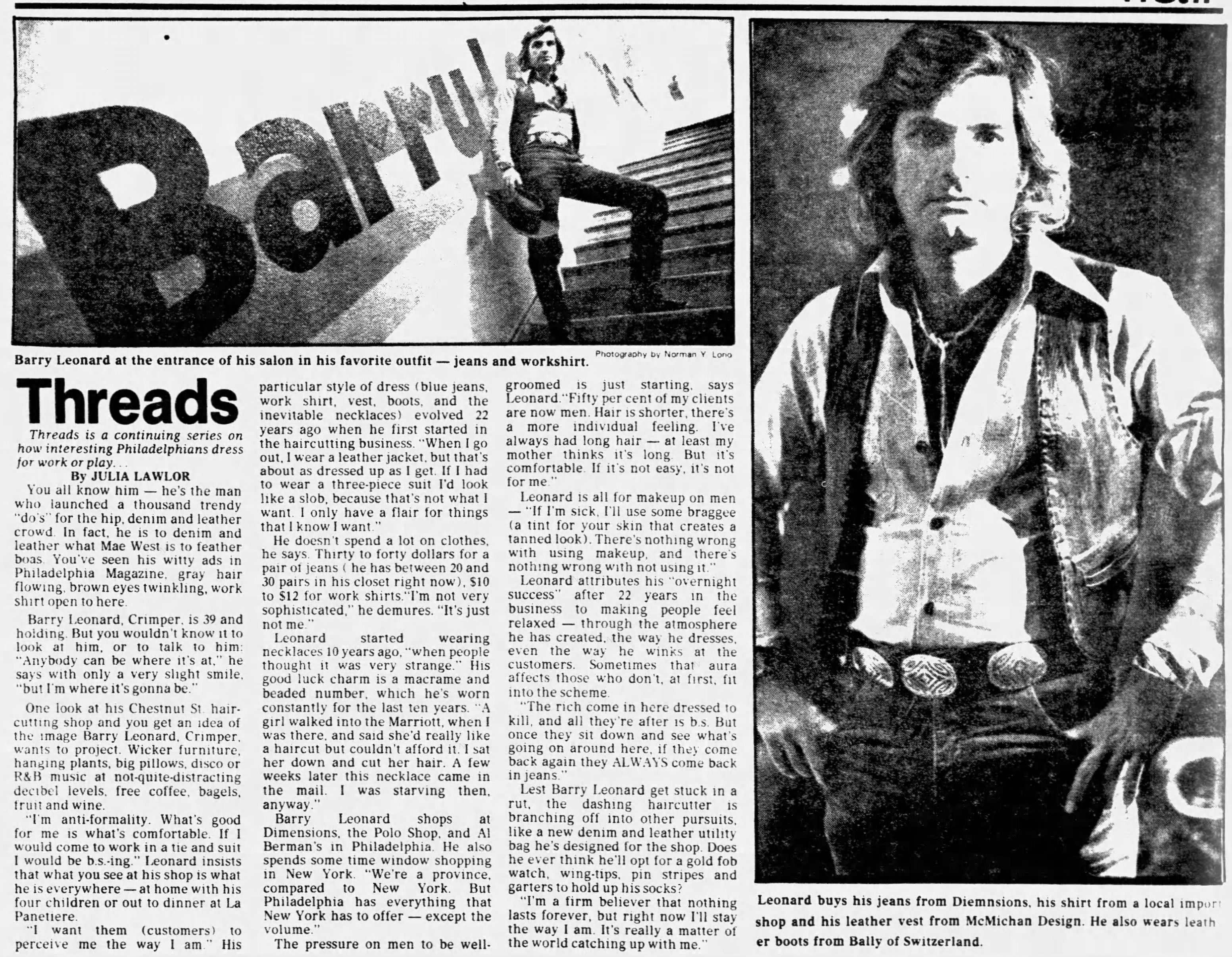
He also created and distributed do-it-yourself manuals for those who couldn’t get appointments and introduced computerized styling technology in the 1980s so clients could design their own cuts on video screens. “I’m a firm believer that nothing lasts forever,” he told the Daily News in 1977. “But right now, I’ll stay the way I am. It’s really a matter of the world catching up with me.”
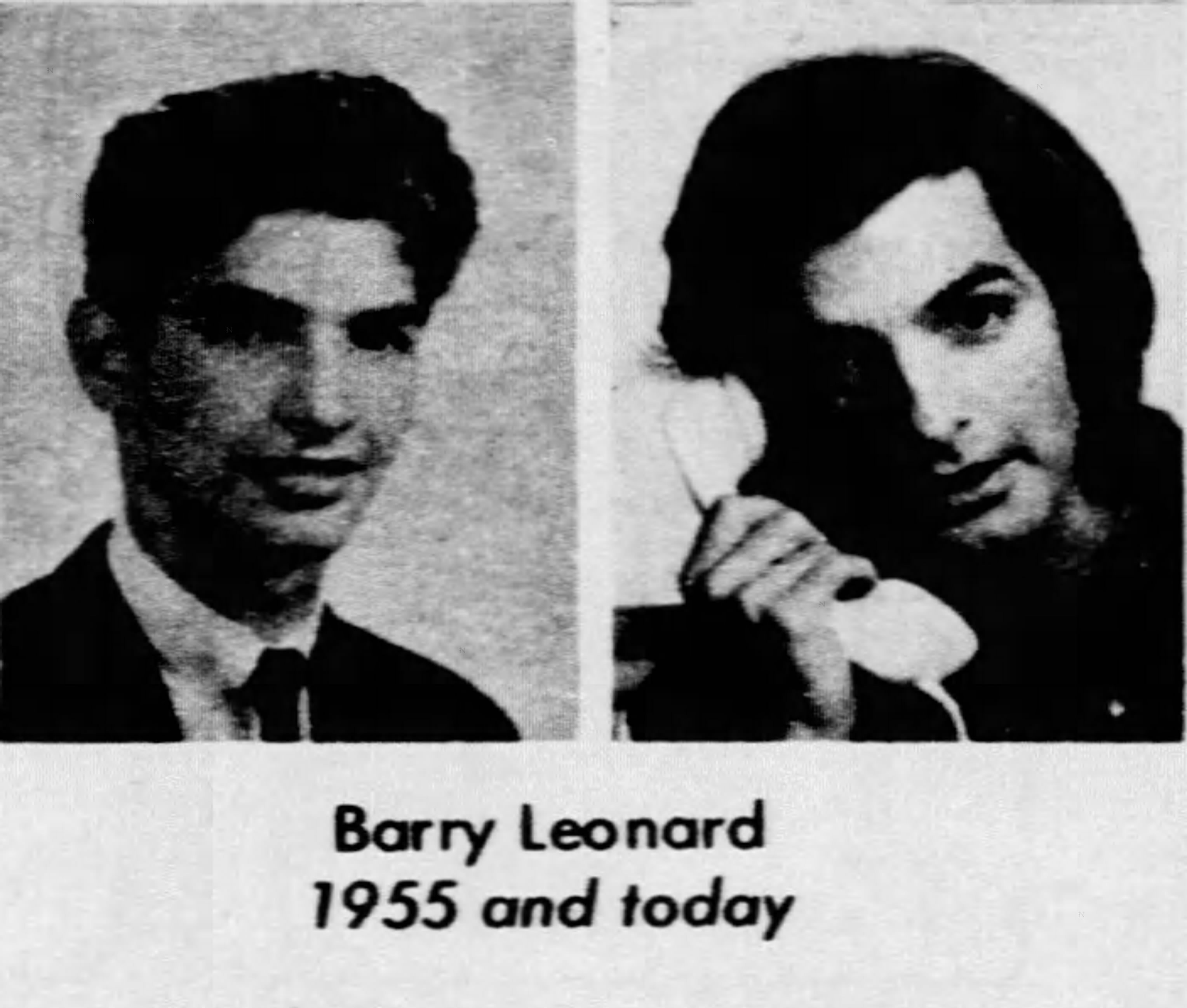
This then and now photo appeared with a story in The Inquirer in 1973.
He was featured often in The Inquirer, Daily News, Philadelphia Magazine, Philadelphia Business Journal, and other publications, and writers dubbed him the “top hair gun” in Philadelphia, “the dashing haircutter,” and “Philadelphia’s leading proponent of hair as art.” He dabbled in selling franchises, endorsed a new Japanese hair-straightening process, and hosted runway-style hair shows and crimper workshops.
Women told him his beauty advice changed their lives. Men said his haircuts improved their sex lives.“I was the image changer,” he told The Inquirer in 2002.
In the late 1960s, Mr. Leonard gave local advertising whiz Elliott Curson a haircut, and Curson, delighted with the result, suggested rebranding Mr. Leonard as “a crimper,” British slang for hairdresser. What followed was a hugely successful ad campaign and a friendship that lasted more than 50 years.
One of their first ads featured the phrase: “When I come out of Barry Leonard’s, I won’t look like my mother.” Curson said: “He had that look, the outfit, and the vision that worked so well.”
Mr. Leonard and his wife, Annie, married in 1986.
Mr. Leonard liked to wear a work shirt, vest, blue jeans, boots, designer glasses, and turquoise jewelry to work. His own hair flowed down to his shoulders when he was young. He told the Daily News in 1977: “Anybody can be where it’s at. But I’m where it’s going to be.”
He was a member of Intercoiffure America and participated in its competitive showings in New York and elsewhere. He was included in a display called “Movers and Shakers” at the now-closed Philadelphia History Museum.
“He would meet you once and have an impact on the rest of your life,” his wife said. “Everybody loved him. He was passionate and compassionate.”
Barry Leonard was born Jan. 27, 1938, in Philadelphia. He grew up in Wynnefield and Bala Cynwyd, and served in the Army’s 101st Airborne Division for two years after high school.
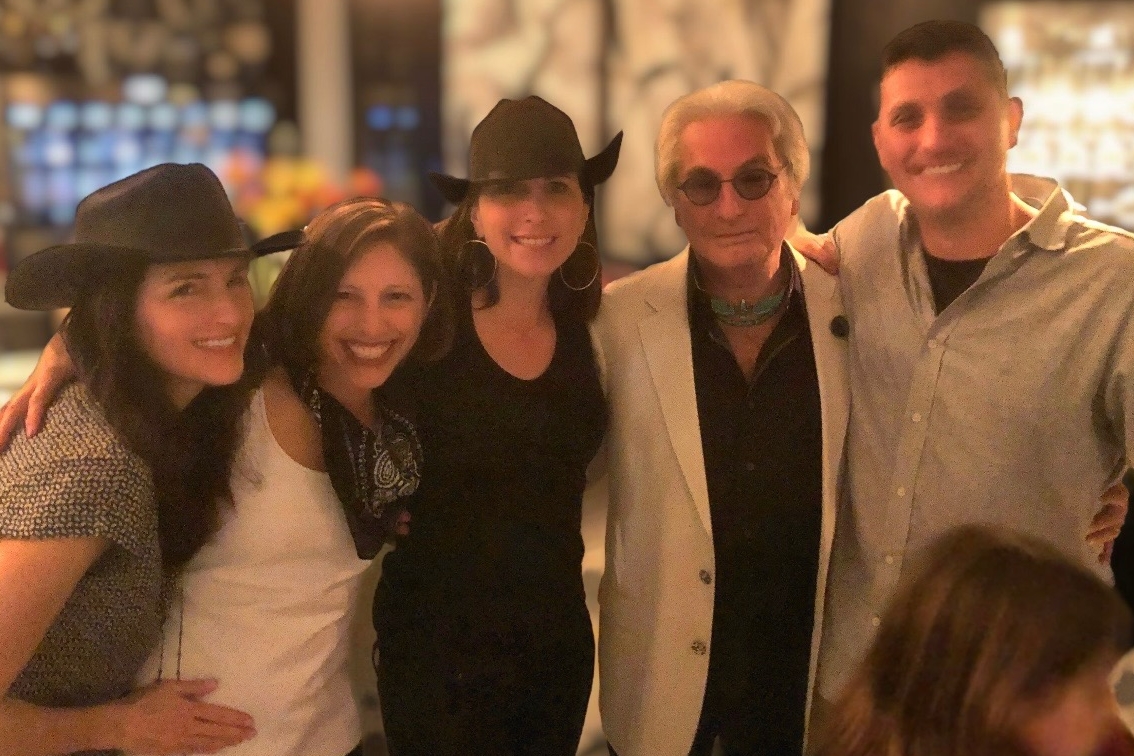
Mr. Leonard (second from right) celebrated his 80th birthday with his children.
He wore a traditional tie and jacket, and cut hair with his father and in a few local shops before opening his place at the Marriott in 1962. He also spent some time working in London and first heard the word crimper there.
He married Charlene Brooks, and they had daughters Karen, Susan, and Elizabeth and a son, Brett. After a divorce, he met Annie Halpern at a party in 1983. They went to a Neil Diamond concert on their first date in 1984, married in 1986, and moved from Center City to Florida in 2005.
Mr. Leonard was an avid boxing fan, and he knew his way around the popular Blue Horizon venue on Broad Street. He had a summer home in Longport, N.J., and enjoyed time at Gulfstream Park racetrack in Florida.
He was spiritual and loquacious, his wife said. He had favorite witty quips, and his family and friends refer to them as “Barryisms.”
This article about Mr. Leonard’s fashion sense was published in the Daily News in 1977.
He attended all kinds of galas and benefits, and doted on his children. “He gave me my first shag” haircut, a longtime friend said on Facebook. Another friend said her neighbor cut her hair once. “The results were not good,” she said. “Barry fixed me.”
They called him “one of a kind,” “truly the best around,” and a “mentor and a friend.” His wife said: “He was the love of my life.”
In addition to his wife, children, and former wife, Mr. Leonard is survived by eight grandchildren and other relatives. A brother died earlier.
A celebration of his life is to be at 11 a.m. Saturday, Dec. 6, at Gulfstream Park, Third Floor, Flamingo Room, 901 S. Federal Highway, Hallandale Beach, Fla. 33009. RSVP to blcrimper@aol.com.
This ad by Mr. Leonard and Elliott Curson appeared in The Inquirer in 1982.
President Donald Trump’s administration on Tuesday asked a federal appeals court in Philadelphia to overturn an order that has, for the moment, blocked authorities from deporting pro-Palestinian activist Mahmoud Khalil — the latest development in a complex legal saga that began when the administration was seeking to crack down on anti-Israeli college campus protests earlier this year.
During a hearing before a three-judge panel in a Center City courtroom, Deputy Assistant Attorney General Drew Ensign said the earlier order, issued by a federal judge in New Jersey, was “indefensible” for several reasons — including that it was issued in the wrong jurisdiction, and that it was effectively helping Khalil’s lawyers improperly “fragment” the various legal proceedings against him and seek venues that might issue favorable rulings.
Khalil’s attorneys, however, said the judges should uphold the lower court’s ruling because the government had illegally targeted the 30-year-old for removal over his political views — something they called a clear First Amendment violation and a situation that could have wider implications amid Trump’s push to increase deportations.
Speaking outside the courthouse after the hearing, Khalil, a legal permanent resident who was born in Syria, told a crowd of supporters he planned to continue his legal fight to remain in the United States.
“This shows how my case is actually just a test for everyone’s right’s here across the country,” he said. “Not only one place, not only for specific people, for immigrants or documented or undocumented people, it’s for everyone across the country.”
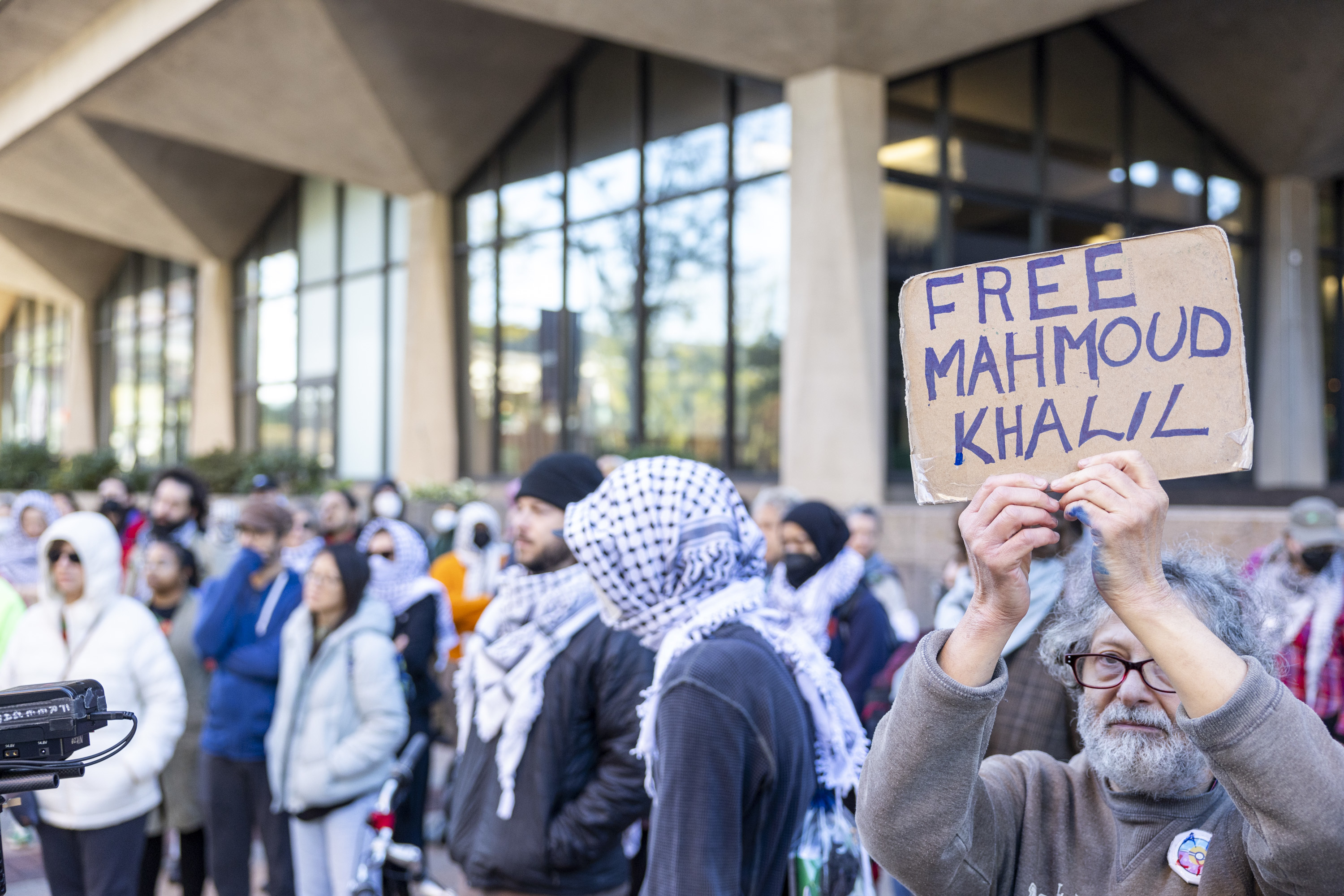
Eric Hamell, of West Philadelphia, holds up a sign saying Free Mahmoud Khalil during a rally outside the James A. Byrne U.S. Courthouse in Philadelphia on Tuesday.
The case against Khalil began in March, when he was arrested by immigration authorities at Columbia University, where he had recently completed a master’s degree and had become a prominent figure at pro-Palestinian protests. Authorities detained Khalil and then pushed to deport him, with Secretary of State Marco Rubio citing an obscure legal statute in contending that Khalil’s rhetoric and continued presence in the country could undermine U.S. foreign policy interests.
Khalil’s lawyers quickly challenged the administration’s actions in court — first in New York, where he lived and was arrested, then in New Jersey, where he was detained in the immediate aftermath of his arrest.
Within days, however, Khalil was transferred to a detention facility in Louisiana, where he was held for more than three months (he was living there this spring when his wife, an American citizen, gave birth to their son in New York).
The issue of where Khalil was located was something Ensign, the government attorney, said was important for the appellate judges to consider: Because Khalil was primarily detained in Louisiana, Ensign said, any legal challenge seeking to have him released should have taken place in that jurisdiction.
And in Ensign’s view, that meant the June ruling by a judge in New Jersey that ordered Khalil released — and temporarily blocked his deportation — should be overturned.
Several judges appeared skeptical of the jurisdictional aspect of Ensign’s argument. Circuit Judge Stephanos Bibas, a Trump appointee, pointed out that authorities were moving Khalil to various jurisdictions over a weekend — and suggested attorneys couldn’t be forced to wait until the work week to file emergency challenges to what they viewed as wrongful detention.
“The lawyers didn’t know” where Khalil was, Bibas said. “They had to do their best.”
The judges seemed more receptive to another of Ensign’s arguments: That Khalil is currently the subject of a complex web of legal cases, with various claims being weighed in various courts.
In addition to the matter being argued in Philadelphia on Tuesday, his immigration case remains pending in Louisiana because of a separate issue: In September, an immigration judge there ruled that Khalil be removed to Syria or Algeria because he failed to disclose information about his past work with pro-Palestinian groups on his green card application.
While his attorneys have appealed that ruling, the appellate panel on Tuesday questioned whether it was appropriate for different jurisdictions to be weighing different aspects of his various cases — particularly when many of the legal issues in them are generally similar.
Circuit Judge Thomas M. Hardiman asked whether doing so would give Khalil a “second bite at the apple” to challenge rulings that don’t go his way.
It remained unclear Tuesday how or when the judges might rule.
Khalil, meanwhile, said outside the courthouse afterward: “We are in the fight until the end.”
The Barrymore Awards celebrated the best of Philadelphia’s regional theater Monday night at Temple Performing Arts Center, where Theatre Philadelphia spotlighted about 50 nominated productions from the 2024-25 season. Twenty-one awards were presented to 13 local companies.
The top winners were Old City’s Arden Theatre Company and Olde Kensington’s Pig Iron Theatre Company, which each took home four Barrymores. Center City’s Wilma Theater — the 2024 Regional Theatre Tony Award recipient — and Inis Nua Theatre Company earned three awards apiece for multiple productions.
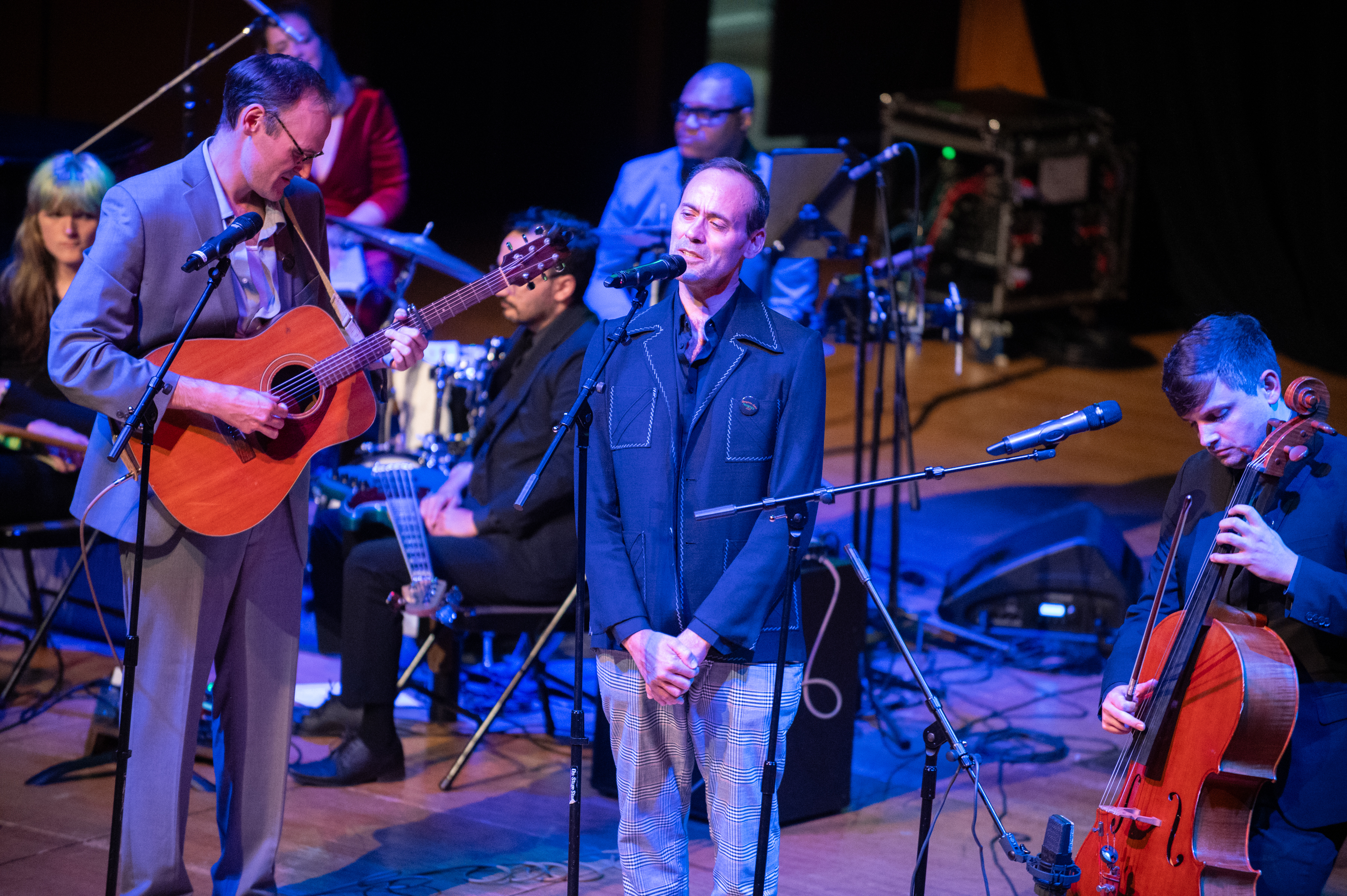
Dito van Reigersberg (center) performs at the 2025 Barrymore Awards on Monday, Oct. 20, 2025.
The Wilma’s production of Branden Jacobs-Jenkins’The Comeuppance, a spooky-tinged millennial drama directed by Wilma co-artistic director Morgan Green, won three awards: outstanding overall production of a play, outstanding ensemble in a play, and outstanding sound design for Jordan McCree.
“The Comeuppance brings the drama of diverging politics and experiences to a microscopic, interpersonal level,” wrote Krista Mar in her Inquirer review. “No one character is a hero, as each of them wins our empathy, especially when possessed by Death, and then loses it. The play holds a mirror to the audience and makes them confront their own biases, assumptions, and judgment.”
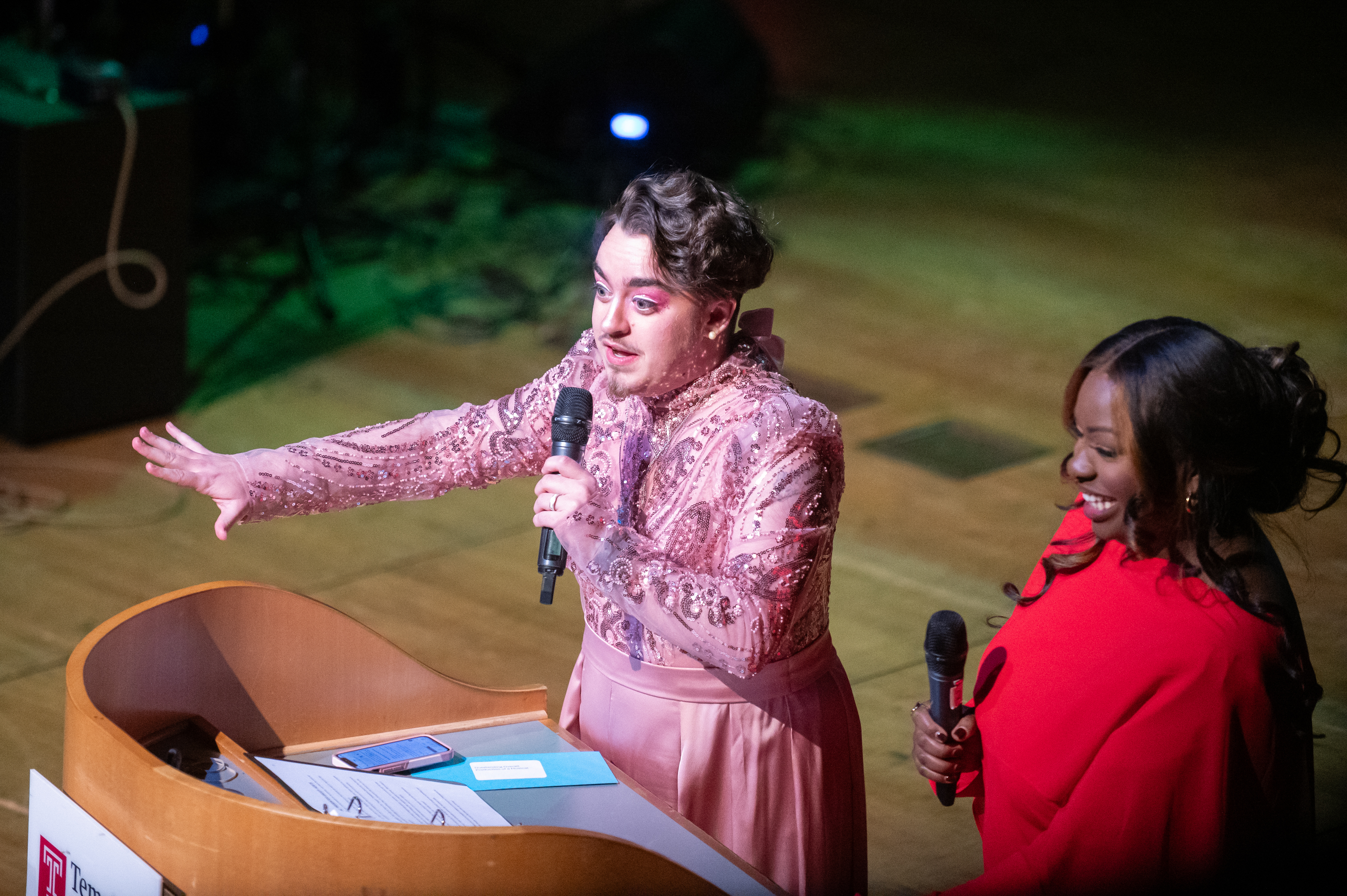
CJ Higgins, Interim Executive Director of Theatre Philadelphia, cohosts the 2025 Barrymore Awards ceremony with Aunyea Lachelle, entertainment and lifestyle anchor for NBC10’s Philly Live at the Temple Performing Arts Center in North Philadelphia on Monday, Oct. 20, 2025.
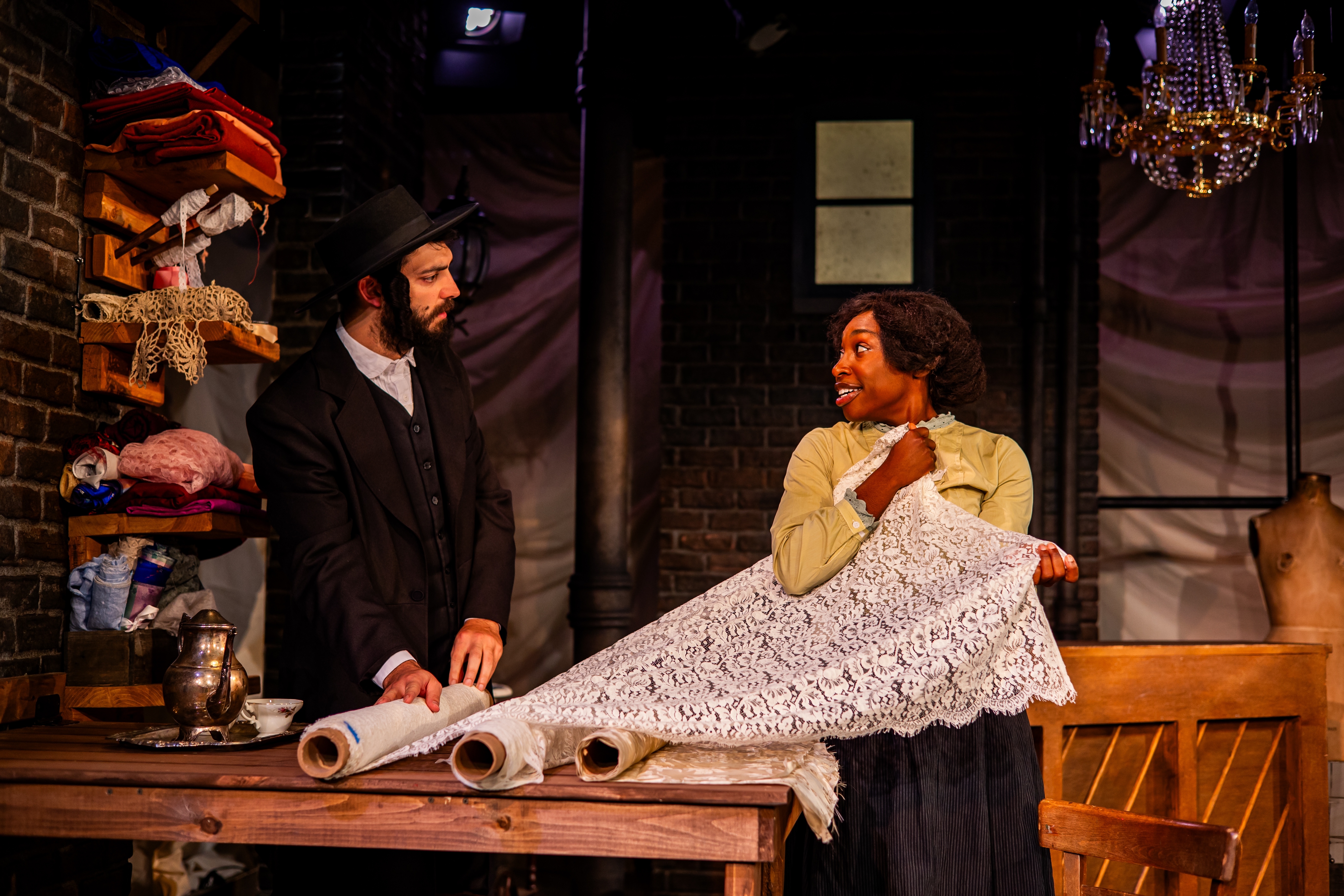
Arden Theatre’s Intimate Apparel, a touching tale from Pulitzer-winning playwright Lynn Nottage about an African American seamstress hoping for romance, won two Barrymores. Amina Robinson earned outstanding direction of a play, and David Pica, who played love interest Mr. Marks, received outstanding supporting performance in a play. Robinson has previously won two Barrymore Awards for directing a musical for The Color Purple at Theater Horizon and Once on This Island at the Arden.
Kishia Nixon, the actor behind interior designer Thalia in R. Eric Thomas’ Glitter in the Glass at Theater Exile, also won for outstanding supporting performance in a play. The Inquirer review called the new work “a nimble, nerdy, and very funny play that tries to answer some very tough questions.”
For outstanding leading performances in a play, both awards went to the stars of InterAct Theatre Company’s Rift, or White Lies. Matteo Scammell and Jered McLenigan played two brothers on opposite sides of the political spectrum and each night they alternated roles. (The Barrymores does not divide acting award categories by gender.)
The cast and crew of the play “The Comeuppance” accept the award for Outstanding Overall Production of a Play at the 2025 Barrymore Awards at the Temple Performing Arts Center in North Philadelphia on Monday, Oct. 20, 2025. The Barrymore Awards spotlight the best musicals, plays, actors, directors, and backstage creatives in the Philadelphia region
In musical categories, Pig Iron Theater’s production of Poor Judge, which ran at the Wilma Theater as part of the 2024 Fringe Festival, took home three awards: outstanding overall production of a musical, outstanding media design for Mike Long, and outstanding music direction for Alex Bechtel.
The eccentric show, conceived and led by Philadelphia legend Dito van Reigersberg (aka Martha Graham Cracker), is a trippy journey through alt-rock singer Aimee Mann’s catalog, enhanced by fascinating live video taping.
Everyone in the ensemble for the September 2024 production played Aimee with delightfully weird and unexpectedly profound results. It was such a success that the Wilma is bringing it back for another run in January.
Dito van Reigersberg in the 2024 Fringe Festival’s production of ‘Poor Judge.’
Bechtel also won the award for outstanding original music for People’s Light’s production of Peter Panto: A Musical Panto. It’s the second year in a row that the composer has been recognized for his original music; last year he won for Alice in Wonderland: A Musical Panto.
Peter Panto earned another Barrymore as well: Connor McAndrews, who played Smee, won for outstanding supporting performance in a musical, alongside actor Sevon Askew, who won in the same category for playing Benny in Arden Theatre’s RENT.
Inis Nua’s Drip, a solo comedy that ran at Fergie’s Pub, won two Barrymores recognizing director Kyle Metzger and actor Max Gallagher for outstanding leading performance in a musical. The story follows a teen who desperately wants to build a synchronized swim team but doesn’t actually know how to swim. The Inquirer review said the show was “a small bit of joy that makes a heartfelt statement through its casting and earnestness, reminding us in the final number that whoever we are, we should all ‘make, make, make a splash.’”
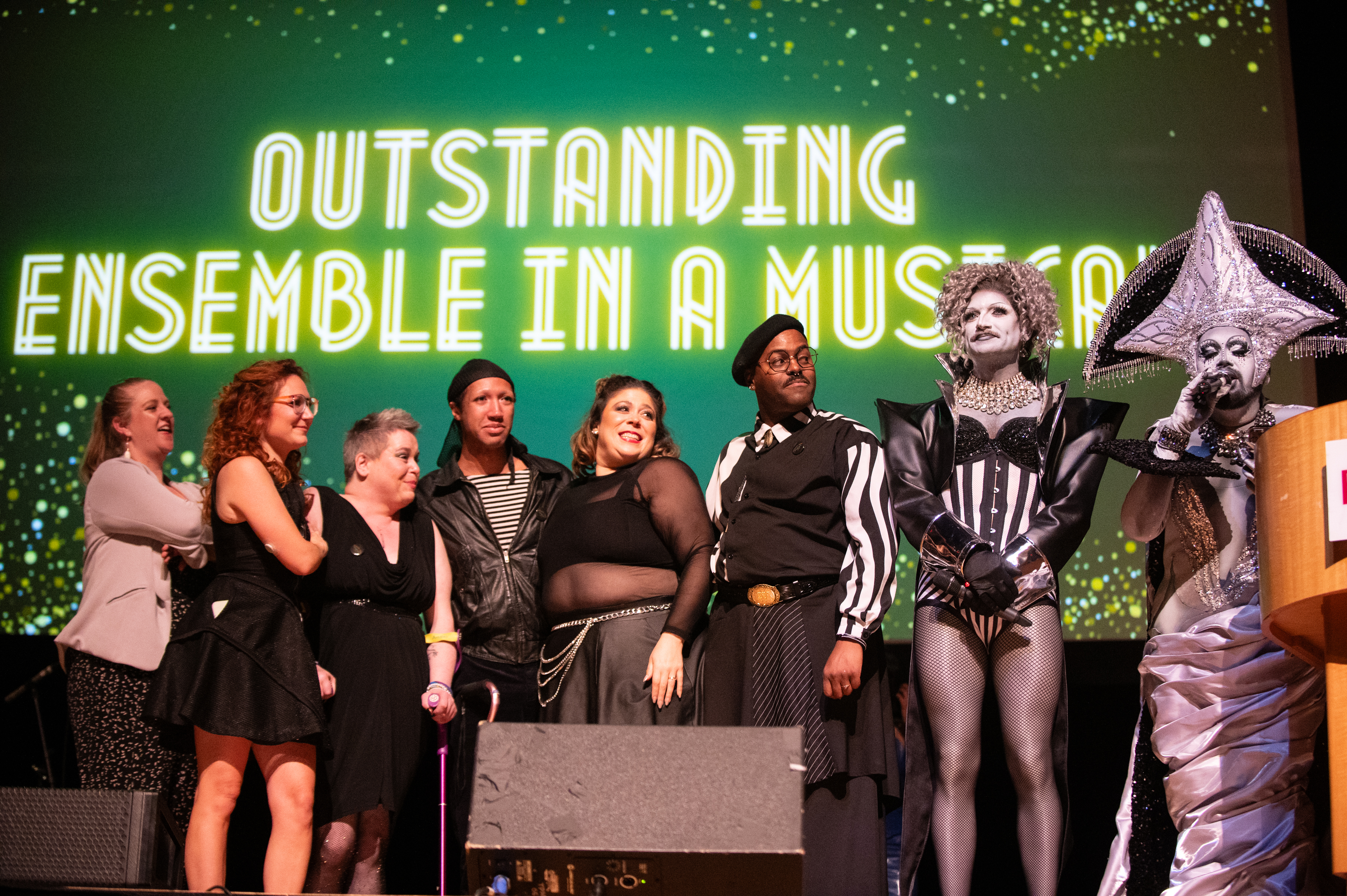
The cast and crew of “Gay Mis” accept the award for Outstanding Ensemble in a Musical at the 2025 Barrymore Awards at the Temple Performing Arts Center in North Philadelphia on Monday, Oct. 20, 2025. Danny Wilfred (third from right) won for outstanding leading performance in a musical.
Also winning for leading performance in a musical was Danny Wilfred, who played Parmesan in Gay Mis, a queer parody of Les Misérables from Philly drag queen Eric Jaffe’s Jaffe St. Queer Productions. Gay Mis took home the Barrymore for outstanding ensemble in a musical as well.
The Philadelphia Award for Social Insight, which comes with a $25,000 prize, went to Esperanza Arts Center for Nichos, a world premiere about Mexican history based on interviews with immigrants in Philly and their families.
For a second year in a row, Theatre Philadelphia did not grant its F. Otto Haas Award for an Emerging Artist, which spotlights up-and-coming Philadelphia actors with a $15,000 cash prize. The organization said it has been unable to grant the award after losing funding.
“The F. Otto Haas Award for an Emerging Artist was a meaningful part of our celebration of Philly theatre for many years,” said Theatre Philadelphia in a statement. “While the F. Otto Haas Award is no longer being presented, we remain deeply grateful for the years of support that made it possible and continue to honor emerging artists across the region through our ongoing recognition programs.”
Connor McAndrews — Peter Panto: A Musical Panto, People’s Light
Livvie Hirshfield — Legally Blonde, Media Theatre
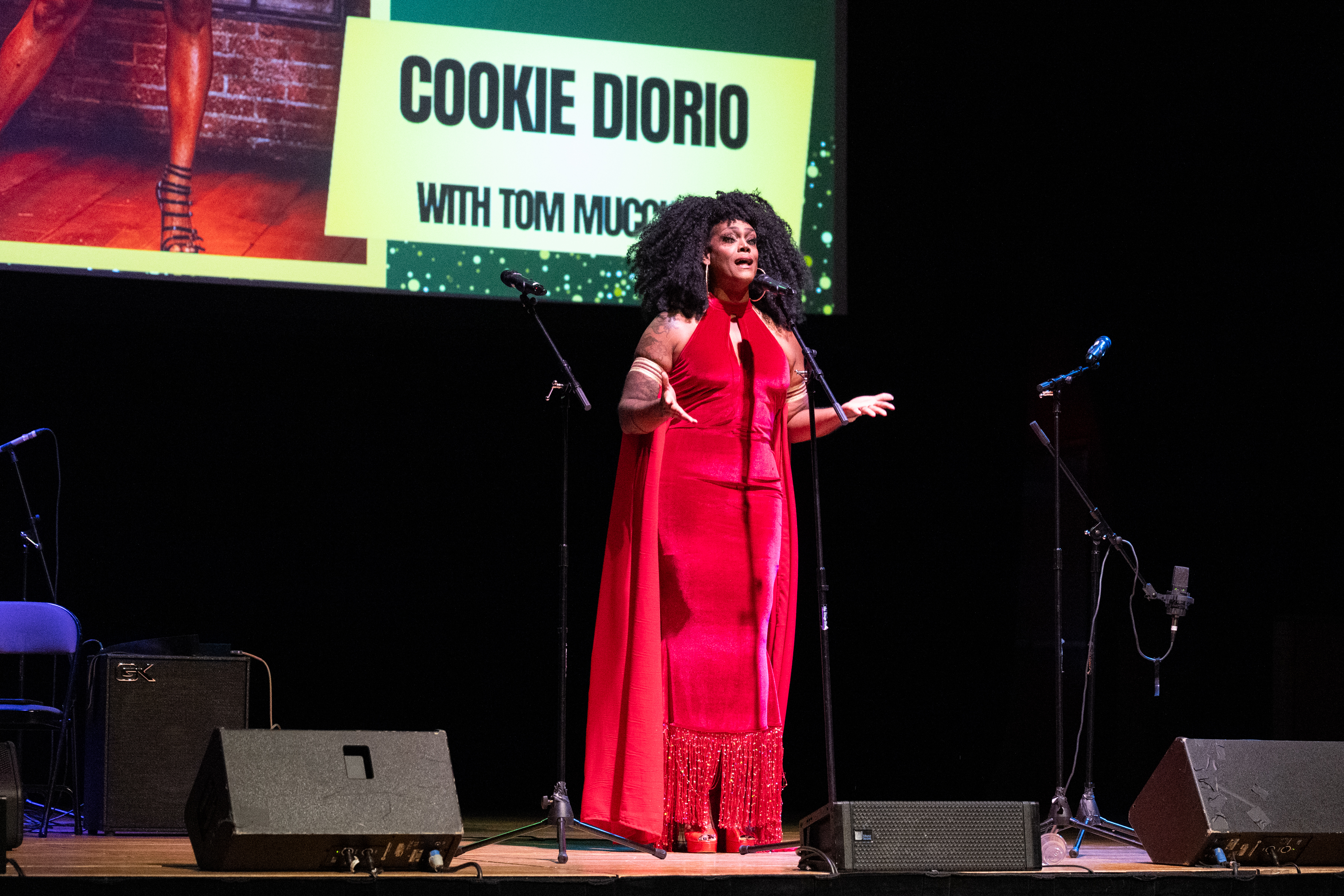
Cookie Diorio, nominated for ‘Kinky Boots,’ performs at the 2025 Barrymore Awards ceremony at the Temple Performing Arts Center in North Philadelphia on Monday, Oct. 20, 2025. The Barrymore Awards spotlight the best musicals, plays, actors, directors, and backstage creatives in the Philadelphia region.
Outstanding Choreography/Movement in a Musical
Todd Underwood — Kiss Me, Kate!, Quintessence Theatre Group
Melanie Cotton — Peter Panto: A Musical Panto, People’s Light
Taylor J. Mitchell — Kinky Boots, New Light Theatre
Christian Ryan — Legally Blonde, Media Theatre
Outstanding Music Direction
Lili St. Queer — Gay Mis, Jaffe St. Queer Productions
Ryan Touhey — Peter Panto: A Musical Panto, People’s Light
Alex Bechtel — Poor Judge, Pig Iron Theatre and Esperanza Arts Center
Justin Yoder — Penelope, Theatre Horizon
Outstanding Ensemble in a Musical
Poor Judge — Pig Iron Theatre
Gay Mis — Jaffe St. Queer Productions
Night Side Songs — Philadelphia Theatre Co.
Peter Panto: A Musical Panto — People’s Light
Outstanding New Work
Iraisa Ann Reilly — January 6: A Celebration. A Bodega Princess Remembers Tradition, Not Insurrection, Simpatico Theatre 2
Eva Steinmetz & Dito van Reigersberg — Poor Judge, Pig Iron Theatre
Daniel & Patrick Lazour — Night Side Songs, Philadelphia Theatre Co.
Jennifer Childs — Peter Panto: A Musical Panto, People’s Light
Tanaquil Márquez — Nichos, Esperanza Arts Center
Outstanding Outdoor Production
All’s Well — Shakespeare in Clark Park
One Monkey Don’t Stop No Show — Theatre in the X
Julius Caesar — Delaware Shakespeare
As You Like It — Shakespeare in Clark Park
Outstanding Set Design
Chris Haig — The Playboy of the Western World, Inis Nua Theatre
Thom Weaver — August Wilson’s King Hedley II, Arden Theatre
Matt Saunders — Archduke, The Wilma Theater
April Thomson — Hold These Truths, Montgomery Theater
Anna Kiraly — Franklin’s Key, Pig Iron Theatre
Roman Tartarowicz — Tuesdays with Morrie, Delaware Theatre Co.
Jordan McCree — The Half-God of Rainfall, The Wilma Theatre
Jordan McCree — The Comeuppance, The Wilma Theater
Chris Sannino — Franklin’s Key, Pig Iron Theatre
Michael Kiley — A Summer Day, The Wilma Theater
Yaim Chong Chia — Archduke, The Wilma Theater
Connor McAndrews (left) and Jamison Stern (right) in People’s Light Theatre’s ‘Peter Panto,’ which was nominated for 8 awards. McAndrews won the Barrymore for outstanding supporting performance in a musical.
Outstanding Original Music
Daniel & Patrick Lazour — Night Side Songs, Philadelphia Theatre Co.
Alex Bechtel — Peter Panto: A Musical Panto, People’s Light
Jordan McCree — The Hobbit, Arden Theatre
Lili St. Queer — Gay Mis, Jaffe St. Queer Productions
Ximena Violante & Ampersan (Zindu Cano and Kevin García) — Nichos, Esperanza Arts Center
Jakeya L. Sanders — Fallawayinto: Corridors of Rememory, Ninth Planet
The Philadelphia Award for Social Insight
Rift, or White Lies — InterAct Theatre
Young Americans — Theatre Horizon
The Drag —EgoPo Classic Theater
Night Side Songs — Philadelphia Theatre Co.
The Half-God of Rainfall — The Wilma Theater
January 6: A Celebration. A Bodega Princess Remembers Tradition, Not Insurrection — Simpatico Theatre
Glitter in the Glass — Theatre Exile
Nichos — Esperanza Arts Center
The Playboy of the Western World — Inis Nua Theatre
Nearly 2 million Pennsylvanians — including 500,000 Philadelphia residents — won’t receive SNAP benefits in November if the federal government shutdown continues, state officials said.
The Supplemental Nutrition Assistance Program provides $366 million a month to low-income people in the state, according to the Pennsylvania Department of Health and Human Services (DHS). Most households that receive SNAP benefits consist of elderly people, children, or individuals with disabilities, according to hunger experts.
This is the first federal shutdown in at least 20 years in which SNAP will not be made available, said George Matysik, executive director of the Share Food Program, a food bank that serves 500,000 people living in the region.
“It’s like a horror movie where the call is coming from within the house,” Matysik said in an interview last week. “Our own federal government is making the choice to take benefits from Pennsylvanians,” who are among 42 million people nationwide who participate in the program.
In Philadelphia, Share has seen a 120% increase in food need over the last three years, Matysik said. “And that was with SNAP,” he added, saying the city faces a greater food crisis now than it did during the pandemic.
In an email Monday, the Pennsylvania DHS blamed Republicans “who control the U.S. Senate, the U.S. House, and the White House” for failing to pass a budget and causing the current difficulties Americans endure.
“We urge Republicans in Congress to reopen the government and protect vulnerable Pennsylvanians at risk because of this inaction,” the email said.
Gov. Josh Shapiro’s office could not be reached for comment. In May, Shapiro said that the commonwealth would be unable to replace lost funding for SNAP should the federal government fail to pay.
The U.S. Department of Agriculture, which administers SNAP, did not return calls for comment. The White House issued a statement that the shutdown is affecting personnel in its press office, delaying responses. The statement blamed Democrats for the government’s closure: “Please remember this could have been avoided if the Democrats voted for the clean Continuing Resolution to keep the government open.”
To receive SNAP benefits, individuals carry EBT (electronic benefits transfer) cards that are loaded monthly with the amounts to which they are entitled.
The shutdown began Oct. 1 after Congress could not reach a compromise to allow funding to continue. The region’s 46,000 federal workers found themselves without paychecks. The Trump administration, meanwhile, began laying off federal workers, with a goal of sacking 4,000 of them. A federal judge in California intervened to halt the layoffs. A hearing is scheduled for Tuesday.
Like other states, New Jersey faces the same funding difficulty. If the federal government remains closed by Nov. 1, about 800,000 people will be without SNAP benefits.
Elderly people who rely on SNAP will suffer throughout Pennsylvania because, for them, “food is medicine,” said Allen Glicksman, director of research at the Eastern Pennsylvania Geriatrics Society in Newtown Square. “Without it, there’s the chance of a health catastrophe that will cost more money in Medicaid and in emergency room visits.”
There are 234,638 Philadelphians age 65 and older, 104,972 (45%) of whom live below the federal poverty line ($21,150 for two individuals in a household), Glicksman calculated.
Brian Gralnick, executive director of the Center for Advocacy for the Rights and Interests of Elders (CARIE) in Center City, agreed. “Consequences will be devastating. Without federal government dollars, ending or even addressing hunger in the region will be as successful as draining the Delaware River using Eagles helmets.”
For children, the potential shortage of SNAP benefits will be no less calamitous, said sociologist Judith Levine, director of the Public Policy Lab at Temple University.
“Food is a necessary element for brain development and growth,” she said. “And there’s a clear connection between hunger and the ability to perform in school.
“This is a complete crisis we are facing.”
One in four Philadelphia children experiences food insecurity — lack of enough food over the course of a year to live a healthy life — according to a City Council report.
In the neighborhoods, the word about the halt to SNAP benefits is circulating. Fear and confusion had already been growing after the Trump administration announced changes to the SNAP program that would make it more difficult for some people to access benefits.
Among the changes: Some SNAP recipients ages 18 to 54 who are able to work and do not support a child under 18 are now required to report at least 20 hours of work, training, or volunteering per week, or 80 hours per month, to keep their benefits.
Despite the revisions to the program, however, many people these days are more worried about what happens if SNAP halts.
“People are very anxious about that,” said Pastor Tricia Neal, director of the Feast of Justice food pantry at St. John’s Lutheran Church in the Northeast.
“The anxiety level is driving more people to come here, and, because we serve 5,500 households, we are well beyond the capacity of what we can support. It’s really horrendous to look at what’s happening here.”
That much is clear, according to Rosemary Diem, who tries to stave off hunger for her and her husband by combining SNAP benefits with visits to Feast of Justice.
“Everything at the pantry is running low,” said Diem, 60, who is disabled, as is her husband, Joseph, 63. “I see us getting hurt without SNAP. There won’t be money for milk and eggs.
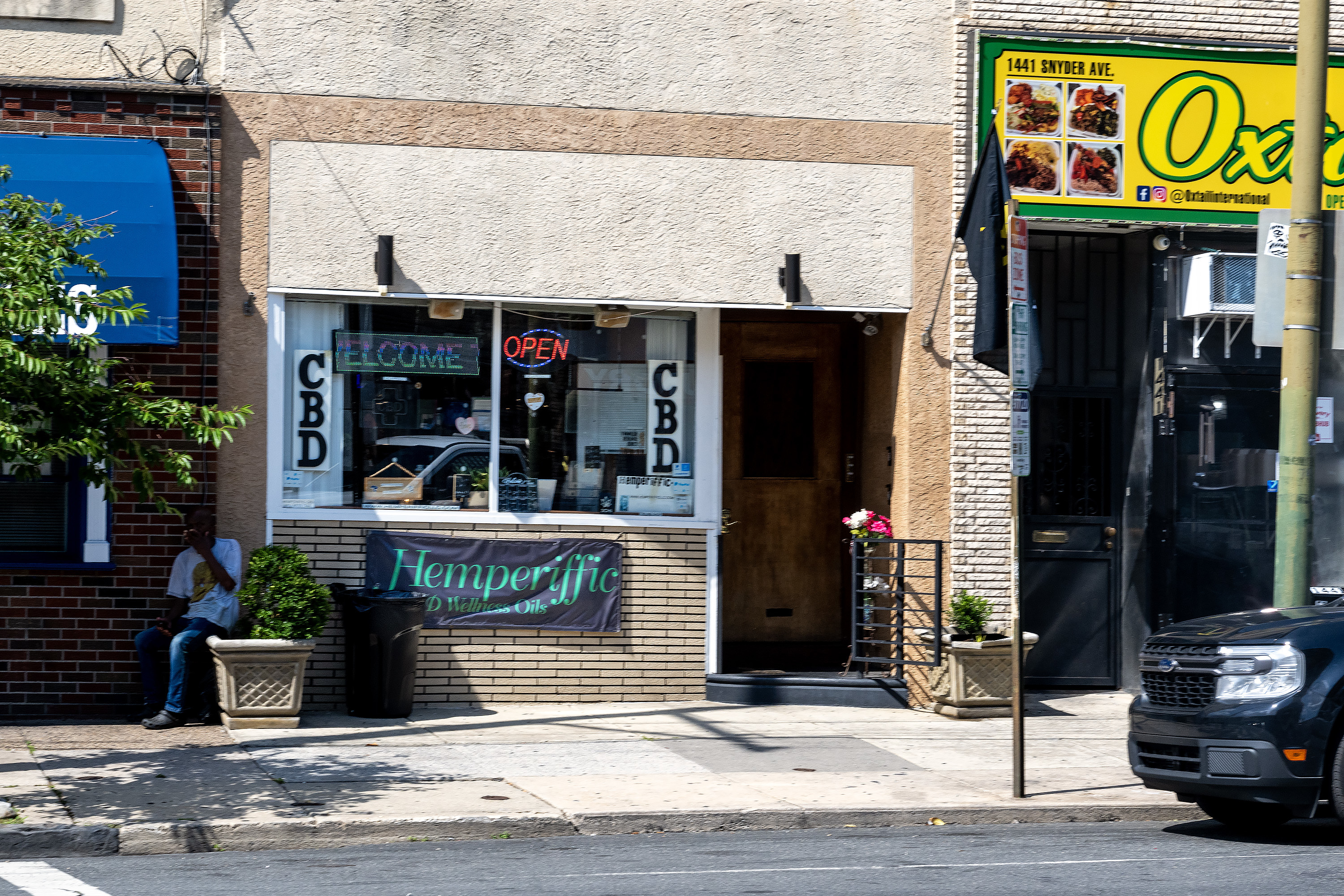
There’s a smoke shop in North Philly peddling recreational drugs across the street from a daycare. A West Philly storefront that sells loose cigarettes on a residential block. A convenience store in Spring Garden that advertises urine to people looking to pass a drug test.
These are among the so-called nuisance businesses that City Council members and neighborhood association leaders cited Monday as lawmakers advanced legislation to make it easier for the city to shut down stores that sell cannabis and tobacco products without licenses.
And legislators said their next target could be the landlords who rent space to those businesses.
“We have to work with our city departments and our state partners to clamp down on these businesses,” said City Council Majority Leader Katherine Gilmore Richardson, who represents the city at-large. “We’re just being inundated.”
Members of Council’s Committee on Licenses and Inspections passed two bills Monday that city officials say seek to close loopholes store owners exploit to avoid being cited for failing to obtain proper permits.
In introducing the legislation earlier this year, Gilmore Richardson cited an Inquirer report about Pennsylvania’s unregulated hemp stores, which sell products advertised as legal hemp that are often black market cannabis or contaminated with illicit toxins.
One bill makes it easier for the city to shut down nuisance businesses by removing language that classifies some violations as criminal matters, requiring that the police investigate them as crimes rather than civil violations that are quicker to adjudicate.
The second piece of legislation makes it illegal for businesses to essentially reorganize under a new name but conduct the same operations as a means of evading enforcement.
Both pieces of legislation could come up for a full vote in the Democratic-dominated City Council in the coming weeks. Members of Mayor Cherelle L. Parker’s administration testified in favor of them, meaning the mayor is likely to sign both.
A smoke shop in South Philadelphia.
Neighborhood association leaders also testified Monday in favor of the changes, but several said more aggressive enforcement is needed. They said smoke shops in particular have popped up throughout their commercial corridors, as have convenience stores that don’t even have licenses to operate as businesses, let alone sell recreational drugs.
“We’ve seen firsthand the selling of illegal drug paraphernalia and [loose cigarettes], many of which children walk past in order to get to the candy bars and seniors walk past to get to the milk,” said Heather Miller, of the Lawncrest Community Association. “We need to address this.”
Elaine Petrossian, a Democratic ward leader in Center City and a community activist, called for “much” higher fines and penalties for landlords. She cited progress the municipal government has made in New York City, where authorities cracked down on building owners who knowingly rented space to tenants selling cannabis or tobacco without licenses to do so.
Several lawmakers said they’d support a similar approach. Councilmember Mark Squilla, who represents a district that spans from South Philadelphia to Kensington, said landlords must be held “more accountable.”
“If they had some skin in the game, maybe they’d think twice about renting to an illegal operation,” he said.
Councilmember Jamie Gauthier, who represents parts of West Philadelphia, agreed. She said she recently attempted to meet with a building owner who rents space to a problematic smoke shop in her district, but was rebuffed.
“He was like, ‘These people pay me rent, and that’s the extent to which I basically care,’” Gauthier said. “We need something that forces property owners to be more accountable than that, because neighbors are suffering.”
Staff writers Max Marin and Ryan W. Briggs contributed to this article.
The University of Pennsylvania Health System, the Philadelphia region’s biggest provider of cancer care and a national leader in developing new treatments, is spending more than $500 million on two new cancer facilities in Philadelphia and central New Jersey to keep growing.
“What we’ve seen pretty consistently is that demand is there to meet any capacity increases,” Julia Puchtler, the health system’s chief financial officer, said in an interview about fiscal 2025 financial results.
Penn is not alone in its push to expand cancer services. Jefferson’s Sidney Kimmel Cancer Center, Temple’s Fox Chase Cancer Center, and the MD Anderson Cancer Center at Cooper are pushing into the suburbs to reach more patients.
The same thing is happening nationally as financially pressured health systems are looking for ways to increase revenue in a growing and lucrative market for cancer care.
Penn stands out locally for the scale of its investment in a strategy to deliver cancer care seamlessly across its seven hospitals and a growing network of outpatient clinics, with the expectation that patients will keep coming back for their ongoing health needs.
Penn sees an opportunity to expand its market share even more, as cancer diagnoses rise. The U.S. is expected to see a nearly 40% increase in cancer diagnoses between 2025 and 2050, according to the Philadelphia-based American Association of Cancer Research.
Experts attribute the rise to a wide variety of factors, from better early detection, to longer life spans, and to environmental exposures that are poorly understood.
Much of Penn’s investment is in outpatient facilities, including a $270 million center being built in Montgomeryville that will have radiation oncology and an infusion center. “More and more patients want to receive care closer to home,” according to Lisa Martin, a senior vice president at Moody’s Rating. “All of that is really what’s behind all of this investment.”
Cancer treatment overall is profitable. At Penn, cancer services account for up to 60% of the system’s operating margin by one simple measure that subtracts direct costs from direct revenue and excludes back-office expenses and other centralized costs.
Puchtler attributed the profitability of cancer care to the prevalence of drugs, such as chemotherapy, that Penn can buy at a discount, while getting the full price from insurers, and the higher percentage of younger cancer patients with better-paying private insurance than is typical for many healthcare services.
The expansion efforts are expensive in an industry where the consumers both benefit from advances and pay ever-rising healthcare costs. Proton therapy, in particular, costs more, but has not yet been proven to have better outcomes across a wide range of cancers.
The intensifying competitive landscape
Penn treats about one-third of adults with cancer in its market area, which stretches from central New Jersey to the Susquehanna, according to Robert Vonderheide, who is director of Penn’s Abramson Cancer Center and leads all of Penn’s efforts in oncology treatment and research.
Penn counted 47,053 new cancer patients in the 12 months that ended June 30, up 40% from five years ago, according to Penn. The system has 14 locations where patients can receive chemotherapy and even more radiation oncology sites.
Competitors are also trying to expand their reach, and Temple’s Fox Chase Cancer Center is succeeding.
window.addEventListener(“message”,function(a){if(void 0!==a.data[“datawrapper-height”]){var e=document.querySelectorAll(“iframe”);for(var t in a.data[“datawrapper-height”])for(var r,i=0;r=e[i];i++)if(r.contentWindow===a.source){var d=a.data[“datawrapper-height”][t]+”px”;r.style.height=d}}});
Fox Chase had 21,442 new patients in fiscal 2025, up 148% from 2020, the nonprofit said. Fox Chase has added suburban offices in Voorhees and Buckingham, Bucks County, and is expanding its infusion capacity at its main campus on Cottman Avenue. Fox Chase has a significantly smaller footprint than Penn, with six locations for infusions and four for radiation.
The MD Anderson Cancer Center at Cooper said it had 4,326 new patients last year, up 27% over the last five years. Cooper has taken the MD Anderson Cancer Center brand to the former Cape Regional Medical Center, which it acquired last year and which used to be part of the Penn Cancer Network. Cooper also offers cancer services at its new Moorestown location.
Jefferson Health’s Sidney Kimmel Cancer Center did not respond to requests for patient data, but has in recent years opened cancer center locations at its Torresdale and Bucks County Hospitals. Jefferson’s cancer center also attained the highest designation from the National Cancer Institute last year — the Philadelphia region’s third comprehensive cancer center, matching Penn and Fox Chase.
Lancaster County resident Susan Reese, 56, said she experienced smooth cooperation between her doctor at Penn’s Lancaster General Hospital and the team at HUP during her treatment for non-Hodgkin lymphoma.
“I never had any question in my mind that one doctor didn’t know what the other doctor was doing,” said Reese, who received CAR-T therapy at HUP in September 2022. Penn has since started offering CAR-T at Lancaster General.
After she relapsed in early 2023, she came back to HUP for a stem cell transplant. She could have gone to Penn State Health’s Hershey Medical Center for that. It’s significantly closer to her home in Willow Street, but she wanted to stay within the Penn system.
Reese’s experience of integration of services at HUP and Lancaster General is what Penn is aiming for in a territory that stretches from central New Jersey to central Pennsylvania.
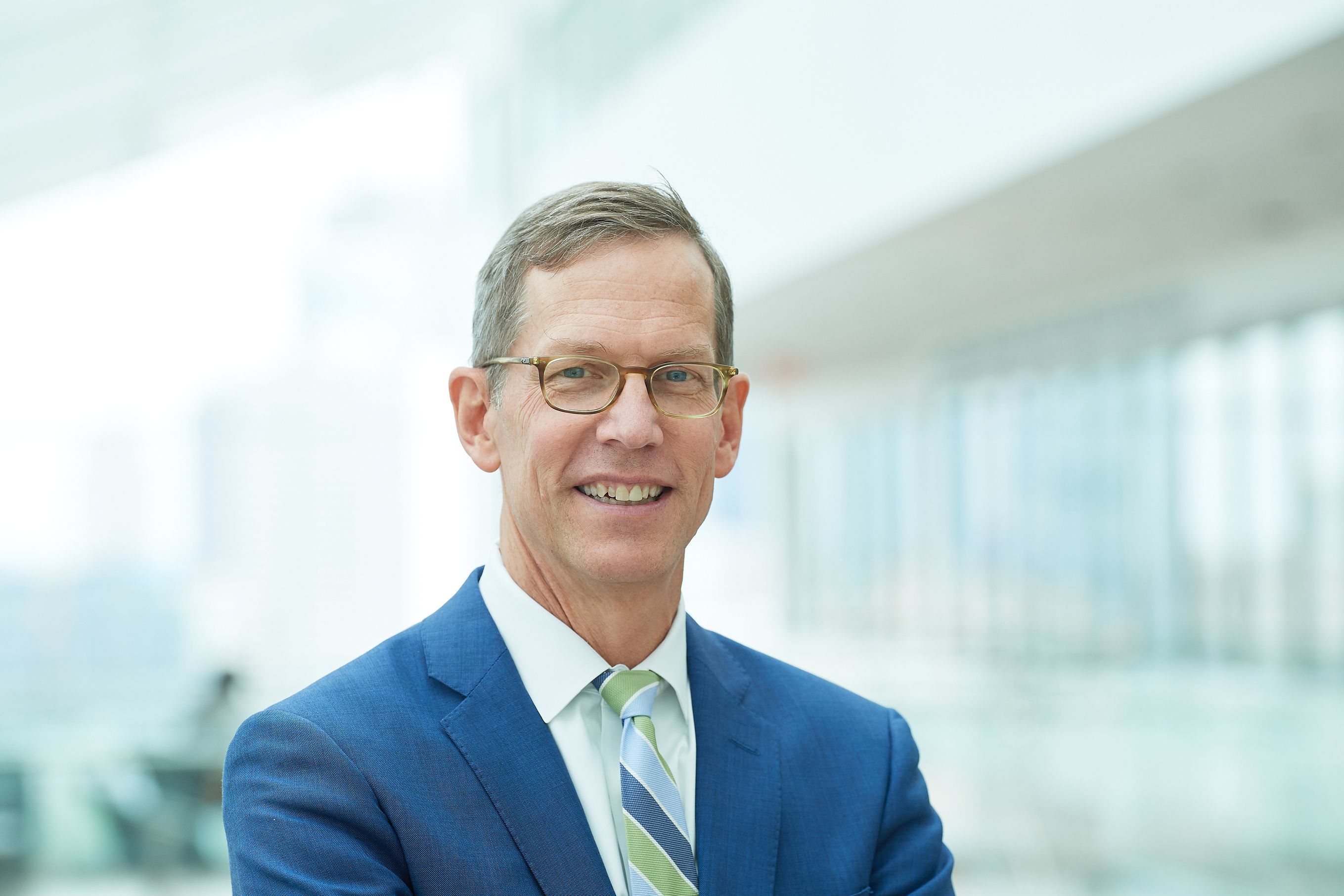
Oncologist Robert Vonderheide, director of Penn Medicine’s Abramson Cancer Center, oversees all Penn’s cancer services and research.
Electronic medical records help with the integration needed to ensure the thousands of cancer patients Penn physicians treat annually get the most advanced care possible, according to Vonderheide, whose research focuses on cellular immunotherapies.
“We treat patients’ cancers now in a very precise way; the precise mutation, the precise type of chemotherapy, the precise dose” are the focus for doctors, Vonderheide said. “This is no longer appropriate for the telephone game. This has to be data-driven.”
Reese’s decision to stay within Penn is part of a broader trend of patients tending to receive all their care within one health system, according to Rick Gundling, a healthcare expert at the Healthcare Financial Management Association in Washington, D.C.
That’s particularly important in oncology, which typically involves multiple specialties, such as medical oncology, radiation oncology, and surgical oncology, he said.
“Seamless coordination across all those disciplines really makes it a better patient experience and clinical experience because it reduces delay, improves access,” Gundling said.
Taking advanced treatments from HUP to the network
Part of Penn’s strategy is to begin offering advanced services at locations beyond HUP. That’s where Penn pioneered CAR-T cell therapy, which harnesses the immune system to attack cancer, and for years that was the only place Penn offered it.
HUP still performed the bulk of the CAR-T treatments for blood cancers, 123 inpatient cases and 14 outpatient cases last year, but now CAR-T is also available at Lancaster General and at Penn’s Pennsylvania Hospital in Center City.
Fox Chase was the next biggest center in the region for the relatively new treatment that Penn scientist Carl June and his research teams helped develop. For the fiscal year that ended June 30, 2025, Fox Chase had 21 inpatient cases and 67 outpatient cases, the center said.
In the Penn system, certain kinds of bone marrow transplants also used to be available only at HUP. “Now we do them at HUP and Pennsylvania Hospital,” Vonderheide said.
Even the most complicated pancreatic surgeries are going to be done at Princeton, in conjunction with experts at HUP, Vonderheide said. Penn held a ceremonial groundbreaking Monday for the hospital’s $295 million cancer center.
Remaining only at HUP are bone marrow transplants that use another person’s cells to treat blood cancers, Vonderheide said. HUP performed 118 of those so-called allogeneic bone marrow transplants on the top floor of its $1.6 billion patient pavilion, now known as the Clifton Center.
Pennsylvania’s next-biggest provider of the treatment was Hershey Medical Center, near Harrisburg, with 71, according to state data.
window.addEventListener(“message”,function(a){if(void 0!==a.data[“datawrapper-height”]){var e=document.querySelectorAll(“iframe”);for(var t in a.data[“datawrapper-height”])for(var r,i=0;r=e[i];i++)if(r.contentWindow===a.source){var d=a.data[“datawrapper-height”][t]+”px”;r.style.height=d}}});
Penn started offering proton therapy at HUP in 2010, and expanded its availability in the last three years to Lancaster General and Voorhees, through a joint venture with Virtua Health. Those two centers only have one proton machine each, compared to five at HUP.
It’s a type of radiation that is designed to precisely target tumors and do less damage to surrounding tissues. That makes the treatment, which costs more, particularly helpful for children, and it is proving beneficial for treating certain neck and throat cancers.The use of proton therapy for the more common prostate cancer has been more controversial.
Penn’s fourth proton center, with two machines, is under construction and is expected to open at Presbyterian in late 2027. When that $224 million center opens, Penn will have more proton treatment rooms than the entire West Coast, said Jim Metz, chair of radiation oncology at Penn.
Currently about 10% of Penn’s roughly 10,000 annual radiation oncology patients are treated with protons, though it’s a higher percentage at locations with proton machines, Penn said.
Penn officials have noted that some cancer patients come to Penn for proton therapy. Even when it’s not appropriate for them, they tend to stay within Penn. “We have seen, when we build protons, our market share increases, ” Metz said.
Editor’s note: This article has been updated with more recent Fox Chase data.
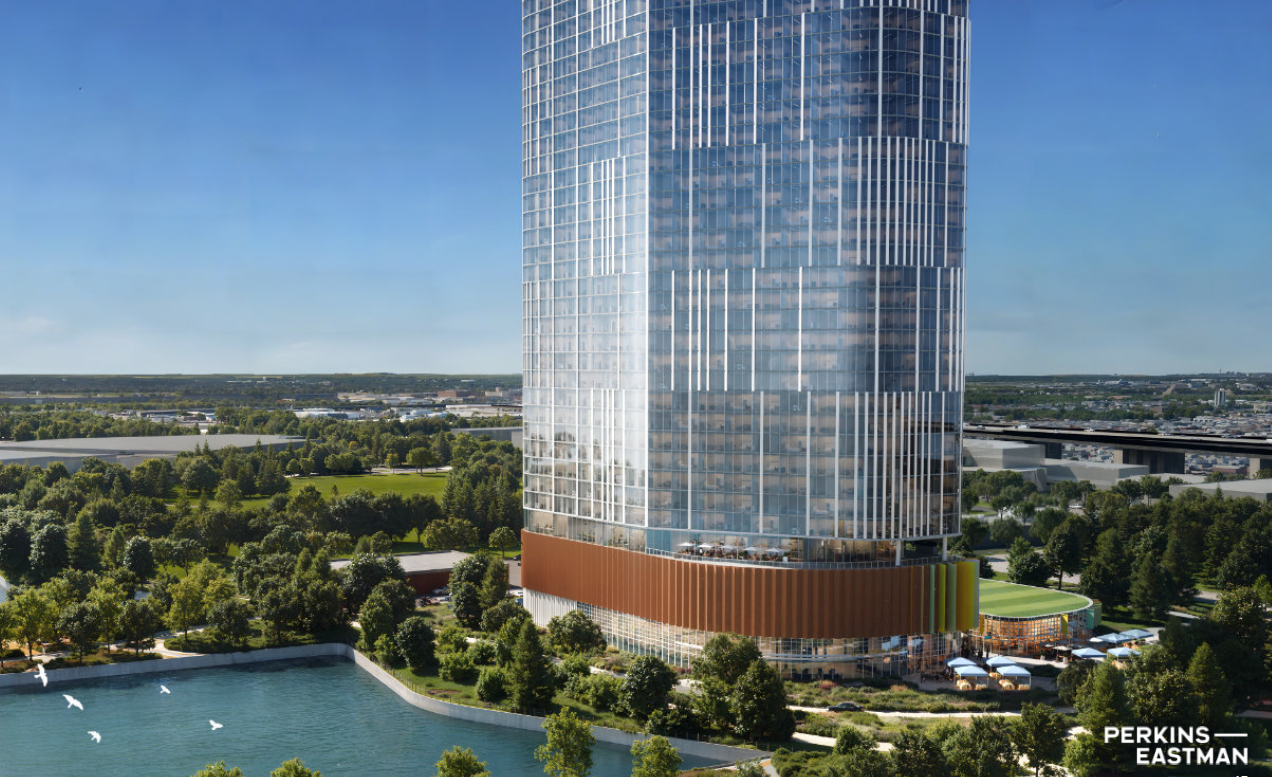
New York’s Brevet Capital Management revealed its vision for 1341 S. Christopher Columbus Blvd. to the Pennsport Civic Association on Wednesday night, showing a soaring tower on Delaware River with 620 units and promising a dramatic revision of public space in the area.
In addition to the tower and small retail building just to its west, the developer’s representatives outlined possible future phases that could include two additional towers.
“The retail building is constructed as a placeholder,” Meredith Trego, a zoning lawyer with Ballard Spahr, said at the Pennsport Civic Association meeting. “But the idea is in a future phase that a one-story building would go away, and a new tower could go in its place.”
The towering project, with its limited parking, is legally possible due to the unique zoning incentives available along the central Delaware riverfront.
In exchange for building as high as they want, the developers must meet a variety of requirements including paying into the city’s housing trust fund, providing public space, and upgrading, maintaining, and extending a rundown stretch of the Delaware River Trail down to Reed Street.
The first tower would be more than 380 feet tall, and renderings show possible future towers that would be even taller. To be allowed to build that high for future buildings, the developer would have to meet the city’s exacting requirements again, including by paying more into the housing trust fund (and they could not encroach on trail space).
Conditions on the pedestrian- and bike-friendly river trail have deteriorated below Washington Avenue. The infrastructure has not been maintained to the level it is farther north.
An encampment of homeless people has settled along this portion of the trail, although its residents have been moved around several times in sweeps orchestrated by the city, Delaware River Waterfront Corp., and property owners.
Another sweep is planned for Tuesday, the developer’s representatives said at the Pennsport meeting, and additional signage and fencing are planned to limit access to the property.
But currently the encampment is largely along the public access bike and pedestrian trail itself, not private property.
“Everyone knows that’s only going to last so long until we get density back there, people [will probably be] living back there,” said Matt McClure, a zoning lawyer representing Brevet. “That’s why we need an active use.”
A rendering of the proposed tower discussed at the Pennsport Civic Association meeting Wednesday night.
Brevet’s team said they would provide additional public space with the initial tower, including on disused piers that jut into the river. Currently they do not plan to build structures on the piers but turn them into publicly accessible green space.
Residents also asked that the developer address traffic conditions on Columbus Boulevard, which is a high-speed roadway that is unsafe for pedestrians.
“Big projects generate focus on improvements,” McClure said. “Hopefully it generates dialogue on making things better” on the boulevard.
The biggest applause of the night came when an attendee urged the developer to add more parking than the 187 spaces currently proposed within the tower. Another 100 spaces are available in an existing surface lot, although that is also the site for a possible third future residential tower.
The developer’s representatives tempered hopes for a greater share of parking in future development, while not ruling it out.
“So for future phases, if there’s a need for additional parking, we could incorporate that,” Trego said. Based on what they’re seeing in developments throughout the city, she added, garages are not as full as expected.
A rendering of the highly theoretical future two towers the developer has discussed as a possibility for the site.
Plans for the first tower have mostly smaller units — 50% one-bedroom units and 35% studios — but the developer said that could change.
“As we study this further, if there is desire for larger units, we can always make room for that,” said Milton Lau, a project architect with the firm Perkins Eastman.
Brevet expects to begin building in summer 2026, with an 18- to 24-month construction timeline for the first tower.
This is Brevet’s first real estate project in Philadelphia, although the company has built other developments in Florida, Texas, and California.