More than 2.5 million miles of fuel pipelines run under homes, farms, parks, and schools in the United States — enough steel line to circle the earth 100 times.
One of those pipelines slices under Mount Eyre Manor, a suburban Bucks County neighborhood perched high above the popular Delaware Canal State Park towpath and only a few thousand feet from the Delaware River.
For years, residents barely gave any thought to the Twin Oaks Pipeline, owned by Sunoco and its parent company, Energy Transfer. That changed in January when state inspectors uncovered a jet fuel leak.
Now, the pipeline is always on their minds.
“We will never drink the water in this house again,” said Kristine Wojnovich, whose well was one of six tainted in the leak. Six metal tanks, part of a filtration system installed by Energy Transfer, now crowd her basement wall.
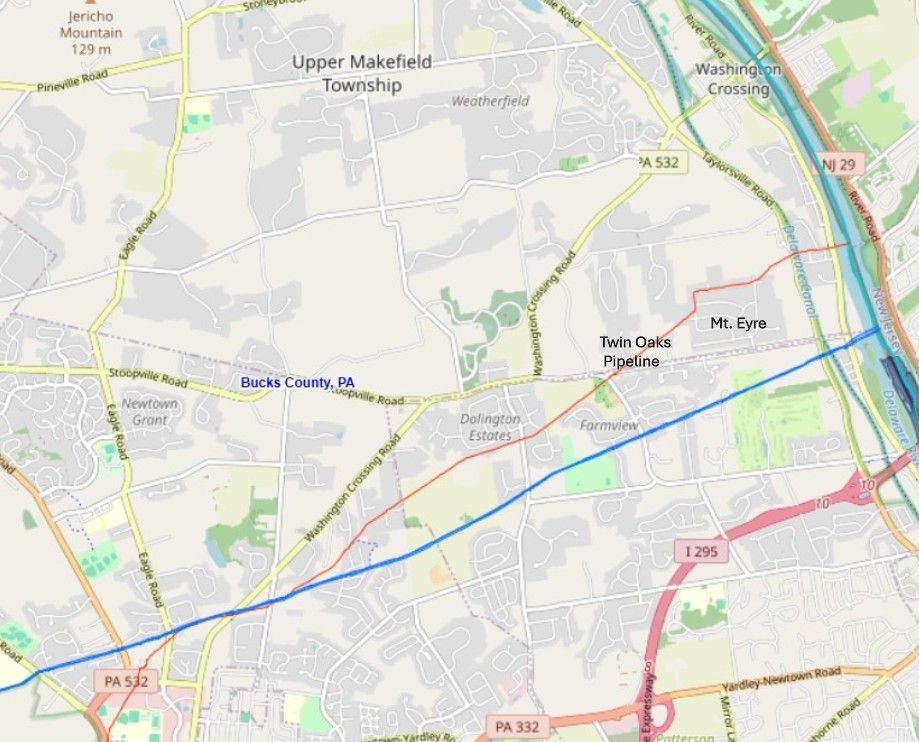
The Twin Oaks Pipeline stretches 106 miles. Built in 1958, its 14-inch diameter pipe carries jet fuel, diesel, or gasoline, depending on need, from Sunoco’s Twin Oaks Terminal in Aston, Delaware County, to a terminal in Newark, N.J.
Along its route, the pipeline burrows beneath suburbs, tunnels under waterways — including the Delaware River — and runs below a school’s grounds and state and local parks. It carves directly through Mount Eyre in the Washington Crossing section of Upper Makefield Township.
Federal regulators estimated that a “slow drip” had seeped undetected at least 16 months before the leak was detected.
Energy Transfer has accepted responsibility and apologized at public meetings. The company declined to comment for this article but noted that it has set up a website with updates and documents related to the spill.
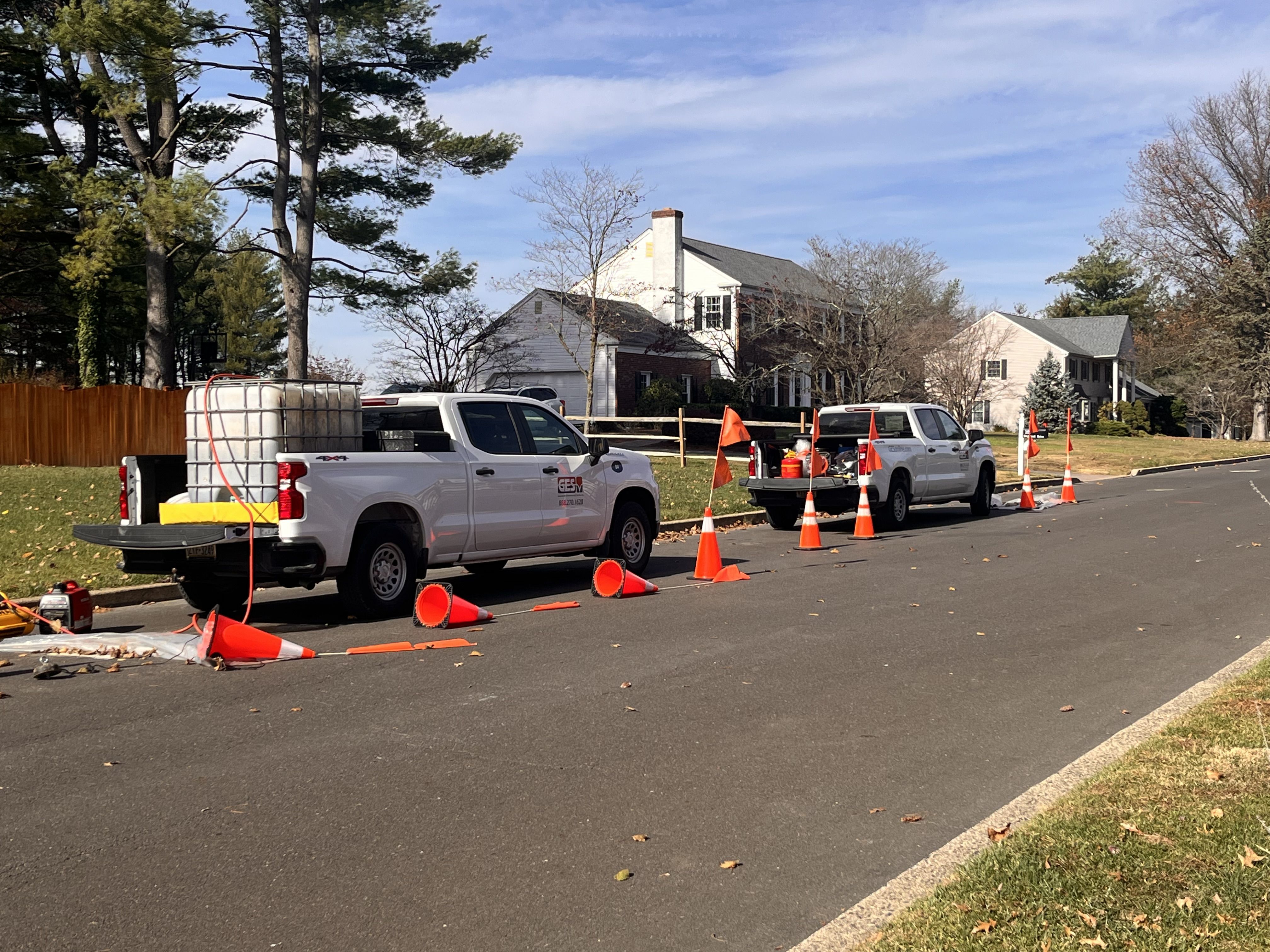
A contractor for Energy Transfer working on a recovery well in front of Kristine Wojnovich’s home in the Mount Eyre Manor neighborhood.
Signs of contamination
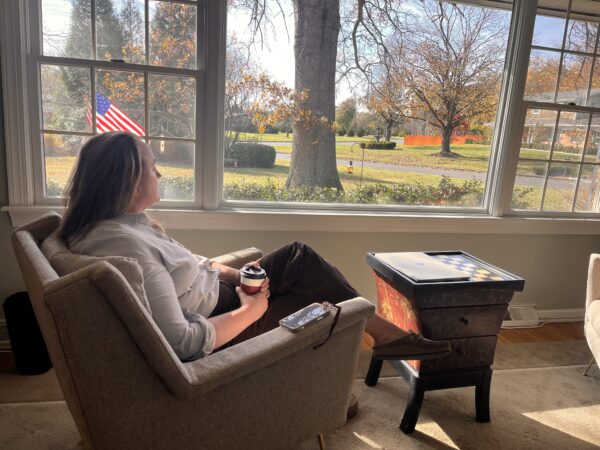
Wojnovich said she first noticed “something off with the water” as she was getting a drink after a workout in September 2023. She recalled the incident on a recent day from her living room as several white trucks owned by an Energy Transfer contractor were parked outside as part of well-monitoring work.
“It smelled to me like oil or gasoline or some kind of petroleum,” Wojnovich said.
Uncertain whether she was imagining it, she waited for her husband, Kevin, to return home. He, too, noticed the odor and suggested they call Sunoco.
The couple say Sunoco failed to locate a source of the odor and told them the likely cause was bacteria. Other neighbors had complained, too.
But it wasn’t until Jan. 21, 2025, that residents first learned of a leak discovered during an investigation by the Pennsylvania Department of Environmental Protection. The DEP advised the federal Pipeline and Hazardous Materials Safety Administration (PHMSA) that water samples from a Mount Eyre home “indicated the presence of kerosene, a major component of JP-8 jet fuel.”
PHMSA notified Energy Transfer and Sunoco.
Since then, residents have attended hours and hours of meetings. They’ve filed seven lawsuits, including a class action. Wojnovich is one of the plaintiffs.
Most people won’t drink the water. Many won’t cook with it. Wojnovich and her husband, Kevin, bathe elsewhere.
Wojnovich noted that when her well was initially tested after the leak, “fumes came out. It was overwhelming. They measured 12½ feet of jet fuel on top of our drinking water well.”
Her water, which eventually tested positive for contamination, now gets routinely tested by contractors paid by Energy Transfer. The company has drilled a second well for the family. But the Wojnoviches say their water still has a pungent odor.
Kevin Wojnovich samples water from a point-of-entry-treatment, whole-house filtration system that Sunoco installed at his Washington Crossing home after a 2024 jet fuel leak was detected in the company’s Twin Oaks pipeline.
The fallout
Of six wells that tested positive for hydrocarbons, four exceeded contaminant levels for drinking water. Residents suspect other wells were, or are, tainted and are skeptical about the way testing has been carried out.
According to the DEP, jet fuel contains “contaminants of concern” including benzene, toluene, ethylbenzene, xylenes, cumene, naphthalene, trimethylbenzenes, dichloroethanes, dibromoethane, and lead, which is also naturally occurring. The compounds can be harmful if ingested in large amounts. Some are carcinogens.
Energy Transfer has purchased a home with a contaminated well on Spencer Road, adjacent to where the leak was detected, for $721,800. It is across from the Wojnoviches’ home and sits vacant. The company purchased the home to drill two recovery wells in order to remove contaminated water.
Since digging up and repairing the pipe section, the company has recovered 1,027 gallons of fuel. About 163 gallons came from private wells, according to DEP records.
Energy Transfer has paid contractors to excavate and remove 276 tons of petroleum-impacted soil, according to a DEP document. It has installed four wells to recover petroleum from underground, dug 26 wells to monitor groundwater, and put in 181 point-of-entry treatment filtration systems in homes. It has collected 1,289 water samples from 363 individual wells.
A map from the federal Pipeline and Hazardous Materials Safety Administration shows the Mount Eyre Manor neighborhood in Washington Crossing, Bucks County, and Sunoco’s Twin Oaks pipeline in red. The blue line signifies another gas transmission pipeline.
Over the summer, Energy Transfer, using an inspection tool, identified multiple anomalies in the pipeline in Upper Makefield Township that required excavation, according to an Oct. 22 update.
The company said in an August letter that the anomalies presented no immediate danger and that there is no “data or information that the continued operation of the pipeline presents a critical safety concern or that the pipeline is leaking.”
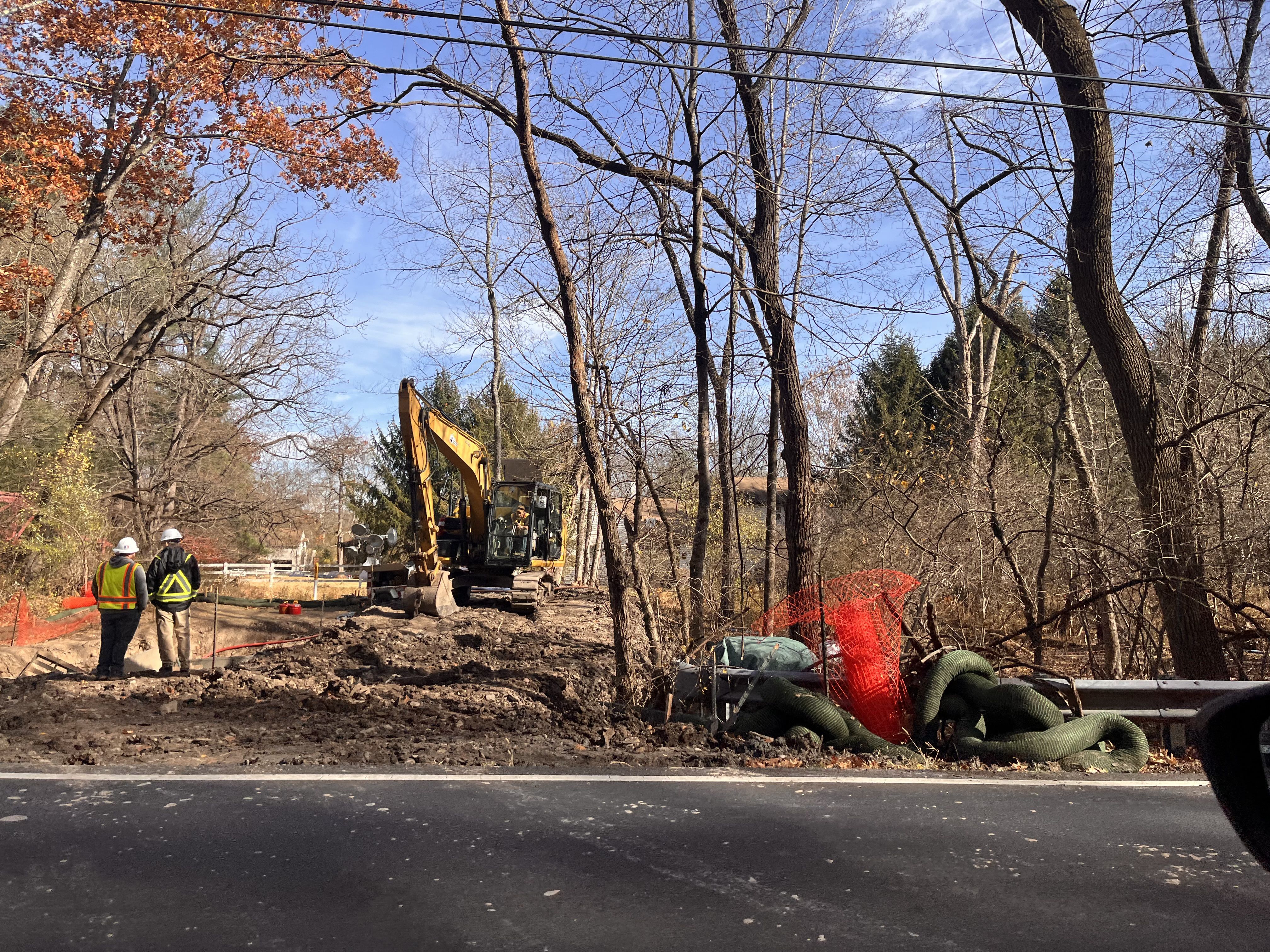
One of those excavations took place in a section of pipe next to the popular canal path used by cyclists and hikers. It is being dug up and replaced.
The excavation along Taylorsville Road won’t disturb the canal trail, company officials said during a recent meeting. The term anomaly does not mean a pipe section is an immediate threat to the safety or integrity of the pipeline, Matt Gordon, vice president of operations at Energy Transfer, said at the meeting.
Meanwhile, the pipeline continues to deliver fuel.
A contractor for Energy Transfer excavates a pipe found along Taylorsville Road with an anomaly that the company said was not in any immediate danger of failing.
‘Another house is up for sale’
The spill has upended life in and around Mount Eyre, neighbors say.
Joe Babiasz said many neighbors had bonded through their children’s schools and activities before the spill. Now, instead of talking soccer, they talk pipelines.
“It’s become part of daily life at this point,” Babiasz said. “When we get together socially, it’s the thing we talk about. It’s been kind of hard to just hang out with people and have it not come up. You can’t walk around the neighborhood without seeing a reminder. ‘Oh, there’s the monitoring well,’ or ‘another house is up for sale.’”
Residents have expressed outrage and skepticism toward Energy Transfer, the parent company of Sunoco, over the handling and testing of the contamination. They say theydon’t trust the company’s methods and doubt the safety of the 67-year-old pipeline.
“There are the trucks out there now,” Babiasz said on a recent day. “You can see them or hear them. It’s been integrated into our daily life.”
He asked: “Are they actually telling us everything?”
Residents wonder if the leak would have been discovered if they had municipal water. They wonder whether the leak created a toxic plume underground and where it might drift to, including into the river.
Neighbors plan to attend the next update by the DEP during a Dec. 8 webinar.
Katherine LaHart, a plaintiff in the class-action suit, said her well water was once clear. Now it is “black — Texas brown.”
“I worry every day about the integrity of our water, air and soil and the pipeline that runs through our neighborhood,” LaHart said. “It keeps me up at night.”
“Jefferson How We Adore Thee” will be released to the university community at its annual gala Tuesday. The university held a contest during its bicentennial last year, and Barden’s piece was selected from dozens of entries, the school said.
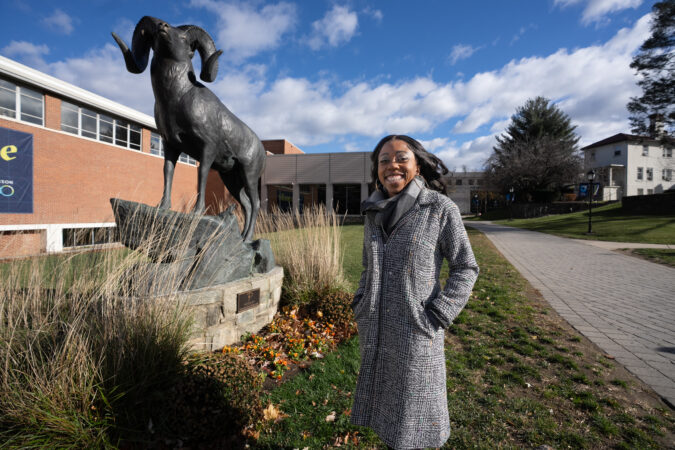
Elizabeth Avril Barden, a customer-experience specialist at Jefferson Health Plans and recent summa cum laude graduate of Thomas Jefferson University, has written the school’s first alma mater song in its 201-year history. “Jefferson How We Adore Thee” will be released to the university community at a gala on Tuesday.
“Elizabeth really captured the essence of the Jefferson community,” said Jefferson President Susan C. Aldridge “Learning, collaborating and innovating are all part of our collective DNA and I couldn’t be happier that we finally have an alma mater which captures who we are as a university as we venture into our third century.”
Jefferson has had a handful of songs that students have written over the years and a processional theme that launched in 1974, but never an official alma mater song, said F. Michael Angelo, Jefferson archivist.
One reason could be that at its founding in 1824, Jefferson was a medical college and over the years evolved into a university. But it was always medically focused until the school merged with the former Philadelphia University, best known for its design, engineering, and health science programs, in 2017.
“Philadelphia University, as far as we can tell through their archives, never had an alma mater song, either,” Angelo said.
Barden, 32, who received her bachelor’s degree in Health Services Management from Jefferson this year, said a colleague encouraged her to enter the contest. She has written about 30 songs, she said, so it wasn’t an off-the-grid venture.
It took her just 25 minutes to write the lyrics and music for the one minute, 55-second piece, she said.
“If you’re creative, you just flow,” she said. “You flow like water because it’s already in you, and you don’t have to overthink what’s already in you.”
And with the help of producer Keegan Myers, who played the music while Barden sang, the chorus goes:
It’s the Jefferson strong and true, where innovation leads us through. Together we achieve our best, as we prepare for what’s next.
“In every step I was taking at the university, it was preparing me for the next level of life,” she said.
Barden has been singing in front of people since age 2 and wroteher first song at 7, she said. Her parents, both Christian pastors originally from Haiti, encouraged her musical talent as she grew up in Brooklyn surrounded by gospel music, she said.
“Me and my six siblings, we were essentially the choir,” she said.
In high school, she won a song-writing contest and got to meet Grammy-winning R&B singer Jazmine Sullivan, who, she said, encouraged her to keep writing. She had written her high school’s alma mater song, too. And when she was a student at Delaware County Community College, she sang the national anthem at two ceremonies.
“Any school I go to, I want to leave a piece of me there,” she said. “Music to me is connection. That’s how I connect to people.”
For winning the Jefferson contest, she received a $200 gift card to the school bookstore, lunch with Aldridge, and a Jefferson mug.
“But the greatest gift was my name being attached to this alma mater song,” she said.
Barden said her aim in writing the song was to give Jefferson a gift.
“Jefferson gave me a lot,” she said, including a scholarship. “There were moments where I needed to talk to professors because life was happening. They were always kind and patient with me.”
Barden attended community college in New York after high school, but left when she got pregnant. When she moved to Philadelphia in 2016, she enrolled at Job Corps and then moved on to the Delaware County college. She continued on to Jefferson, while raising her four children, now ages 2 to 13.
In 2023, she began working there, too. Her job entails focusing on the patient experience and helping patients navigate the system.
“For the most part, I’m kind of like a clean-up person,” Barden said.
She’s currently enrolled in a dual program at Bryn Mawr College and Jefferson to obtain her master’s degrees in social service and public health. She plans to become a licensed clinical social worker and to incorporate music therapy into her work.
As part of her studies, she’s doing research on how music therapy can help those suffering from post-traumatic stress.
“I do believe that the incorporation of music,” she said, “has the ability to communicate with anyone … and help them learn how to cope.”
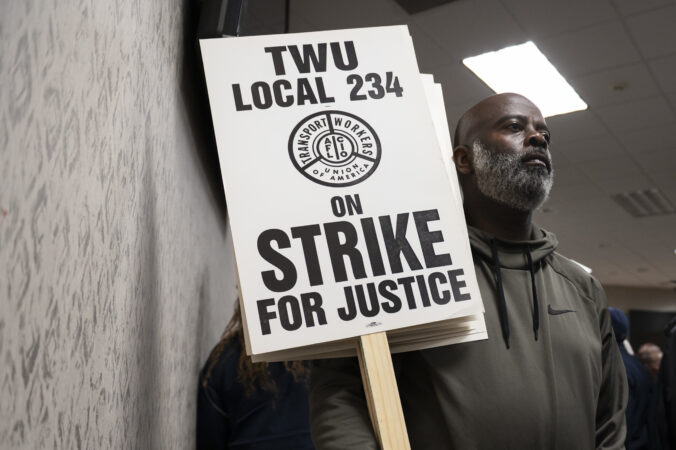
Members of the Transport Workers Union Local 234 on Sunday, Nov. 16 voted to authorize a strike if union and SEPTA negotiators can’t reach an agreement on a new contract.
Shortly before the current contract ran out at 11:59 p.m. on Nov. 7, TWU’s new president, Will Vera, urged union members to stay on the job. In an unusual move, he delayed a strike vote at the time of contract expiration, saying he had hope that a deal could be reached without the usual brinksmanship.
“We’re asking you to please continue to come to work and put money aside. We want you to be prepared in case we have to call a work stoppage,” he told members in a video at the time.
Local 234 leaders say they’re prioritizing a two-year deal with raises and changes to what the union views as onerous work rules, including the transit agency’s use of a third party that Vera said makes it hard for members to use their allotted sick time.
In a statement, SEPTA said it was aware of the authorization vote and is committed “to continue to engage in good-faith negotiations, with the goal of reaching a new agreement that is fair.”
2023 Fraternal Order of Transit Police Lodge 109 (three days)
SEPTA police officers walked off the job after bargaining with the transit agency for almost nine months, largely over the timing of a 13% pay raise for members. The agreement, partially brokered by Gov. Josh Shapiro, came amid heightened fears about safety on public transit and a funding crisis for SEPTA.
TWU Local 234 walked off the job for six days; the biggest issue was retirement benefits. SEPTA’s contributions toward union members’ pensions did not rise in tandem with wages when workers made more than $50,000. Managers’ pension benefits were not capped. The union also wanted to reduce out-of-pocket health-care costs and win longer breaks for bus, trolley, and subway operators between shifts and route changes.
SEPTA and the union reached an agreement Nov. 7, the day before the general election. Democrat Hillary Clinton’s presidential campaign was worried about voter turnout, and the city sought an injunction to end the strike. It proved unnecessary.
Talk about leverage. TWU was ready to strike just before the first home game of the World Series between the Phillies and the New York Yankees. Gov. Ed Rendell pushed the two sides to continue talking, and the transit workers waited to walk out until three hours after the end of Game 5, the last in the series played at Citizens Bank Park.
It was a bitter strike, coming just a year after the stock market’s meltdown started the Great Recession. TWULocal 234 President Willie Brown called himself “the most hated man” in Philadelphia. Mayor Michael Nutter was harshly critical. Brown called him “Little Caesar.”
The strike was settled Nov. 7 with a deal on a five-year contract. Transit workers got a $1,250 bonus, a 2.5% raise in the second year, a graduated increase in SEPTA pension contributions from 2% to 3.5%, and the maximum pension benefit was raised to $30,000 from $27,000.
2005: TWU Local 234 and United Transportation Union Local 1594 (seven days)
Negotiations collapsed mostly over SEPTA’s insistence that workers pay 5% of medical insurance premiums. At that point, the authority paid 100% of the workers’ premiums for family coverage.
In the end, it was solved by Gov. Rendell, a Democrat who had been Philadelphia mayor in the 1990s. He agreed to give promised state money to SEPTA early, so it could pay premiums in advance, reducing its costs.
In the resulting four-year deal, the unions had to pay for 1% of their medical premiums. They also received 3% yearly raises.
Pedestrians and cars in a chaotic dance at the intersection of Market and 30th Streets during the afternoon commute on the first day of the SEPTA city workers’ strike Nov. 1, 2016.
1998: TWU Local 234 (40 days)
City transit workers’ contract expired in March, but they did not strike until June — and then stayed out for 40 days. The two sides reached an agreement in July, but it fell apart. TWU members had returned to their jobs and kept working under an extension of their old contract. A final agreement was signed Oct. 23.
The union agreed to SEPTA’s demand that injured-on-duty benefits be limited. The old contract gave them full pay and benefits while on leave after a work injury. SEPTA wanted to hire an unlimited number of part-time workers. The union agreed to 100 part-timers to drive small buses.
SEPTA’s chief negotiator was David L. Cohen, famous for reining in unions representing city workers during Philadelphia’s bankruptcy in 1992, as Rendell’s mayoral chief of staff.
A two-week strike stilled city buses, trolleys and subways until an agreement was reached April 10. Transit workers would get 3% raises per year over the three-year span of the new contract, as well as increases in pension benefits and sick pay.
The union agreed to several cost-reduction measures, including a restructuring of SEPTA’s workers compensation policies.
Mayor Ed Rendell, a villain to many in labor for winning givebacks from city unions in 1992, pushed SEPTA to offer more generous terms to TWU than it had initially. Cohen, who was his chief of staff, crunched the numbers to make it work. Three years later, out of the city administration and working as a lawyer, he was hired as SEPTA’s chief negotiator.
1986: TWU Local 234 (four days) and UTU Local 1594 (61 days)
When TWU struck the city transit division in March 1986 over a variety of economic issues and work rules, some bus drivers pulled over mid-route and told passengers to dismount, The Inquirer reported.
Members were particularly incensed at what they considered SEPTA’s draconian disciplinary procedures. Union leaders said the issue was a basic lack of respect. The strike was settled in four days.
Drivers for 23 suburban bus routes, two trolley lines in Delaware County and the Norristown High-Speed Line — all members of the United Transportation Union — struck for just over two months, affecting about 30,000 passengers a day.
Employees in what was then known as SEPTA’s Red Arrow Division — after the private transit company that used to own the routes and lines — made considerably less than their city counterparts and had weaker pension benefits. They won raises and pension changes that brought them closer to parity.
1983: Regional Rail (108 days)
Thirteen separate unions walked off the job on the commuter rail lines that SEPTA had taken over at the beginning of the year from Conrail, successor to the bankrupt Pennsylvania and Reading Railroads.
In addition to wages, a key issue was SEPTA’s demand that union train conductors accept pay cuts. The authority had already cut the number of those workers by more than half.
Eventually SEPTA reached deals with a dozen of the unions. The 13th local, which represented 44 railroad signalmen, held out longer. Main issue: Whether SEPTA had the right to contract with outside firms for some types of signal work.
The Regional Rail strike remains SEPTA’s longest work stoppage since 1975.
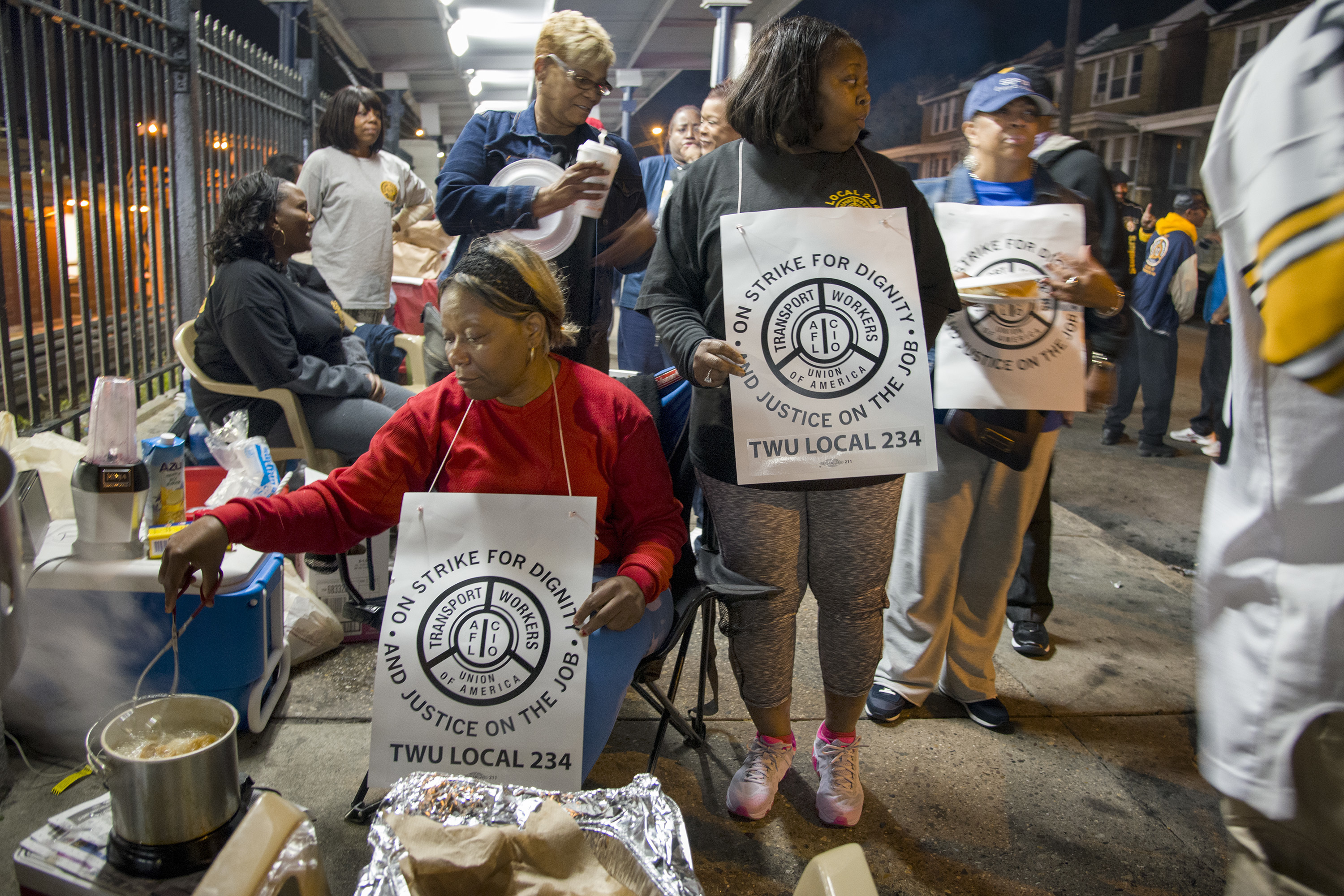
Joyce Woodford (center), a 25-year veteran cashier on SEPTA’s Broad Street Line, serves up fried fish for her fellow striking cashiers outside the Fern Rock Transportation Center during dinnertime on the third day of the SEPTA strike in 2016.
1982: TWU Local 234 (34 days)
About 36 suburban bus drivers and mechanics operating routes primarily in Montgomery County, and some routes in Bucks, won an 8.5% wage increase over three years.
The bus routes were the descendants of the Schuylkill Valley Lines and the Trenton-Philadelphia Coach Lines, which SEPTA acquired in 1976 and 1983, respectively. Service has grown, and the collection of bus routes is known as the Frontier Division today.
1981: TWU Local 234 (19 days) and UTU Local 1594 (46 days)
Transit workers shut down buses, trolleys and subways in the city on March 15, seeking job security in the form of a no-layoff clause, wage increases and a bar on SEPTA hiring part-time workers.
And the Red Arrow division went out for 46 days seeking higher wages and better medical benefits. SEPTA also backed down a demand for permission to hire private contractors for some work on the suburban buses, trolleys, and the Norristown High Speed Line.
1977: TWU Local 234 (44 days)
After a bitter strike, union members who run the city transit division got higher wages and more benefits, after rejecting an arbitrator’s proposed contract that was portrayed in news reports as generous.
A furious Mayor Frank Rizzo told reporters the strike “can last 10 years for all I care.” He said of the union’s rejection of the earlier offer: “It is outrageous, and I hope the people won’t forget it.”
1975: TWU Local 234 (11 days)
Transit workers, concerned about the ravages of inflation, wanted a clause giving them cost-of-living increases and enhancements to health-care benefits. Those were granted after Rizzo agreed to add $7.5 million to the city’s annual SEPTA contribution. Perhaps that’s one reason the mayor was so annoyed two years later.
Staff writer Erica Palan contributed to this article.
Pennsylvania’s new budget has $5 million in supplemental payments for the two Delaware County Hospitals that have seen significant increases in patient volumes since Crozer-Chester Medical Center and Taylor Hospital closed in the spring.
Main Line Health’s Riddle Hospital, near Media, is getting $3 million. The amount for Trinity Health Mid-Atlantic’s Mercy Fitzgerald Hospital, in Darby, is $2 million, according to budget documents.
The $5 million will be doubled by a federal match, said Democratic State Sen. Tim Kearney, who represents part of Delaware County. The $5 million is from a fund used to help hospitals the serve a large number of patients with Medicaid and used to go to Crozer Health, Kearney said Friday.
“Since Crozer’s shutdown in April, Riddle’s Emergency Department has experienced an unprecedented surge — 46% more patients than the same period last year, an increase of nearly 4,000 overall,“ the nonprofit said.
Main Line, which also owns Lankenau Medical Center, Bryn Mawr Hospital, and Paoli Hospital, said it has seen 55,000 patients from the Crozer market — a 15% increase over the same time period last year. That figure includes 8,000 patients who went to a Main Line facility for the first time, the health system said.
Trinity Health did not respond to a request for comment.
Shuttered hospitals in limbo
While Riddle and Mercy Fitzgerald have scrambled to accommodate patients who used to rely on Crozer Health, efforts are underway to bring healthcare services back to at least Taylor Hospital in Ridley.
A group from New Jersey called Chariot Allaire Partners LLC has agreed to pay $10 million for the former Crozer-Chester Medical Center in Upland but has not disclosed its plans. That facility served as a key safety provider for a low-income area of Delaware County.
A partnership of Restorative Health Foundation and Syan Investments won an auction for Springfield Hospital for $3 million, but it does not have support from township officials.
Delaware County legislators also obtained $1 million from the state to buy emergency department equipment if one of the closed hospitals, such as Taylor, reopens, Kearney said.
Editor’s note: This story has been updated with additional detail on the funding.
This suburban content is produced with support from the Leslie Miller and Richard Worley Foundation and The Lenfest Institute for Journalism. Editorial content is created independently of the project donors. Gifts to support The Inquirer’s high-impact journalism can be made at inquirer.com/donate. A list of Lenfest Institute donors can be found at lenfestinstitute.org/supporters.
Democrats swept Delaware County Council elections for the fifth consecutive election, further solidifying their dominance in the former Republican stronghold in the suburbs.
In statements early Wednesday morning, the Democrats thanked their supporters.
“I will continue to work hard and fight for the residents in our County. I look forward to working together with all parties to make Delaware County one of the strongest counties in the Commonwealth,” Womack said in a statement.
With all but one precinct reporting Wednesday, Republican challengers Brian Burke and Liz Piazza each trailed Womack and Phillips by roughly 50,000 votes.
In a statement Wednesday, Frank Agovino, the chair of the Delaware County GOP, said it appeared local issues were a “secondary concern” for Democrats this year.
“The State wide retention initiative was uncharted waters and it feels as though Dem turnout was positively impacted. Additionally, the Unrealistic disdain for the President from the majority of Democrats was also an undeniable factor,” Agovino wrote.
Democrats have held all five seats on the Delaware County Council since 2020, when the party took control of the county for the first time since the Civil War. Democrats flipped the county as part of a national trend of suburbs shifting left, which was accelerated during President Donald Trump’s first term in office. With Tuesday’s results, they will keep their supermajority for the next two years.
In the years since Democrats took control in Delaware County, they say they have worked to enhance county services and repair infrastructure. That has included establishing a health department — Delaware County was the largest county in Pennsylvania without one at the onset of the COVID-19 pandemic — and de-privatizing the county prison following a series of scandals.
Last year, the county increased property taxes 23%, citing the loss of federal pandemic relief dollars and inflation driving up salaries. Republicans made that increase the base of their campaign, telling voters that the Democrats were overspending and that more tax increases were on the way.
Republicans wanted voters to give the GOP a voice on the board, even though the party wouldn’t have the majority, to push back on budgetary decisions and hold the Democrats accountable.
But in the heavily Democratic county, that message was not enough to sway the independent and Democratic voters Republicans needed to win seats. Instead, voters demonstrated continued trust in the current county leadership.
“I truly respect Richard and Joanne as members of Council and hope they will listen to the voices of our residents and help bring to light some of their concerns,” Piazza said in a statement Wednesday.
On Election Day, Donald and Esther Newton, a Chester couple who have been married for more than 55 years, said they believed it was about time their city received more care and investment through property taxes.
“Our infrastructure needs to be fixed, and that takes money,” Esther Newton said.
Democrats swept all countywide races Tuesday.District Attorney Jack Stollsteimer, who was among the first Democrats to win countywide office in Delaware County, won a seat on Delaware County Court. He will have to step down from his current role to take the seat.
Staff writer Nate File contributed to this article.
This suburban content is produced with support from the Leslie Miller and Richard Worley Foundation and The Lenfest Institute for Journalism. Editorial content is created independently of the project donors. Gifts to support The Inquirer’s high-impact journalism can be made at inquirer.com/donate. A list of Lenfest Institute donors can be found at lenfestinstitute.org/supporters.
The transit agency has until Oct. 31 to complete the inspections, which were recommended after the National Transportation Safety Board released a report investigating five fires that occurred on the Silverliner IVs this year.
As of Oct. 9, SEPTA said that crews can handle about six Silverliner IV cars a day, with a goal of ramping up inspections to handle 12 cars a day with five-person crews per car.
Although SEPTA is rotating cars in and out of service for the inspections — instead of yanking all 225 from service at once — riders have experienced significant delays and some trains have been outright canceled. Without a full fleet, SEPTA says it is unable to respond as easily to typical delay-causing events, such as power outages and bad weather.
Riders should check the SEPTA app for real-time updates on how trains are running.
As the deadline approaches and delays persist, The Inquirer is tracking SEPTA’s inspection progress.
Mon., Oct. 27, 2025
95 inspections complete
Days until deadline: 4
Fri., Oct. 24, 2025
88 inspections complete
Days until deadline: 7
Wed., Oct. 22, 2025
78 inspections complete
Days until deadline: 9
Mon., Oct. 20, 2025
66 inspections complete
Days until deadline: 11
Fri., Oct. 17, 2025
58 inspections complete
Days until deadline: 14
story continues after advertisement
Wed., Oct. 15, 2025
46 inspections complete
Days until deadline: 16
Thurs., Oct. 9, 2025
12 inspections completed
Days until deadline: 22
Mon., Oct. 6, 2025
Inspections begin
Cars began undergoing inspections in SEPTA’s four regional maintenance facilities.
Greg Buzby, manager of Regional Rail vehicle engineering, shows some of the work being done for the safety inspections at the SEPTA Overbrook Maintenance Facility.Tyger Williams / Staff Photographer
“We’re looking for any signs of overheating or damage to any of the circuits, physical damage, making sure the bolted connections are tight,” said Greg Buzby, manager of Regional Rail engineering. “There’s also electrical testing that we have to do to make sure the insulation has its integrity.”
Inspections remaining: 225
Days until deadline: 25
Wed., Oct. 1, 2025
NTSB releases report
Noting that the Silverliner IV cars’ “outdated design … represents an immediate and unacceptable safety risk,” the National Transportation Safety Board urged SEPTA to sideline all the Silverliner cars immediately and to retrofit or replace them as soon as possible. The Silverliner IVs went into service between 1974 and 1976, with technology that was designed even before that time.
The NTSB’s findings are advisory.
More than 300 passengers were safely evacuated after a SEPTA Regional Rail train caught fire in February in Delaware County.Charles Fox / Staff Photographer
The Federal Railroad Administration, which regulates freight and passenger railroads, ordered SEPTA to undertake the inspections, concluding “that SEPTA’s maintenance and operation of its passenger rail equipment requires additional oversight and corrective action.”
Inspections remaining: 225
Days until deadline: 30
story continues after advertisement
Talk to our transportation team.
Do you have questions about what’s happening on Regional Rail? Ask here or share how your rides on Regional Rail have been impacted in October.
Staff Contributors
Reporting: Thomas Fitzgerald and Erica Palan
Graphics: John Duchneskie
Editing: Lizzy McLellan Ravitch
Digital Editing: Erica Palan
Subscribe to The Philadelphia Inquirer
Our reporting is directly supported by reader subscriptions. If you want more journalism like this story, please subscribe today
For five glorious Sundays this summer, there was peace in Chester.
In places like the William Penn Homes and Chester Apartments, where children are often encouraged to stay indoors, shut away from the threat of gang violence, it was finally safe to play outside during the height of what is normally the most dangerous time of the year.
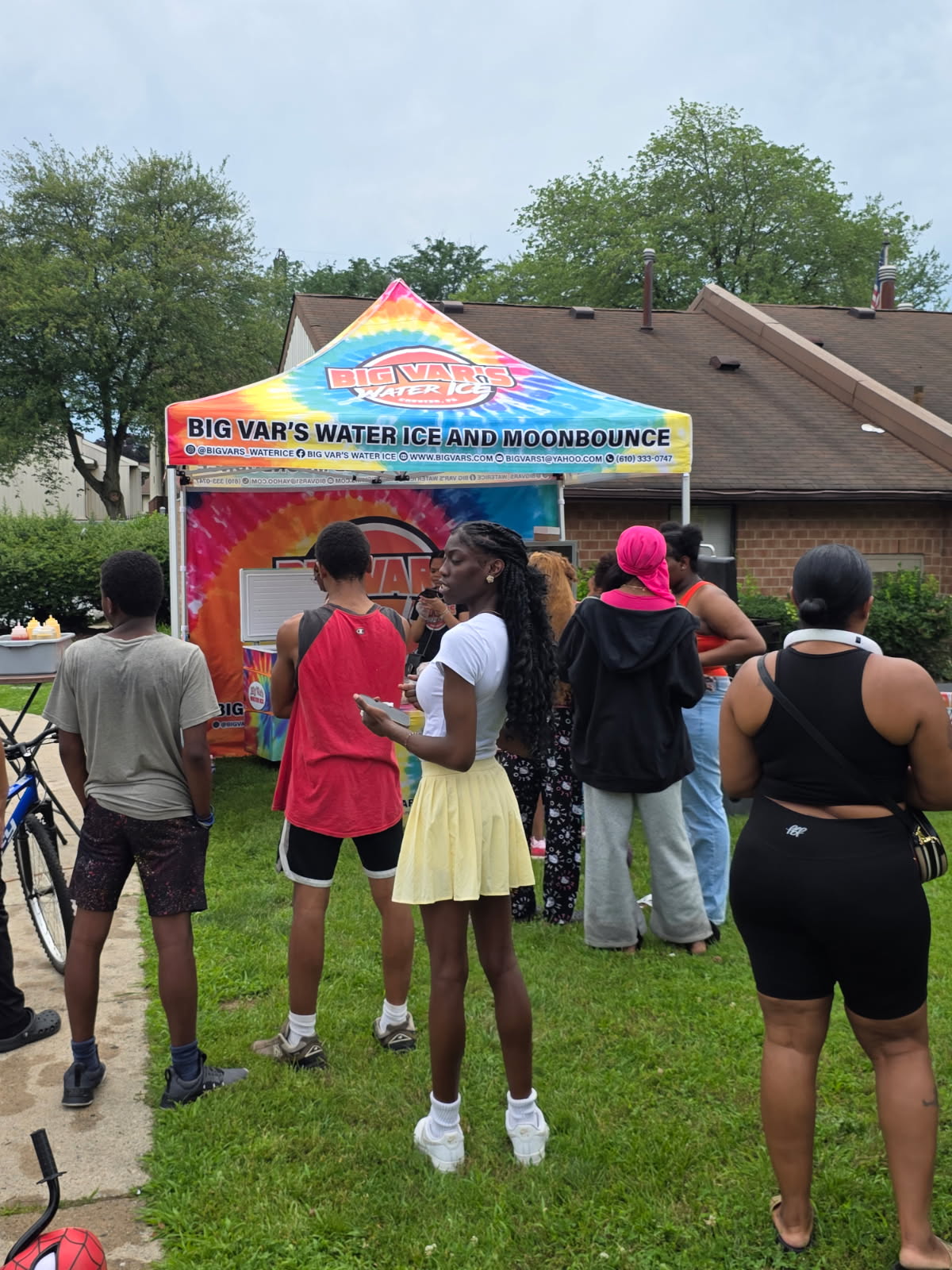
Roving carnivals nicknamed “Sunday Fun Days” were organized and held in Delaware County’s lone city, in areas that had weathered a surge in violence in recent years. A few bounce houses, some water ice, and communities breathing sighs of relief were rewards for keeping the peace, and motivation to continue that trend.
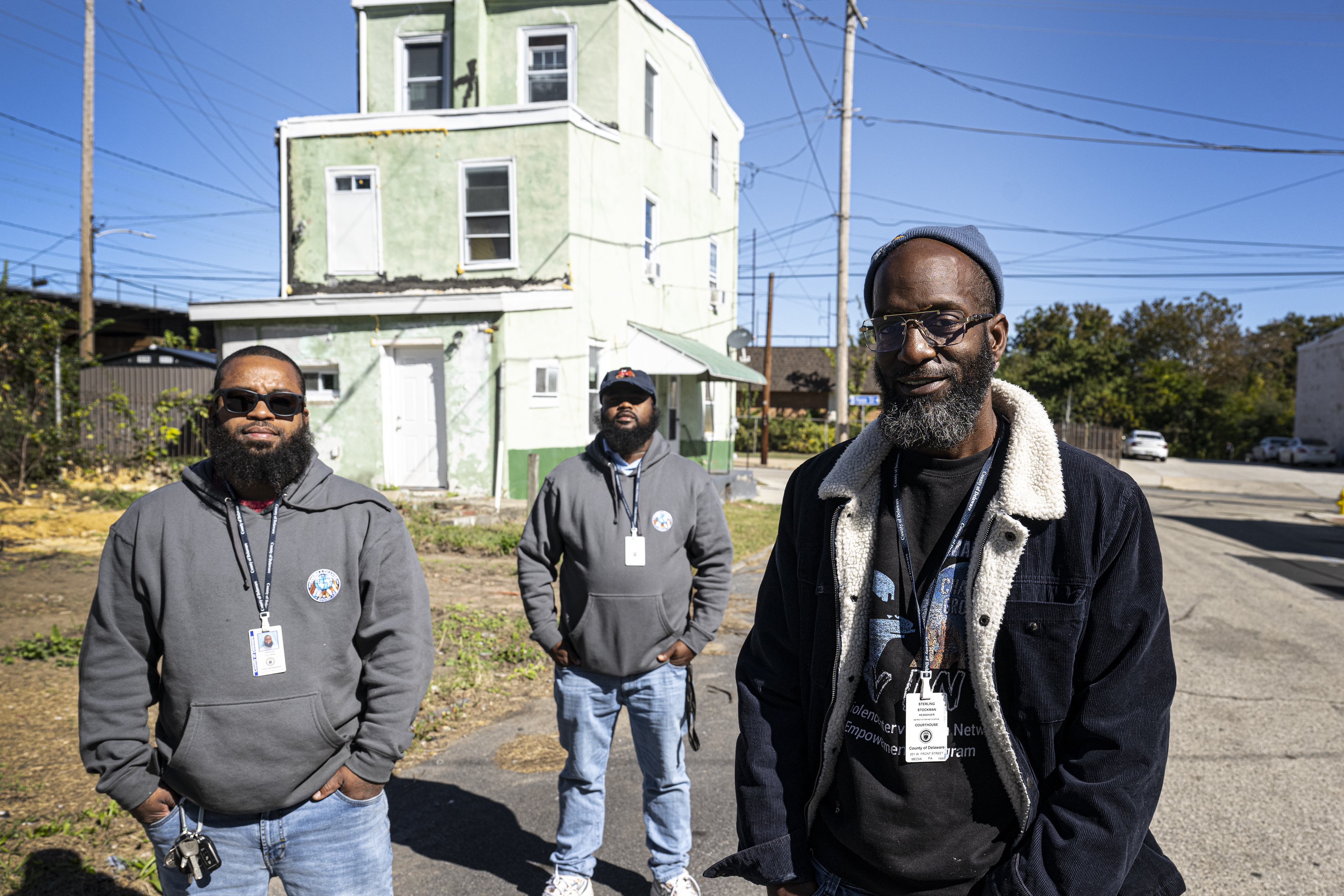
The parties, according to Geo Stockman, the lead gun violence interventionist with Making a Change Group, came during one of the safest summers on record in the city: Not a single fatal gunshot was fired in Chester during that time.
It was a result that local police and county prosecutors say they have been working toward these last few years, through a combination of advocacy work and interventions by groups like Stockman’s.
“This opened up the neighborhoods. It gave them a reason to say, ‘Let’s try something else, people are really looking out for us now, maybe we should put this down,’” Stockman said. “People are always telling people to stop doing something without offering them something in this place. So that’s what we did this summer. We offered them something in its place.”
Gregory Cottman left, Gregory Graves, center, and Geo Stockman say the Sunday Fun Day block parties sponsored by the Delaware County District Attorney’s Office served as both a reward for neighborhoods that have curbed gun violence, and an incentive to continue that trend in the years to come.
In its five years of operation, CPSN has seen a 65% reduction in shootings overall and a 74% reduction in fatal shootings. And since the summer, only two fatal shootings have been recorded in Chester, which prosecutors say still puts the city on pace for one of its most peaceful years on record.
“Violence comes from a place of, of hopelessness, of despair. Just anger, resentment, and feeling like you’ve been left behind, like nobody cares,” Stockman said.
window.addEventListener(“message”,function(a){if(void 0!==a.data[“datawrapper-height”]){var e=document.querySelectorAll(“iframe”);for(var t in a.data[“datawrapper-height”])for(var r,i=0;r=e[i];i++)if(r.contentWindow===a.source){var d=a.data[“datawrapper-height”][t]+”px”;r.style.height=d}}});
He spoke from experience, as a lifelong Chester resident who spent time in prison for mistakes made on the streets of his hometown.
“That’s what makes what we do so effective. Most of us want to be stopped, but nobody stops us,” he said. “Nobody takes the time to say, ‘I’m gonna be the one to calm you down.’ It really only takes somebody with a clear mind that they understand to say, ‘Nah, that ain’t it.’”
Stockman said he and his team have successfully mediated 130 disputes between rival neighborhoods in the last two years. They settled petty arguments, usually started on social media, that were clearly heading toward a violent conclusion.
“This is a small community, so your reputation goes further than just the neighborhood you’re from,” said Gregory “G-Code” Graves, who works with Stockman.
Graves said the anti-violence messaging works because it’s coming from people the intended audience can identify with.
“We’ve been through the vetting process in all these neighborhoods, so even if it’s a little hesitation at first, it doesn’t take a great deal of persuasion to get them to come to us,” Graves said. “And we come in with meaningful things that’s going to help the situation.”
Residents of the Chester Apartments line up for water ice at a “Sunday Fun Day” block party held this summer in Chester.
For District Attorney Jack Stollsteimer, those results are exactly what he envisioned when he brought CPSN to the county five years ago, building it on models used successfully in other cities, including Boston.
And he is confident that the program will continue to thrive without him, as he runs for a county judgeship in the Nov. 4 election.
“People have bought into the strategy. They’ve seen it work now, and they just wanna keep it going,” he said.
Stollsteimer said making Chester safe was one of his priorities when running for district attorney in 2019. Similar programs, he said, had failed before because of a lack of buy-in from officials.
This time was different — Mayor Stefan Roots became a fixture at the Sunday Fun Day parties.
Roots said the weekly parties presented a rare opportunity for residents to meet the people making decisions that affect their everyday lives. And, in turn, allowed him and other officials to have open, honest dialogue with people living in communities most affected by gun violence.
The conversation flowed naturally, he said. No pressure. No pretense.
“This is something that’s never, never happened before,” he said. “The relationship between the city and the county is really welcome. And the results are showing themselves.”
Roots said he lost count of how many residents came up to him at the parties to talk about their own efforts to curb violence in their neighborhoods. People, he said, who told him that the block parties, and the gun violence interventions that preceded them, were a welcome sigh of relief.
“They told me that, sometimes, they don’t want to be ‘the man with the cape.’ They want to go on and have a life, too,” Roots said.
Democrats have dominated Delaware County government since the 2019 election.
As suburban communities across the nation flipped from red to blue, Democrats took control of the county council for the first time since the Civil War — the result of long-term shifts accelerated by President Donald Trump’s first administration. The party has held all five seats on the governing board ever since, easily retaining seats in 2021 and 2023.
Two seats on the five-member board are on the ballot in November. Democrats argue tax increases were necessary to make up for decades of underinvestment by Republicans.
But Republicans insist spending is out of control. While they cannot take control of the board this year, they are asking voters to give them a voice to push back against the Democrats.
“The money tree in the backyard does not exist,” said Brian Burke, one of two Republicans running for council.
Burke, a union steamfitter, was first elected to Upper Darby’s township council in 2019 as a Democrat. He became a Republican to unsuccessfully run for mayor of the township in 2023 following years of feuds with the Democratic administration. While on the township council, Burke worked in conjunction with Republicans on the board as well as two other Democrats to challenge Democratic leadership in Upper Darby. He said this experience would aid him as he worked to hold Democratic leadership in Delaware County accountable.
Piazza worked for decades in Delaware County Court’s domestic relations department, where she ran the warrant division and served as a liaison for judges and attorneys. Running for council, Piazza has been vocal about wanting to devote opioid settlement funds toward grandparents caring for the children of those struggling with addiction.
Womack was first elected to the council in 2021 after spending 10 years on the Darby Township Board of Commissioners. Womack spent years as an advocate in the labor movement, including serving as an adviser on community and religious affairs for the national AFL-CIO.
Burke and Piazza are urging voters to elect them to “stop the spend.”
After the council raised property taxes by 23% last year, the pair of Republicans argued the taxes were a result of out-of-control spending in the county. They say there needs to be a voice on the council acting as a check on spending.
“There’s a lot that needs to be cut. There’s a lot of spending,” Piazza said.
If elected, the two Republicans would not have control over county spending, but they would have votes on the five-member board to oppose new spending and work to sway their Democratic counterparts.
What is the Democratic platform?
Womack and Phillips are largely defending the actions of the Democratic council over the last five years. Republican leadership, they argue, did not raise taxes for 12 years and allowed county infrastructure to fall into disrepair. As a result, they say, Democrats had to increase taxes to fund county services and infrastructure improvements.
No one wanted to increase taxes, Womack said, but it was unavoidable.
“Our county has really been underserved for many decades,” Womack said. “In the long run, it costs you a lot more money to repair than if you had taken care of things gradually.”
If elected, Phillips says she would like to do more public vetting of contracts and work to increase development in Delaware County so that the local tax base can be increased without more tax hikes. Womack has said he wants to work on expanding affordable housing options in the county.
Why were taxes raised? Will there be another hike?
The county council voted last year to increase property taxes by 23%, which comes out to roughly $185 annually for the owner of a home assessed at the county average. The county had used pandemic relief funds to stave off significant tax increases in prior years, but those funds were running dry and additional dollars were needed to cover employee salaries amid inflation, council members said at the time.
Piazza and Burke insist that another double-digit tax increase is on the way. Too much of the current budget, they argue, still depends on short-term federal pandemic relief funds or transfers from other county funds.
“They’re going to come out after November 4th election and basically tell the residents of Delaware County, ‘You’ve got another 20% increase,’” Burke said.
Womack, the sole member of the county council who voted against the increase, said that he anticipated another tax hike but that he could not imagine it would reach 20%.
The incumbent spearheaded a citizens budget task force that has spent the year seeking areas to cut spending.
“It’s kind of hard to really project what we’re looking at right now,” Womack said. He noted that, amid a federal government shutdown, details on state and federal aid are unclear.
However, the county is not expecting to release its preliminary budget until mid-November, after the election. Last year, the county did not release its proposed budget until Dec. 3.
Where do Republicans want to cut?
Republicans have identified three primary areas they argue represent overspending: the county health department, the prison, and outside legal assistance.
Republicans in the county have long argued it was an unnecessary expense. Though the $18 million department is currently funded entirely by state and federal grant dollars, Burke argued it will eventually cost taxpayers.
“In my eyes, that [money] could have been used somewhere else,” Burke said.
In 2020, the council voted to explore options to retake control of the county prison from the private firm that had run it. Phillips, who was controller at the time, argued the decision was in the county’s best interest and has better served inmates and staff.
But Republicans argued that the county’s costs have gone up too much and that the county opened itself up to litigation that it would not have been vulnerable to if the prison had remained privately run. The union representing prison employees often clashed with the first warden the county chose to lead the prison.
In an interview, Burke argued the county could find significant savings if it put the prison back in private hands. In 2025, the prison cost the county over $59 million. The county’s last contract with GEO, which managed the prison privately, paid the company $259 million over five years.
Phillips said the health department and public prison, while significant expenses, will save the county and its residents in the long run. Even when the prison was run privately, she said, infrastructure repairs were on the county and the private operators sought to maximize the number of inmates in the building.
“Government should take care of its people,” Phillips said.
Finally, Republicans point to the ballooning cost of legal counsel to the county. Last year, the county paid more than $4.4 million to outside legal counsel, including a firm that once employed Phillips and County Councilwoman Christine Reuther. Republicans argue this represents misuse of funds and political cronyism.
Phillips and Womack instead point to the county’s small in-house legal team and the growing number of cases brought against the county, including defending against frivolous suits filed by election deniers, as well as managing complex legal issues, such as the Prospect Medical Holdings bankruptcy filing that closed two major hospitals in the county.
Even if they won both seats, Republicans would hold the minority on the council for at least the next two years. This means they would have to persuade Democrats to come along with them on any policy changes or budget cuts.
“I would love to win the seat and get in there and get into the nitty-gritty and kind of see what goes on behind closed doors and have a voice for the residents and be there for them,” Piazza said.
This suburban content is produced with support from the Leslie Miller and Richard Worley Foundation and The Lenfest Institute for Journalism. Editorial content is created independently of the project donors. Gifts to support The Inquirer’s high-impact journalism can be made at inquirer.com/donate. A list of Lenfest Institute donors can be found at lenfestinstitute.org/supporters.
The sense of loss that has permeated 2025 struck again this weekend when we learned of the sudden death of a Philly journalism legend, Michael Days, who guided the Philadelphia Daily News during most of its last dozen freewheeling and Pulitzer-winning years before we merged with The Inquirer in 2017. He was just 72, far too young. The top-line of Mike’s obituary was how, as the first African American to lead a newsroom in America’s founding city, he paid it forward by mentoring the next generation of rising Black journalists. But people like me who worked for him remember him more simply as the wisest and mostempathetic human being we ever had as a boss. He leaves right when the nation’s newsrooms need decent souls like Mike Days more than they ever did.
What a $10M bribe rumor says about Trump, Middle East peace, and America’s fall
President Donald Trump talks with Egypt’s President Abdel-Fattah el-Sissi during a summit to support ending the more than two-year Israel-Hamas war in Gaza after a breakthrough ceasefire deal, Oct. 13 in Sharm El Sheikh, Egypt.
The thing about being a 79-year-old president is that sometimes you just blurt stuff out, with no filter as to whether your words might be embarrassing, undiplomatic — or potentially incriminating.
Consider the case of Donald John Trump, the 47th U.S. president and the oldest one on the day of his election. Last week, in what may prove to be a fleeting moment of triumph as Trump celebrated a Gaza peace deal that included the release of 20 Israeli hostages, POTUS arrived at an Egyptian resort town for a Middle East summit. He kicked off the day with a one-on-one sit-down with Egypt’s strongman ruler, Abdel-Fattah el-Sissi.
“There was a reason we chose Egypt [for the summit] because you were very helpful,” Trump said as a gaggle of reporters and photojournalists entered their meeting room.
Really? Helpful in what way?
“I want to thank you,” the American president told Sissi, who seized power in a 2013 coup. “He’s been my friend right from the beginning during the campaign against Crooked Hillary Clinton. Have you heard of her?”
Here Trump was pushing, ever so absurdly, for the Nobel Peace Prize, and then he had to spoil it all by saying somethin’ stupid like, you bribed me. Well, he almost spoiled it, if more journalists — aside from MSNBC’s brilliant Rachel Maddow, who seized on the remark hours later — had grasped the potential import of this presidential prattle.
It’s certainly legal, if gross, for Trump to be close pals with Sissi, even if Human Rights Watch reports that the Egyptian dictator is “continuing wholesale repression, systematically detaining and punishing peaceful critics and activists and effectively criminalizing peaceful dissent.” What would not be legal is the Middle Eastern nation interfering in the 2016 election, in which Trump narrowly defeated Clinton in the handful of swing states that tipped the Electoral College.
What made Trump’s comments last week so jaw-dropping is that U.S. federal investigators worked for several years trying to prove exactly that scenario. In August 2024, days after Trump was nominated by the GOP for his second reelection bid, the Washington Post reported that the Justice Department investigated a tip that Sissi’s Egypt provided Trump with $10 million the candidate desperately needed in the 2016 homestretch to defeat Clinton. That happened right before Trump, as 45th president, reopened the spigot of foreign aid that had been halted because of Sissi’s human rights abuses.
It’s known that Trump did put $10 million into the campaign, which he listed as a loan. The Post in 2024 offered a tantalizing, if circumstantial, piece of evidence — that the Cairo bank had received a note from an agency believed to be Egyptian intelligence to “kindly withdraw” nearly $10 million in two, 100-pound bags full of U.S. $100 bills, five days before Trump took the oath of office.
But the investigative trail ran cold. In 2019, then-special counsel Robert Mueller turned the matter over to Trump’s appointees in the Justice Department, who of course didn’t pursue the president’s bank records. Neither — inexplicably — did Joe Biden’s attorney general, Merrick Garland, as the statute of limitations expired in January 2022. That’s where things stood last week before Trump started blathering in Sharm El Sheikh.
One reason I’m writing about this is the sheer frustration that Trump — yes, allegedly, possibly — might have gotten away with bribery to the point where he’s almost bragging about it in public. But I also think the mysterious case of the Egyptian bags of cash speaks to the present, dire American moment in a couple of ways.
For one thing, it casts a light on what’s really behind what Trump hopes will be viewed as the signature achievement of his second presidency. That would be the fragile peace deal that aims to end the last two years of bloodshed in Gaza that started with the Hamas terror attack of Oct. 7, 2023 and has resulted in at least 67,000 dead Palestinians and the utter destruction of their seaside homeland.
How did Trump get a deal that had eluded his predecessor Biden, in a region that has vexed every American president from both parties? It certainly helped that most of the power brokers with the clout and the cash to help end the fighting in Gaza are repressive strongmen — or, as Trump might call them, role models. And they all seem to speak the same language of corrupt back-scratching.
If those bags with $10 million in greenbacks did make their way to Trump in 2017, it looks like small change in today’s cross-Atlantic wheeling-and-dealing. After all, a key go-between in the negotiations — Qatar, which has good relations with Hamas and has hosted its exiled leaders — gifted America a $400 million jet that Trump plans to use not just as Air Force One but in his post presidency, while his regime has promised to protect the Qatari dictators if they are ever attacked.
Another key supporter of the plan is the United Arab Emirates, which also backs the UAE firm that recently purchased a whopping $2 billion in cryptocurrency from a firm owned by Trump’s family as well as the family of Steve Witkoff, the regime’s lead Middle East negotiator. At the same time, Trump’s U.S. government allowed UAE to import highly sensitive microchips used in artificial intelligence.
Witkoff’s negotiation end–game brought in Trump’s son-in-law, Jared Kushner, who forged close ties during his father-in-law’s first term with Saudi Arabia’s murderous de facto ruler Prince Mohammed bin Salman, who pulled the levers for a $2 billion investment in a hedge fund created by Kushner despite no prior expertise.
Those Saudi ties could prove critical to future stability in the region, and in a joint interview with CBS’ 60 Minutes Sunday night, Kushner and Witkoff made no apologies for mixing billion-dollar deals with the pursuit of world peace. “What people call conflicts of interest,” Kushner said, “Steve and I call experience and trusted relationships.”
OK, but those “trusted relationships” are built on a flimsy mountain of cash that could collapse at any minute. Look, I’m thrilled like everyone else that 20 Israeli hostages are finally reunited with their loved ones, and to the extent Trump and his regime deserve any credit, I credit them. But the art of the deal that the president is bragging about is all about the Benjamins — more worthy of applause on the floor of the New York Stock Exchange than a Nobel Peace Prize.
Real peace is based on hard work and trust, not Bitcoin — so is it any wonder that the ceasefire is already collapsing with two dead Israeli soldiers and fresh, lethal airstrikes in Gaza? The only thing with any currency among a rogues’ gallery of world dictators is currency, and that transactional stench has fouled everything from Cairo to K Street.
Is it any surprise that a regime whose origin story allegedly includes bags of Egyptian cash would do absolutely nothing when it was told that its future border czar, Tom Homan, was captured on an audiotape accepting $50,000 in a fast-food bag from undercover FBI agents who said they wanted government contracts?
In hindsight, the failure to pursue that report of the $10 million Egyptian bribe opened up a floodgate of putrid corruption, wider than the Nile. It signaled a sick society where everything is for sale — even world peace — but nothing is guaranteed.
Yo, do this!
The 1970s and ‘80s are having a cultural moment right now, and this boomer is here for it! On Apple TV (they’ve dropped the “+,” probably after paying some consultant $1 million for that pearl of wisdom) comes the long-awaited five part docuseries about the life and times of filmmaker Martin Scorsese, the savior who rose from NYC’s mean streets to give us Goodfellas, Raging Bull, Taxi Driver, and so much more. Watching Mr. Scorsese is going to make the eventual death of the baseball season so much easier to take.
The earthy, urban musical equivalent of Scorsese would have to be Bruce Springsteen, who has been marking the 50th anniversary of his breakthrough Born to Run LP with all kinds of cool stuff, capped with Friday’s long-awaited release of the first-ever biopic about “The Boss,” Deliver Me from Nowhere. Staring The Bear’s Jeremy Allen White as Springsteen, the film’s unlikely narrative — focusing on the making of 1982’s highly personal and acoustic Nebraska as the rock star seeks release from a bout of depression — sounds like exactly the uplift that America needs right now.
Ask me anything
Question: As someone living in Ireland and looking across the ocean. Trump won’t be in power forever, but how is anyone going to deal with the MAGA crowd that helped elect him? That level of stupidity, hatred and racism cannot be fixed. How is [t]he USA ever going to heal? — Stephen (@bannside@bsky.social) via Bluesky
Answer: That’s a great question, Stephen, and like most great questions there’s no easy answer. Although I’m optimistic that the 2026 midterms and the 2028 presidential election will happen and that the anti-Trump coalition that we witnessed at “No Kings” will prevail, I agree with you that it’s only a partial and temporary fix. I’d fear an Iraq-level resistance could rise up in the regions we call “Trump country.” My long-term solution would be along the lines of what I proposed in my 2022 bookAfter the Ivory Tower Falls: Fix higher education — broadly defined as from the Ivy League to good trade schools — to made it a public good that reduces inequality instead of driving it. And promote a universal gap year of national service for 18-year-olds, to get young people out of their isolated silos. There are ways to prevent the next generation from becoming as stupid or hateful or racist as the Americans who came before them, but it will take time and patience that we seem to lack right now.
What you’re saying about…
Remember the Philadelphia Phillies? When I last saw you here two weeks ago, their annual postseason collapse and the fate of manager Rob Thomson was a hot topic. As expected, there was minimal response from you political junkies, and opinions were split — even before the team defied the conventional wisdom and announced he’ll be returning in 2026. Thomson’s supporters were more likely to blame the Phillies’ inconsistent sluggers, with John Braun asking “who could you hire who could guarantee clutch hits?” Personally, I’m with Kim Root: “I follow the Philly Union, who just won the Supporters Shield — that is all.”
📮 This week’s question: Back to the issue at hand: I’m curious if newsletter readers attended the “No Kings” protest last Saturday, and what you see as the future of the anti-Trump movement. Are more aggressive measures like a nationwide general strike needed, or is the continued visibility of nonviolent resisters enough? Please email me your answer and put the exact phrase “No Kings future” in the subject line.
Backstory on who the “No Kings” protesters really were
Demonstrators gather for a ’No Kings’ rally in Philadelphia on Saturday.
They clogged city plazas and small-town main streets from San Diego to Bangor on Saturday, yet the more than 7 million Americans who took part in the massive “No Kings” protest — the second-largest one day demonstration in U.S. history, behind only the first Earth Day in 1970 — seemed to mystify much of the befuddled mainstream media. Just who were these people protesting the Donald Trump presidency, and why are they here?
Instead of a journalist, it took a sociologist to get some answers. Dana Fisher — the Philadelphia-area native who teaches at American University and is the leading expert on contemporary protest movements — was out in the field Saturday at the large “No Kings” march in Washington, D.C., collecting data with a team of researchers. She’s shared her early top-line results with me, aiming to both give a demographic and ideological snapshot and also compare Saturday’s crowd with her findings at other recent rallies.
If you were among the 7 million on Saturday, some of this data won’t surprise you. The protesters were, on the whole, older than the average American, with a median age of 44 (compared to 38 for the nation as a whole.) Once again, the “No Kings” participants were overwhelmingly white (87%) with women (57%) in the majority. But it’s also worth noting that men (39%) were more likely to take part than earlier protests tracked by Fisher, and the 8% who identified as Latino is double the rate of Hispanic participation in the 2017 Women’s March.
That last finding may reflect the passions of the “No Kings” protesters, who listed immigration as a key motivation at a rate of 74%, second only to their general opposition to Trump (80%, kind of a no brainer). That certainly jibed with the demonstrators at the rally I attended in suburban Havertown, who again and again mentioned the sight of masked federal agents grabbing migrants off the street as what compelled them to come out.
Fisher’s most telling findings may have been these: The people out in the streets are mad about what they see happening to America, with 80% listing “anger” as an emotion they are feeling, trailed closely by “anxiety” at 76%. Yet few of those who spoke with her team believed that will translate into violence. The number of demonstrators who agreed with the statement that “because things have gotten so off track, Americans may have to resort to violence in order to save our country” was only 23% — lower than other protests her team has surveyed. It seems like the larger the public show of resistance to Trump’s authoritarianism, the more optimism that the path back to democracy can be nonviolent.
What I wrote on this date in 2021
I hate to say I told you so but… On this date four years ago, Joe Biden was still clinging to dreams of a presidential honeymoon after ousting Donald Trump in the 2020 election, but there were dark clouds on the horizon. On Oct. 21, 2021 I warned that sluggish action on key issues was starting to hurt his standing with under-30 voters. I wrote that “while the clock hasn’t fully run out on federal action around issues like student debt or a bolder approach on climate — the disillusionment of increasingly jaded young voters could change the course of American history for the next generation, or even beyond.” How’d that turn out? Read the rest: “From college to climate, Democrats are sealing their doom by selling out young voters.”
Recommended Inquirer reading
I returned from a much-needed staycation this weekend by leaving the sofa and spending a glorious fall morning at the boisterous “No Kings” protest closest to home in Delaware County, which lined a busy street in Havertown. I wrote about how the protests are winning back America by getting under the skin of Donald Trump and the GOP, who can no longer pretend to ignore the widespread unpopularity of their authoritarian project.
Every election matters, even the ones that are dismissed as “off-year” contests. In today’s heated and divisive climate, even what used to be a fairly routine affair — the retention of sitting judges on the state and local level — has taken on greater importance. Here in Pennsylvania, the state’s richest billionaire, Jeff Yass, is spending a sliver of his vast wealth to convince voters to end the tenure of three Democrats on the state Supreme Court. The Inquirer’s Editorial Board is here to explain why that’s a very bad idea. On the other hand, some judges up for retention in the city of Philadelphia — where jurists haven’t always lived up to the promise of America’s cradle of democracy — deserve closer scrutiny. The newsroom’s Samantha Melamed revealed a leaked, secret survey detailing what Philadelphia attorneys think of some of the judges on the November ballot, and it is not pretty. The bottom line is that you need to vote this year, and subscribing to The Inquirer is the best way to stay informed. Sign up today!
By submitting your written, visual, and/or audio contributions, you agree to The Inquirer‘s Terms of Use, including the grant of rights in Section 10.
The Rose Tree Media School District is moving forward with plans to build a kindergarten and first-grade school in Middletown Township, marking its second attempt in recent years to build a new school amid rising enrollment and shrinking classroom space.
The district says the school will be necessary to accommodate increasing student numbers and will finally allow the Delaware County community to offer full-day kindergarten. Yet an uphill battle remains before crews can break ground, as the district must receive approvals from Middletown Township’s council, which has signaled apprehension over traffic and development in the growing municipality.
Why is the district planning to build a new school?
The Rose Tree Media School District plans to build a new elementary school for kindergarten and first-grade students, known as the K-1 Early Learning Center, on district-owned land behind Penncrest High School.
Put simply, “We are overcrowded at the elementary level,” said Rose Tree Media School District Superintendent Joe Meloche.
The school district estimates that more than 600 new homes have been built within its bounds in the last six years, including major developments like Pond’s Edge and the Franklin Mint site. The school district serves Media Borough and Edgmont, Middletown, and Upper Providence Townships. Between 2020 and 2024, Middletown saw a nearly 6% growth rate, due in large part to the new developments. The district projects it will grow by around 300 students in the next 10 years.
!function(){“use strict”;window.addEventListener(“message”,function(a){if(void 0!==a.data[“datawrapper-height”]){var e=document.querySelectorAll(“iframe”);for(var t in a.data[“datawrapper-height”])for(var r,i=0;r=e[i];i++)if(r.contentWindow===a.source){var d=a.data[“datawrapper-height”][t]+”px”;r.style.height=d}}})}();
This growth has forced the district to adopt space-saving measures. At Glenwood Elementary School, two modular classrooms were installed in 2023. The school got two more modular classrooms in 2024, then two more in 2025. There are now 10 modular classrooms being used across the district.
While Rose Tree Media can temporarily expand its classroom space, it can’t expand gyms, cafeterias, auditoriums, nurse’s offices, and other communal spaces. Beyond that, Meloche said, older school buildings aren’t designed to accommodate a modern school day, which includes far more individualized services, breakout groups, and collaborative work than it used to.
What will the new school look like?
Rose Tree Media is working with the Schrader Group, an architecture firm that has designed schools throughout the Philly region, including a K-1 school in Phoenixville.
Having Rose Tree Media’s youngest learners in one building will allow the district to add some “nuanced things” to the school’s design, Meloche said. Small water fountains, tiny sinks, and low-to-the-ground chairs come to mind. The K-1 Center will also place all of the district’s kindergarten and first-grade teachers in one place, making professional development and sharing of resources easier, Meloche said.
The project is currently estimated to cost $84 million. The district says it plans to sell bonds to build the school.
Though suggestions have floated around that Rose Tree Media remodel an old school, rather than build something new, district officials say it’s unrealistic. According to the district, purchasing and repurposing an old building “would be costly and would not meet the needs of young children” as it would lack accessibility features, safe play areas, and elements designed specifically for early learners.
What will this mean for full-day kindergarten?
Rose Tree Media is one of many districts in the Philadelphia region that have historically not offered full-day kindergarten.
Citing families’ needs for childcare and the developmental benefits of full-day schooling, many districts in the region have begun implementing full-day programs. The Penn-Delco School District implemented full-day kindergarten in 2023. Lower Merion switched from half-day to full-day last school year. New Jersey Gov. Phil Murphy signed a law ending half-day kindergarten across the state earlier this summer.
Meloche said bringing full-day kindergarten to Rose Tree Media has been on the table since he came to the district from Cherry Hill in 2023. Full-day kindergarten, Meloche said, will allow the district to “provide a much more substantial foundation for our children.” Under the half-day model, learning is crammed into a shorter period, he said, leaving little time for developmentally important activities like free play, outdoor activities, and specials like art, music, and physical education. Rose Tree Media’s existing elementary schools could not accommodate full-day kindergarten, according to the district.
What happened to the district’s previous proposal in Edgmont Township?
Rose Tree Media evaluated 23 potential sites for a new school before landing on a piece of land in Edgmont Township. That plan fell apart after the township denied the school district’s application in 2023, prompting the district to sue. The school district withdrew its legal challenge last spring and pivoted to the K-1 Center proposal.
Meloche said the district is in the process of selling the 37-acre Edgmont Township property on Route 352. The school district is finalizing the appraisal and has a buyer. They hope to finalize the process, including receiving court approval to sell, by the end of the year.
What will the approval process with Middletown Township look like?
Though the district already owns the property behind Penncrest High School, it is required to go through a planning and development process with local and state governing bodies, which can take several months.
The township has asked the district to undergo an expanded traffic study, which will include evaluations of the intersections of Middletown and Oriole Roads, Rose Tree Road and Hunting Hills Lane, and three access points to Penncrest High School on Barren Road. Once the district completes its expanded traffic study, it will submit a preliminary land development plan to the township. That will kick off a series of public hearings.
The district plans to hold an Act 34 hearing in January, a public meeting required by Pennsylvania law that gives residents and employees an opportunity to weigh in on the project.
During public meetings this fall, some residents urged the Middletown Township Council to deny the school district’s proposal, referencing traffic concerns and the desire to preserve green space. Others implored them to approve the school, citing a need to accommodate residents of new apartments and offer full-day kindergarten to working parents.
Council members noted that the school district will have the opportunity to address community concerns before an official plan is brought to the council.
Councilmember David Bialek said at a Sept. 17 meeting that the district has implied to the public that the K-1 Center is “a done deal” and “rubber-stamped,” when a preliminary plan has not yet been submitted.
In an emailed statement, Meloche said, “We have stated multiple times publicly that we have identified the K-1 Center’s location and purpose, and are now in the approval phase, which includes a rigorous process of approvals from Middletown Township, Delaware County, DEP and PennDot. We have been clear that the land development process must be completed prior to obtaining a building permit. The discussion at our Board meetings, the information on the Time to Bloom web page, and our monthly Time to Bloom email updates have laid out the land development process in detail.”
A rendering of the Rose Tree Media School District’s proposed K-1 center, which the district hopes to build behind Penncrest High School.
Township council chair Bibianna Dussling saidat an Oct. 1 meeting that the “details are going to be key” as the council considers the K-1 Center plans.
“It’s complicated because you can see the pros and cons,” Dussling said. “There’s a lot of concerns as far as the location, traffic, the neighbors, the neighborhood in very close proximity to it, the roadways there that are already busy.”
The district has said its professionals are working on creating an “optimal traffic flow,” which may include adding an additional parking lot for athletic fields and routing K-1 Center bus access around the back of Penncrest High School.
“We believe that we are all on the same side and on the same team,” Meloche said, adding that the goal is “to meet the needs of our community at-large, and to do so in a fiscally responsible but forward-thinking and future-looking way.”
The district says the new school will open in time for the 2028-29 school year. If the application is denied, a spokesperson from the district said they do not have an alternative plan for the K-1 Center.
This suburban content is produced with support from the Leslie Miller and Richard Worley Foundation and The Lenfest Institute for Journalism. Editorial content is created independently of the project donors. Gifts to support The Inquirer’s high-impact journalism can be made at inquirer.com/donate. A list of Lenfest Institute donors can be found at lenfestinstitute.org/supporters.