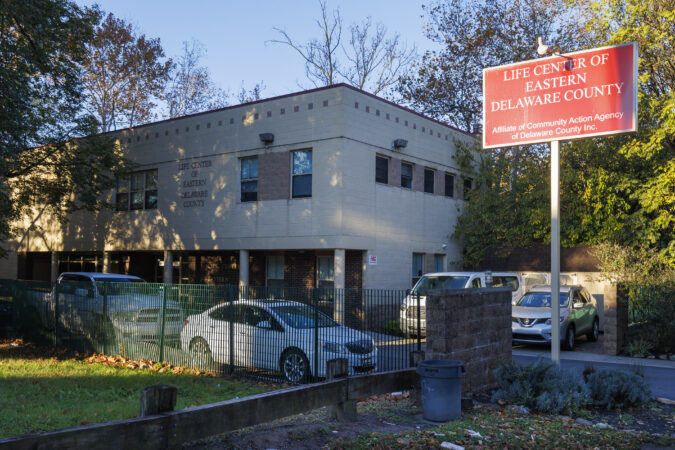
For the first time in months, the director of the Community Action Agency of Delaware County, which operates three homeless shelters and a rental assistance program, isn’t thinking about service cuts.
The organization was forced to reduce capacity at one of its shelters to 50% in October and close the other two on Nov. 1 as a result of the state budget impasse. Delaware County, which had been backfilling for missing state dollars, had to cut the funds it delivered to social service organizations in half last month.
Now, the agency is beginning to reopen its doors and its rental assistance program.
“[Employees] have been busy kind of preparing for the residents to come back,” said Ed Coleman, the nonprofit’s executive director.
The Community Action Agency is one of several nonprofit organizations across the region that were stretched and stressed over the last several months as state dollars stopped flowing in the absence of a budget. Since January, they have grappled with uncertainty over federal funds as President Donald Trump’s administration cancels grants and Congress considers major cuts to social service programs.
The dynamics exposed the vulnerabilities facing philanthropic organizations while threatening the assistance they provide to those they serve.
Last week the Pennsylvania General Assembly finally passed a budget, ending one source of uncertainty. At the Community Action Agency, this meant employees began swapping out bedding and restocking toiletry bags given to incoming residents this week, undoing significant reductions in service.
By Wednesday, Wesley House Shelter, a facility for families and single women that Community Action manages, was able to take in a senior citizen whom a church had placed in a hotel amid the budget stalemate. A former resident who had to stay with a relative until the shelter could reopen also returned to the facility.
The promise of state funds could not have come soon enough.
Coleman said since Nov. 13, the agency received a little more than 250 rental assistance requests — including almost 80 on Tuesday alone.
The organization, Coleman said, is now assessing how much it can spend on services as it waits for state dollars to begin flowing again — which is expected to happen in the next 30 to 90 daysas state agencies catch up on millions in missed payments to counties, schools, and nonprofits.
“We really don’t get paid very quickly with most of the contracts we have,” Coleman said.
The rebuilding mirrors what nonprofits across the Philly region are managing after the state budget impasse. Several nonprofit organizations told The Inquirer they had to freeze hiring and take out lines of debt. Nearly all reported burnout among staff as need increased and uncertainty over funding loomed large.
“In many ways, it felt similar to the early months of COVID,” said Jennifer King, executive director of the Council of Southeast Pennsylvania.
The Bucks County Opportunity Council was forced to reduce the number of individuals it could provide rent assistance to.
And at A Woman’s Place, a domestic violence shelter in Montgomery County, more people were showing up at the shelter door, even if they weren’t domestic violence survivors, asking for help the shelter was not equipped to provide. Often, she said, staff did not even have an answer of where to send people because of the reduction in services across the board.
“That takes a toll on staff, and they start thinking, ‘Do I really want to do this work?’” said Beth Sturman, the shelter’s executive director.
Providers worried most about the impact the freeze had on those they served. Jill Whitcomb, presidentand CEO of Surrey Senior Services in Delaware County, said older adults are facing greater stress and anxiety as a result of state and federal services being rolled back.
“Our mission is to help people remain at home and independent and engaged as long as they possibly can or want to,” Whitcomb said. “That becomes really hard on a limited income when those incomes are already tenuous, and then they’re living with the anxiety about losing their Social Security.”
Jeannine Litski, president of Mental Health Partnerships, said the closure of shelters in the region resulted in greater trauma to unhoused people.
“Imagine you’re just holding on by a thread, and you have at least a place you can lay on a cot for the night and you have a little food, and now that’s taken away,” she said.
While philanthropic organizations were grateful for the state budget deal, they remained anxious about the possibility of another federal government shutdown at the end of January and questioned how much more they could take.
“We got through COVID. Let’s see if we can get through this,” Whitcomb said. “It’d be interesting to talk five years from now and see where everybody is.”
This suburban content is produced with support from the Leslie Miller and Richard Worley Foundation and The Lenfest Institute for Journalism. Editorial content is created independently of the project donors. Gifts to support The Inquirer’s high-impact journalism can be made at inquirer.com/donate. A list of Lenfest Institute donors can be found at lenfestinstitute.org/supporters.
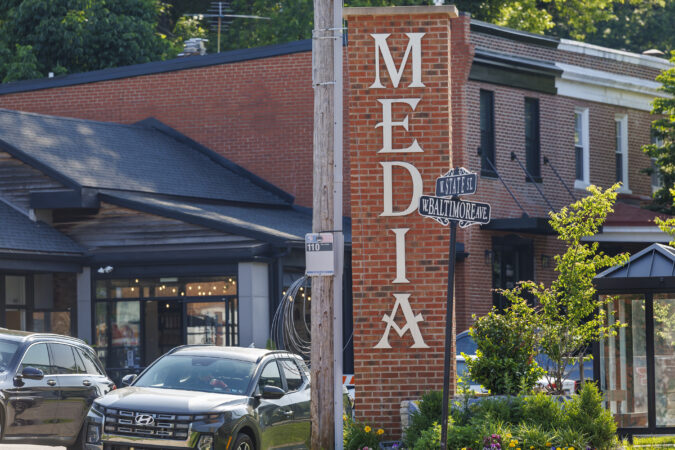
Staff members arrived at the Delaware County Republican Party headquarters in Media on Wednesday morning to find the building’s glass door shattered.
The apparent vandalism appeared to have occurred overnight, said Frank Agovino, the party chair. The Media Police Department, he said, is investigating.
The incident comes a year after the local party had to call police to the same office when protesters cornered two volunteers ahead of the presidential election.
“It’s just a sign of the times, unfortunately,” Agovino said. “There’s some people who just refuse to be civil about political disagreements.”
It was unclear who damaged the office or their motive. However, according to photos shared to Facebook by the Delaware County GOP, a sign identifying the office as a Republican office was posted on the door above the broken glass.
The Media Police Department did not immediately comment on the incident.
Agovino called for state and federal officials to consider stricter penalties for the perpetrators of such violence.
“People that are working in the political arena need to be protected,” he said.
This suburban content is produced with support from the Leslie Miller and Richard Worley Foundation and The Lenfest Institute for Journalism. Editorial content is created independently of the project donors. Gifts to support The Inquirer’s high-impact journalism can be made at inquirer.com/donate. A list of Lenfest Institute donors can be found at lenfestinstitute.org/supporters.
More than 2.5 million miles of fuel pipelines run under homes, farms, parks, and schools in the United States — enough steel line to circle the earth 100 times.
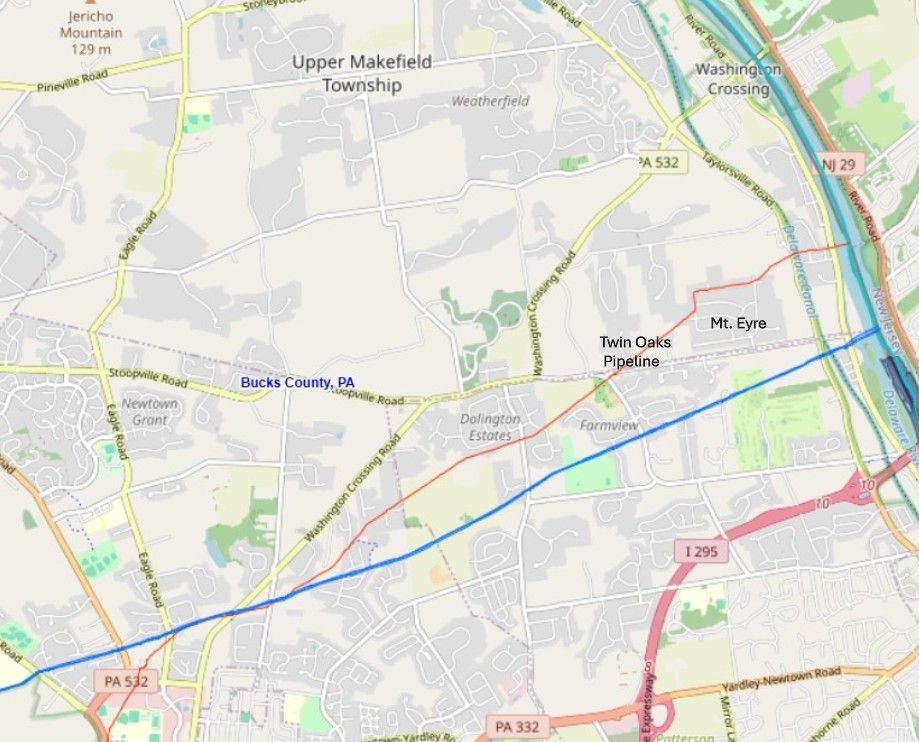
One of those pipelines slices under Mount Eyre Manor, a suburban Bucks County neighborhood perched high above the popular Delaware Canal State Park towpath and only a few thousand feet from the Delaware River.
For years, residents barely gave any thought to the Twin Oaks Pipeline, owned by Sunoco and its parent company, Energy Transfer. That changed in January when state inspectors uncovered a jet fuel leak.
Now, the pipeline is always on their minds.
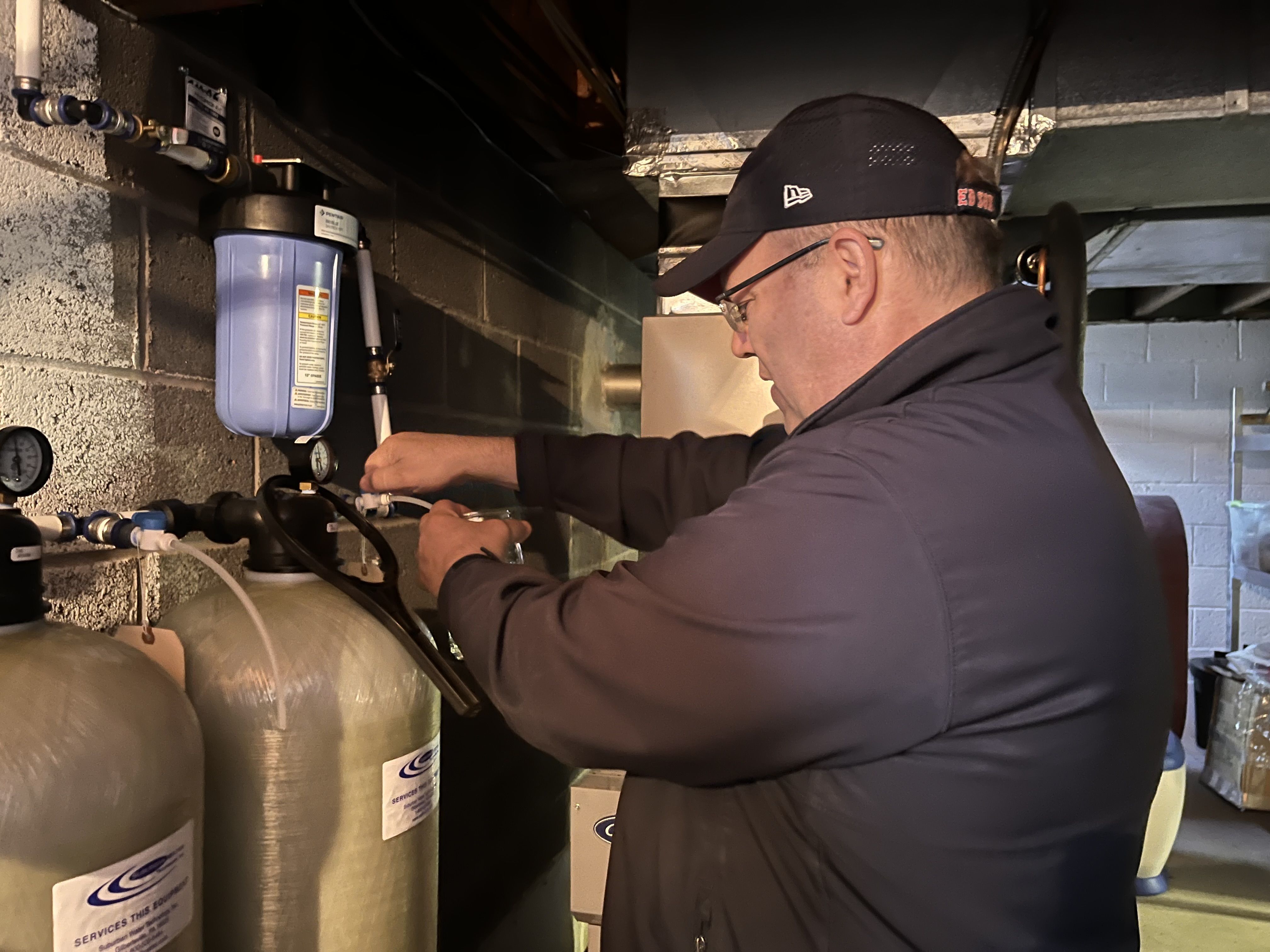
“We will never drink the water in this house again,” said Kristine Wojnovich, whose well was one of six tainted in the leak. Six metal tanks, part of a filtration system installed by Energy Transfer, now crowd her basement wall.
The Twin Oaks Pipeline stretches 106 miles. Built in 1958, its 14-inch diameter pipe carries jet fuel, diesel, or gasoline, depending on need, from Sunoco’s Twin Oaks Terminal in Aston, Delaware County, to a terminal in Newark, N.J.
Along its route, the pipeline burrows beneath suburbs, tunnels under waterways — including the Delaware River — and runs below a school’s grounds and state and local parks. It carves directly through Mount Eyre in the Washington Crossing section of Upper Makefield Township.
Federal regulators estimated that a “slow drip” had seeped undetected at least 16 months before the leak was detected.
Energy Transfer has accepted responsibility and apologized at public meetings. The company declined to comment for this article but noted that it has set up a website with updates and documents related to the spill.
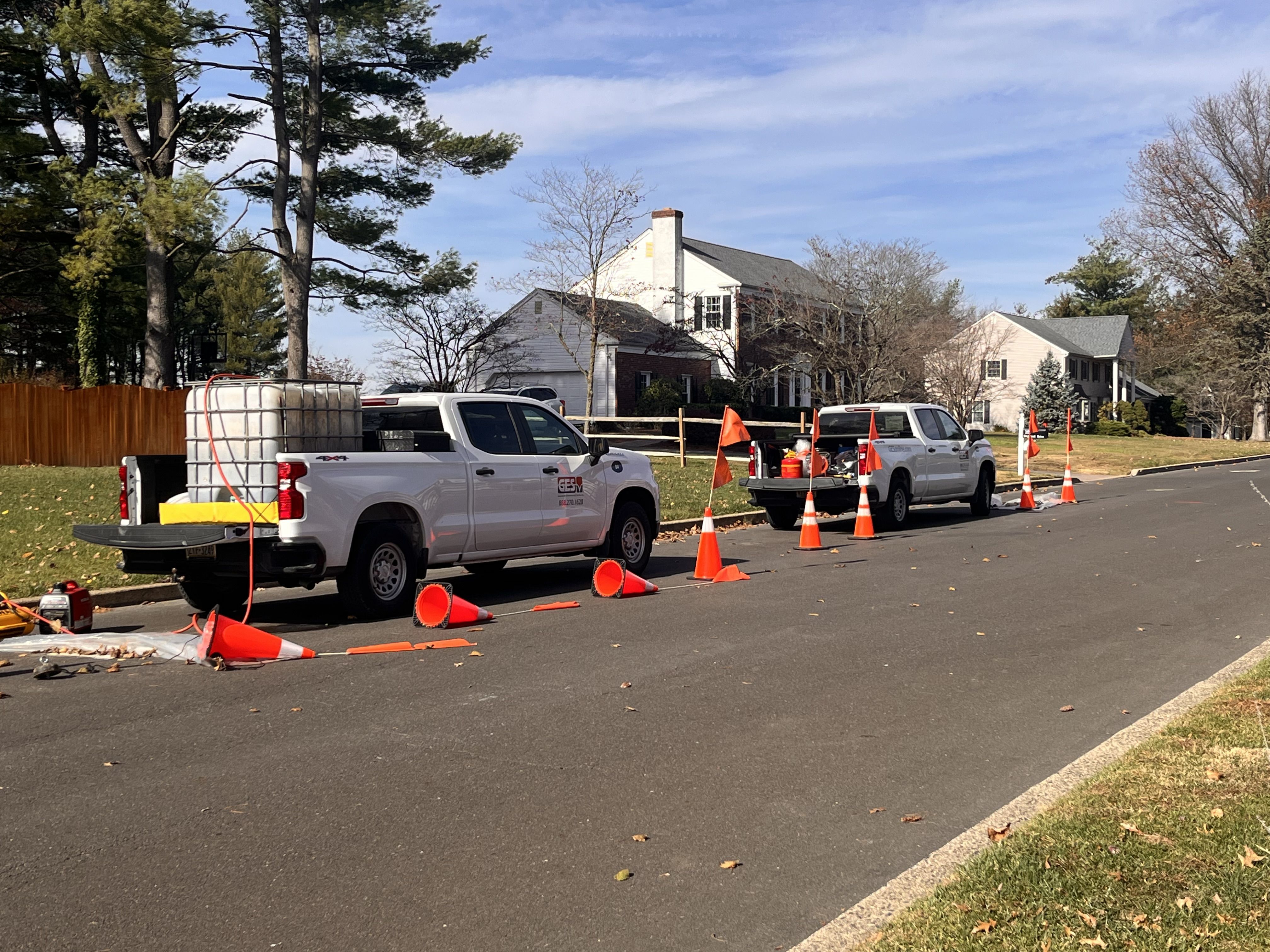
A contractor for Energy Transfer working on a recovery well in front of Kristine Wojnovich’s home in the Mount Eyre Manor neighborhood.
Signs of contamination
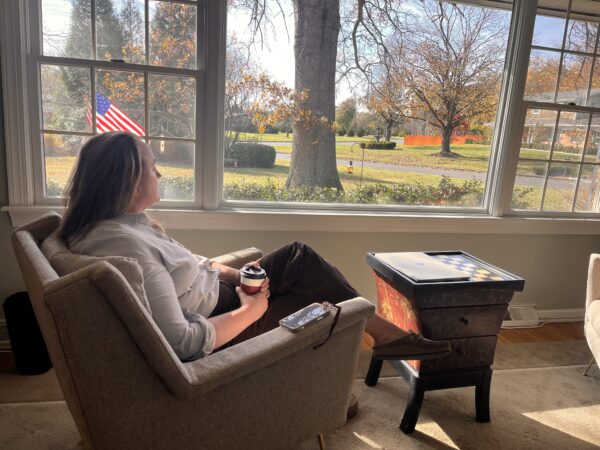
Wojnovich said she first noticed “something off with the water” as she was getting a drink after a workout in September 2023. She recalled the incident on a recent day from her living room as several white trucks owned by an Energy Transfer contractor were parked outside as part of well-monitoring work.
“It smelled to me like oil or gasoline or some kind of petroleum,” Wojnovich said.
Uncertain whether she was imagining it, she waited for her husband, Kevin, to return home. He, too, noticed the odor and suggested they call Sunoco.
The couple say Sunoco failed to locate a source of the odor and told them the likely cause was bacteria. Other neighbors had complained, too.
But it wasn’t until Jan. 21, 2025, that residents first learned of a leak discovered during an investigation by the Pennsylvania Department of Environmental Protection. The DEP advised the federal Pipeline and Hazardous Materials Safety Administration (PHMSA) that water samples from a Mount Eyre home “indicated the presence of kerosene, a major component of JP-8 jet fuel.”
PHMSA notified Energy Transfer and Sunoco.
Since then, residents have attended hours and hours of meetings. They’ve filed seven lawsuits, including a class action. Wojnovich is one of the plaintiffs.
Most people won’t drink the water. Many won’t cook with it. Wojnovich and her husband, Kevin, bathe elsewhere.
Wojnovich noted that when her well was initially tested after the leak, “fumes came out. It was overwhelming. They measured 12½ feet of jet fuel on top of our drinking water well.”
Her water, which eventually tested positive for contamination, now gets routinely tested by contractors paid by Energy Transfer. The company has drilled a second well for the family. But the Wojnoviches say their water still has a pungent odor.
Kevin Wojnovich samples water from a point-of-entry-treatment, whole-house filtration system that Sunoco installed at his Washington Crossing home after a 2024 jet fuel leak was detected in the company’s Twin Oaks pipeline.
The fallout
Of six wells that tested positive for hydrocarbons, four exceeded contaminant levels for drinking water. Residents suspect other wells were, or are, tainted and are skeptical about the way testing has been carried out.
According to the DEP, jet fuel contains “contaminants of concern” including benzene, toluene, ethylbenzene, xylenes, cumene, naphthalene, trimethylbenzenes, dichloroethanes, dibromoethane, and lead, which is also naturally occurring. The compounds can be harmful if ingested in large amounts. Some are carcinogens.
Energy Transfer has purchased a home with a contaminated well on Spencer Road, adjacent to where the leak was detected, for $721,800. It is across from the Wojnoviches’ home and sits vacant. The company purchased the home to drill two recovery wells in order to remove contaminated water.
Since digging up and repairing the pipe section, the company has recovered 1,027 gallons of fuel. About 163 gallons came from private wells, according to DEP records.
Energy Transfer has paid contractors to excavate and remove 276 tons of petroleum-impacted soil, according to a DEP document. It has installed four wells to recover petroleum from underground, dug 26 wells to monitor groundwater, and put in 181 point-of-entry treatment filtration systems in homes. It has collected 1,289 water samples from 363 individual wells.
A map from the federal Pipeline and Hazardous Materials Safety Administration shows the Mount Eyre Manor neighborhood in Washington Crossing, Bucks County, and Sunoco’s Twin Oaks pipeline in red. The blue line signifies another gas transmission pipeline.
Over the summer, Energy Transfer, using an inspection tool, identified multiple anomalies in the pipeline in Upper Makefield Township that required excavation, according to an Oct. 22 update.
The company said in an August letter that the anomalies presented no immediate danger and that there is no “data or information that the continued operation of the pipeline presents a critical safety concern or that the pipeline is leaking.”
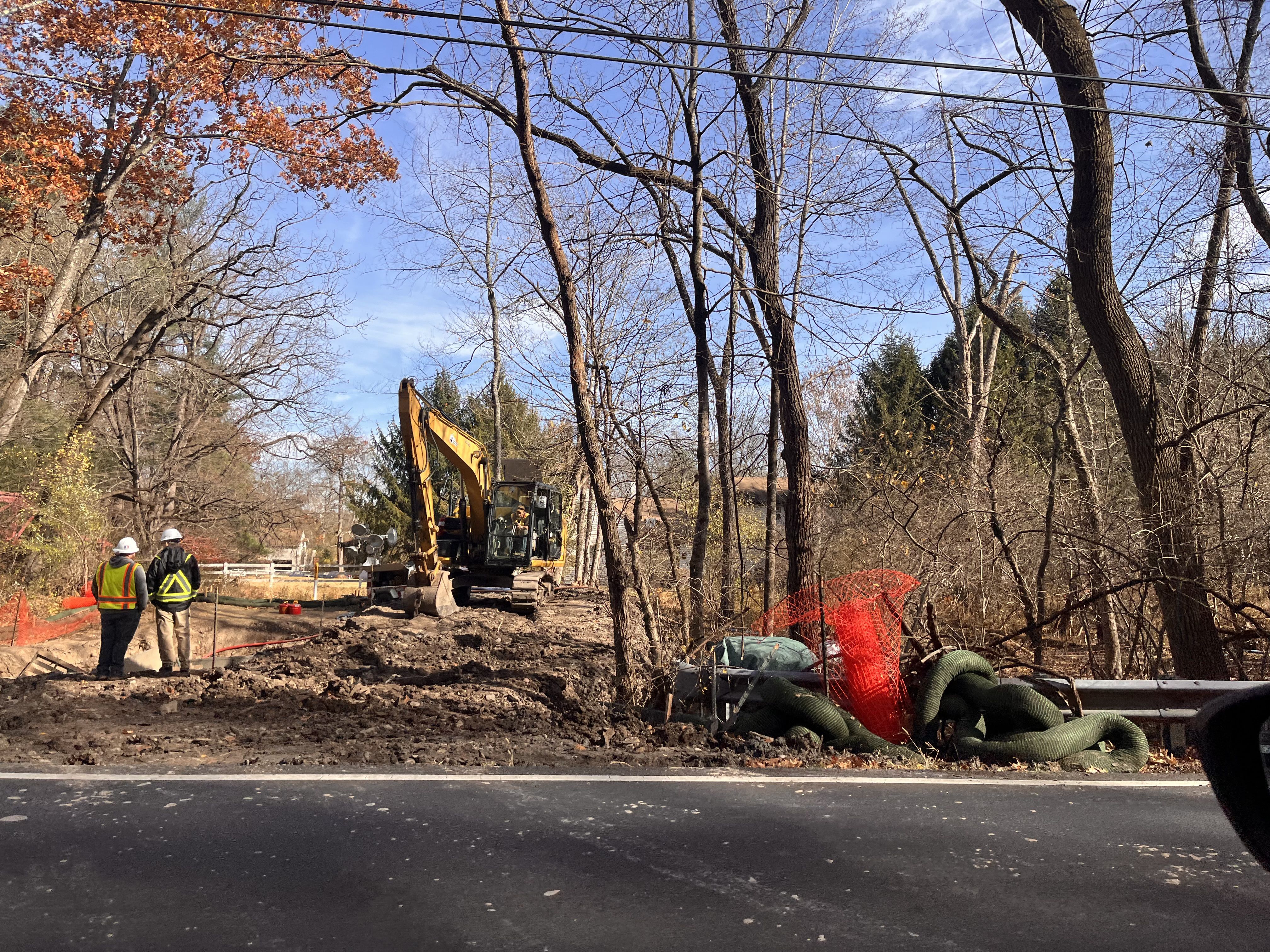
One of those excavations took place in a section of pipe next to the popular canal path used by cyclists and hikers. It is being dug up and replaced.
The excavation along Taylorsville Road won’t disturb the canal trail, company officials said during a recent meeting. The term anomaly does not mean a pipe section is an immediate threat to the safety or integrity of the pipeline, Matt Gordon, vice president of operations at Energy Transfer, said at the meeting.
Meanwhile, the pipeline continues to deliver fuel.
A contractor for Energy Transfer excavates a pipe found along Taylorsville Road with an anomaly that the company said was not in any immediate danger of failing.
‘Another house is up for sale’
The spill has upended life in and around Mount Eyre, neighbors say.
Joe Babiasz said many neighbors had bonded through their children’s schools and activities before the spill. Now, instead of talking soccer, they talk pipelines.
“It’s become part of daily life at this point,” Babiasz said. “When we get together socially, it’s the thing we talk about. It’s been kind of hard to just hang out with people and have it not come up. You can’t walk around the neighborhood without seeing a reminder. ‘Oh, there’s the monitoring well,’ or ‘another house is up for sale.’”
Residents have expressed outrage and skepticism toward Energy Transfer, the parent company of Sunoco, over the handling and testing of the contamination. They say theydon’t trust the company’s methods and doubt the safety of the 67-year-old pipeline.
“There are the trucks out there now,” Babiasz said on a recent day. “You can see them or hear them. It’s been integrated into our daily life.”
He asked: “Are they actually telling us everything?”
Residents wonder if the leak would have been discovered if they had municipal water. They wonder whether the leak created a toxic plume underground and where it might drift to, including into the river.
Neighbors plan to attend the next update by the DEP during a Dec. 8 webinar.
Katherine LaHart, a plaintiff in the class-action suit, said her well water was once clear. Now it is “black — Texas brown.”
“I worry every day about the integrity of our water, air and soil and the pipeline that runs through our neighborhood,” LaHart said. “It keeps me up at night.”
“Jefferson How We Adore Thee” will be released to the university community at its annual gala Tuesday. The university held a contest during its bicentennial last year, and Barden’s piece was selected from dozens of entries, the school said.
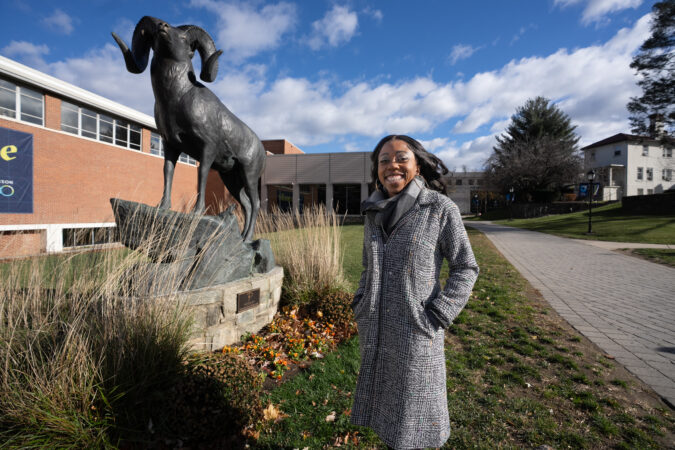
Elizabeth Avril Barden, a customer-experience specialist at Jefferson Health Plans and recent summa cum laude graduate of Thomas Jefferson University, has written the school’s first alma mater song in its 201-year history. “Jefferson How We Adore Thee” will be released to the university community at a gala on Tuesday.
“Elizabeth really captured the essence of the Jefferson community,” said Jefferson President Susan C. Aldridge “Learning, collaborating and innovating are all part of our collective DNA and I couldn’t be happier that we finally have an alma mater which captures who we are as a university as we venture into our third century.”
Jefferson has had a handful of songs that students have written over the years and a processional theme that launched in 1974, but never an official alma mater song, said F. Michael Angelo, Jefferson archivist.
One reason could be that at its founding in 1824, Jefferson was a medical college and over the years evolved into a university. But it was always medically focused until the school merged with the former Philadelphia University, best known for its design, engineering, and health science programs, in 2017.
“Philadelphia University, as far as we can tell through their archives, never had an alma mater song, either,” Angelo said.
Barden, 32, who received her bachelor’s degree in Health Services Management from Jefferson this year, said a colleague encouraged her to enter the contest. She has written about 30 songs, she said, so it wasn’t an off-the-grid venture.
It took her just 25 minutes to write the lyrics and music for the one minute, 55-second piece, she said.
“If you’re creative, you just flow,” she said. “You flow like water because it’s already in you, and you don’t have to overthink what’s already in you.”
And with the help of producer Keegan Myers, who played the music while Barden sang, the chorus goes:
It’s the Jefferson strong and true, where innovation leads us through. Together we achieve our best, as we prepare for what’s next.
“In every step I was taking at the university, it was preparing me for the next level of life,” she said.
Barden has been singing in front of people since age 2 and wroteher first song at 7, she said. Her parents, both Christian pastors originally from Haiti, encouraged her musical talent as she grew up in Brooklyn surrounded by gospel music, she said.
“Me and my six siblings, we were essentially the choir,” she said.
In high school, she won a song-writing contest and got to meet Grammy-winning R&B singer Jazmine Sullivan, who, she said, encouraged her to keep writing. She had written her high school’s alma mater song, too. And when she was a student at Delaware County Community College, she sang the national anthem at two ceremonies.
“Any school I go to, I want to leave a piece of me there,” she said. “Music to me is connection. That’s how I connect to people.”
For winning the Jefferson contest, she received a $200 gift card to the school bookstore, lunch with Aldridge, and a Jefferson mug.
“But the greatest gift was my name being attached to this alma mater song,” she said.
Barden said her aim in writing the song was to give Jefferson a gift.
“Jefferson gave me a lot,” she said, including a scholarship. “There were moments where I needed to talk to professors because life was happening. They were always kind and patient with me.”
Barden attended community college in New York after high school, but left when she got pregnant. When she moved to Philadelphia in 2016, she enrolled at Job Corps and then moved on to the Delaware County college. She continued on to Jefferson, while raising her four children, now ages 2 to 13.
In 2023, she began working there, too. Her job entails focusing on the patient experience and helping patients navigate the system.
“For the most part, I’m kind of like a clean-up person,” Barden said.
She’s currently enrolled in a dual program at Bryn Mawr College and Jefferson to obtain her master’s degrees in social service and public health. She plans to become a licensed clinical social worker and to incorporate music therapy into her work.
As part of her studies, she’s doing research on how music therapy can help those suffering from post-traumatic stress.
“I do believe that the incorporation of music,” she said, “has the ability to communicate with anyone … and help them learn how to cope.”
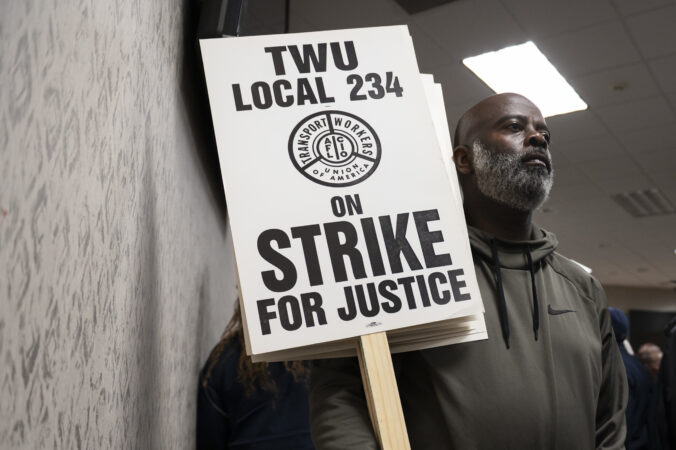
Members of the Transport Workers Union Local 234 on Sunday, Nov. 16 voted to authorize a strike if union and SEPTA negotiators can’t reach an agreement on a new contract.
Shortly before the current contract ran out at 11:59 p.m. on Nov. 7, TWU’s new president, Will Vera, urged union members to stay on the job. In an unusual move, he delayed a strike vote at the time of contract expiration, saying he had hope that a deal could be reached without the usual brinksmanship.
“We’re asking you to please continue to come to work and put money aside. We want you to be prepared in case we have to call a work stoppage,” he told members in a video at the time.
Local 234 leaders say they’re prioritizing a two-year deal with raises and changes to what the union views as onerous work rules, including the transit agency’s use of a third party that Vera said makes it hard for members to use their allotted sick time.
In a statement, SEPTA said it was aware of the authorization vote and is committed “to continue to engage in good-faith negotiations, with the goal of reaching a new agreement that is fair.”
2023 Fraternal Order of Transit Police Lodge 109 (three days)
SEPTA police officers walked off the job after bargaining with the transit agency for almost nine months, largely over the timing of a 13% pay raise for members. The agreement, partially brokered by Gov. Josh Shapiro, came amid heightened fears about safety on public transit and a funding crisis for SEPTA.
TWU Local 234 walked off the job for six days; the biggest issue was retirement benefits. SEPTA’s contributions toward union members’ pensions did not rise in tandem with wages when workers made more than $50,000. Managers’ pension benefits were not capped. The union also wanted to reduce out-of-pocket health-care costs and win longer breaks for bus, trolley, and subway operators between shifts and route changes.
SEPTA and the union reached an agreement Nov. 7, the day before the general election. Democrat Hillary Clinton’s presidential campaign was worried about voter turnout, and the city sought an injunction to end the strike. It proved unnecessary.
Talk about leverage. TWU was ready to strike just before the first home game of the World Series between the Phillies and the New York Yankees. Gov. Ed Rendell pushed the two sides to continue talking, and the transit workers waited to walk out until three hours after the end of Game 5, the last in the series played at Citizens Bank Park.
It was a bitter strike, coming just a year after the stock market’s meltdown started the Great Recession. TWULocal 234 President Willie Brown called himself “the most hated man” in Philadelphia. Mayor Michael Nutter was harshly critical. Brown called him “Little Caesar.”
The strike was settled Nov. 7 with a deal on a five-year contract. Transit workers got a $1,250 bonus, a 2.5% raise in the second year, a graduated increase in SEPTA pension contributions from 2% to 3.5%, and the maximum pension benefit was raised to $30,000 from $27,000.
2005: TWU Local 234 and United Transportation Union Local 1594 (seven days)
Negotiations collapsed mostly over SEPTA’s insistence that workers pay 5% of medical insurance premiums. At that point, the authority paid 100% of the workers’ premiums for family coverage.
In the end, it was solved by Gov. Rendell, a Democrat who had been Philadelphia mayor in the 1990s. He agreed to give promised state money to SEPTA early, so it could pay premiums in advance, reducing its costs.
In the resulting four-year deal, the unions had to pay for 1% of their medical premiums. They also received 3% yearly raises.
Pedestrians and cars in a chaotic dance at the intersection of Market and 30th Streets during the afternoon commute on the first day of the SEPTA city workers’ strike Nov. 1, 2016.
1998: TWU Local 234 (40 days)
City transit workers’ contract expired in March, but they did not strike until June — and then stayed out for 40 days. The two sides reached an agreement in July, but it fell apart. TWU members had returned to their jobs and kept working under an extension of their old contract. A final agreement was signed Oct. 23.
The union agreed to SEPTA’s demand that injured-on-duty benefits be limited. The old contract gave them full pay and benefits while on leave after a work injury. SEPTA wanted to hire an unlimited number of part-time workers. The union agreed to 100 part-timers to drive small buses.
SEPTA’s chief negotiator was David L. Cohen, famous for reining in unions representing city workers during Philadelphia’s bankruptcy in 1992, as Rendell’s mayoral chief of staff.
A two-week strike stilled city buses, trolleys and subways until an agreement was reached April 10. Transit workers would get 3% raises per year over the three-year span of the new contract, as well as increases in pension benefits and sick pay.
The union agreed to several cost-reduction measures, including a restructuring of SEPTA’s workers compensation policies.
Mayor Ed Rendell, a villain to many in labor for winning givebacks from city unions in 1992, pushed SEPTA to offer more generous terms to TWU than it had initially. Cohen, who was his chief of staff, crunched the numbers to make it work. Three years later, out of the city administration and working as a lawyer, he was hired as SEPTA’s chief negotiator.
1986: TWU Local 234 (four days) and UTU Local 1594 (61 days)
When TWU struck the city transit division in March 1986 over a variety of economic issues and work rules, some bus drivers pulled over mid-route and told passengers to dismount, The Inquirer reported.
Members were particularly incensed at what they considered SEPTA’s draconian disciplinary procedures. Union leaders said the issue was a basic lack of respect. The strike was settled in four days.
Drivers for 23 suburban bus routes, two trolley lines in Delaware County and the Norristown High-Speed Line — all members of the United Transportation Union — struck for just over two months, affecting about 30,000 passengers a day.
Employees in what was then known as SEPTA’s Red Arrow Division — after the private transit company that used to own the routes and lines — made considerably less than their city counterparts and had weaker pension benefits. They won raises and pension changes that brought them closer to parity.
1983: Regional Rail (108 days)
Thirteen separate unions walked off the job on the commuter rail lines that SEPTA had taken over at the beginning of the year from Conrail, successor to the bankrupt Pennsylvania and Reading Railroads.
In addition to wages, a key issue was SEPTA’s demand that union train conductors accept pay cuts. The authority had already cut the number of those workers by more than half.
Eventually SEPTA reached deals with a dozen of the unions. The 13th local, which represented 44 railroad signalmen, held out longer. Main issue: Whether SEPTA had the right to contract with outside firms for some types of signal work.
The Regional Rail strike remains SEPTA’s longest work stoppage since 1975.
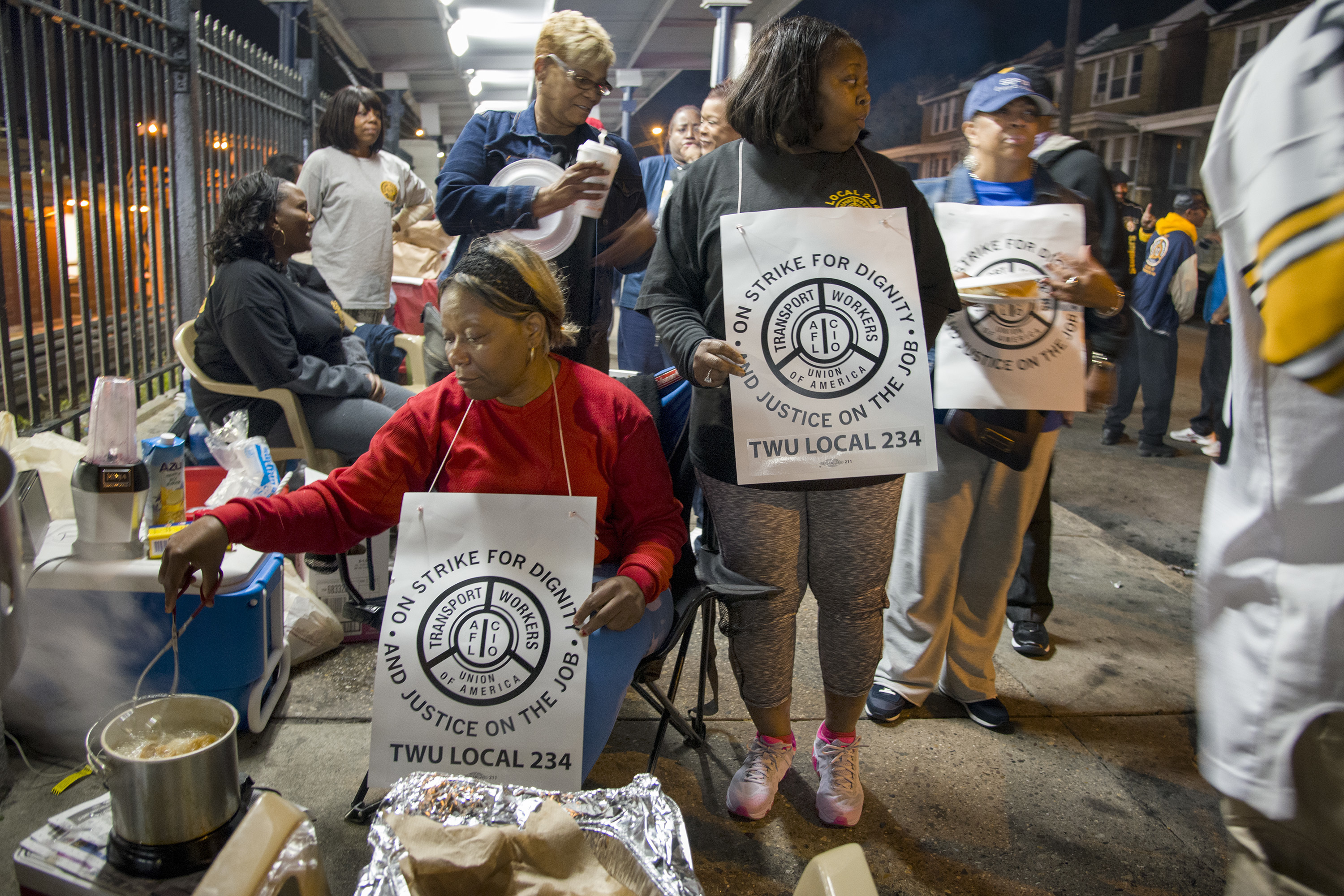
Joyce Woodford (center), a 25-year veteran cashier on SEPTA’s Broad Street Line, serves up fried fish for her fellow striking cashiers outside the Fern Rock Transportation Center during dinnertime on the third day of the SEPTA strike in 2016.
1982: TWU Local 234 (34 days)
About 36 suburban bus drivers and mechanics operating routes primarily in Montgomery County, and some routes in Bucks, won an 8.5% wage increase over three years.
The bus routes were the descendants of the Schuylkill Valley Lines and the Trenton-Philadelphia Coach Lines, which SEPTA acquired in 1976 and 1983, respectively. Service has grown, and the collection of bus routes is known as the Frontier Division today.
1981: TWU Local 234 (19 days) and UTU Local 1594 (46 days)
Transit workers shut down buses, trolleys and subways in the city on March 15, seeking job security in the form of a no-layoff clause, wage increases and a bar on SEPTA hiring part-time workers.
And the Red Arrow division went out for 46 days seeking higher wages and better medical benefits. SEPTA also backed down a demand for permission to hire private contractors for some work on the suburban buses, trolleys, and the Norristown High Speed Line.
1977: TWU Local 234 (44 days)
After a bitter strike, union members who run the city transit division got higher wages and more benefits, after rejecting an arbitrator’s proposed contract that was portrayed in news reports as generous.
A furious Mayor Frank Rizzo told reporters the strike “can last 10 years for all I care.” He said of the union’s rejection of the earlier offer: “It is outrageous, and I hope the people won’t forget it.”
1975: TWU Local 234 (11 days)
Transit workers, concerned about the ravages of inflation, wanted a clause giving them cost-of-living increases and enhancements to health-care benefits. Those were granted after Rizzo agreed to add $7.5 million to the city’s annual SEPTA contribution. Perhaps that’s one reason the mayor was so annoyed two years later.
Staff writer Erica Palan contributed to this article.
Pennsylvania’s new budget has $5 million in supplemental payments for the two Delaware County Hospitals that have seen significant increases in patient volumes since Crozer-Chester Medical Center and Taylor Hospital closed in the spring.
Main Line Health’s Riddle Hospital, near Media, is getting $3 million. The amount for Trinity Health Mid-Atlantic’s Mercy Fitzgerald Hospital, in Darby, is $2 million, according to budget documents.
The $5 million will be doubled by a federal match, said Democratic State Sen. Tim Kearney, who represents part of Delaware County. The $5 million is from a fund used to help hospitals the serve a large number of patients with Medicaid and used to go to Crozer Health, Kearney said Friday.
“Since Crozer’s shutdown in April, Riddle’s Emergency Department has experienced an unprecedented surge — 46% more patients than the same period last year, an increase of nearly 4,000 overall,“ the nonprofit said.
Main Line, which also owns Lankenau Medical Center, Bryn Mawr Hospital, and Paoli Hospital, said it has seen 55,000 patients from the Crozer market — a 15% increase over the same time period last year. That figure includes 8,000 patients who went to a Main Line facility for the first time, the health system said.
Trinity Health did not respond to a request for comment.
Shuttered hospitals in limbo
While Riddle and Mercy Fitzgerald have scrambled to accommodate patients who used to rely on Crozer Health, efforts are underway to bring healthcare services back to at least Taylor Hospital in Ridley.
A group from New Jersey called Chariot Allaire Partners LLC has agreed to pay $10 million for the former Crozer-Chester Medical Center in Upland but has not disclosed its plans. That facility served as a key safety provider for a low-income area of Delaware County.
A partnership of Restorative Health Foundation and Syan Investments won an auction for Springfield Hospital for $3 million, but it does not have support from township officials.
Delaware County legislators also obtained $1 million from the state to buy emergency department equipment if one of the closed hospitals, such as Taylor, reopens, Kearney said.
Editor’s note: This story has been updated with additional detail on the funding.
This suburban content is produced with support from the Leslie Miller and Richard Worley Foundation and The Lenfest Institute for Journalism. Editorial content is created independently of the project donors. Gifts to support The Inquirer’s high-impact journalism can be made at inquirer.com/donate. A list of Lenfest Institute donors can be found at lenfestinstitute.org/supporters.
Democrats swept Delaware County Council elections for the fifth consecutive election, further solidifying their dominance in the former Republican stronghold in the suburbs.
In statements early Wednesday morning, the Democrats thanked their supporters.
“I will continue to work hard and fight for the residents in our County. I look forward to working together with all parties to make Delaware County one of the strongest counties in the Commonwealth,” Womack said in a statement.
With all but one precinct reporting Wednesday, Republican challengers Brian Burke and Liz Piazza each trailed Womack and Phillips by roughly 50,000 votes.
In a statement Wednesday, Frank Agovino, the chair of the Delaware County GOP, said it appeared local issues were a “secondary concern” for Democrats this year.
“The State wide retention initiative was uncharted waters and it feels as though Dem turnout was positively impacted. Additionally, the Unrealistic disdain for the President from the majority of Democrats was also an undeniable factor,” Agovino wrote.
Democrats have held all five seats on the Delaware County Council since 2020, when the party took control of the county for the first time since the Civil War. Democrats flipped the county as part of a national trend of suburbs shifting left, which was accelerated during President Donald Trump’s first term in office. With Tuesday’s results, they will keep their supermajority for the next two years.
In the years since Democrats took control in Delaware County, they say they have worked to enhance county services and repair infrastructure. That has included establishing a health department — Delaware County was the largest county in Pennsylvania without one at the onset of the COVID-19 pandemic — and de-privatizing the county prison following a series of scandals.
Last year, the county increased property taxes 23%, citing the loss of federal pandemic relief dollars and inflation driving up salaries. Republicans made that increase the base of their campaign, telling voters that the Democrats were overspending and that more tax increases were on the way.
Republicans wanted voters to give the GOP a voice on the board, even though the party wouldn’t have the majority, to push back on budgetary decisions and hold the Democrats accountable.
But in the heavily Democratic county, that message was not enough to sway the independent and Democratic voters Republicans needed to win seats. Instead, voters demonstrated continued trust in the current county leadership.
“I truly respect Richard and Joanne as members of Council and hope they will listen to the voices of our residents and help bring to light some of their concerns,” Piazza said in a statement Wednesday.
On Election Day, Donald and Esther Newton, a Chester couple who have been married for more than 55 years, said they believed it was about time their city received more care and investment through property taxes.
“Our infrastructure needs to be fixed, and that takes money,” Esther Newton said.
Democrats swept all countywide races Tuesday.District Attorney Jack Stollsteimer, who was among the first Democrats to win countywide office in Delaware County, won a seat on Delaware County Court. He will have to step down from his current role to take the seat.
Staff writer Nate File contributed to this article.
This suburban content is produced with support from the Leslie Miller and Richard Worley Foundation and The Lenfest Institute for Journalism. Editorial content is created independently of the project donors. Gifts to support The Inquirer’s high-impact journalism can be made at inquirer.com/donate. A list of Lenfest Institute donors can be found at lenfestinstitute.org/supporters.
The transit agency has until Oct. 31 to complete the inspections, which were recommended after the National Transportation Safety Board released a report investigating five fires that occurred on the Silverliner IVs this year.
As of Oct. 9, SEPTA said that crews can handle about six Silverliner IV cars a day, with a goal of ramping up inspections to handle 12 cars a day with five-person crews per car.
Although SEPTA is rotating cars in and out of service for the inspections — instead of yanking all 225 from service at once — riders have experienced significant delays and some trains have been outright canceled. Without a full fleet, SEPTA says it is unable to respond as easily to typical delay-causing events, such as power outages and bad weather.
Riders should check the SEPTA app for real-time updates on how trains are running.
As the deadline approaches and delays persist, The Inquirer is tracking SEPTA’s inspection progress.
Mon., Oct. 27, 2025
95 inspections complete
Days until deadline: 4
Fri., Oct. 24, 2025
88 inspections complete
Days until deadline: 7
Wed., Oct. 22, 2025
78 inspections complete
Days until deadline: 9
Mon., Oct. 20, 2025
66 inspections complete
Days until deadline: 11
Fri., Oct. 17, 2025
58 inspections complete
Days until deadline: 14
story continues after advertisement
Wed., Oct. 15, 2025
46 inspections complete
Days until deadline: 16
Thurs., Oct. 9, 2025
12 inspections completed
Days until deadline: 22
Mon., Oct. 6, 2025
Inspections begin
Cars began undergoing inspections in SEPTA’s four regional maintenance facilities.
Greg Buzby, manager of Regional Rail vehicle engineering, shows some of the work being done for the safety inspections at the SEPTA Overbrook Maintenance Facility.Tyger Williams / Staff Photographer
“We’re looking for any signs of overheating or damage to any of the circuits, physical damage, making sure the bolted connections are tight,” said Greg Buzby, manager of Regional Rail engineering. “There’s also electrical testing that we have to do to make sure the insulation has its integrity.”
Inspections remaining: 225
Days until deadline: 25
Wed., Oct. 1, 2025
NTSB releases report
Noting that the Silverliner IV cars’ “outdated design … represents an immediate and unacceptable safety risk,” the National Transportation Safety Board urged SEPTA to sideline all the Silverliner cars immediately and to retrofit or replace them as soon as possible. The Silverliner IVs went into service between 1974 and 1976, with technology that was designed even before that time.
The NTSB’s findings are advisory.
More than 300 passengers were safely evacuated after a SEPTA Regional Rail train caught fire in February in Delaware County.Charles Fox / Staff Photographer
The Federal Railroad Administration, which regulates freight and passenger railroads, ordered SEPTA to undertake the inspections, concluding “that SEPTA’s maintenance and operation of its passenger rail equipment requires additional oversight and corrective action.”
Inspections remaining: 225
Days until deadline: 30
story continues after advertisement
Talk to our transportation team.
Do you have questions about what’s happening on Regional Rail? Ask here or share how your rides on Regional Rail have been impacted in October.
Staff Contributors
Reporting: Thomas Fitzgerald and Erica Palan
Graphics: John Duchneskie
Editing: Lizzy McLellan Ravitch
Digital Editing: Erica Palan
Subscribe to The Philadelphia Inquirer
Our reporting is directly supported by reader subscriptions. If you want more journalism like this story, please subscribe today
For five glorious Sundays this summer, there was peace in Chester.
In places like the William Penn Homes and Chester Apartments, where children are often encouraged to stay indoors, shut away from the threat of gang violence, it was finally safe to play outside during the height of what is normally the most dangerous time of the year.
Roving carnivals nicknamed “Sunday Fun Days” were organized and held in Delaware County’s lone city, in areas that had weathered a surge in violence in recent years. A few bounce houses, some water ice, and communities breathing sighs of relief were rewards for keeping the peace, and motivation to continue that trend.
The parties, according to Geo Stockman, the lead gun violence interventionist with Making a Change Group, came during one of the safest summers on record in the city: Not a single fatal gunshot was fired in Chester during that time.
It was a result that local police and county prosecutors say they have been working toward these last few years, through a combination of advocacy work and interventions by groups like Stockman’s.
“This opened up the neighborhoods. It gave them a reason to say, ‘Let’s try something else, people are really looking out for us now, maybe we should put this down,’” Stockman said. “People are always telling people to stop doing something without offering them something in this place. So that’s what we did this summer. We offered them something in its place.”
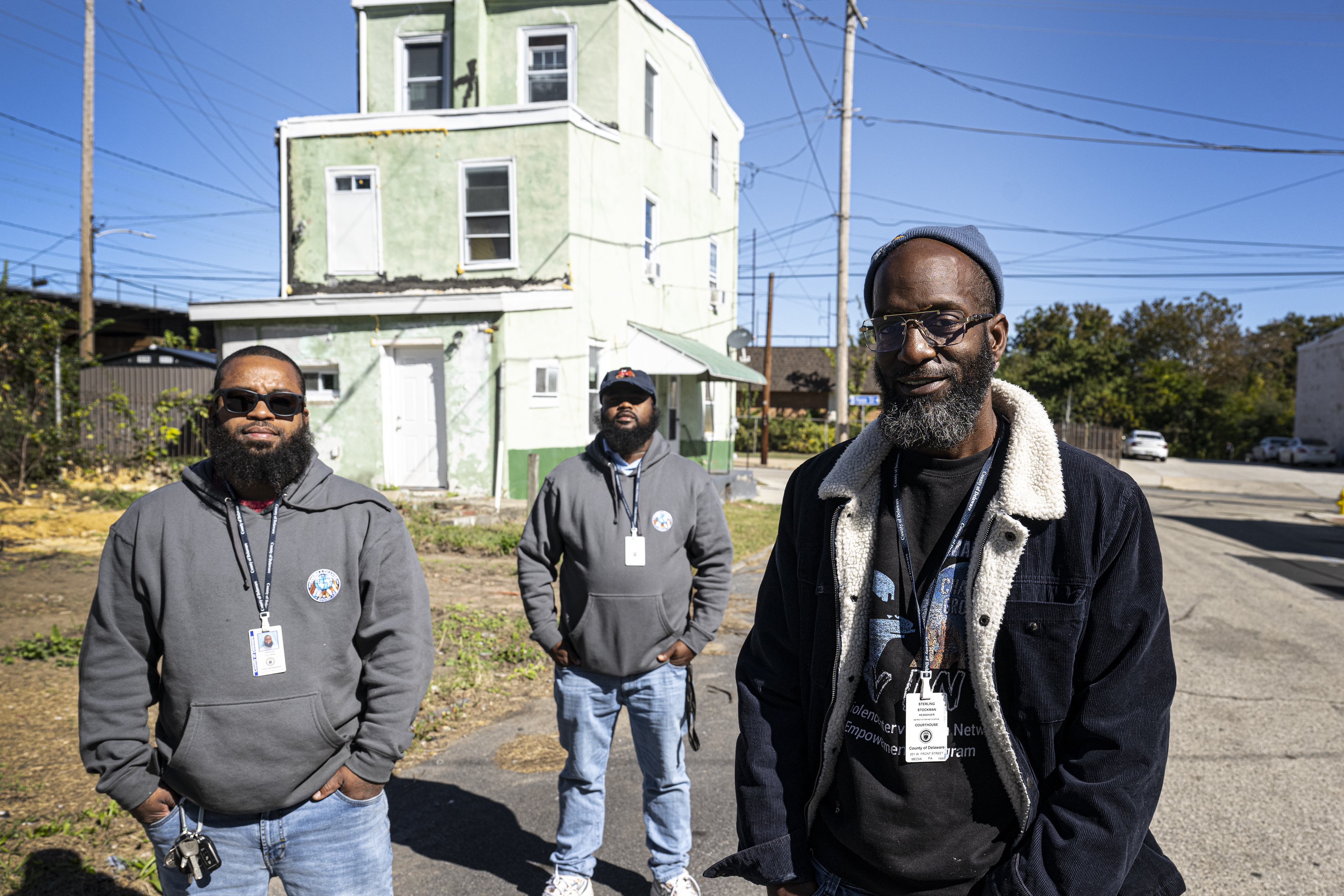
Gregory Cottman left, Gregory Graves, center, and Geo Stockman say the Sunday Fun Day block parties sponsored by the Delaware County District Attorney’s Office served as both a reward for neighborhoods that have curbed gun violence, and an incentive to continue that trend in the years to come.
In its five years of operation, CPSN has seen a 65% reduction in shootings overall and a 74% reduction in fatal shootings. And since the summer, only two fatal shootings have been recorded in Chester, which prosecutors say still puts the city on pace for one of its most peaceful years on record.
“Violence comes from a place of, of hopelessness, of despair. Just anger, resentment, and feeling like you’ve been left behind, like nobody cares,” Stockman said.
window.addEventListener(“message”,function(a){if(void 0!==a.data[“datawrapper-height”]){var e=document.querySelectorAll(“iframe”);for(var t in a.data[“datawrapper-height”])for(var r,i=0;r=e[i];i++)if(r.contentWindow===a.source){var d=a.data[“datawrapper-height”][t]+”px”;r.style.height=d}}});
He spoke from experience, as a lifelong Chester resident who spent time in prison for mistakes made on the streets of his hometown.
“That’s what makes what we do so effective. Most of us want to be stopped, but nobody stops us,” he said. “Nobody takes the time to say, ‘I’m gonna be the one to calm you down.’ It really only takes somebody with a clear mind that they understand to say, ‘Nah, that ain’t it.’”
Stockman said he and his team have successfully mediated 130 disputes between rival neighborhoods in the last two years. They settled petty arguments, usually started on social media, that were clearly heading toward a violent conclusion.
“This is a small community, so your reputation goes further than just the neighborhood you’re from,” said Gregory “G-Code” Graves, who works with Stockman.
Graves said the anti-violence messaging works because it’s coming from people the intended audience can identify with.
“We’ve been through the vetting process in all these neighborhoods, so even if it’s a little hesitation at first, it doesn’t take a great deal of persuasion to get them to come to us,” Graves said. “And we come in with meaningful things that’s going to help the situation.”
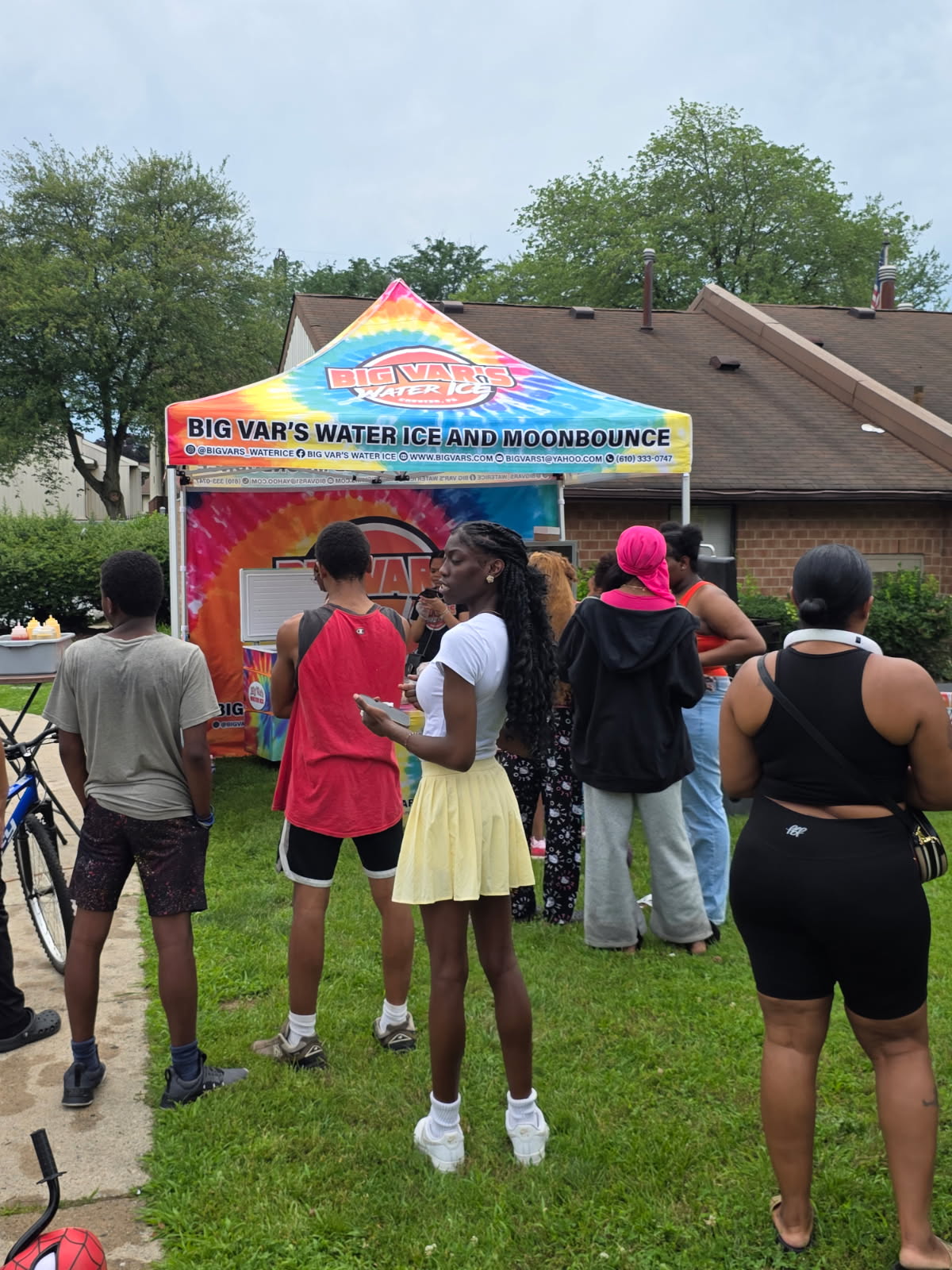
Residents of the Chester Apartments line up for water ice at a “Sunday Fun Day” block party held this summer in Chester.
For District Attorney Jack Stollsteimer, those results are exactly what he envisioned when he brought CPSN to the county five years ago, building it on models used successfully in other cities, including Boston.
And he is confident that the program will continue to thrive without him, as he runs for a county judgeship in the Nov. 4 election.
“People have bought into the strategy. They’ve seen it work now, and they just wanna keep it going,” he said.
Stollsteimer said making Chester safe was one of his priorities when running for district attorney in 2019. Similar programs, he said, had failed before because of a lack of buy-in from officials.
This time was different — Mayor Stefan Roots became a fixture at the Sunday Fun Day parties.
Roots said the weekly parties presented a rare opportunity for residents to meet the people making decisions that affect their everyday lives. And, in turn, allowed him and other officials to have open, honest dialogue with people living in communities most affected by gun violence.
The conversation flowed naturally, he said. No pressure. No pretense.
“This is something that’s never, never happened before,” he said. “The relationship between the city and the county is really welcome. And the results are showing themselves.”
Roots said he lost count of how many residents came up to him at the parties to talk about their own efforts to curb violence in their neighborhoods. People, he said, who told him that the block parties, and the gun violence interventions that preceded them, were a welcome sigh of relief.
“They told me that, sometimes, they don’t want to be ‘the man with the cape.’ They want to go on and have a life, too,” Roots said.
Democrats have dominated Delaware County government since the 2019 election.
As suburban communities across the nation flipped from red to blue, Democrats took control of the county council for the first time since the Civil War — the result of long-term shifts accelerated by President Donald Trump’s first administration. The party has held all five seats on the governing board ever since, easily retaining seats in 2021 and 2023.
Two seats on the five-member board are on the ballot in November. Democrats argue tax increases were necessary to make up for decades of underinvestment by Republicans.
But Republicans insist spending is out of control. While they cannot take control of the board this year, they are asking voters to give them a voice to push back against the Democrats.
“The money tree in the backyard does not exist,” said Brian Burke, one of two Republicans running for council.
Burke, a union steamfitter, was first elected to Upper Darby’s township council in 2019 as a Democrat. He became a Republican to unsuccessfully run for mayor of the township in 2023 following years of feuds with the Democratic administration. While on the township council, Burke worked in conjunction with Republicans on the board as well as two other Democrats to challenge Democratic leadership in Upper Darby. He said this experience would aid him as he worked to hold Democratic leadership in Delaware County accountable.
Piazza worked for decades in Delaware County Court’s domestic relations department, where she ran the warrant division and served as a liaison for judges and attorneys. Running for council, Piazza has been vocal about wanting to devote opioid settlement funds toward grandparents caring for the children of those struggling with addiction.
Womack was first elected to the council in 2021 after spending 10 years on the Darby Township Board of Commissioners. Womack spent years as an advocate in the labor movement, including serving as an adviser on community and religious affairs for the national AFL-CIO.
Burke and Piazza are urging voters to elect them to “stop the spend.”
After the council raised property taxes by 23% last year, the pair of Republicans argued the taxes were a result of out-of-control spending in the county. They say there needs to be a voice on the council acting as a check on spending.
“There’s a lot that needs to be cut. There’s a lot of spending,” Piazza said.
If elected, the two Republicans would not have control over county spending, but they would have votes on the five-member board to oppose new spending and work to sway their Democratic counterparts.
What is the Democratic platform?
Womack and Phillips are largely defending the actions of the Democratic council over the last five years. Republican leadership, they argue, did not raise taxes for 12 years and allowed county infrastructure to fall into disrepair. As a result, they say, Democrats had to increase taxes to fund county services and infrastructure improvements.
No one wanted to increase taxes, Womack said, but it was unavoidable.
“Our county has really been underserved for many decades,” Womack said. “In the long run, it costs you a lot more money to repair than if you had taken care of things gradually.”
If elected, Phillips says she would like to do more public vetting of contracts and work to increase development in Delaware County so that the local tax base can be increased without more tax hikes. Womack has said he wants to work on expanding affordable housing options in the county.
Why were taxes raised? Will there be another hike?
The county council voted last year to increase property taxes by 23%, which comes out to roughly $185 annually for the owner of a home assessed at the county average. The county had used pandemic relief funds to stave off significant tax increases in prior years, but those funds were running dry and additional dollars were needed to cover employee salaries amid inflation, council members said at the time.
Piazza and Burke insist that another double-digit tax increase is on the way. Too much of the current budget, they argue, still depends on short-term federal pandemic relief funds or transfers from other county funds.
“They’re going to come out after November 4th election and basically tell the residents of Delaware County, ‘You’ve got another 20% increase,’” Burke said.
Womack, the sole member of the county council who voted against the increase, said that he anticipated another tax hike but that he could not imagine it would reach 20%.
The incumbent spearheaded a citizens budget task force that has spent the year seeking areas to cut spending.
“It’s kind of hard to really project what we’re looking at right now,” Womack said. He noted that, amid a federal government shutdown, details on state and federal aid are unclear.
However, the county is not expecting to release its preliminary budget until mid-November, after the election. Last year, the county did not release its proposed budget until Dec. 3.
Where do Republicans want to cut?
Republicans have identified three primary areas they argue represent overspending: the county health department, the prison, and outside legal assistance.
Republicans in the county have long argued it was an unnecessary expense. Though the $18 million department is currently funded entirely by state and federal grant dollars, Burke argued it will eventually cost taxpayers.
“In my eyes, that [money] could have been used somewhere else,” Burke said.
In 2020, the council voted to explore options to retake control of the county prison from the private firm that had run it. Phillips, who was controller at the time, argued the decision was in the county’s best interest and has better served inmates and staff.
But Republicans argued that the county’s costs have gone up too much and that the county opened itself up to litigation that it would not have been vulnerable to if the prison had remained privately run. The union representing prison employees often clashed with the first warden the county chose to lead the prison.
In an interview, Burke argued the county could find significant savings if it put the prison back in private hands. In 2025, the prison cost the county over $59 million. The county’s last contract with GEO, which managed the prison privately, paid the company $259 million over five years.
Phillips said the health department and public prison, while significant expenses, will save the county and its residents in the long run. Even when the prison was run privately, she said, infrastructure repairs were on the county and the private operators sought to maximize the number of inmates in the building.
“Government should take care of its people,” Phillips said.
Finally, Republicans point to the ballooning cost of legal counsel to the county. Last year, the county paid more than $4.4 million to outside legal counsel, including a firm that once employed Phillips and County Councilwoman Christine Reuther. Republicans argue this represents misuse of funds and political cronyism.
Phillips and Womack instead point to the county’s small in-house legal team and the growing number of cases brought against the county, including defending against frivolous suits filed by election deniers, as well as managing complex legal issues, such as the Prospect Medical Holdings bankruptcy filing that closed two major hospitals in the county.
Even if they won both seats, Republicans would hold the minority on the council for at least the next two years. This means they would have to persuade Democrats to come along with them on any policy changes or budget cuts.
“I would love to win the seat and get in there and get into the nitty-gritty and kind of see what goes on behind closed doors and have a voice for the residents and be there for them,” Piazza said.
This suburban content is produced with support from the Leslie Miller and Richard Worley Foundation and The Lenfest Institute for Journalism. Editorial content is created independently of the project donors. Gifts to support The Inquirer’s high-impact journalism can be made at inquirer.com/donate. A list of Lenfest Institute donors can be found at lenfestinstitute.org/supporters.