In a rare move, Pennsylvania’s two senators have created a joint fundraising committeethat would allow them to split money from donors who want to give to both of their campaigns, despite being members of different parities.
As polls have shown him losing support among Democratic voters, he has also reported raising significantly fewer campaign funds on his own and has not said if he will run for a second term in 2028.
Common Ground PA, which filedpaperwork with the Federal Election CommissionMonday, lists four beneficiaries for the joint fund: Fetterman for PA; Friends of Dave McCormick; Every Vote PAC, which lists Fetterman as the PAC sponsor; and Pennsylvania Honor, which lists McCormick as the leadership PAC sponsor.
A joint fundraising committee, first enabled by the FEC in 1977, allows two or more candidates, PACs, or party committees to coordinate fundraising efforts to share donations and expenses.
A donor can abide by federal contribution limits while still giving one check that can be allocated to multiple campaigns. But since these groups typically involve party committees, it’s rare for these joint ventures to be bipartisan.
Mike DeVanney, a spokesperson for McCormick’s campaign, called the PAC a donor-driven effort.
“This group of donors value the collaboration exhibited by Senators McCormick and Fetterman for Pennsylvania and want to support both of them,” he said in a statement.
The joint fundraising committee was first reported by Politico.
The two senators have spoken often about their cross-aisle friendship since McCormick took office in 2025, and they have repeatedly teamed up in recent months.
They appeared alongside each other last week in Philadelphia to promote Trump Accounts, the new federally backed savings accounts for kids that became law with President Donald Trump’s signature One Big Beautiful Bill Act.
Fetterman has routinely criticized his own party, feuding with progressives on a range of issues, including Israel and immigration enforcement.
In a fundraising email sent in May, McCormick referred to Fetterman as one of his “closest working partners,” a realization that he said surprised even him.
In that drive, which asked donors to support his efforts to “work across the aisle to get results for the people of Pennsylvania,” McCormick praised his Democratic colleague.
“Senator John Fetterman and I couldn’t look more different. We don’t agree on everything. But we both grew up in Pennsylvania. We both know what it means to fight for working families who feel like Washington forgot them. And we both refuse to let politics get in the way of getting things done,” he wrote.
McCormick told reporters in May his friendship with Fetterman is the most frequent topic of conversation he hears, and he gets positive feedback from it.
“We look for ways to work together. I think people want that,” he said.
Individuals could donate to Fetterman or McCormick separately. But joint fundraising committees, which are used widely by both parties, pull in large checks from donors and split the money across multiple committees using a formula that adheres to federal contribution limits, according to an analysis from the watchdog group OpenSecrets.
Typically, though, campaigns joint fundraise with their party.
Common Ground PA is among the few coordinated efforts across the aisle. A former PAC, the Problem Solvers Patriots, fundraised for members of both parties in previous election cycles.
Former U.S. Rep. Conor Lamb, who lost the Senate primary to Fetterman in 2022 and has not ruled out a run in 2028, blasted the move online as “Another betrayal from Fetterman.”
U.S. Rep. Chris Deluzio, a Western Pennsylvania who has received “a lot of encouragement” to run for Fetterman’s seat, also questioned the creation of the PAC.
“Helping the Republicans raise money to spend against Democrats is bad, right?” Deluzio said on X.
However, Fetterman has been notching strong approval from Republicans, and Pennsylvania Republicans along with Trump himself said he could receive GOP support if he switched parties.
Fetterman’s Republican support has also been growing at the bank with contributions from prominent GOP donors, particularly through his other joint fundraising committee and leadership PAC. At the same time, his fundraising has plummeted overall, raising less than half his previous annual totals in 2025.
Staff writers Gillian McGoldrick and Sam Janesch contributed to this story.
A Delaware County man was charged Wednesday after allegedly making threats againstGov. Josh Shapiro during a visit to a state representative’s office, including a threat to “burn down … [Shapiro’s] mansion with him in it,” Pennsylvania State Police said.
Police said the threats occurred when Richard John Franklin, 65, of Brookhaven, visited State Rep. Leanne Krueger’s legislative office in Brookhaven alongside his brotheron Tuesday to dispute and request help with an unanticipated and unpaid tax bill totaling $19, according to the criminal complaint. When a staffer tried to assist Franklin in completing a form to waive the taxes, Franklin “became irate and crumbled up the paper,” police said.
Franklin then began making threats the staffer believed were “threatening, harassing, and antisemitic in nature,” according to the complaint, including: “I guess I’ll pay that Jew. That Jew needs the money more than me” and “I’d like to burn down his [expletive] mansion with him in it.” Police said Franklin repeatedly referred to Shapiro as a “‘Jew’ multiple times in a negative manner.”
State law enforcement officers charged Franklin with felony levels of terroristic threats and ethnic intimidation, in addition to lower-level charges of harassment and disorderly conduct.
Shapiro, a Democrat who is among the most prominent Jewish officials in the country, has faced multiple threats of violence since becoming Pennsylvania’s top executive. In April 2025, a man broke into the state-owned governor’s mansion on the first night of Passover with a hammer and set several firebombs inside while Shapiro and his family were sleeping in a different part of the residence. The man, Cody Balmer, later pleaded guilty to attempted murder and was sentenced to 25 to 50 years in prison.
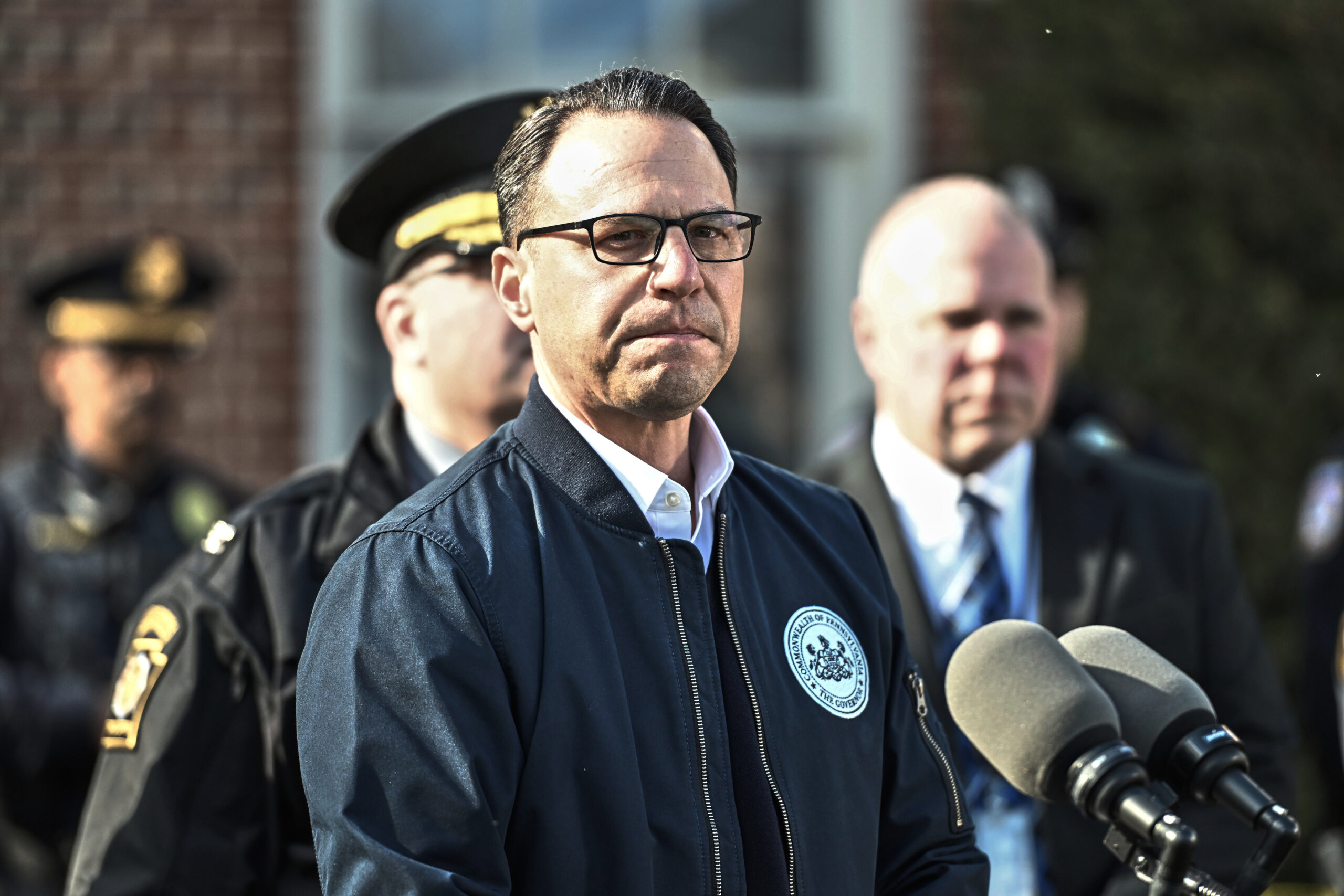
Pennsylvania Gov. Josh Shapiro pauses during a news conference at the governor’s official residence discussing the alleged arson that forced him, his family and guests to flee in the middle of the night on the Jewish holiday of Passover, Sunday, Apr. 13, 2025, in Harrisburg, Pa.
Early Wednesday, investigators from the state police political violencethreat unit visited Franklin at his Brookhaven home, where he provided conflicting accounts of what occurred at Krueger’s office before ultimately admitting to “calling the Governor a ‘Jew’ in a negative manner” and added that his “brother told him he should not have made the statement,” according to the criminal complaint. Franklin denied making any threats toward Shapiro, but admitted to referring to the previous arson attempt at the governor’s residence during the outburst, police said.
State police said they arrested Franklin without incident.
Franklin’s brother, who witnessed the events at Krueger’s office, disputed the state police account and said his brother never threatened the governor.
Leroy Franklin, 72, of Chester, said his brother visited the state representative’s office seeking information about a tax bill he had received, despite paying his state taxes through an accountant this year.
After the brothers spoke to a staffer who did not have answers for them, Richard Franklin became upset and raised his voice, Leroy Franklin said.
In a phone interview Wednesday, Leroy Franklin recalled his younger brother saying something to the effect of: “I’ve been on disability for 15 years, but I guess the state needs my money more than I do.”
The two were together at Krueger’s office the entire time, Leroy Franklin said, adding that he did not hear his brother use an antisemitic slur. He also disputed that his brother threatened arson.
“Anybody who said he did is lying,” Leroy Franklin said.
Around 2 a.m. Wednesday, Leroy Franklin said, he received a call from his younger brother. Richard Franklin told him that police were at his apartment and he was not sure where they were going to take him, Leroy Franklin recounted.
When the two spoke on the phone again later that morning, Leroy Franklin said, he learned police were taking his brother to jail.
“I don’t know what the heck anyone is talking about,” Leroy Franklin said Wednesday. “This is a bit extreme, to put it mildly.”
Richard Franklin was being held at the Delaware County prison with bail set at $100,000, according to court records. A preliminary hearing is scheduled for July 16, according to court documents. A lawyer for Franklin was not listed on court records.
Franklin is a registered Democrat, Pennsylvania voting records show. He has no prior convictions in Pennsylvania.
Shapiro’s office referred requests for comment about the incident to state police.
In a statement Wednesday, State Police Sgt. Logan Brouse said the agency “takes threats against the lives of public officials seriously,” noting the state police political violence threat unit was created “to address the growing amount of ideologically motivated violence against elected officials.”
The unit was created in May, after a Lebanon County man allegedly posted a “hit list” to social media targeting 20 state Democratic lawmakers. Adam Berryhill, 42, was arrested on May 6, after he was connected to an X account that posted a potential plan to attack the legislators. Some of the lawmakers named on the list said they had not been alerted to the threats against them, prompting state police leaders to update their communication protocols and create the investigations unit.
Krueger (D., Delaware) referred a request for comment to a spokesperson for House Democrats.
Nicole Reigelman, a spokesperson for House Speaker Joanna McClinton (D., Philadelphia), said in a statement that threats of political violence are becoming commonplace, “and every incident must be treated with the seriousness it deserves.”
“Healthy democracies depend on robust debate and respectful disagreement — not threats, intimidation, or violence,“ Reigelman added. ”Political violence has no place in our communities, and Pennsylvanians must unite in condemning it whenever and wherever it occurs.”
Let’s suppose you’re the kind of Democrat who — like me — derides Republicans for declaring war on expertise. From vaccines and climate change to tariffs and foreign aid, we say, the GOP has discarded professional knowledge in its quest for power.
Why, then, do we support candidates who lack expertise — and experience — themselves?
That’s the question we should be asking about Graham Platner, whose campaign for the Senate is on the ropes following a former girlfriend’s claim that he had sexually assaulted her. Platner has never held elected office; his only political experience was a stint on his town planning board.
How can we be OK with that? If we value expertise in government, we should want leaders who have demonstrated it. But Democratic voters seem to be moving in the opposite direction.
In the recent New York primary, they chose Darializa Avila Chevalier to replace five-term, 71-year-old Rep. Adriano Espaillat. The first Dominican American — and the first formerly undocumented immigrant — to be elected to Congress, Espaillat helped win measures protecting delivery drivers and home-based childcare providers. But he lost to a 32-year-old graduate student who has zero political experience.
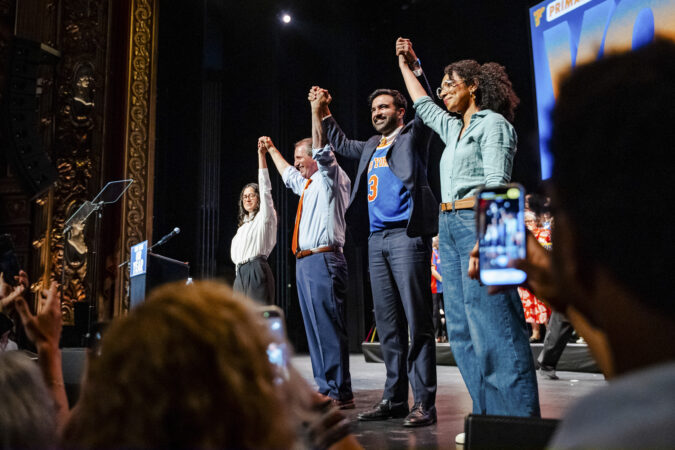
Darializa Avila Chevalier (center), alongside New York Mayor Zohran Mamdani (left), greets supporters after winning the Democratic nomination for New York’s 13th Congressional District.
Neither does Melat Kiros, 29, who unseated 15-term Rep. Diana DeGette, 68, in the Democratic primary in Colorado. She has worked as a lawyer and — more recently — as a barista. But when it comes to politics, she is a complete novice.
Then there’s Platner. A combat veteran and oyster farmer, he ran as an aw-shucks common man. That meant eschewing what he called “the establishment,” including experienced political consultants and pollsters.
But guess what? It turns out experience matters. The young Democratic operative who recruited Platner to run for Senate bypassed the standard background check, which usually takes a few weeks. He opted instead for a three-day “investigation” by a firm that didn’t even bother to interview Platner or solicit a questionnaire from him.
To its credit, the firm flagged some of Platner’s controversial Reddit posts. But a more thorough — and, yes, professional — background check would surely have uncovered his “unsettling” behavior around women, which former girlfriend Jenny Racicot described to reporters last month.
And earlier this week, Racicot said Platner had shown up drunk at her house — after she asked him to stay away — and forcibly had sex with her. Platner denied the charge, but he said he was “mindful of the political reality it would inflict” and that he was taking time to “reflect” on how to proceed.
Leading Democrats — including Sens. Elizabeth Warren and Bernie Sanders — called on Platner to quit the race, and I agree with them. But I also think the party should reflect on why we continue to elevate candidates who lack any real political experience.
To defenders of these outsiders, their inexperience is a selling point. If you want to challenge the establishment, the argument goes, you need people who aren’t tainted by it — which was a major sentiment behind then-29-year-old Alexandria Ocasio-Cortez’s upset in New York’s 14th Congressional District in 2018. Ever since, some have argued, that’s the only way to get progressives into power.
Nonsense. Here in Philadelphia, Chris Rabb scored a stunning victory in the May primary race to replace Rep. Dwight Evans. Like Chevalier and Kiros, Rabb calls himself a democratic socialist. But he also has significant experience in government.
Jonathan Zimmerman wonders how voters can be OK with supporting Graham Platner, a Senate candidate who has never held elected office.
Rabb served for five terms in the Pennsylvania House of Representatives, where he sponsored bills to repeal the death penalty and to promote restorative justice in criminal sentencing. He knows his way around Washington, too. Earlier in his career, he worked as an aide to Carol Moseley Braun, the first African American woman in the U.S. Senate.
Whatever you think of Rabb’s politics, he is qualified for the job. And we should care about that. Just like we shouldn’t make a housing official the director of national intelligence, we shouldn’t make an oysterman a member of Congress. To serve effectively in government — like any other professional role — you need knowledge and experience.
And if you think otherwise, just look at the guy in the White House. America elected 44 presidents before Donald Trump. Forty-one of them had held prior political office; the other three (Zachary Taylor, Ulysses S. Grant, and Dwight D. Eisenhower) were victorious U.S. war generals.
Experts don’t know everything, of course, and they can be wrong (see: COVID-19 lockdowns). But they do know more than the rest of us about what they do. In choosing candidates like Graham Platner, Democrats turned their backs on that principle. Let’s hope they rediscover it before it’s too late.
Jonathan Zimmerman teaches education and history at the University of Pennsylvania. He is the author of “Schooling Citizens: How Education Can Save Democracy,” which will be published next spring by American Philosophical Society Press.
Over the last decade, I’ve grown used to waking up before dawn and writing about a soul-crushing defeat from the night before. Usually it’s on a Wednesday, but somehow Donald Trump is always involved. Monday’s 4-1 demolition of the U.S. men’s national soccer team by Belgium pretty much confirmed that I won’t live to see Americans win the World Cup in my lifetime, so it’s time for acceptance. But these last three weeks have been a blast, and the party isn’t over. Sometimes the tritest words are also the truest: Maybe the real World Cup was the friends we made along the way.
Future generations will remember America’s 250th for its state of denial
Visitors experiencing excessive heat sit on the ground at the National Mall in Washington during Independence Day events honoring the nation’s 250th anniversary on Saturday.
The long-awaited arrival of the 250th birthday of the United States inspired a lot of talk about everything that’s changed since July 4, 1776, especially as “the man on a hobby horse” sinks to the founders’ worst fears about democracy and demagoguery.
But historians of the future may dwell on another huge difference between the day the ink started drying on the American Declaration of Independence and July 4, 2026.
Thomas Jefferson — his work as chief author of the nation’s founding document wrapped up — bought a new thermometer that morning and recorded the temperature in Philadelphia three times in his diaries that day, including a temperate 1 p.m. reading of 76 degrees.
Jefferson’s thermometer might not have been up to the task of keeping up with Philadelphia’s climate 250 years later. On Saturday’s Semiquincentennial, temperatures maxed out at 101 degrees — the third straight day that the mercury reached that mark, which had never happened since records began in 1870. But with the fetid, humid air, it felt more like 110 degrees for anyone brave enough to celebrate America’s birthday outside.
Philly should have seen this train coming. I mean, literally. Two days earlier, officials just outside of Reading, nearly two hours northwest of America’s founding city, plowed ahead with a welcoming party for Union Pacific’s Big Boy No. 4014, the world’s largest operating steam locomotive — even as the railway relic ran an hour late, with some thermometers posting 106 degrees.
The result was what local officials called “a mass casualty event” — no one died, but rescue teams were summoned from neighboring counties to help revive more than 100 people suffering from heat exhaustion, in desperate need of water or an IV. Some 35 of the would-be train spotters were rushed to the hospital.
“It was a little bit chaotic,” an EMS director told the local TV station in Reading. “I don’t think anyone anticipated the weather or the volume of crowds.”
The scientific group World Weather Attribution, which tracks the impact of human-made global warming, said last week’s heat dome over the Eastern Seaboard was indeed a rare event, yet — without the contribution of burning fossil fuels to a warming planet — it “would have been so extreme as to be virtually impossible.”
Heat waves aren’t new. I was just 7 but still remember the July Fourth week of 1966 — exactly six decades ago — when it also topped 100 degrees. It’s one of the few things I remember from that grade-school time because it was so incredibly rare. Today, “once-in-a-century” heat waves are routine all over the planet. In June and looming again this week, Western Europe — where few homes are air-conditioned — has sweltered under temperatures that climate scientists weren’t expecting until around 2050.
This suffocating July Fourth could have been — to steal a phrase from the multiplex marquee — America’s “disclosure day,” exposing the truth of a threat to humankind that’s been hiding in plain sight. Instead, it was our “denial day,” led by our planet’s denier-in-chief, Donald Trump, whose 250th birthday card to America only read: “Don’t look up.”
The denial was immediate, as the president insisted — ignoring the experts who warned that the triple-digit temperatures and intense, gathering thunderstorms might spark a much bigger “mass casualty event” in Washington, D.C. — on going ahead with his bombastic and self-serving speech and a fireworks show that lasted well into the early morning hours of July 5.
Our modern-day seersucker-wearing mayor of Jaws might as well have told the broiled holiday weekend throng, “But, as you see, it’s a beautiful day, the beaches are open, and people are having a wonderful time” — as ominous John Williams music swelled in the background.
The denial was also metaphorical to the max — and not just when those predicted storms arrived and panicked MAGA Trump supporters were forced to take refuge at the National Museum of African American History and Culture, the history and culture their movement is so eager to erase.
In New York Harbor, U.S. Coast Guard vessels forced the storied environmental sloop Clearwater — which took part in the historic Bicentennial tall ships parade back in 1976 — to leave the July 4 Parade of Ships because of two anodyne political banners taped to its sails: “Save the Clean Water Act” and “Indigenous Rights, Racial Justice, Climate Solutions.” Don’t look up, not even at a tall ship.
Hours later, during the fireworks show, the Brooklyn Bridge caught fire, which had nothing to do with climate change, yet felt like a coded message from the overheated planet nonetheless.
But maybe we shouldn’t wade too deeply into the metaphors when the worst denial is the all-too-real policy stuff. Every day, some nightmare headline about killer floods or disappearing glaciers is met with some nonsensical action from the U.S. government based on Earth 2, where none of this is happening.
As the climate-change-intensified heat dome settled in over the Eastern United States, Trump issued pardons for nine people — and you really can’t make this stuff up — who’d been convicted of felony violations of the Clean Air Act by selling or installing devices for diesel trucks that defeated their emissions controls, because polluting our spacious skies is no longer a crime in Trump’s America.
America continues to get a whopping 82% of its energy from polluting fossil fuels, and that’s unlikely to drop over the next 30 months, regardless of how many Trump voters can cheat death on looming “mass casualty events.” But POTUS 47 warned voters he planned to set the world on fire if he returned to the White House.
What’s harder to understand, frankly, is why the people who should be fighting Trump on climate change are running away from the front lines. Yes, I’m talking about Democratic Party leaders who’ve tossed climate action down the memory hole in the 2026 campaign — either terrified that any mention of climate will undercut their single-minded focus on affordability, or distract from fighting Trump’s brand of autocracy.
And ditto for newsroom leaders who seem to have decided that environmental journalists are the first people to lay off, not to mention the other world chieftains who ought to be challenging Trump’s destructive policies, but are meeting the moment with a shrug. Even Canada’s center-left prime minister, Mark Carney, is now backing away from the aggressive climate action he once supported, claiming, “It’s too expensive.”
That’s a lot of malarkey, as the president who just four years ago passed the largest climate action bill in U.S. history might say. Clean energy continues to rise elsewhere in the world because the alternatives, like wind and solar, are ultimately cheaper and also a source of desperately needed job creation. The fossil-fuel-boosted heat wave of July 4, 2026, proved that inaction is a threat not only to our lives and our liberty but also to the pursuit of happiness. It’s hard to celebrate 250 years of American democracy when climate denial is exposing that system as so badly broken.
Yo, do this!
Did I mention the World Cup isn’t over? If you are a true fan of the Beautiful Game, you’ll brush off the quadrennial disappointment of the U.S. men’s team and get excited to watch one of the greatest generations of international soccer superstars we’ve ever seen. One of the more intriguing of the four quarterfinal matchups this weekend will occur when Harry Kane and his English squad face Erling Haaland and his Norwegian upstarts in the Miami heat. The match kicks off at 5 p.m. Saturday on Fox.
The new movie scene for the July Fourth holiday was a disappointment, so the heat wave was a perfect opportunity for revisiting the classics of the 1970s and ’80s with the generation that had not been born yet. We went back to the late Rob Reiner’s first great serious film, the coming-of-age saga Stand By Me. It’s hard not to feel nostalgia today for a time when 12-year-olds had to entertain themselves without iPhones and could disappear into the woods overnight, which felt less strange in 1986 when the movie was first released. It felt truly like a faint signal from a lost planet.
Ask me anything
Question: Talk about Mitch McConnell’s demise. — Wendy (@wensilver.bsky.social) via Bluesky
Answer: Well, Wendy, that’s not exactly a question, and while the New York Times is reporting that the Kentucky senator and former majority leader was unconscious and in cardiac arrest when paramedics found him on June 14, his staff insists McConnell is still alive. That hasn’t stopped conspiracy theories that McConnell is on life support until August, when his replacement, named by GOP lawmakers, could avoid a messy November election. I don’t know about that, and I agree that it’s very poor form to speak ill of the dead. So the fact that he’s still alive is an ideal moment to remind everyone that his hijacking of the U.S. Supreme Court and his cowardice during Donald Trump’s second impeachment both started America on the path toward tyranny. So get well soon, senator. You still have a lot to answer for.
What you’re saying about …
Last week’s question about whether you are happy or concerned about progressive Democrats doing well in the 2026 primaries brought a mix of interesting responses that aren’t easy to categorize. Most of you want Dems who will fight harder than the current crew. “I have been voting since 1968, always for Democrats, but seldom with enthusiasm,” wrote Stephen Boone. “Finally, in my old age, there are a few decent politicians. I want more AOCs! More Zohran Mamdanis! …” Others felt more cautious. Wrote Thomas Desmond: “I think the progressive candidates are fine in deep blue seats, but may not be a great idea in purple or light-red seats that could prove winnable this year.”
📮 This week’s question: It may be water under the bridge next week, but Donald Trump’s personal role in overturning the arguably wrongly given red card to U.S. star Folarin Balogun has sparked a heated debate. Was the red card an injustice to be reversed by any means necessary? Or did Trump’s involvement ruin the World Cup? Please email me your answer and put the exact phrase “Trump Balogun” in the subject line.
Backstory on Trump ruining the World Cup like everything else
President Donald Trump holds up a red card during a meeting with FIFA president Gianni Infantino in the Oval Office of the White House in August 2018.
If the big-screen tragedy of the U.S. men’s soccer team’s same-as-it-ever-was Round of 16 exit from the 2026 World Cup on Monday night had a theme song, it should have been John Lennon’s “Instant Karma.” For its first four (mostly) exhilarating matches, the USMNT gave a nation that was desperate for both an escape from relentless bad news — but also a connection to a wider world — the good vibes it desired. It truly felt like the Americans could go further than ever before (in modern times) in the planet’s greatest sporting event. TV ratings soared. Watch parties were packed. A broken land was coming together.
To longtime soccer fans, the red card handed out last Wednesday to the U.S.’s top goal scorer, Folarin Balogun, for stepping (seemingly unintentionally) on the ankle of a Bosnian player during a 2-0 victory — a harsh punishment that meant not only his ejection from the pitch but a suspension for the upcoming Belgium match — was the essence of our love/hate relationship with soccer. It may be a beautiful game, but it’s the ugly calls that we debate for decades. For a non-soccer fan and malignant narcissist like Trump, for whom anything that goes against his desired outcome is proof of the world’s unfairness toward him, the looming loss of America’s star striker was an opportunity to act like the strutting strongman of a personalist dictatorship.
There were too many ironies to bear — especially the fact that Trump had just gone all the way to the U.S. Supreme Court to fight to strip U.S. citizenship from people like Balogun, who was born to British-Nigerian parents in 2001 during an American visit, and millions of other immigrants who aren’t as talented with their feet. But the other irony was that — like so many corrupt schemes, whether from the mafia or the Trump White House — the president’s soccer coup failed. It felt like Trump had attacked the positive zeitgeist around U.S. men’s soccer with a neutron bomb. Balogun rarely even touched the ball. We’ll never know how much of Belgium’s 4-1 rout of the mistake-prone U.S. was simply a European powerhouse outclassing the Americans, as has happened so many times before, and how much was Trump destroying the juju.
It did seem fitting that this sordid affair played out over the weekend of America’s 250th birthday, as it was more confirmation that Trump, in spite of what the hat says, actually has no clue what makes America great. If any one principle stood out from the founders’ 1776 and 1787 experiments, it is that the United States was to be based on fairness and following the rules, with no king imposing his will. The single greatest thing about America’s presidential elections was not who won, but the fact that the loser accepted the results, and there was a peaceful transfer of power — until Jan. 6, 2021. Likewise, nothing could ruin the often unbridled joy of the World Cup faster than a rigged competition.
I’m still looking forward to the next 12 days, to watching the pinpoint passing of Argentina’s Lionel Messi or the raw power of Norway’s Erling Haaland, and to seeing who can actually win the World Cup on the pitch, and not in a back room. We already know the tournament’s biggest loser: Donald Trump.
What I wrote on this date in 2014
Looking back on this Attytood blog post from 12 years ago today is a reminder of how debates can evolve over time. My short piece on July 7, 2014, was a riff on an op-ed that called newspapers’ online comment sections in those early internet years “a hate crime” that should be cordoned off because of the vitriol spewed at immigrants or others outside the traditional American hierarchies. Back then, I disagreed, taking the side of free speech absolutism. “These are people who shouldn’t be censored … just set straight,” I argued. “The one true powerful weapon against offensive free speech … is your free speech, and mine.” Time proved me wrong: The Inquirer now avoids comments on most articles, including my columns. It turned out that “the wisdom of the crowd” that newsroom reformers once hailed was fatally infected with racism, sexism, and other forms of hate.
Only one column last week, as I enjoyed the July Fourth holiday by spending time with family and watching countless hours of soccer. In that piece, I wrote about an American 250th birthday that should have been a meditation on what makes our nation great, and where we so desperately need to improve — but which Donald Trump used as an excuse to rob the cash register when no one was looking. The president’s staggering $2.2 billion-plus payday during his first full year back in office — accomplished with a mix of crypto flimflammery, informed stock trading, and dealings with foreign dictators — is a five-alarm fire for the rule of law.
One final thought about the 250th birthday of the United States as the moment recedes into the rearview mirror. It’s true that 2026 has been a lousy year, economically, for newsrooms, but you would never know that from reading The Inquirer’s remarkable coverage of such an eventful time. I’ve already praised our world-class World Cup coverage, but our overworked staff also went out and covered a July Fourth party that happened despite killer heat, biblical storms, and a plague of locusts (not really, but it felt that way). This included some real accountability journalism, such as the Trump regime’s efforts to twist the truth around George Washington and slavery, as well as questioning the cost of the big day for city taxpayers. It was also a reminder that Philadelphia has been a hotbed for journalism and the rugged practice of bringing the First Amendment to life since the early days of the republic. Help keep it going another 250 years by subscribing to The Inquirer.
By submitting your written, visual, and/or audio contributions, you agree to The Inquirer’s Terms of Use, including the grant of rights in Section 10.
For years, I have summed up American politics in one sentence: Republicans have no principles, Democrats have no spine. Now, Democrats seem intent on proving they have no brains to go with that wobbly backbone. Following James Carville’s lead, some frightened Democrats appear determined to snatch defeat from the jaws of victory.
Carville worked magic nearly 35 years ago, helping mastermind Bill Clinton’s 1992 win. He has since become the epitome of the conventional-wisdom consulting class. Only a split within the party could darken the Democrats’ bright electoral prospects this year and beyond. Yet, Carville seems determined to promote precisely that division.
Appointing himself the party’s membership czar, Carville openly advocates for an intraparty “schism,” pushing out the democratic socialists whom voters just elected in Democratic primaries. Sparing no expletives, he said, “I actually do think it’s time for Democrats to talk the S-word: schism.”
Even the word reeks of futility. Schism is most closely associated with the Great Church Schism, which culminated in 1054. The schism irreparably split the Christian Church into Eastern Orthodox and Western Roman Catholic, and weakened Christianity for centuries. It led to Western Crusaders sacking Constantinople in 1204, and left the Eastern Orthodox exposed to the rising Ottoman empire, which took the city in 1453.
The Democratic Party has always thrived on diversity. In the 1930s, Sen. “Cotton Ed” Smith and fellow conservatives held the party’s right flank while Sen. Robert Wagner and the liberals held its left. That coalition built the majorities that enabled Franklin Delano Roosevelt to enact the New Deal and to lead the nation through World War II.
One of FDR’s few political missteps was his attempt to purge conservatives in the 1938 primaries. The failed purge, which party chair James Farley called a “bust,” drove Southern Democrats into a conservative coalition with Republicans and shattered FDR’s aura of invincibility. Though not the primary cause, it contributed to staggering Democratic losses that November: 72 House seats and eight Senate seats.
Carville’s schism has no upside. A handful of democratic socialists will not turn America into Cuba. They sit much closer to the Democratic mainstream than Cotton Ed’s bloc sat to FDR’s. A September Gallup poll found that 66% of Democrats hold a positive view of socialism. And these are not hard-line socialists; they more closely resemble the social democrats of Scandinavia, who would regulate capitalist enterprise, rather than have the state seize it.
The downside, though, is immense. A divided party wins fewer elections. The most likely outcome of a Democratic schism is MAGA rule for the foreseeable future, posing grave danger to American democracy itself.
Carville’s promotional flair has won his idea wide coverage, and some Democrats have signed on. The Nation blared that “Establishment Democrats Are Embracing Loserdom.” The author warned that “Some centrists would rather have Trump triumph than forge an alliance with the left.”
Former Democratic Party chair Jaime Harrison told left-wing Democrats: “If you hate the Democratic Party, then please don’t run for our nomination. Don’t use our resources. Don’t rely on our volunteers. Don’t use our infrastructure.”
Democratic Rep. Josh Gottheimer of New Jersey agreed. “Are we going to let them take over the party? Or are we going to stand up and fight back?” he said. “Many of us believe, as I do, that if you’re a socialist, you’re not a Democrat.”
Democratic Sen. John Fetterman of Pennsylvania, although not explicitly endorsing Carville’s call for schism, blasted left-wing Democrats. He said that the victory of democratic socialists has “just been the dancing days of the dirtbag left. You know, some of these candidates are outrageous.”
Carville and his backers should remember the words made famous by football coach Vince Lombardi: “Winning isn’t everything; it’s the only thing.” Stopping Donald Trump and his cronies from subverting our democracy is not the most important thing; it is the only thing.
A united Democratic Party, not a top-down purged one, holds the only hope of achieving that end.
Instead of panicking over left-wing candidates’ victories, mainstream Democrats should learn why those wins sparked such voter enthusiasm. Democrats should also reject Carville’s siren song and heed Sen. Cory Booker’s response to Fetterman’s slamming of the “dirtbag left.”
“If you want to heal a country, you can’t be picking fights,” he said. “Our party is not homogeneous. One of the things that makes the Democratic Party great is that it’s a big-tent party. We need to stay that way. The focus has got to be the November elections.”
Allan J. Lichtman is a distinguished professor of history at American University. He is also the author of “Great American Presidents: The Twelve Who Transformed the Nation,” out from Bancroft Press in September.
For 30 years, Nettie King, 92, has relied on Social Security to survive.
She and her former employers at the Oak Lane Diner near her home paid into Social Security through payroll taxes for years.
While the storied institution closed in 2015, the Social Security benefit checks that King’s work generated have kept coming. “It’s been comfortable,” explained King, who said she was the diner’s first server of color in 1963.
But now there’s a problem.
King is among 68 million Americans facing possible reductions of 22% to their benefits by 2032 unless Congress acts, according to a new report by Social Security Administration (SSA) trustees released last month.
Pennsylvania residents could lose an average of $520 each from their monthly Social Security checks, according to the Committee for a Responsible Federal Budget, a nonpartisan think tank. That would affect an estimated 255,000 Philadelphians receiving Social Security benefits, according to Olivia Mitchell, director of the Boettner Center on Pensions and Retirement Research at the Wharton School of the University of Pennsylvania.
“Losing that much would be a disaster,” King said. “I pray the money doesn’t stop.”
It won’t if Congress overcomes its partisan divide and creates a workable solution to make Social Security solvent, say advocates for the elderly — including AARP, whose senior vice president Bill Sweeney warned in a recent press call that “the longer they wait, the harder it gets.”
Speaking for the Trump administration, Treasury Secretary Scott Bessent said in a statement, “We are working to preserve Social Security … and recognize that more work remains to secure benefits for future beneficiaries.”
Someday soon
Analysts have long predicted the Old Age and Survivors Insurance trust fund from which most retired Social Security claimants draw benefits could dissipate, said Temple University labor economist Samuel Solomon. But that was always regarded as a “someday” event.
“Someday” may now be just six years away. “That’s a big deal,” Solomon said.
The SSA wouldn’t stop paying benefits altogether, Mitchell said. Although the report predicts the fund’s reserves could be tapped out by 2032, “continuing payroll tax revenue [from people currently working] would cover about 78% of scheduled retirement benefits,” she added.
At nearly $1.6 trillion annually, Social Security represents more than 20% of the U.S. budget and is the nation’s largest single expense, Solomon said.
Various factors have combined recently to accelerate the fund’s potential depletion, according to the report submitted by SSA trustees, who include Bessent, as well as Health Secretary Robert F. Kennedy Jr.
First, the fertility rate this year is going down faster than predicted: 1.75 children per woman vs. 1.9.
Also, immigration is lower than estimated. That trend will continue as the government maintains restrictive immigration policies, experts say. It represents a potentially immense loss of revenue, according to Wharton research, which shows that “unauthorized immigrants” paid $24 billion in Social Security payroll taxes in 2024, despite being ineligible to collect any benefits.
Both the slowed fertility and diminished immigration rates have lowered the anticipated number of workers and the payroll taxes they’d have contributed to Social Security, said Kathleen Romig, Social Security expert with the Center on Budget Priorities and Policies, a left-leaning research group.
The final factor, the trustees report said, is that the One Big Beautiful Bill Act that decreased income tax rates has reduced revenue that would’ve flowed into the program.
The SSA didn’t respond for requests to comment.
The Social Security system had been strained long before the trustees report. The giant baby boomer generation has been retiring since around 2011, siphoning millions from the program, Solomon said.
In 1950, when the first boomers were 4 years old, every 100 workers paid the Social Security benefits of 13 elderly people, Solomon said. Today, it’s 25 elderly people per 100 workers — “more responsibility on a single working person to support more retirees,” Solomon said.
That worries Doris Kitt, 81, of Jenkintown, a Social Security benefits recipient who still works at a South Jersey pediatric dental practice.
Doris Kitt talks with coworker Asia Bagby. Kitt, who is 81, still works and also collects Social Security benefits.
“Less Social Security when rent and food continue to cost more is a challenge,” Kitt said.
‘Give me what I’m due’
Through the years, Republicans and Democrats have forwarded competing remedies for repairing Social Security.
GOP suggestions include raising the retirement age to 70, and privatizing the system.
Democrats call for raising payroll taxes and ending the payroll tax cap. (Currently, wages above $184,500 are not subject to Social Security taxes. Democrats would eliminate the cap so higher-income earners pay into the system on 100% of their earnings.)
In a statement, U.S. Rep. Brendan Boyle, a Northeast Philadelphia Democrat running for reelection in November against Republican challenger Jessica Arriaga, said the trustees report makes it clear that “we must act to protect Social Security benefits for all generations.“
He referenced a bill he introduced in May 2025 that would require Americans earning more than $400,000 to contribute a greater percentage of their wages to Social Security. It’s now before the House Ways and Means Committee.
U.S. Rep. Lloyd Smucker, a Republican representing Lancaster County, also issued a statement, saying Social Security could be fixed by a “bipartisan fiscal commission” to “build consensus” and eliminate depletions of benefits. Smucker is being opposed by Democrat Nancy Mannion in his bid for reelection.
“We must preserve the trust fund millions of Americans rely on and keep our promise to those who have been paying into the system their entire lives,” he said.
That covenant must be honored, said Shirley Stringfield, 70, a retired city worker from Germantown.
“I spent 55 years of my life paying into Social Security,” she said, “so I want them to give me my due. I expect to receive my benefits until I expire. I need every cent.”
Two days before the American revolutionaries signed the Declaration of Independence in 1776, the Second Continental Congress gathered in Philadelphia to formally vote on the matter.
Standing in virtually the same spot 250 years later, their distant successors commemorated that historic moment while grappling, at times, with what it left out.
“The fact that we have you here together is a symbol of progress,” said U.S. Rep. Dwight Evans, a retiring Democrat who’s spent more than four decades as one of Philadelphia’s central Black political leaders. “250 years ago, people like me were not fully included in the founders’ vision. … The struggle to live up to our founding ideals was hard fought.”
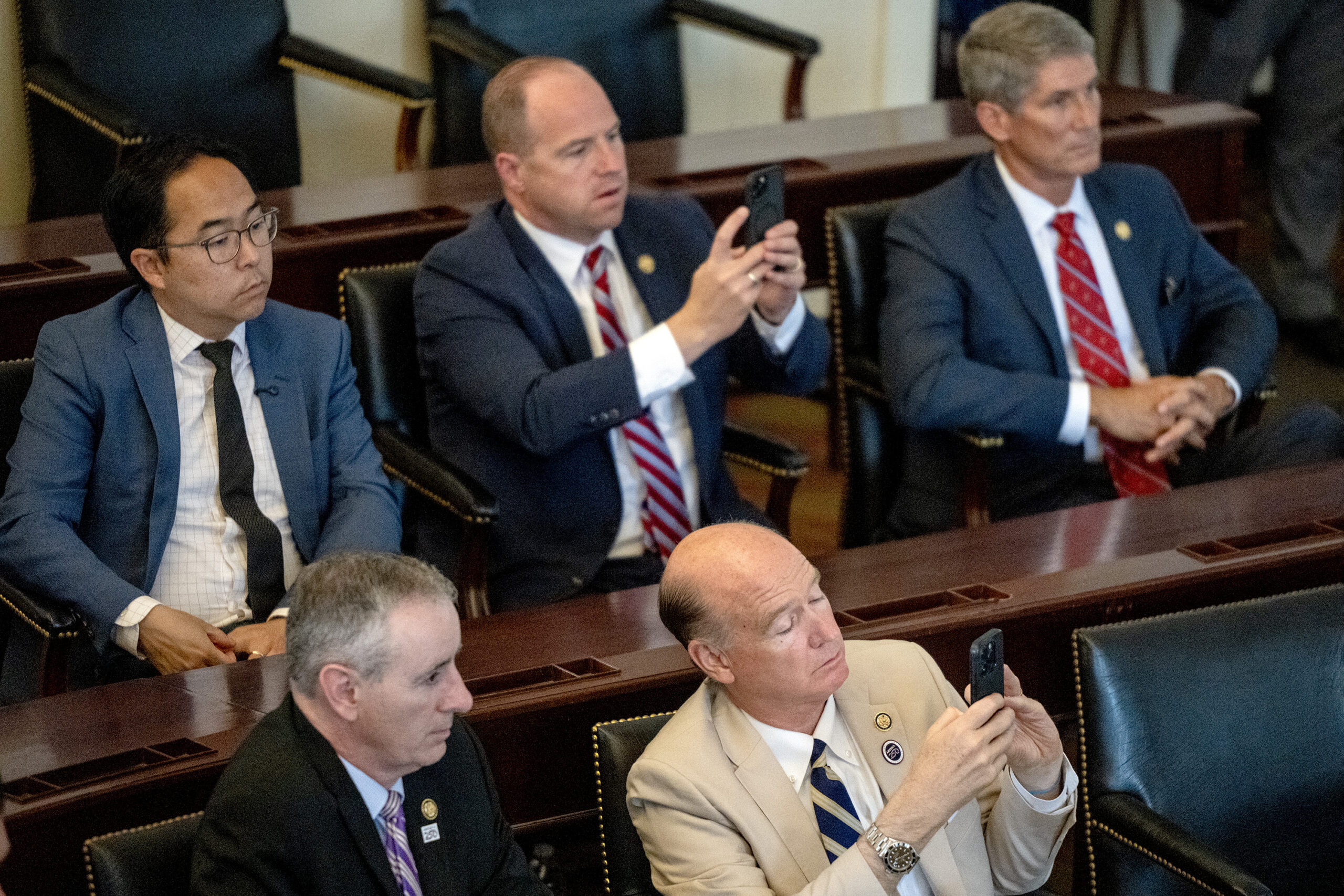
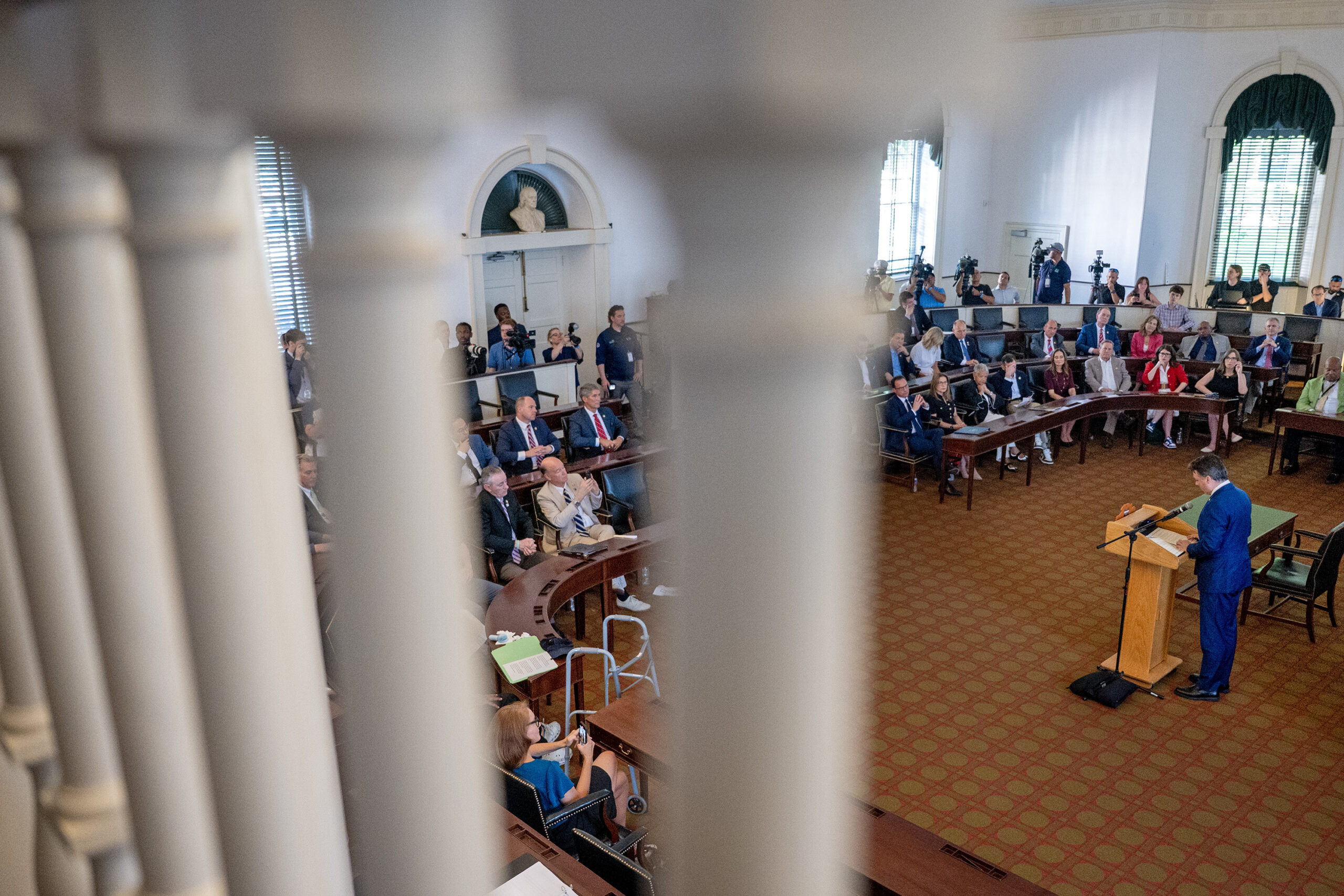
More than30 members of the 119th Congress attended the event at Independence Hall, one of many marking theSemiquincentennial in the city this week. U.S. Rep. Brendan Boyle, a Philadelphia Democrat whose district includes the historic site, had worked for years to bring his colleagues to the site to mark the nation’s founding.
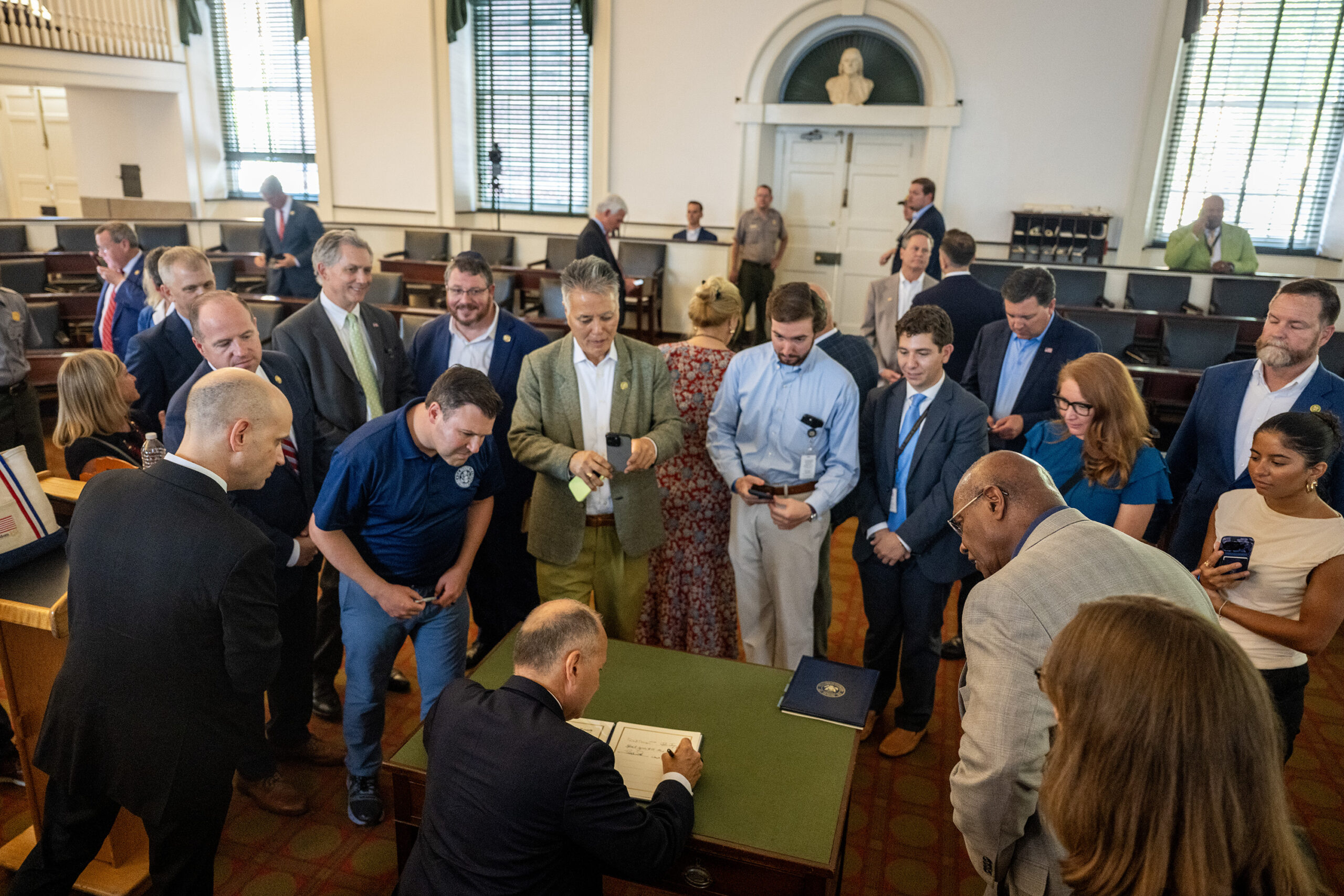
A bust of Benjamin Franklin is above the door in the back of Congress Hall as U.S. Rep. Lloyd Smucker of Lancaster County signs a ceremonial document after the House of Representatives met at Independence Hall on Thursday.
As Boyle and others walked through that history in Congress Hall — the room where the legislative branch convened before relocating to Washington — they referenced both the uneven history of the country and the divided, polarized times that define modern America.
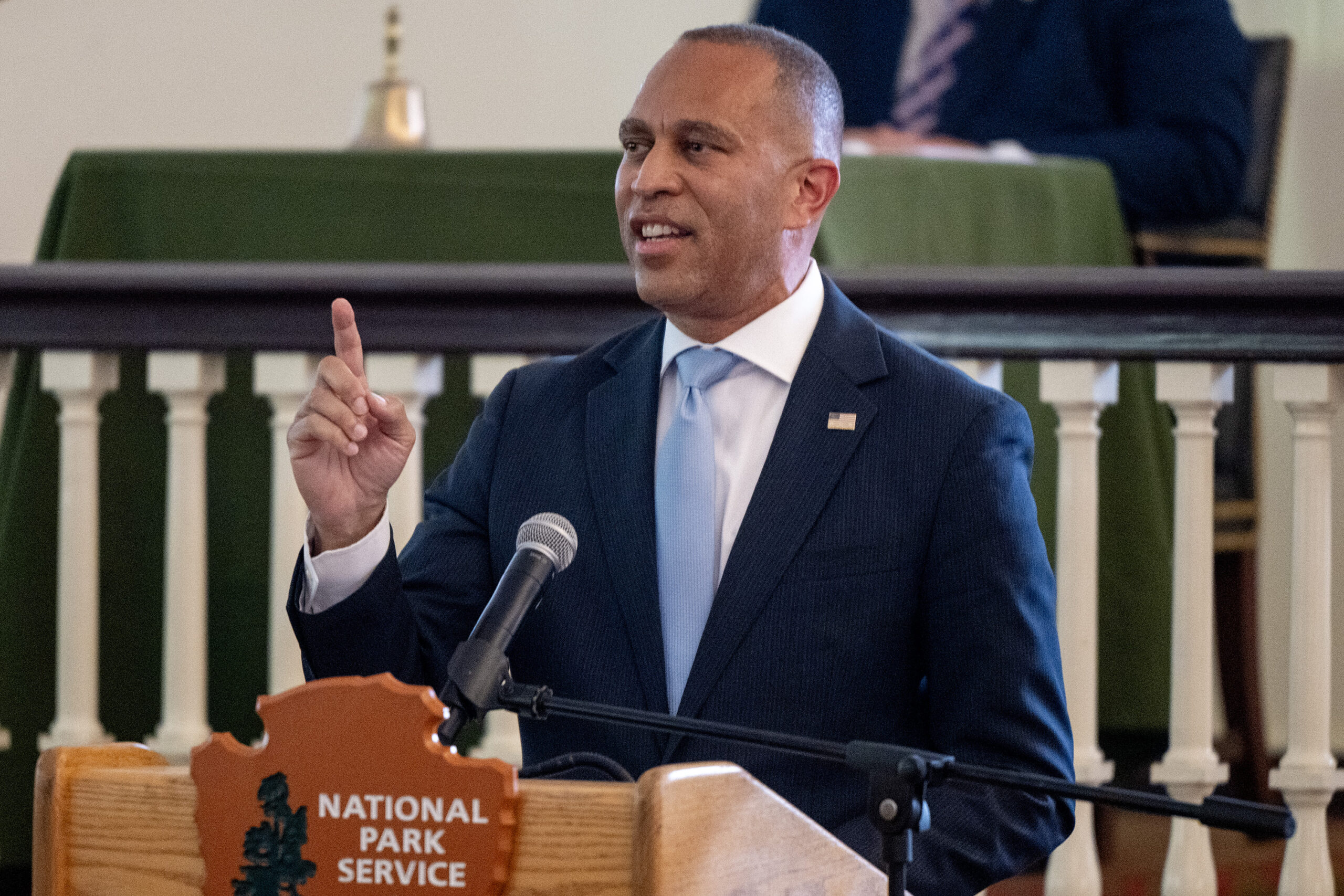
“America has indeed struggled at times, beginning with the horrors of chattel slavery and the oppression of Native Americans, to live up to our highest ideals,” said House Minority Leader Hakeem Jeffries (D., N.Y.). “But the high–minded principles, upon which this great country was born, have served as an eternal lamp post for us to continue to strive and march toward a more perfect union.”
Jeffries’ remarks — from a high-profile lawmaker poised to become the first Black speaker of the U.S. House if his party wins control in the midterms later this year — came as President Donald Trump’s administration has tried to pull back the federal government’s references to the history of slavery, including on Independence Mall, most notably at the President’s House, a block from where the lawmakers gathered.
The Democratic leader was one of multiple speakers, including Pennsylvania Gov. Josh Shapiro, who made veiled references to Republicans’ ceding Congress’ role as a check on Trump. The members of Congress who served at Independence Hall believed the chamber “would be separate and coequal, never subservient or co-opted,” Jeffries said.
“Let us never forget that we don’t work for any other branch of government,” he said. “There are no kings in the United States of America. We work exclusively for the American people.”
House Democratic Leader Hakeem Jeffries addresses the Representatives meeting in Congress Hall. He said it was important to speak about the history of slavery in America. The gathering marked the 250th anniversary of the day the Second Continental Congress voted for independence.
U.S. Rep. Glenn “GT” Thompson, a Centre County Republican and dean of the Pennsylvania delegation, presided over the event. He said afterward that some of the remarks turned “a little political.”
“But it is an excellent observation,” Thompson said. “We don’t have a king. We can thank George Washington for that.”
Thompson was one of several Pennsylvania Republicans to attend the mostly Democratic event, but other top officials were noticeably absent.
Pennsylvania’s top-ranking Republican federal official, U.S. Sen. Dave McCormick, did not attend. Neither did U.S. Sen. John Fetterman, a Democrat who has increasingly aligned himself with Trump and Republicans.
U.S. Sen. Andy Kim (D., N.J.), who lives in nearby Burlington County, was the only senator to attend.
U.S. Senator Andy Kim (left) of New Jersey joins House members.
‘Let this sacred place awaken us’
Since 1800, Congress has met outside Washington, D.C., on only extremely rare occasions.
In 1987, a ceremonial joint session in Philadelphia marked the 200th anniversary of the Constitution, and in September 2002, more than 300 members met in New York City for the first anniversary of 9/11.
Thursday’s gathering in Philadelphia was considered a ceremonial event, not a formal joint session, so the lawmakers did not debate legislation or cast votes in the room where they conducted that kind of official business in the earliest days of the nation.
There weren’t defined political parties, all those years ago.
But the fissures that soon arose in the nation’s first capital — and that have only become more entrenched since then — were evident both in and around Thursday’s event.
The 45-minute ceremony was a bipartisan showing. A pair of Pennsylvania Republicans in particular, Thompson and U.S. Rep. Brian Fitzpatrick (R., Bucks), kicked off the day with a call to order and invocation. Others like U.S. Reps. Ryan Mackenzie (R., Lehigh), Lloyd Smucker (R., Lancaster) and John Joyce (R., Blair) also attended.
Fitzpatrick, a moderate Republican facing a tough reelection campaign this year, and Boyle, a moderate Democrat, were among several speakers who talked about the anniversary being a moment for Congress to recommit to its founding goals.
“Let this sacred place awaken us, a solemn charge that flows from what was proclaimed here 250 years ago,” Fitzpatrick said.
Among the over 30 lawmakers, though, Democrats outnumbered their colleagues across the aisle. Jeffries addressed the room, while no members of House Republican leadership, who control the chamber, made an appearance.
‘A great balancing act’
The day itself came after a chaotic few weeks in Washington, even during an unusually divisive two-year term.
The most significant bipartisan legislation produced during Trump’s second term, a comprehensive housing bill that includes a home-repair program that originated in Pennsylvania, was temporarily scuttled when the president refused to sign it. His demands for a controversial voter-ID and elections reform bill first was derided by members of both parties.
U.S. Rep. Brendan F. Boyle speaks as members of Congress gather for the ceremonial event.
Just 48 hours before Thursday’s gathering, that move was still causing turbulence on Capitol Hill as Republican House Speaker Mike Johnson canceled the rest of the week’s agenda because of disagreements around the legislation, known as the SAVE America Act.
Johnson did not attend the event at Independence Hall.
“Two and a half centuries later, we continue to work to find that balance, work that each of you is charged with taking up every single day,” Shapiro said.
Even in the blocks around the lawmakers’ gathering, the tensions of the Trump era were evident.
A few blocks away at the historic Christ Church, local advocates and interfaith leaders gathered before the congressional event to call out the president’s aggressive immigration enforcement tactics. One local member of Congress — U.S. Rep. Mary Gay Scanlon, a Delaware County Democrat — stood with them before joining her colleagues at Independence Hall.
And just down the street at the President’s House, tourists saw an incomplete display after the Trump administration took down information that memorialized the nine people George Washington enslaved in Philadelphia during the nation’s founding.
Boyle pointed to fights by “generations of Americans who refused to accept that liberty and equality belonged only to some.”
“That struggle is not separate from the American story,” Boyle said. “It is the American story.”
Philadelphia-based restaurateur Stephen Starr and his company, Starr Restaurants, settled with the National Labor Relations Board in May over union-busting allegations at his D.C. steakhouse St. Anselm, according to a copy of the settlement agreement obtained by the Inquirer.
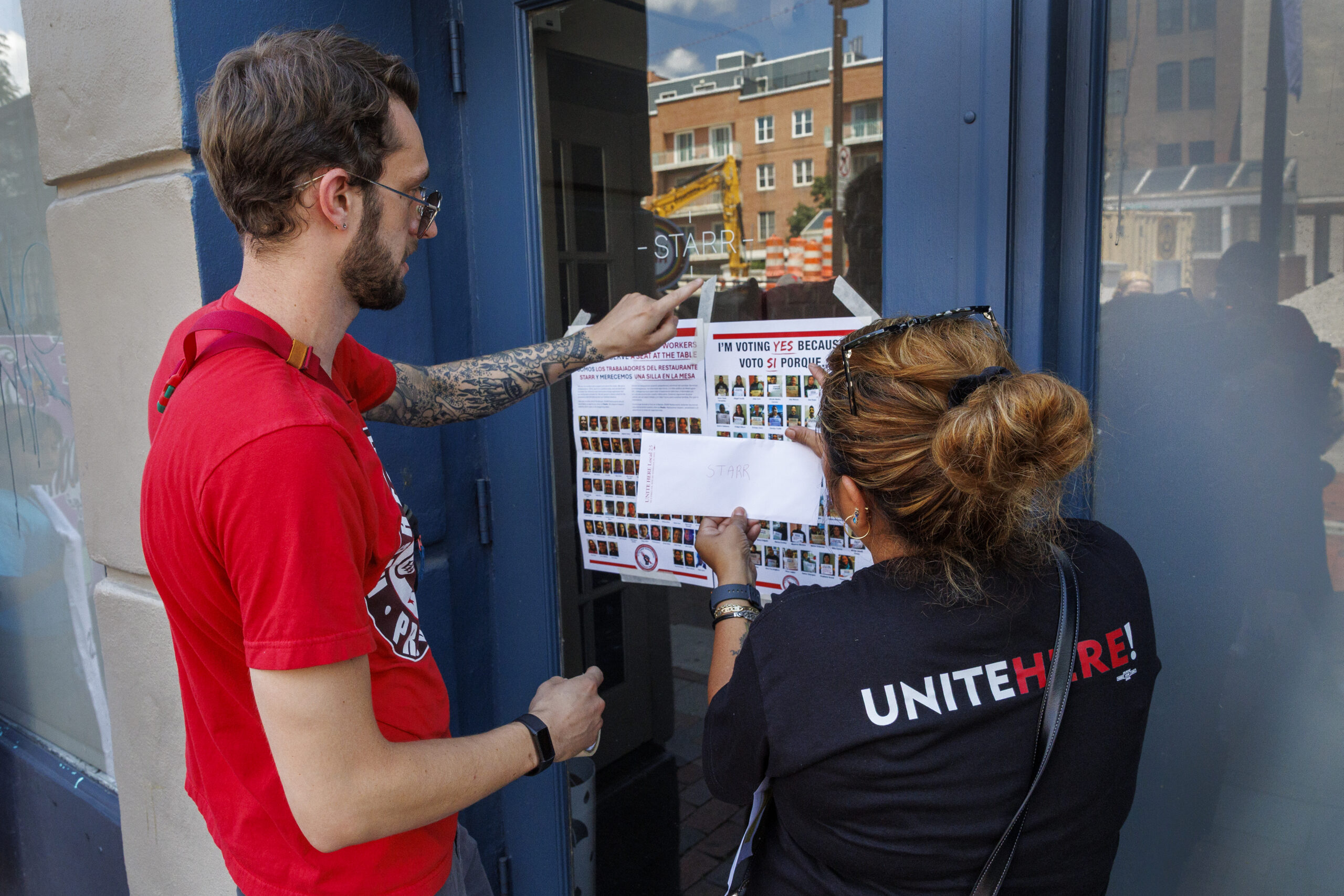
The move is the latest in a lengthy dispute between Starr Restaurants and D.C. union Unite Here Local 25 at St. Anselm, where staffers voted 51 to 42 in favor ofunionizing in February 2025. Now more than 16 months later, Starr restaurants has yet to recognize the union, with more pending litigation leaving St. Anselm workers in limbo.
Reached on May 25, the settlement resolves a set of unfair labor practice (ULP) allegations that Local 25 filed with the NLRB on behalf of St. Anselm employees in June 2025. They alleged that Starr and a St. Anselm supervisor made promises of improved benefits for workers who voted against the union and directly coerced employees with false information. In one instance, they alleged, Starr interrogated a host about her involvement with Local 25 during a one-on-one conversation.
Starr “made a lot of promises about sick pay, about vacation pay,” Ana Reyes, a St. Anselm line cook, previously told the Inquirer, recalling a meeting the restaurateur had with staff during the union drive.
After an investigation, the NLRB’s general counsel found merit in the accusations that Starr Restaurants had violated the National Labor Relations Act, and it pursued charges against the company.
The settlement is not an admittance of wrongdoing and is similar to the standard penalty Starr Restaurants could have received had the case played out fully, according to James M. Cooney, a Rutgers University labor and employment law professor.
St. Anselm, Stephen Starr’s D.C. steakhouse.
The agreement requires Starr Restaurants to post a notice in St. Anselm for 60 days stating that the company will not:
“Threaten you that it would be futile” to unionize,
Solicit complaints and “imply that we will fix them” in order to discourage union support,
Give new or better wages and benefits to discourage unionizing,
Or “promise to pay you for previously unpaid leave” to dissuade workers from supporting a union.
The settlement “allows us to move on and get back to the business of delivering amazing hospitality to our guests,” a spokesperson for St. Anselm said in a statement. “We have vigorously denied, and continue to deny, all allegations listed in the original complaint, and are fully complying with the terms of the settlement while making no admission of violation.”
A delegation of workers pose in front Stephen Starr’s D.C. steakhouse St. Anselm before delivering their union petition in Feb. 2025.
That case remains open, and a hearing was held in mid-June where the NLRB heard testimony from witnesses on both sides. Unite Here Local 25, which represents more than 7,500 hospitality workers, is optimistic that settlement will open up a path to union recognition.
“We feel vindicated,” said Paul Schwalb, Local 25’s executive secretary-treasurer. “It’s the same board that’s going to oversee [the unionization case], and we are quite confident — because we did actually follow labor law — that at the end of the day this unit will be certified, and all the objections that Stephen Starr and his many lawyers have filed will be thrown out because they are not true.”
Legalese that ‘meant nothing’
The battle between Starr Restaurants and Local 25 began last January, when the union began to organize at three of Starr’s seven D.C restaurants: Pastis, a French bistro; the Parc-inspired Le Diplomate; and St. Anselm, an upscale steakhouse.
The efforts — which coincided with union drives at two other high-profile D.C restaurants — stood to add 500 members to Local 25. St. Anselm was the only one that voted to unionize. (Local 25 lost the union election at Pastis, and Le Diplomate’s has been suspended indefinitely.)
A picket line outside of Stephen Starr’s D.C. restaurant Le Diplomate, led by Unite Here Local 25 after Starr Restaurants challenged a unionization vote at St. Anselm.
Almost immediately, relations soured between Starr Restaurants and Local 25. The restaurant group hired anti-union consultants to meet with St. Anselm staff, Washingtonian magazine reported, while other employees told food publication Eater that Local 25 organizers were ambushing them at their homes to sign cards indicating they wanted a union vote.
Local 25 also called for an ongoing boycott of Starr’s D.C. restaurants — including those where no union efforts were taking place. Top Democrats such as Sen. Bernie Sanders, Rep. Alexandria Ocasio-Cortes, and Sen. Chuck Schumer signed on.
Legally, the settlement doesn’t state that Starr Restaurants broke any laws or affirm any of the union’s allegations. In practice, however, Cooney said that workers and employees might have a different interpretation.
Posting a notice “doesn’t sound very intimidating on its face, but employers will sometimes fight tooth and nail over the wording” or try to hide them, said Cooney. “Looking at it from the viewpoint of the common worker, if they see that notice … I think they would see it as an indication that a company violated the law.”
Starr Restaurants posted the notice required by the settlement inside St. Anselm on June 16 and also emailed a copy to staff.
Greg Varney (left) and Ana Reyes, both with Unite Here Local 25, outside Starr headquarters at 134 Market St. in July 2025.
When St. Anselm server Abigail Dunki-Jacobs received the email, it felt like “a bunch of legalese … that meant nothing,” she told The Inquirer. Dunki-Jacobs, who voted against the union, said she hasn’t heard much chatter among her colleagues after it was posted.
“It just feels like a list of facts to me,” she said. “Nobody even really gives a shit about it.”
Delays upon delays
Local 25 organizers and employees who voted for the union also find the settlement meaningless.
Starr Restaurants “didn’t have to admit to doing anything wrong with the statement they made,” said Ellery Grimm, a member of support staff at St. Anselm who helped organize the union drive. “We’ll be vindicated when we have our contract.”
St. Anselm’s union election case has sat unresolved with the NLRB for nearly a year and half, which Cooney said was abnormal. The agency tends to prioritize certifying election results over unfair labor practice allegations.
The NLRB has been beleaguered by delays for more than year, first from the firing of a board member that left the agency unable to issue rulings, and then from a government shutdown that furloughed employees.
The delays have caused at least one St. Anselm employee to quit. Bridget Killburn, a baker at the steakhouse, left in April after more than three years at the restaurant. She now works at a bakery in Maryland that she said offered higher pay and more time off — two things she hoped the union would’ve won by now.
A chef in the kitchen at Le Diplomate, one of Stephen Starr’s three D.C. restaurants that Unite Here Local 25 attempted to unionize.
“I’m someone who wants a very stable job with good pay, good benefits. At this rate, it felt like I was never going to get those things so I needed to try and find a workplace who would allow me to have them,” Killburn said.
Schwalb acknowledged that Local 25 hasn’t done any public campaigning at St. Anselm in months, and has abandoned the union drives at Starr’s other restaurants until all litigation is resolved.
“Rome and the restaurant union — neither one will be built in a day,” he said.
Gov. Mikie Sherrill signed the New Jersey budget for fiscal year 2027 Tuesday night, shortly before the clock ran out on the constitutionally mandated deadline.
The budget ranks as the largest in state history, but Sherrill also contends it is the most “fiscally responsible” in decades in part because it fully funds the state pension program and doesn’t come with widespread tax increases for residents.
Lawmakers approved the budget on Tuesday after adding millions in legislative add-ons Sunday night, a move that countered Sherrill’s earlier vows to change the culture in Trenton. But she softened her stance as the deadline neared and she conceded that lawmakers know their districts best.
South Jersey Democratsdefended the spending, which Republican lawmakers criticized as “pork.”
“I know sometimes it gets disparaging names, but I think one of our responsibilities as elected officials is to be responsive to the needs of our communities,” said Sen. Troy Singleton, a Burlington County Democrat.
But thelast-minuteshuffle didn’tresult in the transparency Sherrill originally promised, with some legislators saying they weren’t sure of the details they were voting on. The budget passed mostly along party lines in theDemocratic-dominated legislature. Sherrill and legislative leaders touted record funding for schools and property tax relief programs.
“I know the process needs work,” Sherrill said at a Tuesday night news conference. “It takes too long. It could be much more transparent, but we took steps in the right direction this year.”
Here are some of the winners and losers in the budget.
Camden County Commissioner Director Louis Cappelli, Jr., left, with Gov. Mikie Sherrill and Camden Mayor Victor Carstarphen, right, at SoccerFest26, the World Cup fan fest at Wiggins Waterfront Park in Camden on Friday.
Winner: Camden City and County
South Jersey obtained funding for projects across the region with Camden scoring one especially big-ticket item: $9 million for property acquisition and demolition. The funding is for a county-run program focused on removing vacant, unusable, or otherwise deemed dangerous properties in the city.
Louis Cappelli Jr., the director of the Camden County Commissioners, said in an interview that the county has demolished more than 1,200 residential and commercial buildings over the past decade as part of this effort, mostly with state money. He said the program’s mission is to encourage the city’s redevelopment.
“The city is in desperate need of new housing, especially market-rate housing, and by creating opportunities for development on these properties, we believe we will draw the interest of residential developers to build in Camden City,” he said.
The city of Camden was also allocated $250,000 for a statue of Martin Luther King Jr., which Sherrill promised the city ahead of her inauguration. This project was a priority for the governor, who systematically struck a pen through legislative projects but dedicated funding to the statue in her proposal earlier this year.
Several organizations that serve Camden city and county received hundreds of thousands of dollars in the budget.
The Camden Coalition of Healthcare Providers received $500,000 for a program that connects emergency department patients to outpatient behavioral care and $750,000 for a program that helps people experiencing homelessness obtain housing. Joseph’s House, a homeless shelter in the city of Camden, received $600,000, and a separate spending bill also sends $650,000 to a new construction homeownership project.
The budget also allocates $300,000 for job training for youth and young adults, $75,000 for a program dedicated to improving school attendance in the city of Camden, and $25,000 for a new county program that supports formerly incarcerated people reentering their community.
It also includes $3.2 million for structural improvements for a bridge at Route 30 and Somerdale Road and $12.1 million for the Camden County LINK Trail, a planned 34-mile multiuse trail.
Loser: High-income seniors
Senior homeowners who earn between $200,000 and $500,000 a year will no longer qualify for the nascent Stay NJ property tax credit program under the new income cap. They just began receiving checks for the program this year.
Sherrill proposed scaling back the expensive program in her budget proposal earlier this year, which caused some tension because the new program was championed by Assembly Speaker Craig Coughlin,a Middlesex County Democratand a key budget negotiator.
But Sherrill and legislative leaders found a compromise by giving higher payments than she proposed for those who make less money, and an even lower income limit than she proposed for the program.
Qualifying taxpayers will get refunded up to half their property tax bill up with maximum refunds ranging from $4,000 to $6,500, depending on their income, with those earning more getting less.
Rowan University’s Shreiber School of Veterinary Medicine Tuesday, April 14, 2026.
You win some, you lose some: Rowan University
Rowan University is receiving less money than it did this year, but significantly more money than Sherrillinitially proposed. At the end of the day it’s a win for the university, which saw significant cuts reversed.
Sherrill’s initial proposal included about $125 million, but legislators brought the total up to nearly $135 million — a drop from the $155 million the state gave the school this year.
Sherrill zeroed out funding for Rowan’s newveterinary school but legislators successfully got $6.2 million for the program — still less than the $8 million it received this year and a far cry from the $20 million the school requested.
State Sen. John Burzichelli, a Gloucester County Democrat, said the money is enough for the school to at least “keep the lights on,” for the veterinary school and the medical school funding is “sound.”
Sherrill also proposed cutting all state funding for Virtua Health College of Medicine and Life Sciences. Legislators restored $2 million to the program — half of what it received this year and much less than the requested $12 million.
The Rowan-Virtua Child Abuse Research Education and Service Institute (CARES) program, which provides medical and mental healthcare to children who have experienced abuse, had all its $1.85 million funding restored after Sherrill initially zeroed it out.
In anticipation of the governor’s proposed cuts, Rowan sent employees layoff notices and announced the closure of its Vineland office. A union representing CARES employees has called on Rowanto reverse these changes.
But Rowan spokesperson Jose Cardona said the university “will evaluate next steps and very soon determine the most responsible path for operations, staffing, and long‑term sustainability.”
The bill that passed alongside the budget with funding from this fiscal year sent nearly$15 million going to Cooper Medical School of Rowan University and support to Cooper University Hospital. That bill also sends $5 million to Cooper University Healthcare’s South Jersey cancer program, which got an additional $27.4 million in the new budget.
Winner: Parents
Legislative leaders secured a 25% increase in the state’s child tax credit program, which is claimed by 217,000 tax filers with children, according to the governor’s office.
The expansion, which will be in place over the next three tax years, bumps each tax credit tier by 25%. So, for example, a household that previously got the highest tier of $1,000 will receive $1,250 and households that got $800 will get $1,000.
Sherrill, a former member of Congress and mother of four,said she saw positive impacts of the national tax credit, “giving parents more money for childcare and summer camps, so their kids can thrive while they’re at work.”
Gov. Mikie Sherrill talks with state Sen. Troy Singleton (D., Burlington) as she arrives to meet with the South Jersey business community for a fireside chat event hosted by the Chamber of Commerce of Southern New Jersey in Mt. Laurel Monday, March 16, 2026.
Loser: Businesses
What Sherrill touted Tuesday night as closing “corporate loopholes” and asking employers “to pay their fair share in healthcare,” the business community saw as an attack.
The budget includes Sherrill’s proposals to introduce new fees for businesses with at least 50 employees on Medicaid,an effort that was led in part by Assembly member Carol Murphy, a Burlington County Democrat, in the legislature. It also imposes limits on two methods businesses use to deduct losses from their taxes.
Hilary Chebra, the director of governmental affairs for Chamber of Commerce Southern New Jersey, criticized these policies, as well as a bill passed by the legislature that bans food surveillance pricing as it’s written.
“Employers aren’t reacting to a single tax increase or one new regulation,” she said. “They’re responding to all of it at once.”
Tom Bracken, the president & CEO of the New Jersey Chamber of Commerce, said businesses were given “minimal support” and that the budget did not focus on supporting economic growth. He said the policies Sherrill championed in the budget “send the wrong message” to employers that New Jersey should be working to attract.
“The negative financial and reputational consequences of these policies will make it more difficult for New Jersey to be competitive — and competitiveness is essential if the state economy is going to grow,” he said.
HARRISBURG — Pennsylvania enters the new fiscal year on Wednesday without a state budget in place for a fifth consecutive year, while top leaders in the politically split legislature publicly disagreed over whether a deal was near.
Lawmakers in the Republican-controlled Senate and the Democratic-led House have known for months that Pennsylvania faces fiscal straits, as the state is on a path to spend more than it brings in in revenue in fiscal 2027. Top negotiators have spent weeks meeting behind closed doors about how the state should spend more than $50 billion in taxpayer dollars, in hopes of avoiding another drawn-out budget impasse.
Under first-term Democratic Gov. Josh Shapiro’s proposed $53.2 billion budget, Pennsylvania would spend $4.8 billion more than its $48.6 billion in projected revenue and would require lawmakers to create new revenue streams, cut spending, or raise taxes — or dip into the state’s reserves.
Senate Republicans on Tuesday recessed until legislators have a final budget deal to vote on, with Senate Majority Leader Joe Pittman (R., Indiana) saying that there is “no reason we cannot conclude our work early next week” and that lawmakers “have a very good trajectory in front of us.”
Pittman — a top negotiator in the closed-door talks — made those remarks just one day after a Senate committee voted to gut the main spending bill in Shapiro’s budget proposal, which was approved by the House in April, from $53.1 billion to $25 million.
State Senate Majority Leader Joe Pittman (R., Indiana) during a press conference at the Capitol in Harrisburg in February.
In a news conference Tuesday, House and Senate Democratic leaders offered a different picture: Despitelawmakers traditionally staying in Harrisburg in the days leading up to July Fourth in hopes of hashing out a deal, Senate Republicans are already packing up for the holiday weekend, the Democrats said, and are politically motivated to hold up the state budget. (House Democrats later canceled their scheduled legislative session on Thursday.)
“[Senate Republicans are] going to tell you that progress is being made, and that it’s important that we allow time for members to go home for the weekend. And by the way, it’s Tuesday,” said Senate Minority Leader Jay Costa (D., Allegheny).
“The bottom line is they’re not serious about getting a budget done, they’re slow-walking this process for weeks and weeks, and we’re calling them on it,” Costa said.
Shapiro echoed the same frustration with Senate Republicans in an interview Tuesday, adding that the Senate “decided to go home on vacation” when lawmakers are due to deliver a budget bill to him for his signature.
“I think it’s disrespectful to the people of Pennsylvania,” Shapiro said, noting that Pennsylvania has a revenue surplus. “They should be here, and they should be working. And instead, they ran away.”
Speaker of the House Joanna McClinton (left) and Lt. Gov. Austin Davis are seated behind Gov. Josh Shapiro as he delivers his third budget address to a joint session of the state House and Senate at the state Capitol on Feb. 4.
Senate GOP leaders, in a statement following their recess Tuesday, said they believe they are “well on our way to effectuating a full budget agreement in the days.”
House Minority Leader Jesse Topper (R., Bedford) told reporters that legislative leaders have been constantly in contact “over the past month” no matter if members are in the building.
“At the end of the day, the talks continue,” Topper said. “This kind of stunt feels a lot like politics.”
Top legislative leaders have been tight-lipped about what the remaining sticking points are in budget talks.
Pennsylvania is constitutionally required to deliver a balanced budget by the start of the new fiscal year on July 1, releasing state funds which are then sent to school districts, county governments, and nonprofit organizations that offer critical services to residents.
The true impact of the missed deadline won’t be felt by local governments and schools for weeks. However, these entities are often required by law to submit their own budgetsdespite inaction by the state, often leaving them unable to predict how much state money to budget. State employees and lawmakers continue to receive pay during a state budget impasse.
Last year, a nearly five-month budget impasse required schools, counties, and service providers to cut jobs, take out high-interest loans, or stop services altogether. The School District of Philadelphia, the state’s largest school district, borrowed $1.5 billion to pay its bills, resulting in $30 million in interest and borrowing costs that weren’t repaid when the state approved its annual spending plan.
Lawmakers were at a bitter standstill about whether to allocate a new, reliable funding stream for public transit, reviving the state’s long-held rural-urban divide. Members also couldn’t agree on how much to spend, until ultimately reaching a $50.1 billion budget deal in November 2025.
This year, both chambers have slim margins for budget votes: House Democrats hold a one-seat majority, while Senate Republicans have a three-seat majority with several conservative members who rarely support spending increases. This often means legislative leaders must work with the minority parties to come to a final deal.
On Monday, Senate Republicans leaders did not show up to a scheduled meeting with Shapiro and Democratic leaders, Costa said, signaling potential discord.
Legislators still need to reach agreements on a number of issues, including whether to tax and regulate so-called skill games differently from slot machines and whether the state should overhaul existing school choice programs.
Democrats have wholly backed Shapiro’s budget proposal, which included legalizing recreational marijuana and raising the state minimum wage. Republicans have emphasized a need to slow down spending, citing the state’s structural deficit.
The leaders will also trade a number of legislative priorities in closed-door meetings unrelated to state spending as part of an overall deal, such as data center oversight proposals.
In Pennsylvania, the state budget topped $50 billion for the first time last year. It had increased by 25% — about $10 billion — over a five-year period.