Tag: Democrats

  • Plan to turn Pennhurst site into massive data center outrages neighbors

    Plan to turn Pennhurst site into massive data center outrages neighbors

    Megan Heiken recently bought a home near the former Pennhurst State School and Hospital, once a center for people with developmental disabilities that now operates as a popular haunted Halloween attraction.

    A new plan to convert Pennhurst into a massive data center has outraged and mobilized local residents, as well as people in neighboring communities in an area known for rolling hills, farms, and an overall rural character.

    Heiken launched an online petition urging her Chester County neighbors and East Vincent Township officials to “work together toward a solution that preserves the Pennhurst property, honors its history, and protects the environment and quality of life for all who live, work and visit here.”

    The petition had 1,825 signatures as of Friday.

    “I made this move to be out in an area with more space, more nature,” Heiken said. “The fact that the owner just wants to plow it over and swap in a data center is kind of alarming.”

    Her sentiments are widely shared. The board of supervisors and planning commission in East Vincent have hosted public meetings on the issue that stretched for hours as residents from Spring City to Pottstown voiced objections.

    Data centers require a large-scale way of cooling computing equipment and are often dependent on water to do that. The amount of water they use can be about the same as an average large office building, although a few require substantially more, according to a recent report from Virginia, which has become a data center hub.

    Steve Hacker, of East Vincent, told the board that his well had already gone dry, as has his neighbor’s, even before a data center has been built. He’s concerned about where the data center would get its water.

    The pushback comes as both President Donald Trump and Pennsylvania Gov. Josh Shapiro champion data center development. Trump aims to fast-track data centers and exempt them from some environmental regulations. Shapiro promotes a 10-year plan that includes cutting regulatory “red tape.”

    State legislators and local governments are scrambling to rewrite local laws as most have no local zoning to accommodate data centers or regulate them.

    window.addEventListener(“message”,function(a){if(void 0!==a.data[“datawrapper-height”]){var e=document.querySelectorAll(“iframe”);for(var t in a.data[“datawrapper-height”])for(var r,i=0;r=e[i];i++)if(r.contentWindow===a.source){var d=a.data[“datawrapper-height”][t]+”px”;r.style.height=d}}});

    1.3 million square feet

    Pennhurst‘s owner has not yet filed a formal application to develop the site, but an engineering firm has submitted a sketch of a preliminary plan to East Vincent Township to develop 125 acres for use as a data center.

    The land is owned by Pennhurst Holdings LLC, whose principal is Derek Strine.

    Strine deferred comment to a spokesperson, Kevin Feeley.

    “Pennhurst AI is aware of the concerns expressed by the residents of East Vincent Township, and we are committed to working through the Township to address them,” Feeley wrote in an email. “What we propose is a facility that would be among the first of its kind in the United States: a state-of-the-art data center project that would address environmental concerns while also providing significant economic investment, jobs, and tax rateables as well as other benefits that would directly address the needs of the community.”

    Feeley said Pennhurst AI plans to continue “working cooperatively with the Township.”

    The sketch calls for five, two-story data center buildings, a sixth building, an electrical substation, and a solar field. Together, the buildings to house data operations would total more than 1.3 million square feet.

    The plan states that a data center is an allowable use within the Pennhurst property because the land is zoned for industrial, mixed-use development. Township officials have agreed a data center would be allowed under that zoning.

    The grounds are bordered by Pennhurst Road to the west. The Schuylkill lies down a steep gorge to the east and north. The property is near the border of Spring City, which is just to the south.
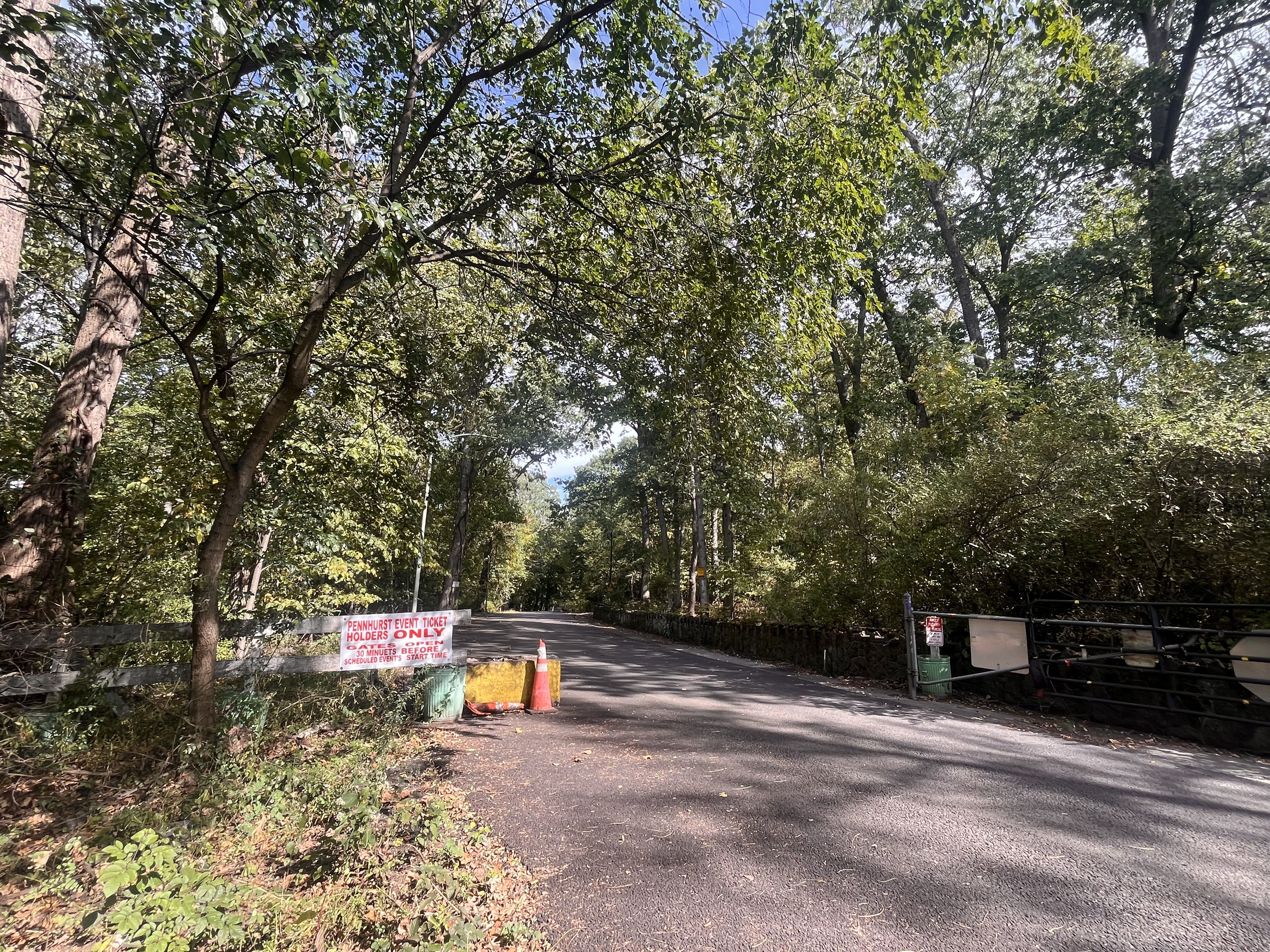
    A view of the entrance to the Halloween attraction at the former Pennhurst State School and Hospital grounds in East Vincent Township, Chester County.

    What’s Pennhurst?

    Pennhurst State School and Hospital, known today as Pennhurst Asylum for its Halloween attraction, has had a long and troubled history. It opened in 1908 to house individuals with intellectual and developmental disabilities. It became severely overcrowded by the time it closed in 1987.

    A 1968 documentary Suffer the Little Children highlighted abusive and neglectful practices, and resulted in legal actions and a landmark disability rights ruling in 1978 that declared conditions as “cruel and unusual punishment.”

    The last patient left Pennhurst in 1987, and the facility sat abandoned until it was purchased in 2008 and converted into a Halloween attraction despite protests from various advocacy groups.

    The Halloween attraction has continued and operators say it shows sensitivity toward those once housed at Pennhurst. Separately, visitors can take historical tours of the exteriors of 16 buildings and learn about people who lived and worked there. The site also has a small Pennhurst history museum.
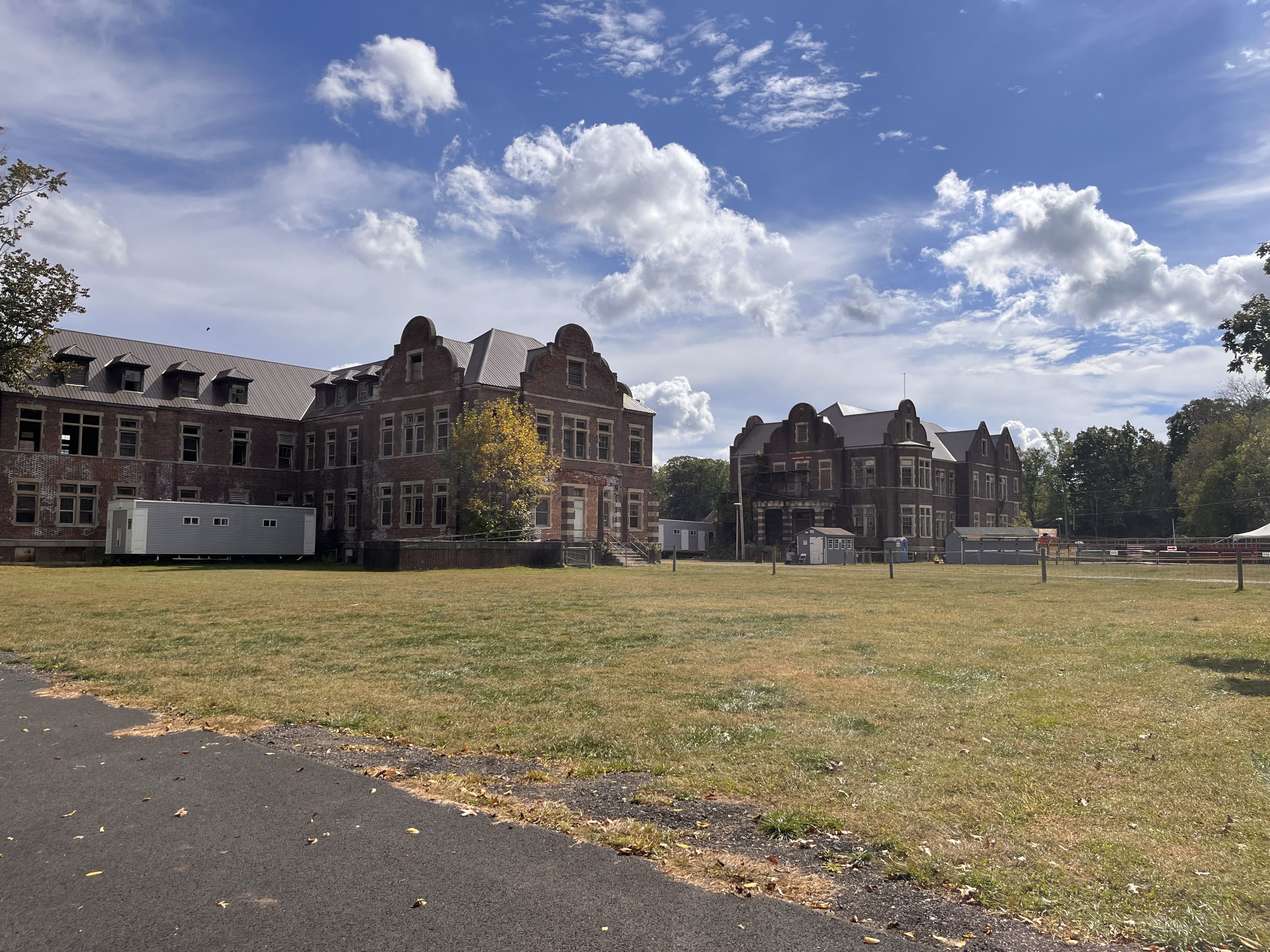
    A view of the vacant buildings on the former Pennhurst State School and Hospital grounds in East Vincent Township, Chester County.

    Contentious meetings

    In recent months, East Vincent officials have raced to draft an ordinance that would govern data centers by limiting building heights, mandating buffers, requiring lighting, noting the amount of trees that can be cut down, and other restrictions.

    At two contentious meetings in September, residents and the board of supervisors argued about the draft ordinance’s specifics. Residents said the ordinance did not incorporate some community-suggested safeguards aimed at preserving the township’s rural character.

    Residents asked how much water the data center would consume, how much power it would need, and how much noise it would generate.

    Pennhurst’s zoning was changed in 2012 from allowing only residential development to permitting industrial and mixed-use buildings. Township Solicitor Joe Clement told residents that it is difficult for the municipality to argue that a data center would not fit within that zone.

    “If there’s a use that is covered by the zoning ordinance, we can’t stop that use,” board vice chair Mark Brancato explained at a Sept. 18 meeting.

    Officials said the draft ordinance was not specifically aimed at the Pennhurst site but was meant to broadly govern any data centers proposed in the township.

    What we’re trying to do is to come up with a set of reasonable guidelines, guardrails, and conditions in the new zoning ordinance that will … provide as much protection as we possibly can for the residents,” Brancato said. ”We are committed to protecting and preserving the rural character of the township.”

    Township meetings, some of which have lasted hours, have been marked by raised voices and emotional appeals.

    “Our whole community is kind of anxious about the thought of this new data center,” Gabrielle Gehron, of Spring City, said during one meeting. “I’m confused about whether we are or not doing something to prevent that from happening.”

    Pa. State Rep. Paul Friel, and State Sen. Katie Muth, both Democrats from East Vincent, have spoken at meetings. Muth noted that Strine received a $10 million grant and loan package from the state in 2017 to prepare the site for “a large distribution facility” and other industrial structures, new office development, and the renovation of six existing buildings for additional commercial use, amid ample open space, according to a funding request provided by the governor’s office.

    Muth fears Strine is paving a path to clear the data center for development and sell the property — after benefiting from tax dollars.

    “These are not good things to live next to,” Muth said of data centers.

    The board tabled the draft ordinance on Sept. 22 after receiving legal advice that they still had time to incorporate more residents’ concerns.

    Beyond Pennhurst

    Other municipalities in Pennsylvania face a similar issue: Most don’t have existing zoning for data centers. However, state law mandates that municipalities must provide zoning for all uses of land — just as state and federal officials are ramping up plans to embrace the centers.

    Plymouth Township is dealing with pressure as Brian J. O’Neill, a Main Line developer, wants to turn the Cleveland-Cliffs steel mill into a 2 million-square-foot data center that would span 10 existing buildings. The Plymouth Township Planning Commission voted against the project given resident backlash. The plan goes to the zoning board later this month.

    And Covington and Clifton Townships in Lackawanna County in the Poconos are also dealing with zoning issues and widespread opposition regarding a plan to build a data center on 1,000 acres.
  • Josh Shapiro’s GOP opponent Stacy Garrity steps in to offer counties $500 million in loans as Pa. budget remains at an impasse

    Josh Shapiro’s GOP opponent Stacy Garrity steps in to offer counties $500 million in loans as Pa. budget remains at an impasse

    HARRISBURG — Pennsylvania Treasurer Stacy Garrity stepped in on Wednesday to offer counties and early education programs $500 million in low-interest loans to hold them over until a final state budget deal is complete, sidestepping the General Assembly and Gov. Josh Shapiro as they near the start of a third month at an impasse.

    Garrity, a Republican who last month announced her bid to challenge Shapiro in next year’s gubernatorial election, announced the unprecedented move to allow the state Treasury to offer the loans to county human service departments for the many social services they provide, as well as for early education Head Start programs, at a 4.5% interest rate.

    Counties, schools, and social service providers have pleaded for months with the legislature to finalize a budget so they can begin receiving their expected state payments, which have been on hold since the beginning of the fiscal year on July 1. Some counties have had to secure private loans to hold them over until state payments begin, while others — including those around the Philadelphia region — have relied on their reserves. Other counties have frozen hiring and spending as they await a resolution to the budget stalemate.

    The move would allow counties to access millions of dollars for early education programs serving 35,000 children across the state, as well as for county social services — all of which have been operating for months without their state appropriation, with no end to the budget impasse in sight.

    Garrity’s decision to act unilaterally without the action of the General Assembly allows her to capitalize politically on the ongoing budget crisis over Shapiro, challenging his image as a moderate Democratic governor of a politically “purple” state willing to work across the aisle in a divided legislature. That brand, which he has built nationally as he is rumored to have interest in running for president in 2028, has been tested as he has so far been unable to secure a budget deal or a recurring funding stream for the state’s beleaguered mass transit agencies, including SEPTA.

    Shapiro, for his part, has described his role in budget negotiations as being a go-between for Senate Republicans and House Democrats, who control their respective chambers, and has said that the two caucuses remain “diametrically opposed” on some issues.

    A spokesperson for Shapiro said in a statement Wednesday that the real solution to the budget impasse is for Senate Republicans, whose leaders endorsed Garrity last week, to return to work in Harrisburg to finalize a budget deal with House Democrats. A spokesperson for House Majority Leader Matt Bradford (D., Montgomery) echoed the sentiment, arguing that Senate Republicans “refuse to negotiate on a realistic budget agreement.”

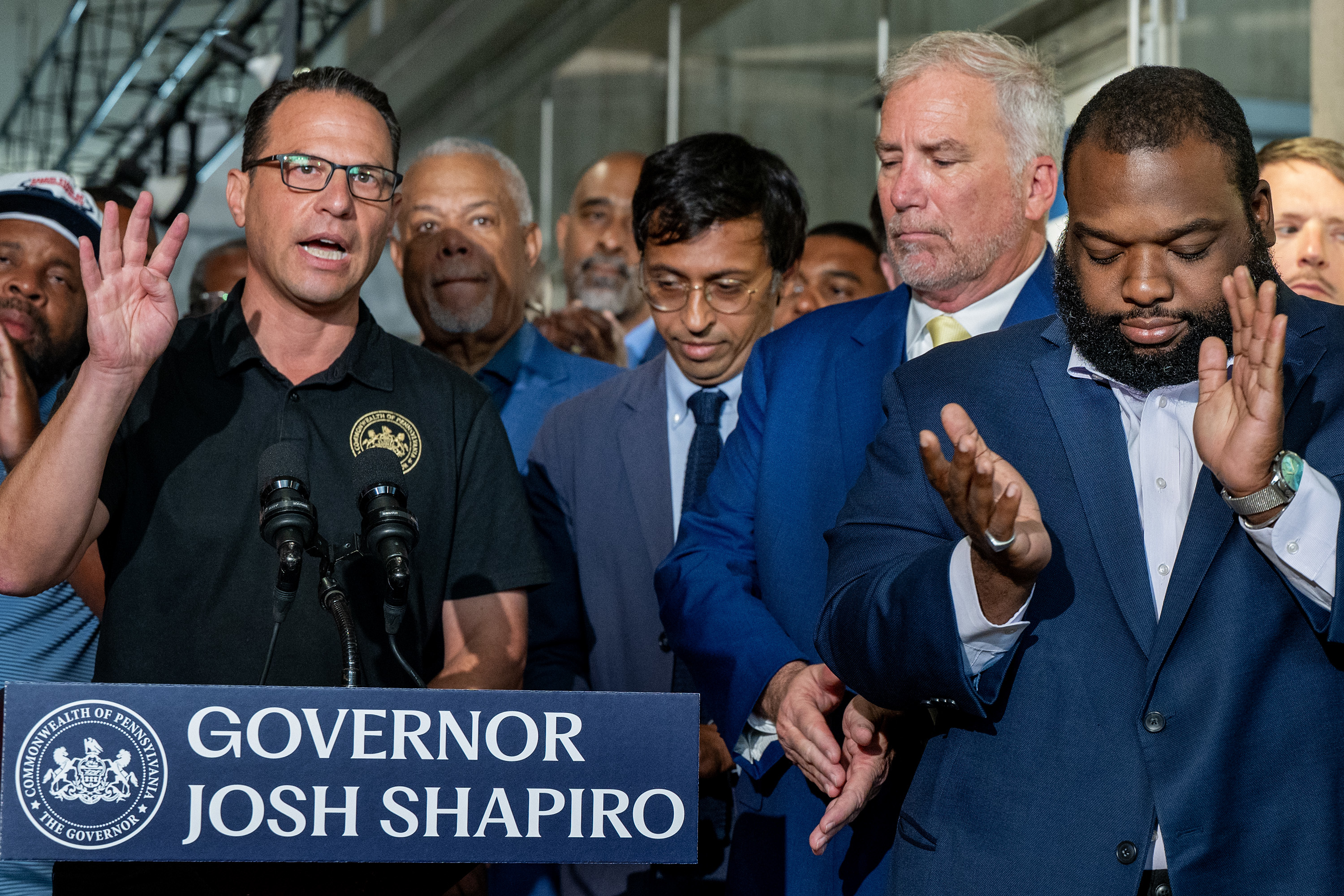
    Gov. Josh Shapiro visits SEPTA headquarters Sunday, Aug. 10, 2025 to discuss funding for the transit agency and to pressure Senate Republicans as planned service cuts are pending because of a budget shortfall. To his right, from left, are state Democratic legislators Sen. Anthony H. Williams; Sen. Nikil Saval; Rep. Ed Neilson; and Rep. Jordan Harris.

    Senate Majority Leader Joe Pittman (R., Indiana), the Senate’s top negotiator, who has met for months in closed-door budget talks with Bradford and Shapiro, said in a statement that it was Democrats who caused the prolonged impasse while demanding they include mass transit funding in the state budget. After mounting pressure as SEPTA enacted major service cuts, Shapiro ultimately sought to fund the agency on his own, and the issue will need to be revisited in two years.

    Garrity, who kicked off her “Help Is on the Way” introductory campaign tour around the state earlier this week, said Wednesday her decision to intervene in the state budget stalemate was not political, despite her burgeoning run against Shapiro. Rather, she said that she had been thinking about a way to do so for months, including ahead of her announcement of her run for governor, and that most Pennsylvanians don’t even realize the state budget is late. She argued that if she wanted to be political, she would not intervene and would “keep the pressure” on Shapiro over the late state budget.

    “I’m standing up here as Pennsylvania’s state treasurer, not as a candidate for governor,” Garrity said from a podium in the Harrisburg building that houses the state Treasury. “I think I have a responsibility to serve Pennsylvanians, that if I have something that I can do to provide some relief, then I should do it.”

    However, that didn’t stop Garrity from inviting Montgomery County Commissioner Tom DiBello — the lone Republican on the board where Shapiro once served — to the podium at the news conference to deliver some direct criticisms of Shapiro and to praise Garrity’s intervention as a “lifeline” for counties, alongside two other GOP county commissioners from south-central Pennsylvania. While Montgomery County remains one of the wealthiest counties in the state, the late budget has required Pennsylvania’s third-most-populous county to spend down its reserves, money that it usually relies upon to continue earning interest as part of its annual revenue, DiBello said.

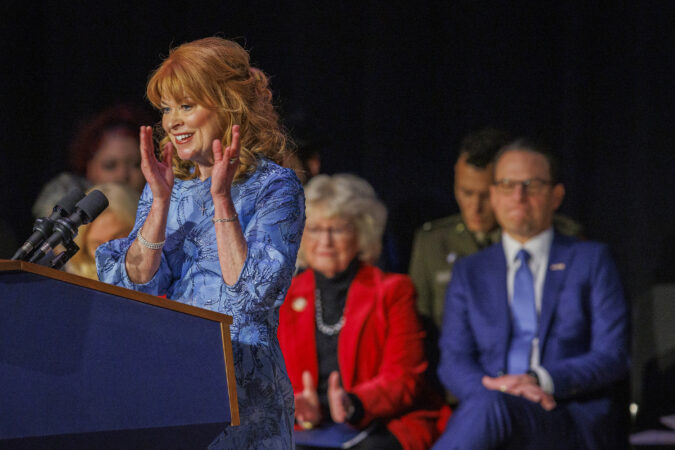
    Pennsylvania Treasurer Stacy L. Garrity gives her acceptance speech after receiving the PA GOP’s endorsement for her campaign for governor during the Republican Party of Pennsylvania’s 2025 Fall Meeting at the Penn Stater Hotel & Conference Center in State College on Sept. 20.

    “It starts at the top. The governor is responsible,” DiBello said. “He’s got to pull it together. It’s his signature at the end of the day.”

    In response to Garrity’s announcement Wednesday, Montgomery County Commissioners Neil Makhija and Jamila Winder, both Democrats, said in a statement that the county needs a final state budget instead of a short-term loan program, urging Senate Republicans to “do their job.”

    “A short-term loan at 4.5% interest is the state profiting from a problem of their own making, at the expense of the taxpayers,” the two commissioners added.

    DiBello said he did not believe his invitation to Wednesday’s event had political motivations, adding: “I didn’t even think of that.” He also noted that he has come to Harrisburg to advocate on behalf of counties multiple times before.

    Senate President Pro Tempore Kim Ward (R., Westmoreland), who has been one of Shapiro’s biggest critics since his first budget in 2023 and was quick to support Garrity’s candidacy, prodded at Shapiro’s pledge to “get stuff done” while praising Garrity’s leadership.

    “Today, Treasurer Stacy Garrity made a bold move that shows what ‘get stuff done’ actually looks like,” Ward said in a statement. “Treasurer Garrity’s leadership is on display as her solution-driven option is exactly what we need, but has been glaringly missing from the present administration.”

    Garrity said at the news conference Wednesday that she offered the loan program specifically to Head Start programs and county governments’ human service departments because both had asked her to help them get through the budget impasse. The state budget was due by July 1, and Pennsylvania is the only state besides Michigan that has not yet passed its budget. She said she is willing to offer similar loans to schools or other state-subsidized or funded programs as requested.

    The Pennsylvania General Assembly can forgive the interest accrued by counties taking out loans during the budget impasse, Garrity said, adding that she would support legislation that does so.

    This suburban content is produced with support from the Leslie Miller and Richard Worley Foundation and The Lenfest Institute for Journalism. Editorial content is created independently of the project donors. Gifts to support The Inquirer’s high-impact journalism can be made at inquirer.com/donate. A list of Lenfest Institute donors can be found at lenfestinstitute.org/supporters.