Tag: Democrats

  • Shapiro stumps for N.J. gubernatorial candidate Mikie Sherrill

    Shapiro stumps for N.J. gubernatorial candidate Mikie Sherrill

    On the first day of early in-person voting in New Jersey, and with U.S. Rep. Mikie Sherrill, the Democratic gubernatorial candidate, showing a slim polling edge over her Republican opponent, Democrats called in the popular governor from neighboring Pennsylvania to drum up some enthusiasm among Garden State voters.

    Gov. Josh Shapiro stumped for Sherrill at a senior center auditorium and an African Methodist Episcopal church, targeting two groups seen as necessary for Sherrill to beat Republican Jack Ciattarelli.

    “Thank you for getting off the sidelines,” Shapiro said to the crowd at the senior center, several of whom said they either voted by mail already or were on their way to the polls. “Thank you for doing your part. Thank you for being in this game. I am grateful.”

    Outside the Monroe Township senior center, Shapiro was a big draw among the crowd that lined up early Saturday to get through security.

    “He’s very well liked,” said Connie Hamlin, 71, of Monroe Township, who sipped coffee to stay warm “Number one, he’s handsome. He’s young. That’s very important.”

    Equally important, she said, is that Shapiro is “for democracy” and “a decent person,” two traits she said President Donald Trump lacks.

    Shapiro got standing ovations and roaring applause, but Sherrill was the main event. The Navy veteran and former federal prosecutor finds herself in a tight race with Ciattarelli, a business owner and former state lawmaker. A recent Rutgers-Eagleton poll found Sherrill with a five-percentage-point lead.
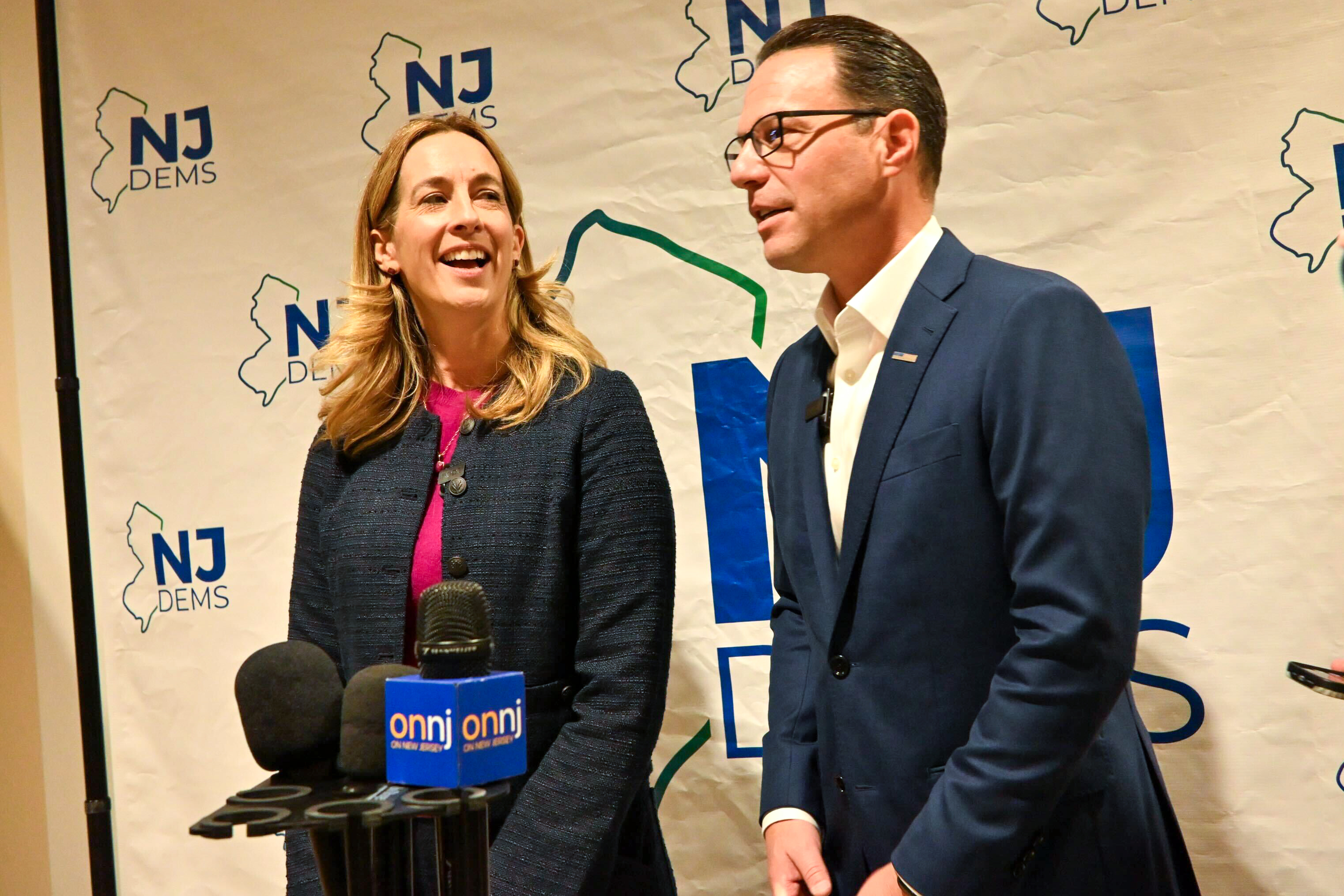
    Gov. Josh Shapiro on the campaign trail for NJ gubernatorial candidate Mikie Sherrill (left) Saturday, Oct. 25, 2025.

    At the two campaign stops, Sherrill ripped into Trump, saying that while the prices of consumer goods like coffee have skyrocketed, “Trump and his family are making billions.”

    Sherrill said her opponent would rubber-stamp Trump administration policies that are unpopular with many in New Jersey — such as his cancellation of $16 billion in funding to build two new rail tunnels under the Hudson River.

    “It’s about opportunity and affordability,” Sherrill said. “We’re fighting for our kids, to make sure they have a better future.”

    Ciattarelli hit the campaign trail as well Saturday, stopping in Passaic, Bergen, and Morris Counties with a message of “a stronger, safer, and more affordable New Jersey,” according to Facebook posts.

    Friday evening, Trump held a tele-rally for Ciattarelli, in which he said Sherrill would “be a travesty as the governor of New Jersey” and urged Republicans to take part in early voting.

    “You got to make sure the votes are counted, because New Jersey has a little bit of a rough reputation, I must be honest,” Trump said.

    There is no evidence of mass voter fraud in New Jersey or anywhere else in recent elections, but Trump still claims the 2020 election was rigged against him and has appointed a notorious Pennsylvania election denier to a federal position monitoring elections. On Friday, the Department of Justice said it will send federal observers to monitor elections in New Jersey and California.

    At a news conference Saturday, Sherrill said she is proud that New Jersey’s elections have been “open, transparent, and free.”

    “And we’re going to continue to do that, and ensure we don’t have any voter intimidation,” Sherrill said.

    At the senior center, Hamlin said she supports Sherrill’s plan to lower energy costs, likes that she’s a woman, and feels it’s important that the next governor is a Democrat. “She’s soft-spoken, but she has meaningful things to say,” Hamlin said.

    Shapiro spoke about how he was raised and how his faith teaches him that “no one is required to complete the task, but neither are we free to refrain from it.”

    The message wasn’t lost on Steve Riback, who said Trump has given antisemites and other extremists “license to come out of the woodwork.” Riback, who is Jewish, said that Shapiro would be his top choice for president in 2028, above Illinois Gov. JB Pritzker.

    Shapiro urged voters frustrated with Trump to send a message to the rest of the country “that here in Jersey, we value our freedom, we cherish our democracy, and we love our country.”

    And Shapiro held up Sherrill as someone who would get things done in New Jersey. Sherrill has cited Pennsylvania as an example of a state with more efficient business licensure rules and better-managed energy costs.

    Shapiro, who has not officially announced his reelection campaign, has long been floated as a presidential hopeful by Democratic insiders and national pundits. Shapiro’s soon-to-be-released memoir will likely add to speculation about his 2026 intentions.

    After the senior center visit, Shapiro and Sherrill hit the turnpike up to New Brunswick, where a packed Mount Zion A.M.E. Church — congregants had come in on buses from around the state — was waiting for him.

    Shapiro said it was up to Democrats to keep, and build upon, what the founders created. “We are those people, and this is a moment where we have to do this work. We’ve got to stand up for our rights,” he said. “We’ve got to keep perfecting our union.”

    Pheobie Thomas, an A.M.E. member who traveled from Trenton for church, said Shapiro and Sherrill offered promising signs that they support “equitable access for all people, including Black people.”

    Thomas, 48, said there is a long history of Democratic politicians courting Black churches for votes, and for good reason.

    “The Black church is extremely important,” Thomas said. “We do go to the polls. We do show up.”

    As for Shapiro, she said he was speaking to New Jersey — but at the same time, he hinted that he was speaking to a broader audience.

    “You just know that there’s that potential of, you know, ‘I may come back again to ask for your vote.’”

    Staff writer Robert Moran contributed to this article.

  • He helped defeat a plan to sell the sewer utility in his South Jersey town last year. Now, he’s running for mayor.

    He helped defeat a plan to sell the sewer utility in his South Jersey town last year. Now, he’s running for mayor.

    Keith Gibbons entered politics by accident.

    A few years ago, he was driving with his then-11-year-old daughter when she asked where roads came from.

    “The government,” Gibbons responded.

    “What’s the government?” his daughter asked.

    That led to a longer explanation and eventual father-daughter trip to a Gloucester Township meeting so she could see the government in, ah, action. Having covered many local government meetings and school boards long ago, I can attest that Gibbons went beyond any parental or civic duty.

    Gibbons continued to attend the meetings when a proposal to dissolve the Municipal Utilities Authority (MUA) caught his attention. He feared the township was planning to sell the water and sewer system.

    But during sworn oral testimony in a May 2023 teleconference, an attorney representing the township said there was no expectation the utilities would be sold within the next five years. Mayor David Mayer agreed.

    Yet, a year later, the township council voted to sell the sewer system to the highest bidder.

    “They lied to us,” Gibbons said.

    The township received two bids from large for-profit water companies: Aqua offered $52 million, and New Jersey American Water bid a whopping $143 million, plus a promise to make an additional $90 million in capital improvements to a system that only needed an estimated $25 million in repairs.

    Something didn’t smell right. Even for a sewer system.

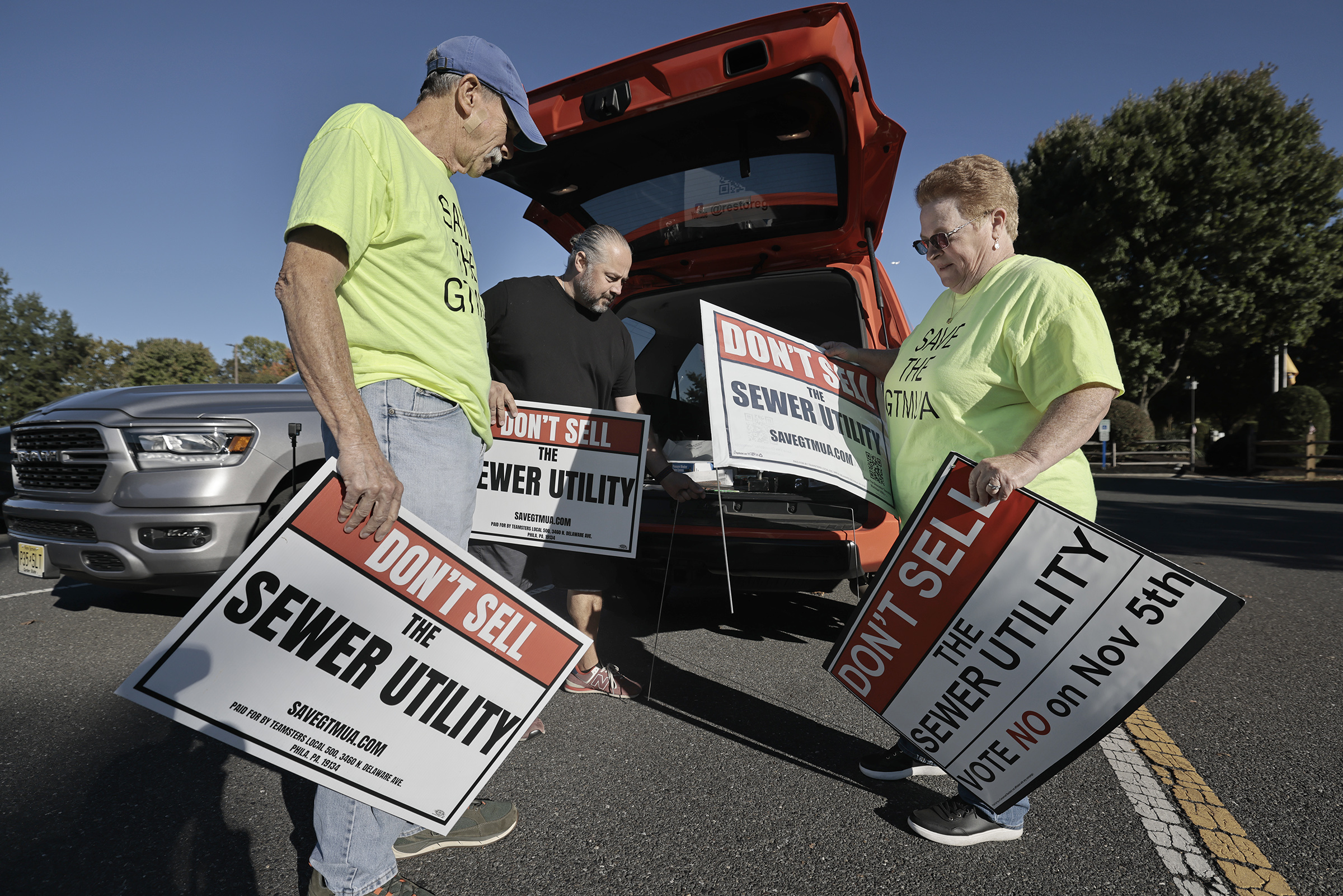
    Keith Gibbons (middle) joined Ira Eckstein and Denise Coyne at a rally opposing a plan to sell a South Jersey sewer and water utility in October 2024.

    Coincidentally, Mayor Mayer worked for American Water. In addition to his job as director of government affairs at the water company, his mayoral salary is $52,000.

    To guard against any conflict of interest, Mayer recused himself from any discussion regarding the sewer sale.

    Even still, American Water’s lucrative offer raised eyebrows. But generous bids are part of the for-profit playbook. Aqua offered Bucks County $1.1 billion for its sewer system, but the commissioners backed away after fierce public opposition.

    For-profit water companies have been throwing big money at small towns in New Jersey, Pennsylvania, and beyond in an effort to scale up. The utility systems may not seem sexy, but they are mini monopolies that generate steady cash flow.

    In Pennsylvania, a 2016 change in the law essentially opened the door for local utilities to be sold at higher prices. Local politicians are often happy to get the utility systems off the books and use the windfall to fund other projects or avoid tax increases.

    But often left out of the negotiations are the ratepayers.

    After the sales go through, the for-profit companies often jack up the rates. In some towns, after a brief rate freeze, the water bills have increased by 100%.

    Rates have also increased at government-owned utility companies, but not by nearly as much. For example, Philadelphia recently increased water rates by 9%.

    As utility bills grow, residents have nowhere to turn. Aging infrastructure, climate change, and increased demand, including to cool computer data centers, are expected to further drive up water prices in the years to come.

    From left: Denise Coyne, Nancy Kelly Gentile, Gloucester Township independent mayoral candidate Keith Gibbons, and Ira Eckstein canvass supporters in Clementon, N.J., in September.

    For-profit companies say they offer professional management and resources to make long-deferred upgrades, as well as the ability to purchase materials in bulk and spread the risk across systems as they grow.

    Mayer said in an interview that the sewer sale would have enabled Gloucester to reduce property taxes, eliminate its debt, and make other improvements.

    But critics argue that handing control to for-profit companies seeking quick returns on investments is shortsighted and results in higher costs to consumers. After all, water and sewer utilities are supposed to be a long-term public good, not a profit center.

    To its credit, Gloucester Township scheduled a referendum last November to let residents vote on whether to sell the sewer system or not. A public vote should be a requirement, but most towns avoid referendums because the last thing they want is for taxpayers to have a say in the utility system they own.

    The referendum gave Gibbons time to mount a grassroots campaign against the sale. He knocked on doors, handed out yard signs, and used a podcast to raise awareness.

    But Gibbons seemed overmatched. His group spent roughly $3,000 opposing the sale, while New Jersey American Water spent about $1 million.

    Yet, David beat Goliath in a landslide. More than 80% voted against the sale.

    Gibbons, 48, a Cinnaminson High grad, who ran a Christmas tree farm and worked for Live Nation but is now self-employed and serves on the school board, became somewhat of a local hero in a town of 66,000 residents.

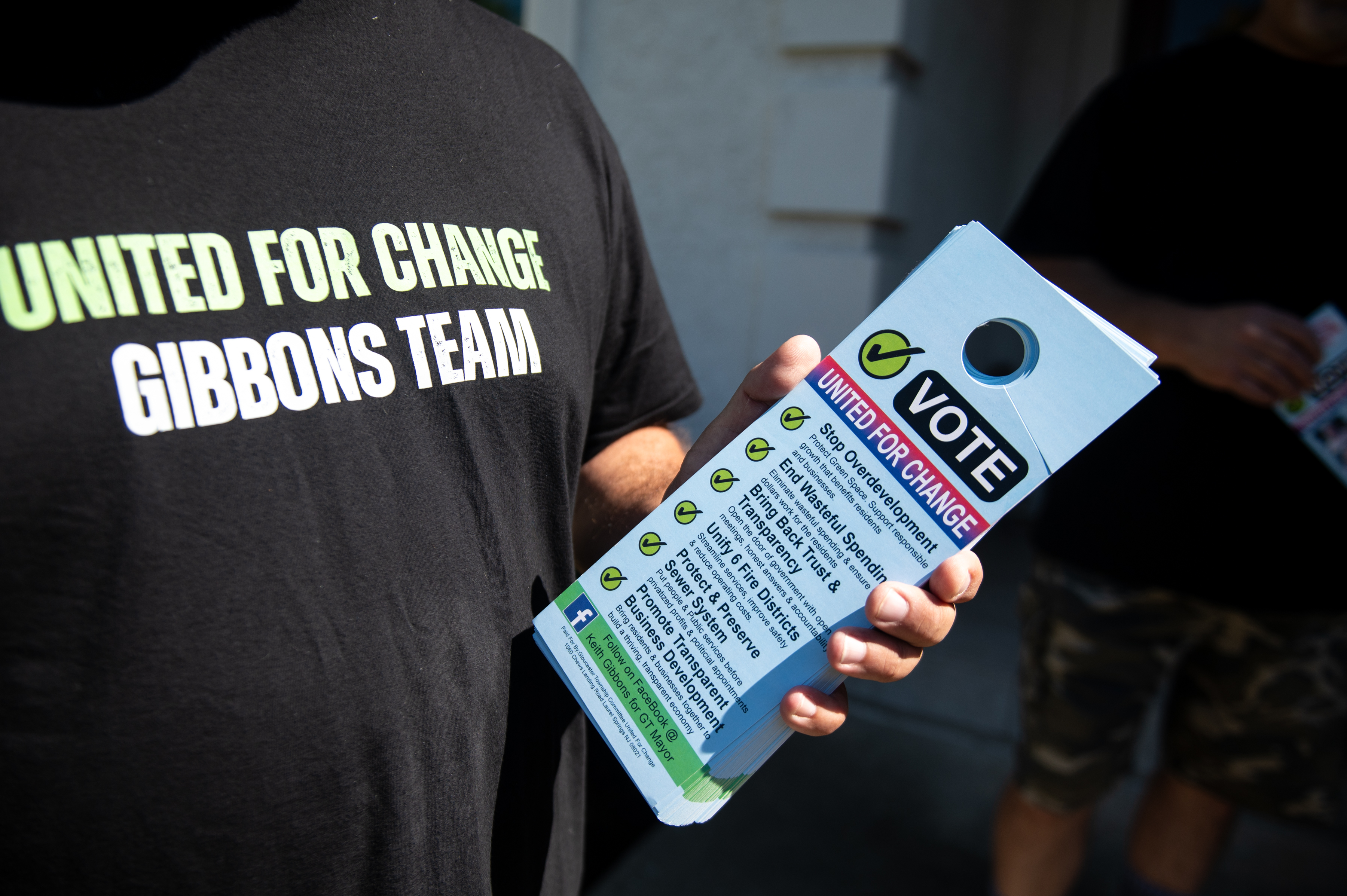
    Gloucester Township independent mayoral candidate Keith Gibbons holds promotional materials encouraging constituents to vote for him.

    Residents soon urged him to run for mayor.

    Gibbons, a former Republican, is running as an independent against Mayer, who has spent his life in South Jersey politics, working for former U.S. Rep. Rob Andrews in the 1990s before becoming chief of staff in the Camden County Clerk’s Office.

    He also served as a New Jersey assemblyman before getting elected mayor in 2010. Mayer’s wife is a Camden County freeholder.

    Mayer is part of the Democratic machine that has controlled South Jersey for decades, but has recently shown signs of losing its grip on power. In Gloucester Township, there are still twice as many registered Democrats as Republicans.

    The election has turned nasty. There are allegations that the Democrats tried to recruit a “phantom candidate” to run as a Republican to siphon votes away from Gibbons.

    Mayer said Gibbons has been on the school board for three years, and “I don’t know what he’s touting as his accomplishments.”

    Other attempts to muddy Gibbons indicate that the Democratic establishment may be nervous.

    Is it because Gibbons has a sophisticated field operation?

    “I don’t even have a campaign manager,” he said.

    Does Gibbons have deep-pocketed donors?

    “I’ve spent about $5,000 on the election,” he said.

    What’s his campaign message?

    “I’m not a political person,” Gibbons said. “I just want to fix local problems.”

    Can an outsider with no political experience win?

    Gibbons believes voters are fed up with South Jersey’s entrenched political machine, in which jobs and contracts often go to cronies. He argues no one is looking out for taxpayers who are often too busy to get involved, or believe they can’t do anything to change the system.

    But his efforts to block the sewer sale show that one person — and a motivated electorate — can make a difference.

    Mayer counters that he is proud to be a Democrat, and that the party’s strength has benefited South Jersey. He pointed to a list of accomplishments as mayor, from creating community policing to adding open space, attracting new businesses, and opening an office for veterans, adding that no party boss tells him what to do.

    For his part, Gibbons said he supports term limits and smart development. He plans to focus on fiscal responsibility and government transparency. If elected, he promised the water and sewer system would not get sold to a for-profit company whose main mission is to maximize shareholder value.

    “I don’t claim to know everything, but I do know enough,” Gibbons said.

    Now there’s a campaign slogan for an accidental candidate.

  • What is the Shutdown Fairness Act 2025?

    The Shutdown Fairness Act 2025 is a GOP-backed bill that would pay federal employees who are working during the government shutdown, with Republicans continuing to put pressure on Democrats to reopen the government.

    Senate Majority Leader John Thune earlier this week announced the measure, Senate Bill 3012, as hundreds of thousands of federal workers will miss their paychecks, while the military, while paid Oct. 15, face missing their Oct. 31 paychecks. This as families face food security issues, with SNAP benefits stretched thin.

    Senate Bill 3012, known as the S. 3012, is a measure that would pay federal employees who are working through the shutdown, including members of the military and contractors who support “excepted” work.

    Majority Whip Sen. John Barrasso, a Wyoming Republican, said live on the Senate floor on Thursday, Oct. 23, that there was “no single argument against passing it immediately” since it would pay the troops, Coast Guard, Border Patrol, members of ICE, air traffic controllers, TSA agents at airports, and Capitol police officers in Washington, D.C.

    The bill would provide “such sums as are necessary” to pay non-furloughed workers; however, Democrats have argued that all federal workers, including those on furlough, should be paid.

    The bill, sponsored by GOP Sen. Ron Johnson of Wisconsin, applies only to “excepted” federal employees whose work is considered essential during a period of prolapsed funding. Those employees continue to work but cannot get back pay until the shutdown is over. Nonessential workers are placed on furlough, and also get back pay.

    The bill was first proposed by Senate Majority Leader John Thune this week. The legislation requires the backing of Democrats, but some have warned the bill would give power to President Donald Trump.

    “We know what will happen — any agencies that he doesn’t like won’t get paid,” Sen. Chris Murphy, a Connecticut Democrat, told reporters earlier this week, per CBS News.

  • Trump’s MAGA makeover of the Third Circuit is complete

    Trump’s MAGA makeover of the Third Circuit is complete

    In his first term, Donald Trump appointed four judges to the Philadelphia-based U.S. Court of Appeals for the Third Circuit — flipping the court’s ideological balance firmly to the right.

    The 14-member court, which hears appeals from Pennsylvania, New Jersey, and Delaware, routinely handles disputes of national importance.

    This past summer, it struck down Pennsylvania’s mail-in ballot dating rule, and just last week, it heard arguments over New Jersey’s long-standing assault rifle ban, potentially teeing up the issue for U.S. Supreme Court review.

    President Joe Biden had a chance to tip the balance back.

    His nominee, Adeel Mangi, would have become the first Muslim American to serve on any federal appellate court. But facing bad-faith Republican attacks and tepid Democratic support, Mangi’s nomination was left to die on the Senate floor.

    That failure, and Trump’s return to power, cleared the way for the rapid installation of two MAGA loyalists, Emil Bove and Jennifer Mascott, cementing an 8-6 conservative majority.

    Less than a year into his second term, Trump has finished what he started in his first. His MAGA makeover of the Third Circuit is complete — and the people of Pennsylvania, New Jersey, and Delaware, and perhaps the country as a whole, will be living with its consequences for decades to come.

    Emil Bove: The hatchet man

    Trump’s first pick for the Third Circuit is also his most dangerous: Emil Bove.

    Bove, the president’s former criminal defense attorney, lacks the culture war credentials required of nearly every other Trump judicial nominee. He never sued the Biden administration, or opposed same-sex marriage, or defended a state abortion ban. But he has one quality in spades: loyalty to Donald Trump.

    Once installed in the U.S. Department of Justice, Bove wasted little time proving to Trump that he would do whatever it took to advance Trump’s agenda.

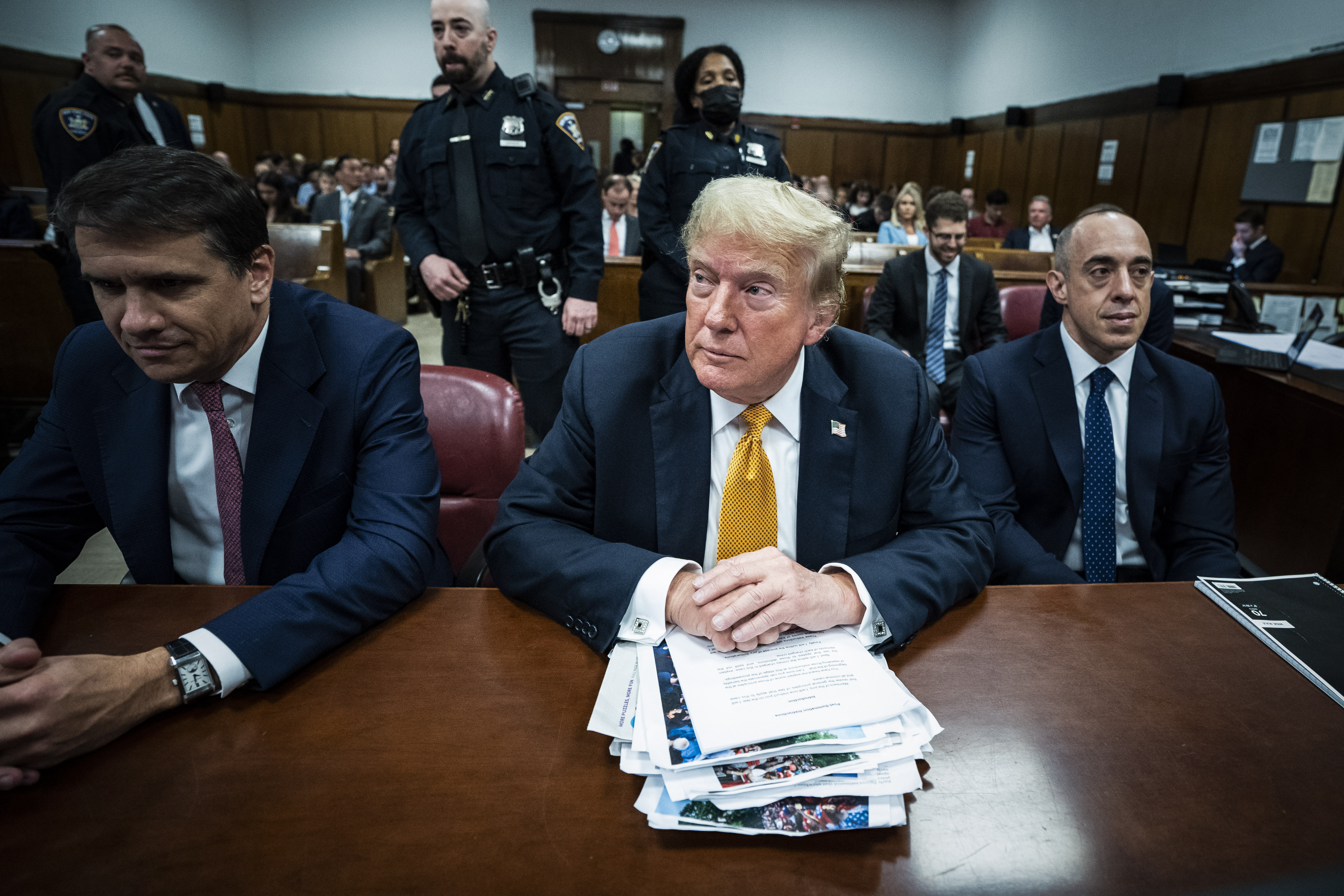
    Donald Trump, flanked by attorneys Todd Blanche and Emil Bove (right), at his criminal trial in Manhattan in 2024.

    He fired the federal prosecutors and FBI agents who pursued cases against the Jan. 6, 2021, insurrectionists. He clumsily sought to dismiss charges against New York City Mayor Eric Adams to coerce him to aid Trump’s immigration crackdown. And, according to multiple credible whistleblower allegations, Bove told other DOJ lawyers that if courts tried to stop the administration’s deportations, they should tell “the courts ‘fuck you.’”

    Now that Bove is on the Third Circuit — he was confirmed in July by a razor-thin 50-49 vote — he is moving with similar speed to show Trump he’s still on his side.

    This week, in what appears to be Bove’s first vote as a circuit judge, he joined four other Trump appointees dissenting from the full court’s decision to deny the request of various Republican organizations to rehear the case holding Pennsylvania’s date requirement for mail-in ballots unconstitutional.

    Of course, there never should have been a vacancy for Bove to fill.

    Back in November 2023, President Biden nominated Mangi to the seat Bove now holds. Mangi had all the sterling credentials you’d expect from an appellate court nominee — degrees from Oxford and Harvard Law, and a long career at a white-shoe law firm.

    But all Republicans could see was that he was Muslim, and they pulled out every Islamophobic trick in their very big book to disingenuously paint him as some antisemitic radical.

    And what’s worse, some Senate Democrats fell for it, sinking Mangi’s nomination and handing this critical vacancy to Trump.

    Jennifer Mascott: Am MAGA, will travel

    Over the summer, Trump also nominated Catholic University law professor Jennifer Mascott to a second Third Circuit vacancy in Delaware.

    Mascott’s résumé is dripping with connections to Trump and the MAGA legal movement. She clerked for then-D.C. Circuit Judge Brett Kavanaugh (one of Trump’s appointees to the Supreme Court) and Justice Clarence Thomas (one of Trump’s favorite justices).

    Before joining Catholic Law last year, she taught at George Mason’s Antonin Scalia Law School, one of the most conservative in the country.

    In the first Trump administration, she worked in Trump’s Justice Department and helped with Justice Amy Coney Barrett’s last-minute confirmation.

    This time, she went to work directly for Trump as senior counselor to the president in the White House Counsel’s Office.

    What Mascott lacks, however, is any genuine connection to Delaware.

    She lives in Maryland and works in Washington, D.C. She is not admitted to the Delaware Bar, and she has little, if any, experience with Delaware’s sophisticated corporate law regime.

    But Mascott admitted in her Senate Judiciary Committee questionnaire that she made clear to Trump that she was willing to take any judgeship in which he “would be interested in having [her] serve,” historical tradition and judicial propriety be damned.

    Even the timing of her confirmation reeks of political gamesmanship.

    Mascott leapfrogged a half dozen other judicial nominees so she could join the Third Circuit in time to participate, and potentially cast the deciding vote, in a major Second Amendment case about New Jersey’s assault weapons ban.

    With Bove and Mascott now seated, the Third Circuit may become the venue of choice for Trump’s allies looking to legitimize his most extreme policies, as right-wing litigants know they’ll find sympathetic ears in Philadelphia.

    What was once a court known for its independence and moderation could soon become a proving ground for Trump’s legal movement — a place where loyalty trumps the law.

    The only question left is how long it will take before the rest of the country starts feeling the consequences of the Third Circuit’s new MAGA majority.

    John P. Collins Jr. is an associate professor at George Washington University Law School, where he researches and writes about federal judicial nominations.

  • Johnny Doc played a pivotal role electing his brother to the Pa. Supreme Court. Ten years later, things are different.

    Johnny Doc played a pivotal role electing his brother to the Pa. Supreme Court. Ten years later, things are different.

    As Pennsylvania Supreme Court Justice Kevin Dougherty knocked on doors in Northeast Philadelphia last month, a voter made a connection.

    Peering out his front door on a sunny September day, the man asked if the mild-mannered and smiling white-haired justice standing on his front porch was related to former labor leader John Dougherty. Widely known as “Johnny Doc,” the former head of Local 98 of the International Brotherhood of Electrical Workers and a onetime kingmaker in state and local politics was sentenced last year to six years in federal prison on embezzlement and bribery convictions.

    Despite the public fall from grace, the voter said he missed John Dougherty’s leadership in Philadelphia, adding that he believed Dougherty had been good for workers in the city. They are brothers, Kevin Dougherty confirmed.

    Justice Kevin Dougherty (left) canvasses with his son, State Rep. Sean Dougherty (center) in Fox Chase Sunday Sept. 7, 2025, stopping at the home of a voter. The elder Dougherty is one of three Pennsylvania Supreme Court justices up for retention.

    The justice had spent the day asking voters in his neighborhood to keep him and two other justices on the state’s Supreme Court for an additional 10-year term. At that stage, many voters were not even aware of the typically sleepy and nonpartisan contest on which both parties are spending millions in the lead-up to the Nov. 4 election.

    But in this year’s unusually high-profile state Supreme Court retention race, the connection has, in some circles, become unavoidable. Republicans seeking to oust Kevin Dougherty and two of his colleagues, all initially elected as Democrats, have sought to tie the judge to his brother’s misdeeds. The justice, a son of South Philadelphia who previously led Philadelphia’s Family Court, has sought to distance himself, and has seen the continued support of labor unions in his retention campaign.

    “Over the course of 25 years as a judge, including ten years as a Justice on the Supreme Court, Justice Dougherty has had the privilege and the benefit of meeting a multitude of Pennsylvanians including the working men and women of organized labor,” Shane Carey, Kevin Dougherty’s campaign manager, said in a statement. “Our campaign is proud to receive their support, as well as the support from almost 5,000 other individual donors.”

    How Johnny Doc helped elect his brother to the Supreme Court in 2015

    Kevin Dougherty didn’t choose to be related to one of the city’s most prominent power brokers, but he certainly benefited from his brother’s former union’s help, with significant support from the politically powerful Local 98 during his 2015 campaign for the state bench.

    Local 98, where John Dougherty was the longtime business manager, contributed more than $620,000 during Kevin Dougherty’s 2015 campaign for the Pennsylvania Supreme Court. Local 98’s spokesperson at the time also served as Kevin Dougherty’s campaign manager and appears from campaign finance filings that year to have been paid by Local 98. The union also spent more than $480,000 on in-kind contributions for “professional services,” mailers, merchandise, and more.

    Justice Kevin Dougherty talks with volunteers before they head out the canvass in Fox Chase Sunday Sept. 7, 2025. Dougherty is one of three Pennsylvania Supreme Court justices up for retention.

    Kevin Dougherty is the only justice up for retention from Southeastern Pennsylvania. The other justices, Christine Donohue and David Wecht, live in Pittsburgh. They will each appear on the November ballot with no party and no home county. Voters will simply be asked “yes” or “no” whether each individual justice should be retained for another term.

    Republicans working to oust the three justices this year have tried to leverage Kevin Dougherty’s past support from his brother to encourage voters to oppose his retention.

    Scott Presler, an influencer aligned with President Donald Trump who has more than 2.4 million followers and runs a political action committee aimed at registering Republican voters, posted an AI-generated image of John Dougherty behind bars, tying, without evidence, Local 98’s contributions to Kevin Dougherty’s 2015 campaign to his brother’s convictions.

    “Coincidence?” Presler wrote.

    Johnny Dougherty, the former IBEW business manger, and his attorney Gregory J. Pagano as they leave the U.S. District Court, Reading, Pa. on the day he was sentenced to 6 years in prison Thursday, July 11, 2024.

    For months, the conservative influencer has posted on social media urging followers to vote against retaining Kevin Dougherty and his colleagues, citing the times his name was mentioned during John Dougherty’s trials, such as when prosecutors alleged the justice received free home repairs or snow removal on the union’s dime. Kevin Dougherty’s lawyer at the time of the embezzlement trial said the judge never knowingly accepted services paid for with union funds.

    While door-knocking in September, Kevin Dougherty dismissed attacks against him related to his brother as “misinformation,” noting his decades-long career as a judge.

    Kevin Dougherty, 63, spent more than a decade as a Common Pleas Court judge in Philadelphia before his election to the state Supreme Court. During his tenure on the state’s highest court, he has authored majority opinions and is leading a statewide initiative to improve how Pennsylvania’s judicial system interacts with people with behavioral health issues.

    “I spent close to a quarter of a century being a judge,” Dougherty said on a sidewalk in Northeast Philly. “I just don’t accept people’s comments and judgment. I want to know what the motive behind those comments are. Some of these comments are just partisan … and I believe in my reputation.”

    The justice should be vetted on his own merits, said John Jones, a former U.S. District Court judge for the Middle District of Pennsylvania who was appointed to the bench by former President George W. Bush.

    “You can pick your friends, but you can’t pick your relatives,” Jones, now president of Dickinson College, added. “You have to judge the justice on his own merits. This is not a country where we favor guilt by association.”

    This time on the campaign trail, Kevin Dougherty has new familial support. State Rep. Sean Dougherty, a Democrat who was elected last year to represent parts of Northeast Philadelphia, has joined his dad to stump for his retention.

    Kevin Dougherty still has broad union support, including from Local 98

    With John Dougherty no longer at the helm of Local 98, labor unions in Pennsylvania this year still overwhelmingly supported the justice for retention, contributing $665,000 to Kevin Dougherty’s campaign as of September. While trades unions contributed the most of any interest group to all three justices — for a total of $903,000 as of the latest filings — Kevin Dougherty is the largest beneficiary of that support.

    Among those contributors: Local 98. The union, which has reorganized and distanced itself from John Dougherty since he was first convicted in 2021, gave $70,000 to Kevin Dougherty’s retention campaign.

    “IBEW Local 98 does not support candidates based on personal relationships,” said Tom Lepera, Local 98’s political director, in a statement. “We support candidates who understand and stand up for the needs of working men and women in organized labor. Justice Dougherty, along with Justices Donohue and Wecht, have consistently demonstrated their commitment to protecting the rights and interests of middle-class workers across this commonwealth.”

    Kevin Dougherty’s campaign did not respond to several questions this week about his brother’s role in his 2015 campaign or whether his brother’s reputation has influenced the retention campaign.

    Anti-retention material featuring President Donald Trump as Uncle Sam was on display at Republican rally in Bucks County last month headlined by Treasurer Stacy Garrity, a candidate for governor. The material is from Early Vote Action, a group led by GOP influencer Scott Presler.

    Union leaders insist their support for Kevin Dougherty this year has nothing to do with his brother and is a reflection of his quality work in the judiciary. Labor unions often support Democratic candidates, who are often seen as more beneficial to unions and their priorities.

    “It’s about keeping good judges on the bench,” said Ryan Boyer, leader of the Philadelphia Building and Construction Trades Council, an umbrella organization of local trades unions once commanded by John Dougherty. This year, the building trades gave just over $33,000 to each justice.

    “We don’t live on Mars where we don’t know that sometimes familial connections can be there,” Boyer said, “and they try to exploit those things.”

    Nonpartisan and Democratic groups favor Dougherty’s tenure on the bench

    Like his colleagues running for retention, Kevin Dougherty has earned broad support from nonpartisan and partisan groups alike.

    Dougherty was recommended for retention by the Pennsylvania Bar Association, which is a rigorous, nonpartisan decision based on a jurist’s behavior on the bench, and endorsed by several law enforcement organizations.

    Lauren Cristella, CEO of the Committee of Seventy, the Philadelphia-based good-government group, noted that the justice was never charged or found guilty of wrongdoing.

    Justices David Wecht, Christine Donohue and Kevin Dougherty sit onstage during a fireside chat at Central High School on Monday, Sept. 8, 2025 in Philadelphia.

    “The Committee of Seventy relies on the findings of law enforcement and professional oversight organizations, such as the Bar Association, when evaluating judicial candidates. This year, the Pennsylvania Bar Association has evaluated Justice Dougherty and recommended him for retention. Our focus remains on transparency, accountability, and maintaining public trust in Pennsylvania’s courts,” Cristella said in a statement.

    Dougherty and his fellow justices have also gained the support of Gov. Josh Shapiro, Pennsylvania’s popular Democratic governor, who in a fundraising email to Pennsylvania Democrats on Thursday urged voters to mark “yes” on retaining Dougherty, Donohue, and Wecht.

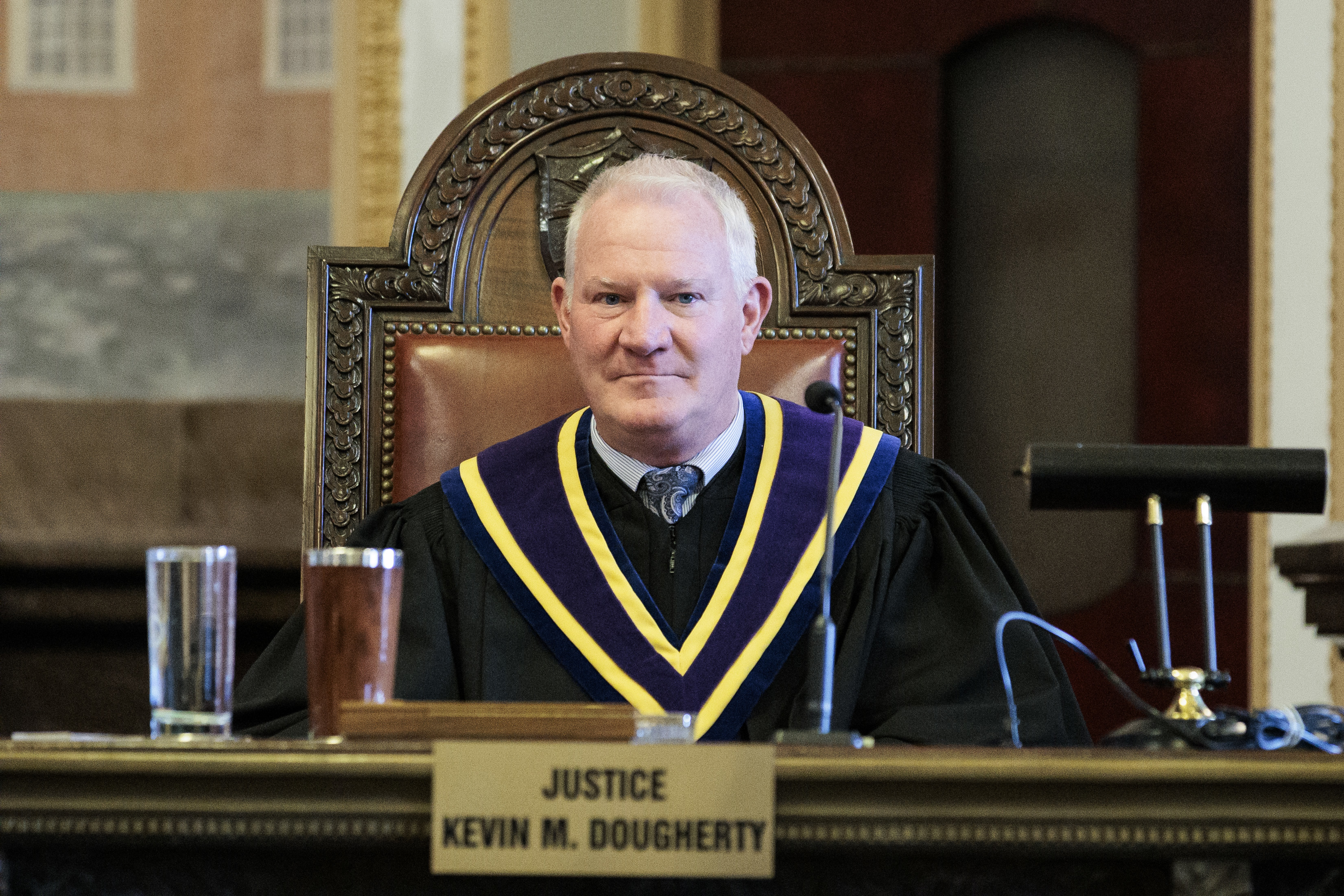
    Justice Kevin M. Dougherty listens during a Courtroom Dedication Ceremony at the Supreme Court Courtroom in Philadelphia City Hall on Tuesday, Sept. 9, 2025 in Philadelphia.

    “The threats to our freedoms are coming from all directions, and we need a Court that stands up for what’s right,” Shapiro said in the email. “Justices Donohue, Dougherty, and Wecht have proven that we can count on them to protect freedom, reproductive rights, and the rule of law.”

    In a statement to The Inquirer, Kevin Dougherty didn’t mention his brother by name.

    “With regard to my personal relationship I love my big brother. For obvious reasons, my brother is not participating in my Retention campaign,” he said.

  • Gov. Josh Shapiro will campaign for Democratic governor hopefuls Mikie Sherrill and Abigail Spanberger this weekend

    Gov. Josh Shapiro will campaign for Democratic governor hopefuls Mikie Sherrill and Abigail Spanberger this weekend

    Gov. Josh Shapiro is hitting the campaign trail in two key states this weekend.

    With less than two weeks left until Election Day, Shapiro will campaign and raise cash for U.S. Reps. Mikie Sherrill (D., N.J.) and Abigail Spanberger, (D., Va.), two Democratic hopefuls in high-stakes gubernatorial races that could preview the national mood ahead of next year’s midterms.

    Shapiro will campaign with Sherrill Saturday morning in Monroe Township at an event to mark the start of early in-person voting in the Democratic-leaning state which has grown increasingly red. The pair will then attend a Souls to the Polls event at a church in New Brunswick, Shapiro For Pennsylvania spokesperson Manuel Bonder said.

    The governor is also expected to hold a fundraiser for the New Jersey Democratic State Committee to benefit Sherrill’s campaign later in the day.

    On Sunday, Shapiro will head to Virginia to attend events in Portsmouth and Norfolk with Spanberger.

    Sherrill has amped up her campaigning in recent weeks, and she’s brought out big Democratic names to help her. In the last three weeks, she’s campaigned with New Jersey Sens. Cory Booker and Andy Kim, and with Maryland Gov. Wes Moore. Former Secretary of Transportation Pete Buttigieg is planning a visit to New Jersey next weekend, and Sherrill’s campaign curtain call the Saturday before Election Day will feature a rally with former President Barack Obama.

    National Democrats see the Garden State governor’s race as a must-win, and despite polling showing Sherrill up in the race, nerves are high after President Donald Trump lost the state by only four points in November.

    This combination photo shows candidates for governor of New Jersey Republican Jack Ciattarelli, left, and Democrat Mikie Sherrill during the final debate in governors race, Oct. 8, 2025, in New Brunswick, N.J. (AP Photos/Heather Khalifa)

    Why Shapiro is involved in the New Jersey governor’s race

    Shapiro is a big draw on the campaign trail as he continues to build a national profile, and gears up for his own reelection campaign next year. The first-term governor, who is seen as a potential 2028 presidential candidate, announced the 2026 release of a memoir this week.

    His multi-state gubernatorial stumping follows investments in races in Pennsylvania. He donated $250,000 from his campaign fund to the Pennsylvania Democratic Party last month. And he’s appeared in ads for the judicial races in Pennsylvania, in which Democrats hope to retain three judges there.

    In a September poll by Quinnipiac University, 61% of respondents said they viewed Shapiro favorably, an unprecedented figure among recent Pennsylvania governors at the same point in their terms, pollsters noted.

    The poll also found that Shapiro is viewed favorably by some Republicans, an across-the-aisle appeal that appears to extend across the Delaware River.

    Shapiro’s been lauded by Sherrill’s Republican opponent in the New Jersey race, Jack Ciattarelli, a trend chronicled recently by Politico.

    Ciattarelli commended Shapiro’s willingness to criticize New York City mayoral candidate Zohran Mamdani’s past comments on Israel, and praised his handling of small businesses, energy and property taxes in Pennsylvania, contrastingly saying New Jersey faces a “crisis” in all three.

    Sherrill has said frequently that she wants to mimic Pennsylvania’s success in cutting the time it takes business owners to get permits from state government.

    This story has been updated to correct the location of Gov. Josh Shapiro’s first stop with U.S. Rep. Mikie Sherrill on the campaign trail Saturday.

  • Democratic vets in Congress blast Scott Perry’s comment that Democrats ‘hate the military’

    Democratic vets in Congress blast Scott Perry’s comment that Democrats ‘hate the military’

    Democratic veterans in Congress, including two from Pennsylvania, are taking personally comments U.S. Rep. Scott Perry made to a conservative radio station asserting that Democrats in Congress “hate the military” — and the lawmakers are hitting back.

    “That’s only a credential that they get when they want to run for office,” Perry said, of Democrats, during an interview last week on The Chris Stigall Show.

    ”They join the military, they serve a little bit, they get the credential and then they run for office and wear the uniform and say, ‘Look at me — I support America.’ But let’s face it, all their votes say they don’t support America.”

    Perry made the comments last week, but a report this week from the New York Times prompted backlash from Perry’s colleagues on the other side of the aisle, including U.S. Rep. Chris Deluzio, a Democrat who represents the Pittsburgh suburbs and served six years in the Navy.

    On Wednesday, members of the Democratic Veterans Caucus, cochaired by Deluzio and U.S. Rep. Pat Ryan (D., N.Y.) called the remarks “insulting to their service,” in a statement shared with The Inquirer.

    “It’s disgusting to see a sitting member of Congress attack the integrity and honor of veterans and servicemembers due to their political party,” the veterans wrote. “He should immediately apologize to his constituents for insulting their service and questioning their patriotism.”

    The statement blasted Perry as an “oathbreaker,” noting he was part of an effort to throw out Pennsylvania’s electoral votes after President Donald Trump’s loss in the 2020 election. The lawmakers also criticized Perry’s unwillingness to hold in-person town halls, something very few Republican lawmakers have been doing since Trump’s first administration.

    “If he had a spine he’d stand in front of the Democratic veterans he represents and say this garbage to their faces, but Scott Perry doesn’t have the guts,” his House colleagues wrote.

    The statement from the caucus was co-signed by 13 other Democratic veterans in the House, including U.S. Rep. Chrissy Houlahan, a Democrat who represents Chester County. The Air Force Veteran has challenged the Trump administration’s rhetoric and policies regarding female service members.

    Perry, in a statement, pushed back clarifying his remarks were not about “all Democrats,” but “Leftists in Congress who served in the military and use that as a shield to insulate themselves from accountability for their radial and corrosive ideologies.”

    He said the Times story “cherry-picked” one line in a broader six-minute interview with Stigall about the government shutdown and funding the Pentagon.

    “The leftists now stomping their feet about my response are the same leftists who caused our government to shut down,” Perry said in his response.

    Still, the comments from Perry about his colleagues and their jilted response illustrate the ways in which political insults have accelerated. Lawmakers who have served in the military had long been one of the few bipartisan groups bonded through service. A group of Democratic and Republican former service members serving in Congress called For Country Caucus still meets for early morning breakfasts on the Hill.

    Perry, a House member since 2013, served in the U.S. Army and has been a staunch conservative voice, unabashed with his criticism of Democrats. Perry retired from the Army National Guard in 2019 with the rank of brigadier general after 39 years of service.

    He could face a tight reelection contest next year after narrowly winning his Central Pennsylvania district by just one point in 2024. Democrat Janelle Stelson, a former local news anchor who narrowly lost to Perry that year, is running again. She is currently the top-funded House challenger in the country.

  • Why Delaware County’s council race is focused around rising property taxes

    Why Delaware County’s council race is focused around rising property taxes

    Democrats have dominated Delaware County government since the 2019 election.

    As suburban communities across the nation flipped from red to blue, Democrats took control of the county council for the first time since the Civil War — the result of long-term shifts accelerated by President Donald Trump’s first administration. The party has held all five seats on the governing board ever since, easily retaining seats in 2021 and 2023.

    But on the heels of a double-digit property tax increase last year, Republicans see an opening to regain representation.

    Two seats on the five-member board are on the ballot in November. Democrats argue tax increases were necessary to make up for decades of underinvestment by Republicans.

    But Republicans insist spending is out of control. While they cannot take control of the board this year, they are asking voters to give them a voice to push back against the Democrats.

    “The money tree in the backyard does not exist,” said Brian Burke, one of two Republicans running for council.

    Who is running?

    Republicans nominated Burke, the former president of the Upper Darby Township Council, and Liz Piazza, a former county employee, for the two seats.

    Burke, a union steamfitter, was first elected to Upper Darby’s township council in 2019 as a Democrat. He became a Republican to unsuccessfully run for mayor of the township in 2023 following years of feuds with the Democratic administration. While on the township council, Burke worked in conjunction with Republicans on the board as well as two other Democrats to challenge Democratic leadership in Upper Darby. He said this experience would aid him as he worked to hold Democratic leadership in Delaware County accountable.

    Piazza worked for decades in Delaware County Court’s domestic relations department, where she ran the warrant division and served as a liaison for judges and attorneys. Running for council, Piazza has been vocal about wanting to devote opioid settlement funds toward grandparents caring for the children of those struggling with addiction.

    Democrats nominated incumbent Councilmember Richard Womack and County Controller Joanne Phillips.

    Womack was first elected to the council in 2021 after spending 10 years on the Darby Township Board of Commissioners. Womack spent years as an advocate in the labor movement, including serving as an adviser on community and religious affairs for the national AFL-CIO.

    Phillips was elected controller in 2017, the first year Democrats swept county-level positions. In the controller role, she has been responsible for auditing county offices and advising on council spending matters.

    What is the Republican platform?

    Burke and Piazza are urging voters to elect them to “stop the spend.”

    After the council raised property taxes by 23% last year, the pair of Republicans argued the taxes were a result of out-of-control spending in the county. They say there needs to be a voice on the council acting as a check on spending.

    “There’s a lot that needs to be cut. There’s a lot of spending,” Piazza said.

    If elected, the two Republicans would not have control over county spending, but they would have votes on the five-member board to oppose new spending and work to sway their Democratic counterparts.

    What is the Democratic platform?

    Womack and Phillips are largely defending the actions of the Democratic council over the last five years. Republican leadership, they argue, did not raise taxes for 12 years and allowed county infrastructure to fall into disrepair. As a result, they say, Democrats had to increase taxes to fund county services and infrastructure improvements.

    No one wanted to increase taxes, Womack said, but it was unavoidable.

    “Our county has really been underserved for many decades,” Womack said. “In the long run, it costs you a lot more money to repair than if you had taken care of things gradually.”

    If elected, Phillips says she would like to do more public vetting of contracts and work to increase development in Delaware County so that the local tax base can be increased without more tax hikes. Womack has said he wants to work on expanding affordable housing options in the county.

    Why were taxes raised? Will there be another hike?

    The county council voted last year to increase property taxes by 23%, which comes out to roughly $185 annually for the owner of a home assessed at the county average. The county had used pandemic relief funds to stave off significant tax increases in prior years, but those funds were running dry and additional dollars were needed to cover employee salaries amid inflation, council members said at the time.

    Piazza and Burke insist that another double-digit tax increase is on the way. Too much of the current budget, they argue, still depends on short-term federal pandemic relief funds or transfers from other county funds.

    “They’re going to come out after November 4th election and basically tell the residents of Delaware County, ‘You’ve got another 20% increase,’” Burke said.

    Womack, the sole member of the county council who voted against the increase, said that he anticipated another tax hike but that he could not imagine it would reach 20%.

    The incumbent spearheaded a citizens budget task force that has spent the year seeking areas to cut spending.

    “It’s kind of hard to really project what we’re looking at right now,” Womack said. He noted that, amid a federal government shutdown, details on state and federal aid are unclear.

    However, the county is not expecting to release its preliminary budget until mid-November, after the election. Last year, the county did not release its proposed budget until Dec. 3.

    Where do Republicans want to cut?

    Republicans have identified three primary areas they argue represent overspending: the county health department, the prison, and outside legal assistance.

    Delaware County, the largest county in Pennsylvania without a health department at the onset of COVID-19, launched its health department in 2022.

    Republicans in the county have long argued it was an unnecessary expense. Though the $18 million department is currently funded entirely by state and federal grant dollars, Burke argued it will eventually cost taxpayers.

    “In my eyes, that [money] could have been used somewhere else,” Burke said.

    In 2020, the council voted to explore options to retake control of the county prison from the private firm that had run it. Phillips, who was controller at the time, argued the decision was in the county’s best interest and has better served inmates and staff.

    The prison was de-privatized after a series of complaints of mismanagement and mistreatment of prisoners. The prison’s superintendent resigned in 2019 after an Inquirer investigation revealed allegations of racism and abuse of employees.

    But Republicans argued that the county’s costs have gone up too much and that the county opened itself up to litigation that it would not have been vulnerable to if the prison had remained privately run. The union representing prison employees often clashed with the first warden the county chose to lead the prison.

    In an interview, Burke argued the county could find significant savings if it put the prison back in private hands. In 2025, the prison cost the county over $59 million. The county’s last contract with GEO, which managed the prison privately, paid the company $259 million over five years.

    Phillips said the health department and public prison, while significant expenses, will save the county and its residents in the long run. Even when the prison was run privately, she said, infrastructure repairs were on the county and the private operators sought to maximize the number of inmates in the building.

    “Government should take care of its people,” Phillips said.

    Finally, Republicans point to the ballooning cost of legal counsel to the county. Last year, the county paid more than $4.4 million to outside legal counsel, including a firm that once employed Phillips and County Councilwoman Christine Reuther. Republicans argue this represents misuse of funds and political cronyism.

    Phillips and Womack instead point to the county’s small in-house legal team and the growing number of cases brought against the county, including defending against frivolous suits filed by election deniers, as well as managing complex legal issues, such as the Prospect Medical Holdings bankruptcy filing that closed two major hospitals in the county.

    Even if they won both seats, Republicans would hold the minority on the council for at least the next two years. This means they would have to persuade Democrats to come along with them on any policy changes or budget cuts.

    “I would love to win the seat and get in there and get into the nitty-gritty and kind of see what goes on behind closed doors and have a voice for the residents and be there for them,” Piazza said.

    This suburban content is produced with support from the Leslie Miller and Richard Worley Foundation and The Lenfest Institute for Journalism. Editorial content is created independently of the project donors. Gifts to support The Inquirer’s high-impact journalism can be made at inquirer.com/donate. A list of Lenfest Institute donors can be found at lenfestinstitute.org/supporters.

  • Republicans could end the government shutdown tomorrow

    Republicans could end the government shutdown tomorrow

    The Republican Party controls the federal government. It holds the majority in the House and the Senate, and controls the White House, as well.

    Republicans could end the government shutdown tomorrow. A quick vote by the majority in the House and, after a rules change, by the majority in the Senate, followed by a presidential signature, would pass a budget into law and reopen the government.

    Yet, absurdly, President Donald Trump and his followers are blaming congressional Democrats for the shutdown. This is ridiculous. The Democrats have little power in Washington these days.

    Their only sway comes in the ability to filibuster in the Senate, but that can be easily taken away by a simple majority vote by the Republicans.

    No, as President Trump might say, the Republicans hold all the cards.

    The president, for months, has been openly targeting Democrats as he uses and misuses his presidential powers.

    Threatening Democrats

    He states, on the record, that he will defund what he considers Democratic programs, agencies, and communities. He brags about using federal law enforcement and even the military in American cities, even though their Democratic leaders object.

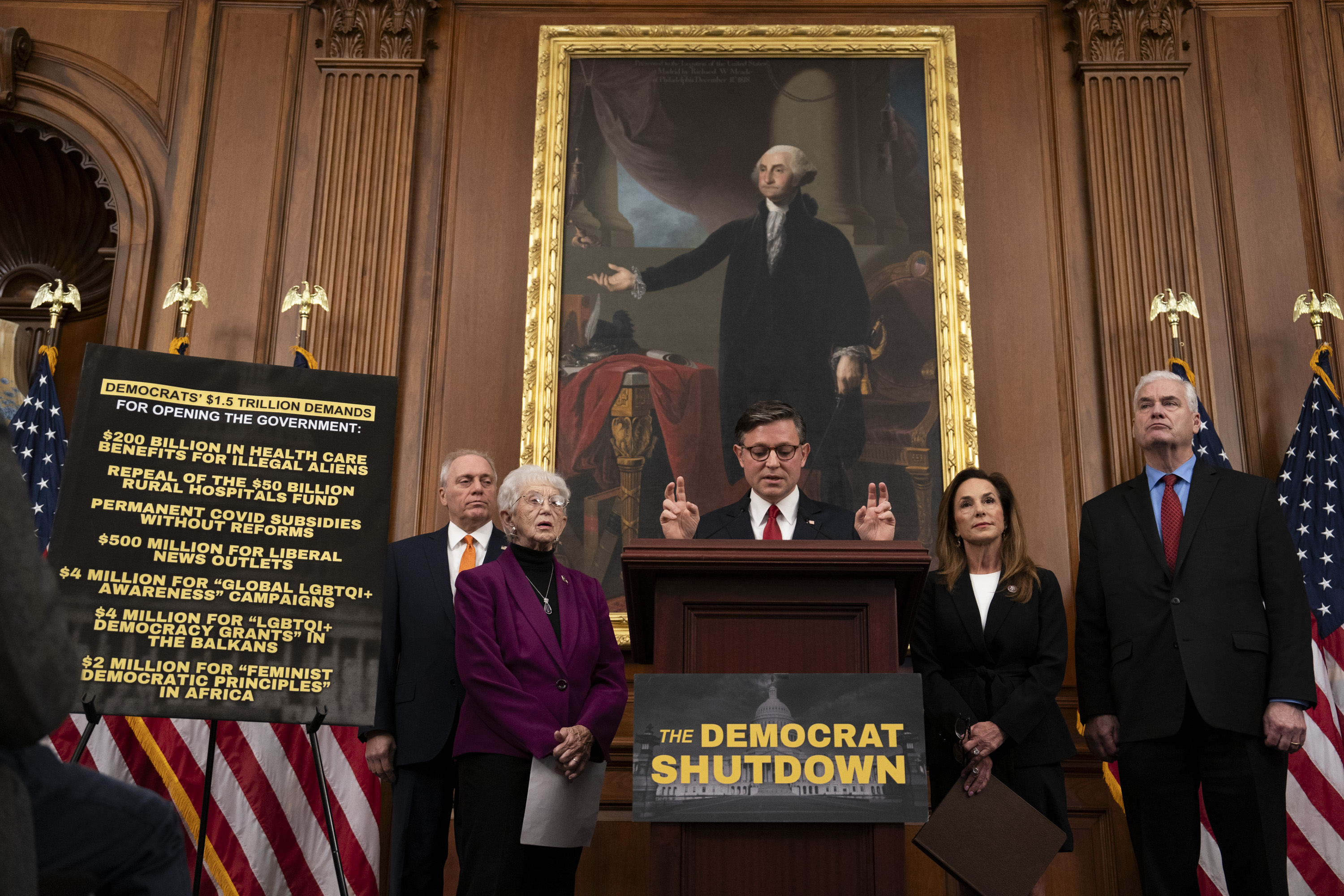
    House Speaker Mike Johnson gathers Republican leaders at a news conference last week to blame Democrats for the government shutdown. That’s ridiculous, writes Joseph Hoeffel.

    The country has never seen such presidential partisanship, overreach, and lawlessness.

    Now, Kristi Noem, the secretary of Homeland Security, is abusing her powers and playing politics regarding the shutdown.

    Last week, she produced a video for the Transportation Security Administration, which she supervises, to show at TSA security checkpoints in airports across the country. In the video, Noem blames congressional Democrats for the government shutdown and any related travel delays.

    She says, in part, “Democrats in Congress refuse to fund the federal government, and because of this, many of our operations are impacted … our hope is that Democrats will soon recognize the importance of opening the government.”

    Congress created the U.S. Department of Homeland Security in 2002 with strong majority votes in each chamber.

    No member suspected that a future secretary would so blatantly engage in partisanship on the job. Petty politics should never infect this particular department and its critical national security responsibilities.

    A number of airports around the country, including Los Angeles, Phoenix, Cleveland, and Charlotte, N.C., are refusing to run the TSA video, citing the political nature of its content.

    Any airport, public or private, that receives federal or state funding could be breaking the laws against political activity by recipients of government money if they show the video.

    I doubt this legal jeopardy Noem is creating through her avid partisanship will give her any pause. Nor will any worries about her job security.

    She is doing exactly what Trump wants her to do: Blame the Democrats at every opportunity for anything that is not working in the federal government.

    But the Republicans could pass a budget and reopen the government tomorrow.

    They need only to suspend the Senate rule that permits the Democrats to filibuster. Any Senate rule can be changed at any time by a simple majority vote.

    Elections have consequences

    In fact, the Senate Republicans just suspended such a rule last month so they could approve a large group of military and civilian appointees by a single en bloc vote, rather than the regular process of individual committee hearings and separate votes on each appointee.

    I am sure I would not like the budget priorities that unfettered congressional GOP majorities and Trump would produce.

    But elections have consequences.

    A single party controls our federal government by the will of the voters. I accept that and will fight it out at the next election.

    Why won’t the Republicans pass a budget and end the government shutdown? Do they think playing the political blame game is more important than governing?

    Let them use the power the voters gave them and accept the responsibility to govern. Let them accept the credit or the blame for the actions they take.

    And stop blaming the Democrats because the Republicans will not do their job.

    Joseph Hoeffel is a former Democratic member of Congress from Montgomery County (13th Congressional District, 1999-2004). He lives in Abington.

  • The Pa. Senate GOP approved a budget bill that Democrats say won’t even cover the state’s obligations

    The Pa. Senate GOP approved a budget bill that Democrats say won’t even cover the state’s obligations

    HARRISBURG — The Republican-led Pennsylvania Senate sent a $47.9 billion spending plan to the state House on Tuesday, but the proposal was dead on arrival and deemed “unserious” in the Democratic-controlled chamber, marking the latest chapter of the nearly four-month-long budget impasse in the state’s bitterly divided legislature.

    The Senate GOP plan, which passed the chamber by a 27-23 vote along party lines, included a $300 million, or 0.6%, total increase over last year’s budget that is intended to cover the state’s debt service and pension obligations, in addition to cutting operational spending for the legislative body by 5%, said Senate Majority Leader Joe Pittman (R., Indiana).

    The Republican senators’ spending plan amended a bill that passed with a narrow bipartisan majority in the House earlier this month to spend $50.25 billion for the 2025-26 fiscal year, allow for significant increases in public education spending, and cover increased Medicaid expenses.

    The House Democrats’ $50.25 billion spending bill was a slight decrease from the $51.5 billion budget proposal Democratic Gov. Josh Shapiro pitched in February. And it was an attempt by House Democrats at reaching a compromise — decreasing their proposed spending by 2.4% over Shapiro’s initial pitch — after encouragement from Senate President Pro Tempore Kim Ward (R., Westmoreland) for legislative leaders to bring the usually closed-door budget negotiations into the public eye.

    But the Senate GOP’s counteroffer passed Tuesday included little compromise and little increase in spending. However, it is a budget that would fund Pennsylvania’s needs rather than wants, several top GOP senators said during floor debate on the bill.

    “All it takes is one day and one vote to end this ‘Shapiro Shutdown,’” Pittman said in his floor remarks in support of the GOP budget bill.

    Several GOP senators noted the state’s fiscal outlook as the reason lawmakers cannot afford to spend much more over last year, as Pennsylvania is on track to bring in $46.4 billion during the 2025-26 fiscal year, which is significantly less than Shapiro and House Democrats want to spend.

    Pennsylvania is sitting on approximately $10 billion in reserves, from its leftover balance from the 2024-25 fiscal year and its hefty Rainy Day Fund. Democrats want to tap into those reserves and reinvest them in the state, while Republicans believe it is critical to protect those funds to maintain the state’s bond rating or cut taxes as a way to reinvest those surpluses back into taxpayers’ pockets.

    Top Senate Republicans on Tuesday urged the state House to return to session and pass their $47.9 billion spending plan as the most responsible way to protect Pennsylvania taxpayers in future years. And some offered criticism of Shapiro, who has continued to host news conferences around Pennsylvania during the 113-day budget impasse, accusing the governor of failing to lead in Harrisburg on budget negotiations.

    “If you want to have an honest conversation about how to get this budget done, a governor gallivanting across the state taking potshots at members of this caucus doesn’t help,” Pittman said.

    What was not mentioned Tuesday among Senate Republicans was that $47.9 billion is the highest number that the most conservative members of the GOP Senate caucus have pledged to spend. Sen. Dawn Keefer (R., Cumberland), who led the House Freedom Caucus before her election to the state Senate last year, even went as far as to take a flamethrower to a replica of Shapiro’s budget proposal in a social media video earlier this year while promising viewers through a rhyme that she would “hold the line at $47.9″ billion.

    Sign posted by the PA Senate at the Pennsylvania State Capitol in Harrisburg Aug. 26, 2025, reminds visitors of the state’s “multi-billion dollar structural deficit.”

    Senate Democrats firmly rejected the GOP plan as a farce that would not cover the state’s obligations for this fiscal year or make critical increases to public education funding needed to improve Pennsylvania’s school funding system. The top Senate Democratic leader, Sen. Jay Costa (D., Allegheny), tried several legislative maneuvers to try to get the Senate to vote on the House Democrats’ bill instead of the GOP proposal, all of which failed.

    “They thumbed their noses and they said, ‘Go to heck,’” State Sen. Vincent Hughes (D., Philadelphia), the minority chair of the Senate Appropriations Committee, said of his GOP colleagues’ response to the House bill ahead of Tuesday’s vote.

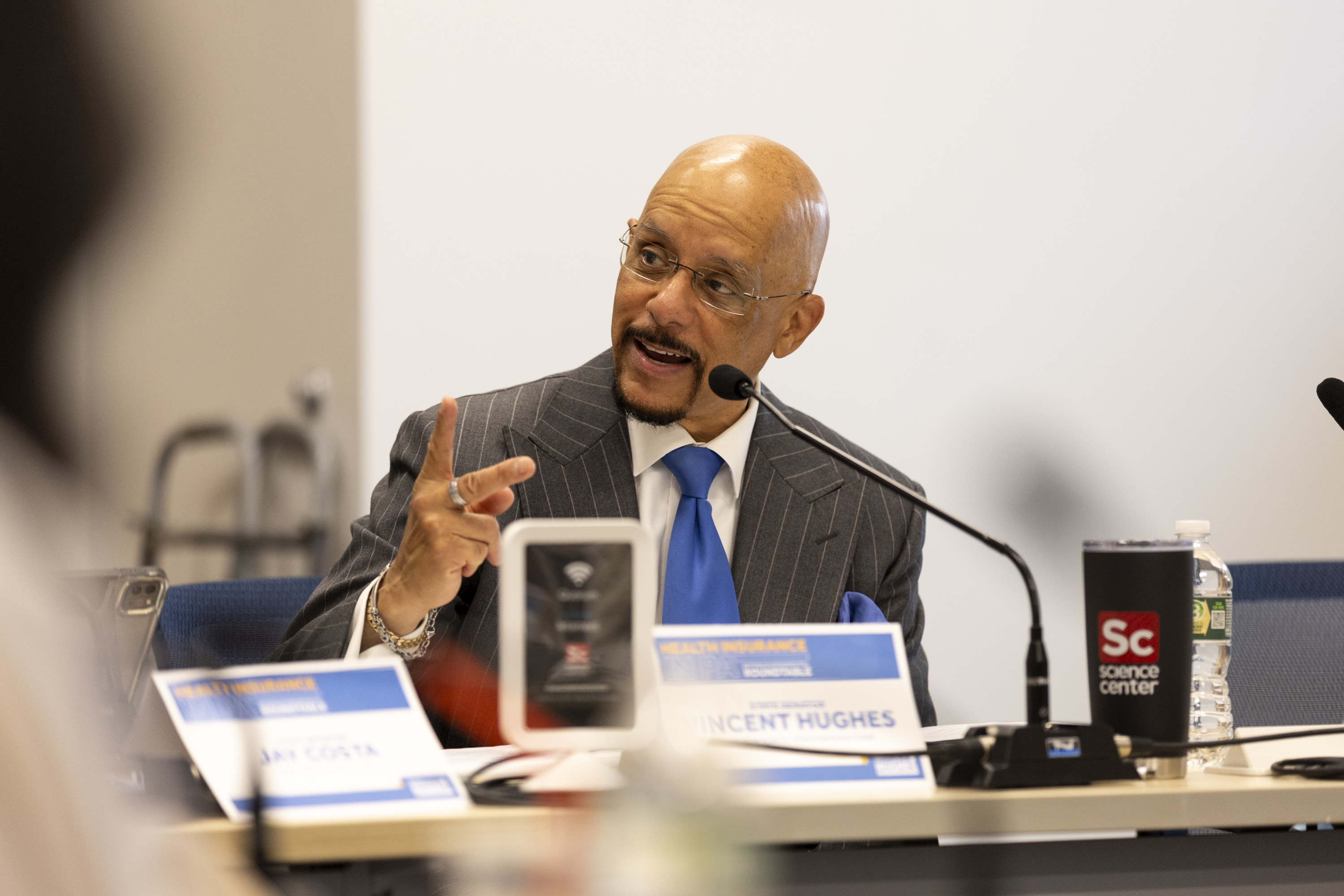
    Senator Vincent Hughes, speaks at the Round table with Pennsylvania lawmakers, stakeholders, health systems to discuss potential cuts to Medicaid and ACA at the University City Science Center in Philadelphia, Pa., on Tuesday, April 22, 2025.

    Shapiro, following a news conference in Allegheny County on Tuesday, voiced a similar sentiment when he told reporters the Senate’s proposal was “a joke” and “not designed to be serious or get the job done.” He again urged top GOP Senate leaders to begin meeting with top House Democrats to finalize a budget deal.

    Budget talks have largely stalled since August, when the urgency for a deal seemed to dwindle after Shapiro and Democrats agreed to remove mass transit from the negotiation table, a top Democratic priority.

    “I’m sorry transit didn’t get funded. But just because your top priority didn’t get addressed doesn’t mean that our priorities are no longer relevant, and that’s a hard truth,” Pittman, who has been critical of Pennsylvania’s mass transit systems and was a major roadblock in finalizing a deal, said Tuesday.

    And, as evidenced by Tuesday’s vote, leaders still do not agree on how much Pennsylvania should spend for the current fiscal year, now almost in its fifth month. Pennsylvania is the only state in the nation without any spending plan. North Carolina, which passed a six-month budget in early summer, returned to session this week to finish budget negotiations.

    During the stalemate, schools, counties, and service providers have had to lay off staff or take out significant loans to stay afloat in the absence of any state payments. School districts have had to make up more than $3 billion in expected payments from the state during the monthslong impasse.