Tag: Donald Trump

  • Greenland, Denmark, NATO: Breaking the world we built

    Greenland, Denmark, NATO: Breaking the world we built

    Out of the ashes of the Second World War, the United States led the creation of several global institutions to ensure we would never again have to fight such a war. We created the United Nations, the World Bank, the International Monetary Fund, and, most importantly, the North Atlantic Treaty Organization.

    Decades ago, NATO’s first secretary general, Hastings Ismay, remarked that the purpose of the alliance was “to keep the Soviet Union out, the Americans in, and the Germans down.” Then, aside from the threat of Soviet aggression, the other major threat was that the U.S. would turn its back on European allies and return to the isolationist posture it disastrously pursued in the early 20th century.

    Today, NATO faces its greatest threat from an entirely new source: a belligerent United States that may attack a fellow NATO nation.

    The White House has said President Donald Trump is weighing “a range of options,” explicitly including the use of the U.S. military, in his efforts to control Greenland. If that threat ever becomes reality, NATO as we know it will not survive.

    I write this as the lead Democrat for the U.S. congressional delegation to the NATO Parliamentary Assembly, which brings together lawmakers from every NATO member country to provide democratic oversight of the alliance and coordinate on shared security threats.

    I also write as someone who believes deeply that NATO is the bedrock of the post-World War II world. It is why Americans and Europeans have avoided a great-power war for nearly 80 years.

    NATO endures because of trust: The shared belief that allies do not threaten one another, and that borders are not rewritten by force.

    Greenland is a part of the Kingdom of Denmark, a founding member of NATO. A U.S. attack on Greenland would mean the United States using military force against a member of its own alliance.

    Danish military forces participate in an exercise with hundreds of troops from several European NATO members in the Arctic Ocean in Nuuk, Greenland, in September.

    There is no playbook for that scenario because it was always unthinkable. The moral authority of Article 5 — the pledge that an attack on one is an attack on all — would collapse overnight.

    No country on NATO’s eastern flank would ever again fully trust American guarantees. Estonia, Latvia, Poland, and others would be forced to reconsider their security in a world where Washington seizes territory from a smaller ally.

    The Trump administration’s rhetoric also plays directly into the hands of our fiercest adversaries.

    Beijing and Moscow have spent years trying to fracture the transatlantic partnership through disinformation, coercion, and intimidation. Every hint that America might use force against an ally becomes propaganda for authoritarian regimes that insist the rules-based order is a fiction, and that power — not law — is what matters.

    The administration argues that Greenland is strategically vital because of rising Russian and Chinese activity in the Arctic. But that reality is precisely why the United States must deepen cooperation with Denmark and Greenland — not threaten them.

    America already maintains a robust security presence in Greenland. A critical U.S. base supports missile warning, missile defense, and space surveillance under a long-standing defense agreement with Denmark that grants extensive U.S. access.

    Danish leaders have made clear they are open to strengthening cooperation with the U.S., writes Brendan F. Boyle. Pictured here is Mette Frederiksen, Denmark’s prime minister, at the European Political Community summit in Copenhagen, in October.

    Danish leaders have made clear they are open to strengthening that cooperation, and Greenland’s elected government has welcomed dialogue conducted with respect for international law and democratic self-determination.

    That is the path forward. The United States must expand joint Arctic operations, invest alongside Denmark in new capabilities, and work directly with Greenland’s leaders to protect shared security interests. Partnership strengthens deterrence while preserving the alliance that makes deterrence possible in the first place.

    This moment is a choice between partnership and coercion. America must choose partnership.

    The consequences of coercion would be devastating: European allies would begin preparing for a world in which U.S. commitments no longer carry weight. Some nations would pursue independent nuclear deterrents. Others would seek alternative security arrangements. Critical partnerships — including Trump’s own agreement with Finland to build polar icebreakers vital to deterring Russian aggression in the Arctic — would collapse.

    The alliance that has underpinned global stability since 1945 would fracture, not because of Moscow or Beijing, but because of decisions made in Washington.

    After the disastrous Iraq War, Americans are already uneasy about another prolonged foreign war. Now they are being told military force against a NATO ally is under consideration, an act that would inevitably risk escalation and could drag the United States into a costly, dangerous occupation.

    At home, families are trying to afford healthcare, keep their jobs, and provide for their children. They do not want to bankroll another unnecessary conflict that risks American lives and diverts attention from urgent needs here.

    Congress must draw a clear line. No funding for military action against a NATO ally. No ambiguity about America’s commitments. The United States must reaffirm — in law and in action — that its power is exercised through its alliances, not against them.

    An invasion of Greenland would not make America safer. It would end the alliance that has kept Americans safe for generations and plunge us into a new, dark world.

    Brendan F. Boyle represents Pennsylvania’s 2nd Congressional District and is the lead Democrat for the U.S. congressional delegation to the NATO Parliamentary Assembly. He is also a visiting lecturer at Princeton University’s School of Public and International Affairs.

  • Why touring ‘Suffs’ in Philadelphia under Trump is a ‘radical act’

    Why touring ‘Suffs’ in Philadelphia under Trump is a ‘radical act’

    Broadway playwright, composer, and actor Shaina Taub knows the power of theater to make a political statement. As an enthusiastic teen in Vermont, Taub staged a teach-in to protest the Iraq War at her high school — a bold move inspired by the anti-war musical Hair.

    About a decade later, when she was approached to write a musical about the suffrage movement, Taub recognized another meaningful opportunity to blend activism with theater.

    The one challenge: She was pretty unfamiliar with the American women who fought for the right to vote.

    “I really didn’t know anything,” Taub said.

    She was stunned, but her feelings turned into frustration as she concluded that her American public school education had been seriously lacking. “I was blown back by the scope of this history,” she said.

    That fueled her to create Suffs, the hit musical about the suffrage movement centered on South Jersey Quaker activist Alice Paul, a radical and charismatic organizer played fittingly by Taub herself in the Off-Broadway and Broadway runs.

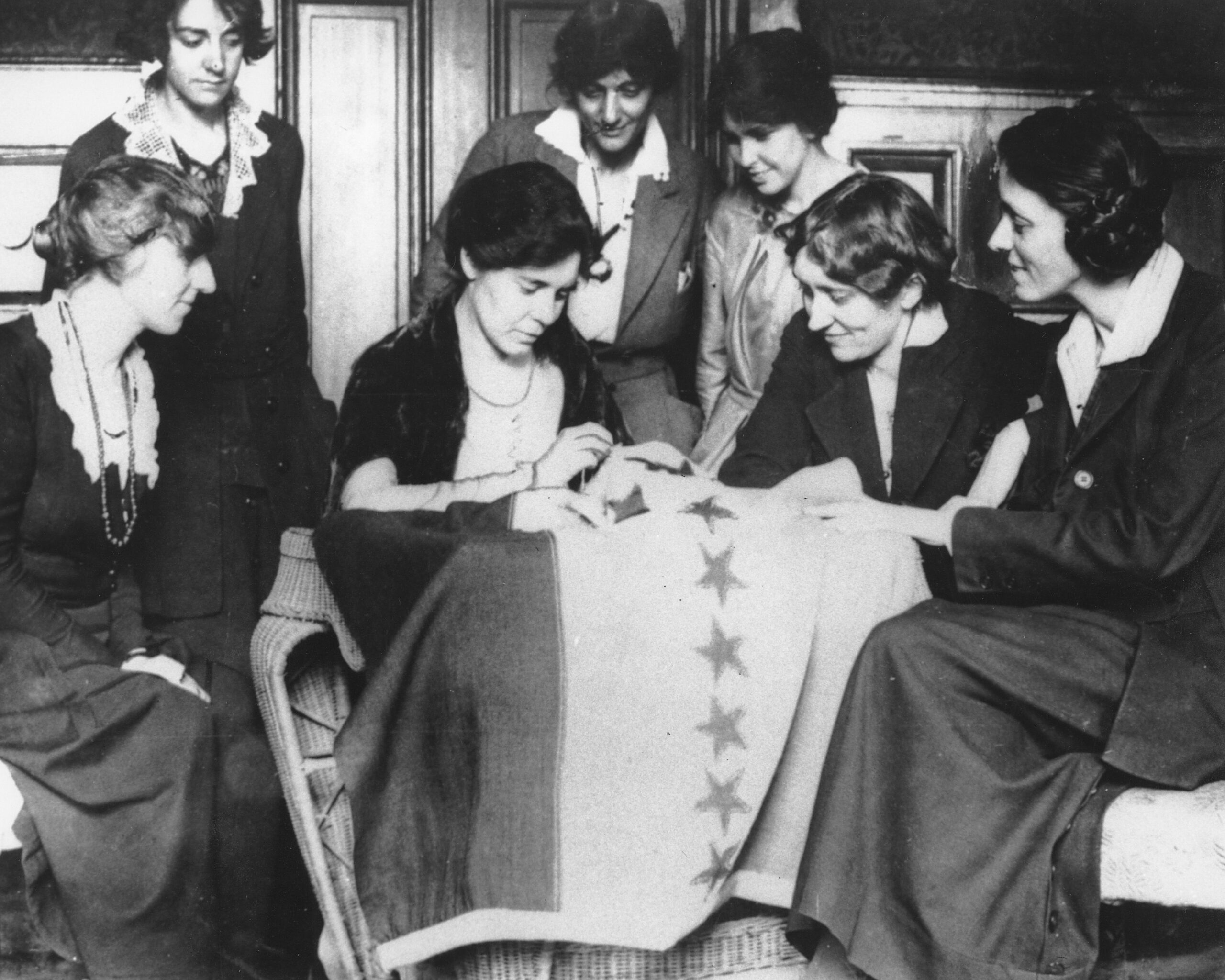
    Alice Paul, seated second from left, sews the 36th star on a banner, celebrating the ratification of the women’s suffrage amendment in August 1920. The 36th star represented Tennessee, whose ratification completed the number of states needed to put the amendment in the Constitution. (AP Photo, File)

    After premiering in 2022 at New York’s Public Theater for a sold-out run — following the trajectory of another history musical box-office success, HamiltonSuffs opened on Broadway in 2024. It went on to earn six Tony Award nominations.

    Taub took home two, for best book and best score, making history as the first woman to win in both categories independently on a night where Hillary Clinton, a Suffs coproducer, introduced Taub and the cast.

    Now on its first North American tour, Suffs has landed at Philadelphia’s Academy of Music this week (running through Jan. 18) to help kick off a year of events commemorating the 250th anniversary of the nation’s founding. The musical graces the same stage where suffragist Susan B. Anthony once spoke some 150 years ago advocating for the right to vote.

    Though mostly set in the District of Columbia, Suffs has some local shout-outs, too: The show mentions Swarthmore College, where Paul studied before pursuing her master’s at the University of Pennsylvania, and Bryn Mawr College, where President Woodrow Wilson (Suffs’ main antagonist) once taught history and politics.

    “Suffs” on Broadway.

    On opening night at the Academy of Music, director Leigh Silverman nodded to Philadelphia’s history in the suffrage movement, mentioning the protests Paul organized at Independence Hall, only a mile away, and across the city.

    “The suffs you met tonight, and the many, many others … were here in Philadelphia, and they remind us of our collective strength and what is possible when we stand up and fight, despite how far it might seem like we have to go, or for how long we have to keep marching,” she said.

    Taub echoed that sentiment in an interview.

    She believes the tour has been especially significant to stage under President Donald Trump following his policies canceling millions in federal grants for arts organizations nationwide and targeting historical institutions (particularly in Philadelphia) to alter the information they present to the public about slavery.

    “This is the first year of Suffs being performed under this president, and [it feels like] a radical act to get together in the theater and tell these stories,” Taub said.

    She added that it’s acutely meaningful to see the show in Philadelphia as the city reflects on the nation’s history for America250 this year.

    Though the actor/playwright grew up in Vermont, she saw shows in Philadelphia as a kid when she visited family in South Jersey; her mother, Susan Taub, was raised in Cherry Hill, just a few miles down the road from Paul’s childhood home in Mount Laurel.

    Today, it serves as the location of the Alice Paul Center for Gender Justice.

    Despite her connections to the region, Taub admitted that she has not yet visited Paul’s home. She plans to march over there soon.

    “Suffs.” Through Jan. 18, Academy of Music, 240 S. Broad St. ensembleartsphilly.org

  • The first assistant to DA Larry Krasner is retiring. He has some advice for his boss.

    The first assistant to DA Larry Krasner is retiring. He has some advice for his boss.

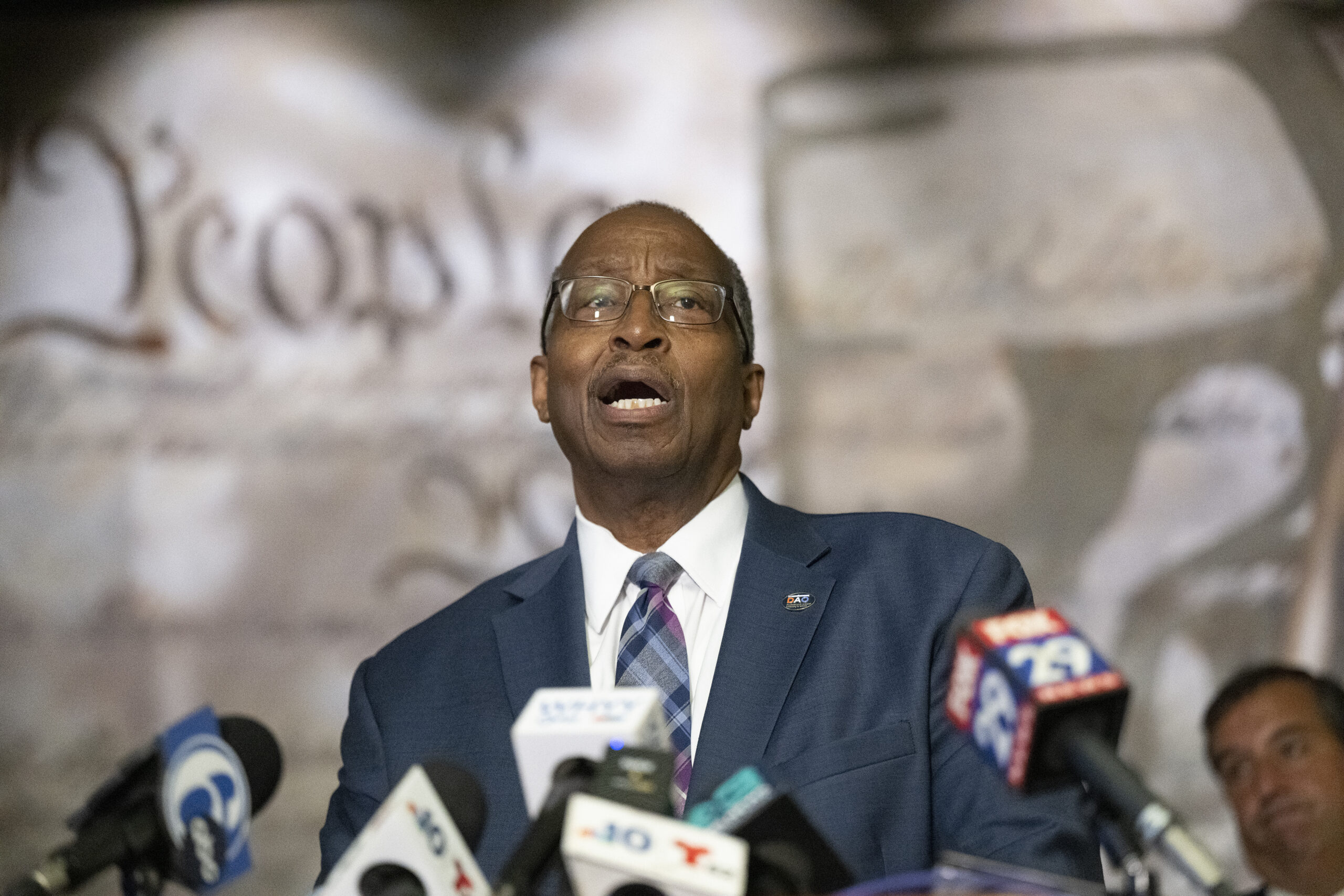
    Robert Listenbee, the first assistant district attorney under Larry Krasner and a largely behind-the-scenes enforcer of the office’s progressive agenda, is retiring after nearly eight years as the office’s second-in-command.

    Listenbee, 77, is expected to announce Friday that he is stepping down, marking the first shift in Krasner’s leadership team as the top prosecutor begins his third term.

    A longtime public defender and juvenile justice advocate, Listenbee joined the administration at the outset of Krasner’s first term in 2018 — even as Krasner openly questioned whether the role of first assistant was necessary beyond its statutory requirement.

    Robert Listenbee joined District Attorney Larry Krasner at the 2026 inaugural ceremony.

    Over the course of Krasner’s tenure, Listenbee rarely served as the public face of the office on major cases, focusing instead on juvenile work, recruitment, and personnel matters.

    Some prosecutors in the office said that often translated into a lack of visible management compared to previous first assistants, and that he served more as an internal messenger of Krasner’s often controversial agenda than the traditional day-to-day overseer of the office.

    Listenbee has said his role was never set up to operate traditionally, and his goal was to carry out Krasner’s vision and reform the office.

    Krasner declined to say who might replace him but he said he was evaluating candidates.

    Robert Listenbee, first assistant district attorney, announced developments in the case against a West Philadelphia teen who was planning a terrorist attack.

    Before joining the district attorney’s office, Listenbee spent decades as a public defender, including 16 years as chief of the juvenile unit at the Defender Association of Philadelphia. He later led the U.S. Department of Justice’s Office of Juvenile Justice and Delinquency Prevention during the Obama administration, and worked at Drexel University before returning to Philadelphia to join Krasner’s team.

    We spoke with Listenbee about his unconventional path to the law, his years reshaping juvenile justice, internal tensions within the DA’s office, and his advice for Krasner’s third term.

    This interview has been edited for length and clarity.

    Tell me about your life growing up.

    I was raised in Mount Clemens, just north of Detroit. My father worked in the auto industry. We were poor and lived in the projects. I went to a public high school, and was the first in my family to go to college.

    I came from a small African American community where people look out for one another. This community saw something in me very early. When I was only planning to go to Kalamazoo College, a mom at my school decided my life was going to be different. She contacted the recruiter at Harvard University, and they visited me out in my little home in the projects when I hadn’t even applied. I got a full ride to Harvard.

    I was among the first large group of African Americans at Harvard. It was 1966. We were in the middle of the Civil Rights Movement and the Vietnam War.

    How was that?

    There was total upheaval in this nation. Demonstrations everywhere, college campuses being taken over.

    I worked on the committee that helped establish the African American Studies Department at Harvard, one of the first in the nation.

    This was also at a time when African countries were becoming independent. I spent 16 months as a teacher in the rural area in western Kenya.

    Robert Listenbee spent 16 months in Africa teaching English, and then traveled the continent before going to law school.

    Instead of coming back from Africa, I decided to hitchhike around the world. I spent six months in Asia — Thailand, Laos, even as the war was going on. I rode a motorcycle into the Mekong Delta in Vietnam and had experiences that make me grateful to be alive. I hitchhiked across Africa and traveled 8,000 miles by train across India. I did all of this on about $600.

    After a two-year gap year, I returned to Harvard and finished my degree.

    I ended up getting a full-ride scholarship to Berkeley law school.

    Where did you go after law school?

    I had job offers but I had this crazy idea that I wanted to build a road across Africa, from Nairobi to Lagos, but I was broke and needed money to do it.

    This was when the pipeline was being built across the North Slope of Alaska, and you could make gobs of money in a short period of time. So in 1976, I went to Anchorage without a job and lived in the YMCA. I shoveled snow, washed dishes, and worked at McDonald’s.

    Robert Listenbee worked in the oil fields building the pipeline on the North Slope of Alaska for several years beginning in 1976.

    Finally, I got a job on the pipeline.

    I was there for a couple of years. I was a laborer in the oil fields. I worked trucks that rode across the Arctic Ocean in the middle of the winter. I worked on wildcat wells 50 miles from base camp. I had to relieve pressured gas to keep it from blowing up. It was 50 degrees below zero.

    Robert Listenbee worked in the oil fields building the pipeline on the North Slope of Alaska for several years beginning in 1976.

    I got into fights. People were trying to kill me at different points in time, and I was trying to kill other people, too. So I mean, the reason I know a little bit about criminal justice is because I was almost a criminal.

    I never built the road in Africa. I eventually came back to Philadelphia, and worked construction until 1986.

    So what about being a lawyer?

    After my construction company failed, I was broke again. I ended up going back to legal work, and got a job working at the Defender Association.

    You were the head of the juvenile unit for 16 years, and then you finished your career here on the other side — going from defending young people to prosecuting them. How was that transition for you?

    Working for the U.S. Department of Justice’s Office of Juvenile Justice and Delinquency Prevention under President Obama helped prepare me for prosecutorial work.

    I was adamant I would never work for this office. I thought it was corrupt. Krasner called me three times before I agreed to join as first assistant.

    We were engaging in culture change. Some of the behavior of the people who were here was absolutely outrageous, especially in the homicide unit. They had a sense that this office belonged to them. It didn’t belong to the people. They were willing to cheat and do it and hide evidence in the process of doing it. That’s the feeling that I had when I first got here, and that’s what we found.

    Robert Listenbee, first assistant district attorney, takes questions from the media after announcing developments in the case against a West Philadelphia teen who investigators say purchased materials including chemicals, wiring, and tactical equipment associated to become a terrorist.

    There has been criticism of your juvenile work — some have said that it was too lenient during the period of intense gun violence and that kids went on to commit worse crimes. Others say the office hasn’t gone far enough to treat kids as kids. How do you assess your record?

    We’ve reduced the number of kids in out of home placements. We’ve expanded juvenile diversion programs. In 2024, we created a juvenile homicide unit to review all cases of juveniles charged with murder.

    I’m satisfied that we’re being as fair as we can and taking the time to carefully evaluate every issue in a case.

    The first assistant is typically the person who manages the office day-to-day. Some prosecutors have said that, in this administration, that role functioned differently — that much of the management flowed directly from Krasner. Do you think that perception is fair, and how did you approach leadership in that environment?

    The DA did not want the imperial first assistant that had been here before. He would prefer a flat structure to a hierarchical structure, which means you get assigned a lot of odd jobs depending on what he wants you to do.

    If I were running the office, I would have run it completely differently. But I have to tell you that, having been here as long as I have, we never would have gotten this far without the DA’s serious concerns about what people around here were doing, whether they were implementing his policy or not. His skepticism, his oversight, is what’s kept this place moving in the direction that he wanted to go in. I wasn’t tuned in enough to the office to understand that from the very beginning, but I listened to him.

    We hire people, we fire people, we move people around. That’s happened a lot. We sometimes end up with younger and inexperienced supervisors, because we haven’t really developed a program for training supervisors really well. We’re working on that.

    Do you have any regrets in the position?

    We’ve gotten better with victim communication, particularly when police are killed.

    I wish I had worked on juvenile issues earlier than I did.

    District Larry Krasner speaks with the media after casting his vote in the 2025 primary.

    What’s your advice for the next first assistant?

    You have to understand the DA’s goals and purposes and how he operates.

    So, listen to Larry?

    Not that. The DA is not a micromanager. But there’s no written directives on most of the things he wants, and there’s no organizational chart or hierarchy. If we have issues, we often go to him.

    Do you have a piece of advice for Krasner in his third term?

    This is a city that has a chip on its shoulder. The DA is a person who has a chip on his shoulder. They respect him for that when he speaks out. A lot of the things he says may not be politically astute, but they’re things he believes in. They like that about him.

    He is the Donald Trump of the progressive era.

    He needs to continue surrounding himself with people who can understand him and help him implement his policies.

    A lot of people don’t like him, and I understand that. A lot of people don’t like me because I work for him. A lot of people don’t like what we do. That never mattered to me. I know that the people we have seen in court, the victims and the defendants and the witnesses, I know that we’re doing right by them. That’s my North Star.

    Robert Listenbee, the first assistant to District Attorney Larry Krasner, retired on Friday.
  • Protests erupt over federal immigration enforcement operations after shootings in Minneapolis and Portland

    Protests erupt over federal immigration enforcement operations after shootings in Minneapolis and Portland

    MINNEAPOLIS — As anger and outrage spilled out onto Minneapolis’ streets over the fatal shooting of a woman by an Immigration and Customs Enforcement officer, a new shooting by federal officers in Oregon left two people wounded, sparked additional protests and elicited more scrutiny of enforcement operations across the U.S.

    Hundreds of people protesting the shooting of Renee Good marched in freezing rain Thursday night down one of Minneapolis’ major thoroughfares, chanting “ICE out now” and holding signs saying, “killer ice off our streets.” Protesters earlier vented their outrage outside a federal facility that is serving as a hub for the administration’s latest immigration crackdown on a major city.

    Early Friday, city crews removed makeshift barricades made from debris including garbage cans and Christmas trees that blocked streets in the area of Wednesday’s shooting to keep streets open, but Minneapolis officials said they would not remove the memorial the community created there. An estimated 15 tons (13.6 metric tonnes) of debris including metal and tires were removed, officials said.

    The shooting in Portland, Oregon, took place outside a hospital Thursday afternoon. A man and woman were shot inside a vehicle, and their conditions were not immediately known. The FBI and the Oregon Department of Justice were investigating.

    Portland Mayor Keith Wilson and the city council called on ICE to end all operations in the city until a full investigation is completed. Hundreds protested Thursday night at the ICE building. Early Friday, Portland police reported that a handful of arrests were made after officers asked protesters to move to the sidewalk, as traffic remained open in the area.

    Just as it did following Wednesday’s shooting in Minneapolis shooting, the Department of Homeland Security defended the actions of the officers in Portland, saying it occurred after a Venezuelan man with alleged gang ties and who was involved in a recent shooting tried to “weaponize” his vehicle to hit the officers. It was not yet clear if witness video corroborates that account.

    Homeland Security Secretary Kristi Noem, President Donald Trump and others in his administration have repeatedly characterized the Minneapolis shooting as an act of self-defense and cast Good as a villain, suggesting she used her vehicle as a weapon to attack the officer who shot her.

    Vice President JD Vance said the shooting was justified and Good, a 37-year-old mother of three, was a “victim of left-wing ideology.”

    “I can believe that her death is a tragedy while also recognizing that it is a tragedy of her own making,” Vance said, noting that the officer who killed her was injured while making an arrest last June.

    But state and local officials and protesters rejected that characterization, with Minneapolis Mayor Jacob Frey saying video recordings show the self-defense argument is “garbage.”

    An immigration crackdown quickly turns deadly

    The Minneapolis shooting happened on the second day of the Trump administration’s immigration crackdown on the Twin Cities of Minneapolis and St. Paul, which Homeland Security said is the biggest immigration enforcement operation ever. More than 2,000 officers are taking part and Noem said they have made more than 1,500 arrests.

    It provoked an immediate response in the city where police killed George Floyd in 2020, with hundreds of people turning up to the scene to vent their outrage at the ICE officers and the school district canceling classes for the rest of the week as a precaution.

    Good’s death — at least the fifth tied to immigration sweeps since Trump took office — has resonated far beyond Minneapolis, as protests took place or were expected this week in many large U.S. cities.

    Who will investigate?

    The Minnesota agency that investigates officer-involved shootings said Thursday that it was informed that the FBI and U.S. Justice Department would not work with the it, effectively ending any role for the state to determine if crimes were committed. Noem said the state has no jurisdiction.

    “Without complete access to the evidence, witnesses and information collected, we cannot meet the investigative standards that Minnesota law and the public demands,” said Drew Evans, head of the Minnesota Bureau of Criminal Apprehension.

    Minnesota Gov. Tim Walz demanded that the state be allowed to take part, repeatedly emphasizing that it would be “very difficult for Minnesotans” to accept that an investigation excluding the state could be fair.

    Deadly encounter seen from multiple angles

    Several bystanders captured video of Good’s killing, which happened in a neighborhood south of downtown.

    The recordings show an officer approaching an SUV stopped across the middle of the road, demanding the driver open the door and grabbing the handle. The Honda Pilot begins to pull forward and a different ICE officer standing in front of it pulls his weapon and immediately fires at least two shots at close range, jumping back as the vehicle moves toward him.

    It is not clear from the videos if the vehicle makes contact with the officer, and there is no indication of whether the woman had interactions with agents earlier. After the shooting, the SUV speeds into two cars parked on a curb before crashing to a stop.

    Officer identified in records

    The federal agent who fatally shot Good is an Iraq War veteran who has served for nearly two decades in the Border Patrol and ICE, according to records obtained by AP.

    Noem has not publicly named him, but a Homeland Security spokesperson said her description of his injuries last summer refers to an incident in Bloomington, Minnesota, in which court documents identify him as Jonathan Ross.

    Ross got his arm stuck in the window of a vehicle whose driver was fleeing arrest on an immigration violation. Ross was dragged and fired his Taser. A jury found the driver guilty of assaulting a federal officer with a dangerous weapon.

    Attempts to reach Ross, 43, at phone numbers and email addresses associated with him were not successful.

  • New Jersey’s Petty’s Island, now owned by Venezuela’s Citgo, will soon belong to major conservative donor’s firm

    New Jersey’s Petty’s Island, now owned by Venezuela’s Citgo, will soon belong to major conservative donor’s firm

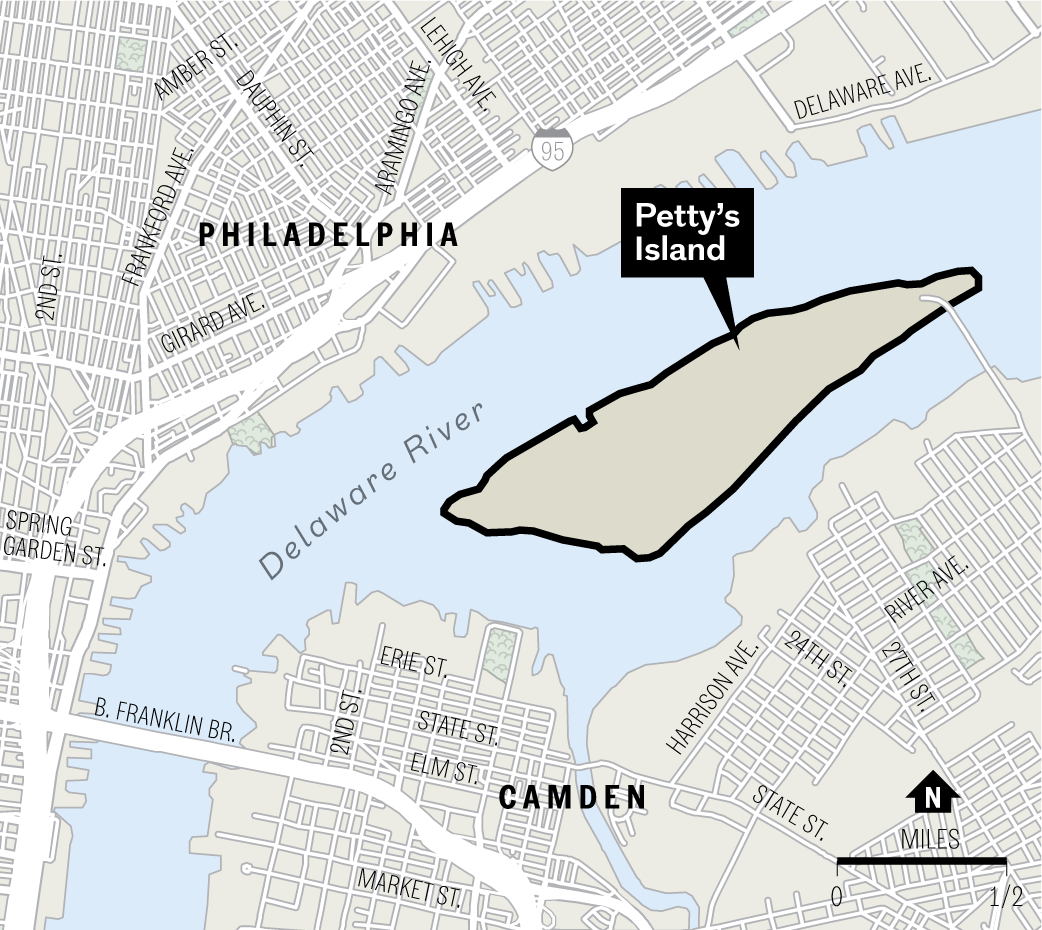
    New Jersey has long coveted Petty’s Island, 300 acres in the Delaware River off Pennsauken, as a potential environmental and recreational haven with its grand views of Philadelphia.

    Originally the hunting grounds of Native Americans, the island was later farmed by Quakers. Folklore claims pirate landings and an overnight stay by Ben Franklin. In more recent years, redevelopment proposals envisioned a hotel and golf course before the state’s embrace of a nature preserve.

    Citgo Petroleum Corp. — the Houston-based refining arm of Venezuela’s national oil company — has owned the island for 110 years, leaving a legacy of pollution from oil storage and distribution.

    Now recent international events and a court ruling on Citgo have clouded the island’s immediate future while underscoring the reach of the petroleum industry.

    Formerly, it was the site of Fuel storage (center) for the Venezuelan oil company Citco.

    Late last year, U.S. District Court Judge Leonard Stark in Delaware approved Amber Energy as buyer of Citgo’s Venezuelan parent company through a sale of shares to settle billions in debts, concluding a process that began in 2017. Amber Energy bid $5.9 billion in a court-organized auction.

    Citgo owns a network of petroleum infrastructure that some analysts say could be worth up to $13 billion, according to the Wall Street Journal.

    Venezuelan officials immediately denounced the sale as “fraudulent” and appealed the decision. Citgo is a subsidiary of Venezuela’s state-owned oil company, Petróleos de Venezuela (PDVSA).

    However, on Jan. 3, the U.S. captured Venezuela President Nicolás Maduro and brought him to the U.S. to face narco-conspiracy charges. He has pleaded not guilty.

    It is no longer clear whether Venezuela will continue with an appeal. President Donald Trump has said the U.S. is now running that country and is mapping out a vision for its vast crude oil reserves.

    So it’s likely Amber Energy, an affiliate of activist hedge fund Elliott Management, will soon close on the arrangement to own Citgo — and presumably Petty’s Island.

    Elliott Management was founded by Paul Singer. He or his firm have contributed tens of millions to political campaigns or groups, including Trump’s 2024 presidential campaign.

    Amber Energy, through a spokesperson Braden Reddall, declined to comment this week. Reddall, however, noted in an email that the “transaction involving Citgo has not yet been completed.”

    Citgo has long been working to eventually donate the island to the New Jersey Natural Lands Trust, which is overseen by the state Department of Environmental Protection (DEP).

    The DEP declined to comment.

    Map of Petty’s Island in the Delaware River, north of the Benjamin Franklin Bridge.

    Citgo and Petty’s Island

    Petty’s Island was originally inhabited by the Indigenous Lenni-Lenape people, and stories abound about its history, according to a DEP website for the trust. The island was once owned by William Penn.

    In 1678, then-owner Elizabeth Kinsey, a Quaker, struck a deal to buy it from the Lenni-Lenape and allowed them to continue hunting and fishing — provided they agreed not to kill her hogs or set fire to her hayfields.

    There are other tales of Blackbeard the pirate docking there and even Benjamin Franklin spending a night on the island, which was eventually named after John Petty, an 18th-century trader from Philadelphia.

    The island had been used for farming, trading, and shipbuilding until Citgo, then an American company, began buying land there in 1916, continuing to do so until it owned the entire island by the 1950s. Venezuela’s PDVSA acquired ownership of Citgo in the 1980s.

    In the early 2000s, the oil company sought to donate the island to New Jersey as a nature preserve, aligning with environmental efforts to conserve the land, which includes habitats for bald eagles, kestrels, and herons.

    But in 2004, the state’s Natural Lands Trust rejected an offer from Citgo for a conservation easement under political pressure to develop it.

    At the time, a development company in Raleigh, N.C., had planned a golf course, a hotel and conference center, and 300 homes for the island, which offers views of Philadelphia and Camden, but that proposal was abandoned.

    In 2009, the Natural Lands Trust, created by the New Jersey Legislature to preserve land and protect nature, finally voted to accept the island from Citgo.

    Then-Venezuelan President Hugo Chávez heralded the plans at the Summit of the Americas.

    An informational sign for Petty’s Island, seen in the distance, at Cramer Hill Waterfront Park in Camden.

    What is Elliott Management?

    Singer, who leads Amber Energy’s parent company Elliott Management, was the seventh-largest donor in the 2024 election cycle, according to Open Secrets, a research group that tracks money in U.S. politics. That put him in a top 10 list that included Elon Musk, Timothy Melon, and Jeffrey Yass.

    Singer contributed $43.2 million, with almost all going to conservative causes, including a $5 million contribution to Make America Great Again Inc., a super PAC that supports Trump. And $2 million went to the Keystone Renewal PAC to support conservative candidates in Pennsylvania.

    The order for the sale of Citgo to the arm of Singer’s hedge fund was the last major legal step to wrap claims by up to 15 creditors that began in 2017 for debt defaults.

    The deal is expected to close in coming months. Amber Energy plans to retain the Citgo brand.

    Petty’s Island (right) as seen by drone, Friday, Jan. 9, 2026. The 292-acre land sits in the Delaware river near the border between Pennsylvania and New Jersey. It is located between the Betsy Ross and Ben Franklin bridges. Formerly it was the site of Fuel storage for the Venezuelan oil company Citco.

    What’s happening on the island now?

    Currently, the New Jersey Natural Lands Trust holds a conservation easement for the island that prevents any development.

    The state’s goal is to turn the island into an urban nature reserve with an environmental center, according to the Center for Aquatic Sciences in Camden, which is partnering with the trust in the endeavor.

    Public access to the island is permitted only as part of scheduled programs. The trust has built a main trail along the southern perimeter and added connector trails for a total of two miles. It has installed 13 exhibits and kiosks along the trails.

    Transfer of the title of the island ultimately depends on Citgo, which is responsible for removing the petroleum infrastructure and cleaning up contamination.

    But before Citgo can turn the title over to the trust, the DEP must certify that the land is cleaned to state standards, according to the most recent information available on the DEP website for the trust.

    Last year, Citgo agreed to place $13.3 million in a trust fund to remediate “all hazardous substances, hazardous wastes, and pollutants discharged,” on the island.

    If Amber Energy assumes all liabilities of Citgo, it would presumably be responsible for the cleaning and transfer of title under the conservation easement.

    Reddall, the spokesperson for Amber Energy, declined to comment on the cleanup.

  • The race between Josh Shapiro and Stacy Garrity for Pa. governor has officially begun. Here’s what you need to know.

    The race between Josh Shapiro and Stacy Garrity for Pa. governor has officially begun. Here’s what you need to know.

    Pennsylvania’s race for governor has officially begun. And 10 months before the election, the November matchup already appears to be set.

    Democratic Gov. Josh Shapiro formally announced his reelection campaign Thursday — not that anyone thought he wouldn’t run. And Republicans have rapidly coalesced behind the state party’s endorsed candidate, Pennsylvania Treasurer Stacy Garrity.

    The race will dominate Pennsylvania politics through November, but it could also have a national impact as Democrats hope Shapiro at the top of the state ticket can elevate the party’s chances in several key congressional races.

    Here’s what you need to know about the high-stakes contest.

    The candidates

    Josh Shapiro

    Shapiro is seeking a second term as Pennsylvania’s top executive as he’s rumored to be setting his sights on the presidency in 2028. Just weeks after his campaign launch, Shapiro will head to New York and Washington, D.C., as part of a multicity book tour promoting his memoir.

    Shapiro was first elected to public office in 2004 when he flipped a state House seat to represent parts of Montgomery County. As a freshman lawmaker, he quickly built a reputation of brokering deals across party lines. He went on to win a seat on the Montgomery County Board of Commissioners in 2011, flipping the board blue for the first time in decades.

    Shapiro was elected state attorney general in 2016, a year when Pennsylvania went for Republican Donald Trump in the presidential contest. The position put Shapiro in the national spotlight in 2020 when Trump sought to overturn his loss in the state that year through a series of legal challenges, which Shapiro’s office successfully battled in court.

    He went on to decisively beat Trump-backed Republican State. Sen. Doug Mastriano for the governorship in 2022. Despite an endorsement from Trump, Mastriano lacked the support of much of Pennsylvania’s Republican establishment and spent the election cycle discouraging his supporters from voting by mail.

    Throughout Shapiro’s first term as governor, he has highlighted his bipartisan bona fides and ability to “get stuff done” — his campaign motto — despite contending with a divided legislature. His launch video highlights the quick reconstruction of I-95 following a tanker explosion in 2023.

    In 2024, Shapiro was vetted as a possible running mate for then-Vice President Kamala Harris, who ultimately snubbed the Pennsylvanian in favor of Minnesota Gov. Tim Walz. Harris went on to lose the state to Trump.

    Stacy Garrity

    Garrity is Shapiro’s likely opponent in the general election. She earned an early endorsement from the Pennsylvania Republican Party in September after winning a second term to her current position in 2024 with the highest total of votes in history for a state office, breaking a record previously held by Shapiro.

    She has been quick to go on the attack against the Democratic governor in recent months. Throughout Pennsylvania’s monthslong budget impasse Garrity criticized Shapiro’s leadership style and panned the final agreement he reached with lawmakers as fiscally irresponsible.

    Garrity’s campaign has focused on contrasting her priorities with Shapiro’s, arguing the governor is more interested in higher office than he is in Pennsylvania.

    A strong supporter of Trump, Garrity is one of the only women that has been elected to statewide office in Pennsylvania history. If elected, she would be the first female governor in state history.

    Garrity is a retired U.S. Army colonel who was executive at Global Tungsten & Powders Corp. before she was elected treasurer in 2020. Running a relatively low-key state office, Garrity successfully lobbied Pennsylvania’s General Assembly to allow her to issue checks to residents whose unclaimed property was held by her office, even if they hadn’t filed claims requesting it.

    Anyone else?

    While Shapiro and Garrity are the likely nominees for their parties, candidates have until March to file petitions for the race. That theoretically leaves the possibility of a primary contest open for both candidates, but it appears unlikely at this point.

    Mastriano, who ran against Shapiro in 2022, spent months floating a potential run for governor against Garrity. He announced Wednesday that he would not be seeking the Republican nomination.

    The stakes

    Why this matters for Pennsylvanians

    The outcome of Pennsylvania’s gubernatorial race could hold wide-ranging impacts on transportation funding, election law, and education policy, among other issues.

    The state’s governor has a powerful role in issuing executing actions, setting agendas for the General Assembly, and signing or vetoing new laws. The governor also appoints the secretary of state, the top Pennsylvania election official who will oversee the administration of the next presidential election in the key swing state.

    Throughout the entirety of Shapiro’s first term, he has been forced to work across the aisle because of the split legislature. Throughout that time the balance of power in Harrisburg has tilted toward Democrats who hold the governor’s mansion and the Pennsylvania House. But many of the party’s goals — including expanded funding for SEPTA and other public transit — have been blocked by the Republican-held Senate.

    If Garrity were to win that dynamic would shift, offering Republicans more leverage as they seek to cut state spending and expand school voucher options (while Shapiro has said he supports vouchers, the policy has not made it into any budget deals under him).

    Shapiro’s ambition

    Widely rumored to have his sights set on higher office, Shapiro’s presidential ambitions may rise and fall with his performance in his reelection campaign.

    Shapiro coasted to victory against Mastriano in 2022, winning by 15 points. The 2026 election is expected to be good for Democrats with Trump becoming an increasingly unpopular president.

    But Garrity is viewed as a potentially stronger opponent to take on Shapiro than Mastriano, even though her political views have often aligned with the far-right senator.

    When the midterms conclude, the 2028 presidential cycle will begin. If Shapiro can pull off another decisive win in a state that voted for Trump in 2024, it could go a long way toward aiding his national profile. But if Garrity wins, it could end the governor’s chances of putting up a serious campaign for the presidency in 2028.

    Every other race in Pennsylvania

    The governor’s contest is the marquee race in Pennsylvania in 2026. Garrity and Shapiro have the ability to help or hurt candidates running for Pennsylvania’s statehouse and Congress.

    The momentum of these candidates, and their ability to draw voters to the polls could play a key role in determining whether Democrats can successfully flip four competitive U.S. House districts as they attempt to take back the chamber.

    Democrats also narrowly hold control of the Pennsylvania House and are hoping to flip three seats to regain control of the Pennsylvania Senate for the first time in decades. If Democrats successfully flip the state Senate blue, it would offer Shapiro a Democratic trifecta to push for long-held Democratic goals if he were to win reelection.

    Strong Democratic turnout at the statewide level could drive enthusiasm down-ballot, and vice versa. Similarly, weak turnout could aid Republican incumbents in retaining their seats.

    The dates

    The election is still months away but here are days Pennsylvanians should put on their calendars.

    • May 4: Voter registration deadline for the primary election.
    • May 19: Primary election.
    • Oct. 19: Voter registration deadline for the general election.
    • Nov. 3: General election.
  • In dozens of cases, Philly’s federal judges have found Trump’s mandatory detention policy unlawful

    In dozens of cases, Philly’s federal judges have found Trump’s mandatory detention policy unlawful

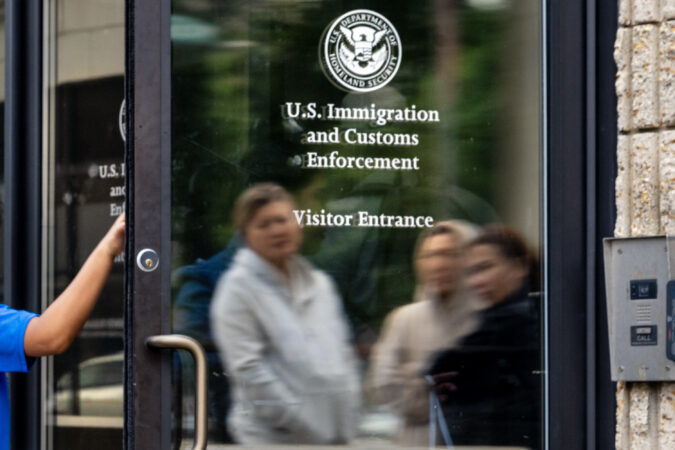
    Federal judges in Philadelphia have ruled dozens of times against a Trump administration policy that mandates detention for nearly all undocumented immigrants — joining a nationwide wave of decisions criticizing the government for applying the policy in unlawful ways.

    In the Eastern District of Pennsylvania, U.S. District Judge Juan R. Sánchez wrote in a memorandum this week that more than 40 people who have been detained in the region under that policy, which was rolled out by Immigration and Customs Enforcement last summer, have sought relief in the courts — and judges have ruled against the government in every case.

    Chief Judge Wendy Beetlestone was even more blunt in an opinion filed last month, writing that “the law is piled sky high against the government’s position” to mandate detention and deny bond hearings for all undocumented immigrants — even those seeking to stay here via appropriate legal channels.

    The administration’s insistence on employing the policy and defending it in court, Beetlestone wrote, was akin to the Greek myth of Sisyphus pushing a boulder up a hill.

    “The Government’s hope, presumably, is that if it keeps pushing the boulder of its argument up the hill, at least one judge may rule against the weight of the authority,” Beetlestone wrote. “But the tale before the courts is the traditional one of Greek mythology: the Government returns again and again to push the same theory uphill, only for courts to send it rolling back down again.”

    The pushback has added to a chorus of similar decisions in courts nationwide. Sánchez, appointed by George W. Bush, wrote in his memo that people challenging their detention in federal district courts “have prevailed, either on a preliminary or final basis, in 350 … cases decided by over 160 different judges sitting in about fifty different courts spread across the United States.”

    A Politico analysis of court dockets published this week put that tally even higher, reporting that over the last six months, more than 300 federal judges — comprising appointees of every president since Ronald Reagan — have ordered some form of relief in mandatory detention cases to about 1,600 challengers.

    Spokespeople for ICE did not reply to questions about the judicial rebukes, and many of the government’s court filings in cases challenging detention have been made under seal.

    Still, the Trump administration has made no secret of its desire to boost the number of people in federal immigration detention. And the mandatory detention policy has helped push the number of confined immigrants past 65,000, a two-thirds increase since Trump took office in January.

    Lilah R. Thompson, an immigration attorney in the community defense unit at the Defender Association of Philadelphia, said in an interview that mandatory detention “plainly violates the law and is an illegal policy.” But she said most challenges to it so far have come in individual cases, and the potential legal avenues seeking to strike it down nationwide are protracted and legally complex.

    In the meantime, Thompson said, the government has seemed content to use the policy in its attempt to apply pressure to immigrants and, ultimately, increase deportations.

    “[Authorities] are applying a blanket policy because when people are in detention, they aren’t able to withstand the horrors of detention,” Thompson said. “It makes their circumstances much more difficult.”

    A dramatic change in precedent

    ICE’s detention mandate was rolled out amid the Trump administration’s aggressive push to crack down on immigrants nationwide.

    It came as the Board of Immigration Appeals — the highest administrative body for interpreting the nation’s immigration laws — issued three precedential rulings that made it dramatically harder for detainees to be released on bond.

    In one of those rulings, the board held that immigration judges lack the power to hear or grant bond requests to people who entered the United States without permission — even if they had been in the country for years, or had few other infractions that might warrant detention as their cases wound through the immigration system.

    That upended decades of established government practice, which typically allowed otherwise law-abiding people who entered the country illegally to at least receive a bond hearing and determine if they could remain in the community as their cases moved forward.

    The decision also meant that thousands of detained immigrants who previously would have been eligible for bond hearings could be released only if they filed and won a federal lawsuit.

    For many detainees that created an impossible situation because they have neither a lawyer nor the money to hire one.

    “There are so many people that are getting picked up [under] the unlawful mandatory detention policy, but because they don’t have an attorney to file a [legal challenge], they’re still experiencing the consequences of the policy,” said Maria Thomson, another attorney in the Defender Association’s community defense unit.

    Officials at the federal Executive Office for Immigration Review, which oversees the BIA, declined to answer questions about the rulings.

    “The Executive Office for Immigration Review does not comment on federal court decisions,” spokesperson Kathryn Mattingly said in a statement.

    Detainees who have been able to hire attorneys and appear before federal judges have been winning relief at near-universal rates, with the courts ordering their freedom or directing the immigration court to hold a bond hearing.

    “The district courts have been overwhelming on this question. It’s been extremely lopsided,” said Jonah Eaton, a veteran immigration attorney who teaches law at Temple University and the University of Pennsylvania, adding that even some Trump-appointed judges “have said this is nonsense.”

    Earlier this week, District Judge John Murphy said in a court filing that judges had sided with detainees in all 50 cases filed so far in Pennsylvania’s Eastern District.

    And in November, District Judge Paul Diamond wrote that he’d found 288 district court decisions nationwide addressing the issue — and that judges had ruled against the administration in 282 of them.

    Diamond then went on to criticize the government’s attempts to justify its policy using what he said were competing interpretations of the law.

    It is “difficult to credit the Government’s squarely contradictory position here,” Diamond wrote.

    Significant challenges

    Still, not all wins for detainees are comprehensive.

    In some instances, immigrants are granted bond hearings before an immigration judge. But Eaton said some of those immigration judges will either deny bond or set an impossibly high figure. In Philadelphia, he said, it’s become common for attorneys to ask the federal judges to order release themselves, “because immigration judges won’t do it.”

    Immigration Court is part of the executive branch, not the judiciary, run by the Department of Justice. That has for years called the courts’ impartiality into question.

    “Even when we’re seeing bond hearings happening, they’re being denied at a higher rate,” said attorney Emma Tuohy, a deportation-defense specialist at Simon, Choi & Tuohy in Philadelphia. So immigrant defenders “are going straight to district court and filing habeas corpus, on the premise that people are being unlawfully detained.”

    Habeas corpus, Latin for “you have the body,” is a demand that the government bring a detained person to court and prove that they have been legally imprisoned. It’s considered a fundamental protection against arbitrary detention.

    Beyond bond hearings, Thompson, of the Defender Association, said there are challenges in seeking to provide ample legal assistance to people who have solid grounds to fight their detention: Many can’t afford lawyers, she said, there is no statewide funding to support lawyers pursuing such challenges, and ICE can move detainees to different jurisdictions at its discretion, increasing the difficulty of petitioning for release.

    “They are doing it because they can, and because the consequences are that most [immigrants] cannot fight this and will end up being deported,” she said.

    Cases that might threaten the overall detention policy, meanwhile, are likely to take time to wind through appellate courts, she said — and the administration could seek to litigate the matter in jurisdictions that have been more traditionally conservative.

    In the meantime, federal judges are going to continue having to confront the issue in district courts. Murphy wrote this week that there are approximately 25 petitions awaiting a ruling in Philadelphia’s federal courthouse.

    If Beetlestone’s opinion is any guide, the judges would prefer that ICE change its position — rather than continuing down the same path and hoping the ruling will be different next time.

    Relying on hope in the courts, Beetlestone said, “resembles a game of whack-a-mole, in which the mole (here, the Government) insists on repeatedly volunteering to get struck by the judicial gavel.”

  • Anger and outrage spills onto Minneapolis streets after ICE officer’s fatal shooting of Renee Good

    Anger and outrage spills onto Minneapolis streets after ICE officer’s fatal shooting of Renee Good

    MINNEAPOLIS — As anger and outrage spilled out onto Minneapolis’ streets Thursday over the fatal shooting of a woman the day before by an Immigration and Customs Enforcement officer, a new shooting by federal officers in Oregon left two people wounded and elicited more scrutiny of enforcement operations across the country.

    Hundreds of people protesting the shooting of Renee Good as she tried to drive away marched in freezing rain Thursday night down one of Minneapolis’ major thoroughfares chanting “ICE out now” and holding signs saying, “killer ice off our streets.” Protesters earlier vented their outrage outside of a federal facility that’s serving as a hub for the administration’s latest immigration crackdown on a major city.

    The shooting in Portland, Oregon, took place outside a hospital Thursday afternoon and the conditions of the two people wounded were not immediately known. The FBI’s Portland office said it is investigating.

    Just as it did following the Minneapolis shooting, the Department of Homeland Security defended the actions of the officers in Portland, saying the shooting occurred after a Venezuelan man with alleged gang ties and who was involved in a recent shooting tried to “weaponize” his vehicle to hit the officers. It wasn’t clear yet if witness video corroborates that account.

    Homeland Security Secretary Kristi Noem, President Donald Trump and others in his administration have repeatedly characterized the Minneapolis shooting as an act of self-defense and cast Good as a villain, suggesting she used her vehicle as a weapon to attack the officer who shot her.

    Vice President JD Vance said the shooting was justified and that Good, a 37-year-old mother of three, was a “victim of left-wing ideology.”

    “I can believe that her death is a tragedy while also recognizing that it is a tragedy of her own making,” Vance said, noting that the officer who killed her was injured while making an arrest last June.

    But state and local officials and protesters rejected that characterization, with Minneapolis Mayor Jacob Frey saying video of the shooting shows the self-defense argument was “garbage.”

    An immigration crackdown quickly turns deadly

    The shooting happened on the second day of the Trump administration’s immigration crackdown on the Twin Cities of Minneapolis and St. Paul, which Homeland Security said is the biggest immigration enforcement operation ever. More than 2,000 officers are taking part, and Noem said they have already made more than 1,500 arrests.

    It provoked an immediate response in the city where police killed George Floyd in 2020, with hundreds of people turning up to the scene to vent their outrage at the ICE officers and the school district canceling classes for the rest of the week as a precaution.

    Good’s death — at least the fifth tied to immigration sweeps since Trump took office — has resonated far beyond Minneapolis, as protests took place or were expected this week in many large U.S. cities.

    “We should be horrified,” protester Shanta Hejmadi said. “We should be saddened that our government is waging war on our citizens.”

    Who will investigate?

    On Thursday, the Minnesota agency that investigates officer-involved shootings said it was informed that the FBI and U.S. Justice Department would not work with the department, effectively ending any role for the state to determine if crimes were committed. Noem said the state has no jurisdiction.

    “Without complete access to the evidence, witnesses and information collected, we cannot meet the investigative standards that Minnesota law and the public demands,” Drew Evans, the bureau’s superintendent, said.

    Gov. Tim Walz publicly demanded that the state be allowed to take part, repeatedly emphasizing that it would be “very difficult for Minnesotans” to accept that an investigation that excludes the state could be fair.

    Noem, he said, was “judge, jury and basically executioner” during her public comments about the confrontation.

    “People in positions of power have already passed judgment, from the president to the vice president to Kristi Noem — have stood and told you things that are verifiably false, verifiably inaccurate,” the governor said.

    Frey, the mayor, told The Associated Press: “We want to make sure that there is a check on this administration to ensure that this investigation is done for justice, not for the sake of a cover-up.”

    Deadly encounter seen from multiple angles

    Several bystanders captured footage of Good’s killing, which happened in a neighborhood south of downtown.

    The videos show an officer approaching an SUV stopped across the middle of the road, demanding the driver open the door and grabbing the handle. The Honda Pilot begins to pull forward, and a different ICE officer standing in front of it pulls his weapon and immediately fires at least two shots at close range, jumping back as the vehicle moves toward him.

    It isn’t clear from the videos if the vehicle makes contact with the officer, and there is no indication of whether the woman had interactions with ICE agents earlier. After the shooting the SUV speeds into two cars parked on a curb before crashing to a stop.

    Officer identified in court documents

    Noem hasn’t publicly named the officer who shot Good. But a Homeland Security spokesperson said her description of his injuries last summer refers to an incident in Bloomington, Minnesota, in which court documents identify him as Jonathan Ross.

    Ross got his arm stuck in the window of a vehicle of a driver who was fleeing arrest on an immigration violation, and was dragged roughly 100 yards (91 meters) before he was knocked free, records show.

    He fired his Taser, but the prongs didn’t incapacitate the driver, according to prosecutors. Ross was transported to a hospital, where he received more than 50 stitches.

    A jury found the driver guilty of assaulting a federal officer with a dangerous weapon.

    DHS assistant secretary Tricia McLaughlin said the officer involved in the shooting had worked more than 10 years as a deportation officer and had been selected for ICE’s special response team, which includes a 30-hour tryout and additional training.

    McLaughlin declined to confirm the identity of the officer as Ross. The AP wasn’t immediately able to locate a phone number or address for Ross, and ICE no longer has a union that might comment on his behalf.

  • Gov. Shapiro asks Pennsylvania voters to choose ‘getting stuff done’ over ‘chaos’ as he kicks off 2026 reelection bid

    Gov. Shapiro asks Pennsylvania voters to choose ‘getting stuff done’ over ‘chaos’ as he kicks off 2026 reelection bid

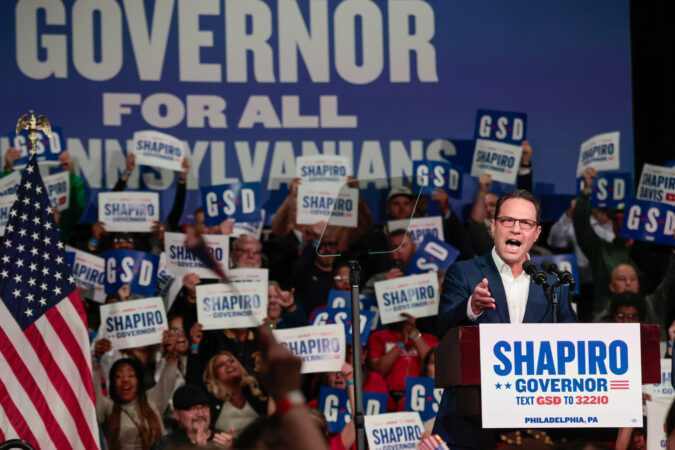
    Pennsylvania Gov. Josh Shapiro officially launched his widely expected bid for reelection Thursday, spending his first day back on the campaign trail in one of the nation’s most politically divided states by touting his achievements for workers, seniors, and schools while contrasting himself against Republicans in President Donald Trump’s Washington.

    The Montgomery County Democrat presented his opening argument to voters Thursday afternoon in a highly produced campaign rally at a Pittsburgh union hall, before appearing Thursday night before Philadelphia voters at the Alan Horwitz “Sixth Man” Center in Nicetown.

    Shapiro, 52, of Abington Township, will pursue his reelection bid by crisscrossing the state, boasting a high approval rating that Republicans hope to damage as talk of his potential 2028 candidacy continues to build.

    Shapiro took the stage in Pittsburgh and Philadelphia following speeches from Lt. Gov. Austin Davis and a parade of public officials, labor leaders, and community advocates who touted his first term accomplishments, all delivering a similar message: Shapiro shows up and delivers for residents across the commonwealth.

    At the Sixth Man Center, supporters and local leaders packed the event space in the youth sports center where Shapiro delivered a speech next to a huge mural of 76ers star Joel Embiid. Shapiro joked about his midrange jumper as he praised the center’s work.

    “I am proud to be here on today to say that Josh Shapiro as governor of the commonwealth has delivered for us in a way that some thought … was impossible,” said Philadelphia Mayor Cherelle L. Parker to an excited crowd.

    The rollout signaled Shapiro’s campaign will be anchored in his administration’s motto, “Get S— Done,” emphasizing that state government should be able to solve residents’ problems effectively.

    “You deserve someone who goes to work every day focused on you and on getting stuff done,” Shapiro said.

    He is not expected to face a primary challenger, just like in 2022, when he later cruised to victory in the general election against far-right State Sen. Doug Mastriano (R., Franklin). Mastriano, who had been teasing another run, announced Wednesday he would not join the race for governor.

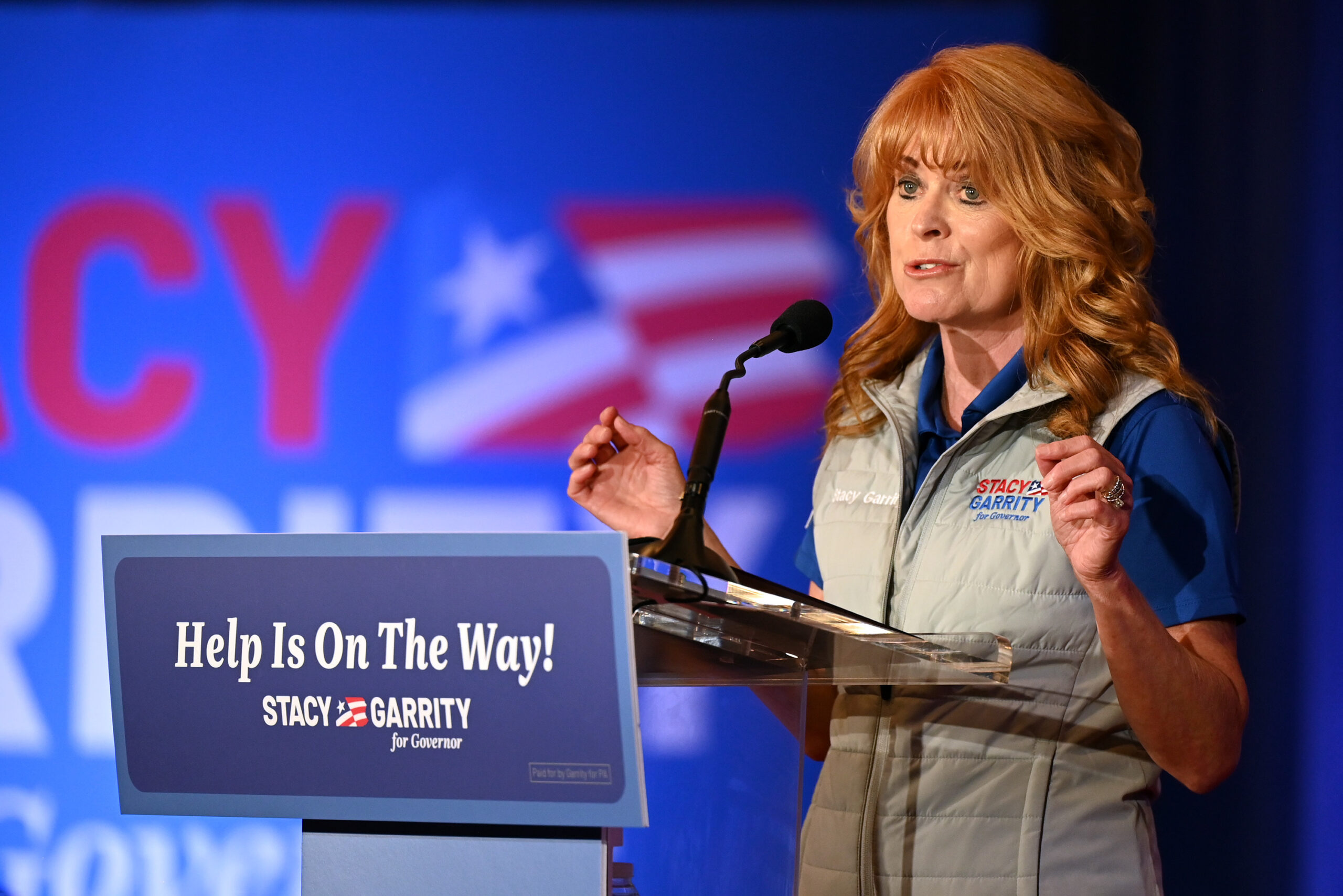
    This time, Republicans hope to take a stronger swing at Shapiro by coalescing around one candidate early. The state GOP endorsed State Treasurer Stacy Garrity more than a year in advance of November’s midterm election.

    State Treasurer and Republican candidate for governor Stacy Garrity holds a rally on Sept. 25, 2025 at the Newtown Sports & Events Center in Bucks County.

    State Republican Party Chair Greg Rothman said in a statement Thursday that Pennsylvanians have had “enough of Josh Shapiro’s lack of leadership and broken promises,” noting several of Shapiro’s missteps in his administration such as his reneging on school vouchers, a $295,000 payout over a sexual harassment claim against a former top aide, and failing to send a month’s worth of state agency mail.

    “[Garrity] actually gets stuff done, she doesn’t just talk about it on the campaign trail,” Rothman added.

    Garrity has contended that Shapiro — a former attorney general, county commissioner, and state representative — is more focused on running for president in 2028 than leading the state.

    “Josh Shapiro is more concerned with a promotion to Pennsylvania Avenue than serving hardworking Pennsylvanians,” Garrity said in a statement earlier this week, noting the state fared poorly in U.S. News and World Report rankings on the economy and education.

    But that’s part of the appeal for some of Shapiro’s supporters.

    Fernando Rodriguez, who works at Fox Chase Farm in Philadelphia, was eager to hear Shapiro’s stump speech. The 37-year-old didn’t vote for Shapiro in 2022 and had cast only one ballot for a presidential election, voting for President Barack Obama in 2008.

    But he wanted to see Shapiro win reelection and, more importantly, go on to run for president in 2028.

    “There seems to be some maturity, some presidential qualities to him,” Rodriguez said, noting that is particularly important given the direction of national politics.

    Shapiro has not publicly acknowledged any presidential ambitions and is expected to keep a local focus as he campaigns for reelection. But on Thursday at his rally, he reminded voters that they have the ability to deliver not only a resounding reelection victory for him, but also the chance to flip control of the U.S. House and state Senate as Democrats target four congressional districts in Pennsylvania and other down-ballot offices.

    Shapiro has already raised $30 million to support his reelection, which is likely to boost the entire ticket.

    State Democrats hope Shapiro will be able to leverage his popularity and growing national brand to bring more voters out to the polls, in what is already likely to be an advantageous midterm year for the party.

    “We’ve got a lot of work to do and it’s not just about reelecting the governor,” Eugene DePasquale, the chair of the state Democratic Party, said Thursday in Pittsburgh.

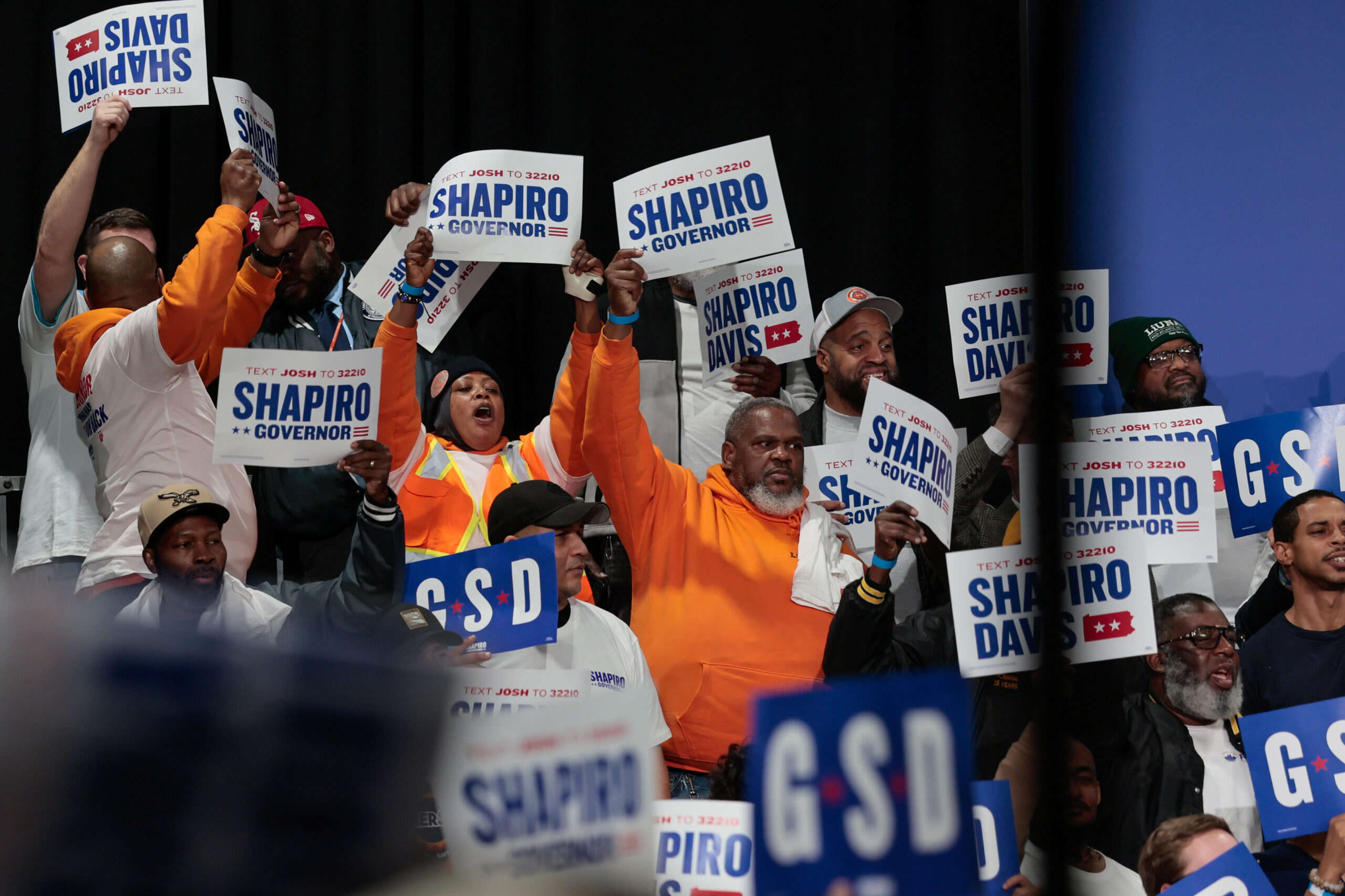
    Gov. Josh Shapiro’s supporters cheer as he makes his way to the stage during a reelection announcement event event at the Alan Horwitz “Sixth Man” Center in Philadelphia on Thursday, Jan. 8, 2026.

    ‘The hard work of bringing people together’

    Offering an opening pitch to voters, Shapiro highlighted key themes he is expected to repeat during the next 10 months on the campaign trail: He’s protected Pennsylvanians’ freedoms and created jobs, with more work to do.

    He noted several bipartisan achievements passed by the state’s divided legislature during his time in office, including a long-sought increase to the state’s rent and property tax rebate, historic funding increases for public education, and more. Pennsylvanians, he argued, have a simple choice in November.

    “Will we continue to do the hard work of bringing people together to get stuff done, or will we descend into the chaos and extremism that has gripped too many other places across our nation?” Shapiro asked in his stump speech in Pittsburgh and Philadelphia.

    In Philly, the crowd gave this question a resounding “No.”

    Shapiro’s launch drew a distinction between his style of leadership and that of Trump — whom Shapiro repeatedly called a danger to democracy prior to his reelection in 2024. Shapiro did not name the president during his announcement, but alluded to Trump — while noting his legal challenges against the Trump administration.

    The move followed Shapiro’s oft-repeated tactic since Trump took office for a second time: Criticize his policies, while not alienating Trump’s supporters in Pennsylvania, as the state swung in favor of Trump in 2024.

    In addition to his two campaign rallies, Shapiro kicked off his reelection bid in a video advertisement posted on social media. He led that off with footage from one of his biggest accomplishments from his first three years in office: rebuilding a collapsed section of I-95 in 12 days, in what was expected to take months.

    The quick rebuild also featured in his speech in Philly, where he heaped praise on organized labor for its role in the reconstruction.

    Rob Buckley with Buckley & Company, Inc., shakes hands with Gov. Josh Shapiro (right) at the end of a 2023 news conference before the reopening of I-95.

    Notably, Shapiro’s video announcement included a focus on several issues important to rural or conservative voters, such as signing a law that ended the ban on Sunday hunting, hiring 2,000 more law enforcement officers, and removing college degree requirements for most state agency jobs. He also highlighted his work in helping to reopen the lone gas pump in Germania, Potter County, following an Inquirer report about its closure.

    During his speech on the glossy basketball court in Nicetown, supporters began chanting “Four more years!”

    “I like the sound of that,” Shapiro said, with a smile.

  • DA Krasner condemns fatal ICE shooting in Minneapolis, says officers who commit crimes in Philly will ‘be convicted’

    DA Krasner condemns fatal ICE shooting in Minneapolis, says officers who commit crimes in Philly will ‘be convicted’

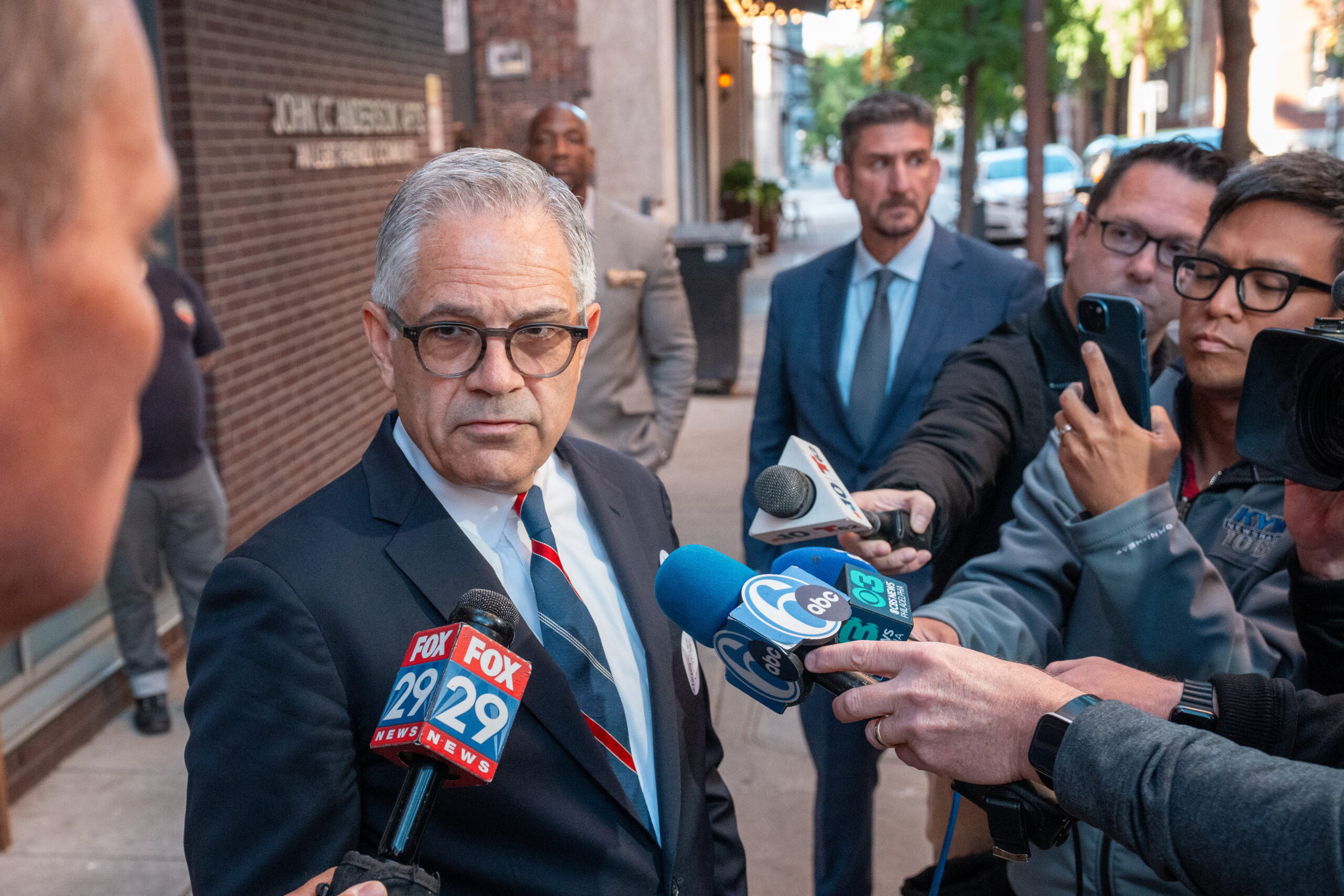
    District Attorney Larry Krasner, responding to the killing of a 37-year-old woman by an ICE agent in Minneapolis, vowed to prosecute law enforcement officers who commit crimes in the city of Philadelphia.

    “You will be arrested, you will stand trial, you will be convicted,” Krasner said during a news conference Thursday.

    His remarks came a day after a masked ICE agent shot Renee Nicole Good multiple times in her SUV.

    In widely circulated videos of the incident, Good appears to be driving away from a group of immigration agents as they order her to get out of her vehicle.

    President Donald Trump and top White House officials offered a starkly different view, saying Good tried to run over the officer with her car.

    Department of Homeland Security Secretary Kristi Noem said the officer, identified Thursday as Jonathan Ross, was justified in shooting the woman because he feared for his life. She said Good, a mother of three, had committed an act of domestic terrorism.

    Minnesota officials have called for an investigation into the conduct of the officer, who has not been charged with any crimes.

    But Krasner, flanked by a group of Philadelphia City Council members and the sheriff, called the actions criminal.

    The top prosecutor said that he has family ties to Minneapolis, and that he had reviewed the videos of the shooting, about a mile from where George Floyd was killed by police in 2020. He held a moment of silence for Good and displayed her photo before leading the group in a chant of her name.

    “We have to use our voices to call out people who commit terrible crimes,” Krasner said. “Or who justify them.”

    That last part was aimed at Trump, whom Krasner has sharply and repeatedly criticized.

    The progressive prosecutor often uses his platform to openly decry the president and his policies, most recently when he urged Philadelphians to film ICE agents who have ramped up immigration enforcement since Trump’s return to office.

    He said that tactic had been a success in Minneapolis because the video brought widespread attention to the incident.

    After Good’s killing, Krasner said, “The first thing out of Trump’s mouth was a lasagna of lies.”

    “She behaved horribly,” Trump told reporters. “And then she ran him over.”

    Krasner said he could not even be certain that Good was blocking officers from the roadway, as some officials have suggested. Had Good done so, Krasner said, she would have been engaging in an act that “protesters have done forever.”

    And that behavior, he said, does not justify a fatal shooting.

    Any law enforcement agent inclined to behave similarly in Philadelphia should “get the eff out of here,” Krasner said. And should such an incident happen in the city, the DA said, he would charge the offending officer in state court, where presidential pardons have no effect.

    “There are honest decent moral law enforcement officers by the bushel — this is not for you,” Krasner said of his warning. “This is for any one of your colleagues who thinks they are above the law.”