Tag: Donald Trump

  • Life during wartime in New Orleans as feds terrorize Latinos who saved a city

    Life during wartime in New Orleans as feds terrorize Latinos who saved a city

    KENNER, La. — When the day New Orleans had feared for weeks finally came on Wednesday, it began with a lie as wide as the meandering Mississippi River.

    A port city somehow dubbed the Big Easy despite its centuries of big trouble woke up to a frigid blast of Arctic air and a claim from the U.S. Department of Homeland Security that local immigration raids it’s named the “Catahoula Crunch” would narrowly target “criminal illegal aliens roaming free thanks to sanctuary policies …”

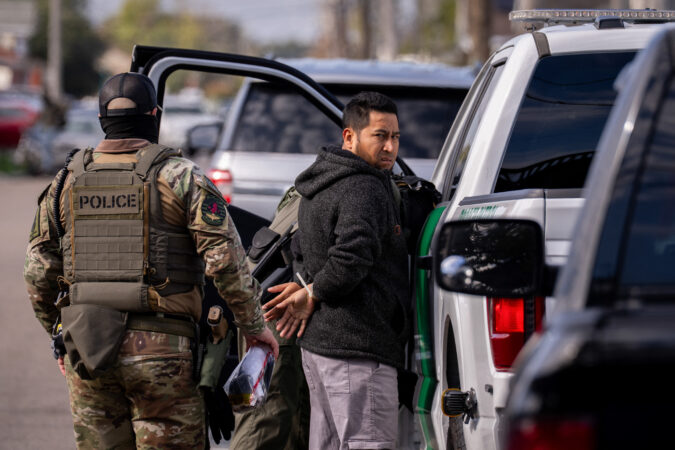
    Within a couple of hours — in raids that were, in fact, wildly untargeted — SUV caravans bearing masked, green-uniformed U.S. Customs and Border Protection (CBP) agents stormed into parking lots and at suburban Home Depots and Lowe’s, blitzkrieged Latino restaurants and a car wash on a busy strip near the airport, and cruised neighborhoods looking for roofers to arrest.

    On a hunch, I drove to a Home Depot here in Kenner at lunchtime and found them: a platoon of maybe 15 masked Border Patrol officers in olive-drab uniforms and dark baseball caps wrapping up a sweep of the parking lot, strutting past the piled-up orange shopping carts and ignoring a film crew shouting, “Why are you here?”

    Ricardo Ramírez, a 50-year-old construction worker and a U.S. citizen, had just pulled into the Home Depot lot to return some items when, as he told me a few minutes later, one of the officers came up to him and barked, “Which country? Are you a citizen?” Ramírez carries his passport because “it’s so crazy what’s going on that I have to, just because I look Spanish” — and was surprised when the officers moved past without asking to see it.

    But at that moment, just two miles away in a suburban subdivision in North Kenner, citizen volunteers raced to find another 12-agent Border Patrol team raiding a two-story home with white siding and green shutters. As an agent trained a sniper rifle on them, two Latino workers who’d been replacing a metal roof damaged in a recent hurricane stood atop the home, hands in the air.

    Zoe Higgins, a 33-year-old social worker who volunteered with the group Unión Migrante to track the immigration raids and watched the tense drama, told me, “I could only imagine how they were feeling, and I was filled with anger.” But as more and more citizens and some journalists crowded the narrow, one-way Louisiana State Drive, they saw the agents leave — the rooftop workers spared, but two other crew members handcuffed and whisked away, destination unknown.

    This is life during wartime in America in 2025, as an iconic U.S. city that celebrates itself as a boiling gumbo pot of Spanish-style architecture, Louisiana French, and spicy Creole culture suddenly finds itself under a terrorizing siege from the same federal government that promised billions so “New Orleans will rise again” after the devastation of Hurricane Katrina 20 years ago.

    Heard about Los Angeles? Heard about Chicago? Heard about Charlotte, N.C.? The 10-month-old Donald Trump regime has stumbled into a playbook for the xenophobic mass deportation drive it promised voters in 2024 — an “American Counter-Revolutionary Guard” of around 250 masked Border Patrol officers, led by the arrogance and telegenic evil of their commander, Greg Bovino, rampaging the Lowe’s parking lots and back alleys of one U.S. city before caravanning in their black SUVs to terrorize the next.

    Ricardo Ramírez, a 50-year-old construction worker, talks about being questioned by Border Patrol agents at a Home Depot parking lot in Kenner, La., on Wednesday.

    I flew from Philadelphia into Greater New Orleans Tuesday afternoon, just in time for the launch of the so-called Catahoula Crunch, because I wanted to see what it looked and felt like when the U.S. government sends a commando squad to wage war on one of its own cities. That meant spurning the beignets and darkened French Quarter jazz clubs of my 10 prior visits here and instead embedding on Williams Boulevard in Kenner, where former Pizza Huts are now taquerias with twinkling white lights and mariachi-style music is pumped into the markets.

    This is the New Orleans tourists only see speeding past in their airport Ubers, where in low-slung brick homes under the constant roar of jet engines, the Latino community has nearly tripled since 2000 — swelled by Mexican and Central American workers who labored around-the-clock on the massive post-Katrina reconstruction. That narrative of communal pride has been swamped by a palpable fear that this week pervades Kenner, where nearly a third of residents are Latino, yet the police chief is pro-immigration raids.

    By the end of the day, observers tallied around 12 to 14 apparent arrests. There was no evidence that any of these people were on the list of 10 most-wanted actual criminals Homeland Security pictured along with Wednesday’s launch — catnip for the Fox News audience clinging to the delusional Big Lie that Team Bovino is only targeting bad guys.

    Instead, his secret police just swarmed wherever they could find the most brown-skinned people — the Home Depot lot, a white van filled with contractors, Mexican restaurants — and acted like the gun-toting officer in the recent movie Civil War who famously asked, “What kind of American are you?”

    In Bovino’s past operations, only a fraction of those arrested and facing deportation had criminal records — just 44 out of 370 in last month’s Charlotte op — and there was no evidence that Louisiana’s “Catahoula Crunch” would be any different.
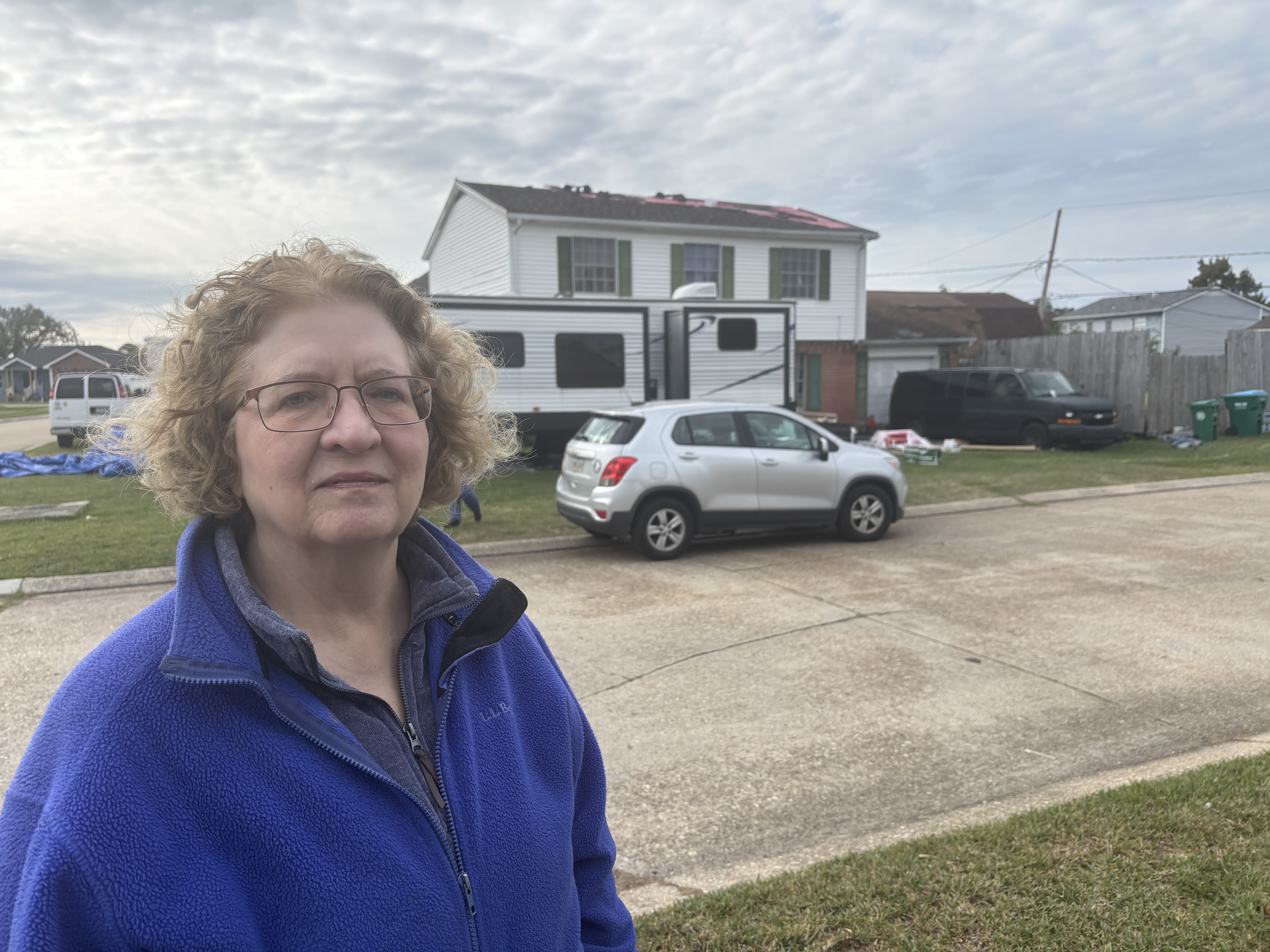
    The Rev. Jane Mauldin, a Unitarian minister and immigration watchdog, outside a home worksite that was raided by Border Patrol agents on Wednesday.

    Yet, the real terror in Kenner is what you don’t see — a vibrant community that overnight has vanished underground.

    Shoppers who enter the Latino-oriented Ideal Market on the Williams strip are greeted with a sign: “STOP: NO ICE ACCESS IN THIS BUSINESS.” Yet, at midmorning Wednesday, there was just one shopper in the entire supermarket, outnumbered by workers stocking bins of green and yellow plantains and glistening produce that looked utterly untouched.

    “A lot of people are staying home, not going out,” Ramírez, the worker questioned by Border Patrol, told me. “We work in construction, and we are shorthanded. We know people don’t want to go to work. They are afraid.”

    Several local volunteers shared the same thought: that these “papers, please” random raids and the families hiding behind closed blinds and locked doors remind them of the stories they’ve read about Jews who lived in constant fear of Nazi raids in the 1930s and ‘40s.

    “I keep thinking about Anne Frank, who was kept alive with her family by a good friend named Miep,” said the Rev. Jane Mauldin, a Unitarian minister who was one of the volunteers who raced to the North Kenner raid on the roofers, referring to the Jewish teen who eventually died in a German concentration camp in 1945, and her Dutch protector. “I keep in my head saying, ‘What would Miep do?’”

    School attendance is down, and church pews are empty. Volunteers are collecting food for families that have suddenly gone into a COVID-level lockdown, and almost everyone who is out and about has a friend or coworker who abruptly went into hiding when they heard Border Patrol had targeted New Orleans.
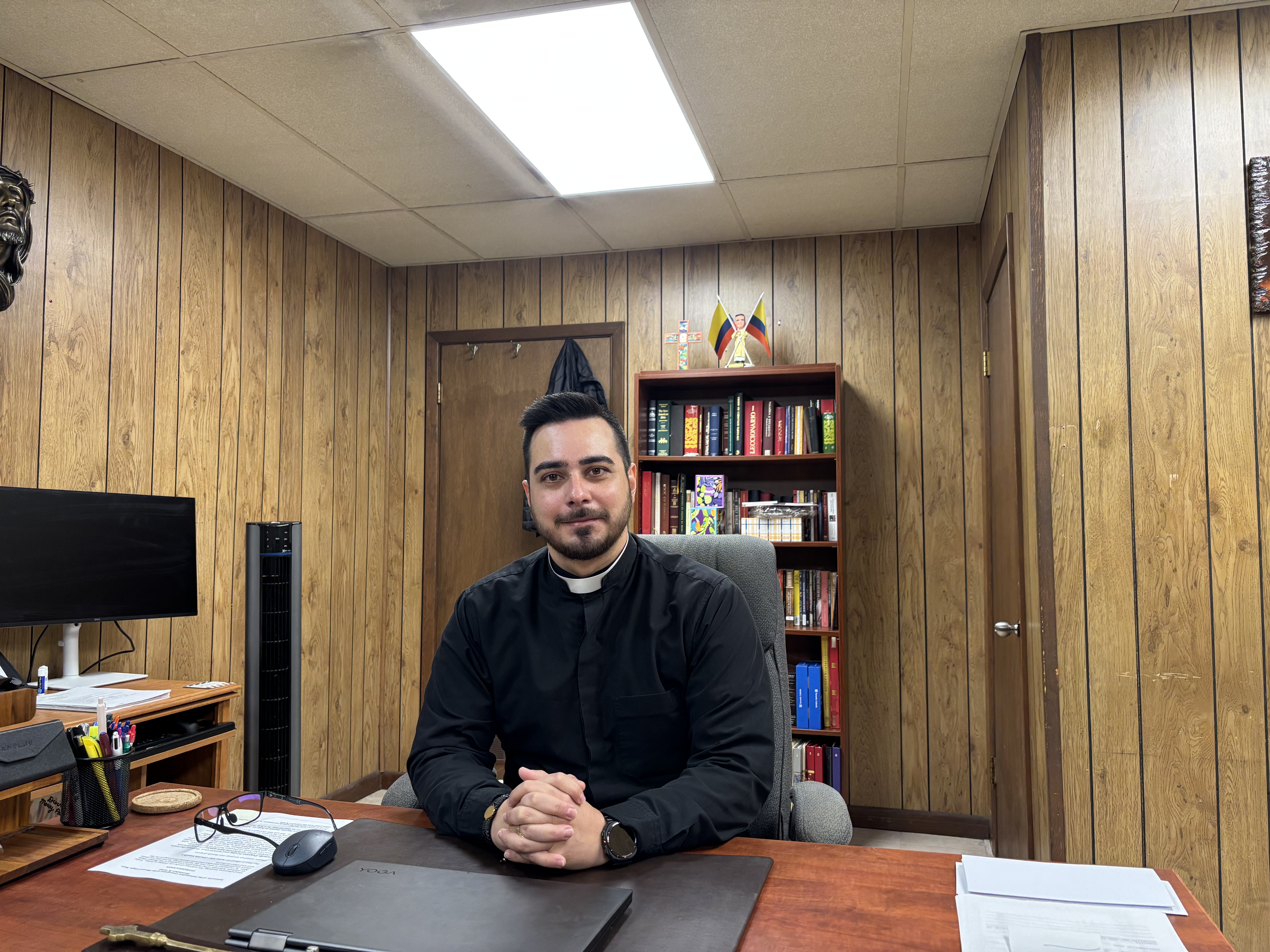
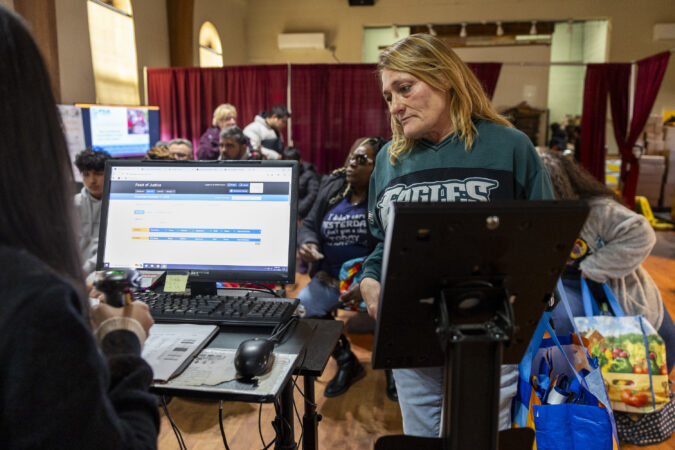
    Father Luis Duarte, a 33-year-old immigrant from Colombia, talks about plunging attendance at St. Jerome Catholic Church, in Kenner, La., where he is pastor, as federal immigration raids begin on Wednesday.

    “There is a good friend of mine who hasn’t left her house in a week,” Mauldin said. “Her children are not going to school because of the fear … And she has all the right papers, but she’s not a citizen, so there is a possibility that she could be kidnapped and taken away and never see her children again.”

    The Rev. Luis Duarte, the 33-year-old Colombian-born priest at St. Jerome Roman Catholic Church in Kenner, told me that attendance at weekend Masses offered in Spanish has plunged, and a family that for weeks had been planning a joyous quinceañera for their daughter’s 15th birthday called it off. “They are fearful,” he told me, adding, “Not fearful because they are criminal, but because they are Hispanics.”

    Duarte was one of many who spoke of the unbelievable irony that the very people who came to the United States with hammers and 16-hours-a-day energy to rescue New Orleans in its darkest hour, after flooding from 2005’s Hurricane Katrina swamped thousands of homes and killed 1,833 people, are now seeing their new world turned upside down by the same U.S. government that vowed to rebuild the Crescent City.

    Duarte said his parishioners have told him of yard signs that welcomed the 2005 influx in Spanish — the same language government agents are now using to profile those they seek to handcuff and whisk away. “So when I see what’s going on now …” the priest said, then paused. “Yeah, why?”

    Yeah, why? This feels like a domestic Vietnam in reverse: We saved the town in order to destroy it. You can glean clues from the way Bovino and his cosplay tin soldiers preened for the prearranged cameras on Canal Street Wednesday afternoon, or the twisted name for his operation. The Catahoula leopard dog is the official state canine, revered by Louisiana’s early settlers for their ability to herd cattle and hunt down wild boars. The “crunch” is the sound of jaws ripping flesh. It’s a terrible echo for a place that once sicced bloodhounds on its enslaved people.

    The cruelty was the point in 1825. The cruelty is the point in 2025. The day laborers outside Lowe’s, just wanting to hammer shingles onto your roof, are the modern-day Christians thrown to Bovino’s cowardly lions in a Roman circus for Fox News couch potatoes. Same as the Somali Americans in Minneapolis, whom Trump was slandering on Wednesday as “garbage.” The worst Americans can revel in the latest model of white supremacy while their Dear Leader is robbing them blind and stashing the profits in crypto or the Trump Plaza Kazakhstan or whatever.

    But every day, more and more people are catching onto the scam and asking what Miep would do. “This hits very deep and very personal for many of us — in my neighborhood, almost every roof had to be replaced,” Mauldin said. “The men who were willing to go on the roof in 100-degree heat in September 2005 were not white, not Black — mostly, they were the Latino men who rebuilt this city.”

    Hours later, I stood at the busy corner of Elysian Fields and St. Claude with a dozen protesters amid a nonstop cacophony of cars responding to one of their signs: “Honk If Your Ancestors Were Immigrants.”


  • Delaware County approves a nondiscrimination ordinance protecting LGBTQ+ residents

    Delaware County approves a nondiscrimination ordinance protecting LGBTQ+ residents

    Delaware County became the third of Philadelphia’s collar counties to enact a local policy protecting LGBTQ+ residents from discrimination.

    The suburban county’s all-Democratic council voted unanimously Wednesday evening to empower a human relations commission established earlier in the year to adjudicate claims of discrimination based on sexual orientation and gender identity and expression, barring discrimination against LGBTQ+ residents among a wide list of protected classes.

    The vote comes after Chester and Montgomery Counties approved similar policies earlier this year as President Donald Trump targets the LGBTQ+ community through policy and rhetoric.

    Delaware County had been working toward the ordinance for months, introducing the policy in August before hitting pause as county council members and attorneys worked through the details.

    At least 79 local governments across Pennsylvania, including Philadelphia, have enacted nondiscrimination ordinances, according to the Pennsylvania Youth Congress, which advocates for LGBTQ+ youth.

    “Now almost an entire half of the state is now protected by a [local] human relations commission,” Kyle McIntyre, the organizer of Delco Pride, said in an interview Thursday.

    The ordinance mirrors a state policy barring discrimination and establishing a human relations commission to adjudicate complaints.

    While regulations for the state commission bar discrimination based on gender identity and sexual orientation, Delaware County’s policy goes a step further to specifically prohibit such discrimination in law.

    The ordinance provides Delaware County residents a local venue to bring complaints before taking concerns to the Pennsylvania Human Relations Commission.

    “This ordinance reflects what good local government should be,” Monica Taylor, a Democrat who chairs the county council, said Wednesday.

    Some residents, including Delaware County Controller Joanne Phillips, a council member-elect, raised concerns that the ordinance could become expensive in a county that is already looking at a potential 19% tax increase for next year.

    Phillips, a Democrat, said she supported the concept of the commission but worried it would cost more than anticipated once a board began adjudicating cases.

    County officials estimated the commission would cost the county just $3,000 annually and said adjustments could be made to the commission’s role if enforcement of the ordinance became too costly.

    Critics of the policy on Tuesday claimed, without evidence, that the ordinance would dampen free speech in the county, allowing fines against those who say offensive things.

    Charlie Alexander, a far-right activist who unsuccessfully sought the GOP nomination for the county council earlier this year, arrived in a dog costume with a rainbow blanket draped over his head. He argued the ordinance was an unconstitutional infringement on First Amendment rights.

    “Don’t infringe on our rights and you won’t be made to feel very uncomfortable in your homes and neighborhoods,” he threatened the council members.

    The ordinance, however, does not regulate private speech. It bars discrimination in housing, employment, education, healthcare, and public accommodations.

    “This is not infringing on speech. It’s really clear what practices are deemed unlawful,” council member Kevin Madden, a Democrat, said.

    Taylor said the commission, which was first approved over the summer, will be staffed with volunteers early next year and prepared to take cases by next summer.

    “This ordinance provides a fair, reliable, and community-focused way to address concerns,” she said.

    This story has been updated to clarify the name of the commission.

  • Nothing about Trump’s ballroom benefits us

    Nothing about Trump’s ballroom benefits us

    The White House is the People’s House. Period. It is public property that was paid for by us, built by us, and is maintained by us. And no matter who its current occupants are, we still own that building.

    Yet, we weren’t asked if we wanted a new 90,000-square-foot, mega-ballroom decorated with gold and who-knows-what-else to be added onto our house. But it’s a ballroom we’re getting from President Donald Trump, whether we like it or not. (Count me in the latter group.)

    I agree with those who say the design is tacky. I also agree with those who say we don’t really need it — especially when there is so much our fellow Americans actually need these days.

    The project, which will, of course, be called the Trump Ballroom, is projected to cost $300 million. The president says it will be paid for “100% by me and some friends of mine.”

    Sure. Just like the wall he promised to build and get Mexico to pay for. Same thing with his plan to produce a viable alternative to the Affordable Care Act.

    But even if construction costs are covered, taxpayers will get stuck with paying for maintenance and upkeep.

    A handout rendering of the interior of a “$200 million ballroom” in the East Wing of the White House that was announced by the Trump administration in July. The cost of building it has gone up since then — it is currently estimated at $300 million.

    Between high grocery bills, rising healthcare costs, over-the-top housing prices, and everything else that’s going on right now, building an addition onto the White House should be the lowest Trump priority.

    Yet, the project was very much on the president’s mind Sunday night because he boasted about it on Truth Social, claiming “it will be, at its completion, the most beautiful and spectacular Ballroom anywhere in the World!”

    But for a lot of us, the old East Wing, which was demolished to make way for the Trump Ballroom, was beautiful and spectacular on its own. That includes former first lady Michelle Obama, whose office was once located in the East Wing.

    Just last week, she described on the Jamie Kern Lima podcast what a jarring experience the demolition was for her. “It’s not about me, it’s about us and our traditions and what they stand for,” the former first lady explained. “I think in my body I felt confusion because I’m like, ‘Well, who are we? What do we value and who decides that?’”

    I grew up in Washington, D.C., just seven miles away from the White House. But it could have been a thousand miles away. I felt completely disconnected from the historic landmark and what took place there.

    That is, until Obama moved in with her family. She was the first person whom I ever heard refer to 1600 Pennsylvania Ave. as “the People’s House.” Putting it that way made me feel welcome. It gave me a sense of ownership. I loved how she reminded Americans of that shared ownership throughout her family’s eight years in the White House.

    Former first lady Michelle Obama speaks about her new book “The Look” during an event at Sixth and I Streets in Washington, D.C., on Nov. 12.

    Trump supporters are quick to point out that the Obamas themselves made additions to the White House grounds. When he was in office, President Barack Obama painted lines on an existing tennis court and added basketball hoops. But those are minuscule changes compared with Trump’s addition, which would be almost double the size of the White House itself.

    I listened to Obama’s comments about the White House on the Kern podcast a few days before the Thanksgiving holiday, one of the most American traditions we celebrate.

    And as I mulled over her words, I thought about how, no matter what we think of them, U.S. presidents come and go from their official residence, but the building remains a stalwart symbol of the nation’s highest office.

    A Christmas tree decorates the White House on Monday during a preview of its Christmas decorations, which are themed “Home Is Where the Heart Is.”

    The theme of this year’s White House Christmas decor is “Home Is Where the Heart Is.” But we have to remember that home is ours; Trump is merely a temporary guest at the executive mansion. It still belongs to us, the American people. Period.

  • Trump admin threatened to withhold SNAP funds in Pa. and N.J.  unless recipient data is released. N.J. AG called stance ‘immoral’

    Trump admin threatened to withhold SNAP funds in Pa. and N.J. unless recipient data is released. N.J. AG called stance ‘immoral’

    The Trump administration’s threat to withhold money that Democratic-run states use to administer the SNAP food aid program unless officials release personal information about individual recipients puts 2 million people in Pennsylvania and more than 800,000 in New Jersey at risk of food insecurity.

    On Wednesday, New Jersey Attorney General Matthew Platkin called the administration’s stance “deeply immoral.”

    “The past few weeks have shown that the Trump administration is willing to sacrifice millions of Americans’ most basic needs in service of a political agenda,” he added.

    In a cabinet meeting Tuesday, Agriculture Secretary Brooke Rollins said that data describing Supplemental Nutrition Assistance Program recipients’ names, addresses, Social Security numbers, and immigration status are necessary to ferret out fraud, the Associated Press reported. The Department of Agriculture runs the SNAP program.

    Twenty-two states, including New Jersey, have sued the administration over its demand for personal information, which states have never shared with the federal government. Representing Pennsylvania, Gov. Josh Shapiro joined the lawsuit. A California federal court issued a preliminary injunction on Oct. 15, allowing all parties until next Monday to respond.

    The federal government splits the cost of running SNAP with states, and the Trump administration said it is not planning to take SNAP benefits from individuals, but rather to pull funds it sends to the states to run the program..

    Individuals could nonetheless see their payments disrupted, said Joel Berg, CEO of Hunger Free America, in an interview. The agency is a national nonprofit that fights hunger.

    “People in the Philadelphia region could go hungry,” he said. “Even people in rural Pennsylvania and South Jersey in counties that supported Trump who are highly dependent on these programs could be hurt.

    “This is an authoritarian intrusion of big government. It’s a way to bully Democratic states.”

    Around 500,000 of the 2 million people in Pennsylvania who receive the federal food aid are in Philadelphia.

    Neither Shapiro nor New Jersey Gov. Phil Murphy offered comments. The White House referred requests for comment to the USDA, which released a statement Wednesday evening complaining that blue states “choose to protect illegals, criminals, and bad actors over the American taxpayer.”

    The statement added that the USDA recently sent an additional request to Democratic-run states for data. However, the statement warned, “if they fail to comply, they will be provided with formal warning that USDA will pull their administrative funds.”

    Lately, the SNAP program has played a significant role in aspects of how the Trump administration governs, advocates say.

    During the shutdown, the Trump administration paused SNAP benefits in early November, and then went to the Supreme Court to fight orders by federal judges to release the funding.

    The way SNAP has been thrust into the White House’s partisan battles irks George Matysik, executive director of the Share Food Program, which provides food to hundreds of Philadelphia-area pantries. “We have a serious food affordability crisis developing and it requires a focused response, not continuous political sideshows,” he said Wednesday.

    Temple University sociologist Judith Levine agreed. “It’s extremely disturbing that because of political games, people may lose this very basic benefit needed for survival,” she said. “Being food insecure has nothing to do with infighting between political parties.”

    Loss of SNAP places an inordinate strain on the charitable food system, primarily food pantries, which in turn hurts families, said Eliza Kinsey, a professor in the department of family medicine and community health at the University of Pennsylvania’s Perelman School of Medicine.

    “There’s tons of evidence that stoppages of SNAP can disproportionately affect households with children,” she said. “Cutting SNAP could be disastrous.”

  • Gov. Josh Shapiro says Kamala Harris’ descriptions of him were ‘blatant lies’ intended to sell books

    Gov. Josh Shapiro says Kamala Harris’ descriptions of him were ‘blatant lies’ intended to sell books

    Gov. Josh Shapiro lashed out over former Vice President Kamala Harris’ portrayal of his interview to become her 2024 running mate, calling Harris’ retellings “complete and utter bulls—” intended to sell books and “cover her a—,” according to the Atlantic.

    Shapiro, Pennsylvania’s first-term Democratic governor now seen as a likely presidential contender in 2028, departed from his usual composed demeanor and rehearsed comments in a lengthy Atlantic profile, published Wednesday, when journalist Tim Alberta asked the governor about Harris’ depiction of him in her new book.

    In her book, titled 107 Days, Harris described Shapiro as “poised, polished, and personable” when he traveled to Washington to interview with Harris for a shot at becoming the Democratic vice presidential candidate during her historic campaign against Donald Trump.

    However, Harris said, she suspected Shapiro would be unhappy as second-in-command. He “peppered” her with questions, she wrote, and said he asked questions about the vice president’s residence, “from the number of bedrooms to how he might arrange to get Pennsylvania artists’ work on loan from the Smithsonian.” The account aligns with reporting from The Inquirer when Harris ultimately picked Minnesota Gov. Tim Walz over Shapiro, in part, because Shapiro was too ambitious to serve in a supporting role if chosen as her running mate.

    But Shapiro, the Atlantic reported, was taken aback by the portrayal.

    “She wrote that in her book? That’s complete and utter bull—,” Shapiro reportedly told the Atlantic when asked about Harris’ account that he had been imagining the potential art for the vice presidential residence. He added: “I can tell you that her accounts are just blatant lies.”

    The governor’s sharp-tongued frustration depicted in the Atlantic marked a rare departure for the image-conscious Shapiro, whose oratory skills have been compared to those of former President Barack Obama, and who has been known to give smiling, folksy interviews laced with oft-repeated and carefully told anecdotes.

    The wide-ranging, nearly 8,000-word profile in the Atlantic also detailed Shapiro’s loss of “some respect” for Harris during the 2024 election, including for her failure to take action regarding former President Joe Biden’s visible decline.

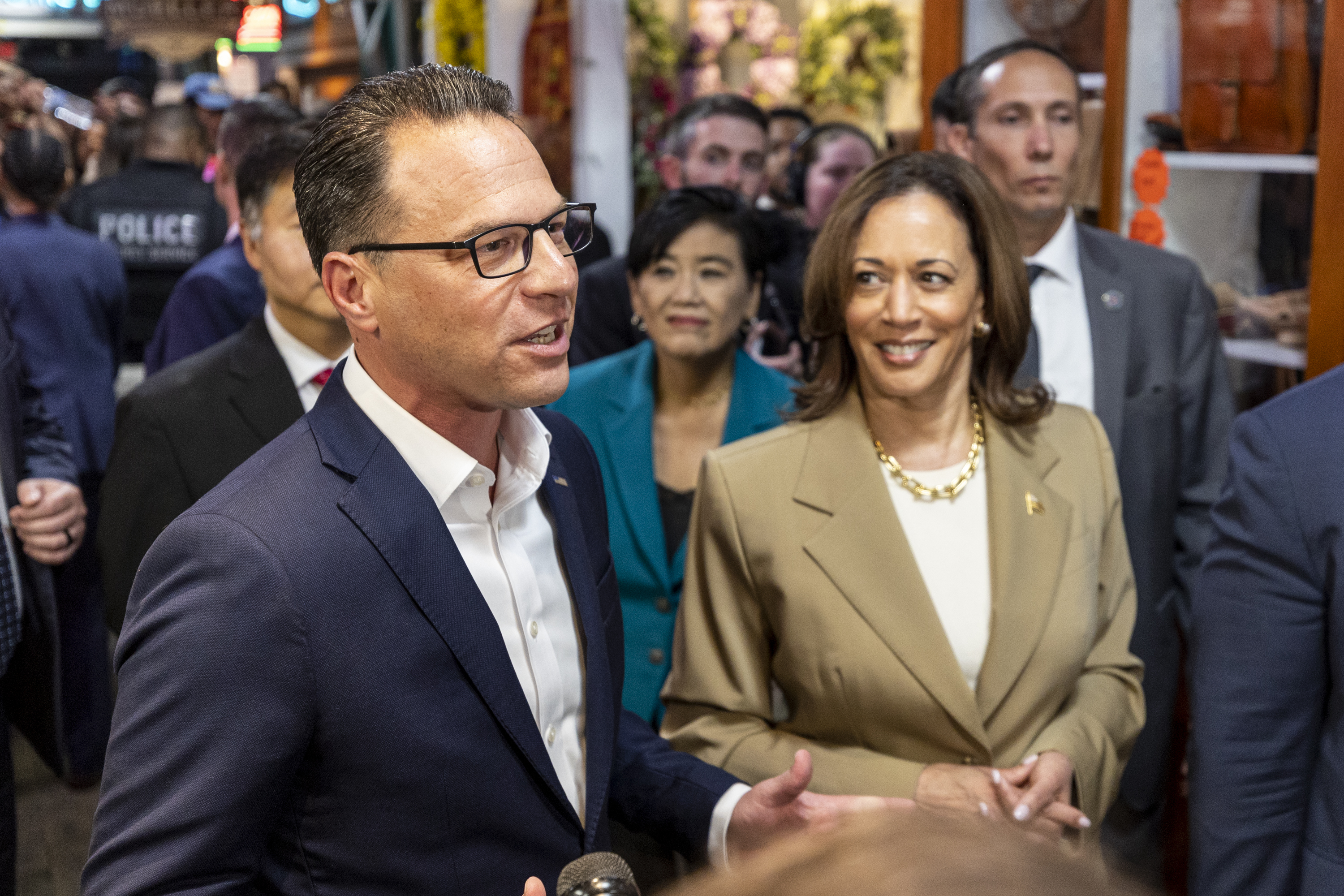
    Governor Josh Shapiro speaks with press along with Vice President Kamala Harris during their short visit to Little Thai Market at Reading Terminal Market after she spoke at the APIA Vote Presidential Town Hall at the Pennsylvania Convention Center in Philadelphia, Pa., on Saturday, July 13, 2024.

    When Shapiro was asked by the Atlantic whether he felt betrayed by Harris’ comments in her book about him, given that the two have known each other for 20 years, he said: “I mean, she’s trying to sell books and cover her a—.”

    He quickly reframed his response: “I shouldn’t say ‘cover her a—,’ I think that’s not appropriate,” he added. “She’s trying to sell books, period.”

    The Atlantic piece, titled “What Josh Shapiro Knows About Trump Voters,” presented Shapiro as a popular Democratic governor in a critical swing state that went for Trump in 2024, and as a master political operator who has carefully built a public image as a moderate willing to work across the aisle or appoint Republicans to top cabinet positions. That image was tested this year during a protracted state budget impasse that lasted 135 days, as Shapiro was unable to strike a deal between the Democratic state House and GOP-controlled state Senate for nearly five months past the state budget deadline.

    The Atlantic piece also outlined common criticisms of Shapiro throughout his two decades in Pennsylvania politics, including those from within the Democratic Party: He is too ambitious with his sights set on the presidency, and his pragmatic approach often leaves him frustrating all sides, as evidenced in his 2023 deal-then-veto with state Senate Republicans over school vouchers. It highlighted some of the top issues Shapiro will face if he chooses to run for president in 2028, including a need to take clearer stances on policy issues — a complaint often cited by Republicans and his critics. If he rises to the presidential field, Shapiro will also have to face his past handling of a sexual harassment complaint against a former top aide that Shapiro claimed he knew very little about despite the aide’s long-held reputation.

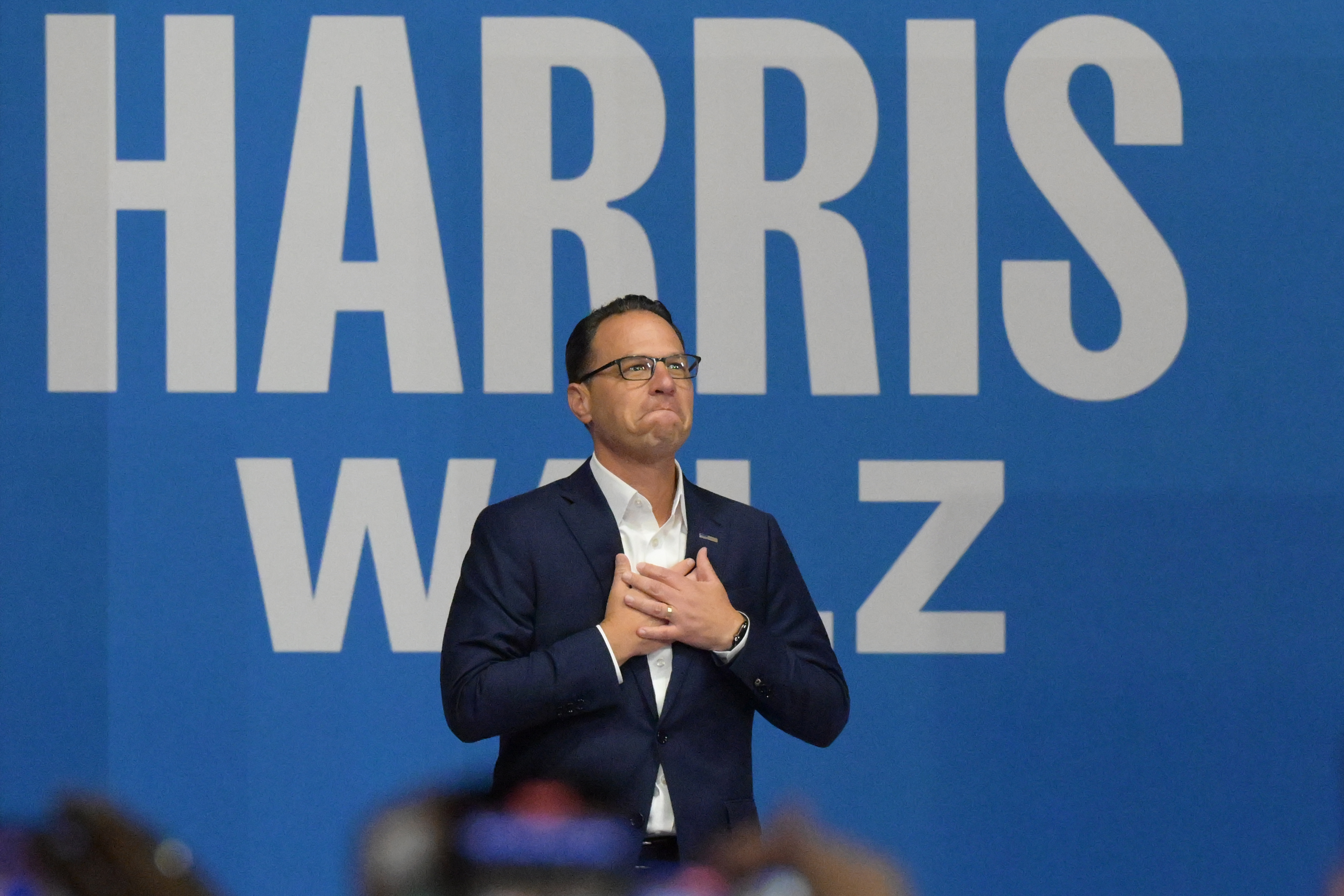
    Gov. Josh Shapiro takes the stage ahead of U.S. Vice President Kamala Harris and Gov. Tim Walz at a rally in Philadelphia’s Liacouras Center on August 6, 2024.

    “The worst-kept secret in Pennsylvania politics is that the governor is disliked — in certain cases, loathed — by some of his fellow Democrats,” the Atlantic reported. Further, Alberta noted that when an unnamed Pennsylvania lawmaker received a call from a member of Harris’ vetting operation, the member said they had never seen “so many Democrats turning on one of their own.”

    Shapiro has been featured in several other prominent national media outlets in recent weeks, including in the New Yorker, which ran a profile about his experience with political violence. He has become vocal on that issue in the months since a Harrisburg man who told police he wanted to kill Shapiro broke into the governor’s residence in April and set several fires while Shapiro and his family slept upstairs. As one of the most prominent Jewish elected officials in the nation, Shapiro has frequently said that leaders must “bring down the temperature” in their rhetoric, and has tried to refocus his own messaging on the good that state governments can do to make people’s lives easier, such as permitting reforms and infrastructure improvements.

    “The fact that people view institutions as incapable or unwilling to solve their problems is leading to hyper-frustration, which then creates anger,” Shapiro told the Atlantic. “And that anger forces people oftentimes into dark corners of the internet, where they find others who want to take advantage of their anger and try and convert that anger into acts of violence.”

  • Sabrina Carpenter slams Trump administration for using her music in ‘disgusting’ ICE video

    Sabrina Carpenter slams Trump administration for using her music in ‘disgusting’ ICE video

    Sabrina Carpenter’s not mincing words when it comes to the Trump administration using one of her songs in a video promoting ICE and the Department of Homeland Security.

    On Tuesday, the pop princess condemned the White House for posting a video featuring ICE arresting protesters and undocumented immigrants to one of her songs. The video, which was published on the White House’s X account one day earlier, was captioned “Have you ever tried this one?“ alongside the hearteye emoji and was paired with Carpenter’s track ”Juno.”

    It’s a nod to a scene in Carpenter’s just-wrapped “Short n’ Sweet” tour, where she would playfully “arrest” someone in the crowd “for being so hot,” giving them a souvenir pair of fuzzy pink cuffs before performing “Juno.”

    Carpenter, a Bucks County native, replied to the post, “this video is evil and disgusting. Do not ever involve me or my music to benefit your inhumane agenda.” Her response has been viewed more than 2 million times.

    It’s the latest in a series of similar incidents, where artists ranging from Beyoncé to the Rolling Stones have objected to the White House using their music in videos promoting the Trump administration’s agenda without their consent.

    Last month, Olivia Rodrigo had a similar exchange in the comments of a White House Instagram video demanding that undocumented immigrants self-deport over the singer’s track “All-American Bitch.” Rodrigo, who is Filipino American, commented at the time, “Don’t ever use my songs to promote your racist, hateful propaganda.”

    The White House also used a song by Carpenter’s friend and musical collaborator, Berks County’s Taylor Swift, last month. Fans of Swift’s called out the use of “The Fate of Ophelia” in a video celebrating President Donald Trump, despite the president’s repeated slights toward the pop star. Swift herself did not comment on the video, but she has previously criticized Trump for posting AI photos of her on his social platforms.

    Carpenter, 26, worked with HeadCount on her “Short n’ Sweet” tour, registering 35,814 voters — more than any other artist the nonpartisan voter registration group worked with in 2024. She’s been vocal about her support for LGBTQ+ rights and has publicly donated to the National Immigration Law Center.

    When Trump won last year, she took a moment during her concert to say “I’m sorry about our country and to the women here, I love you so, so, so much.”

    “Here’s a Short n’ Sweet message for Sabrina Carpenter: We won’t apologize for deporting dangerous criminal illegal murderers, rapists and pedophiles from our country,” White House spokesperson Abigail Jackson told the New York Times. “Anyone who would defend these sick monsters must be stupid, or is it slow?”

  • What to know about the hepatitis B vaccine schedule debate

    What to know about the hepatitis B vaccine schedule debate

    The nation’s top vaccine advisory panel is expected to debate whether to delay the first dose of the hepatitis B shot on Thursday.

    The immunization, developed in Philadelphia and long recommended for all U.S. infants at birth, protects against a disease that can do permanent damage to the liver, and for which there is no cure.

    The shot is widely considered safe and effective, but who should receive it, and when, has come under scrutiny by President Donald Trump’s administration.

    The Advisory Committee on Immunization Practices (ACIP), an independent panel of experts reconstituted this past summer to include several vaccine skeptics, had tabled a vote on this topic in September. It is now scheduled to spend Thursday discussing the vaccine, according to a draft agenda of the group’s two-day December meeting.

    Vaccine experts and patient advocates have previously advocated against delaying the birth dose, citing concerns that unvaccinated children could be at risk of contracting the highly contagious virus.

    Here’s what to know about the vaccine.

    It’s recommended for all newborns at birth.

    Starting in 1991, the first dose of the hepatitis B vaccine has been universally recommended for all newborns within 24 hours of birth. Rates of infection among children and teens have since dropped by 99%.

    Prior to the universal birth dose recommendation, about half of infections in children were acquired from mothers infected with the virus, the Centers for Disease Control and Prevention found.

    The virus spreads through contact with blood and other body fluids.

    The virus can be transmitted from mother to baby, as well as through a variety of household sources, such as personal items like toothbrushes and razors that become contaminated with blood.

    The virus cannot be spread through casual contact such as hugging, touching, or sharing utensils, but it can be spread through open wounds.

    The disease is incurable.

    Hepatitis B is the most common chronic viral infection in the world. Over time, the disease can cause cirrhosis or severe scarring of the liver, liver failure, and liver cancer.

    Patients can take antiviral treatments to help control the virus, but there is no cure.

    The panel has previously considered delaying the birth dose until one month of age.

    ACIP previously debated delaying the first dose of the vaccine until one month of age for most babies.

    Some members had suggested the dose for newborns should instead be given only to the populations most at risk.

    The ACIP considered recommending doctors vaccinate only those newborns whose mothers test positive for the virus, and having the other babies wait a month for their first dose.

    Trump separately stated in a news conference, without citing scientific evidence, that he thinks newborns should no longer universally receive the shot and children should wait until age 12. Experts criticized Trump for incorrectly suggesting that hepatitis B is only transmitted sexually.

    Experts are concerned about a potential change to the guidelines.

    Leading medical societies and infectious-disease experts say there is no scientific evidence for changing the current guidelines.

    Experts worry that delaying the vaccine could affect its ability to prevent transmission of the virus from mother to baby. “If you wait longer than 24 hours, then the vaccine doesn’t work as well,” Chari Cohen, president of the Hepatitis B Foundation, told The Inquirer in an interview earlier this fall.

    Even if the ACIP were to recommend vaccinating only babies whose mothers have the virus, some cases could be missed. Universal testing for the virus has been recommended since the 1990s, but 15% to 16% of women still do not get tested.

    Such a policy also would not account for other exposures. Su Wang, a New Jersey physician who treats patients with hepatitis B and herself has the disease, told The Inquirer earlier this year that she likely caught hepatitis B as a child living with her grandparents. Her parents tested negative. “There are a lot of exposures that we aren’t testing for,” she said.

    The vaccine is a Philadelphia success story.

    The hepatitis B virus was first discovered by Baruch Blumberg, a scientist at Fox Chase Cancer Center, in 1967.

    He went on to win a Nobel Prize for that work, and later cocreated and developed the vaccine, which continues to be manufactured in and around the region.

    The Hepatitis B Foundation is also locally based, in Doylestown.

  • More than 65,000 immigrants are being held in federal detention, a big increase from when Trump took office

    More than 65,000 immigrants are being held in federal detention, a big increase from when Trump took office

    The number of immigrants confined in federal detention facilities has surged past 65,000, perhaps the highest figure ever and a two-thirds increase since President Donald Trump took office in January.

    The 65,135 in custody across the nation represents a shattering of the 60,000 threshold, which was last passed briefly in August before dropping back down. The new figure is up from 39,238 when Trump was inaugurated, as his administration quickly undertook an unprecedented campaign to arrest, detain, and deport immigrants.

    “It’s quite stunning,” said Jonah Eaton, a Philadelphia immigration attorney who teaches about detention at Temple University’s Beasley School of Law. “They are dead serious about moving as many people out of the country as possible, and keeping them detained while they do it.”

    The data, current as of Nov. 16, come from the Transactional Records Access Clearinghouse, an information-and-research organization that obtains information from ICE and other federal agencies.

    An ICE spokesperson said the agency could not comment on statistics compiled by third parties.

    window.addEventListener(“message”,function(a){if(void 0!==a.data[“datawrapper-height”]){var e=document.querySelectorAll(“iframe”);for(var t in a.data[“datawrapper-height”])for(var r,i=0;r=e[i];i++)if(r.contentWindow===a.source){var d=a.data[“datawrapper-height”][t]+”px”;r.style.height=d}}});

    The Trump administration says it is arresting the “worst of the worst,” criminal immigrants who have committed serious and sometimes violent offenses. But the new data show ― as they consistently have ― that 74% of those in detention have no criminal convictions.

    “The question is ‘What’s going to be the ceiling for this?’ as the administration has designs to expand the capacity to detain individuals as arrests increase,” said Cris Ramon, an independent immigration consultant in Washington. “If the goal is to remove as many people as possible, they’re going to be leaning on the detention centers to be, first and foremost, a staging ground.”

    Ramon said he was not surprised by the high detention numbers, given the Trump administration’s determination to carry out large-scale operations in cities like Charlotte, N.C., and Chicago.

    The Moshannon Valley Processing Center outside Philipsburg, a U.S. Immigration and Customs Enforcement facility in Clearfield County, Pennsylvania that is privately operated by the GEO Group under contract with ICE. It is the largest ICE detention center in the Northeast United States.

    The new figures show that more of those in custody are being arrested by ICE, rather than by U.S. Customs and Border Protection, the agency that conducts inspections at airports and other ports of entry and includes the Border Patrol.

    Today 81% of people in detention were arrested by ICE, up from 38% when Trump took office. The president has demanded that Immigration and Customs Enforcement make more arrests more quickly, and won new funding to encourage that.

    The agency generally operates in the interior United States.

    Many of those arrested in Pennsylvania are sent to the largest detention center in the Northeast, the Moshannon Valley Processing Center near Philipsburg, Pa. Moshannon, as it is known, is a private, 1,876-bed immigration prison operated by the Florida-based GEO Group Inc.

    ICE also holds detainees at the Clinton County Correctional Facility and the Pike County Correctional Facility. And this year the agency began confining people at the Philadelphia Federal Detention Center in Center City.

    New Jersey has two detention facilities, in Newark and Elizabeth, and might be getting a third, in South Jersey. The administration plans to hold detainees at Joint Base McGuire-Dix-Lakehurst, one of two military sites that have been designated for that purpose. The other is Camp Atterbury in Indiana.

    Many of those in custody are subject to “mandatory detention,” meaning they are not allowed to seek release on bond. In the summer, the administration announced a policy change that prevented immigration judges from granting bond to anyone in detention who had entered the United States without documentation.

    The result, according to the National Immigration Law Center, is that the Trump administration has ensured that migrants have almost no way out of detention “other than death or deportation.”

    ICE is arresting, detaining, and refusing to release far more people than before, the law center said, including many who rarely would have been held in the past.

    In Philadelphia and elsewhere, some immigrants have showed up for routine in-person appointments or check-ins, only to be handcuffed and taken into detention. Green-card applicants, asylum-seekers, and others who have ongoing legal or visa cases have been unexpectedly detained.

    Immigration detention is civil in nature, to hold people as they progress through their court cases or await deportation. It is not supposed to be a punishment.

    When Joe Biden assumed the presidency in 2021, there were 14,195 people in immigration detention. That figure more than doubled during his term and eventually topped 39,000.

    “Trump’s cruel mass detention and deportation agenda has reached a previously unimaginable scope and scale,” Carly Pérez Fernández, communications director at Detention Watch Network in Washington, said in a statement.

    She called the new detention figure “a grim reminder” of a larger plan that is “targeting people based on where they work and what they look like, destabilizing communities, separating families, and putting people’s lives at risk.”

    ICE holds detainees across the country, in ICE facilities, in federal prisons, in privately owned lockups, and in state and local jails. As detentions have surged, so has the need for places to house people.

    As of this summer, ICE detained people in all 50 states as well as in Guantánamo Bay, Cuba, Puerto Rico, Guam, the Northern Mariana Islands, and the U.S. Virgin Islands, according to the Vera Institute of Justice in New York.

    Texas had the most facilities with 69, and Florida was second with 40, the institute said.

  • Trump pardons Texas Democratic Rep. Henry Cuellar in bribery and conspiracy case

    Trump pardons Texas Democratic Rep. Henry Cuellar in bribery and conspiracy case

    President Donald Trump pardoned Texas Democratic Rep. Henry Cuellar and his wife in a federal bribery and conspiracy case on Wednesday, citing what he called a “weaponized” justice system.

    Trump, who has argued that his own legal troubles were a partisan witch hunt, said on social media without presenting evidence that Cuellar and his wife, Imelda Cuellar, were prosecuted because the congressman had been critical of President Joe Biden’s immigration policies.

    Trump, a Republican, said in a social media post that Cuellar “bravely spoke out against Open Borders” and accused Biden, a Democrat, of going after the congressman and his wife “for speaking the TRUTH.”

    Federal authorities had charged Cuellar and his wife with accepting thousands of dollars in exchange for the congressman advancing the interests of an Azerbaijan-controlled energy company and a bank in Mexico. Cuellar is accused of agreeing to influence legislation favorable to Azerbaijan and deliver a pro-Azerbaijan speech on the floor of the U.S. House.

    Cuellar has said he and his wife are innocent. The couple’s trial had been set to begin next April.

    “Henry, I don’t know you, but you can sleep well tonight,” Trump wrote in his social media post announcing the pardon. “Your nightmare is finally over!”

    Cuellar thanks Trump for the pardon

    Cuellar, who spoke to reporters outside his congressional office on Wednesday, thanked Trump in a brief statement.

    “I think the facts have been clear about this, but I would also say I want to thank God for standing during this very difficult time with my family and I,” he said. ”Now we can get back to work. Nothing has changed. We will continue working hard.”

    Cuellar was asked if he was changing parties and said, “No, like I said, nothing has changed.”

    A spokesperson for Biden did not immediately respond to messages seeking comment.

    The Constitution gives the president broad power to grand pardons for federal crimes. The pardons don’t erase a recipient’s criminal record but can be seen as act of mercy or justice, often in cases that further public welfare.

    Trump’s pardons this year have included a string of unlikely beneficiaries who are boldfaced names and frequently politically aligned with the president. He pardoned dozens of Republicans accused of participating in his efforts to overturn his 2020 election loss to Biden. He gave clemency to all of 1,500-plus people charged in the Jan. 6, 2021, attack on the U.S. Capitol. He’s also pardoned a former Republican governor of Connecticut, an ex-GOP congressman and reality TV stars who had been convicted of cheating banks and evading taxes.

    Cuellar’s daughters sought a pardon for him

    In Trump’s social media post, he included a copy of a letter that Cuellar’s two daughters, Christina and Catherine, had sent to him on Nov. 12 asking that he pardon their parents.

    “When you and your family faced your own challenges, we understood that pain in a very human way,” Cuellar’s daughters wrote in their letter. ”We watched from afar through the eyes of daughters who knew what it felt like to see parents under fire.”

    One of Henry Cuellar’s lawyers, Eric Reed, said Wednesday that his legal team made a “pretty substantive presentation” to the Justice Department several months ago seeking dismissal of the charges. He declined to comment on what specifically Cuellar’s legal team discussed with the department but said the arguments made were not political in nature.

    In a statement, Imelda Cuellar’s lawyers said Wednesday they were gratified by Trump’s pardon of their client.

    “She has always maintained her innocence,” the statement said.

    Henry Cuellar still faces an Ethics Committee investigation in the House. It began in May 2024 shortly after his indictment and was reauthorized in July. The committee said it was in contact with the Justice Department about mitigating the risks associated with dual investigations while still meeting its obligations to safeguard the integrity of the House.

    Cuellar, who has served in Congress for more than 20 years, is a moderate Democrat who represents an area on the Texas-Mexico border and has a history of breaking with his party when it comes to immigration and firearms.

    He was among the most vocal critics of the Biden administration’s response to a record number of migrants crossing the U.S.-Mexico border. He also is one of the last Democrats in Congress who opposes abortion rights.

    Cuellar is not the only Democrat Trump has pardoned this year. In February, he pardoned former Illinois Gov. Rod Blagojevich, five years after he had commuted his sentence in a political corruption case.

    Like in Cuellar’s case, Trump suggested that New York City Mayor Eric Adams, a Democrat, faced federal corruption charges because he made comments critical of Biden’s immigration policies.

    Trump did not pardon Adams, but after Trump took office, the Justice Department moved to drop the case against the mayor, who had begun working with the Republican administration on immigration issues.

    A top Justice Department official, who was also Trump’s defense lawyer in several of his cases, stepped in to seek dismissal in the case.

  • Europeans accuse Putin of feigning interest in peace after talks with U.S. envoys

    Europeans accuse Putin of feigning interest in peace after talks with U.S. envoys

    KYIV, Ukraine — Ukraine and its European allies accused Russian President Vladimir Putin on Wednesday of feigning interest in peace efforts after five hours of talks with U.S. envoys at the Kremlin produced no breakthrough.

    The Russian leader “should end the bluster and the bloodshed and be ready to come to the table and to support a just and lasting peace,” said U.K. Foreign Secretary Yvette Cooper. Ukrainian Foreign Minister Andrii Sybiha urged Putin to “stop wasting the world’s time.”

    The remarks reflect the high tensions and gaping gulf between Russia on one side and Ukraine and its European allies on the other over how to end a war that Moscow started when it invaded its neighbor nearly four years ago.

    A day earlier, Putin accused the Europeans of sabotaging the U.S.-led peace efforts — and warned that, if provoked, Russia would be ready for war with Europe.

    Since the 2022 invasion, European governments, along with the U.S., have spent billions of dollars to support Kyiv financially and militarily. Under President Donald Trump, however, the U.S. has tempered its support — and instead made a push to end the war.

    Putin’s foreign affairs adviser Yuri Ushakov said Tuesday’s talks at the Kremlin between Putin and U.S. envoy Steve Witkoff and Trump’s son-in-law Jared Kushner were “positive” but wouldn’t release any details.

    Unclear where peace talks go now

    Where the peace talks go from here depends largely on whether the Trump administration decides to increase the pressure on Russia or on Ukraine to make concessions.

    A U.S. peace proposal that became public last month was criticized for being tilted heavily toward Moscow because it granted some of the Kremlin’s core demands that Kyiv has rejected as nonstarters.

    Many European leaders worry that if Putin gets what he wants in Ukraine, he will have free rein to threaten their countries, which already have faced incursions from Russian drones and fighter jets, and an alleged widespread sabotage campaign.

    The Russian and American sides agreed Tuesday not to disclose the substance of their Kremlin talks, but at least one major hurdle to a settlement remains — the fate of four Ukrainian regions Russia partially seized and occupies and claims as its own.

    After the talks, Ushakov told reporters that “so far, a compromise hasn’t been found” on the issue of territory, without which the Kremlin sees “no resolution to the crisis.”

    Ukraine has ruled out giving up territory that Russia has captured.

    Asked whether peace was closer or further away after the talks, Ushakov said: “Not further, that’s for sure.”

    “But there’s still a lot of work to be done, both in Washington and in Moscow,” he said.

    Kremlin spokesman Dmitry Peskov said Wednesday it was “not correct” to say that Putin had rejected the U.S. peace plan. He declined to elaborate on the talks.

    “We’re deliberately not going to add anything,” he said. “It’s understood that the quieter these negotiations are conducted, the more productive they will be.”

    Europeans step up assistance for Ukraine

    Foreign ministers from European NATO countries, meeting in Brussels on Wednesday, showed little patience with Moscow.

    “What we see is that Putin has not changed any course. He’s pushing more aggressively on the battlefield,” Estonian Foreign Minister Margus Tsahkna said. “It’s pretty obvious that he doesn’t want to have any kind of peace.”

    Finnish Foreign Minister Elina Valtonen struck the same note. “So far we haven’t seen any concessions from the side of the aggressor, which is Russia, and I think the best confidence-building measure would be to start with a full ceasefire,” she said.

    NATO Secretary-General Mark Rutte said Ukraine’s partners will keep supplying military aid to ensure pressure is maintained on Moscow.

    “The peace talks are ongoing. That’s good,” Rutte said.

    “But at the same time, we have to make sure that whilst they take place and we are not sure when they will end, that Ukraine is in the strongest possible position to keep the fight going, to fight back against the Russians,” he said.

    Canada, Germany, Poland and the Netherlands announced they will spend hundreds of millions of dollars more together to buy U.S. weapons to donate to Ukraine.

    This year, European countries in NATO and Canada began buying U.S. weapons for Ukraine under a financial arrangement known as the Prioritized Ukraine Requirements List, or PURL.

    The war claims more lives

    Russia and Ukraine are engaged in a grim war of attrition on the battlefield and are using drones and missiles for long-range strikes behind the front line. Many analysts have noted that the slow slog favors Russia’s larger military, especially if disagreements between Europe and the U.S. or among Europeans hampers weapons delivery to Ukraine.

    Russian drones hit the town of Ternivka in Ukraine’s Dnipropetrovsk region, killing two people and injuring three more, according to the head of the regional military administration, Vladyslav Haivanenko. Two people were in critical condition, he said, after the attack destroyed a house and damaged six more.

    Overall, Russia fired 111 strike and decoy drones overnight, Ukraine’s air force said.

    Meanwhile, Russia’s Defense Ministry said it destroyed 102 Ukrainian drones overnight.

    Falling drone debris sparked a fire at an oil depot in the Tambov region, about 200 kilometers (120 miles) south of Moscow, Gov. Yegveniy Pervyshov said.