The first World Cup I remember was in 1970. I was a kid in Guatemala, and my brothers and I were so excited. It was the year the Brazilian seleção included Pelé, Jairzinho, Rivellino, Tostão, Gérson, and Zé Maria — there may be no more beautiful example of the sport of soccer than what they showed us.
The Guatemalan team was not in the World Cup that year (or ever 😢), but El Salvador was, and although they were unlikely to advance very far, we felt a lot of Central American solidarity and rooted for them — the underdoggiest of the underdogs.
Philly’s Haitian community doesn’t care if it’s a little lopsided.
“Most Haitians adore Brazil,” the Rev. Dr. Josephys Dafils told me via email, “and now Haiti will face the mighty Brazil on American soil. This is the thrill and magic of soccer. Haitians and Haitian Americans will travel to be part of this historic moment. Many of us will gather for a tailgate celebration outside the stadium, even without tickets, which are extremely expensive. We will bring food, music, vendors, and a traditional Haitian band called rara.”
Numa St. Louis agreed: “For Haitian Americans, this event is more than just a game; it’s a moment of immense pride and emotion. As a Haitian American and die-hard soccer fan, the feelings that arise from witnessing Haiti step onto the world stage are overwhelming. It represents a long-cherished dream; a chance for a nation often faced with adversity to showcase its talent, passion, and spirit on an international platform.”
“The joy of supporting Haiti, coupled with the opportunity to share the occasion with Brazilian fans,” he told me via email, “underscores the camaraderie found in the beautiful game.”
Dafils, who at one time served as a youth soccer coach in Haiti, said that for the national team to make it to the World Cup at all, they had to overcome almost insurmountable obstacles.
“Armed groups have taken control of nearly 85% of [Haiti’s] capital, as well as major cities across the country. More than one million Haitians have been forced to flee their homes,” he said. “Many people no longer have access to electricity, clean running water, or food. Families are constantly moving from one neighborhood to another in search of safety. [And] amid this dire situation, the Haitian national soccer team has accomplished the extraordinary.”
An example of that? They had to play all the qualifying matches outside of Haiti.
Haiti’s Leverton Pierre controls the ball during a CONCACAF Gold Cup soccer match in June against the United States in Arlington, Texas.
“I have cried tears of joy since Nov. 18, 2025 — the day Haiti qualified for the 2026 World Cup,” Dafils told me. “Nov. 18 also marks the anniversary of the Battle of Vertières in 1803, when Haiti secured its independence from France. The symbolism is profound.”
St. Louis makes another historic connection: Next year’s tournament will also coincide with America’s 250th anniversary, adding another layer of significance.
The Haitian community has a long history in Philadelphia. Hundreds of white slaveholders and those they enslaved fled the Haitian Revolution, first arriving in Philadelphia in 1793; many of those enslaved people gained their freedom here in the years between 1793 and 1796. The community grew and saw waves of immigration throughout the 20th and 21st centuries, prompted by political turmoil and natural disasters.
The shadow of Trump’s immigration policies “loom large” — even over an event like the World Cup match, according to St. Louis.
“The cancellation of the Temporary Protected Status program threatens to strip many Haitians of their legal ability to remain in the United States, leaving them vulnerable to deportation,” he said. “Furthermore, Haiti is among the 19 countries whose citizens are banned from entering the U.S., which will hinder potential visitors from attending the matches.”
But he and Dafils always return to the thrill and magic of the World Cup match.
“It has taken 52 years for Haiti to return to the World Cup. None of us know when we will see this again. I was not yet born in 1974, and I never thought I would witness such a moment,” Dafils said.
“This match symbolizes hope,” St. Louis said, “a celebration of cultural connections that transcend borders. Even amid political challenges and the looming impact of immigration policies, this gathering promises to foster unity among diverse communities, showcasing the power of sports to uplift and inspire.”
“As the day approaches, the anticipation grows for what promises to be an exhilarating clash, filled with heartwarming moments, passionate displays, and the acknowledgment of Haiti’s journey,” he added.
Ordinarily, I wouldn’t recommend perusing the annual National Security Strategy of the United States of America. It generally summarizes the foreign policy direction in which the current administration is headed, and makes for lengthy, dry reading.
But the new 33-page document is so shocking — even given what we already know about this administration’s behavior — that Americans need to pay attention.
The NSS 2025 ignores the real security threats the U.S. faces in favor of praising white nationalist policies at home and demanding our democratic allies adopt the same. It promotes the myth that President Donald Trump can create a stable world by doing “deals” with authoritarian Moscow and Beijing.
As for Russia’s invasion and brutalization of Ukraine, no word, except for chastising Europe for obstructing Trump’s efforts to force a pro-Russian “peace” plan on Kyiv. No wonder Kremlin spokesperson Dmitry Peskov quickly announced that the report was “largely consistent with our vision.”
The document envisions a world in which Trump, Vladimir Putin, and Xi Jinping dominate the globe in concert, each controlling his own sphere of influence; it labels Trump’s intended control over the Western Hemisphere the “Monroe Doctrine Trump Corollary.”
In reality, if Trump pursues this megalomaniacal mirage, he will facilitate the efforts of China and Russia to undermine U.S. security, destroy U.S. alliances, and dominate the world.
What’s so revealing about the NSS is how much it has changed from the 2017 version released after Trump’s first year in office. Back then, the strategy referenced “the revisionist powers of China and Russia [who] want to shape a world antithetical to U.S. values and interests.” Russia, the document added, “aims to weaken U.S. influence in the world and divide us from our allies and partners.”
The security threat from both countries has only worsened since then. What has changed is the personnel around the president.
Gone are the professionals and knowledgeable advisers (except for Secretary of State Marco Rubio, who has largely been pushed to the sidelines). Present are the sycophants who flatter Trump’s brilliance and advance the white nationalist MAGA line.
It’s no wonder there’s no reference to rising Chinese military threats to Taiwan. Or to massive Chinese cyberattacks on our country. One, called Salt Typhoon by U.S. intelligence agencies, has compromised U.S. telecommunications networks; another has penetrated U.S. infrastructure, including water supply plants, electricity grids, and transportation.
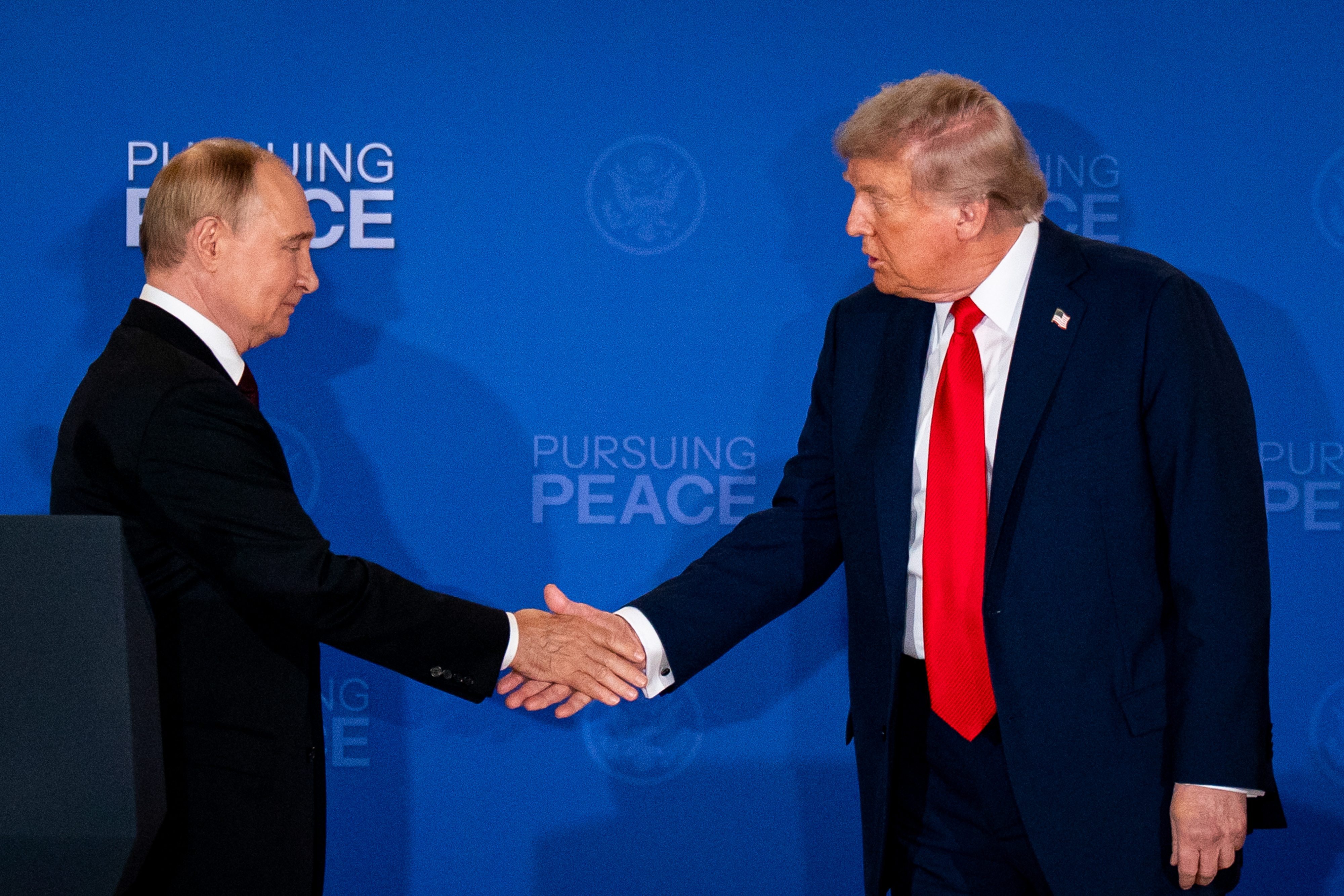
Vladimir Putin and Donald Trump.
Yet, in typical contradictory behavior, the Trump administration just halted plans to impose sanctions on China’s Ministry of State Security in response to Salt Typhoon.
The security plan devotes pages to Trump’s penchant for trade deals and tariffs with Beijing, which it claims will ensure U.S. superiority in advanced technology.
In another capitulation, however, Trump just agreed that Nvidia can sell advanced H200 chips to China, threatening that very U.S. superiority in advanced technology. Trump apparently wants to avoid displeasing Xi before traveling to Beijing for a summit in April. The president doesn’t want to interfere with his hopes of closing a brilliant trade deal.
In other words, national security can be ignored when it contradicts the prospect of illusory economic gains — whether it be deals with China or Russia. And the president counts on his brilliance to secure both with his pals Putin and Xi (although he has repeatedly been bested by each of them).
But the uglier and more gut-wrenching flaw is the document’s attack on Europe, its democratic values, and its support for Ukraine.
The 2017 NSS read: “A strong and free Europe is of vital importance to the United States. We are bound together by our shared commitment to the principles of democracy, individual liberty, and the rule of law.”
The “Promoting European Greatness” section of the new NSS echoes Vice President JD Vance’s tirade against European democracies, which I heard firsthand at the Munich Security Conference in February. Rather than speaking about the Russian war on Ukraine that threatens all of Europe, Vance denounced Germany for not inviting the extreme right, neo fascist Alternative für Deutschland party into a governing coalition.
The 2025 NSS contends that Europe is on the verge of “civilizational erasure” because of immigration policies; instead, it promotes (white) nationalist, anti-immigration political parties. It slurs the European Union for its multilateralism (which the United States promoted after World War II, and which brought political and economic stability to the continent).
And instead of supporting NATO allies as Russia attacks them with drones, cuts their underwater cables, and conducts sabotage and assassinations on European soil, the White House blames the Europeans for “regarding Russia as an existential threat.”
“Our goal,” the document reads, “should be to help Europe correct its current trajectory.”
There is something truly sick here.
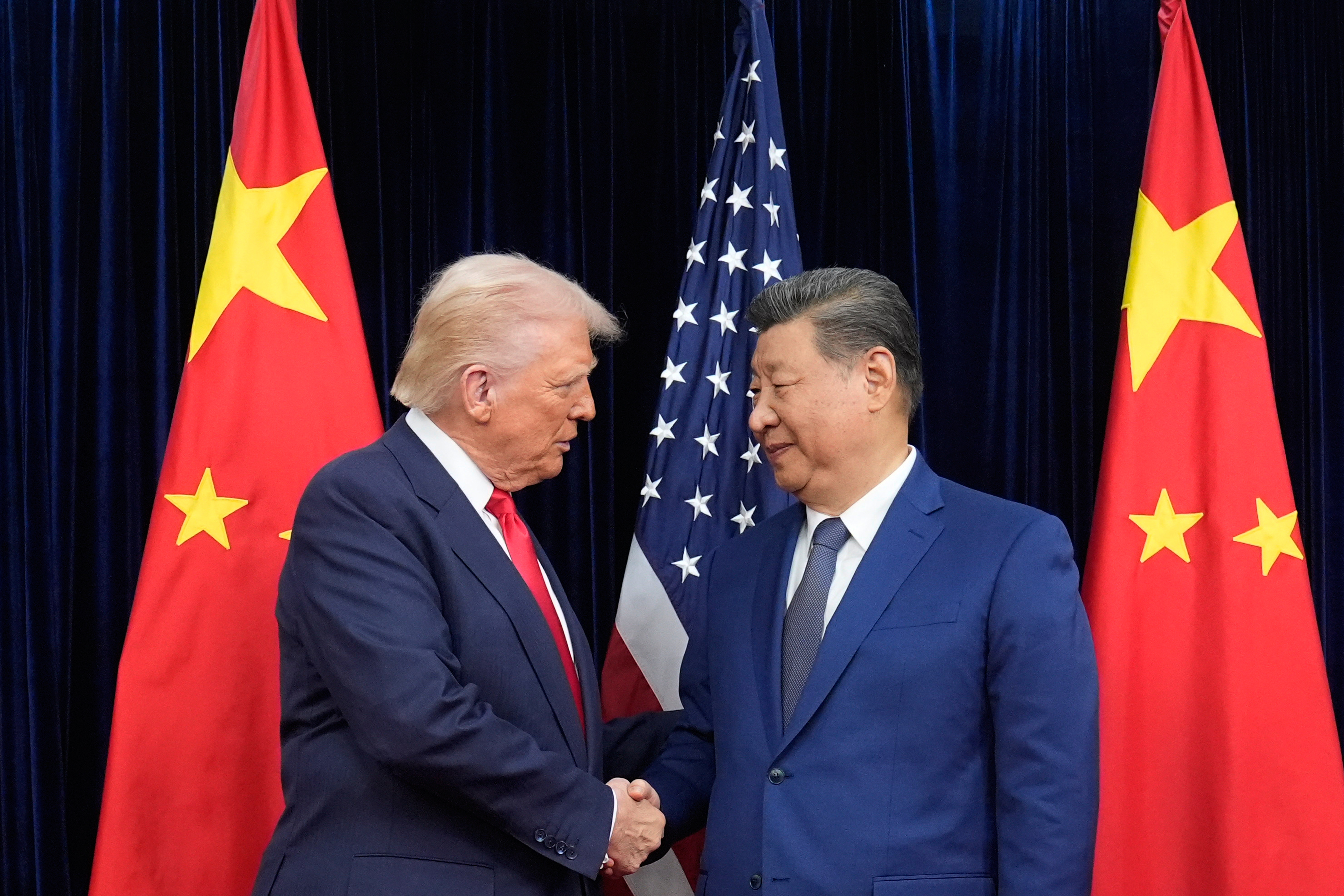
President Donald Trump and Chinese President Xi Jinping shake hands before their meeting at Gimhae International Airport in Busan, South Korea, in October.
Trump thinks China and Russia are his potential partners, while Europe is in the way — on Ukraine, on human rights, on warnings about Russia, on its own regulation of technology. Forget about common values or shared commitment to the principles of democracy and the rule of law.
Unabashed to intervene in domestic European politics, the document calls on Europeans to restore “strategic stability” with Russia, meaning pressure Kyiv into signing a deal that consigns Ukraine to permanent domination by Moscow.
And the U.S. wants Europe to take over most of NATO’s conventional defense capabilities, from intelligence to missiles by 2027, an impossible feat.
Moreover, the White House is actively promoting as part of its “security strategy” the success of radical white nationalist parties in Britain, France, Germany, and elsewhere that are pro-Moscow and eager to do any and all business with Beijing. In other words, a Europe led by parties that are hostile to American security interests.
The NSS 2025 envisions an alliance of authoritarian governments and their imitators, including Russia, China, the United States – and far-right European parties that dislike NATO, want to end theEuropean Union, and prefer deals with dictators to defending democracy.
This is what Trump advocates, although he doesn’t grasp that it would destroy him as well as his country.
Fortunately, Europe won’t capitulate, nor will our allies in Asia. Nor would most Americans, I believe, if they only knew what the Trump national security policy is all about.
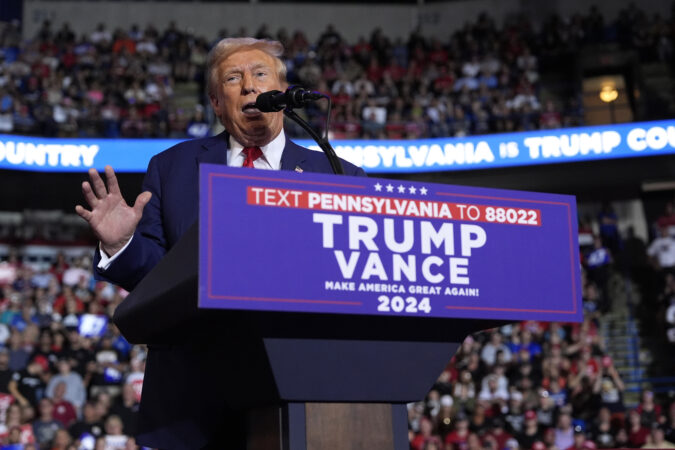
President Donald Trump’s raucous rally Tuesday night in Pennsylvania was billed as the launch of a national tour focused oneasing voters’ economic anxieties that threaten Republicans’ hold in Washington with the 2026 midterms looming.
But the economy couldn’t maintain the president’s interest for the duration of the speech.
Instead, he rallied the crowd at the Mount Airy Casino Resort in Mount Pocono by fomenting anger at Democratic U.S. Rep. Ilhan Omar and other Somali immigrants who live in Minnesota and teasing a 2028 run, despite constitutional limits on a third term.
Employing a method he calls “the weave,” Trump darted back and forth between cost-of-living issues and entirely unrelated material, such as claiming credit for the use of the phrase “Merry Christmas” during the holiday season.
“If I read what’s on the teleprompter, you’d all be falling asleep right now,” Trump said.
It was Trump’s third trip to Pennsylvania since he began his second term, following a campaign in which he spent a considerable amount of time in the Keystone State, winning it back in part by promising to cure a beleaguered economy. It’s the president’s first return to Northeast Pennsylvania, where he saw his biggest gains in the region during the last election, and which will be a crucial battleground in next year’s election, when the GOP’s razor-thin House majority is on the line.
“America is winning again. Pennsylvania is prospering again. And I will not rest until this commonwealth is wealthier and stronger than ever before,” Trump proclaimed at the large casino and hotel complex tucked in between ski resorts in the Pocono Mountains.
The casino stayed open Tuesday and gamblers played slots and card games on the floor upstairs as Trump spoke in the ballroom below.
Trump, in a speech that stretched over an hour, blamed high prices on hisDemocratic predecessor, formerPresident Joe Biden. He argued gas prices are down and car prices are dropping thanks to relaxed fuel-efficiency standards. The stock market is up this year and overall growth for the third quarter is strong. Trump also has signed agreements to reduce list prices on prescription drugs.
While Trump again called concerns about affordability a “hoax,” the event itself was at least an acknowledgment that frustrations with the economy are damaging the Republican brand ahead of the midterms. He spoke in front of a large “lower prices, bigger paychecks,” banner.
“Democrats talking about affordability is like Bonnie and Clyde preaching about public safety,” he said.
The most compelling part of the evening came more than an hour in, when the president called up members of the local community, including a waiter and an EMT to share personal stories about how no taxes on tips or overtime would benefit their families when tax returns are filed next year.
Trump played to the Pennsylvania crowd, noting his connections to the state as a graduate of the University of Pennsylvania’s Wharton School. “I love Philadelphia. It’s gotten a little rougher, but we will take it,” he quipped.
“It’s like I hit a piece of steel. … He’s so strong,” Trump said about patting the Eagles player on the back.
But despite these light-hearted moments, Trump repeatedly went after Omar and the Somali immigrant community.
Trump asked if anyone from the crowd was from Somalia and asked them to raise their hands before tearing into Omar, the progressive Minnesota Democrat who left the African country as a refugee.
“She comes from a country where, I mean, it’s considered about the worst country in the world, right?”
Later in the speech, Trump complained about immigration from Somalia, Afghanistan and Haiti — instead of countries like Norway and Denmark — as he recounted and affirmed his use of the phrase “shithole countries” during his first term, something he denied at the time.
He also accused Democrats of making Pennsylvania a “dumping ground” for immigrants.
Despite this incendiary rhetoric, Trump also celebrated his performance with Black and Latino voters in the last election. He put up the strongest Republican performance with these demographic groups in decades, though a majority both went for Vice President Kamala Harris.
“Black people love Trump,” Trump said. “I got the biggest vote with Black people. They know a scam better than anybody. They know what it is to be scammed.”
In his speech, Trump touted his tariffs as bringing in “hundreds of billions of dollars,” and noted his administration would be steering $12 billion to farmers through that revenue. The money is meant to help agriculture producers cope with retaliatory measures taken by China and other trading partners in response to Trump’s tariffs, which Trump did not mention in his remarks.
“We gave the farmers a little help … and they are so happy.” Trump said.
Poll after poll shows Americans see rising home prices, groceries, education, and electricity costing more. Gallup’s Economic Confidence Index found a 17-month low in terms of trust in the economy, and the survey found Americans’ views of the job market are at their most negative since the end of Trump’s first term during the height of the pandemic.
For the average Pennsylvanian, there is a “financial struggle” with higher prices on food, childcare, healthcare, and electricity, among other expenses, said Mark Zandi, chief economist at Moody’s Analytics.
He attributes it to Trump’s tariffs and immigration policies, including deportation, which he said limits the number of people working and has “hurt growth and raised inflation.”
“Everyone’s paying a lot more for basic necessities, most everything,” Zandi said.
Zandi noted Trump’s economic policies include a few positives for workers and employers, including tax breaks for businesses from Trump’s Big Beautiful Bill Act, as well as the tax cuts on tips and overtime.
“But net, I think the policies have contributed to the financial hardship of the typical Pennsylvanian,” Zandi said.
Pennsylvania, however, is the only growing economy in the Northeast, according to Moody’s Analytics. The state has secured $31.6 billion in private-sector investments since Democratic Gov. Josh Shapiro took office in 2023, according to his administration.
Shapiro has been quick to argue the state’s relative fiscal health has come in spite of federal policies he argued are hurting Pennsylvanians. He called Trump “a president who seems to want to blame everybody else, whose economic policies are failing,” in an interview Monday night on MS NOW.
“I mean, if he comes to Pennsylvania and spews more B.S. … I think what you’re ultimately going to find are people tuning him out,” Shapiro, a potential contender for the presidency in 2028, saidahead of Trump’s visit.
Sen. John Fetterman (D., Pa.) told MS NOW in a separate interview on Tuesday that polling shows the president, “he’s really kind of losing the plot with a part of his own voters now front and center.”
A key battleground
The setting for Trump’s speech is also one of the most closely watched battlegrounds in the state, home to freshman Republican U.S. Rep. Rob Bresnahan’s district, which Democrats are targeting to flip. Bresnahan won by 1.5 percentage points last year.
Bresnahan was more on message in brief remarks. He said he and Trump have heard the call for relief.
“The message is the same everywhere we go: Lower the cost, higher-paying jobs, keep our community safe, and listen to the people during the work,” he told the crowd in Mount Pocono.
He argued policies authored by Trump and passed by the Republican-led Congress, like tax credits for working families and seniors, are already helping people.
The Democratic Congressional Campaign Committeeseized on the visit to blast Bresnahan in ads on the Wilkes-Barre Times Leader website, highlighting his penchant for stock trading. And Scranton Mayor Paige Cognetti, a Democrat running to unseat Bresnahan, took the moment to call him “the exact kind of self-serving politician that Northeastern Pennsylvanians … all agree we need to get rid of.”
Whether Trump’s message resonates in this part of the country will be telling. Monroe County, home to Mount Pocono, flipped to Trump in the 2024 election after backing Biden in 2020.
The region is home to a large number of New York City transplants who have moved here seeking more-affordable housing in a region that largely relies on Pocono Mountains tourism as the main source of jobs.
While views on the economy were mixed on the casino floor, attendees in the ballroom gave the president a warm welcome back to the state. The Secret Service had to turn people away, and many who got in had waited more than four hours outside on an 18-degree day.
Trump’s ongoing response to affordability woes could have major implications for other vulnerable Republicans hoping to be reelected in the state. In last month’s election, Democrats successfully ran on affordability in the New Jersey and Virginia gubernatorial races — and picked up a slew of local seats in Pennsylvania.
The DCCC has its sights on the seats of three other Pennsylvania Republicans, along with Bresnahan: U.S. Rep. Brian Fitzpatrick of Bucks County; U.S. Rep. Ryan Mackenzie of Lehigh County; and U.S. Rep. Scott Perry of York County.
Attendees in the crowd Tuesday night held “Keep the House, Keep the Country,” posters.
Trump told the crowd he’d be back on the trail for Republicans in the midterms, and reflected, that like his off-the-cuff speech, he enjoys stumping.
Whether the current state of the economy affects Republicans’ chances in 2026 could depend on how those future appearances go and how willing the party will be to keep acknowledging that many Americans are struggling.
Marc Stier, executive director of the Pennsylvania Policy Center, who was a leading advocate for the establishment of the ACA, argued that “voters are not fools, particularly when it comes to their pocketbook.”
“How they talk about it will determine in some ways how badly they get hurt,” Stier said. “If they acknowledge a problem and, say, come up with ideas to deal with it, they will probably be hurt less. If they followed Trump’s line … I think they’re gonna get clobbered.”
A smattering of people pushed their luck Tuesday at the Mount Airy Casino Resort, tapping neon slot buttons, flipping dice onto felt craps tables, and wandering the rows of glowing, dinging machines.
A floor below, President Donald Trump was set to speak in a sprawling ballroom, where event staff hung a huge blue banner: LOWER PRICES, BIGGER PAYCHECKS.
Trump picked this casino in the Pocono Mountains to deliver the first big economic speech of his presidency as polls show Americans are feeling the pain of high prices — and many are blaming him.
But the contrast at the casino was hard to miss: the steady slot machine chimes of financial risk and uncertainty above and a president’s promises of stability and revival on the floor below.
How’s the economy working for Rosemary Migli?
“It could be better,” saidthe 73-year-old retired bartender from Tobyhanna, taking a puff of a cigarette before winning 35 cents on a spin.
Despite a frenzy of police and Secret Service, many gamblers, focused on their own troubles or celebrations, did not realize the president was coming. An older retired couple enjoyed an afternoon together with no obligations. Nearby, a recently widowed woman said the monotony of the slots helps her cope with her loss.
Peter Jean-Baptiste celebrated his 33rd birthday at the casino with his fiancee. The Philadelphia-based couple are saving for a wedding next year.
“It’s tough for everyone just trying to make a living, honest people trying to make a living,” Jean-Baptiste said. “One day you feel like [Trump’s] got your back, the next day he doesn’t.”
Jean-Baptiste, who works in property insurance, said he has also seen housing prices rise. And, as a child of Haitian immigrant parents, he is struggling with how Trump’s anti-Haitian verbal attacks and immigration crackdowns have affected his family.
“He does a bunch of hot takes and causes division between American citizens,” Jean-Baptiste said. “When, I feel, we really all just want to get along and get by.”
Mount Pocono is a region with mixed fortunes: Wealthy retirees have second vacation homes here, while lower-income workers are employed in warehouses and hold up the tourism industry. The area is also a hub for New York City commuters who moved here for more affordable housing.
“We live on a fixed income. We watch what we spend,” said Julie Dietz, sitting beside her husband, Glenn, as she played a buffalo-themed slot game. The Toms River, N.J., couple gamble for a few hours every now and then. She was a paralegal and he worked evaluating industrial facilities for safety before they retired.
“We know what our limitations are,” Dietz, 71, said. “Yes, food prices have gone up, but I’ve also seen some things come down — gas prices in our area. And the economy took so many years to get to this point.”
Dietz, who supported Trump in the last election, thinks an economic rebound is just going to take more time.
“He’s been in office 11 months. Eleven months. So I feel full confidence that he is going to do what he said he’s going to do. Everybody wants things immediately.”
Kathy F., who didn’t want to give her last name talking about politics and gambling, joined her husband at the casino Tuesday, despite her misgivings about losing money at a time when prices are going up.
“I go to Costco and everything is $5 more than it used to be. That’s a lot,” she said, bundled in a puffy black coat as her husband gambled nearby.
“I really don’t understand politics,” said the retired New York City civil servant, who voted for then-Vice President Kamala Harris last year. “It seems like they just fight with each other nonstop when all people want is to be able to afford to live.”
As he stretched his legs between games, Stephen Miller — “not that Stephen Miller,” he clarified — laughed off the notion of going to see Trump in person a floor below.
“If I want to see him, all I have to do is turn on the TV. He’s on at 12, he’s on at 3, he’s on at 5, seven days a week.”
The 75-year-old retired contractor supports Trump, though, and called the economy “half-decent.” He said food prices are high but eggs have gone down.
“The economy is glacial, so it moves slow. Democrats are definitely locked onto the affordability. But affordability means, what? It means whatever you want it to mean.”
Miller glanced down at a few vouchers in his hand to set off for the next set of machines.
“I’m not winning yet, but I will be and the Donald will be,” he said. “Give it time.”
Donald Trump let us know exactly who he is when he rode down that escalator in June 2015, declared his presidential candidacy, and said this about Mexicans: “They’re bringing drugs. They’re bringing crime. They’re rapists.”
We’ve heard him refer to Haiti, African nations, and El Salvador as “shithole countries.” Last year, he accused Haitians in Springfield, Ohio, of eating their neighbors’ dogs and cats. Trump allows mask-wearing U.S. Immigration and Customs Enforcement agents to terrorize undocumented immigrants, most recently in New Orleans, as reported by my colleague Will Bunch.
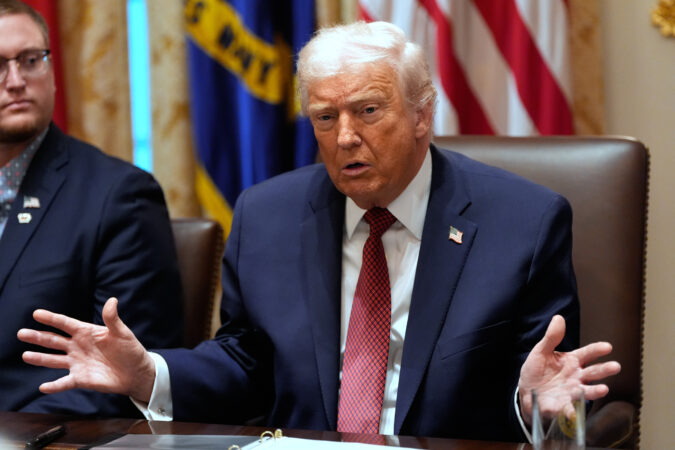
No one should be surprised he called Somalis “garbage” who “contribute nothing” and should leave America during a cabinet meeting last week.
“These are people that do nothing but complain,” Trump said. “When they come from hell, and they complain and do nothing but bitch, we don’t want them in our country. Let them go back to where they came from and fix it.”
Trump talks a really good game about putting America First, but he really means people of color last. An example of that was when he suspended refugee admissions, but then turned around and made an exception for white South Africans.
Even knowing Trump’s agenda, it’s still upsetting to hear a sitting U.S. presidentdenigrate the roughly 250,000 Somalis in this country.
He’s talking about law-abiding folks like Salma Hussein. She made headlines in 2022 when she became the first female Somali principal in her school district in suburban Minneapolis,and possibly in the entire state of Minnesota.
Hussein was born in Somalia, but has lived in America since the age of 7, and is a naturalized citizen. She’s a wife. She’s a mother of two. She’s a good person. “It’s really hurtful, and he’s giving permission to people to be hateful, and that’s really disheartening,” Hussein said.
I stumbled across some of her social media posts about what’s been happening and decided to reach out. When I got her on the phone last week, Hussein, 37, and I talked about a lot of things, including how a stranger had emailed her saying: “Watch out. You’re not wanted. We’re taking out the trash from our country.”
Salma Hussein, a Somali American who’s lived in the U.S. since she was 7, said the president is “giving permission to people to be hateful.”
I shouldn’t even have to write this:Most Somalis are honest, law-abiding people. Many settled in Minnesota during the early 1990s after fleeing their war-torn country. Of the state’s foreign-born Somalis, most are naturalized U.S. citizens. They have every right to live in the Land of 10,000 Lakes. They vote. They pay taxes. Trump is their president, too. Some, oddly enough, even voted for him.
I wish they’d thought longer and harder before voting for Trump, who posted on Truth Social that Minnesota is “a hub of fraudulent money laundering” and announced he was terminating Somalis’ Temporary Protected Status.
Dozens of Somalis in Minnesota are facing charges in connection with a nefarious scheme to defraud the U.S. government of hundreds of millions in funding that had been set aside to feed hungry children atthe height of the pandemic. Still, it’s unfair for a sitting U.S. president to stereotype an entire community for the actions of a subset. “As a Somali American, I’m just as upset about the people in my community who use fraud to make money,” Hussein told me.
Somalis, who have built a large and influential enclave inMinnesota, are terrified that masked agents from ICE will take them into custody. Some have started carrying their passports. Others refuse to even leave their homes.
“This kind of dangerous rhetoric and this level of dehumanizing can lead to dangerous actions by people who listen to the president,” said Rep. Ilhan Omar (D., Minn.) on CBS’s Face the Nation on Sunday.
It’s textbook Trump — and, of course, MAGA loves it.
Rep. Ilhan Omar (D., Minn.) speaks during a news conference, May 24, 2023, on Capitol Hill in Washington.
Which ethnic minority Trump will single out next for harassment is anybody’s guess. The only thing we can be certain of is that they will be from a Black or brown community.
There’s this idea in the sports world that when your team wins a championship like the Super Bowl, fans can’t really complain about whatever happens in the next season or two. The author of that maxim has obviously never been to Philadelphia, which is experiencing a 1776-level revolt over the Eagles’ three-game losing streak and the increasingly erratic play of the Super Bowl MVP, quarterback Jalen Hurts. So much for brotherly love, pal.
No, the thing that finally caused the mainstream media to go all Watergate all the time on Donald Trump and his Pentagon chief was a lot more simple, if harder to stomach: the early September murder by drone strike of two men — their identities still unknown to the world, or most of it — clinging to a piece of ship-wreckage in the Caribbean Sea near Venezuela.
Flip on the favorite show of the Beltway set — MS Now’s Morning Joe — and there practically is no other story than the second attack on the seemingly helpless victims of an initial drone strike that killed their nine comrades. The media is demanding to learn what did self-proclaimed “Secretary of War” Pete Hegseth know about the strike, and when did he know it. Commentators are calling the killing a war crime at best, a murder at worst. An unnamed lawmaker who saw a video of the second strike told reporters that the film is nauseating.
Pressure on the Trump regime to release this 45 or so minutes of footage of the boat attack is intensifying, and it’s not hard to understand why. It’s a bit like 2020’s video of the excruciating cop murder of George Floyd in Minneapolis, which made a problem that activists had been talking about for decades — police brutality — so real for everyday folk that millions took to the streets.
Likewise, people have been calling Trump names — including the “f-word,” fascist — ever since the Manhattan real-estate mogul descended the escalator at Trump Tower to run for president in 2015. But somehow the mental image of men reportedly begging to be saved seconds before an admiral givesthe order to obliterate them has captured the angry imagination in a way that past Trump outrages did not. No wonder Trump has flip-flopped on releasing the video.
Look, I’m glad the media and Congress, including some Republicans, are finally taking seriously the idea that major felonies are being committed in Trump World. Still, the two men killed in what’s called the double-tap strike came after nine other people had already been blown up, in an attack against civilians of a nation America is not at war with, who were accused of committing a crime — drug trafficking — that is not a capital offense.
There is no legal, let alone moral, justification for this attack — and it was the first of a series of drone strikes that have killed at least 86 people. There’s a strong case that every one of these is a war crime. It’s just that the killing of the two men clinging to debris appears even more egregious.
This highlights an even weightier issue. From Day One of Trump’s second term, there has been a callous indifference to human life — a hallmark that the current U.S. government unfortunately shares with many other authoritarian regimes throughout history. But the media, and the watchdogs, have struggled to convey this reality with so many of the deaths taking place off camera.
So far, the worst crime has been the rash move back in the first weeks of the new administration by Trump’s billionaire then-ally Elon Musk and his so-called Department of Government Efficiency, or DOGE, to dismantle the U.S. Agency for International Development (USAID) — a once-thriving $34-billion-a-year agency that funded food, medicine, classrooms and other aid in developing nations.
The Musk team labelled USAID as inefficient and out of whack with Trump’s new priorities like curbing immigration. This despite the fact that experts saw the American agency as the best projector of “soft power” around the globe as it saved literally millions of lives, especially for children under age 5.
“We are now witnessing what the historian Richard Rhodes termed ‘public man-made death,’ which, he observed, has been perhaps the most overlooked cause of mortality in the last century,” Atul Gawande, a surgeon who worked with USAID in the Joe Biden years, wrote last month in the New Yorker. Gawande estimated that the wanton destruction of USAID programs that offered vaccines and fought AIDS and infectious disease outbreaks caused 600,000 needless deaths in the first 10 months of the Trump regime, with millions more to come.
This week, the philanthropic Gates Foundation reported that for the first time in the 21st century, mostly preventable deaths of children under age 5 are rising instead of falling, and the main culprit is cuts in development aid, led by the United States. “We could be the generation who had access to the most advanced science and innovation in human history,” the billionaire philanthropist Bill Gates said, “but couldn’t get the funding together to ensure it saved lives.”
The MAGA comebacks to cries that Trump is a fascist dictator often claim that innocent people aren’t getting slaughtered as happened under Adolf Hitler or Mao Zedong or other historic despots. The truth is that the regime’s cruelty-is-the-point demagoguery is inevitably becoming a death cult, epitomized by Musk’s chainsaw DOGE shtick. The murder happens in small batches, on boats off South America, and it also happens in big lots in places like famine-plagued South Sudan, as children die from aid cuts to badly needed health centers.
And increasingly, Trump’s death cult is taking root here at home, from the 25 humans, and counting, who’ve died in ICE’s overcrowded detention centers this year, to individuals like Roberto Carlos Montoya Valdez, who was struck by cars while running awayfrom immigration agents who raided a Home Depot parking lot in Southern California. This is before we know the full and likely lethal impact of alarming health policy changes from Robert F. Kennedy Jr.’s Health and Human Services Department, and the toxic anti-vaccine culture he promotes.
We should be just as outraged by the deaths that take place out of sight, in dusty and remote places on the other side of the world, as by two premeditated murders captured in a MAGA snuff film. Understanding the nature of Trump’s cult of death is critical for folks to find the courage to rise up and stop this before it gets much, much worse.
Yo, do this!
The one thing that truly sets MS Now’s Rachel Maddow apart from her peers as an opinionated late-night cable-news host is her love for history, and her ability to put today’s crisis in the context of what came before. In her second life as a top podcaster, Maddow’s sweet spot has become America before, during, and immediately after World War II, and what memory-holed stories from that era tell us about today. Her new audio series, Burn Order, is about immigration, paranoia and demagoguery — not now, but in the unconscionable internment of Japanese-Americans in the 1940s. Two episodes in, it’s her best podcast yet.
I’ve never really kept my promise to include great restaurants and bars in this space, but here goes. During last week’s fairly frantic journalistic sojourn to New Orleans, I took one night off and grabbed a beer in what might be the greatest American dive bar, Jake and Snake’s Christmas Club Bar. This shotgun shack of a watering hole in the middle of an otherwise residential street has to be seen to be believed, both on the ramshackle outside and in the dark interior pumping 1950s rockabilly and lit only by — what else? — Christmas lights. There is no better way to kick off your holiday season.
Ask me anything
Question: All things considered, the U.S. has weathered this first year of the second Trump regime OK. But three more years of this? Any guesses as to what happens between now and then? — Shawn “Smith” Peirce (@silversmith1.bsky.social) via Bluesky
Answer: Weathered? Just barely. But I do exit 2025 slightly more optimistic than I began the year, thanks to the size of the No Kings protests and the growing resolve of citizen resistance to immigration raids. What happens in the next three years? I think 2026 will be pivotal. Trump will surely look at his sagging polls and double down on dictatorship, which could include misguided foreign wars, more aggressive use of troops at home, and efforts to somehow nullify next November’s midterms. I also think these will fail, which means a Democratic Congress in 2027 and 2028 that will certainly impeach Trump and restrain his worst impulses. If not, I may be writing this newsletter from my prison cell.
What you’re saying about…
The question I posed here two weeks ago about the John F. Kennedy assassination was a good, evergreen topic ahead of a long break. Maybe it was my boomer-heavy readership, but all but one respondent didn’t believe that Lee Harvey Oswald acted alone. “I also saw Jack Ruby shoot Oswald on live television, another searing memory,” wrote Laura Hardy, who was 8 in 1963. “Nothing ever added up in my mind. Still doesn’t. Was it the Russians? The CIA? The mob?” The one naysayer was Armen Pandola, who argues that “JFK was a fairly conservative Democrat at the time…Where is the motive?”
📮 This week’s question: This has been asked before, but it’s still the most important thing going. Trump is appearing in public with a bruised, bandaged hand, prone to weird digressions or outbursts. So what is the deal with his health? Please email me your answer and put the exact phrase “Trump’s health” in the subject line.
Backstory on an all-too fitting venue for Trump’s Pa. speech
The Mount Airy Casino Resort in Mount Pocono, Pa.
Donald Trump may be constitutionally ineligible to run again for president — no seriously, he can’t — but that factoid apparently isn’t stopping the 47th POTUS from campaigning in the critical swing states. Why else did Trump choose Pennsylvania — a state he visited a gazillion times as a candidate — as the location for a major speech on the economy, to convince citizens that what they are seeing in supermarket aisles is not what’s happening? I can’t even imagine what Trump will say Tuesday night, but I was stunned to learn the regime’s choice of venue: The Mount Airy Casino Resort, the former honeymoon haven in Mount Pocono.
It’s not just that Trump is touting economic security in a casino, which seems way too fitting in an America where so many folks have decided that the only way they’ll ever get rich is through gambling, whether that’s a get-rich-quick investment in crypto or meme stocks, or by an addiction to the betting sites like DraftKings that are devouring the sports world. Or that the backdrop might remind people that Trump was the rare entrepreneur who drove his own Atlantic City casinos — supposedly a license to print money — into bankruptcy.
The real problem is that the Mount Airy Lodge is the epitome of the real Trump economy: Public corruption. Like Trump’s real-estate empire, the original Mount Airy Lodge fell on hard times in the 1990s, and its longtime owner died from a self-inflicted gunshot wound in 1999. The supposed savior was the state’s headlong rush into casino gambling and northeastern Pennsylvania’s landfill magnate Louis DeNaples, long dogged by allegations of ties to Scranton’s organized crime family. In 2008, DeNaples was indicted on four counts of perjury tied to his casino permit application; ultimately the politically connected businessman turned over the casino to a trust chaired by his daughter and saw the charges dropped. But the Mount Airy Resort Casino remains dogged by controversy, including a recently proposed $2.3 million settlement with its table-games dealers who accused the owners of years of wage theft.
But Trump considers DeNaples “a close friend,” and the Mount Airy casino nabbed a $50 million federal bailout loan during the COVID-19 pandemic in the final year of Trump’s first term. Five years later, is there a positive story about the Trump economy that can be told from this stage of dropped felony charges, alleged wage theft, and government largesse for the well-connected? Don’t bet your nest egg on it.
What I wrote on this date in 2015
Ten years ago, I was fascinated by the decades-long political rise of Vermont senator and then-White House hopeful Bernie Sanders. This left-wing curmudgeon and relic of the 1960s didn’t capture the White House but changed America, for good. On Dec. 9, 2015, I touted my Amazon Kindle Single e-book about Sanders (The Bern Identity…it’s still available!) and offered highlights. I wrote: “Politics mattered then, before Chicago and Kent State and Watergate and all the cynicism, and the unvarnished, authentic voice of Bernie Sanders is bringing that feeling back for many.” Read the rest: “5 things I learned writing an e-book about Bernie Sanders.”
Recommended Inquirer reading
Did I mention that I went to New Orleans? I wrote two columns from the scene of Homeland Security’s immigration raid that the Trump regime has branded “Catahoula Crunch” in a gross homage to the Louisiana state dog. The first piece looked at Day One of the operation — the Big Lie behind the raids that claim to target criminals but instead go after day laborers, usually without criminal records — and the fear that pervaded the Latino community. The second column was a much more hopeful look inside the growing citizen resistance, as I profiled the everyday folks who are taking risks to blow whistles, chase cars, and generally impede Trump’s mass deportation agenda.
Last week — if you could somehow make it through the sickening bromance between Donald Trump and FIFA, the world governing body of soccer — we finally learned the key groupings and early-stage matches of the 2026 men’s World Cup finals across the United States as well as our now frenemies Canada and Mexico. You won’t be surprised to know that The Inquirer’s soccer writer extraordinaire Jonathan Tannenwald was all over the key developments. We learned who the U.S. team will play: Paraguay, a to-be-determined European qualifier, and Australia, in a June 19 Seattle match I still want to attend if I can start a GoFundMe (kidding…maybe) for the astronomical ticket prices. The Philadelphia matches include perennial contenders France and Brazil as well as a Curaçao-Ivory Coast showdown that I’m excited for because I might be able to afford it. The World Cup is going to be one of the biggest stories of 2026, and you know the Inquirer will cover this like an Italian center back. This alone will be worth the price of a subscription, so what are you waiting for?
By submitting your written, visual, and/or audio contributions, you agree to The Inquirer‘s Terms of Use, including the grant of rights in Section 10.
President Donald Trump is expected to visit Northeast Pennsylvania today, promoting his economic agenda — including affordability and gas prices.
The trip — which the White House confirmed with The Inquirer last week — will include stops in Scranton and a rally in Mount Pocono.
Trump is no stranger to northeast and north-central Pennsylvania. He visited the region 13 times, including stops in Wilkes-Barre Township and Scranton on his second-term campaign last year. He had a particularly strong performance in Northeast Pennsylvania last year, with some of his top gains compared to the 2020 election coming from Lackawanna and Luzerne counties.
It’s part of an expected national tour where Trump will tout his efforts to lower inflation ahead of the 2026 midterm elections in battleground areas. Those races, including ones in northeastern and north-central Pennsylvania, will determine whether Democrats or Republicans control Congress.
Trump’s visit Tuesday appears to be his first to Pennsylvania since attending an energy summit in Pittsburgh in July.
Affordability — a concept Trump has rebuked in the past, calling it a “fake narrative” — remains a top issue for voters, including locals. Trump continues to claim that prices have fallen since he took office in January, despite reports of the opposite. A CNN fact-checking report from November said prices and inflation have increased. Trump’s tariff policies have contributed to those increases, according to experts.
When and where will Trump be in Pennsylvania?
Trump has obligations at the White House and in D.C. until at least 3:15 p.m. according to his public schedule.
His first publicly visible scheduled appearance in Pennsylvania is at 6:10 p.m. at the Mount Airy Casino Resort in Mount Pocono. As of Tuesday morning, registration to attend the remarks were still open.
This story will be updated. Staff reporter Fallon Roth contributed to this article.
But in a rare interview with the Washington Post, published Thursday, Yass shared details on the key motivation behind his political spending: school vouchers, which supporters say will allow parents and students to choose their school. Yass’ unwavering support for vouchers and other school choice measures has led him to throw his dollars to Pennsylvania, other states, and to Trump, whose candidacy he once opposed.
And in 2026, he said he’ll continue to financially back pro-voucher candidates across the nation.
“I have come across what I think is a great way to relieve the suffering of tens of millions of kids,” Yass told The Washington Post. “To most people it’s like if you’re a libertarian billionaire, you must be Lex Luthor trying to do something nefarious. If I gave to a hospital, you wouldn’t be saying that.”
School vouchers, which are opposed by teacher unions and public school advocates, have been a high-profile issue in Pennsylvania’s state budget talks in years past, but they’ve failed to pass it. Yass poured money into that effort, but Democratic Gov. Josh Shapiro, who has embraced — though softened — his support for a voucher program, vetoed the measure from the state budget after it couldn’t pass a Democratic-controlled state House in 2023.
Yass told the Post that “It was a dramatic failure. We thought we had it.“
The billionaire saw better success in Texas where he contributed to help defeat anti-voucher Republicans in the primary, creating a more favorable atmosphere for passing the state’s $1 billion voucher program.
But these instances were hardly the beginning — or the end — of Yass’ involvement with politics. He gave $3.2 million in political contributions in Pennsylvania in 2018, and by last year, that had risen to $35 million, the Post reported.
Though now known as a major backer of GOP candidates, he has supported Democrats who he believes can help champion the school choice message. The first major beneficiary of Yass’ contributions was State. Sen. Anthony Williams (D., Philadelphia) who unsuccessfully ran for governor in 2010 and Philadelphia mayor in 2015.
And in 2007, Yass conversed with then-Sen. Barack Obama, who received a $2,300 donation from Yass for his 2008presidential campaign, the Post reported. Yass believed that Obama would support school choice if elected, but his administration ended up opposing voucher programs for children in the D.C. school system.
According to the Post, this may have been an indication to Yass that Democrats would not be an ally for the school choice cause.
His allegiance to school choice also appears to have made him switch his perspective of Trump from an opponent — who spent millions of dollars to back GOP primaryopponentsin 2024 — to a supporter.
The billionaire owed his change of thought on Trump to the president being “a true champion” of school choice, Yass told the post, crediting him for the passage of the Texas voucher bill and a new federal tax credit for donations to scholarship organizations.
His support for the president also coincides with Yass having business in front of the Trump administration. Yass’ trading firm is a top stakeholder in ByteDance, TikTok’s parent company. Trump is mulling the fate of the popular social media app in the United States and Yass could benefit from a deal supported by Trump to keep TikTok operational here.
JUÁREZ, Mexico — Carolina was living in Colombia as a refugee when her 15-year-old son disappeared. Almost a year after her boy went missing and she mourned his loss, she got a call from an international number.
Her son was alive 3,000 miles away in this historic Mexican city once known as “the Pass of the North,” nestled along the Texas border.
“I was so happy, but I didn’t know how to get here, without knowing anything, without money, with nothing,” she told me when I met with her recently at an immigrant shelter in Juárez. “I sold my house and came here alone.”
After a harrowing three-month journey during which she made her way across seven countries, survived two kidnappings, and endured beatings and sexual assault, she reunited with her son on Jan. 10.
They tried to get an appointment to cross the border through U.S. Customs and Border Protection’s CBP One app — part of a program launched by the Biden administration to allow people to come to the U.S. legally while they waited for their asylum or other immigration case to be processed.
Carolina and her son were still trying when President Donald Trump ended the program the day of his inauguration.
They’ve been stuck in shelters ever since.
Speak to immigrants at the border, and what happened to Carolina is sadly common. Some people are luckier, some less so, but no one comes out unscathed from their journey. And while some are willing to see their dreams deferred, there are and will continue to be more people who see coming to the United States as the only way out of a desperate situation.
Visiting the border nearly 10 months after Trump took office and essentially ended the ability to seek asylum in the United States, you see what many Americans — even some begrudging critics — credit the president with doing.
Trump has been brutally effective at limiting border crossings. The quiet downtown streets and plazas, the nearly empty shelters in both El Paso, Texas, and its sister city of Juárez in Mexico, are a testament to that fact. Only a few years ago, thousands of immigrants crowded sidewalks and shelters here, straining the region’s spirit of hospitality.
Today, the immigrants left behind are the vulnerable among the vulnerable, advocates said. People who are unable to move out or move on, stuck in shelters with the hope that Trump’s “hard heart will soften,” as one woman told me.
My own heart was not hard enough to dash her dream. Perhaps it should have been.
The last thing immigrants need is for some well-meaning dope to ignore the facts for short-term comfort. They had enough of that during the Biden administration.
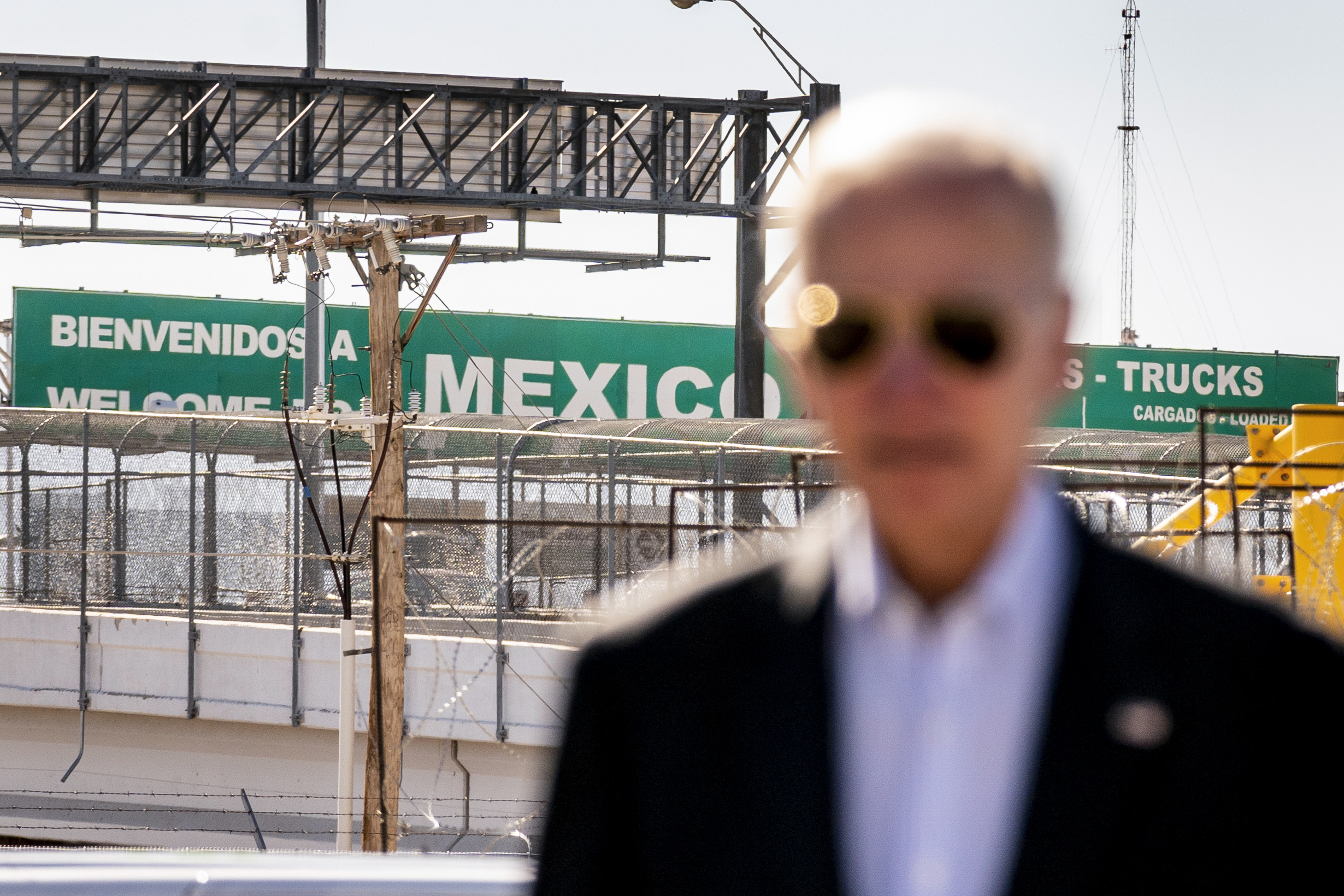
A large “Welcome to Mexico” sign hung over the Bridge of the Americas is visible as President Joe Biden talks with U.S. Customs and Border Protection officers in El Paso, Texas, in 2023.
Good intentions
Under President Joe Biden, about six million people were allowed entry to pursue asylum applications and other immigration cases, according to the Migration Policy Institute.
I believe that all things being equal, the U.S. has no trouble absorbing these immigrants. Call me cynical (I prefer pragmatic), but our economy runs on cheap labor and consumer spending — six million people give you both. It gives you adults who are willing to do the work Americans won’t, and kids who will go to school and graduate for the jobs there aren’t enough Americans for.
But the problem is the president can only do so much. The executive can allow people to remain in the country under some sort of limited parole, it can direct enforcement toward higher priority targets, such as immigrants with criminal records, but it cannot grant legal status.
Only Congress can do that, and legislators have decided there is no major issue they can’t shrug off as intractable and call it a day.
So the Biden administration opted to let people in — regardless of whether they had a good asylum case — knowing full well that just as one president could open the door for immigrants, another could slam it in their faces.
Biden himself shut that door halfway as the 2024 presidential election neared, but the political damage had already been done, because the administration at no point made the argument for why it was doing what it was doing.
As desperate people who wanted a better life clustered at the border — partly because of the pent-up demand that grew under pandemic restrictions Trump put in place — Bidencould have made a moral argument, or laid out the economic benefits of immigration. He could have done more than introduce immigration reform shortly after taking office, and then just as quickly give up on it.
Instead, it was never clear what Biden wanted other than not to be seen as the bad guy.
His administration’s humanitarian intentions, coupled with incessant fear-mongering on the right, paved the way to where we are today.
Flags from North, South, and Central America line the left side of the chapel inside the Casa del Migrante in Juárez, Mexico, in November.
All for nothing
It took Helen, her husband, and their 3-month-old baby three months to travel from Ecuador to the Casa del Migrante shelter in Juárez, which is run by the Roman Catholic Diocese of Ciudad Juárez.
Like Carolina, Helen — who remains concerned about the status of her potential immigration case — would speak with me only on the condition that her last name not be used.
Helen and her husband, both in their early 20s, arrived in October of last year after leaving their home because of growing gang violence. “You couldn’t have any peace anymore,” Helen said.
The family crossed the dangerous jungle and rode through Mexico on the freight train known as “the beast.” She saw a man die, falling under the wheels of the cars.
While her husband goes out to work odd jobs, she takes care of their daughter. The routine gets to her, she said. Once a month, they’re able to go out and splurge on a meal, even as they’re afraid to walk the city’s streets.
Her daughter has now lived most of her life inside a shelter, but Helen told me they will continue to sacrifice.
“We are waiting to cross. Whatever it takes,” she said.
Across town at the Vida shelter,Carolina, 53, is torn aboutwhat to do.
Her journey to Juárez began 14 months ago. Distraught over her son’s disappearance, she went back to her native Venezuela to be with her mother.
When Mexican officials informed Carolina that her son was alive, she left Venezuela on Oct. 20, 2024, and traveled across Central America. She was kidnapped twice, Carolina said. Once when she crossed the Guatemalan border into Mexico, and again when she got to Juárez in December.
“The one here was the worst. The one here was rape, beatings. I still can’t fully touch myself here,” she said, grimacing as she moved her hand along her left breast. “They left me with nothing.”
Although she’s grateful for all the help she’s received, she said, it’s coming up on a year of living in shelters,and the uncertainty is becoming overwhelming.
Her son is going to high school, and sometimes works with a handyman. She sells donated used clothing in front of the shelter and cleans houses, but work is sporadic.
“I tell my son we should go back,” Carolina said. “He says he came here for a future.”
Her mother calls and tells her she doesn’t have food, she said. She trusts that God has a plan and things will work out accordingly — even if it means returning home to struggle there — but there must be a point to her journey.
“You go hungry, you grow tired, it’s raining, you see corpses. You spend sleepless nights, running from people who want to rob you, kill you,” she said.
“Do you know what it’s like to go through what I went through and not be able to cross?”
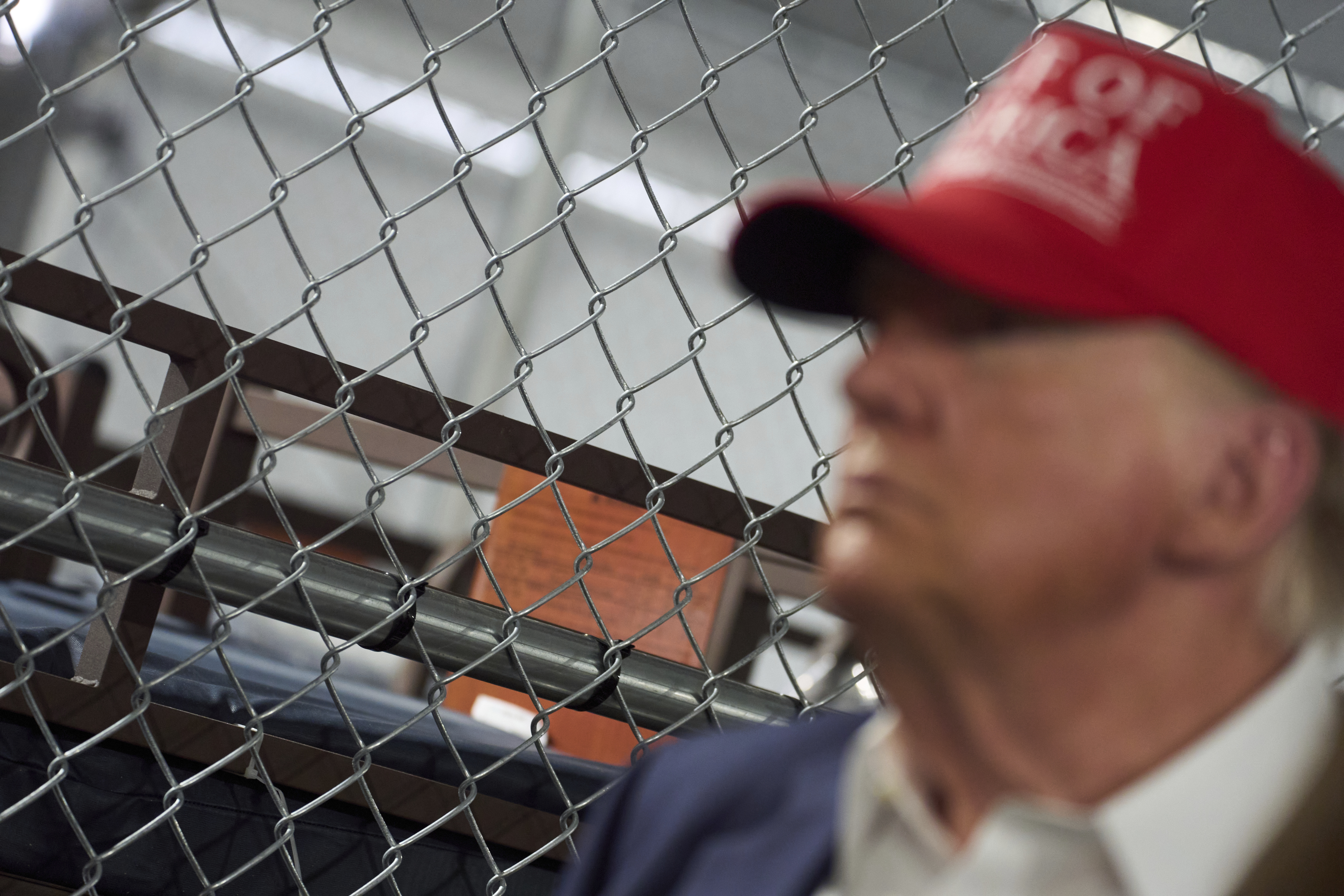
President Donald Trump during a July tour of “Alligator Alcatraz,” a migrant detention facility at Dade-Collier Training and Transition facility in Ochopee, Fla.
No turning back
Many immigrants who are still in shelters, and those who have decided to remain in Mexico, are in a state of flux, waiting for the opportunity to cross the border.
Trump may have succeeded in curtailing illegal immigration through a mix of enforcement, deterrence, and cruelty, but it is unsustainable. While he may be able to delay the inevitable — especially if he manages to crash the economy and there are fewer jobs for immigrants to fill — eventually, people will return.
“Listening to people’s stories, we’re really at a critical moment,” said Alejandra Corona, who heads Jesuit Refugee Services in Juárez, a nonprofit that serves the migrant community. “The world is broken, and there are no options.”
You see it in the eyes of parents who are deeply wounded because they cannot provide for their families even in the most basic ways, Corona told me, and the reasons why are far from simple.
“It’s not just, ‘Oh, I lost my job,’” she said. “It’s, ‘I had a job, but couldn’t afford to pay off the gang member or the cartel. I stopped paying for protection and had to flee. I was discriminated against, I’ve never had a passport, I’ve never been to school, I’ve never had access to my rights. I do not exist, and no one wants to see that I don’t exist.’”
The lesson to be drawn from the border today is that immigrants may not be as visible, but they haven’t gone away.
If Democrats capture the presidency in 2028, they will likely not follow the Trump administration’s amoral ruthlessness, but they cannot repeat the Biden administration’s aimless permissiveness, either.
Everyone suffers under the current seesaw approach to immigration, where an immigrant can come here “the right way” under one administration, only to see things turn out wrong under the next. Trump has tried — successfully and unsuccessfully — to kill programs for immigrants established under Presidents George H.W. Bush, Barack Obama, and Biden.
Whether or not you support immigration, the whims of an individual — even if it’s the president — are no substitute for the legislative process.
The United States is a nation of immigrants. America has thrived economically and culturally thanks to this fact. On immigration, it’s Congress, as representatives of the people, who must determine the who and how, the when and where, that makes the most sense for the country.
Until then, immigrants will be ready and waiting — and prayingfor a softer heart in the White House.
President Donald Trump will visit Northeast Pennsylvania on Tuesday to promote his economic agenda, including efforts to lower inflation, the White House confirmed to The Inquirer on Thursday.
The trip will kick off what is expected to be anationaltour of Trump touting his economic policies ahead of the 2026 midterms, when Democrats and Republicans will battle for control of Congress.
The specific location for Trump’s visit has not yet been made public, but Northeast Pennsylvania will be a major battleground in next year’s midterms.
Democrats believe that they can oust freshman Republican U.S. Rep. Rob Bresnahan, of Lackawanna County, threatening the GOP’s slim House majority. Democrats are also specifically targeting the districts of U.S. Reps. Brian Fitzpatrick, of Bucks County; Ryan Mackenzie, of Lehigh County; and Scott Perry, of York County.
Trump endorsed Bresnahan and most of Pennsylvania’s GOP delegation on his social media platform, Truth Social, last month. Scranton Mayor Paige Cognetti, a Democrat, is mounting a campaign to unseat Bresnahan, who won by roughly a percentage point last election.
Affordability — which Trump called a “fake narrative” used by Democrats — has been a top issue for voters, including during November’s blue wave when Democrats won local contests throughout Pennsylvania, in addition to the gubernatorial races in Virginia and New Jersey.