Of course, not all of the Jeffrey Epstein files were released.
Even some files made available late Friday were quickly removed. Large portions were heavily redacted. Some portions contained boldfaced names, but there was little mention of Donald Trump.
As long as Trump keeps his thumb on the scales at the U.S. Department of Justice, no one should ever expect a fair shake — let alone an honest accounting of the yearslong connection between a convicted sex offender and a convicted president who is a congenital liar.
This is life under a brazenly corrupt administration that rewards billionaire cronies, punishes hundreds of political enemies, kills in broad daylight, and tramples the Constitution.
Better to prepare for how to defend against three more years of authoritarian rule mixed with kabuki theater.
In normal times, the Trump administration’s continued cover-up of the Epstein files would be an epic scandal, prompting hearings, investigations, and accountability.
But the Republicans who control the House and Senate have been a profile in cowardice. Until enough voters wake up, Trump and the GOP will continue to provide misdirection, denials, and a flouting of the law.
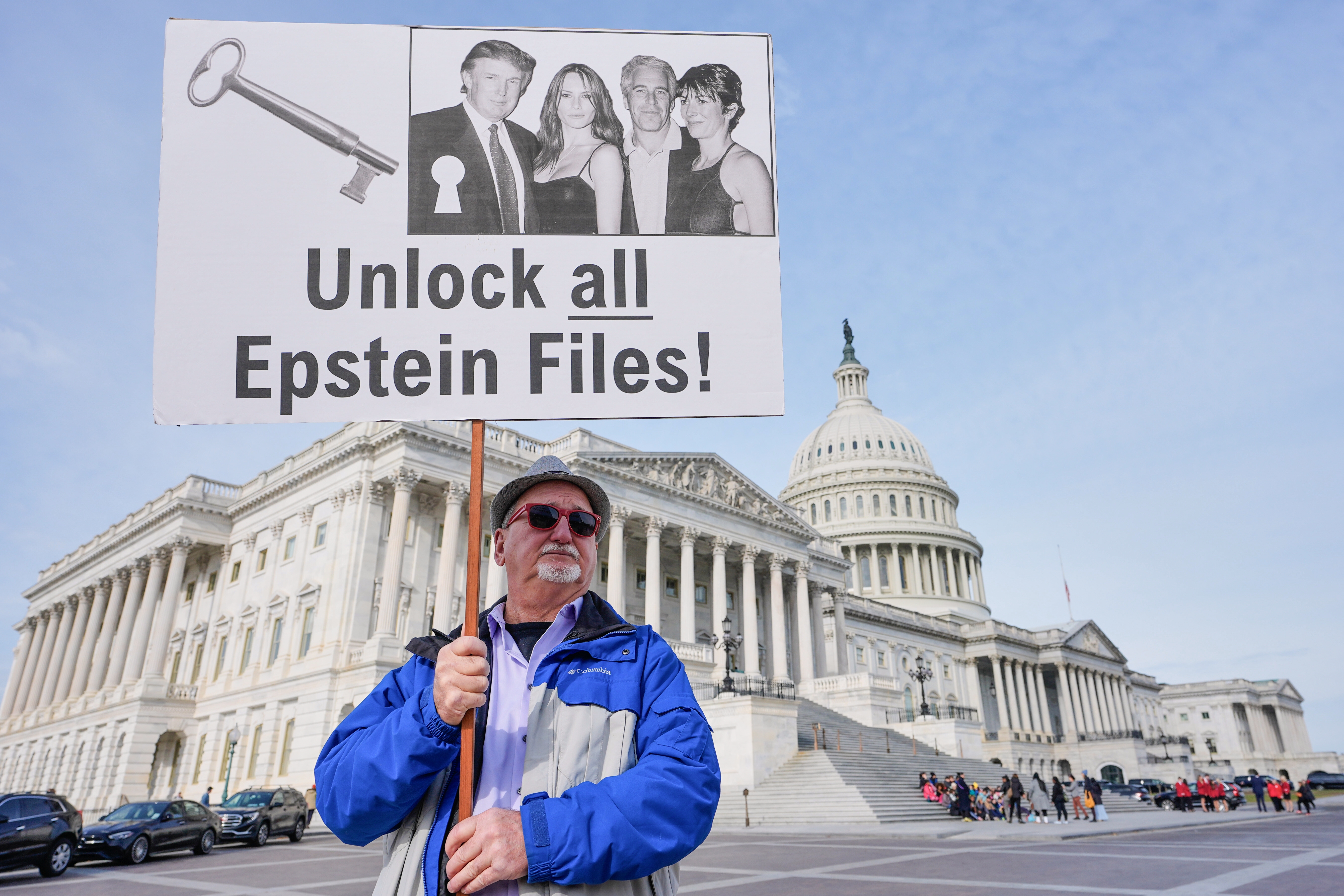
Gary Rush, of College Park, Md., holds a sign outside the U.S. Capitol urging the release of the full Epstein files in November.
Trump has not been implicated in any wrongdoing, but his enablers — including Attorney General Pam Bondi and FBI Director Kash Patel, and most Republicans in Congress — inexplicably continue to protect him.
Doing so obliterates any trust in the justice system and the rule of law.
The main tragedy involves the yearslong sex trafficking, rape, and abuse of hundreds of underage girls, including one alleged 11-year-old, and young, vulnerable women by Epstein and his many rich and powerful friends.
Epstein’s survivors have demanded that the files be released so there can be at least some public accounting of the horror they endured. But instead, the survivors have had to relive the trauma and fear of death threats.
One survivor who Epstein recruited from Trump’s Mar-a-Lago spa when she was a teen took her own life earlier this year. In atelling admission of how Trump views women as objects, he said earlier this year that Epstein “stole” her from him.
A recent story by the New York Times detailed how Trump and Epstein “pursued women in a game of ego and dominance” where “female bodies were currency.”
But the American people have been misled and abused, as well, while other pressing issues have been ignored or made worse.
Trump’s disregard for women has been well documented.
More than two dozen women have accused Trump of sexual abuse. He was caught on tape bragging about grabbing women by their genitals.
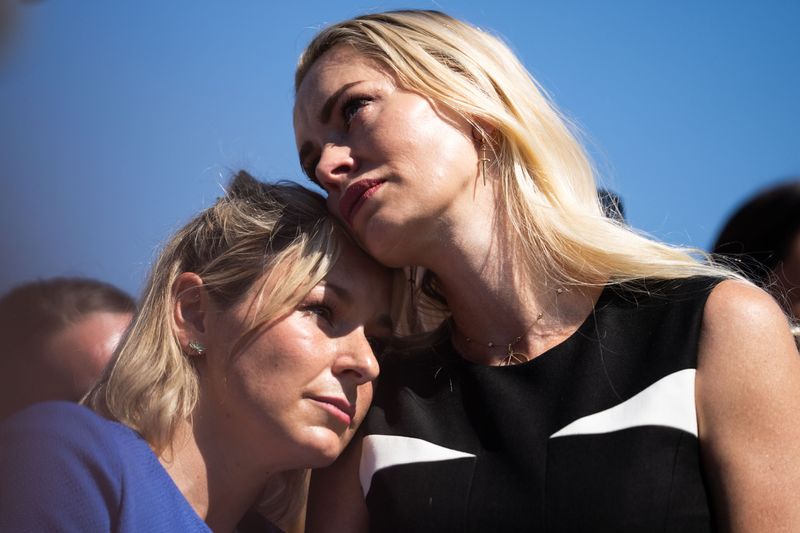
Danielle Bensky (left) and Anouska De Georgiou, victims of convicted sex offender Jeffrey Epstein, embrace during a news conference in Washington, D.C., in September.
A separate video showed Trump and Epstein partying at Mar-a-Lago, while Trump patted a woman on her behind. In 2023, a jury found Trump liable for sexually abusing a woman.
Everyone knew Trump was a lout, but more than 77 million Americans, including millions of women, voted for him anyway. And the Republicans in Congress have dutifully stood by him for years, bringing repeated shame to themselves and the country.
During last year’s election campaign, Trump used the Epstein files to stoke conspiracies and rally his supporters. He promised to release the files if elected, but after returning to the White House, called them a hoax.
(Trump also promised to lower prices, but that is a separate editorial, just as is his promise to end the war in Ukraine in one day.)
After mounting pressure from his base, and a 427-1 House vote last month to release the Epstein files, Trump ultimately signed a bill to make them public by Dec. 19.
The deadline passed, and all the files have yet to come out. Expect more gamesmanship and Truth Social rants.
The Epstein saga is a microcosm of Trump’s modus operandi. Lie, steal, cheat. Deny, deflect, delay, and degrade. Blame, complain, pressure, and sue. Line pockets whenever possible. Always overpromise and underdeliver.
Truth, honesty, humility, compassion, or responsibility are nowhere to be found.
Trump’s sinking poll numbers indicate that many supporters are finally catching on. The midterms loom, but so does three more years of hell.
But could the end of our long national nightmare be near?
WASHINGTON — The Trump administration said Monday it is pausing leases for five large-scale offshore wind projects under construction in the East Coast due to unspecified national security risks identified by the Pentagon.
The pause is effective immediately and will give the Interior Department, which oversees offshore wind, time to work with the Defense Department and other agencies to assess the possible ways to mitigate any security risks posed by the projects, the administration said.
“The prime duty of the United States government is to protect the American people,” Interior Secretary Doug Burgum said in a statement. “Today’s action addresses emerging national security risks, including the rapid evolution of the relevant adversary technologies, and the vulnerabilities created by large-scale offshore wind projects with proximity near our east coast population centers.”
The administration said leases are paused for the Vineyard Wind project under construction in Massachusetts, Revolution Wind in Rhode Island and Connecticut, Coastal Virginia Offshore Wind, and two projects in New York: Sunrise Wind and Empire Wind.
The Interior Department said unclassified reports from the U.S. government have long found that the movement of massive turbine blades and the highly reflective towers create radar interference called “clutter.” The clutter caused by offshore wind projects obscures legitimate moving targets and generates false targets in the vicinity of wind projects, the Interior Department said.
The action comes two weeks after a federal judge struck down President Donald Trump’s executive order blocking wind energy projects, saying the effort to halt virtually all leasing of wind farms on federal lands and waters was “arbitrary and capricious” and violates U.S. law.
Judge Patti Saris of the U.S. District Court for the District of Massachusetts vacated Trump’s Jan. 20 executive order blocking wind energy projects and declared it unlawful.
Saris ruled in favor of a coalition of state attorneys general from 17 states and Washington, D.C., led by New York Attorney General Letitia James, that challenged Trump’s Day One order that paused leasing and permitting for wind energy projects.
An internal CBS News battle over a “60 Minutes” story critical of the Trump administration has exploded publicly, with a correspondent charging it was kept off the air for political reasons and news chief Bari Weiss saying Monday the story did not “advance the ball.”
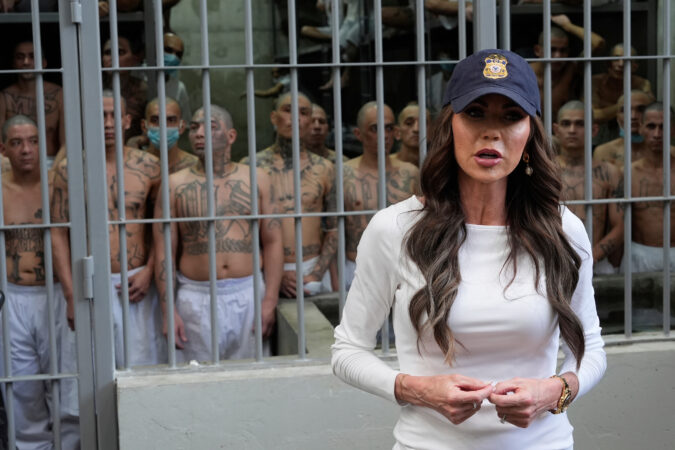
Two hours before airtime Sunday, CBS announced that the story where correspondent Sharyn Alfonsi spoke to deportees who had been sent to El Salvador’s notorious CECOT prison, would not be a part of the show. Weiss, the Free Press founder named CBS News editor-in-chief in October, said it was her decision.
The dispute puts one of journalism’s most respected brands — and a frequent target of President Donald Trump — back in the spotlight and amplifies questions about whether Weiss’ appointment was a signal that CBS News was headed in a more Trump-friendly direction.
Alfonsi, in an email sent to fellow “60 Minutes” correspondents said the story was factually correct and had been cleared by CBS lawyers and its standards division. But the Trump administration had refused to comment for the story, and Weiss wanted a greater effort made to get their point of view.
“In my view, pulling it now after every rigorous internal check has been met is not an editorial decision, it is a political one,” Alfonsi wrote in the email. She did not immediately respond to requests for comment from The Associated Press.
Alfonsi said in the email that interviews were sought with or questions directed to — sometimes both — the White House, State Department and Department of Homeland Security.
“Government silence is a statement, not a VETO,” Alfonsi wrote. “Their refusal to be interviewed is a tactical maneuver designed to kill the story. If the administration’s refusal to participate becomes a valid reason to spike a story, we have effectively handed them a ‘kill switch’ for any reporting they find inconvenient.”
“Spike” is a journalist’s term for killing a story. But Weiss, in a statement, said that she looked forward to airing Alfonsi’s piece “when it’s ready.”
Speaking Monday at the daily CBS News internal editorial call, Weiss was clearly angered by Alfonsi’s memo. A transcript of Weiss’ message was provided by CBS News.
“The only newsroom I’m interested in running is one in which we are able to have contentious disagreements about the thorniest editorial matters with respect and, crucially, where we assume the best intent of our colleagues,” Weiss said. “Anything else is completely unacceptable.”
She said that while Alfonsi’s story presented powerful testimony about torture at the CECOT prison, The New York Times and other outlets had already done similar work. “To run a story on this subject two months later, we need to do more,” she said. “And this is ‘60 Minutes.’ We need to be able to get the principals on the record and on camera.”
It wasn’t clear whether Weiss’ involvement in seeking administration comment was sought. She reportedly helped the newscast arrange interviews with Jared Kushner and Steve Witkoff this past fall to discuss Trump’s Middle East peace efforts. Trump himself was interviewed by Norah O’Donnell on a “60 Minutes” telecast that aired on Nov. 2.
Trump has been sharply critical of “60 Minutes.” He refused to grant the show an interview prior to last fall’s election, then sued the network over how it handled an interview with election opponent Kamala Harris. CBS’ parent Paramount Global agreed to settle the lawsuit by paying Trump $16 million this past summer. More recently, Trump angrily reacted to correspondent Lesley Stahl’s interview with Trump former ally turned critic Marjorie Taylor Greene.
“60 Minutes” was notably tough on Trump during the first months of his second term, particularly in stories done by correspondent Scott Pelley. In accepting an award from USC Annenberg earlier this month for his journalism, Pelley noted that the stories were aired last spring “with an absolute minimum of interference.”
Pelley said that people at “60 Minutes” were concerned about what new ownership installed at Paramount this summer would mean for the broadcast. “It’s early yet, but what I can tell you is we are doing the same kinds of stories with the same kind of rigor, and we have experienced no corporate interference of any kind,” Pelley said then, according to deadline.com.
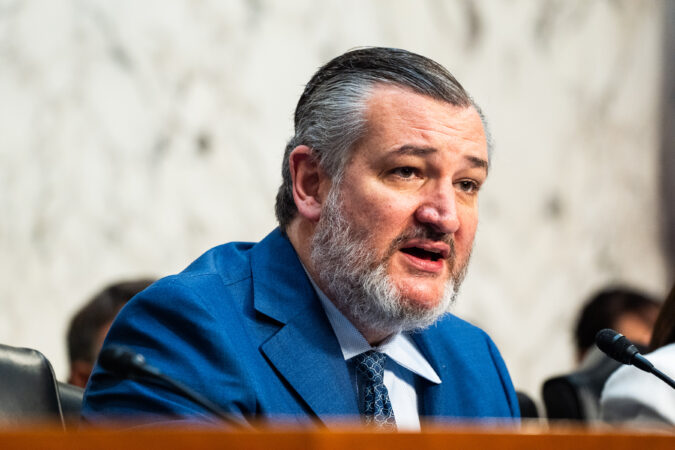
Sen. Ted Cruz sat down with a longtime ally in November at an office near D.C.’s Union Station to discuss the future of the Republican Party. Before long, the discussion touched on his own future.
His friend Morton Klein, president of the Zionist Organization for America, told Cruz he believed that “Jew hatred and Israel bashing” was on the rise on the right — and that something had to be done about it. Cruz, who had begun a series of speeches decrying antisemitism in the GOP, told Klein he had been fielding requests from people urging him to run for president in 2028.
Cruz came across as someone “seriously” considering such a run, Klein recalled.
With the future of the party up for grabs in a Donald Trump-less 2028 primary, Cruz has in recent months positioned himself as a loud voice for a more traditional, hawkish Republican foreign policy. He’s also urging the GOP to rid itself of popular MAGA pundit Tucker Carlson, whom he argues is injecting the “poison” of antisemitism into the movement with his broadsides against Israel. Carlson has rejected that characterization.
As he feuds with Carlson, Cruz is weighing a second presidential bid, according to a person close to the senator and another briefed on his thinking, who spoke like others on the condition of anonymity to disclose internal conversations. A White House run would be politically risky for Cruz, 55, putting him on course to collide with Vice President JD Vance, who many Republicans expect to enter the 2028 race.
Friction is already evident behind the scenes: Cruz has criticized Vance, a close ally of Carlson, to Republican donors, according to two people familiar with the comments. The senator has warned that Vance’s foreign policy views are dangerously isolationist, the people said.(Vance has been one of the GOP’s most prominent skeptics of U.S. intervention abroad.)
The emerging rivalry shows how much the party has changed under Trump’s leadership since Cruz arrived in the Senate in 2013. After rising to prominence as a rebel against the establishment, Cruz is now a vocal champion of some longtime orthodox GOP positions, as a new generation of conservatives is ascending with a different vision.
Some political observers are skeptical that another Cruz run would gain much traction. He can no longer run as an outsider and alienated some conservatives with his fight against Trump in the 2016 campaign. Still, Cruz has built name recognition and relationships with plenty of activists and donors across the country in recent years, and it’s far from clear what will animate the base in the next GOP primary.
“Can Ted help craft or meld together the traditional Republican approach with the new reality of what the Republican Party is now?” asked Daron Shaw, a political science professor at the University of Texas who overlapped with Cruz as a staffer on George W. Bush’s presidentialcampaign. “It’s a heavy lift.”
The day after his chat with Klein, Cruz called Carlson “a coward” during a speech before a group supporting Jewish conservatives in Las Vegas, again denouncing the “poisonous lies” of antisemitism. He said they were “blessed” to have Trump, who “loves the Jewish people,” in the White House right now.
“When Trump is not in the White House, what then?” he asked in his booming voice.
“Ted Cruz!” an audience member shouted.
The senator just smiled, then continued his speech.
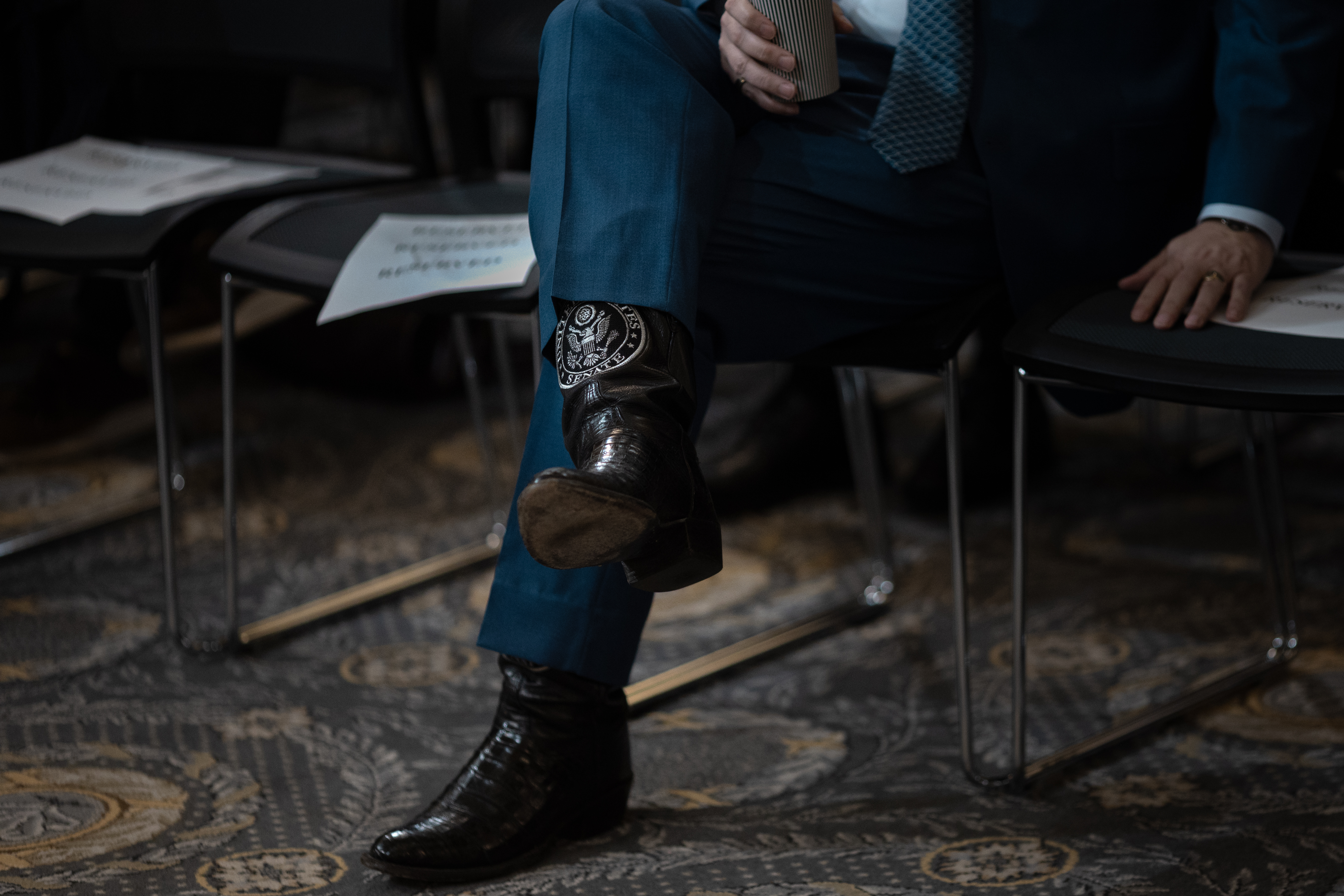
Sen. Ted Cruz (Texas) wears Senate-themed boots in May at the Capitol.
‘All of us hate Ted Cruz’
Anyone considering a run for the GOP nomination in 2028 faces a big obstacle: Vance.
The 41-year-old vice president leads early polls and is seen as a loyal lieutenant to Trump, who maintains high support from the party base even as the president’s approval ratings have plummeted.
But Trump has been noncommittal about endorsing his running mate as heir to his Make America Great Again movement, leaving an opening for an ambitious conservative with a different vision for the party.
“The Republicans will be fighting for their identity,” Rep. Marjorie Taylor Greene (R-Georgia) said of the 2028 primary. Greene, a close ally of Carlson who represents the populist and isolationist wing of the party, added: “There’ll be Ted Cruz, I’m sure, running against JD Vance. All of us hate Ted Cruz.”
Cruz has adapted to changes in his party over several decades in politics. Following a stretch in the establishment during Bush’s 2000 campaign, he became solicitor general of Texas in 2003 and launched a Senate campaign in 2011 as a tea-party-infused change agent, defeating the lieutenant governor in the GOP primary.
“The best thing to happen to the Republican Party was to get its teeth kicked in in 2008,” Cruz said during a 2012 campaign event with the libertarian Ron Paul.
When he arrived in Washington, Cruz picked fights over spending and President Barack Obama’s health care law, sparking a government shutdown in 2013. Not everyone in his party liked his style. “If you killed Ted Cruz on the floor of the Senate, and the trial was in the Senate, nobody could convict you,” Sen. Lindsey Graham (R-South Carolina) joked at a 2016 press dinner.
Cruz brought his insurgent pitch into the 2016 presidential race, but Trump caught fire with an antiestablishment campaign that dramatically eclipsed the senator’s. After bowing out of the GOP race as the last major Trump opponent standing, Cruz told delegates at the Republican National Convention that year to “vote your conscience,” instead of throwing his support behind Trump, who had branded him as “Lyin’ Ted.” He returned to the Senate, where he is now chair of the Commerce Committee and has refashioned himself into a bipartisan dealmaker on aviation safety and other issues.
The Texas senator, who has called himself a “noninterventionist hawk” and has long been a vocal ally of Israel, argues that an anti-Israel foreign policy could embolden terrorists. And he is a defender of the benefits of traditional capitalism at a time when some in the “New Right” are calling for a more populist turn.
“Those who are anti-Israel quickly become anti-capitalist and anti-American,” Cruz said in a brief interview about his decision to speak out against Carlson. “Tucker’s obsession is unhealthy and dangerous.”
By targeting Carlson and growing anti-Israel sentiment within the party, Cruz has hit upon a division within the GOP base that some believe could animate the 2028 primaries. Carlson is closely allied with Vance, a onetime Trump critic who is now an “America First” populist, embracing skepticism of some big-business interests and rejecting the U.S. foreign policy status quo.
Cruz is staking out positions against isolationism and antisemitism at a time when explicitly antisemitic figures such as white supremacist commentator Nick Fuentes are gaining an audience on the right.
Vance, by contrast,has rejected the suggestion that the right has a problem with antisemitism afterCarlson hosted Fuentes for a friendly interview. (The vice president disavowed Fuentes months before the interview and has not explicitly weighed in on Carlson hosting him.)
It’s “kind of slanderous to say that the Republican Party, the conservative movement, is extremely antisemitic,”Vancesaid in a recent interview with NBC News. In a social media postlast week, Vance criticized a news article claiming antisemitism was rising among young people.
“I would say there’s a difference between not liking Israel (or disagreeing with a given Israeli policy) and antisemitism,” he replied to one user.
Asked to respond to Vance’s comment, Cruz said he is not in agreement with “people who are anti-Israel or people who are antisemitic.”
“Every Hamas or Hezbollah or IRGC terrorist that Israel took out makes Americans safer,” Cruzsaid, referencing militants in Gaza, Lebanon and Iran that the United States designates as terrorist groups. “And those who don’t see that are not acting in accordance with American national security interests.”
The feud
In early July, Cruz sat down in Washington with Israel’s prime minister and delivered a dire warning. Over cigars at Blair House, Cruz told Benjamin Netanyahu that antisemitism on the right was rising to a level he had never seen before.
“No, Ted,” Netanyahu responded, according to Cruz, who recounted the conversation in a speech. “That’s Qatar, that’s Iran, that’s astroturf, that’s paid for.”
But Cruz said he was not placated. Replies to his social media posts were flooded with anti-Jewish bigotry from what looked to him like ordinary, real people. He began to fear that what he saw as antisemitism on the left was beginning to infect the right, he said.
In June, Cruz sat for an interview with Carlson that grew heated over the topic of Israel. Cruz suggested that Carlson criticizes Israel more than other countries because of bigotry toward Jews. Carlson said he has many Jewish friends who have the same questions as him and grilled Cruz with factual questions on the Middle East. In an uncharacteristic lapse, Cruz failed to identify the population of Iran. “You don’t know the population of the country you seek to topple?” Carlson asked.
Since then, the two have savaged each other in increasingly personal terms. Carlson has called Cruz “vulgar and dumb and reckless” for connecting U.S. military support for Israel to a biblical responsibility to defend the Holy Land and God’s chosen people. After Carlson hosted Fuentes on his podcast this fall, Cruz called on Republicans to repudiate the pundit.
Carlson “decided Jews are the source of all evil in the world,” Cruz said in a recent podcast. The senator also posted a digitally altered sexually suggestive photo of Carlson to critique his friendly stance toward Qatar, a U.S. ally with which Israel has clashed.
Since the killing of conservative influencer Charlie Kirk, internal battles about the future of the GOP have spilled into the open, many centering on the true meaning of “America First” as Trump spends time and political capital on Ukraine, Israel and Venezuela. Carlson criticized Trump’s decision to strike Iran’s nuclear sites in June and has warned the president against pursuing regime change in Venezuela, a goal Cruz shares.
“What Ted is trying to do is say, this is where our voters are,” said one person close to the senator. “Trump and Ted are much more aligned on foreign policy than Trump and Tucker are.”
Few Republicans have publicly rallied to Cruz’s side.
“I can tell you, my colleagues, almost to a person, think what is happening is horrifying,” Cruz said in one speech on Carlson. “But a great many of them are frightened because he has one hell of a big megaphone.”
Rep. Dan Crenshaw (R-Texas) said he “applauds” Cruz for speaking out against Carlson. But others declined to weigh in.
Sen. Tommy Tuberville (R-Alabama), a close Trump ally, said he believes the back-and-forth is personal. “Sometimes when you get embarrassed, you get mad, get your feelings hurt,” he said.
Sen. Richard Blumenthal (D-Connecticut) said he is surprised but happy that Cruz has the “courage” to challenge such a powerful figure on the right. “To give Senator Cruz due credit, it requires some guts and gumption to stand up against Tucker Carlson,” he said.
As Carlson and Cruz have attacked each other, Trump has declined to take sides, calling Carlson a “nice guy” and Cruz a “good friend” in recent months.
Carlson has said he thinks “antisemitism is immoral, and I am against it.” He argues the feud is just politics. “All [Cruz] wants is to be president. That’s all he’s ever wanted,” Carlson said in an interview. “As a political matter, he somehow thinks that calling me a Nazi is going to get him the nomination because it’s going to hurt JD Vance.” (Cruz has not publicly used that word to described Carlson.)
Rep. Ryan Zinke (R-Montana), who argued that Cruz damaged his credibility with conservatives after spurning Trump in 2016 but later recovered his standing, said Cruz “always has an eye on running.”
“Ted stakes out his position pretty well, and so were he to run, we know where he is,” Zinke said.
So far, there are few signs that Cruz is gaining an advantage. Hal Lambert, a major GOP donor who helped organize a super PAC to support Cruz when he ran for president in 2016, said he thinks a 2028 bid would be tricky for the senator.
“If JD Vance is running, I’m going to be supporting JD Vance,” Lambert said.
“I just don’t understand what the platform would be,” he said of Cruz’s potential run. “The platform would be, I’m Ted, and that’s JD?”
Kadia Goba and Sarah Ellison contributed to this report.
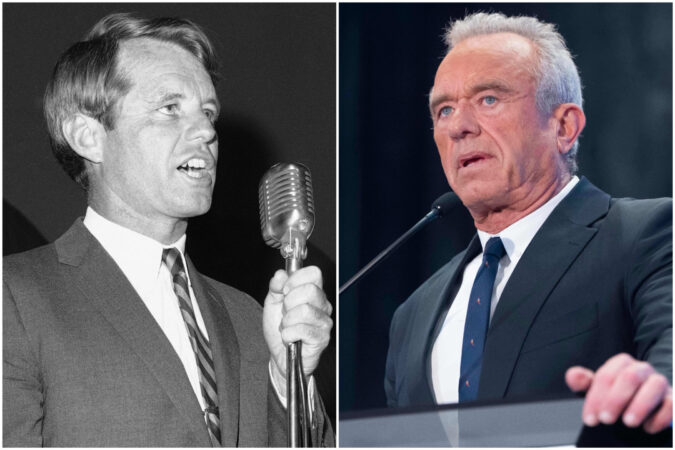
I find it impossible, like many my age, to think of Robert F. Kennedy Jr. without thinking about his father.
It isn’t easy. Considering the late Attorney General Robert Kennedy and his son together requires a leap of memory but a far larger one of faith.
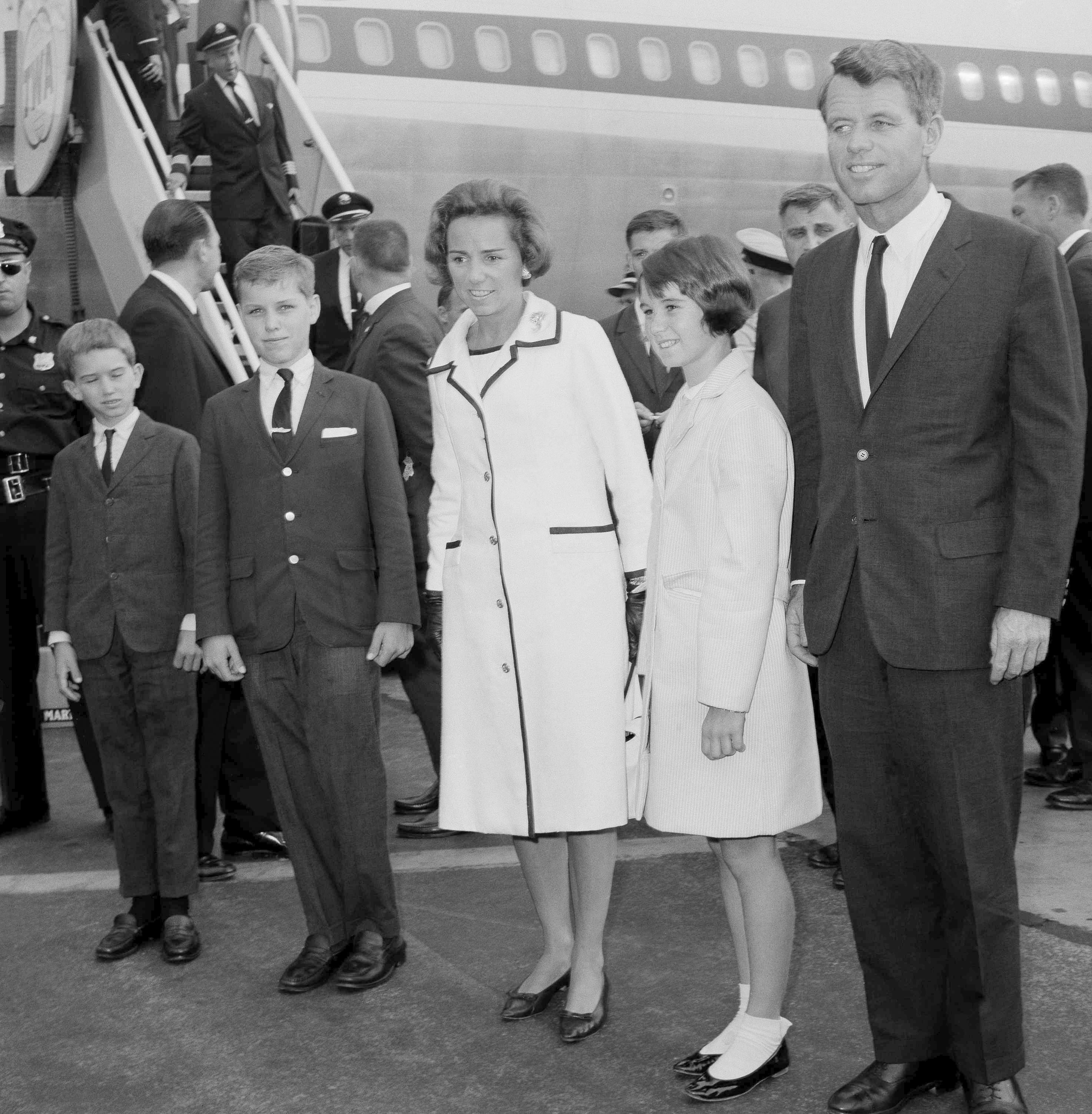
Attorney General Robert F. Kennedy, right, wife Ethel Kennedy, and children, from left, Bobby, Joseph, and Kathleen, second right, at Kennedy International Airport in New York, July 1, 1964, shortly after they returned from a one-week trip to West Germany and Poland.
Bobby Kennedy sought unity. His son, the secretary of Health and Human Services, is part of the same Donald Trump team that sells national division on every possible front.
Americans of an older generation recall watching the funeral train back in 1968 that carried Sen. Robert F. Kennedy’s body from New York’s St. Patrick’s Cathedral to Washington, where he would join his brother already interred in Arlington Cemetery.
Sen. Edward Kennedy, back, pauses at the grave of assassinated President John F. Kennedy in Arlington National Cemetery, Nov. 20, 1970, with his wife Joan, right. With them are the widow of former Sen. Robert F. Kennedy, Ethel Kennedy, and her five children.
All along the tracks we saw the faces, white and Black, of working people for whom Bobby Kennedy held such promise. His presidential candidacy in 1968 meant an end to the brutal American conflict in Vietnam, an economic shift in our country’s wealth from the war in Southeast Asia to the dire needs of our major cities.
That June Saturday offered none of the pageantry of President Kennedy’s death five years earlier. There were no marching bands, no riderless cavalry horse, no President Charles de Gaulle or Haile Selassie, no heroic “Day of Drums.”
“Senator Robert Kennedy died at 1:44 this morning … June 6, 1968 … He was 42 years old.”
Kennedy had made his name as a U.S. attorney general fighting for civil rights. He took on Deep South governors to desegregate Ole Miss and the University of Alabama. He pushed his brother behind the scenes, to give the historic Civil Rights speech of 1963.
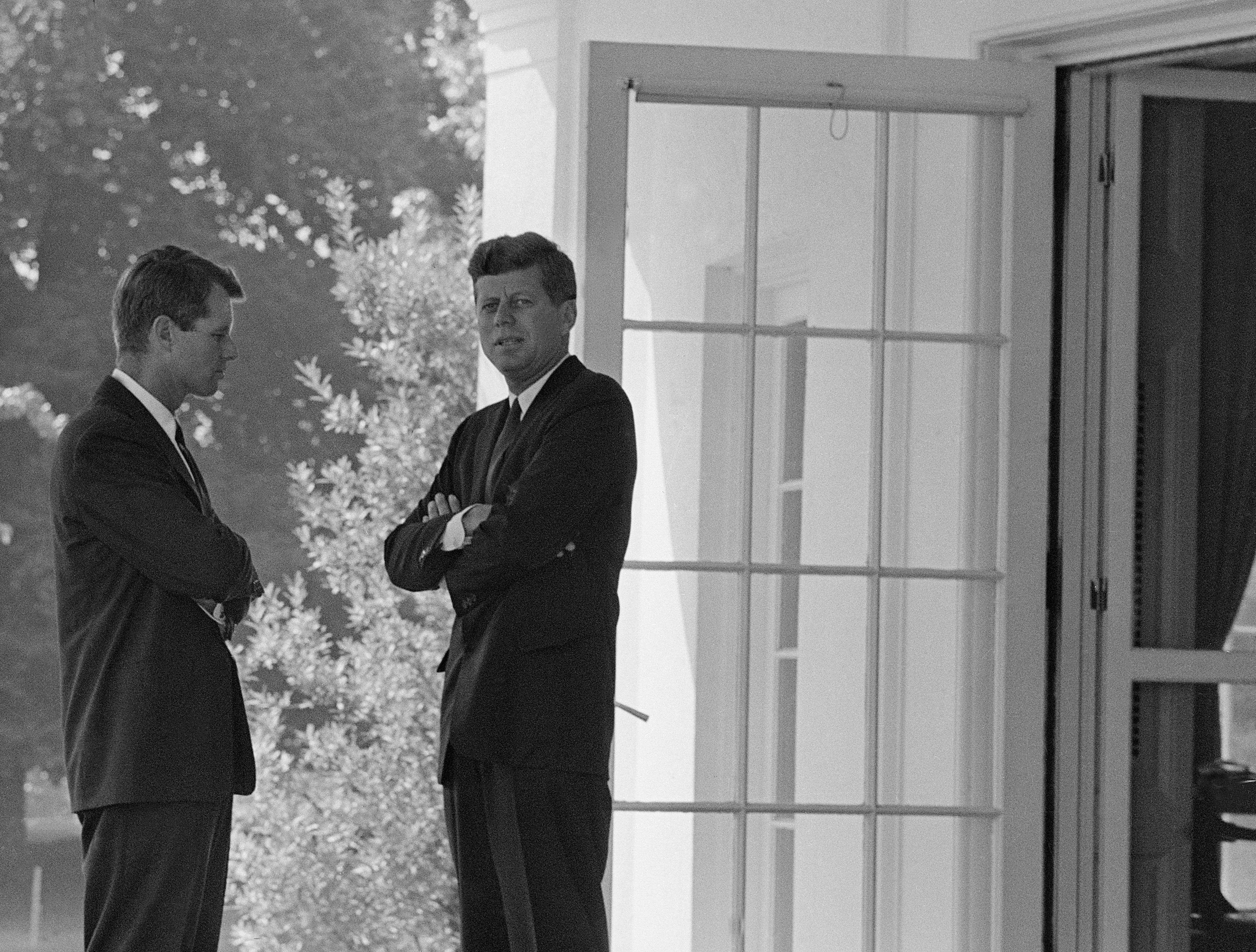
U.S. President John F. Kennedy, right, confers with his brother Attorney General Robert F. Kennedy at the White House in Washington, D.C., on Oct. 1, 1962, during the buildup of military tensions between the U.S. and the Soviet Union that became the Cuban missile crisis later that month.
But what made him unique, as New York columnist Jack Newfield once wrote, was that he “felt the same empathy for white working men and women that he felt for Black, Latino, and Native American working men and women. He thought of police officers, waitresses, construction workers, and firefighters as his people.”
Bobby made a call for racial unity a part of his 1968 presidential campaign.
In the Indiana primary, he rode through the streets of Gary in an open convertible, Richard Hatcher (the city’s first African American mayor) on one side, Tony Zale, the middleweight boxing champ, so popular with the city’s white working people, on the other.
“I have an association with those who are less well off, where perhaps we can accomplish something: bringing the country together.
“I think we can end the divisions within the United States — whether it’s between Blacks and whites, between the poor and the more affluent, or between groups on the war in Vietnam. We can start to work together. We are a great country, an unselfish country. I intend to make that my basis for running,” Robert Kennedy said after winning the California Democratic Primary in 1968, minutes before his assassination.
Sen. Edward M. Kennedy waves from the rear platform of the observation car bearing the remains of his slain brother, Sen. Robert F. Kennedy, as the funeral train passed through North Philadelphia Station, June 8, 1968. Others on the platform are unidentified.
And these were the very people who showed up for Bobby when his funeral train passed through Newark and Trenton and Philadelphia and Baltimore that grim Saturday in June.
Stepping out of my apartment building, a neighbor stopped me to say he was sorry for the Islamophobia he felt circulating lately in Donald Trump’s America.
At the post office, the man behind the counter asked if I could write “Happy Holidays” in Arabic for a sign he wanted to hang. I wrote it carefully, conscious of my uneven hand. He thanked me and taped it up. I hope the small sign does its modest work, easing someone without calling attention to itself, doing what such gestures often do best when they pass quietly.
At the bus station, a large man asked to borrow my phone. When he handed it back, he asked where I was from. I said Egypt. He swore, laughed, and spoke with me for a few minutes about the world, about worry, about what people owe one another. Before boarding, he offered a blessing.
These moments remind me how relatively easy my passage as an immigrant has been.
I have not encountered violence directly. What I have met, mostly, is ignorance, and even that only recently.
I have rarely felt compelled to take it personally. I tend to think that most people would not speak as they do if their lives had widened just enough to complicate what they take for granted, if familiarity had been allowed to interrogate fear.
That belief comes from observation over decades and across cultures. People are rarely changed by argument alone. They are altered by proximity, by repeated exposure to what does not confirm the story they have been told about others or about themselves. Knowledge and kindness work slowly. They loosen bias and false certainty by degrees.
I carry sorrow for the violent pain and murderous ignorance that continue to surface where I come from, and far beyond it. The point is not to rank suffering or distribute blame. The point is recognition: We are capable of living far better than we do.
After the recent mass shooting at a Hanukkah celebration at Bondi Beach in Sydney, where 15 people were killed, a Muslim man, Ahmed al Ahmed, intervened by tackling and disarming one of the attackers. He was shot twice in the process and is credited with saving lives. Past narrow religious allegiances, this was a human refusal to stand aside.
In this photo released by the Prime Minister’s office, Australian Prime Minister Anthony Albanese meets Ahmed al Ahmed at St George Hospital in Sydney on Dec. 16.
That matters, because it interrupts the story we are encouraged to believe about what people inevitably are.
In recent months, reported incidents of anti-Muslim harassment and threats have risen across the country, echoing what many Americans are experiencing in daily life.
Living in the United States for nearly two decades, I am well aware that this country has inflicted violence both inside its borders and far from its shores, for generations, often while renaming it, often while insisting on its necessity.
Any serious reckoning with this asks more of us than explanations shaped for a news cycle.
It asks for patience, attention, and the willingness to trace continuities rather than isolated events. It asks us to notice how harms travel, and how language perpetuates those harms. It asks us to notice how easily whole communities are reduced to headlines, faiths are flattened into caricature, and violence becomes explanatory shorthand.
When we make others suffer, we do not escape the damage. We carry it, often without knowing how it has narrowed us.
But none of this survives sustained attention. What does endure are the small acts that refuse the terms we are handed and the gestures that loosen suspicion.
Goodness is practiced. It appears in ordinary exchanges.
In the traditions that have shaped my thinking, love is not postponed until some imagined future. Mercy is learned here, among people who misunderstand one another, who arrive carrying inherited fear, who fail but try again.
Decency is possible. I encountered it on the street, from ordinary people who spoke plainly and put distance between the human being and the headlines.
As a discipline of perception, it is worth the effort to try to see the Divine in everyone. Much depends on the effort, repeated daily, without witnesses.
Yahia Lababidi is an Egyptian-American writer and poet, the author of 12 books, including Palestine Wail: Poems. His work has appeared in World Literature Today, The New Arab, NPR, and PBS.
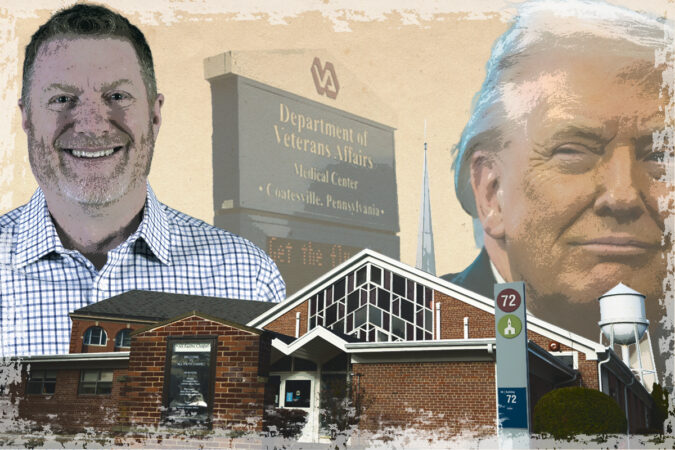
Russell “Rusty” Trubey said he was compelled by God to preach the words that helped set off a national battle over religion at the U.S. Department of Veterans Affairs.
Reading from a sermon titled“When Culture Excludes God,” Trubey, an Army Reserve chaplain, sermonized to a congregation of veterans at the Coatesville VA Medical Center from a Bible passage — Romans 1:23-32 — that refers to same-sex relationships as “shameful.”
Some congregants, upset by the sermon, walked out of the June 2024 service at the Chester County facility, where Trubey has been employed for roughly 10 years. Soon after, Trubey’s lawyers said he was temporarily pulled from his assignment — and transferred to stocking supply shelves — while his supervisors investigated his conduct.
Speaking to Truth and Liberty, a Christian group that advocates for the church to play a greater role in the public sphere, Trubey said he knows that reading the Bible verses about same-sex relationships is “100%” the reason he got in trouble.
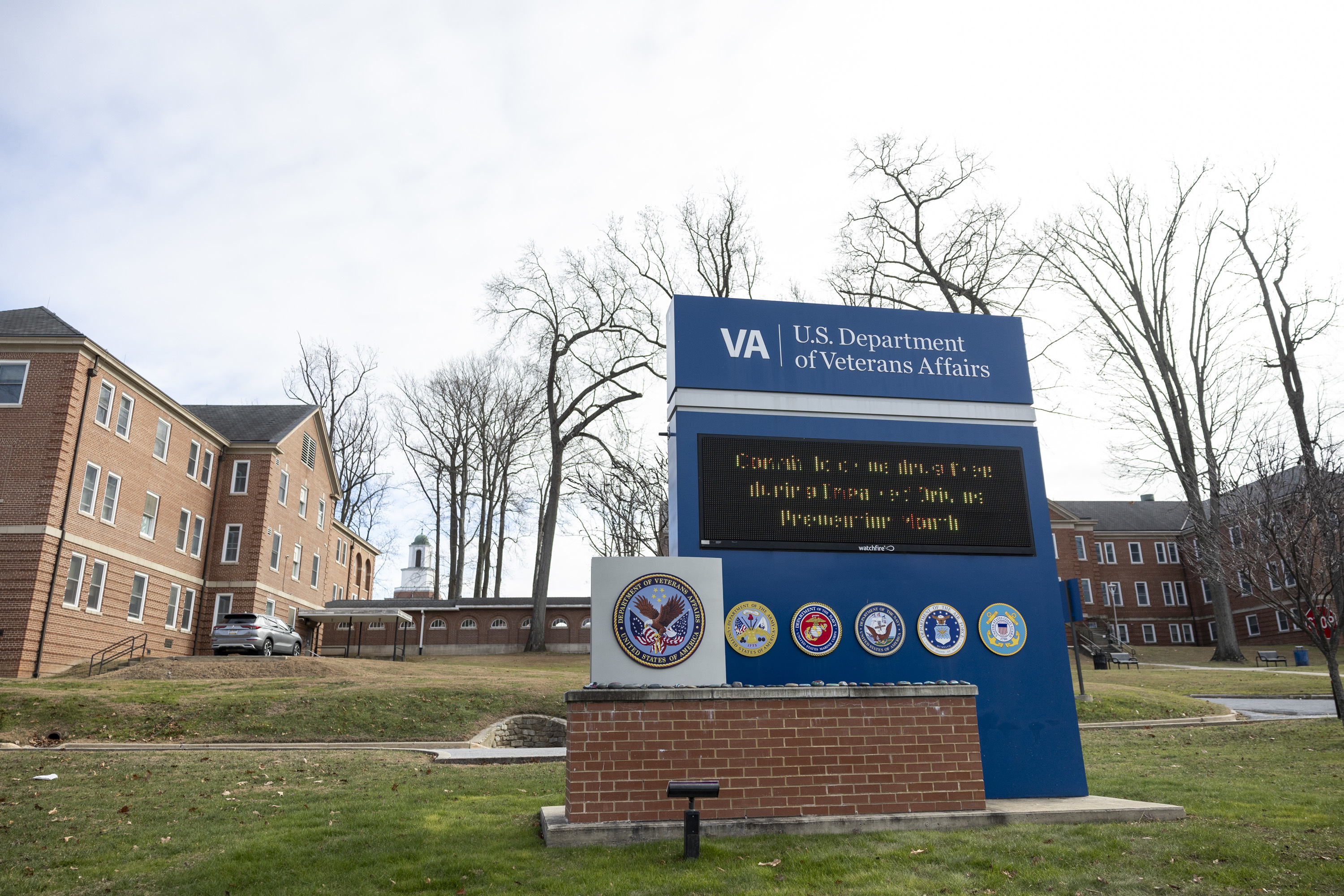
One of the entrances leading into Coatesville VA Medical Center.
A month earlier, Trubey’s lawyers had taken hiscase to the White House. In a letter sent a few weeks after President Donald Trump’s inauguration, Trubey’s lawyers asked Trump’s VA secretary, Doug Collins, to interveneon Trubey’s behalf in regard to repercussions for the sermon.
Trubey had delivered the talk during former President Joe Biden’s administration — an environment that Trump officials allege was hostile to Christians.
In the letter, the chaplain’s lawyers from the First Liberty Institute and Independence Law Center accused Trubey’s supervisor of wanting sermons to be screened ahead of time for pre-approval and stated that Trubey received a letter of reprimand, which would later go on to be rescinded by Coatesville VA Medical Center officials.
Soon after the lawyers’ letter reached the new administration, the VA, one of the largest federal employers in Pennsylvania, reinstated Trubey to his position and Collins reaffirmed that chaplains’ sermons would not be censored.
But the fallout from this incident — paired with Trump’s ongoing campaign to root out perceived prejudice against Christians and dismantle diversity, equity, and inclusion — left an undeniable mark on the VA, helping to inspire an agencywide “Anti-Christian Bias Task Force.”
Announced to employees in April 2025, the task force asks employees to report offenses such as “reprimand issued in response to displays of Christian imagery or symbols,” per a department email reviewed by The Inquirer.
And the VA wants names.
In the email, the VA encouraged employees to identify colleagues and workplace practices that violate the policy and send information about the alleged offenses to a dedicated email address. The announcement was in accordance with a Trump executive order from February that ordered federal agencies to “eradicate” anti-Christian bias and create a larger White House task force composed of cabinet secretaries and chaired by Attorney General Pam Bondi.
As of this summer, the VA received more than 1,000 reports of anti-Christian bias and reviewed 500, according to task force documents. Another report is expected in February.
Some of the offenses the VA is on the watch for could be especially pertinent during the holiday season when workers may want their faith represented at their desks.
One union leader at the Veterans Benefits Administration office in Philadelphia called the task force, which does not extend to biases against other religions, “McCarthyism for Christians.”
“What they’re really doing is they’re trying to create a hostile work environment where you’re now afraid to say something because you may be reported,” said the union representative weeks after the VA’s task force announcement. The representative asked to speak anonymously out of fear of workplace retaliation.
The VA said in a statement that the department is “grateful” for Trump’s executive order. The VA did not answer The Inquirer’s questions on an updated number of reports received through the task force, what happens to people or practices that are reported, and next steps of the task force.
“As the EO stated, the prior administration ‘engaged in an egregious pattern of targeting peaceful Christians, while ignoring violent, anti-Christian offenses,’” said VA press secretary Pete Kasperowicz in the statement. “Under President Trump, VA will never discriminate against Veterans, families, caregivers or survivors who practice the Christian faith.”
One of those offenses, as outlined by the VA, is “informal policies, procedures, or unofficial understandings hostile to Christian views.” Another is retaliation against chaplains’ sermons, which appears to be in responseto the Trubey incident from June 2024.
Erin Smith, associate counsel at the First Liberty Institute, who helped represent Trubey said: “If Chaplain Trubey’s story serves as inspiration to help protect the rights of all chaplains in the VA, then that is a wonderful thing to come out of a terrible situation.”
But some VA employees disagree.
Ira Kedson, president of AFGE Local 310, which represents employees at the Coatesville VA Medical Center, said in an interview in June that he heard some employees were “deeply troubled” by the incident with Trubey, especially those who worked in clinical settings with patients who were in attendance of the controversial sermon.
“I was told that some of the residents were deeply hurt and deeply troubled by the situation and it took a long time for them to be able to move past it,” Kedson said.
Religion takes center stage in the Trump administration
Trump is leading what is arguably one of the most nonsecular presidencies in modern United States history with his embrace of a loyal, conservative Christian base.
“We’re bringing back religion in our country,” Trump said at the Rose Garden during the National Day of Prayer in May.
And efforts to elevate religion in the public sphere have gone beyond Trump’s rhetoric. For instance, the Office of Personnel Management, the federal government’s human resources agency, issued guidance that aims to protect religious expression in the workplace for all religions.
Most of the reports submitted to the VA focused on “denying religious accommodations for vaccines and provision of abortion services; mandating trainings inconsistent with Christian views; concealing Christian imagery; and Chaplain program and protections for Chaplains,” according to task force documents.
Doug Collins at his Jan. 21 confirmation hearing before the Senate Veterans’ Affairs Committee, at the Capitol in Washington.
Charles Haynes, senior fellow for religious liberty at the Freedom Forum, a nonpartisan organization based in Washington that promotes First Amendment rights, said while it’s not unconstitutional or unprecedented to createa faith-specific task force, “the appearance of [the Christian-bias task force], to many people, is a favoritism of the government for one group over another.”
The White House, in a statement, said Trump has a record of defending religious liberty regardless of faith.
“President Trump has taken unprecedented action to fight anti-Christian, anti-Semitic, and other forms of anti-religious bias while ending the weaponization of government against all people of faith,” said White House spokesperson Taylor Rogers in an email to The Inquirer.
Furthermore, she added, that the media is doing “insane mental gymnastics to peddle a false and negative narrative about the President’s efforts on behalf of nearly 200 million Christians across the country.”
Identifying anti-Christian bias or chasing a ‘unicorn’?
The Trump administration has shared few details about the operations and goals of the anti-Christian bias task force, raising questions from lawmakers and other stakeholders.
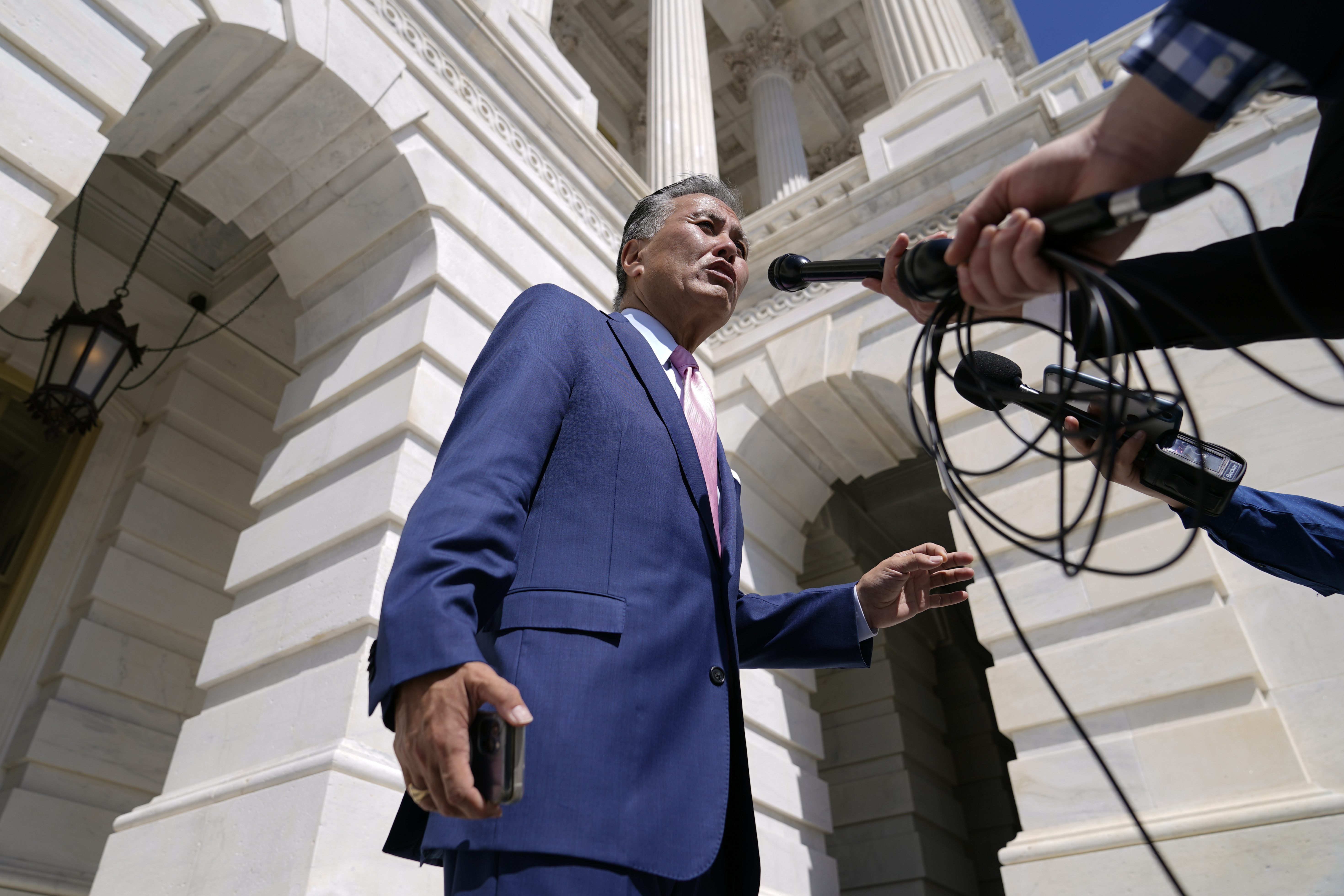
Rep. Mark Takano, the ranking member of the House Committee on Veterans’ Affairs, was in a monthslong back-and-forth with VA Secretary Collins, trying to get answers to an extensive list of questions he initially sent in May, with the California Democrat particularly concerned that the scope of the initiative is limited to bias against Christians.
“To preserve this right to religious freedom, the Department cannot prioritize one faith over others, nor can it allow religious considerations to shape its policies in ways that may conflict with the First Amendment,” Takano wrote in May. “Further, the vagueness of the task force’s mission raises significant concerns about how it will be used and whether it is compatible with the mission of the Department.”
Collins responded in June and did not answer most of Takano’s questions, though he did saythat the task force, which reports to the secretary, will identify, strategize, and potentially alter any policies that discriminate against Christians or religious liberty.
The lawmakerfollowed up a week later. Roughly four months later, in October, Collins’ responses were vague once again.Most recently, Takano is asking for both Democratic and Republican members of the House and Senate’s Veterans’ Affairs Committees to be looped in on future correspondence regarding the task force.
The VA, according to a statement from Takano, has not fully answered their questions and has refused to host a bipartisan briefing.
“The lack of transparency and accountability of this task force leaves me with numerous concerns for the due process and privacy of hardworking VA employees,” Takano said. “VA’s silence won’t stop us from asking the questions we are constitutionally obligated to ask.”
Rep. Mark Takano (D., Calif.) in August 2022, on Capitol Hill in Washington. Takano, ranking member of the House Committee on Veterans’ Affairs, has been trying to get answers from the VA on the Anti-Christian Bias Task Force.
Michael L. “Mikey” Weinstein, former counsel for the Reagan administration turned founder and president of the Military Religious Freedom Foundation, said his group is looking for a plaintiff to sue the government over the task force. The group has been receiving calls from VA employees concerned aboutit, one of whom, he said, was a senior physician at the VA Medical Center in Philadelphia.
The physician, Weinstein said, was distraught to receive the memo about the task force. He had family in town and noted the irony of showing his family around all the historical sites that signified the birthplace of American freedoms while being asked by the federal government to partake in such a project.
“It was like a dagger in his heart,” Weinstein said.
Weinstein is adamant that anti-Christian bias in the federal workforce is nonexistent, like looking for a “unicorn.”
Noticeably absent from the task force, critics say, is any effort to explore instances of discrimination against other faiths within federal agencies.
Trump has historically espoused hateful rhetoric against Muslims, including enacting a travel ban on individuals from predominantly Muslim countries during his first term. The president has issued an executive order this term to combat antisemitism on college campuses, but he also has a history of engaging with antisemites on the political right.
Ahmet Selim Tekelioglu, executive director of CAIR-Philadelphia, a nonprofit that aims to protect the civil rights of Muslims in the U.S., said he believes all forms of discrimination should be stamped out, but he’s concerned the task force isn’t affording those protections to everyone.
“It focuses exclusively on alleged anti-Christian conduct within the federal agencies, and in our opinion of this, risks then entrenching preferential treatment and signaling the protections that should exist for everyone is conditional, right?” Tekelioglu said.
There is hope, however, that this task force could lead to other future initiatives to root out hate, said Jason Holtzman, chief of Jewish Community Relations Council at the Jewish Federation of Greater Philadelphia.
“My hope is that hopefully they’re starting with the task force on Christian bias, and then maybe they’ll initiate one on antisemitism, Islamophobia, because I think task forces need to exist on all of these different forms of hate,” said Holtzman, noting that both Trump and Biden have taken action to combat antisemitism.
Haynes, the religious liberty expert, said anti-Christian bias is a “matter of perspective.”
“How you see it for the conservative Christian, what others would say is just creating an inclusive, safe workplace for everyone, they see, in some respects, as being anti-Christian,” Haynes said.
Haynes said that “anecdotal sort of stories” about prejudice against Christians pushed by conservative groups do not appear to be based in any kind of research into a widespread trend. But it only takes one story — as seen in Trubey’s case — to set off a firestorm.
The man, Victor Acurio Suarez, is unable to live on his own, always cared for by his younger brother. He tried to flag down a U.S. Immigration and Customs Enforcement agent in a Lowe’s parking lot near his home in September, apparently thinking the officer could help him find work. Instead, he was arrested and placed in detention and is scheduled for an Immigration Court hearing on Jan. 16.
“Given Mr. Suarez’s medical and functional limitations, I am concerned that he is unable to safely care for himself, effectively represent himself in legal processes, or access the necessary support without his family,” the governor wrote to Judge Dennis Ryan.
Meyer also advocated for Acurio Suarez in a series of social media posts, saying, “I want Delawareans to know about Victor Acurio Suarez,” and calling what has happened to him “deeply disturbing.”
Meyer’s advocacy is notable. While many elected officials have spoken out against President Donald Trump’s broader immigration policies, advocating for specific individuals has been typically reserved for high-profile cases like Kilmar Abrego Garcia, the Maryland man who was illegally deported to El Salvador’s notorious CECOT prison, returned to Moshannon Valley Processing Center, and was recently released.
Meyer argued that with no criminal history, not even a traffic violation, Acurio Suarez “poses no threat to public safety.”
Yet how much weight the backing of a governor carries in the immigration system remains to be seen.
In the past, someone with Acurio Suarez’ profile might have been allowed to stay home as their case moved forward in Immigration Court.
A medical assessment submitted for his asylum application this week said Acurio Suarez has autism and aphasia, a language disorder that affects his ability to produce or understand speech.
Dr. David W. Baron noted Acurio Suarez can’t safely live on his own. He requires supervision to perform daily hygiene activities or cook and has a hard time communicating his needs to others, a condition made worse by being in an unfamiliar setting while in detention, where he doesn’t have access to the support needed for his neurocognitive disabilities.
Still, as the Trump administration pursues a mass deportation agenda, undocumented immigrants without violent criminal histories are increasingly held in mandatory detention, unable to seek release on bond, as their cases play out.
It’s unclear what impact the governor’s letter might have. The judge on the case can only approve or deny the asylum application.
ICE does have discretion in releases but has so far denied a September request from Acurio Suarez’ attorney, Kaley Miller-Schaeffer.
“The letter from the governor, if anything, could maybe persuade ICE to relook at the request for release on parole,” she said, noting that Meyer’s letter brings more attention to the case.
An ICE spokesperson said in a statement that the agency was committed to the “health, safety, and welfare of all detainees in custody.”
“ICE’s National Detention Standards and other ICE policies require all contracted facilities to provide comprehensive medical and mental health screenings from the moment an alien arrives at a facility and throughout their entire time in custody,” the statement said.
Miller-Schaeffer said she will still have to prove Acurio Suarez met all the strict requirements for asylum in Immigration Court. Should ICE not reconsider releasing Suarez on bond, he will remain in Moshannon Valley Processing Center until he is either granted asylum or deported.
Deportation could be deadly, according to Acurio Suarez and his brother. In addition to lacking the necessary support to perform daily tasks, Acurio Suarez fears the gang that drove him and his brother to flee the country would find him again in an effort to recruit or kill him.
Acurio Suarez told Baron he fled to the United States in 2021 after a group of gang members beat and kicked him with steel-toe boots, knocking out his gold front teeth and stealing them. The group was part of Los Lobos, a criminal organization with a national presence in the country, designated a foreign terrorist organization by U.S. Secretary of State Marco Rubio this year.
Acurio Suarez said the group also set his home on fire after they learned his younger brother reported the attack to the police.
According to the Global Initiative Against Transnational Organized Crime, gang violence has risen in Ecuador amid economic hardship and subsequent battles over the illicit economy. The Geneva-based group estimates that the country will reach about 9,100 intentional homicides in 2025, a 40% increase from the previous year.
In his passionate defense of Acurio Suarez, Meyer said the 52-year-old is at “high risk of re-victimization by the Los Lobos gang” should he be deported.
“If you believe compassion belongs in our immigration system, join me in calling for Victor’s release,” Meyer wrote.
President Donald Trump’s administration proposed a sweeping set of rules Thursday designed to prevent hospitals from providing gender-affirming care to minors, a move that could have consequential implications for Children’s Hospital of Philadelphia.
CHOP runs one of the nation’s largest clinics providing medical care and mental health support for transgender and gender-nonbinary children and teens and their families. Each year, hundreds of new families seek care at CHOP’s Gender and Sexuality Development Program, created in 2014. The information of CHOP patients who have sought gender-affirming care had been the target of a recent unsuccessful lawsuit from the Trump administration.
The proposals constitute the most significant moves the administration has taken to restrict the use of puberty blockers, hormone therapy, and surgical interventions for transgender people under the age of 18 — including cutting off federal Medicaid and Medicare funding from hospitals that provide gender-affirming care to children and prohibiting federal Medicaid dollars from being used to fund such procedures.
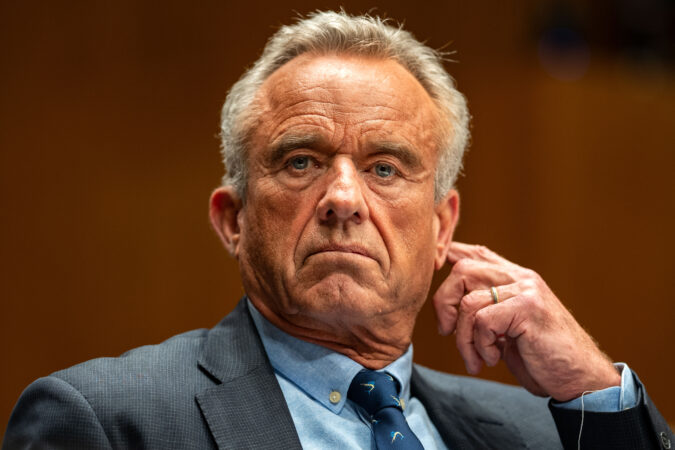
“This is not medicine, it is malpractice,” Health Secretary Robert F. Kennedy Jr. said, referring to gender-affirming procedures, at a news conference Thursday. “Sex-rejecting procedures rob children of their futures.”
CHOP, like most other hospitals in the country, participates in both Medicare and Medicaid.
CHOP declined to comment Thursday.
The renowned pediatric hospital treats children and teens with gender dysphoria — a medical condition in which a person’s body does not match their gender identity. Its doctors prescribe hormone therapy and puberty blockers.
CHOP has said its doctors do not prescribe any medication before its patients undergo extensive medical and psychological evaluations.
Gender-affirming care is legal in Pennsylvania, and states, not the federal government, regulate medicine and doctors.
But Trump has sought to criminalize this care for minors, saying doctors are engaged in “chemical mutilation,” akin to child abuse, and he has called the research “junk science.”
Just days into his second term in office, the president issued an executive order titled “Protecting Children from Chemical and Surgical Mutilation,” which contains inflammatory and misleading descriptions of largely medically approved transgender care. Kennedy has followed the president’s lead, signing a declaration Thursday rejecting these procedures.
Other actions proposed Thursday include the U.S. Food and Drug Administration issuing warning letters to 12 manufacturers and retailers for what an HHS news release claims to be “illegal marketing of breast binders to children for the purposes of treating gender dysphoria.”
The court battle over gender care for minors
In June, the U.S. Department of Justice issued subpoenas to CHOP and at least 19 other hospitals that treat transgender youth as part of an investigation into possible healthcare fraud. The federal subpoenas demanded patient medical records, including their dates of birth, Social Security numbers, and addresses, as well as every communication by doctors — emails, voicemails, and encrypted text messages — dating back to January 2020.
The subpoenas touched off a wave of legal battles that continue to play out. Several hospitals around the country, including CHOP, filed motions asking federal judges to block the release of private patient information.
So far, federal judges in Philadelphia, Boston, and Washington state have sided with the hospitals, ruling the subpoenas were politically motivated.
In Philadelphia, U.S. District Judge Mark A. Kearney last month determined that the “privacy interests of children and their families substantially outweighs the department’s need to know” such confidential and sensitive information. The federal government has 60 days to appeal the Nov. 21 ruling.
In September, patients and their parents joined the legal fight to limit the scope of the subpoenas issued to CHOP and UPMC Children’s Hospital of Pittsburgh. The Philadelphia-based Public Interest Law Center (PILC) filed separate but similar legal relief on behalf of families with children and teens who have received gender-affirming care at CHOP and in Pittsburgh.
The federal judge presiding over the Pittsburgh hospital’s case has yet to issue a ruling. Earlier this week, however, DOJ lawyers said they are willing to accept redacted medical records. They argued that would solve the dispute over patient privacy rights.
On Thursday, Mimi McKenzie, PILC’s legal director, said the center “strongly disagrees” and would fight the release of redacted medical records.
“These records are so deeply personal and contain such highly sensitive information about these young patients,” McKenzie said. “There is no anonymization or redaction that can protect their privacy interests.”
McKenzie said the proposed federal rule to ban all federal funding to hospitals that treat transgender youth would “face a myriad of legal challenges.” She described gender-affirming care as “lifesaving” for many children.
“The notion that our federal government would tell hospitals to pick which children you want to save — the children who need gender-affirming care or all the other children — is despicable. The cruelty of this administration knows no bounds.”
Other institutions have recoiled in the face of the Trump administration’s threats.
Earlier this year, Penn Medicine and Penn State Health cut back gender-affirming care for youth. Nemours Children’s Hospital in Delaware and UPMC Children’s Hospital of Pittsburgh announced they will no longer provide gender-affirming care beyond behavioral health services to new patients.
Pennsylvania’s fledgling State Board of Higher Education on Thursday rolled out itsfirst strategic plan, setting goals addressing affordability, increased degree attainment, the state’s workforce and economic development needs, and the fiscal health of colleges.
The board voted unanimously to post the 10-year plan for public comment.It will consider adoption in February.
“The plan will strengthen partnerships, break down silos, and enable effective reinvestment in the sector,” Cynthia Shapira, chair of the board, said in a statement introducing the plan.
It comes as the sector faces perhaps its greatest challenge in decades. Both private and public universities have been losing enrollment as the number of high school graduates falls — with another dip beginning next year and a 12% decline expected in Pennsylvania by 2037. Public trust in colleges has faltered, while concerns about cost and student debt have mounted.
They are also facing scrutiny from President Donald Trump’s administrationand a forecasted gap in workers who require a postsecondary credential in essential areas, such as healthcare, teaching, and advanced manufacturing.
The Pennsylvania State System of Higher Education, which oversees the state’s 10 universities, endorsed the plan’s emphasis on collaboration across private and public colleges and universities.
“Within our own system, we have learned that when universities work together, they can innovate, overcome challenges and better serve students and the Commonwealth,” the system said in a statement. Shapira is also the chair of PASSHE’s board.
The 21-member higher education board includes college presidents, administrators, legislators, and students.It was formed in 2024 by the governor and General Assembly to help public and private colleges work more cohesively and better serve students and the state’s workforce needs. The plan rollout follows public hearings that drew comments from more than 1,200 people, the board said.
The plan outlines the challenges facing the higher education sector including another coming decline in the high school population, financial constraints, and the lack of coordination among institutions. Student debt averages more than $40,000 per student in Pennsylvania, the plan notes.
“Multiple comparative state-level analyses … place Pennsylvania at or near the bottom in terms of affordability, attainment, and state investment per capita,” the report stated. “Adding to these challenges are a large and growing postsecondary workforce credential gap, and a range of closures and mergers that threaten to reduce access to postsecondary education.”
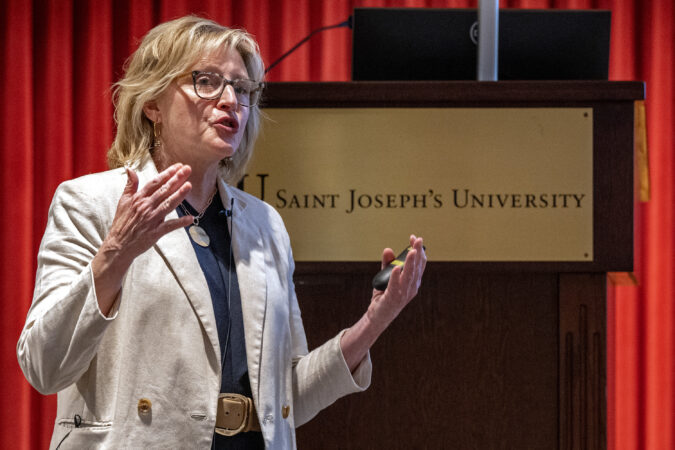
In the Philadelphia region, Cabrini University and the University of the Arts closed in 2024 and Rosemont College announced earlier this year that it would cease operations in 2028 and that Villanova University would purchase its campus. Salus University was merged into Drexel University. Six of Pennsylvania’s state universities were merged into two entities in 2022, and St. Joseph’s University absorbed the University of the Sciences the same year.
Other local colleges have struggled with enrollment declines and deficits. Temple University, for example, has gone from more than 40,000 students in 2017 to less than 30,000 this year.
What are the specific goals in the plan?
The new plan set six goals:
Increase postsecondary attainment.
Ensure affordable pathways to postsecondary credentials.
Support the economic development needs of the state.
Support the workforce development needs of the state.
Ensure accountability and efficient use of state funds.
Strengthen the fiscal health and stability of the higher education sector.
How will the board work toward those goals?
To meet the goals, the board proposes a “strategic communications plan” that touts the benefits of postsecondary education and how it impacts employment outcomes.
It also emphasizes expanding funding for dual credit programs and enrollment in those programs to streamline the path from high school to college and allow students to accumulate more credits before they graduate high school. In addition, the plan proposes studying how to improve retention rates and focusing on reenrolling adults who started college but didn’t finish; there are more than 1.1 million Pennsylvanians with some college experience.
Among its plans for addressing affordability are support of policies that “expand financial aid and forgive debt for in-demand, high-quality credentials,” take advantage of new federal Pell grants for workforce programs, and boost access to “open educational resources” to reduce the cost of course materials.
The report also discusses the intent to “maximize the impact of research universities,” recruit out-of-state students to broaden the talent pool, and increase access to paid work experiences for students.
To promote fiscal health, the plan recommends identifying and promoting best practices for fiscal efficiency and cost savings, and developing resources and an advisory group to help financially struggling colleges.
“If institutions decide to close or merge, tools and expertise to assist in this process will help maximize savings, retain access to critical academic programming, and mitigate negative effects on students and communities,” the plan states.
Another advisory group is recommended to help communities where colleges close maintain access to postsecondary education.
What comes next?
After the public comment period and the plan’s final adoption, the board intends to report annually on progress toward the goals and to consider revisions to the plan every five years.
![As long as [REDACTED] has his thumb on the scales of justice, the Epstein files were always going to be [REDACTED] | Editorial](https://wp-brooklyn.enclave.vn/wp-content/uploads/2025/12/56QJ6RRBRHQJHDGZ7NKUDPNTPU-675x450.jpg)