Tag: Donald Trump

  • The U.S. gained 64,000 jobs in November but lost 105,000 in October as the unemployment rate rose to 4.6%

    The U.S. gained 64,000 jobs in November but lost 105,000 in October as the unemployment rate rose to 4.6%

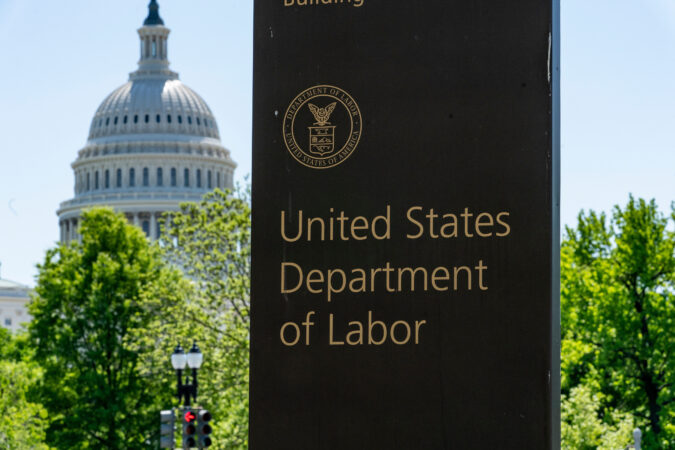
    WASHINGTON — The United States gained a decent 64,000 jobs in November but lost 105,000 in October as federal workers departed after cutbacks by the Trump administration, the government said in delayed reports.

    The unemployment rate rose to 4.6%, highest since 2021.

    Both the October and November job creation numbers, released Tuesday by the Labor Department, came in late because of the 43-day federal government shutdown.

    The November job gains came in higher than the 40,000 economists had forecast. The October job losses were caused by a 162,000 drop in federal workers, many of whom resigned at the end of fiscal year 2025 on Sept. 30 under pressure from billionaire Elon Musk’s purge of U.S. government payrolls.

    Labor Department revisions also knocked 33,000 jobs off August and September payrolls.

    Workers’ average hourly earnings rose just 0.1% from October, the smallest gain since August 2023. Compared to a year earlier, pay was up 3.5%, the lowest since May 2021.

    Healthcare employers added more than 46,000 jobs in November, accounting for more than two-thirds of the 69,000 private sector jobs created last month. Construction companies added 28,000 jobs. Manufacturing shed jobs for the seventh straight month, losing 5,000 jobs in November.

    Hiring has clearly lost momentum, hobbled by uncertainty over President Donald Trump’s tariffs and the lingering effects of the high interest rates the Federal Reserve engineered in 2022 and 2023 to rein in an outburst of inflation.

    American companies are mostly holding onto the employees they have. But they’re reluctant to hire new ones as they struggle to assess how to use artificial intelligence and how to adjust to Trump’s unpredictable policies, especially his double-digit taxes on imports from around the world.

    The uncertainty leaves jobseekers struggling to find work or even land interviews. Federal Reserve policymakers are divided over whether the labor market needs more help from lower interest rates. Their deliberations are rendered more difficult because official reports on the economy’s health are coming in late and incomplete after a 43-day government shutdown.

    Labor Department revisions in September showed that the economy created 911,000 fewer jobs than originally reported in the year that ended in March. That meant that employers added an average of just 71,000 new jobs a month over that period, not the 147,000 first reported. Since March, job creation has fallen farther — to an average 35,000 a month.

    The unemployment rate, though still modest by historical standards, has risen since bottoming out at a 54-year low of 3.4% in April 2023.

    “The takeaway is that the labor market remains on a relatively soft footing, with employers showing little appetite to hire, but are also reluctant to fire,” Thomas Feltmate, senior economist at TD Economics, wrote in a commentary. “That said, labor demand has cooled more than supply in recent months, which is what’s behind the steady upward drift in the unemployment rate.’’

    Adding to the uncertainty is the growing use of artificial intelligence and other technologies that can reduce demand for workers.

    “We’ve seen a lot of the businesses that we support are stuck in that stagnant mode: ‘Are we going to hire or are we not? What can we automate? What do we need the human touch with?’’’ said Matt Hobbie, vice president of the staffing firm HealthSkil in Allentown, Pennsylvania.

    “We’re in Lehigh Valley, which is a big transportation hub in eastern Pennsylvania. We’ve seen some cooling in the logistics and transportation markets, specifically because we’ve seen automation in those sectors, robotics.’’

    Worries about the job market were enough to nudge the Fed into cutting its benchmark interest rate by a quarter of a percentage point last week for the third time this year.

    But three Fed officials refused to go along with the move, the most dissents in six years. Some Fed officials are balking at further cuts while inflation remains above the central bank’s 2% target. Two voted to keep the rate unchanged. Stephen Miran, appointed by Trump to the Fed’s governing board in September, voted for a bigger cut – in line with what the president demands.

    Tuesday’s report shows that “the labor market remains weak, but the pace of deterioration probably is too slow to spur the (Fed) to ease again in January,’’ Samuel Tombs, chief U.S. economist at Pantheon Macroeconimics, wrote in a commentary. The Fed holds its next policy meeting Jan. 27-28.

    Because of the government shutdown, the Labor Department did not release its jobs reports for September, October and November on time.

    It finally put out the September jobs report on Nov. 20, seven weeks late. It published some of the October data – including a count of the jobs created that month by businesses, nonprofits and government agencies – along with the November report Tuesday. But it did not release an unemployment rate for October because it could not calculate the number during the shutdown.


  • In 2026, America needs an anti-AI party | Will Bunch Newsletter

    Sometimes a terrible year can end with a moment of uplift. This actually happened in the last days of 1968, when Apollo 8 took the first humans in orbit around the moon and sent wonder back to a planet struggling with assassinations and riots. Alas, 2025 seems not such a year. A world already reeling from two mass shootings half a world apart learned Sunday night that Hollywood icon Rob Reiner and his wife Michele had been murdered in their home, allegedly by their own son. Boomers like me saw our own journey in that of Reiner — playing a young campus liberal, then taking down the pomposity of classic rock before both an unprecedented streak of classic movies and unparalleled social and political activism. He had more to give, and leaves a void that can’t truly be filled.

    If someone forwarded you this email, sign up for free here.

    Americans fear AI and loathe its billionaires. Why do both parties suck up to them?

    Time’s 2025 person of the year are the architects of AI, depicted in this painting by Jason Seiler. The painting, with nods to the iconic 1932 “Lunch atop a Skyscraper” photograph, depicts tech leaders Mark Zuckerberg, Lisa Su, Elon Musk, Jensen Huang, Sam Altman, Demis Hassabis, Dario Amodei, and Fei-Fei Li.

    “This is the West, sir. When the facts become legend, print the legend.”journalist in the 1962 film, The Man Who Shot Liberty Valance

    The top editors at Time (yes, it still exists) looked west to Silicon Valley and decided to print the legend last week when picking their Person of the Year for the tumultuous 12 months of 2025. It seemed all too fitting that its cover hailing “The Architects of AI” was the kind of artistic rip-off that’s a hallmark of artificial intelligence: 1932’s iconic newspaper shot, “Lunch Atop a Skyscraper,” “reimagined” with the billionaires — including Elon Musk and OpenAI’s Sam Altman — and lesser-known engineers behind the rapid growth of their technology in everyday life.

    Time’s writers strived to outdo the hype of AI itself, writing that these architects of artificial intelligence “reoriented government policy, altered geopolitical rivalries, and brought robots into homes. AI emerged as arguably the most consequential tool in great-power competition since the advent of nuclear weapons.”

    OK, but it’s a tool that’s clearly going to need a lot more work, or architecting, or whatever it is those folks out on the beam do. That was apparent on the same day as Time’s celebration when it was reported that Washington Post editors got a little too close to the edge when they decided they were ready to roll out an ambitious scheme for personalized, AI-driven podcasts based on factors like your personal interests or your schedule.

    The news site Semafor reported that the many gaffes ranged from minor mistakes in pronunciation to major goofs like inventing quotes — the kind of thing that would get a human journalist fired on the spot. “Never would I have imagined that the Washington Post would deliberately warp its own journalism and then push these errors out to our audience at scale,” a dismayed, unnamed editor reported.

    The same-day contrast between the Tomorrowland swooning over the promise of AI and its glitchy, real-world reality felt like a metaphor for an invention that, as Time wasn’t wrong in reporting, is so rapidly reshaping our world. Warts and all.

    Like it or not.

    And for most people (myself included), it’s mostly “or not.” The vast majority understands that it’s too late to put this 21st-century genie back in the bottle, and like any new technology there are going to be positives from AI, from performing mundane organizing tasks that free up time for actual work, to researching cures for diseases.

    But each new wave of technology — atomic power, the internet, and definitely AI — increasingly threatens more risk than reward. And it’s not just the sci-fi notion of sentient robots taking over the planet, although that is a concern. It’s everyday stuff. Schoolkids not learning to think for themselves. Corporations replacing salaried humans with machines. Sky-high electric bills and a worsening climate crisis because AI runs on data centers with an insatiable need for energy and water

    The most recent major Pew Research Center survey of Americans found that 50% of us are more concerned than excited about the growing presence of AI, while only 10% are more excited than concerned. Drill down and you’ll see that a majority believes AI will worsen humans’ ability to think creatively, and, by a whopping 50-to-5% percent margin, also believes it will worsen our ability to form relationships rather than improve it. These, by the way, are two things that weren’t going well before AI.

    So naturally our political leaders are racing to see who can place the tightest curbs on artificial intelligence and thus carry out the will of the peop…ha, you did know this time that I was kidding, didn’t you?

    It’s no secret that Donald Trump and his regime were in the tank from Day One for those folks out on Time’s steel beam, and not just Musk, who — and this feels like it was seven years ago — donated a whopping $144 million to the Republican’s 2024 campaign. Just last week, the president signed an executive order aiming to press the full weight of the federal government, including Justice Department lawsuits and regulatory actions, against any state that dares to regulate AI. He said that’s necessary to ensure U.S. “global AI dominance.”

    This is a problem when his constituents clearly want AI to be regulated. But it’s just as big a problem — perhaps bigger — that the opposition party isn’t offering much opposition. Democrats seem just as awed by the billionaire grand poobahs of AI as Trump. Or the editors of Time.

    Also last week, New York Democratic Gov. Kathy Hochul — leader of the second-largest blue state, and seeking reelection in 2026 — used her gubernatorial pen to gut the more-stringent AI regulations that were sent to her desk by state lawmakers. Watchdogs said Hochul replaced the hardest-hitting rules with language drafted by lobbyists for Big Tech.

    As the American Prospect noted, Hochul’s pro-Silicon Valley maneuvers came after her campaign coffers were boosted by fundraisers held by venture capitalist Ron Conway, who has been seeking a veto, and the industry group Tech:NYC, which wants the bill watered down.

    It was a similar story in the biggest blue state, California, where Gov. Gavin Newsom in 2024 vetoed the first effort by state lawmakers to impose tough regulations on AI, and where a second measure did pass but only after substantial input from lobbyists for OpenAI and other tech firms. Silicon Valley billionaires raised $5 million to help Newsom — a 2028 White House front-runner — beat back a 2021 recall.

    Like other top Democrats, Pennsylvania Gov. Josh Shapiro favors some light regulation for AI but is generally a booster, insisting the new technology is a “job enhancer, not a job replacer.” He’s all-in on the Keystone State building massive data centers, despite their tendency to drive up electric bills and their unpopularity in the communities where they are proposed.

    Money talks, democracy walks — an appalling fact of life in 2025 America. In a functioning democracy, we would have at least one political party that would fly the banner of the 53% of us who are wary of unchecked AI, and even take that idea to the next level.

    A Harris Poll found that, for the first time, a majority of Americans also see billionaires — many of them fueled by the AI bubble — as a threat to democracy, with 71% supporting a wealth tax. Yet few of the Democrats hoping to retake Congress in 2027 are advocating such a levy. This is a dangerous disconnect.

    Time magazine got one thing right. Just as its editors understood in 1938 that Adolf Hitler was its Man of the Year because he’d influenced the world more than anyone else, albeit for evil, history will likely look back at 2025 and agree that AI posed an even bigger threat to humanity than Trump’s brand of fascism. The fight to save the American Experiment must be fought on both fronts.

    Yo, do this!

    • I haven’t tackled much new culture this month because I’ve been doing something I so rarely do anymore: Watching a scripted series from start to finish. That would be Apple TV’s Pluribus, the new sci-fi-but-more-than-sci-fi drama from television genius Vince Gilligan. True, one has to look past some logistical flaws in its dystopia-of-global-happiness premise, but the core narrative about the fight for individualism is truly a story of our time. The last two episodes come out on Dec. 19 and Dec. 26, so there’s time to catch up!
    • The shock and sorrow of Rob Reiner’s murder at age 78 has, not surprisingly, sparked a surge of interest in his remarkable, and remarkably diverse, canon of classic movies. His much-awaited sequel Spinal Tap II: The End Continues began streaming on HBO Max just two days before his death. Check it out, or just re-watch the 1984 original, which is one of the funniest flicks ever made, and which is also streaming on HBO Max and can be rented on other popular sites. Crank it up to 11.

    Ask me anything

    Question: What news value, not advertising value, is accomplished by publicizing every one of Trump’s insane rantings daily? — @bizbodeity.bsky.social via Bluesky

    Answer: This is a great question, and the most recent and blatant example which I assume inspired it — Trump’s stunningly heartless online attack against a critic, Hollywood icon Rob Reiner, just hours after his violent murder — proves why this is a painful dilemma for journalists. I’d argue that Trump’s hateful and pathologically narcissistic post was a deliberate troll for media attention, to make every national moment about him. In a perfect world, it would indeed be ignored. But it was highly newsworthy that his Truth Social post was so offensive that it drew unusual criticism from Republicans, Evangelicals, and other normal supporters. We may remember this is as a political turning point. Trump’s outbursts demand sensitivity, but that Americans elected such a grotesque man as our president can’t easily be ignored.

    What you’re saying about…

    It’s been two weeks since I asked about Donald Trump’s health, but the questions have not gone away. There was not a robust response from readers — probably because I’d posed basically the same question once before. Several of you pointed to expert commentary that suggests the president is experiencing significant cognitive decline, perhaps suffering from frontotemporal dementia. Roberta Jacobs Meadway spoke for many when she lambasted “the refusal if not the utter failure of the once-major news outlets to ask the questions and push for answers.”

    📮 This week’s question: We are going to try an open-ended one to wrap up 2025: What is your big prediction for 2026 — could be anything from elections to impeachment to the Eagles repeating as Super Bowl champs — and why. Please email me your answer and put the exact phrase “2026 prediction” in the subject line.

    Backstory on how I covered an unforgettable year

    Rick Gomez, who travelled 65 hours by bus from Phoenix, Ariz., holds an AI photo composite poster of Donald Trump, in Washington, the day before Trump took the Oath of Office to become the 47th president of the United States.

    Barring the outbreak of World War III — something you always need to say these days — this is my final newsletter, or column, of 2025, as I use up my old-man plethora of vacation days. To look back on America’s annus horribilis, I thought I’d revive a feature from my Attytood blogging days: a recap of the year with the five most memorable columns, not numbered in order of significance. Here goes:

    1. A year that many of us dreaded when the votes were counted in November 2024 began for me with a sad reminder that the personal still trumps the political, when my 88-year-old father fell ill in the dead of winter and passed away on March 11. I wrote about his life, but also what his passion for science and knowledge said about a world that, at the end of his life, was slipping away: Bryan H. Bunch (1936-2025) and the vanishing American century of knowledge.
    2. Still, Donald J. Trump could not be ignored. On Jan. 19, I put on my most comfortable shoes (it didn’t really help) and traipsed around a snowy, chilly Washington, D.C. as the about-to-be 47th president made his “forgotten American” supporters wait on a soggy, endless line for a nothingburger rally while the architects of AI and other rich donors partied in heated luxury, setting the tone for a year of gross inequality: American oligarchy begins as Trump makes billions while MAGA gets left out in the rain.
    3. One of the year’s biggest stories was Trump’s demonizing of people of color, from calling Somali immigrants “garbage” to his all out war on DEI programs that encouraged racial diversity, when the truth was always far different. In February, I wrote about the American dream of a young man from Brooklyn of Puerto Rican descent and his ambition to become an airline pilot, who perished in the D.C. jet-helicopter crash. His remarkable life demolished the MAGA lie about “DEI pilots.” Read: “Short, remarkable life of D.C. pilot Jonathan Campos so much more than Trump’s hateful words.”
    4. If you grew up during the 1960s and ‘70s, as I did, then you understand the story of our lifetimes as a battle for the individual rights of every American — for people to live their best lives regardless of race or gender, or whether they might be transgender, or on the autism spectrum. I wrote in October about the Trump regime’s consuming drive to reverse this, to make it a crime to be different: From autism to beards, the Trump regime wages war on ‘the different
    5. A grim year did end on one hopeful note. Trump’s push for an authoritarian America is faltering, thanks in good measure to the gumption of everyday people. This month, I traveled to New Orleans to chronicle the growing and increasingly brave public resistance to federal immigration raids, as citizens blow whistles, form crowds and protest efforts to deport hard-working migrants: In New Orleans and across U.S., anger over ICE raids sparks a 2nd American Revolution

    What I wrote on this date in 2021

    On this date four years ago, some of us were still treating Donald Trump’s attempted Capitol Hill coup of Jan. 6, 2021 like a crime that could be solved so that the bad guys could be put away. On Dec. 16, 2021, I published my own theory of the case: that Team MAGA’s true goal was provoking a war between its supporters and left-wing counterdemonstrators, as a pretext for sending in troops and stopping Congress from finishing its certification of Joe Biden’s victory. That didn’t happen because the leftists stayed home. More than 1,000 pardons later, check out my grand argument: “A theory: How Trump’s Jan. 6 coup plan worked, how close it came, why it failed.”

    Recommended Inquirer reading

    • Only one column this week, as this senior citizen was still recovering from that grueling trip to New Orleans. On Sunday, I reacted with the shock and sadness of seeing a mass shooting at my alma mater, Brown University. I wrote that in a nation with 500 million guns, it’s a virtual lock that some day our families — nuclear or extended, like the close-knit Brown community — will be struck by senseless violence. And I took sharp issue with Trump’s comment that “all you can do is pray.” There is much that can and should be done about gun safety.
    • Sometimes the big stories are the ones that play out over decades, not days. When I first started coming regularly to Philadelphia at the end of the 1980s, the dominant vibe was urban decline. The comeback of cities in the 21st century has altered our world, for good — but a lot of us old-timers have wondered: Just who, exactly, is moving into all these new apartments from Center City to Kensington and beyond? Last week, The Inquirer’s ace development reporter Jake Blumgart took a deep dive into exactly that — highlighting survey results that large numbers are under 45, don’t own a car, and moved here from elsewhere, and telling some of their stories. Local journalism is the backbone of a local community, and you are part of something bigger when you subscribe to The Inquirer. Plus, it’s a great Christmas gift, and you’ll get to read all my columns in 2026. See you then!

    By submitting your written, visual, and/or audio contributions, you agree to The Inquirer‘s Terms of Use, including the grant of rights in Section 10.

  • A disabled Ecuadorian immigrant tried to flag down an ICE officer. Now he faces deportation.

    A disabled Ecuadorian immigrant tried to flag down an ICE officer. Now he faces deportation.

    Victor Acurio Suarez is 52 but childlike, born with developmental disabilities that have left him unable to live on his own.

    He likes to talk to people, said his brother, who takes care of him. And on Sept. 22, in a Lowe’s parking lot near the brothers’ home in Seaford, Del., he tried to flag down an ICE agent, apparently thinking the officer could help him find work.

    Instead, Acurio Suarez, originally from Ecuador, was arrested for being in the country without permission and sent to the Moshannon Valley Processing Center, an ICE detention facility in central Pennsylvania.

    Acurio Suarez doesn’t realize he’s in custody, his brother, Lenin Acurio Suarez, said in an interview. He thinks he’s on vacation, provided with three free meals a day and allowed to buy snacks and kick a soccer ball.

    But in phone calls from Moshannon, he says that after three months, he’s grown tired of vacation and wants to come home.

    In fact, Acurio Suarez faces deportation to Ecuador ― with a key Immigration Court hearing that had been scheduled for Thursday now postponed. When that hearing takes place, he could be granted asylum and allowed to stay in the U.S., safe from the gang violence he fled, or ordered returned to his homeland.

    His case, said his attorney, Kaley Miller-Schaeffer, is a prime example of how Trump-administration policy shifts have encouraged ICE to detain even the most vulnerable and to treat potential discretionary relief as irrelevant in a bid to boost deportations.

    Her Sept. 30 request to have Acurio Suarez released to the care of his brother while his immigration case goes forward was denied.

    Asked about Acurio Suarez’s arrest and detention, ICE said in a statement that they screen and look out for the health of all detainees.

    “U.S. Immigration and Customs Enforcement is firmly committed to the health, safety, and welfare of all detainees in custody. ICE’s National Detention Standards and other ICE policies require all contracted facilities to provide comprehensive medical and mental health screenings from the moment an alien arrives at a facility and throughout their entire time in custody.”

    At an earlier court hearing, Miller-Schaeffer said, she watched as Acurio Suarez struggled to answer basic questions. He told the judge he didn’t know if he had an attorney or know what an attorney does.

    His ability to testify was so limited, she said, that the judge allowed his brother to take the stand to explain his sibling’s experience and situation.

    Acurio Suarez can recall big events in his life, she said. He remembers being beaten by gangs who seized on his vulnerability, but he couldn’t tell you exactly when that occurred.

    Today, as President Donald Trump pursues an unprecedented mass-deportation campaign, more migrants including Acurio Suarez have been made subject to mandatory detention. That means they’re held in custody during their deportation proceedings, unable to seek release on bond.

    Victor Acurio Suarez’s empty room at his home in Seaford, Del.

    That includes immigrants whose only offense was crossing the border without approval, who in the past might have been issued a notice to appear in court and allowed to live in the community while their cases go forward.

    That’s helped drive the number of immigrants in federal detention past 65,000, a two-thirds increase since Trump took office in January.

    The administration says it is arresting the “worst of the worst,” dangerous immigrants who have committed serious and sometimes violent offenses. But data show 74% of those in detention have no criminal convictions.

    That includes Acurio Suarez, who worked at odd jobs in Ecuador before coming to this country in 2021.

    According to an ICE report, at 9:14 a.m. on Sept. 22, an ICE team was conducting operations in Seaford, a southern Delaware city of 9,000 where 13% of the population is foreign-born.

    The ICE officer wrote that he was looking for a place to park in the Lowe’s lot when a man in paint-stained clothing, Acurio Suarez, approached him. Acurio Suarez waved his hand, signaling the officer to come to him, according to the ICE account.

    The officer kept going, then stopped his car and watched Acurio Suarez from another lot. Acurio Suarez tried to hail other cars, and could be seen talking to people who were loading lumber onto a trailer in the parking lot, he said.

    It looked like Acurio Suarez was trying to find daily work, which is why he tried to get the ICE officer to stop his vehicle, the report said.

    It’s common for undocumented immigrants seeking a day’s pay to wait in the parking lots of big home-improvement stores like Lowe’s and Home Depot, hoping to connect with building contractors who need laborers.

    Lenin Acurio Suarez said his brother cannot hold a full-time job, able only to handle small tasks, provided someone is beside him giving directions.

    A second ICE officer arrived, and both parked their cars near where Acurio Suarez had left his lunch box unattended. Acurio Suarez walked back toward the officers, and one of the agents approached and questioned him.

    Acurio Suarez said he had no identification or immigration documents and was placed in handcuffs. He told the officer he was in good health, the report says.

    Lenin Acurio Suarez holds a photograph of his brother, Victor, at his home in Seaford, Del., on Wednesday. Victor was arrested by ICE on Sept. 22.

    Records show that four years ago, on Aug. 2, 2021, he and his brother were stopped by the U.S. Border Patrol as they tried to enter the country near Eagle Pass, Texas, southwest of San Antonio.

    The brothers were processed separately by immigration authorities. Lenin Acurio Suarez was issued a notice to appear in court and released. His immigration case was later dismissed.

    Victor Acurio Suarez was ordered deported and subsequently returned to Ecuador on Sept. 24. But three days later, for reasons that are unclear, the deportation order was found to have been issued incorrectly, and Acurio Suarez was brought back by authorities to the U.S.

    In October 2021, he was granted temporary permission to stay in the country. He had filed his asylum case by the time that permission expired a year later.

    Asylum cases from Ecuador have surged in recent years, as thousands of people flee violence, political instability, and economic hardship. Gang violence there has rocketed as criminal organizations compete for control of the illicit economy, including extortion, kidnapping, transporting drugs, and illegal mining, according to the Geneva-based Global Initiative Against Transnational Organized Crime.

    The group projects that intentional homicides in Ecuador could reach 9,100 in 2025, a 40% increase over the previous year.

    That’s a rate of nearly 50 per 100,000 inhabitants, which would continue to give Ecuador the highest homicide rate in Latin America, the organization said. In the U.S. the figure is about five per 100,000 people.

    While ICE agents were arresting Acurio Suarez, Lenin was frantically searching the neighborhood, initially not having realized that his brother had left their home. Lenin called local police for help, and officers checked the Lowe’s security cameras. The video showed Victor being taken into custody.

    In an interview, Lenin, 49, explained that he has always taken care of his younger brother, since their mother left when they were teenagers in Ecuador.

    In this country, Lenin has a job in housing construction that enables him to provide for himself and his brother and to live with others in a rented house. He worries what will happen to Victor if he’s sent back to Ecuador, where there’s no one to care for him.

    “Thanks to God I’ve been able to pay rent and food for me and my brother,” Lenin said. “I am grateful for this country, to be in this country. But I want my brother to have a fair life, with me, out of detention. He won’t be able to survive by himself in Ecuador.”

  • Top Pennsylvania Republicans are projecting relative calm amid 2026 national party panic

    Top Pennsylvania Republicans are projecting relative calm amid 2026 national party panic

    The same week Republican National Committee chair Joe Gruters said history predicted “almost certain defeat” for his party in the 2026 midterms, Pennsylvania Republicans partying in Midtown Manhattan projected relative calm about the election cycle.

    Gruters, President Donald Trump’s handpicked chair to run the party, said on a conservative radio station last week: “It’s not a secret. There’s no sugarcoating it. It’s a pending, looming disaster heading our way. We are facing almost certain defeat.”

    He added that the goal is to win and he “liked our chances in the midterms,” but noted “only three times in the last hundred years has the incumbent party been successful winning a midterm.”

    Pennsylvania could decide which party controls the U.S. House next year, as Democrats eye four congressional districts that Republicans recently flipped while the GOP fights to maintain its majority.

    But Pennsylvania Republicans in New York City for the annual Pennsylvania Society glitzy gathering of politicos last weekend had a less hair-on-fire view.

    “At this point when I was running [for Senate in 2024], the betting market said there was a 3% chance I was going to win,” Sen. Dave McCormick (R., Pa.) said after addressing a bipartisan audience at the Pennsylvania Manufacturer’s Association luncheon on Saturday.

    “We’re a million miles from Election Day, and we’ve got a great track record of things to talk about and a great vision for how the president’s policies are going to make life better for working families,” McCormick said. “We just got to go out and make that message happen, but also continue to make the policies that are going to make that a reality happen.”

    The political environment was, of course, far more favorable to Republicans in 2024, when Trump won Pennsylvania by a larger margin than he did in 2016. But with Republicans in power and popular Democratic Gov. Josh Shapiro on the ballot for reelection, the headwinds in 2026 in the Keystone State are different.

    Pennsylvania GOP chair Greg Rothman, in an interview outside the PMA event on Saturday, called Shapiro “one of the greatest politicians of my generation” but noted that upsets have happened across various political environments in state history.

    “Anything can happen and the voters are smart, and all I can do is prepare the party to ride the waves and ignore the crashes, but I’m optimistic,” he added.

    Shapiro will likely face a GOP challenge from State Treasurer Stacy Garrity, who is a popular politician in her own right and holds the record for receiving the most votes of any candidate for statewide office in Pennsylvania.

    Meanwhile, Rothman predicted that the four Pennsylvania congressional incumbents running for reelection in swing districts will sink or swim based on how Trump and his policies land with voters come November.

    “They will be judged by the national economy and by immigration,” he said, and by Trump’s ability to end some international conflicts.

    But U.S. Rep. Rob Bresnahan, a GOP incumbent running for reelection in Pennsylvania’s Eighth Congressional District, which includes Scranton, had a more local view of how to win in 2026.

    “Everything about our job as a member of Congress is about northeastern Pa.,” Bresnahan said.

    “Northeastern Pennsylvania has always been our North Star. We know our district. We are out in our district. We’ve done over 250 public events. Our constituency case work is, in my opinion, one of the best offices in the country.”

    Bresnahan appeared at a rally with Trump in Mount Pocono last week. He was also one of just 20 House Republicans to sign a successful discharge petition to force a vote for collective bargaining to be restored for federal workers.

    “At the end of the day that might have been going against party leadership, but it was what’s right for northeastern Pennsylvania,” he said.

    Democrats have begun a full court press. That was evident at the Pennsylvania Society, where attendees seen mingling with other politicians included: Janelle Stelson, who is running for a second time against U.S. Rep. Scott Perry in the 10th Congressional District, as well as firefighter Bob Brooks and former federal prosecutor Ryan Croswell, both of whom are running for the Democratic nomination to take on U.S. Rep. Ryan Mackenzie in the Seventh.

    Bresnahan’s challenger, Scranton Mayor Paige Cognetti, also attended the soiree and walked through the Rainbow Room atop Rockefeller Center with U.S. Sen. Chris Coons (D., Del.) on Friday night. Coons said the time is now for Democrats to get involved in these races.

    “Given the margin, if there were to be four new Democrats in the House this cycle, as there were in 2018, that’d be the difference maker for the country,” Coons added.

    Staff writer Gillian McGoldrick contributed to this article.

  • Janney Montgomery Scott sheds investment bank under owner KKR and focuses on brokers

    Janney Montgomery Scott sheds investment bank under owner KKR and focuses on brokers

    Philadelphia-based Janney Montgomery Scott LLC has confirmed plans to exit the investment banking business and will focus exclusively on beefing up its wealth advisory business under its private-equity owner KKR, which bought Janney last year.

    The firm has made what CEO Tony Miller called “a strategic decision” to sell the last of its banking units.

    Investment bankers raise money for companies and governments by selling stock shares, bonds, and other financial instruments to investors, for a cut of the proceeds, a sometimes lucrative but hard-to-predict business. Research analysts help attract those clients by writing about their financial prospects.

    Wealth advisors, typically registered with the SEC or licensed through the industry group FINRA, are paid to guide clients’ investments, and may sell exchange-traded funds (ETFs), and other approved products. Business has soared with the U.S. stock markets in recent years. Miller, the Janney CEO, called investing in that business a better road to “long-term success.”

    Janney plans to sell its last bond and investment banking units, including staff in Philadelphia, at its TM Capital in Atlanta, and in other offices, to Ohio-based Huntington Bancshares and its financial institutions banking, research, and sales units to New York-based Brean Capital. Janney officials hope to close the deals in early 2026. The prices haven’t been disclosed.

    Janney, which recently added advisors in Texas among other states, will remain based in Philadelphia. The company employs around 900 in the region.

    Regional commercial banks and other small to midsize financial institutions were among the last industry groups Janney investment bankers and analysts covered. Just last month, Janney bankers announced that they had advised Georgia-based First Southern Bank on its unusual $51 million sale to member-owned Community First Credit Union of Jacksonville, Fla.

    Former Janney employees said Janney’s owners had the option of taking the time and money to build up the investment banking unit, such as regional brokerages Piper Sandler, Raymond James, and Baird & Co. have done in recent years, instead of cutting back and relying entirely on trading and investment volume that rises and falls with market prices.

    Until the late 1900s, Philadelphia was a financial center, and generations of investment professionals — at firms started by Stephen Girard, Jay Cooke, J.P. Morgan’s mentor A.J. Drexel, the predecessors of what’s now Morgan Stanley Wealth Management, the Butcher clan, as well as Janney and smaller firms — raised money for enterprises ranging from the Pennsylvania Railroad to Donald Trump’s ill-fated Atlantic City casinos. Janney notoriously fired critical analyst Marvin Roffman in 1990 at Trump’s insistence.

    Successful investment bankers were paid a percentage of the deals they closed, built Main Line and Shore estates, and established branches in other cities.

    But even locally based companies now bank with giant Wall Street firms. Janney’s wealth advisory office network, juiced by the relentless rise in the U.S. stock markets, has lately accounted for more than 90% of Janney’s revenue, with investment banking only a thin sliver, according to a statement the company gave The Inquirer.

    “The big investment banks are feasting on deals,” said Robert Costello, a veteran Philadelphia-area money manager. “But the small deals have been drying up, and if they are getting rid of the municipal-bond desk, there’s nothing left.”

    “It’s ‘another one bites the dust,’” said Ryan Connors, a Bucks County-based former Janney analyst who covers utility stocks for Northcoast Research.

    “Philadelphia is thriving as a city, but our business has left it,” Connors said.

    Yet investment research has survived the decline in regional investment banking, he added.

    When Connors left Boenning & Scattergood, a Philadelphia investment bank where he had been director of research before it sold and shut down in 2022, “they told us [stock] research was dying.”

    But Connors said research-based firms like his employer are doing well because hedge funds and other large investors have proven willing to pay for financial research.

  • Why hasn’t Trump sent troops to Philly, the city where ‘bad things happen’? Everyone has a theory.

    Why hasn’t Trump sent troops to Philly, the city where ‘bad things happen’? Everyone has a theory.

    In the last six months, President Donald Trump has sent troops, immigration agents, or both to Democratic cities from coast to coast. The list includes Los Angeles, Chicago, Washington, Memphis, Portland, Ore., Charlotte, N.C., New Orleans, and Minneapolis.

    But not Philadelphia.

    The city that seemed an obvious early target, condemned by Trump as the place where “bad things happen,” has somehow escaped his wrath. At least so far.

    That has sparked speculation from City Hall to Washington over why the president would ignore the staunchly Democratic city with which he has famously feuded. Here we offer some insight into whether that’s likely to change.

    Why has Philadelphia been spared when smaller, less prominent cities have not?

    Nobody knows. Or at least nobody knows for sure. But lots of people in government and immigration circles have ideas.

    There’s the weather theory, that it’s hard for immigration agents who depend on cars to make arrests in cities that get winter snow and ice. Except, of course, the administration just launched Immigration and Customs Enforcement operations in Minneapolis, which gets 54 inches of snow a year.

    Then there’s the swing-state theory, that Trump is staying out of Philadelphia because Pennsylvania ranks among the handful of states that can tip presidential elections. But that doesn’t explain Trump’s surge into North Carolina, where he sent immigration forces last month.

    While the Tar Heel State voted for Trump three times, elections there can be decided by fewer than 3 percentage points.

    U.S. Rep. Brendan Boyle, a Democrat whose North and Northeast Philadelphia district includes many immigrants, suggested a blue-state theory, that Trump has mostly targeted cities in states that voted for Vice President Kamala Harris in the 2024 presidential election. But Boyle acknowledged that North Carolina and Tennessee are exceptions.

    “It could just be that they’re working their way down the list,” Boyle said.

    Has Mayor Cherelle L. Parker had a hand in keeping troops out of Philadelphia?

    It depends on whom you talk to.

    For months she has passed up opportunities to publicly criticize the president, turning aside questions about his intentions by saying she is focused on the needs of Philadelphia. Some believe her more passive approach has kept the city out of the White House crosshairs.

    People close to the mayor point out that big-city mayors who land on the president’s bad side have faced big consequences. For instance, in Los Angeles, Mayor Karen Bass frequently clashed with Trump ― and faced a National Guard deployment.

    Some point out that Parker has good relationships with Republicans who are friendly with the president, including U.S. Sen. Dave McCormick of Pennsylvania, who has praised the mayor on multiple occasions.

    On the other hand, some in the city’s political class ― especially those already skeptical of Parker ― say the suggestion that she has shielded the city gives her too much credit.

    One strategist posited that the lack of overt federal action has more to do with Trump’s trying to protect a razor-thin Republican majority in the House, and that targeting Philadelphia could anger voters in the Bucks County and Lehigh Valley districts where Republicans hold seats.

    What does Trump say about his plans for Philadelphia?

    Not much. Or at least nothing specific.

    During a raucous campaign-style rally Tuesday night in Northeast Pennsylvania, Trump made no mention of his intentions ― even as he railed against immigration and accused Democrats of making the state a “dumping ground” for immigrants.

    Trump suggested there should be a “permanent pause” on immigration from “hellholes like Afghanistan, Haiti, Somalia and many other countries,” declared Washington the safest it has been in decades, and praised ICE as “incredible.”

    He also reminisced about hosting the Philadelphia Eagles at the White House earlier this year, after their Super Bowl win, hailing head coach Nick Sirianni as a “real leader” and marveling at running back Saquon Barkley’s muscles.

    “I love Philadelphia,” Trump declared. “It’s gotten a little rougher, but we will take it.”

    That was a marked change from a decade ago, when Trump called Jim Kenney a “terrible” mayor, and Kenney called him a “nincompoop.”

    Kenney fought Trump in court and won in 2018, when a U.S. District Court judge ruled that the president could not end federal grants based on how the city treats immigrants. After the ruling, the Irish mayor was captured on video dancing a jig and calling out “Sanctuary City!”

    More recently, in May, Philadelphia landed on Trump’s list of more than 500 sanctuary jurisdictions that he planned to target for funding cuts. That was no surprise. Nor was it surprising that in August, when the administration zapped hundreds of places off that list, Philadelphia was among the 18 cities that remained.

    “I don’t know why they’re not here yet,” said Peter Pedemonti, codirector of New Sanctuary Movement of Philadelphia. But the larger point is that “ICE is in neighborhoods every day, they are taking away people every day,” and he urged those who support immigrants to prepare.

    “Now is the time to get involved with organizations that are organizing around this,” Pedemonti said. “There are neighbors who need us.”

    Has Gov. Josh Shapiro helped dissuade federal action in Philadelphia?

    It’s hard to say. Shapiro has challenged Trump in court multiple times, including when he was the state attorney general during Trump’s first term.

    As governor, Shapiro sued the administration over its move to freeze billions in federal funds for public health programs, infrastructure projects, and farm and food bank contracts. He also joined a multistate suit challenging an executive order that restricted gender-affirming care for minors.

    On immigration, however, Shapiro has been careful not to directly engage in the sanctuary city debate, saying his job is to provide opportunity for all Pennsylvanians. But he has been critical of Trump’s enforcement tactics, calling them fear-inducing and detrimental to the state’s economy and safety.

    Still, Trump has not lashed out at Shapiro, a popular swing-state governor. At his rally in Mount Pocono last week, in which he criticized several Democrats, Trump didn’t mention Shapiro ― or the Republican in attendance who is running against the governor in 2026, Stacy Garrity.

    Why is the president sending troops to American cities in the first place? Isn’t that unusual?

    Highly unusual ― and fought in court by the leaders of many of the cities that have been targeted. On Wednesday, a federal judge blocked Trump’s deployment of troops to Los Angeles, saying it was “profoundly un-American” to suggest that peaceful protesters “constitute a risk justifying the federalization of military forces.”

    Trump says the National Guard is needed to end violence, to help support deportations, and to fight crime in Democratic-run cities. Last week he declared that Democrats were “destroying” Charlotte, after a Honduran man who had twice been deported allegedly stabbed a person on a commuter train.

    Two members of the West Virginia National Guard were hospitalized in critical condition ― one subsequently died ― after being shot by a gunman in Washington the day before Thanksgiving.

    That the attack was allegedly carried out by an Afghan man who had been granted asylum helped spark a wave of immigration policy changes, all in the name of greater security. For some immigrants who are attempting to legally stay in the country, that has resulted in the cancellation of citizenship ceremonies and the freezing of asylum processes.

    So what happens next?

    It’s hard to say. Immigration enforcement will surely continue to toughen.

    More immigrants are being arrested when they show up for what they expect to be routine immigration appointments, suddenly finding themselves handcuffed and whisked into detention. In Philadelphia this year, more than 90 immigrants have been trailed from the Criminal Justice Center by ICE agents and then arrested on the sidewalks outside, according to advocates who are pushing the sheriff to ban the agency from the courthouse.

    But it’s difficult to predict when or whether troops might land on Market Street.

    “I’ve heard so many different theories,” said Jay Bergen, the pastor at Germantown Mennonite Church, who has helped lead demonstrations against courthouse arrests. “It’s probably all of them ― a little bit of the way Shapiro has positioned himself, the way the mayor has positioned herself, a little bit the electoral map of Pennsylvania, a little bit, more than a little bit, Trump’s own personality.”

    That Philadelphia has been ignored to date doesn’t mean it won’t be in Trump’s sights tomorrow, Bergen said.

    “This administration thrives on being unpredictable, and on sowing as much exhaustion and pain as possible,” Bergen said. “We don’t do ourselves a favor by getting panicked in advance, but we also need to be ready.”

  • National Trust sues to stop Trump’s ballroom construction

    National Trust sues to stop Trump’s ballroom construction

    Historic preservationists begged President Donald Trump in October not to rapidly demolish the White House’s East Wing annex for his ballroom project, urging him to wait for federal review panels and allow the public to weigh in. Now a group charged by Congress with helping to preserve historic buildings is asking a judge to block construction until those reviews occur, arguing that the ongoing project is illegal and unconstitutional.

    The lawsuit from the nonprofit National Trust for Historic Preservation, which was filed Friday in the U.S. District Court for the District of Columbia, represents the first major legal challenge to Trump’s planned 90,000-square-foot addition and is poised to test the limits of his power. The organization argues that the administration failed to undergo legally required reviews or receive congressional authorization for the project, which Trump has rushed to launch in hopes of completing it before his term ends in 2029.

    “No president is legally allowed to tear down portions of the White House without any review whatsoever — not President Trump, not President Joe Biden, and not anyone else,” the complaint says.

    The administration in October rapidly demolished the East Wing to make way for the ballroom over the objections of the National Trust and other historic preservationists who urged the White House to pause its demolition, submit its plans to the National Capital Planning Commission, and seek public comment.

    Officials responded by saying they would work with the commission, a board that oversees federal building projects and is now led by Trump allies, “at the appropriate time.” It has yet to do so, even as regular work continues on the former East Wing site.

    The White House did not immediately respond Friday morning to questions about the lawsuit. The administration has maintained that Trump has authority over White House grounds and is working to improve them at no cost to taxpayers, dismissing critics as “unhinged leftists” who seized on the imagery of bulldozers tearing down what has been called “the People’s House” as a metaphor for the opening year of his term.

    “The lawsuit is our last resort,” Carol Quillen, National Trust’s CEO, said in an interview. “We serve the people, and the people are not being served in this process.”

    The National Trust is seeking a temporary restraining order on construction as the court reviews its claims, its lawyers said. One of those lawyers is Greg Craig, a Foley Hoag lawyer who previously served as White House counsel to President Barack Obama, and who is working pro bono on the case. Craig also served as President Bill Clinton’s lawyer during Republicans’ efforts to impeach Clinton in the late 1990s.

    Trump has made the ballroom a focus and frequent talking point in the opening year of his second term, and administration officials have acknowledged that he is involved to the point of micromanagement.

    “In a very short period of time — like about a year and a half — you’re going to have the best ballroom anywhere in the country,” Trump told lawmakers at the White House on Thursday night.

    The president has also maintained that he is not bound by typical building restrictions or the need to seek construction approvals, citing conversations with advisers and experts.

    “They said, ‘Sir, this is the White House. You’re the president of the United States, you can do anything you want,’” Trump said at an October dinner to celebrate the ballroom’s donors.

    Several polls have shown that the ballroom project is broadly unpopular, and Democrats have consistently attacked it, eager to contrast the president’s focus on a luxurious ballroom against many Americans’ concerns about affordability. Some conservatives have also questioned Trump’s plans and pace, asking why the administration did not undergo a formal review process before tearing down part of the symbolic seat of government. The president and his original handpicked architect battled over Trump’s desire to expand the ballroom’s size before Trump replaced him, the Washington Post previously reported.

    The $300 million project is being funded by wealthy individuals and large companies that have contracts with the federal government, including Amazon, Lockheed Martin, and Palantir Technologies. (Amazon founder Jeff Bezos owns the Post.) The administration has released a partial list of contributors but granted some anonymity — eliciting concerns from Democratic lawmakers and others, some of which are reflected in the complaint.

    The National Trust, for example, alleges that the Trump administration violated the Constitution’s property clause, which authorizes Congress to oversee property on federal land.

    The National Trust’s lawsuit names Trump and other administration officials, including at the National Park Service and the General Services Administration, as defendants. The National Trust argues that the ballroom plans are legally required to be reviewed by the NCPC and the Commission on Fine Arts, another federal panel, which is without members after Trump fired them in October. The organization also contends that the White House has failed to fulfill its obligations under the National Environmental Policy Act to conduct and publish an assessment of the environmental impact of tearing down the East Wing and disposing of the debris, particularly given concerns about environmental contamination.

    White House officials have previously dismissed criticism from the National Trust, arguing that its leaders are “loser Democrats and liberal donors” who oppose Trump on political grounds. The National Trust has a decades-long association with Trump: In 1995, he donated easements to the organization that made his Mar-a-Lago resort in Florida a historic property in exchange for tax breaks. National Trust officials have said they subsequently worked with the Trump organization on “collaborative” construction projects at the resort, including its ballroom.

    The White House also has defended the project by drawing a distinction between construction on the White House grounds, which administration officials say is covered by federal review panels, and demolition and site prep, which they maintain is not.

    However, the National Trust says that this is a distinction without a difference. Recent photos have shown that heavy construction machinery and teams of people are working regularly on the site, and Trump has said that pile drivers are operating “all day, all night.”

    The group’s lawsuit also cites the White House’s own public timeline for the project, which includes a section that says “construction commences” and that it “kicked off in September 2025.”

    Quillen said she did not have a “hard objection” to a White House ballroom — so long as its size, materials and design were consistent with the White House and did not overshadow the main building. It is the National Trust’s job, she said, to preserve American history, particularly at the White House, given the building’s iconic status and central role. She noted that the organization has also brought legal challenges to past administrations’ construction projects.

    “Following the process and enabling public input often results in a better project outcome,” Quillen said.

  • Federal judge issues order to prohibit immigration officials from detaining Kilmar Abrego Garcia

    Federal judge issues order to prohibit immigration officials from detaining Kilmar Abrego Garcia

    BALTIMORE — A federal judge blocked U.S. immigration authorities on Friday from re-detaining Kilmar Abrego Garcia, saying she feared they might take him into custody again just hours after she had ordered his release from a detention center.

    The order came as Abrego Garcia appeared at a scheduled appointment at an Immigration and Customs Enforcement field office roughly 14 hours after he walked out of immigration detention facility in Pennsylvania.

    His lawyers had sent an urgent request to the judge, warning that ICE officials could immediately place him back into custody. Instead, Abrego Garcia exited the building after a short appointment, emerging to cheers from supporters who had gathered outside.

    Speaking briefly to the crowd, he urged others to “stand tall” against what he described as injustices carried out by the government.

    Abrego Garcia became a flashpoint of the Trump administration’s immigration crackdown earlier this year when he was wrongly deported to a notorious prison in El Salvador. He was last taken into custody in August during a similar check-in.

    Officials cannot re-detain him until the court conducts a hearing on the motion for the temporary restraining order, U.S. District Judge Paula Xinis in Maryland said. She wrote that Abrego Garcia is likely to succeed on the merits of any further request for relief from ICE detention.

    “For the public to have any faith in the orderly administration of justice, the Court’s narrowly crafted remedy cannot be so quickly and easily upended without further briefing and consideration,” she wrote.

    Abrego Garcia on Friday stopped at a news conference outside the building, escorted by a group of supporters chanting “We are all Kilmar!”

    Abrego Garcia says he has ‘so much hope’

    “I stand before you a free man and I want you to remember me this way, with my head held up high,” Abrego Garcia said through a translator. “I come here today with so much hope and I thank God who has been with me since the start with my family.”

    He urged people to keep fighting.

    After Abrego Garcia spoke, he went through security at the field office, escorted by supporters.

    When Abrego Garcia’s attorney, Simon Sandoval-Moshenberg, announced to the crowd assembled outside that his client would walk back out the field office’s doors again, he stressed that the legal fight was not over.

    “Yesterday’s order from Judge Xinis and now the temporary restraining order this morning represent a victory of law over power,” Sandoval-Moshenberg said.

    The agency freed him just before 5 p.m. on Thursday in response to a ruling from Xinis, who wrote federal authorities detained him after his return to the United States without any legal basis.

    Kilmar Abrego Garcia waits with Lydia Walther-Rodriguez of Casa in Maryland, left, to enter the building for a mandatory check at the Immigration and Customs Enforcement office in Baltimore, Friday, Dec. 12, 2025, after he was released from detention on Thursday under a judge’s order. (AP Photo/Stephanie Scarbrough)

    Mistakenly deported and then returned

    Abrego Garcia is a Salvadoran citizen with an American wife and child who has lived in Maryland for years. He immigrated to the U.S. illegally as a teenager to join his brother, who had become a U.S. citizen. In 2019, an immigration judge granted him protection from being deported back to his home country, where he faces danger from a gang that targeted his family.

    While he was allowed to live and work in the U.S. under ICE supervision, he was not given residency status. Earlier this year, he was mistakenly deported and held in a notoriously brutal Salvadoran prison despite having no criminal record.

    Facing mounting public pressure and a court order, President Donald Trump’s Republican administration brought him back to the U.S. in June, but only after issuing an arrest warrant on human smuggling charges in Tennessee. He has pleaded not guilty to those charges and asked a federal judge there to dismiss them.

    A lawsuit to block removal from the U.S.

    The 2019 settlement found he had a “well founded fear” of danger in El Salvador if he was deported there. So instead ICE has been seeking to deport him to a series of African countries. Abrego Garcia has sued, claiming the Trump administration is illegally using the removal process to punish him for the public embarrassment caused by his deportation.

    In her order releasing Abrego Garcia, Xinis wrote that federal authorities “did not just stonewall” the court, “They affirmatively misled the tribunal.” Xinis also rejected the government’s argument that she lacked jurisdiction to intervene on a final removal order for Abrego Garcia, because she found no final order had been filed.

    ICE freed Abrego Garcia from Moshannon Valley Processing Center, about 115 miles northeast of Pittsburgh, on Thursday just before the deadline Xinis gave the government to provide an update on Abrego Garcia’s release.

    He returned home to Maryland a few hours later.

    Immigration check-in

    Check-ins are how ICE keeps track of some people who are released by the government to pursue asylum or other immigration cases as they make their way through a backlogged court system. The appointments were once routine but many people have been detained at their check-ins since the start of Trump’s second term.

    The Department of Homeland Security sharply criticized Xinis’ order and vowed to appeal, calling the ruling “naked judicial activism” by a judge appointed during the Obama administration.

    “This order lacks any valid legal basis, and we will continue to fight this tooth and nail in the courts,” said Tricia McLaughlin, the department’s assistant secretary.

    Sandoval-Moshenberg said the judge made it clear that the government can’t detain someone indefinitely without legal authority.

    Abrego Garcia has also applied for asylum in the U.S. in immigration court.

    Charges in Tennessee

    Abrego Garcia was hit with human smuggling and conspiracy to commit human smuggling charges when the U.S. government brought him back from El Salvador. Prosecutors alleged he accepted money to transport within the United States people who were in the country illegally.

    The charges stem from a 2022 traffic stop in Tennessee for speeding. Body camera footage from a Tennessee Highway Patrol officer shows a calm exchange with Abrego Garcia. There were nine passengers in the car, and the officers discussed among themselves their suspicions of smuggling. However, Abrego Garcia was eventually allowed to continue driving with only a warning.

    A Department of Homeland Security agent testified at an earlier hearing that he did not begin investigating the traffic stop until after the U.S. Supreme Court said in April that the Trump administration must work to bring back Abrego Garcia.

  • Once opposed, A.C. wind farm has become a landmark 20 years later

    Once opposed, A.C. wind farm has become a landmark 20 years later

    Blustery winds propelled the giant blades of five turbines at the Jersey-Atlantic Wind Farm on a recent day. Set on a back bay island, they were once contested over fears of noise, aesthetics, and worries of threats to Shore birds.

    But two decades later, they have emerged as a spinning landmark to Atlantic City.

    The 380-foot turbines silently rotate in clear view of motorists streaming to casinos. Some visitors have even requested hotel rooms facing the structures, which are taller than the Statue of Liberty.

    The embrace of the land-based wind farm contrasts sharply with the more recently divisive battle over offshore wind projects, an effort stalled by economics and the Trump administration.

    Together, the Jersey-Atlantic Wind Farm turbines produce 63% of the energy for the Atlantic County Utilities Authority’s wastewater treatment plant, which serves 14 municipalities. Officials calculate the farm has saved ratepayers $8.8 million since its grand opening on Dec. 12, 2005.

    It is one of only two wind farms operating in New Jersey. The other is a much smaller farm in Bayonne.

    “This was a total home run for everybody involved,” said Richard Dovey, president of the ACUA at the time it was built. “It’s been nothing but successful, environmentally and economically … [an] inspiration for many other entities, whether they’re public or private.”

    How the wind farm came to be

    The idea for a wind farm near Atlantic City came from a worker in the energy industry who passed the idea onto Dovey in the early 2000s. With Dovey’s help, it picked up support in former Gov. Jim McGreevey’s administration.

    Dovey believed in renewable energy and thought it could power the ACUA’s regional wastewater treatment plant on City Island in Absecon Bay, about two miles from the Atlantic Ocean. He thought Atlantic City’s ample breezes from land and sea would make it an ideal location.

    Atlantic City’s ample breezes from land and sea made an ideal location for a wind farm.

    Community Energy Inc., a developer of wind power based in the Philadelphia suburbs, played a significant role in the project’s development and received a $1.7 million grant from the New Jersey Board of Public Utilities.

    The New Jersey Sierra Club backed the project.

    Construction began in mid-2005. The project cost $12 million and included driving pilings into an island of upland surrounded by wetlands and installing intricate concrete bases to support the turbines made by GE.

    Currently, the wind farm is owned by Texas-based Leeward Energy. Leeward rents the land for the wind farm from ACUA.

    In return, ACUA has a 20-year agreement to purchase the power produced by the turbines from Leeward for 7.9 cents a kilowatt-hour, which was cheap even then. Now, the rate is about half the market rate for energy.

    It has helped ACUA keep some of the lowest sewer rates in the state.

    However, that agreement is expiring, and the two sides are in negotiations to renew a contract, which could change the rate the ACUA pays for its wind power.

    window.addEventListener(“message”,function(a){if(void 0!==a.data[“datawrapper-height”]){var e=document.querySelectorAll(“iframe”);for(var t in a.data[“datawrapper-height”])for(var r,i=0;r=e[i];i++)if(r.contentWindow===a.source){var d=a.data[“datawrapper-height”][t]+”px”;r.style.height=d}}});

    Community concerns

    Initially, the wind farm faced resistance. Residents in the neighboring Venice Park section of Atlantic City were concerned primarily about potential noise from the turbines.

    To allay their fears, Dovey organized a bus trip that took residents to visit a wind farm in Somerset County in Pennsylvania.

    “Their major concern was noise,” Dovey, now 73, recalls. “We drove literally underneath the turbine. One neighborhood leader took one step out and said my air conditioner is louder than this; let’s go home. They thought the turbines were beautiful, even inspiring.”

    In addition, there were apprehensions regarding how the turbines would affect birds and marine life. The wind farm is just below the Edwin B. Forsythe National Wildlife Refuge, a 48,000-acre area of coastal habitat. New Jersey Audubon agreed to monitor the impact on the bird population as part of its support for the project.

    According to the ACUA, a three-year study by NJ Audubon found “a small number of bird deaths which could be attributed to collisions with turbines.” It found more fatalities were caused by raccoons, feral cats, and collisions with wires and trucks.

    People were also concerned about the visual impact, fearing they might spoil scenic views, affect property taxes, and hurt tourism. However, the wind farm has since become an iconic part of the landscape.

    The concerns were part of a broader debate at the time regarding the emerging push among some New Jersey leaders for offshore wind farms, which had faced a moratorium by the state.

    Even though the moratorium was lifted, and Gov. Phil Murphy backed a large offshore wind program that would have powered millions of homes, the debate continued. This year, President Donald Trump issued an executive order to stop offshore wind, making any project in the near future unlikely.

    However, a federal judge recently ruled that Trump exceeded his authority with the order, a ruling the administration is likely to challenge. It is unclear whether renewable energy companies still have the political will for a renewed push to build an offshore wind farm off the coast of New Jersey.

    Taking advantage of wind

    The Jersey-Atlantic Wind Farm is an example of how wind power can work, even if on a smaller scale. The farm is ideally located because of consistent land and ocean breezes. If winds exceed 45 mph, the turbines, each equipped with a weather station, switch off to protect the machinery. That happens only a few times a year.

    Matt DeNafo, current president of the ACUA, says the wind farm has been a “huge project” for his organization. The ACUA is operating a pilot project that would store energy captured by the turbines in a battery. A solar array on site also provides about 3% of the facility’s power.

    DeNafo said the arrangement with Leeward brought significant economic stability through the 20-year fixed rate. He said it allows the agency to offer the lowest wastewater rates in the region.

    At the same time, the ACUA does not have to pay for maintenance of the turbines, while still collecting rent from Leeward.

    If winds exceed 45 mph, the turbines, each equipped with a weather station, switch off to protect the machinery.

    “It’s really been a great partnership for us. It’s been a beacon for our organization,” DeNafo said. One casino was “getting a lot of requests for windmill-view rooms because it’s got a calming effect.”

    Harrah’s, MGM, and Borgata casino hotels all are in view of the windmills.

    Amy Menzel, a spokesperson for the ACUA, said summer tours of the wind farm and treatment plant are popular.

    “We give open house tours in the summer on Wednesdays,” Menzel said. “People can just drop in. We have a lot of curious people who are visiting the Shore. The tours are really a mix of locals and out-of-town visitors, people who just want to get a little closer and learn more.”

    Editor’s note: This article has been corrected to note that the wind farm is on an upland, not a wetland.

  • A recession seems increasingly likely in 2026, economist says

    A recession seems increasingly likely in 2026, economist says

    It’s December, which means it’s time for economists to publish their forecasts for the upcoming year. Given all the political, economic, and social concerns, the crystal ball is fuzzy.

    However, the factors that should drive growth in 2026 are fairly clear.

    Tariffs are an unknown and the greatest potential threat

    With inflation remaining stubbornly high and affordability becoming a political battleground, President Donald Trump is faced with some difficult decisions. It is hard to argue that tariffs are not paid for by consumers. Recent actions to lower tariffs on imported food products is an admission that is the case.

    So in 2026, will tariffs be reduced? And if so, how broadly?

    The likelihood is they will be lowered, but the ad hoc nature of tariff adjustments indicates the changes will not likely have much of an impact on prices. And that means inflation is likely to remain well above the Fed’s target rate of 2%.

    The effects of high and rising prices on economic activity cannot be denied. Affordability is not a hoax, at least not for the average household. Consumer confidence recently fell to some of the lowest levels recorded.

    While overall consumer spending has held up, much of the demand is coming from upper-income households. An economy can be supported for only so long by a small percentage of the population. Eventually, the companies that provide goods and services to the average household will feel the pain.

    Without a major turnabout on tariffs, inflation is likely to remain high, further depressing consumer confidence and spending.

    Immigration policy and deportations are slowing population growth

    Whatever you think of the Trump immigration and deportation strategy, there are economic implications.

    When the shutdown in immigration is combined with rising death rates and falling birth rates, the result is the U.S. population may have declined in 2025 for the first time ever.

    Also, restrictions on immigration have slowed labor force growth. When you add in the fear factor affecting both documented and undocumented workers, the negative effects on the labor supply are magnified.

    In an economy with low unemployment rates, the lack of workers puts upward pressure on wages and inflation while reducing income growth and total consumer spending.

    In addition, the labor shortage restricts business growth. Small businesses continue to report that the lack of qualified workers is their biggest problem.

    The administration’s immigration policy will likely continue to limit labor availability, slow hiring, and restrain spending, while putting upward pressure on wages and prices.

    The Federal Reserve faces a difficult choice

    The Fed is in a pickle. If it tries to fight elevated inflation by not lowering interest rates, it risks slowing the economy. If it tries to address a softening economy by reducing interest rates, it risks inflaming inflationary pressures.

    It is clear the monetary authorities would prefer to lower rates back toward trend levels. And they are likely to cut rates next year. But there is little reason to believe inflation will settle down soon, so the Fed cannot be expected to act aggressively.

    The Fed cannot fight high inflation and slowing growth at the same time, so barring a recession, expect it to act cautiously.

    The impact of AI on the economy should accelerate in 2026

    The 800-pound gorilla in the economic forecast is artificial intelligence, the next industrial revolution.

    Next year will likely be make-it-or-break-it for many companies when it comes to AI. The hundreds of billions of dollars being invested must show clear signs of being financially profitable. By this time next year, AI firms must create real value, not just stock market value.

    Previous early phases of industrial revolutions typically led to massive upheaval in the labor market. We are starting to see the outlines of what that might look like once AI becomes embedded in the economy.

    Right now, firms are not firing workers. But many have paused hiring. The next step, though, is layoffs. We could start seeing that by mid-2026.

    Ultimately, hiring should come back. It always happened in past phases of the industrial revolution. Just don’t expect to see that until 2027 or even later.

    As AI spreads thorough the economy, anticipate much slower or even negative job growth, leading to higher unemployment rates, lower consumer confidence, and slower spending.

    Upending traditional international relationships creates tremendous economic uncertainties

    The Trump administration’s desire to reframe international relationships cannot be viewed simply as a political strategy. Its economic consequences are hardly clear now but may show up in 2026.

    A rough summary of the latest national security outline points to a pullback from Europe, an expansion in the Americas, closer relations with Russia, and more competition with China.

    Again, how this plays out is anyone’s guess, but we could see Europe become a major economic competitor, China become more aggressive when it comes to trade, and Russia, well who knows what Vladimir Putin will do?

    How could this affect the U.S. economy? Consider China. It has no qualms about using its economic strength as a cudgel. Its economic war with the U.S. is likely to heat up.

    Think about soybeans. China had been the U.S.’s biggest market but has bought little this year. Instead, China is encouraging other countries to grow soybeans. U.S. soybean farmers are going bankrupt and the huge farm bailout could be needed for other segments of the economy if the economic war heats up.

    Similarly, look for Europe, which Trump wants to set afloat, to start switching its demand for American-made products to other parts of the world. The continent could become a full-throated competitor with no holds barred.

    The Trump administration’s goal of resetting international political relationships is likely to spread into a restructuring of international economic competition.

    The U.S. economy is amazingly resilient, but a number of significant issues could become major problems. How they all play out is uncertain, but given the potential negative impacts on growth, it is hard to think we can skirt a recession next year.