Tag: Donald Trump

  • Congress acts swiftly to force release of Epstein files, and Trump agrees to sign bill

    Congress acts swiftly to force release of Epstein files, and Trump agrees to sign bill

    WASHINGTON — Both the House and Senate acted decisively Tuesday to pass a bill to force the Justice Department to publicly release its files on the convicted sex offender Jeffrey Epstein, a remarkable display of approval for an effort that had struggled for months to overcome opposition from President Donald Trump and Republican leadership.

    When a small, bipartisan group of House lawmakers introduced a petition in July to maneuver around Speaker Mike Johnson’s control of the House floor, it appeared a longshot effort — especially as Trump urged his supporters to dismiss the matter as a “hoax.”

    But both Trump and Johnson failed to prevent the vote. The president in recent days bowed to political reality, saying he would sign the bill. And just hours after the House vote, senators agreed to approve it unanimously, skipping a formal roll call.

    The decisive, bipartisan work in Congress Tuesday further showed the pressure mounting on lawmakers and the Trump administration to meet long-held demands that the Justice Department release its case files on Epstein, a well-connected financier who killed himself in a Manhattan jail while awaiting trial in 2019 on charges he sexually abused and trafficked underage girls.

    For survivors of Epstein’s abuse, passage of the bill was a watershed moment in a years-long quest for accountability.

    “These women have fought the most horrific fight that no woman should have to fight. And they did it by banding together and never giving up,” said Rep. Marjorie Taylor Greene as she stood with some of the abuse survivors outside the Capitol Tuesday morning.

    “That’s what we did by fighting so hard against the most powerful people in the world, even the president of the United States, in order to make this vote happen today,” added Greene, a Georgia Republican.

    In the end, only one lawmaker in Congress opposed the bill. Rep. Clay Higgins, a Louisiana Republican who is a fervent supporter of Trump, was the only “nay” vote in the House’s 427-1 tally. He said he worried the legislation could lead to the release of information on innocent people mentioned in the federal investigation.

    The bill forces the release within 30 days of all files and communications related to Epstein, as well as any information about the investigation into his death in federal prison. It would allow the Justice Department to redact information about Epstein’s victims or continuing federal investigations, but not information due to “embarrassment, reputational harm, or political sensitivity.”

    Even before the bill’s passage Tuesday, thousands of pages of emails and other documents from Epstein’s estate have been released from an investigation by the House Oversight Committee.

    Those documents show Epstein’s connections to global leaders, Wall Street powerbrokers, influential political figures and Trump himself. In the United Kingdom, King Charles III stripped his disgraced brother Prince Andrew of his remaining titles and evicted him from his royal residence after pressure to act over his relationship with Epstein.

    Trump’s reversal on the Epstein files

    Trump has said he cut ties with Epstein years ago, but tried for months to move past the demands for disclosure.

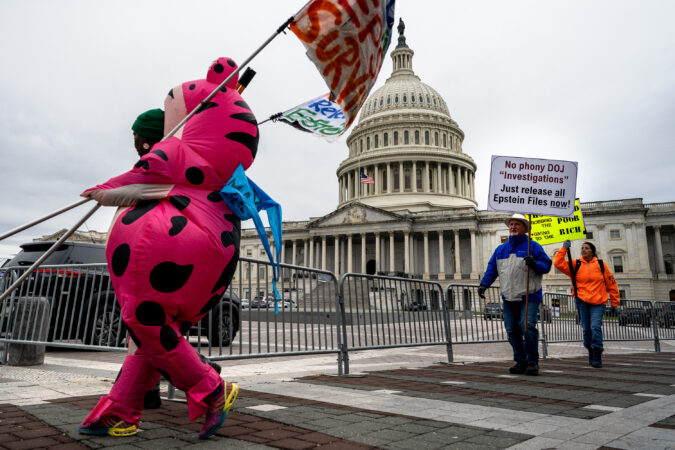
    Still, many in the Republican base continued to demand the release of the files. Adding to that pressure, survivors of Epstein’s abuse rallied outside the Capitol Tuesday morning. Bundled in jackets against the November chill and holding photos of themselves as teenagers, they recounted their stories of abuse.

    “We are exhausted from surviving the trauma and then surviving the politics that swirl around it,” said one of the survivors.

    Another, Jena-Lisa Jones, said she had voted for Trump and had a message for the president: “I beg you Donald Trump, please stop making this political.”

    The group of women also met with Johnson and rallied outside the Capitol in September, but have had to wait months for the vote.

    That’s because Johnson kept the House closed for legislative business for nearly two months and refused to swear-in Democratic Rep. Adelita Grijalva of Arizona during the government shutdown. After winning a special election on Sept. 23, Grijalva had pledged to provide the crucial 218th vote to the petition for the Epstein files bill. But only after she was sworn into office last week could she sign her name to the discharge petition to give it majority support in the 435-member House.

    It quickly became obvious the bill would pass, and both Johnson and Trump began to fold. Trump on Sunday said Republicans should vote for the bill.

    Yet Greene told reporters that Trump’s decision to fight the bill had betrayed his Make America Great Again political movement.

    “Watching this turn into a fight has ripped MAGA apart,” she said.

    How Johnson handled the bill

    Rather than waiting until next week for the discharge position to officially take effect, Johnson held the vote under a procedure that requires a two-thirds majority.

    But Johnson also spent a morning news conference listing off problems that he sees with the legislation. He argued that the bill could have unintended consequences by disclosing parts of federal investigations that are usually kept private, including information on victims.

    “This is a raw and obvious political exercise,” Johnson said.

    Still, he voted for the bill. “None of us want to go on record and in any way be accused of not being for maximum transparency,” he explained.

    Meanwhile, the bipartisan pair who sponsored the bill, Reps. Thomas Massie, R-Ky., and Ro Khanna, D-Calif., warned senators against doing anything that would “muck it up,” saying they would face the same public uproar that forced both Trump and Johnson to back down.

    “We’ve needlessly dragged this out for four months,” Massie said, adding that those raising problems with the bill “are afraid that people will be embarrassed. Well, that’s the whole point here.”

    Senate acts quickly

    Even as the bill cleared his chamber, Johnson pressed for the Senate to amend it to protect the information of “victims and whistleblowers.” But Senate Majority Leader John Thune quickly shut down that notion.

    As senators gathered in the chamber Tuesday evening for the first votes of the week, it became clear no one would object to passing the bill as written.

    Just before Senate Democratic leader Chuck Schumer called to pass the bill by unanimous consent, Oklahoma Sen. Markwayne Mullin, a Republican who is close to Trump, walked in the chamber and gave Schumer a thumbs-up. He then walked over to Schumer and shook his hand.

    “This is about giving the American people the transparency they’ve been crying for,” said Schumer, D-N.Y. “This is about holding accountable all the people in Jeffrey Epstein’s circle who raped, groom, targeted and enabled the abuse of hundreds of girls for years and years.”

  • EEOC sues Penn for failing to release information related to antisemitism investigation

    EEOC sues Penn for failing to release information related to antisemitism investigation

    The U.S. Equal Employment Opportunity Commission is suing the University of Pennsylvania for failing to release information related to an investigation it began in 2023 over the school’s treatment of Jewish faculty and other employees regarding antisemitism complaints.

    Penn, according to the complaint filed in federal court Tuesday, has not complied with a subpoena for information, including the identification of employees who could have been exposed to alleged harassment and the names of all employees who complained about the behavior.

    In its quest to find people potentially affected, the EEOC demanded a list of employees in Penn’s Jewish Studies Program, a list of all clubs, groups, organizations and recreation groups related to the Jewish religion — including points of contact and a roster of members — and names of employees who lodged antisemitism complaints.

    Penn usually does not comment on litigation, but in this case, the school ardently objected to the EEOC’s characterization of its cooperation and the personal nature of the material it was still seeking.

    The school said in a statement it has cooperated extensively with the EEOC, including providing more than 100 documents and over 900 pages.

    But the private university said it will not disclose personal information, specifically “lists of Jewish employees, Jewish student employees and those associated with Jewish organizations, or their personal contact information” to the government.

    “Violating their privacy and trust is antithetical to ensuring Penn’s Jewish community feels protected and safe,” the university said Tuesday.

    Penn also provided information on employees who complained and agreed that it could be shared, the school said, but the school would not provide information on those who objected.

    “Penn also offered to help the EEOC reach employees who are willing to speak with the agency by informing all employees of the investigation and how they could reach out to the agency,” the university said. “The EEOC rejected that offer.”

    The original complaint was launched by EEOC Commissioner Andrea Lucas, now chair of the body, on Dec. 8, 2023, two months after Hamas’ attack on Israel that led to unrest on college campuses, including Penn, and charges of antisemitism. It was also just three days after former Penn President Liz Magill had testified before a Republican-led congressional committee on the school’s handling of antisemitism complaints; the testimony drew a bipartisan backlash and led to Magill’s resignation days later.

    Lucas, who was appointed chair this year by President Donald Trump, also brought similar antisemitism charges against Columbia University that earlier this year resulted in the school paying $21 million for “a class settlement fund.”

    EEOC complaints typically come from those who allege they were aggrieved. Lucas, according to the complaint, made the charge in Penn’s case because of the “probable reluctance of Jewish faculty and staff to complain of harassing environment due to fear of hostility and potential violence directed against them.“

    The EEOC’s investigation ensued after Lucas’ complaint to the EEOC’s Philadelphia office that alleged Penn was subjecting Jewish faculty, staff, and other employees including students “to an unlawful hostile work environment based on national origin, religion, and/or race.”

    The allegation, the complaint said, is based on news reports, public statements made by the university and its leadership, letters from university donors, board members, alumni and others. It also cited complaints filed against Penn in federal court and with the U.S. Department of Education over antisemitism allegations and testimony before a congressional committee.

    The EEOC complaint pointed to public comments by Magill, addressing antisemitism while she led Penn.

    “I am appalled by incidents on our own campus, and I’ve heard too many heartbreaking stories from those who are fearful for their safety right here at Penn,” Magill said in 2023. “This is completely unacceptable.”

    Magill also in a message had addressed “a small number of Penn staff members” who “received vile, disturbing antisemitic emails that threatened violence against members of our Jewish community,” in November 2023.

    The complaint cited incidents of antisemitic obscenities being shouted on the campus, destruction of property in Penn’s Hillel, a swastika painted in an academic building, graffiti outside a fraternity and a pro-Palestinian encampment on the campus in 2024 that eventually was dismantled by police.

    “Throughout its investigation, the EEOC has endeavored to locate employees exposed to this harassment and to identify other harassing events not noted by respondent in its communications, but respondent has refused to furnish this information, thereby hampering the EEOC’s investigation,” the complaint said.

    Penn said it had received three antisemitism complaints, according to the federal complaint, but the EEOC questioned that number given the university’s workforce of more than 20,000. It demanded that the school provide names of all people who attended listening sessions as part of the school’s task force on antisemitism and all faculty and staff members who took the task force’s survey.

    Penn objected to the subpoena and the commission partially modified it in September, ordering the school to comply within 21 days, the complaint said.

    In its statement to The Inquirer, Penn defended its response to antisemitism.

    “Penn has worked diligently to combat antisemitism and protect Jewish life on campus,” the school said.

  • Every Pa. lawmaker votes to release Jeffrey Epstein records as Congress passes bill after Trump’s reversal

    Every Pa. lawmaker votes to release Jeffrey Epstein records as Congress passes bill after Trump’s reversal

    WASHINGTON — Congress passed legislation Tuesday to require President Donald Trump’s administration to release troves of records related to notorious sex trafficker Jeffrey Epstein after months of pressure from Democrats and survivors on the issue.

    The U.S. House voted 427-1 to pass the bill on Tuesday, prompting lawmakers in the chamber to cheer. The legislation was then rapidly passed by the U.S. Senate through unanimous consent, a process that skips debate when no senator objects to a bill.

    Despite the overwhelming bipartisan consensus, Tuesday’s House vote followed months of pushing by Democrats to bring it the floor as Trump unsuccessfully lobbied to prevent it from receiving a debate.

    The president abruptly changed his stance on the bill this week after it became clear it had enough Republican support to pass against his objections. The veto-proof bill now heads to Trump’s desk for his signature.

    U.S. Rep. Rob Bresnahan, a freshman Republican who represents Northeastern Pennsylvania, told The Inquirer after the vote that his office “had a lot of phone calls” about the bill.

    “We listened to our constituents… and I want to thank the people at home for bringing this to our attention,” he said outside the House chamber.

    U.S. Rep. Clay Higgins, a Louisiana Republican, was the sole no vote. Five House members did not vote.

    Trump said this week he would sign the bill into law, but he doesn’t actually need congressional approval to order the release of the files and could have already done so — a fact noted by U.S. Rep. Dwight Evans in the lead-up to the vote.

    “Let’s be clear — Donald Trump doesn’t have to wait until Congress votes on this resolution,” Evans, a retiring Philadelphia Democrat, said in a Monday post on X. “If he wanted to, he could tell the Justice Department to release the Epstein files TODAY.”

    The bill, called the Epstein Files Transparency Act, requires the Department of Justice to publish all unclassified files related to the prosecution and investigation of Jeffrey Epstein, a well-connected financier and convicted sex offender who was found dead in his jail cell in August 2019 and determined to have died by suicide after being federally charged with sex trafficking underage girls. After his death, his close associate Ghislaine Maxwell was convicted of sexually exploiting and abusing girls with him over the course of a decade.

    The bill was led by U.S. Rep. Ro Khanna, a California Democrat who grew up in Bucks County, and U.S. Rep. Thomas Massie, a Kentucky Republican who frequently breaks with party leadership. U.S. Reps. Mary Gay Scanlon and Chris Deluzio, both Pennsylvania Democrats, were cosponsors.

    Trump suggested on the campaign trail that he would release files related to the Epstein investigation, but after his administration faced uproar over their lackluster release of information surrounding the investigation, he began discrediting the cause.

    Trump is mentioned numerous times in files that have already been released, including in an email in which Epstein claims Trump “spent hours at my house” with a young woman who later said she was a victim of Epstein, the New York Times reported last week. The president was neighbors with Epstein in Florida and was photographed with him at numerous social occasions in the 1990s and 2000s. He has called the efforts for more transparency a Democratic “hoax” that had fooled “stupid” Republicans who would be committing a “hostile act” by supporting the release.

    Bresnahan was hesitant to answer whether any of the mentions of the president concern him.

    “I saw some of the email threads; a lot of it was snippets. I don’t know where it came from,” said Bresnahan, who represents a swing district.

    “I want to look at the whole comprehensive picture,” he added.

    House Speaker Mike Johnson (R., La.) wasn’t going to allow the bill to be voted on the floor, so Khanna and Massie successfully forced the vote through a discharge petition, which was supported by all House Democrats and just three other Republicans — U.S. Reps. Marjorie Taylor Greene of Georgia, Nancy Mace of South Carolina, and Lauren Boebert of Colorado.

    Massie and Khanna started to gather signatures in September and got the 218th needed on Wednesday last week when U.S. Rep. Adelita Grijalva (D. Ariz.) was sworn into office after winning a special election in September.

    U.S. Rep. Brendan Boyle, a Philadelphia Democrat, blamed the delay for Grijalva’s swearing in on Trump and Johnson‘s resistance to the bill getting to the floor.

    “There is a reason why Donald Trump has worked so hard to keep these Epstein files covered up,” he said in a video he shared on social media.

    The bill reaching the floor put Republicans in a new bind: their stance on the matter would be on the record. They had to choose whether their loyalty to Trump would outweigh pressure from constituents on the matter.

    Once it became clear the president wouldn’t prevail, Trump had a complete about-face Sunday night and called for lawmakers to support the bill.

    “House Republicans should vote to release the Epstein files, because we have nothing to hide, and it’s time to move on from this Democrat Hoax perpetrated by Radical Left Lunatics in order to deflect from the Great Success of the Republican Party,” he posted on Truth Social.

    “I DON’T CARE!” he added in the post and claimed that the files are a “curse on the Democrats, not us.”

    Khanna said that almost 100 Republicans would have voted for the bill before Trump changed course in an interview with The New York Times.

    “Trump saw his MAGA coalition was splintering and the last thing he could have had is a hundred Republicans vote for a Democratic bill in defiance of what he wanted,” he said in the interview. “Obviously, he has enough political instincts to realize how much he was losing on this issue.”

    Once Trump signaled support for the bill, Khanna said he would “be surprised if it’s not close to unanimous.”

    A separate House Oversight Committee investigation has released thousands of files from Epstein’s estate that show his connections spanning from Trump to influential leaders on Wall Street and across the globe. The Wall Street Journal also revealed over the summer a sexually explicit birthday message that appeared to be from the president to Epstein.

    Trump has since called on the Justice Department to investigate ties between his political adversaries and Epstein, particularly the Clintons.

    Survivors of Epstein’s abuse rallied outside the Capitol in the cold Tuesday morning.

    Liz Stein, a survivor of Epstein’s abuse, said in a statement that she hopes “our elected leaders show the courage to stand with survivors.”

    “Those of us directly impacted and harmed by the crimes of Jeffrey Epstein and Ghislaine Maxwell deserve justice and for the world to know our story,” she said. “It’s time for real accountability and true transparency.”

    Where did Pa. Republicans stand prior to Tuesday’s vote?

    U.S. Rep. Brian Fitzpatrick, a Bucks County Republican and former FBI agent who represents a purple district, had been quiet on the issue.

    World Without Exploitation, an anti-human trafficking group that has called for the release of all Epstein files, put a billboard up in Fitzpatrick’s district that says: “Courage is Contagious: Release ALL The Epstein Files.”

    Fitzpatrick was also the subject of digital ads from the Democratic National Committee about the Epstein files over the summer that called him one of Trump’s “sycophantic enablers.”

    Even though no Pennsylvania Republicans signed onto the petition to allow a vote on the bill, some had previously indicated that they wanted the records released.

    Bresnahan said on FOX56 WOLF on Friday that he would vote to release the files while making sure victims are protected. He told The Inquirer after the vote that he made that decision “weeks ago.”

    When asked whether he was surprised at the near-unanimous support from his Republican peers, he said he “really wasn’t talking to a lot of my peers as to where they were going to be on it.”

    Other Republicans made statements over the summer after the Justice Department said it would not release any more files. Attorney General Pam Bondi suggested in February that she had Epstein’s “client list,” but the department released files that were long in the public eye before claiming in July that Epstein didn’t actually have a list of clients.

    U.S. Rep. Ryan Mackenzie, a freshman Republican who represents the Lehigh Valley, said during a telephone town hall in July that he would support measures to release DOJ files on Epstein if Trump’s administration doesn’t do more, NPR reported. He echoed that position Monday night, according to news reports.

    “I know they have not released as much as I would like to see to date, but hopefully they’re going to be doing that,” he said in July. “And if not, then Congress should potentially step in and compel them to do that because again, the American people deserve to have full transparency and information about what is in those files, and ultimately, we’re going to get there.”

    U.S. Rep. Scott Perry, a Trump ally who represents parts of Central Pennsylvania, shared a letter to Bondi on July 18 expressing “serious concern” over how the Epstein case had been handled and said it “remains one of the most troubling examples of apparent failures within our justice system.”

    He said the Trump administration’s handling of the case at that point had “only heightened public distrust.” He cited how the administration’s February 2025 release of documents “contained little new information” and its pivot on a supposed client list.

    “The continued secrecy surrounding these records undermines public confidence in the Justice Department’s commitment to justice,” he said at the time, requesting a special prosecutor to investigate the handling of the case.

    Perry supported a Democratic motion in July to subpoena the Justice Department for the Epstein files in an effort led by U.S. Rep. Summer Lee, a progressive Democrat from Pittsburgh. He also backed motions to subpoena former President Bill Clinton and former Secretary of State Hillary Rodham Clinton related to the case.

    Fitzpatrick, Perry, Mackenzie, and Bresnahan all represent districts that will be targeted by Democrats during next year’s midterms.

    Also in July, U.S. Rep. Dan Meuser (R., Luzerne) called for the release of “all the pertinent, credible Epstein files” but focused squarely on Clinton.

    Other Republicans in the state have been pretty quiet on the matter.

    Lee, the Pittsburgh Democrat who led the summer subpoena effort, said in a post on X after the vote that the Department of Justice has “slow-walked” the release of files for months and echoed that Trump hasn’t acted on his ability to compel the department to release the files.

    “No matter how wealthy or well-connected, every person who is complicit, enabled, or abused women and girls will be brought to justice,” she added.

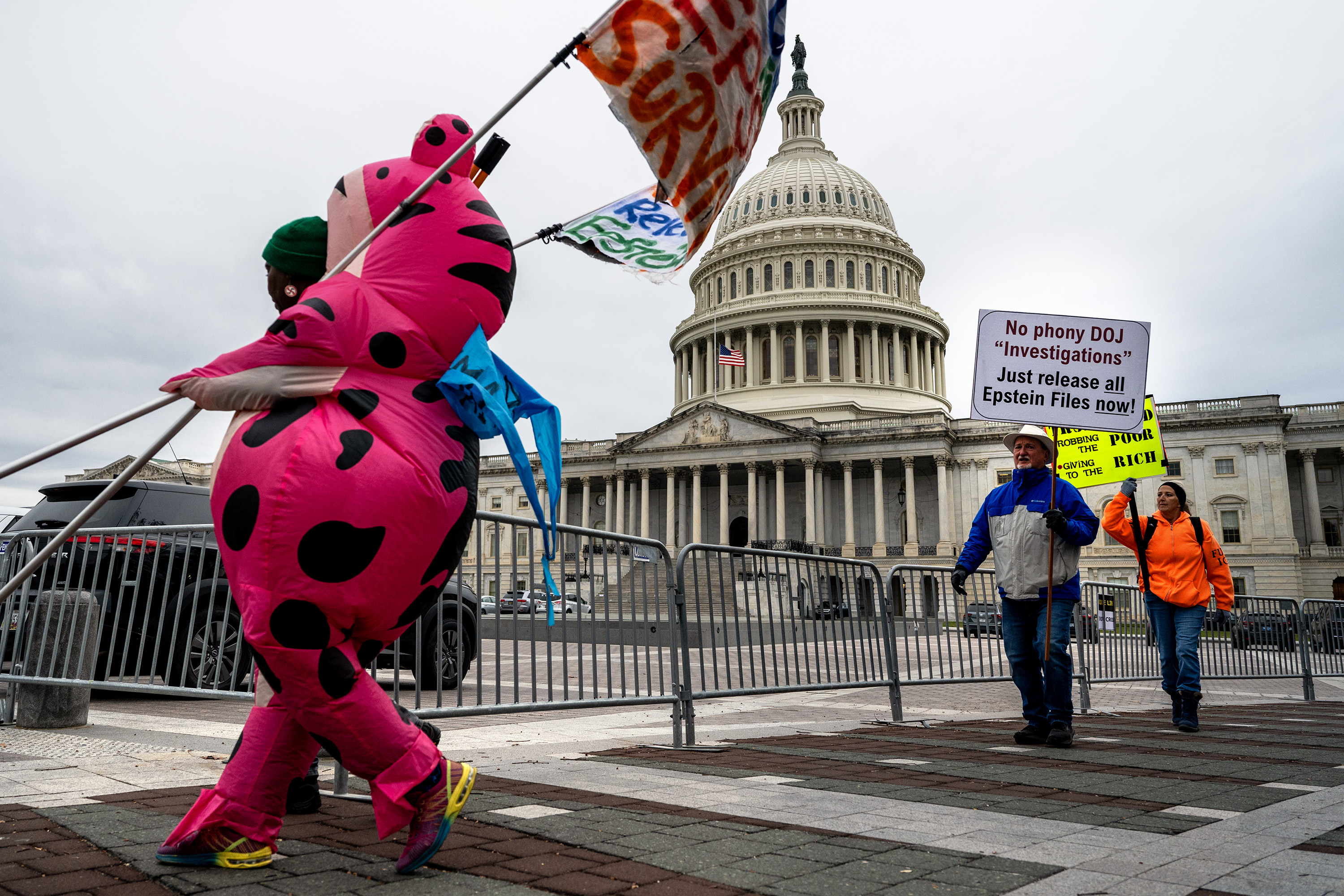
    Protesters head to the U.S. Capitol in Washington D.C. Tuesday, Nov. 18, 2025 as a bill that would require the release of records relating to Jefrey Epstein comes to a vote.
  • The Trump administration will announce the dismantling of multiple parts of the Education Department

    The Trump administration will announce the dismantling of multiple parts of the Education Department

    The Education Department plans to announce Tuesday that it will move multiple parts of the agency to other federal departments, an unprecedented and unilateral effort to dismantle an agency created by Congress to ensure all Americans have equal access to educational opportunity and better coordinate federal programs.

    The move was described by three people informed of the plan ahead of the announcement. Two of these people said six offices within the department would be shifted elsewhere; the third person said it was at least two.

    President Donald Trump signed an executive order in March seeking to close the department and asked Education Secretary Linda McMahon to work with Congress to do so. The agency, which was created in 1979, has long been derided by conservatives as unnecessary and ineffective. But Congress has not acted on or seriously considered Trump’s request.

    McMahon has acknowledged that only Congress can eliminate the department but vowed to do everything in her power to dismantle it from within.

    Asked for comment, an Education Department spokeswoman suggested some information provided to The Post about the plan was inaccurate, but did not offer specifics.

    Supporters of the department say that the agency is effective in coordinating multiple aspects of education in one place and keeping priorities important to students, parents and schools high on the federal agenda.

    Offices that could be moved out of the agency include the Office for Civil Rights, which investigates allegations of discrimination on the basis of race, sex and disability; the Office of Special Education and Rehabilitative Services, which administers the $15 billion Individuals with Disabilities Act program; and the Indian Education program; the Office of Elementary and Secondary Education, which administers K-12 grant programs; and the Office of Postsecondary Education.

    Federal law directs that these programs be housed in the Education Department. The Trump administration is employing a work-around, the people briefed on the matter said, whereby other government agencies would run the Education programs under a contract with the Education Department. The people spoke on the condition of anonymity because they were not authorized to discuss the changes.

    The Trump administration laid the groundwork for this change earlier this year when it signed an agreement to move career, technical and adult education grants out of the Education Department to the Labor Department. Under the arrangement, Education retains oversight and leadership while managing the programs alongside Labor, a way of sidestepping the federal statute.

    “We believe that other department functions would benefit from similar collaborations,” McMahon wrote in an op-ed essay published Monday in USA Today.

    More broadly, McMahon has argued that the recently ended government shutdown showed how unnecessary her agency is.

    “Students kept going to class. Teachers continued to get paid. There were no disruptions in sports seasons or bus routes,” she wrote. “The shutdown proved an argument that conservatives have been making for 45 years: The U.S. Department of Education is mostly a pass-through for funds that are best managed by the states.”

  • College journalism exposes the rot of ‘grown-ups’ | Will Bunch Newsletter

    I’m always reluctant to talk about upcoming columns, because in this twisted era everything changes at the drop of a MAGA hat, and I hate to jinx things. But as of now, I’m booked for a trip to Charlotte (or Raleigh?…I’ve already jinxed it, maybe) this coming weekend, where I hope to report from the front lines of the Border Patrol’s latest big-city invasion that has terrorized the immigrant community in North Carolina. So I’m going to spend a couple days reading up on what to do in a tear-gas attack, and I’ll see you again this weekend.

    If someone forwarded you this email, sign up for free here.

    Fearless college kids are saving journalism. Grown-ups? Not so much

    Editions of the Indiana Daily Student in the student media area in Franklin Hall on Indiana University’s campus on Oct. 14.

    In American journalism’s year of the bended knee, nobody would have been surprised if the student editors of the Harvard Crimson followed the sorry example of major outlets like CBS News or the Washington Post in groveling before the rich and powerful — in this case, their ex-university president and still plugged-in professor Larry Summers.

    Earlier this month, Summers took to social media (the Elon Musk-owned X, of course) with a rant against the student-run paper at the Ivy League school he once helmed, linked to an article by conservative commentator (and former Crimson editor) Ira Stoll accusing the Crimson of biased coverage in favor of Palestine. Summers said ominously, “I do hope alumni trustees will investigate and take any necessary steps lest a problematic situation deteriorate any further.”

    But instead of backing down, Harvard’s student journalists stepped up. When the emails of the late financier and sex fiend Jeffrey Epstein, released last week by a House committee, proved to be riddled with his communications with Summers — long after Epstein had pleaded guilty to teen sex trafficking in Florida — the Crimson produced the most in-depth takedown of any media outlet, anywhere.

    “As Summers Sought Clandestine Relationship With Woman He Called a Mentee, Epstein Was His ‘Wing Man’” was the blistering headline on the article by undergraduates Dhruv T. Patel and Cam N. Srivastava. It described, in excruciating detail, the married Summers’ missives to Epstein about his efforts to woo a much younger Chinese economist on campus whom he was mentoring (and whom the former U.S. treasury secretary and his felonious friend code-named, with a racism they thought would remain forever private, as “peril.”)

    Take that to the alumni trustees, Mr. Summers!

    With a devastating kicker that shows Summers still emailing Epstein up until 1:27 p.m. of the day before his pal was busted on new federal sex charges in 2019, the Crimson article went viral over the weekend. By Monday morning, Massachusetts U.S. Sen. Elizabeth Warren was calling for Summers’ ouster from his faculty post. By Monday night, a “deeply ashamed” Summers announced that he’s pulling back from his public commitments, although he plans to continue teaching.

    The students’ reporting was another win for truth, justice, and the American way — but not an isolated incident. In recent years, as mainstream journalism looks increasingly weak and flabby in the face of U.S. authoritarianism, and with college campuses on the front lines of a culture war, scribes in their teens and early 20s — burning with youthful idealism and the freedom of not much to lose — have raced into the void.

    Some 3,000 miles from Harvard Square, the student journalists at the Stanford Daily stood their ground after one of its reporters was charged with three felonies, at the behest of a top university administrator, for attempting to cover a pro-Palestinian protest on the California campus. Under increasing public pressure, the charges were dropped in March — another triumph for the paper whose 2022 investigative reporting into research irregularities took down the university president.

    In the heartland, the editors of the Indiana Daily Student at that state’s flagship public university last month stood up to school administrators banning their print editions, blasting the move in a front-page editorial that said “telling us what we can and cannot print is unlawful censorship.” The students, who worked with their peers at nearby Purdue University to publish a special issue that circumvented the ban, rallied support from prominent alums and got the school to reverse course.

    “I think that many of these college journalists are laser-focused on their beats, are developing great sources among administrators, faculty and students, and are unfazed by the possibility that their stories might piss off a valued source or two,” Columbia Journalism School professor Bill Grueskin, who covered the Stanford fracas for Columbia Journalism Review, told me Monday. “In other words, they’re doing the things that the best reporters do. They’re just not able to buy a beer (legally, at least) when their story shakes up the world.”

    I know what some of you are thinking here. Investigating corruption or misconduct among university leaders, or fighting for a free press…aren’t these college students just doing what any journalist worth their salt would do? Well, yes and no.

    Consider those Epstein emails that continue to dominate the news. It turns out that two prominent journalists corresponded frequently with the convicted sex creep: the “palace intrigue” access journalist Michael Wolff, and a soon-to-be-fired New York Times business reporter, Landon Thomas Jr. The missives suggest they had zero interest in reporting on Epstein’s proclivity for underage girls but very much wanted the access to the rich and famous that jeevacation@gmail.com offered.

    And it gets worse. Thomas actually solicited a $30,000 donation from Epstein to a favored charity — a severe ethical breach that cost him his job in America’s most prestigious newsroom. Wolff, meanwhile, was offering Epstein advice on how to leverage — in essence, blackmail — the sitting U.S. president, Donald Trump. At the same time, he was pushing a business venture that would link him not only with Epstein but another man later convicted of sex crimes, filmmaker Harvey Weinstein. It seems like both conflicted journalists wanted to play in the big leagues with the much richer people they were supposed to watchdog.

    This is something that too many elite journalists share with the increasingly conflicted corporations that employ them: a desire to comfort the comfortable in return for access, or prestige, or money — and to avoid getting sued, which might jeopardize those first three things.

    How else to explain major TV networks like CBS or ABC, owned by corporations with myriad issues before the federal government, settling frivolous lawsuits by Trump for millions of dollars, or the similarly conflicted Jeff Bezos telling his Washington Post to spike its endorsement of Kamala Harris, or the mealy-mouthed “both sides” reporting on rising authoritarianism that plagues so many elite newsrooms of the traditional media?

    The late, great Kris Kristofferson told us that freedom’s just another word for nothing left to lose, and maybe that simple explanation has a lot to do with the bravery of college journalists — that they are freer to question authority than folks with a mortgage and worries about paying for their own kids to attend a top school.

    Still, it’s important to understand that most of the rot in modern mainstream journalism — too much consolidation in the hands of too few conglomerates with too much at risk to be seen as anti-regime — is institutional. We should strive to make something great out of the fact that the next generation of American journalists has arrived with smarts, savvy, and a moral compass yet to be worn down by late-stage capitalism.

    Our challenge, as a society, is to tear down the decrepit structures of the corrupted old media and build a new one that rewards independent journalists who actually afflict the comfortable, and offers them incentives to keep doing that instead of cutting venture-capitalism deals with the folks they allegedly cover. Most of today’s college journalism majors would never trade emails with the likes of Jeffrey Epstein — except to take him down.

    Yo, do this!

    • The stroke of timing behind Ken Burns’ latest documentary epic, The American Revolution, which is currently running this week on PBS stations like WHYY here in Philadelphia and also streaming, was supposed to be the 250th anniversary of the conflict that created the United States. But the project has taken on much greater relevance in a fraught present, when folks are heatedly arguing just what the Founders’ American Experiment is really all about. Critics have praised Burns and his skilled team for blending the ideals and leadership of the George Washingtons and Thomas Paines with the realities faced by everyday folk, including indigenous and enslaved people.
    • Personally, I’ve been embroiled in my nostalgia for a more recent revolution — the cultural and musical explosions that occurred in 1966. I’ve been listening to the audiobook about that tumultuous year1966: The Year the Decade Exploded — by the British author Jon Savage, whose later book on the year 1971 was the basis for an outstanding but largely ignored documentary series on Apple TV, But 1971’s classic rock wouldn’t have happened without the cultural pioneers and a youthful clamor for liberation that came five years earlier. The book is an engrossing reminder that change is possible.

    Ask me anything

    Question: Now that People Magazine has revealed the disgusting “piggy” story, why isn’t this atop every news outlets coverage? We spent 3 full weeks on Biden’s age, a week on his pardon of his son with such moral outrage from every outlet. This doesn’t even get covered? — BigTVFan (@bigtvfan.bsky.social) via Bluesky

    Answer: The episode that BigTVFan is referring to occurred with a gaggle of journalists about Air Force One, but just started getting viral attention Monday night. It is, indeed, shocking to watch. When a Bloomberg woman journalist pressed Donald Trump on the Epstein files, the president erupted. “Quiet! Quiet, Piggy!” Yes, this should be a front-page story in the traditional media, and not only because of the stunning sexism (when the subject is Epstein, no less!) and the regal arrogance, but also this: the man who’s followed around by the nuclear suitcase seems to be losing his grip on reality. Monday afternoon, Trump spoke to a gathering of franchisees of the fast-food addiction that may be just one reason why nobody believes he only weighs 16 ounces more than Jalen Hurts, McDonald’s, and was at times beyond incoherent. Yet Trump’s rapidly deteriorating mental state remains mostly off-limits for the elite media. It’s a massive error of omission that the world will look back on and regret.

    What you’re saying about…

    It’s funny how one week can feel like a decade in 2025. Last week’s question about the eight senators (seven Democrats and an independent) who cut a deal to end the long government shutdown drew a huge response from folks fired up about an issue that now almost feels like ancient history after the Epstein email release. Readers were passionate but divided. Certainly many felt the eight senators had caved in the worst possible way. An outraged Freddi Carlip wrote that “most people wanted to do what was best for Americans who are hurting and that is to stand up to bullies.” But a number of you thought the opposition had few real options but to deal from a weak hand. “This was always going to end with the government opening under the black flag of the Big Ugly Bill,” wrote Kent Dietz. “Oft repeated but true: elections have consequences.”

    📮 This week’s question: It’s all Epstein all the time, so let’s talk about it. Do you think Trump has sincerely flip-flopped and the relevant files will soon be released? Or is the White House still playing a long game aiming to keep Epstein’s secrets buried with him? Please email me your answer and put the exact phrase “Epstein files” in the subject line.

    History lesson on ‘Charlotte’s Web’…and fascism

    U.S. Border Patrol Commander at large Gregory Bovino, right, looks on as a detainee sits by a car Monday, in Charlotte, N.C.

    Nobody reads any more, at least not to the end. That’s been driven home this autumn by several efforts from tech bros and other leaders of our dystopia falling flat on their face with their attempts at literary allusions. A viral post on Bluesky recently mocked the Icarus Flying Academy, whose founders may be blissfully unaware that their Greek mythological namesake flew too close to the sun and crashed. On Monday, gazillionaire Jeff Bezos also invoked ancient Greece by announcing his AI startup Project Prometheus, invoking an inventor who was ultimately bound to a rock by Zeus for his overreaching. Then there’s the bad people behind the U.S. Border Patrol and its inhumane mass deportation drive, who took their horror show to North Carolina this past weekend with their “Operation Charlotte’s Web.”

    The “brains” behind the BP’s masked goon squad, Gregory Bovino, named the operation — which netted 81 detainees in its first Saturday during a chaotic surge through suburban lawns and Home Depot parking lots — after the 1952 classic children’s novel by E.B. White about a farm, a pig, and the compassionate spider, Charlotte, who saves the pig’s life. Why? Because Bovino’s secret police force are ensnaring scores of immigrants in their web. In Charlotte, N.C. Get it? Bovino even took to social media’s X with a wildly out-of-context quote from the novel: “Wherever the wind takes us. High, low. East, west. North, south. We take to the breeze, we go as we please.”

    In a viral essay, the writer Chris Geidner of the excellent site LawDork demolished Bovino’s literary aspirations for his police-state operation. His piece went well beyond the obvious point that a children’s novel that centers on a spider’s quest to protect someone different from her — a pig — from his human predators is the 180-degree polar opposite from the web of inhumanity that Team Bovino is spinning in Charlotte, terrorizing the Latino community there. Geidner notes that much of E.B. White’s wider work was in opposition to the very fascism that’s behind the mass deportation drive of Bovino and his ultimate boss, Donald Trump.

    Geidner quotes White from a 1940 essay, as Adolf Hitler’s stormtroopers were advancing across Europe: “I am in love with freedom and that it is an affair of long standing and that it is a fine state to be in, and that I am deeply suspicious of people who are beginning to adjust to fascism and dictators merely because they are succeeding in war. From such adaptable natures a smell rises. I pinch my nose.”

    White, and his fictional Charlotte, would have done more than pinch their nose from the stench of this operation in a proud city that shares its name with a heroic spider. For sure, Bovino’s crimes against literature pale in comparison to his ongoing crimes against humanity. But he may discover that the rapidly spinning American thread of community and common decency that is resisting mass deportation is the true sequel to Charlotte’s Web.

    What I wrote on this date in 2018

    It was Mississippi’s most famous writer, William Faulkner, who wrote, “The past is never dead. It’s not even past.” Seven years ago on this date, I wrote about how a justice-denied 1955 murder of a Black man trying to deliver absentee ballots to the county courthouse in Brookhaven, Miss., haunted the modern Senate campaign of that town’s GOP U.S. Sen. Cindy Hyde-Smith. I wrote: “Four years after [Lamar Smith] was killed, a baby girl was born in Brookhaven named Cindy Hyde. Over the next 59 years, she immersed herself in the politics of a community that bitterly refuses to concede the just cause that Lamar Smith died for.” Read the rest from Nov. 18, 2018: “Why the blood of a 1955 Mississippi murder drenches today’s U.S. Senate race.”

    Recommended Inquirer reading

    • Only one column this week, and as you might expect it drilled deeply into the true meaning of the Jeffrey Epstein emails that have dominated the headlines. I went beyond the suggestive comments about Donald Trump to look at the deeper moral decay of the rich and famous who continued to seek out Epstein and his connections years after his Florida guilty plea to child prostitution charges. The missives from billionaires and political insiders also reveal their growing — and justified — worries that the public may be reaching for pitchforks.
    • The John Fetterman saga never ends, nor does Pennsylvania readers’ bottomless fascination with his decade-plus odyssey from outspokenly progressive mayor of struggling Braddock, Pa., to the U.S. Senate, where he is increasingly at odds with his fellow Democrats about practically everything. The Inquirer’s coverage of revelations in Fetterman’s new autobiography, including his long-running feud with Gov. Josh Shapiro, was one of the most widely read stories last week. So was what happened next, as renewed heart problems caused Fetterman to fall flat on his face and again be hospitalized. There’s three more years until the end of Fetterman’s term and an all-but-certain primary challenge from his political left. No one is going to cover this better than The Inquirer, so why not subscribe today?

    By submitting your written, visual, and/or audio contributions, you agree to The Inquirer‘s Terms of Use, including the grant of rights in Section 10.

  • Pennsylvania’s Working Families Party pledges to support a primary challenger against Sen. John Fetterman

    Pennsylvania’s Working Families Party pledges to support a primary challenger against Sen. John Fetterman

    Pennsylvania’s Working Families Party is recruiting candidates to run against Pennsylvania’s Democratic senator, John Fetterman.

    Fetterman has not announced whether he will run for reelection in 2028, but the progressive party put out a public declaration Tuesday pledging to endorse — and, if necessary, recruit and train — a challenger.

    The announcement, first reported by The Inquirer, is a remarkable step for the left-leaning organization to take more than two years before an election and speaks to the degree of frustration with Fetterman among progressives.

    “At a time when Donald Trump and Republicans in Congress are doing everything they can to make life harder for working people, we need real leaders in the Senate who are willing to fight for the working class,” Shoshanna Israel, Mid-Atlantic political director for the Working Families Party, said in a statement.

    “Senator Fetterman has sold us out, and that’s why the Pennsylvania Working Families Party is committed to recruiting and supporting a primary challenge to him in 2028.”

    Fetterman did not immediately return a request for comment about the Working Families Party’s announcement.

    The Working Families Party is a progressive, grassroots political party that is independent from the Democratic Party, but it often endorses and supports Democratic candidates.

    Israel noted in her statement that Fetterman voted last week in support of the Republican plan to end the government shutdown — along with seven other Senate Democratic caucus members who crossed the aisle.

    Democratic lawmakers in the House, including several from Pennsylvania’s delegation, railed against the decision as caving to the GOP and President Donald Trump without any substantive wins on healthcare, rendering a 35-day shutdown pointless.

    Though he supports extending federal healthcare subsidies, Fetterman has long said he is against government shutdowns as a negotiating tactic and will always vote to get federal coffers flowing and federal employees paid.

    “I’m sorry to our military, SNAP recipients, gov workers, and Capitol Police who haven’t been paid in weeks,” Fetterman said in a post on X after the vote. “It should’ve never come to this. This was a failure.”

    Already one of the most well-known and scrutinized senators in Washington, Fetterman was back in the spotlight this week as he returns to work following a hospitalization after a fall near his home in Braddock. His staff said he suffered a “ventricular fibrillation flare-up” and hit his face, sustaining “minor injuries.”

    Ventricular fibrillation is the most severe form of arrhythmia — an abnormal heart rhythm — and the most common cause of sudden cardiac death.

    It’s the latest in a string of serious health incidents that have marked the Democratic senator’s time in the public eye. The fall comes three years after he recovered from a near-fatal stroke just days before he won the 2022 Senate primary, which was caused by a blood clot that had blocked a major artery in his brain.

    He spent Thursday and Friday in the hospital and was released Saturday, saying he was feeling good and grateful for his care with plans to be back in the Senate this week.

    Working Families on the offensive

    Israel said in addition to the online portal, the party will hold a number of recruitment events across Pennsylvania in the coming months to train candidates and campaign staff on the basics of running for office and managing a campaign with hopes of finding quality candidates for a variety of races ahead of 2028.

    The party is also pledging a robust ground game and fundraising for a potential challenger it supports.

    It wouldn’t be the first time the Working Families Party has opposed Fetterman. In the 2022 Democratic Senate primary, WFP endorsed State Rep. Malcolm Kenyatta (D., Philadelphia) over Fetterman, who was lieutenant governor at the time.

    The Working Families Party has grown its influence in the region since then. In 2023, WFP became the minority party on Philadelphia’s City Council, defeating Republicans in seats the party had held for over 70 years by electing Councilmembers Kendra Brooks and Nicolas O’Rourke.

    Fetterman has been promoting his book, Unfettered, recounting his stroke during the 2022 Senate run, subsequent struggles with depression, and adjustment to life in the U.S. Senate.

    The book makes no mention of a reelection bid but laments the ugly politics he experienced in both the Democratic primary and his general election race against Mehmet Oz.

    Fetterman said in the book that Oz’s attacks during his rehabilitation from his stroke became so mentally crushing he felt he should have quit the race.

    And he grapples with criticism he faced during the primary surrounding a 2013 incident in which he wielded a shotgun and apprehended a Black jogger he suspected of a shooting. Fetterman calls the backlash an early trigger of his depression.

    Fetterman has said he will remain a Democrat even as Republicans have lauded his independent streak and willingness to work with the GOP.

    Earlier this year, Fetterman was the first Senate Democrat to support the Laken Riley Act, a Republican immigration bill that requires U.S. Immigration and Customs Enforcement to detain and take into custody individuals who have been charged with theft-related offenses, even without a conviction. Critics of the law say it severely cracks down on due process for immigrants.

    Fetterman was the sole Senate Democrat to vote to confirm Attorney General Pam Bondi, who was one of Trump’s attorneys when he tried to overturn the results of the 2020 election.

    And he has been the Senate’s most outspoken defender of Israel during its war in Gaza, sponsoring a resolution with Sen. Dave McCormick (R., Pa.) against antisemitism and appearing for the first time since his fall at an event hosted by the Jewish Federations of North America in Washington on Monday.

    He also received recognition from Israeli Prime Minister Benjamin Netanyahu, who called him the country’s “best friend” and gifted him a silver pager inspired by Israel’s attack on Hezbollah in Lebanon that exploded pagers.

    “He has repeatedly shown disregard for the rights of Palestinians,” the Working Families Party release said. “Refusing to support a two-state solution and breaking with the rest of the Democratic caucus on Israel’s illegal annexation of the West Bank.”

    Staff writer Aliya Schneider contributed to this article.

  • The ‘No Kings’ rallies were a start. Now what?

    The ‘No Kings’ rallies were a start. Now what?

    In my younger days, I enjoyed sports talk radio.

    A favorite of mine was ESPN’s Mike and Mike. I remember during the height of the Colin Kaepernick protest, Mike Golic commended Kaepernick for his attention-grabbing display and the reasons behind it.

    But Golic turned the tables on Kaepernick and asked what the quarterback planned to do to achieve the goals he sought through his protest.

    I would love to ask white people who were part of the “No Kings” rally recently the same question, but I am unsure of what tangible outcome was sought from it. It seemed like an occasion to voice their displeasure, so I am unsure what the next step is beyond planning another “protest” in the next few months.

    The optics from the mass demonstration were indeed impressive: seven million people, predominantly older and white, took part in protests nationwide. That cannot be ignored. But the substance of these protests was lacking.

    Not according to news media pundits, who declare that these acts are signs of the anger and emerging resistance to the Trump administration we’ve been waiting for.

    But “No Kings” shouldn’t be confused with the Arab Spring.

    Protesters made no demands. They caused no ruckus. In fact, this “protest” seemed more like a party than a desperate attempt to save humanity.

    Don’t get me wrong.

    Protesting one’s grievances in an attempt to acquire a remedy for them by way of public policy is a good thing. Black people are well acquainted with our history of protest and resistance to unjust laws.

    Lessons from the civil rights era

    But the lessons for all to learn from the history of Black resistance, particularly the civil rights movement, is 1) there is always a tangible demand for something or numerous things, 2) there’s a righteous anger that is harnessed into a tangible action (e.g., protest, boycott, divesting, etc.) to produce the demand, and 3) there is a desperation that yields a willingness to sacrifice in the name of their humanity.

    The “No Kings” protest had none of these.

    But it did have singing, dancing, and folks in costumes. Indeed, there is room for joy within any social movement (if you can call this a social movement yet, I am not sure), and there’s been that at protests before.

    Joy is one of the fruits of our work, whether it comes from protest or other mass action, but a protest isn’t a party.

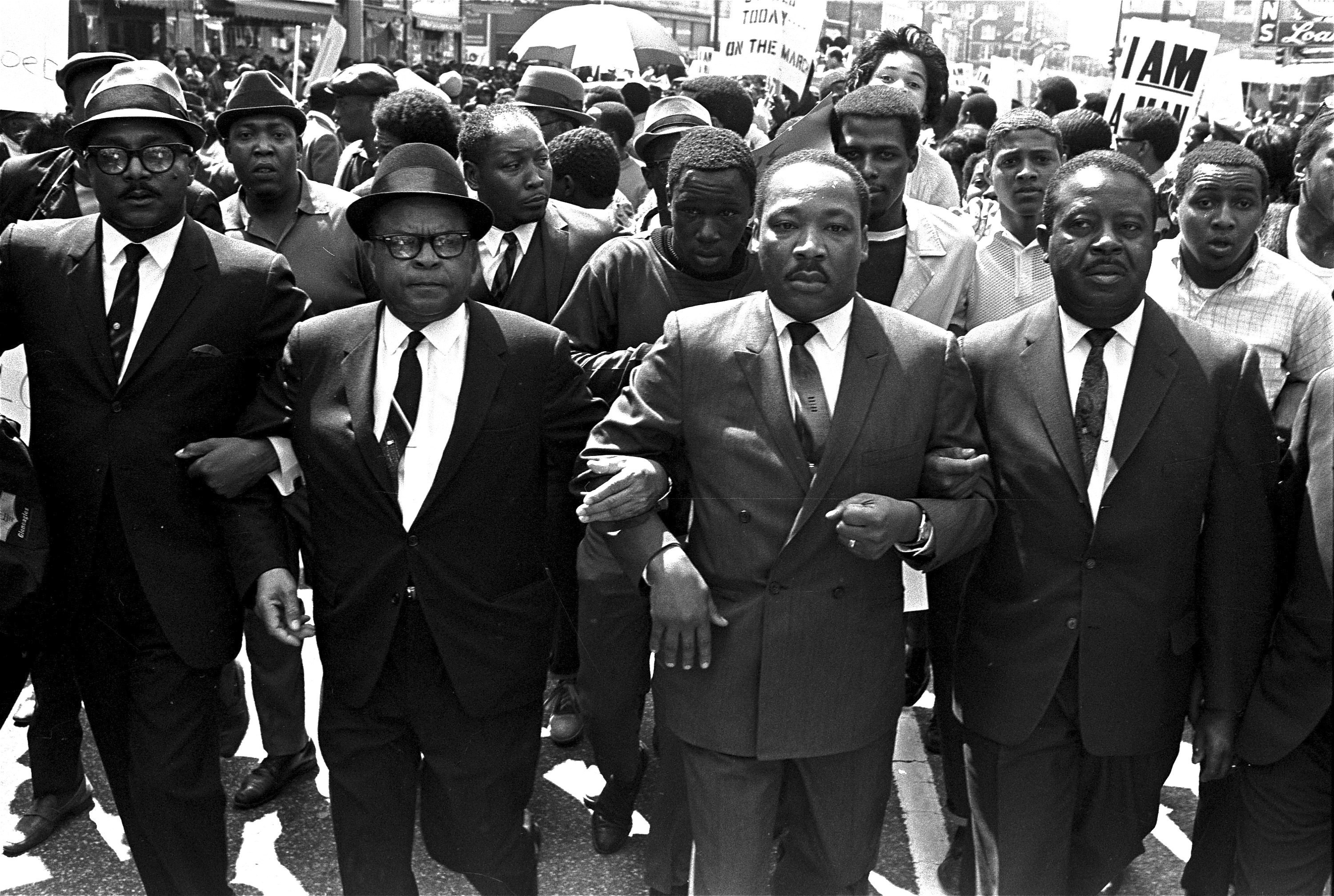
    The Rev. Dr. Martin Luther King and other civil rights leaders march in Memphis on March 28, 1968. He was killed a week later.

    Organized protests should elicit a response that either brings the oppressor to their knees and forces them to concede the demand, or, at the very least, brings them to the negotiating table.

    The “No Kings” rally produced only one response from Donald Trump: an AI video of a “King Trump” jet dumping what appeared to be liquid feces on the protesters. Clearly, demonstrators got a reaction from Trump, but not the kind that relieves any of the pressure they face at the kitchen table.

    I previously commented that white people have a decision to make. That is, whether they intend to fight for their rights and the rights of nonwhite people, or only for their own rights. I’m not sure what these protests suggest is their answer to that question. But my advice is to learn from the civil rights movement.

    Some sit it out

    I highly doubt white Americans can “save” democracy in America by way of reconciling its relationship with white supremacy absent Black people. However, a lot of us have chosen to sit out these protests because many of the people protesting Trump are likely responsible for his return to power.

    We’re tired of persevering through the hypocrisy in the name of survival, but I digress.

    Learn from the civil rights movement to strengthen this effort on behalf of all Americans. Concretely define the “movement’s” demand(s) via policy change that can directly begin to upend systemic oppression.

    Just as the civil rights movement improved the lives of all Americans, so should these coordinated mass demonstrations. Harness the real anger seen at town hall meetings, for example, to agitate and aggravate the power structure to show that these protests are a force to be reckoned with, as opposed to “a good time had by all.”

    Lastly, continue direct action with a consistency that demonstrates your demands aren’t a wish list, but rather the oxygen necessary to breathe.

    Taking it to the streets is definitely a start. But it’s nowhere near the finish.

    To reach the finish line, y’all have more work to do. Some Democrats in Congress need to learn these lessons, as well.

    Rann Miller is an educator and freelance writer based in southern New Jersey. His “Urban Education Mixtape” blog supports urban educators and parents of children attending urban schools. urbanedmixtape.com @UrbanEdDJ

  • Amy Gutmann, once Penn president, is teaching again. Here’s what it’s like to be her student.

    Amy Gutmann, once Penn president, is teaching again. Here’s what it’s like to be her student.

    The undergraduate class at the University of Pennsylvania vigorously discussed the use of affirmative action in college admissions, half the room charged with arguing one side and half the other.

    Their task, informed by the 2023 U.S. Supreme Court decision that ended the use of race-conscious college admissions, was to brief and advise a popular governor of a swing state who had not yet taken a position on the issue.

    “Guess who is the governor?” said their professor, Amy Gutmann. “I am the governor.”

    And for 90 minutes, the entirety of the class period, Gutmann guided a lively discussion in which students talked as much as she did.

    While never a governor, Gutmann has quite the leadership portfolio. She was president of Penn for a record 18 years, leaving in 2022 to become U.S. ambassador to Germany under former President Joe Biden, a post she held until 2024. She is also a Harvard-educated political scientist who cowrote the book The Spirit of Compromise and in 2018 was called one of the world’s 50 greatest leaders by Fortune magazine.

    Now, for the first time in about 25 years — since she was a politics professor at Princeton — Gutmann is back in the classroom teaching a full course this semester in the Annenberg School for Communication. Sarah Banet-Weiser, dean of Annenberg, who initially came up with the idea for the course, is her co-teacher.

    For students, the professorial star power was hard to pass up. There was a waiting list for the class.

    “It’s kind of a power duo,” said Evan Humphrey, 21, a senior communications major from Seattle. “Got to take that class.”

    Senior Evan Humphrey said she was drawn to enroll in the class because of the two professors and their distinguished careers.

    Focusing on teaching — the heart of a university — has been especially meaningful to Gutmann, and to Banet-Weiser, too, at a time when higher education has had its federal funding threatened and its approaches attacked.

    “It literally gives me life every week,” Banet-Weiser said.

    Gutmann, 75, who said she aspired to be a teacher since she was 5, said it has made her feel productive “in a way that goes to the heart of what a university is about.”

    “We should never lose sight of that heart of the university and how valuable it is,” she said.

    The goal of the class, called “The Art and Ethics of Communication in Times of Crisis,” is “to learn how and why to communicate with greater insight and understanding across differences,” while creating space “for free and open dialogue about controversial issues.”

    Seniors Luiza Louback (left) and Sarah Usandivaras (right) participate in the class discussion.

    It could be a primer for the politically divided nation.

    “My pitch is that you can’t really know what you believe if you don’t know what people who disagree with you believe and what their reasons are,” Gutmann said in an interview. “I always say I don’t care what your position is. I care that you can give reasons for it and understand the strongest arguments on the other side.

    “That’s the method to search for truth, and it’s the way we serve a democracy.”

    Bringing experience to the classroom

    During class, Gutmann frequently drew on her experiences as a first-generation college student, a young professor at Princeton, a college president, and an ambassador.

    When she got her first teaching job, a male colleague congratulated her, but later she learned he told someone she got the job because she was a woman.

    “Did I take that as a compliment? Mm-mm,” Gutmann told the class.

    Humphrey said she especially likes hearing about Gutmann’s vast experiences.

    “She’s like, ‘Well, when I was the president here, this is something I dealt with,’” Humphrey said. “It’s really interesting knowing the experience she has and her background and the perspective she brings.”

    Amy Gutmann (center), president emerita of the University of Pennsylvania and former U.S. ambassador to Germany, is presented with the Weitzman National Museum of American Jewish History’s Only in America® Award during a gala at the museum this month. The award recognizes “Jewish Americans who have made enormous contributions to our world … often despite facing antisemitism and prejudice.” Among those posing with her are Ramanan Raghavendran (far right), chair of Penn’s board of trustees, veteran journalist Andrea Mitchell (next to Raghavendran), Penn President J. Larry Jameson, (to the immediate left of Gutmann), and David Cohen, former Penn board chair, (next to Jameson.)

    Gutmann’s life outside class continues to be full, too. After class Wednesday, Gutmann, whose father fled Nazi Germany, flew to Berlin to receive the Prize for Understanding and Tolerance from the Jewish Museum Berlin.

    Having returned to Philadelphia to live after leaving Germany, Gutmann said it wasn’t hard to find her stride again in the classroom. She had given one-off lectures as Penn’s president.

    “I have a lot of muscle memory on teaching,” she said.

    Her style has changed from her early days at Princeton, where she worked from 1976 to 2004. She said reading a student’s notebook left behind and open after one of her ethics and public policy lectures was a major turning point.

    “‘That’s not what I said,’” Gutmann thought. “And I realized it’s not what you teach them, it’s what they learn. At that point, I realized I needed feedback.

    “So I changed from doing the 45-minute [lecture] thing to doing five or 10 minutes, max, and then asking them questions. Then I got them to argue with one another, and once I found that, I found what I really discovered worked for learning.”

    Amy Gutmann talks with sophomore Brian Barth (right) at the end of class she co-teaches at Penn’s Annenberg School for Communication.

    Gutmann said she spends Fridays and weekends preparing for the class, which meets twice a week.

    “It’s a ton of work,” she said. “I’m really delighted to be doing it.”

    The class comes against the backdrop of fraught times for colleges. Penn earlier this year scrubbed its website of diversity initiatives after President Donald Trump’s administration threatened funding to schools employing diversity, equity, and inclusion efforts. In the summer, the school struck an agreement with the administration over the past participation of former transgender swimmer Lia Thomas, and Penn was one of nine schools originally asked to sign a compact that would have given the school preferential consideration for federal funding in exchange for complying with certain mandates affecting admissions, hiring, and other university operations. Penn declined.

    ‘One-of-a-kind’ discussions

    Gutmann and Banet-Weiser do not allow laptops, phones, or any electronic devices in class so that students completely focus on the conversation. To prepare for the affirmative action discussion, students were assigned related readings and review of the court cases.

    The two professors interacted with each other and prompted discussion among students with deep questions: Is treating people equal the same as treating them equally? Is it right to use affirmative action for only one racial group? What about other forms of affirmative action or preference, including for athletes, low-income students, and legacies whose parents attended the university?

    The approach resonated with students.

    “I wanted to take a class where I would really be encouraged to step out of my comfort zone and be able to learn not only how to understand my own beliefs and values but understand the beliefs and values of others,” said Sarah Usandivaras, 21, a senior communications and political science major who was born in New York and grew up in Paraguay.

    She found it in Gutmann and Banet-Weiser’s classroom.

    “It’s a one-of-a-kind,” she said.

    Ariana Zetlin, a doctoral student in Penn’s Graduate School of Education, is auditing the class to observe its approach.

    “The discussion and the debates are so much deeper and stronger than what I’m seeing in classrooms that don’t necessarily have these structures,” said Zetlin, 30, who is from New York.

    During class, those on both sides found common ground.

    Senior Angele Diamacoune said she was learning from the day’s lesson.

    “So I’m hearing agreement that diversity is a good thing but disagreement on how you get it,” Gutmann said.

    She asked students how many believed that having low-income and racially diverse students in class contributed to their learning. Every hand went up.

    “That to me is really striking,” Gutmann said. “There aren’t that many things that we can get unanimity on.”

    She asked students how they would advise colleges to teach the issue.

    “It would be good to teach with activities like this,” said Angele Diamacoune, 21, a senior communications major from Allentown.

    “Are you learning?” Gutmann asked her.

    “I am,” Diamacoune answered.

    “I am, too,” Gutmann said.

  • He showed up for what he thought was a routine appointment in Philly. ICE was waiting for him.

    He showed up for what he thought was a routine appointment in Philly. ICE was waiting for him.

    On Oct. 16, Rian Andrianzah walked into a Philadelphia office of U.S. Citizenship and Immigration Services for what he thought was a routine biometrics appointment. He expected to be fingerprinted and photographed and sent on his way.

    Instead, while his wife waited in an outer room, he was arrested by ICE ― and now faces deportation in a case that has angered the city’s Indonesian community.

    Andrianzah, 46, is among a growing number of immigrants whose families say they showed up for in-person appointments or check-ins, only to be suddenly handcuffed and spirited into detention.

    Green-card applicants, asylum-seekers, and others who have ongoing legal or visa cases have been unexpectedly taken, part of a Trump administration strategy, lawyers and advocates say, to boost the number of immigration arrests and to deport anyone who can possibly be deported.

    “ICE was waiting for him,” said Philadelphia immigration attorney Christopher Casazza, who represents Andrianzah and his family. “In 15 years, I have never once seen somebody arrested at their biometrics appointment ― except in the past few months.”

    Andrianzah legally entered the United States on a visitor’s visa in February 2000, but did not return to Indonesia. He was placed in removal proceedings in 2003, and a judge issued a final order of deportation in November 2006. His appeal was denied two years later.

    The removal order was never enforced, as had been common for what the government then saw as low-priority immigration violators. Some people with final orders have lived in the U.S. for decades.

    In the ensuing years, Andrianzah worked factory and warehouse jobs ― and married Siti Rahayu, 44, also of Indonesia. They made a home in South Philadelphia, parents to two U.S.-citizen children, a son, age 8, and a daughter, 15.

    Andrianzah and his wife went to USCIS that day as part of her application for a T visa, available to people who have been victims of human trafficking. In an interview with The Inquirer, Rahayu said she was sent to the U.S. in 2001 by relatives who saw her as a means to pay off a debt, delivering her to an underground organization that puts people in low-paying jobs, then keeps them working indefinitely.

    Siti Rahayu of Philadelphia, here on Thursday, November 6, 2025. Her husband Rian Andrianzah walked into United States Citizenship and Immigration Services office for a routine visit but he was sent to Moshannon detention center to await deportation.

    Casazza, of the Philadelphia firm Palladino, Isbell & Casazza LLC, said Rahayu has a strong case for a T visa, which offers permission to live in the U.S. and a path to permanent residency and citizenship.

    As her husband, Andrianzah would receive those same benefits under her visa.

    That’s why, Casazza said, it makes no sense for ICE to confine and deport him. Once his wife’s visa was approved, Andrianzah would be able to legally live in the United States, the attorney said.

    Asked about Andrianzah’s arrest and the couple’s situation, a U.S. Immigration and Customs Enforcement spokesperson in Philadelphia said in a statement: “Due to privacy issues, we are not authorized to discuss this case.”

    Andrianzah is being held at the Moshannon Valley Processing Center, an ICE detention facility in Clearfield County, Pa.

    As President Donald Trump presses his deportation agenda, what were routine meetings with federal authorities have now become risky for immigrants. Advocates say many of those arrested were following the rules and doing what the government asked:

    • On May 27, the wife of a Marine Corps veteran was detained in Louisiana after meeting with USCIS about her green-card application, CBS News reported. Paola Clouatre, 25, said she came to the U.S. as a child with her mother, but was abandoned as a teenager and unaware that the government had ordered them deported. She spent about eight weeks in custody before being fitted with an ankle monitor and released.
    • On June 3, federal agents in New York City arrested at least 16 immigrants who showed up for check-ins, after a private contractor working with ICE summoned them to urgent appointments, The City, a news organization, reported.
    • On Oct. 22, a 21-year-old California college student was arrested by ICE at an appointment at a USCIS office in San Francisco, Newsweek reported. Government officials said Esteban Danilo Quiroga-Chaparro, a Colombian national and green-card applicant, had missed mandatory meetings, though his husband said that was untrue.
    • On Oct. 23, a Venezuelan couple pursuing asylum were arrested during a check-in at the ICE office in downtown Milwaukee, Urban Milwaukee reported. Diego Ugarte-Arenas and Dailin Pacheco-Acosta sought protection after fleeing their homeland in 2021. An ICE spokesperson told the news agency that “all aliens who remain in the U.S. without a lawful immigration status may be subject to arrest and removal.”

    “There’s a lot of risks right now,” said Ana Ferreira, who serves on the executive board of the Philadelphia chapter of the American Immigration Lawyers Association.

    Some clients went into immigration appointments knowing there was a possibility they could be detained, she said. Others were shocked to be taken.

    “None of this would have happened years ago,” Ferreira said. “It’s a completely different landscape.”

    Siti Rahayu of Philadelphia holds a photograph of her husband, Rian Andrianzah. He walked into a United States Citizenship and Immigration Services office for what he thought would be a routine visit but was sent to the Moshannon detention center to await deportation. Photograph taken on Thursday, November 6, 2025.

    Rahayu said that on Oct. 16, she completed her own biometrics appointment, then grew concerned when her husband did not appear. She asked the staff what was happening.

    “They [said they] don’t know anything, and they say this is new for them,” Rahayu said.

    Finally someone told her: He’s gone. Rahayu fears for her husband’s health in custody because he suffers from diabetes, which impairs his vision.

    The local Indonesian American community reacted immediately, supported by Asian Americans United, the advocacy group. An estimated 2,000 Indonesians live in Philadelphia, the 10th-largest community in the nation.

    “It has sparked so much outrage,” said Kintan Silvany, the civic-engagement coordinator at Gapura, which works to empower local Indonesian Americans. “People are asking how they can help, how they can donate. A lot of people don’t think this can happen to us.”

    Andrianzah said through his wife that he wished to thank everyone who has tried to help him and his family, that he is grateful for their care and concern. Supporters have raised about $13,000.

    Each year thousands of people physically report to ICE or related immigration agencies for mandatory check-ins.

    Some immigrants are required to appear every couple of weeks, some once a month, others once a year. The appointments help immigration officials keep track of people who in the past have been low priorities for deportation, allowed to live freely as they pursue legal efforts to stay in the United States.

    Biometrics appointments are usually brief sessions, perhaps half an hour, at which the government captures fingerprints, a passport-style photo, and a signature. The immigrant may also be asked to provide information like height and weight.

    Despite the fresh risk of being arrested on the spot, immigrants have little option except to show up. Many types of immigration applications require in-person appearances. And failure to appear for a required ICE appointment can by itself result in an order for removal.

    “They’re trying to grab everybody, wherever they can,” and that included Andrianzah, Casazza said. “ICE is going to do their best to deport him.”

  • After big wins Tuesday, Democrats think they can oust Brian Fitzpatrick. But the Bucks Republican is resilient.

    After big wins Tuesday, Democrats think they can oust Brian Fitzpatrick. But the Bucks Republican is resilient.

    Should last week’s election results make Brian Fitzpatrick nervous?

    Bucks County Democrats think so.

    The Republican lawmaker has been like Teflon in the 1st Congressional District, which includes all of Bucks County and a sliver of Montgomery County. He persistently outperforms the rest of his party and has survived blue wave after blue wave. First elected in 2016, he has remained the last Republican representing the Philadelphia suburbs in the U.S. House.

    But Democrats pulled something off this year that they hadn’t done in recent memory. They won each countywide office by around 10 percentage points — the largest win margin in a decade — and for the first time installed a Democrat, Joe Khan, as the county’s next top prosecutor.

    Now they are looking to next year, hopeful that County Commissioner Bob Harvie, the likely Democratic nominee, succeeds where Fitzpatrick’s past challengers have failed.

    “This year was unprecedented, and sitting here a year before the midterm, you have to believe that next year is going to be unprecedented as well,” State Sen. Steve Santarsiero, who is also the county party’s chair, said Wednesday.

    Eli Cousin, a spokesperson for the Democratic Congressional Campaign Committee, predicted a “perfect storm brewing for Democrats” to beat Fitzpatrick. “He and Trump’s Republican Party are deeply underwater with Bucks County voters; he has failed to do anything to address rising costs, and we will have a political juggernaut in Gov. Josh Shapiro at the top of the ticket,” Cousin said.

    There are several reasons Democrats may be exhibiting some premature confidence: Despite a spike in turnout for an off-year election, far fewer voters turn out in such elections than do in midterms. Fitzpatrick is extremely well-known in Bucks, where his late brother served before he was elected to the seat. He has won each of his last three elections by double digits.

    Just last year, President Donald Trump narrowly won Bucks County, becoming the first Republican presidential candidate to do so since the 1980s, and Republicans overtook Democrats in voter registrations last year.

    But Tuesday was a sizable pendulum swing in the bellwether. Some of the communities, like Bensalem, that drove Trump’s victory flipped back to blue.

    The last time Democrats had won a sheriff’s race in the county was 2017, a year after Trump was elected the first time. That year, Democrats won by smaller margins, and a Republican incumbent easily won reelection as district attorney. The following year, Fitzpatrick came the closest he has yet to losing a race, but still won his seat by 3 percentage points.

    This year’s landslide, Democrats say, is a warning sign.

    “There were Democratic surges in every place that there’s a competitive congressional seat, and that should be scaring the s— out of national Republicans,” said Democratic strategist Brendan McPhilips, who managed Democratic Sen. John Fetterman’s campaign in the state and worked on both of the last Democratic presidential campaigns here.

    “The Bucks County seat has always been the toughest, but it’s certainly on the table, and there’s a lot there for Bob Harvie to harness and take advantage of.”

    Bucks County Democratic Commissioner Bob Harvie speaks during an Oct. 5 rally outside the Middletown Township Police Department and Administrative Offices in Langhorne.

    Harvie, a high school teacher-turned-politician, leapt on the results of the election hours after races were called, putting out a statement saying, “There is undeniable hunger for change in Bucks County.”

    “The mood of the country certainly is different,” Harvie said in an interview with The Inquirer on Thursday. “What you’re seeing is definitely a referendum.”

    Lack of GOP concern

    But Republicans don’t appear worried.

    Jim Worthington, a Trump megadonor who is deeply involved in Bucks County politics, attributes GOP losses this year to a failure in mail and in-person turnout. Fitzpatrick, he said, has a track record of running robust mail voting campaigns and separating himself from the county party apparatus.

    “He’s not vulnerable,” Worthington said. “No matter who they run against him, they’re going to have their hands full.”

    Heather Roberts, a spokesperson for Fitzpatrick’s campaign, noted that the lawmaker won his last election by 13 points with strong support from independent voters in 2024 — a year after Democrats performed well in the county in another off-year election. She dismissed the notion that Harvie would present a serious challenge, contending the commissioner “has no money and no message” for his campaign.

    Fitzpatrick is also a prolific fundraiser. He brought in $886,049 last quarter, a large amount even for an incumbent, leading Harvie, who raised $217,745.

    “Bob Harvie’s not going to win this race,” said Chris Pack, spokesperson for the Defending America PAC, which is supporting Fitzpatrick. “He has no money. He’s had two dismal fundraising quarters in a row. That’s problematic.”

    Pack noted Harvie’s own internal poll, reviewed by The Inquirer, showed 57% of voters were unsure how they felt about him.

    “An off-off-year election is not the same as a midterm election,” Pack said, adding he thinks Fitzpatrick’s ranking as the most bipartisan member of Congress will continue to serve him well in Bucks County.

    “He’s obviously had well-documented breaks on policy with the Republican caucus in D.C., so for Bob Harvie to try to say Brian Fitzpatrick is super far right, no one’s gonna buy it,” Pack said. “They haven’t bought it every single election.”

    On fundraising, Harvie said he had brought in big fundraising hauls for both of his commissioner races, and said he would have the money he needed to compete.

    Of the four GOP-held House districts Democrats are targeting next year in the state, Fitzpatrick’s seat is by far the safest. That raises the question: How much money and attention are Democrats willing to invest in Pennsylvania?

    “Who’s the most vulnerable?” asked Chris Nicholas, a GOP consultant who grew up in Bucks County. The other three — U.S. Rep. Scott Perry and freshman U.S. Reps. Rob Bresnahan, in the Northeast, and Ryan Mackenzie, in the Lehigh Valley — won by extremely narrow margins last year. “If you’re ranking the four races, you have Rob Bresnahan at the top and Fitzpatrick at the bottom,” Nicholas said.

    National Democrats seldom invest as much to try to beat Fitzpatrick as they say they will, Nicholas said. And he pointed to 2018, a huge year for Democrats, when they had a candidate in Scott Wallace who was very well-funded, albeit far less known than Harvie, and still came up short.

    Democrats see Harvie as the best shot they have had — a twice-elected commissioner, with name ID from Lower Bucks County, home to many of the district’s swing voters. And the 1st District is one of just three in the country that is held by a Republican member of Congress where Vice President Kamala Harris won last year.

    And then there’s Shapiro, who Democrats think will give a boost to candidates like Harvie as he runs for reelection next year. Shapiro won the district by 20 points in 2022.

    Following the playbook used by successful candidates this year, Democrats are likely to argue to voters that Fitzpatrick has done little to push back on Trump — while placing cost-of-living concerns at the feet of the Republican Party.

    “A lot of people are, you know, upset with where we are as a nation,” Harvie said. “They grew up expecting that if you worked hard and played by the rules, you’d be able to have all the things you needed and have a good life. And that’s not happening for them.”

    The Trump effect

    Democrats won races in Bucks County, and across the country, this year by tying their opponents to Trump — a tactic that was especially effective in ousting Republican Sheriff Fred Harran, who partnered his office with U.S. Immigration and Customs Enforcement. In recent cycles, that strategy has not worked against Fitzpatrick.

    “The big thing Democrats throw against Republicans is you’re part and parcel of Trump and MAGA, and Fitzpatrick voted against Trump,” Nicholas said.

    Over nearly 10 years in Congress, Fitzpatrick has been a rare Republican who pushes back on Trump, though often subtly. Fitzpatrick, who cochairs the bipartisan Problem Solvers Caucus, was the lone Pennsylvania Republican to confirm former President Joe Biden’s electoral victory in 2020. A former FBI agent who spent a stint stationed in Ukraine, he is among the strongest voices of support for Ukraine in Congress, consistently pushing the administration to do more to aid the country as it resists a yearslong Russian invasion.

    Fitzpatrick was also one of just two House Republicans to vote against Trump’s signature domestic policy package, which passed in July. He voted for an earlier version that passed the House by just one vote, which Democrats often bring up to claim Fitzpatrick defies his party only when it has no detrimental impact.

    “He’s good at principled stances that ultimately do nothing,” said Tim Persico, an adviser with the Harvie campaign. “That is what has allowed him to defy gravity in the previous cycles. … Now the economy is doing badly. … People feel worse about everything, and Fitzpatrick isn’t doing anything to help with that. I think it makes it harder to defy gravity.”

    Trump has endorsed every Republican running for reelection in Pennsylvania next year except Fitzpatrick. While the Bucks County lawmaker has avoided direct criticism of the president, in an appearance in Pittsburgh over the summer, Trump characterized the “no” vote on the domestic bill as a betrayal.

    Fitzpatrick has faced more conservative primary challengers in the past, but no names have surfaced so far this cycle, a sign that even the more MAGA-aligned may see him as their best chance to hold onto the purple district.

    Keeping his distance from Trump, and limiting Democrats’ opportunities to tie the two together, may remain Fitzpatrick’s best path forward.

    “Anybody who wants to align themselves with an agenda of chaos and corruption and cruelty ought to be worried,” said Khan, Bucks County’s new district attorney-elect.

    This suburban content is produced with support from the Leslie Miller and Richard Worley Foundation and The Lenfest Institute for Journalism. Editorial content is created independently of the project donors. Gifts to support The Inquirer’s high-impact journalism can be made at inquirer.com/donate. A list of Lenfest Institute donors can be found at lenfestinstitute.org/supporters.